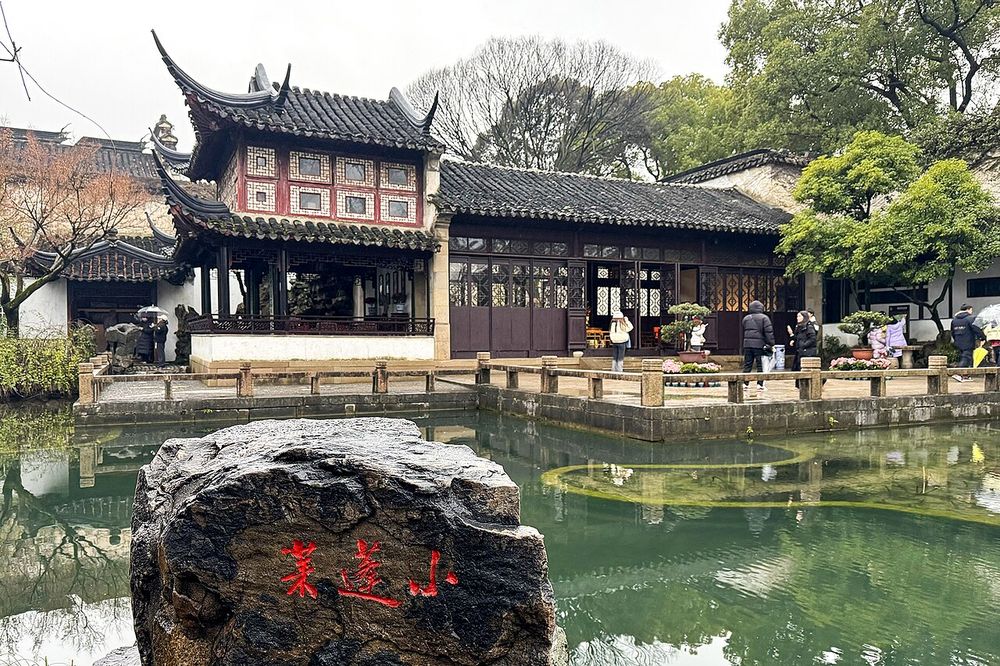
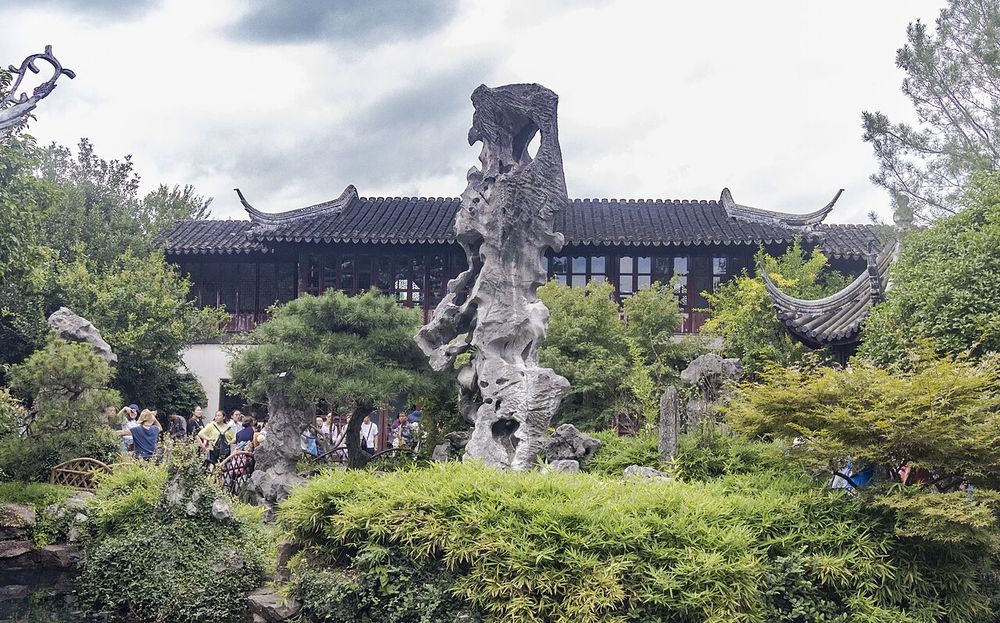
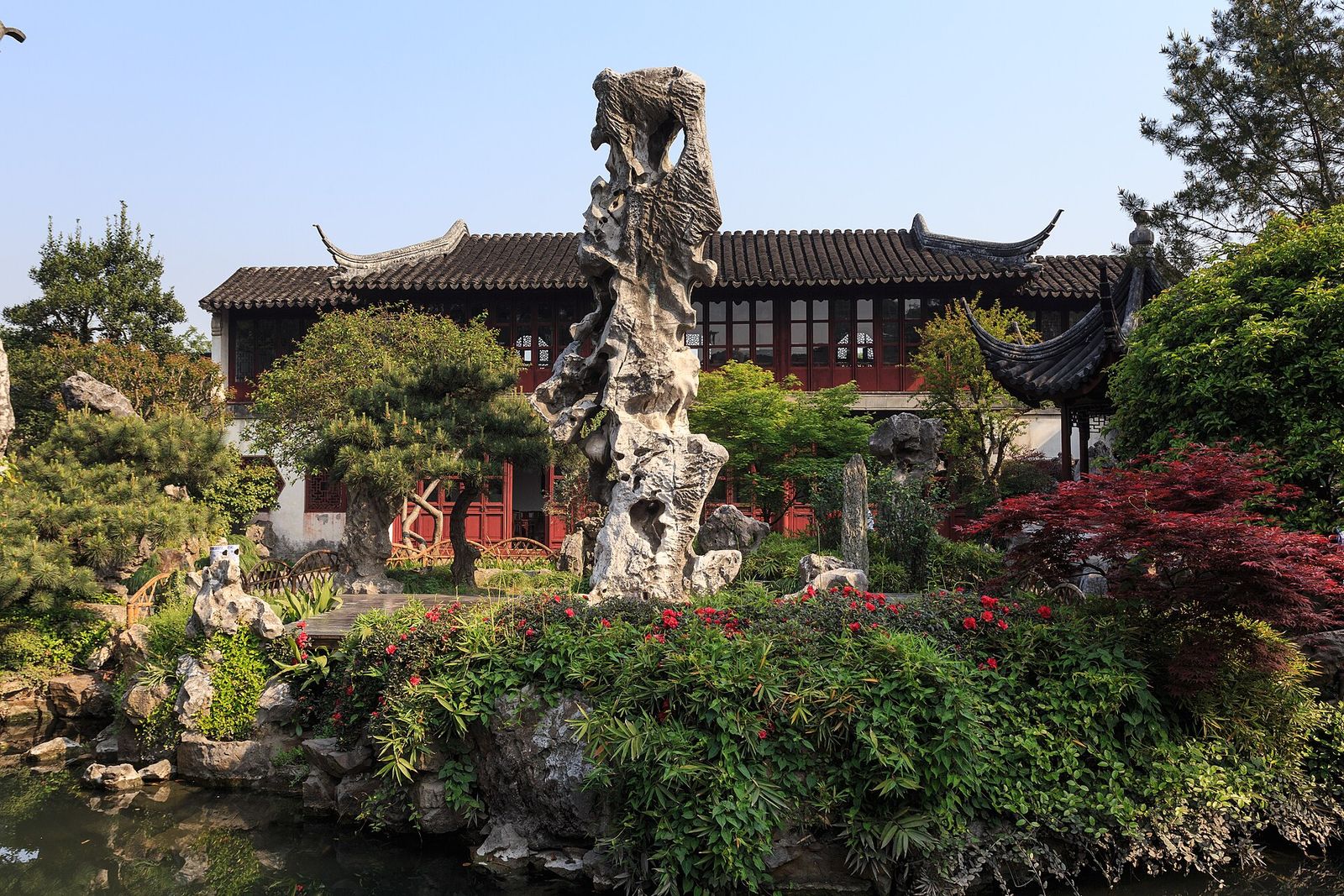
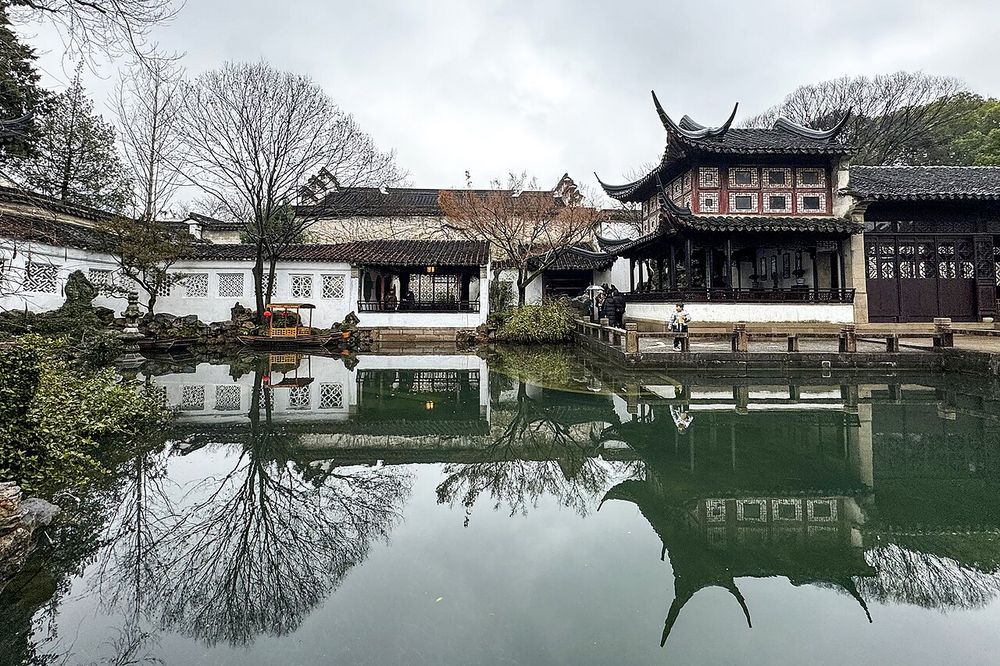
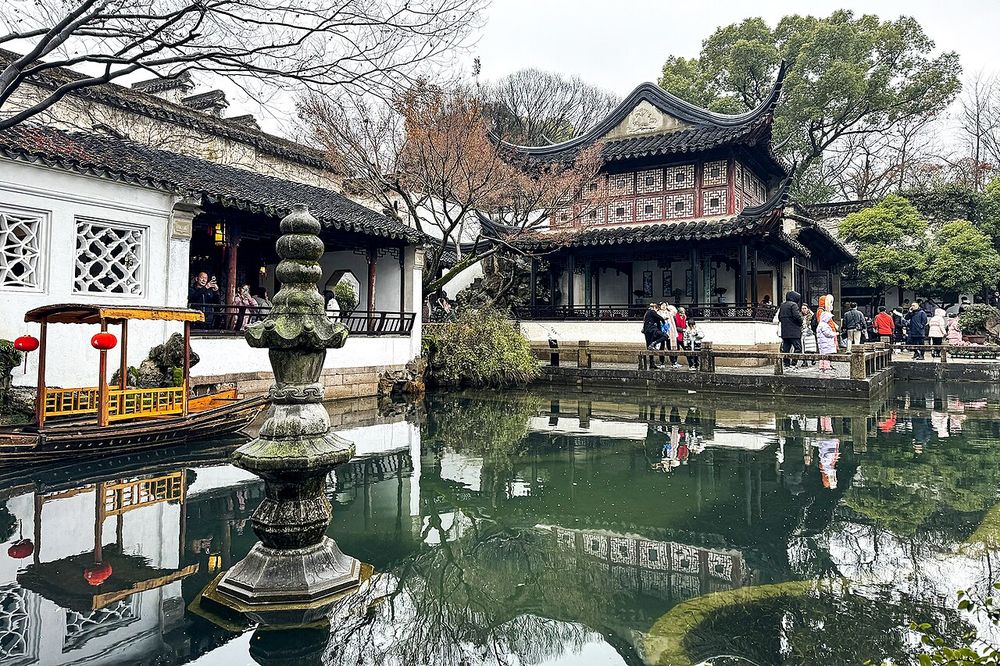
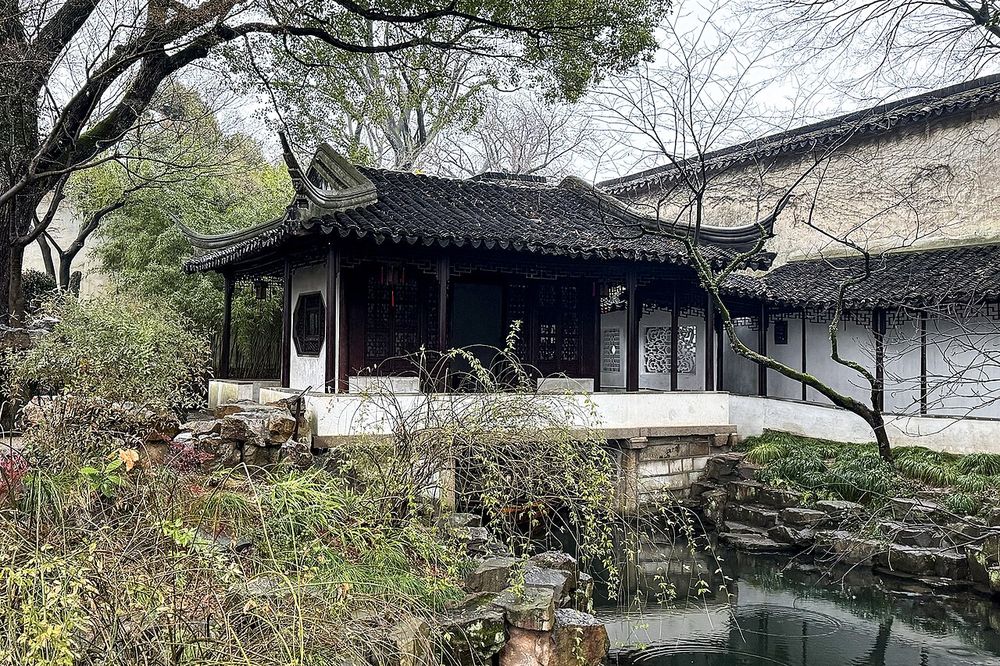
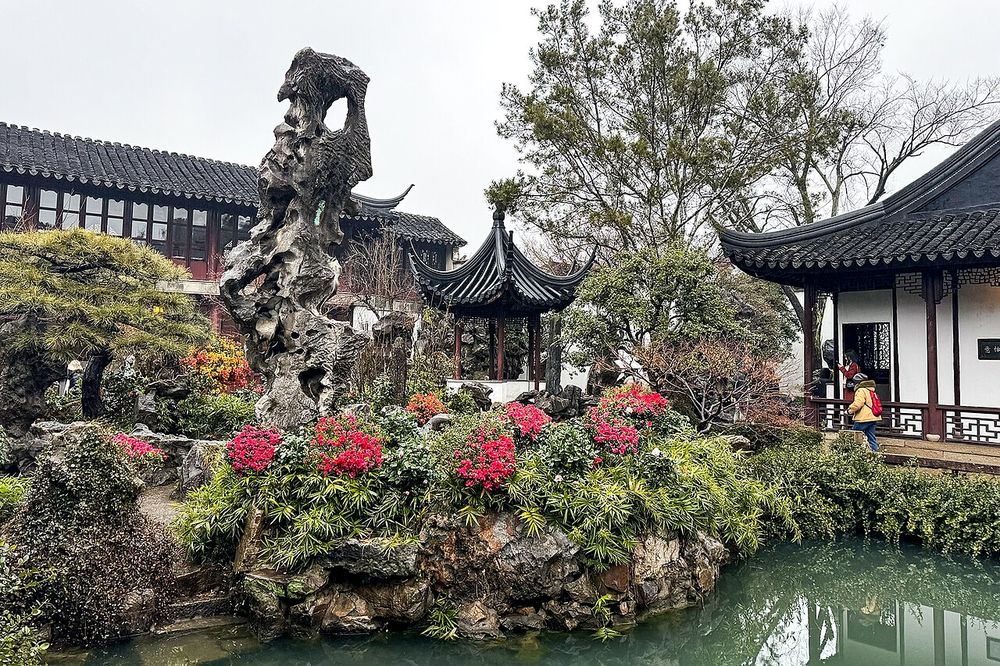
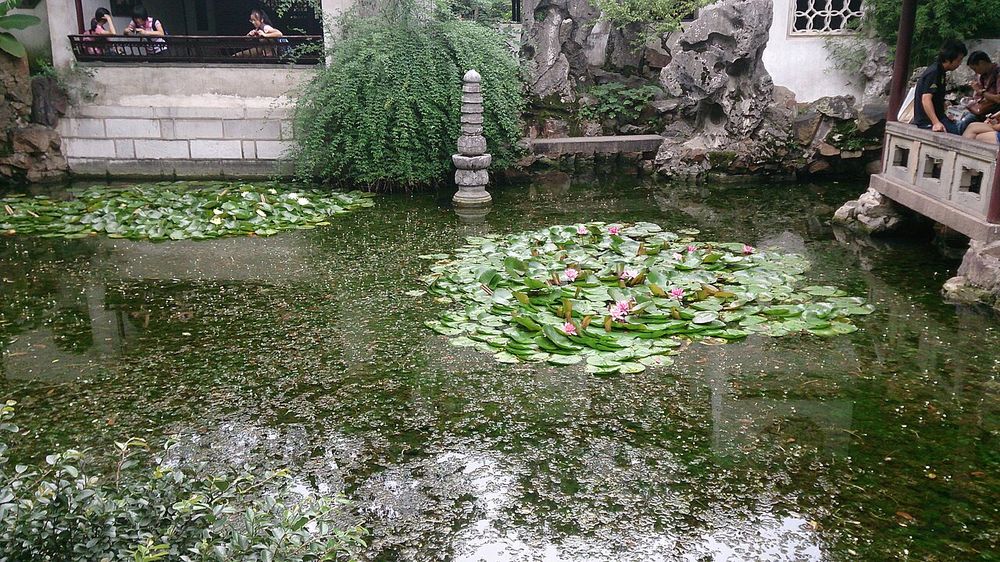
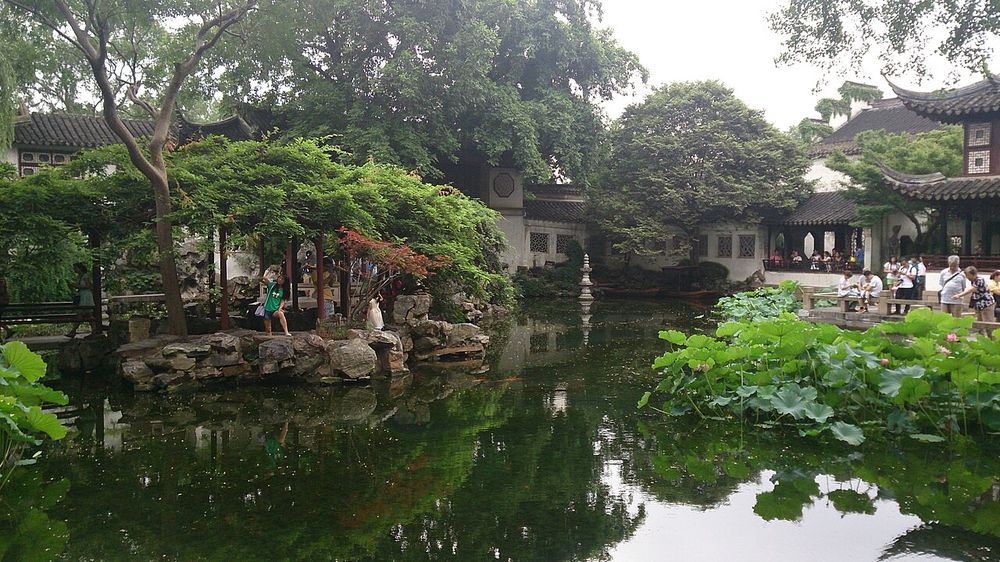
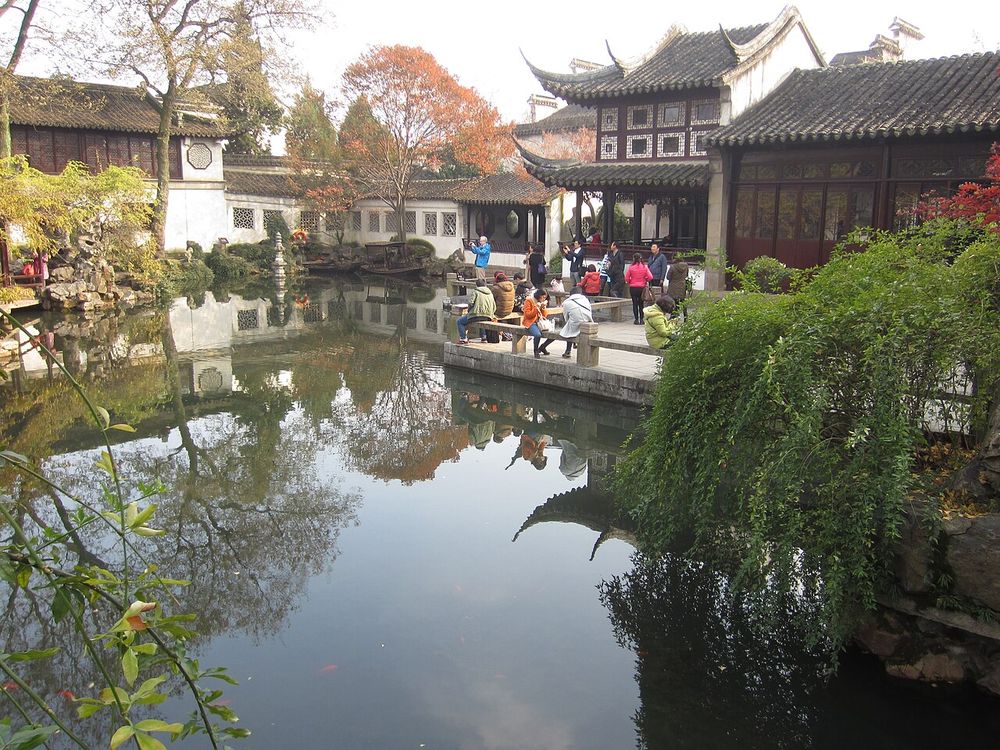
A garden of rooms and courtyards joined by seven hundred metres of corridor, begun in 1593 outside the city's west gate. At its heart stands the Cloud-Capped Peak, a single lake rock six and a half metres tall. Its owners changed, and its name kept the same sound: Liu.
Photo: Zhangzhugang, CC BY-SA 4.0, Wikimedia Commons
The story
In 1593, in the reign of the Wanli emperor of the Ming dynasty (1368–1644), the official Xu Taishi was dismissed and came home to Suzhou. Outside the Chang Gate he built himself the East Garden, with a rock wall made by the master Zhou Shichen and five great rocks brought from his father-in-law's house. His West Garden across the road later became a Buddhist temple, which is still there.
Two hundred years later Liu Shu, another official tired of office, rebuilt the ruin as Hanbi Villa, and people called it Liu's Garden. When Sheng Kang bought it in 1873 he kept the sound and changed the character: Liu, "to linger". The scholar Yu Yue called it the finest garden in the Wu country.
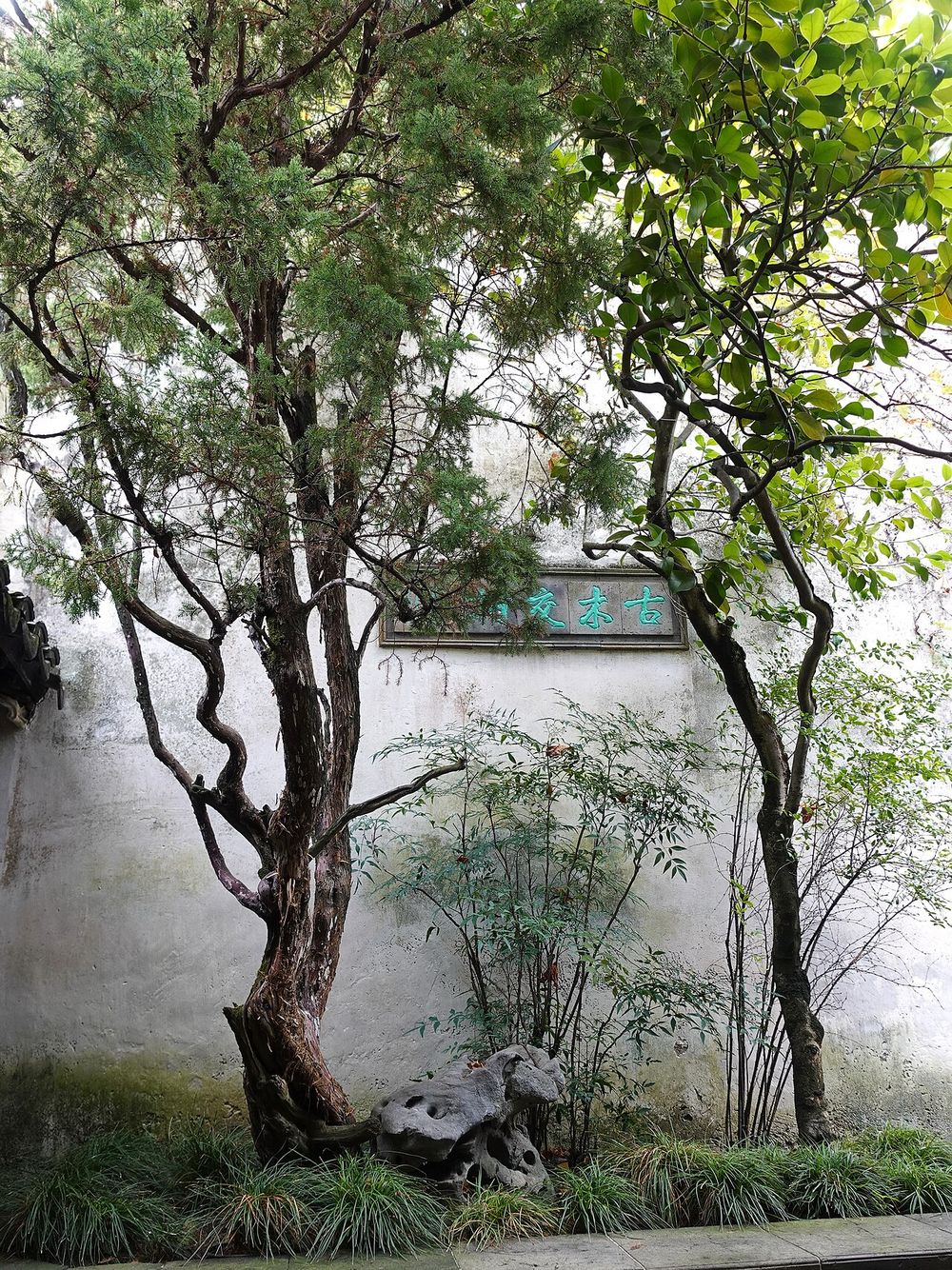
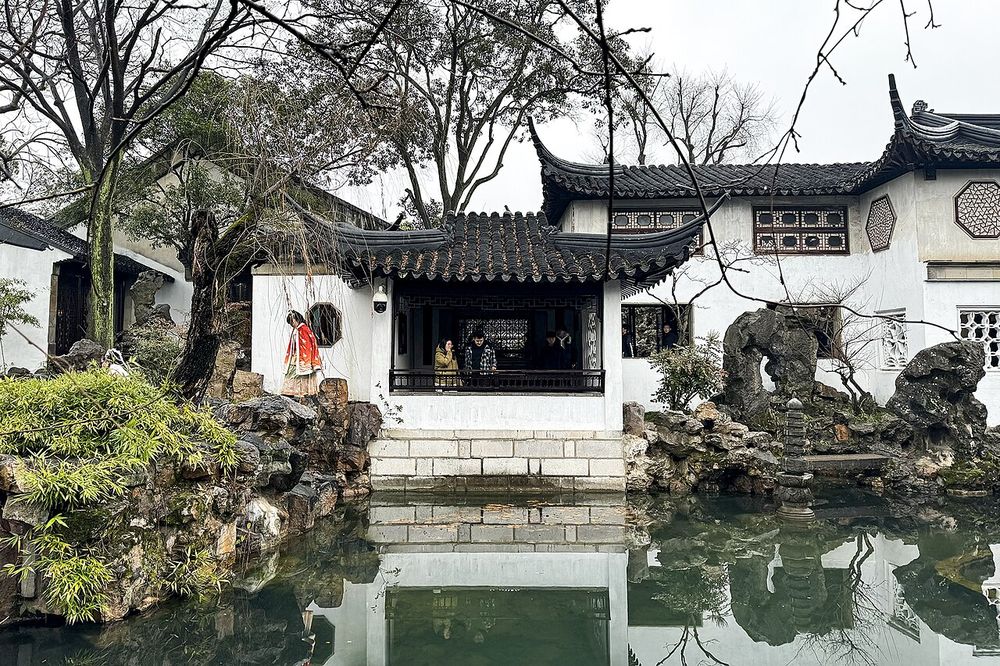
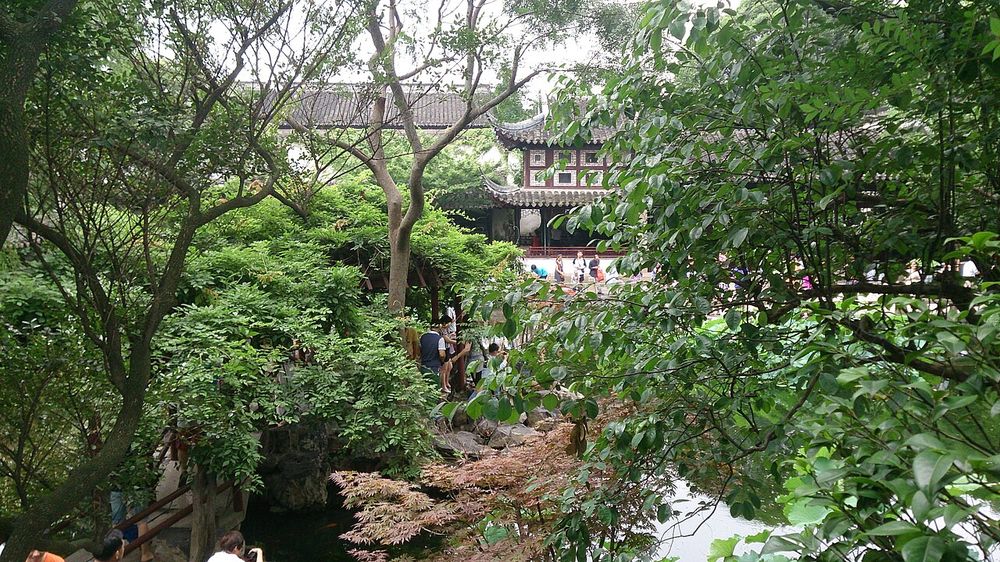
Old Trees with Interlocking Branches, 2022颐园居, CC BY-SA 4.0
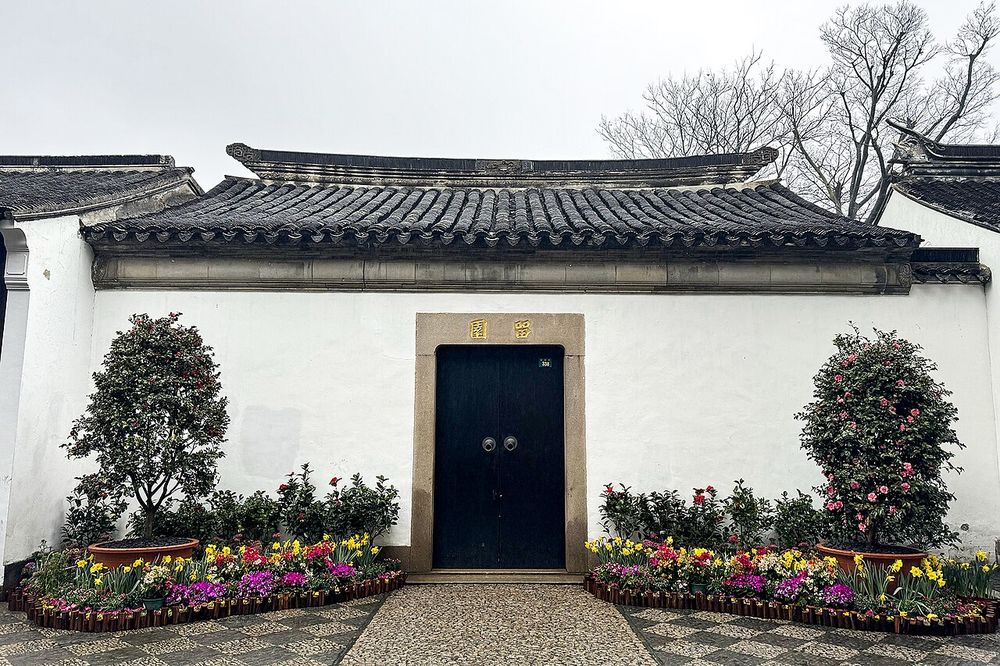
You came in through a long, narrow passage between high walls, turning and dim, more than fifty metres of it. It is meant to make you small. At the end, a few windows show green, and then the garden opens: water, a hill, pavilions, light. Garden makers call this holding back first, then letting go.
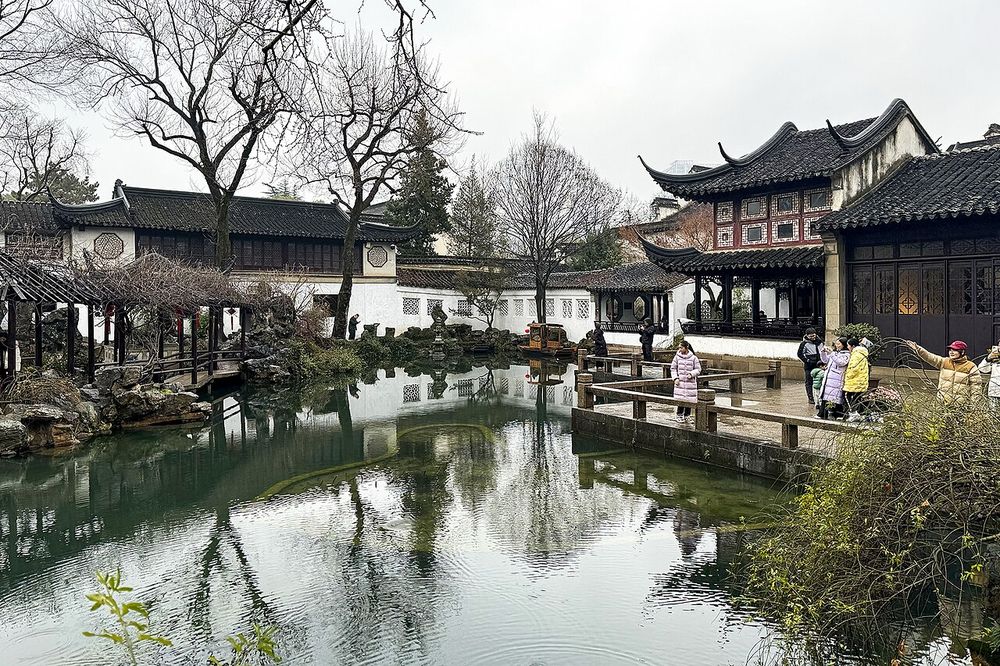
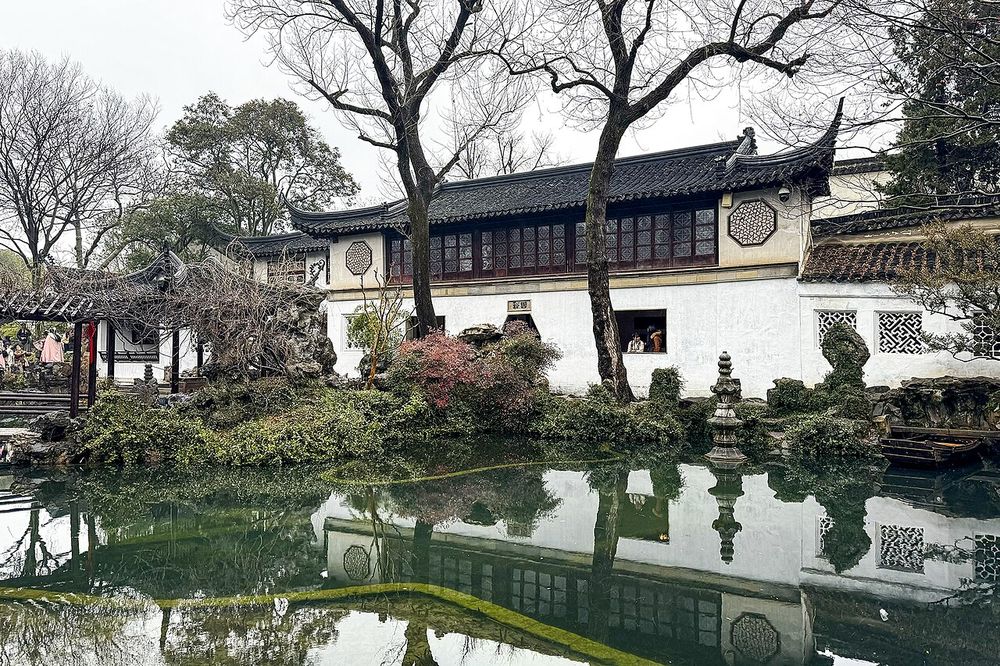
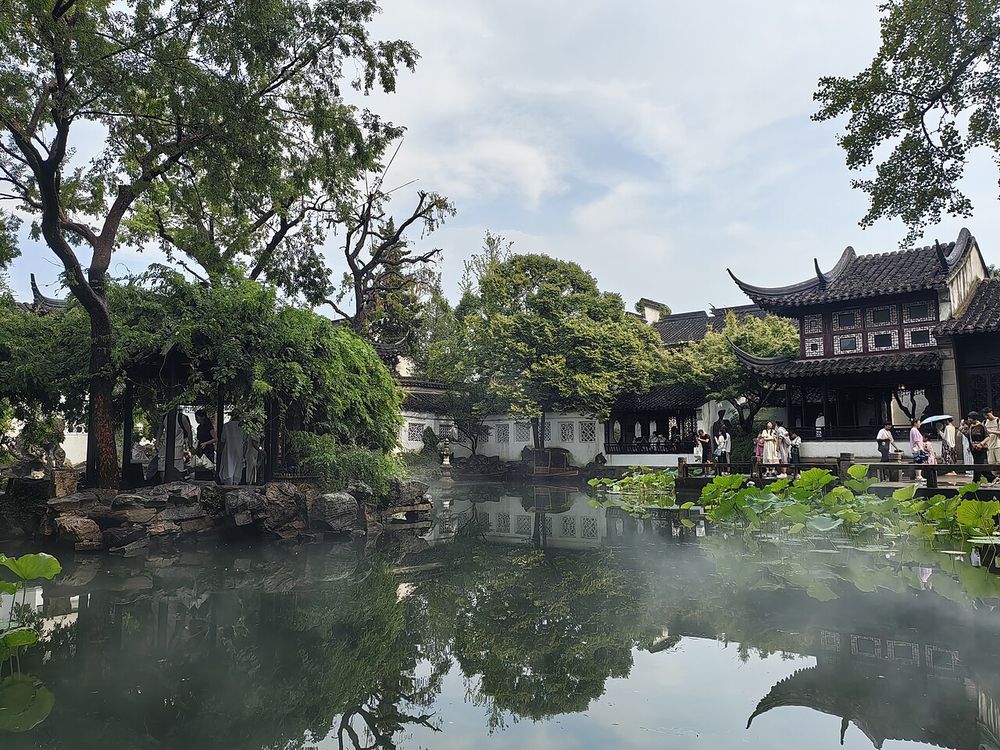
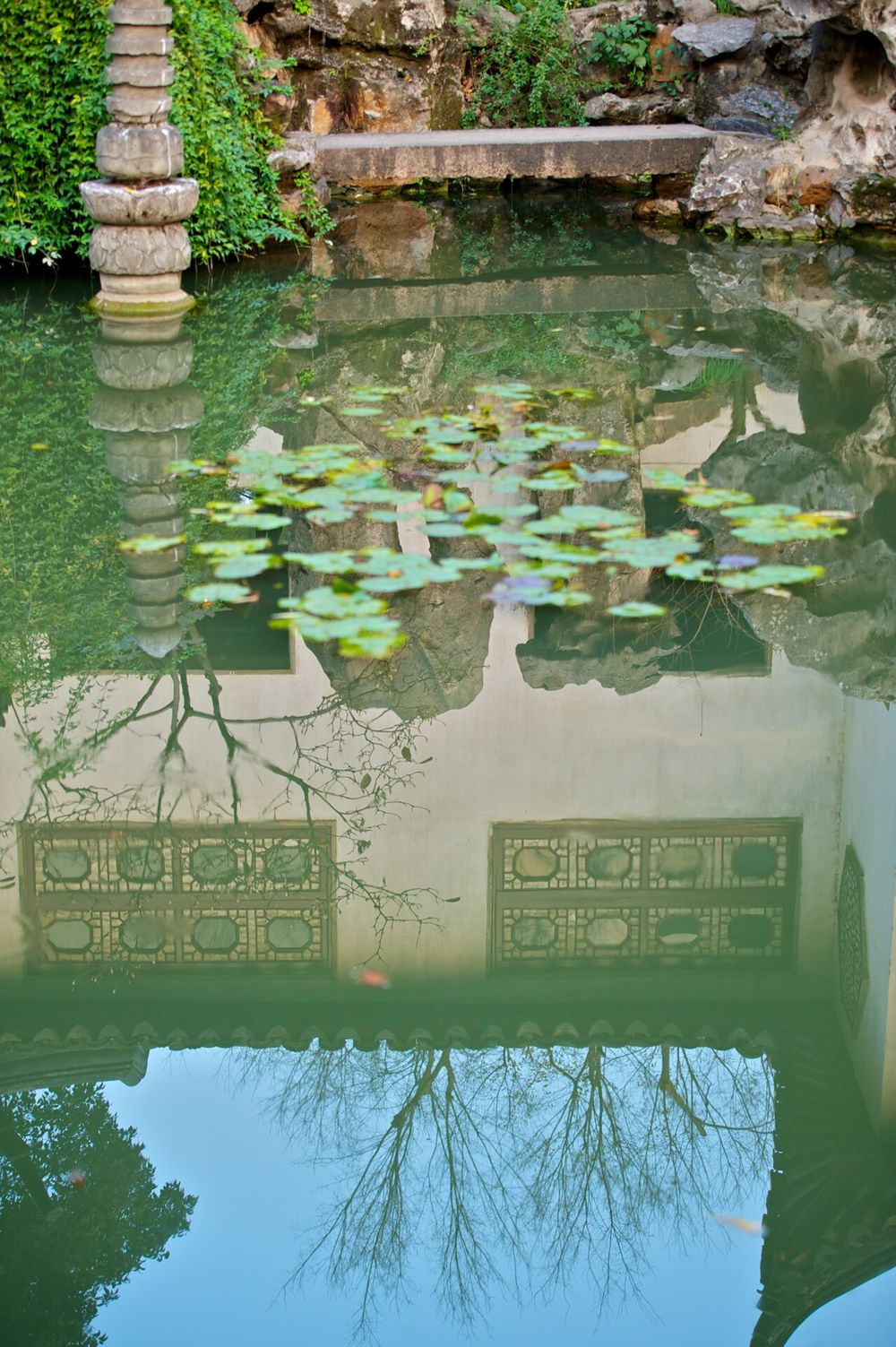
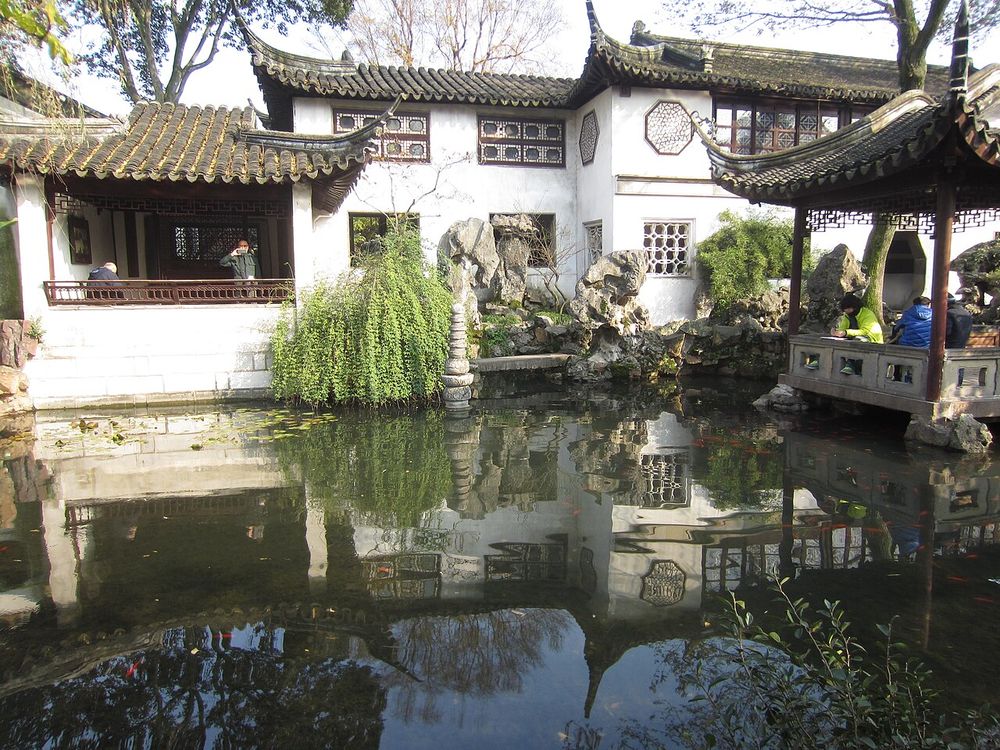
Reflections in the central pond, 2024Windmemories, CC BY-SA 4.0
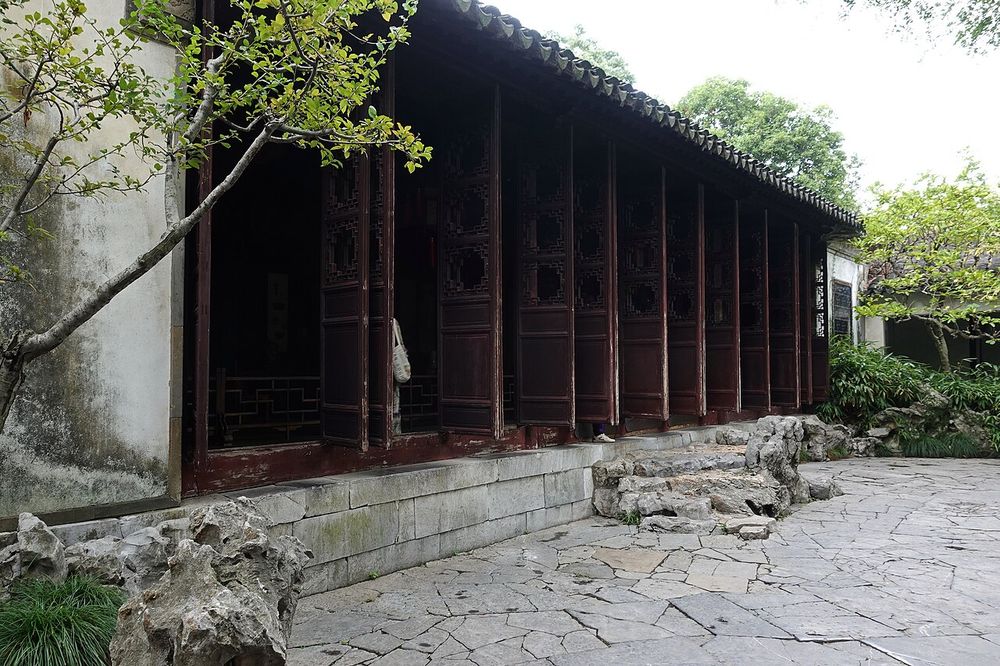
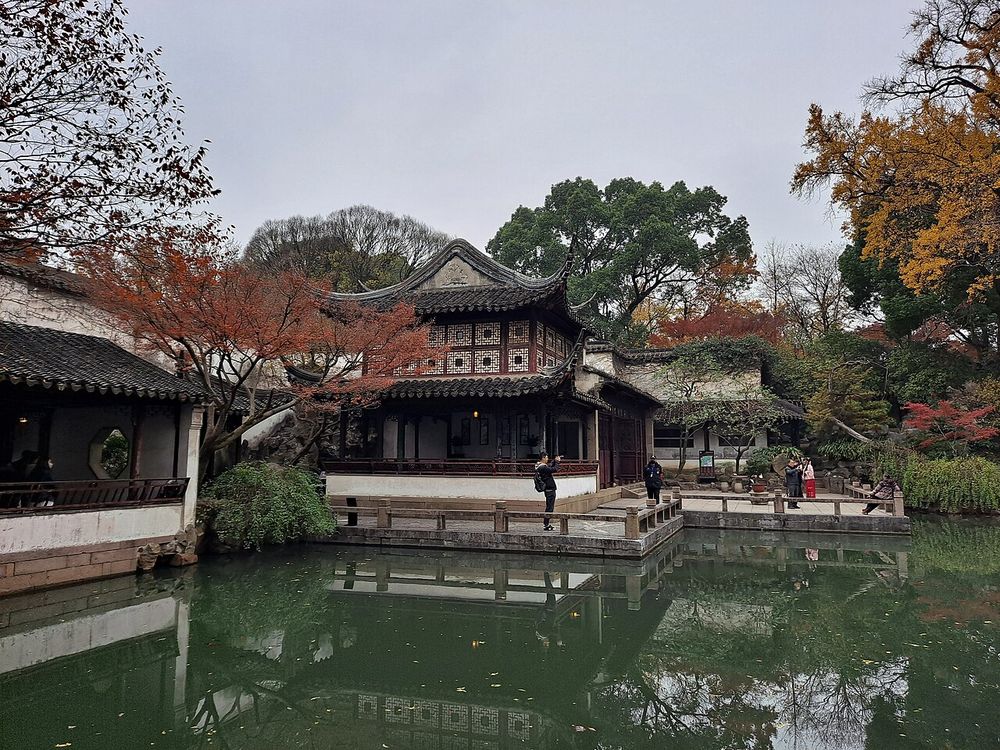
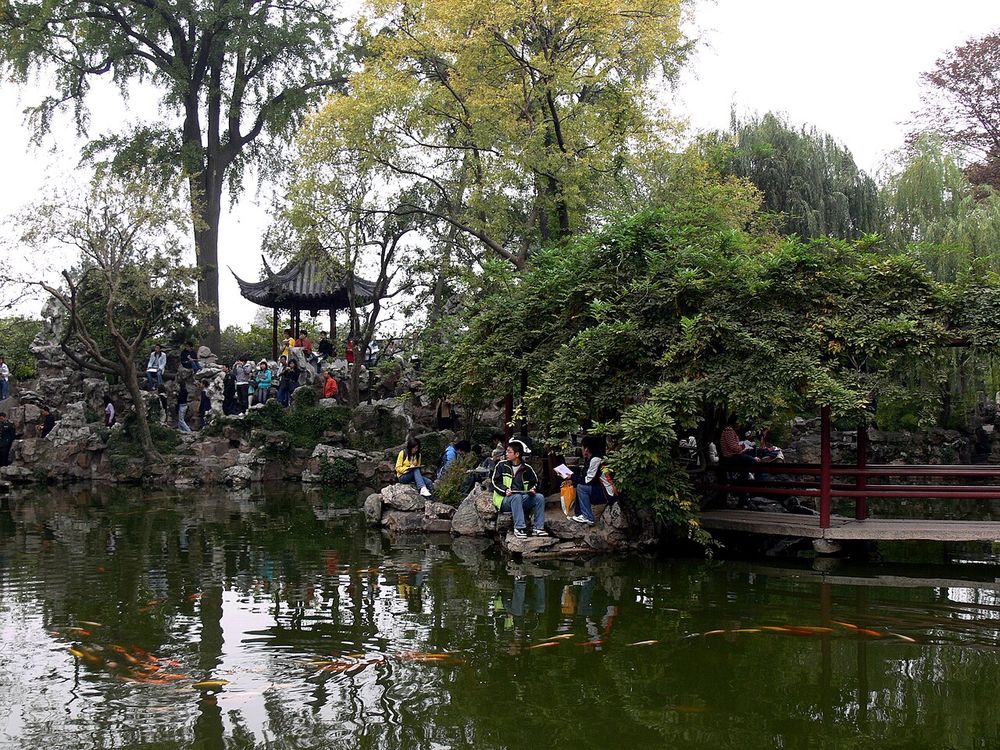
The garden has four parts. The central part, with its pond and hill, is the oldest. The east is a maze of halls and courtyards, the west a hill of maples, the north a little farm. Covered corridors, about seven hundred metres of them, join everything, so that you can walk the whole garden in the rain.
Set into the corridor walls are more than three hundred stone tablets carved with the calligraphy of famous hands, known as the Lingering Garden models. Stop at one and trace a character with your eyes.
Things people often get wrong
"Lingering Garden is a translation of an old name." The old name was Liu's Garden, after an owner. The new owner wanted his own name on it but kept the sound: liu, to stay.
"The Cloud-Capped Peak came from the Song (960–1279) emperor's rock collection." That is the story. It cannot be proved.
"It is a small garden." At about 2.3 hectares it is the second largest of the nine, after the Humble Administrator's Garden. It feels small because it is cut into so many rooms.
People who stood here
We searched Chinese sources first for this list, then English ones.
Xu Taishi (Ming official, builder of the East Garden)He had rebuilt a palace of the empress dowager in Beijing. Dismissed from office, he made the East Garden and gave his West Garden to the Buddhists.
Zhou Shichen (rock master, late Ming)He piled the rock screen behind Xu's hall, some three zhang high and twenty wide, "like a landscape painting on a long scroll".
Liu Shu (Qing (1644–1912) official and collector of rocks)He rebuilt the garden in 1794–1798, collected twelve fine rocks and called himself "the man who whistles at twelve peaks". In 1823 the garden was opened to visitors.
Wang Xuehao (painter, 1754–1832)In 1802 he painted Liu Shu's twelve rocks one by one. The album is in the Shanghai Museum.
Sheng Kang (Qing official from Changzhou)He bought the ruin in 1873, finished rebuilding in 1876 and named it the Lingering Garden. His son Sheng Xuanhuai founded China's first modern bank and ran its telegraphs and railways.
Yu Yue (scholar, 1821–1907)He wrote the record of the garden for Sheng Kang. His own small garden, the Qu Yuan, is a short walk across the old city.
Go deeper: seven stops through four gardens
After the entrance corridor, go round the central pond clockwise, then east to the Cloud-Capped Peak, then west to the hill. Allow ninety minutes.
1. Old Trees with Interlocking Branches
Old Trees with Interlocking Branches, 2022颐园居, CC BY-SA 4.0
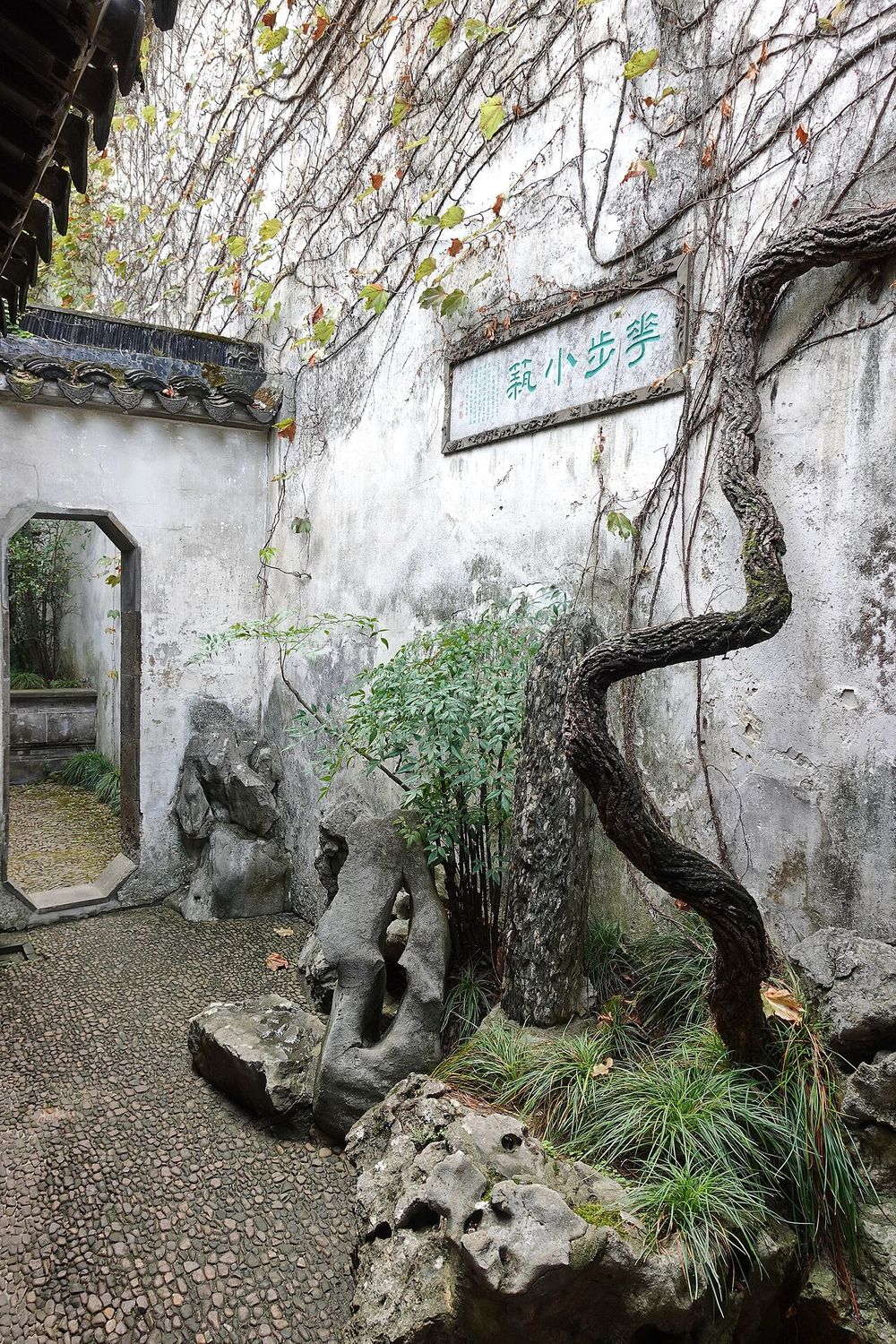
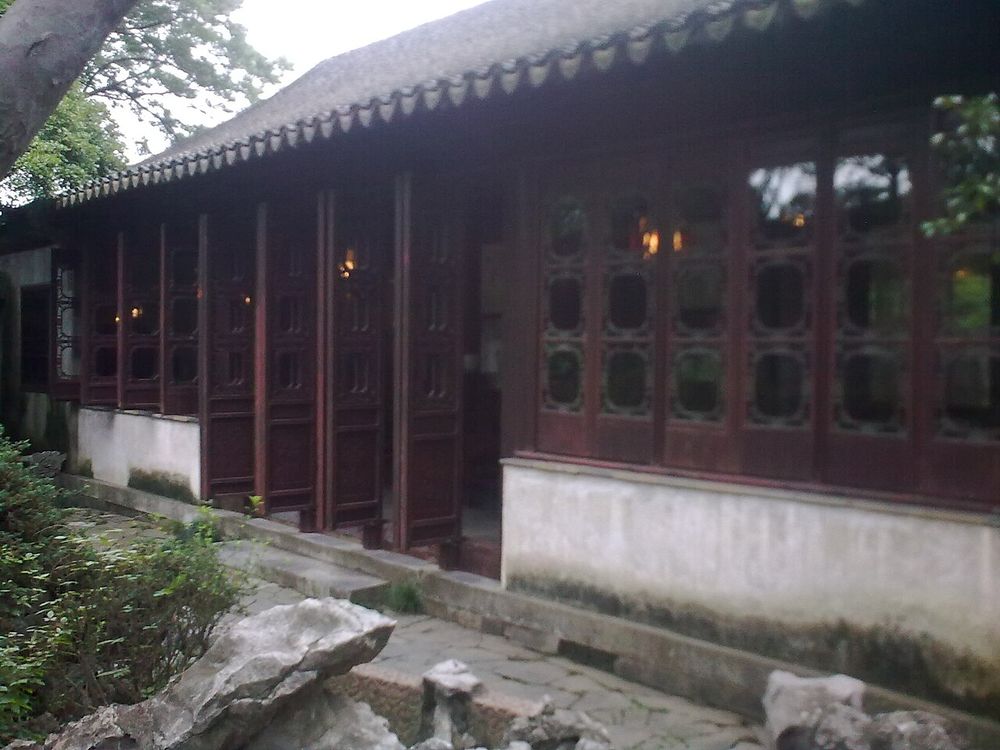
At the end of the entrance corridor is a tiny court with one old tree, a flower bed and a wall. Look through the windows to the left: each frames a different scrap of the garden beyond.
A small court by the entrance, 2022颐园居, CC BY-SA 4.0
2. The central pond and Little Penglai
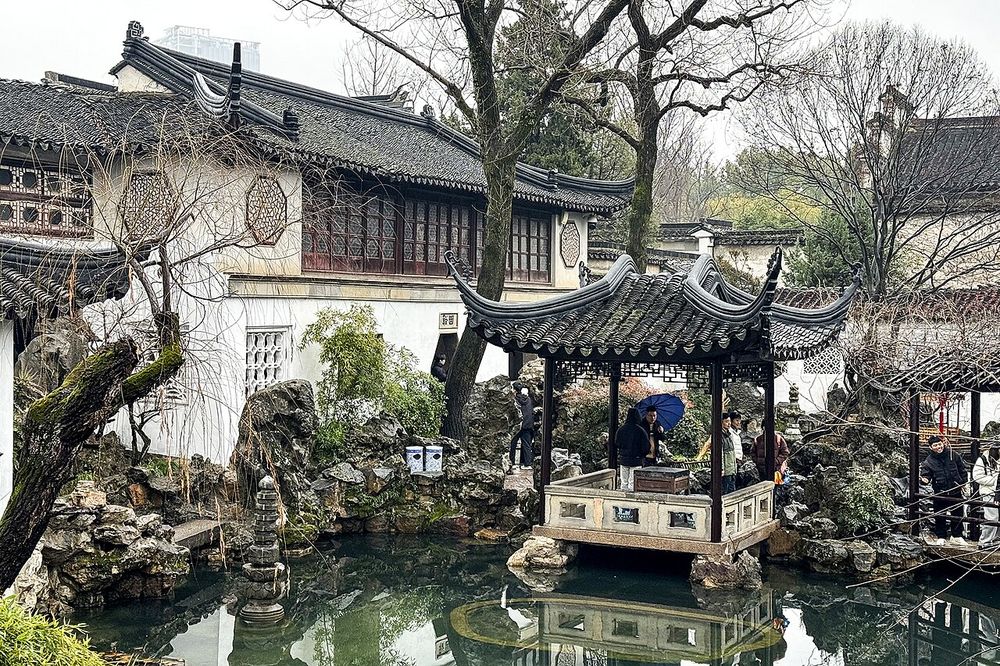
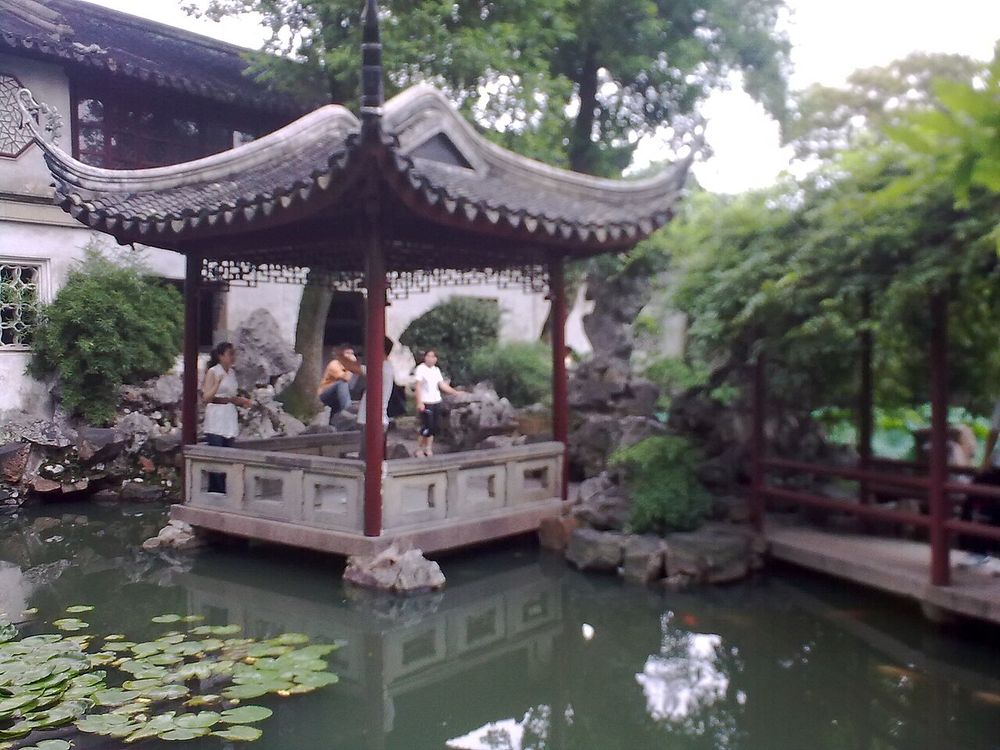
A pavilion on the rockery, 2024Windmemories, CC BY-SA 4.0
Round the pond stand the Hanbi Mountain House, named from a line of Zhu Xi about water holding the green, and the Pellucid Tower that looks like a moored boat. Opposite, a hill of yellow stone, the oldest work in the garden, climbs to a pavilion.
The island under bare wisteria, 2024Windmemories, CC BY-SA 4.0
In the pond lies Little Penglai, an island named after the islands of the immortals, crossed by a zigzag bridge under wisteria.
The Haopu PavilionLamassu Design Gurdjieff (talk), CC BY-SA 3.0
The Haopu Pavilion is named after the river where the philosopher Zhuangzi watched fish and said he knew they were happy. Watch the fish here. Are they happy?
3. The Celestial Hall of Five Peaks
The Celestial Hall of Five Peaks, 2022颐园居, CC BY-SA 4.0
The largest hall in any Suzhou garden, built of nanmu wood. Its name comes from a line of Li Bai about the five old peaks of Mount Lu. In front, a rockery stands for those mountains.
The hall is divided front and back, for receiving guests and for the family. The furniture is set as it was, in strict pairs.
4. The Small Court of the Stone Forest
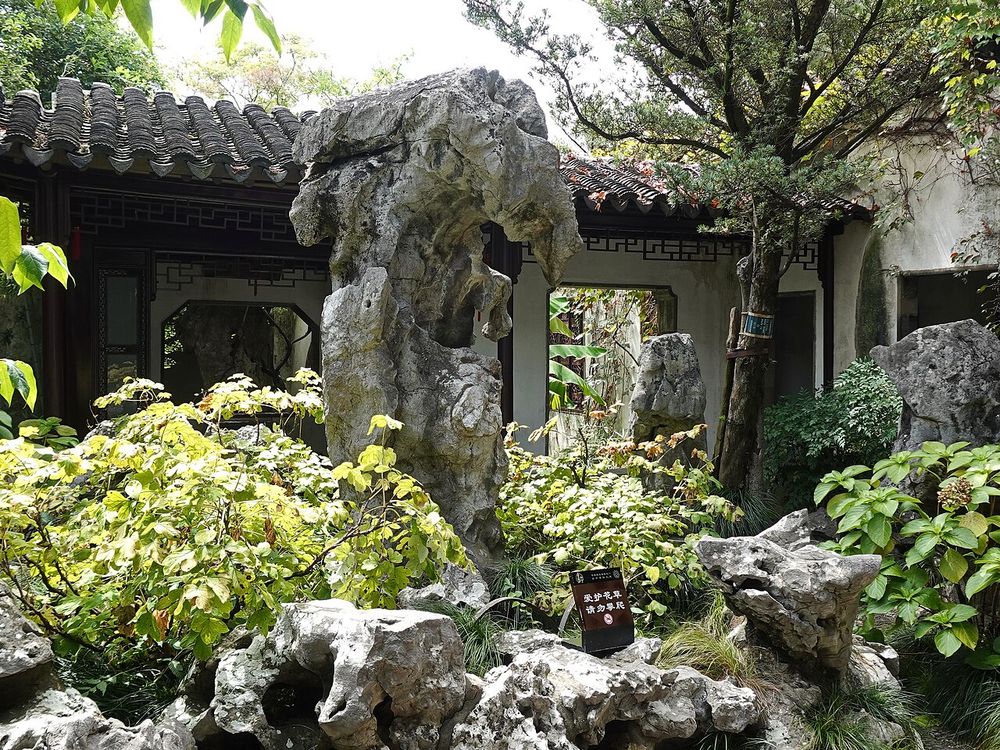
The Small Court of the Stone Forest, 2022颐园居, CC BY-SA 4.0
Behind the hall is a nest of tiny courtyards, each holding one or two rocks and a plant, seen through windows from the rooms around. This was the study, where the owner sat with his stones.
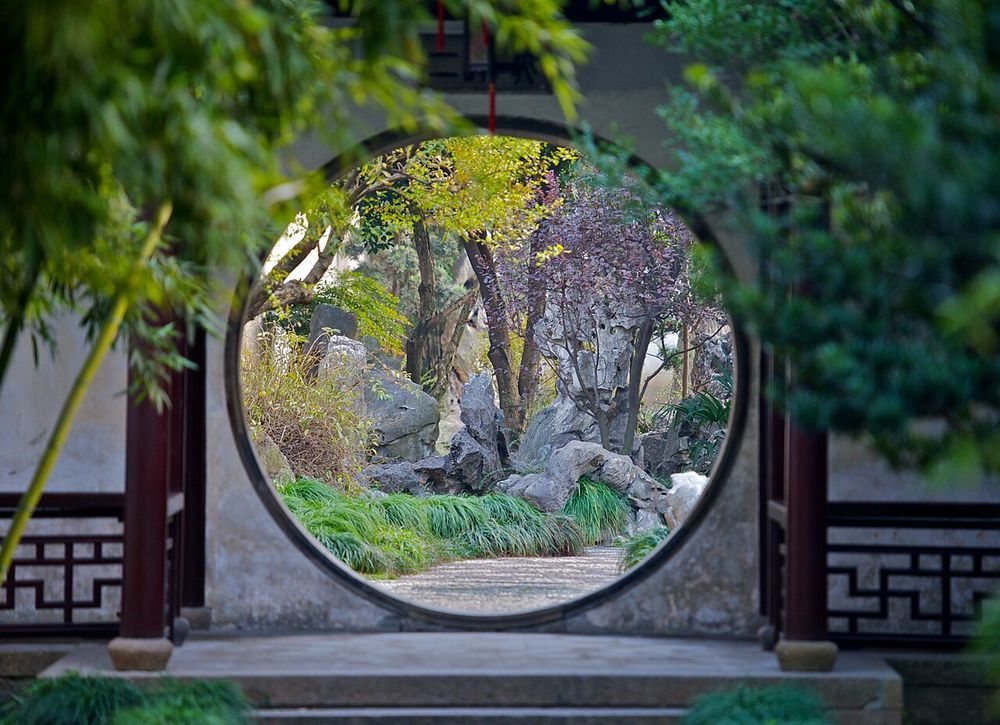
A moon gatekevinmcgill from Den Bosch, Netherlands, CC BY-SA 2.0
5. The Cloud-Capped Peak
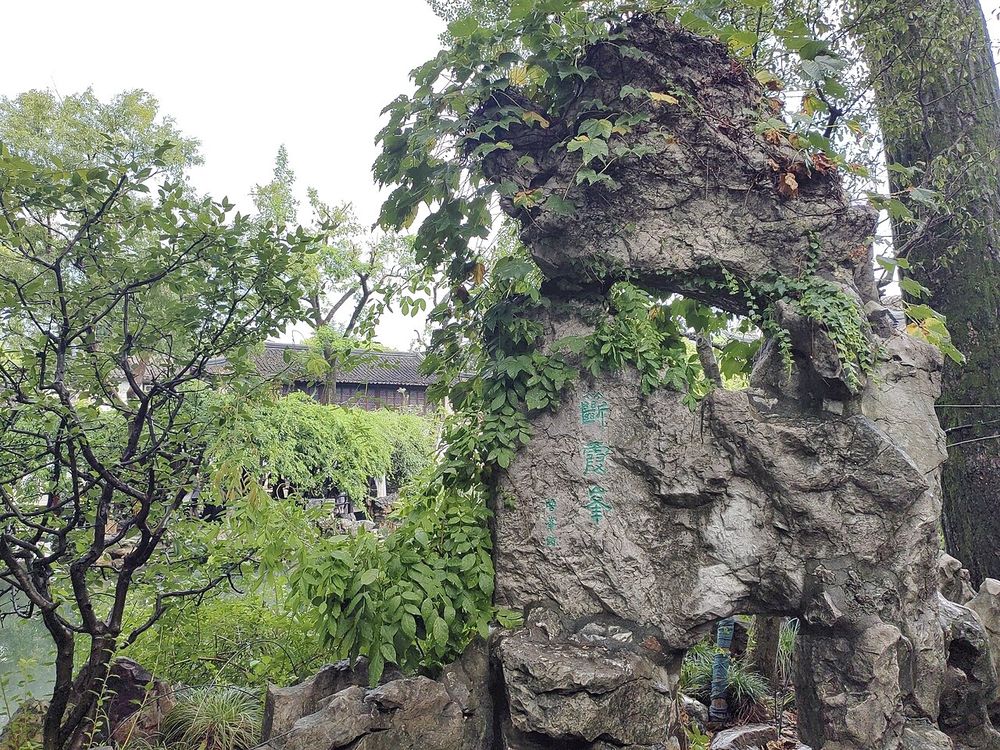
The peak in summer, 2019ScareCriterion12, CC BY-SA 4.0
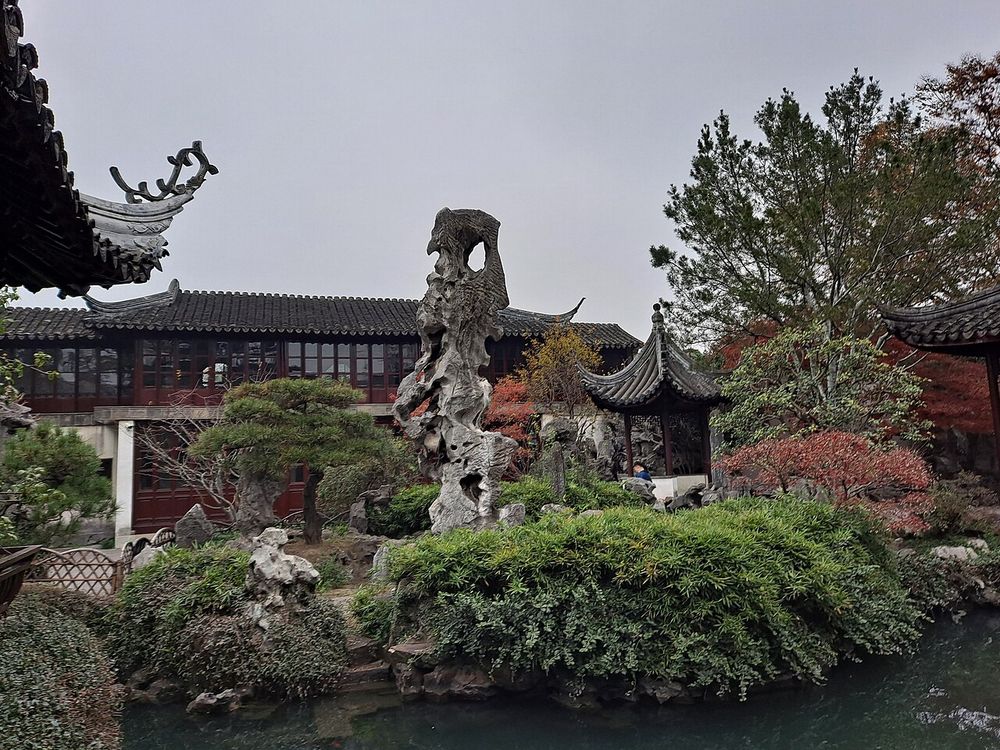
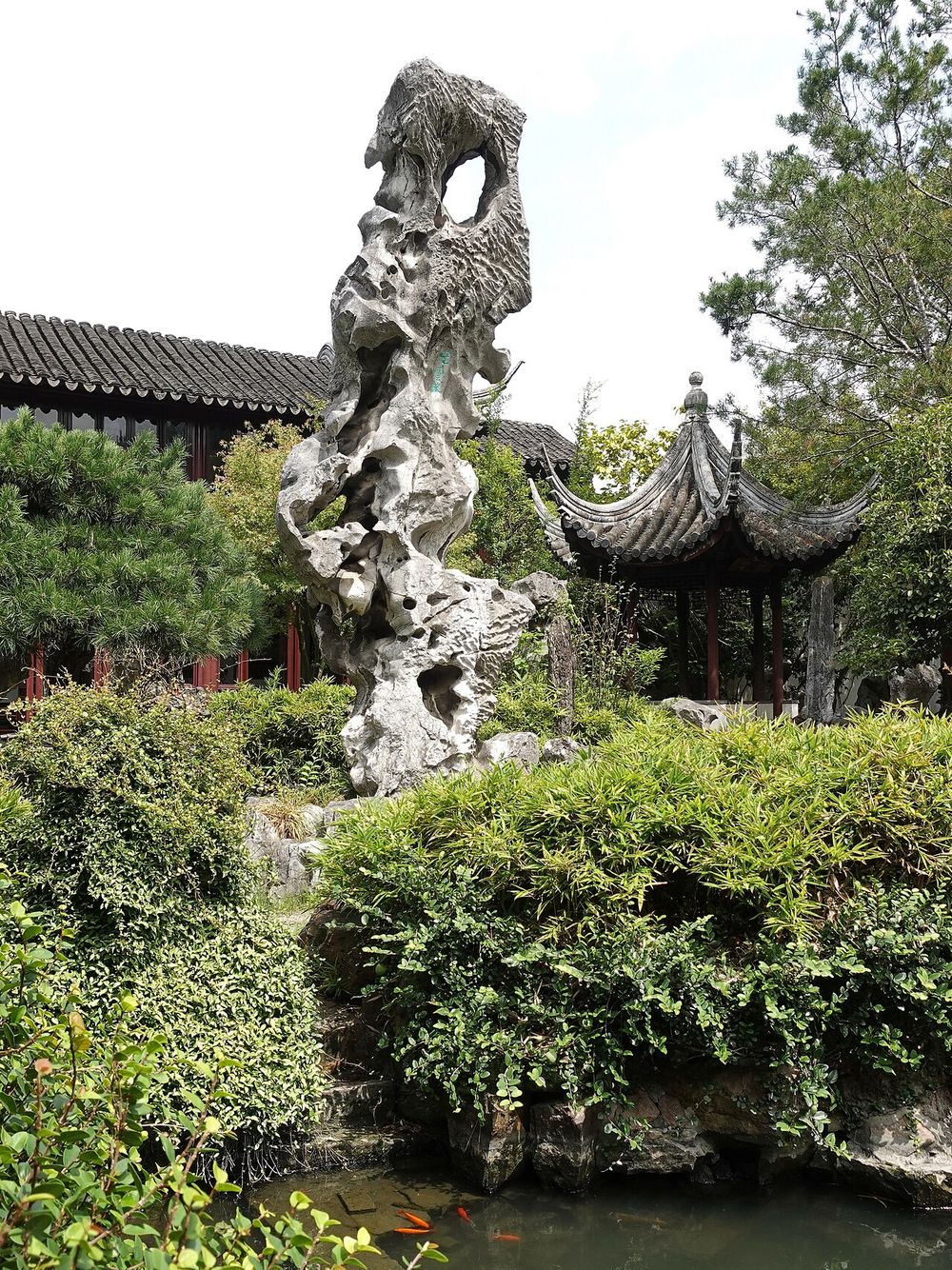
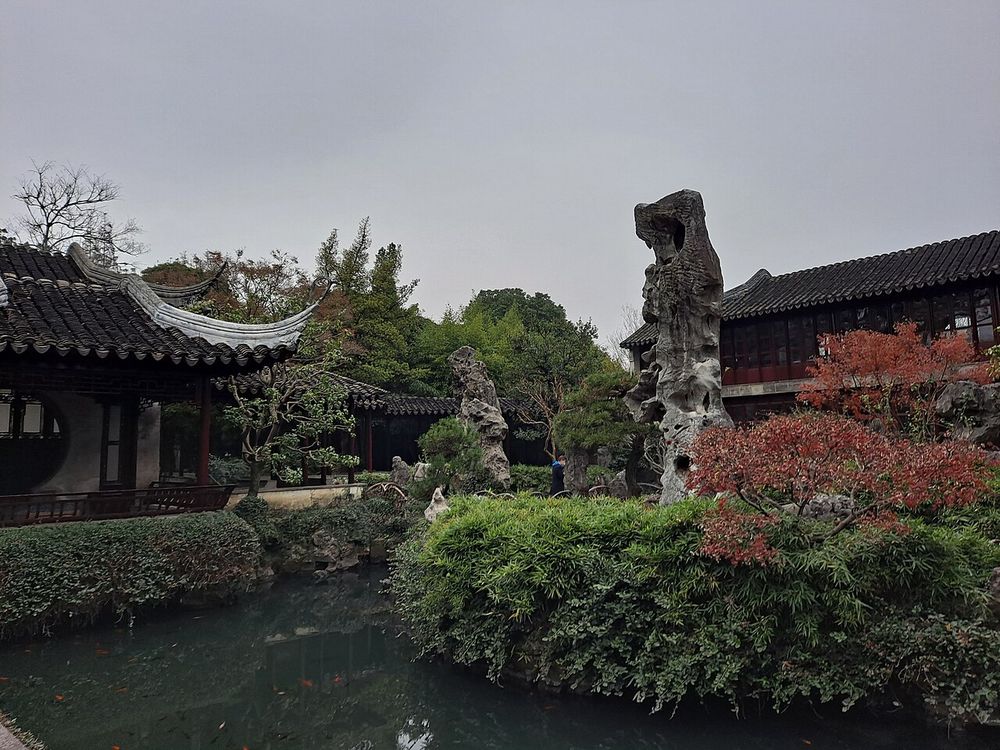
A single lake rock about 6.5 metres tall, with two smaller peaks beside it. It is often counted among the four famous rocks of Jiangnan, and is the tallest lake rock in the Suzhou gardens.
Old judges of rock asked four things: is it thin, wrinkled, full of holes, open so that light passes through? Find a hole that shows you the sky.
The peak and its pond钉钉, CC BY-SA 4.0
The small pond in front is there to catch its reflection. A hall, a tower and a pavilion were built round it only to look at this stone.
6. The west hill and the Lively Place
Autumn colours, 2020钉钉, CC BY-SA 4.0
The west is wild on purpose: an earth hill covered in maples, red in November, with a stream running below to a waterside room called the Lively Place.
The north part is a small farm of bamboo, grapes and peach trees, and a garden of penjing.
7. Music in the garden: Dongshan Sizhu
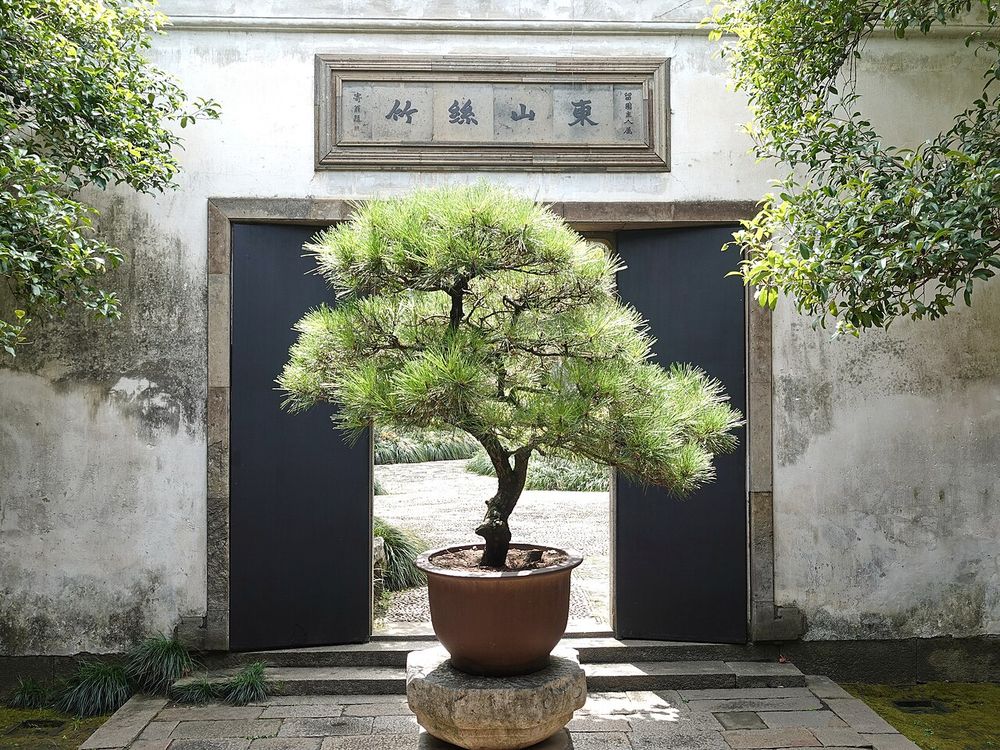
The gate of Dongshan Sizhu and a penjing pine, 2022颐园居, CC BY-SA 4.0
The board over a gate in the east reads "silk and bamboo of the eastern mountain", that is, music. In some rooms of the garden you can hear Suzhou pingtan storytelling or Jiangnan silk-and-bamboo music played for visitors.
The Lingering Garden was also a set for the 1987 television Dream of the Red Chamber.
Why it survived
In the war of 1860 the garden was laid waste. In the war years of the 1930s and 40s soldiers were quartered here and horses kept in the halls, and by 1949 it was a ruin again. It was repaired and reopened in 1954.
Xu Taishi built in 1593; that year London's theatres were closed by plague, and Shakespeare published his first poem.
Meanwhile in the world
Year
Here
Elsewhere
1593
Xu Taishi builds the East Garden
Shakespeare publishes Venus and Adonis
1779
The Ruiyun rock is moved to the imperial lodge in Suzhou
Captain Cook is killed in Hawaii
1798
Liu Shu finishes Hanbi Villa
Napoleon lands in Egypt
1823
The garden opens to visitors
The Monroe Doctrine
1876
Sheng Kang finishes the Lingering Garden
Bell patents the telephone
1954
Restored and reopened
Geneva Conference
1997
World Heritage
Hong Kong returns to China
One line to remember: hold back first, then let go.
Then and now
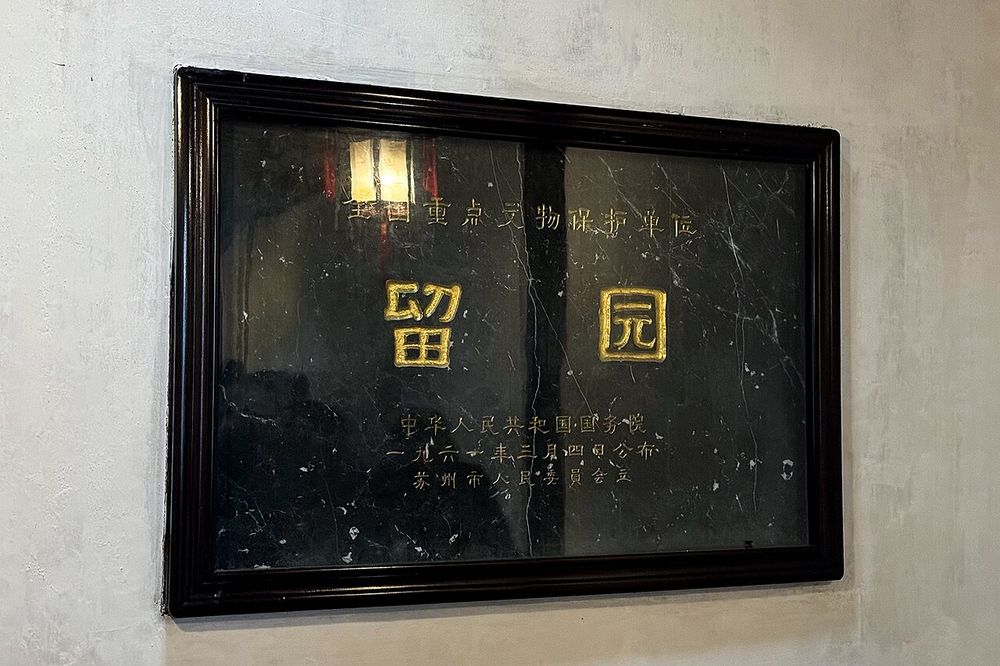
The Cloud-Capped Peak in spring, 2015Zhangzhugang, CC BY-SA 4.0, Wikimedia CommonsThe Cloud-Capped Peak close up, 2022颐园居, CC BY-SA 4.0, Wikimedia CommonsThe peak and its pond钉钉, CC BY-SA 4.0, Wikimedia CommonsThe peak in summer, 2019ScareCriterion12, CC BY-SA 4.0, Wikimedia CommonsThe peak and the tower behind, 2020钉钉, CC BY-SA 4.0, Wikimedia CommonsThe name board at the gateWindmemories, CC BY-SA 4.0, Wikimedia CommonsOld Trees with Interlocking Branches, 2022颐园居, CC BY-SA 4.0, Wikimedia CommonsA small court by the entrance, 2022颐园居, CC BY-SA 4.0, Wikimedia CommonsThe central pond in winter, 2024Windmemories, CC BY-SA 4.0, Wikimedia CommonsHalls round the pond, 2024Windmemories, CC BY-SA 4.0, Wikimedia CommonsReflections in the central pond, 2024Windmemories, CC BY-SA 4.0, Wikimedia CommonsA pavilion on the rockery, 2024Windmemories, CC BY-SA 4.0, Wikimedia CommonsRocks and halls, 2024Windmemories, CC BY-SA 4.0, Wikimedia CommonsThe pond from the north, 2024Windmemories, CC BY-SA 4.0, Wikimedia CommonsLittle Penglai and the zigzag bridge, 2024Windmemories, CC BY-SA 4.0, Wikimedia CommonsThe island under bare wisteria, 2024Windmemories, CC BY-SA 4.0, Wikimedia CommonsA waterside hall, 2024Windmemories, CC BY-SA 4.0, Wikimedia CommonsA peak among flowers, 2024Windmemories, CC BY-SA 4.0, Wikimedia CommonsThe central pond in summer, 2024Yumeto, CC BY-SA 4.0, Wikimedia CommonsA tall rock, 2024Yumeto, CC BY-SA 4.0, Wikimedia CommonsThe Hanbi Mountain House and lotusLamassu Design Gurdjieff (talk), CC BY-SA 3.0, Wikimedia CommonsGreen Shade PavilionLamassu Design Gurdjieff (talk), CC BY-SA 3.0, Wikimedia CommonsThe Haopu PavilionLamassu Design Gurdjieff (talk), CC BY-SA 3.0, Wikimedia CommonsThe Ke Pavilion on the hillGisling 14:03, 30 November 2007 (UTC), CC BY-SA 4.0, Wikimedia CommonsThe Celestial Hall of Five Peaks, 2022颐园居, CC BY-SA 4.0, Wikimedia CommonsOutside the Celestial Hall of Five PeaksLamassu Design Gurdjieff (talk), CC BY-SA 3.0, Wikimedia CommonsThe Small Court of the Stone Forest, 2022颐园居, CC BY-SA 4.0, Wikimedia CommonsA moon gatekevinmcgill from Den Bosch, Netherlands, CC BY-SA 2.0, Wikimedia CommonsA doorwaykevinmcgill from Den Bosch, Netherlands, CC BY-SA 2.0, Wikimedia CommonsThe gate of Dongshan Sizhu and a penjing pine, 2022颐园居, CC BY-SA 4.0, Wikimedia CommonsWater lilieskevinmcgill from Den Bosch, Netherlands, CC BY-SA 2.0, Wikimedia CommonsWater lilies and a lanternstone wu, CC BY-SA 3.0, Wikimedia CommonsThe pond in greenstone wu, CC BY-SA 3.0, Wikimedia CommonsTrees over the waterstone wu, CC BY-SA 3.0, Wikimedia CommonsAutumn colours, 2020钉钉, CC BY-SA 4.0, Wikimedia CommonsCorridor and windows, 2015Another Believer, CC BY-SA 4.0, Wikimedia CommonsA courtyard, 2015Another Believer, CC BY-SA 4.0, Wikimedia Commons
Local legends
These are stories people tell about this place. They are legends, not history, and each one says where it comes from.
LegendThe rock from the emperor's convoy
The Song emperor Huizong had rare rocks carried from the south to his garden in Kaifeng in great convoys. Stones that never arrived, people say, were left along the way, and the Cloud-Capped Peak is one of them.
Source: Told of many great rocks in Jiangnan; there is no record for this one
LegendThe emperor took the best rock
Xu Taishi's finest rock, the Ruiyun Peak, was moved in 1779 to the lodge built for the Qianlong emperor's southern tour. It stands today in a school yard in Suzhou.
Source: Recorded; the move is history, the regret is the story
Later, people who live here will be able to add the stories they grew up with, and say which of these they have heard.
Not certain, and where accounts conflict
How long is the corridor?
The usual figure is about 700 metres. It depends on what is counted as corridor.
Who made the yellow-stone hill?
It is usually credited to Zhou Shichen, the master who worked for Xu Taishi. It has been repaired many times since.
Checked 2026-11-12 Suzhou Municipal Administration of Gardens. Tickets are sold through its WeChat account, 苏州园林旅游.
Tickets and hours
55 yuan in April, May and July to October; 45 yuan in January to March, June, November and December.
March to October 7:30–17:30, last entry 17:00. November to February 7:30–17:00, last entry 16:30.
Last checked 2026-11-12. Suzhou Municipal Administration of Gardens, published prices and opening hours; travel reports of 2026.
Booking without WeChat
International booking platform International travel sites such as Trip.com sell the same tickets with a passport, for a little more.
WeChat or Alipay Book a date and time through the "苏州园林旅游" (Suzhou Garden Tourism) WeChat account with your passport number, and show the passport at the gate.
Ticket window on site Do not count on buying at the gate on busy days.
Note Children, students and older visitors may have free or half-price entry; bring the passport.
Checked 2026-11-12
Where to start
The garden is at 338 Liuyuan Road, outside the old city to the west. Take a taxi, or walk from Shantang Street along the canal.
Combine it with the West Garden Temple opposite and with Tiger Hill to the north.
Before you go
Bring your passport itself.
Late October and November for the maples; spring for azaleas and wisteria.
Customs and manners
Do not touch the stone tablets in the corridor walls.
In rooms with music, keep quiet and do not use flash.
Opening hours are given in the local time of the place. Prices are in the local currency. The figure after ≈ is approximate, at exchange rates checked on 9 November 2026, in .
Look for these
In the entrance corridor, count the turns.
On the Cloud-Capped Peak, find a hole that shows the sky.
Find the island of the immortals.
In the Stone Forest court, find a window that frames one rock only.
In the corridor, find a carved character you can read.
I am here
Stand at the site, sign in, press the button, and collect its stamp. Your browser will ask to use your location. It is sent to us once to confirm that you are at the site; we keep how far you were from it, not the spot where you stood.
Your stamps are saved to your account, so they follow you to any device. Checking from a browser cannot rule out every false location; stricter checks arrive with the app.
Messages
Share your photos
Photos here show the place, not people. Each one is credited to the visitor who took it and appears after our team has looked at it. A photo with you in it belongs under “I am here”.