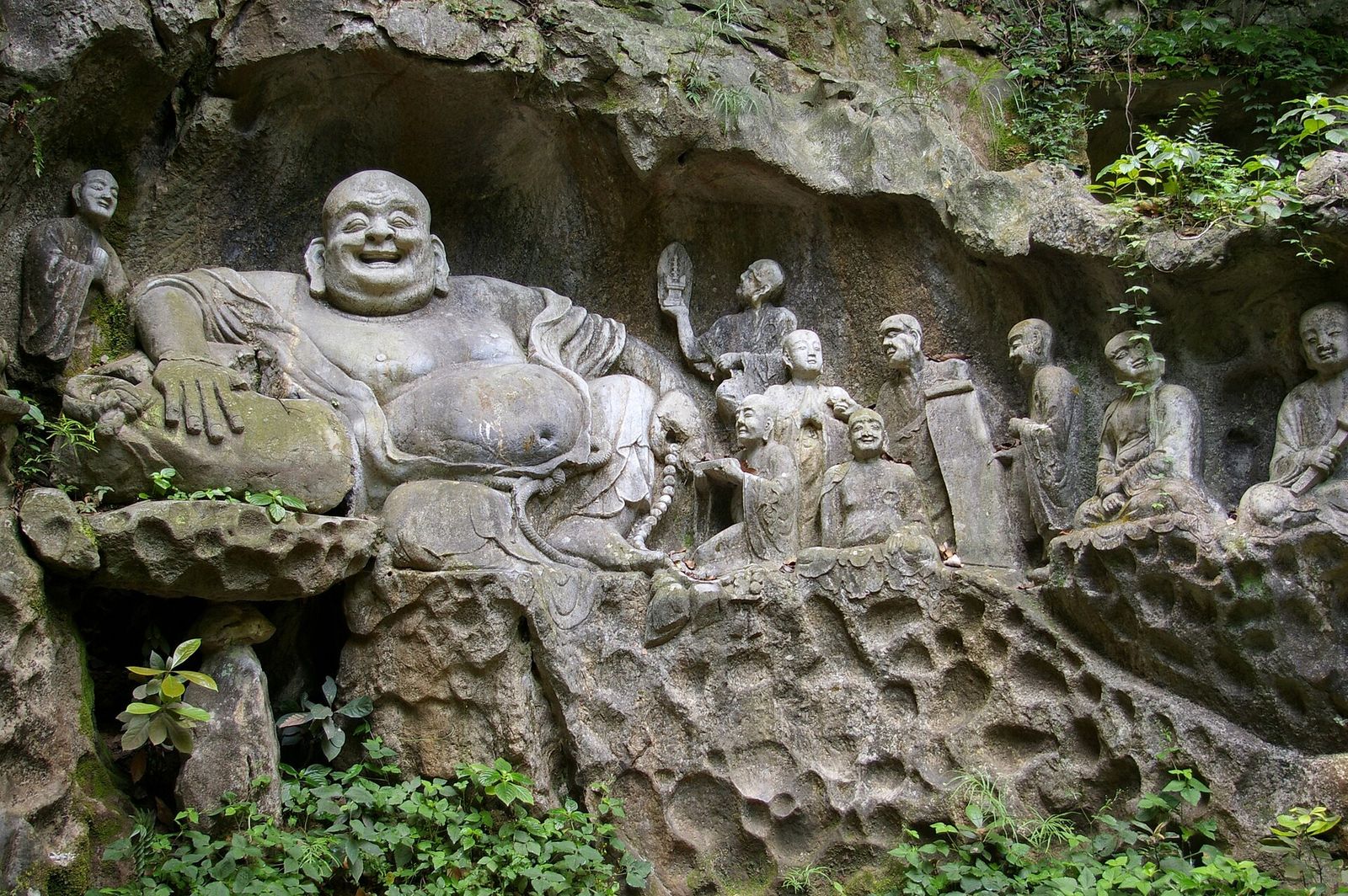
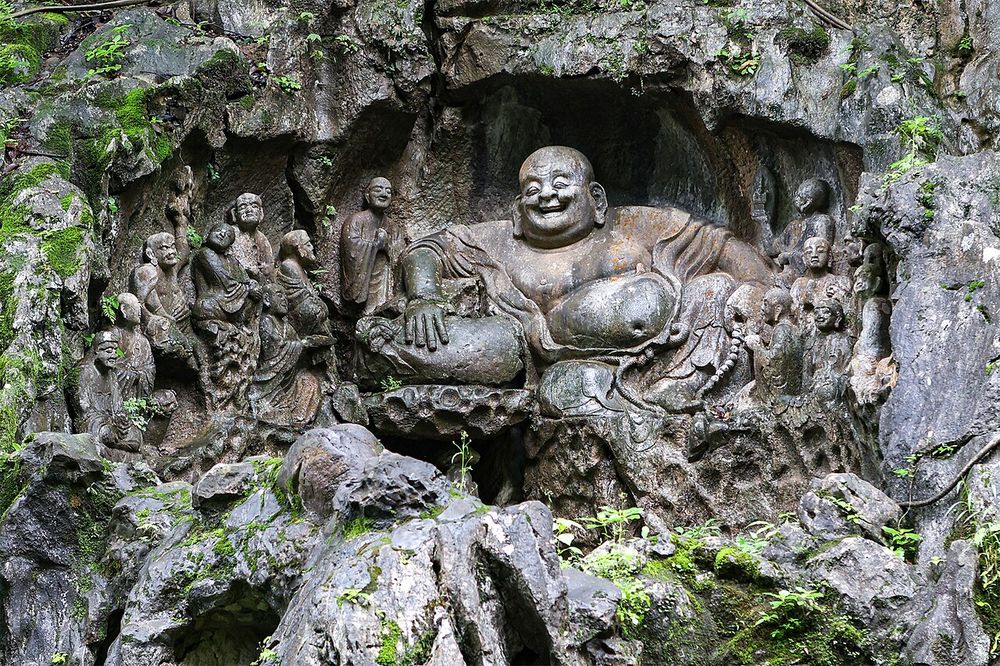
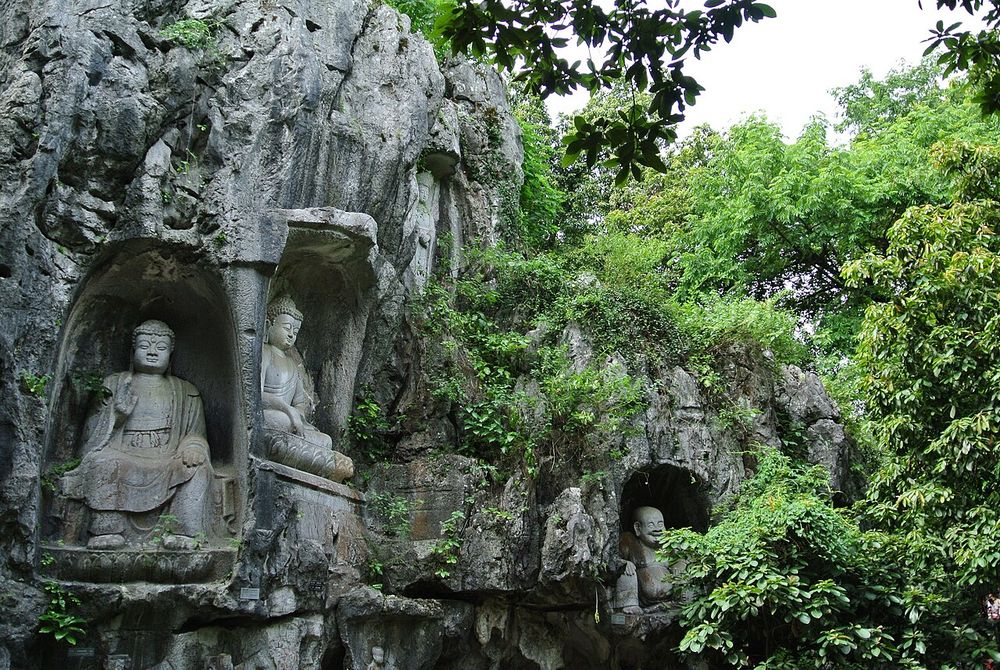
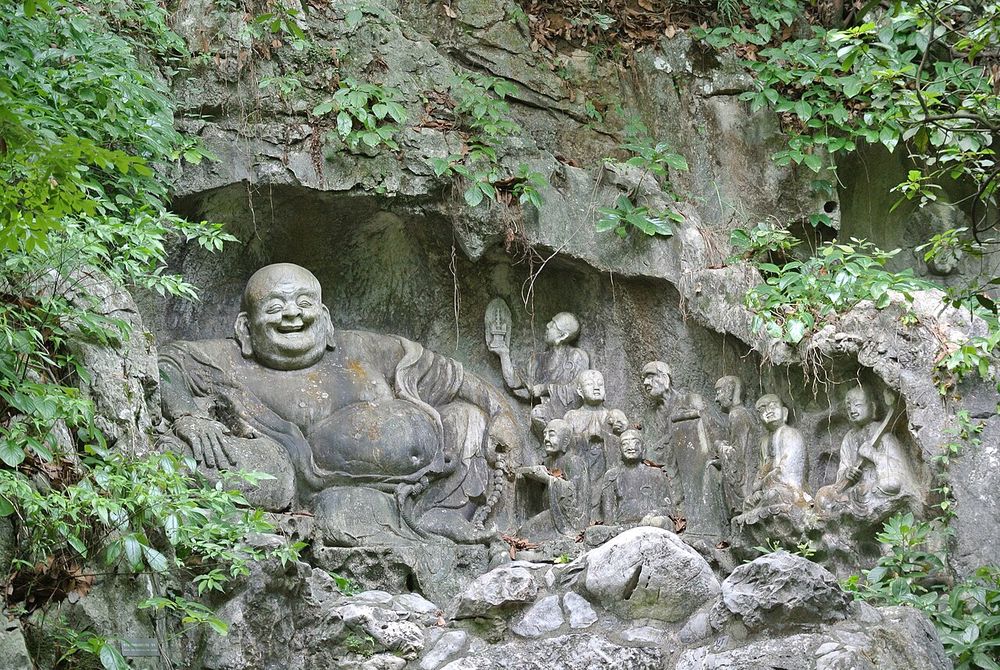
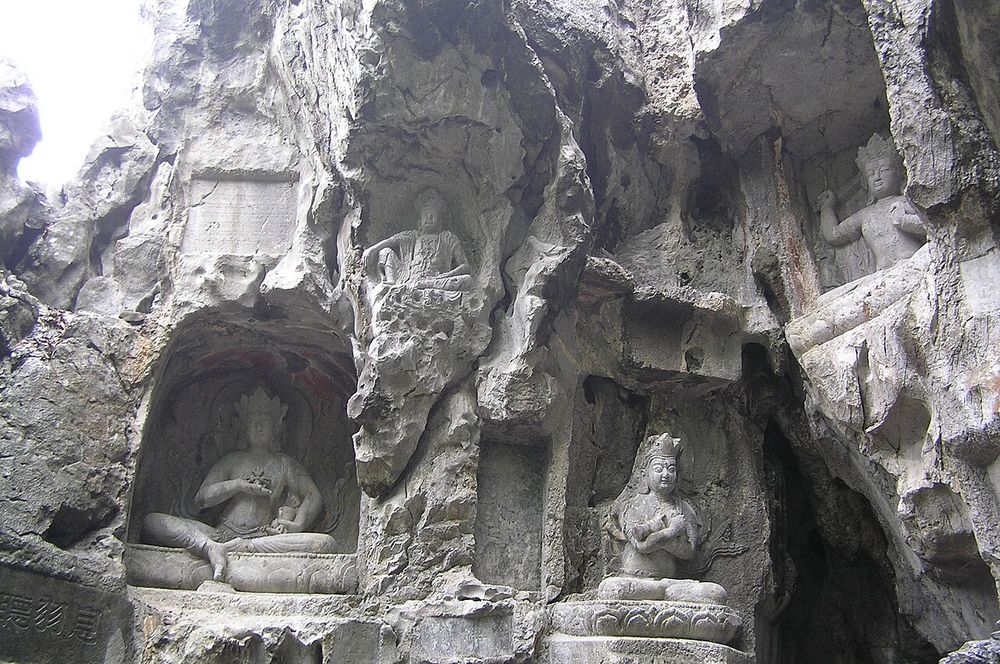
Hangzhou's oldest great monastery, founded in the fourth century in a wooded valley west of the lake, facing a limestone hill whose cliffs and caves are carved with hundreds of Buddhist figures from the tenth to the fourteenth century. Since December 2025 it has been free, but you must book a day ahead.
Photo: Tyg728, CC BY-SA 4.0, Wikimedia Commons
The story
You are walking up a shady valley beside a clear, fast stream. On your left rises a low hill of grey, holed and fluted rock, overhung with trees, and in its face, in niches and caves, sit stone figures: a fat laughing monk surrounded by smaller ones, robed Buddhas, crowned goddesses. On your right, through a yellow wall, are the curving roofs of a monastery and the smell of incense.
Tradition says the monastery was founded in 326, in the Eastern Jin (317–420), by an Indian monk named Huili. In the same years, in the Roman Empire, Constantine was building his new capital on the Bosporus.
The laughing Maitreya and the arhats in the cliffJakub Hałun, CC BY-SA 3.0
Huili is said to have looked at the hill and declared that it was a small peak of Vulture Peak in India, and asked when it had flown here. The hill has been called Feilai Feng, "the peak that flew here", ever since. He built his temple facing it.
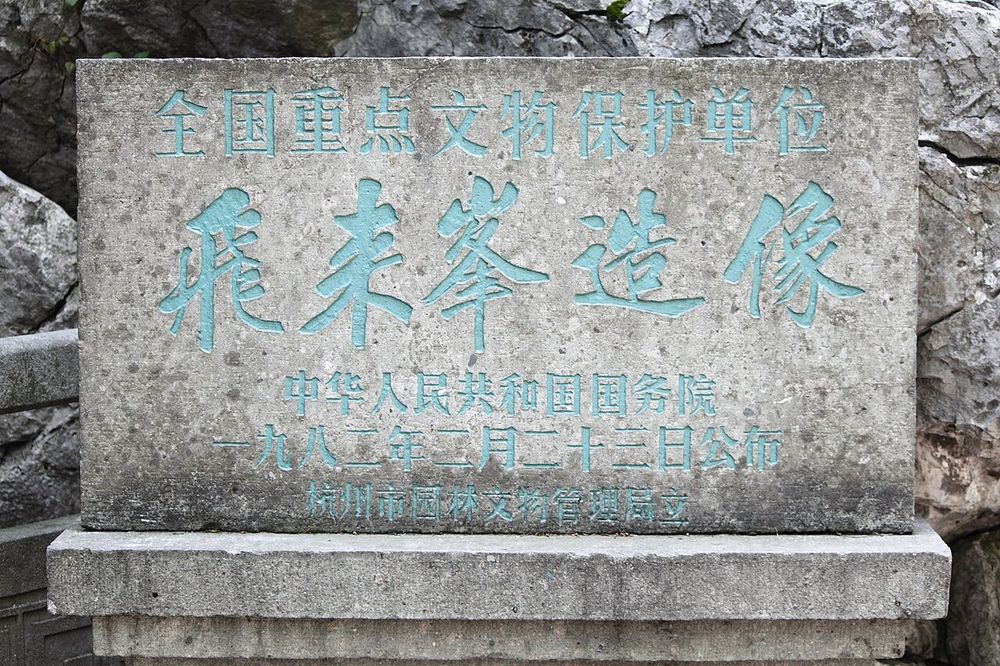
The carvings in the hill were made between the tenth century and the fourteenth, from the Five Dynasties (907–960) to the Yuan (1271–1368). It is one of the largest groups of Yuan Buddhist sculpture in southern China, including figures in the Tibetan style brought by the Mongol court.
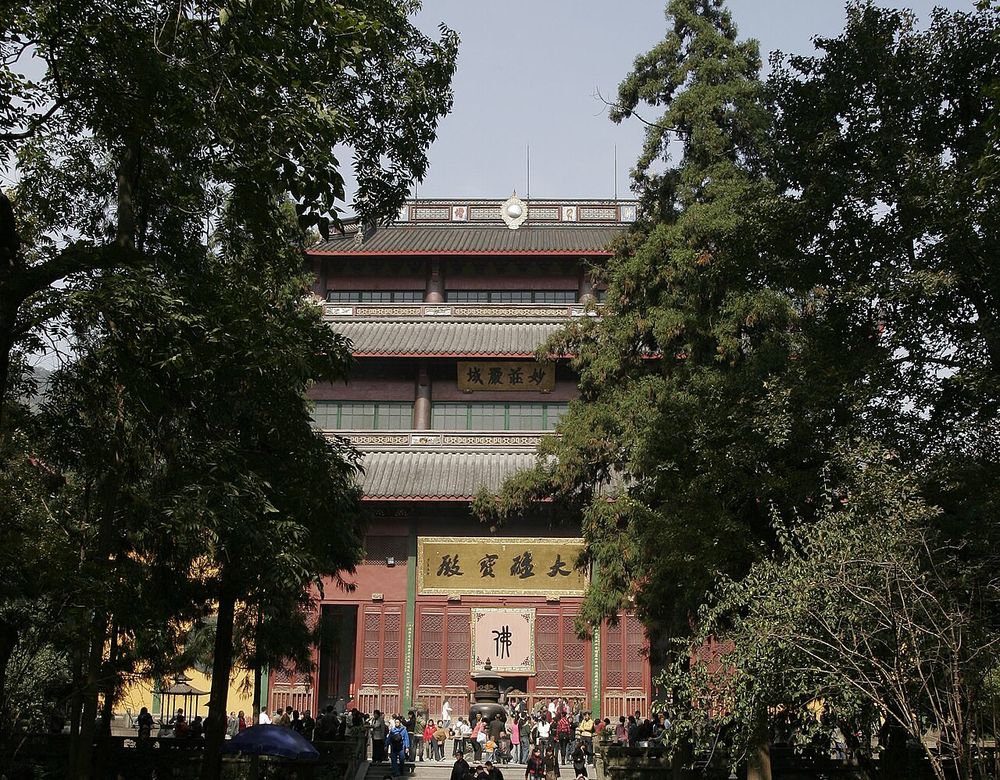
The temple across the stream has been destroyed and rebuilt many times. The great halls you see were rebuilt in the Qing (1644–1912) and the twentieth century.
Things people often get wrong
"It is free, so you can just turn up." Since February 2026 there has been no queue on the spot. You must book online at least a day ahead.
"The laughing Buddha is the Buddha." He is Maitreya, the Buddha to come, shown as a Chinese monk with a cloth bag who lived in the tenth century.
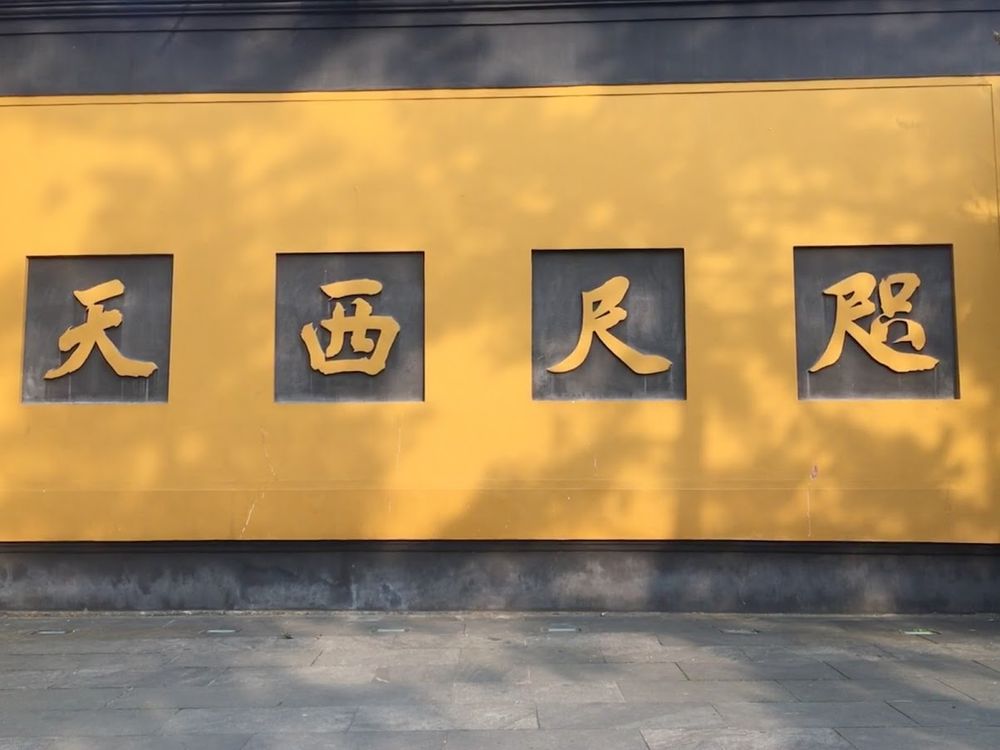
"The temple is called Lingyin." The Kangxi Emperor renamed it Yunlin Chan Temple in 1689, and his board still hangs over the gate. Nobody uses the name.
People who stood here
Bai Juyi (Tang (618–907) poet, governor of Hangzhou 822–824)In 823 he wrote an essay on the Cold Spring Pavilion at the foot of the peak, saying that of all the views round Hangzhou, the temple was the best and the pavilion the best at the temple. He sat by the same stream that runs beside you.
The Kangxi Emperor (Qing emperor, 1661–1722)On his tour of the south in 1689 he gave the temple a new name, Cloud Forest; the story goes that he had seen it lying in cloud among the trees from the hill behind. His board with four characters still hangs over the Hall of the Heavenly Kings.
Go deeper: five stops, from the stream to the great hall
The route runs first along the carvings, then into the temple. With the carvings, the temple and the climb to the upper temples, allow half a day.
1. The stream and the pavilion
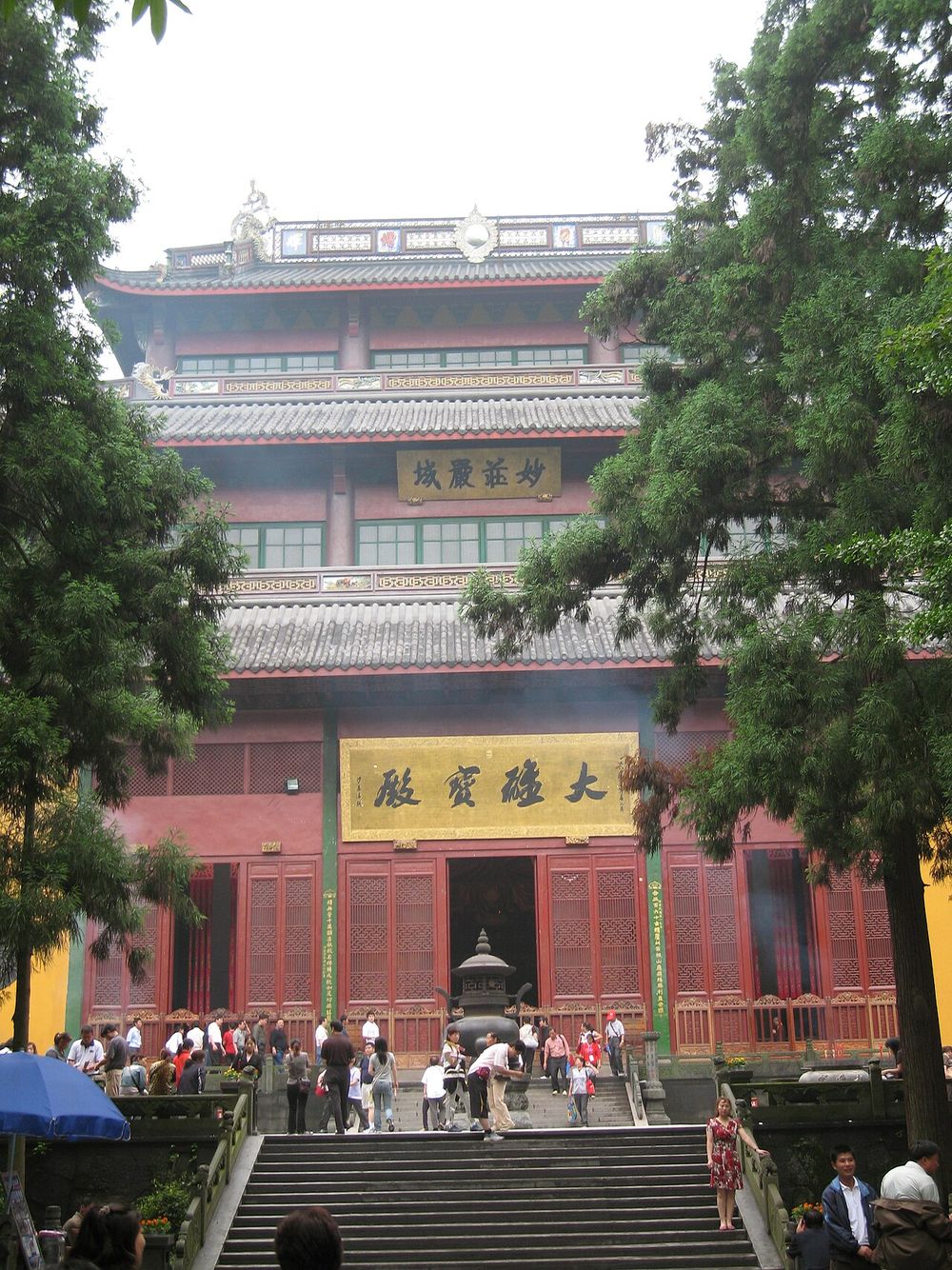
The temple through the treesDenis Yuen, CC BY-SA 2.5
Inside the gate the path follows the Cold Spring stream. The small pavilion over the water stands on the site Bai Juyi wrote about in 823, though the building is modern.
2. The carvings
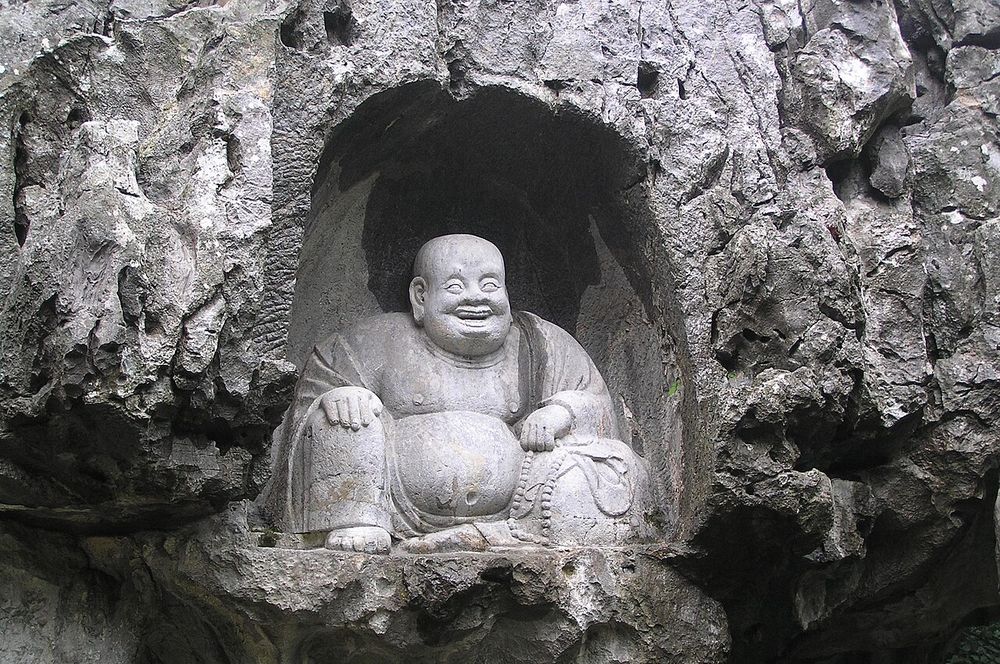
Maitreya in his nicheNo machine-readable author provided. Mr. Tickle assumed (based on copyright clai, CC BY-SA 3.0
The best-known figure is the laughing Maitreya of the Southern Song (1127–1279), cut into the cliff with his great belly and open bag, eighteen arhats round him. He is the largest of the carvings.
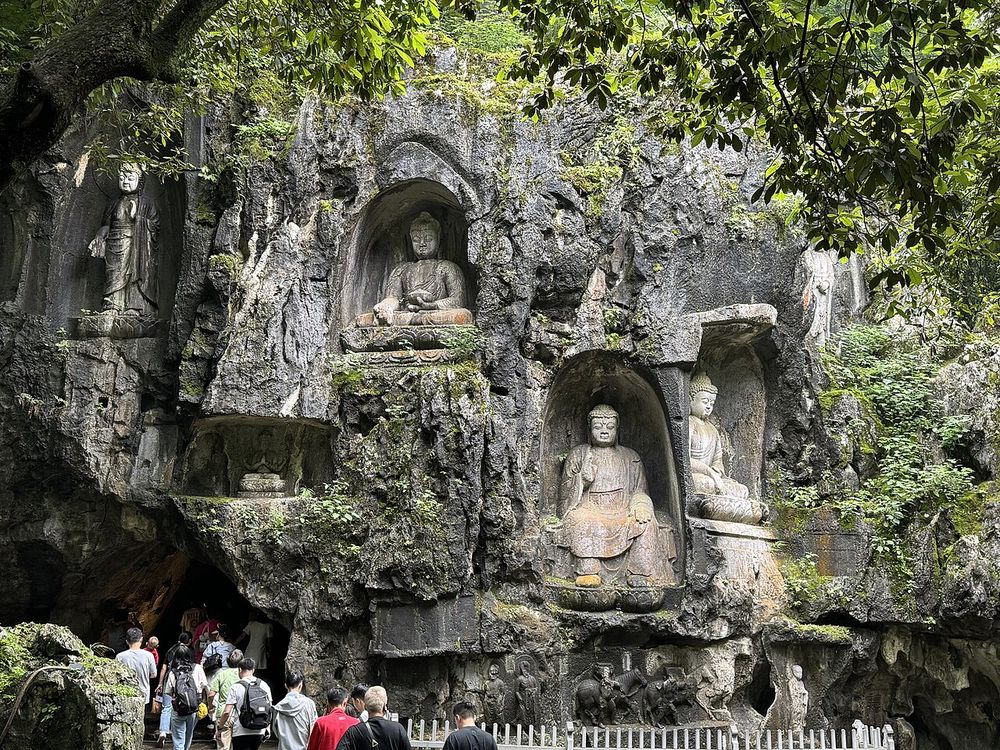
Carvings on the face of the hillPatrick20242023, CC BY-SA 4.0
Further on, in the caves, are rows of smaller Buddhas and Bodhisattvas of the tenth century, and on the cliff faces the Yuan figures, crowned and jewelled in the Tibetan manner.
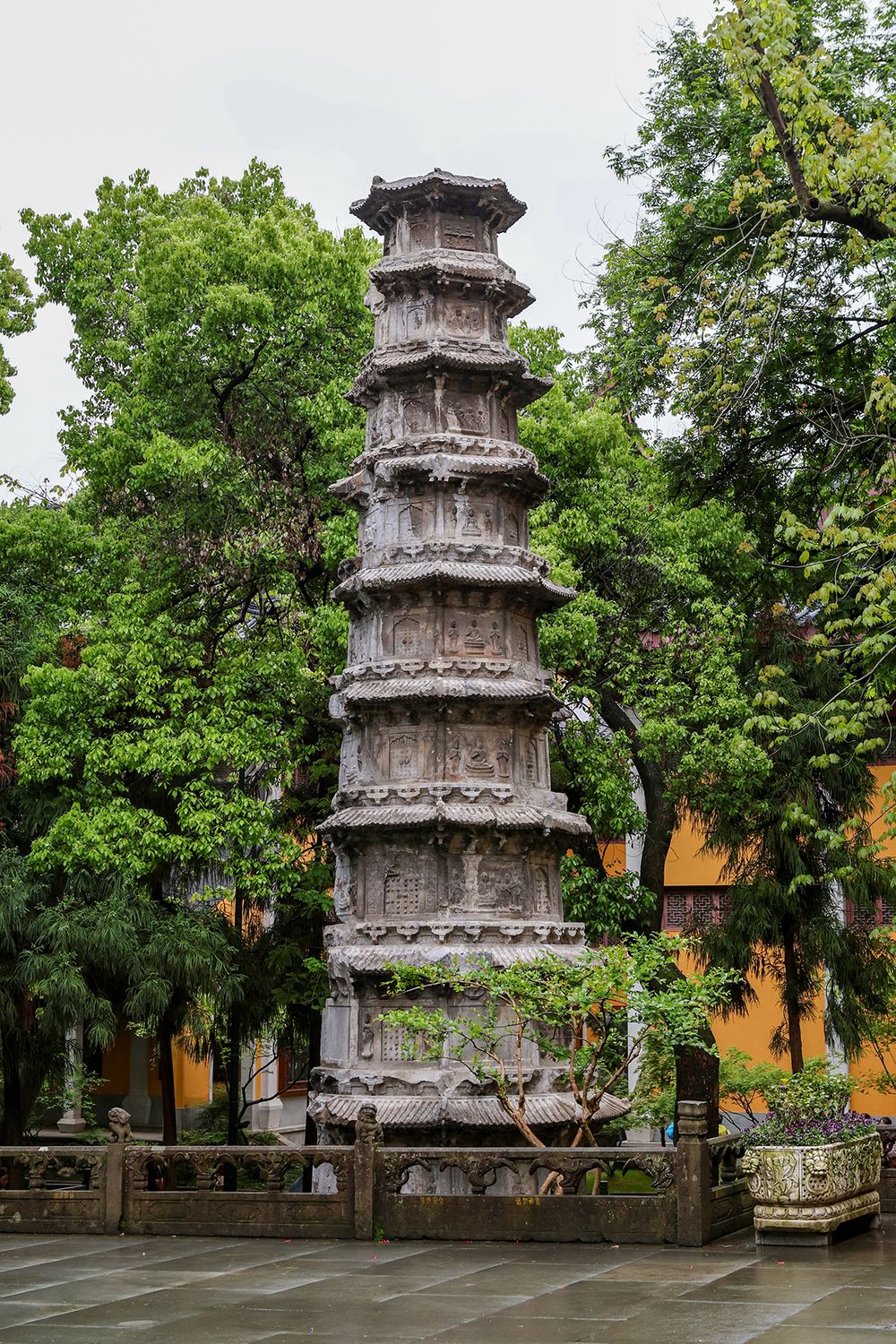
Ligong Pagoda, said to be Huili's tombYumeto, CC BY-SA 4.0
At the foot of the hill stands a slim stone pagoda said to cover the remains of Huili himself. It was rebuilt in the Ming (1368–1644).
3. The Hall of the Heavenly Kings
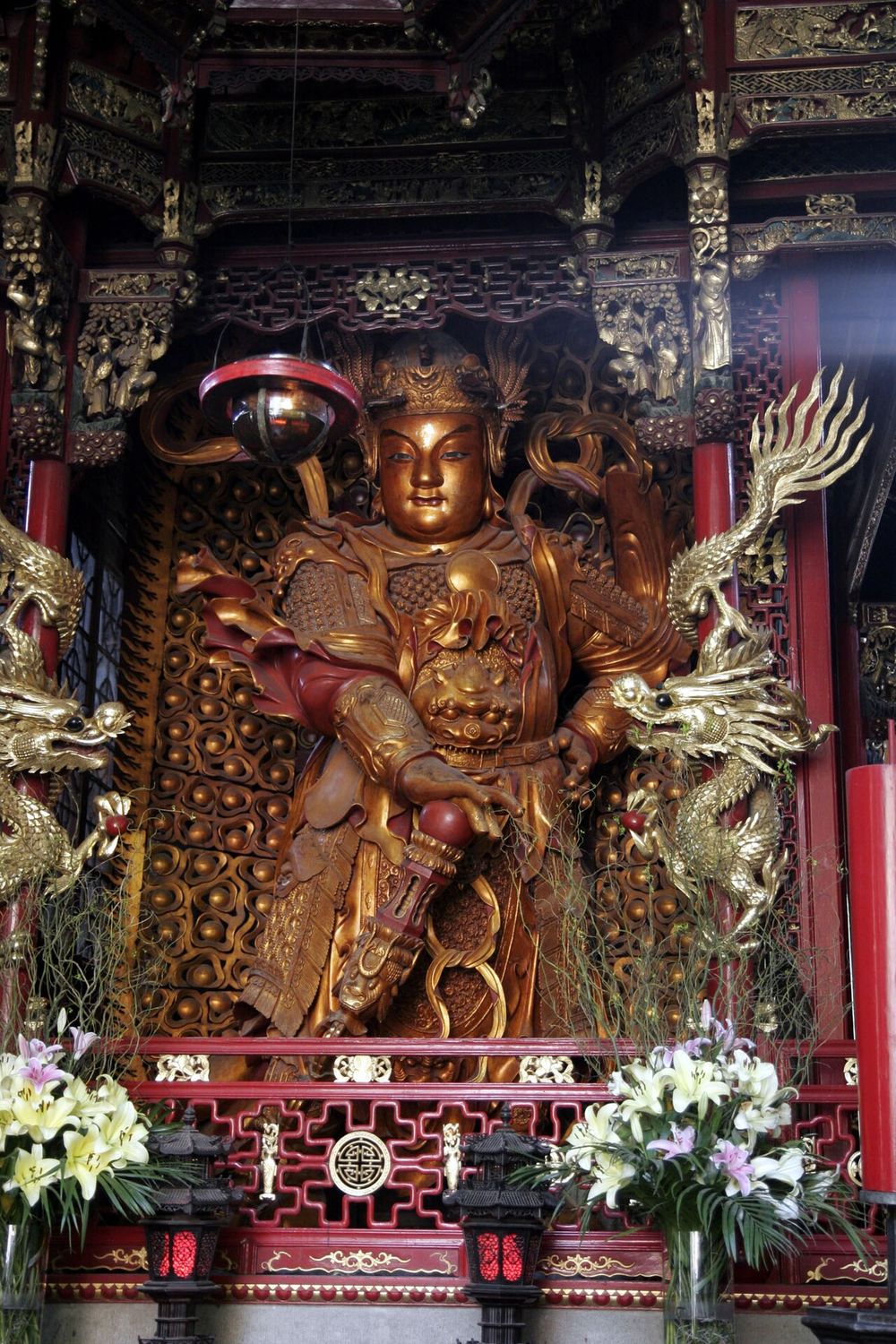
A Heavenly King in the first hallKuebi = Armin Kübelbeck, CC BY-SA 3.0
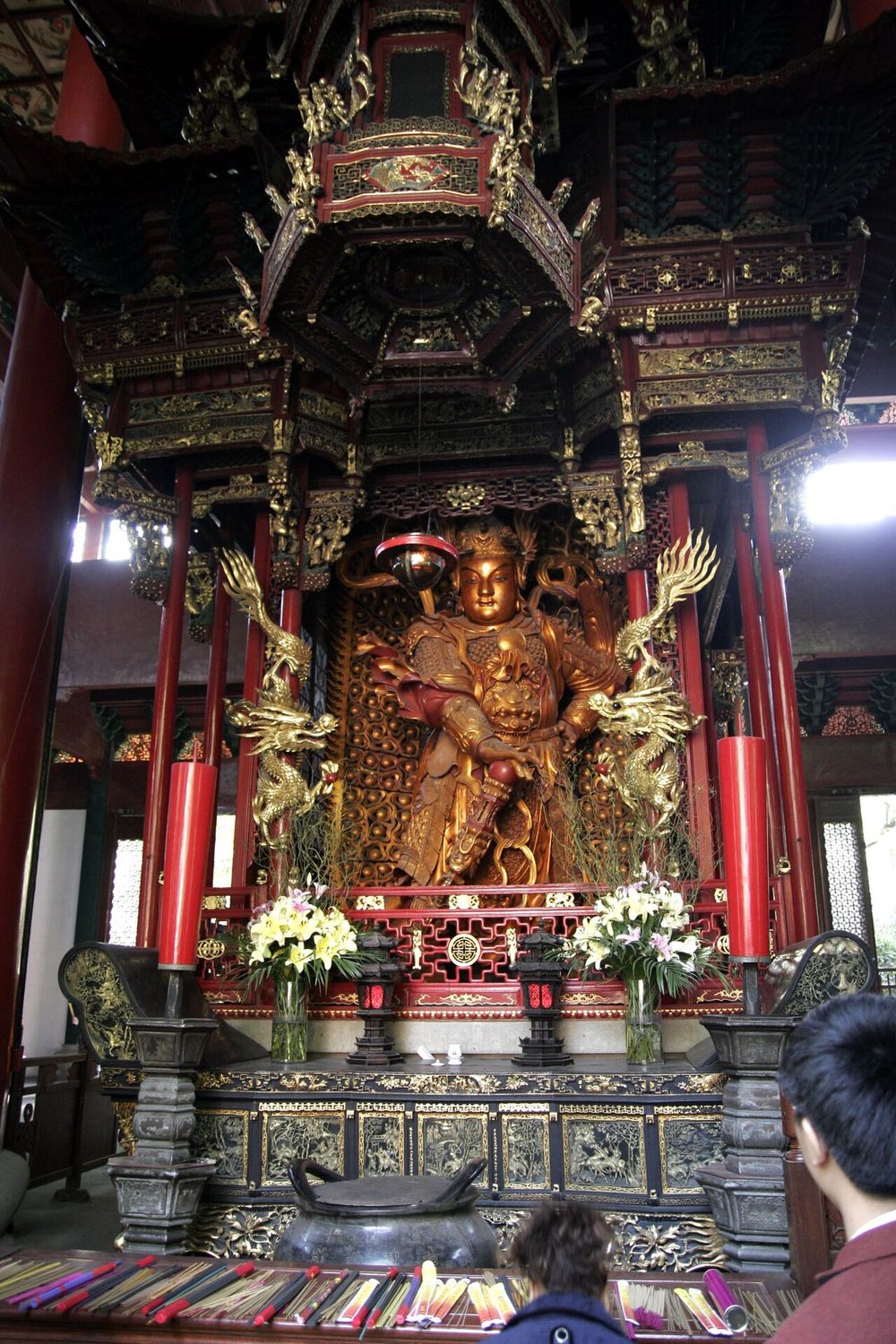
Cross the stream into the temple. The first hall has the Kangxi Emperor's board outside. Inside sit the laughing Maitreya again, the four Heavenly Kings, and behind him, facing the main hall, the guardian Weituo, carved from camphor wood in the Southern Song.
4. The great hall
One of the stone pagodas of 960Windmemories, CC BY-SA 4.0
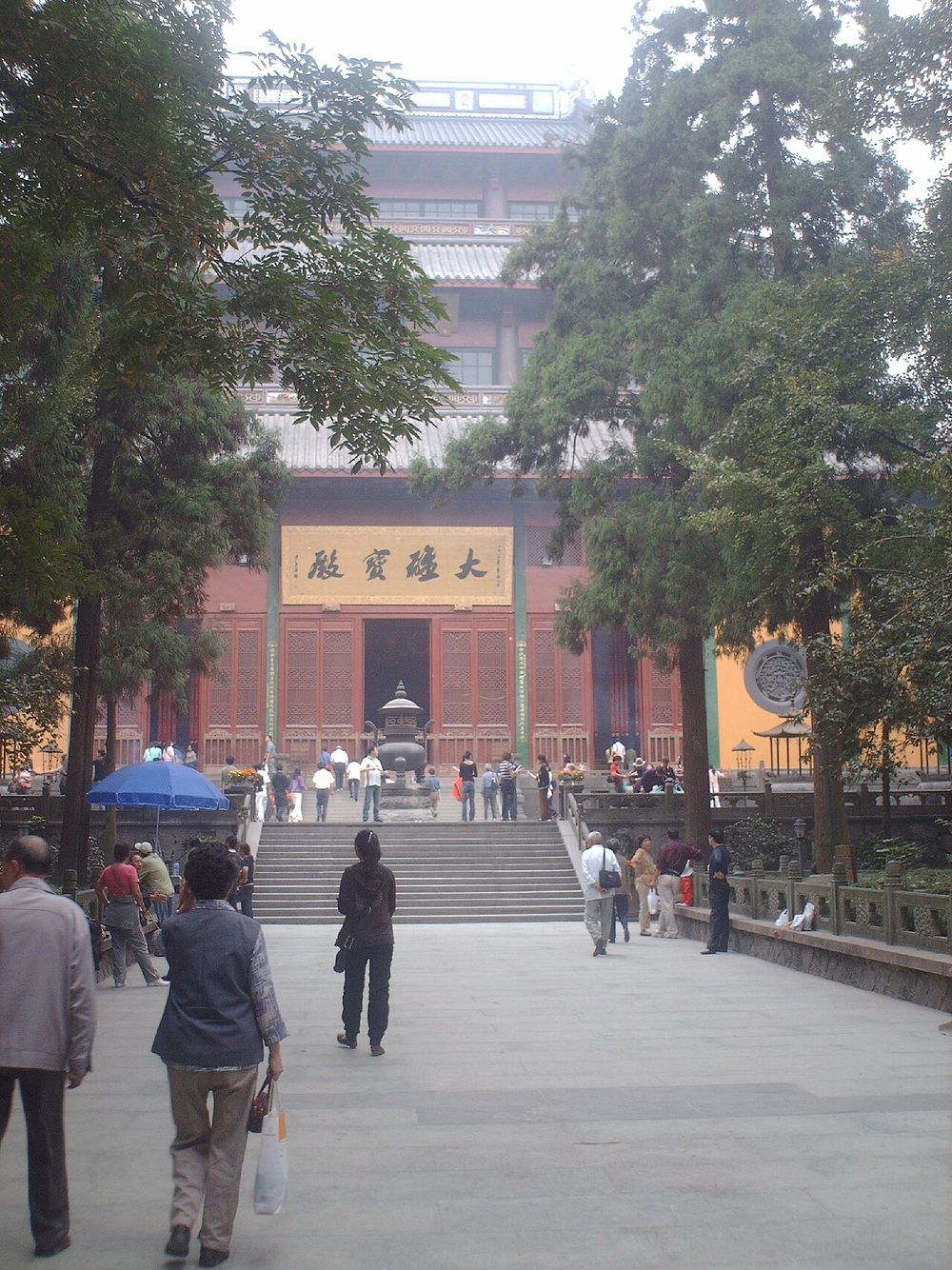
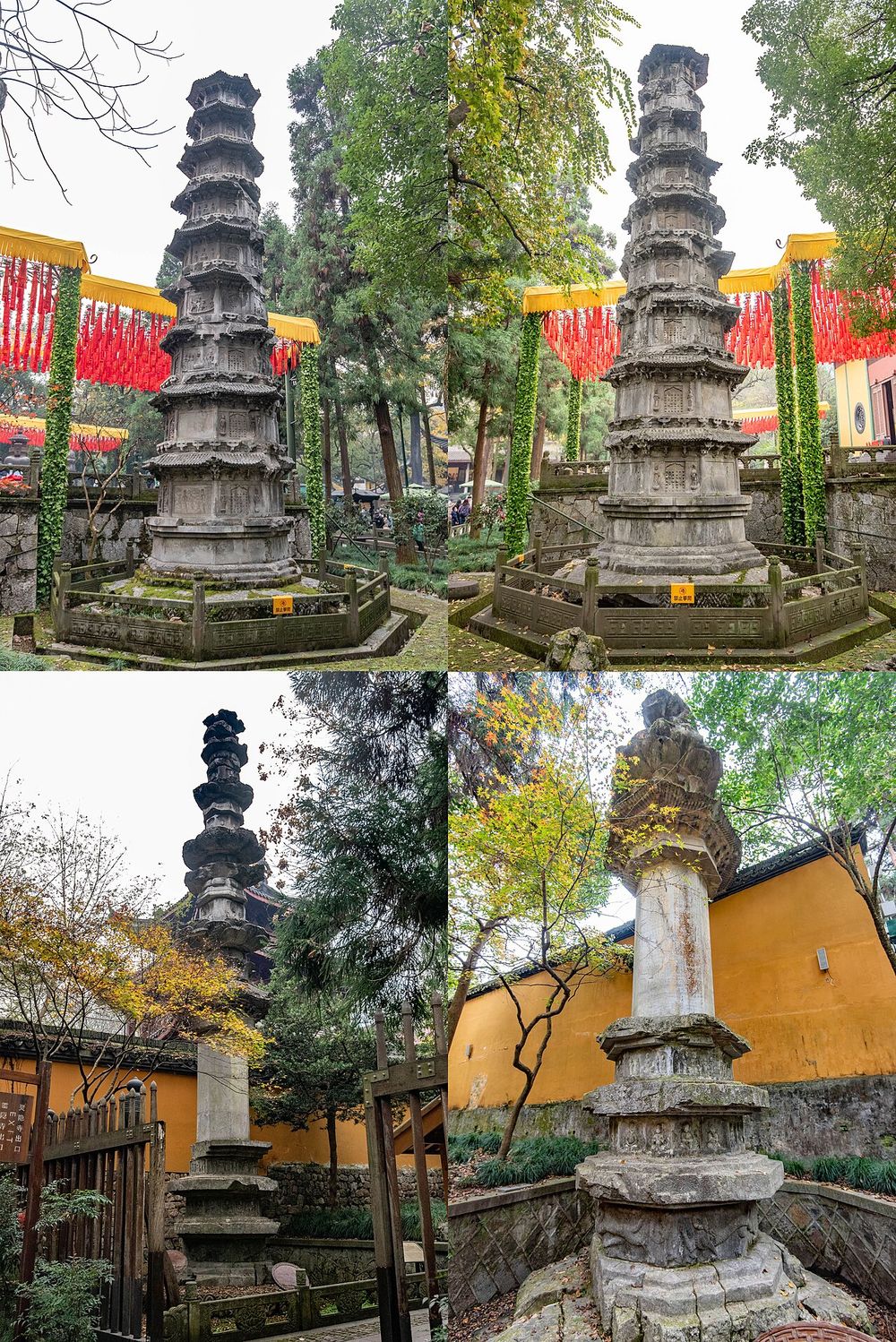
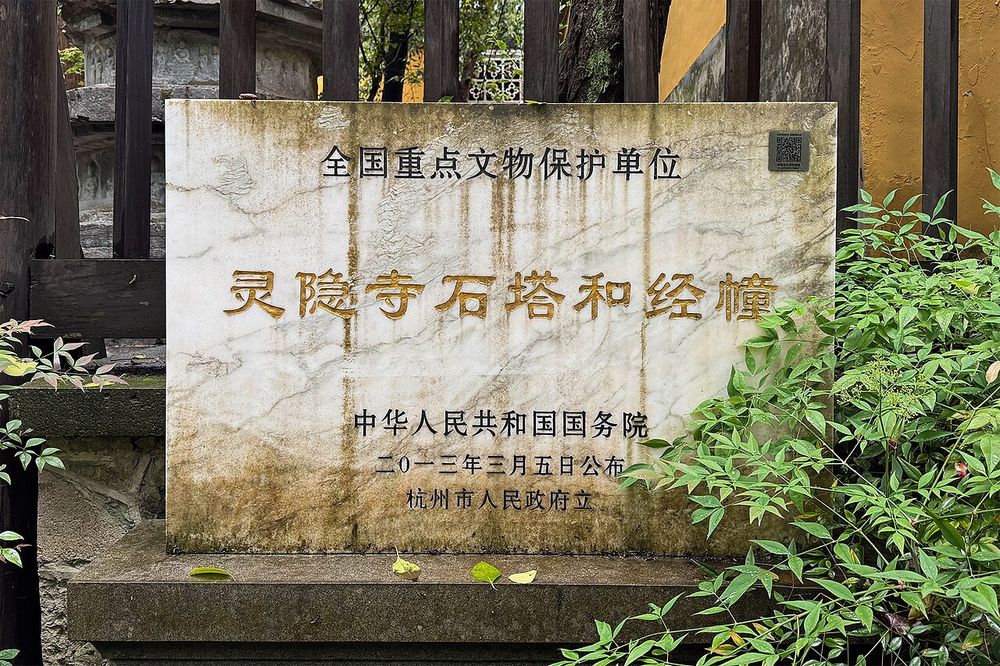
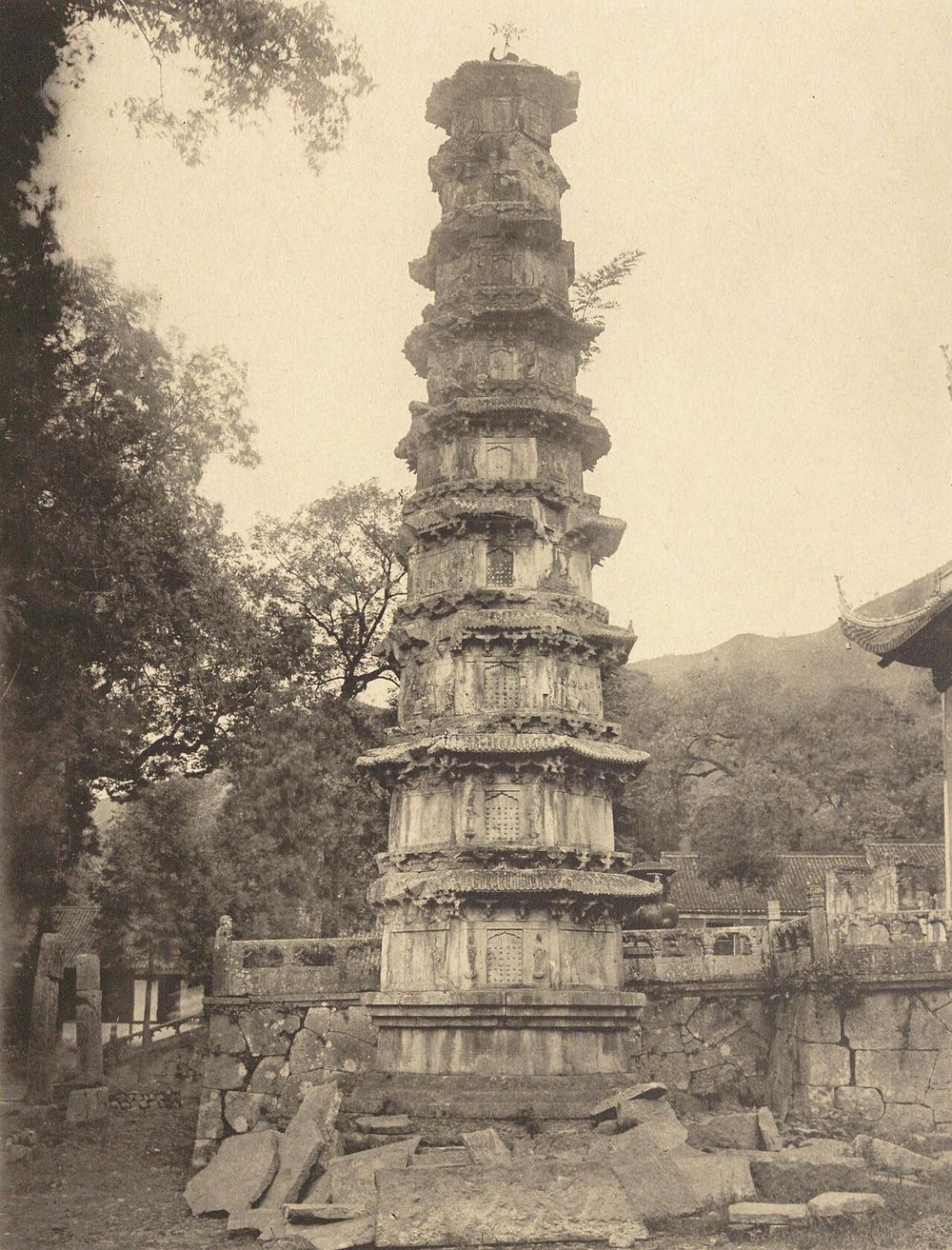
In front of the great hall stand two stone pagodas set up in 960 by the king of Wuyue (907–978), Qian Chu, the man who later built Leifeng Pagoda. They are among the oldest things in the temple.
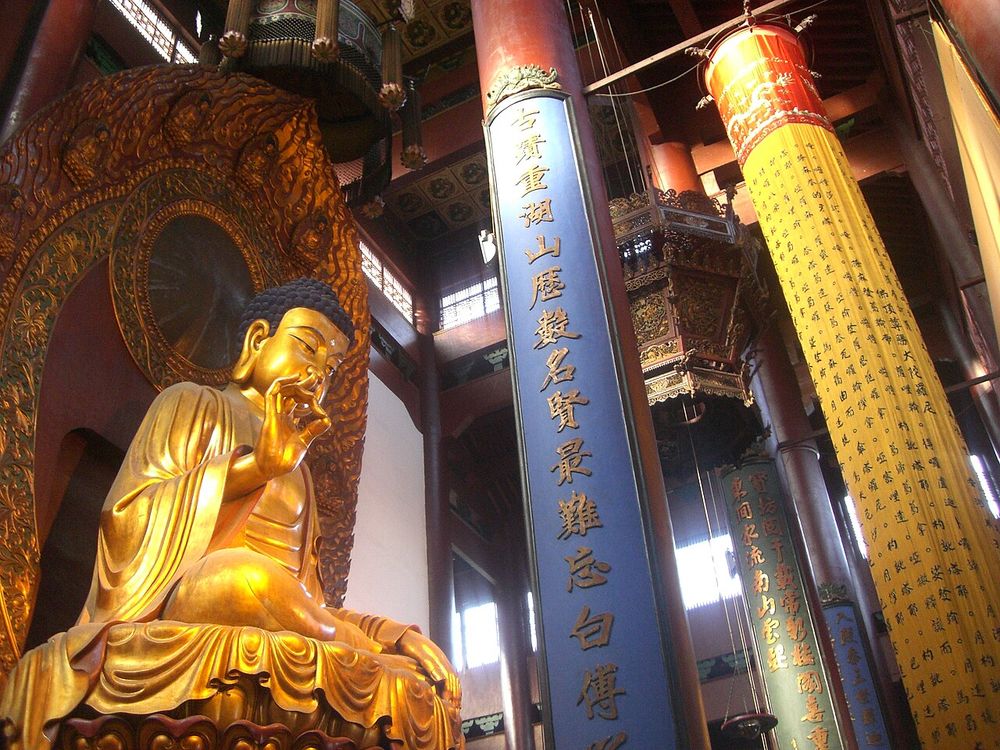
The great camphor-wood BuddhaPedro Ceinos, CC BY-SA 3.0
Inside, the seated Buddha stands 24.8 metres high with its throne and halo, carved from twenty-four blocks of camphor wood and gilded. It was made in the 1950s to replace a figure that collapsed.
5. The halls above
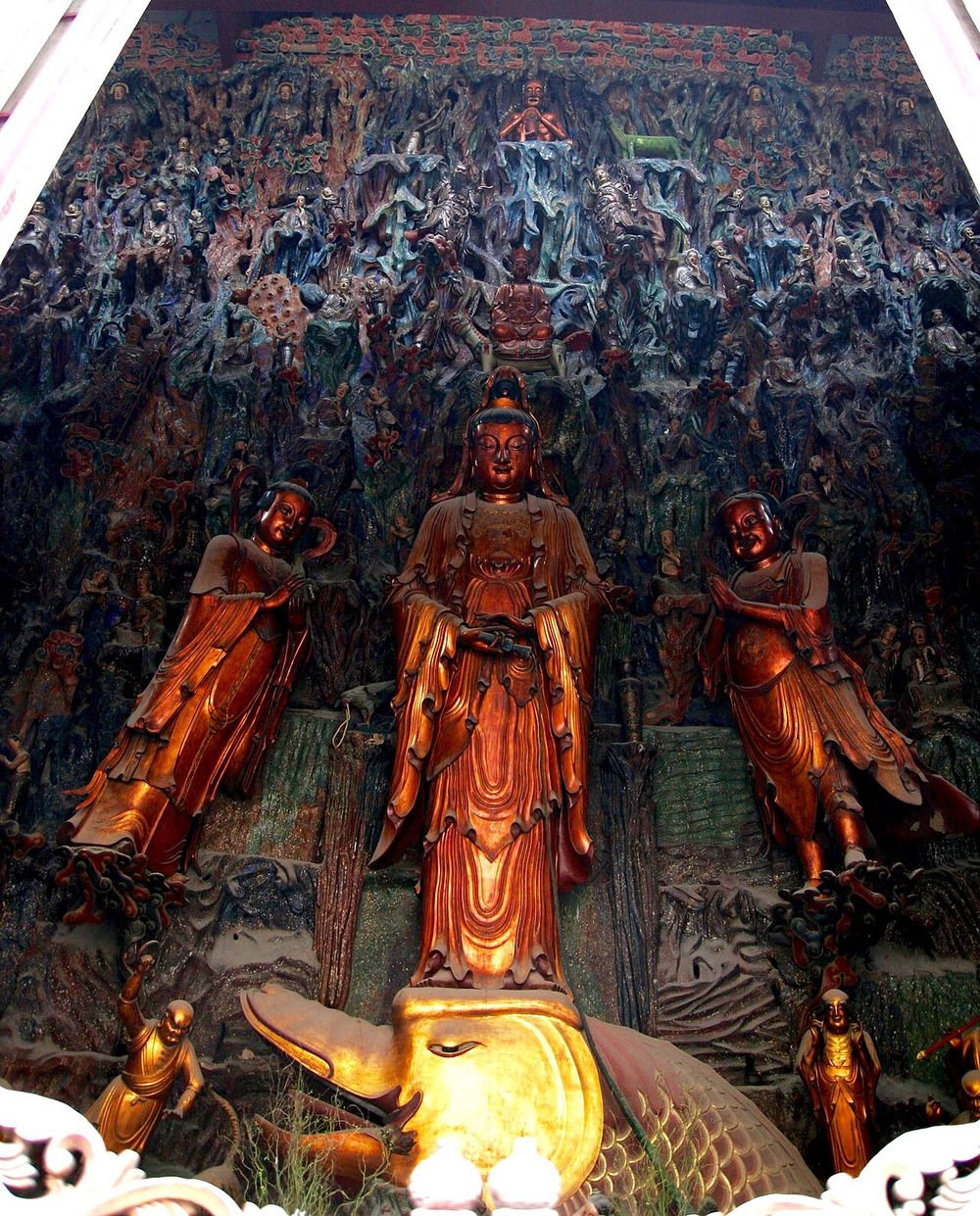
Figures behind the great BuddhaKuebi = Armin Kübelbeck, CC BY-SA 3.0
Behind the great hall more halls climb the slope, including one for Ji Gong, the mad monk of the stories, who is said to have been ordained here. Paths go on up the hill to two smaller temples, Yongfu and Taoguang, which are included in the same booking.
Meanwhile in the world
Year
Here
Elsewhere
326
Huili is said to found the temple
Constantine is building Constantinople
823
Bai Juyi writes about the Cold Spring Pavilion
In Baghdad the House of Wisdom is translating Greek books
960
The king of Wuyue sets up the two stone pagodas
The Song dynasty is founded; Mieszko I becomes the first ruler of Poland
1282–1292
Most of the Yuan carvings are made
Marco Polo is in China
1689
The Kangxi Emperor renames the temple
England's Bill of Rights
2025
The scenic area becomes free, by booking
The same autumn the Louvre is robbed of crown jewels
Then and now
Seated Buddhas in a niche at Feilai FengMilan Tvrdy, Public domain, Wikimedia CommonsThe laughing Maitreya and the arhats in the cliffJakub Hałun, CC BY-SA 3.0, Wikimedia CommonsThe Maitreya group from the sideWindmemories, CC BY-SA 4.0, Wikimedia CommonsMaitreya in his nicheNo machine-readable author provided. Mr. Tickle assumed (based on copyright clai, CC BY-SA 3.0, Wikimedia CommonsCarvings on the face of the hillPatrick20242023, CC BY-SA 4.0, Wikimedia CommonsA Buddha in a cave mouth低碳一粒米, CC BY-SA 3.0, Wikimedia CommonsFigures among the trees低碳一粒米, CC BY-SA 3.0, Wikimedia CommonsInside one of the cavesNo machine-readable author provided. Mr. Tickle assumed (based on copyright clai, CC BY-SA 3.0, Wikimedia CommonsThe national heritage tablet for the carvingsDoctoroftcm, CC BY-SA 3.0, Wikimedia CommonsLigong Pagoda, said to be Huili's tombYumeto, CC BY-SA 4.0, Wikimedia Commons"The Western Heaven is but a foot away", on the yellow wallYxh1433, CC BY-SA 4.0, Wikimedia CommonsThe temple through the treesDenis Yuen, CC BY-SA 2.5, Wikimedia CommonsThe great hall from the courtyardYiwa, CC BY 3.0, Wikimedia CommonsThe great hall among old treesKuebi = Armin Kübelbeck, CC BY-SA 3.0, Wikimedia CommonsA Heavenly King in the first hallKuebi = Armin Kübelbeck, CC BY-SA 3.0, Wikimedia CommonsAnother of the four Heavenly KingsKuebi = Armin Kübelbeck, CC BY-SA 3.0, Wikimedia CommonsThe great camphor-wood BuddhaPedro Ceinos, CC BY-SA 3.0, Wikimedia CommonsFigures behind the great BuddhaKuebi = Armin Kübelbeck, CC BY-SA 3.0, Wikimedia CommonsOne of the stone pagodas of 960Windmemories, CC BY-SA 4.0, Wikimedia CommonsThe stone pagodas and pillars in front of the hallSiyuwj, CC BY-SA 4.0, Wikimedia CommonsThe heritage tablet for the stone pagodas and pillarsWindmemories, CC BY-SA 4.0, Wikimedia CommonsOne of the stone pagodas in 1918Sekino Tadashi, Public domain, Wikimedia Commons
Video
Films from official channels, played from YouTube. Nothing is loaded until you press play.
West LakeCCTV纪录 · China Central Television's documentary channel; 2 min · checked 2026-11-12
Local legends
These are stories people tell about this place. They are legends, not history, and each one says where it comes from.
LegendThe peak that flew here
The Indian monk Huili came to this valley, looked at the hill and said: this is a small peak of Vulture Peak in India; when did it fly here? He called out to the white ape that had lived on the peak in India, and an ape came out of a cave. He built his temple facing the hill.
Source: Temple tradition, recorded in later gazetteers
LegendJi Gong and the flying peak
The mad monk Ji Gong saw the peak about to fly down onto a village. He ran in and carried off a bride from a wedding, and the whole village chased him out, just before the peak landed where their houses had been.
Source: Hangzhou folk tale
Later, people who live here will be able to add the stories they grew up with, and say which of these they have heard.
Not certain, and where accounts conflict
326 or 328?
Both are given for the founding. The story of Huili comes mainly from records written long afterwards.
Does the temple still charge?
The temple announced that it would stop selling its 30-yuan incense ticket from 1 December 2025, the same day the scenic area became free. A few 2026 guides still mention it.
Can a visitor with a passport book?
The notice says bookings are by real name with a "valid document". We did not test whether the mini-programme accepts a foreign passport, or whether its face check for the waiting list works for foreigners.
Visiting
Tickets and hours
Free since 1 December 2025, including Lingyin, Yongfu and Taoguang temples. Before that it cost 45 yuan plus 30 yuan for the temple.
Open daily 7:30–17:30; no entry after 17:00.
Daily places are capped at 35,000 on weekdays, 50,000 at weekends and 65,000 on holidays. Weekends fill up days ahead.
Last checked 2026-11-12. The scenic area's notice of 19 November 2025 on free entry and booking, and reports of January 2026 on the changed booking rules.
Booking without WeChat
Official page in English There is no ticket and no booking website. Book a free timed slot in the mini-programme 杭州灵隐飞来峰 (Hangzhou Lingyin Feilai Feng) in Alipay or WeChat. Bookings open at 8:00 each day for the next seven days; the same day cannot be booked.
Ticket window on site Since 1 February 2026 there is no on-site registration window. If the day is full, join the online waiting list before 20:00 the day before.
Note Bring the passport you booked with; it is checked at the gate. Slots are morning (7:30–12:00) or afternoon (12:00–17:00).
Checked 2026-11-12
Where to start
The temple is about 4 kilometres west of the lake. Buses run from the lake to the Lingyin terminus; taxis may have to set you down short of the gate.
Go early in your slot and see the carvings before the temple.
Before you go
The paths up to the upper temples are steep stone steps.
Dress modestly. Shorts and bare shoulders are frowned on in the halls.
Customs and manners
This is a working monastery and many people come to pray. Take your hat off in the halls, do not point at the statues, and do not walk in front of someone who is bowing.
Step over the raised wooden thresholds, not on them.
Do not photograph the statues inside the halls.
You do not have to burn incense or make an offering.
Opening hours are given in the local time of the place. Prices are in the local currency. The figure after ≈ is approximate, at exchange rates checked on 9 November 2026, in .
Look for these
Find the laughing Maitreya in the cliff. How many arhats surround him?
Find a figure wearing a tall crown in the Tibetan manner.
Read the four characters over the Hall of the Heavenly Kings. Who wrote them?
Who stands behind Maitreya in the first hall, facing the other way?
Count the storeys of the stone pagodas in front of the great hall.
Find the hall of Ji Gong.
I am here
Stand at the site, sign in, press the button, and collect its stamp. Your browser will ask to use your location. It is sent to us once to confirm that you are at the site; we keep how far you were from it, not the spot where you stood.
Your stamps are saved to your account, so they follow you to any device. Checking from a browser cannot rule out every false location; stricter checks arrive with the app.
Messages
Share your photos
Photos here show the place, not people. Each one is credited to the visitor who took it and appears after our team has looked at it. A photo with you in it belongs under “I am here”.