The largest island in West Lake, a wooded hill some thirty-eight metres high, tied to the shore by two causeways. On it are a hermit's grave among plum trees, the oldest society of seal carvers in China, an imperial library, a museum, and the tombs of a courtesan and a revolutionary.
Photo: Suicasmo, CC0, Wikimedia Commons
The story
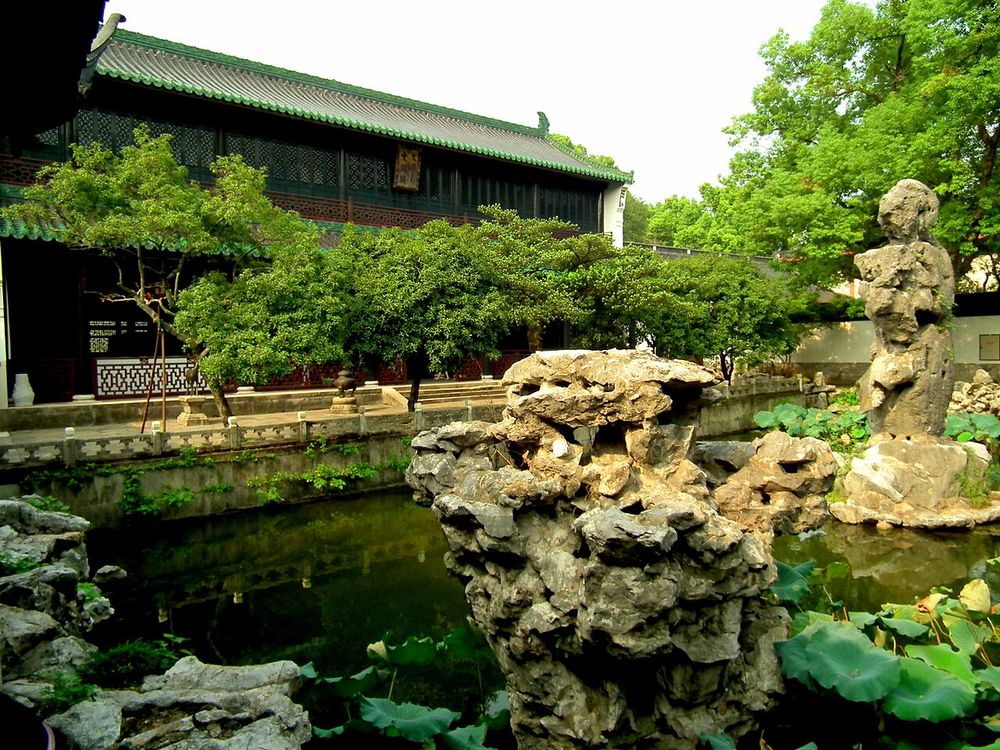
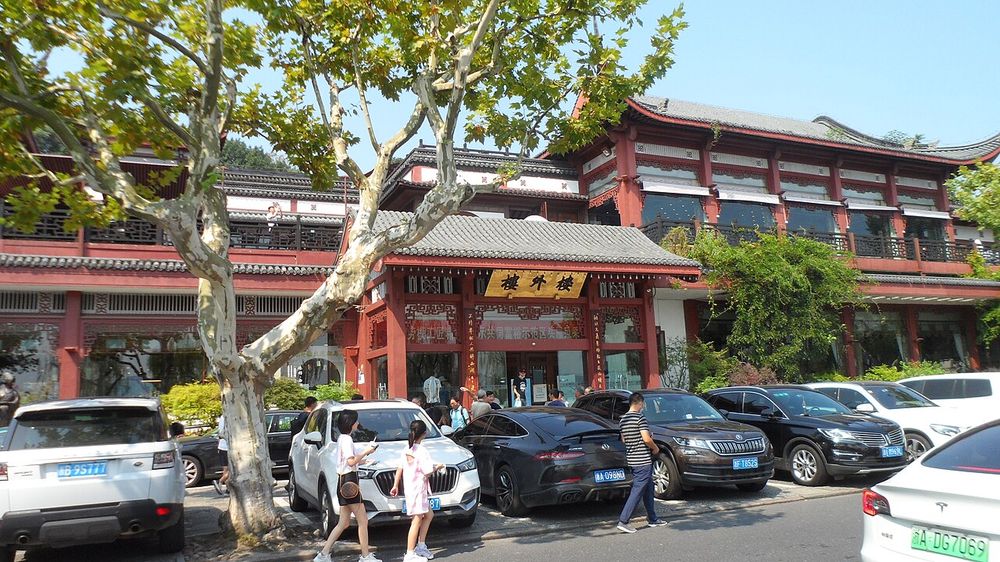
You are on a shady road along the foot of a low hill, with water on your left and old walls, gateways and stone steps on your right going up among camphor trees. A restaurant with red pillars faces the lake. Further on, a moon-shaped gate opens onto a garden of rocks climbing the slope.
In the 1020s a poet named Lin Bu lived here alone for twenty years, refusing every invitation to court. He planted plum trees and kept cranes, and people said the plums were his wife and the cranes his children. At the same time in England, King Cnut ruled an empire round the North Sea.
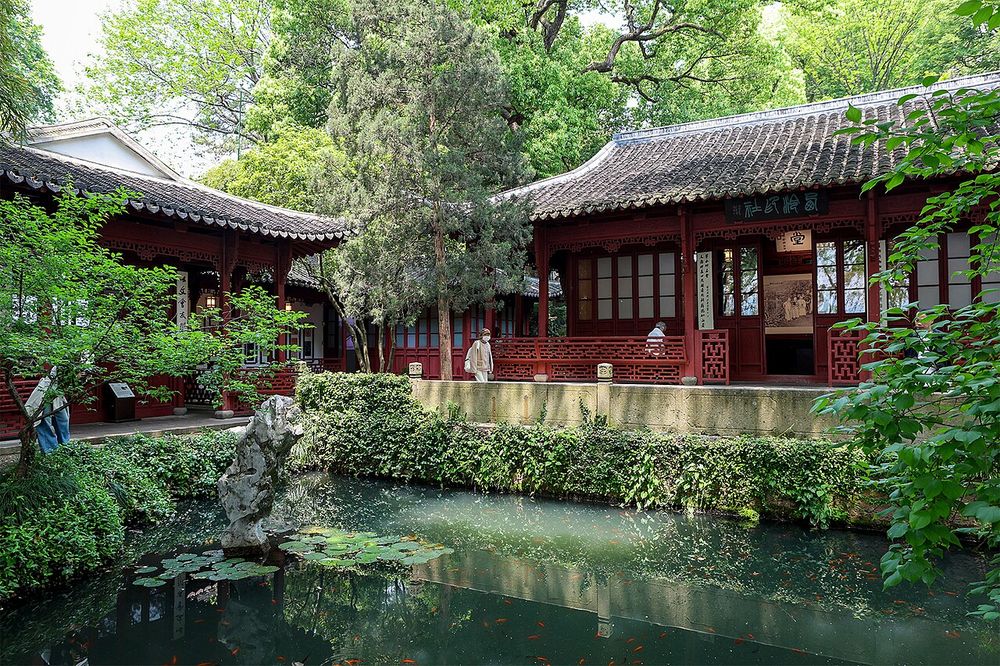
Buildings of the seal society by their poolWindmemories, CC BY-SA 4.0
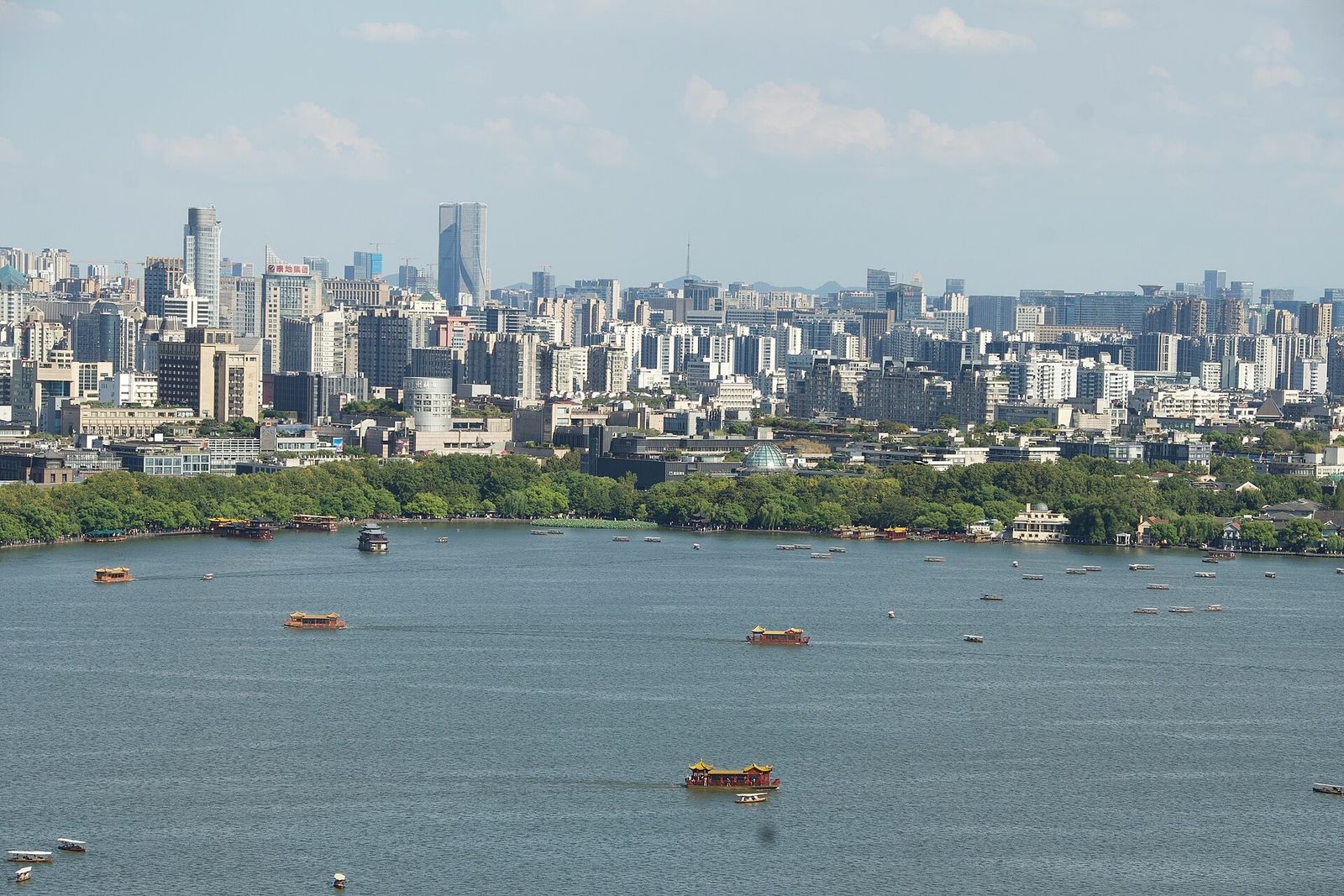
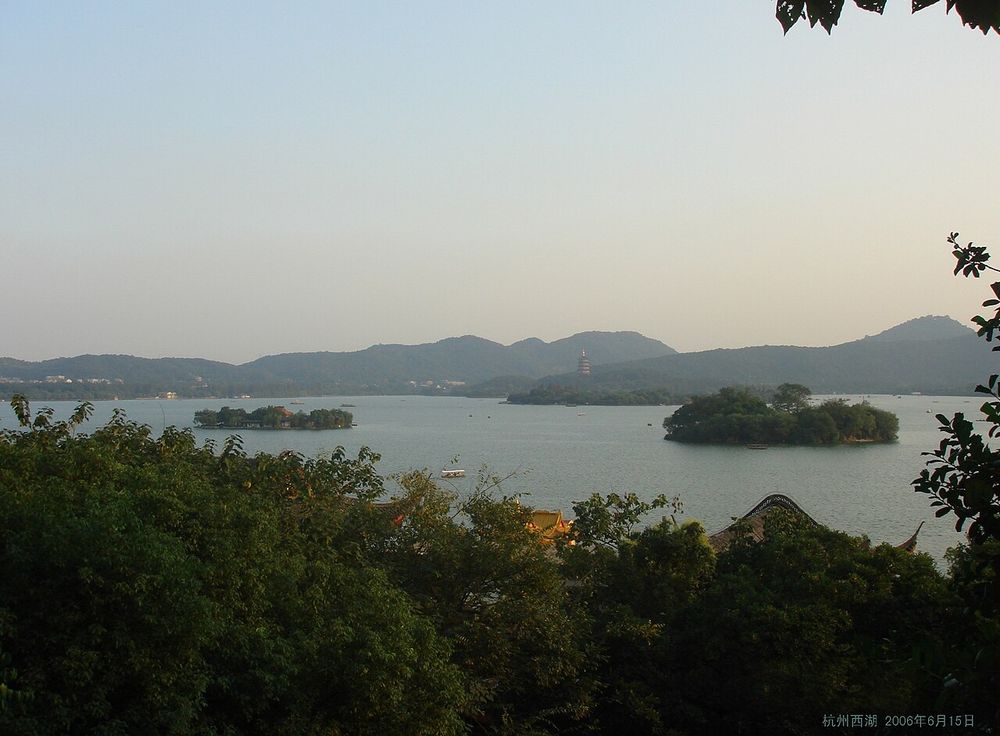
Solitary Hill is the only natural island in West Lake; the others were piled up from dredged mud. It is solitary only in name: the Bai Causeway joins it to the east shore and the short Xiling Bridge to the north.
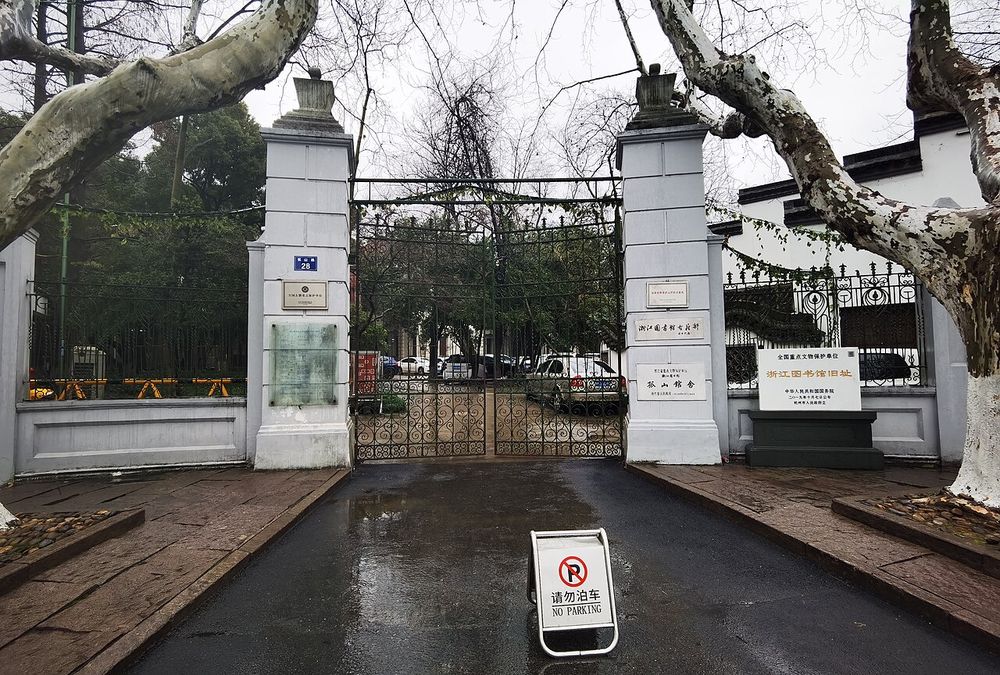
Emperors liked it. The Kangxi and Qianlong emperors stayed in a travelling palace on its south side, and Qianlong had a library built here to hold one of the seven copies of the largest book ever made in China.
Today the hill is a park, free, with a museum, a library and a seal carvers' garden that are also free.
Things people often get wrong
"It is an island you need a boat to reach." You walk onto it from either causeway.
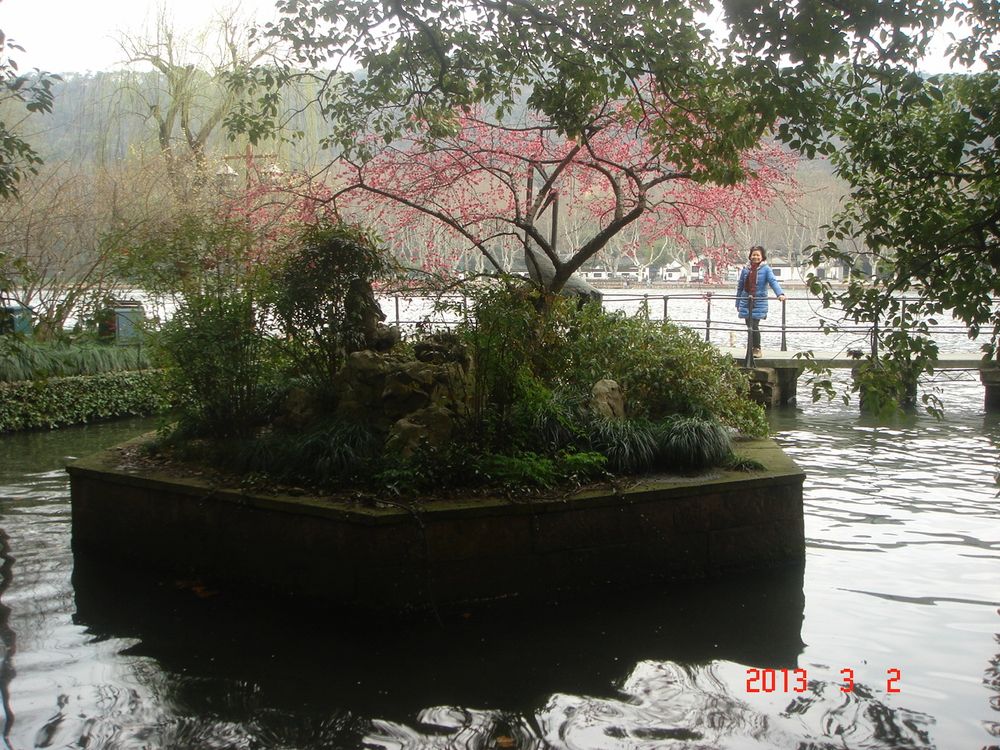
"The plum trees are Lin Bu's." The trees you see were planted in the last hundred years. His grave is real; it was dug open after the fall of the Song (960–1279) and later rebuilt.
"The seal society is a museum." It is a working society of artists, founded in 1904, that still elects its members. The garden is open to all.
People who stood here
Lin Bu (Song poet and hermit, 967–1028)He lived on this hill for twenty years without once going into the city. His two lines on plum blossom, its sparse shadows lying across clear shallow water and its faint scent drifting at dusk, are the most famous ever written on the flower.
Wu Changshuo (painter and seal carver, 1844–1927)In 1913 he became the first president of the seal society on this hill. A bronze statue of him sits in the garden, and his seals are still copied by students across East Asia.
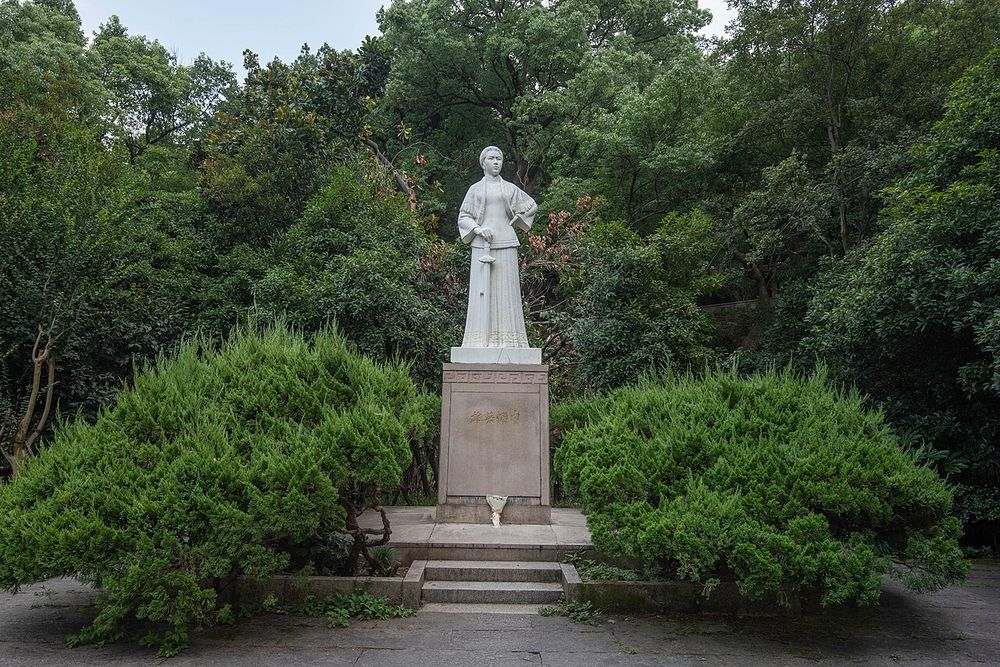
Qiu Jin (revolutionary and poet, 1875–1907)She was beheaded in Shaoxing in 1907 for plotting against the Qing (1644–1912). Her friends buried her by the lake, as she had asked, and the grave was moved and restored more than once. Her white statue stands at the foot of Xiling Bridge.
Go deeper: five stops round the hill
A path goes right round the hill in about forty minutes; another climbs over the top. These stops go round anticlockwise from the end of the Bai Causeway.
1. The museum and the library
The museum's lakeside branchGary Todd from Xinzheng, China, CC0
The Zhejiang Provincial Museum began here in 1929. Its lakeside branch, in buildings round the old imperial palace grounds, shows painting, calligraphy, porcelain and lacquer, and is free.
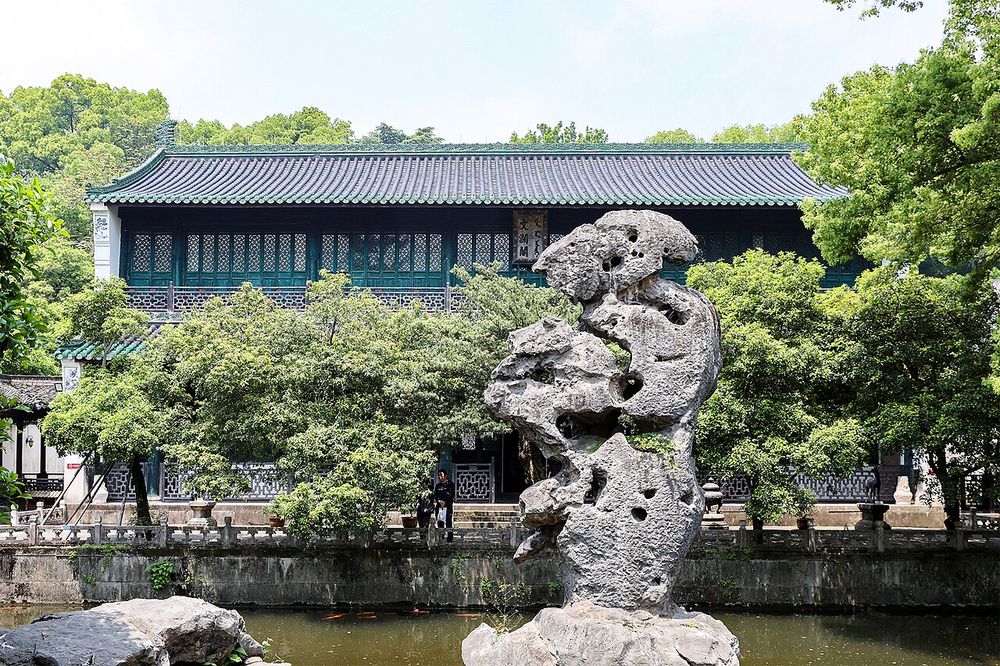
The rock garden of Wenlan PavilionLukeLOU, CC BY-SA 3.0
Behind it is Wenlan Pavilion, finished in the 1780s to house the Complete Library of the Four Treasuries, an imperial copy of more than 36,000 volumes. Much of it was lost when the city was taken in 1861, during the Taiping war. Local scholars spent decades copying the missing parts back. The books are now kept in the provincial library; the pavilion and its rock garden can be visited.
2. The seal carvers' garden
The lower garden of the seal societyWindmemories, CC BY-SA 4.0
In 1904 four seal carvers met here and founded a society "to protect metal and stone, and to study seal carving". Its garden climbs the hill in terraces, with a small stone pagoda, rock-cut inscriptions and pools. It is the oldest society of its kind in China.
The society's memorial gateInhorw, CC BY-SA 4.0
At the top you can see over the whole north of the lake.
3. The hermit's grave
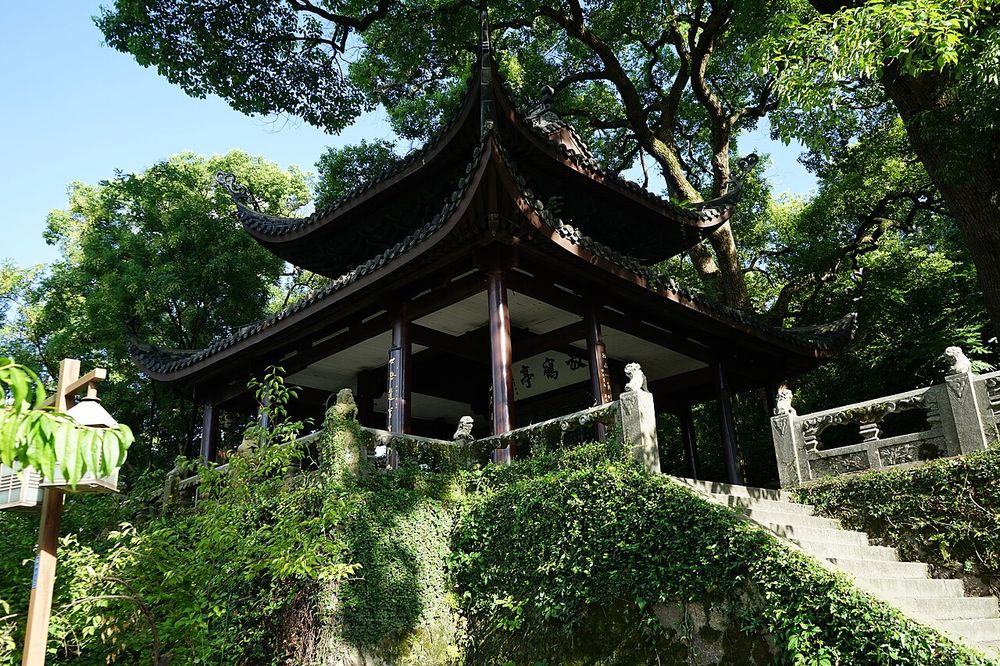
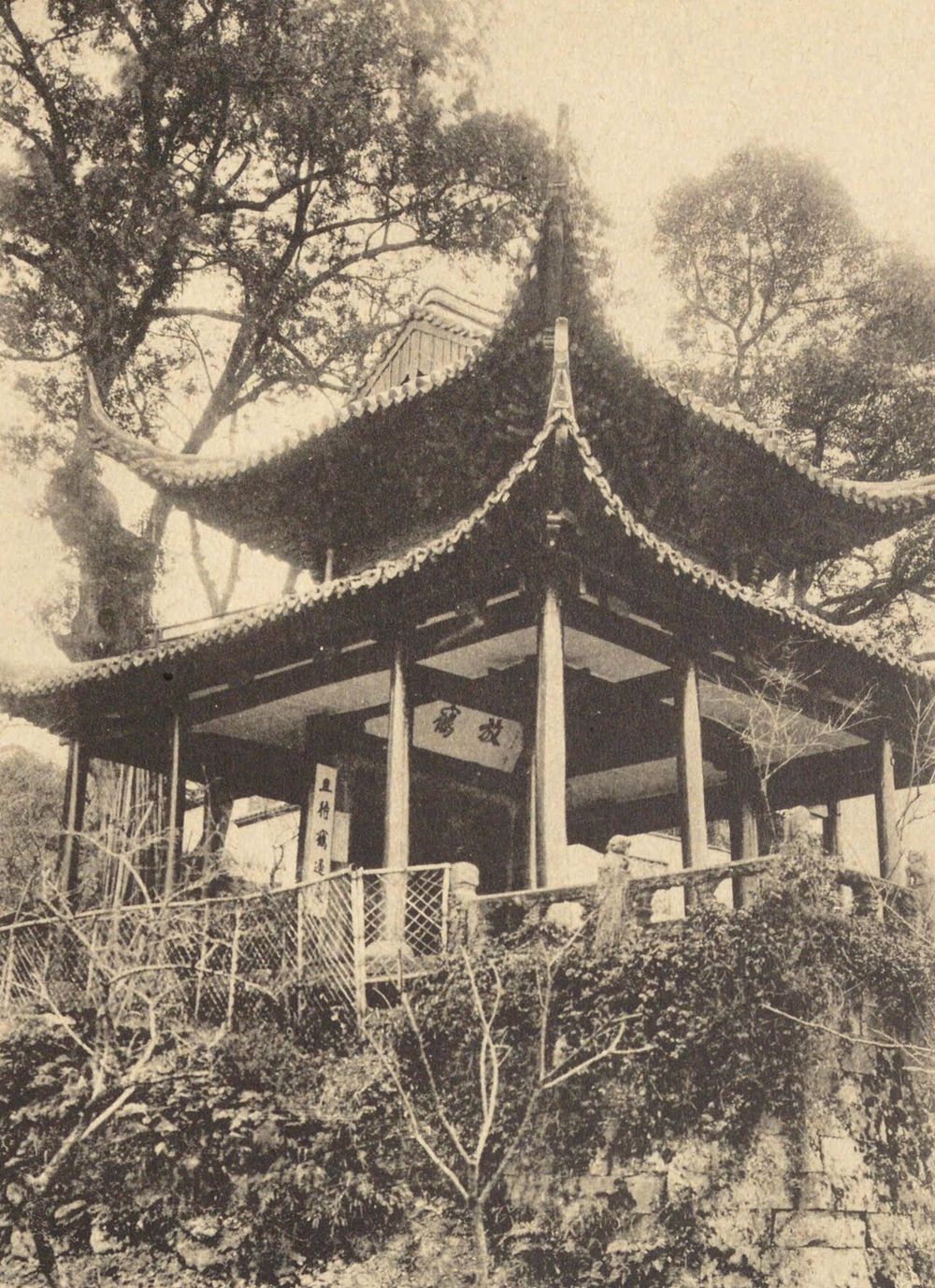
The Crane-releasing PavilionAmarespeco, CC BY-SA 4.0
On the north side, facing the inner lake, is Lin Bu's grave and the Crane-releasing Pavilion. Inside the pavilion is a stone tablet carved with an old text about cranes, copied in the Kangxi Emperor's hand. In late winter the slope below is covered in plum blossom.
4. The bridge and two graves
Boats by Xiling BridgeWindmemories, CC BY-SA 4.0
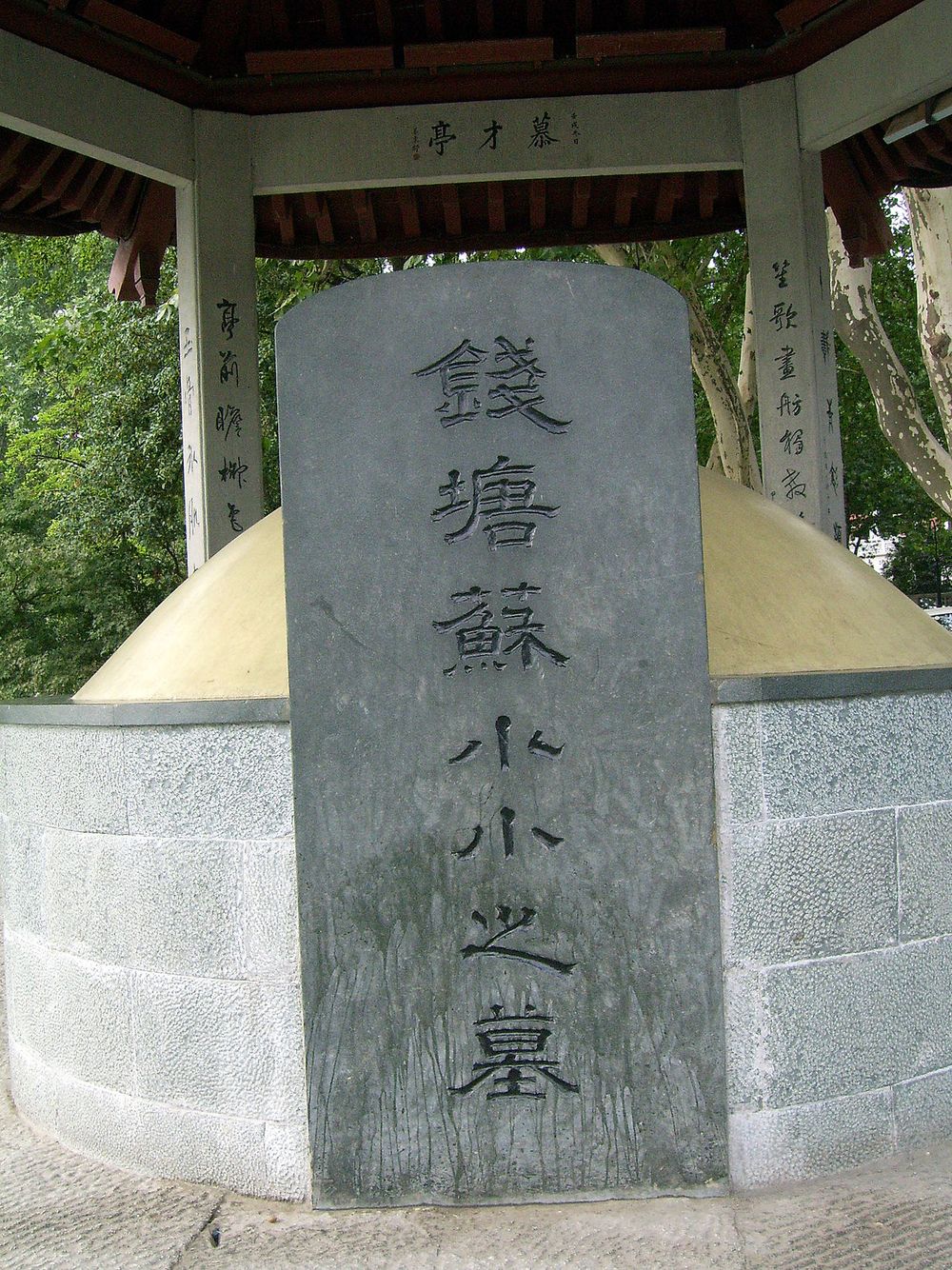
At the west end of the hill a short stone bridge, Xiling Bridge, crosses to the north shore. Beside it, under a small pavilion, is the grave of Su Xiaoxiao, a singing girl of the fifth century famous in poems. The present grave was rebuilt in 2004.
Qiu Jin's tomb at the end of Xiling BridgeSiyuwj, CC BY-SA 4.0
Across the bridge, at its far end, stands the white statue of Qiu Jin over her tomb.
5. The restaurant
Louwailou restaurant, founded 1848钉钉, CC BY-SA 4.0
On the south shore, facing the lake, is Louwailou, a restaurant founded in 1848. Its name comes from a Song poem about the lake: "beyond the hills more hills, beyond the towers more towers". It is famous for West Lake fish in vinegar sauce.
Meanwhile in the world
Year
Here
Elsewhere
1020s
Lin Bu lives as a hermit on the hill
Cnut rules England, Denmark and Norway
1780s
Wenlan Pavilion is built for the imperial library
The United States wins its independence
1848
Louwailou opens
Revolutions break out across Europe
1904
The seal carvers found their society
The Russo-Japanese War begins
1907
Qiu Jin is executed and later buried by the lake
Picasso paints Les Demoiselles d'Avignon
1929
The provincial museum is founded here
The Wall Street Crash
Then and now
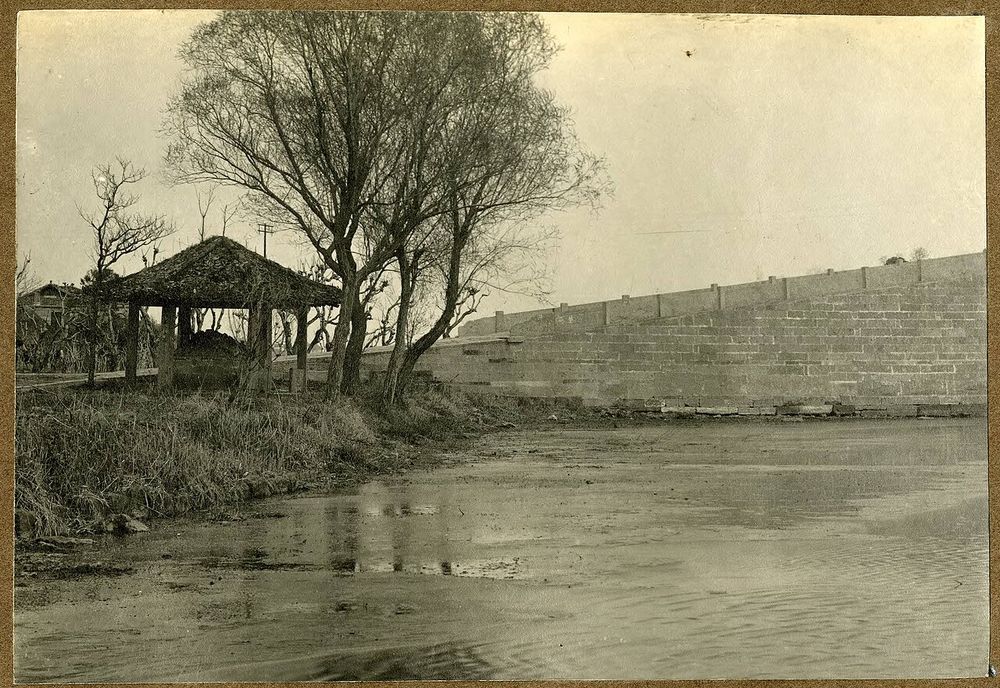
The outer lake and the city from the hill's side of the waterUser:CatOnMars, CC BY 4.0, Wikimedia CommonsThe lake from the top of the hillwanghongliu, CC BY-SA 3.0, Wikimedia CommonsLotus on the North Inner Lake below the hillzhiyin586@163.com, CC BY 3.0, Wikimedia CommonsBoats by Xiling BridgeWindmemories, CC BY-SA 4.0, Wikimedia CommonsXiling Bridge seen from the Su Causeway钉钉, CC BY-SA 4.0, Wikimedia CommonsThe museum's lakeside branchGary Todd from Xinzheng, China, CC0, Wikimedia CommonsThe main hall of the museum branchLukeLOU, CC BY-SA 3.0, Wikimedia CommonsThe gate of the library on the hillUser:CatOnMars, CC BY-SA 4.0, Wikimedia CommonsThe rock garden of Wenlan PavilionLukeLOU, CC BY-SA 3.0, Wikimedia CommonsWenlan Pavilion behind its pool and rockWindmemories, CC BY-SA 4.0, Wikimedia CommonsBuildings of the seal society by their poolWindmemories, CC BY-SA 4.0, Wikimedia CommonsThe lower garden of the seal societyWindmemories, CC BY-SA 4.0, Wikimedia CommonsThe society's name carved in stoneWindmemories, CC BY-SA 4.0, Wikimedia CommonsThe society's memorial gateInhorw, CC BY-SA 4.0, Wikimedia CommonsOld buildings in the seal society gardenBuhuzu, Public domain, Wikimedia CommonsThe Crane-releasing PavilionAmarespeco, CC BY-SA 4.0, Wikimedia CommonsThe tablet inside the pavilion猫猫的日记本, CC BY-SA 4.0, Wikimedia CommonsPlum blossom on the hill in late winterzhiyin586@163.com, CC BY 3.0, Wikimedia CommonsA plum tree by the waterzhiyin586@163.com, CC BY 3.0, Wikimedia CommonsThe grave of Su XiaoxiaoShizhao, Public domain, Wikimedia CommonsQiu Jin's statueUser:CatOnMars, CC BY-SA 4.0, Wikimedia CommonsQiu Jin's tomb at the end of Xiling BridgeSiyuwj, CC BY-SA 4.0, Wikimedia CommonsLouwailou restaurant, founded 1848钉钉, CC BY-SA 4.0, Wikimedia CommonsThe Crane-releasing Pavilion in 1922Tokiwa Daijō, Public domain, Wikimedia CommonsA pavilion and the grave of a poetess by the lake, early twentieth centuryPhotographs of YMCA buildings, people, and activities held in the collections of, CC BY 4.0, Wikimedia CommonsOn the hill in 1978LBM1948, CC BY-SA 4.0, Wikimedia CommonsA path on the hill in 1978LBM1948, CC BY-SA 4.0, Wikimedia Commons
Video
Films from official channels, played from YouTube. Nothing is loaded until you press play.
West LakeCCTV纪录 · China Central Television's documentary channel; 2 min · checked 2026-11-12
Local legends
These are stories people tell about this place. They are legends, not history, and each one says where it comes from.
LegendThe cranes that fetched him home
Lin Bu kept two cranes. When he was out on the lake in his boat and a visitor came, his boy let the cranes fly. Lin Bu saw them circling over the hill and rowed home.
Source: Shen Kuo, Brush Talks from Dream Brook, about 1088
LegendSu Xiaoxiao under the pines
Su Xiaoxiao, a singing girl of Qiantang, met a young man riding a black horse and promised herself to him "under the pines and cypresses of Xiling". She died young, and was buried by the bridge where they had met.
Source: A song of the Southern Dynasties (420–589), and later tales
Later, people who live here will be able to add the stories they grew up with, and say which of these they have heard.
Not certain, and where accounts conflict
Was Lin Bu really unmarried?
His biography says he never married. In the Southern Song (1127–1279) a writer named Lin Hong claimed to descend from him and was mocked for it.
Did Su Xiaoxiao exist?
She is known only from songs and later stories. Her grave is a place of memory, not of burial that can be proved.
Visiting
Tickets and hours
The hill is free and open at all hours. The museum and the seal society keep daytime hours.
Last checked 2026-11-12. Reference works on the hill's buildings and Hangzhou city news reports; the hill is free and has no ticket office of its own.
Booking without WeChat
Official page in English The hill, its garden, museum branch and graves are free. Nothing needs to be booked.
Ticket window on site None needed.
Note The museum branch normally closes on Mondays; we did not check its current hours on its own site.
Checked 2026-11-12
Where to start
Walk along the Bai Causeway from the Broken Bridge; it ends at the foot of the hill.
Go round anticlockwise and leave over Xiling Bridge to Yue Fei's temple, five minutes further on.
Before you go
Plum blossom is usually at its best in February.
The steps in the seal society garden are steep and uneven.
Customs and manners
The graves are places of respect. Do not climb on them or sit on the tablets.
Do not pick the plum blossom.
Opening hours are given in the local time of the place.
Look for these
How many bridges join the hill to the shore?
In the seal society garden, find the small stone pagoda.
Find the white statue at the end of Xiling Bridge. Who is she?
Is the plum blossom out?
Find the name of the restaurant on the south shore. What does it mean?
I am here
Stand at the site, sign in, press the button, and collect its stamp. Your browser will ask to use your location. It is sent to us once to confirm that you are at the site; we keep how far you were from it, not the spot where you stood.
Your stamps are saved to your account, so they follow you to any device. Checking from a browser cannot rule out every false location; stricter checks arrive with the app.
Messages
Share your photos
Photos here show the place, not people. Each one is credited to the visitor who took it and appears after our team has looked at it. A photo with you in it belongs under “I am here”.