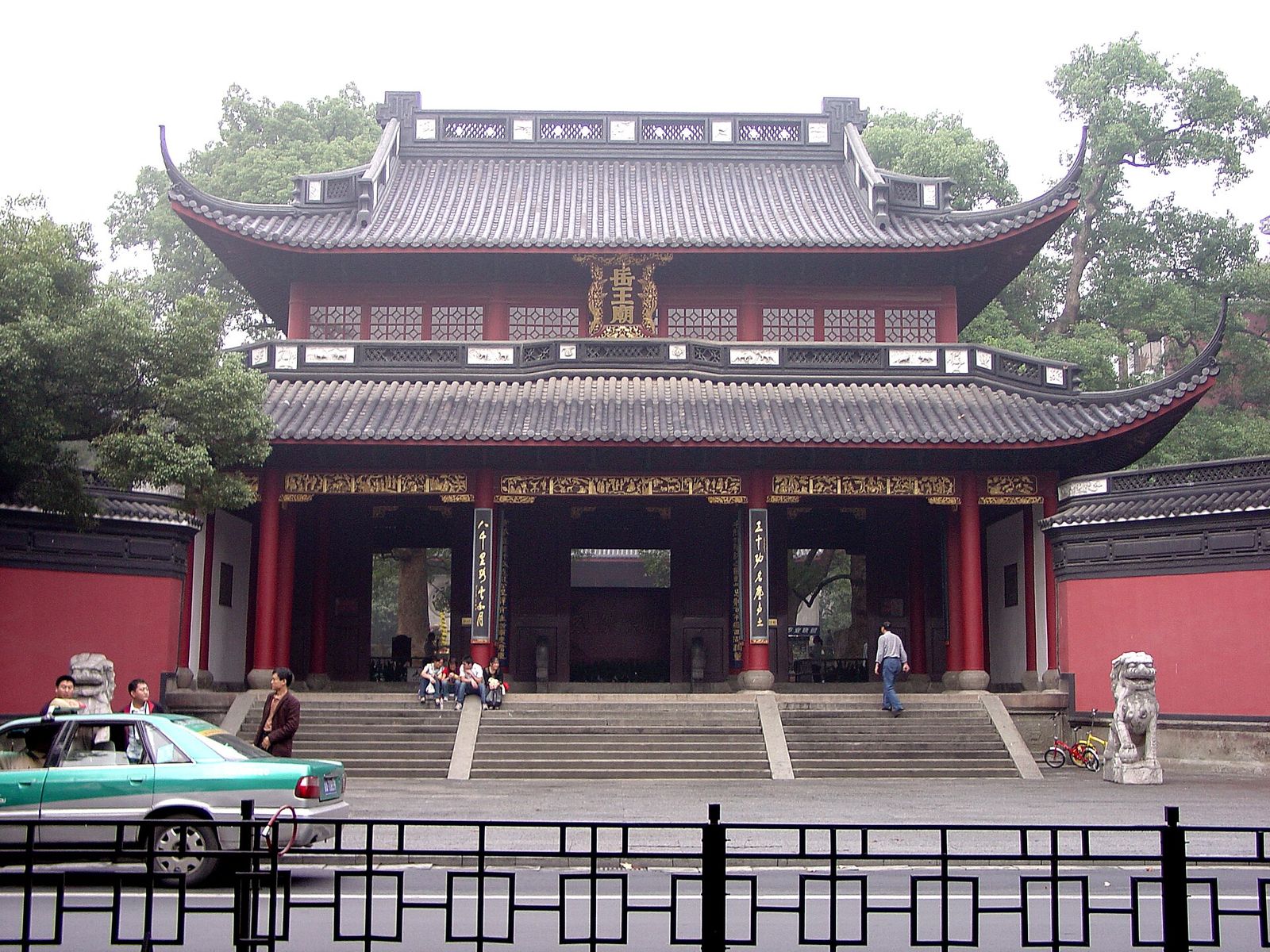
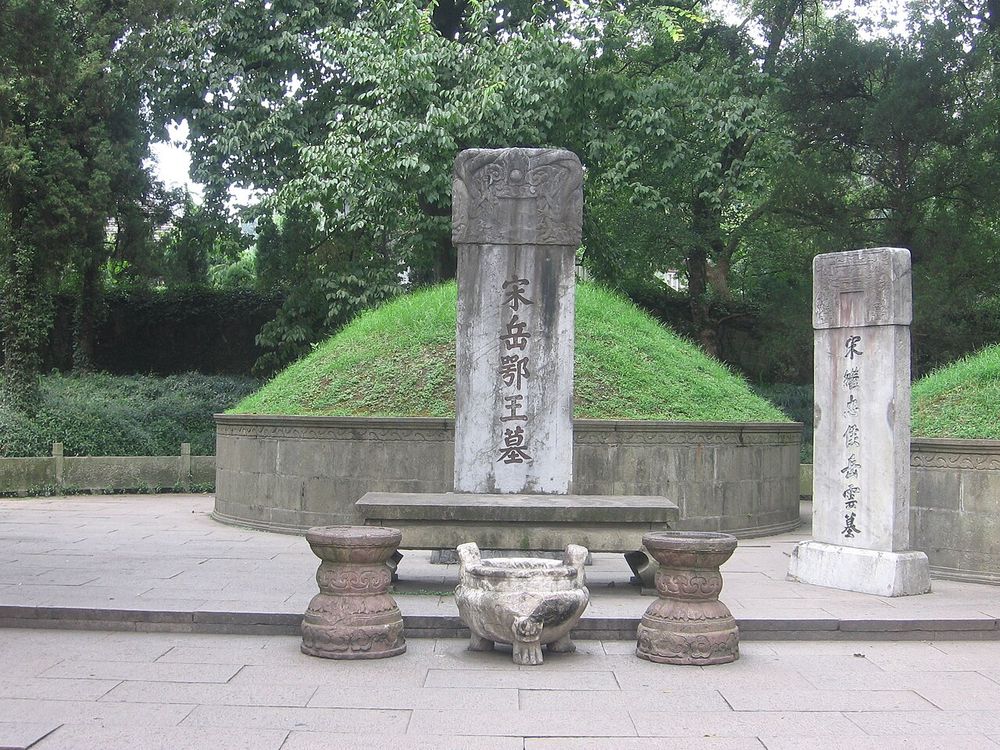
The grave of the Song general who became China's byword for loyalty, killed on false charges in 1142 and reburied here by the lake twenty years later. In front of his tomb four iron figures of the people blamed for his death kneel with their hands tied behind them, and have done so for five hundred years.
Photo: Liuxingy, CC BY-SA 4.0, Wikimedia Commons
The story
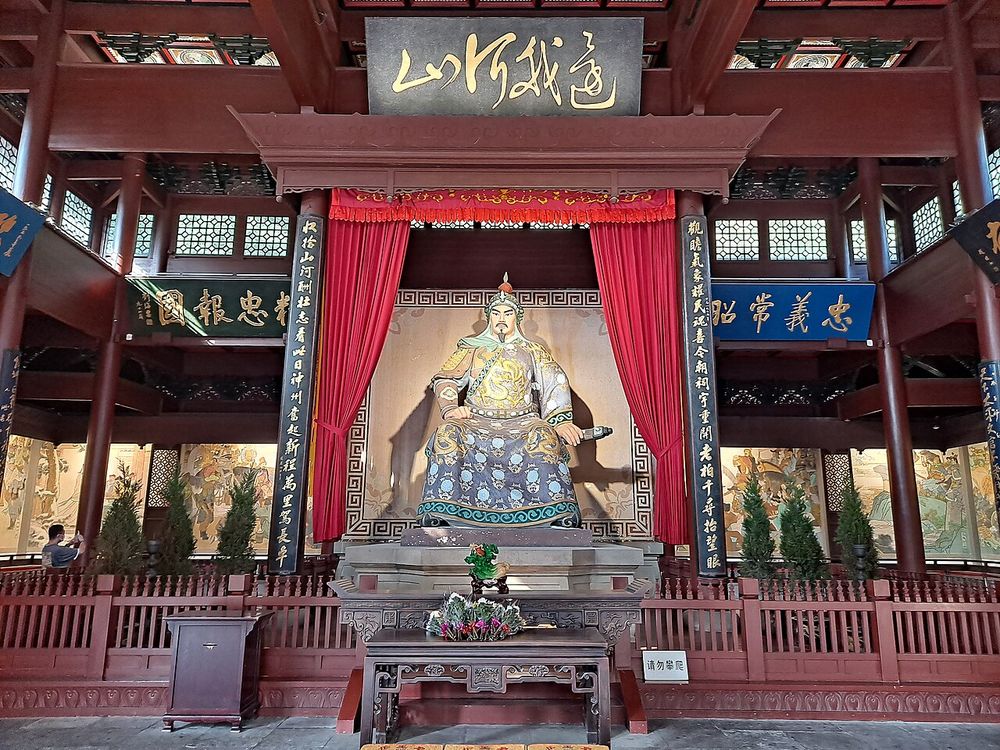
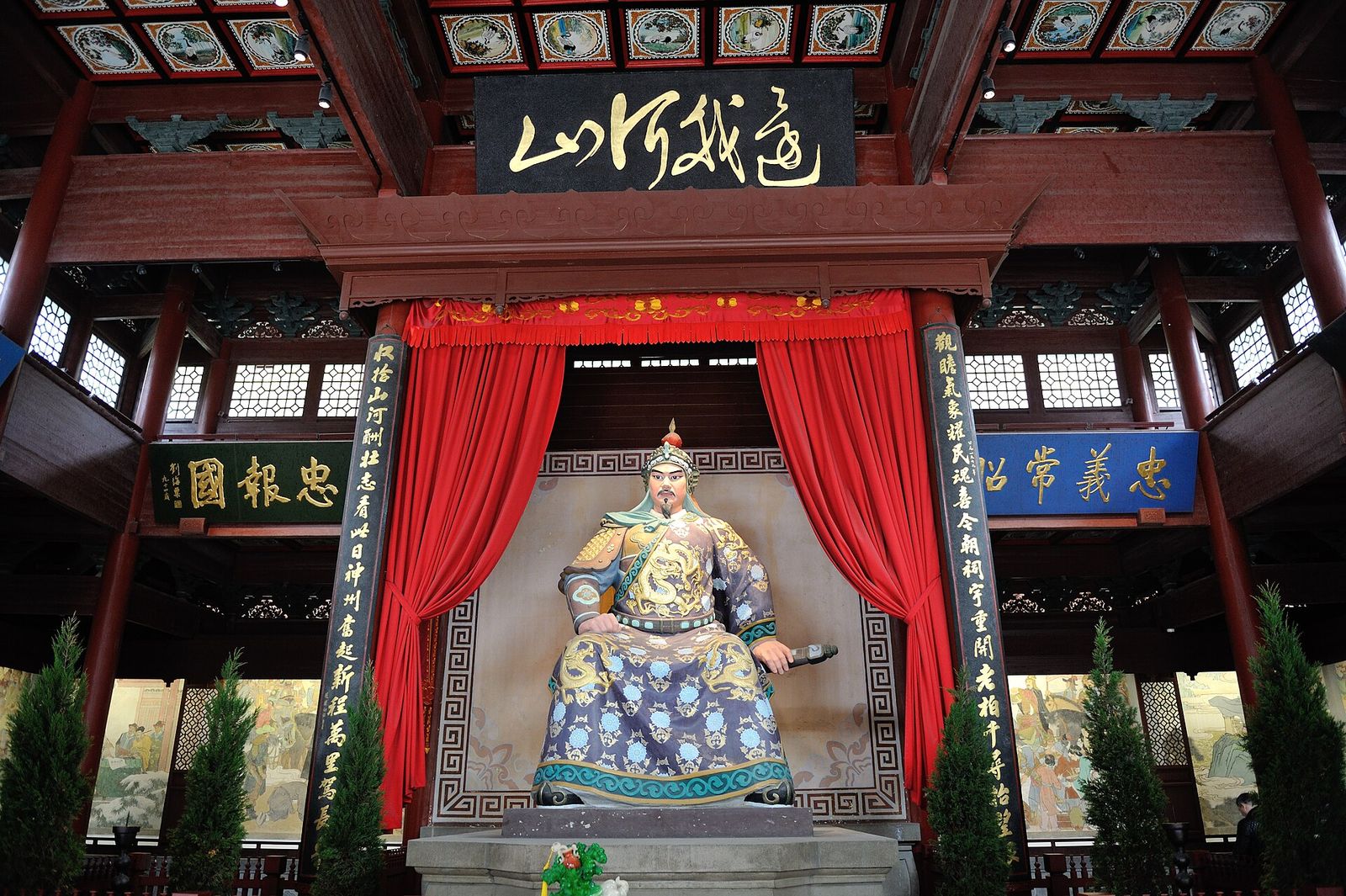
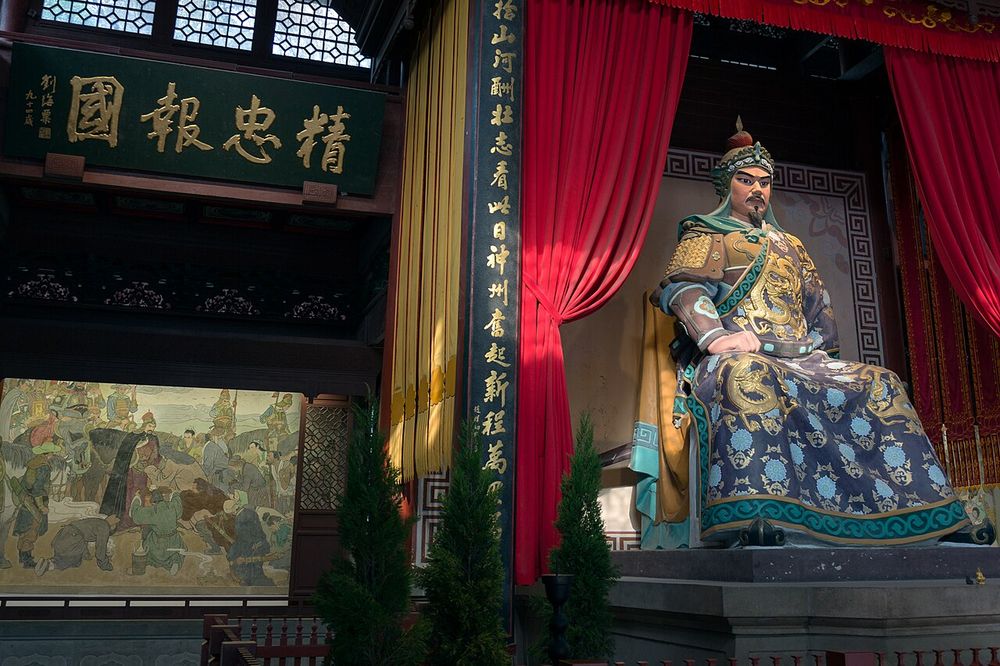
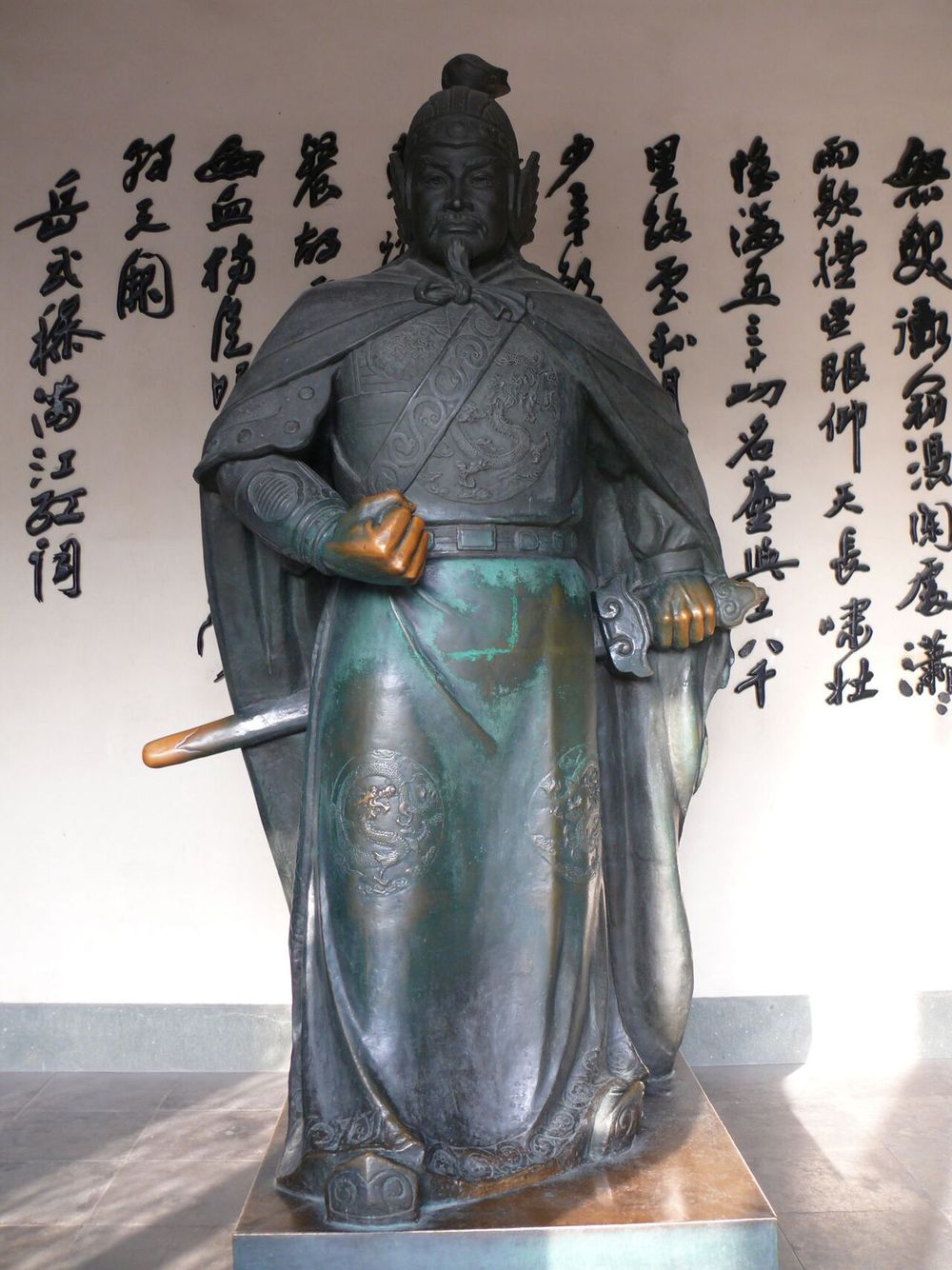
You are on a busy lakeside road. Across it rises a tall gateway of dark wood and white walls, and through it a courtyard of old camphor trees leads to a big double-roofed hall. Inside, under a gilded board, a giant painted figure in armour sits with one hand on his sword. To the left, behind another wall, are two grassy mounds and rows of stone men and animals.
Yue Fei was the most successful general of the Southern Song (1127–1279) against the Jin, who had taken northern China. In 1142, while peace was being made, he was arrested and killed on charges no one could state. At that time in Europe the Second Crusade was five years away.
The emperor who ordered his death, Gaozong, never cleared his name. His successor did, in 1162, and had him reburied here at the foot of Qixia Ridge with full honours. The temple beside the grave was founded in 1221. Its buildings have been rebuilt many times on the same spot; most of what you see is Qing (1644–1912) or later.
The temple has two parts: the hall in front, and the tomb garden to its left. The tomb is what people come for.
Things people often get wrong
"His mother tattooed 'Serve the country with utmost loyalty' on his back." The official history says that when he was tried, the words were seen on his back. That his mother put them there comes from a novel of the Qing.
"The kneeling figures are the originals." They have been recast many times, because visitors beat and spat on them. The present ones are iron.
"Yue Fei wrote the poem 'The River All Red'." It is printed under his name everywhere, but it first appears in the Ming (1368–1644), and scholars still argue about who wrote it.
People who stood here
Yue Fei (Song general, 1103–1142)He did not choose this place. He was reburied here twenty years after his death, and for eight hundred years people have come to stand in front of him.
Zhao Mengfu (painter and calligrapher, 1254–1322)A descendant of the Song royal family who took office under the Mongol Yuan, he wrote a poem at this grave: the grass grows wild on the general's tomb, and the stone animals stand in the autumn. He may have stood where the stone figures stand now.
Go deeper: four stops, from the hall to the kneeling figures
Go into the hall first, then out through the side door to the tomb garden. An hour is enough.
1. The hall
The hall and its board, "Give me back my rivers and mountains"钉钉, CC BY-SA 4.0
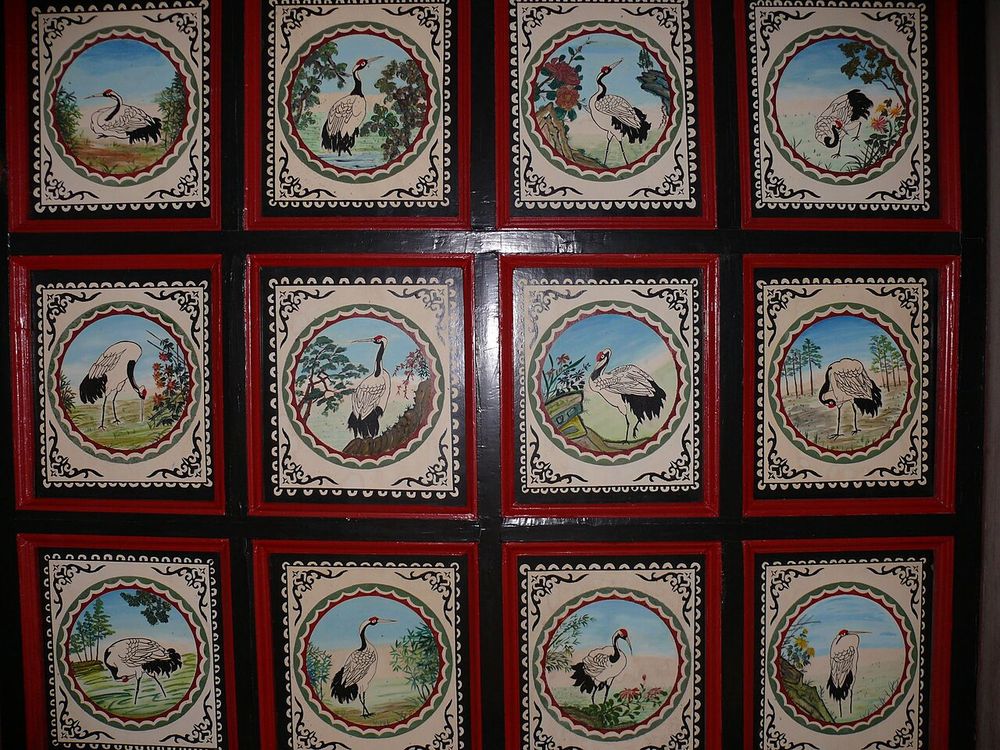
The great figure of Yue Fei sits in armour under a board with four large characters: "Give me back my rivers and mountains". The board is said to copy his own hand. The ceiling above is painted with white cranes.
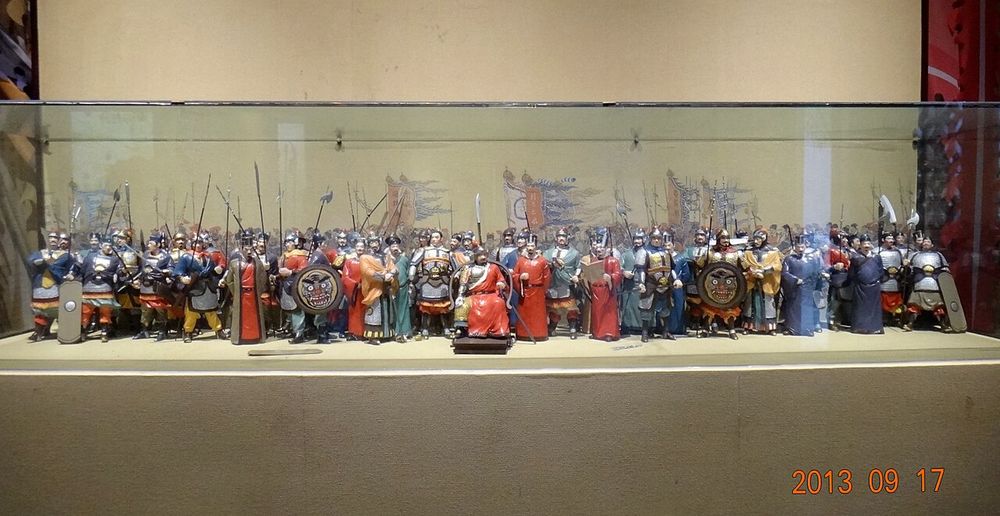
In the side halls are his son Yue Yun, killed with him, and some of his generals. On the walls of the corridors are panels telling his life, from his childhood to his death.
2. The wall with four characters
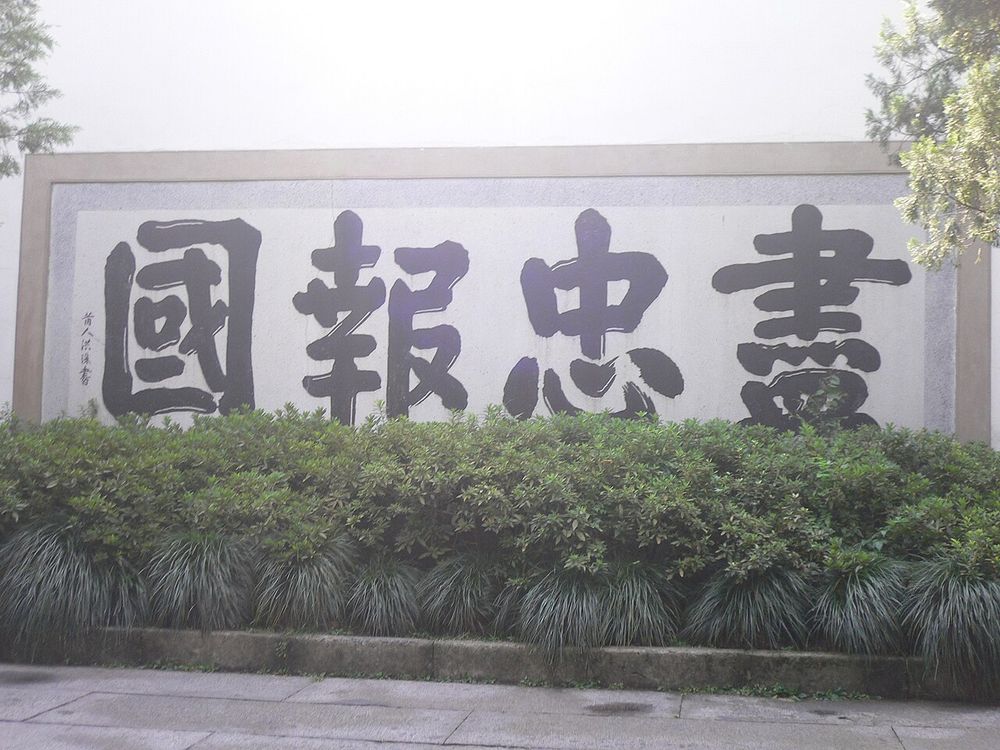
The wall with four characters江上清风1961, CC BY 3.0
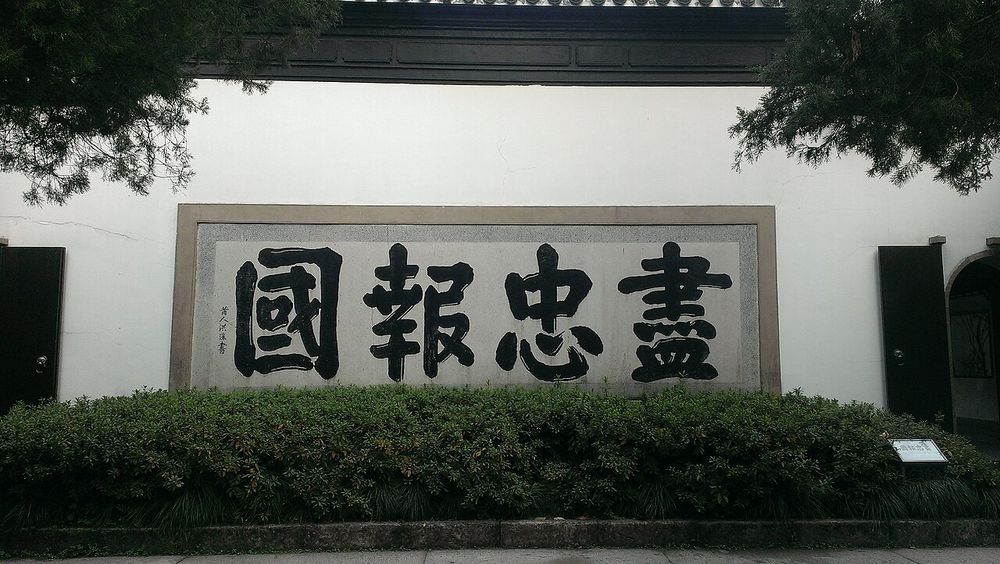
Leaving the hall for the tomb, you pass a long white wall with four huge characters: "Serve the country with utmost loyalty". These are the words the official history says were on his back. They were written for the wall by a Ming calligrapher.
3. The tomb
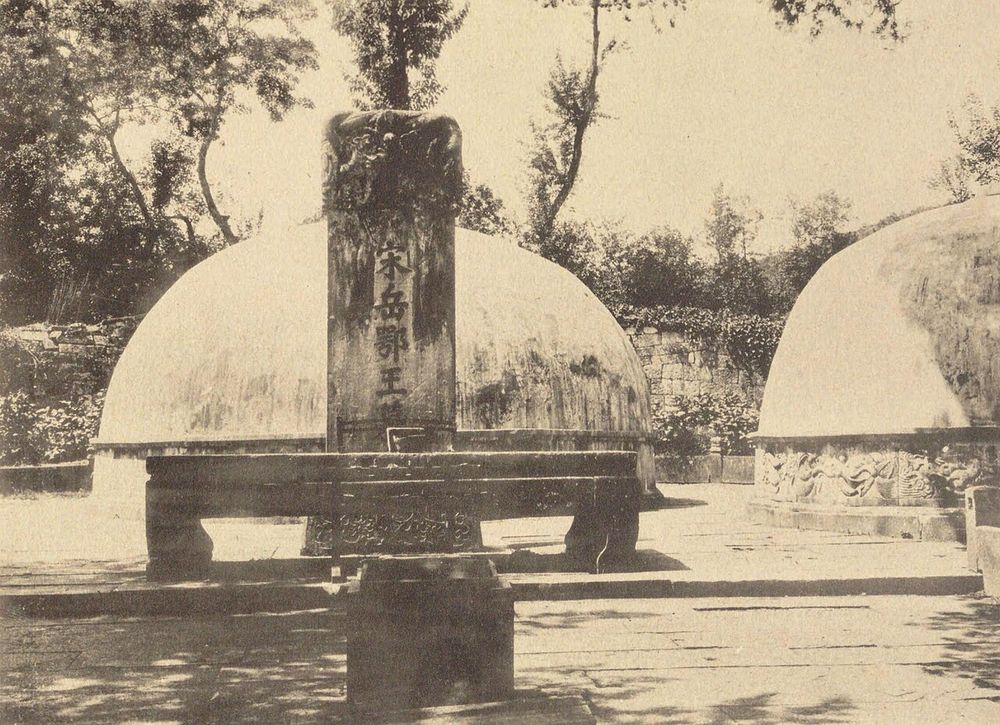
The graves of Yue Fei and his sonWindmemories, CC BY-SA 4.0
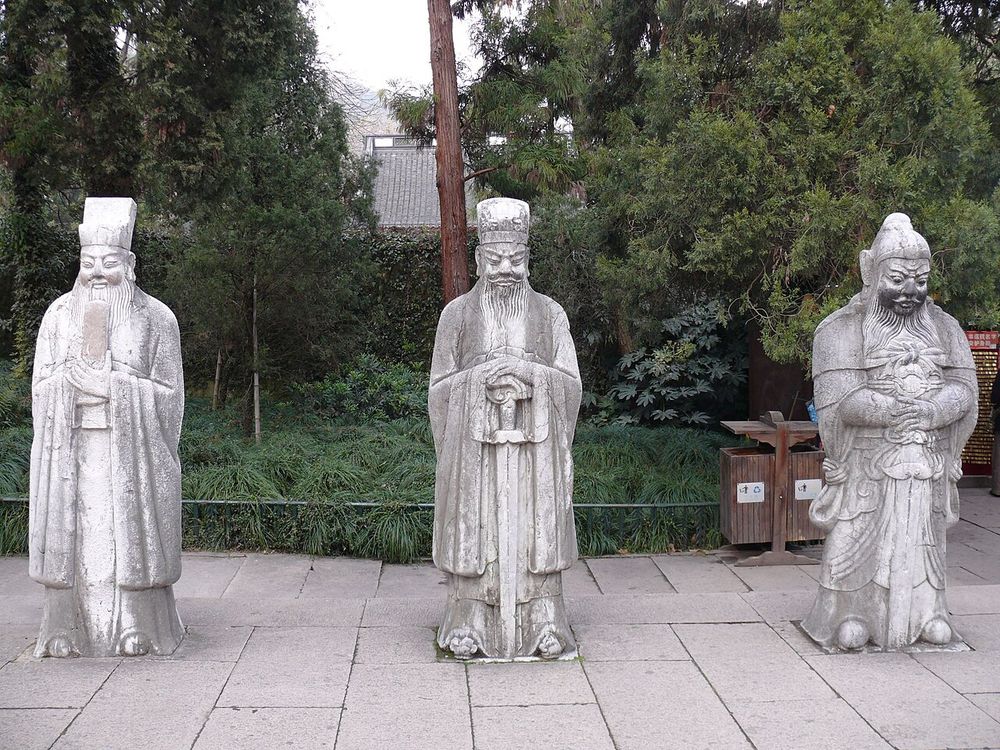
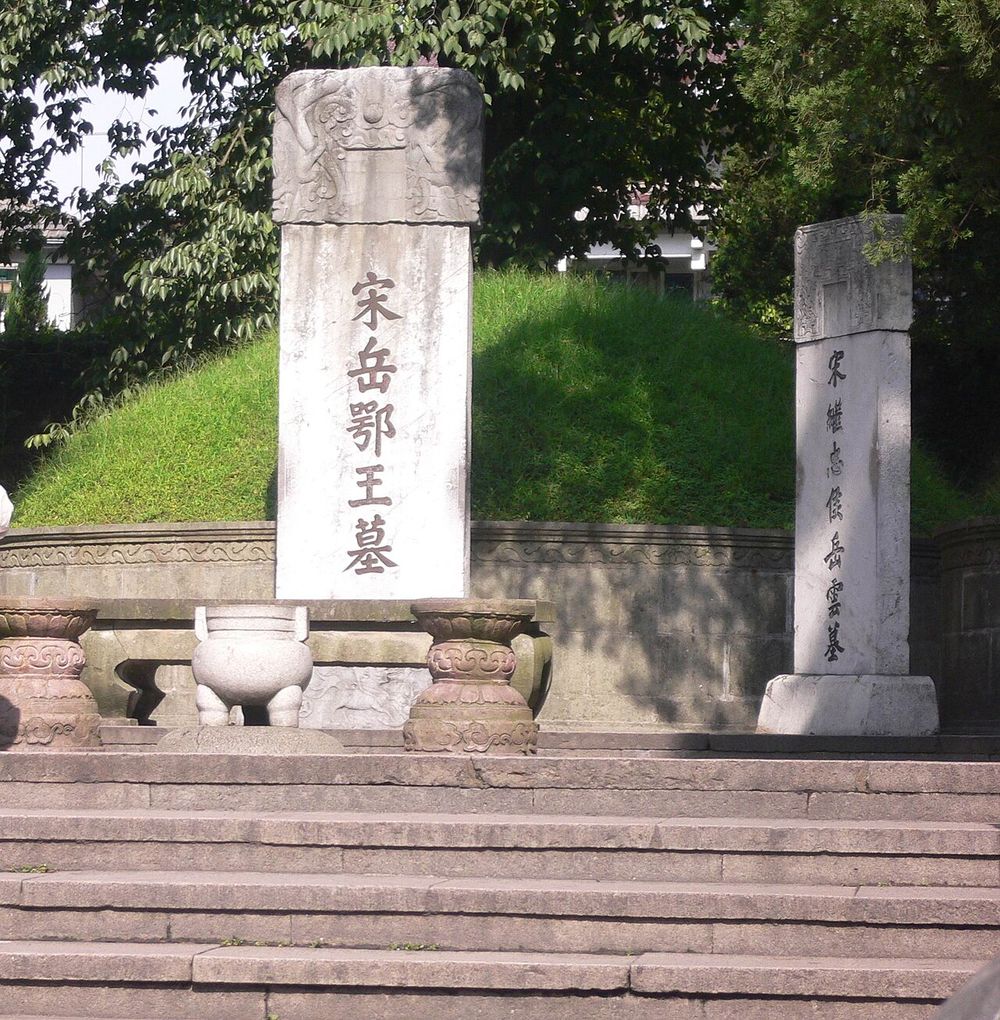
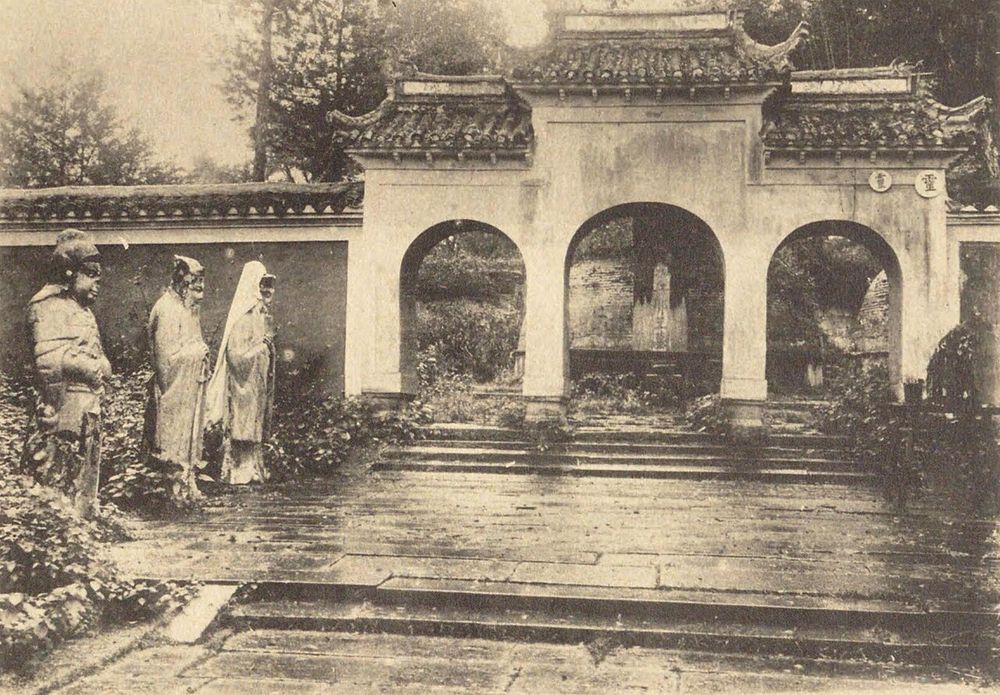
Two grassy mounds stand side by side behind low stone fences: the larger is Yue Fei's, the smaller his son's. Stone officials, horses, tigers and sheep line the path in front, as they line the tombs of princes.
When the tomb garden was restored in 1979, two Southern Song stone figures were found buried beside the path. They show that this has been the place of burial since the Song.
4. The kneeling figures
The tomb and its tabletsZhou Guanhuai, CC BY-SA 4.0
Below the tomb, behind iron railings, four iron figures kneel with their hands tied behind them: the chief minister Qin Hui, his wife Lady Wang, and the officials Moqi Xie and Zhang Jun. The earliest that can be dated were cast in bronze in 1513.
Over the tomb gate is a couplet: "The green hill is fortunate to hold a loyal man's bones; the white iron is innocent, yet was cast into traitors."
A question to talk over: the order to kill Yue Fei came from the emperor. Why are only the ministers kneeling here?
Meanwhile in the world
Year
Here
Elsewhere
1142
Yue Fei is put to death
At Saint-Denis near Paris the first Gothic choir is nearly finished
Films from official channels, played from YouTube. Nothing is loaded until you press play.
West LakeCCTV纪录 · China Central Television's documentary channel; 2 min · checked 2026-11-12
Local legends
These are stories people tell about this place. They are legends, not history, and each one says where it comes from.
LegendThe mother's needle
Before he went to war, his mother made him kneel and with a needle wrote four characters on his back, "Serve the country with utmost loyalty", and rubbed ink into them so that he would never forget.
Source: The Qing novel The Complete Story of Yue Fei (1684); the official history says only that the words were on his back
LegendThe cypress that turned to stone
A cypress stood by the prison where Yue Fei was killed. On the day he died it withered, and its trunk later turned to stone. Pieces of it are kept in a pavilion in the temple.
Source: Temple tradition; the pieces are fossil wood of a much older age
Later, people who live here will be able to add the stories they grew up with, and say which of these they have heard.
Not certain, and where accounts conflict
The day he died
Given as 27 or 28 January 1142. We give the month.
When was the temple founded?
1221 according to the temple's managers and Xinhua; some online articles say 1195. We use 1221.
Who wrote "The River All Red"?
The poem first appears in a Ming text, about three hundred years after his death, and nothing earlier quotes it. Some scholars hold that it is his; others that a Ming writer composed it.
Visiting
Tickets and hours
25 yuan for an adult in 2026 booking listings, with reductions for children and older visitors.
Listings show it opening at 7:30.
Last checked 2026-11-12. Xinhua's 2023 report on the temple, Hangzhou news of 2026, and booking listings for the price; the temple's own website could not be opened from abroad.
Booking without WeChat
Official page in English The temple sells tickets at its gate. It is also listed in the West Lake Tourism mini-programme in WeChat and Alipay, and on international booking platforms. The scenic area's own website could not be opened from abroad when we tried in November 2026.
Ticket window on site There is a ticket window at the gate on Beishan Road; bring your passport.
Note On 24 June, West Lake Day, the temple is among the paid sites round the lake that let everyone in free.
Checked 2026-11-12
Where to start
The gate is on Beishan Road, five minutes' walk from Xiling Bridge and the north end of the Su Causeway.
Before you go
Allow an hour. The hall can be dark inside; the tomb garden is best in morning light.
Customs and manners
For Chinese visitors this is a place of respect. Keep your voice down at the tomb.
Spitting at the kneeling figures was once the custom; it is now forbidden, and so is reaching through the railing to hit them.
Opening hours are given in the local time of the place. Prices are in the local currency. The figure after ≈ is approximate, at exchange rates checked on 9 November 2026, in .
Look for these
Read the four characters on the board above the great figure.
Look up at the ceiling of the hall. What birds are painted there?
Which grave is bigger, the father's or the son's?
Count the kneeling figures. How many are women?
Find the couplet over the tomb gate.
Find the pieces of stone tree in their pavilion.
I am here
Stand at the site, sign in, press the button, and collect its stamp. Your browser will ask to use your location. It is sent to us once to confirm that you are at the site; we keep how far you were from it, not the spot where you stood.
Your stamps are saved to your account, so they follow you to any device. Checking from a browser cannot rule out every false location; stricter checks arrive with the app.
Messages
Share your photos
Photos here show the place, not people. Each one is credited to the visitor who took it and appears after our team has looked at it. A photo with you in it belongs under “I am here”.