LegendWe shall be thought mad
When the canons voted in 1401, one of them said: let us build a church so great that those who see it finished will think we were mad.
Source: Cathedral tradition; the minutes of the meeting do not survive
Seville, Andalusia, Spain
Catedral de Santa María de la Sede · kah-teh-DRAHL deh seh-VEE-yah; hee-RAHL-dah
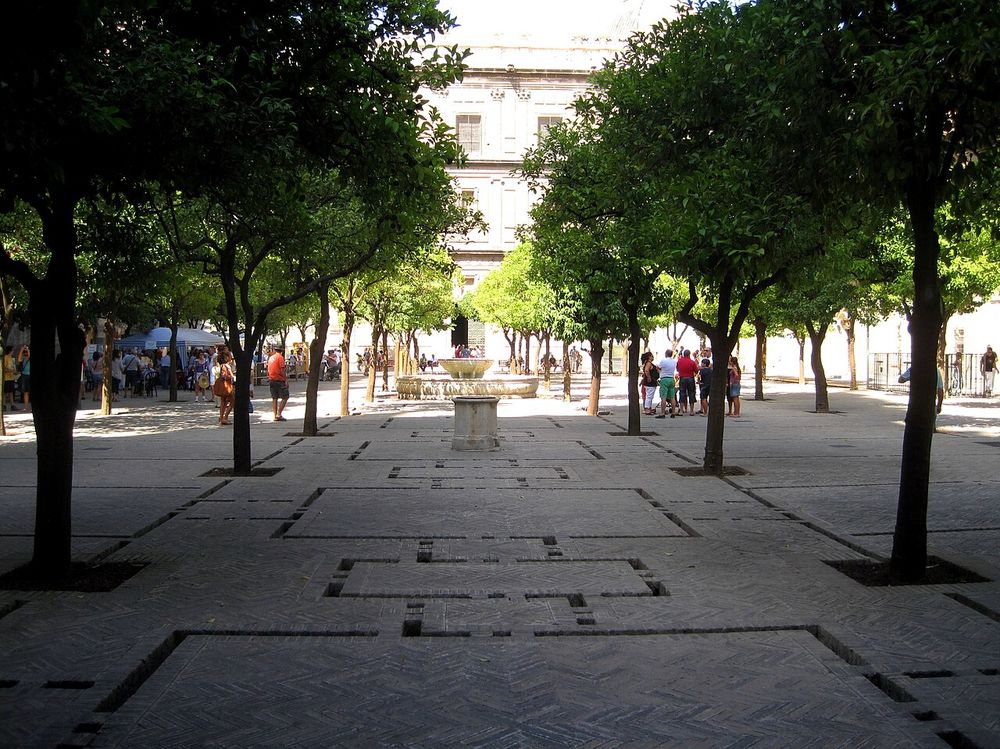
The largest Gothic church in the world, built between 1434 and 1506 on the exact ground plan of the city's great mosque. The mosque's courtyard of orange trees is still the cathedral's courtyard. The mosque's minaret, with a belfry added on top, is still its bell tower. And the body of Christopher Columbus, or part of it, lies inside.
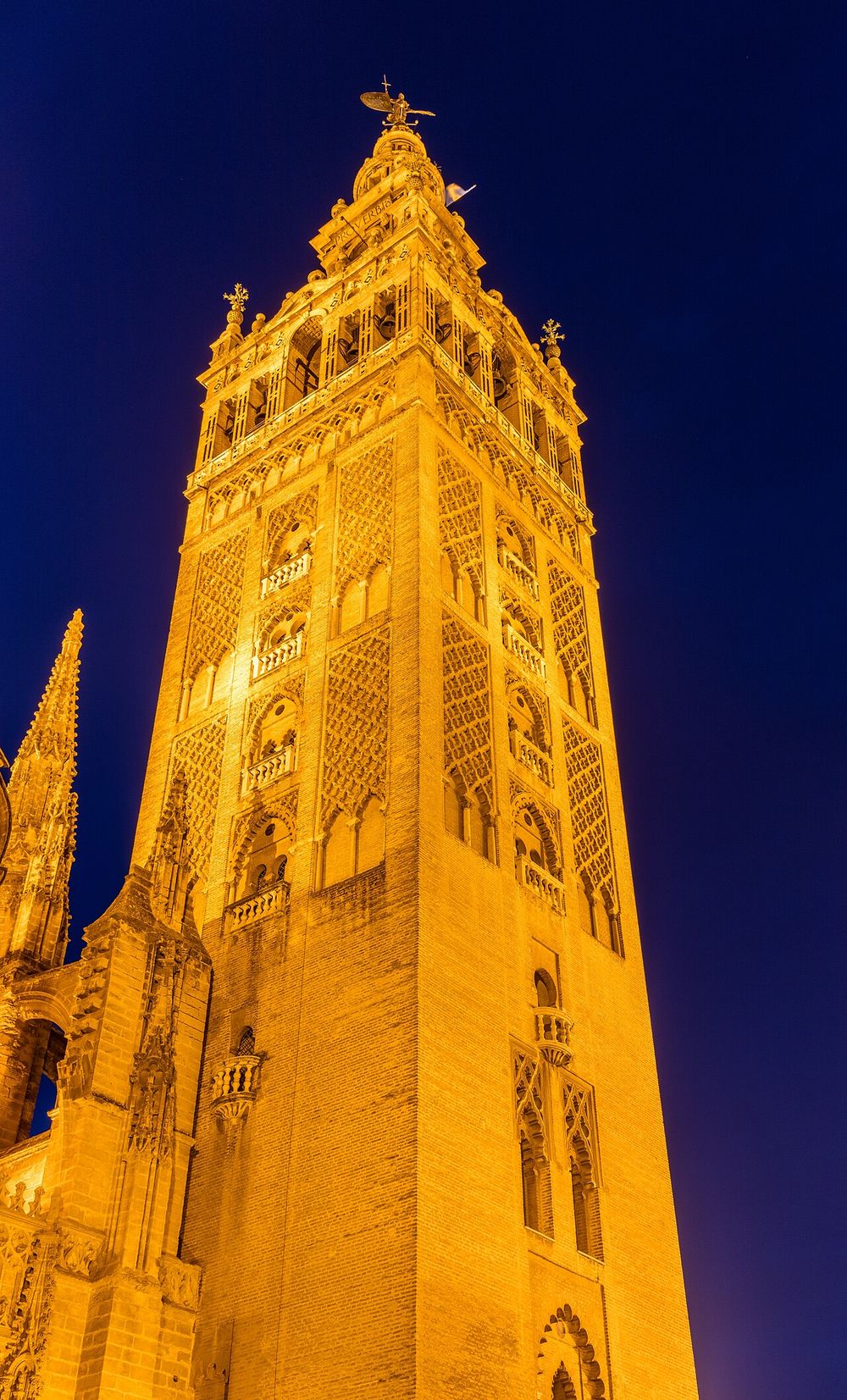
Photo: Diliff, CC BY-SA 3.0, Wikimedia Commons
In 1172 the Almohad caliph, who ruled from Morocco, ordered a new great mosque for his Spanish capital. It took twenty-six years. Fifty years after it was finished the Christians took the city and used the mosque as their cathedral, as it stood, for a century and a half.
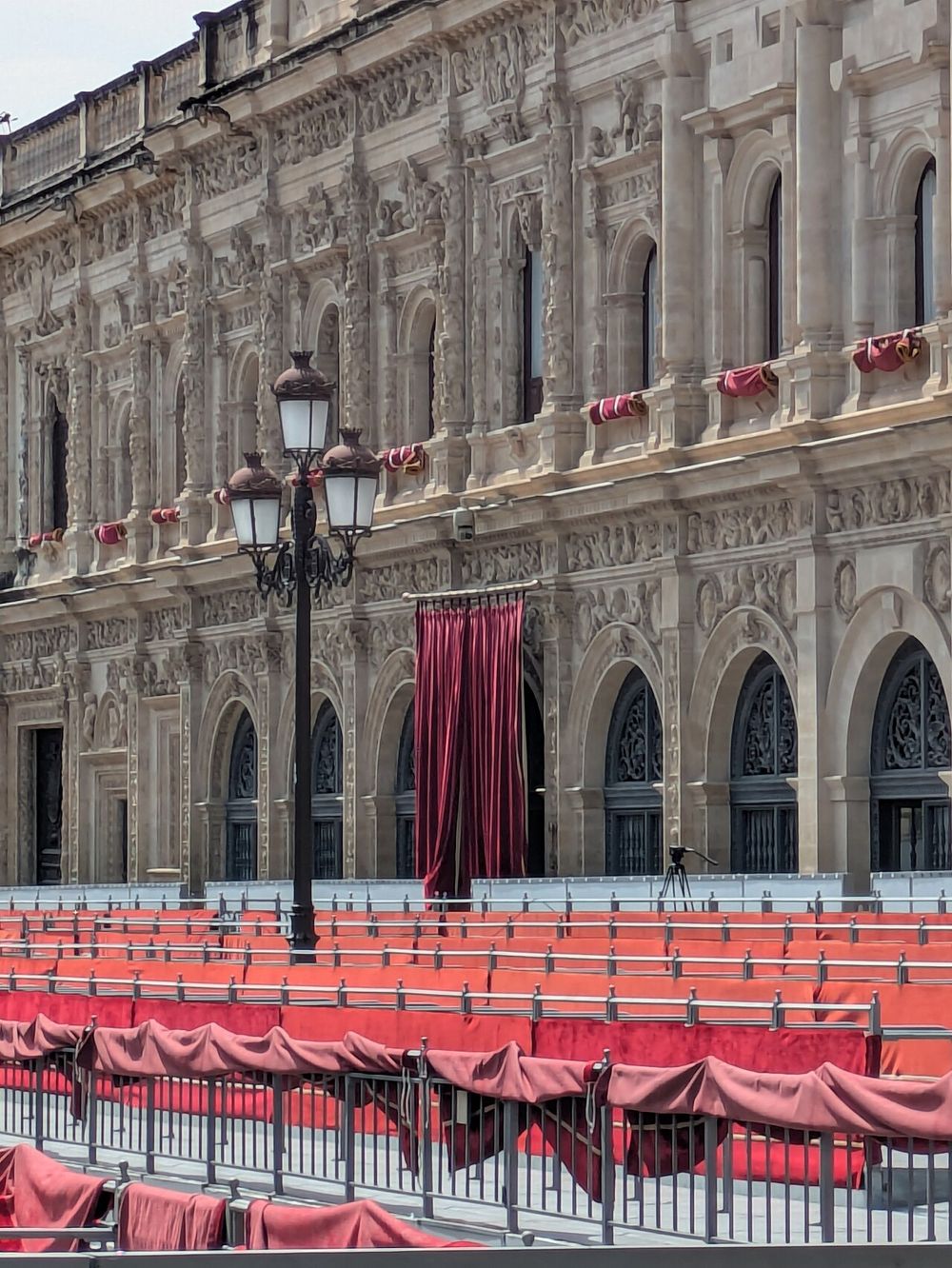
By 1401 it was falling down. The canons voted to replace it. They kept the tower and the courtyard and filled the prayer hall's rectangle with a church. That is why it is so wide and so square, unlike any cathedral in France. In China the building years run from the Xuande to the Zhengde reigns of the Ming dynasty (1368–1644).
Close by, with a page of its own: Alcázar of Seville, Mezquita, Córdoba, Notre-Dame de Paris.
The ticket covers the church, the treasury, the tower and the courtyard, and also a second church ten minutes away, El Salvador. Walks on the roof are a separate guided ticket.
| Part | Ticket |
|---|---|
| The church and the tomb of Columbus | Cathedral ticket |
| The high altar and the royal chapel | Cathedral ticket; the chapel is closed during services |
| The treasury | Cathedral ticket |
| The Giralda | Cathedral ticket |
| The courtyard of the orange trees | Cathedral ticket; you leave through it |
| The roof | Separate guided ticket |
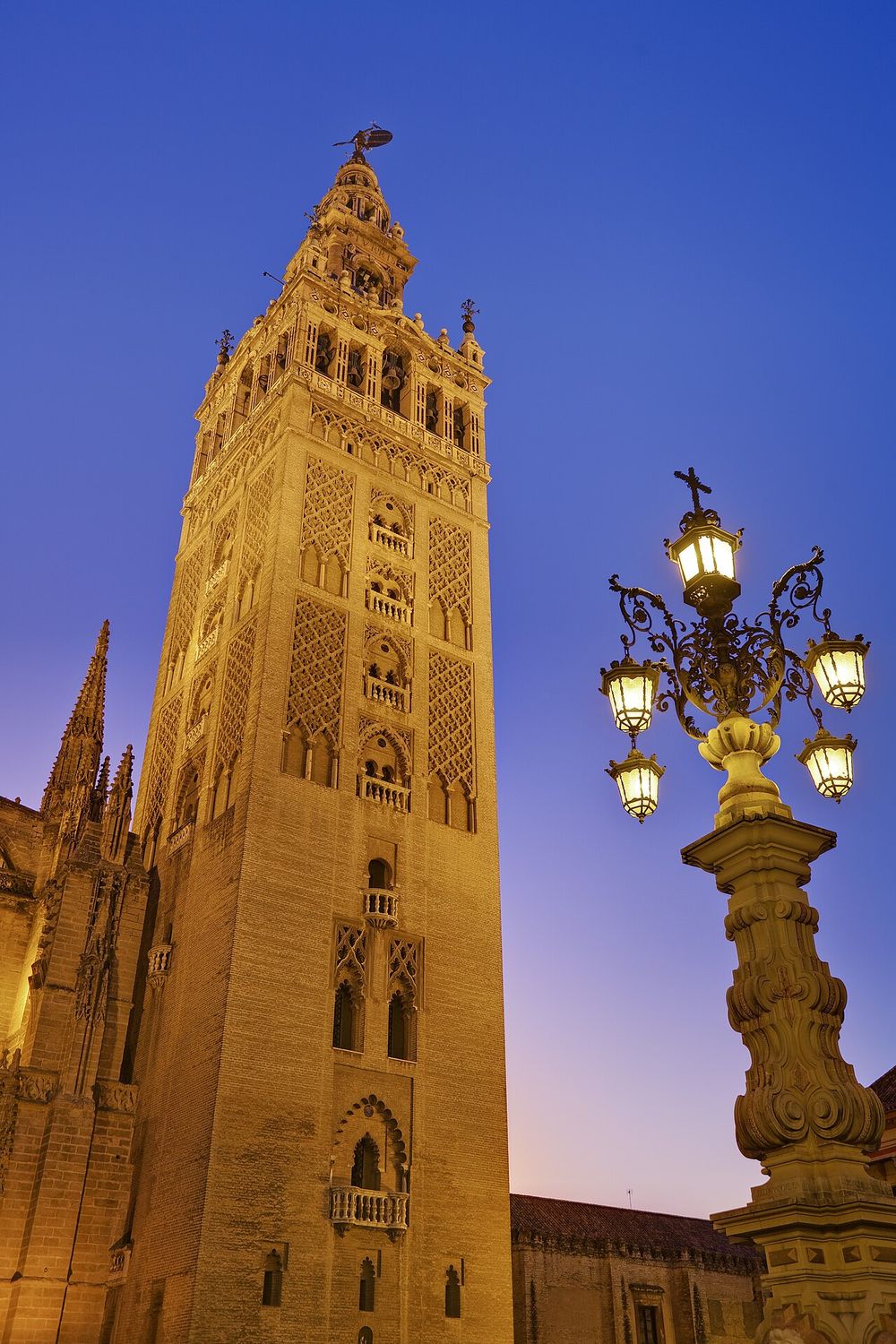
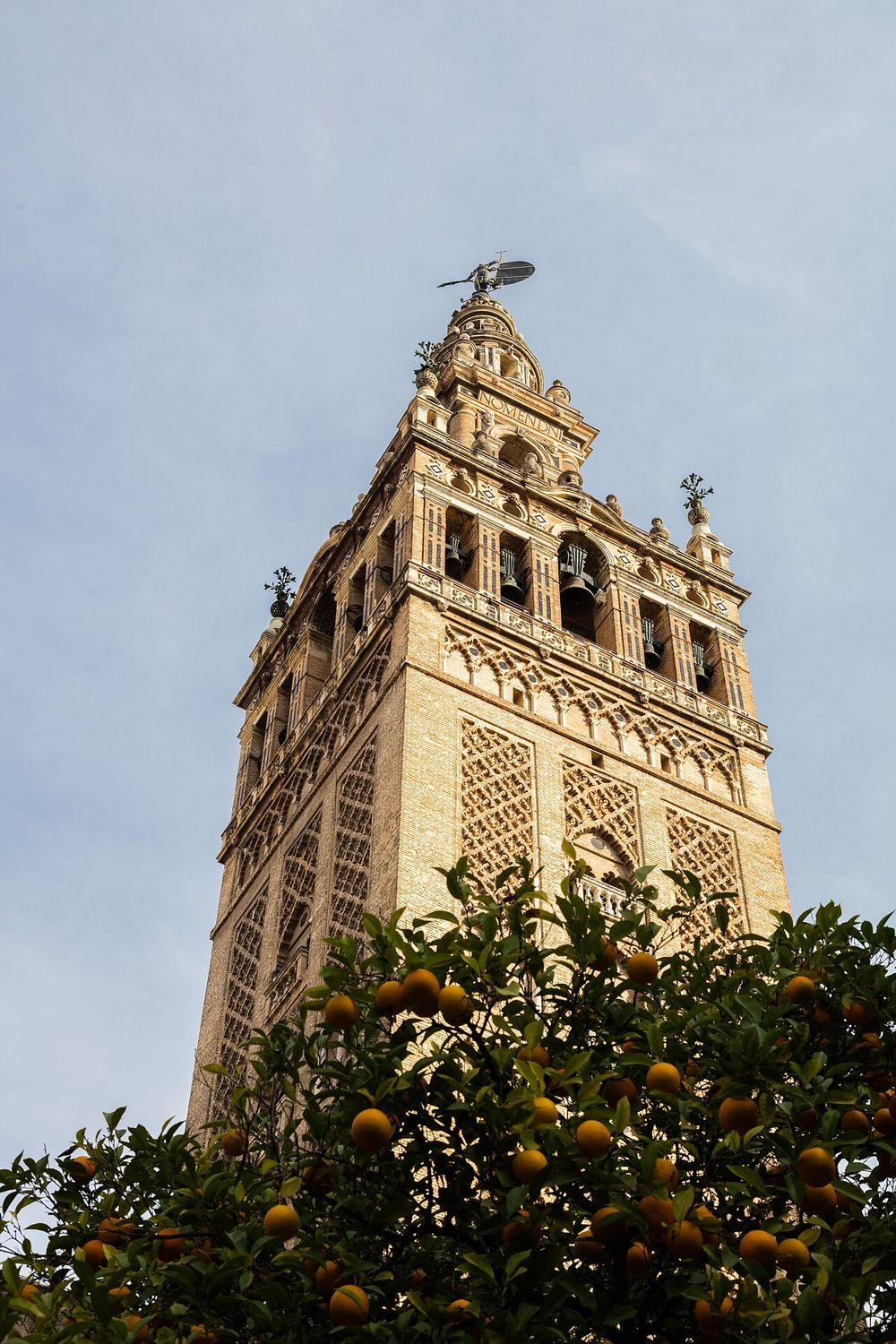
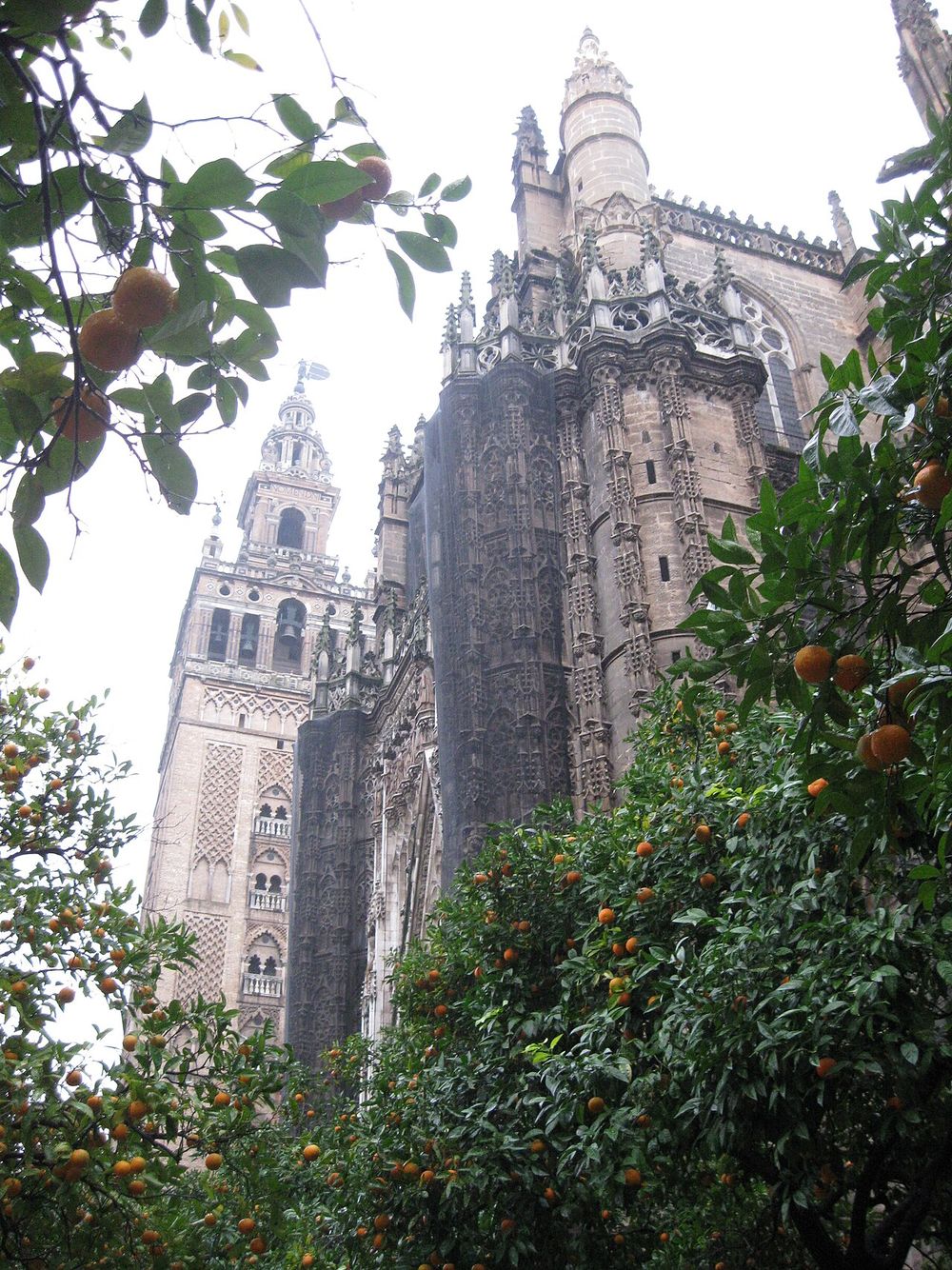
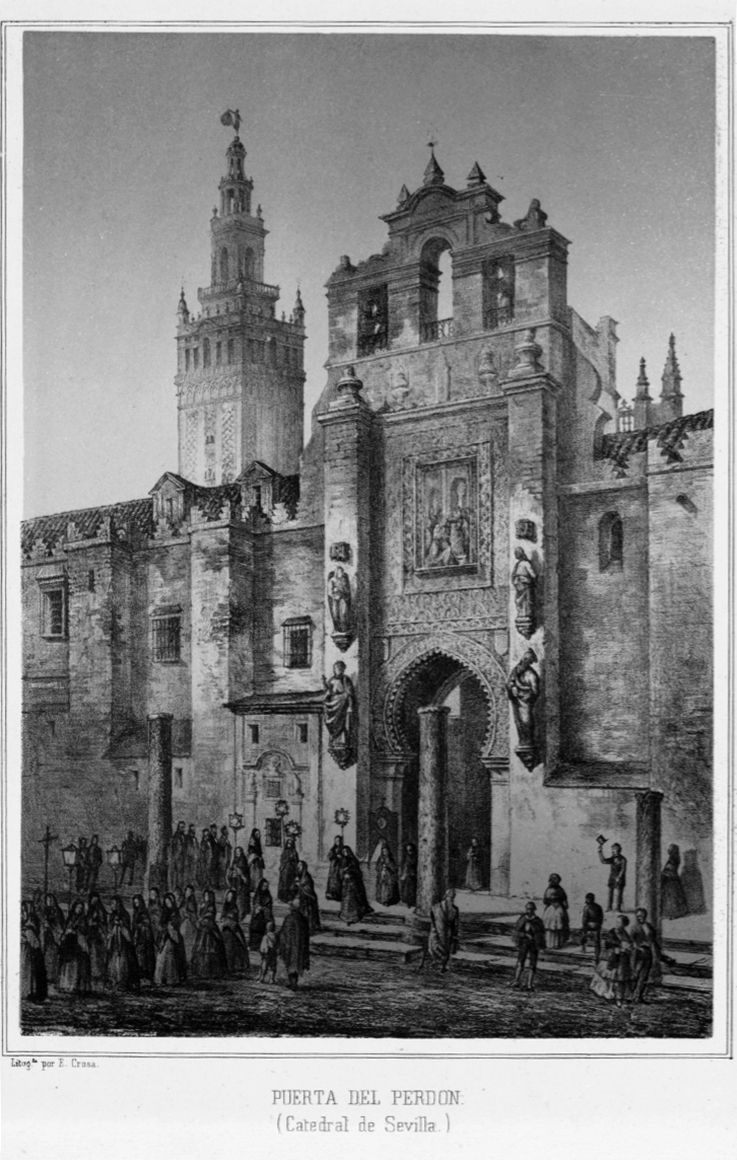
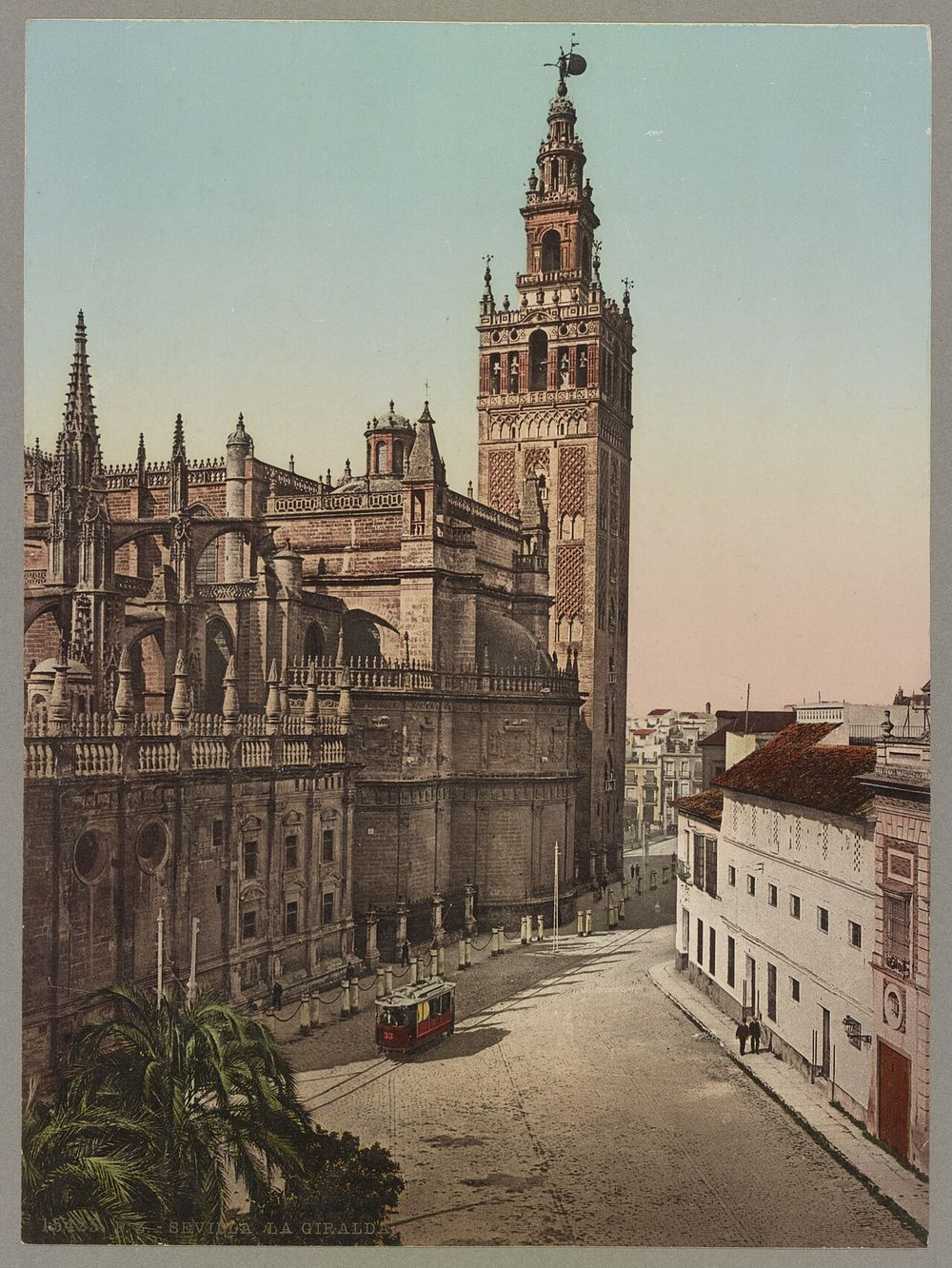
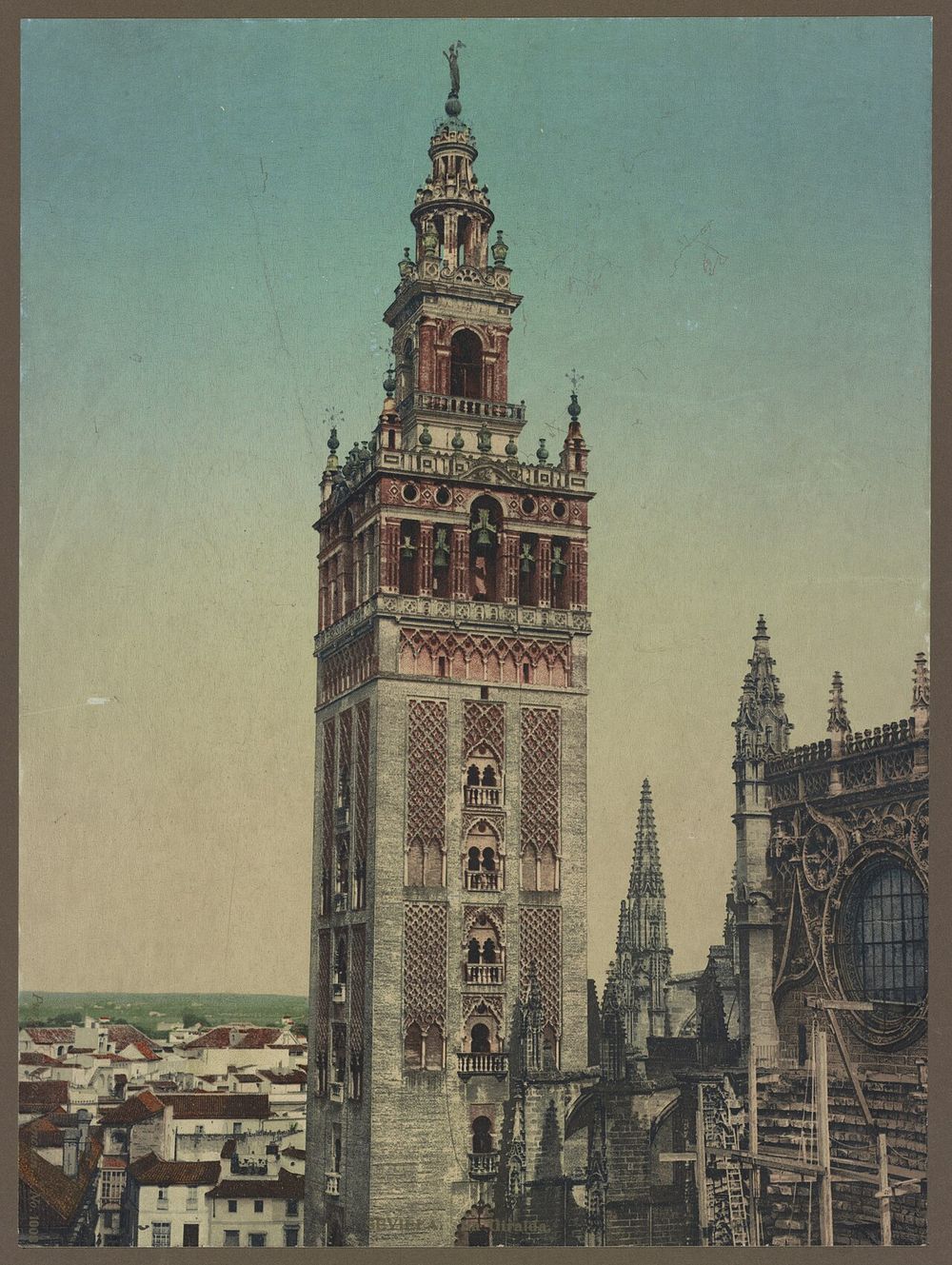
Look up the Giralda in three parts. The lower two thirds, of brick with panels of woven pattern, are the minaret of 1198. The stone at the very bottom is older still: Roman blocks reused, some with Latin on them.
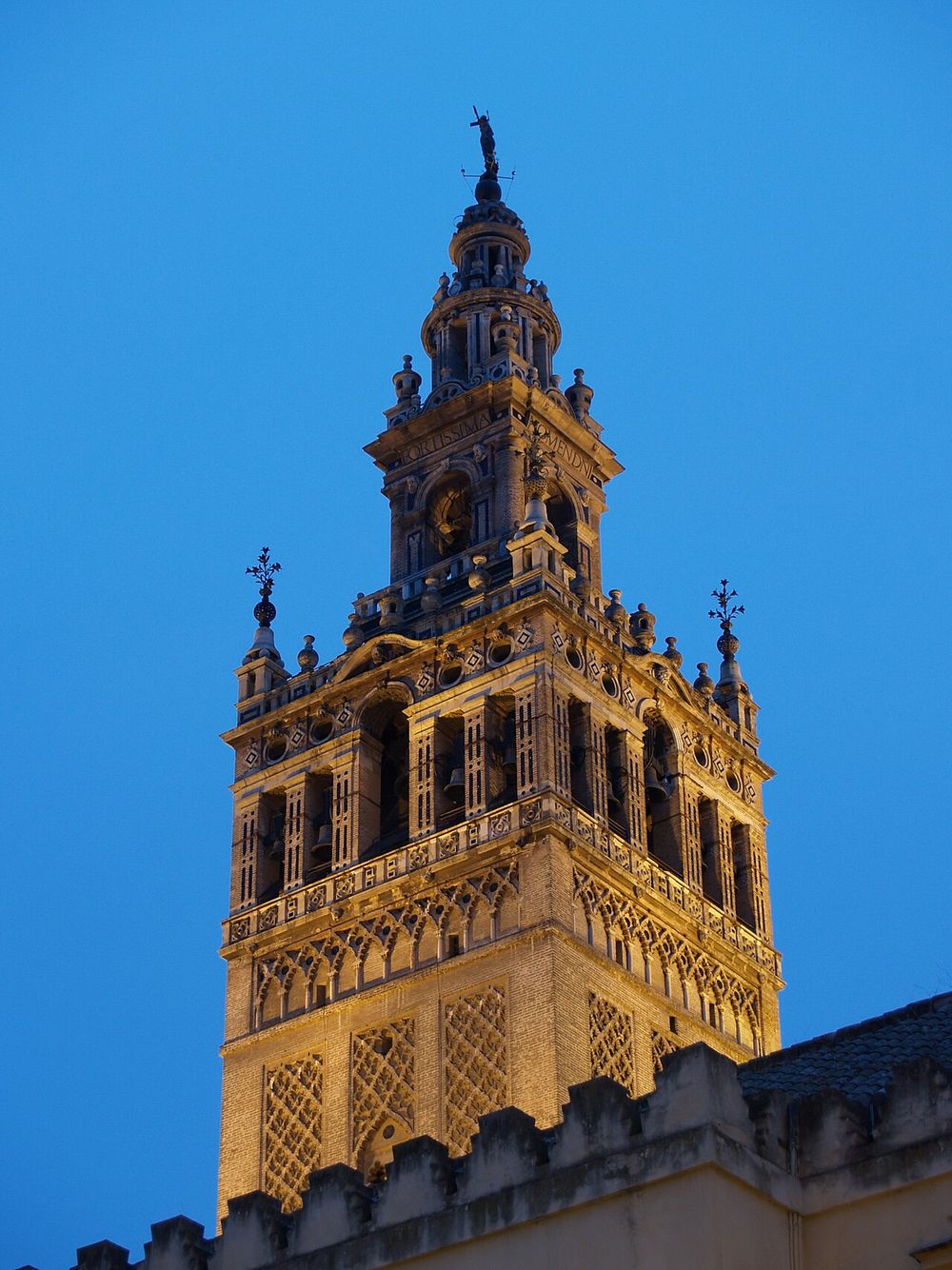
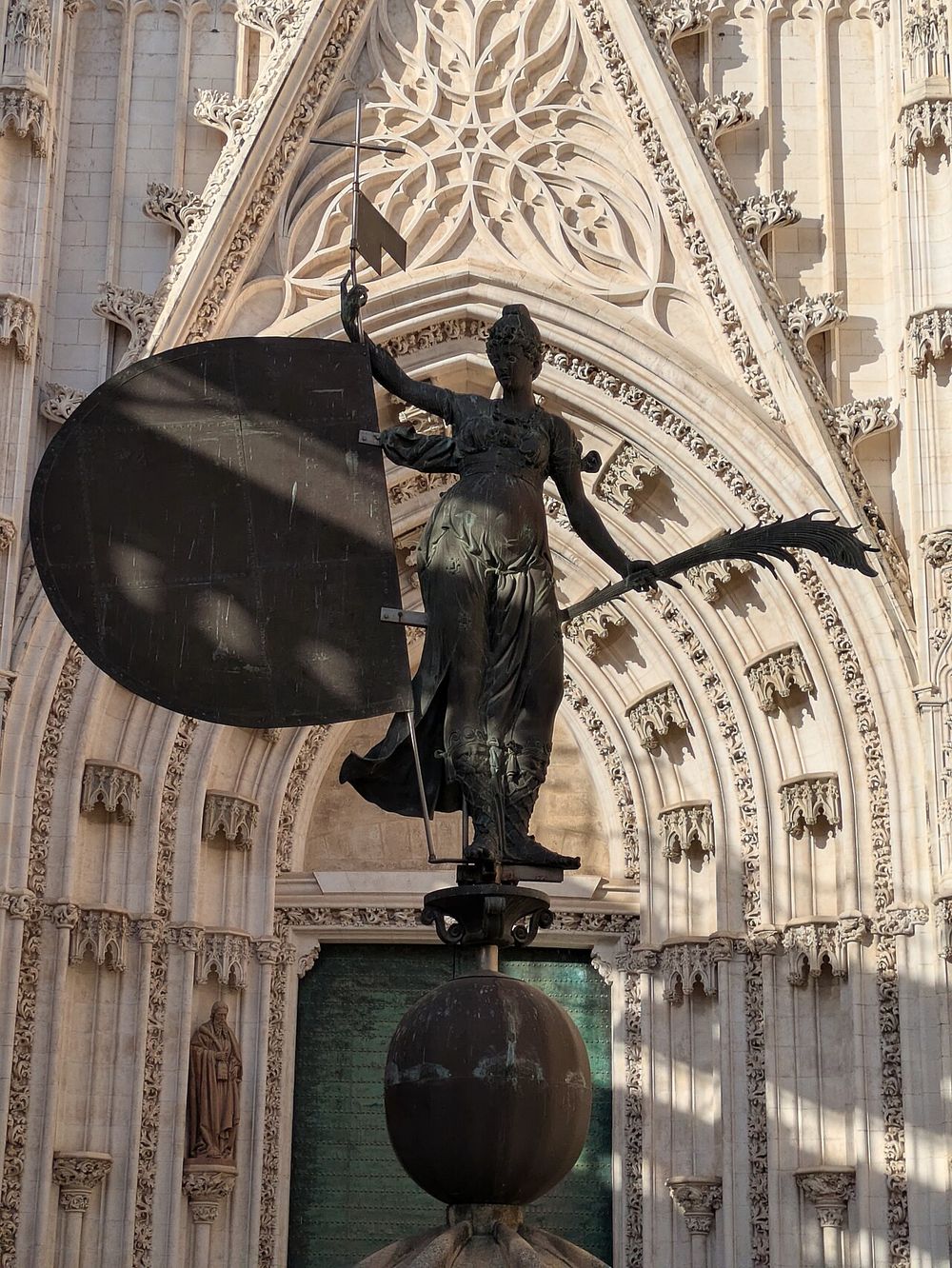
The top third, with the bells, was added in 1568. On the very tip a bronze woman four metres high holds a shield and a palm. She is a weathervane and turns with the wind. Her nickname, the Giraldillo, "the one that turns", gave the whole tower its name.
There are no stairs inside. Thirty-five ramps wind up round a core, wide enough for the man who gave the call to prayer to ride up on a horse five times a day. You walk up the same ramps.
"The tower is a church tower in Moorish style." It is a real minaret. Its two sisters, built by the same rulers in the same years, still stand in Marrakesh and Rabat.
"It is the biggest church in the world." It is the biggest Gothic one, and the biggest cathedral by volume. Saint Peter's in Rome and one in Brazil are larger churches.
"Columbus is certainly buried here." See the fourth stop below. The Dominican Republic says it has him too. Both may be right.
"The gold is from America." The great altarpiece was begun in 1482, ten years before Columbus sailed. Its later parts may well be gilded with American gold.
One ticket covers all eight stops. The visit starts at the south door and ends in the courtyard.
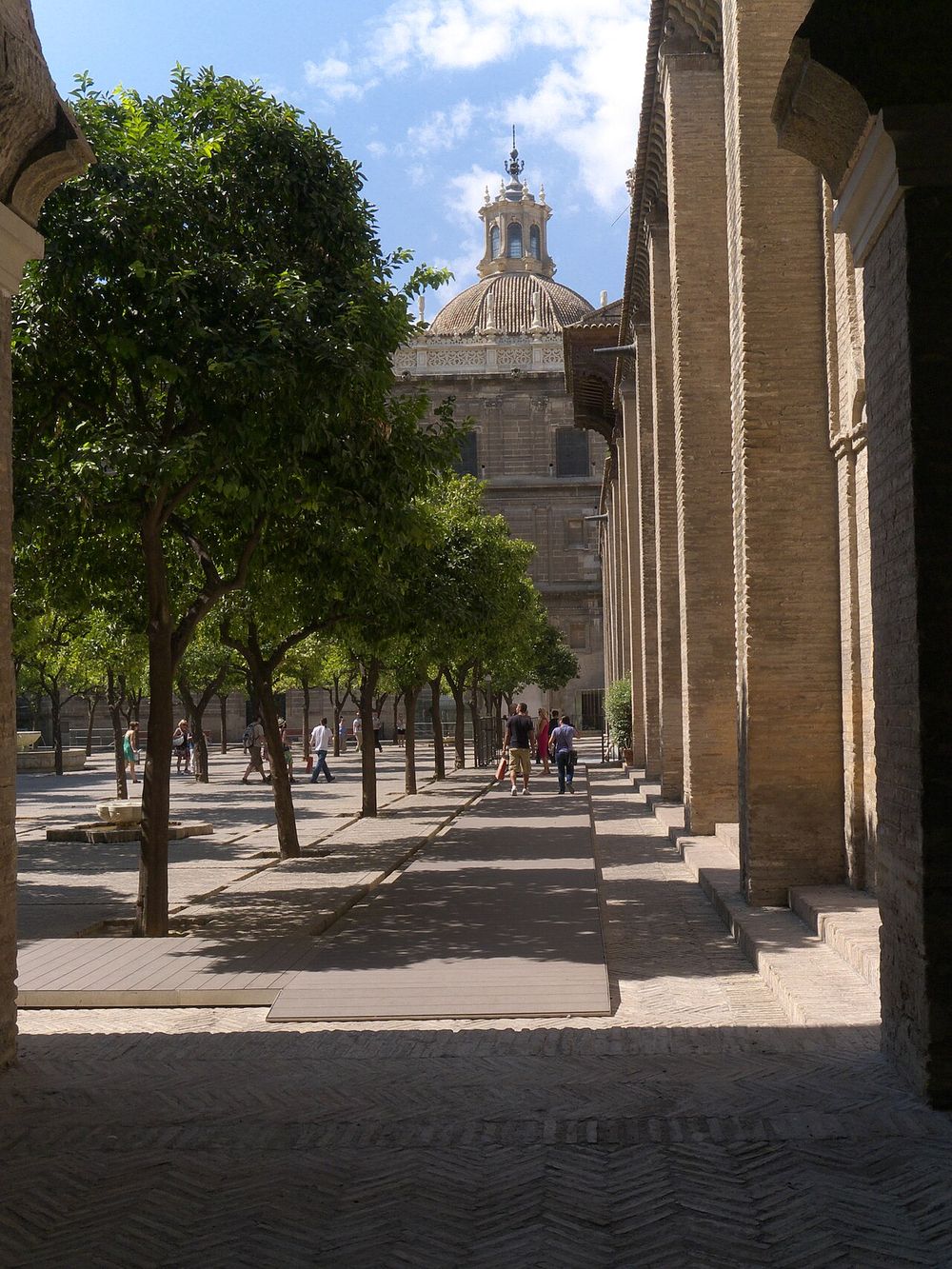
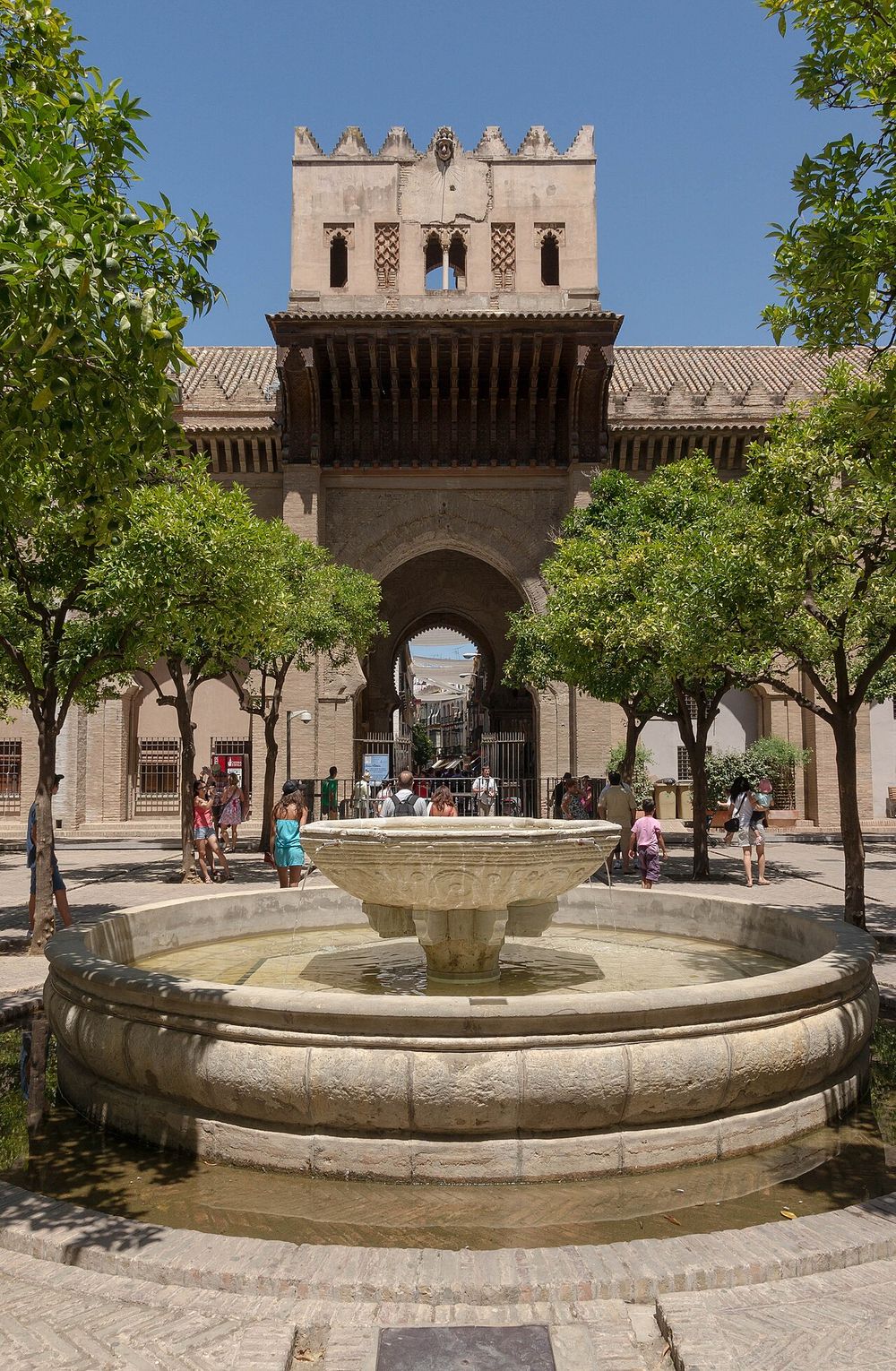
This was where the faithful washed before prayer. The channels cut in the paving between the trees carried the water. The fountain in the middle has a basin that is older than the mosque: it is Visigothic, from before 711.
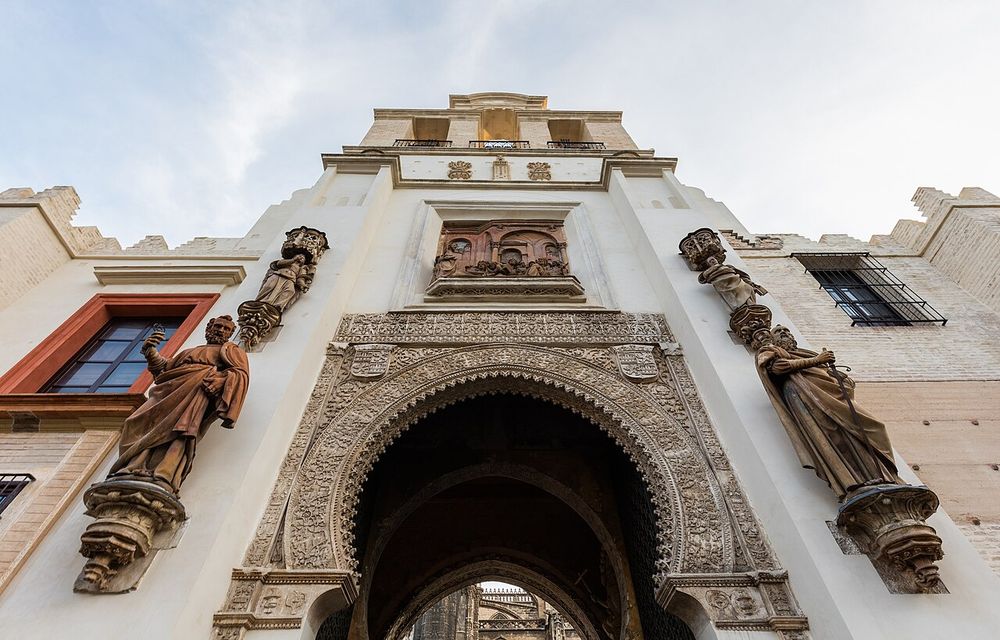
The gate to the street keeps its horseshoe arch and its bronze doors from the 1100s. Under the arcade by it hang a wooden crocodile, an elephant's tusk and a horse's bit.
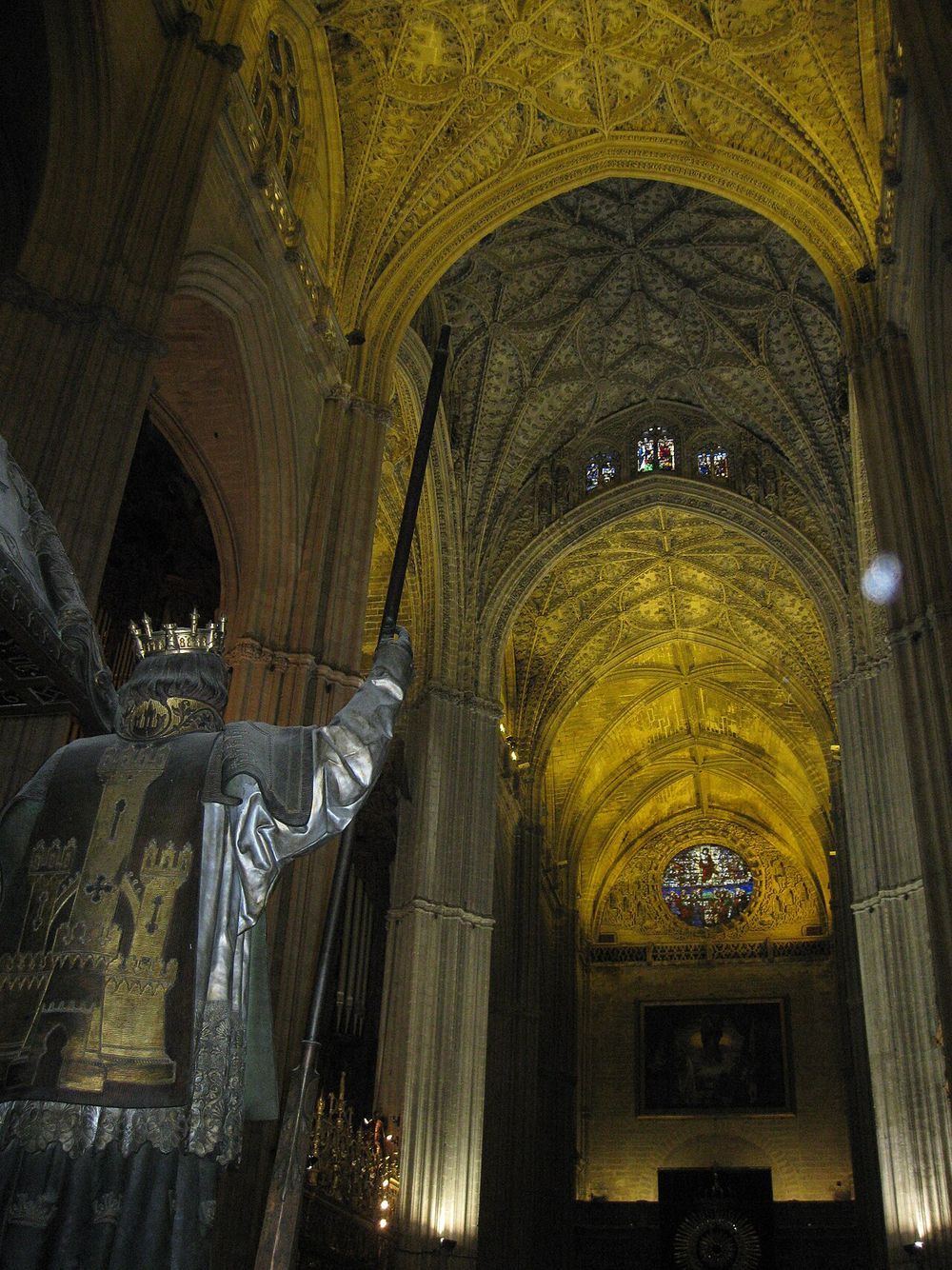
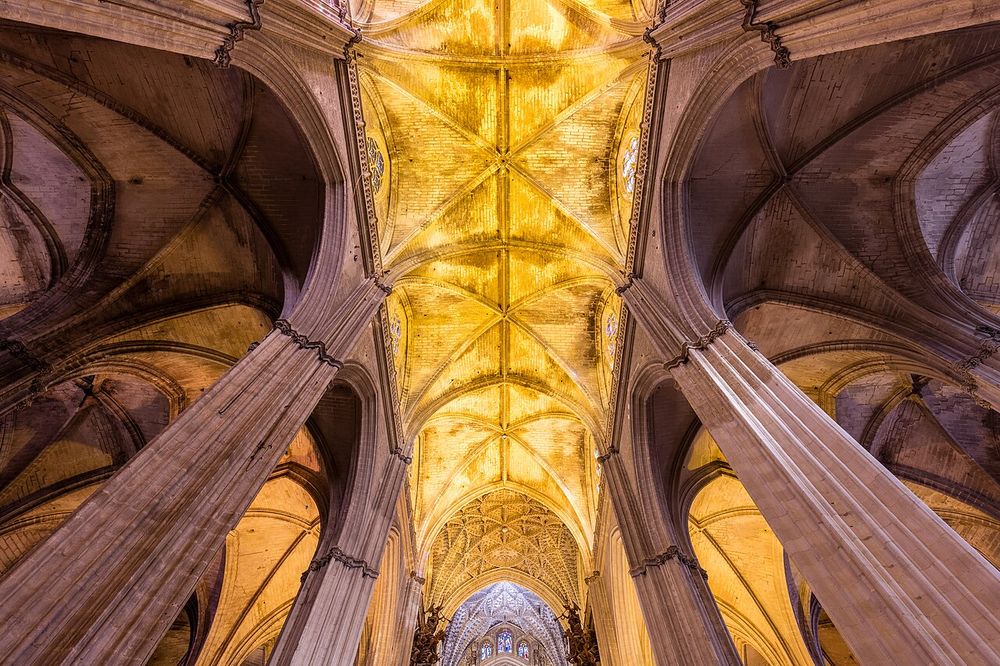
Inside, the first thing is the width. There are five aisles, and the side ones are nearly as high as the middle. A French cathedral pulls you forward to the altar. This one spreads sideways, like the hall of columns it replaced.
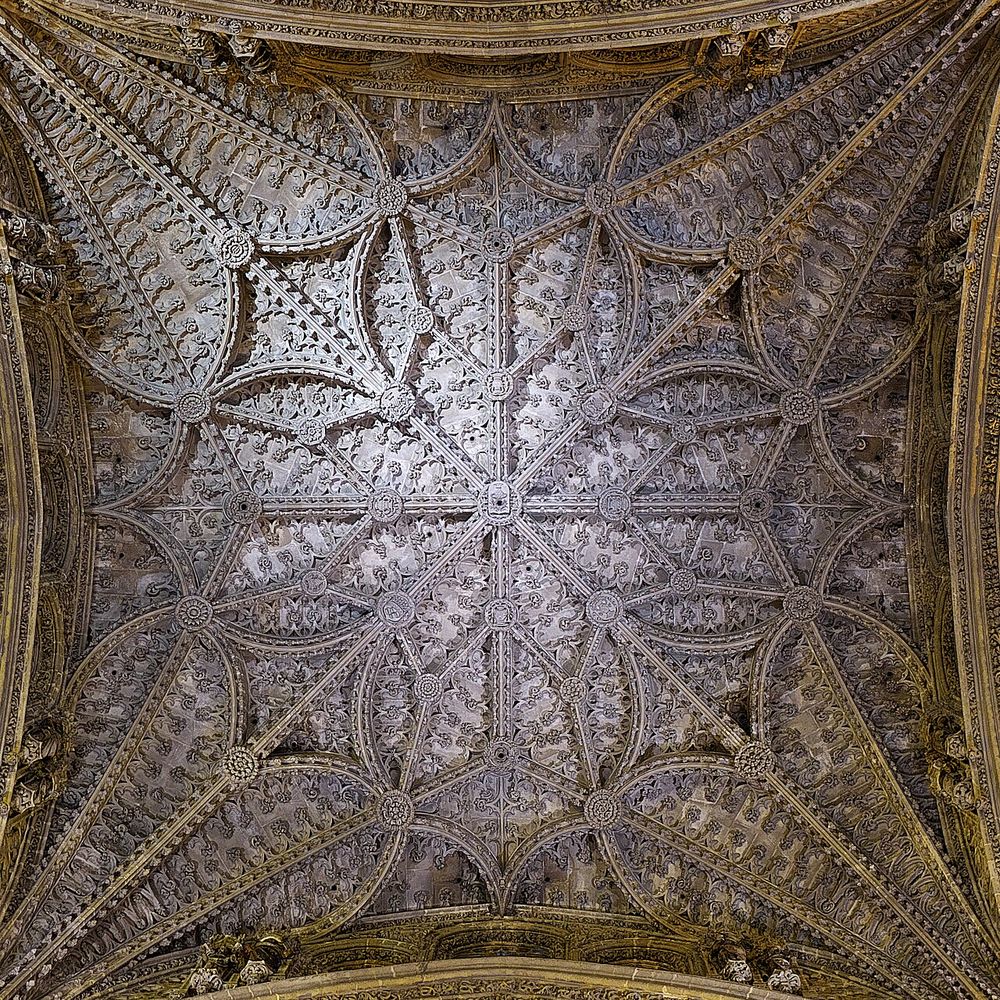
Look up where the two arms cross. The stone lace of that vault is the third on the spot. The first fell in 1511 and the second in 1888.
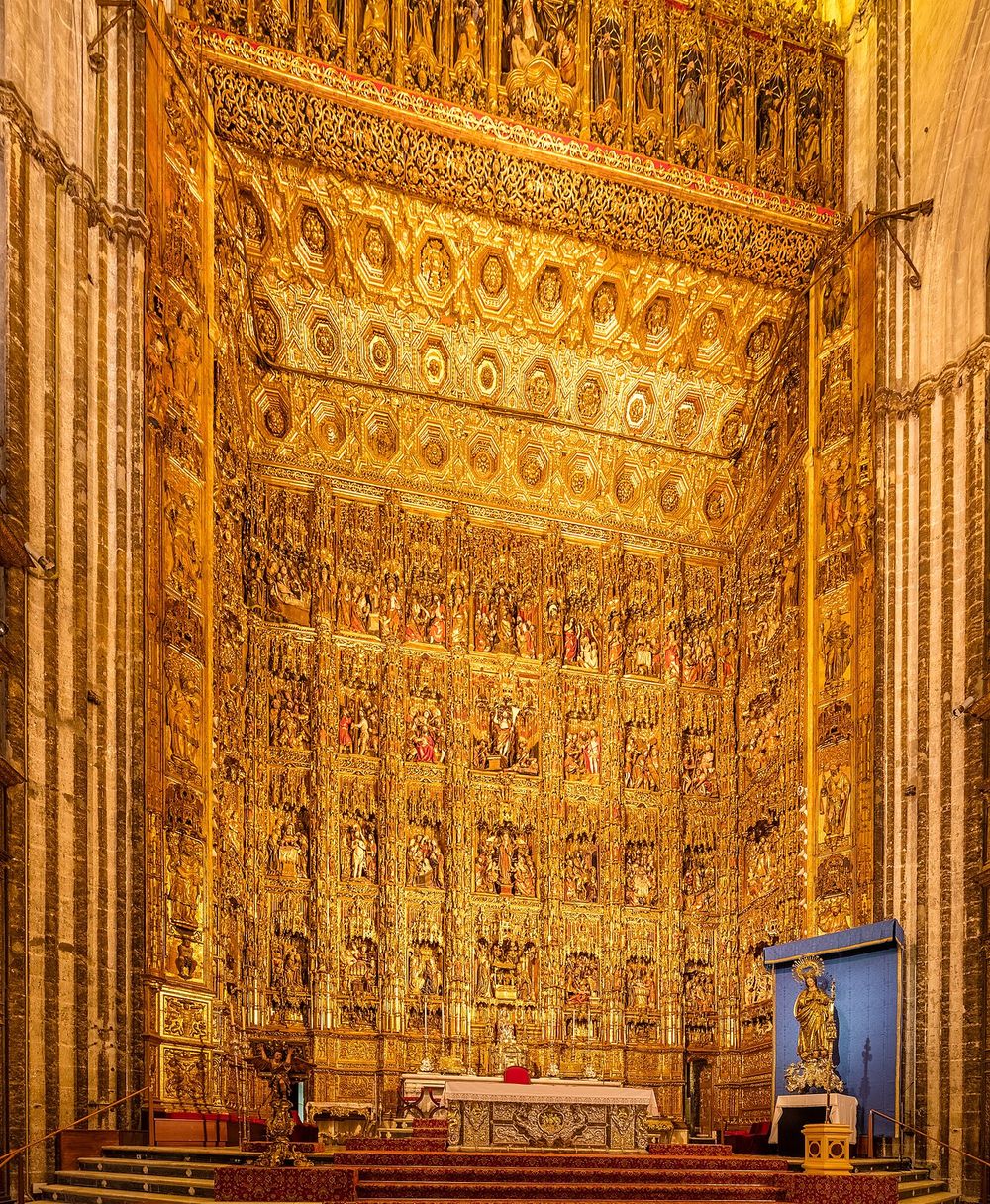
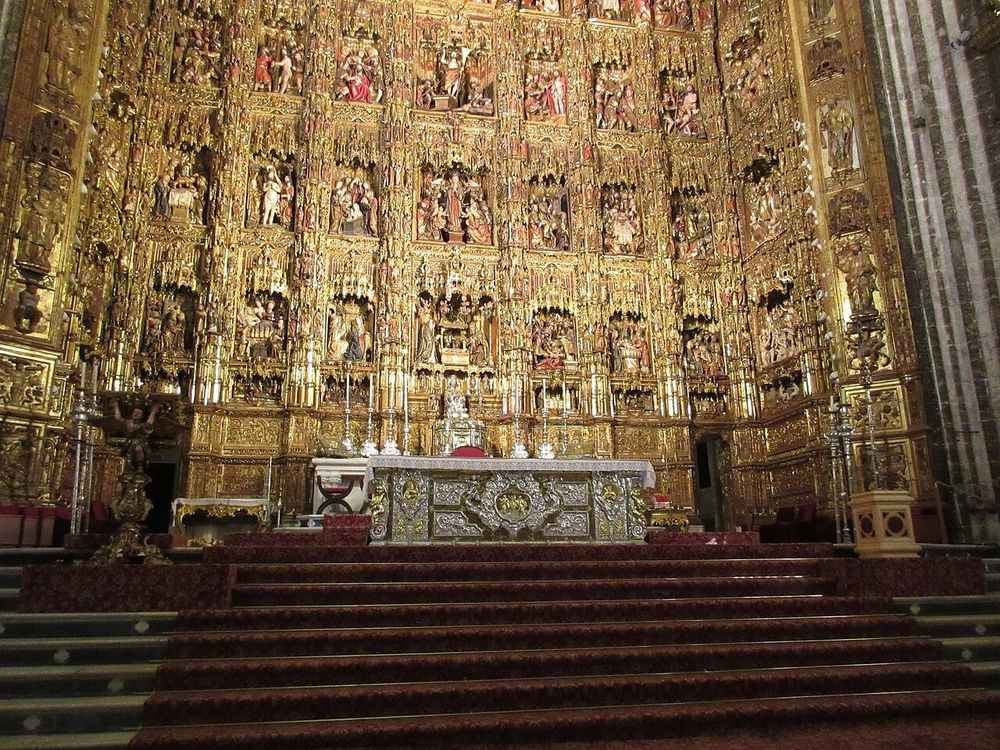
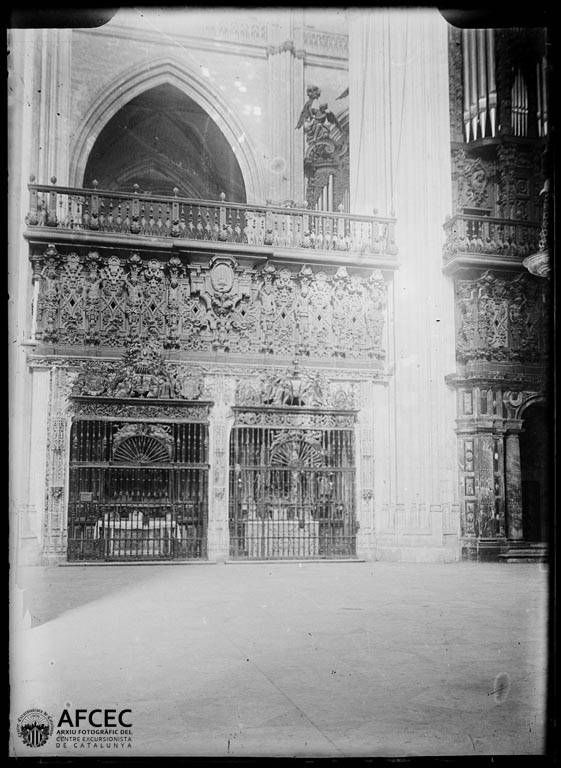
Behind the iron screen is the largest altarpiece in the Christian world: twenty metres high, with forty-four scenes from the lives of Christ and Mary and more than two hundred figures, all of carved wood covered in gold. A Flemish carver began it in 1482. He and his successors worked on it for eighty years.
The figures at the top are larger than those at the bottom, so that from the floor they all look one size.
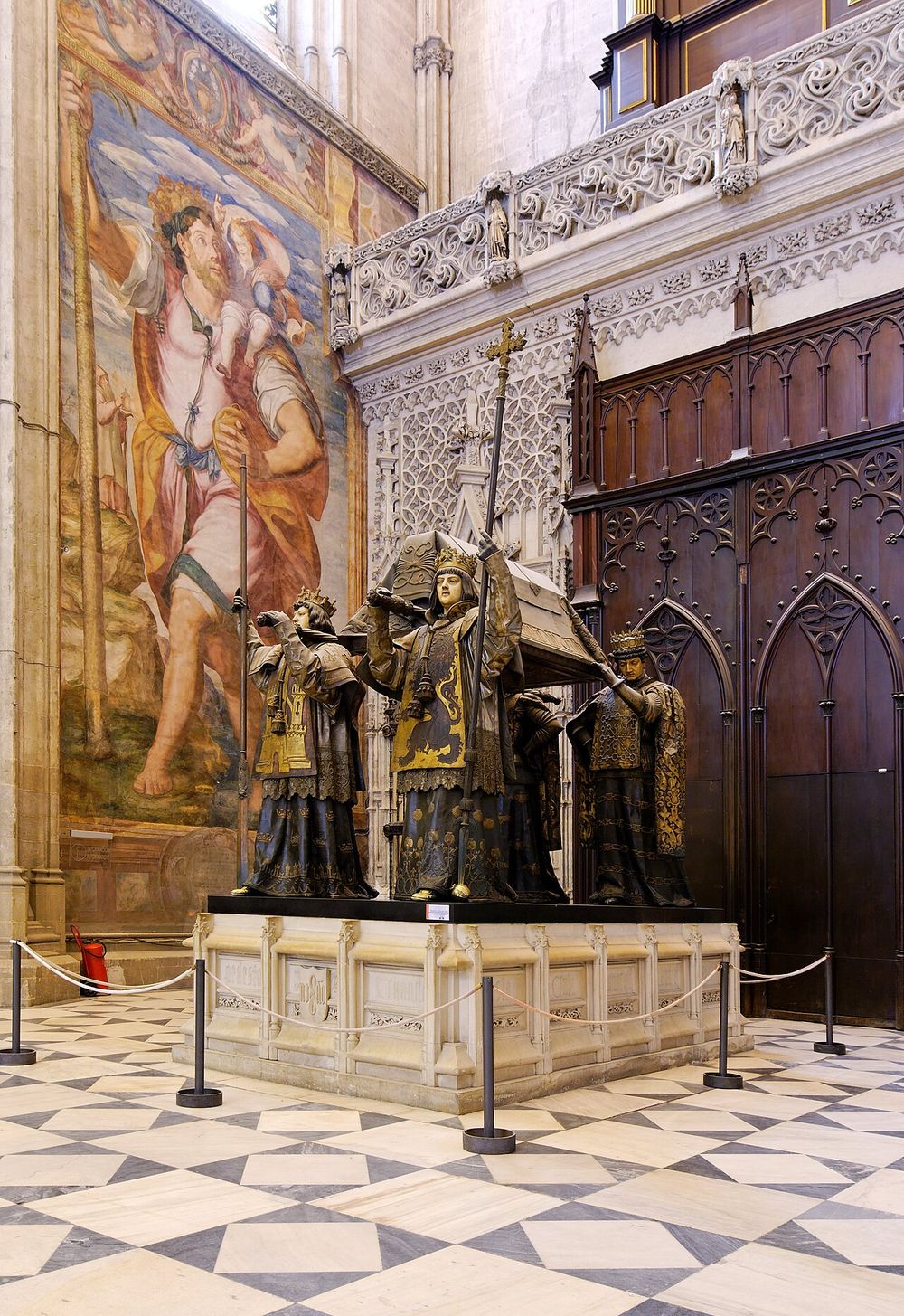
Just inside the south door four bronze heralds, larger than life, carry a coffin on their shoulders. They wear the arms of the four kingdoms of Spain. The monument was made for the cathedral of Havana. When Spain lost Cuba in 1898 it was shipped here with the bones.
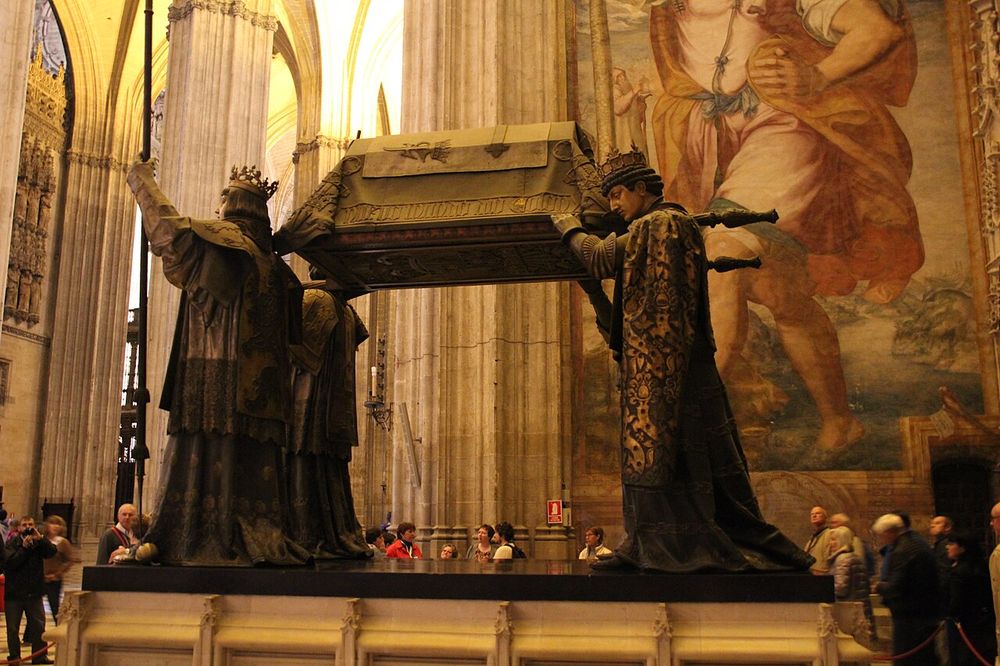
Look at the spear of one of the heralds at the front. Its point goes through a pomegranate. In Spanish the fruit is "granada": the conquest of Granada in 1492 freed the money for the voyage.
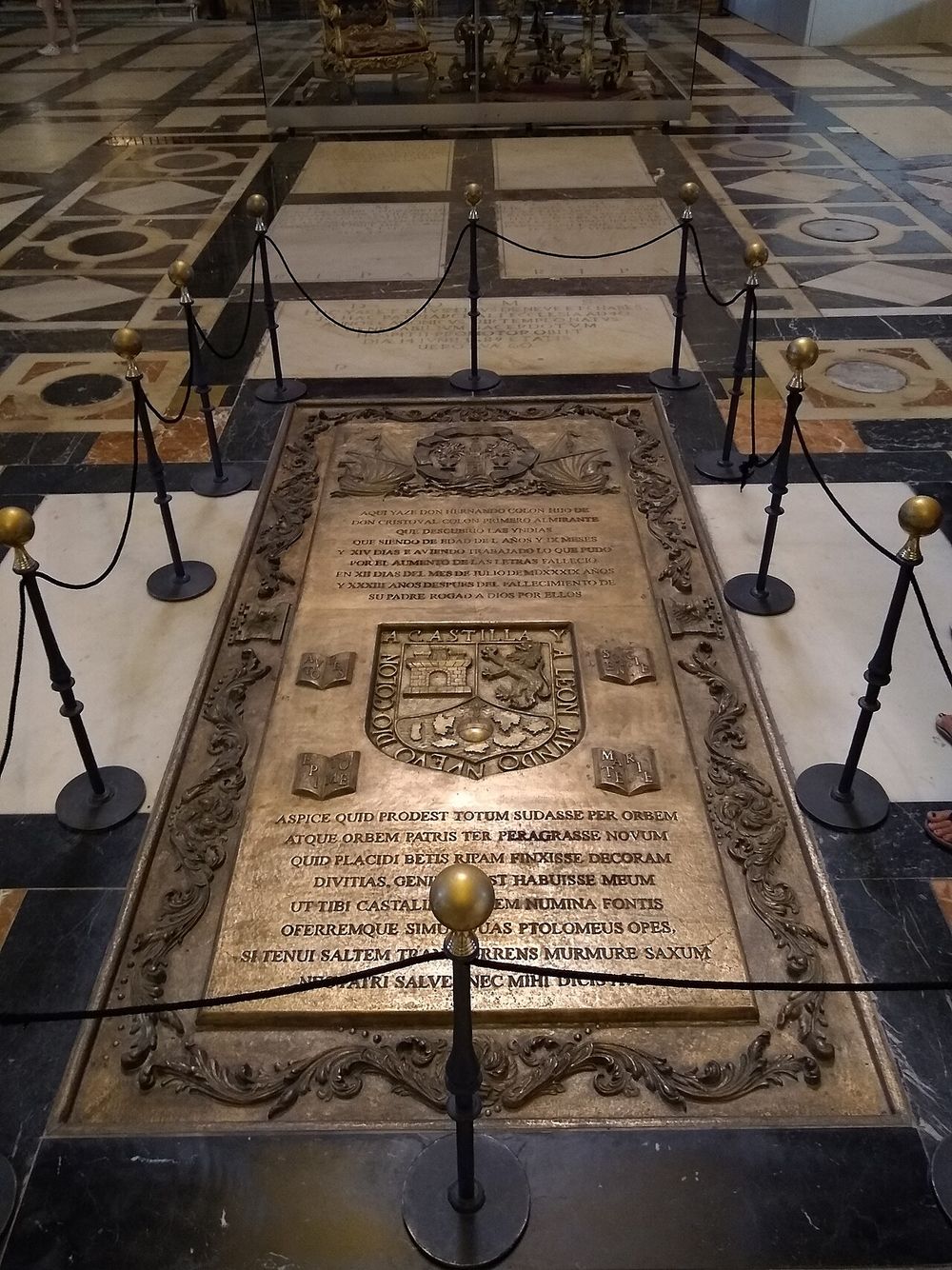
In 2006 scientists compared the DNA of the bones in the coffin with that of Columbus's brother, buried nearby. They matched. But the coffin holds only about a fifth of a skeleton.
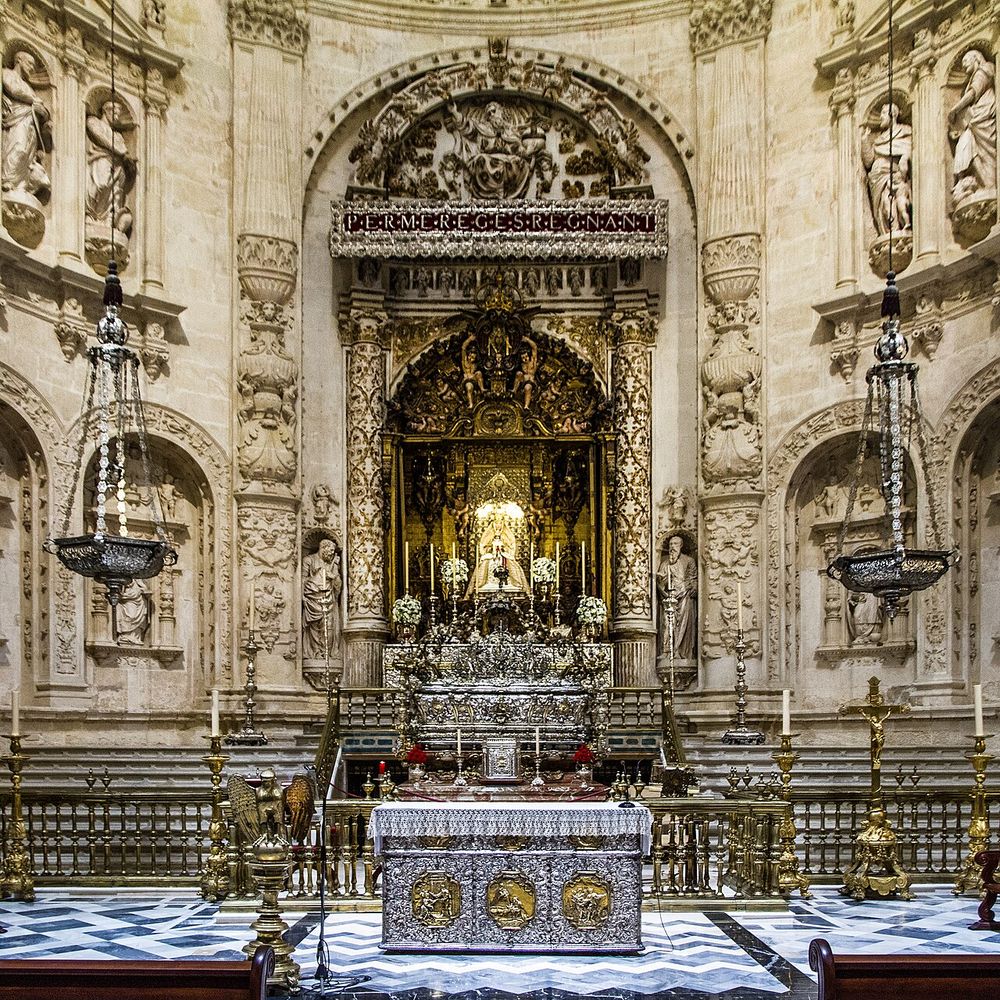
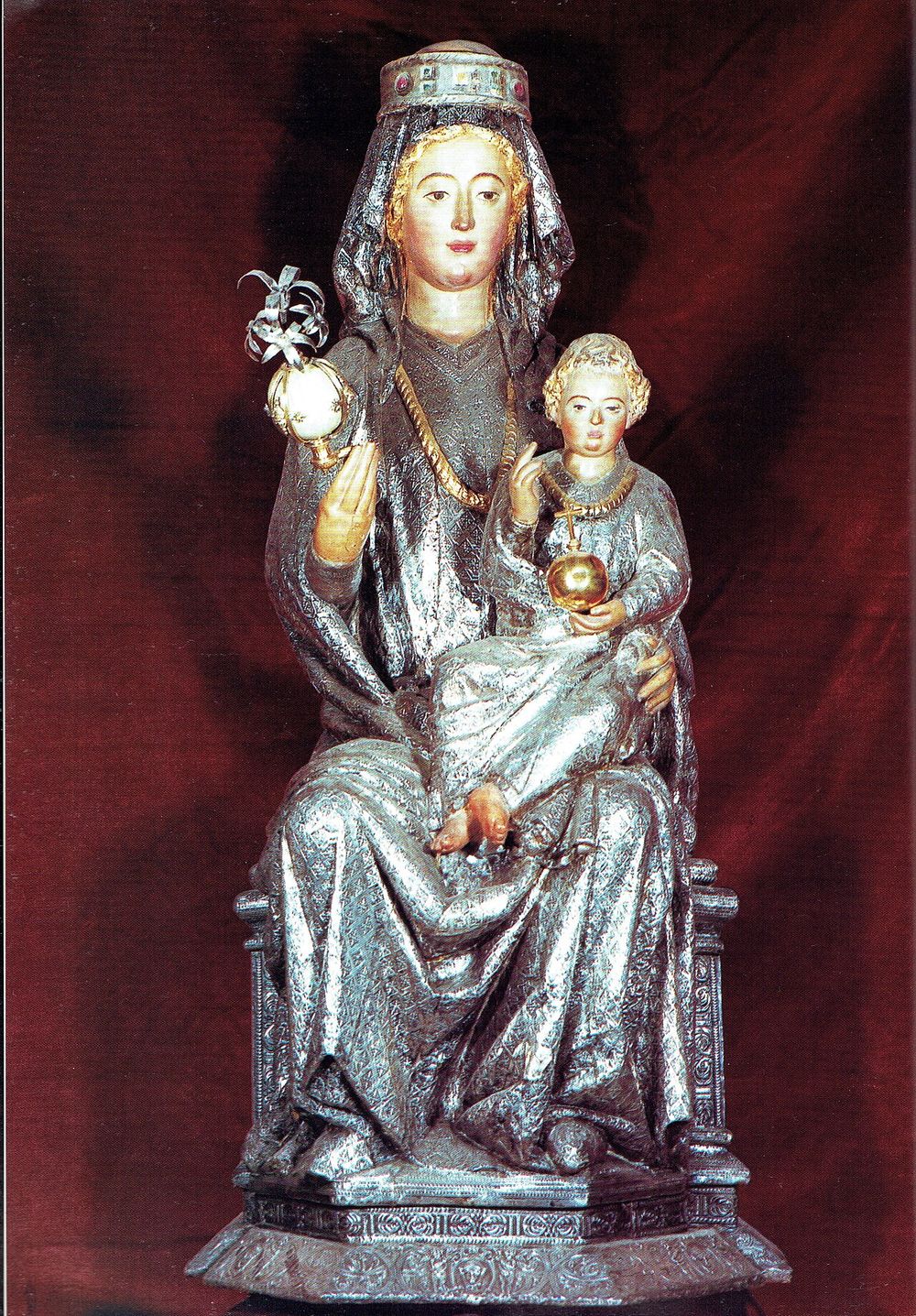
At the east end a domed chapel holds the conqueror of the city, Ferdinand III, in a casket of silver. It is opened on a few days each year and his body is shown. Above the altar sits a small figure of the Virgin with jointed arms and real hair. She is the patron of Seville.
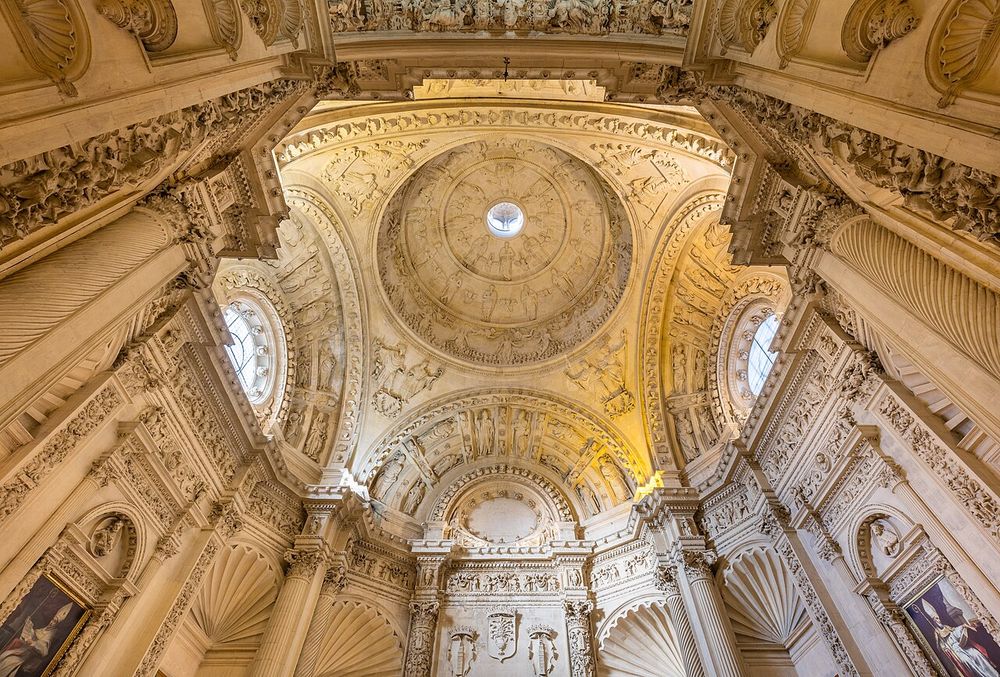
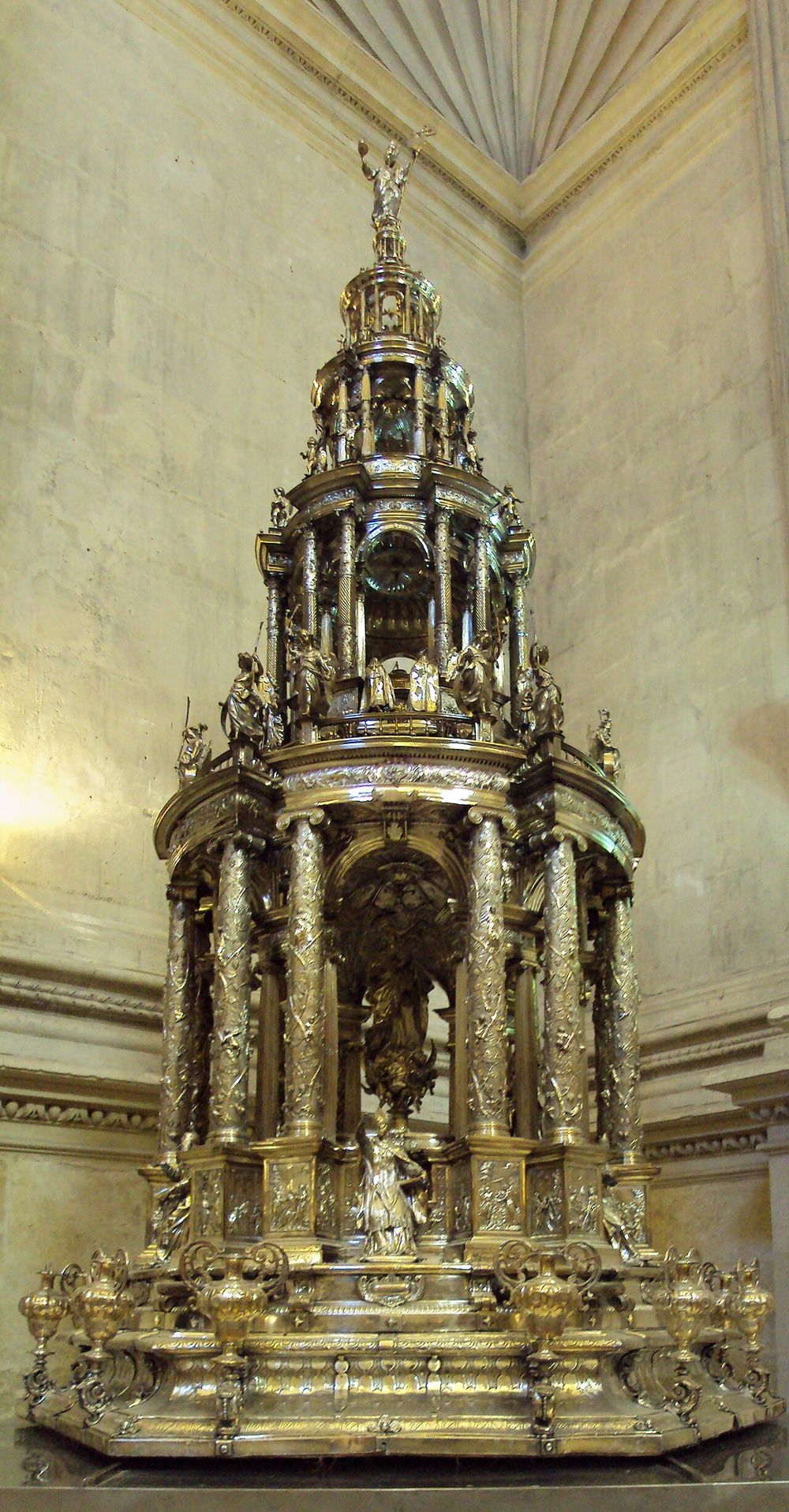
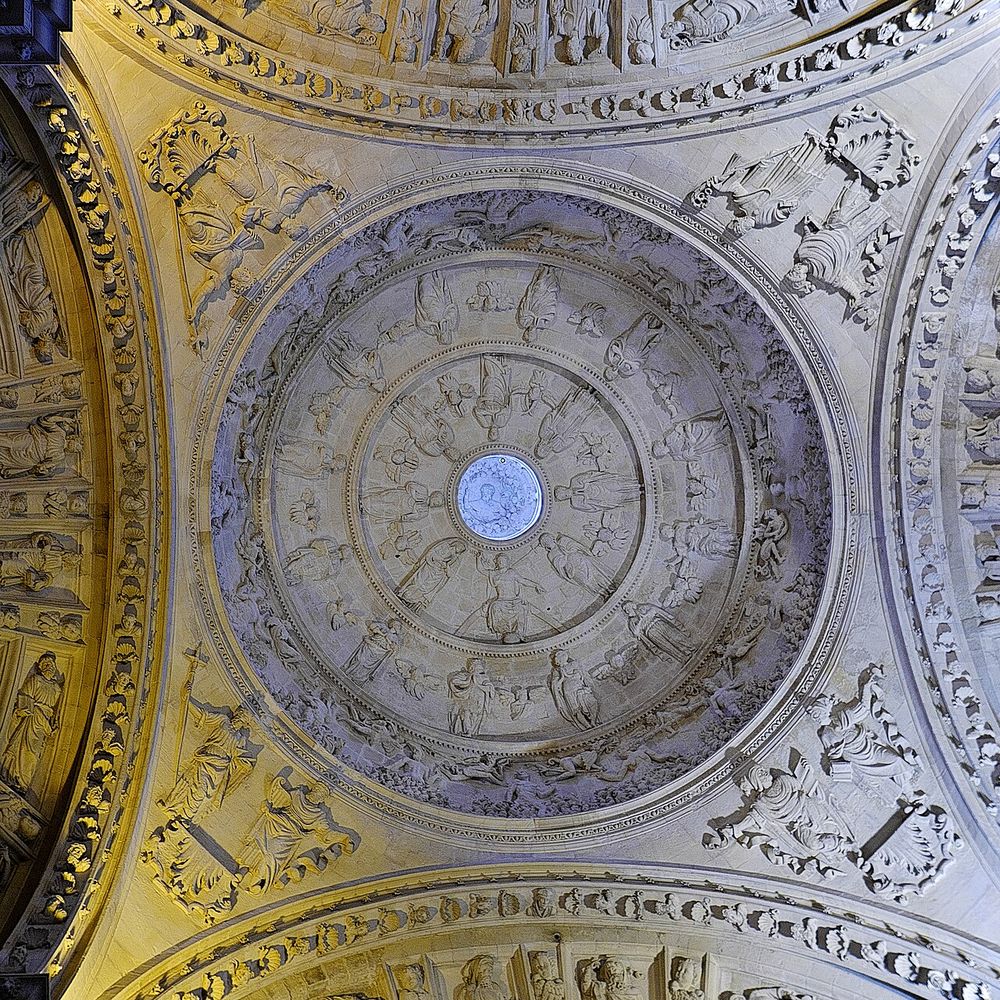
The great sacristy is a room of the 1530s under a dome carved with the Last Judgement. In the middle stands a silver tower nearly four metres high, made in the 1580s to carry the consecrated bread through the streets once a year. It takes a team of men under it.
¡Voto a Dios que me espanta esta grandeza y que diera un doblón por describilla!
I swear to God this grandeur frightens me, and I'd give a gold doubloon to describe it!
Miguel de Cervantes, the opening of his sonnet on the king's monument in Seville Cathedral, 1598. It ends with a swaggering soldier who looks, puts on his hat and walks off: "and there was nothing"; our translation
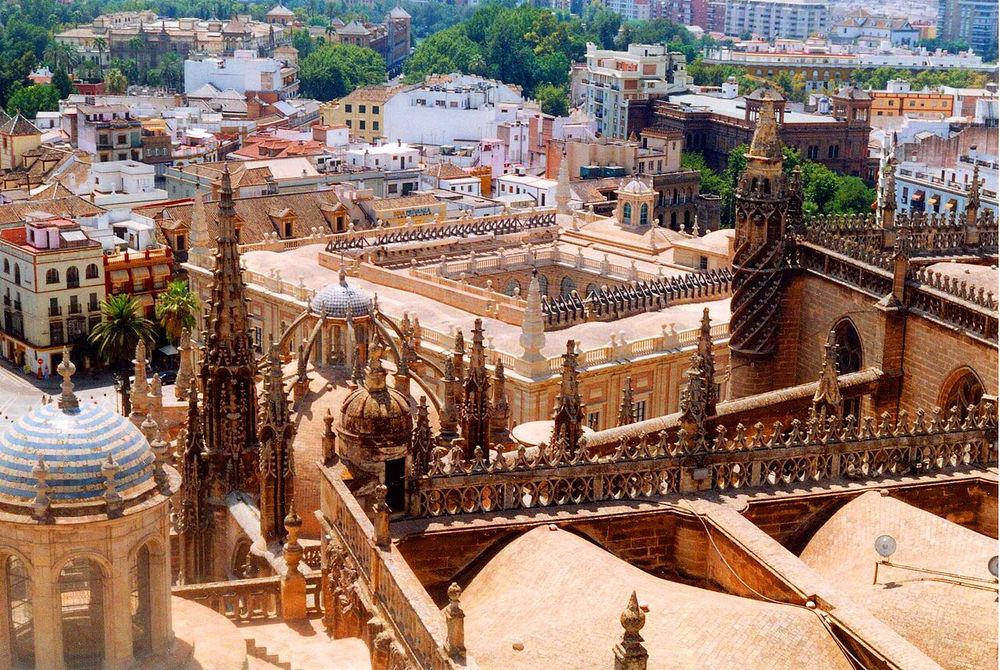
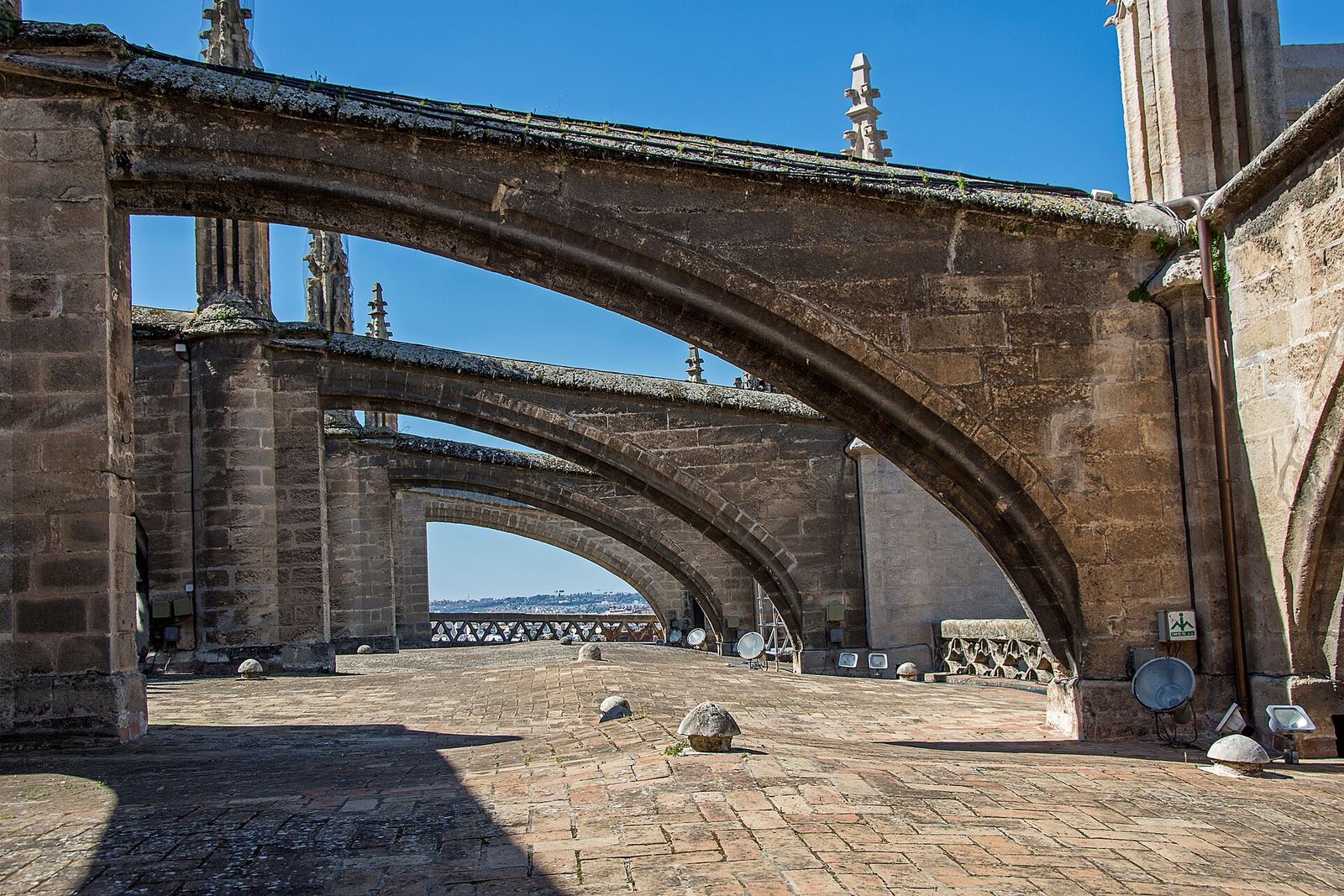
The climb is easy: thirty-five ramps and then seventeen steps. Windows on the way show you the roof of the church from above, a forest of stone spikes and flying arches.
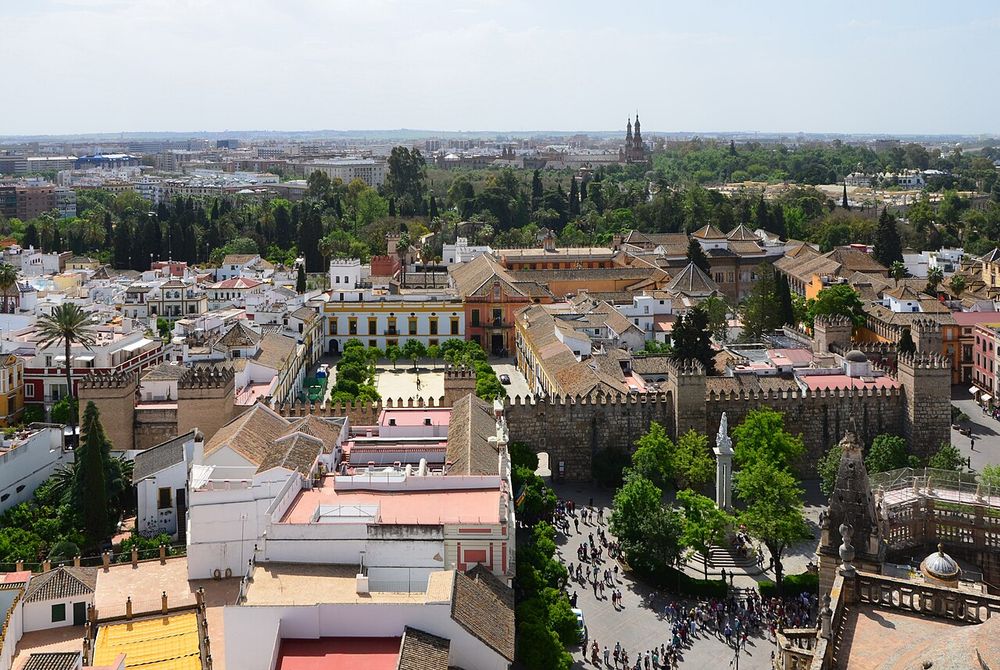
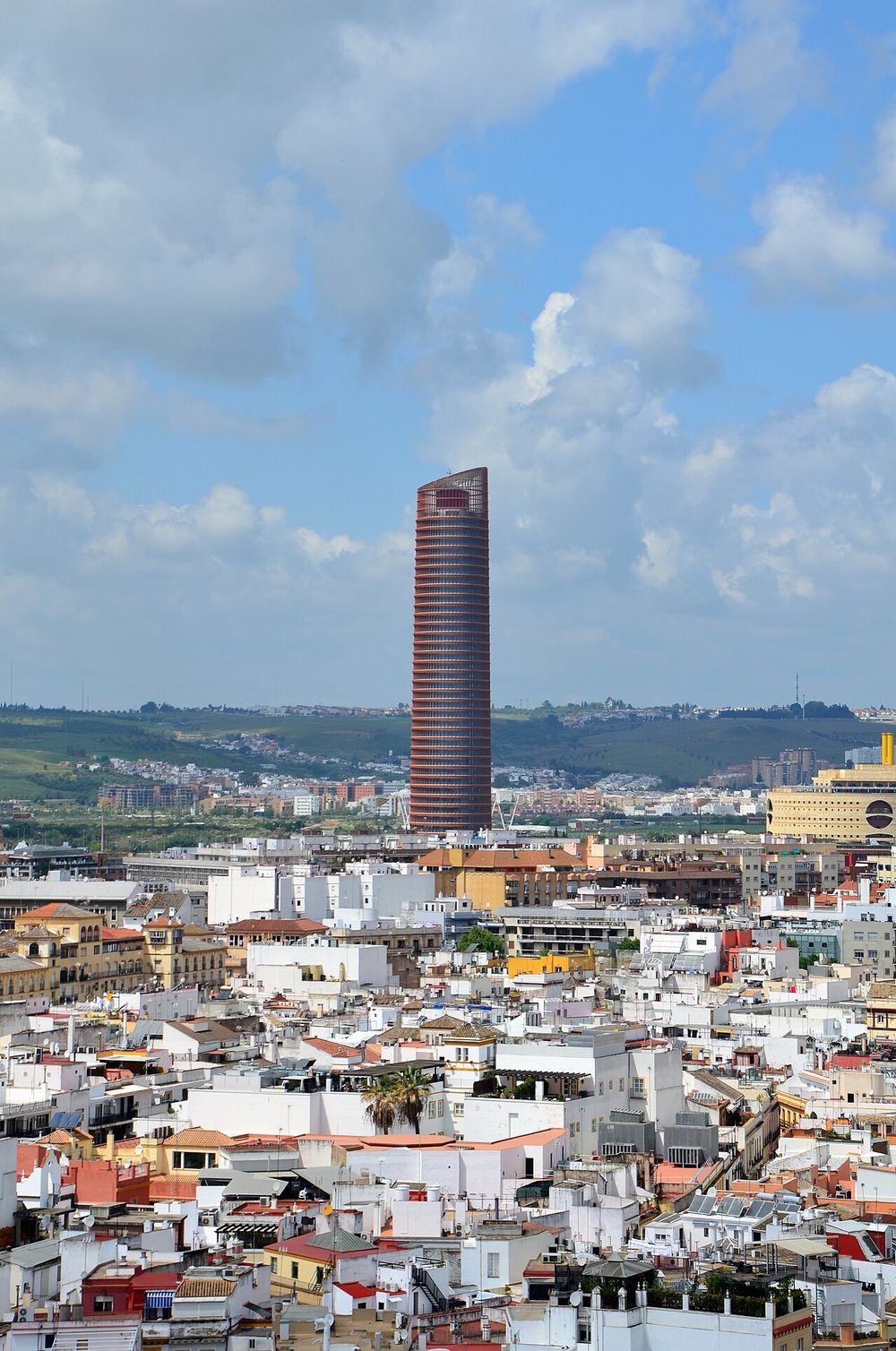
From the bell floor you look down on the palace and its gardens to the south, the bullring by the river to the west, and one glass tower of 2015, the first building in eight hundred years to be taller than this one.
The bells are rung by swinging them right over. If one starts while you are beside it, cover your ears.
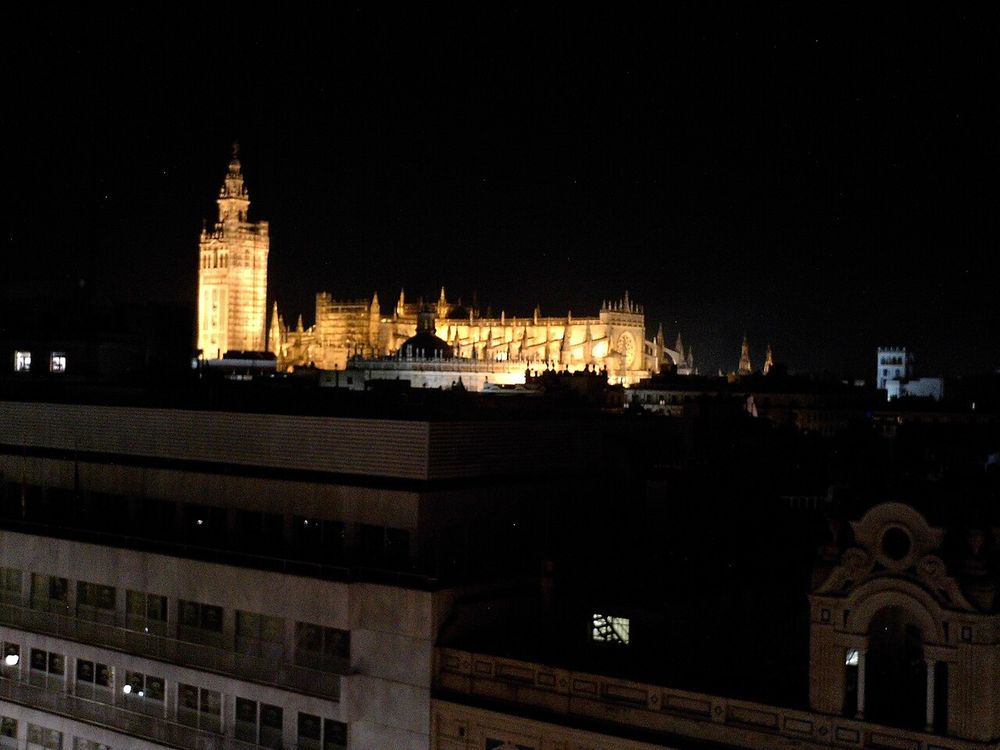
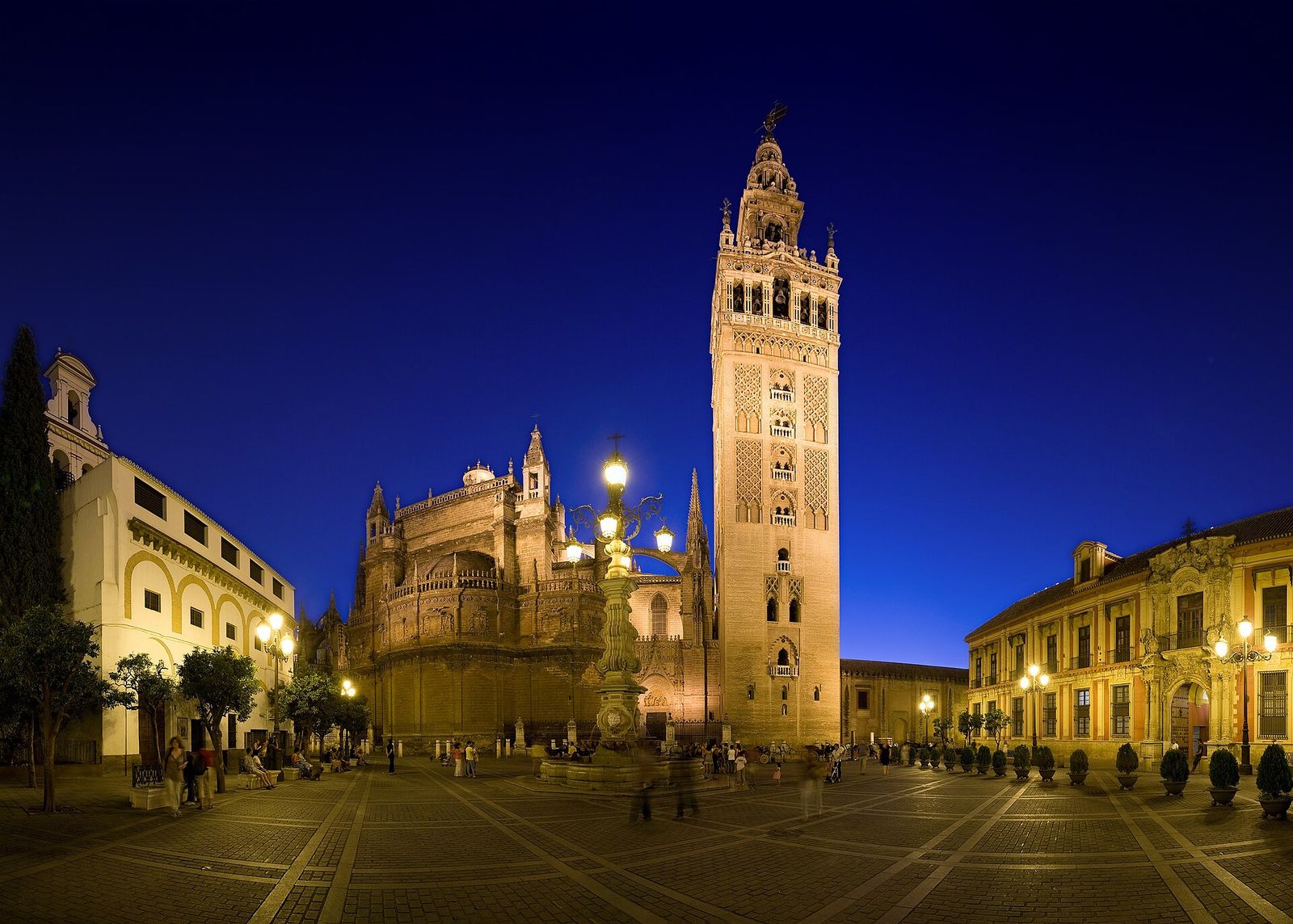
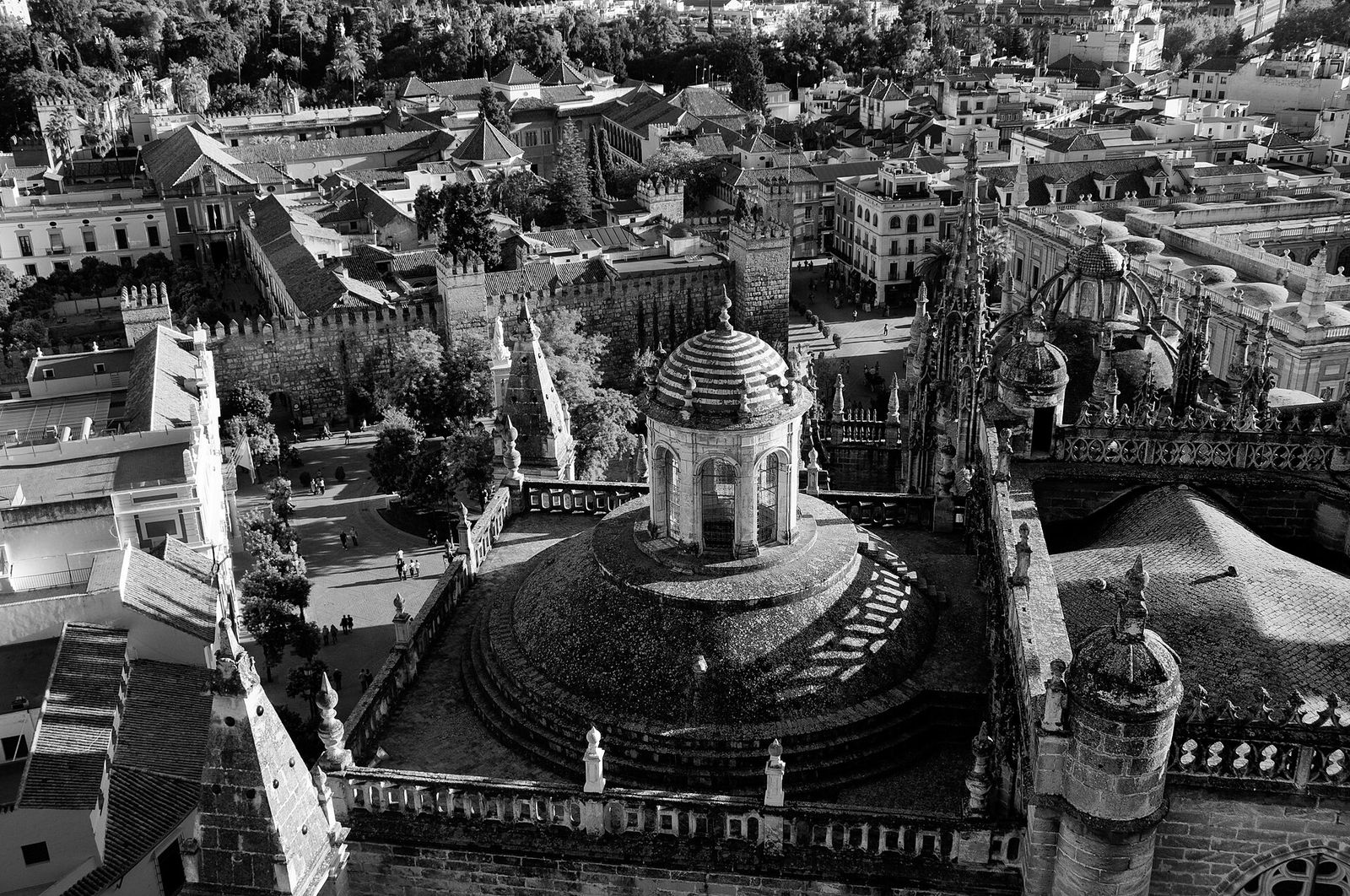
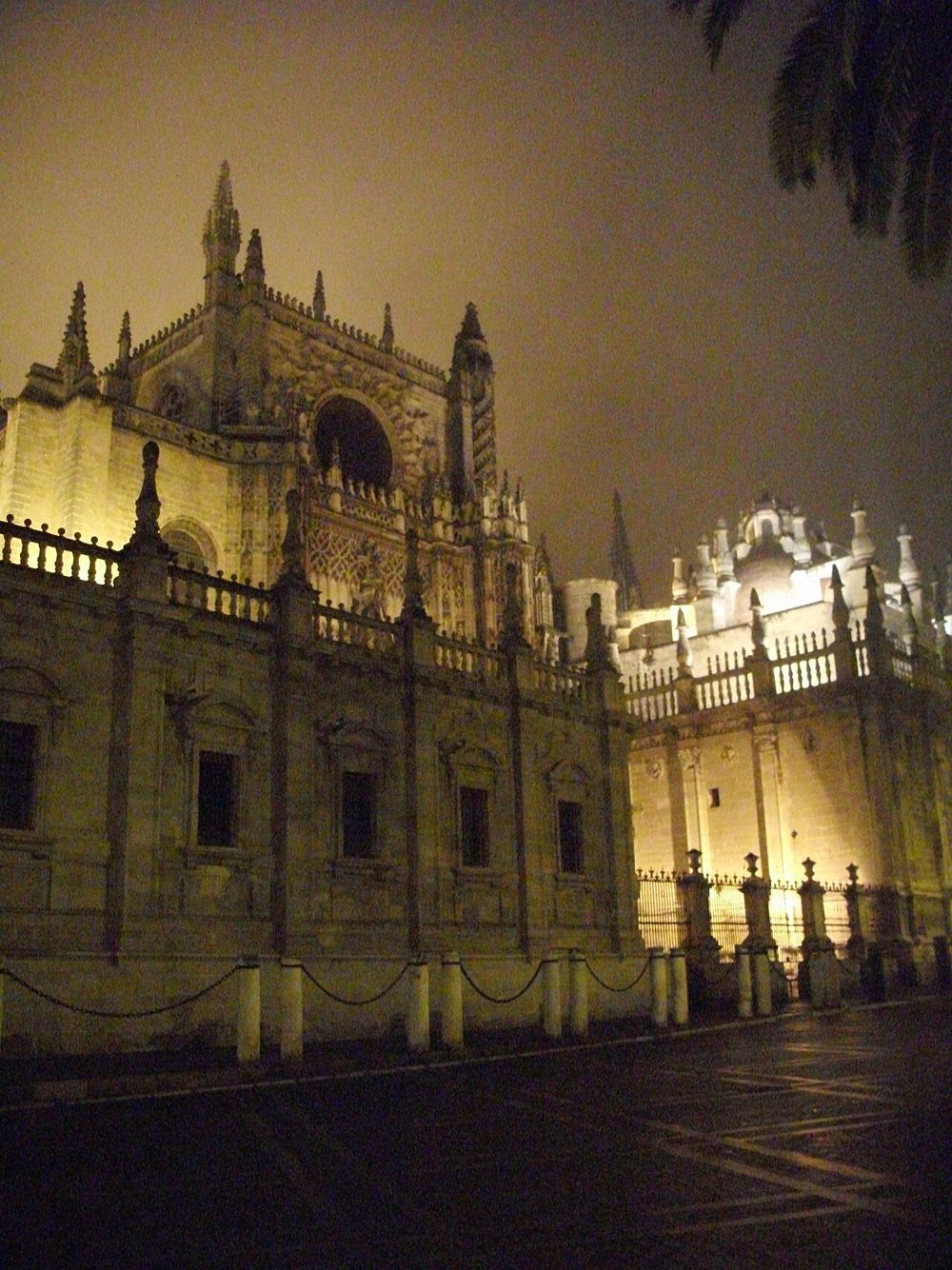
The same shot: the picture of the tower and the east end together is taken from the far side of the small square behind the cathedral, beside the fountain with the lamp, at dusk when the floodlights come on. For the tower framed by orange trees, stand in the lane called Mateos Gago, two hundred metres to the east.
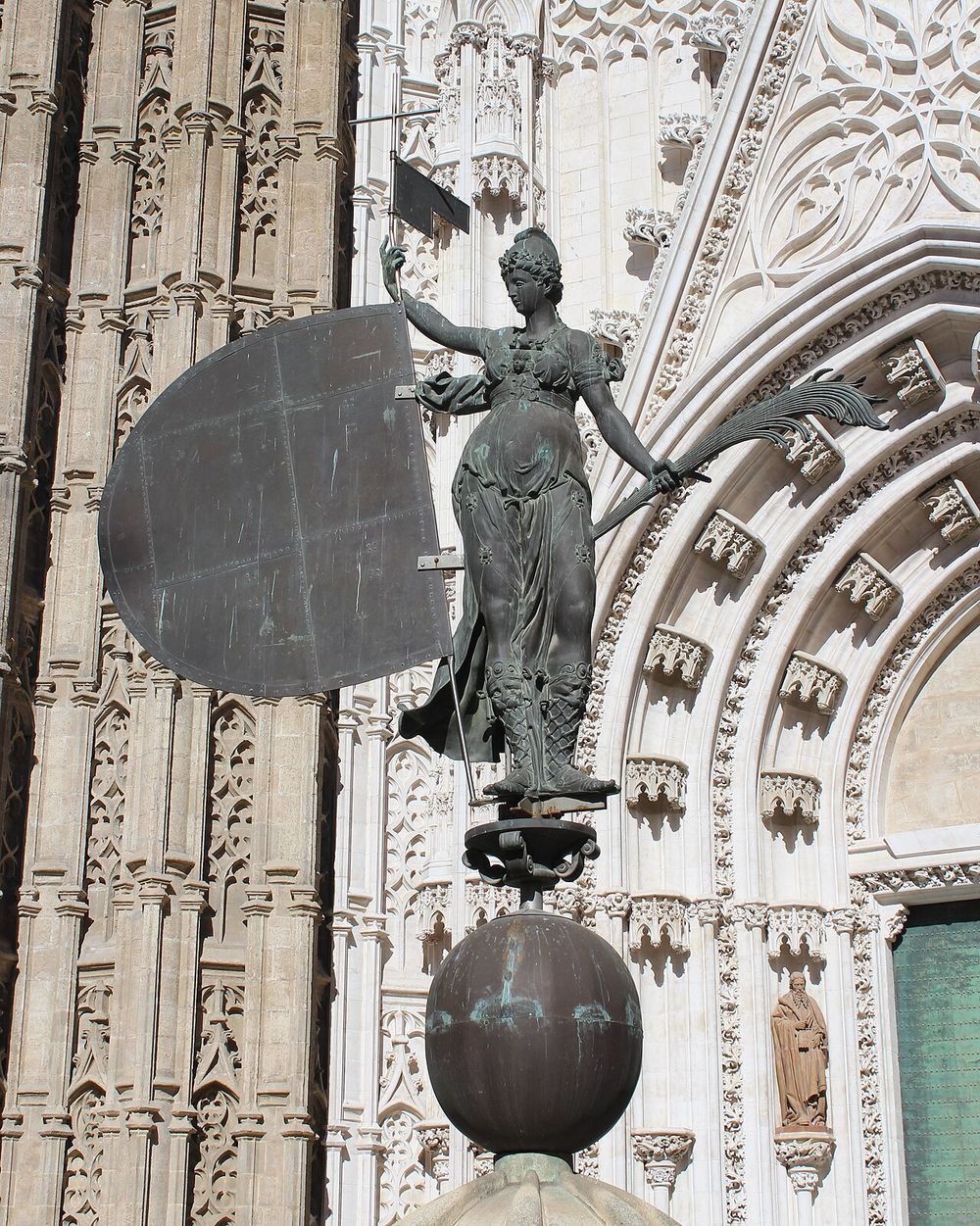
By the south door stands a copy of the weathervane, so you can see how big she is.
| Year | Here | Elsewhere |
|---|---|---|
| 1198 | The minaret is finished | In Paris the cathedral of Notre-Dame is half built |
| 1248 | The city falls to Castile; the mosque becomes a cathedral | The first stone of Cologne Cathedral is laid |
| 1401 | The canons vote to rebuild | In Florence a competition is held for the bronze doors of the Baptistery |
| 1492 | Columbus sails, from a port down the river | Granada, the last Muslim kingdom in Spain, surrenders |
| 1506 | The last stone is laid; Columbus dies | In Rome the new Saint Peter's is begun |
| 1568 | The belfry and the weathervane are finished | The Dutch revolt against Spain begins |
| 1899 | Columbus's remains arrive from Havana | Spain has just lost Cuba and the Philippines to the United States |
One line to remember: a mosque's footprint, a minaret's body, and a sailor who would not stay buried.
These are stories people tell about this place. They are legends, not history, and each one says where it comes from.
When the canons voted in 1401, one of them said: let us build a church so great that those who see it finished will think we were mad.
Source: Cathedral tradition; the minutes of the meeting do not survive
The sultan of Egypt sent a live crocodile, an elephant and a giraffe to King Alfonso X, asking to marry his daughter. The princess said no. When the crocodile died it was stuffed and hung in the church, and later copied in wood.
Source: Told in Seville since the Middle Ages; an Egyptian embassy of 1260 is recorded
The minaret was topped by four golden balls so bright they could be seen a day's ride away. An earthquake brought them down in 1356.
Source: The balls and the earthquake are both recorded; the day's ride is the chronicler's
Later, people who live here will be able to add the stories they grew up with, and say which of these they have heard.
Last checked 2026-11-12. The cathedral chapter's notice for 2026 and Spanish ticket guides.
Checked 2026-11-12
Stand at the site, sign in, press the button, and collect its stamp. Your browser will ask to use your location. It is sent to us once to confirm that you are at the site; we keep how far you were from it, not the spot where you stood.
Your stamps are saved to your account, so they follow you to any device. Checking from a browser cannot rule out every false location; stricter checks arrive with the app.
Photos here show the place, not people. Each one is credited to the visitor who took it and appears after our team has looked at it. A photo with you in it belongs under “I am here”.