Mezquita-Catedral de Córdoba · meth-KEE-tah kah-teh-DRAHL deh KOR-doh-bah
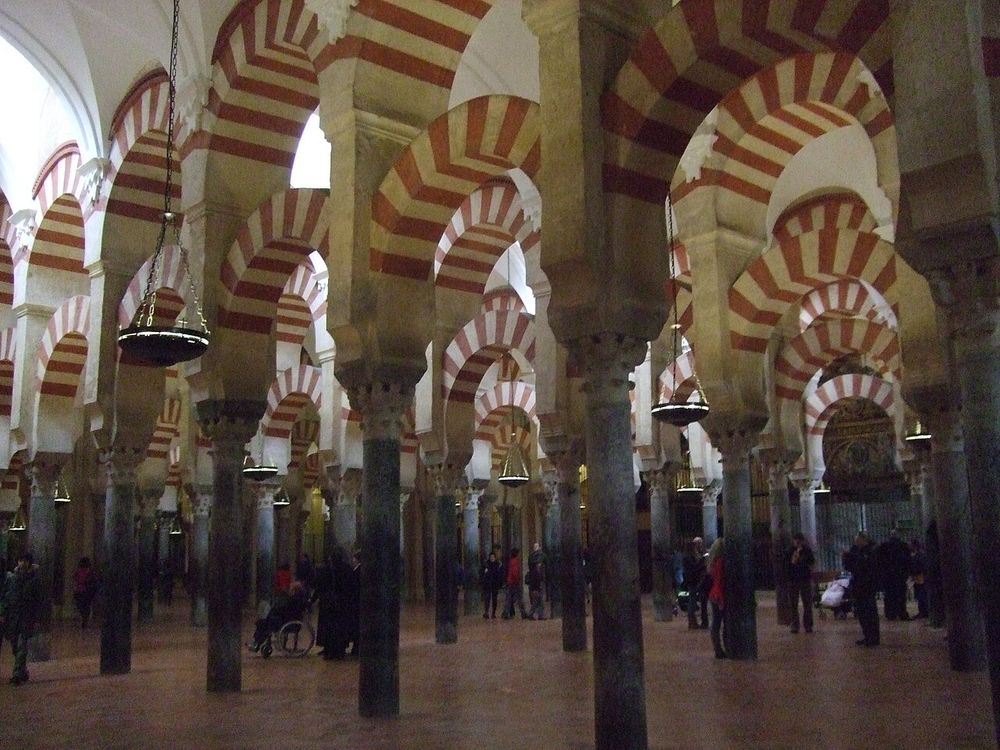
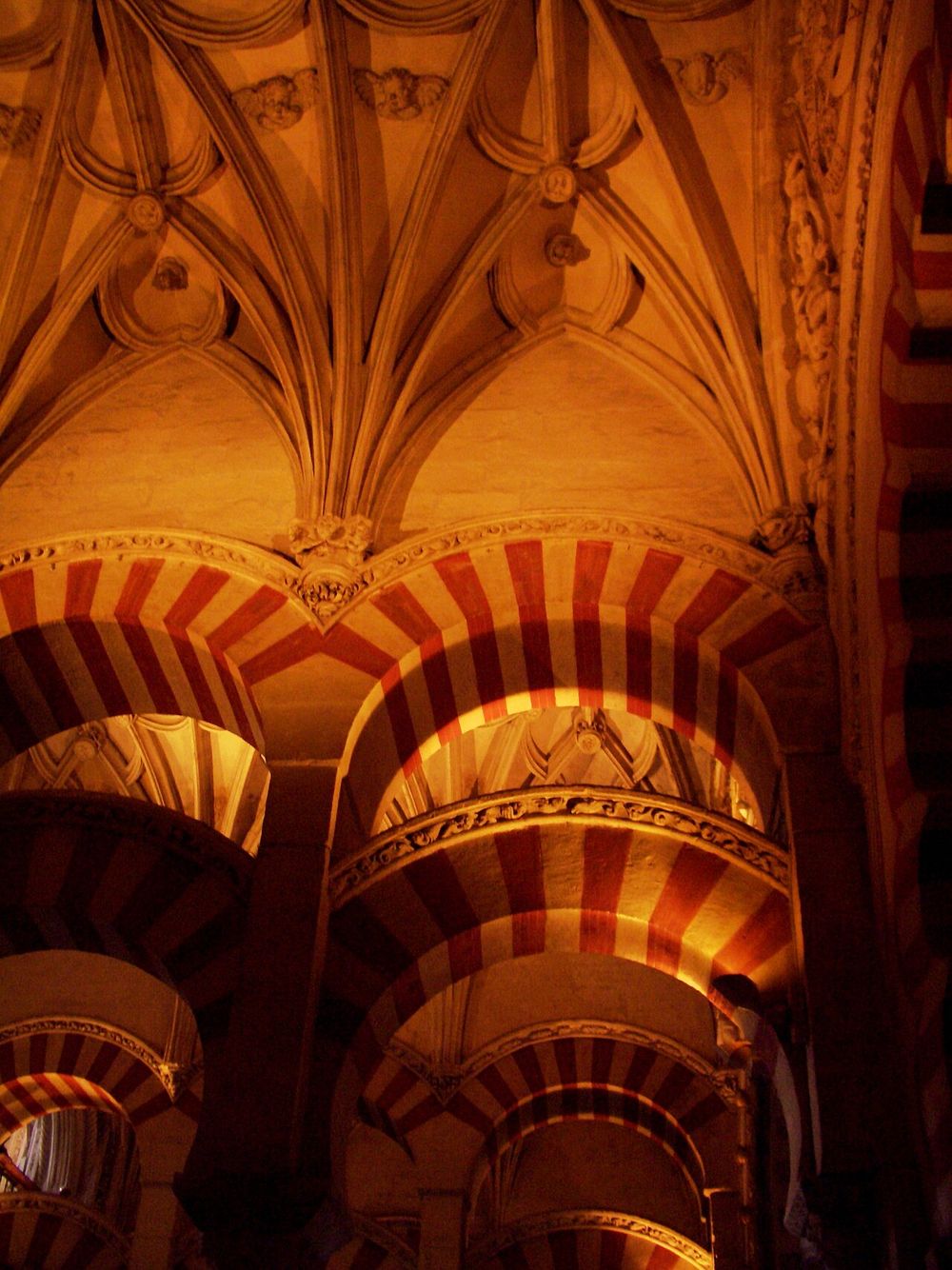
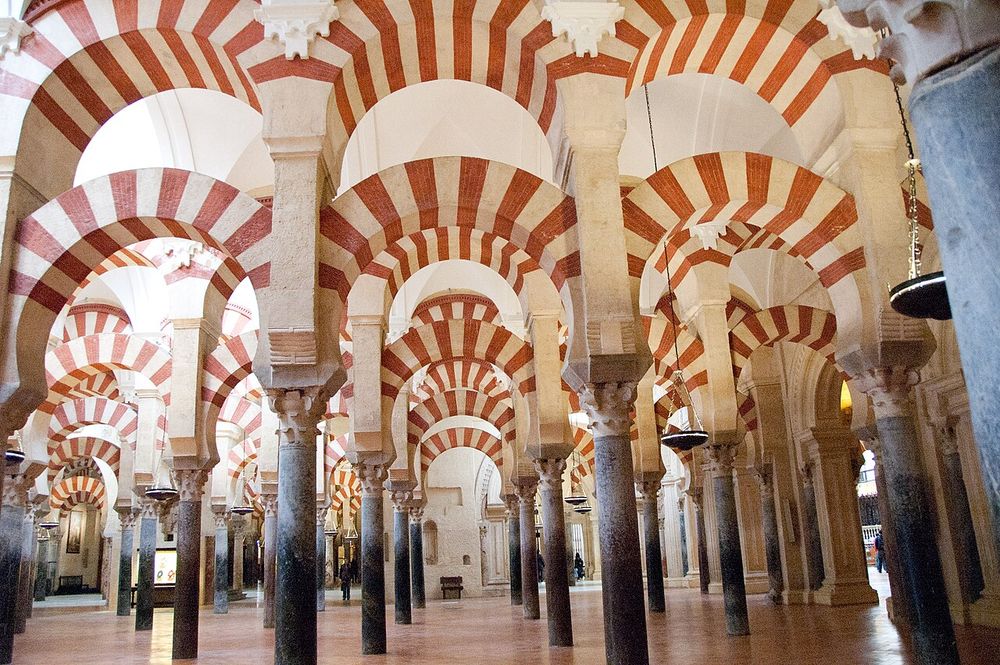
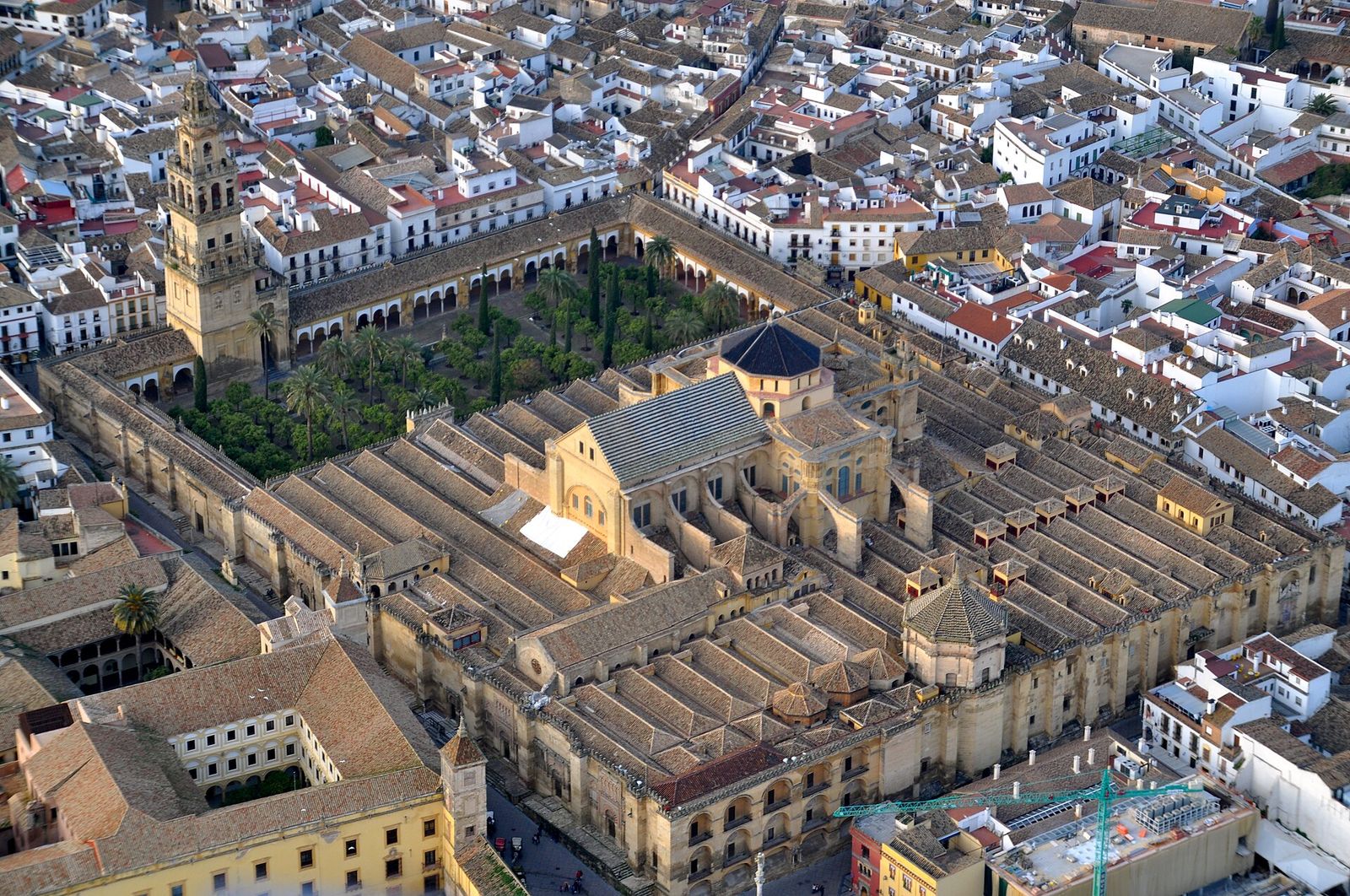
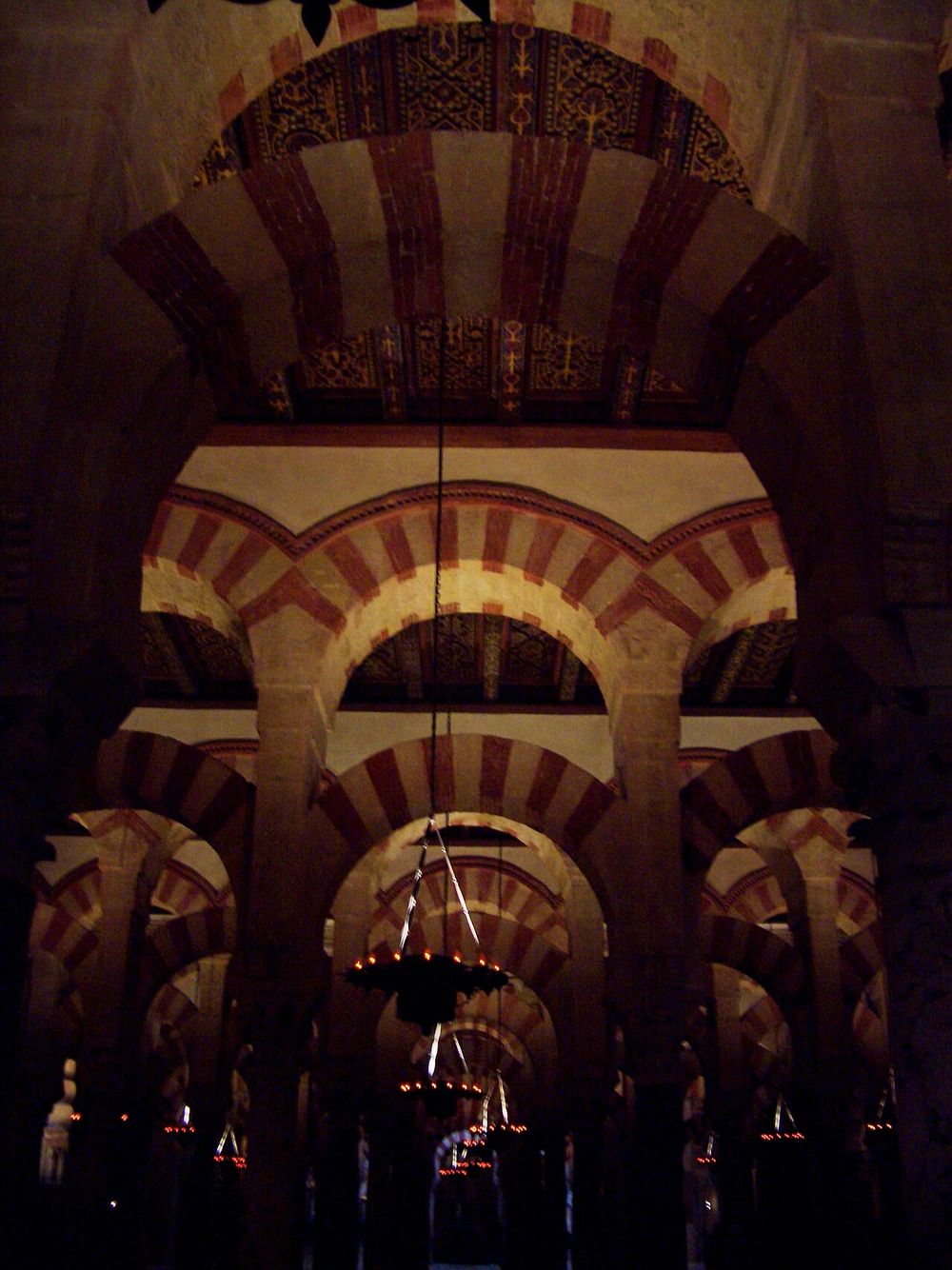
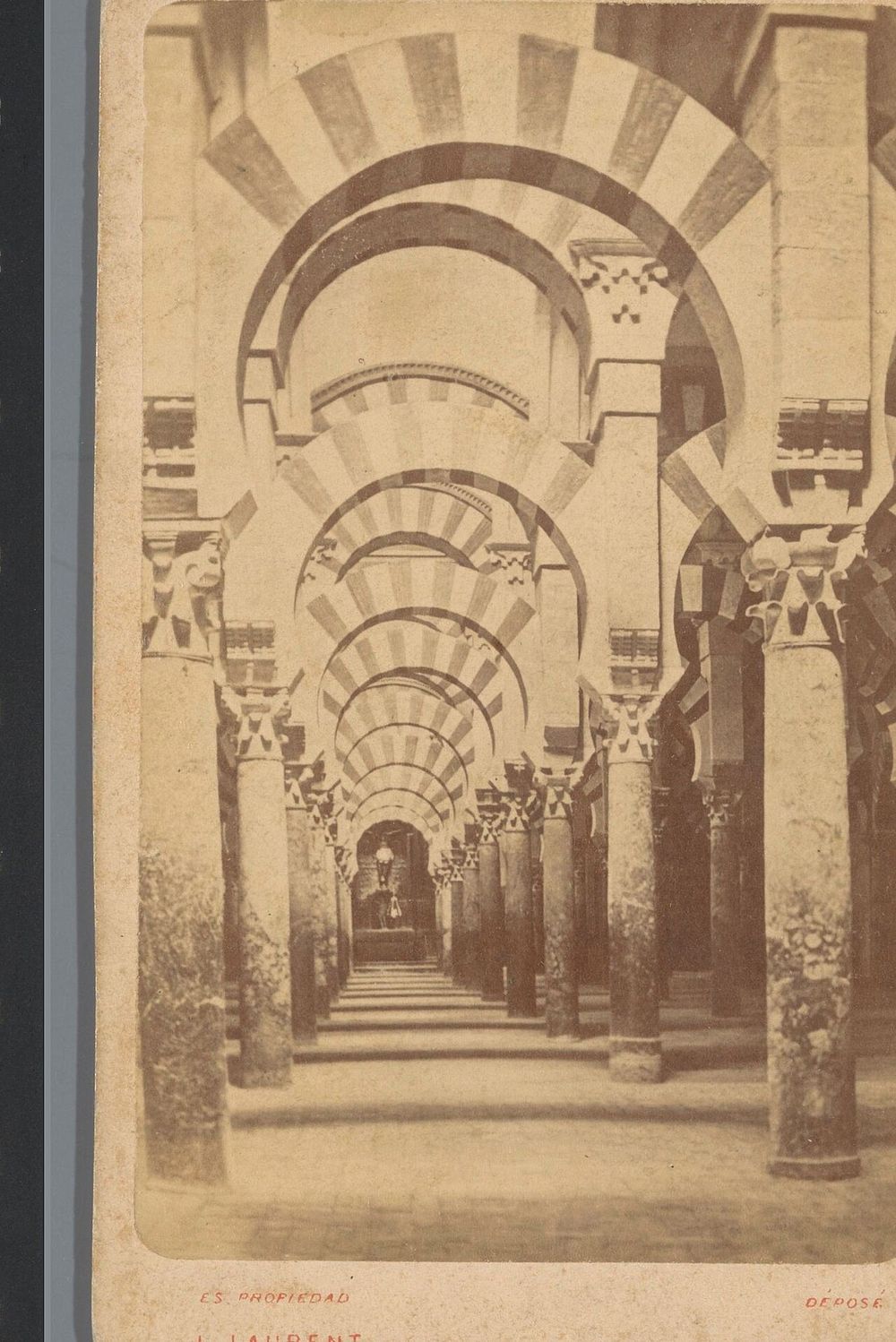
A hall of 856 columns carrying two tiers of red and white arches, begun in 785 as the great mosque of the richest city in western Europe. In the middle of it, since the 1500s, stands a full-sized cathedral. It has been a Catholic church for nearly eight hundred years, which is longer than it was a mosque. Both buildings are here, one inside the other.
Photo: Toni Castillo Quero, CC BY-SA 2.0, Wikimedia Commons
The story
In 750 the ruling family of the Islamic world, the Umayyads of Damascus, were massacred at a banquet by their rivals. One prince of nineteen escaped. He swam the Euphrates, crossed Africa in disguise, and six years later made himself ruler of Muslim Spain, with Córdoba as his capital. In 785, an old man, he began this mosque.
His successors enlarged it three times as the city grew, until by the year 1000 it could hold some forty thousand people. In China these two centuries run from the middle of the Tang dynasty (618–907) to the early Northern Song (960–1127).
The hall of columns, June 2011Alvaro.vinuela.carnicero, CC BY-SA 4.0
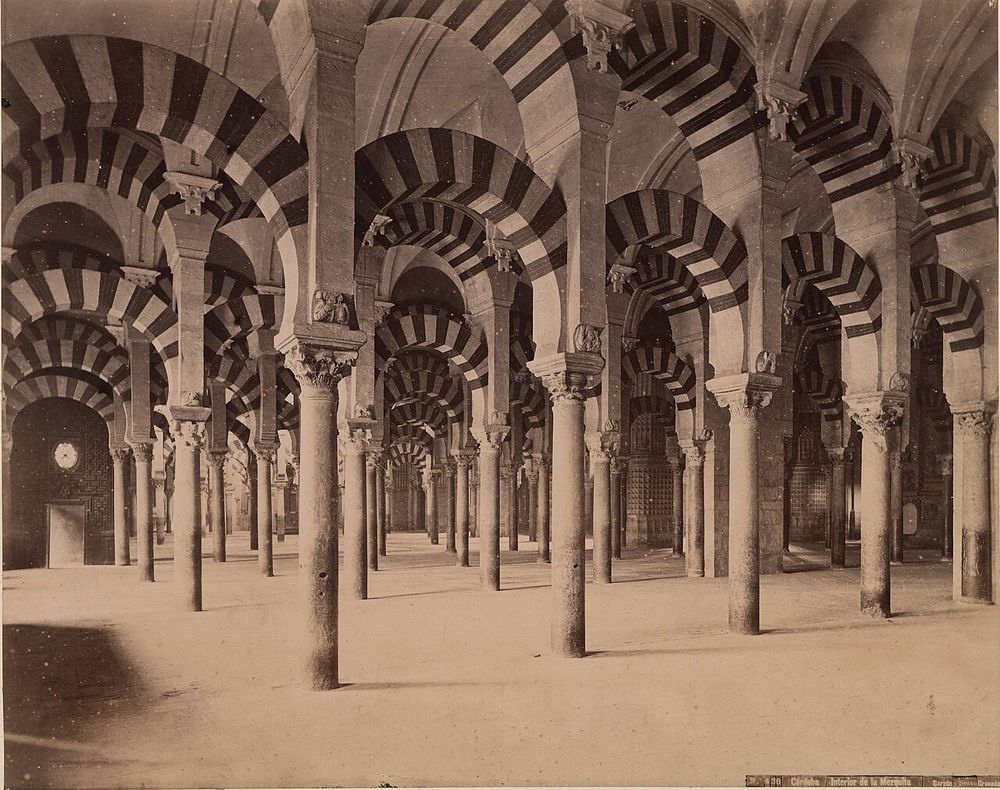
Let your eyes get used to the dark. Columns run away from you in every direction, like a plantation of palms.
Look at the columns themselves. No two match. Some are pink, some grey, some black; some stand on bases and some are sunk in the floor. The builders took them from Roman and Visigothic ruins, and they were all different heights.
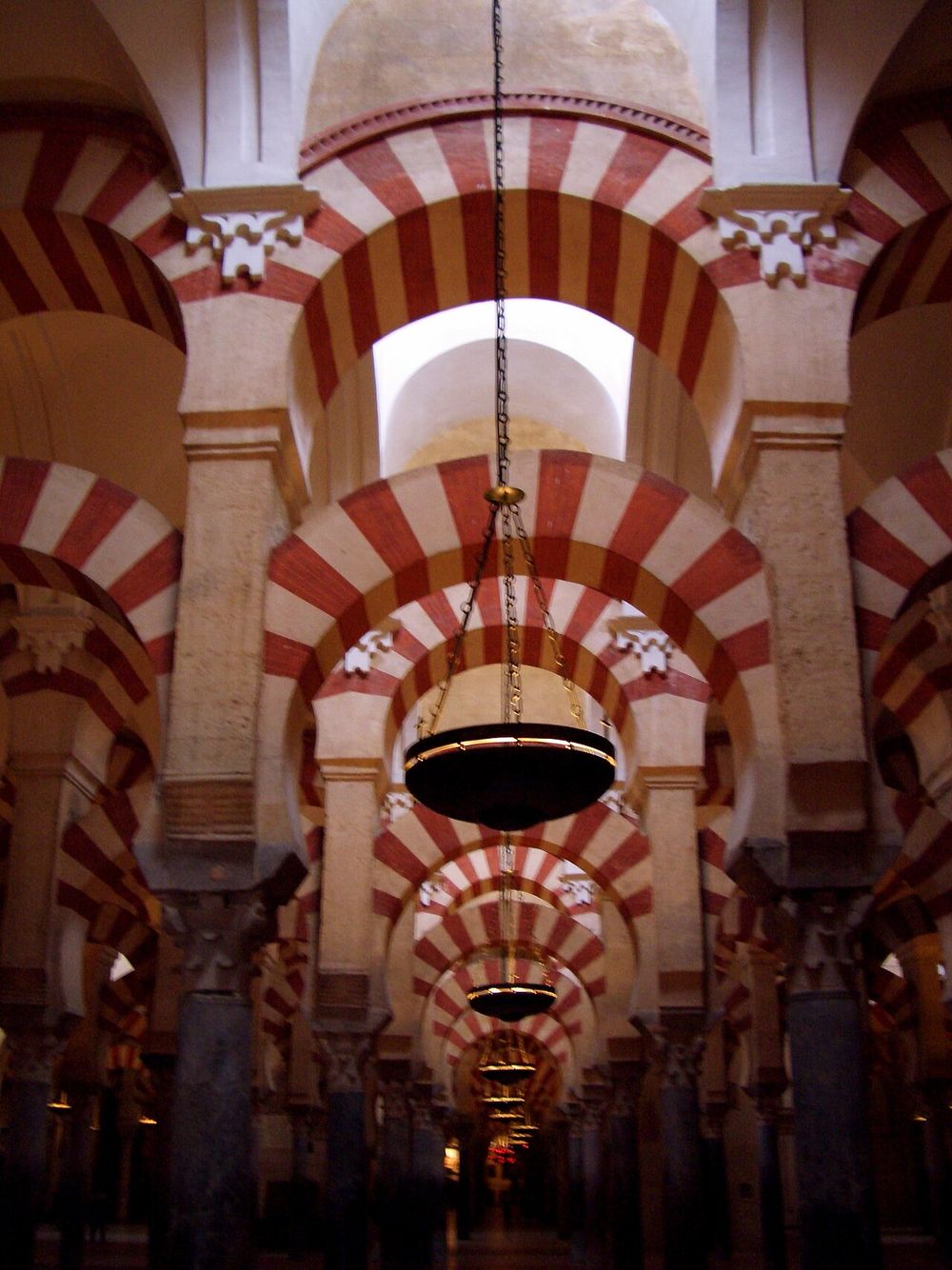
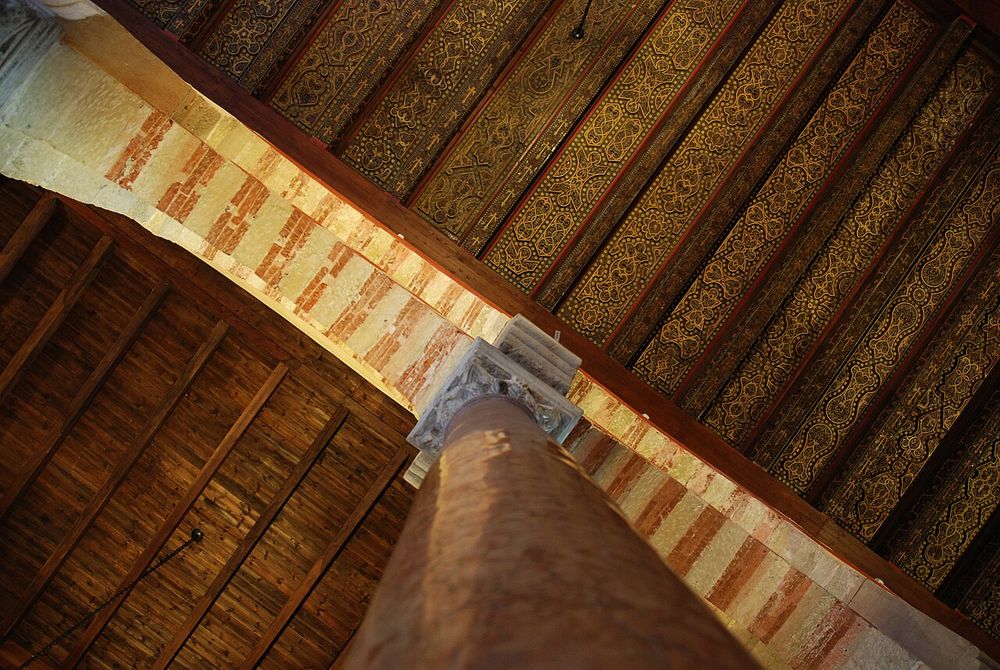
They were also too short for so big a hall. So the builders did something nobody had done in a building before. On each column they set a pier, and they sprang two arches from it, one above the other: a horseshoe arch below to tie the columns together, and a round arch above to carry the roof. They had seen the same idea in a Roman aqueduct.
The stripes are not paint. They are red brick and pale stone laid in turn.
Things people often get wrong
"It is a mosque." It is a Catholic cathedral, with Mass every day, and has been since 1236. Muslims are not allowed to pray in it. Visitors who kneel to pray in the Muslim way are stopped by the guards.
"The Christians wrecked it." They kept it for nearly three hundred years almost as it was. The cathedral in the middle was built against the wishes of the city council, which threatened the workmen with death.
"The prayer niche points to Mecca." It points almost due south. Mecca is to the south-east. Nobody is sure why.
"The arches are all the same." Walk east. In the last eight aisles the stripes are painted on. That part was built in a hurry, about 990, by a man in a hurry.
People who stood here
Abd al-Rahman I (founder of the Umayyad state in Spain, 731–788)He began the mosque in 785 and is said to have worked on it an hour a day with his own hands. He planted the first palm in Spain in his garden and wrote a poem to it: a stranger in the west, like himself.
al-Hakam II (caliph of Córdoba, reigned 961–976)A scholar whose library was said to hold four hundred thousand books. He added the richest part: the domes and the prayer niche. He wrote to the emperor in Constantinople for a mosaic maker, and the emperor sent one, with 1,600 kilograms of gold glass cubes as a gift.
Almanzor (chief minister and real ruler, about 938–1002)He nearly doubled the hall to hold his Berber soldiers. In 997 he raided the Christian shrine of Santiago in the far north and, the chronicles say, made Christian prisoners carry its bells here on their backs to be hung as lamps.
Averroes (Ibn Rushd, philosopher and judge, 1126–1198)He was born a few streets away, and was chief judge of Córdoba. A judge sat in this mosque. His commentaries on Aristotle were read in Paris and Oxford for four hundred years.
Maimonides (Moses ben Maimon, Jewish philosopher and physician, 1138–1204)He was born in the Jewish quarter just north-west of these walls and left at about ten, when a stricter Muslim dynasty took the city. He became the sultan's doctor in Cairo.
Ferdinand III of Castile (king, 1199–1252)He took Córdoba on 29 June 1236. The mosque was blessed as a church the same day. He then had the bells of Santiago carried home, the chronicles say, on the backs of Muslim prisoners.
Luis de Góngora (Spanish poet, 1561–1627)The most difficult and admired poet of Spain's golden age was born in Córdoba and was a paid official of this cathedral for most of his life. The chapter once reprimanded him for talking during services and going to bullfights. He is buried in one of the chapels.
Muhammad Iqbal (poet and philosopher of India, 1877–1938; honoured as the spiritual father of Pakistan)He came in 1933 and was allowed, as a special favour, to say his prayers here. The long poem in Urdu that he wrote about it, The Mosque of Córdoba, is known by heart in Pakistan.
Go deeper: eight stops through twelve centuries
The building grew from north-west to south-east. Walk it in the order it was built.
1. The courtyard
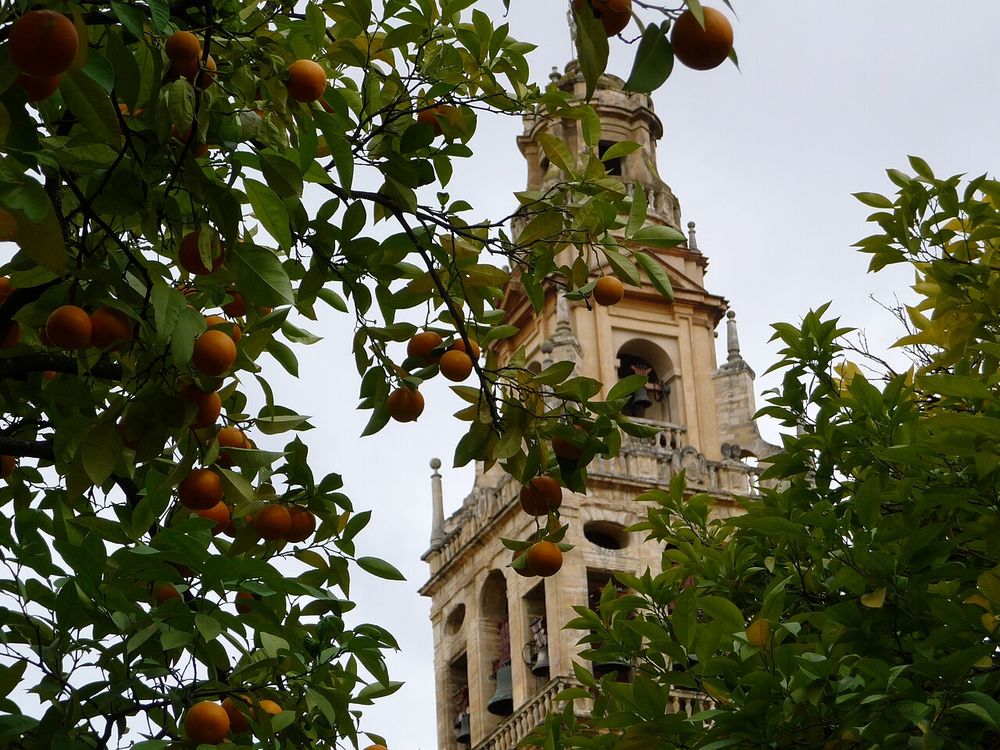
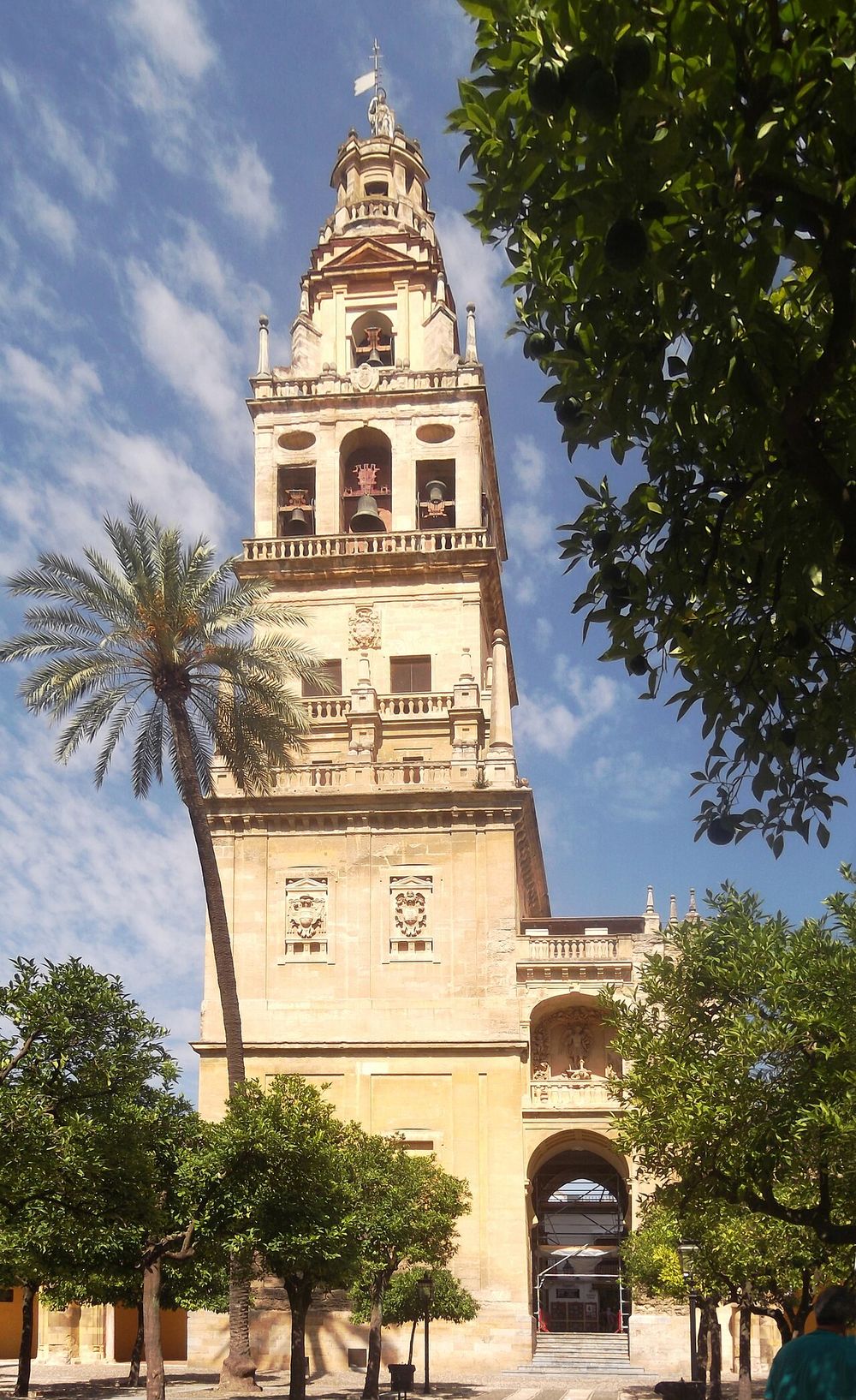
The tower through the orange treescesar.ruiz, CC BY-SA 3.0
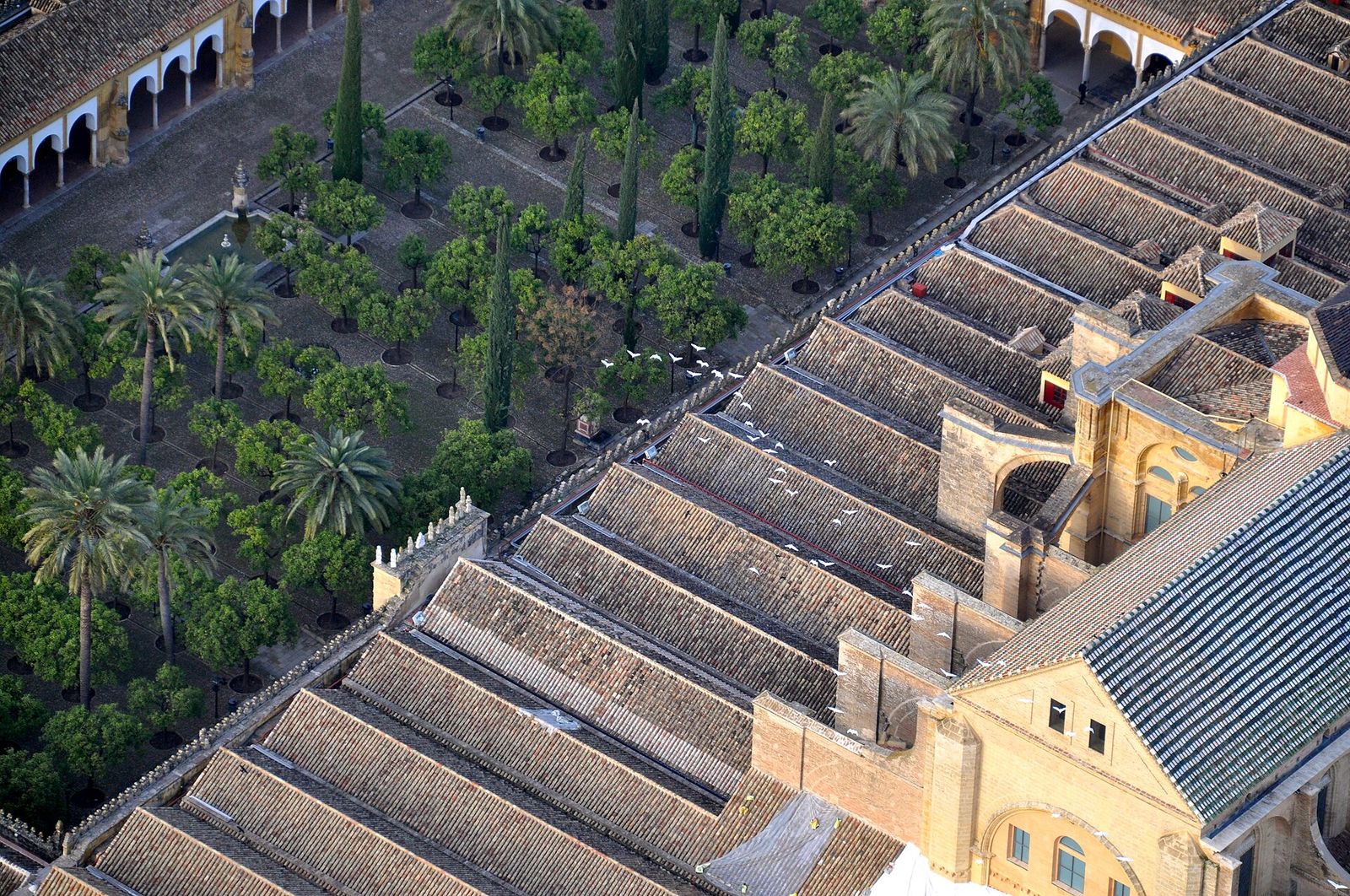
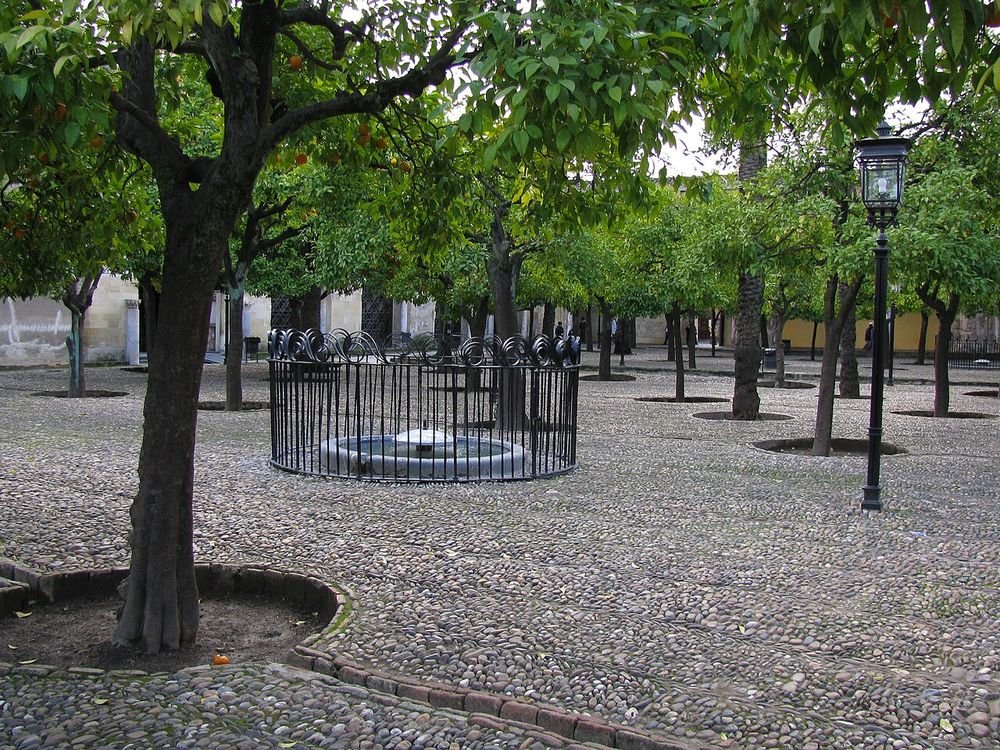
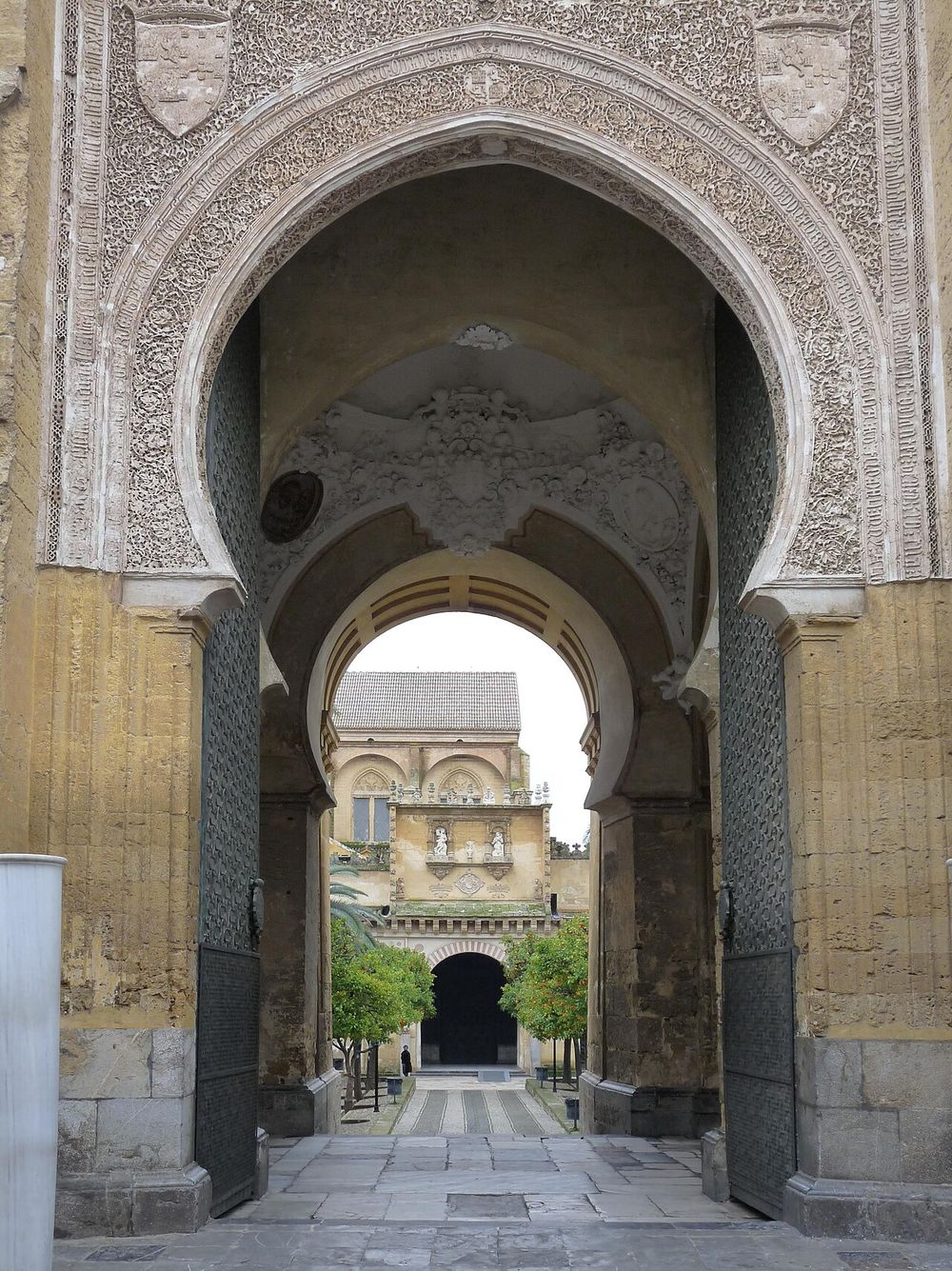
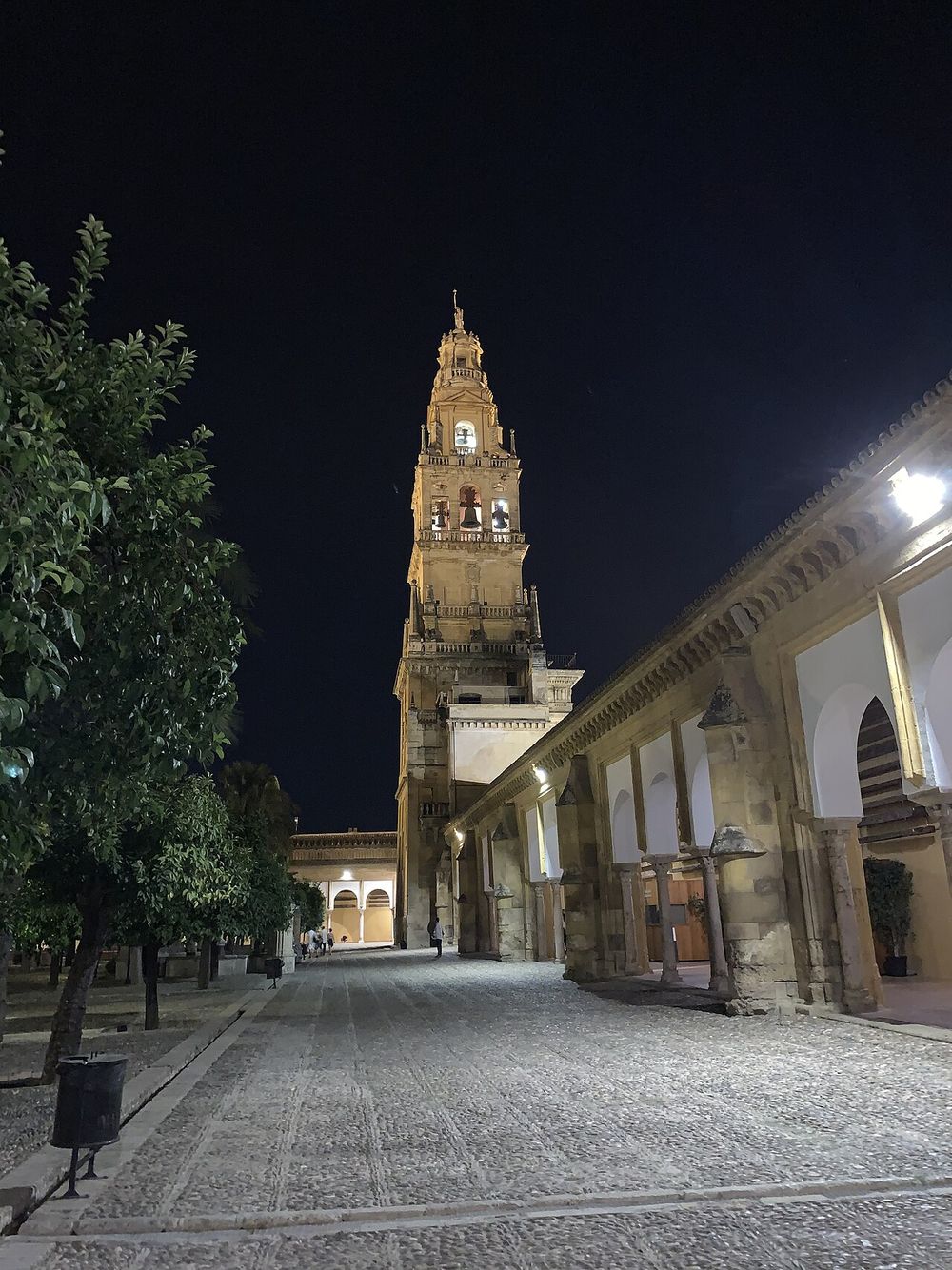
You enter through a court of orange trees. Before the oranges there were palms and olives, and channels between them brought water for washing. The rows of trees line up with the rows of columns inside: the hall once opened on the court through nineteen arches, and the grove walked straight into the building. The arches were walled up to make chapels.
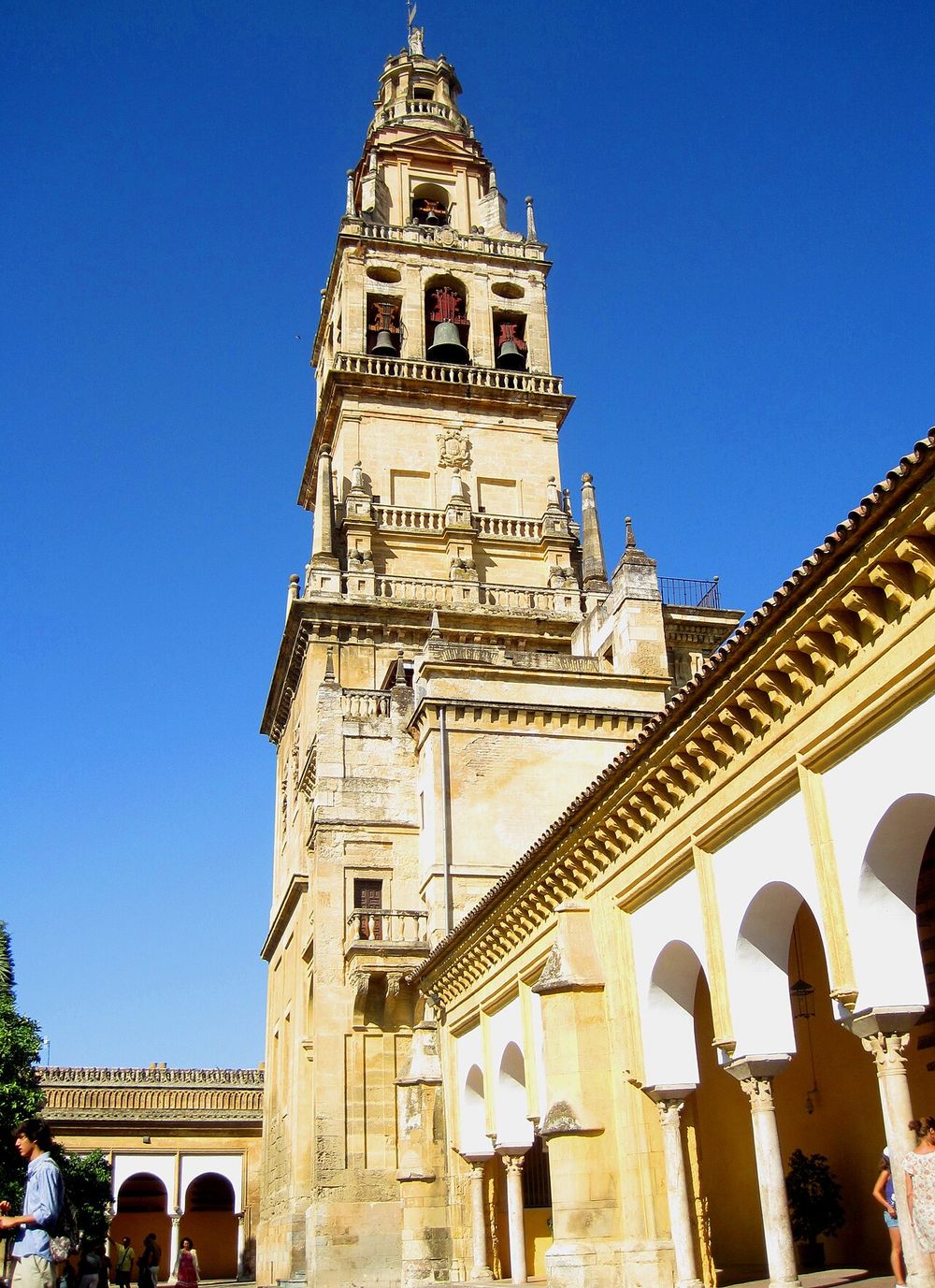
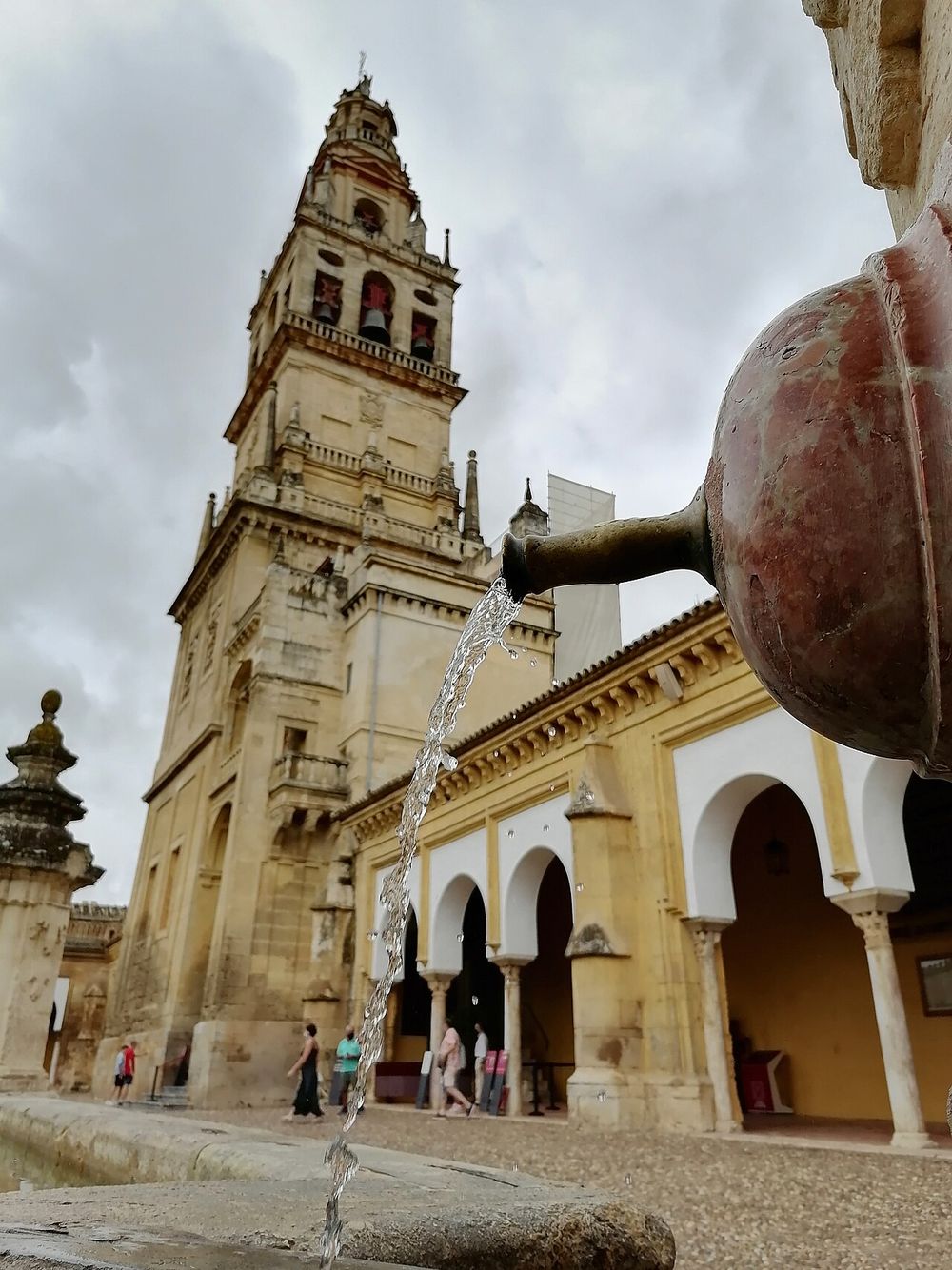
The bell towerRoberto Chamoso G, CC BY-SA 3.0 es
The bell tower is a shell. Inside it stands the minaret of 951, which cracked in a storm in 1589 and was wrapped in new stone. You can climb it.
2. The first mosque, 785
Double arches in the oldest partDiego Delso, CC BY-SA 4.0
The first eleven aisles are the founder's. Look at the tops of the columns: Roman leaves on one, a Visigothic cross chiselled off the next. Look at the floor: some shafts go down into it because they were too long.
3. The first extension, 833
Columns and arches lit from belowDiego Delso, CC BY-SA 4.0
Walk south. Where the floor changes you are in the second emir's hall. He ran out of old columns and had new capitals carved, the first made in Islamic Spain. They copy the Roman ones, a little stiffly.
4. The caliph's hall, 961
The ribbed dome of 961José Luis Filpo Cabana, CC BY 4.0
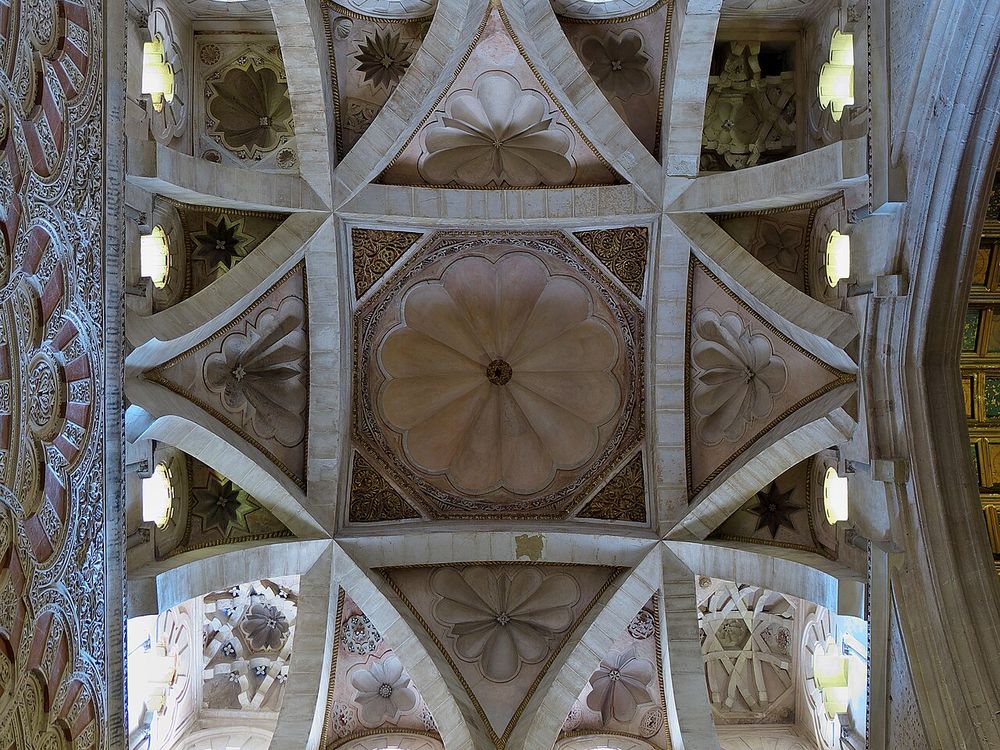
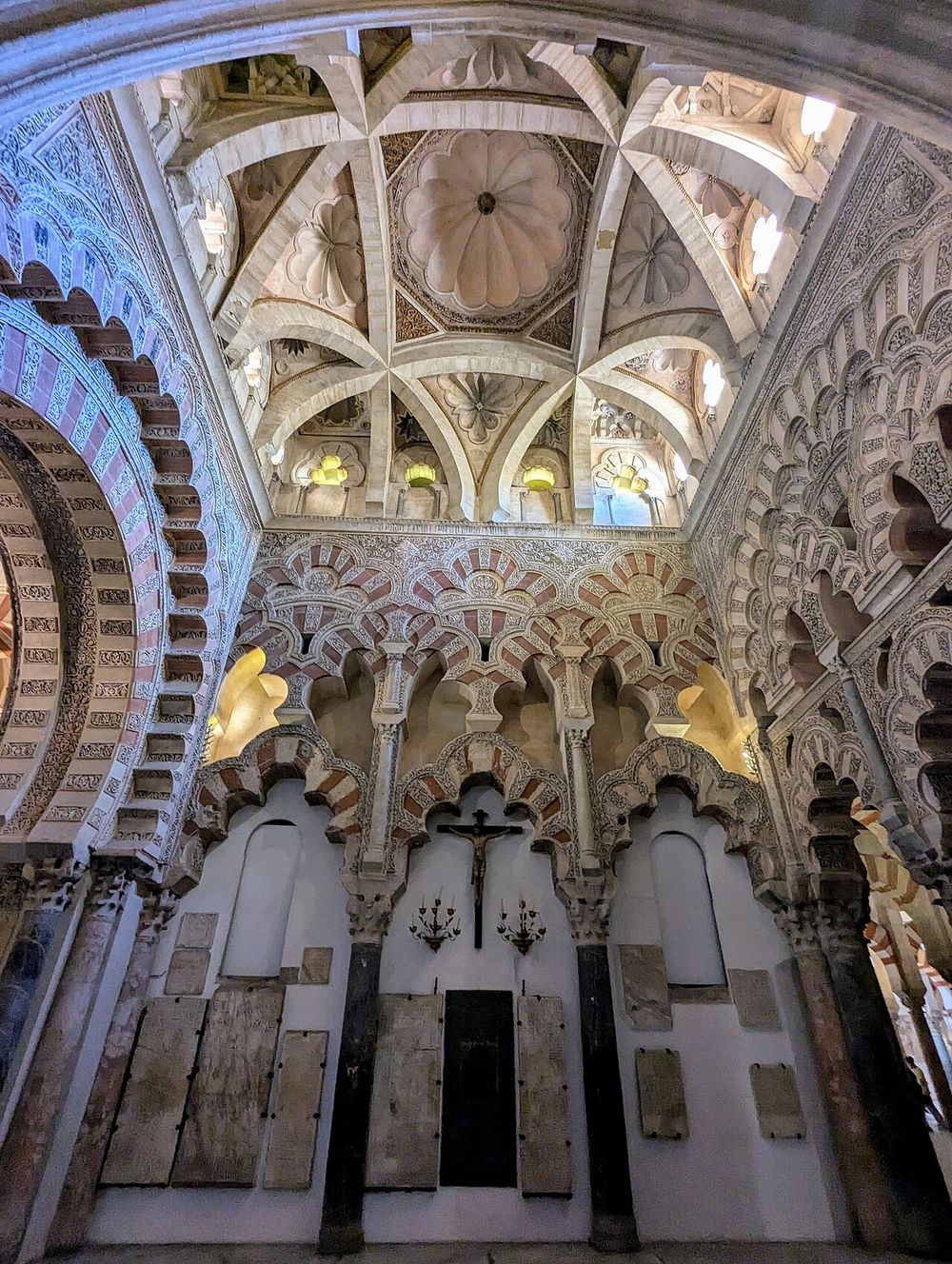
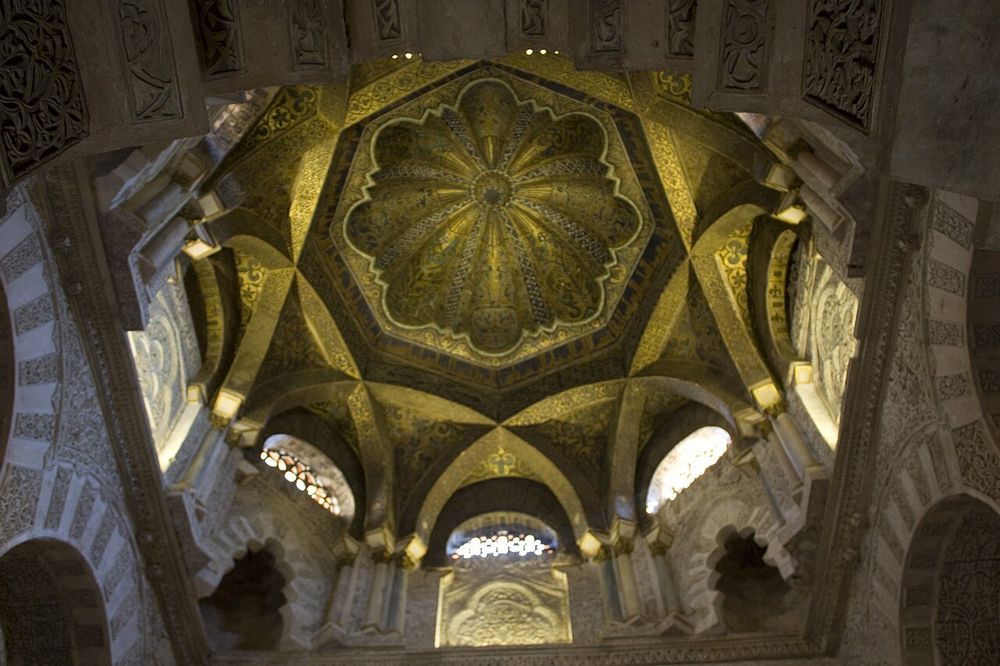
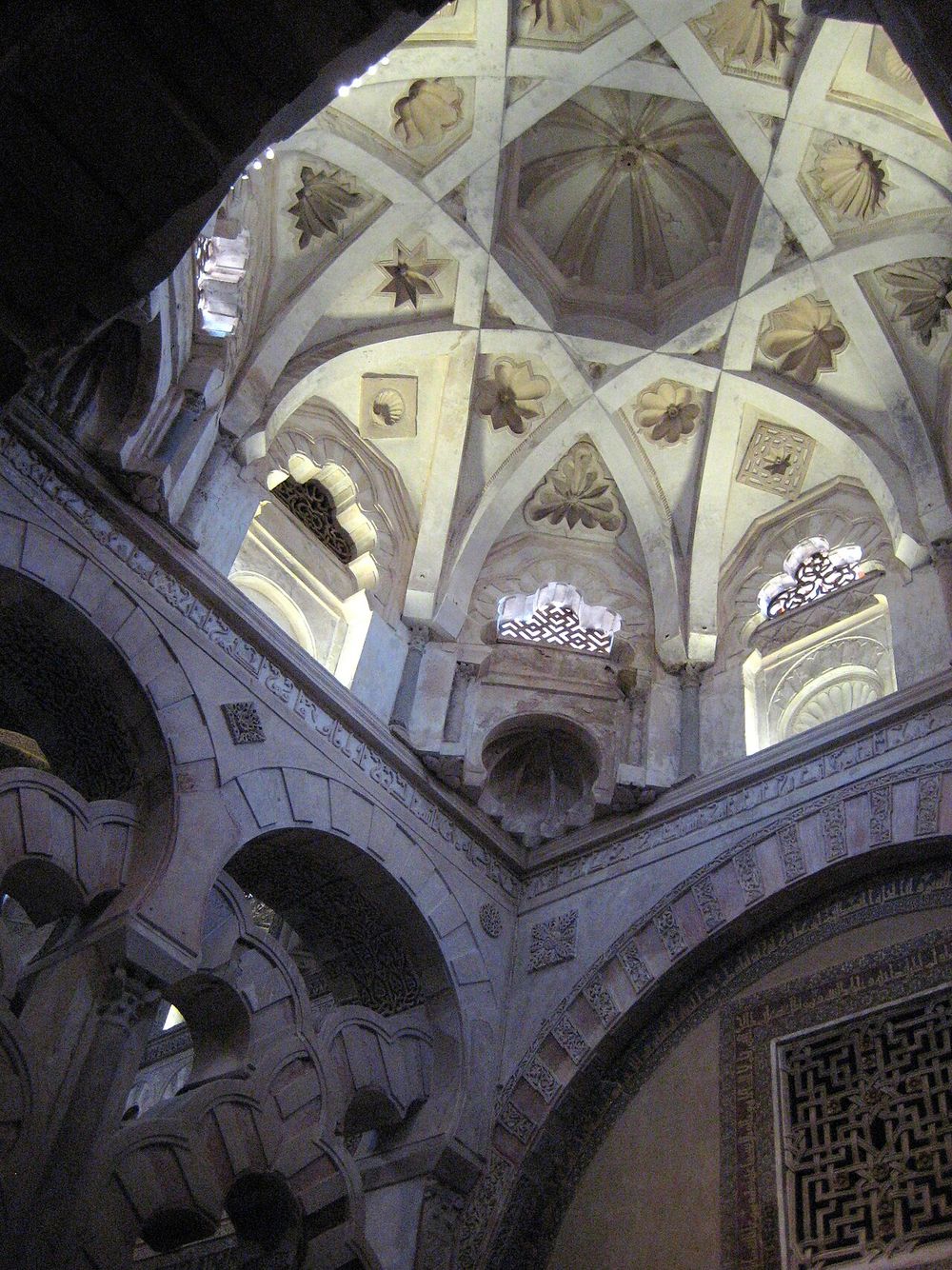
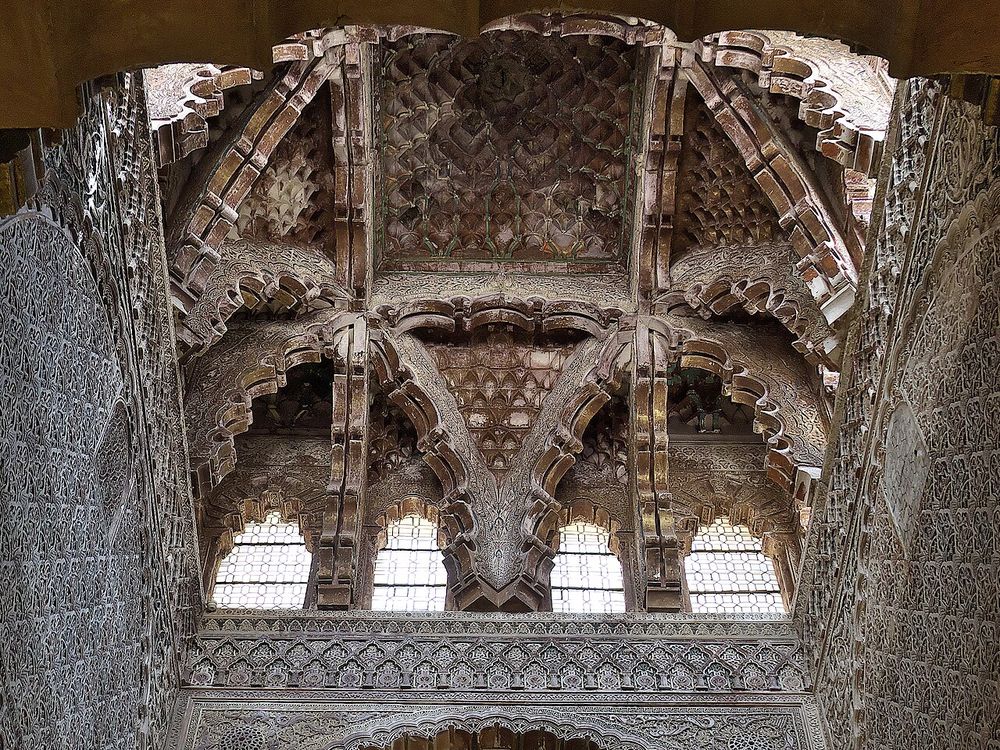
Further south the light changes. Daylight falls from a dome whose stone ribs cross to make an eight-pointed star without meeting in the middle. It was built more than a century before ribbed vaults appeared in northern Europe.
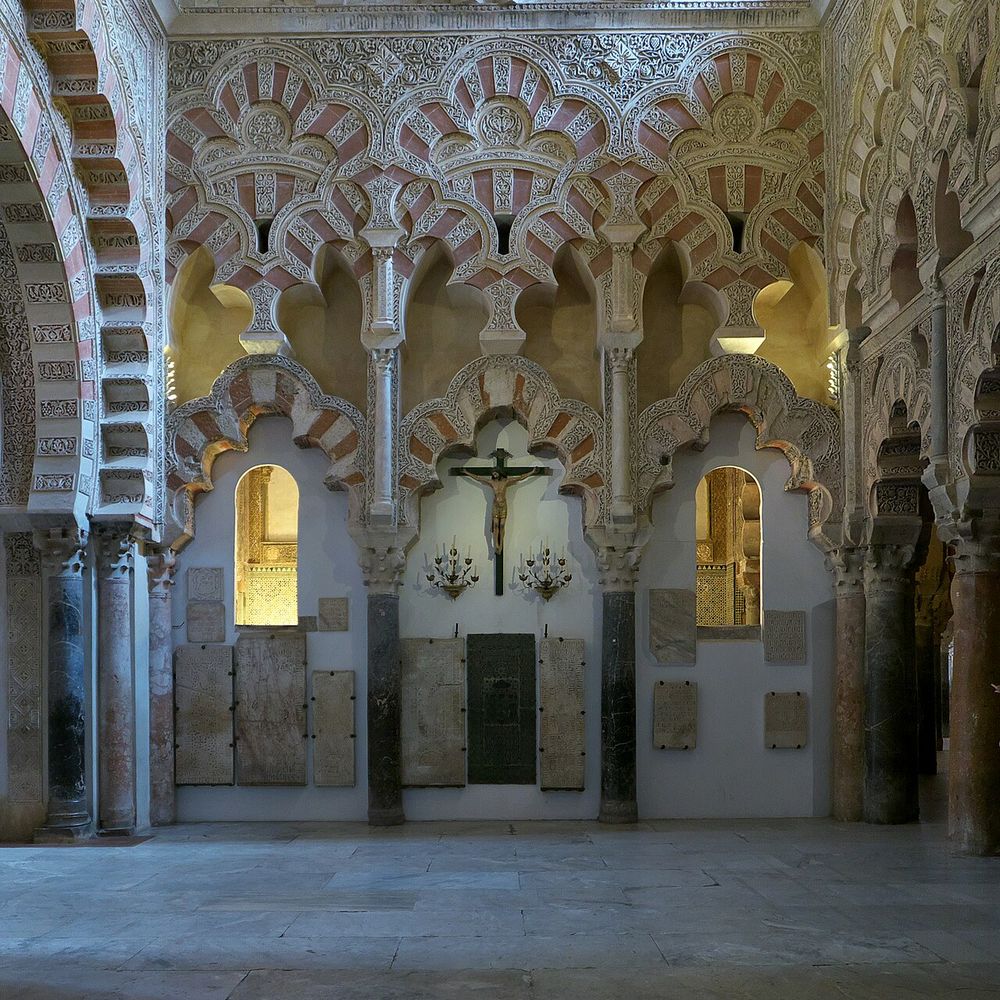
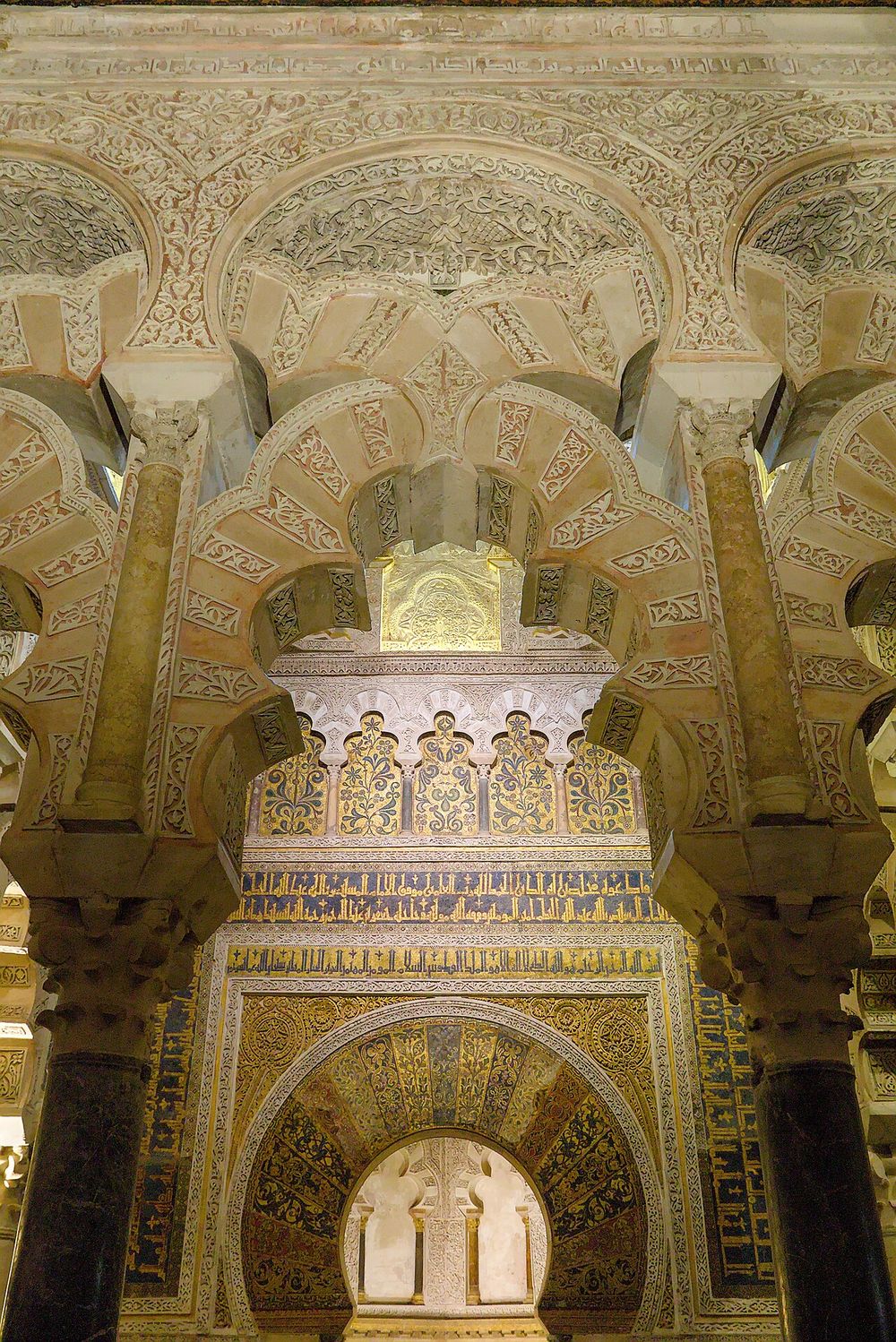
Under it the arches stop being simple. They cross and loop through each other in lobes, like a pattern knitted in stone.
5. The niche
The mihrab, April 2017Jl FilpoC, CC BY-SA 4.0
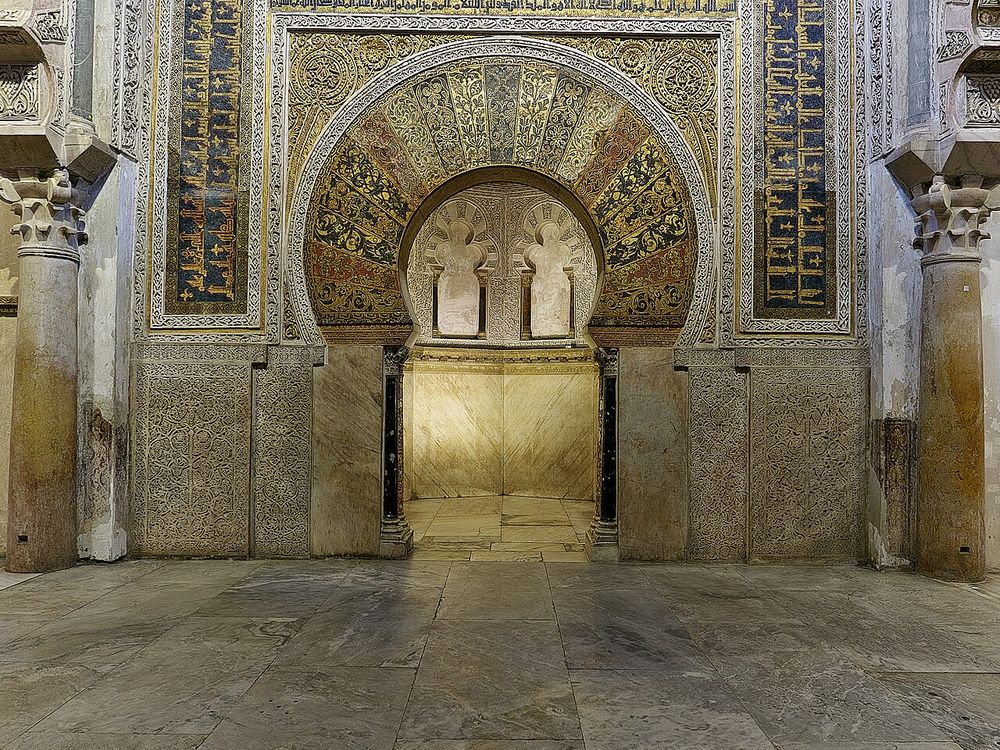
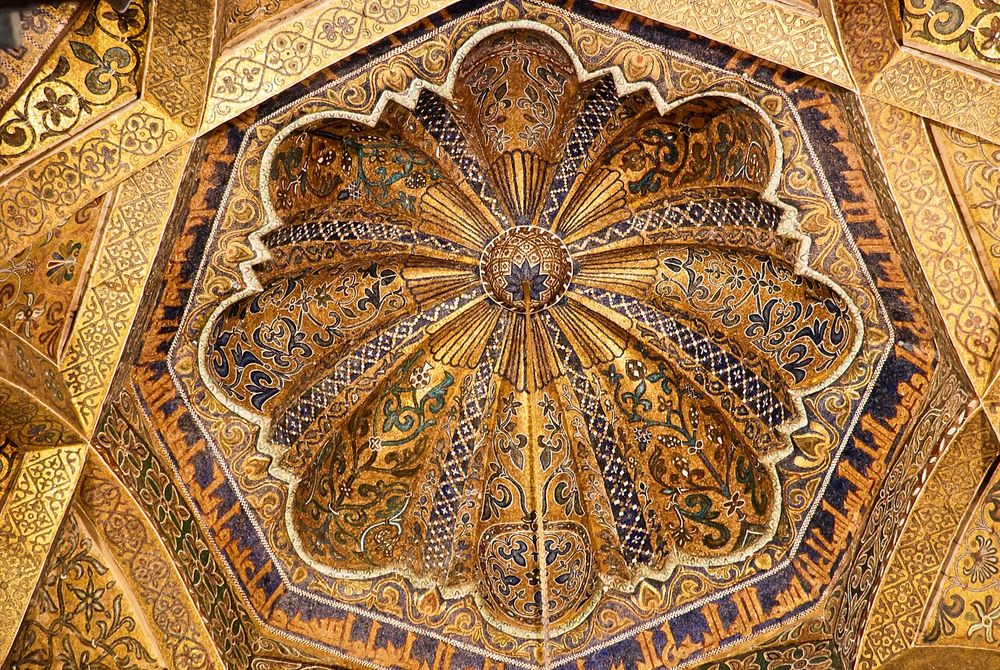
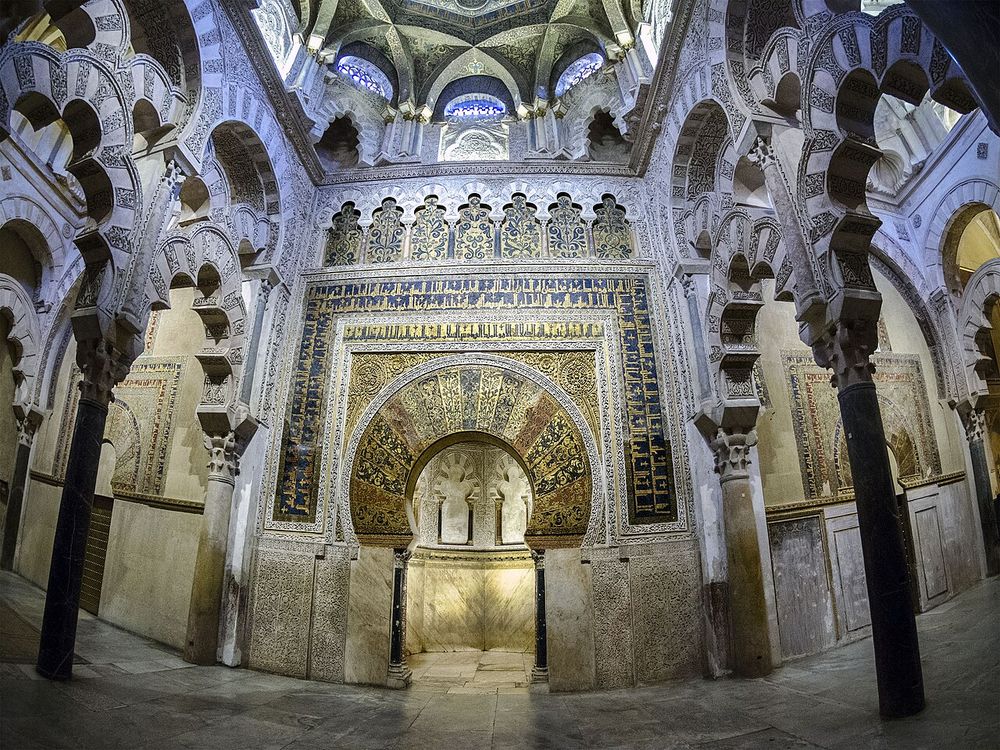
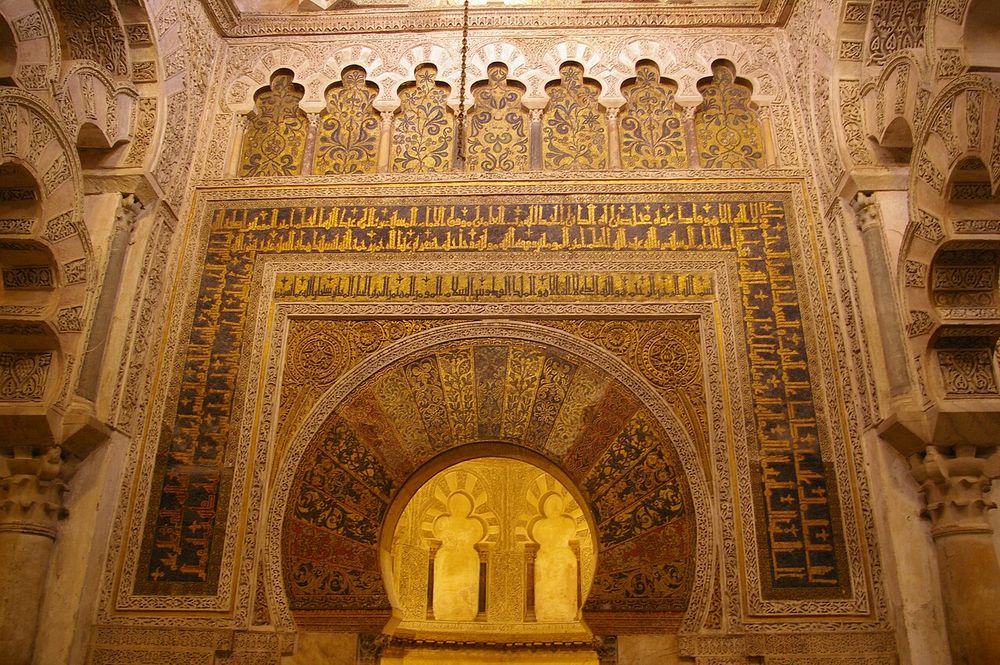
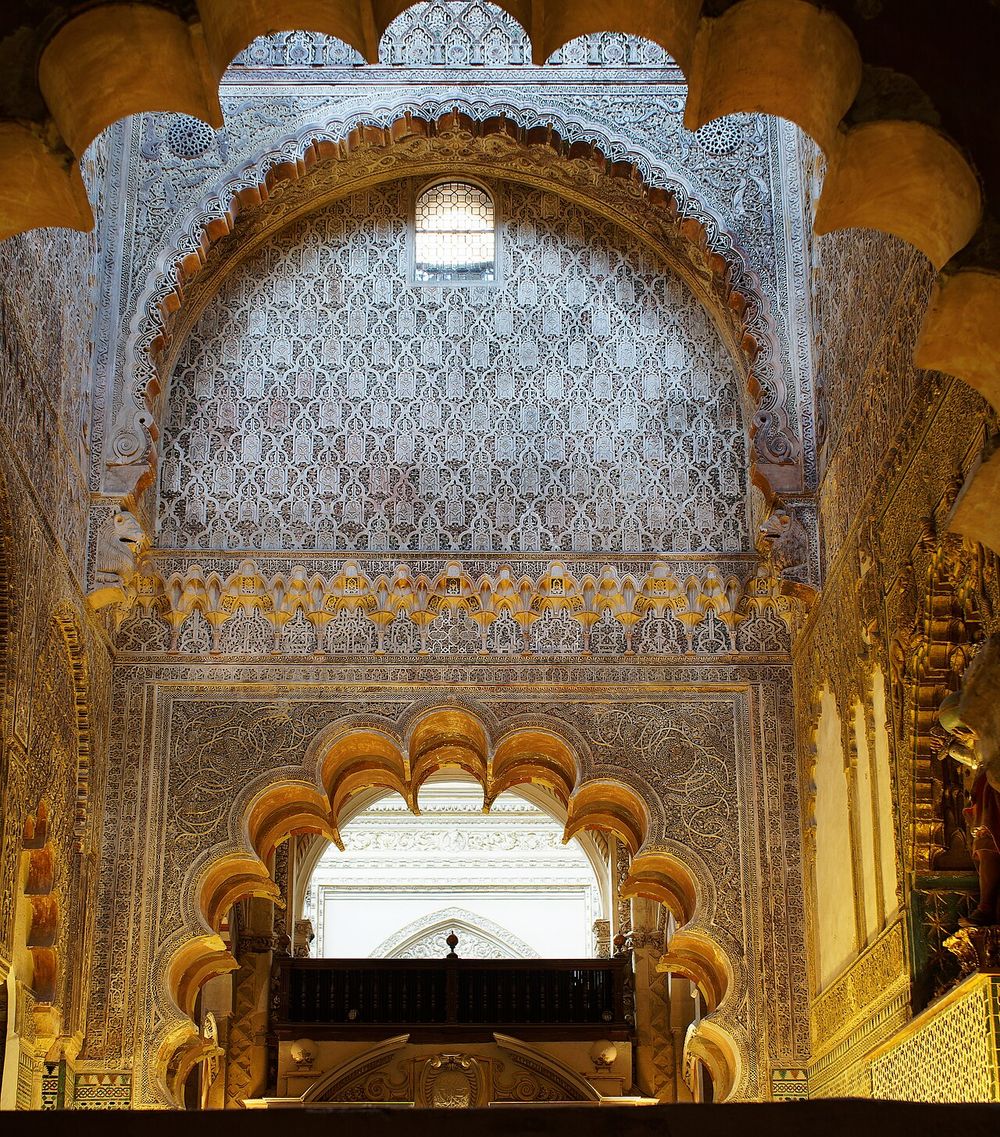
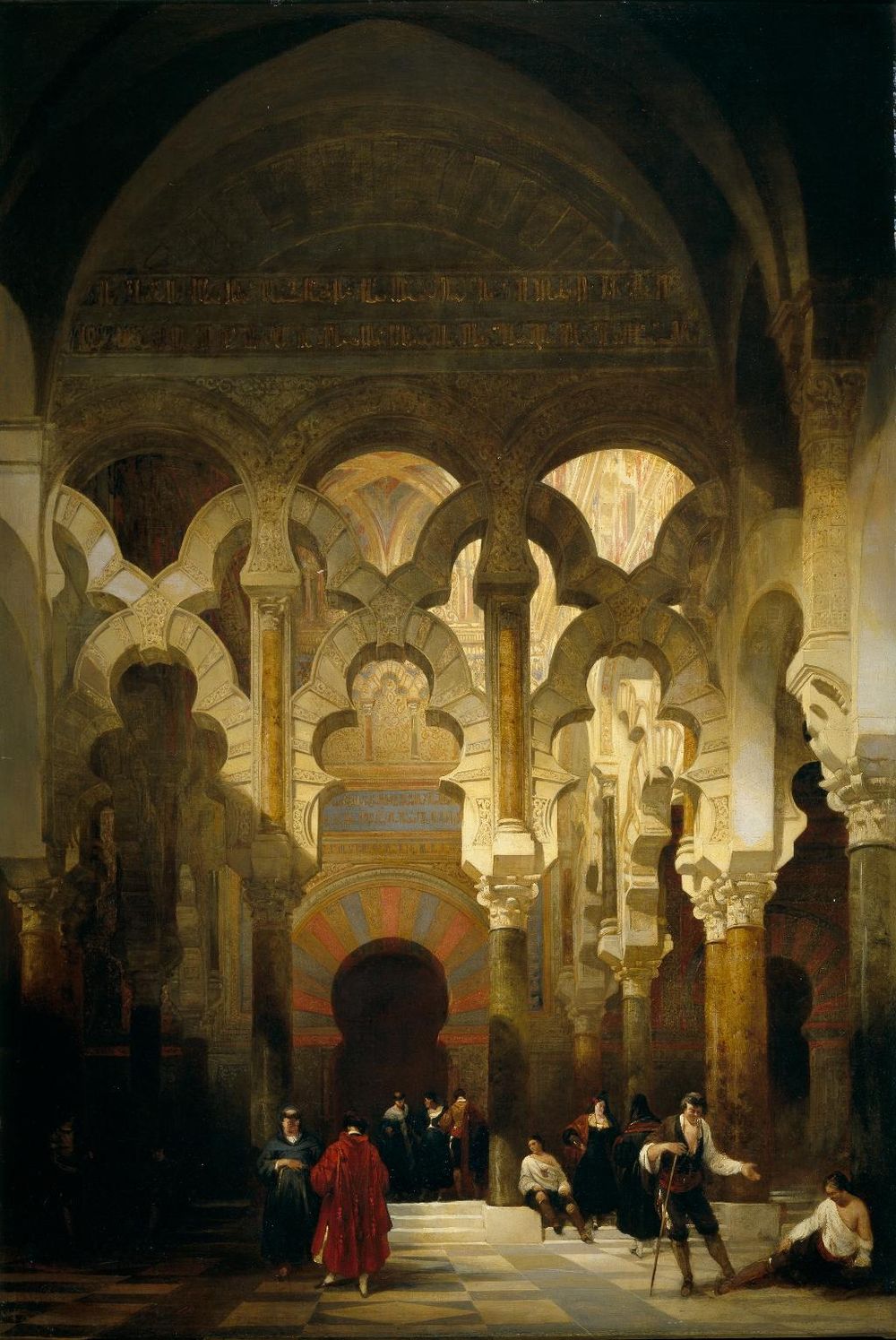
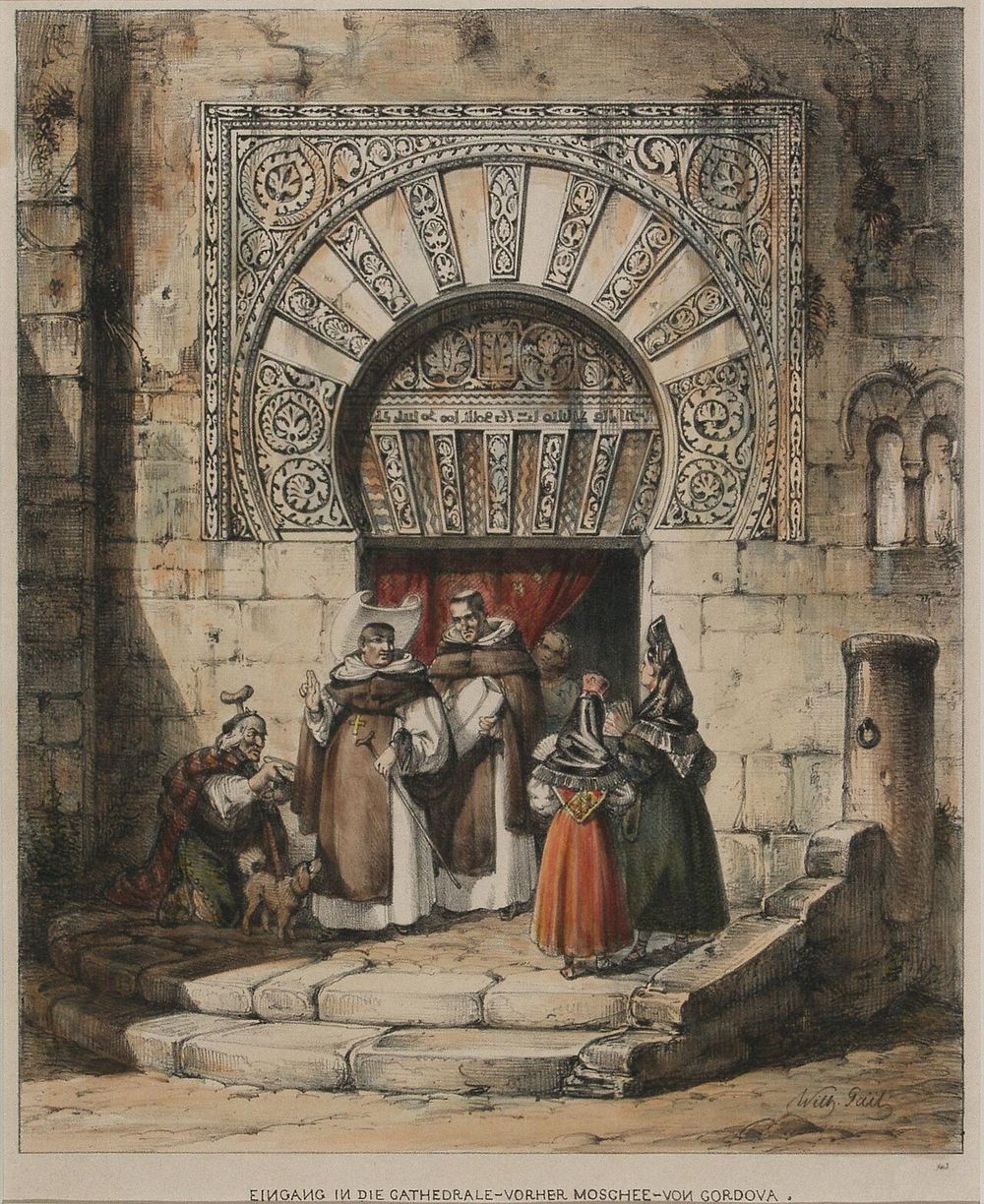
At the south wall is the mihrab, the niche that shows the direction of prayer. Here it is not a niche but a small eight-sided room, roofed with a shell carved from one block of marble. You look in through a horseshoe arch.
The mosaic dome before the mihrabRuggero Poggianella, CC BY-SA 2.0
The arch and the dome above are covered in mosaic: gold, deep blue, green, red. The bands of writing are verses of the Quran and the name of the caliph who paid. The man who set the cubes was a Christian from Constantinople.
Look at the marble at the foot of the arch. It is worn into a hollow. Pilgrims went round the little room seven times on their knees.
6. The minister's hall, 990
Almanzor's aisles, with painted stripesPaul Asman and Jill Lenoble, CC BY 2.0
Now walk east. Eight more aisles run the whole length of the building. This is Almanzor's addition. He could not build south, because of the river, so he built sideways, which left the mihrab off centre for ever. Look closely at the arches: the red is paint.
7. The cathedral in the middle
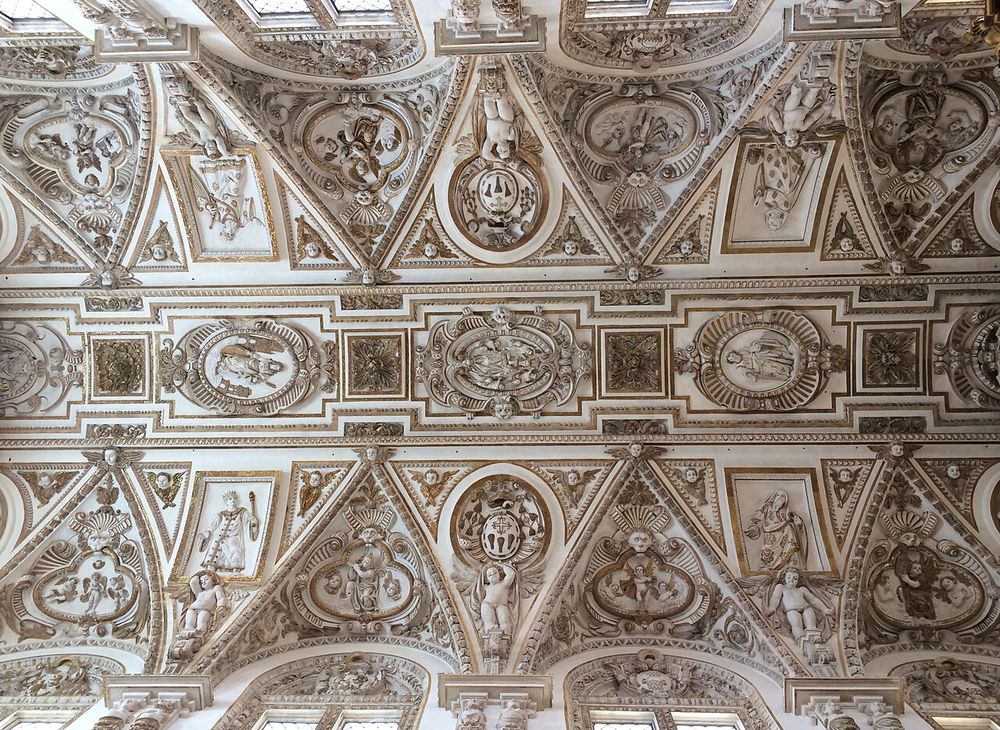
The ceiling of the cathedral in the middlePablo Alejandro Araujo Granda from Quito, Ecuador, CC BY-SA 2.0
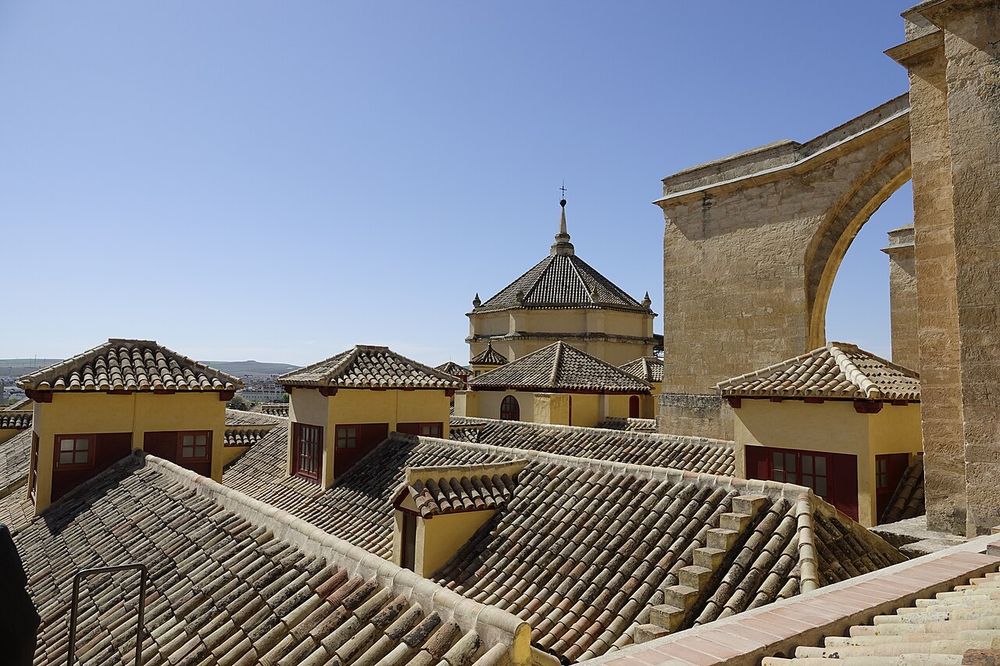
Go back to the centre. The roof suddenly rises to three times its height, white and gold, with a dome, a high altar of red marble and choir stalls of mahogany from Cuba. It was begun in 1523 and its choir stalls were finished in the 1750s, so it is Gothic at the bottom, Renaissance in the middle and Baroque at the top.
To make room, the builders took out the columns of the central aisles. Stand at the edge and look both ways: striped arches on one side of you, saints on the other. Nowhere else can you do this.
¡Oh excelso muro, oh torres coronadas
de honor, de majestad, de gallardía!
¡Oh gran río, gran rey de Andalucía,
de arenas nobles, ya que no doradas!
O lofty wall, O towers crowned
with honour, with majesty, with grace!
O great river, great king of Andalusia,
whose sands are noble, though they are not gold!
Luis de Góngora, the opening of his sonnet "A Córdoba", 1585. He served this cathedral and is buried in it; our translation
8. Outside
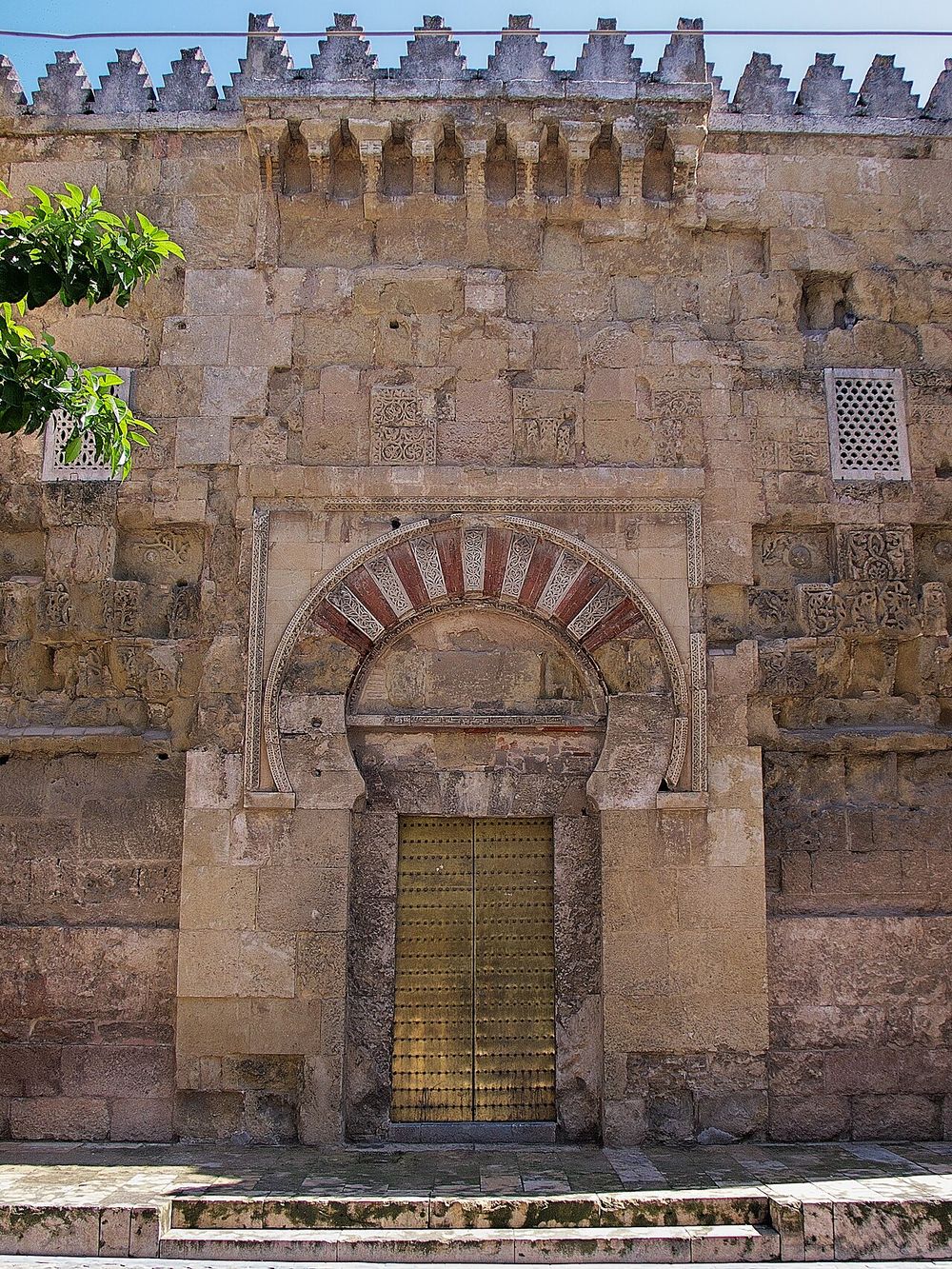
The oldest door, 786José Luis Filpo, CC BY 2.0
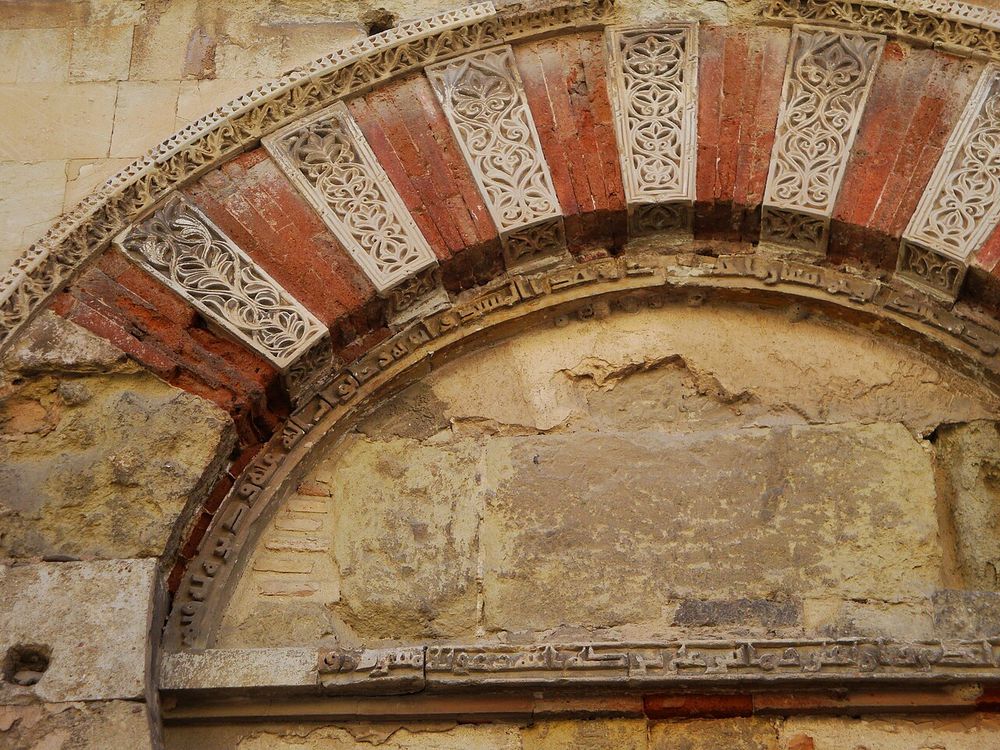
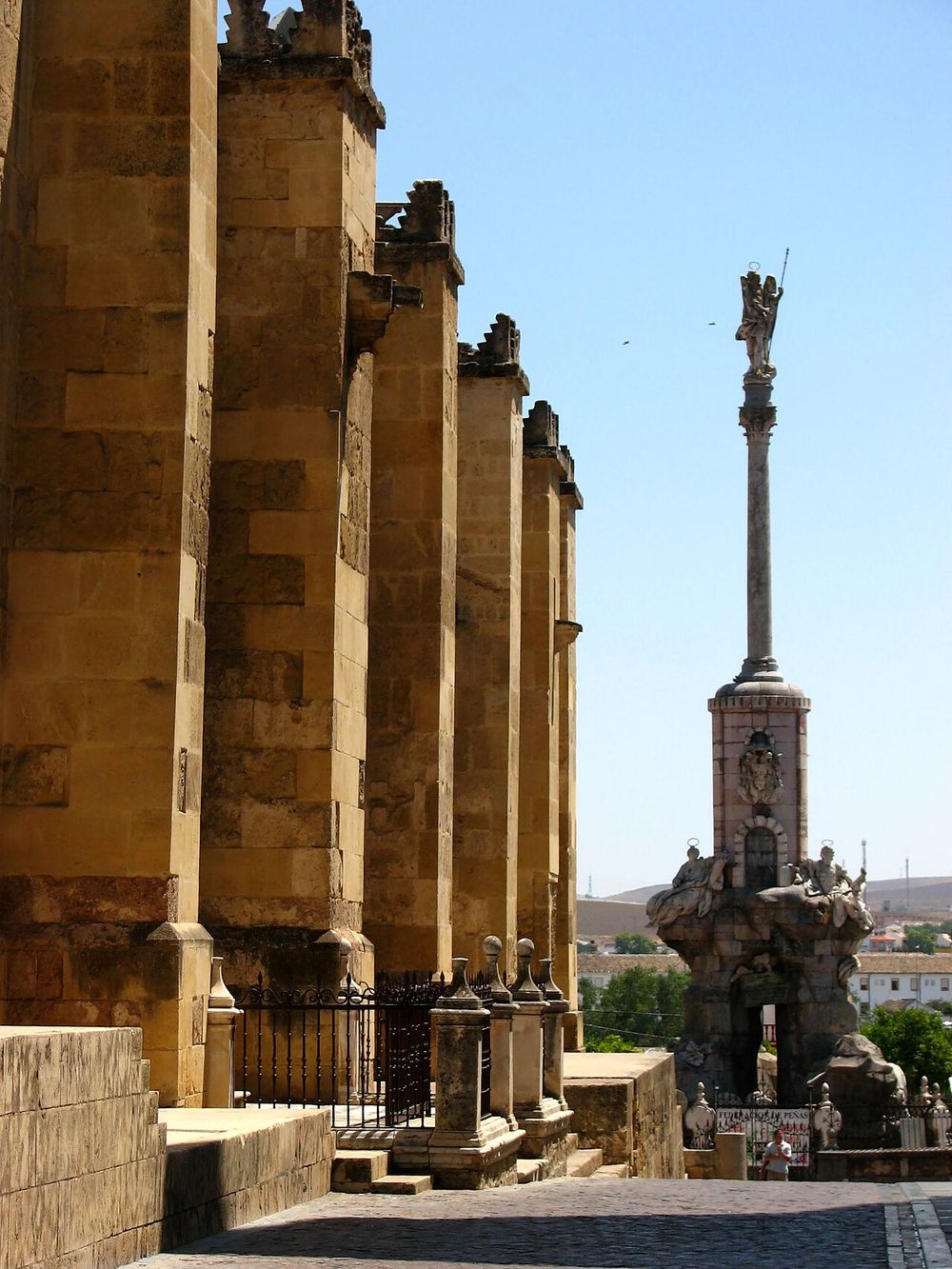
Walk round the outside. On the west wall is the oldest door, from 786, its carving worn almost flat.
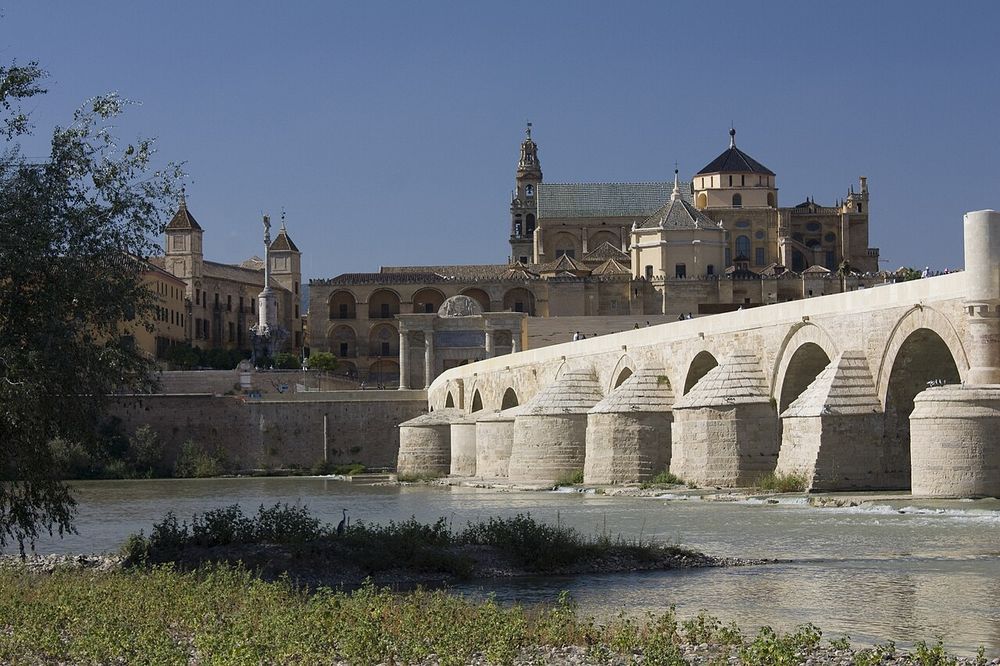
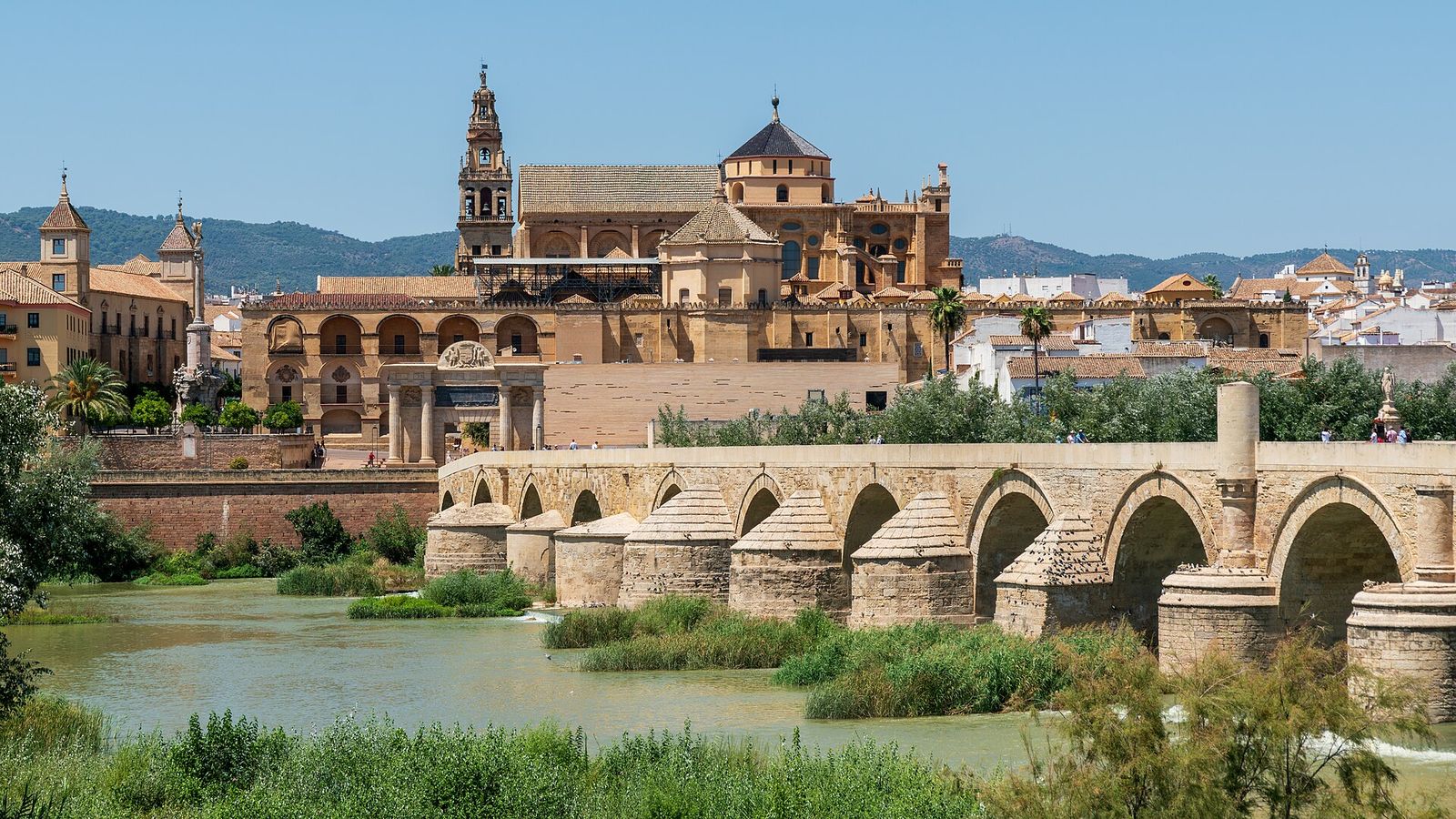
The bridge, the gate and the Mosque-CathedralDaniel VILLAFRUELA, CC BY-SA 3.0
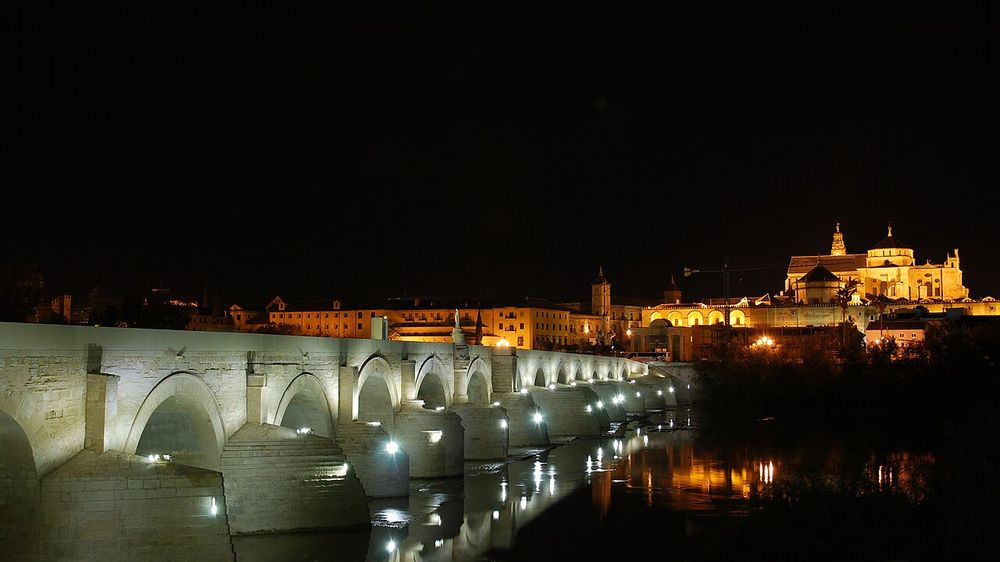
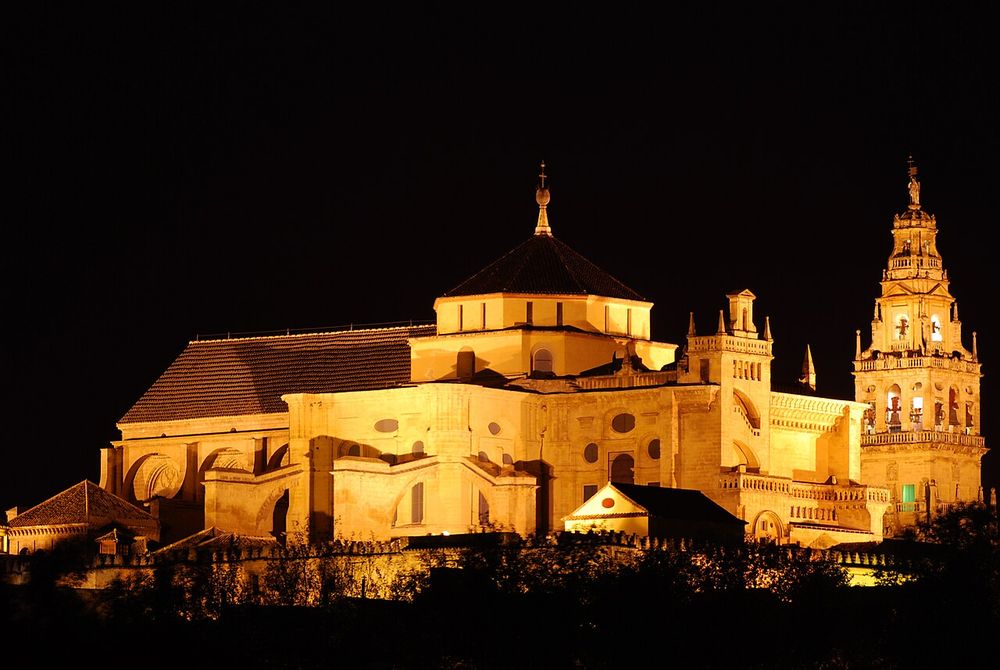
Then cross the Roman bridge. From the far bank you see what the building is: a long, low, flat box of a mosque, with a tall church pushing up through its roof.
The same shot: the classic view is from the middle of the bridge at sunset, when the stone turns orange, or from the tower at the far end after dark.
Meanwhile in the world
Year
Here
Elsewhere
785
The mosque is begun
Charlemagne is conquering the Saxons
833
The first extension
In Baghdad the caliph's House of Wisdom is translating Greek science
961
The caliph adds the domes and the mihrab
Otto I is about to be crowned emperor in Rome
997
Almanzor brings the bells of Santiago
Vikings from Greenland are about to reach America
1236
Córdoba falls to Castile; the mosque becomes a cathedral
The Mongols are about to invade Russia
1523
The cathedral in the middle is begun
Magellan's last ship has just come home
1984
The building joins the World Heritage list
With it on the list that year are the Alhambra and the works of Gaudí
One line to remember: longer a church than a mosque, and still called the Mosque.
Then and now
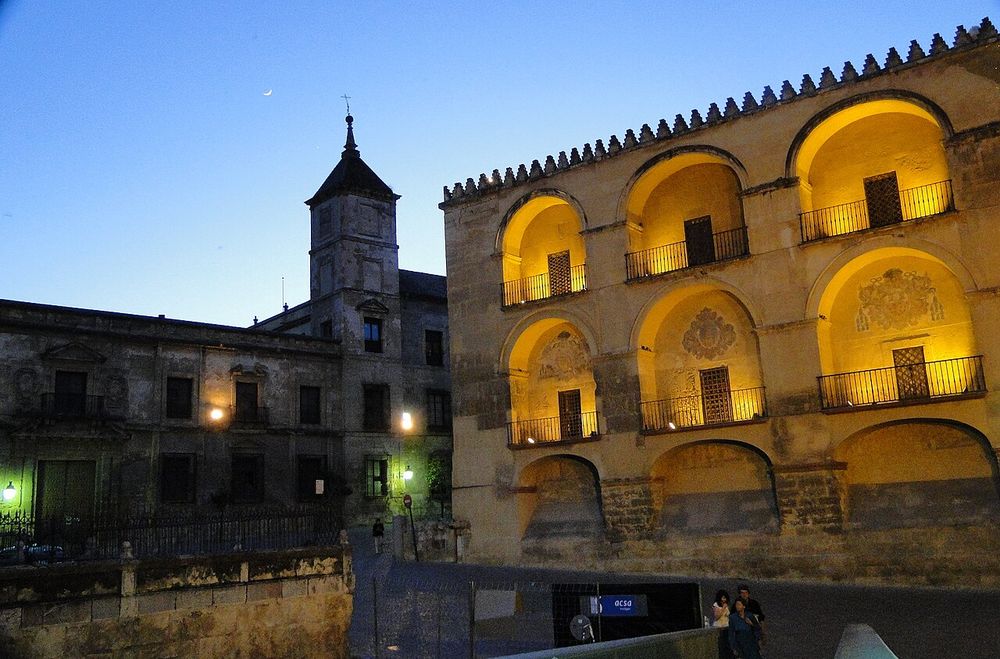
The building from the air, March 2010Toni Castillo Quero, CC BY-SA 2.0, Wikimedia CommonsThe roofs and the courtyard from the airToni Castillo Quero, CC BY-SA 2.0, Wikimedia CommonsThe Roman bridge and the Mosque-Cathedral, August 2023Jose María Ligero Loarte, CC BY-SA 4.0, Wikimedia CommonsThe cathedral rising through the mosque's roofs, March 2019FDV, CC BY-SA 4.0, Wikimedia CommonsThe tower through the orange treescesar.ruiz, CC BY-SA 3.0, Wikimedia CommonsA fountain in the courtyardBogdan Migulski, CC BY 2.0, Wikimedia CommonsThe courtyard and the towerلا روسا, CC BY-SA 3.0, Wikimedia CommonsThe bell towerRoberto Chamoso G, CC BY-SA 3.0 es, Wikimedia CommonsThe tower from the street, June 2021Manuelteje, CC BY-SA 4.0, Wikimedia CommonsThe gate under the towermichael clarke stuff, CC BY-SA 2.0, Wikimedia CommonsThe hall of columns, June 2011Alvaro.vinuela.carnicero, CC BY-SA 4.0, Wikimedia CommonsDouble arches in the oldest partDiego Delso, CC BY-SA 4.0, Wikimedia CommonsArches in the half-darkDiego Delso, CC BY-SA 4.0, Wikimedia CommonsColumns and arches lit from belowDiego Delso, CC BY-SA 4.0, Wikimedia CommonsThe wooden ceiling above the archesPikaluk from West Midlands, UK, CC BY 2.0, Wikimedia CommonsThe ribbed dome of 961José Luis Filpo Cabana, CC BY 4.0, Wikimedia CommonsInterlaced arches under the domeJosé Luis Filpo Cabana, CC BY 4.0, Wikimedia CommonsThe chapel under the first dome, June 2024Rodelar, CC BY-SA 4.0, Wikimedia CommonsLobed arches before the mihrab, April 2024Benjamin Smith, CC BY-SA 4.0, Wikimedia CommonsThe mihrab, April 2017Jl FilpoC, CC BY-SA 4.0, Wikimedia CommonsThe mihrab and its domeÁngel M. Felicísimo from Mérida, España, CC BY-SA 2.0, Wikimedia CommonsMosaic round the arch of the mihrabAmelia Wells from United Kingdom, CC BY 2.0, Wikimedia CommonsThe mosaic dome before the mihrabRuggero Poggianella, CC BY-SA 2.0, Wikimedia CommonsThe dome from below, September 2011Daniel VILLAFRUELA, CC BY-SA 3.0, Wikimedia CommonsA ribbed dome beside itAllen Gathman, CC BY-SA 2.0, Wikimedia CommonsThe royal chapel, in plaster of the 1300sArnoldius, CC BY-SA 4.0, Wikimedia CommonsThe vault of the royal chapelJosé Luis Filpo Cabana, CC BY 3.0, Wikimedia CommonsAlmanzor's aisles, with painted stripesPaul Asman and Jill Lenoble, CC BY 2.0, Wikimedia CommonsThe ceiling of the cathedral in the middlePablo Alejandro Araujo Granda from Quito, Ecuador, CC BY-SA 2.0, Wikimedia CommonsThe oldest door, 786José Luis Filpo, CC BY 2.0, Wikimedia CommonsWorn carving over the oldest doorlosmininos, CC BY-SA 2.0, Wikimedia CommonsThe west wall and a monument to the city's guardian angelConan, CC BY 2.0, Wikimedia CommonsThe bridge, the gate and the Mosque-CathedralDaniel VILLAFRUELA, CC BY-SA 3.0, Wikimedia CommonsThe bridge and the building at nightEmilio García, CC BY-SA 2.0, Wikimedia CommonsThe south side at night, from the bridgeAdam Jones, Ph.D., CC BY-SA 3.0, Wikimedia CommonsThe whole building lit, November 2008Emilio García from Parla, Spain, CC BY-SA 2.0, Wikimedia CommonsThe tower at night, September 2020Javi VLL, CC BY-SA 4.0, Wikimedia CommonsThe interior painted by David Roberts, 1838David Roberts, Public domain, Wikimedia CommonsThe mihrab in a print of the 1830sWilhelm Gail, Public domain, Wikimedia CommonsThe hall of columns about 1900Rafael Garzón / Rafael Señán, Public domain, Wikimedia CommonsAn aisle in a photograph of the 1800sRijksmuseum, CC0, Wikimedia Commons
Local legends
These are stories people tell about this place. They are legends, not history, and each one says where it comes from.
LegendThe emperor's regret
Charles V had given leave to build the cathedral without seeing the place. When he came in 1526 he said: you have built what could have been built anywhere, and destroyed what was unique in the world.
Source: First recorded by a Córdoba writer in the 17th century
LegendThe shared church
When the Muslims came, they shared the church on this spot with the Christians, half each, until the emir bought the Christian half.
Source: Arab historians of the 10th century; the same story is told of Damascus
LegendThe prisoner's cross
A Christian captive chained to a column scratched a cross into the marble with his fingernail. It is shown behind a grille.
Source: Cathedral tradition
Later, people who live here will be able to add the stories they grew up with, and say which of these they have heard.
Not certain, and where accounts conflict
Was there a church here first?
Excavations in the 1930s found mosaics and walls of the 500s under the floor; one patch can be seen through glass. Whether they belong to a church of Saint Vincent, as the Church says, or to another kind of building, archaeologists still argue.
Why does it face south?
One view is that the founder copied the direction of the mosque in Damascus, his lost home. Another is that the builders followed the Roman street grid. A third is that an early school of law in Spain held south to be correct.
Whose building is it?
In 2006 the Church registered the building as its property for a fee of thirty euros. Many in Córdoba hold that it belongs to the public. The courts have left the registration in place. The name is fought over too: the Church says Cathedral, the city says Mosque-Cathedral, and everyone in the street says Mezquita.
Visiting
Tickets and hours
13 euros in 2025; the tower was 3 euros more. Check the price for your date.
Free from 8:30 to 9:30 from Monday to Saturday, for people on their own, in silence. Groups and guides are not let in then, and part of the hall is roped off.
Open 10:00 to 19:00 from March to October and to 18:00 in winter. On Sundays it closes from 11:30 to 15:00 for Mass.
A fire in August 2025 damaged one chapel on the east side. It was put out in a few hours and the building opened next day. Repairs may still close that corner.
Last checked 2026-11-12. Notices of the cathedral chapter and Spanish ticket guides, 2025 and 2026.
Booking from abroad
Official page in English The chapter's own site has an English version and takes foreign bank cards. You choose a day and a time.
Ticket window on site Machines and desks in the courtyard sell for the same day and take cards.
Note No document is needed. In the free first hour no ticket is issued: you walk in.
Checked 2026-11-12
Where to start
Fast trains from Madrid take 1 hour 45 minutes and from Seville 45 minutes. From the station it is twenty-five minutes on foot or bus 3.
Come for the free hour, leave when it ends, and come back with a ticket in the late afternoon, when the low sun comes through the doors.
In May the city holds its festival of flowered courtyards and is full.
Before you go
It is dark inside. Give your eyes five minutes before you judge it.
From June to September Córdoba is one of the hottest cities in Europe. Do everything before noon.
Customs and manners
This is a church in use. Men take off their hats; shoulders and knees are covered.
Muslim prayer is not allowed inside, and guards enforce it. The rule is disputed and painful to many visitors. Arguing with a guard will not change it.
During Mass the centre is closed and you may not walk about with a camera. You may sit down and attend.
Do not lean on the columns or sit on their bases.
In the courtyard, old men of the city sit on the wall in the shade in the evening. It is their square.
Look for these
Find two columns of different colours side by side.
Find a column that goes down into the floor.
Which arch is the horseshoe: the upper or the lower?
Find where the stripes are paint and not brick.
At the mihrab, find the worn hollow in the marble.
Find the dome with a star of ribs. How many points?
Stand where you can see a striped arch and a saint at once.
From the bridge, find the church coming through the roof.
I am here
Stand at the site, sign in, press the button, and collect its stamp. Your browser will ask to use your location. It is sent to us once to confirm that you are at the site; we keep how far you were from it, not the spot where you stood.
Your stamps are saved to your account, so they follow you to any device. Checking from a browser cannot rule out every false location; stricter checks arrive with the app.
Messages
Share your photos
Photos here show the place, not people. Each one is credited to the visitor who took it and appears after our team has looked at it. A photo with you in it belongs under “I am here”.