Basílica de la Sagrada Família · sə-GRAH-də fə-MEE-lee-ə
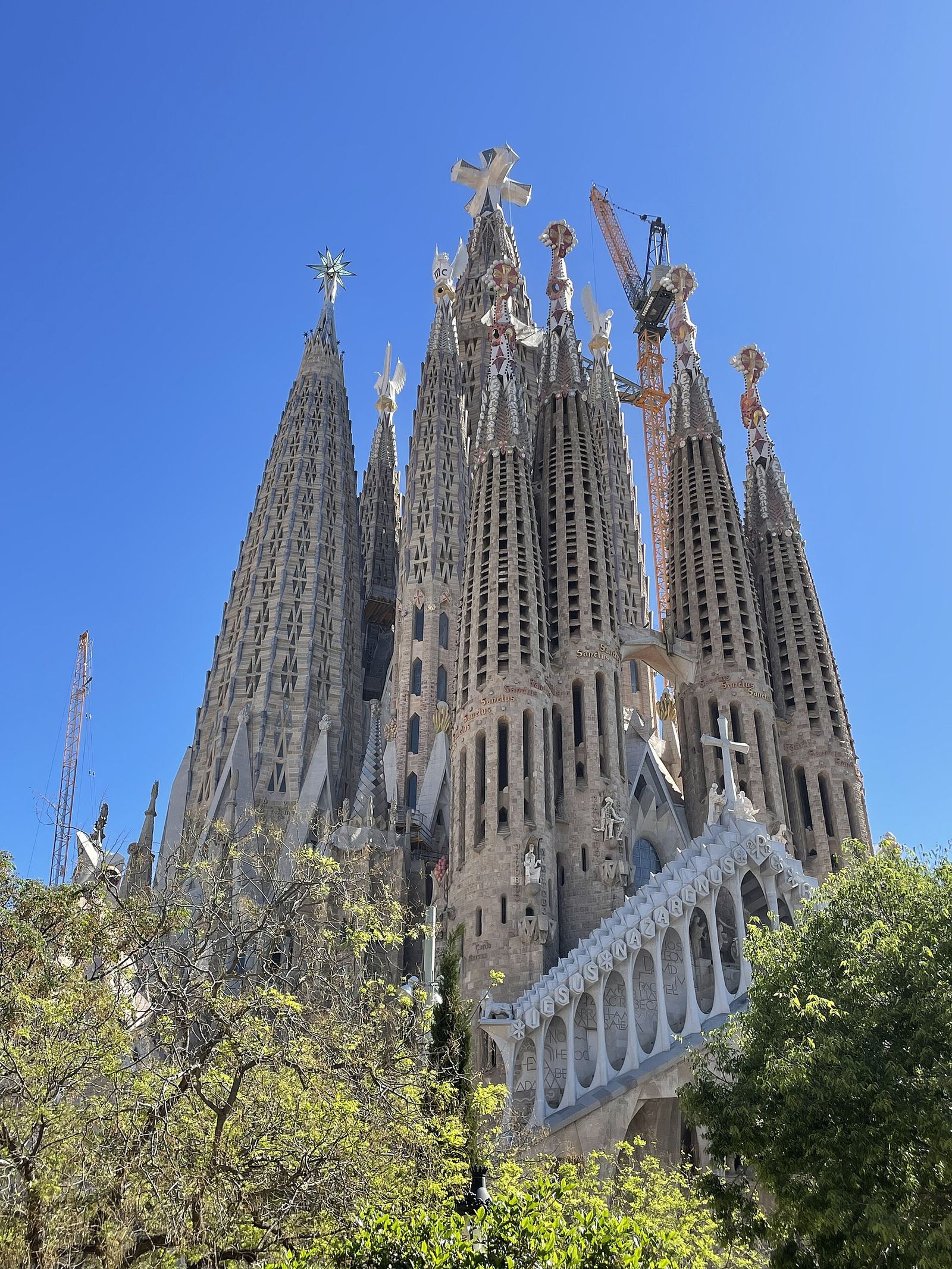
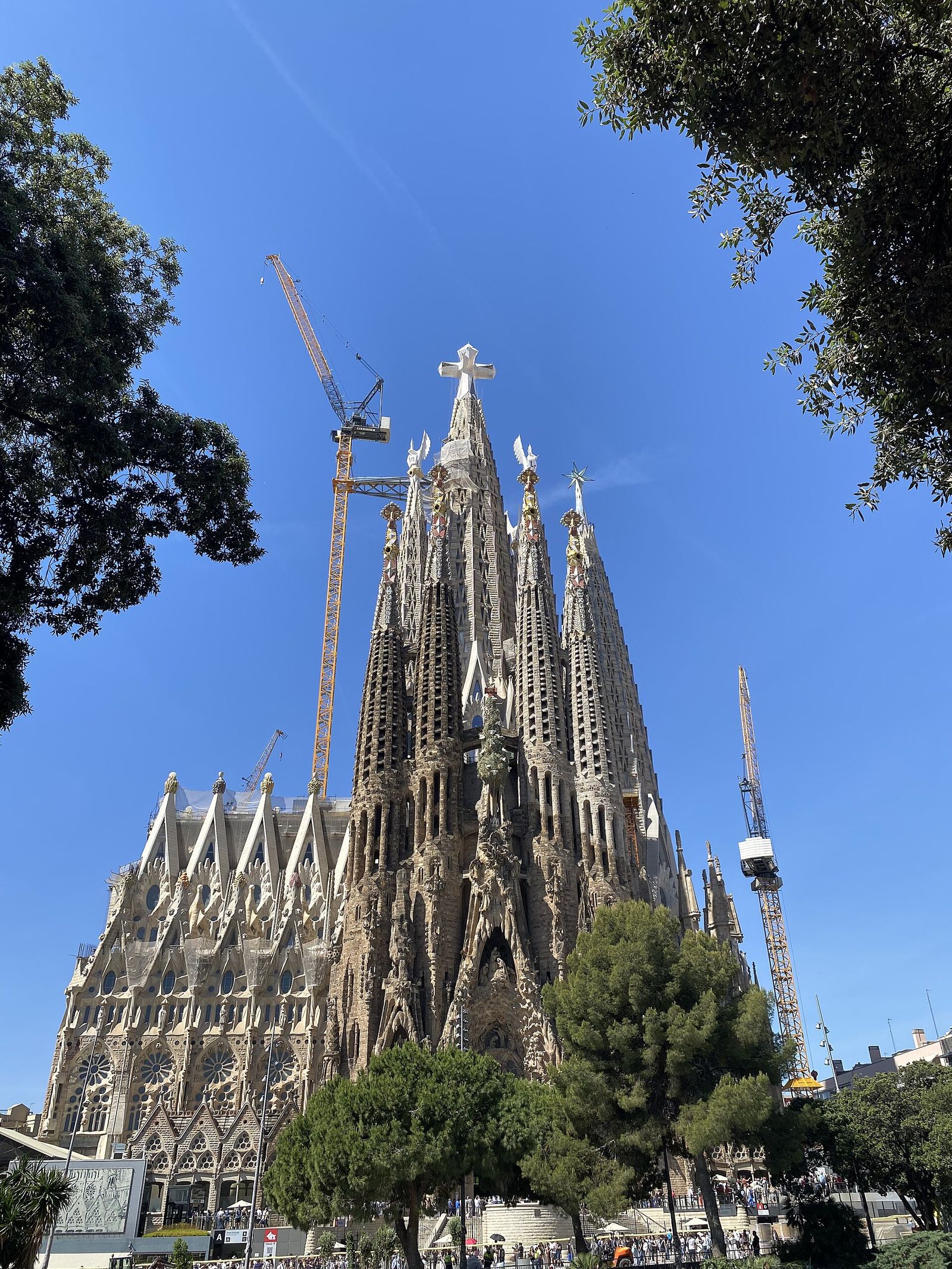
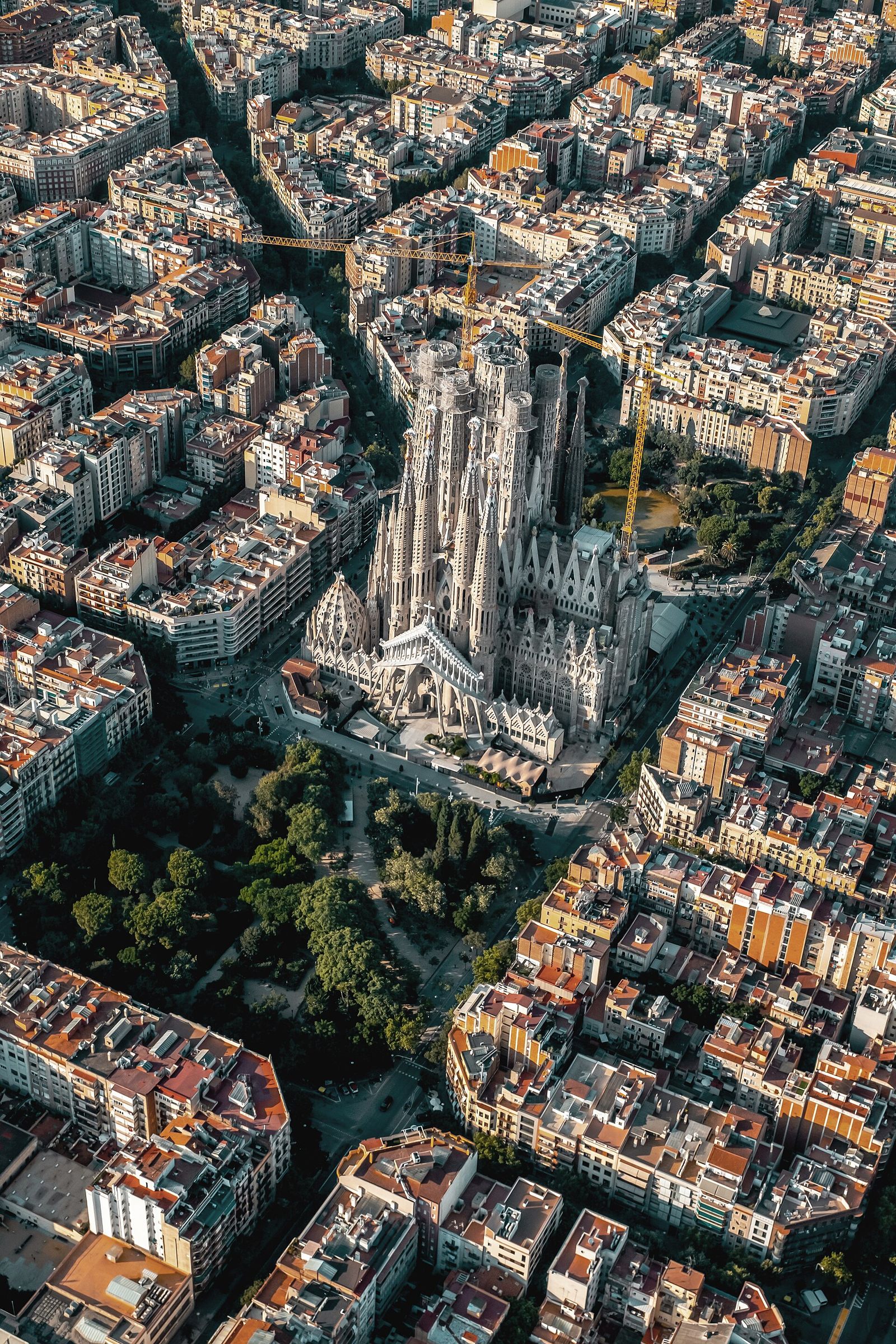
A church begun in 1882 and still being built. Its architect, Antoni Gaudí, knew he would not see it finished. In 2026, a hundred years after his death, its central tower made it the tallest church in the world.
Photo: Enfo, CC BY-SA 4.0, Wikimedia Commons
The story
You are looking at a church that has been a building site for more than 140 years. The first stone was laid in 1882. A year later a 31-year-old architect, Antoni Gaudí, took the job over and changed the design completely. He worked on it for the rest of his life.
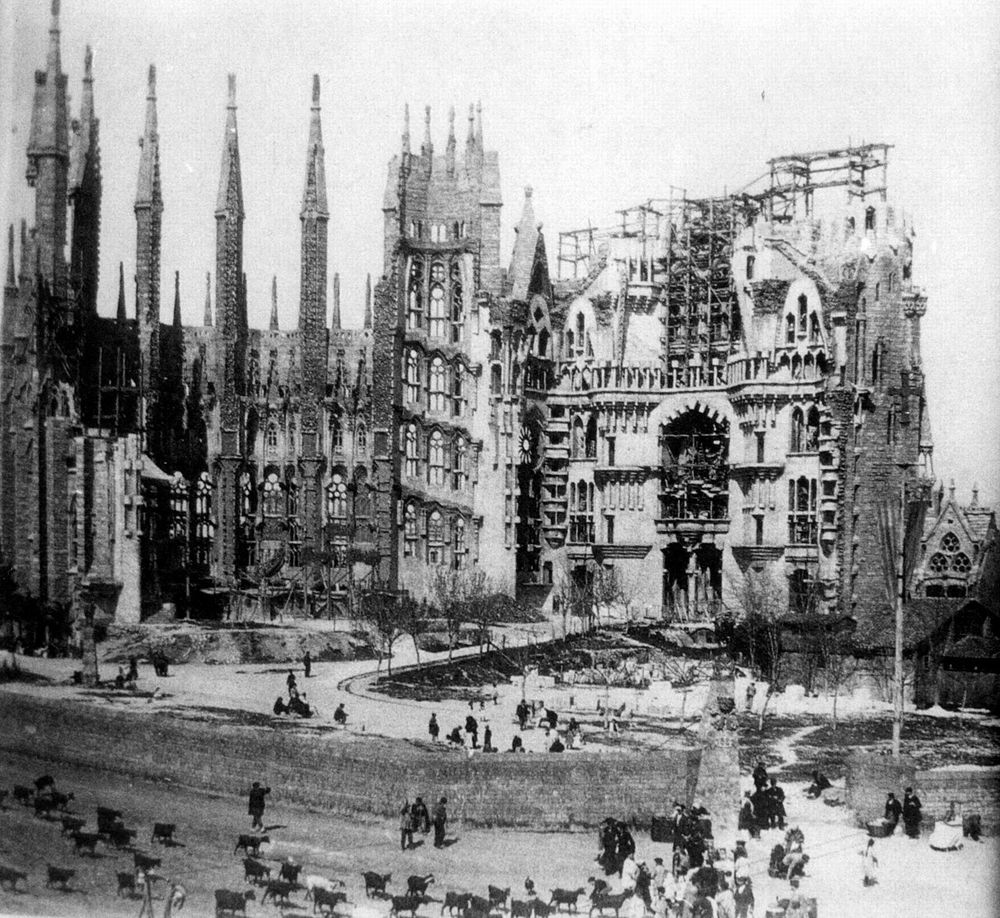
When he died in 1926, one tower out of eighteen was finished. In February 2026 the cross went onto the highest of them, the Tower of Jesus Christ, at 172.5 metres. No church in the world is taller.
What is here
The ticket lets you into the church, the museum under it and the schoolhouse. Going up a tower is an extra, chosen when you book. The outside of all the façades can be seen from the street for nothing.
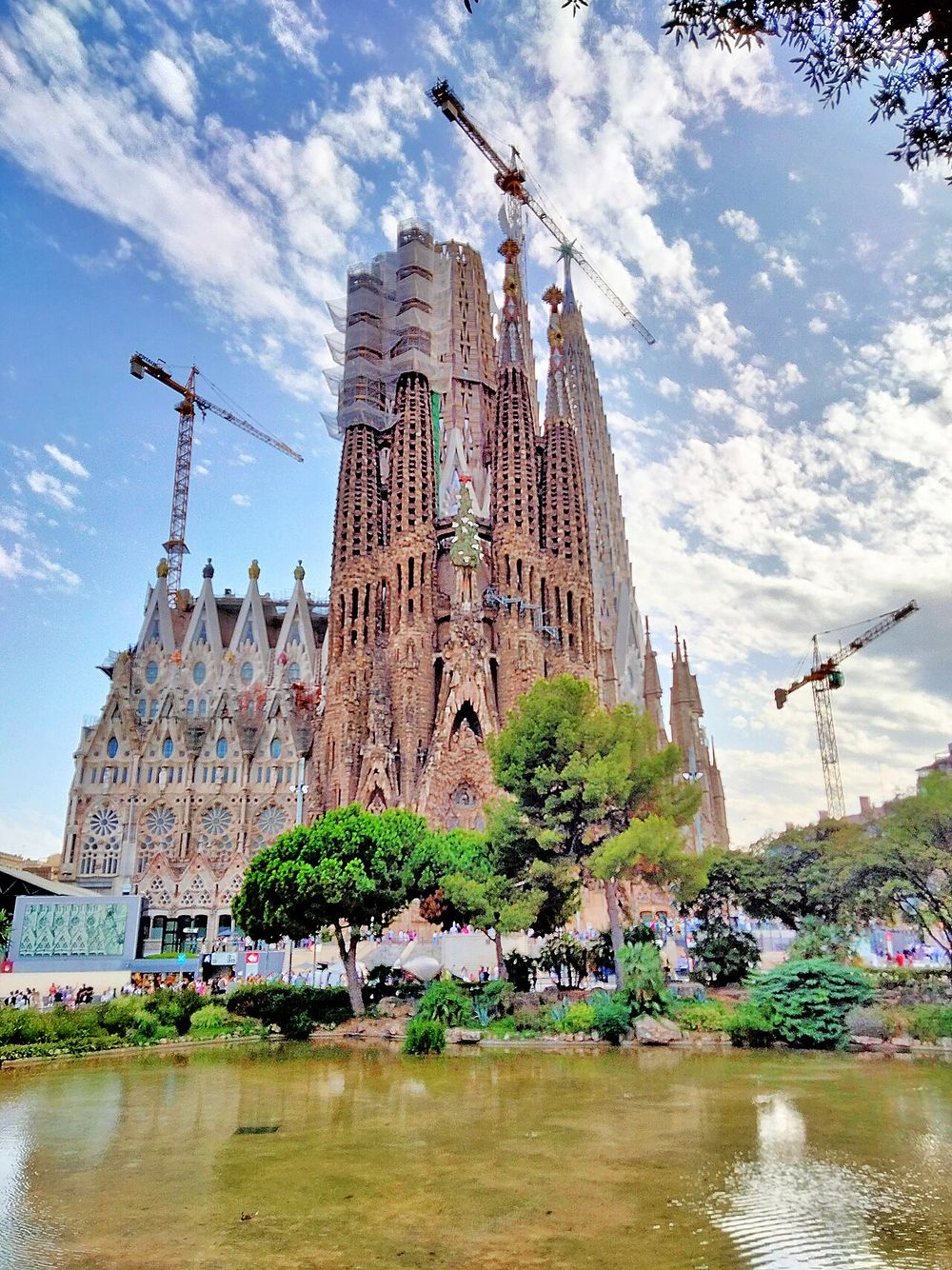
The Nativity façade across the pond in the squareEnric, CC BY-SA 4.0
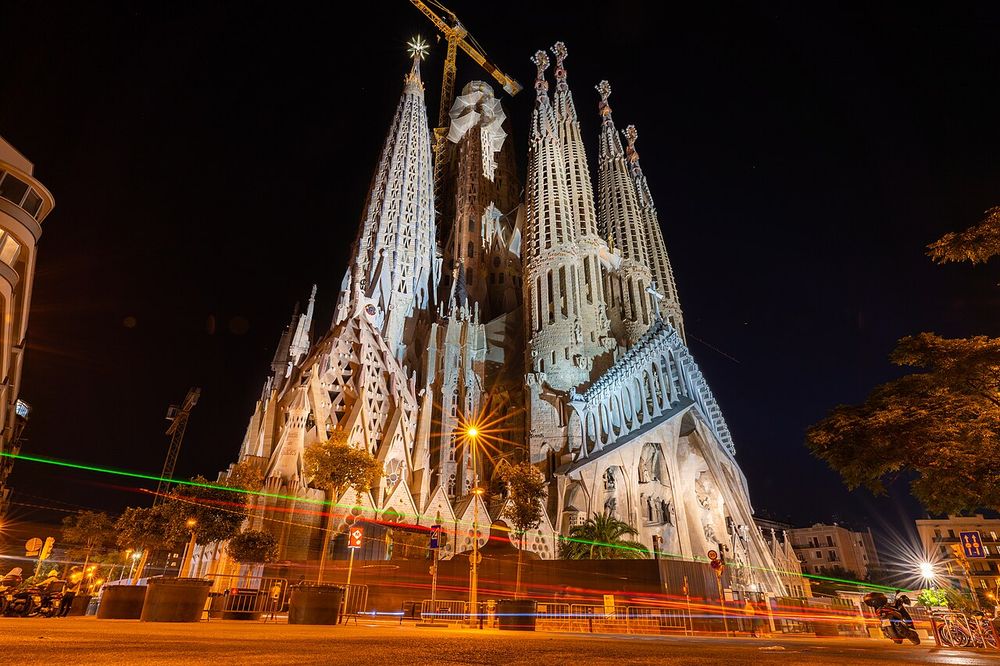
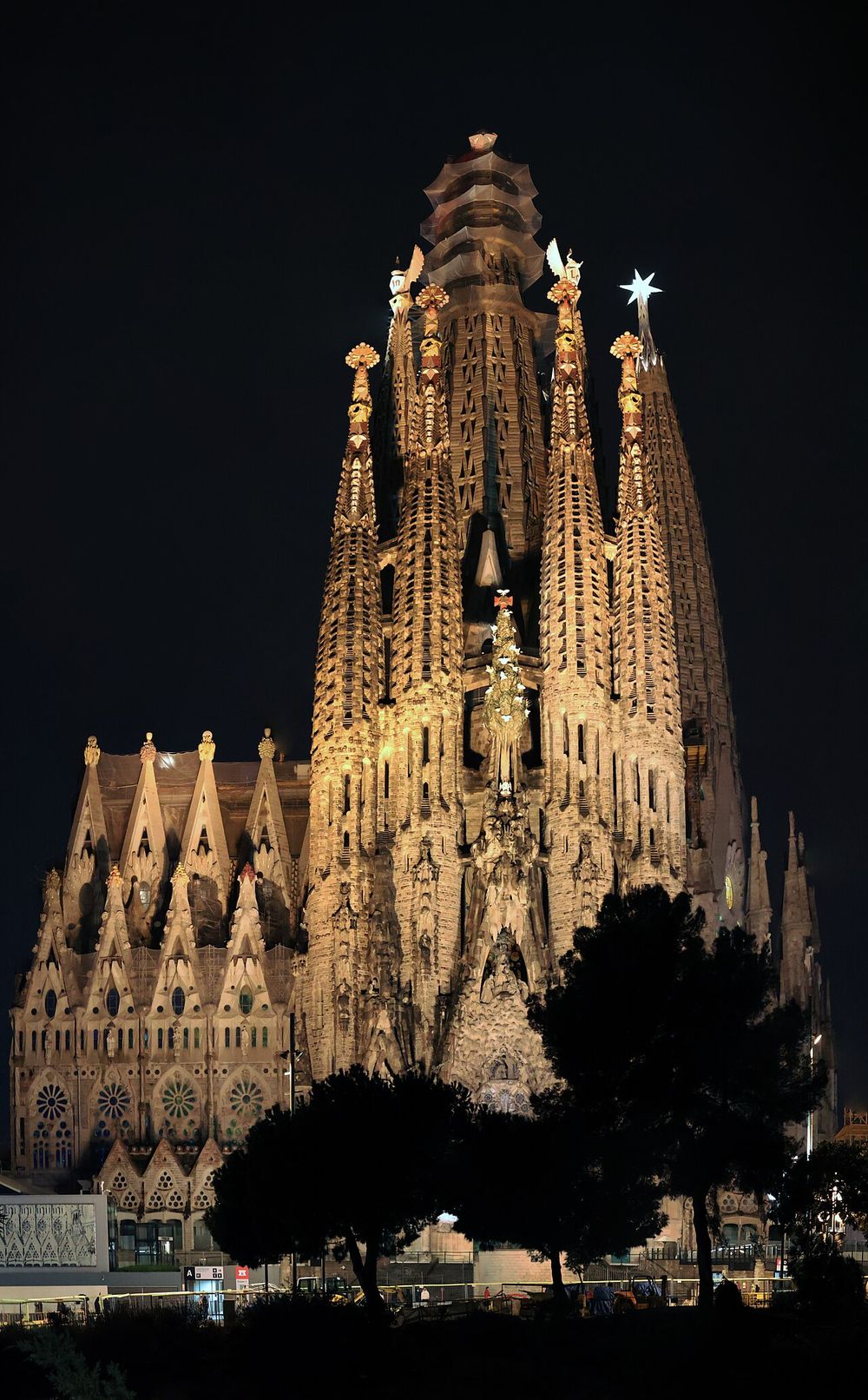
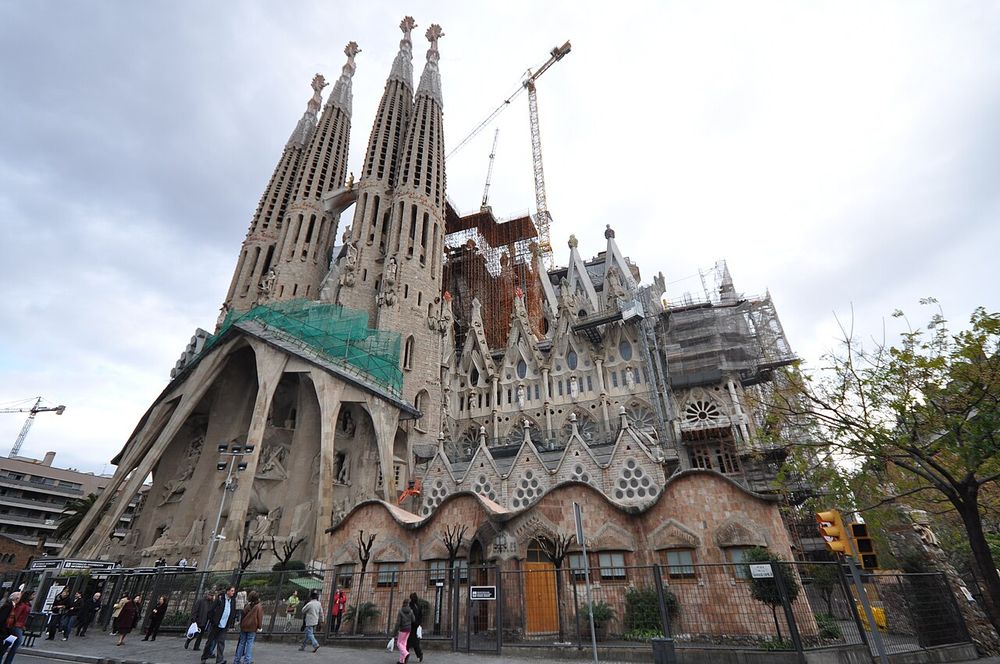
This side, facing the sunrise, is the one Gaudí built himself. It tells the birth of Jesus, and it looks as if the stone had melted and set again as leaves, animals and people.
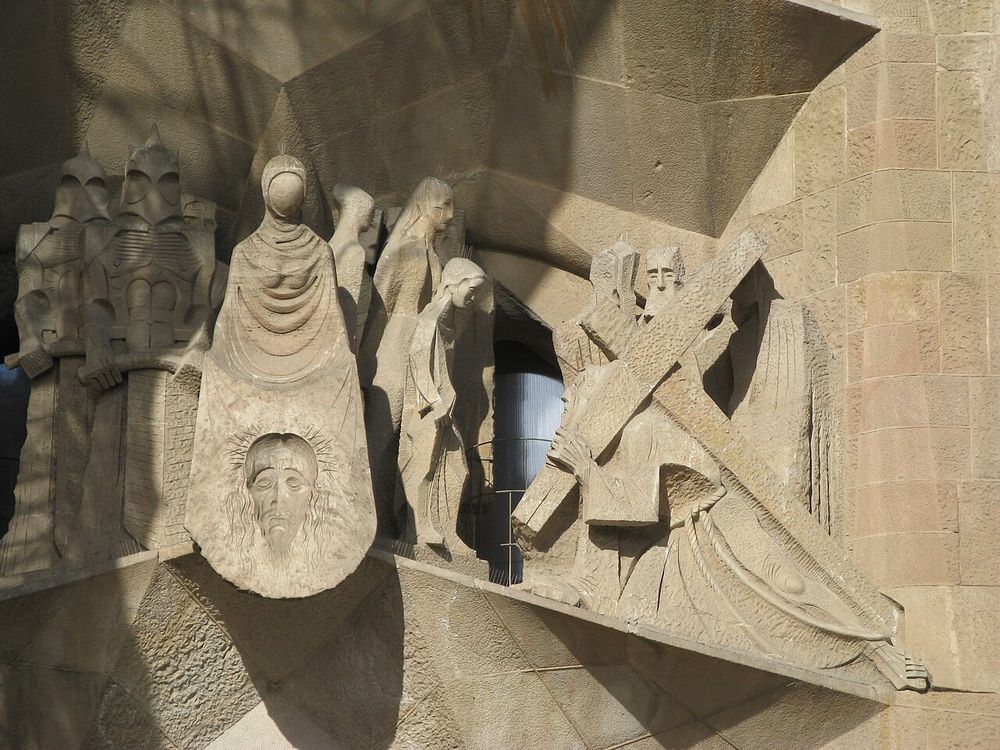
Go round to the other side, facing the sunset, and everything changes. The Passion façade tells his death. It is bare and bony, and its figures are cut in hard straight lines. A different sculptor carved it sixty years after Gaudí died.
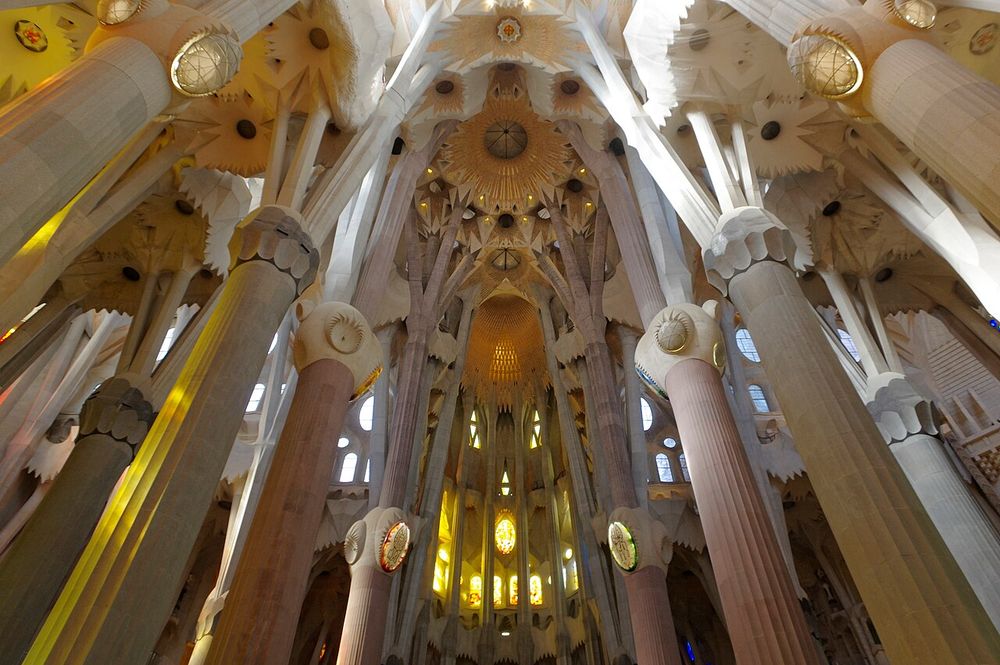
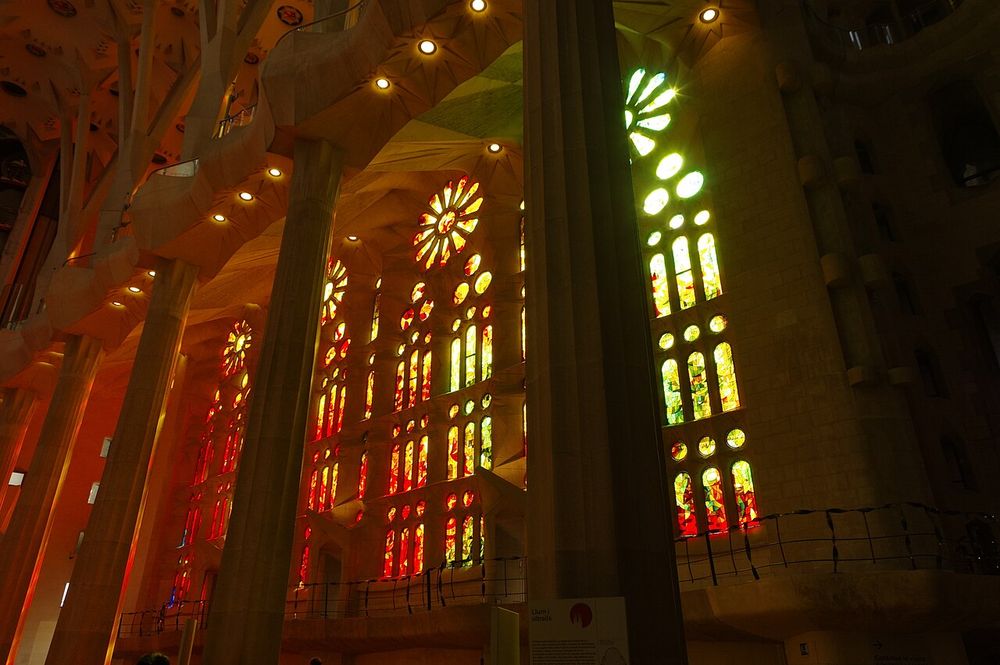
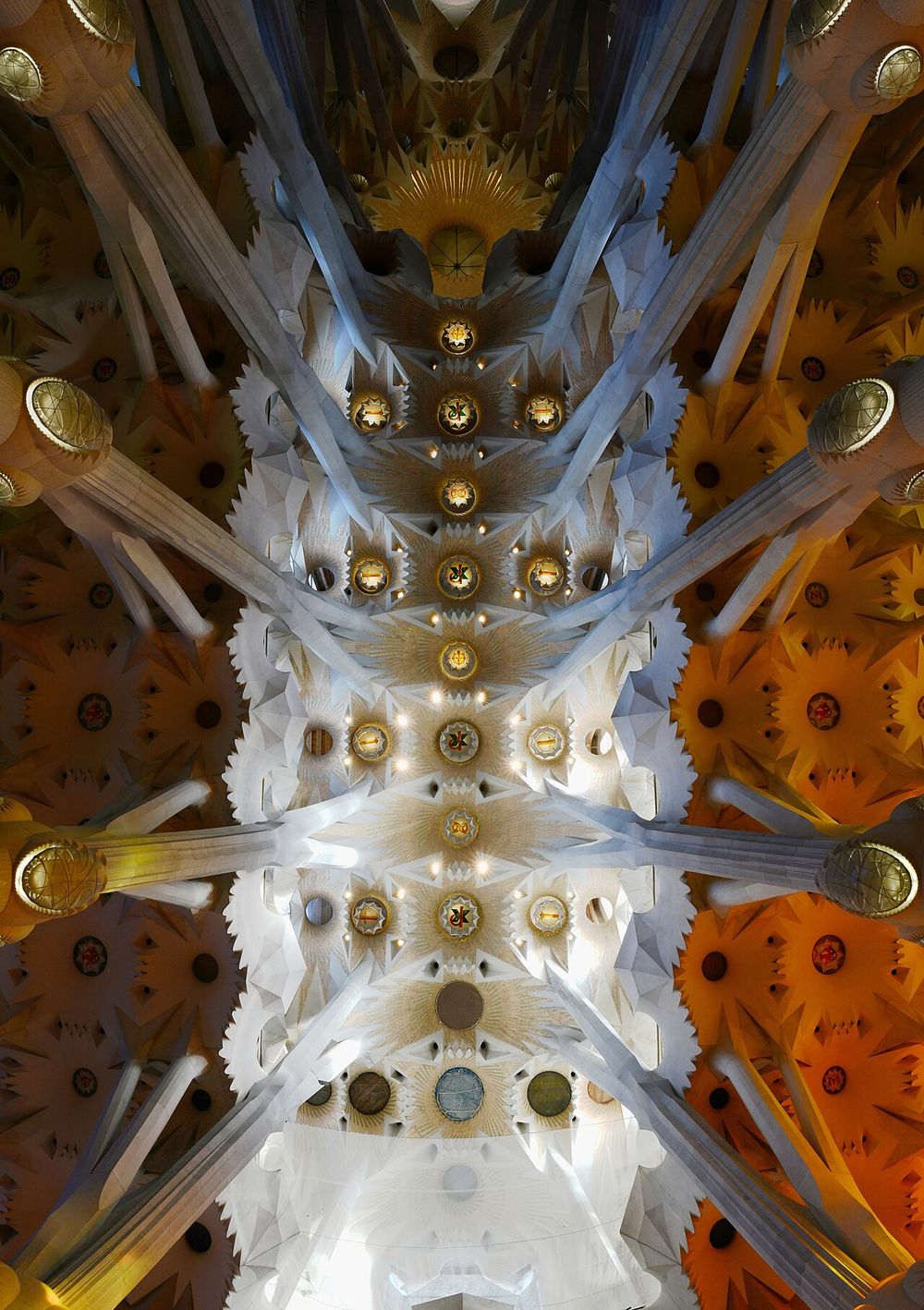
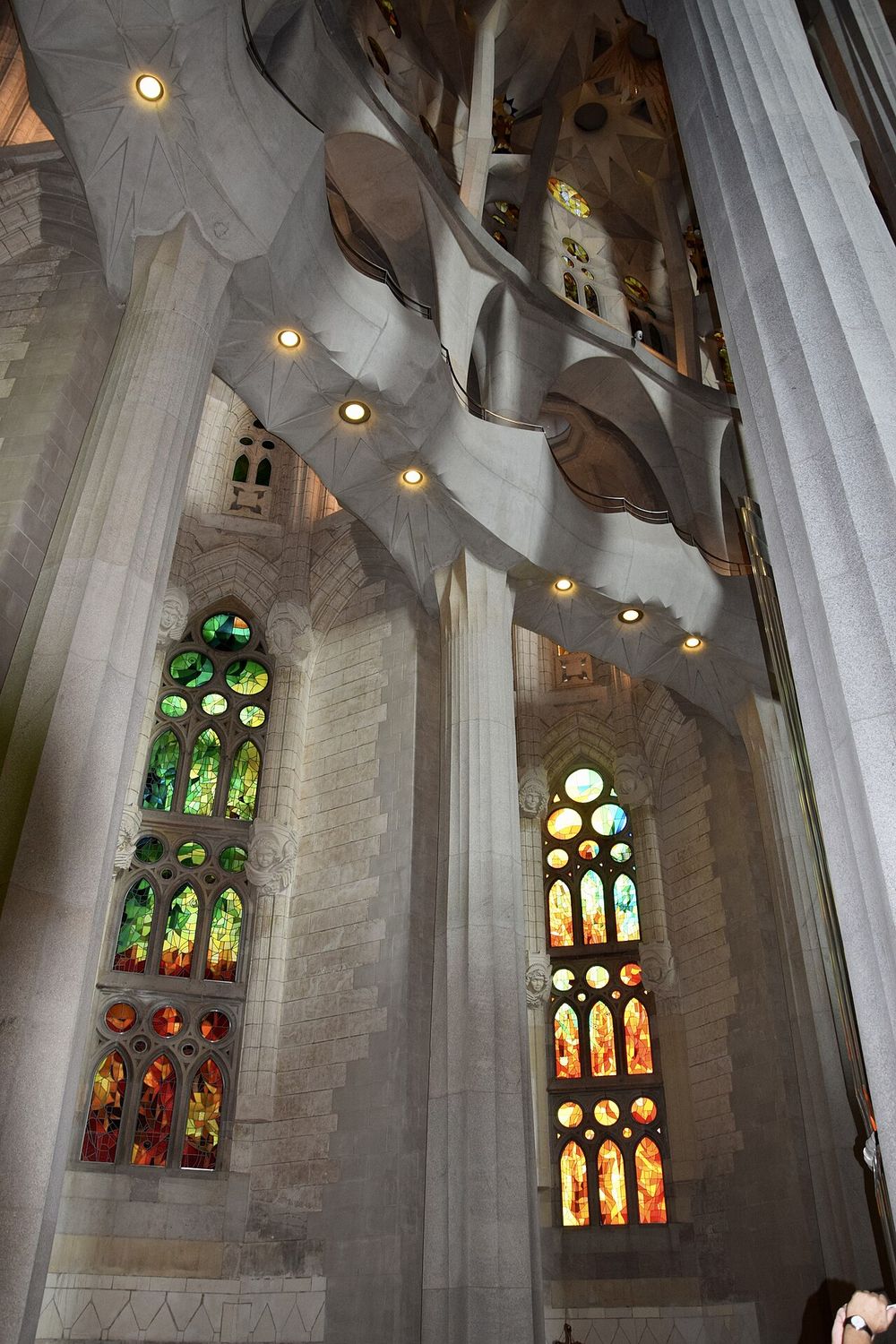
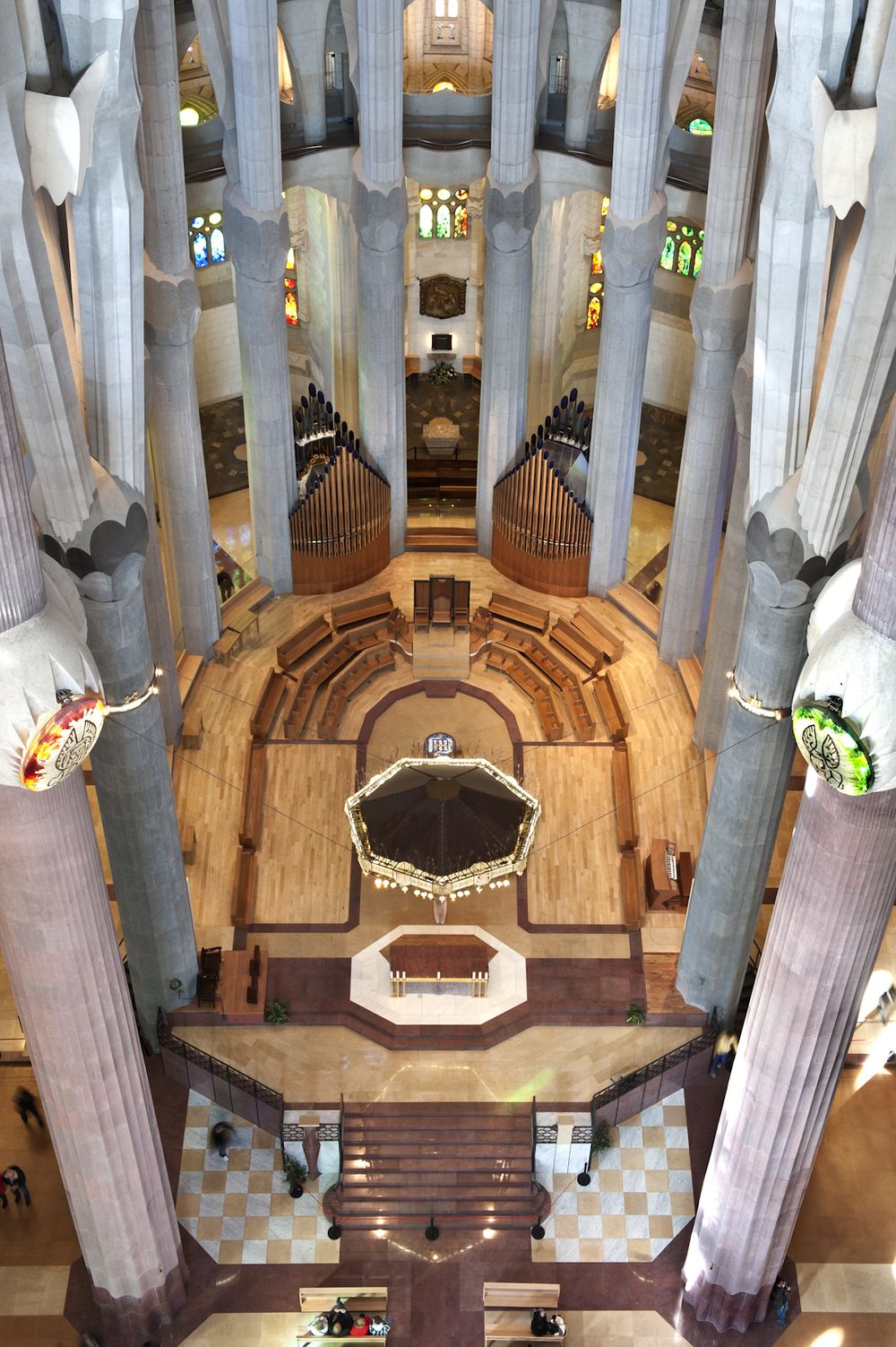
Inside there are no flat ceilings and almost no straight columns. The pillars lean and branch like trees, and the light through the coloured glass turns from blue and green in the morning to orange and red in the afternoon.
It has always been paid for by gifts and, now, by tickets. No government and no bishop ever funded it. That is one reason it has taken so long.
Things people often get wrong
"It is a cathedral." It is not. Barcelona's cathedral is the Gothic church in the old town. This is a basilica, a title the Pope gave it in 2010.
Chinese visitors often call it the world's most famous abandoned building site. It was never abandoned. Work stopped only during the Spanish Civil War and its aftermath, and during the pandemic of 2020.
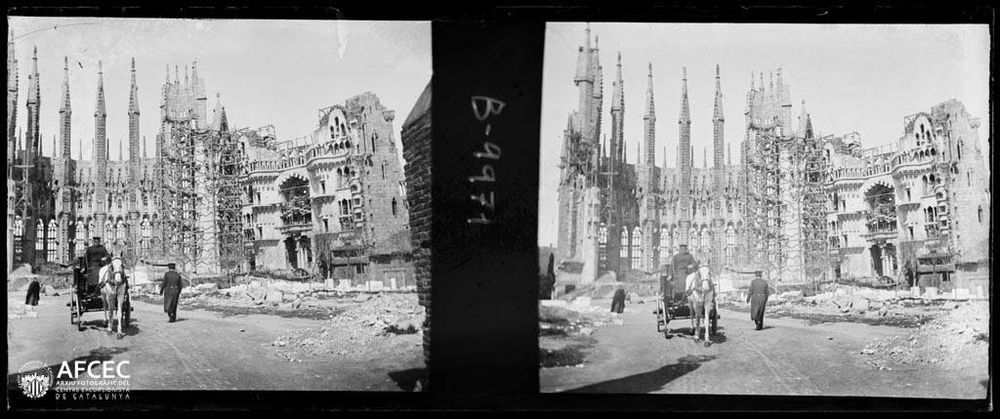
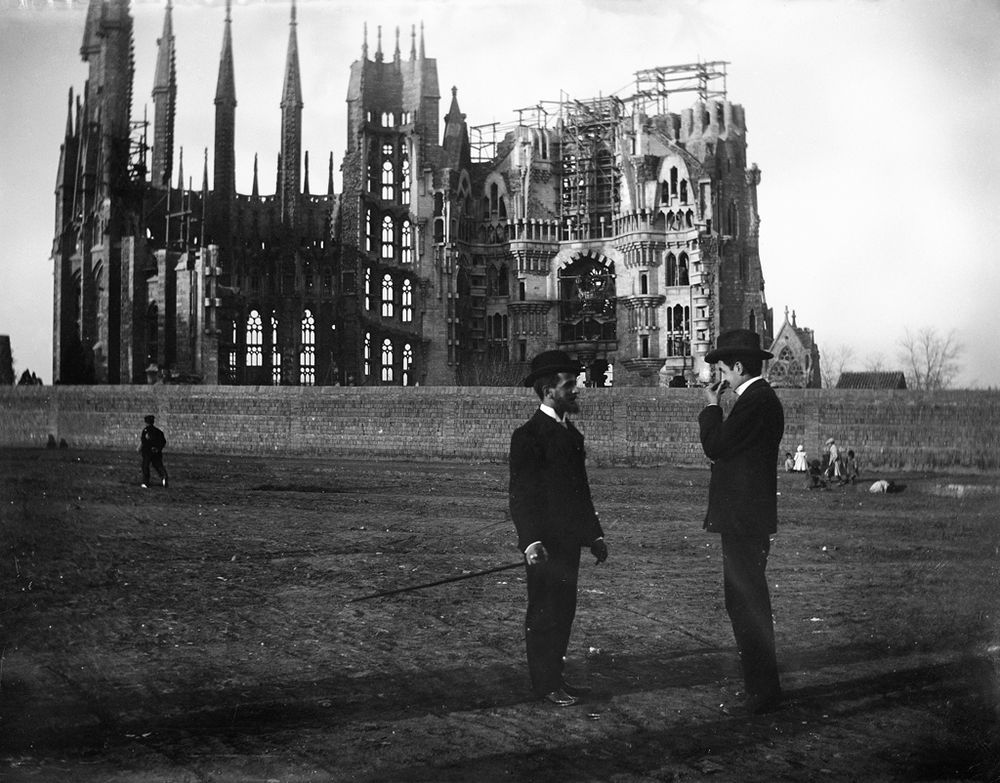
"Gaudí designed all of it." He left models and drawings for the whole church, but most were smashed or burned in 1936. What has been built since is worked out from the broken pieces, old photographs and his geometry.
"It is finished now." Not yet. Fourteen towers stand. The four of the main front, the Glory façade, and the front itself are still to come.
The people of this place
Barcelona is the capital of Catalonia. Catalans have their own language, Catalan. It is not a dialect of Spanish, and it is the first language on street signs, in schools and in this church. Nearly everyone also speaks Spanish.
A greeting in Catalan is noticed and liked: "Bon dia" for good morning, "Gràcies" for thank you. Whether Catalonia should be independent of Spain is a question that divides families. It is better to listen than to offer a view.
Days run late. Lunch is at two and dinner at nine or after. On 23 April, the day of Saint George, the patron of Catalonia, people give each other books and roses.
People who stood here
George Orwell (English writer; author of 1984)He was in Barcelona in 1937, during the Civil War, and went to look at the church. He thought it "one of the most hideous buildings in the world" and wrote that the anarchists had shown bad taste in not blowing it up. He may have stood on this pavement, looking up at four lonely towers.
Salvador Dalí (Spanish painter)He defended Gaudí when almost nobody else did, and called this architecture terrifying and good enough to eat. He may have stood here delighted by exactly what made Orwell shudder.
Go deeper: ten stops, outside and in
The first four stops are outside, the next four inside, and the last two are about the man and about the same years elsewhere.
1. The Nativity façade: the one Gaudí finished
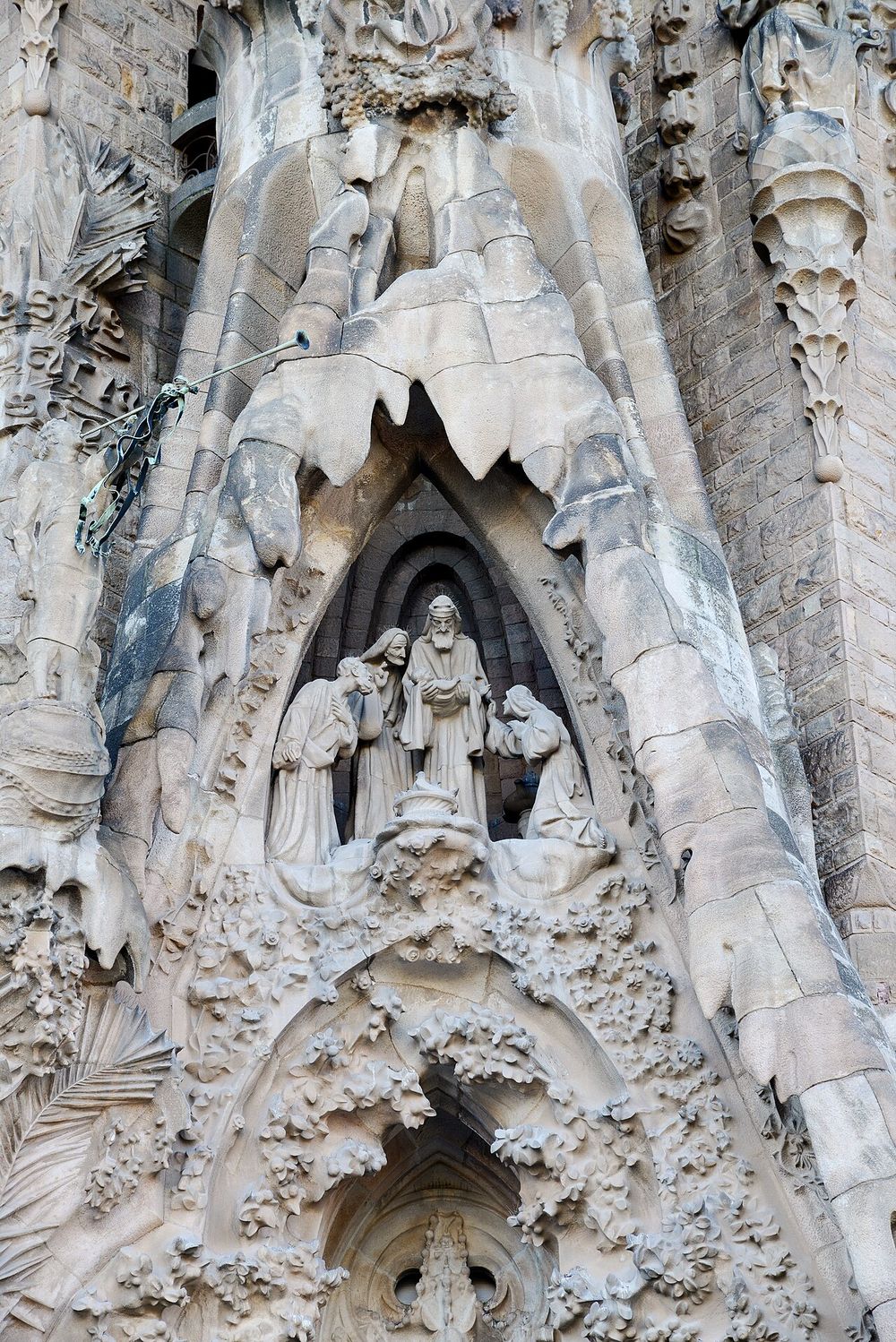
The Nativity façade: the central doorwayAlvesgaspar, CC BY-SA 4.0
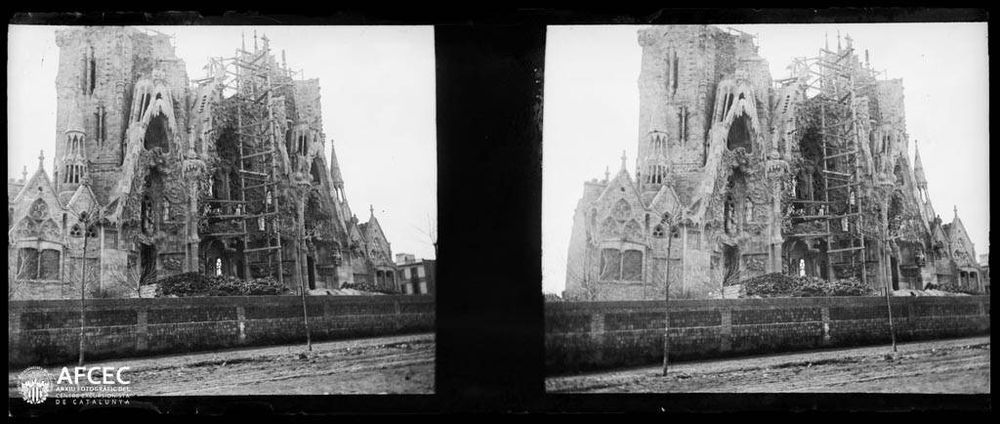
Gaudí chose to build this front first. He reasoned that a joyful façade would persuade the city to go on paying for the rest. Work on it ran from 1894 to 1930.
There are three doorways, for Hope, Charity and Faith. In the middle the Holy Family sits under a star, and above the door rises a green cypress covered with white doves.
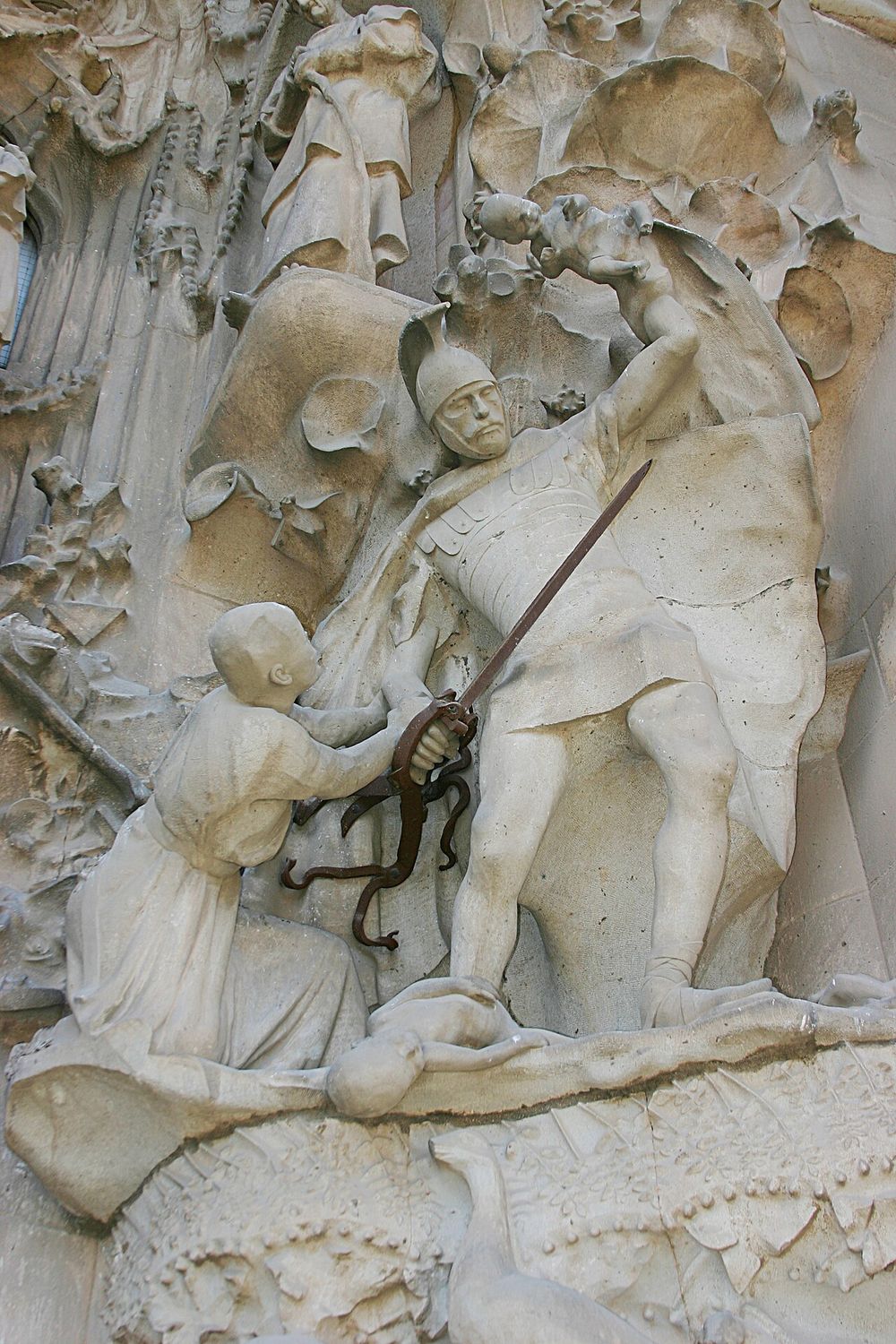
Gaudí wanted real things. He made plaster casts of living plants, chickens and donkeys, and of local people, for his sculptors to copy.
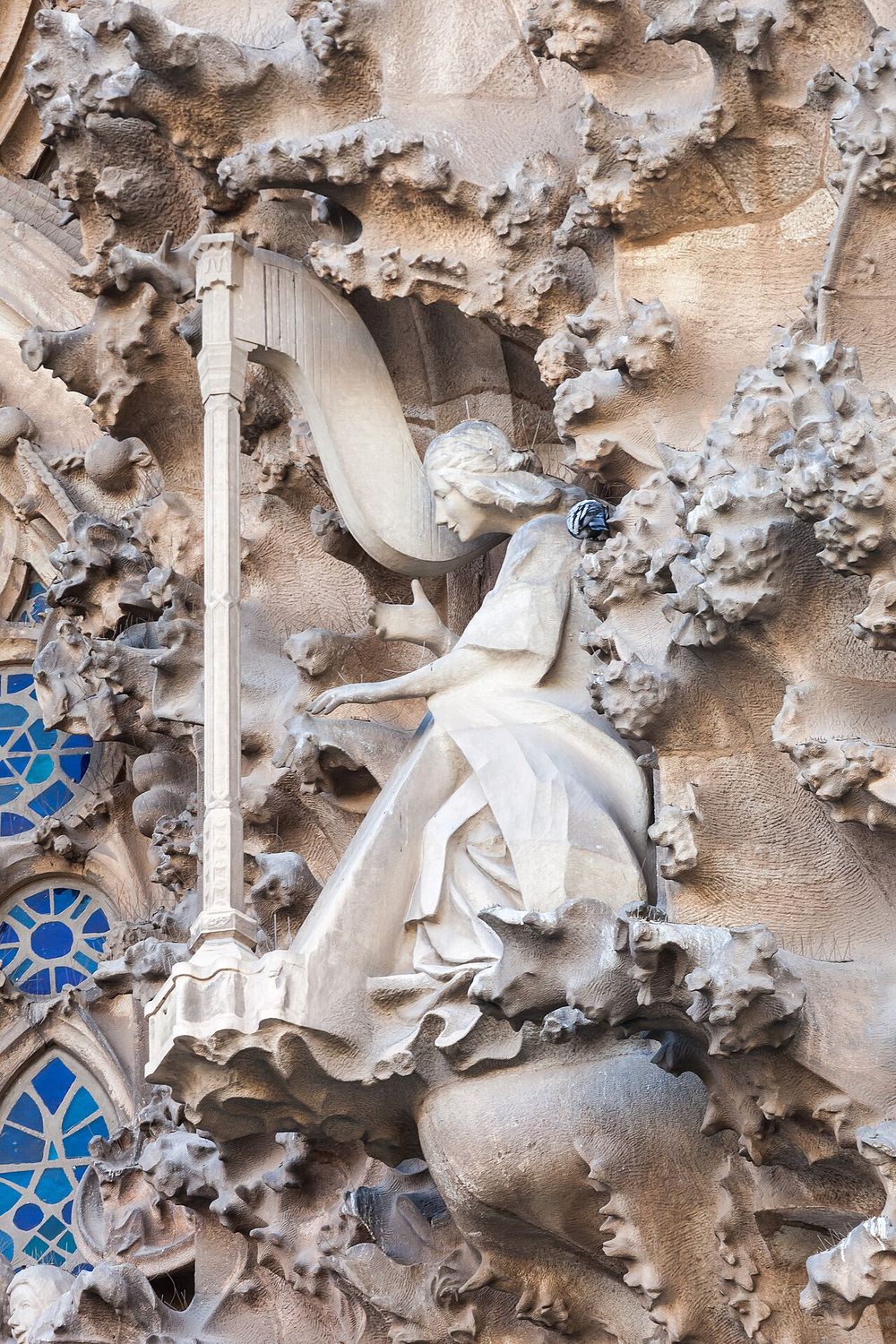
Many of the figures you see were carved after his death. The fifteen angels playing instruments and the singing children are by Etsuro Sotoo, a Japanese sculptor who came here in 1978 and never left.
2. The Passion façade: bones and a number square
The Passion façade: figures by SubirachsYair Haklai, CC BY-SA 4.0
Gaudí drew this front in 1911, while he lay ill, and wanted it hard and frightening. The sculptor Josep Maria Subirachs carved it between 1987 and 2009. The story runs in an S from the Last Supper at lower left to the burial at the top.
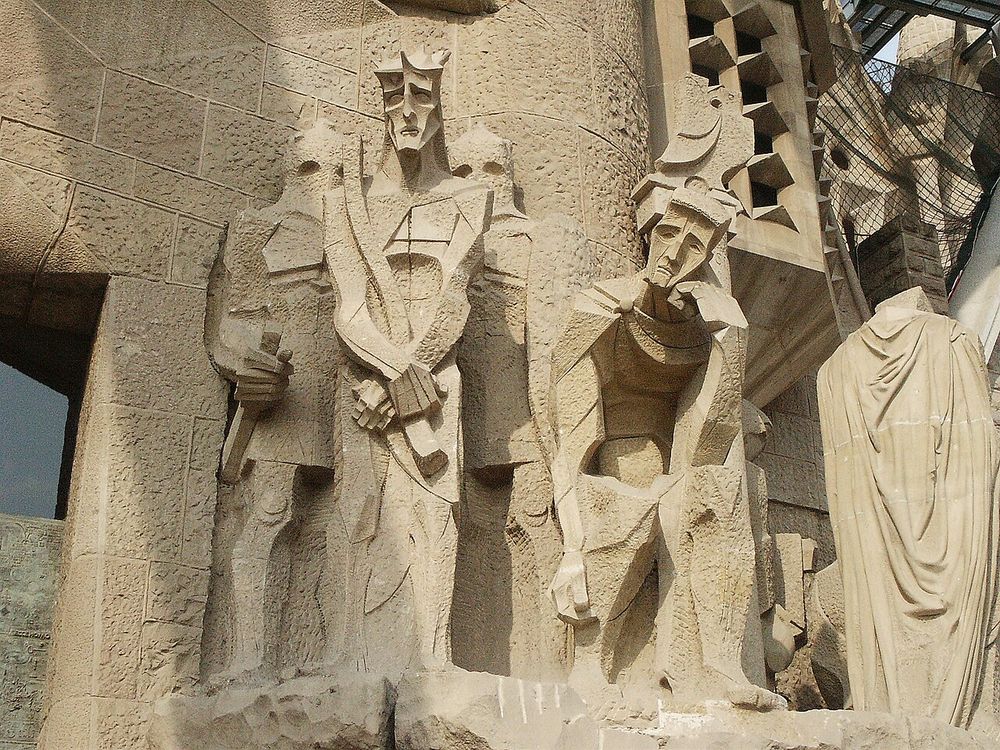
Roman soldiers on the Passion façade; their helmets copy Gaudí's chimneysRp22, CC BY 3.0
The helmets of the Roman soldiers copy the chimneys on the roof of La Pedrera, an apartment block Gaudí built across town. It is the sculptor's salute to the architect.
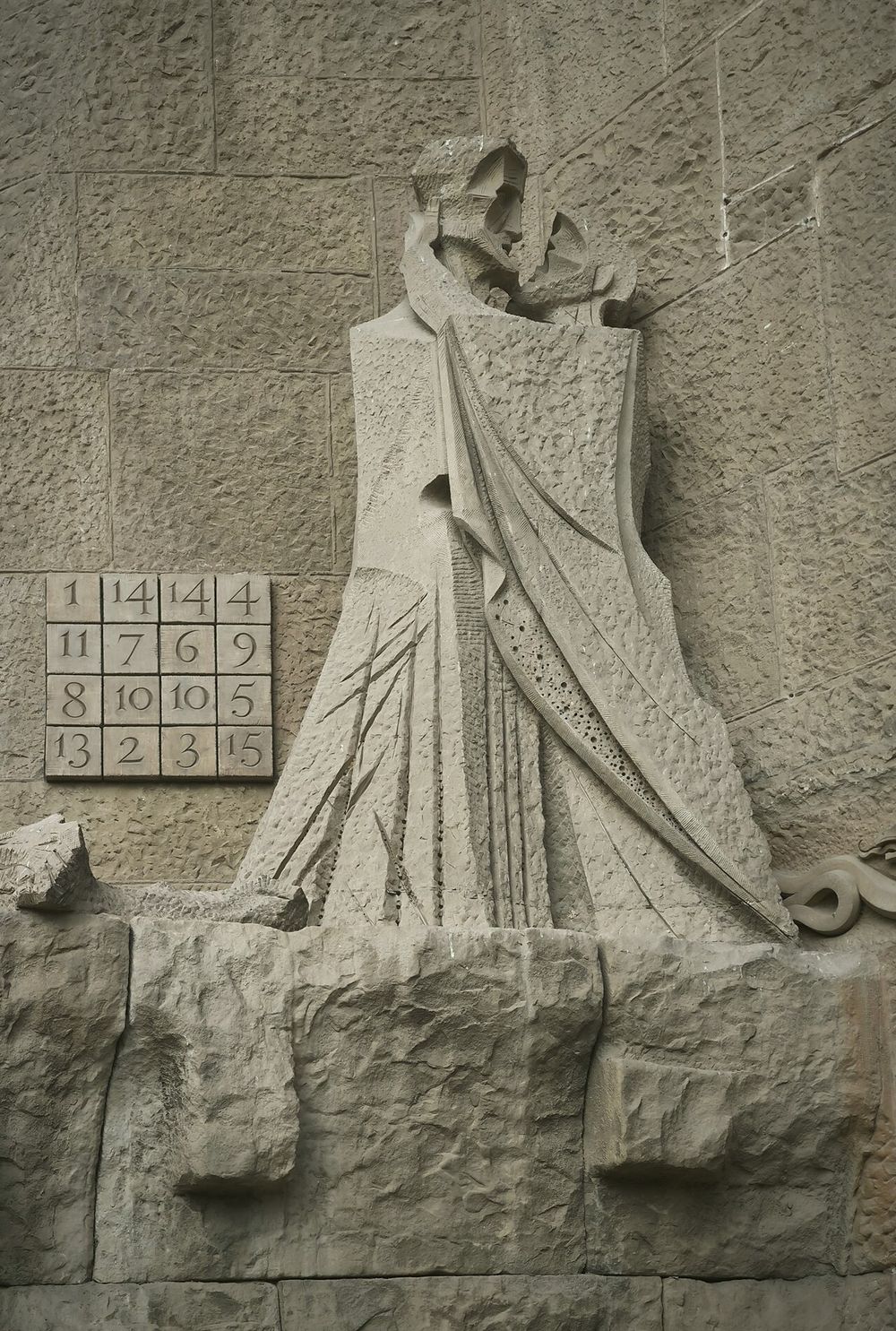
Beside the kiss of Judas is a square of sixteen numbers. Every row, column and diagonal adds up to 33, the age of Christ at his death.
The bronze doors of the Passion façade, covered in Gospel textCatalan Art & Architecture Gallery (Josep Bracons) from Barcelona, Catalonia, CC BY-SA 2.0
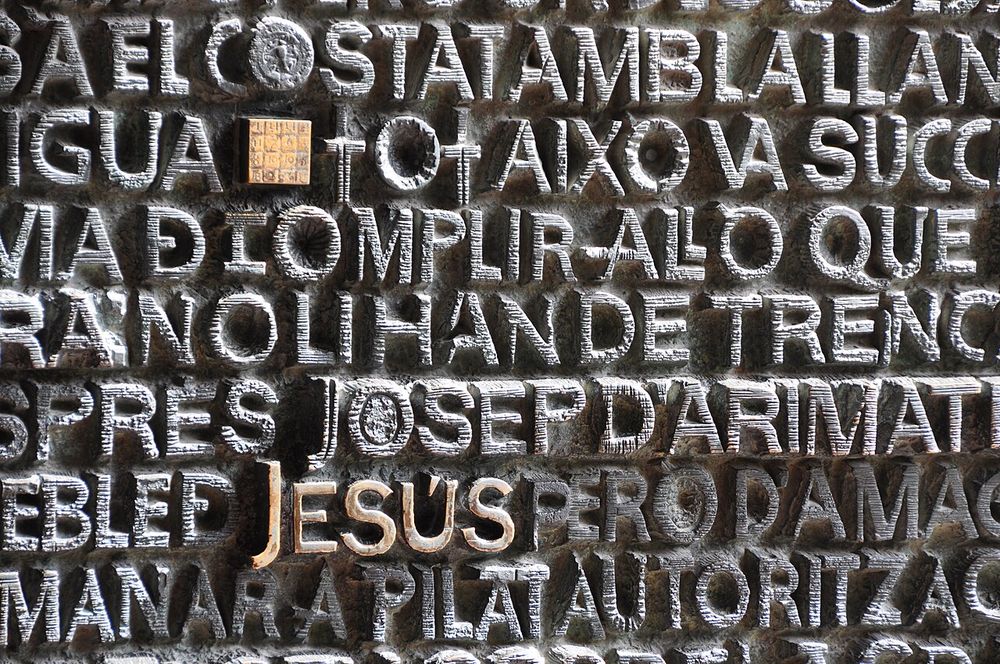
The bronze doors carry the Gospel account of the Passion in raised letters, eight thousand of them. A few words are polished gold.
3. The towers: eighteen planned, fourteen standing
Spring 2026: the central tower with its crossWikipsico43, CC BY-SA 4.0
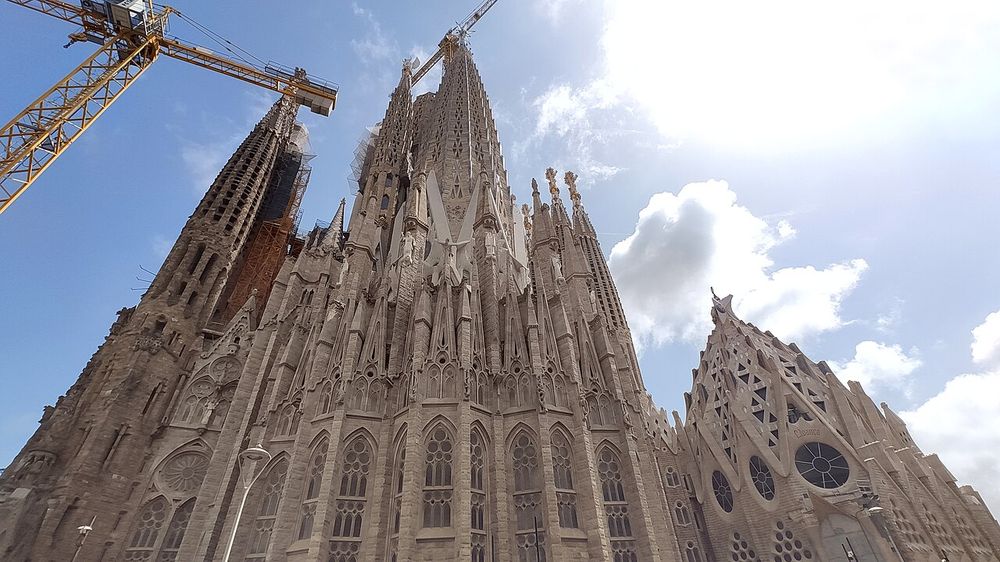
Gaudí planned eighteen towers. Twelve are for the apostles, four on each façade. Four are for the evangelists. One is for the Virgin Mary, and the tallest, in the centre, is for Jesus Christ.
Mary's tower, 138 metres, was topped with a star of glass in December 2021. The four evangelists' towers were finished in 2023. The cross was set on the Tower of Jesus Christ on 20 February 2026, and Pope Leo XIV blessed it on 10 June 2026, a hundred years to the day after Gaudí died.
At 172.5 metres it passes the spire of Ulm Minster in Germany, which had been the tallest church since 1890. Gaudí kept it just lower than Montjuïc, the hill above the harbour. The work of man, he said, should not rise above the work of God.
Mosaic baskets of fruit on the pinnaclesSagrada Família (oficial), CC BY-SA 3.0
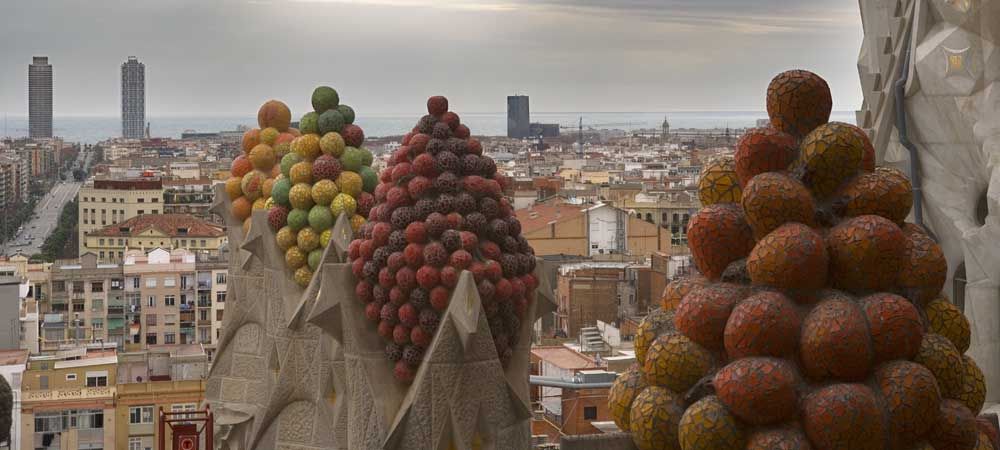
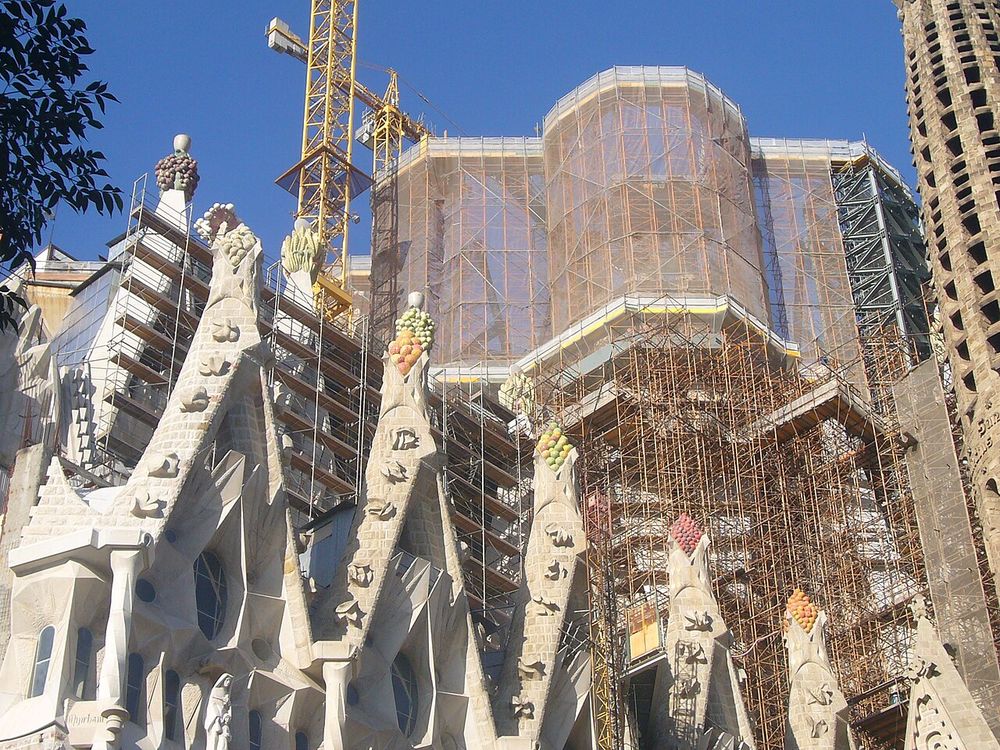
Look at the tips of the lower pinnacles. They end in baskets of fruit in coloured mosaic: oranges, grapes, figs, chestnuts.
4. The Glory façade: the front door that is not there yet
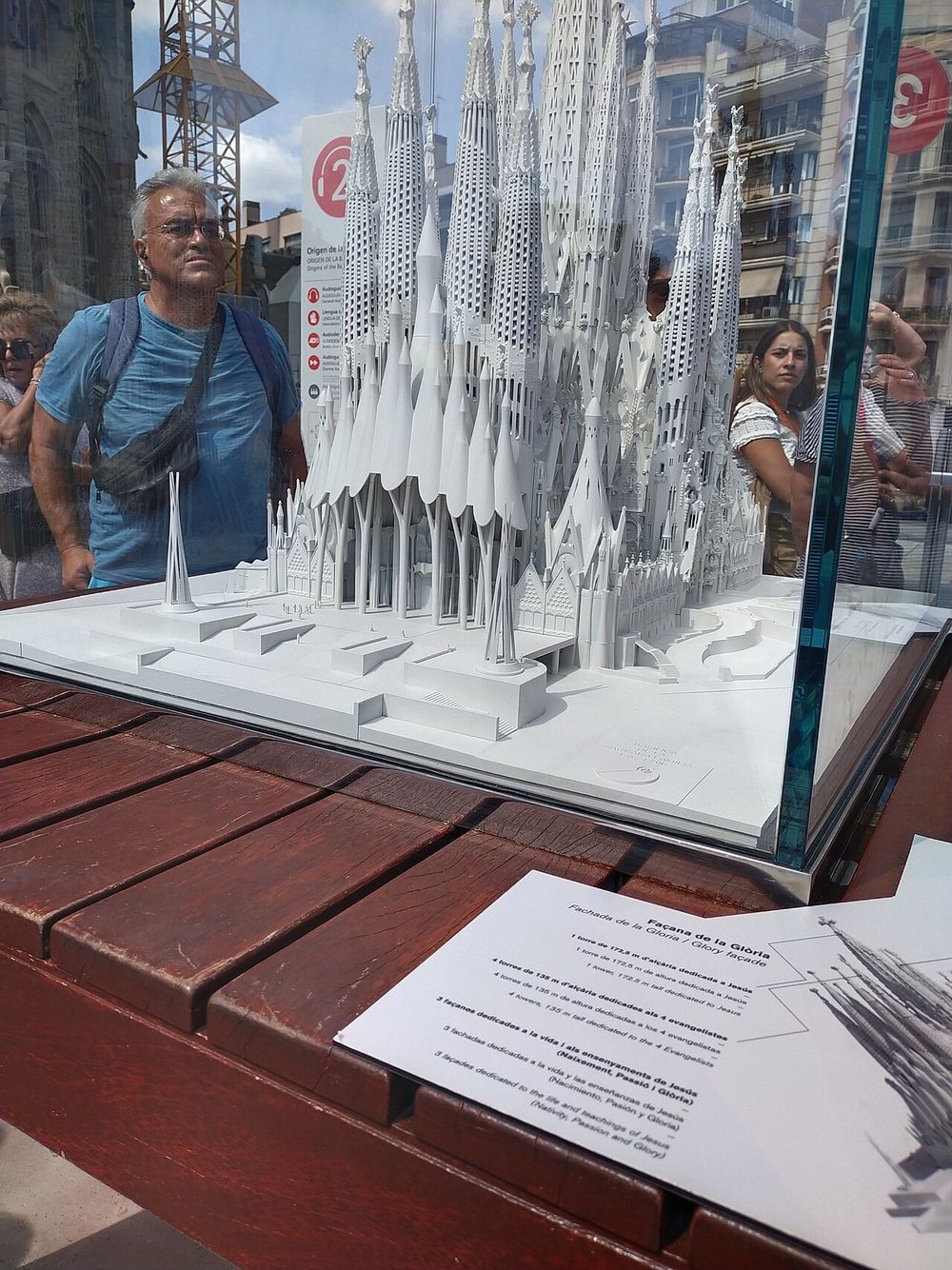
The main entrance will face south, towards the sea. It will be the largest façade, and its subject is the road to God: death, judgement, glory. Building has begun; the towers above it have not.
Gaudí's plan gives it a wide stairway running out over the street. Blocks of flats now stand where the stairs would go. Whether and how they will be cleared is being argued between the church, the city and the people who live there.
5. Inside: a forest of stone
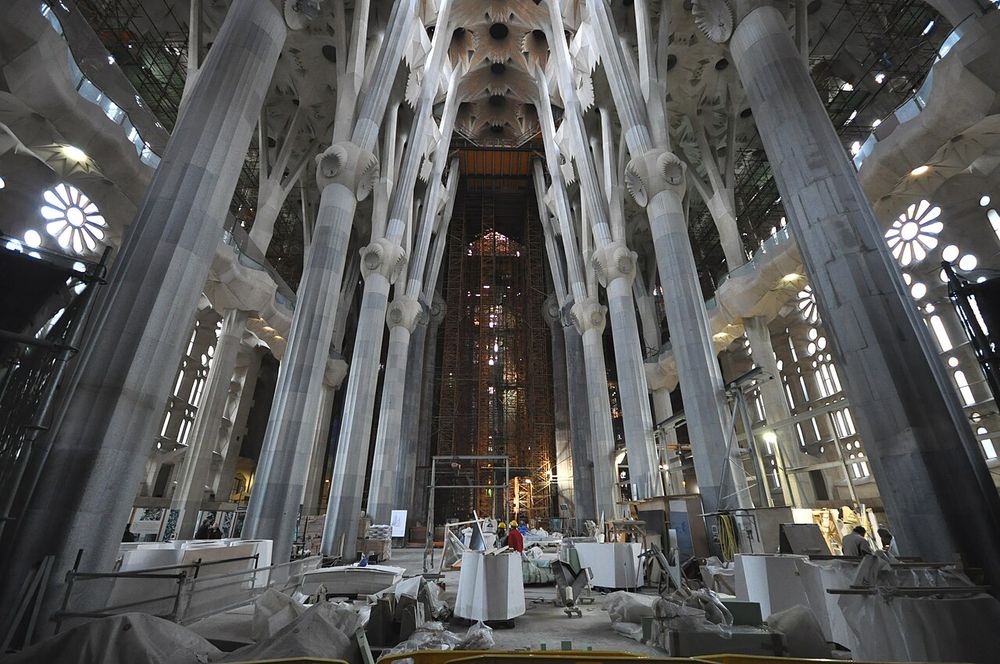
The nave: columns that branch like treesBerthold Werner, CC BY-SA 4.0
Gaudí disliked the buttresses that hold up Gothic cathedrals from outside. He called them crutches. He wanted a building that stood by itself.
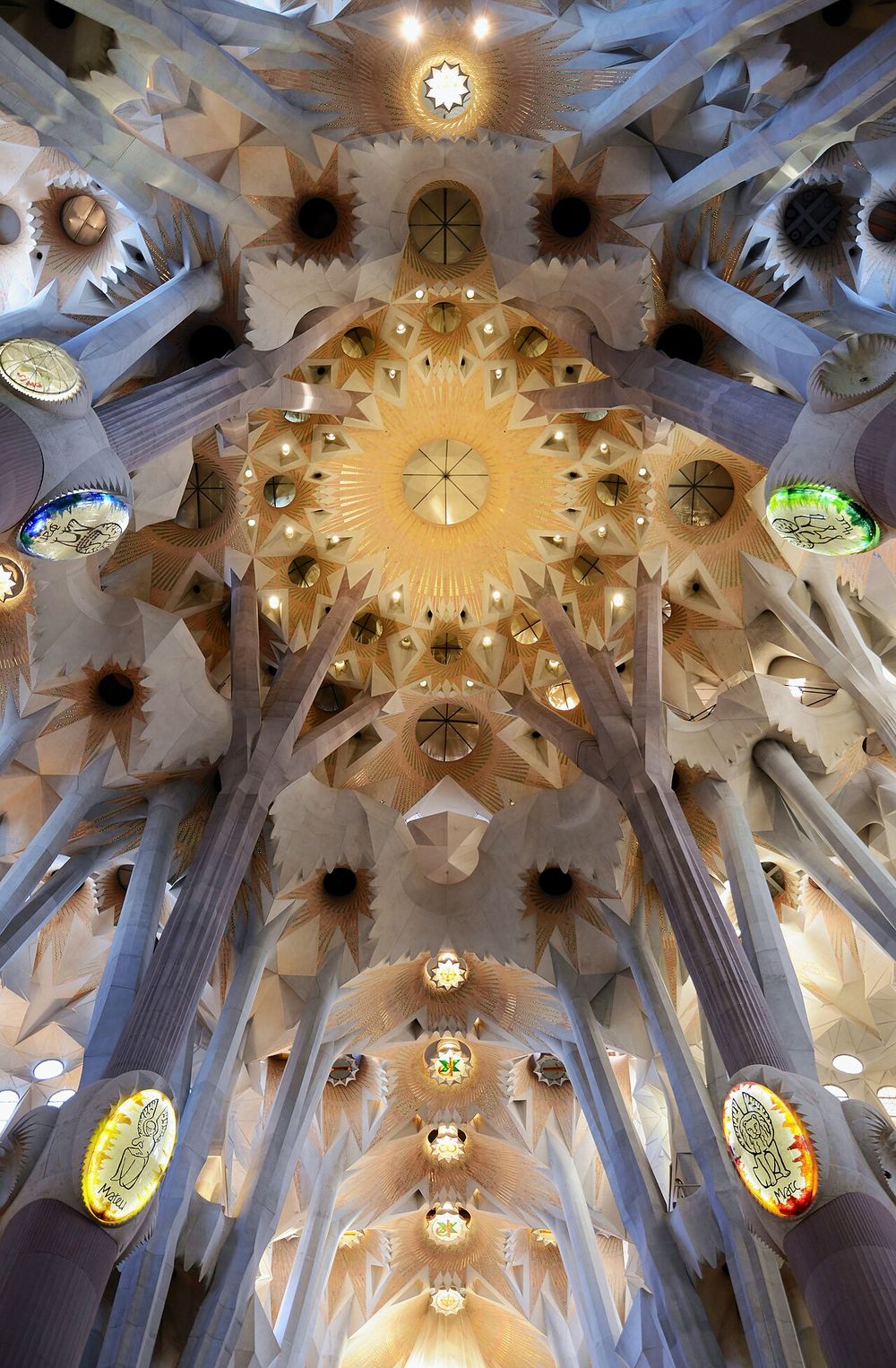
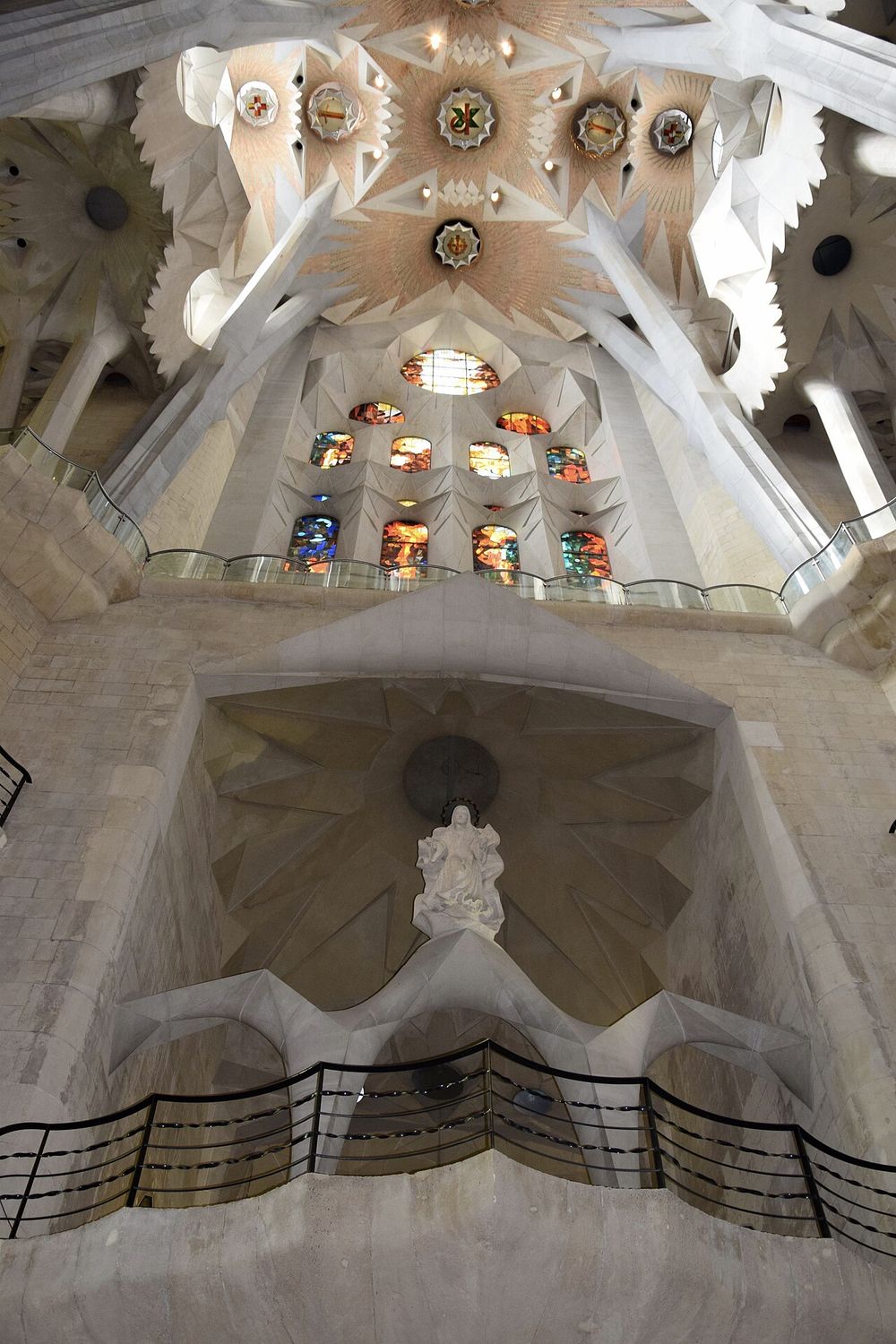
So the columns lean. Each one is tilted along the line of the load it carries, and near the top it splits into branches that each take a piece of the vault. The hardest stone goes where the weight is greatest: dark red porphyry for the four columns at the crossing, then basalt, granite, and sandstone at the edges.
The vault seen from directly belowAlvesgaspar, CC BY-SA 4.0
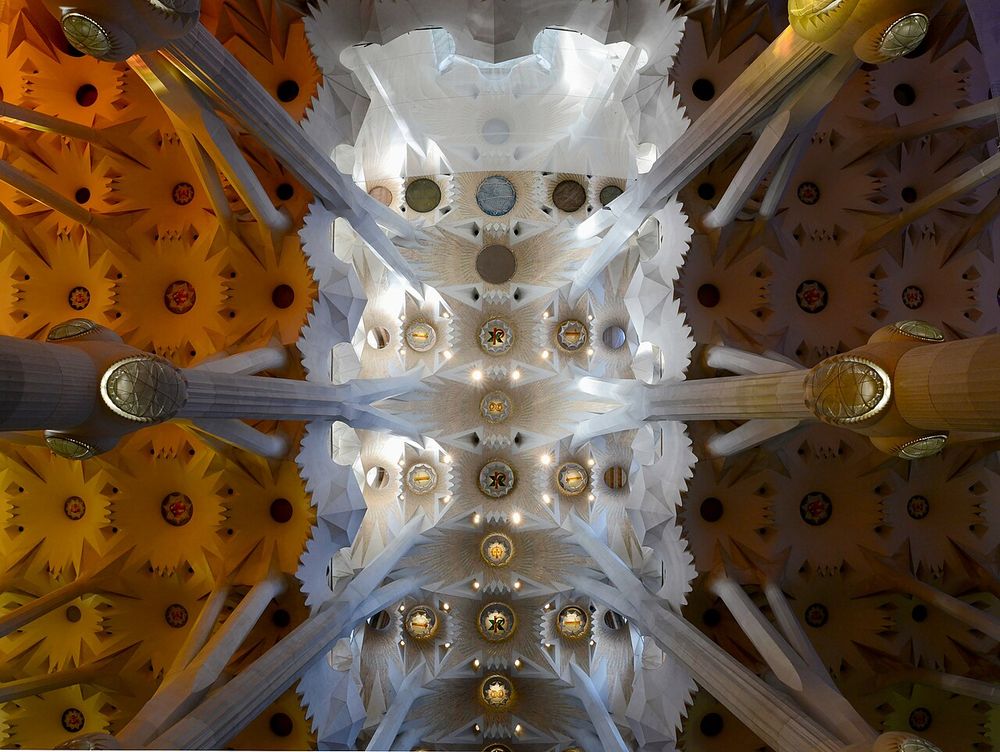
Look straight up. The vault is 45 metres above the floor in the nave and 60 at the crossing. The round openings between the branches let daylight down like gaps in leaves.
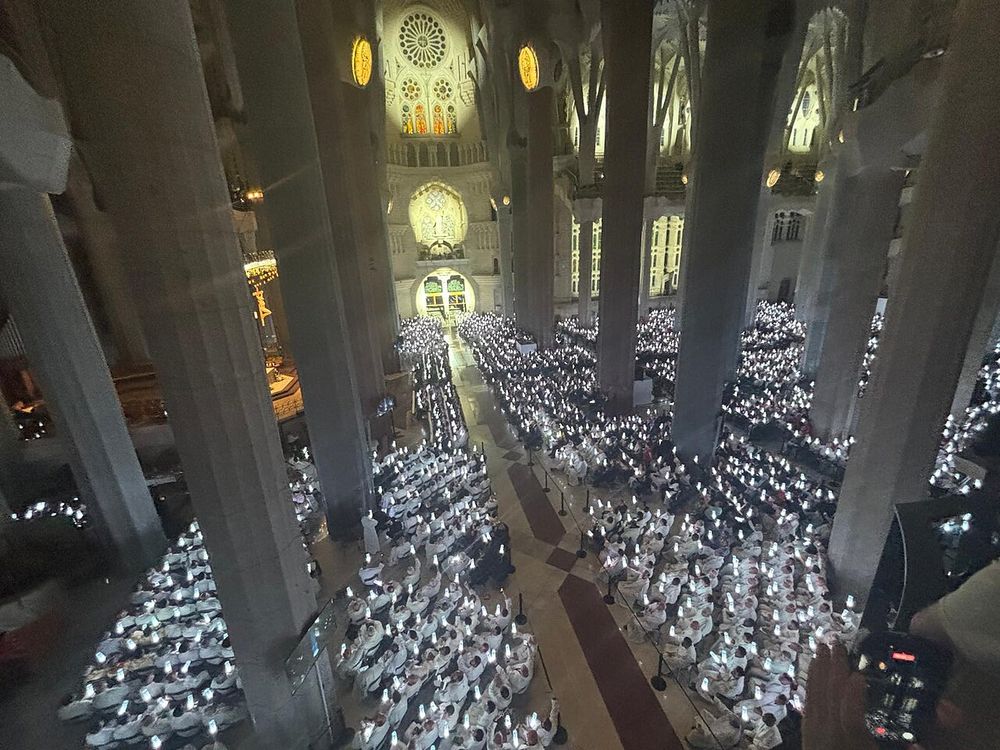
The nave was roofed only in 2010. On 7 November that year Pope Benedict XVI consecrated the church, and Mass could be said in it for the first time.
6. The glass: cold in the morning, warm in the afternoon
Afternoon light through the west windowsBerthold Werner, CC BY-SA 4.0
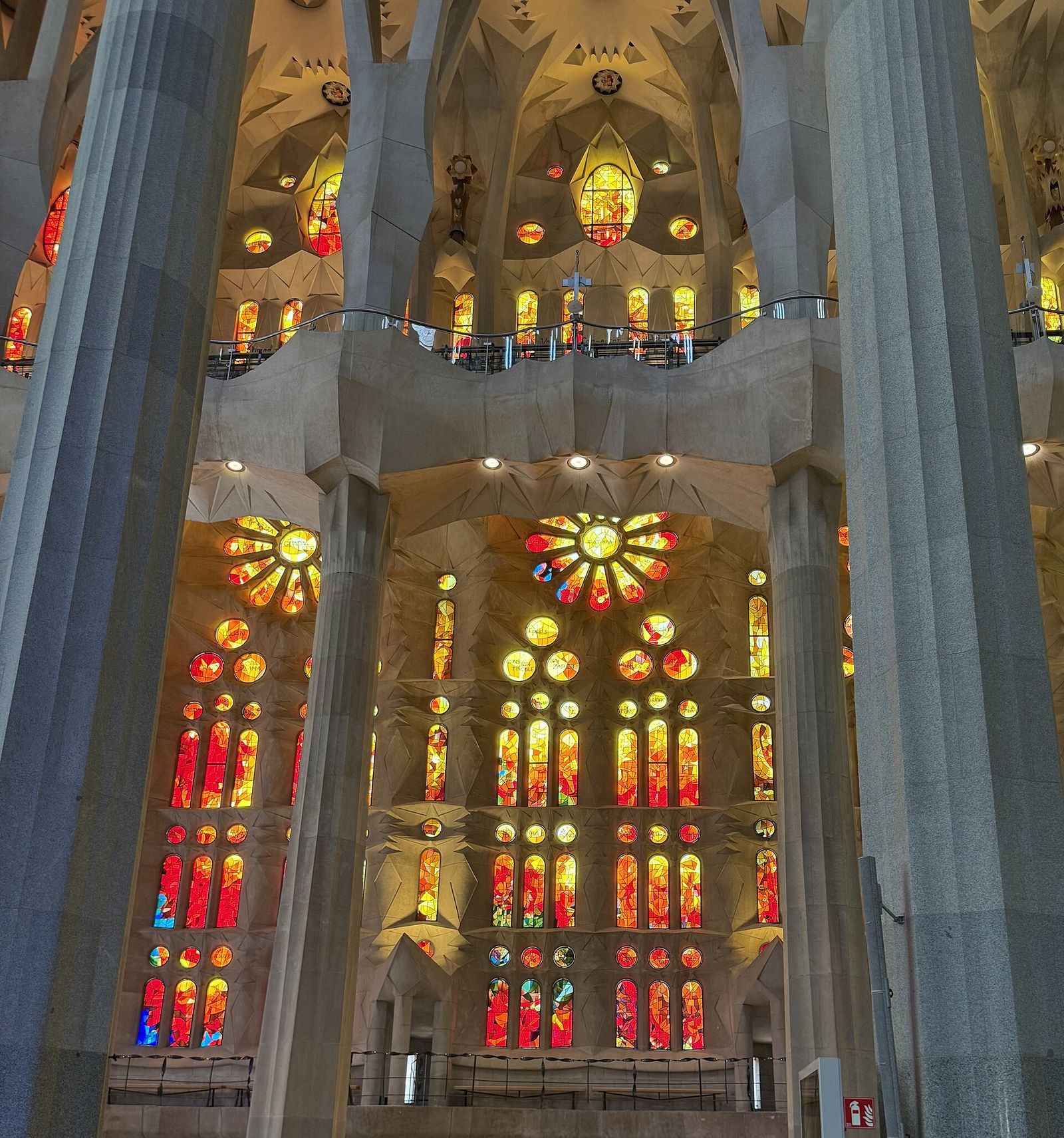
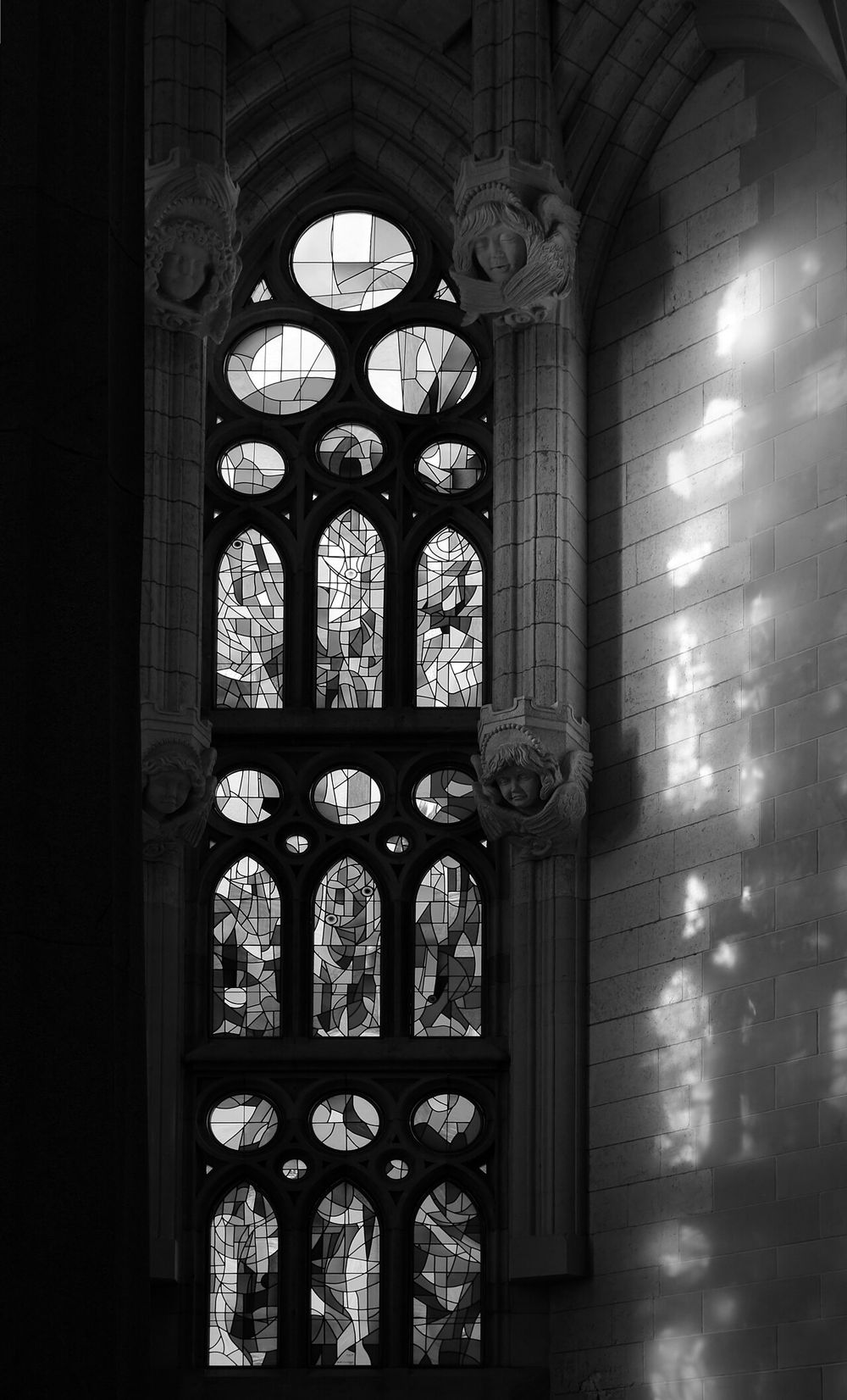
The windows are by the Catalan painter Joan Vila-Grau, who began them in 1999. On the Nativity side, where the sun rises, they are blue and green. On the Passion side, where it sets, they are orange and red.
The upper windows are almost clear. Gaudí wanted colour low down, where people are, and white light high up to show the vault.
Come about two hours before sunset on a clear day. The whole west side burns.
7. The crypt and Gaudí's grave
Gaudí's grave in the cryptBocachete, Public domain
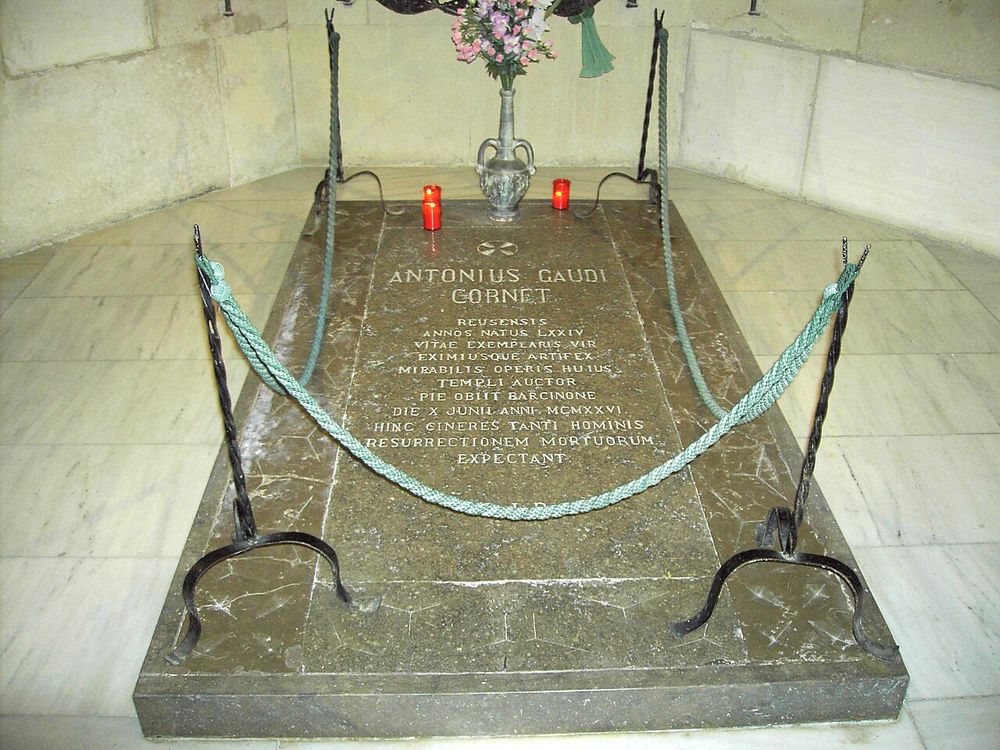
Under the apse is the oldest part, the crypt, begun in 1882 by the first architect in an ordinary Gothic style. Gaudí finished it and is buried in it, in the chapel of Our Lady of Mount Carmel.
On 7 June 1926 he was walking to evening prayers when a tram hit him. He was 73, thin, and carelessly dressed, with no papers in his pockets. People took him for a beggar, and it was some time before anyone would take him to a hospital. He died three days later. Half of Barcelona followed the coffin here.
Ten years later, in July 1936, the Civil War began. Anti-clerical militants set fire to the crypt and to Gaudí's workshop. His drawings burned and his plaster models were smashed.
8. The museum and the schoolhouse: how he worked it out
Gaudí's schoolhouse in 1909, with the church behindUnknown authorUnknown author, Public domain
Gaudí did not trust drawings. He built models. To find the shape of an arch that would stand without props, he hung chains from a board and looked at them in a mirror: a hanging chain turned upside down is a perfect arch.
The broken models were pieced together after the war, and they are still the main guide. Today the shapes are worked out on computers and many of the stones are cut by machine. That is why the last forty years have gone faster than the first hundred.
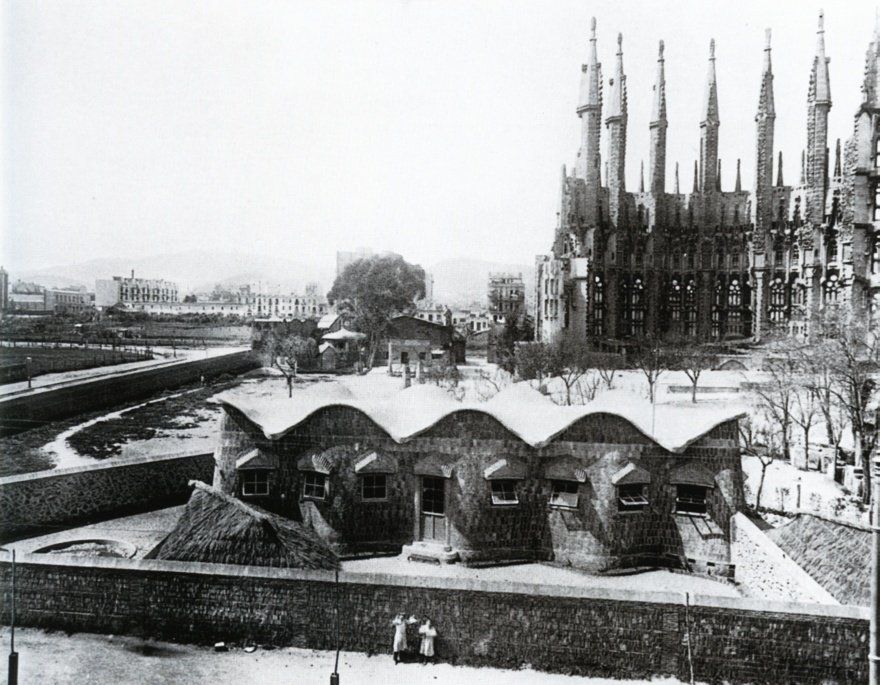
The low building with the wavy roof is the school Gaudí built in 1909 for the children of his workmen. The walls and roof are thin brick, and they are strong because they curve. The architect Le Corbusier came in 1928 and drew it in his notebook.
9. The man
Antoni Gaudí was born in 1852, the son of a coppersmith. He never married. In his last years he gave up every other job, and in 1925 he moved into his workshop on the site. He went from door to door asking for money for the building.
Asked how long it would take, he is said to have answered: "My client is not in a hurry."
Seven of his buildings in and near Barcelona are on the World Heritage list, among them the crypt and Nativity façade of this church. In April 2025 Pope Francis declared him "Venerable", a step on the way to being named a saint.
Not everyone has wanted it finished. In 2008 some four hundred architects and artists signed a letter asking for the work to stop, on the ground that what is being built is no longer Gaudí's.
The Japanese director Hiroshi Teshigahara made a film with almost no words, Antonio Gaudí (1984), that ends on this building. Dan Brown set the last chapters of his novel Origin (2017) inside it.
10. The same years in China, and other long buildings
When the first stone was laid in 1882, China was in the eighth year of the Guangxu Emperor of the Qing (1644–1912). When Gaudí died in June 1926, the Northern Expedition was about to set out from Guangzhou.
A hundred and forty years is long but not a record. Cologne Cathedral in Germany took 632 years, with a gap of three centuries. The Giant Buddha at Leshan in Sichuan took ninety, from 713 to 803, and outlived the monk who began it.
Gaudí built no building in China. Yet his way of finding form in nature has a Chinese echo: the scholar's rocks and garden rockeries of Suzhou are also chosen because they look as if no hand had shaped them.
Meanwhile in the world
Year
Here
Elsewhere
1882
The first stone is laid
Eighth year of the Guangxu Emperor; in Germany Cologne Cathedral has just been finished after 632 years
1883
Gaudí takes over
Krakatoa erupts; Karl Marx dies in London
1909
The schoolhouse is built
The boy emperor Puyi has just come to the throne in Beijing
1926
Gaudí dies; one tower is finished
The Northern Expedition begins in China
1936
The workshop is burned at the start of the Civil War
The Xi'an Incident in December
1976
The four towers of the Passion façade are finished
Spain is leaving the Franco dictatorship; Mao Zedong dies
2010
The nave is roofed and the church consecrated
The Shanghai World Expo
2026
The Tower of Jesus Christ is completed and blessed
A hundred years since Gaudí's death
One line to remember: begun in 1882, tallest church in the world in 2026, and not finished yet.
Then and now
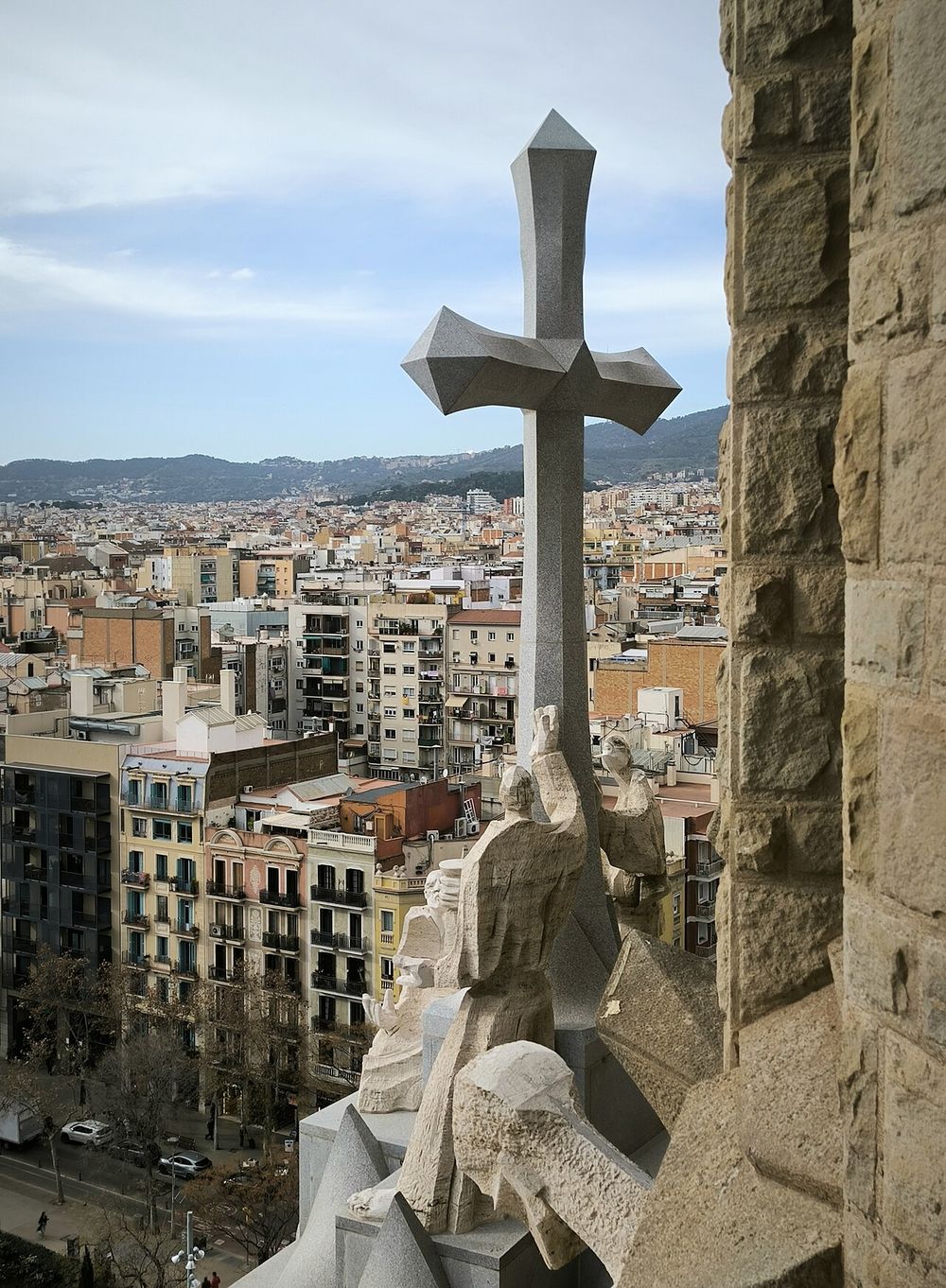
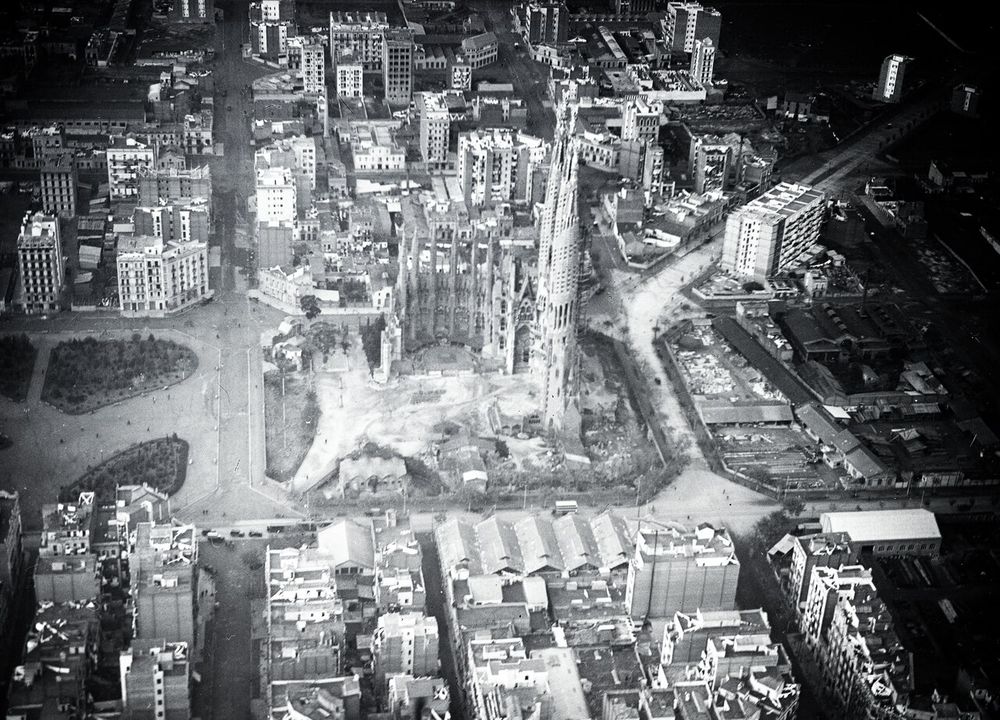
Spring 2026: the central tower with its crossWikipsico43, CC BY-SA 4.0, Wikimedia CommonsThe towers in May 2026WikiJana1, CC BY-SA 4.0, Wikimedia CommonsFrom the air in 2020, before the central tower roseManel Subirats Ferrer, CC BY-SA 4.0, Wikimedia CommonsThe Nativity façade across the pond in the squareEnric, CC BY-SA 4.0, Wikimedia CommonsLooking up at the towers, 2023Américo Toledano, CC BY-SA 4.0, Wikimedia CommonsThe Nativity side at night, 2022Maksim Sokolov (maxergon.com), CC BY-SA 4.0, Wikimedia CommonsLit at night, December 2025Hendrik Manuels Stoops Lugo, CC0, Wikimedia CommonsA cross on one of the pinnacles, with the city belowReda Kerbush, CC BY-SA 4.0, Wikimedia CommonsThe Nativity façade: the central doorwayAlvesgaspar, CC BY-SA 4.0, Wikimedia CommonsNativity façade: the Massacre of the InnocentsJosé Luiz, CC BY-SA 3.0, Wikimedia CommonsNativity façade: detail of the Charity doorwayLmbuga, CC BY-SA 3.0, Wikimedia CommonsA sculpture group on the outsideReda Kerbush, CC BY-SA 4.0, Wikimedia CommonsThe Passion façade: figures by SubirachsYair Haklai, CC BY-SA 4.0, Wikimedia CommonsRoman soldiers on the Passion façade; their helmets copy Gaudí's chimneysRp22, CC BY 3.0, Wikimedia CommonsThe Passion façade and its four towersJorge Láscar from Australia, CC BY 2.0, Wikimedia CommonsThe bronze doors of the Passion façade, covered in Gospel textCatalan Art & Architecture Gallery (Josep Bracons) from Barcelona, Catalonia, CC BY-SA 2.0, Wikimedia CommonsMosaic baskets of fruit on the pinnaclesSagrada Família (oficial), CC BY-SA 3.0, Wikimedia CommonsThe apse end under construction, 2011Jordiferrer, CC BY-SA 3.0, Wikimedia CommonsThe building site from above, 2005Son of Groucho from Scotland, CC BY 2.0, Wikimedia CommonsThe nave: columns that branch like treesBerthold Werner, CC BY-SA 4.0, Wikimedia CommonsThe vault seen from directly belowAlvesgaspar, CC BY-SA 4.0, Wikimedia CommonsLooking up along the columnsAlvesgaspar, CC BY-SA 4.0, Wikimedia CommonsThe crossing vaultAlvesgaspar, CC BY-SA 4.0, Wikimedia CommonsThe nave during building, about 2010Jorge Láscar from Australia, CC BY 2.0, Wikimedia CommonsAfternoon light through the west windowsBerthold Werner, CC BY-SA 4.0, Wikimedia CommonsColoured light on the Passion side, 2026Triptychon, CC0, Wikimedia CommonsStained glass by Joan Vila-GrauAnk Kumar, CC BY-SA 4.0, Wikimedia CommonsA gallery under the windowsAnk Kumar, CC BY-SA 4.0, Wikimedia CommonsA window in black and whiteAlvesgaspar, CC BY-SA 4.0, Wikimedia CommonsLamps and columns insideAlvesgaspar, CC BY-SA 4.0, Wikimedia CommonsThe altar and its canopy, seen from aboveSagrada Família (oficial), CC BY-SA 3.0, Wikimedia Commons10 June 2026: the Mass at which the Tower of Jesus Christ was blessedMedol, CC BY 4.0, Wikimedia CommonsThe spiral stair inside a towerTony Hisgett from Birmingham, UK, CC BY 2.0, Wikimedia CommonsA spiral stair seen from below, 2026Triptychon, CC0, Wikimedia CommonsGaudí's grave in the cryptBocachete, Public domain, Wikimedia CommonsA model of the Glory façade, still to be builtLuistxo, CC BY-SA 4.0, Wikimedia CommonsThe Nativity façade going up, late 1890sAnonymousUnknown author, Public domain, Wikimedia CommonsCarts and walkers pass the building site, about 1900Unknown photographer, Public domain, Wikimedia CommonsThe church in open fields, 1905, photographed by Baldomer Gili RoigBaldomer Gili i Roig, Public domain, Wikimedia CommonsAbout 1915: the towers begin to riseTemplo Expiatorio de la Sagrada Familia, CC BY-SA 3.0, Wikimedia CommonsGaudí's schoolhouse in 1909, with the church behindUnknown authorUnknown author, Public domain, Wikimedia CommonsFrom the air in 1930: four towers and no roofWalter Mittelholzer, Public domain, Wikimedia Commons
Local legends
These are stories people tell about this place. They are legends, not history, and each one says where it comes from.
LegendThe Nativity façade
Gaudí took his models from the street. The Roman soldier who kills the children has six toes on one foot, because the waiter from a nearby tavern who posed for him had six.
Source: Told by Gaudí's assistants and repeated by his biographers
LegendThe Passion façade
The faceless helmets of Subirachs's soldiers, and the chimneys on La Pedrera that they copy, are said to have given George Lucas the helmets of the stormtroopers in Star Wars.
Source: A story Barcelona guides tell; nothing from Lucas confirms it
LegendThe building
In Barcelona, anything that drags on is said to "take longer than the Sagrada Família". People also say that the day it is finished the world will end.
Source: Local sayings
Later, people who live here will be able to add the stories they grew up with, and say which of these they have heard.
Not certain, and where accounts conflict
When will it be finished?
The builders long said 2026. That year saw the central tower completed. The Glory façade, its four towers and much sculpture remain, and dates in the mid-2030s are now given.
Is what is being built Gaudí's?
The church's architects say they follow his models and geometry. Critics, including the four hundred who signed a letter in 2008, say too much has to be guessed.
How many towers stand?
Fourteen, by our count from reports of 2026: eight apostles, four evangelists, Mary and Jesus Christ. Some guides write "all eighteen", which counts four not yet built.
Did it have a building permit?
An application was made in 1885 to a town that Barcelona later absorbed, and was never answered. The city granted a licence in 2019, 137 years after work began.
"My client is not in a hurry"
Everyone quotes it. We have not found where Gaudí said it.
Visiting
Tickets and hours
Guides in 2026 give about 26 euros for the church with an audio guide on your phone, and about 36 to 40 euros with a tower. Children under 11 are free. Check the price when you book.
Since the central tower was blessed in June 2026, good time slots have been selling out ten days or more ahead.
Hours given for 2026: 09:00 to 18:00 from November to February, to 19:00 in March and October, to 20:00 from April to September. On Sundays it opens at 10:30.
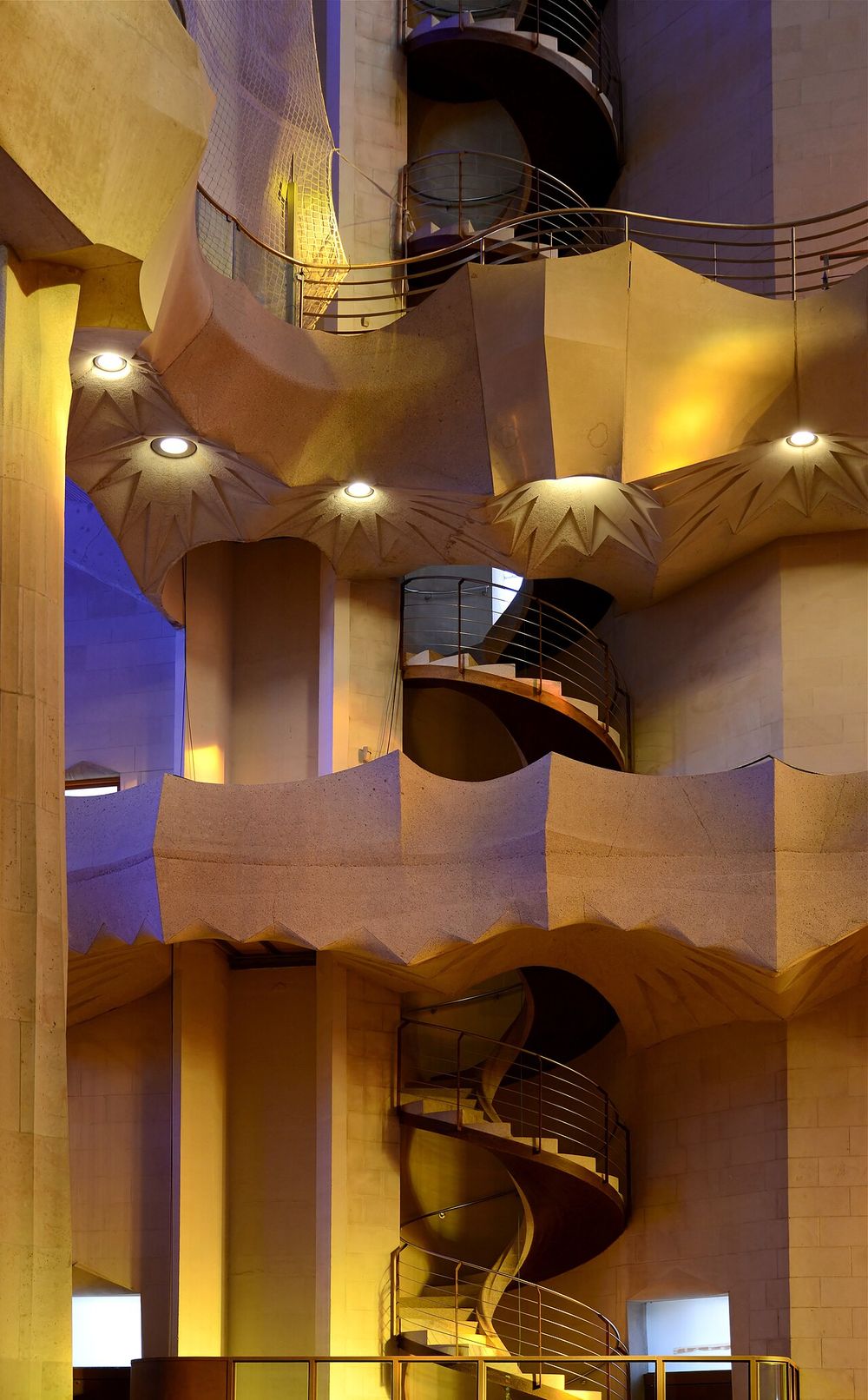
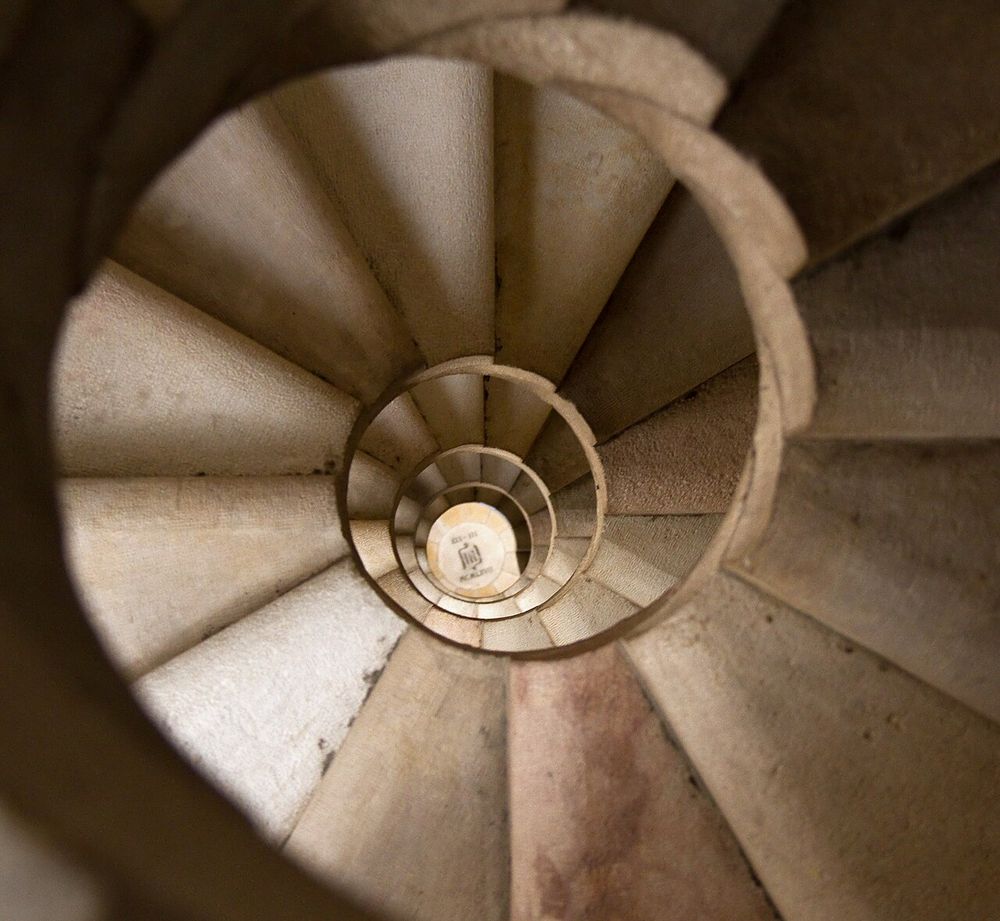
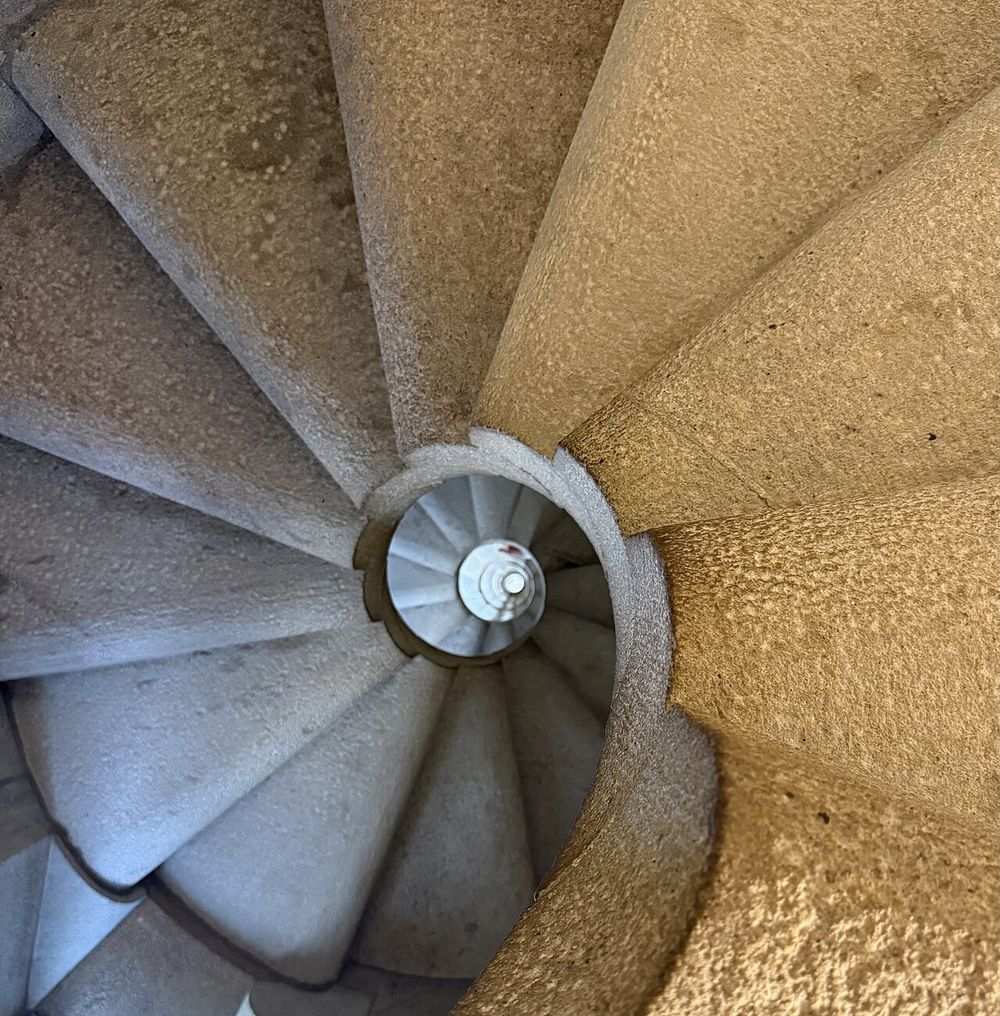
A tower visit goes up by lift and comes down by a narrow spiral stair of several hundred steps. Children under six are not taken up. The towers close in rain and wind.
Last checked 2026-11-12. News reports and travel guides of 2026; the basilica's own ticket page was opened but shows no prices.
Booking from abroad
Official page in English The basilica's own site sells the tickets, in English among other languages: sagradafamilia.org. Tickets are for a fixed time and carry your name.
Note There is no ticket office on site for the general visit. Buy before you come and bring the identity document you named.
Checked 2026-11-12
Where to start
Visitors with tickets go in on Carrer de la Marina, at the Nativity façade. Look at that façade before you enter.
Inside, walk the nave slowly from one end to the other, then leave by the Passion façade and look at it from the square. Finish in the museum underneath.
For the light, book the last two hours of the afternoon. For fewer people, book the first slot of the morning.
The best free view of the whole building is from the pond in the square on the Nativity side.
Before you go
Metro lines 2 and 5 stop at Sagrada Família, at the door.
There is a security check like an airport's. Large bags are not allowed and there is nowhere to leave them.
Barcelona's pickpockets are skilled and work the metro and the pavements round the church. Keep bags closed and in front of you.
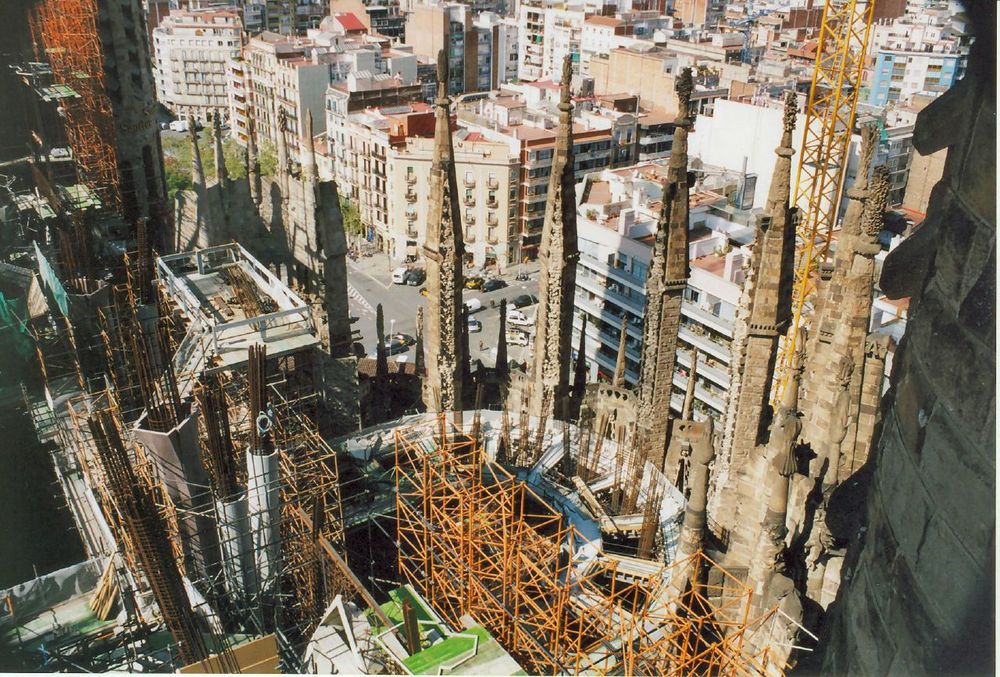
Building goes on while you visit. Expect cranes, hoardings and noise.
Customs and manners
This is a working Catholic church, and the dress rule is enforced at the door. Shoulders covered; shorts and skirts at least to mid-thigh; nothing see-through; no swimwear. People turned away get no refund.
Take your hat off inside, unless you wear it for religious or medical reasons.
Keep your voice low. Part of the nave is roped off for prayer, and photographs are not wanted there.
Mass in several languages is said on Sunday mornings. It is free and seats are few; people queue early. It is for worship, and you will be asked not to walk about or take pictures.
A word of Catalan at the ticket check, "Bon dia", is good manners here.
Look for these
At the foot of the two big columns of the Nativity façade, find the two animals that carry them. One lives in the sea and one on land. Which is on the side nearer the sea?
On the Nativity façade, find the cypress tree. What colour are the birds on it?
On the Passion façade, find the square of numbers and add up one row.
Find the soldiers' helmets. If you have been to La Pedrera, where did you see that shape?
Inside, find a column of dark red stone. Why is the hardest stone in the middle of the church?
Stand under the crossing and look up. How many branches does one column split into?
Compare the windows on the two long sides. Which side is cold in colour, and which warm?
On the pinnacles outside, find a basket of fruit. Which fruits can you name?
I am here
Stand at the site, sign in, press the button, and collect its stamp. Your browser will ask to use your location. It is sent to us once to confirm that you are at the site; we keep how far you were from it, not the spot where you stood.
Your stamps are saved to your account, so they follow you to any device. Checking from a browser cannot rule out every false location; stricter checks arrive with the app.
Messages
Share your photos
Photos here show the place, not people. Each one is credited to the visitor who took it and appears after our team has looked at it. A photo with you in it belongs under “I am here”.