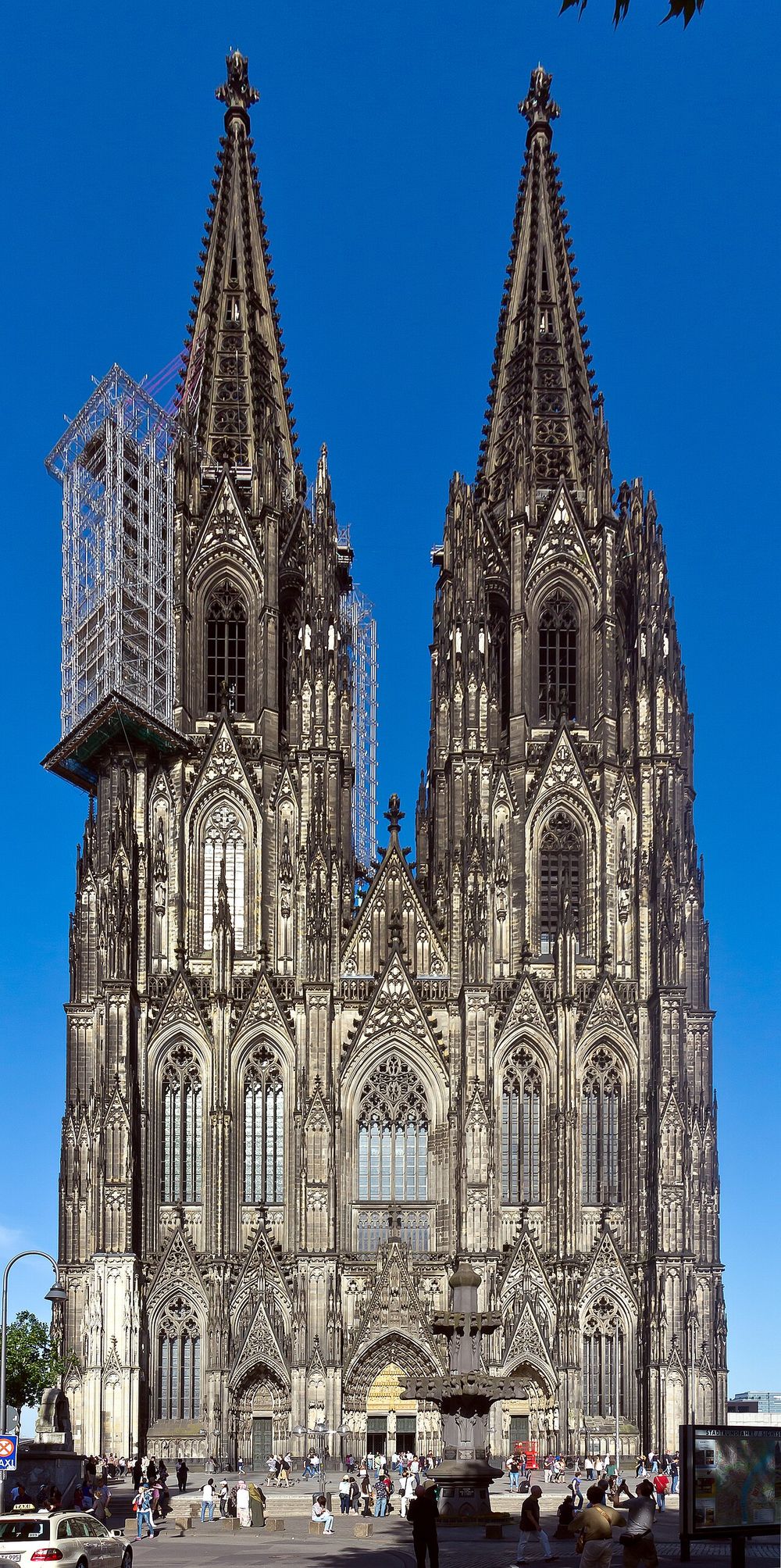
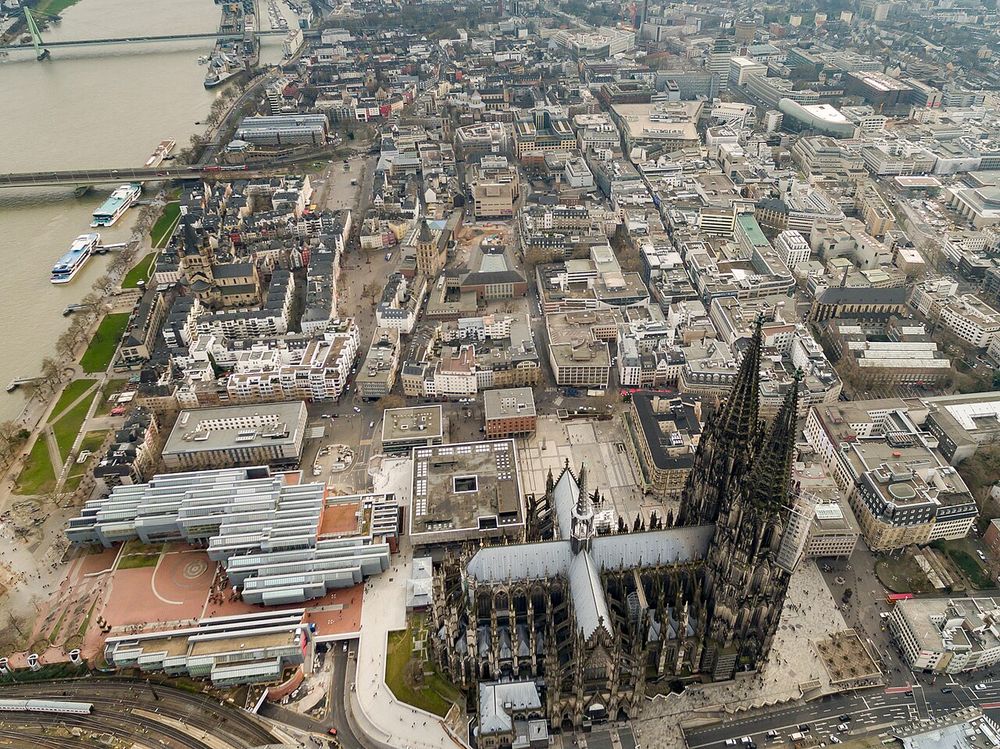
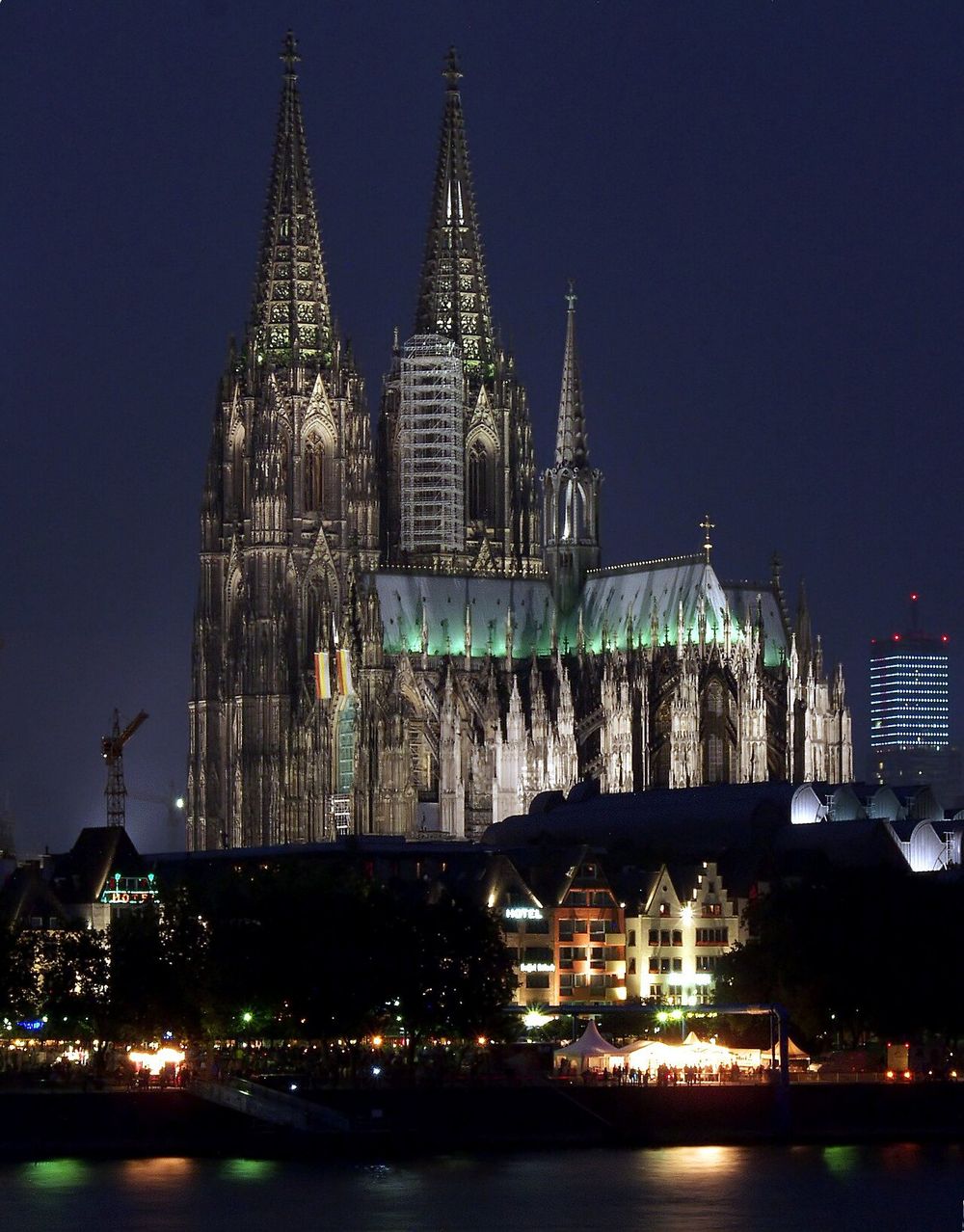
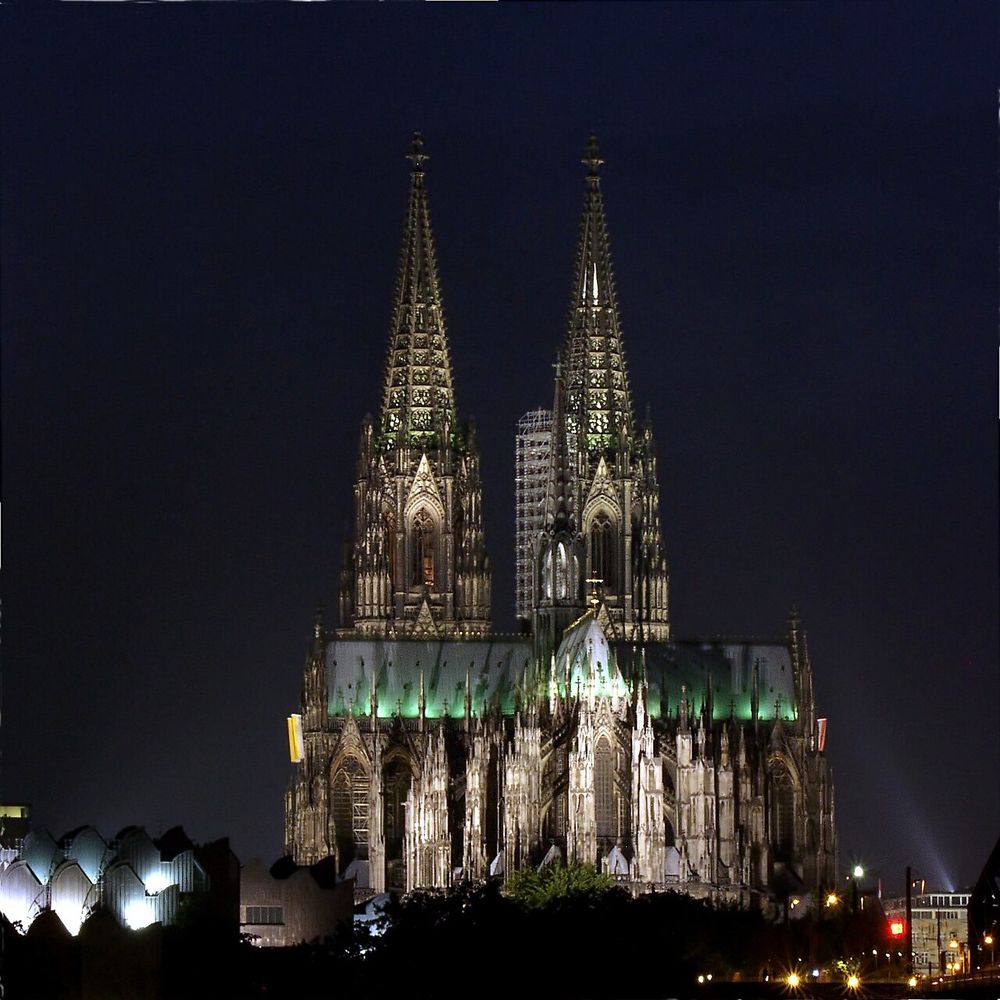
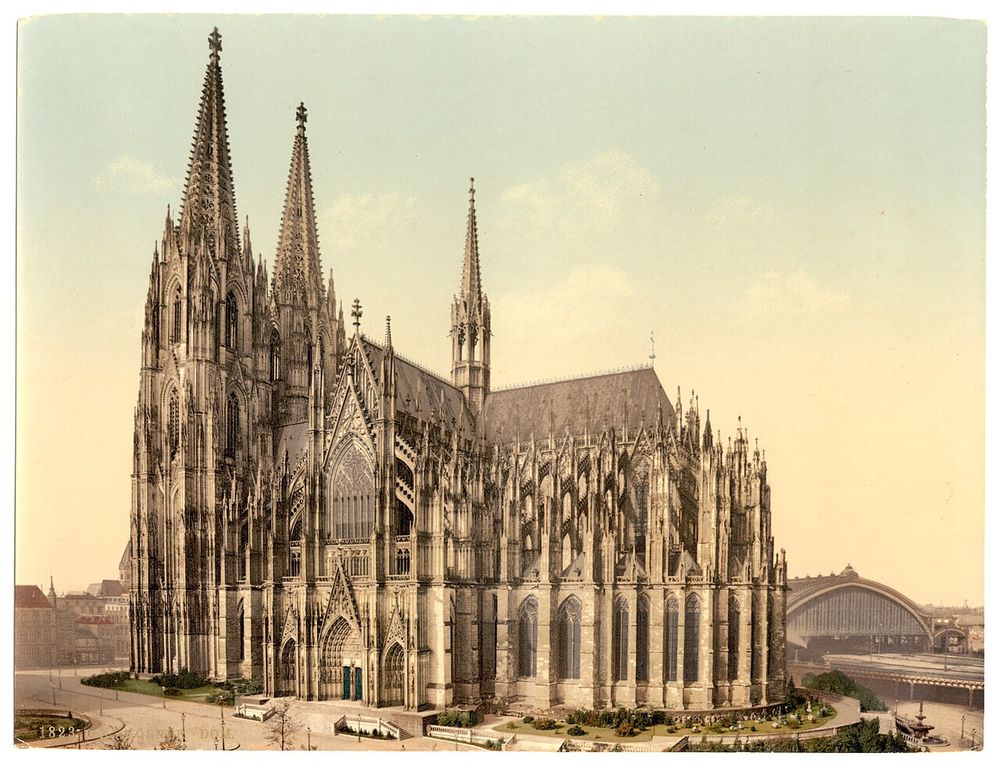
A Gothic cathedral begun in 1248 and finished in 1880, to the medieval drawings, after standing half built for three hundred years with a wooden crane on its stump of a tower. Its two spires are 157 metres high. For four years it was the tallest building on earth. It took fourteen heavy bombs in the Second World War and stood.
Photo: dronepicr, CC BY 2.0, Wikimedia Commons
The story
In 1164 the archbishop of Cologne came home from Italy with a prize of war: bones said to be those of the three wise men who followed the star to Bethlehem. Pilgrims came in such numbers that the old cathedral could not hold them. In 1248 the city began a new one, the biggest it could imagine, in the new French style.
The east end was finished in 1322. Then the money and the will gave out. About 1520 work stopped altogether. In China 1248 is late in the Southern Song dynasty (1127–1279), and 1880 is the sixth year of Guangxu of the Qing (1644–1912).
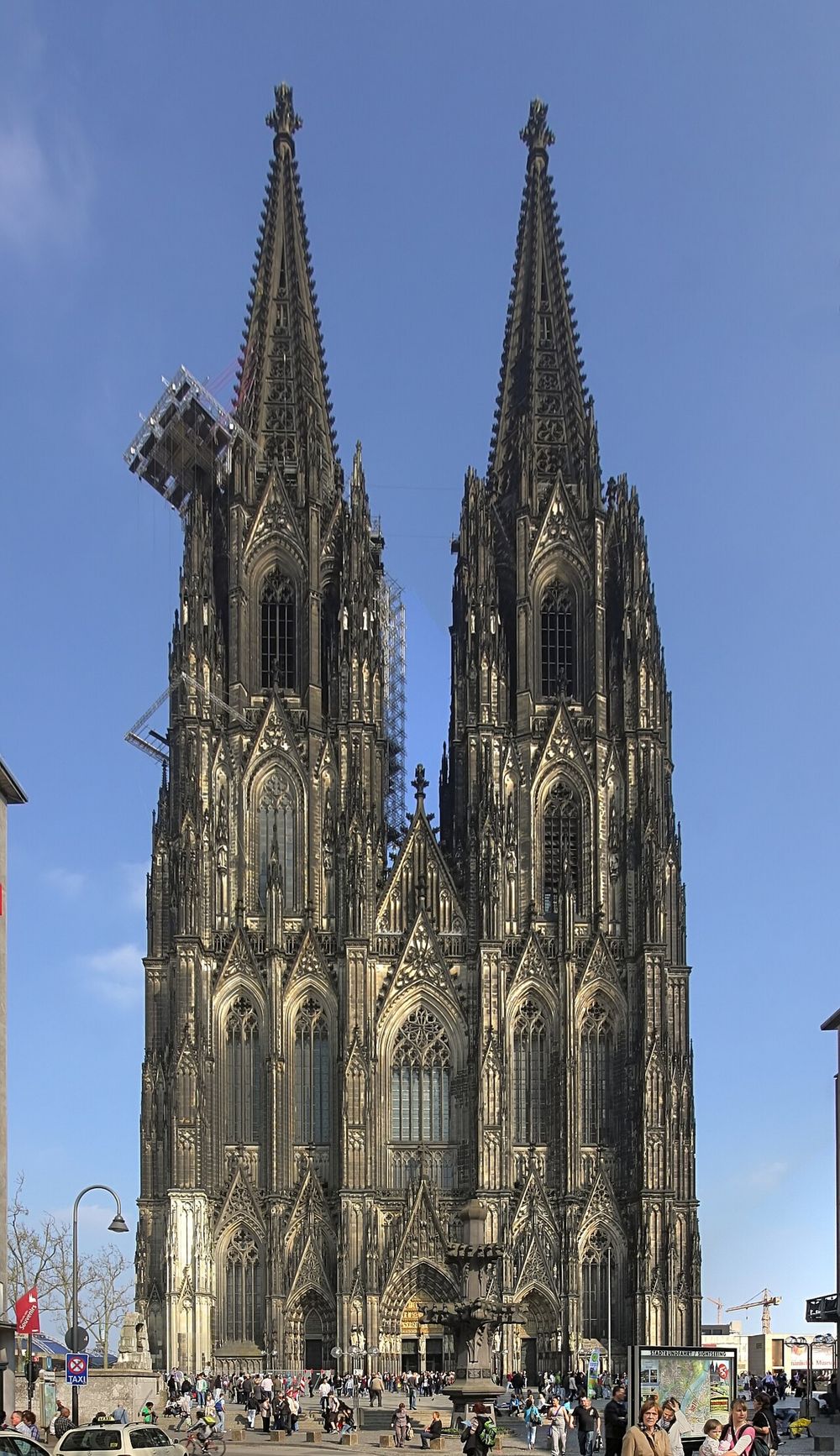
The two spires, June 2013Raimond Spekking, CC BY-SA 4.0
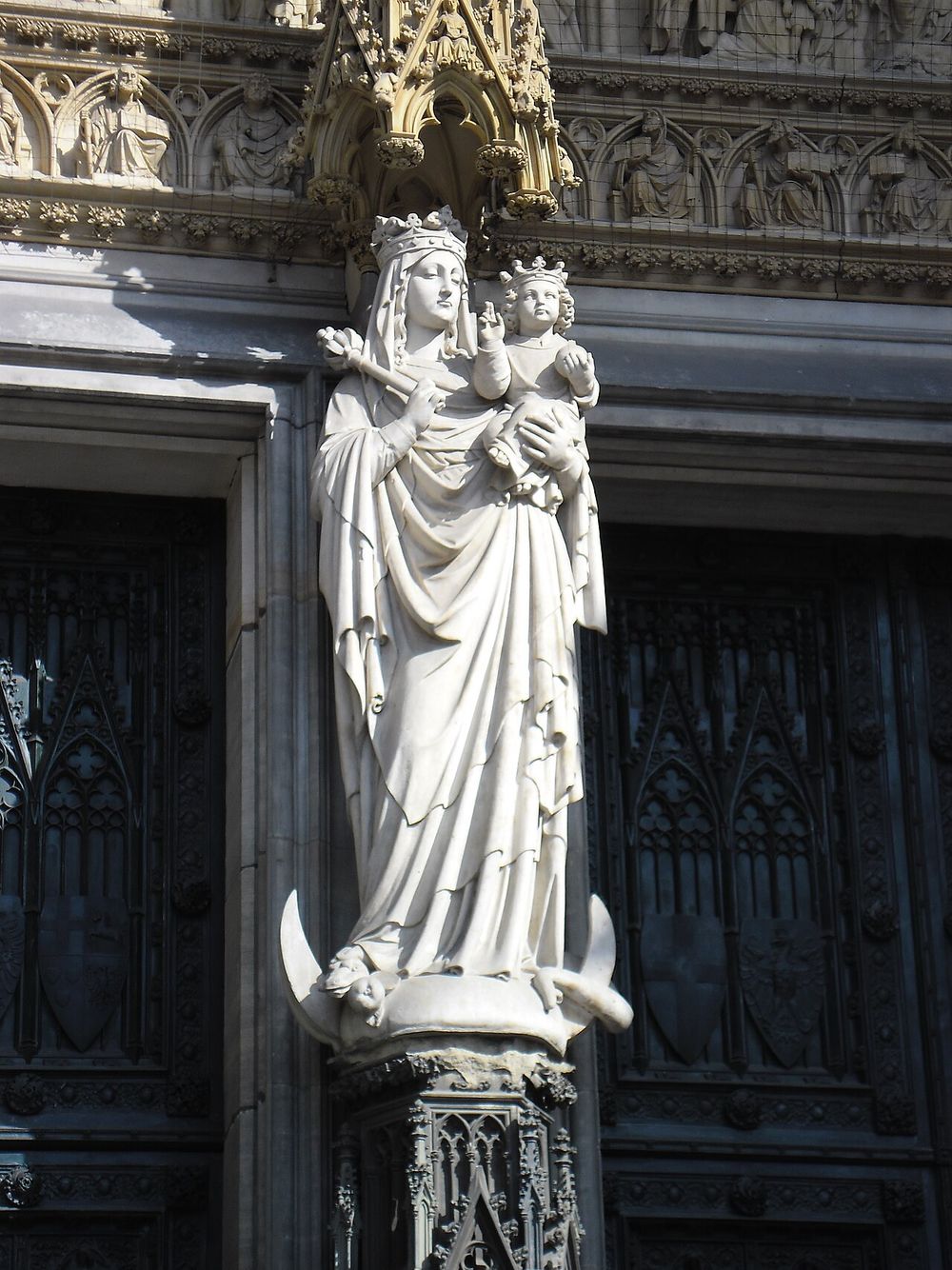
Step back until you can see the tops. No church has a larger front. Every surface is cut into ribs, niches and little spires, so the whole thing seems to be rising while you look.
Almost all of what you are looking at is from the 1800s. But it was built from a drawing made about 1300, on a sheet of parchment four metres high. The sheet was lost. Half of it turned up in 1814 in the loft of an inn, where, the story goes, it was being used to dry beans.
Look at the colour. The stone is not black by nature. Rain and two centuries of soot have turned it, and it is too soft to scrub. Paler patches are new stone: about a hundred masons work on the building all year, every year.
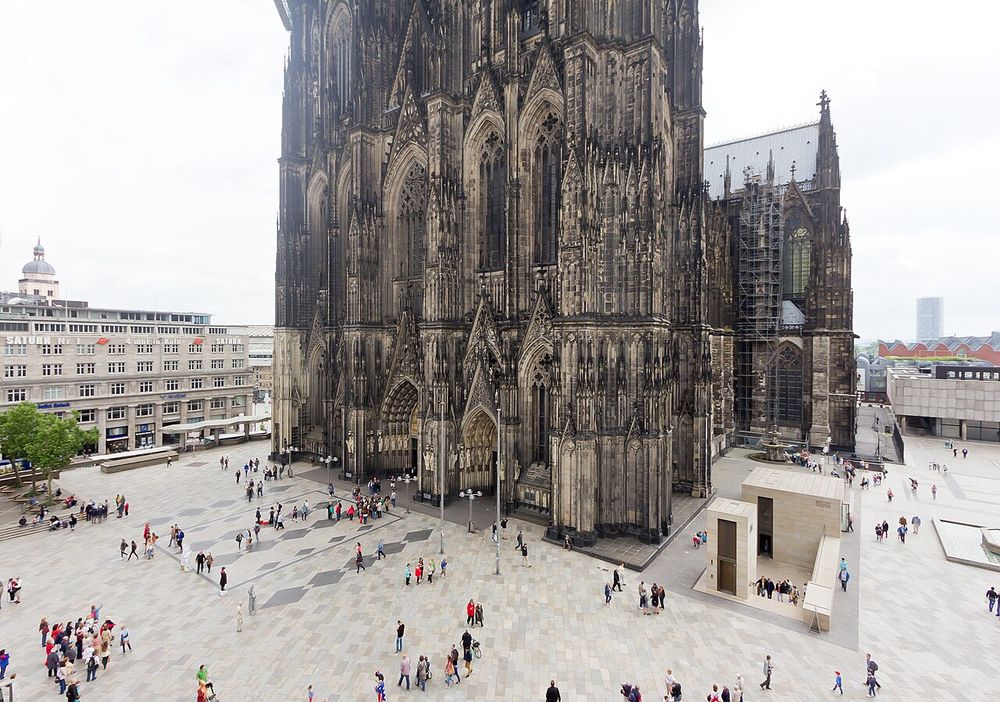
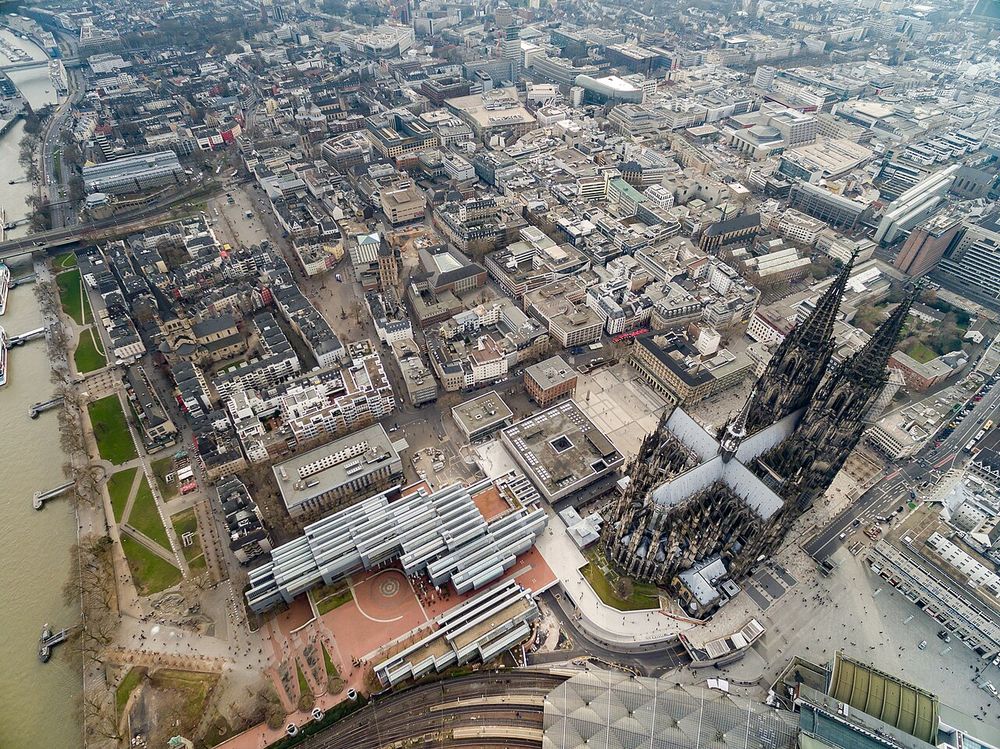
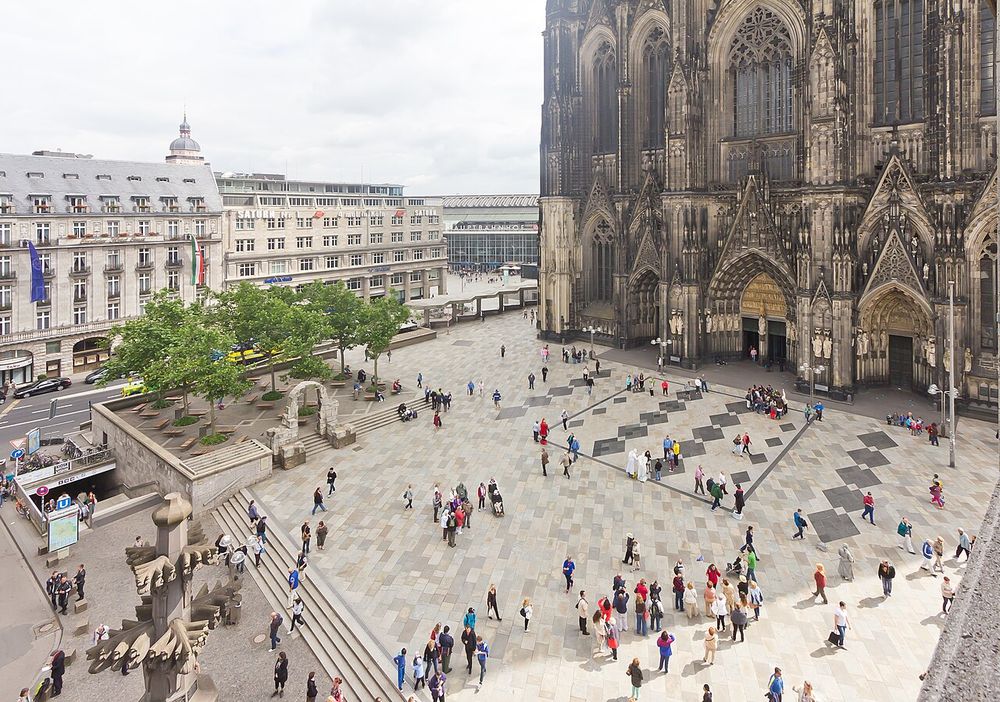
The square from above, June 2013Raimond Spekking, CC BY-SA 4.0
At the foot of the south tower stands a stone finial, nine and a half metres tall. It is a full-size copy of the ones on top of the spires. Stand beside it and look up.
Things people often get wrong
"It is a medieval building." The choir is medieval. The nave, the towers and the whole front were built between 1842 and 1880, with steam cranes and an iron roof, and paid for largely by a Protestant king of Prussia.
"It is free." Until 30 June 2026 it was. Since 1 July 2026 visitors pay 12 euros. People who come to pray or to a service still go in free, by the north door.
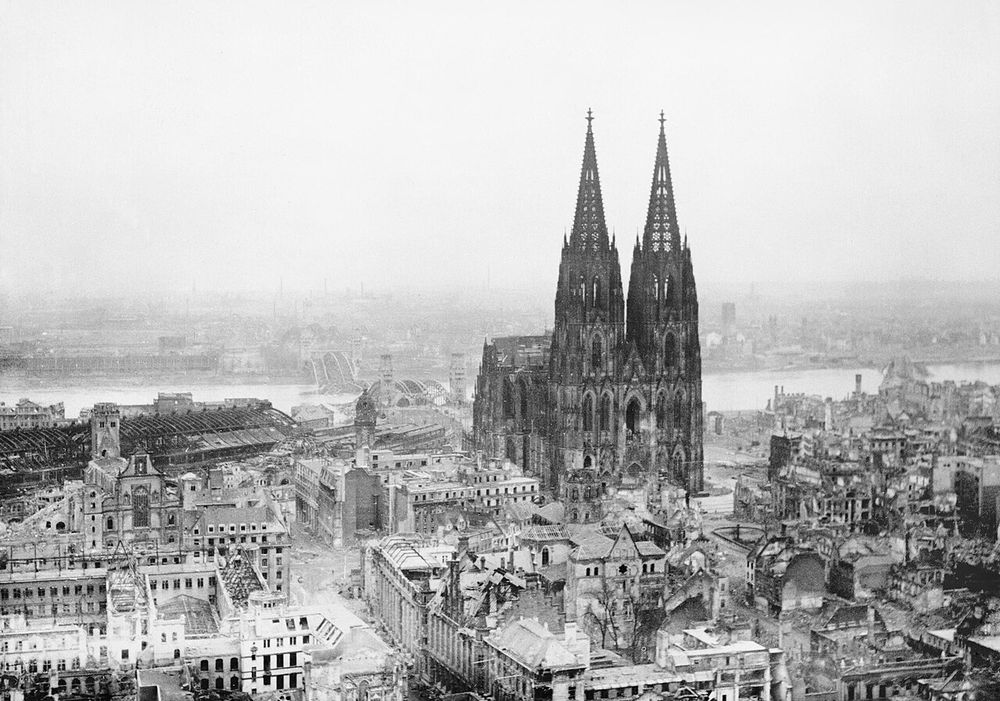
"The bombers spared it on purpose." It was hit by fourteen heavy bombs and some seventy fire bombs. It stood because a Gothic frame of piers and arches lets a blast pass through. The story that pilots were told to save it as a landmark has no document behind it.
"It is finished." Ask in Cologne and you will be told that the day it is finished the world will end.
People who stood here
Rainald of Dassel (archbishop of Cologne and chancellor of the emperor, about 1120–1167)When the emperor sacked Milan he gave his chancellor the relics of the Three Kings from a church there. Rainald brought them over the Alps in 1164 and made Cologne one of the great pilgrim cities of Europe.
Petrarch (Italian poet, 1304–1374)He came in 1333 and wrote to a friend that he had seen, in the middle of the city, a very beautiful church, unfinished, which the people with good reason called the greatest.
Sulpiz Boisserée (art collector, 1783–1854)A merchant's son of Cologne who gave thirty years to one idea: that the ruin should be finished. He measured it, hunted down the lost drawings, published them, and talked Goethe and the Prussian crown prince round.
Johann Wolfgang von Goethe (German poet, 1749–1832)He saw the stump in 1774 and found it sad. Forty years later Boisserée showed him the plans, and he lent his name to the campaign.
Heinrich Heine (German poet, 1797–1856)He joined the society for finishing the cathedral, then changed his mind. In his long poem of 1844 he calls the half-built church a Bastille of the spirit and is glad it was never finished. It was finished thirty-six years later.
Frederick William IV of Prussia (king, 1795–1861)A Protestant who loved the Middle Ages. He laid the stone for the new work in 1842 and paid half the cost from the state, to bind his new Catholic provinces on the Rhine to Prussia.
Robert Schumann (German composer, 1810–1856)He saw a cardinal installed here in 1850. The slow, solemn fourth movement of his Rhenish Symphony, written that winter, is his memory of it.
Konrad Adenauer (mayor of Cologne, later first chancellor of West Germany, 1876–1967)He was mayor from 1917 until the Nazis removed him in 1933, and again for a few months in 1945 in a city nine-tenths destroyed. His funeral Mass was held here in 1967, with the leaders of the world in the pews.
Gerhard Richter (German painter, born 1932)In 2007 he filled the great south window, blank since the war, with 11,263 squares of glass in seventy-two colours, placed by a computer at random. The cardinal said it would suit a mosque better and stayed away from the unveiling.
Go deeper: eight stops, from the square to the bell
Stops 2 to 6 are inside and need the visitor's ticket. The tower and the treasury are separate tickets.
1. The crane
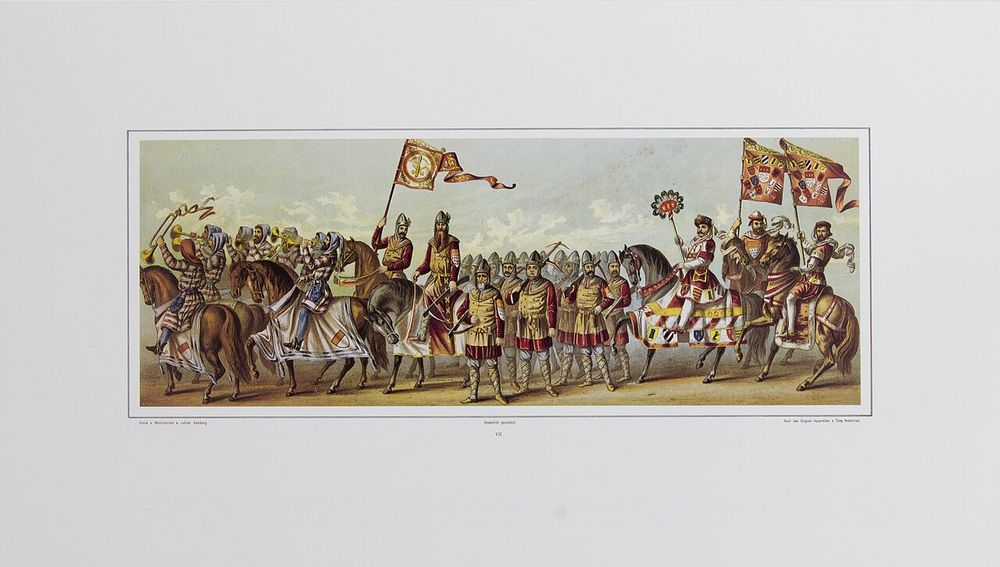
The pageant for the finishing of the cathedral, 1880Tony Avenarius, Public domain
From about 1400 to 1868 a wooden crane, twenty-five metres high, stood on the stump of the south tower. Nobody took it down, because taking it down would have meant admitting the cathedral would never be finished. It is in every old view of the city. When it creaked, people said, it was calling for the work to go on.
The finishing in 1880 was celebrated as a triumph of the new German empire. The archbishop was not there. He was in exile, in a quarrel between the Church and the state.
2. The nave
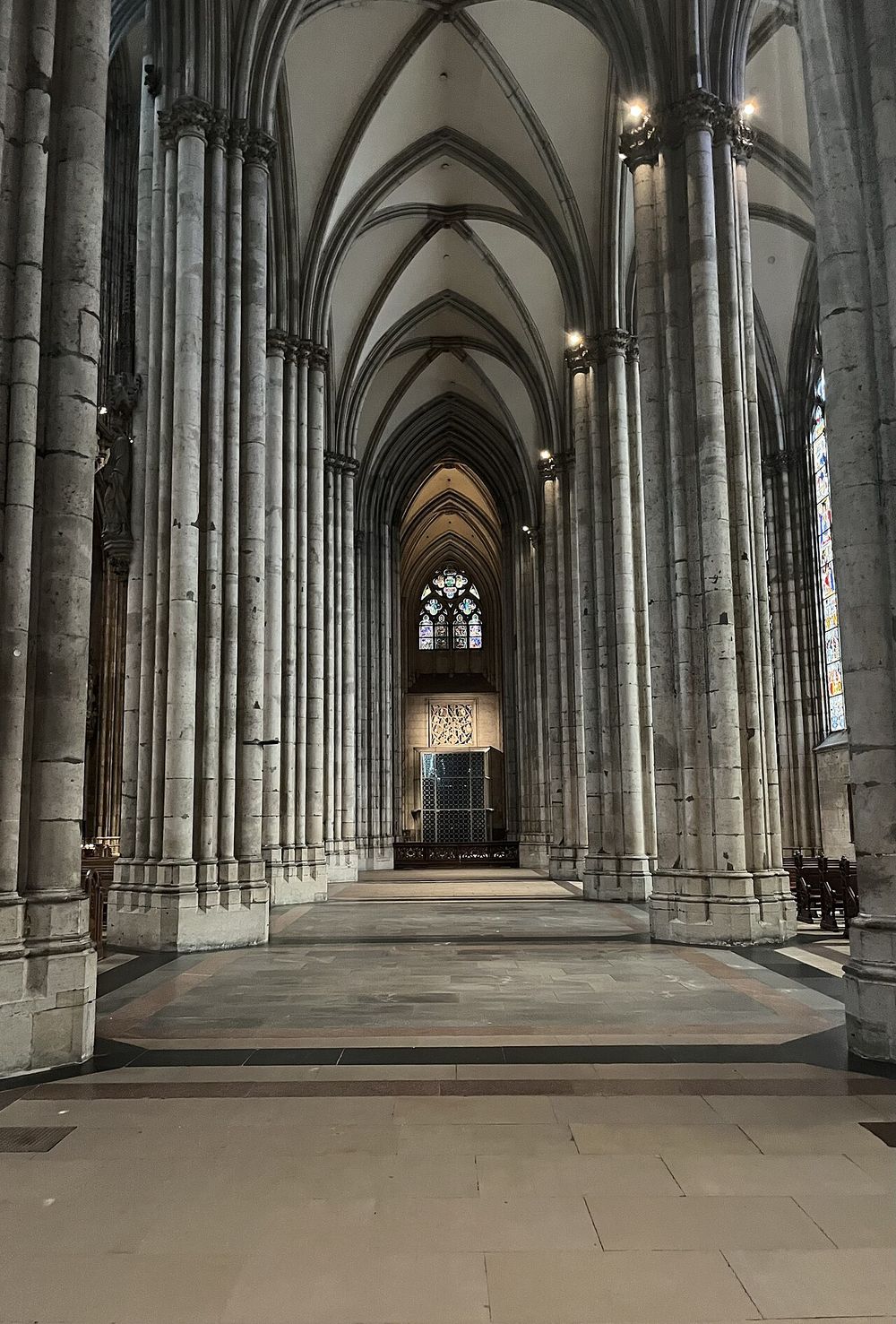
The nave, May 2026Kaap bij Sneeuw, CC0
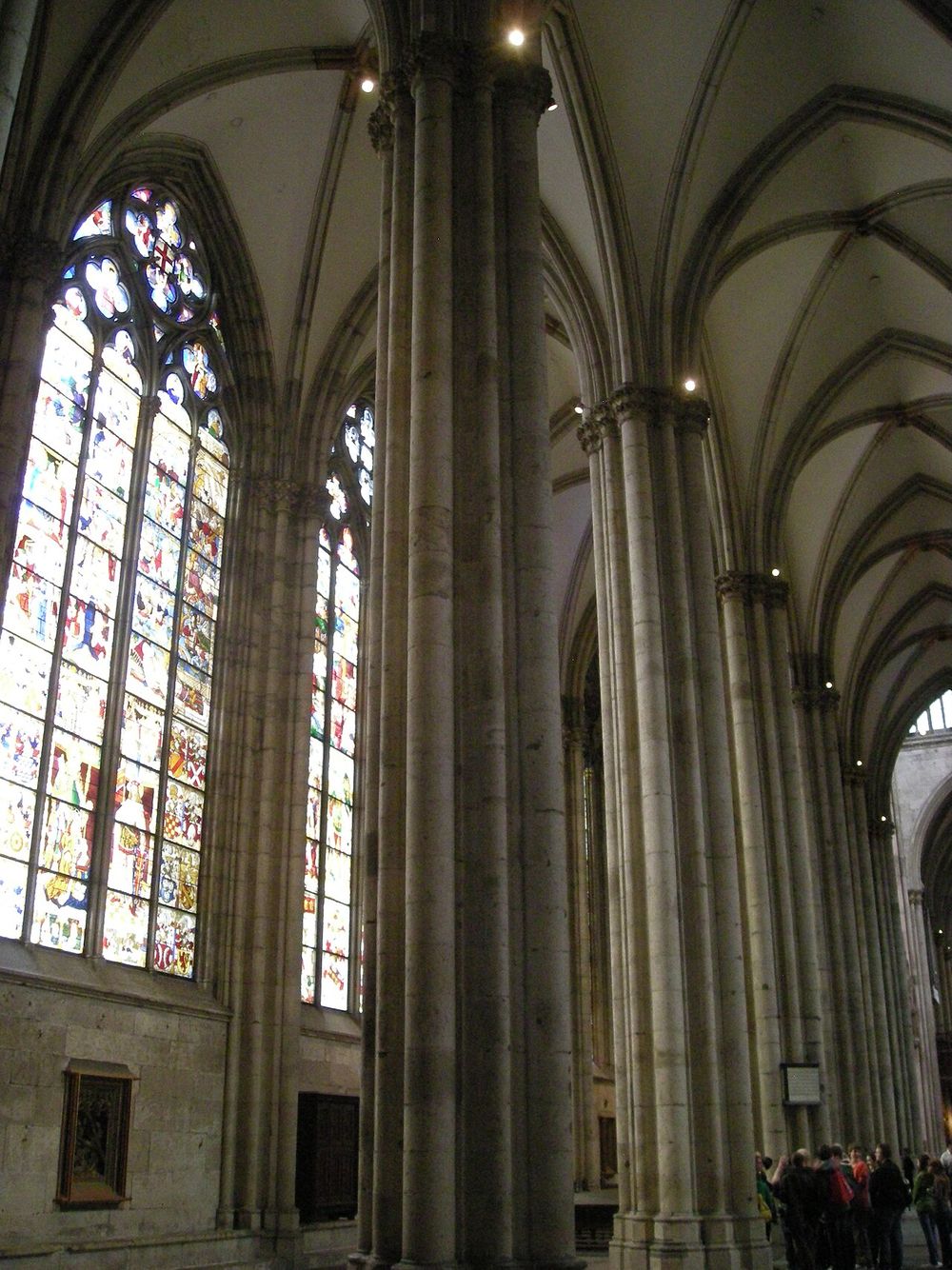
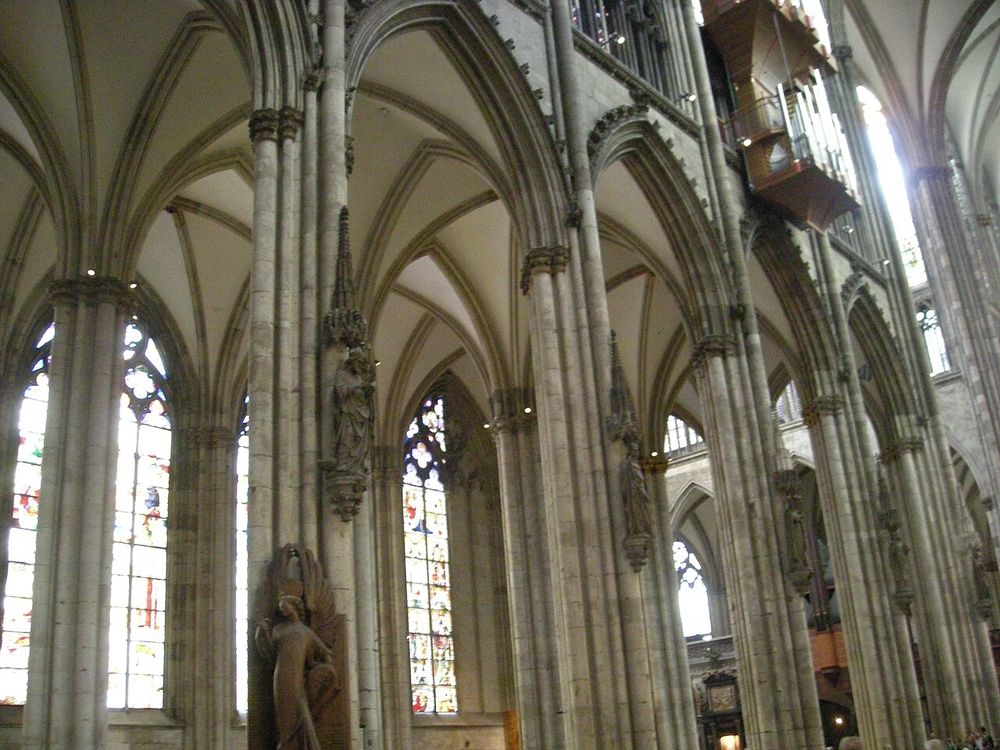
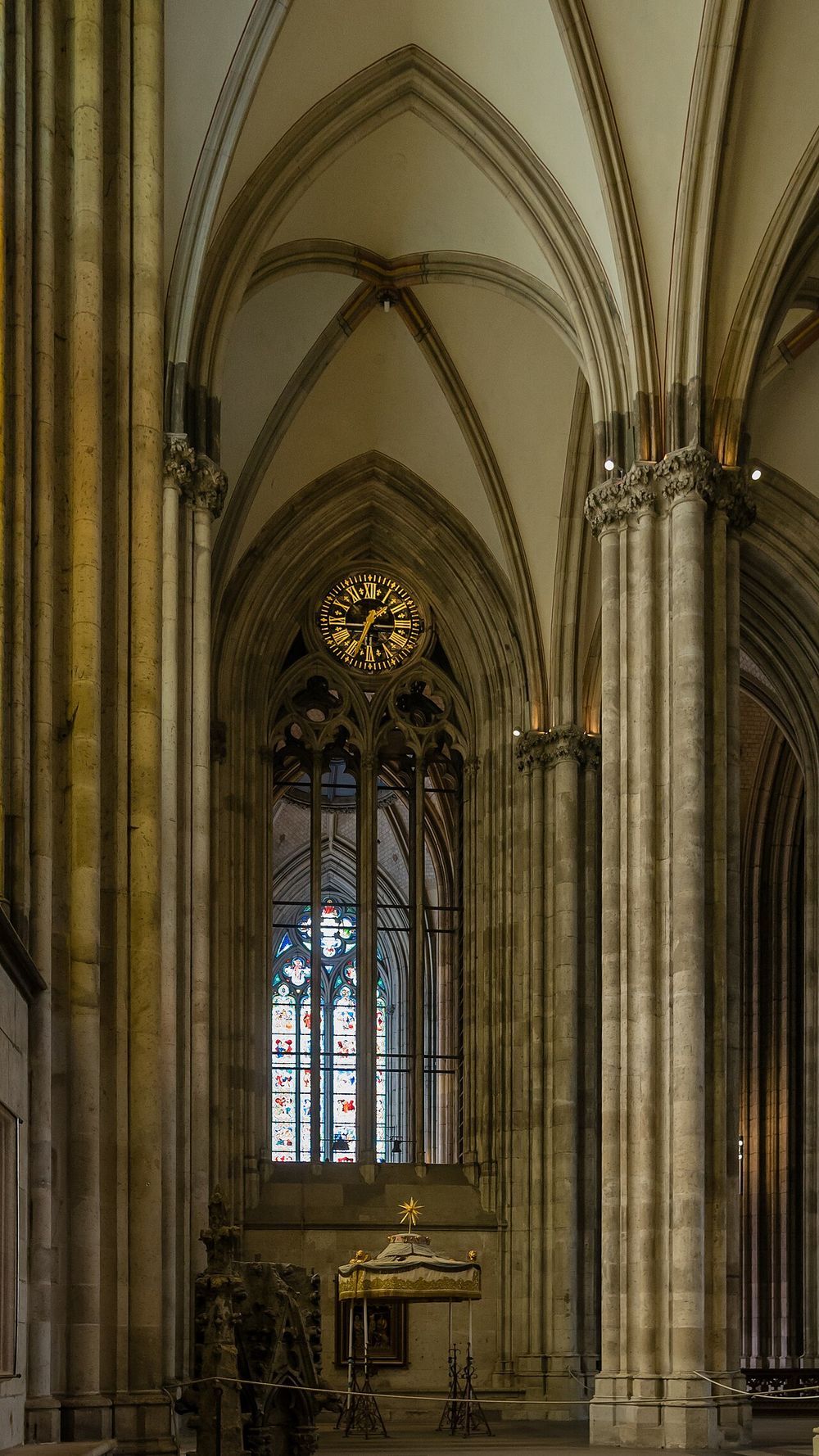
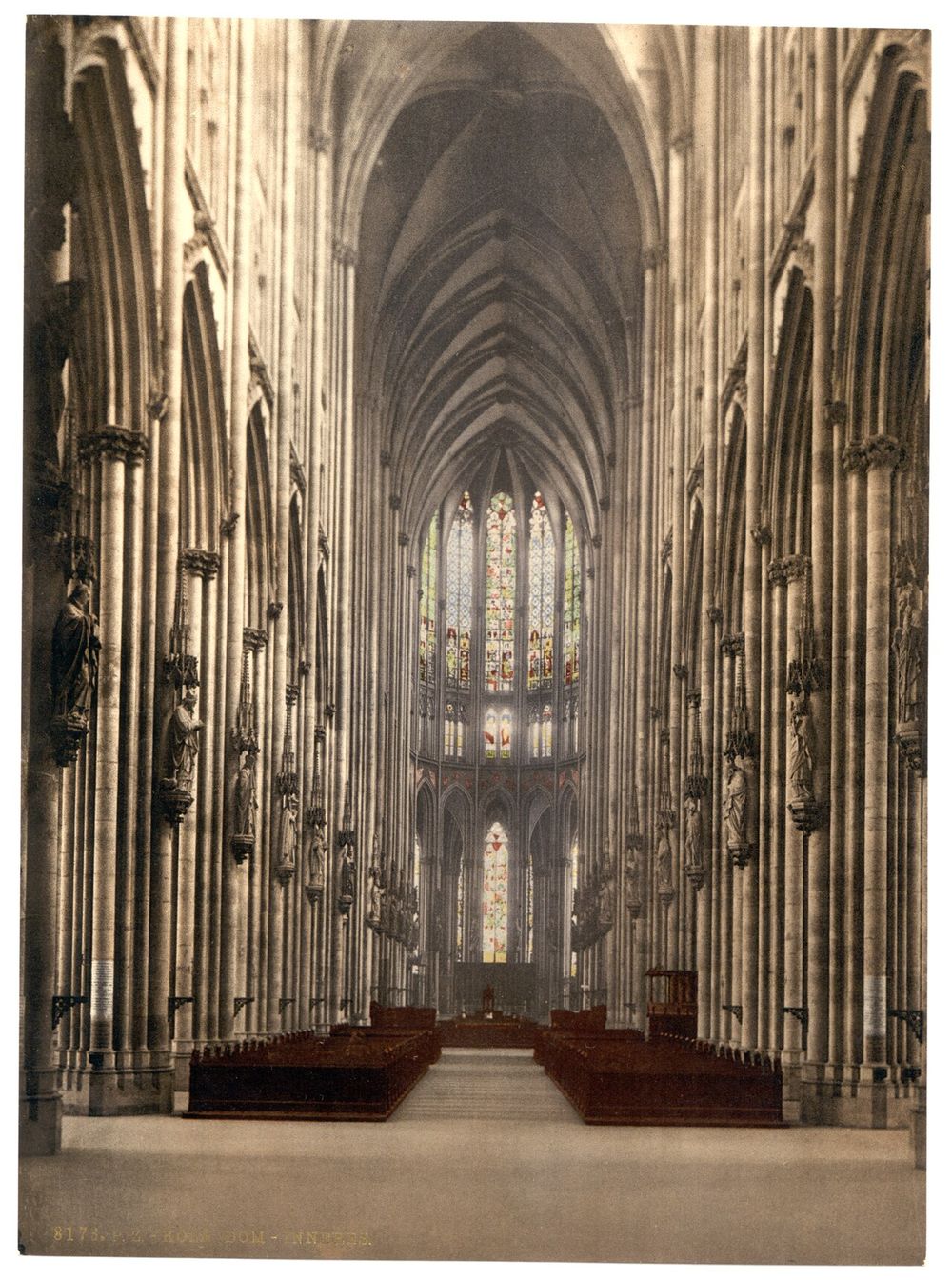
Inside, look straight up. The vault is forty-three metres above the floor, and the nave is narrow, so the height feels greater than it is. The piers run from floor to roof without a break.
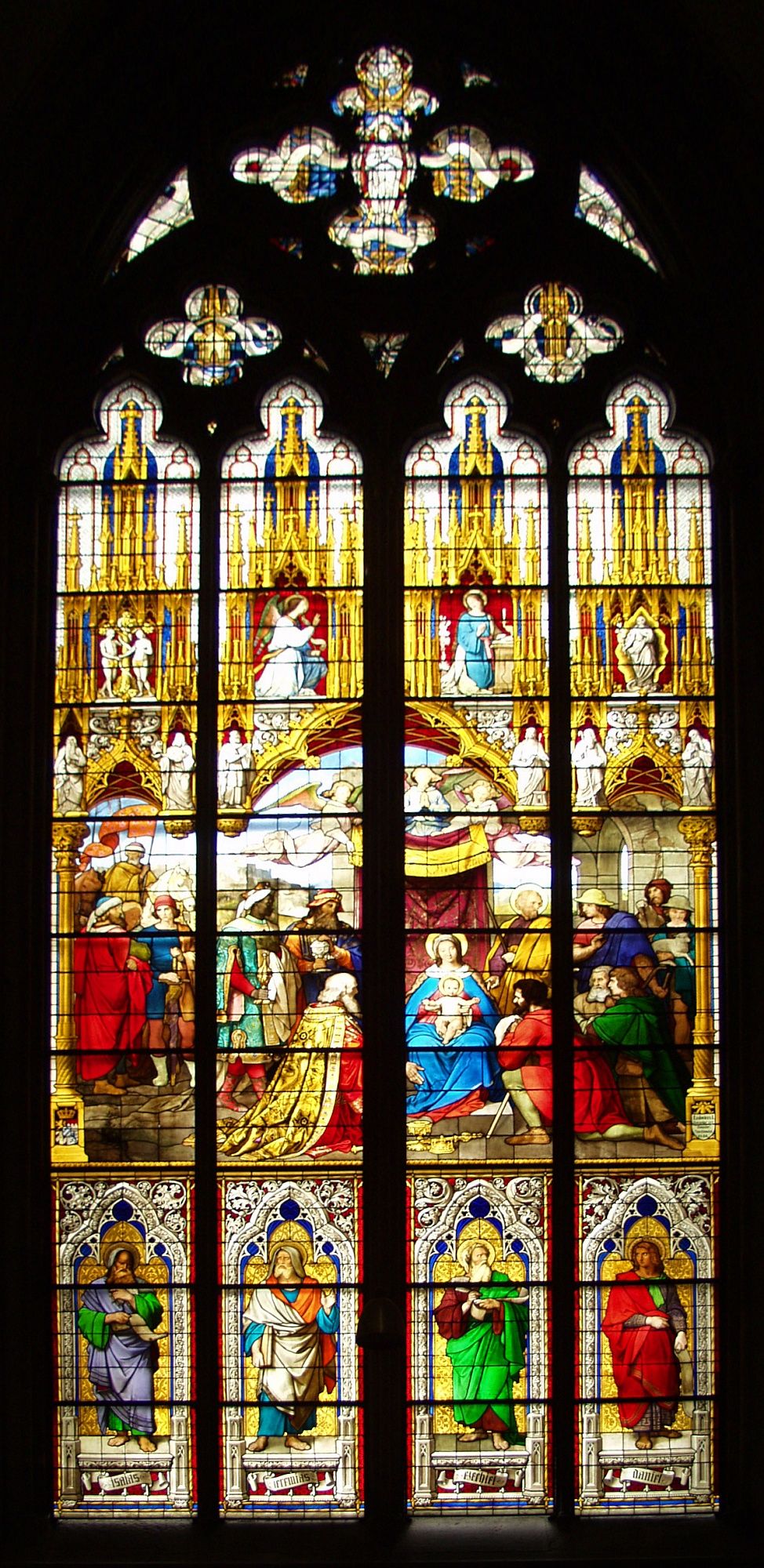
A window given by the king of Bavaria, 1848Raimond Spekking, CC BY-SA 3.0
The windows on the south side were given in 1848 by the king of Bavaria. Those on the north are from about 1508. Look for the difference: the old ones are darker and the faces are smaller.
3. The oldest cross
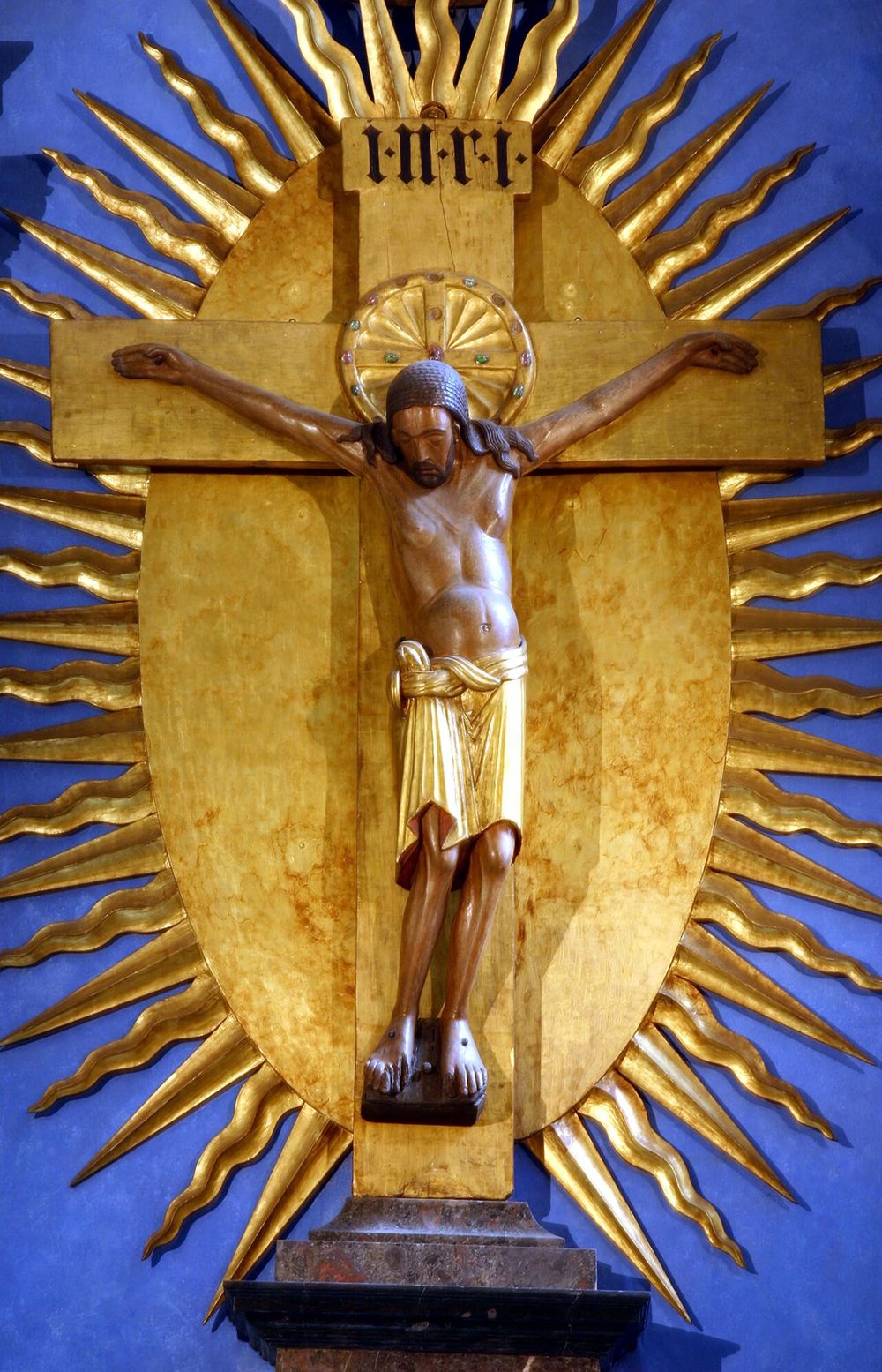
The Gero Cross, about 970No machine-readable author provided. Elya assumed (based on copyright claims)., CC BY-SA 3.0
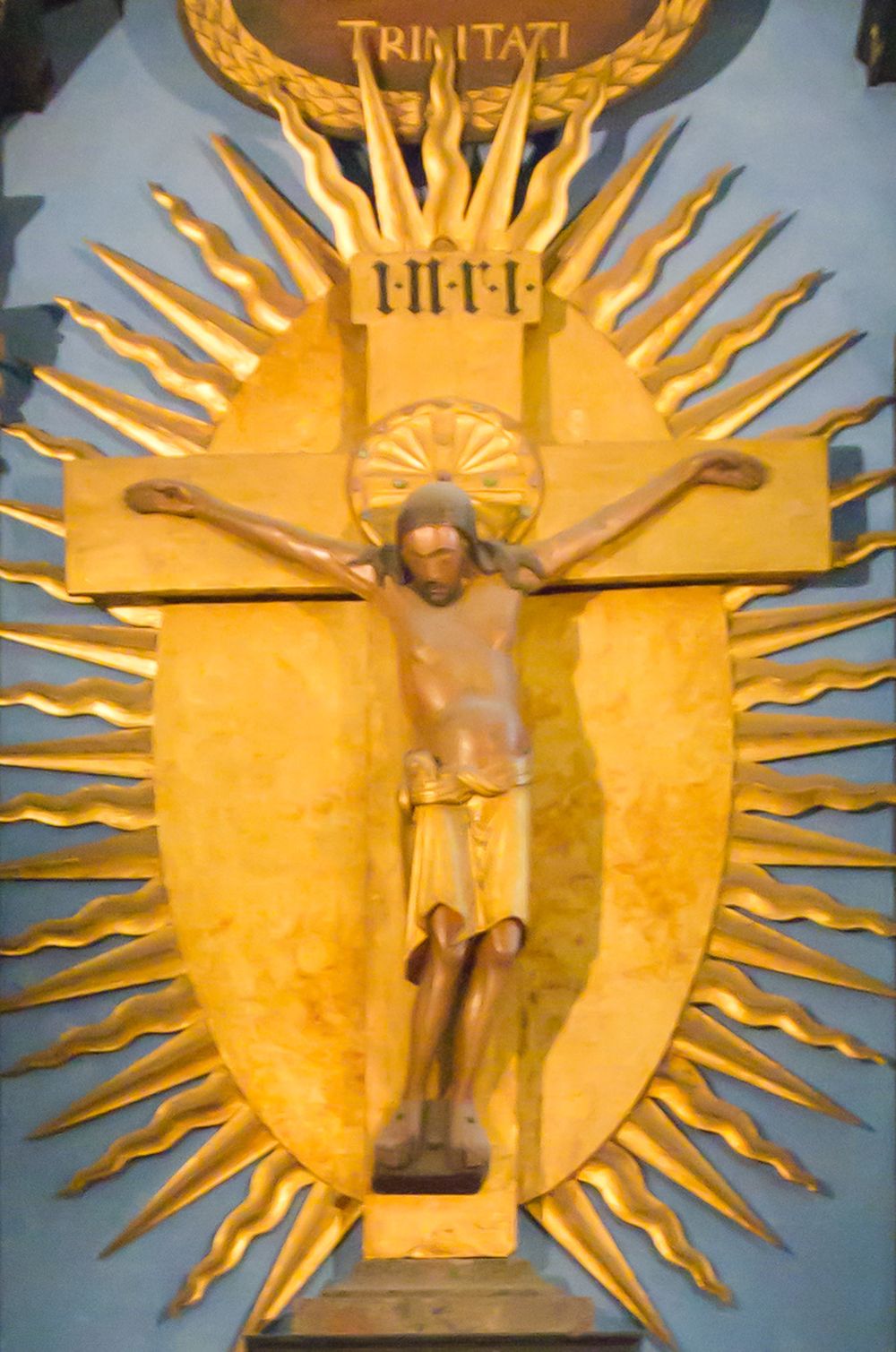
In a chapel on the north side hangs a crucifix carved in oak about 970. It is the oldest large one that survives north of the Alps. Christ is shown dead, his body sagging and his eyes shut. Before this, sculptors showed him alive and upright. Here, for the first time, he is a man who has died.
4. The golden box
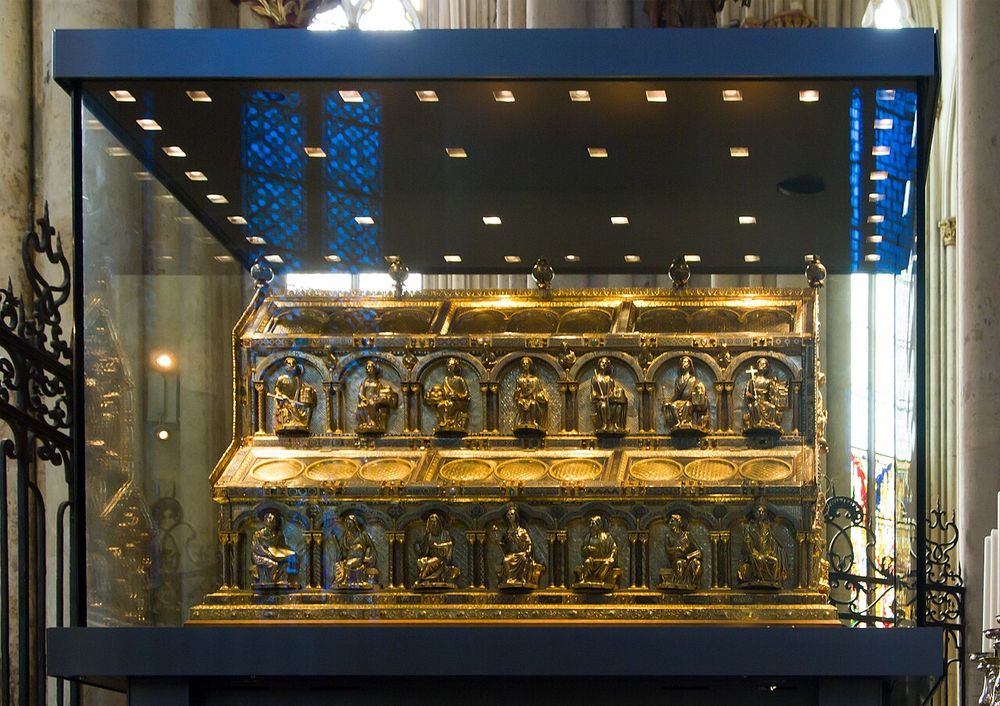
The shrine of the Three KingsPedelecs, CC BY-SA 3.0
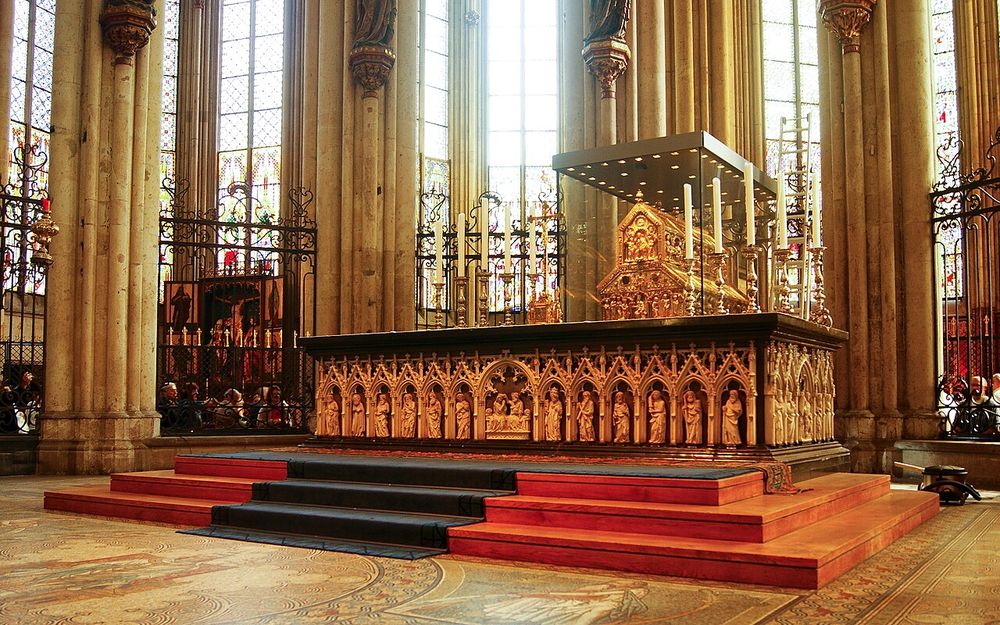
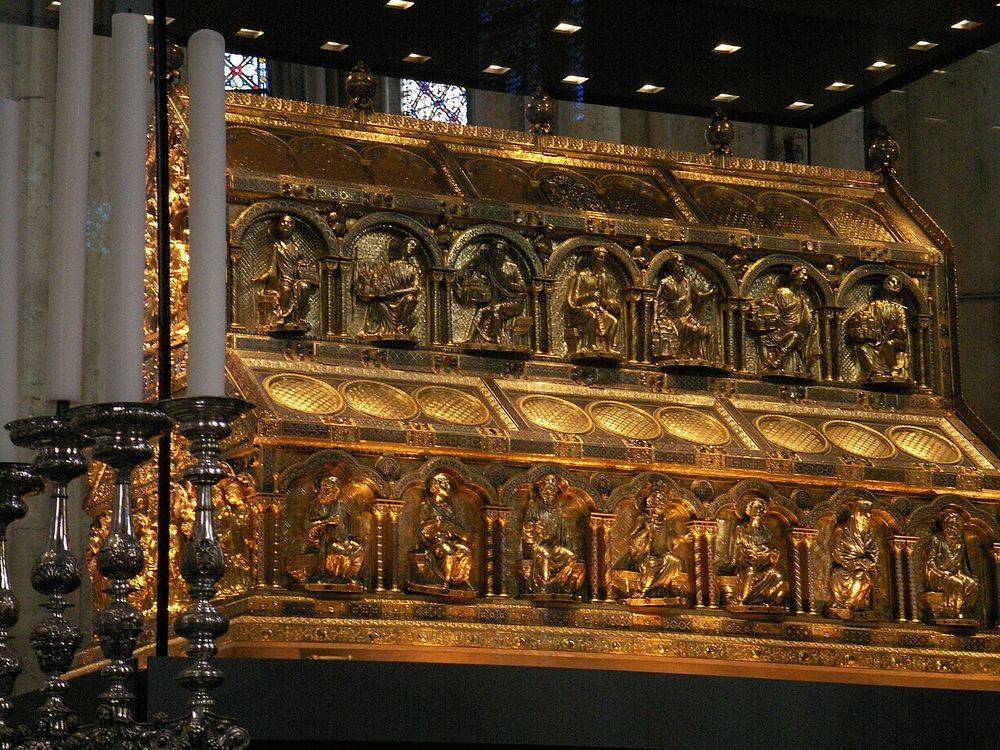
Behind the high altar, in a glass case, is the reason for the whole building: a chest of gilded silver in the shape of a church, over two metres long, made between about 1190 and 1225. It is the largest reliquary in western Europe. On its sides sit prophets and apostles; on the front the three kings bring their gifts, and a fourth figure follows them, a German king who paid for the gold.
It was opened in 1864. Inside were the bones of three men: one young, one in middle life, one old.
5. The choir
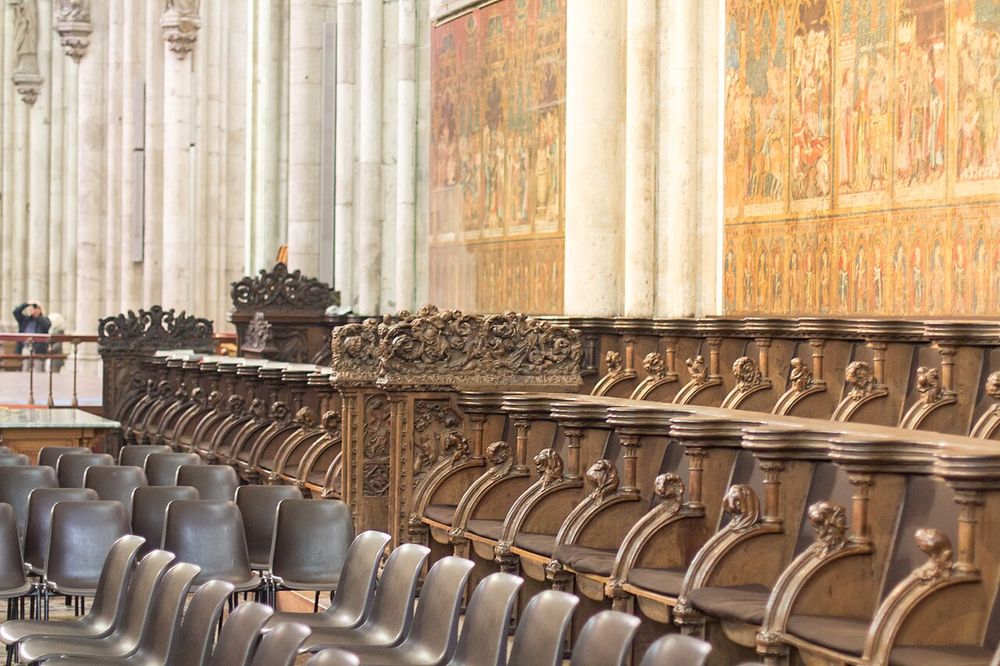
The choir stalls of about 1310Elke Wetzig, CC BY-SA 4.0
The oak stalls were carved about 1310 and have 104 seats, more than any other set in Germany. Two were kept, by custom, for the pope and the emperor. Under the tip-up seats are small carvings of monsters, acrobats and couples dancing.
The Milan Madonna, about 1290Doppelklecks, CC BY-SA 4.0
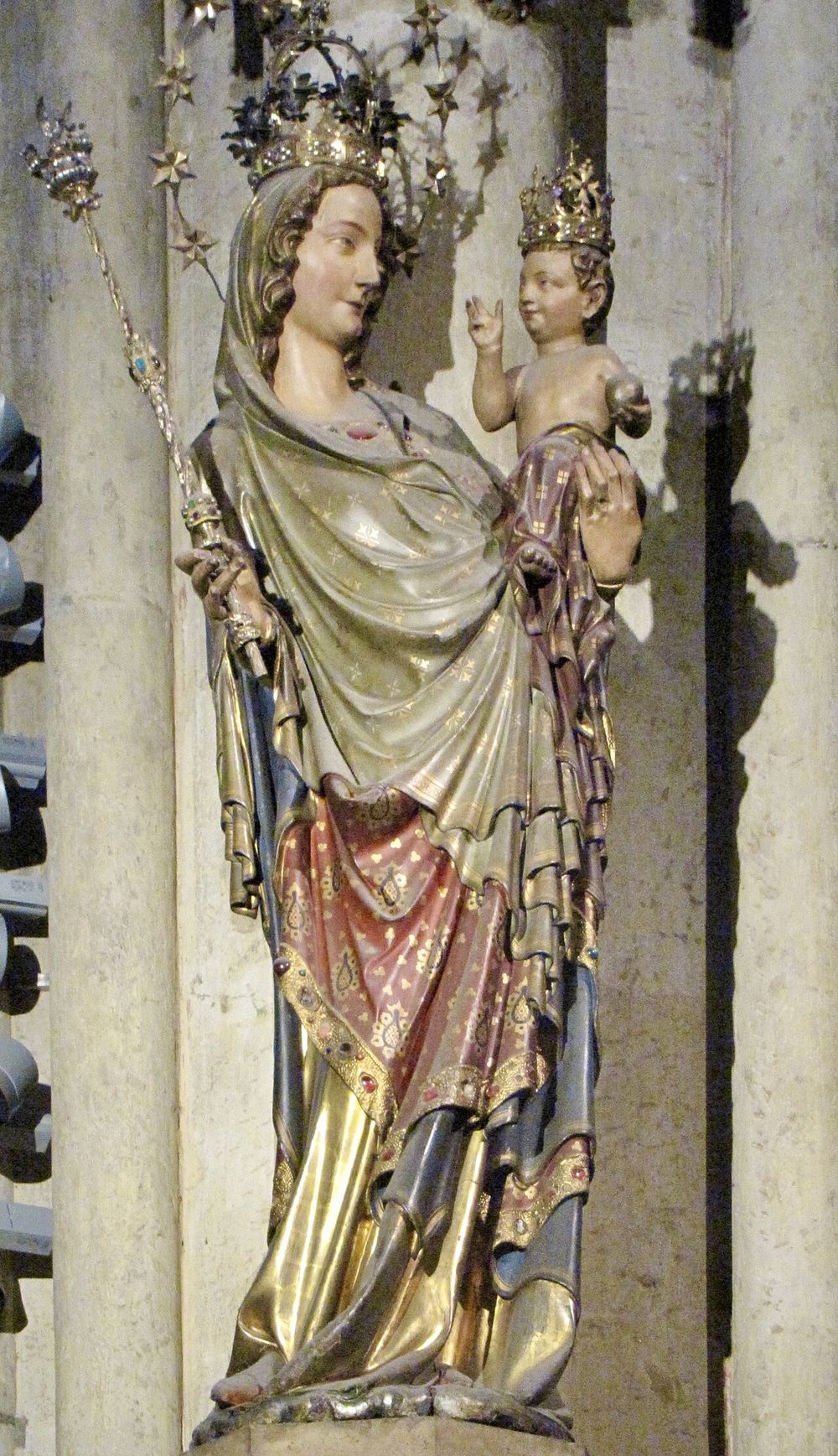
Near the choir stands a painted wooden Virgin of about 1290, slender and smiling. She replaced an older figure, brought from Milan with the relics, that was lost in a fire.
6. The painting with the city's saints
Lochner's altarpiece of the city's patrons, about 1445Stefan Lochner, CC BY 3.0
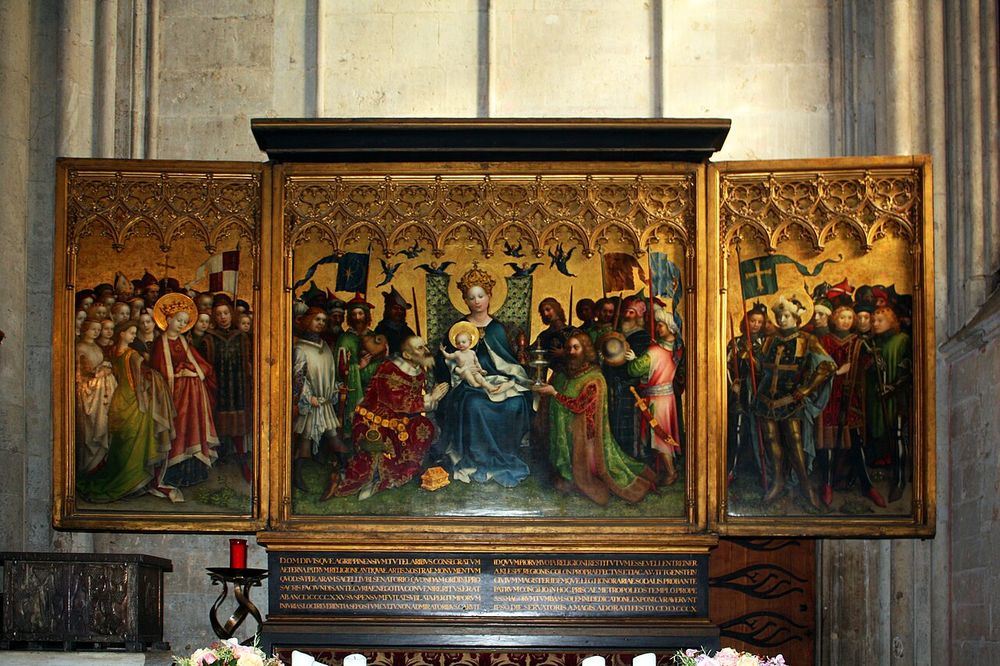
Stefan Lochner painted this altarpiece for the town hall chapel about 1445. In the middle the kings kneel to the child. On the wings are the city's own martyrs. The gold ground is real gold leaf, punched with a pattern.
Doch siehe! dort im Mondenschein
Den kolossalen Gesellen!
Er ragt verteufelt schwarz empor,
Das ist der Dom von Köllen.
But look! there in the moonlight,
that colossal fellow!
He looms up devilish black:
that is the cathedral of Cologne.
Heinrich Heine, Deutschland. Ein Wintermärchen, Caput IV, 1844; our translation
7. The tower
Inside the stone cage of the spireAnil Öztas, CC BY-SA 4.0
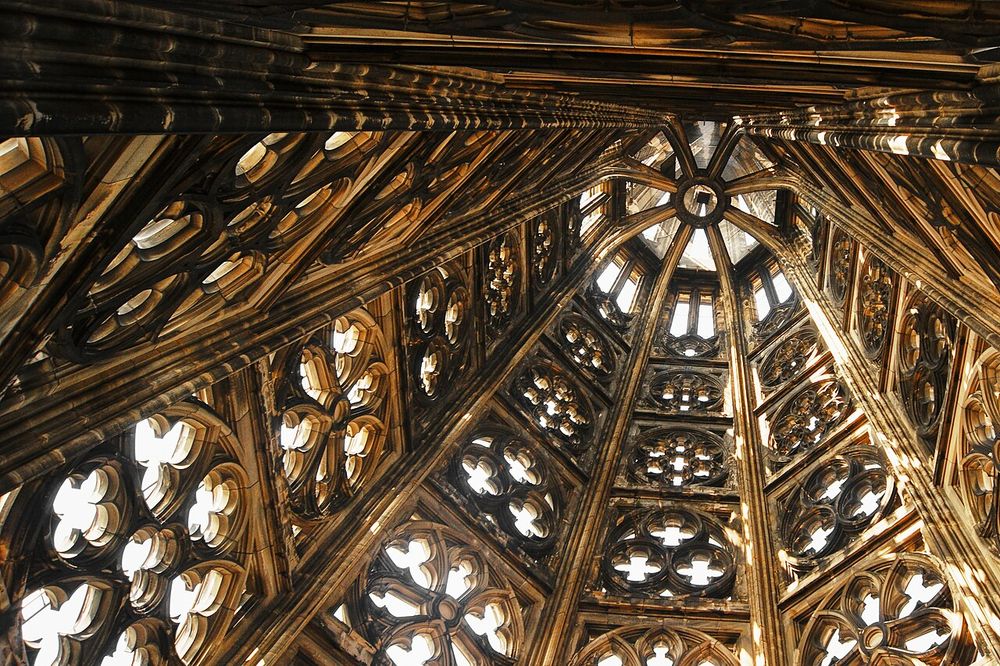
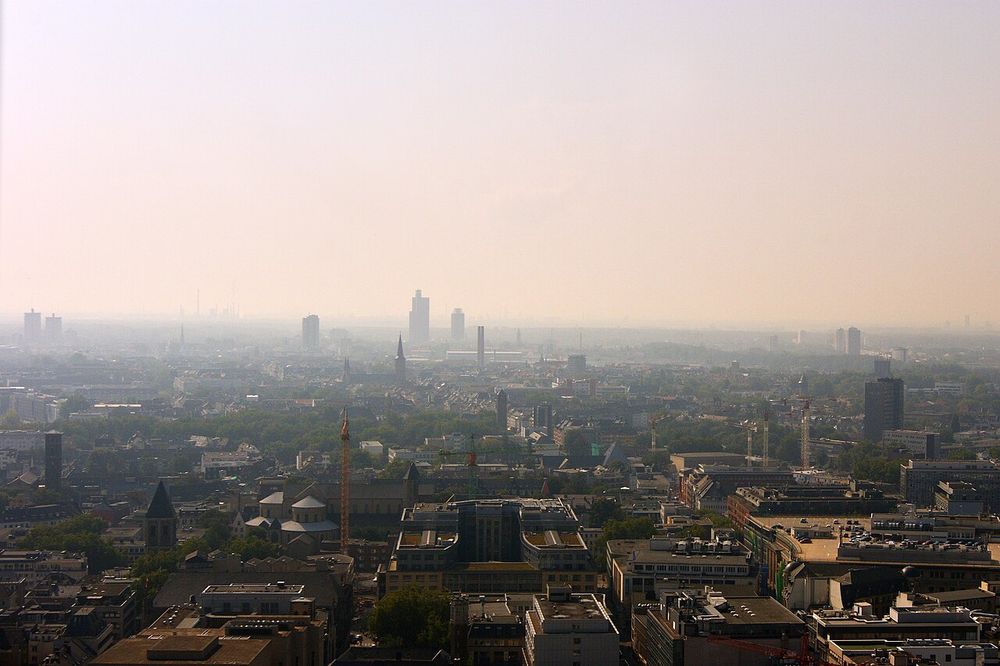
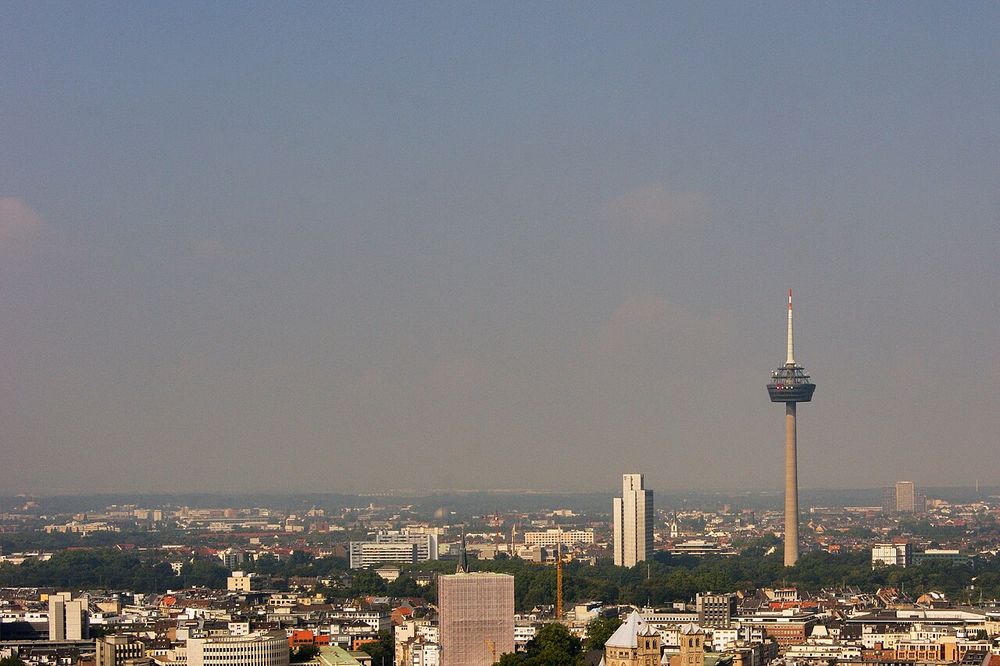
The climb is 533 steps up a stone spiral in the south tower, to a platform ninety-seven metres up. The last part is inside the spire itself, which is not solid but a cage of stone tracery. You can see the sky through it.
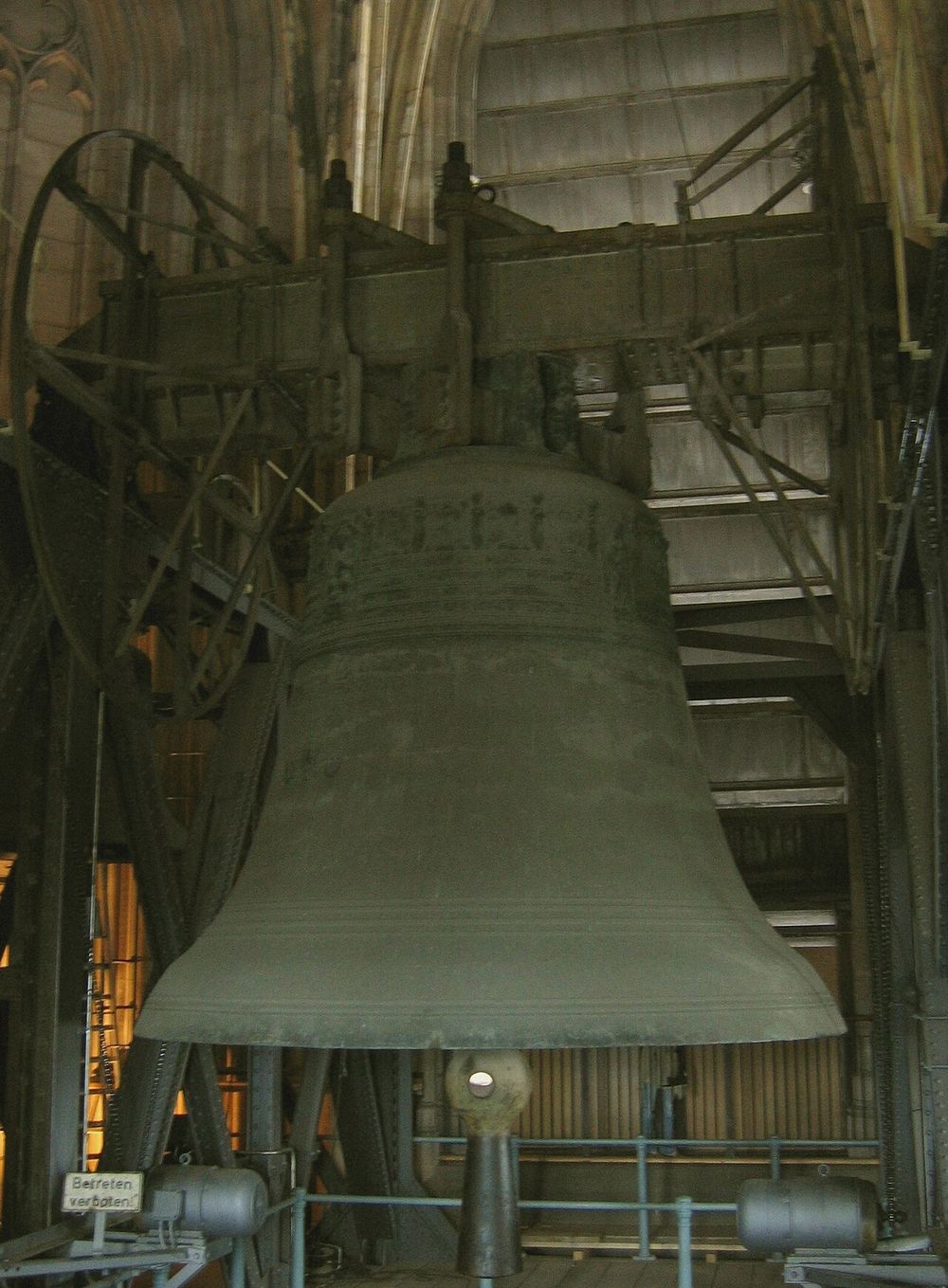
The great bell with its new clapper, January 2012Elke Wetzig (Elya), CC BY-SA 3.0
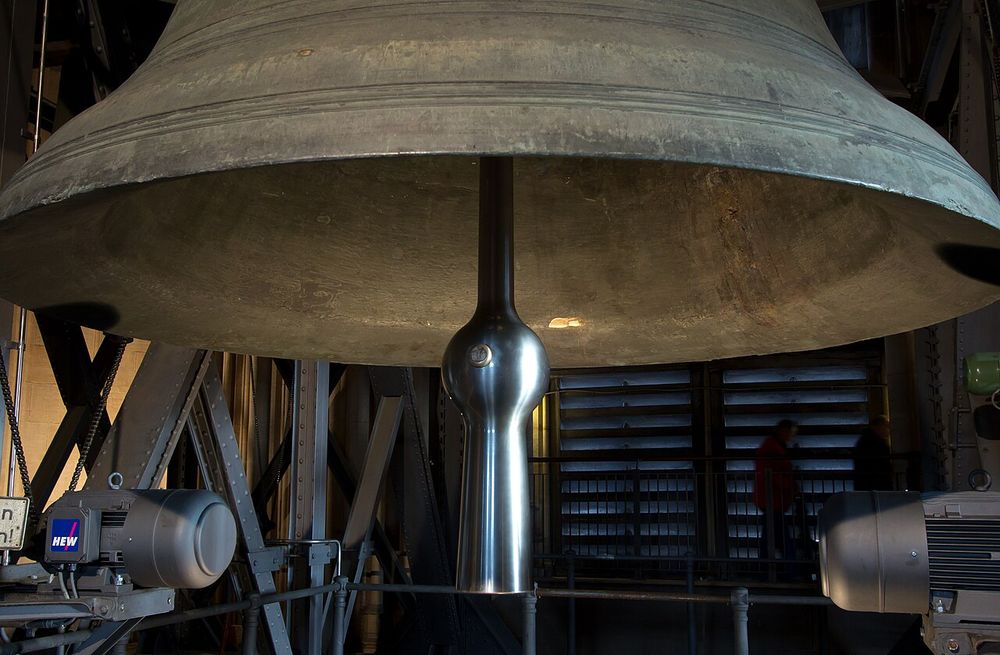
On the way you pass the bells. The biggest, cast in 1923, weighs twenty-four tonnes. The people of Cologne call it Fat Peter. It is rung on a few feast days a year. In January 2011 its clapper, the weight of a small car, snapped and fell.
8. From across the river
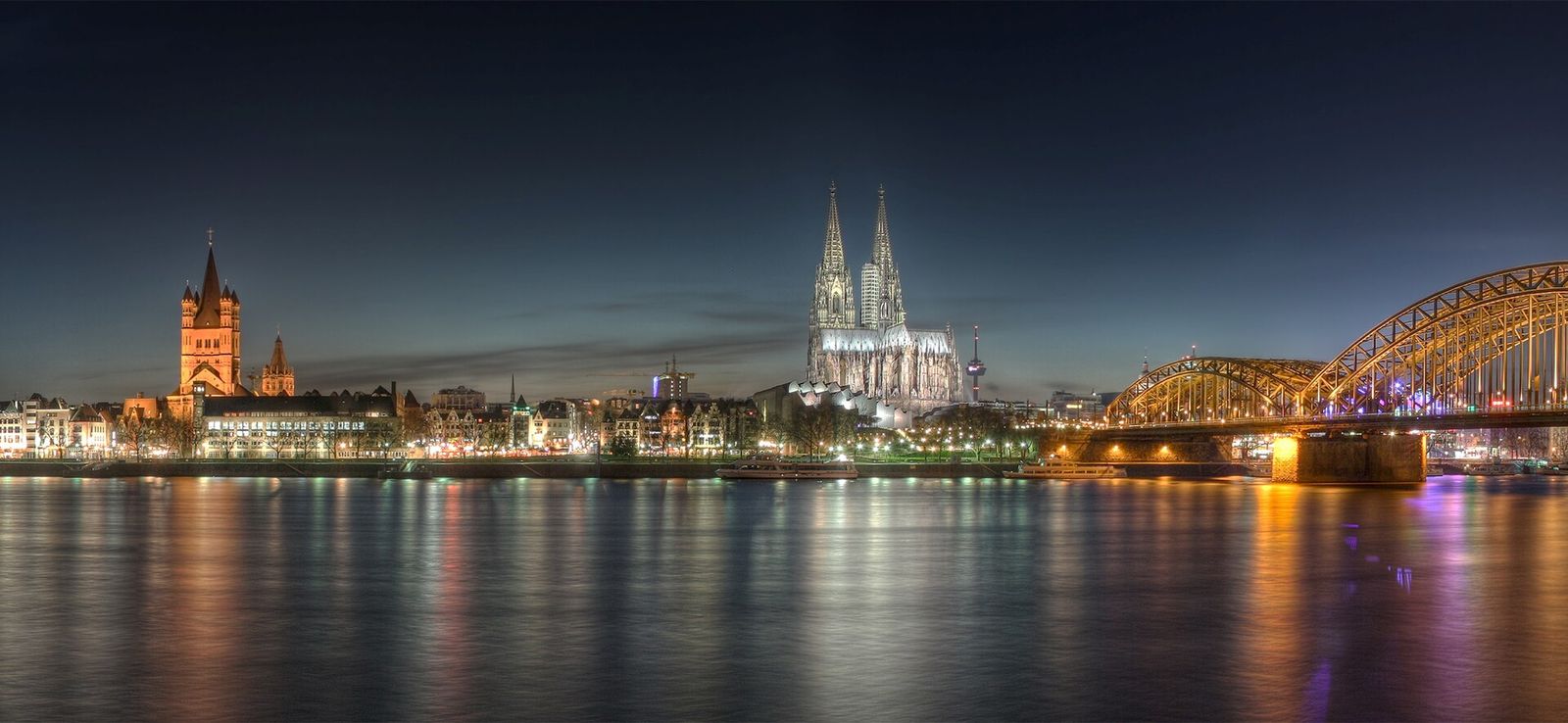
The cathedral and the bridge at duskCologne_-_Panoramic_Image_of_the_old_town_at_dusk.jpg: Ahgee ASR688 derivative w, CC BY-SA 3.0
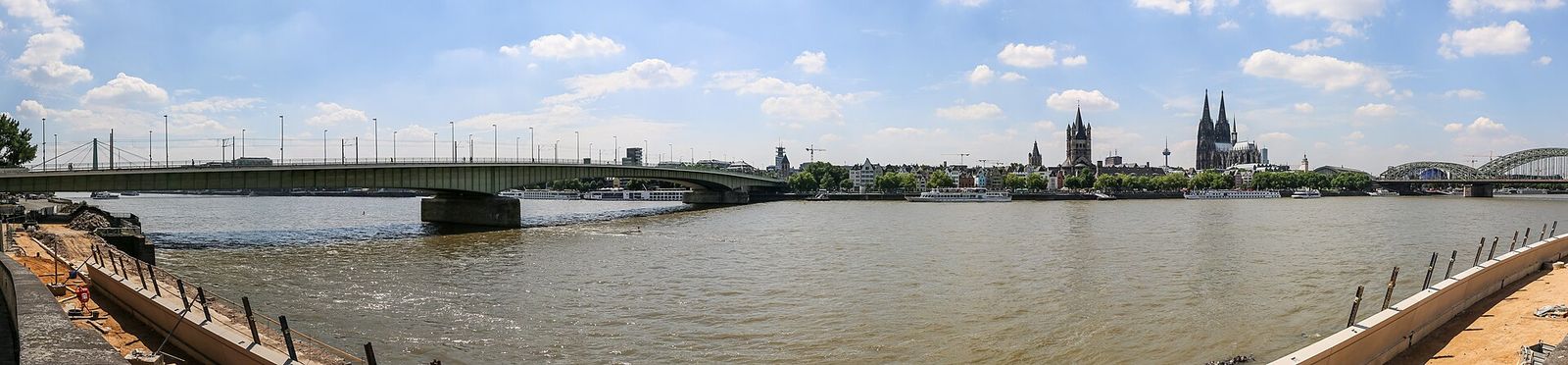
The same shot: the classic view, with the iron railway bridge leading the eye to the spires, is taken from the steps on the east bank, just south of the bridge, as the lights come on. The fence of the bridge's footpath is hung with tens of thousands of padlocks left by couples.
The cathedral above the ruins, 9 March 1945Clark (Mr), Royal Air Force official photographer, Public domain
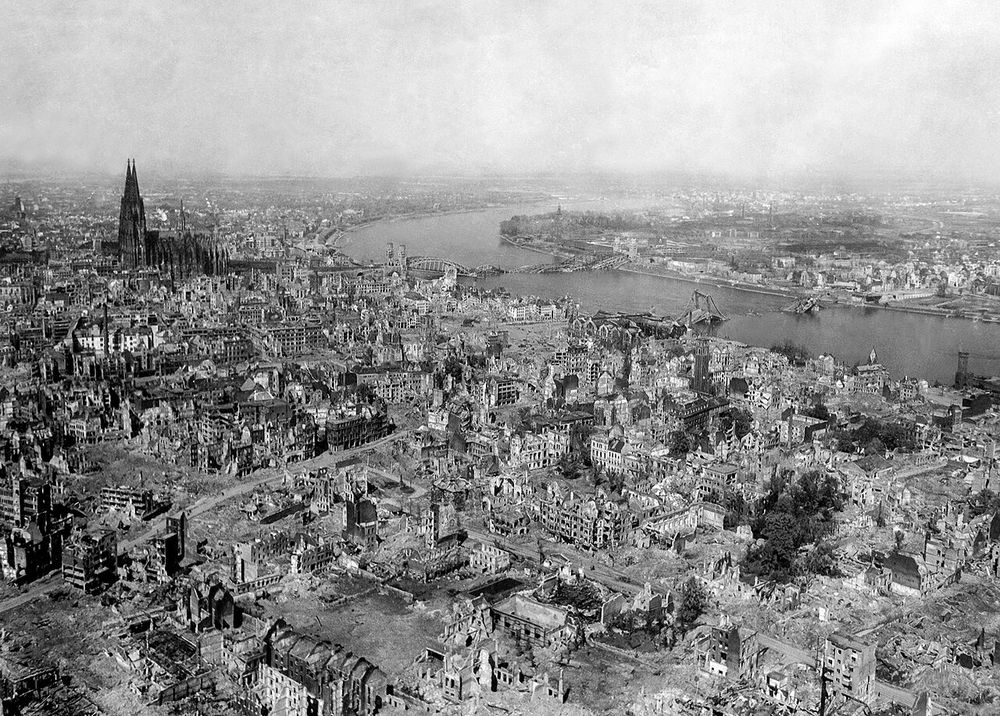
In the photographs of March 1945 the same view shows the bridge in the river and the city flat. Only the cathedral stands.
Meanwhile in the world
Year
Here
Elsewhere
1164
The relics of the Three Kings arrive
In England Thomas Becket quarrels with his king and flees
1248
The first stone is laid
The king of Castile takes Seville from the Muslims
1322
The choir is consecrated
Dante has died the year before
1520
Work stops
Luther burns the pope's letter in Wittenberg
1842
Work begins again
The first anaesthetic is used in surgery
1880
The cathedral is finished
Edison's light bulb goes on sale
1945
The city is destroyed; the cathedral stands
The war ends in Europe in May
1996
It joins the World Heritage list
A sheep called Dolly is cloned
2026
Visitors pay for the first time
The football World Cup is played in North America
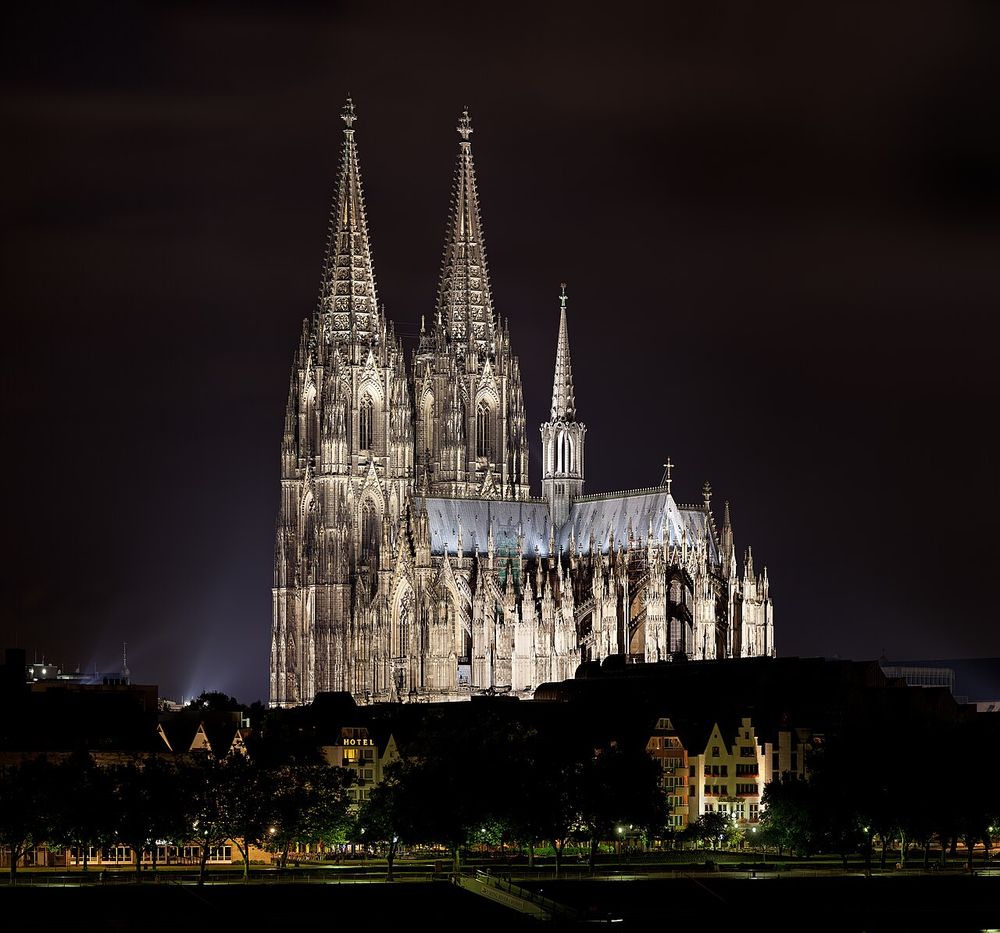
One line to remember: begun for three kings, finished for an emperor, and never really finished.
Then and now
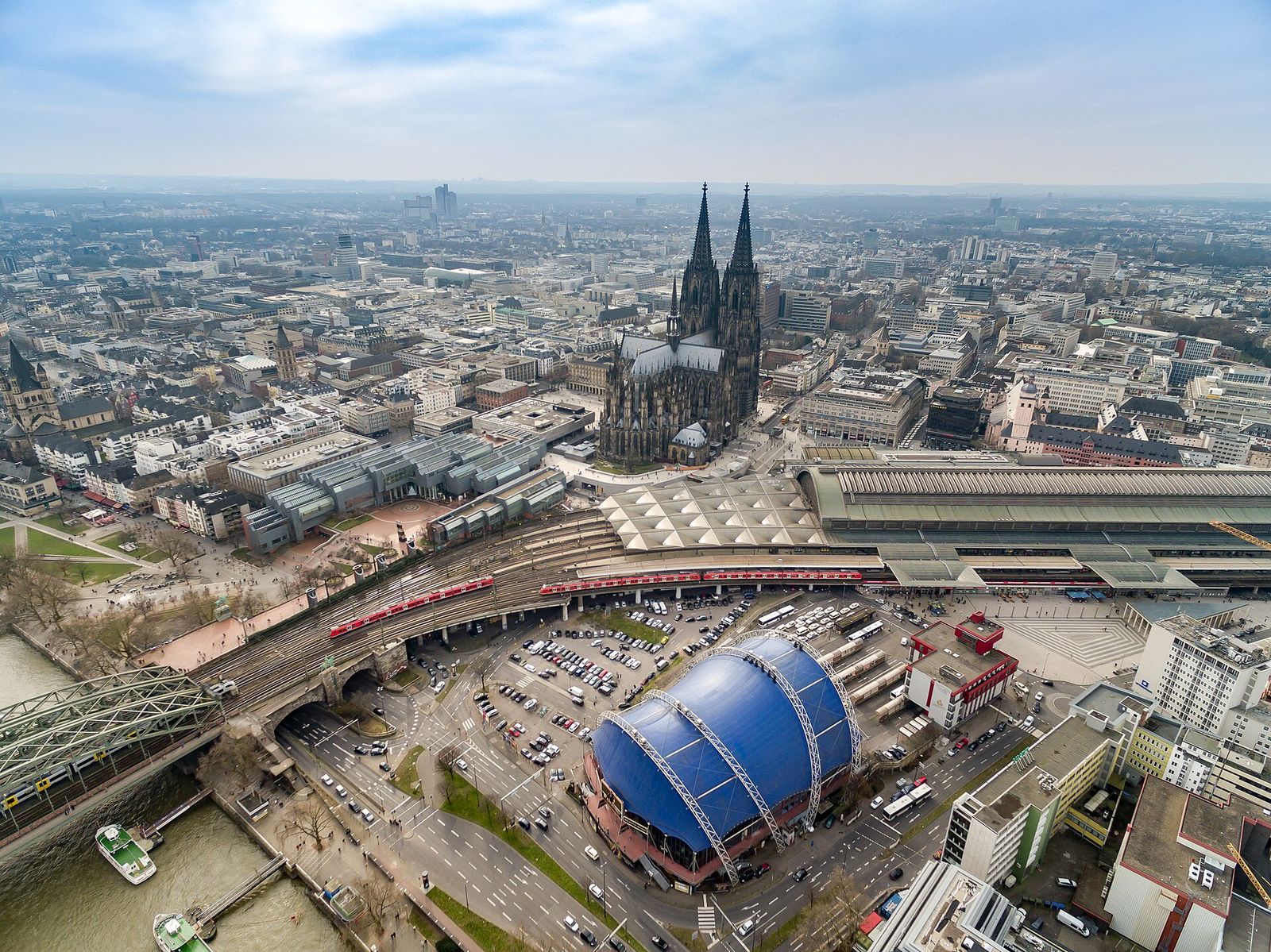
The cathedral and the station from the air, February 2016dronepicr, CC BY 2.0, Wikimedia CommonsThe cathedral and the old town from the airDronepicr, CC BY 3.0, Wikimedia CommonsThe cathedral beside the Rhine, from the airDronepicr, CC BY 3.0, Wikimedia CommonsCologne across the Rhine, 2014Dietmar Rabich, CC BY-SA 4.0, Wikimedia CommonsThe cathedral and the bridge at duskCologne_-_Panoramic_Image_of_the_old_town_at_dusk.jpg: Ahgee ASR688 derivative w, CC BY-SA 3.0, Wikimedia CommonsThe west front, April 2011Raimond Spekking, CC BY-SA 3.0, Wikimedia CommonsThe two spires, June 2013Raimond Spekking, CC BY-SA 4.0, Wikimedia CommonsApostles on the west doorsEraldo Tresoldi, CC BY-SA 3.0, Wikimedia CommonsThe Virgin and Child on the central doorEraldo Tresoldi, CC BY-SA 3.0, Wikimedia CommonsThe square from above, June 2013Raimond Spekking, CC BY-SA 4.0, Wikimedia CommonsThe south side and the squareRaimond Spekking, CC BY-SA 4.0, Wikimedia CommonsPiers and windows, July 2012Michael Barera, CC BY-SA 4.0, Wikimedia CommonsThe vaults of the naveMichael Barera, CC BY-SA 4.0, Wikimedia CommonsAn aisleCEphoto, Uwe Aranas, CC BY-SA 3.0, Wikimedia CommonsThe nave, May 2026Kaap bij Sneeuw, CC0, Wikimedia CommonsA window given by the king of Bavaria, 1848Raimond Spekking, CC BY-SA 3.0, Wikimedia CommonsThe Gero Cross, about 970No machine-readable author provided. Elya assumed (based on copyright claims)., CC BY-SA 3.0, Wikimedia CommonsThe Gero Cross in its later sunburstPedelecs, CC BY-SA 3.0, Wikimedia CommonsThe high altar, with the shrine behindCherryX, CC BY-SA 3.0, Wikimedia CommonsThe shrine of the Three KingsPedelecs, CC BY-SA 3.0, Wikimedia CommonsProphets and apostles on the shrineWelleschik, CC BY-SA 3.0, Wikimedia CommonsThe choir stalls of about 1310Elke Wetzig, CC BY-SA 4.0, Wikimedia CommonsThe Milan Madonna, about 1290Doppelklecks, CC BY-SA 4.0, Wikimedia CommonsLochner's altarpiece of the city's patrons, about 1445Stefan Lochner, CC BY 3.0, Wikimedia CommonsInside the stone cage of the spireAnil Öztas, CC BY-SA 4.0, Wikimedia CommonsThe view from the south tower, September 2011Anil Öztas, CC BY-SA 4.0, Wikimedia CommonsThe television tower from the cathedralAnil Öztas, CC BY-SA 4.0, Wikimedia CommonsThe great bell with its new clapper, January 2012Elke Wetzig (Elya), CC BY-SA 3.0, Wikimedia CommonsThe great bell of 1923Andreasdziewior, CC BY-SA 3.0, Wikimedia CommonsThe cathedral at night, August 2013Thomas Wolf, www.foto-tw.de, CC BY-SA 3.0 de, Wikimedia CommonsThe cathedral above the old fish market at nightRaimond Spekking, CC BY-SA 4.0, Wikimedia CommonsThe spires litRaimond Spekking, CC BY-SA 4.0, Wikimedia CommonsThe pageant for the finishing of the cathedral, 1880Tony Avenarius, Public domain, Wikimedia CommonsThe south side about 1900, colour printUnknown, Public domain, Wikimedia CommonsThe nave about 1900Unknown, Public domain, Wikimedia CommonsCologne in 1945, photographed by the American armyU.S. Department of Defense. Department of the Army. Office of the Chief Signal O, Public domain, Wikimedia CommonsThe cathedral above the ruins, 9 March 1945Clark (Mr), Royal Air Force official photographer, Public domain, Wikimedia Commons
Local legends
These are stories people tell about this place. They are legends, not history, and each one says where it comes from.
LegendThe master and the devil
The first master mason made a bet with the devil that he would finish the cathedral before the devil could bring water to the city by a canal. The devil won. The master threw himself from the scaffold, and the cathedral stood unfinished.
Source: Printed by the Brothers Grimm in their German Legends, 1816
LegendThe end of the world
When the cathedral is finished, the world will end.
Source: A Cologne saying; the masons' yard has never closed
LegendThe beans
Half the great drawing of the west front was found in 1814 in the loft of an inn at Darmstadt, stretched out to dry beans on.
Source: Told by Boisserée and his friends; the other half was found in Paris in 1816
Later, people who live here will be able to add the stories they grew up with, and say which of these they have heard.
Not certain, and where accounts conflict
Whose bones are in the shrine?
The Gospel says only that wise men came from the east. It does not say three, or kings. The bones cannot be traced before the 1100s in Milan. A piece of cloth found with them in 1864 is silk of the 2nd or 3rd century from Syria.
Is charging right?
The chapter says the building costs 44,000 euros a day to keep and that ninety-nine in a hundred who enter are tourists. Critics in Cologne say a church should not have a till at the door. On the first day most visitors asked by reporters said the price was fair.
Visiting
Tickets and hours
12 euros from 1 July 2026; 6 euros for students. Children up to 13 are free, here and in the tower and treasury.
Visiting hours are about 10:00 to 17:00 from Monday to Saturday and 13:00 to 16:00 on Sundays. There is no visiting during services.
The tower costs 8 euros and is open from 9:00 to 18:00 from March to October and to 16:00 in winter.
Entry is free on 1 May and 3 October.
Last checked 2026-11-12. The cathedral chapter's announcements of June 2026 as reported by German news agencies, and Cologne city listings.
Booking from abroad
Official page in English The cathedral sells visitors' tickets on its own site, in English, and takes foreign bank cards. Since 1 July 2026 visitors enter by the west door and leave by the north door.
Ticket window on site Tickets are also sold at the door.
Note No document is needed. If you come to pray, light a candle or attend a service, say so at the north door and go in free; you may not walk round.
Checked 2026-11-12
Where to start
The main railway station is beside the cathedral. You see the spires as you step off the train.
Climb the tower first, at 9:00, then go in when the church opens to visitors.
Come back after dark to see the front lit.
Before you go
The tower has no lift, and the stair is narrow, with people coming down as you go up.
The square is known for pickpockets. Keep your bag in front of you.
Rucksacks larger than cabin size are not let in.
Customs and manners
Men in red robes with staffs keep order. They are the cathedral's own wardens. If one asks you to take off your hat or lower your voice, do it.
At noon a short prayer is said over the loudspeakers. Stand still until it ends.
During Carnival, on the Thursday before Lent and the Monday after, the city is one party and the area round the cathedral is fenced.
In Cologne you say "der Dom", never "the church". The city is fond of it in the way a family is fond of a difficult old relative.
Look for these
Find a patch of pale new stone on the front.
Find the stone finial on the square. How tall is it?
Inside, find the dead Christ of 970. Are his eyes open?
On the shrine, find the fourth king.
Under a choir seat, find a monster.
Find a window from 1508 and one from 1848.
In the spire, can you see the sky through the stone?
From the bridge, find the padlocks.
I am here
Stand at the site, sign in, press the button, and collect its stamp. Your browser will ask to use your location. It is sent to us once to confirm that you are at the site; we keep how far you were from it, not the spot where you stood.
Your stamps are saved to your account, so they follow you to any device. Checking from a browser cannot rule out every false location; stricter checks arrive with the app.
Messages
Share your photos
Photos here show the place, not people. Each one is credited to the visitor who took it and appears after our team has looked at it. A photo with you in it belongs under “I am here”.