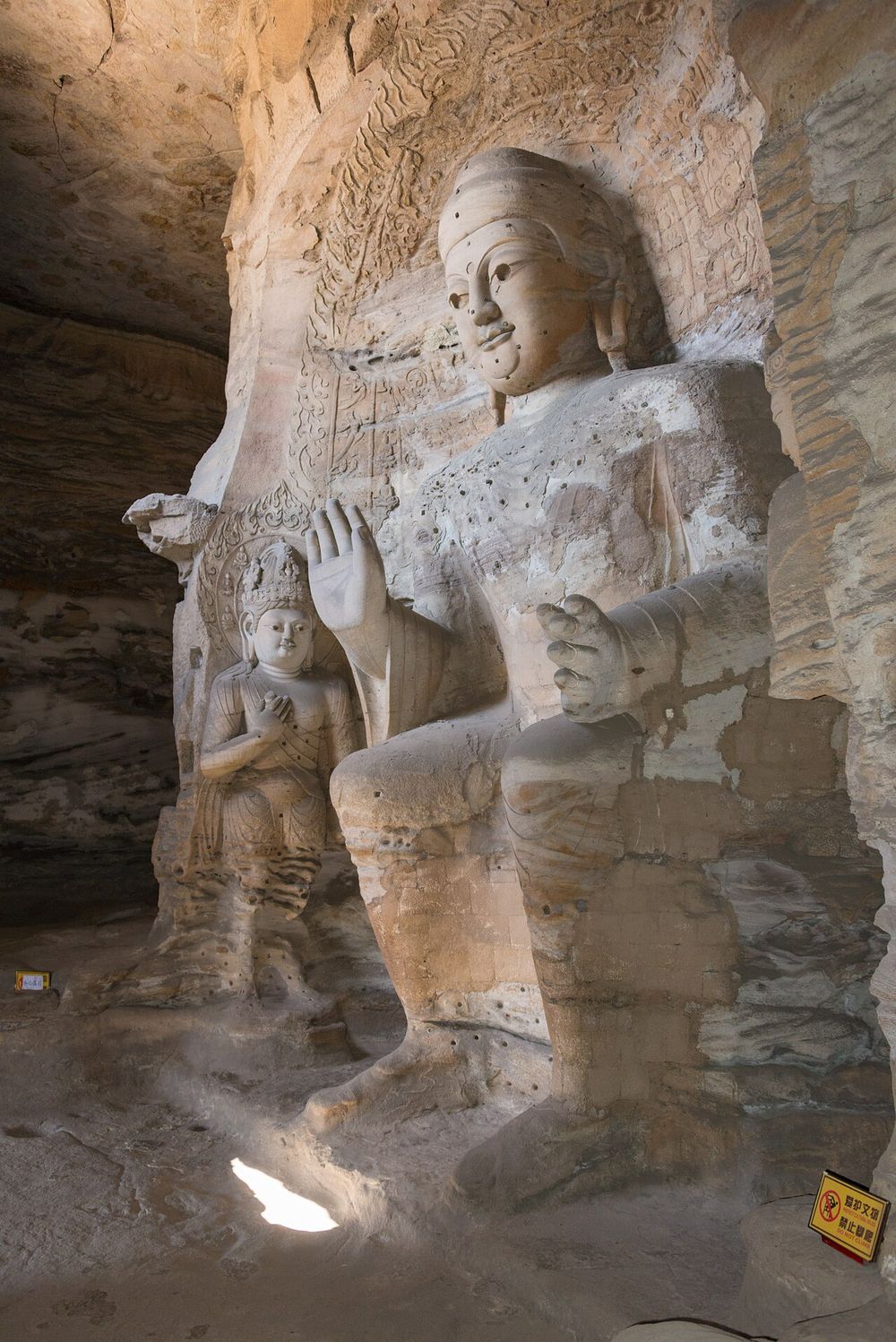
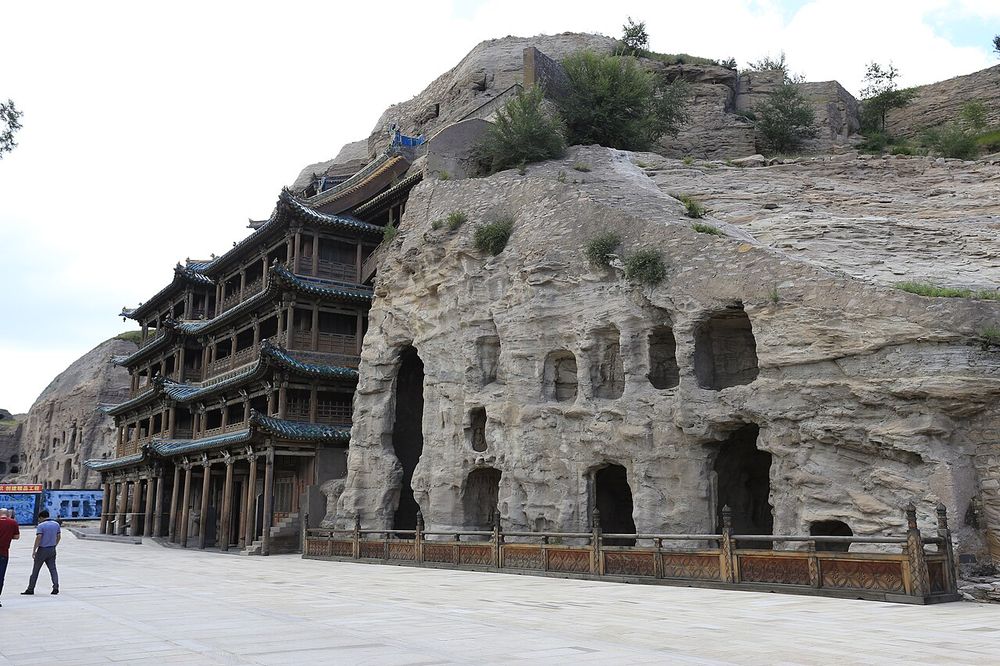
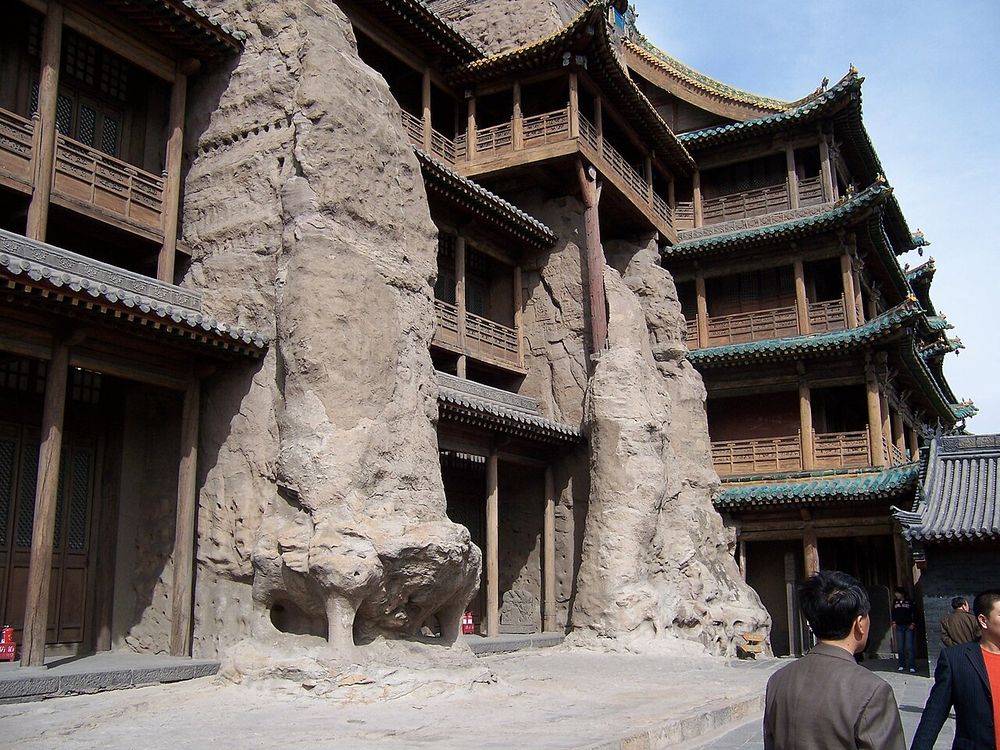
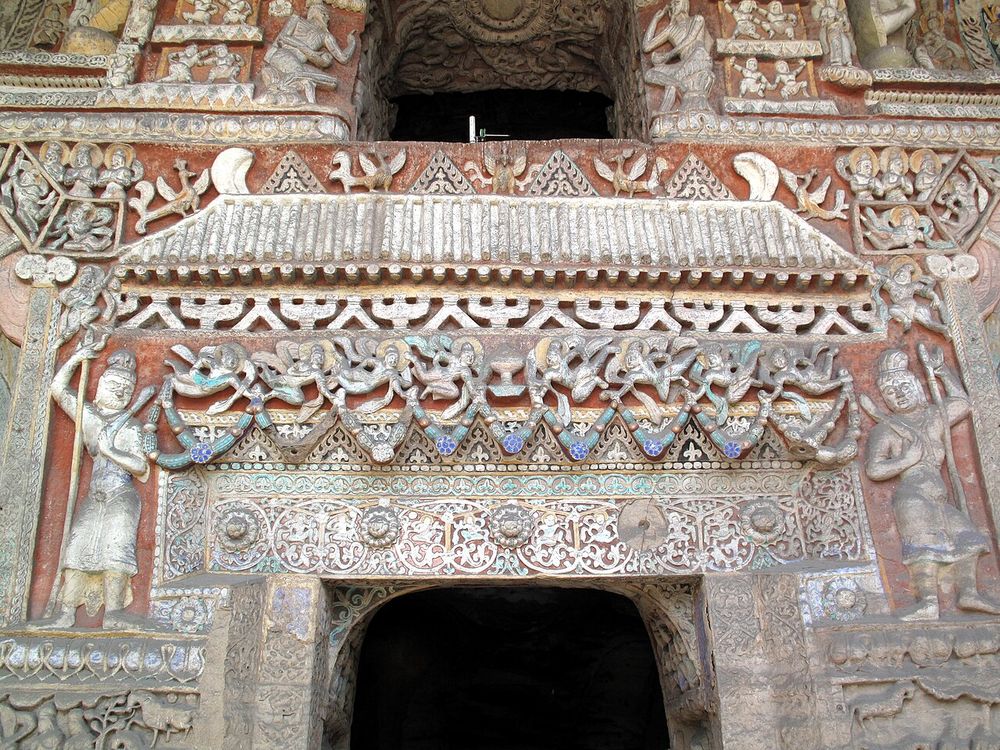
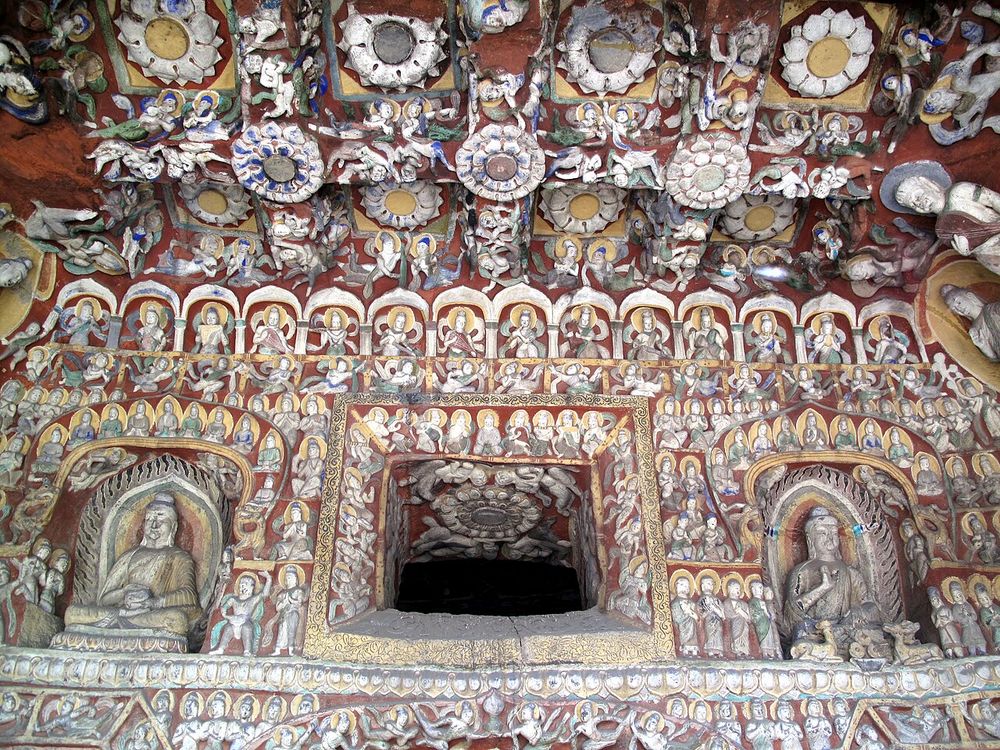
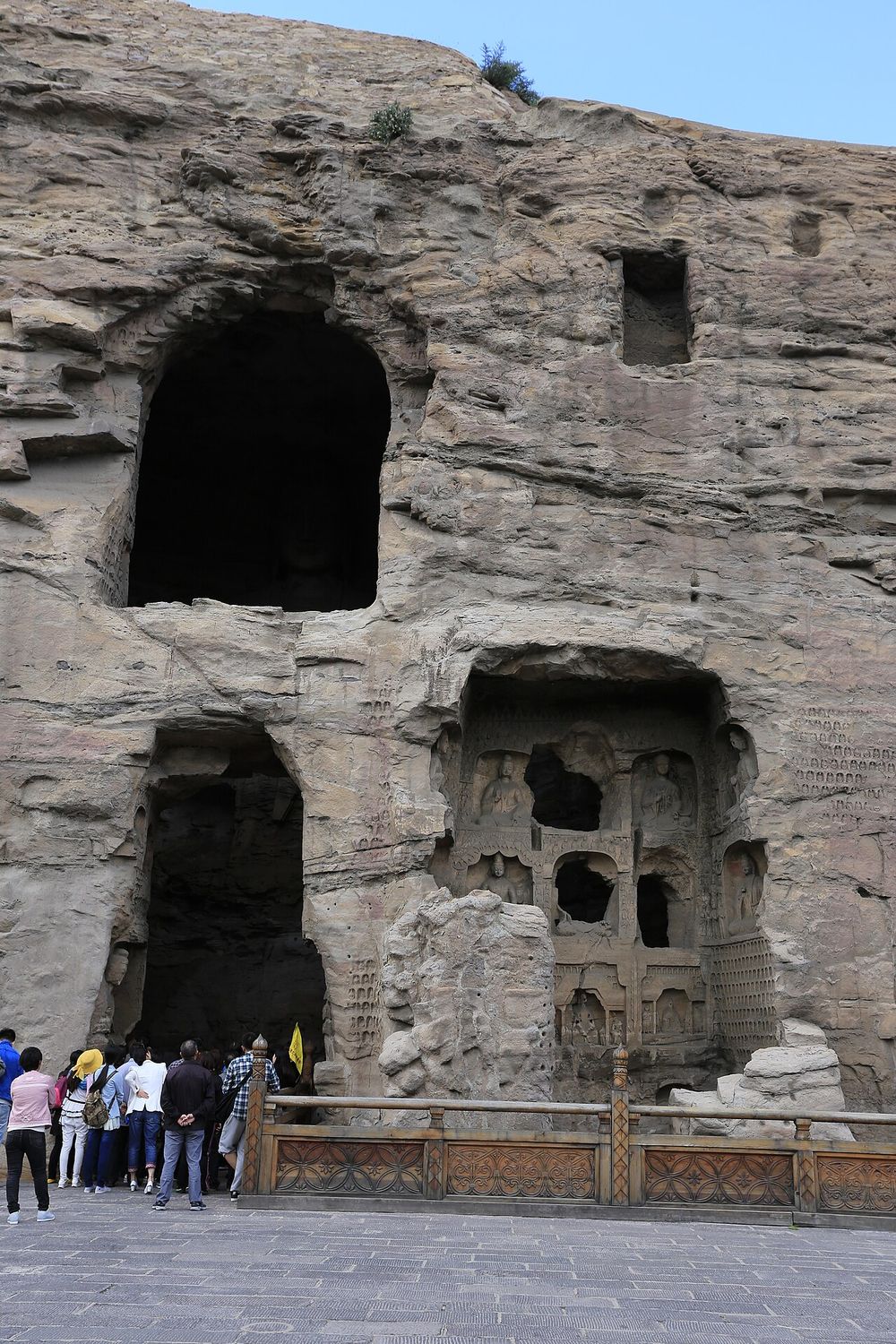
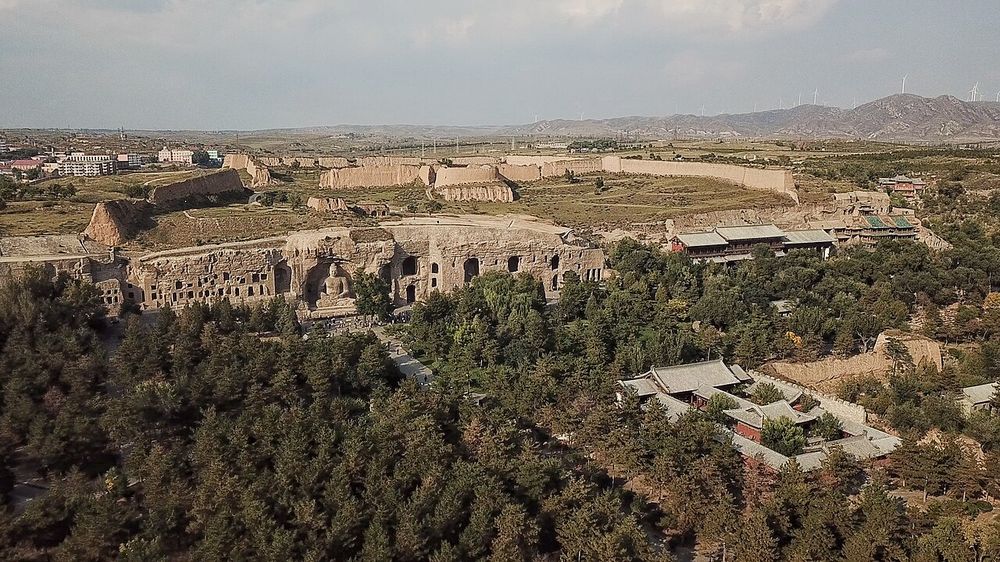
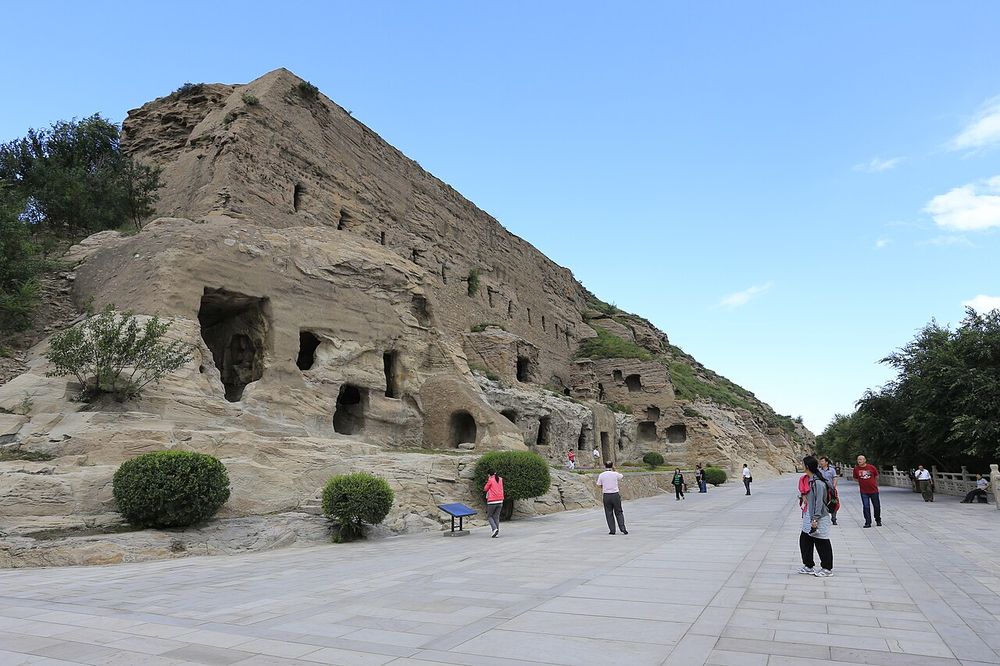
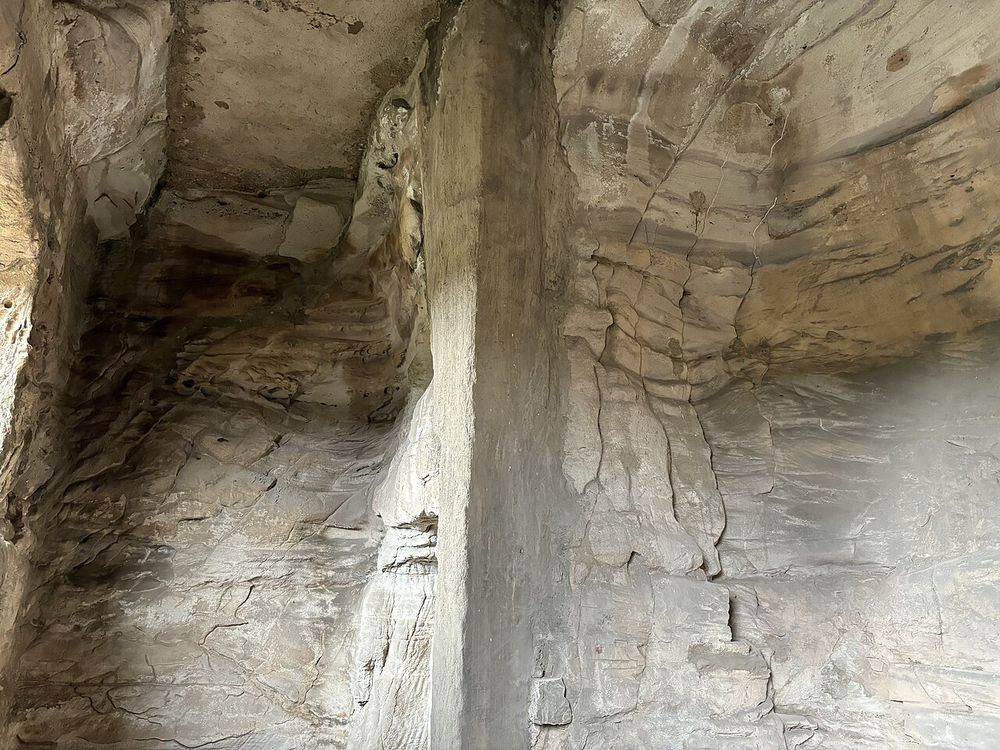
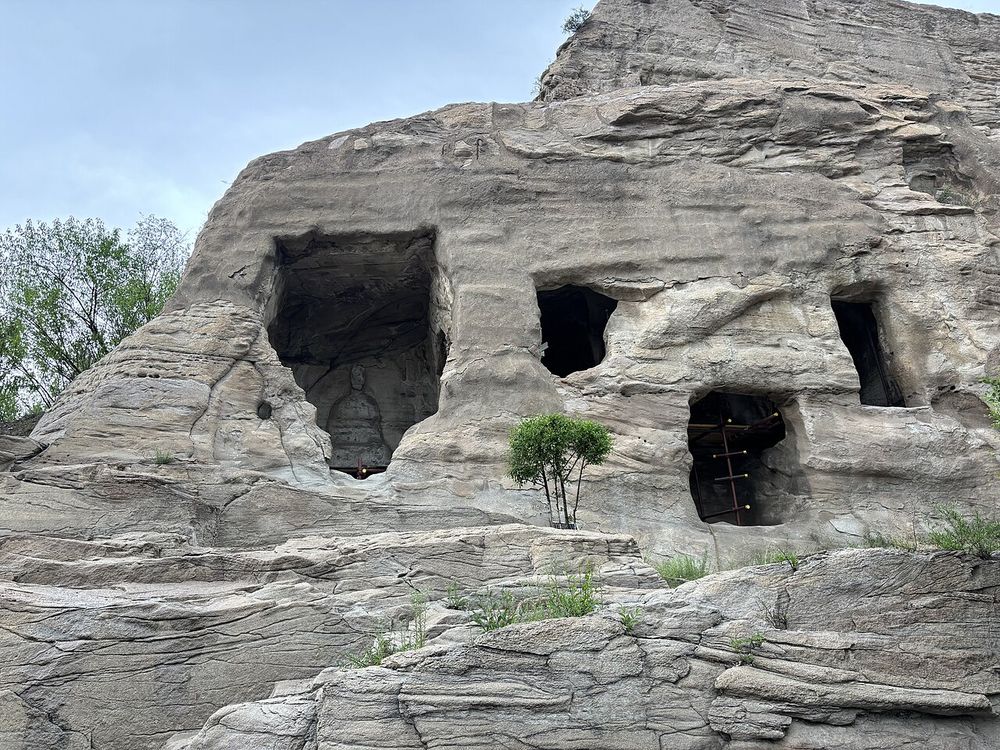
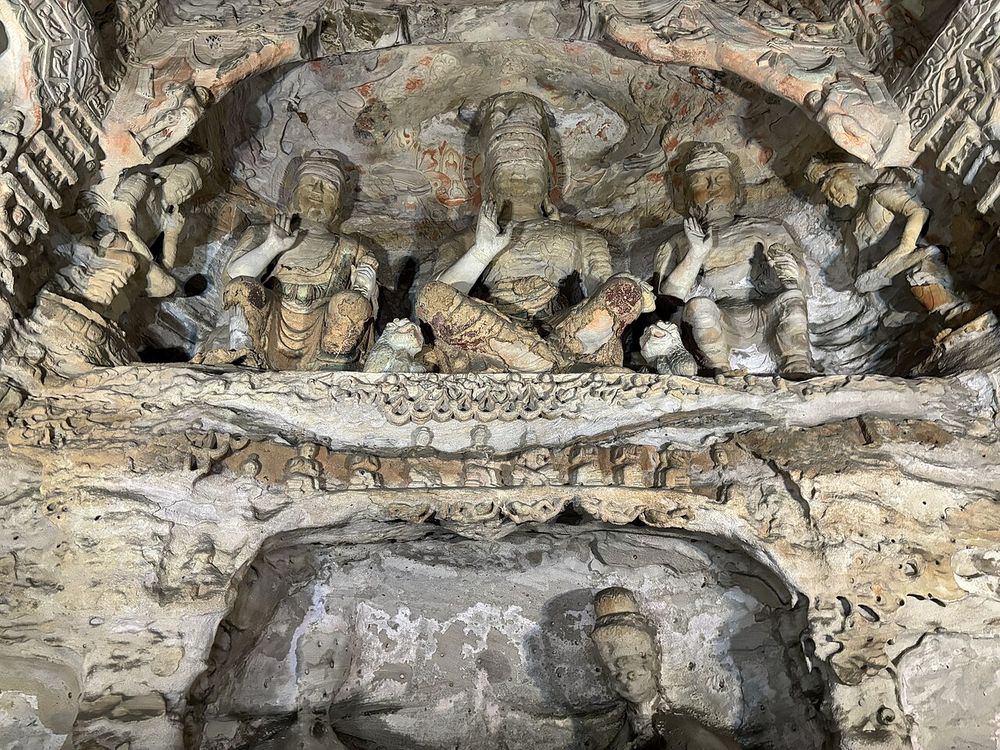
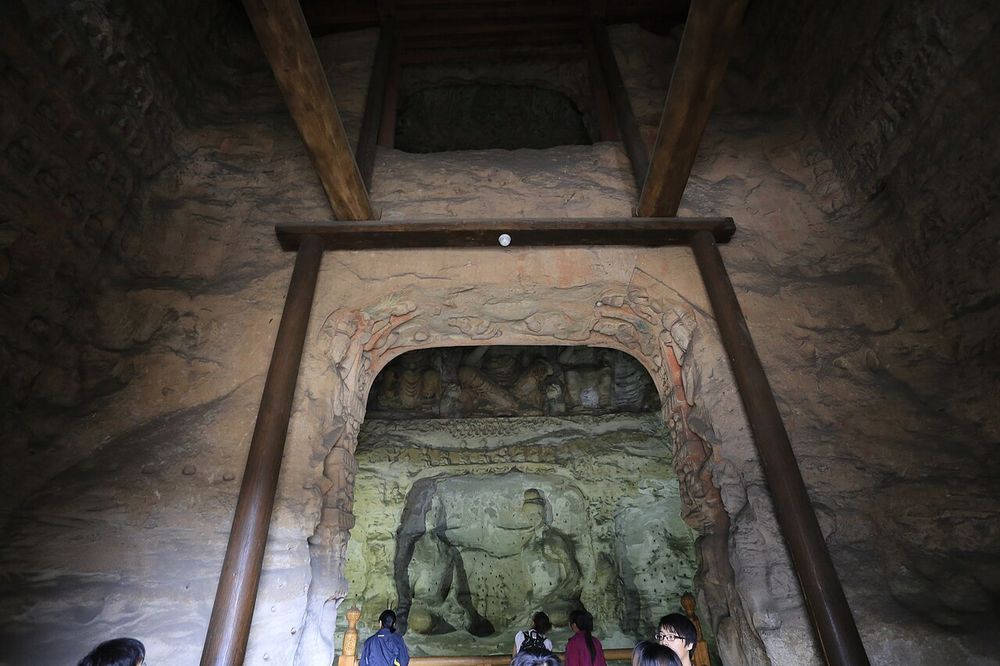
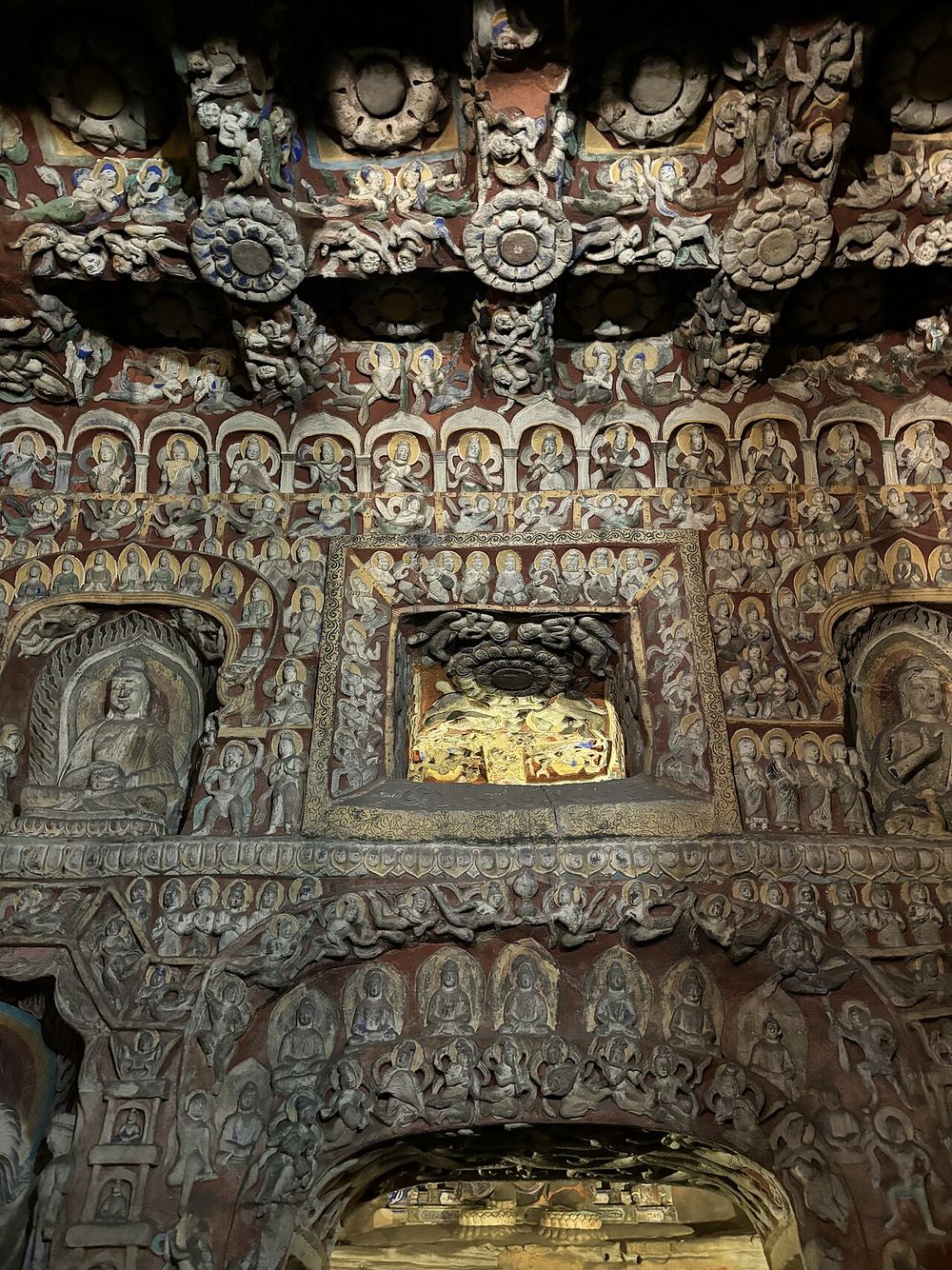
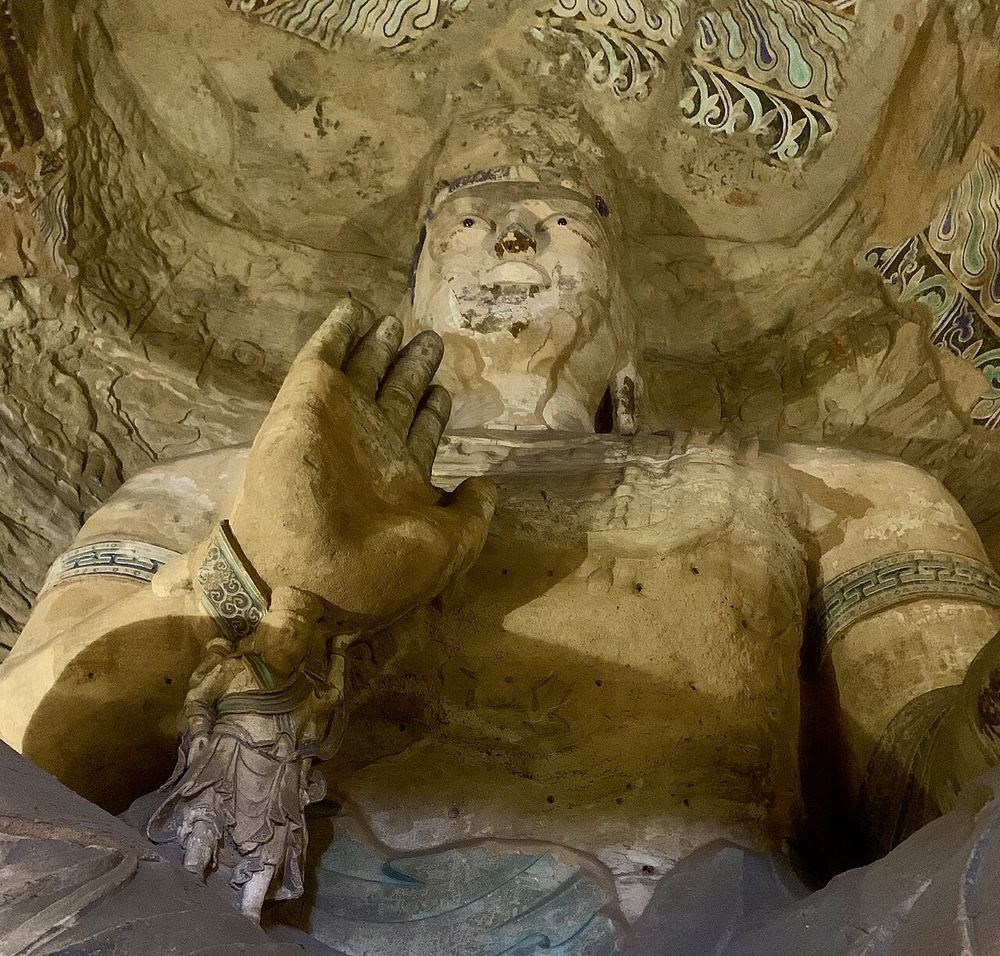
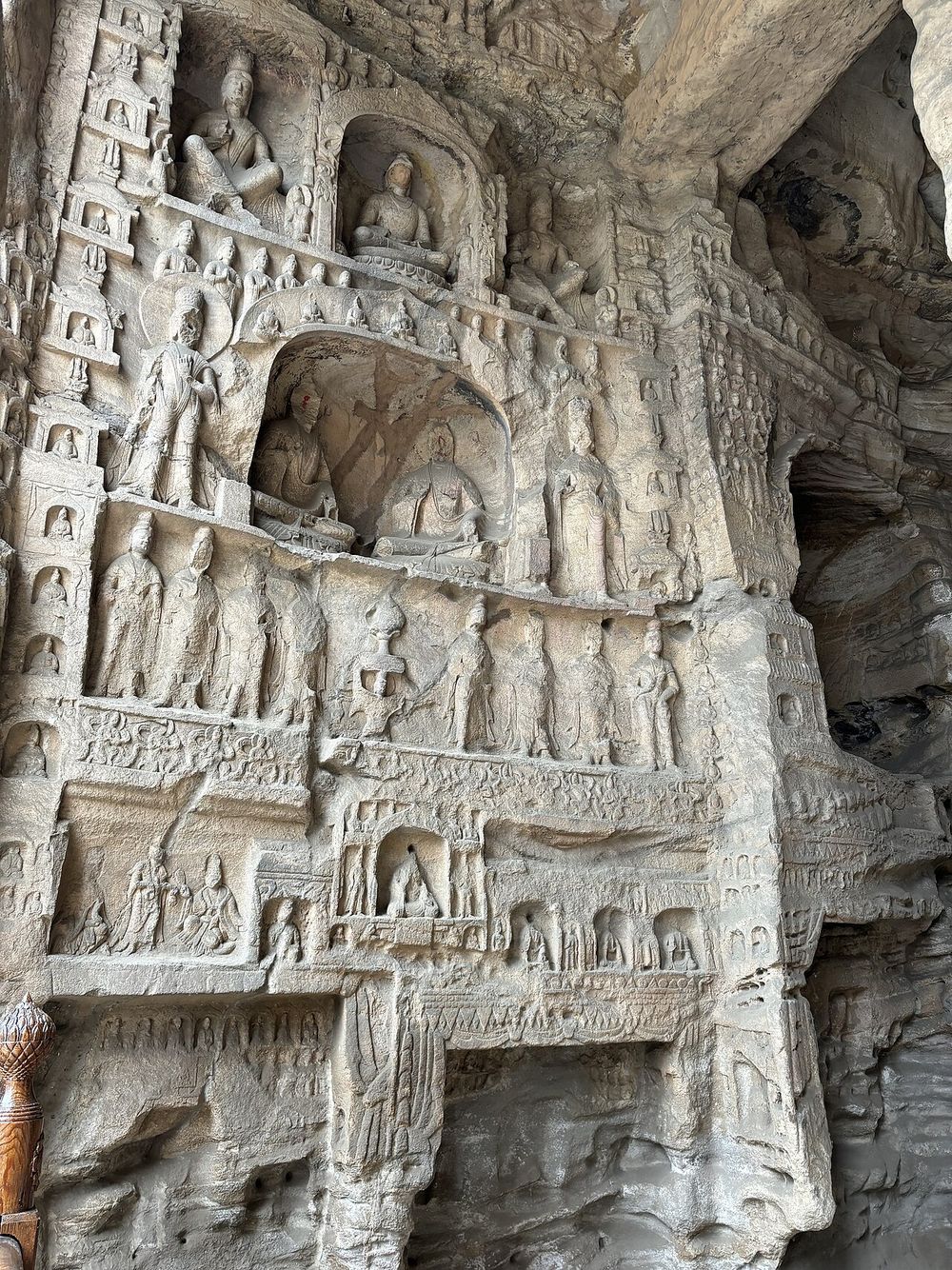
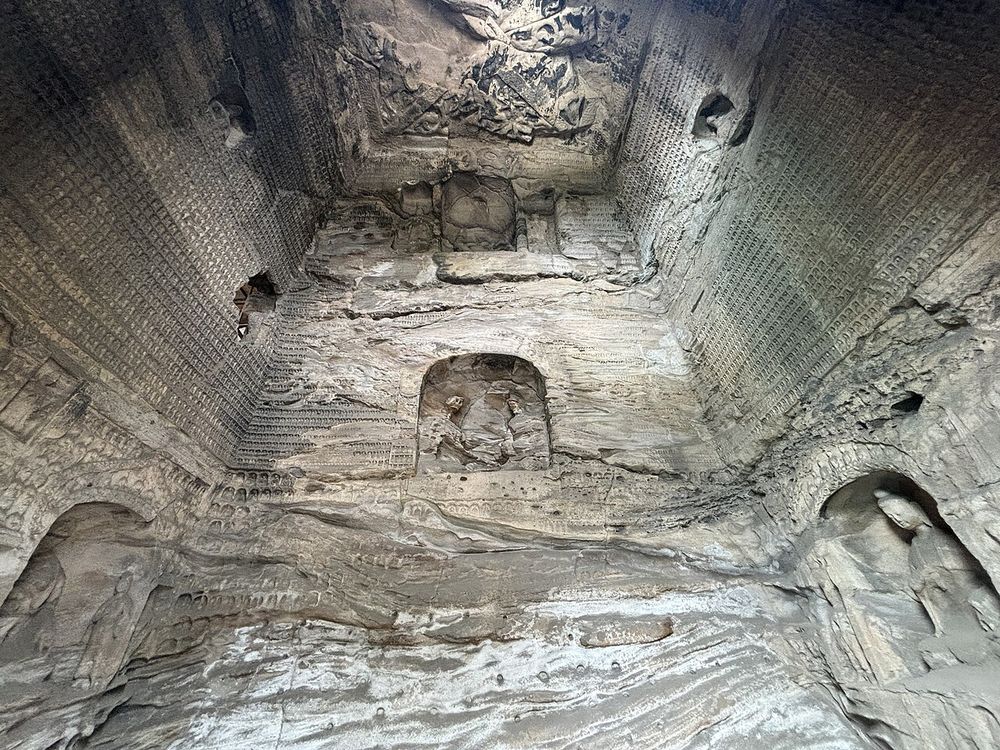
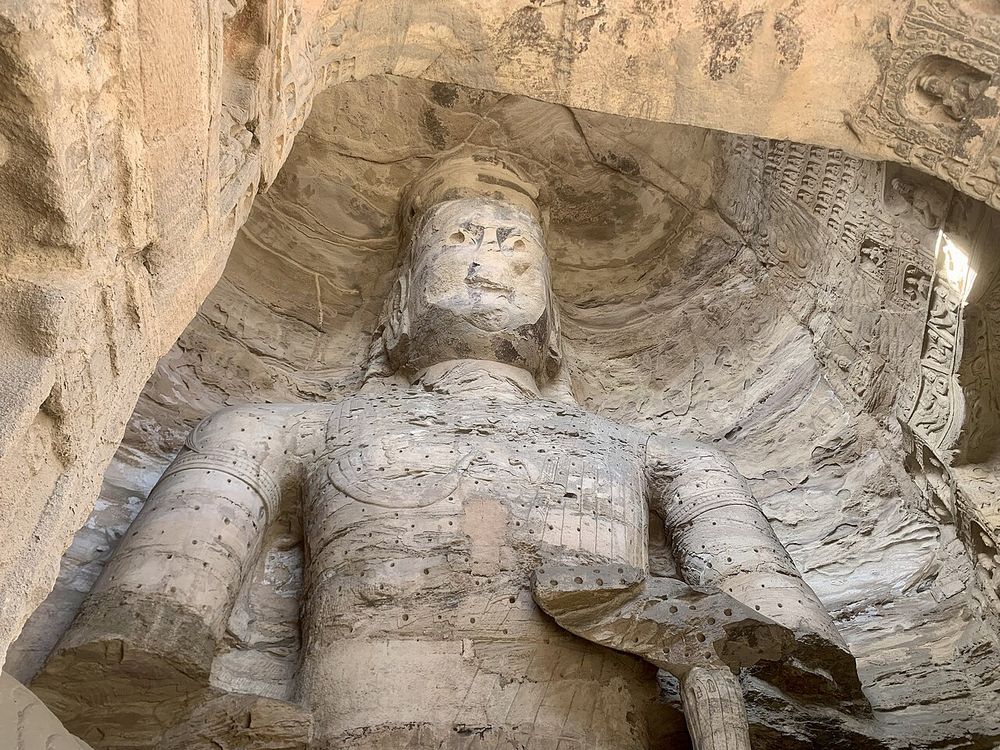
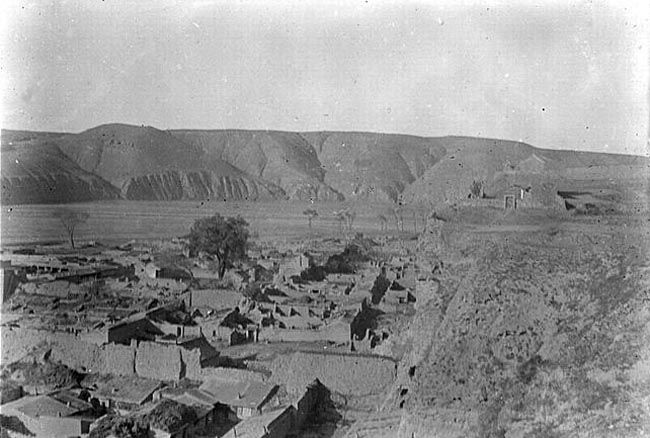
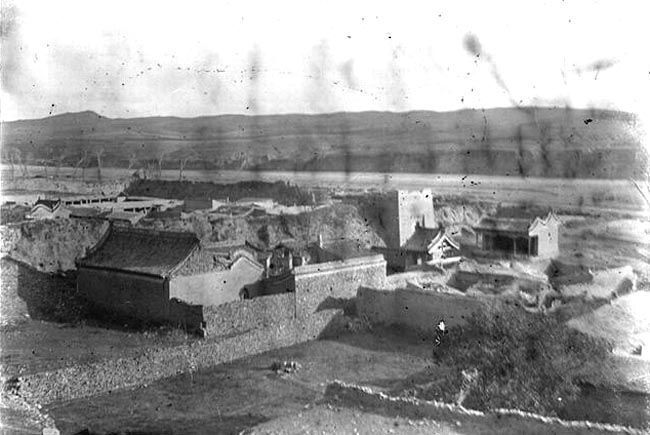
The caves themselves: forty-five main caves along a kilometre of sandstone cliff, cut between 460 and the 520s by the Northern Wei. Walk them from east to west and you walk through seventy years in which Buddhist sculpture came from India and Central Asia and became Chinese.
Photo: Thebrainchamber1, CC BY-SA 4.0, Wikimedia Commons
The story
The Northern Wei (386–534) were the Tuoba, a people from the northern steppe who conquered northern China and made Pingcheng, today's Datong, their capital. In 460 the emperor Wencheng let the monk Tanyao cut five great caves, each with a colossal Buddha. For the next thirty-four years the court and its nobles paid for ever richer caves. When the capital moved to Luoyang in 494, smaller patrons went on cutting small caves to the west until the 520s.
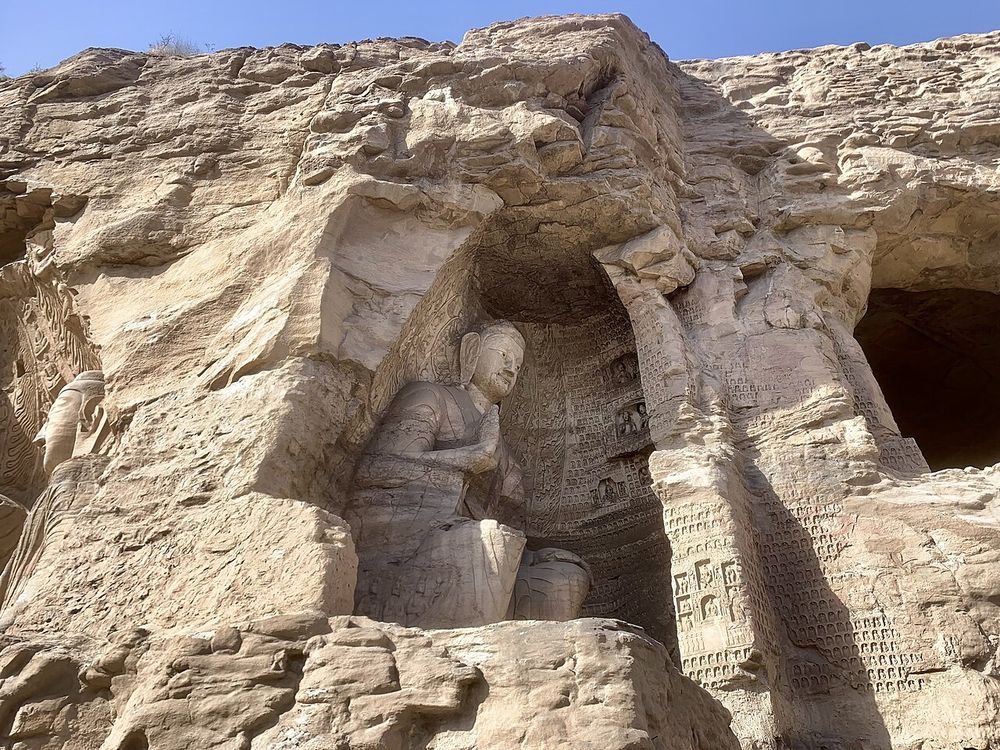
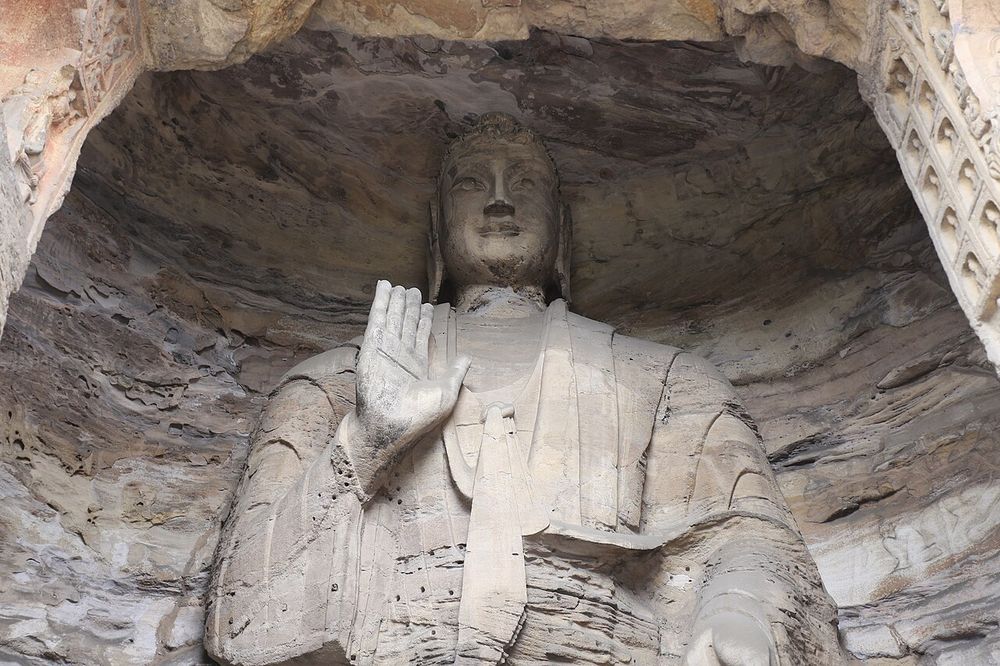
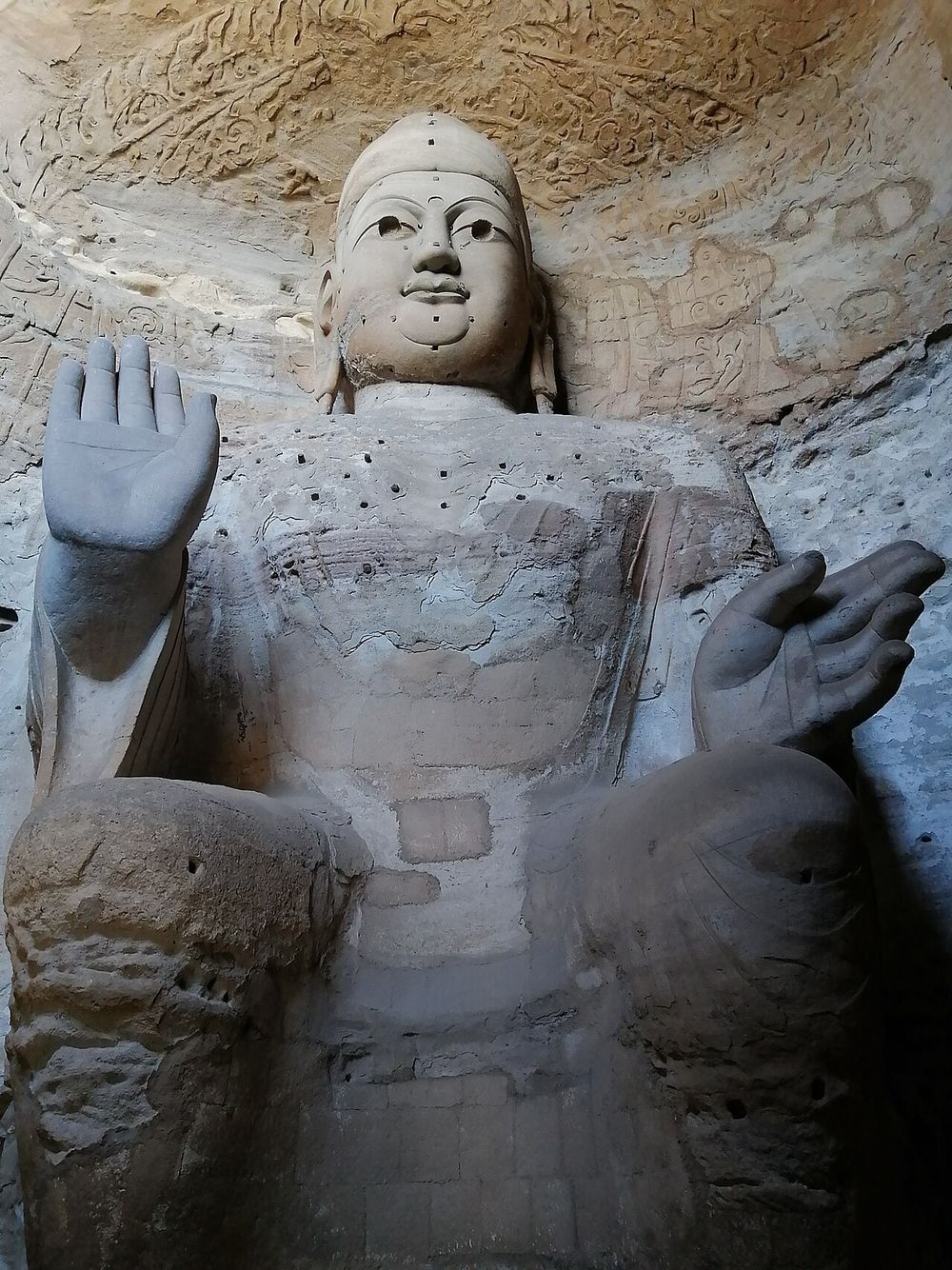
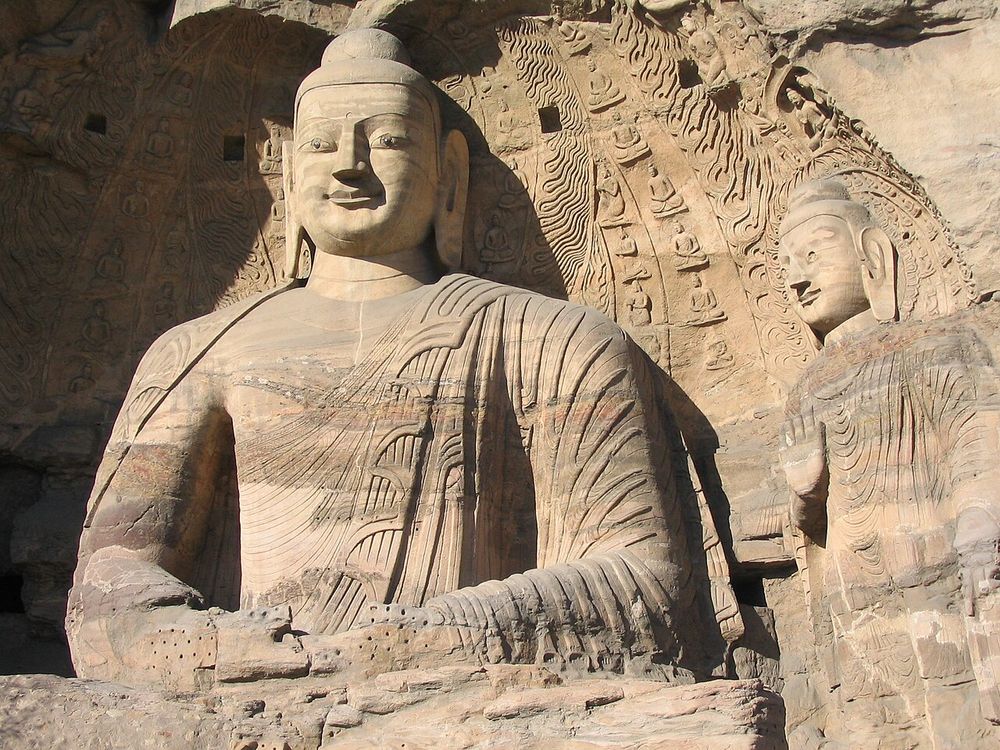
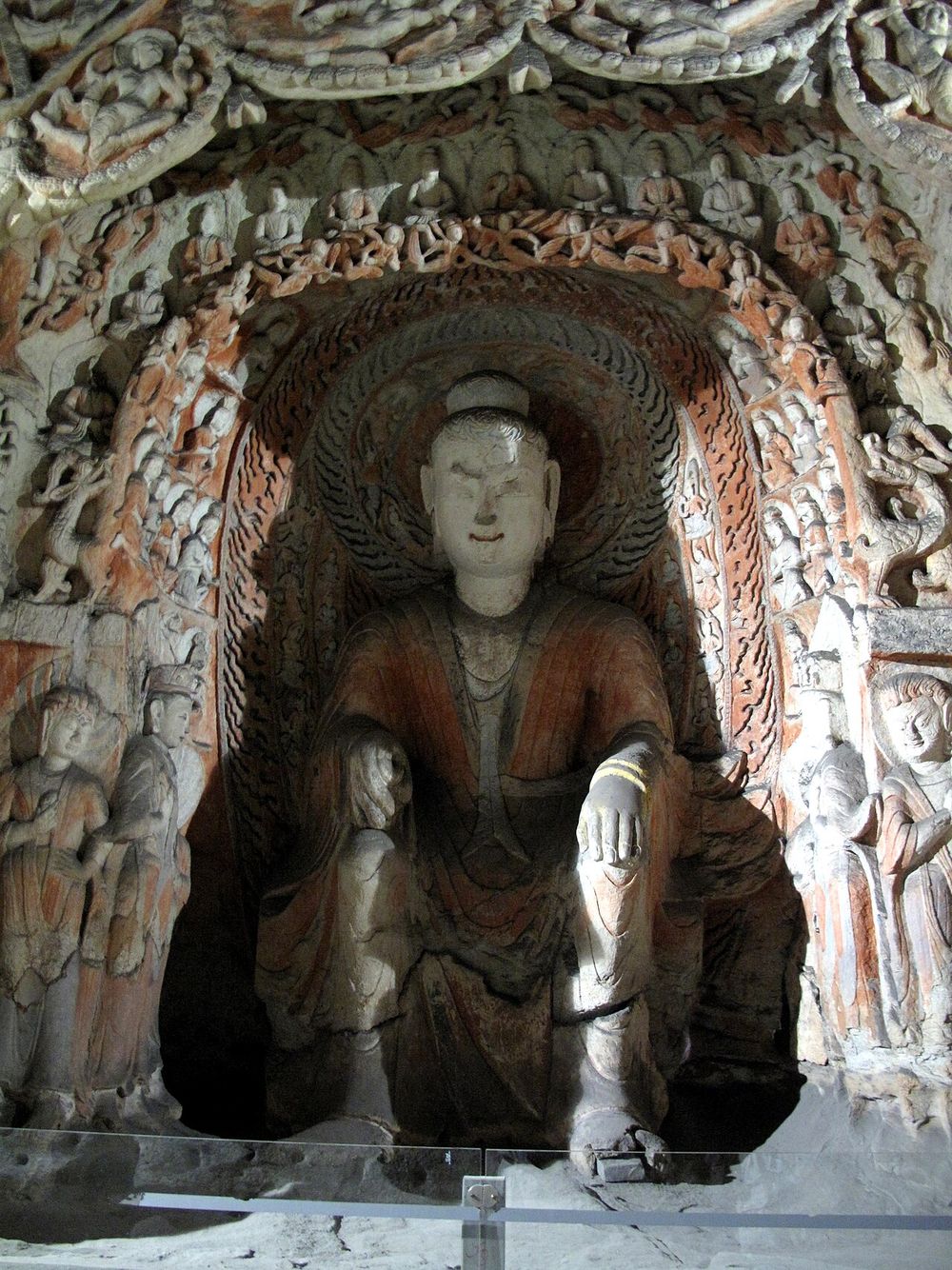
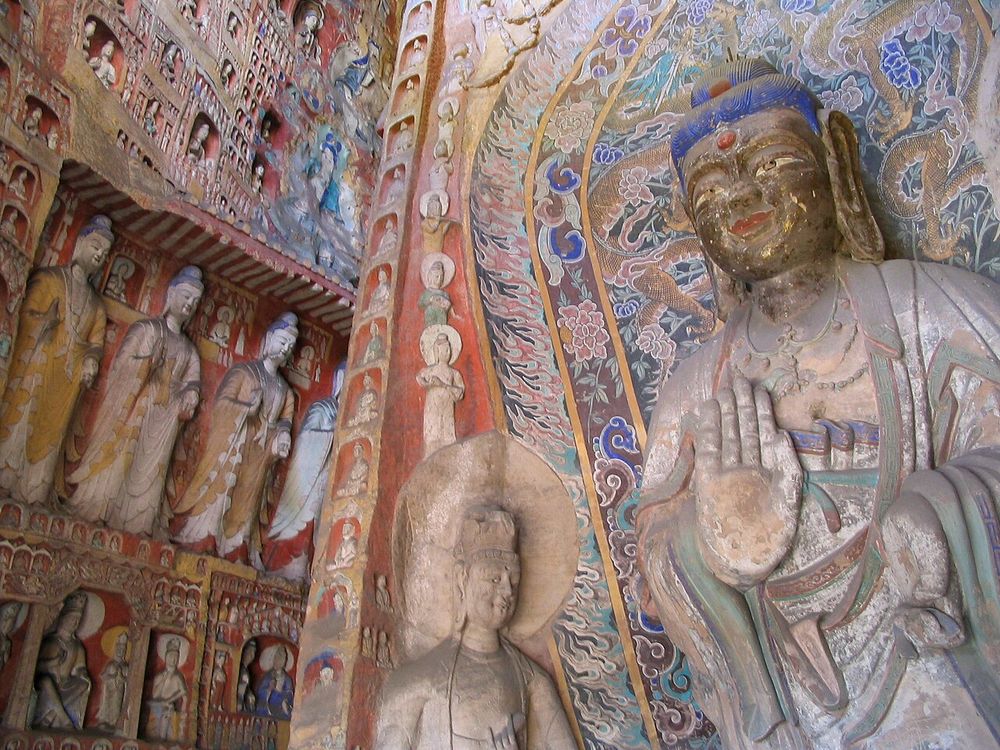
About 51,000 figures survive in some 250 caves and niches. The early Buddhas have broad shoulders and thin robes like those of Gandhara and Mathura; the later ones wear the layered robes of Chinese officials and have long, slender bodies. You can watch the change happen as you walk.
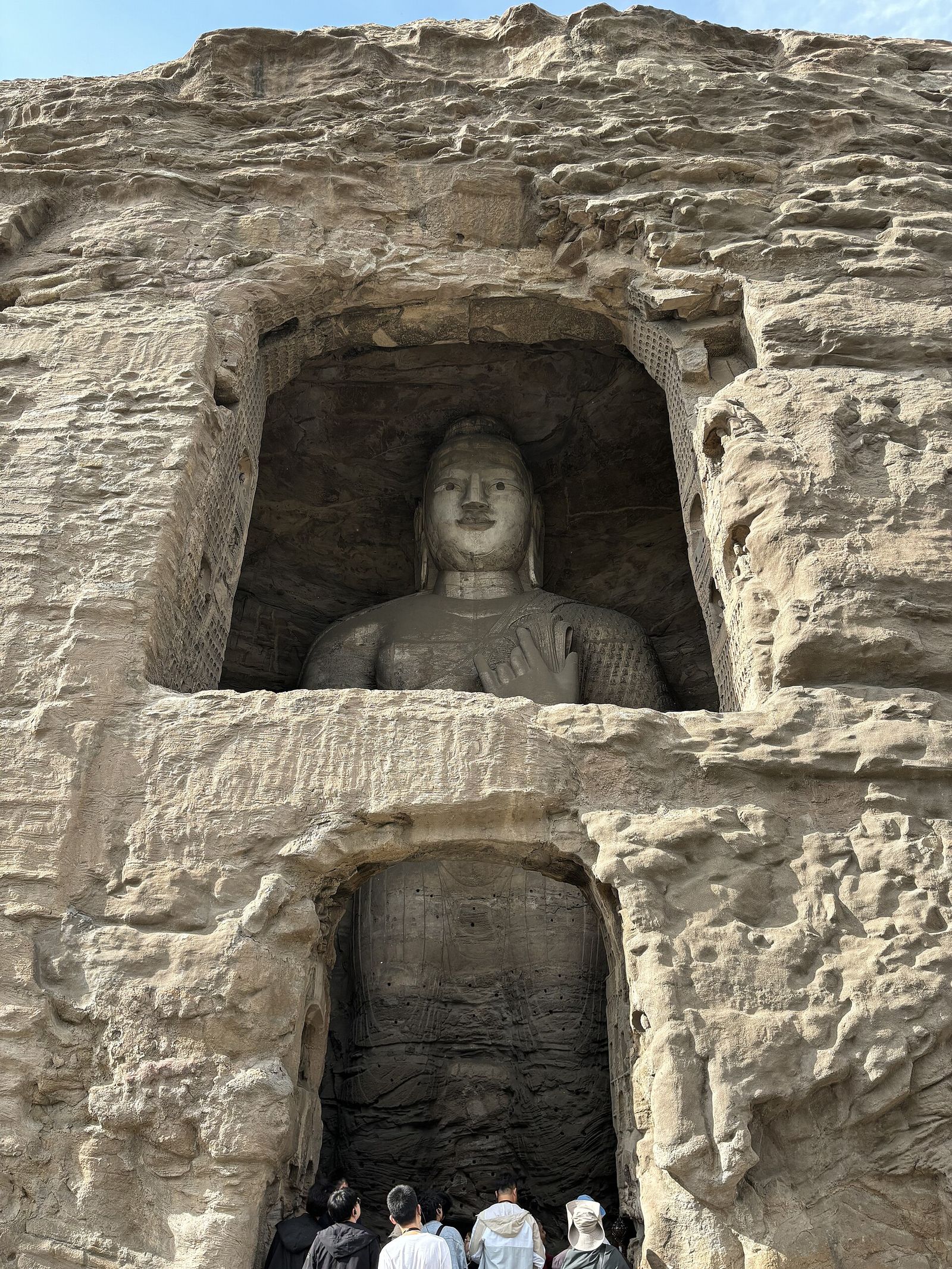
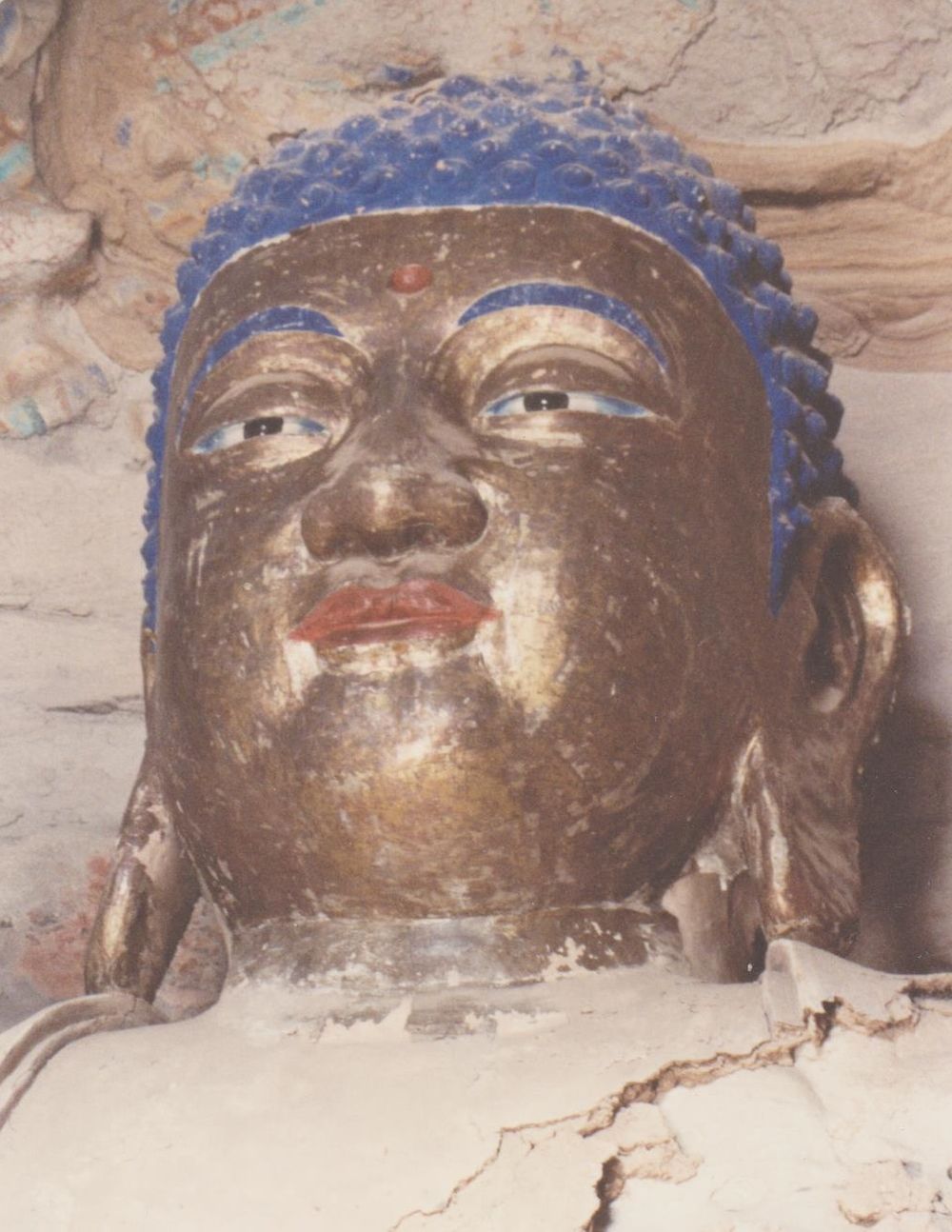
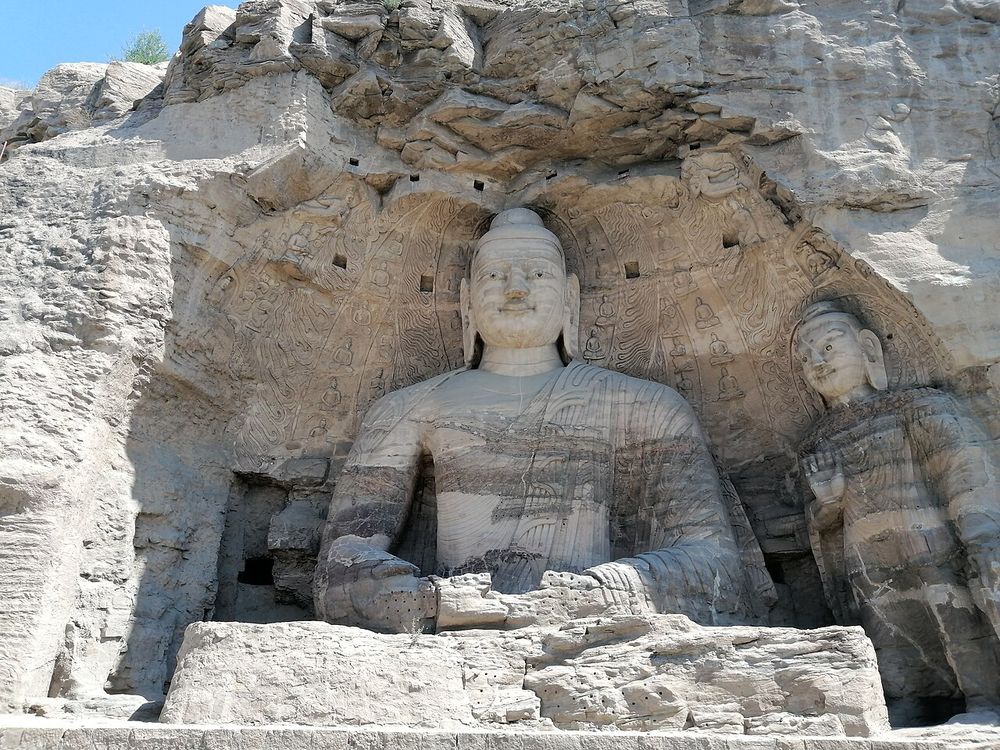
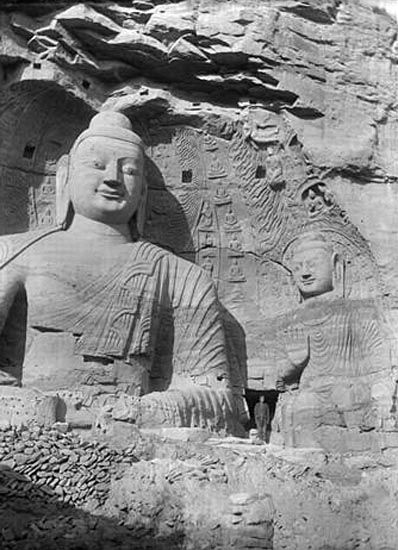
The front of this cave fell away long ago, and its Buddha, about thirteen and a half metres high, now sits in the open. His shoulders are broad, his robe clings, his face is full and smiling slightly, with a small moustache. He is the face of Yungang.
Cave 16, 2013Zhangzhugang, CC BY-SA 3.0
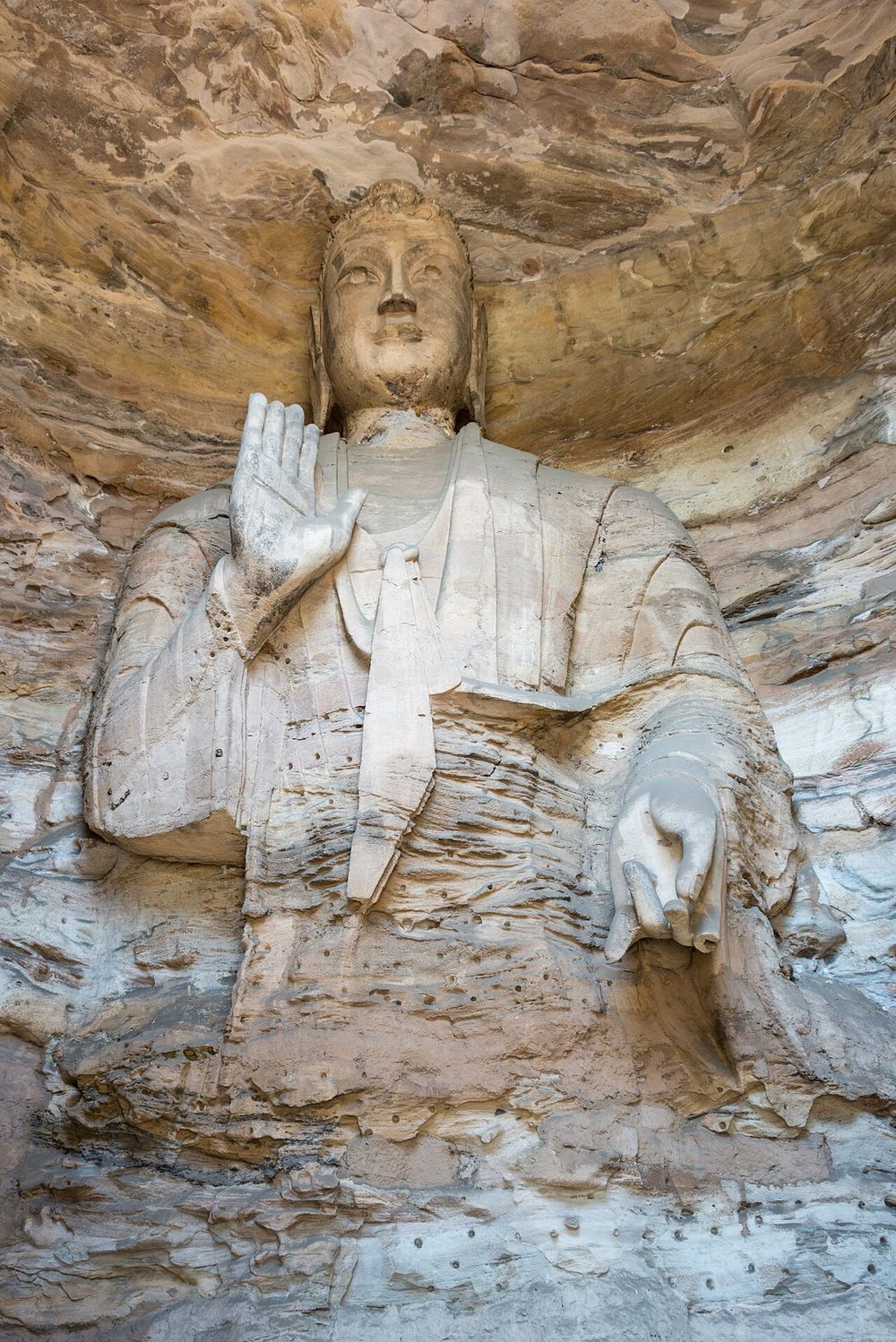
Now walk a few steps east to Cave 16. Its Buddha, finished later, wears a thick Chinese robe with a sash tied at the chest. In a few metres, Indian Buddhism has put on Chinese clothes.
Things people often get wrong
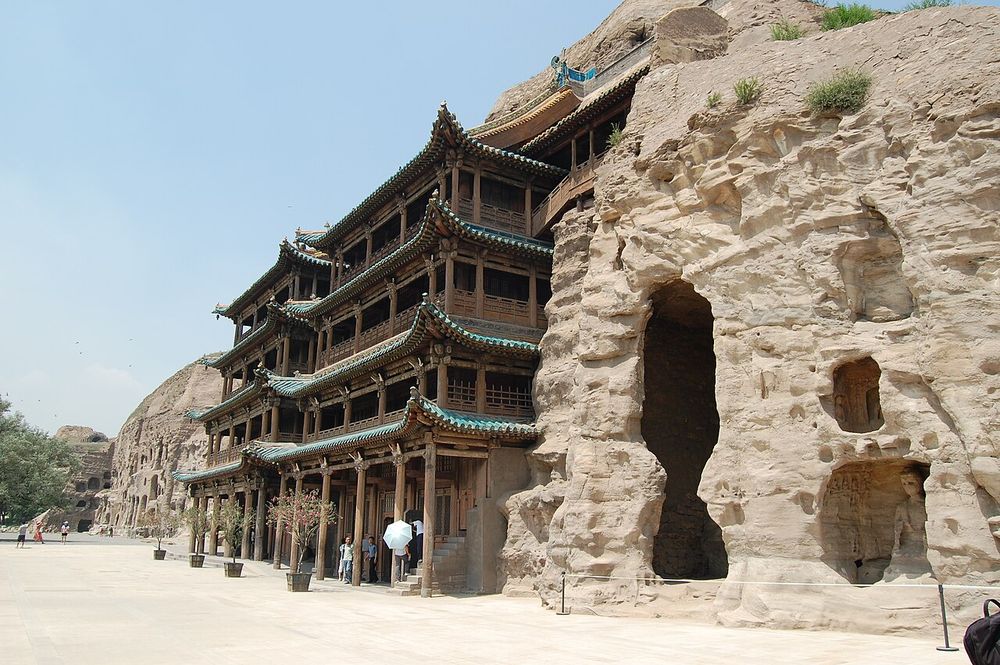
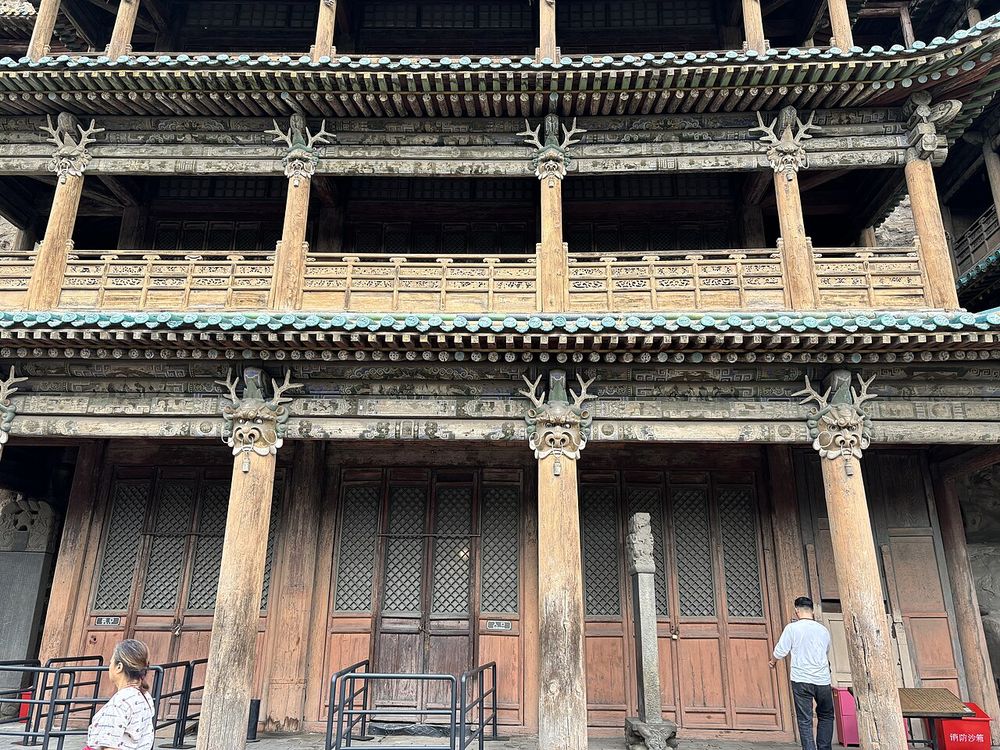
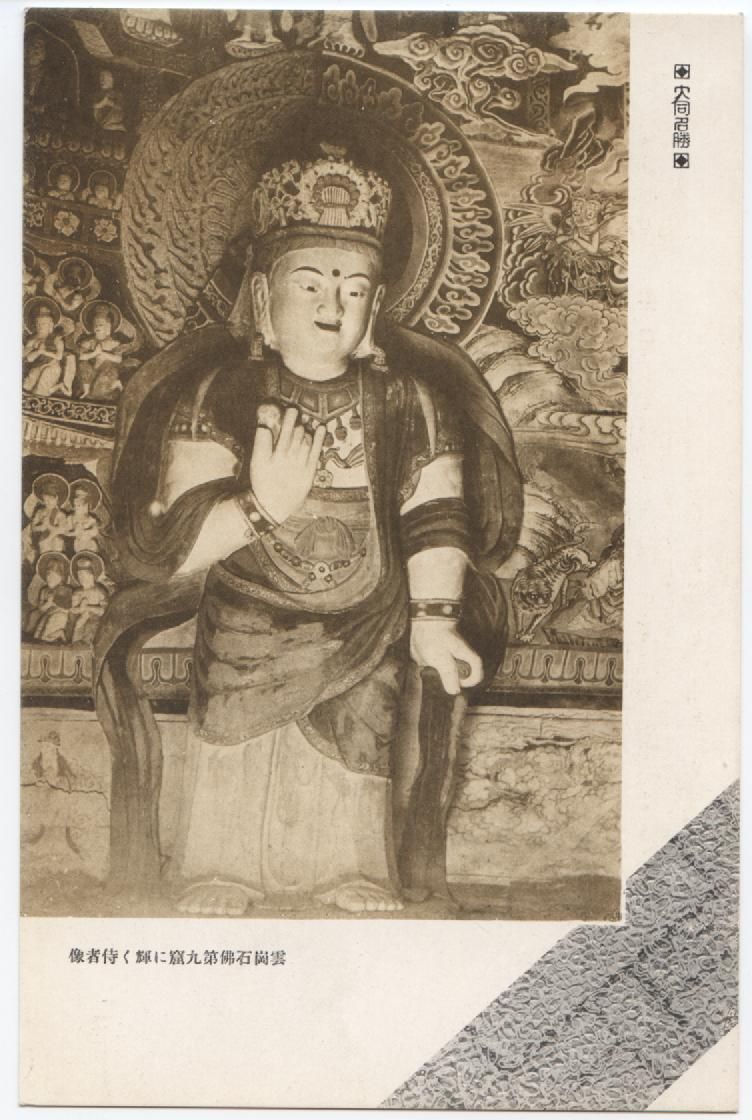
"The caves were always bare stone." Most were painted, and many had wooden temple halls built against the cliff. The bright colours you see in Caves 9–13 are mostly Qing repainting.
"Every head is original." Many heads and figures were cut off and sold abroad in the 1910s and 1920s. Some are in museums in New York, Paris and Tokyo.
People who stood here
We searched Chinese sources first for this list, then English ones.
Tanyao (monk, 5th century)He asked the emperor for the first five caves, 16 to 20, in 460.
Emperor Xiaowen of the Northern Wei (r. 471–499)The emperor who adopted Chinese dress, language and surnames for his court and moved the capital to Luoyang in 494. The change can be seen in the robes of the later Buddhas.
Édouard Chavannes (French sinologist, 1865–1918)He photographed the caves in 1907 and published them, bringing Yungang to the attention of scholars in the West.
Liang Sicheng and Lin Huiyin (architects)In 1933 they surveyed Yungang with Liu Dunzhen and wrote about the Northern Wei buildings carved in the caves, the earliest pictures of Chinese timber architecture.
Mizuno Seiichi and Nagahiro Toshio (Japanese archaeologists)During the Japanese occupation, from 1938 to 1944, they surveyed every cave; their sixteen volumes are still the basic record.
Go deeper: eight stops from Cave 1 to the western caves
Walk from east to west, Caves 1 to 45. Three hours for the main caves; the Yungang museum by the exit is worth an hour more.
1. Caves 1 and 2: pagoda pillars
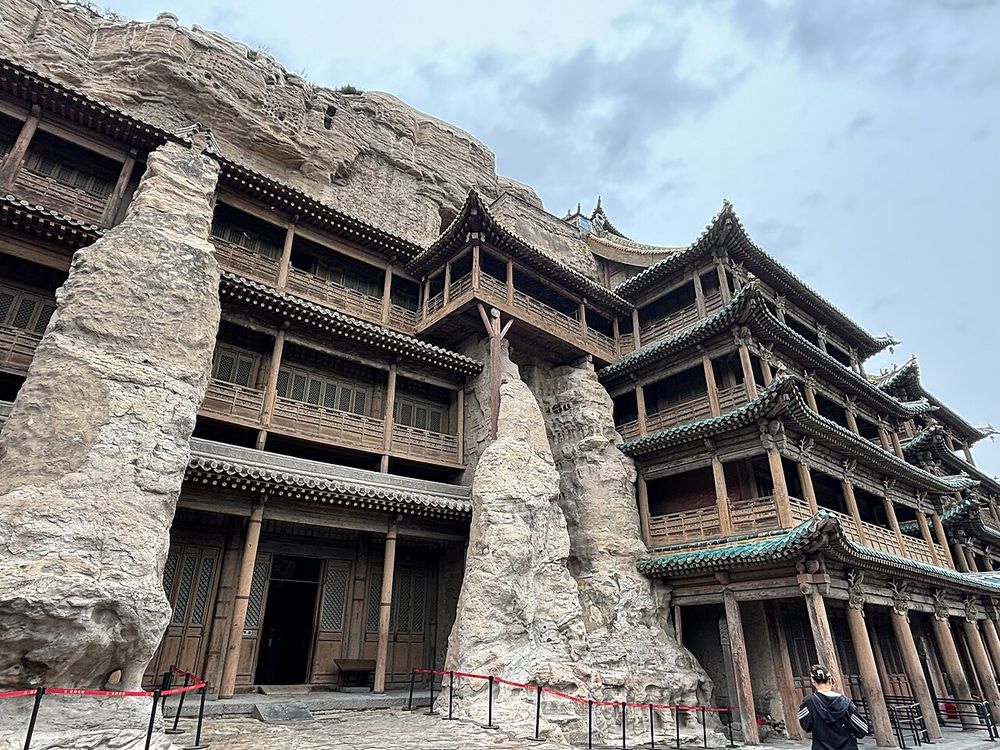
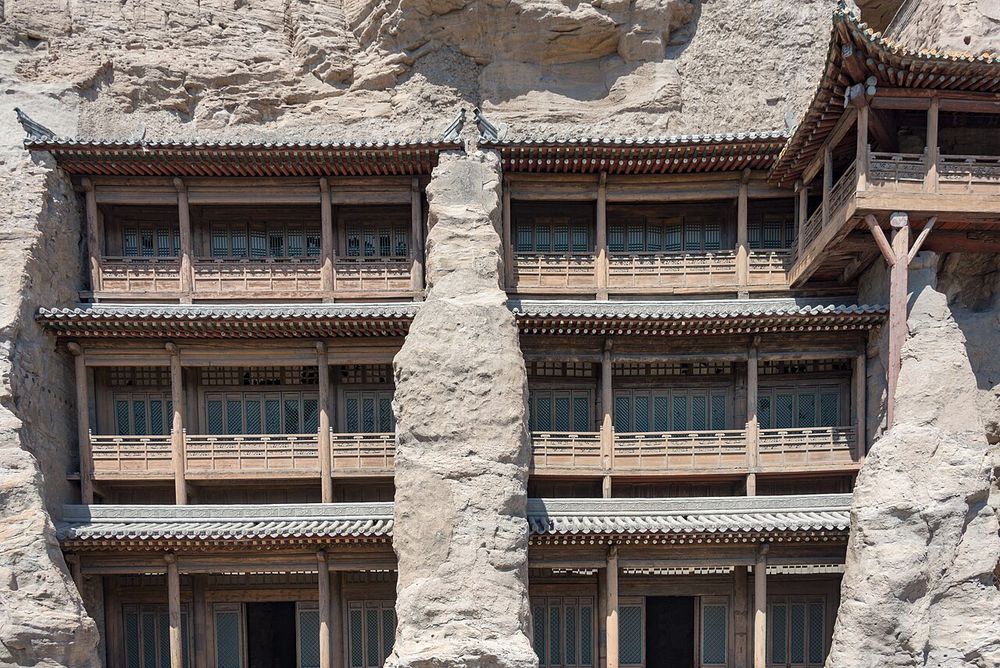
The wooden towers and the cliff, 2010Marcin Białek, CC BY-SA 3.0
The two eastern caves each have a square pillar carved as a pagoda in the middle, for walking round in prayer.
2. Cave 3: the largest, unfinished
Cave 3, 2023Yumeto, CC BY-SA 4.0
The largest cave at Yungang, never finished by the Northern Wei. Inside sit a Buddha and two bodhisattvas carved much later, perhaps in the Sui (581–618) or early Tang (618–907), rounder and softer than anything around them.
The later bodhisattva of Cave 3, 2013xiquinhosilva, CC BY 2.0
3. Caves 5 and 6: the giant and the life of the Buddha
The towers of Caves 5 and 6, 2013Zhangzhugang, CC BY-SA 3.0
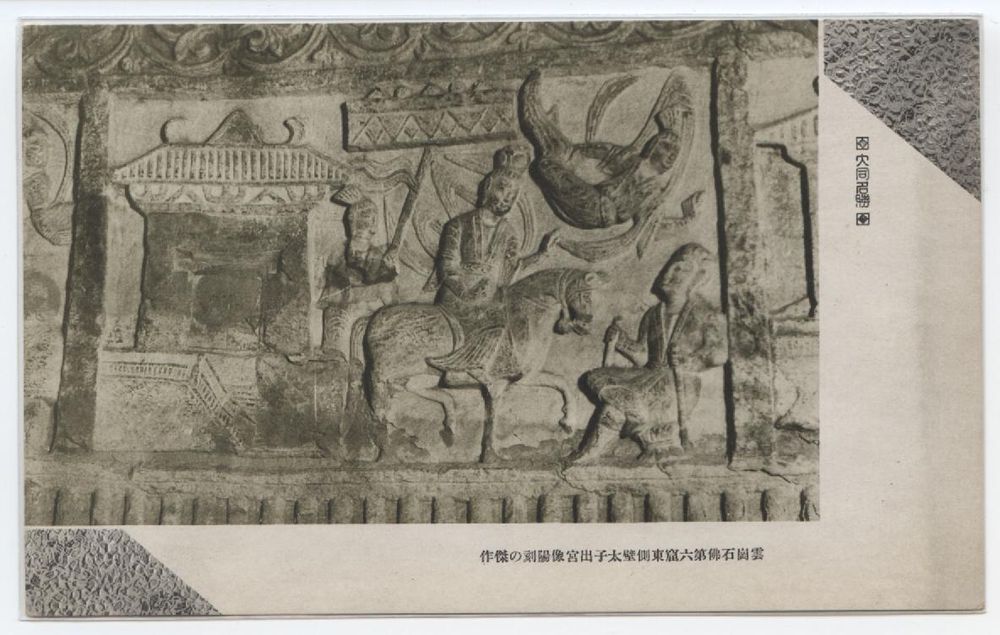
Wooden towers of 1651 stand against the cliff. In Cave 5 sits Yungang's largest Buddha, about seventeen metres high. Cave 6 has a two-storey central pillar and walls carved with the life of the Buddha, from his birth to his enlightenment, in Chinese dress and Chinese buildings.
Cave 6Thebrainchamber1, CC BY-SA 4.0
4. Caves 7 and 8: the twin caves
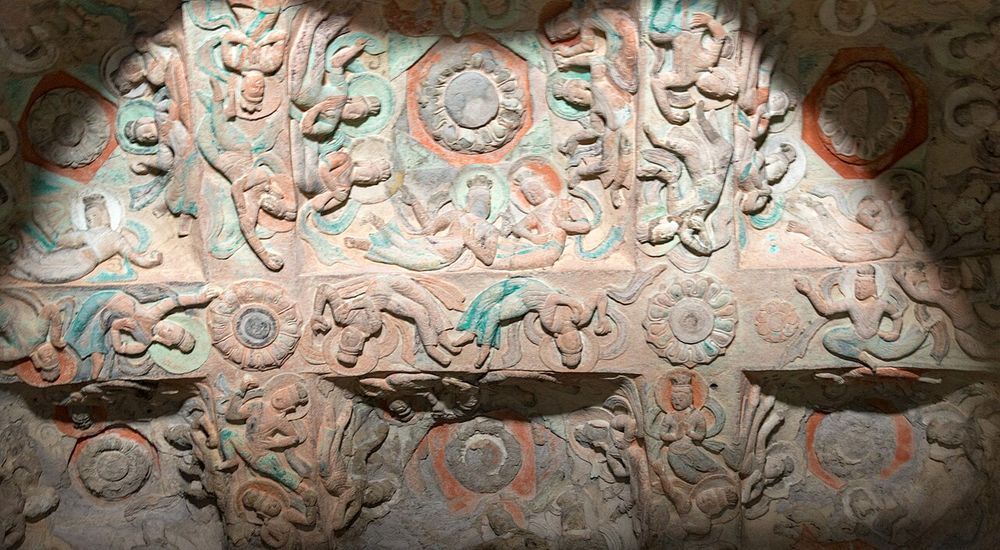
The ceiling of Cave 7, 2024Thebrainchamber1, CC BY-SA 4.0
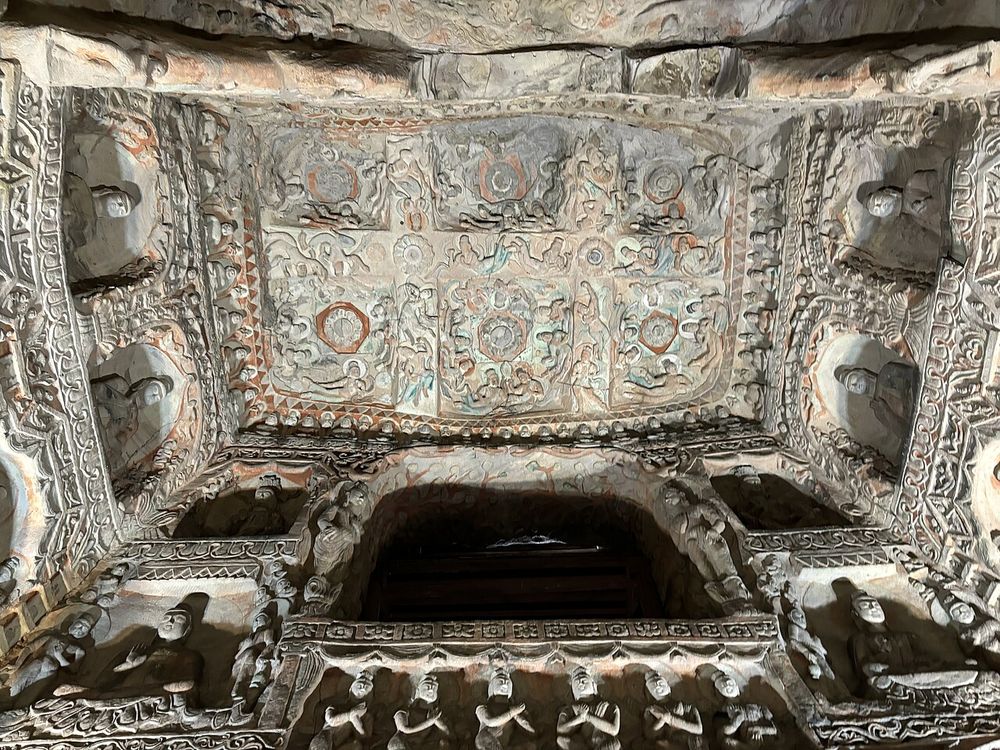
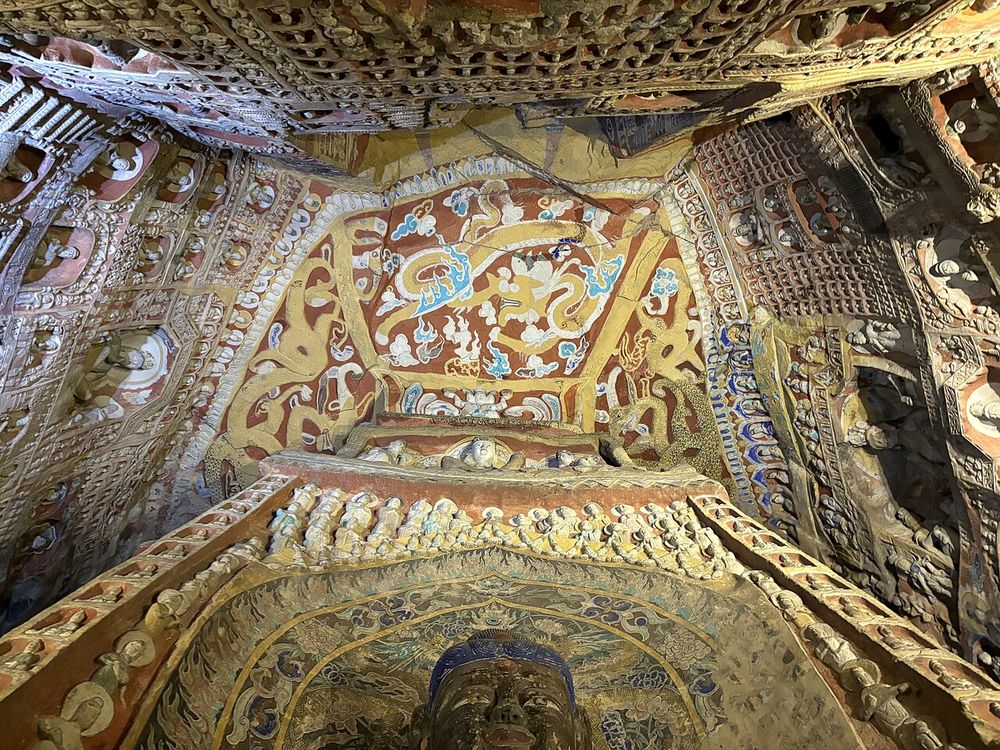
Pairs of caves, cut together, perhaps for the emperor and the empress dowager, who ruled together in the 470s and 480s. Look up at the ceiling of Cave 7: flying figures circle a lotus.
The wooden tower and the cliff of Caves 5 to 7, 2006McKay Savage from London, UK, CC BY 2.0
5. Caves 9 to 13: the Five Splendid Caves
Cave 9, 2009G41rn8, CC BY-SA 4.0
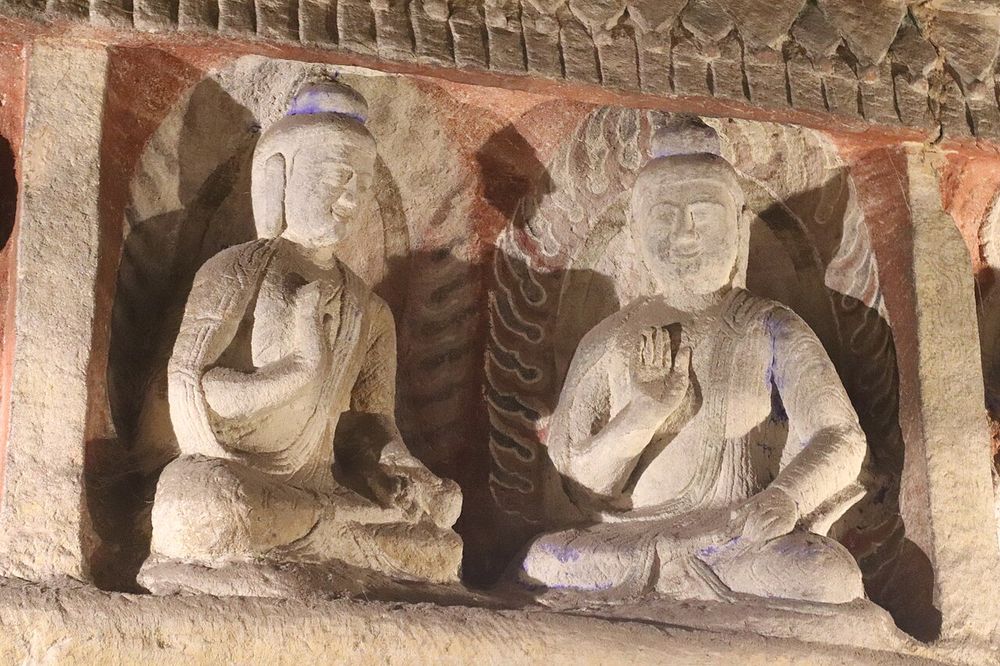
These caves have front halls with columns carved in the rock, and their walls are crowded with painted figures, buildings and musicians. The colours are mostly Qing. Cave 12 is the music cave: find the players of the lute, the pipes, the drum and the harp.
Musicians in Cave 12, 2009G41rn8, CC BY-SA 4.0Seated Buddhas in Cave 12, 2025Liuxingy, CC BY-SA 4.0
6. Caves 16 to 20: the five caves of Tanyao
The Buddha of Cave 16, 2013Zhangzhugang, CC BY-SA 3.0
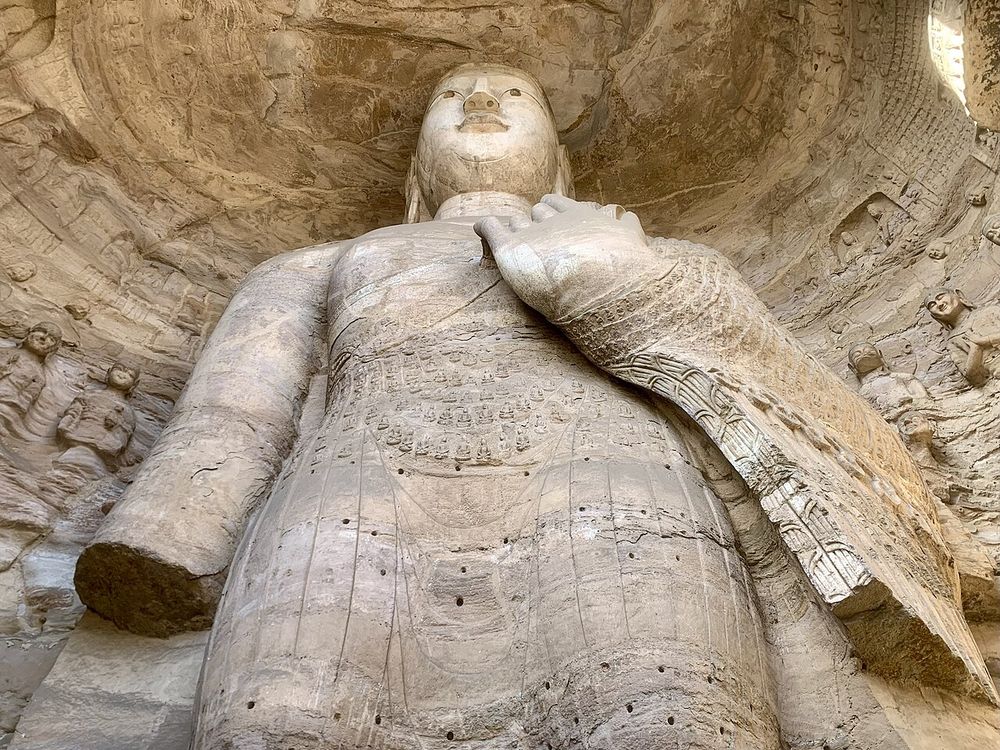
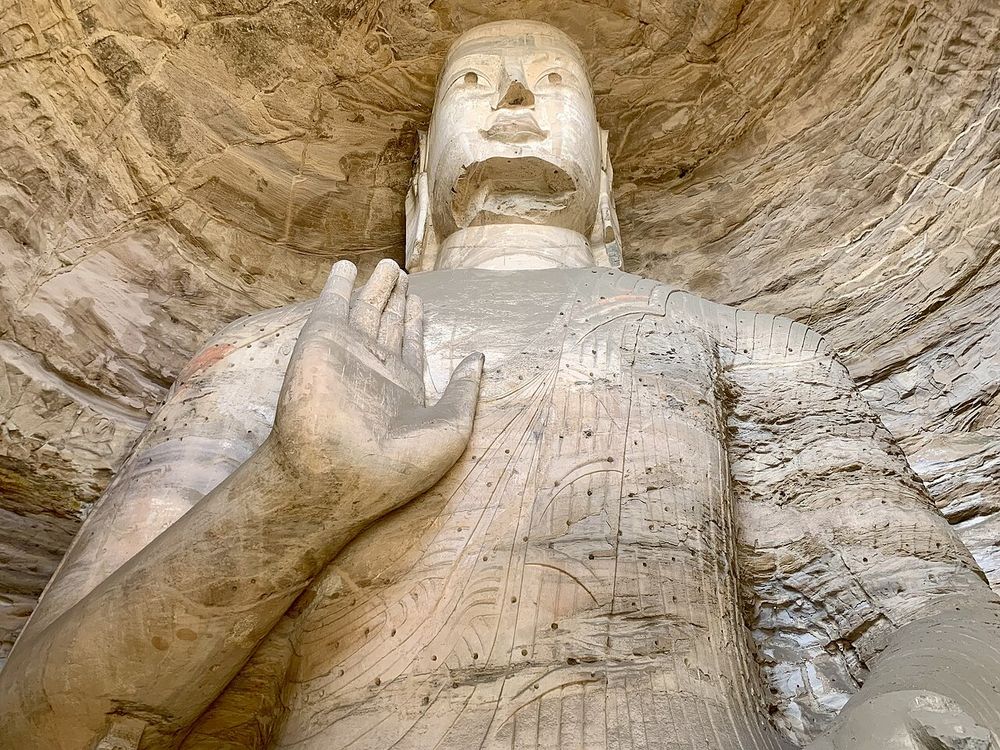
The first and greatest caves, each built round one colossal Buddha. Cave 19 has the tallest of the five, almost seventeen metres. Cave 18's Buddha wears a robe covered in a thousand tiny Buddhas. Cave 17 has a seated Maitreya with crossed ankles.
The Buddha of Cave 18Dudva, CC0The Buddha of Cave 19Dudva, CC0
7. The western caves
Buddhas in a collapsed western caveFelix Andrews (Floybix), CC BY-SA 3.0
After 494 smaller patrons cut small caves at the west end. The figures are slender, with long necks and narrow faces, the style later carried to Longmen. Many have weathered badly.
8. The heads that went away
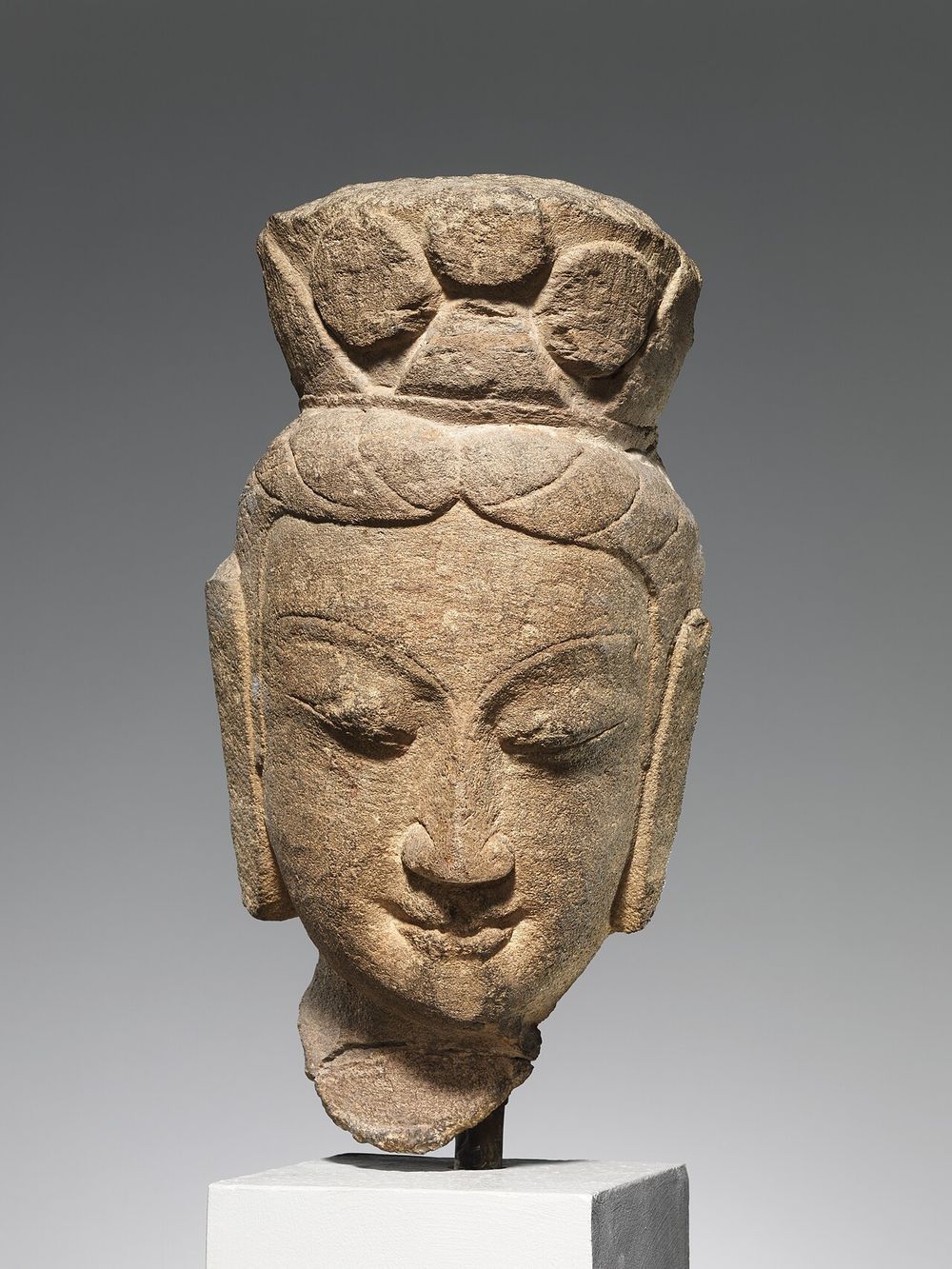
A bodhisattva head from Yungang in the Metropolitan Museum, New YorkThe Metropolitan Museum of Art, CC0
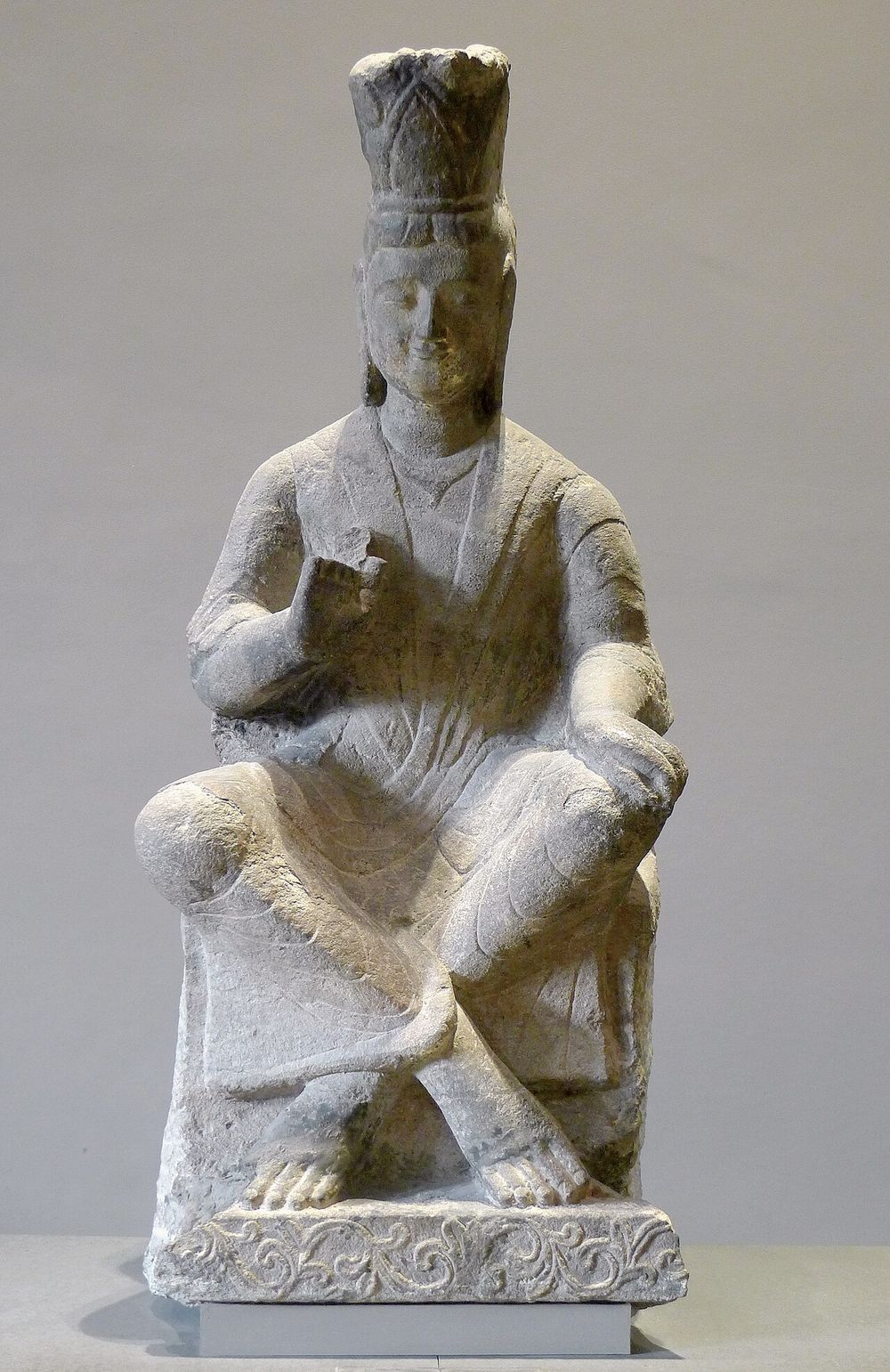
In the early twentieth century dealers had heads and small figures cut from the caves. A bodhisattva head in the Metropolitan Museum in New York and a seated bodhisattva in the Musée Cernuschi in Paris are among those traced to Yungang. Compare them with the empty places in the walls.
A bodhisattva from Yungang in the Musée Cernuschi, ParisMbzt, CC BY-SA 3.0
Saving the caves
For decades lorries of coal from the mines around Datong passed 350 metres from the caves, and black dust settled on the stone. In 1998 the road was moved behind the hill. In the 2000s the factories and villages in front were cleared, and in 2001 Yungang was listed as World Heritage. In 2021 the Yungang Academy was set up to look after the caves.
Meanwhile in the world
Year
Here
Elsewhere
460
Tanyao begins the five caves
The Western Roman Empire has sixteen years left
494
The court moves to Luoyang
Clovis rules the Franks
1651
Wooden towers are built in front of Caves 5 and 6
The English Navigation Act
1907
Chavannes photographs the caves
The first Cubist paintings
1933
Liang Sicheng and Lin Huiyin survey the caves
Hitler comes to power
2001
World Heritage
The September 11 attacks
One line to remember: walk east to west and watch the Buddha change his clothes.
Then and now
The cliff at Cave 16, 2024Thebrainchamber1, CC BY-SA 4.0, Wikimedia CommonsThe cliff of caves from the air, 2019Charlie fong, CC BY-SA 4.0, Wikimedia CommonsThe caves along the cliffThebrainchamber1, CC BY-SA 4.0, Wikimedia CommonsCave fronts, 2013xiquinhosilva, CC BY 2.0, Wikimedia CommonsNiches in the rock, 2013xiquinhosilva, CC BY 2.0, Wikimedia CommonsThe eastern caves, 2013Zhangzhugang, CC BY-SA 3.0, Wikimedia CommonsThe wooden towers and the cliff, 2010Marcin Białek, CC BY-SA 3.0, Wikimedia CommonsCave 3, 2023Yumeto, CC BY-SA 4.0, Wikimedia CommonsInside Cave 3Thebrainchamber1, CC BY-SA 4.0, Wikimedia CommonsThe later bodhisattva of Cave 3, 2013xiquinhosilva, CC BY 2.0, Wikimedia CommonsCave 4Thebrainchamber1, CC BY-SA 4.0, Wikimedia CommonsThe towers of Caves 5 and 6, 2013Zhangzhugang, CC BY-SA 3.0, Wikimedia CommonsThe gilded head of the great Buddha of Cave 5BabelStone, CC BY-SA 3.0, Wikimedia CommonsCave 6Thebrainchamber1, CC BY-SA 4.0, Wikimedia CommonsCarvings in Cave 6, 2009G41rn8, CC BY-SA 4.0, Wikimedia CommonsCave 7, 2024Thebrainchamber1, CC BY-SA 4.0, Wikimedia CommonsThe ceiling of Cave 7, 2024Thebrainchamber1, CC BY-SA 4.0, Wikimedia CommonsInside Cave 7, 2013Zhangzhugang, CC BY-SA 3.0, Wikimedia CommonsThe wooden tower and the cliff of Caves 5 to 7, 2006McKay Savage from London, UK, CC BY 2.0, Wikimedia CommonsCave 9, 2009G41rn8, CC BY-SA 4.0, Wikimedia CommonsCave 10Thebrainchamber1, CC BY-SA 4.0, Wikimedia CommonsSide wall statues in Cave 11Felix Andrews (Floybix), CC BY-SA 3.0, Wikimedia CommonsCave 12Thebrainchamber1, CC BY-SA 4.0, Wikimedia CommonsMusicians in Cave 12, 2009G41rn8, CC BY-SA 4.0, Wikimedia CommonsSeated Buddhas in Cave 12, 2025Liuxingy, CC BY-SA 4.0, Wikimedia CommonsCave 13Dudva, CC0, Wikimedia CommonsCave 14Thebrainchamber1, CC BY-SA 4.0, Wikimedia CommonsCave 15Thebrainchamber1, CC BY-SA 4.0, Wikimedia CommonsCave 16, 2013Zhangzhugang, CC BY-SA 3.0, Wikimedia CommonsThe Buddha of Cave 16, 2013Zhangzhugang, CC BY-SA 3.0, Wikimedia CommonsThe Buddha of Cave 16 in its robe, 2013xiquinhosilva, CC BY 2.0, Wikimedia CommonsThe Maitreya of Cave 17Dudva, CC0, Wikimedia CommonsThe Buddha of Cave 18Dudva, CC0, Wikimedia CommonsThe Buddha of Cave 19Dudva, CC0, Wikimedia CommonsThe open-air Buddha of Cave 20, 2025Dudva, CC0, Wikimedia CommonsCave 20, 2023Yumeto, CC BY-SA 4.0, Wikimedia CommonsBuddhas in a collapsed western caveFelix Andrews (Floybix), CC BY-SA 3.0, Wikimedia CommonsA bodhisattva head from Yungang in the Metropolitan Museum, New YorkThe Metropolitan Museum of Art, CC0, Wikimedia CommonsA bodhisattva from Yungang in the Musée Cernuschi, ParisMbzt, CC BY-SA 3.0, Wikimedia CommonsThe caves in 1907, photographed by ChavannesEdouard Chavannes, Public domain, Wikimedia CommonsCave 20 in 1907Edouard Chavannes, Public domain, Wikimedia CommonsA cave in 1907Edouard Chavannes, Public domain, Wikimedia CommonsCave 6 on an old postcardAnonymous. The postcard set was published in Keijo(Today Seoul) in 1939., Public domain, Wikimedia CommonsCave 9 on an old postcardAnonymous. The postcard set was published in Keijo(Today Seoul) in 1939., Public domain, Wikimedia Commons
Local legends
These are stories people tell about this place. They are legends, not history, and each one says where it comes from.
LegendThe emperors as Buddhas
The five great Buddhas of Tanyao are said to portray the first five emperors of the Northern Wei. The idea goes back to the monk Faguo, who said that the emperor was the Buddha of the present age.
Source: 《魏书·释老志》 records Faguo's saying; which Buddha is which emperor is guesswork
Later, people who live here will be able to add the stories they grew up with, and say which of these they have heard.
Not certain, and where accounts conflict
How many figures are there?
51,000 is the usual count; some books say 59,000. It depends on how small a figure is counted.
Who were the twin caves for?
A common view is that Caves 7–8 and 9–10 were made for the emperor Xiaowen and the empress dowager Feng, who ruled together. There is no inscription to prove it.
Checked 2026-11-12 Yungang Academy, which runs the site. Tickets are sold through its WeChat account and authorised platforms.
Tickets and hours
120 yuan from April to October; 100 yuan from November to March. Half price for students and those over 60; free for children under 6 or under 1.2 metres.
Opening hours change with the season, roughly from early morning to late afternoon; check the WeChat account for your date.
Last checked 2026-11-12. The Yungang ticket rules of 2025–26 as reported in the press; the Yungang scenic area's own notices are on its WeChat account.
Booking without WeChat
International booking platform Authorised platforms such as Trip.com also sell tickets with a passport.
WeChat or Alipay All Yungang tickets are booked online in advance, with a real name and passport number, through the Yungang Grottoes WeChat account.
Ticket window on site Since 15 March 2025 tickets for the same day are not sold, and there is no ticket window at the gate.
Note Book at least a day ahead, more in summer and national holidays.
Checked 2026-11-12
Where to start
16 kilometres west of Datong. Bus 603 runs from the city; a taxi takes about thirty minutes.
Come early, before the tour groups, and start at the east end.
Before you go
Bring your passport itself.
The caves are cold even in summer; bring a layer.
Customs and manners
No flash, no touching, and in some caves no photographs.
Keep your voice down; for many visitors these are holy places.
Opening hours are given in the local time of the place. Prices are in the local currency. The figure after ≈ is approximate, at exchange rates checked on 9 November 2026, in .
Look for these
Find the moustache on the Buddha of Cave 20.
Find the tiny Buddhas on the robe of Cave 18.
In Cave 12, find a musician with a lute.
In Cave 6, find the Buddha as a baby.
Find an empty place where a head was cut away.
I am here
Stand at the site, sign in, press the button, and collect its stamp. Your browser will ask to use your location. It is sent to us once to confirm that you are at the site; we keep how far you were from it, not the spot where you stood.
Your stamps are saved to your account, so they follow you to any device. Checking from a browser cannot rule out every false location; stricter checks arrive with the app.
Messages
Share your photos
Photos here show the place, not people. Each one is credited to the visitor who took it and appears after our team has looked at it. A photo with you in it belongs under “I am here”.