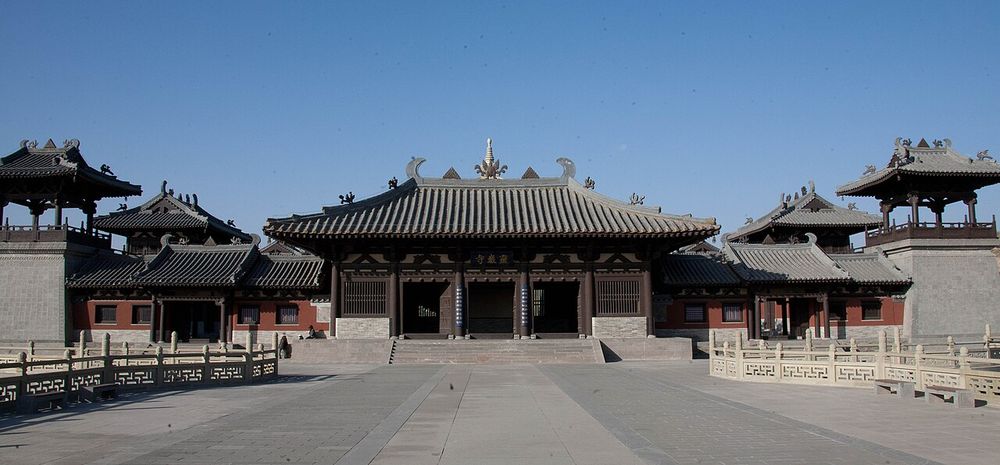
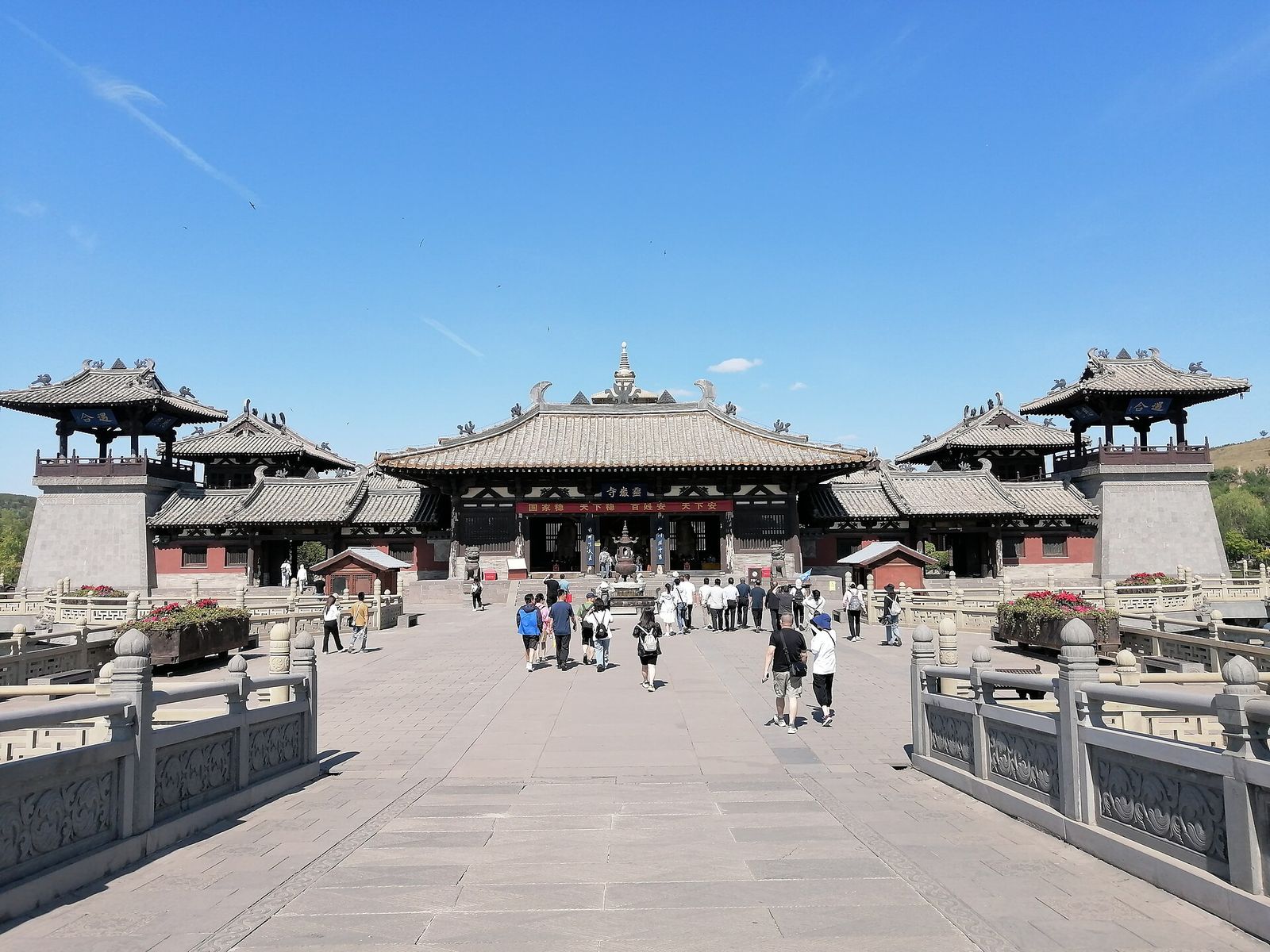
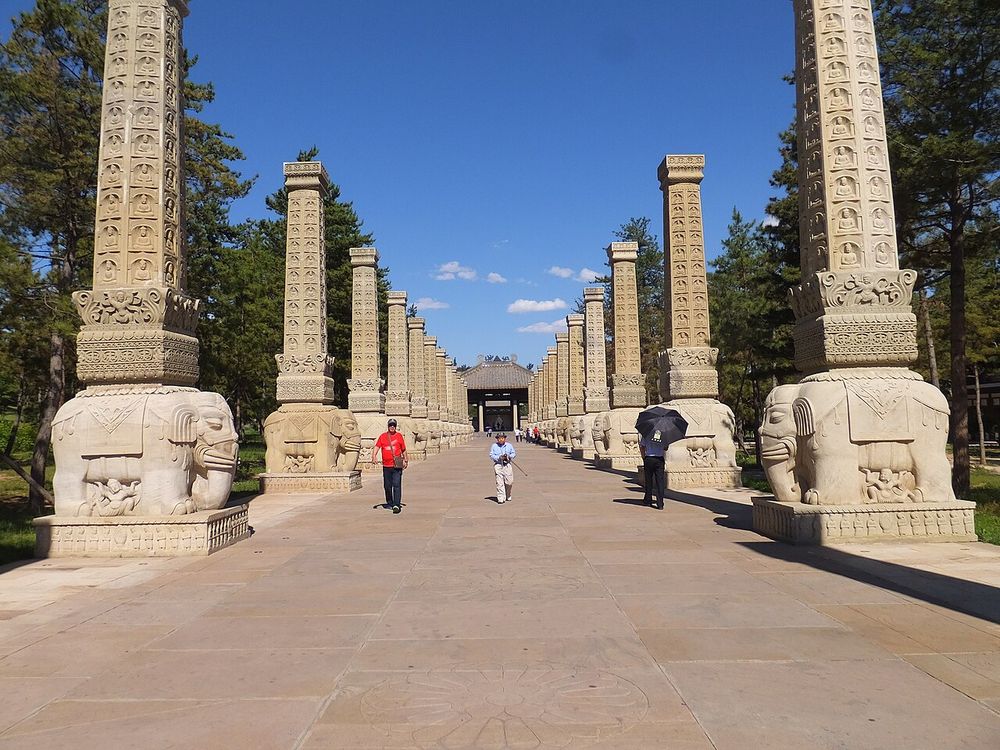
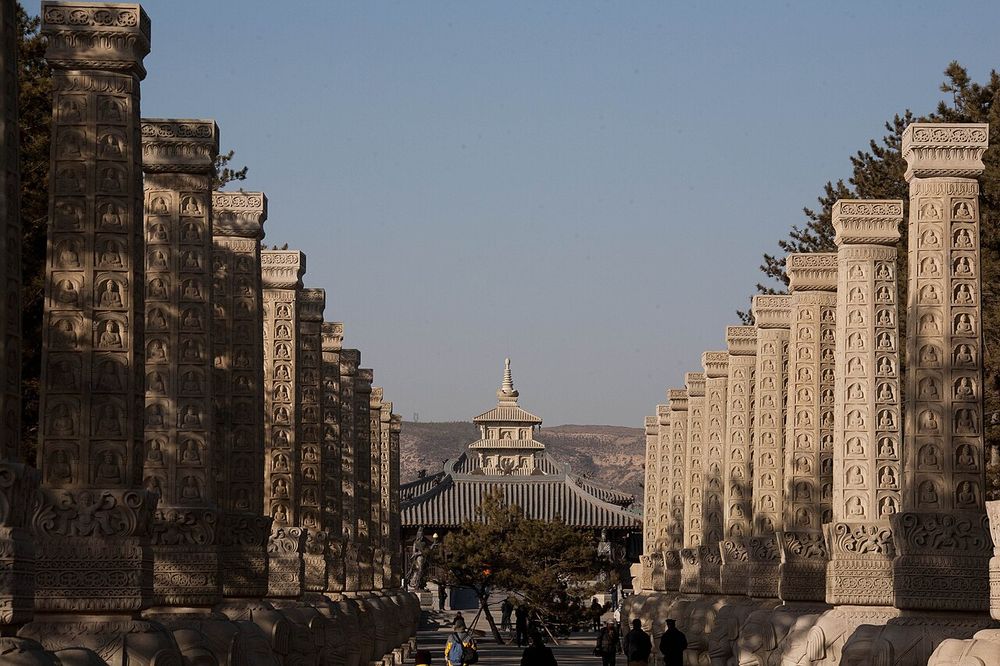
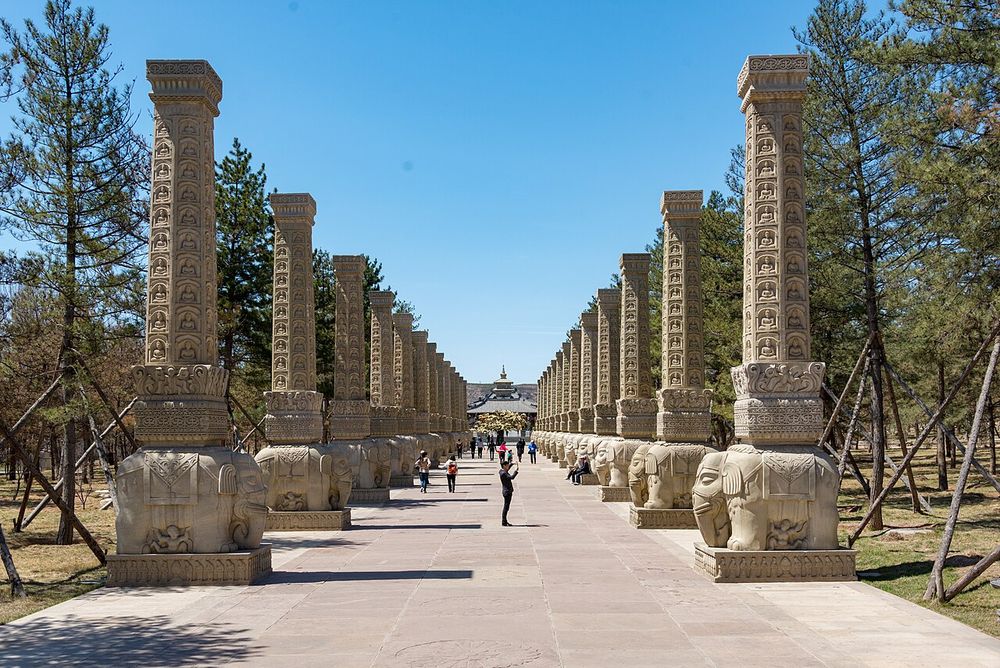
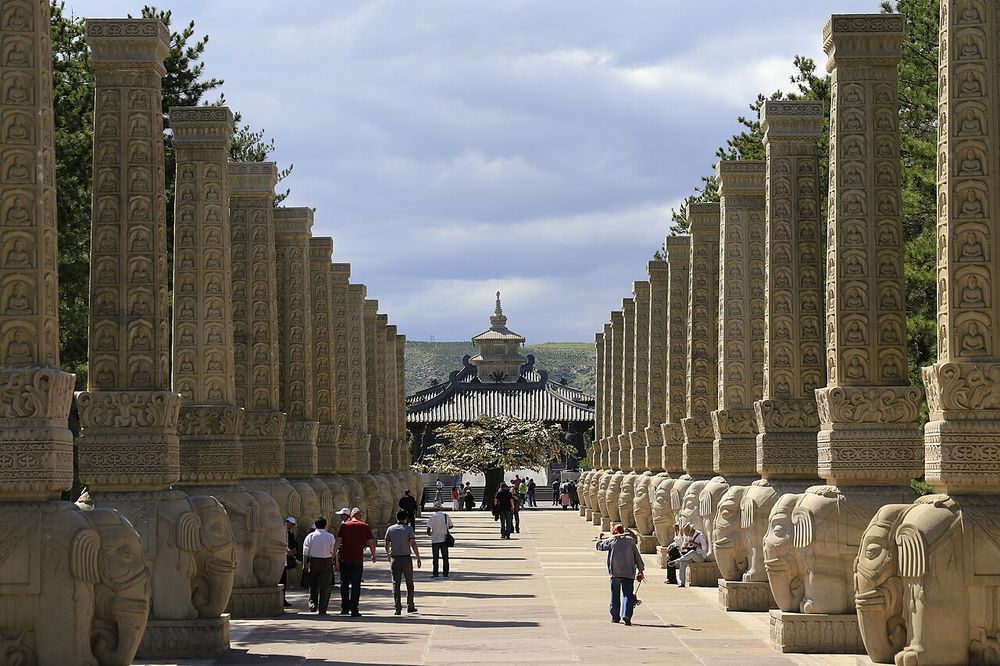
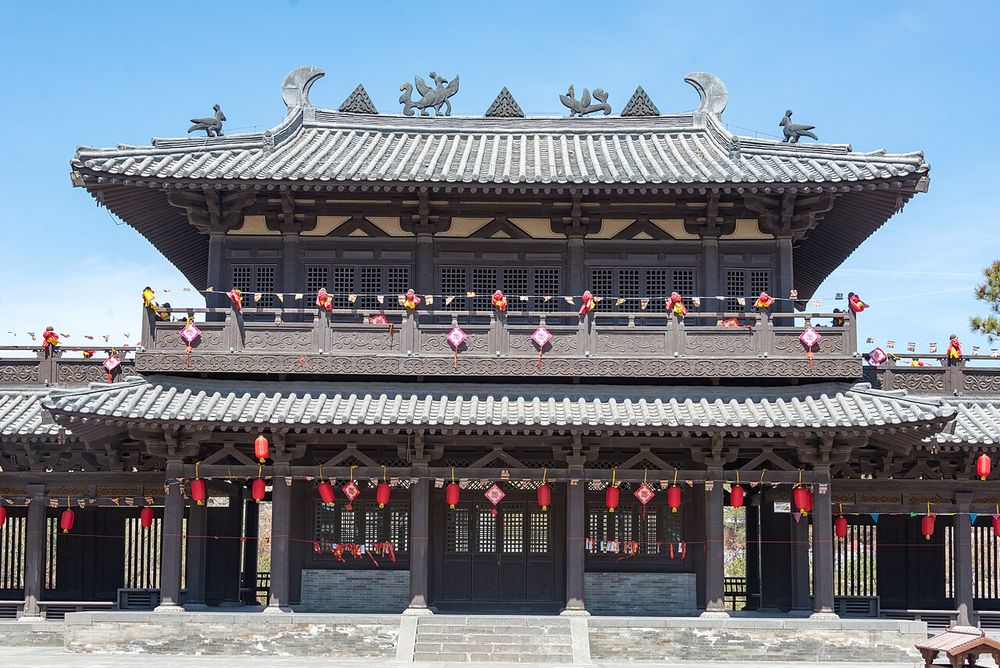
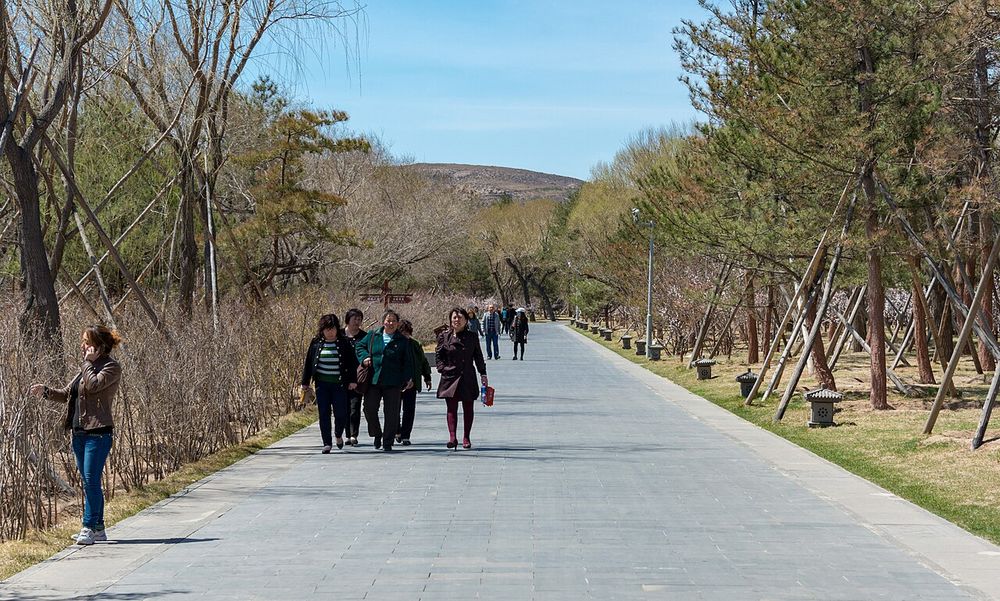
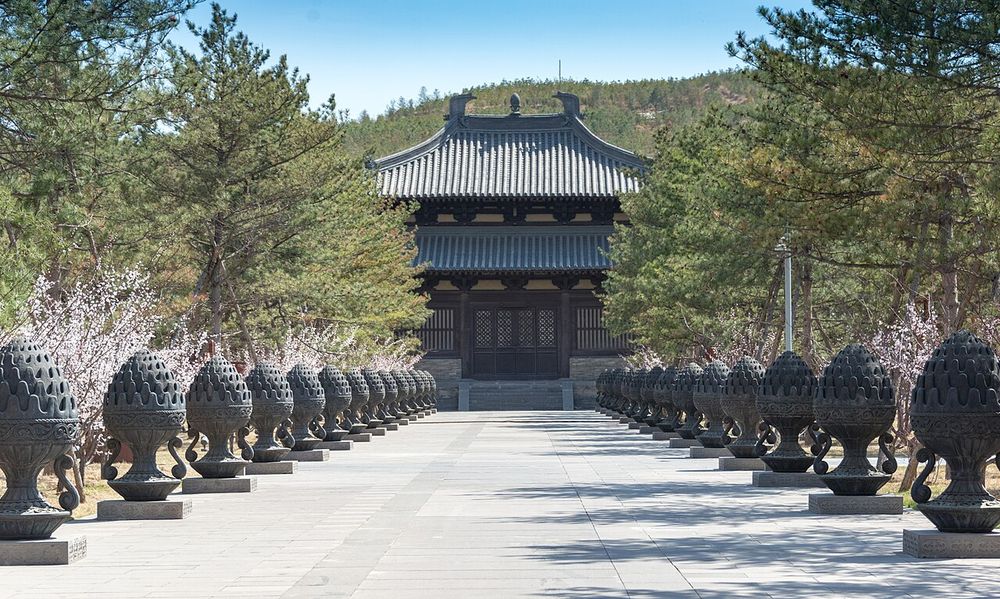
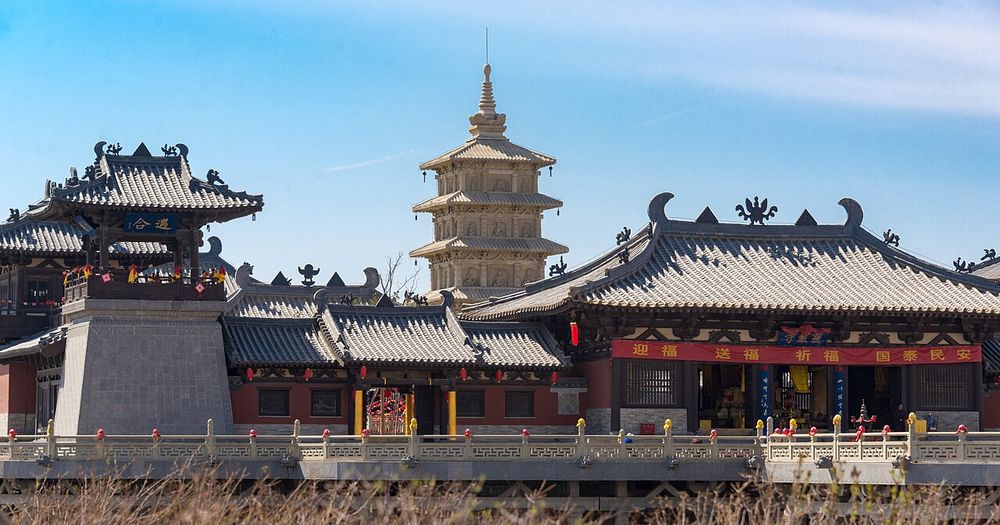
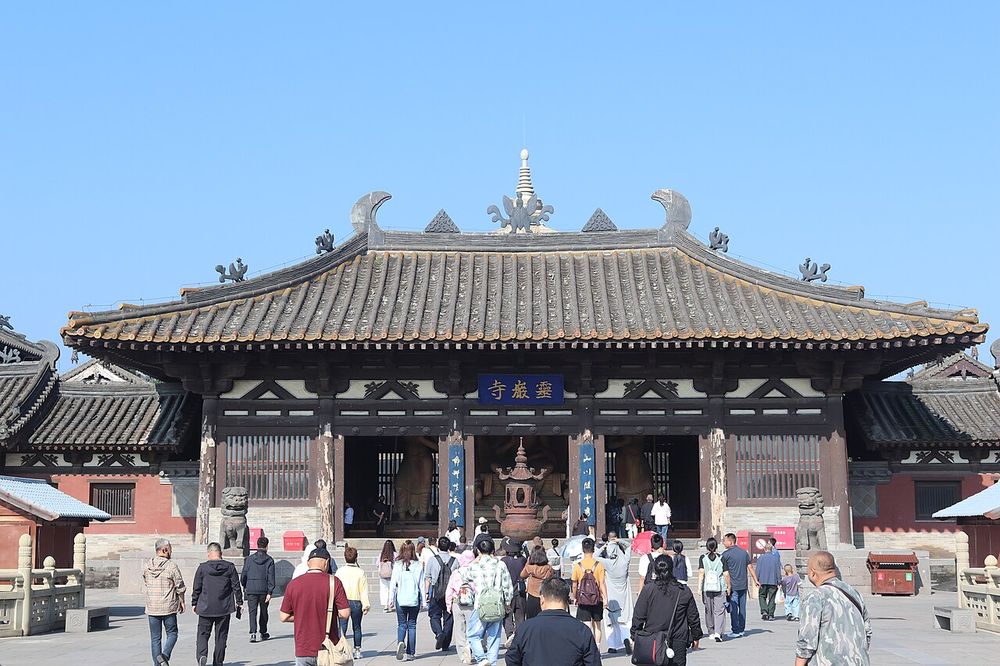
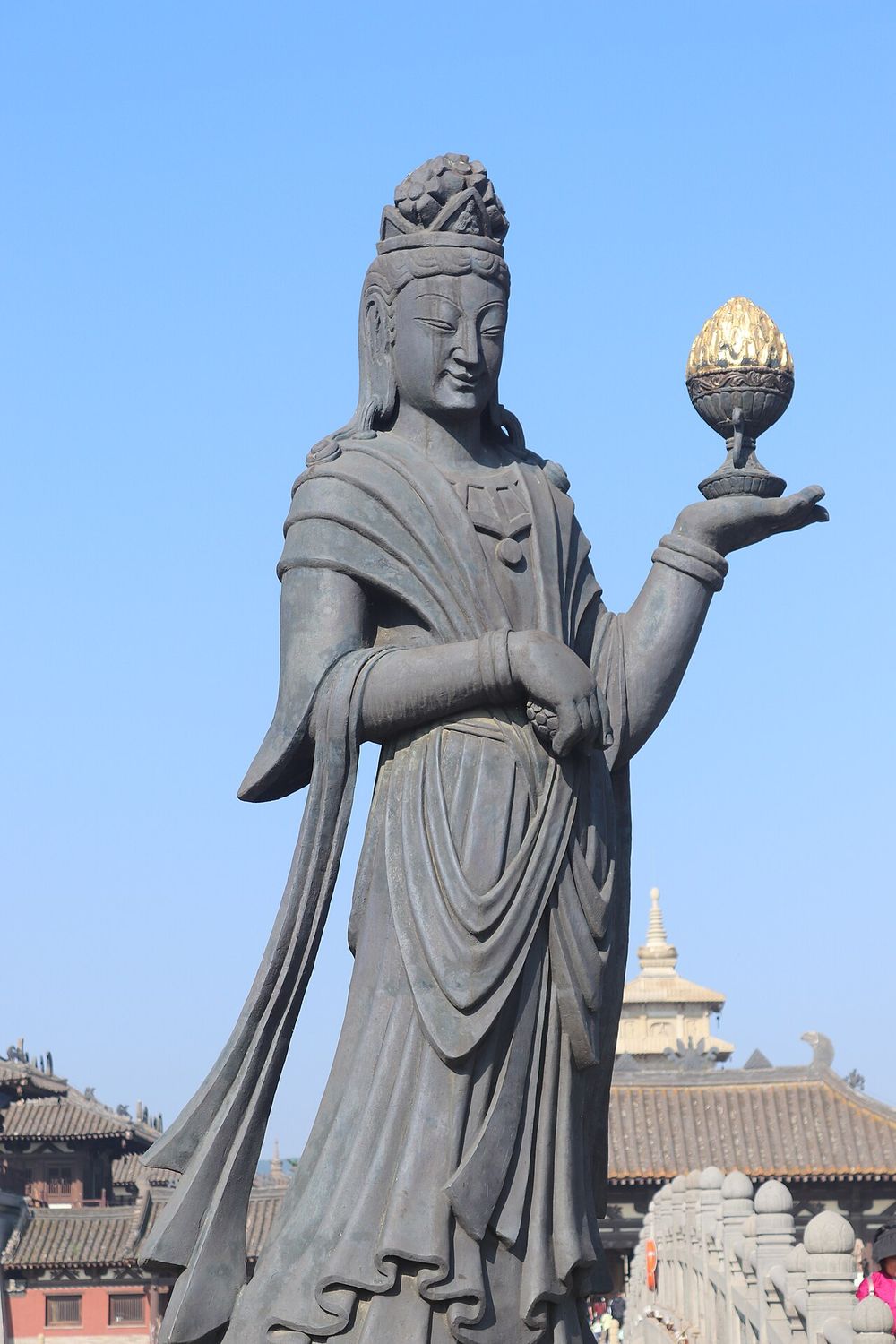
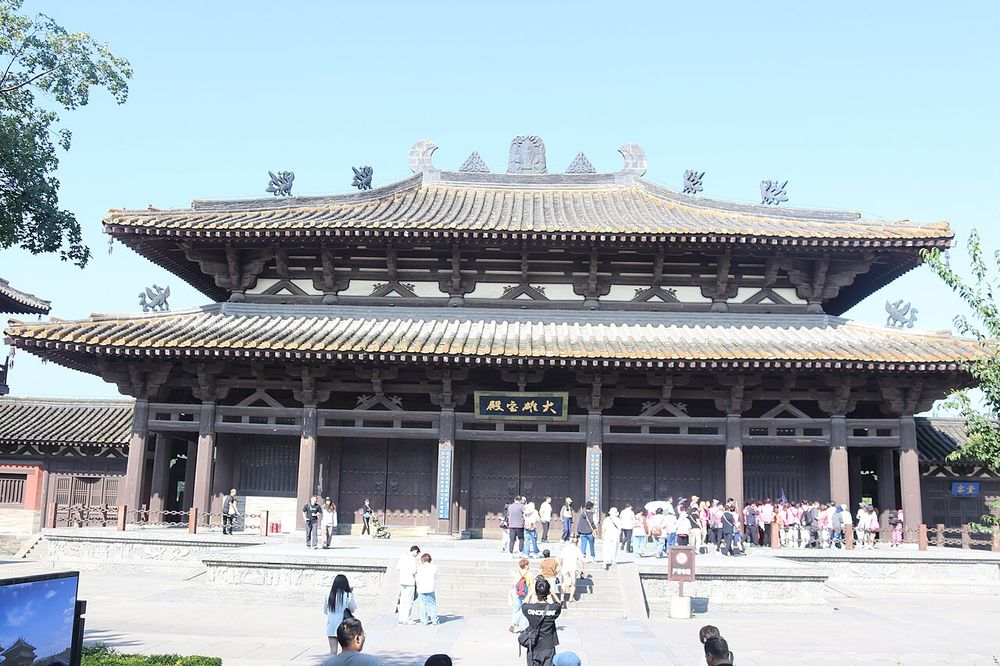
A temple of the Northern Wei, rebuilt in our own century on an island in the lake before the Yungang caves. The monk Tanyao founded the first temple here in the 460s, when he began the caves. What you see today is a new building after old descriptions, reached along an avenue of carved columns.
Photo: Yumeto, CC BY-SA 4.0, Wikimedia Commons
The story
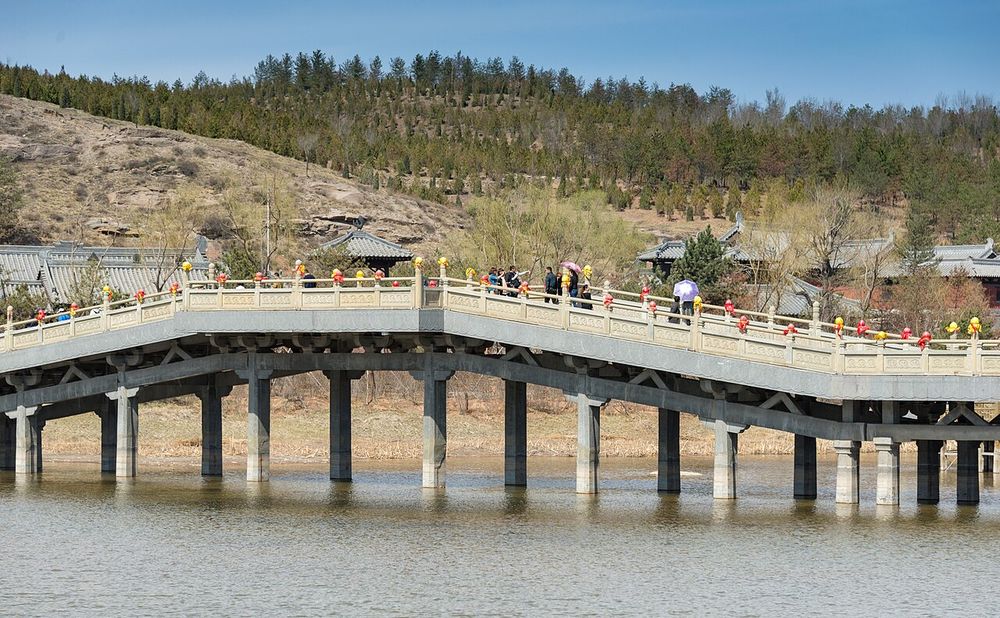
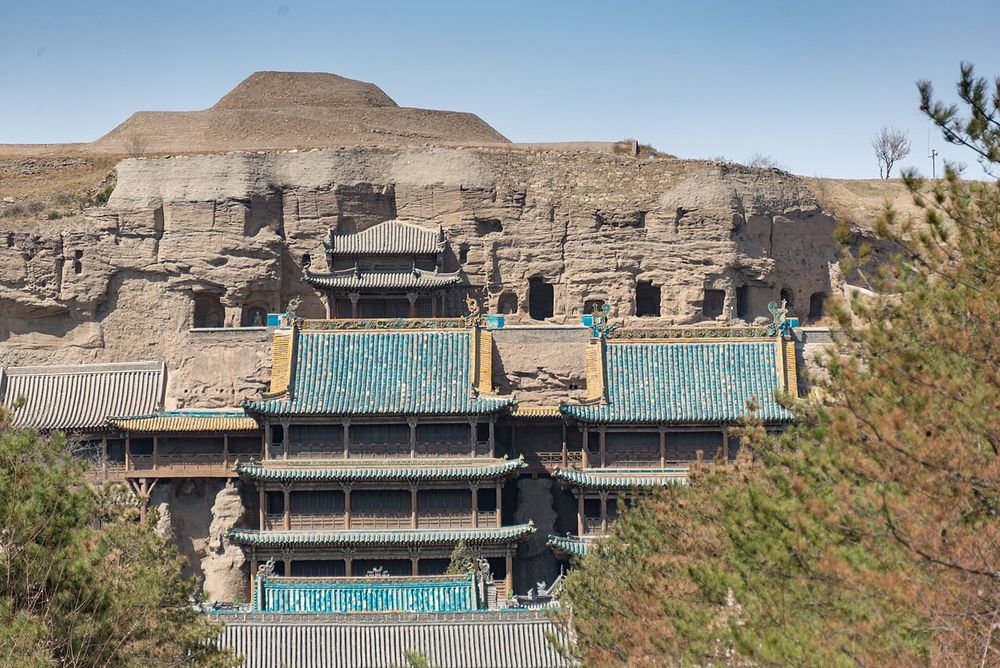
In 460 the monk Tanyao asked the Northern Wei (386–534) emperor to cut five great caves in the cliff of Wuzhou Mountain, west of the capital Pingcheng, today's Datong. Monks needed somewhere to live and pray beside them, and temples rose below the cliff and on top of it. The geographer Li Daoyuan, who saw them, wrote: halls on the hill and palaces on the water, the temples looking at each other through the mist.
Those temples are gone. When Datong cleared the coal roads and factories away from the caves in the 2000s, it built a large new park in front of them, and in it, on an island in a new lake, a temple in Northern Wei style called the Lingyan Temple, a name the old cave temple is said to have borne. Meanwhile, from 2008 to 2011, archaeologists digging on top of the cliff found the real foundations of a Northern Wei temple.
The long bridge over the lake, 2013xiquinhosilva, CC BY 2.0
Across the water stands a temple of three courtyards with deep eaves and plain red columns, built in the style of the fifth century as scholars imagine it. Behind it, a few hundred metres away, the cliff of the caves runs east and west.
山堂水殿,烟寺相望
Halls on the hill and palaces on the water, temples facing each other through the mist
Li Daoyuan, Commentary on the Water Classic, early 6th century
Be clear about what it is: a new building, not a ruin restored. It gives you a sense of how the caves once sat among temples and water, and a quiet place before the crowds of the caves.
The temple from the square, 2010JP Bennett from Yamato, Japan, CC BY 2.0
Things people often get wrong
"This is the temple of the Northern Wei." It is a modern building on a new island. The real Northern Wei remains are on top of the cliff and in front of the caves.
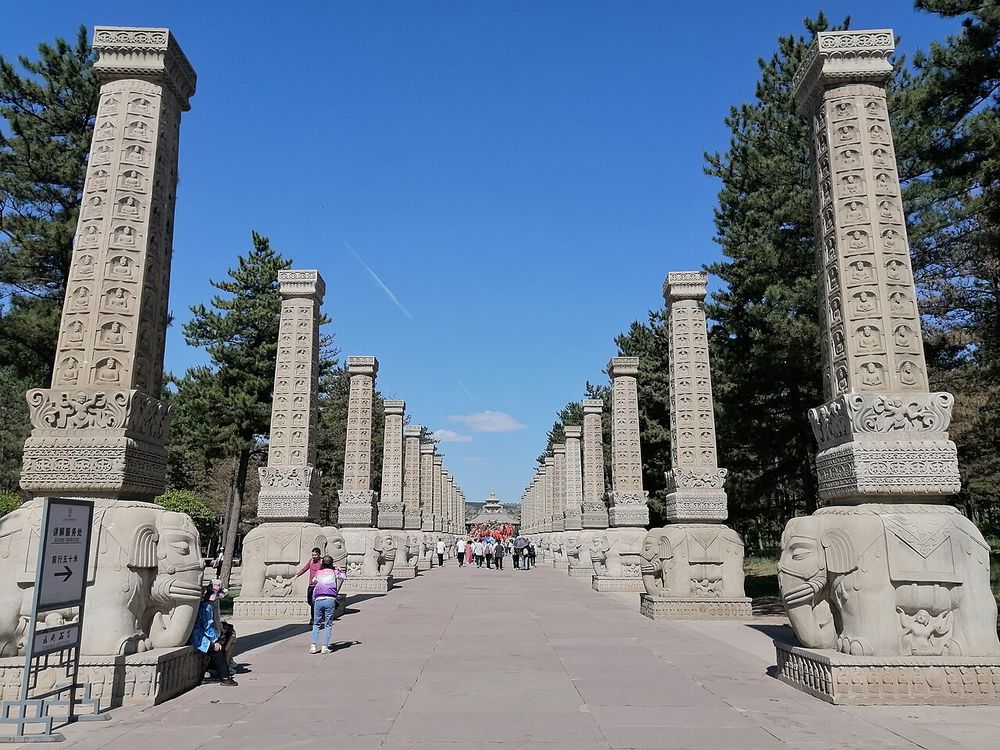
"The avenue of columns is ancient." It was built with the new park, with carvings copied from motifs in the caves.
People who stood here
We searched Chinese sources first for this list, then English ones.
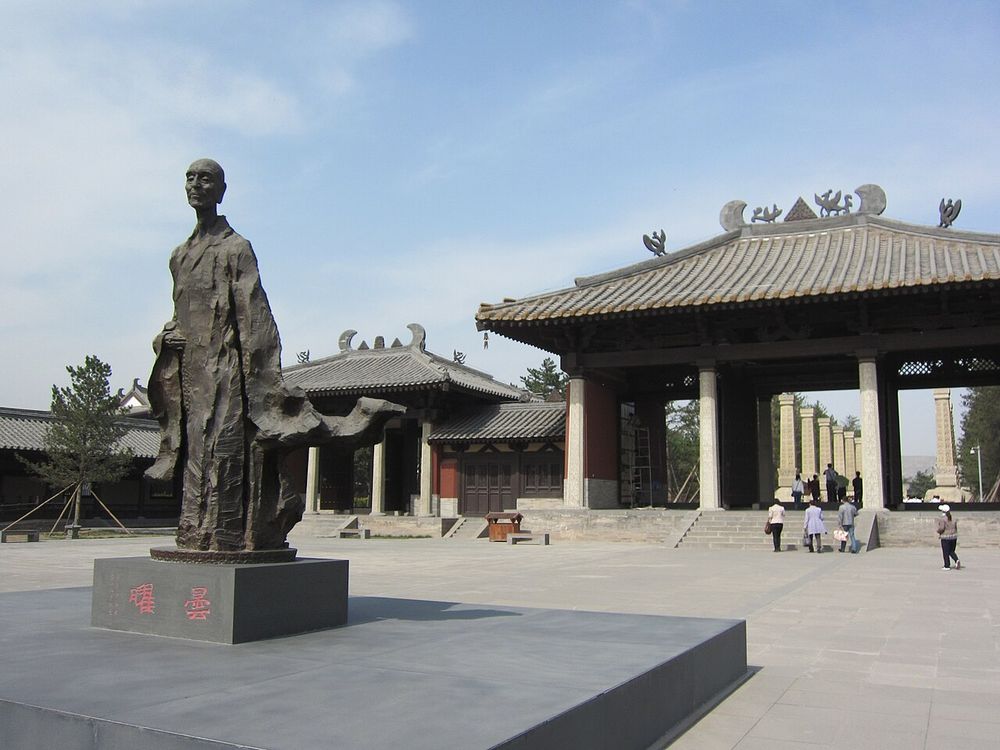
Tanyao (monk, 5th century)He survived the persecution of Buddhism in 446, and in 460 asked the emperor to cut the five great caves. He is counted as the founder of the cave temple. His statue by the sculptor Wu Weishan stands in the square named after him.
Li Daoyuan (geographer, d. 527)In his commentary on China's rivers he described the caves and temples on the Wuzhou river, the description that the new temple follows.
Wu Weishan (sculptor, born 1962)He made the bronze statue of Tanyao in the square.
Go deeper: five stops from the square to the caves
From the entrance, walk through Tanyao Square and along the avenue to the lake, cross to the temple, then go on to the caves. Half an hour for the temple itself.
1. Tanyao Square
The statue of Tanyao, 2011Jeremy Reding from Seattle, USA, CC BY-SA 2.0
The bronze monk stands at the start of the way, his hands together. Look at his face: the sculptor gave him the calm of the great Buddha of Cave 20.
2. The avenue of columns
The avenue of columns, 2023Yumeto, CC BY-SA 4.0
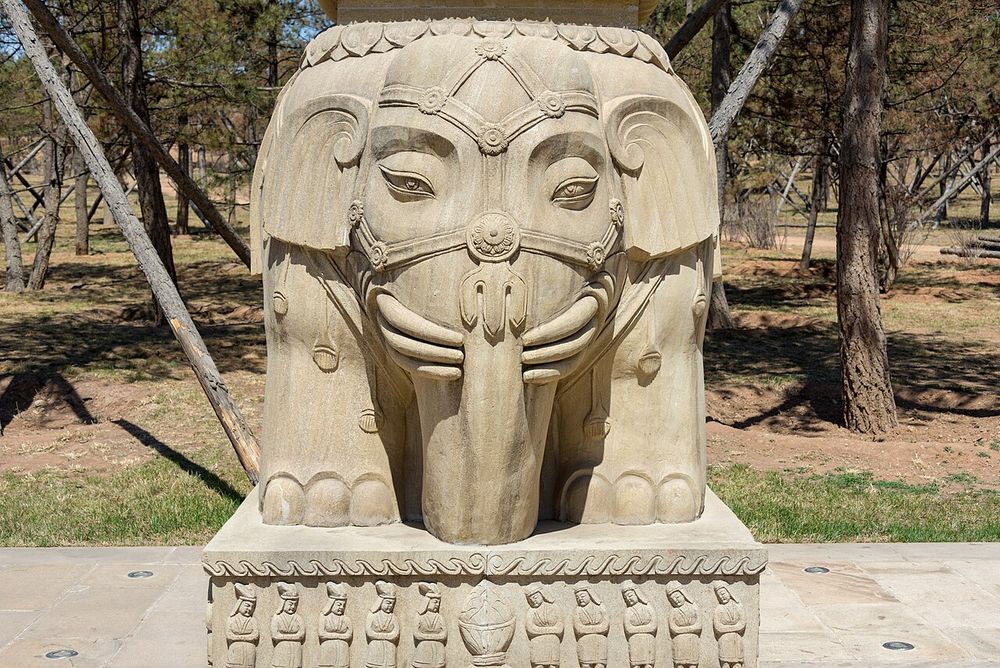
Pairs of stone columns carved with Buddhas, lotuses and elephants line the avenue. At their feet, elephants carry the columns, as elephants carry columns in the caves.
An elephant at a column's foot, 2013xiquinhosilva, CC BY 2.0
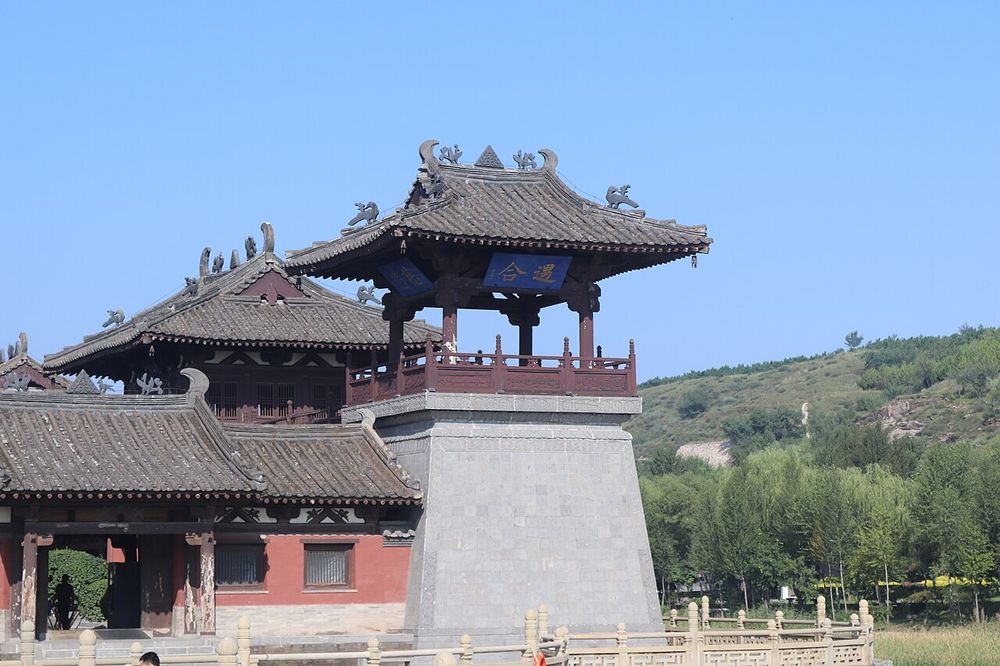
3. The bridge and the lake
The bridge to the island, 2013xiquinhosilva, CC BY 2.0
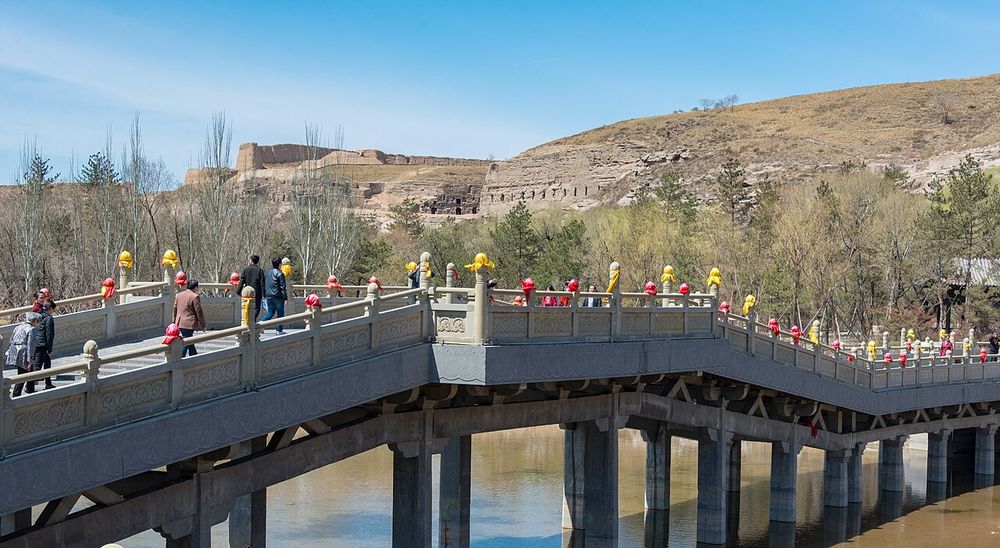
The lake was dug to bring back the halls on the water of Li Daoyuan's description. The river below the caves, the old Wuzhou river, ran here.
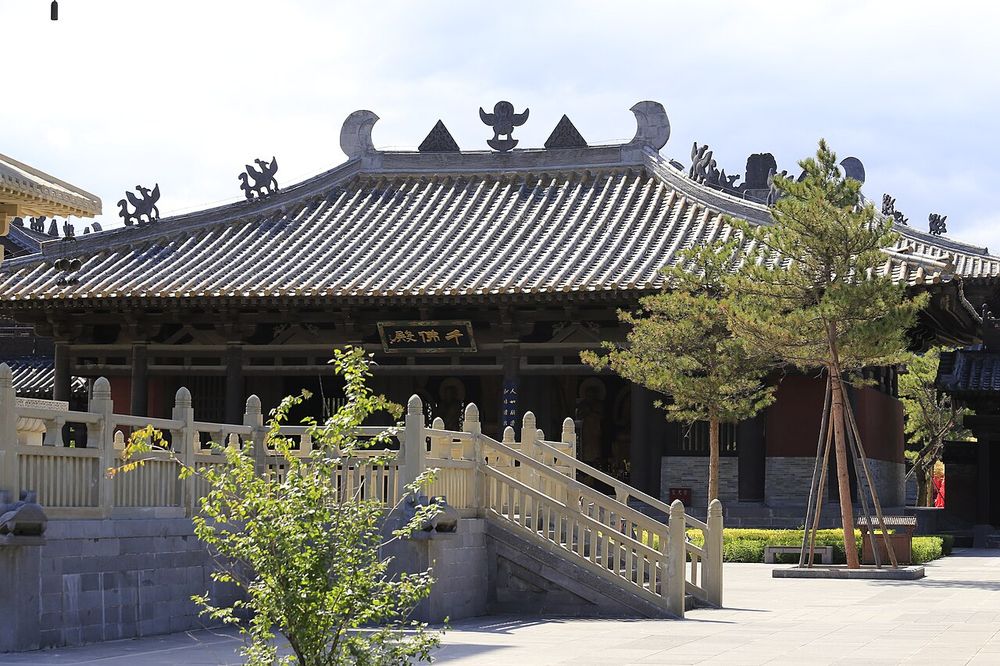
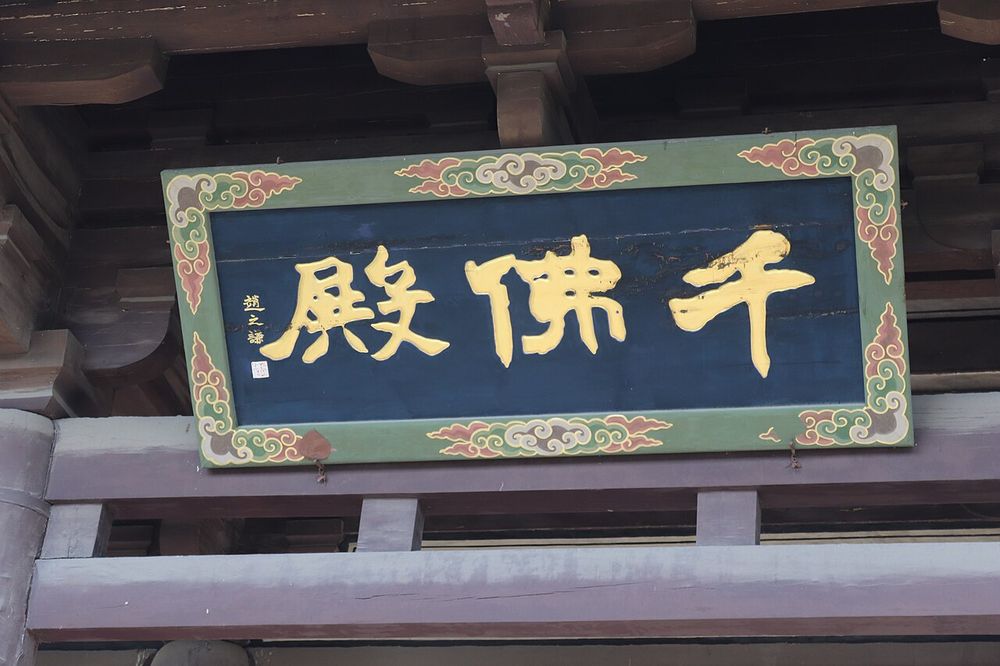
4. The Thousand Buddha Hall and the main hall
The Thousand Buddha Hall, 2025Liuxingy, CC BY-SA 4.0
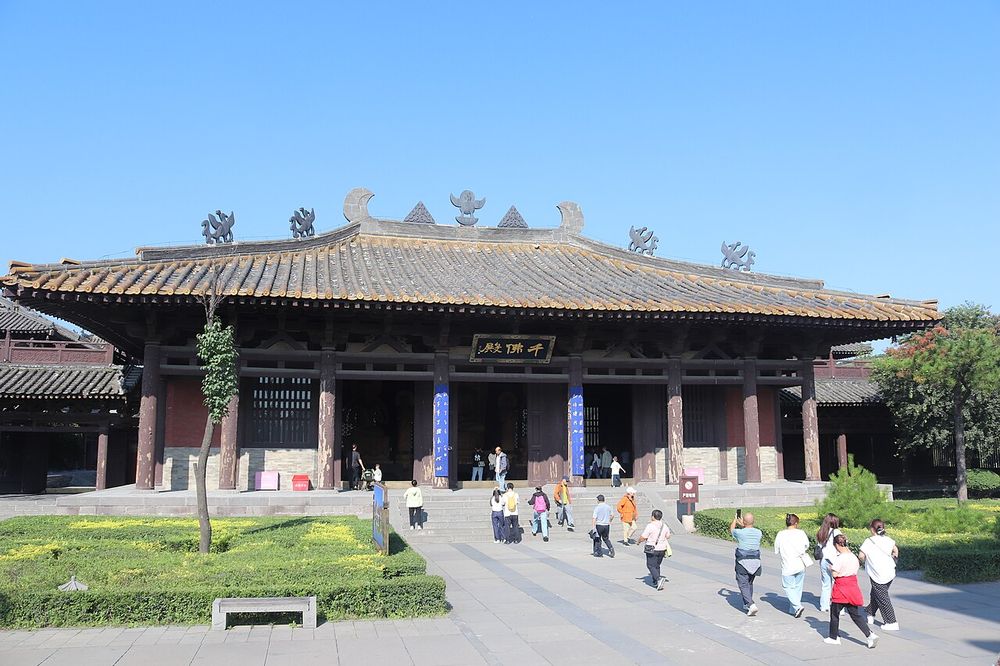
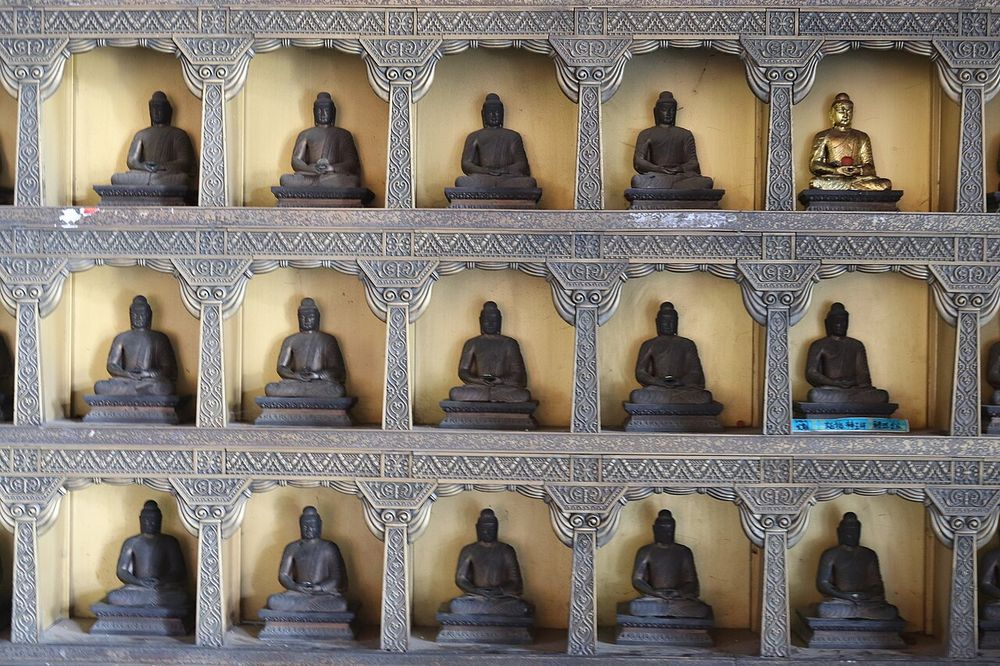
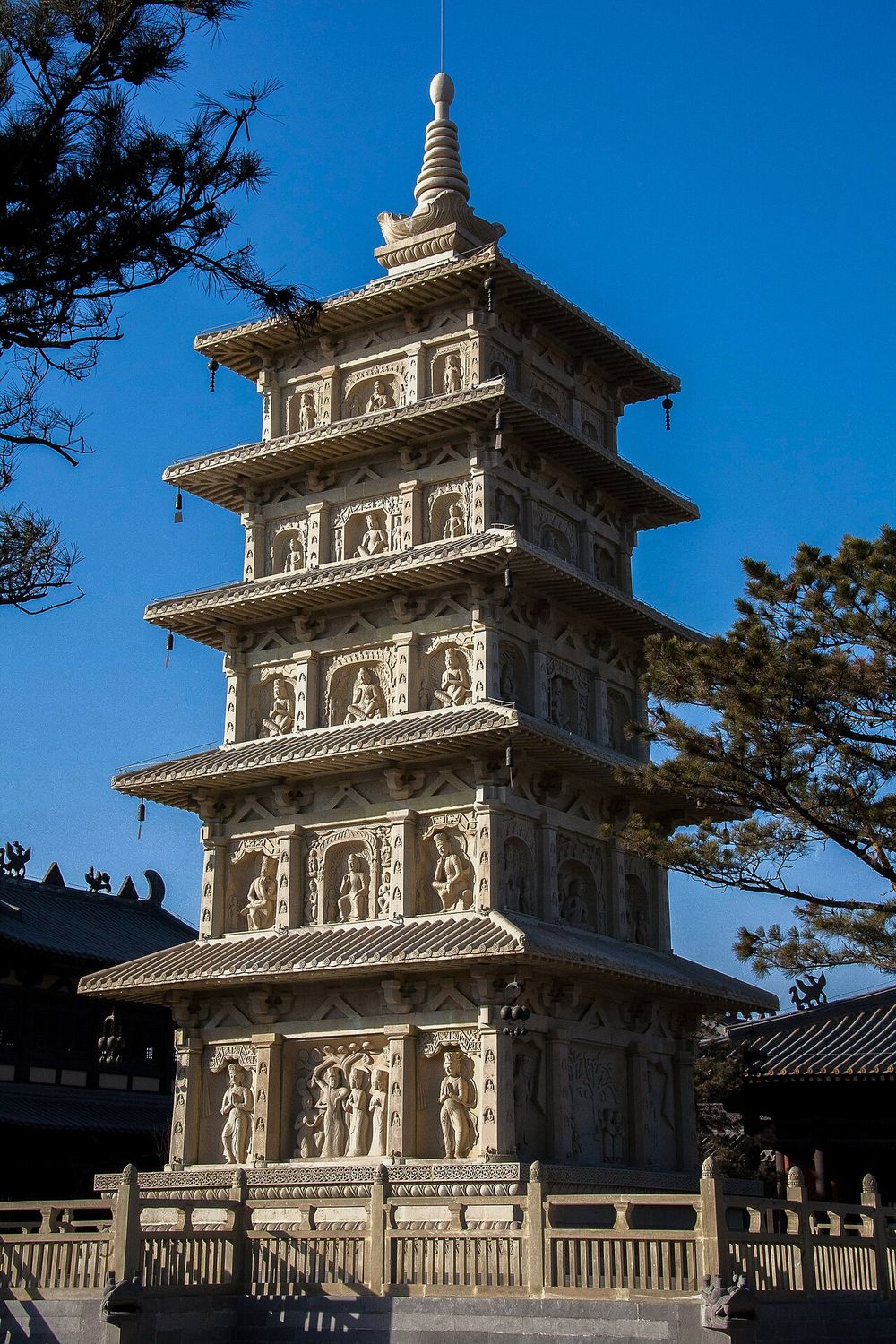
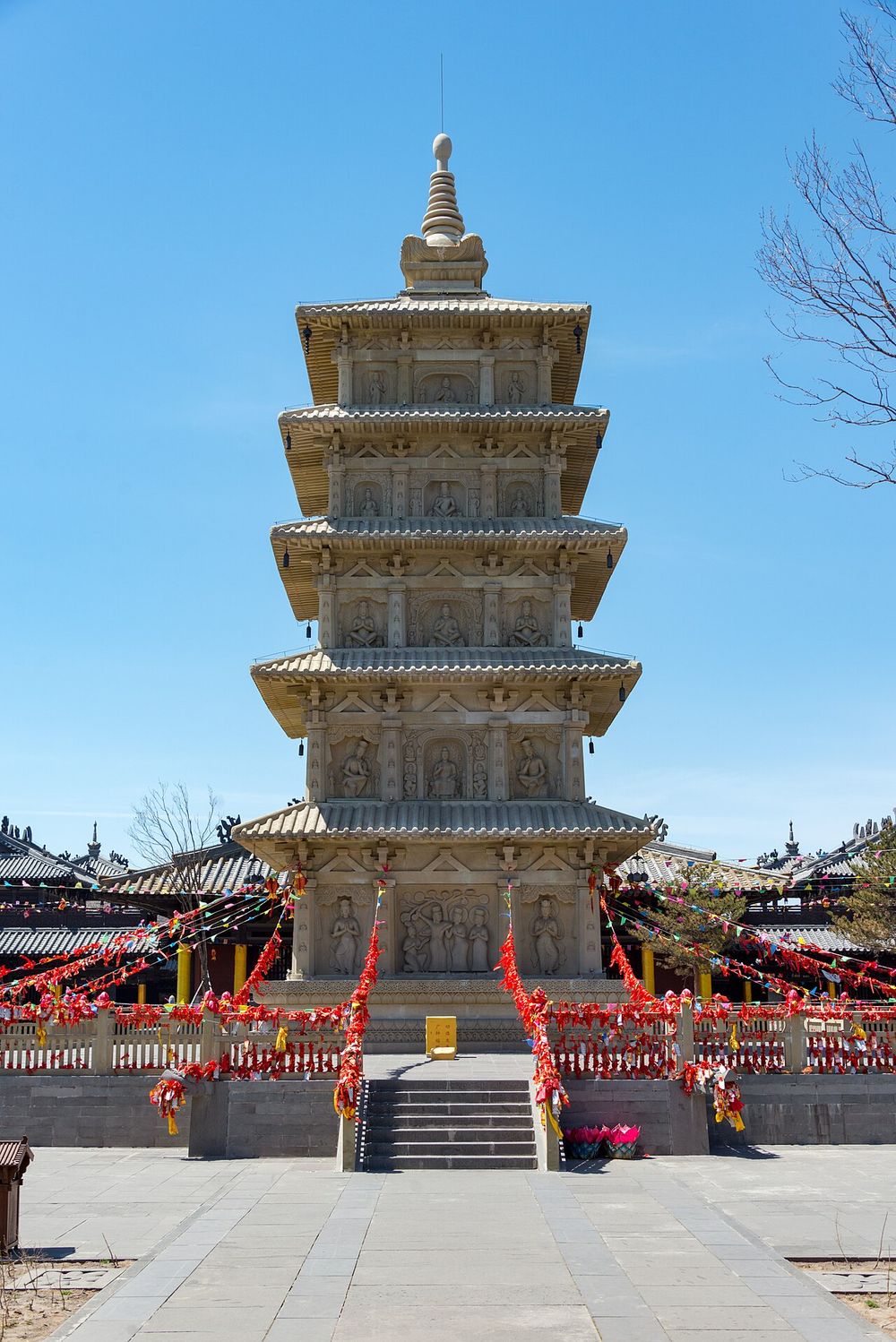
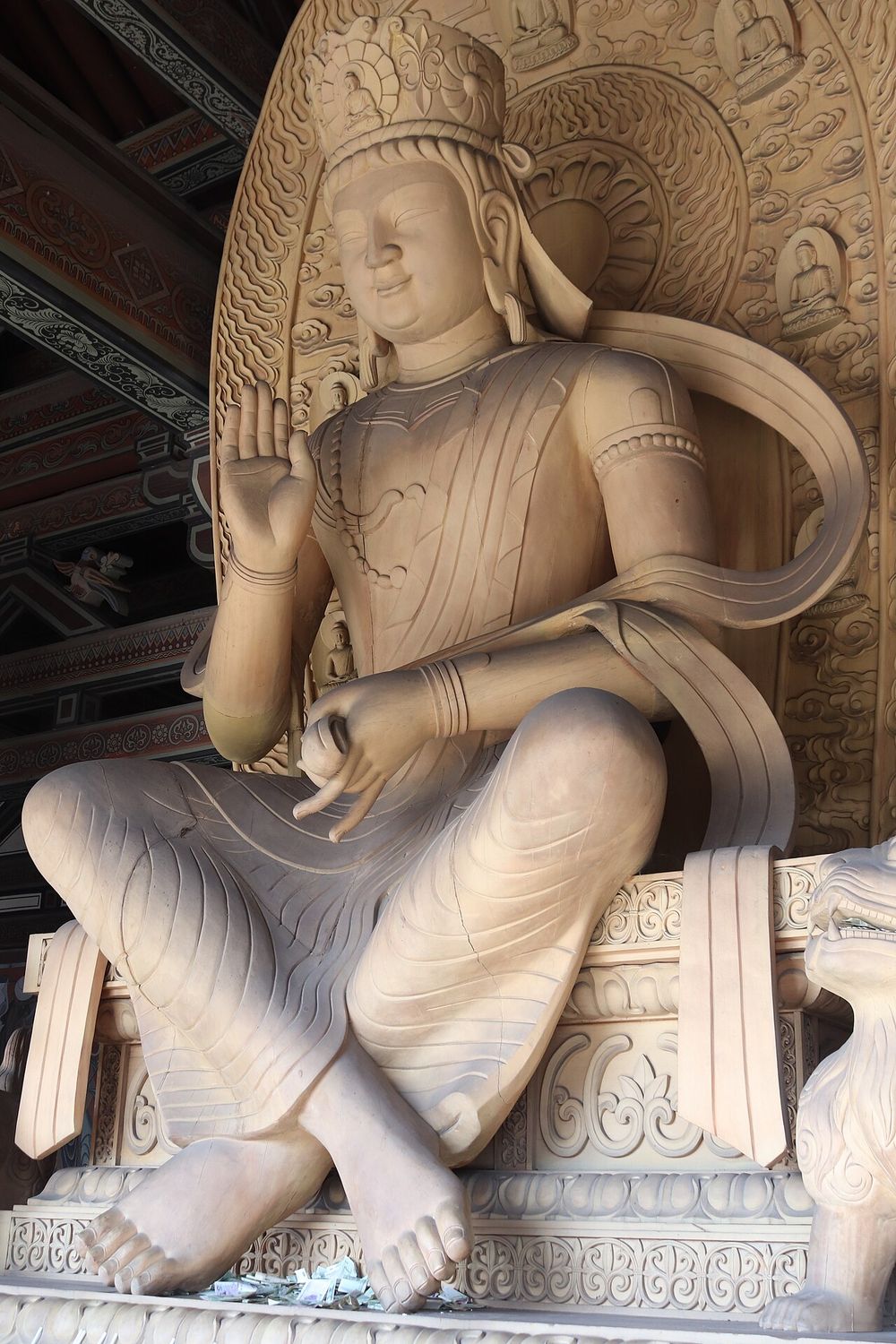
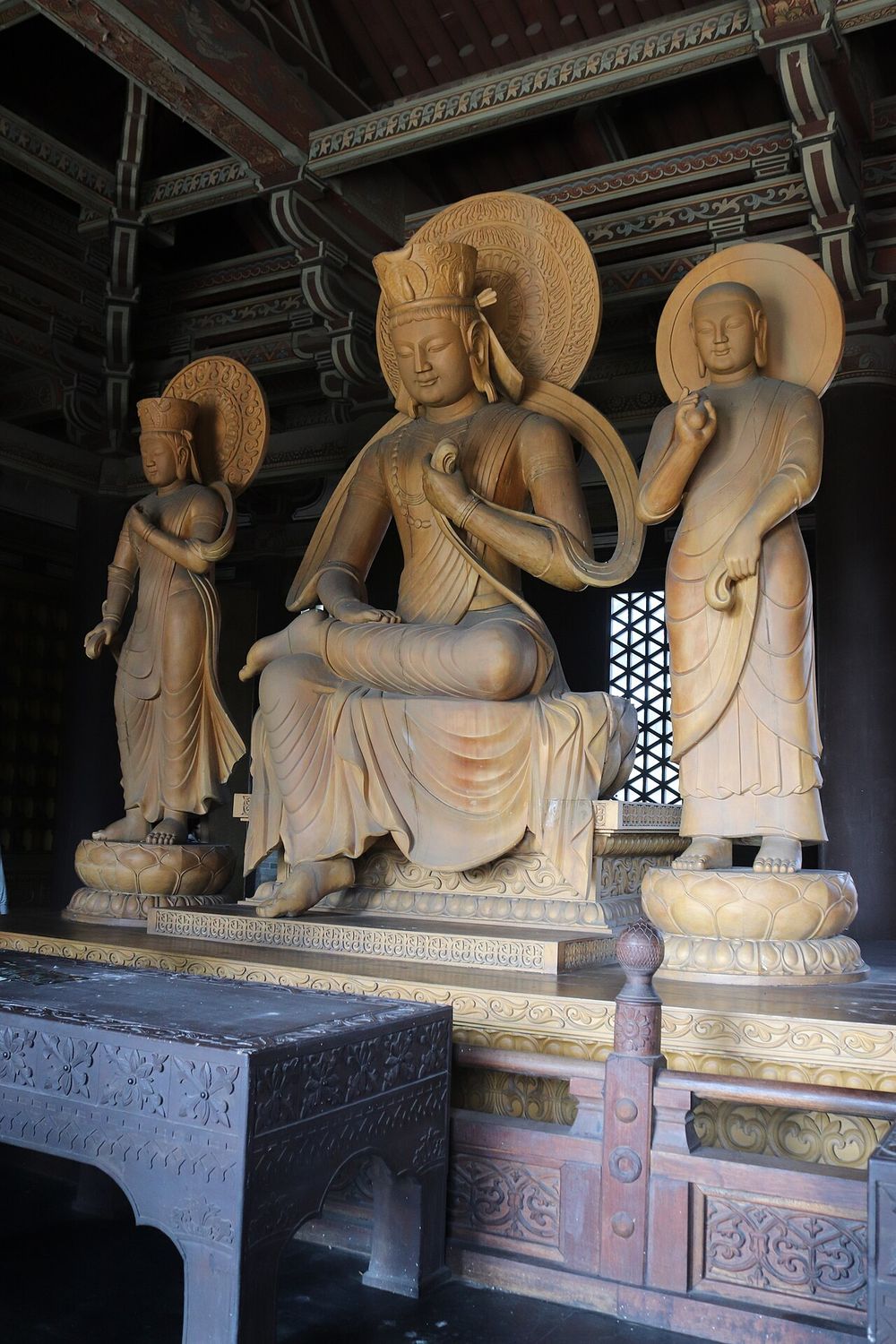
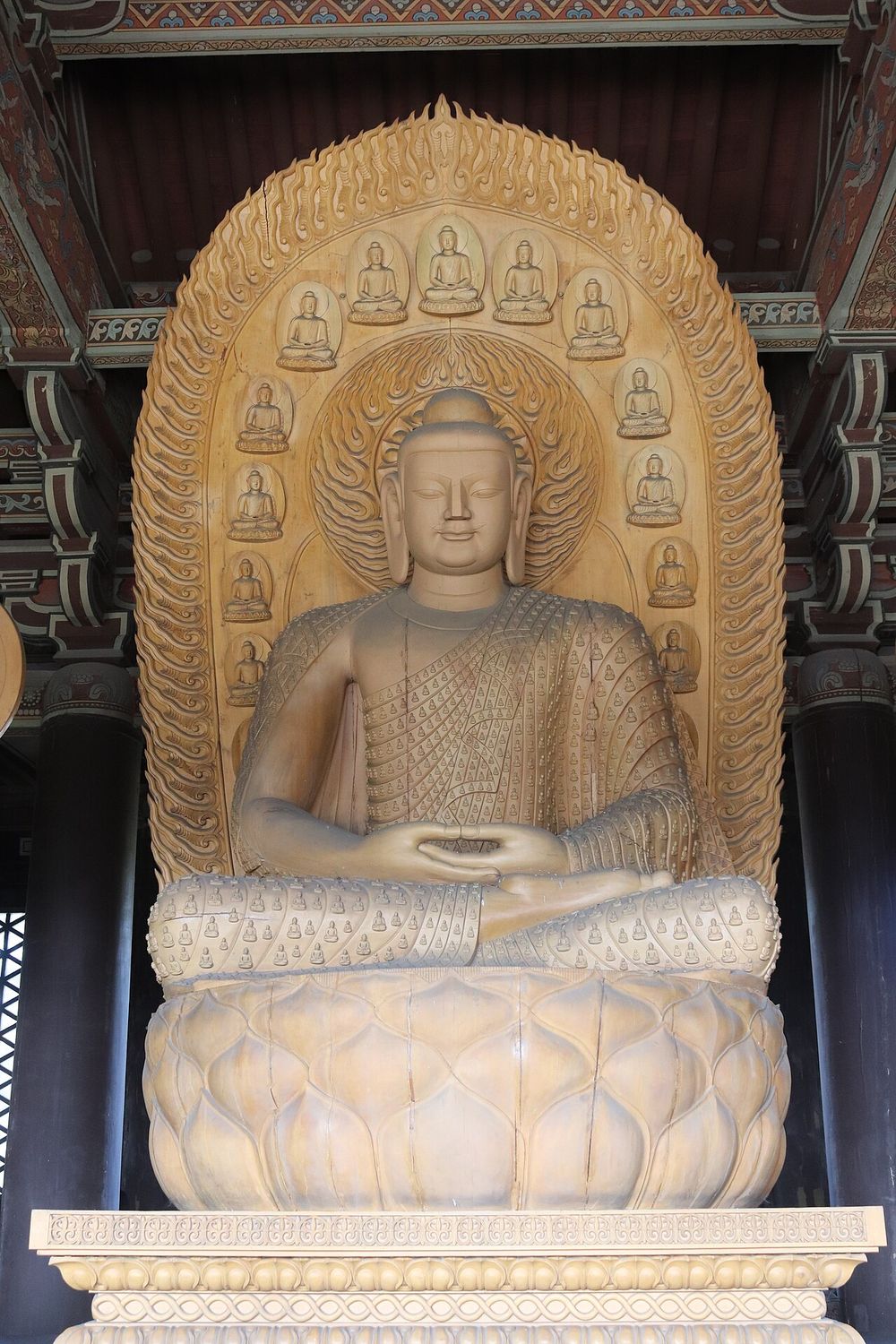
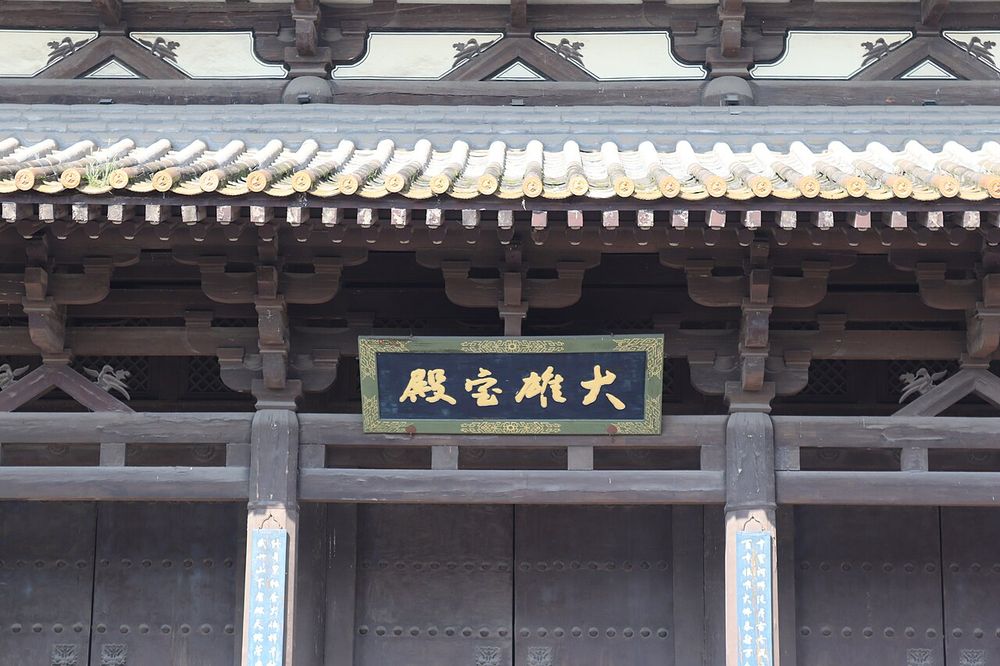
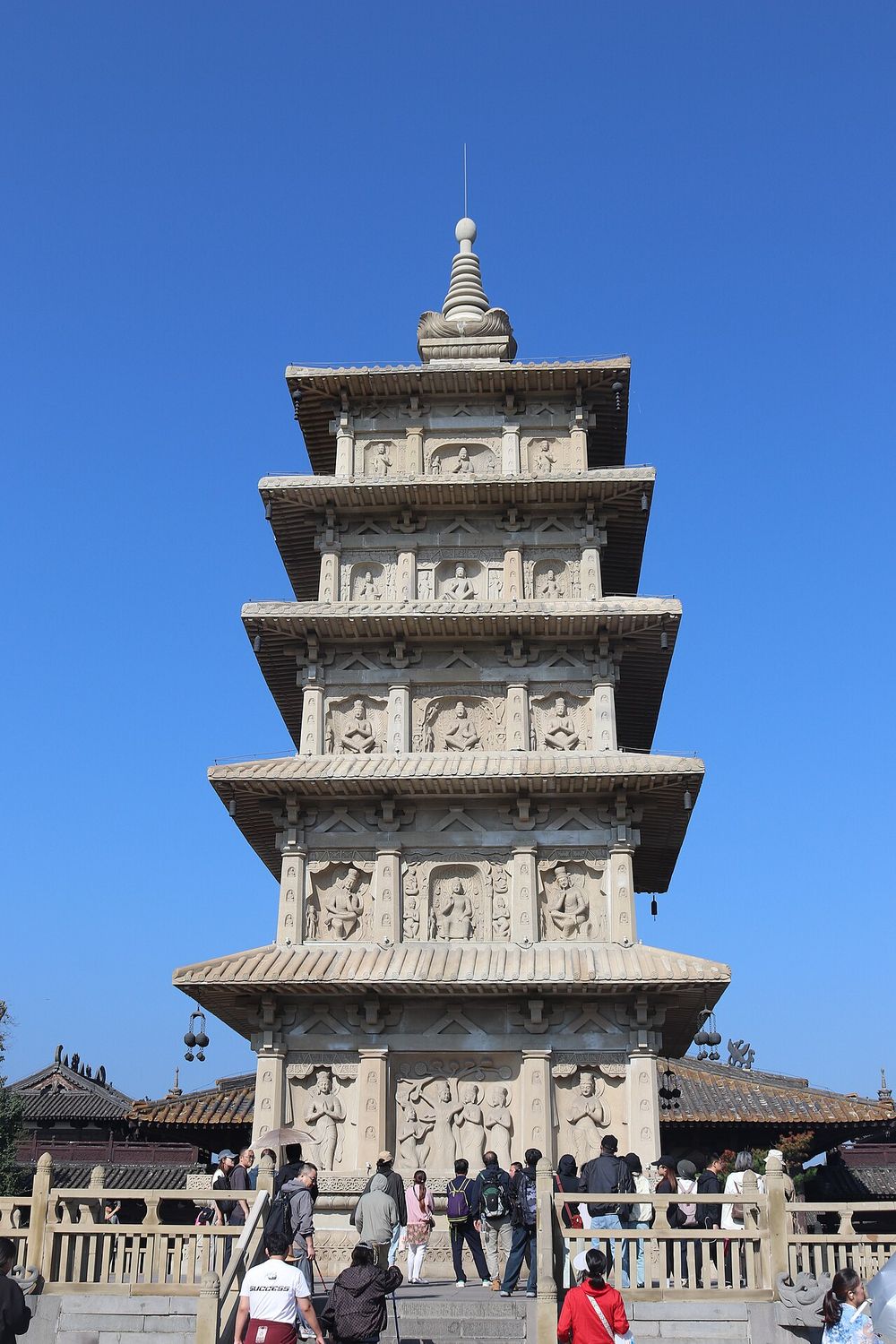
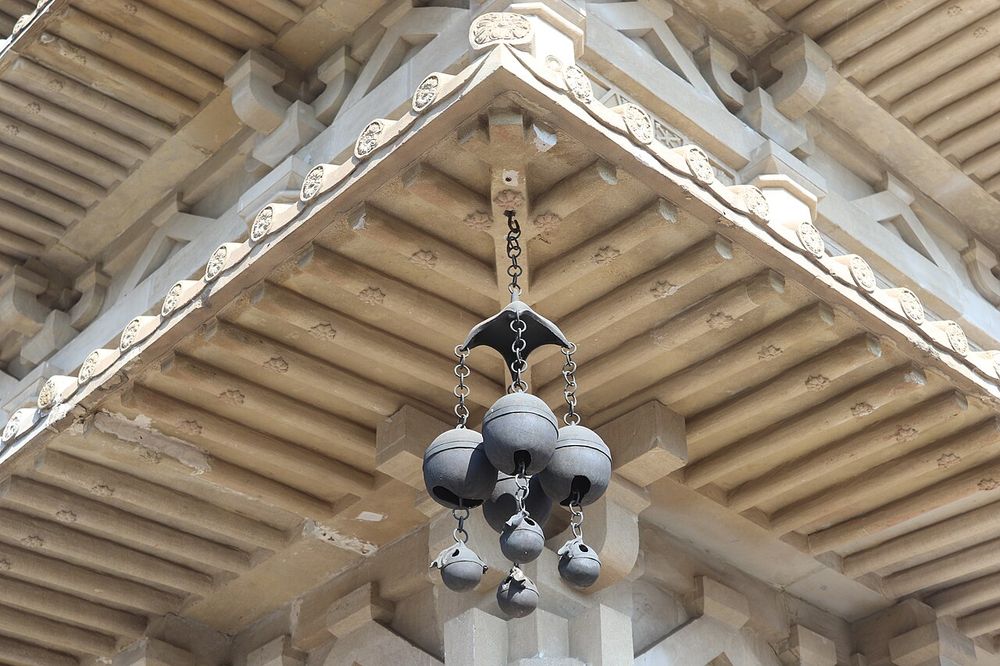
Three courtyards lead to the main hall. Inside, rows of small Buddhas fill the walls, echoing the thousand-Buddha walls of the caves. The pagoda in the courtyard copies the stone pagodas carved in the caves.
Rows of small Buddhas, 2025Liuxingy, CC BY-SA 4.0The pagoda in the temple, 2010JP Bennett from Yamato, Japan, CC BY 2.0
5. On to the caves
The temple below the cliff of the caves, 2013xiquinhosilva, CC BY 2.0
From the island, walk north to the cliff. The first caves you reach are 1 and 2 at the east end; the five great caves of Tanyao are at the west.
The temple and the same years elsewhere
Tanyao began the caves in 460, sixteen years before the last Roman emperor in the West was deposed.
Meanwhile in the world
Year
Here
Elsewhere
460
Tanyao begins the five great caves
Attila has been dead seven years
494
The court moves from Pingcheng to Luoyang
Clovis rules the Franks
2011
Northern Wei temple remains on the clifftop are among China's ten major finds of the year
The Arab Spring
One line to remember: a new temple after an old description, in front of real caves.
Then and now
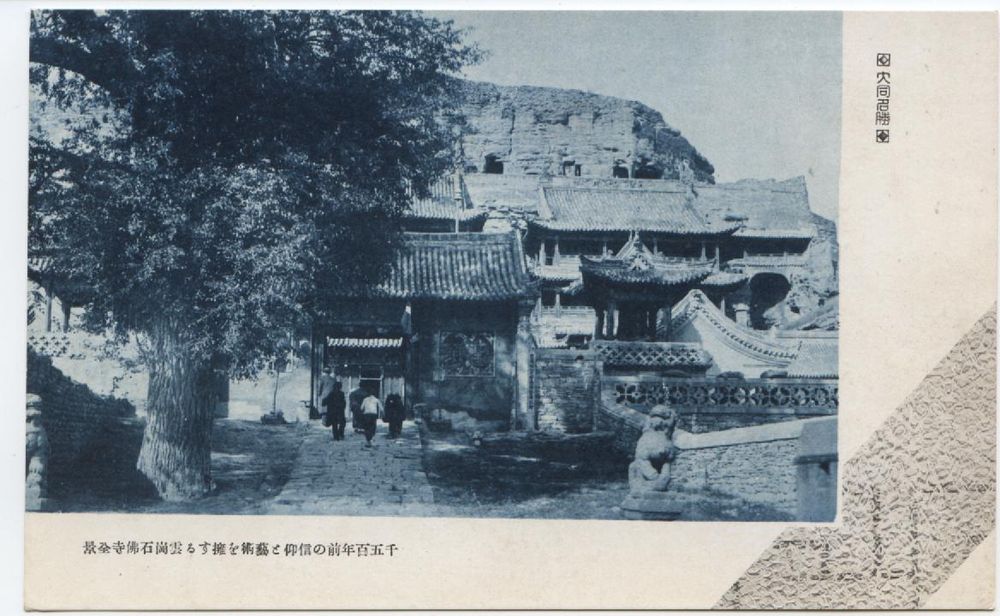
The Lingyan Temple across the water, 2023Yumeto, CC BY-SA 4.0, Wikimedia CommonsThe avenue of columns, 2023Yumeto, CC BY-SA 4.0, Wikimedia CommonsThe columns at the entrancelienyuan lee, CC BY 3.0, Wikimedia CommonsThe avenue towards the temple, 2010JP Bennett from Yamato, Japan, CC BY 2.0, Wikimedia CommonsCarved columns, 2013xiquinhosilva, CC BY 2.0, Wikimedia CommonsAn elephant at a column's foot, 2013xiquinhosilva, CC BY 2.0, Wikimedia CommonsColumns and visitors, 2013Zhangzhugang, CC BY-SA 3.0, Wikimedia CommonsThe pagoda, 2013xiquinhosilva, CC BY 2.0, Wikimedia CommonsThe main hall, 2013xiquinhosilva, CC BY 2.0, Wikimedia CommonsThe bridge to the island, 2013xiquinhosilva, CC BY 2.0, Wikimedia CommonsThe road along the lake, 2013xiquinhosilva, CC BY 2.0, Wikimedia CommonsLanterns of stone before a hall, 2013xiquinhosilva, CC BY 2.0, Wikimedia CommonsThe temple below the cliff of the caves, 2013xiquinhosilva, CC BY 2.0, Wikimedia CommonsThe long bridge over the lake, 2013xiquinhosilva, CC BY 2.0, Wikimedia CommonsHalls and the pagoda, 2013xiquinhosilva, CC BY 2.0, Wikimedia CommonsA hall on its terrace, 2013Zhangzhugang, CC BY-SA 3.0, Wikimedia CommonsThe temple from the square, 2010JP Bennett from Yamato, Japan, CC BY 2.0, Wikimedia CommonsThe statue of Tanyao, 2011Jeremy Reding from Seattle, USA, CC BY-SA 2.0, Wikimedia CommonsThe pagoda in the temple, 2010JP Bennett from Yamato, Japan, CC BY 2.0, Wikimedia CommonsBuildings at the east end, 2025Liuxingy, CC BY-SA 4.0, Wikimedia CommonsA hall at the east end, 2025Liuxingy, CC BY-SA 4.0, Wikimedia CommonsA seated bodhisattva in the east building, 2025Liuxingy, CC BY-SA 4.0, Wikimedia CommonsA standing bodhisattva by the east bridge, 2025Liuxingy, CC BY-SA 4.0, Wikimedia CommonsA Buddha and attendants inside, 2025Liuxingy, CC BY-SA 4.0, Wikimedia CommonsRows of small Buddhas, 2025Liuxingy, CC BY-SA 4.0, Wikimedia CommonsA seated Buddha, 2025Liuxingy, CC BY-SA 4.0, Wikimedia CommonsThe board of the Thousand Buddha Hall, 2025Liuxingy, CC BY-SA 4.0, Wikimedia CommonsThe Thousand Buddha Hall, 2025Liuxingy, CC BY-SA 4.0, Wikimedia CommonsThe board of the main hall, 2025Liuxingy, CC BY-SA 4.0, Wikimedia CommonsThe main hall, 2025Liuxingy, CC BY-SA 4.0, Wikimedia CommonsThe stone pagoda, 2025Liuxingy, CC BY-SA 4.0, Wikimedia CommonsUnder the pagoda's eaves, 2025Liuxingy, CC BY-SA 4.0, Wikimedia CommonsThe caves and their old temple buildings, early 20th centuryAnonymous. The postcard set was published in Keijo(Today Seoul) in 1939., Public domain, Wikimedia Commons
Local legends
These are stories people tell about this place. They are legends, not history, and each one says where it comes from.
LegendThe emperor's five Buddhas
Tanyao's five great Buddhas are said to stand for the first five emperors of the Northern Wei, so that worshipping the Buddha meant honouring the throne.
Source: A widely held reading, after the saying of the time that the emperor was the Buddha of today
Later, people who live here will be able to add the stories they grew up with, and say which of these they have heard.
Not certain, and where accounts conflict
Where was the real Lingyan Temple?
Old texts speak of temples below and on top of the cliff. Excavations on the clifftop in 2008–2011 found a Northern Wei temple with monks' rooms; the new temple on the island is not on any ancient site.
Checked 2026-11-12 Yungang Academy, which runs the site. Tickets are sold through its WeChat account and authorised platforms.
Tickets and hours
The Yungang ticket, 120 yuan from April to October and 100 yuan from November to March, includes the temple.
Opening hours change with the season, roughly from early morning to late afternoon.
Last checked 2026-11-12. The Yungang ticket rules of 2025–26 as reported in the press; the Yungang scenic area's own notices are on its WeChat account.
Booking without WeChat
International booking platform Authorised platforms such as Trip.com also sell tickets with a passport.
WeChat or Alipay All Yungang tickets are booked online in advance, with a real name and passport number, through the Yungang Grottoes WeChat account.
Ticket window on site Since 15 March 2025 tickets for the same day are not sold, and there is no ticket window at the gate.
Note Book at least a day ahead.
Checked 2026-11-12
Where to start
The site is 16 kilometres west of Datong. Bus 603 runs from the city, or take a taxi of about thirty minutes.
Visit the temple on the way in, before the caves.
Before you go
Bring your passport itself.
Datong is high and dry; bring water and sun cream in summer and warm clothes in winter.
Customs and manners
The halls are active places of worship. Do not climb on the altars.
Opening hours are given in the local time of the place. Prices are in the local currency. The figure after ≈ is approximate, at exchange rates checked on 9 November 2026, in .
Look for these
Find an elephant carrying a column.
Find Tanyao's hands.
In the courtyard, compare the pagoda with a pagoda carved in the caves.
I am here
Stand at the site, sign in, press the button, and collect its stamp. Your browser will ask to use your location. It is sent to us once to confirm that you are at the site; we keep how far you were from it, not the spot where you stood.
Your stamps are saved to your account, so they follow you to any device. Checking from a browser cannot rule out every false location; stricter checks arrive with the app.
Messages
Share your photos
Photos here show the place, not people. Each one is credited to the visitor who took it and appears after our team has looked at it. A photo with you in it belongs under “I am here”.