Kasuga Taisha, the shrine of three thousand lanterns
春日大社 · kah-SOO-gah TIE-shah
A vermilion shrine at the foot of a mountain nobody may climb, reached by a forest path lined with two thousand stone lanterns. It was founded in 768 for the family that ran Japan for three centuries, and every lantern was given by someone who wanted something.
Photo: Zairon, CC BY 4.0, Wikimedia Commons
The story
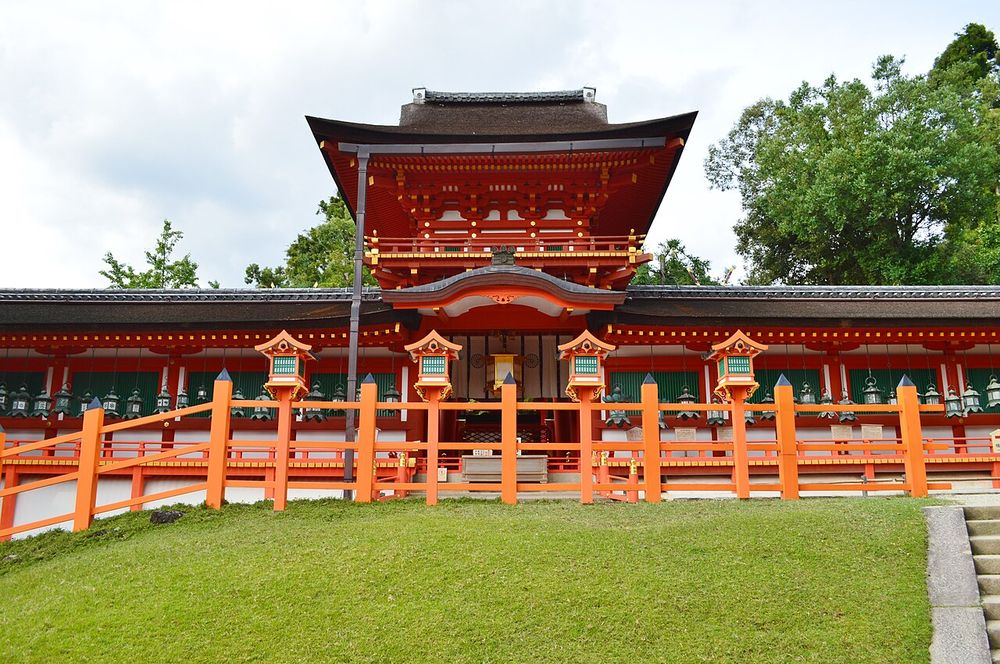
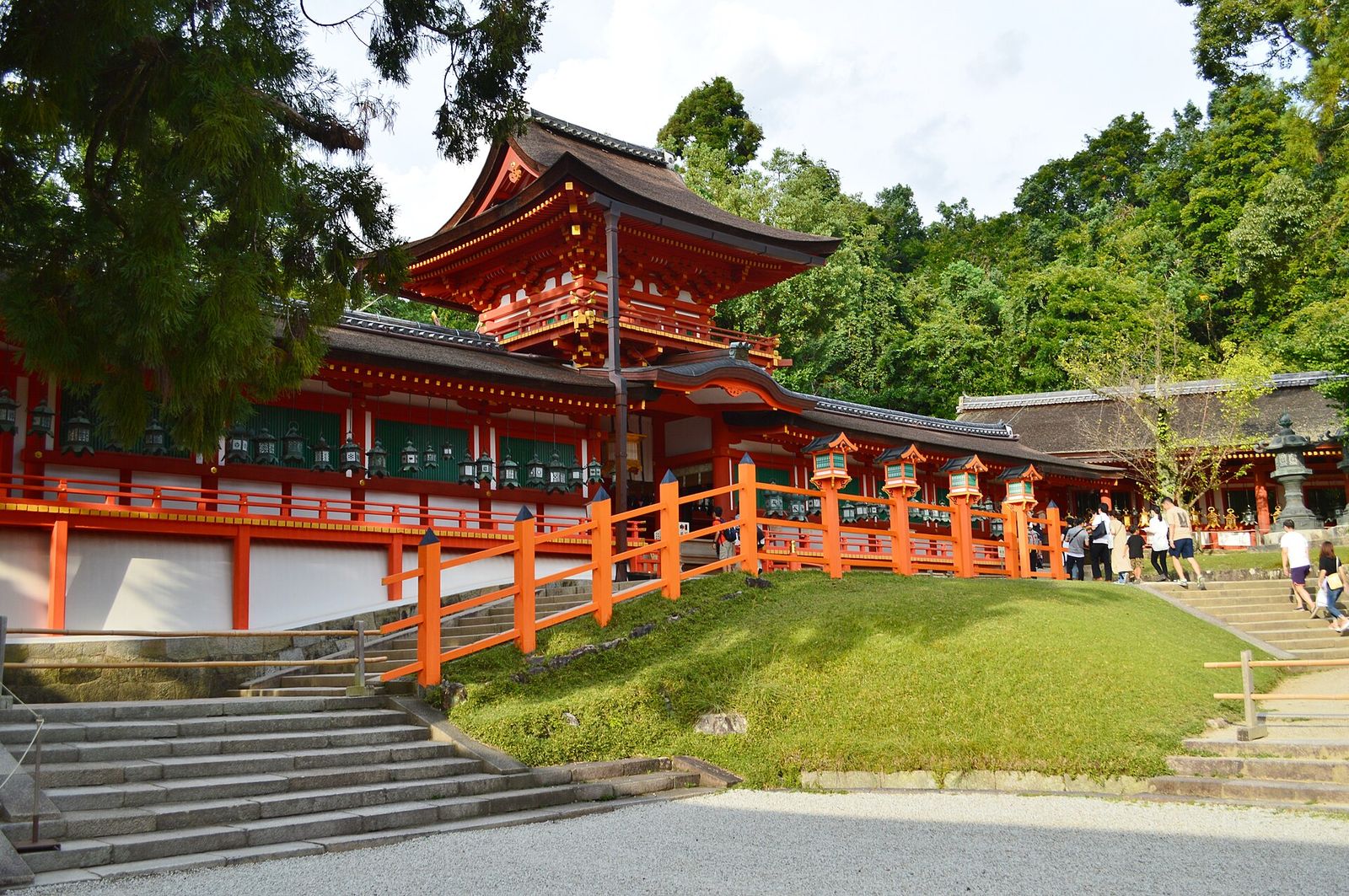
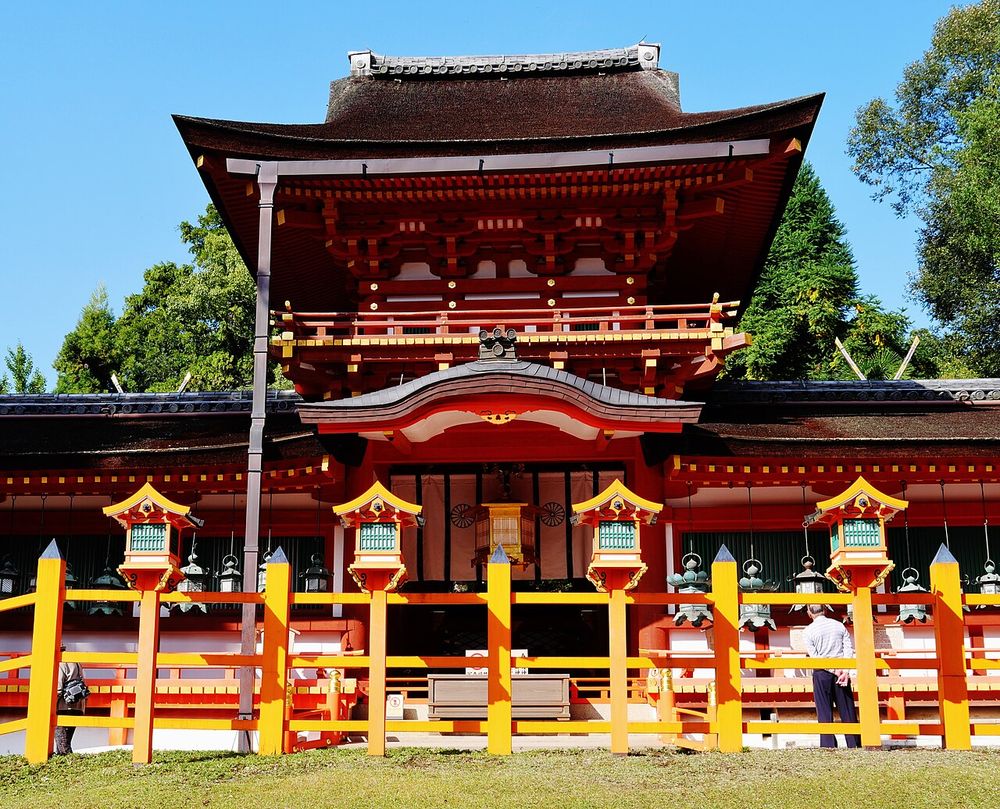
You are standing in front of a two-storey gate painted vermilion, with a roof of cypress bark. Bronze lanterns hang in a row under its eaves. Behind it, where you may not go, four small halls stand side by side, one for each of four gods.
The shrine was founded in 768. That year Charlemagne became king of the Franks, and Tang China was rebuilding after the An Lushan rebellion; the poet Du Fu had two years left to live.
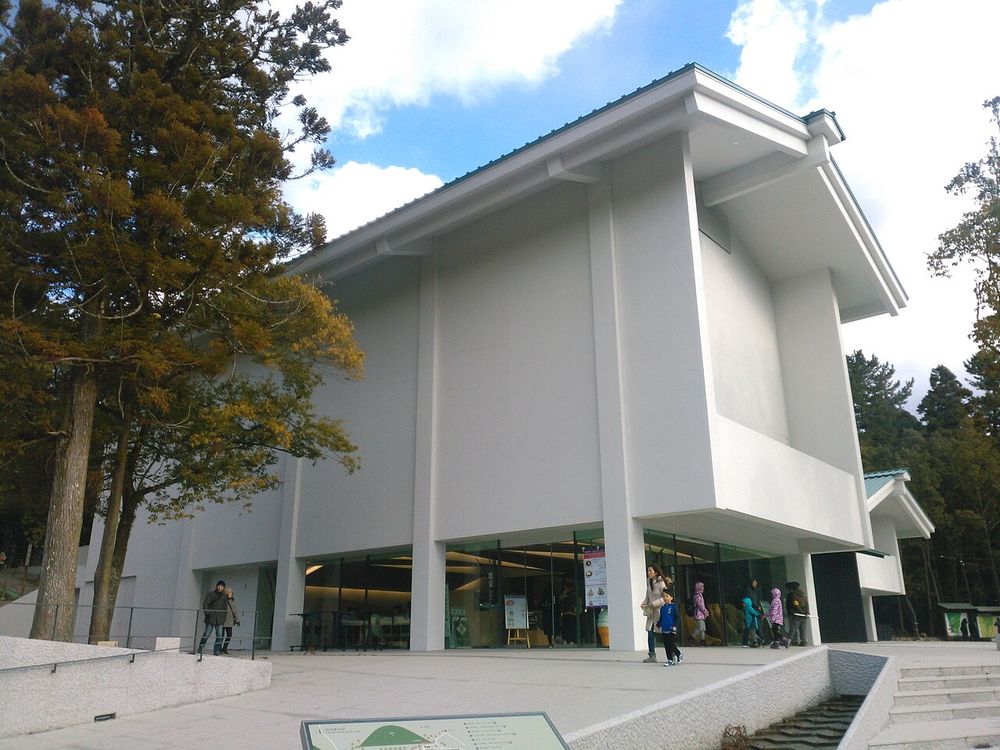
The paths, the lanterns, the outer court and Wakamiya are free and open all day. Three things charge 700 yen each: the inside of the cloister, the museum and the botanical garden. The four main halls are seen from the middle gate and are not entered.
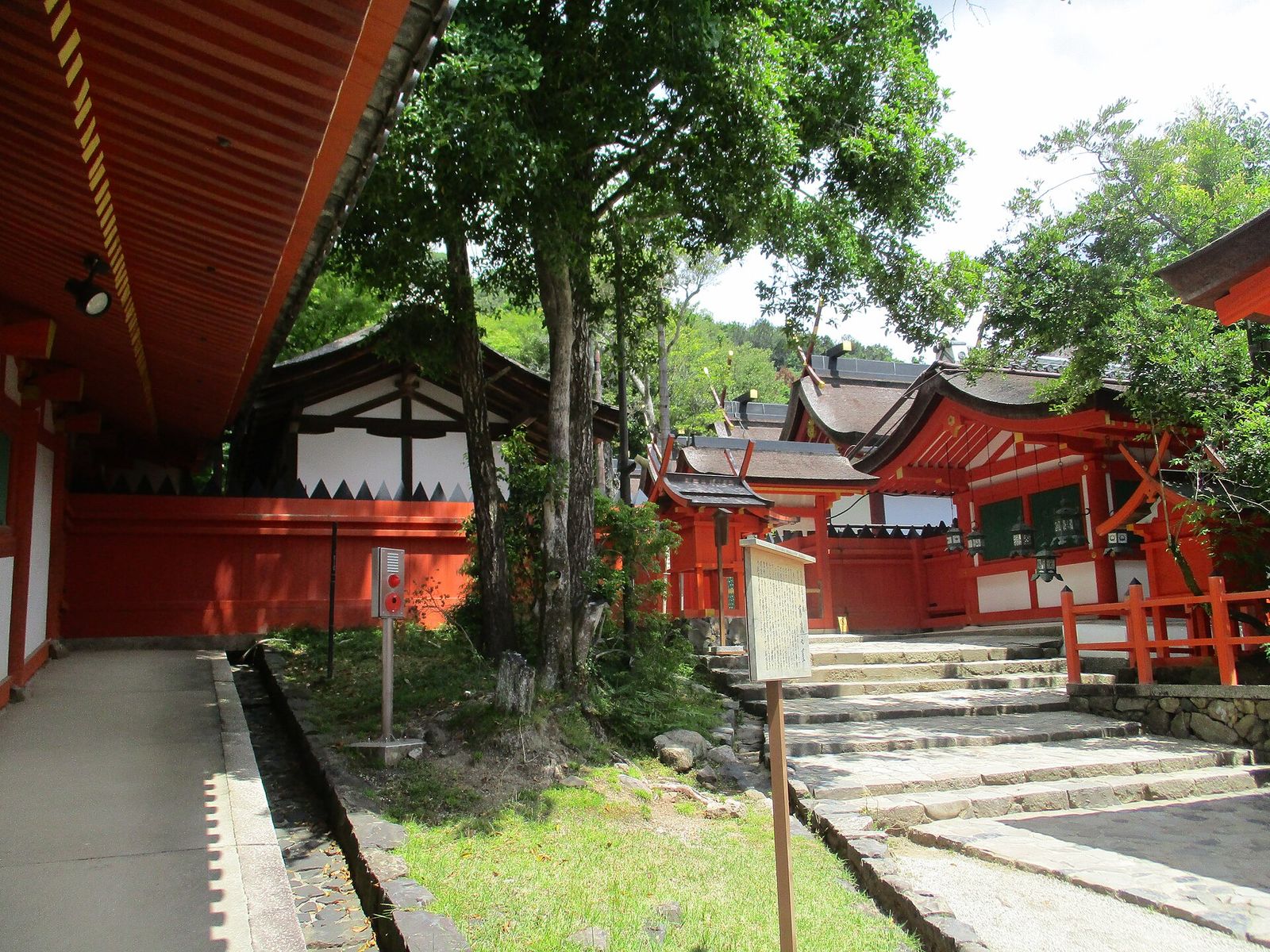
The middle gate and the corridors on either sideSaigen Jiro, CC0
This is Kasuga Taisha, a Shinto shrine, not a Buddhist temple. It was built for the Fujiwara family, who married their daughters to emperors and governed in their name from the ninth century to the twelfth. The four gods here were the family's own.
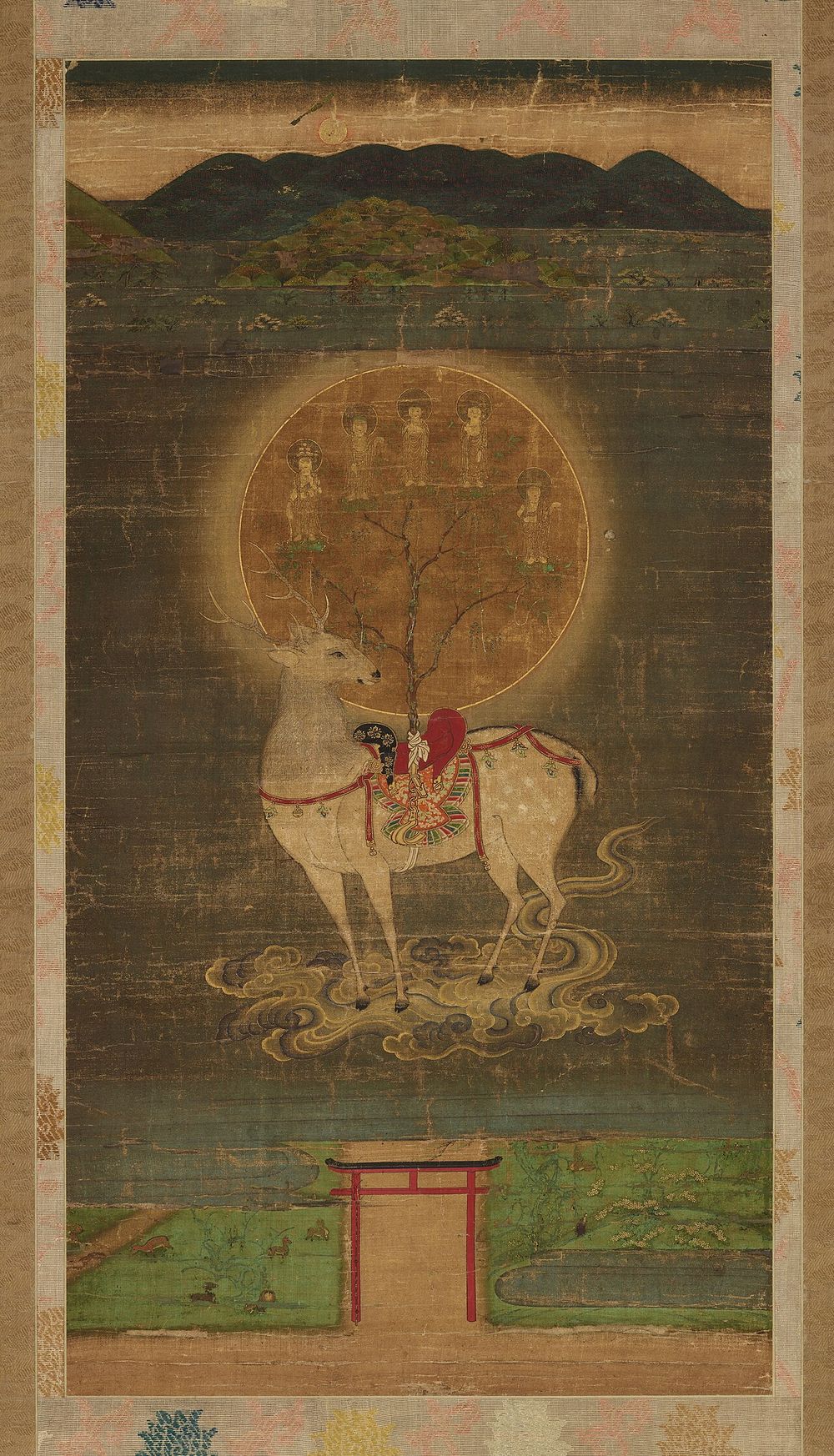
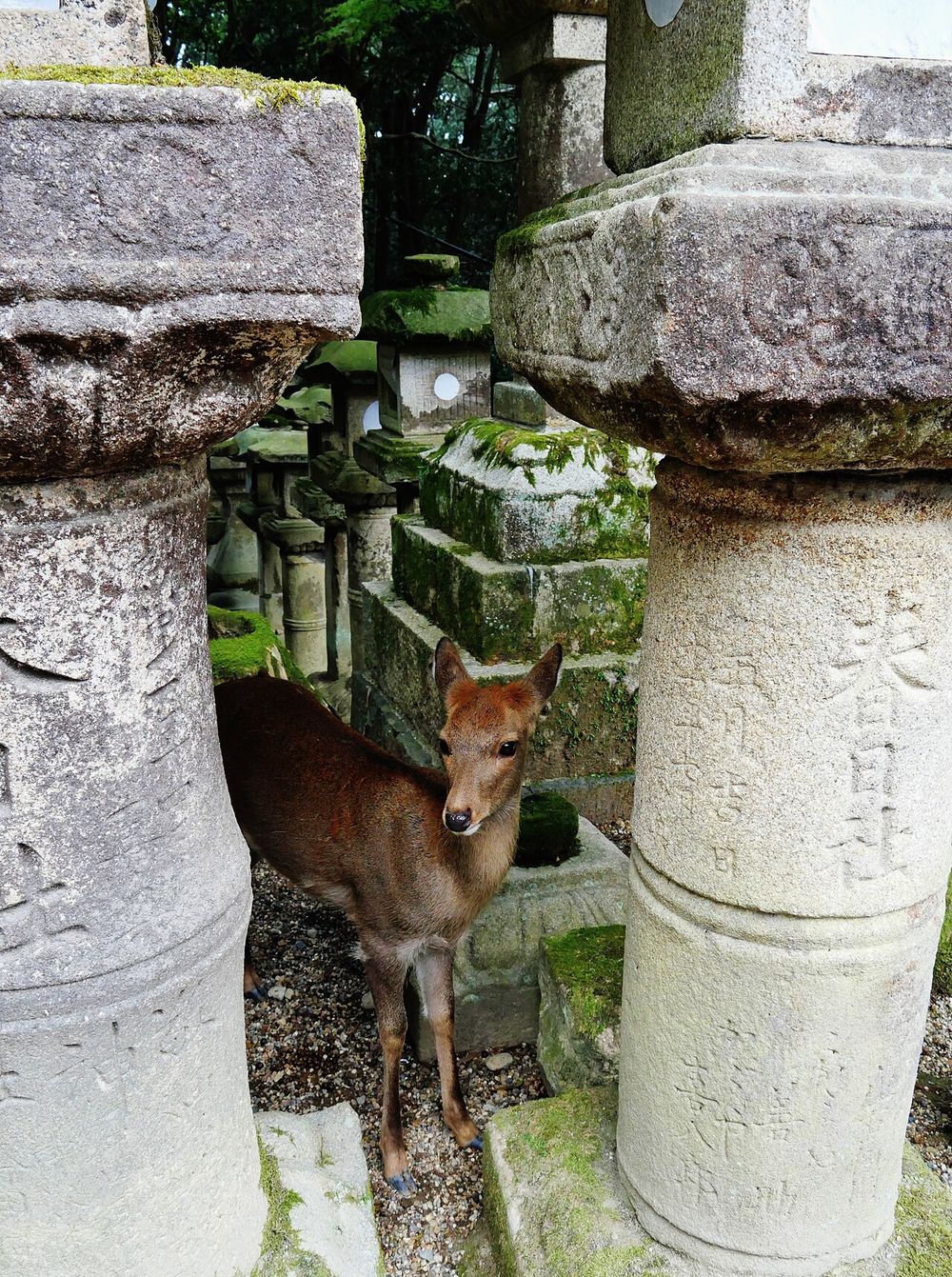
The first of the four is said to have arrived riding a white deer. That is why the deer of Nara were treated as messengers of the gods, and why they still wander freely through the town.
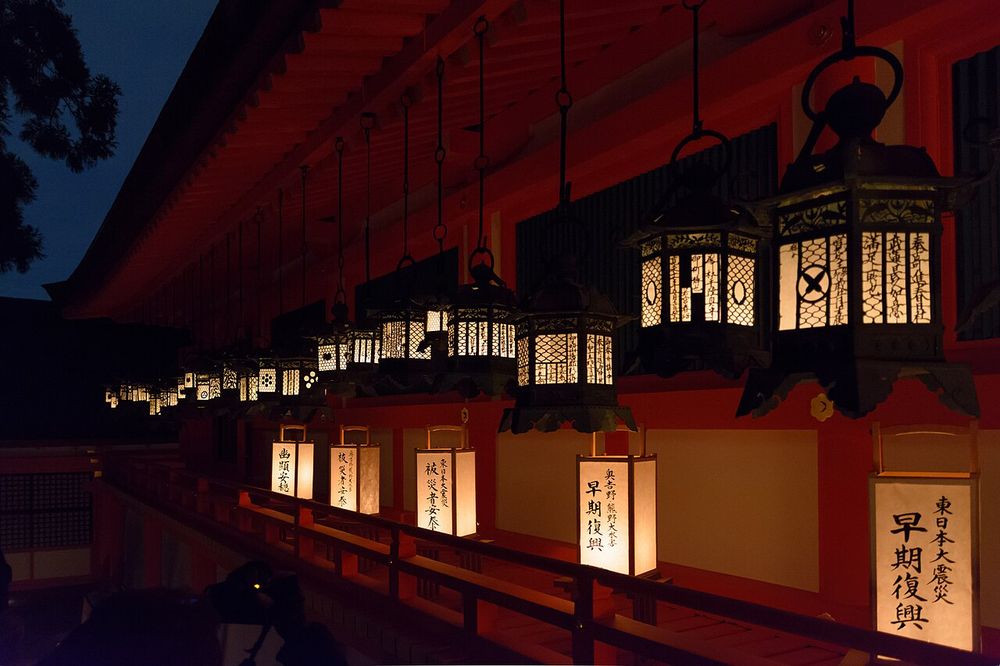
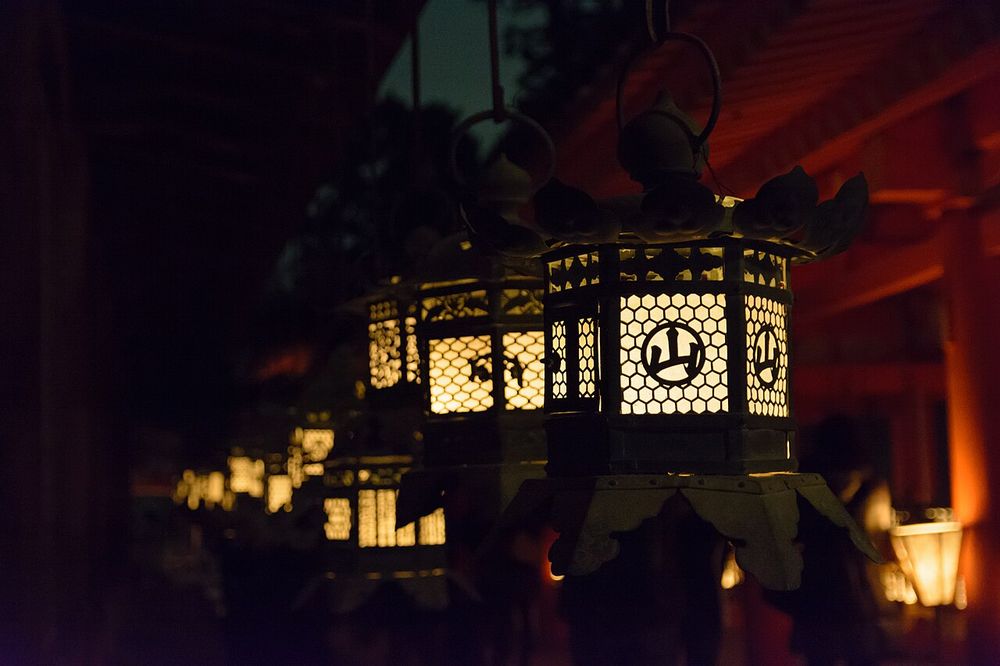
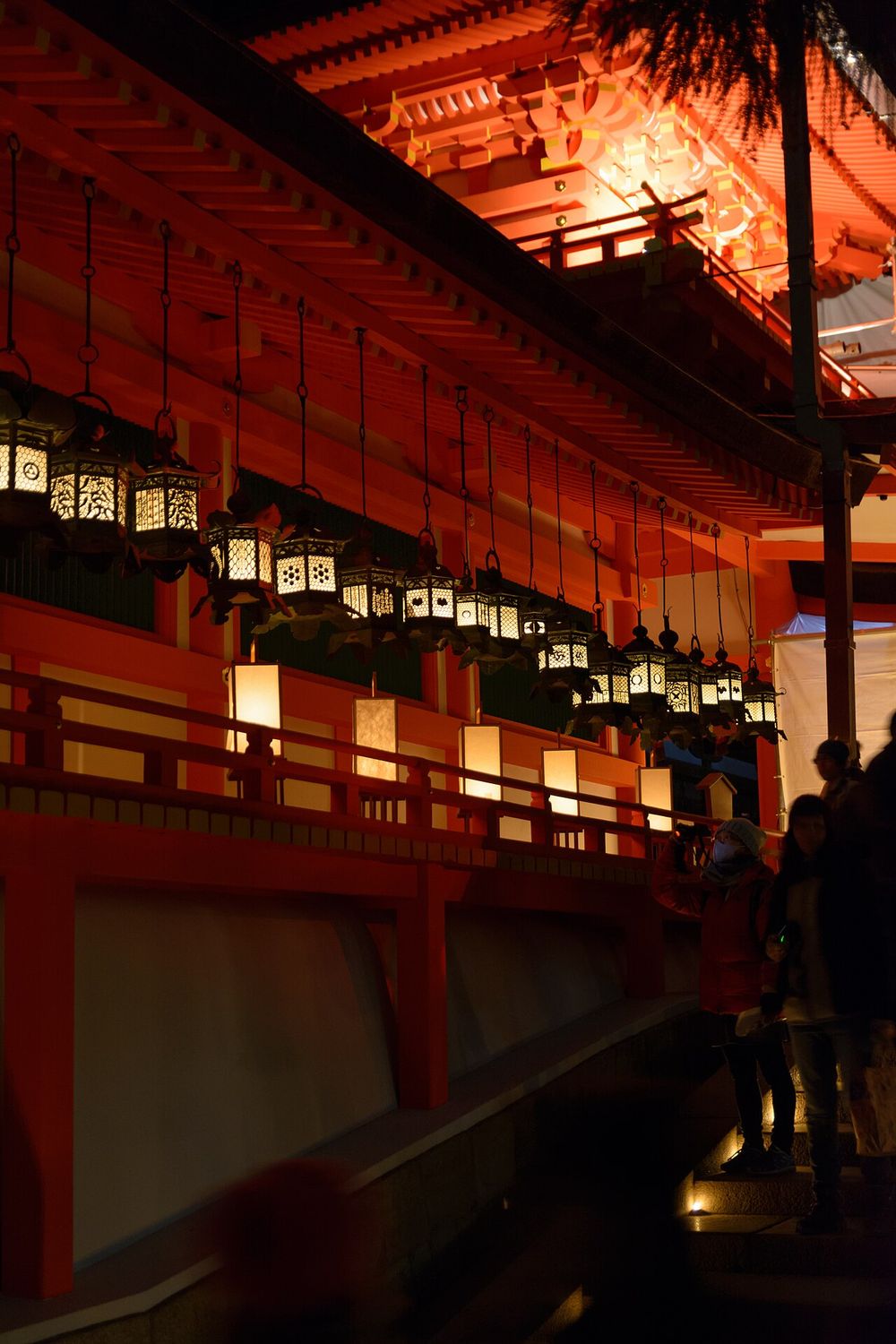
There are about three thousand lanterns: some two thousand of stone along the paths and a thousand of bronze under the eaves. People have been giving them for nine hundred years, each with a prayer. All of them are lit on only three nights a year.
Before you leave, look at the colour. The vermilion paint, the white walls and the dark bark roofs are renewed about every twenty years, and have been sixty times.
Things people often get wrong
"It is a temple." It is a shrine: there are no Buddhas here, people clap when they pray, and the priests wear white. But until 1868 the shrine and the temple of Kōfuku-ji down the hill were run as one, and monks chanted sutras in front of these halls.
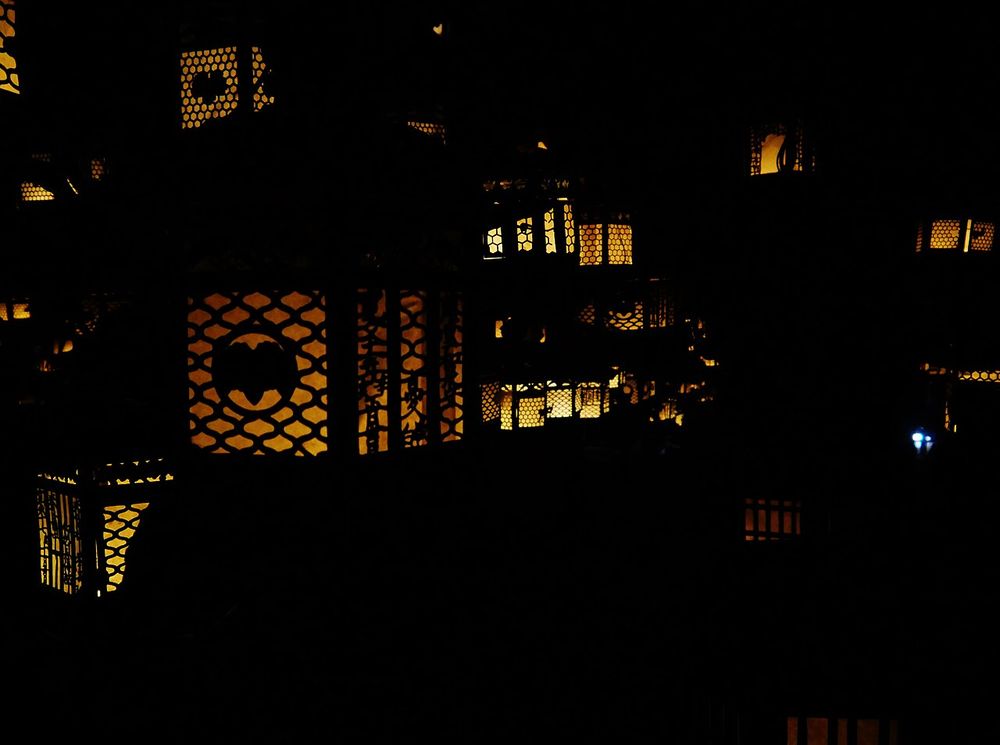
"The lanterns are lit every night." They are lit on 3 February and on 14 and 15 August. On other days, a dark room inside the cloister keeps some burning so that visitors can see the effect.
"It is rebuilt from new every twenty years." It was, for a thousand years. Since 1863 the four main halls have been repaired and repainted, not replaced.
"The grassy hill is Mount Mikasa." The bare hill north of the shrine is Mount Wakakusa. The sacred mountain, Mikasa, is the dark wooded cone straight behind the halls, and it is closed.
"The deer belong to the shrine." They are wild animals that belong to nobody. Their story is on the page for Nara Park.
People who stood here
Abe no Nakamaro (a Japanese student who stayed in Tang China and became a high official there; Chao Heng in Chinese)He left for China in 717, aged about nineteen. Tradition says the envoys of that mission prayed for a safe crossing at the foot of Mount Mikasa, where the shrine was built fifty years later, so he may have stood where you stand. He passed the Tang examinations, served Emperor Xuanzong, and was a friend of the poets Li Bai and Wang Wei. He never got home. His poem about the moon over this mountain is at stop 7.
Go deeper: seven stops, from the first torii to the forest
The stops follow the walk in from the park: the first gate, the lanterns, the outer court, the halls, the bronze lanterns, the younger shrine, the forest.
1. The first torii and the long approach
The approach with deer, published in 1893Unknown authorUnknown author, Public domain
The approach begins at a wooden torii at the edge of the park. A gate was first put up here in 836; the present one is of the 1630s. From it the path runs more than a kilometre, straight and slightly uphill, through the trees to the shrine.
Just inside the torii, on the right, a young pine grows behind a fence. It replaced an old tree that died in 1995. The god of Kasuga is said to have appeared at that pine as an old man and danced. The pine painted on the back wall of every Noh stage in Japan is this tree.
Walk in the middle only if you must. The centre of the path is kept for the gods, and Japanese visitors keep to the side.
2. The stone lanterns
Stone lanterns in the forest, deep in mossCun Cun, CC BY-SA 4.0
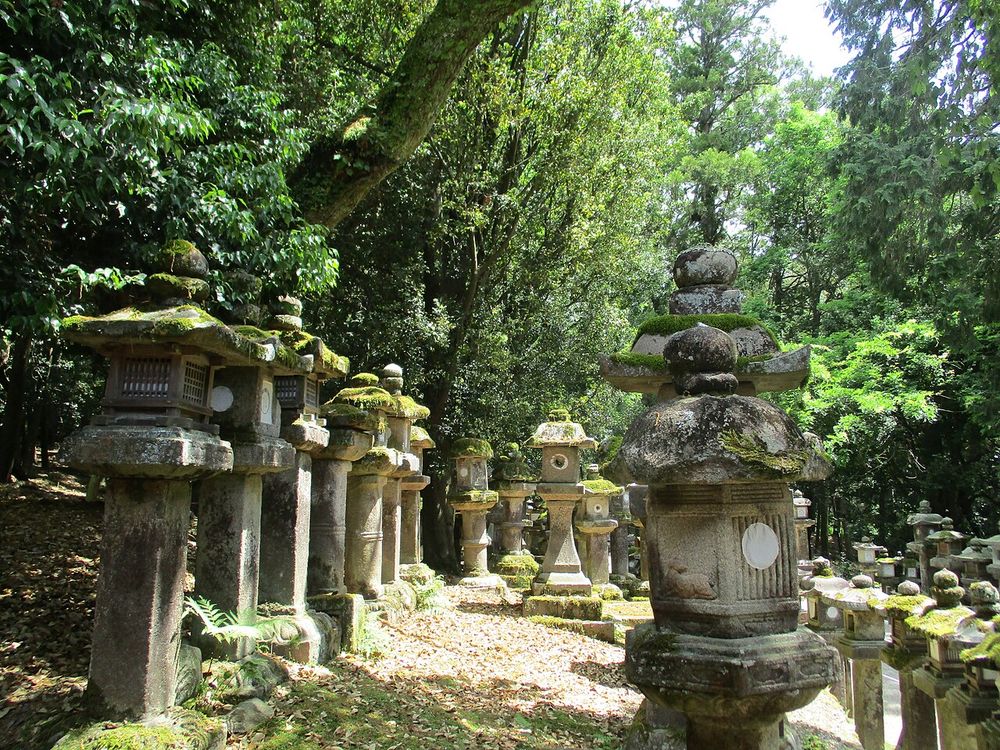
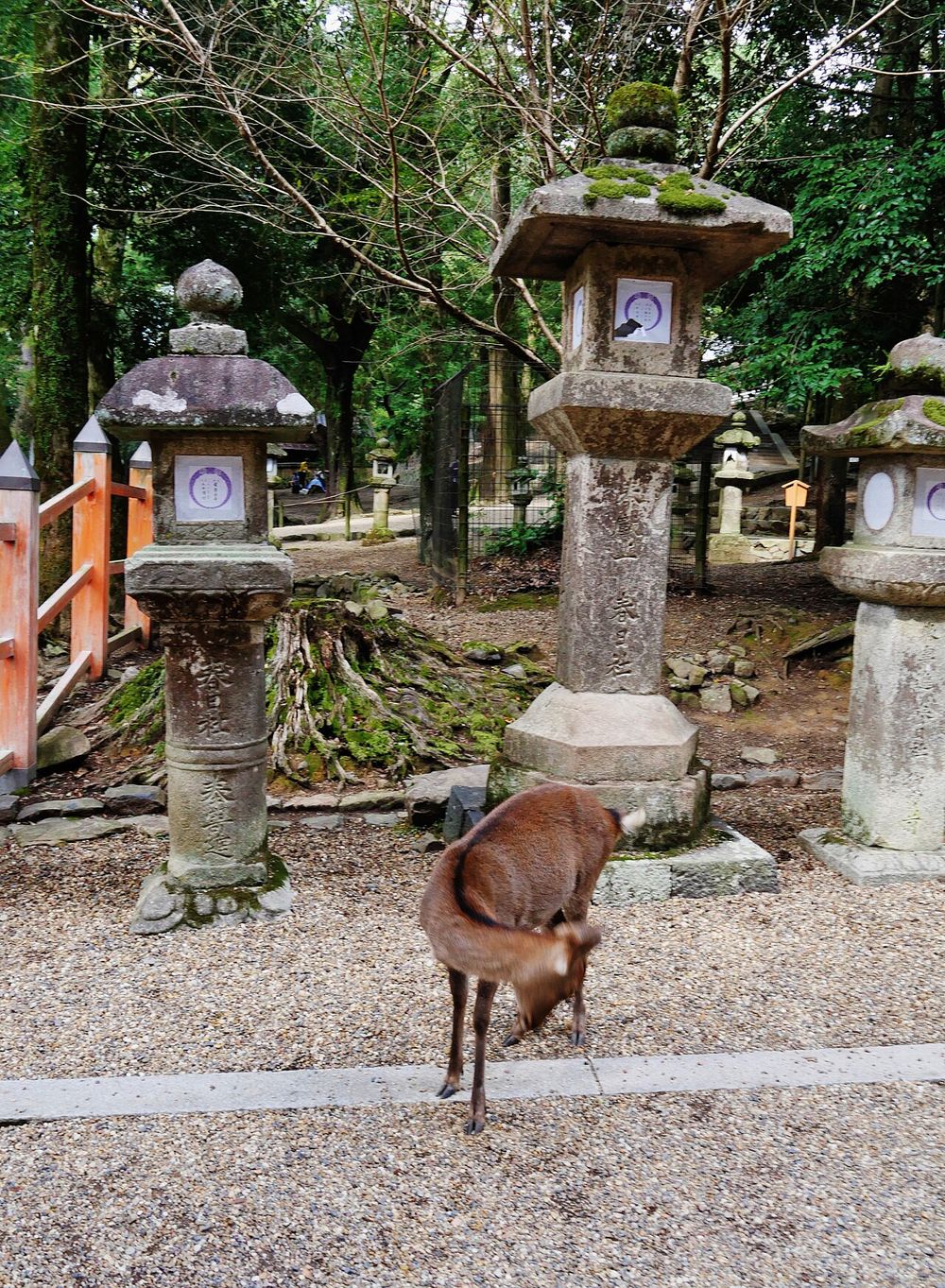
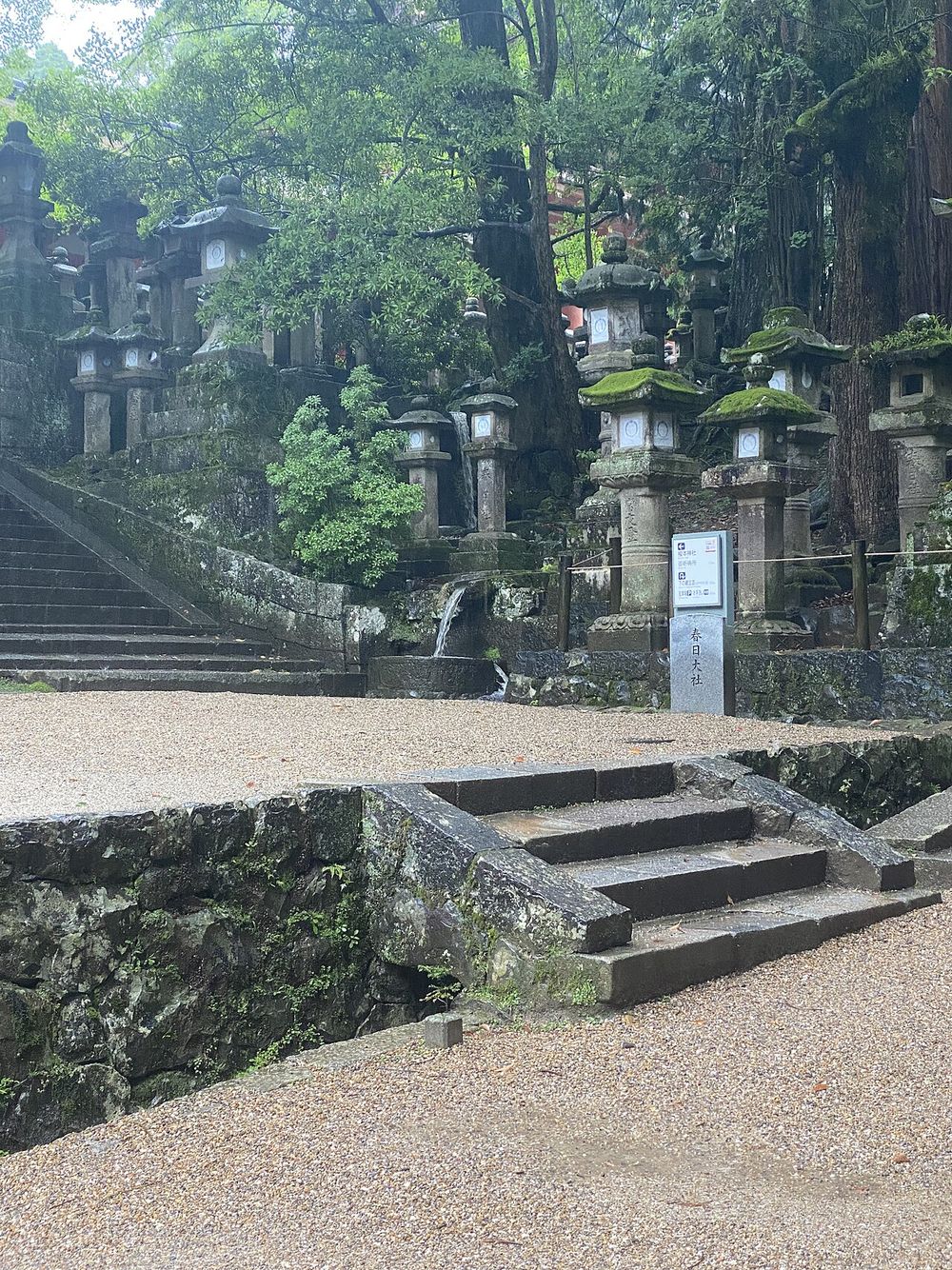
After the second torii the lanterns begin to crowd both sides of the path, two and three deep, each on its own post and furred with moss. There are about two thousand. Most carry the name of the giver and a date.
The givers were not only lords. From the seventeenth century, merchants, guilds of rice dealers and soy brewers, and village clubs who saved for years to send one member on pilgrimage all paid for lanterns. The newest are from this century.
A deer among the lanternsZairon, CC BY 4.0
Each lantern has a small window that was once pasted with paper, and a lamp of rapeseed oil inside. Lighting two thousand of them took the whole evening, which is one reason it is now done only at festivals.
3. The South Gate and the outer court
The South GateGuilhem Vellut, CC BY 2.0
The South Gate is twelve metres high and is the main way into the cloister. Beyond it is an open court with a long low hall. The front part was for laying out offerings and the back part for sacred dance; when rain stops a ceremony outside, it moves here.
The great cedar beside the outer courtPufacz, CC BY-SA 4.0
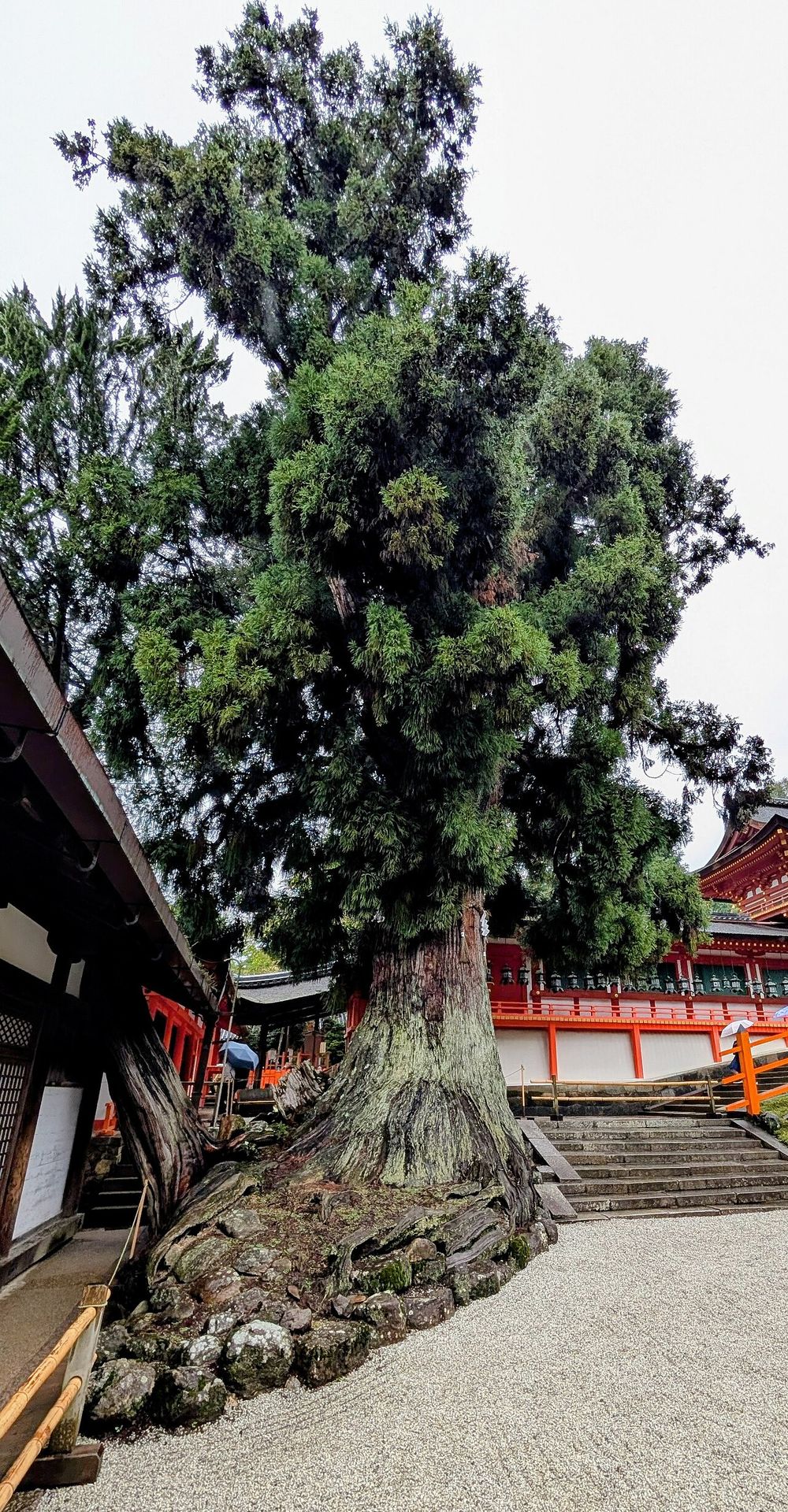
To the left stands a cedar that the shrine puts at 800 to 1,000 years old, 25 metres tall and nearly nine round the trunk. A second tree grows out of its root, and it leans through a hole cut for it in the roof of the hall next door. The carpenters moved the roof, not the tree.
4. The middle gate and the four halls
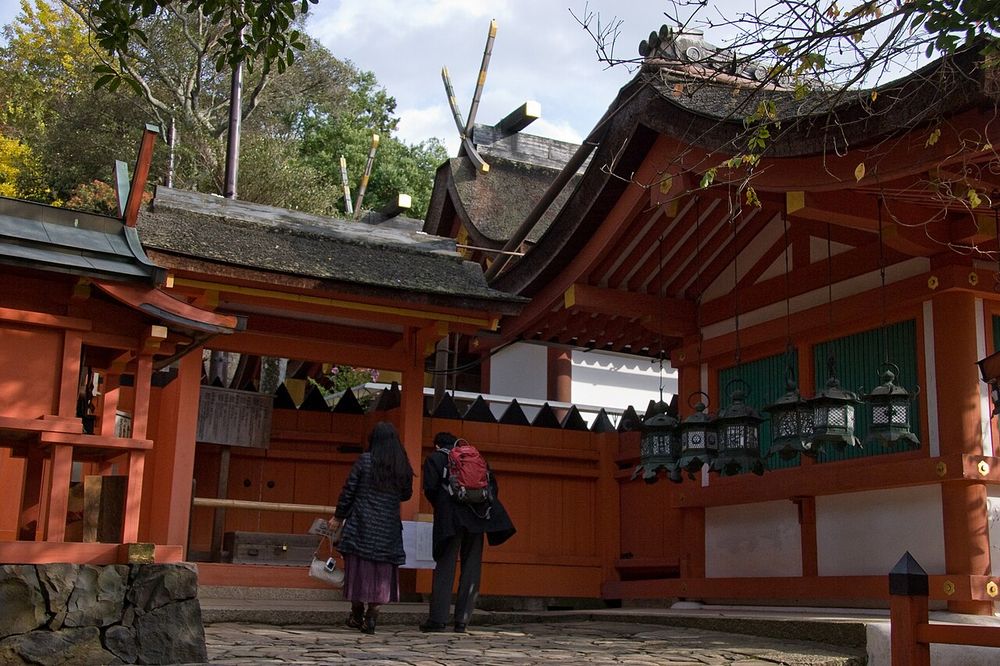
The forked roof-ends of the main halls, seen over the fenceKimon Berlin, CC BY-SA 2.0
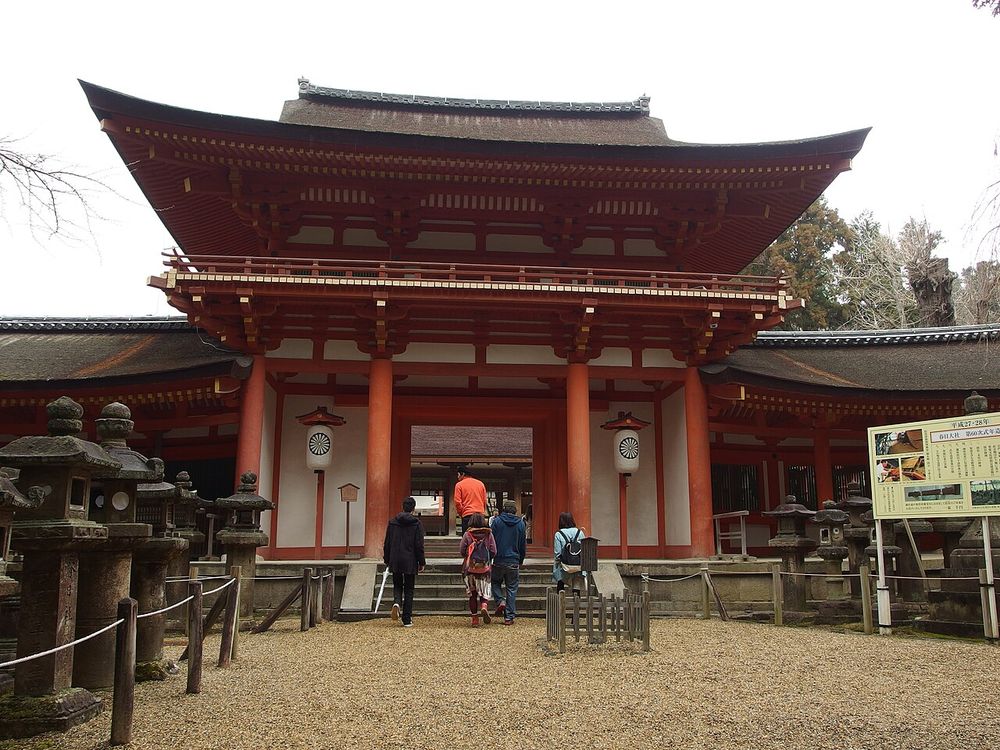
The two-storey gate ahead of you is the middle gate, ten metres high. People often take it for the shrine itself. The four main halls stand behind it in a row, and only priests go further.
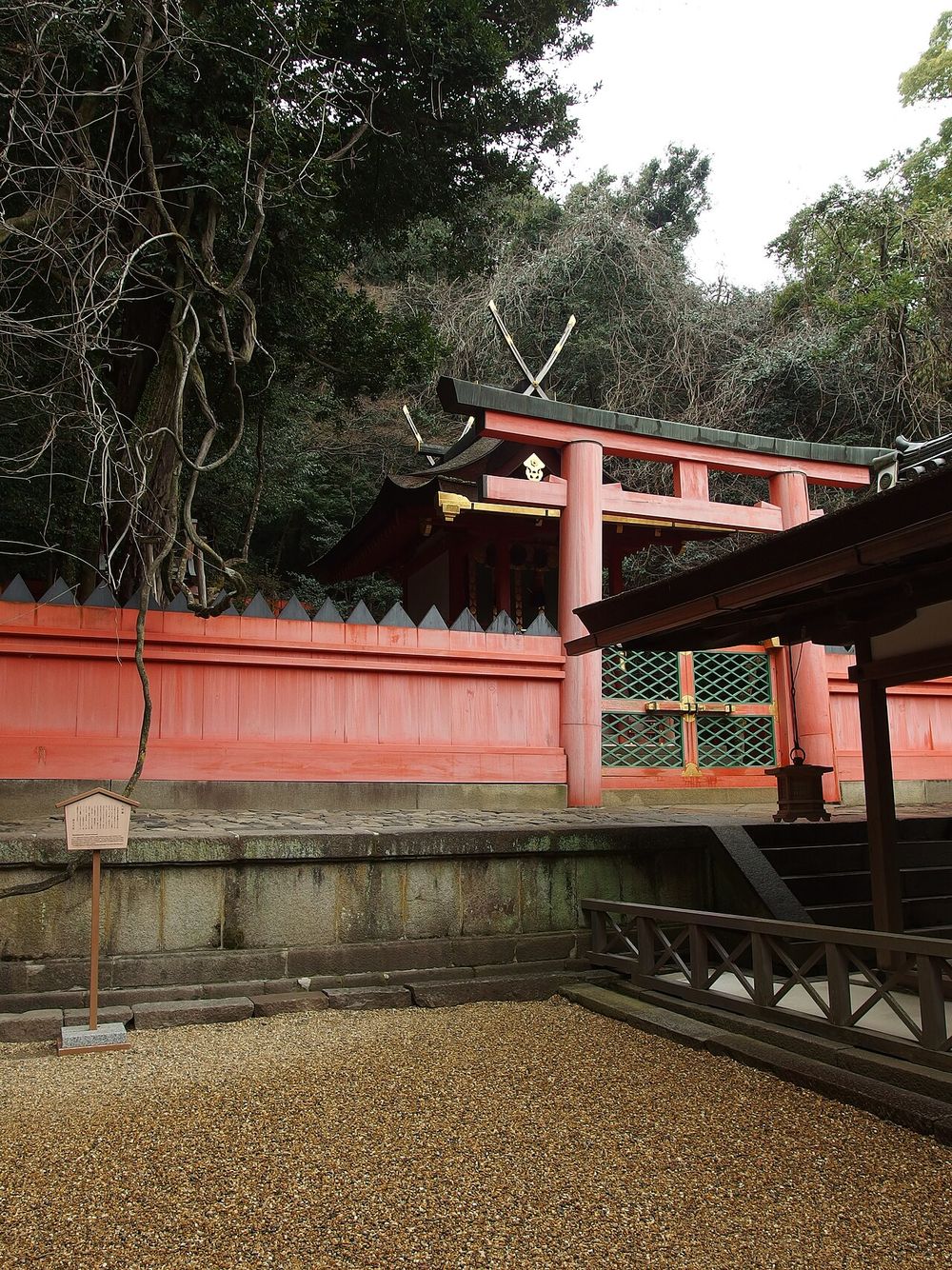
Each hall is barely two metres wide. The door is in the gable end, under a porch roof that sweeps forward. Shrine builders all over Japan copied the form, and it is named after this place: Kasuga style.
The first two gods were brought from shrines far to the east, near modern Tokyo; they are gods of thunder and the sword. The third is the ancestor of the Fujiwara, a god of ritual words, and the fourth is his wife. Together they made a pantheon for one family.
A deer mandala of the late thirteenth century: the gods of Kasuga as five Buddhas on a sacred treeUnknown authorUnknown author, Public domain
In the Middle Ages, people who could not travel to Nara hung a painting of the shrine at home and prayed to that. Some show only a deer with a sacred tree on its saddle and five small Buddhas in its branches: the gods of Kasuga, seen as Buddhas in another form.
5. The bronze lanterns and the dark room
Bronze lanterns lit for the festival of 3 FebruaryDegueulasse, CC BY 3.0
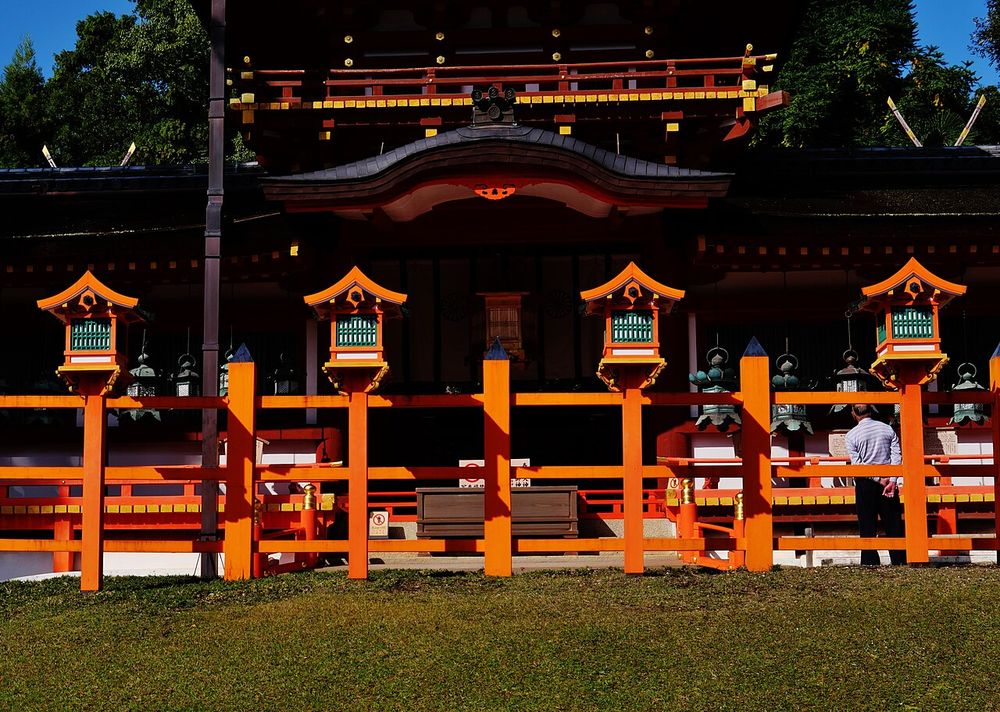
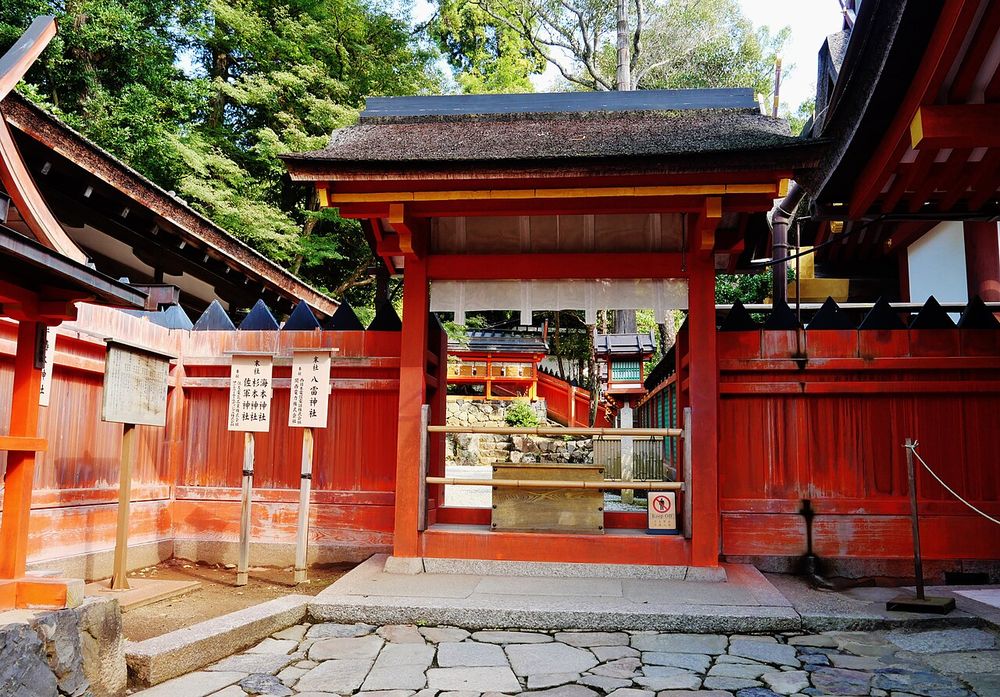
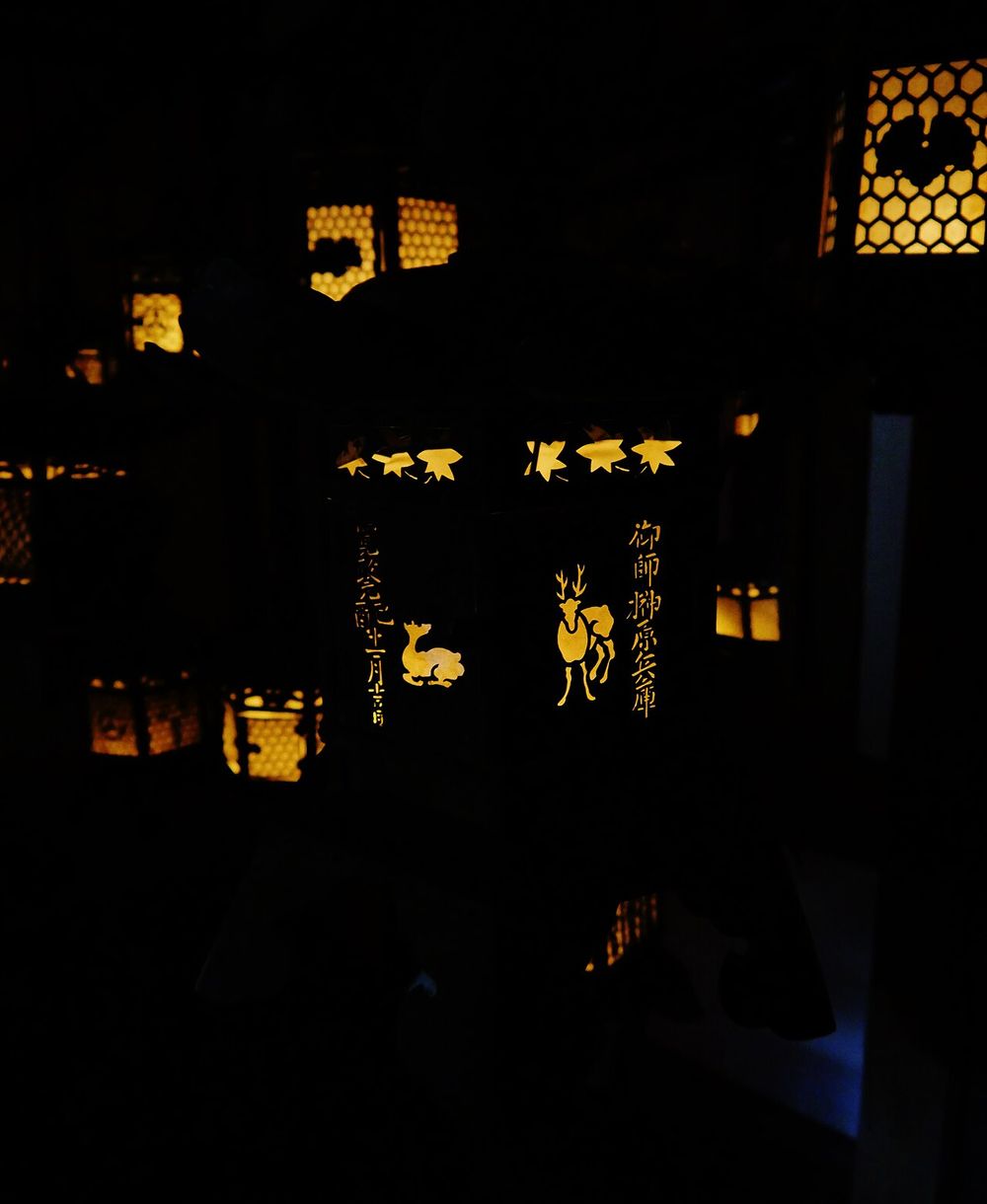
With the 700 yen ticket you can walk the inside of the cloister. A thousand bronze lanterns hang here from the eaves, some gilded, each pierced with its own pattern: wisteria, deer, a family crest.
The shrine points out lanterns given by warlords of the sixteenth and seventeenth centuries, men who spent their lives fighting each other and hang here side by side.
Lanterns and their reflections in the dark roomZairon, CC BY 4.0
At the north-east corner is a former priests' office with the shutters closed and the lanterns lit. Mirrors on the walls multiply them. It is the only place to see, on an ordinary day, what the festival nights look like.
6. The younger shrine and the December festival
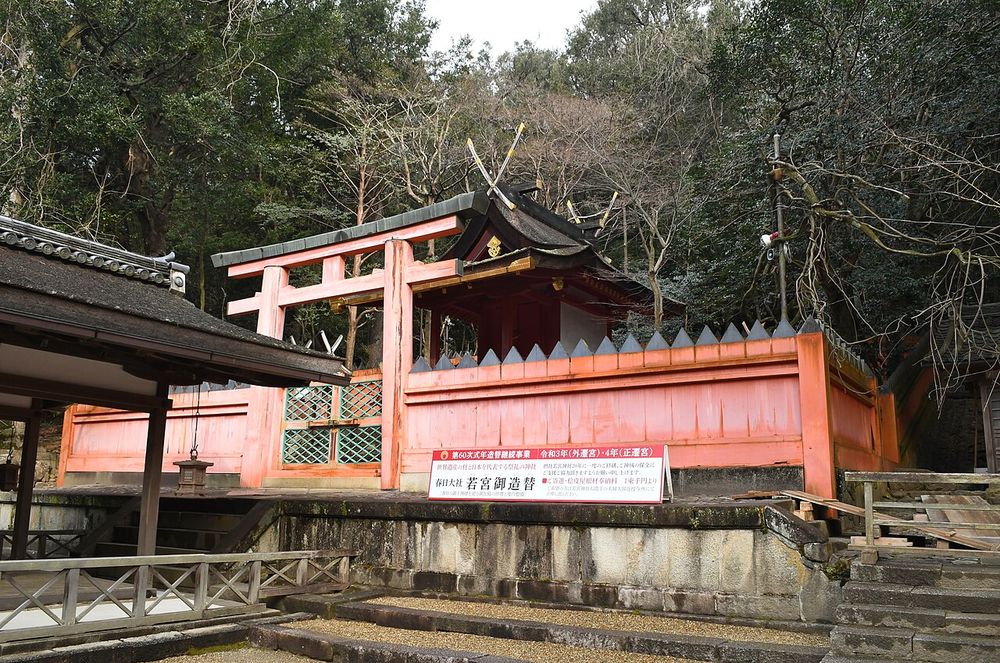
Wakamiya, the younger shrineSaigen Jiro, CC0
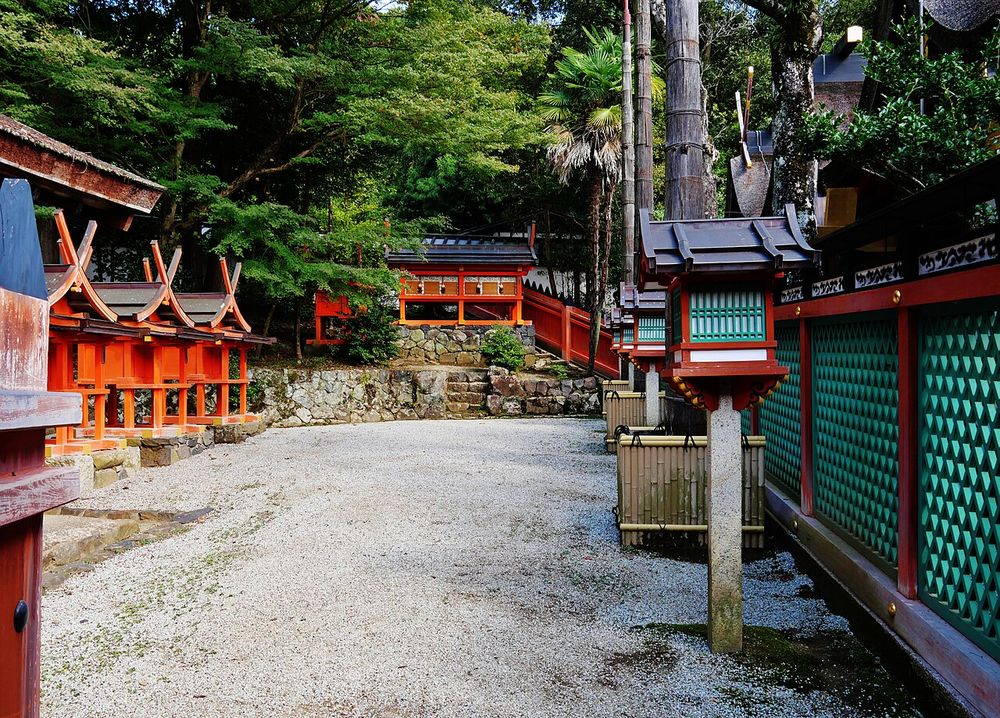
A hundred metres south along a lantern-lined path is Wakamiya, the "young shrine", for a child of the third and fourth gods. It was built in 1135, in years of flood, famine and plague.
The next year the regent ordered a festival here to ask for relief. It has been held every year since 1136. At midnight on 17 December all lights are put out and the god is carried in darkness down to a temporary hall in the park, where music and dance are offered until the following night.
Several of the dances are older than Noh theatre and are among its sources. Some survive nowhere else.
7. The forest and the mountain
The trail through Kasugayama Primeval ForestVera46, CC BY 2.0
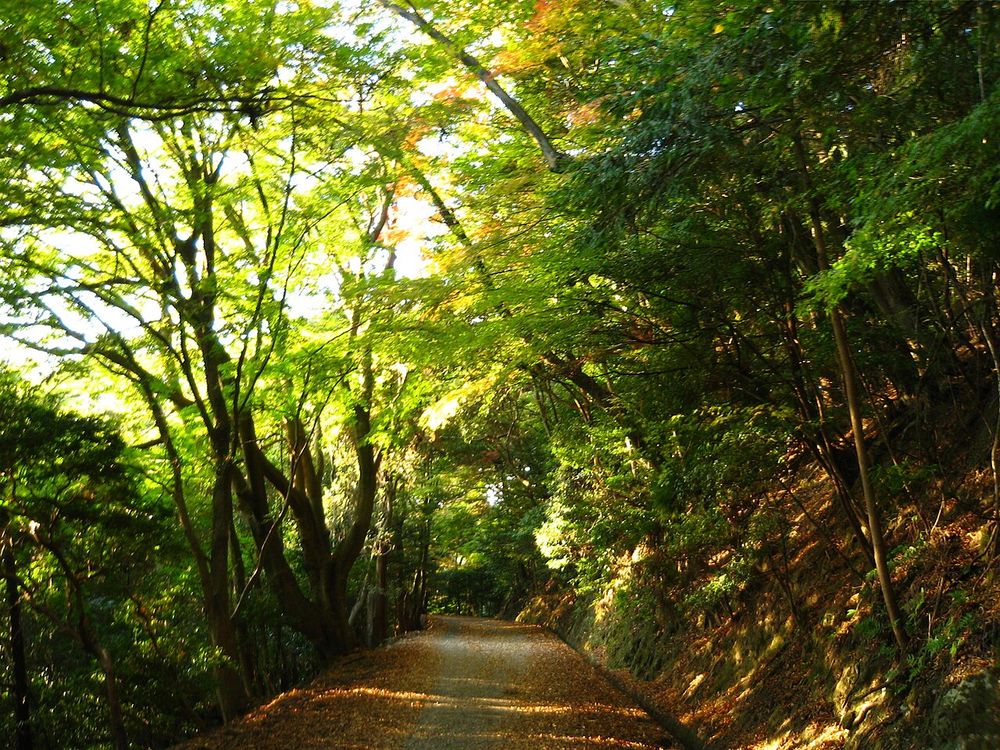
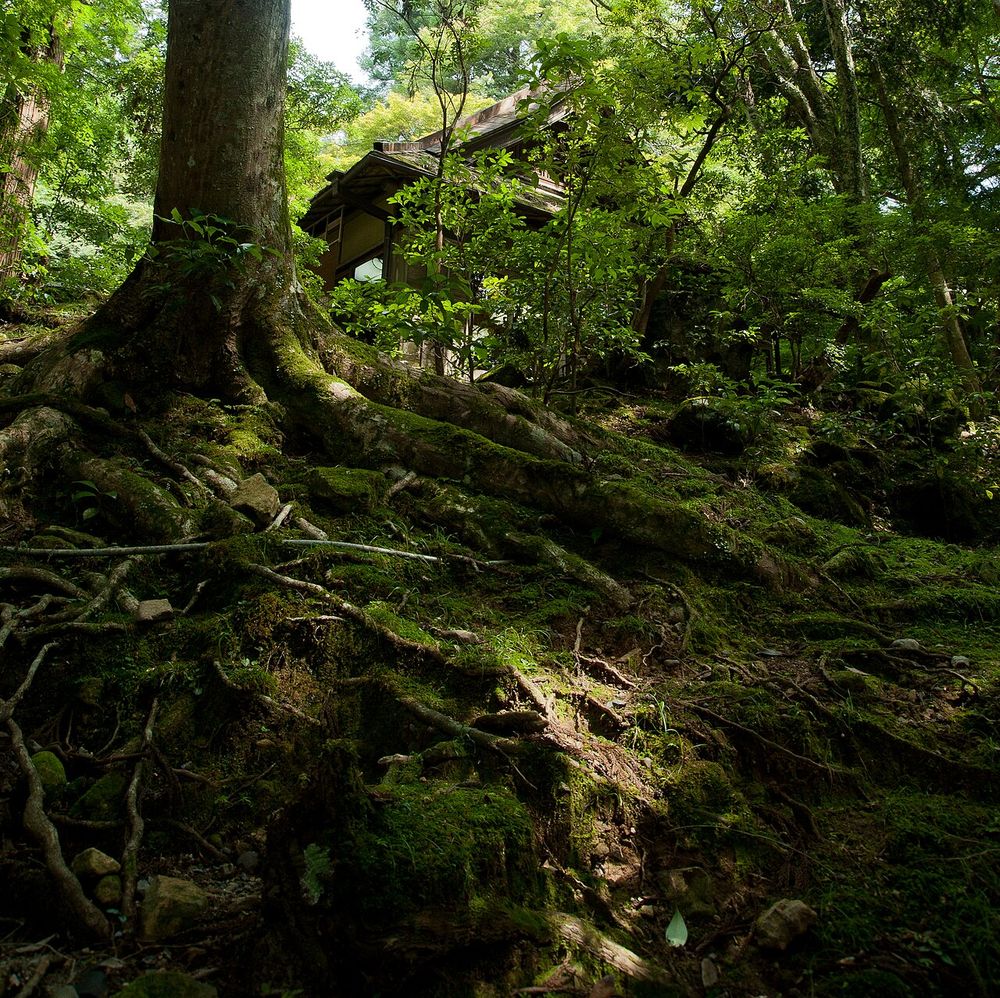
Hunting and cutting wood on the hills behind the shrine were forbidden in 841, to keep the gods' ground pure. Nothing has been felled since. The result is about 250 hectares of old evergreen forest ten minutes' walk from a city centre, and it is part of the World Heritage listing.
Mount Mikasa itself, the cone behind the halls, is 297 metres high and closed to everyone. In 753, at a farewell banquet on the coast of China, Abe no Nakamaro looked up at the moon and thought of it:
天の原
ふりさけ見れば
春日なる
三笠の山に
出でし月かも
When I look up
into the wide plain of heaven,
is that the same moon
that rose over Mount Mikasa
at Kasuga, long ago?
Abe no Nakamaro, 753; in the Kokin Wakashū and the Hyakunin Isshu
His ship was wrecked and blown to Vietnam. Li Bai, hearing he had drowned, wrote a lament for him. He had in fact survived, walked back to Chang'an, and served the Tang for another seventeen years.
Meanwhile in the world
Year
Here
Elsewhere
710
The capital moves to Nara, laid out on the plan of Chang'an
Tang China: Emperor Xuanzong will take the throne in two years
717
Abe no Nakamaro sails for China
Li Bai is sixteen; in Europe an Arab army besieges Constantinople
768
The shrine is founded
Charlemagne becomes king of the Franks; the Tang (618–907) is rebuilding after the An Lushan rebellion
841
Hunting and felling banned on the hills behind
Tang Emperor Wuzong is about to close the Buddhist monasteries of China
1136
The first December festival at Wakamiya
Nine years after the Song lost north China; in France the first Gothic church is about to be begun at Saint-Denis
1863
The four main halls are rebuilt for the last time
The Taiping war in China; the battle of Gettysburg in America
1868
Gods and Buddhas are separated by law; the monks leave
The Meiji Restoration; in China, the Tongzhi reign under Empress Dowager Cixi
1998
Listed as World Heritage with seven other sites in Nara
The same year as the Summer Palace and the Temple of Heaven in Beijing
Then and now
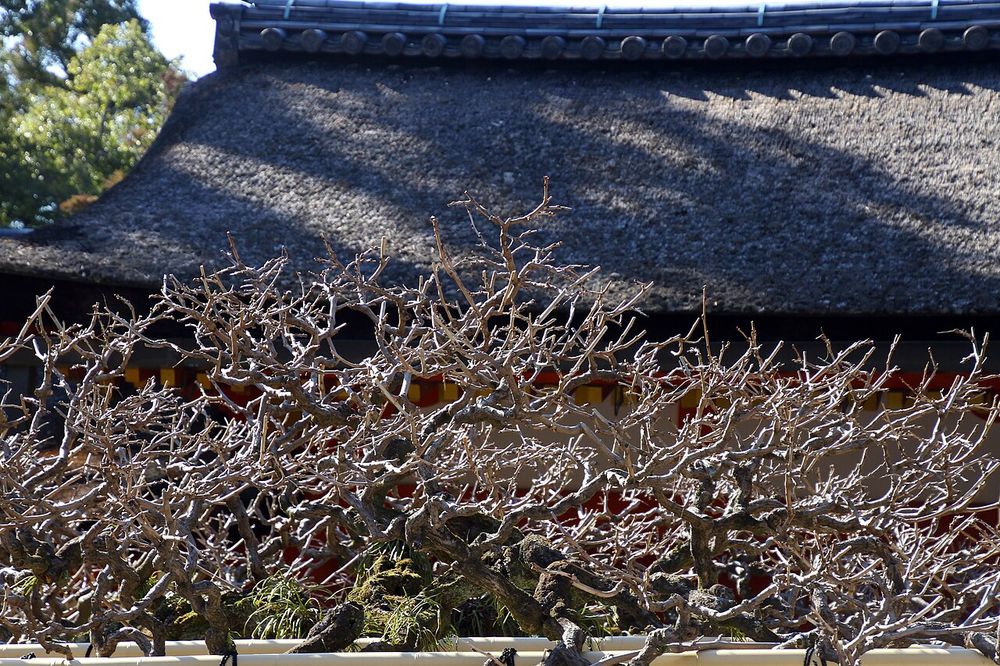
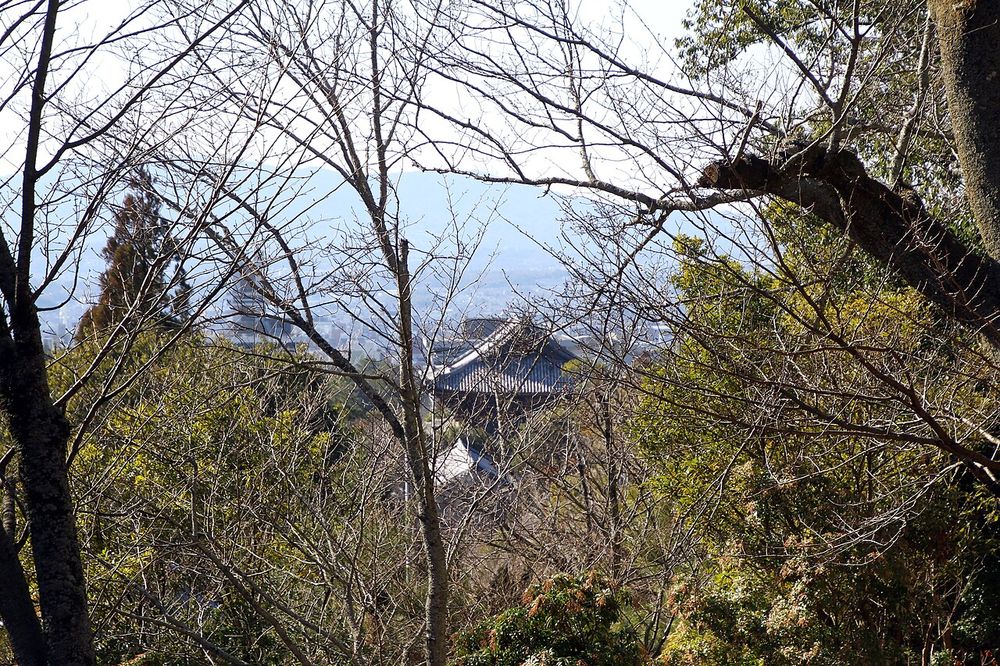
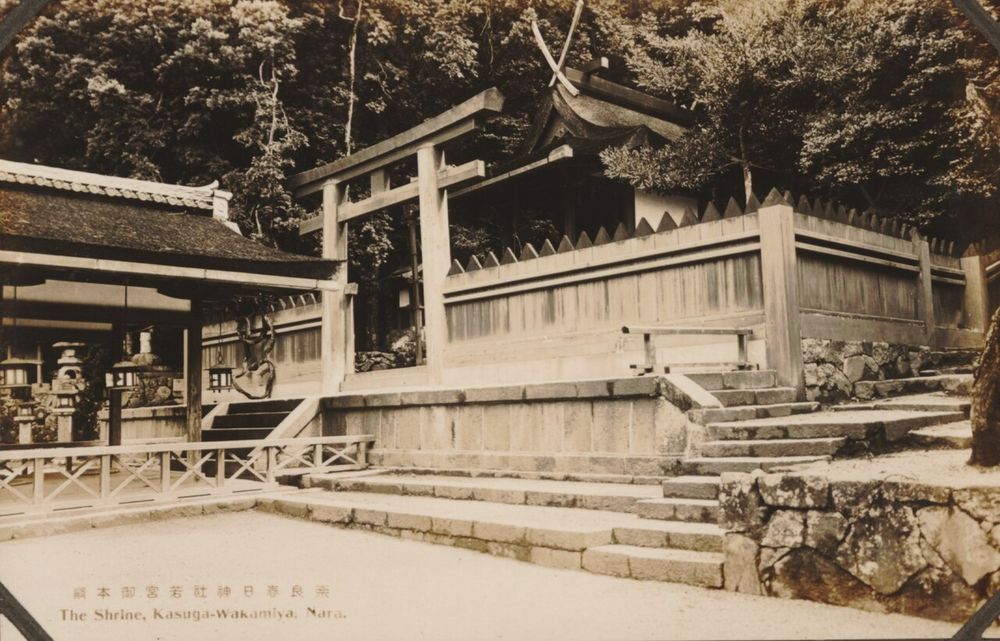
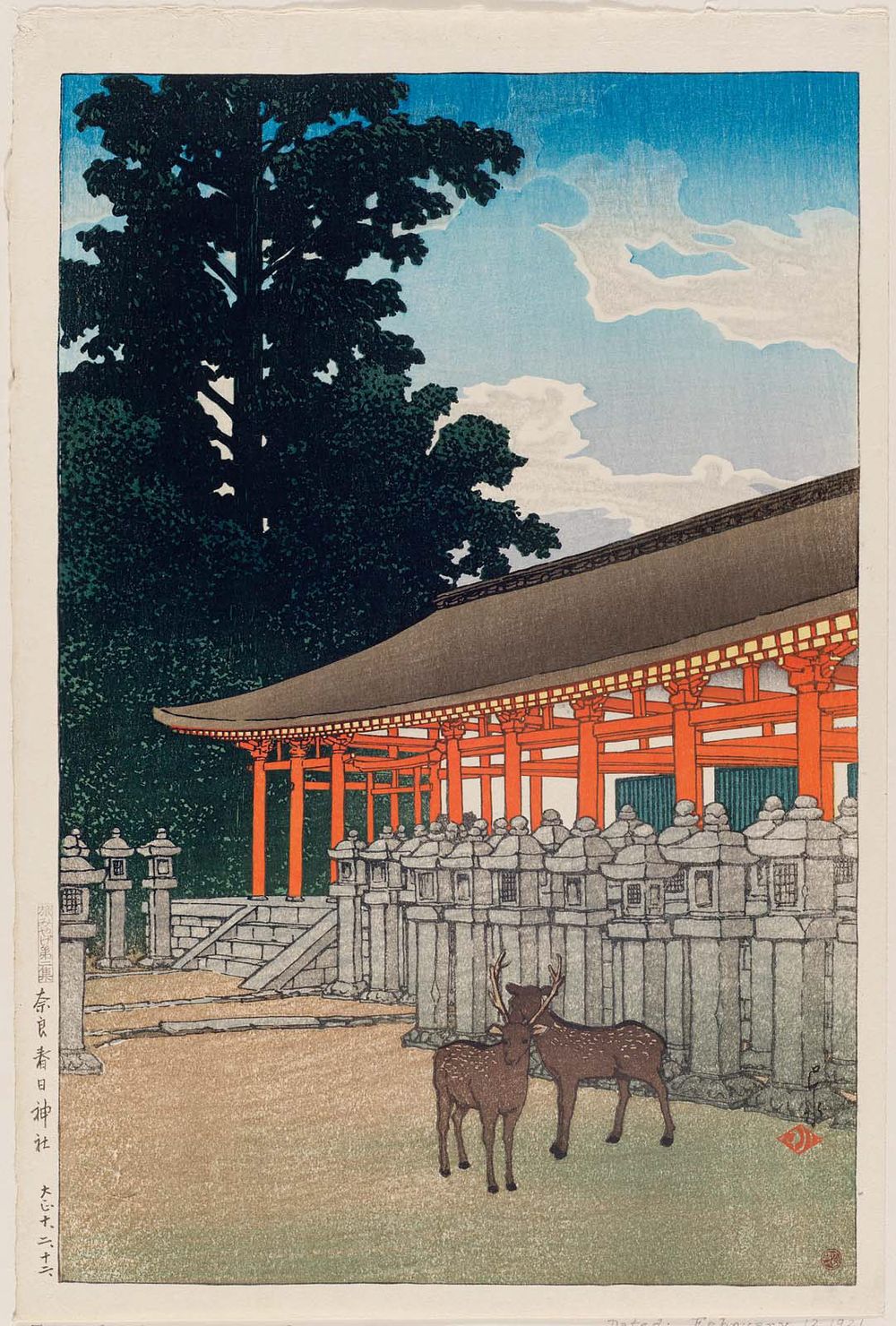
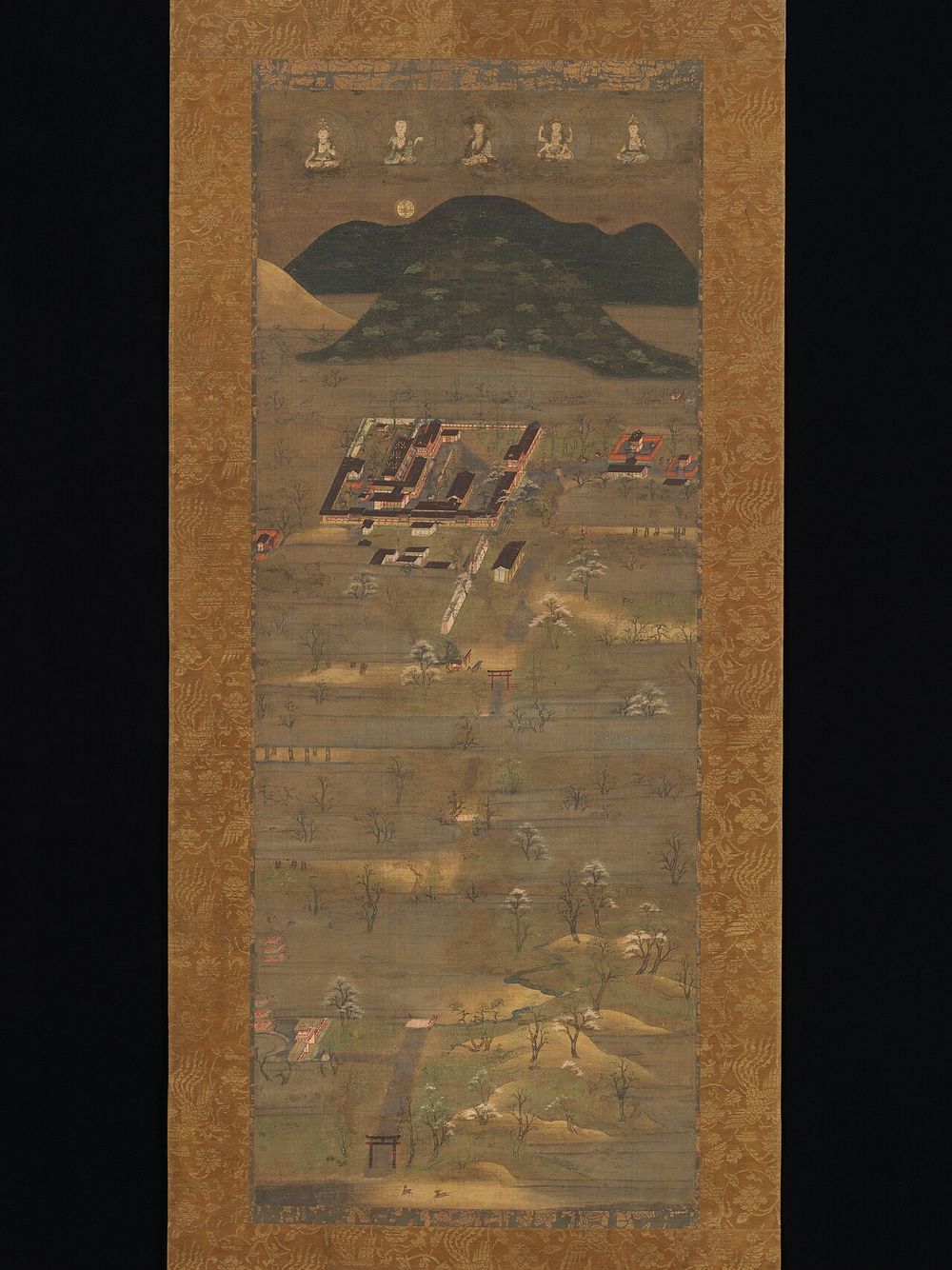
The middle gate from the foot of the stepsSaigen Jiro, CC0, Wikimedia CommonsThe cloister and its lanterns, from the outer courtCun Cun, CC BY-SA 4.0, Wikimedia CommonsThe middle gate and the corridors on either sideSaigen Jiro, CC0, Wikimedia CommonsThe middle gate, with gilded lanterns in frontZairon, CC BY 4.0, Wikimedia CommonsLanterns under the eaves of the middle gateZairon, CC BY 4.0, Wikimedia CommonsThe South GateGuilhem Vellut, CC BY 2.0, Wikimedia CommonsStone lanterns in the forest, deep in mossCun Cun, CC BY-SA 4.0, Wikimedia CommonsLanterns stepping up the slope beside the pathImmanuelle, CC BY 4.0, Wikimedia CommonsA deer among the lanternsZairon, CC BY 4.0, Wikimedia CommonsA deer looking out between two lantern postsZairon, CC BY 4.0, Wikimedia CommonsThe great cedar beside the outer courtPufacz, CC BY-SA 4.0, Wikimedia CommonsThe forked roof-ends of the main halls, seen over the fenceKimon Berlin, CC BY-SA 2.0, Wikimedia CommonsA lantern-lined path between the fencesZairon, CC BY 4.0, Wikimedia CommonsA small gate in the cloister, with paper noticesZairon, CC BY 4.0, Wikimedia CommonsBronze lanterns lit for the festival of 3 FebruaryDegueulasse, CC BY 3.0, Wikimedia CommonsOne lit lantern, its pierced pattern showingDegueulasse, CC BY 3.0, Wikimedia CommonsThe cloister by lantern lightDegueulasse, CC BY 3.0, Wikimedia CommonsThe dark room, where lanterns burn all yearZairon, CC BY 4.0, Wikimedia CommonsLanterns and their reflections in the dark roomZairon, CC BY 4.0, Wikimedia CommonsPierced patterns thrown by the lampsZairon, CC BY 4.0, Wikimedia CommonsWakamiya, the younger shrineSaigen Jiro, CC0, Wikimedia CommonsA vermilion fence and gate at one of the small shrinesGuilhem Vellut from Annecy, France, CC BY 2.0, Wikimedia CommonsSmall shrines among the treesHyppolyte de Saint-Rambert, CC BY-SA 4.0, Wikimedia CommonsA cypress-bark roof behind winter branchesHyppolyte de Saint-Rambert, CC BY-SA 4.0, Wikimedia CommonsThe roofs of the shrine through the treesHyppolyte de Saint-Rambert, CC BY-SA 4.0, Wikimedia CommonsThe museumKerakon, CC BY-SA 4.0, Wikimedia CommonsThe trail through Kasugayama Primeval ForestVera46, CC BY 2.0, Wikimedia CommonsRoots across the forest floorC.K. Tse, CC BY-SA 2.0, Wikimedia CommonsThe South Gate in snow, in an early twentieth-century photographDumas Roger, CC BY-SA 4.0, Wikimedia CommonsThe approach with deer, published in 1893Unknown authorUnknown author, Public domain, Wikimedia CommonsDeer on the approach, in a hand-coloured photograph of about 1890Batchelder, John Davis, 1872-1958, collector, Public domain, Wikimedia CommonsA gate and fence of the shrine on an old postcardAnonymousUnknown author, CC BY 4.0, Wikimedia CommonsThe shrine in a woodblock print by Kawase Hasui, 1921Hasui Kawase, Public domain, Wikimedia CommonsA deer mandala of the late thirteenth century: the gods of Kasuga as five Buddhas on a sacred treeUnknown authorUnknown author, Public domain, Wikimedia CommonsA medieval painting of the shrine under Mount Mikasa, made to be prayed to at homeanonymous, Public domain, Wikimedia Commons
Video
Films from official channels, played from YouTube. Nothing is loaded until you press play.
The historic monuments of ancient NaraUNESCO · made with NHK; 3 min · checked 2026-11-12
Local legends
These are stories people tell about this place. They are legends, not history, and each one says where it comes from.
LegendThe white deer
The first god of Kasuga rode here from his shrine in the east on the back of a white deer and alighted on Mount Mikasa. The deer of Nara are descended from it.
Source: Shrine tradition; the picture scroll Kasuga Gongen Genki of 1309
LegendThree lanterns in one night
Nearly all the stone lanterns are inscribed "Kasuga shrine". Fifteen are inscribed "great bright god of Kasuga". Whoever finds three of those in a single night will become rich.
Source: A saying in Nara, repeated by the shrine's guides
LegendThe pine where the god danced
The god of Kasuga appeared under the pine by the first torii in the form of an old man and danced there.
Source: Shrine tradition; the tree is the model for the pine painted on Noh stages
LegendThe wisteria that sweeps the sand
The old wisteria in the outer court, whose flower clusters hang low enough to brush the sand, was planted by the Konoe, the senior branch of the Fujiwara.
Source: The shrine's own guide, which says it is "said to have been planted" by them; the vine appears in the scroll of 1309
Later, people who live here will be able to add the stories they grew up with, and say which of these they have heard.
Not certain, and where accounts conflict
Was the shrine really founded in 768?
That is the date the halls were built, by imperial order. Worship here is older: a temple map of 756 already marks the spot as "divine ground". Shrine tradition puts the first god's arrival in 710.
How many lanterns are there?
"About three thousand" is the shrine's round figure: some two thousand of stone and one thousand of bronze. Lanterns are still being given, and nobody publishes an exact count.
How old is the great cedar?
The shrine says 800 to 1,000 years. A tree in that position is drawn in the scroll of 1309, which fits; nobody has counted its rings.
Did the envoys to China pray on this spot?
Chronicles record prayers "at the foot of Mount Mikasa" for the mission of 717. The shrine did not yet exist, and the exact place is not known.
Visiting
Tickets and hours
The grounds are free. The shrine's English page gives the gates as open from 7:00 to 17:00; travel guides give 6:30 to 17:30 from March to October.
Special admission to the inside of the cloister costs 700 yen. The desk is open from 9:00 to 16:00.
The museum and the botanical garden are reported at 700 yen each, and both close at about 16:30 or 17:00. The garden is reported closed on some Tuesdays outside April and May.
On the Saturdays of November 2026 the shrine opens from 17:30 to 20:00 with the lanterns lit, for 700 yen, without booking, according to event listings.
Last checked 2026-11-12. The shrine's own English guide page, opened in November 2026; museum and garden fees from recent travel reports.
Booking from abroad
Official page in English No booking is needed for the shrine or for the 700 yen special admission; pay at the desk inside the South Gate. The shrine's own English guide: kasugataisha.or.jp.
Ticket window on site Tickets for the cloister, the museum and the garden are sold at each door on the day. Travel guides say credit cards are not accepted. Bring yen.
Note Special admission can be refused without notice when a ceremony is being held. If seeing the inside matters to you, avoid 13 March and the days around 17 December.
Checked 2026-11-12
Where to start
Walk in from the first torii if you have forty minutes to spare: the approach is half the visit. Otherwise take the bus from either Nara station to the stop called Kasuga Taisha Honden, at the top.
See the outer court and the cedar, buy the 700 yen ticket, walk the cloister to the dark room, then take the lantern path south to Wakamiya.
Come before 9:00 or after 15:30. School parties fill the approach in the middle of the day.
The wisteria flowers from late April to early May. The lantern nights are 3 February and 14 and 15 August.
Before you go
The approach is gravel and climbs gently for more than a kilometre. Wear flat shoes.
Photography is allowed in the grounds and the cloister. Do not photograph a ceremony or a wedding party close up without asking.
The deer on the approach expect crackers and will follow you. Show them empty hands and they lose interest.
Customs and manners
Bow once before you pass under a torii, and keep to the side of the path.
At the water basin, rinse your left hand, then your right, then your mouth from your cupped left hand. Do not put the ladle to your lips.
To pray: drop a coin in the box, bow twice, clap twice, bow once.
Do not touch or lean on the lanterns. Many are loose on their posts, and some are eight hundred years old.
Opening hours are given in the local time of the place. Prices are in the local currency. The figure after ≈ is approximate, at exchange rates checked on 9 November 2026, in .
Look for these
On the stone lanterns, find one with a deer carved on it.
Find the shrine's crest, a hanging cluster of wisteria. How many places can you see it?
At the water basin near the top of the approach, find the bronze deer. What is it holding in its mouth?
Find the tree that grows through a roof.
Under the eaves, find a bronze lantern with a pattern you like. What does it show?
Look at the hair of a shrine maiden. What flower is on her hairpin?
From the middle gate, try to count the four roofs behind it.
By the first torii, find the young pine behind its fence.
I am here
Stand at the site, sign in, press the button, and collect its stamp. Your browser will ask to use your location. It is sent to us once to confirm that you are at the site; we keep how far you were from it, not the spot where you stood.
Your stamps are saved to your account, so they follow you to any device. Checking from a browser cannot rule out every false location; stricter checks arrive with the app.
Messages
Share your photos
Photos here show the place, not people. Each one is credited to the visitor who took it and appears after our team has looked at it. A photo with you in it belongs under “I am here”.