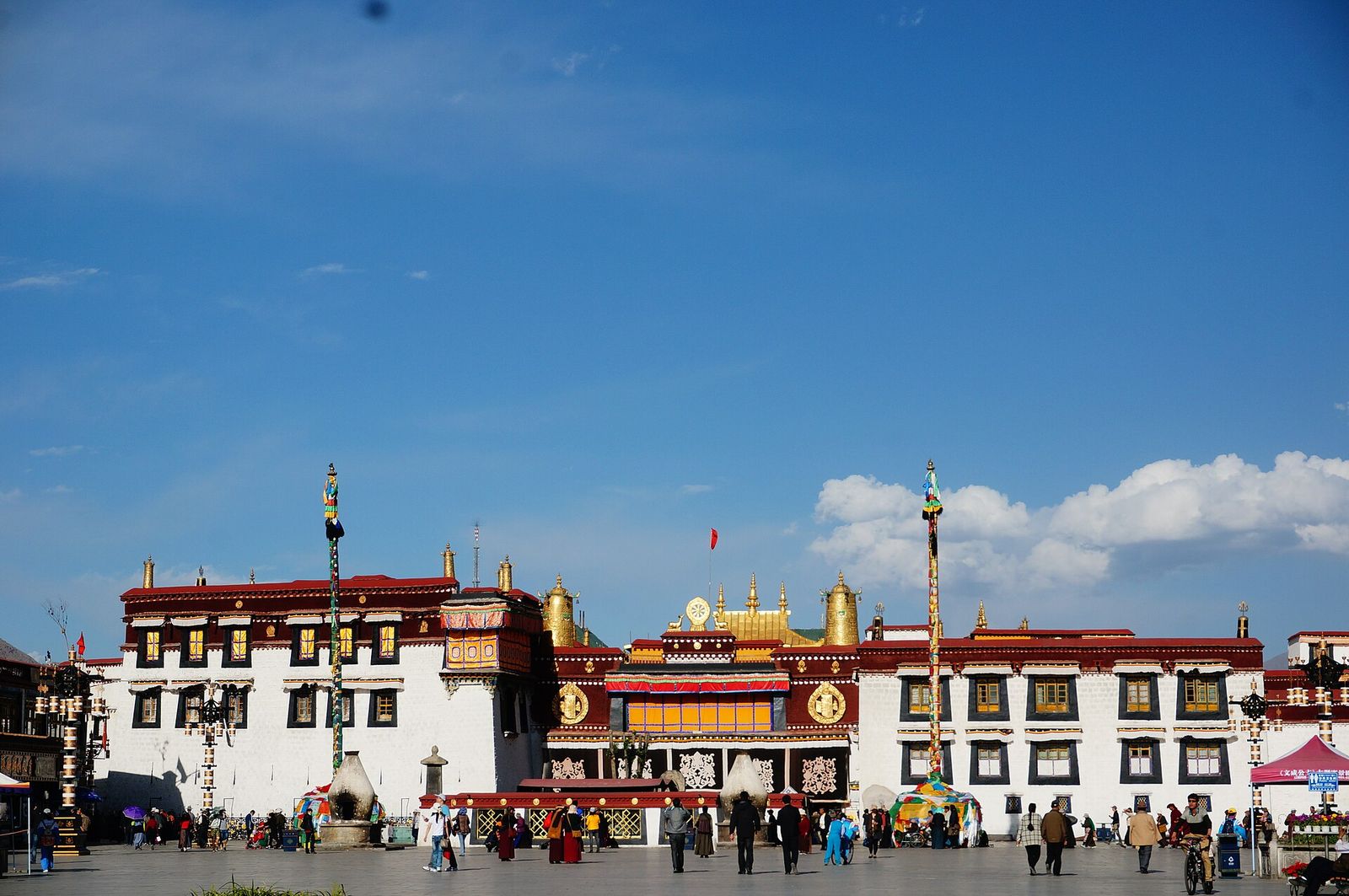
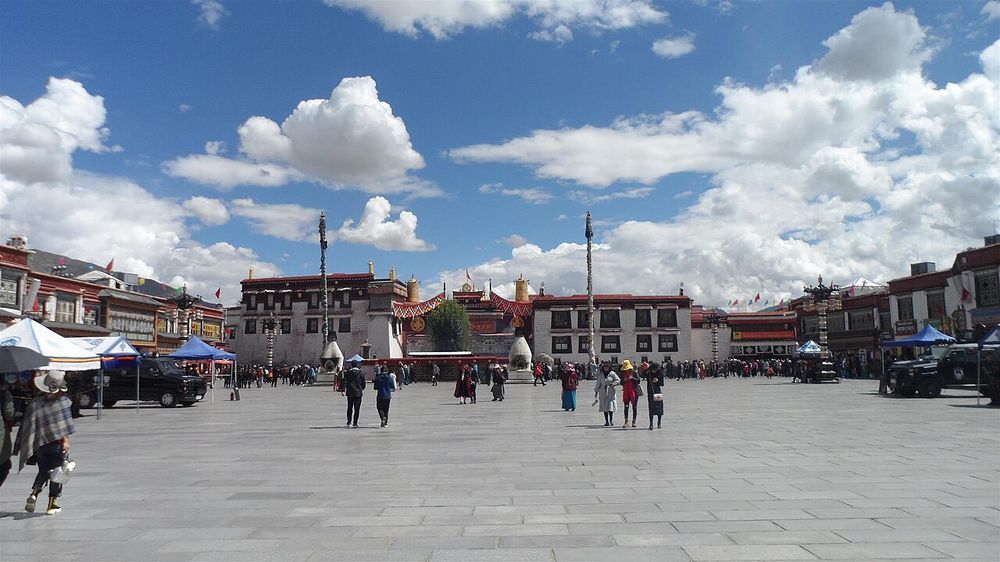
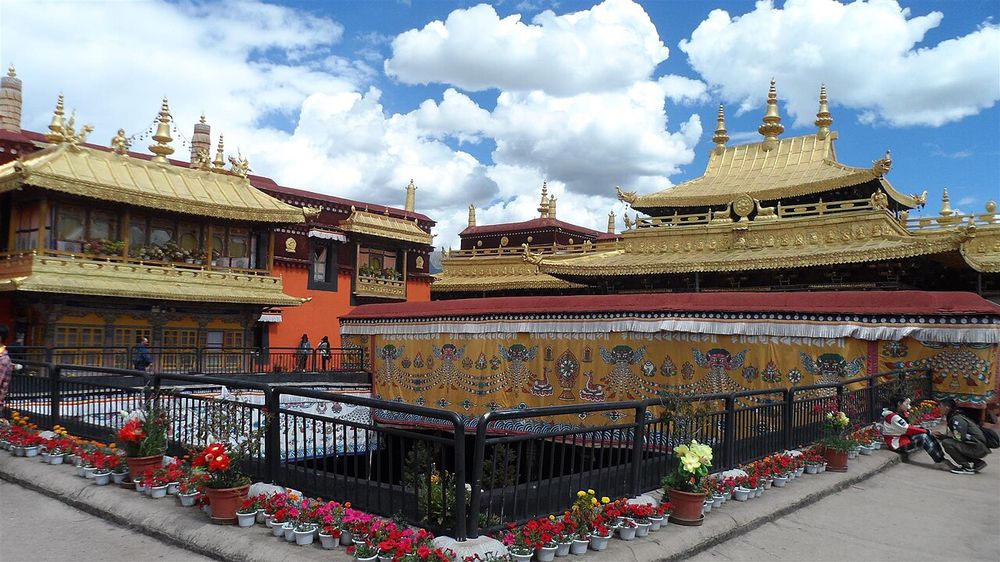
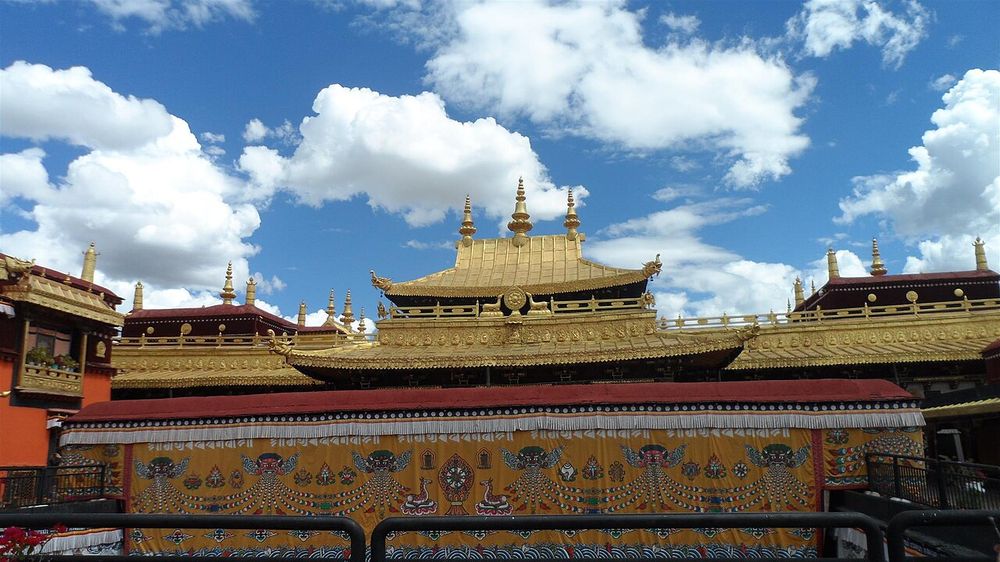
The oldest and holiest temple in Tibet, begun in the 600s on a marshy plain. The town of Lhasa grew up around it. Pilgrims still walk for months to reach its door, and the door faces west, towards Nepal.
Photo: Andrew and Annemarie, CC BY-SA 2.0, Wikimedia Commons
The story
You are in front of the Jokhang. Tibetans call it the Tsuglakhang, the great temple. It was begun in the 600s under King Songtsen Gampo, who first joined Tibet into one kingdom. That makes it about as old as the earliest mosques, and older than any wooden building still standing in China.
The old saying is "first the Jokhang, then Lhasa". The temple came before the town, and the town's main street is simply the path that pilgrims wore around it.
The square, the stones in front of the gate and the Barkhor street are free and always open. One ticket covers everything inside the gate, including the roof.
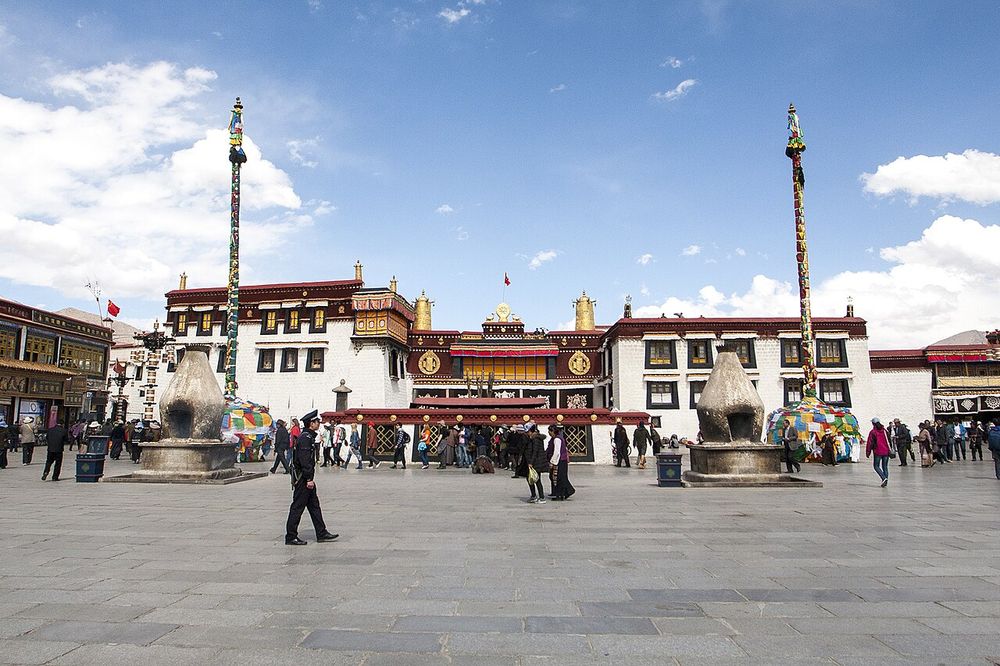
The gate and the two prayer mastsWindmemories, CC BY-SA 4.0
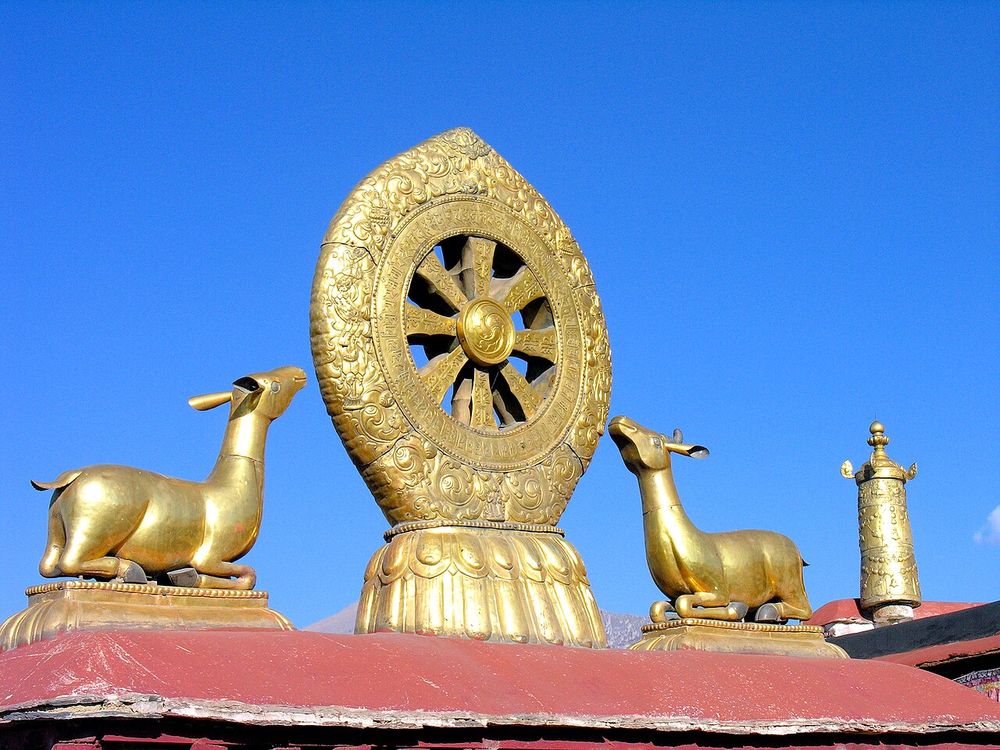
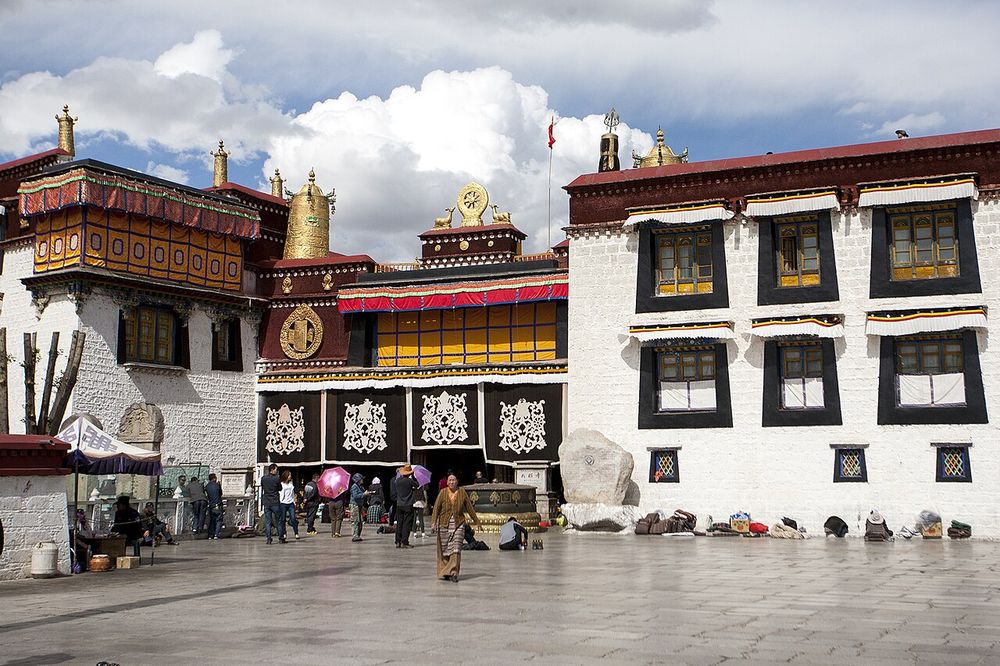
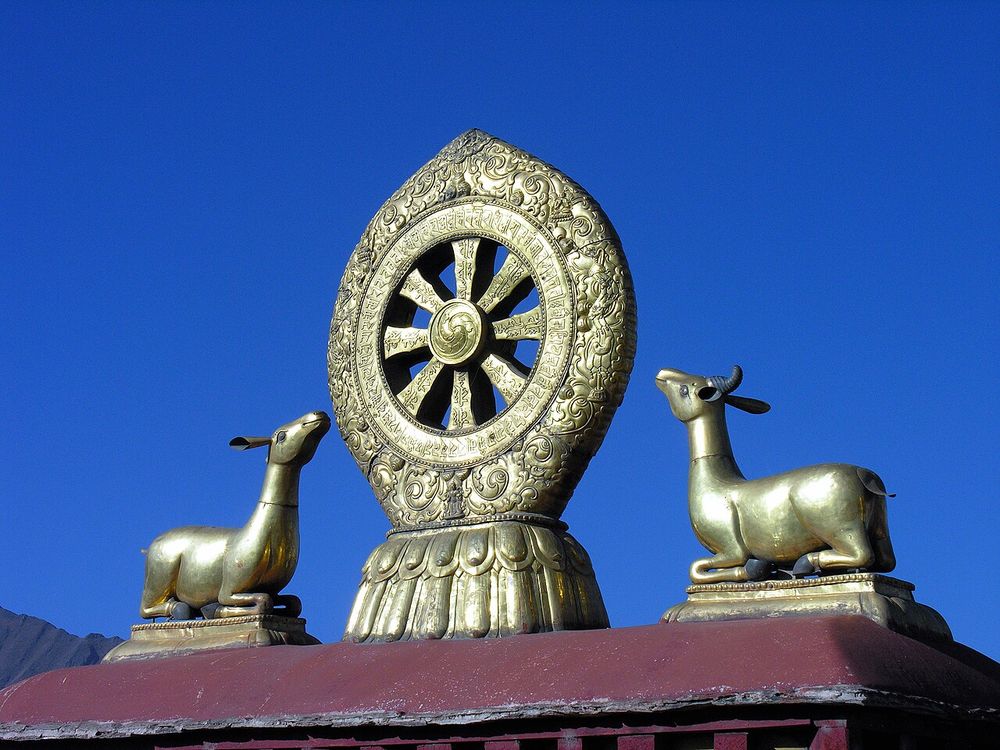
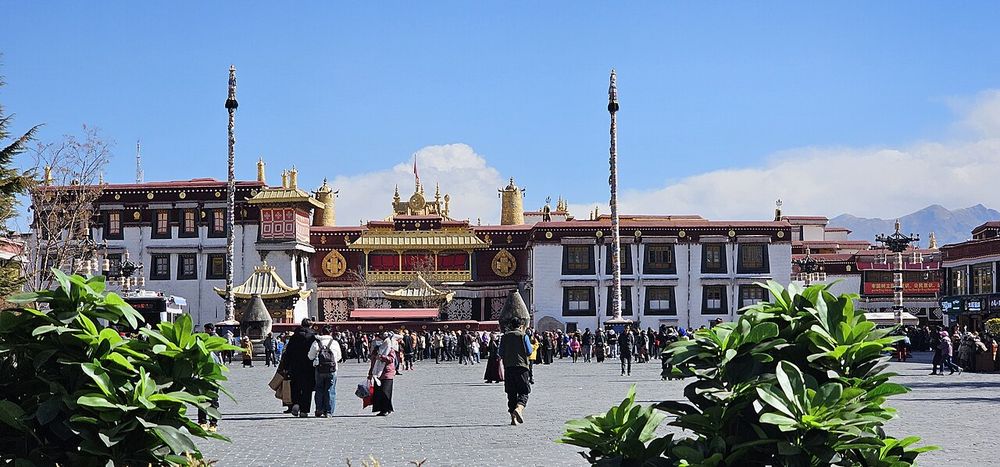
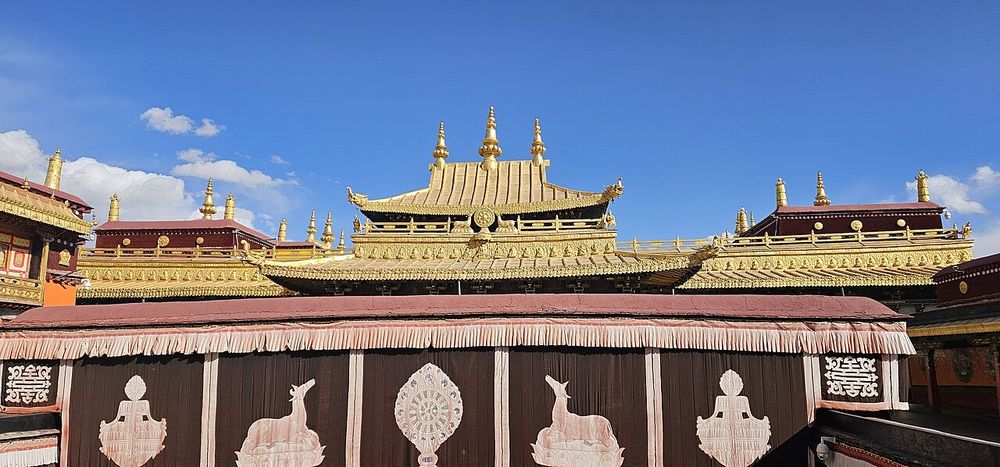
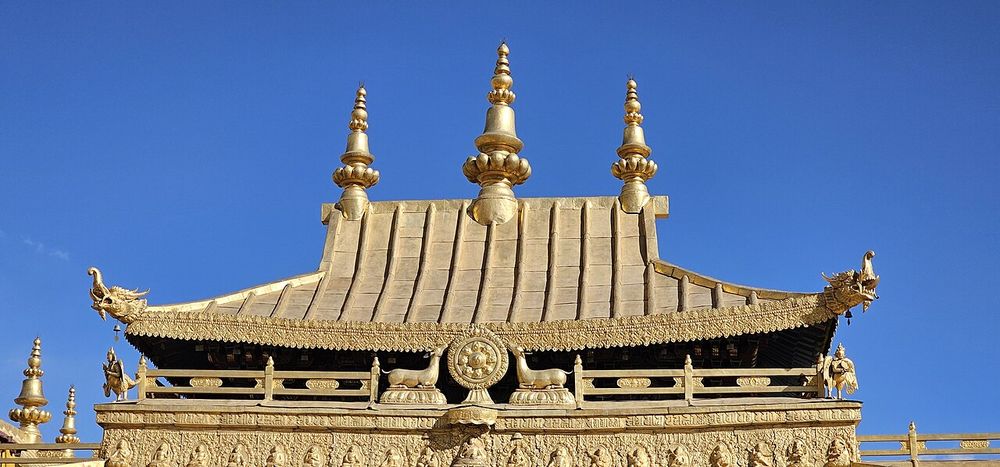
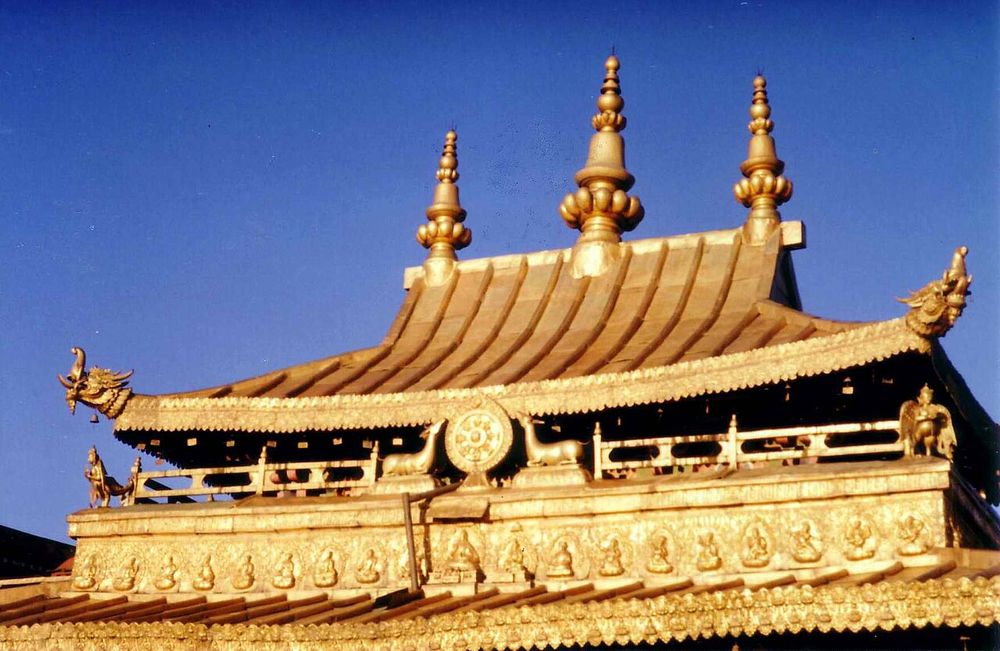
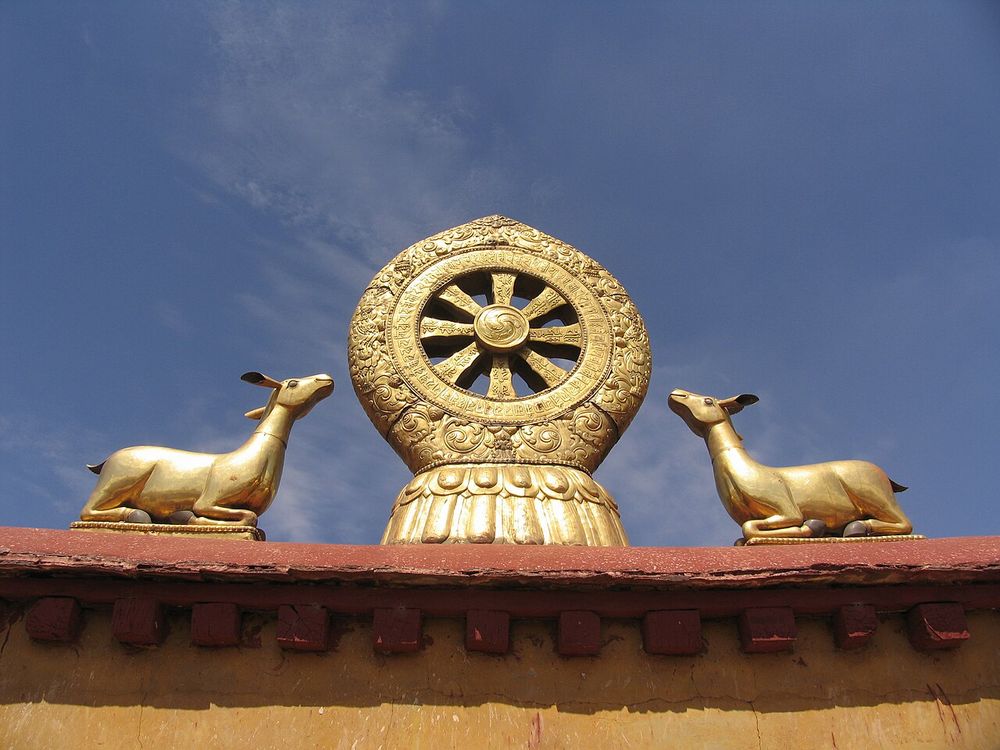
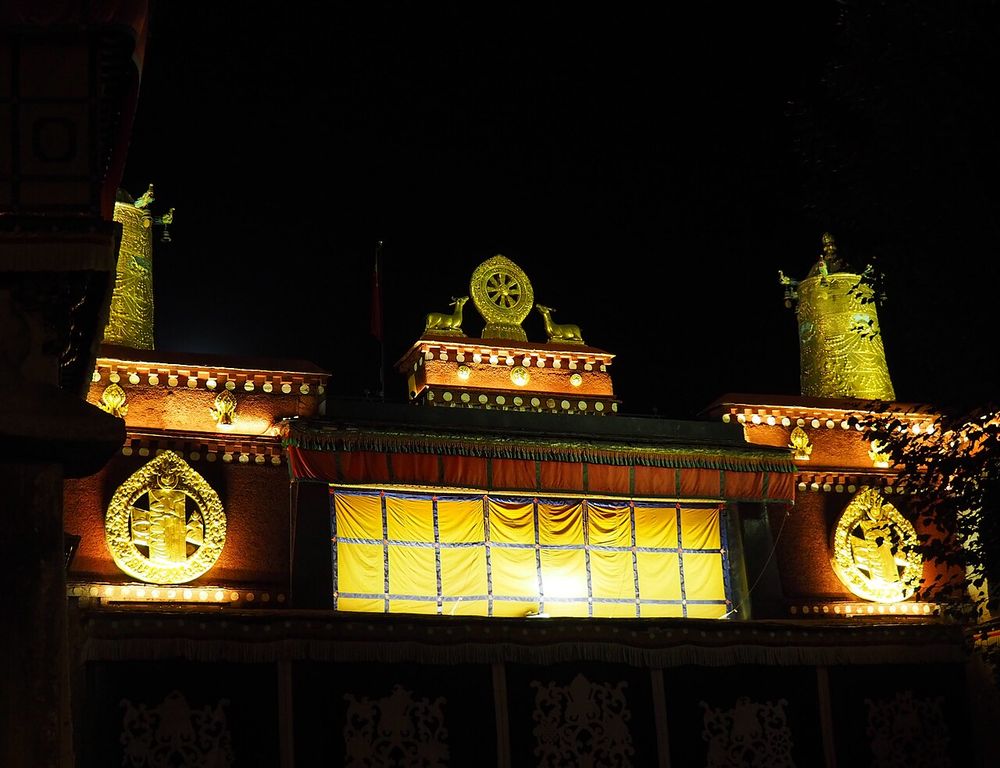
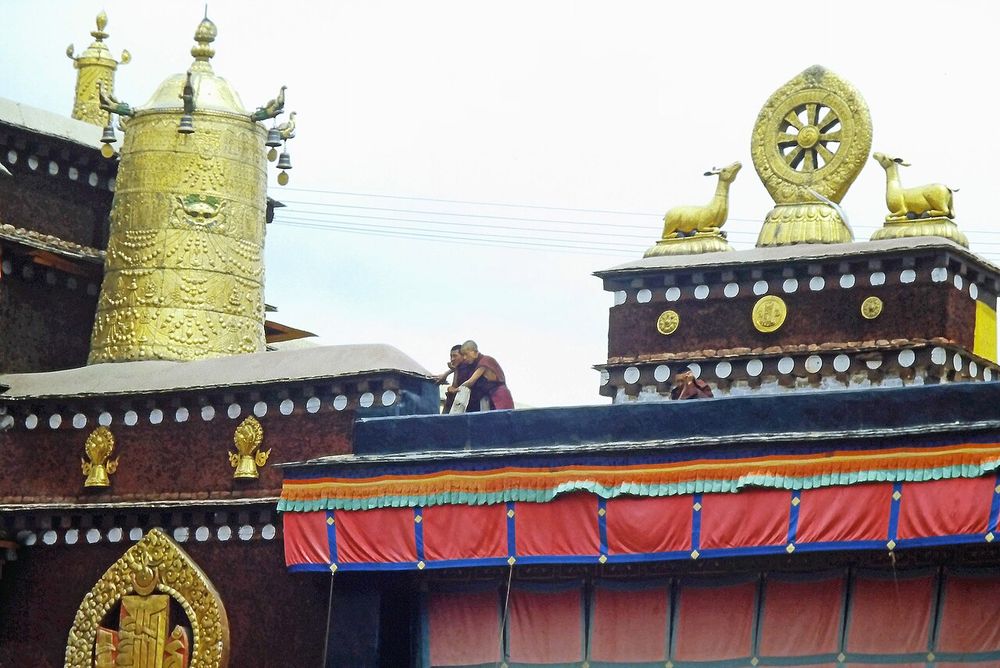
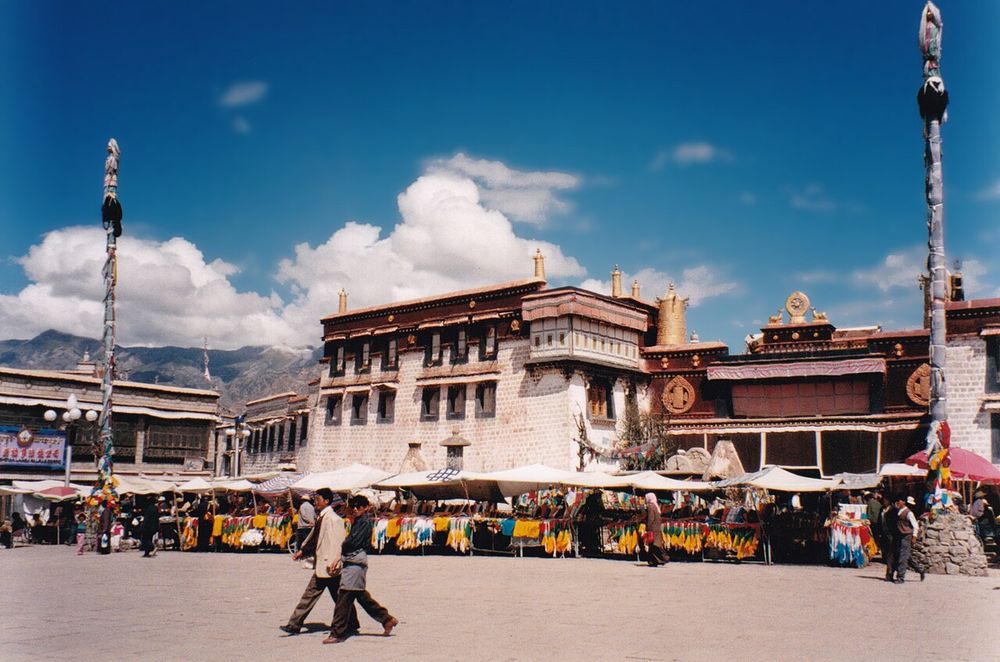
The front is low and plain: white walls, a dark band of pressed twigs under the eaves, black cloth awnings with white signs. Nothing here is tall. The gold is on the roof, where a wheel stands between two deer.
Look at the paving in front of the gate. It is polished like glass. People have lain down on it, full length, many thousands of times a day for centuries.
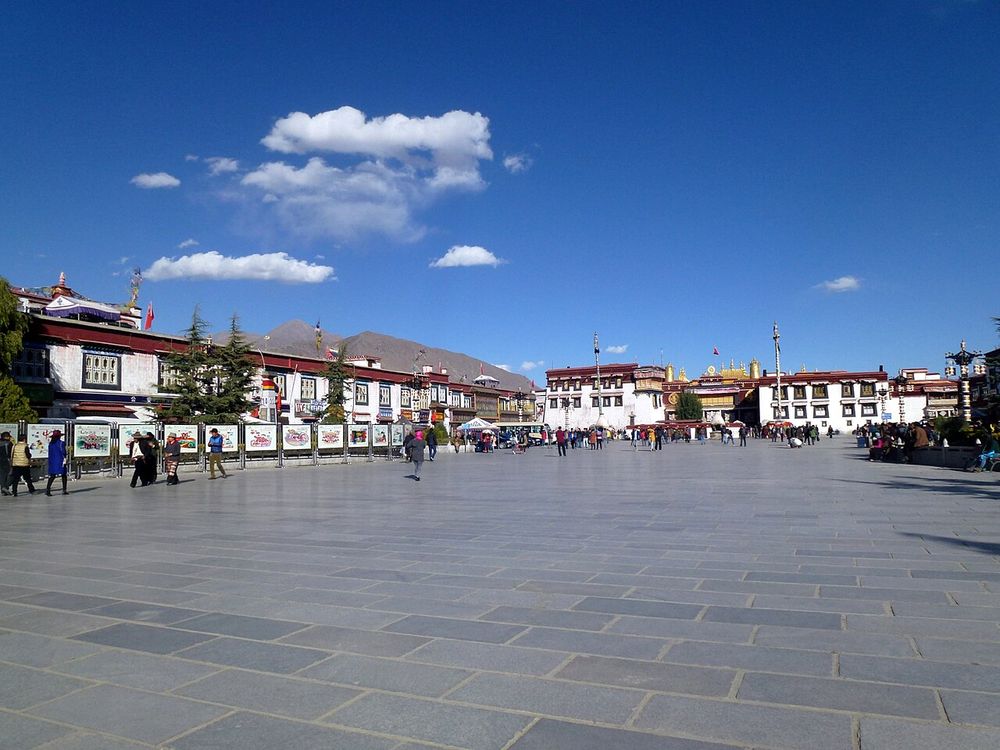
Notice which way you are facing. You are looking east, so the temple faces west. Almost every Chinese temple faces south.
The wheel of the teaching between two deerDennis G. Jarvis, CC BY-SA 2.0
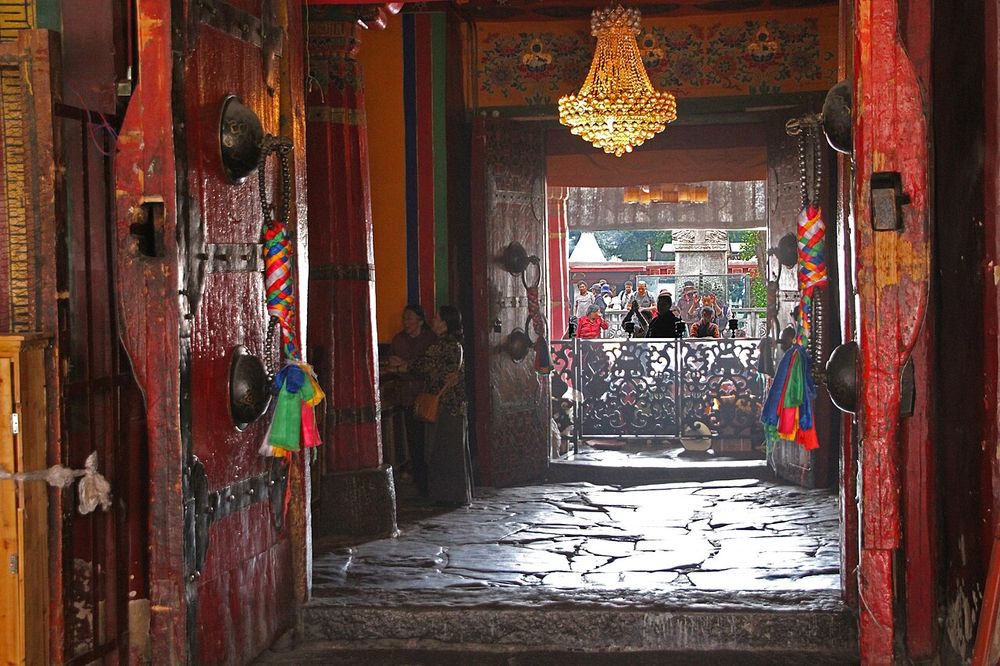
Inside it is dark and smells of butter. At the far end, in a small room, sits a gilded Buddha about a metre and a half high. Tibetans call it the Jowo, "the Lord". The whole building is its house: Jokhang means "house of the Jowo".
Things people often get wrong
"Princess Wencheng built it." Tibetan histories say the temple was built for the king's Nepalese queen, Bhrikuti, to house the Buddha image she brought. The Chinese princess Wencheng is said to have chosen the site. The statue Wencheng brought was first kept in another temple, the Ramoche.
"The 'zhao' in its Chinese name means bright." It is only a sound. It copies the Tibetan word Jowo.
"It belongs to one school, the Dalai Lama's." Every school of Tibetan Buddhism treats it as its own. Since the 1600s it has been looked after by the Gelug school.
"The Dalai Lama lived here." He lived in the Potala Palace in winter and the Norbulingka in summer. He came here for the great ceremonies, and the Tibetan government had its offices upstairs.
"I can come on my own." Visitors with a foreign passport need a Tibet travel permit and must travel with a licensed agency and guide. This is the rule for all of Tibet.
The people of this place
Lhasa is a Tibetan city, and the Jokhang is a working temple before it is a sight. Most people in the queue are not tourists. Some have come a thousand kilometres, measuring the road with their bodies.
Walking in a circle around a holy place is called a kora. It is always clockwise, with the holy thing on your right. Do the same, even in the shops of the Barkhor.
The full-length bow is called a prostration. Hands together at the head, the throat and the heart, then down flat, arms stretched. Wooden boards on the hands and an apron protect skin and clothes. It is not a show. Do not step over a person lying down, and do not photograph faces.
The smoke in the square is juniper and herbs, burned in big white stoves as an offering. The white scarf people give each other and lay before statues is a khata, a sign of respect. People pour melted butter into the lamps from flasks they bring from home.
Tibetans mostly have no family name. Ask someone's name and you will get two given names. The greeting is "Tashi delek".
People who stood here
Songtsen Gampo (the king who first united Tibet, died about 650)He moved his court to this valley and had the temple built. Upstairs there is a chapel with his statue between his two foreign queens.
Princess Wencheng (Chinese princess of the Tang (618–907) court)She reached Lhasa in 641, after a journey of many months from Chang'an, today's Xi'an. Tibetan histories say she read the land by Chinese geomancy and pointed to the marsh where the temple stands. She lived in Tibet for nearly forty years and never went home.
Princess Bhrikuti (Nepalese princess; one of Nepal's national heroes)Tibetans call her Tritsun. The temple is said to have been built for her, by craftsmen from the Kathmandu valley, and to face her homeland.
Princess Jincheng (Chinese princess of the Tang court)She came in 710, two generations after Wencheng. Tibetan histories say it was she who brought the Jowo out of hiding and placed it here, where it has been ever since.
Atisha (Bengali monk and teacher, revered in India, Bangladesh and Tibet)He taught in Lhasa about 1047. A famous book of the king's last words says of itself that Atisha found it hidden in a pillar of this temple.
Tsongkhapa (founder of the Gelug school, the school of the Dalai Lamas)In 1409 he held the first Great Prayer Festival here and set a crown of gold on the Jowo's head. The festival filled this temple with tens of thousands of monks every new year for five centuries.
The Fifth Dalai Lama (ruler of Tibet from 1642, builder of the Potala)He enlarged the temple to nearly its present size, and in 1645 wrote the guidebook to it that scholars still use.
Tsangyang Gyatso, the Sixth Dalai Lama (Tibet's best-loved poet)He was brought to Lhasa as a boy of fourteen in 1697. His short love songs are still sung, and one of them gave its name to a yellow house on the Barkhor.
Évariste Huc (French missionary and travel writer)He and Joseph Gabet reached Lhasa in January 1846 after eighteen months on the road from north China. They were sent away six weeks later. His book was read all over Europe.
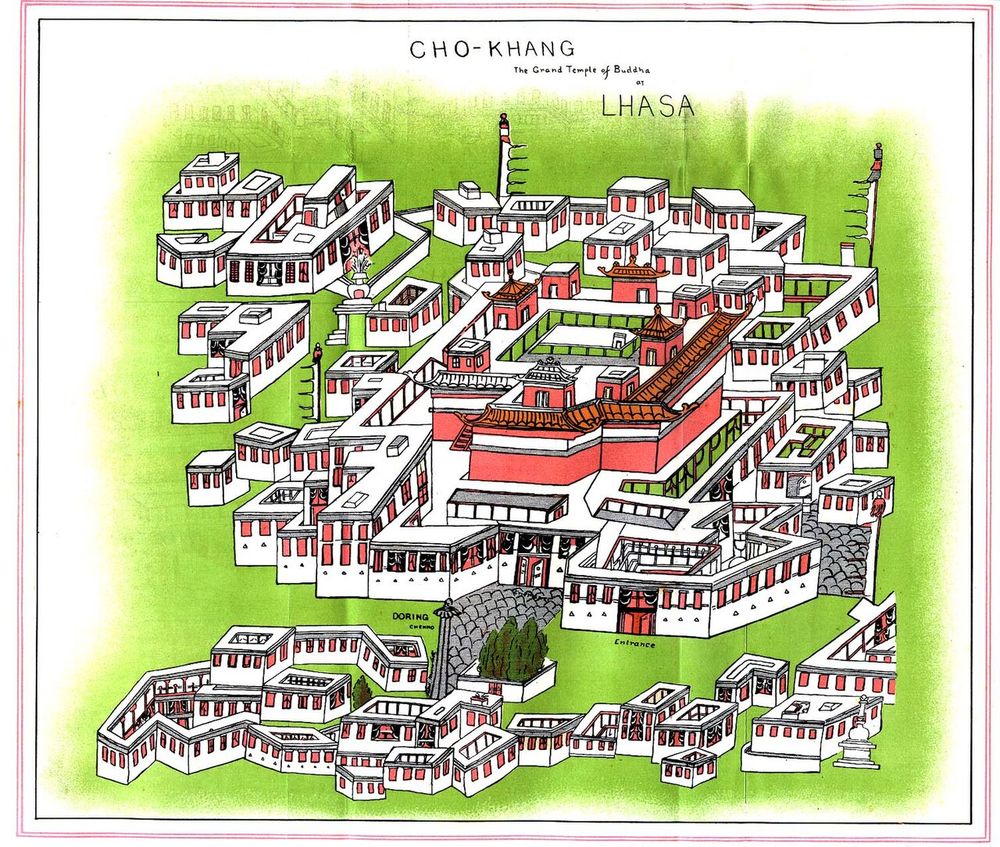
Sarat Chandra Das (Bengali scholar who travelled for British India)He came in 1882 as a pilgrim. His book carries one of the first plans of the temple. Tibetans who had helped him were punished after he left.
Kawaguchi Ekai (Japanese Zen monk, the first Japanese in Lhasa)He lived in Lhasa from 1901 to 1902 passing as a Chinese monk, and worked as a doctor. He wanted the Tibetan scriptures for Japan.
Gombojab Tsybikov (Buryat scholar from Russia)He came as a pilgrim in 1900 with a camera hidden in a prayer wheel. His pictures, printed in 1905, were among the first photographs of Lhasa the world saw.
Alexandra David-Néel (French explorer and writer)In 1924, aged fifty-five, she walked into Lhasa dressed as a beggar, the first Western woman to do so. She stayed two months and saw the new year crowds press through these doors.
Heinrich Harrer (Austrian mountaineer, author of Seven Years in Tibet)He lived in Lhasa from 1946 to 1951. He describes the night of the butter lamps, when the whole circuit round the temple was lined with towers of coloured butter.
Giuseppe Tucci (Italian scholar of Tibet)He came to Lhasa in 1948, after eight expeditions to other parts of Tibet, visited the temple and was received by the young Dalai Lama.
The Fourteenth Dalai Lama (born 1935)He sat his final monastic examinations here during the Great Prayer Festival early in 1959, before a crowd of many thousands of monks.
Go deeper: eight stops, from the square to the roof and round the Barkhor
The first two stops are in the square and are free. Then you go in. The last stop is the street outside.
1. The square: a temple that faces west
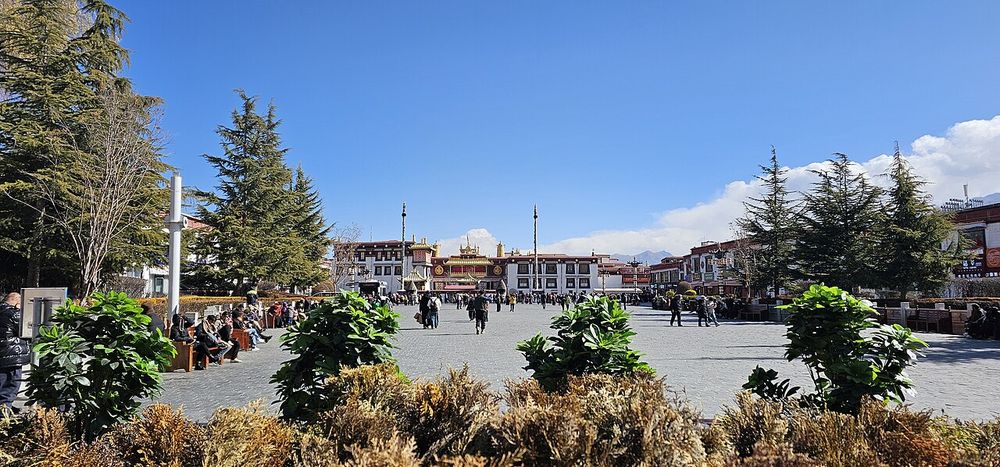
The square in January 2024Nabin K. Sapkota, CC BY-SA 4.0
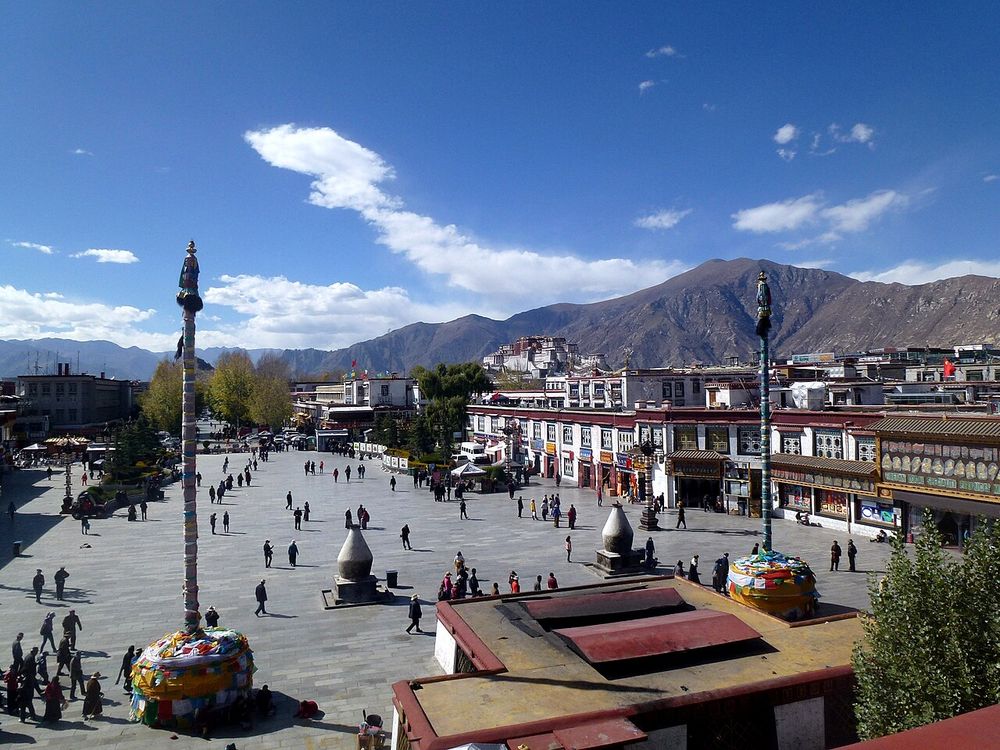
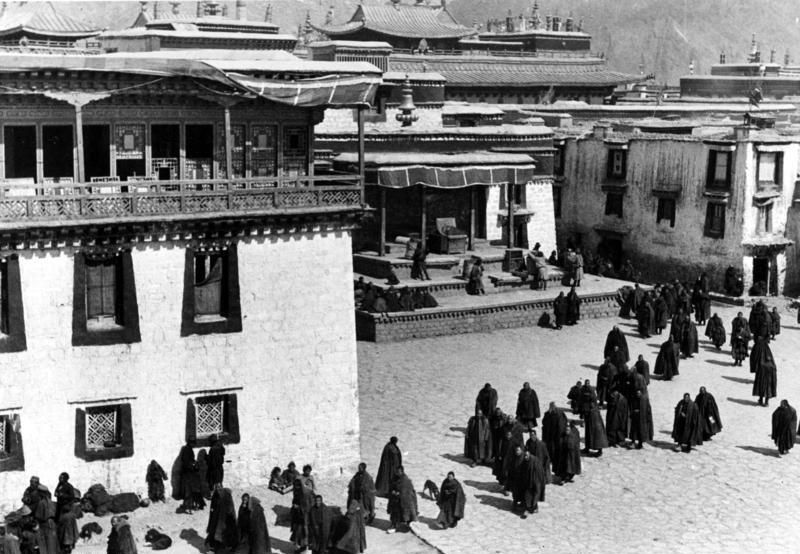
The square is new. Until 1985 houses came right up to the gate. They were cleared to make an open space.
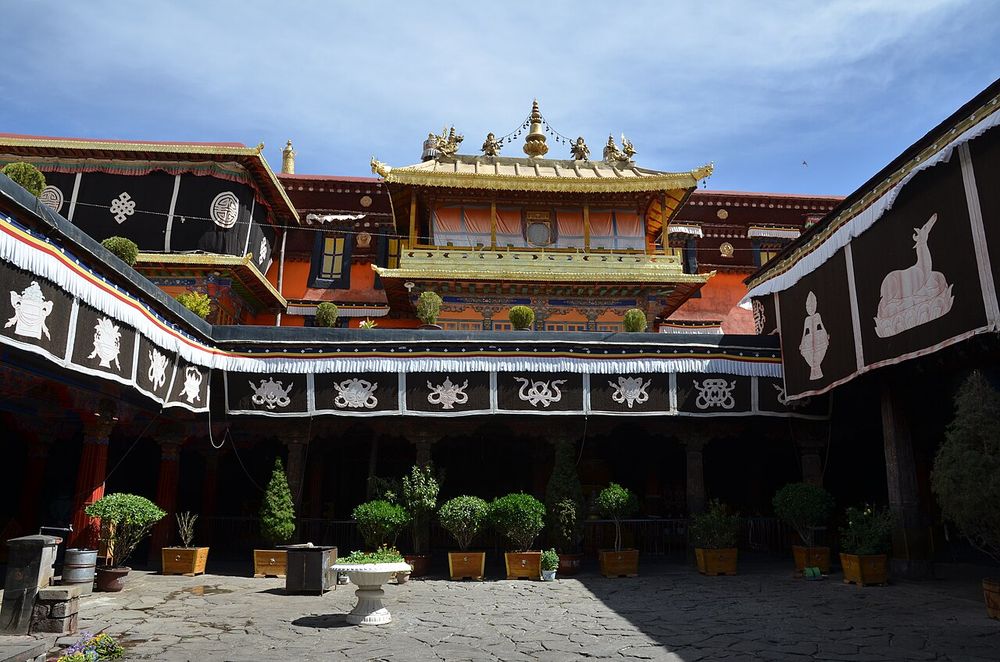
The two tall poles wrapped in cloth are prayer masts. The white stoves are for juniper smoke.
The front: white walls, black awnings and the gilded roof ornamentsWindmemories, CC BY-SA 4.0
Tibetan histories give the reason for the western door: it looks towards Nepal, the home of Queen Bhrikuti. Whatever the reason, the choice was made in the 600s and never changed. Each later builder added rooms around the old core and kept the door where it was.
The dark band under the roof is not paint. It is bundles of tamarisk twigs, cut short, stacked end-on and dyed. Only temples and palaces were allowed it. It is light, and it lets the wall breathe.
2. Three things in front of the gate
The front from the south side of the squareWindmemories, CC BY-SA 4.0
To the left of the gate, behind a wall, stands a stone pillar. It was set up in 823. It records a treaty of peace between the Tibetan emperor and the Tang emperor of China, sworn in both capitals in 821 and 822.
The text is cut in Tibetan and in Chinese, side by side. It calls the two rulers "nephew and uncle", because Tibetan kings had twice married Tang princesses. It says each side shall keep the land it holds and neither shall raise an army against the other. It is one of the oldest dated pieces of written Tibetan anywhere.
Beside it is a second, rougher stone, covered with small pits. A Qing (1644–1912) official set it up in 1794. It told people how to nurse those sick with smallpox instead of driving them into the hills.
Between them is the stump of an old willow, also walled in.
3. The porch and the open court
Two of the four guardian kings in the porchGerd Eichmann, CC BY-SA 4.0
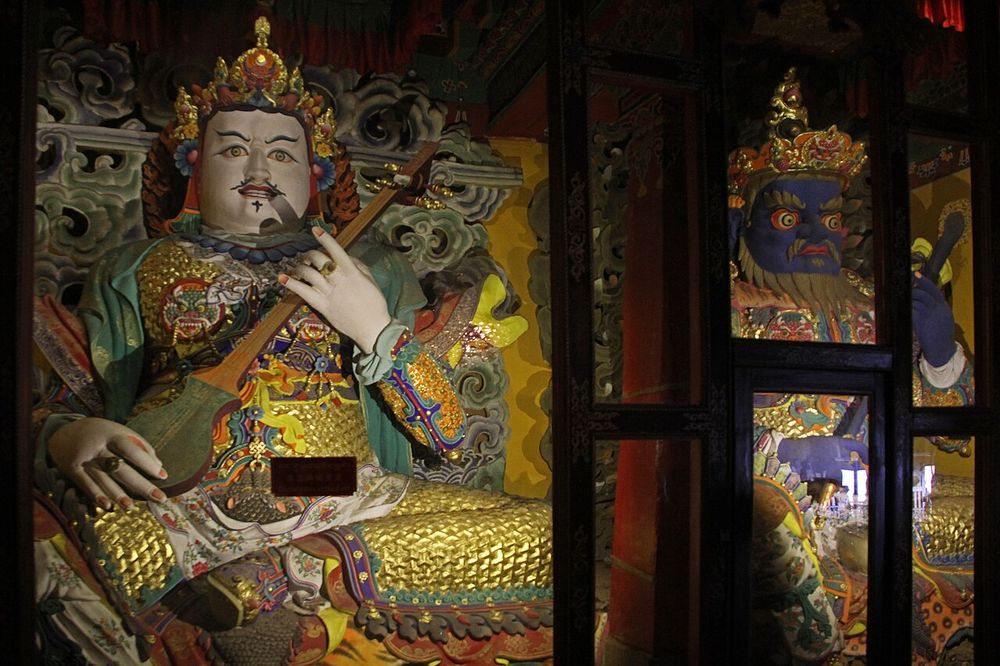
In the porch four large figures guard the door, two on each side. They are the kings of the four directions. Every Tibetan temple has them, as Chinese temples do.
For two hundred years a bronze bell hung in this porch with Latin words cast on it: Te Deum laudamus, "We praise thee, O God". It came from the chapel of Italian Capuchin friars who lived in Lhasa from 1707 to 1745. It is now kept in store.
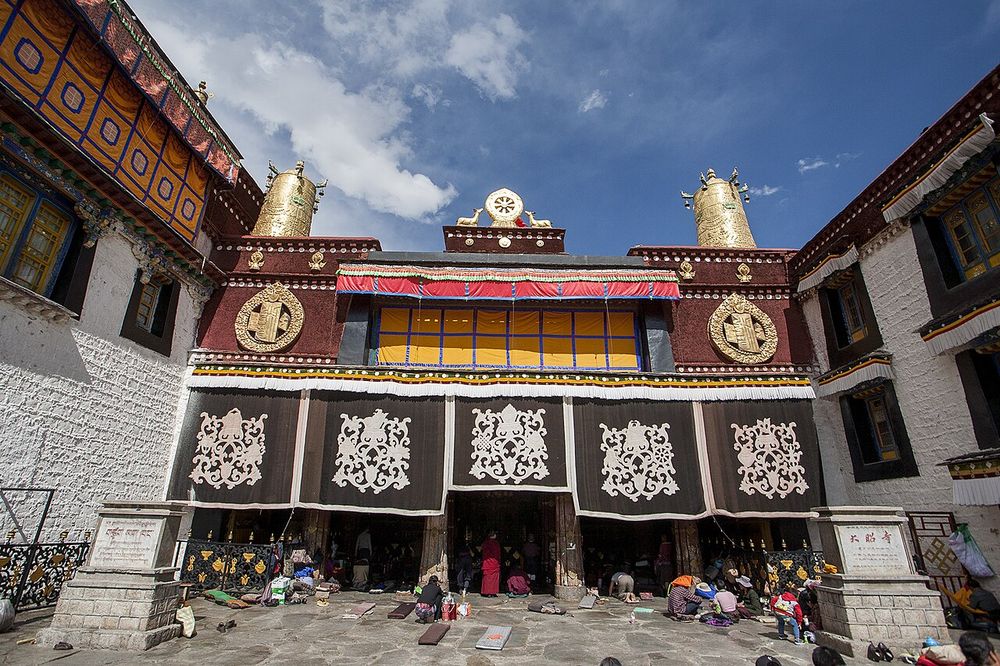
The open court, November 2013Maris Burbergs, CC BY 3.0
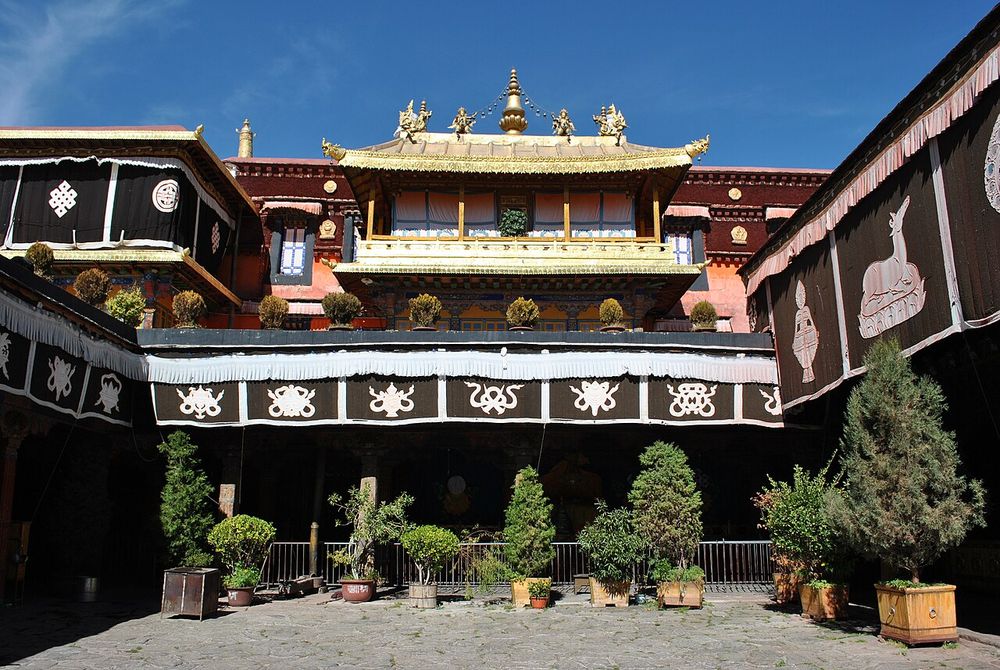
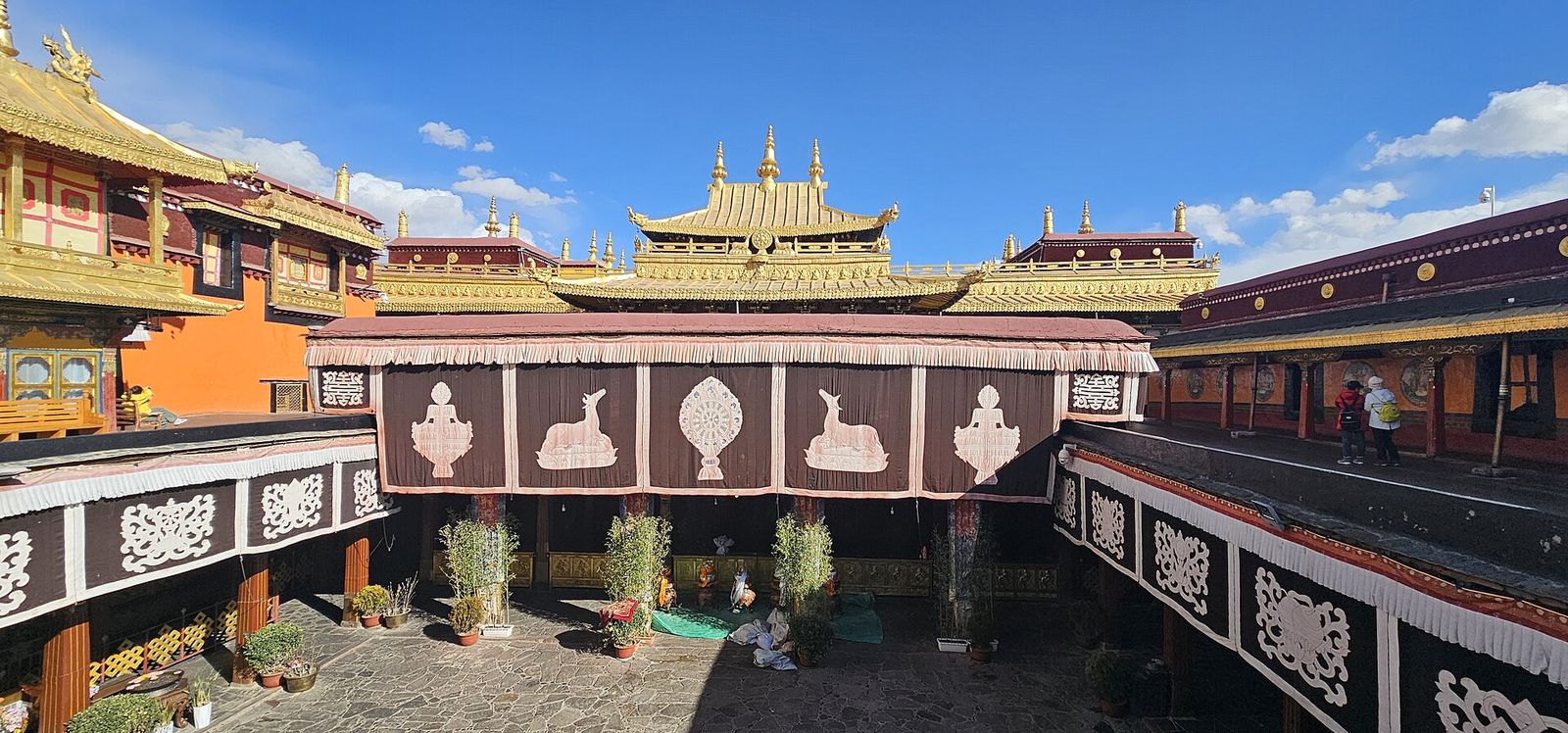
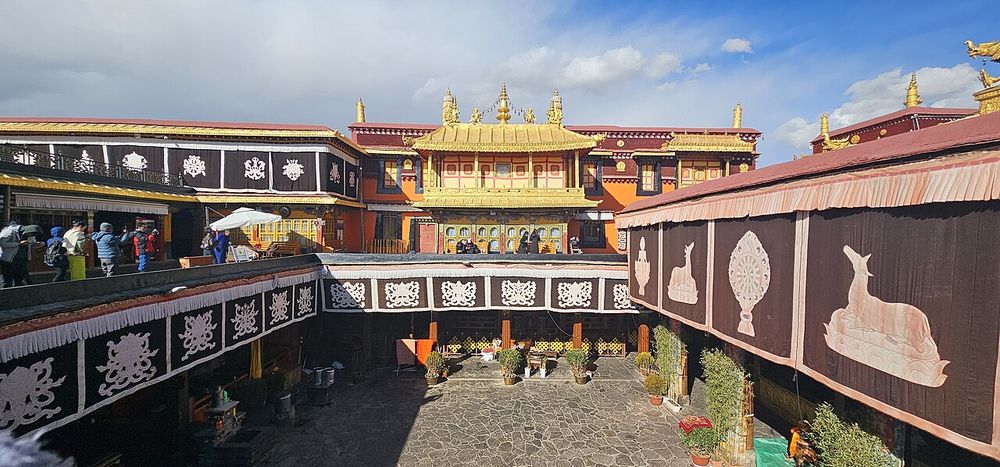
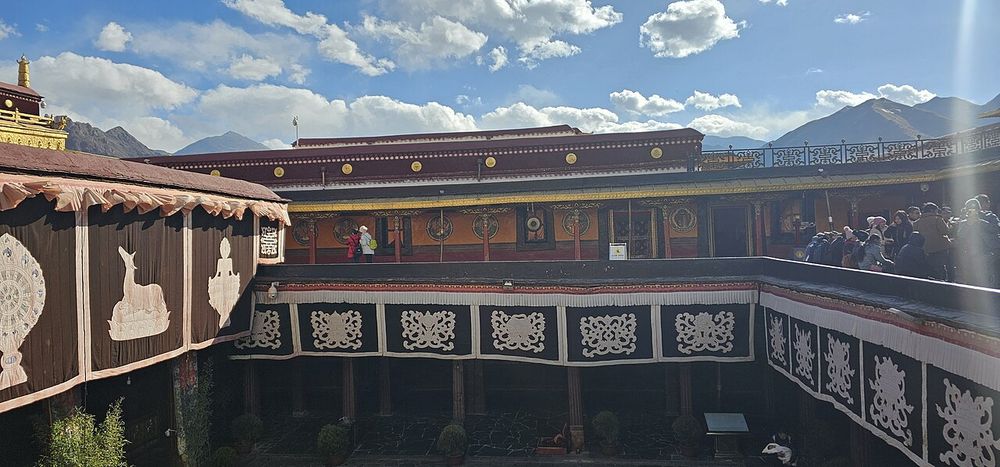
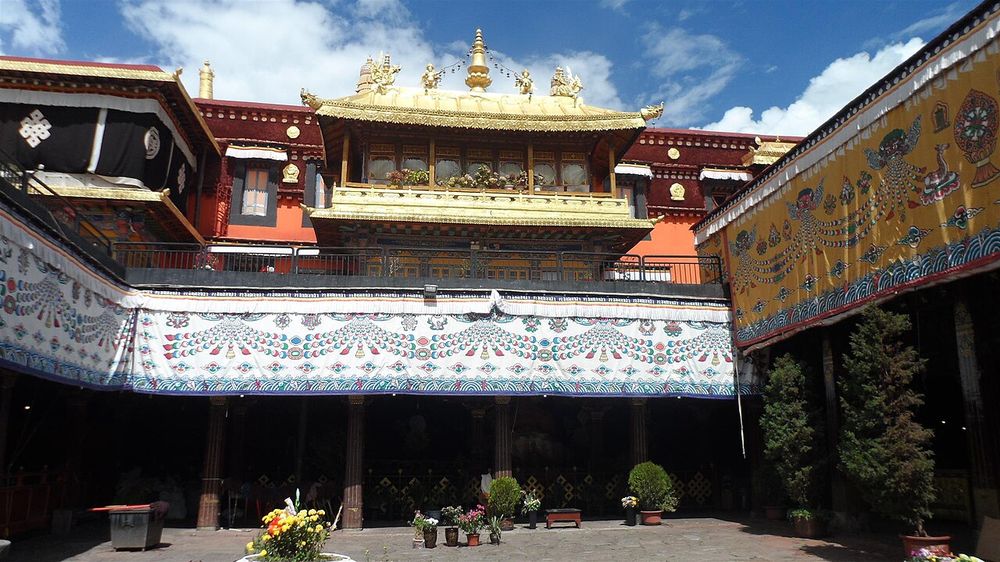
Past the porch is an open court with a painted gallery round it. This is where Tsongkhapa's Great Prayer Festival was held. The throne of the Dalai Lama stood on the north side.
A wall painting in the courtGerd Eichmann, CC BY-SA 4.0
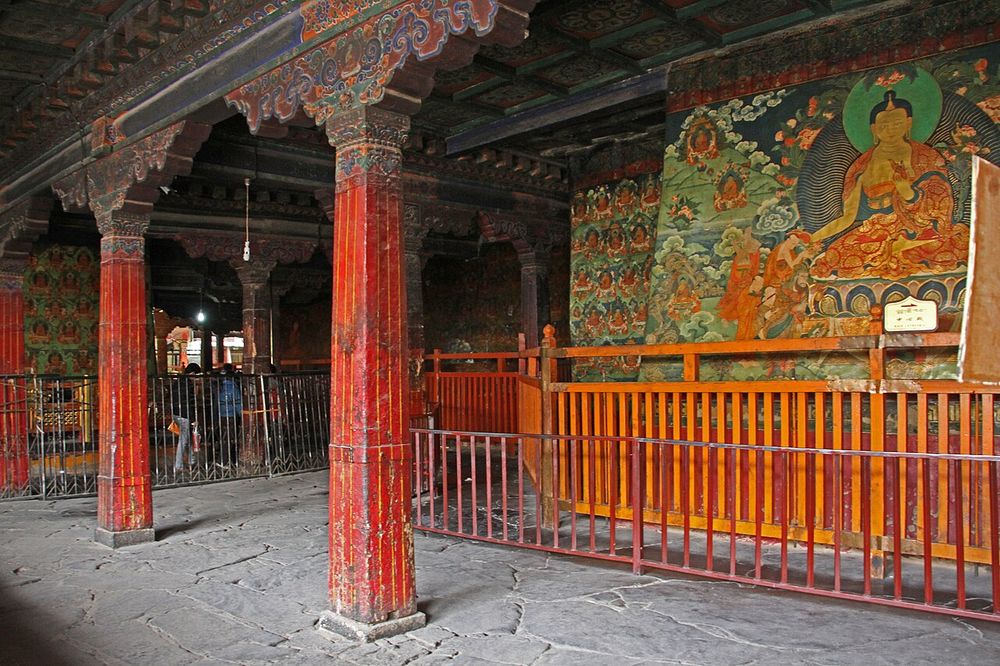
The walls are painted with a thousand Buddhas, and with the story of the temple itself. Look for a lake being filled in, and for goats carrying loads of earth.
The passage from the court to the inner doorGerd Eichmann, CC BY-SA 4.0
A passage lined with butter lamps leads from the court to the inner door.
4. The oldest wood in Tibet
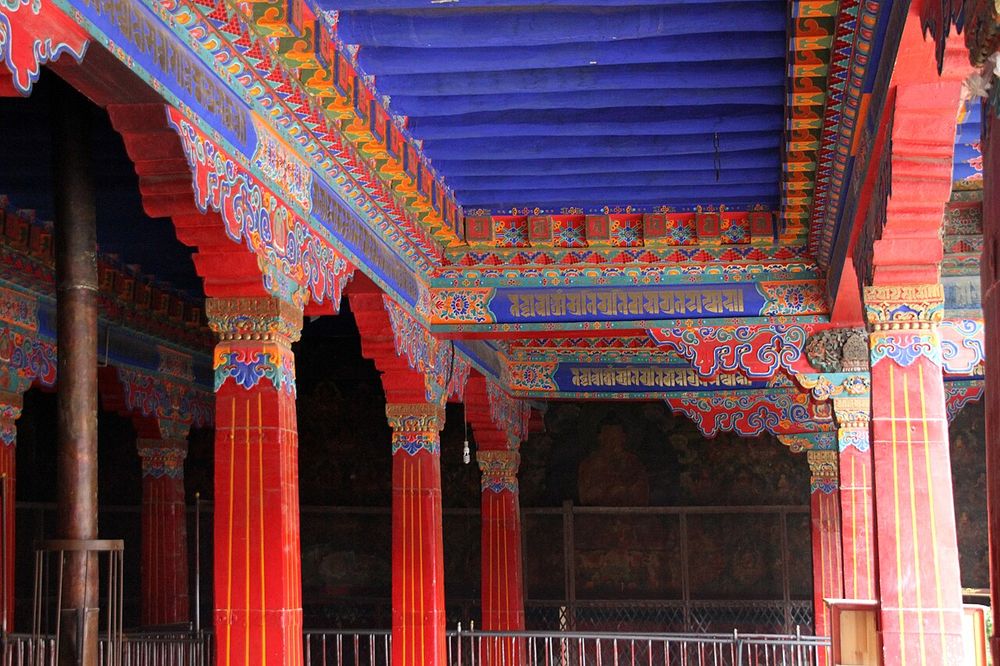
The painted galleryGerd Eichmann, CC BY-SA 4.0
The first temple was a square, two floors high, with small rooms on all four sides opening on to a hall in the middle. That is the plan of a monastery in India, such as Nalanda, where monks' cells surround a court. The Chinese archaeologist Su Bai made this comparison after measuring the building.
You are now inside that square. The hall has since been roofed over and raised. The rooms round it are the chapels you will walk past.
Look at the door frames of the chapels on the ground floor, and at the short, thick pillars. Several are carved with small figures, lions and curling leaves in the style of the Kathmandu valley. Scholars date them to the 600s. They are the oldest carved wood in Tibet, and among the oldest anywhere in Asia still doing its first job.
For comparison: the oldest wooden hall in China, at Nanchan Temple on Mount Wutai, dates from 782.
The middle of the hall is filled by statues several metres high. One is Padmasambhava, the Indian master who Tibetans say tamed the land for Buddhism. One is Maitreya, the Buddha to come. One is Avalokiteshvara, the lord of compassion, with a thousand arms.
5. The Jowo
Straight ahead, at the east end, is the smallest and most crowded room. The line of pilgrims has been moving towards it since they came in.
The statue shows the Buddha at the age of twelve, as a prince. It is of gilded metal, about a metre and a half high. You see very little of the metal. It wears a crown and robes of gold set with turquoise, coral and pearls, given over many centuries.
The crown is the important change. A plain Buddha is a monk, with no ornaments. In 1409 Tsongkhapa gave this statue a crown, and so turned the image of a monk into the image of a heavenly king. Some monks of the time objected.
Tibetan histories say Princess Wencheng brought the statue from China in 641, and that it was first kept at the Ramoche temple, ten minutes' walk north of here. When Tibetans feared a Chinese attack it was hidden here, behind a door that was plastered over. Princess Jincheng found it two generations later. The statue the Nepalese queen had brought went to the Ramoche in exchange. Each temple has held the other's statue ever since.
Each pilgrim climbs the steps at the side, touches their head to the statue's knee, and is moved on by a monk. They may have walked for half a year for those two seconds.
Photographs are not allowed anywhere in the chapels.
6. Upstairs: a king, two queens and a golden urn
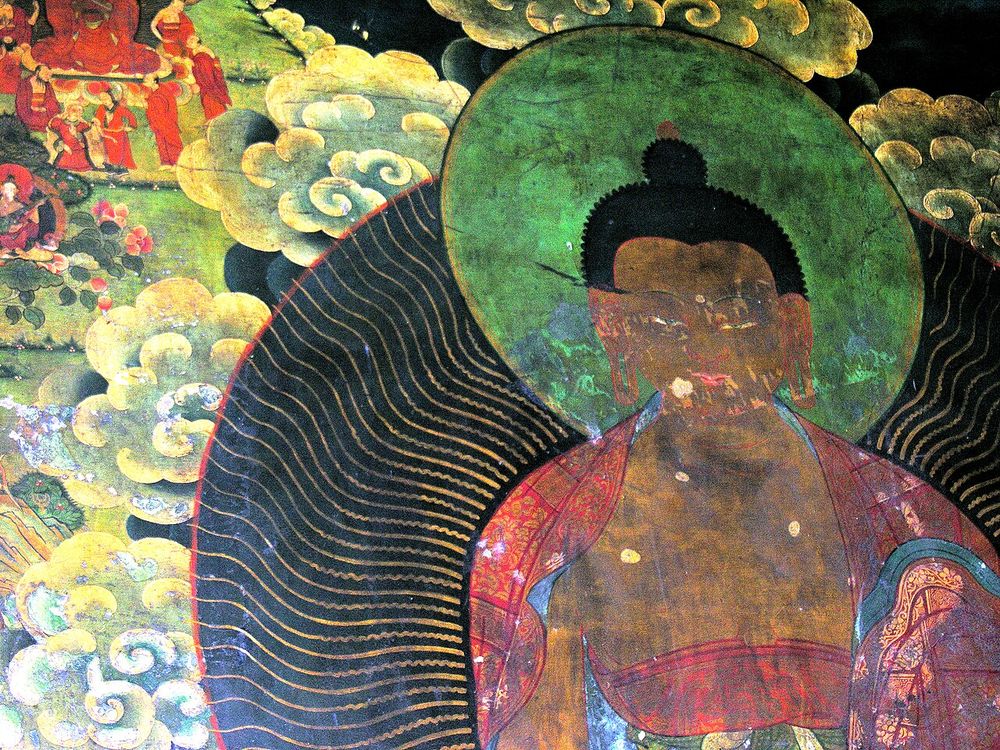
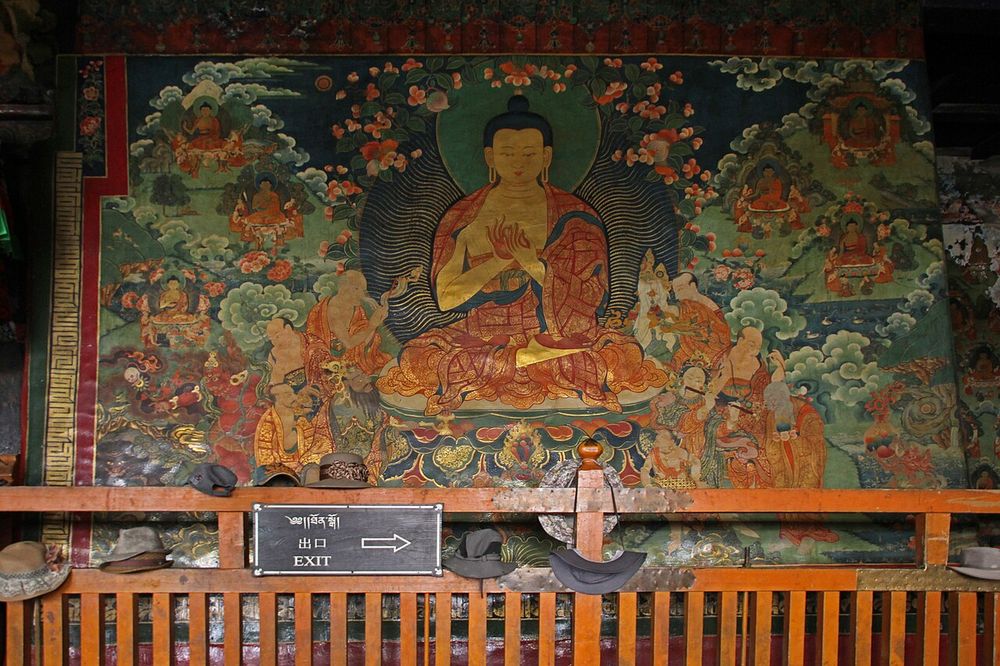
A wall painting of the BuddhaDennis G. Jarvis, CC BY-SA 2.0
On the upper floor, above the entrance, is the chapel of King Songtsen Gampo. He sits in the middle. Wencheng and Bhrikuti sit on either side. In Tibetan belief the two queens are forms of the goddess Tara, one white and one green.
From the 1600s until 1959 the rooms on the upper floors were also offices. The council of ministers of the Tibetan government met here. Church and state were one thing, and this was the building for both.
In 1793 the Qianlong Emperor sent a golden urn to Lhasa. When a new Dalai Lama or Panchen Lama had to be found, the names of the boys put forward were written on ivory slips, placed in the urn, and one was drawn in front of the Jowo. A second urn was kept in Beijing, at the Lama Temple, for Mongolian lamas. The urn was last used here in 1995.
7. The roof
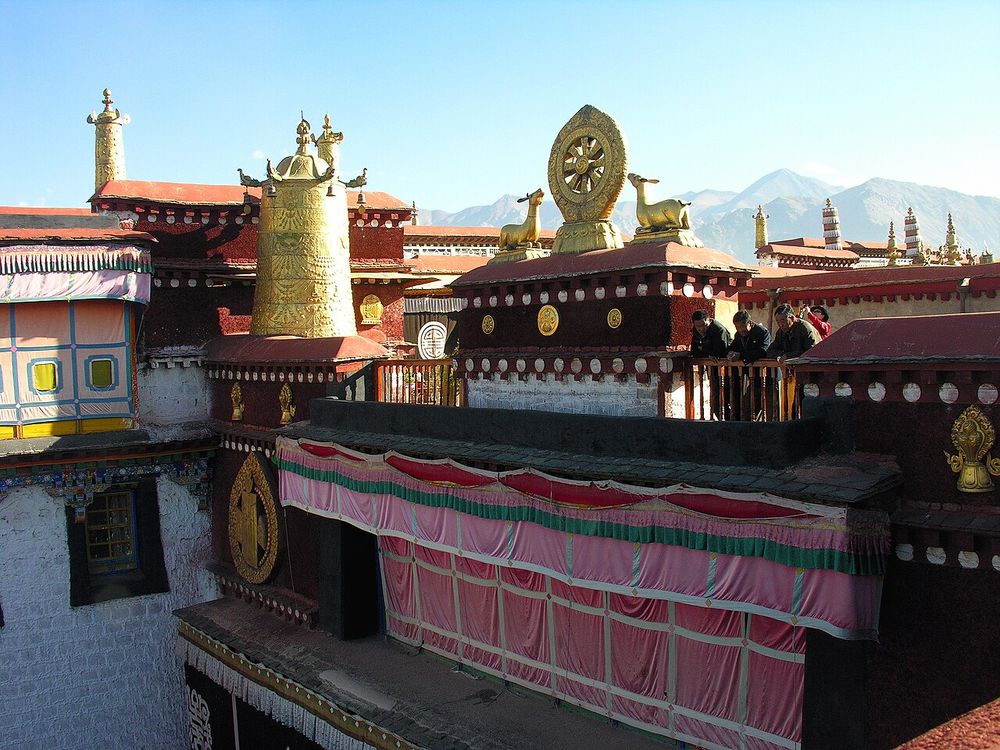
The wheel, the deer and a banner of victoryDennis G. Jarvis, CC BY-SA 2.0
Climb to the roof. Here photographs are allowed.
The wheel has eight spokes for the eight parts of the pathDennis G. Jarvis, CC BY-SA 2.0
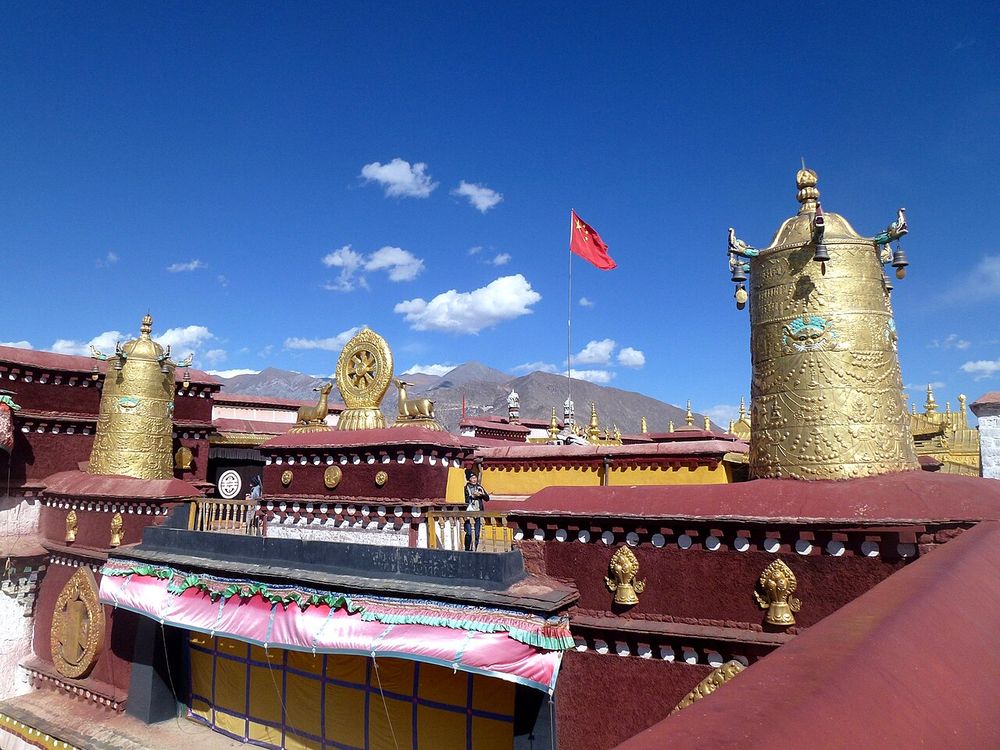
The wheel between two deer stands over the front of every Tibetan monastery. The Buddha gave his first teaching in a deer park near Varanasi in India. The wheel is the teaching, with eight spokes for its eight parts. The deer are the first to listen. One is a stag and one a doe.
Gilded roofs under cloud, May 2014Andrew and Annemarie, CC BY-SA 2.0
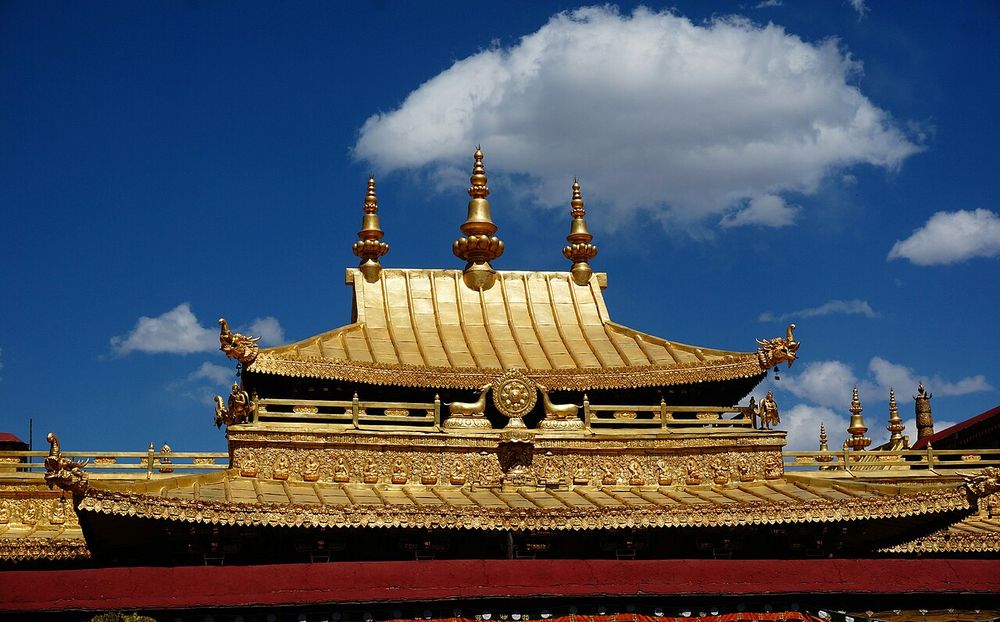
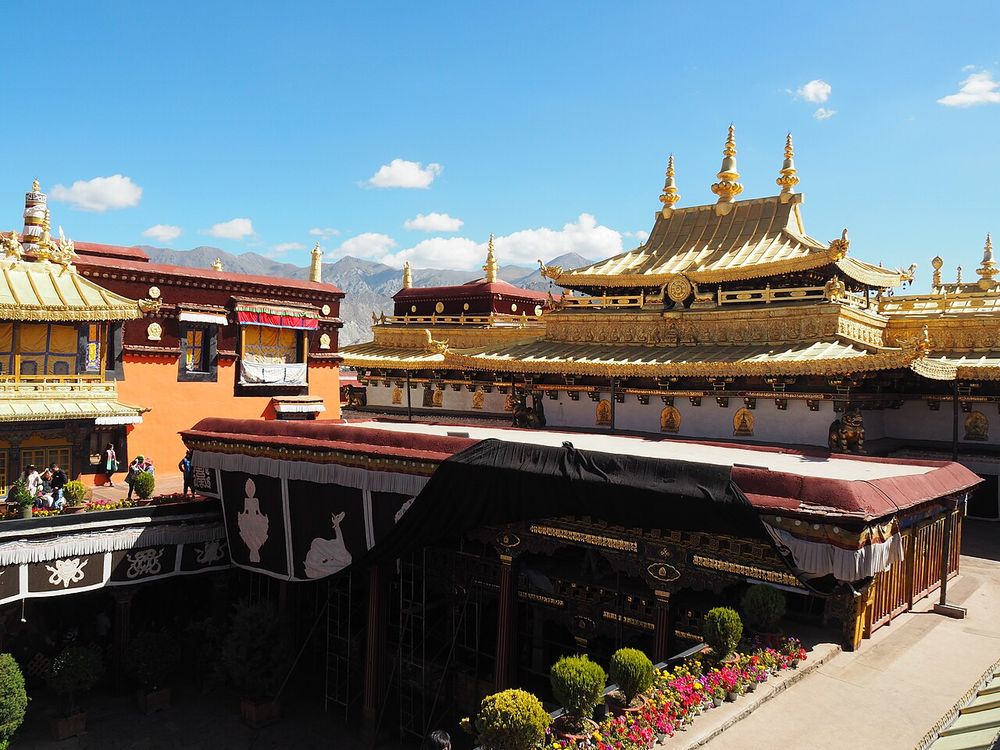
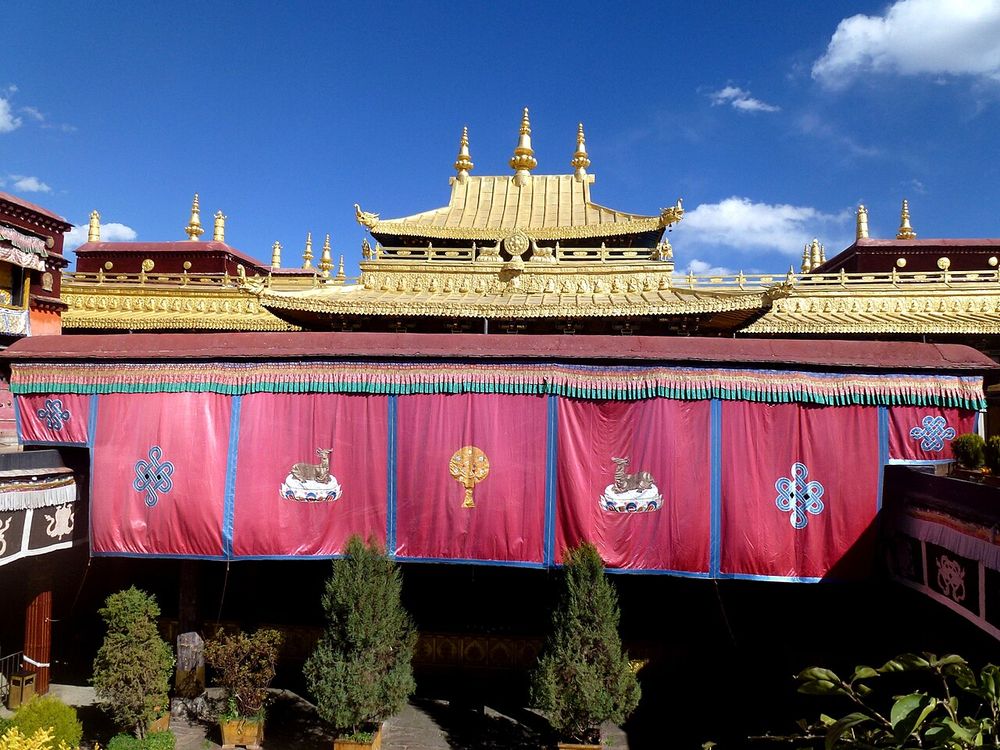
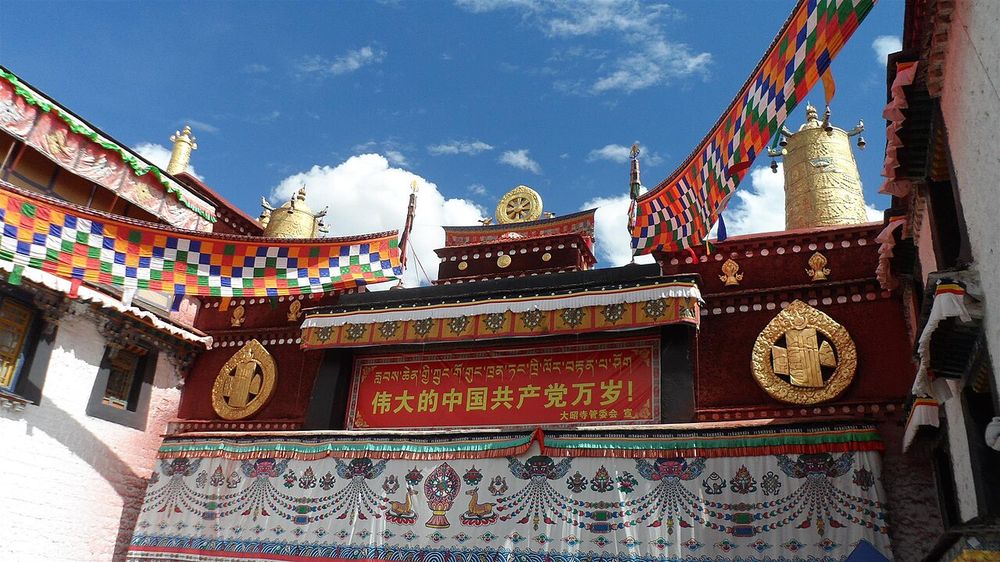
The gilded roofs behind you each cover one chapel below. The oldest were given in the 1300s by kings from the far west of Tibet and Nepal. The tall gold cylinders are banners of victory. The dragons' heads at the corners are water spouts.
Looking west from the roof over the squareHiroki Ogawa, CC BY 3.0
Now look west, over the square. The white and red building on its hill is the Potala Palace, two kilometres away. In the 600s the king's fort stood on that hill and his temple stood here. Lhasa is the space between the two.
The temple was closed and badly damaged in the Cultural Revolution, from 1966. Many statues were destroyed, and for some years parts of it were used as a guesthouse. Repairs began in 1972 and it was open for worship again by 1980. Much of what you saw downstairs was remade then. The building, the old woodwork and, by all accounts, the Jowo came through.
On 17 February 2018 a fire broke out at the back of the temple. It was put out the same evening, and pilgrims were let in again the next day.
8. The Barkhor: the street that is a prayer
The square with the old town behindNabin K. Sapkota, CC BY-SA 4.0
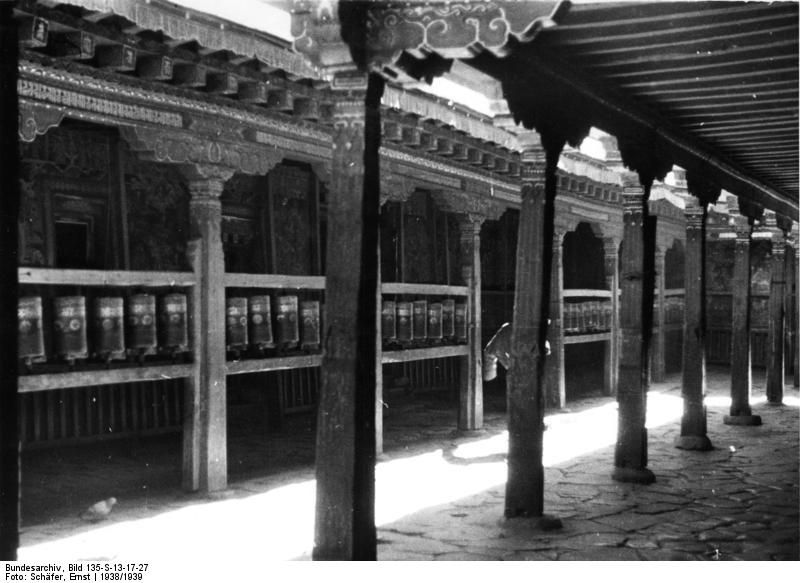
Lhasa has three pilgrim circuits, one inside the next. The inner one is the corridor of prayer wheels round the chapels you have just seen. The outer one is eight kilometres long and takes in the Potala. The middle one is the Barkhor, about a kilometre, round the outside wall of the temple.
Go out of the gate, turn left, and walk with everyone else. At each of the four corners there is a great stove for juniper. Old houses of Lhasa's noble and merchant families line the way, with black-framed windows that widen towards the bottom.
At the south-east corner is a house painted yellow. It is a restaurant called Makye Ame. The words come from a song by the Sixth Dalai Lama, Tsangyang Gyatso, and mean something like "mother I was not born to", a way of speaking of a beloved.
From the peak of the eastern mountain
the clear white moon has risen.
The face of the mother I was not born to
keeps turning in my mind.
Tsangyang Gyatso, the Sixth Dalai Lama (1683–1706), the first of his songs; our translation
Chinese readers know this place from a song. "A Diao", written by the singer Zhao Lei in 2016, is about a Tibetan woman, and one line sets her in the sunlight in front of the Jokhang's gate with a flask of sweet tea. Sweet milk tea, drunk by the glass in crowded tea houses, is Lhasa's daily habit. There are several a few steps from the square.
The Chinese film Paths of the Soul (2017), directed by Zhang Yang, follows eleven villagers who prostrate their way along 1,200 kilometres of road to Lhasa. Ordinary villagers play themselves. Their road ends on the flagstones of this square. If you want the same frame, stand at the back of the square, between the two tall masts, and face the gate. Photograph the stones and the gate. Leave the pilgrims' faces out.
Two Hollywood films of 1997 are set here, and neither was shot here. The Lhasa of Seven Years in Tibet, with Brad Pitt as Heinrich Harrer, was built in the Andes of Argentina. Martin Scorsese's Kundun was made in Morocco.
Meanwhile in the world
Year
Here
Elsewhere
641
Princess Wencheng reaches Lhasa
Arab armies are taking Egypt; Alexandria falls the next year
600s
The first temple is built
The Dome of the Rock in Jerusalem is finished in 692
710
Princess Jincheng arrives
The next year an army from North Africa crosses into Spain
823
The treaty pillar is set up
Charlemagne has been dead nine years; Vikings are raiding the coasts of Europe
1409
Tsongkhapa's first Great Prayer Festival
In Europe three men each claim to be the pope
1640s
The Fifth Dalai Lama enlarges the temple
The Taj Mahal is nearly finished; civil war in England
1793
The golden urn arrives from Beijing
King Louis XVI of France is beheaded
1904
A British army enters Lhasa; the first photographs of the temple are taken
Russia and Japan are at war
1966
The temple is closed and damaged
The Cultural Revolution begins across China
2000
The Jokhang is added to the World Heritage list
The old town of Bruges joins the list in the same year
One line to remember: the temple came first, and the city is the path worn round it.
Then and now
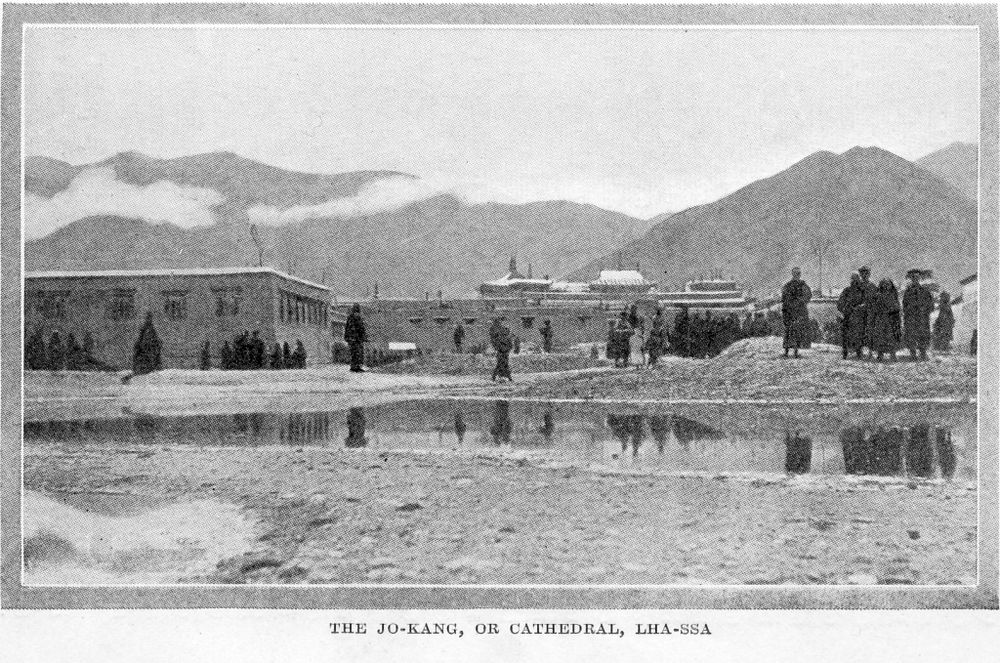
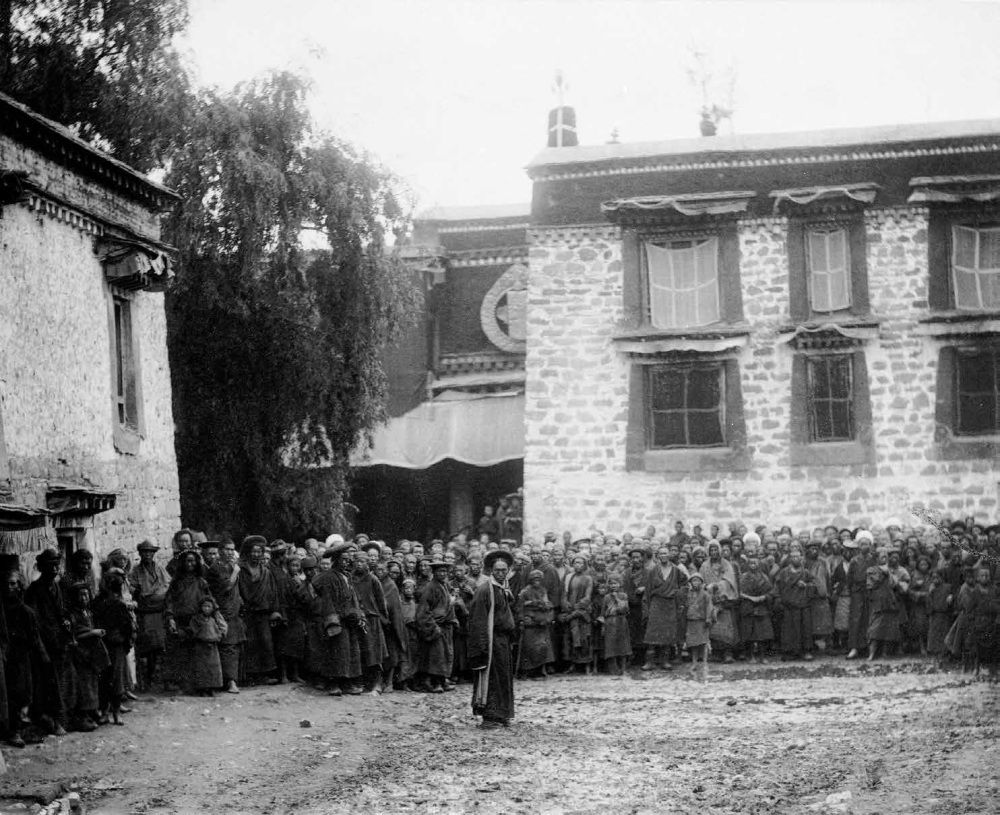
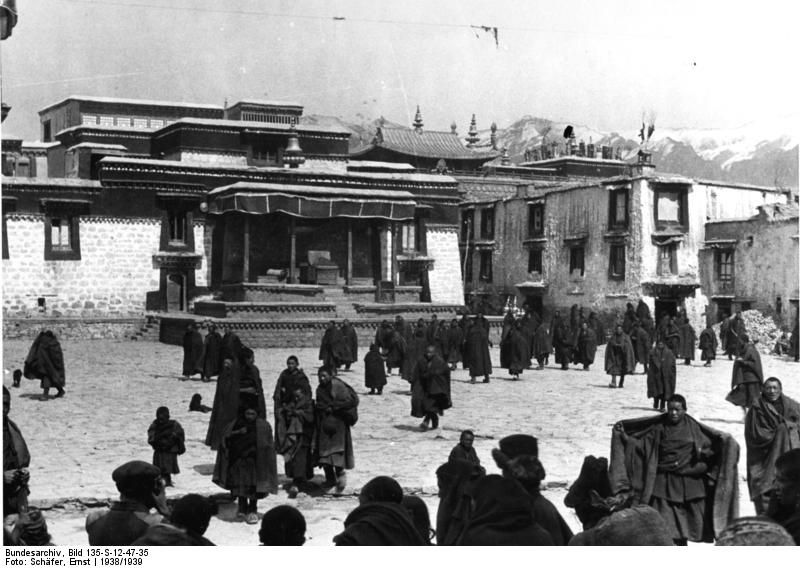
The front of the Jokhang across the square, May 2014Andrew and Annemarie, CC BY-SA 2.0, Wikimedia CommonsThe gate and the two prayer mastsWindmemories, CC BY-SA 4.0, Wikimedia CommonsThe front: white walls, black awnings and the gilded roof ornamentsWindmemories, CC BY-SA 4.0, Wikimedia CommonsThe front from the south side of the squareWindmemories, CC BY-SA 4.0, Wikimedia CommonsThe square in January 2024Nabin K. Sapkota, CC BY-SA 4.0, Wikimedia CommonsThe square with the old town behindNabin K. Sapkota, CC BY-SA 4.0, Wikimedia CommonsThe square on a clear day, October 2019钉钉, CC BY-SA 4.0, Wikimedia CommonsA halo round the sun over the roof, May 2014Windmemories, CC BY-SA 4.0, Wikimedia CommonsThe inner court and the gilded roofs, seen from the roof terraceNabin K. Sapkota, CC BY-SA 4.0, Wikimedia CommonsThe roof terrace round the open courtNabin K. Sapkota, CC BY-SA 4.0, Wikimedia CommonsThe roofs in January 2024Nabin K. Sapkota, CC BY-SA 4.0, Wikimedia CommonsLooking across the court from the roofNabin K. Sapkota, CC BY-SA 4.0, Wikimedia CommonsThe court from above, October 2019钉钉, CC BY-SA 4.0, Wikimedia CommonsThe open court, November 2013Maris Burbergs, CC BY 3.0, Wikimedia CommonsThe court with its black awningsPavel Špindler, CC BY 3.0, Wikimedia CommonsA gilded roof: each one stands over a chapel belowNabin K. Sapkota, CC BY-SA 4.0, Wikimedia CommonsGilded roofs under cloud, May 2014Andrew and Annemarie, CC BY-SA 2.0, Wikimedia CommonsThe gilded roofs, September 2015Laika ac from UK, CC BY-SA 2.0, Wikimedia CommonsA gilded roof photographed in 1993No machine-readable author provided. John Hill assumed (based on copyright claim, CC BY 2.5, Wikimedia CommonsGilded roofs and banners of victory钉钉, CC BY-SA 4.0, Wikimedia CommonsThe roofs with the mountains behind钉钉, CC BY-SA 4.0, Wikimedia CommonsBanners of victory on the roofHiroki Ogawa, CC BY 3.0, Wikimedia CommonsThe roof with its red cloth hangingsHiroki Ogawa, CC BY 3.0, Wikimedia CommonsThe wheel, the deer and a banner of victoryDennis G. Jarvis, CC BY-SA 2.0, Wikimedia CommonsThe wheel of the teaching between two deerDennis G. Jarvis, CC BY-SA 2.0, Wikimedia CommonsThe wheel has eight spokes for the eight parts of the pathDennis G. Jarvis, CC BY-SA 2.0, Wikimedia CommonsThe wheel and the deer from the squareAneta Ribarska, CC BY-SA 3.0, Wikimedia CommonsThe square from the roofHiroki Ogawa, CC BY 3.0, Wikimedia CommonsLooking west from the roof over the squareHiroki Ogawa, CC BY 3.0, Wikimedia CommonsPainted brackets under the eaves钉钉, CC BY-SA 4.0, Wikimedia CommonsA gilded lion under the eavesXiaotong Gao, CC BY-SA 3.0, Wikimedia CommonsThe front lit at nightLaika ac from UK, CC BY-SA 2.0, Wikimedia CommonsThe passage from the court to the inner doorGerd Eichmann, CC BY-SA 4.0, Wikimedia CommonsThe painted galleryGerd Eichmann, CC BY-SA 4.0, Wikimedia CommonsA wall painting in the courtGerd Eichmann, CC BY-SA 4.0, Wikimedia CommonsA painted Buddha in the galleryGerd Eichmann, CC BY-SA 4.0, Wikimedia CommonsTwo of the four guardian kings in the porchGerd Eichmann, CC BY-SA 4.0, Wikimedia CommonsA wall painting of the BuddhaDennis G. Jarvis, CC BY-SA 2.0, Wikimedia CommonsA wall painting of a teacher in a yellow hatHiroki Ogawa, CC BY 3.0, Wikimedia CommonsPainted beamsHiroki Ogawa, CC BY 3.0, Wikimedia CommonsThe temple in the 1840s, from the book of the French missionary HucAbbe Huc & Gabert, Public domain, Wikimedia CommonsThe plan drawn after Sarat Chandra Das's visit of 1882, printed in 1902Sarat Chandra Das, Public domain, Wikimedia Commons1904: looking towards the temple, photographed by John Claude WhiteJohn Claude White (1853-1918), Public domain, Wikimedia CommonsThe front in 1938–1939, photographed by the German expedition of Ernst SchäferErnst Schäfer, CC BY-SA 3.0 de, Wikimedia CommonsThe corridor of prayer wheels, 1938–1939Ernst Schäfer, CC BY-SA 3.0 de, Wikimedia CommonsThe temple and the houses round it, 1938–1939, before the square was clearedErnst Schäfer, CC BY-SA 3.0 de, Wikimedia CommonsThe roof in 1987Jan Kranendonk (https://www.jankranendonk.nl), CC BY-SA 4.0, Wikimedia CommonsThe front in 1996G41rn8, CC BY-SA 4.0, Wikimedia Commons
Local legends
These are stories people tell about this place. They are legends, not history, and each one says where it comes from.
LegendThe ground under the temple
There was a lake here. The king threw his ring into the air and vowed to build where it fell. It fell into the lake, and a white stupa rose from the water. The lake was then filled with earth carried on the backs of goats. The old name of the town, Rasa, means "goat earth".
Source: The Mirror Illuminating the Royal Genealogies, a Tibetan history of the 1300s
LegendThe whole of Tibet
Princess Wencheng saw that the land of Tibet was a demoness lying on her back, and that the lake was her heart's blood. The Jokhang was built on her heart, and twelve more temples on her shoulders, hips, elbows, knees, hands and feet, to pin her down.
Source: The Mirror Illuminating the Royal Genealogies; the Mani Kabum
LegendThe Jowo chapel
The Jowo was made in India while the Buddha was alive, by the craftsman of the gods, and the Buddha blessed it himself. It passed to the emperor of China and came to Tibet as part of Wencheng's dowry.
Source: Tibetan chronicles, including the Pillar Testament
LegendThe willow stump
Princess Wencheng planted the willow in front of the gate with her own hands. People call it the Princess Willow or the Tang Willow.
Source: Local tradition
LegendThe pitted stone
Powder scraped from the smallpox stone cures sickness. That is why it is covered in pits and most of its words are gone.
Source: Local belief, recorded by travellers of the 1900s
LegendThe yellow house
The Sixth Dalai Lama used to slip out of the Potala at night in ordinary clothes. In a tavern in the yellow house on the Barkhor he met the woman of his songs.
Source: A popular story; no early source names the house
Later, people who live here will be able to add the stories they grew up with, and say which of these they have heard.
Not certain, and where accounts conflict
When was it built?
Tibetan histories give different years, among them 639, 647 and 652. All were written centuries later. Most scholars say only "about the 640s".
Did the Nepalese queen exist?
Bhrikuti appears in Tibetan histories from the 1100s onward. No record from her own time, in Nepal, Tibet or China, names her. Some historians accept her and some do not. The Nepalese style of the oldest carving is not in doubt.
Is the Jowo the statue Wencheng brought?
Tibetans hold that it is. The story of the hiding and the exchange comes only from later histories. The statue has been regilded and reworked so often that its age cannot be judged by eye, and it has not been tested.
How much of the building is from the 600s?
Su Bai, André Alexander and Roberto Vitali each studied the fabric. They agree on the plan of the core and some of its doors and pillars. They differ on the walls and the upper floor.
What did the fire of 2018 destroy?
The official statement said about 50 square metres burned, that no relic was harmed, and that the Jowo was safe. Outside observers pointed to pictures that seemed to show damage to a roof at the east end, and asked for more to be shown. Visitors since have found the Jowo chapel open as before.
Visiting
Tickets and hours
85 yuan, the same all year.
Booking is by real name and at least one day ahead. On the day you show the booking code or your document at the ticket office, pay, and are given the ticket.
Guides of 2026 give opening as 8:30 to 17:30. In the morning, until 13:30, you enter in the time slot you booked. In the afternoon there are no slots. Some guides print 9:00 to 18:00, so check with your guide.
Pilgrims come in from early morning by their own queue and do not pay. Mornings are theirs.
The square, the stones in front and the Barkhor are free at any hour.
Last checked 2026-11-12. Travel guides and news reports of 2026 that quote notices of the Lhasa city government and the Tibet tourism department; we could not open an official page in English.
Booking without WeChat
WeChat or Alipay Chinese visitors book by real name, one day ahead, in the WeChat mini-programme named 大昭寺. We found no English version and no way to pay with a foreign card.
Ticket window on site Guides say that visitors aged 60 or over, and a few other groups, can buy at the ticket office with their identity document without booking. We could not confirm that this covers foreign passports.
Note Visitors with a foreign passport, and visitors from Taiwan, cannot enter Tibet on their own. You need a Tibet travel permit, and the permit is issued only through a licensed travel agency that also provides your guide. The agency books the Jokhang for you with your passport details. Carry the passport itself on the day.
Checked 2026-11-12
Where to start
Walk the Barkhor once first, clockwise, before you go in. It takes twenty minutes and you will understand the building better.
Look at the two stones to the left of the gate, then go in.
Inside, the route is one way and clockwise: the court, the hall and its chapels, the Jowo, then up to the roof. Allow an hour and a half.
Late afternoon gives the best light on the front and on the Potala from the roof.
Before you go
Lhasa is at 3,650 metres. Rest for a day or two before you do anything. Walk slowly and drink water. Stairs inside are steep, like ladders.
There are security checks at every entrance to the old town. Carry your passport and permit. Lighters are taken away.
The floor is slippery with butter. Wear shoes with a grip.
The sun is strong and the nights are cold, even in summer.
It is dark inside. Let your eyes adjust rather than using a phone light.
Customs and manners
Always clockwise: round the Barkhor, round the hall, round each statue.
Take off your hat and sunglasses at the door. Cover your shoulders and knees.
Step over the wooden door sills. Do not stand on them.
No photographs in any chapel. On the roof and in the square you may photograph the building. Ask before you photograph a person, and do not photograph people who are praying.
Do not touch the statues, the paintings or the offerings. Do not point at a statue with one finger. Use an open hand, palm up.
Let pilgrims pass. They have come further than you.
Do not touch anyone on the head, children included.
If you want to give, put a small note in the box or add butter to a lamp. Do not hand money to children.
Talk about religion and politics is sensitive here. Your guide can lose a licence over it. Do not press them.
Look for these
In the square, which way does the gate face? Use the sun.
Find the stone pillar of 823. Can you see that it has two kinds of writing?
Find the stone covered in small pits. Why is it like that?
In the court, find the goats carrying earth on the wall.
In the hall, find a door frame with small carved figures. It is five hundred years older than Notre-Dame in Paris.
Ask your guide to show you the small figure of a goat inside the temple.
On the roof, count the spokes of the wheel.
The two deer are looking up at the wheel. What are they listening to?
From the roof, find the Potala.
On the Barkhor, find the yellow house.
I am here
Stand at the site, sign in, press the button, and collect its stamp. Your browser will ask to use your location. It is sent to us once to confirm that you are at the site; we keep how far you were from it, not the spot where you stood.
Your stamps are saved to your account, so they follow you to any device. Checking from a browser cannot rule out every false location; stricter checks arrive with the app.
Messages
Share your photos
Photos here show the place, not people. Each one is credited to the visitor who took it and appears after our team has looked at it. A photo with you in it belongs under “I am here”.