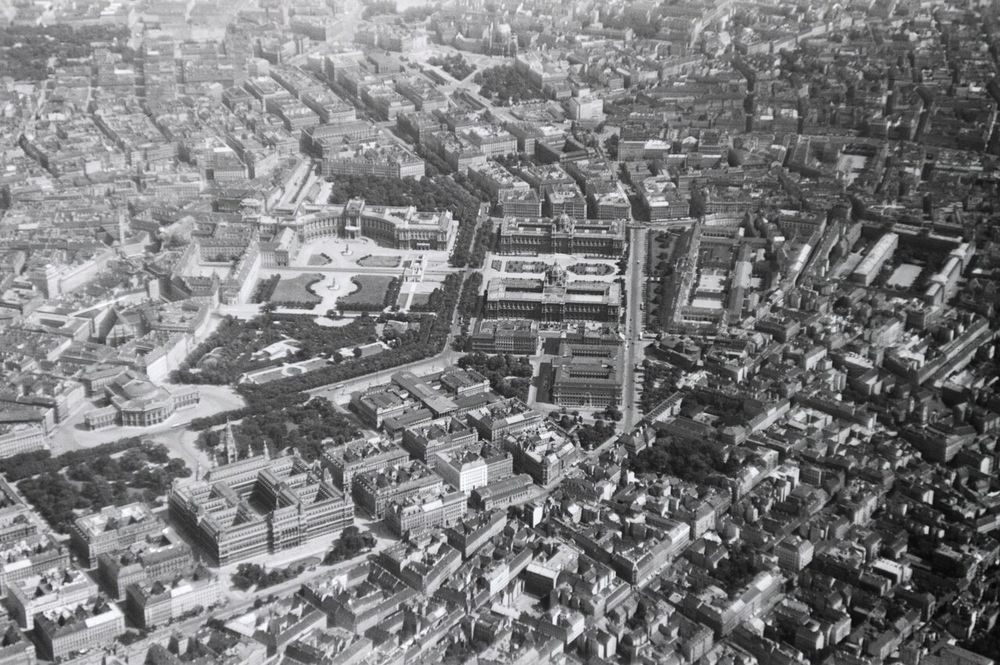
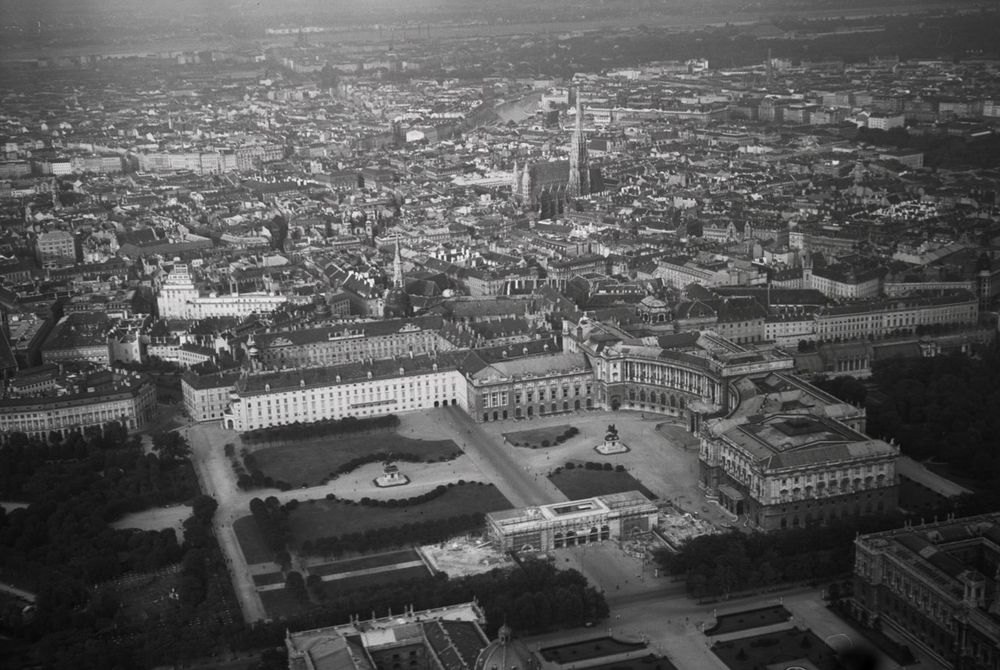
The winter home of the Habsburgs for more than six hundred years, in the middle of Vienna. It is a small town of palaces joined together: eighteen wings, nineteen courtyards and about 2,600 rooms, added to by almost every ruler and never finished. It holds a thousand-year-old crown, a library like a cathedral, white horses that dance, and a balcony Austria still does not know what to do with.
Photo: Diego Delso, CC BY-SA 4.0, Wikimedia Commons
The story
A castle on this spot is first recorded in 1279, soon after the Habsburg family took Austria. In China that is the year the Southern Song dynasty (南宋, 1127–1279) fell to the Mongols. The family stayed until 1918.
They never pulled the old parts down. Each ruler built a new wing beside the last, in the style of his own day. To walk through the courtyards is to walk through seven centuries, out of order.
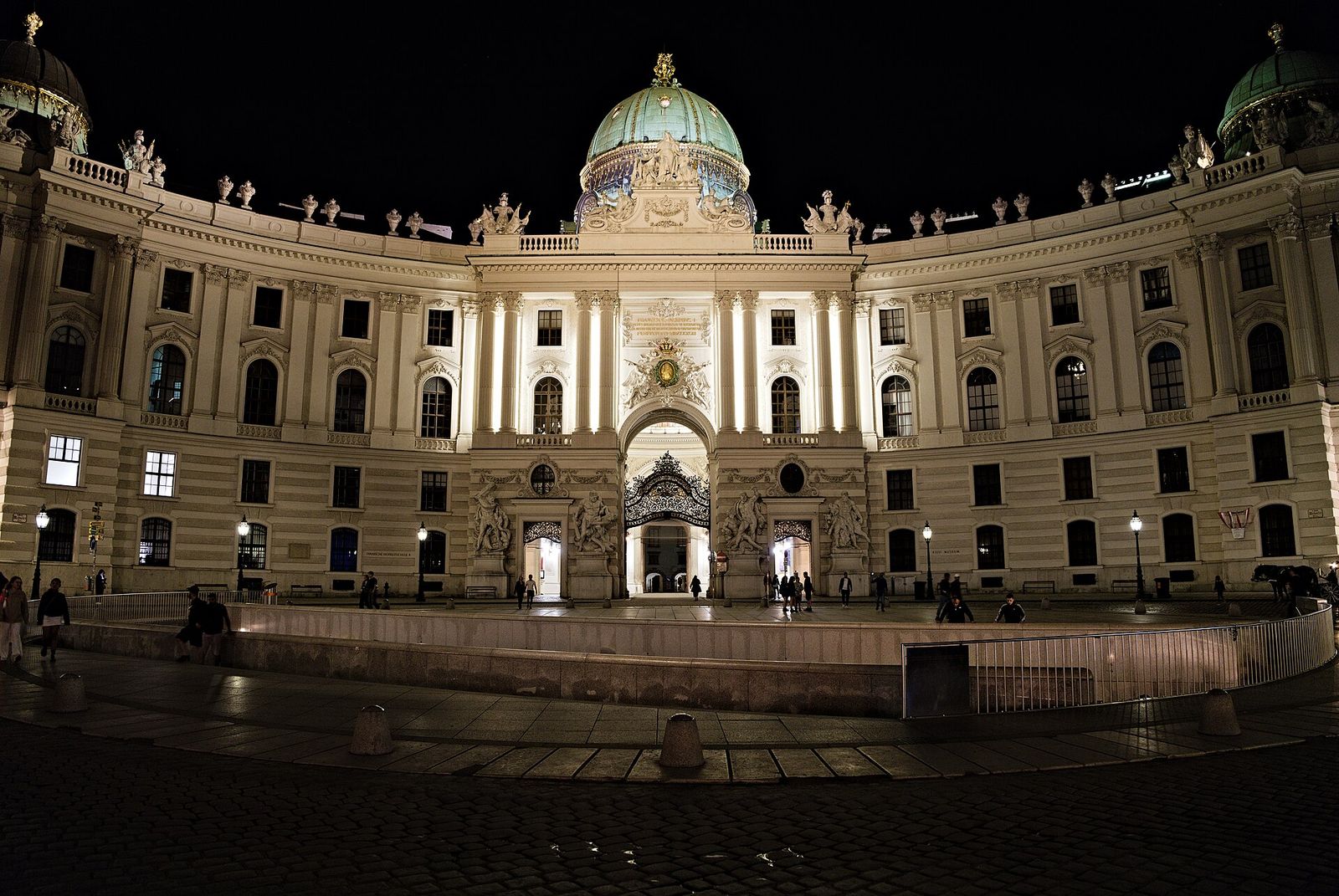
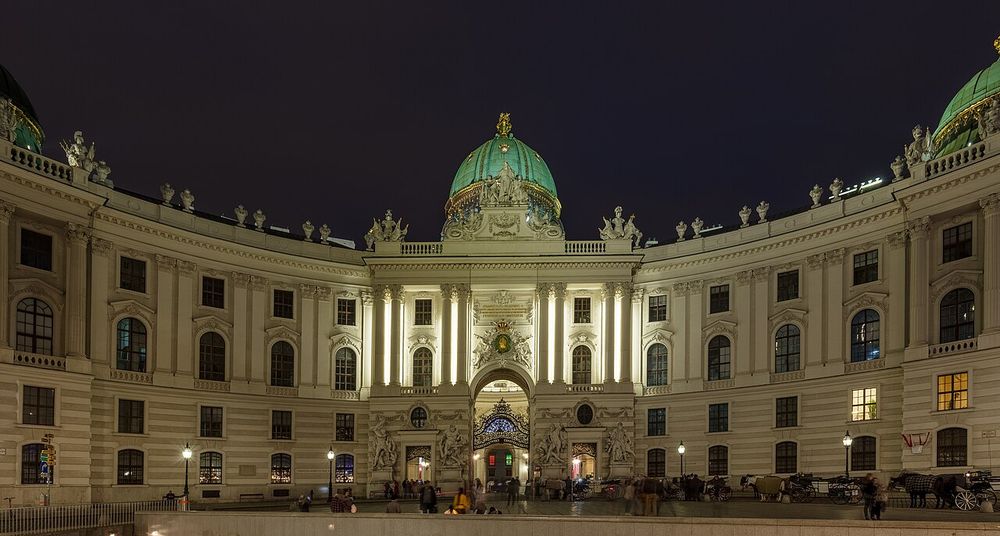
The same front at night, August 2022Leonhard Lenz, CC0
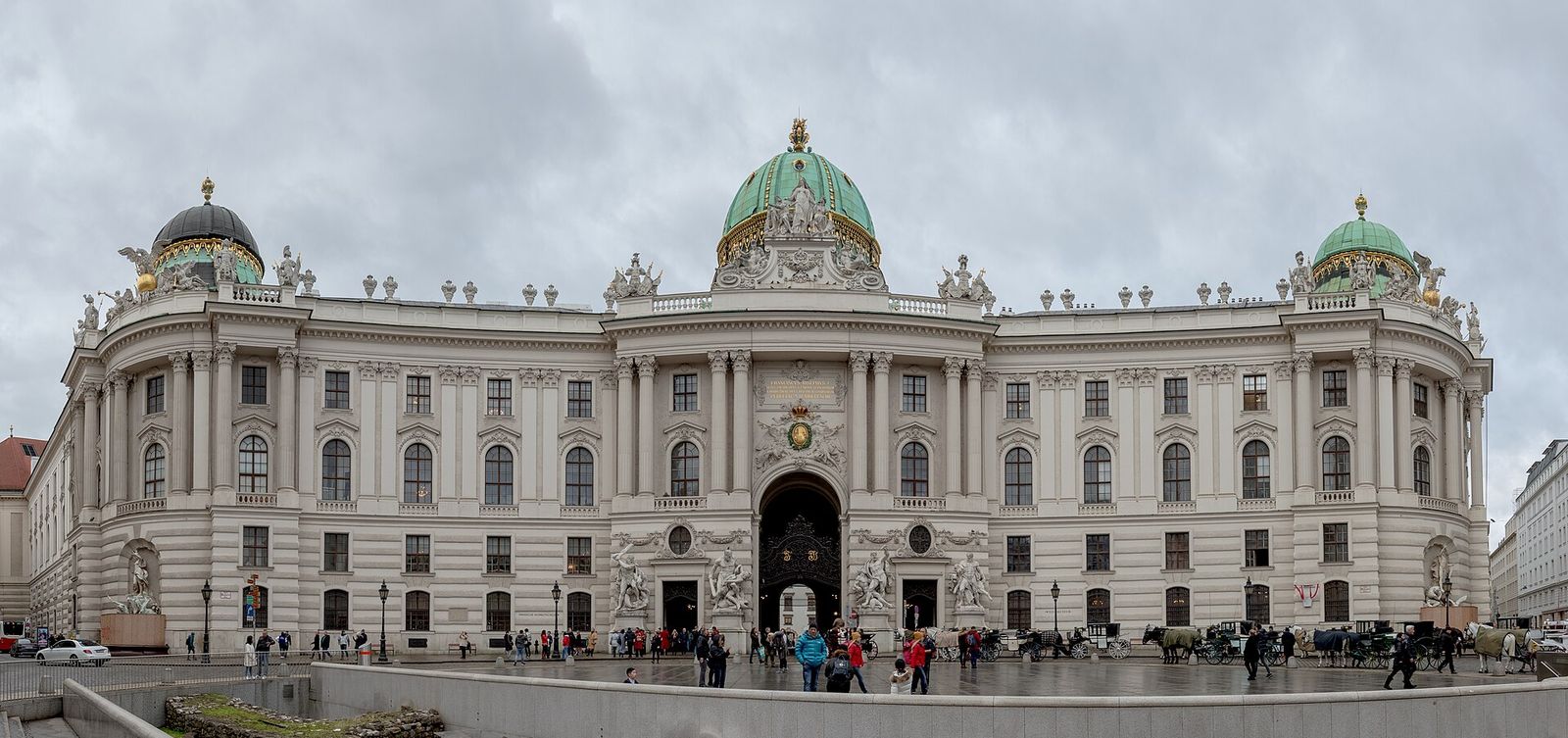
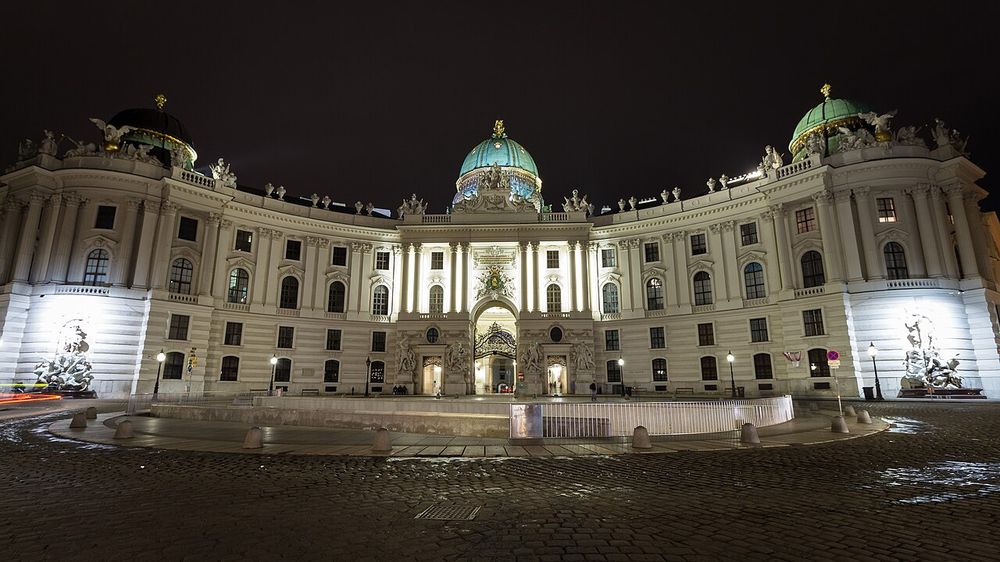
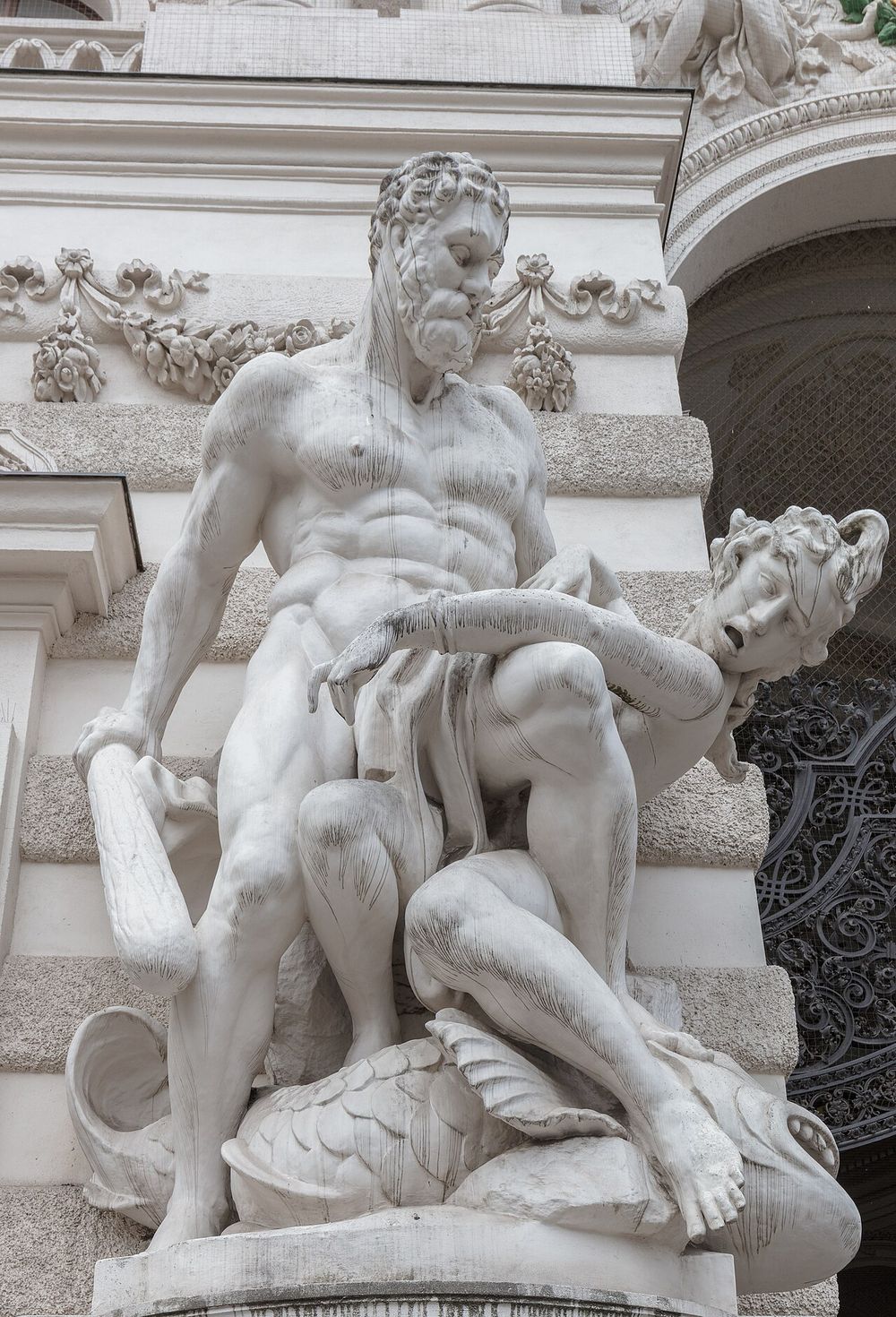
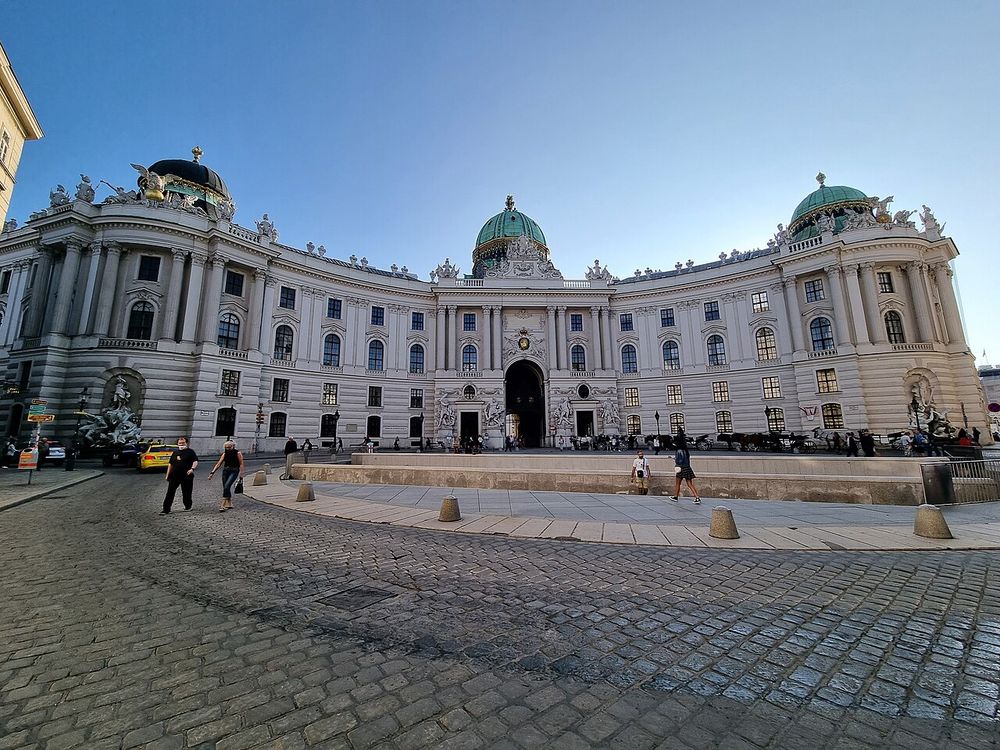
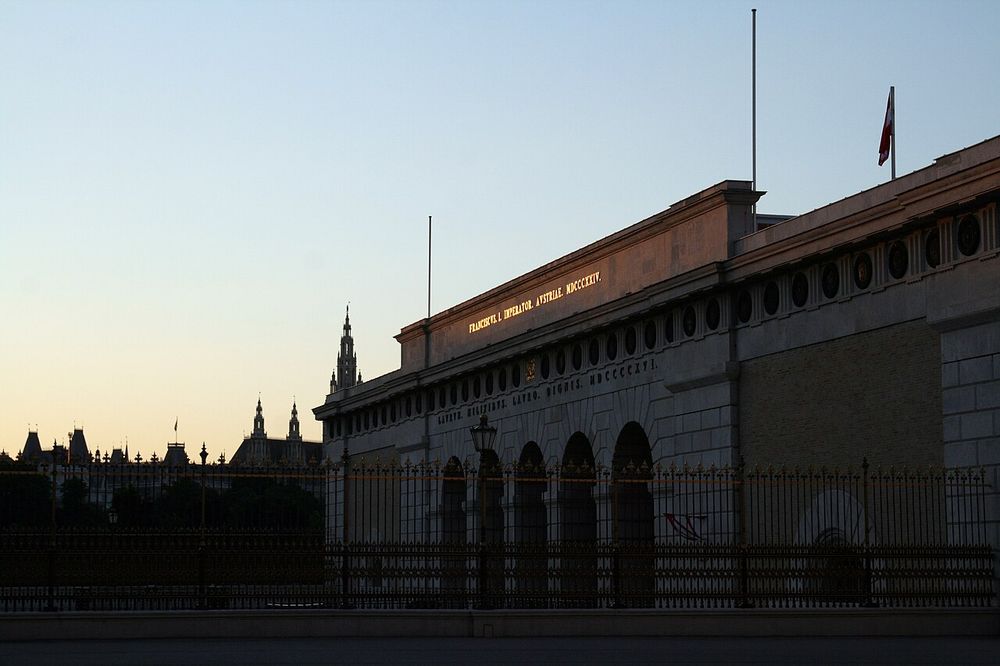
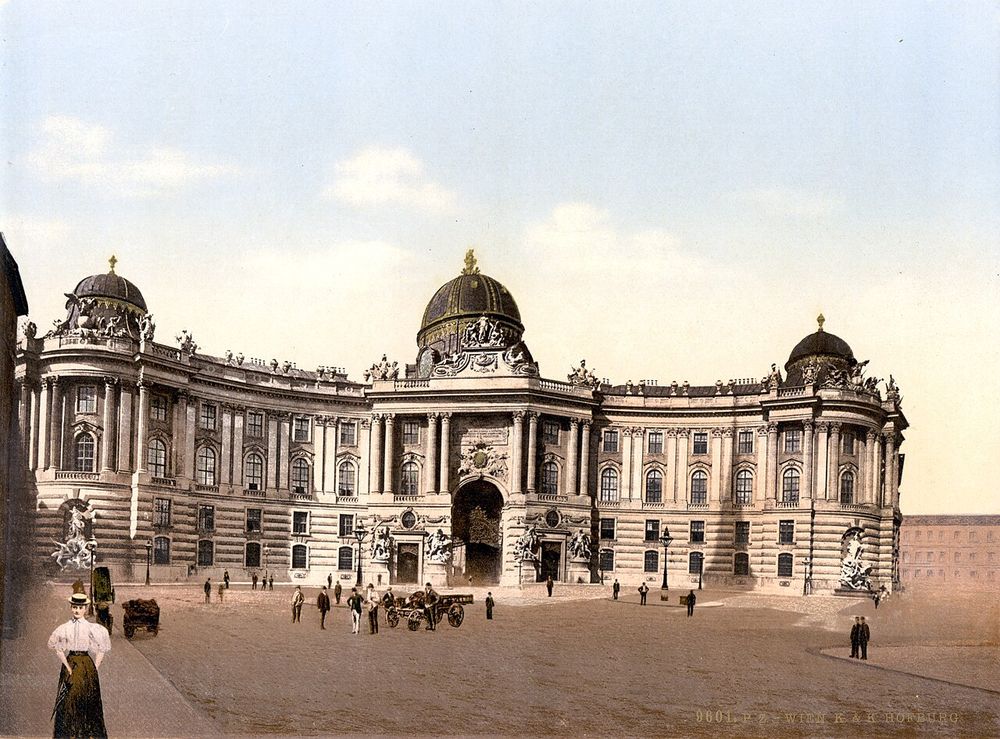
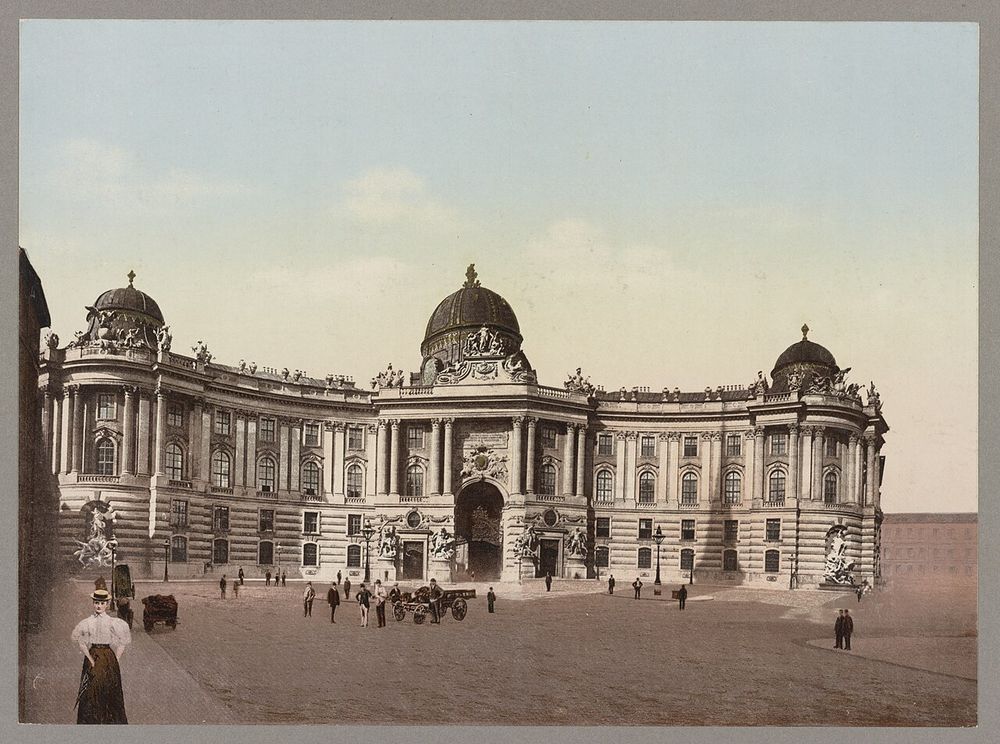
A green dome, a curving white front, giant statues of Hercules clubbing his enemies on either side of the gate. It looks like the proud old face of the empire. It is the newest face. This front was finished in 1893, to a design that had waited in a drawer for 160 years, and the empire had twenty-five years left.
Walk through the gate, under the dome. Nobody will stop you. The way through the palace is a public street and always has been. Carriages and cars used it.
On the other side is a courtyard, and beyond it a red gate from 1552, and beyond that the oldest walls. The further in you go, the further back.
Things people often get wrong
"The Hofburg is a palace." It is a cluster of some eighteen wings. There is no single entrance and no single ticket. The emperor's rooms, the crown, the library and the horses each have their own door and their own price.
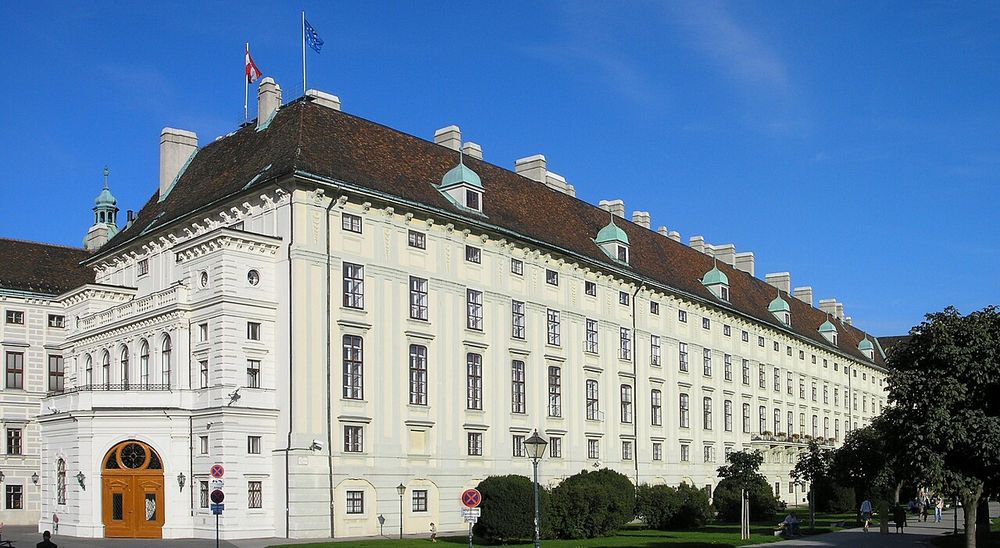
"It is a museum now." The President of Austria works in one wing. There are ministries, a conference centre, the national library, a church with a choir, and people living in flats under the roofs.
"Sisi lived here happily." She disliked the place, called it a prison, and was away from Vienna for most of her last thirty years.
"The Spanish Riding School is Spanish." The horses came from Spain in the sixteenth century. The school has been in Vienna ever since.
People who stood here
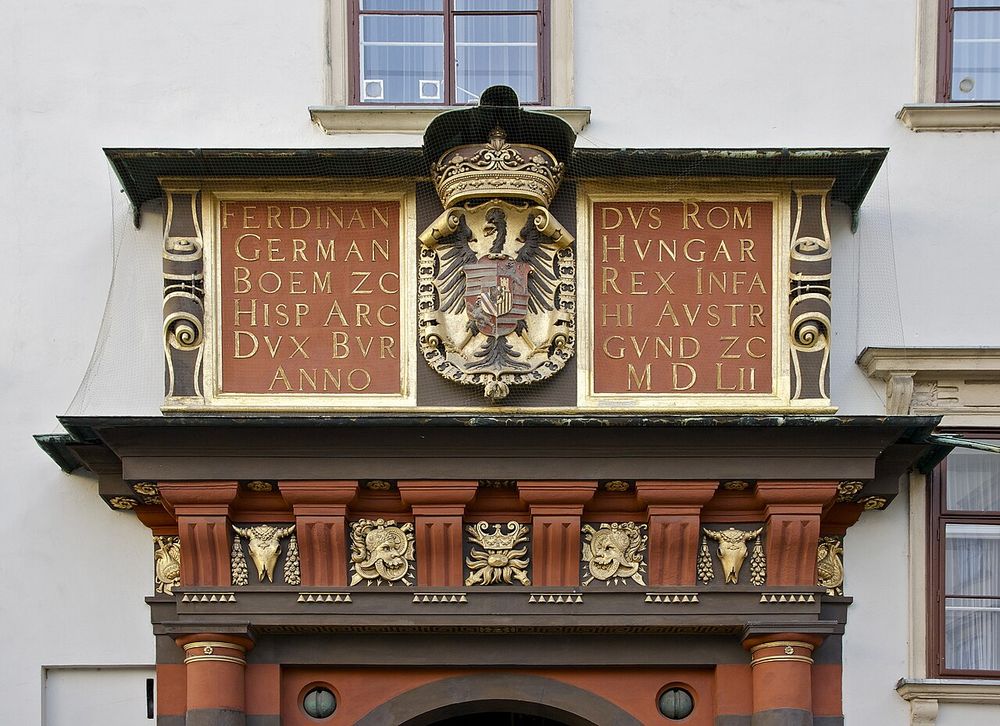
Ferdinand I (Holy Roman Emperor, 1503–1564)Born and raised in Spain, he made Vienna the family's capital. He built the red gate in 1552 and had all his titles written across it in gold.
Johann Bernhard Fischer von Erlach (Austrian architect, 1656–1723)He designed the court library and died the year building began. His son finished it, and also drew the curved front on Michaelerplatz that was not built until both had been dead for more than a century.
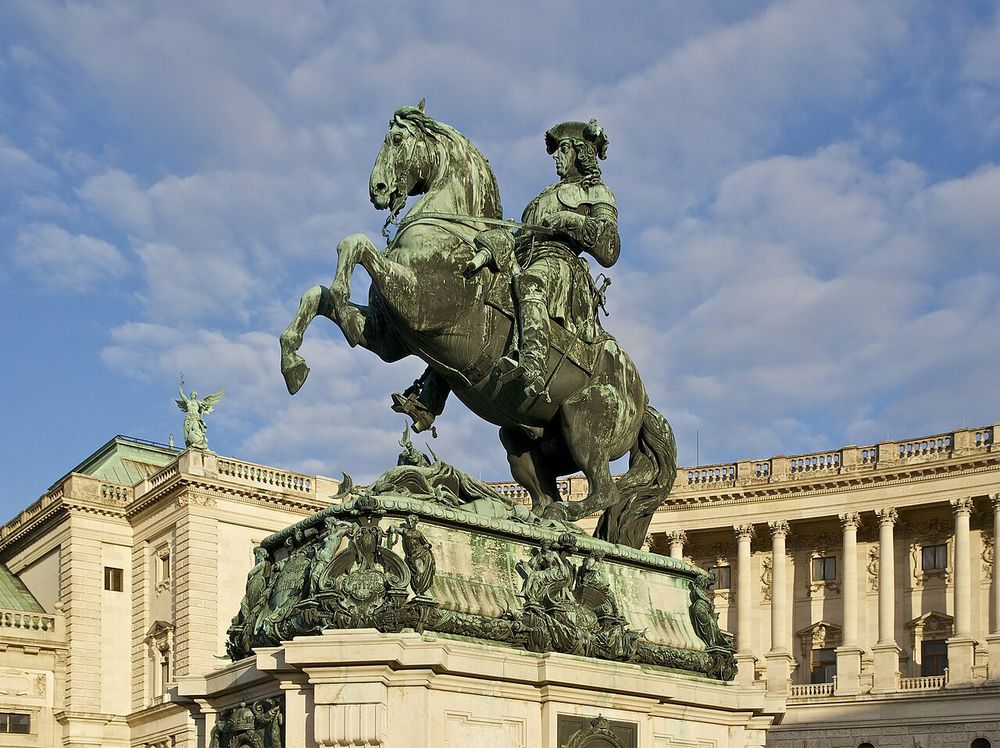
Prince Eugene of Savoy (general, 1663–1736)A small Frenchman whom Louis XIV refused to take into his army. He came to Vienna, fought for the Habsburgs for fifty years and drove the Turks out of Hungary. His 15,000 books, bound in red, blue and yellow leather, stand in the middle of the library.
Ludwig van Beethoven (German composer, 1770–1827)On 29 November 1814 he conducted his Seventh Symphony in the palace ballroom before the tsar, the kings and the ministers who had come to redraw the map of Europe. It was the greatest public success of his life. He was already almost deaf.
Charles-Joseph, Prince de Ligne (Belgian-born soldier and wit, 1735–1814)He watched the Congress of Vienna give ball after ball here and said: the congress does not move forward, it dances. He died before it ended, saying that at least he could offer the kings the spectacle of a field marshal's funeral.
Franz Joseph I (emperor of Austria, 1830–1916)Twice a week any subject could ask to see him here. He received as many as a hundred people in a morning, standing at a high desk so that nobody would stay long.
Elisabeth, "Sisi" (empress of Austria, 1837–1898)She had wall bars and rings fitted in her dressing room and exercised every day, which the court thought scandalous. Her hair reached her ankles and took three hours a day to dress. In 1898 an Italian anarchist stabbed her on the lakeside in Geneva with a sharpened file.
Alois Podhajsky (Austrian riding master, 1898–1973)Director of the riding school through the war. In May 1945 he put on a display for the American general George Patton, who had competed at the Olympics himself, and asked him to protect the horses. Patton did.
Orson Welles (American actor and director, 1915–1985)In the film The Third Man (1949) he is Harry Lime, a racketeer in ruined post-war Vienna. Lime's flat is in the palace with the stone figures at its door on Josefsplatz, and it is in front of that door that he is said to have been run over.
Thomas Bernhard (Austrian writer, 1931–1989)His last play, Heldenplatz (1988), is about a Jewish family who can still hear the cheering of 1938 through their windows on the square. Politicians demanded that it be banned before anyone had read it. It opened anyway, to more than half an hour of applause and booing.
Go deeper: eight stops, from the old gate to the square of heroes
The courtyards and squares are public and free at all hours. Stops 4 to 7 are indoors, each with its own ticket.
1. The gate on Michaelerplatz
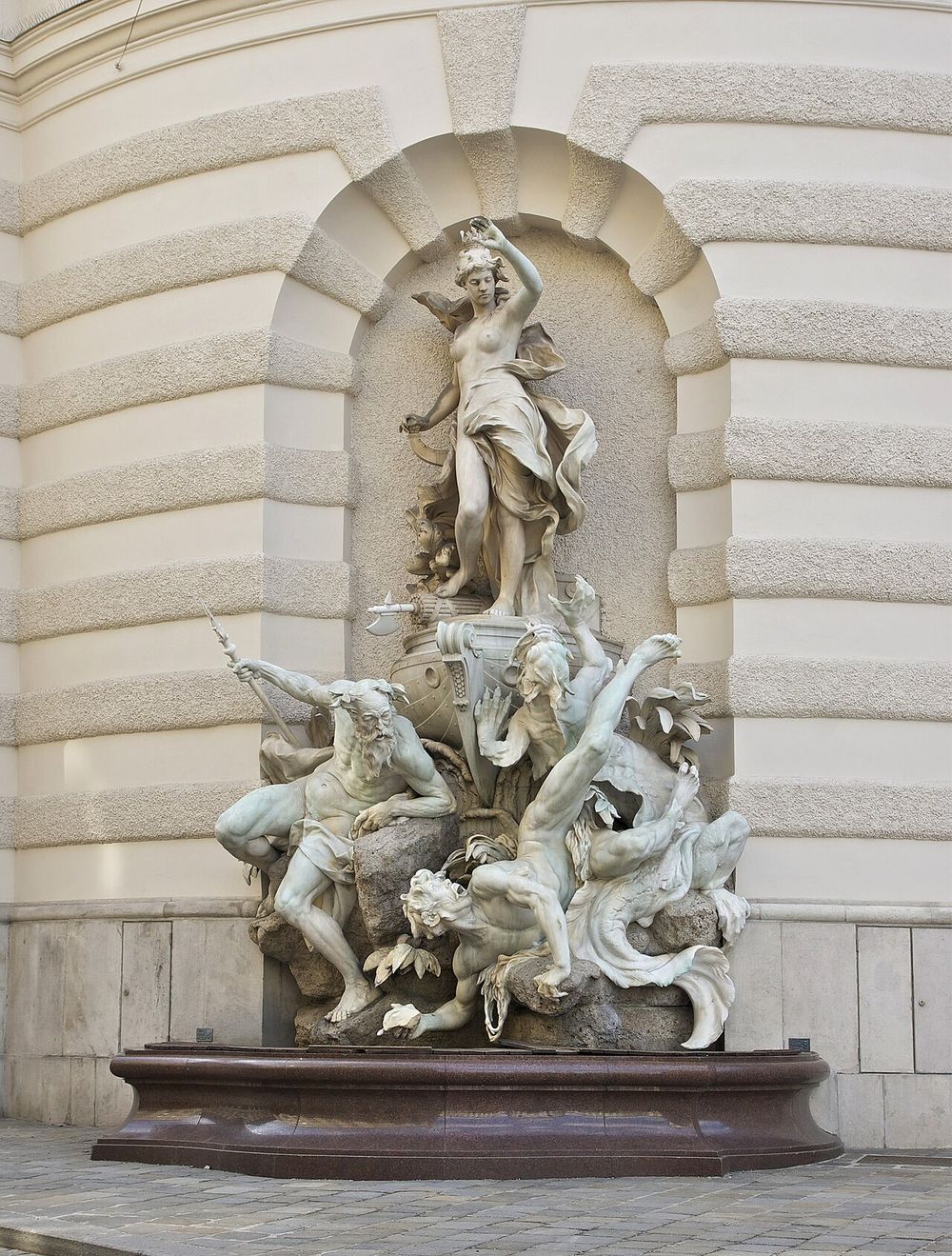
The fountain "Power at Sea"Jebulon, CC0
Two fountains flank the front. On the left a ship's prow cuts through sea monsters: Power at Sea. On the right is Power on Land. When they were carved in the 1890s, Austria still had a coast and a navy.
In the middle of the square, behind a railing, is a pit with Roman walls. A legionary camp stood near here, and these were houses along the road outside it.
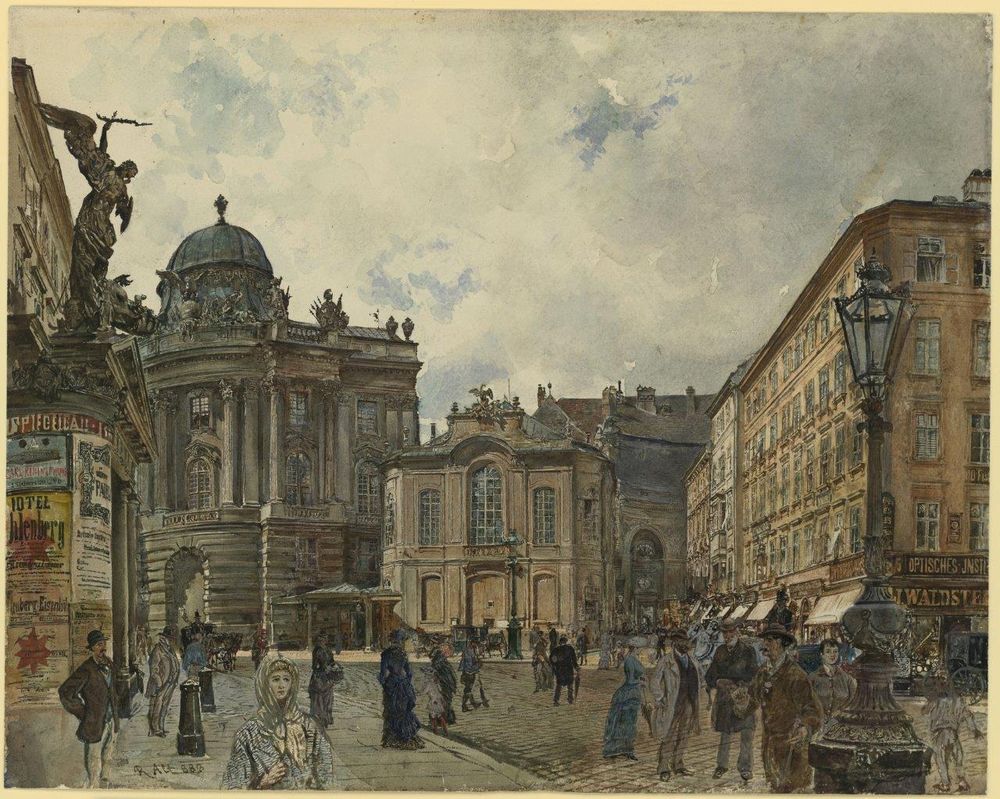
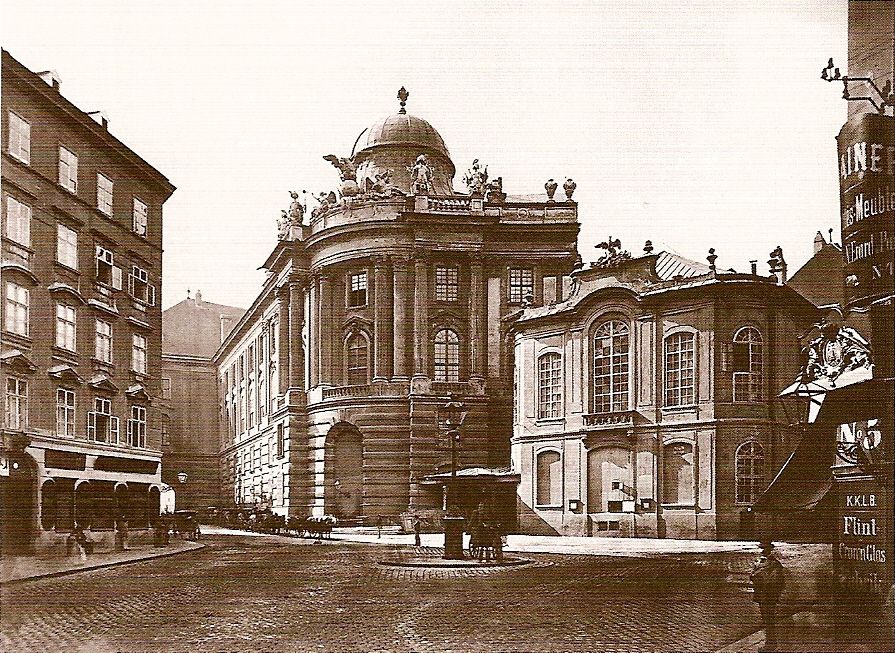
Michaelerplatz painted by Rudolf von Alt, 1888Rudolf von Alt, Public domain
Until 1888 the old court theatre stood where the dome is now. Mozart's Marriage of Figaro was first performed in it, in 1786.
Look across at the plain house opposite, with no ornament round its windows. It was built in 1911 and Vienna hated it.
2. The inner court
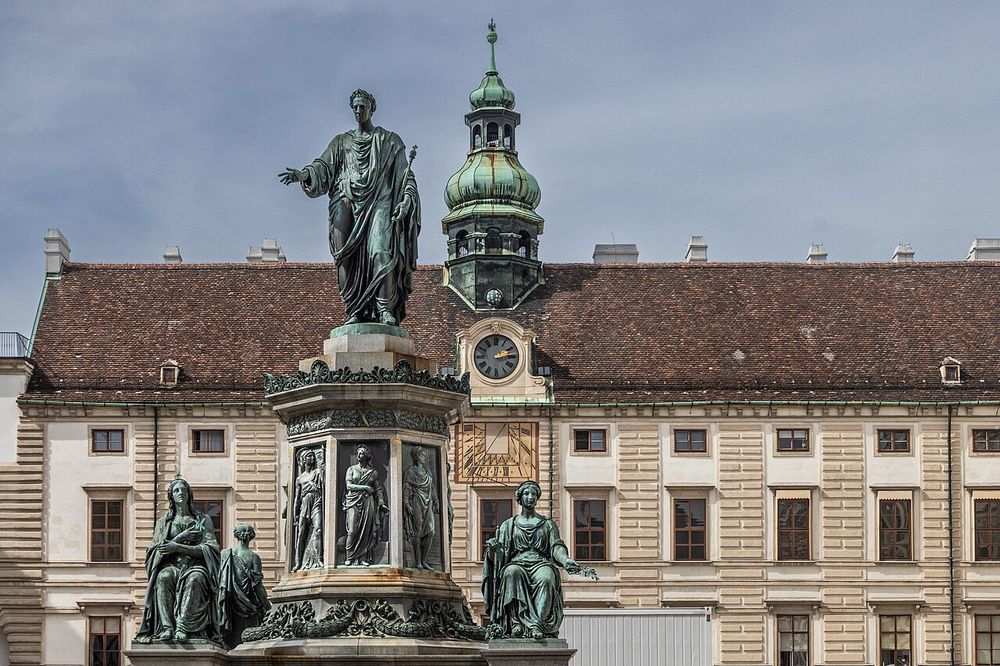
The emperor Francis and the clock tower of the AmalienburgAneza Palaiou, CC BY-SA 4.0
Through the dome you come out in a square court called simply In der Burg, in the castle. The bronze emperor in a Roman toga is Francis, who hosted the Congress of Vienna.
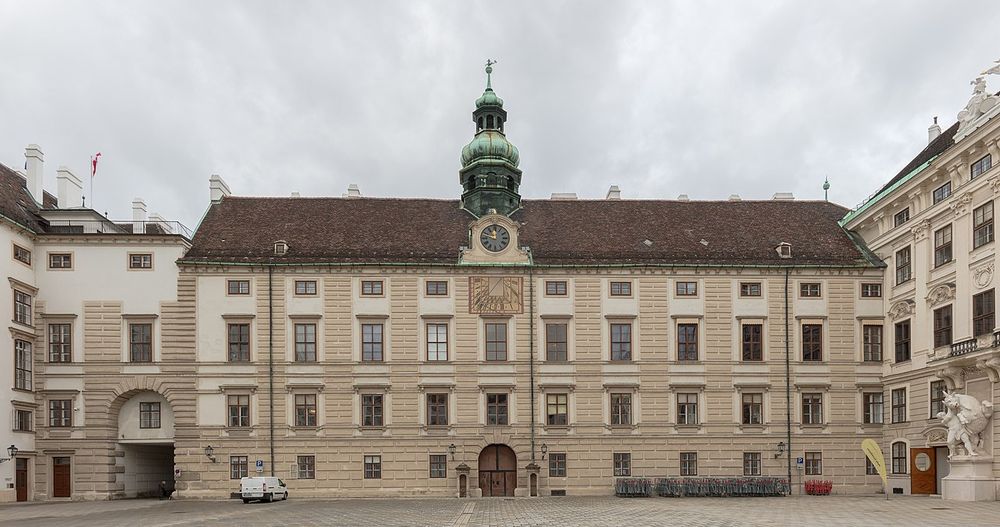
Look up at the little tower on the building behind him. It has a clock, and below the clock a sundial, and above it a ball that shows the phase of the moon.
3. The Swiss Gate
The Swiss Gate, June 2016Tilman2007, CC BY-SA 4.0
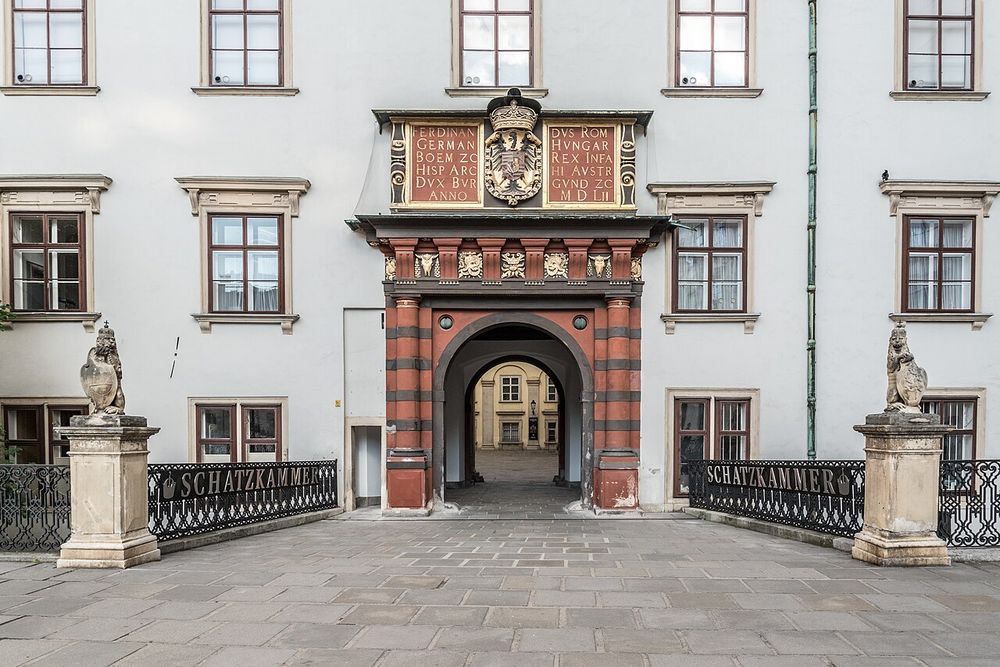
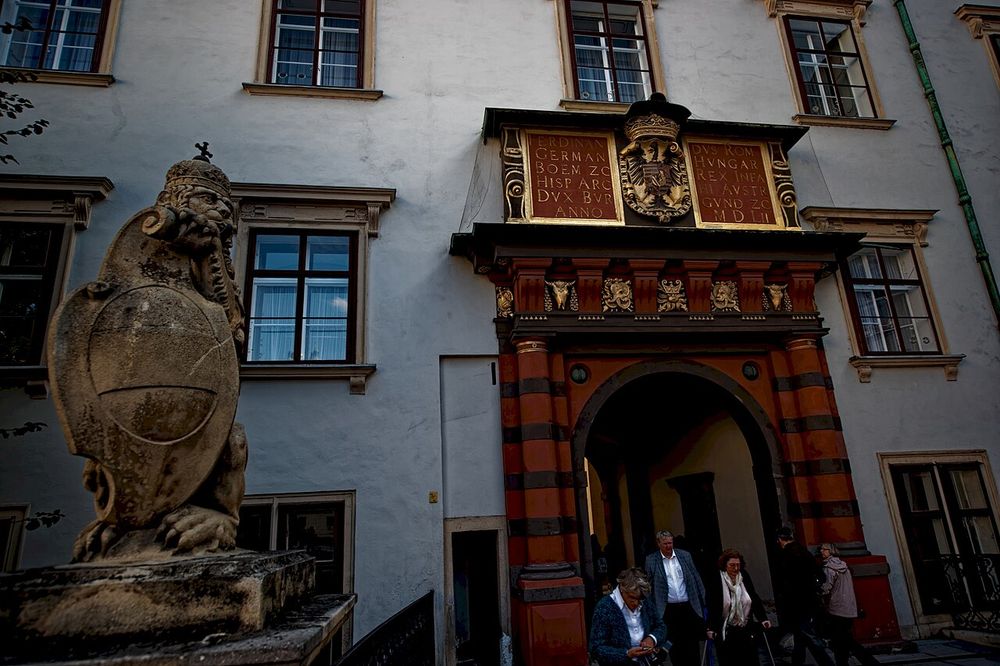
Red, black and gold, dated 1552. The grooves on either side are where the chains of the drawbridge ran: there was a moat here. The gold letters list Ferdinand's titles: king of Germany, Hungary and Bohemia, prince of Spain, archduke of Austria, duke of Burgundy.
The Swiss Court and the chapel steps, September 2013Bella47, CC BY-SA 3.0 at
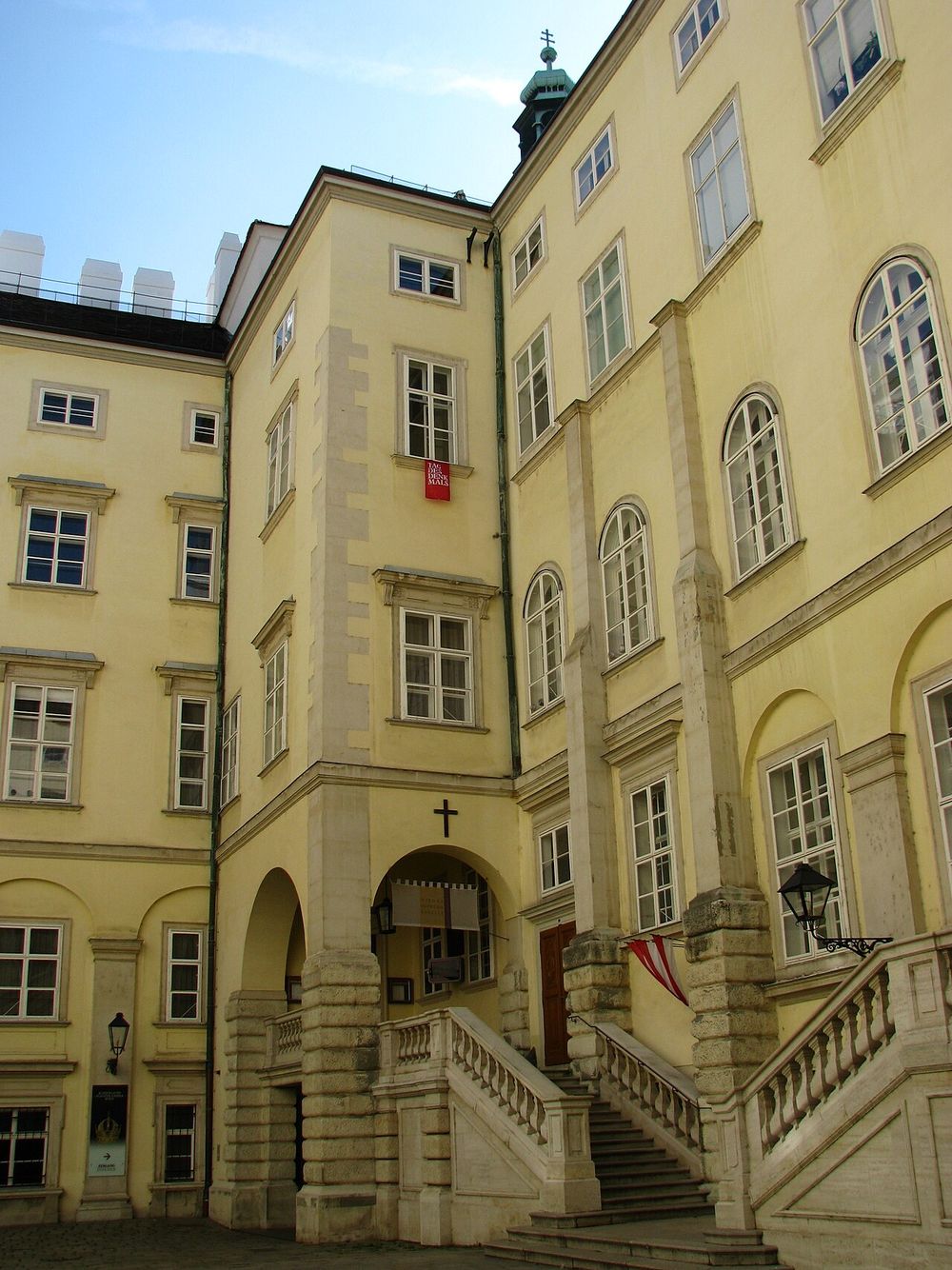
Inside is the oldest court, with thirteenth-century walls under the plaster. Steps on the right lead up to the palace chapel of 1449. The Vienna Boys' Choir, founded for this chapel in 1498, sings Mass here on Sunday mornings from September to June. Schubert sang in it as a boy.
4. The treasury
The crown: eight hinged plates of goldDavid Monniaux (talk · contribs), CC BY-SA 3.0
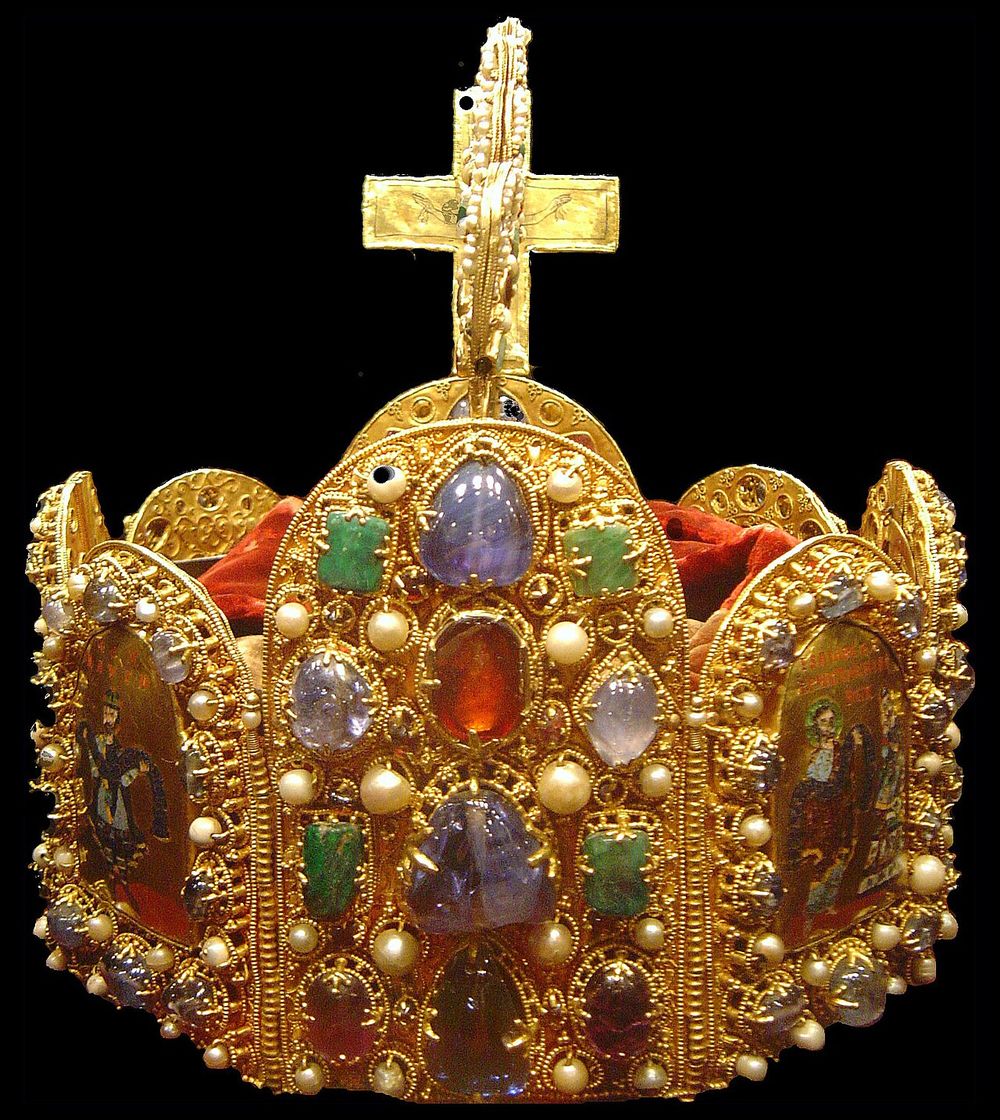
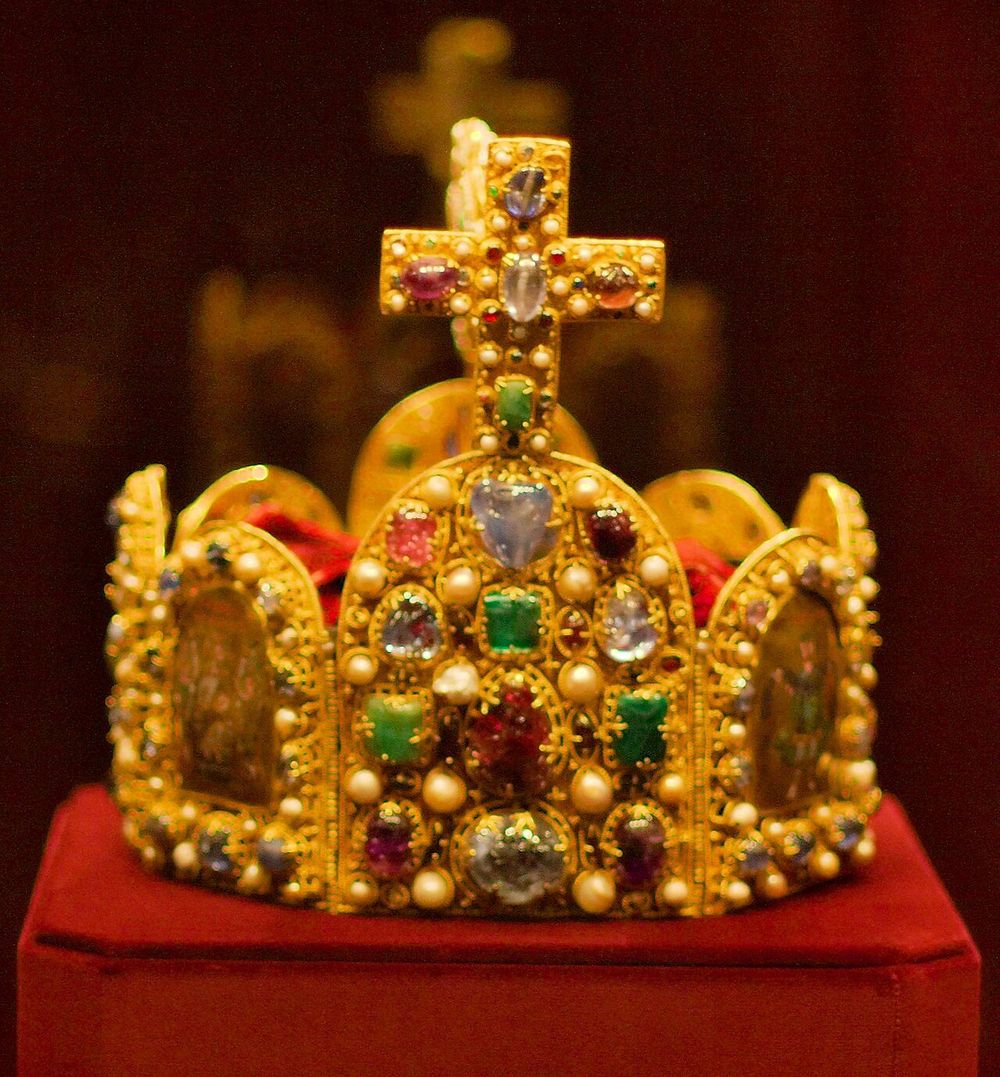
The door is under the chapel steps. In room after dark room are the things that made a man an emperor. The crown of the Holy Roman Empire is the centre of it: eight gold plates hinged together, set with pearls and uncut stones, made in the second half of the tenth century. In China that is the first years of the Northern Song (北宋, 960–1127). It is not round, and no head fits it well.
The Holy LanceArnoldius, CC BY-SA 3.0
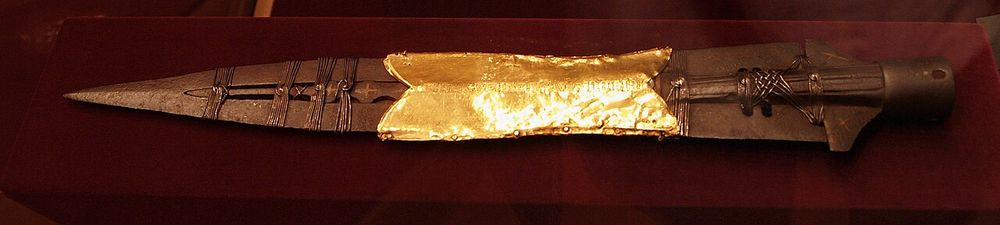
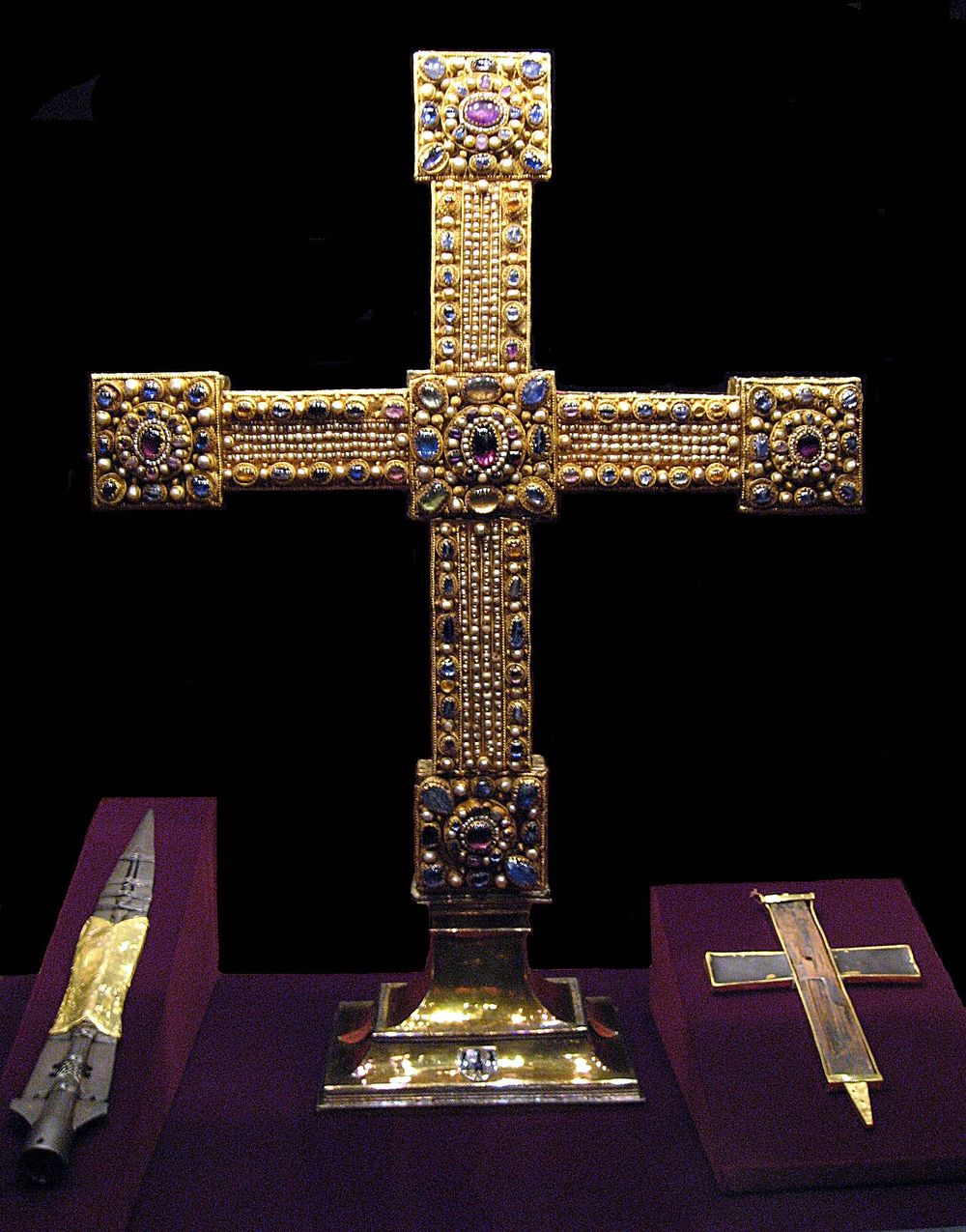
Beside it is an iron spearhead, bound with gold. For centuries it was believed to be the lance that pierced Christ's side, with a nail from the Cross inside it. Tests date it to the eighth century.
These pieces were kept in Nuremberg until 1800, when they were sent here out of Napoleon's reach. In 1938 Hitler took them back to Nuremberg. American soldiers found them in a bunker in 1945 and returned them to Vienna.
5. The emperor's and the empress's rooms
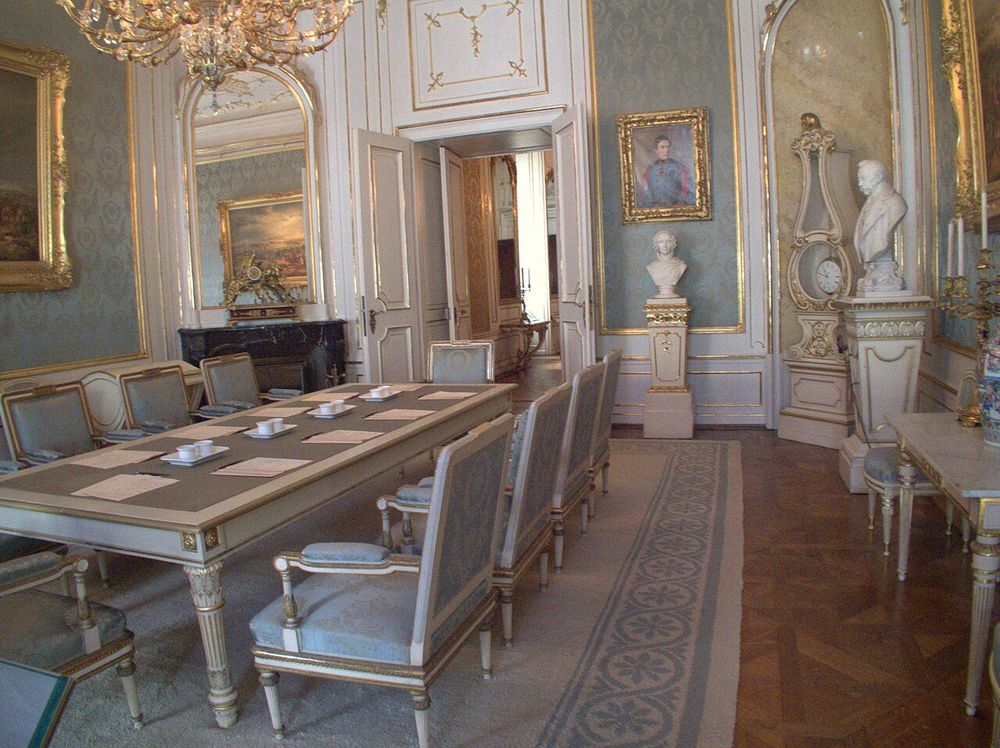
A table laid in the imperial apartments, August 2012Hanno Niemus, CC BY-SA 3.0
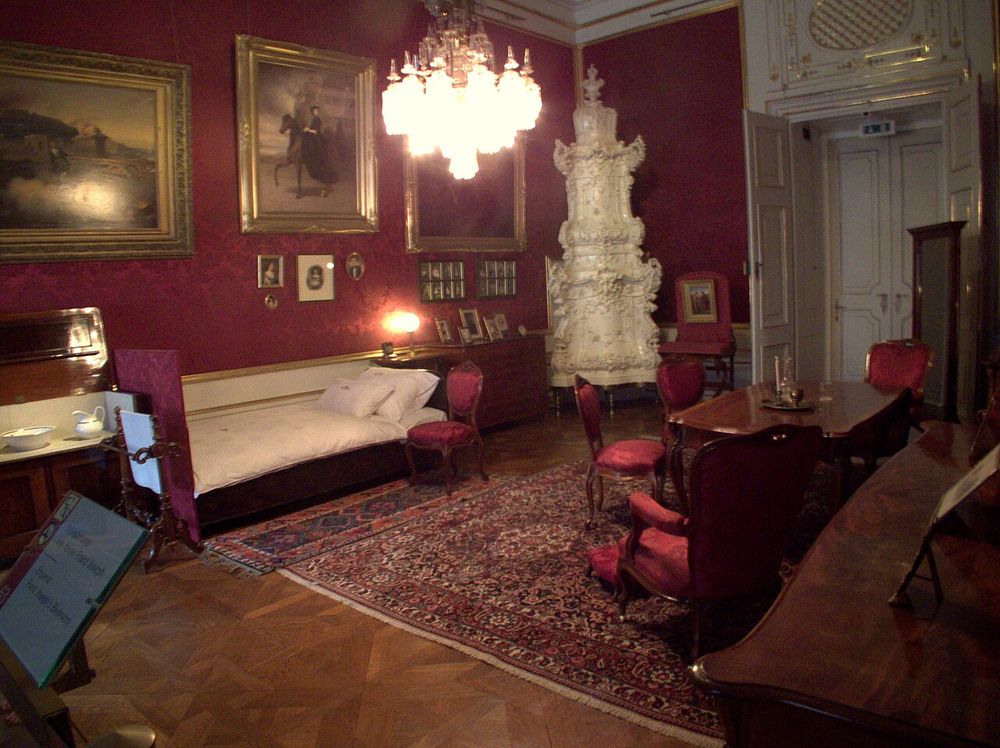
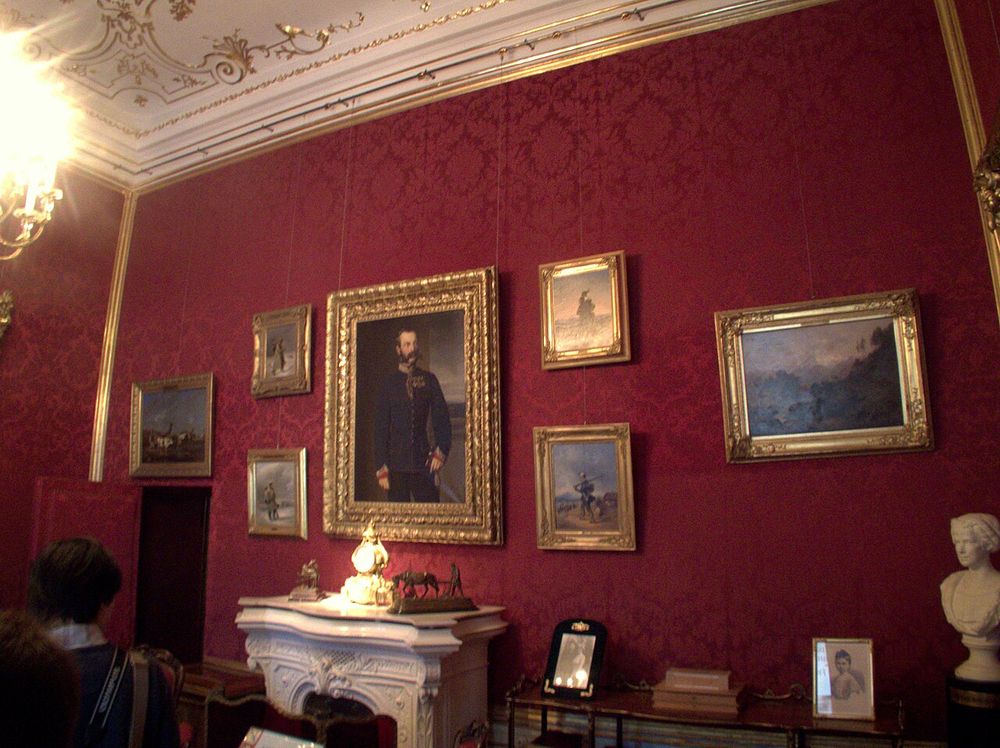
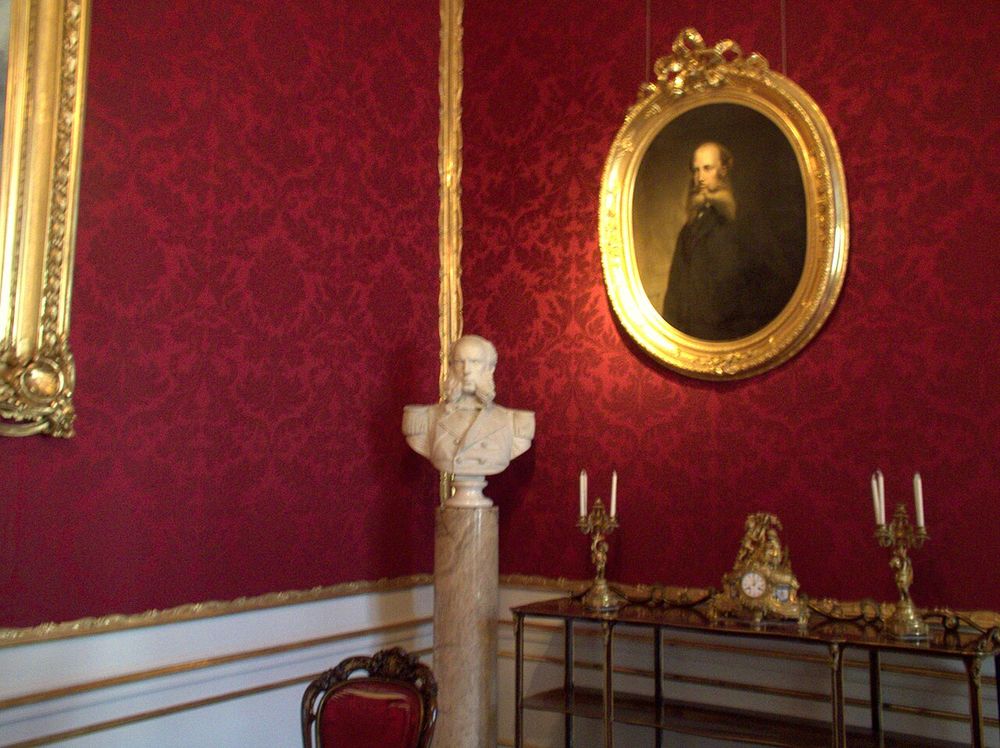
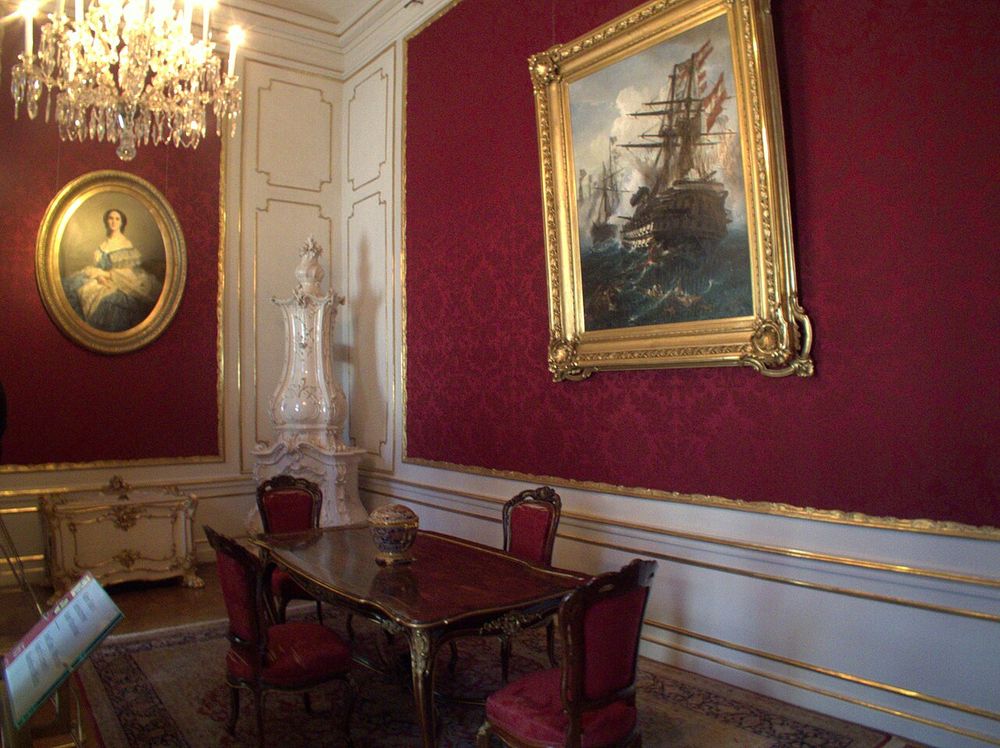
The rooms are red, white and gold, and smaller than you expect. In the audience chamber stands the high desk. In the emperor's study hang two portraits of his wife with her hair down. In his bedroom, the iron bed again.
A sitting room in the apartmentsHanno Niemus, CC BY-SA 3.0
Her rooms are next. Look for the wooden bars on the wall and the rings in the doorway. Her bathroom had the first bathtub in the palace. The museum beside the apartments, redesigned in 2026, shows her dresses, her travelling medicine chest, and the file.
6. Josefsplatz and the library
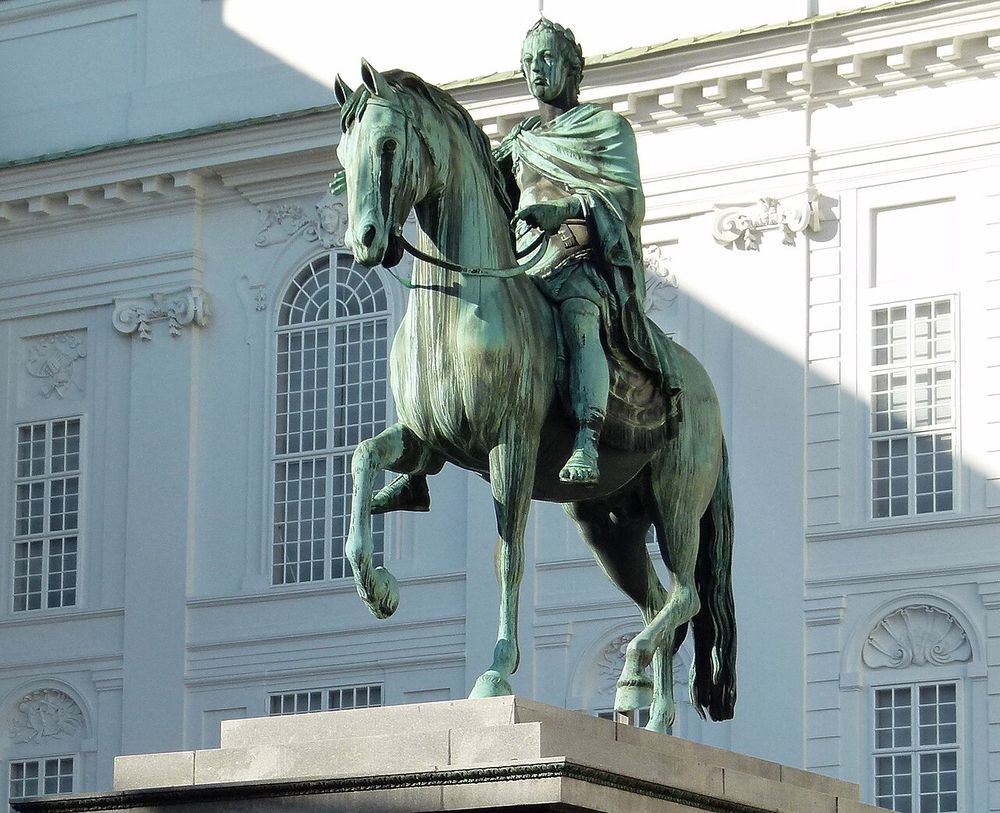
Joseph II on Josefsplatz, May 2013Brücke-Osteuropa, CC BY-SA 3.0 at
A quiet white square with an emperor on horseback. The film-makers of The Third Man put Harry Lime's flat in the palace facing the statue. Its doorway, held up by four stone women, is unchanged.
The same shot: stand by the statue's railing and frame the doorway at night, when the square is nearly empty.
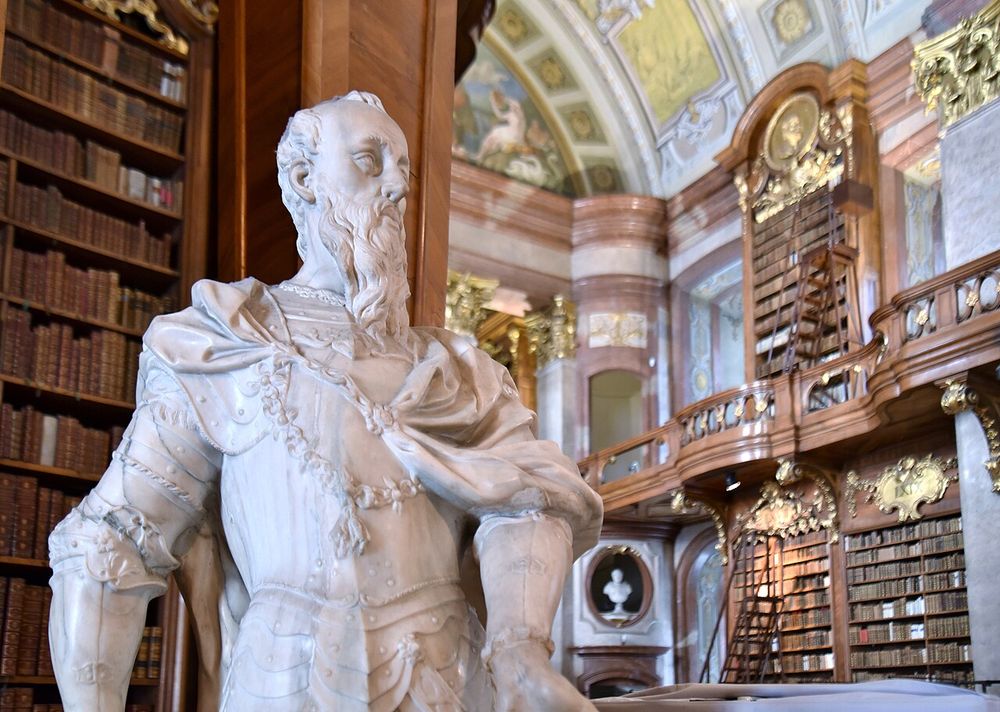
The State Hall and the statue of Charles VI, April 2019Bahnfrend, CC BY-SA 4.0
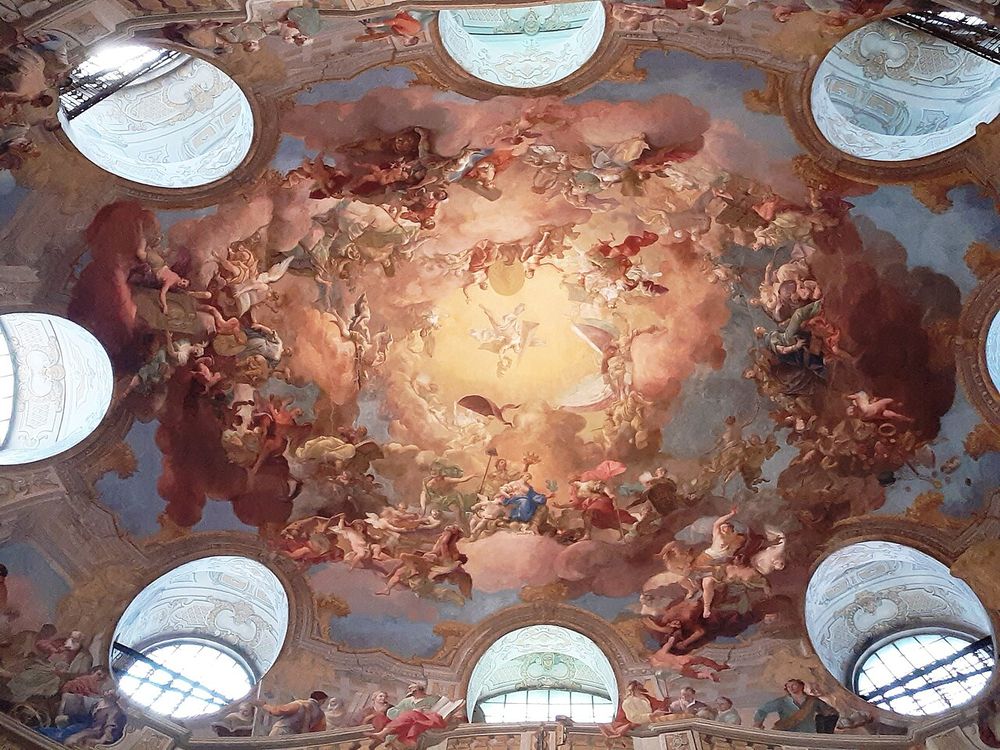
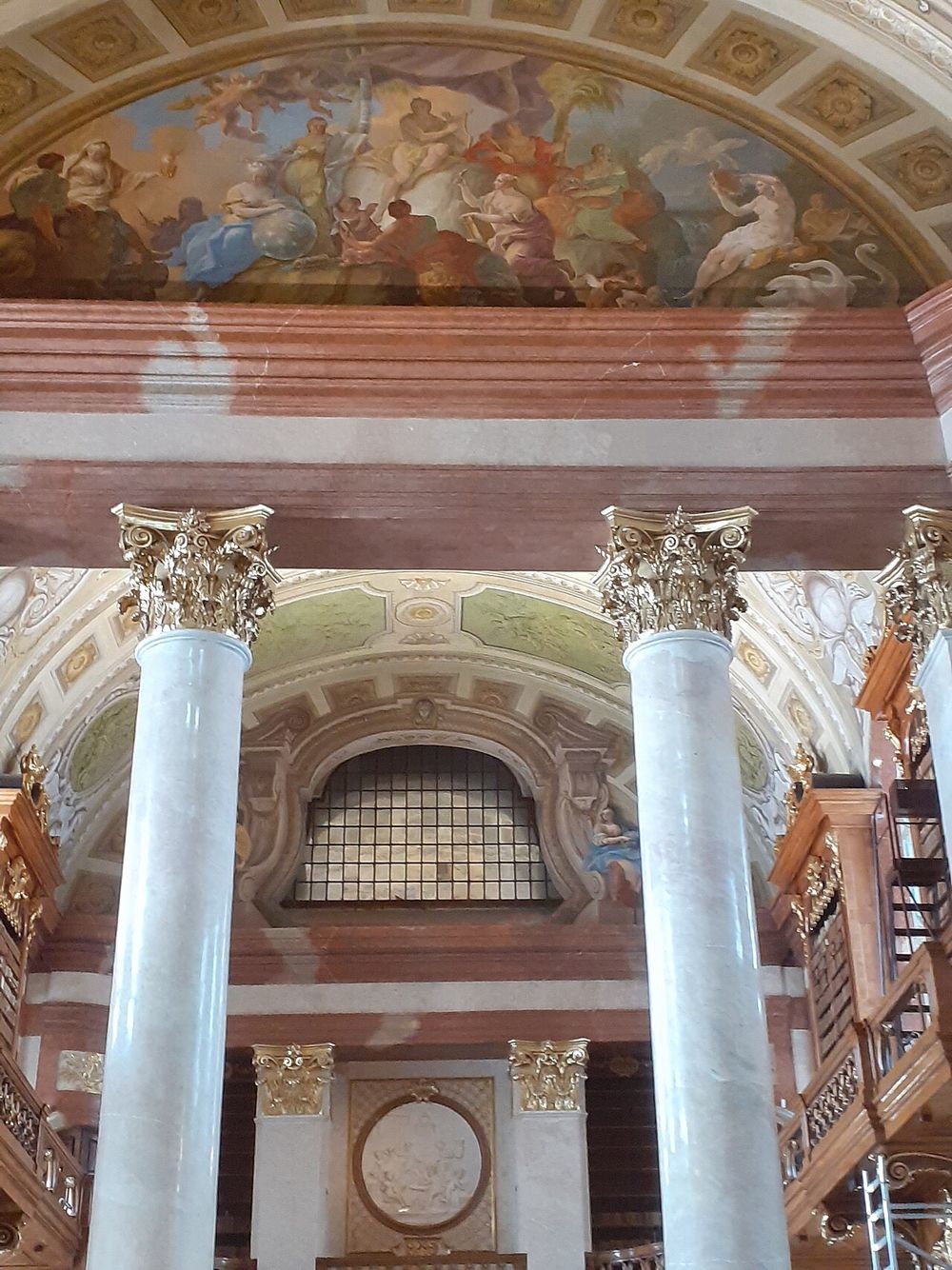
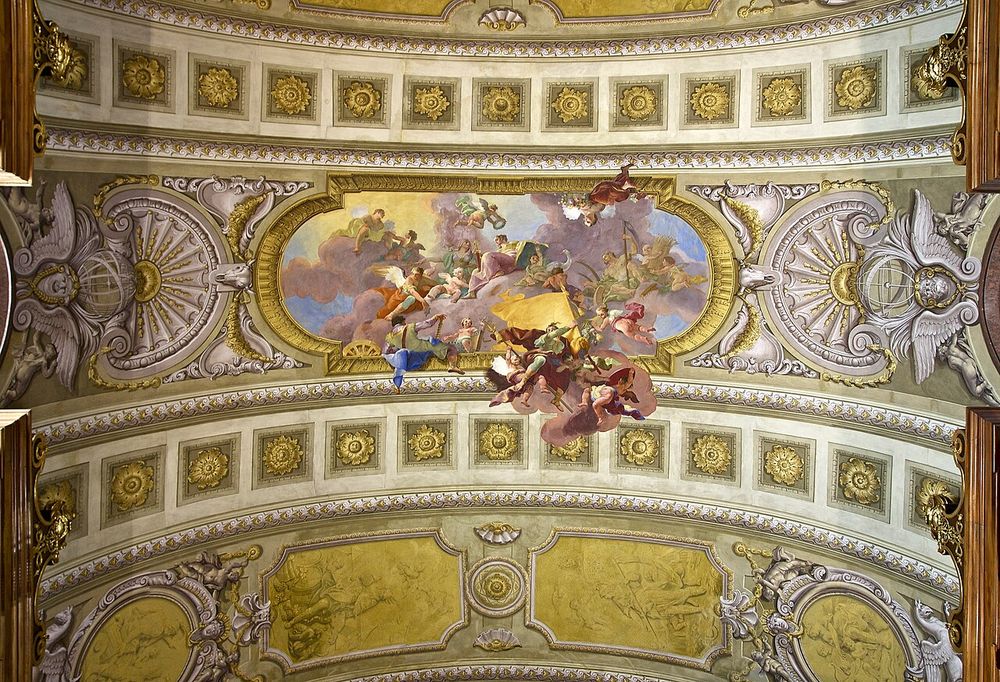
Up the stairs behind the statue is the State Hall of the old court library, built from 1723. It is nearly eighty metres long and twenty high, under a painted dome. Two hundred thousand books in walnut cases climb the walls. Some of the cases are doors: they swing open on rooms with more books.
7. The white horses
The Winter Riding School, February 2012Jebulon, CC0
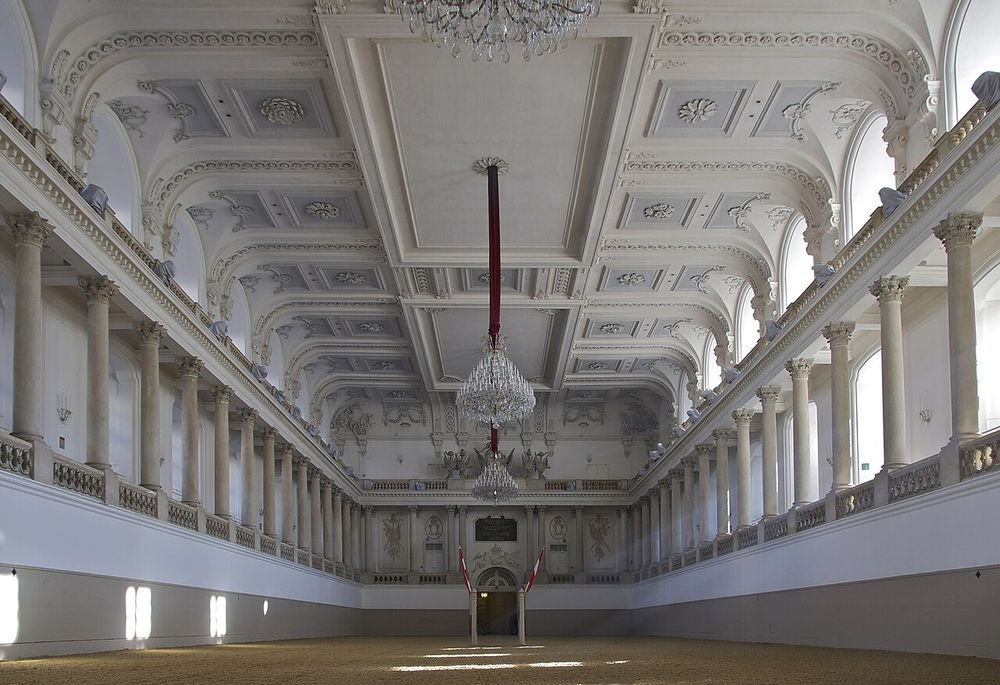
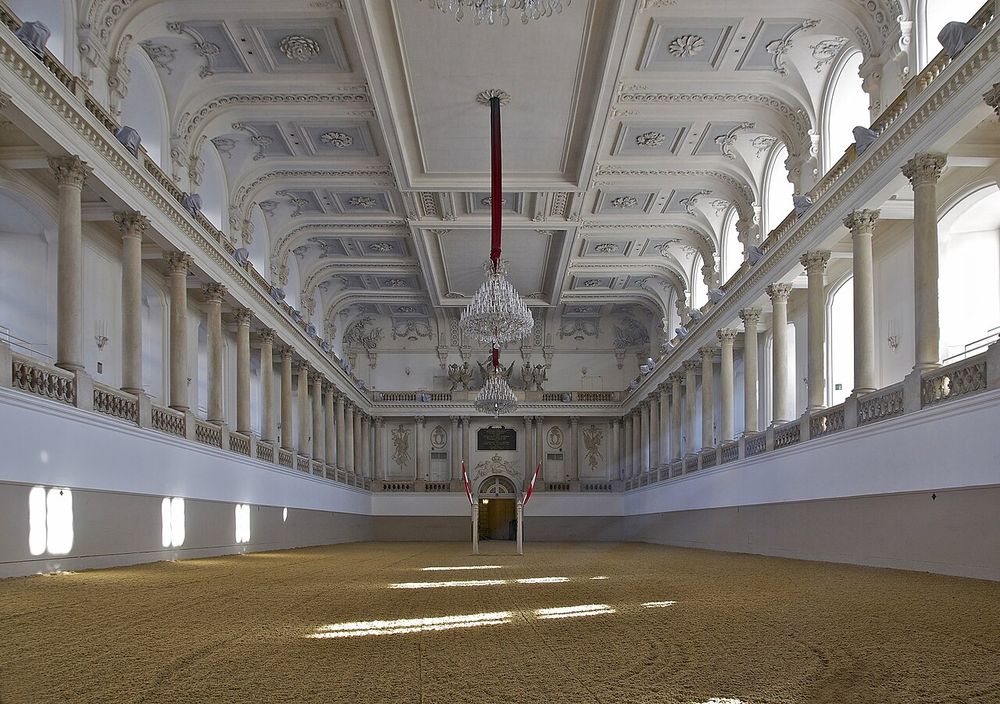
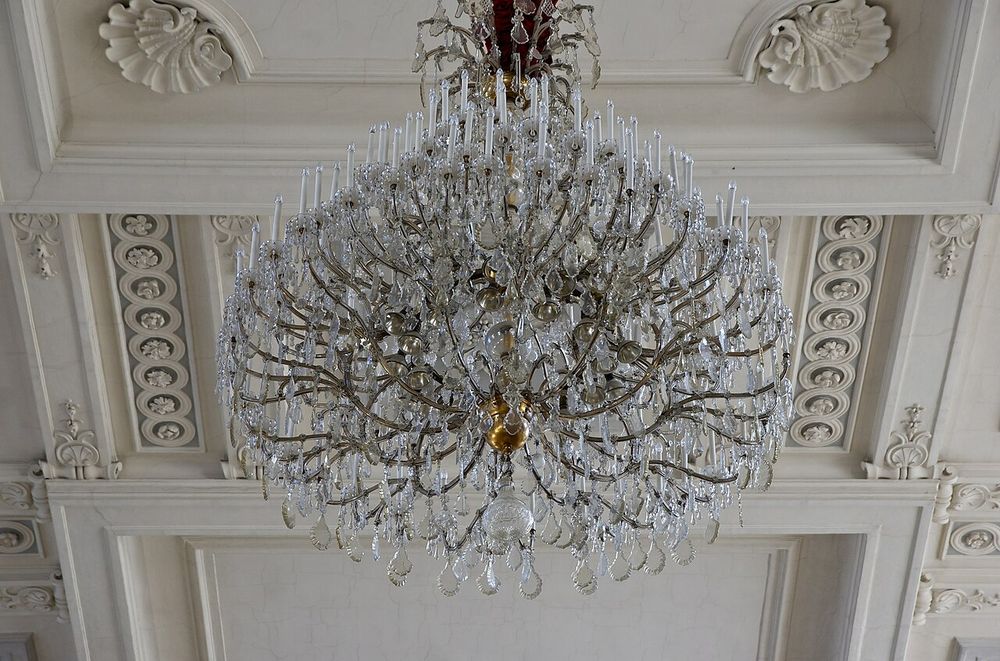
The Winter Riding School is a white hall with a chandelier and two galleries, finished in 1735, in which the only colour is the riders' brown coats. The horses are Lipizzaners. They are born dark and turn white over six to ten years. Stallions and riders train together for years before they perform.
As each rider enters he lifts his hat to a portrait at the far end. It is of the emperor who built the hall.
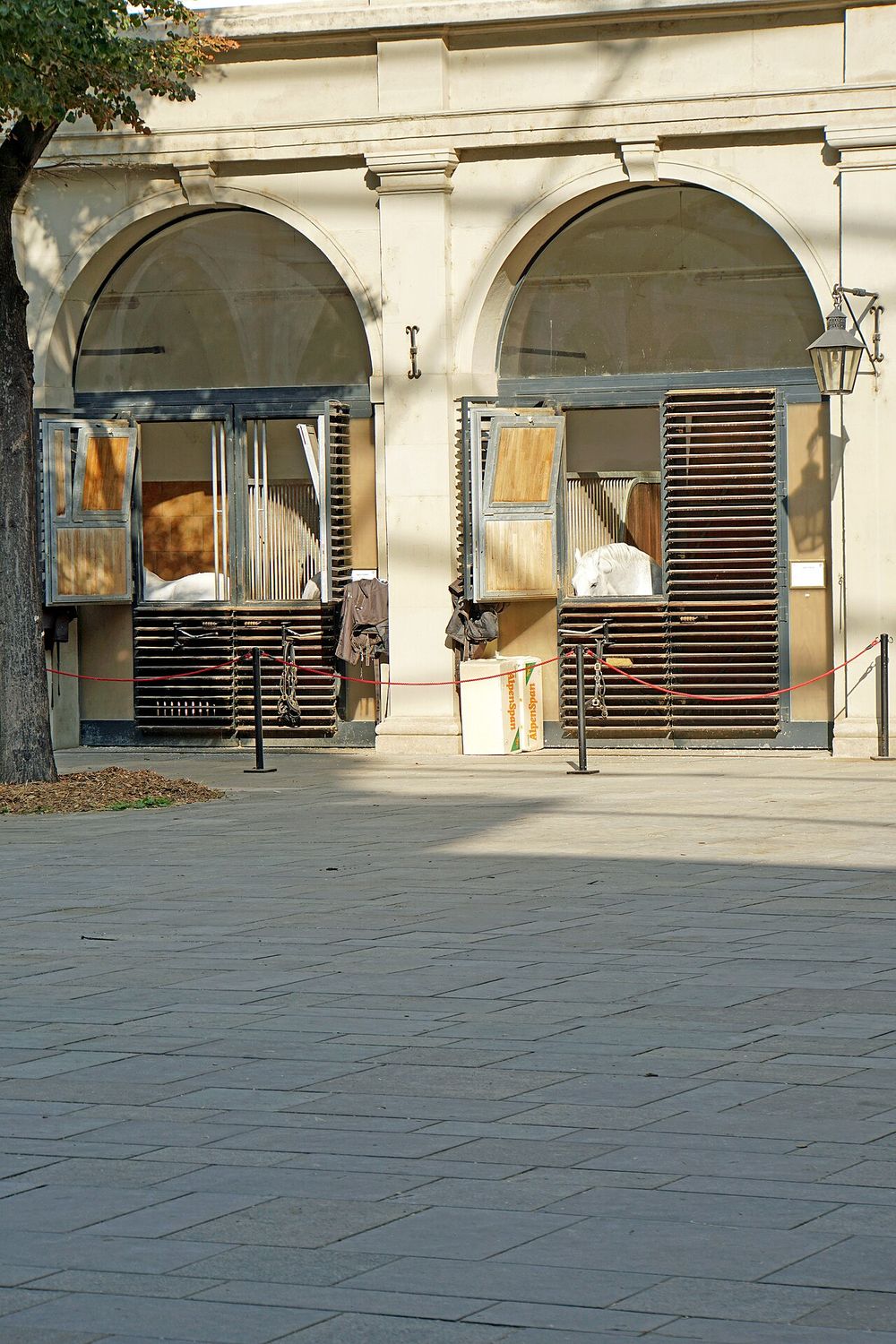
The arcaded court of the stables, May 2014Ricardalovesmonuments, CC BY-SA 3.0
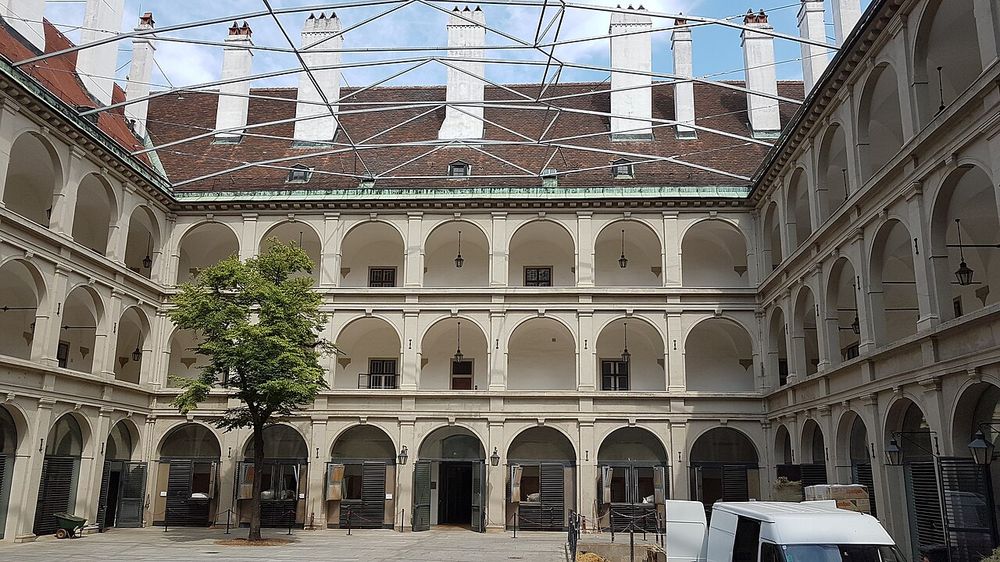
The stables are across the lane, in a Renaissance courtyard with three tiers of arcades. From the street you can sometimes see a white head looking out.
8. Heldenplatz
The Neue Burg across Heldenplatz, June 2016Tilman2007, CC BY-SA 4.0
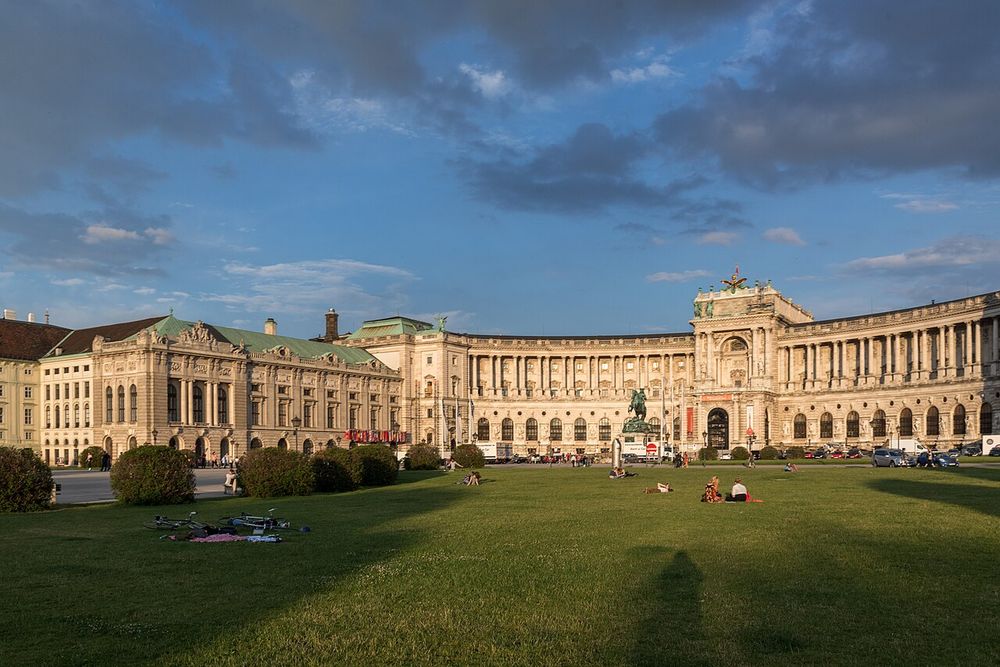
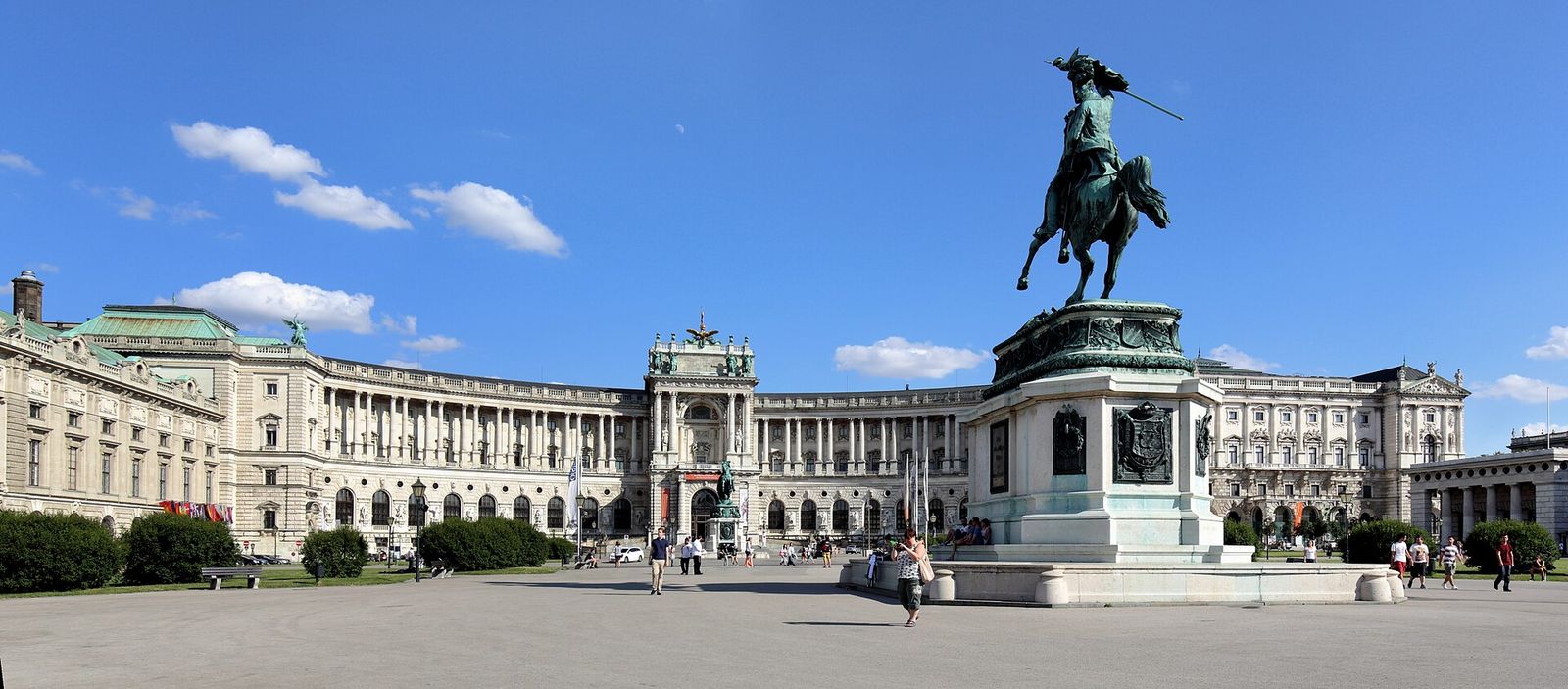
Go back through the inner court and out through the far arch. The space opens. A long curved palace with a colonnade stands on one side: the Neue Burg, the new castle, finished in 1913. A second, matching wing was to face it, and a forum of museums was to join them. Then came the war.
Heldenplatz and Archduke Charles, June 2019Rosser1954, CC BY-SA 4.0
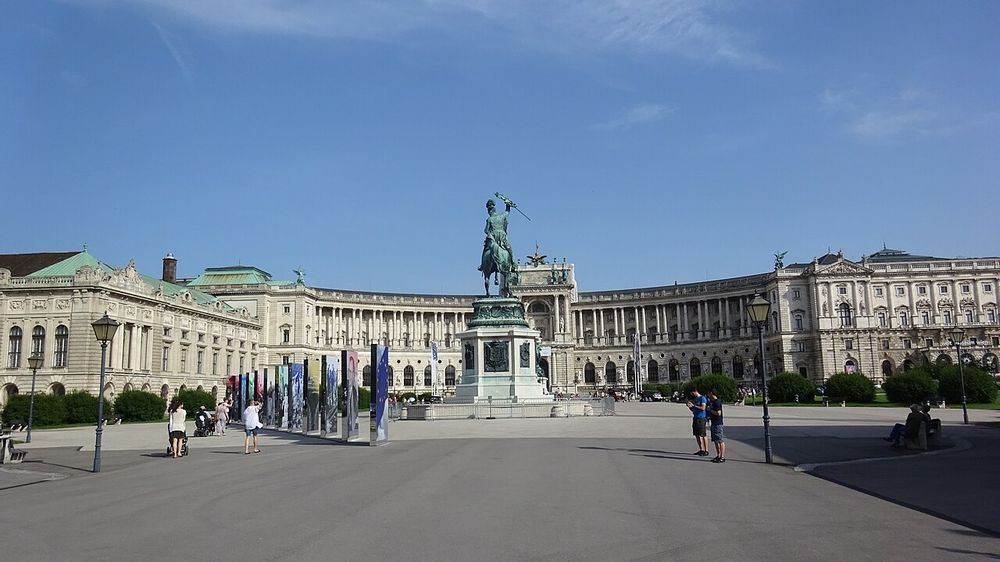
Two bronze generals ride here. The nearer one, on a horse that stands on its hind legs alone, is Archduke Charles, who beat Napoleon in 1809.
The crowd on Heldenplatz, 15 March 1938Heinrich Hoffmann, Public domain
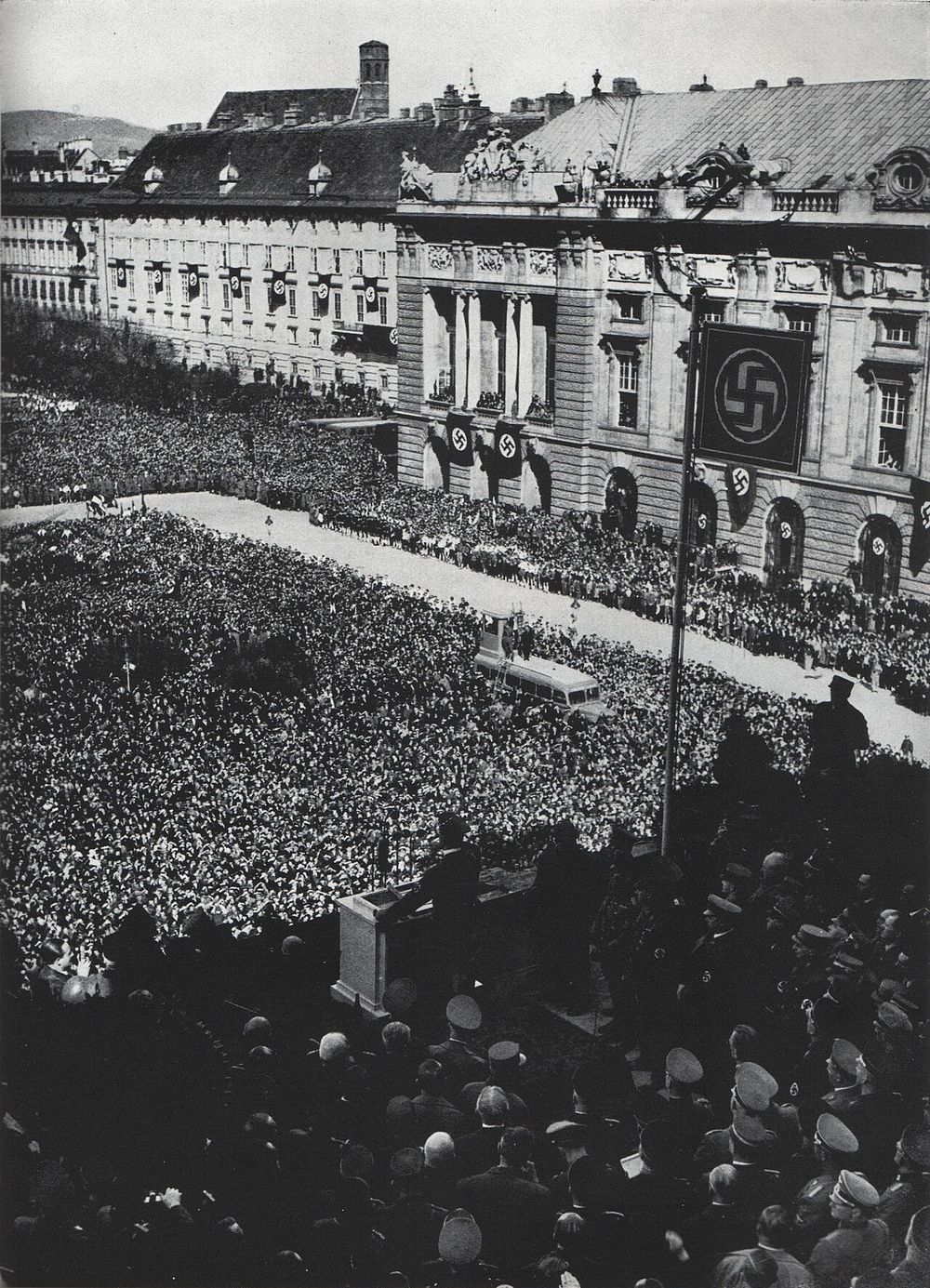
On 15 March 1938, three days after German troops crossed the border, Adolf Hitler, who was born in Austria, stood on the central balcony of the Neue Burg and announced that his homeland had joined the German Reich. Some two hundred thousand people filled this square and cheered.
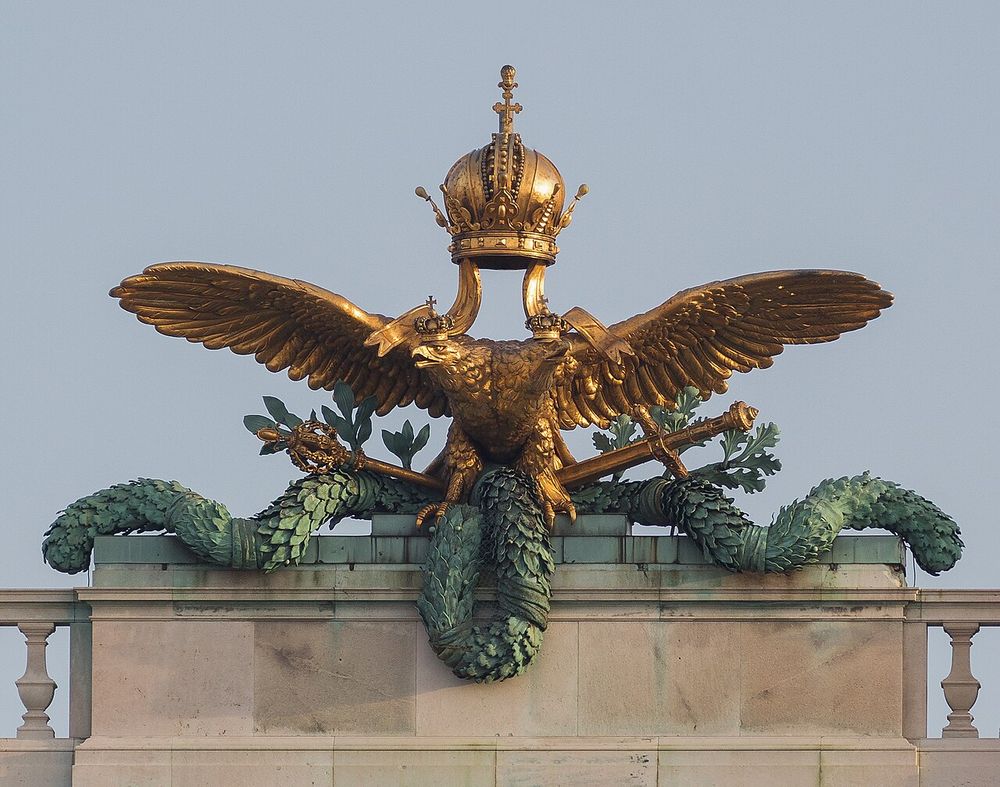
For decades Austria described itself as Hitler's first victim. The photographs of this square were the answer. The balcony is kept closed. A museum of Austrian history opened behind it in 2018, and what to do with the balcony itself is still argued over.
Meanwhile in the world
Year
Here
Elsewhere
1279
A castle here is first recorded
Kublai Khan completes the Mongol conquest of China
1552
The Swiss Gate is built
Ivan the Terrible takes Kazan
1683
A Turkish army besieges Vienna and mines the bastion in front of the palace
Britain's first public museum opens in Oxford
1735
The Winter Riding School is finished
Linnaeus publishes his System of Nature
1814
The Congress of Vienna dances
Napoleon is sent to Elba
1898
The empress Elisabeth is murdered in Geneva
Spain and the United States go to war
1913
The Neue Burg is finished
Ford starts the moving assembly line
1918
The last emperor leaves; the republic is declared
The First World War ends
1938
Hitler speaks from the balcony
The Munich Agreement is signed
2018
A museum of Austrian history opens in the Neue Burg
A century since the end of the First World War
One line to remember: not one palace but seven centuries of palaces, and the last piece was finished five years before the family left.
Then and now
The front on Michaelerplatz, January 2020Diego Delso, CC BY-SA 4.0, Wikimedia CommonsThe same front at night, August 2022Leonhard Lenz, CC0, Wikimedia CommonsThe Michael wing lit up, January 2020Diego Delso, CC BY-SA 4.0, Wikimedia CommonsThe gate at night, August 2018Rafa Esteve, CC BY-SA 4.0, Wikimedia CommonsHercules at the gateDiego Delso, CC BY-SA 4.0, Wikimedia CommonsThe fountain "Power at Sea"Jebulon, CC0, Wikimedia CommonsThe Michael wing from inside the curve, August 2021בר, CC BY-SA 3.0, Wikimedia CommonsThe emperor Francis and the clock tower of the AmalienburgAneza Palaiou, CC BY-SA 4.0, Wikimedia CommonsThe Amalienburg, January 2020Diego Delso, CC BY-SA 4.0, Wikimedia CommonsThe Swiss Gate, June 2016Tilman2007, CC BY-SA 4.0, Wikimedia CommonsThe inscription of 1552Jebulon, CC0, Wikimedia CommonsThe Swiss Gate from the inner courtTxllxt TxllxT, CC BY-SA 4.0, Wikimedia CommonsThe Swiss Court and the chapel steps, September 2013Bella47, CC BY-SA 3.0 at, Wikimedia CommonsThe crown of the Holy Roman EmpireUser:MatthiasKabel, CC BY 2.5, Wikimedia CommonsThe crown: eight hinged plates of goldDavid Monniaux (talk · contribs), CC BY-SA 3.0, Wikimedia CommonsThe Imperial Cross, made to hold the relicsMyName (Gryffindor), Public domain, Wikimedia CommonsThe Holy LanceArnoldius, CC BY-SA 3.0, Wikimedia CommonsA table laid in the imperial apartments, August 2012Hanno Niemus, CC BY-SA 3.0, Wikimedia CommonsA room in the imperial apartmentsHanno Niemus, CC BY-SA 3.0, Wikimedia CommonsRed silk and a white stoveHanno Niemus, CC BY-SA 3.0, Wikimedia CommonsFamily portraits in the apartmentsHanno Niemus, CC BY-SA 3.0, Wikimedia CommonsA sitting room in the apartmentsHanno Niemus, CC BY-SA 3.0, Wikimedia CommonsCourt porcelain with the double eagleJebulon, CC0, Wikimedia CommonsA gilt ewer and basin from the court silverJebulon, CC0, Wikimedia CommonsJoseph II on Josefsplatz, May 2013Brücke-Osteuropa, CC BY-SA 3.0 at, Wikimedia CommonsThe State Hall and the statue of Charles VI, April 2019Bahnfrend, CC BY-SA 4.0, Wikimedia CommonsThe painted dome of the State Hall, July 2023Abxbay, CC BY-SA 4.0, Wikimedia CommonsColumns and bookcases in the State HallAbxbay, CC BY-SA 4.0, Wikimedia CommonsA detail of the ceiling by Daniel GranDaniel Gran, CC0, Wikimedia CommonsThe Winter Riding School, February 2012Jebulon, CC0, Wikimedia CommonsThe riding hall from the galleryJebulon, CC0, Wikimedia CommonsA chandelier in the riding hallJebulon, CC0, Wikimedia CommonsThe arcaded court of the stables, May 2014Ricardalovesmonuments, CC BY-SA 3.0, Wikimedia CommonsThe way in to the stables, September 2016Dennis G. Jarvis, CC BY-SA 2.0, Wikimedia CommonsA roof turret on the Leopold wingHubertl, CC BY-SA 4.0, Wikimedia CommonsThe Leopold wing, where the President worksGryffindor Panorama made by Digon, CC BY 2.5, Wikimedia CommonsThe Neue Burg across Heldenplatz, June 2016Tilman2007, CC BY-SA 4.0, Wikimedia CommonsThe Neue Burg and Prince Eugene, July 2014C.Stadler/Bwag, CC BY-SA 3.0 at, Wikimedia CommonsThe double eagle on the roof of the Neue BurgHubertl, CC BY-SA 4.0, Wikimedia CommonsHeldenplatz and Archduke Charles, June 2019Rosser1954, CC BY-SA 4.0, Wikimedia CommonsPrince Eugene of SavoyJebulon, CC0, Wikimedia CommonsThe outer gate of 1824Gugerell, CC0, Wikimedia CommonsThe outer gate at dusk, July 2010Manfred Werner - Tsui, CC BY-SA 3.0, Wikimedia CommonsThe Mozart monument in the palace garden, June 2009Gerd Eichmann, CC BY-SA 4.0, Wikimedia CommonsMichaelerplatz before 1888, with the old court theatre where the dome now standsMichael Frankenstein, Public domain, Wikimedia CommonsMichaelerplatz painted by Rudolf von Alt, 1888Rudolf von Alt, Public domain, Wikimedia CommonsThe new front about 1900Unknown authorUnknown author, Public domain, Wikimedia CommonsThe front in a colour print of the 1890sMiscellaneous Items in High Demand, PPOC, Library of Congress, Public domain, Wikimedia CommonsFrom the air, July 1935Walter Mittelholzer, Public domain, Wikimedia CommonsFrom the air, 1934Walter Mittelholzer, Public domain, Wikimedia CommonsThe crowd on Heldenplatz, 15 March 1938Heinrich Hoffmann, Public domain, Wikimedia Commons
Local legends
These are stories people tell about this place. They are legends, not history, and each one says where it comes from.
LegendThe horse on two legs
The sculptor of Archduke Charles balanced the whole weight of the bronze on the horse's two hind hooves. He is said to have gone mad because he could not do it a second time: the horse of the other statue rests on its tail.
Source: A Viennese story. Anton Dominik Fernkorn did fall ill and died in an asylum in 1878; the second horse does rest on its tail
LegendThe house without eyebrows
The emperor is said to have so disliked the bare new house opposite his gate that he had the curtains on that side kept shut and never again left by Michaelerplatz.
Source: Told in Vienna since the 1910s about Adolf Loos's building of 1911. No court record confirms it
LegendThe spear of destiny
Whoever holds the Holy Lance is said to hold the fate of the world, and to lose his life when he loses the lance. Hitler is said to have stood before it as a young man and sworn to own it.
Source: Medieval belief in the lance's power is real. The Hitler story comes from Trevor Ravenscroft's book The Spear of Destiny (1973) and has no evidence behind it
Later, people who live here will be able to add the stories they grew up with, and say which of these they have heard.
Not certain, and where accounts conflict
How old is the crown?
The museum dates it to the second half of the tenth century, with the cross and arch added a little later. Some scholars argue for the early eleventh. It was not made for Charlemagne, though for centuries it was said to be his.
Is the feather headdress Moctezuma's?
The Aztec headdress of quetzal feathers in the museum in the Neue Burg is the only one of its kind left in the world. Nothing shows that the Aztec ruler ever wore it. Mexico has asked for its return; Austrian and Mexican experts concluded that it is too fragile to travel.
How many rooms?
The usual figure is 2,600. It depends on what is counted as the Hofburg and what as a room, and nobody has published a list.
Visiting
Tickets and hours
Sisi Museum and Imperial Apartments: €20 for adults for most of 2026, daily from 9:00 to 17:30. The redesigned museum reopened on 19 November 2026 and the price was due to change then.
Imperial Treasury: about €16 online in 2026, closed on Tuesdays.
State Hall: a separate ticket of roughly €10 to €12; closed on Mondays outside the summer.
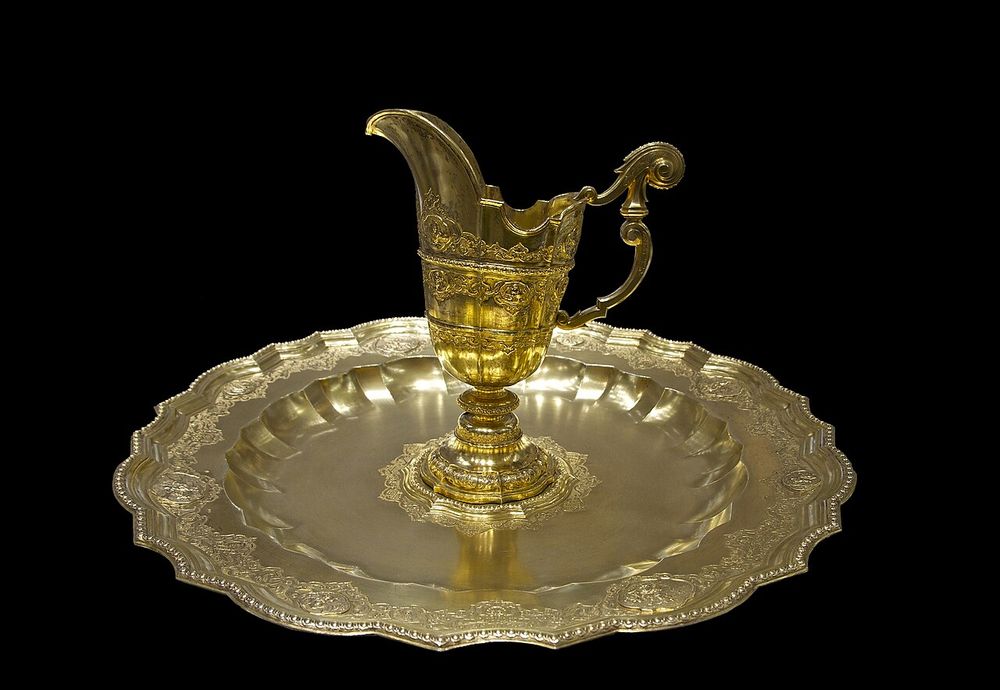
The silver collection has been closed since 2023.
Last checked 2026-11-12. The Burghauptmannschaft Österreich, the Kunsthistorisches Museum and the Austrian National Library on their own buildings; ticket and opening information from 2026.
Booking from abroad
Note Riding-school performances sell out months ahead. The morning exercise is easier to get into and far cheaper.
Checked 2026-11-12
Where to start
Underground line U3 to Herrengasse, then two minutes on foot to Michaelerplatz.
Walk the eight stops outdoors first. It takes forty minutes. Then choose one or two interiors. All of them in one day is too much.
Before you go
The treasury is kept dark and cool to protect the textiles.
For Sunday Mass with the choir, be at the chapel well before 9:15.
Customs and manners
At the riding school there is no photography and no talking during the work. The horses are young stallions and are easily startled.
In the chapel on Sunday you are at a church service. Stay to the end, and do not clap.
On Heldenplatz, think before you pose in front of the balcony. Viennese people notice.
The horse-cab drivers in the inner court charge by the route. Agree the price before you get in.
Horse cabs and service vehicles still drive through the gate. Keep to the side under the dome.
Look for these
At the gate, find the ship's prow.
In the square, find the Roman walls.
On the clock tower, find the ball that shows the moon.
On the Swiss Gate, find the grooves for the drawbridge chains.
Count the sides of the crown.
In the empress's rooms, find the rings in the doorway.
In the library, find a bookcase that is a door.
On Heldenplatz, find the horse that stands on two legs.
I am here
Stand at the site, sign in, press the button, and collect its stamp. Your browser will ask to use your location. It is sent to us once to confirm that you are at the site; we keep how far you were from it, not the spot where you stood.
Your stamps are saved to your account, so they follow you to any device. Checking from a browser cannot rule out every false location; stricter checks arrive with the app.
Messages
Share your photos
Photos here show the place, not people. Each one is credited to the visitor who took it and appears after our team has looked at it. A photo with you in it belongs under “I am here”.