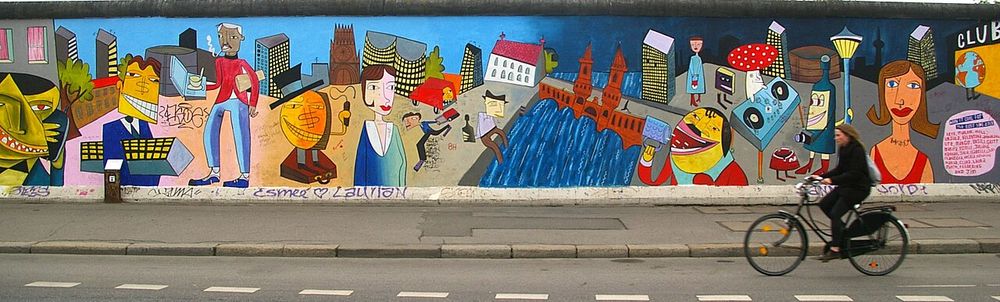
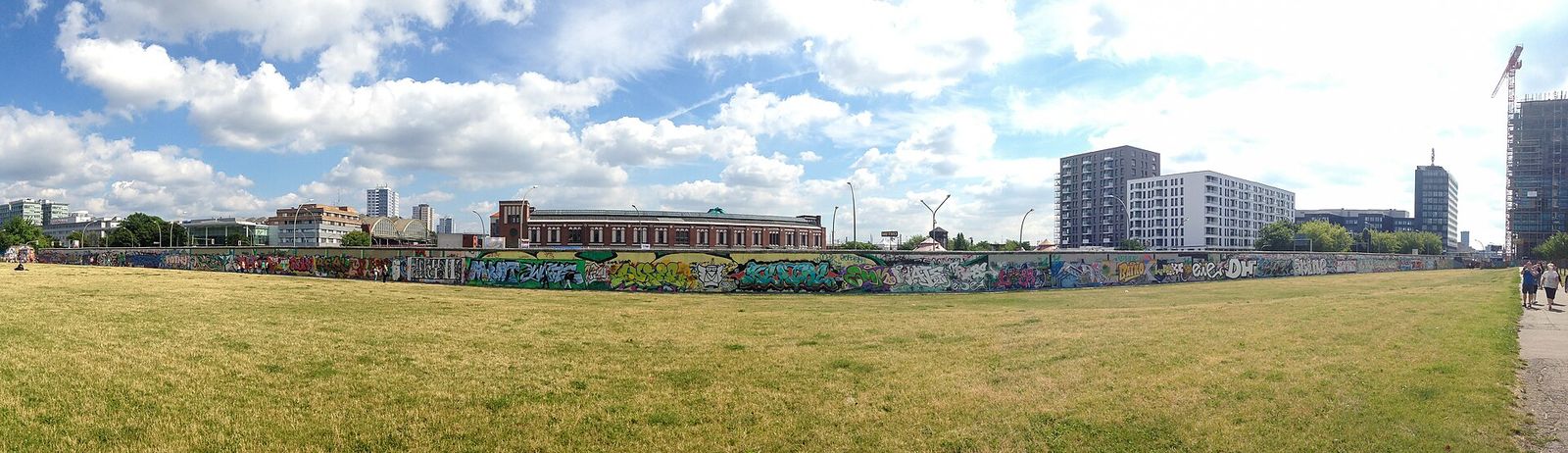
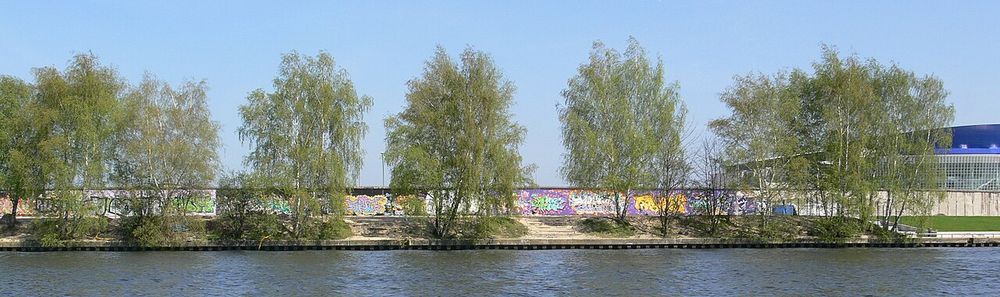
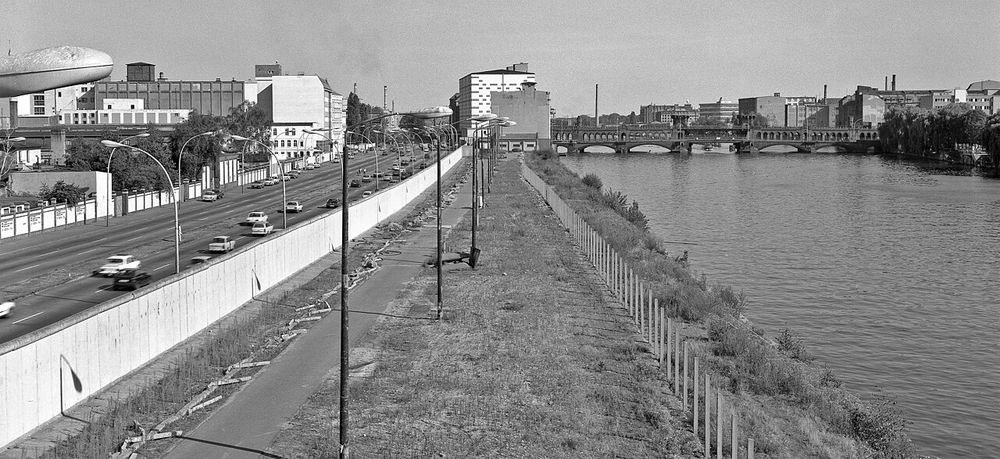
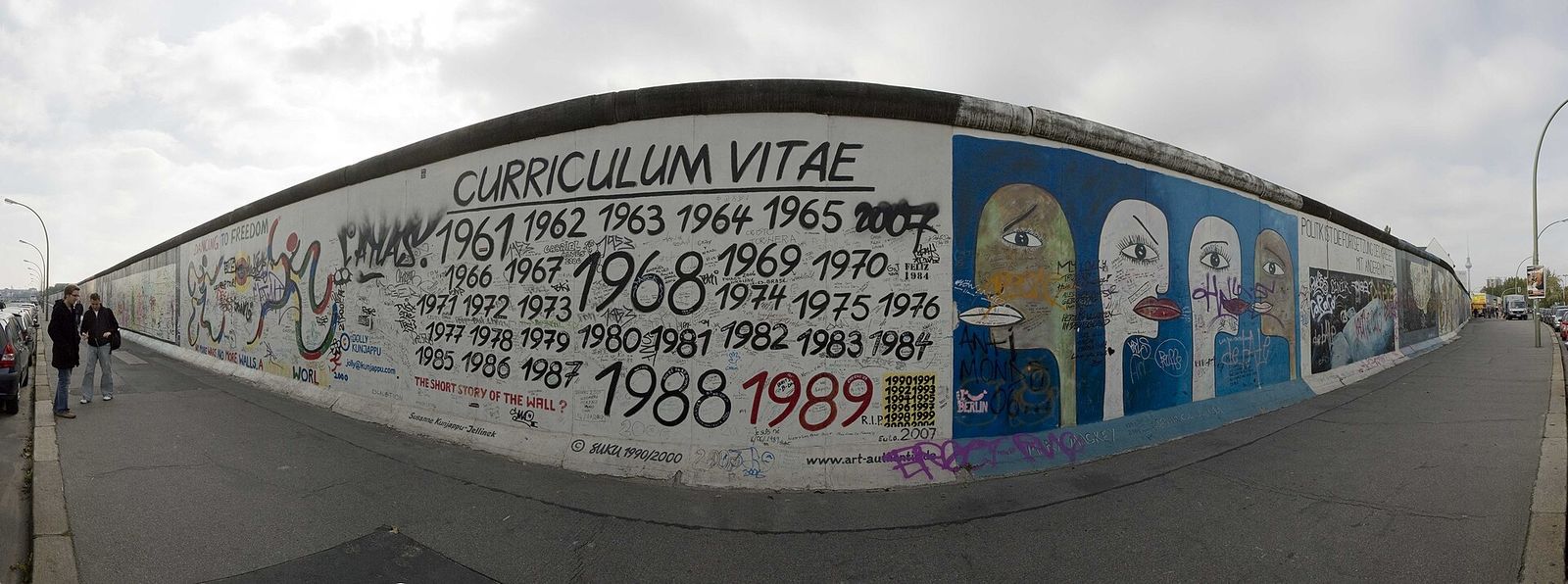
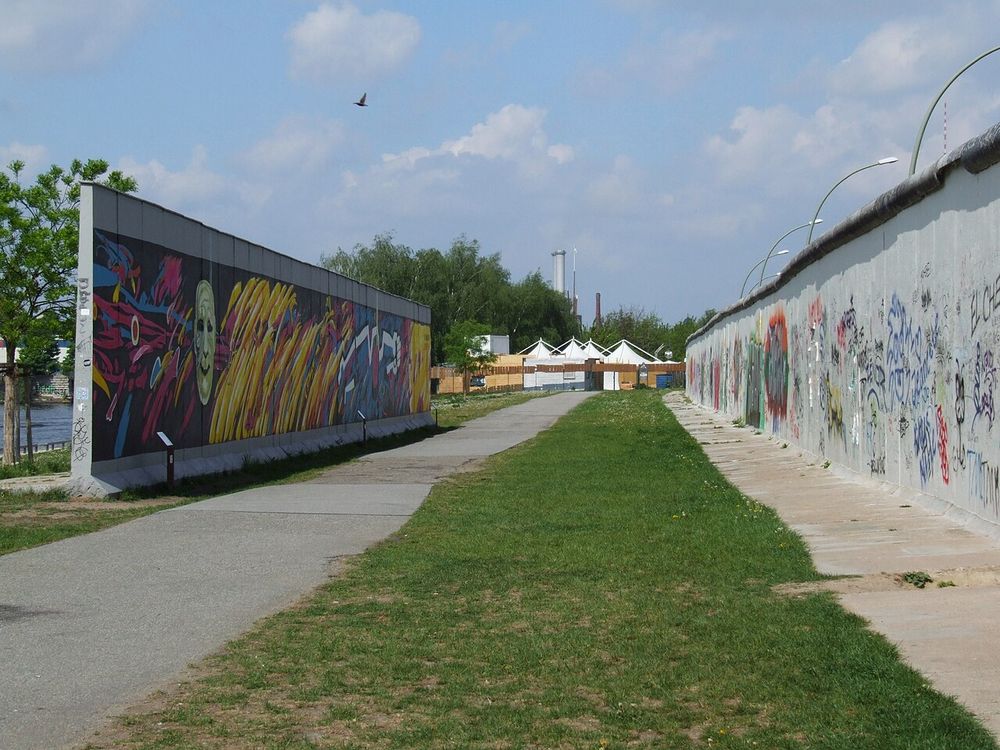
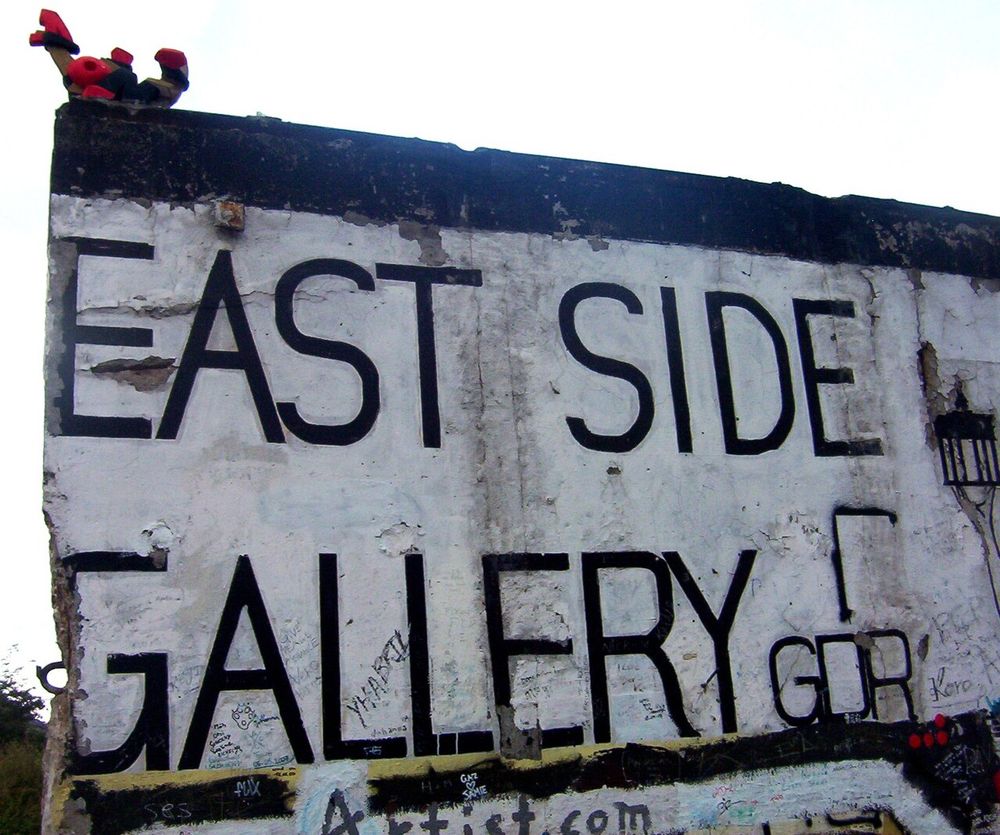
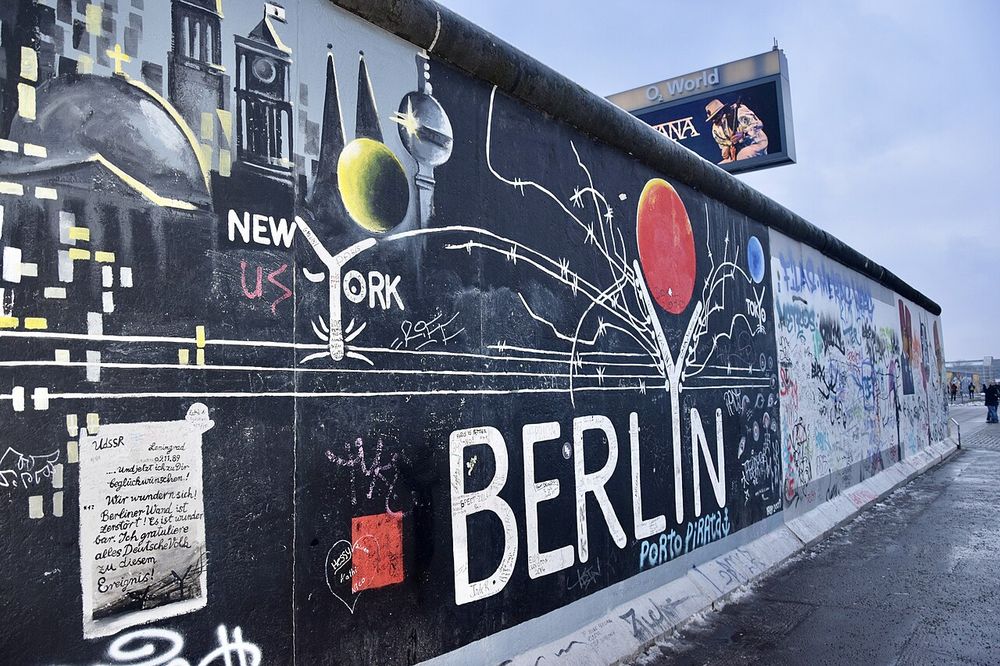
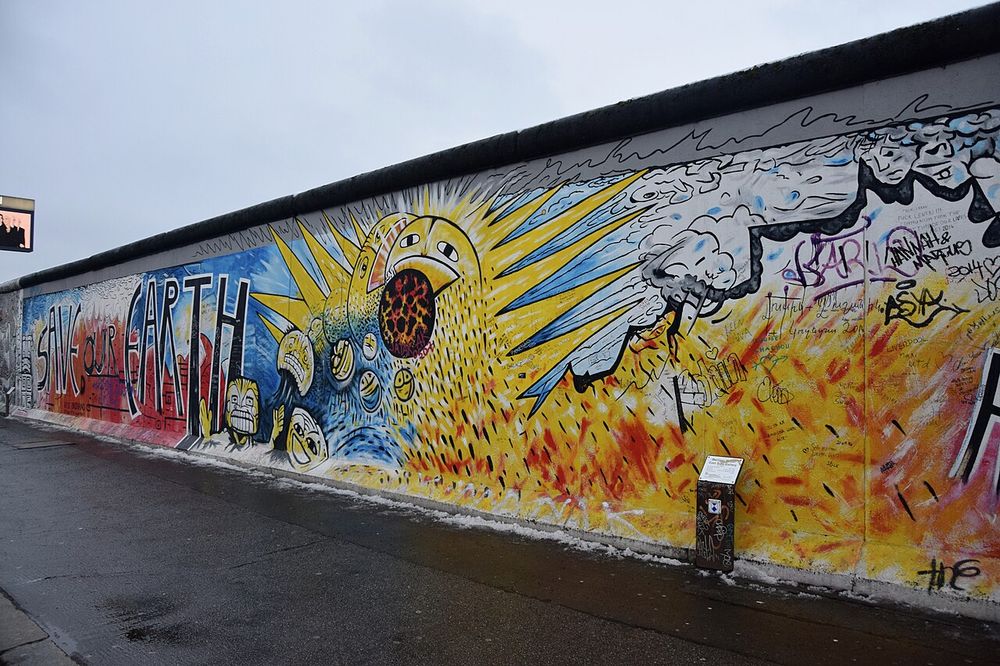
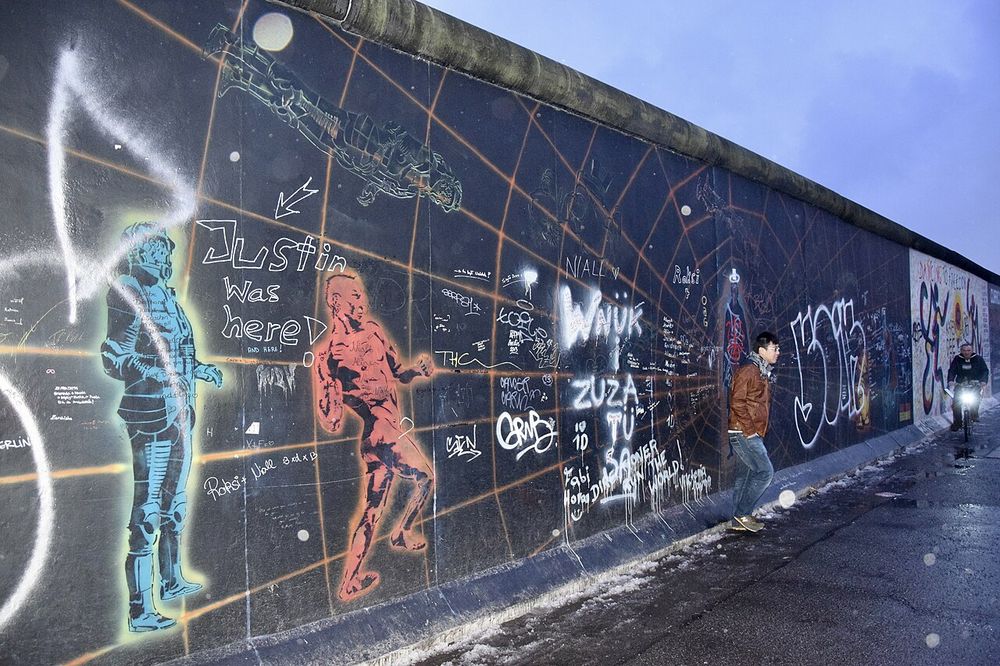
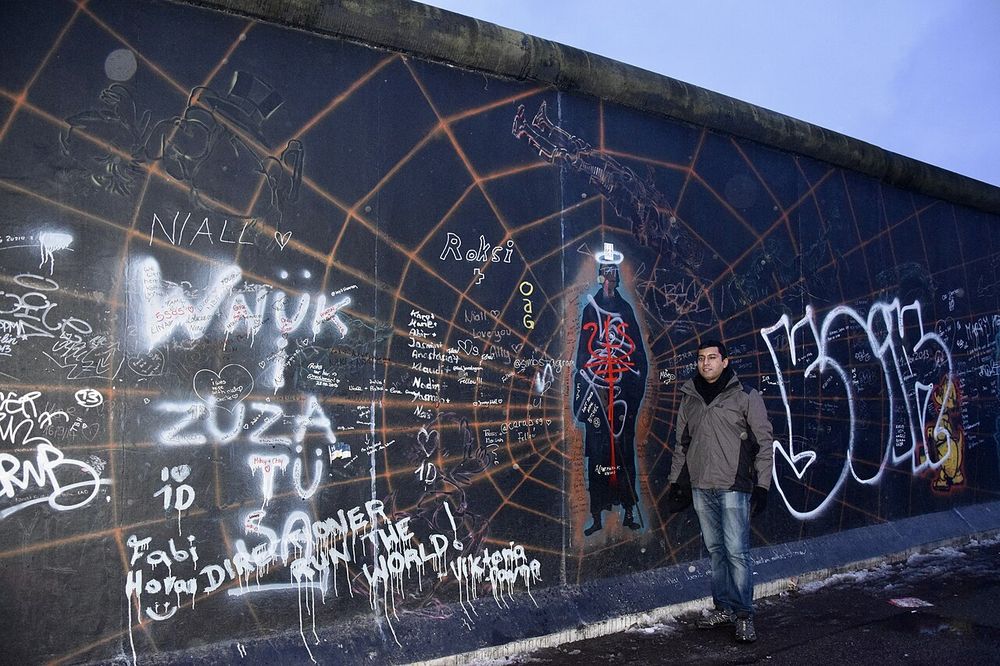
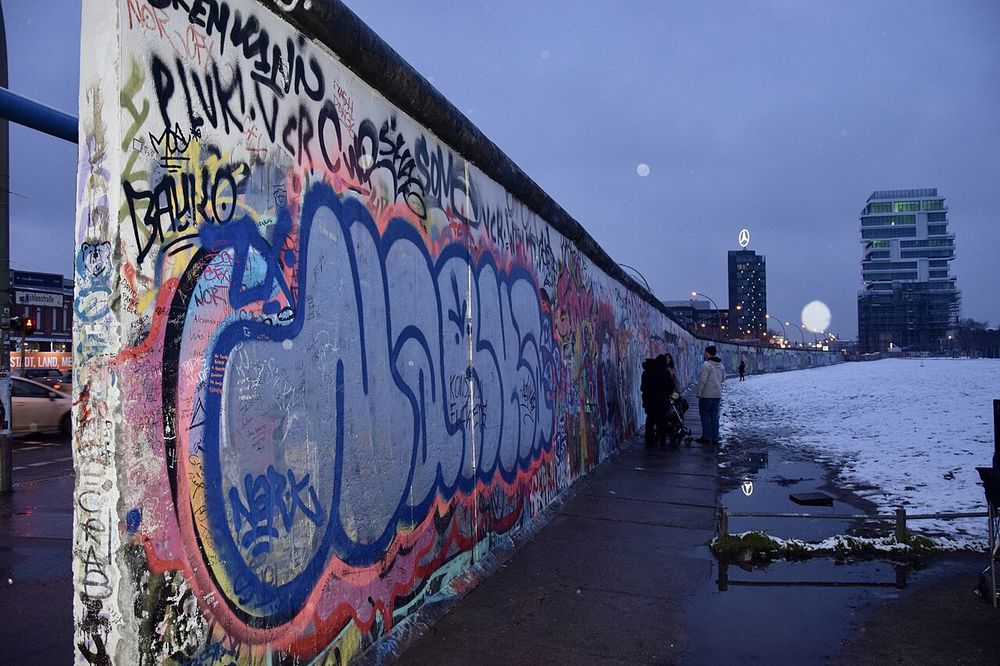
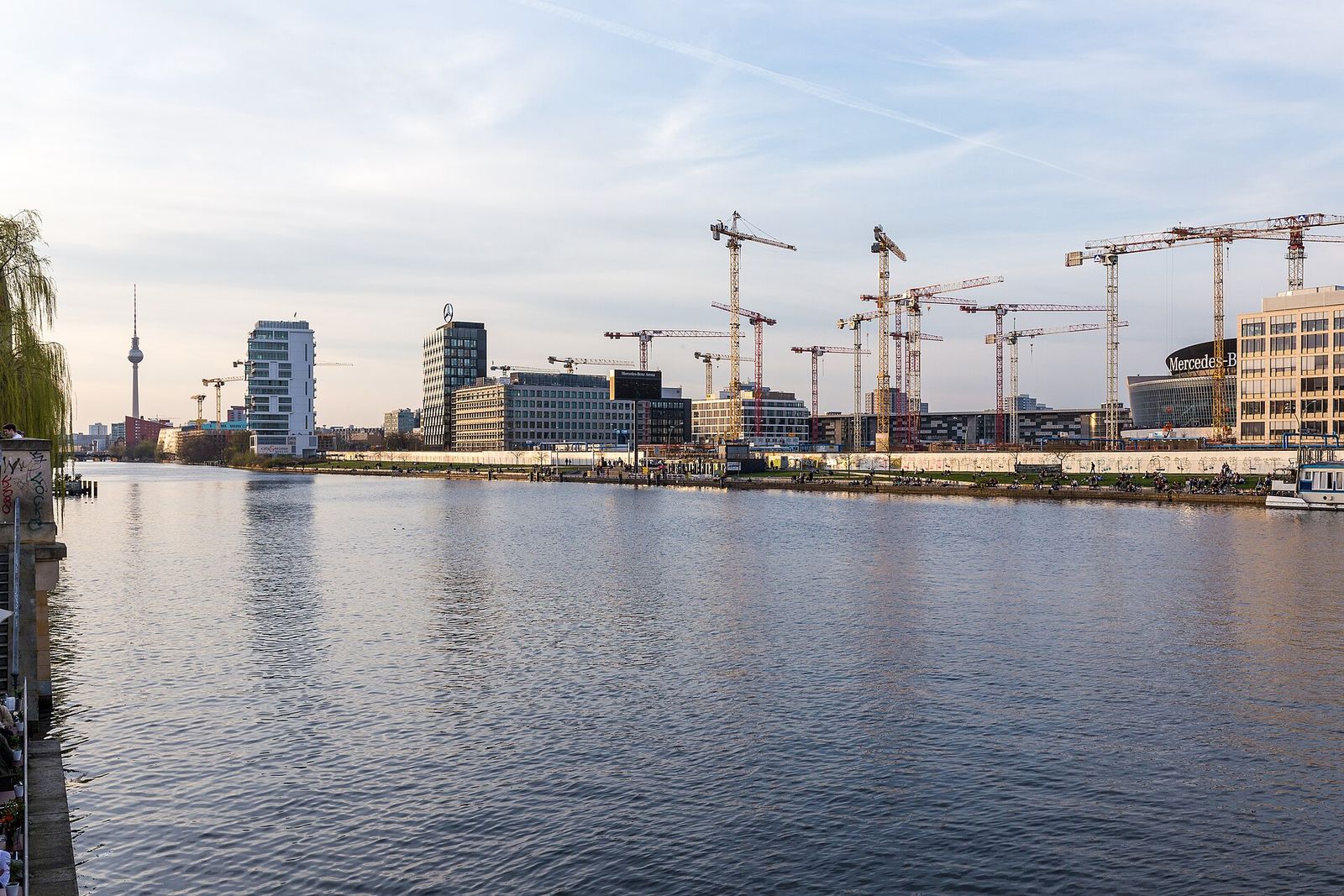
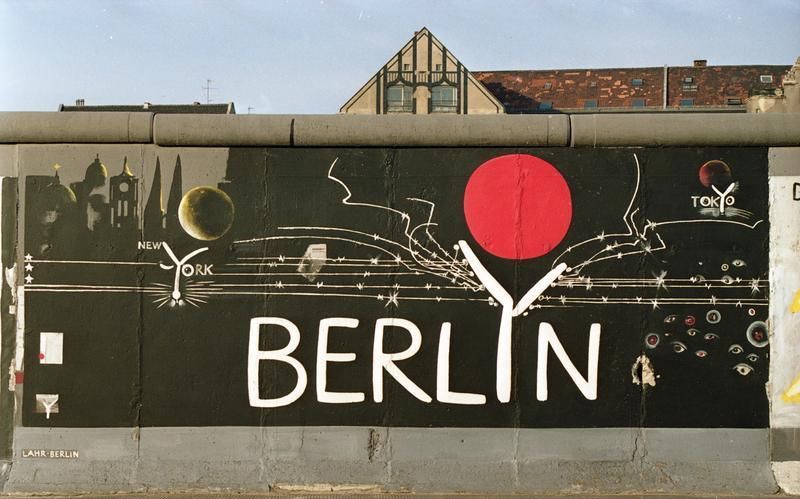
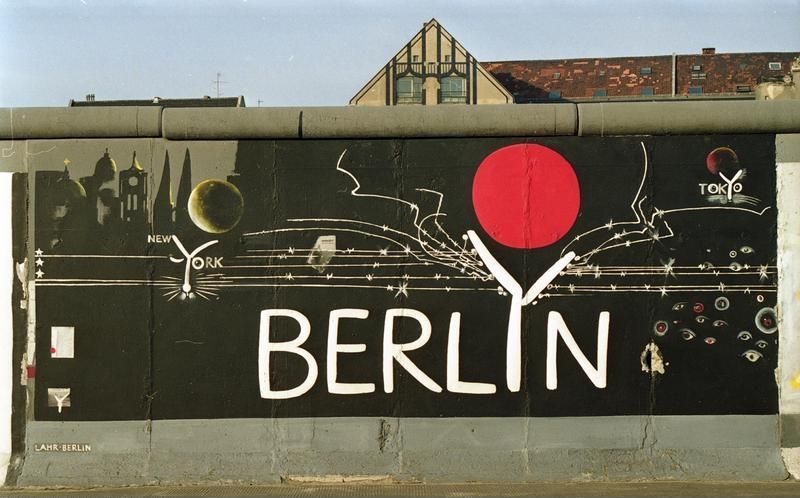
The longest piece of the Berlin Wall still standing: 1.3 kilometres beside the river Spree. In 1990, in the months between the opening of the border and the end of East Germany, 118 artists from 21 countries painted it from end to end. They painted the side that faces East, which until then nobody had been allowed to touch.
Photo: Rene Ehrhardt from Reading, United Kingdom, CC BY 2.0, Wikimedia Commons
The story
On the western side the Berlin Wall was painted for years. Anyone could walk up to it. On the eastern side it stayed white. Here people walked and drove past it every day, and nobody dared put a mark on it.
The border opened on 9 November 1989. Within months artists came to this stretch with ladders. What they made is a picture of one year, 1990, when nobody yet knew how things would turn out.
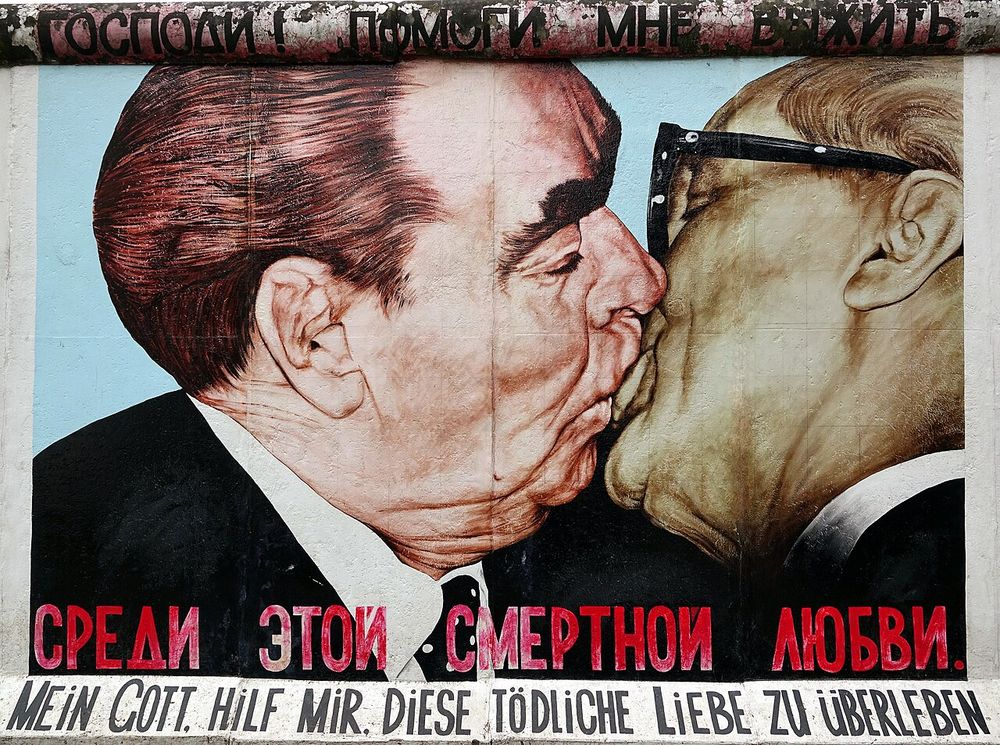
Two old men in suits kiss on the mouth, eyes shut. One is Leonid Brezhnev, the Soviet leader. The other is Erich Honecker, who ran East Germany.
It happened. The kiss was a formal greeting between communist leaders, and a French photographer caught this one in East Berlin in October 1979, at the thirtieth birthday of the East German state. The Russian painter Dmitri Vrubel saw the photograph and painted it here in 1990, over three metres high.
Under it he wrote, in Russian and German: "My God, help me to survive this deadly love." Ten years earlier that would have meant prison. By 1990 the state that built the wall could no longer stop a man painting on it.
Things people often get wrong
"This is graffiti from the Cold War." Not one of these paintings was here while the border was shut. All were painted between February and September 1990.
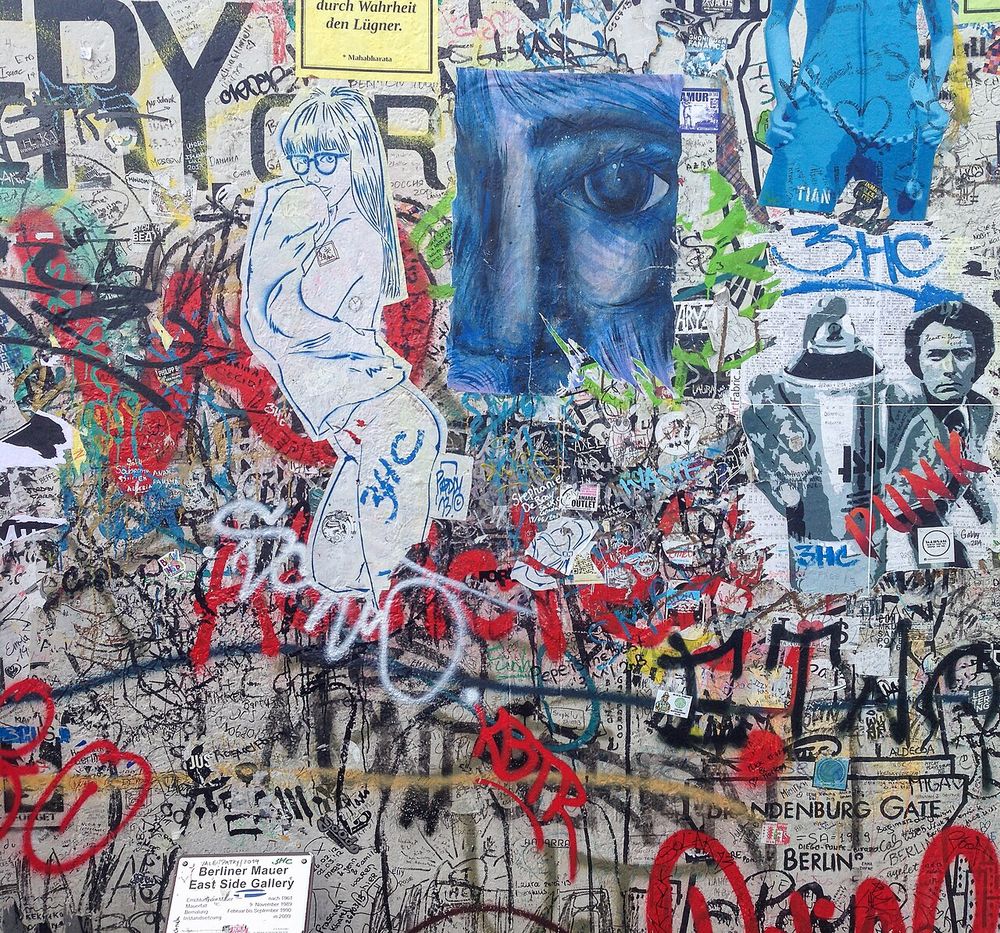
"I am looking at the paint of 1990." Mostly not. Weather, exhaust and visitors' pens wore the pictures away. In 2009 the wall was repaired and stripped, and the artists were asked to paint their pictures again. Most did. A few refused.
"West Berlin was on the other side of this wall." The river was. The whole width of the Spree belonged to the East, and West Berlin began on the far bank.
"It is a gallery." There is no door, no ticket and no closing time. It is a pavement beside a busy road.
People who stood here
Dmitri Vrubel (Russian painter, 1960–2022)He came from Moscow in 1990 and was given a segment like everyone else. His kiss became the most photographed picture in Berlin. In 2009 he painted it again from the beginning, and he spent his last years in the city.
Régis Bossu (French press photographer)He took the photograph of the kiss in October 1979. It ran across two pages of a Paris magazine. Without his picture there would be no painting.
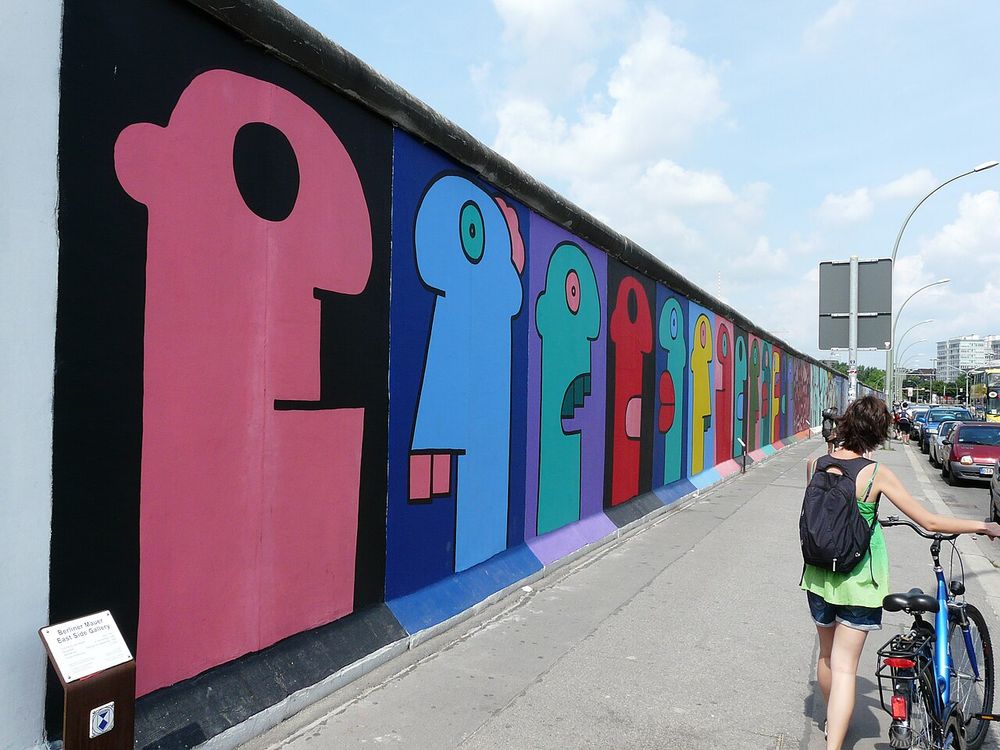
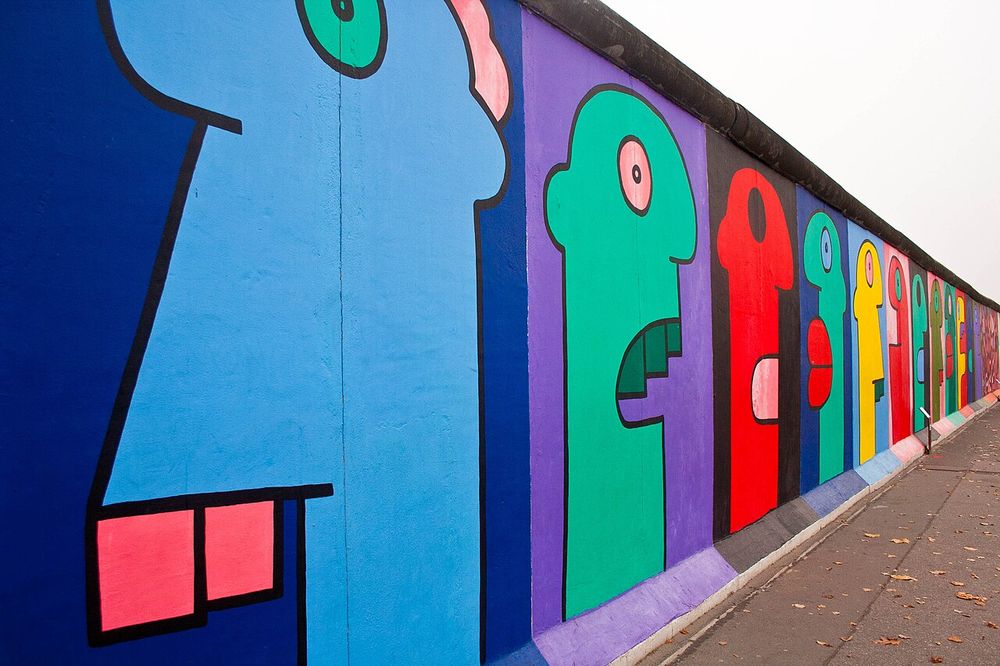
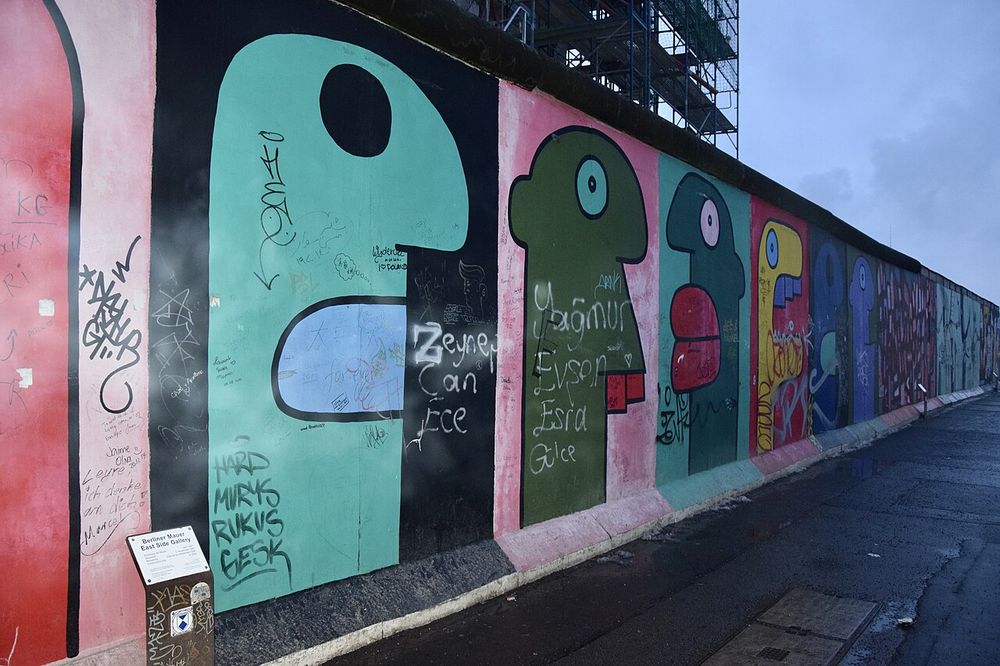
Thierry Noir (French painter, born 1958)He moved to West Berlin in 1982 and lived in a squat beside the Wall. In 1984 he began to paint it, on the western side, with big bright heads in profile. He painted fast and simply. Here in 1990 he painted the same heads on the side he had never seen.
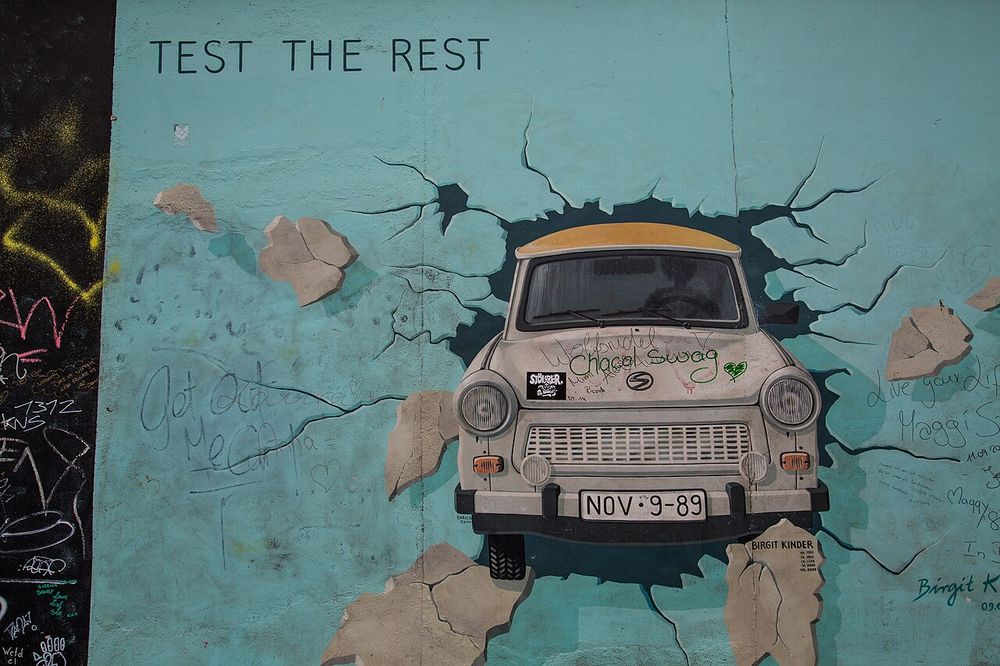
Birgit Kinder (German painter, born 1962)She grew up in East Germany and painted the car she knew: a Trabant, the small East German car with a plastic body, bursting through the wall towards you. The number plate is the date the border opened.
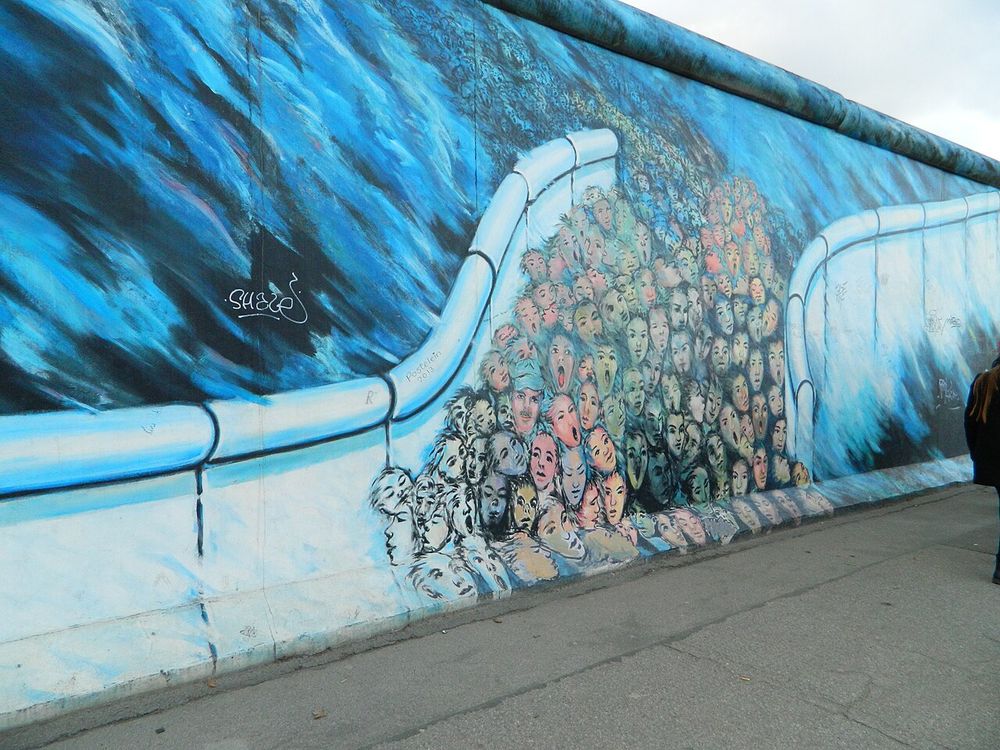
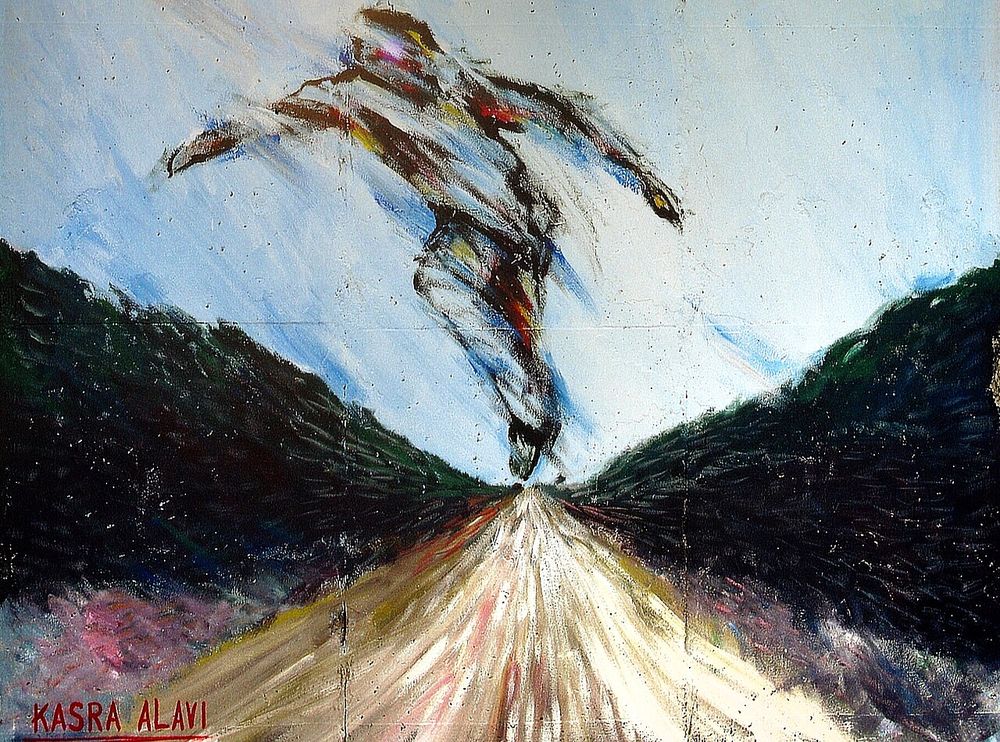
Kani Alavi (Iranian-born painter, born 1955)He came to West Berlin in 1980 and lived by the crossing called Checkpoint Charlie. On the night of 9 November he watched from his window as the crowd came through. He painted their faces here, and for many years led the artists' fight to keep the wall standing.
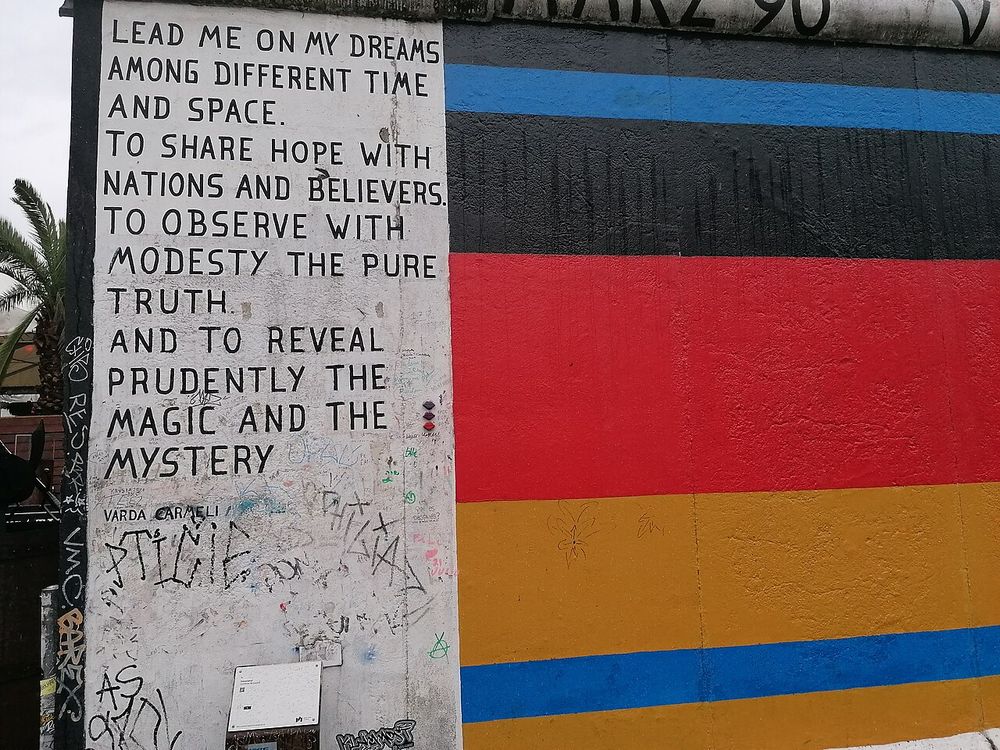
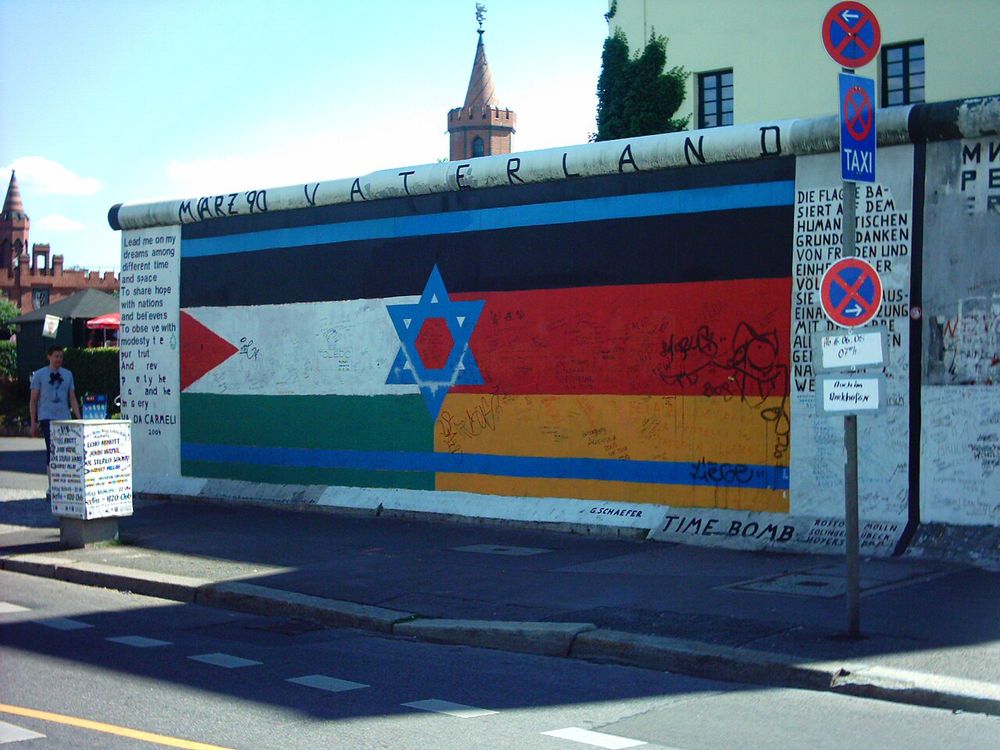
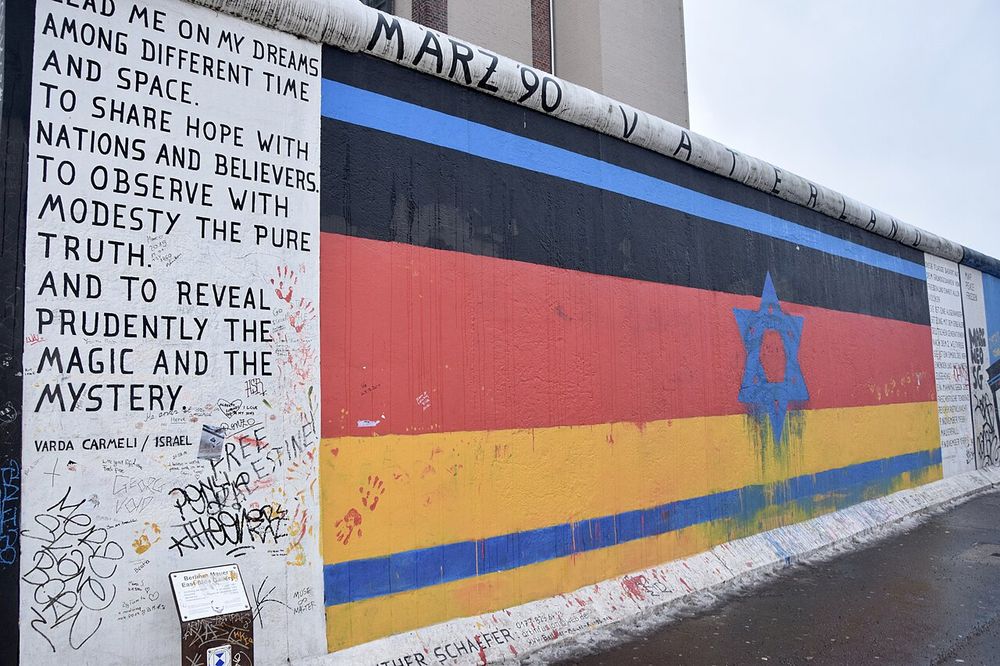
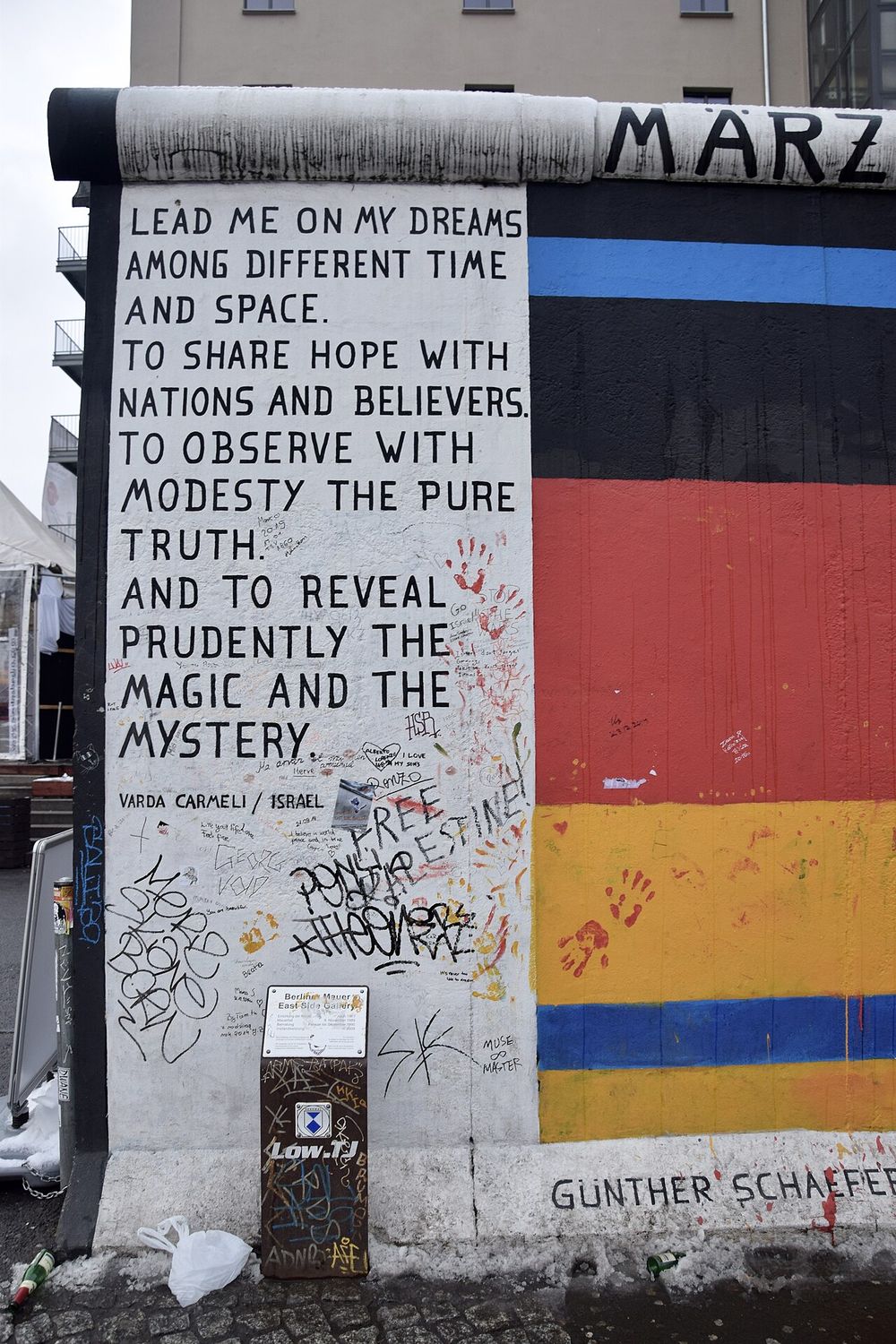
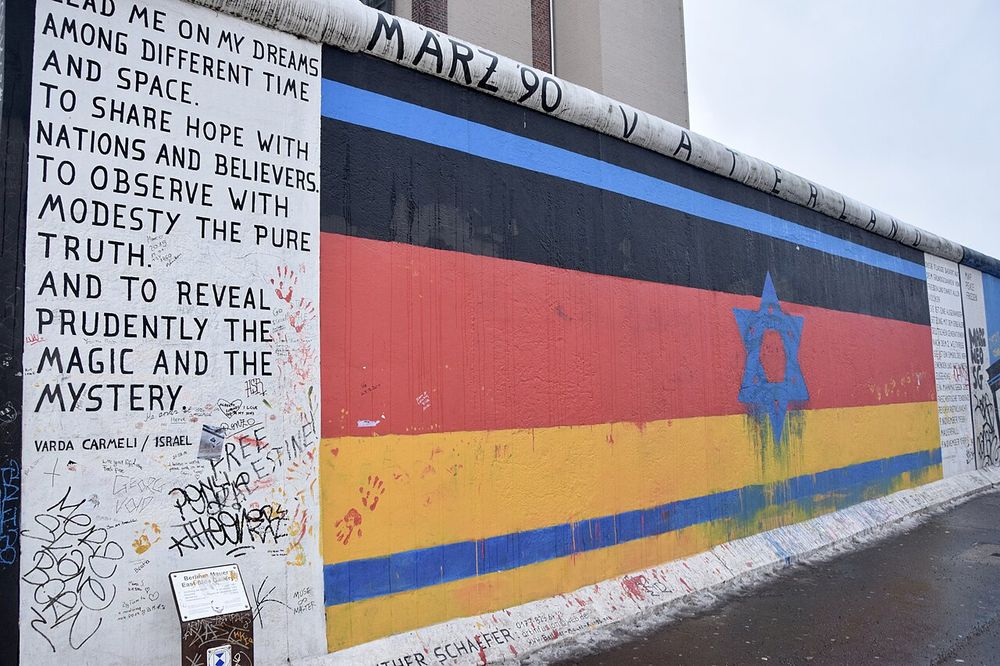
Günther Schaefer (German painter and photographer)He painted the German flag with the Star of David laid over it, for two ninths of November: 1938, when synagogues burned across Germany, and 1989. It has been defaced dozens of times. He repaints it each time.
Christine MacLean (Scottish gallerist)In 1990 she found the artists, handed out the segments and the paint, and got leave from the East German authorities, who still owned the wall.
Çetin Mert (child, 1970–1975)He lived on the western bank opposite. On his fifth birthday, 11 May 1975, his ball rolled into the river and he went in after it. West Berlin firemen stood on the bank and were not allowed into the water, because the water was East.
Go deeper: eight stops along the wall
The wall runs along Mühlenstraße from the East Station to the Oberbaum Bridge. The stops below are not in walking order. The crowd will show you where the kiss is.
1. The wall itself
The wall beside the road, May 2014Rae Allen from Brisbane, Australia, CC BY 2.0
Look at it before you look at the paintings. Each segment is an L of concrete 3.6 metres high and 1.2 metres wide, and weighs nearly three tonnes. A crane stood them in a row. The round pipe on top was to stop hands and hooks.
This road was also the way official guests were driven in from the airport. That is the reason usually given for the wall here being the best kind, smooth and painted white.
2. The kiss
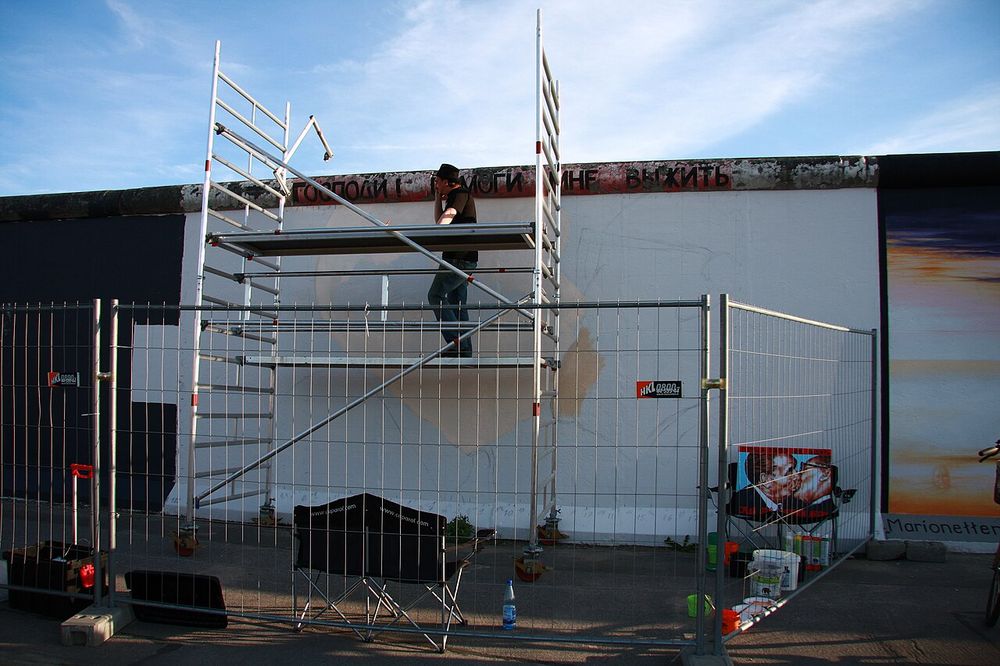
Scaffolding for the repainting, June 2009Wo st 01 (There are 682 Pictures in my Category) See also Toolserver, CC BY-SA 3.0 de
In 2009 the old painting was scraped off and the painter stood here on a scaffold, copying his own work from a photograph. He was upset to find the original gone. The second version is sharper and cleaner. Whether it is the same picture is a fair question.
The same shot: come before nine in the morning, when the pavement is empty, and stand back as far as the kerb.
3. The Trabant
The Trabant, September 2014Tony Webster from Portland, Oregon, United States, CC BY 2.0
East Germans waited ten years and more for one of these cars. In November 1989 they drove them west in long queues, two-stroke engines smoking, and West Berliners banged on the roofs in welcome. The painter first called the picture "Test the Best", a play on a cigarette slogan of the time, "Test the West". When she repainted it she changed one word.
4. The heads
Heads by Thierry NoirGonzalo Malpartida from Madrid, España, CC BY-SA 2.0
Big lips, one eye, flat colour, a black outline. They look like a child's drawing and they are meant to. The painter has said that a picture on the Wall had to be done quickly.
5. November
Kani Alavi's crowd of faces, April 2013Freepenguin, CC BY-SA 3.0
A river of faces pours through a gap. Look at the faces one by one. Some are laughing. Many are frightened, or blank. The painter watched the real crowd and did not see only joy.
6. The flag
The flag paintingChaddy, CC BY-SA 4.0
Black, red and gold, with a six-pointed star laid over it. In Germany 9 November is two dates in one. That is why the country's national day is 3 October and not the day the Wall opened.
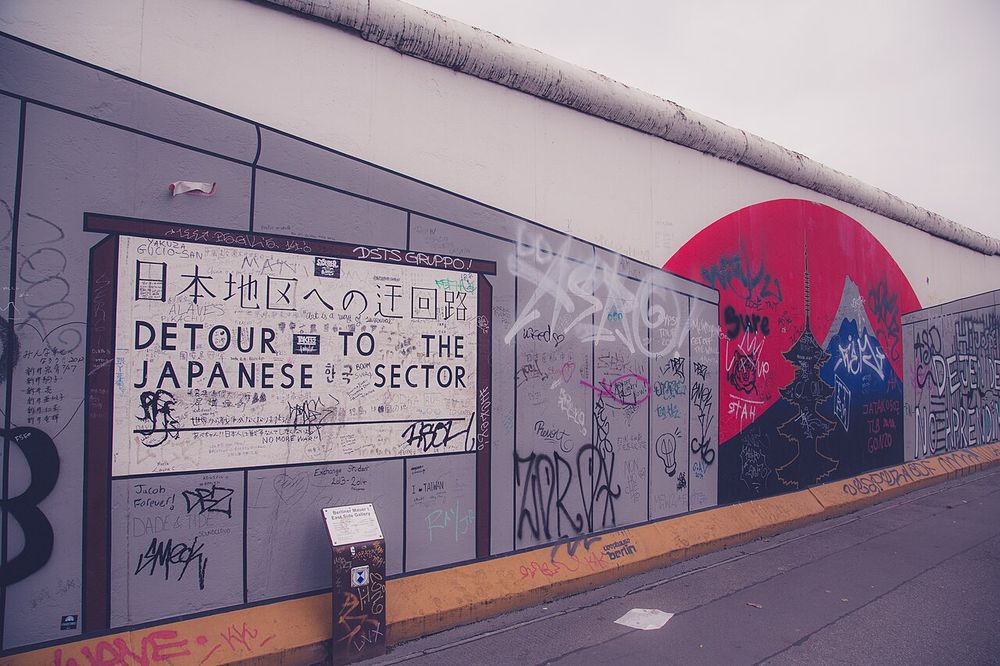
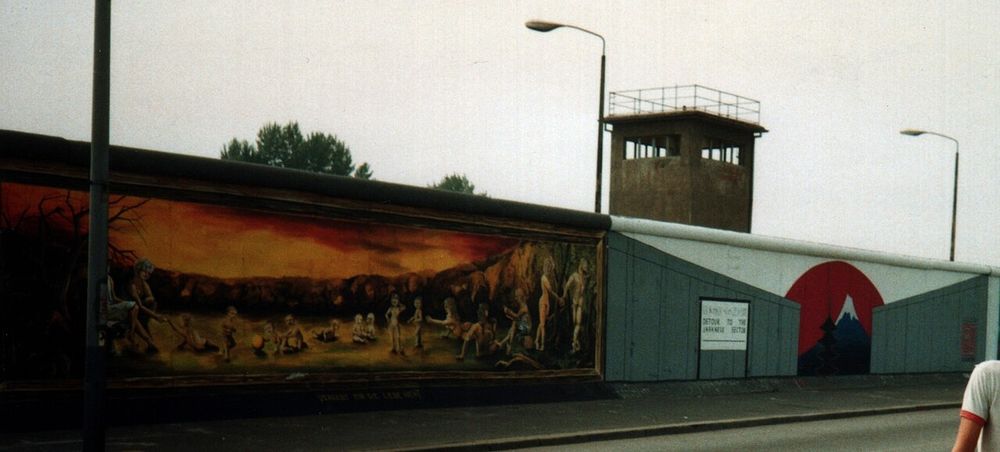
"Detour to the Japanese Sector", 2014Tony Webster from Portland, Oregon, United States, CC BY 2.0
Near by, a painter who grew up in East Berlin dreaming of Japan painted a detour to a sector the city never had: a Japanese one.
7. The other side
The river side, July 2014HerrAdams, CC BY-SA 4.0
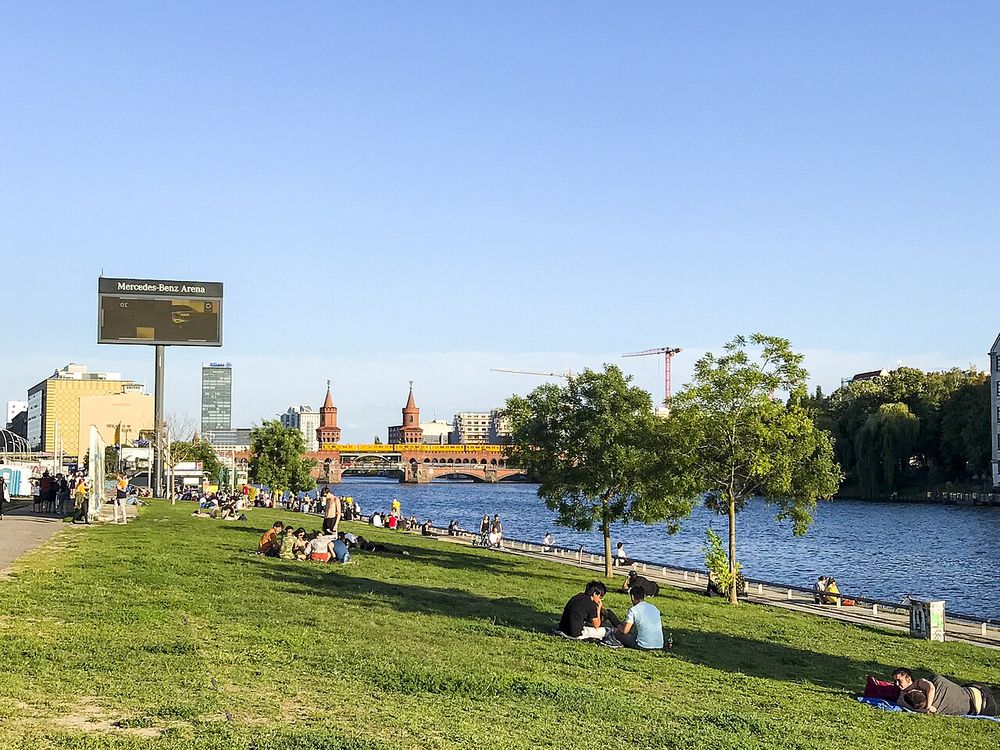
Walk through one of the gaps to the river. This side faced West. It is covered in tags now, and there is a lawn where the guarded strip was. Sit on the bank. The far shore was another country.
The wall from the Spree, 2009Photo: Andreas Praefcke, CC BY 3.0
Between 1966 and 1975 five children from the western bank fell into this water and drowned while rescuers argued about who was allowed to go in. After the fifth, the two governments signed an agreement, and rescue posts were set up along the bank.
8. The bridge
The Oberbaum Bridge with the wall still across it, 1990Gerd Danigel, CC BY 3.0
The wall ends at the Oberbaum Bridge: red brick, two towers, a railway on top and a covered walk beneath, built in the 1890s. While the city was divided it was a crossing on foot only, for people with day passes. Now the yellow underground trains cross it every few minutes.
In the film Run Lola Run (1998) a young woman with bright red hair runs through the arcade under the tracks to save her boyfriend. Stand at the end of the arcade and you have the shot.
Meanwhile in the world
Year
Here
Elsewhere
1961
The river bank is sealed in August
Gagarin becomes the first man in space
1975
A fifth child drowns at the western bank; a rescue agreement follows
The war in Vietnam ends
1979
The two leaders kiss in East Berlin in October
Revolution in Iran
1989
The border opens on 9 November
Communist rule ends across eastern Europe
1990
Painted from February; opened on 28 September, five days before East Germany ceases to exist
Nelson Mandela walks out of prison
2009
The paintings are stripped and painted again
Barack Obama becomes president of the United States
2013
Crowds protest as segments are removed for a block of flats
Pope Francis is elected
2018
The Berlin Wall Foundation takes charge
The football World Cup is played in Russia
One line to remember: the wall is from 1961, the pictures are from 1990, and most of the paint is from 2009.
Then and now
The gallery along Mühlenstraße, October 2007Rene Ehrhardt from Reading, United Kingdom, CC BY 2.0, Wikimedia CommonsThe wall beside the road, May 2014Rae Allen from Brisbane, Australia, CC BY 2.0, Wikimedia CommonsWall and lawn, 2012Pudelek (Marcin Szala), CC BY-SA 3.0, Wikimedia CommonsThe name painted at one end, 2007Andreas Thum, CC BY-SA 3.0, Wikimedia CommonsThe kiss, March 2020Gzen92, CC BY-SA 4.0, Wikimedia CommonsScaffolding for the repainting, June 2009Wo st 01 (There are 682 Pictures in my Category) See also Toolserver, CC BY-SA 3.0 de, Wikimedia CommonsThe Trabant, September 2014Tony Webster from Portland, Oregon, United States, CC BY 2.0, Wikimedia CommonsHeads by Thierry NoirGonzalo Malpartida from Madrid, España, CC BY-SA 2.0, Wikimedia CommonsMore of the headsPaul VanDerWerf from Brunswick, Maine, USA, CC BY 2.0, Wikimedia CommonsThe heads from further offAnk Kumar, CC BY-SA 4.0, Wikimedia CommonsKani Alavi's crowd of faces, April 2013Freepenguin, CC BY-SA 3.0, Wikimedia CommonsThe flag paintingChaddy, CC BY-SA 4.0, Wikimedia CommonsThe flag painting in an earlier yearJensen, CC BY-SA 3.0, Wikimedia CommonsThe flag again: it is often repaintedAnk Kumar, CC BY-SA 4.0, Wikimedia CommonsThe flag painting, another viewAnk Kumar, CC BY-SA 4.0, Wikimedia CommonsThe flag in another yearAnk Kumar, CC BY-SA 4.0, Wikimedia Commons"Detour to the Japanese Sector", 2014Tony Webster from Portland, Oregon, United States, CC BY 2.0, Wikimedia CommonsThe "Berlin" paintingAnk Kumar, CC BY-SA 4.0, Wikimedia CommonsOne of the paintingsAnk Kumar, CC BY-SA 4.0, Wikimedia CommonsThe pavement in January 2015Ank Kumar, CC BY-SA 4.0, Wikimedia CommonsPaintings in winter light, January 2015Ank Kumar, CC BY-SA 4.0, Wikimedia CommonsWriting over writingAnk Kumar, CC BY-SA 4.0, Wikimedia CommonsA painting on filmHeribert Pohl --- Thanks for half a million clicks! from Germering bei München, , CC BY-SA 2.0, Wikimedia CommonsThe river side, July 2014HerrAdams, CC BY-SA 4.0, Wikimedia CommonsTags on the river side, 2014HerrAdams, CC BY-SA 4.0, Wikimedia CommonsThe lawn on the bank, August 2019Indrajit Das, CC BY-SA 4.0, Wikimedia CommonsThe wall from the Spree, 2009Photo: Andreas Praefcke, CC BY 3.0, Wikimedia CommonsThe Spree and the wall in the distance, March 2017Ansgar Koreng, CC BY-SA 4.0, Wikimedia CommonsThe Oberbaum Bridge with the wall still across it, 1990Gerd Danigel, CC BY 3.0, Wikimedia CommonsThe "Berlin" painting when new, 1990Joachim F. Thurn, CC BY-SA 3.0 de, Wikimedia CommonsThe same painting in 1990Joachim F. Thurn, CC BY-SA 3.0 de, Wikimedia CommonsA segment in August 1990Lklundin, CC BY-SA 3.0, Wikimedia Commons
Local legends
These are stories people tell about this place. They are legends, not history, and each one says where it comes from.
LegendPaint fast, and be ready to run
It is said that the first painters on the western side worked with one eye on a small steel door. The ground just in front of the Wall still belonged to the East, and guards could step out through the door and arrest whoever was there.
Source: Thierry Noir's own account of painting from 1984. The strip of eastern ground and the doors are documented; how often painters were chased is his telling
Later, people who live here will be able to add the stories they grew up with, and say which of these they have heard.
Not certain, and where accounts conflict
Is this still the work of 1990?
The pictures were repainted in 2009 by most of the same artists. Some painters refused, saying a copy is not the original and that they had not been asked properly. Their pictures were left, covered or redone by others, and the argument went to court.
Who painted the Wall first?
Thierry Noir is usually named, for 1984. People had written slogans on the western side since the 1960s, and others were painting at about the same time. Nobody kept a record.
How many pictures are there?
About a hundred. The figure usually given for 1990 is 118 artists from 21 countries. Some pictures have been lost to building work and some segments have been moved.
Visiting
Tickets and hours
Free, at all hours, every day.
The pictures are best in morning light. By late morning the pavement is crowded.
Last checked 2026-11-12. The Berlin Wall Foundation, which has looked after the gallery since 2018, and the artists' own accounts.
Booking from abroad
Note The foundation offers guided walks in English on some days; times are on its site.
Checked 2026-11-12
Where to start
S-Bahn to Ostbahnhof and walk east; or S-Bahn and U-Bahn to Warschauer Straße, cross the road to the bridge, and walk west.
Walk the painted side one way and the river side back. Allow an hour and a half.
Before you go
There is no shade and no shelter on the painted side.
If you see men with three cups and a ball on the pavement, they are cheats. The winners in the crowd work with them. Do not stop.
Keep a hand on your bag in the crowd at the kiss.
Customs and manners
Do not write on the wall. It is a protected monument, and writing on the pictures is an offence.
Do not climb on it or prop a bicycle against it.
Look behind you before you step back for a photograph. Berlin cyclists ride fast.
Posing for a kiss in front of the kiss is the custom, and nobody minds. Remember all the same that people died within sight of this wall.
Look for these
Find the round pipe on top of the wall.
Find the joints between segments. How wide is one?
Read the number plate on the Trabant.
Find the line of writing under the kiss. Which two languages?
In the crowd of faces, find one that is not happy.
Find a head with one eye.
On the river side, find where the lawn was once a road.
From the bridge, work out which bank was West.
I am here
Stand at the site, sign in, press the button, and collect its stamp. Your browser will ask to use your location. It is sent to us once to confirm that you are at the site; we keep how far you were from it, not the spot where you stood.
Your stamps are saved to your account, so they follow you to any device. Checking from a browser cannot rule out every false location; stricter checks arrive with the app.
Messages
Share your photos
Photos here show the place, not people. Each one is credited to the visitor who took it and appears after our team has looked at it. A photo with you in it belongs under “I am here”.