Gedenkstätte Berliner Mauer · geh-DENK-shtet-teh bair-LEE-ner MOW-er
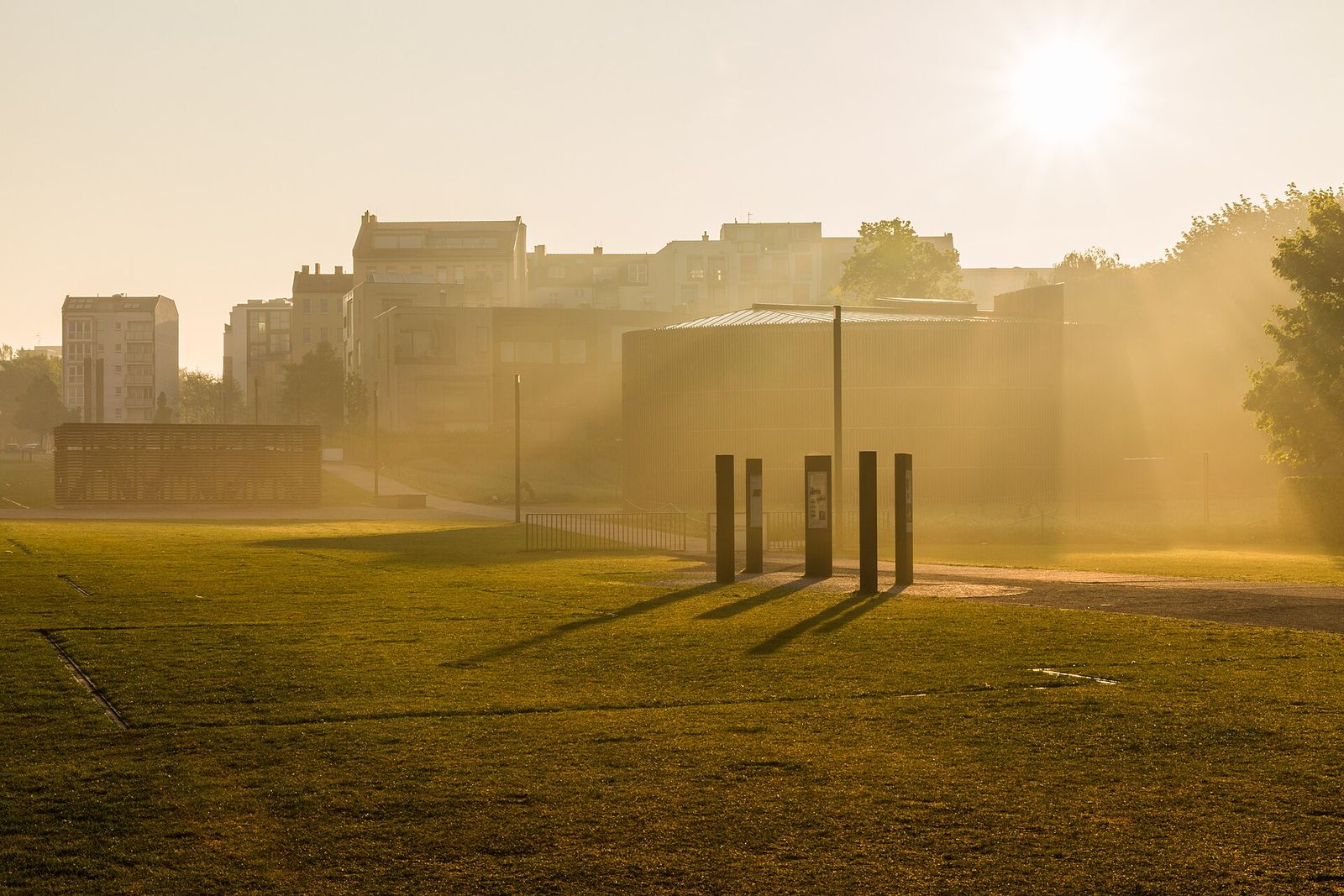
One street, 1.4 kilometres long, where the Berlin Wall can still be understood. Here the border ran along the fronts of the houses: the rooms were in the East and the pavement was in the West. In August 1961 people jumped from their windows into the other country. Seventy metres of the whole barrier, front wall, sand strip, watchtower and back wall, have been kept as they were.
Photo: Ansgar Koreng, CC BY-SA 4.0, Wikimedia Commons
The story
After 1945 Berlin was divided among the four victorious powers. By 1961 more than two and a half million people had left East Germany, most of them through the open border in the city. Early on Sunday 13 August 1961 the East German government closed it with barbed wire, and within days began to build a wall.
It stood for twenty-eight years, two months and twenty-seven days. At least 140 people died at it. In China these years run from the last of the three hard years to the eve of the 1990s.
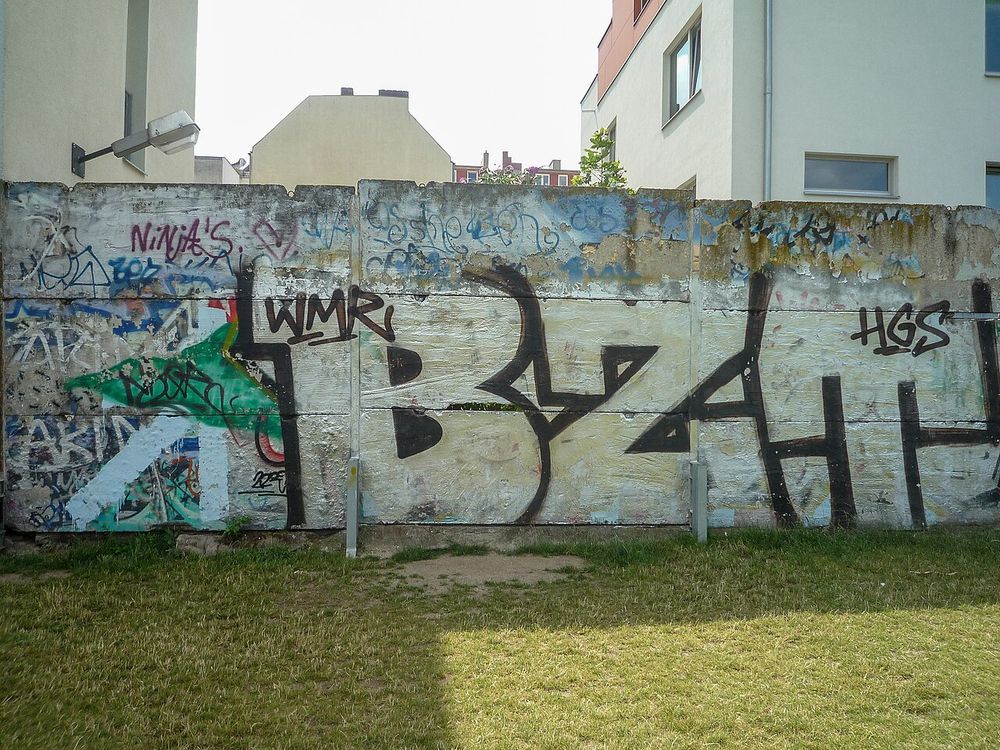
The front wall, March 2016Ansgar Koreng, CC BY 3.0 de
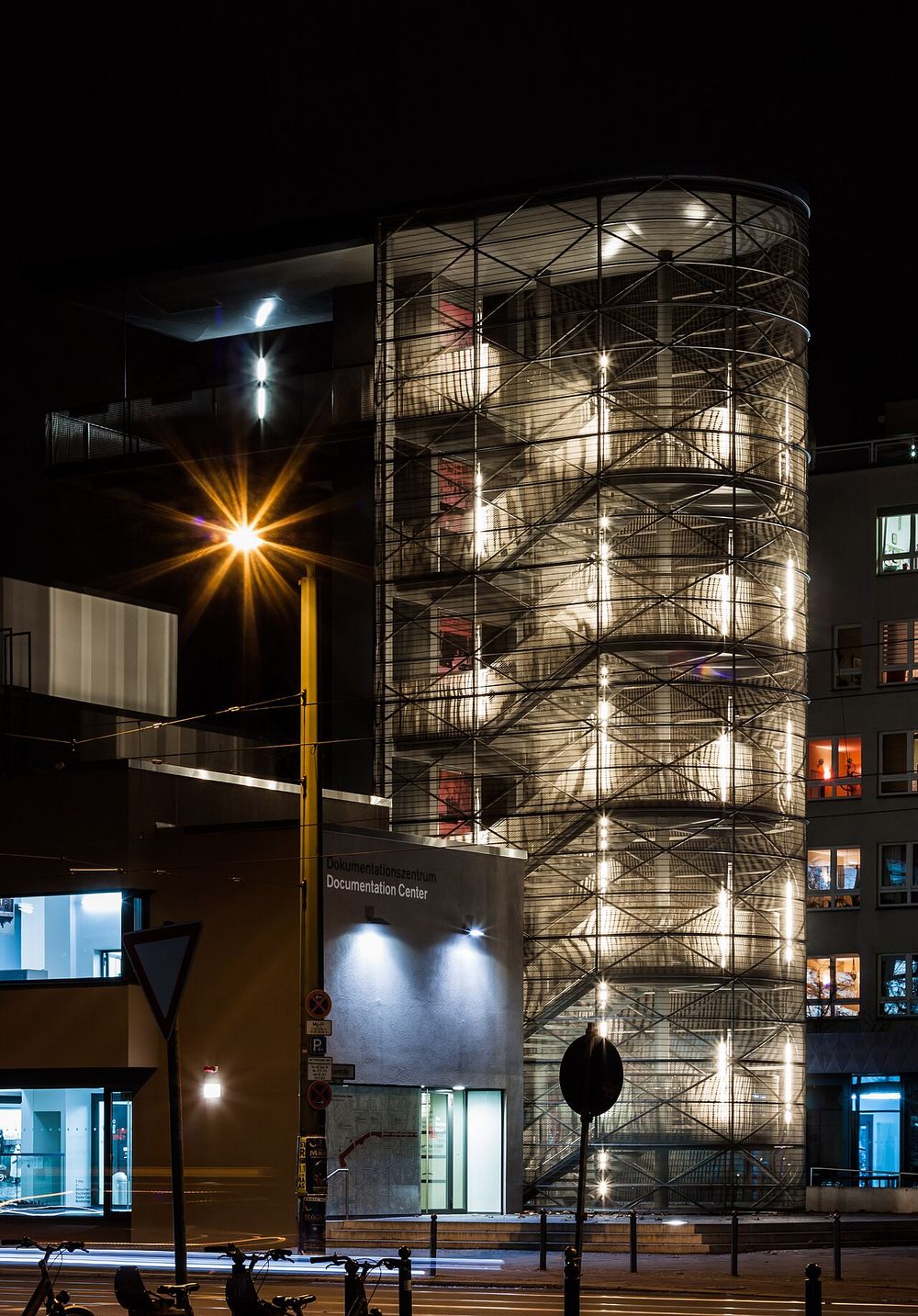
Across the street a tower of steel stairs stands beside the documentation centre. Climb it. It is free. From the top you look down into the only piece of the border that is still complete.
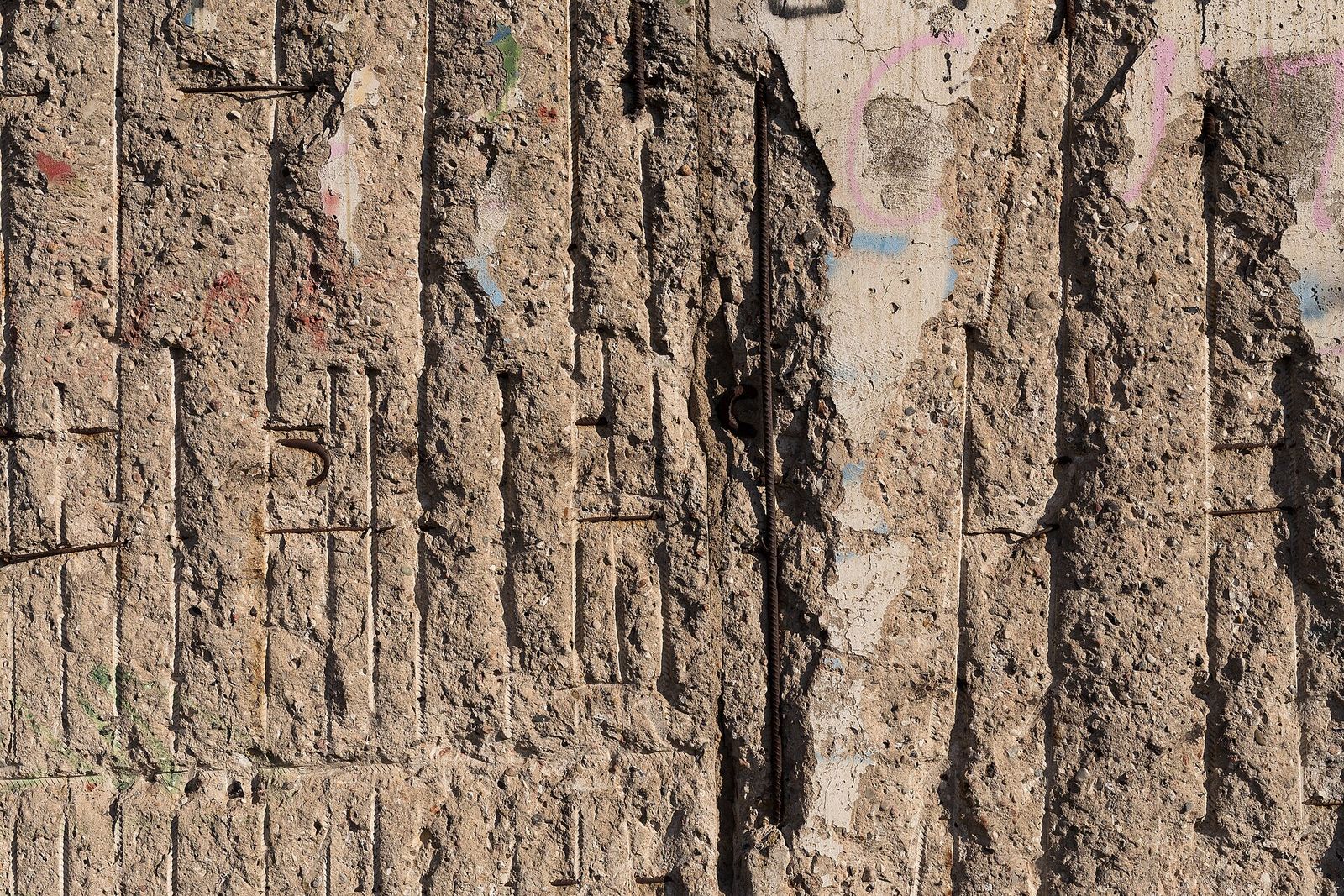
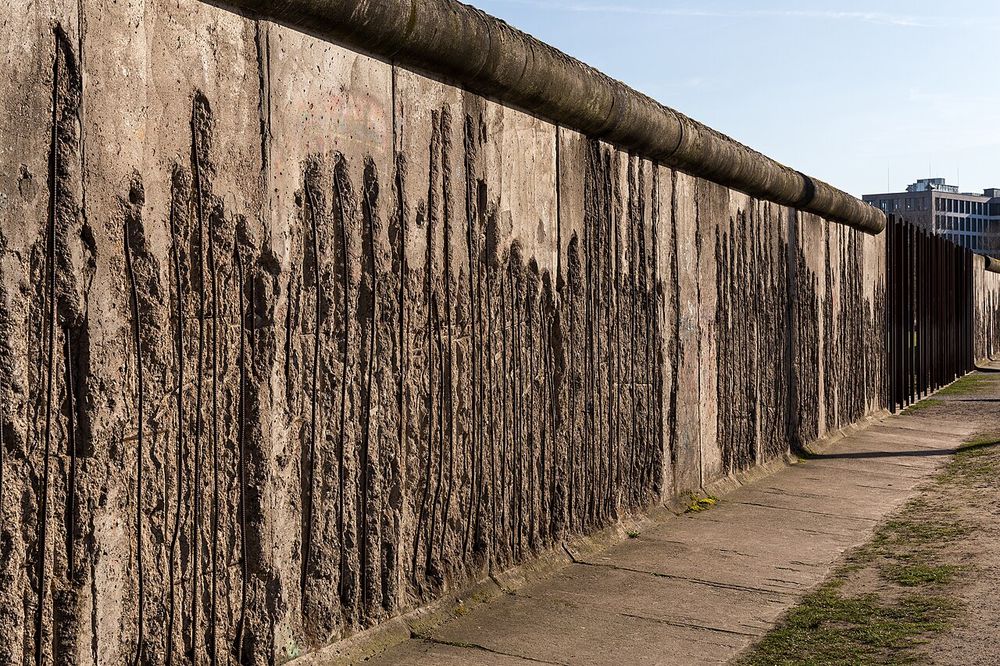
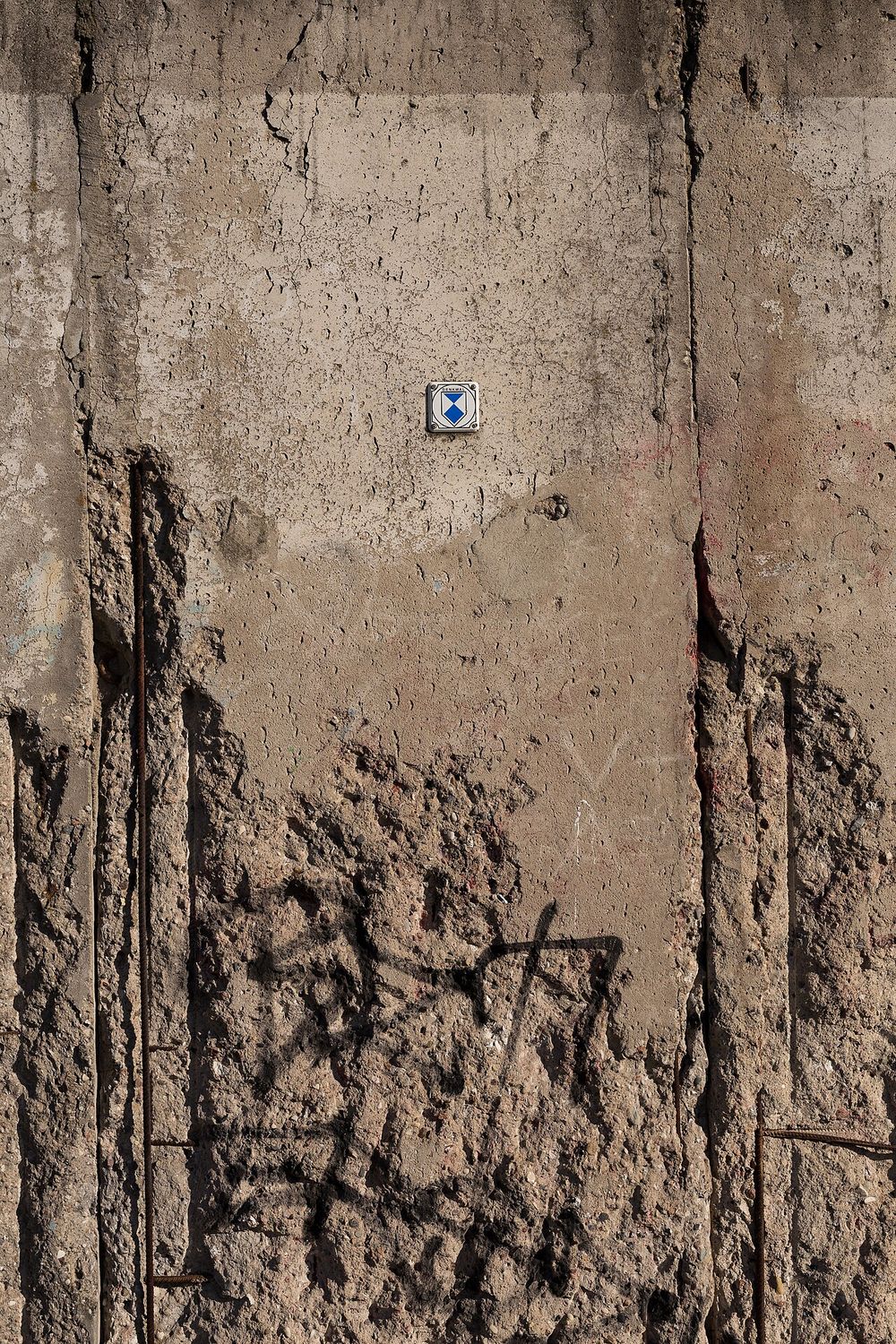
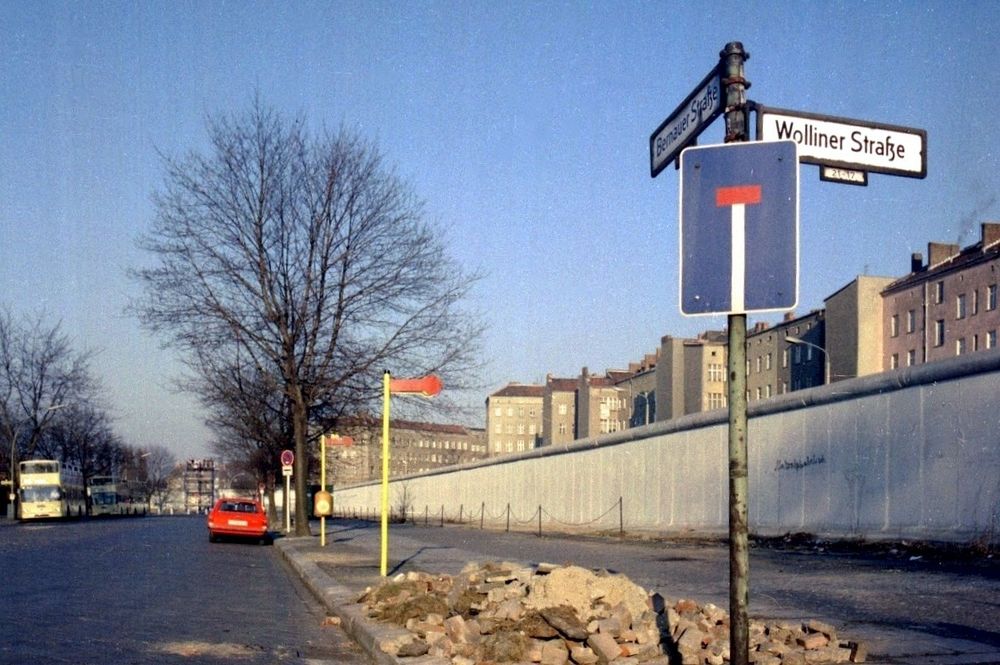
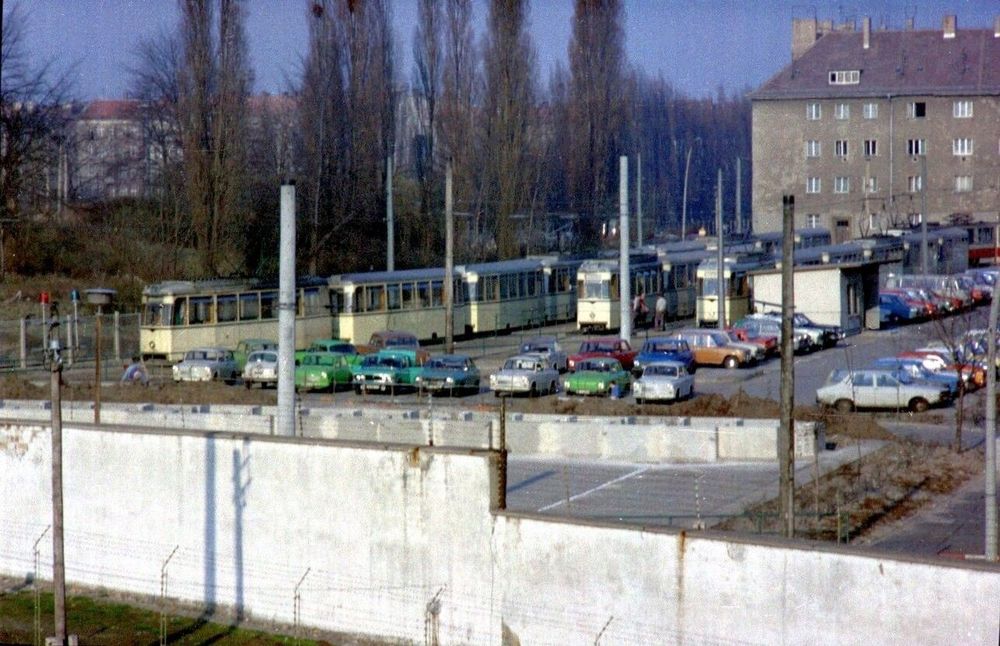
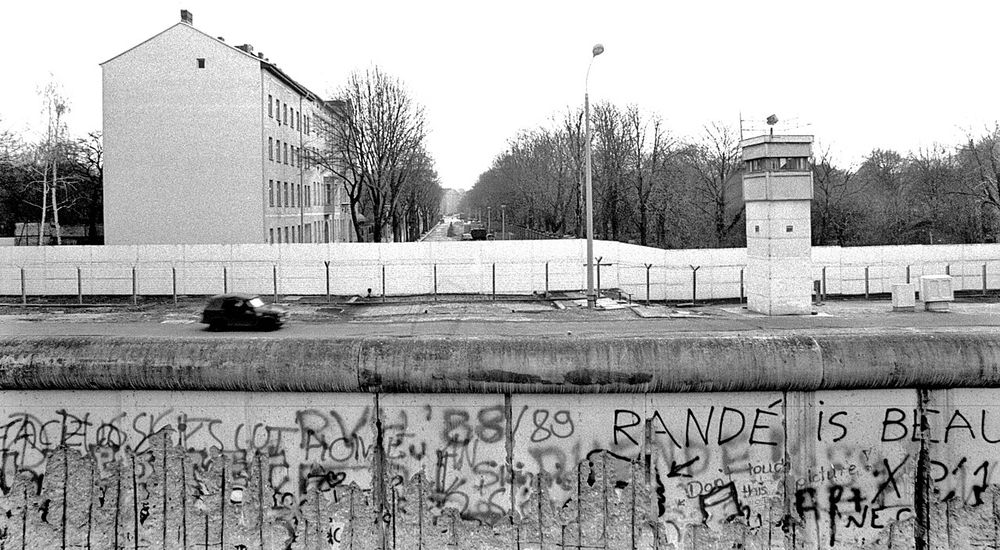
Nearest you is the wall everyone knows: grey concrete, 3.6 metres high, with a round pipe on top so that hands could not grip. That faced the West. But the Wall was not one wall. Behind it is a strip of raked sand that showed footprints, a road for patrol cars, a line of lamps that burned all night, a watchtower, and then a second wall facing the East.
An East Berliner who wanted to leave had to cross all of that, from the far side, under the lights. The people who built it called it the "anti-fascist protection rampart". Every part of it faced inward.
Things people often get wrong
"The Wall divided Germany." The border between the two German states was 1,400 kilometres of fence further west. The Wall ran round West Berlin, 155 kilometres of it, and made the western half of the city an island inside East Germany.
"It was built to keep enemies out." The guards looked east. Almost everyone shot here was trying to leave.
"Nobody intends to build a wall" sounds like a line made up afterwards. It is not. The East German leader Walter Ulbricht said it at a press conference on 15 June 1961, two months before the wire went up, and it is on film.
"It fell on 9 November 1989." It was opened that night, by mistake, when an official misread a note at a press conference. Tearing it down took until 1992.
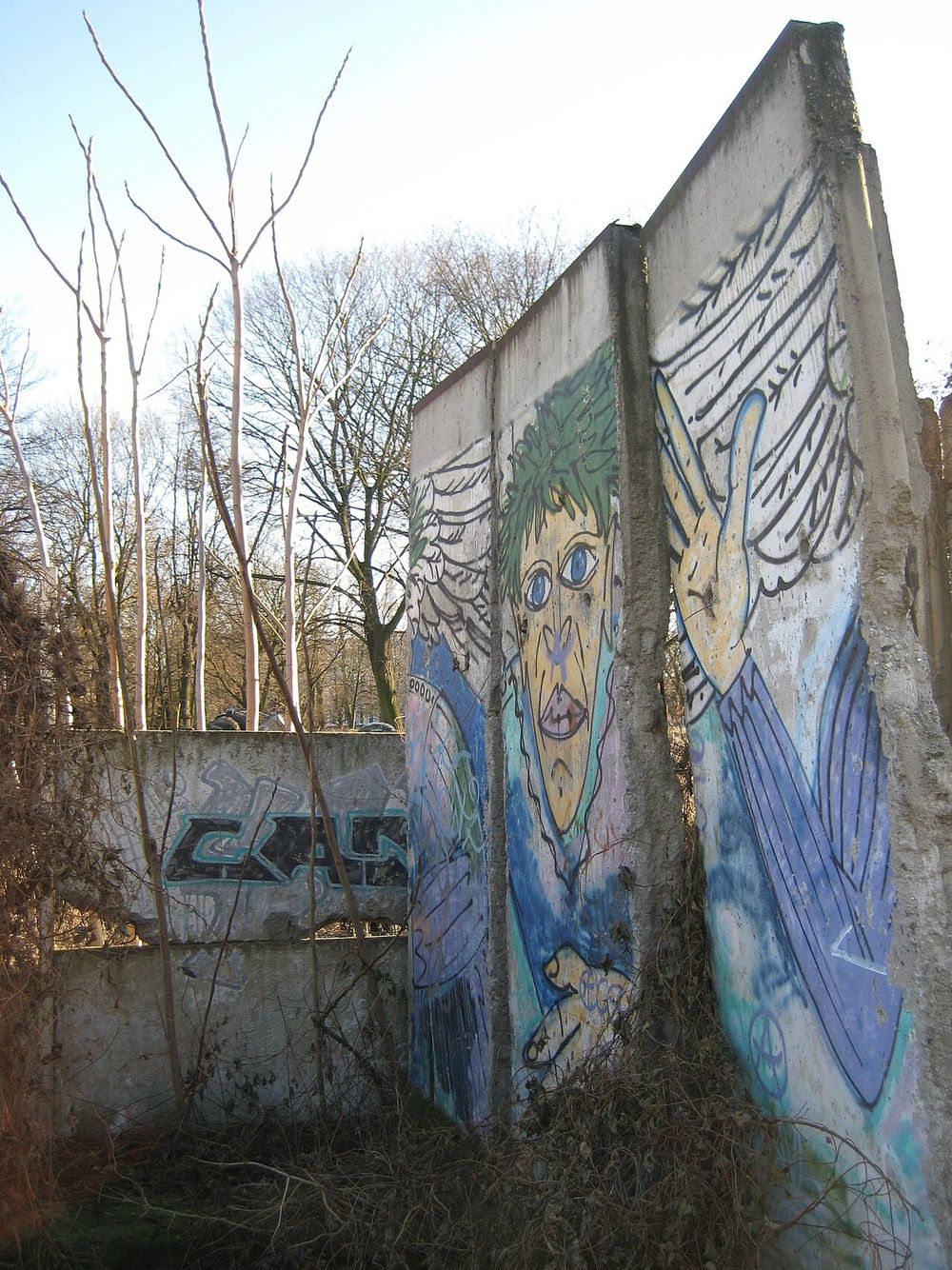
"The painted wall is the real one." The long painted stretch by the river is real, but it was painted after 1989. While the border stood, the side facing East was kept blank.
People who stood here
Ida Siekmann (nurse, 1902–1961)She lived on the third floor of number 48. On 22 August 1961, the day before her fifty-ninth birthday, with the front door nailed shut, she threw her bedding into the street and jumped after it. She was the first person to die at the Wall.
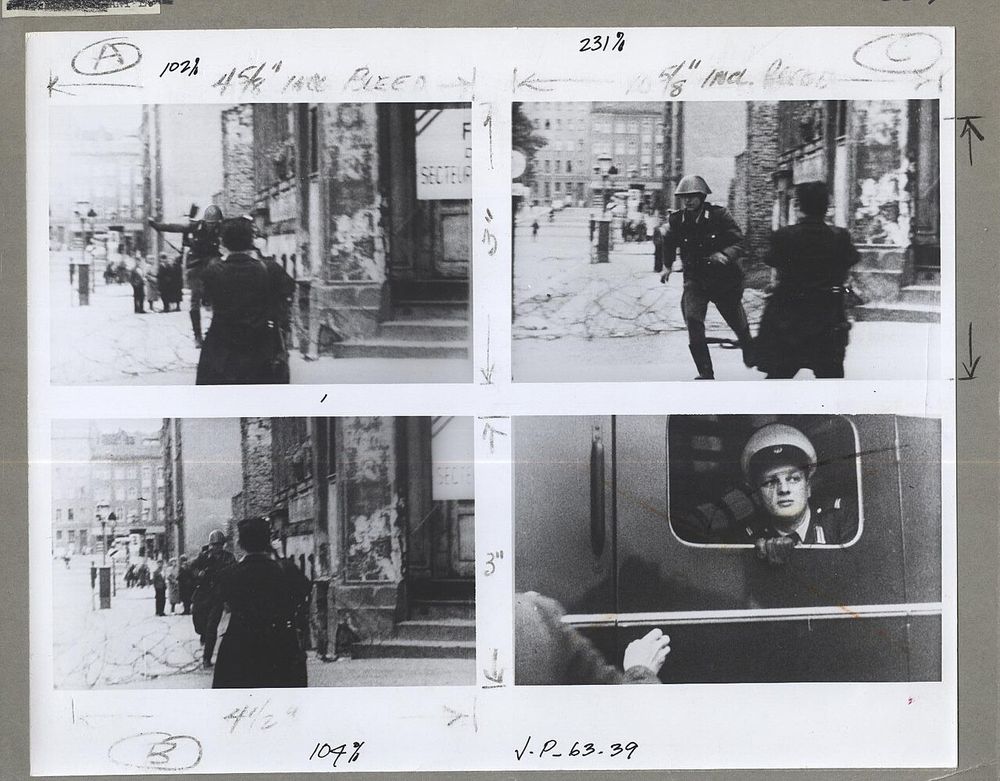
Conrad Schumann (East German border policeman, 1942–1998)He was nineteen and on guard at the corner of Ruppiner Straße on 15 August 1961, when the border was still a coil of wire. People on the western side called to him to come over. He threw down his cigarette, ran and jumped. A photographer was waiting.
Frieda Schulze (pensioner, aged 77 in 1961)On 24 September 1961, aged seventy-seven, she climbed out on to her first-floor window sill at number 29. East German police leaned out and held her by the arms. West Berliners below pulled her by the ankles. The West won.
Reinhard Furrer (student, later astronaut, 1940–1995)In 1964 he helped dig a tunnel 145 metres long from a bakery cellar on this street to an outdoor toilet in the East. Fifty-seven people crawled out through it in two nights. In 1985 he flew on the American space shuttle.
Egon Schultz (East German border soldier, 1943–1964)A teacher of twenty-one doing his service. He was shot dead in the yard where Tunnel 57 came up. East Germany named schools after him as a man murdered by Western agents. Files opened after 1990 showed that the fatal bullet came from another border soldier's gun.
Manfred Fischer (pastor, 1948–2013)His church stood in the death strip and was blown up in 1985. In 1990, when everyone wanted the Wall gone, he stood in front of the bulldozers on this street and insisted that a piece be kept so that it could be explained. The memorial exists because of him.
John le Carré (English novelist, 1931–2020)He was a young intelligence officer in Germany in 1961 and came to watch the Wall go up. He went home and wrote The Spy Who Came in from the Cold in five weeks. It ends with two people climbing the Wall at night under a searchlight.
Go deeper: eight stops along the street, west to east
Everything outdoors is free and open from early morning until late evening. The two centres are free and closed on Mondays.
1. The station of ghosts
The ghost-station exhibition, August 2025Aagnverglaser, CC BY-SA 4.0
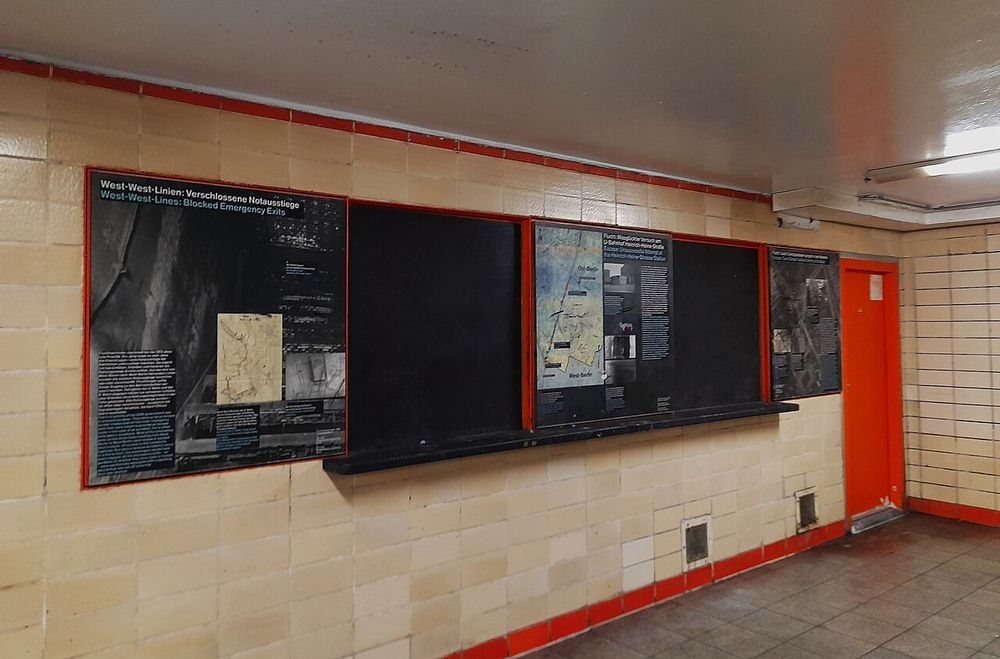
Begin under ground, in the S-Bahn station Nordbahnhof. Three train lines from West Berlin ran under East Berlin for a few minutes on their way. The trains did not stop. The stations were bricked up and dim, with armed guards on the platforms. West Berliners called them ghost stations. An exhibition in the hall tells the story.
2. The steel rods
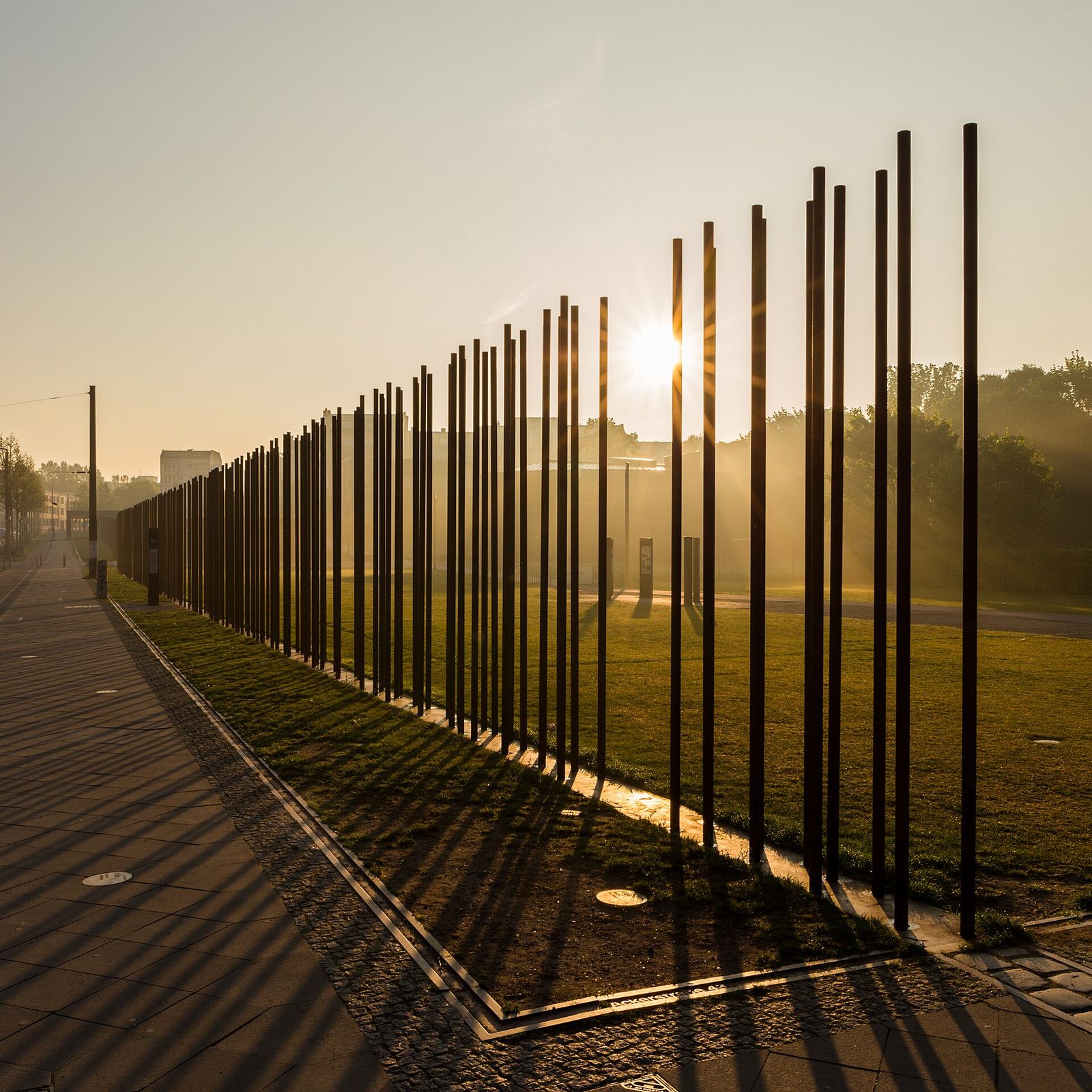
The rods against the lightAnsgar Koreng, CC BY-SA 4.0
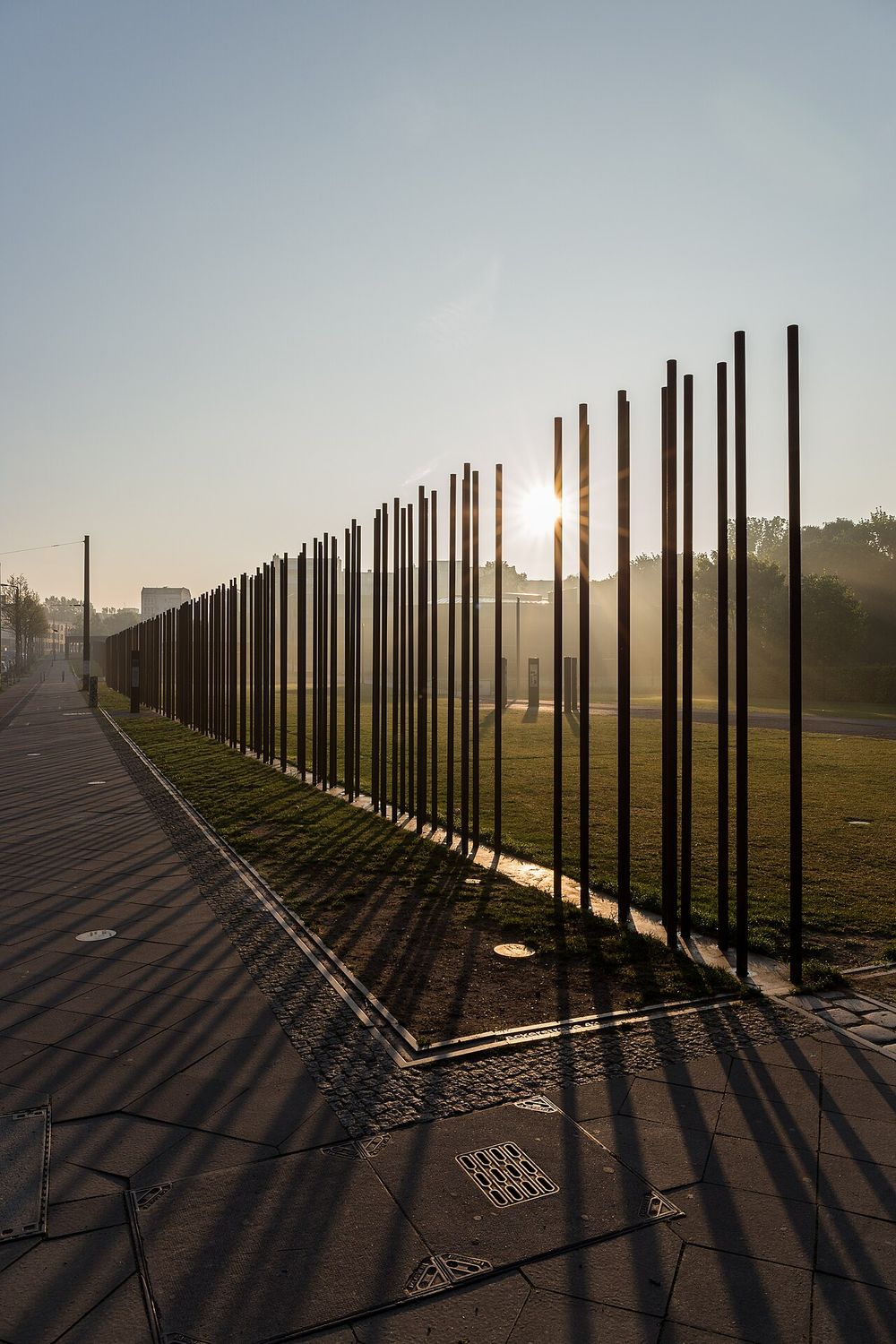
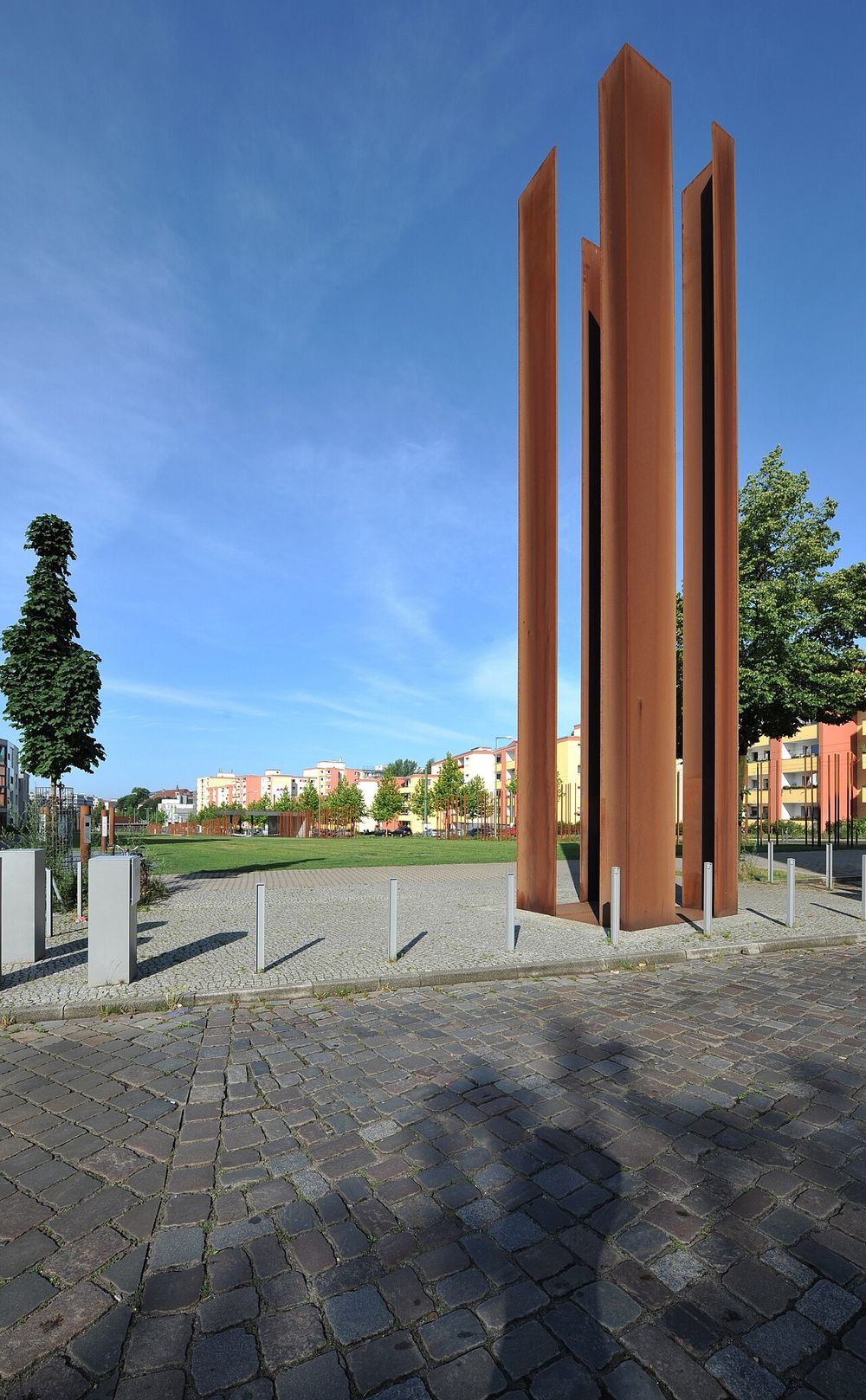
Come up to the street. Where the Wall has gone, its line is marked by rust-red steel rods as tall as it was. Walk beside them and you see through; stand at an angle and they close into a solid wall.
A photograph of 1961 on a house wallHerrAdams, CC BY-SA 4.0
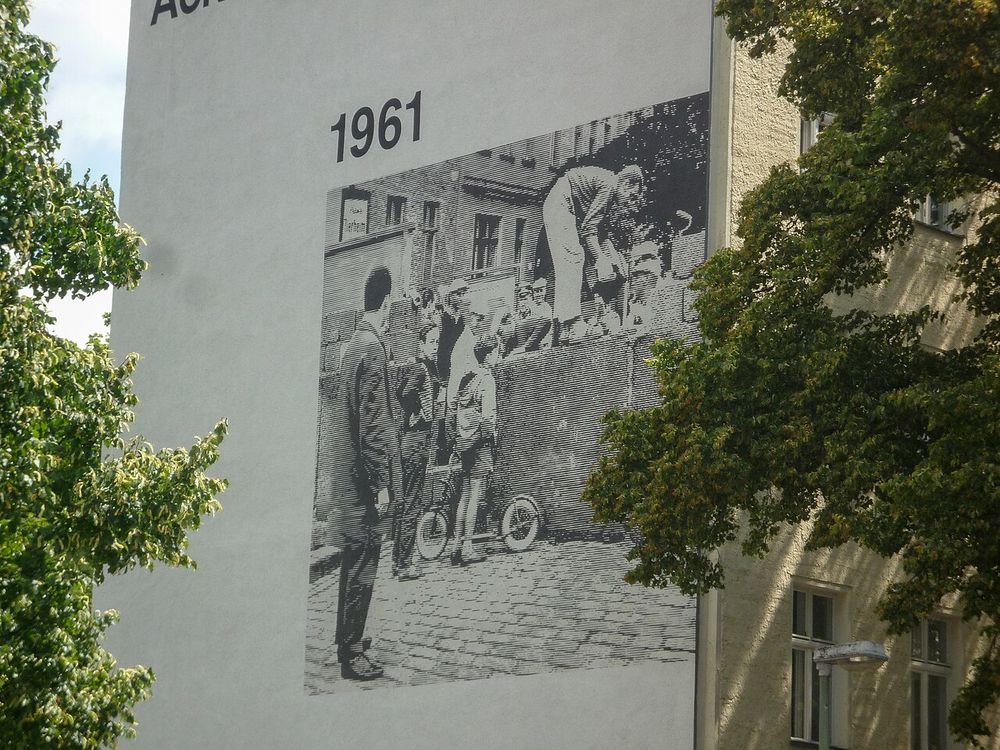
On the end walls of the houses are photographs as big as the houses, of what happened at that spot.
3. The window of remembrance
The window of remembranceInhiber, CC BY-SA 3.0
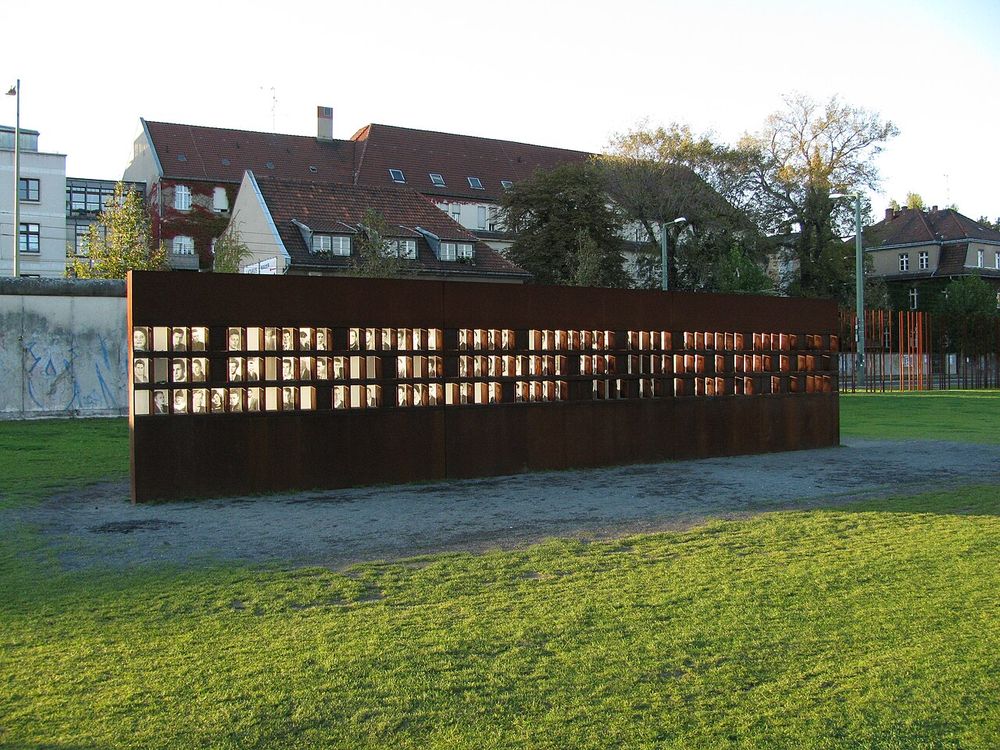
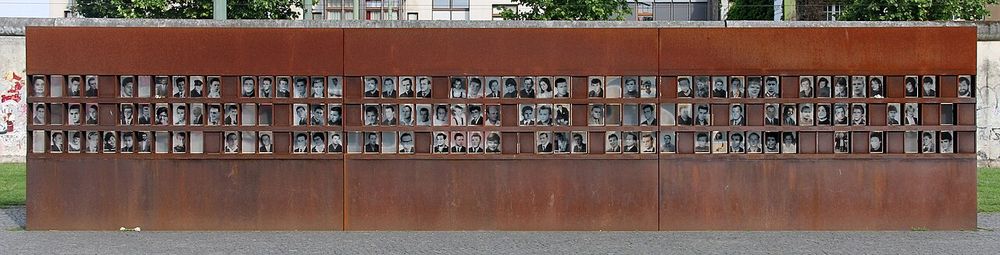
A wall of rusted steel holds small windows, one for each person known to have died at the Berlin Wall, with a photograph, a name and two dates. Some windows are empty: no picture could be found. The youngest was a baby; several were children who fell into the river on the western side, where western rescuers were not allowed to go in after them.
4. The piece that was kept
The Wall along the street, March 2016Ansgar Koreng, CC BY 3.0 de
Between two high steel walls is the seventy metres you saw from the tower. You cannot go in. Narrow slits in the back wall let you look through from the eastern side, as nobody could at the time.
The inscription on the steel wallHerrAdams, CC BY-SA 4.0
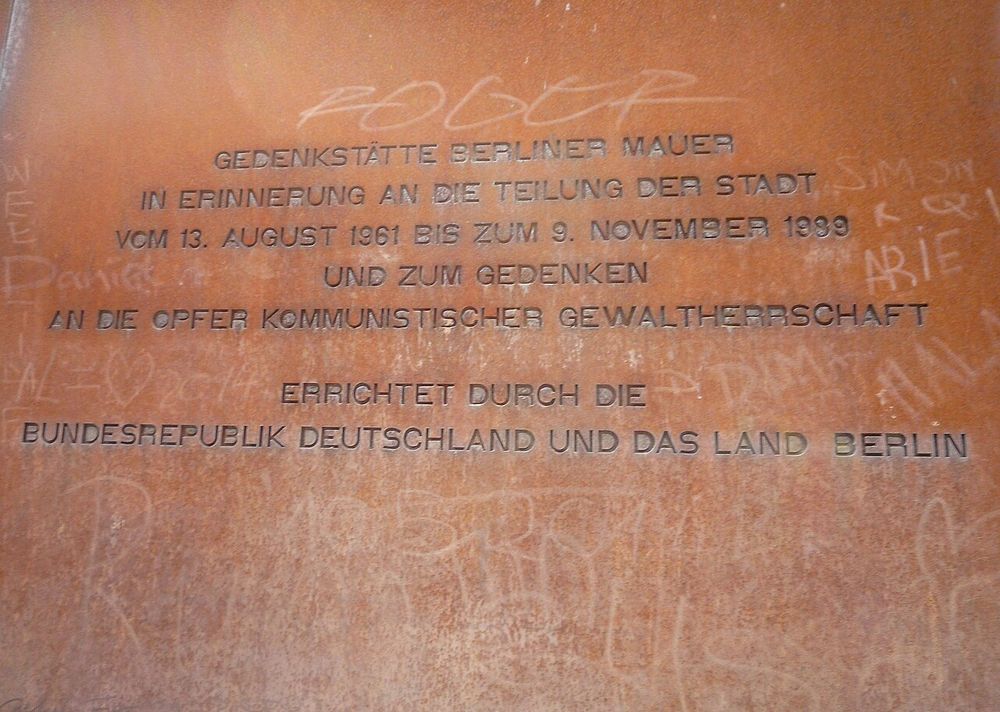
The inscription says the place is in memory of the division of the city and of the victims of communist tyranny.
5. The street of windows
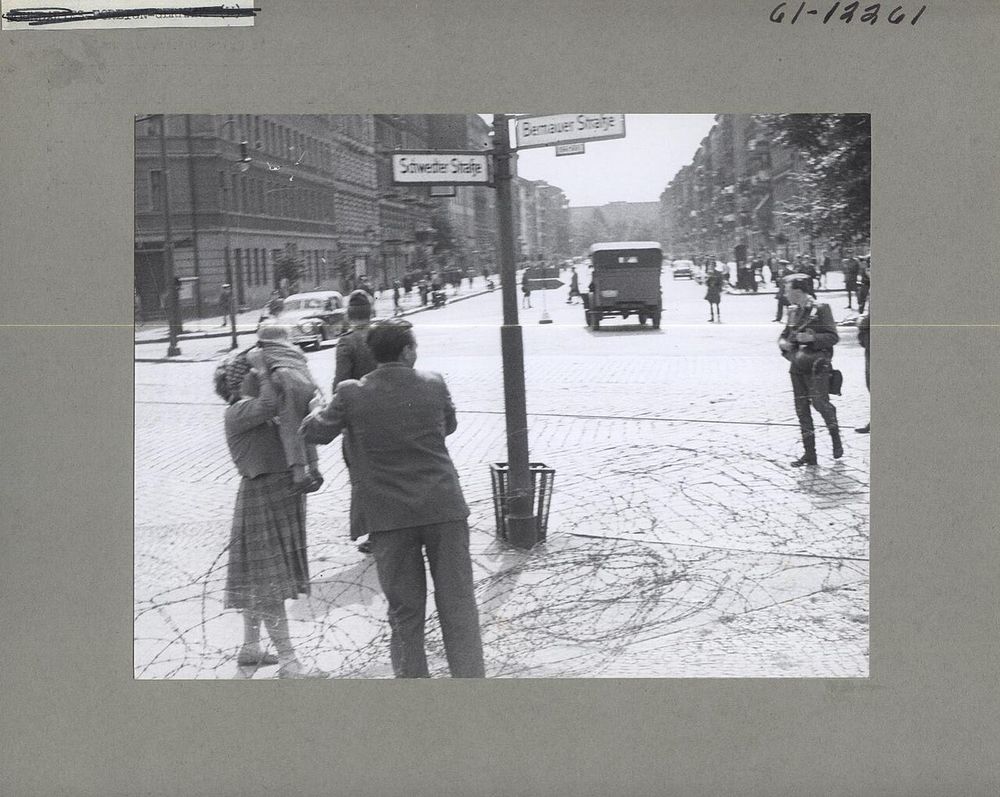
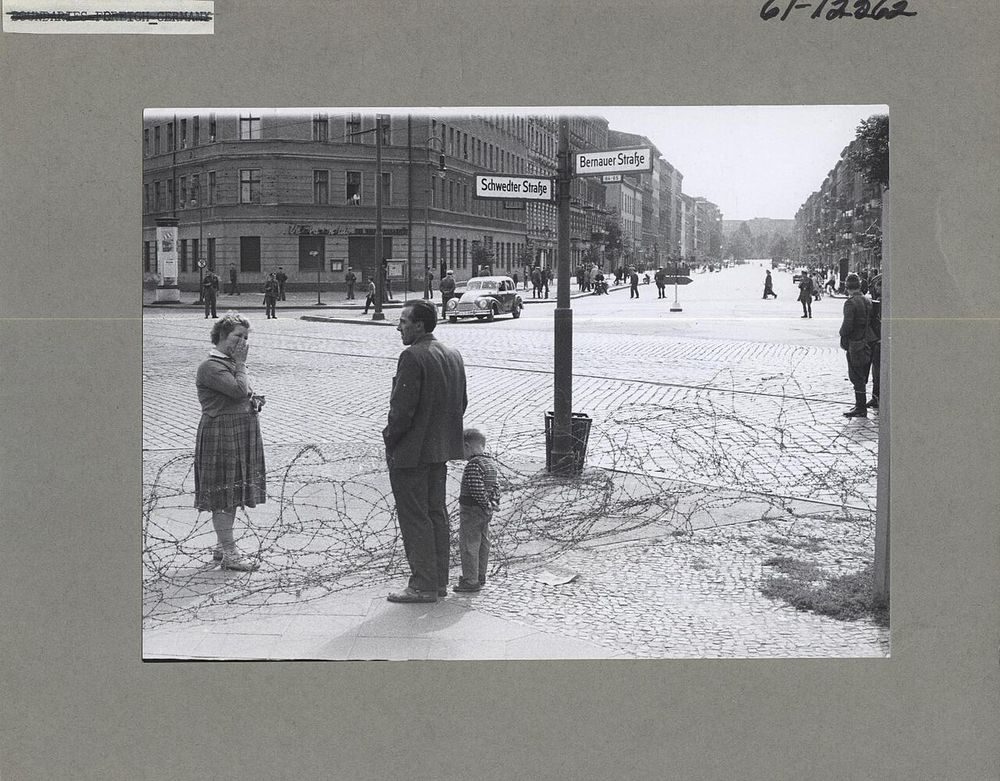
A family divided, talking across the line, 1961The Central Intelligence Agency, Public domain
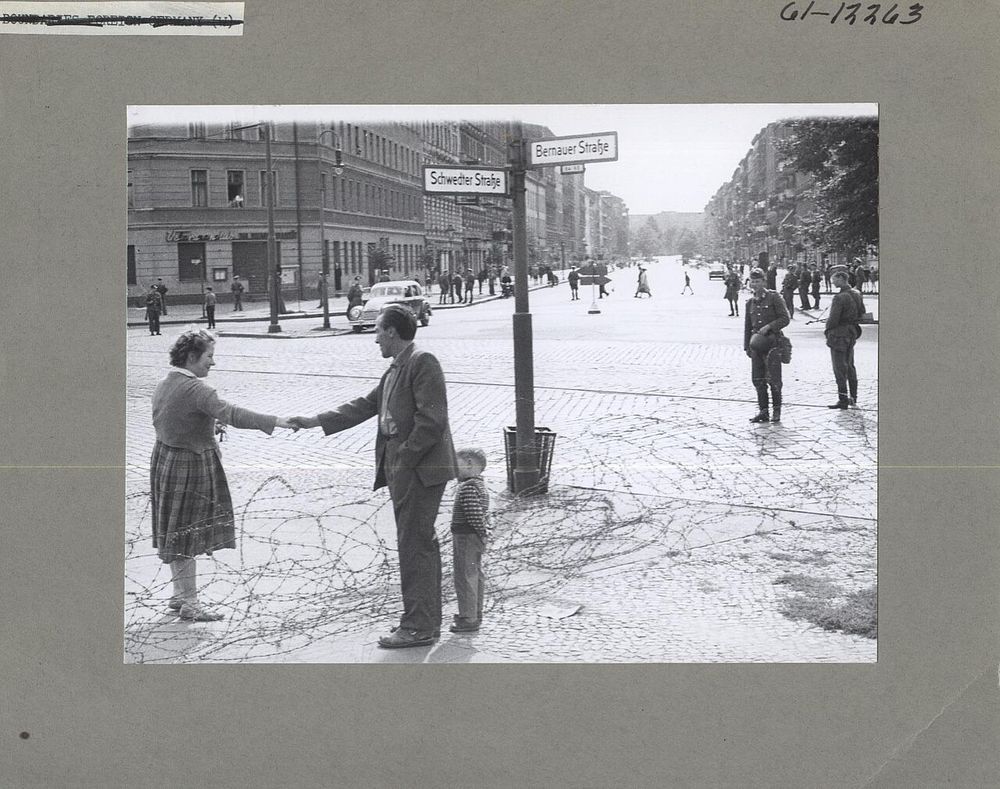
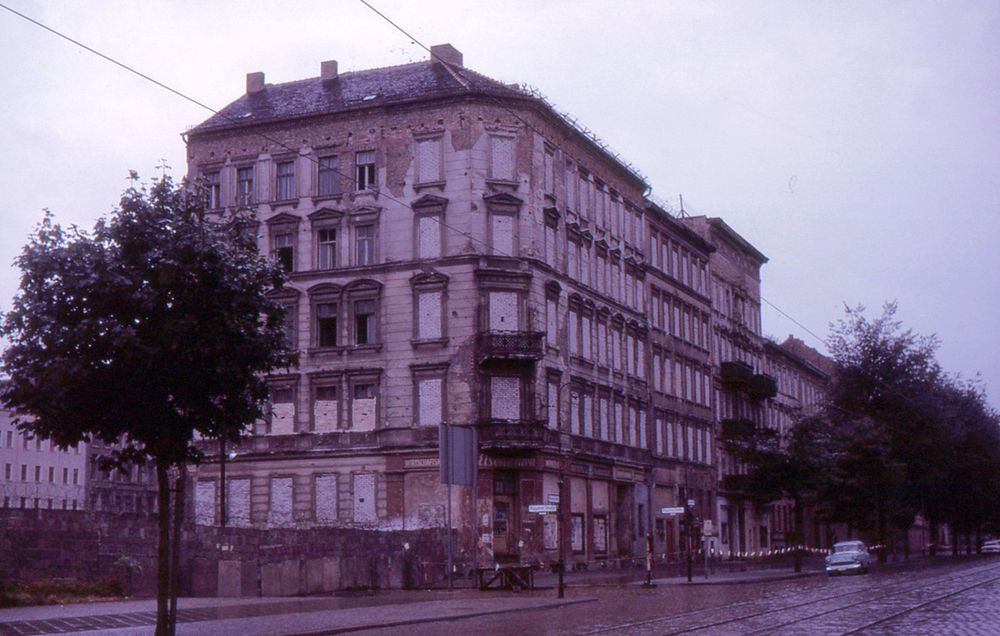
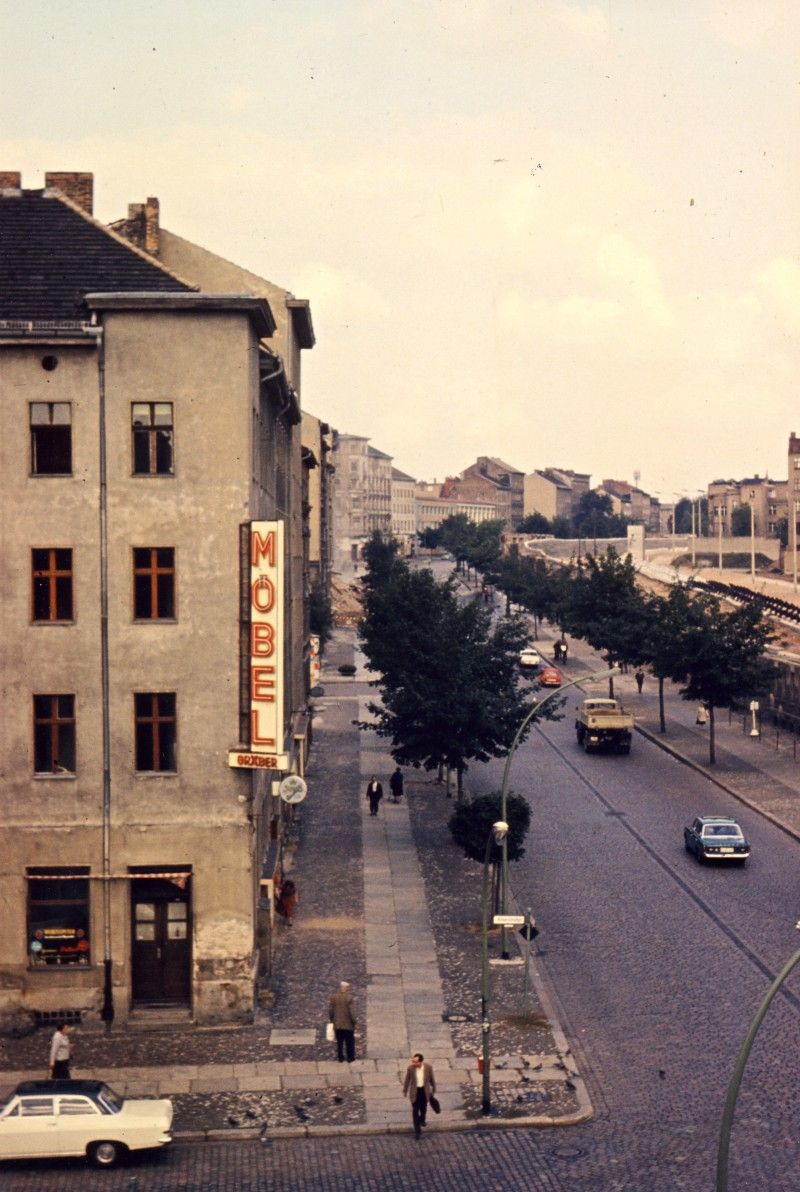
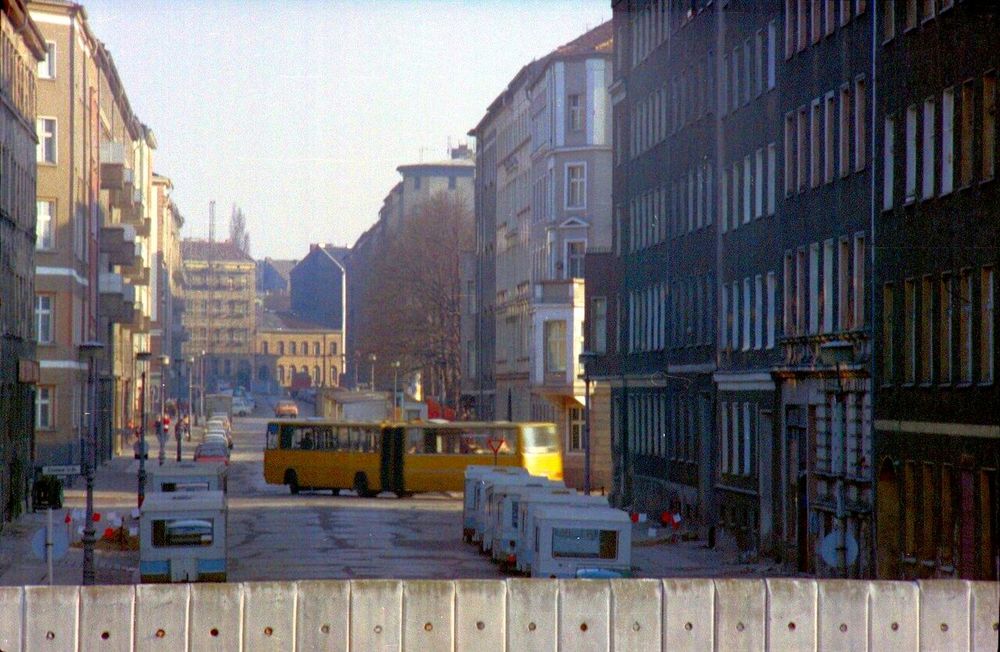
Walk east. For the first weeks the houses themselves were the border. People climbed down ropes, slid down sheets, jumped into nets held by the West Berlin fire brigade. Then the windows were bricked up, floor by floor. In the mid-1960s the houses were pulled down, all but their ground-floor fronts, which served as the Wall until 1980.
Bricked-up houses on the street, 1963Roger W from Sarasota, Florida, U.S.A., CC BY-SA 2.0
Steel strips in the ground mark the outline of each house.
6. The tunnels
The line of Tunnel 57N-Lange.de, CC BY-SA 3.0
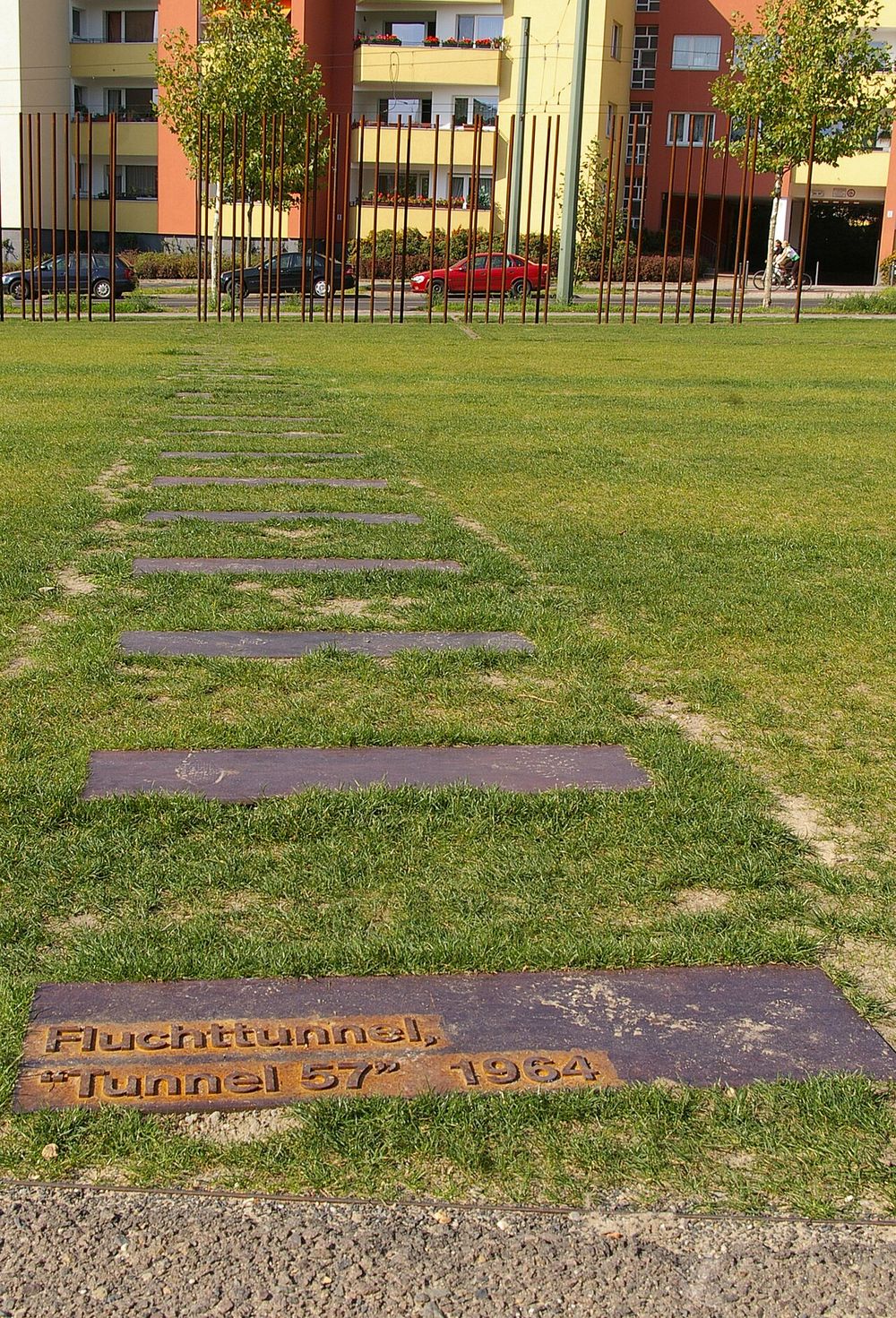
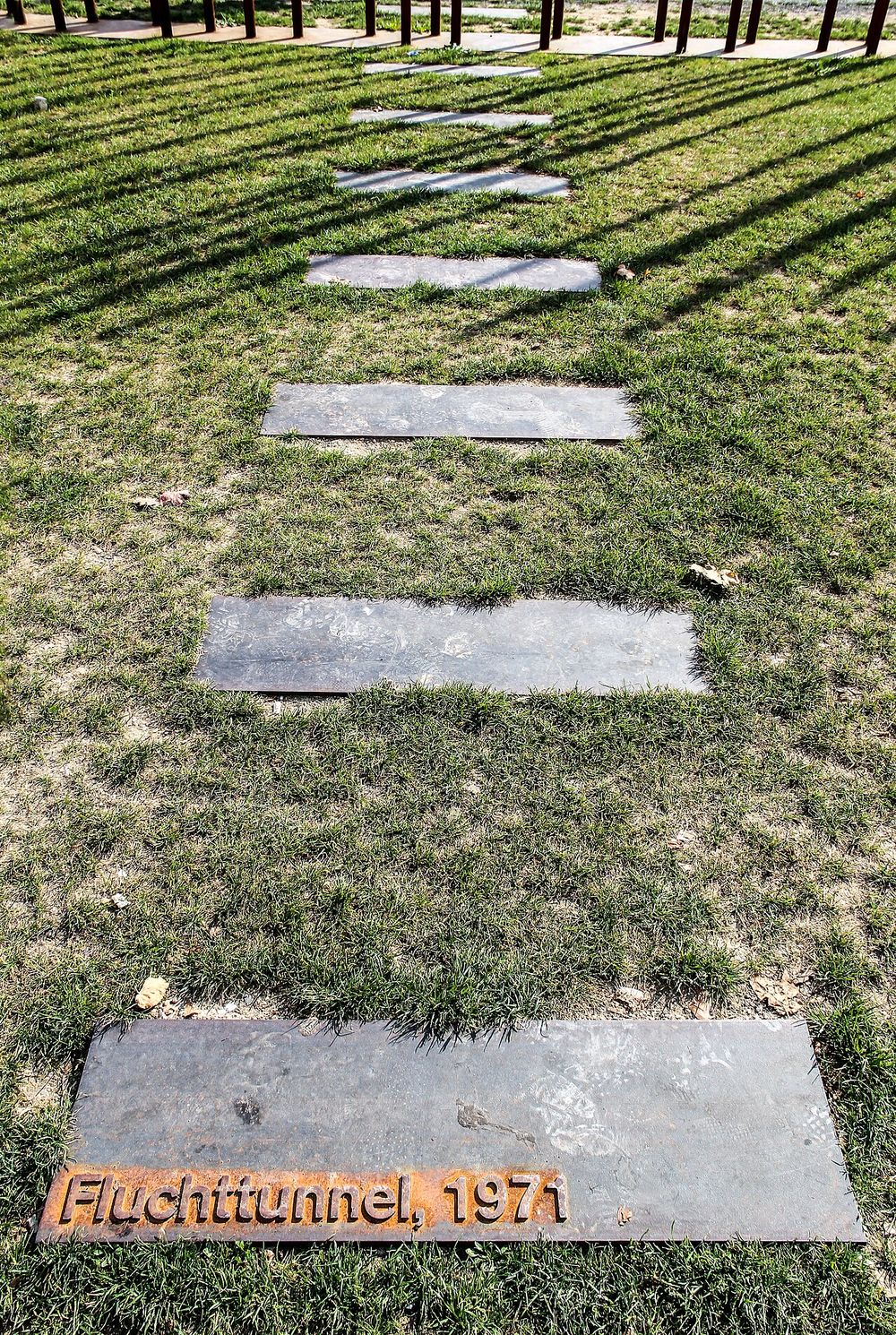
The soil here is firm clay, good for digging, and the cellars on the western side were close to the line. More tunnels were dug under this street than anywhere else. Their routes are marked in the grass with steel plates. In 1962 an American television company paid for one, in return for the right to film it. Twenty-nine people came through.
7. The chapel
The Chapel of Reconciliation, May 2015Ansgar Koreng, CC BY 3.0 de
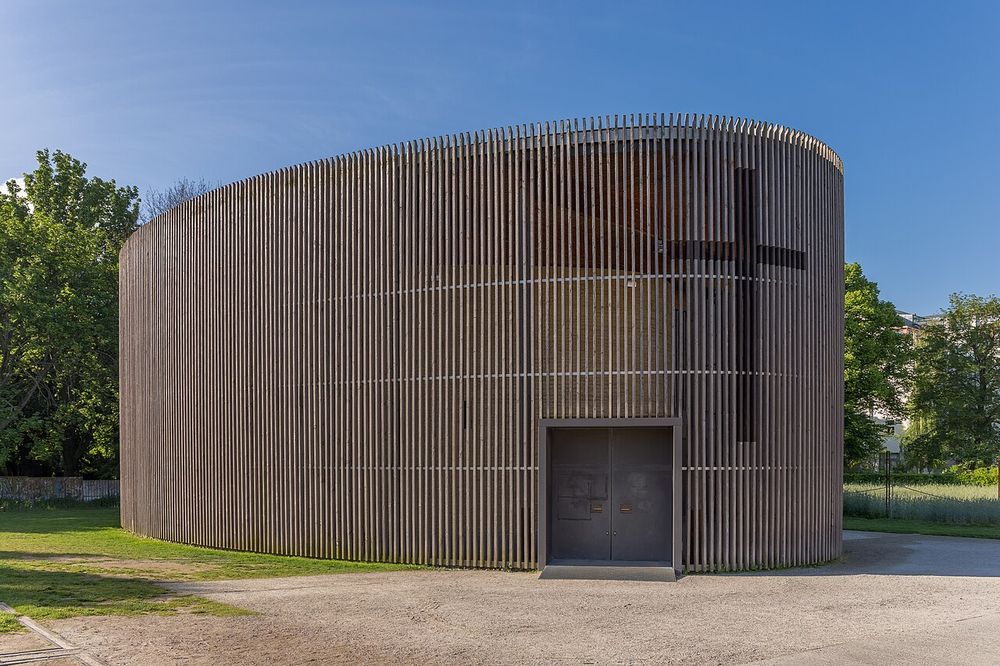
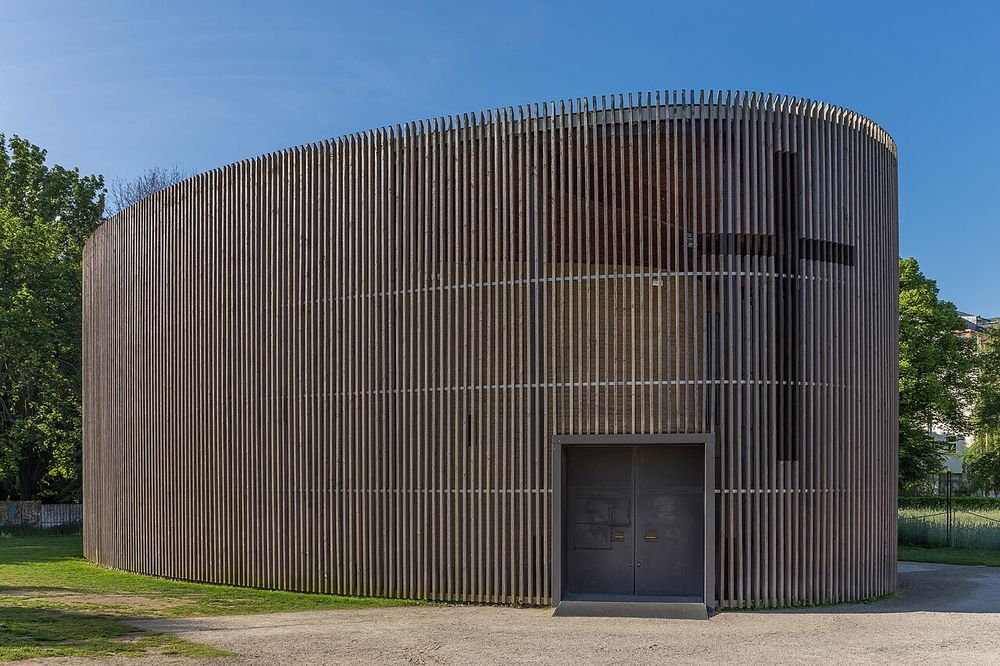
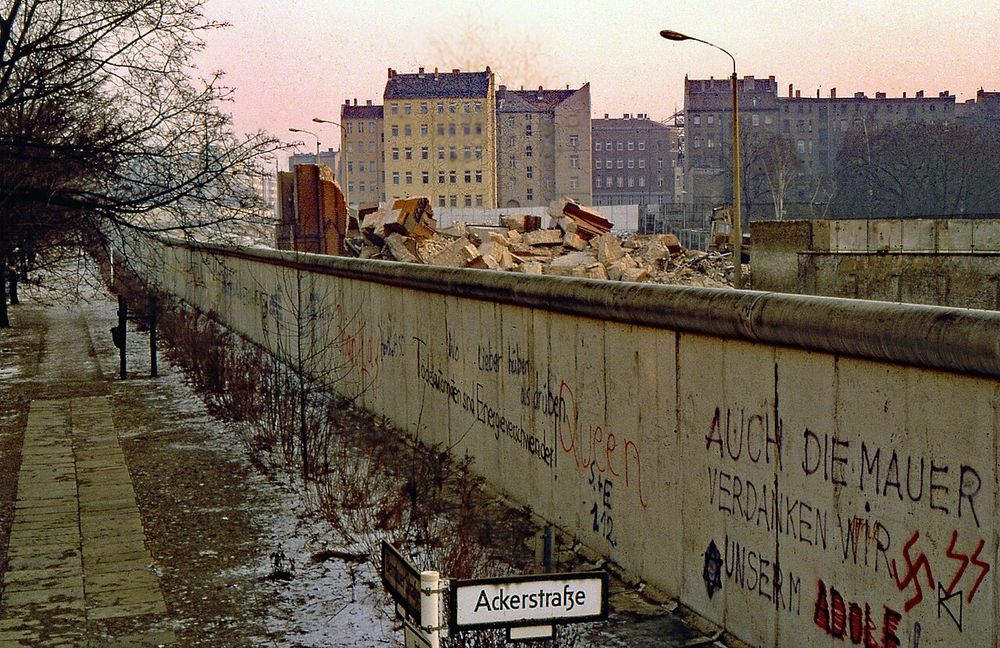
A brick church of 1894 stood exactly on the line. After 1961 its door opened on the death strip and nobody could reach it. Border guards used the tower as a lookout. In January 1985 the government blew it up, to clear the field of fire. The film of the spire falling went round the world.
Inside the chapel: walls of rammed earthWolfgang Reich, CC BY-SA 3.0
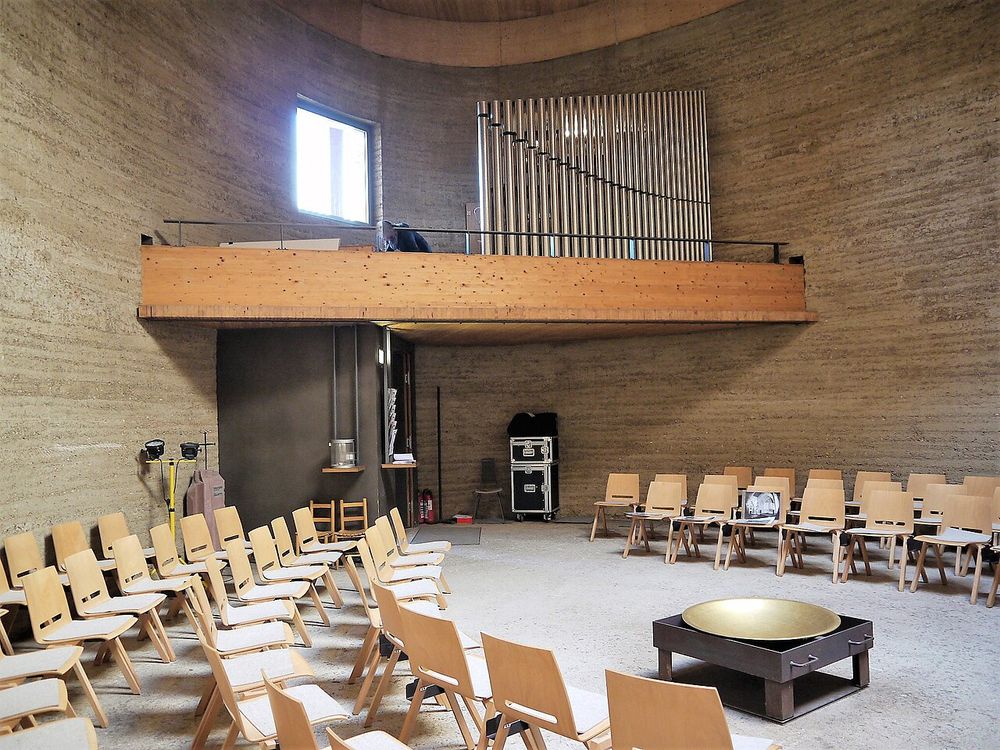
On the same spot stands a small oval chapel of 2000. Its walls are rammed earth, mixed with the crushed brick of the old church: look for the red specks. Round it grows a field of rye, sown and cut each year, on what was the sand strip.
The bent cross of the old churchSarah Stierch, CC BY 4.0
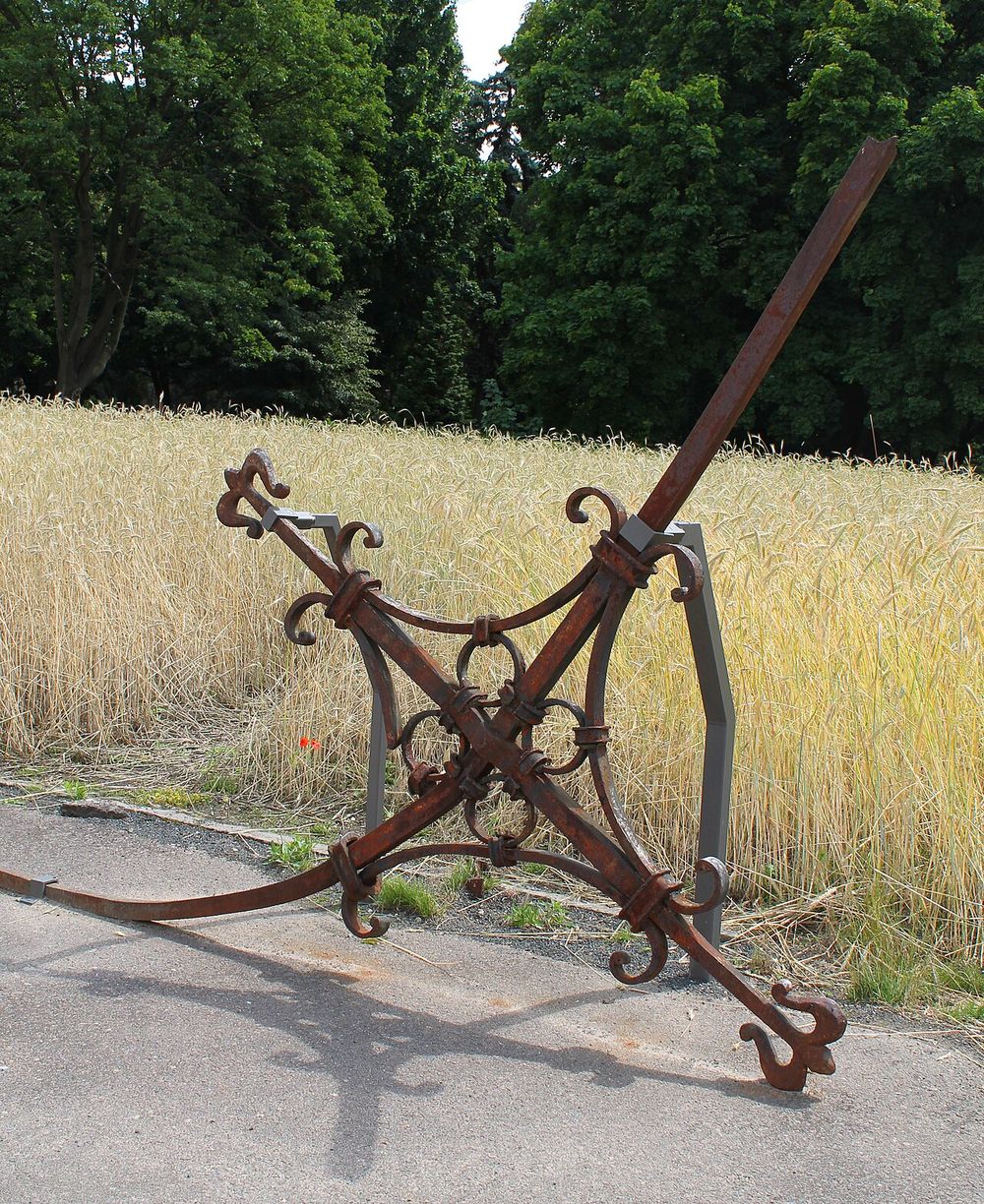
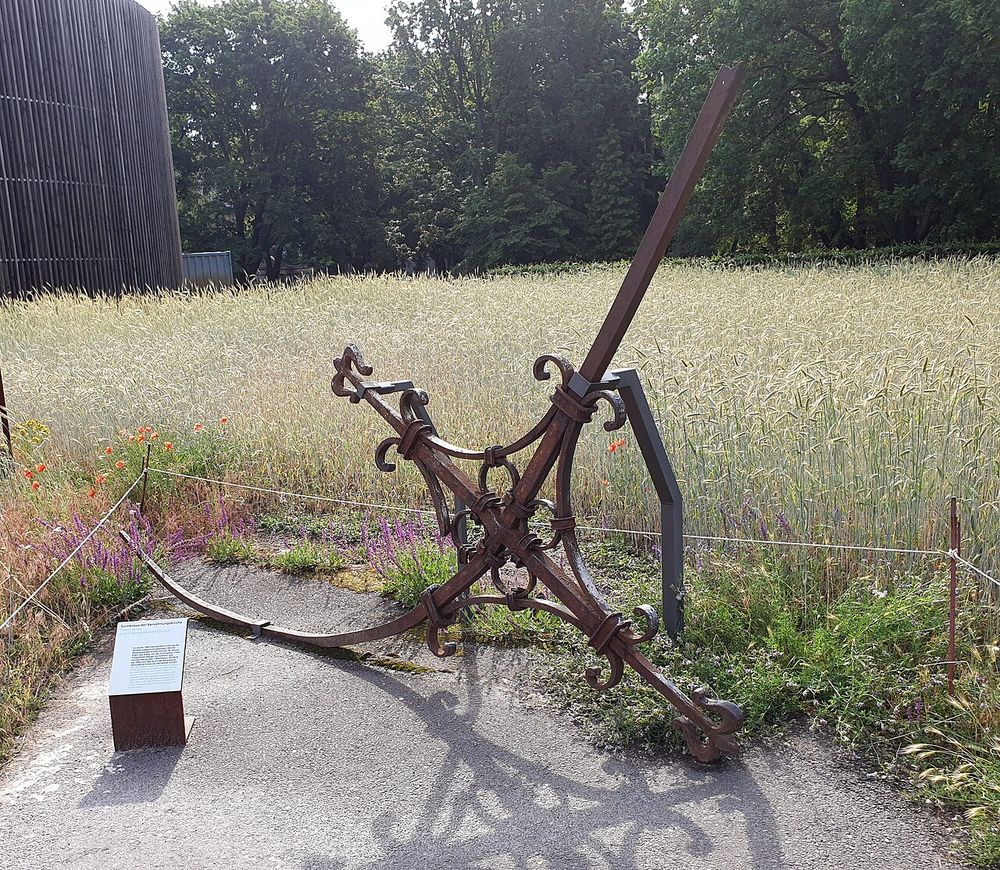
The cross from the old spire, bent by the fall, lies beside the path.
8. The jump
The border policeman's jump, 15 August 1961The Central Intelligence Agency, Public domain
At the corner of Ruppiner Straße a line in the pavement marks where the wire lay on 15 August 1961. The photograph of the soldier in mid-air, his rifle slipping from his shoulder, was taken from the western pavement.
The same shot: stand on the eastern side of the corner, where he stood, and look west. It is a few steps.
The street goes on to a park where, on Sundays, half of Berlin comes to a flea market and sings karaoke in a stone bowl on what was the death strip.
Meanwhile in the world
Year
Here
Elsewhere
1961
The border is closed on 13 August
Gagarin becomes the first man in space
1962
Twenty-nine people escape through a tunnel
The Cuban missile crisis
1964
Fifty-seven escape through another
The Olympic Games are held in Tokyo
1985
The church in the death strip is blown up
Gorbachev comes to power in Moscow
1989
The border opens on 9 November
Communist rule ends across eastern Europe
1990
Demolition begins on this street in June; Germany is one state again in October
Nelson Mandela walks out of prison
1998
The national memorial opens
The euro's central bank is founded in Frankfurt
One line to remember: not one wall but two, with a killing ground between, and every part faced in.
Then and now
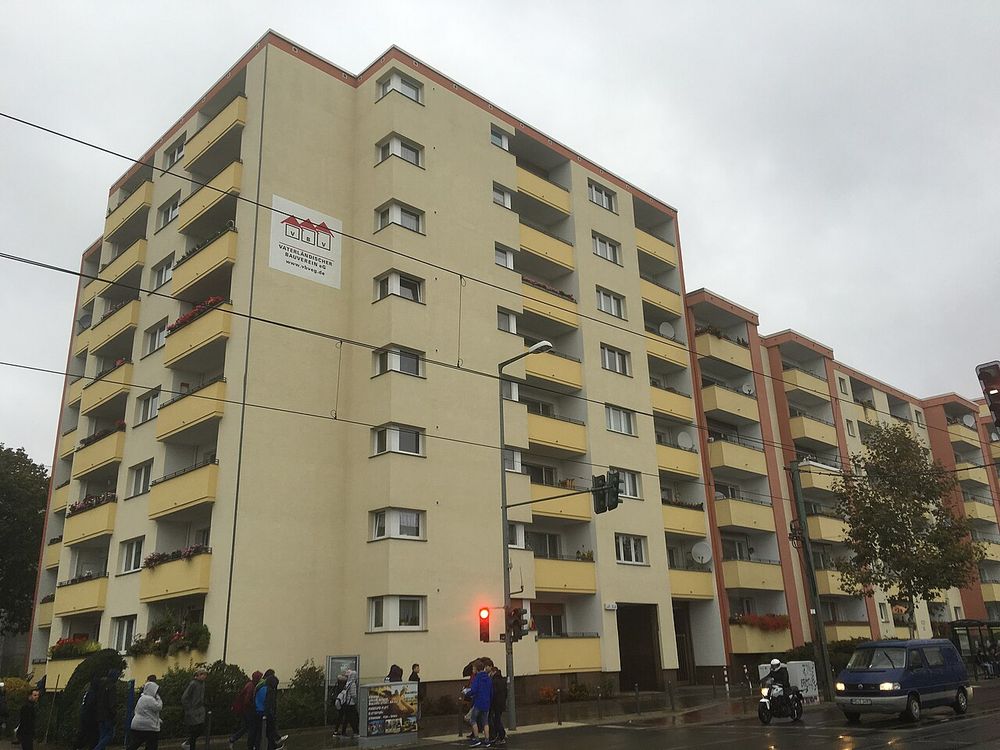
The memorial ground at sunrise, May 2017Ansgar Koreng, CC BY-SA 4.0, Wikimedia CommonsSteel rods on the line of the Wall, May 2017Ansgar Koreng, CC BY-SA 4.0, Wikimedia CommonsThe rods against the lightAnsgar Koreng, CC BY-SA 4.0, Wikimedia CommonsThe front wall, March 2016Ansgar Koreng, CC BY 3.0 de, Wikimedia CommonsThe Wall along the street, March 2016Ansgar Koreng, CC BY 3.0 de, Wikimedia CommonsThe concrete close upAnsgar Koreng, CC BY 3.0 de, Wikimedia CommonsSteel columns of the memorialAilura, CC BY-SA 3.0, Wikimedia CommonsThe inscription on the steel wallHerrAdams, CC BY-SA 4.0, Wikimedia CommonsThe visitor centre, February 2015Ansgar Koreng, CC BY 3.0 de, Wikimedia CommonsThe viewing tower at night, December 2014Ansgar Koreng, CC BY 3.0 de, Wikimedia CommonsA photograph of 1961 on a house wallHerrAdams, CC BY-SA 4.0, Wikimedia CommonsA block of flats on Bernauer StraßeBjoertvedt, CC BY-SA 4.0, Wikimedia CommonsThe window of remembranceInhiber, CC BY-SA 3.0, Wikimedia CommonsFaces and names in the windowOTFW, Berlin, CC BY-SA 3.0, Wikimedia CommonsPlates marking the line of an escape tunnelDietmar Rabich, CC BY-SA 4.0, Wikimedia CommonsThe line of Tunnel 57N-Lange.de, CC BY-SA 3.0, Wikimedia CommonsThe Chapel of Reconciliation, May 2015Ansgar Koreng, CC BY 3.0 de, Wikimedia CommonsThe chapel and its screen of wooden slatsAnsgar Koreng, CC BY 3.0 de, Wikimedia CommonsInside the chapel: walls of rammed earthWolfgang Reich, CC BY-SA 3.0, Wikimedia CommonsThe bent cross of the old churchSarah Stierch, CC BY 4.0, Wikimedia CommonsThe tower cross of the old church, June 2019OTFW, Berlin, CC BY-SA 3.0, Wikimedia CommonsThe back wall, facing EastHerrAdams, CC BY-SA 4.0, Wikimedia CommonsWall segments stored in the cemeteryBeek100, CC BY-SA 3.0, Wikimedia CommonsThe ghost-station exhibition, August 2025Aagnverglaser, CC BY-SA 4.0, Wikimedia CommonsThe border policeman's jump, 15 August 1961The Central Intelligence Agency, Public domain, Wikimedia CommonsA family divided, talking across the line, 1961The Central Intelligence Agency, Public domain, Wikimedia CommonsWaving across the border, 1961The Central Intelligence Agency, Public domain, Wikimedia CommonsMeeting at the border, 1961The Central Intelligence Agency, Public domain, Wikimedia CommonsBricked-up houses on the street, 1963Roger W from Sarasota, Florida, U.S.A., CC BY-SA 2.0, Wikimedia CommonsThe corner of Ackerstraße, 1966ELAB, Archiv der Versöhnungsgemeinde, CC BY-SA 4.0, Wikimedia CommonsThe Wall on the street in 1982Lothar Weber, CC BY-SA 4.0, Wikimedia CommonsThe Wall seen from the West, 1982Lothar Weber, CC BY-SA 4.0, Wikimedia CommonsThe street cut off by the Wall, 1982Lothar Weber, CC BY-SA 4.0, Wikimedia CommonsThe rubble of the church in the death strip, 1985Werner Kremer, CC BY-SA 4.0, Wikimedia CommonsThe Wall and a watchtower at the corner, 1989Gerd Danigel , ddr-fotograf.de, CC BY-SA 4.0, Wikimedia Commons
Local legends
These are stories people tell about this place. They are legends, not history, and each one says where it comes from.
LegendThe guards who aimed to miss
It is often said that many of the young conscripts in the towers fired wide on purpose.
Source: Told by former guards at their trials in the 1990s and by people who got across. It cannot be measured, and it did not save the dead
Later, people who live here will be able to add the stories they grew up with, and say which of these they have heard.
Not certain, and where accounts conflict
How many died?
The foundation's research counts at least 140 at the Berlin Wall between 1961 and 1989, about a hundred of them people who were trying to escape. A private museum in the city gives a much higher figure by counting differently. Deaths on the long border between the two states are counted separately.
Was there an order to shoot?
East Germany always denied it. A written order of 1973 to a special unit, found in the files in 2007, tells men not to hesitate to use their weapons even against women and children. Guards who killed were given medals and a bonus.
Visiting
Tickets and hours
Free.
The grounds are open every day from 8:00 to 22:00.
The visitor centre, the documentation centre and its tower are open from Tuesday to Sunday, 10:00 to 18:00.
Last checked 2026-11-12. The Berlin Wall Foundation, which runs the memorial; opening times as published in 2026.
Booking from abroad
Note The foundation offers public tours in English on some days; the times are on its site. Signs and films throughout are in German and English.
Checked 2026-11-12
Where to start
S-Bahn lines 1, 2, 25 and 26 to Nordbahnhof. See the exhibition in the station, then come up at the Bernauer Straße exit.
Walk east along the street. The whole length takes an hour and a half. Tram M10 runs beside you if you tire.
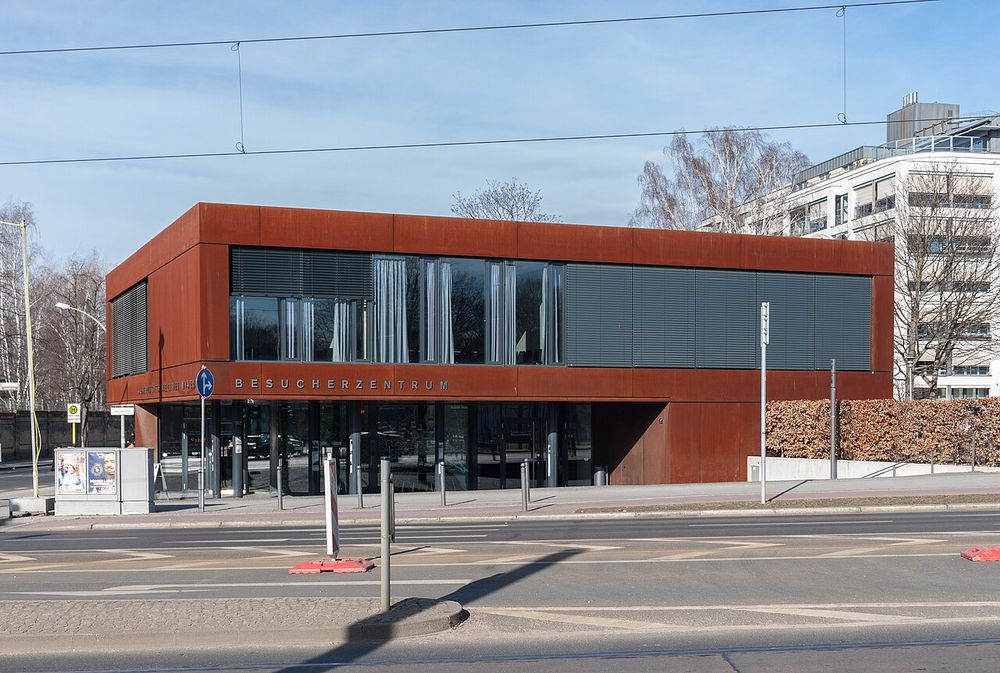
Watch the short films in the visitor centre first. They are shown in German and in English in turn.
Before you go
Most of the visit is outdoors. There is no shelter along the street.
Some of the photographs and films show people dying. Decide beforehand what children should see.
Customs and manners
This is a place of mourning. Families of the dead still come. Do not climb on the Wall, sit on the tunnel markers or pose smiling at the window of remembrance.
At noon from Tuesday to Friday a short service in the chapel remembers one victim by name. Anyone may sit in.
Do not walk into the rye.
Many Berliners over fifty have their own memories of this border. If one starts to tell you, listen.
Chipping pieces off the Wall is forbidden and is treated as damage to a monument.
Look for these
From the tower, count the parts of the barrier between West and East.
Find the pipe on top of the wall. What was it for?
Which way do the lamps face?
In the window of remembrance, find an empty frame.
In the chapel wall, find a speck of red brick.
Find the bent cross.
In the pavement, find the outline of a house.
At the corner, find the line the soldier jumped.
I am here
Stand at the site, sign in, press the button, and collect its stamp. Your browser will ask to use your location. It is sent to us once to confirm that you are at the site; we keep how far you were from it, not the spot where you stood.
Your stamps are saved to your account, so they follow you to any device. Checking from a browser cannot rule out every false location; stricter checks arrive with the app.
Messages
Share your photos
Photos here show the place, not people. Each one is credited to the visitor who took it and appears after our team has looked at it. A photo with you in it belongs under “I am here”.