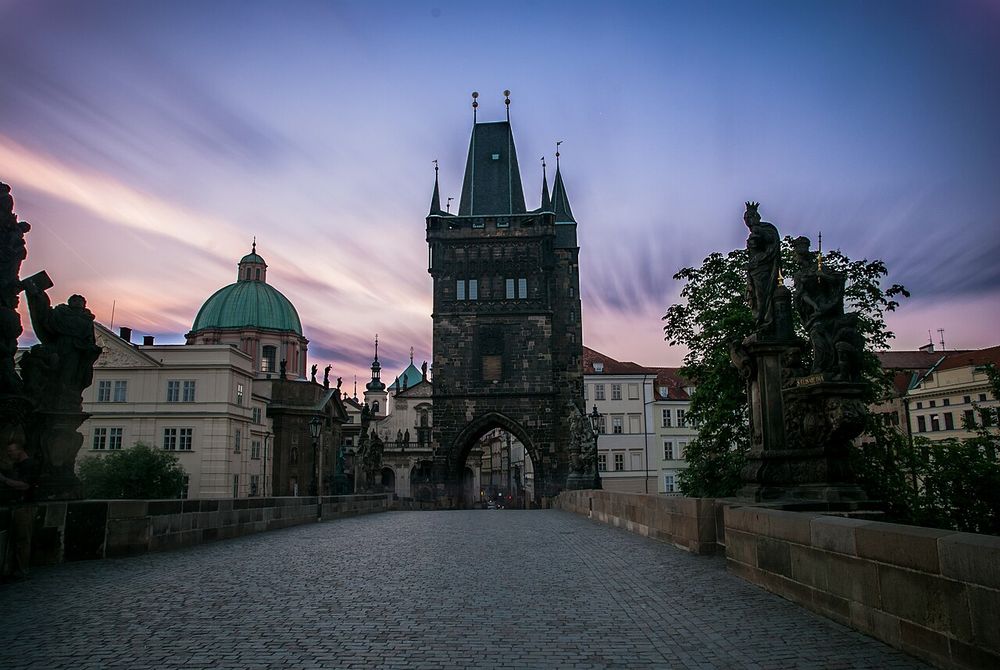
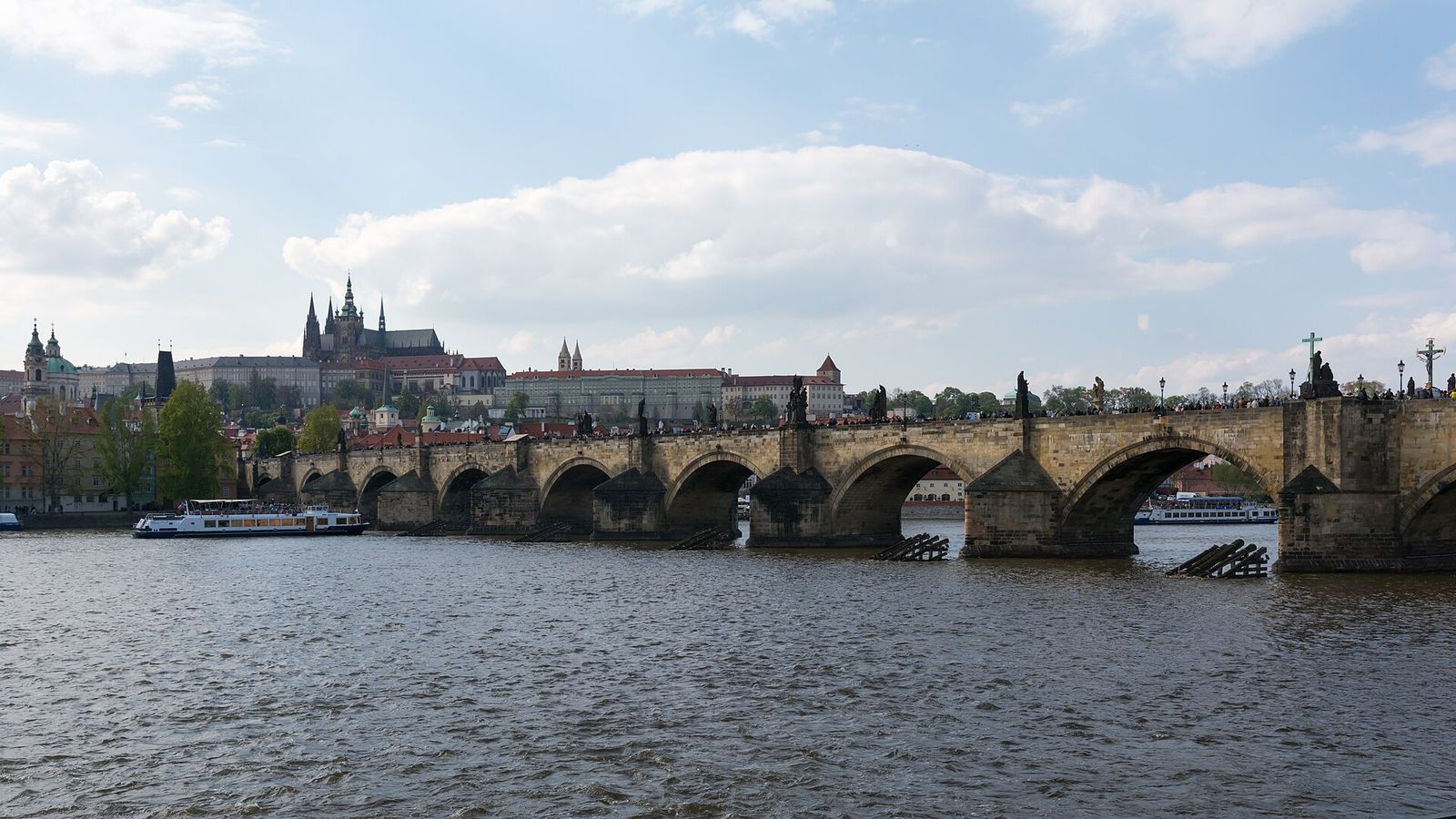
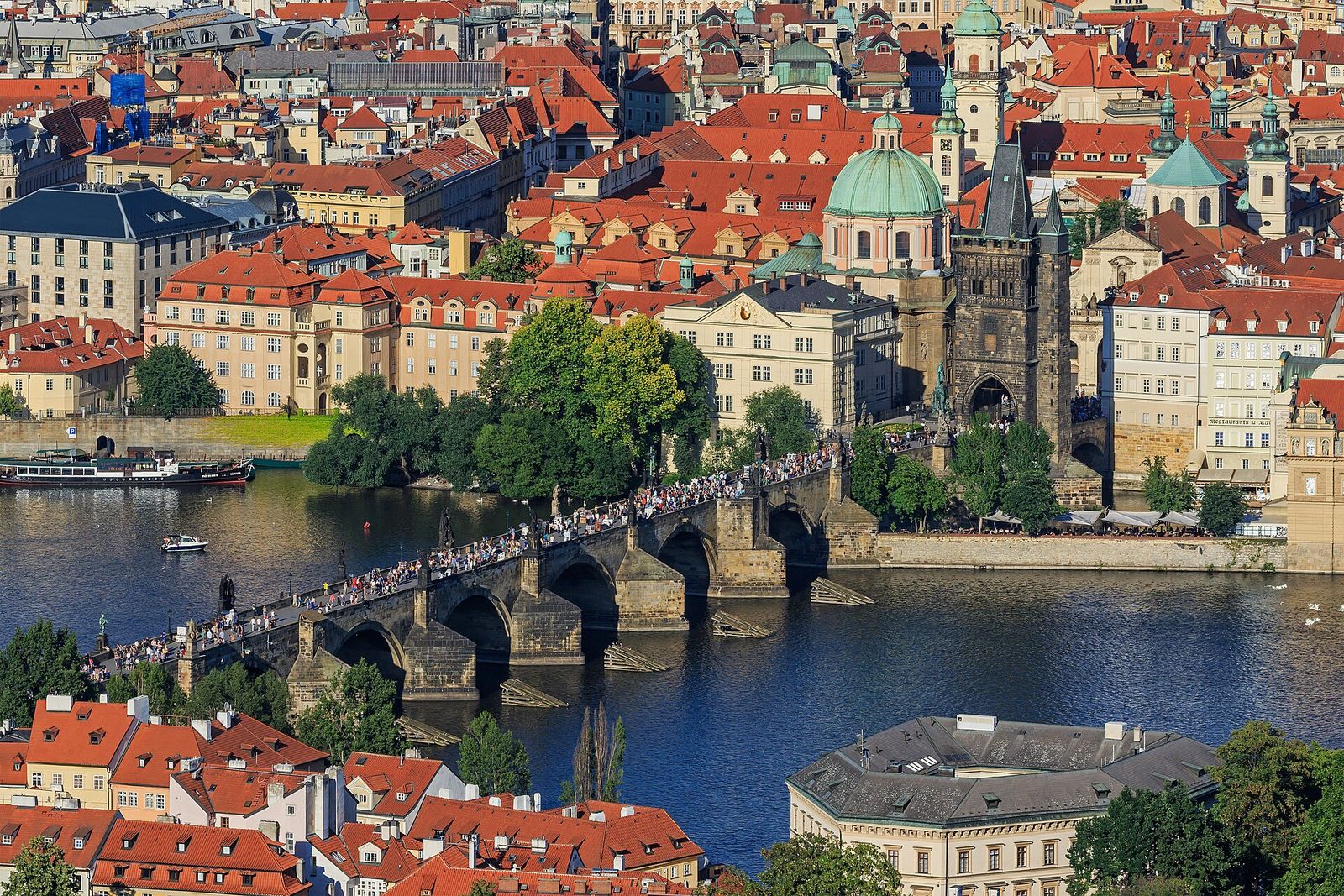
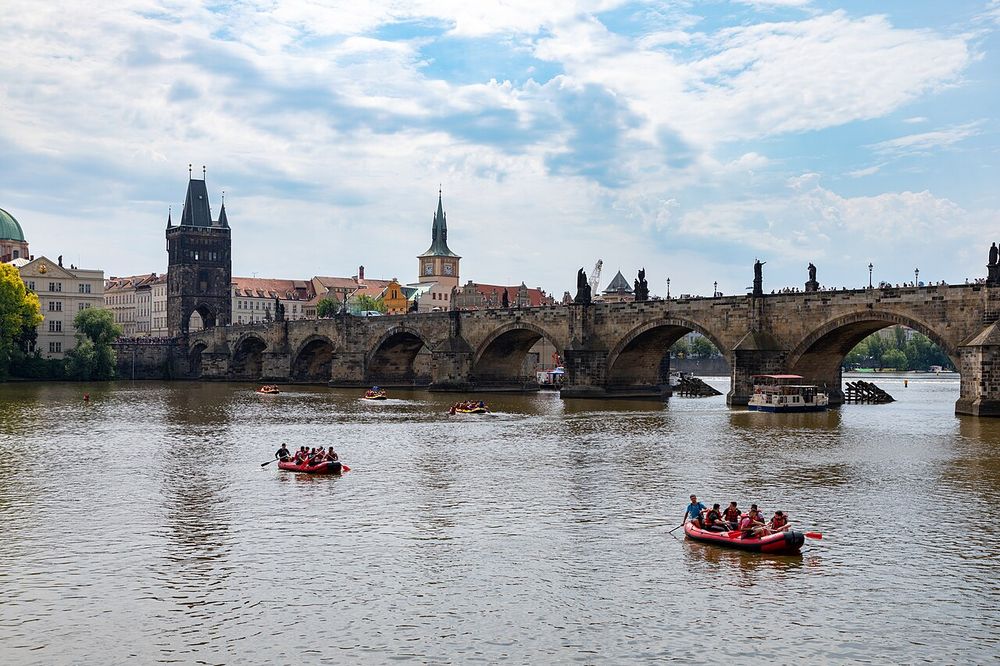
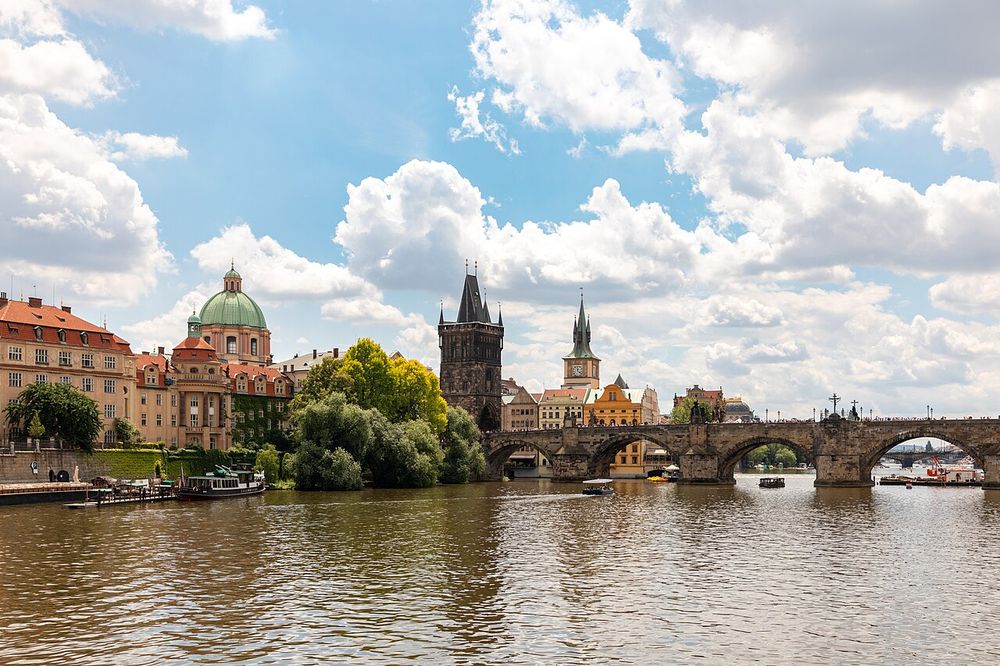
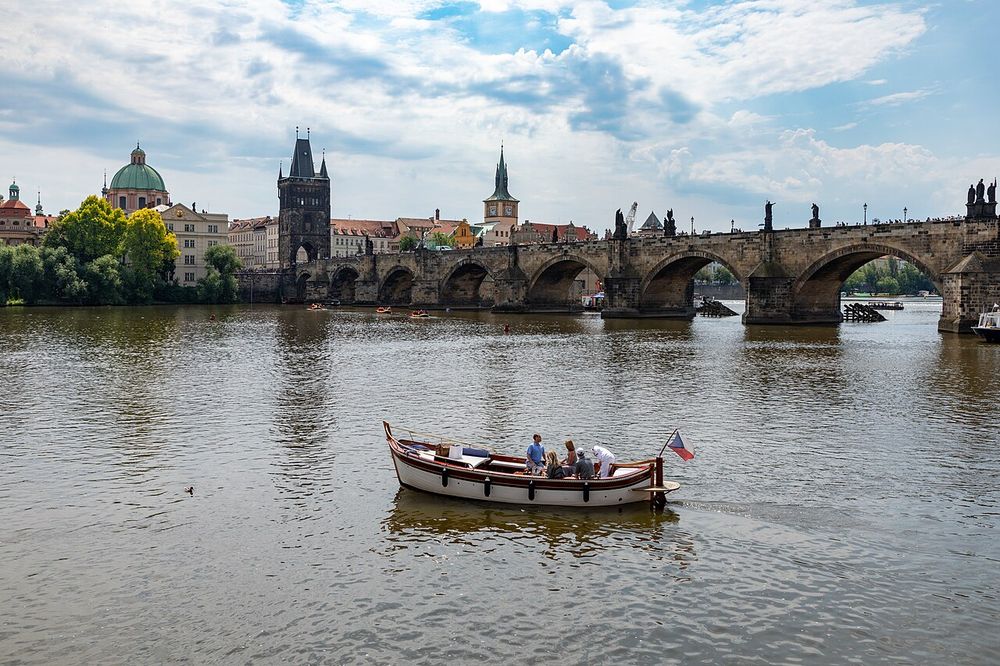
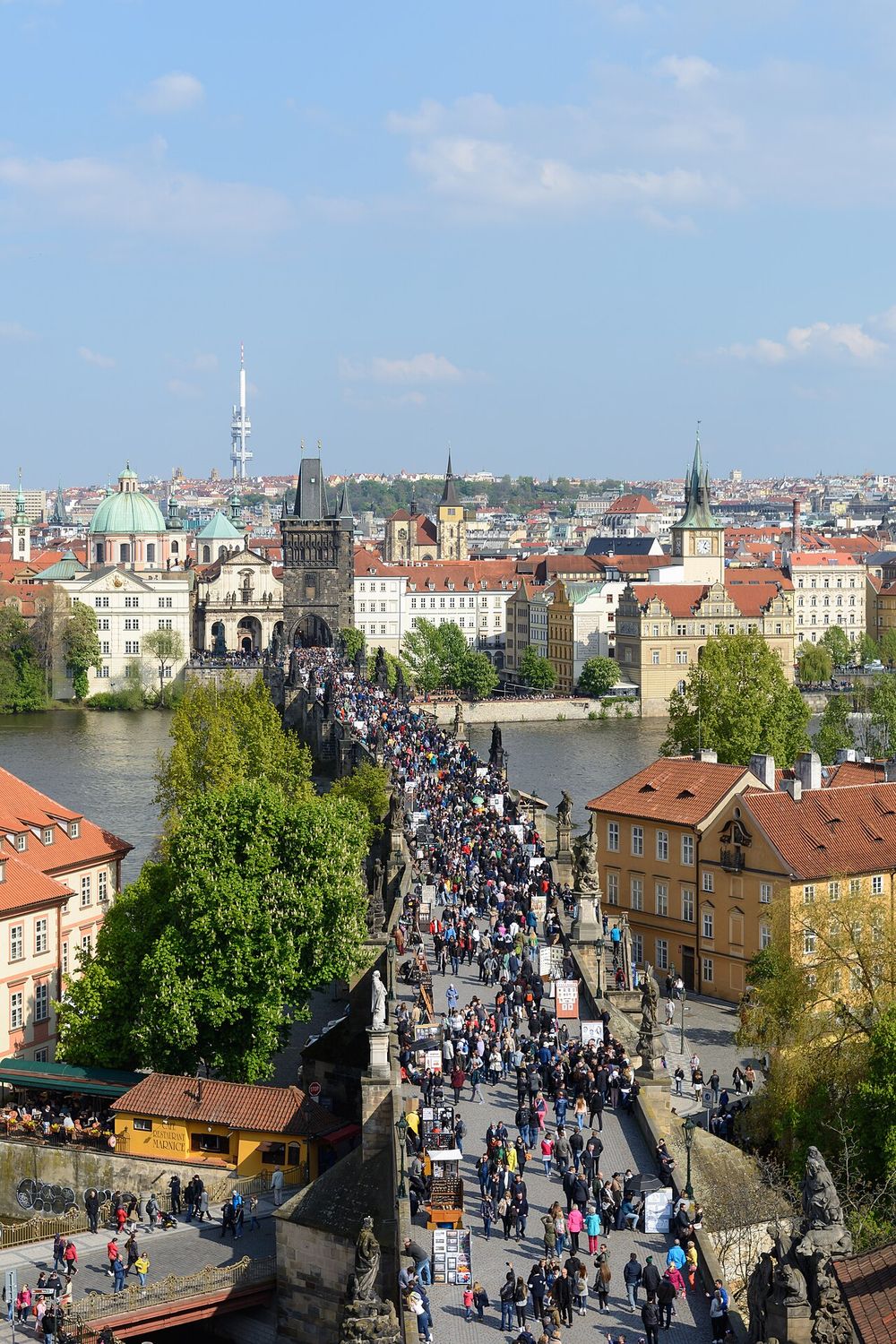
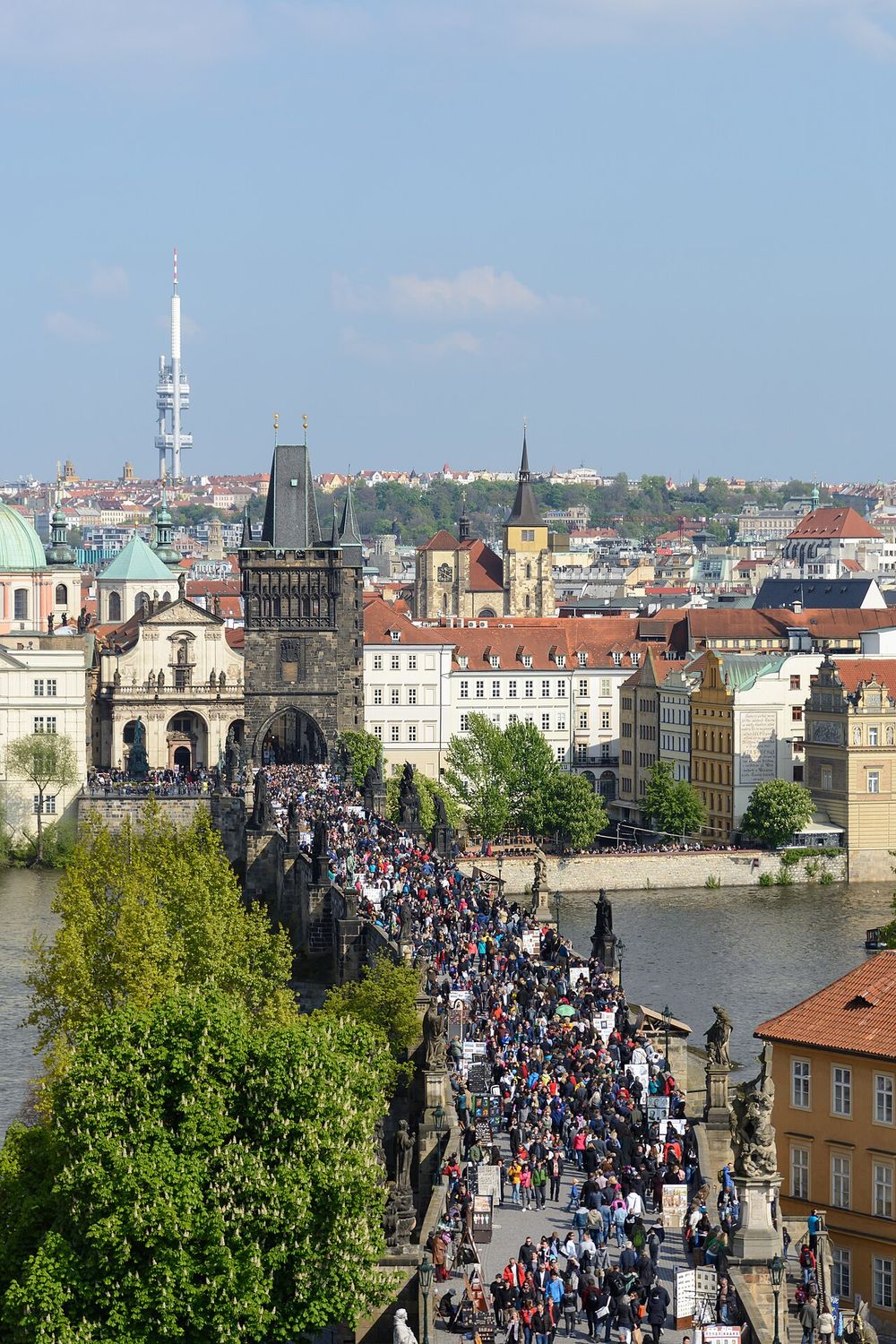
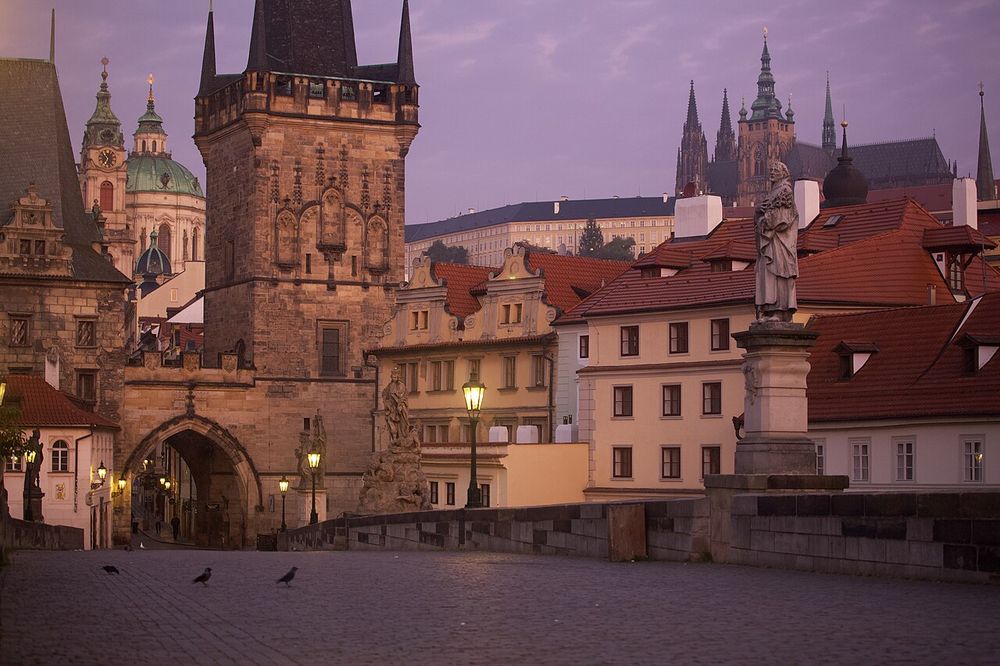
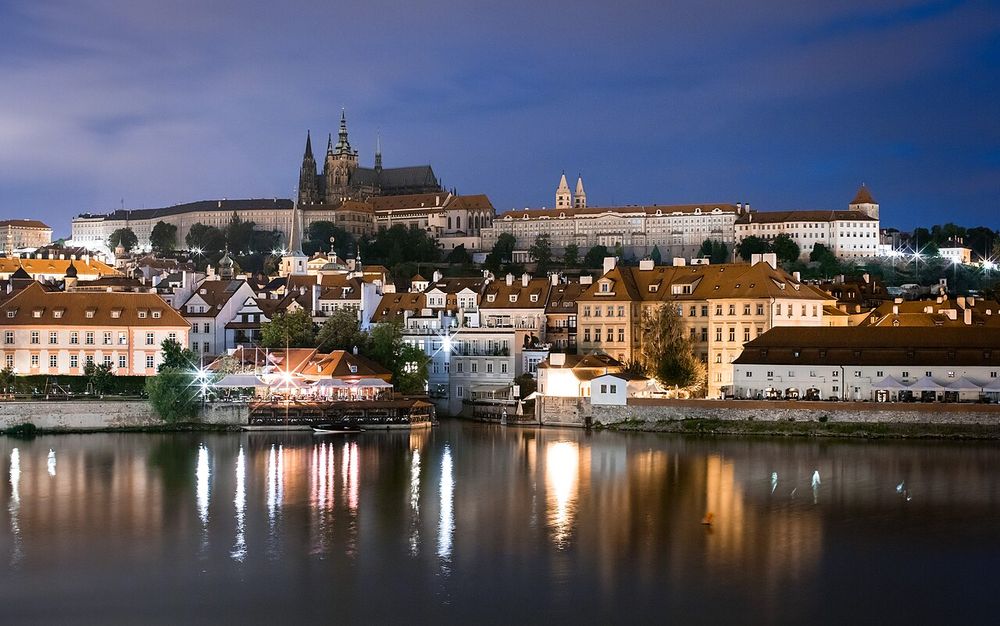
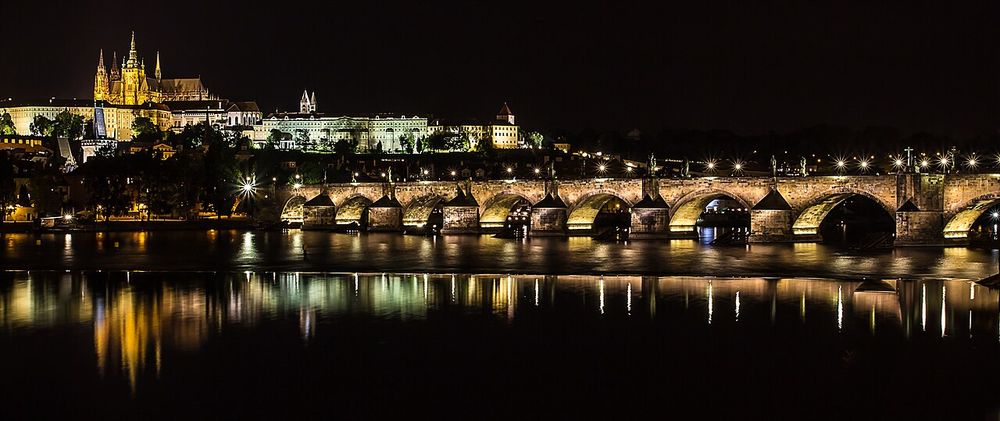
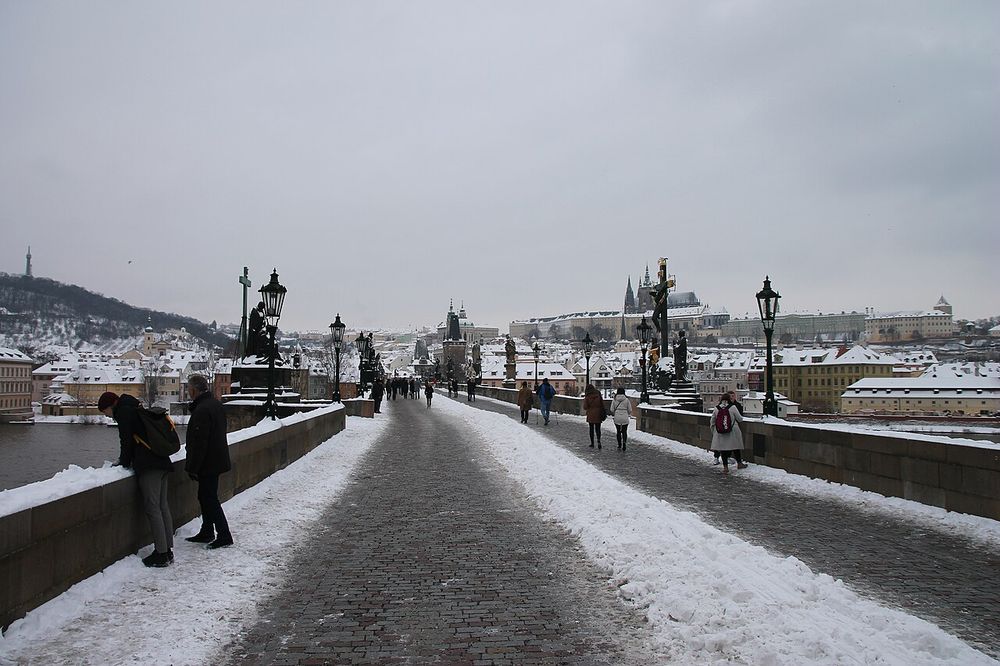
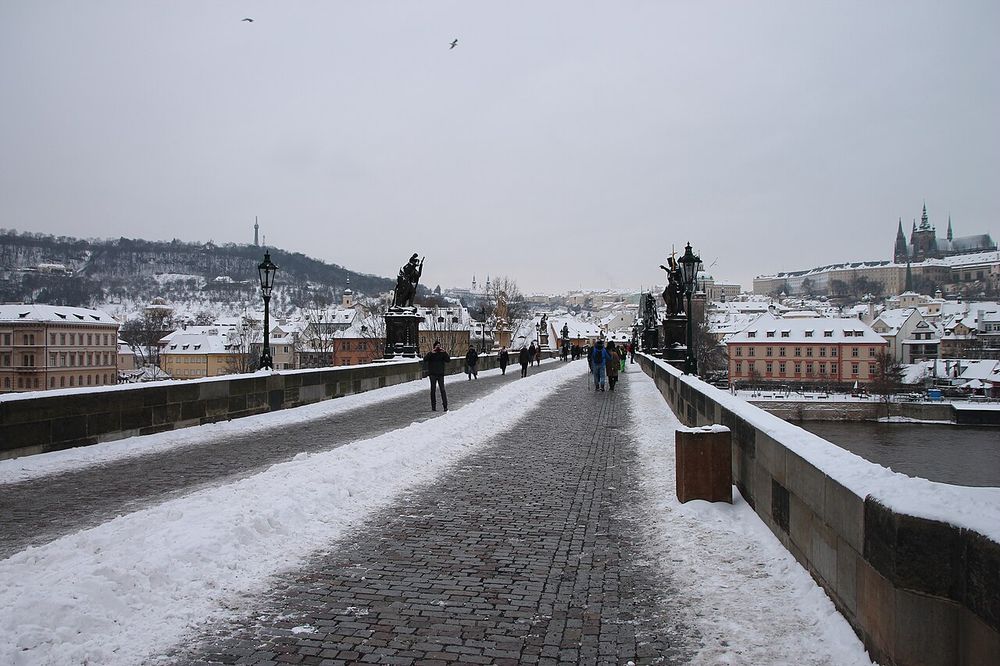
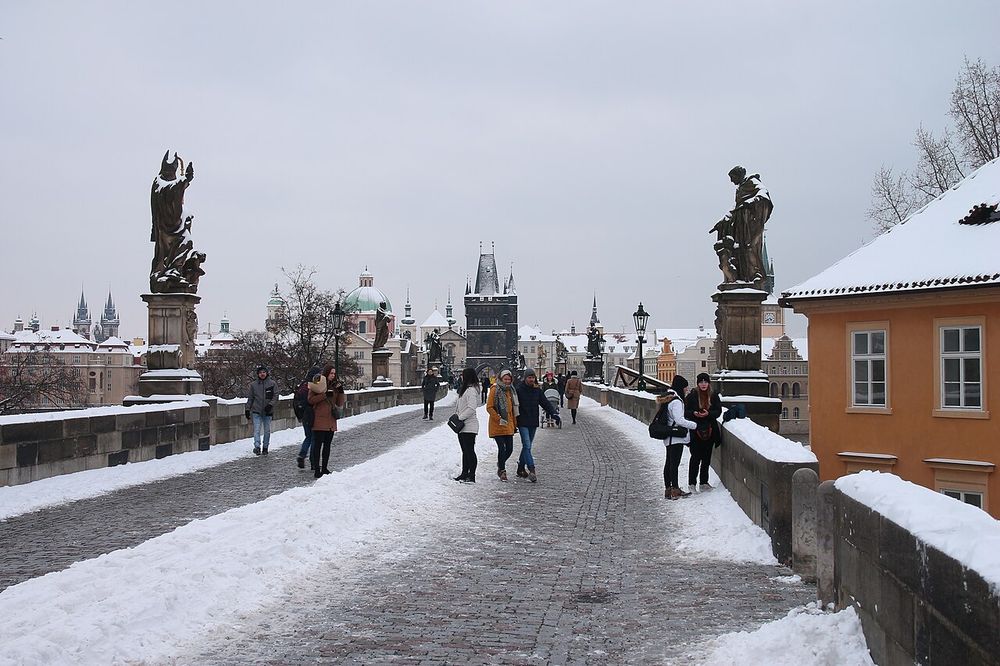
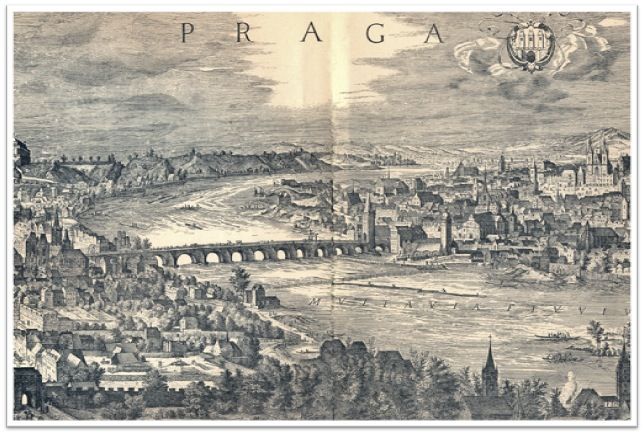
A stone bridge of sixteen arches, 516 metres long, begun in 1357. For almost five hundred years it was the only way across the river in Prague, and every king rode over it to be crowned. Thirty statues of saints stand along its sides. One of them marks a murder: a priest was thrown from this bridge at night in 1393, and became the saint of bridges all over Europe.
Photo: Uoaei1, CC BY-SA 4.0, Wikimedia Commons
The story
The river Vltava runs through Prague with the old town on one bank and the castle on the other. An earlier stone bridge was swept away by a flood in 1342. The king, Charles IV, ordered a new one, higher and stronger.
Work began in 1357. In China that is the seventeenth year of Zhizheng, near the end of the Yuan dynasty (元, 1271–1368); Zhu Yuanzhang, who would found the Ming (1368–1644), had taken Nanjing the year before. Chinese readers may think of the Lugou Bridge near Beijing, finished in 1192: it too is a long stone bridge with a row of carvings on each side.
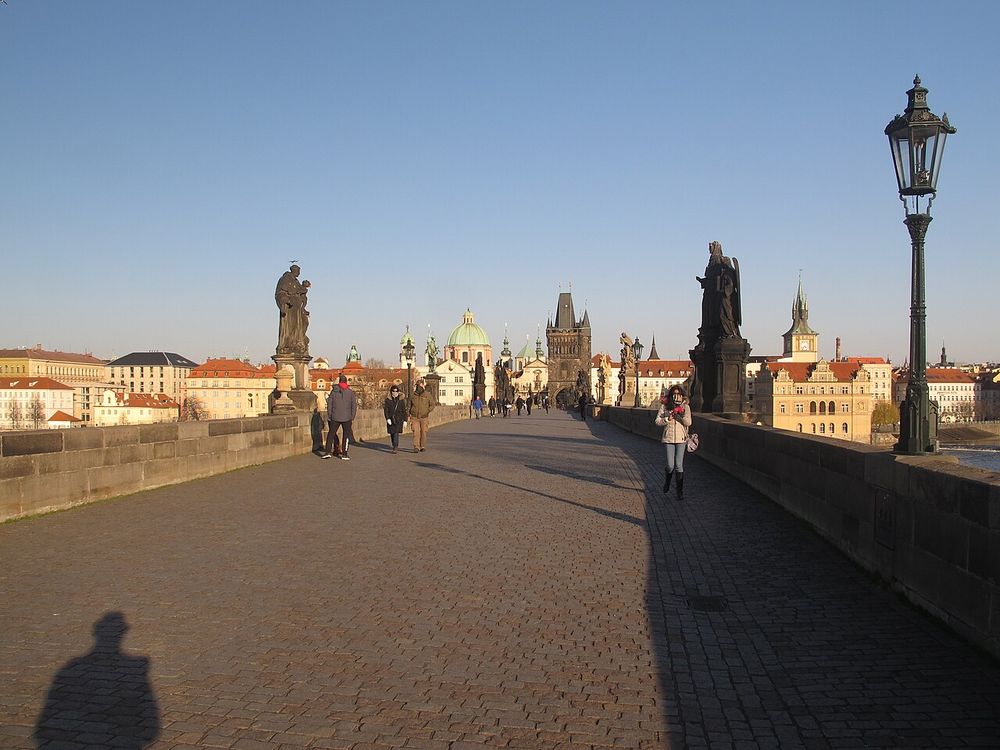
The bridge empty in March 2020Tadeáš Gregor, CC BY-SA 4.0
You are standing on sandstone blocks laid in the fourteenth century, ten metres wide, with the river sliding under you through arches you cannot see. Ahead is the castle on its hill. Behind you are the towers of the old town.
The saints came later. For three hundred years the bridge was bare except for one cross. The statues were put up between 1683 and 1714, when Catholic rulers had won back a country that had been largely Protestant. They face the people crossing, not the river.
Nearly all of them are copies now. The soft stone was dissolving in the rain, and the originals have been taken indoors.
Things people often get wrong
"It has always been called Charles Bridge." For five hundred years it was the Stone Bridge or the Prague Bridge. The present name dates from 1870.
"It has always been for walkers." Horse trams ran across it from 1883, electric trams from 1905, then buses and cars. Since the 1960s it has been for walkers only.
"Rubbing the bronze plaque is an old custom." The shiny patches on the base of the statue of St John come from a much newer habit than most people think. The older custom belongs to a different spot, a few steps away.
"The priest died for keeping the queen's secret." That story appeared some sixty years after his death. The records of the time show a quarrel between the king and the archbishop over who should run a rich abbey.
People who stood here
Charles IV (king of Bohemia and Holy Roman Emperor, 1316–1378)He ordered the bridge at forty-one and did not live to cross it finished. It took about forty-five years. His statue sits on the tower at the Old Town end, and is thought to be a true likeness.
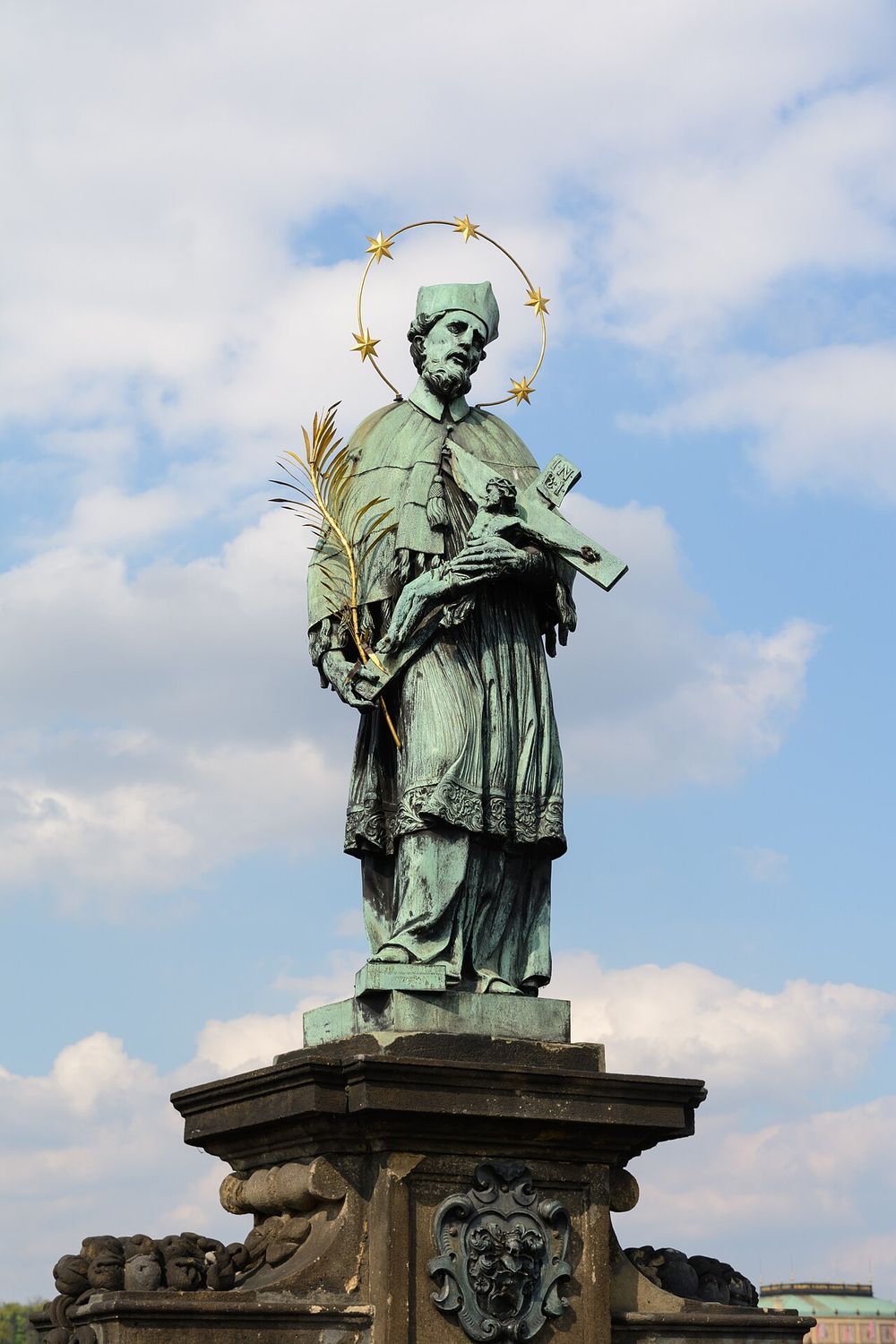
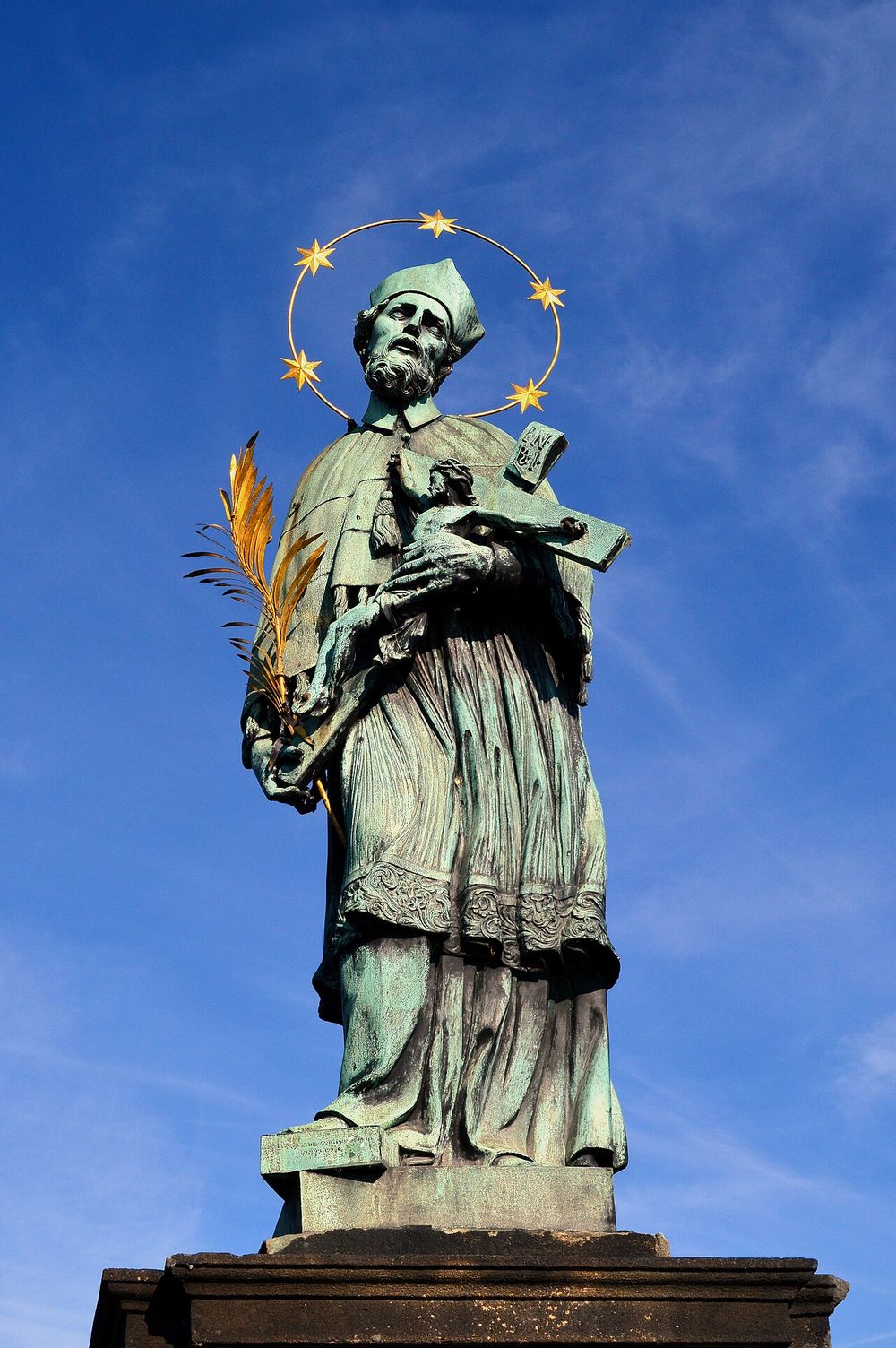
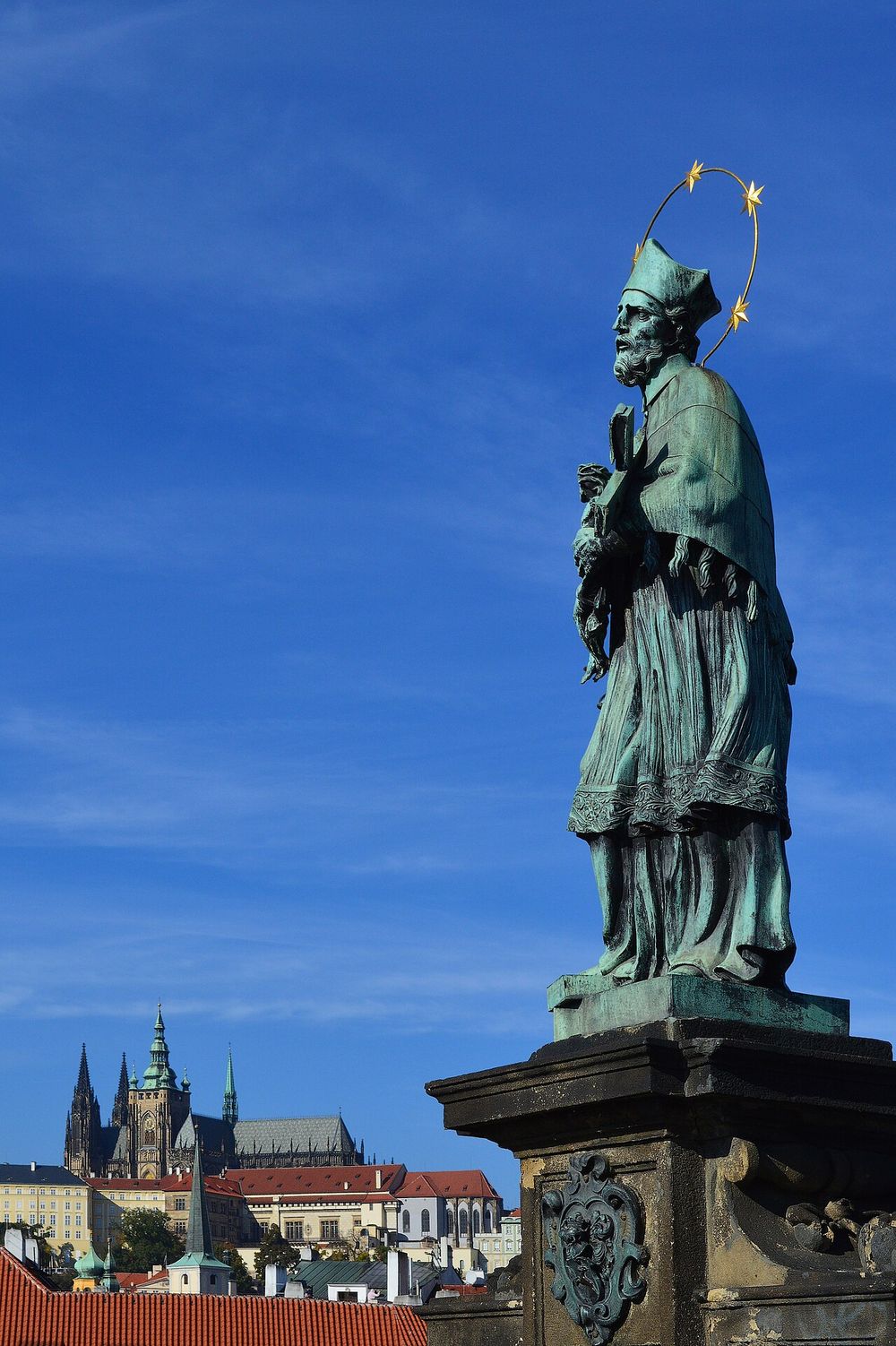
John of Nepomuk (priest, about 1345–1393)The archbishop's deputy. On 20 March 1393 the king's men tortured him, tied him up and threw him from the bridge after dark. He was made a saint in 1729. Statues of him, with five stars round his head, stand on bridges from Portugal to Poland.
Wenceslas IV (king of Bohemia, 1361–1419)Charles's son, who had the priest killed. He was moody, drank heavily and was twice taken prisoner by his own nobles. His statue sits on the tower beside his father's, and his badge, a kingfisher in a knotted towel, is carved all over it.
Jiří Plachý (Jesuit priest, 1606–1664)In 1648 a Swedish army took the castle bank by surprise and tried to fight its way across. He led a company of university students who held the bridge tower for three months, until news came that the Thirty Years' War was over.
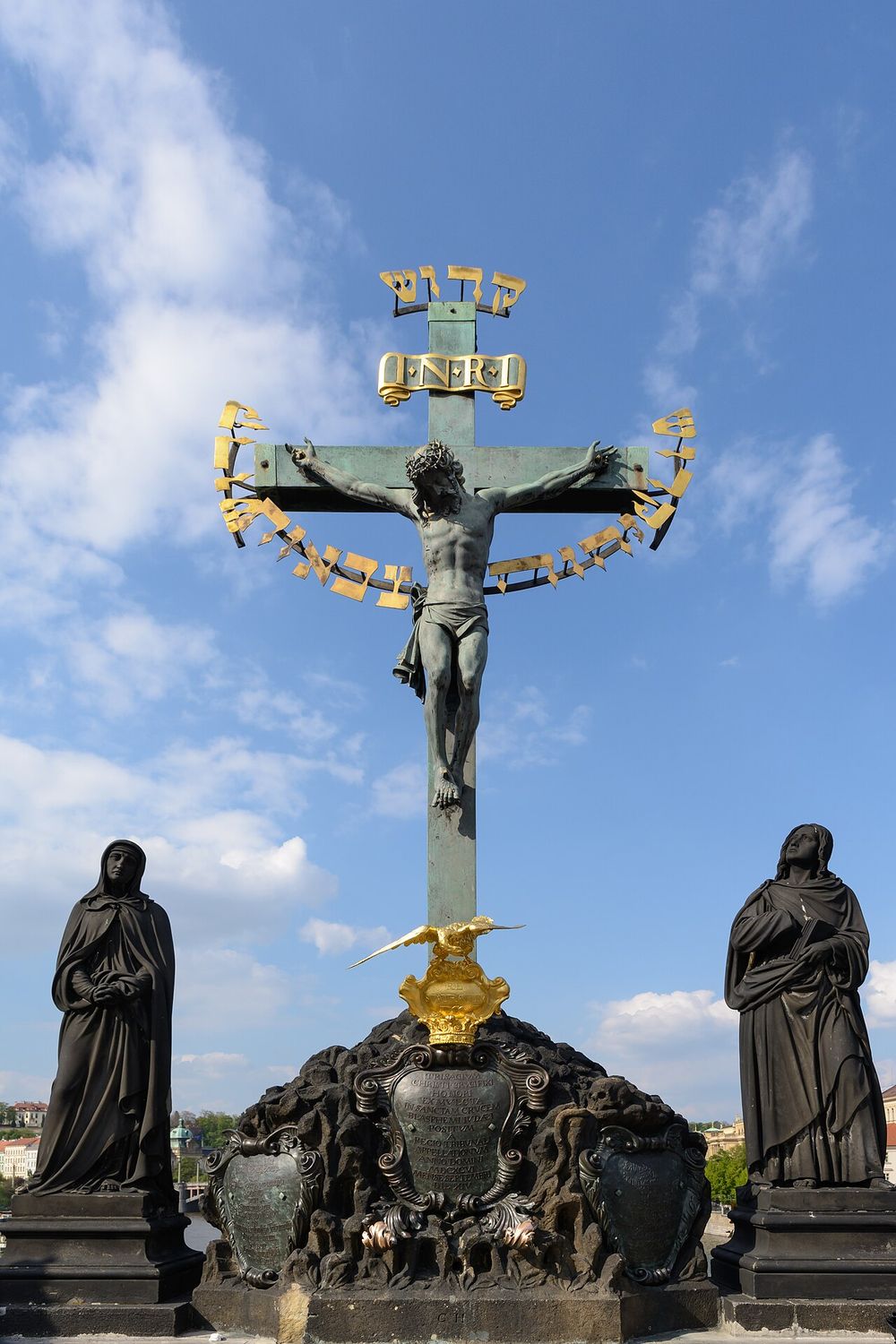
Elias Backoffen (leader of Prague's Jewish community, 1690s)In 1696 a court found him guilty of mocking the cross on the bridge. His fine paid for the gilded Hebrew words that still hang round it.
Matthias Braun (sculptor from Tyrol, 1684–1738)At twenty-six he carved for the bridge a blind nun to whom Christ leans down from the cross. It is usually called the finest statue here.
Bedřich Smetana (Czech composer, 1824–1884)His tone poem Vltava (1874) follows the river from two springs in the forest to the moment it passes under this bridge. He had gone deaf a few weeks before he began it. A museum of his life stands on the bank beside the tower.
Franz Kafka (Prague writer in German, 1883–1924)He crossed the bridge thousands of times. His earliest surviving story, Description of a Struggle, takes two men over it on a winter night.
Marina Tsvetaeva (Russian poet, 1892–1941)An exile living in a village outside Prague, she fell in love with the stone knight who stands under the bridge and wrote him a poem in 1923. She said he looked like her.
Brian De Palma (American film director, born 1940)In Mission: Impossible (1996) a spy is shot on the bridge at night and drops over the parapet into the river. It was one of the first big foreign films shot in Prague after 1989.
Go deeper: eight stops, from the Old Town end to the far towers
The bridge is free and never closes. Only the towers have tickets. Walk from the Old Town side towards the castle: that is the way the kings came.
1. The square before the bridge
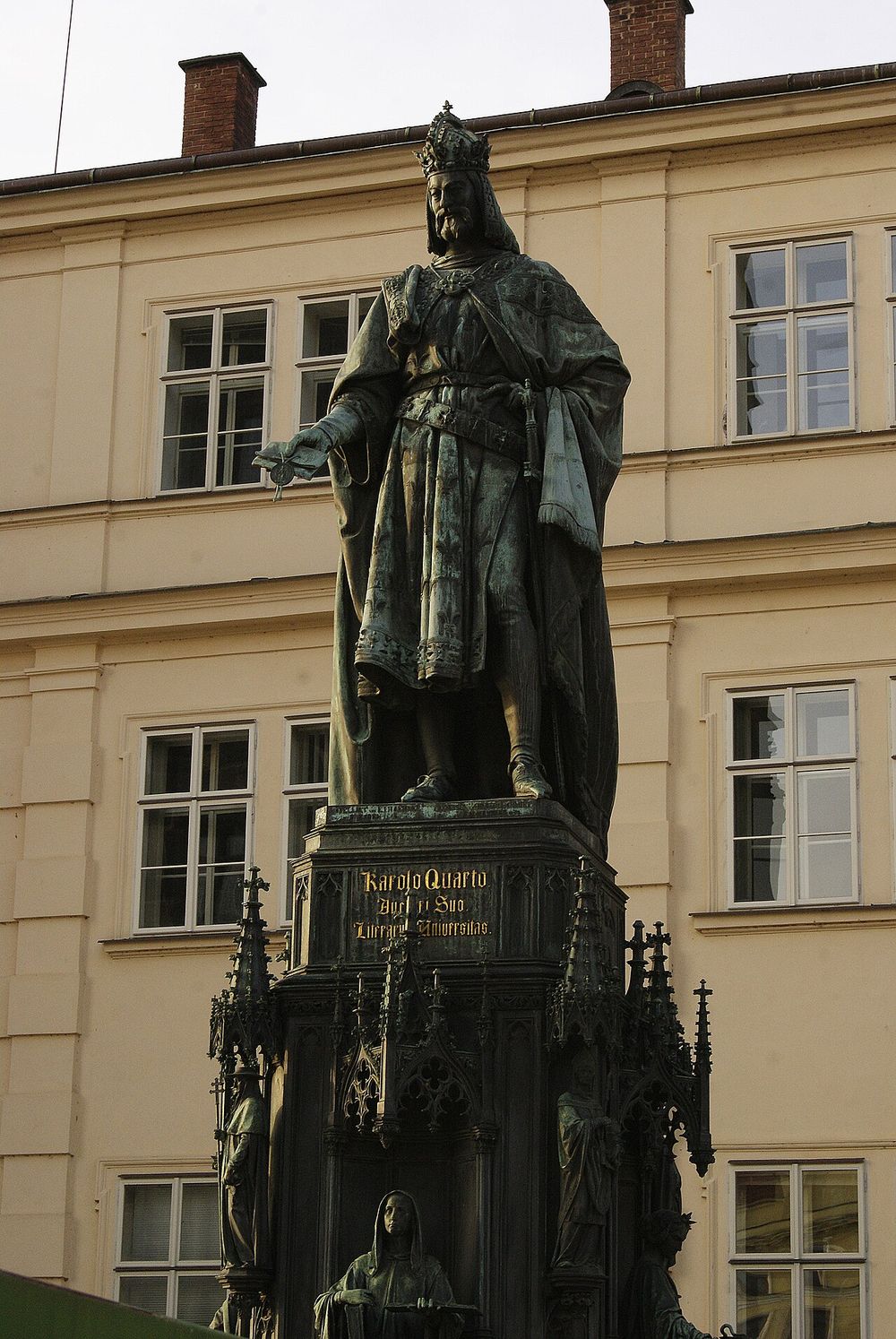
Charles IV on the square before the bridgeLibertinaGrim, CC BY-SA 3.0
A bronze king stands on a pedestal holding a charter. It is Charles IV, and the paper is the founding document of his university. The statue was made for the university's five-hundredth birthday in 1848.
2. The Old Town Bridge Tower
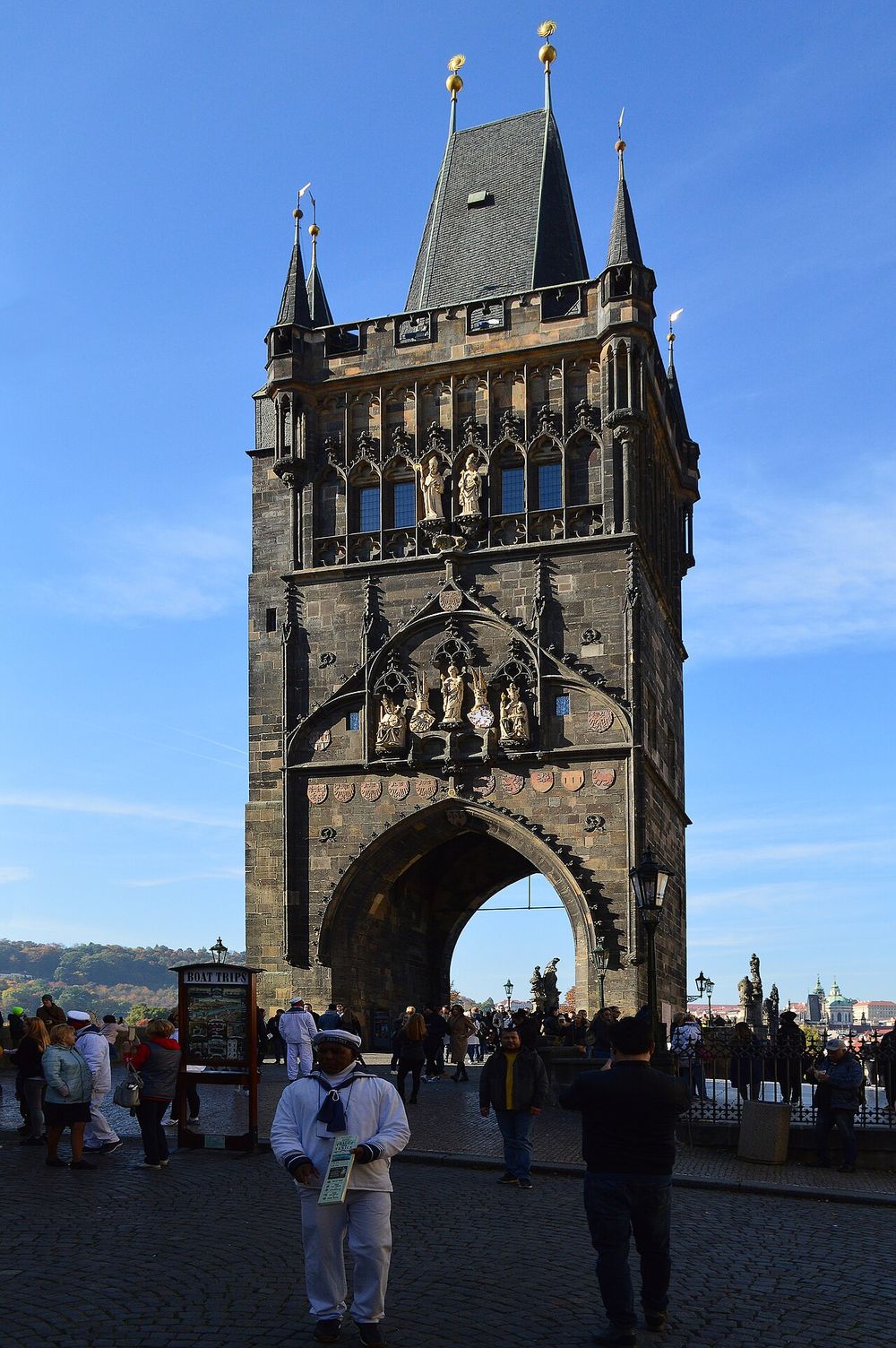
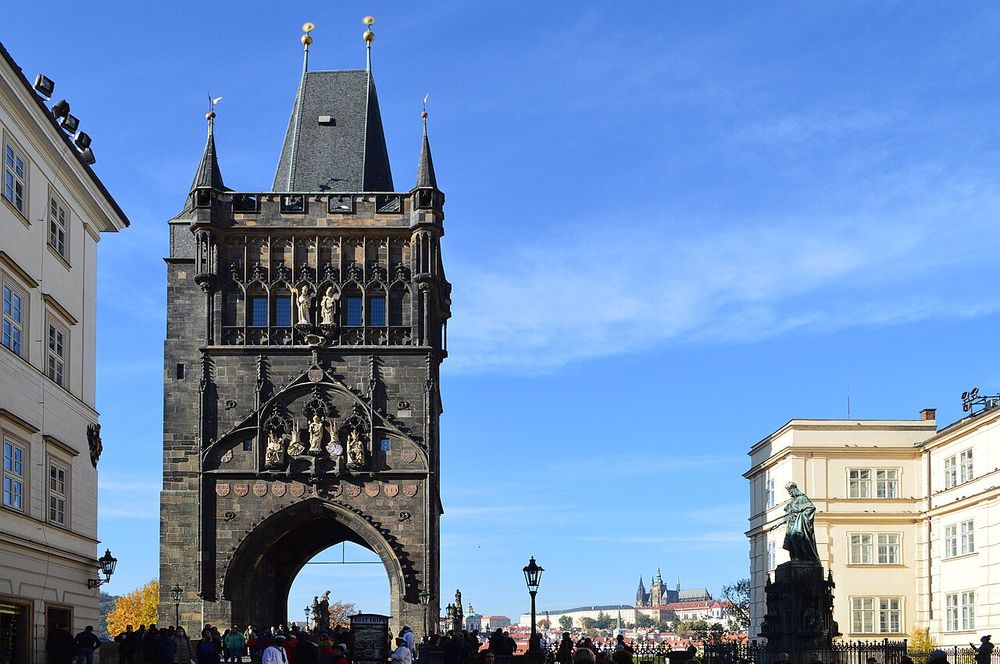
The Old Town Bridge Tower, October 2021Scotch Mist, CC BY-SA 4.0
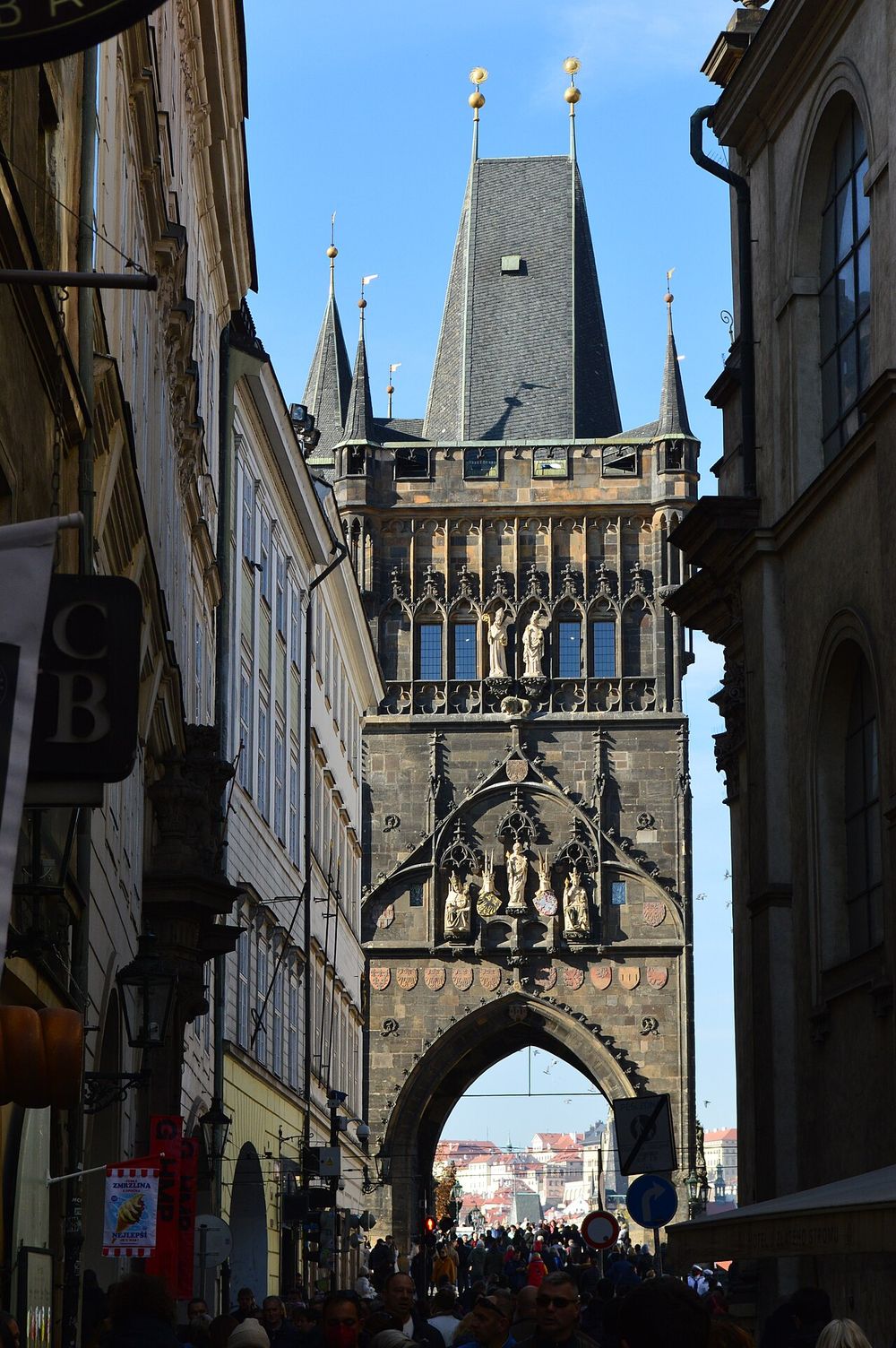
The gate to the bridge, built about 1380 by the cathedral's workshop. On the side facing you, above the arch, are three figures: the old emperor and his son seated on either side, and between them St Vitus standing on a little model of the bridge.
The far side of the tower is bare. Swedish cannon stripped it in 1648.
In 1621, after a failed rising against the Habsburgs, twenty-seven leaders were executed in the Old Town square. Twelve of their heads were hung from this tower in iron baskets and left for ten years.
You can climb it: 138 steps to a gallery under the roof.
3. The cross with Hebrew letters
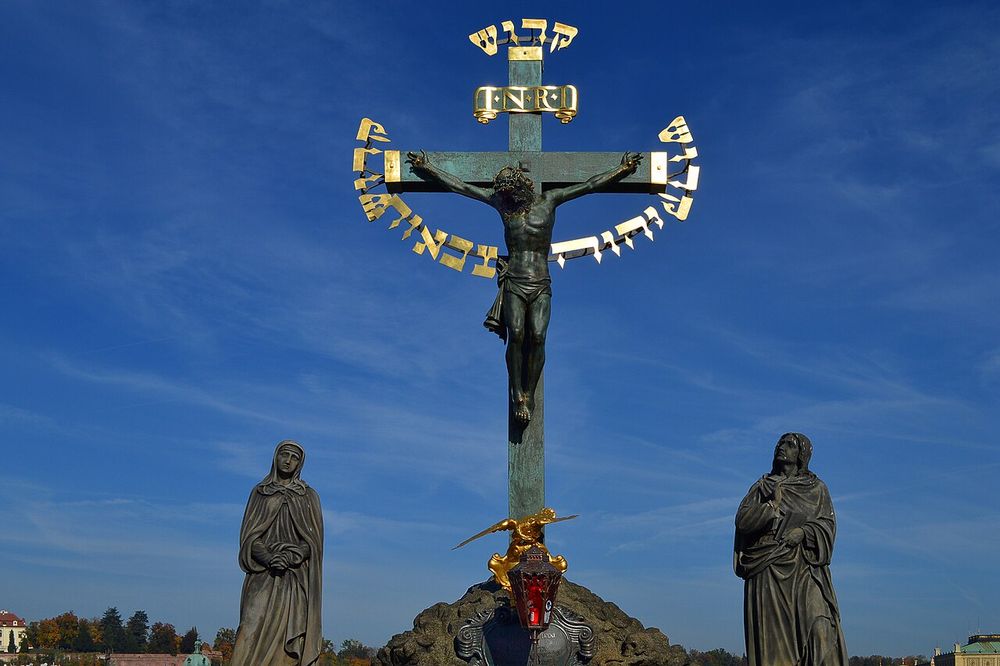
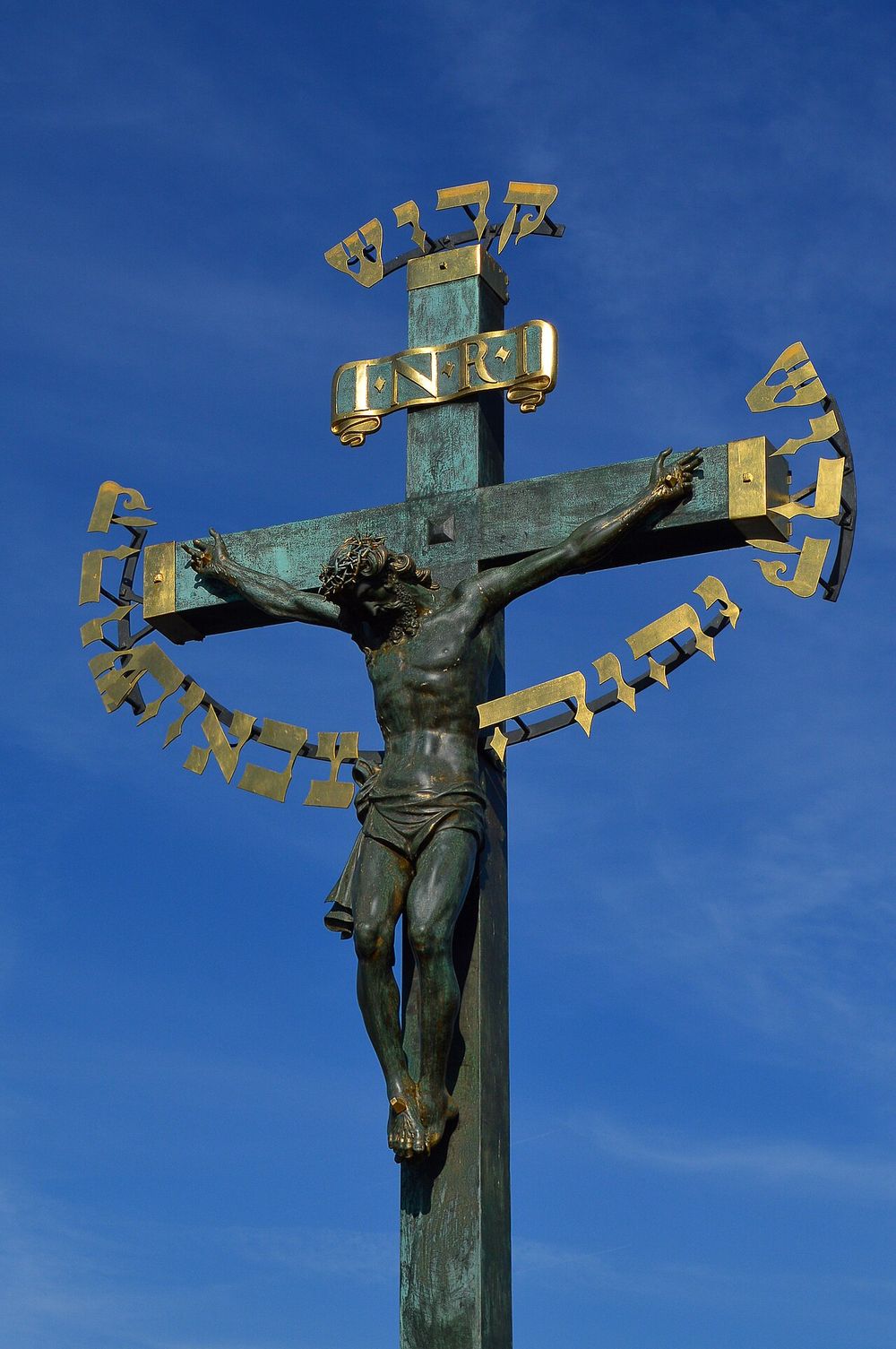
The crucifix and its Hebrew lettersScotch Mist, CC BY-SA 4.0
Near the start, on the right, is a bronze crucifix. A cross has stood at this spot since the bridge was new. Round the figure runs an arc of gilded Hebrew letters: "Holy, holy, holy is the Lord of Hosts", words from the Jewish prayer book.
They were put there in 1696 to humiliate the Jews of Prague, who had to pass them every day. Small bronze plaques in Czech, English and Hebrew, added in 2000, explain this.
4. St John of Nepomuk
St John of Nepomuk, July 2016A.Savin, FAL
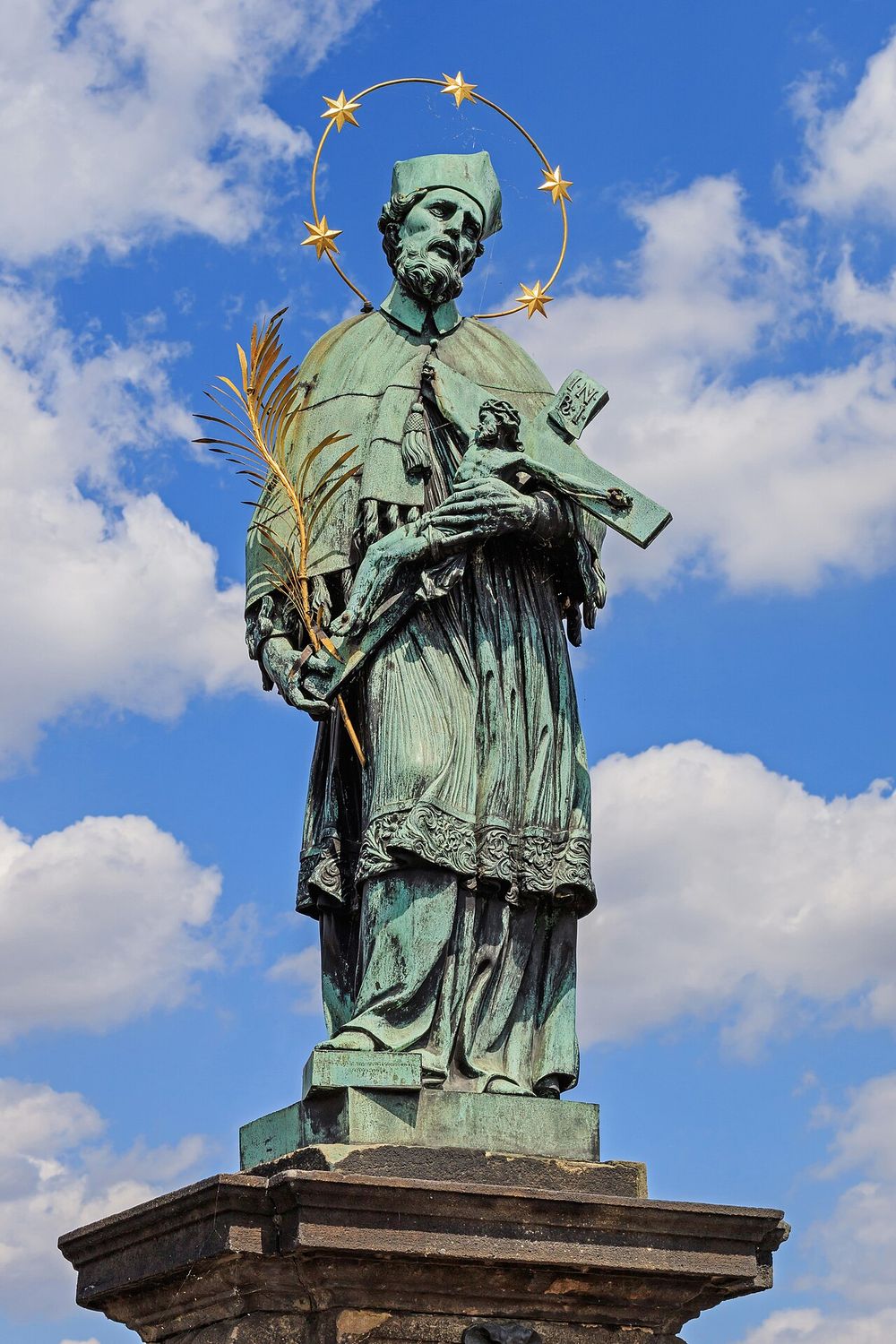
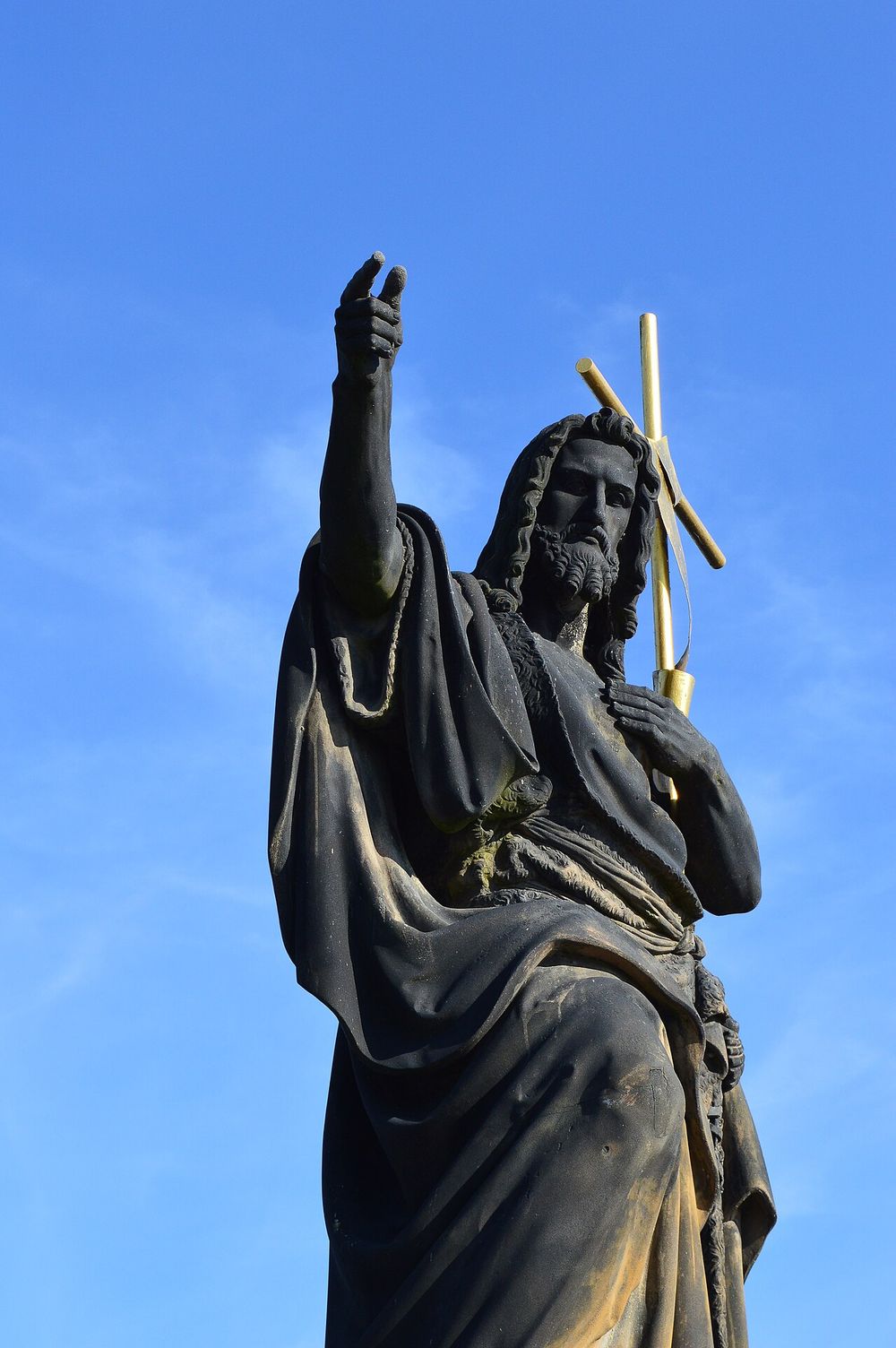
The oldest statue on the bridge, cast in bronze and set up in 1683. He holds a crucifix and a palm, and five gold stars ring his head: people said five stars appeared on the water where he sank.
The two reliefs, polished by handsScotch Mist, CC BY-SA 4.0
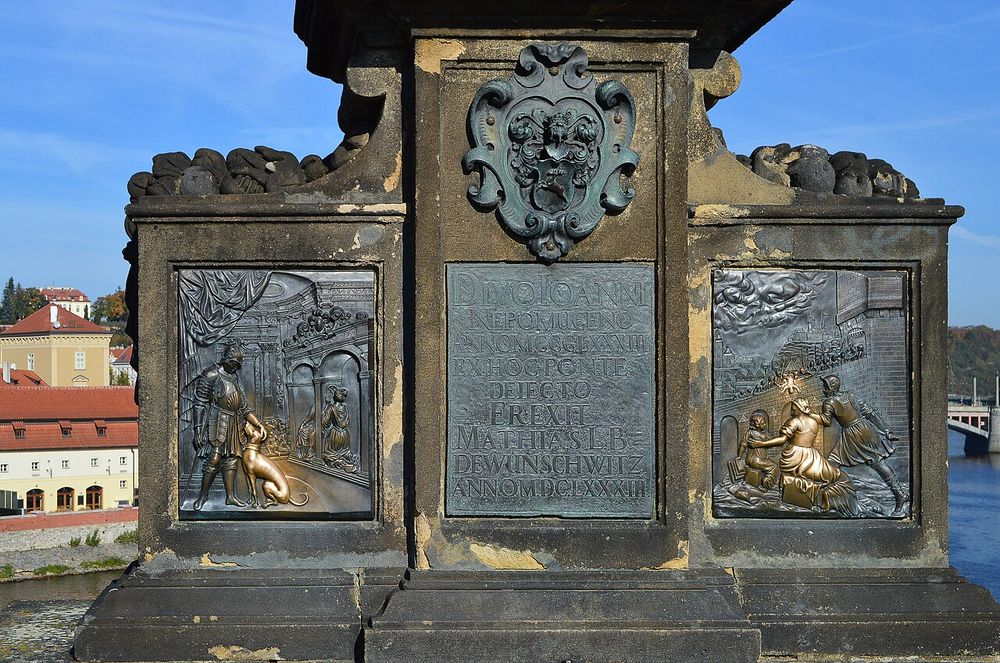
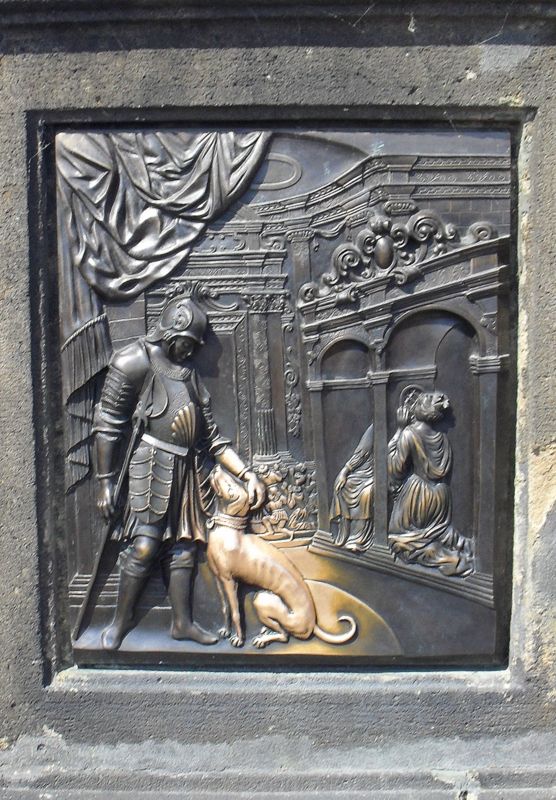
Two reliefs on the base are worn bright by hands. On the right a tiny figure falls head first from the bridge. On the left a soldier strokes a dog while the queen kneels at confession behind him. Guides say that touching the falling priest means you will come back to Prague. Nobody can say what touching the dog does, and it is the shinier of the two.
5. The five stars in the parapet
The relief with the dogAw58, CC BY-SA 3.0
A few steps past the statue of St John, a small brass cross with five stars is set into the top of the wall, behind an iron grille. This is where the priest went over. People lay a hand on the cross so that each finger touches a star, and make a wish.
6. The crowd of saints
One of the statue groupsScotch Mist, CC BY-SA 4.0
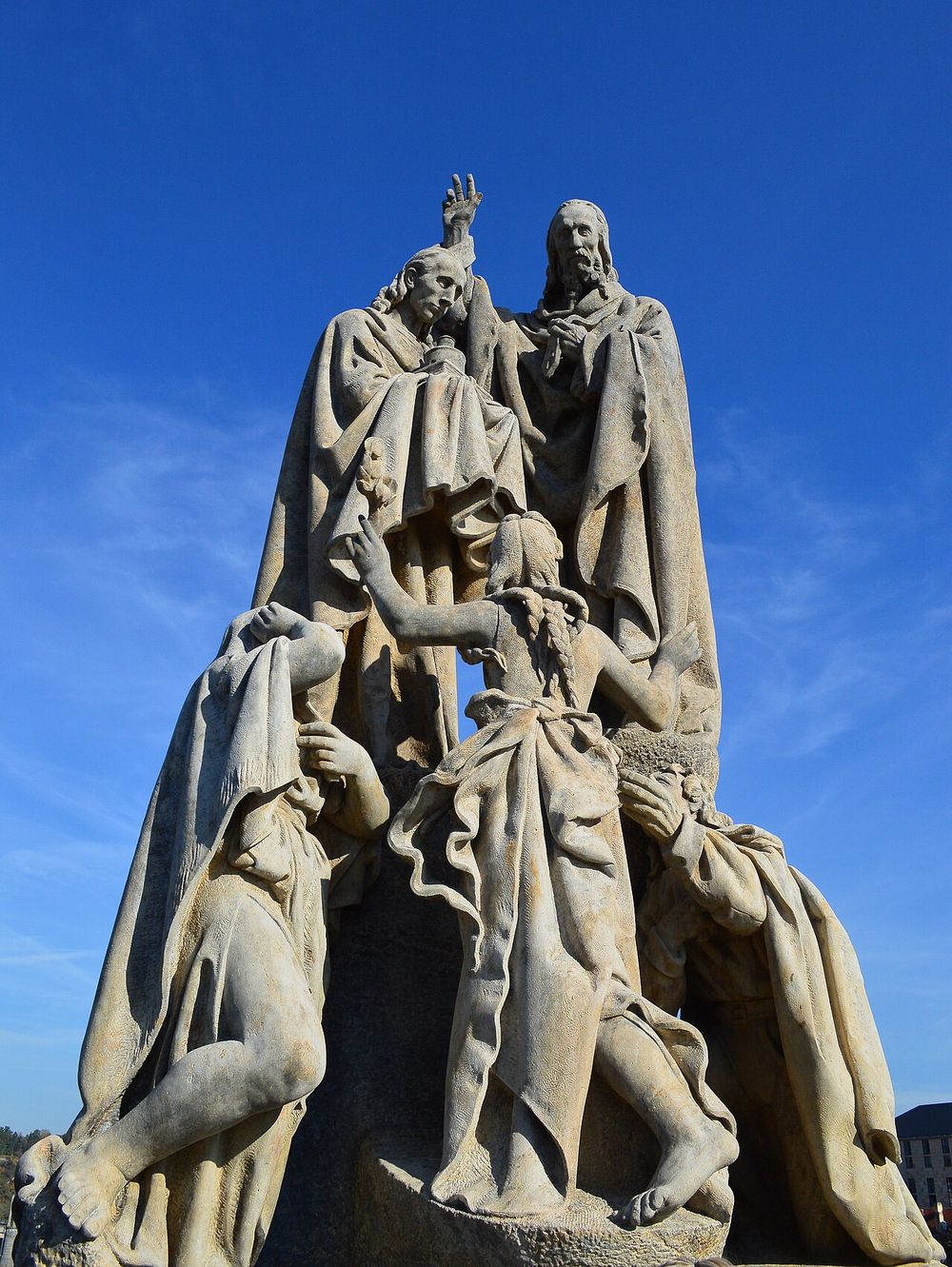
Jesuits, Dominicans, the university and rich citizens each paid for a group and tried to outdo the next. Look for the blind nun on the left, about two-thirds of the way across, the Turk guarding Christian prisoners in a cave, and St Francis Xavier baptising an Indian prince on a platform carried by figures from Asia, one of them Chinese.
The originals are in a museum of stone sculpture at the exhibition grounds, and in the vaults of the old fortress of Vyšehrad.
7. The knight under the bridge
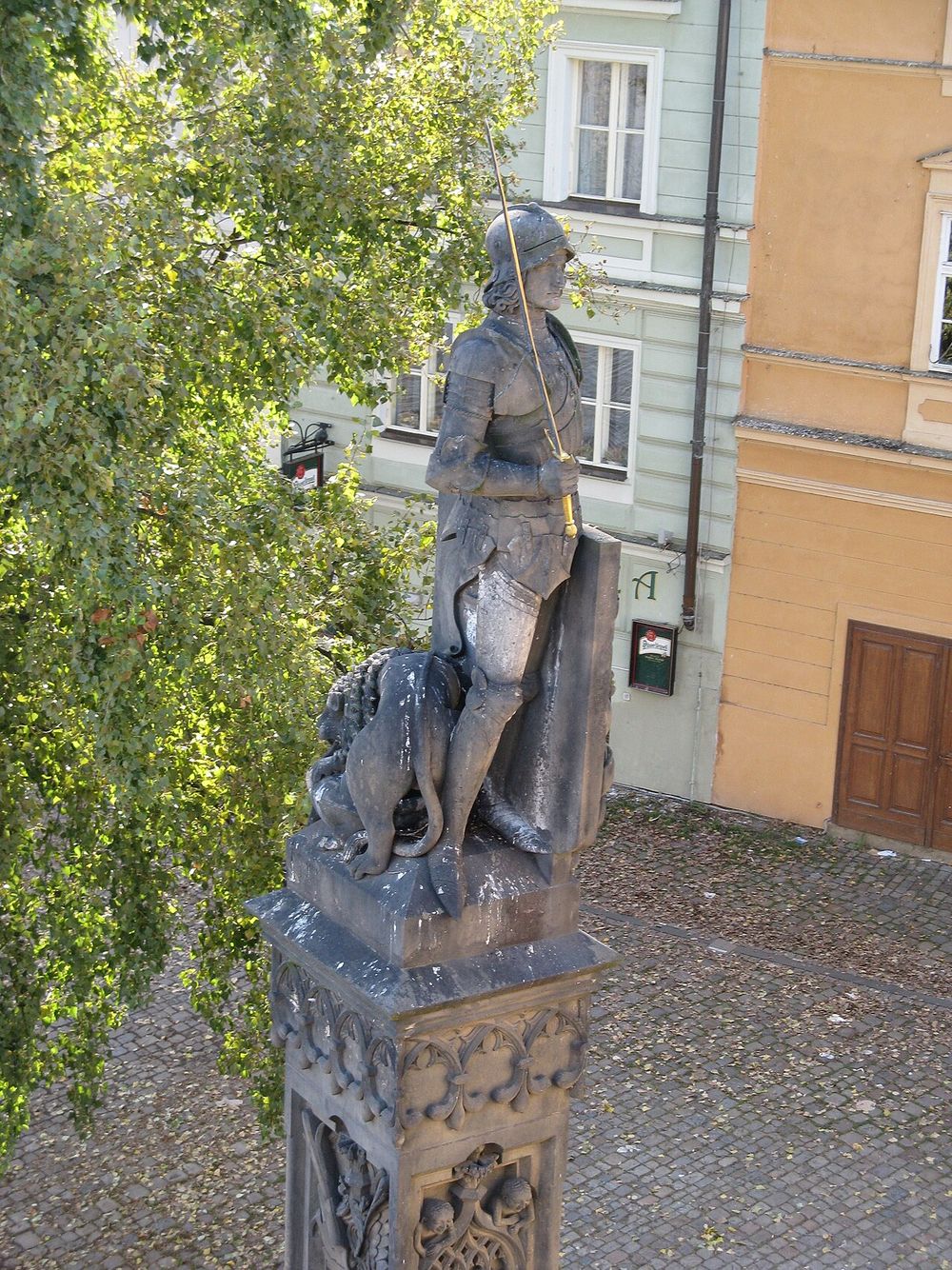
Bruncvík, the knight below the bridgeYair Haklai, CC BY-SA 4.0
Lean over the left-hand wall where the bridge crosses an island. On a pier below stands a knight in armour with a drawn golden sword and a lion at his feet. He is Bruncvík, a prince of legend.
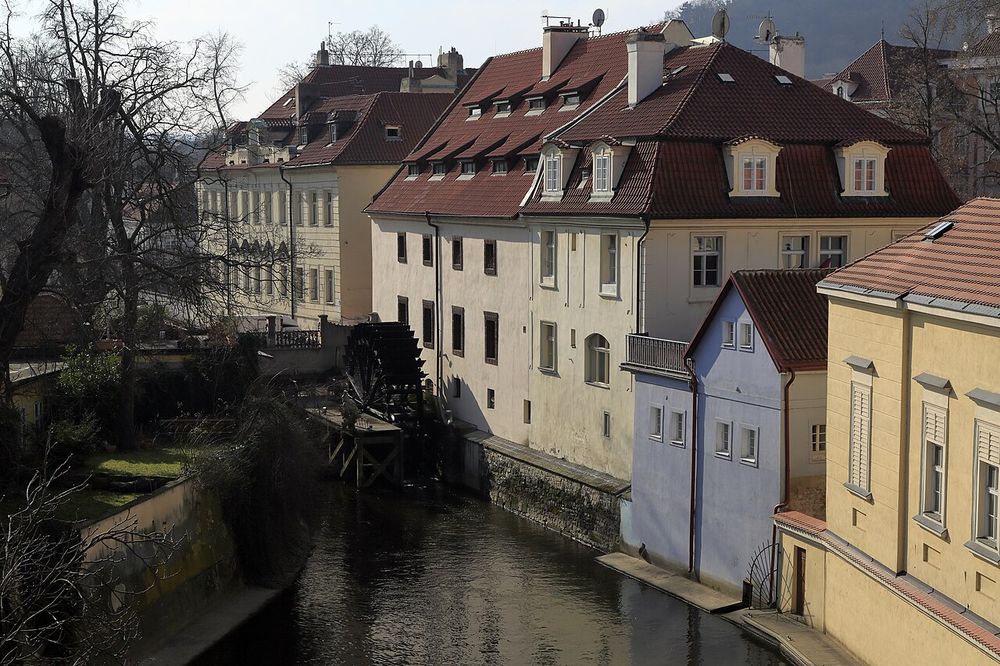
The Devil's Channel on Kampa, February 2015Falk2, CC BY-SA 4.0
The island is Kampa. A narrow mill-stream called the Devil's Channel cuts it off from the bank, and an old water-wheel still turns in it.
8. The far towers and the view back
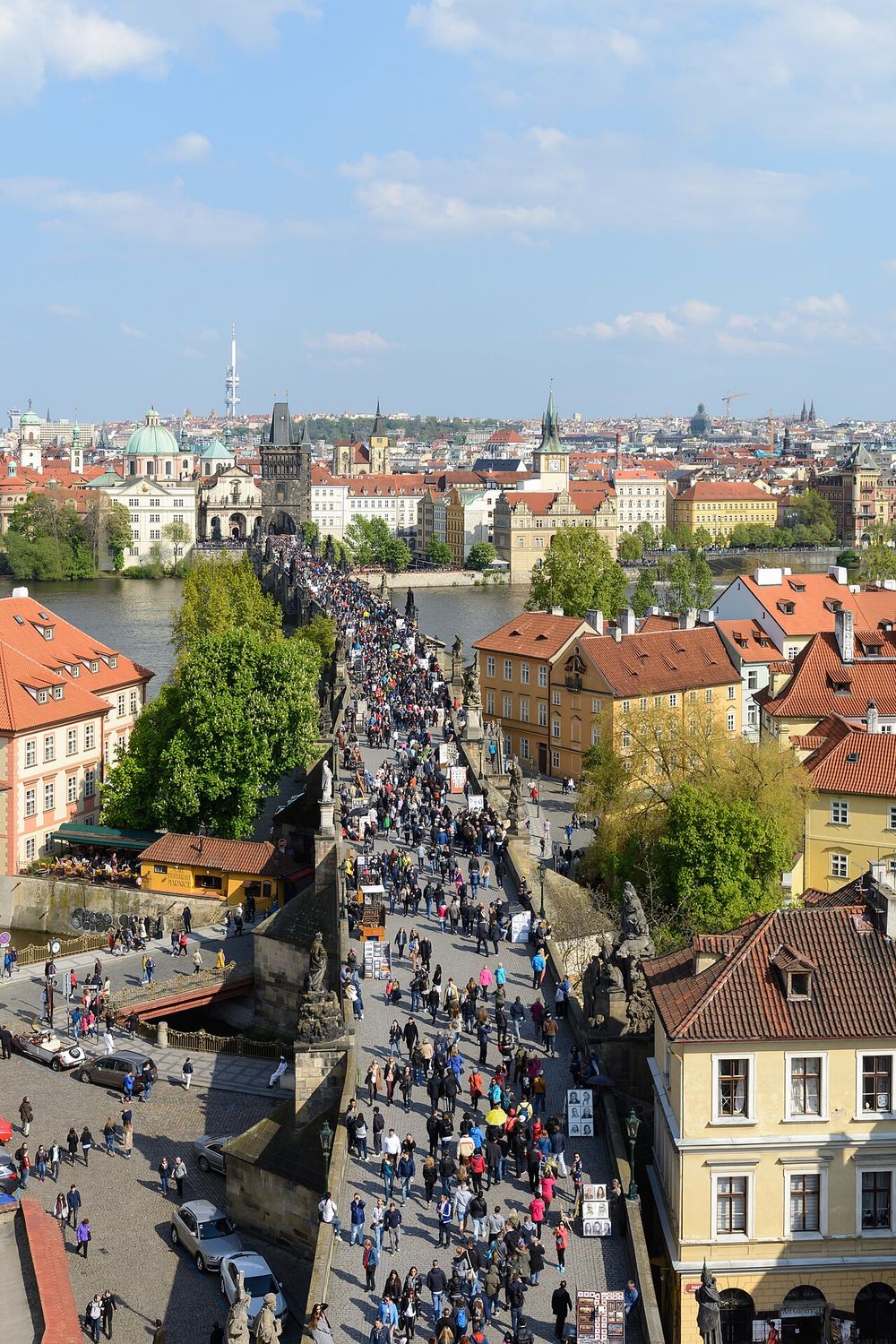
From the Lesser Town tower: the bend in the bridge, April 2017Uoaei1, CC BY-SA 4.0
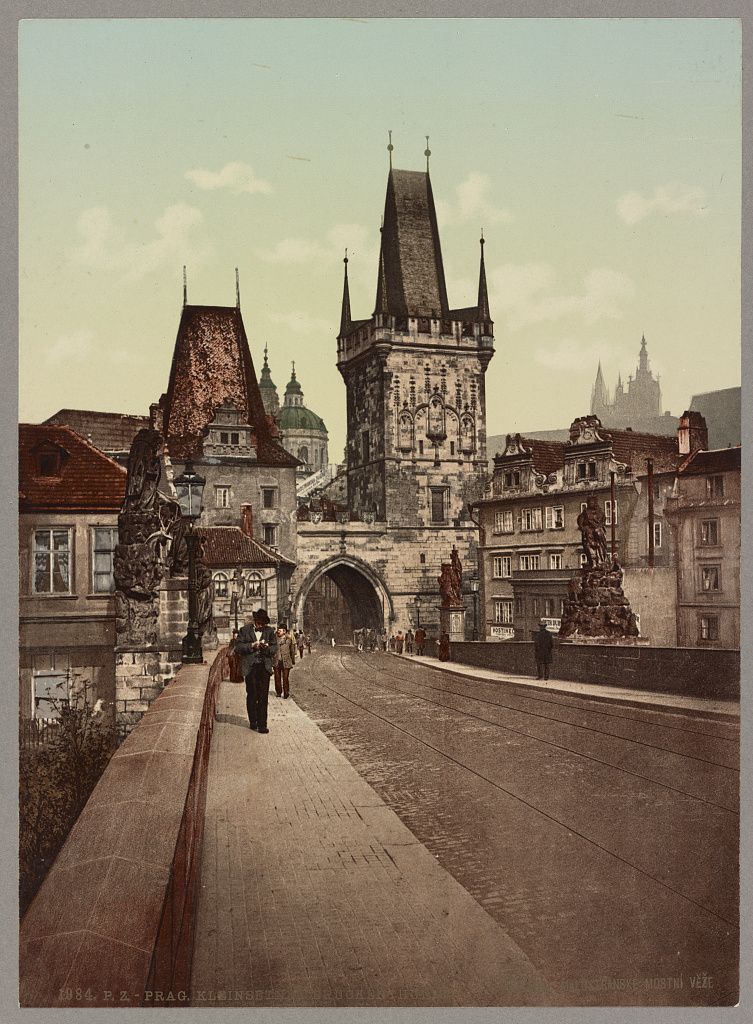
Two towers of different heights guard the castle end. The short one is older than the bridge: it belonged to the bridge that was washed away. Climb the tall one and look back. From above you see what you cannot see on the bridge: that it is not straight. It bends, probably because it was laid along the line of the older bridge.
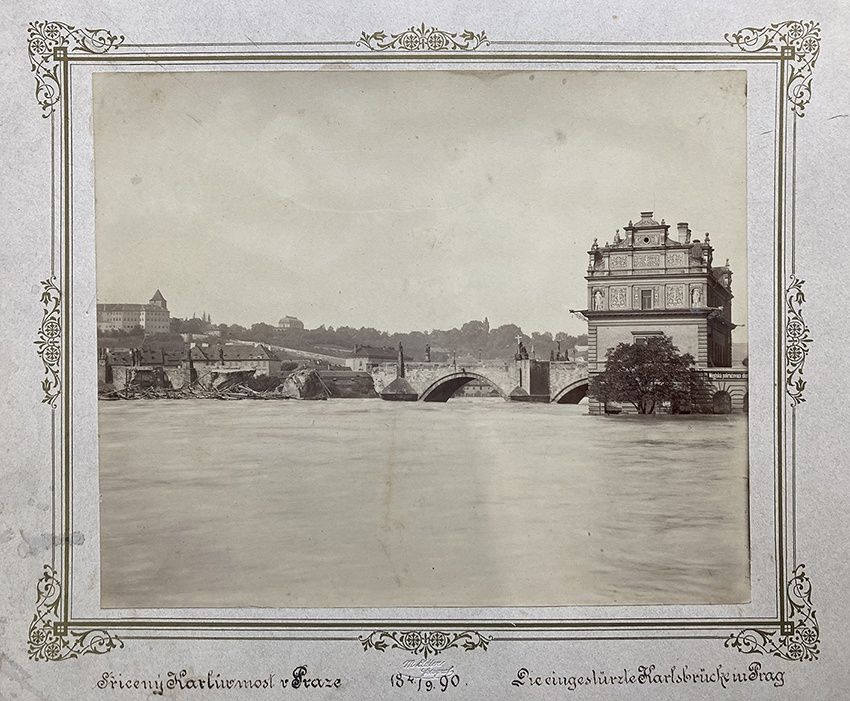
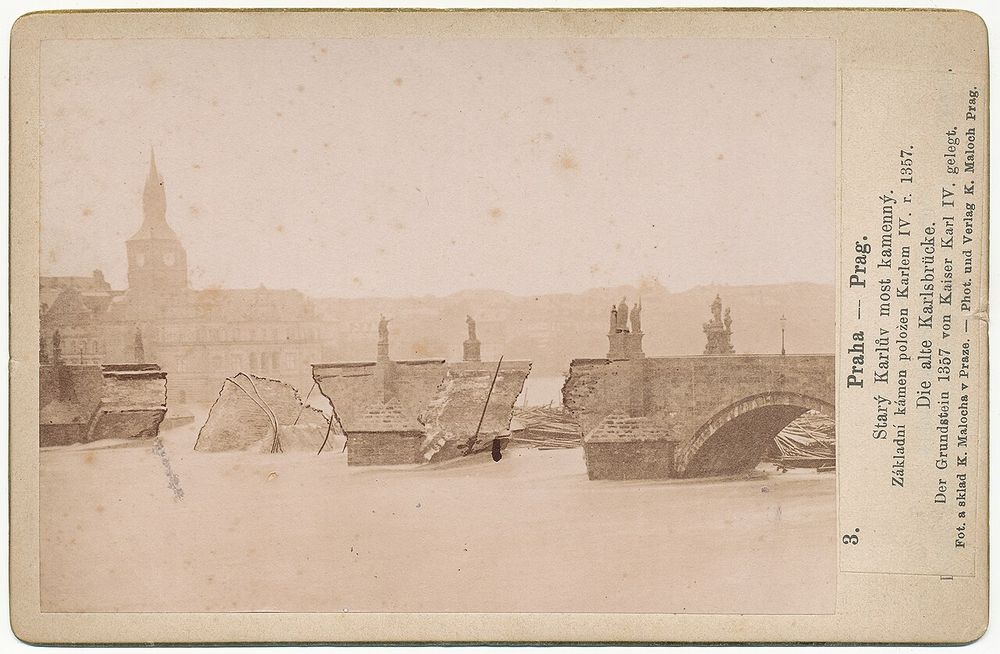
The gap in the bridge, 4 September 1890Moritz Adler, Public domain
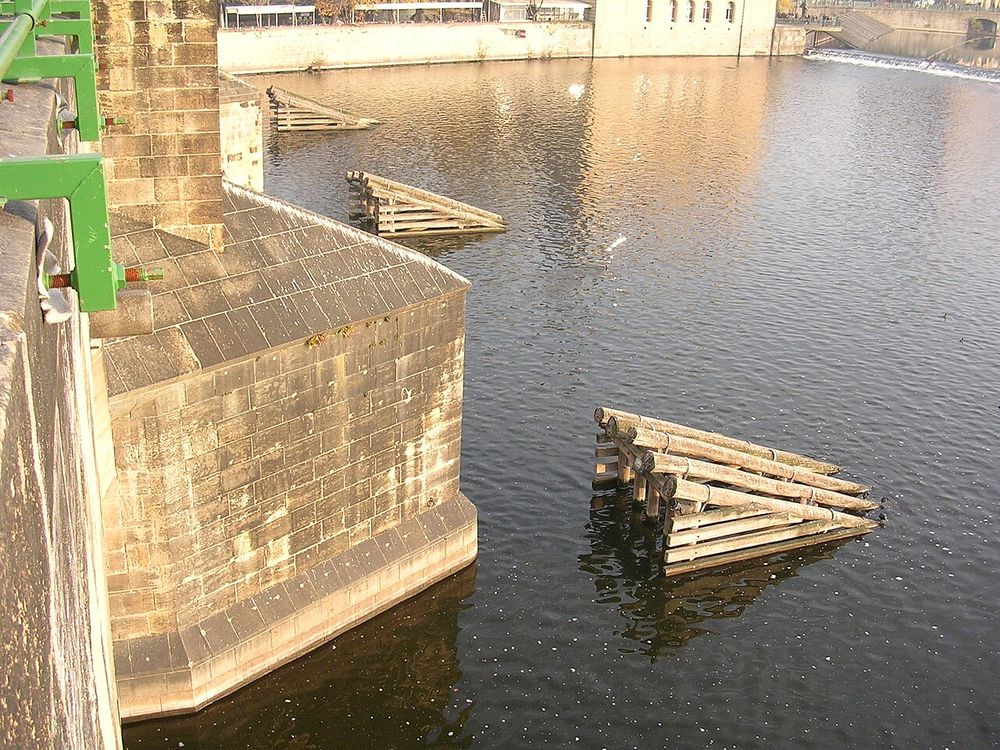
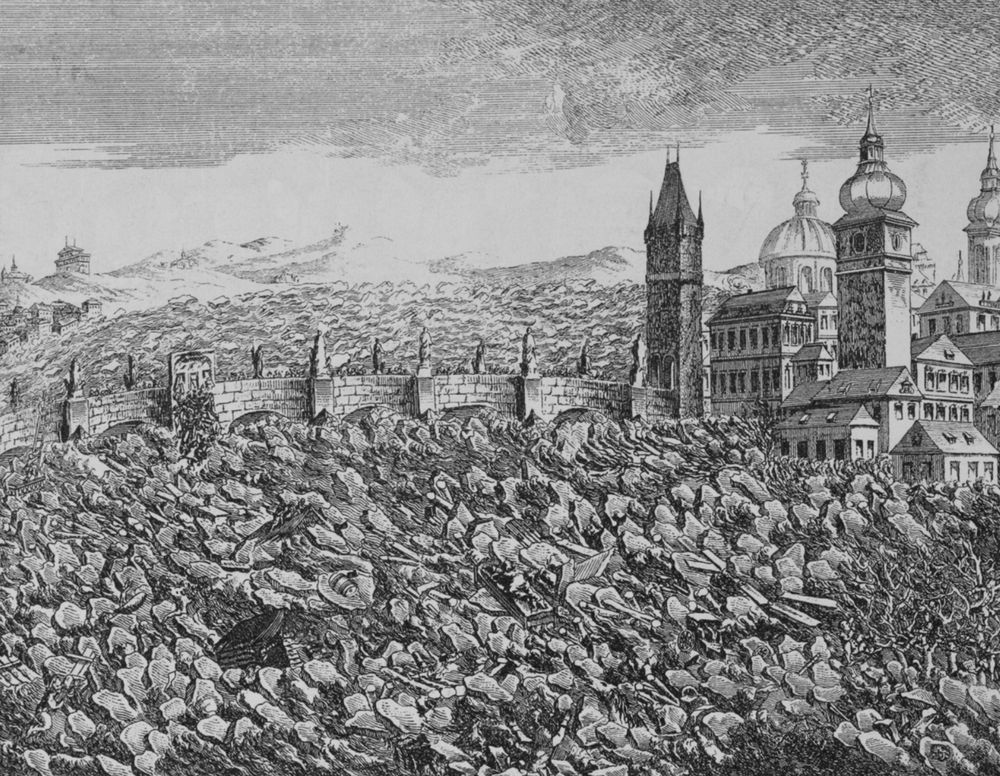
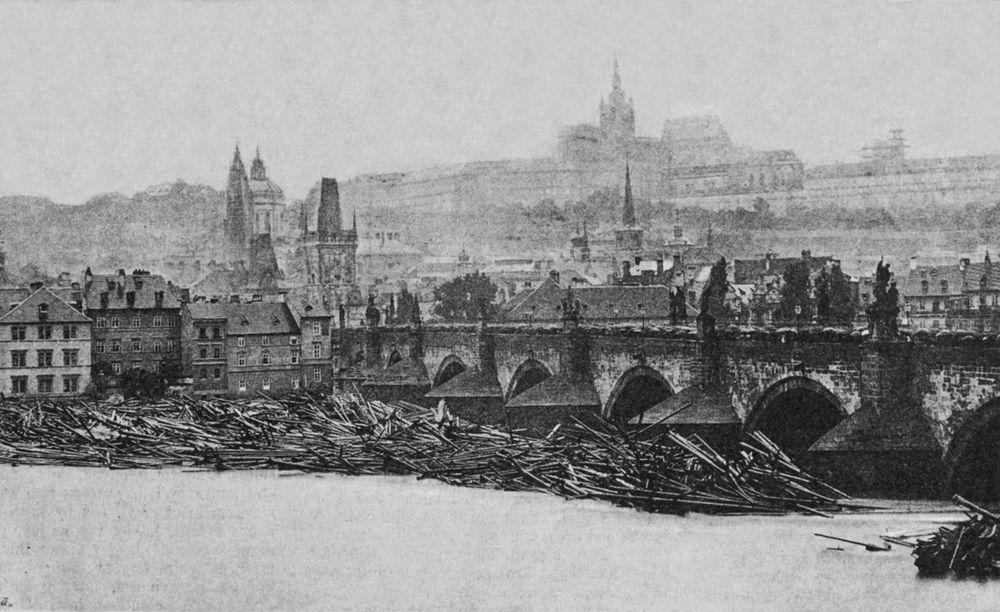
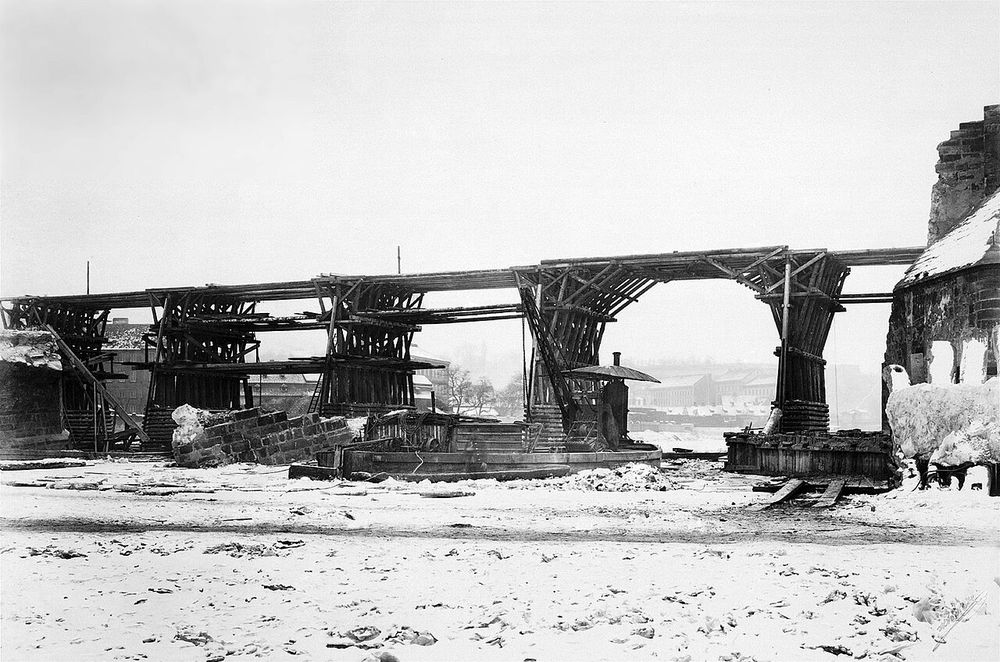
On 4 September 1890 a flood piled thousands of logs from broken timber rafts against the piers. Three arches fell, and two statues went into the river with them. The repair took two years.
The Old Town tower before sunrise, July 2013Michael Brezocnik, CC BY-SA 4.0
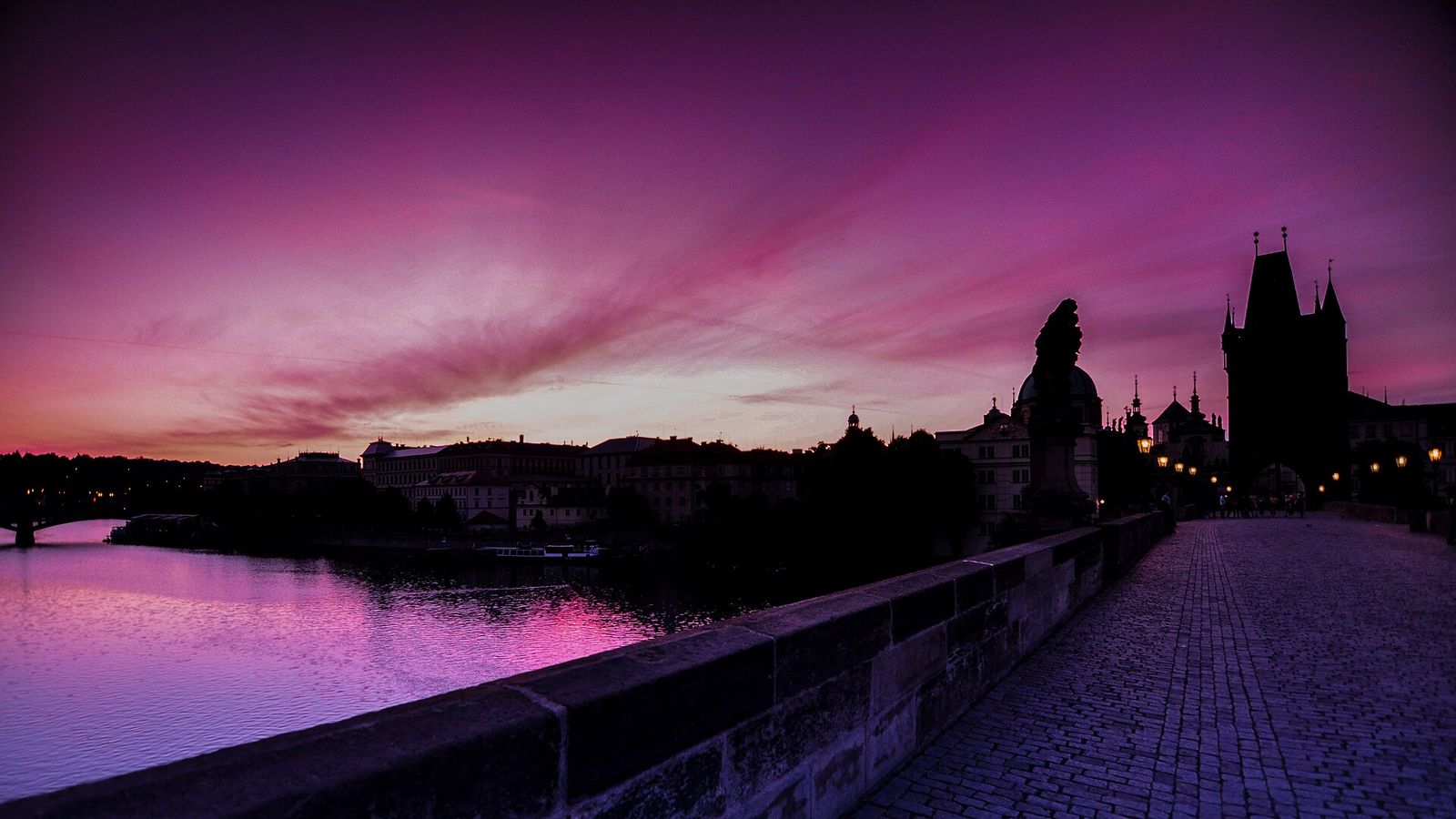
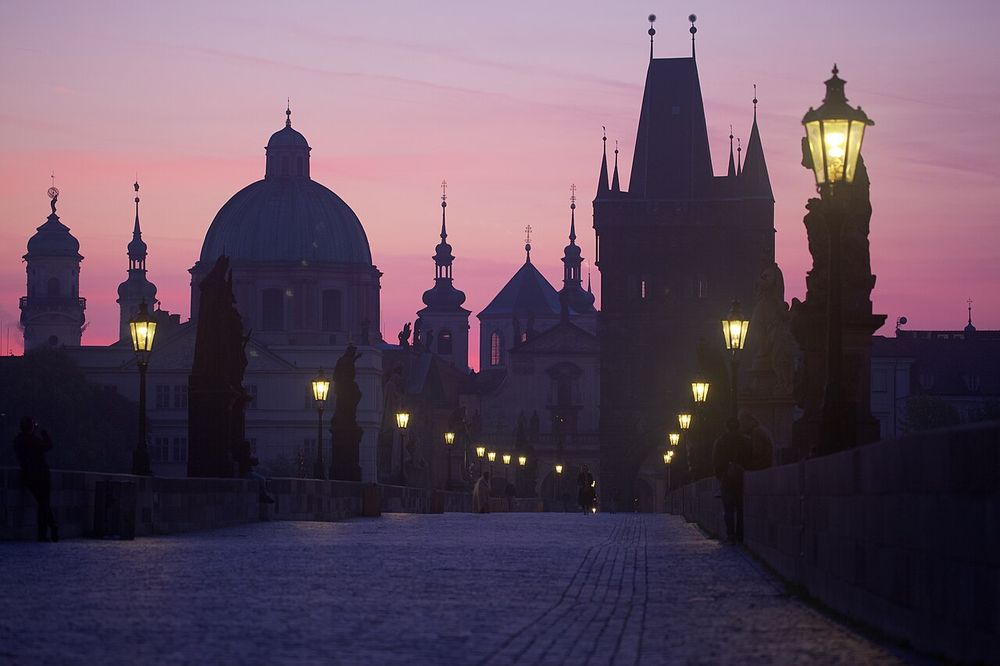
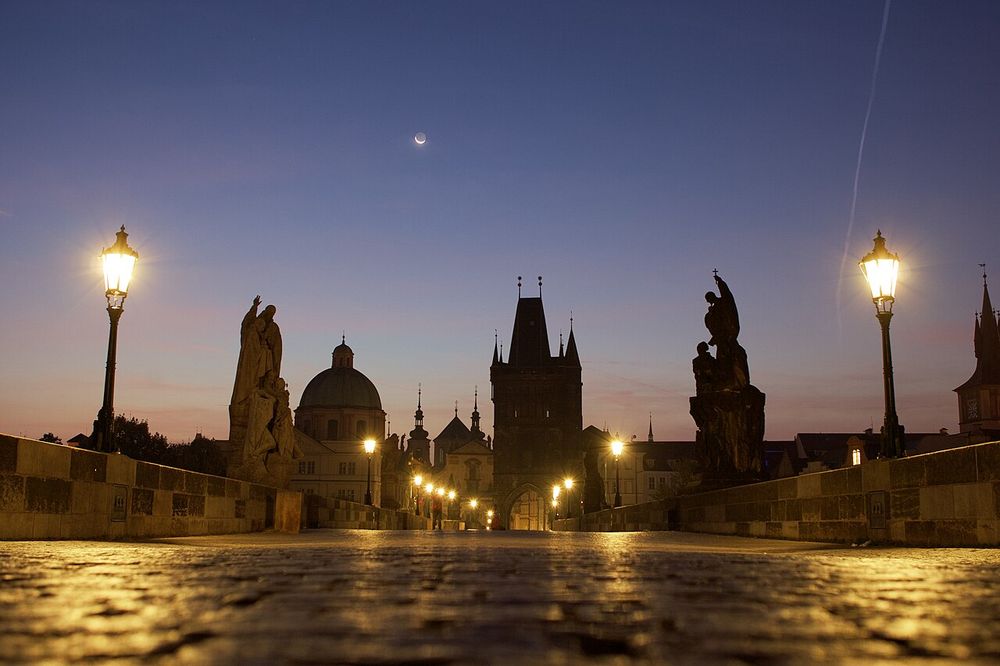
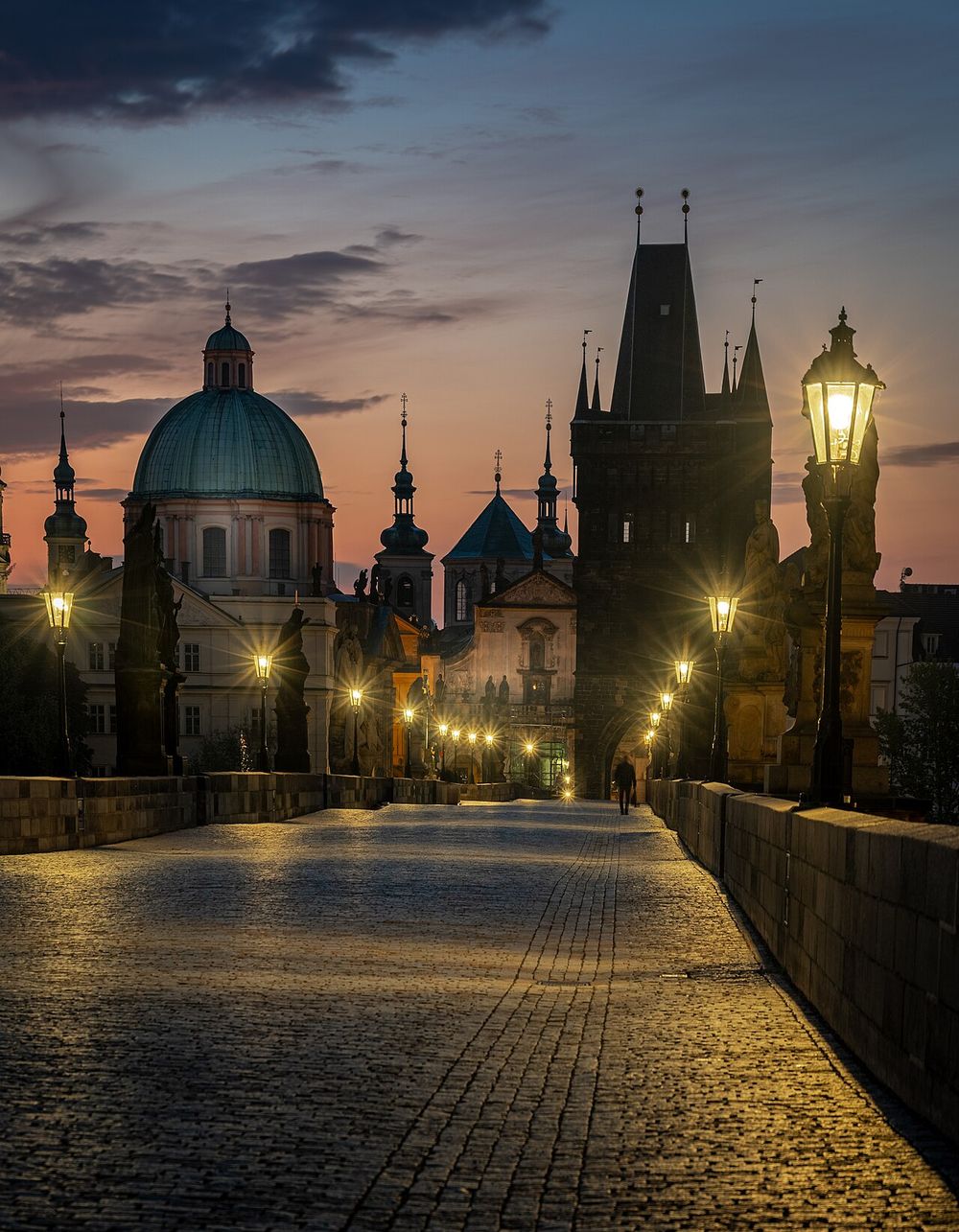
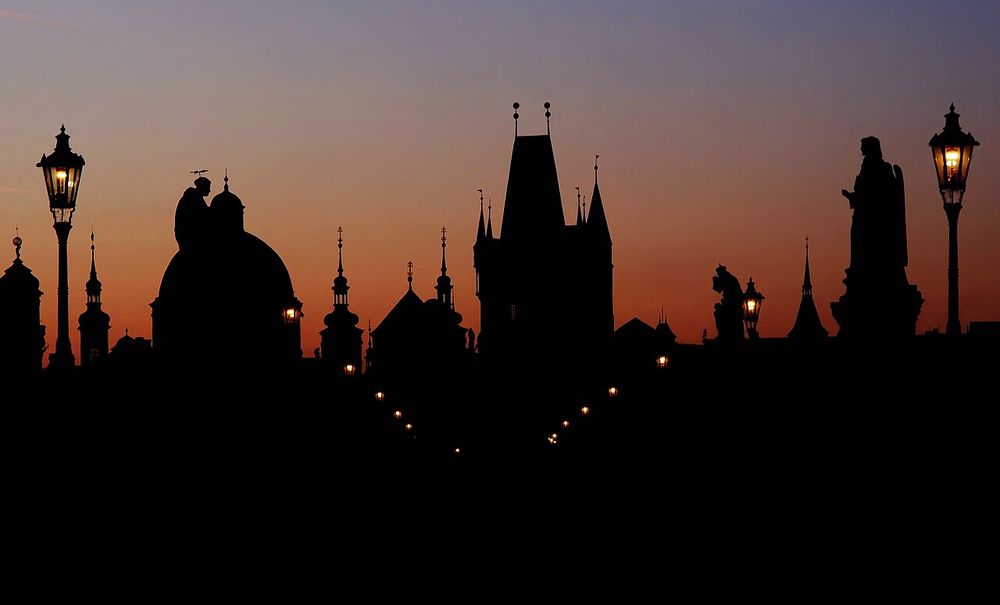
The same shot: be under the Old Town tower half an hour before sunrise. The lamps are still lit, the saints are black against the sky, and for twenty minutes the bridge is nearly empty.
Meanwhile in the world
Year
Here
Elsewhere
1357
The foundation stone is laid
The king of France is a prisoner in England after the battle of Poitiers
1393
John of Nepomuk is thrown from the bridge
Timur takes Baghdad
1621
Twelve heads are hung on the tower
The Pilgrims hold their first harvest feast in America
1648
Students hold the bridge against the Swedes
The Peace of Westphalia ends the Thirty Years' War
1683
The first statue is put up
A Turkish army besieges Vienna
1890
A flood brings down three arches
Vincent van Gogh dies in France
1965
Traffic is banned
The first man walks in space
2002
The bridge survives the worst flood in modern Prague
Euro notes and coins come into use
One line to remember: the bridge is from the 1300s, the saints from the 1700s, and the stone you touch is mostly newer than either.
Then and now
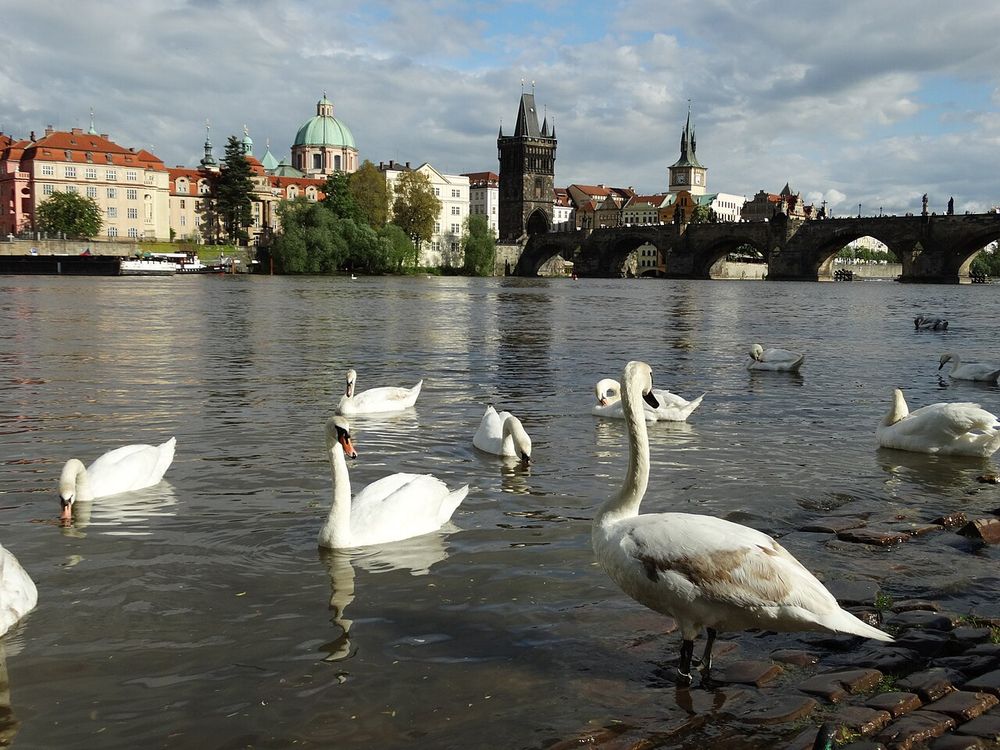
The bridge and the castle from the river bank, April 2017Uoaei1, CC BY-SA 4.0, Wikimedia CommonsThe bridge from the lookout tower on Petřín, July 2016A.Savin, FAL, Wikimedia CommonsThe arches from the water, 2019Dietmar Rabich, CC BY-SA 4.0, Wikimedia CommonsThe Lesser Town end from the riverDietmar Rabich, CC BY-SA 4.0, Wikimedia CommonsA boat passing the bridgeDietmar Rabich, CC BY-SA 4.0, Wikimedia CommonsSwans below the bridgekikiwis, CC BY 3.0, Wikimedia CommonsTimber ice-guards in front of a pier, November 2008cs:ŠJů, CC BY-SA 3.0, Wikimedia CommonsThe bridge empty in March 2020Tadeáš Gregor, CC BY-SA 4.0, Wikimedia CommonsFrom the Lesser Town tower: the bend in the bridge, April 2017Uoaei1, CC BY-SA 4.0, Wikimedia CommonsThe afternoon crowd from aboveUoaei1, CC BY-SA 4.0, Wikimedia CommonsTowards the Old Town from the towerUoaei1, CC BY-SA 4.0, Wikimedia CommonsSunrise in May 2015mendhak, CC BY-SA 2.0, Wikimedia CommonsLamps and domes before sunriseBradley Weber, CC BY 2.0, Wikimedia CommonsThe Lesser Town end at first light, October 2021Bradley Weber, CC BY 2.0, Wikimedia CommonsEarly morning on the bridge, October 2021Bradley Weber, CC BY 2.0, Wikimedia CommonsThe Old Town tower before sunrise, July 2013Michael Brezocnik, CC BY-SA 4.0, Wikimedia CommonsA lamp at dawn, September 2024Stavros Argyropoulos, CC BY-SA 2.0, Wikimedia CommonsSaints against the dawn sky, August 2014Petar Milošević, CC BY-SA 4.0, Wikimedia CommonsThe castle at night from the bridge, July 2017Lucas Garron, CC0, Wikimedia CommonsThe bridge lit at night, August 2014Marc-Olivier Giguere, CC BY-SA 4.0, Wikimedia CommonsSnow on the bridge, February 2021Draceane, CC BY-SA 4.0, Wikimedia CommonsThe bridge in winterDraceane, CC BY-SA 4.0, Wikimedia CommonsStatues under snowDraceane, CC BY-SA 4.0, Wikimedia CommonsCharles IV on the square before the bridgeLibertinaGrim, CC BY-SA 3.0, Wikimedia CommonsThe Old Town Bridge Tower, October 2021Scotch Mist, CC BY-SA 4.0, Wikimedia CommonsThe tower from the squareScotch Mist, CC BY-SA 4.0, Wikimedia CommonsThe tower from the streetScotch Mist, CC BY-SA 4.0, Wikimedia CommonsThe crucifix and its Hebrew lettersScotch Mist, CC BY-SA 4.0, Wikimedia CommonsThe gilded inscription of 1696Scotch Mist, CC BY-SA 4.0, Wikimedia CommonsThe crucifix group, April 2017Uoaei1, CC BY-SA 4.0, Wikimedia CommonsSt John of Nepomuk, July 2016A.Savin, FAL, Wikimedia CommonsThe saint and his five starsUoaei1, CC BY-SA 4.0, Wikimedia CommonsThe statue from belowScotch Mist, CC BY-SA 4.0, Wikimedia CommonsThe saint with the castle behindScotch Mist, CC BY-SA 4.0, Wikimedia CommonsThe two reliefs, polished by handsScotch Mist, CC BY-SA 4.0, Wikimedia CommonsThe relief with the dogAw58, CC BY-SA 3.0, Wikimedia CommonsOne of the statue groupsScotch Mist, CC BY-SA 4.0, Wikimedia CommonsA saint against the skyScotch Mist, CC BY-SA 4.0, Wikimedia CommonsBruncvík, the knight below the bridgeYair Haklai, CC BY-SA 4.0, Wikimedia CommonsThe Devil's Channel on Kampa, February 2015Falk2, CC BY-SA 4.0, Wikimedia CommonsPrague and its one bridge in an engraving of 1607Dr.J. Kosina; Jiljí Sadeler (1607), Public domain, Wikimedia CommonsThe ice flood of February 1784Unknown authorUnknown author, Public domain, Wikimedia CommonsThe broken bridge, September 1890Karel Maloch, CC BY-SA 4.0, Wikimedia CommonsThe gap in the bridge, 4 September 1890Moritz Adler, Public domain, Wikimedia CommonsThe flood of September 1890 in a drawingJan Mulač, Public domain, Wikimedia CommonsThe bridge under repair after the floodJindřich Eckert, Public domain, Wikimedia CommonsThe Lesser Town towers in a colour print of about 1890Photoglob Co., publisher, Public domain, Wikimedia Commons
Local legends
These are stories people tell about this place. They are legends, not history, and each one says where it comes from.
LegendEggs in the mortar
The builders are said to have mixed raw eggs into the mortar to make it strong. Every town in Bohemia sent cartloads. One town, afraid they would break, is said to have sent its eggs hard-boiled.
Source: Czech folk tradition; the town is Velvary. Laboratory tests of the old mortar have found traces of protein, and chemists do not agree that it is egg
LegendThe palindrome
The first stone is said to have been laid in 1357, on the 9th of the 7th month, at 5:31 in the morning: 1-3-5-7-9-7-5-3-1, chosen by the king's astrologers.
Source: The year is certain. The day and minute were proposed by a Czech astronomer in the twentieth century from the position of the planets; no medieval record gives them
LegendThe sword in the bridge
Bruncvík's magic sword, which cuts off heads at a word, is said to be walled up inside the bridge. When the Czechs are in their worst danger, St Wenceslas will ride across with his knights, his horse will strike the stone with its hoof, and the sword will be found.
Source: Czech folk tradition, retold by Alois Jirásek in Old Czech Legends (1894)
Later, people who live here will be able to add the stories they grew up with, and say which of these they have heard.
Not certain, and where accounts conflict
Who built it?
Peter Parler, the cathedral's architect, has long been given the credit. He was in his twenties and newly arrived in 1357, and documents name a master called Otto as the first builder. Parler's workshop certainly built the tower.
Why was the priest killed?
The archbishop's own report, written weeks later, speaks of a dispute over church appointments and says nothing of a confession. The story of the queen's secret was first written down about sixty years later. The Church has kept the feast and no longer insists on the story.
How much of the bridge is old?
The core of the piers and arches is medieval. The facing stones have been replaced many times, most recently in a repair begun in 2008 that heritage inspectors criticised for cutting away old blocks. Repairs continue piece by piece.
Visiting
Tickets and hours
The bridge is free and open day and night.
Old Town Bridge Tower: CZK 250 in 2026 (reduced CZK 170); both towers together CZK 340. Half price in the first hour after opening.
The towers open at 10:00 for most of the year and at 9:00 from June to September, and close between 18:00 and 20:30 according to the season.
Last checked 2026-11-12. Prague City Tourism and the Museum of Prague on the bridge and its towers; the National Heritage Institute's register; tower prices and hours for 2026.
Booking from abroad
Note Nothing to book for the bridge. Tower tickets are sold at the towers and on the Prague City Tourism site, which is the only official seller.
Checked 2026-11-12
Where to start
Metro line A to Staroměstská, then five minutes on foot towards the river.
Come at sunrise, or after ten at night. Between ten in the morning and six in the evening you will be carried along by the crowd.
Cross once on each side. The statues on the left and the right are different.
Before you go
This is the busiest spot in Prague for pickpockets, above all in the knot of people at the statue of St John.
The painters and musicians on the bridge hold city licences. Ask the price before a portrait is begun.
One or two statues are usually under scaffolding for repair.
Customs and manners
Do not sit or stand on the parapet, and do not climb the statue bases for a photograph. The stone is soft and the drop is real.
Padlocks on the grilles are cut off and thrown away.
At the cross with Hebrew letters, read the plaque before you photograph it. For Jewish visitors it is a painful place.
The statues are saints, and some people stop to pray at them. Step round.
In the weeks before Christmas a lamplighter in uniform lights the gas lamps by hand at dusk. Let him work.
Look for these
On the tower, find the kingfisher.
On the tower, find the saint standing on a little bridge.
At the cross, find the Hebrew letters and the plaque that explains them.
In the parapet, find the cross with five stars.
On the base of St John, find the dog.
Find the Chinese figure carrying a saint.
Lean over and find the knight with the golden sword.
From a tower, find where the bridge bends.
I am here
Stand at the site, sign in, press the button, and collect its stamp. Your browser will ask to use your location. It is sent to us once to confirm that you are at the site; we keep how far you were from it, not the spot where you stood.
Your stamps are saved to your account, so they follow you to any device. Checking from a browser cannot rule out every false location; stricter checks arrive with the app.
Messages
Share your photos
Photos here show the place, not people. Each one is credited to the visitor who took it and appears after our team has looked at it. A photo with you in it belongs under “I am here”.