Five hundred years of what the popes collected and commissioned, in one long walk through their palace. At the end of it is the chapel where Michelangelo painted the ceiling and where each new pope is chosen.
Photo: Staselnik, CC BY-SA 3.0, Wikimedia Commons
The story
You are about to walk through a palace. The popes lived and worked in these rooms, and over five centuries they filled them with statues, maps, tapestries and paintings. The visit is one long route, about seven kilometres if you see everything.
It began with a single statue dug out of a vineyard in 1506. It ends in the Sistine Chapel, under a ceiling that one man painted in four years.
Not part of the museums; its own entrance on the square
If you have one minute
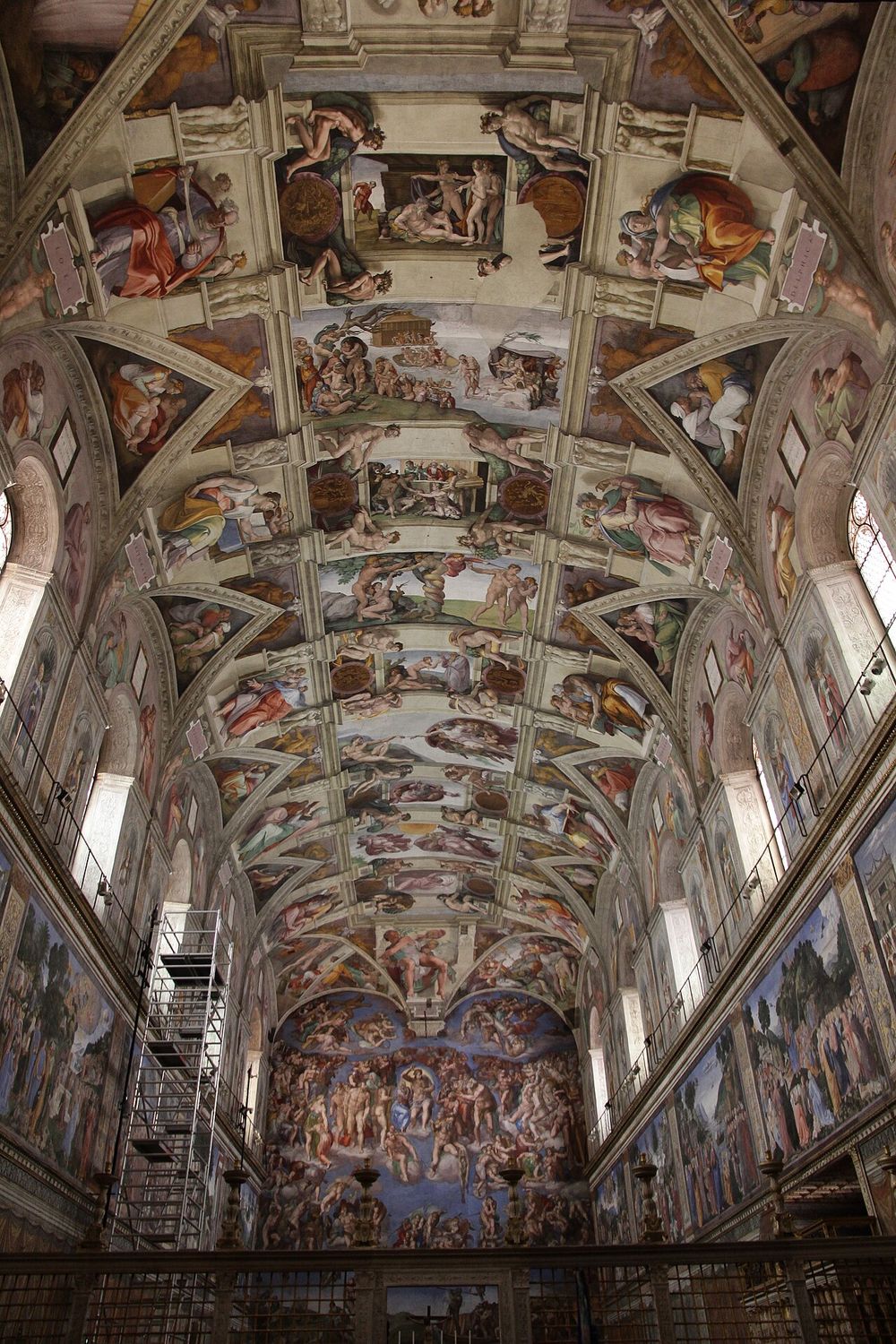
In the Sistine Chapel, looking up
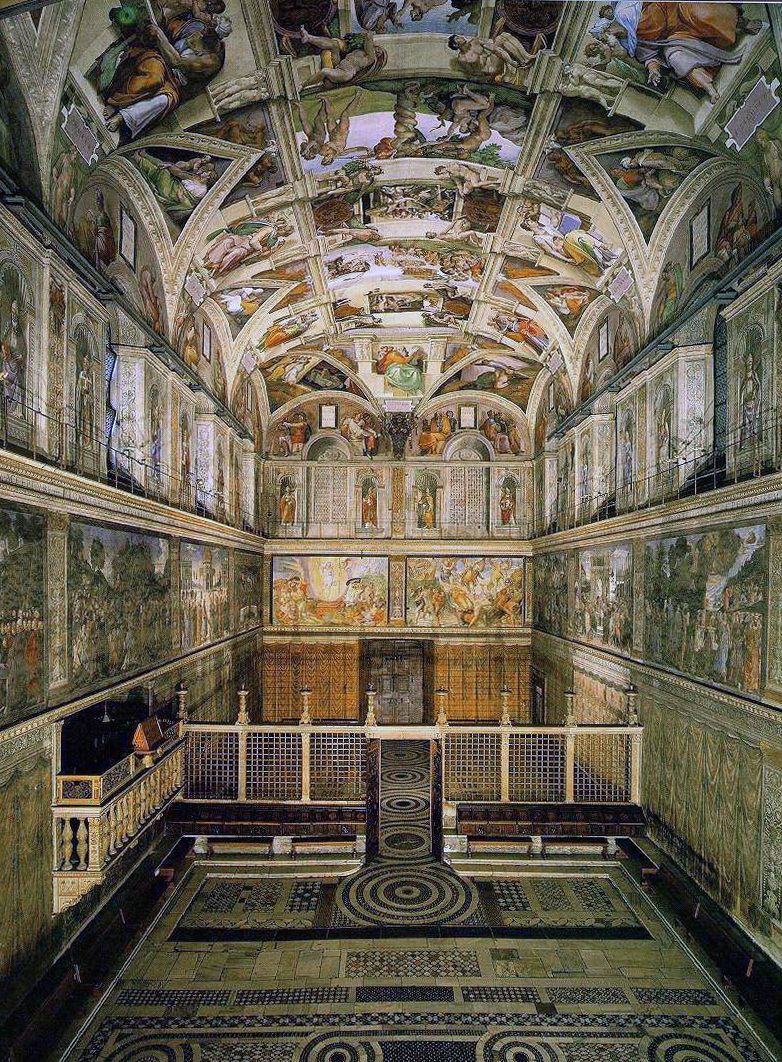
Inside the Sistine ChapelThe original uploader was Snowdog at Italian Wikipedia., CC BY-SA 3.0
This room is the pope's own chapel, built in the 1470s. In 1508 Pope Julius II told Michelangelo to paint its ceiling. Michelangelo said he was a sculptor and did not want the job. He did it anyway, on a scaffold 20 metres up, standing with his head bent back.
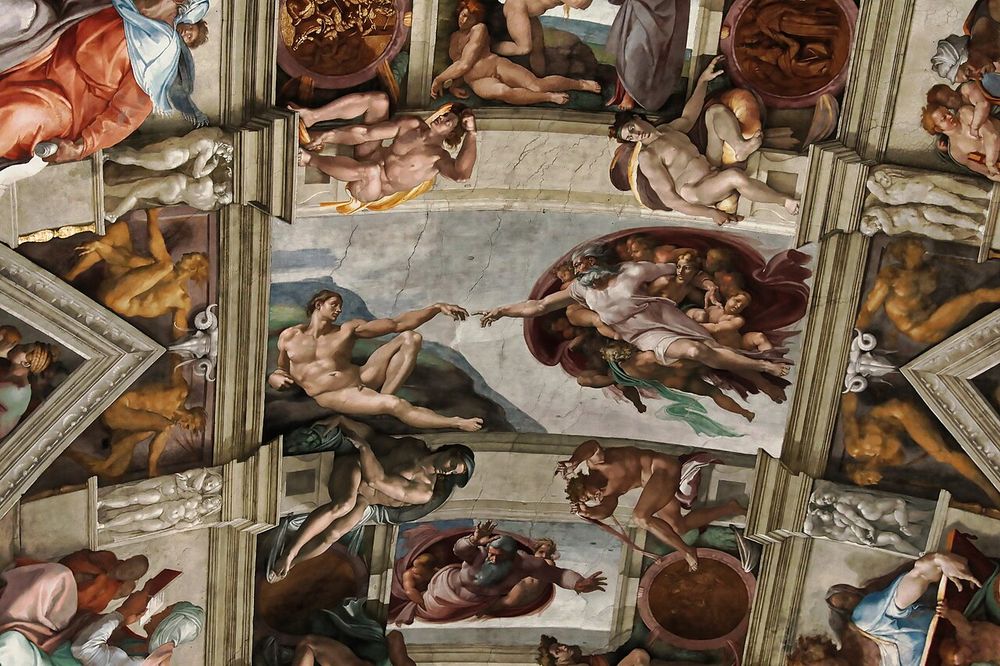
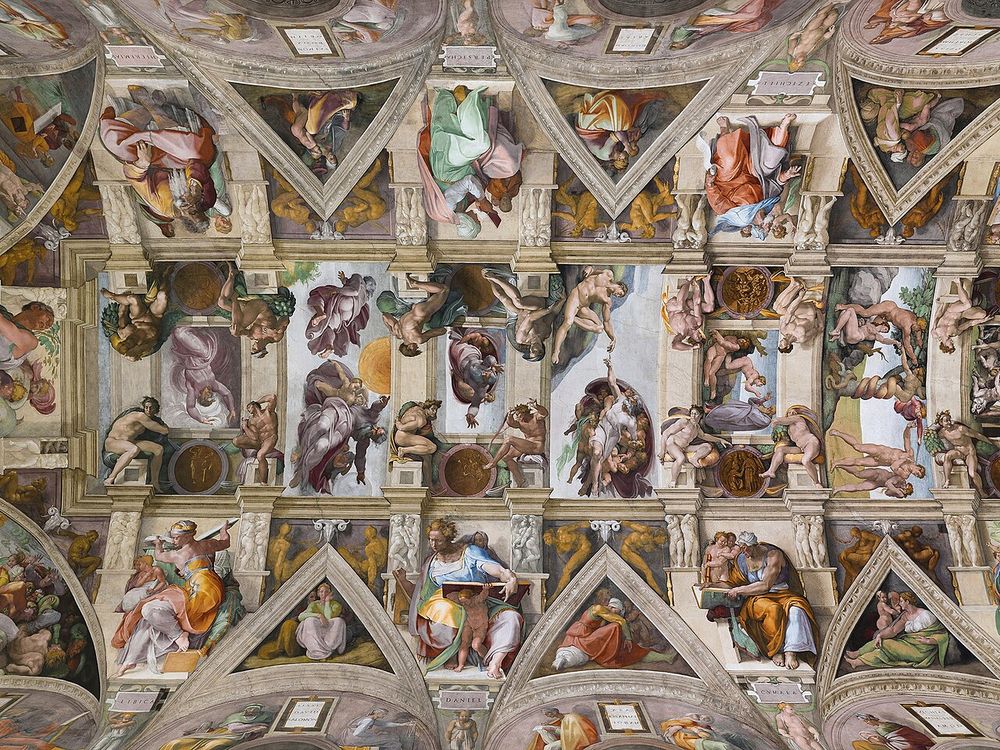
Down the middle run nine scenes from the Book of Genesis. In the fourth from the altar, God reaches out a finger to give life to Adam. Their fingers do not quite touch.
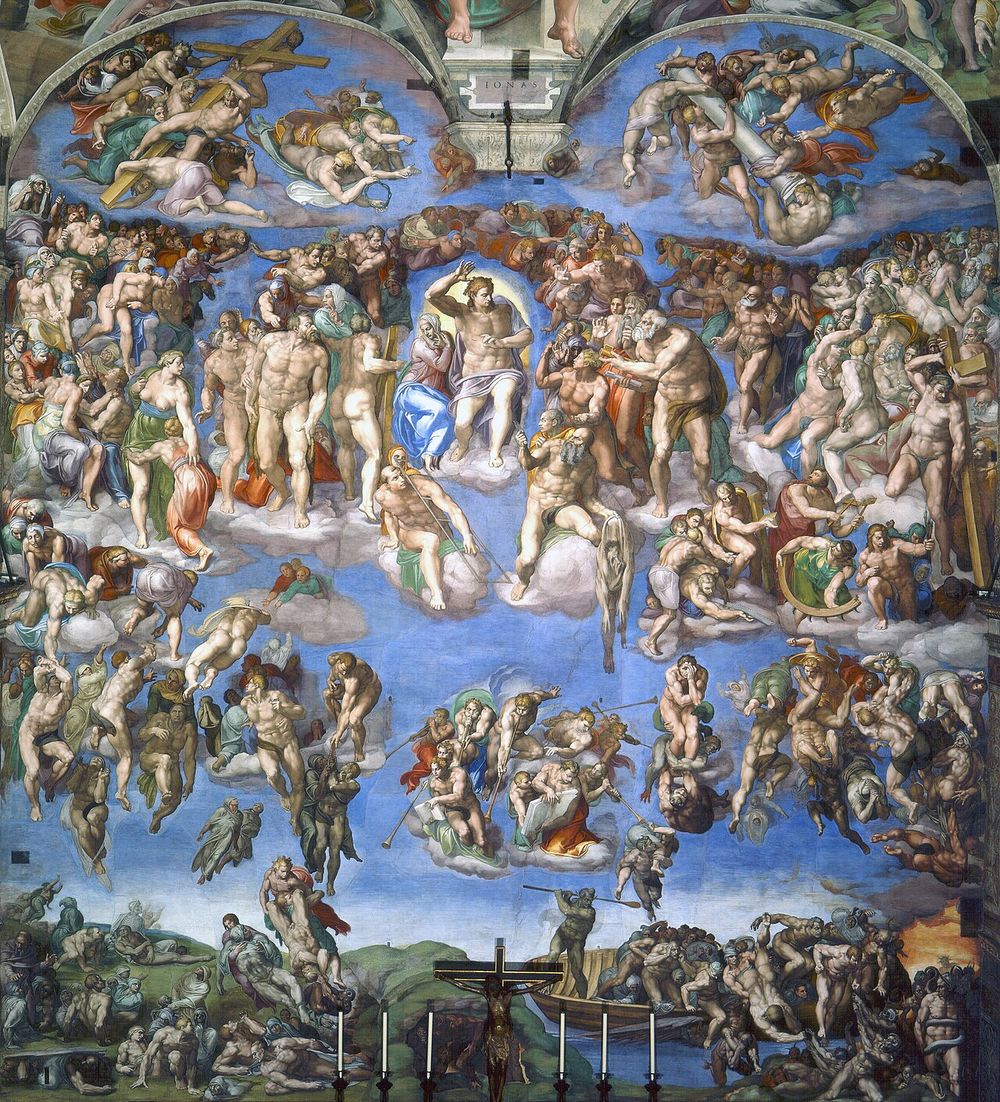
Twenty-five years later he came back and painted the whole wall behind the altar: the Last Judgment, with Christ in the middle sending the saved up and the damned down.
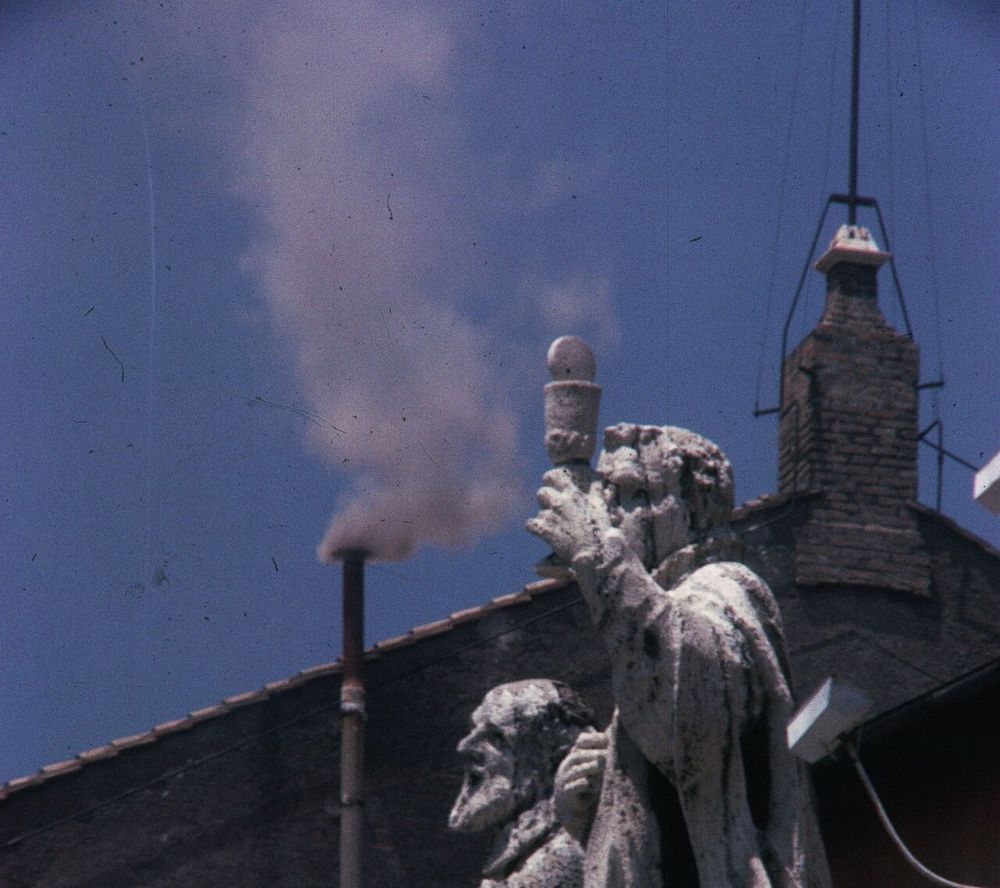
When a pope dies or resigns, the cardinals are locked into this room to choose the next one. The last time was in May 2025.
Things people often get wrong
"Michelangelo painted the ceiling lying on his back." He stood. He wrote a comic poem about it, complaining that his beard pointed at heaven and paint dripped on his face.
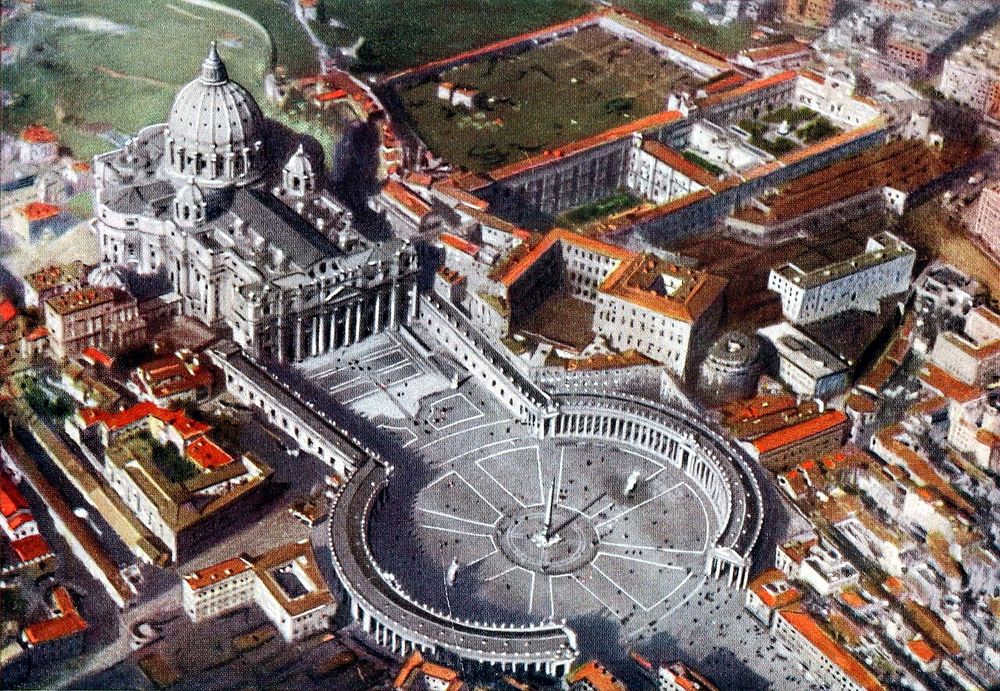
"The Sistine Chapel is part of St Peter's Basilica." It is part of the pope's palace, and visitors reach it only through the museums. The basilica is next door, with its own entrance.
"The entrance is on St Peter's Square." It is on the other side of the walls, on Viale Vaticano, a fifteen-minute walk from the square.
"You can take pictures everywhere." You can in the museums, without flash. In the Sistine Chapel you cannot, and the guards do stop people.
People who stood here
Michelangelo (Italian sculptor and painter of the Renaissance)He stood above your head for four years, from 1508 to 1512, and again at the altar wall from 1536 to 1541, by then in his sixties. In the Last Judgment he painted his own face on the empty skin that Saint Bartholomew holds.
Goethe (German poet, author of Faust)He came to Rome in 1786 and went back to the chapel again and again. He wrote that no one who had not seen it could form an idea of what one man is able to do. He may have stood where you stand, with a stiff neck, unwilling to leave.
Go deeper: ten stops along the one-way route
The route is one-way. These ten stops follow it in order, from the entrance to the way out.
1. The wall and the door: a museum inside a state
The queue along the Vatican walls, April 2007Diliff, CC BY-SA 3.0
The high wall beside the pavement is a border. Behind it is Vatican City, the smallest state in the world, less than half a square kilometre. When you go through the door you leave Italy.
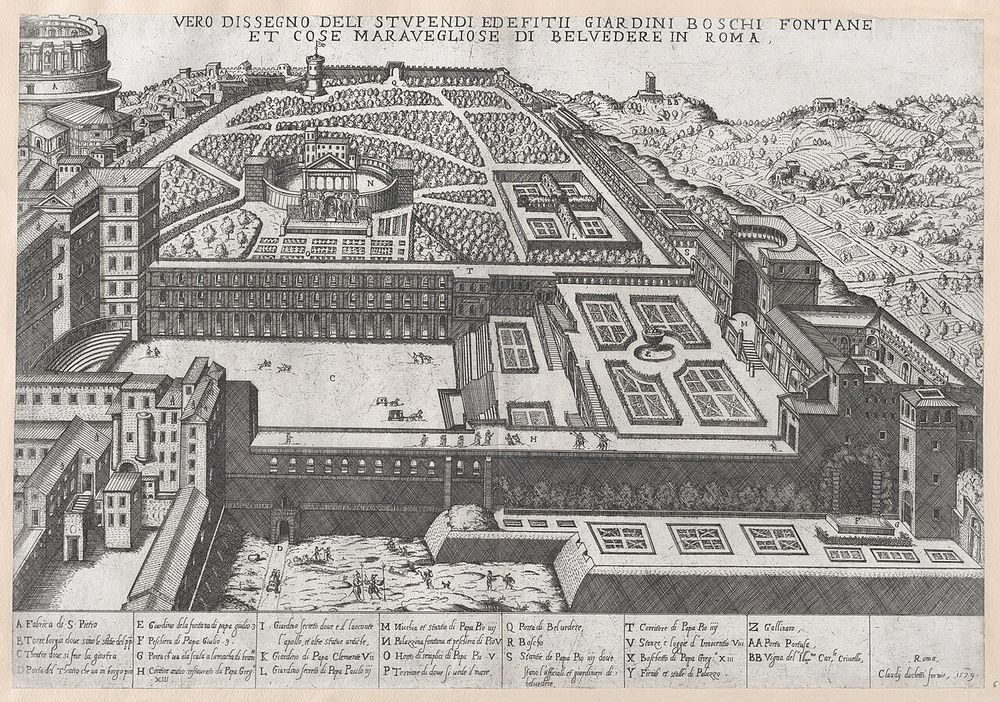
The collection began in 1506, when Pope Julius II put a newly found ancient statue in his garden courtyard and let artists come to look. Later popes went on buying, digging and building. The first rooms made to be a public museum opened in 1771.
Popes were princes as well as priests. Owning the best of ancient Rome was a way of saying that Rome's greatness had passed to them.
2. The Pinecone Courtyard
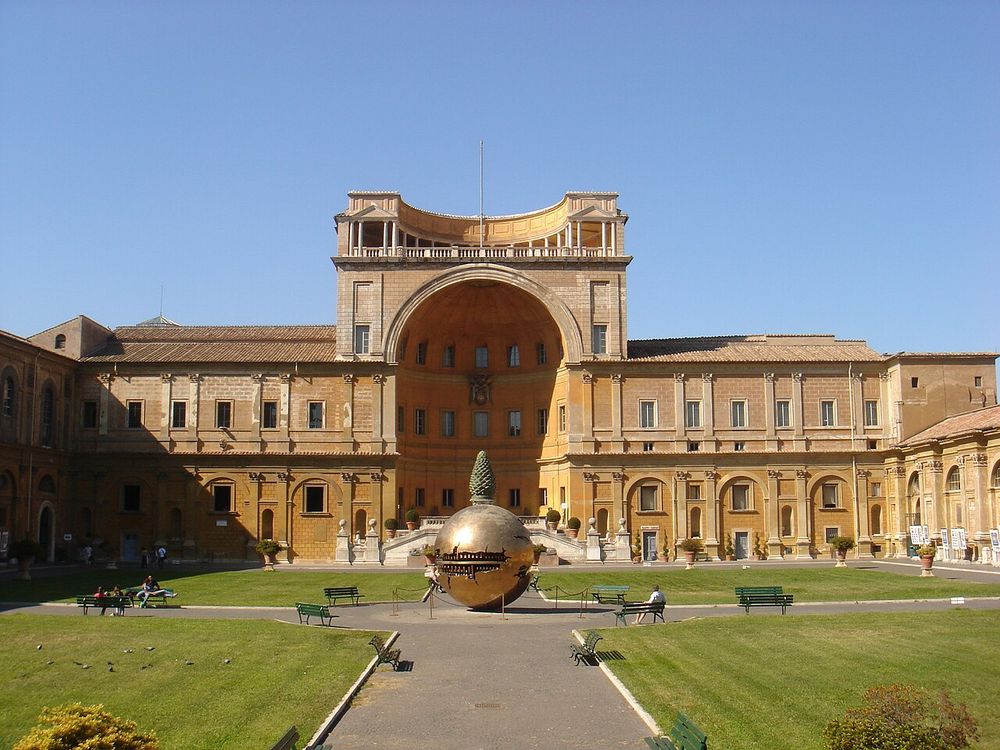
The Pinecone CourtyardLalupa, CC BY-SA 3.0
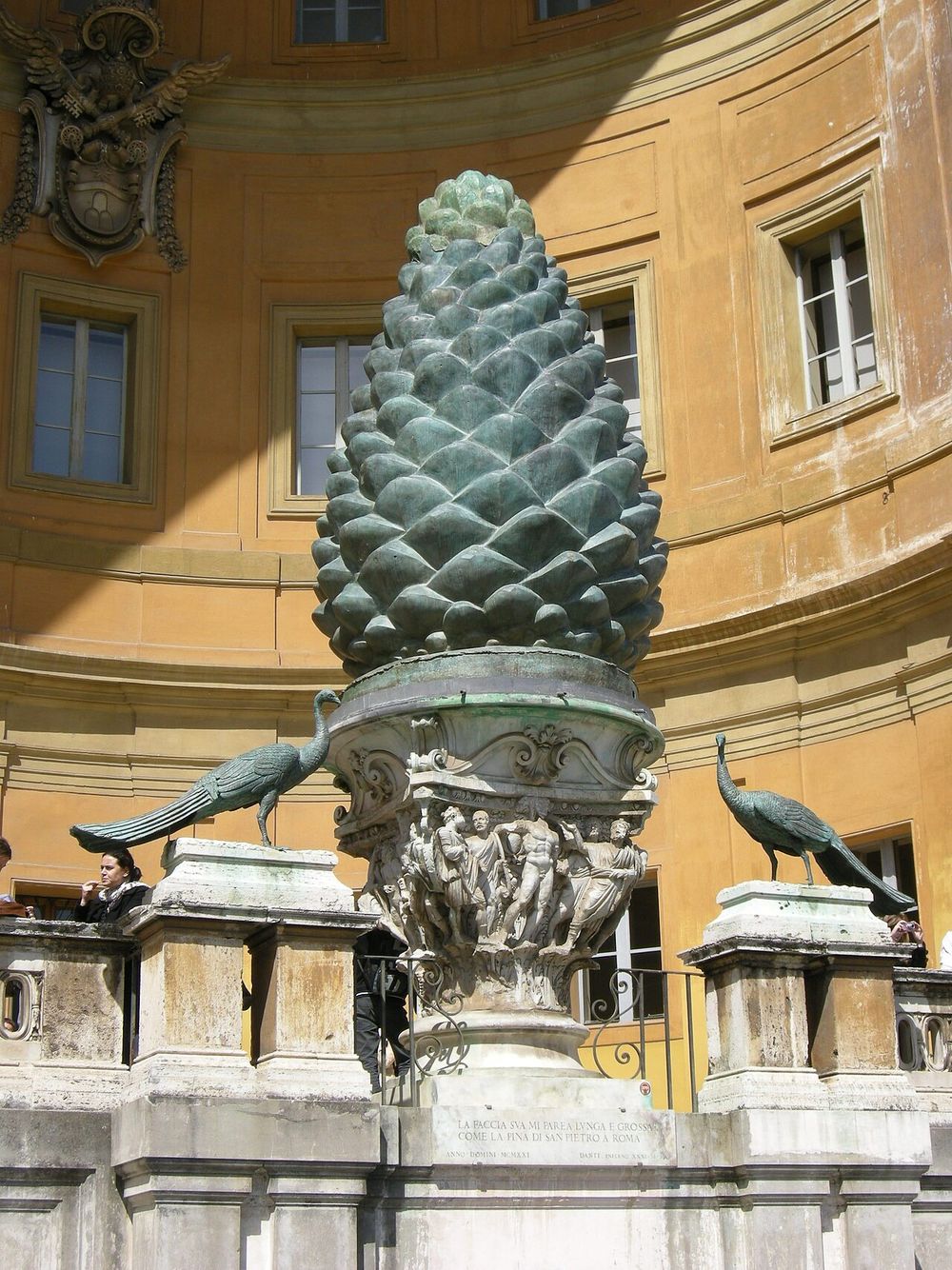
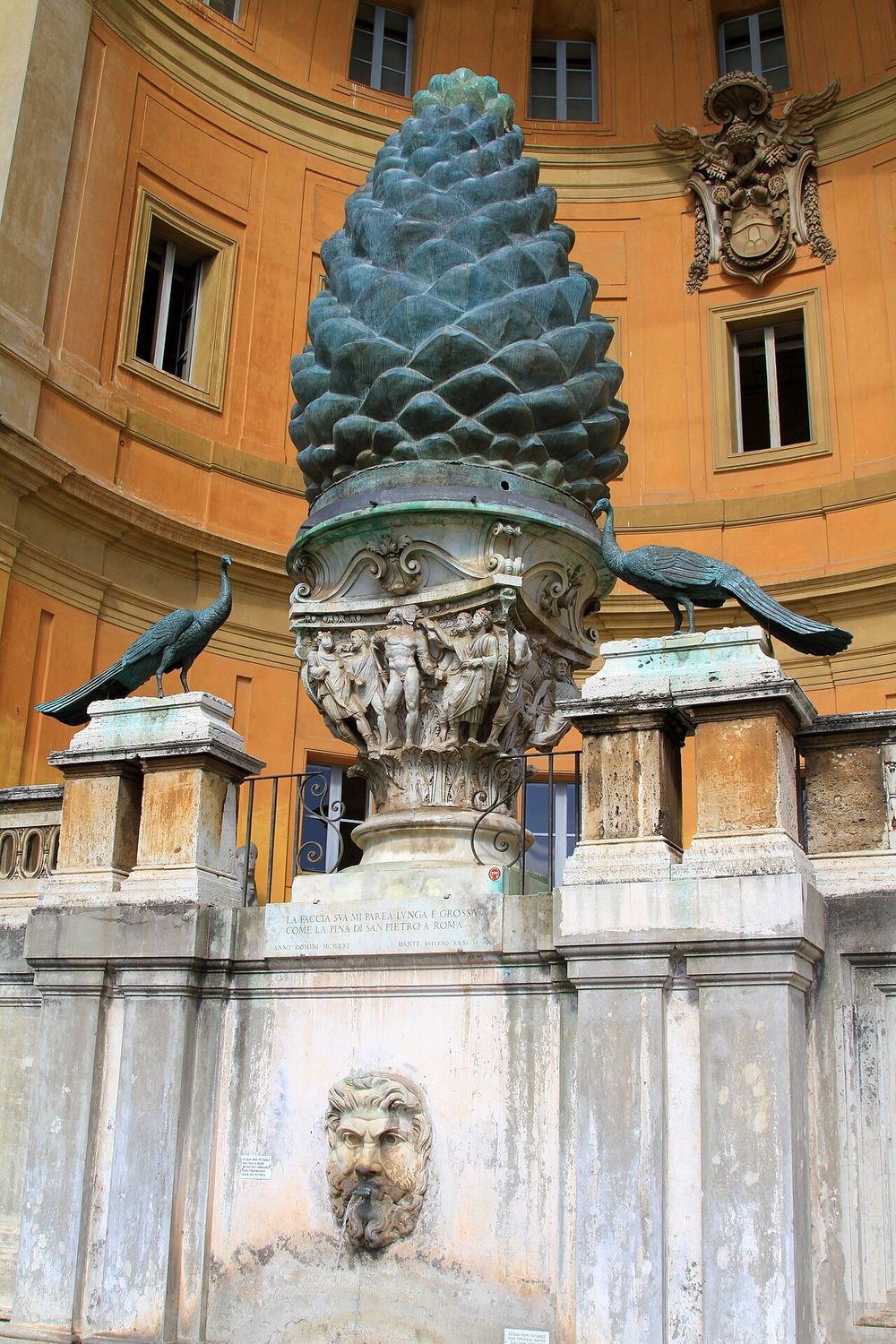
The bronze pinecone in the niche is nearly four metres high and almost two thousand years old. It was a fountain in ancient Rome, and water ran out of the tips of its scales. In the Middle Ages it stood in front of the old St Peter's.
The bronze pinecone, once a Roman fountainsailko, CC BY-SA 3.0
Dante saw it there. In the Inferno he describes a giant whose face is as long and as big as the pinecone of St Peter's in Rome.
3. The Octagonal Court: Laocoön and Apollo
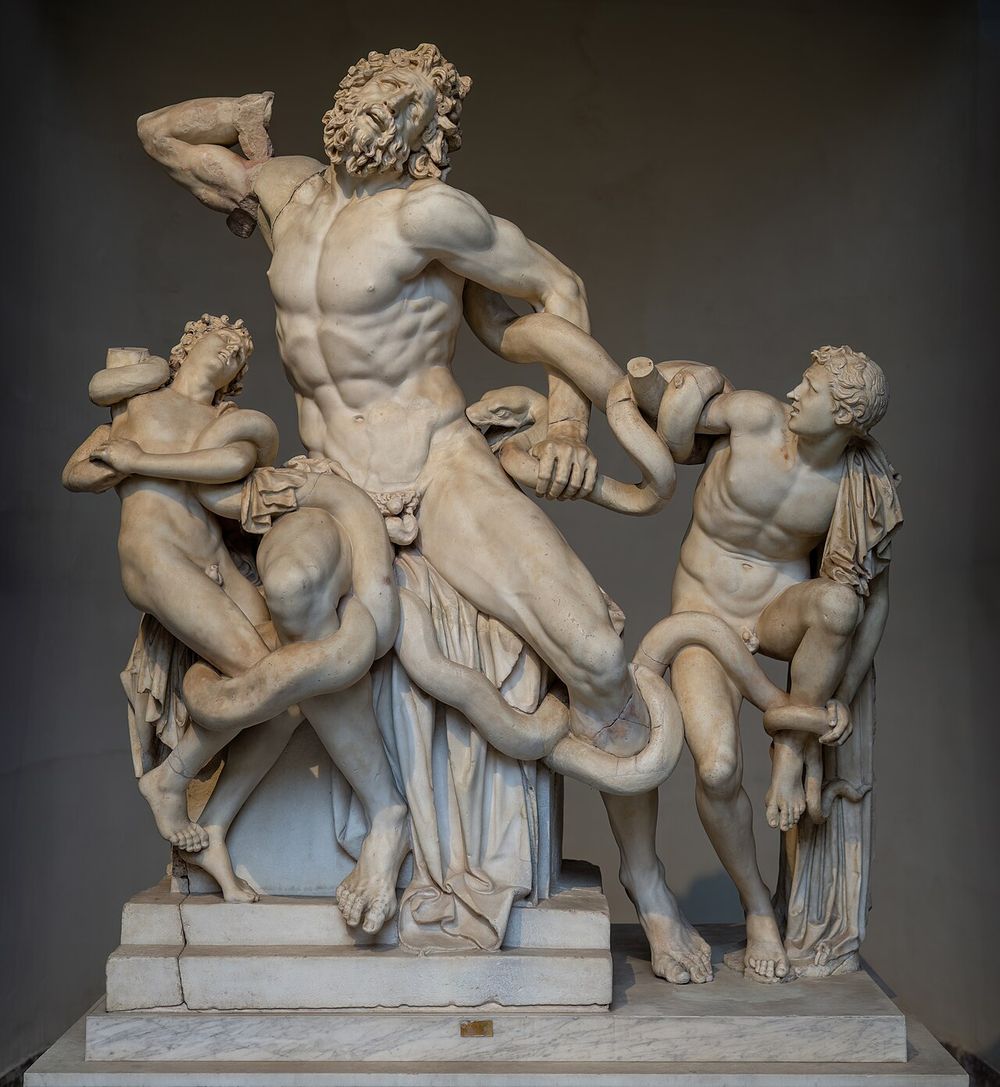
Laocoön and his sonsWilfredor, CC0
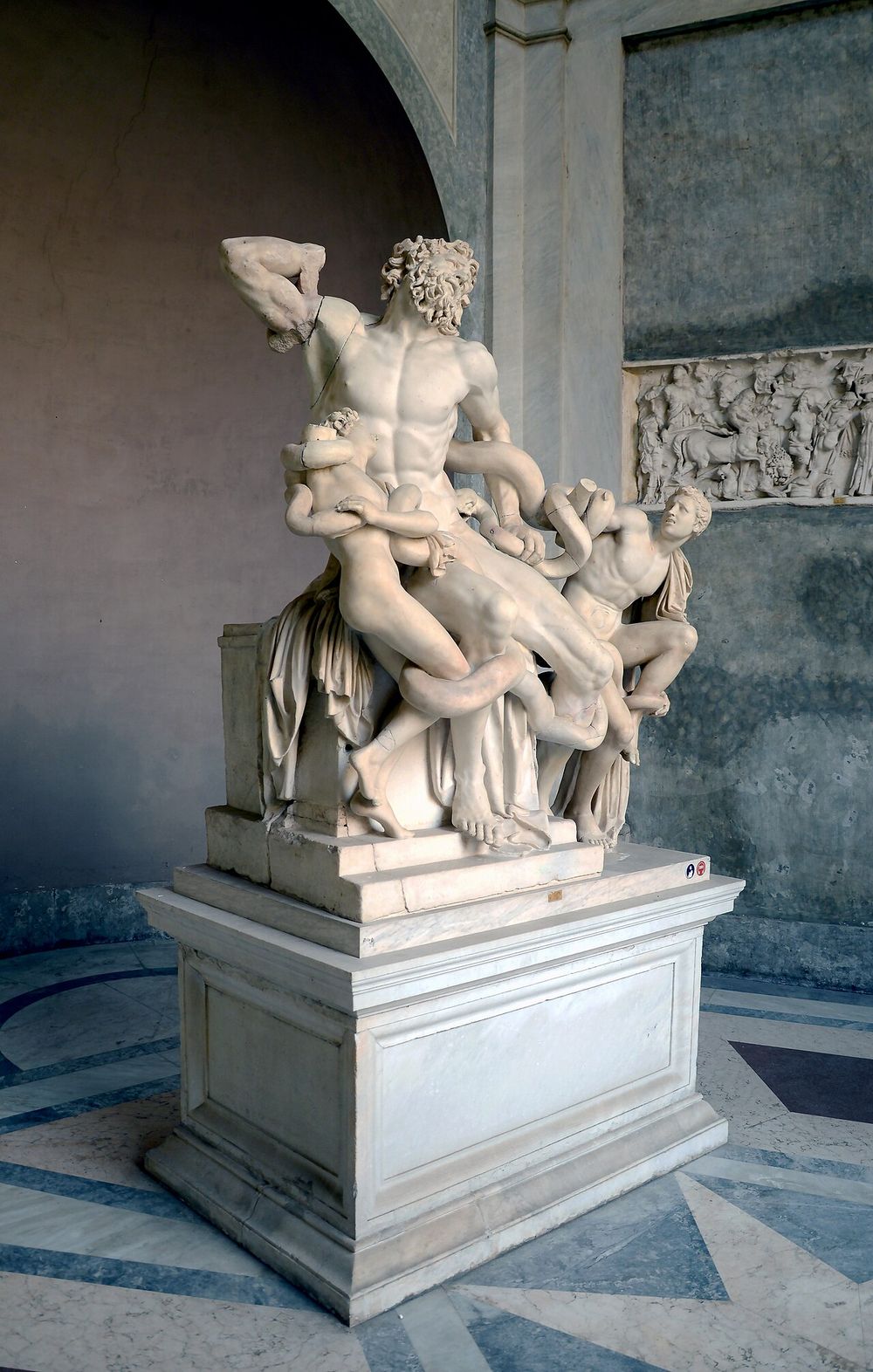
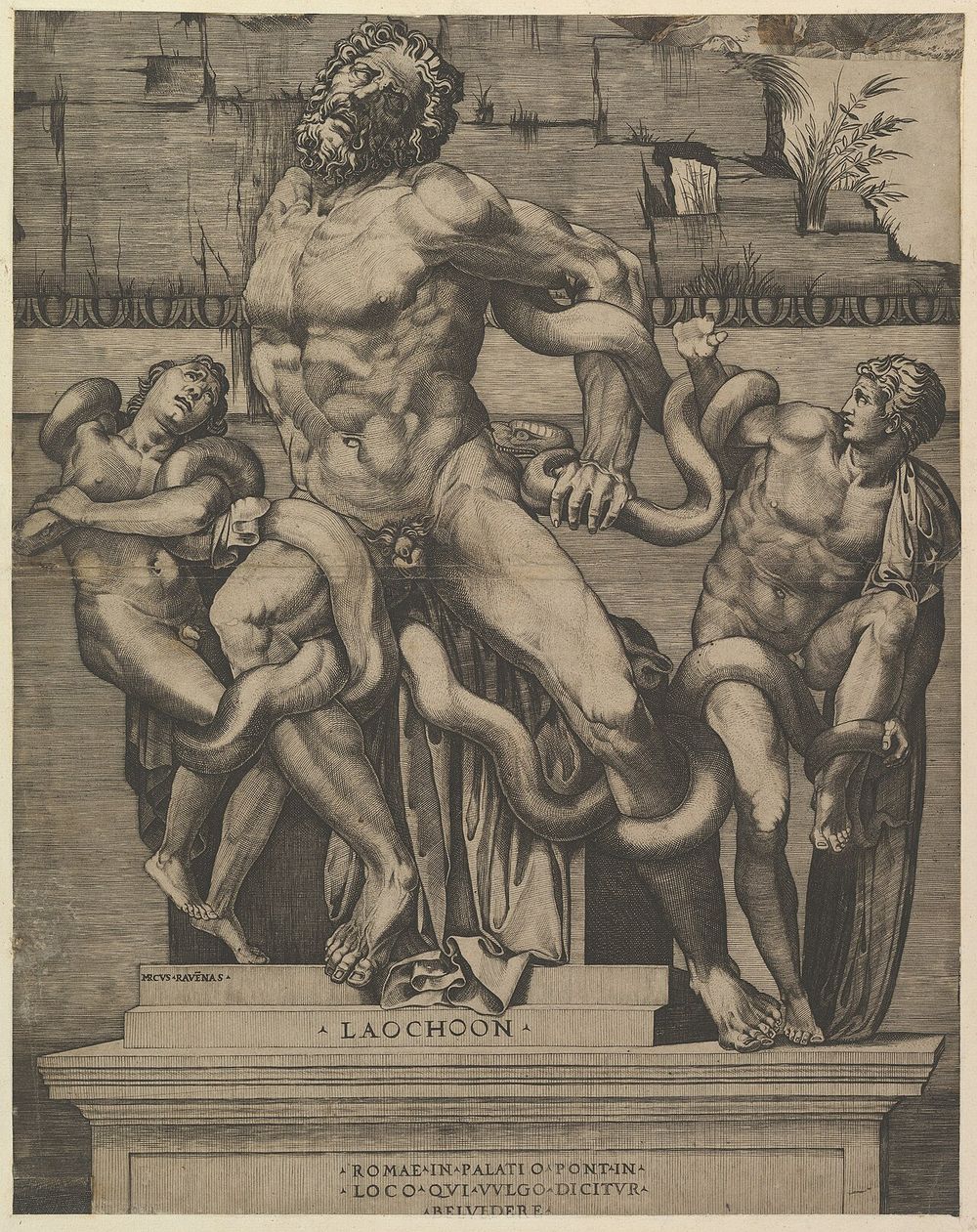
On 14 January 1506 a man digging in his vineyard in Rome broke into a buried room and found this group. A Trojan priest and his two sons are being killed by sea snakes sent by the gods. The pope sent Michelangelo to look. Within weeks the pope had bought it.
Look at the father's body twisting, and at his face. Sculptors for the next three hundred years learned from it how to show pain.
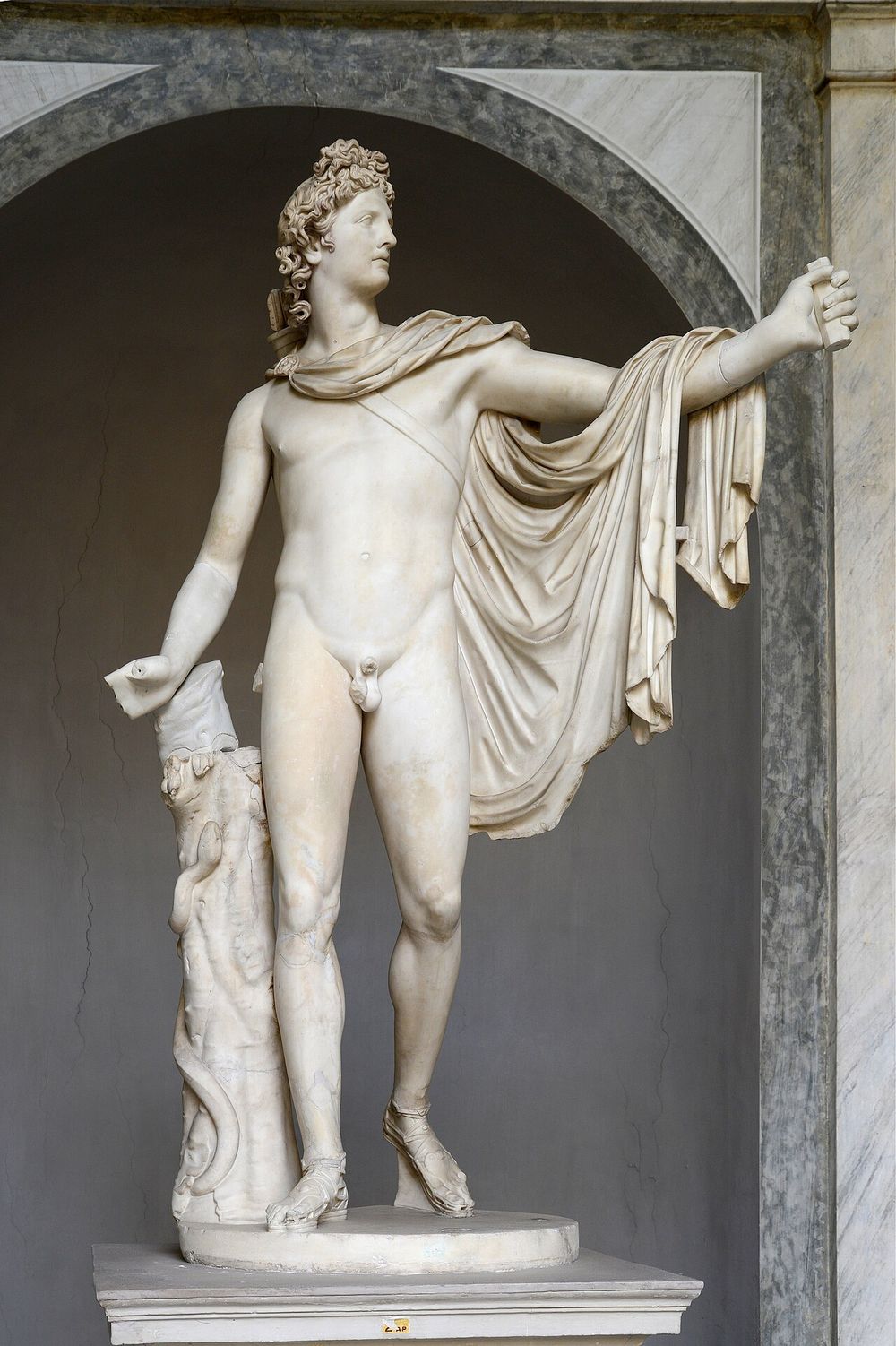
The Apollo BelvedereAlvesgaspar, CC BY-SA 4.0
Across the court stands the Apollo Belvedere, a Roman copy in marble of a lost Greek bronze. In the eighteenth century it was thought the most beautiful statue in the world. Napoleon took both statues to Paris in 1797. They came back in 1816.
4. The Torso and the Round Hall
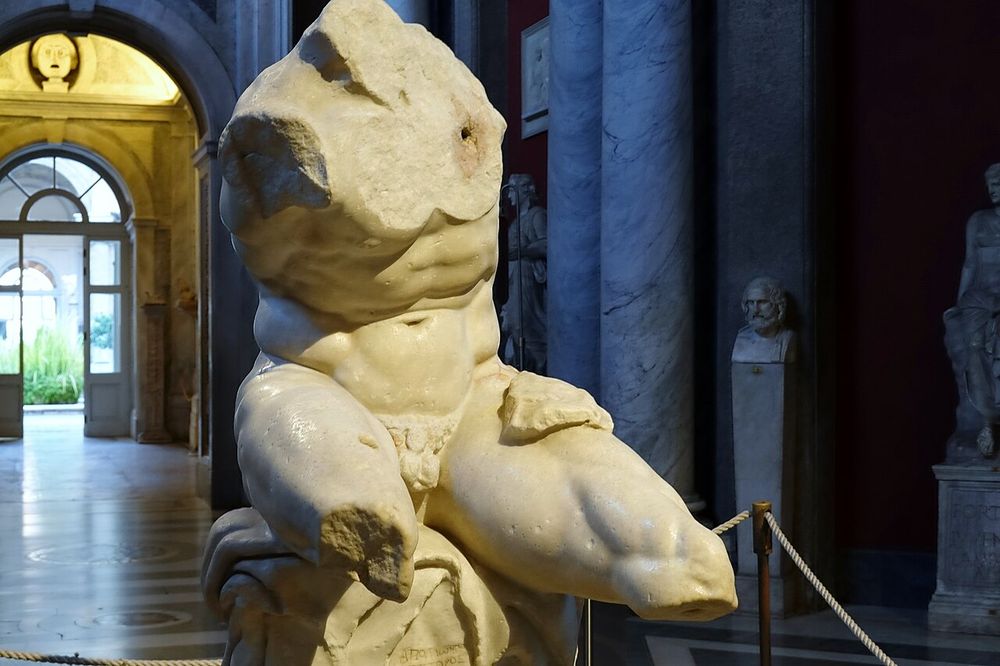
The Belvedere TorsoRichard Mortel from Riyadh, Saudi Arabia, CC BY 2.0
This broken body, without head, arms or lower legs, is signed by Apollonios of Athens. Michelangelo studied it for hours and would not hear of restoring it. The twisting bodies on the Sistine ceiling come from here.
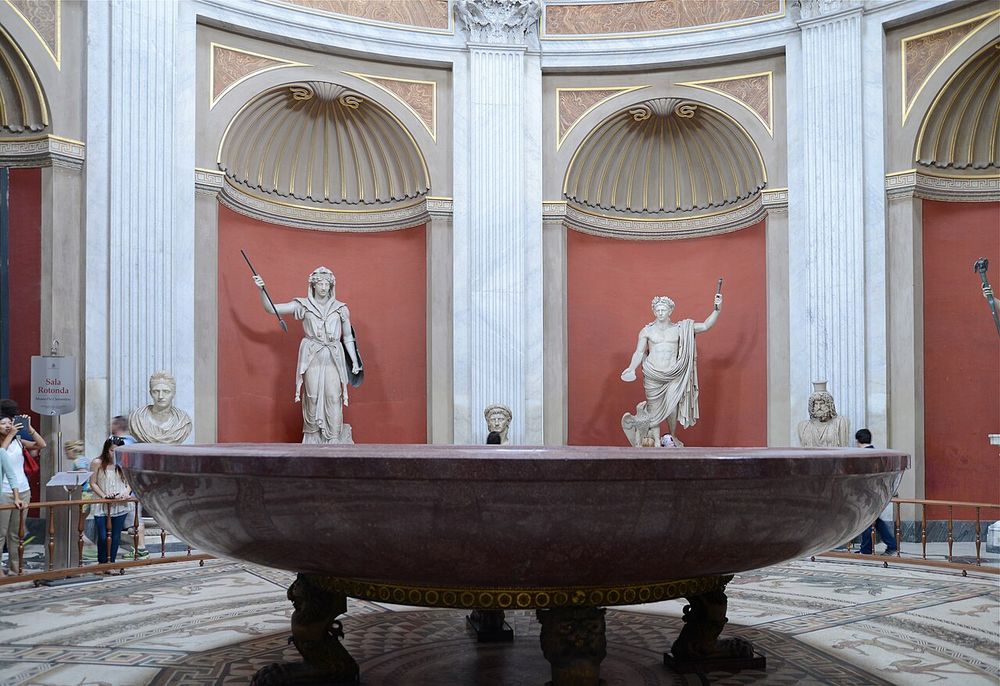
The Round Hall and its porphyry basinAlvesgaspar, CC BY-SA 4.0
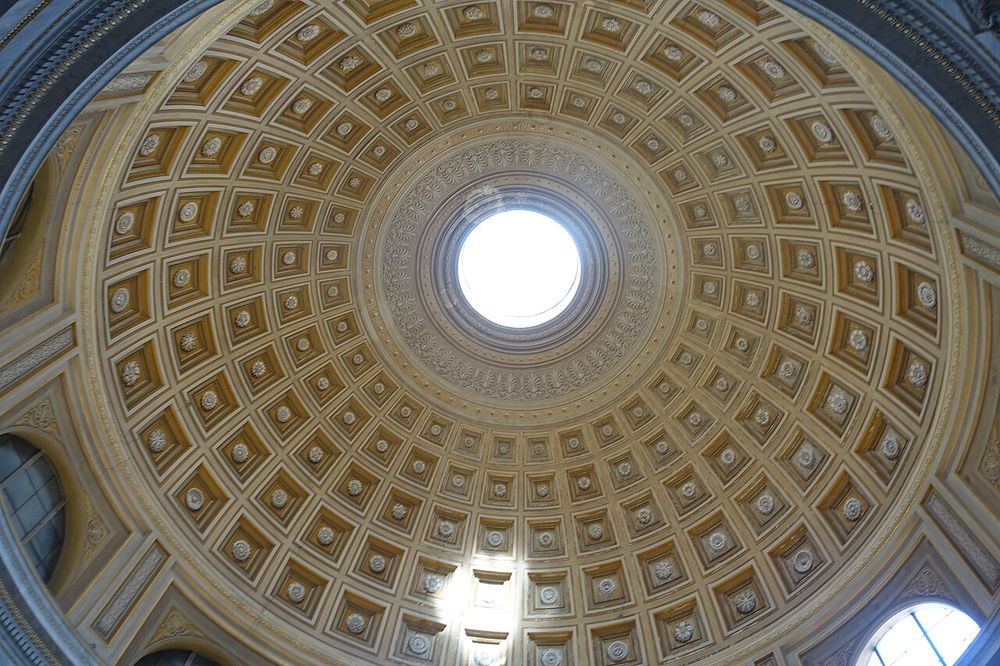
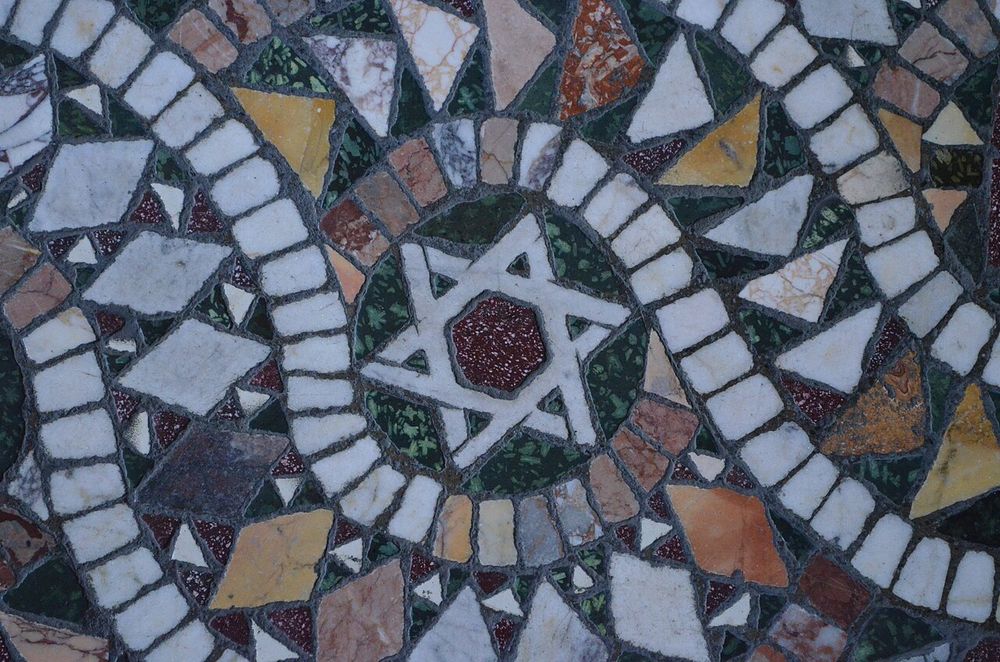
The Round Hall was built about 1780 as a small copy of the Pantheon. The red stone basin in the middle is cut from one block of porphyry and measures 13 metres round. It is said to come from the palace of the emperor Nero. The floor is a Roman mosaic.
5. The long galleries: candelabra, tapestries, maps
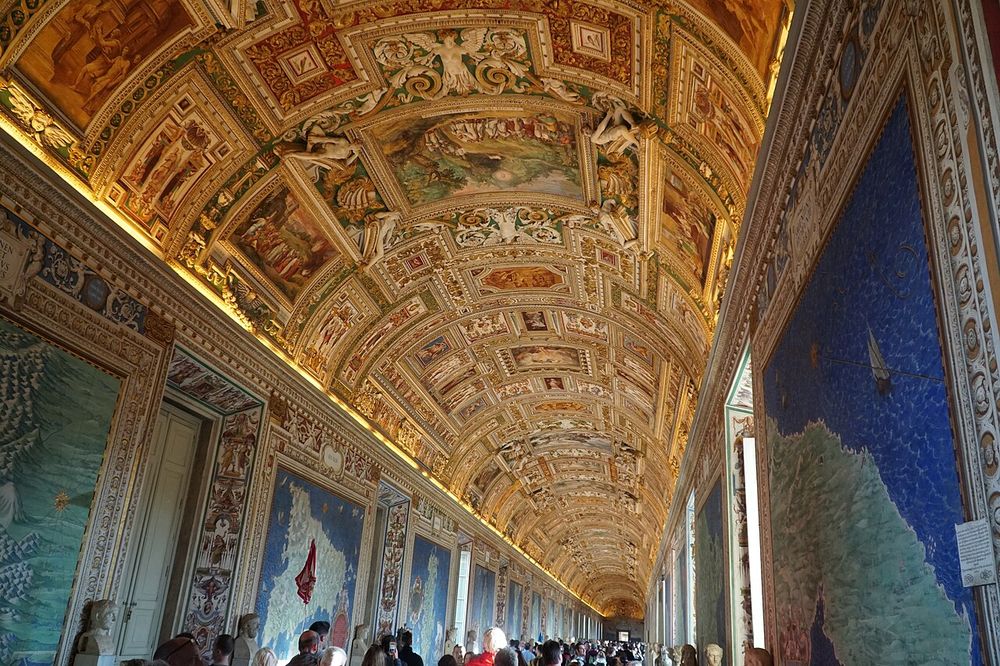
The Gallery of MapsDeb Nystrom from Ann Arbor, Michigan, USA, CC BY 2.0
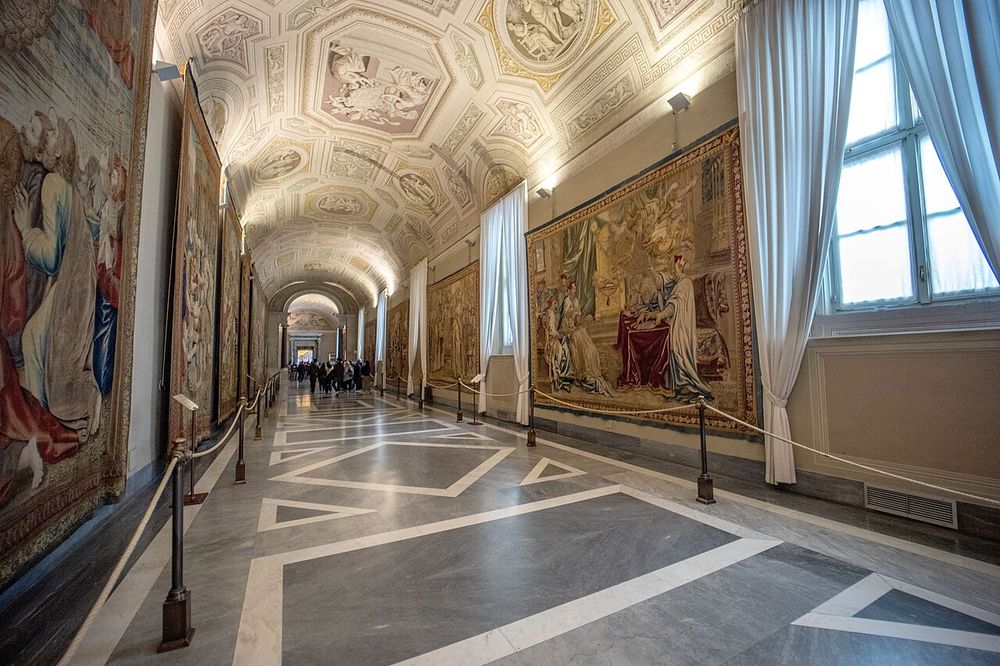
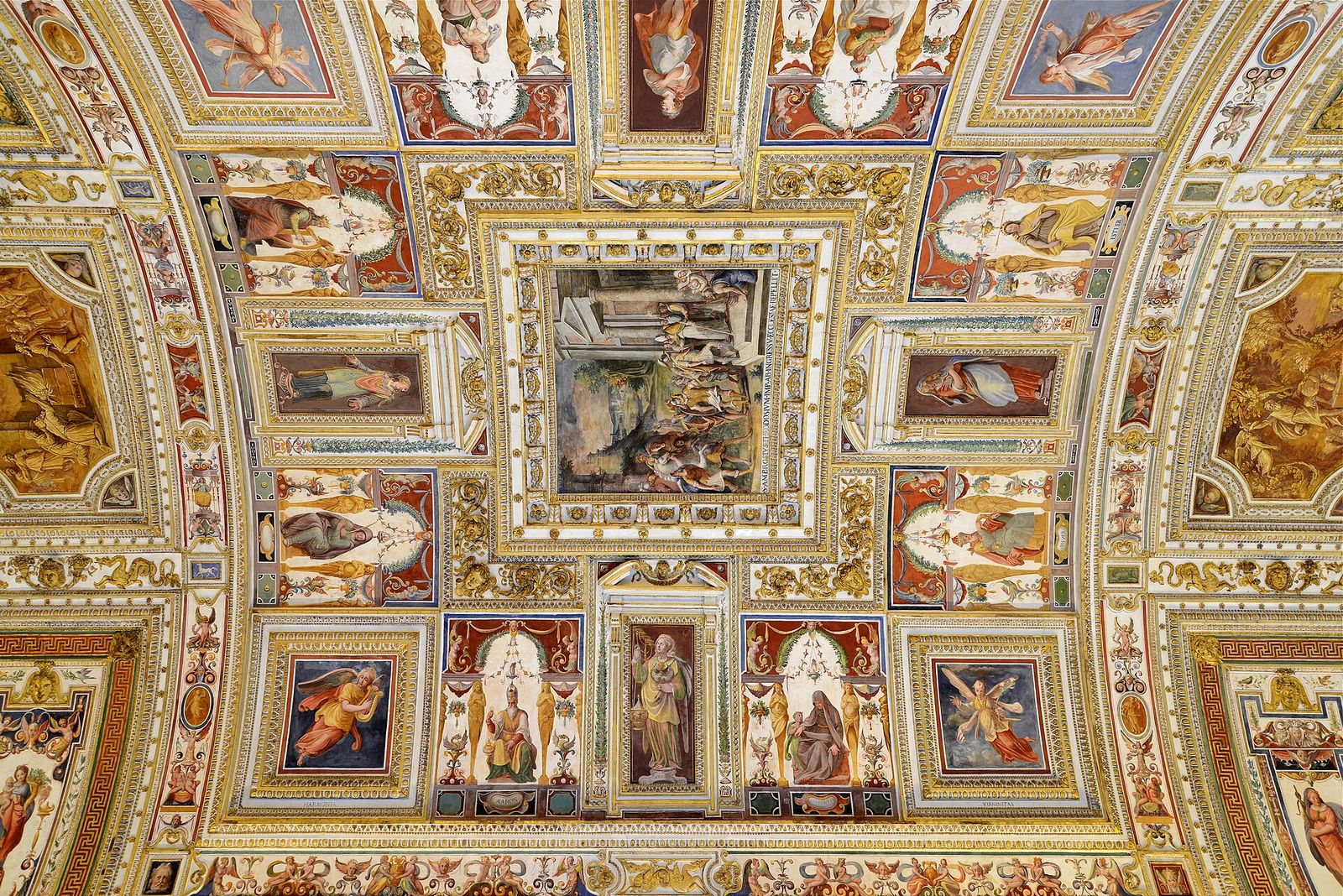
Three galleries in a row carry you towards the chapel. The last is the Gallery of Maps, 120 metres long. On its walls are forty maps of the regions of Italy, painted between 1580 and 1583.
Walk it as if you were walking down Italy from the Alps to the toe, with the Adriatic coast on one wall and the Tyrrhenian on the other. Towns, ports and even battles are marked.
The pope who ordered it was Gregory XIII, who also gave the world the calendar we use. He fixed it in 1582. In that same year a Jesuit named Matteo Ricci, who had studied in Rome under the calendar's chief mathematician, landed at Macau. Twenty years later he drew a map of the world for the emperor of China.
6. The Raphael Rooms
Raphael, The School of AthensRaphael, Public domain
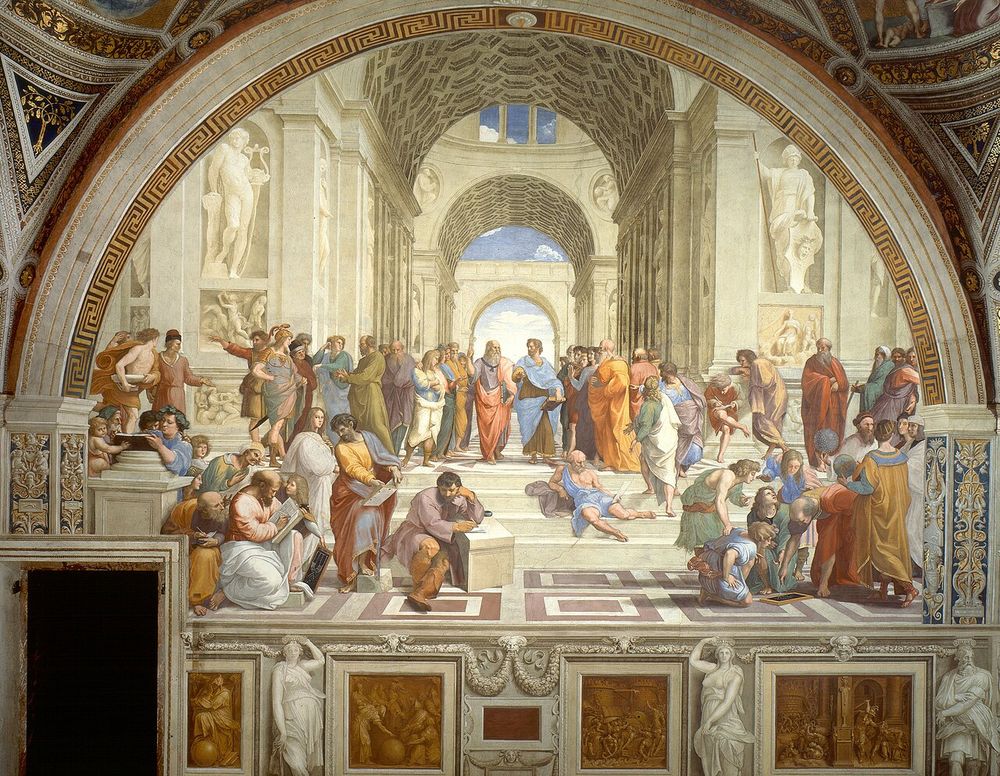
Julius II would not live in the rooms of the pope before him, whom he hated. He moved upstairs and in 1508 gave the walls to a painter of twenty-five, Raphael.
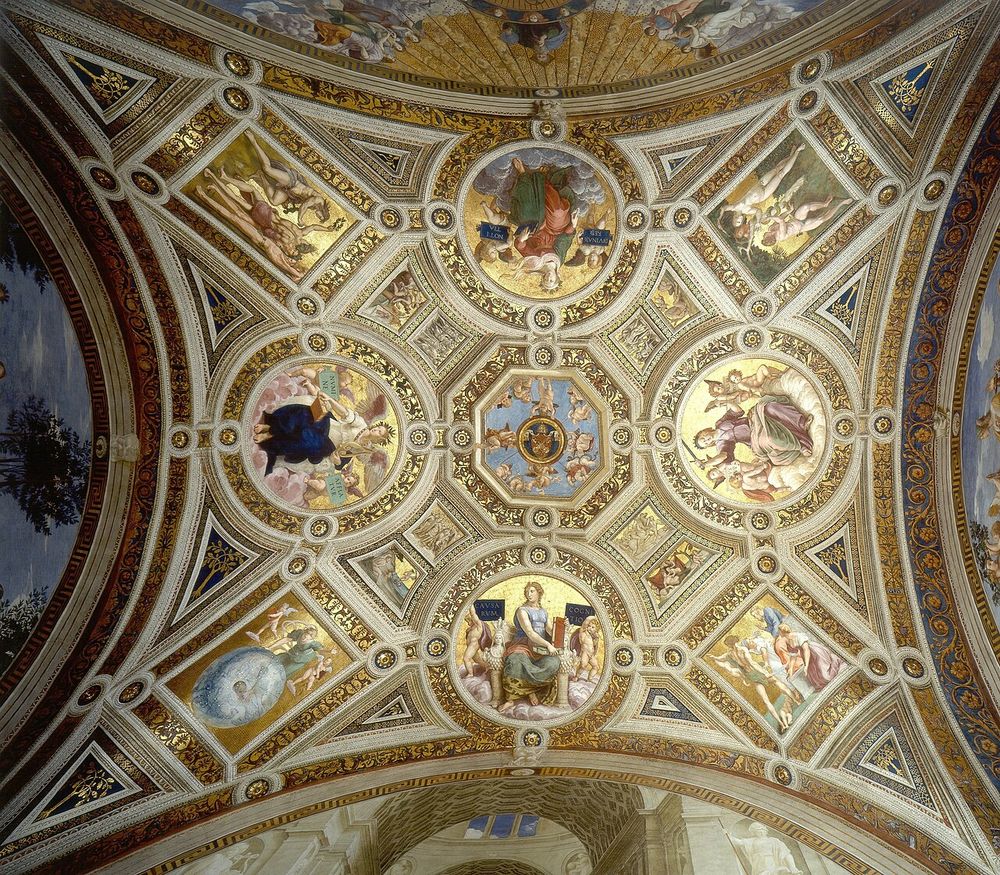
In the School of Athens the thinkers of ancient Greece meet under one great vault. In the middle Plato points up and Aristotle holds his hand out flat. Plato has the face of Leonardo da Vinci. The man brooding alone on the steps, leaning on a block, is thought to be Michelangelo, who was at work on the ceiling a few doors away. Raphael looks out at you from the far right edge.
Raphael, The Liberation of Saint PeterSailko, CC BY 3.0
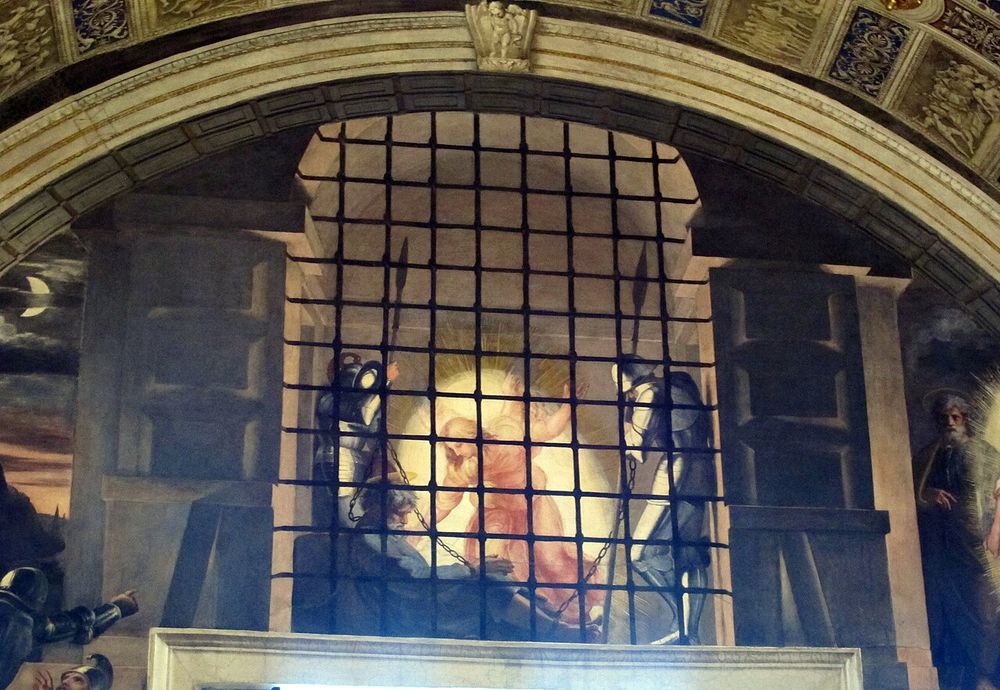
In the next room look above the window for the Liberation of Saint Peter. An angel wakes Peter in his cell at night. It is one of the first great night scenes in painting, with light from the angel, the moon and a torch.
7. The Sistine Chapel: the walls and the ceiling
The chapel before Michelangelo, as a nineteenth-century print imagined itG. Tognetti, Public domain
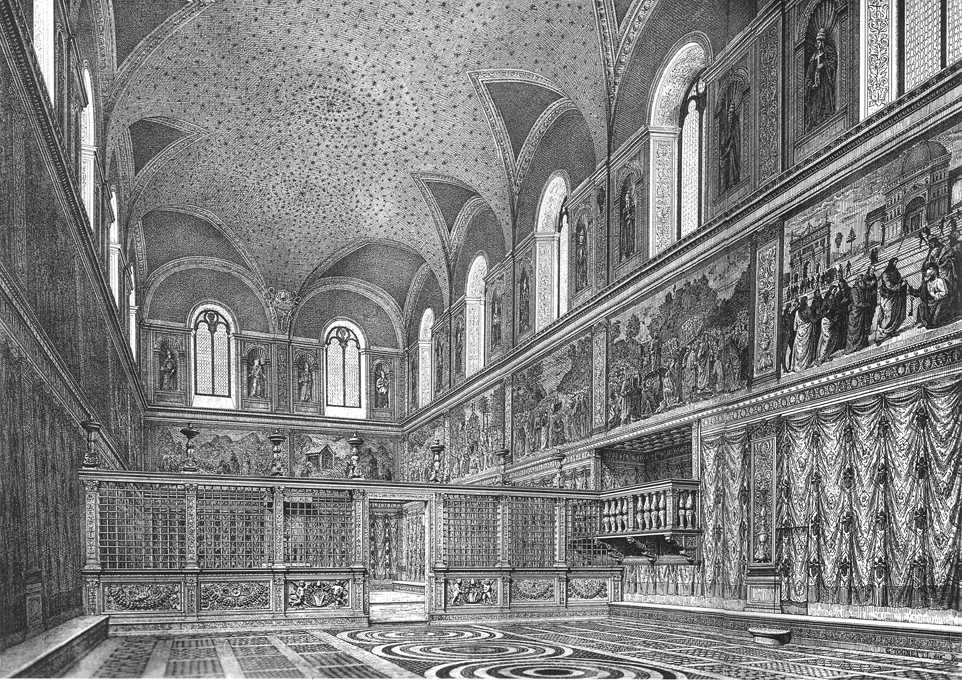
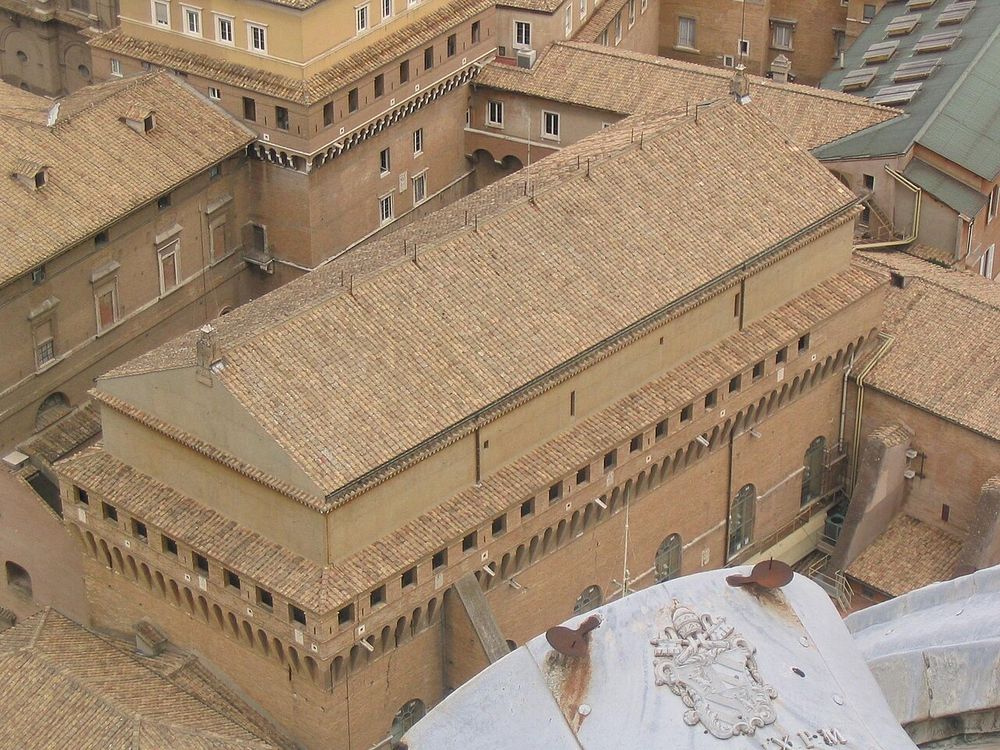
The chapel is named after Pope Sixtus IV, who built it between 1473 and 1481. It is 40 metres long, 13 wide and 20 high. In 1481 the best painters of Florence, among them Botticelli, painted the side walls with the lives of Moses and of Christ. Most visitors never look at them.
The Creation of AdamMichelangelo, Public domain
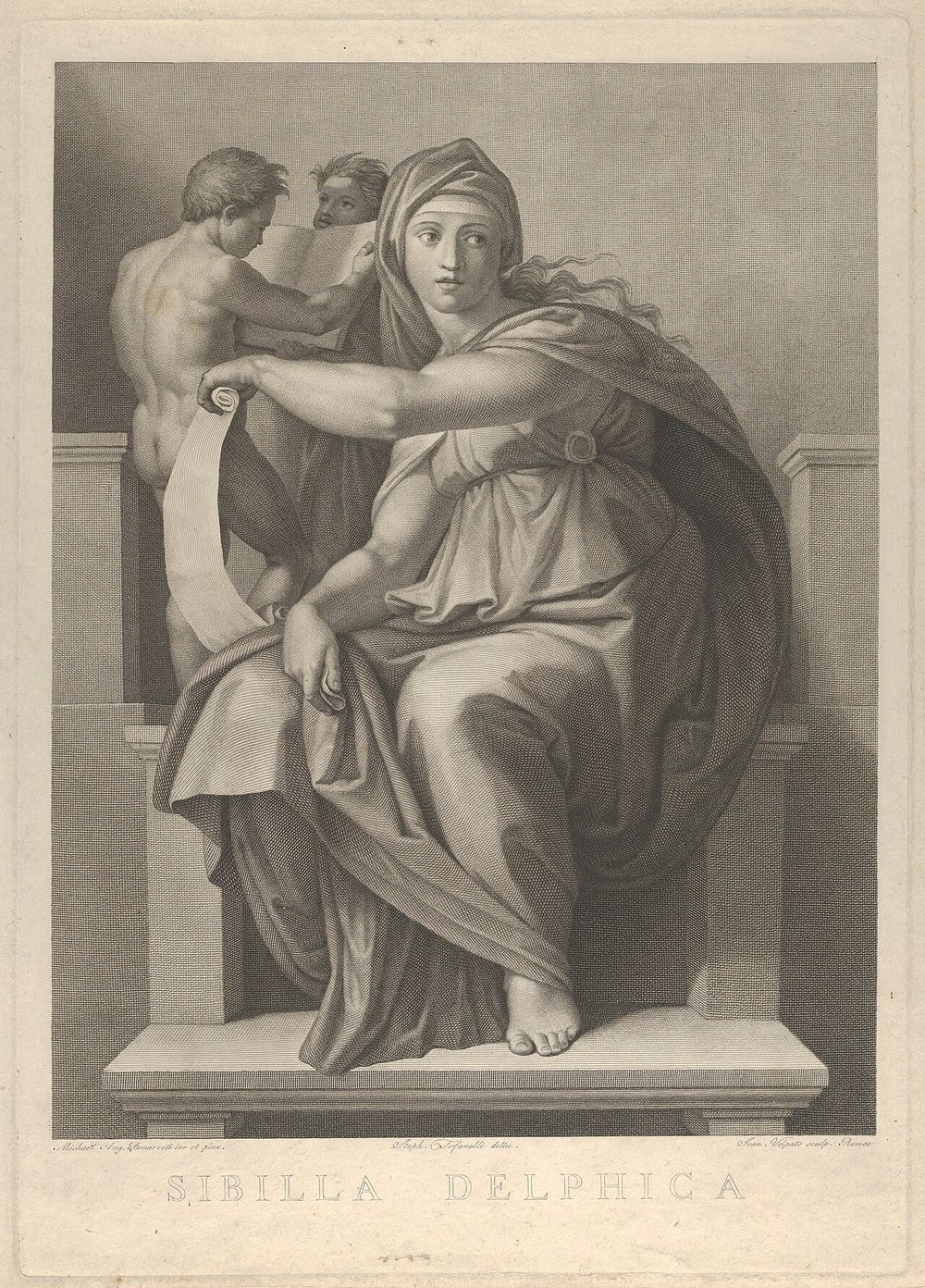
The ceiling then was blue with gold stars. Michelangelo covered it between 1508 and 1512 with more than three hundred figures. He worked from the door towards the altar, and the figures get bigger and bolder as he goes. Start at the altar end, with God dividing light from darkness, and read back towards the door, to Noah lying drunk.
He hated the work. He sent a friend a poem about what it was doing to his body.
I' ho già fatto un gozzo in questo stento
I have already grown a goitre from this drudgery
Michelangelo, sonnet to Giovanni da Pistoia (about 1509–1510)
8. The Last Judgment
The Last JudgmentMichelangelo, Public domain
Between the ceiling and this wall, Rome was sacked by an imperial army in 1527 and half of Europe left the Roman Church. The mood is different. There is no frame and no architecture, only bodies rising and falling in a blue void.
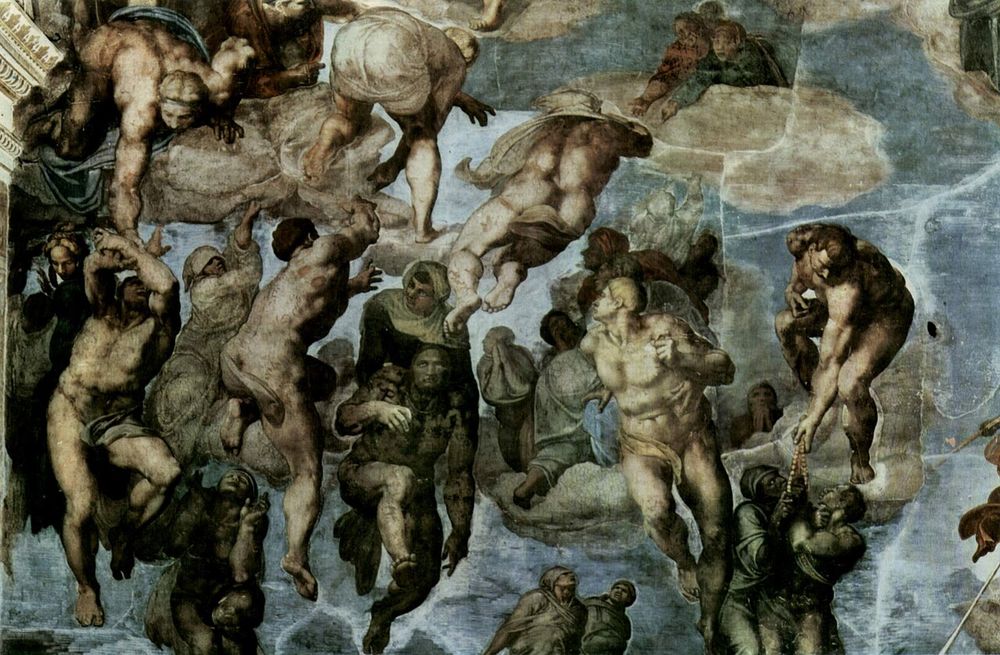
Find Saint Bartholomew, just below Christ to the right, holding a knife and his own skin. The sagging face on the skin is Michelangelo's.
A detail of the Last Judgment before cleaningMichelangelo, Public domain
Nearly all the figures were naked. Churchmen were scandalised, and in 1565, just after Michelangelo died, a painter was paid to add drapery. He was known ever after as "the breeches-maker".
9. The chapel at work: smoke, cleaning, and cameras
White smoke from the chapel chimney: a pope has been chosenDavid Lees, Public domain
For a conclave a stove is brought in and a chimney is run up through the roof. The cardinals vote on paper, and the ballots are burned. Black smoke means no decision. White smoke means there is a pope. On 8 May 2025 the white smoke was for Leo XIV, the first pope from the United States.
From 1980 to 1994 restorers cleaned four centuries of candle soot and glue off the paintings. The colours came out sharp: pink, apple green, orange. Some scholars said the cleaners had taken off Michelangelo's own finishing touches. Most now accept the bright colours as his.
The cleaning was paid for by a Japanese television company, which in return had the sole right to photograph the work. That agreement has long run out. The ban on cameras stayed.
Because filming is not allowed either, the film Conclave (2024) built the whole chapel again in a studio in Rome for its voting scenes.
10. The picture gallery, the stair, and China
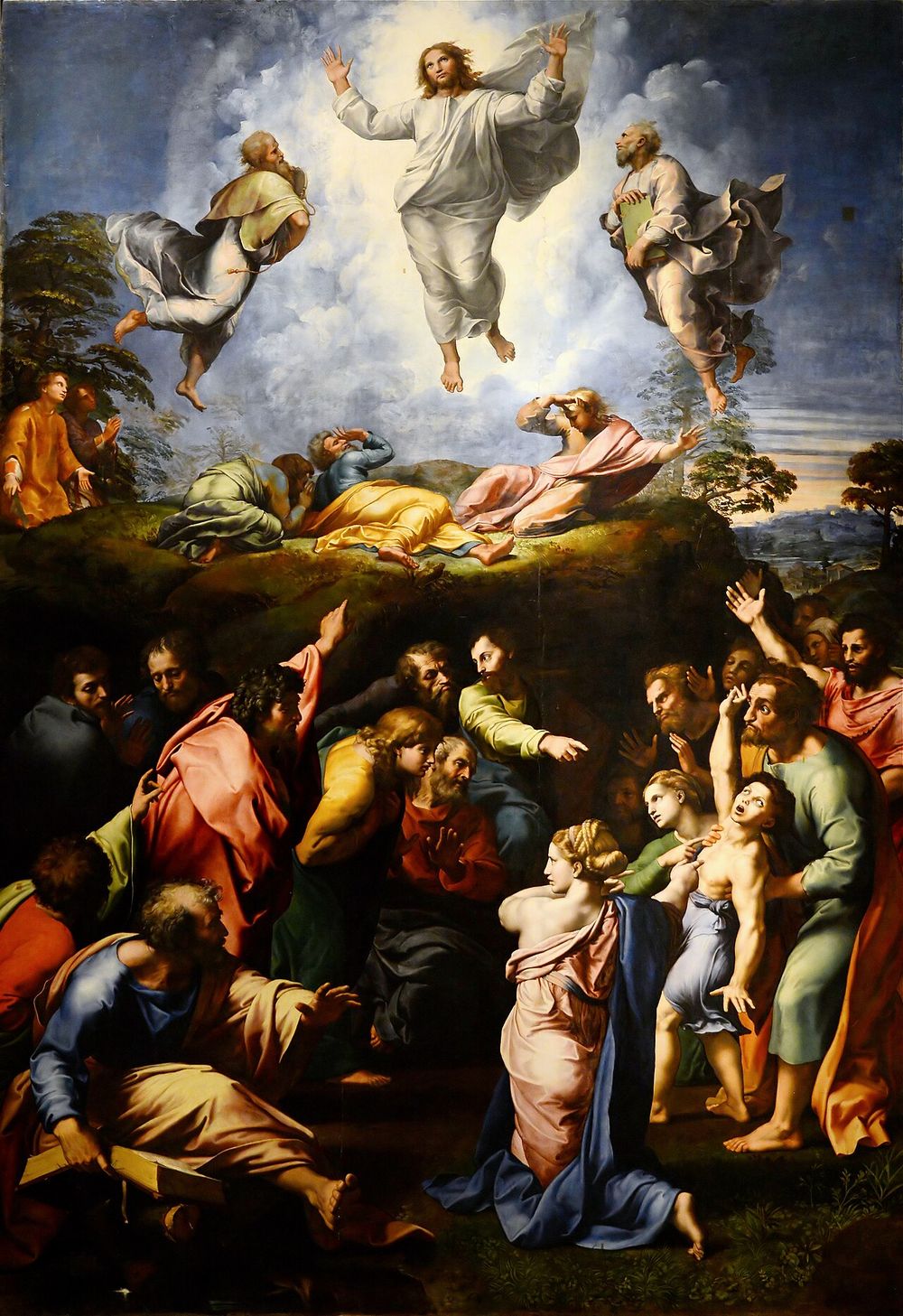
Raphael, The Transfiguration, in the PinacotecaRaphael, CC BY-SA 4.0
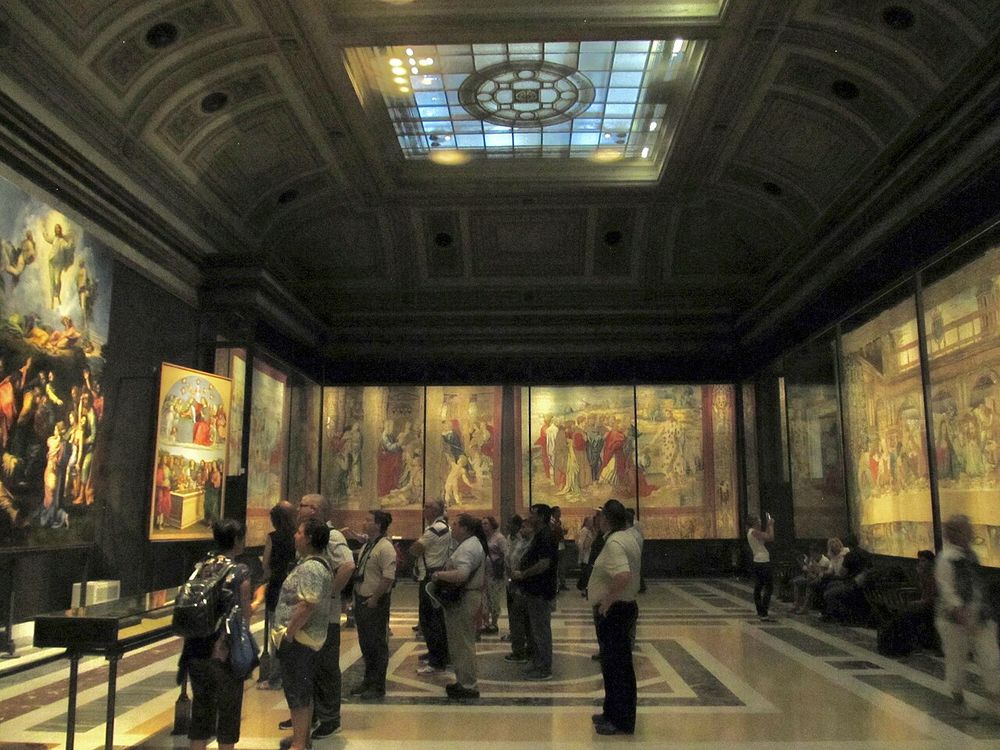
The Pinacoteca, the picture gallery, is in a separate building near the entrance, and most people are too tired to go. Go for one painting: Raphael's Transfiguration. He was working on it when he died in 1520, aged 37, and it was set up at the head of his coffin.
The spiral ramp of 1932Wilfredor, CC0
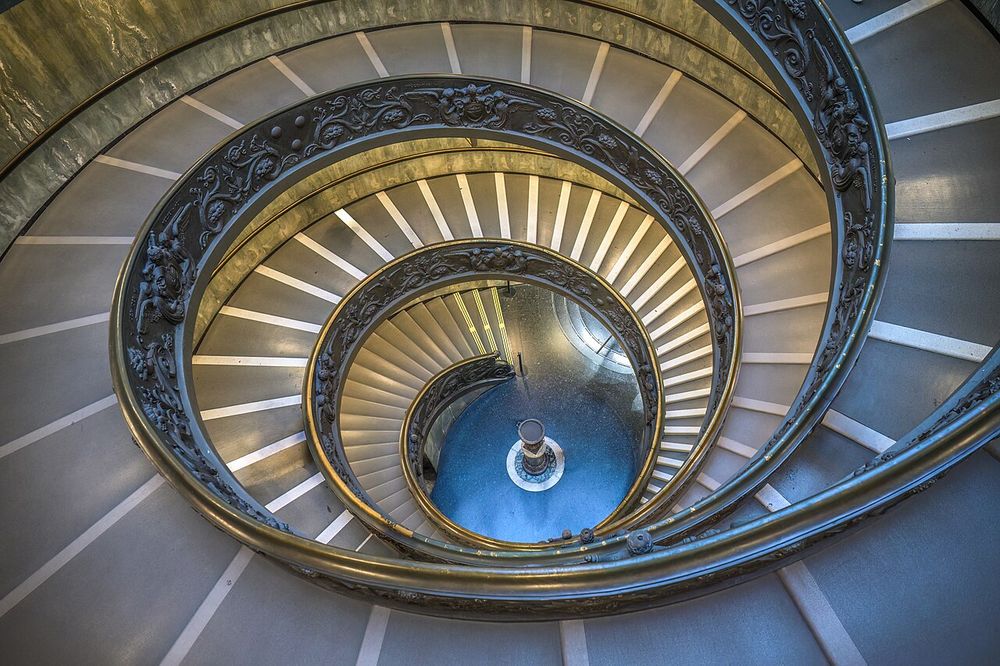
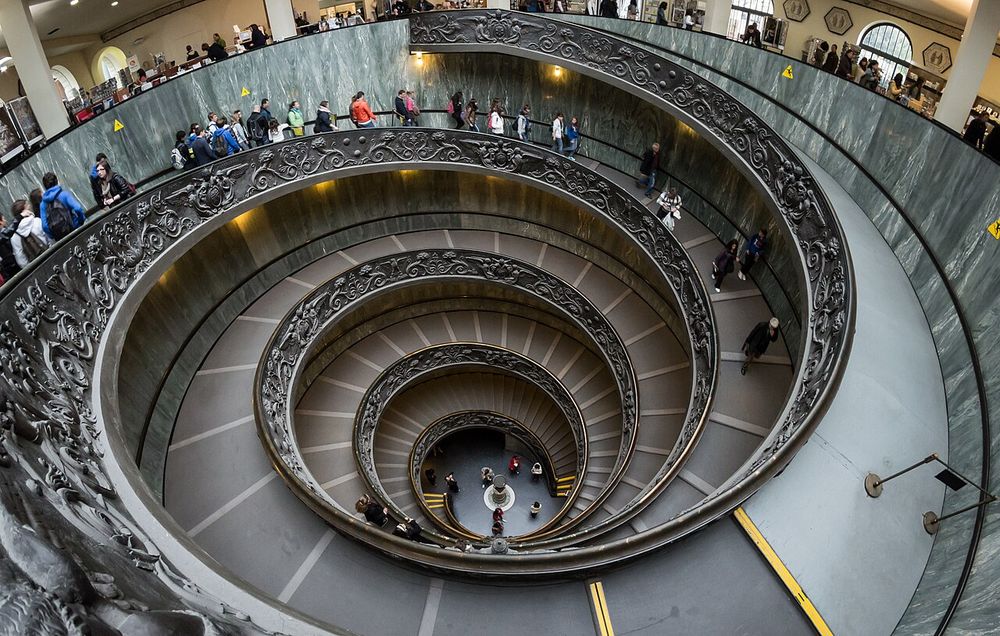
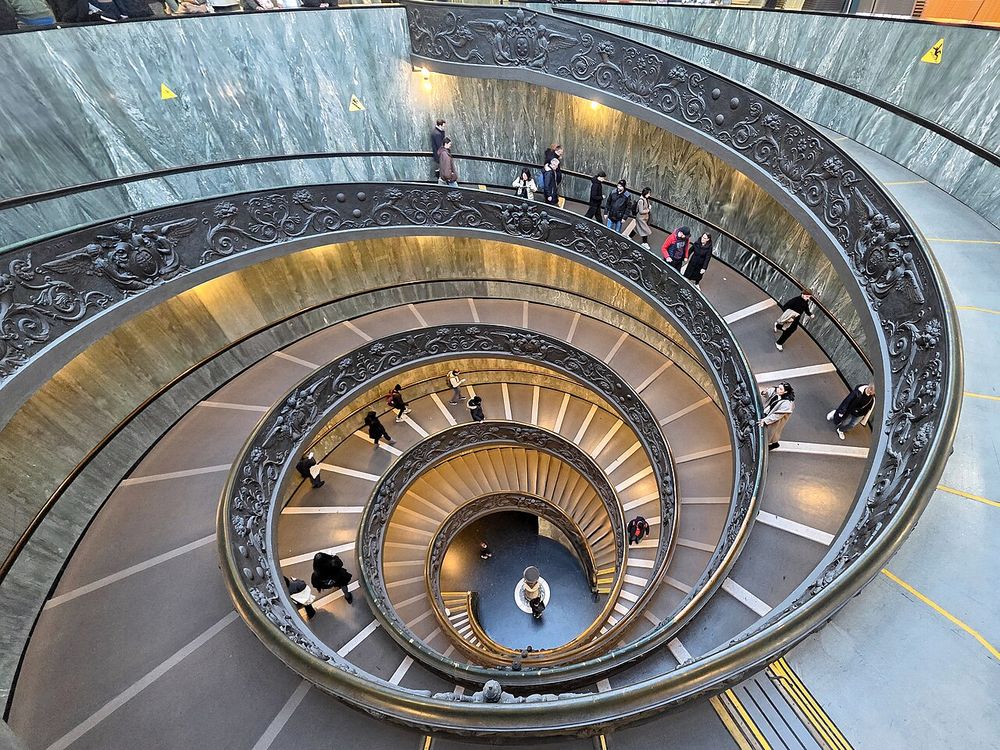
You leave by a spiral ramp built in 1932. It is two ramps wound together, one for going up and one for going down, so that people moving in opposite directions never meet.
When Michelangelo began the ceiling in 1508, the Zhengde Emperor of the Ming (1368–1644) was on the throne, and the philosopher Wang Yangming had just been banished to Guizhou, where he worked out his teaching that knowing and doing are one.
In 1904 the reformer Kang Youwei came to Rome in exile. He wrote in his travel diary of his admiration for Raphael, and argued that Chinese painting should learn from such work.
Meanwhile in the world
Year
Here
Elsewhere
1473–1481
The Sistine Chapel is built
The Chenghua reign of the Ming
1506
The Laocoön is found; the collection begins
First year of the Zhengde Emperor of the Ming
1508–1512
Michelangelo paints the ceiling; Raphael begins the Rooms
Wang Yangming is banished to Guizhou
1536–1541
The Last Judgment
The Jiajing reign of the Ming
1580–1583
The Gallery of Maps
Matteo Ricci lands at Macau in 1582
1771
The first public museum rooms open
The Qianlong Emperor is about to order the Siku Quanshu
1797–1816
Napoleon takes the best statues to Paris; they return
The first years of the Jiaqing Emperor
1980–1994
The Sistine frescoes are cleaned
China's years of reform and opening
2025
A conclave in the chapel elects Leo XIV
The Palace Museum in Beijing marks its hundredth year
One line to remember: one statue in 1506, seven kilometres of rooms today, and Michelangelo's chapel at the end.
Then and now
The Belvedere Courtyard at duskDiego Delso, CC BY-SA 4.0, Wikimedia CommonsThe queue along the Vatican walls, April 2007Diliff, CC BY-SA 3.0, Wikimedia CommonsThe Pinecone CourtyardLalupa, CC BY-SA 3.0, Wikimedia CommonsThe bronze pinecone, once a Roman fountainsailko, CC BY-SA 3.0, Wikimedia CommonsThe pinecone and its two bronze peacocksCarlo Pelagalli, CC BY-SA 3.0, Wikimedia CommonsLaocoön and his sonsWilfredor, CC0, Wikimedia CommonsThe Laocoön from the sideLivioandronico2013, CC BY-SA 4.0, Wikimedia CommonsThe Apollo BelvedereAlvesgaspar, CC BY-SA 4.0, Wikimedia CommonsThe Belvedere TorsoRichard Mortel from Riyadh, Saudi Arabia, CC BY 2.0, Wikimedia CommonsThe Round Hall and its porphyry basinAlvesgaspar, CC BY-SA 4.0, Wikimedia CommonsThe dome of the Round Hall, modelled on the PantheonJoseolgon, CC BY 4.0, Wikimedia CommonsThe Hall of the AnimalsDaderot, Public domain, Wikimedia CommonsAugustus of Prima Porta, found in 1863Justin Benttinen, CC BY-SA 4.0, Wikimedia CommonsA child's sarcophagus in the Chiaramonti galleryFabrizio Garrisi, CC BY-SA 4.0, Wikimedia CommonsA painted Egyptian coffin panelWilfredor, CC0, Wikimedia CommonsAn Etruscan chariot of the sixth century BCJean-Pol GRANDMONT, CC BY-SA 3.0, Wikimedia CommonsA ceiling panel in the Gallery of the CandelabraAnil Öztas, CC BY 4.0, Wikimedia CommonsThe Gallery of TapestriesFabrizio Garrisi, CC BY-SA 4.0, Wikimedia CommonsThe Gallery of MapsDeb Nystrom from Ann Arbor, Michigan, USA, CC BY 2.0, Wikimedia CommonsThe vault of the Gallery of MapsAlvesgaspar, CC BY-SA 4.0, Wikimedia CommonsRaphael, The School of AthensRaphael, Public domain, Wikimedia CommonsThe ceiling of the room of the School of AthensRaphael, Public domain, Wikimedia CommonsThe marble floor of the Raphael RoomsDarafsh, CC BY-SA 3.0, Wikimedia CommonsRaphael, The Liberation of Saint PeterSailko, CC BY 3.0, Wikimedia CommonsThe Sistine Chapel from outside: a plain brick boxUser Maus-Trauden on de.wikipedia, CC BY-SA 3.0, Wikimedia CommonsInside the Sistine ChapelThe original uploader was Snowdog at Italian Wikipedia., CC BY-SA 3.0, Wikimedia CommonsThe ceilingUnknown, CC BY 2.5, Wikimedia CommonsThe ceiling along its whole lengthJörg Bittner Unna, CC BY 3.0, Wikimedia CommonsThe Creation of AdamMichelangelo, Public domain, Wikimedia CommonsThe Delphic SibylJörg Bittner Unna, CC BY 3.0, Wikimedia CommonsThe Last JudgmentMichelangelo, Public domain, Wikimedia CommonsRaphael, The Transfiguration, in the PinacotecaRaphael, CC BY-SA 4.0, Wikimedia CommonsThe tapestry room of the Pinacotecadaryl_mitchell from Saskatoon, Saskatchewan, Canada, CC BY-SA 2.0, Wikimedia CommonsA papal car of about 1930 in the Carriage PavilionHigh Contrast, CC BY 3.0 de, Wikimedia CommonsThe spiral ramp of 1932Wilfredor, CC0, Wikimedia CommonsLooking down the rampColin, CC BY-SA 3.0, Wikimedia CommonsThe ramp from the top, 2026NateBergin, CC BY 4.0, Wikimedia CommonsThe Belvedere and its gardens in a sixteenth-century printClaude Duchet / Ambrogio Brambilla, CC0, Wikimedia CommonsThe Laocoön, engraved by Marco Dente soon after it was foundMarco Dente, CC0, Wikimedia CommonsThe chapel before Michelangelo, as a nineteenth-century print imagined itG. Tognetti, Public domain, Wikimedia CommonsThe Delphic Sibyl in an engraving of 1784Michelangelo / Giovanni Volpato, CC0, Wikimedia CommonsA detail of the Last Judgment before cleaningMichelangelo, Public domain, Wikimedia CommonsSt Peter's and the Vatican palaces from the air, published in 1921Keystone View Company, Public domain, Wikimedia CommonsWhite smoke from the chapel chimney: a pope has been chosenDavid Lees, Public domain, Wikimedia Commons
Local legends
These are stories people tell about this place. They are legends, not history, and each one says where it comes from.
LegendThe Last Judgment, bottom right
The pope's master of ceremonies, Biagio da Cesena, said the naked figures were fit for a tavern. Michelangelo painted him in hell as the judge Minos, with donkey's ears and a snake round his body. Biagio complained to the pope, who answered that his power did not reach as far as hell.
Source: Told by Giorgio Vasari in his Lives of the Artists (1568)
LegendThe ceiling
The architect Bramante, jealous of Michelangelo, is said to have talked the pope into giving him the ceiling, sure that a sculptor would fail at fresco and be disgraced.
Source: Told by Michelangelo's pupil Condivi (1553) and by Vasari; it is Michelangelo's side of the story
LegendThe Creation of Adam
The cloak and figures round God are said to trace the outline of a human brain, a secret sign that God gave Adam a mind as well as life.
Source: Proposed by an American doctor in a medical journal in 1990; art historians are not persuaded
LegendThe Belvedere Torso
Pope Julius II asked Michelangelo to give the Torso a head, arms and legs. He refused, saying it was too beautiful to be touched.
Source: A story told in the museums; no document of the time records it
Later, people who live here will be able to add the stories they grew up with, and say which of these they have heard.
Not certain, and where accounts conflict
Is Heraclitus in the School of Athens really Michelangelo?
The figure is not in Raphael's full-size drawing and was added late, in Michelangelo's manner. Most scholars accept it as a portrait. No document says so.
Did the cleaning go too far?
The restorers removed everything above the fresco surface as later dirt and glue. Critics said Michelangelo had added shadows on the dry plaster, and that these went too. The argument has cooled but not ended.
How many visitors?
Close to seven million a year. On busy days more than twenty thousand people pass through the Sistine Chapel, and their breath and dust are now the main threat to the paintings.
Should the statues taken from Greece and Egypt be here?
In 2023 the pope returned three fragments of the Parthenon to Greece, as a gift to the Orthodox Church. The museums have not said this sets a rule.
Visiting
Tickets and hours
Guides in 2026 give 20 euros for the full ticket, or 25 euros booked online, which includes a 5-euro booking fee. A reduced ticket for ages 6 to 18 and for students is given as 8 or 10 euros, plus the fee. Small children are free.
Monday to Saturday, 8:00 to 20:00, with last entry at 18:00. Closed on Sundays.
On the last Sunday of each month entry is free, from 9:00 to 14:00 with last entry at 12:30. It is the most crowded day of the month.
Guides also report Friday evening openings from April to October, 19:00 to 23:00, by online booking only.
The museums close on Catholic feast days. Check the calendar on the museums' site before fixing a date.
Last checked 2026-11-12. Travel guides of 2026, several of which cite the museums' own site; the official ticket site refuses automated visits, so we could not open it.
Booking from abroad
Ticket window on site Tickets have also been sold at the door for 20 euros, with a queue of two to three hours in season. One guide reports that since June 2026 tickets are sold online only. We could not confirm this.
Note The museums' own site, museivaticani.va, says the only official place to buy tickets online is tickets.museivaticani.va, which has an English version. That ticket site refuses automated visits, so we could not open it and give no link. Guides say booking opens 60 days ahead, that tickets carry your name, and that an identity document is checked at the door.
Checked 2026-11-12
Where to start
The entrance is on Viale Vaticano, on the north side of the walls. From St Peter's Square, walk with the wall on your left for about fifteen minutes.
Book the first slot at 8:00 or a slot after 15:00. The middle of the day belongs to tour groups.
There are short and long routes. If you have two hours, go by the Pinecone Courtyard, the Octagonal Court, the three long galleries, the Raphael Rooms and the chapel.
In the chapel, move to the benches along the side walls, sit down, and look for twenty minutes. Bring small binoculars if you have them.
Read about the ceiling before you go in. Guides are not allowed to speak inside.
Before you go
Metro line A to Ottaviano or Cipro, then five to ten minutes on foot.
Bring the identity document named on the ticket.
Large bags, umbrellas with points, tripods and selfie sticks go to the free cloakroom.
It is a long walk on stone floors, with few seats and little cool air in summer. Wear soft shoes and carry water.
Men selling "skip the line" tickets on the street outside are not from the museums.
Customs and manners
The dress rule is that of a church, and it applies to the whole visit: shoulders and knees covered, for men and women, and hats off. People are turned back at the door.
The Sistine Chapel is a consecrated chapel. Keep silent and take no photographs or video. The guards will call out for silence.
Do not touch the statues or lean on the walls. The marble has been worn by hands for centuries.
Priests and nuns you pass are at home here. A nod is enough. Do not photograph them close up.
Look for these
In the Pinecone Courtyard, find the two bronze birds beside the pinecone. What are they?
At the Laocoön, count the snakes. Where is one about to bite?
In the Round Hall, find the giant red basin. Is it made of one piece of stone?
In the Gallery of Maps, find the island of Sicily. Is north at the top?
In the School of Athens, find the one man who looks straight at you.
In the Sistine Chapel, find the two fingers that almost touch. Which hand is reaching harder?
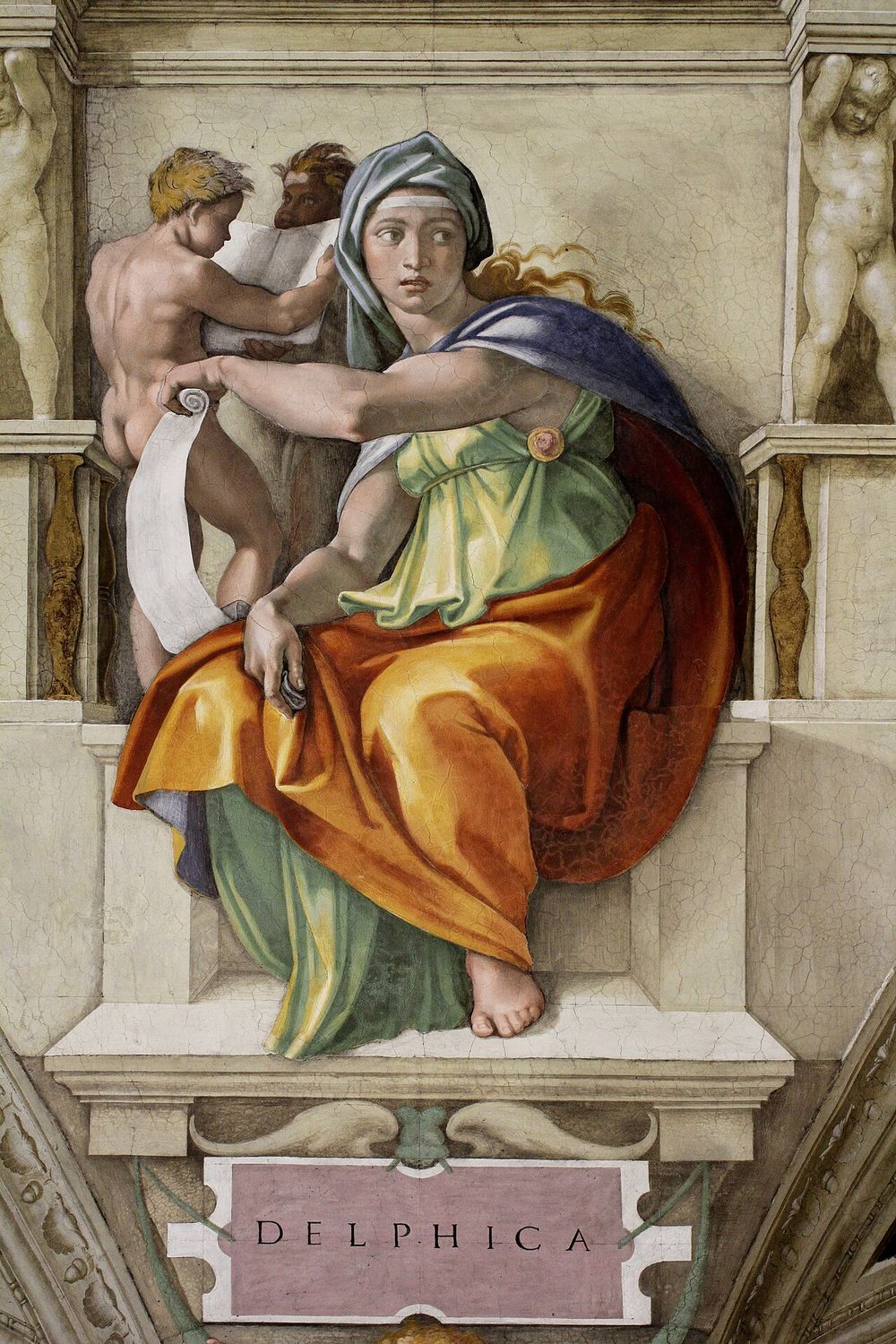
On the ceiling, find a woman reading a huge book and a man with his head in his hand.
In the Last Judgment, find the man with donkey's ears.
On the way out, look down the spiral ramp. Can you see that there are two ramps?
I am here
Stand at the site, sign in, press the button, and collect its stamp. Your browser will ask to use your location. It is sent to us once to confirm that you are at the site; we keep how far you were from it, not the spot where you stood.
Your stamps are saved to your account, so they follow you to any device. Checking from a browser cannot rule out every false location; stricter checks arrive with the app.
Messages
Share your photos
Photos here show the place, not people. Each one is credited to the visitor who took it and appears after our team has looked at it. A photo with you in it belongs under “I am here”.