Basilica di San Pietro · bah-ZEE-lee-kah dee sahn PYEH-troh
The largest church in the world, built over the grave of a fisherman from Galilee. It took 120 years and the best architects of the Renaissance, and the way it was paid for split the Western Church in two.
Photo: Diliff, CC BY-SA 3.0, Wikimedia Commons
The story
You are in front of the largest church ever built. Inside it is 187 metres long, and the cross on the dome is 136 metres above the floor. It stands where Christians have believed since the first century that Peter, the chief of the apostles, is buried.
The first stone was laid in 1506 and the church was consecrated in 1626. In those 120 years there were twenty popes and at least ten architects, among them Bramante, Raphael and Michelangelo.
The church and the grottoes are free. The dome, the treasury and the excavations under the church each need their own ticket. The Vatican Museums and the Sistine Chapel are a different place with a different entrance.
A separate place with its own ticket and its own page
If you have one minute
In the square, facing the church
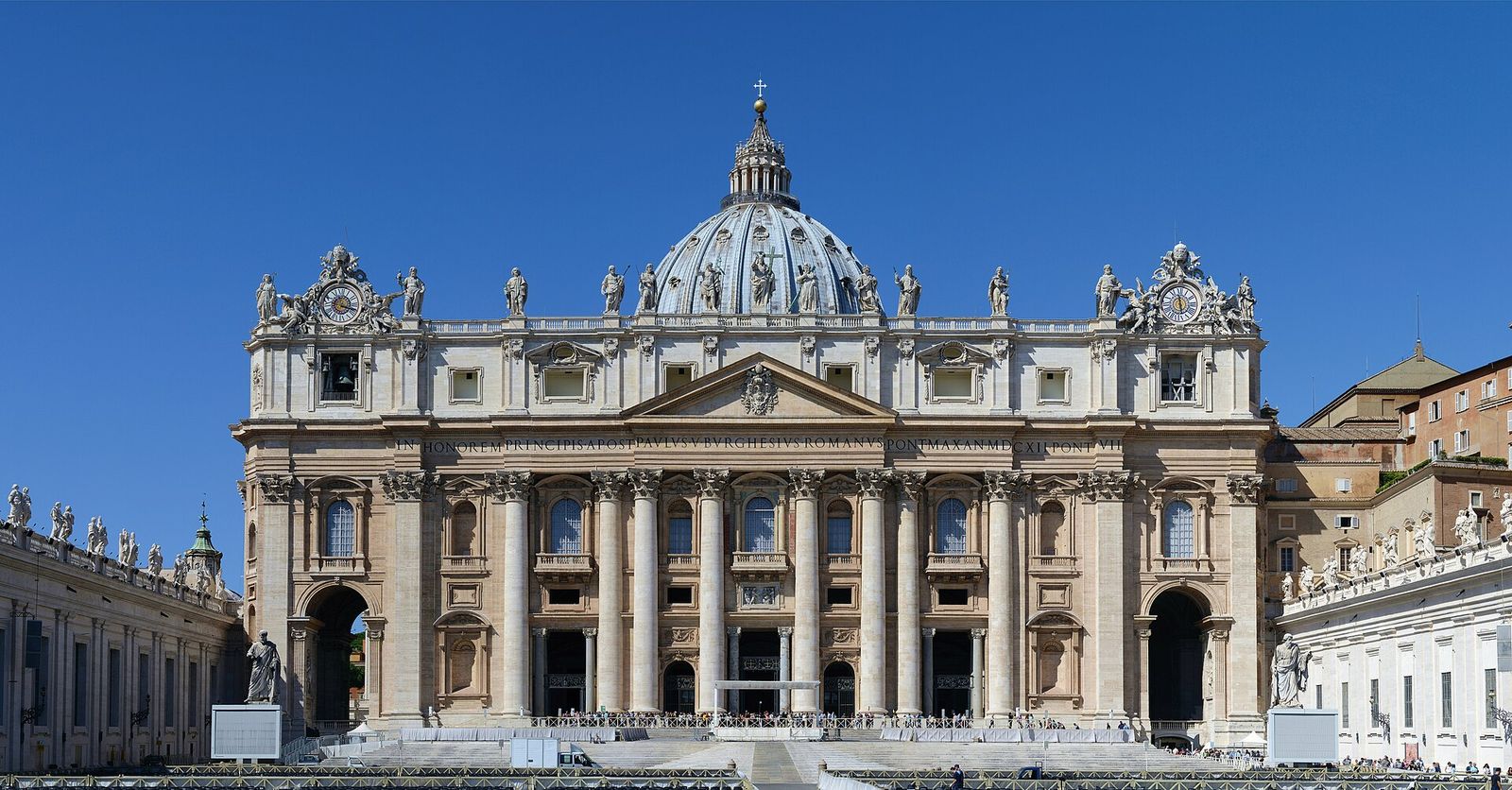
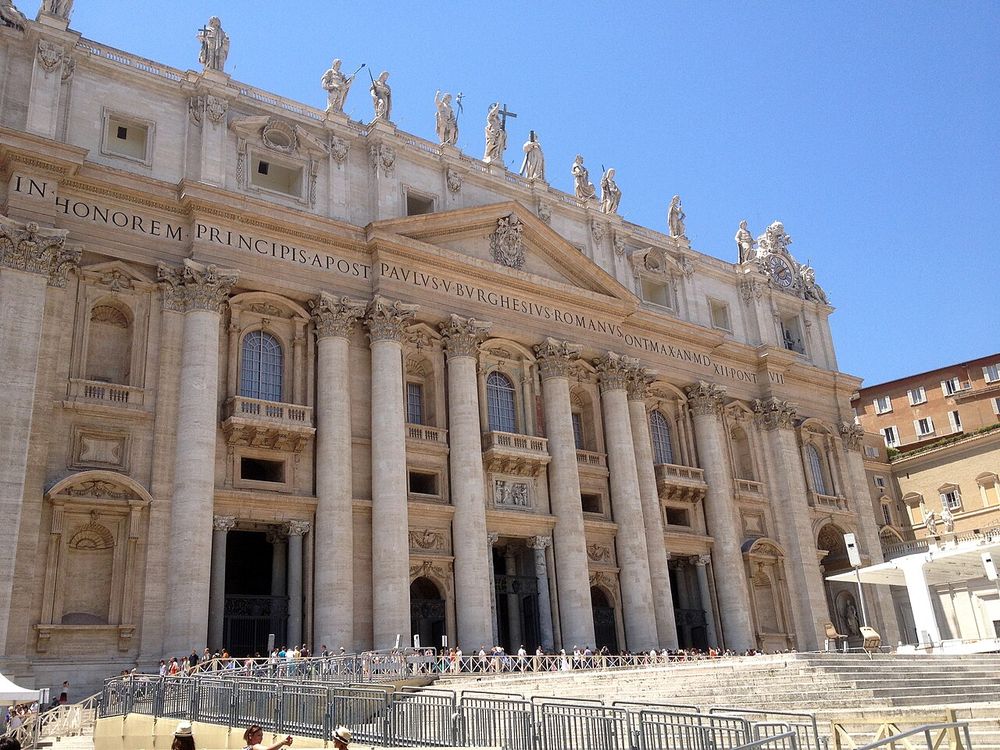
The front of the church from the squareAlvesgaspar, CC BY-SA 4.0
Peter was a fisherman whom Jesus called to follow him. Tradition says he came to Rome and was crucified here, in the emperor Nero's racecourse, about the year 64. He was buried in a cemetery beside it. The high altar of the church stands straight above that spot.
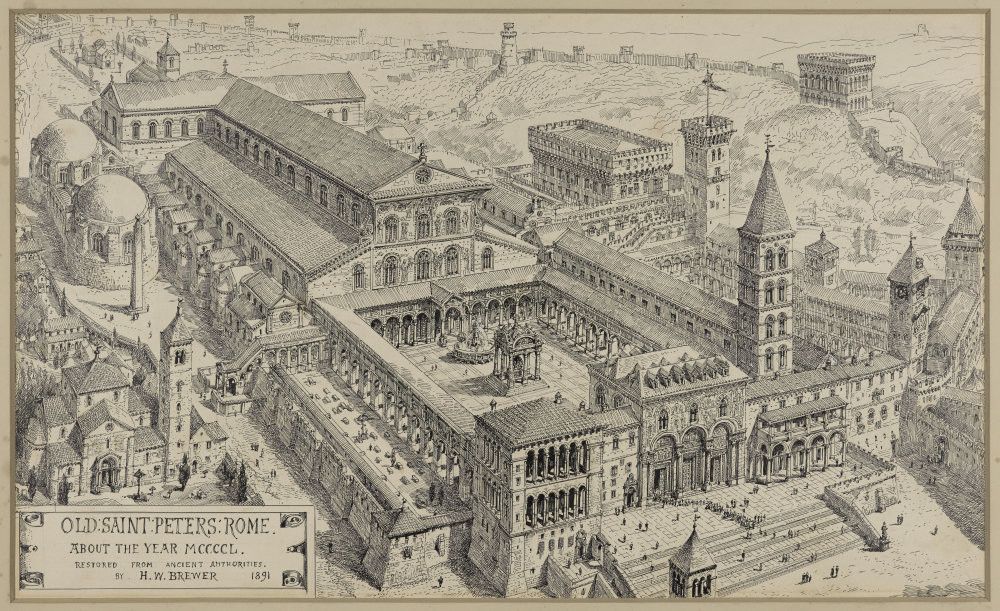
The first church here was built by the emperor Constantine in the 300s. It stood for twelve hundred years and was falling down when Pope Julius II decided to replace it.
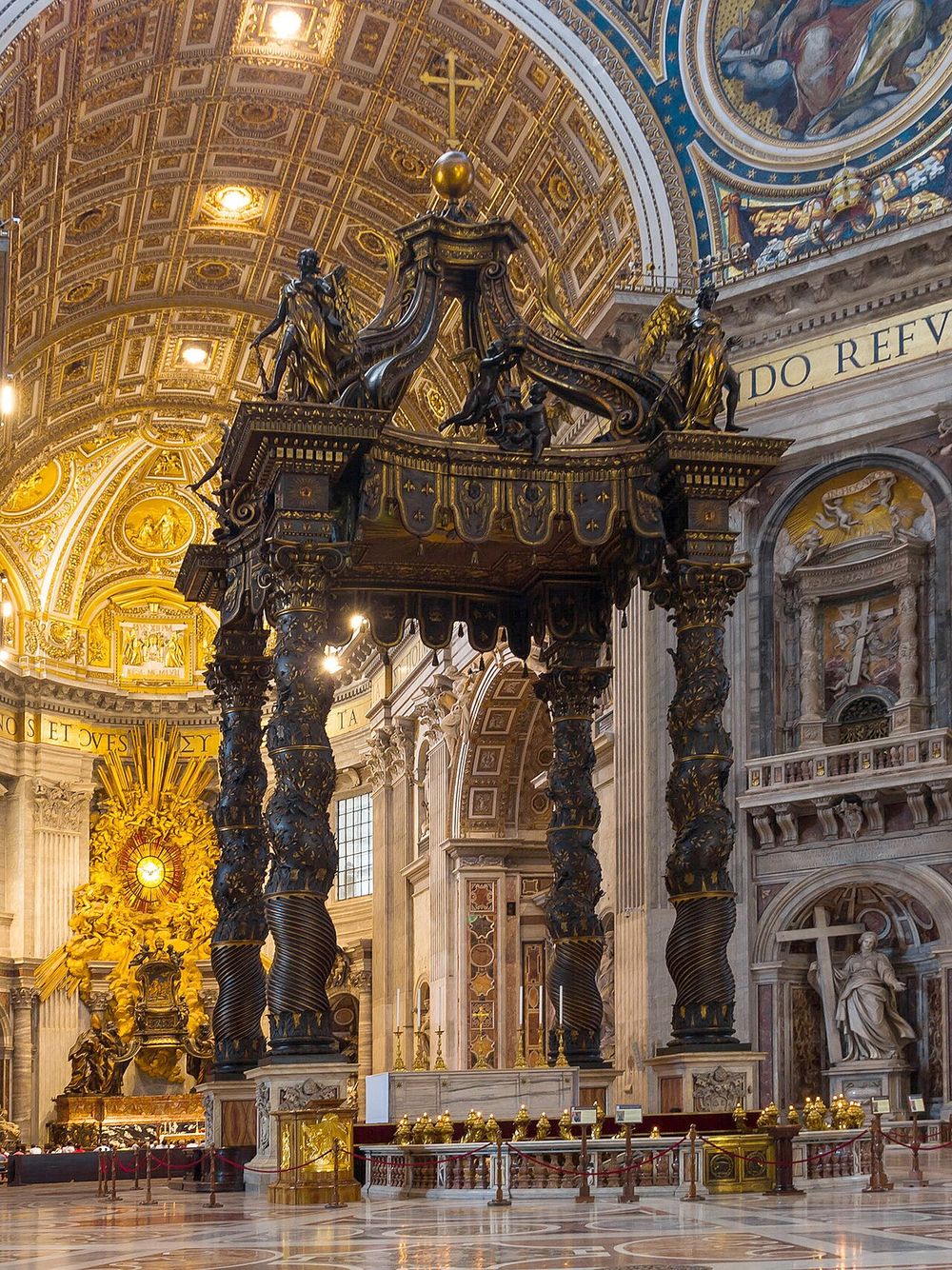
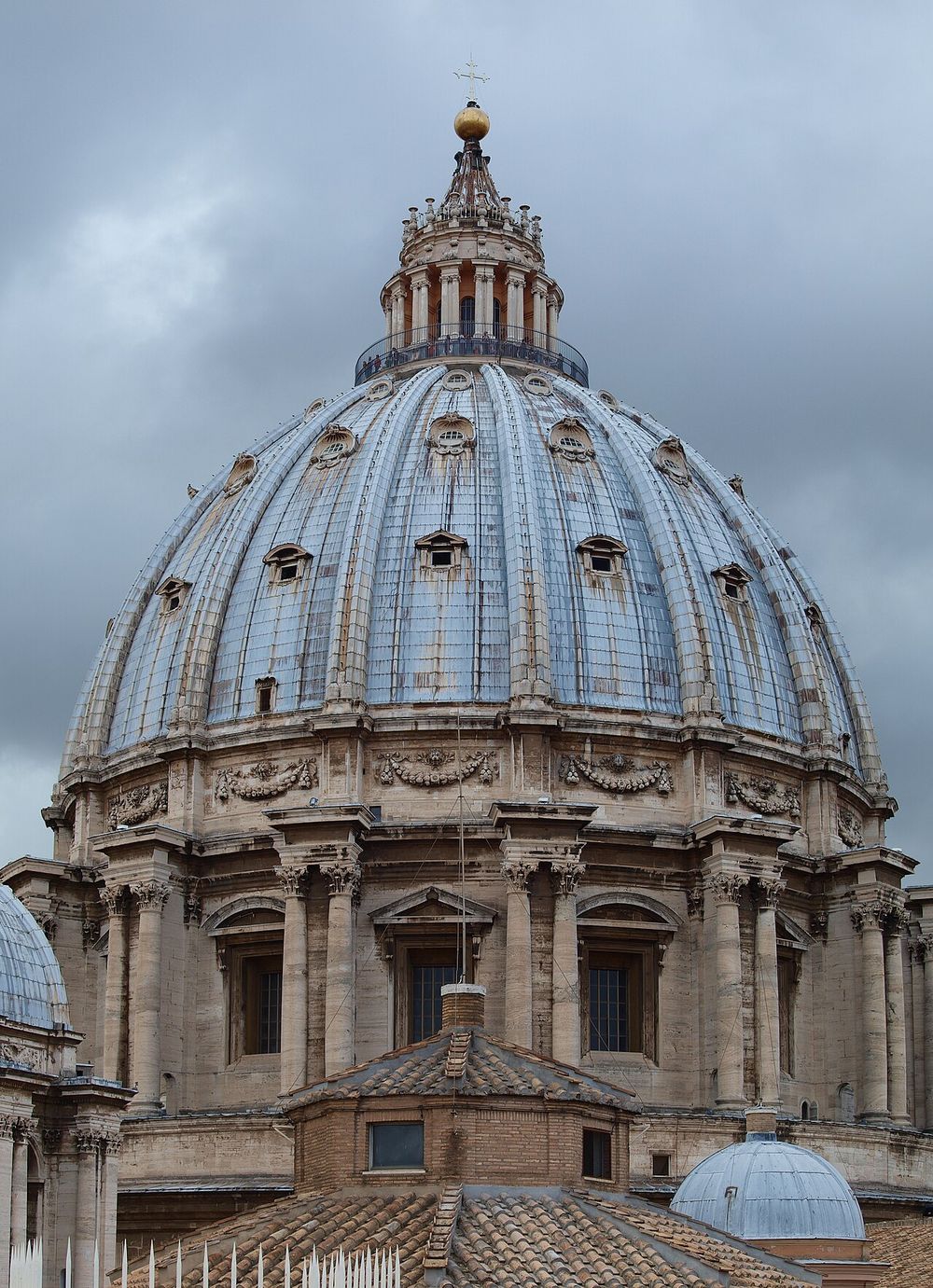
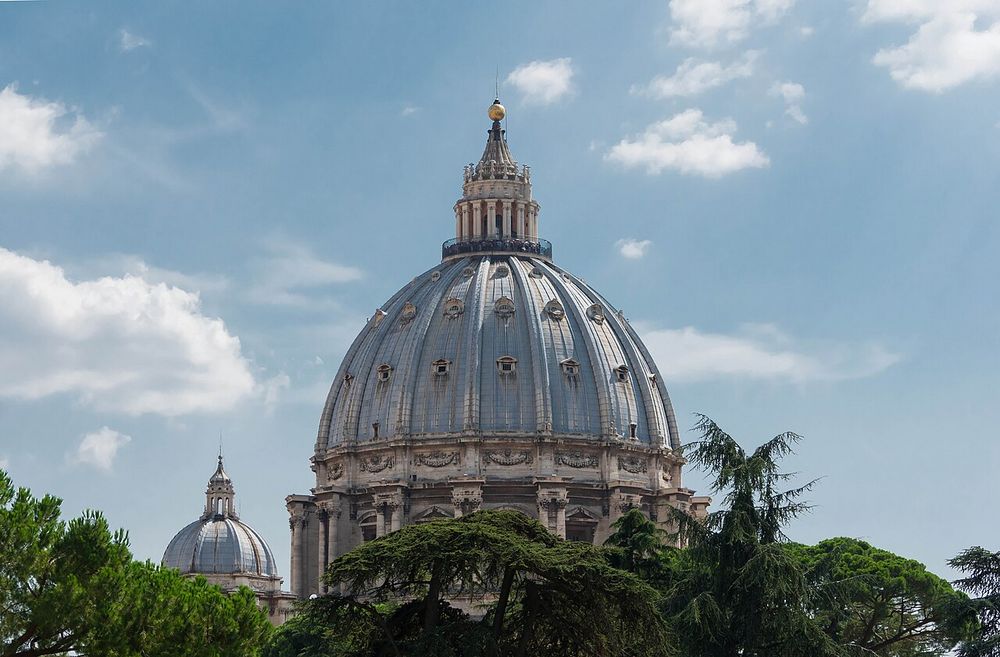
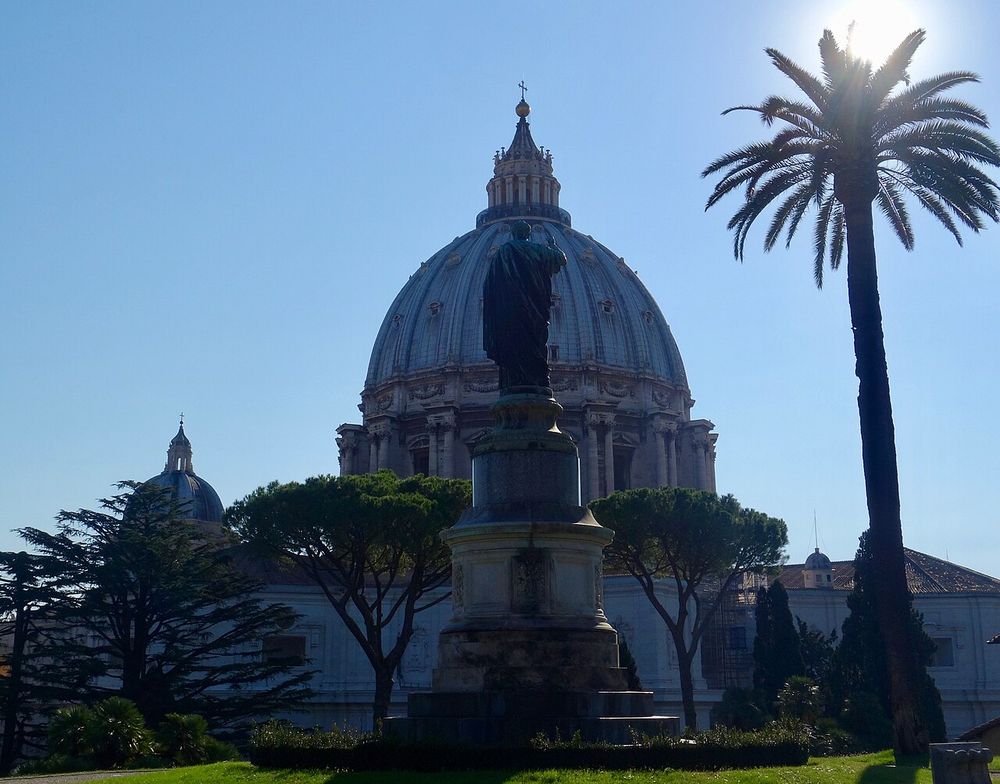
The dome is Michelangelo's. He took the job at 71 and refused pay. The two curved rows of columns that hold the square are by Bernini, who also made the bronze canopy over the altar inside.
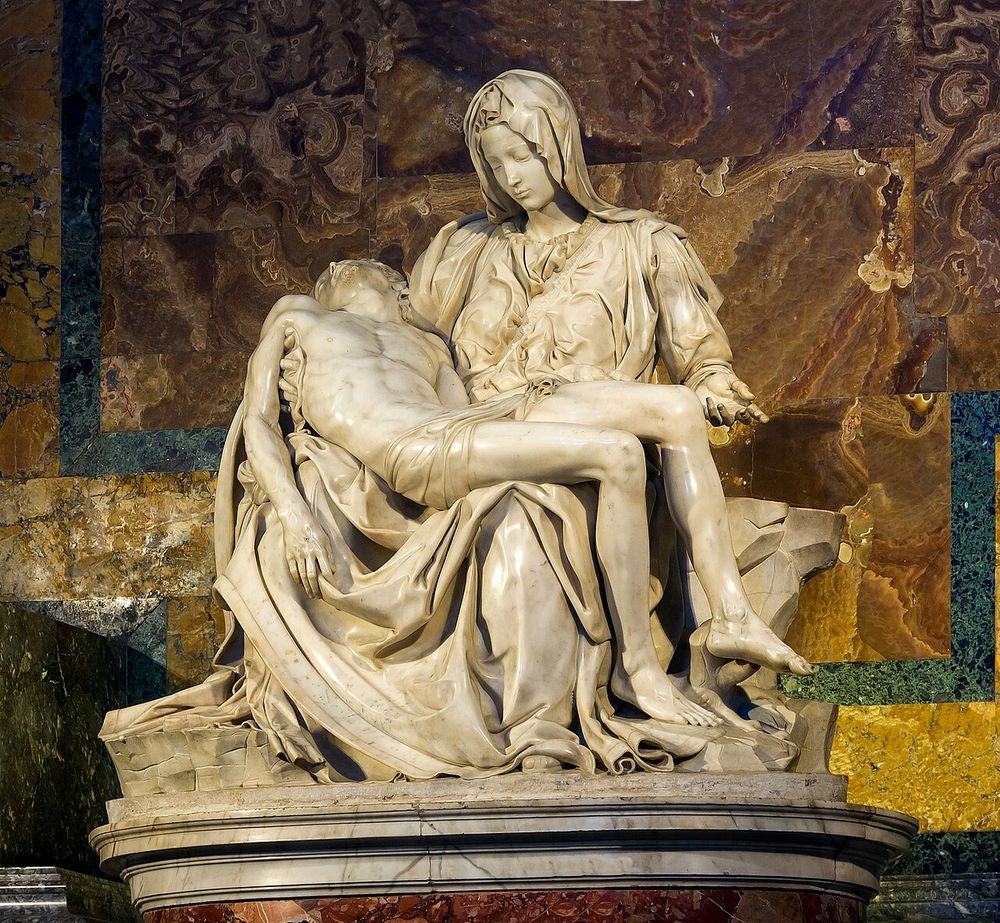
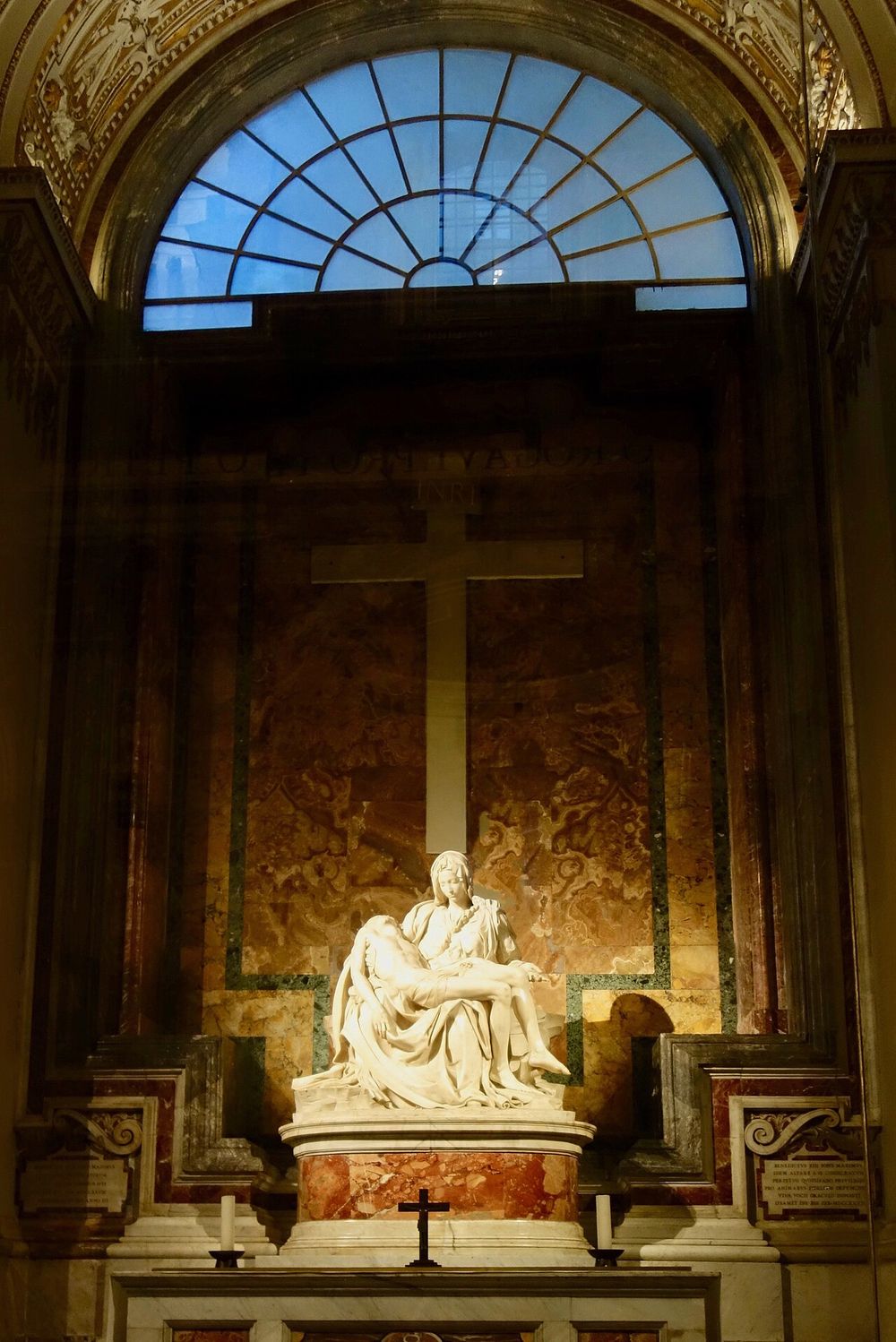
Just inside, on the right, is the Pietà: Mary with the dead Christ across her knees. Michelangelo carved it at 24.
Things people often get wrong
"It is the Pope's cathedral." The cathedral of Rome is St John Lateran, across the city. St Peter's is where the Pope holds his great ceremonies, because of the tomb.
"You need a ticket." The church is free. What you queue for in the square is a security check. A paid reservation and the climb up the dome are extras.
"Michelangelo designed the Swiss Guards' uniform." The striped uniform was designed by a commander of the guard in 1914.
"The Sistine Chapel is inside." It is in the palace next door and is reached through the Vatican Museums, which have their own entrance, fifteen minutes' walk away.
People who stood here
Charlemagne (king of the Franks, who united most of western Europe)On Christmas Day in the year 800 he knelt at the tomb of Peter in the old church that stood on this spot. As he rose, the Pope set a crown on his head and the people hailed him as emperor of the Romans. The round slab of red stone on which he is said to have knelt is set in the floor just inside the central door. You may be standing on it.
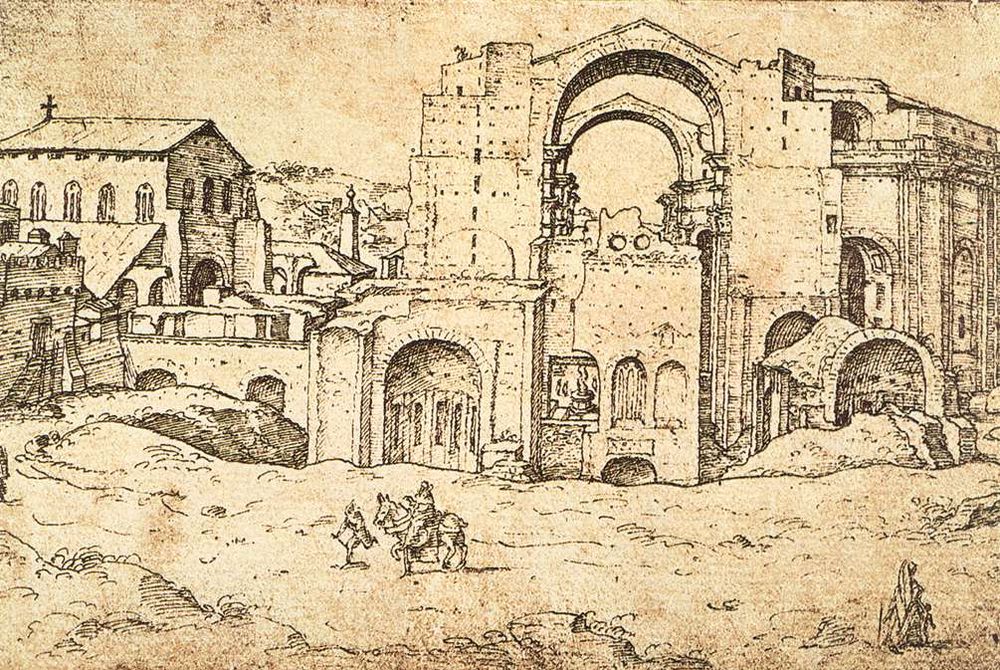
Martin Luther (the German monk who began the Protestant Reformation)He came to Rome on foot in the winter of 1510, a young monk on business for his order, and prayed at the tomb. The old church was half pulled down and the piers of the new one were rising among the rubble. Seven years later he attacked the sale of pardons that was paying for it. He may have stood where you stand, looking at a building site.
Go deeper: eight stops, from the square to the dome
The stops run from the square, through the door and up the nave, down to the tombs and then up to the dome.
1. The square: two arms and an obelisk
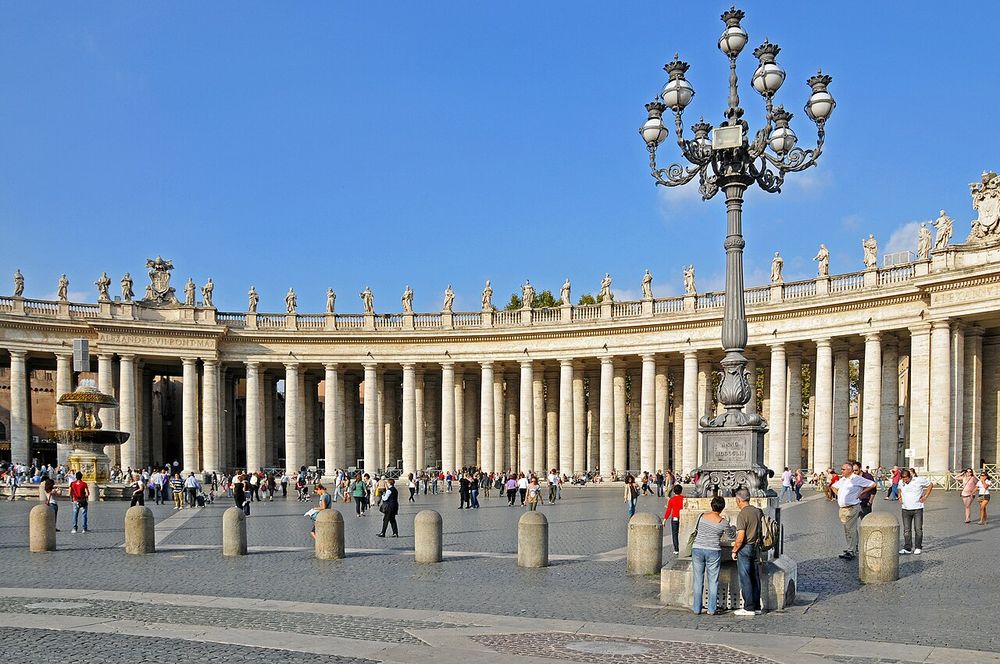
Bernini's colonnadeDennis G. Jarvis, CC BY-SA 2.0
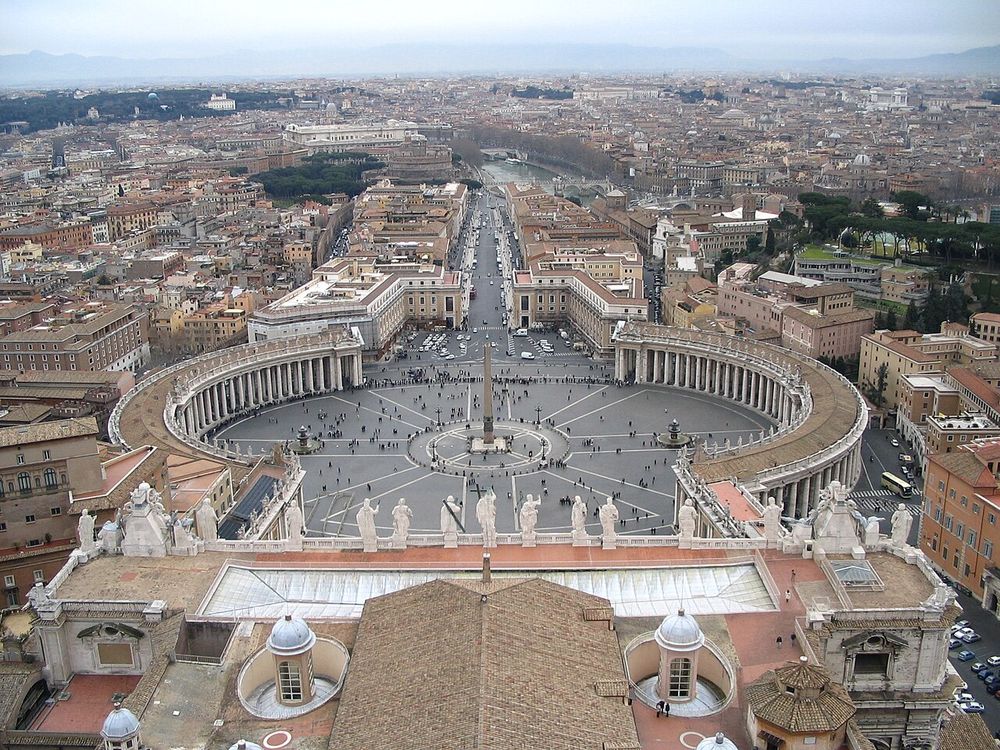
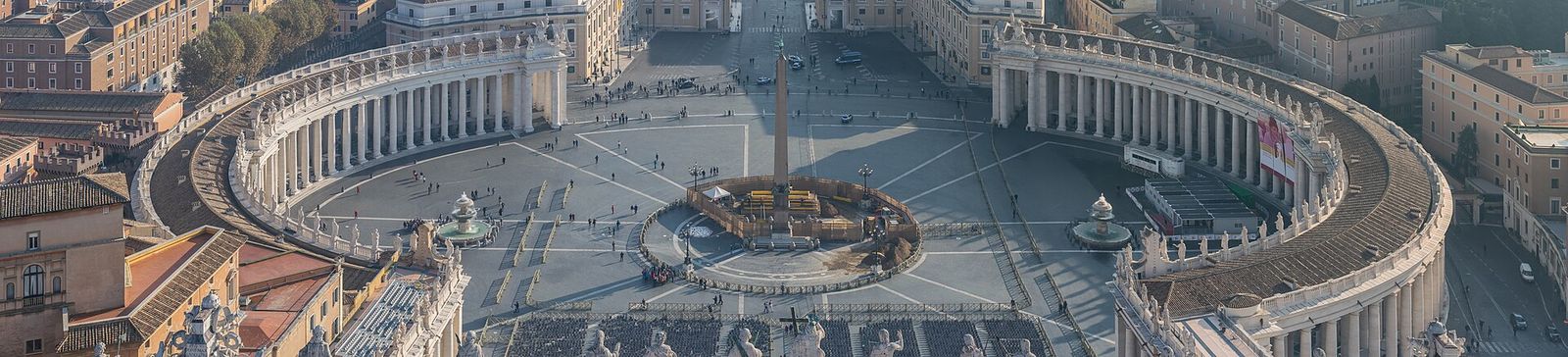
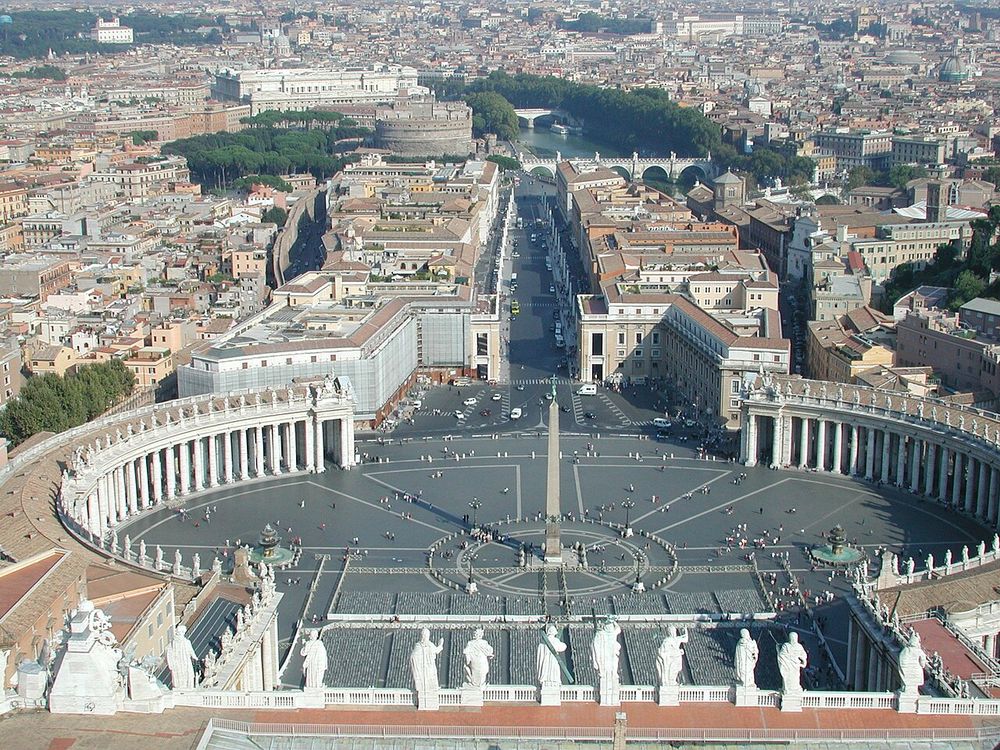
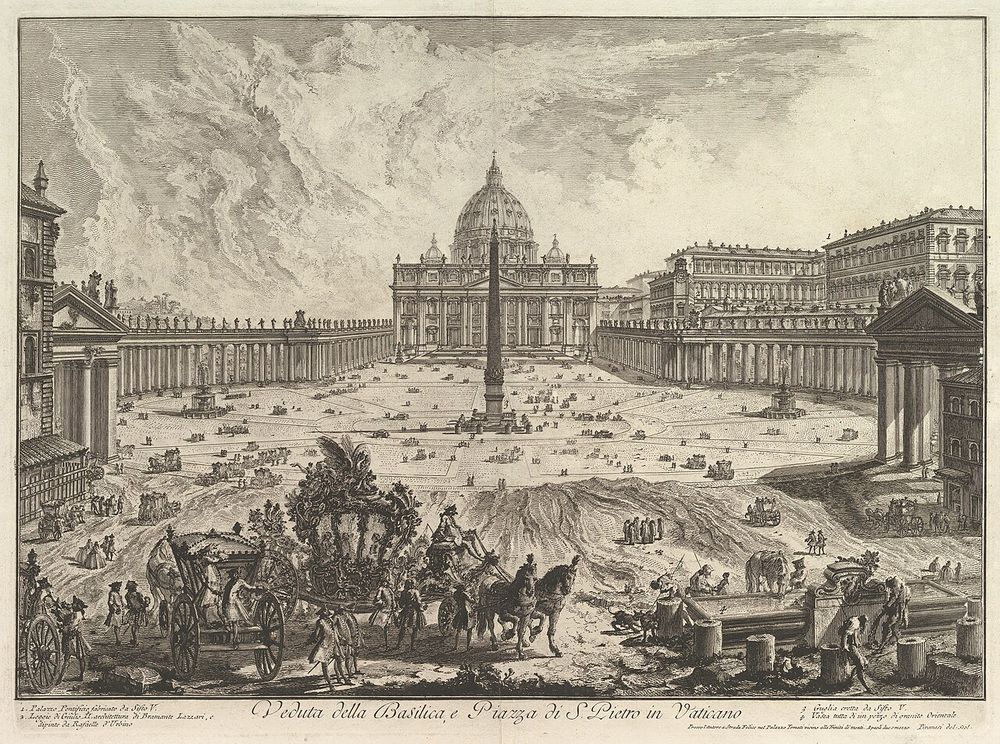
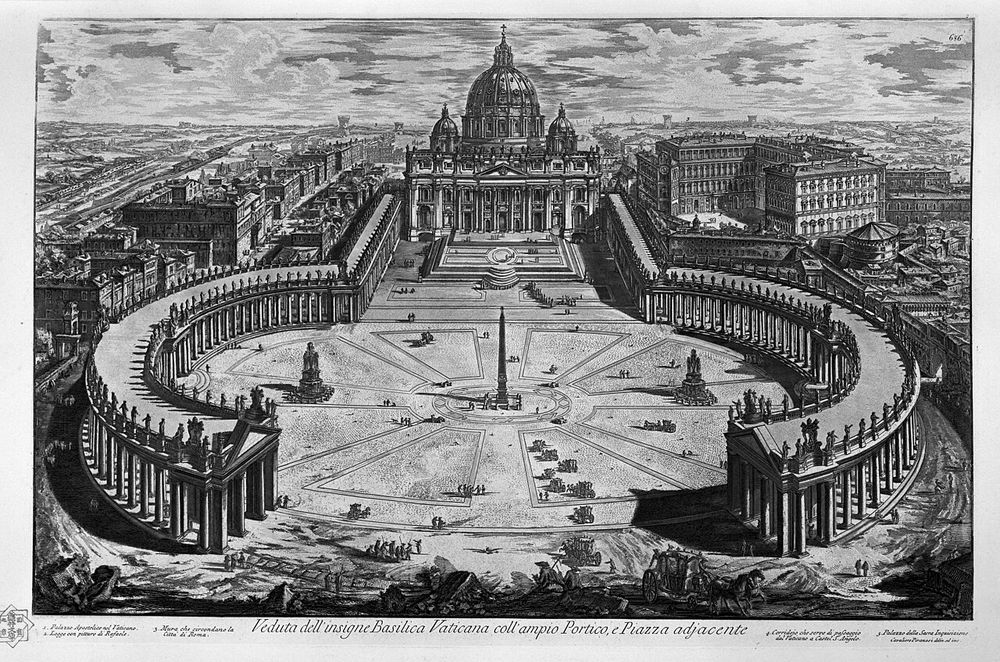
Bernini built the square between 1656 and 1667. The two curved colonnades have 284 columns in four rows, with 140 statues of saints along the top. He said they were the arms of the Church reaching out to gather people in.
Between the obelisk and each fountain, find a round stone in the pavement. Stand on it and look at the nearer colonnade. The four rows of columns line up and look like one.
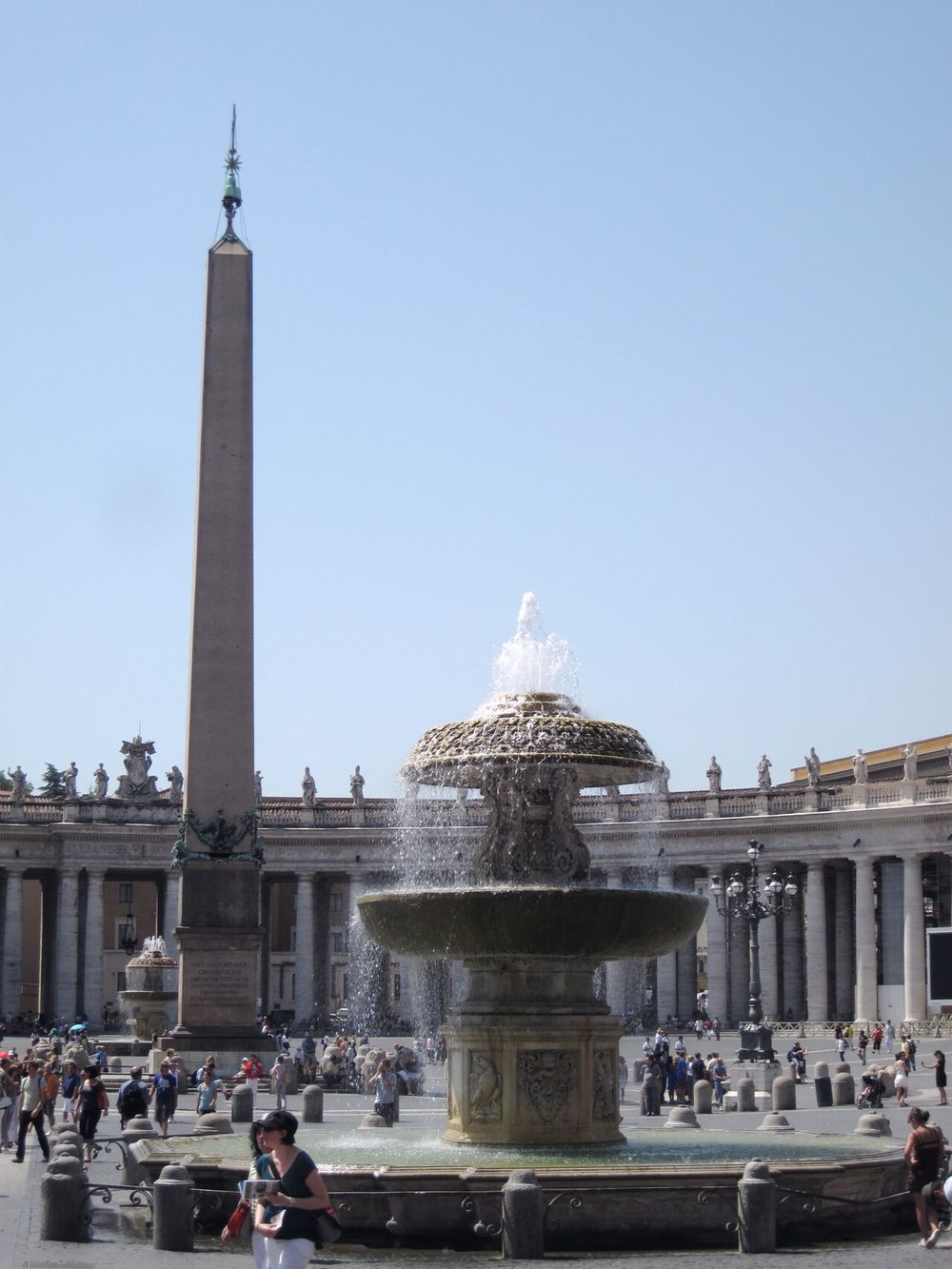
The obelisk and a fountaintrukdotcom, CC BY-SA 3.0
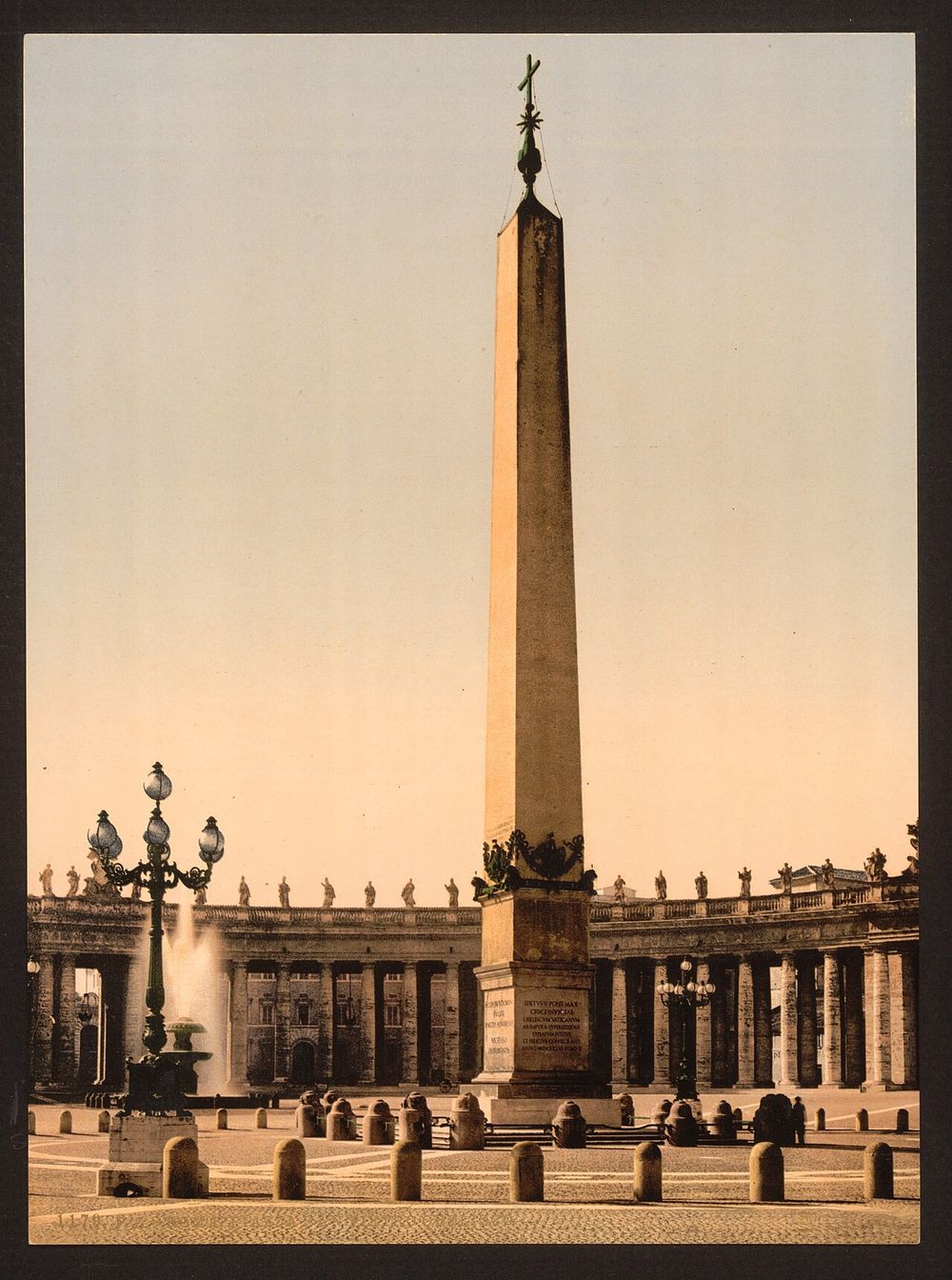
The obelisk is Egyptian and has no writing on it. The emperor Caligula brought it to Rome in AD 37 for his racecourse, the one where Peter died. It is the only obelisk in Rome that never fell. In 1586 it was moved 250 metres to this spot by 900 men and 140 horses.
2. The front and the Holy Door
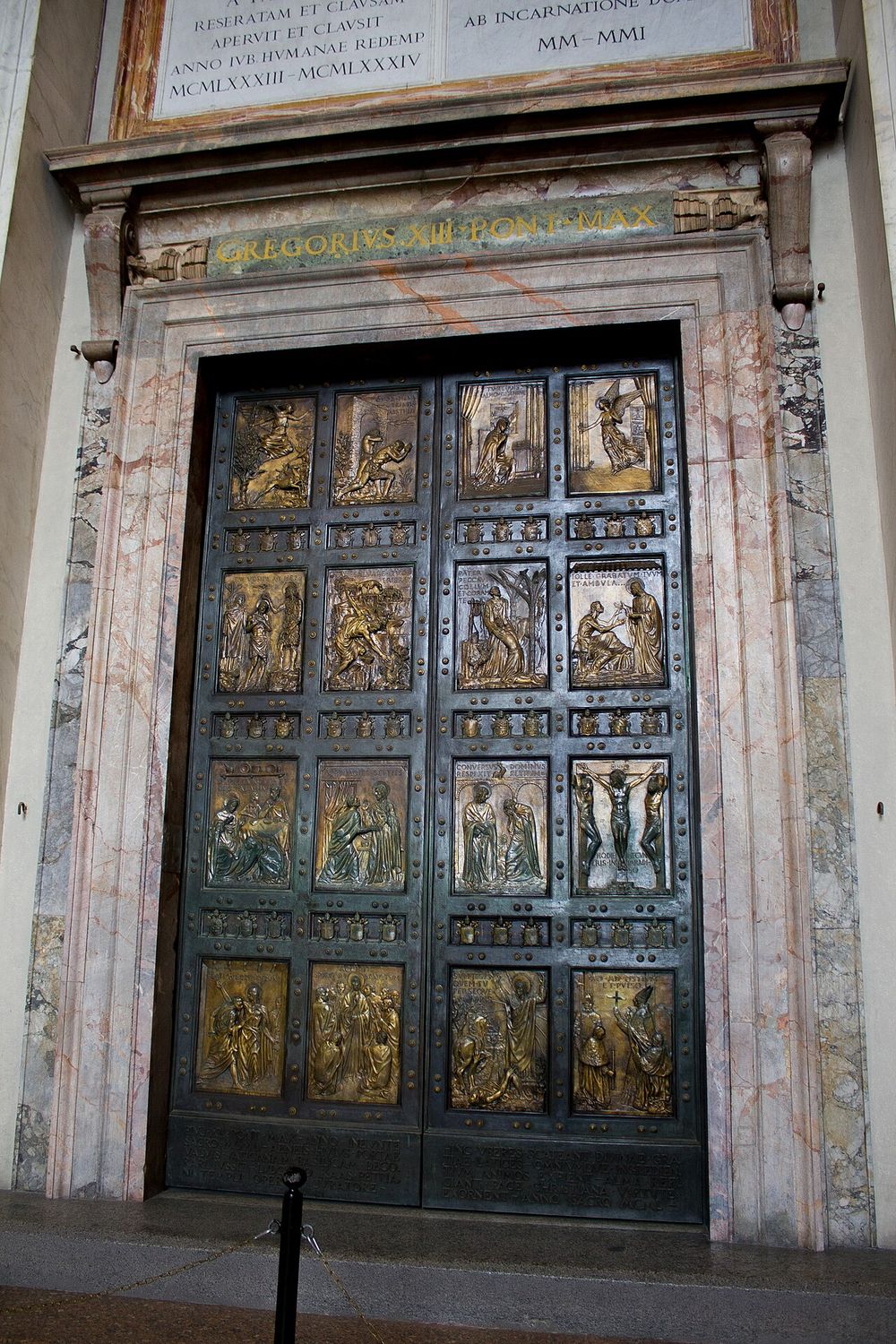
The Holy DoorGutza, CC0
Michelangelo planned a church in the shape of a cross with four equal arms, so that the dome would rule the whole. After his death the nave was made longer, and the wide front of 1614 was put across it. That is why, from the square, the front hides most of the dome.
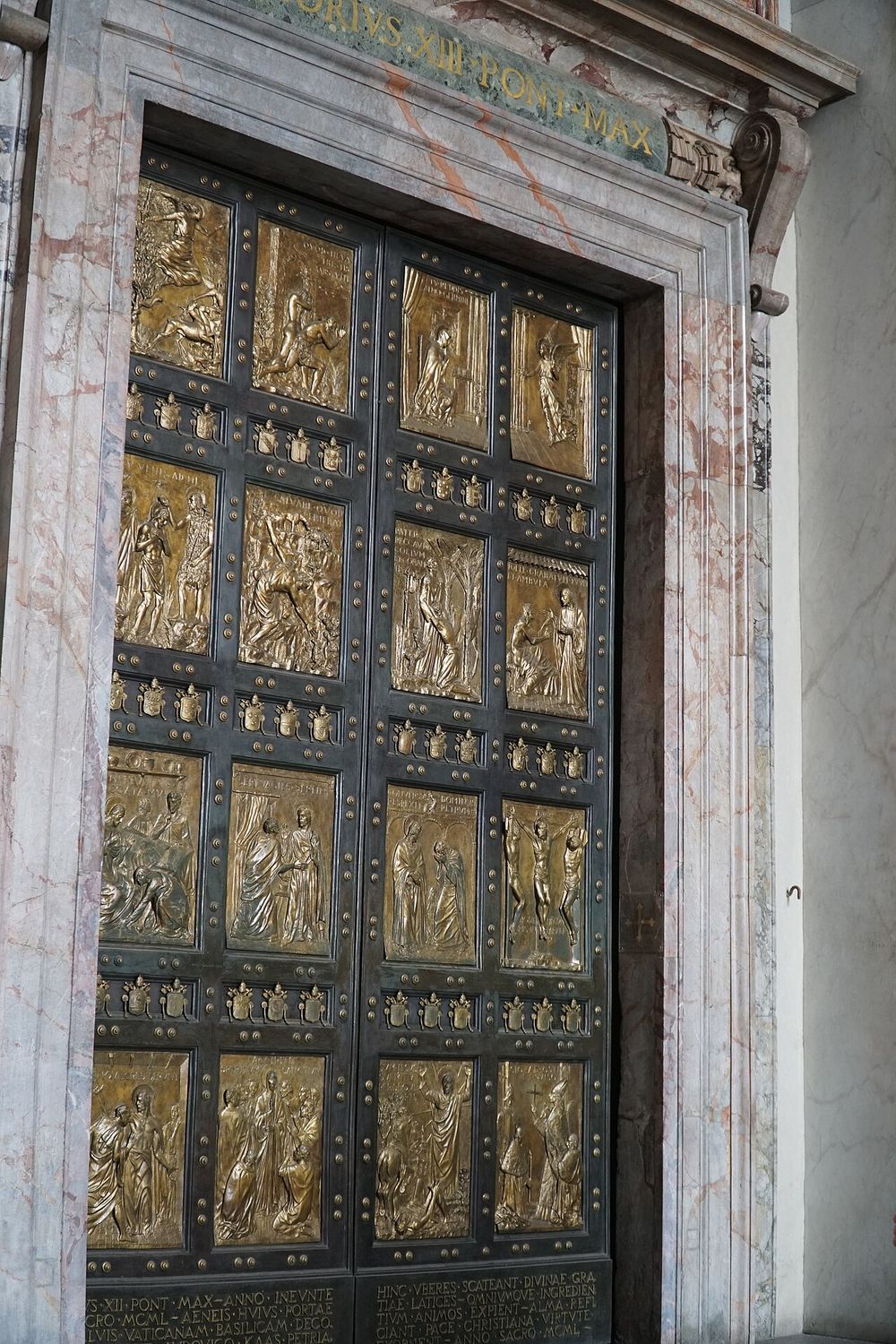
Of the five doors, the one on the far right is the Holy Door. It is bricked up from inside and opened only in a jubilee year, usually every twenty-five years. Pope Francis opened it on 24 December 2024. Pope Leo XIV closed it on 6 January 2026.
3. The Pietà
Michelangelo's PietàJebulon, CC0
A French cardinal ordered it for his own tomb in 1498. Michelangelo promised him the most beautiful work in marble in Rome, and finished it in a year. Mary looks younger than her son. Asked why, he said that purity keeps a woman young.
It is the only work he signed. The letters run along the band across Mary's chest.
In 1972 a man climbed the rail and struck it fifteen times with a hammer, breaking the nose and the left arm. It was mended with the fragments and has been behind glass ever since.
4. The nave: how big is big
The nave and the inscription round the wallsWknight94, CC BY-SA 3.0
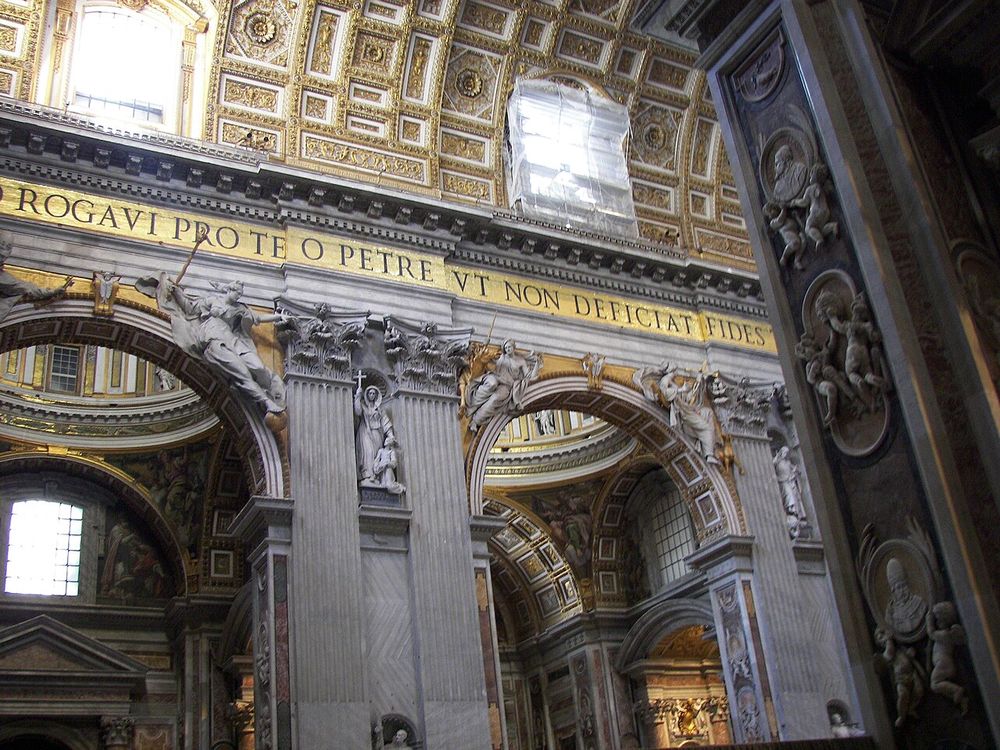
The church does not look its size, because everything in it is scaled up together. The cherubs holding the holy-water basins by the door are two metres tall. The letters of the inscription round the top of the walls are as tall as a man.
The marble floordaryl_mitchell from Saskatoon, Saskatchewan, Canada, CC BY-SA 2.0
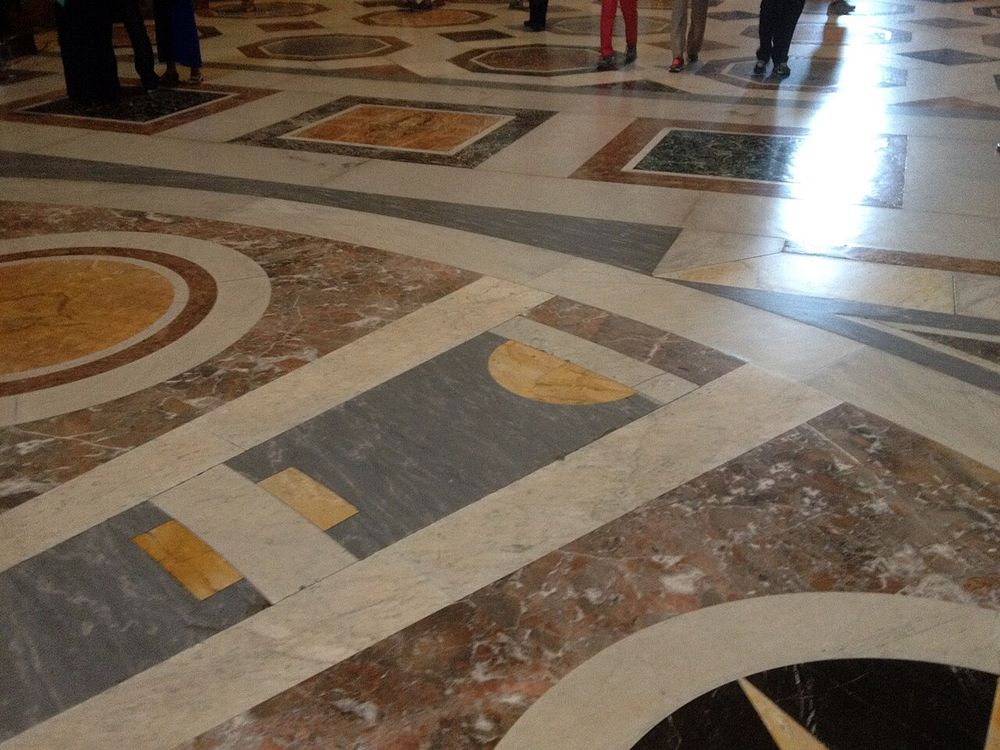
Look down along the middle of the floor. Brass marks show where other great churches would end if they were set inside this one: St Paul's in London, the cathedrals of Florence and Milan, and others. None reaches the far wall.
The bronze Saint Peter, his foot worn smoothBruce McAdam, CC BY-SA 2.0
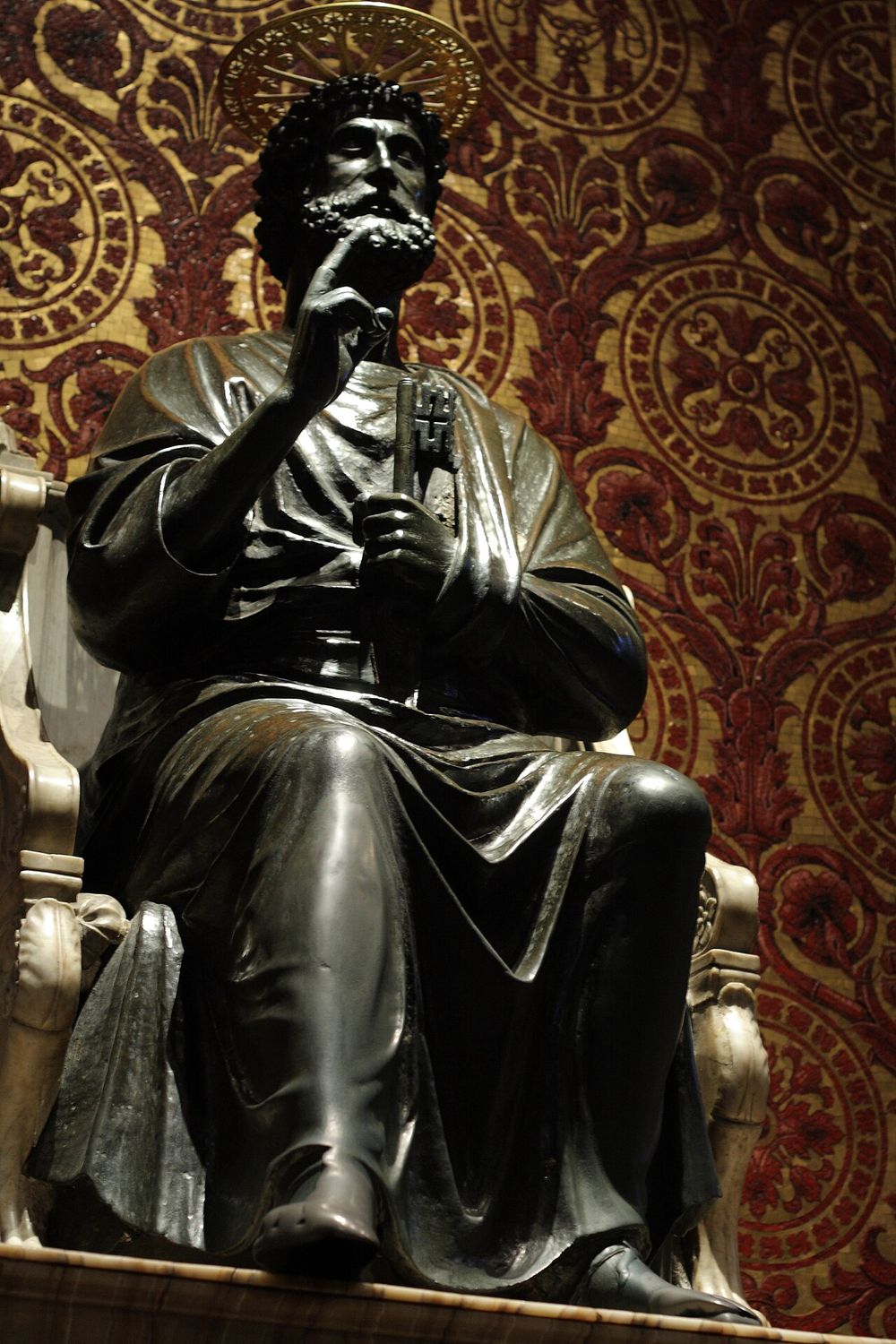
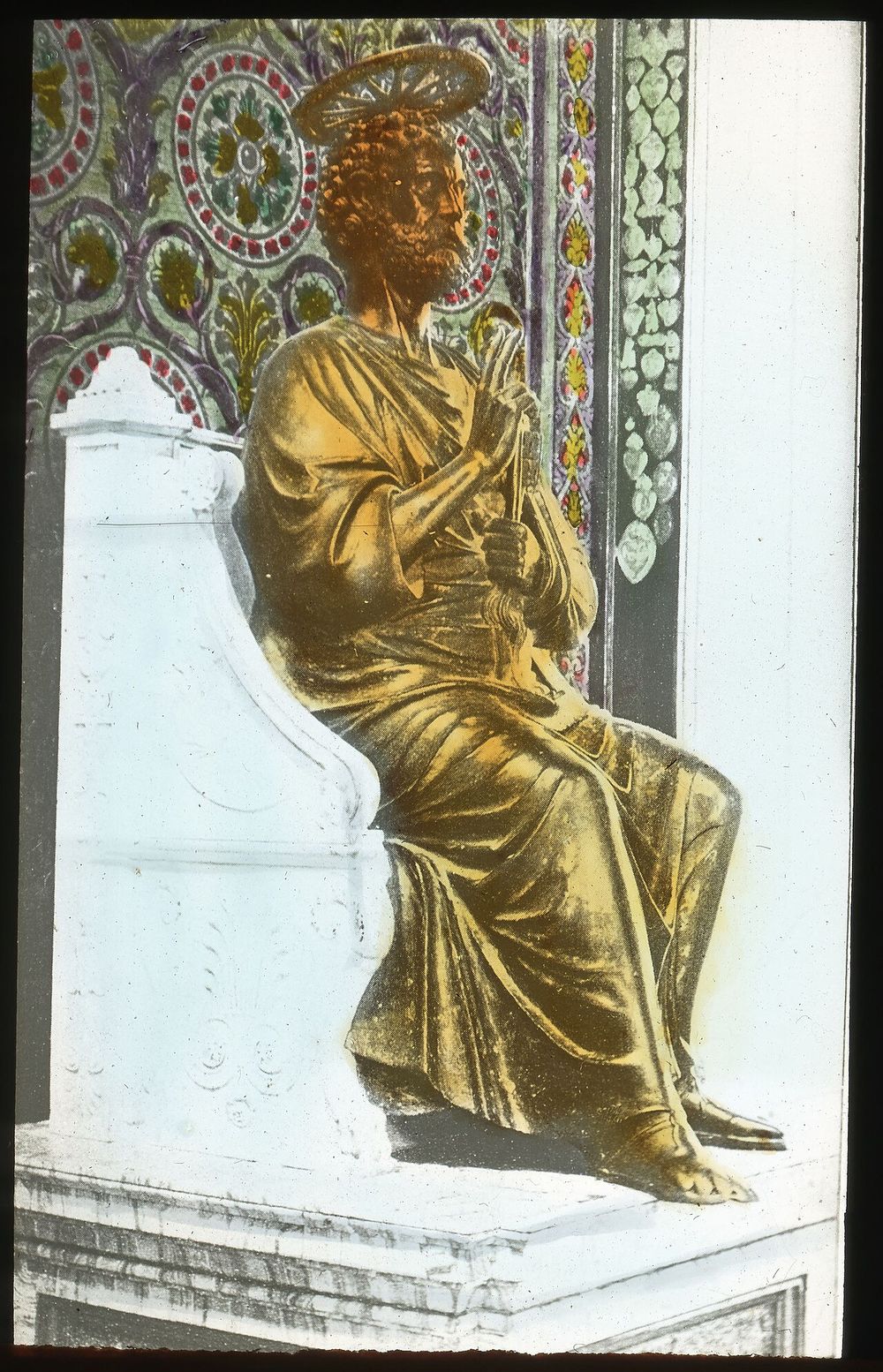
On the right near the crossing sits a bronze Saint Peter of about 1300. Pilgrims touch or kiss his right foot as they pass. Seven centuries of hands have worn the toes smooth.
5. The canopy and the chair
Bernini's bronze canopy over the high altarJebulon, CC0
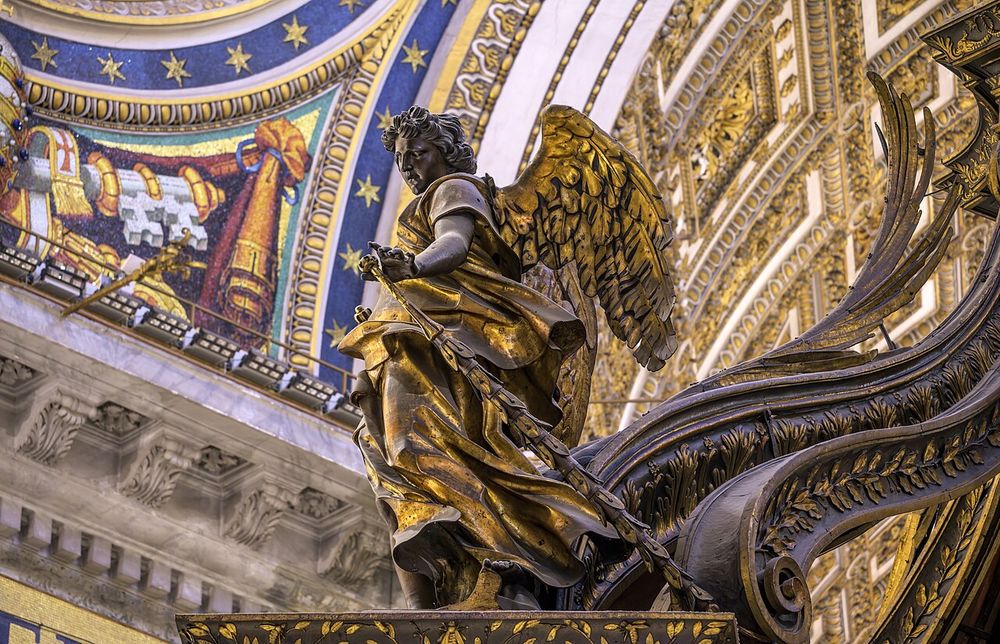
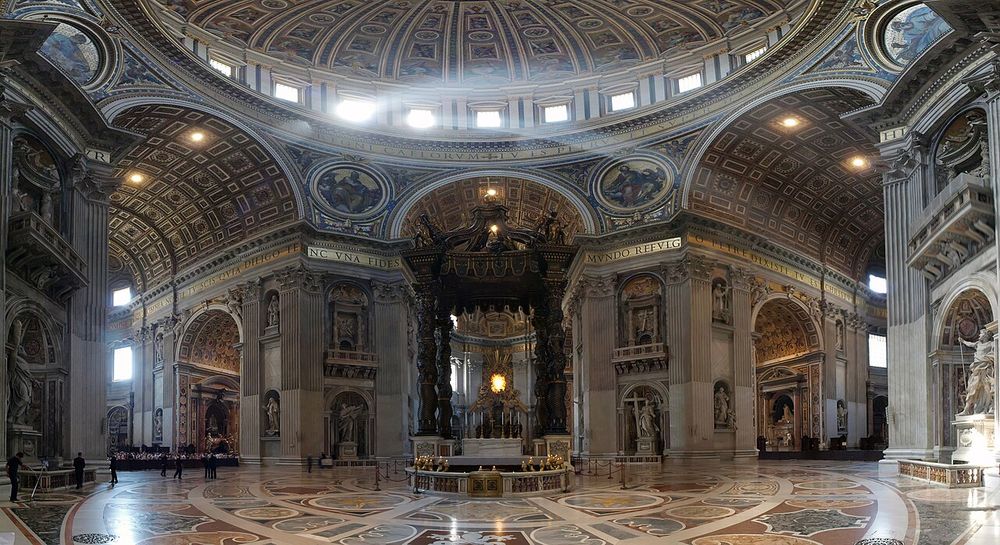
Over the high altar stands Bernini's canopy of bronze, 29 metres tall, on four twisted columns. He was 25 when he began it in 1624. Only the Pope says Mass at this altar.
Part of the bronze came from the beams of the porch of the Pantheon, the best-preserved temple of ancient Rome. The pope who ordered this was a Barberini. Romans said that what the barbarians had not done, the Barberini did.
The dove in the window above the ChairDnalor 01, CC BY-SA 3.0 at
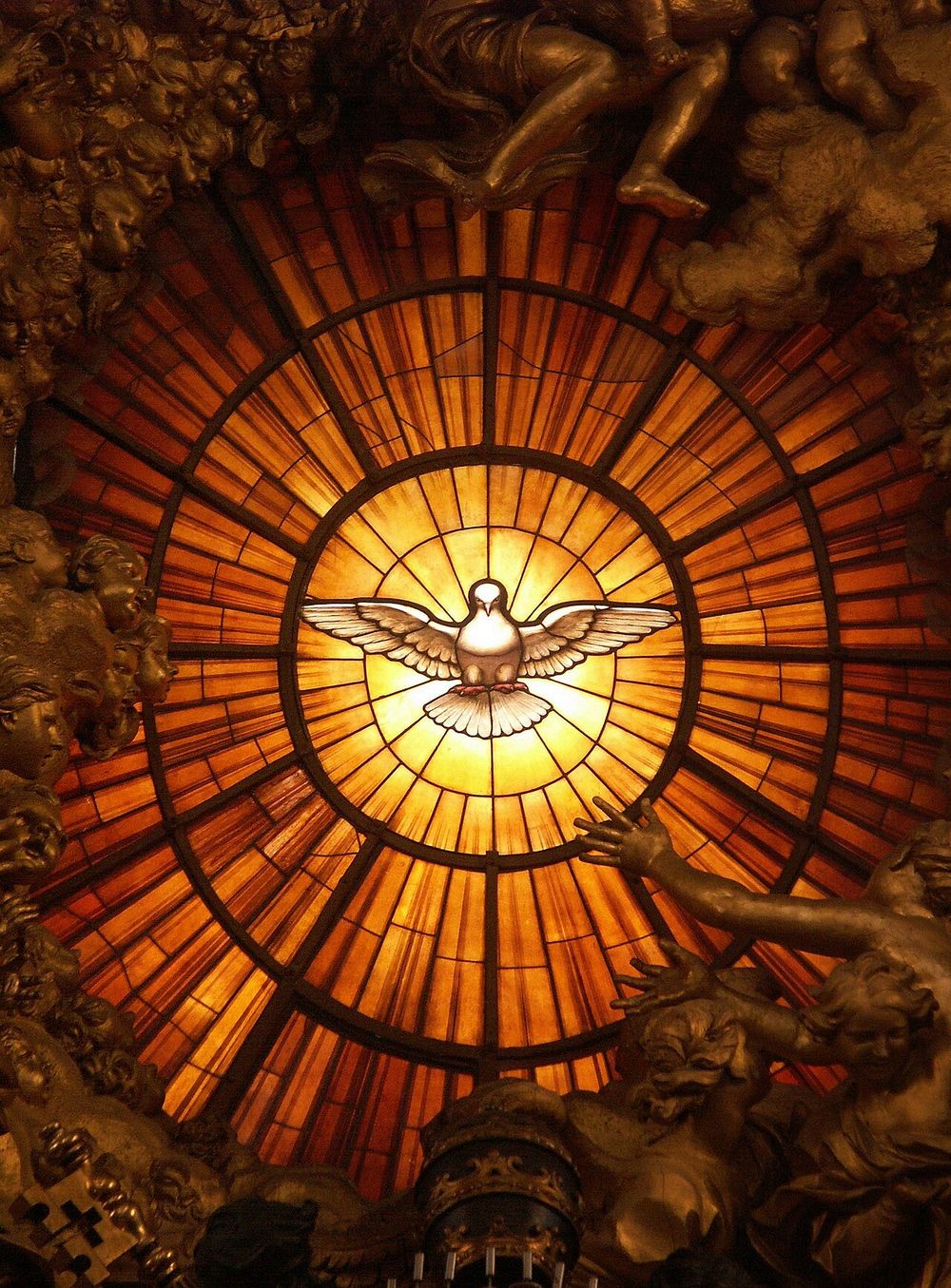
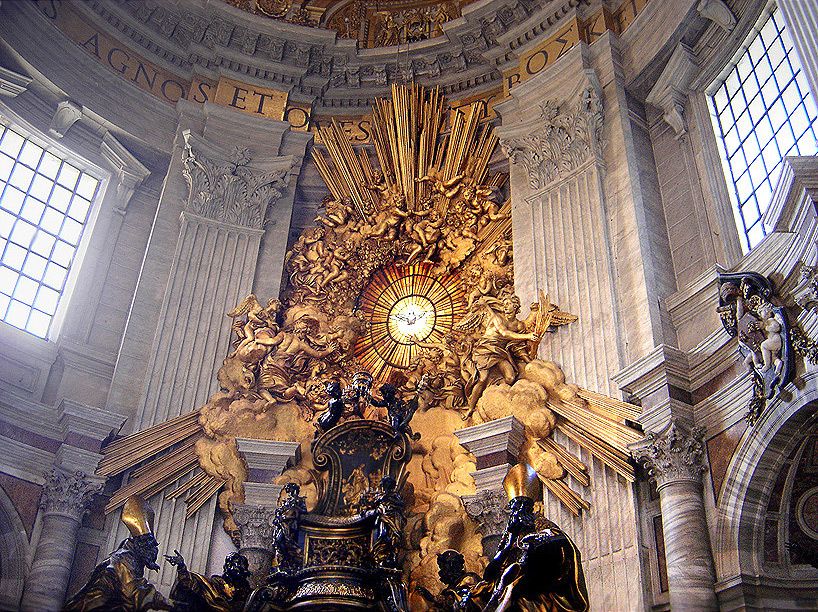
At the very end of the church, four bronze figures hold up a great bronze chair, which encloses an old wooden one long believed to be Peter's own. Above it a dove flies in a window of thin yellow stone. Come in the late afternoon, when the sun is behind it.
6. Below the floor: the grottoes and the grave
A mosaic of Christ between Peter and Paul in the grottoesWilfredor, CC0
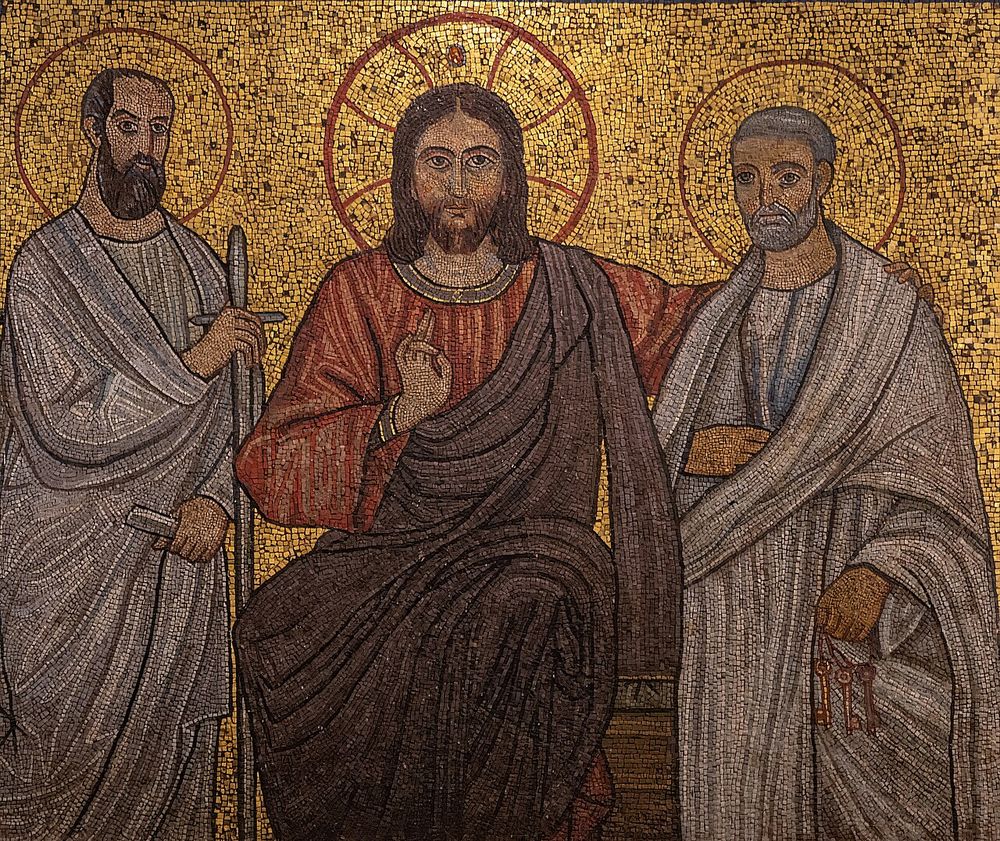
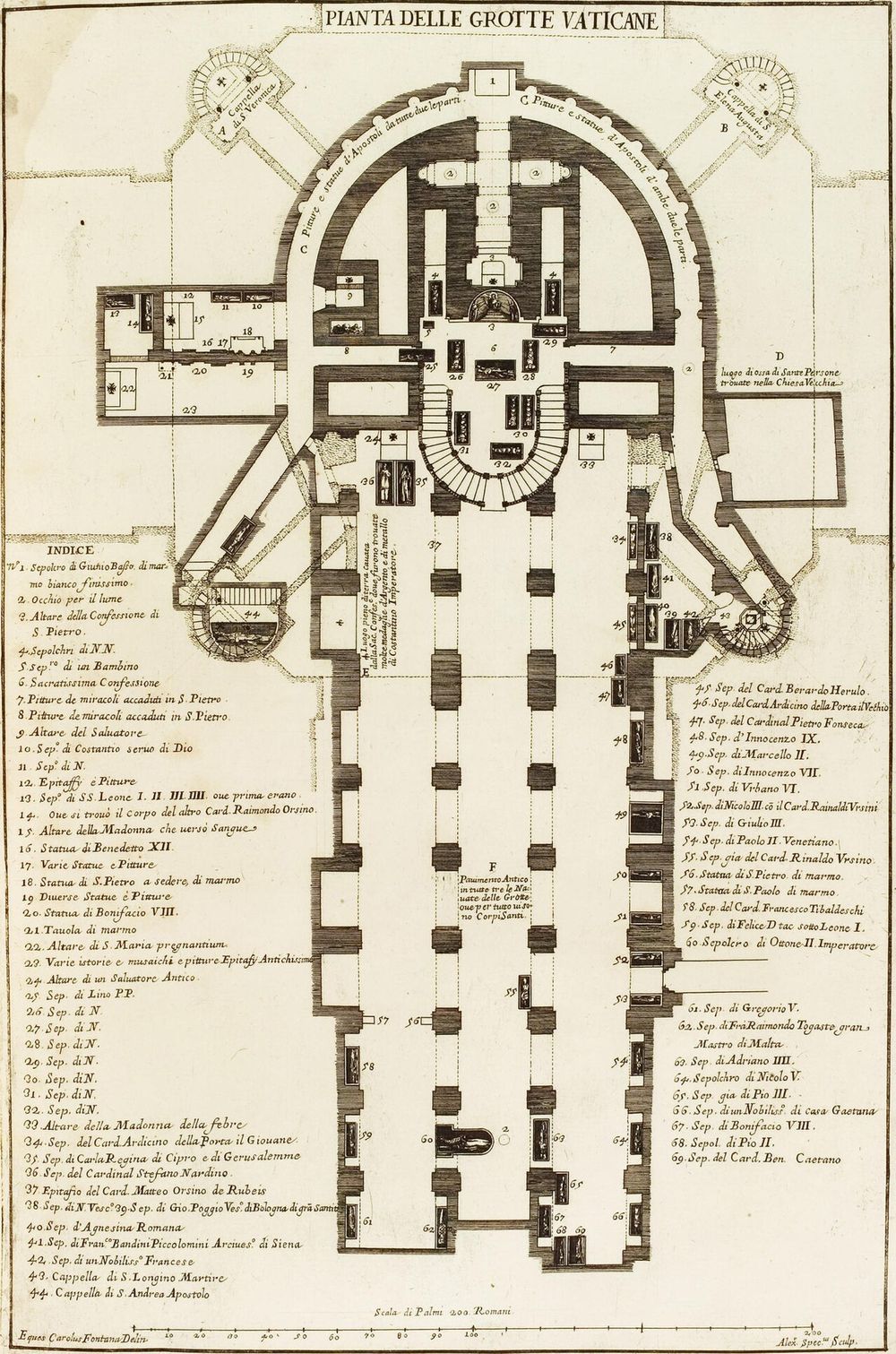
Stairs near the crossing lead down to the level of Constantine's church. Popes are buried here, among them Benedict XVI, who died in 2022. Pope Francis, who died in April 2025, chose to be buried in another church across Rome.
Lower still is a street of Roman tombs, dug out in the 1940s. At its end, directly under the high altar, the diggers found a small shrine of about AD 160 built against a red wall, and bones in a niche beside it. In 1968 Pope Paul VI said that they had been identified as Peter's in a way he held to be convincing. Not all scholars agree.
That lowest level is seen only on a guided visit in a small group, asked for well in advance on the basilica's site.
7. The dome
The dome from insideJean-Pol GRANDMONT, CC BY-SA 3.0
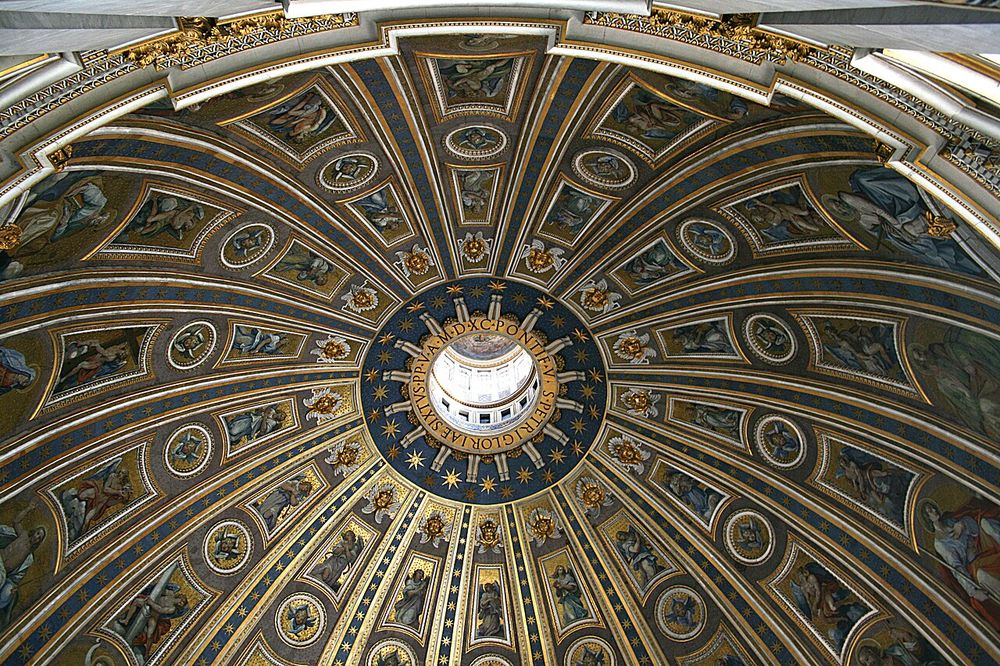
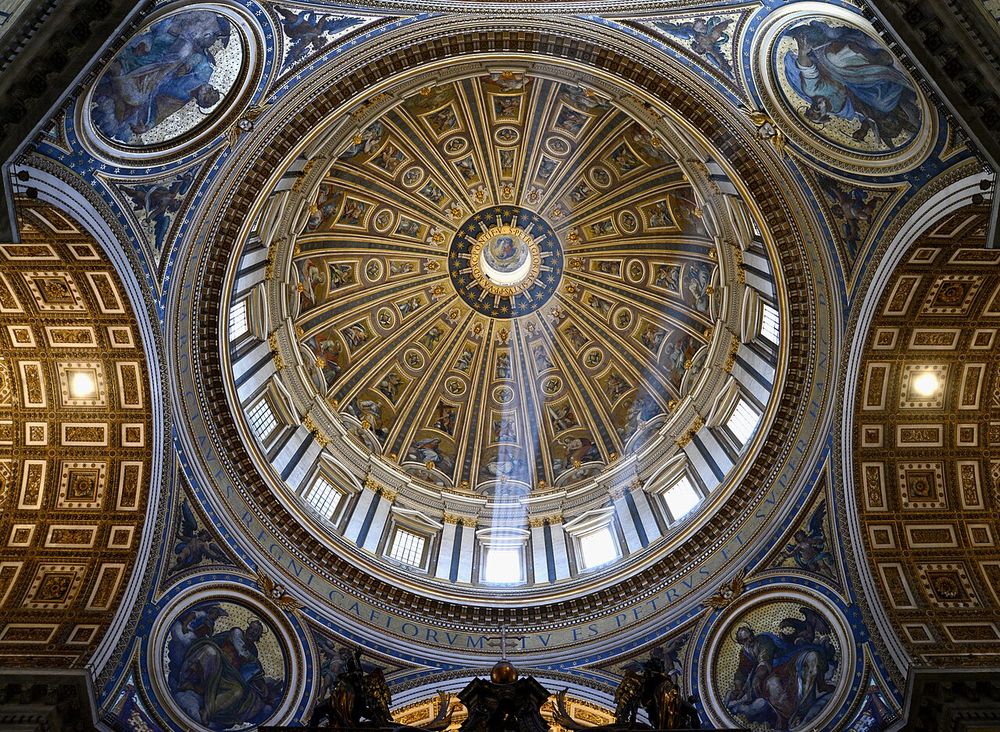
Michelangelo studied the dome of Florence cathedral and the Pantheon, and made his own of two shells, one inside the other, held by iron chains. He died in 1564 with only the drum built. It was finished in 1590, slightly taller and more pointed than he had drawn it.
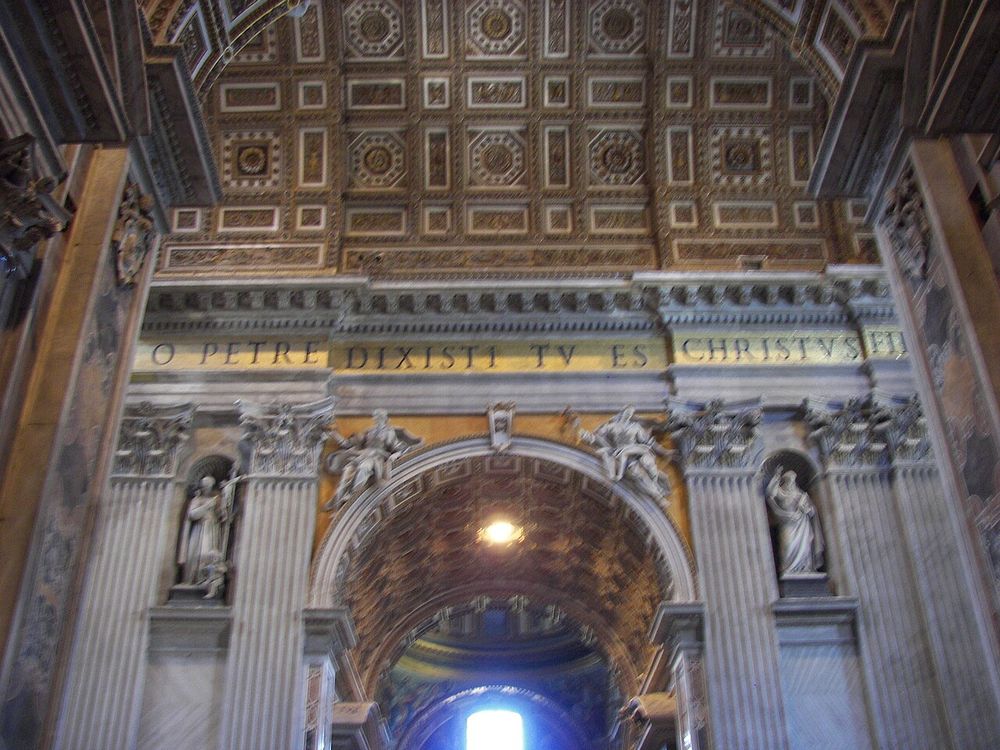
It is 42 metres across, a little less than the Pantheon. Round its base, in letters two metres high, are the words Christ spoke to Peter: you are Peter, and on this rock I will build my church.
The square from the domevalyag, CC BY-SA 3.0
The way up is 551 steps, or a lift to the roof and then 320 steps. The last stretch runs between the two shells and leans with the curve. At the top you look down on the square and across all of Rome.
8. The price, and the same years in China
The new church rising inside the old, drawn by Maarten van Heemskerck in the 1530sMaarten van Heemskerck, Public domain
To pay for the building, Pope Leo X sold indulgences across Europe: certificates that were said to shorten a soul's time of punishment after death. In 1517 Martin Luther, by then a professor in Germany, published ninety-five objections. Within a generation half of Europe had left the Roman Church.
When the first stone was laid in 1506, the Zhengde Emperor had just come to the throne of the Ming (1368–1644). The Forbidden City in Beijing was then 86 years old.
When the church was consecrated in 1626, the Ming had eighteen years left. In that year the Manchu leader Nurhaci died of wounds after failing to take a Ming fortress. The Jesuit Adam Schall, who had left Rome a few years before, was in China, where he would later run the imperial observatory.
Meanwhile in the world
Year
Here
Elsewhere
about 64
Peter is crucified and buried here
The Eastern Han (AD 25–220); Buddhism is reaching China about now
about 320–360
Constantine builds the first church
The Eastern Jin (317–420); Wang Xizhi writes the Orchid Pavilion preface in 353
800
Charlemagne is crowned in the old church
The Tang (618–907), under Emperor Dezong
1506
The first stone of the new church
First year of the Zhengde Emperor of the Ming
1517
Luther's ninety-five theses
Portuguese ships reach Guangzhou
1590
The dome is finished
The Wanli reign; Matteo Ricci is in Guangdong
1626
The church is consecrated
Nurhaci dies; the Ming has eighteen years left
1667
Bernini's square is finished
The young Kangxi Emperor begins to rule in person
2025
A jubilee year; Pope Francis dies and Leo XIV is elected
The Holy Door closes again in January 2026
One line to remember: a fisherman's grave, a church that took 120 years, and a bill that started the Reformation.
Then and now
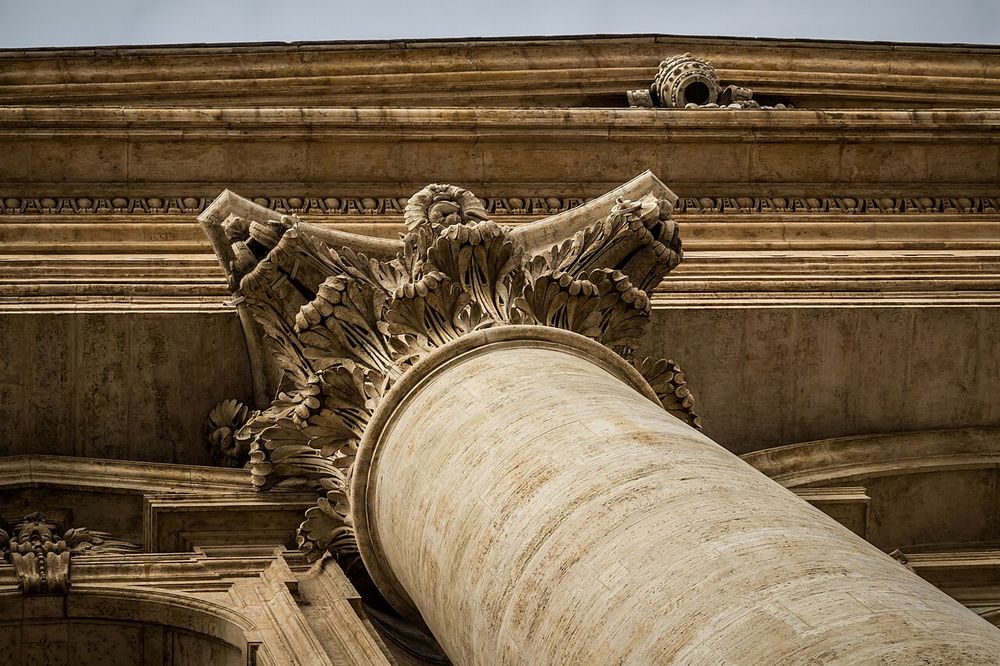
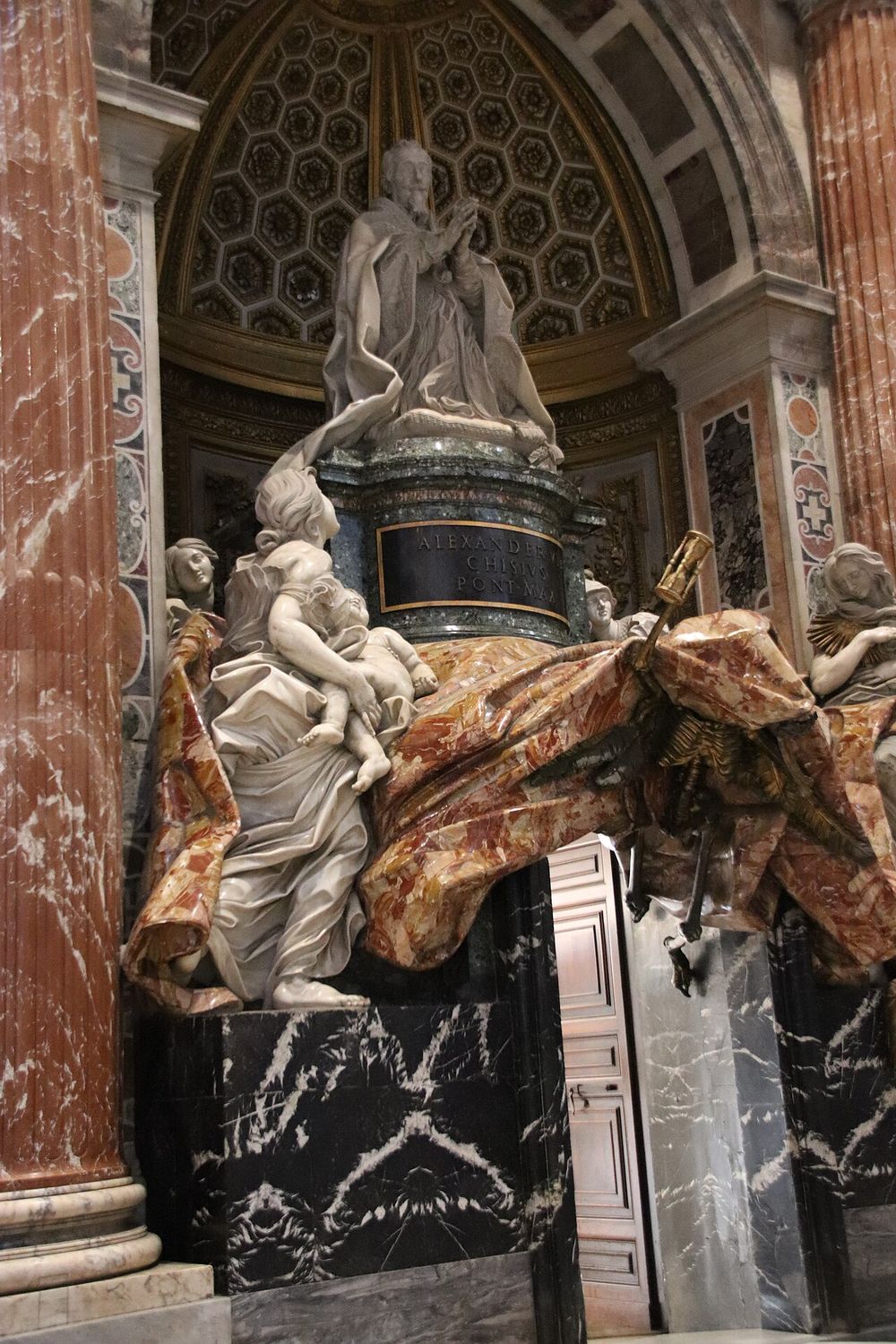
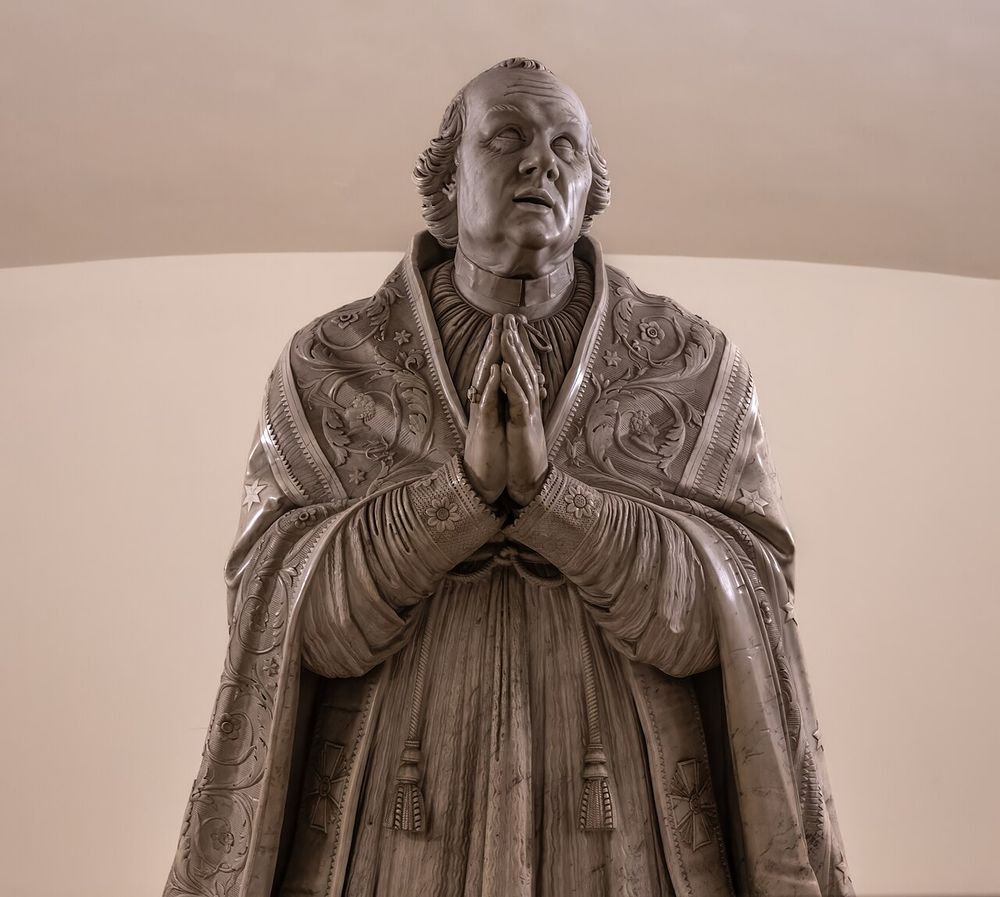
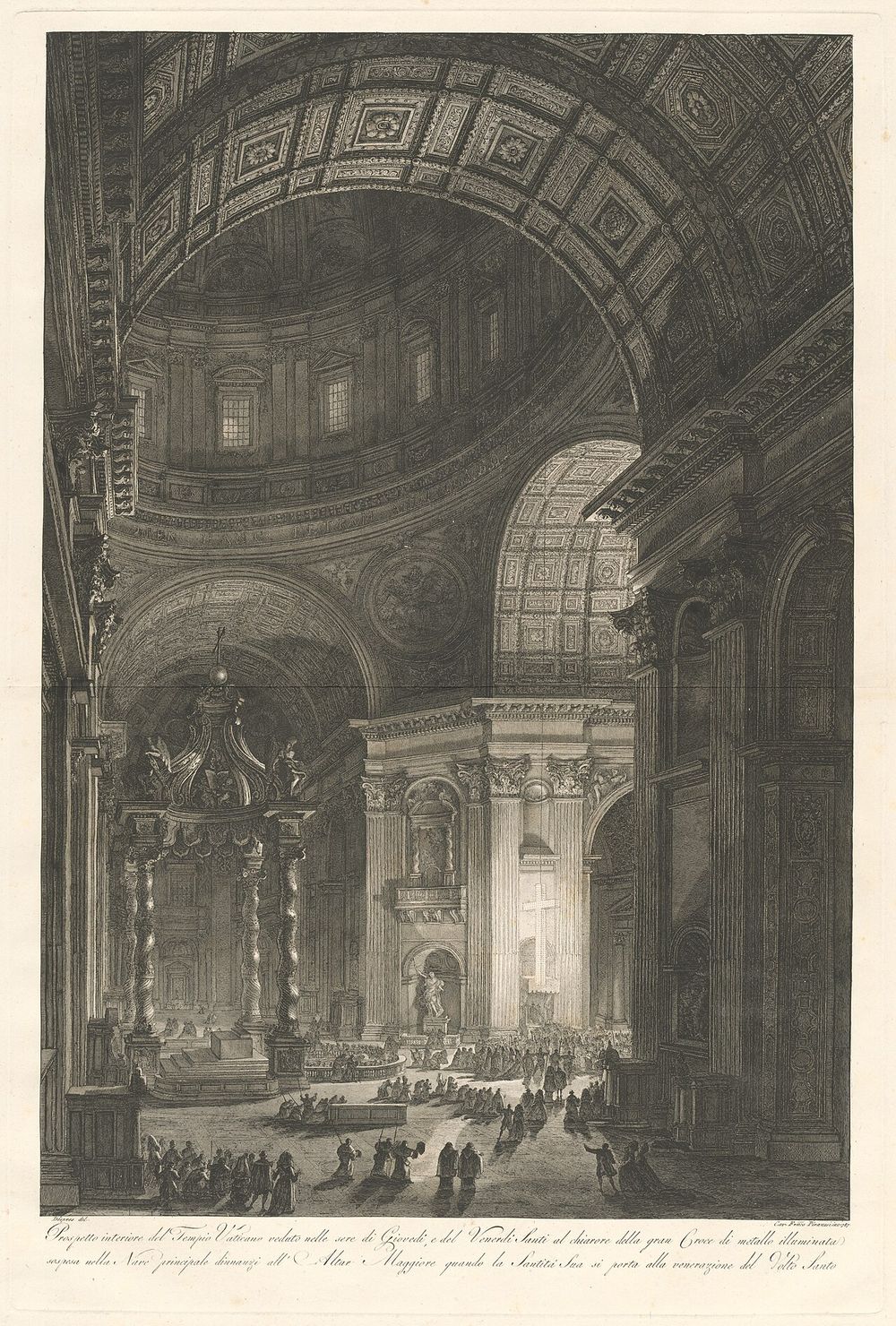
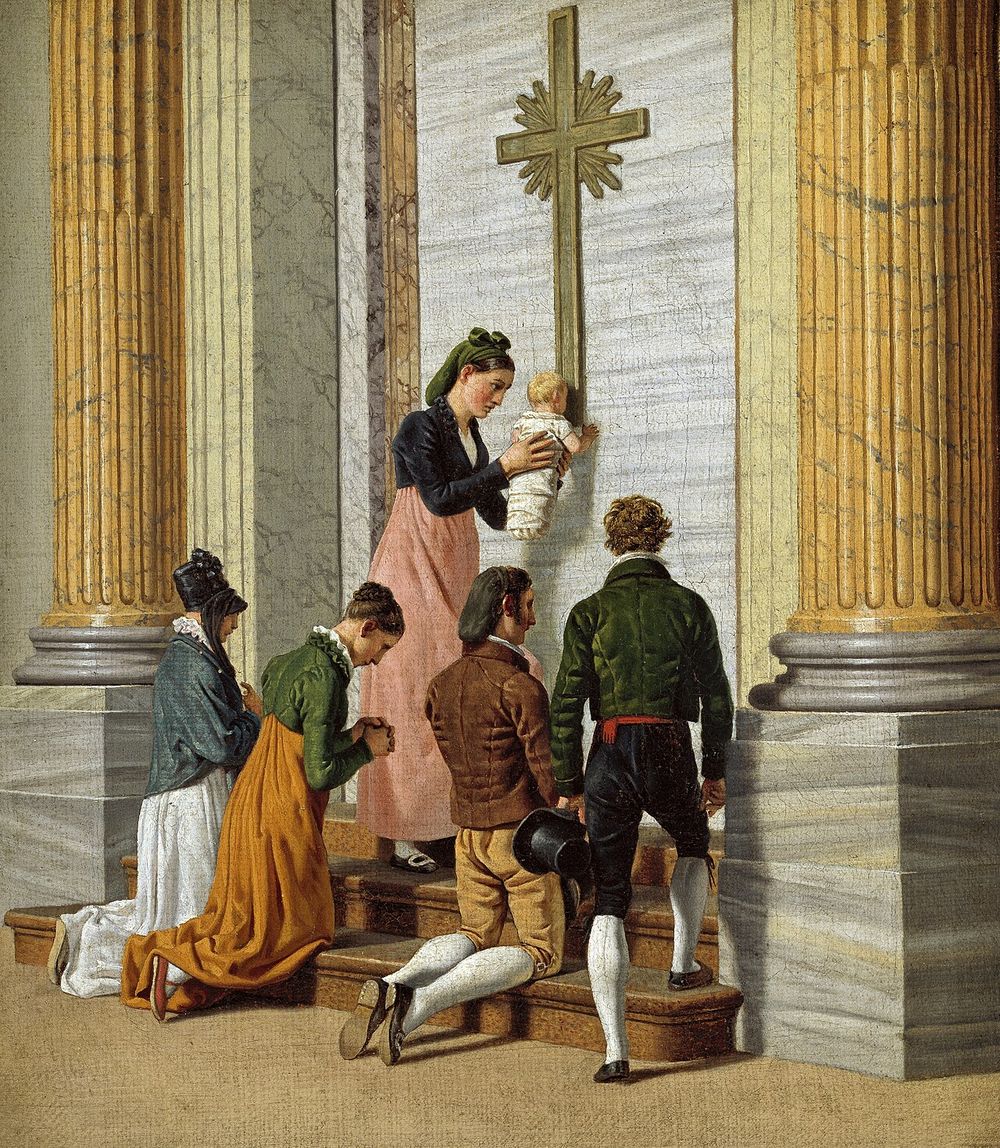
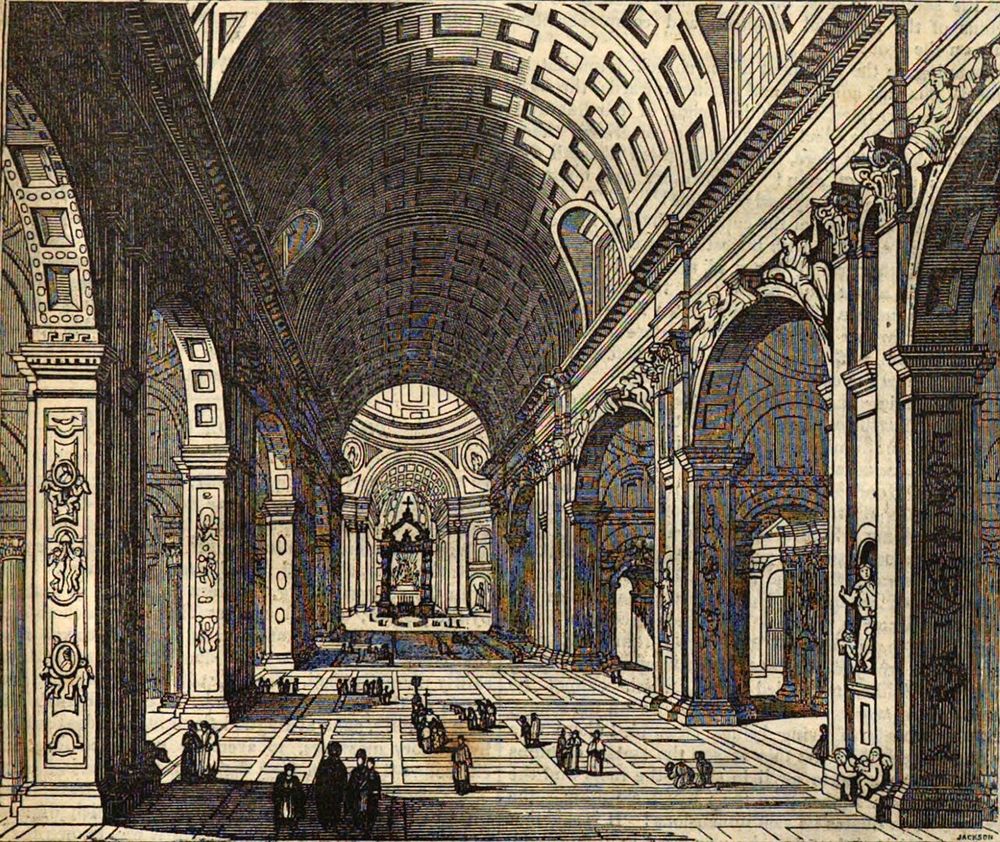
The front of the church from the squareAlvesgaspar, CC BY-SA 4.0, Wikimedia CommonsThe whole square in one sweepKrzysztof Golik, CC BY-SA 4.0, Wikimedia CommonsThe front, finished in 1614daryl_mitchell from Saskatoon, Saskatchewan, Canada, CC BY-SA 2.0, Wikimedia CommonsBernini's colonnadeDennis G. Jarvis, CC BY-SA 2.0, Wikimedia CommonsA column of the colonnade from belowDietmar Rabich, CC BY-SA 4.0, Wikimedia CommonsThe obelisk and a fountaintrukdotcom, CC BY-SA 3.0, Wikimedia CommonsThe square from the domevalyag, CC BY-SA 3.0, Wikimedia CommonsRome from the domeLukask, CC BY-SA 3.0, Wikimedia CommonsThe Holy DoorGutza, CC0, Wikimedia CommonsThe bronze panels of the Holy DoorDeb Nystrom from Ann Arbor, Michigan, USA, CC BY 2.0, Wikimedia CommonsMichelangelo's PietàJebulon, CC0, Wikimedia CommonsThe Pietà in its chapel, behind glassSonse, CC BY 2.0, Wikimedia CommonsThe nave and the inscription round the wallsWknight94, CC BY-SA 3.0, Wikimedia CommonsThe gilded vault of the naveWknight94, CC BY-SA 3.0, Wikimedia CommonsThe marble floordaryl_mitchell from Saskatoon, Saskatchewan, Canada, CC BY-SA 2.0, Wikimedia CommonsThe bronze Saint Peter, his foot worn smoothBruce McAdam, CC BY-SA 2.0, Wikimedia CommonsBernini's bronze canopy over the high altarJebulon, CC0, Wikimedia CommonsAn angel on top of the canopyWilfredor, CC0, Wikimedia CommonsThe crossing, with the canopy under the domePatrick Landy (FSU Guy (talk)), CC BY-SA 3.0, Wikimedia CommonsThe Chair of Saint Peter at the end of the churchRicardo André Frantz (User:Tetraktys), CC BY-SA 3.0, Wikimedia CommonsThe dove in the window above the ChairDnalor 01, CC BY-SA 3.0 at, Wikimedia CommonsBernini's tomb of Pope Alexander VIIGary Todd from Xinzheng, China, Public domain, Wikimedia CommonsThe dome from insideJean-Pol GRANDMONT, CC BY-SA 3.0, Wikimedia CommonsLooking straight up into the domeAlvesgaspar, CC BY-SA 4.0, Wikimedia CommonsA mosaic of Christ between Peter and Paul in the grottoesWilfredor, CC0, Wikimedia CommonsPope Pius VI at prayer, a statue now in the grottoesWilfredor, CC0, Wikimedia CommonsThe dome from the roofStaselnik, CC BY-SA 3.0, Wikimedia CommonsThe dome from the Vatican gardensJebulon, CC0, Wikimedia CommonsThe back of the church from the gardensSonse, CC BY 2.0, Wikimedia CommonsThe church and the gardens in a wide viewSonse, CC BY 2.0, Wikimedia CommonsThe dome from the Tiber at duskJebulon, CC BY-SA 3.0, Wikimedia CommonsThe old church as it was about 1450, in a drawing of 1891Henry William Brewer (1836-1903), Public domain, Wikimedia CommonsThe new church rising inside the old, drawn by Maarten van Heemskerck in the 1530sMaarten van Heemskerck, Public domain, Wikimedia CommonsA plan of the grottoes by Carlo Fontana, 1694Carlo Fontana, Public domain, Wikimedia CommonsThe square in an etching by Piranesi, about 1750Giovanni Battista Piranesi, CC0, Wikimedia CommonsThe church and square from above, by PiranesiGiovanni Battista Piranesi, Public domain, Wikimedia CommonsThe cross of lamps hung in the church on Good Friday, 1787Francesco Piranesi, CC0, Wikimedia CommonsPilgrims at the Holy Door, painted by C. W. Eckersberg about 1814Christoffer Wilhelm Eckersberg, CC0, Wikimedia CommonsThe nave in an English magazine of 1833Unknown authorUnknown author, Public domain, Wikimedia CommonsThe obelisk in a colour print of the 1890sPhotochrom Print Collection, Public domain, Wikimedia CommonsThe bronze Peter dressed in robes for his feast day, 1913Edmund F. Arras, Public domain, Wikimedia Commons
Local legends
These are stories people tell about this place. They are legends, not history, and each one says where it comes from.
LegendThe obelisk
When the obelisk was being raised in 1586, the Pope ordered silence on pain of death. The ropes began to smoke and stretch. A sailor in the crowd shouted "Water on the ropes!" The ropes were wetted, shrank, and held. The Pope pardoned him and gave his family the right to supply the palms for Palm Sunday.
Source: A Roman story first written down long afterwards; the engineer's own detailed account does not mention it
LegendThe Pietà
Michelangelo overheard visitors saying the statue was by another sculptor. That night he came back with a lamp and cut his name across Mary's chest. He was ashamed of it afterwards and never signed a work again.
Source: Giorgio Vasari, Lives of the Artists (1568)
LegendThe crossing
Peter was fleeing Rome when he met Christ on the road, walking towards the city. "Lord, where are you going?" he asked. "To Rome, to be crucified again." Peter turned back. He asked to be crucified head down, as unworthy to die as his master had.
Source: The Acts of Peter, a text of the second century that the Church does not count as scripture
LegendThe bronze foot
Touching the foot of the bronze Peter and saying a prayer brings the saint's help, and a safe return to Rome.
Source: Pilgrims' custom
Later, people who live here will be able to add the stories they grew up with, and say which of these they have heard.
Not certain, and where accounts conflict
Are the bones Peter's?
They are those of a strongly built man in his sixties, wrapped in purple cloth with gold thread, found in a niche marked with a scratched Greek text that some read as "Peter is here". The identification rests on that reading and on the place. It cannot be proved.
Did Peter come to Rome at all?
The New Testament does not say so. Christian writers from about AD 100 onwards take it for granted, and nobody in the early Church claimed his grave for another city.
Who made the bronze Peter?
It was long thought to be from the fifth century. Tests of the metal and its style now point to about 1300 and to the sculptor Arnolfo di Cambio.
Is it the largest church?
By floor area inside, yes. A church built in Ivory Coast in 1989 in imitation of it has a higher dome and covers more ground with its forecourt, but holds fewer people.
Visiting
Tickets and hours
The church is free. Guides that checked the basilica's site in 2026 give 7:00 to 20:00, with last entry about 19:15. Older guides give 19:10 as closing time, so do not leave it to the last hour.
A timed entry booked on the basilica's site costs 7 euros and includes an audio guide on your phone. It can shorten the wait, though visitors report that it does not always.
The dome is open from 7:30 to 17:00 in winter and to 18:00 in summer. One guide of 2026 gives 17 euros by the stairs and 22 euros with the lift, booked online together with entry to the church.
On Wednesday mornings, when the Pope holds his audience in the square, the church stays shut until about midday.
The church closes without notice for ceremonies.
Last checked 2026-11-12. The basilica's own site, opened in November 2026, for the booking page; hours and prices from guides that checked that site in 2026.
Booking from abroad
Official page in English Entry to the church is free and needs no booking. The basilica's own site, in English, has a booking page for a timed entry with an audio guide, for the dome and for the excavations: basilicasanpietro.va.
Ticket window on site Without a booking, join the security queue on the right side of the square. Dome tickets have also been sold at the foot of the dome.
Checked 2026-11-12
Where to start
Be in the square by 7:00, or come after 16:00. From 9:30 to 14:00 the queue for security can take one to two hours.
Do the dome first if you mean to do it at all. The way down brings you out inside the church.
Inside, turn right for the Pietà, walk up the nave to the canopy, go on to the Chair at the far end, and come back down the other side.
The grottoes are entered near the crossing, and the way out leaves you outside the church. Keep them for last.
Before you go
Metro line A to Ottaviano, then ten minutes on foot.
The climb between the two shells of the dome is narrow, steep and one-way. It is not for anyone who fears closed spaces or has a weak heart.
Large bags and tripods are not let in. There is a free cloakroom to the right of the front.
On Sundays at noon, when he is in Rome, the Pope speaks from a window above the square.
Customs and manners
Shoulders and knees must be covered, for men and women. Guards at the door turn people away. A scarf tied round the waist is accepted.
This is a working church. Speak quietly, take off your hat, and keep out of chapels where a service is being held.
Photographs are allowed without flash. Do not photograph people at prayer or in the confessionals.
At the bronze Peter, people wait in line to touch the foot. Join the line or pass behind it.
The Swiss Guards at the gates are soldiers on duty. Ask before you photograph them close up.
Look for these
In the square, find the round stone from which four rows of columns look like one.
Count the doors in the front. Which one is bricked up inside?
Just inside the central door, find a round slab of red stone in the floor. Who knelt on it?
At the Pietà, find Michelangelo's name. Where did he put it?
In the floor of the nave, find the mark for a church in your own part of the world, or the one nearest to it.
Look at the bronze Peter's two feet. What is the difference?
On the columns of the canopy, find the bees. They are the badge of the pope who paid for it.
Look up into the dome. Can you read any of the letters round its base?
I am here
Stand at the site, sign in, press the button, and collect its stamp. Your browser will ask to use your location. It is sent to us once to confirm that you are at the site; we keep how far you were from it, not the spot where you stood.
Your stamps are saved to your account, so they follow you to any device. Checking from a browser cannot rule out every false location; stricter checks arrive with the app.
Messages
Share your photos
Photos here show the place, not people. Each one is credited to the visitor who took it and appears after our team has looked at it. A photo with you in it belongs under “I am here”.