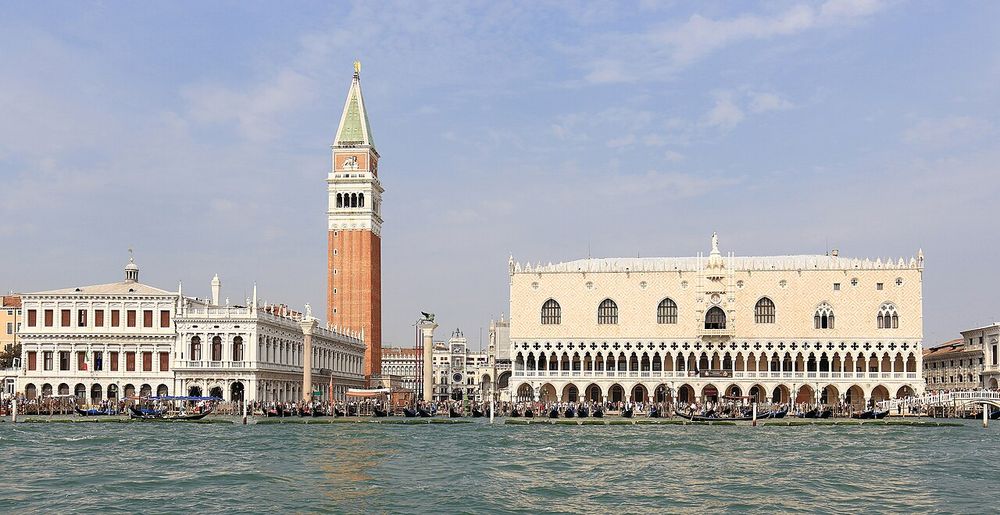
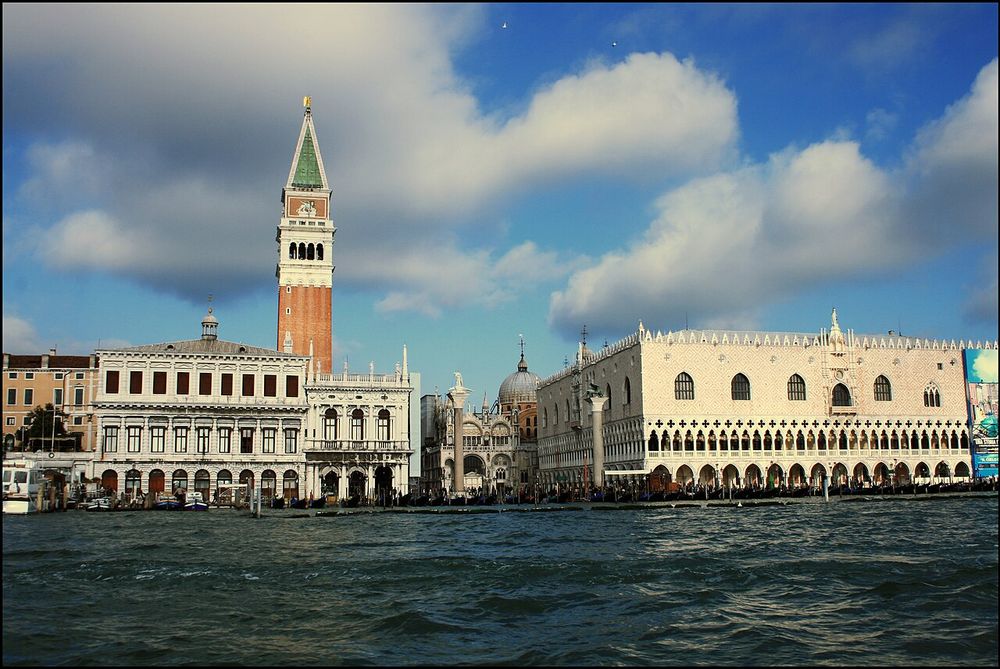
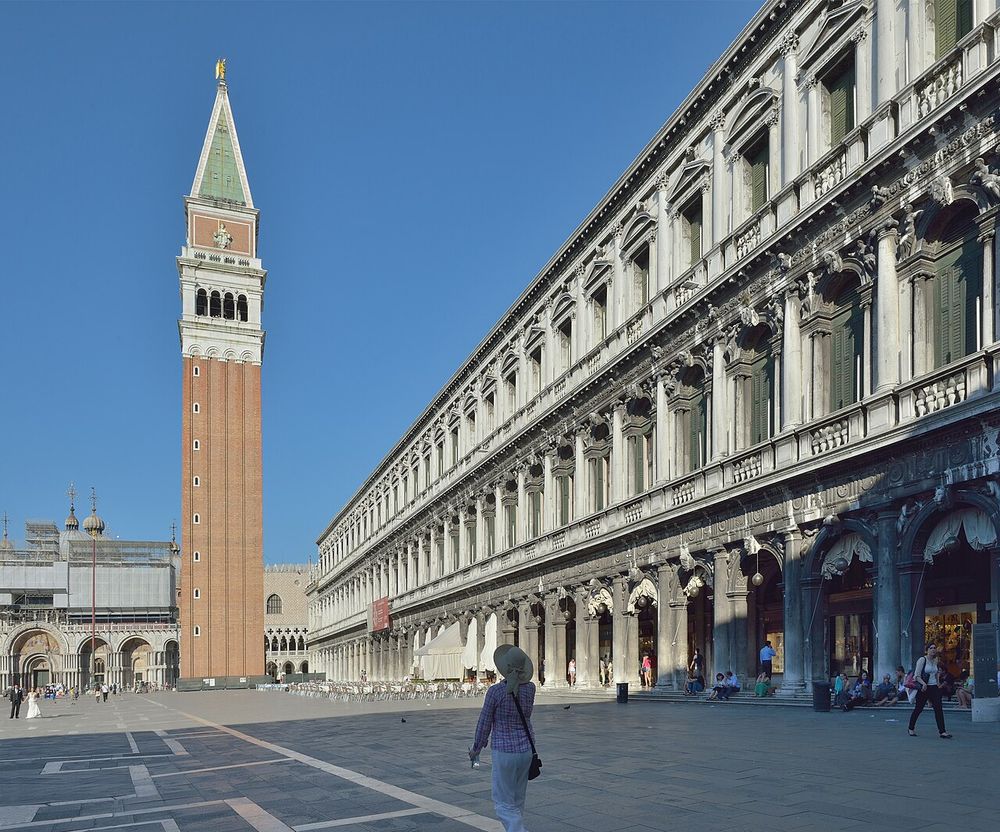
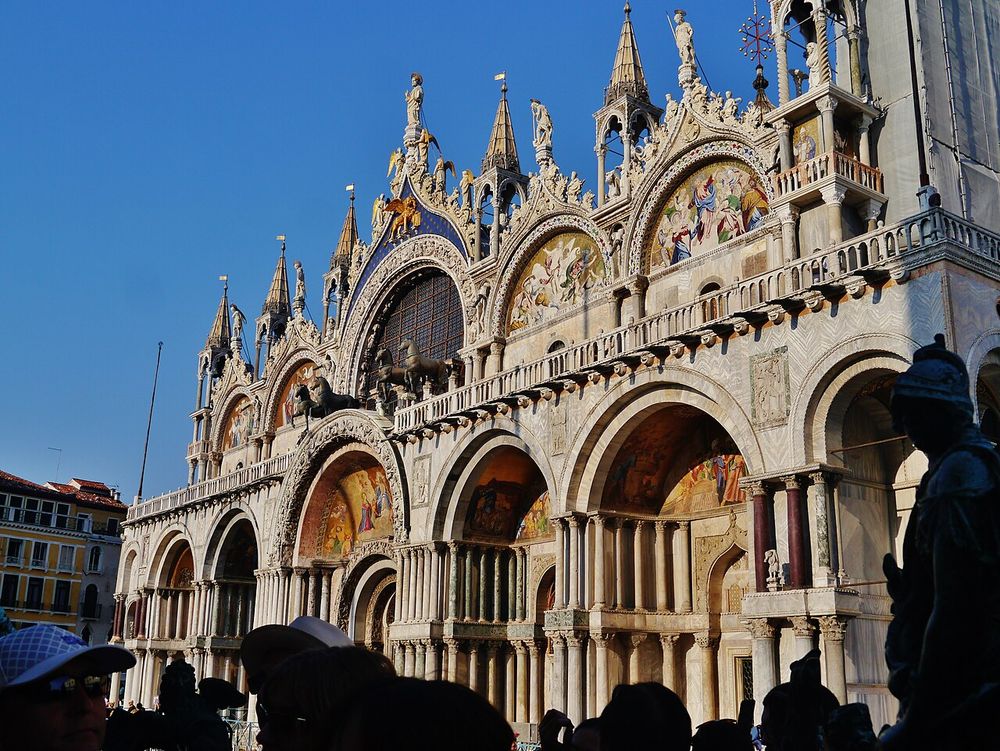
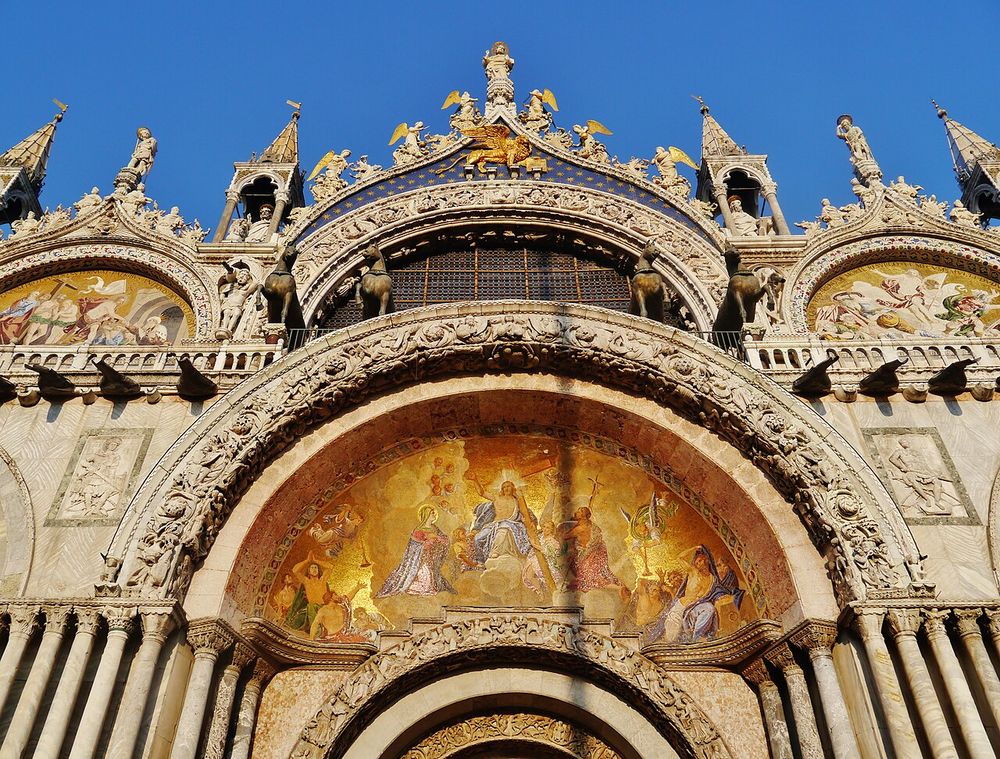
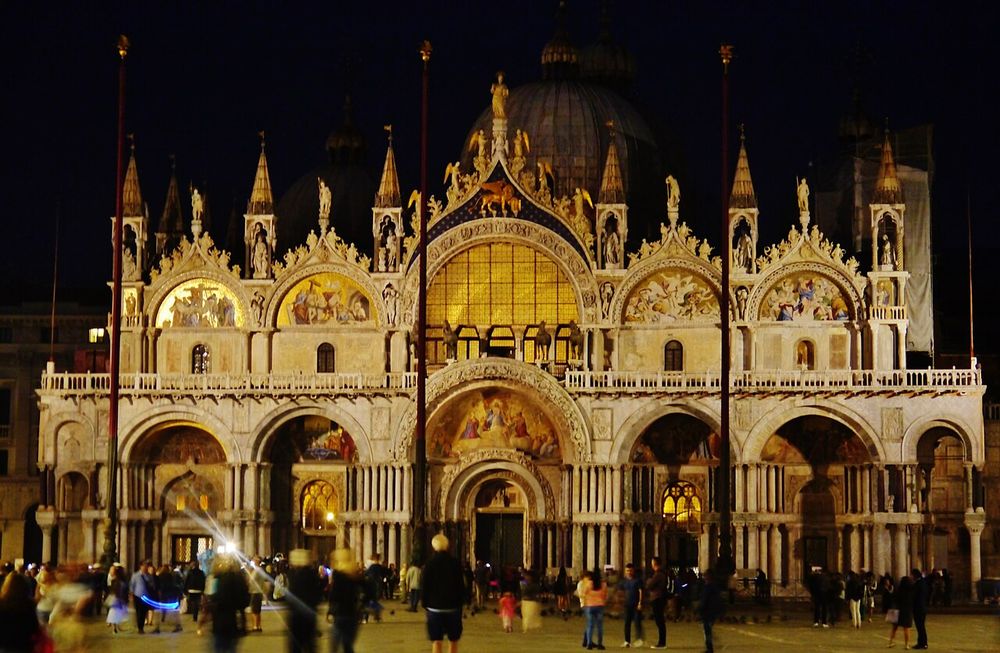
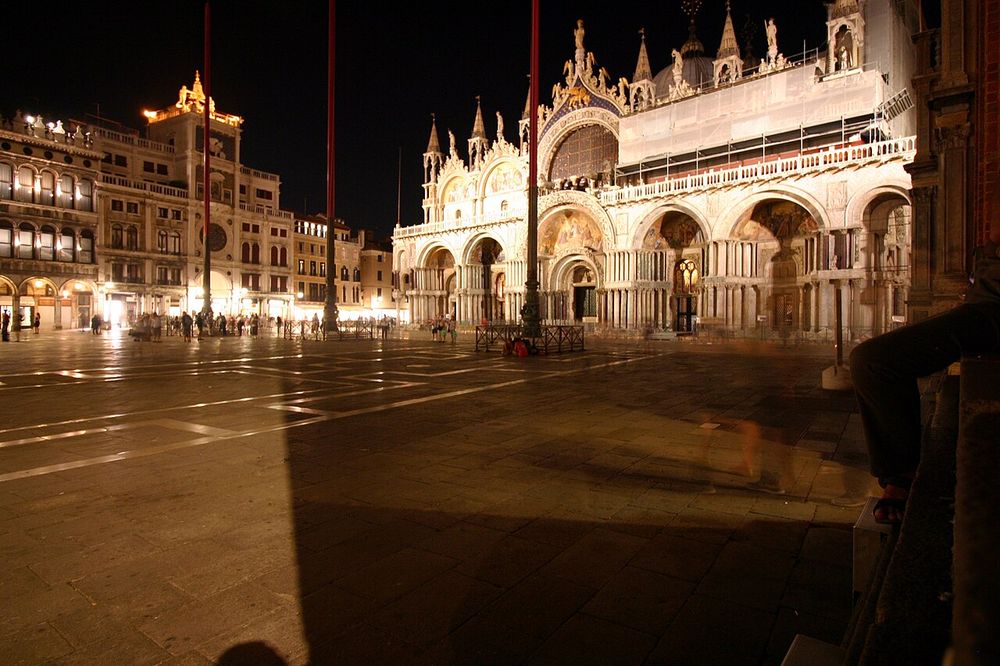
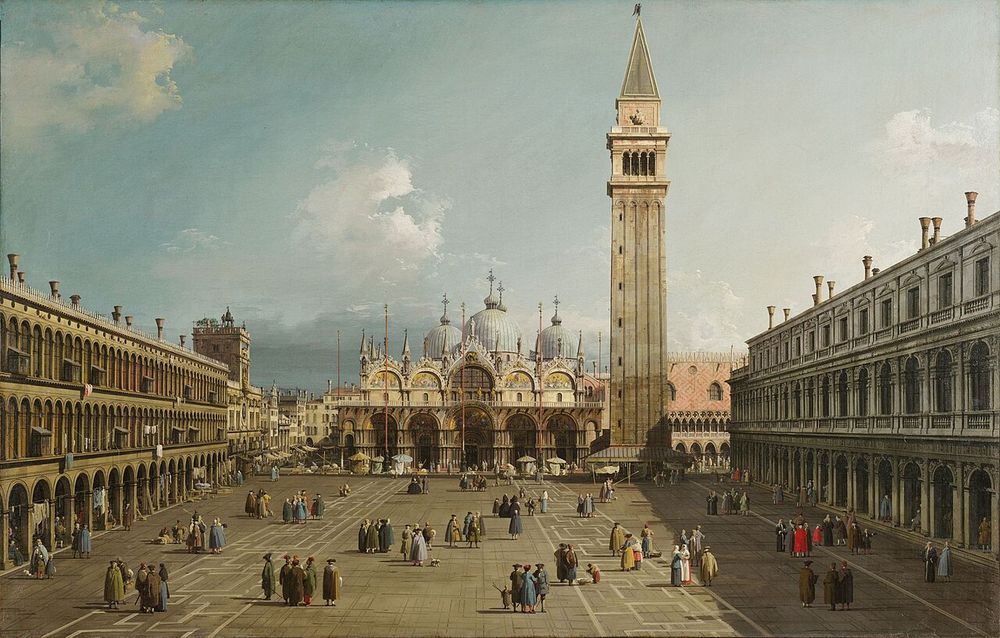
The only square in Venice that Venetians call a square. A gold church at one end, a brick tower that fell down and was put back, a clock with two bronze giants, and arcades on three sides. A few times a year the sea comes up through the paving.
Photo: Benh LIEU SONG, Public domain, Wikimedia Commons
The story
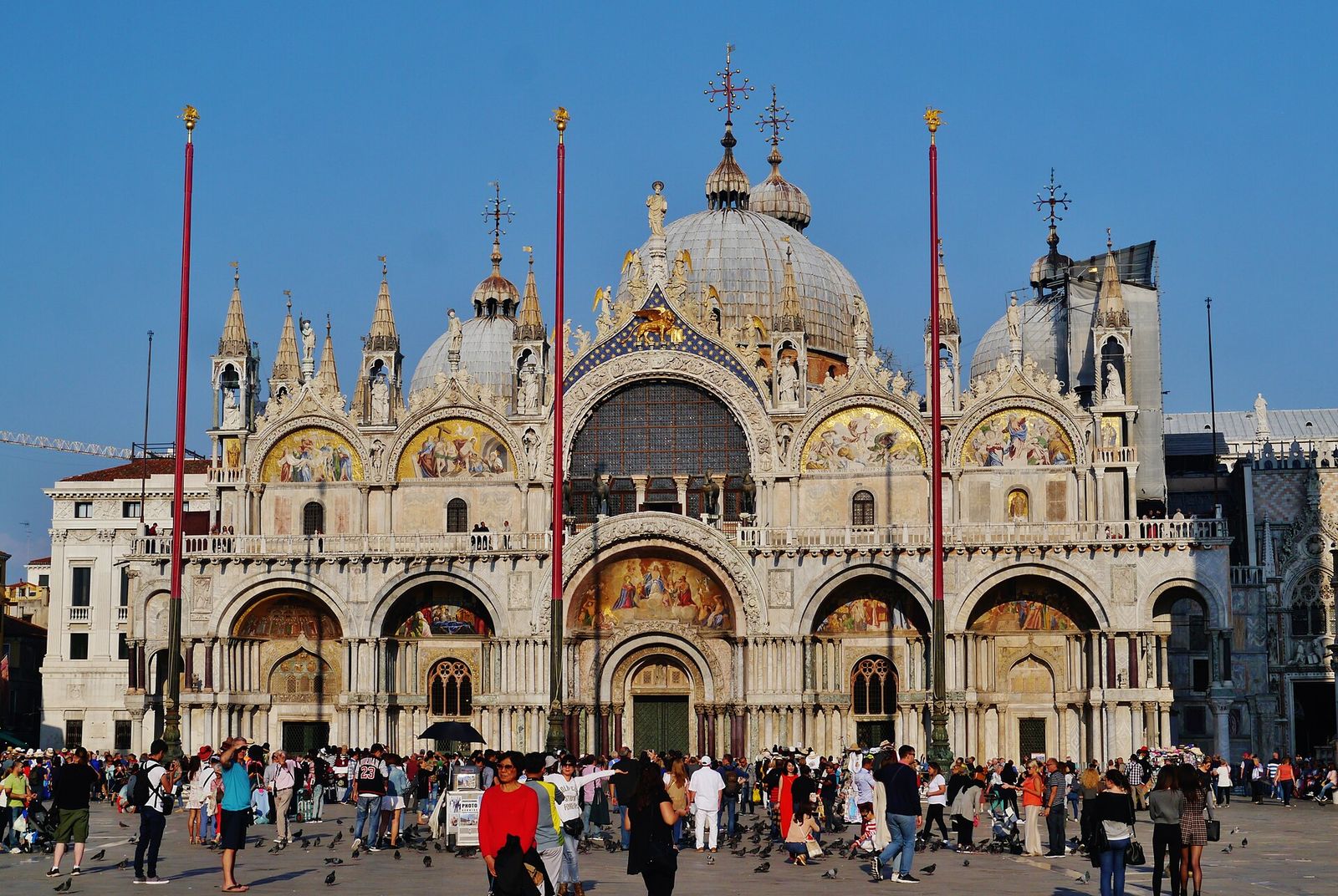
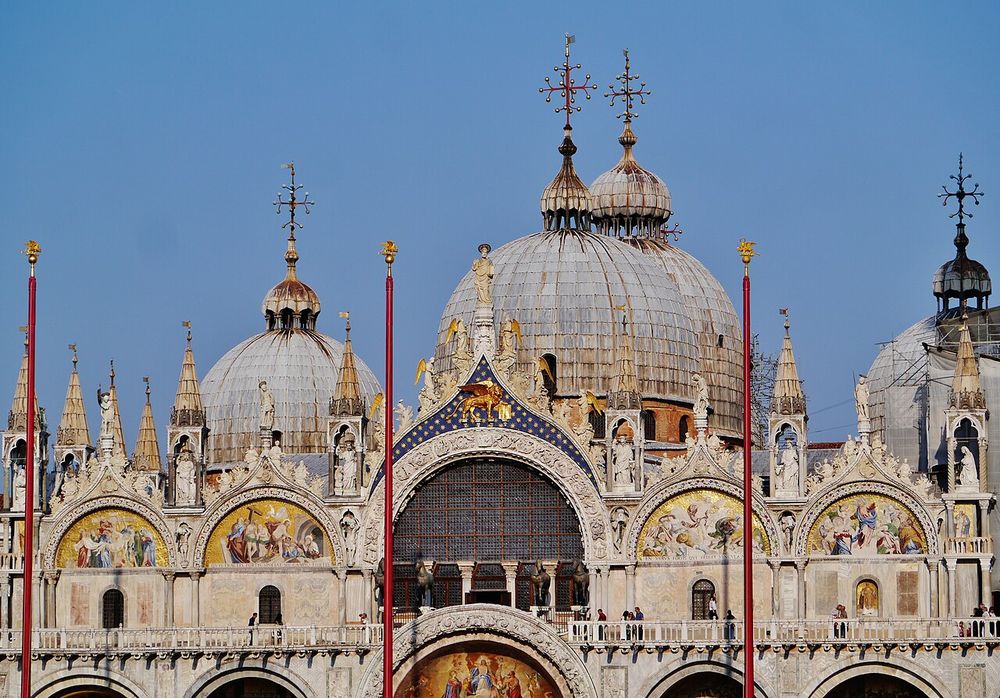
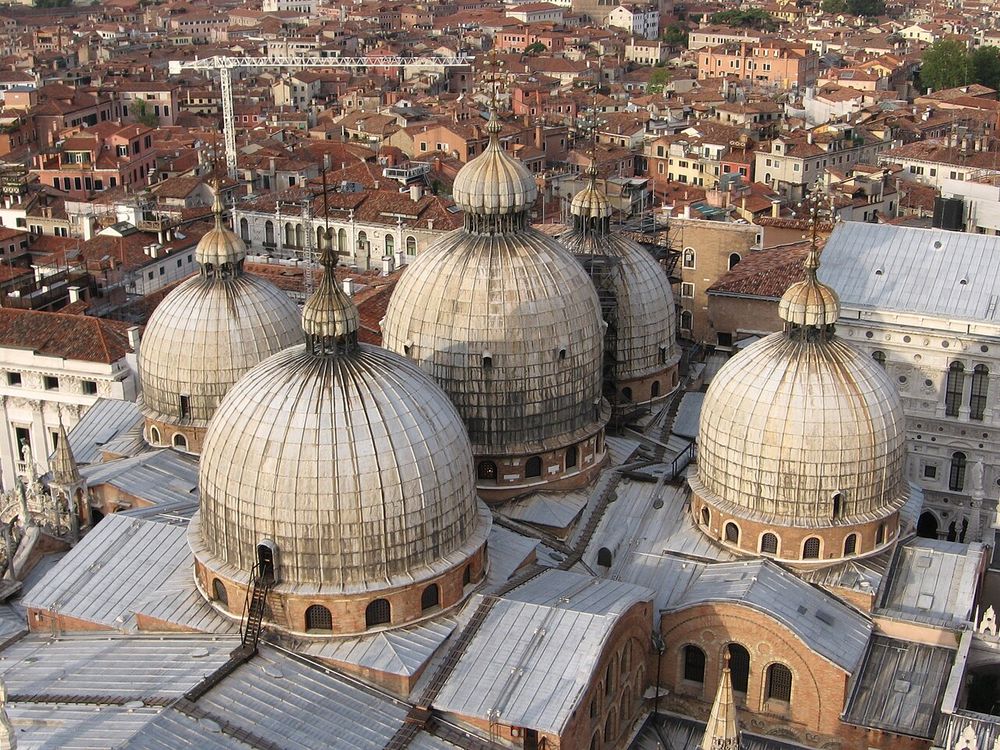
You are standing on grey stone with lines of white running through it, in a space with walls on every side and no roof. There are no cars and no trees. Ahead is a church with five domes, and beside it a red brick tower with a green point.
The square took this shape in 1177, when a canal was filled in to double its size. In China it was the Southern Song (1127–1279), and the philosopher Zhu Xi was forty-seven.
The places inside
Each of these has its own page, with its own story, pictures and visiting notes.
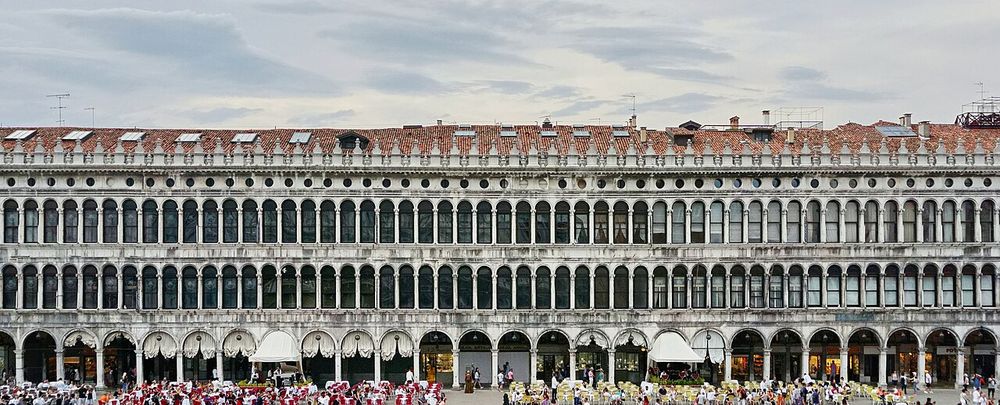
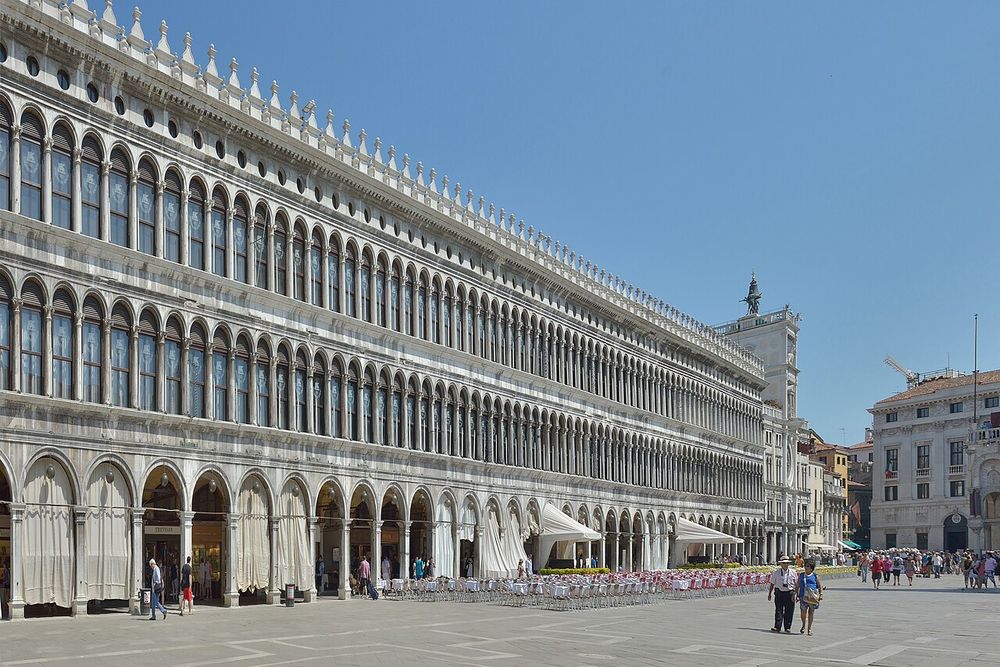
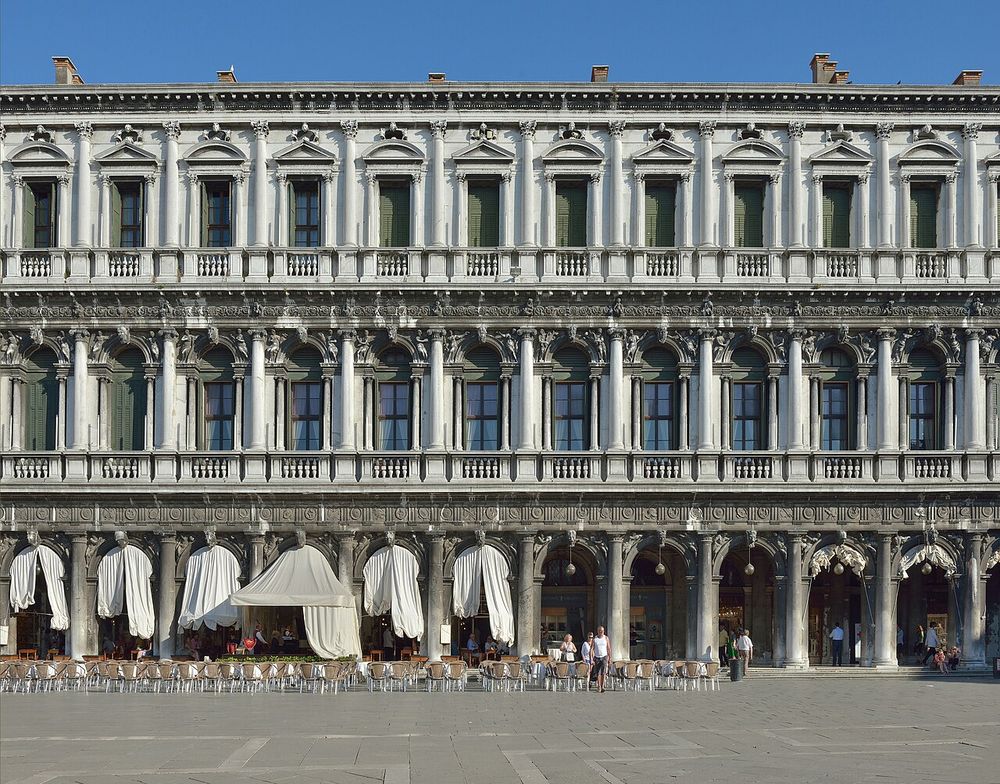
The north arcade, fifty arches longArmin Kleiner, CC BY-SA 4.0
For a thousand years Venice was a republic of merchants, ruled by an elected duke called the doge. This was its front room. The church was the doge's chapel. The palace beside it was his house and the seat of government. The long buildings on either side were the offices of the nine officials who ran the church and its money.
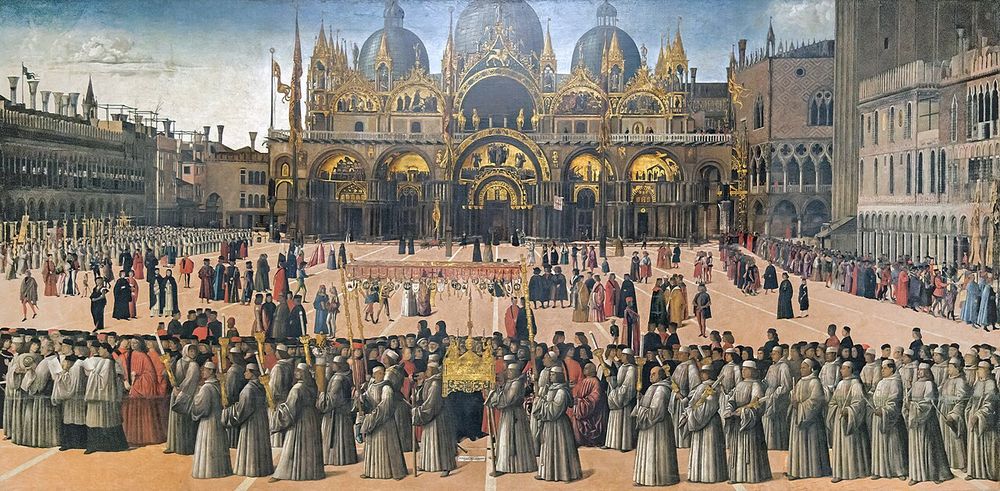
Everything Venice wanted the world to see happened here: processions, executions, bullfights, the arrival of kings. The republic ended in 1797, when Napoleon's army reached the lagoon.
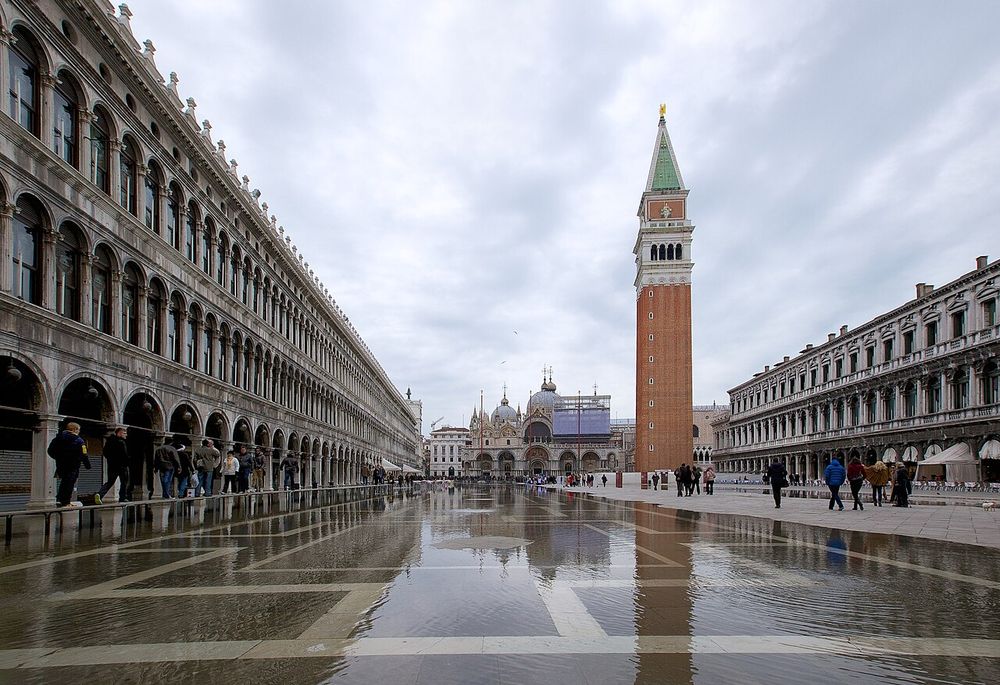
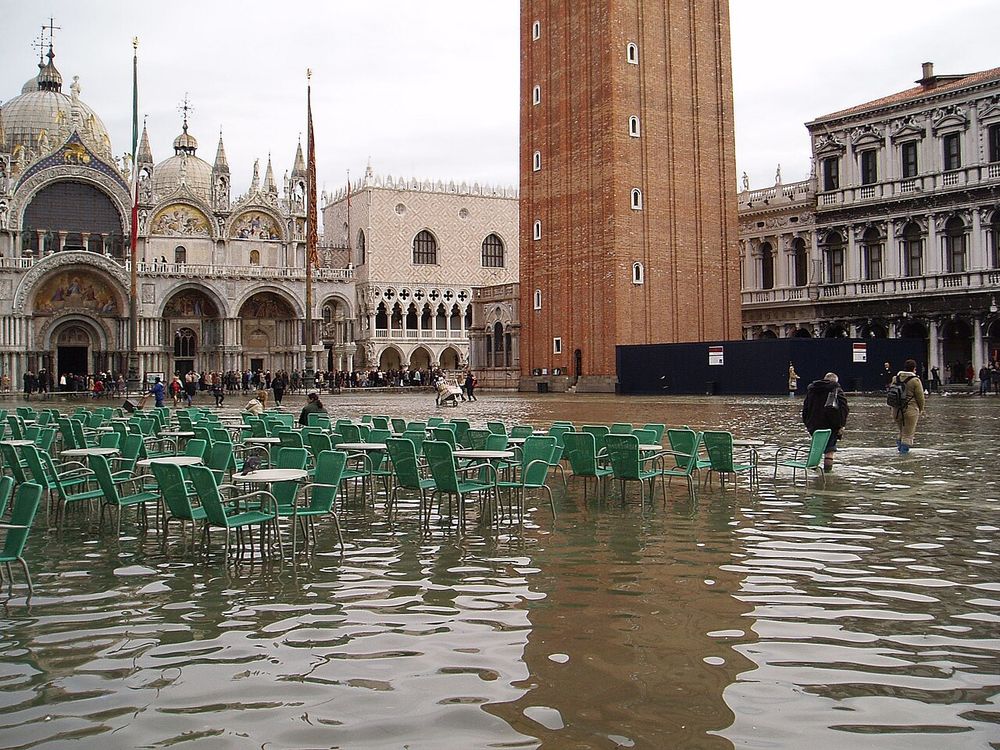
This is also the lowest ground in the city. When a high tide meets a south wind, water rises through the drains and the square becomes a lake.
Things people often get wrong
"Venice is full of squares." It has one piazza. Every other open space is a campo, a field, because that is what they once were.
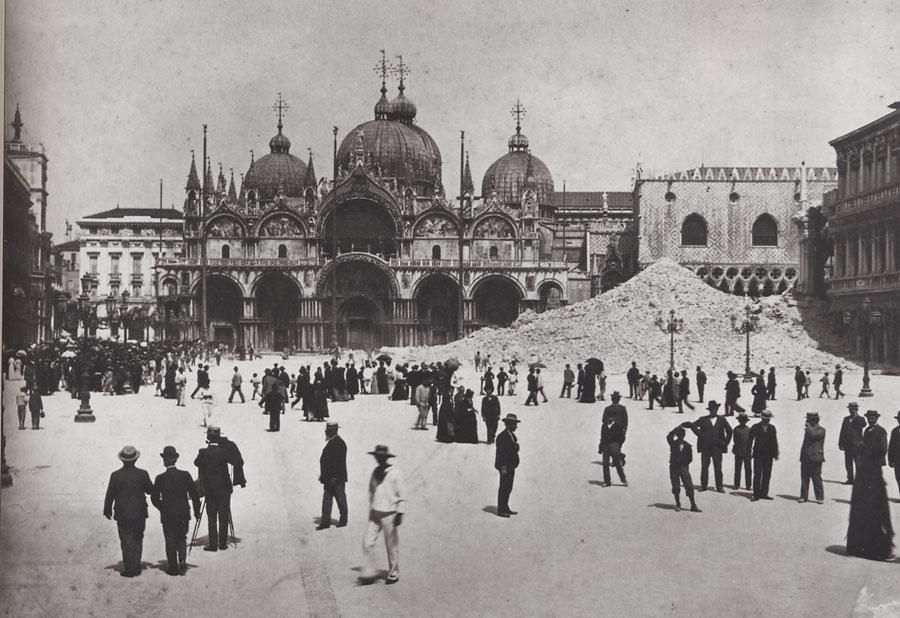
"The bell tower is a thousand years old." It fell down in 1902. What you see was finished in 1912, copied brick for brick.
"Napoleon called it the finest drawing room in Europe." The phrase is everywhere and no one has found it in anything he wrote or was heard to say.
"You can feed the pigeons." It has been forbidden since 2008, and there is a fine.
"The floods are drowning the square more every year." Since October 2020 a line of steel gates at the mouths of the lagoon has been raised against the highest tides. The square still gets wet at lower ones.
People who stood here
Galileo (Italian scientist who first turned a telescope on the sky)On 21 August 1609 he took the doge and the senators up the bell tower and handed them his new telescope. They saw ships two hours before the ships could be seen by eye. The senate doubled his salary.
Marco Polo (Venetian merchant who travelled to China and served Kublai Khan)He was born in Venice in 1254 and came home in 1295 after twenty-four years away. The square was already this size, and the church already had its domes. He may have crossed these stones on his way to tell people what he had seen.
Napoleon (emperor of the French, 1804–1815)He ended the republic in 1797 without coming here. He came ten years later, as emperor, for ten days. He had a church at the west end pulled down to build himself a ballroom, and it is still called the Napoleonic Wing.
Go deeper: seven stops, from the paving to the water
The stops go once round the square and then out to the water.
1. The floor
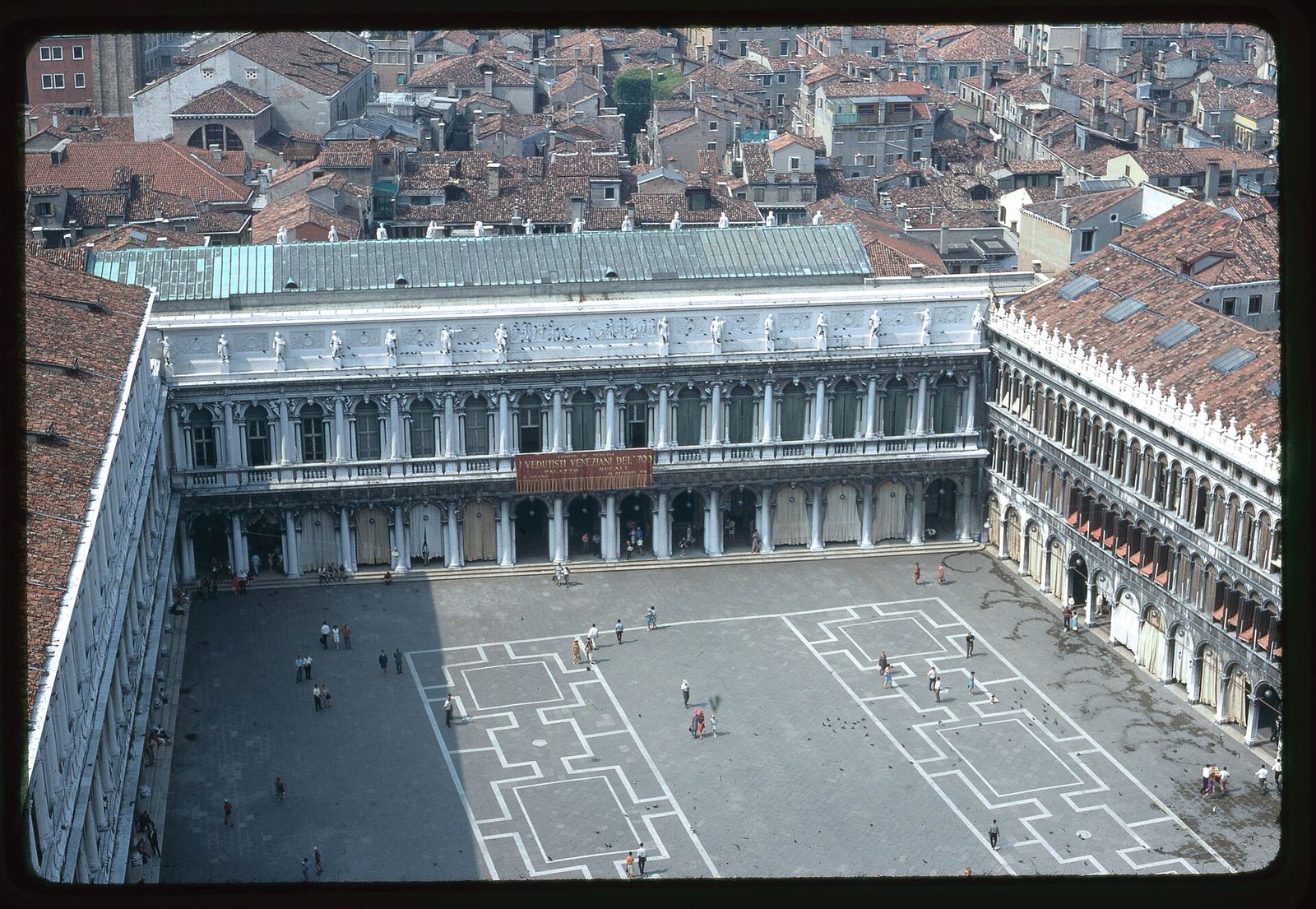
The square from above, in a slide by André CorbozAndré Corboz, CC BY-SA 4.0
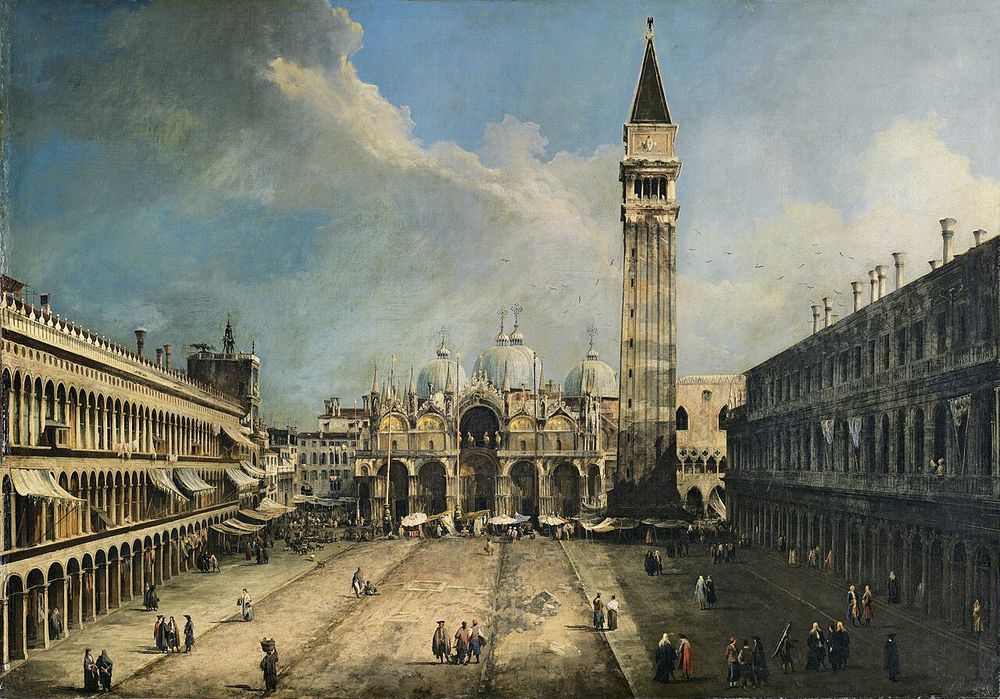
The square is not a rectangle. It is about 175 metres long, 82 metres wide at the church and 57 at the far end. The narrowing makes the church look closer and larger when you enter from the west.
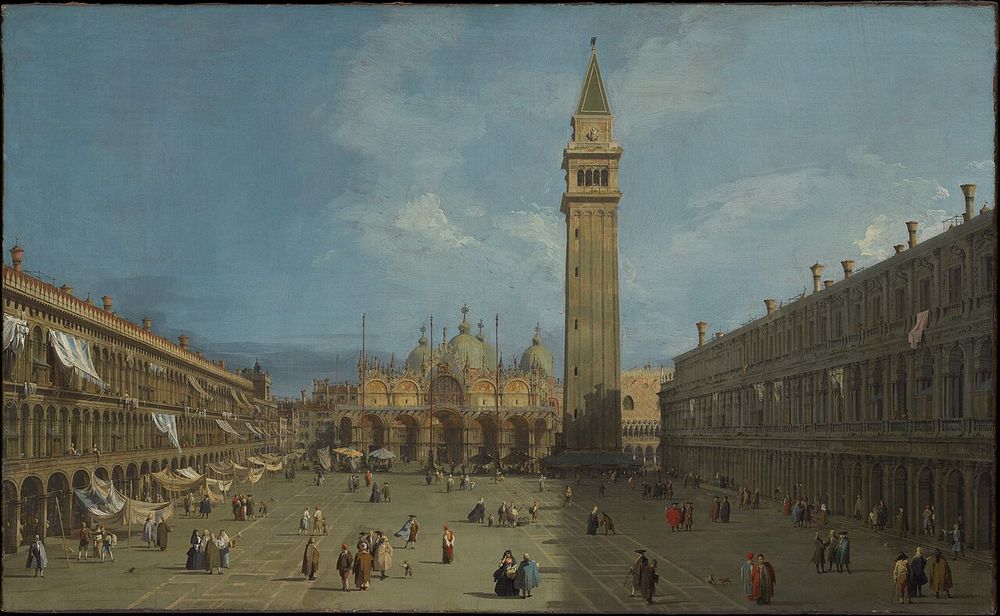
Until 1723 the ground was brick. The present paving is dark volcanic stone from the hills near Padua, with bands of white stone from across the Adriatic. The white lines marked where the guilds set up their market stalls.
2. The bell tower
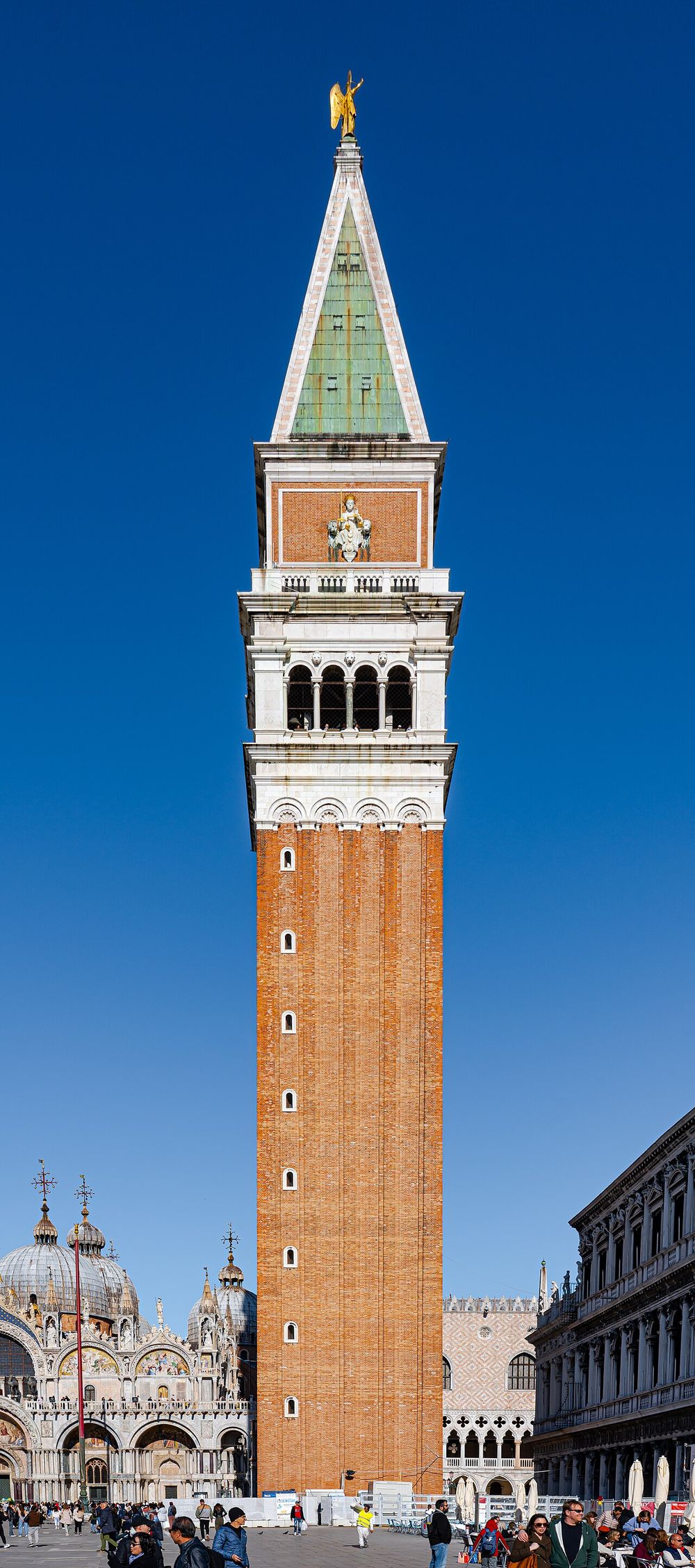
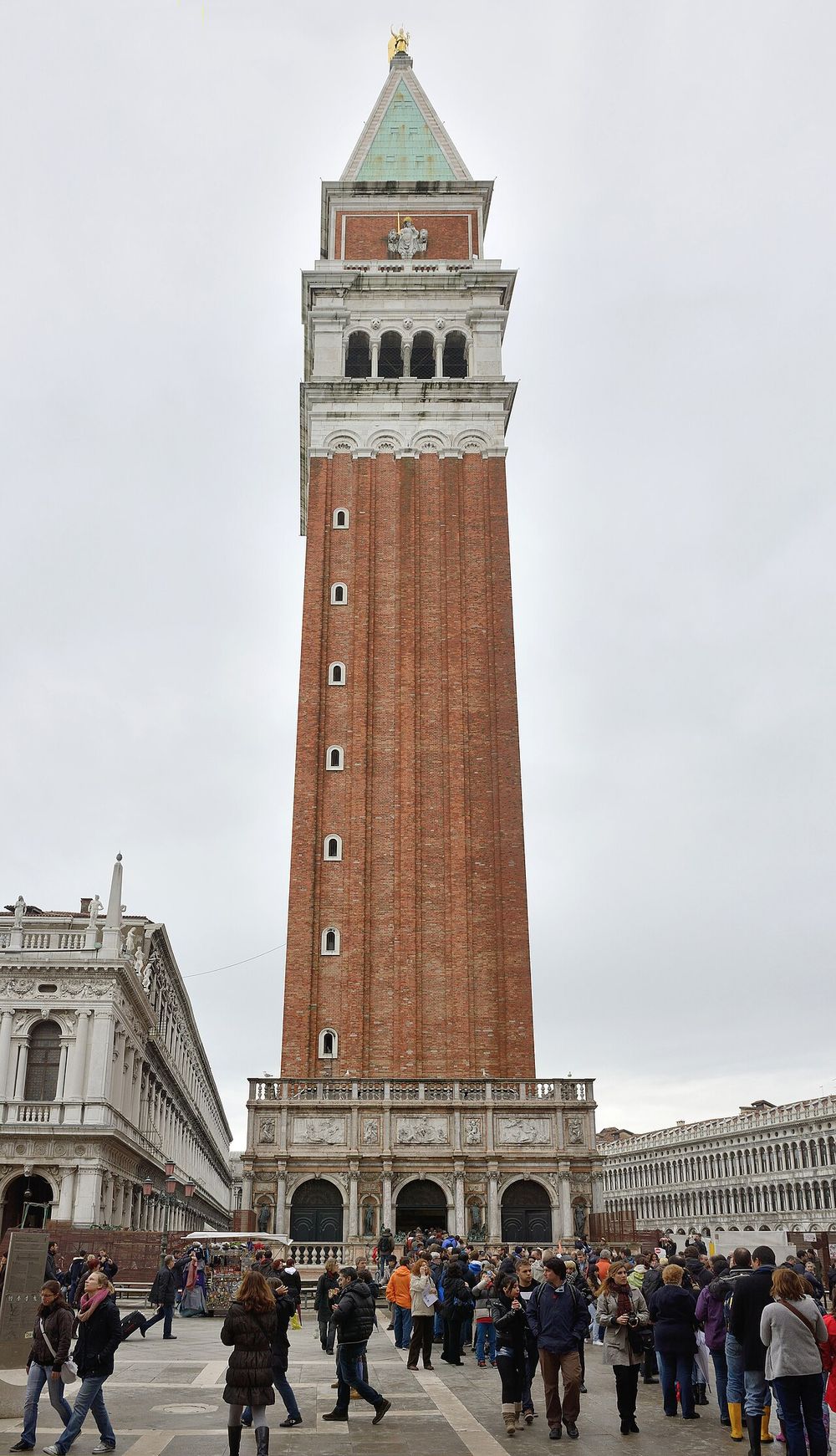
The bell tower, 98.6 metresAciarium, CC BY-SA 4.0
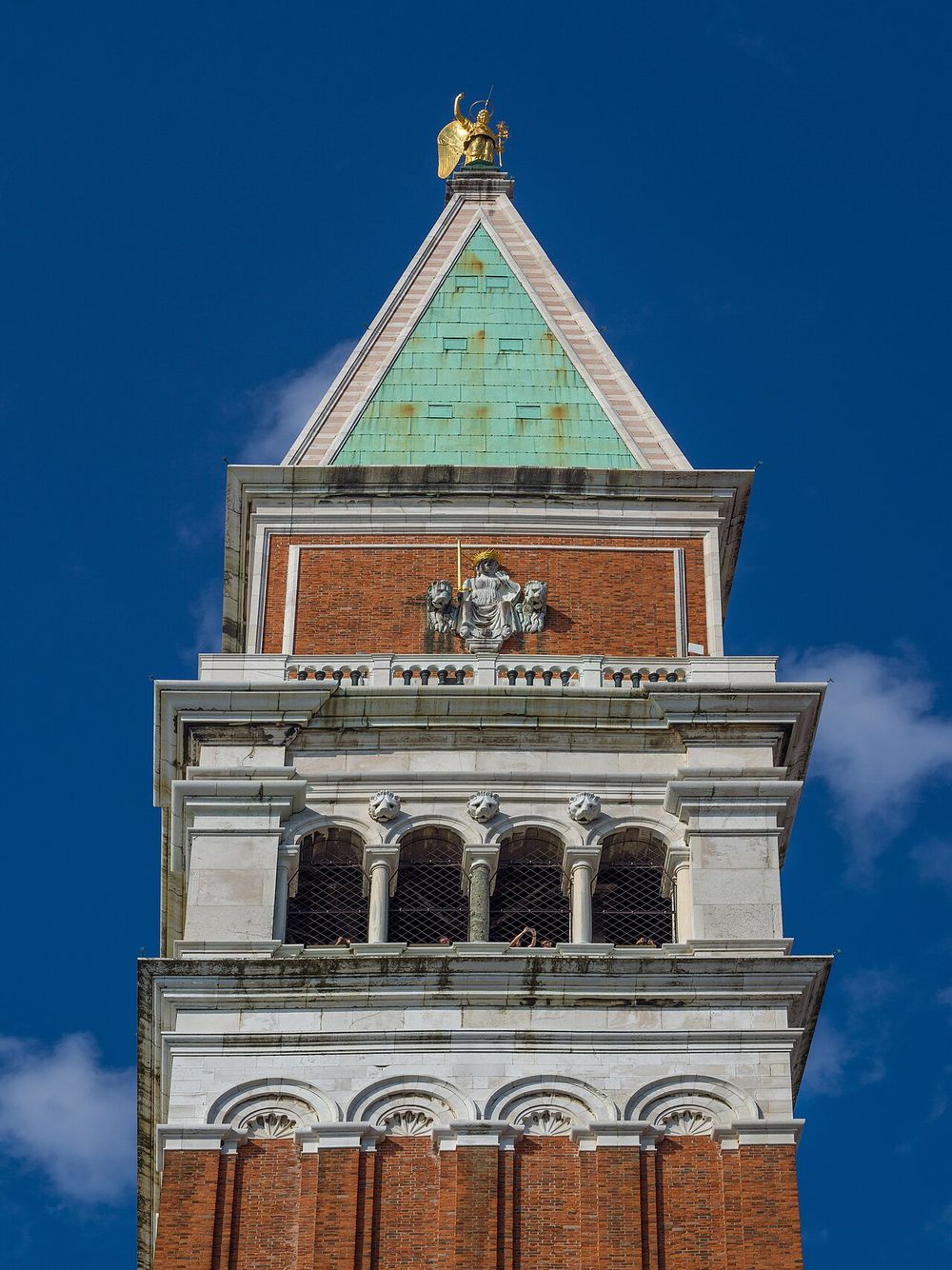
The tower is 98.6 metres high. It was a lighthouse for ships and a watchtower, and its five bells ran the day: one to start work, one for noon, one to call the senators, one for the council, and one, the smallest, for an execution.
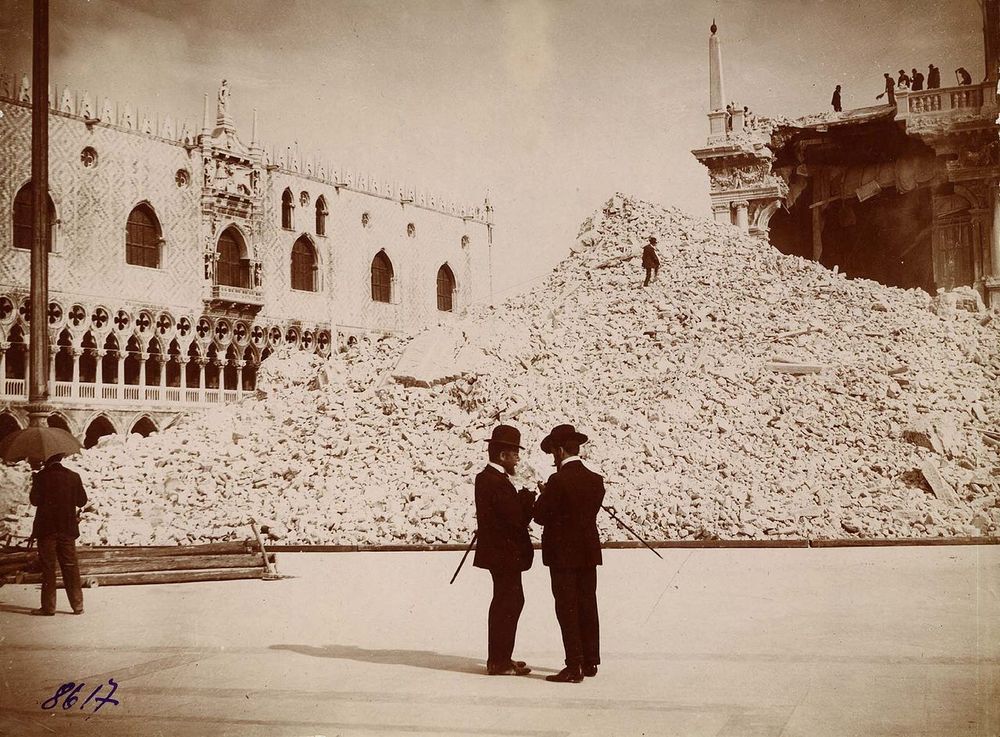
The heap of bricks on 14 July 1902Unknown authorUnknown author, Public domain
On the morning of 14 July 1902 a crack that had been watched for days ran up the wall. The square was cleared. At 9:47 the tower sank straight down into a heap of bricks. No one was hurt. The caretaker's cat was the only death.
The city council voted the same evening to rebuild it "as it was, where it was". The new tower opened on 25 April 1912, St Mark's day. It has a lift.
3. The clock tower
The clock towerFernando de Gorocica, CC BY-SA 4.0
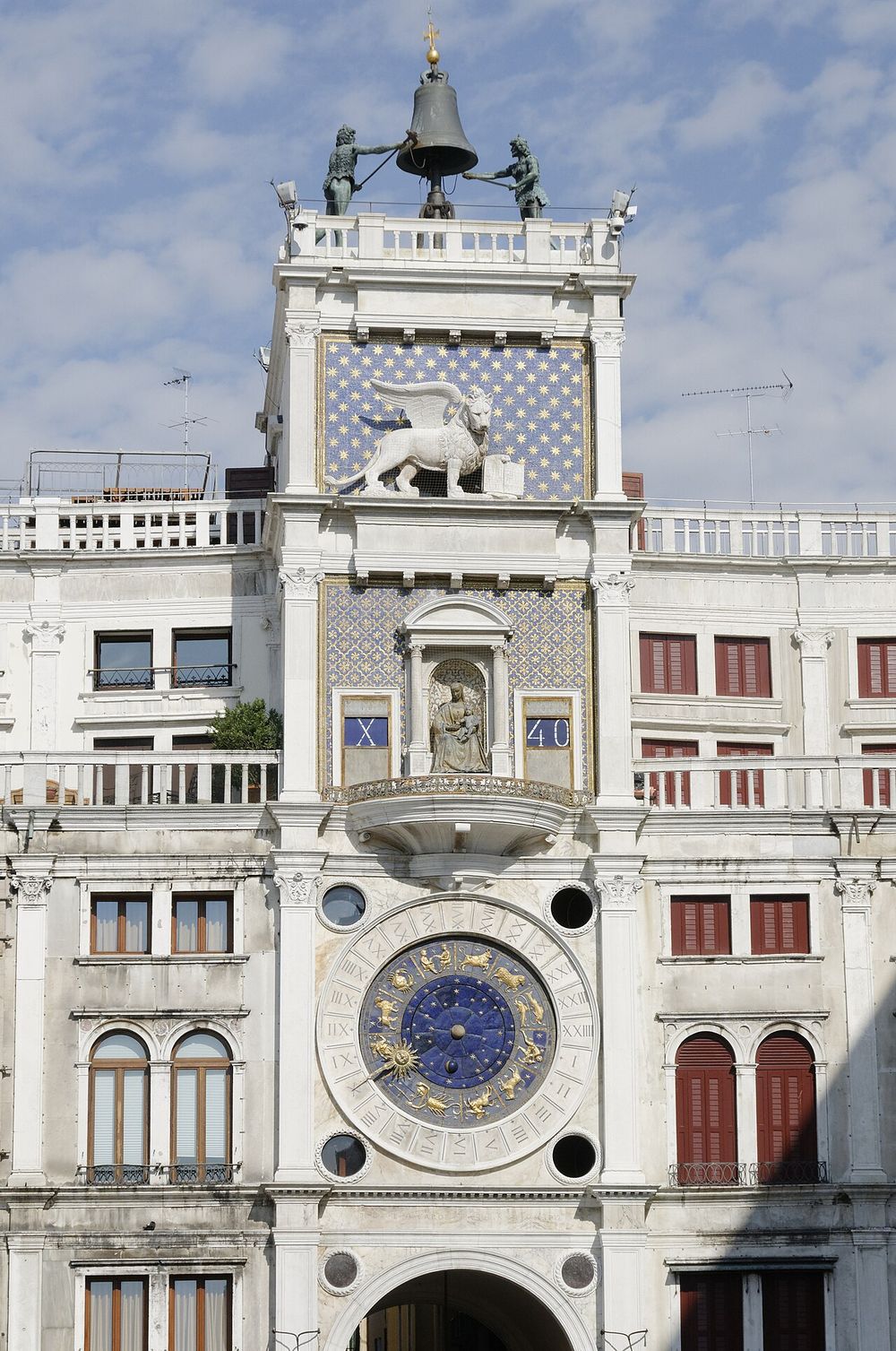
The clock was finished in 1499. On the roof two bronze men, each two and a half metres tall, swing hammers at a bell. They have gone dark with age and are called the Moors. One strikes two minutes before the hour and one two minutes after: the past and the future.
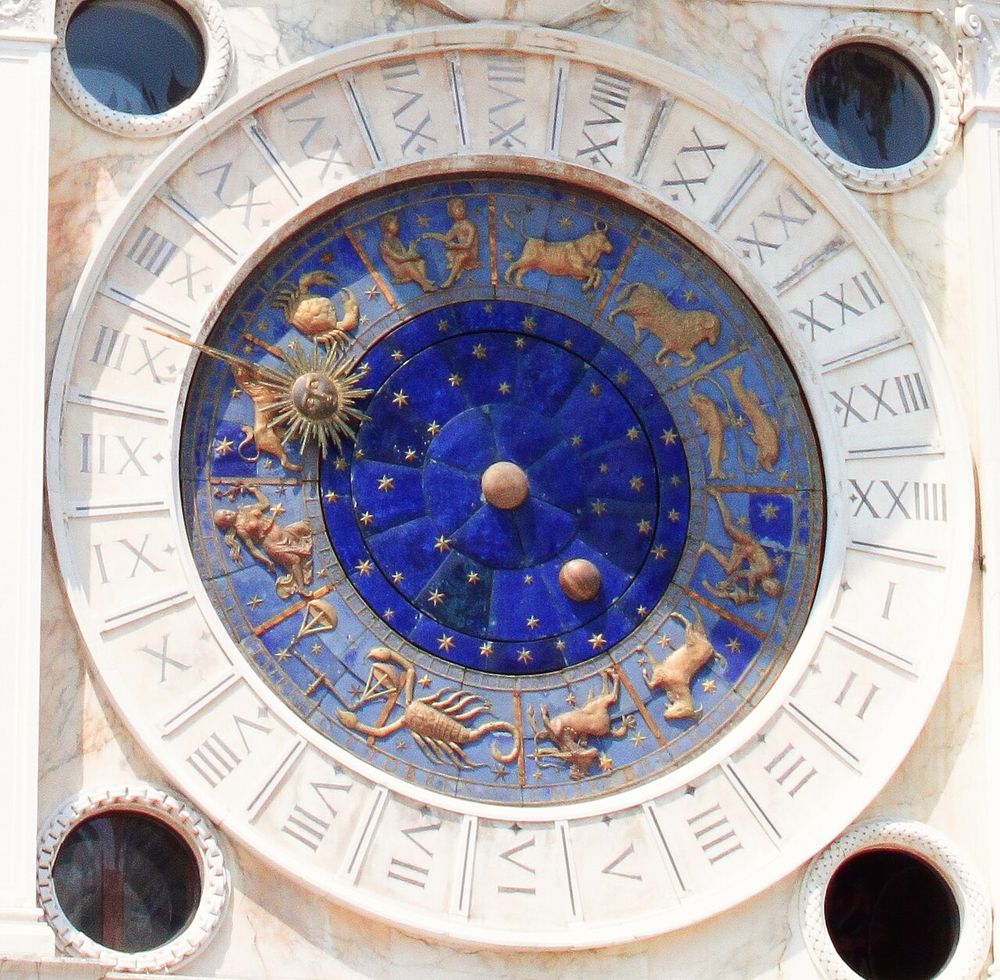
The clock face: hours, zodiac and moonFernando de Gorocica, CC BY-SA 4.0
The blue and gold face shows the hour, the sign of the zodiac and the phase of the moon. A merchant city needed to know the tides, and the tides follow the moon.
The arch under the clock is the start of the Mercerie, the street of shops that runs to the Rialto bridge. It was the richest street in Europe when the clock was new.
4. The arcades and the cafés
The north arcade and the clock towerThis Photo was taken by Wolfgang Moroder. Feel free to use my photos, but please, CC BY-SA 3.0
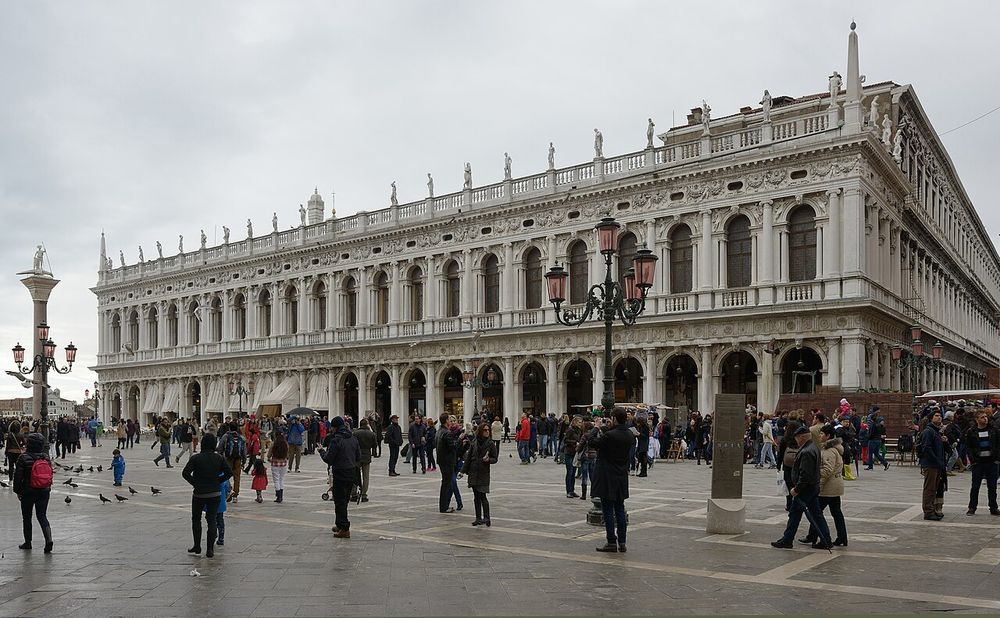
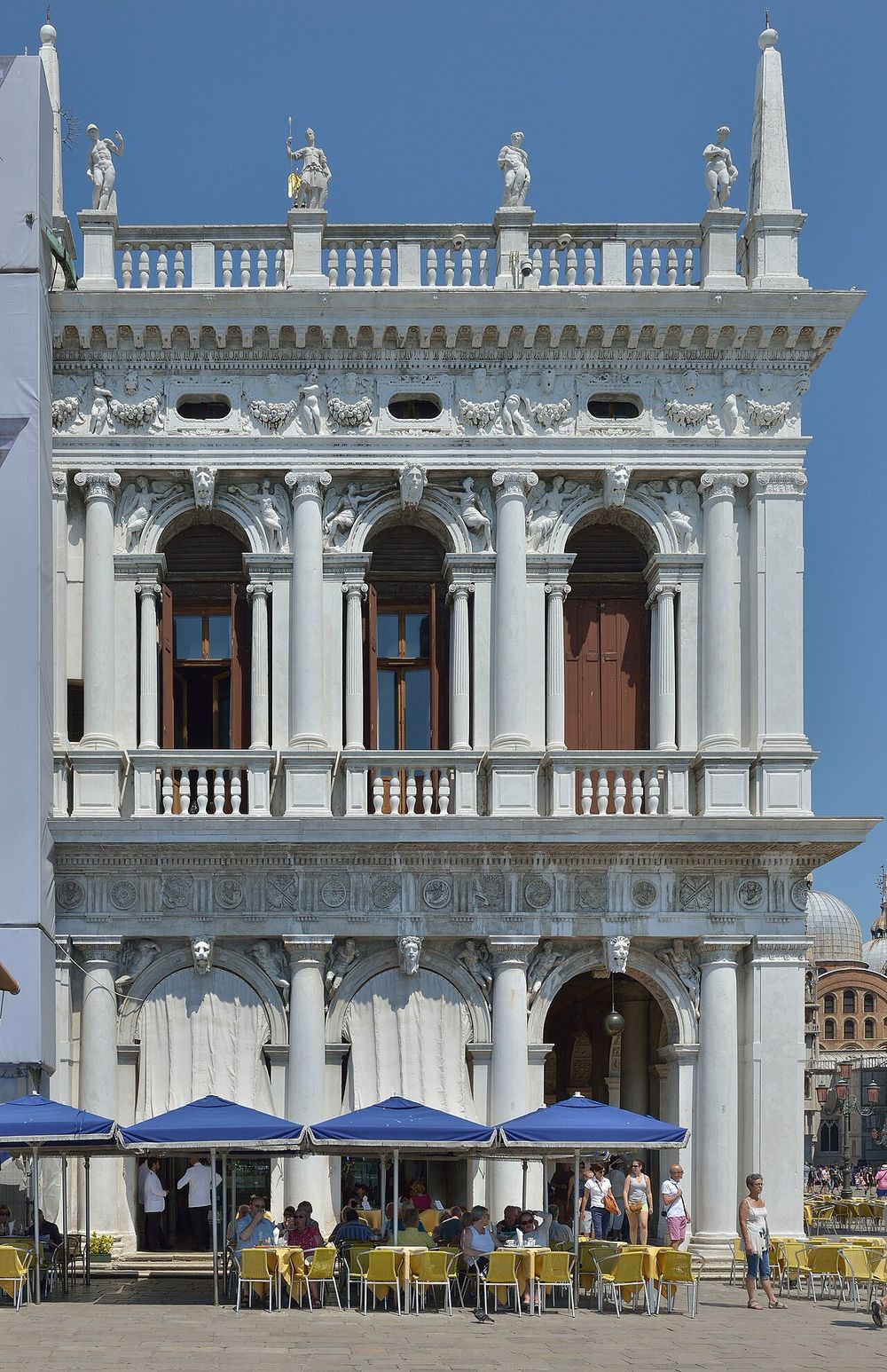
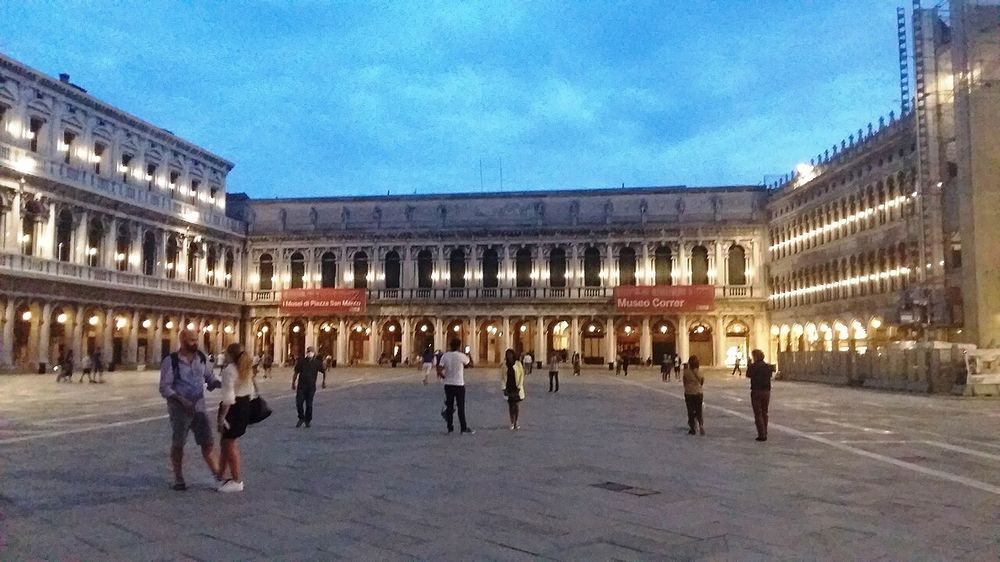
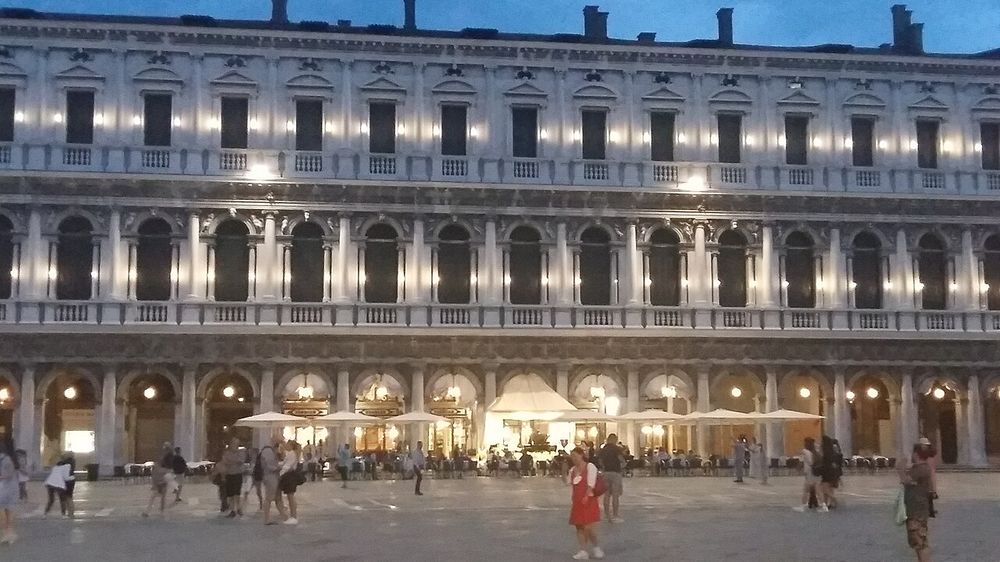
The long building on the north side, with fifty arches, was built in the early 1500s. The one on the south is a century younger. They housed the procurators of St Mark, who ranked next after the doge.
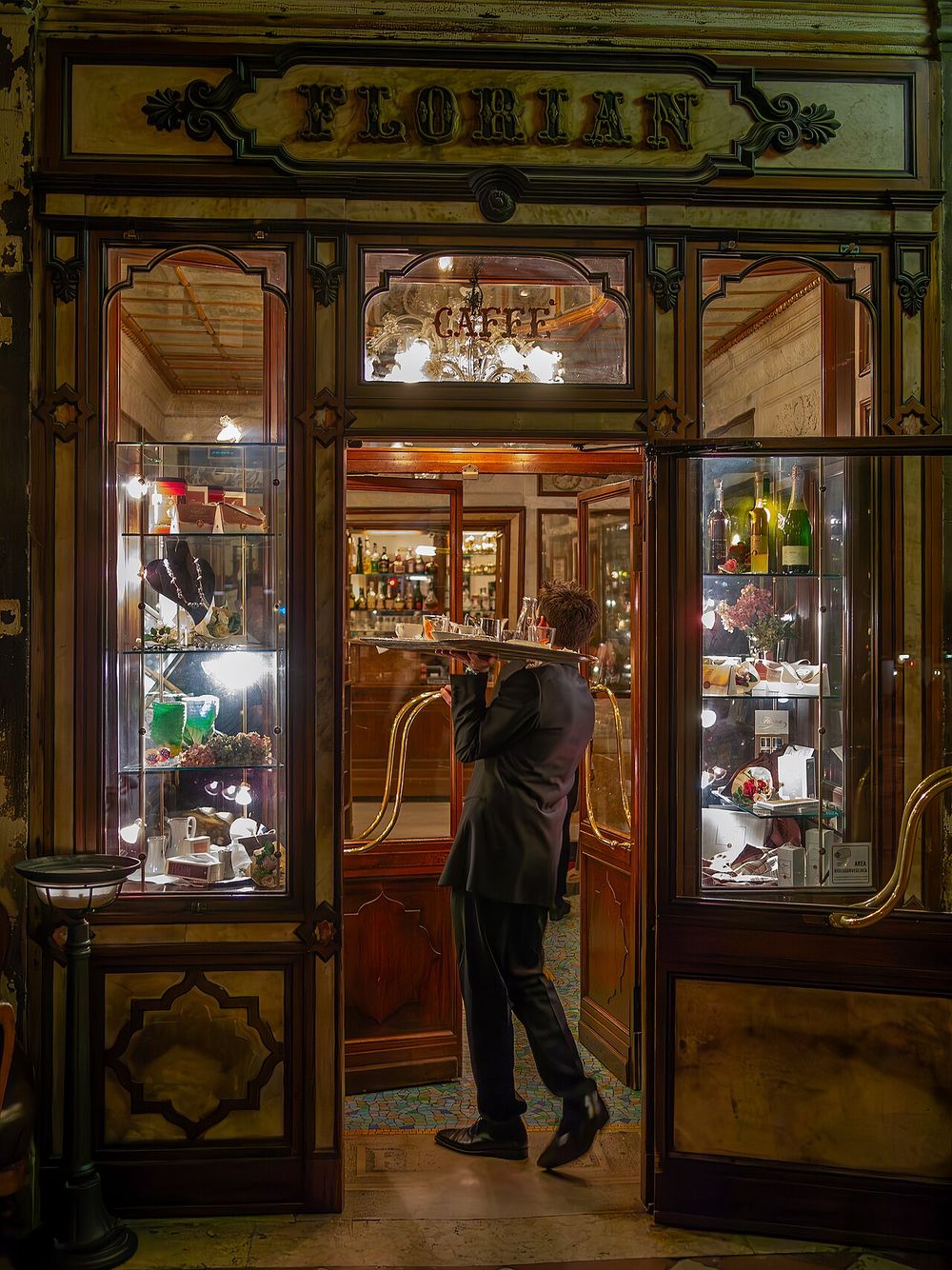
The door of FlorianErmell, CC BY-SA 4.0
Under the south arcade is Florian, opened on 29 December 1720 and in business ever since. Coffee had come to Europe through Venice, from the Ottoman lands. Florian was the one coffee house that admitted women, which is why Casanova, the Venetian adventurer, liked it.
The tables in the square have small orchestras. If you sit down while they play, a charge for the music is added to your bill. It is printed on the menu.
5. Napoleon's wing
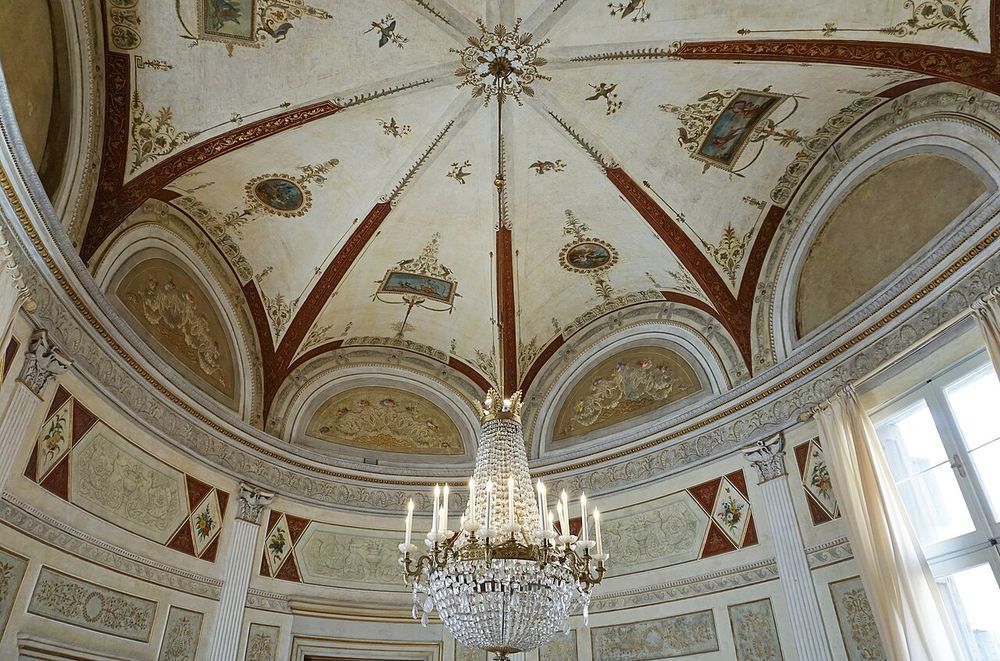
A ceiling in the Napoleonic WingArmin Kleiner, CC BY-SA 4.0
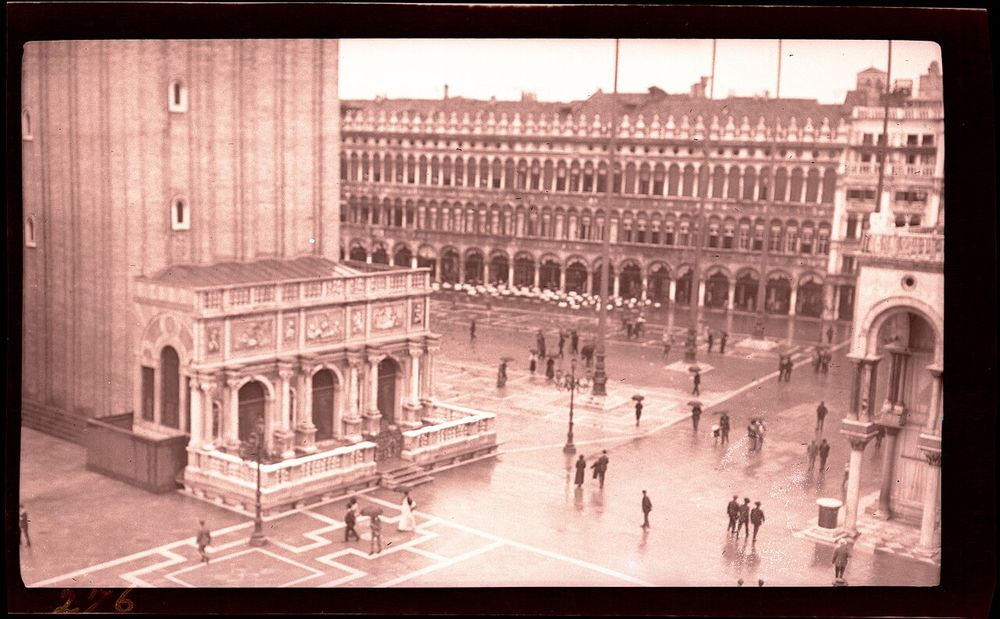
The west end was closed by a church designed by the architect Sansovino, who is buried in the basilica. In 1807 it was pulled down. The new wing gave the French governor a grand staircase and a ballroom.
Today the stairs lead to the Correr Museum, the museum of the city: maps, coins, the doges' robes, and the shoes on tall platforms that Venetian ladies wore above the mud.
6. The two columns
The columns from the square, with San Giorgio beyondThis Photo was taken by Wolfgang Moroder. Feel free to use my photos, but please, CC BY-SA 3.0
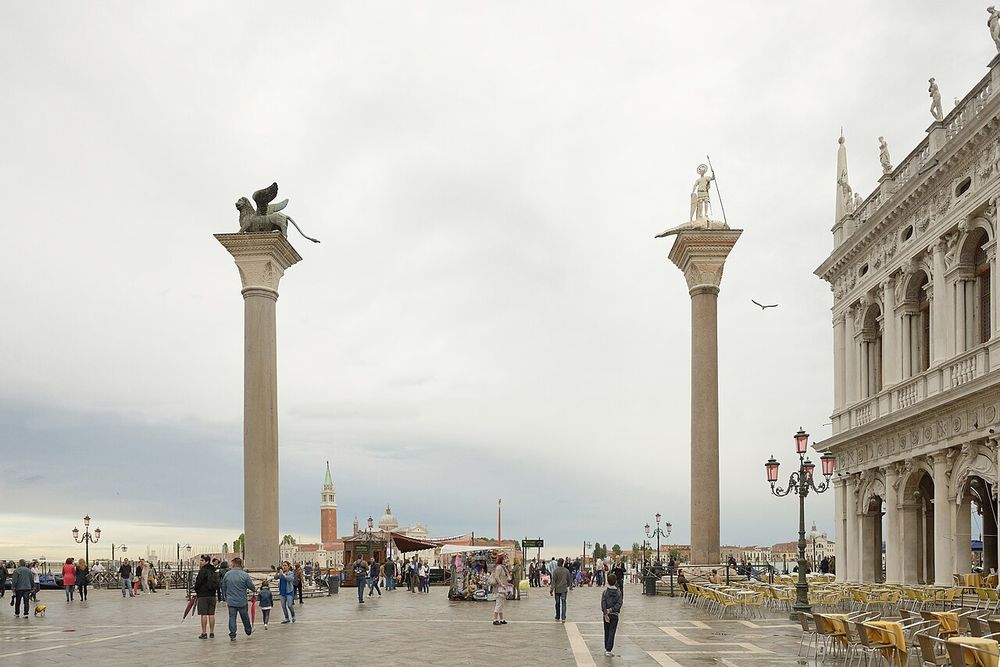
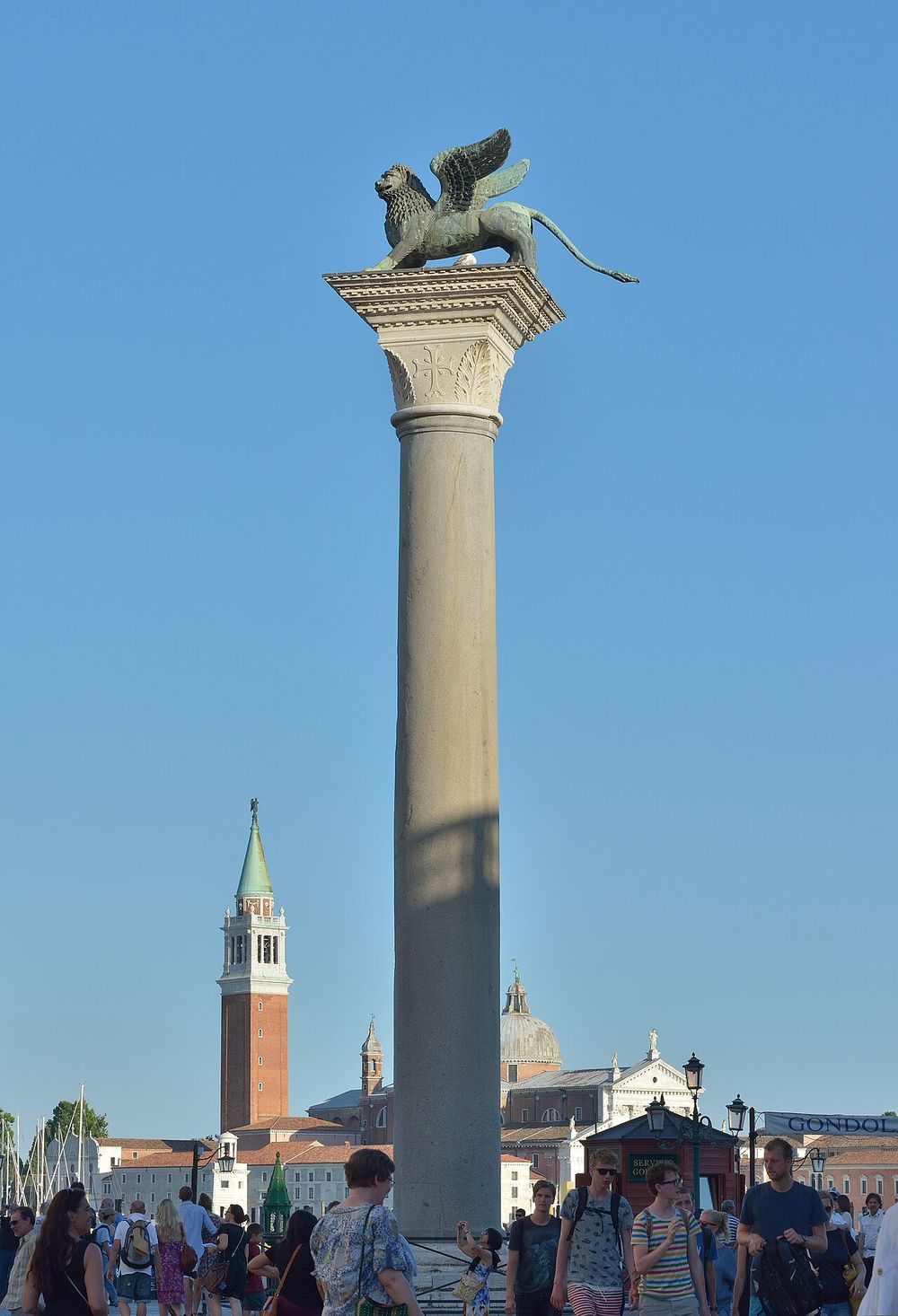
Walk past the bell tower towards the water. This smaller space is the Piazzetta. At its end stand two columns of granite, set up about 1172. They were the city's gate: everyone of importance arrived by boat and walked in between them.
The winged lionThis Photo was taken by Wolfgang Moroder. Feel free to use my photos, but please, CC BY-SA 3.0
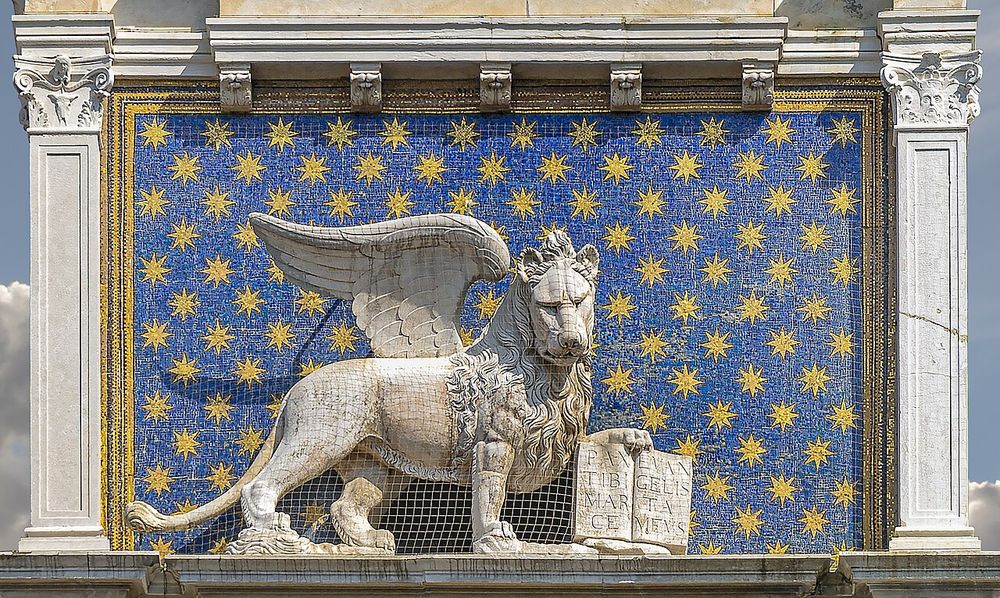
On one column is a winged lion, the sign of St Mark and of Venice. It is far older than the city. Tests of the bronze in 2024 traced its copper to the Yangtze valley, and its shape is like the guardian beasts placed in tombs in Tang China. How it reached Venice, nobody knows.
St Theodore and his crocodileDidier Descouens, CC BY-SA 4.0
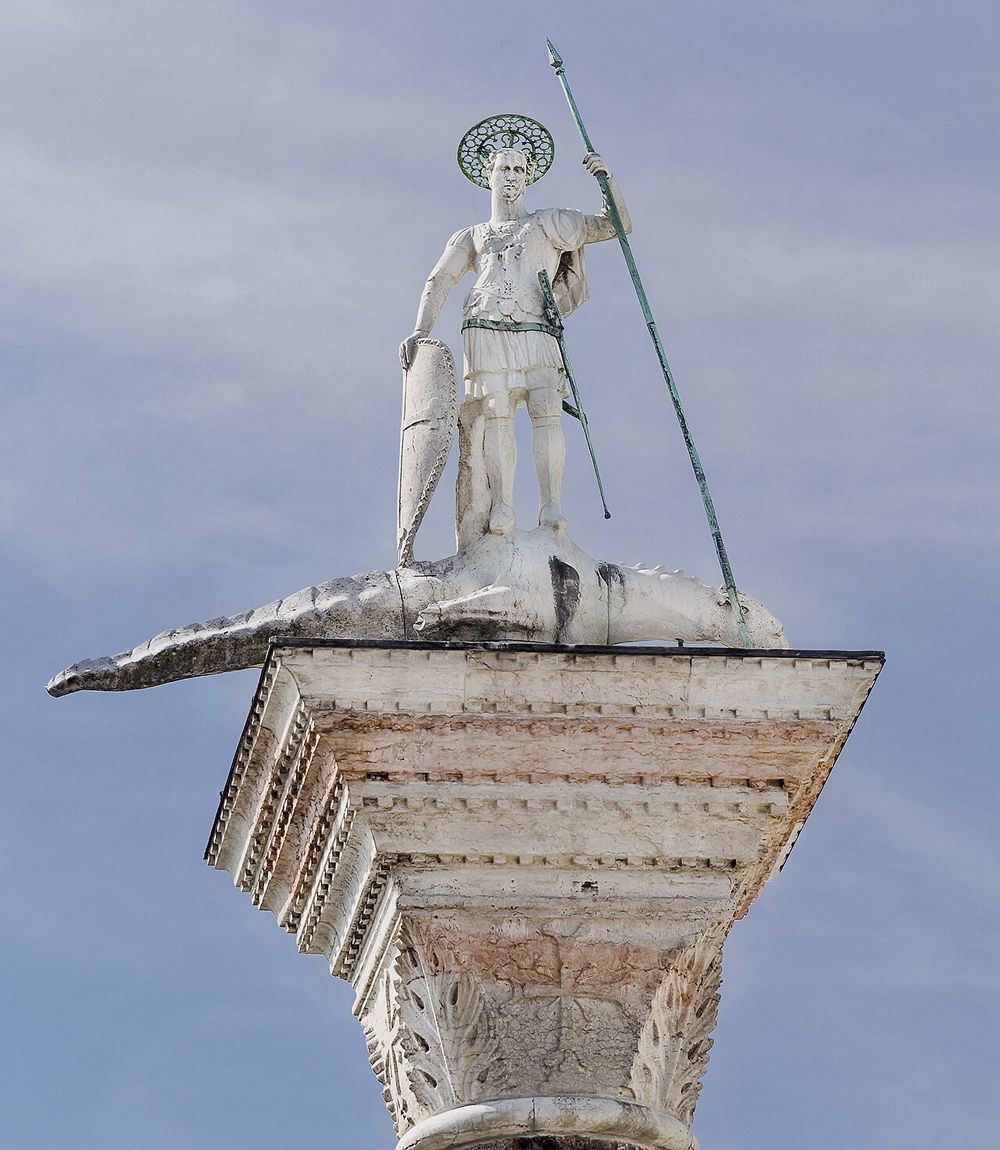
On the other is St Theodore, the city's first patron, standing on a crocodile. Criminals were executed between the two columns. Venetians still walk round, not through.
7. The water
The square as a mirrorSergey Ashmarin, CC BY-SA 3.0
Stand at the edge of the quay. The stone is less than a metre above the normal level of the lagoon. In autumn and winter, a few times a year, the tide rises higher than that. A siren sounds across the city, and raised walkways of planks are laid over the square.
On 4 November 1966 the water reached 194 centimetres and stayed for a day. On 12 November 2019 it reached 187. Since 2020 seventy-eight steel gates lying on the sea bed can be raised to close the lagoon when a tide of more than 110 centimetres is forecast.
Once did She hold the gorgeous east in fee;
And was the safeguard of the west: the worth
Of Venice did not fall below her birth,
Venice, the eldest Child of Liberty.
William Wordsworth, On the Extinction of the Venetian Republic, 1807
Meanwhile in the world
Year
Here
Elsewhere
828
Venetians bring home a body said to be St Mark's and build a church for it
Tang China (618–907): the poet Bai Juyi is fifty-six
1177
The square is doubled in size; pope and emperor make peace in front of the church
Southern Song China; in Cambodia, Angkor is sacked by an army from the east
1499
The clock tower is finished
Ming China (1368–1644); Vasco da Gama comes home from India by sea, the route that will take the spice trade away from Venice
1609
Galileo shows his telescope from the bell tower
Ming China: the Jesuit Matteo Ricci, an Italian, is living in Beijing
1720
Florian opens
Qing China, the Kangxi reign; in London the South Sea Bubble bursts
1797
Napoleon ends the republic after 1,100 years
Qing China: the Qianlong emperor has just given up the throne; George Washington leaves office
1902
The bell tower falls
The last years of the Qing (1644–1912); the year after the first Nobel prizes
1966
The worst flood on record
The Cultural Revolution begins in China; the same storm floods Florence
2020
The sea gates are raised for the first time
The year of the pandemic; the square is empty for months
Then and now
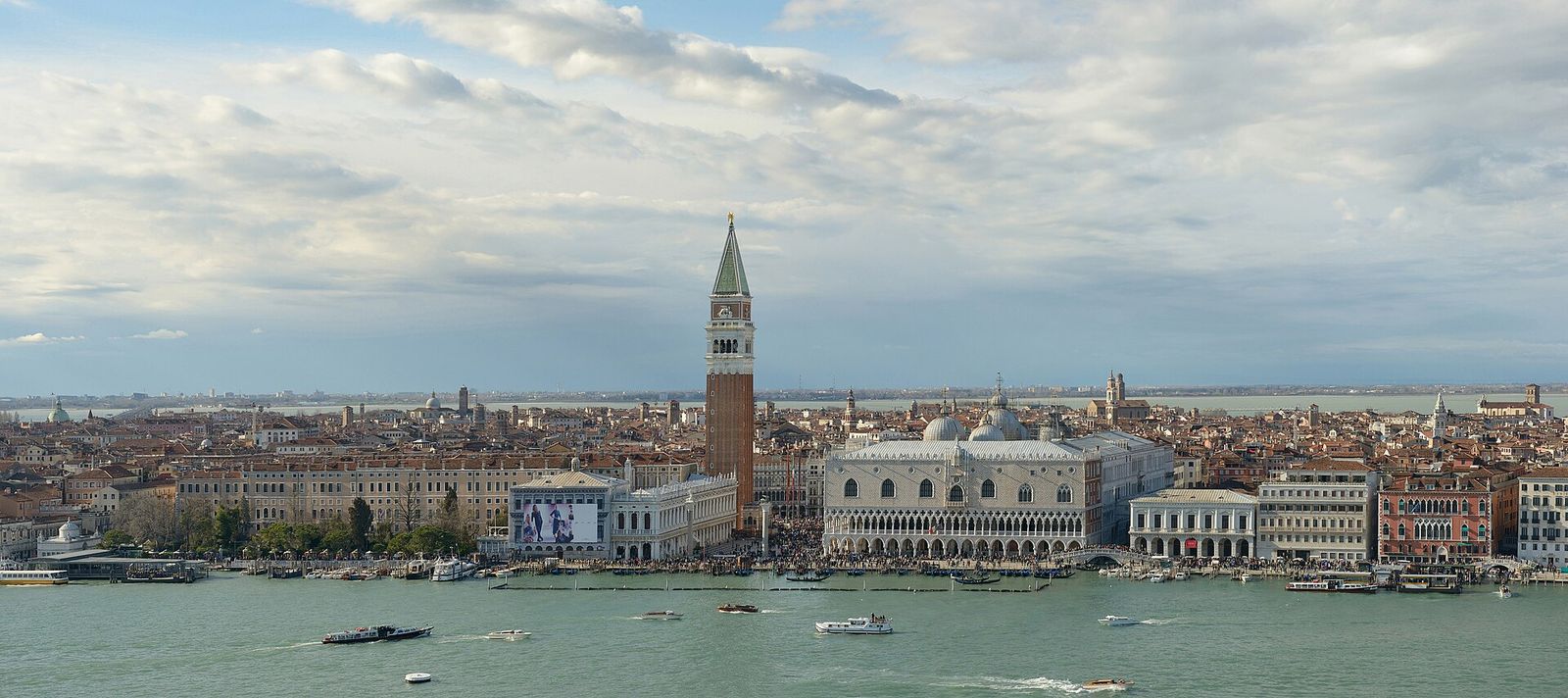
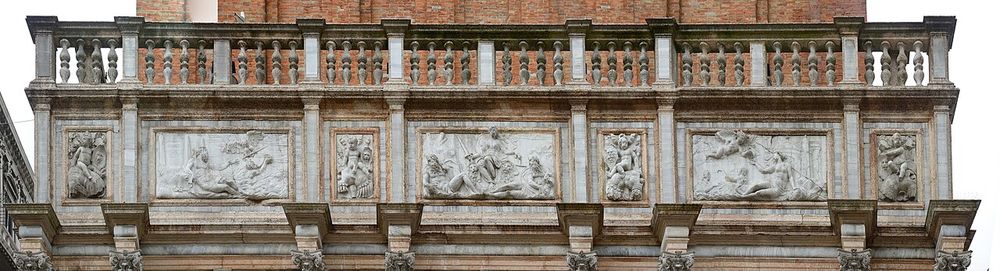
The square and the city from across the waterThis Photo was taken by Wolfgang Moroder. Feel free to use my photos, but please, CC BY-SA 3.0, Wikimedia CommonsThe square from above, in a slide by André CorbozAndré Corboz, CC BY-SA 4.0, Wikimedia CommonsThe bell tower and the palace from the air, over the island of San GiorgioLimlf, CC BY-SA 4.0, Wikimedia CommonsThe bell tower, the library and the Doge's Palace from the lagoonMartin Falbisoner, CC BY-SA 4.0, Wikimedia CommonsThe waterfront from a boatLaima Gūtmane (simka…, CC BY-SA 3.0, Wikimedia CommonsThe Doge's Palace and the bell tower in hazeYair Haklai, CC BY-SA 4.0, Wikimedia CommonsThe north arcade, fifty arches longArmin Kleiner, CC BY-SA 4.0, Wikimedia CommonsThe north arcade and the clock towerThis Photo was taken by Wolfgang Moroder. Feel free to use my photos, but please, CC BY-SA 3.0, Wikimedia CommonsThe south arcade and the bell towerThis Photo was taken by Wolfgang Moroder. Feel free to use my photos, but please, CC BY-SA 3.0, Wikimedia CommonsWindows of the south arcade above FlorianThis Photo was taken by Wolfgang Moroder. Feel free to use my photos, but please, CC BY-SA 3.0, Wikimedia CommonsThe door of FlorianErmell, CC BY-SA 4.0, Wikimedia CommonsA ceiling in the Napoleonic WingArmin Kleiner, CC BY-SA 4.0, Wikimedia CommonsThe bell tower with the little loggia at its footThis Photo was taken by Wolfgang Moroder. Feel free to use my photos, but please, CC BY-SA 3.0, Wikimedia CommonsThe bell tower, 98.6 metresAciarium, CC BY-SA 4.0, Wikimedia CommonsThe belfry and the green spireThis Photo was taken by Wolfgang Moroder. Feel free to use my photos, but please, CC BY-SA 3.0, Wikimedia CommonsThe gilded angel that turns with the windDidier Descouens, CC BY-SA 4.0, Wikimedia CommonsSansovino's loggia, crushed in 1902 and pieced together againThis Photo was taken by Wolfgang Moroder. Feel free to use my photos, but please, CC BY-SA 3.0, Wikimedia CommonsThe reliefs along the top of the loggiaThis Photo was taken by Wolfgang Moroder. Feel free to use my photos, but please, CC BY-SA 3.0, Wikimedia CommonsThe clock towerFernando de Gorocica, CC BY-SA 4.0, Wikimedia CommonsThe clock tower, with the two bronze men on the roofMarie-Lan Nguyen, CC BY 2.5, Wikimedia CommonsThe clock face: hours, zodiac and moonFernando de Gorocica, CC BY-SA 4.0, Wikimedia CommonsThe lion of St Mark on the clock towerDidier Descouens, CC BY-SA 4.0, Wikimedia CommonsSansovino's library on the PiazzettaThis Photo was taken by Wolfgang Moroder. Feel free to use my photos, but please, CC BY-SA 3.0, Wikimedia CommonsThe end of the library facing the waterThis Photo was taken by Wolfgang Moroder. Feel free to use my photos, but please, CC BY-SA 3.0, Wikimedia CommonsThe two columnsThis Photo was taken by Wolfgang Moroder. Feel free to use my photos, but please, CC BY-SA 3.0, Wikimedia CommonsThe columns from the square, with San Giorgio beyondThis Photo was taken by Wolfgang Moroder. Feel free to use my photos, but please, CC BY-SA 3.0, Wikimedia CommonsThe winged lionThis Photo was taken by Wolfgang Moroder. Feel free to use my photos, but please, CC BY-SA 3.0, Wikimedia CommonsThe lion on its columnThis Photo was taken by Wolfgang Moroder. Feel free to use my photos, but please, CC BY-SA 3.0, Wikimedia CommonsSt Theodore and his crocodileDidier Descouens, CC BY-SA 4.0, Wikimedia CommonsHigh water, November 2004This Photo was taken by Wolfgang Moroder. Feel free to use my photos, but please, CC BY-SA 3.0, Wikimedia CommonsThe square as a mirrorSergey Ashmarin, CC BY-SA 3.0, Wikimedia CommonsThe square at nightkallerna, CC BY-SA 4.0, Wikimedia CommonsThe arcades lit at duskAbxbay, CC BY-SA 4.0, Wikimedia CommonsThe north arcade at nightAbxbay, CC BY-SA 4.0, Wikimedia CommonsThe front from the squareZairon, Public domain, Wikimedia CommonsDomes, gables and the horsesZairon, CC BY-SA 4.0, Wikimedia CommonsThe arches of the front from the sideZairon, CC BY-SA 4.0, Wikimedia CommonsThe great arch over the centre doorZairon, CC BY-SA 4.0, Wikimedia CommonsSaints and angels along the top of the south sideThis Photo was taken by Wolfgang Moroder. Feel free to use my photos, but please, CC BY-SA 3.0, Wikimedia CommonsThe five domes from the bell towerDaniel Albrecht, Public domain, Wikimedia CommonsThe front lit at nightZairon, CC BY-SA 4.0, Wikimedia CommonsThe church and the square after darkJosé Luiz, CC BY-SA 4.0, Wikimedia CommonsThe mosaic of about 1265 over the left doorThis Photo was taken by Wolfgang Moroder. Feel free to use my photos, but please, Public domain, Wikimedia CommonsThe left door and its columns of coloured marbleThis Photo was taken by Wolfgang Moroder. Feel free to use my photos, but please, CC BY-SA 3.0, Wikimedia CommonsThe left door, with the church shown inside the pictureMichael Wittwer, CC BY-SA 4.0, Wikimedia CommonsA carved capital on the frontThis Photo was taken by Wolfgang Moroder. Feel free to use my photos, but please, CC BY-SA 3.0, Wikimedia CommonsA procession in the square, painted by Gentile Bellini in 1496Gentile Bellini, Public domain, Wikimedia CommonsThe square painted by Canaletto, about 1723, with the new paving half laidGiovanni Antonio Canal, Public domain, Wikimedia CommonsThe square by Canaletto, about 1730Giovanni Antonio Canal, Public domain, Wikimedia CommonsThe square and the church by Canaletto, 1730Giovanni Antonio Canal, Public domain, Wikimedia CommonsThe heap of bricks on 14 July 1902Unknown authorUnknown author, Public domain, Wikimedia CommonsThe ruins of the bell tower in front of the church, 1902Unknown authorUnknown author, Public domain, Wikimedia CommonsThe square in a lantern slide of about 1913Edmund F. Arras, Public domain, Wikimedia Commons
Video
Films from official channels, played from YouTube. Nothing is loaded until you press play.
Venice and its lagoonUNESCO · made with NHK; 2 min · checked 2026-11-12
Local legends
These are stories people tell about this place. They are legends, not history, and each one says where it comes from.
LegendThe third column
Three columns were brought from the East by ship. One slid into the lagoon as it was unloaded and lies in the mud to this day. The other two lay on the quay for years because no one could raise them, until an engineer did it with wet ropes that shortened as they dried.
Source: Venetian chronicles from the fourteenth century
LegendThe gamblers' reward
The engineer was offered any reward he liked. He asked for the right to keep gaming tables between the two columns, the only place in Venice where dice were allowed. The government agreed, and then made the same spot the place of execution, so that no one would wish to linger.
Source: Venetian tradition, told by Francesco Sansovino in 1581
LegendThe blinded clockmakers
When the clock was finished, the senate had the eyes of the two men who made it put out, so that they could never build another like it for any other city.
Source: Venetian popular legend; the records show the makers were paid and pensioned
LegendThe baker's boy
A young baker found a dead man in the street at dawn, was taken for the murderer and was hanged between the columns. The real killer confessed later. Two small lamps on the side of the church have burned for the boy ever since.
Source: Venetian legend, set in 1507
Later, people who live here will be able to add the stories they grew up with, and say which of these they have heard.
Not certain, and where accounts conflict
Did Napoleon say it?
"The finest drawing room in Europe" is credited to him in almost every guidebook. It has not been found in his letters or in the memoirs of anyone who was with him. A French poet of the next generation is the other candidate.
Where did the lion come from?
It was long thought to be from the eastern Mediterranean, of about 300 BC. The study of 2024 argues for China in the eighth century. The wings, and the book under its paws, were added in Venice. The question is not closed.
Will the gates save the square?
The gates close the lagoon against tides above 110 centimetres. The square begins to flood at about 80. A separate project to seal and drain the square itself was begun in the 2020s; we could not confirm how far it has got.
Is there an entry fee for Venice?
On a number of days in spring and summer, people visiting for the day must register and pay a fee to the city. The dates and the price change each year. We have not checked the city's own page; do so before a day trip.
Visiting
Tickets and hours
The square is free and never closes.
The bell tower costs 15 euros. In summer it opens at 9:30 and closes at 21:15; in winter it closes at 19:15. It shuts in high wind and fog.
The basilica has its own page, with its prices and hours.
A coffee at a table in the square costs several times what it costs standing at a bar in a side street, and the music is charged on top.
Last checked 2026-11-12. The basilica's own ticket site (tickets.basilicasanmarco.it) for the bell tower, as shown in November 2026; the square itself is a public place.
Booking from abroad
Official page in English The square needs no ticket. For the bell tower, the basilica's own shop sells timed tickets in English and takes foreign cards: tickets.basilicasanmarco.it.
Ticket window on site Tickets for the bell tower are also sold at its foot on the day. In summer the queue for the lift can be an hour.
Note The Doge's Palace, the Correr Museum and the clock tower belong to the city museums and have their own tickets, which we have not verified here.
Checked 2026-11-12
Where to start
Water buses 1 and 2 stop at San Marco Vallaresso and at San Zaccaria, each three minutes' walk from the square. On foot from the railway station it is forty minutes, following the yellow signs "Per San Marco".
Come before 8:00 or after 19:00. Between ten and five, in summer, the square is packed.
Go up the bell tower first, for the plan of the whole city; then the basilica; then walk to the columns.
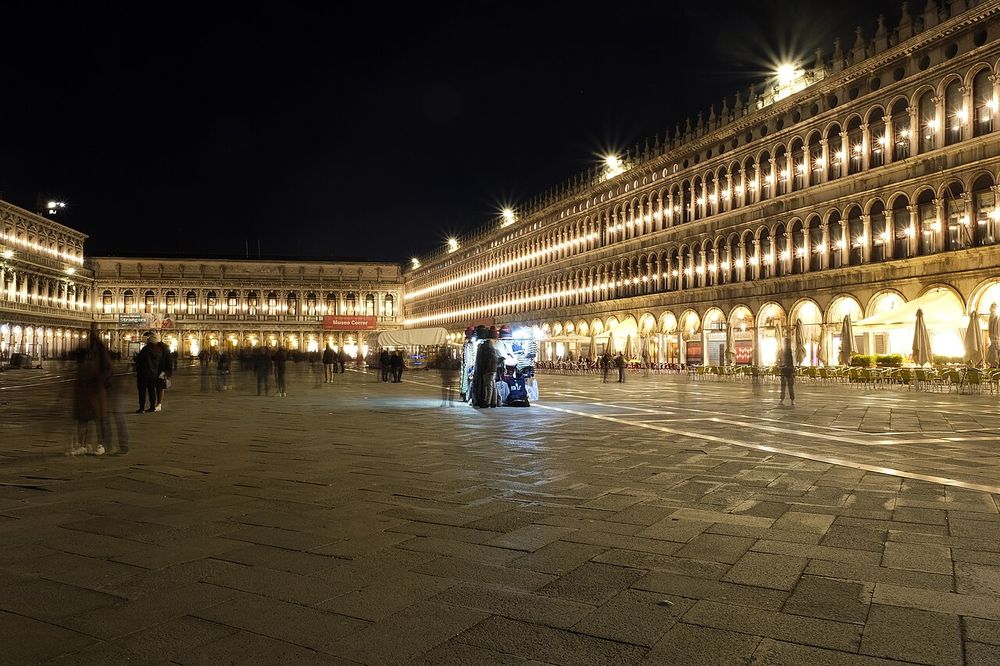
At night, when the day visitors have gone, the cafés' orchestras play to a nearly empty square. You can listen from the arcade for nothing.
Before you go
From October to January look at the tide forecast. High water usually lasts two or three hours and then drains away. Hotels lend boots.
There are no benches. Sitting on the steps and the paving, and eating there, are forbidden, and wardens do fine people.
Wheeled suitcases are hard work here. The bridges between the station and the square all have steps.
Watch your bag in the crowd under the clock tower.
Customs and manners
Do not feed the pigeons or the gulls.
Do not walk about in swimwear or bare-chested, and do not paddle when the square is flooded.
Keep to the right in the narrow streets leading to the square, and do not stop on the bridges.
Venetians greet shopkeepers on entering. "Buongiorno" is enough.
Opening hours are given in the local time of the place. Prices are in the local currency. The figure after ≈ is approximate, at exchange rates checked on 9 November 2026, in .
Look for these
Find the white lines in the paving. Do they run straight to the church?
Count the arches of the north arcade.
At the hour, watch the two bronze men. Which one strikes first?
On the clock face, find the sign of the zodiac for this month.
Find a winged lion. Then find five more.
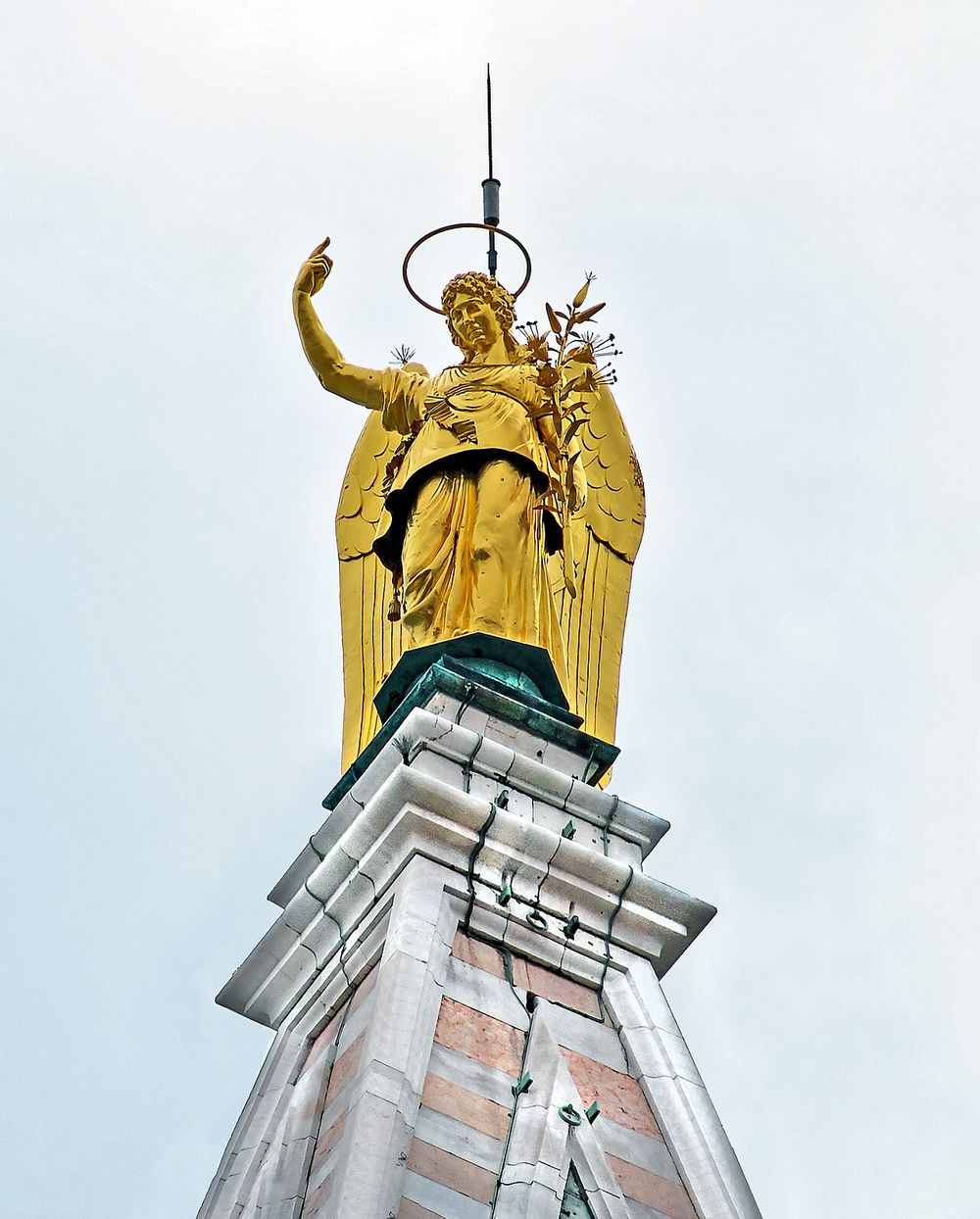
On the bell tower, find the golden angel. Which way is the wind blowing?
At the columns, what is St Theodore standing on?
Look at the base of the columns. Can you find the carvings of people at work, worn almost smooth?
I am here
Stand at the site, sign in, press the button, and collect its stamp. Your browser will ask to use your location. It is sent to us once to confirm that you are at the site; we keep how far you were from it, not the spot where you stood.
Your stamps are saved to your account, so they follow you to any device. Checking from a browser cannot rule out every false location; stricter checks arrive with the app.
Messages
Share your photos
Photos here show the place, not people. Each one is credited to the visitor who took it and appears after our team has looked at it. A photo with you in it belongs under “I am here”.