Basilica di San Marco · bah-ZEE-lee-ka dee san MAR-ko
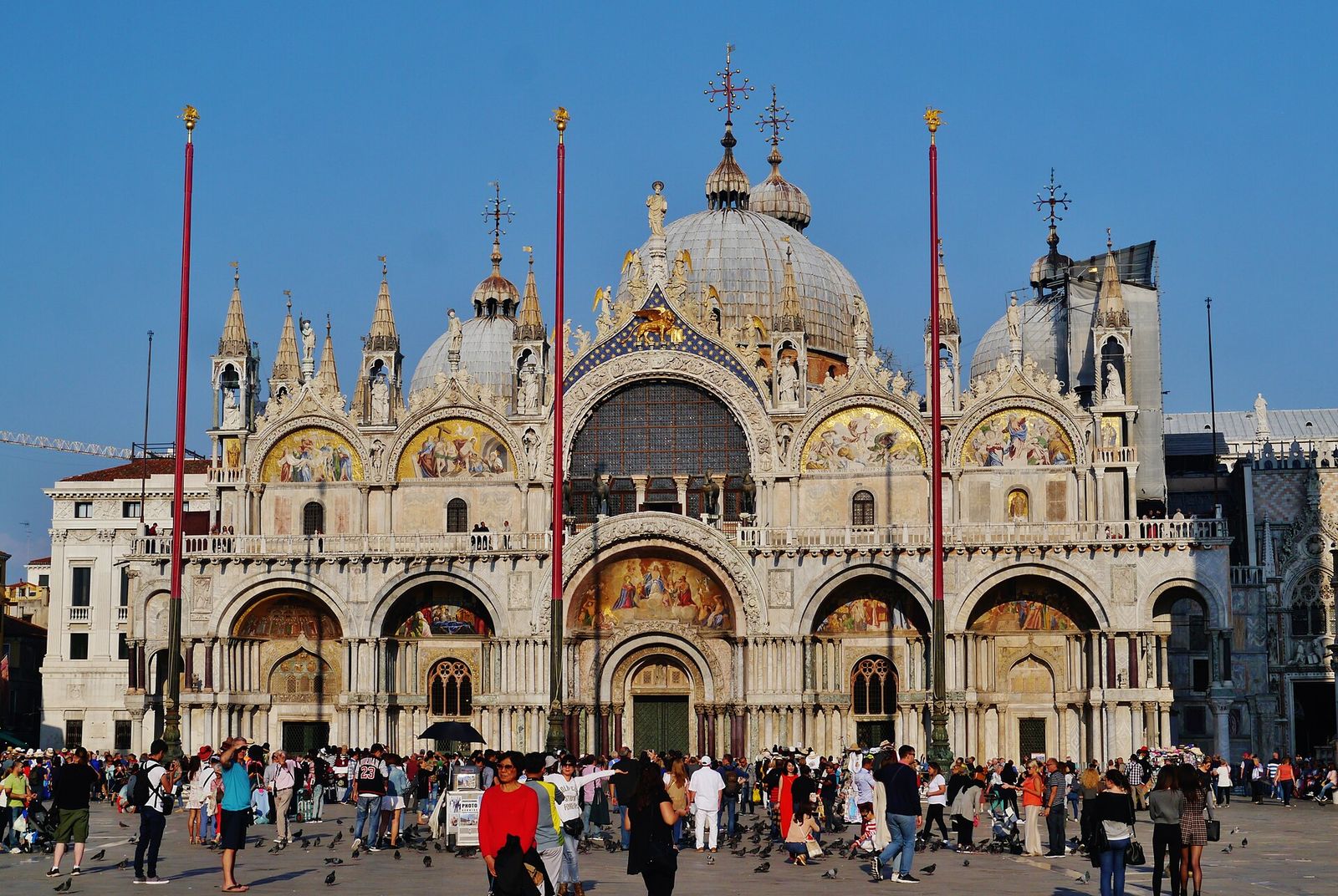
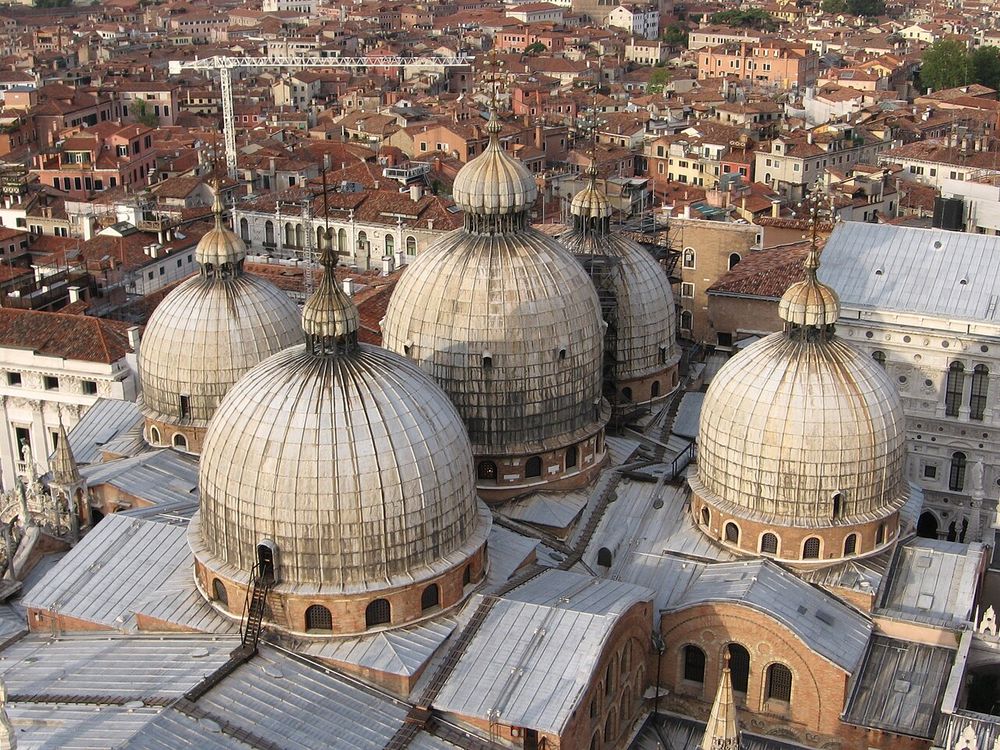
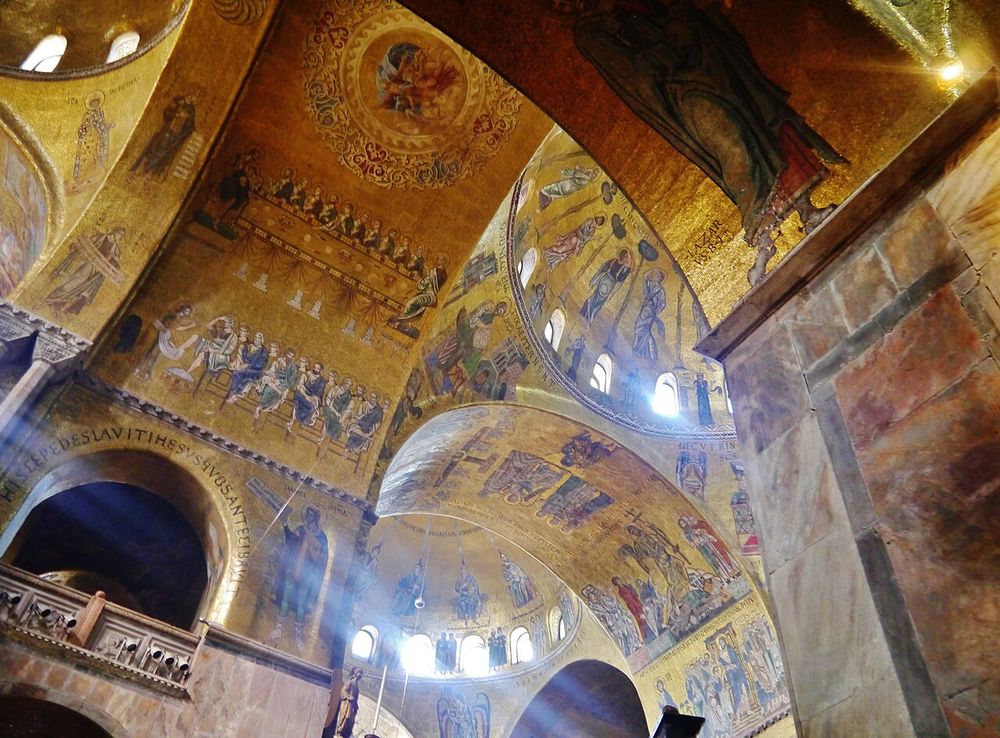
Five domes, four bronze horses and eight thousand square metres of gold mosaic. It was built to hold a body taken from Egypt, and filled with what Venice carried home from Constantinople. For seven hundred years it was the private chapel of the doge.
Photo: Zairon, CC BY-SA 4.0, Wikimedia Commons
The story
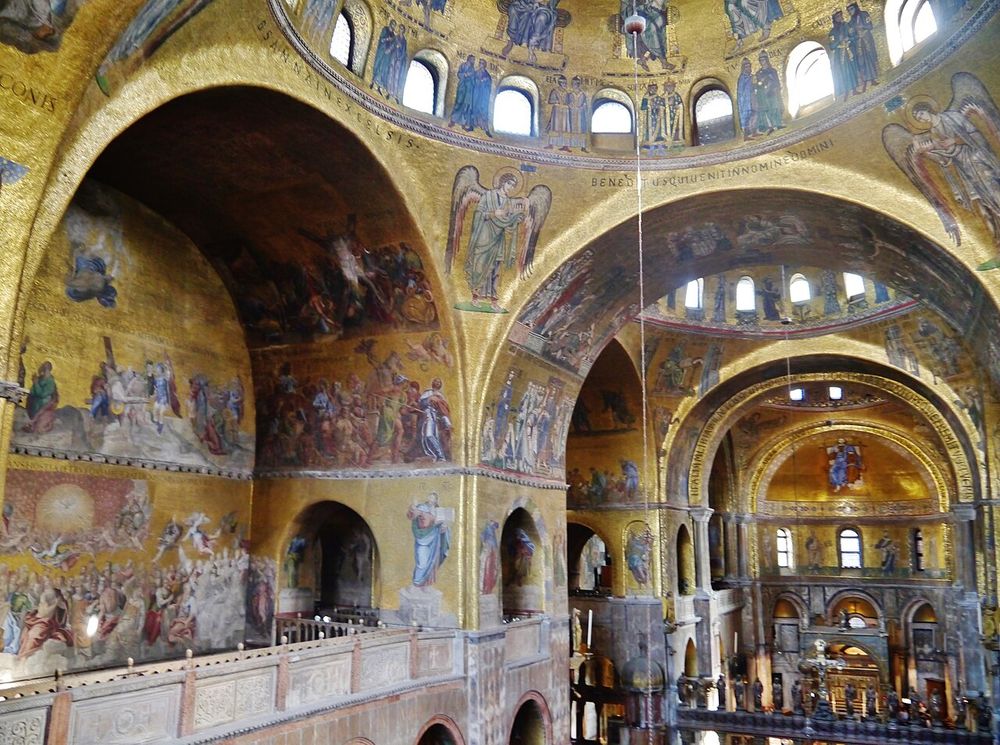
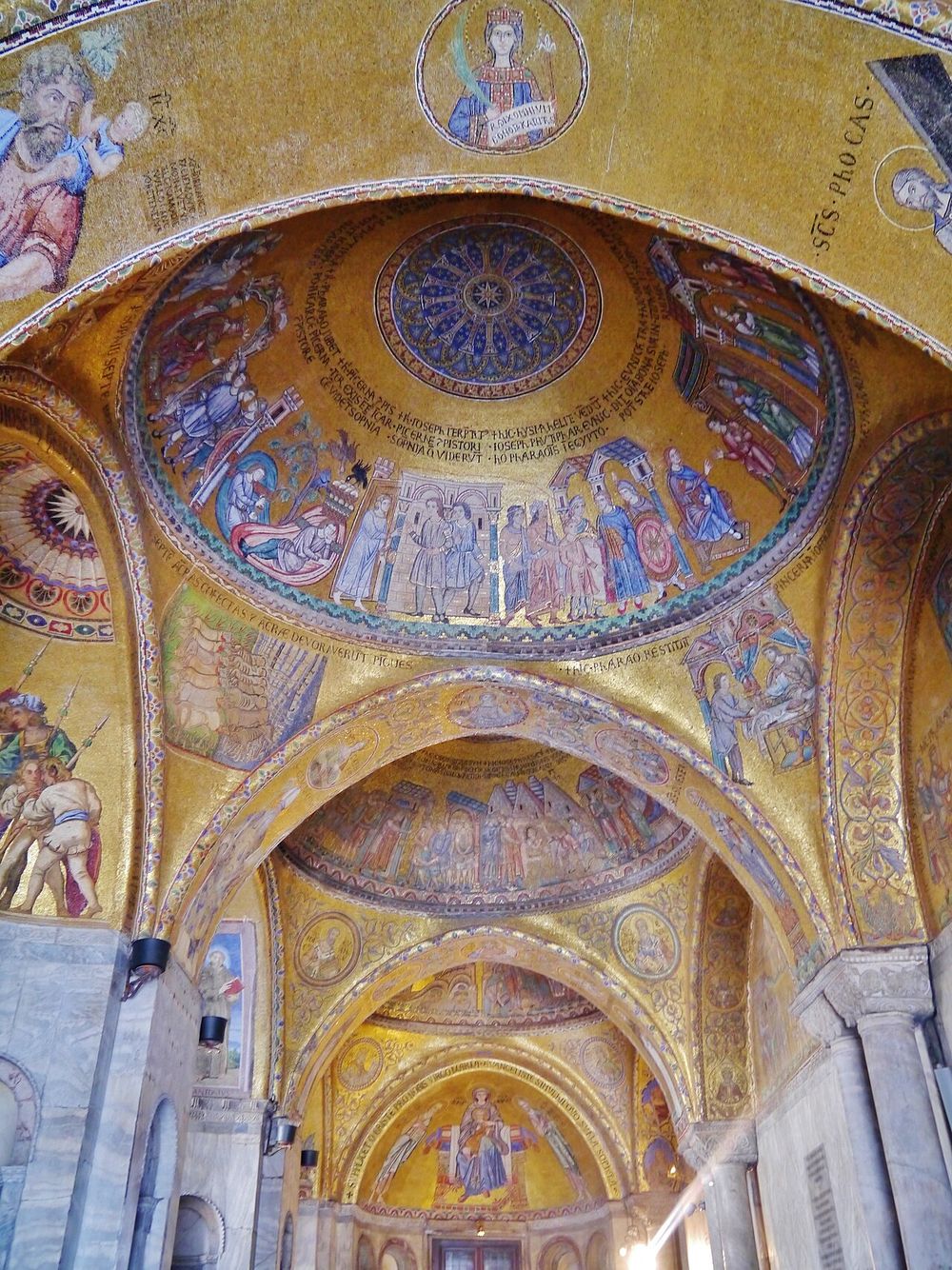
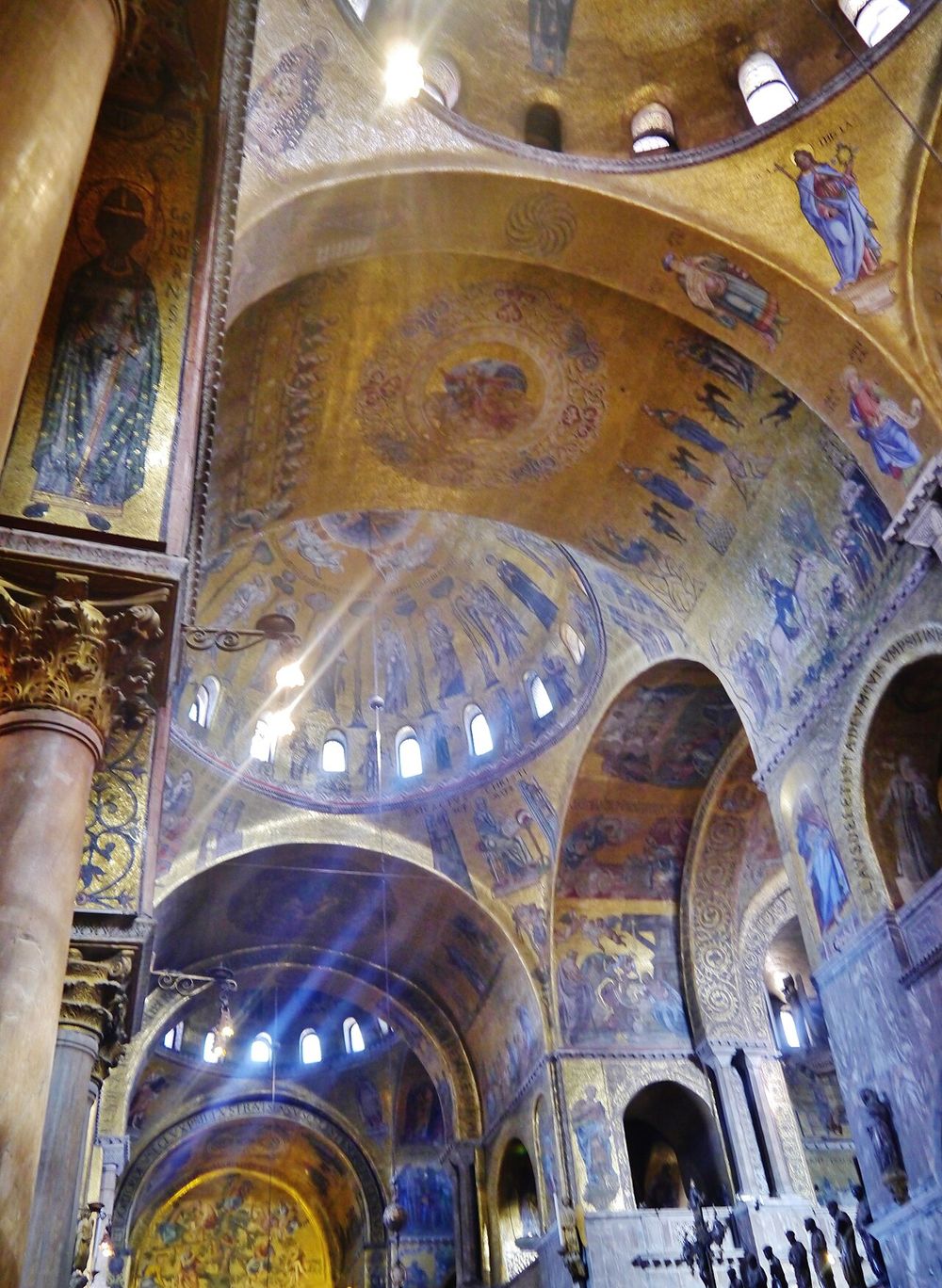
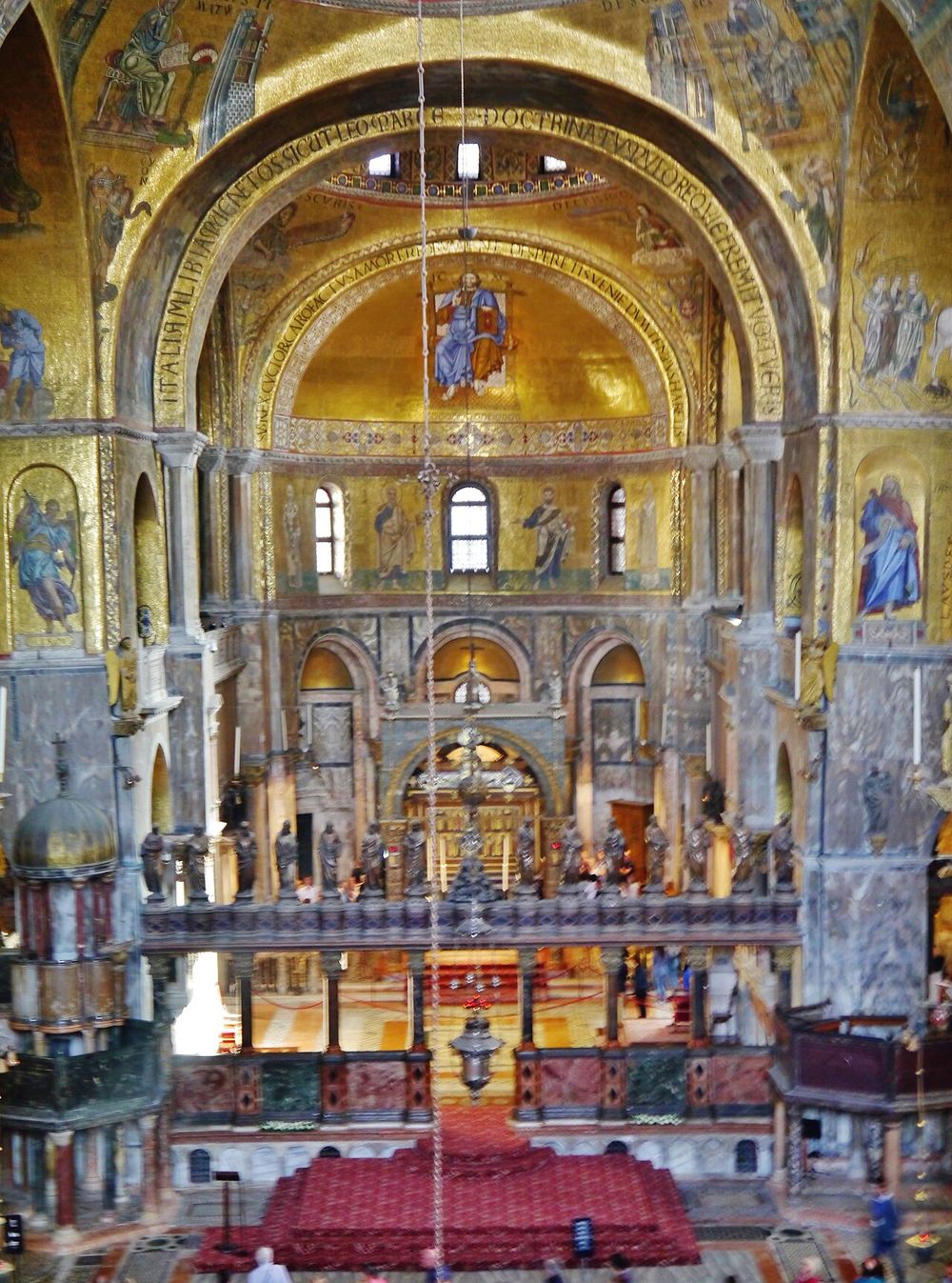
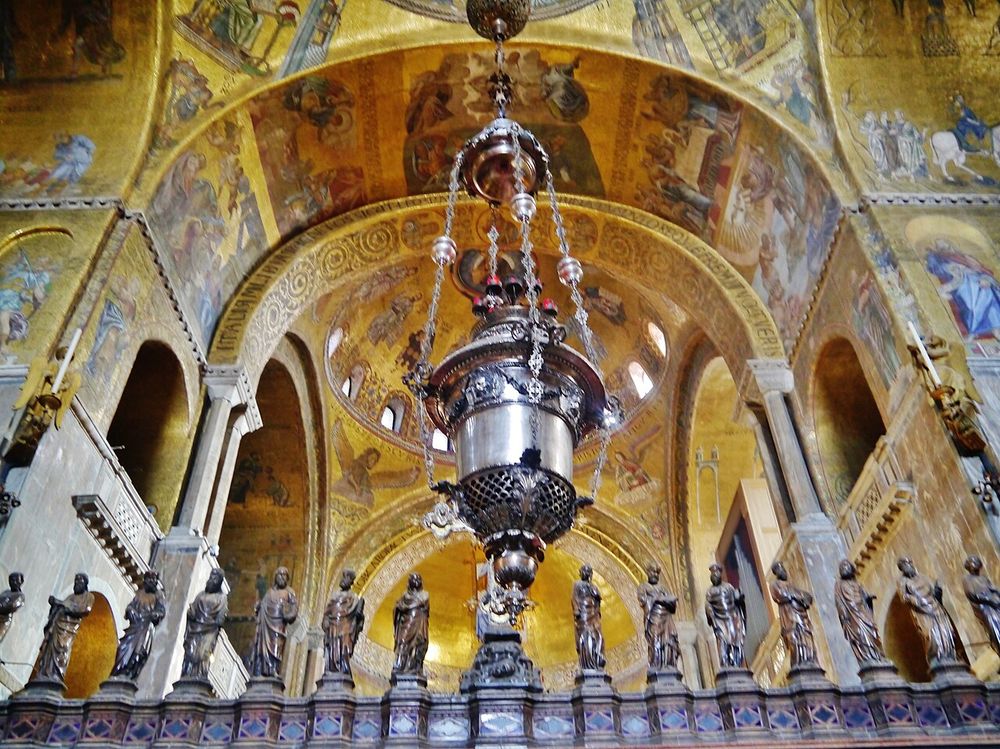
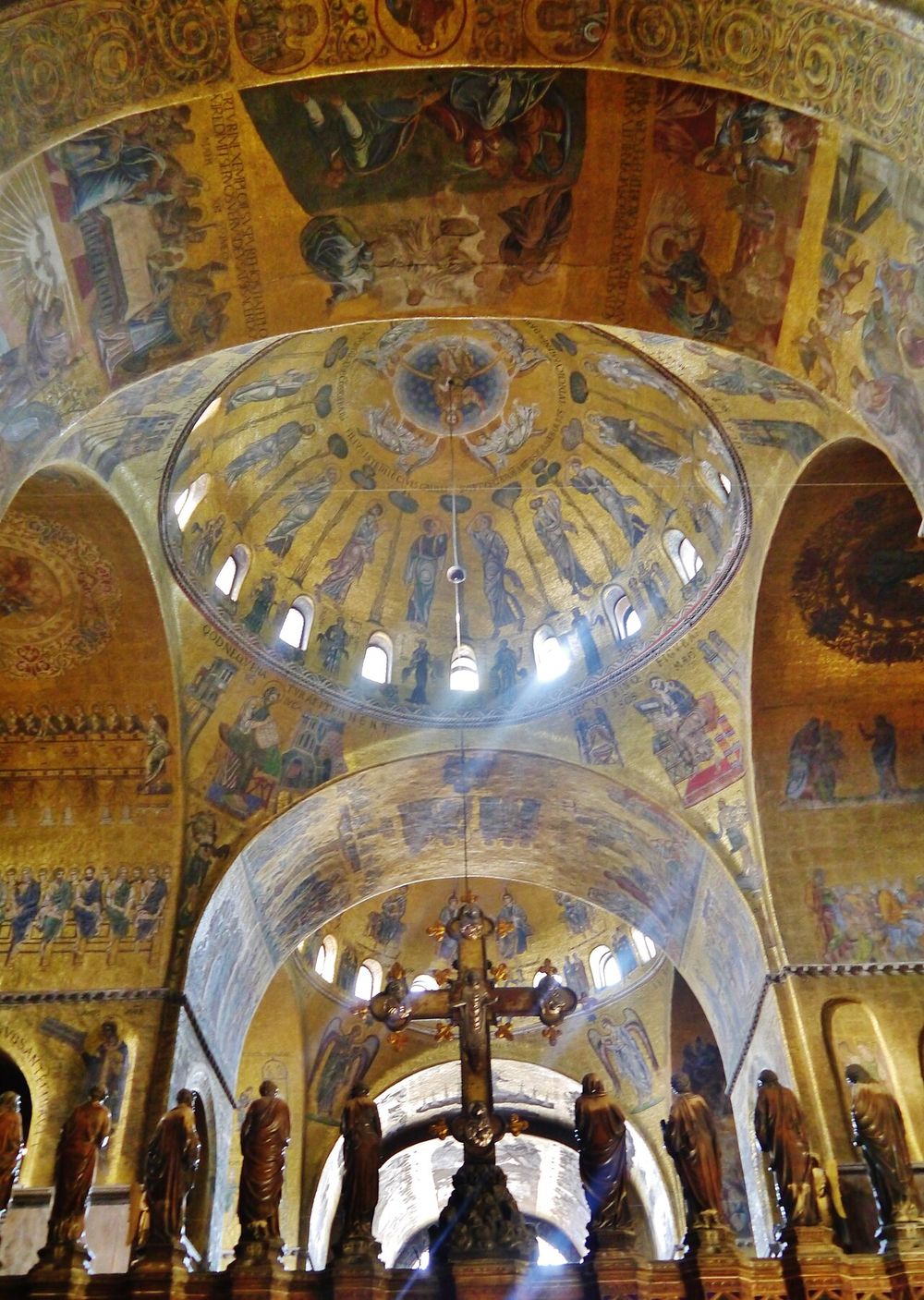
You have stepped out of sunlight into a dim, warm space. As your eyes adjust, the ceiling begins to glow. Every curved surface above you is gold: domes, arches, the undersides of arches, with figures in dark robes standing on the gold as if in air. The floor under your feet rises and falls like a sea.
This church was consecrated in 1094. In China it was the Northern Song (960–1127): in the capital Kaifeng, the official Su Song had just finished a clock tower twelve metres high, driven by water.
The ticket for the church does not cover everything in it. The golden screen and the museum upstairs each cost more, and it is cheaper to buy them together at the start.
In 828 two Venetian merchants came home from Alexandria in Egypt with a body they said was that of St Mark, who wrote one of the four Gospels. A city with an apostle's body ranked with Rome. Venice made Mark its patron and his winged lion its badge.
This is the third church built over the body. Its plan is a cross with four equal arms and a dome over each arm and the centre. It was copied from a church in Constantinople, the capital of the Greek-speaking Roman empire, which Venice traded with, admired and envied.
In 1204 a crusading army carried by Venetian ships sacked Constantinople. The horses over the door, the purple statues at the corner, much of the gold and enamel on the altar, and the columns of coloured marble on the front all came home in the fleet.
The mosaics took the next two hundred years. Look up, and then look down.
Things people often get wrong
"It was always the cathedral of Venice." It was the doge's own chapel until 1807. The city's cathedral was a plain church at the far eastern end of the town.
"The horses outside are the ancient ones." Those are copies. The real four are indoors, upstairs, out of the salt air.
"The mosaics are painted gold." Each small cube is clear glass with a leaf of real gold sealed inside it. They are set at slightly different angles so that the surface flickers.
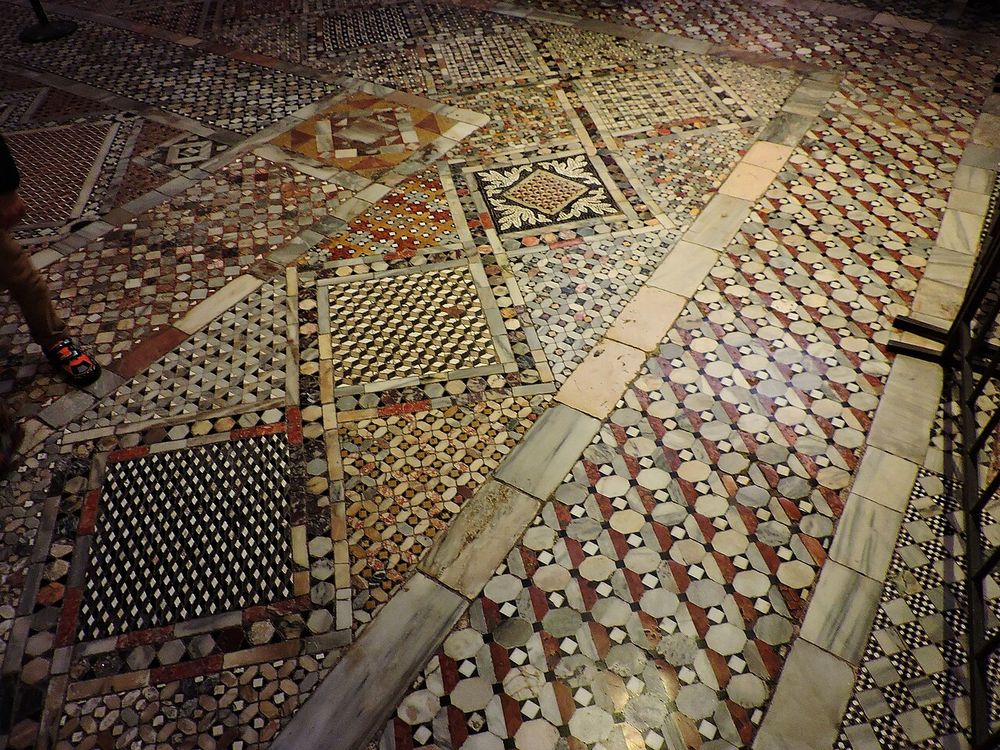
"The floor is uneven because it is badly kept." The church stands on wooden piles driven into mud, and the ground has settled unevenly for nine hundred years.
"It is free." Worshippers at Mass enter free by a side door. Visitors pay, and book a time.
People who stood here
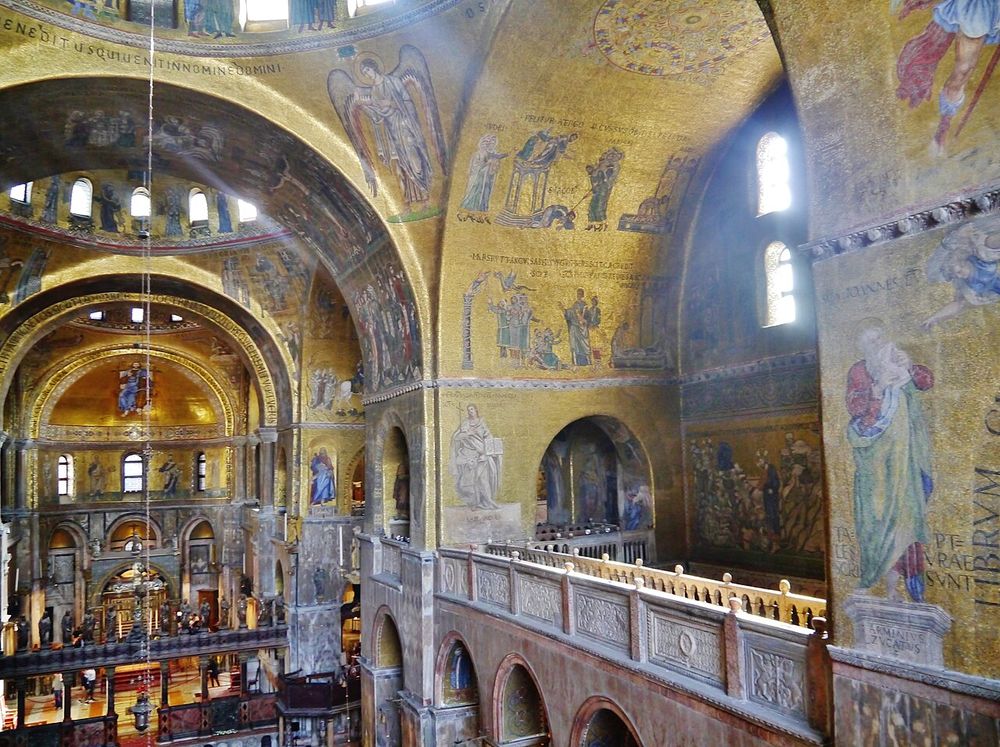
Claudio Monteverdi (Italian composer of the first great operas)He was master of music here from 1613 until his death in 1643. Singers and players stood in the galleries on both sides, so that the sound answered itself across the church, and he wrote for that.
Antonio Vivaldi (Venetian composer of The Four Seasons)His father was a violinist in the basilica's orchestra. The pay lists for Christmas 1696 record the son, aged eighteen, as an extra violin. He may have played in the gallery above you.
Frederick Barbarossa (German emperor, 1155–1190)On 24 July 1177, after years of war with the pope, he knelt before him in the entrance hall of this church and kissed his foot. A diamond of red stone in the floor marks the place.
Go deeper: eight stops, from the left door to the horses
The stops begin outside at the left end of the front, go through the entrance hall, round the church and up the stairs.
1. The left door
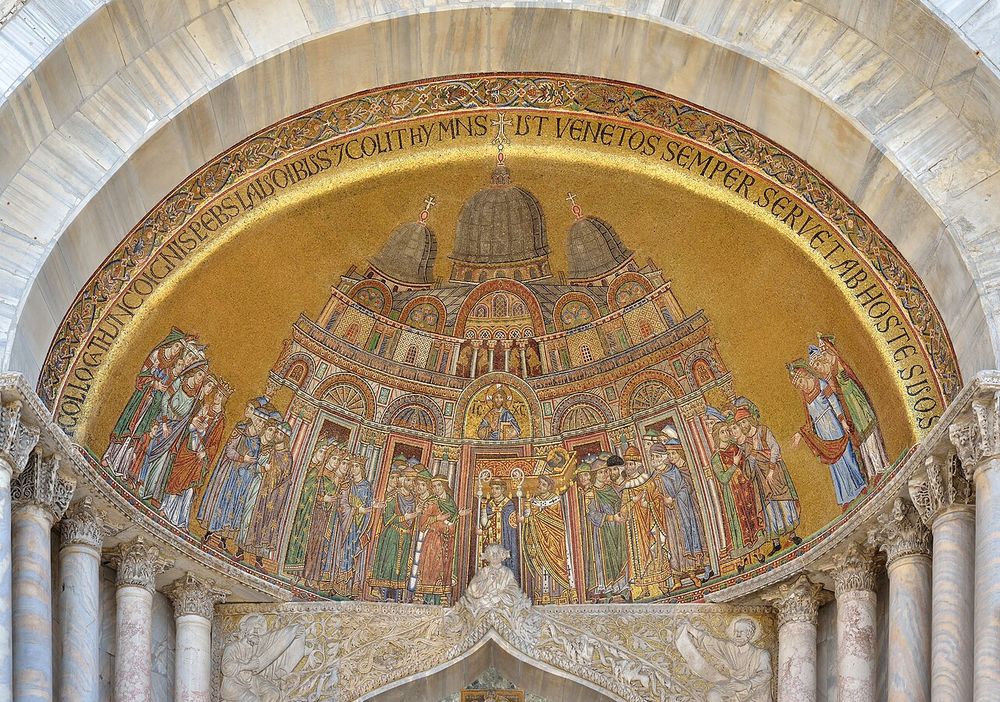
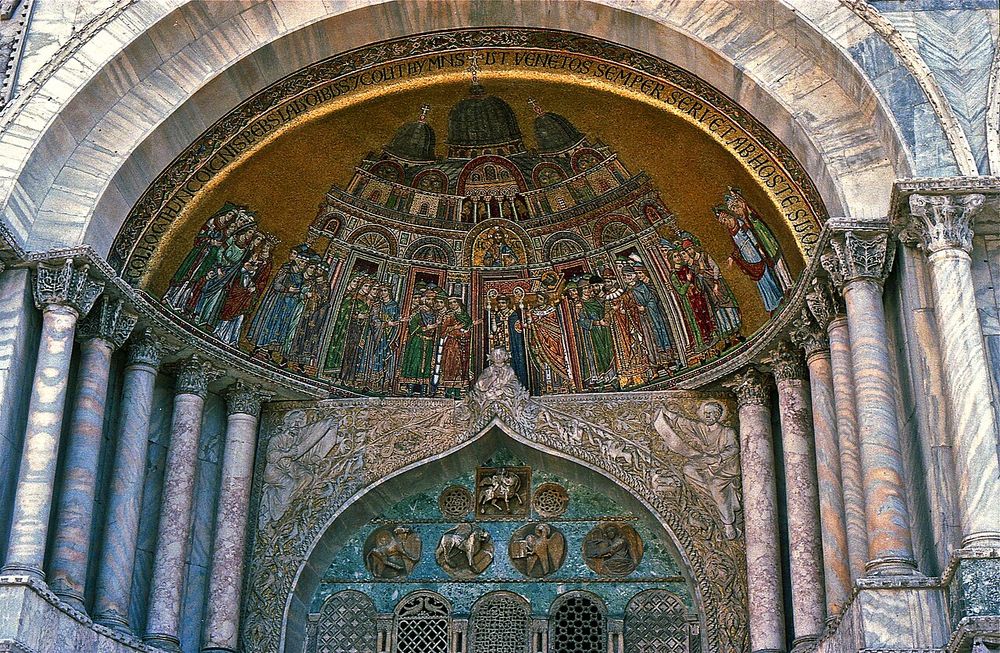
The mosaic of about 1265 over the left doorThis Photo was taken by Wolfgang Moroder. Feel free to use my photos, but please, Public domain
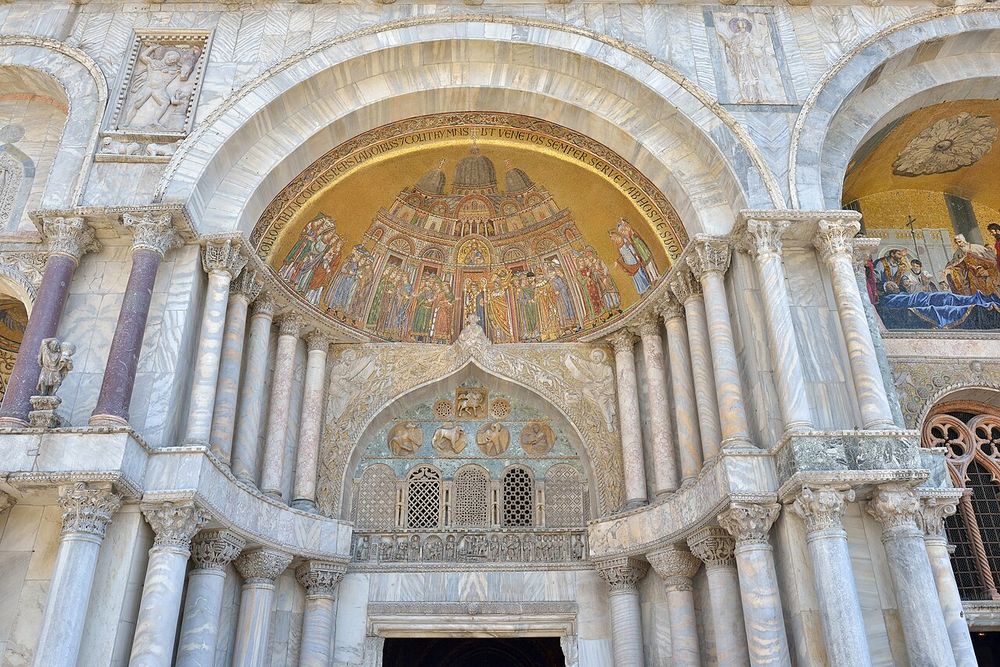
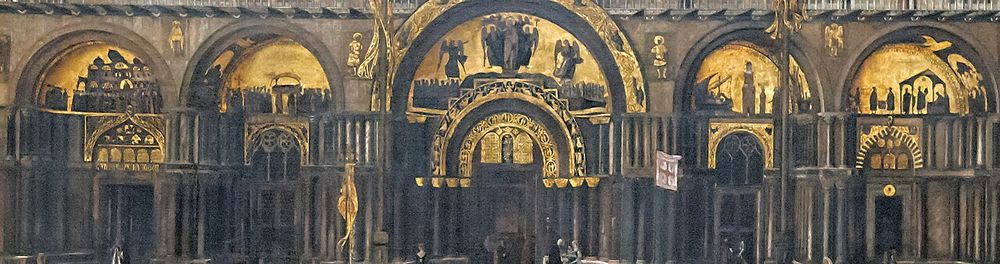
Four of the five mosaics over the doors were remade in later centuries. The one on the far left is of about 1265 and is the only one that is old. It shows the body of St Mark being carried into this church.
Look closely at the church in the picture. It has the domes and the horses. It is the oldest view of the building, made when the horses had been on it for about ten years.
2. The corner of purple stone
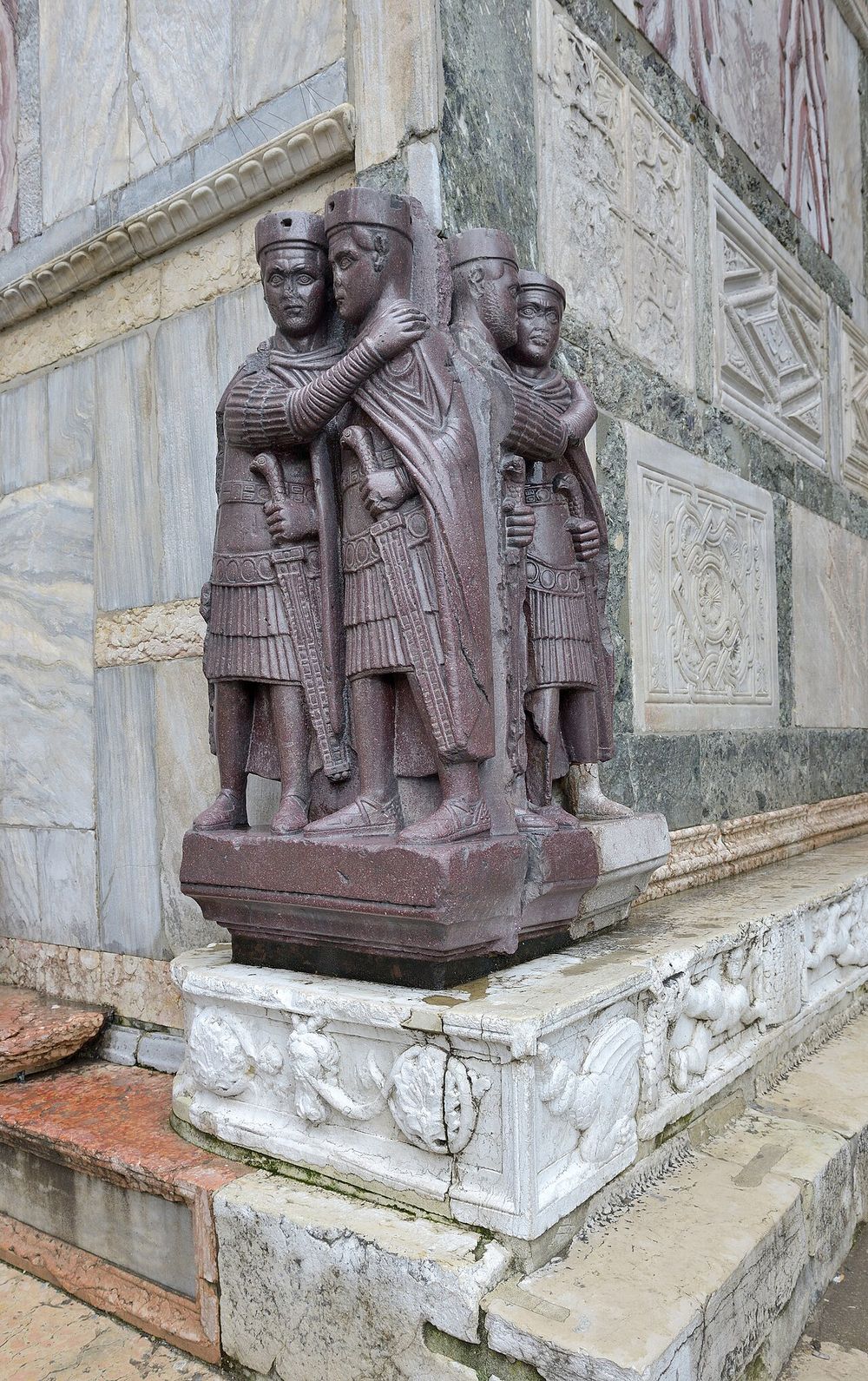
The four emperors in porphyryArchaeodontosaurus, CC BY-SA 4.0
Walk round to the right-hand corner, by the gate of the palace. Four men in armour, carved in dark purple stone, hold each other by the shoulder. They are the four rulers who shared the Roman empire about the year 300.
The stone is porphyry from Egypt, reserved for emperors. The group stood in Constantinople until 1204. One figure has a white foot: the original was left behind. It was dug up in Istanbul in the 1960s and is in the museum there.
3. The entrance hall
The dome of the CreationNicola Quirico, CC BY-SA 4.0
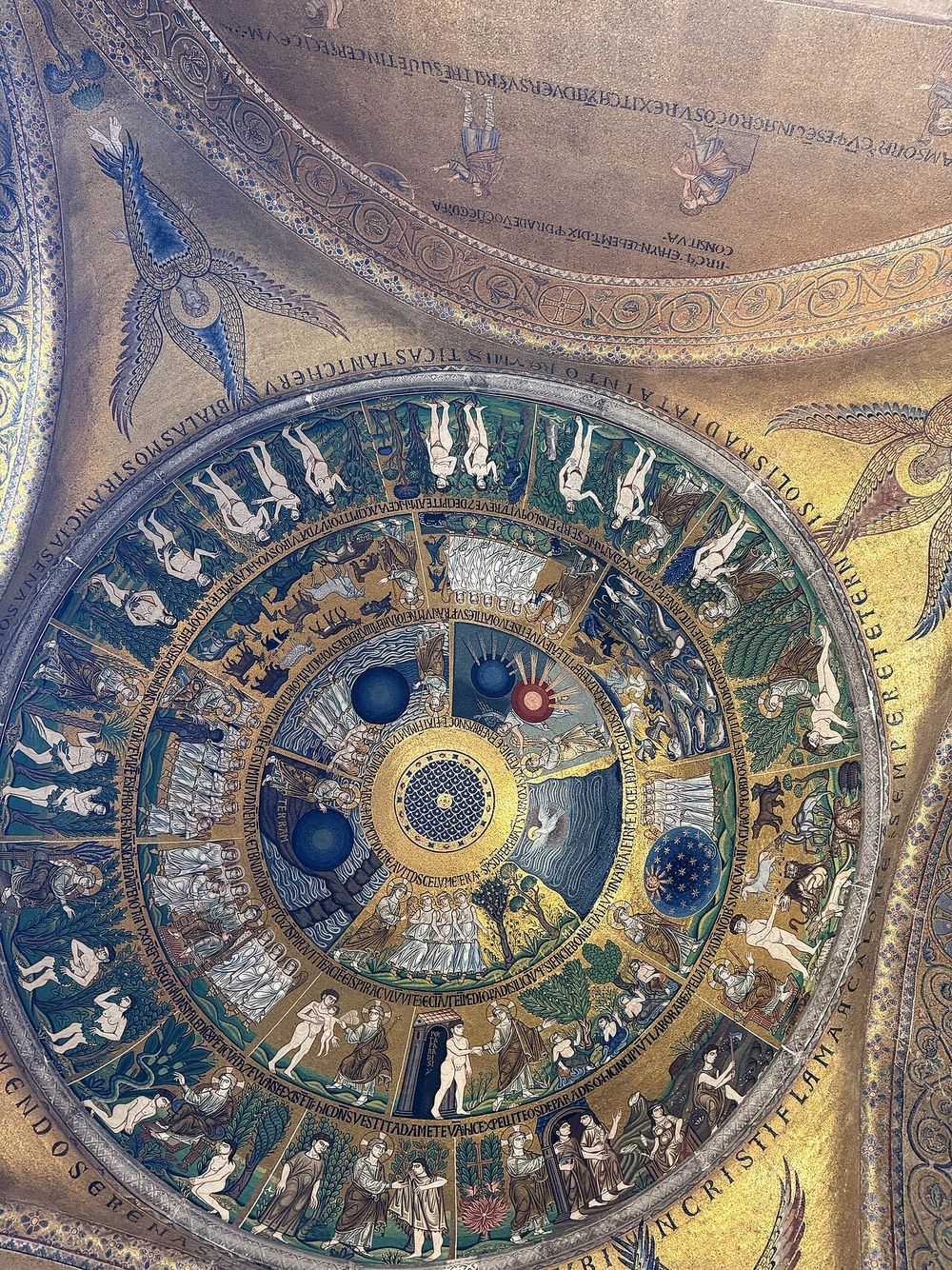
Inside the door, before the church itself, is a long hall with small domes. Look straight up into the first one on the right. In three rings and twenty-six scenes it tells the making of the world, day by day, from the first light to Adam and Eve leaving the garden.
Count the angels beside the Creator in each scene. There is one on the first day, two on the second, and so on to six. The mosaic was made about 1220 and copied from a Greek picture Bible seven hundred years older.
4. The floor
The marble floorDimitris Kamaras from Athens, Greece, CC BY 2.0
The floor is the same age as the walls. It is made of thousands of pieces of coloured marble and glass, cut into triangles, squares and circles and fitted into patterns like the carpets Venice bought in the East.
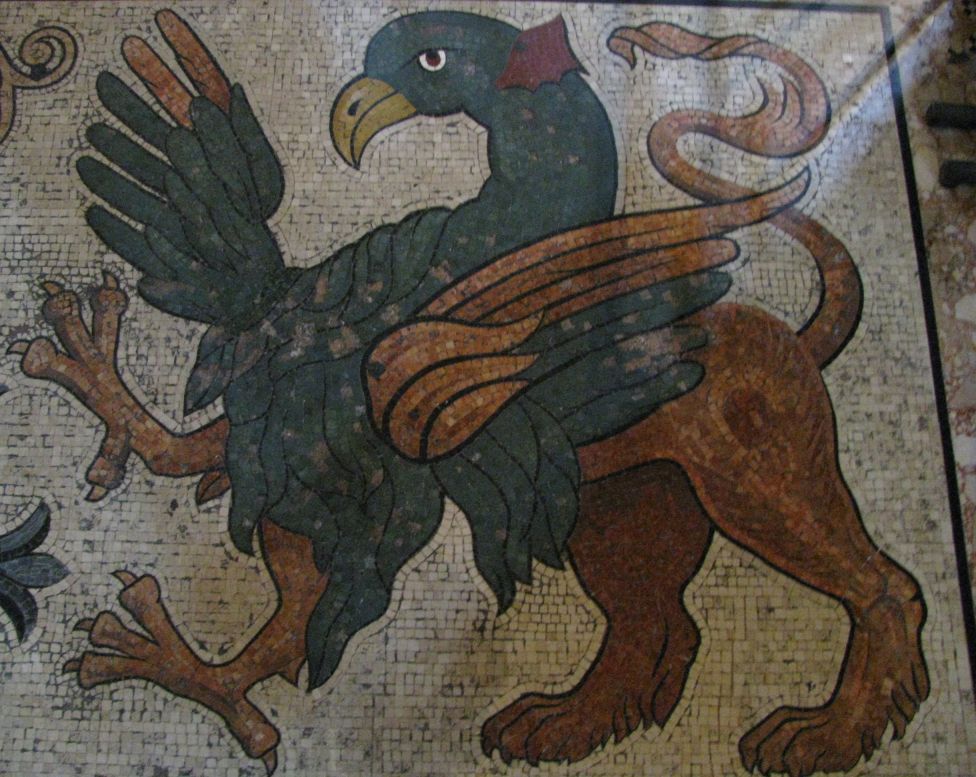
A griffin in the flooruser:Testus, CC BY-SA 3.0
Among the patterns are animals: peacocks, eagles, a griffin. In one panel two cocks carry a fox slung from a pole. Nobody is sure what it means.
5. The domes
The dome of PentecostZairon, CC BY-SA 4.0
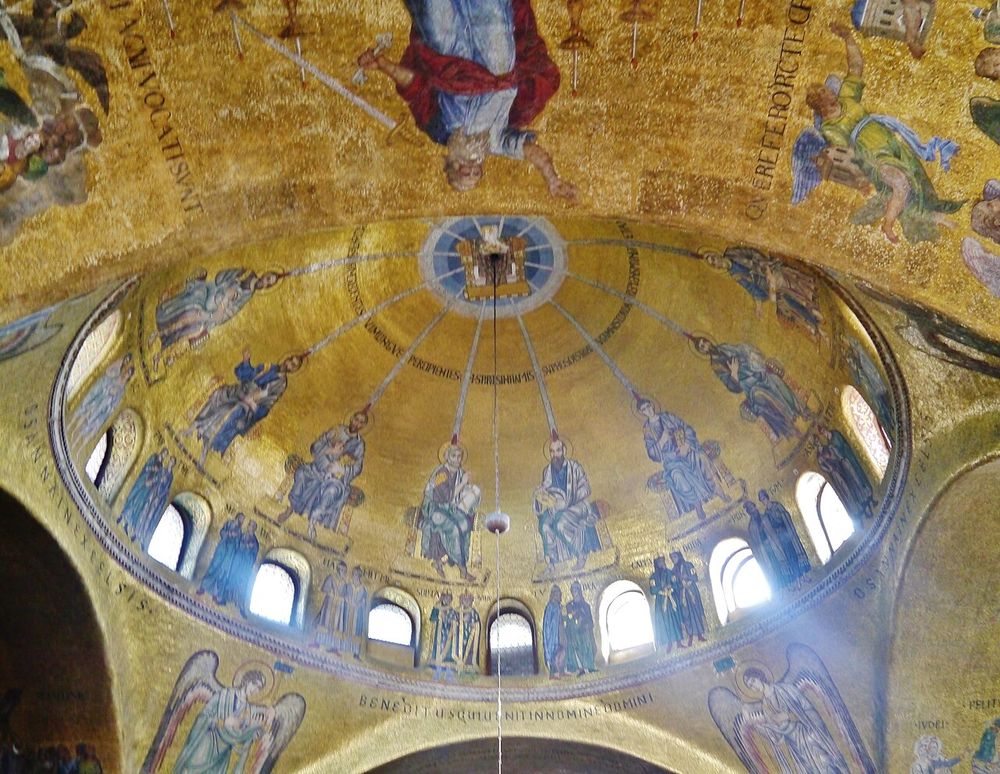
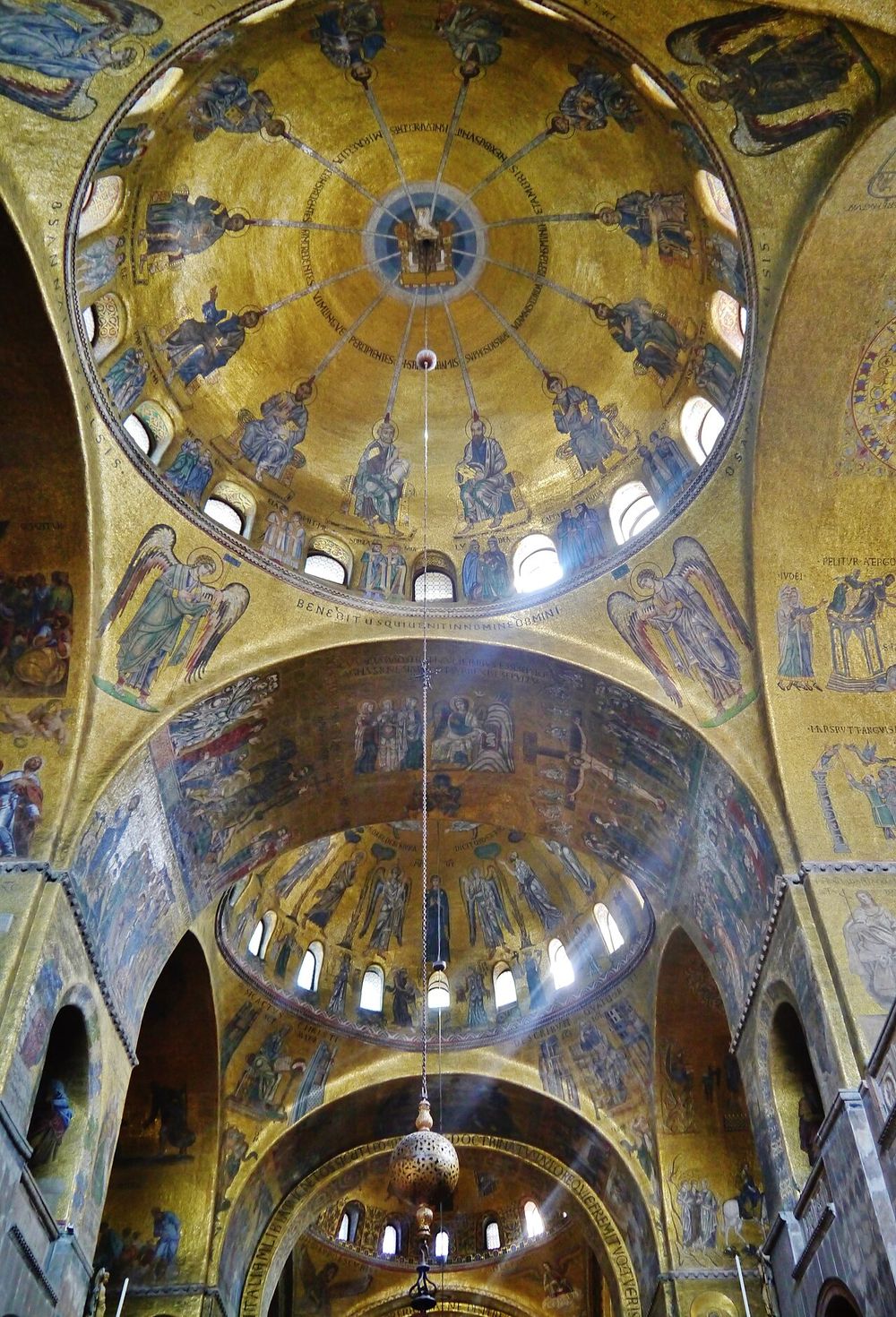
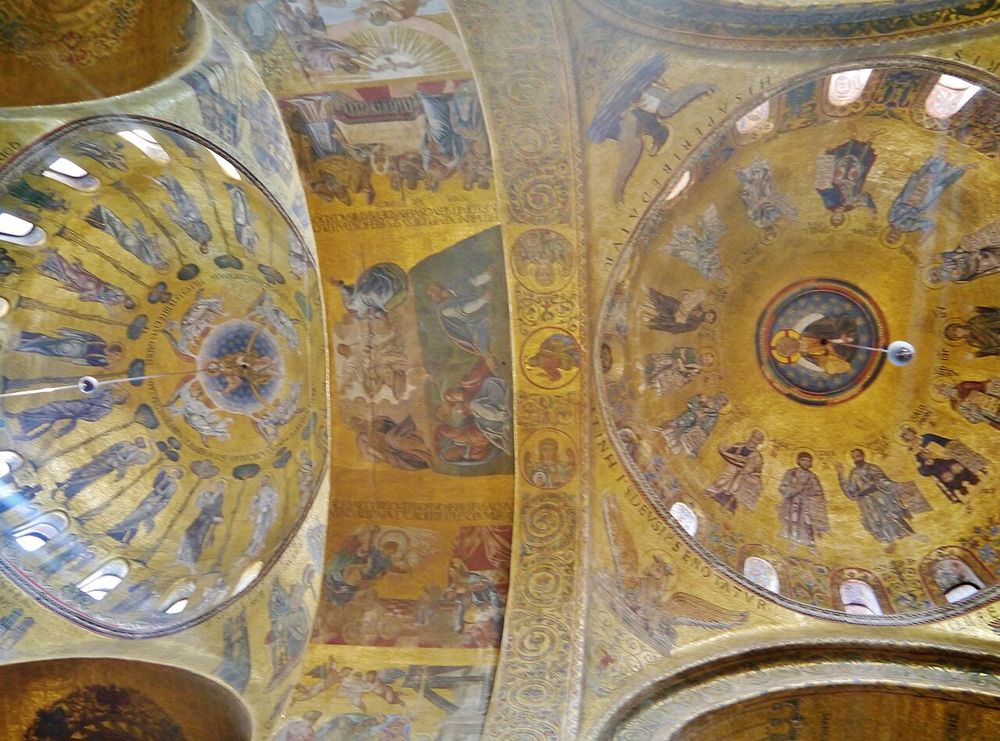
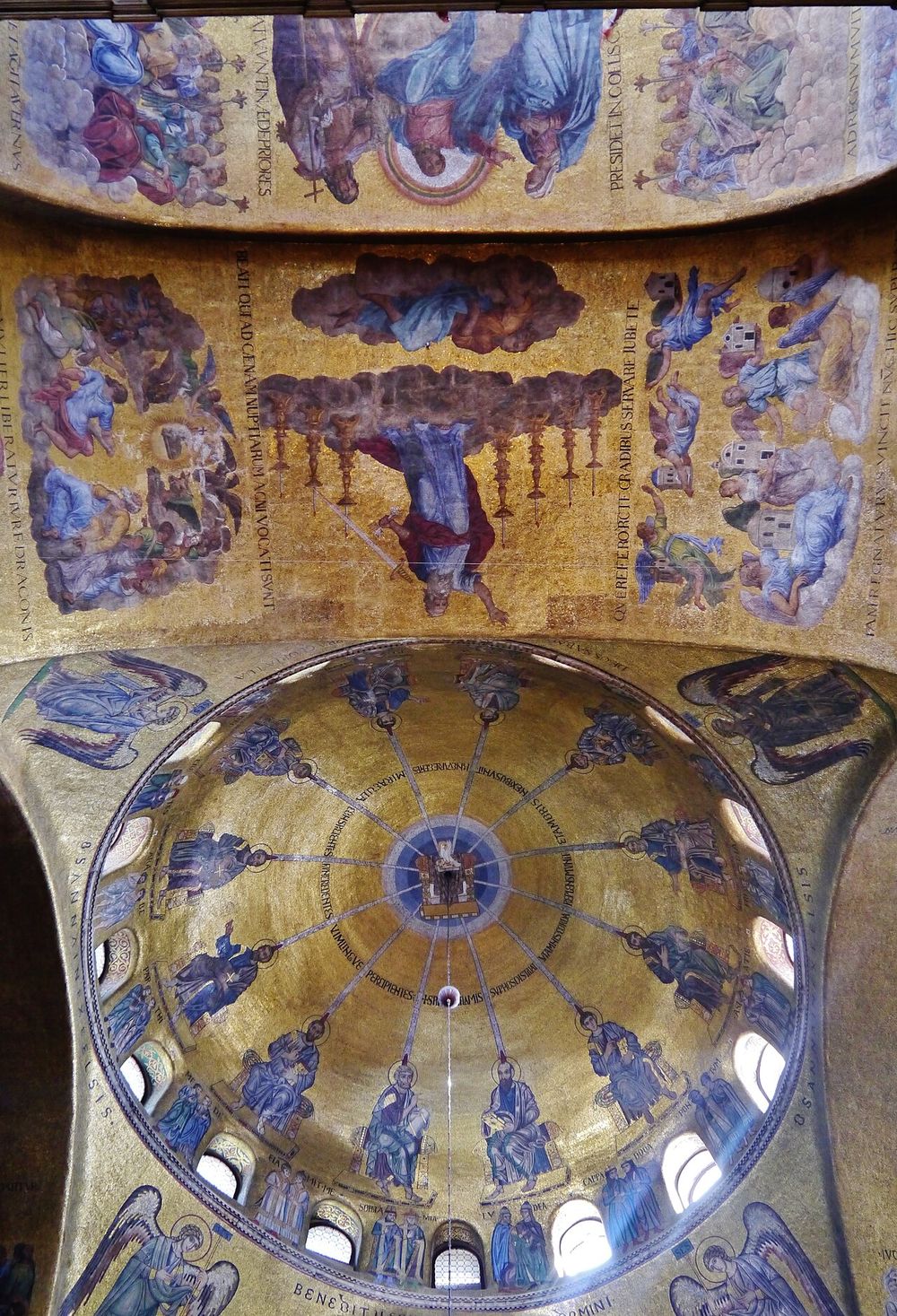
Read the domes from the door to the altar. In the first, a dove sits on a throne at the centre and twelve rays run down to the twelve followers of Christ. Between the windows below them stand the peoples of the world in pairs, each in its own dress, hearing the message in its own language.
The dome of the AscensionUnknown authorUnknown author, Public domain
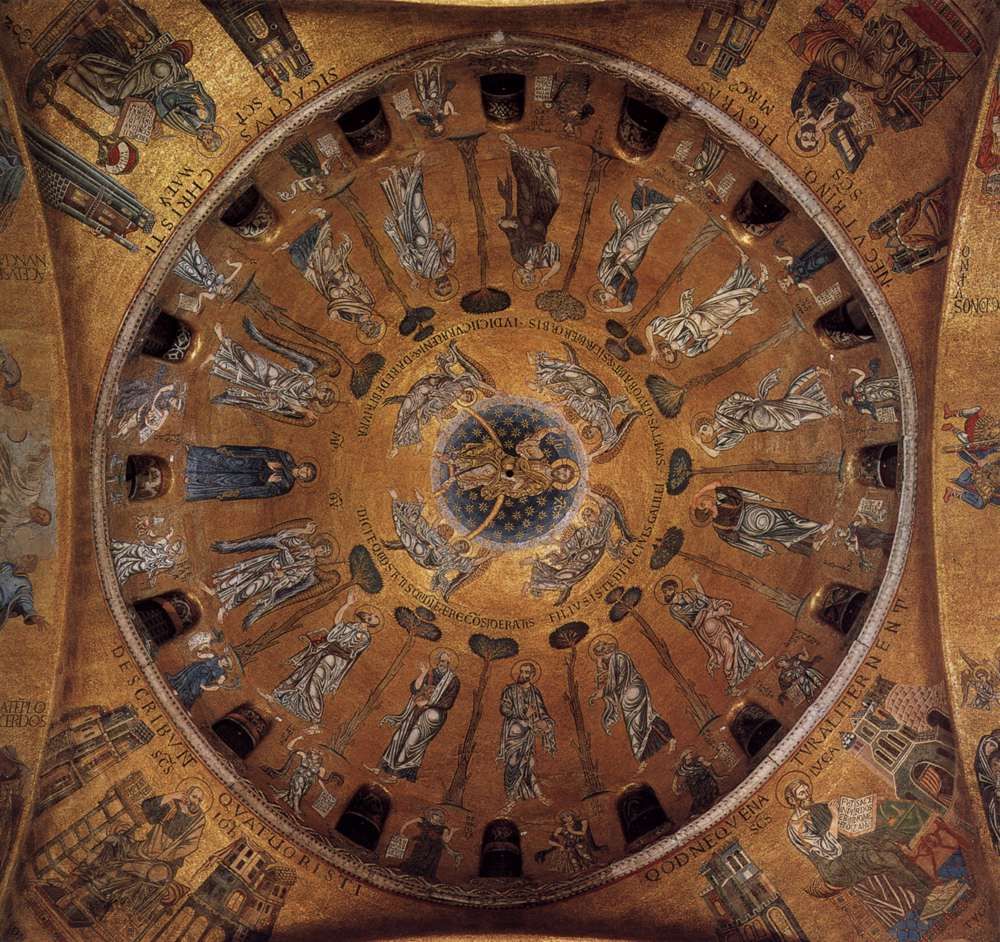
In the central dome Christ rises into a sky of stars, carried by four angels. Round the rim stand his mother, two angels and the twelve, with trees between them.
The gold is not a background. To the people who made it, it was the light of heaven, and the figures stand in it.
6. The golden screen
The golden screenDimitris Kamaras from Athens, Greece, CC BY 2.0
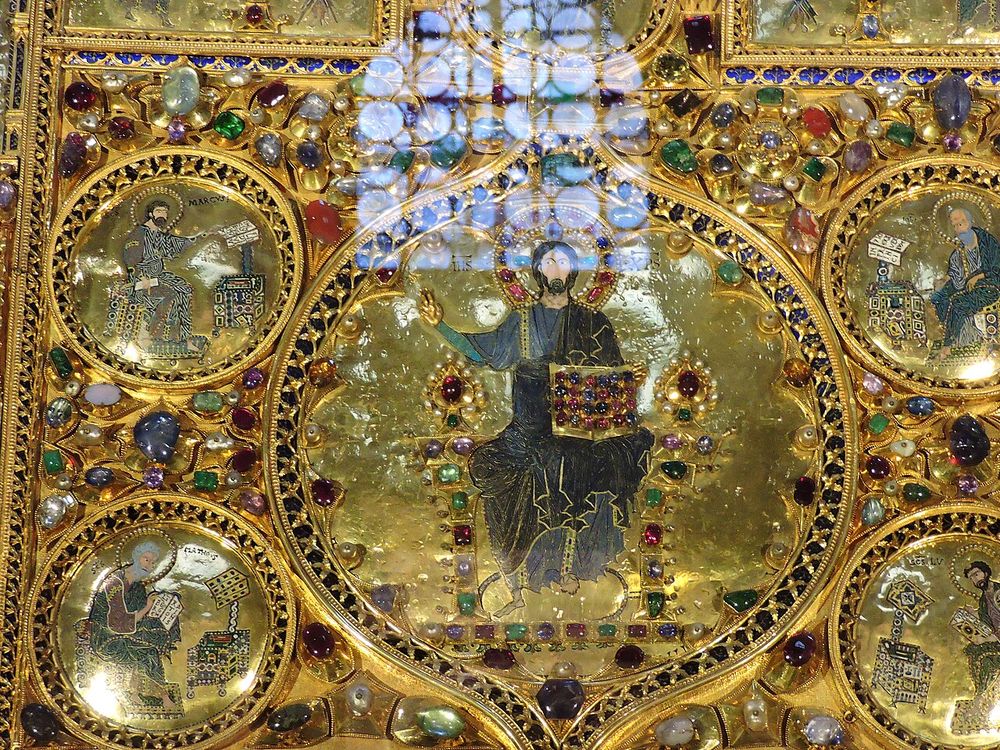
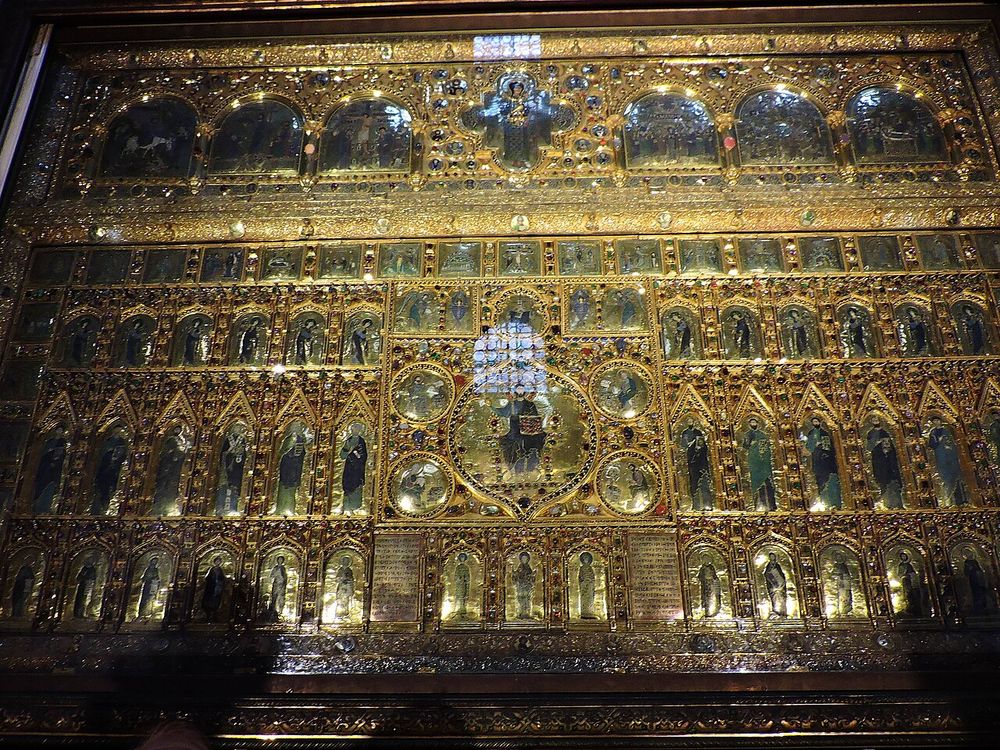
Behind the high altar, facing away from the church, is a panel of gold three metres wide and two high. It was ordered from Constantinople in 976, enlarged twice, and put in its present frame in 1345.
Christ at the centre of the golden screenDimitris Kamaras from Athens, Greece, CC BY 2.0
It carries about 250 small pictures in enamel and nearly two thousand stones: pearls, garnets, emeralds, sapphires, amethysts and rubies. The stones are polished round, not cut, because the cutting of gems had not yet been invented.
Under the altar in front of it is the stone coffin of St Mark.
7. The treasury
Cups from Constantinople in the treasuryDimitris Kamaras from Athens, Greece, CC BY 2.0
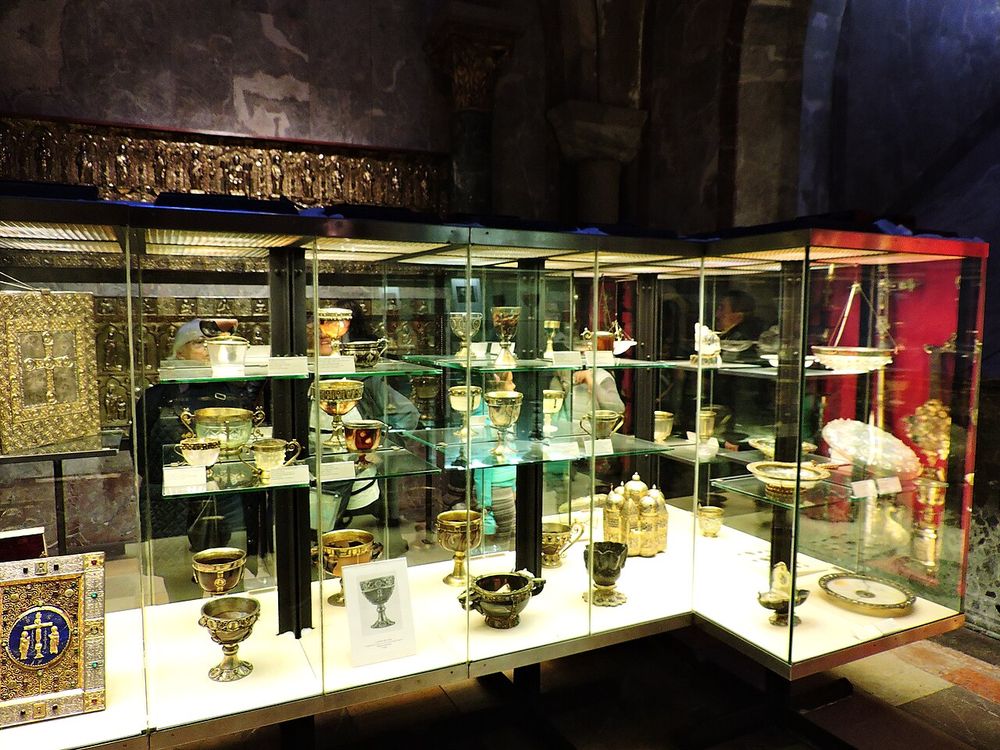
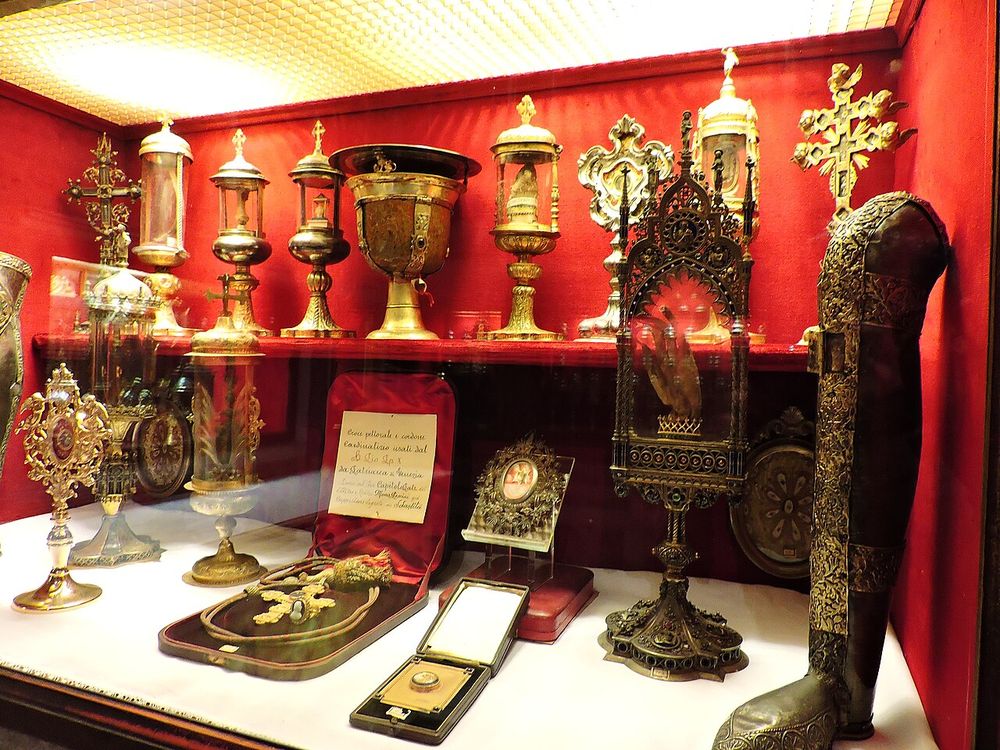
A door in the right arm of the church leads to a small room with very thick walls. It was a tower of the first doge's castle. It holds cups of rock crystal, agate and coloured glass mounted in gold, made in Constantinople for emperors and taken in 1204.
Much of what the crusaders took was melted down in 1797 to pay Napoleon. These pieces survived because they were thought to be worth more as relics than as metal.
8. The horses
The four horses, indoorsHorses_of_Basilica_San_Marco.jpg: Tteske derivative work: Morn (talk), Public domain
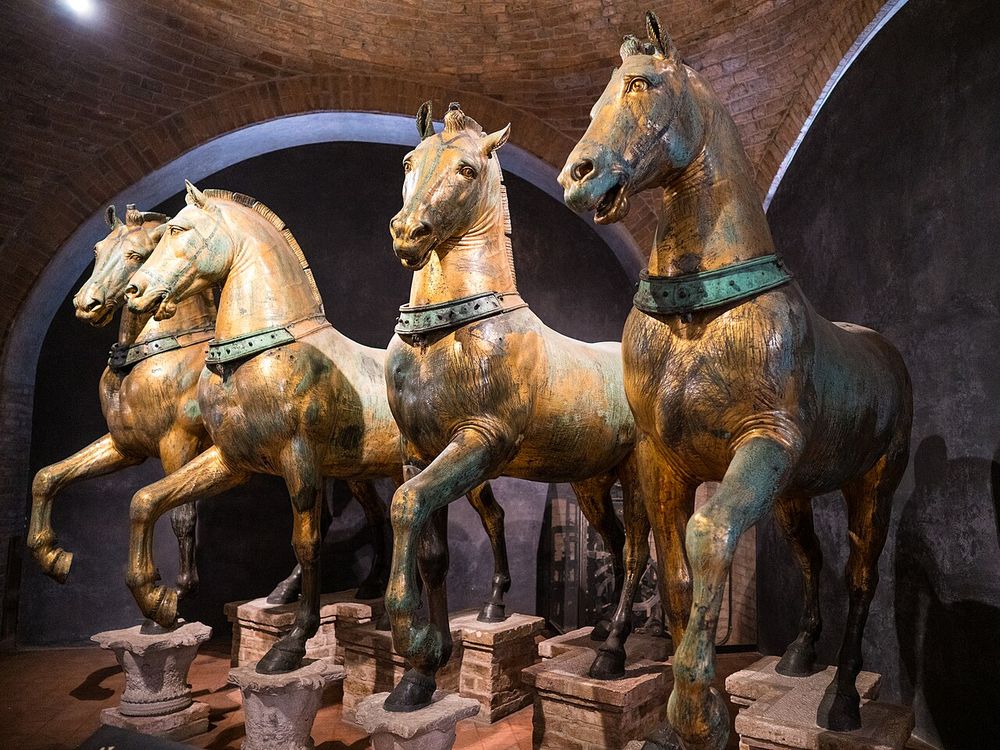
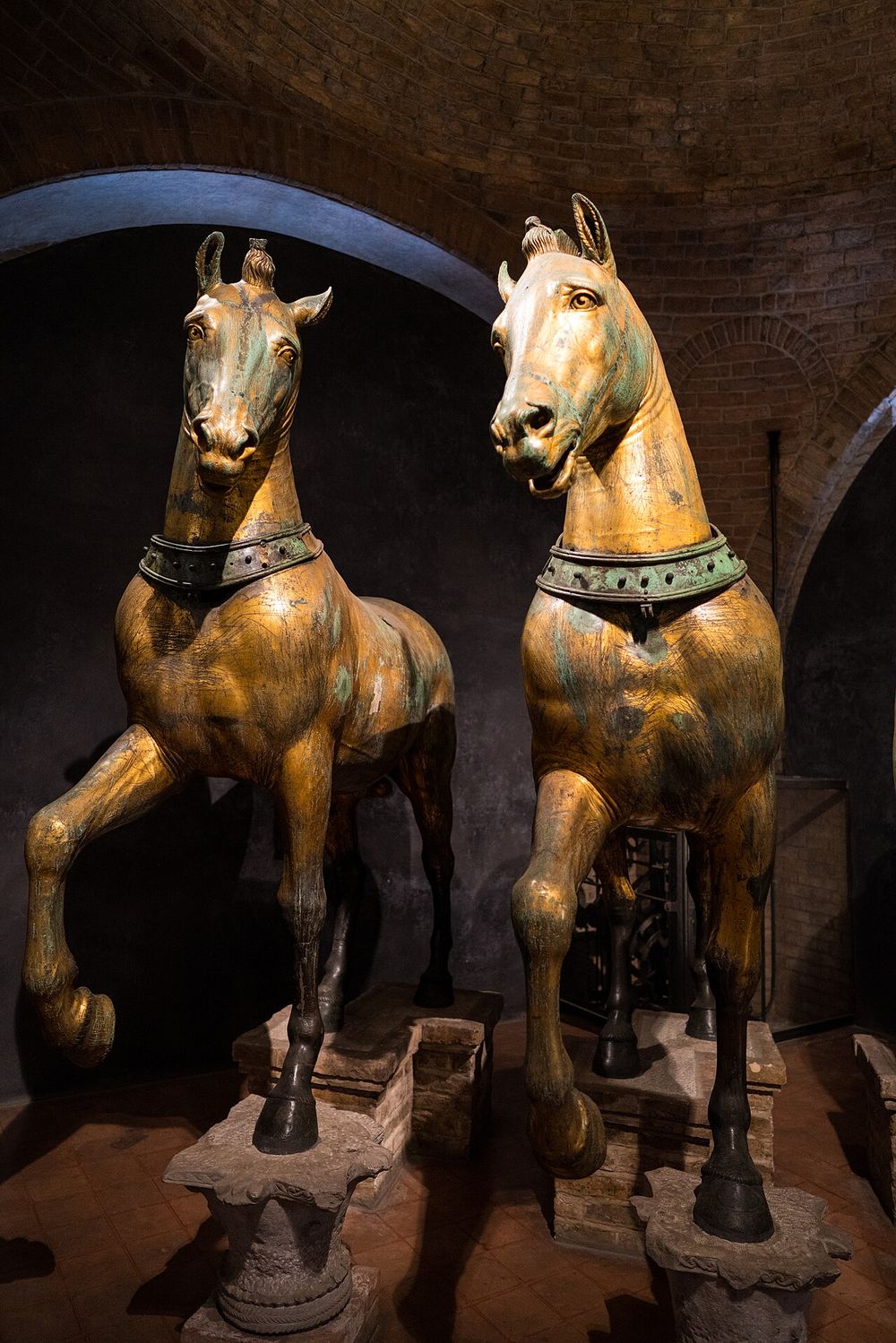
Climb the steep stair by the main door to the museum. In a room of bare brick stand four horses, a little larger than life, cast in copper and gilded. They once pulled a chariot. They are Greek or Roman work, perhaps eighteen hundred years old, and the only team of four to survive from the ancient world.
They stood over the racecourse of Constantinople. Venice took them in 1204 and set them over this door. Napoleon took them in 1797 and set them on an arch in Paris. They came back in 1815. Look at the scratches on their sides: they were made on purpose, so that the gold would not glare.
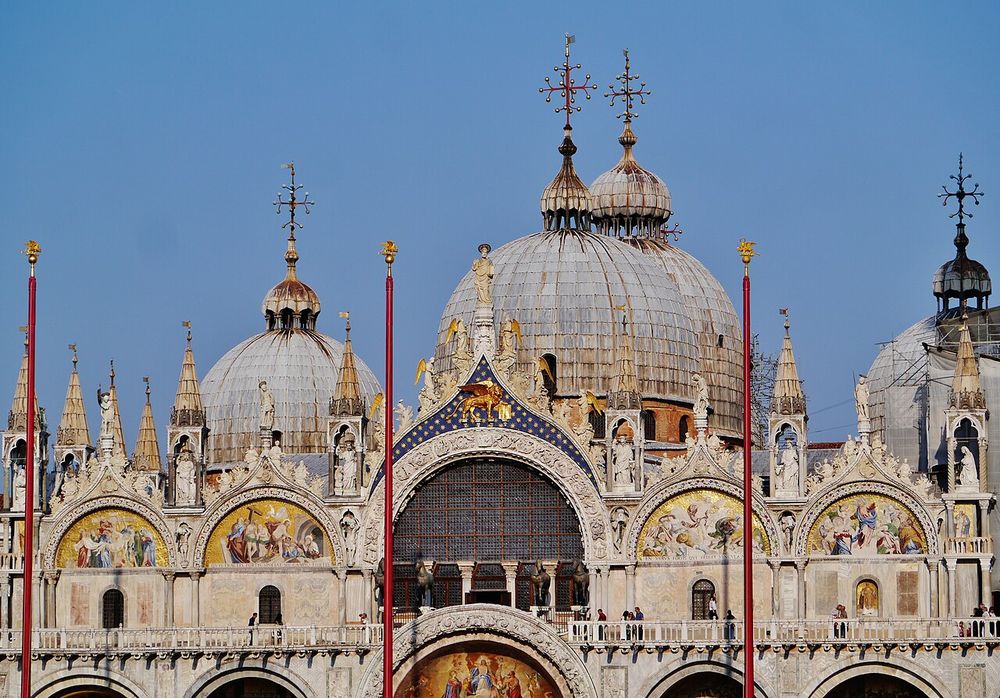
Domes, gables and the horsesZairon, CC BY-SA 4.0
Now go out through the glass door onto the balcony. The copies stand beside you, the square is below, and the domes are at your back. This is where the doge stood to be seen.
Meanwhile in the world
Year
Here
Elsewhere
828
The body said to be St Mark's reaches Venice
Tang China (618–907): Bai Juyi is fifty-six; in Baghdad the caliph's House of Wisdom is translating the Greeks
1063
The present church is begun
Northern Song China: Su Shi is twenty-six; three years before the Normans conquer England
1094
It is consecrated
Su Song's water-driven clock tower stands in Kaifeng; the First Crusade is two years off
1204
Constantinople is sacked and its treasures shipped to Venice
Southern Song (1127–1279) China (1127–1279); two years later Genghis Khan unites the Mongols
about 1254
The four horses are set over the door
Marco Polo is born in Venice; the Mongols rule north China
1345
The golden screen is finished
Yuan China (1271–1368); three years before the Black Death reaches Venice
1797
Napoleon takes the horses to Paris
Qing China: the Jiaqing reign has just begun
1807
The doge's chapel becomes the cathedral of Venice
Beethoven is writing his Fifth Symphony; Robert Morrison, the first Protestant missionary, lands at Guangzhou
2019
The sea floods the church to a depth not seen for half a century
The year of the fire at Notre-Dame in Paris
Then and now
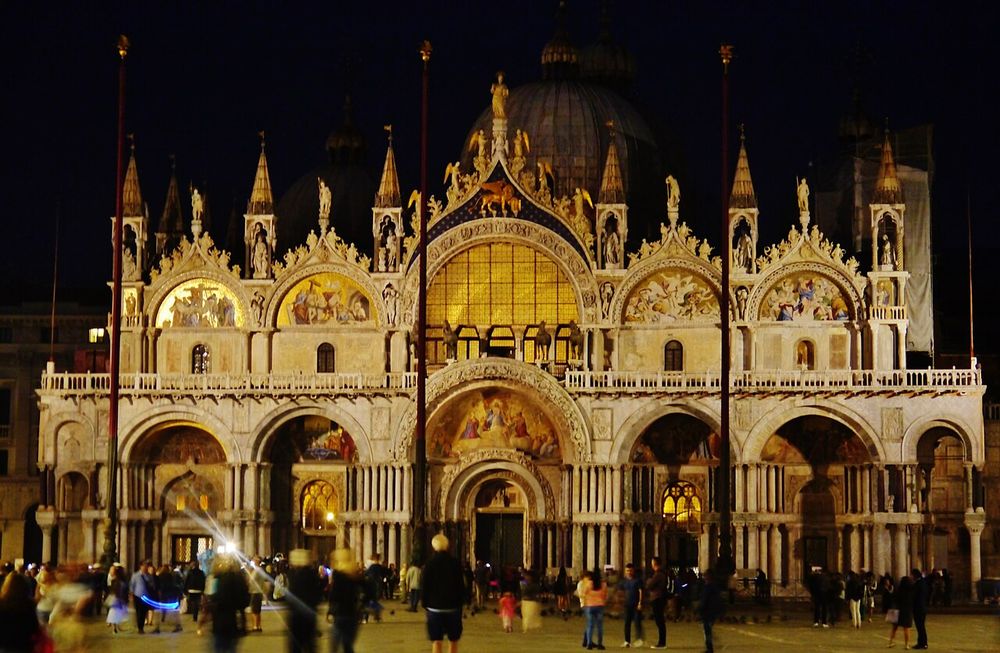
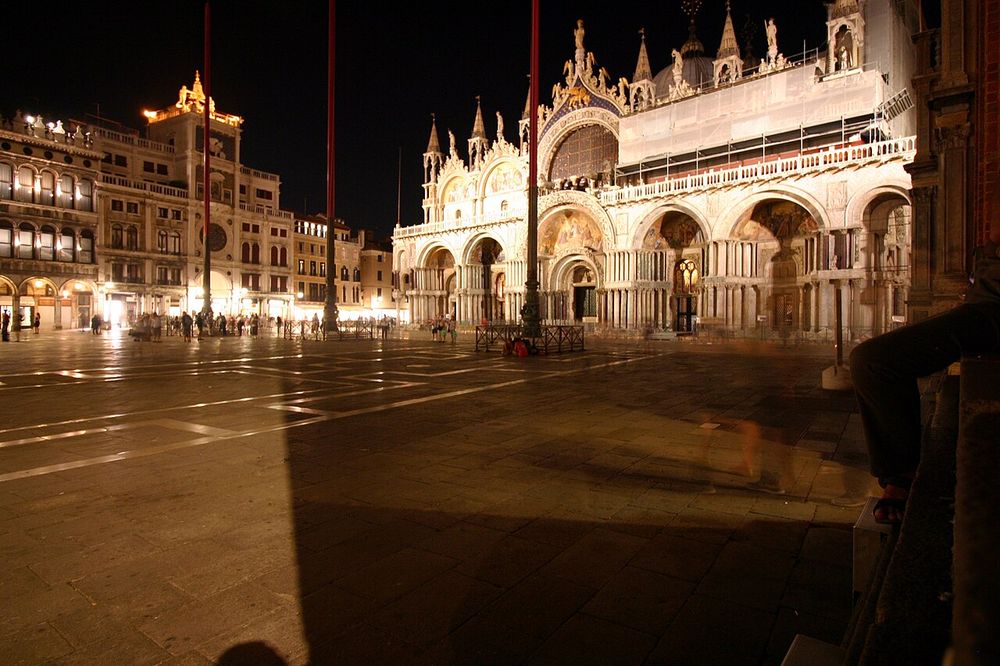
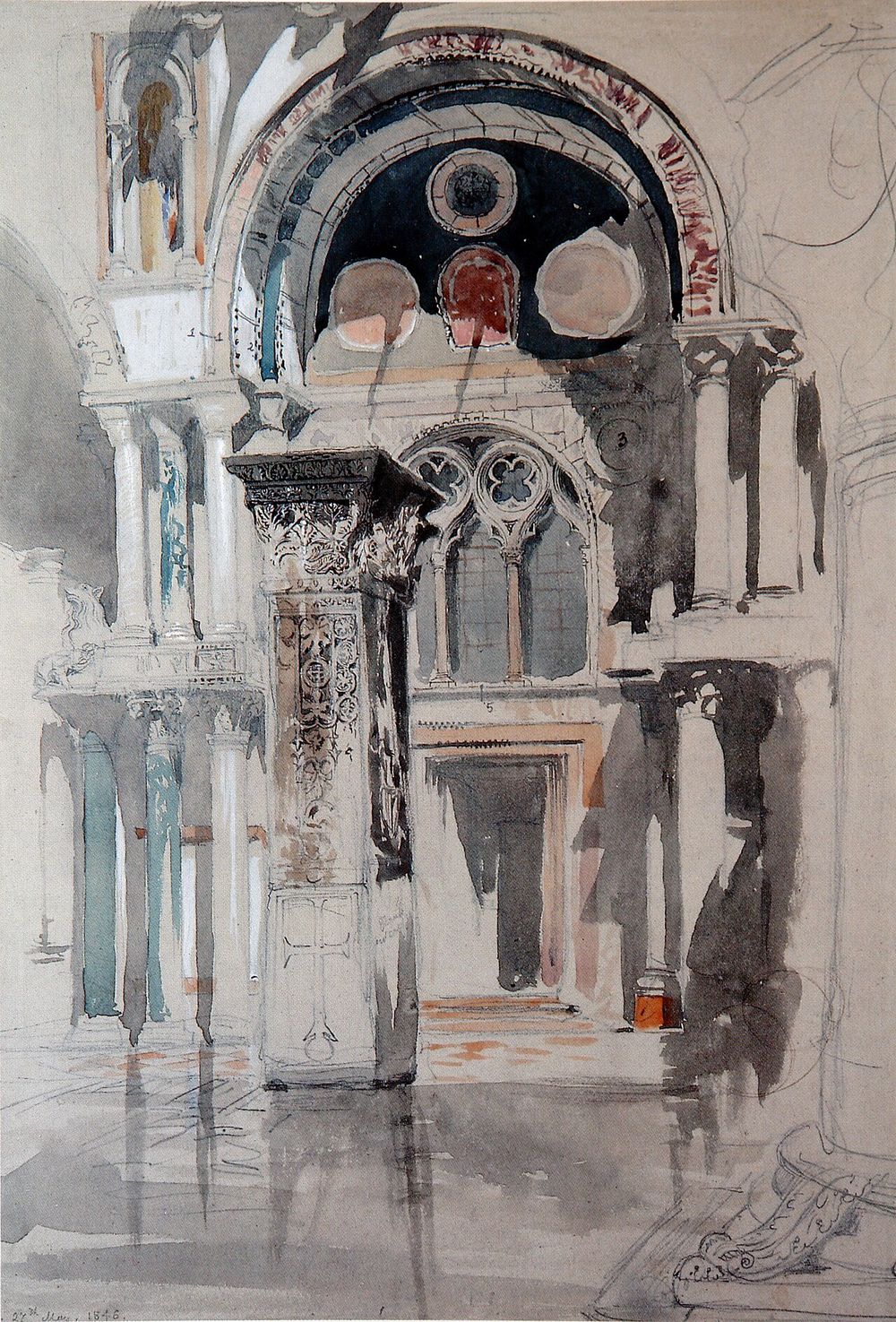
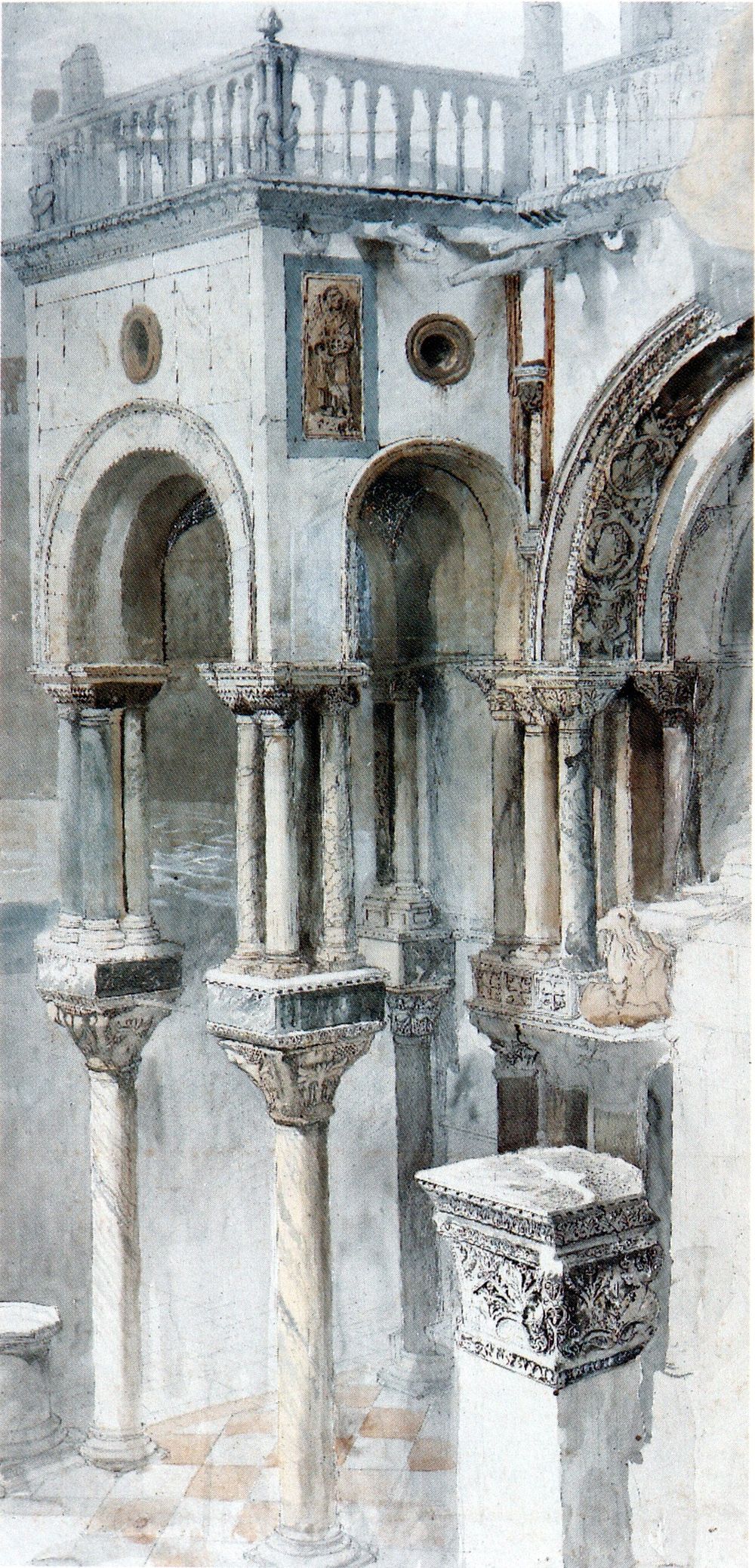
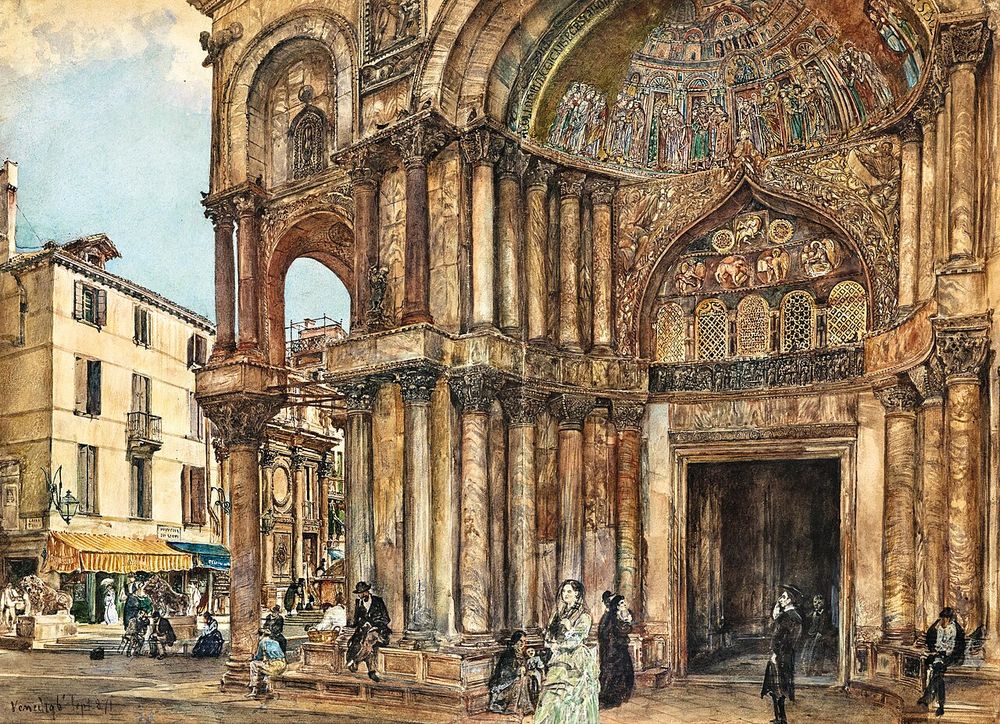
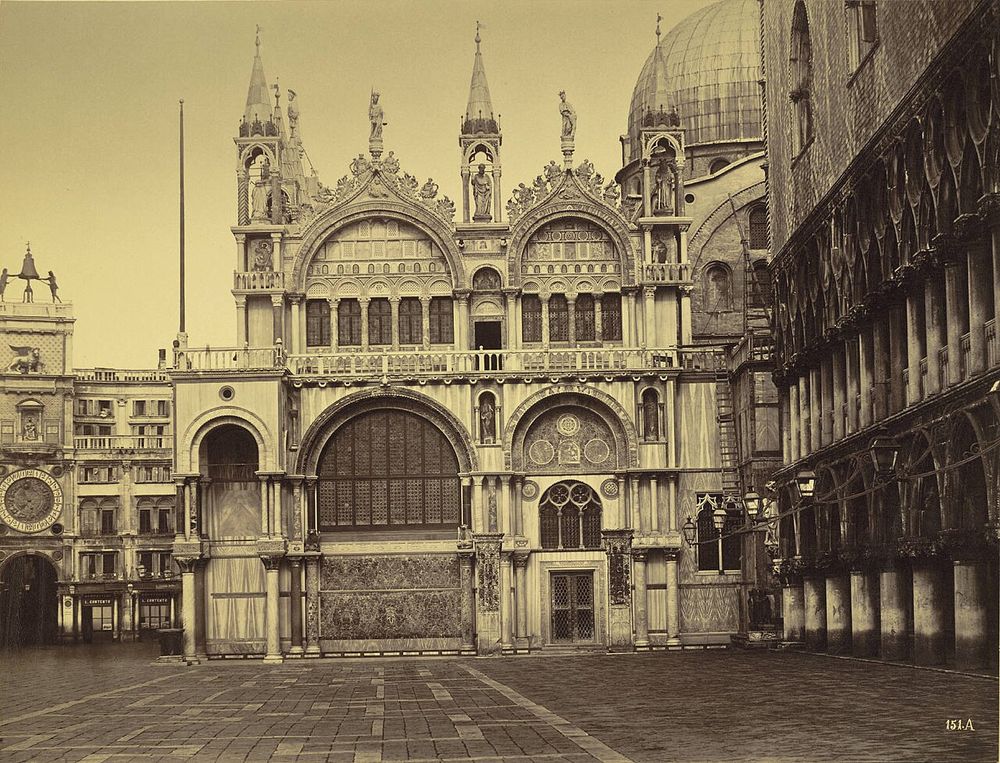
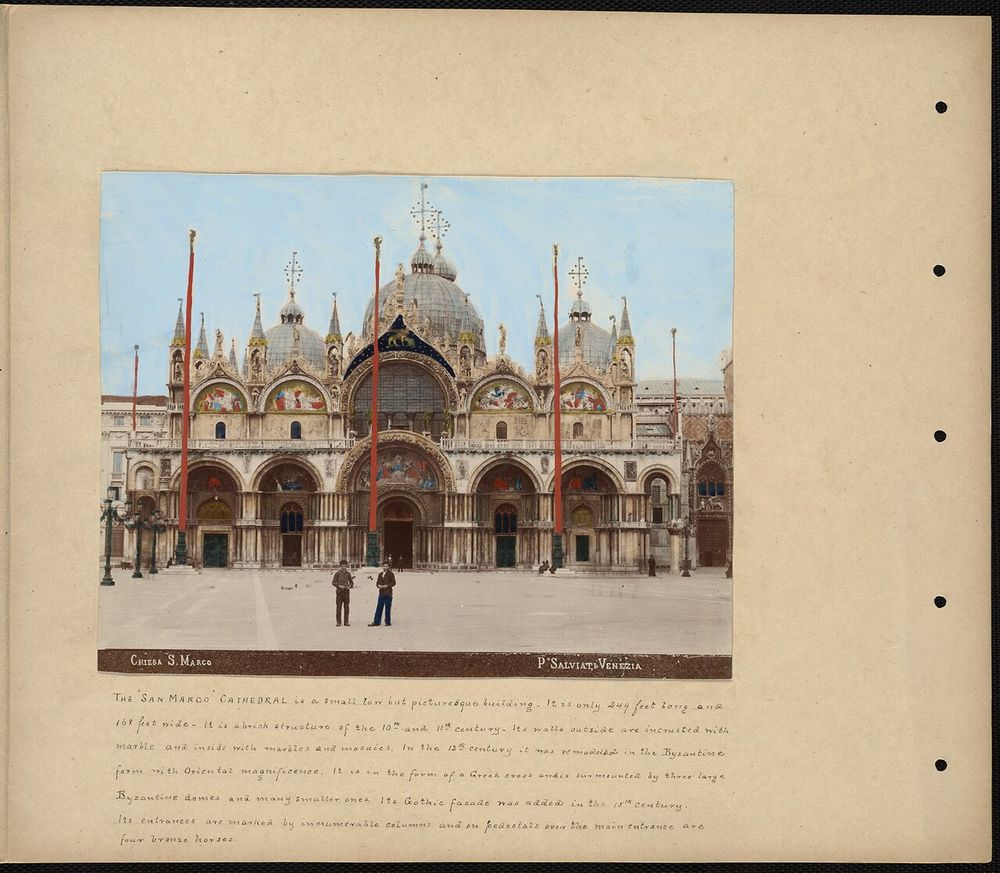
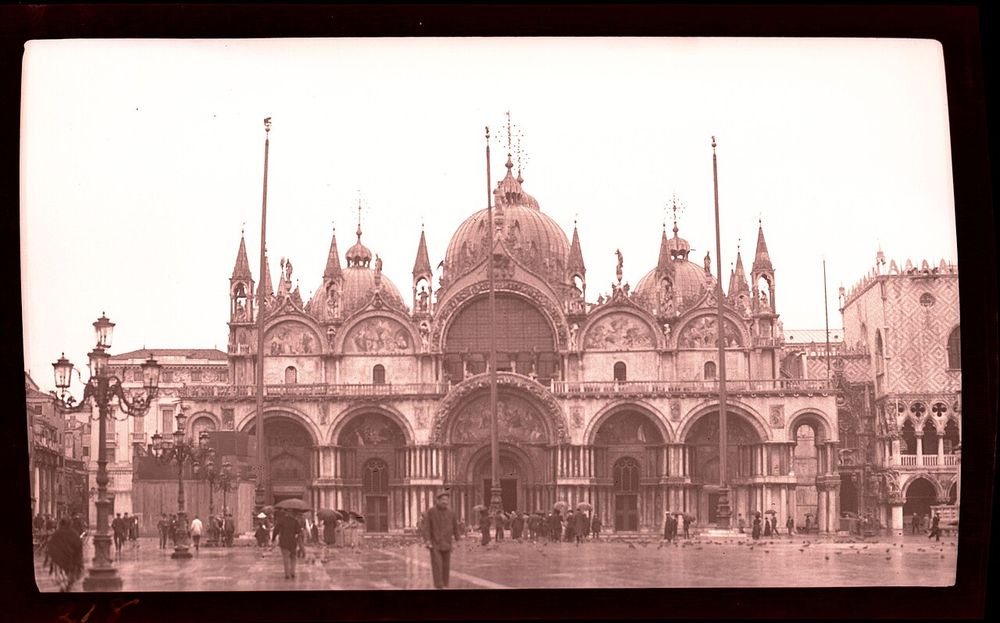
The front from the squareZairon, Public domain, Wikimedia CommonsDomes, gables and the horsesZairon, CC BY-SA 4.0, Wikimedia CommonsThe arches of the front from the sideZairon, CC BY-SA 4.0, Wikimedia CommonsThe great arch over the centre doorZairon, CC BY-SA 4.0, Wikimedia CommonsSaints and angels along the top of the south sideThis Photo was taken by Wolfgang Moroder. Feel free to use my photos, but please, CC BY-SA 3.0, Wikimedia CommonsThe five domes from the bell towerDaniel Albrecht, Public domain, Wikimedia CommonsThe front lit at nightZairon, CC BY-SA 4.0, Wikimedia CommonsThe church and the square after darkJosé Luiz, CC BY-SA 4.0, Wikimedia CommonsThe mosaic of about 1265 over the left doorThis Photo was taken by Wolfgang Moroder. Feel free to use my photos, but please, Public domain, Wikimedia CommonsThe left door and its columns of coloured marbleThis Photo was taken by Wolfgang Moroder. Feel free to use my photos, but please, CC BY-SA 3.0, Wikimedia CommonsThe left door, with the church shown inside the pictureMichael Wittwer, CC BY-SA 4.0, Wikimedia CommonsA carved capital on the frontThis Photo was taken by Wolfgang Moroder. Feel free to use my photos, but please, CC BY-SA 3.0, Wikimedia CommonsThe four emperors in porphyryArchaeodontosaurus, CC BY-SA 4.0, Wikimedia CommonsThe four emperors at the corner of the churchThis Photo was taken by Wolfgang Moroder. Feel free to use my photos, but please, CC BY-SA 3.0, Wikimedia CommonsA carved pillar from a church in Constantinople, by the south wallKtiv, CC BY-SA 4.0, Wikimedia CommonsSmall domes of the entrance hallZairon, CC BY-SA 4.0, Wikimedia CommonsThe dome of the CreationNicola Quirico, CC BY-SA 4.0, Wikimedia CommonsThe Creation, in three ringsGiulio09445, CC BY 4.0, Wikimedia CommonsLooking east along the churchZairon, CC BY-SA 4.0, Wikimedia CommonsThe crossing from the galleryZairon, CC BY-SA 4.0, Wikimedia CommonsGold on every vaultZairon, CC BY-SA 4.0, Wikimedia CommonsThe screen and the high altarZairon, CC BY-SA 4.0, Wikimedia CommonsA hanging lamp before the archesZairon, CC BY-SA 4.0, Wikimedia CommonsTwo domes in lineZairon, CC BY-SA 4.0, Wikimedia CommonsThe domes from the floorZairon, CC BY-SA 4.0, Wikimedia CommonsArches and domes from the galleryZairon, CC BY-SA 4.0, Wikimedia CommonsTwo of the eastern domesZairon, CC BY-SA 4.0, Wikimedia CommonsThe dome of PentecostZairon, CC BY-SA 4.0, Wikimedia CommonsThe dome of Pentecost and the arch before itZairon, CC BY-SA 4.0, Wikimedia CommonsThe dome of the AscensionUnknown authorUnknown author, Public domain, Wikimedia CommonsThe golden screenDimitris Kamaras from Athens, Greece, CC BY 2.0, Wikimedia CommonsEnamels and stones of the golden screenDimitris Kamaras from Athens, Greece, CC BY 2.0, Wikimedia CommonsChrist at the centre of the golden screenDimitris Kamaras from Athens, Greece, CC BY 2.0, Wikimedia CommonsCups from Constantinople in the treasuryDimitris Kamaras from Athens, Greece, CC BY 2.0, Wikimedia CommonsRelic holders in the treasuryDimitris Kamaras from Athens, Greece, CC BY 2.0, Wikimedia CommonsThe marble floorDimitris Kamaras from Athens, Greece, CC BY 2.0, Wikimedia CommonsA griffin in the flooruser:Testus, CC BY-SA 3.0, Wikimedia CommonsThe four horses, indoorsHorses_of_Basilica_San_Marco.jpg: Tteske derivative work: Morn (talk), Public domain, Wikimedia CommonsThe horses in the museumNan Palmero from San Antonio, TX, USA, CC BY 2.0, Wikimedia CommonsTwo of the horsesNan Palmero from San Antonio, TX, USA, CC BY 2.0, Wikimedia CommonsThe front in 1496, when all its mosaics were still the first ones; detail of a painting by Gentile BelliniDidier Descouens, Public domain, Wikimedia CommonsPart of the front, drawn by John Ruskin in 1846John Ruskin, Public domain, Wikimedia CommonsThe south side, drawn by Ruskin about 1851John Ruskin, Public domain, Wikimedia CommonsThe left door, watercolour by Rudolf von Alt, 1871Rudolf von Alt, Public domain, Wikimedia CommonsThe corner of the church and the palace in a nineteenth-century photographCornell University Library, No restrictions, Wikimedia CommonsThe front in a hand-coloured photograph of the 1890sWilliam Vaughn Tupper Flickr uploader BPL, Public domain, Wikimedia CommonsThe front in a lantern slide of about 1913Edmund F. Arras, Public domain, Wikimedia Commons
Video
Films from official channels, played from YouTube. Nothing is loaded until you press play.
Venice and its lagoonUNESCO · made with NHK; 2 min · checked 2026-11-12
Local legends
These are stories people tell about this place. They are legends, not history, and each one says where it comes from.
LegendThe body under the pork
Two merchants of Venice, Buono and Rustico, stole the body of St Mark from its tomb in Alexandria. To get it past the Muslim customs men at the harbour they laid it in a basket under joints of pork. The officers lifted the lid, cried out in disgust and waved the basket through.
Source: Translatio Sancti Marci (eleventh century); shown in the mosaics of the church
LegendPeace to you, Mark
Long before, St Mark himself was caught in a storm and driven into the lagoon, where no city yet stood. An angel came to him and said: "Peace to you, Mark, my evangelist. Here your body shall rest." Those are the words in the book under the lion's paw.
Source: Venetian tradition, written down in the thirteenth century
LegendThe arm in the pillar
When the new church was finished, no one could remember where the body had been hidden during the building. The doge and the people fasted and prayed for three days. Then a stone fell from a pillar on the right, and an arm reached out.
Source: Venetian chronicles; shown in a mosaic in the right arm of the church
LegendThe glass jewels
When the French came to strip the church in 1797, the priests told them that the stones of the golden screen were only coloured glass. The soldiers believed it and left the screen alone.
Source: Venetian popular tradition
Later, people who live here will be able to add the stories they grew up with, and say which of these they have heard.
Not certain, and where accounts conflict
Whose body is it?
The story of the theft was written two centuries after it is said to have happened. That a body was brought from Alexandria in the ninth century, and that Venice believed it to be Mark's, is not in doubt. The bones have never been tested.
How old are the horses, and who made them?
Guesses have run from Greece in the fourth century BC to Rome in the third century AD. The metal is nearly pure copper, which is hard to cast and takes gilding well, and that points to the Roman period. No ancient writer mentions them.
Which church was copied?
Old Venetian sources name the Church of the Holy Apostles in Constantinople, where the emperors were buried. It was pulled down in 1461, so the two cannot be compared.
How much of the mosaic is original?
About two thirds is of the twelfth and thirteenth centuries. The rest was remade between 1500 and 1900, some of it to designs by Titian and Tintoretto. The remade parts have shading and deep space; the old ones are flat against the gold.
Visiting
Tickets and hours
The church alone is 10 euros. The church with the golden screen is 20 euros. The church with the museum and the horses is 20 euros. Everything is 30 euros.
Visitors aged 11 to 18, students up to 26 and people over 65 pay half.
Monday to Saturday the church opens at 9:30 and closes at 17:15, with last entry at 16:45. On Sundays and holy days it opens to visitors at 14:00.
On Sunday mornings a ticket for the museum and balcony alone is 14 euros.
The bell tower outside is a separate ticket of 15 euros.
Last checked 2026-11-12. The basilica's own ticket site (tickets.basilicasanmarco.it), prices and opening hours as shown in November 2026.
Booking from abroad
Official page in English The basilica sells its own timed tickets in English and takes foreign cards. It calls itself the only official ticket office: tickets.basilicasanmarco.it. Tickets carry your name.
Ticket window on site Visitors with their own booking go in by the door named Porta San Pietro, on the front. Without a booking you join the line in the square, which in summer can take more than an hour.
Note On Sunday mornings the church is closed to visitors until 14:00; only the museum and the balcony of the horses are open.
Checked 2026-11-12
Where to start
Book the first time of the day, or one after 15:30. The mosaics are fully lit for about an hour around midday on most days; in that hour the gold is at its brightest and the crowd at its thickest.
Before you go in, look at the left door and the four emperors at the corner. Both are free.
Inside, the route is one way. The stair to the museum is by the main door: take it last, and come out on the balcony.
Allow half an hour for the church and an hour and a half for everything.
Before you go
Shoulders and knees must be covered, for men as well as women.
Rucksacks and large bags are not allowed inside. There is a free deposit a minute away, in the small square with the two stone lions to the left of the church.
Photographs are not allowed in the church.
The floor is uneven and the museum stair is steep and narrow, with no lift.
Customs and manners
Mass is said every day. Worshippers use the door on the north side and enter free; that door is not a way in for visiting.
Keep your voice low and take off your hat.
Do not touch the mosaics or the columns.
When the square is flooded, the entrance hall is too. The church then lays raised boards and may open late.
Opening hours are given in the local time of the place. Prices are in the local currency. The figure after ≈ is approximate, at exchange rates checked on 9 November 2026, in .
Look for these
Over the left door, find the four horses inside the picture.
Which of the four emperors has a white foot?
In the Creation dome, find the day on which the birds and fish are made. How many angels stand by?
In the entrance hall, find the red diamond in the floor.
In the floor of the church, find a peacock.
In the first dome, find two people who are dressed like no one else in the ring.
On the horses, find the scratches in the gold.
From the balcony, count the domes behind you.
I am here
Stand at the site, sign in, press the button, and collect its stamp. Your browser will ask to use your location. It is sent to us once to confirm that you are at the site; we keep how far you were from it, not the spot where you stood.
Your stamps are saved to your account, so they follow you to any device. Checking from a browser cannot rule out every false location; stricter checks arrive with the app.
Messages
Share your photos
Photos here show the place, not people. Each one is credited to the visitor who took it and appears after our team has looked at it. A photo with you in it belongs under “I am here”.