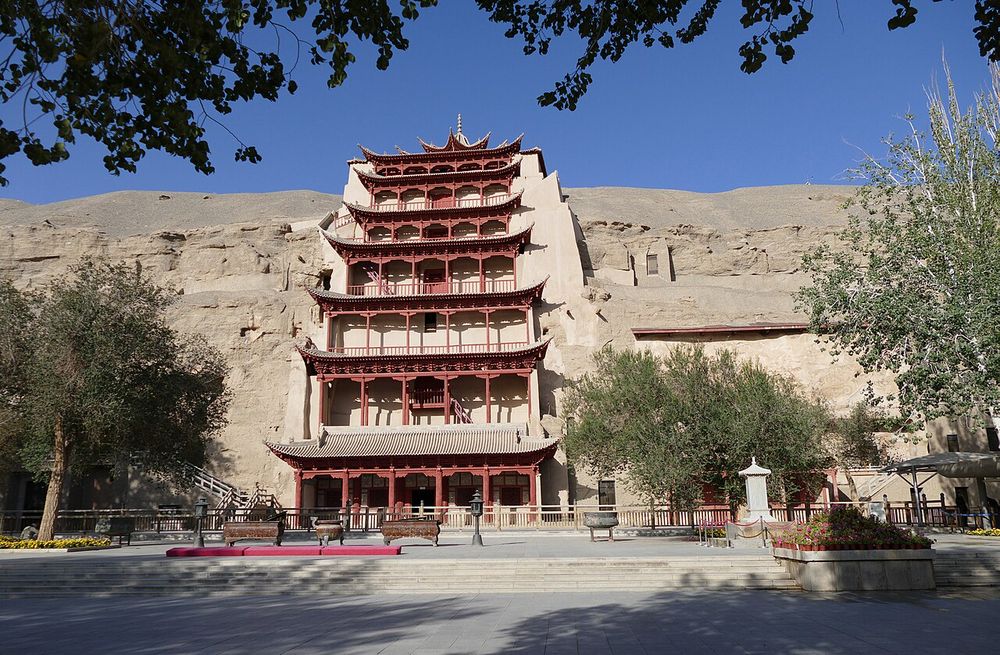
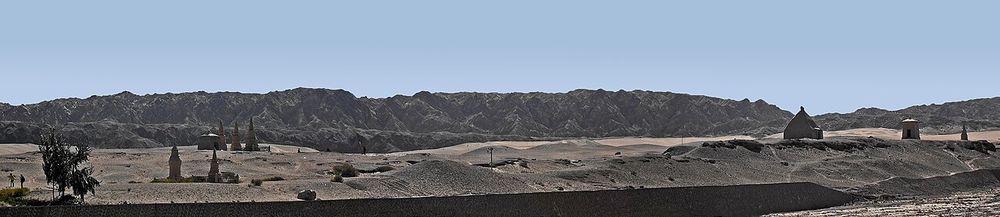
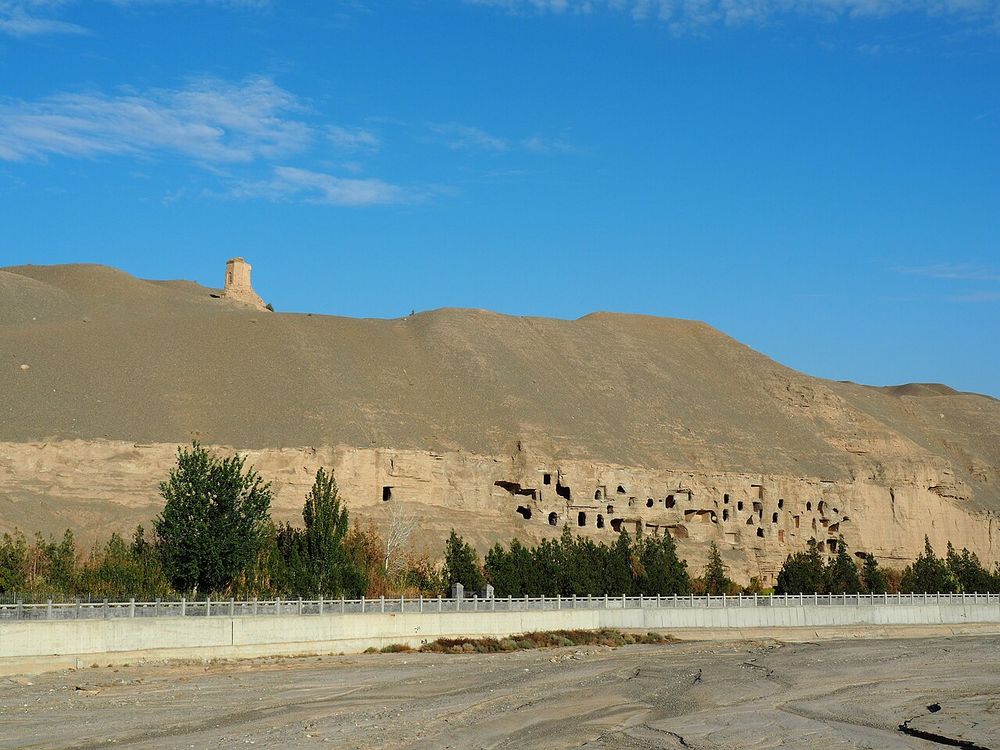
Seven hundred caves cut into a desert cliff at the edge of the Gobi, painted and sculpted for a thousand years by travellers, monks and merchants of the Silk Road. One small cave, sealed for nine centuries, held fifty thousand manuscripts; its opening in 1900 scattered them across the museums of the world.
Photo: Zossolino, CC BY-SA 4.0, Wikimedia Commons
The story
In 366, says an inscription of the Tang (618–907), a monk named Le Zun saw the cliff above the Daquan river glow with the light of a thousand Buddhas, and cut the first cave. For a thousand years after him, through the Northern Wei (386–534), Sui, Tang, Song and Yuan (1271–1368), people who passed through Dunhuang, the last oasis before the desert road to the west, paid for caves here. Today about 735 survive, 492 of them painted, with 45,000 square metres of murals and more than 2,000 painted statues.
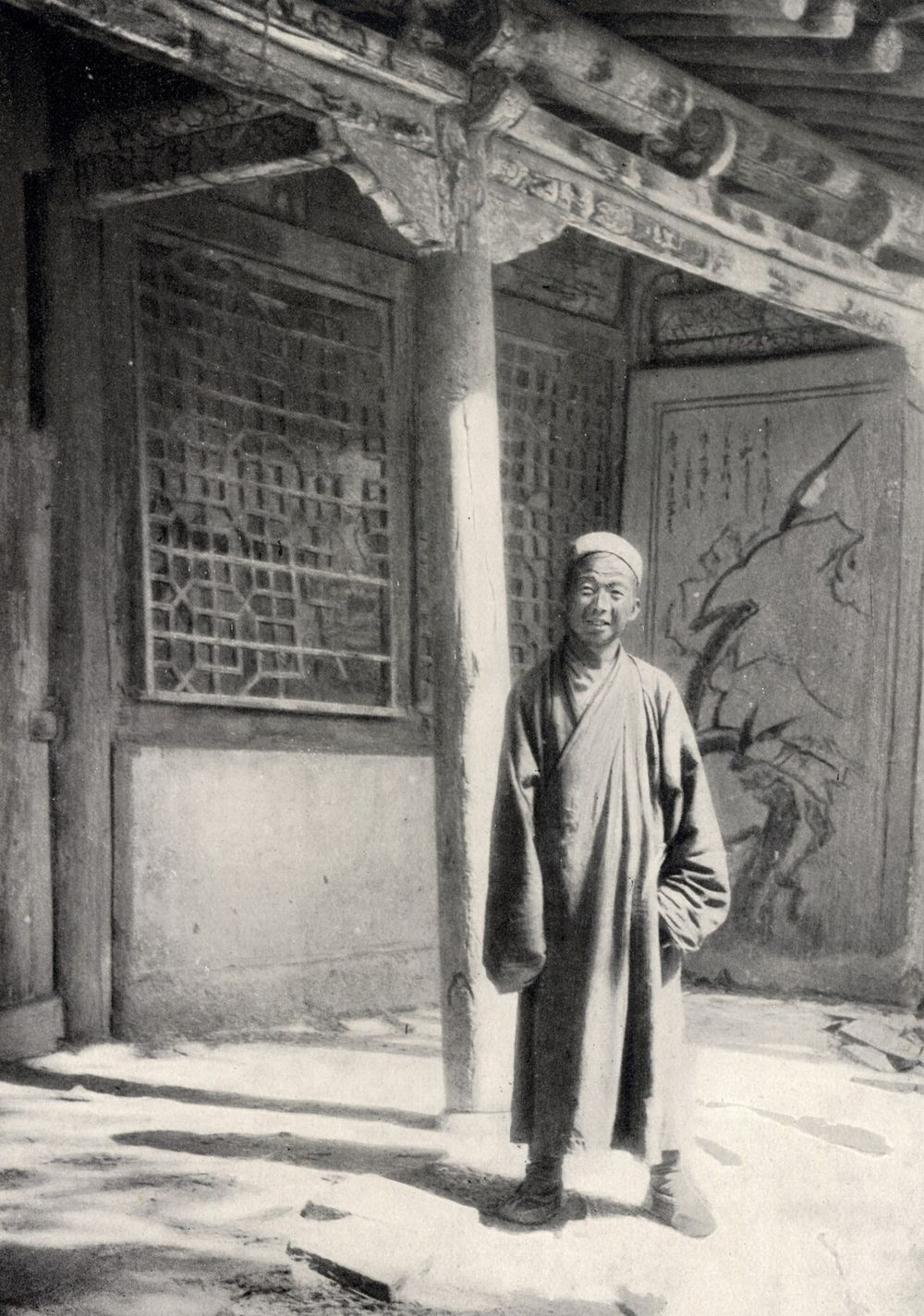
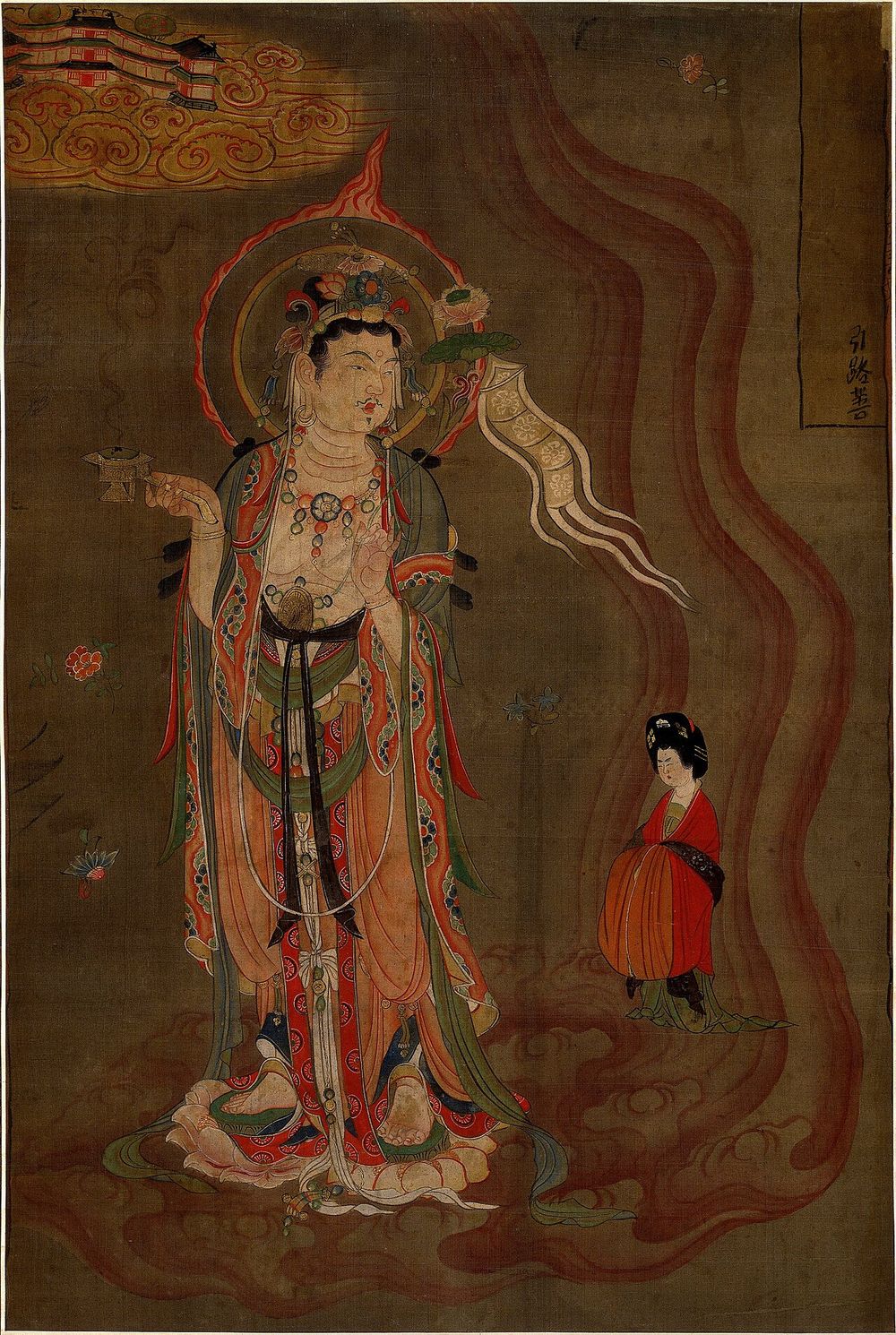
In 1900 a Taoist named Wang Yuanlu, who had made himself keeper of the caves, found a sealed room behind a wall: the Library Cave, packed with scrolls in Chinese, Tibetan, Sanskrit, Sogdian, Uyghur and Hebrew. Over the next years Aurel Stein, Paul Pelliot and others bought or took away tens of thousands of them; they are now in London, Paris, St Petersburg, Kyoto and Beijing. The study of these papers became a field of its own, Dunhuang studies.
The standard (A) ticket includes the two films at the Digital Exhibition Centre, the shuttle and eight caves with a guide. The emergency (B) ticket covers four caves and the shuttle. Special caves are a separate ticket.
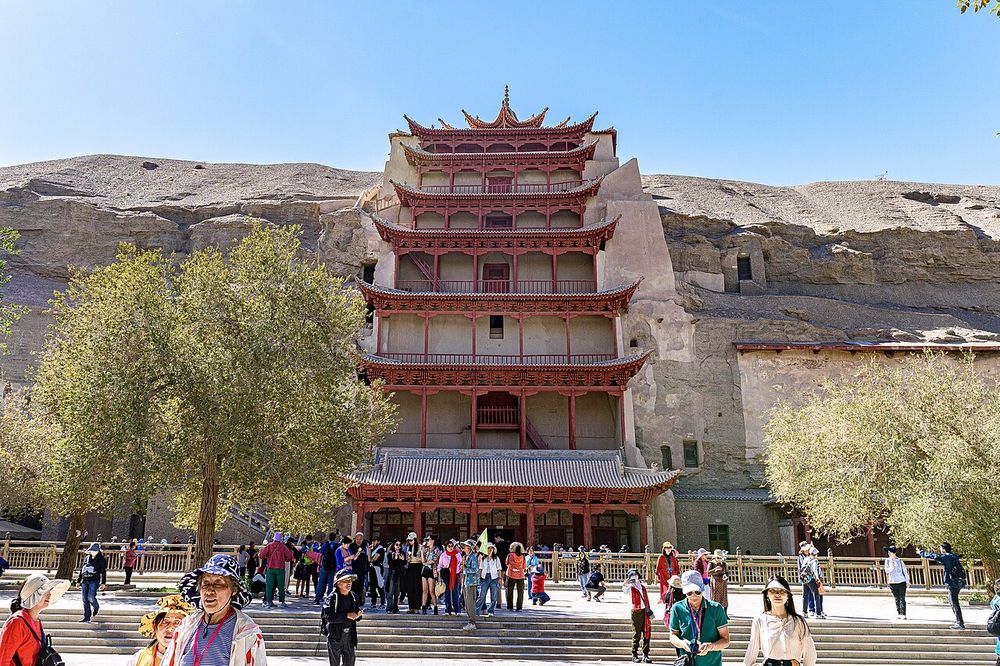
The Nine-Storey Building, 2015Zossolino, CC BY-SA 4.0
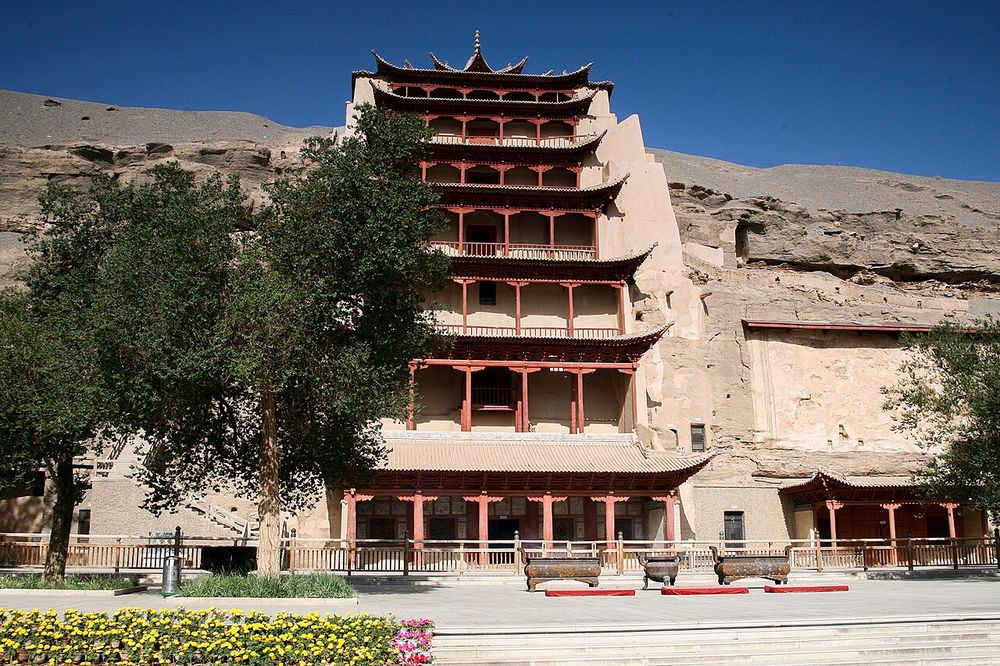
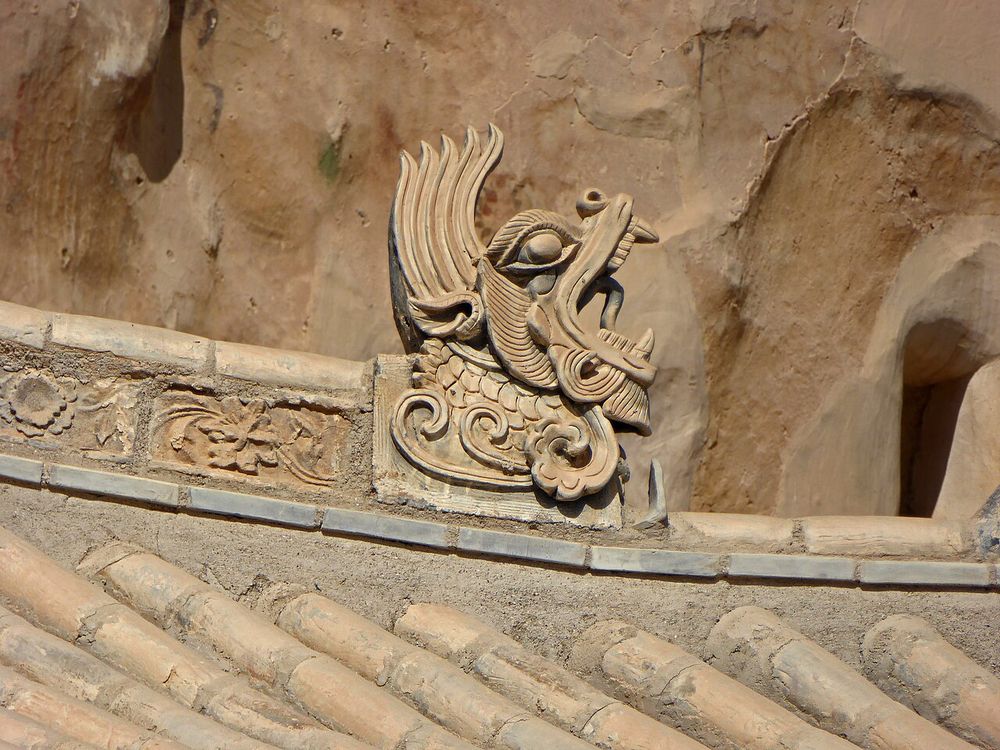
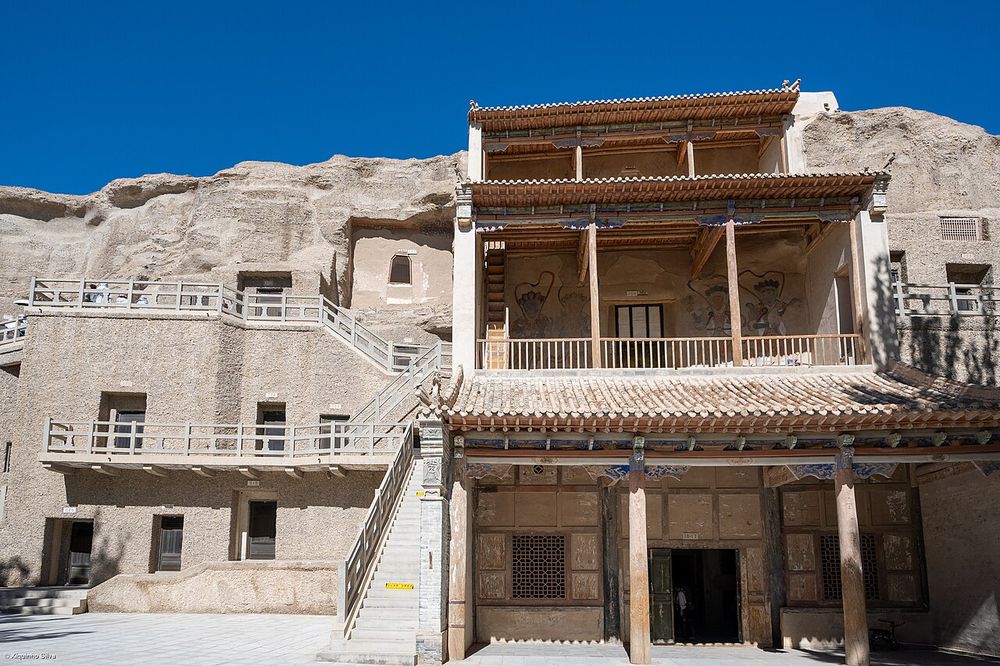
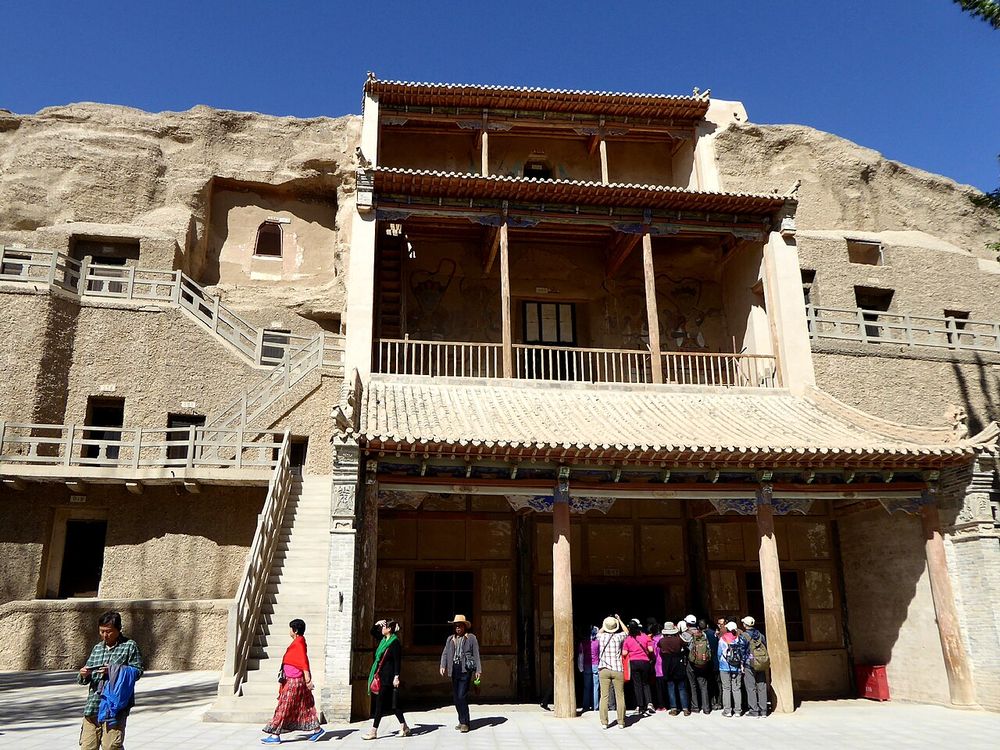
The red tower against the cliff covers Cave 96. Inside sits a Maitreya Buddha about 35.5 metres high, made at the end of the 7th century, under the Empress Wu Zetian, of stone carved roughly and then built up in clay. The tower around him has been rebuilt several times; the nine storeys you see date from 1935.
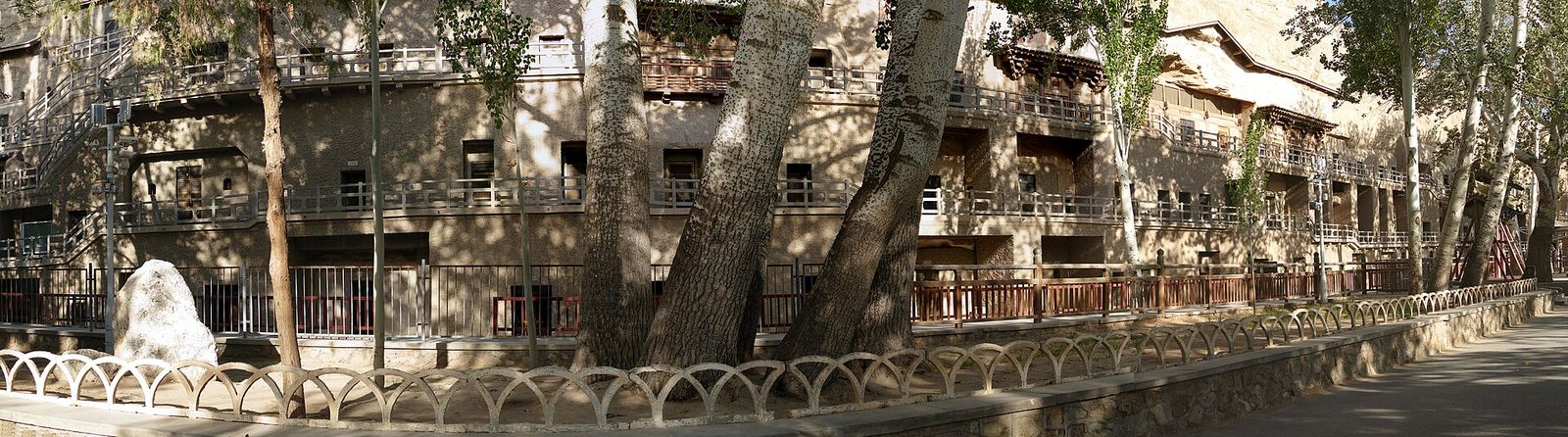
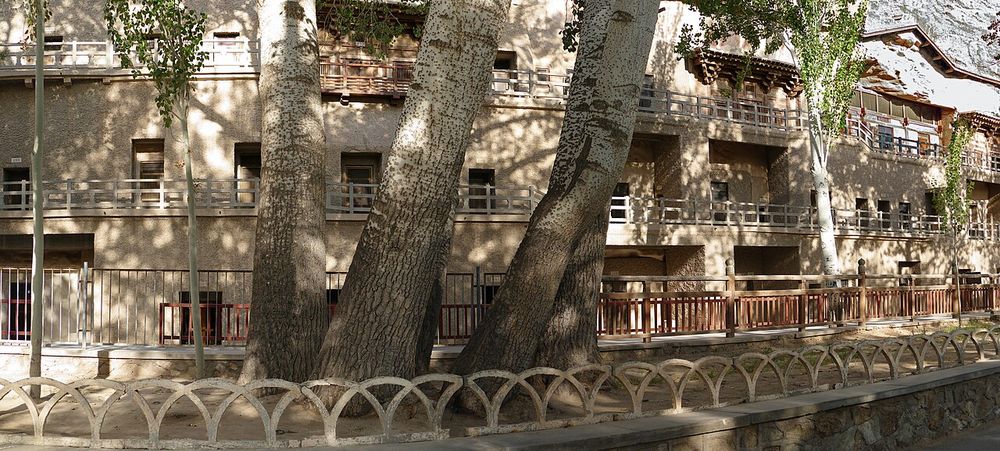
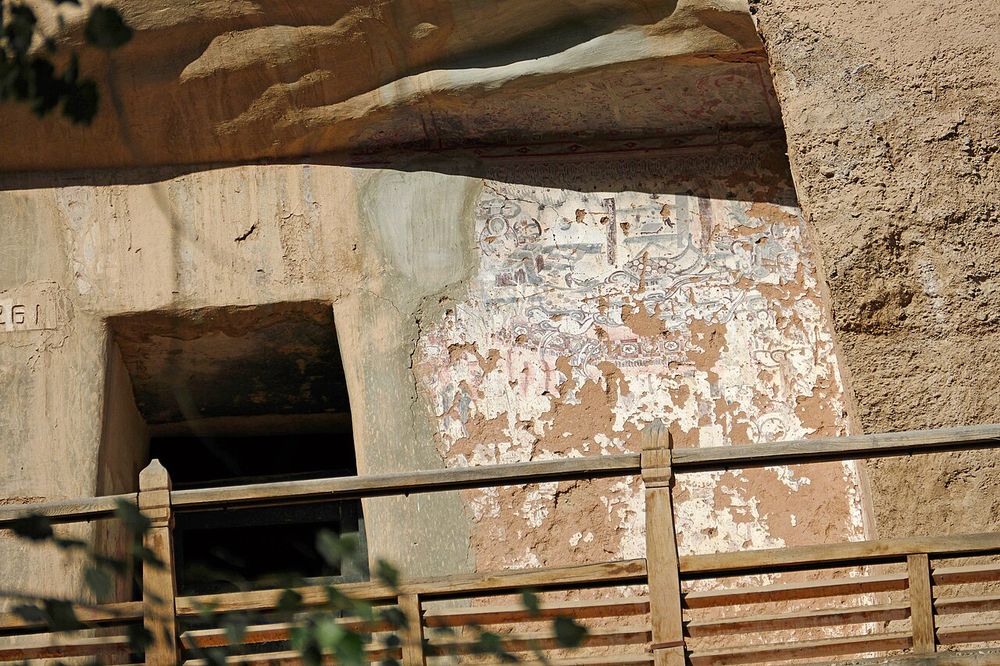
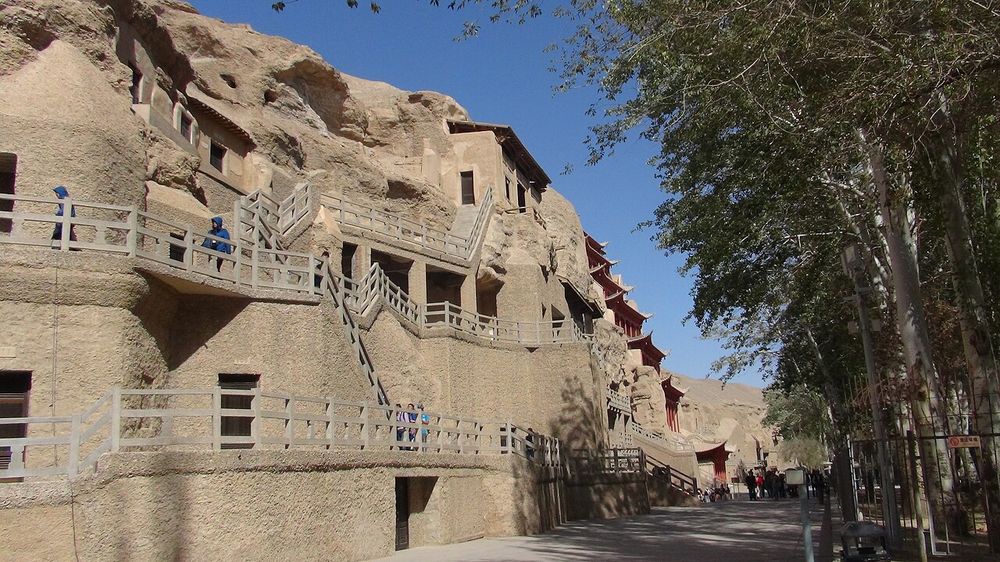
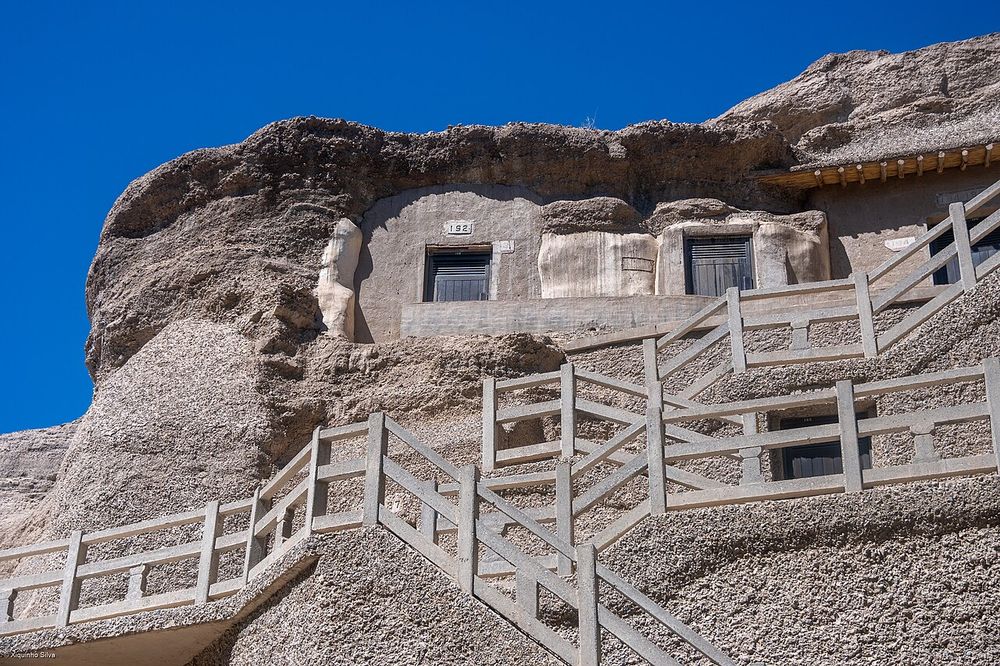
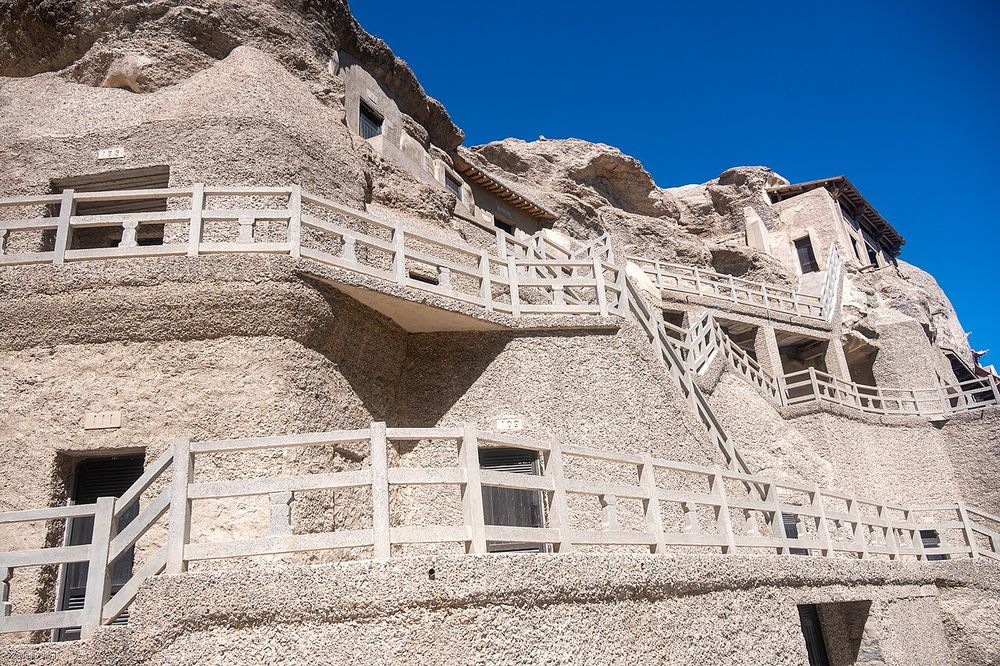
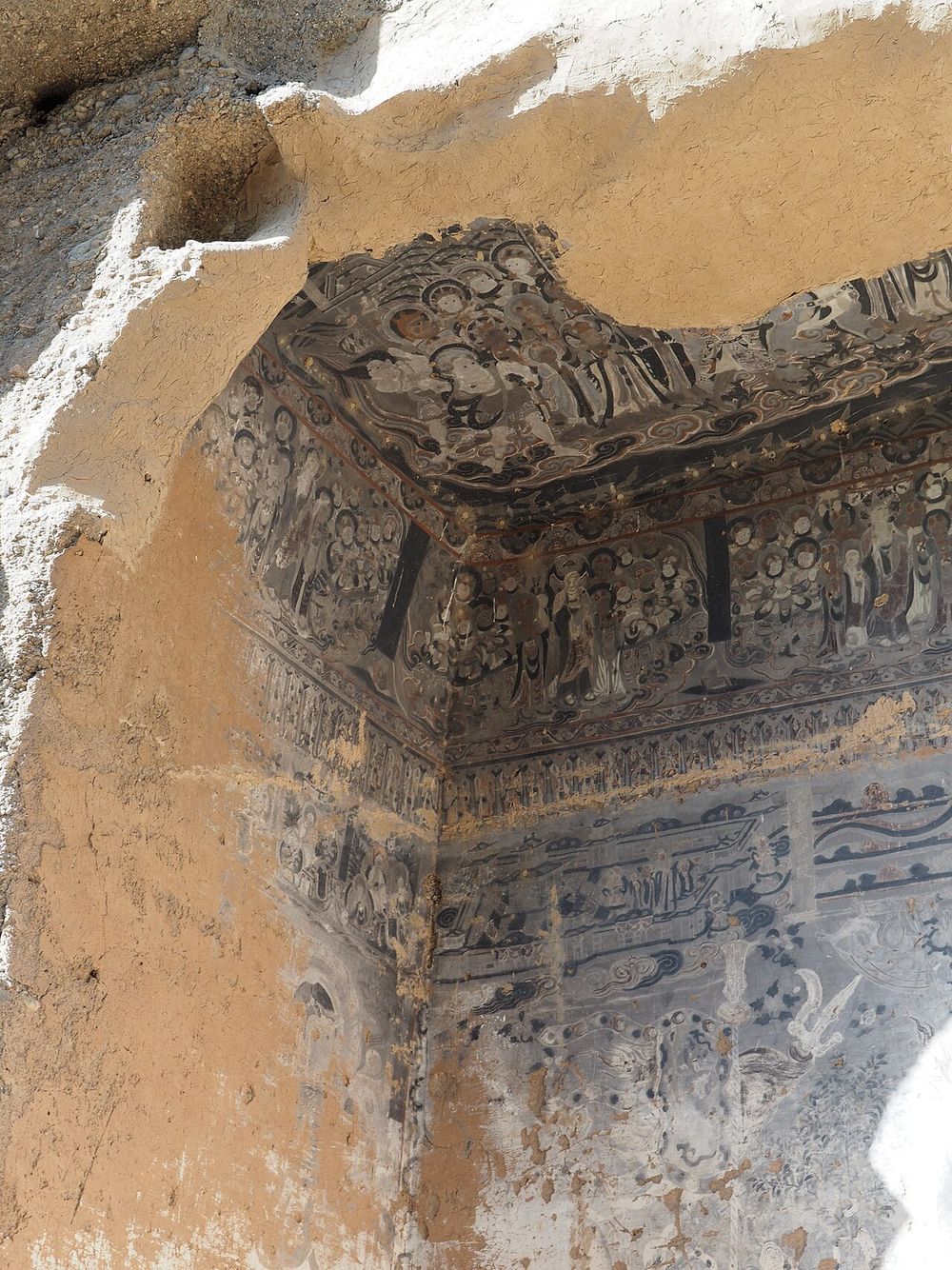
Then look along the cliff on either side: tier upon tier of cave doors, linked by walkways, for over a kilometre. Behind each door is painted darkness that you will see only with a guide's torch.
Things people often get wrong
"You can visit any cave you like." Only eight caves are shown on the standard ticket, chosen in rotation to protect the paintings; the famous ones may be closed on your day.
"You can take photographs inside." Photography is strictly forbidden in the caves; cameras and bags are left at the entrance.
People who stood here
We searched Chinese sources first for this list, then English, French and Japanese ones.
Wang Yuanlu (Taoist keeper of the caves, about 1849–1931)He found the Library Cave in 1900 and later sold manuscripts from it to foreign expeditions, using the money to repair the caves. He is still a figure of argument in China.
Aurel Stein (archaeologist, 1862–1943)The Hungarian-born British explorer came in 1907 and took away thousands of manuscripts, among them the Diamond Sutra of 868, the oldest dated printed book in the world, now in the British Library.
Paul Pelliot (sinologist, 1878–1945)The French scholar, who read Chinese, spent three weeks in 1908 sorting the Library Cave by candlelight and chose the most valuable manuscripts, now in the Bibliothèque nationale in Paris.
Zhang Daqian (painter, 1899–1983)From 1941 to 1943 he lived at the caves and copied more than two hundred murals, bringing them to the attention of the Chinese public.
Chang Shuhong (painter, 1904–1994)He left Paris to found the Dunhuang Art Research Institute in 1944 and spent the rest of his working life protecting the caves; he is called the "guardian of Dunhuang".
2 more people
Fan Jinshi (archaeologist, born 1938)Arriving as a graduate in 1963, she later led the Dunhuang Academy and began the digital recording of the caves; China calls her "the daughter of Dunhuang".
Yasushi Inoue (novelist, 1907–1991)His novel "Tonkō" (Dunhuang), written in 1959 before he had ever been there, made the caves famous in Japan; he later travelled to see them.
Go deeper: six stops from the films to the Library Cave7 stops · about 2 min to read
A standard visit takes about four hours: the films first, then a shuttle to the caves and a guided walk through eight of them.
1. The Digital Exhibition Centre
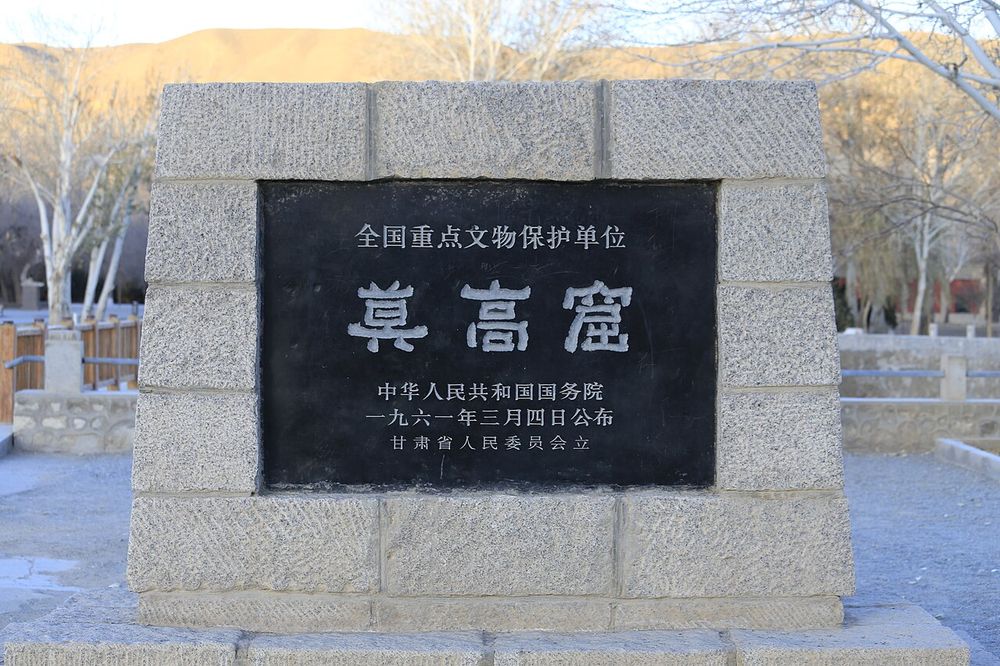
The memorial stone at the gate, winter 2013Zhangzhugang, CC BY-SA 4.0
The visit begins 15 kilometres away, at a centre in the desert near Dunhuang, with two films: one on the history of the caves, one projected on a dome inside a recreated cave. They exist so that fewer minutes are spent breathing inside the real ones.
2. The cliff and the Nine-Storey Building
Cave 96 and its tower, September 2023N509FZ, CC BY-SA 4.0
From the shuttle stop you walk across the dry riverbed to the cliff. The caves run in up to five tiers; the Nine-Storey Building marks the middle.
3. The Tang: Caves 45 and 220
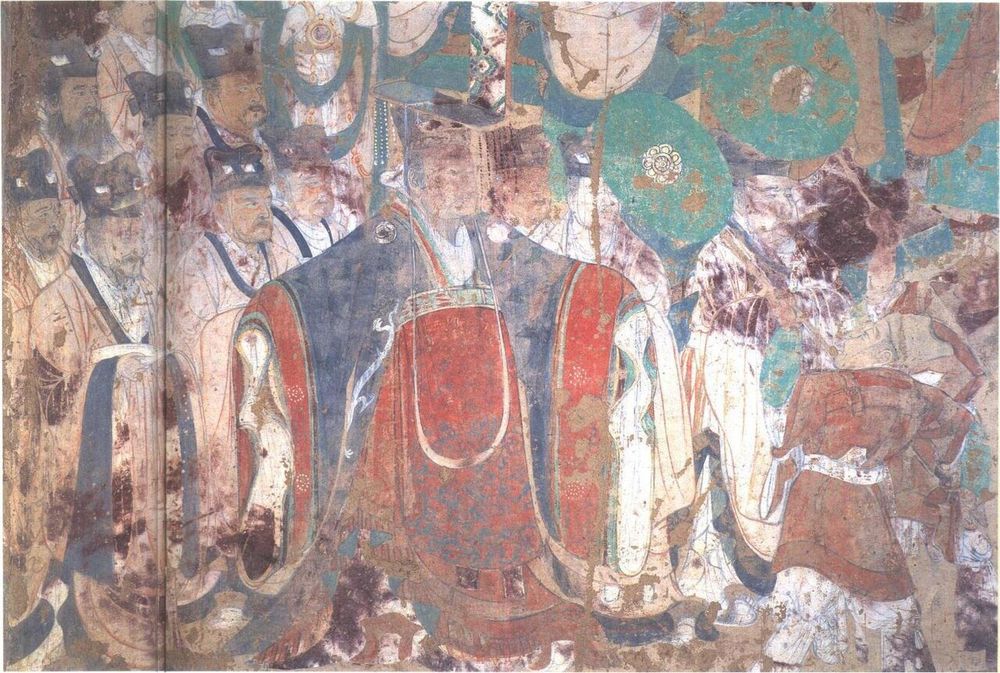
The emperor and his officials, Cave 220, 642Unknown authorUnknown author, Public domain
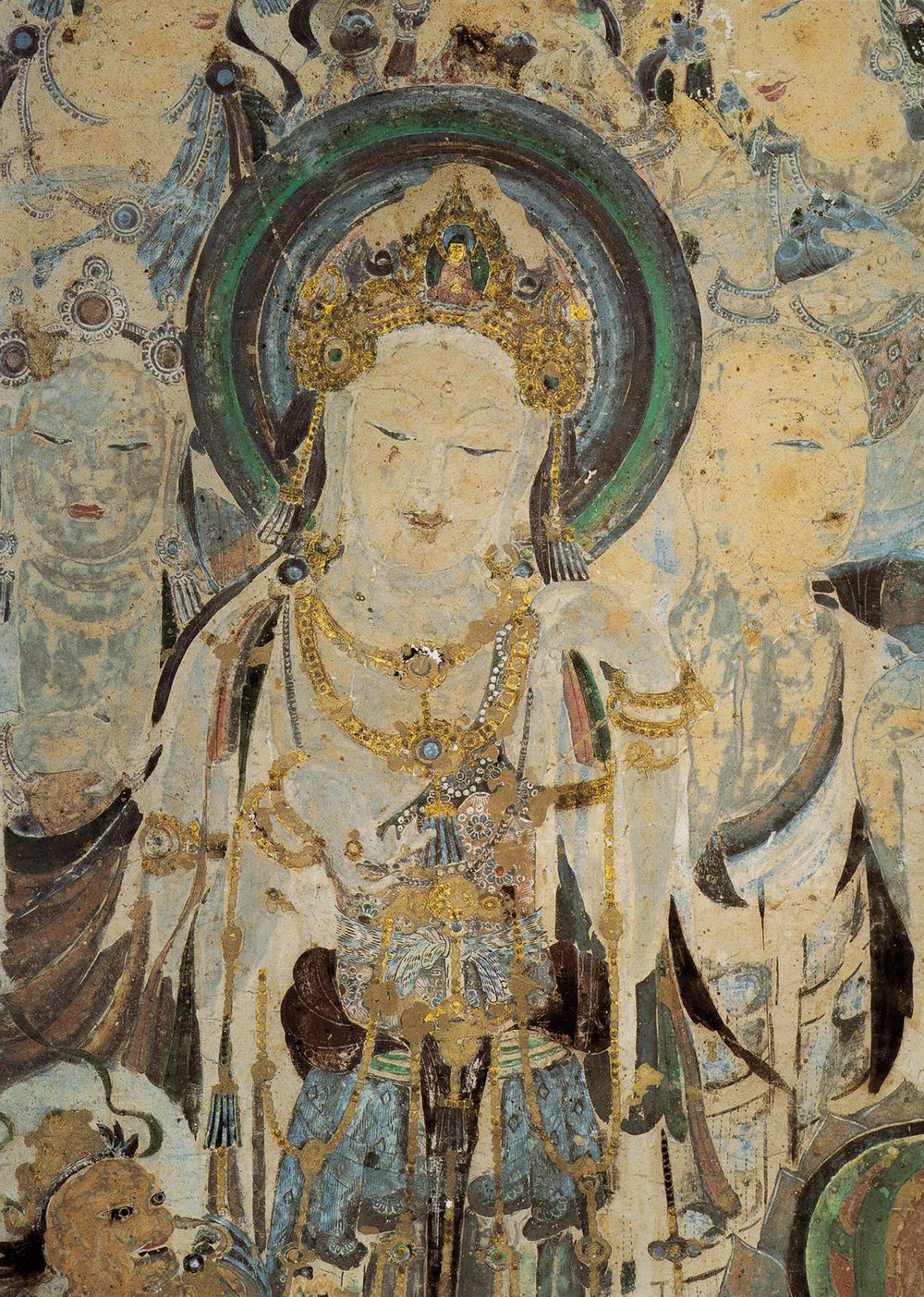
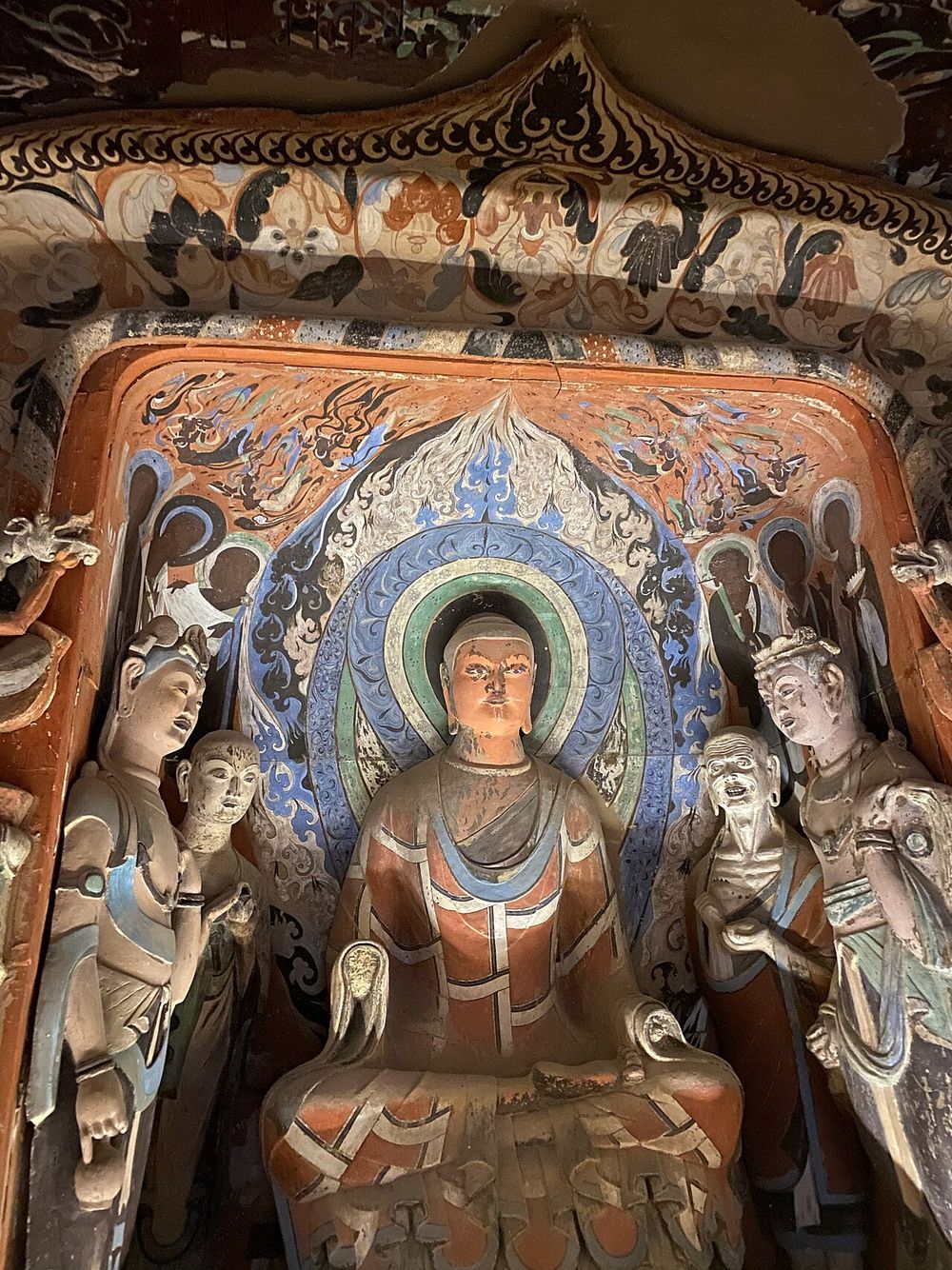
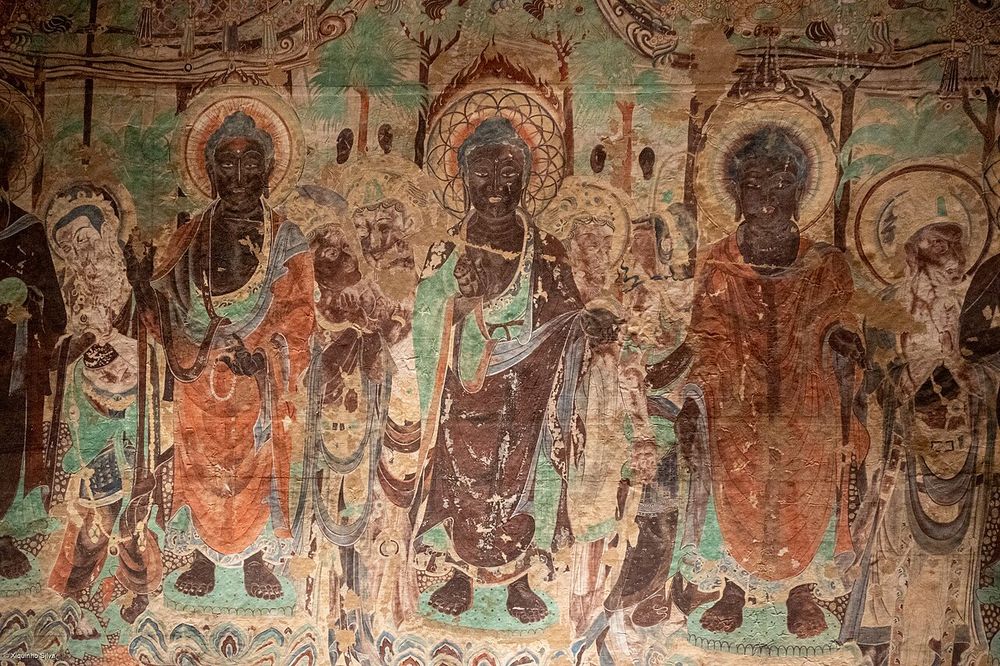
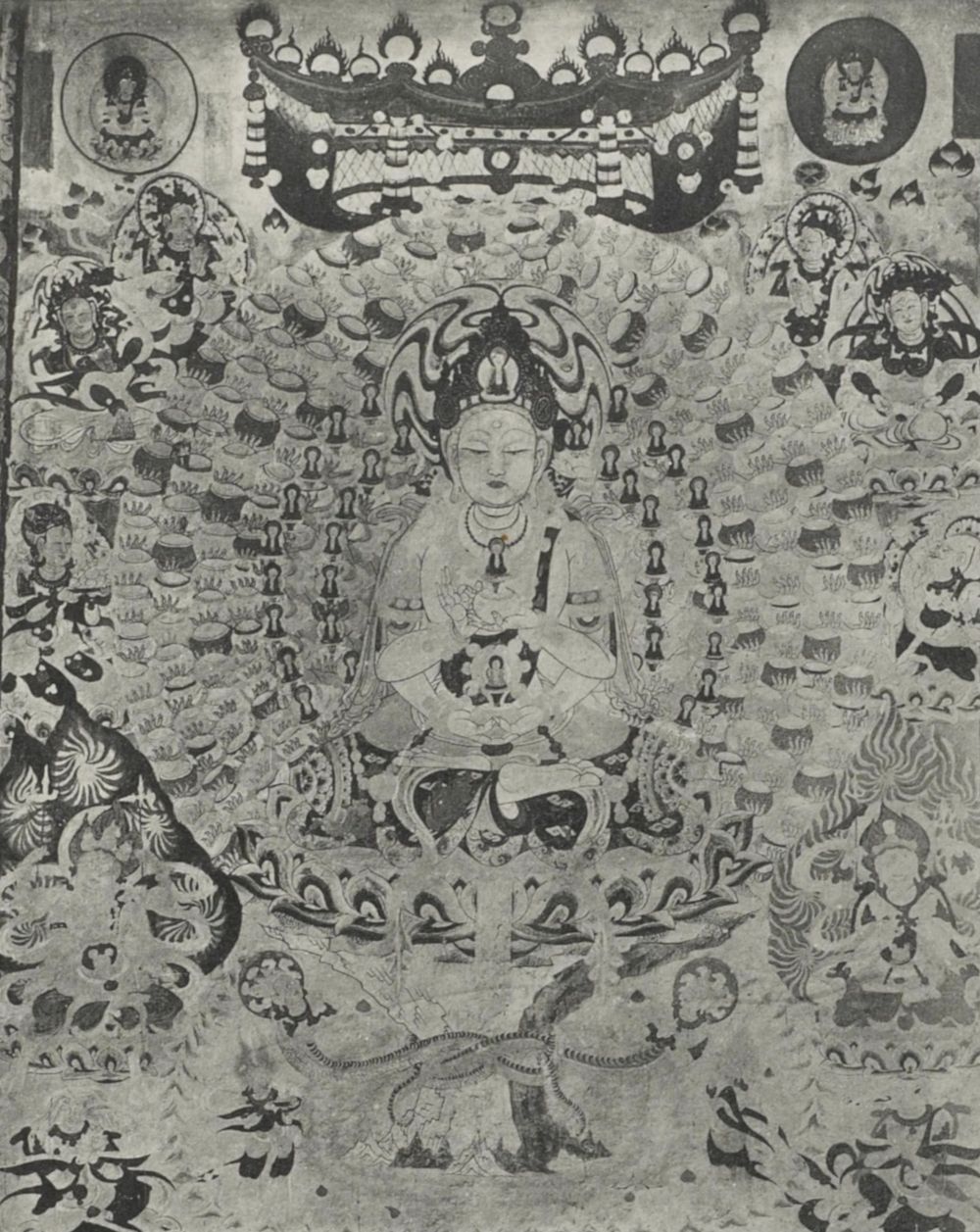
The Tang caves are the high point. In Cave 45, a Buddha, disciples and bodhisattvas stand with relaxed hips and calm faces, the "most beautiful bodhisattvas" of China. In Cave 220, painted in 642, an emperor in black robes leads his officials to hear the Buddhist sage Vimalakirti, a portrait of the Tang court itself.
The bodhisattva of Cave 57, Tangunknown ancient Buddhist artist(s), Public domain
4. Cave 61 and the map of Mount Wutai
The map of Mount Wutai, Cave 61Chinese artist(s) from the 10th century, Public domain
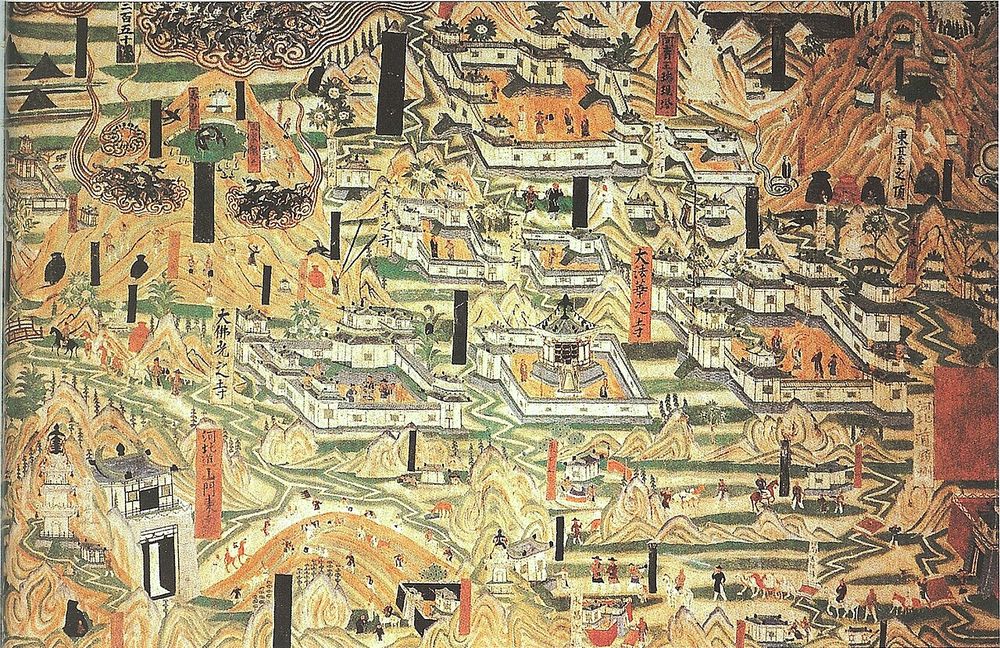
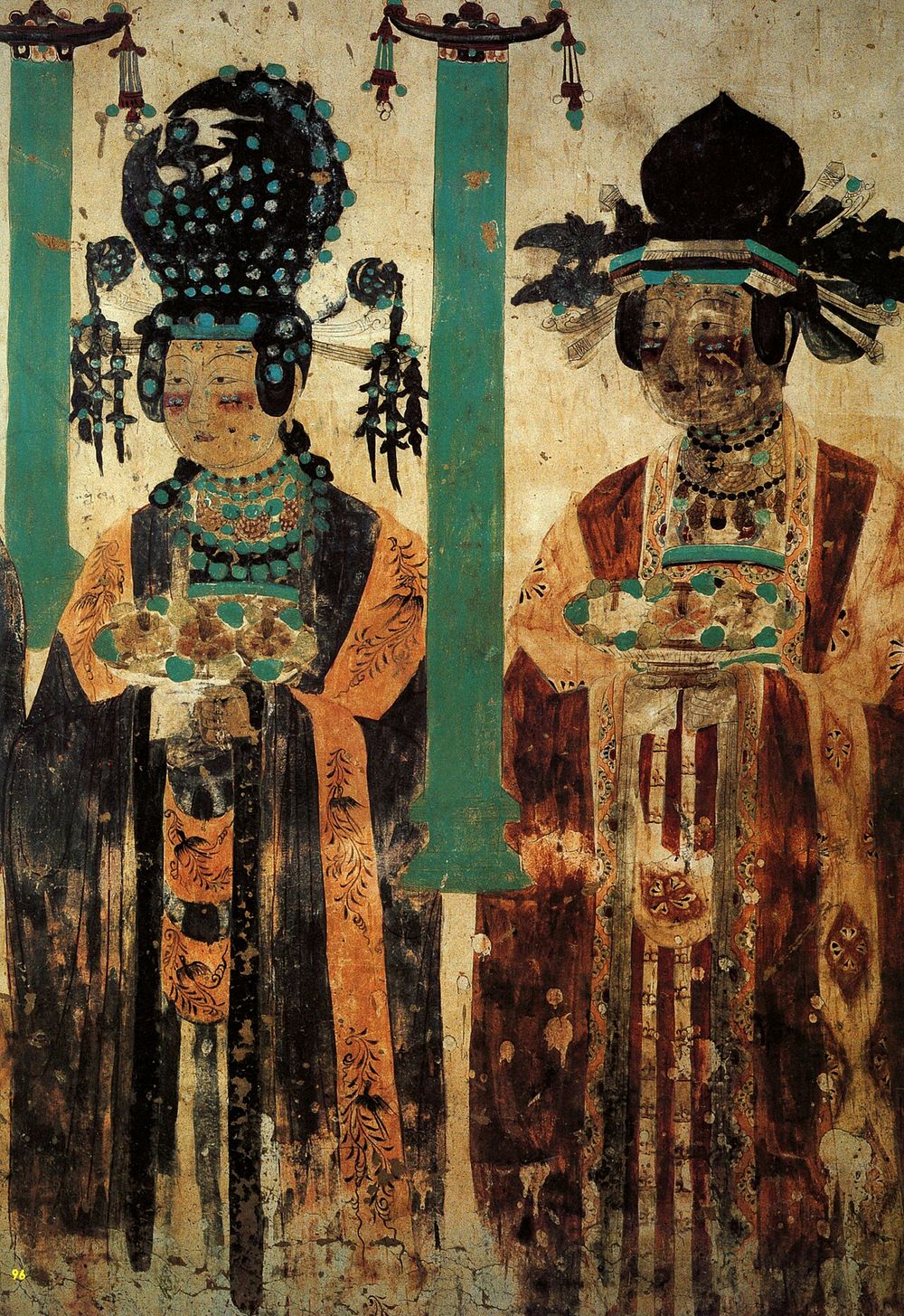
One wall of this tenth-century cave is a bird's-eye map of the sacred Mount Wutai, with monasteries, roads and pilgrims. In 1937 the architects Liang Sicheng and Lin Huiyin used a temple named on it, the "Great Foguang Temple", to find a real Tang timber hall still standing on Mount Wutai, then the oldest known wooden building in China.
5. The Library Cave
Wang Yuanlu, photographed by Aurel SteinAurel Stein[1], Public domain
Cave 17 is a small room off the passage of Cave 16. It was sealed around the early 11th century, perhaps to store worn-out sacred texts, perhaps for fear of war; no one knows. The room you see is empty; its contents are in a dozen countries, and the Dunhuang Academy and the International Dunhuang Programme have put tens of thousands of them online.
A bodhisattva leading a soul, silk painting from the Library Caveanonymous, Public domain
6. The sleeping Buddha of Cave 158
The reclining Buddha, Cave 158Bairuilong, CC BY-SA 4.0
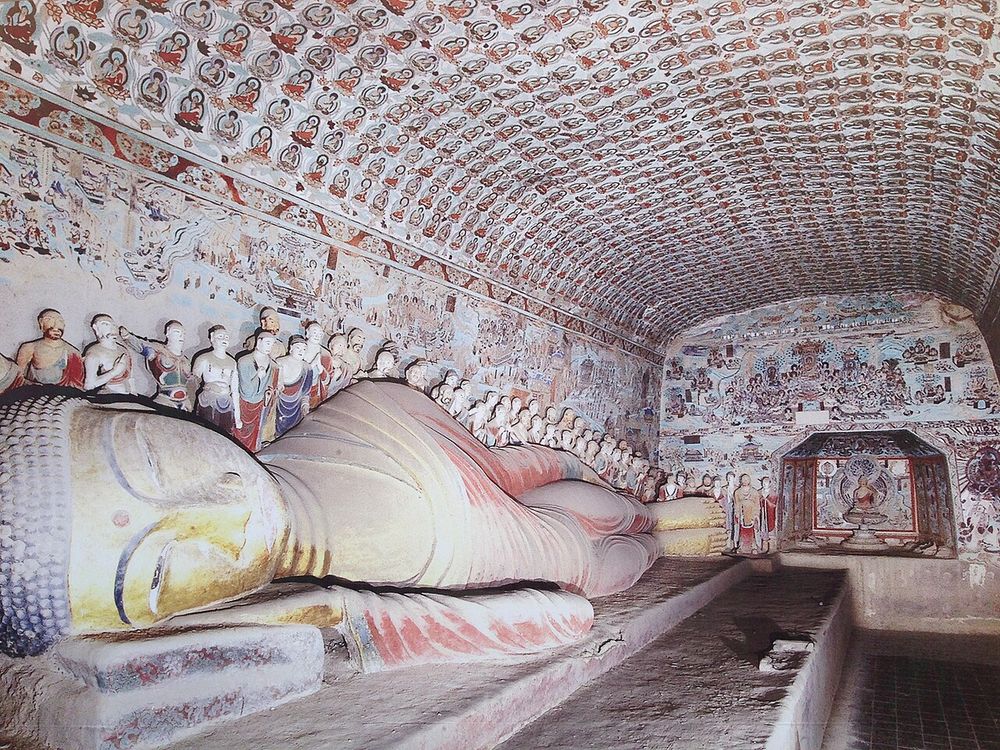
If your tour includes it, Cave 158 holds a Buddha lying on his side at the moment of his death, about 15.8 metres long, with mourners painted on the walls around him, among them foreign kings cutting their ears and chests in grief.
The caves and the same years elsewhere
Le Zun cut the first cave in 366; in the same decade the Huns crossed the Volga and set off the great migrations into the Roman world.
Meanwhile in the world
Year
Here
Elsewhere
366
Le Zun cuts the first cave
The Huns are pressing west towards the Roman world
642
Cave 220 is painted
The Arabs win at Nahavand and the Persian empire falls
868
The Diamond Sutra is printed
Alfred the Great is about to become king of Wessex
1900
Wang Yuanlu opens the Library Cave
The Boxer uprising; Freud publishes "The Interpretation of Dreams"
1987
The caves become a World Heritage Site
The US and the Soviet Union sign the INF Treaty
One line to remember: a thousand years of travellers' prayers, painted in the dark.
Then and now
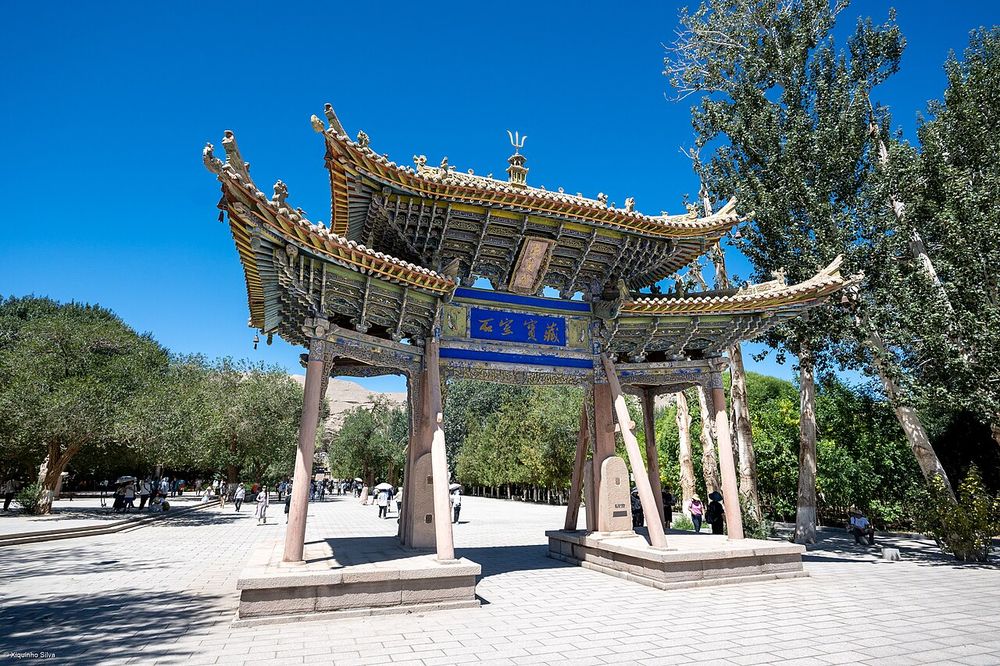
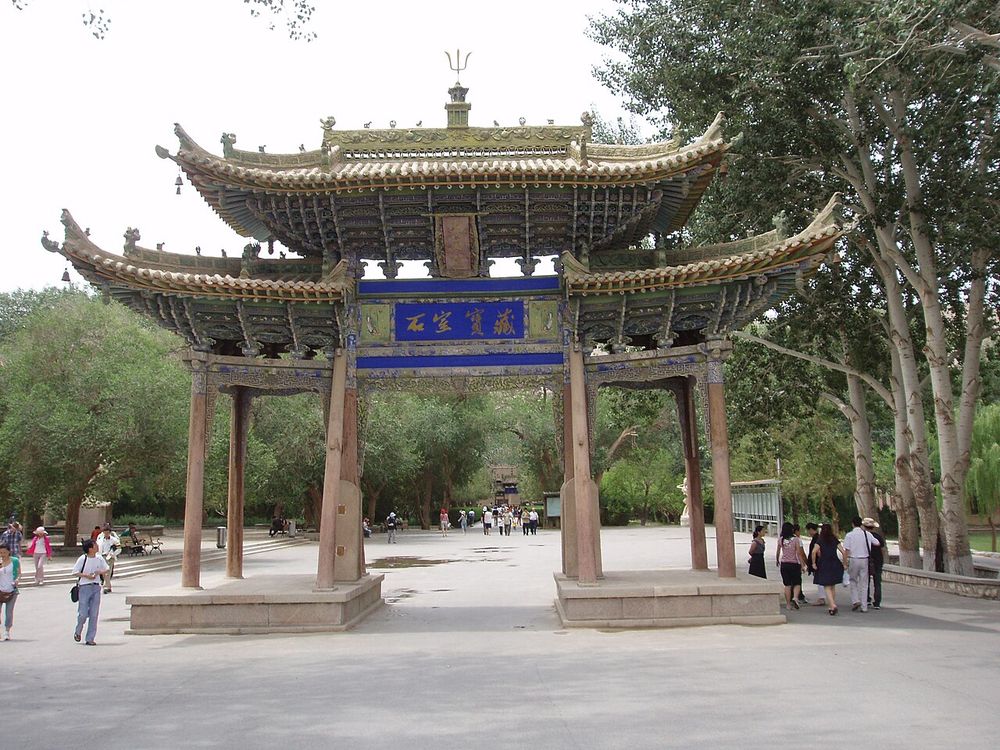
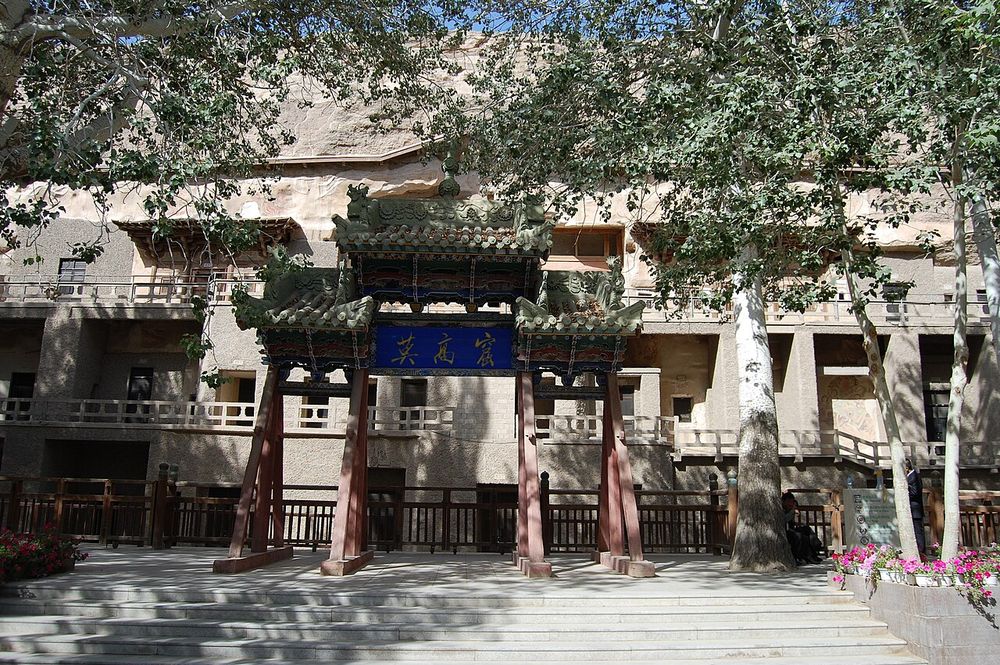
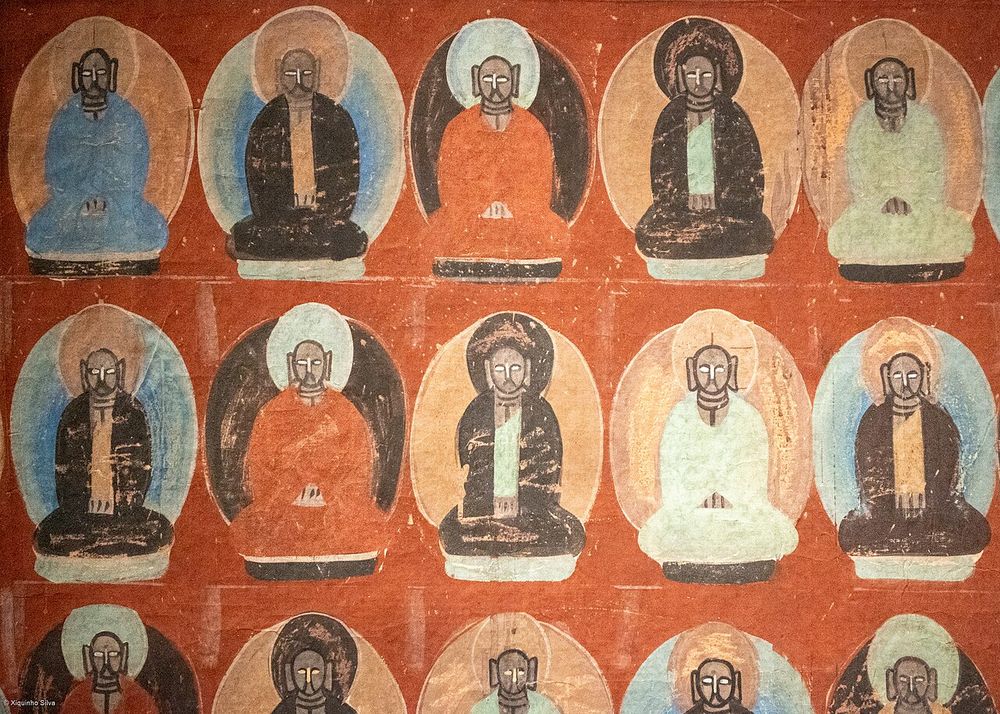
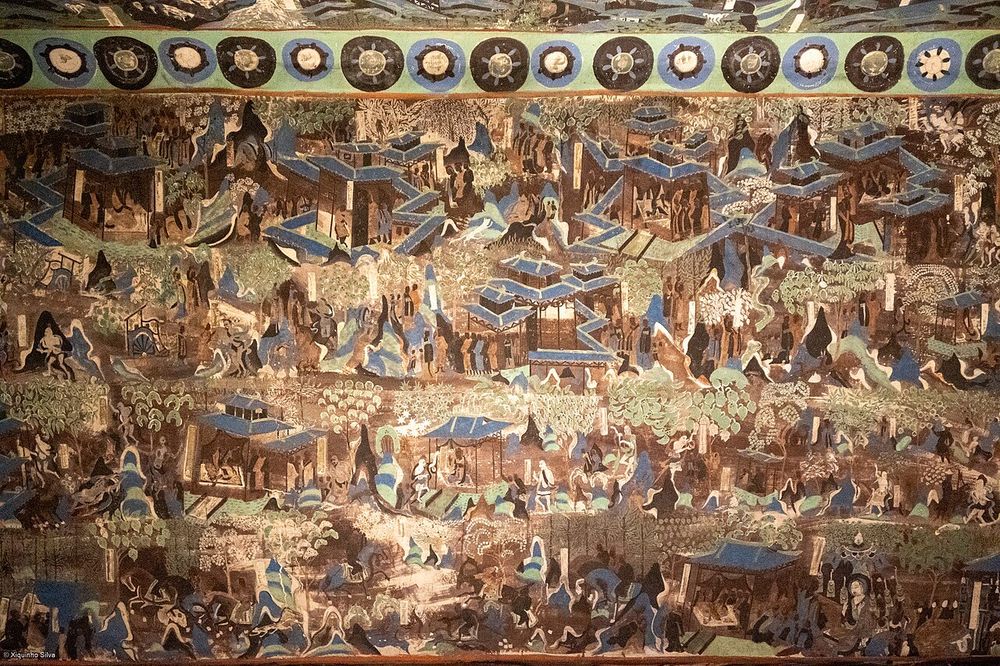
The cliff of caves, 2015Zossolino, CC BY-SA 4.0, Wikimedia CommonsThe desert and the cliff from the dunes opposite, 2015Zossolino, CC BY-SA 4.0, Wikimedia CommonsThe Nine-Storey Building, 2015Zossolino, CC BY-SA 4.0, Wikimedia CommonsCave 96 and its tower, September 2023N509FZ, CC BY-SA 4.0, Wikimedia CommonsThe tower in summer, 2008Windmemories, CC BY-SA 4.0, Wikimedia CommonsTiers of cave doors behind poplars, 2015Zossolino, CC BY-SA 4.0, Wikimedia CommonsA cave entrance in the rock, 2015Zossolino, CC BY-SA 4.0, Wikimedia CommonsWalkways along the cliff, 2015Zossolino, CC BY-SA 4.0, Wikimedia CommonsRoof decoration on the tower, 2015Zossolino, CC BY-SA 4.0, Wikimedia CommonsA wooden porch on the cliff, 2024xiquinhosilva, CC BY 2.0, Wikimedia CommonsStairs and terraces of the caves, 2024xiquinhosilva, CC BY 2.0, Wikimedia CommonsConcrete walkways of the 1960s, 2024xiquinhosilva, CC BY 2.0, Wikimedia CommonsA Tang-style eave against the sky, 2024xiquinhosilva, CC BY 2.0, Wikimedia CommonsThe gateway of the cave area, 2024xiquinhosilva, CC BY 2.0, Wikimedia CommonsA tower and porch on the cliffHiroki Ogawa, CC BY 3.0, Wikimedia CommonsThe cliff and the desert beyond, 2015Laika ac from UK, CC BY-SA 2.0, Wikimedia CommonsThe ceiling of a cave entrance, 2015Laika ac from UK, CC BY-SA 2.0, Wikimedia CommonsThe memorial stone at the gate, winter 2013Zhangzhugang, CC BY-SA 4.0, Wikimedia CommonsThe pailou gate, 2009Fanghong, CC BY-SA 3.0, Wikimedia CommonsCaves behind the trees, 2009Sigismund von Dobschütz, CC BY-SA 3.0, Wikimedia CommonsA wall of painted Buddhasxiquinhosilva, CC BY 2.0, Wikimedia CommonsA mural of crowds and buildingsxiquinhosilva, CC BY 2.0, Wikimedia CommonsA painted clay Buddha in his nicheNana ebi, CC0, Wikimedia CommonsThe emperor and his officials, Cave 220, 642Unknown authorUnknown author, Public domain, Wikimedia CommonsParadise mural in Cave 220xiquinhosilva, CC BY 2.0, Wikimedia CommonsThe map of Mount Wutai, Cave 61Chinese artist(s) from the 10th century, Public domain, Wikimedia CommonsDonor queens from Khotan, Cave 61Unknown authorUnknown author, Public domain, Wikimedia CommonsThe bodhisattva of Cave 57, Tangunknown ancient Buddhist artist(s), Public domain, Wikimedia CommonsThe reclining Buddha, Cave 158Bairuilong, CC BY-SA 4.0, Wikimedia CommonsA bodhisattva leading a soul, silk painting from the Library Caveanonymous, Public domain, Wikimedia CommonsA woman donor, painting of 983 from the Library CaveUnknown authorUnknown author, Public domain, Wikimedia CommonsWang Yuanlu, photographed by Aurel SteinAurel Stein[1], Public domain, Wikimedia CommonsA mural photographed by Pelliot's expedition, 1908Paul Pelliot, Public domain, Wikimedia Commons
Local legends
These are stories people tell about this place. They are legends, not history, and each one says where it comes from.
LegendThe light of a thousand Buddhas
Le Zun, walking with his staff, saw the cliff blaze with golden light in the shape of a thousand Buddhas, and took it as a sign to cut the first cave. The name "Caves of the Thousand Buddhas" comes from this.
Source: Inscription of Li Kerang, 698, Mogao
Later, people who live here will be able to add the stories they grew up with, and say which of these they have heard.
Not certain, and where accounts conflict
Why was the Library Cave sealed?
The main theories: to store worn-out but sacred texts; to hide treasures from an invasion, such as the Western Xia or the Karakhanids; or simply as a storeroom no longer needed. None is proved.
Did Zhang Daqian damage the caves?
He was accused of peeling off later layers of paint to reach older murals beneath. Accounts differ and the debate continues.
Visiting
Tickets and hours
Standard (A) ticket 238 yuan from April to November, 140 yuan from December to March. Emergency (B) ticket 100 yuan. Special caves 150 to 200 yuan each.
April to November 8:00 to 18:00, last entry 16:10. Daily quota 6,000 standard tickets.
Last checked 2026-11-12. Ticket classes, prices, quotas and hours from 2026 press guides citing the Dunhuang Academy's notices; the booking site itself could not be opened from abroad.
Booking without WeChat
Official page in English Book on the Mogao booking site or its WeChat mini-program, 莫高窟参观预约网, with a passport. Standard tickets open 30 days ahead.
International booking platform Some travel platforms resell tickets; the Dunhuang Academy warns against touts and unofficial sellers.
Ticket window on site There is no ticket office at the site; without a booking you cannot enter.
Note In summer the standard tickets sell out within minutes of release; the emergency tickets are the fallback.
Checked 2026-11-12
Where to start
Start at the Digital Exhibition Centre near Dunhuang, at the time on your ticket; shuttles run from there.
Read a little before you go: with only eight caves, knowing what you are looking at matters.
Before you go
Summer heat can pass 40 °C; go early. Inside the caves it is cool and dim.
Bags and cameras must be left in lockers; carry your passport.
Customs and manners
Do not touch the walls or lean on the doorframes; the paintings are on clay and flake easily.
Keep your voice low; breath and noise in a crowded cave both harm the paintings.
Opening hours are given in the local time of the place. Prices are in the local currency. The figure after ≈ is approximate, at exchange rates checked on 9 November 2026, in .
Look for these
In Cave 220, find the emperor in black robes.
On the map of Mount Wutai, find the "Great Foguang Temple".
Find a flying apsara with ribbons, and count how many instruments the heavenly musicians play.
I am here
Stand at the site, sign in, press the button, and collect its stamp. Your browser will ask to use your location. It is sent to us once to confirm that you are at the site; we keep how far you were from it, not the spot where you stood.
Your stamps are saved to your account, so they follow you to any device. Checking from a browser cannot rule out every false location; stricter checks arrive with the app.
Messages
Share your photos
Photos here show the place, not people. Each one is credited to the visitor who took it and appears after our team has looked at it. A photo with you in it belongs under “I am here”.