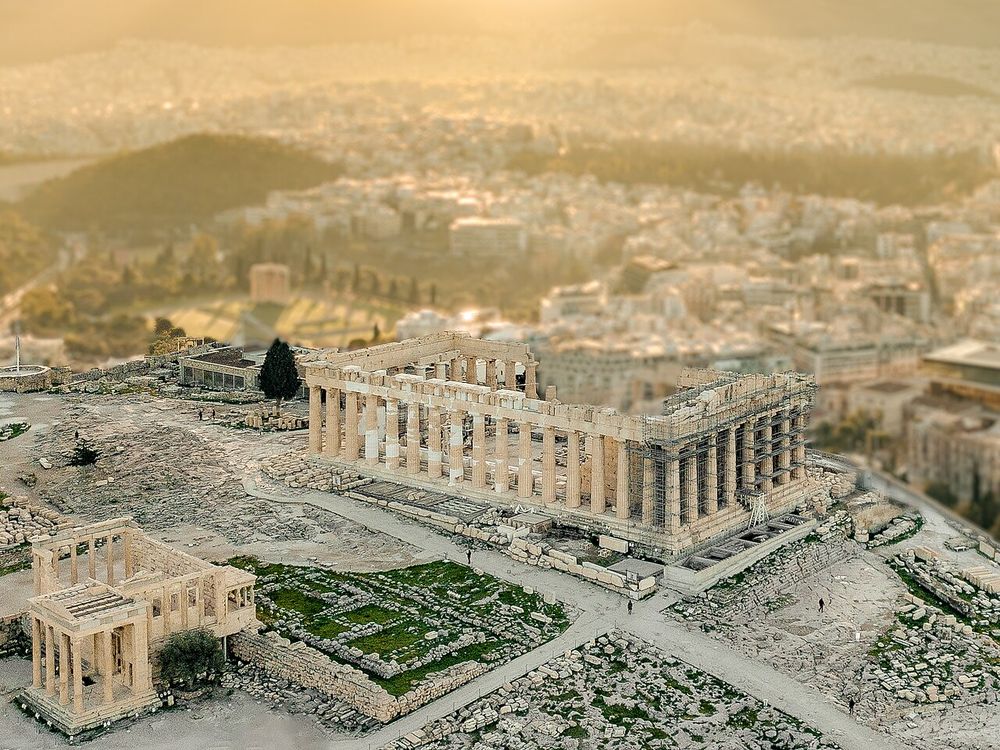
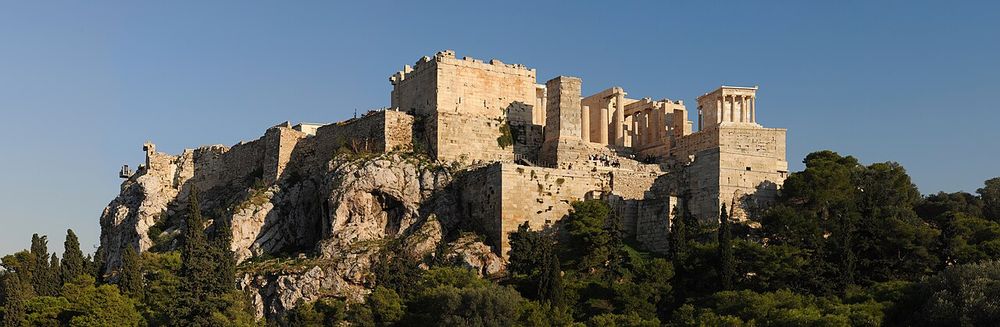
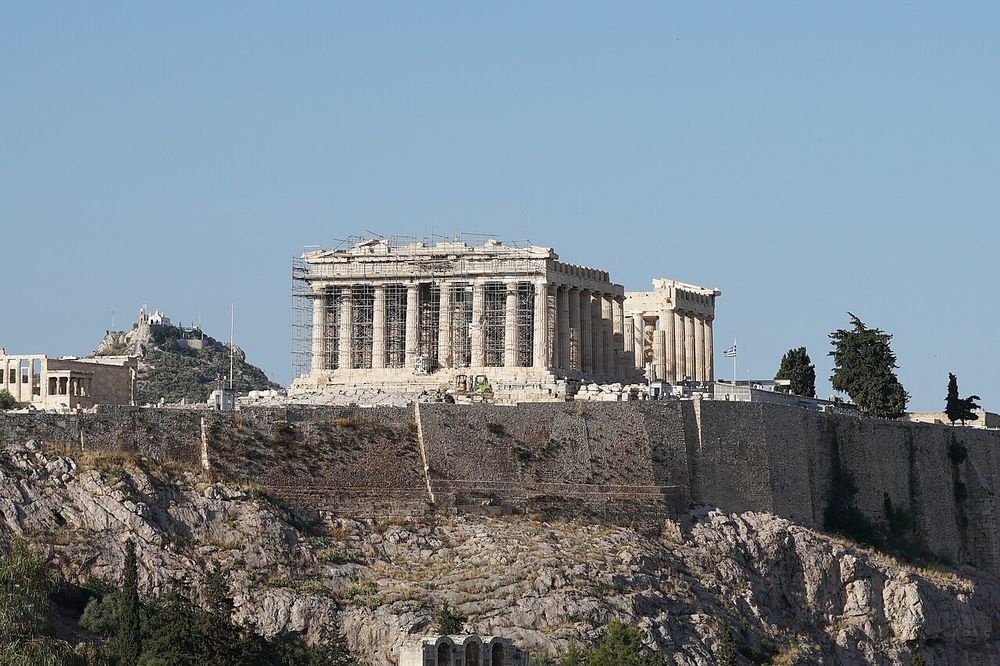
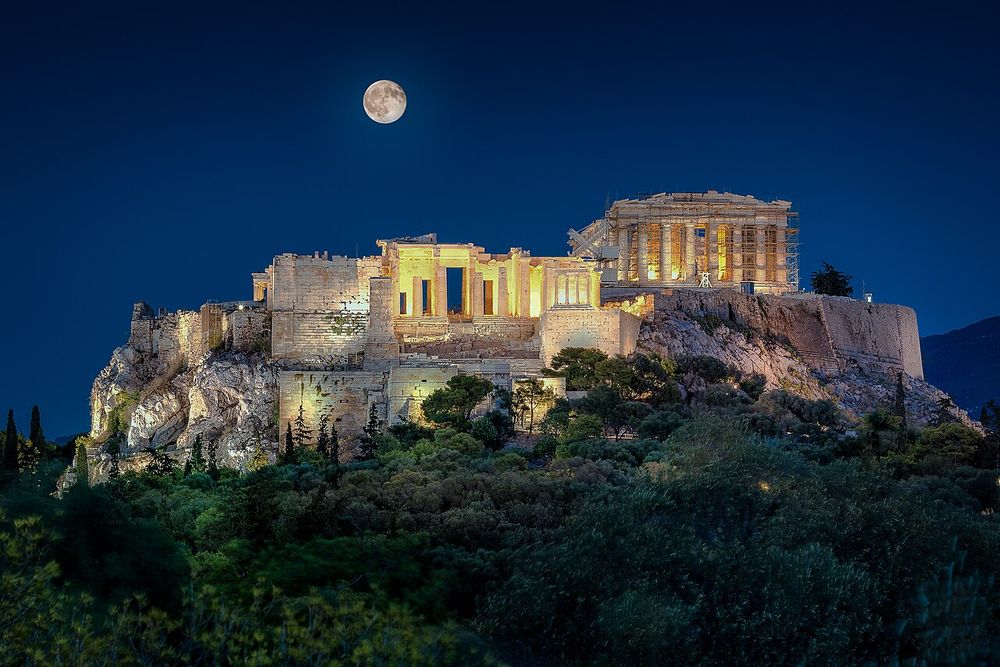
A temple with almost no straight line in it, built in nine years, used for two thousand, and blown open by one shell in 1687. Around it, on one rock, the gate, the small temples and the theatres of classical Athens.
Photo: A.Savin, CC BY-SA 3.0, Wikimedia Commons
The story
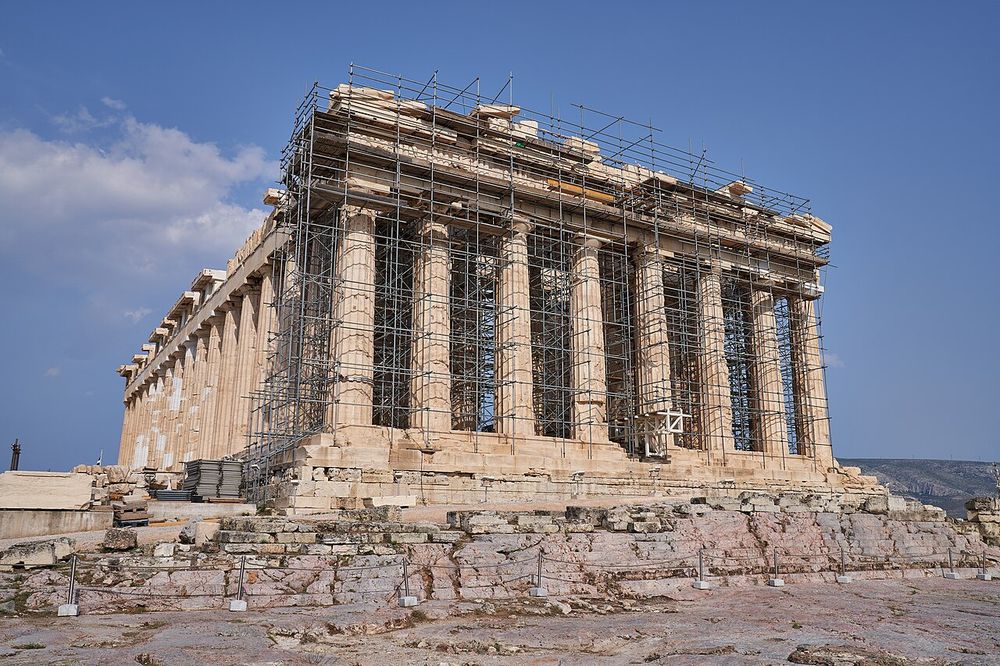
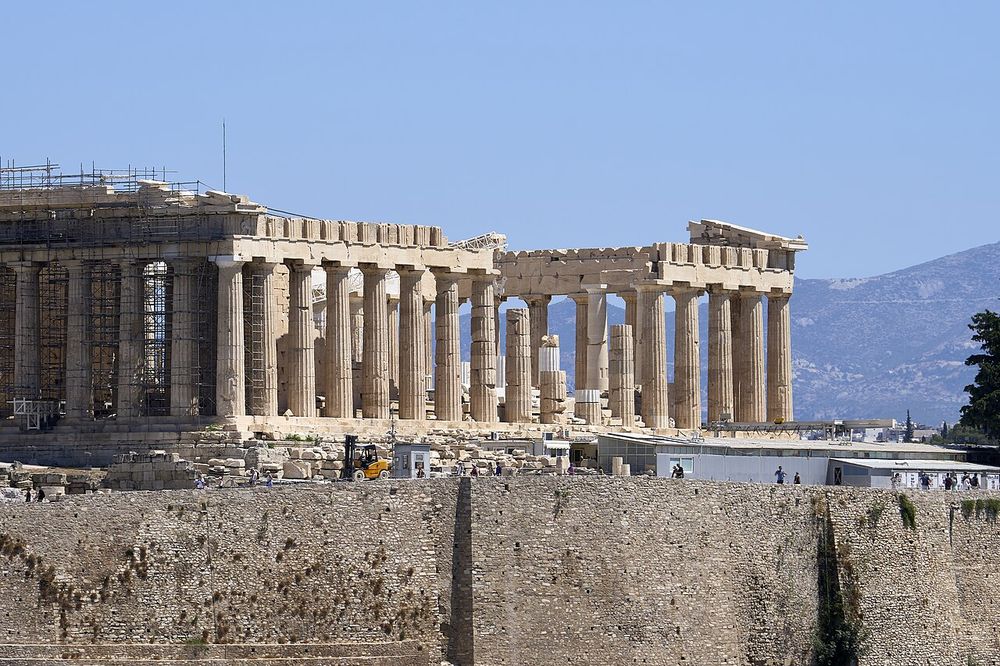
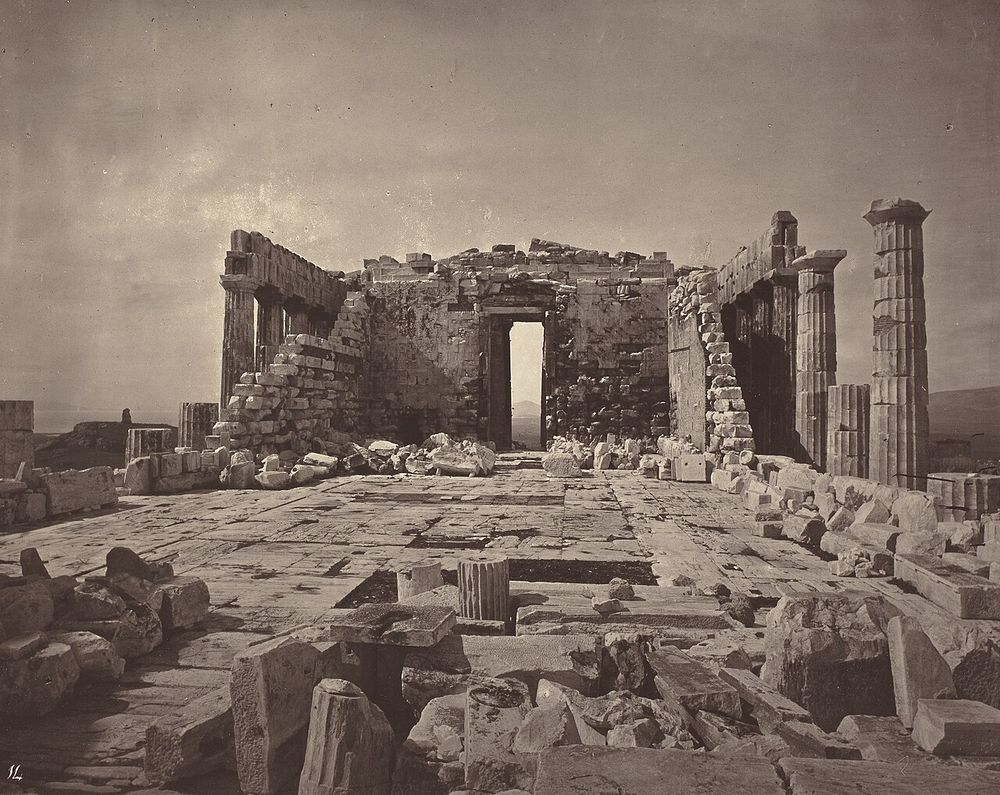
The temple in front of you is the Parthenon. It was built between 447 and 438 BC for Athena, the goddess who protected Athens. For the next two thousand years it was a church, then a mosque. In 1687 a shell set off gunpowder stored inside, and it became what you see.
Look again. The columns and steps seem straight. Not one of them is.
The Parthenon is one building on the Acropolis. One site ticket covers the four classical buildings on top and the two theatres on the south slope. The Acropolis Museum at the foot of the hill is a separate place with a separate ticket and a page of its own. Many visitors assume one ticket covers both and find out at the door.
A separate place with its own ticket; see its own page
If you have one minute
Inside the gate, looking at the Parthenon
The west end and north side: the first view from the gateGeorge E. Koronaios, CC BY-SA 4.0
In 480 BC a Persian army took Athens and burned the temples on this rock. Thirty years later Athens had won the war and led a league of Greek cities. The statesman Pericles spent a great sum, part of it paid in by the allies, to build this temple on the ruins. From the first stone to the dedication took nine years.
The floor rises a little in the middle. The columns swell slightly and lean inwards. The builders made these curves too small to notice, and the result looks more upright and more alive than a truly straight building would.
The white stone is not how it looked. The sculptures were painted blue, red and purple. About half of what survives is in the Acropolis Museum at the foot of the hill. The other half is in the British Museum in London. Greece has asked for it back for more than forty years.
Things people often get wrong
"Greek temples were white." They were painted. Almost all the colour has gone, and the idea of white classical marble comes largely from European taste of the 1700s and 1800s. Recent tests have found traces of the pigment Egyptian blue on the sculptures.
"It fell down with age." It stood complete for more than two thousand years. Earthquakes did not bring it down. The explosion of 1687 did.
"You can go inside." You cannot. Visitors walk round the outside, behind a rope.
"The Acropolis and the Parthenon are the same thing." The Acropolis is the whole rock. The Parthenon is the largest of several buildings on it. The huge lone columns you can see to the south-east are a different temple, of Olympian Zeus, with its own ticket.
Some visitors have read that the building is a modern invention. The evidence against that comes from sides that had no reason to agree. Athens carved its building accounts on stone, and those stones were dug up. Ottoman tax registers of the 1500s list it as the mosque of the fortress of Athens, and the traveller Evliya Çelebi described it around 1667. Venetians and Ottomans both recorded the explosion.
People who stood here
Socrates (philosopher of ancient Athens)He was in his early twenties when the building began and in his thirties when it was finished. He was an Athenian and a stonemason's son. He may have stood where you are standing and watched the columns go up, drum by drum.
Sophocles (playwright; author of Oedipus the King)His plays were first staged in the Theatre of Dionysus on the south slope. On the day Oedipus was first performed, he may have stood at the edge of that stage, looking up at an audience seated on this hillside.
Lord Byron (English poet)He came here in 1810, a few years after Lord Elgin's men had taken the sculptures down. He may have stood before these same bare walls, and he went home and wrote some of the angriest lines in English about what his countryman had done.
Go deeper: seven stops round the Parthenon, then the rest of the rock
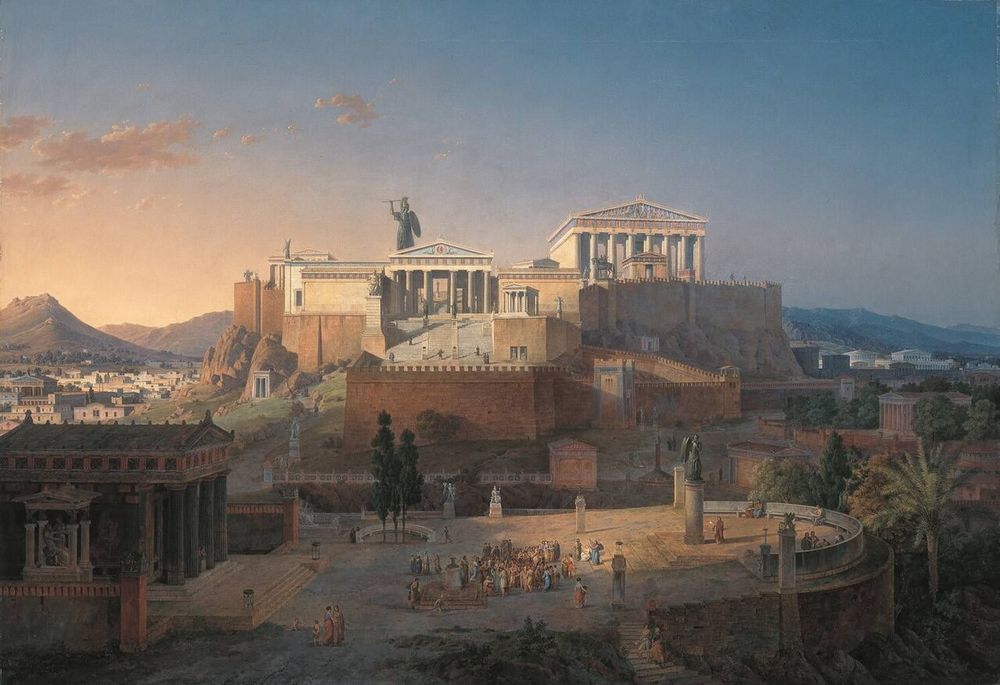
Visitors come up through the gate at the west end and walk round the outside of the temple. The first seven stops follow that walk. The stops after them are the other buildings on the rock, the two theatres on its slope, and the museum below.
1. Inside the gate: the first look
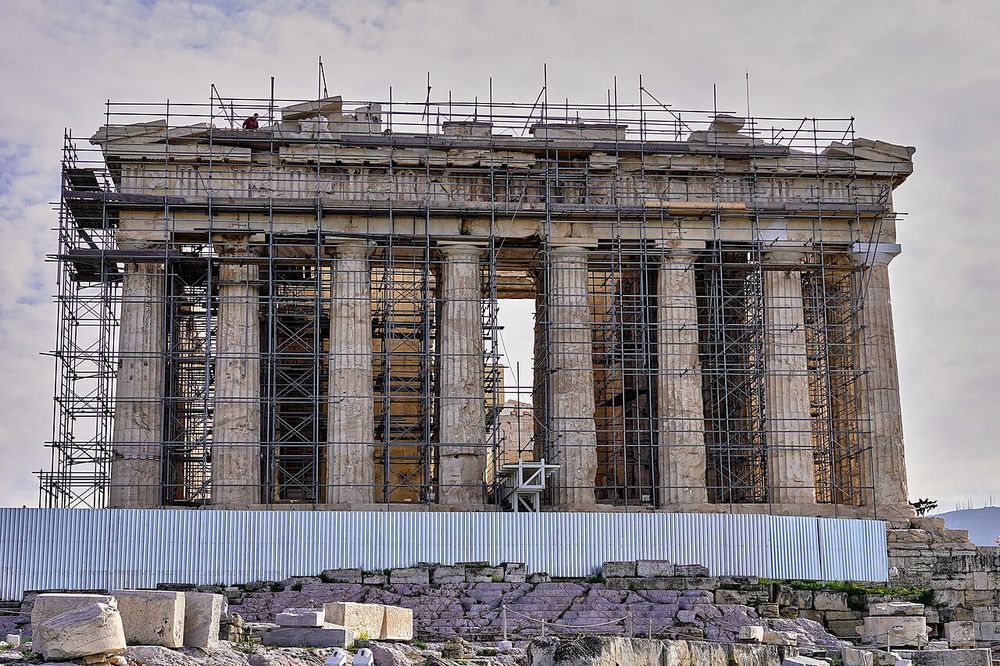
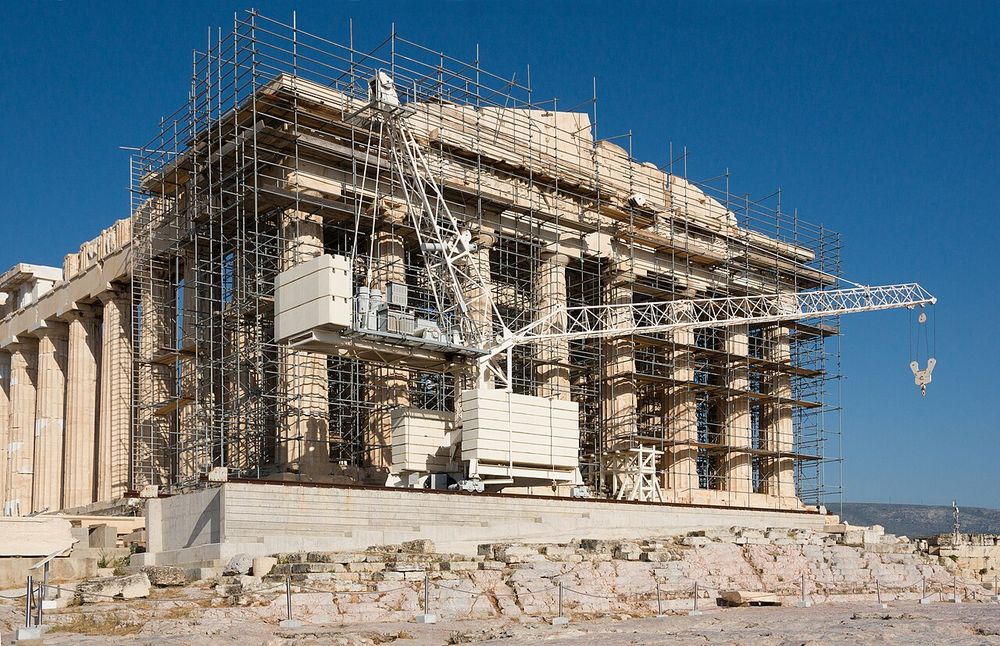
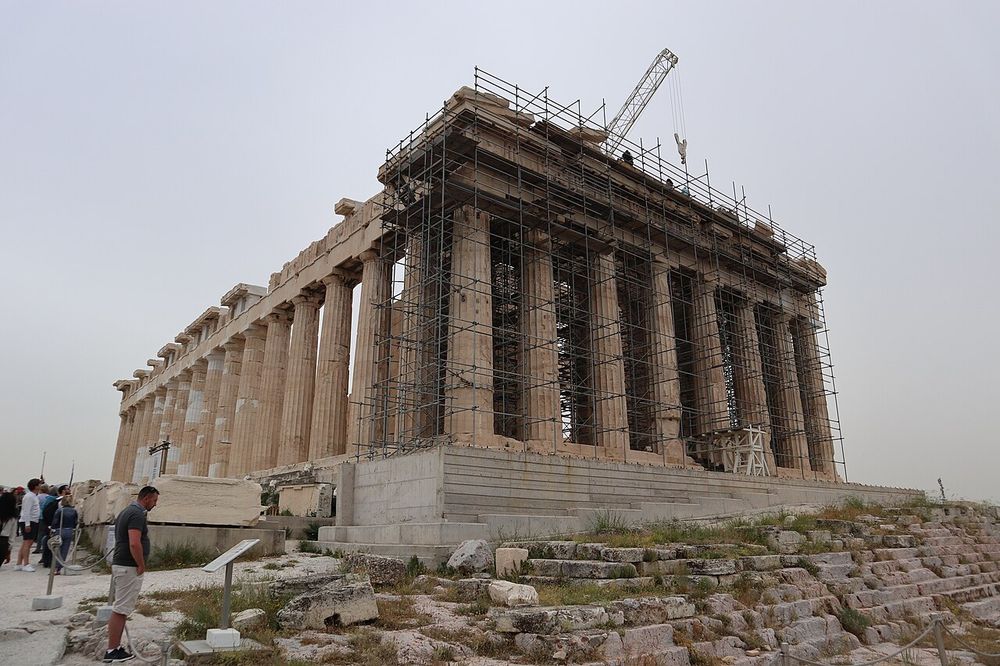
The west end, with scaffolding, 2020George E. Koronaios, CC BY-SA 4.0
Through the gate, the Parthenon stands ahead and to the right. What you see first is its west end and north side: its back and its flank. The front faces east, towards the sunrise, and you must walk to the far end to see it.
Some numbers. The temple is about 70 metres long and 31 wide. There are 46 outer columns: eight at each end and seventeen on each side, counting the corners once. Each is about 10.4 metres high and has twenty flutes. The marble came from Mount Pentelikon, about 16 kilometres away. No mortar was used. The blocks were cut to fit and held with metal clamps.
The architects were Iktinos and Kallikrates. The sculptor Phidias had charge of the whole. Work began in 447 BC, the statue went in in 438, and the outside sculpture was finished in 432.
2. The north steps: the straight lines that are not there
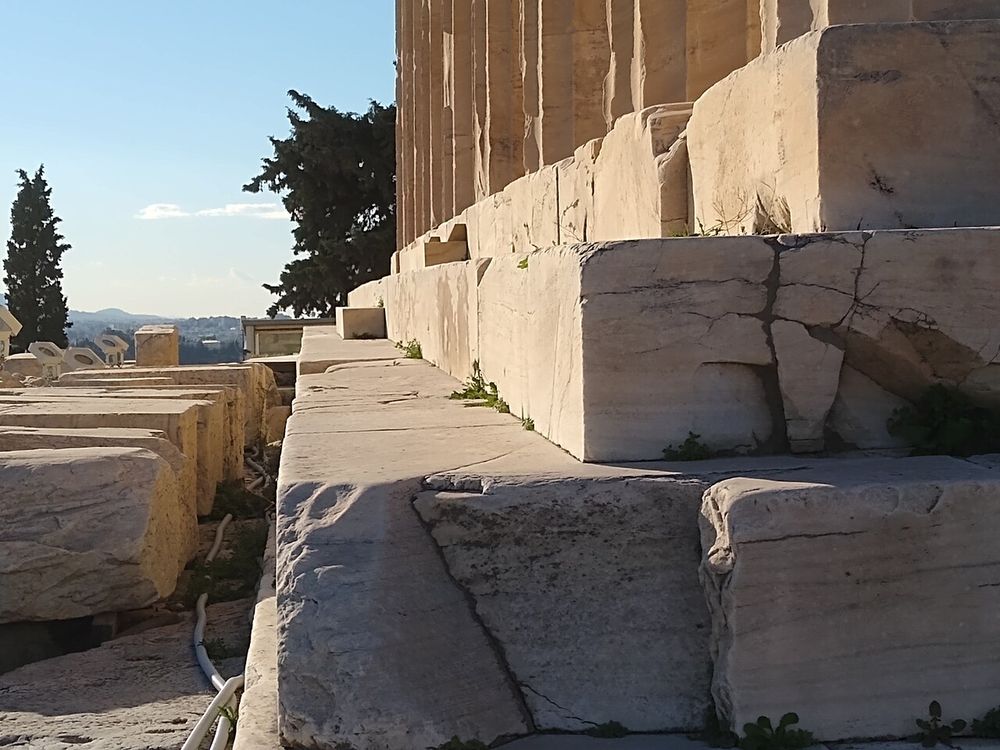
The steps at the east end; look along the edge for the curveTwospoonfuls, CC BY-SA 4.0
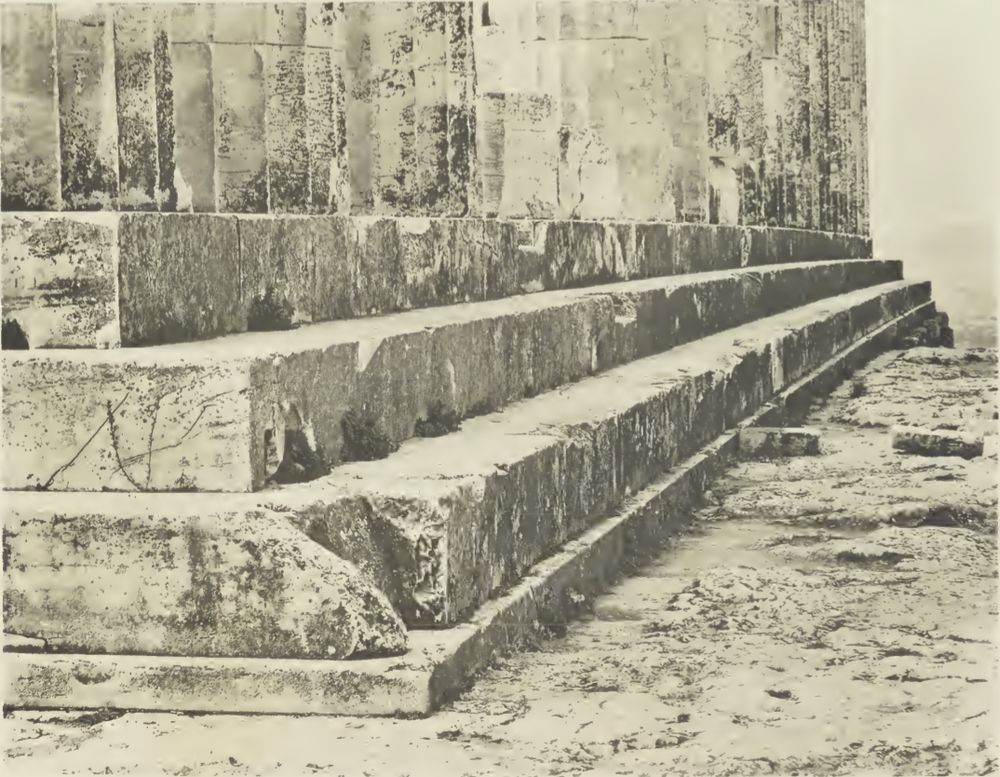
Stand at a corner, put your eye near the edge of a step, and look along the long side. The step rises in the middle. On the short ends the centre is about 6 centimetres higher than the corners. On the long sides it is about 11.
The same thing runs through the whole building. The columns swell in the middle and narrow towards the top. All of them lean slightly inwards. The four at the corners are a little thicker, because they stand against bright sky and would look thin. The beam above the columns curves with the floor.
So almost every block has its own shape and had to be worked out and cut by itself. To finish that in nine years was a feat of organisation.
Why they did it is disputed. The Roman architect Vitruvius said it corrected the eye: from a distance a truly straight line seems to sag. The scholar Jeffrey Hurwit argues that the curves make the building seem to flex and live, like a sculpture. The rise in the floor also sheds rainwater.
3. Look up: what the three bands of sculpture said
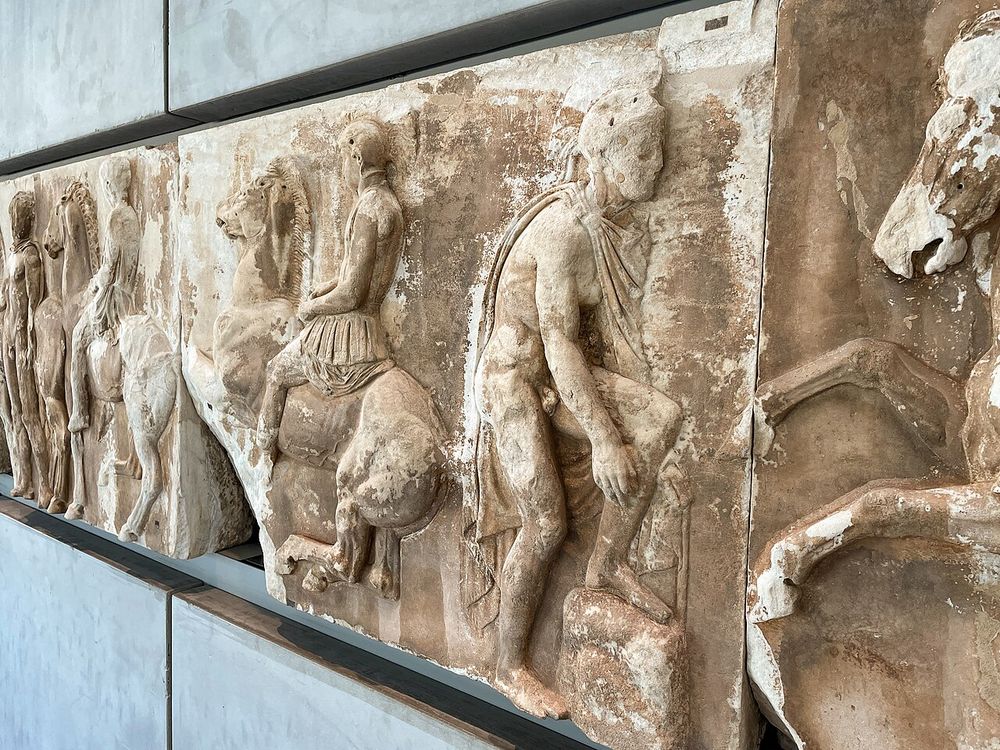
A block of the west frieze: horsemen preparingNikos Kitsakis, CC BY 4.0
The sculpture came in three bands. Most of what is on the building now is a copy. The originals were moved indoors, away from weather and fumes.
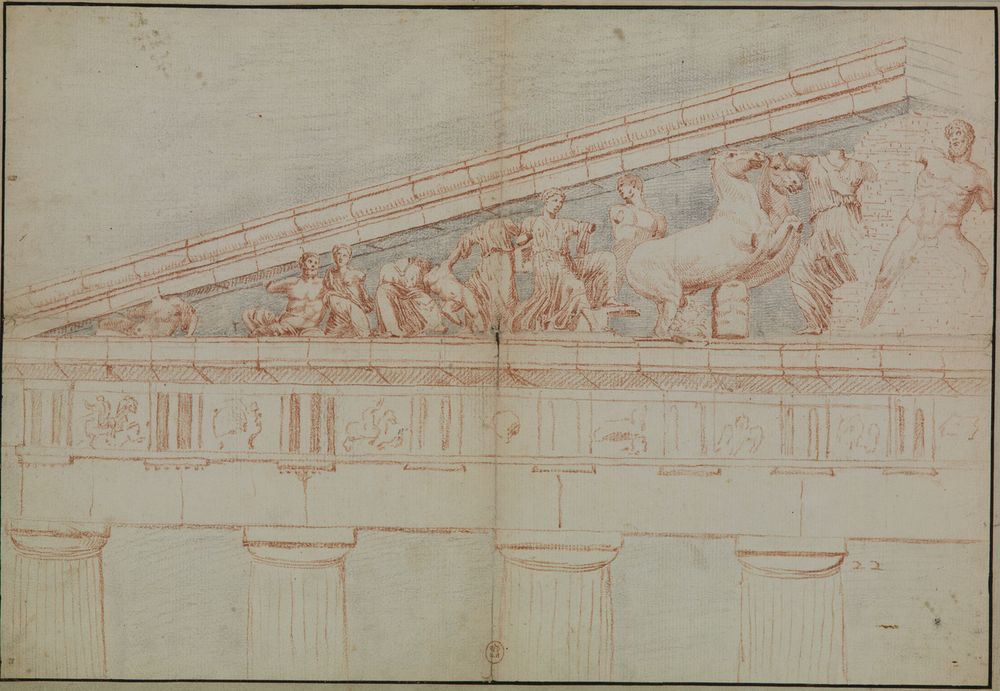
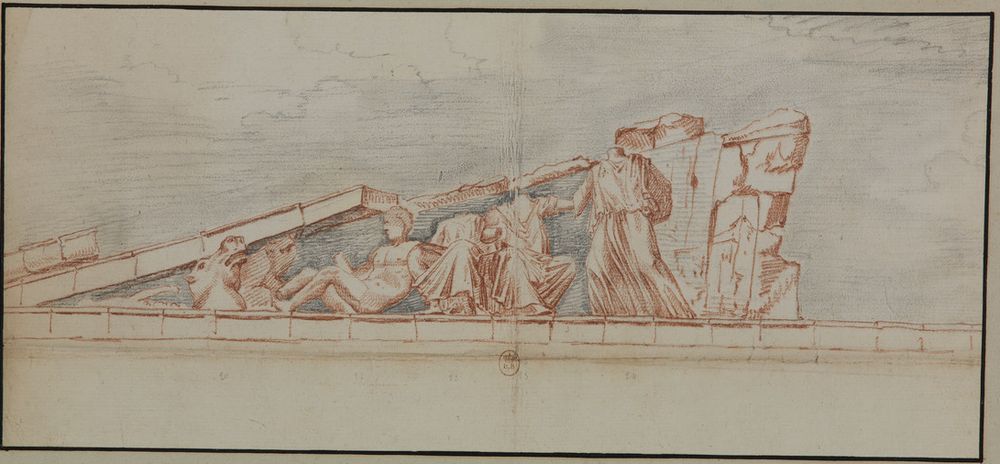
The pediments, the two triangles under the roof. The east one showed the birth of Athena, fully armed, from the head of her father Zeus. The west one showed her contest with Poseidon, god of the sea, for the city.
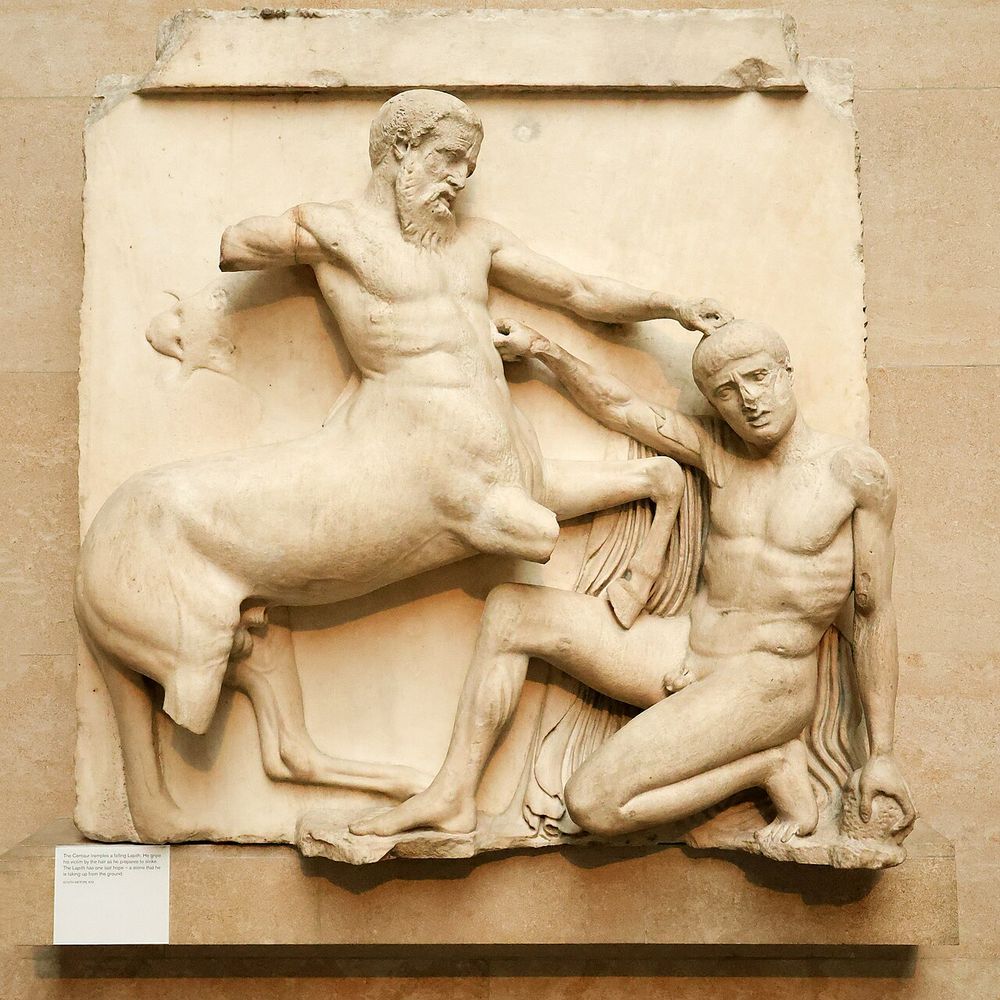
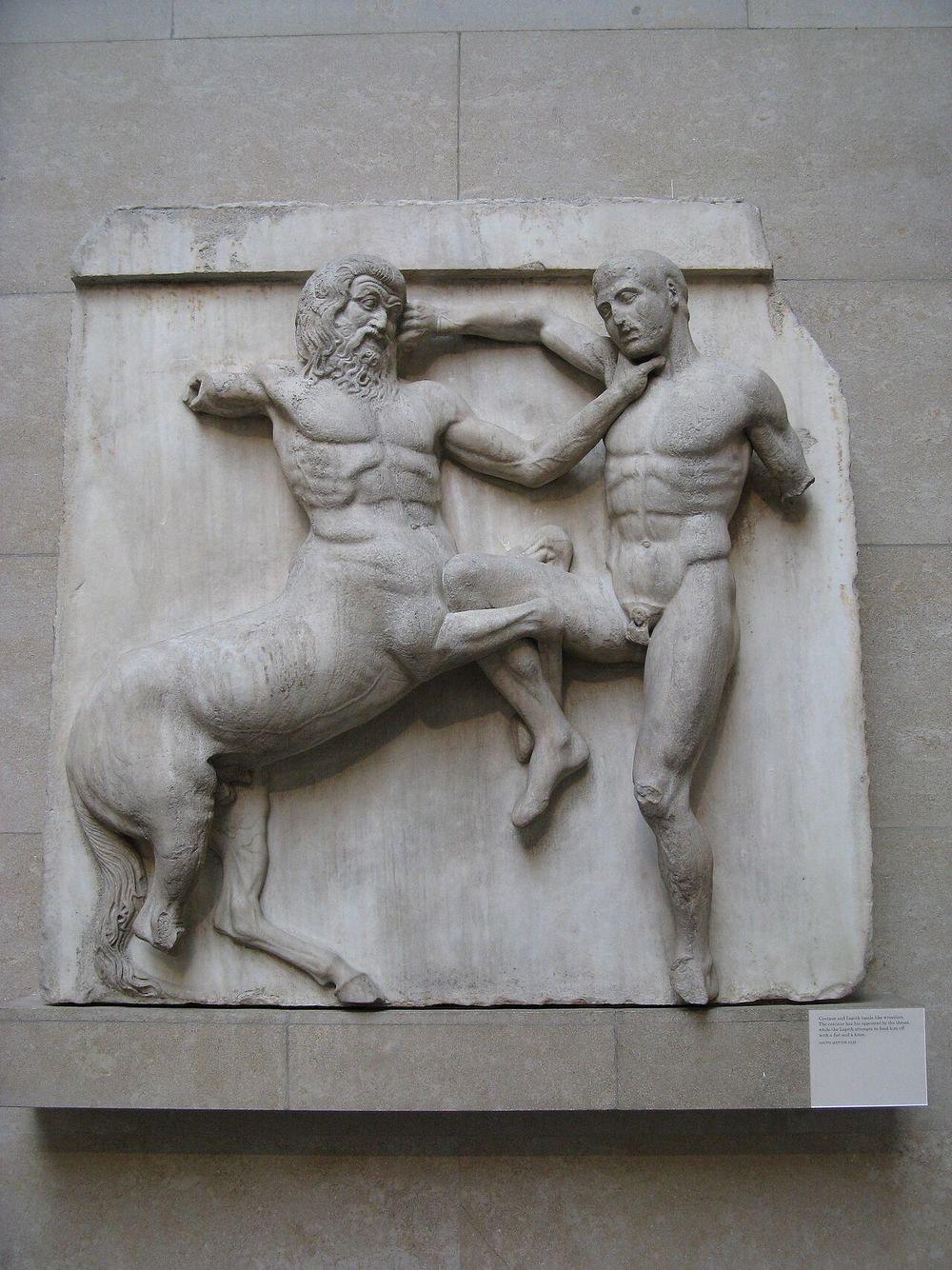
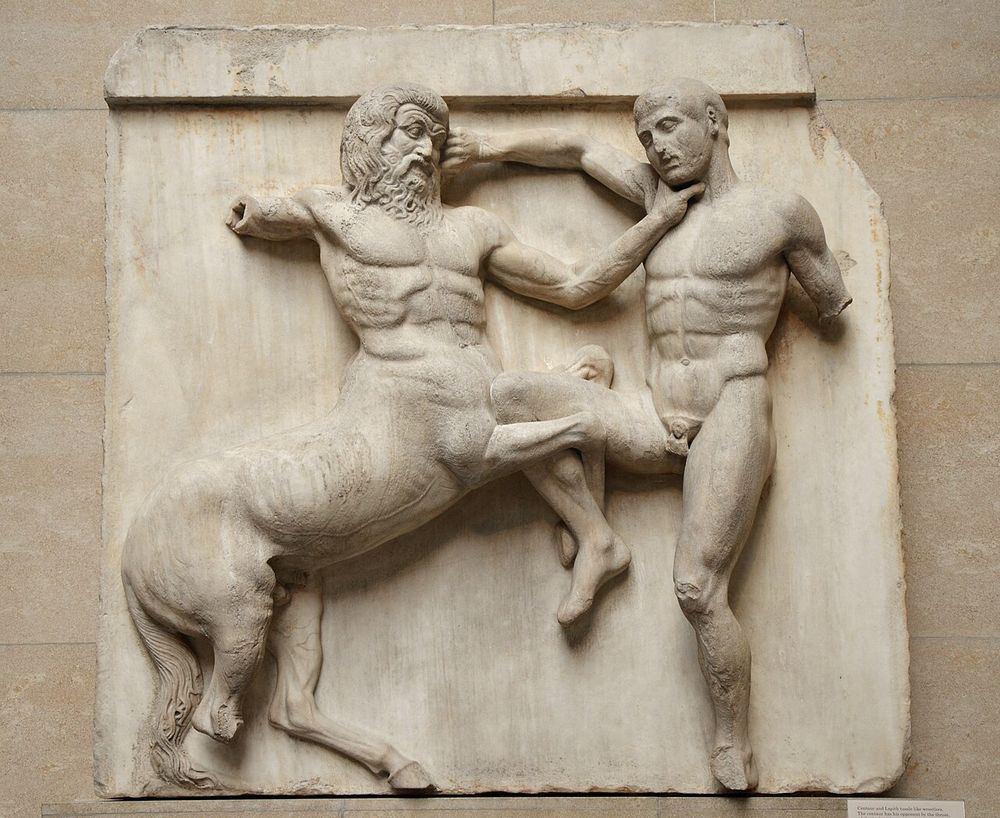
The metopes, the square panels above the columns. There were 92, and every one was carved, which no other Greek temple can claim. Each side showed a battle: gods against giants on the east, Greeks against Amazons on the west, the Trojan War on the north, Lapiths against centaurs on the south. The four stories say one thing: order beats brute force. Athens had just beaten Persia, and was telling its own story through myth.
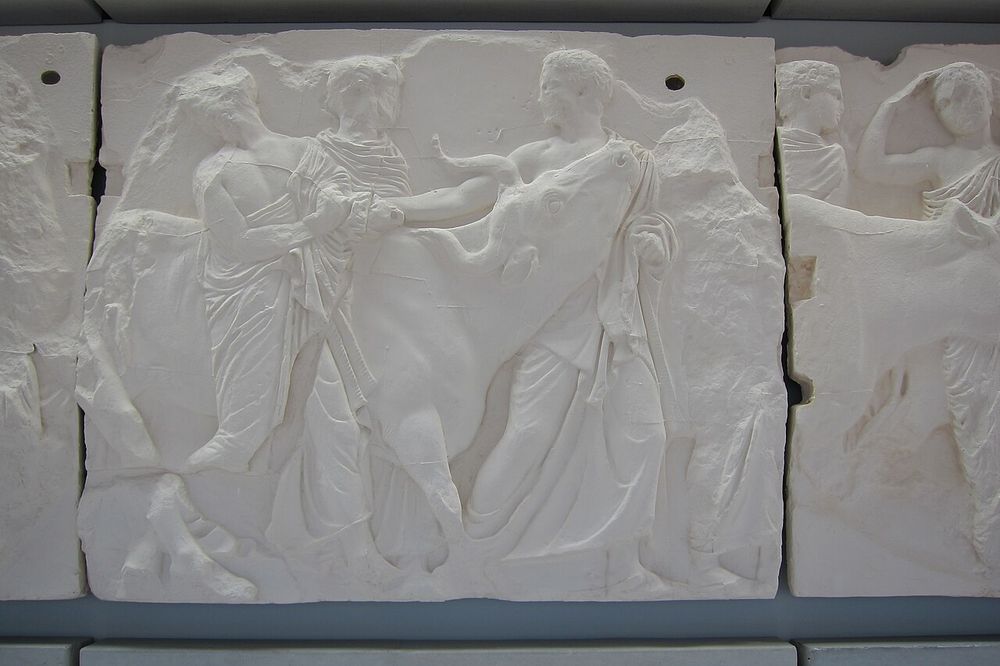
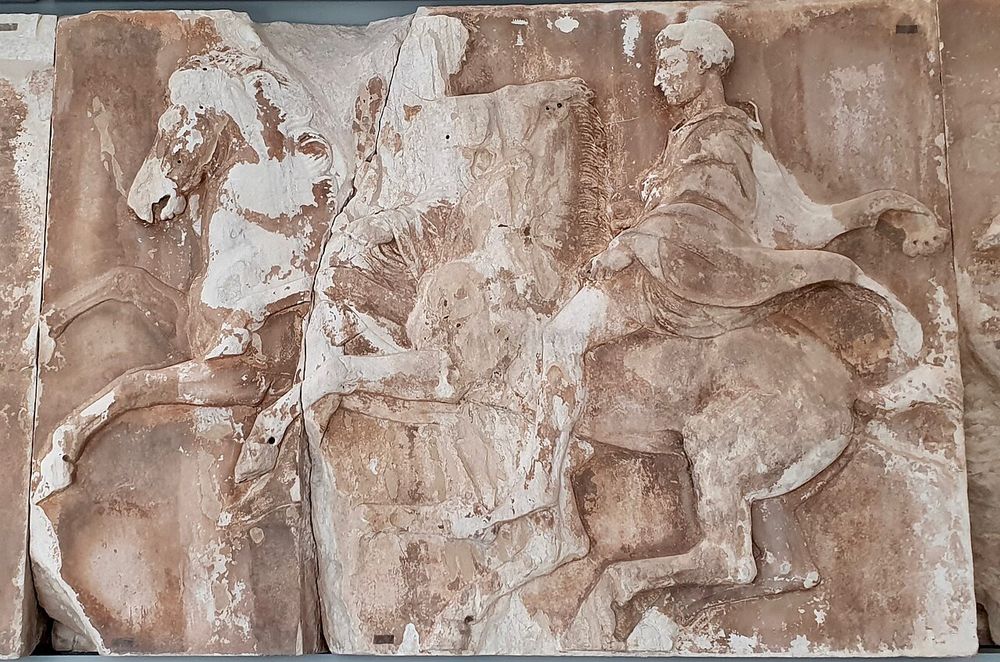
The frieze, a band 160 metres long round the top of the inner wall, behind the columns. It is usually read as the procession of the Panathenaic festival: riders, chariots, water-carriers and animals for sacrifice, moving towards the east end, where a newly woven robe is handed over for Athena. It sat high in the shade of the colonnade and was hard to see from below.
No ancient text says what the frieze shows. The festival is the usual answer. In 1996 the archaeologist Joan Connelly proposed that the centre shows a mythical king of Athens giving up his daughter for sacrifice. Both readings are still argued.
4. West and north: the faces that were cut away
On the west and north sides most of the metope figures are a blur. That is not all weather. When the temple became a Christian church, the faces and bodies of the pagan gods were hacked off on purpose.
The panel at the west end of the north side is better kept. It shows a standing goddess facing a seated one. One explanation is that Christians took it for the angel Gabriel and the Virgin Mary and spared it. Many scholars repeat this. No document proves it.
A south metope in the British Museum: a centaur and a LapithSanjay ach, CC BY-SA 4.0
The centaur panels on the south side were hidden by buildings attached to the church and so escaped. The best of them are now in the British Museum.
5. The east front: the goddess you cannot see
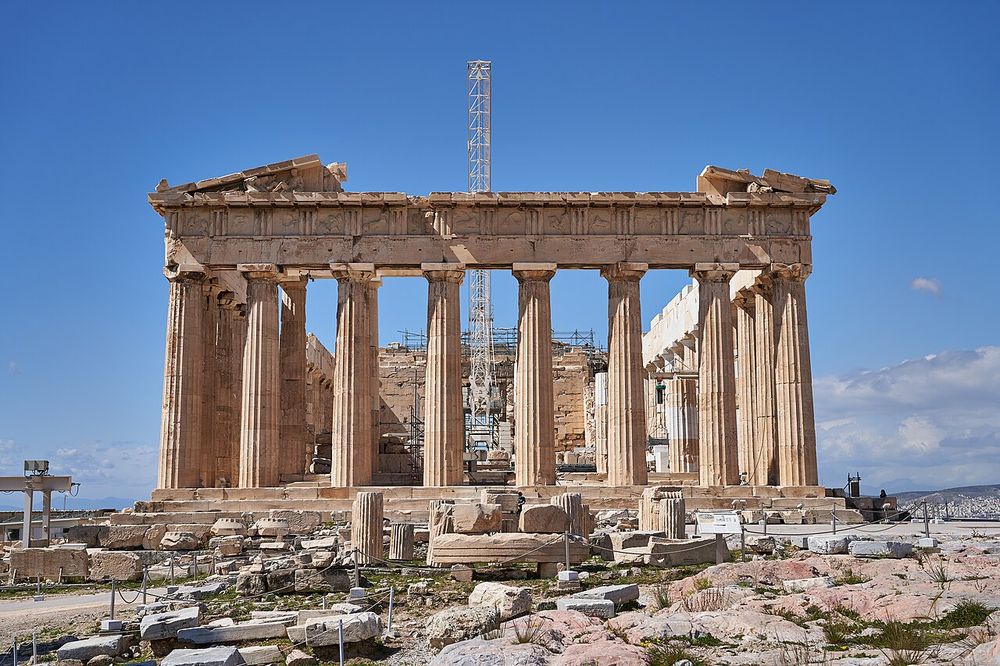
The east front of the Parthenon, 2021George E. Koronaios, CC BY-SA 2.0
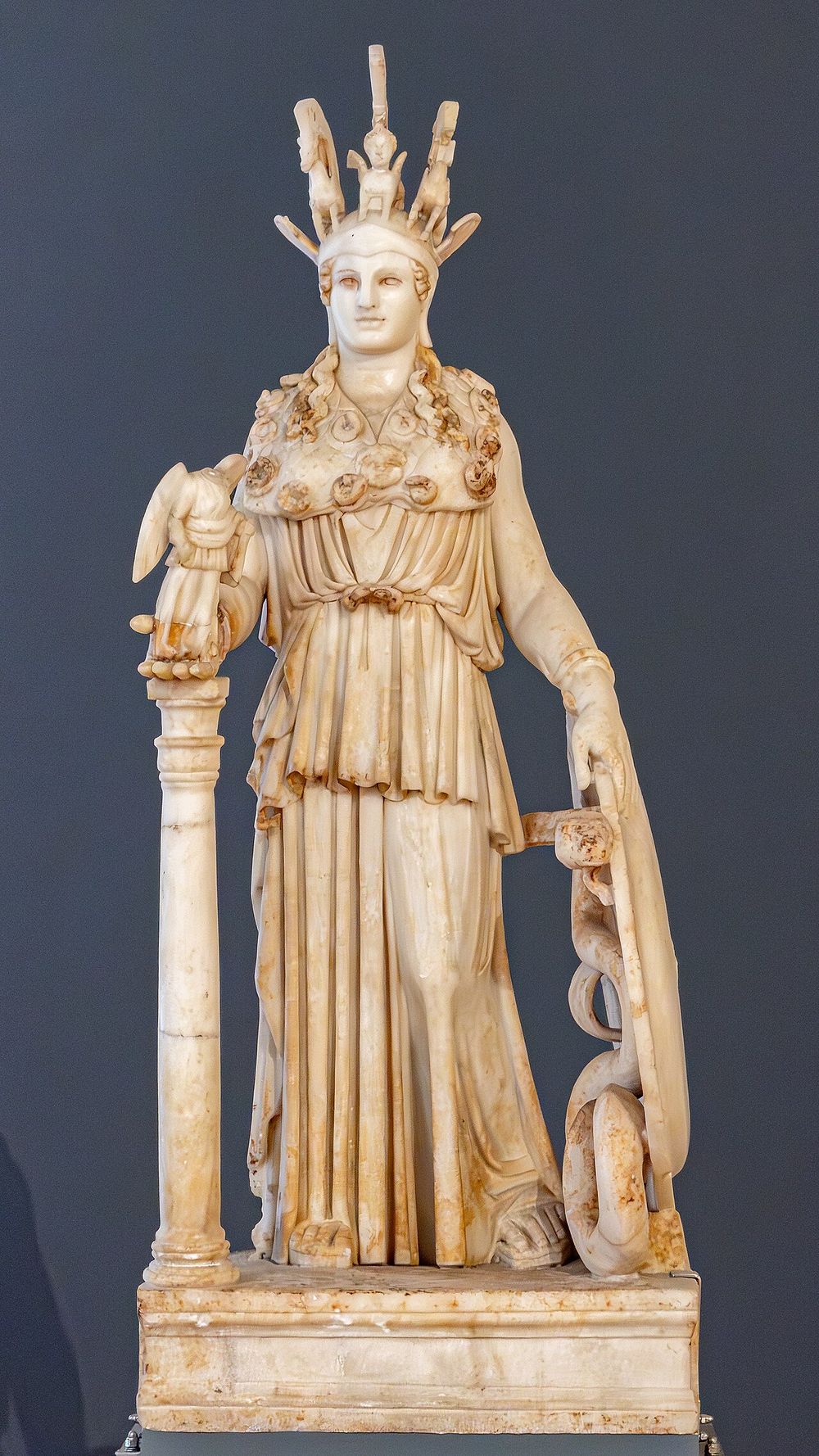
The east end is the front. Inside the door stood Phidias's Athena: a wooden frame, ivory for the face and arms, gold for the dress and armour, about 12 metres high, with a figure of Victory on her right hand. The historian Thucydides says the gold weighed about 40 talents, roughly a tonne, and could be taken off. It was the gold reserve of Athens.
Behind the statue was a second room, opening to the west, that held the treasury of Athens and its allies. So the Parthenon was a temple and a bank. Many Greek cities saw it as a monument Athens had built for itself with their money. Calling it a symbol of democracy is mostly an idea of the 1700s and after.
The Varvakeion Athena, a Roman copy of the lost statue, about a metre highNikos Kitsakis, CC BY 4.0
The statue vanished long ago. To see what it looked like, go to the National Archaeological Museum in Athens, which has a Roman marble copy about a metre high.
6. The south side: one building, four lives
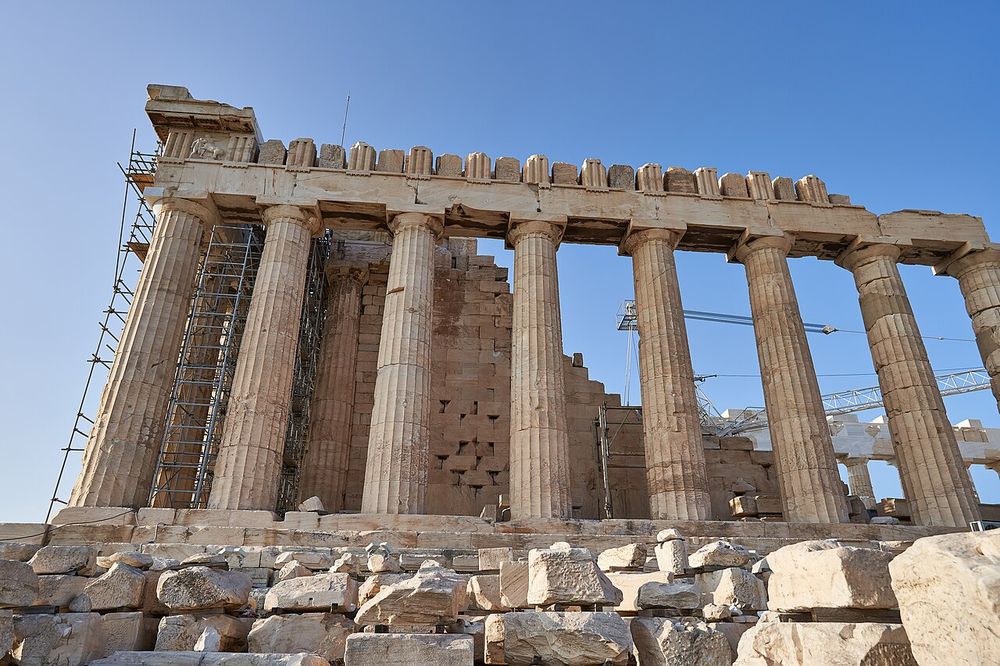
The south side, where the explosion did most damageGeorge E. Koronaios, CC0
Along the south side the columns are most broken. The reason is 1687.
Around the 500s AD the temple became a church of the Virgin Mary, and a rounded apse was added at the east end. In 1204 crusaders took Athens and made it a Catholic cathedral. After the Ottomans took the city in 1458 it became a mosque, with a minaret at the south-west corner.
Turning it into a church and a mosque sounds like damage. It was the opposite. Because the building was always in use, somebody always mended the roof, and it reached 1687 whole.
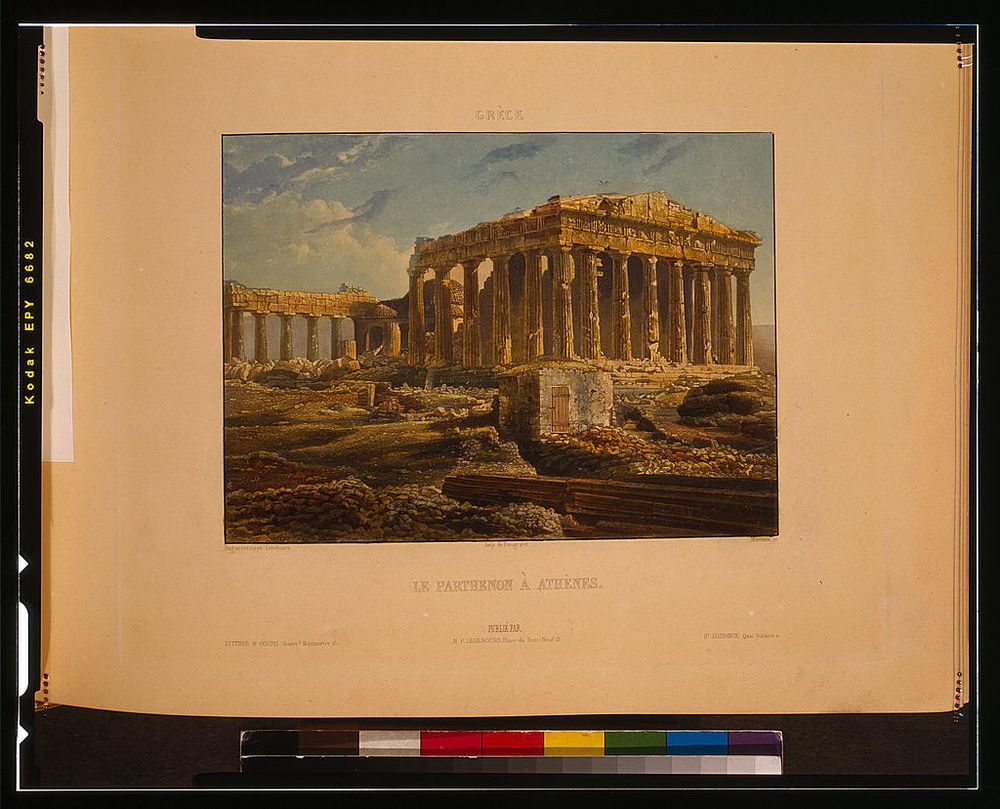
On 26 September 1687 a Venetian army was besieging the Acropolis. The Ottoman garrison had stored its gunpowder in the temple. A mortar shell hit it. The roof, the inner room and the middle columns were blown out, and about 300 people died.
Afterwards the Venetian commander Morosini tried to take the horses from the west pediment as a trophy. The ropes broke and the sculptures smashed on the rock.
The same event reads differently on each side. A Venetian account calls it a lucky shot; the garrison surrendered days later. For the Ottomans it was the loss of a mosque used for two centuries. For later Greeks it was two foreign empires fighting on their holy ground.
Between 1801 and 1812 the men of Lord Elgin, British ambassador to the Ottoman court, took down about half of the sculpture that survived.
7. Looking back: new stone, old stone and empty places
Restoration: white new marble among the yellow oldJebulon, CC0
Walk the full circle and look at the columns again. The colours differ. Old stone is honey-yellow. New stone, set in during repairs, is white. It comes from the same mountain and will yellow in time.
This is the restoration that began in 1975. Its first task was to undo the last one. Ancient masons sealed their iron clamps in lead so they would not rust. The engineer Balanos, who rebuilt the north colonnade between 1898 and 1933, used bare iron. It rusted, swelled and cracked the marble from inside. Now each block is taken down, the iron is taken out, titanium goes in, and the block goes back.
Elgin sold the sculptures to the British government in 1816 for 35,000 pounds. They have been in the British Museum since. The British position is that Elgin had permission from the Ottoman authorities, and that an Act of 1963 forbids the museum to give objects away. Greece has formally asked for them since 1983. It says a permit from an occupying power does not count, and that nobody has ever produced the original. The talks go on.
8. The Propylaea: the gate that was never finished
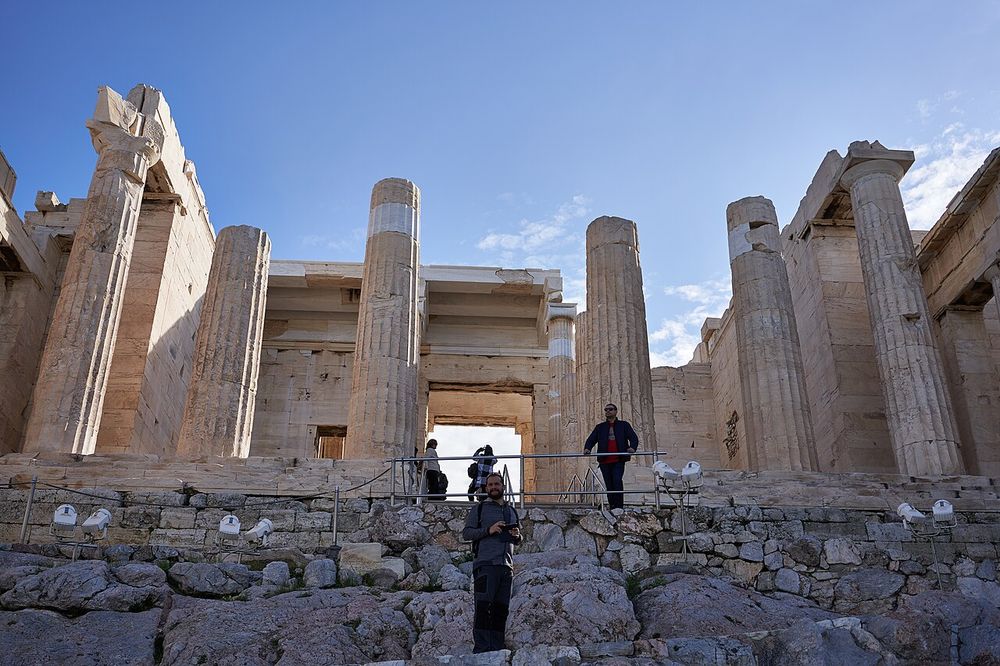
The west side of the PropylaeaGeorge E. Koronaios, CC BY-SA 4.0
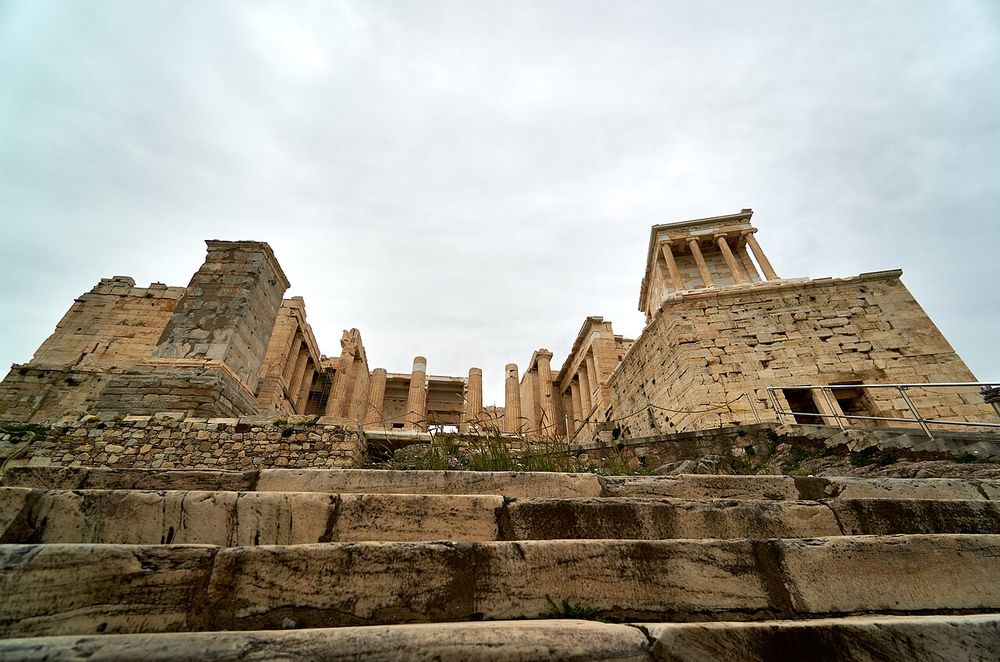
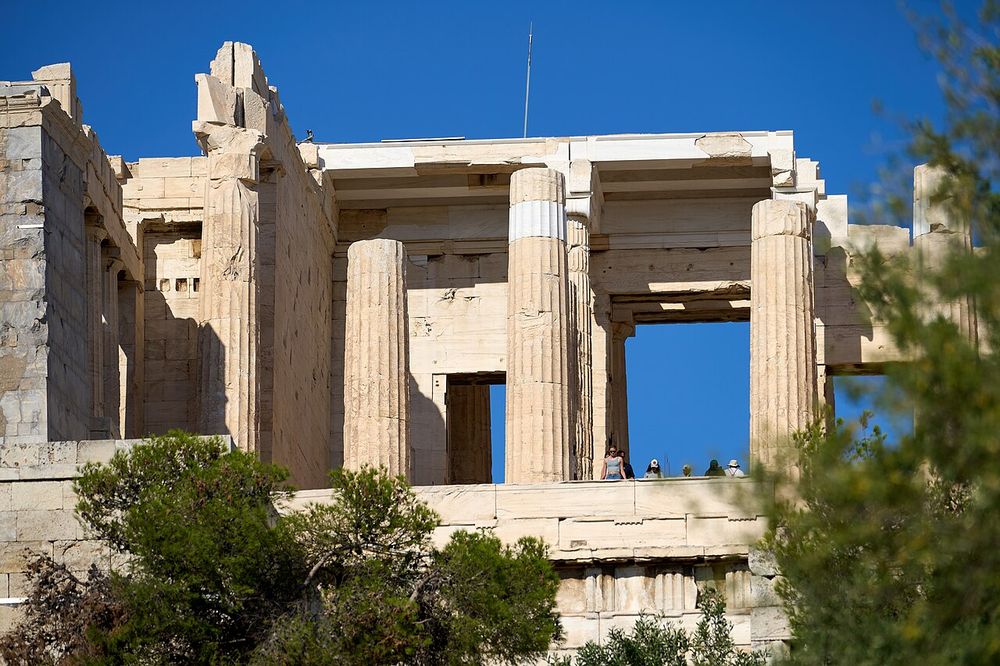
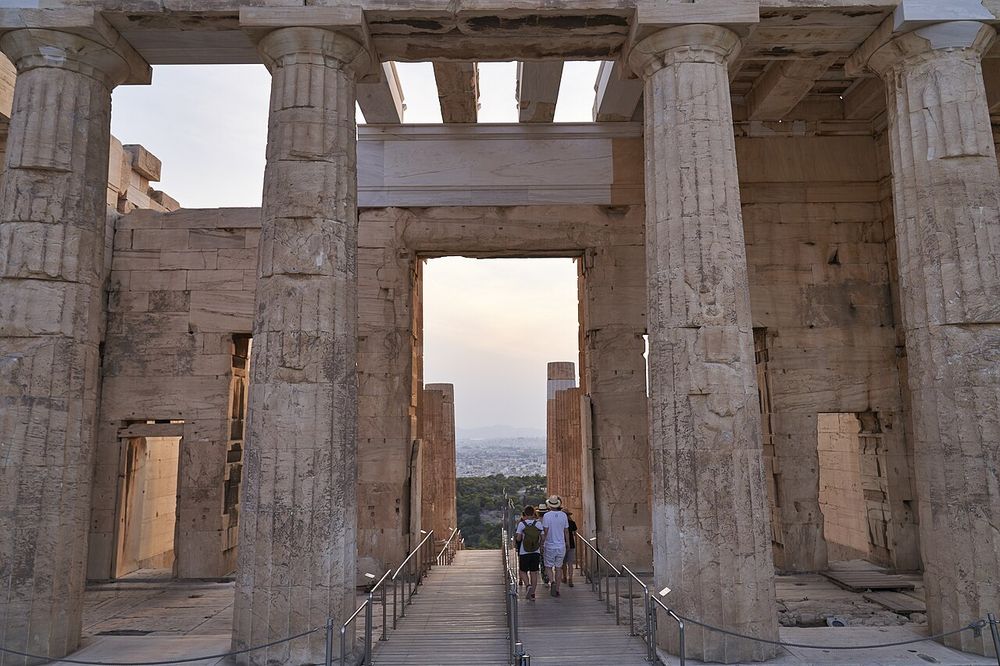
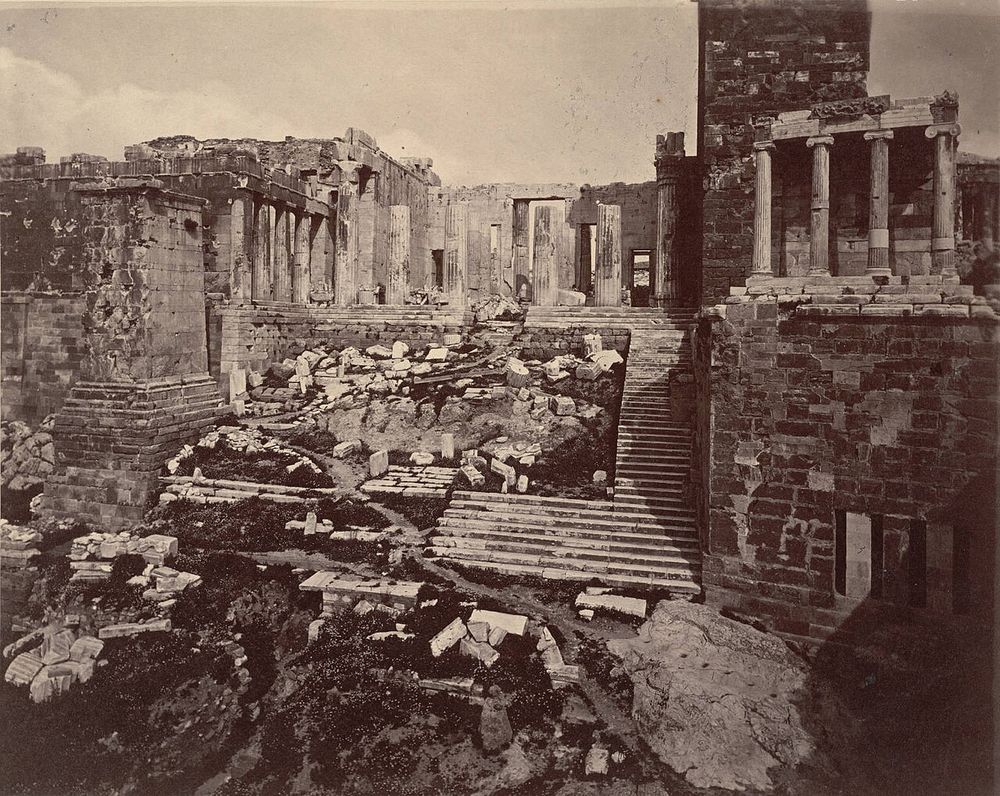
This is the front gate of the Acropolis, and visitors still come up through it. The architect was Mnesikles. Work began in 437 BC and stopped in 432. The next year the war with Sparta began, and nobody took it up again.
Look at the wall blocks. Small knobs of stone stick out of them. They held the ropes when the blocks were lifted, and were to be cut off at the end. They are still there. That is what an unfinished building looks like.
9. The Temple of Athena Nike: taken apart and put back
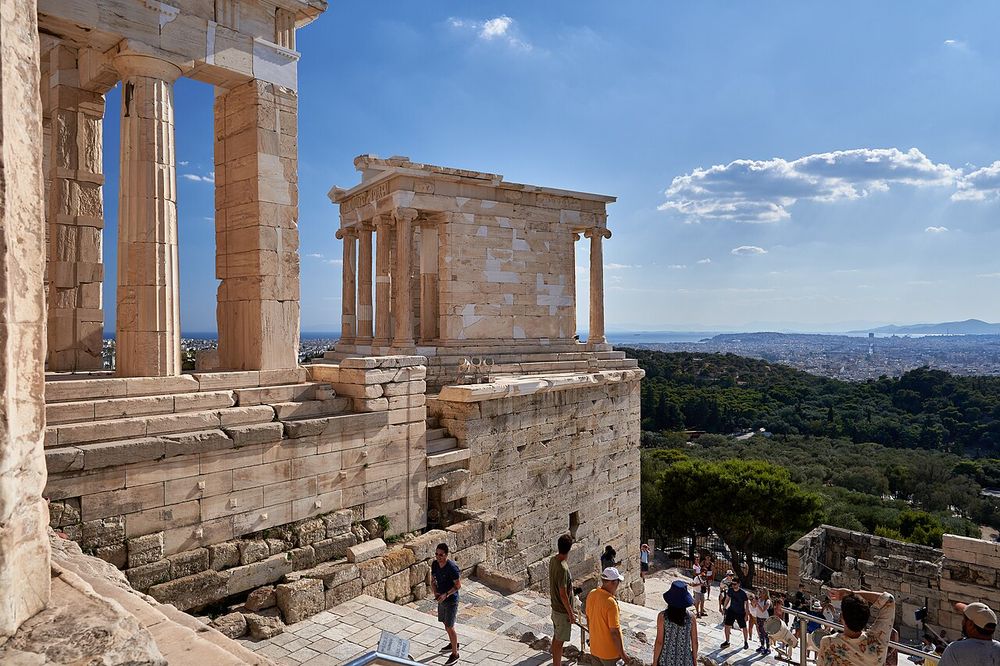
The Temple of Athena Nike on its bastionGeorge E. Koronaios, CC BY-SA 4.0
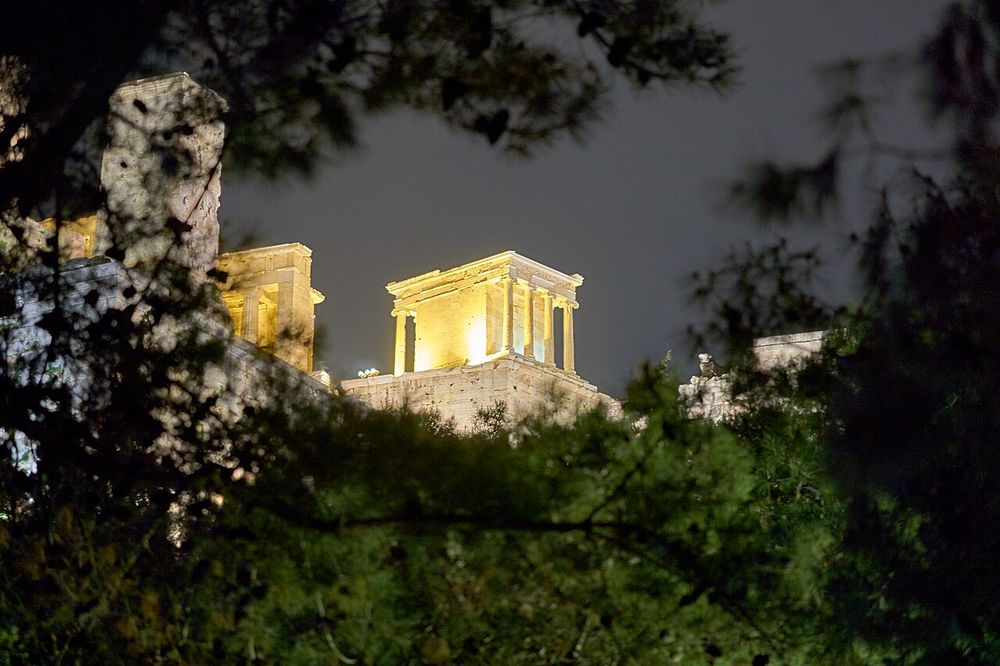
On the last steps up, look to your right. A very small temple stands on a bastion beside the gate. It is in the Ionic style, by Kallikrates, of the 420s BC, for Athena as bringer of victory.
In 1686 the Ottoman garrison pulled it down and used the stone for a gun platform. After Greek independence the blocks were found and put together again, and it has been taken apart and rebuilt twice more since. The carved frieze is now in the museum.
10. The Erechtheion: a porch held up by six maidens
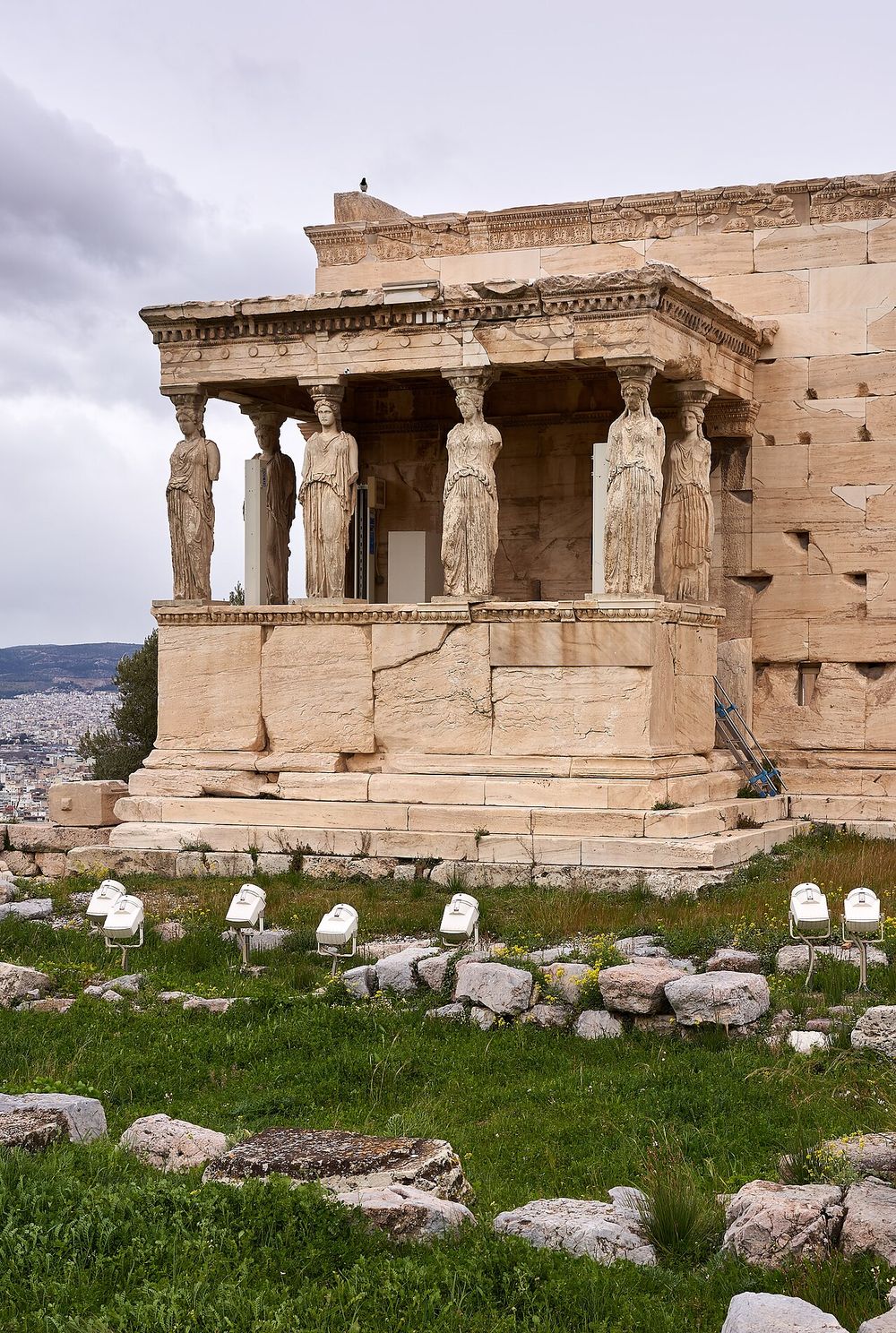
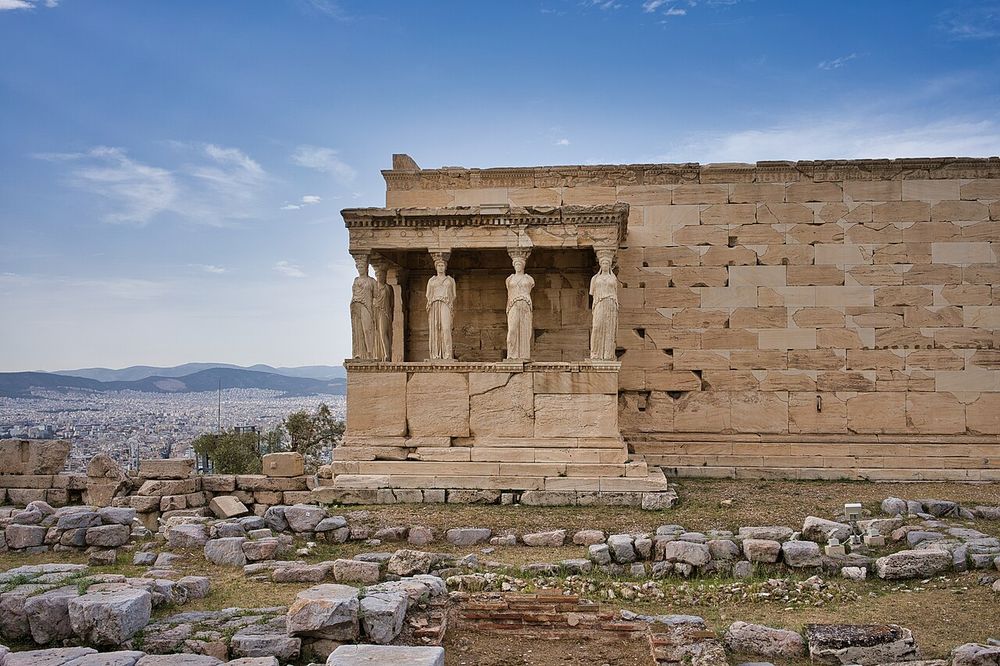
The six maidens of the south porch; these are copiesGeorge E. Koronaios, CC BY-SA 4.0
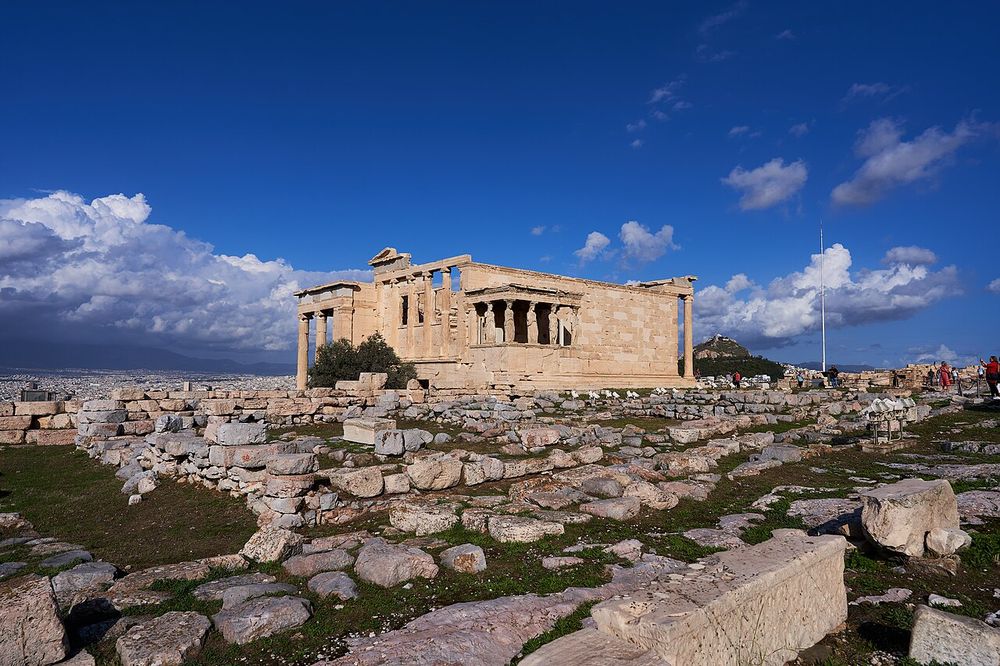
Past the gate, the Parthenon is on your right and this temple on your left. It was finished in 406 BC. Two years later Athens lost its war with Sparta.
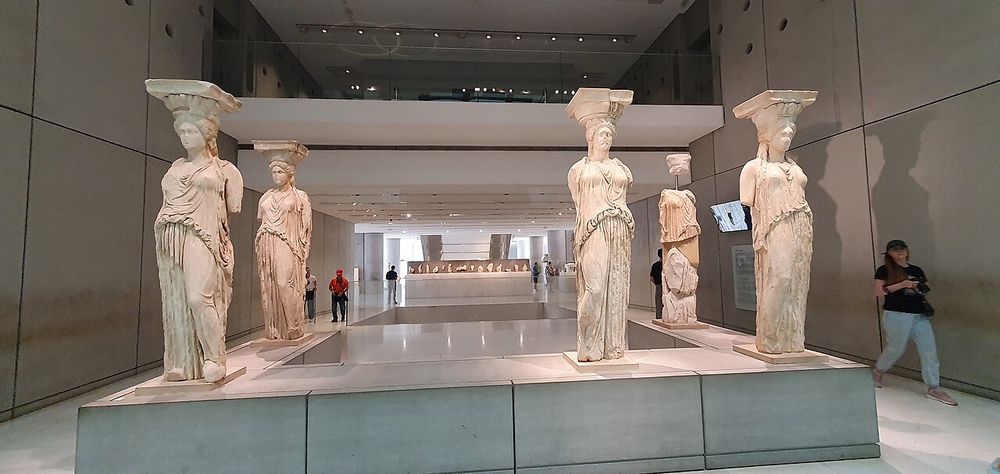
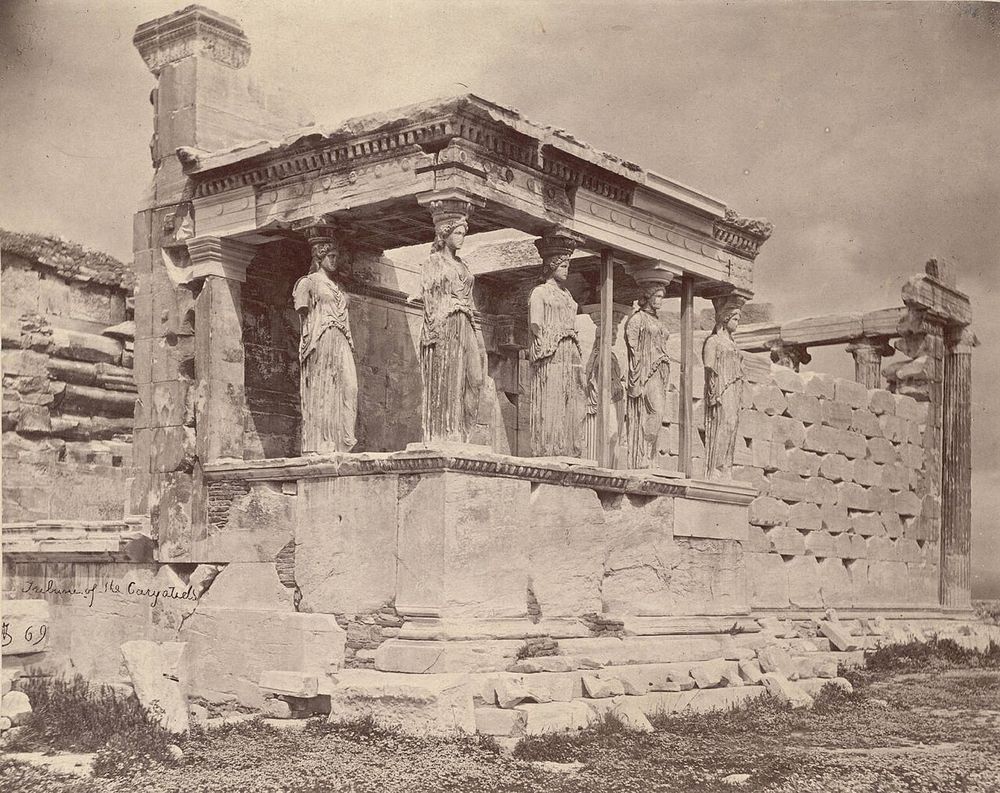
The south porch has no columns. Six statues of young women carry the roof. The six on the hill are copies. Five originals are in the Acropolis Museum. The sixth was taken by Elgin and is in the British Museum.
Greek temples are usually plain rectangles. This one is on several levels, with porches facing different ways. Several old holy places crowded this patch of ground, and the building had to fit round them. An olive tree grows on its west side today, planted in memory of the one in the myth.
11. The Theatre of Dionysus: where drama began
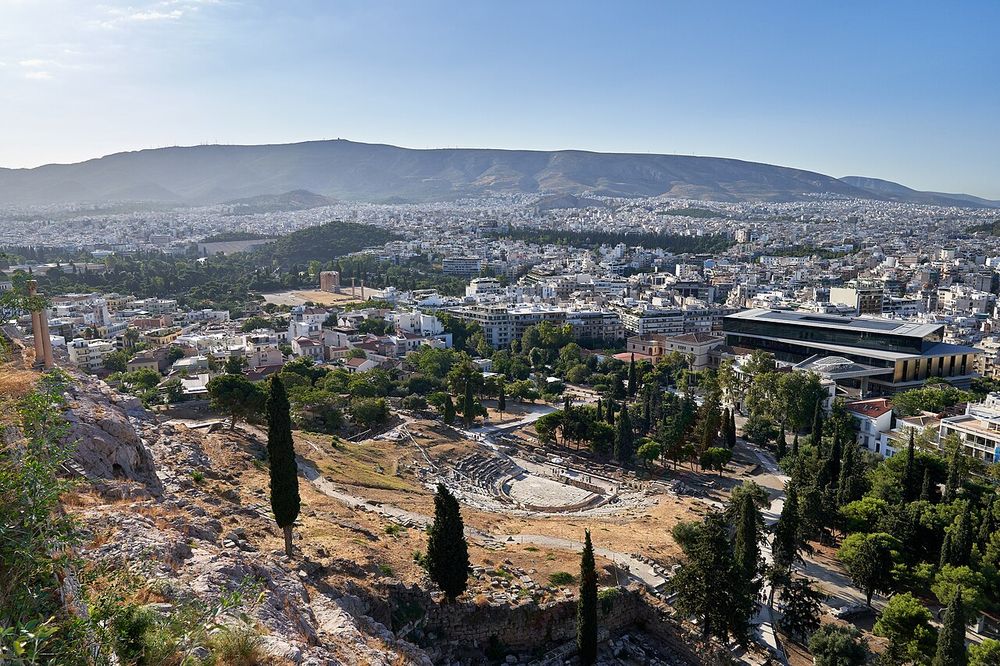
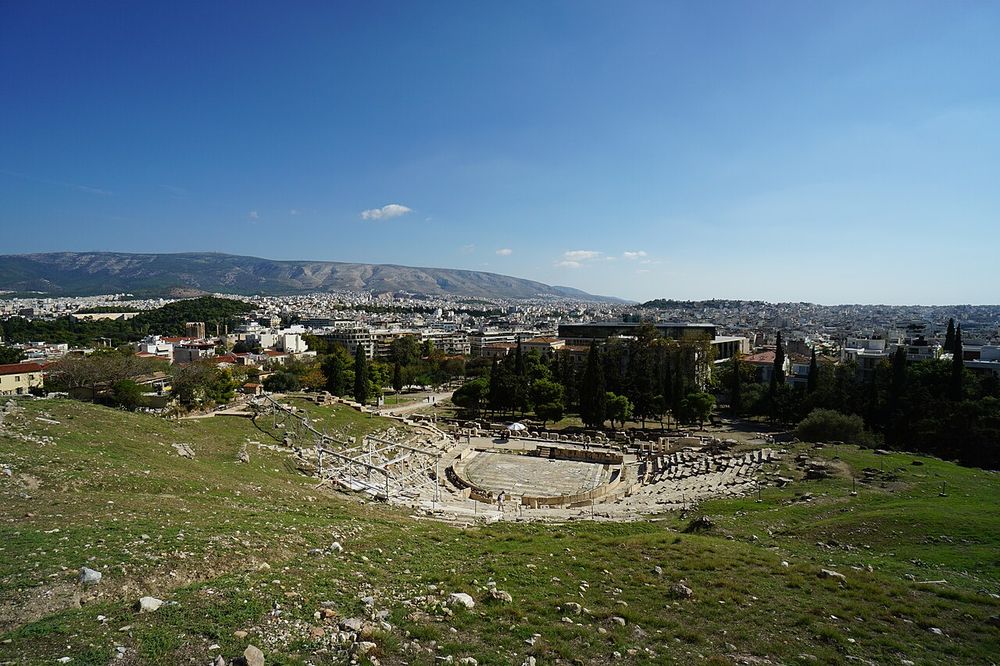
The Theatre of Dionysus from aboveGeorge E. Koronaios, CC BY-SA 4.0
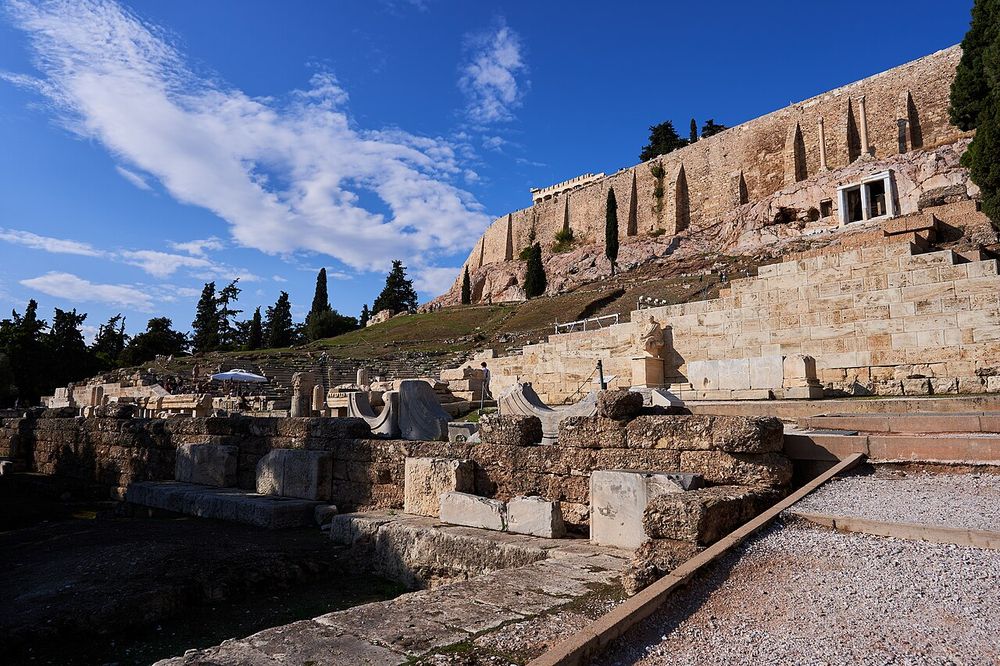
On the south slope, the first thing you pass if you enter from the south-east. It is generally held to be the birthplace of Western drama. It was rebuilt in stone in the 300s BC and held about 17,000 people.
The plays of Aeschylus, Sophocles, Euripides and the comic writer Aristophanes were first performed on this slope.
12. The Odeon of Herodes Atticus: a Roman theatre still in use
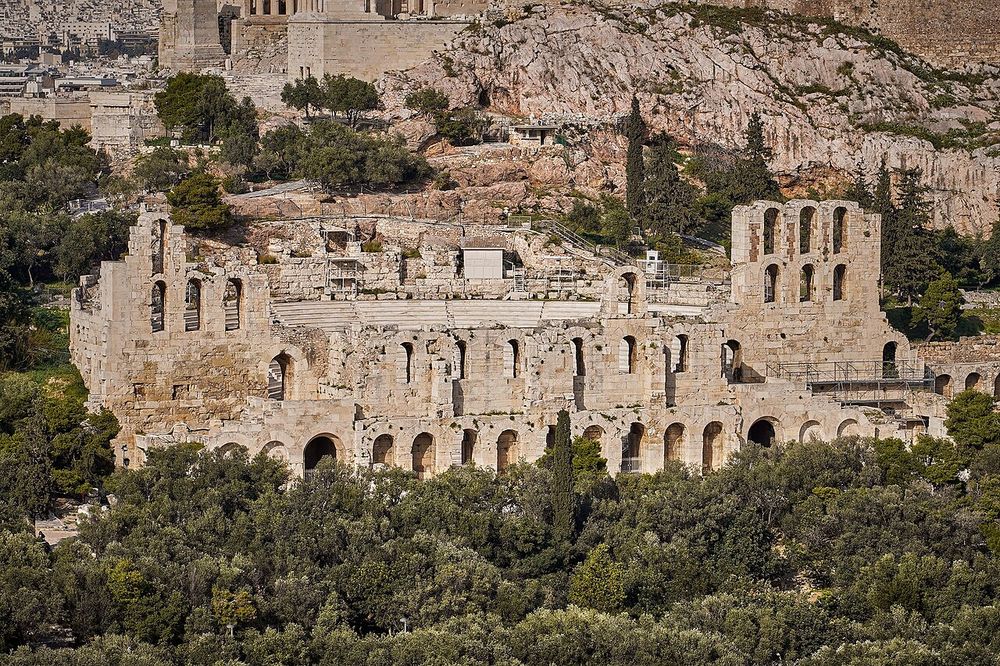
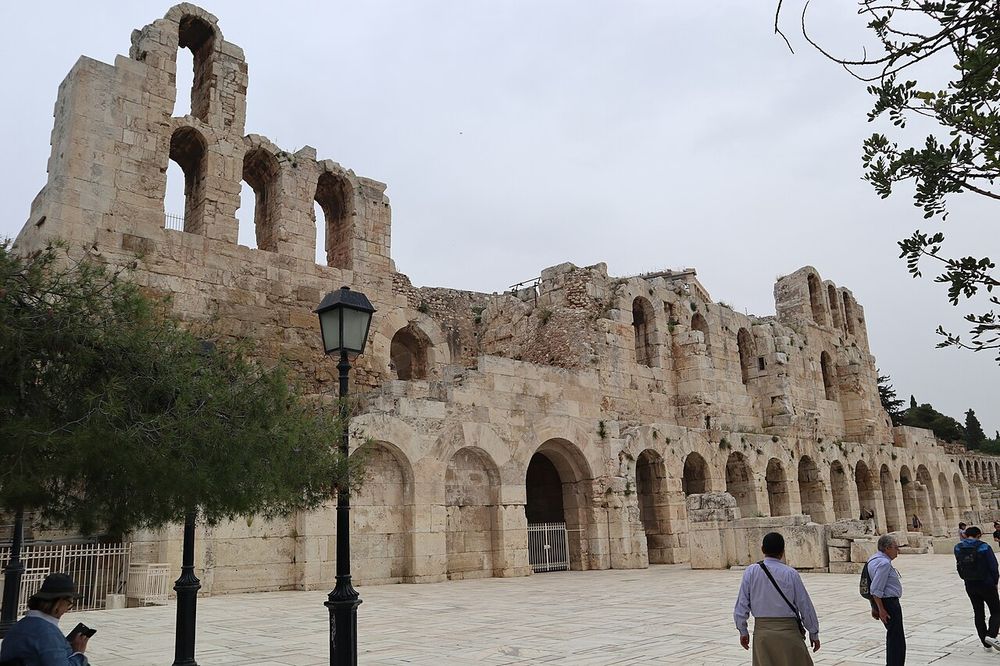
The Odeon on the south-west slopeGeorge E. Koronaios, CC BY-SA 4.0
On the south-west slope. A side path from the way up looks down into it. It was built in AD 161 by a rich Athenian, Herodes Atticus, in memory of his wife Regilla. That is about six hundred years after the Parthenon. It seated five to six thousand and once had a wooden roof.
The Athens festival plays here from June to September. At other times it is closed, and the only way in is a ticket for a performance. The musician Yanni recorded his concert Live at the Acropolis here in 1993. Many listeners, in China as elsewhere, first saw the Acropolis on that recording.
13. The Acropolis Museum: a separate visit
The original maidens in the Acropolis MuseumYair-haklai, CC BY-SA 4.0
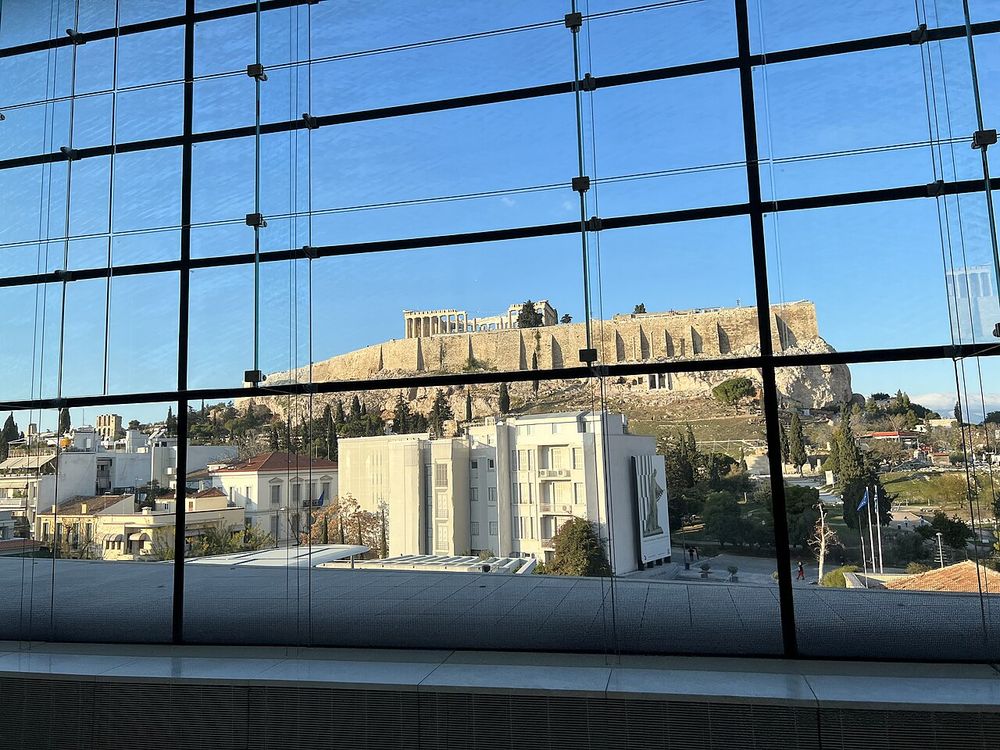
Most of the sculpture you saw on the rock is copy. The originals are in the Acropolis Museum at the foot of the hill, about five minutes on foot from the south exit: five of the maidens, the frieze of the Nike temple, and what Athens still has of the Parthenon.
The museum is a separate place with its own ticket, and it has a page of its own here. Go there after the hill.
14. The same years in China
Confucius died in 479 BC. The year before, the Persians had burned this rock. Thirty years later the Parthenon was begun.
The tomb of Marquis Yi of Zeng in Hubei was closed around 433 BC, in the very years the Parthenon's sculpture was being finished. In it lay a set of 65 bronze bells tuned across five octaves. On one side of the world, curves worked out for thousands of marble blocks; on the other, pitches worked out for 65 bells. Neither knew of the other. The bells are in the Hubei Provincial Museum in Wuhan.
The blue on the Parthenon sculptures is Egyptian blue, a man-made copper calcium silicate. From about the same centuries China made its own man-made pigments, Chinese blue and Chinese purple, of copper barium silicate, later used on the Terracotta Army. The two are close cousins. Some scholars think the Chinese recipe was inspired by the Egyptian one. Others point out that no Egyptian blue has been found in China and hold that it was invented there.
A Chinese visitor here may think of the Old Summer Palace in Beijing: both were wrecked by foreign armies, both have treasures in foreign museums, and both have been asking for them back for generations. The cases differ too. The Old Summer Palace was looted and burned on purpose. The Parthenon was blown up in a battle, and its sculptures were taken down a century later by a diplomat.
15. Copies, poems and music
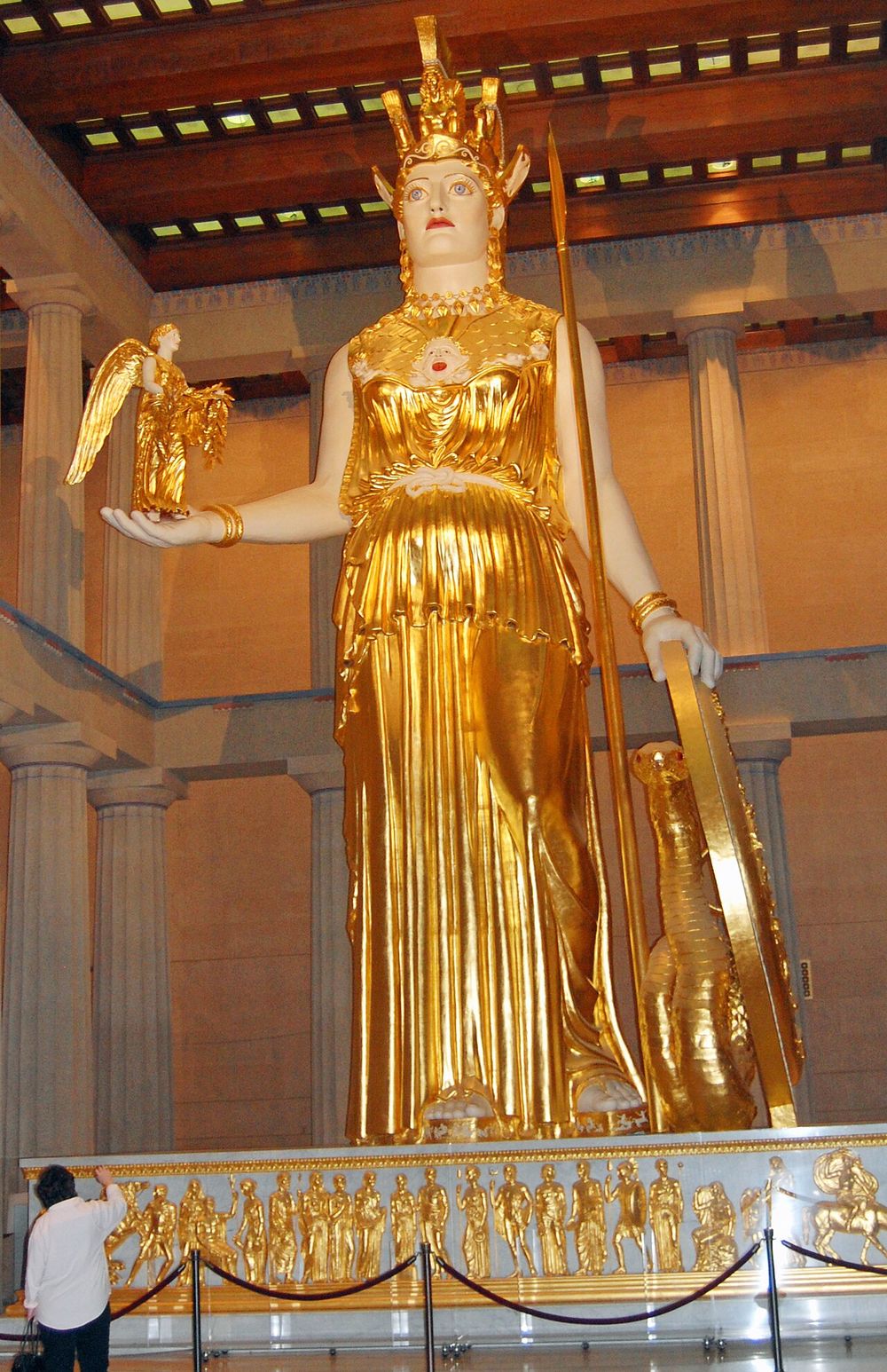
The rebuilt Athena inside the Parthenon at Nashville, TennesseeBubba73 (Jud McCranie), CC BY-SA 4.0
Nashville, Tennessee, has a full-size copy of the Parthenon, first put up for an exhibition in 1897 and rebuilt in concrete by 1931. Since 1990 it has held a rebuilt Athena about 13 metres high by the sculptor Alan LeQuire, gilded in 2002. It is the only place to see the temple whole, with its goddess inside.
The Lincoln Memorial in Washington (1922) takes its outline from the Parthenon, with the door moved to the long side and Lincoln seated where the goddess stood. The row of columns under a triangle on banks and law courts across the Western world goes back to this building.
English poets took sides over the marbles. Byron attacked Elgin in The Curse of Minerva (1811) and in Childe Harold's Pilgrimage (1812). Keats saw the sculptures in London and wrote the sonnet On Seeing the Elgin Marbles (1817) in wonder.
Dull is the eye that will not weep to see
Thy walls defaced, thy mouldering shrines removed
By British hands
Byron, Childe Harold's Pilgrimage, Canto II (1812)
Meanwhile in the world
Year
Here
Elsewhere
480 BC
The Persians burn the temples on the Acropolis
Confucius is an old man with a year to live
447 BC
The Parthenon is begun
China is entering the Warring States period (475–221 BC)
438 BC
The statue of Athena is dedicated
The Buddha, by one common dating, is teaching in northern India
433 BC
The sculptures are nearly done
Marquis Yi of Zeng is buried with his 65 bells
431 BC
Work on the gate has stopped
The war between Athens and Sparta begins
AD 161
Herodes Atticus builds his theatre
Marcus Aurelius becomes emperor in Rome; the Eastern Han (AD 25–220) rules China
500s
The Parthenon becomes a church
Hagia Sophia is built in Constantinople; the Sui will soon reunite China
1458
The Ottomans take Athens; the church becomes a mosque
The Forbidden City in Beijing is 38 years old
1687
The explosion
Newton publishes the Principia; the Kangxi Emperor rules China
1801–1812
Elgin's men remove the sculptures
Napoleon is at war with most of Europe
1860
Athens is the capital of a new Greek state; clearing of the rock goes on
The Old Summer Palace in Beijing is looted and burned
1975
The present restoration begins
—
2009
The Acropolis Museum opens
—
One line to remember: nine years to build, two thousand years in use, one shell.
Then and now
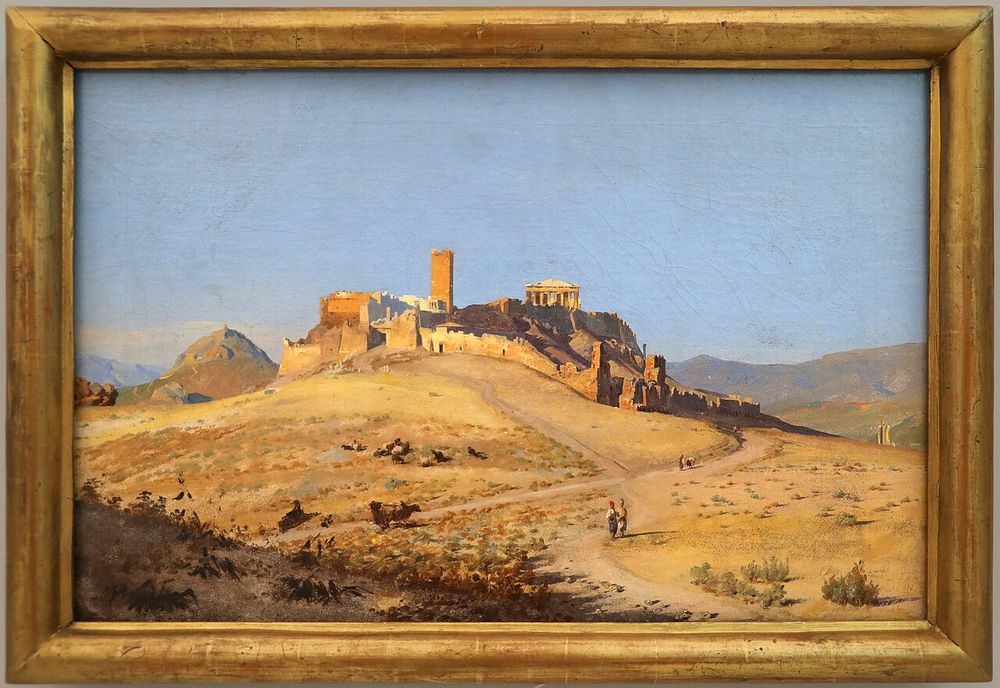
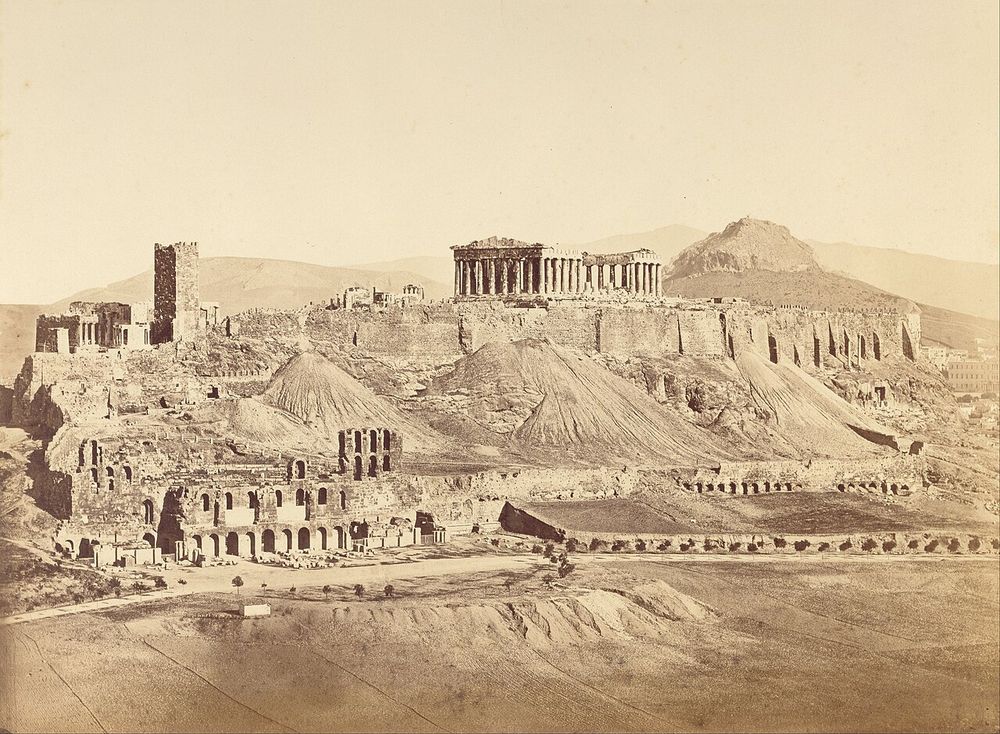
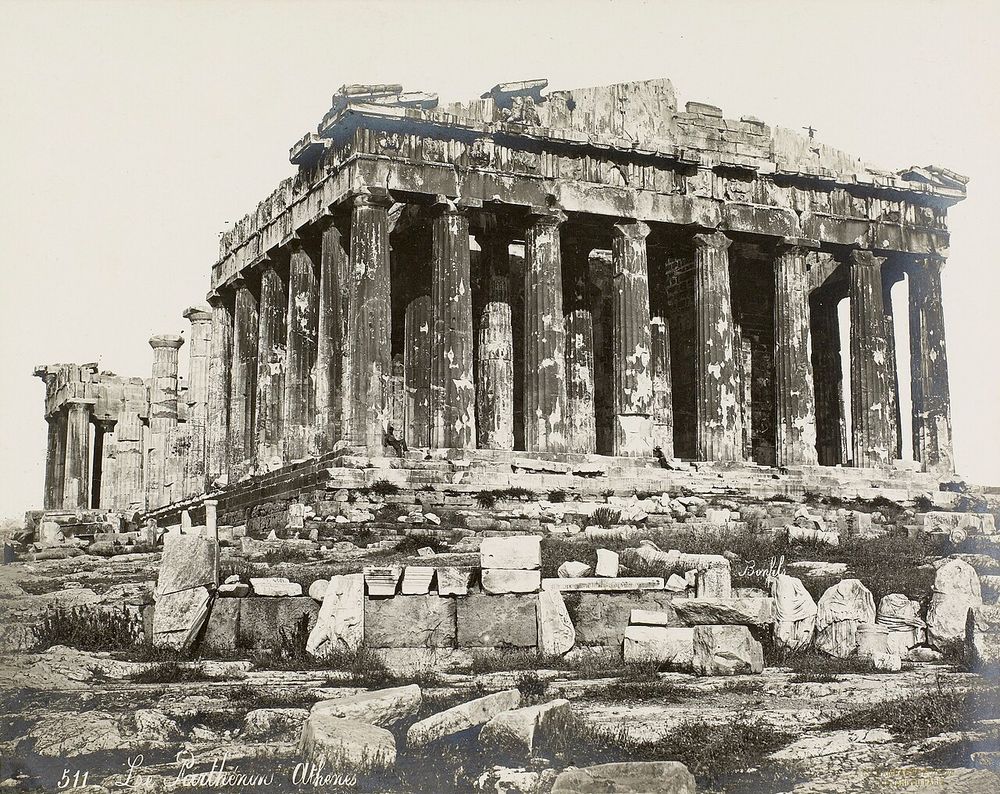
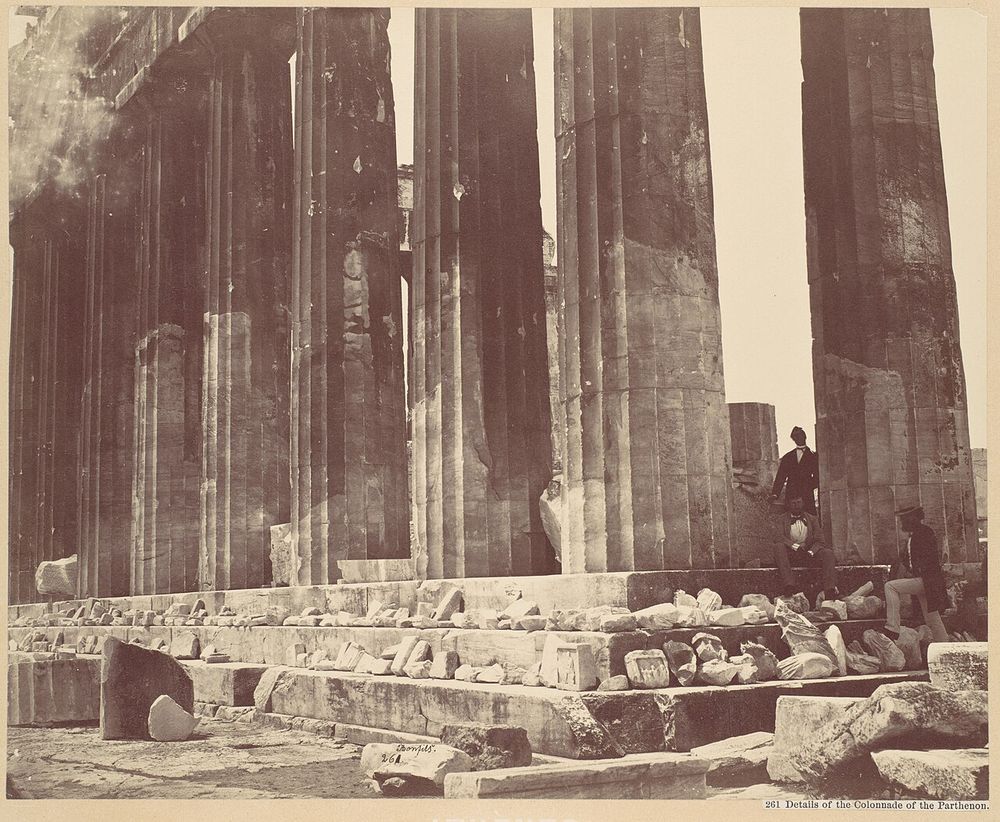
The Acropolis from the air: the Parthenon in the middle, the Erechtheion beside itSfetkos, CC BY-SA 4.0, Wikimedia CommonsThe rock seen from the Areopagus hillGgia, CC BY-SA 3.0, Wikimedia CommonsThe Parthenon from Philopappos Hill, 2020George E. Koronaios, CC BY-SA 4.0, Wikimedia CommonsThe Acropolis lit at nightSpirosparas, CC BY-SA 4.0, Wikimedia CommonsThe east front of the Parthenon, 2021George E. Koronaios, CC BY-SA 2.0, Wikimedia CommonsThe west end, with scaffolding, 2020George E. Koronaios, CC BY-SA 4.0, Wikimedia CommonsThe west end and north side: the first view from the gateGeorge E. Koronaios, CC BY-SA 4.0, Wikimedia CommonsThe south side, where the explosion did most damageGeorge E. Koronaios, CC0, Wikimedia CommonsThe south side from below the wall, 2022George E. Koronaios, CC BY-SA 4.0, Wikimedia CommonsThe Parthenon with a restoration crane, 2018George E. Koronaios, CC BY-SA 4.0, Wikimedia CommonsRestoration: white new marble among the yellow oldJebulon, CC0, Wikimedia CommonsThe steps at the east end; look along the edge for the curveTwospoonfuls, CC BY-SA 4.0, Wikimedia CommonsThe Erechtheion and its porch of maidensGeorge E. Koronaios, CC BY-SA 4.0, Wikimedia CommonsThe six maidens of the south porch; these are copiesGeorge E. Koronaios, CC BY-SA 4.0, Wikimedia CommonsThe Erechtheion from the south-eastGeorge E. Koronaios, CC BY-SA 2.0, Wikimedia CommonsThe original maidens in the Acropolis MuseumYair-haklai, CC BY-SA 4.0, Wikimedia CommonsThe way up to the PropylaeaGeorge E. Koronaios, CC BY-SA 4.0, Wikimedia CommonsThe Propylaea from belowGeorge E. Koronaios, CC BY-SA 4.0, Wikimedia CommonsLooking out through the gate from the insideGeorge E. Koronaios, CC BY-SA 4.0, Wikimedia CommonsThe west side of the PropylaeaGeorge E. Koronaios, CC BY-SA 4.0, Wikimedia CommonsThe Temple of Athena Nike on its bastionGeorge E. Koronaios, CC BY-SA 4.0, Wikimedia CommonsThe Nike temple lit at night, from the street belowGeorge E. Koronaios, CC BY-SA 4.0, Wikimedia CommonsThe Theatre of Dionysus from aboveGeorge E. Koronaios, CC BY-SA 4.0, Wikimedia CommonsThe Theatre of Dionysus under the south wall of the rockGeorge E. Koronaios, CC BY-SA 4.0, Wikimedia CommonsThe slope and the theatre, 2018George E. Koronaios, CC0, Wikimedia CommonsThe arched front of the Odeon of Herodes AtticusGeorge E. Koronaios, CC BY-SA 4.0, Wikimedia CommonsThe Odeon on the south-west slopeGeorge E. Koronaios, CC BY-SA 4.0, Wikimedia CommonsThe Acropolis seen through the glass of the museumPinterpandai.com, CC BY-SA 3.0, Wikimedia CommonsThe Parthenon frieze in the Acropolis Museum; the white parts are casts of blocks in LondonSharon Mollerus, CC BY 2.0, Wikimedia CommonsA block of the west frieze: horsemen preparingNikos Kitsakis, CC BY 4.0, Wikimedia CommonsThe west frieze in the Acropolis MuseumYair-haklai, CC BY-SA 4.0, Wikimedia CommonsA south metope in the British Museum: a centaur and a LapithSanjay ach, CC BY-SA 4.0, Wikimedia CommonsAnother south metope in the British MuseumYair Haklai, CC BY-SA 3.0, Wikimedia CommonsA centaur metope in LondonCarole Raddato from FRANKFURT, Germany, CC BY-SA 2.0, Wikimedia CommonsThe Varvakeion Athena, a Roman copy of the lost statue, about a metre highNikos Kitsakis, CC BY 4.0, Wikimedia CommonsThe rebuilt Athena inside the Parthenon at Nashville, TennesseeBubba73 (Jud McCranie), CC BY-SA 4.0, Wikimedia CommonsThe west pediment drawn in 1674, thirteen years before the explosion (attributed to Jacques Carrey)Jacques Carrey, Public domain, Wikimedia CommonsThe east pediment in 1674Jacques Carrey, Public domain, Wikimedia CommonsThe Parthenon in 1839, engraved from one of the first photographs taken in GreecePhotographer: Pierre-Gustave Joly (1798-1865)Engraver: Frédéric Martens (1806-18, Public domain, Wikimedia CommonsLeo von Klenze's painting of the Acropolis as he imagined it in ancient times, 1846Leo von Klenze, Public domain, Wikimedia CommonsThe Acropolis painted by Vincenzo Lanza, 1860Francesco Bini, CC BY-SA 4.0, Wikimedia CommonsThe Acropolis from the south-west, about 1865, photographed by Dimitrios ConstantinDimitrios Constantin (Greek, active 1858 - 1860s) – photographer (Greek) Details, Public domain, Wikimedia CommonsThe Parthenon from the west, photographed by Félix Bonfils, 1860s–1880sFélix Bonfils, Public domain, Wikimedia CommonsThe base of the colonnade, about 1870Félix Bonfils, CC0, Wikimedia CommonsAmong the ruins on the rock, photographed by William J. Stillman, 1869–70William James Stillman, CC0, Wikimedia CommonsA carved marble doorway, photographed by Stillman, 1869–70William James Stillman, CC0, Wikimedia CommonsThe porch of maidens in 1869Cornell University Library, No restrictions, Wikimedia CommonsThe Propylaea in 1869, still heaped with fallen stoneCornell University Library, No restrictions, Wikimedia CommonsThe curve of the steps, photographed for a study of 1910G. Fougeres, Public domain, Wikimedia Commons
Local legends
These are stories people tell about this place. They are legends, not history, and each one says where it comes from.
LegendThe west side of the Erechtheion
Athena and Poseidon both wanted this city. Poseidon struck the rock with his trident and a spring of salt water came up. Athena made an olive tree grow. The Athenians chose the olive, and the city took her name.
Source: Apollodorus, Library 3.14; shown on the west pediment of the Parthenon
LegendThe olive tree
When the Persians burned the Acropolis the sacred olive burned with it. The next day Athenians who came up found a new shoot on the stump, already a cubit long.
Source: Herodotus, Histories 8.55
LegendThe east front of the Parthenon
Zeus had a terrible headache. Hephaestus split his head with an axe, and Athena sprang out, grown and in armour.
Source: Hesiod, Theogony; Pindar, Olympian 7; shown on the east pediment
LegendThe porch of maidens
After Elgin's men carried one of the six maidens away, people in Athens said that at night the five who were left could be heard crying for their sister.
Source: A story told in Athens in the early 1800s and repeated by travellers of the time
Later, people who live here will be able to add the stories they grew up with, and say which of these they have heard.
Not certain, and where accounts conflict
Why the curves?
Vitruvius: to correct an optical illusion. Jeffrey Hurwit and others: to give the building life. Drainage is a third, practical reason. No ancient builder left an explanation.
What does the frieze show?
The Panathenaic procession, in the usual view. Joan Connelly (1996) reads the centre as a myth of a king sacrificing his daughter. No ancient text settles it.
The spared metope
That Christians took it for the Annunciation is widely repeated and unproven.
When did it become a church, and a mosque?
For the church, dates run from the late 400s to the late 500s. For the mosque, 1458, 1460 and later are all given; one record suggests it was still a church in 1466.
Did Elgin have permission?
Britain says he had a permit from the Ottoman government. Greece says no original has ever been shown, only an Italian translation, and that an occupier could not give the monument away.
Museum prices
Most guides give 20 euros. One gives 15 in summer and 10 in winter. Check before you go.
Spring and Autumn, or Warring States?
Chinese historians divide the two periods at 476/475 BC or at 403 BC. By the first, the Parthenon is a Warring States building; by the second, a late Spring and Autumn one.
Visiting
Tickets and hours
The site ticket is 30 euros for an adult, the same all year. It is sold on the Greek culture ministry's ticket site, hhticket.gr, and you must choose an entry time. Once in, you may stay as long as you like.
There is a limit of 20,000 visitors a day. In summer, book several days ahead; morning slots go first.
The Acropolis Museum is a separate place with its own ticket, sold by the museum. There is no official ticket for both. See the museum's own page.
The old combined ticket for the Acropolis and six other sites ended in April 2025. Guidebooks still mention it.
The site is listed as open about 08:00–20:00 from April to October and about 08:00–17:00 from November to March, with last entry half an hour before closing.
Last checked 2026-11-11. Travel guides checked in 2026; the two official ticket sites were not opened for this check.
Where to start
There are two entrances. The west one is the main gate, used by groups, with the longest queue. The south-east one is on Dionysiou Areopagitou street, next to the museum and Akropoli metro station. It is quieter, and the way up passes both theatres. Start there.
A route of about two hours: south-east entrance, Theatre of Dionysus, up the south slope with the Odeon below on your left, the gate and the Nike temple, round the Parthenon by the north side to the east front, the viewpoint with the flag at the north-east corner, back along the south side, and down.
Then the museum, for two hours more. In summer heat, turn the day round: the air-conditioned museum at midday, the rock late in the afternoon.
Paths on the top are moved from time to time for the restoration. Follow the ropes and the signs on the day.
Before you go
There is almost no shade on the rock. During heatwaves the site has been closed from midday to late afternoon. Book the first slot of the morning or a late one, and bring water and a hat.
The marble underfoot is worn smooth and is slippery even when dry. Wear flat shoes with grip.
Greece is in the Schengen area. Check whether your passport needs a Schengen visa.
Buy on the official site with an international bank card, and bring the ticket on your phone or printed.
Keep an eye on bags and pockets in the metro and in the crowds round the entrances.
Customs and manners
Do not touch the ancient stone, sit on it, or pick up pieces from the ground. Guards will whistle.
Thin high heels have been banned at Greek ancient sites since 2009, because they damage the stone.
To Greeks this is a national monument, not only a ruin. Posing with banners, staged shoots and tripods need a permit, and the guards stop them.
Drones may not be flown without special permission.
The marbles in London are a live question in Greece. People will gladly talk about it, and most hold strong views.
Look for these
Find the curve. Crouch at a corner and look along the edge of a long step. Flat, or arched?
Count the flutes on one column.
Tell new from old. Find a column that is part honey-yellow and part white. Which colour is 2,500 years old?
Find the survivor. Most square panels on the north side were cut flat. On which one can you still make out two figures?
Find the gap. On which side are the columns most broken in the middle, and why?
On the gate, find the lifting knobs left on the wall blocks.
From the south wall, look down. How many ancient theatres can you find?
In the museum, count the maidens. How many are there, and where is the empty place?
I am here
Stand at the site, sign in, press the button, and collect its stamp. Your browser will ask to use your location. It is sent to us once to confirm that you are at the site; we keep how far you were from it, not the spot where you stood.
Your stamps are saved to your account, so they follow you to any device. Checking from a browser cannot rule out every false location; stricter checks arrive with the app.
Messages
Share your photos
Photos here show the place, not people. Each one is credited to the visitor who took it and appears after our team has looked at it. A photo with you in it belongs under “I am here”.