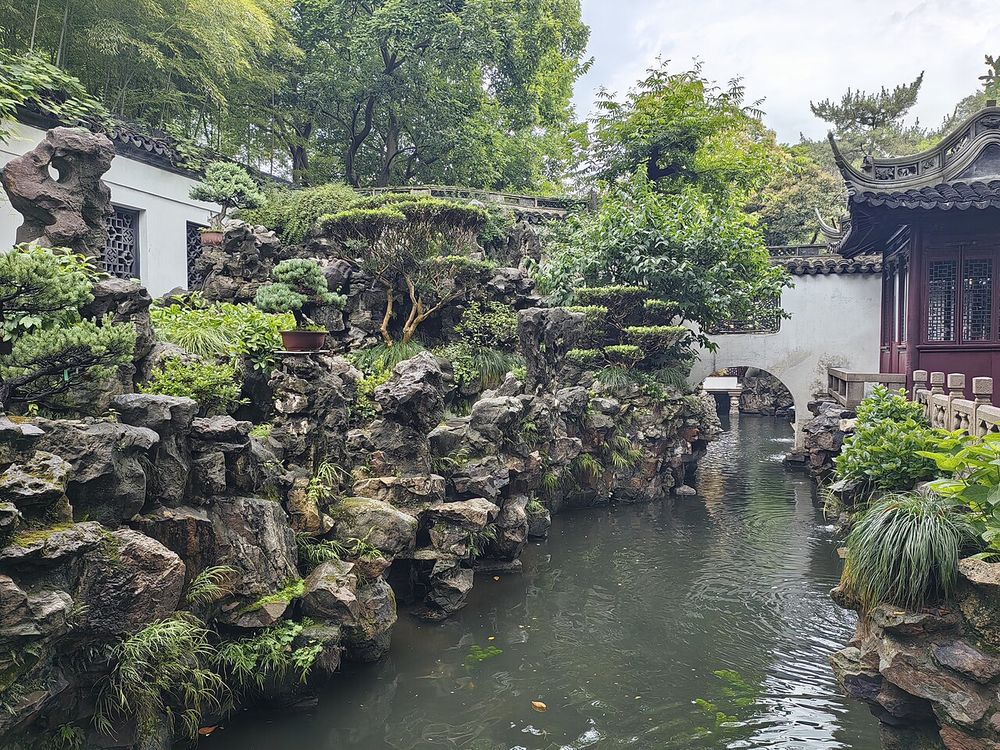
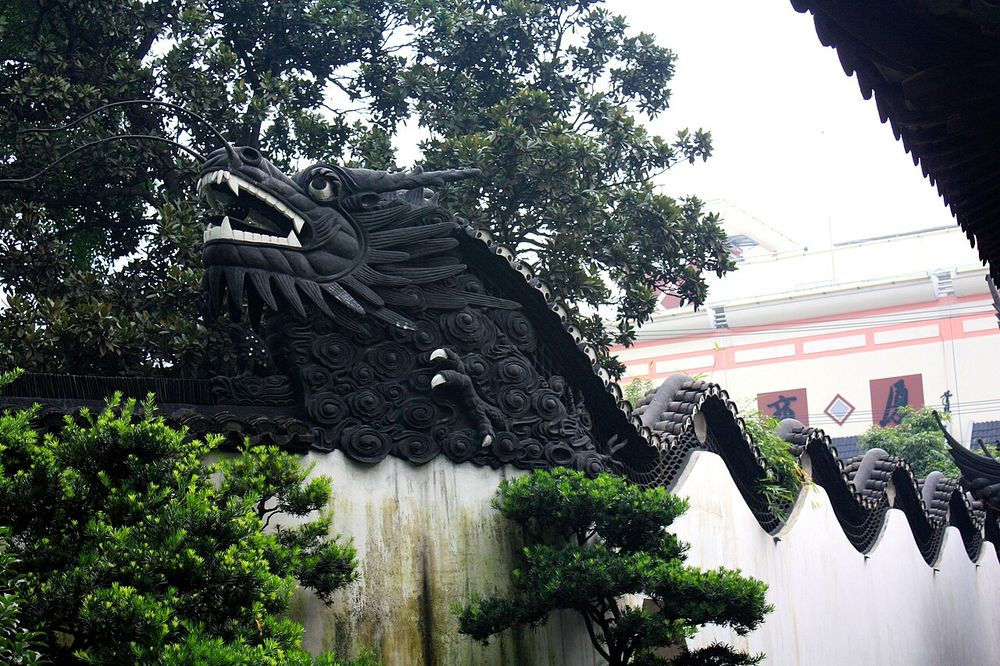
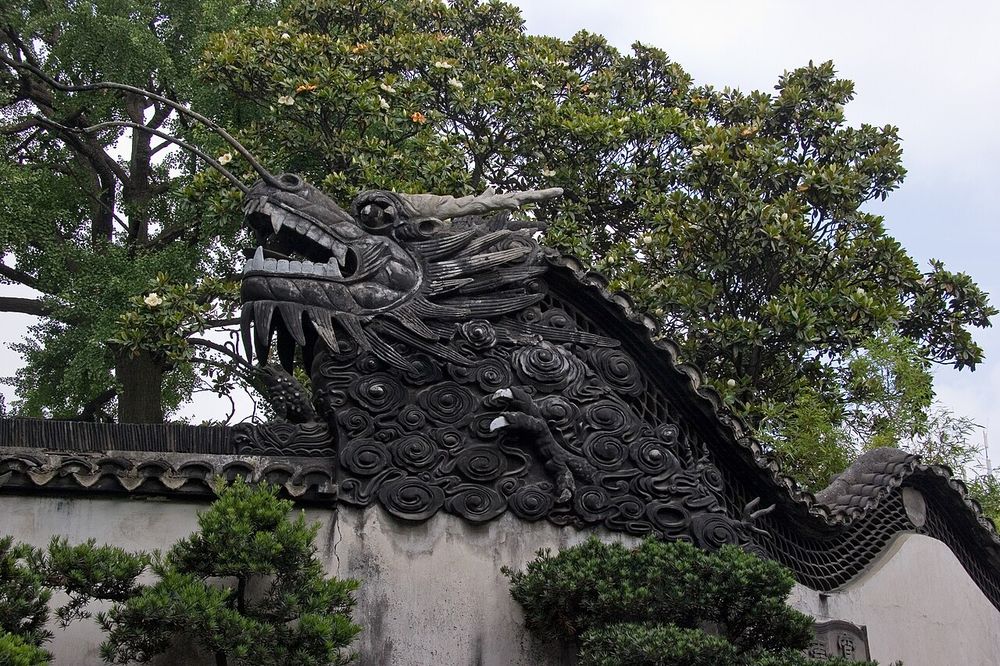
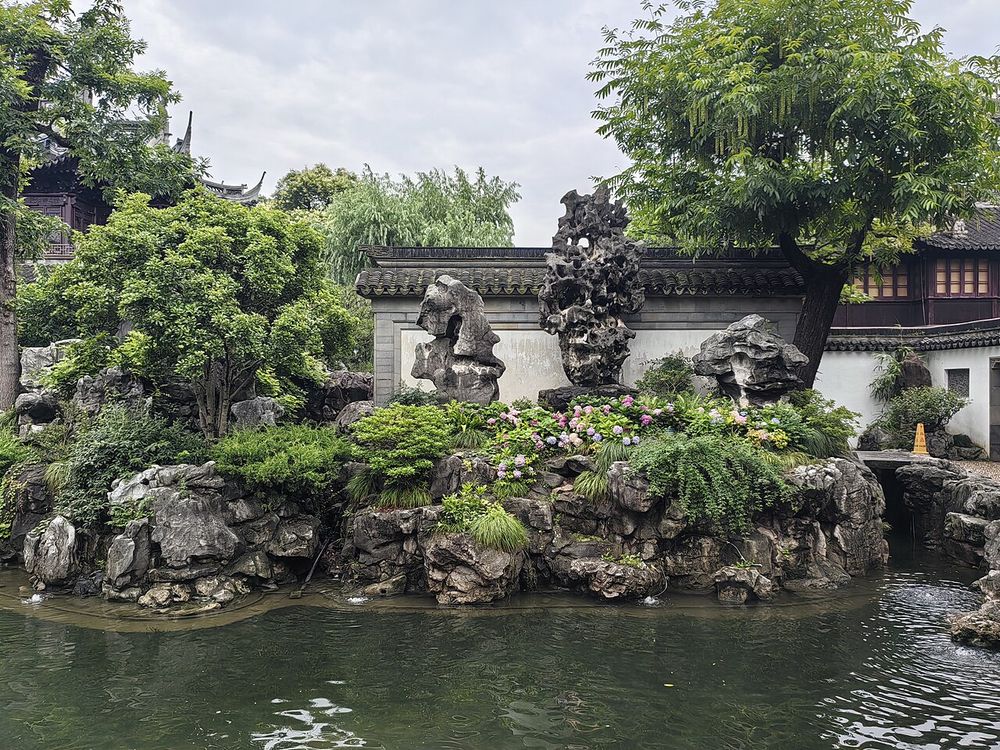
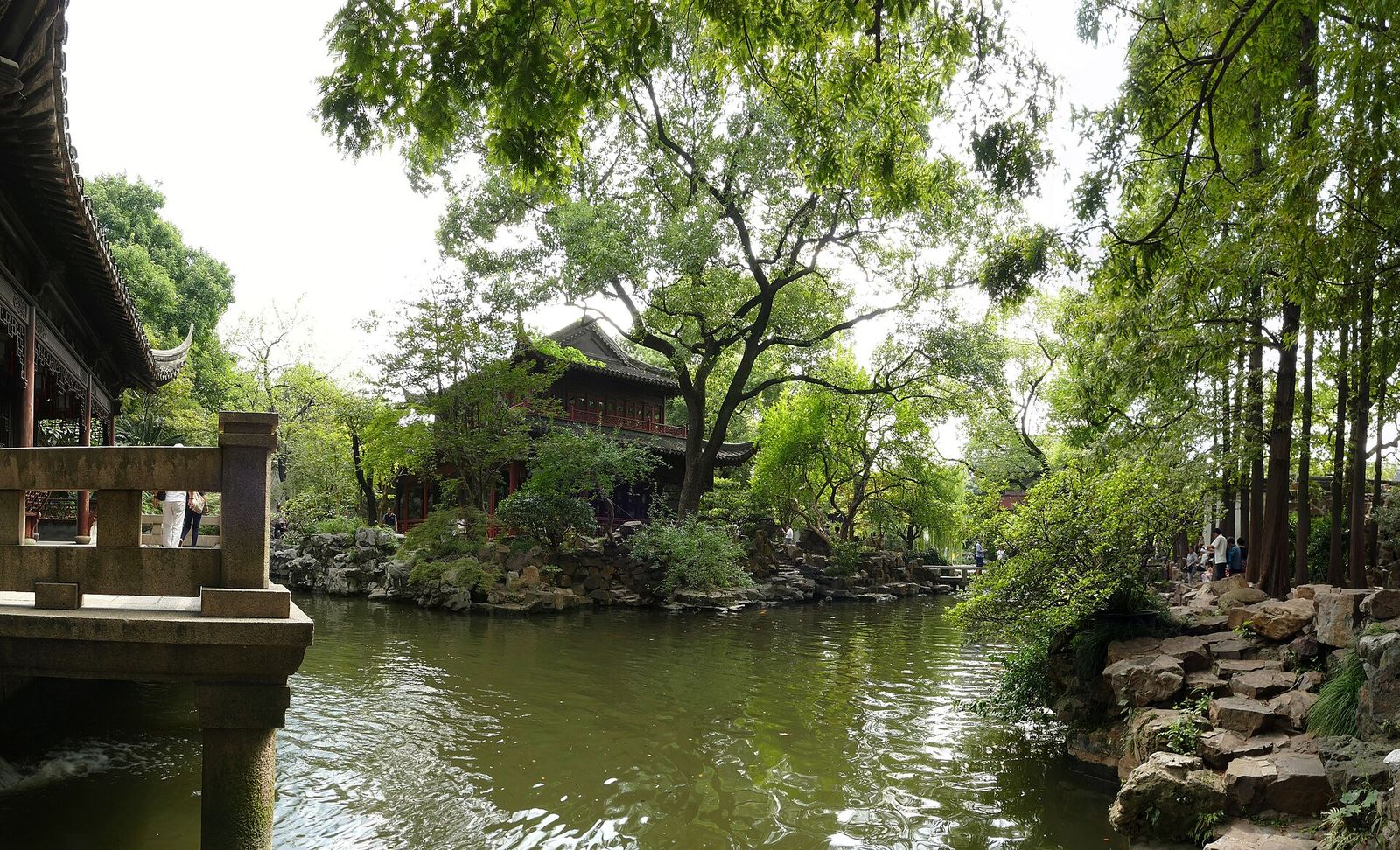
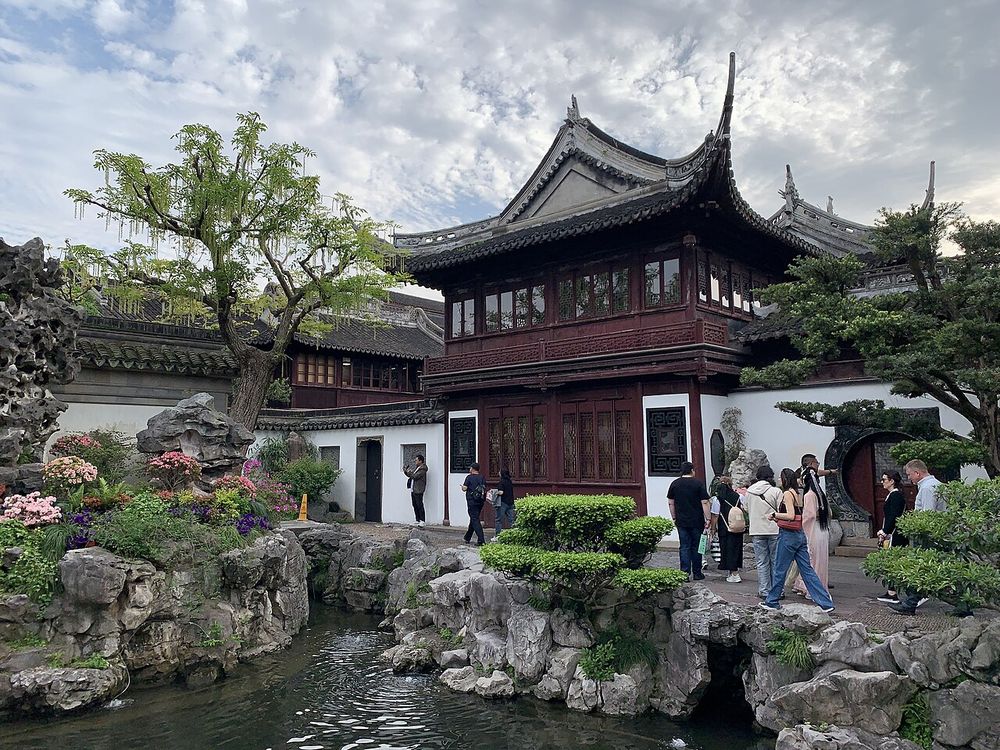
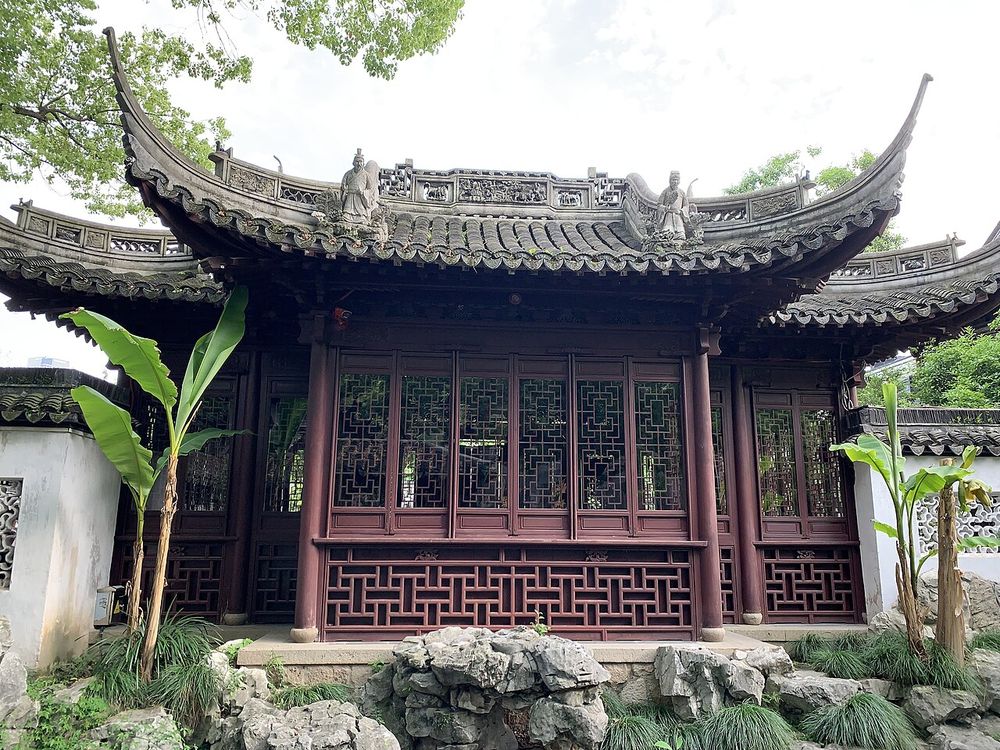
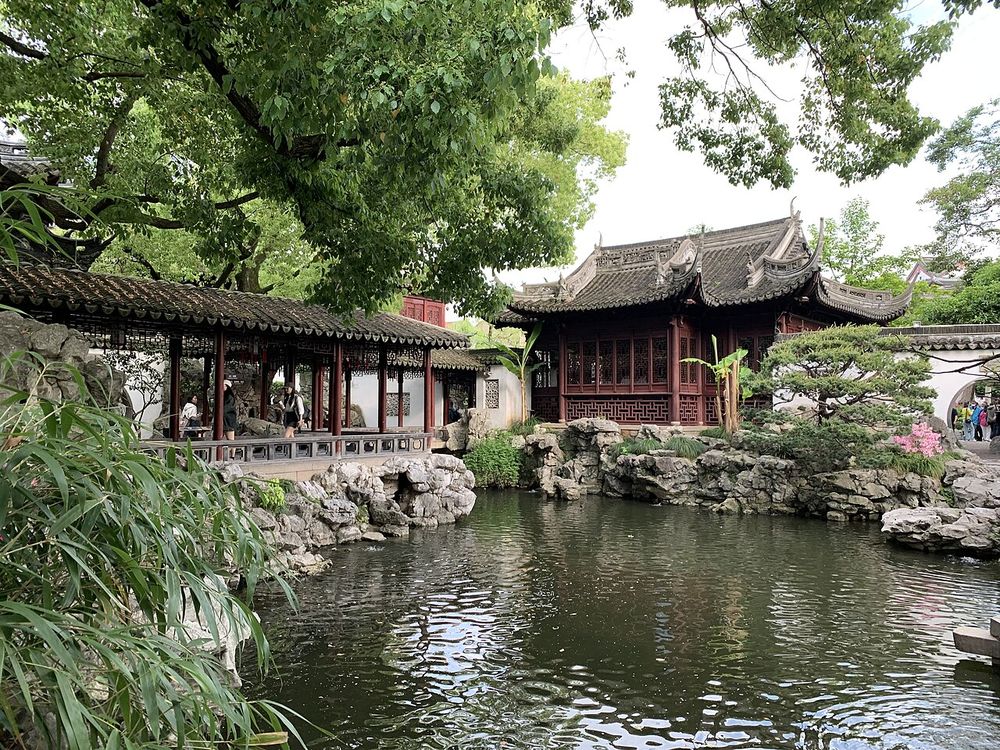
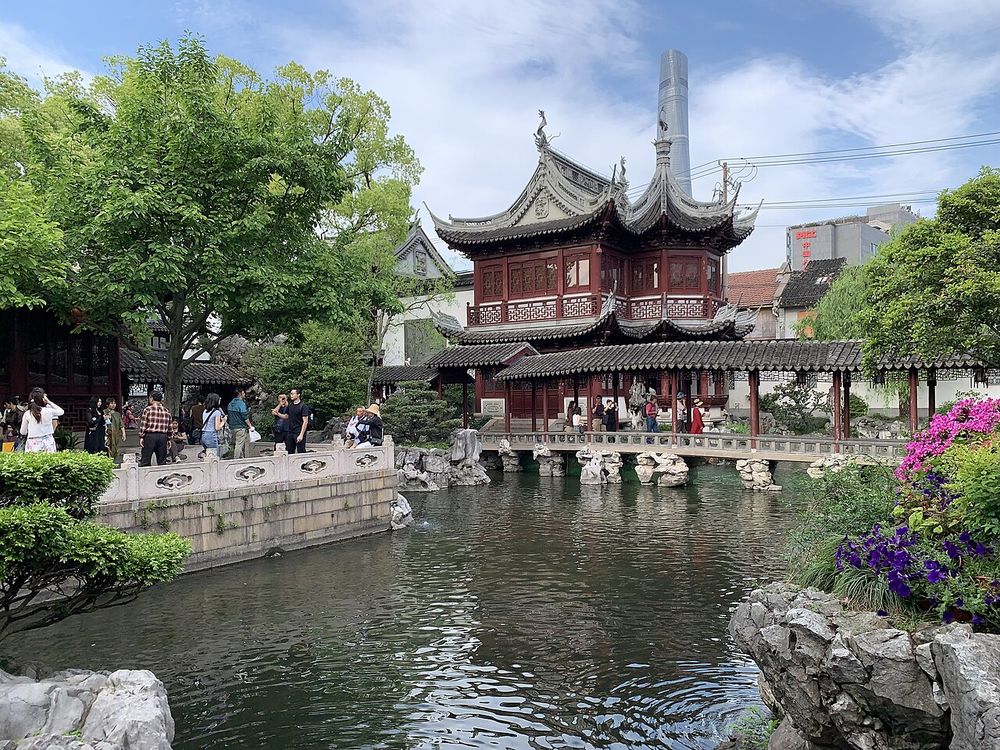
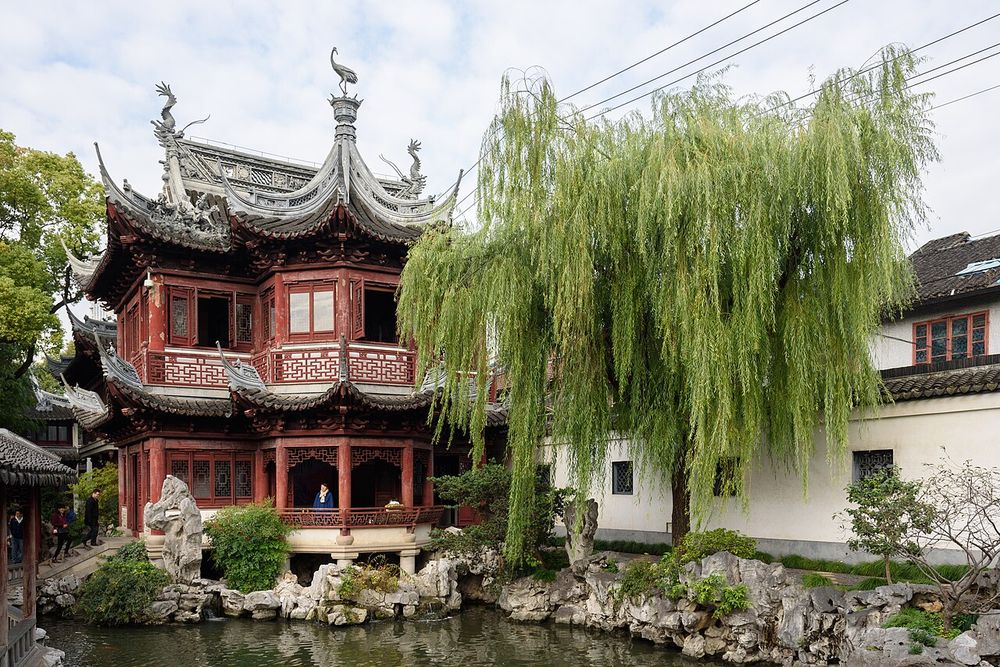
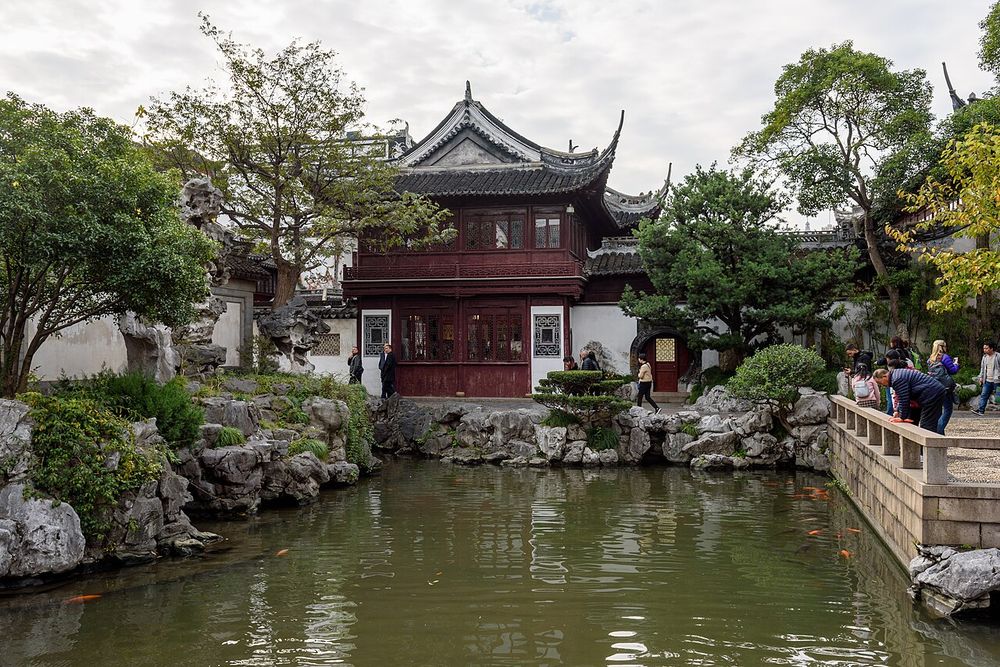
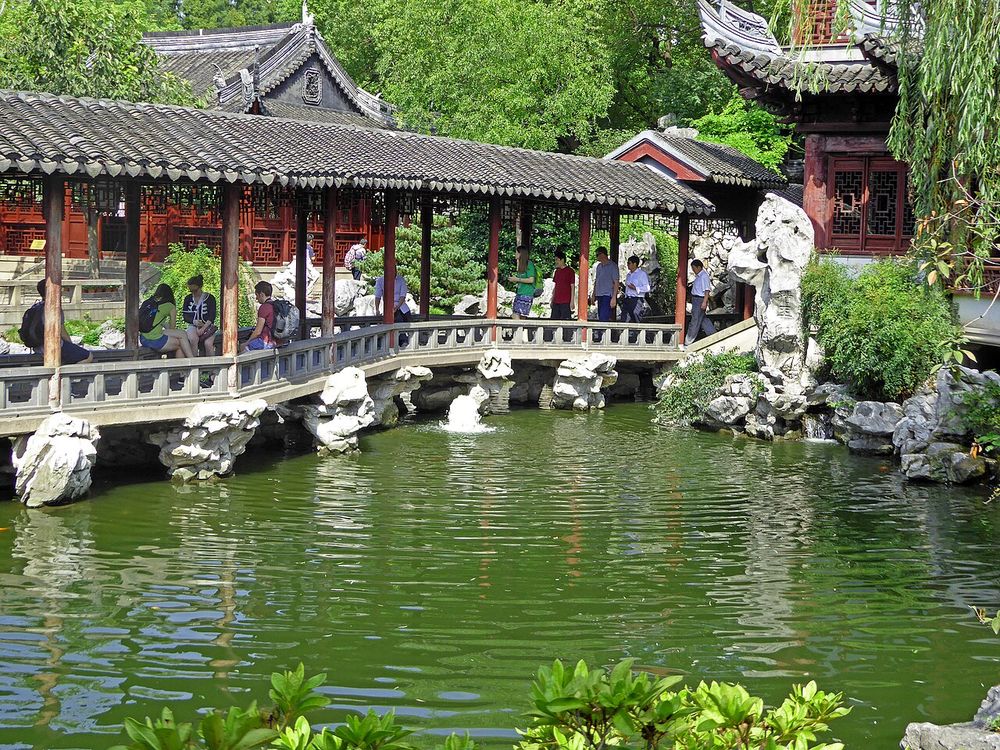
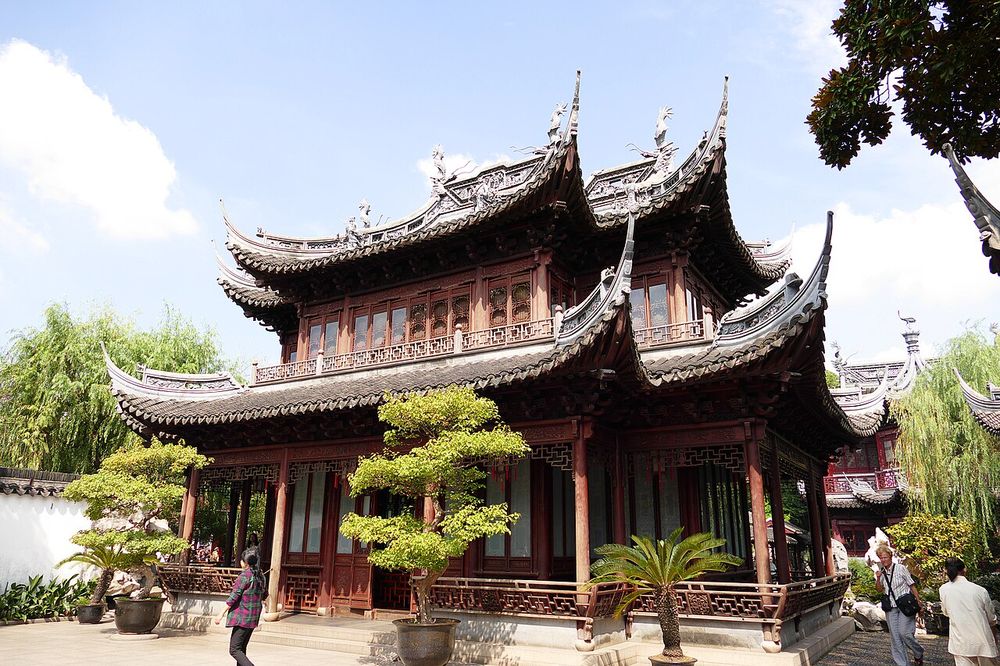
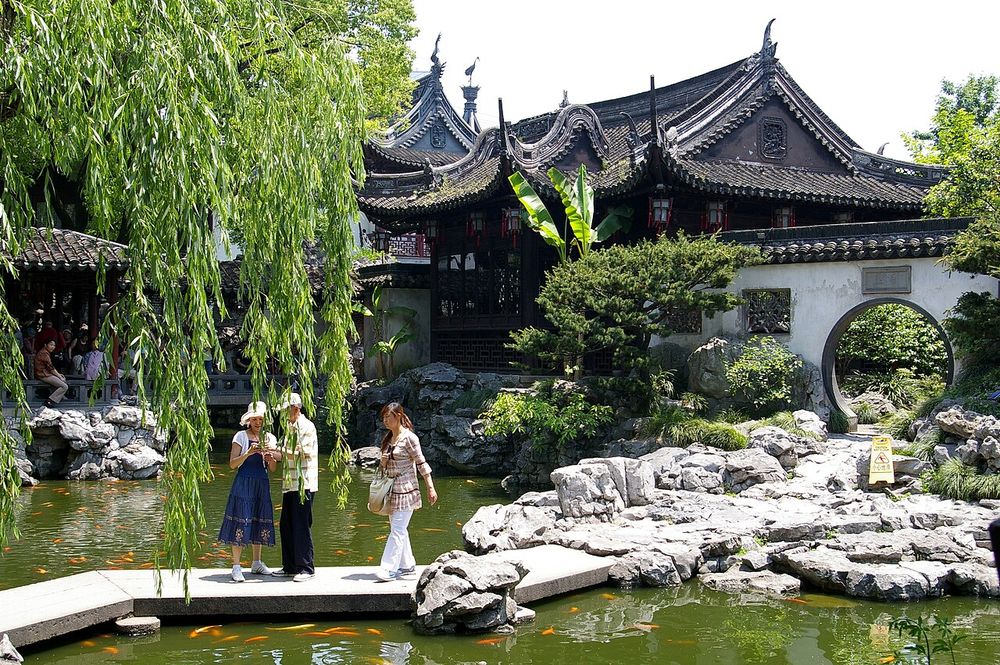
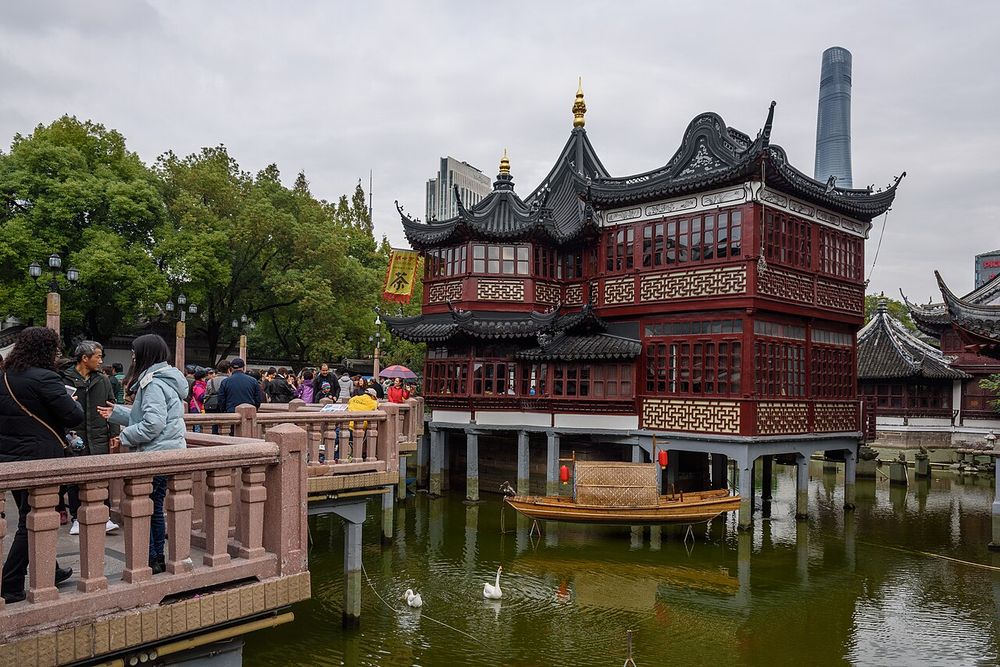
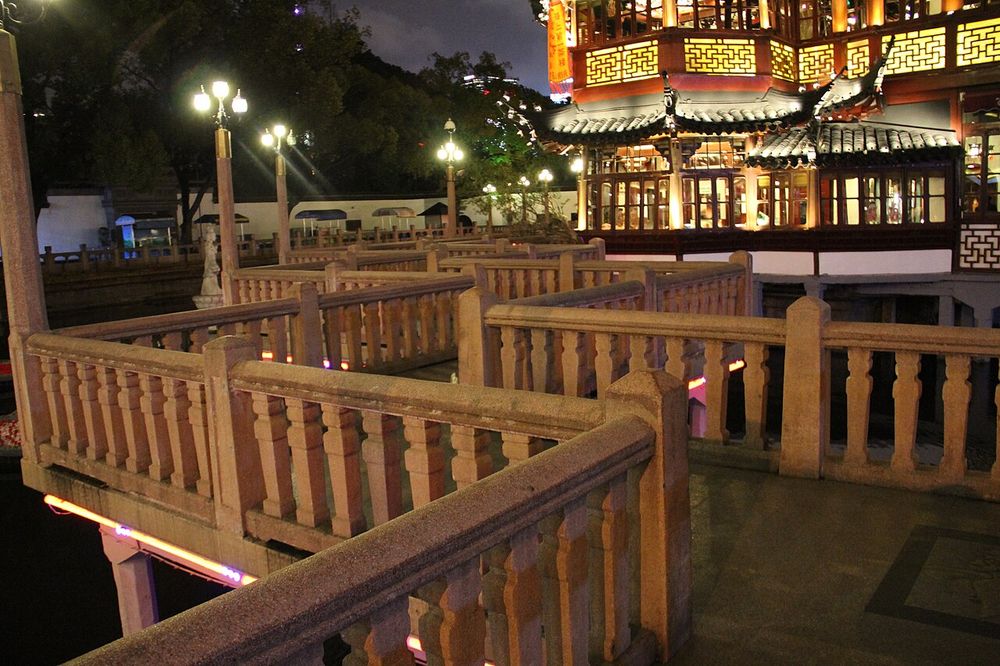
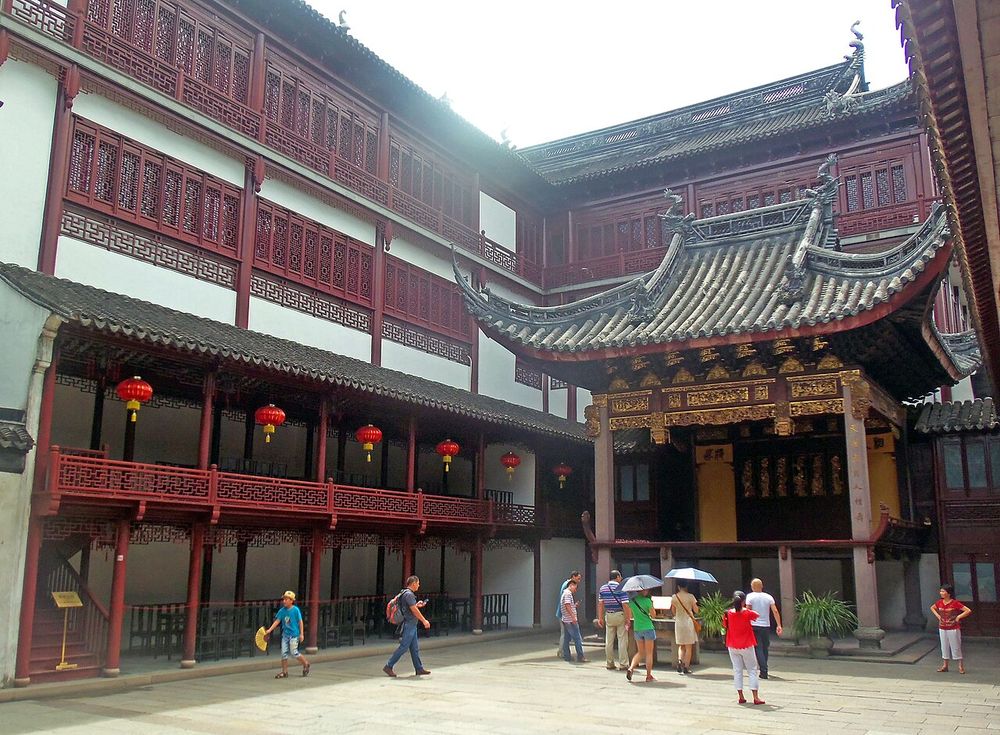
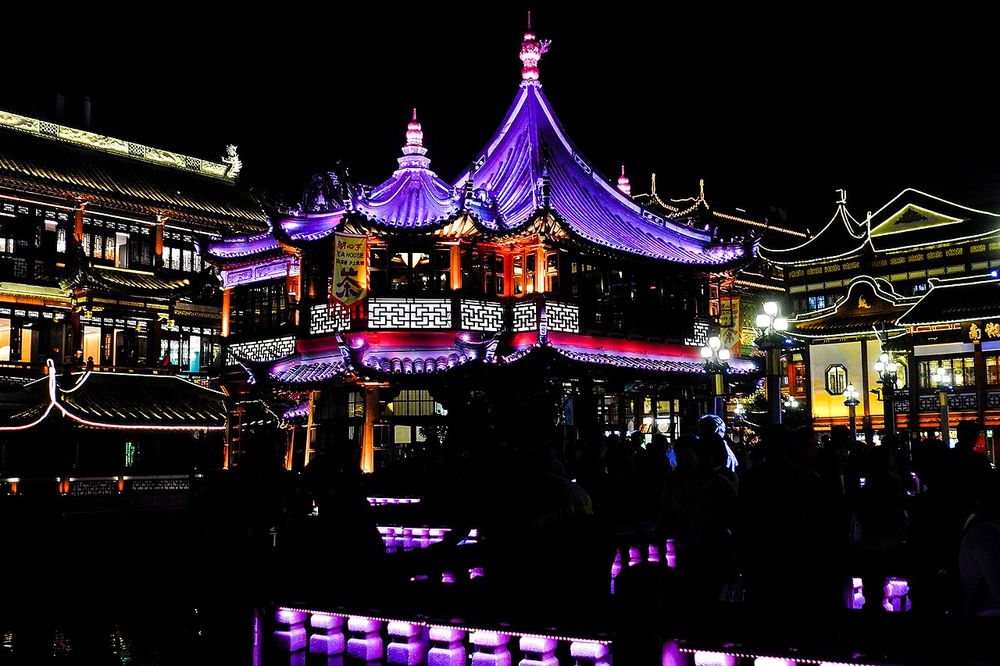
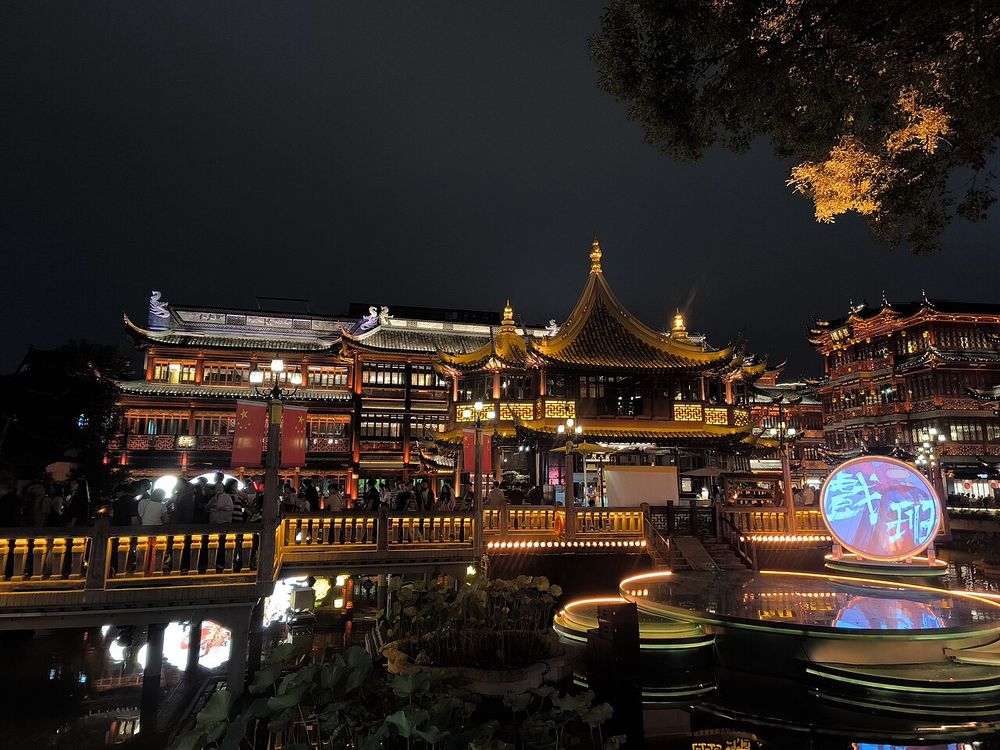
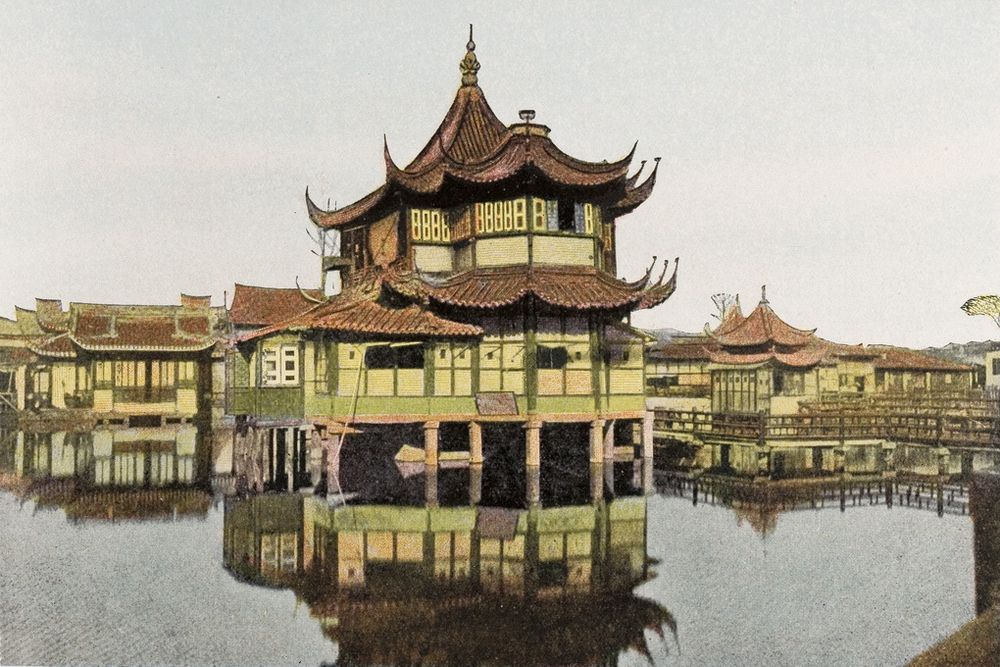
A Ming dynasty garden in the heart of Shanghai's old walled town, built by an official for his ageing parents. Behind its walls are a mountain of yellow rock, ponds full of carp, walls that end in dragons' heads, and a stone full of holes that people have admired for four hundred years. Outside its gate, a teahouse stands in a pond at the end of a zigzag bridge.
Photo: Zossolino, CC BY-SA 4.0, Wikimedia Commons
The story
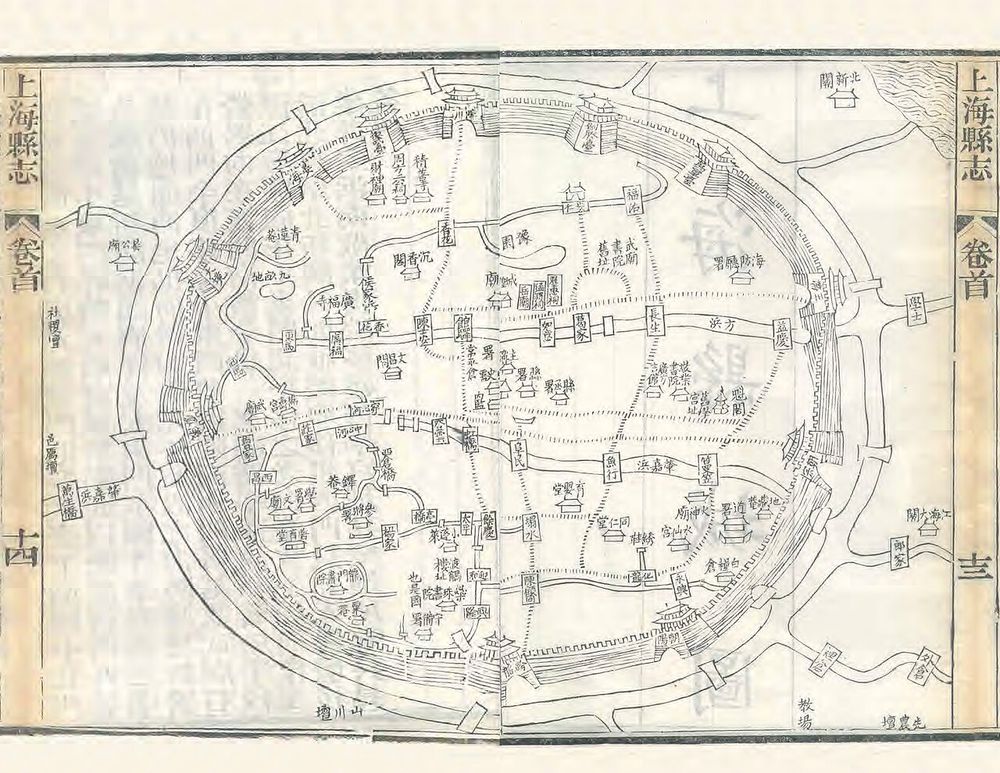
In 1559 Pan Yunduan, son of a high official of the Ming dynasty (1368–1644), began a garden beside his family house in Shanghai, then a small walled county town. He called it Yu, "ease" or "contentment", because, as he wrote, it was meant to please his ageing parents. It took him almost twenty years. His father died soon after it was finished.
The family declined, and in 1760 merchants of the town bought the ruin and joined it to the City God Temple next door as its "West Garden". Since then it has lived through Shanghai's whole modern history: British soldiers in 1842, a rebel headquarters in 1853, painters' gatherings, war damage, and a careful restoration from 1956 that opened it to everyone in 1961. Today it is a small garden, about two hectares, packed with rooms, rocks and water, surrounded by the noise of the bazaar.
What is here
The garden is behind its own wall and has its own ticket. The bridge and the teahouse stand outside it in the bazaar; the City God Temple next door has a separate small ticket.
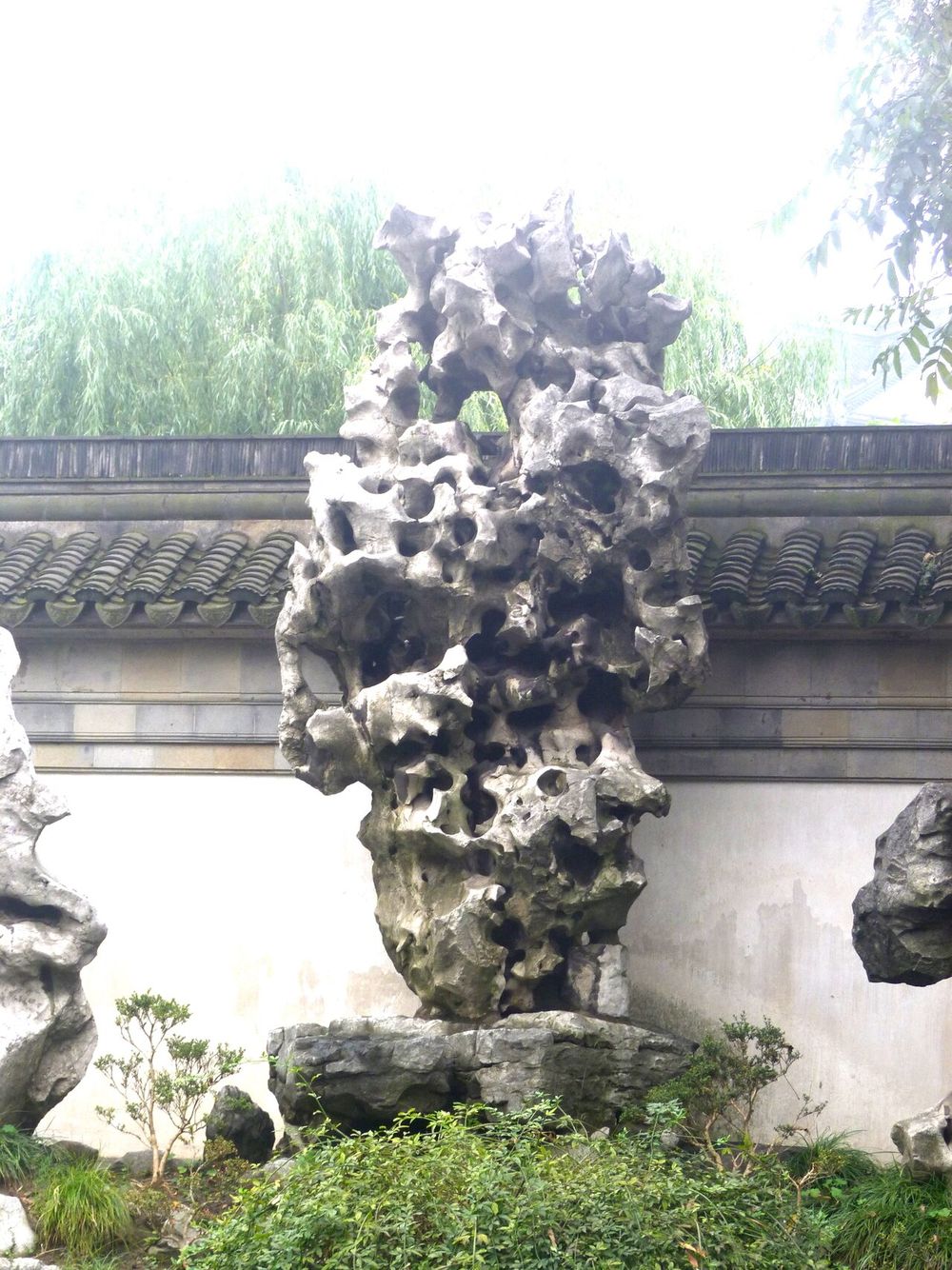
The Exquisite Jade Rock, 2011Gisling, CC BY-SA 3.0
This grey limestone, about three metres tall and riddled with holes, is the treasure of the garden. Chinese collectors judged such rocks by four qualities: thin, open, leaky and wrinkled. This one has all four. Look through it and the sky shows through a dozen openings at once.
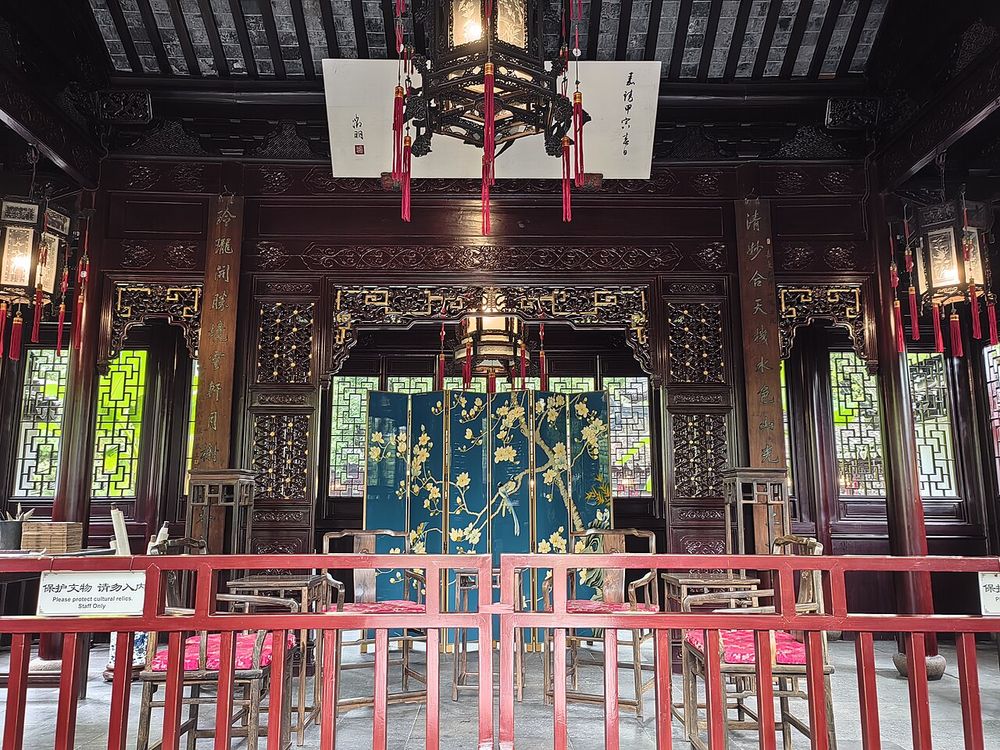
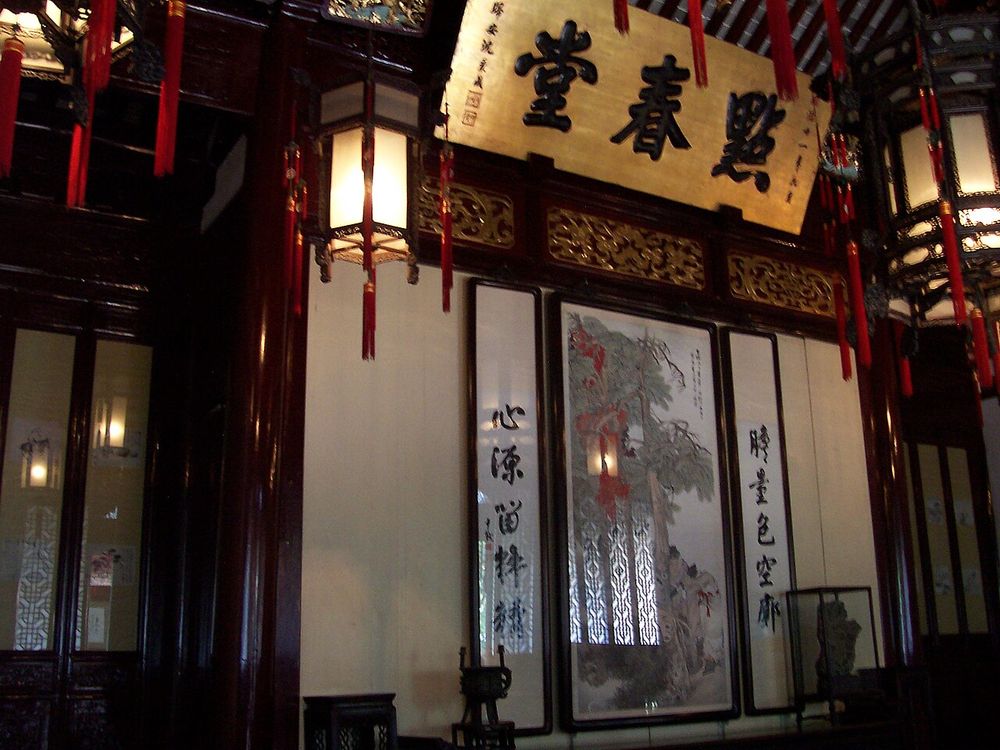
Then turn round. Across a small pond is the Hall of Jade Splendour, Pan Yunduan's study, set exactly so that he could sit and look at the rock.
Inside the Hall of Jade Splendour, 2024Yumeto, CC BY-SA 4.0
Things people often get wrong
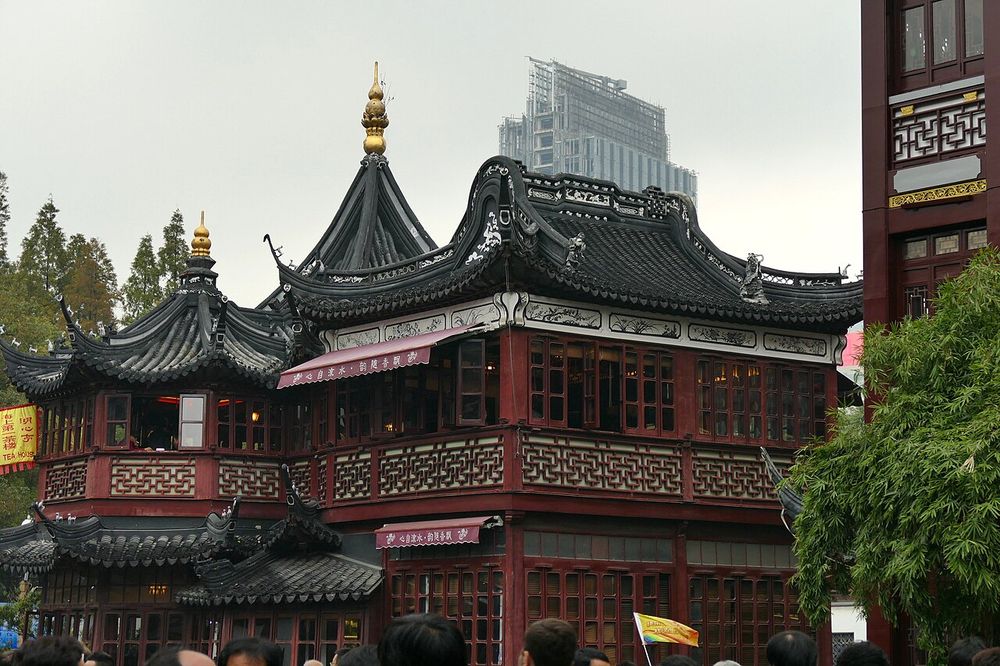
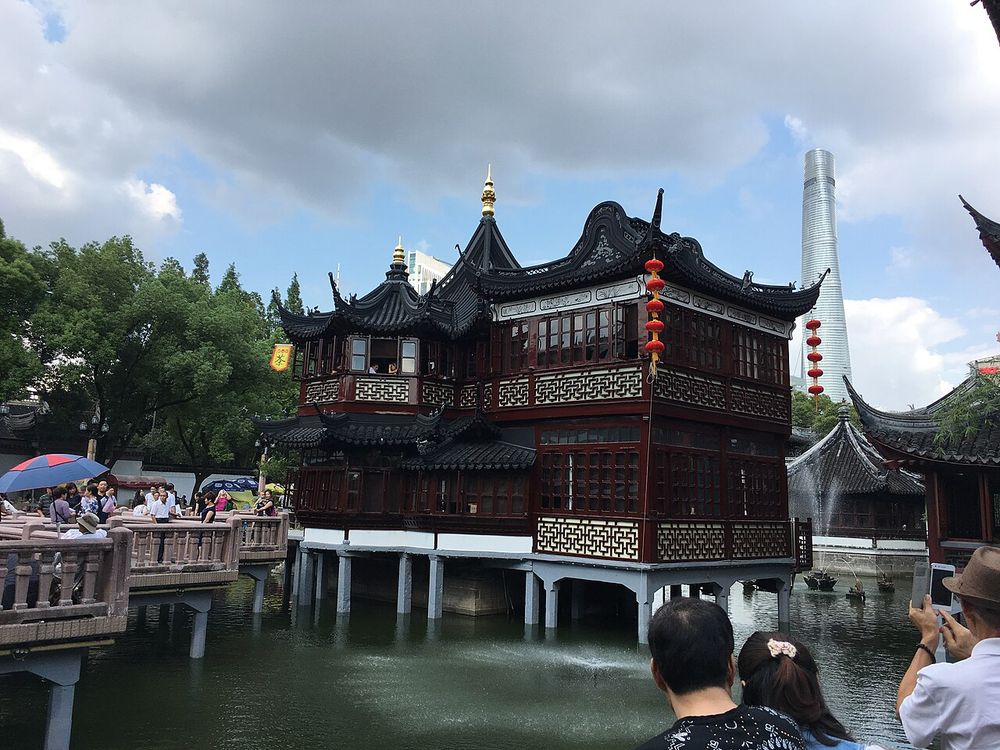
"The teahouse and the zigzag bridge are Yu Garden." They stand in a pond of the bazaar, outside the paid gate. The garden itself is behind the wall.
"It is all ancient." Much was rebuilt after the wars of the 19th and 20th centuries, mainly in 1956–1961 and again in the 1980s. The Grand Rockery and the Jade Rock are the oldest things here.
People who stood here
We searched Chinese sources first for this list, then English ones.
Dong Qichang (painter and calligrapher, 1555–1636)The greatest painter-critic of the late Ming, from the Shanghai area, he wrote poems and boards in the garden while the Pan family owned it.
Wu Changshuo (painter, 1844–1927)In the late Qing (1644–1912) the garden's Book and Painting Tower was where Shanghai's painters met and sold their work; Wu Changshuo and Ren Bonian were among them, and the Shanghai school of painting grew from such gatherings.
Guo Moruo (writer, 1892–1978)He visited after the garden reopened in 1961 and wrote a short poem ending: "Yu Garden has a history to last a thousand autumns."
Chen Congzhou (garden scholar, 1918–2000)The author of "On Chinese Gardens" twice directed the garden's repairs, in 1982 and 1987, and gave it much of the look it has today.
Queen Elizabeth II (1926–2022)On 15 October 1986, on the first visit of a British monarch to China, she took tea at the Huxinting teahouse and then walked across the zigzag bridge into the garden. The teahouse still keeps her table.
3 more people
Ba Jin (writer, 1904–2005)The author of "Family" was a regular at the Huxinting teahouse; his table, too, is kept.
Bill Clinton (US president, born 1946)During his visit to Shanghai in 1998 he took tea at the Huxinting teahouse.
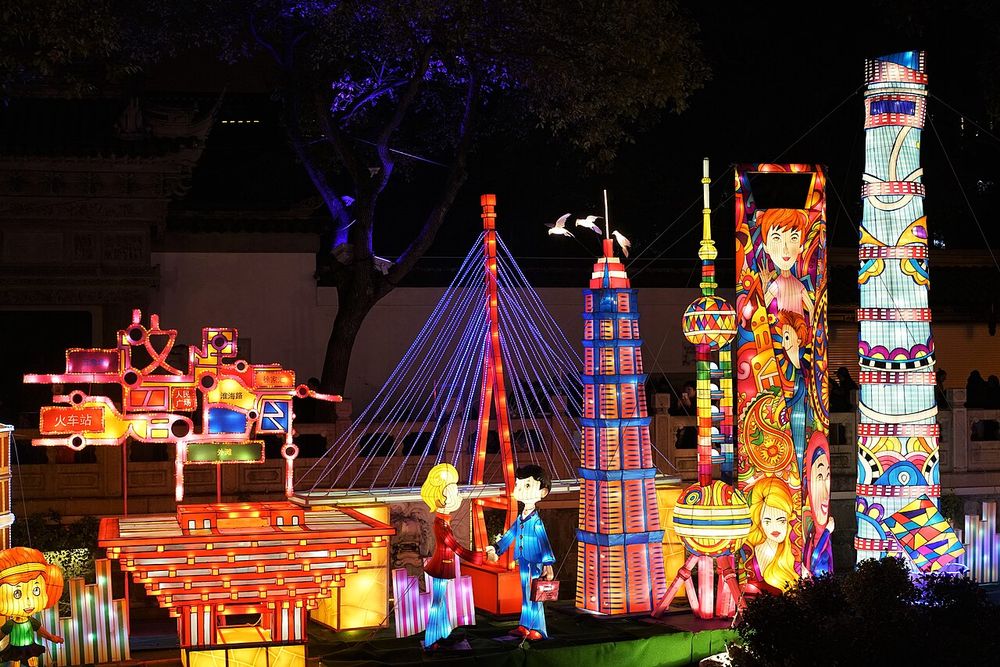
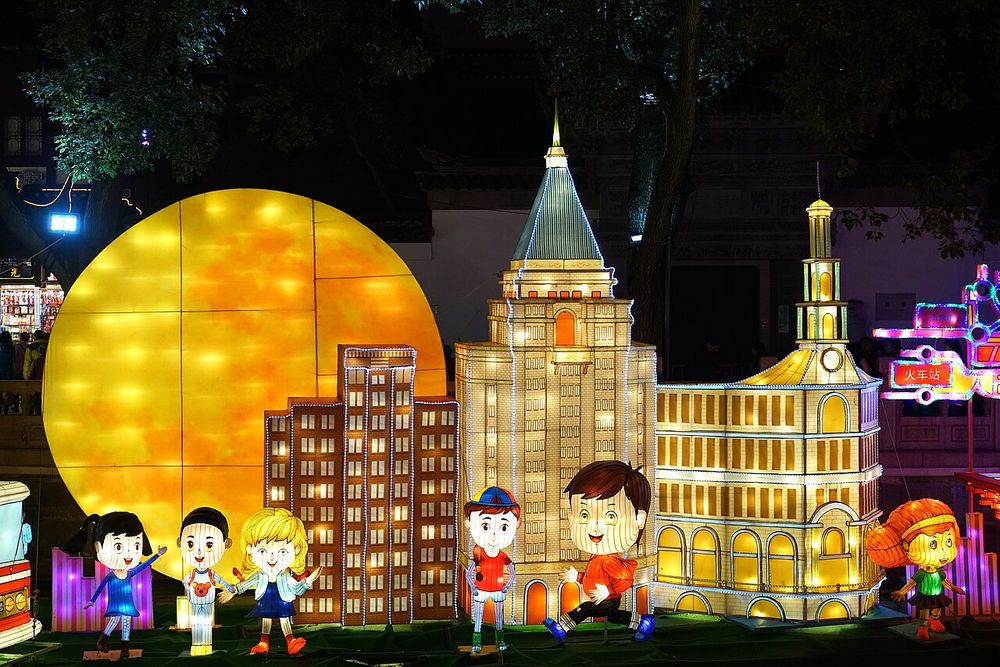
Keir Starmer (British prime minister)On 30 January 2026, his first day in Shanghai, he walked round the Yuyuan lantern festival in the rain and bought a box of butterfly pastries.
Go deeper: six stops from the bridge to the opera stage7 stops · about 2 min to read
The paid garden takes an hour and a half. Start at the bridge outside, enter at the north gate, and walk south through the garden to the exit at the Inner Garden.
1. The zigzag bridge and the teahouse
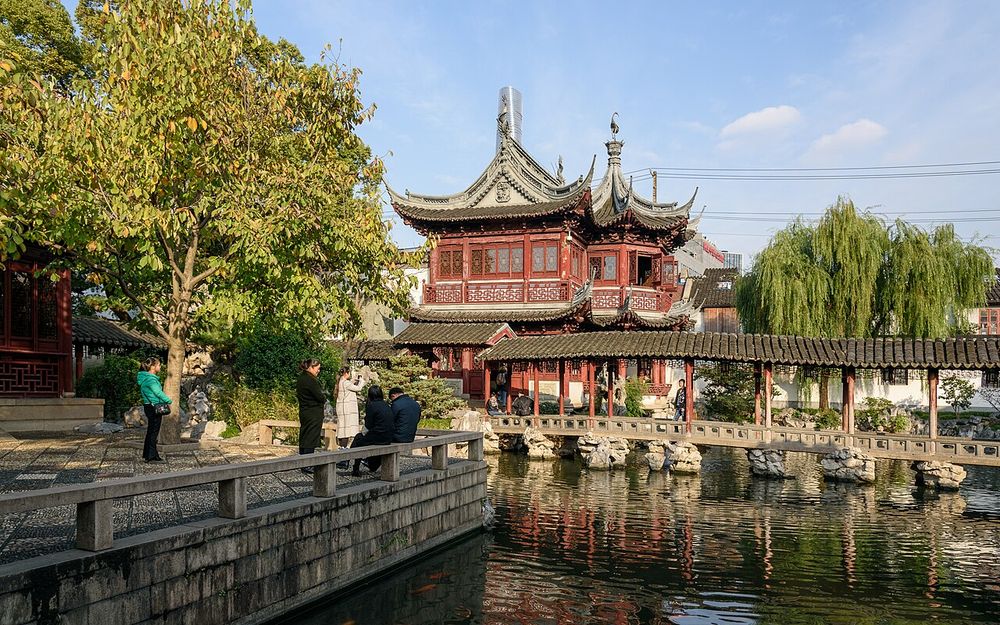
The Huxinting teahouse across the pond, November 2017King of Hearts, CC BY-SA 4.0
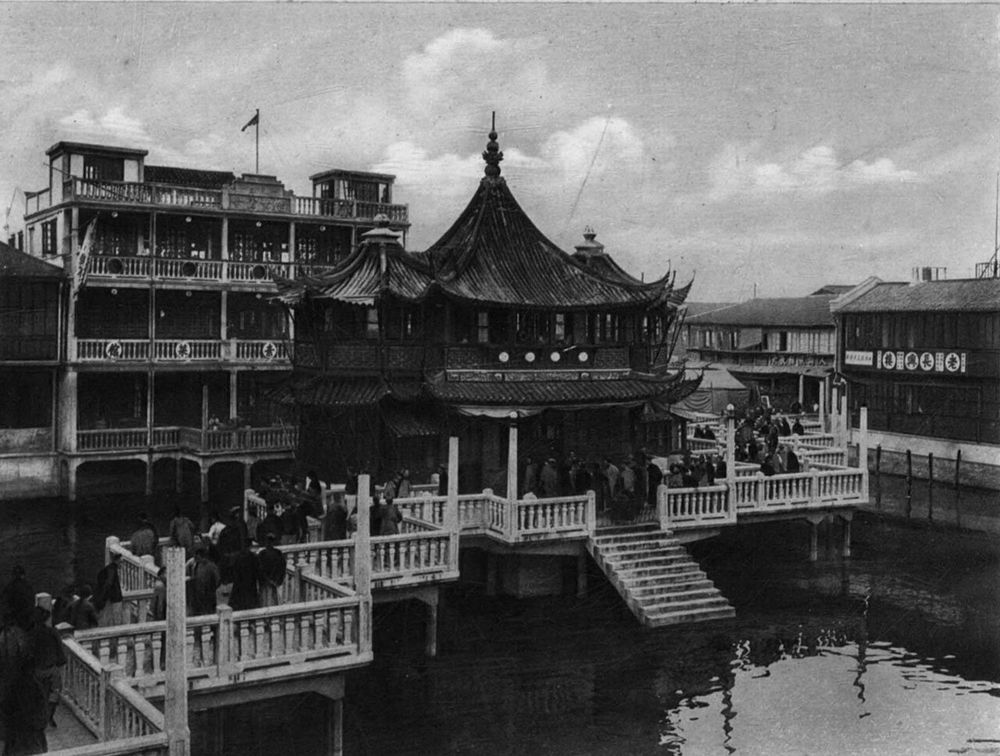
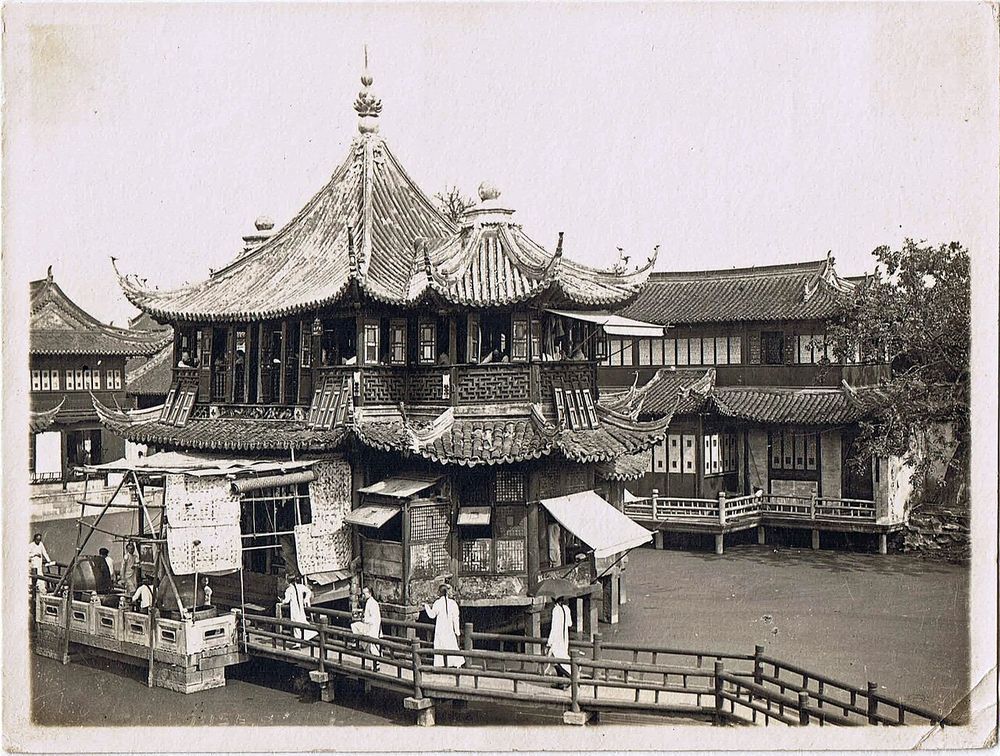
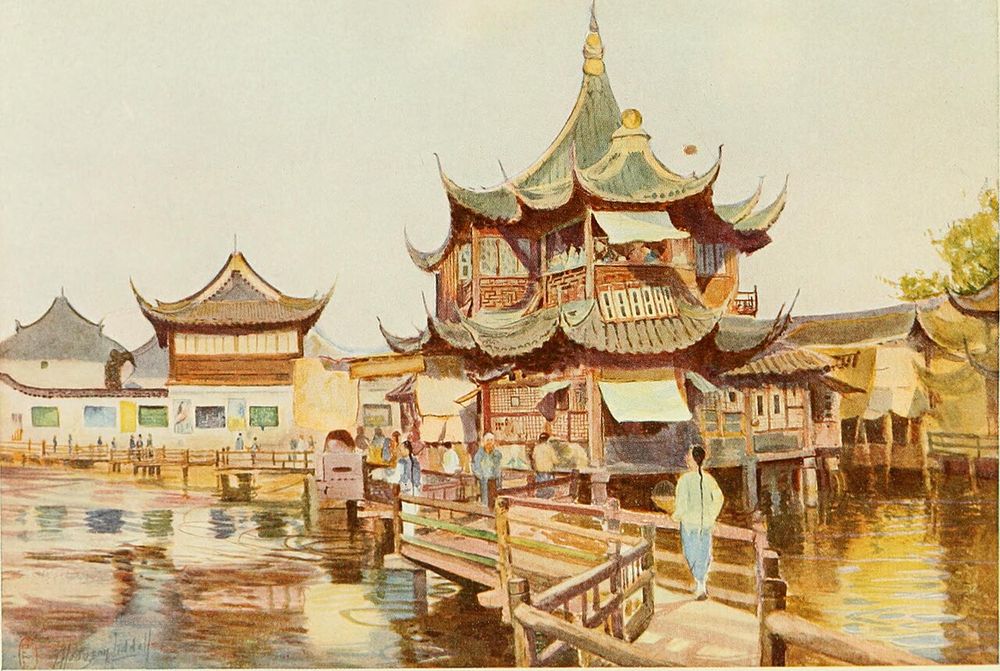
Merchants built both in 1784 on the site of a pavilion of the old garden. In 1855 the pavilion became Shanghai's first teahouse, and it still serves tea upstairs and down. The bridge turns nine times: a straight path, people said, lets evil spirits through.
The teahouse and the bridge in an early 20th-century book of photographsUnknown authorUnknown author, Public domain
2. The Grand Rockery
Rocks and a stream, June 2024Yumeto, CC BY-SA 4.0
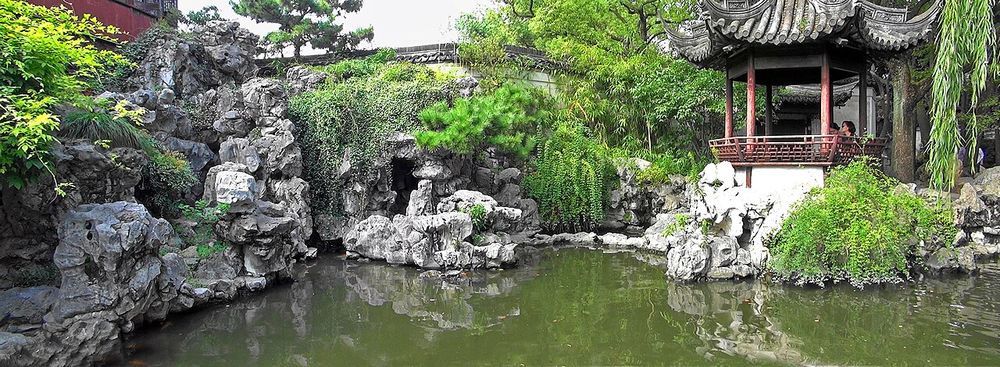
From the Hall of Three Ears of Grain and the Hall for Viewing the Mountain, look across the water at a mountain of yellow stone, some fourteen metres high. It is the work of Zhang Nanyang, the great rockery maker of the Ming, and is said to be the only one of his works that survives. Climb to the little pavilion on top: in Pan's day, it is said, you could see the Huangpu River from there.
3. The dragon walls and the old ginkgo
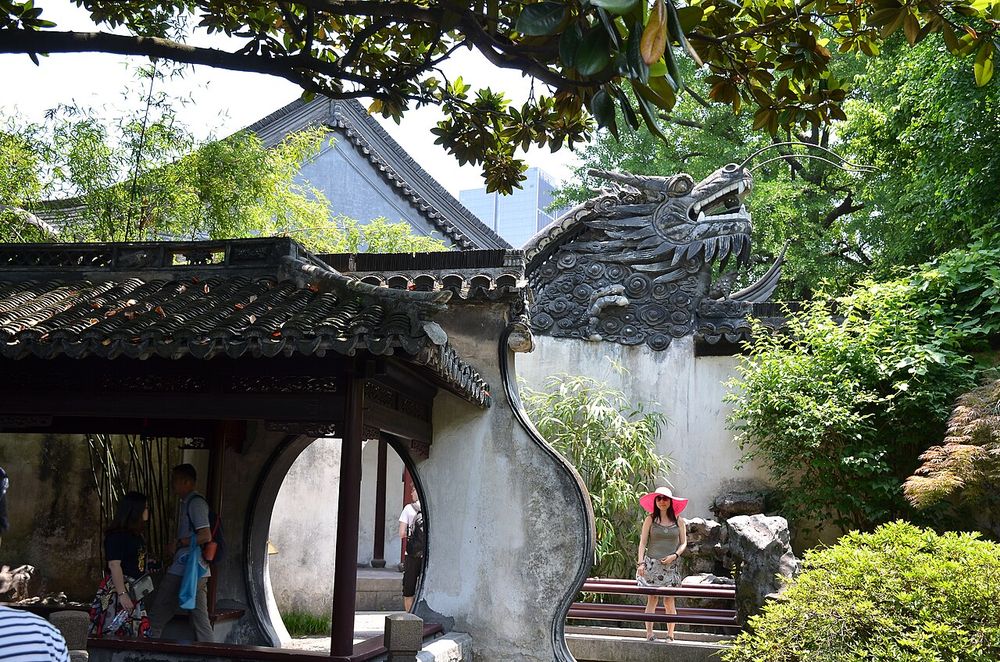
A dragon's head at the end of a wall, 2011J. Patrick Fischer, CC BY-SA 3.0
The garden is divided by walls whose ridges are dragons: a scaly body undulating along the top, a head with open jaws at the end. In front of the Tower of Ten Thousand Flowers stands a ginkgo said to be more than four hundred years old, which may have been planted while the Pans still lived here.
A dragon wall, 2007KimonBerlin, CC BY-SA 2.0
4. The Hall of Heralding Spring
The Hall of Heralding Spring, 2004Yuqi Qiao, CC BY-SA 3.0
In September 1853 the Small Swords Society, a secret society allied in spirit with the Taiping rebels, seized Shanghai's walled town and made this hall its headquarters. They held the town for seventeen months, until French and Qing troops drove them out in 1855. A display in the hall tells their story.
5. The Jade Rock and the Hall of Jade Splendour
The Exquisite Jade Rock across its pond, June 2024Yumeto, CC BY-SA 4.0
Here is the rock of the one-minute visit. Stand in the hall and look out: Pan Yunduan designed the whole court around this view. Next to it, the Book and Painting Tower is where late Qing painters met, the cradle of the Shanghai school.
6. The Inner Garden and the opera stage
The spiral ceiling over the opera stage, 2013Daniel Case, CC BY-SA 3.0
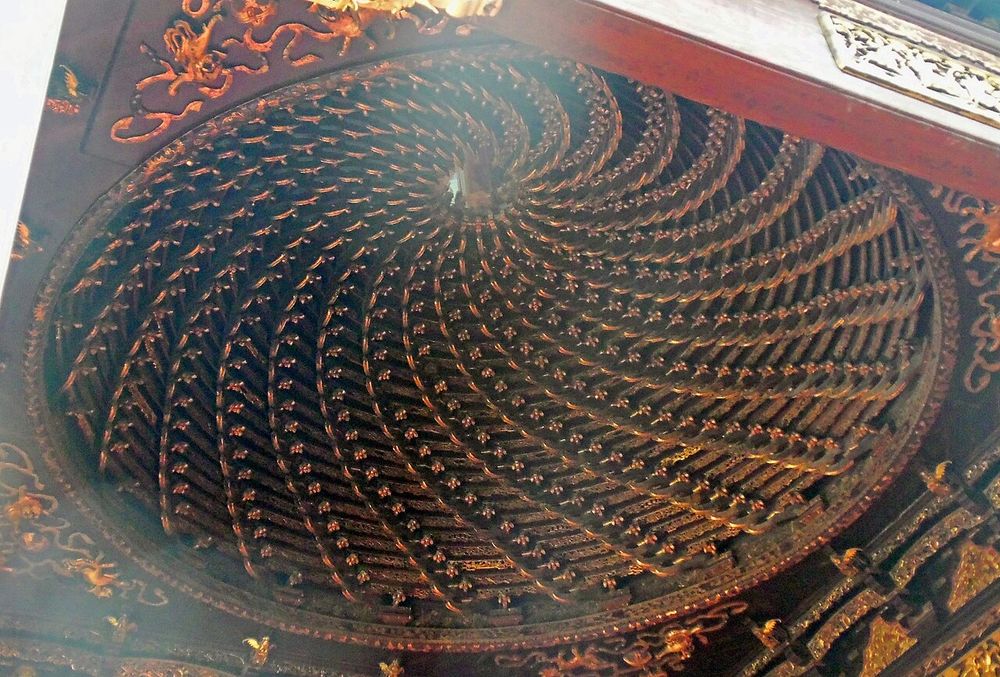
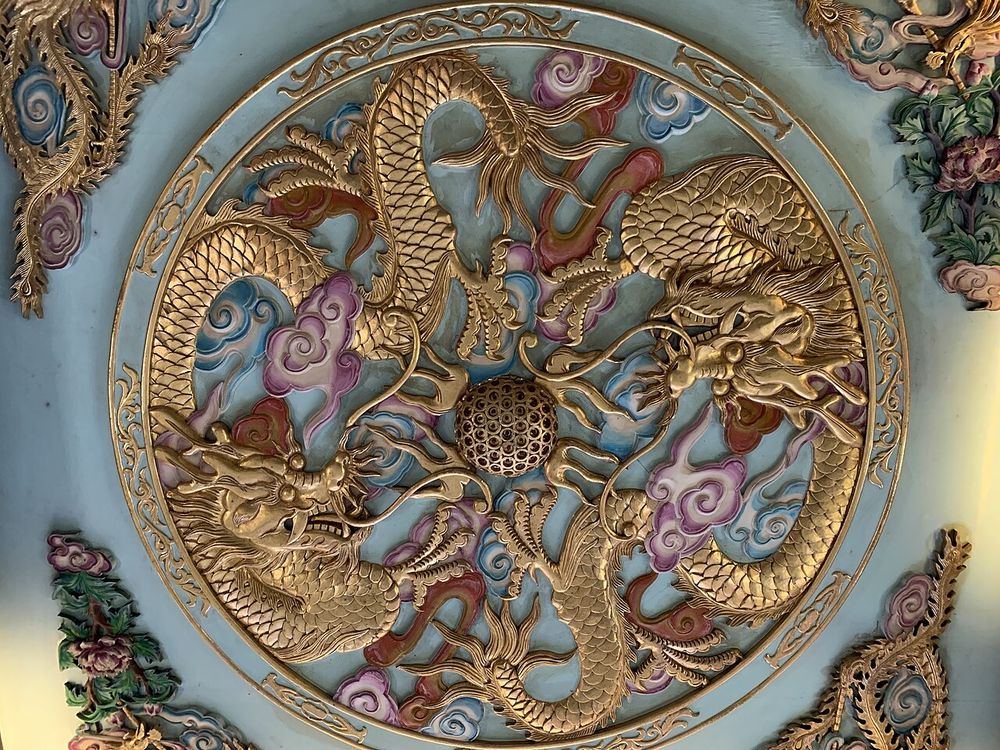
The Inner Garden was built in 1709 as a separate garden of the City God Temple and joined to Yu Garden later. Its old opera stage has a ceiling that spirals up in carved and gilded wood, said to help carry the singers' voices.
The garden and the same years elsewhere
Pan Yunduan began his garden in 1559, the year Elizabeth I was crowned in London. Four hundred and twenty-seven years later, the second Queen Elizabeth walked into it.
Meanwhile in the world
Year
Here
Elsewhere
1559
Pan Yunduan begins the garden
Elizabeth I is crowned in London
1577
The garden is close to finished
Francis Drake sets out to sail round the world
1784
Merchants build the teahouse pavilion and the zigzag bridge
The United States ratifies the peace with Britain
1853
The Small Swords Society seizes Shanghai's old town
The Crimean War begins
1961
The restored garden opens to the public
Yuri Gagarin flies into space
1986
Queen Elizabeth II takes tea at Huxinting
The Chernobyl disaster
One line to remember: a son's gift to his parents, which became the whole city's garden.
Then and now
The Grand Rockery across the pond, 2015Zossolino, CC BY-SA 4.0, Wikimedia CommonsA pond with willows and rocks, 2015Zossolino, CC BY-SA 4.0, Wikimedia CommonsA pavilion among spring greenery, April 2024Chainwit., CC BY 4.0, Wikimedia CommonsA hall with lattice windows, April 2024Chainwit., CC BY 4.0, Wikimedia CommonsA covered walk along the water, April 2024Chainwit., CC BY 4.0, Wikimedia CommonsThe pond and the towers of Lujiazui behind, April 2024Chainwit., CC BY 4.0, Wikimedia CommonsRocks and a stream, June 2024Yumeto, CC BY-SA 4.0, Wikimedia CommonsThe Exquisite Jade Rock across its pond, June 2024Yumeto, CC BY-SA 4.0, Wikimedia CommonsThe Exquisite Jade Rock, 2011Gisling, CC BY-SA 3.0, Wikimedia CommonsInside the Hall of Jade Splendour, 2024Yumeto, CC BY-SA 4.0, Wikimedia CommonsA dragon's head at the end of a wall, 2011J. Patrick Fischer, CC BY-SA 3.0, Wikimedia CommonsA dragon wall, 2007KimonBerlin, CC BY-SA 2.0, Wikimedia CommonsA gateway under a dragon wall, 2017shankar s. from Dubai, united arab emirates, CC BY 2.0, Wikimedia CommonsThe Hall of Heralding Spring, 2004Yuqi Qiao, CC BY-SA 3.0, Wikimedia CommonsThe spiral ceiling over the opera stage, 2013Daniel Case, CC BY-SA 3.0, Wikimedia CommonsA carved and gilded dragon panel, 2024Chainwit., CC BY 4.0, Wikimedia CommonsA window with green bamboo bars, 2013Daniel Case, CC BY-SA 3.0, Wikimedia CommonsA path through bamboo, 2013Daniel Case, CC BY-SA 3.0, Wikimedia CommonsA pavilion by the water, November 2017King of Hearts, CC BY-SA 4.0, Wikimedia CommonsHalls round a pond, November 2017King of Hearts, CC BY-SA 4.0, Wikimedia CommonsA covered bridge over the pond, 2015Zossolino, CC BY-SA 4.0, Wikimedia CommonsA pavilion with upturned eaves, 2015Zossolino, CC BY-SA 4.0, Wikimedia CommonsWillows, a pond and a pavilion, May 2009Jakub Hałun, CC BY-SA 4.0, Wikimedia CommonsThe Huxinting teahouse across the pond, November 2017King of Hearts, CC BY-SA 4.0, Wikimedia CommonsThe teahouse and the zigzag bridge, November 2017King of Hearts, CC BY-SA 4.0, Wikimedia CommonsThe teahouse under an autumn sky, November 2014Hermann Luyken, CC0, Wikimedia CommonsThe teahouse on the pond, 2016Fredlyfish4, CC BY-SA 4.0, Wikimedia CommonsWalking the zigzag bridge, 2012MiLu24, CC BY-SA 3.0, Wikimedia CommonsA courtyard with two-storey halls, 2013Daniel Case, CC BY-SA 3.0, Wikimedia CommonsThe bazaar lit up at night, 2019Windmemories, CC BY-SA 4.0, Wikimedia CommonsThe teahouse at night, October 2026源義信, CC BY 4.0, Wikimedia CommonsLanterns of the Spring Festival lantern fair, 2019Augusthaiho, CC BY-SA 4.0, Wikimedia CommonsLanterns over the bazaar at New Year, 2019Augusthaiho, CC BY-SA 4.0, Wikimedia CommonsThe teahouse and the bridge, about 1921Unknown authorUnknown author, Public domain, Wikimedia CommonsThe teahouse and the bridge in an early 20th-century book of photographsUnknown authorUnknown author, Public domain, Wikimedia CommonsThe teahouse in a coloured plate of 1909Internet Archive Book Images, No restrictions, Wikimedia CommonsThe teahouse in an old photographUnknown authorUnknown author, Public domain, Wikimedia CommonsA map of the walled town of Shanghai, 1871应宝时, Public domain, Wikimedia Commons
Local legends
These are stories people tell about this place. They are legends, not history, and each one says where it comes from.
LegendThe rock that never reached the emperor
The Exquisite Jade Rock is said to have been gathered for Emperor Huizong of the Song, who collected rocks from all over the south for his palace garden in Kaifeng. The convoy broke up when the dynasty fell, and the rock stayed by the Huangpu until the Pans found it.
Source: A story told in Shanghai and in most guides; no document of the Song confirms it
LegendSmoke from every hole
It is said that if you burn incense under the Jade Rock, smoke comes out of all its holes at once, and if you pour water on top, it runs out of every hole.
Source: Told by guides; we found no test of it
Later, people who live here will be able to add the stories they grew up with, and say which of these they have heard.
Not certain, and where accounts conflict
Why do the dragons have three or four claws?
A popular story says the owner was accused of using the emperor's five-clawed dragon and saved himself by saying these were not dragons. The walls as they stand are largely rebuilt after 1956, and we found no early source for the story.
How old is the teahouse?
The building dates from 1784; it became a teahouse in 1855. Some accounts give the Ming as its date because a pavilion of Pan's garden stood on the same spot.
Visiting
Tickets and hours
40 yuan from April to June and September to November, 30 yuan in the other months.
Open Tuesday to Sunday, 9:00 to 16:30, last entry 16:00. Closed on Mondays except some public holidays.
The zigzag bridge is open at all hours and free. The teahouse charges for tea.
Last checked 2026-11-12. Ticket prices and hours as given by several 2026 visitor guides that agree with each other; the garden's own WeChat mini-program could not be opened from abroad.
Booking without WeChat
Official page in English Tickets are sold through the garden's own WeChat mini-program, which could not be opened from abroad.
International booking platform International booking sites such as Trip.com and Klook sell the ticket with a passport, sometimes at a small mark-up.
Ticket window on site There are ticket windows at the gate, so you can buy on the spot; queues are long at weekends and in holidays.
Note Bring your passport.
Checked 2026-11-12
Where to start
Metro Line 10 or 14 to Yuyuan Garden station, then five minutes' walk through the bazaar.
Arrive at opening time and walk the bridge first, before the crowds. Leave the bazaar for later.
Before you go
Avoid Monday, when the garden is shut, and the national holidays, when the bridge is queued.
The Spring Festival lantern fair fills the bazaar for about five weeks around Chinese New Year and has its own timed tickets.
Pickpockets work the crowds in the bazaar; keep your phone and passport close.
Customs and manners
The City God Temple next door is an active Taoist temple. Do not photograph people at prayer at close range.
Walking the zigzag bridge at the Lantern Festival is an old custom for luck; people will be in no hurry.
Opening hours are given in the local time of the place. Prices are in the local currency. The figure after ≈ is approximate, at exchange rates checked on 9 November 2026, in .
Look for these
Find a dragon's head at the end of a wall, and count its claws.
Stand in the Hall of Jade Splendour and look out at the Jade Rock, as Pan Yunduan did.
From the top of the Grand Rockery, find the towers of Lujiazui above the roofs.
Find the ginkgo before the Tower of Ten Thousand Flowers.
I am here
Stand at the site, sign in, press the button, and collect its stamp. Your browser will ask to use your location. It is sent to us once to confirm that you are at the site; we keep how far you were from it, not the spot where you stood.
Your stamps are saved to your account, so they follow you to any device. Checking from a browser cannot rule out every false location; stricter checks arrive with the app.
Messages
Share your photos
Photos here show the place, not people. Each one is credited to the visitor who took it and appears after our team has looked at it. A photo with you in it belongs under “I am here”.