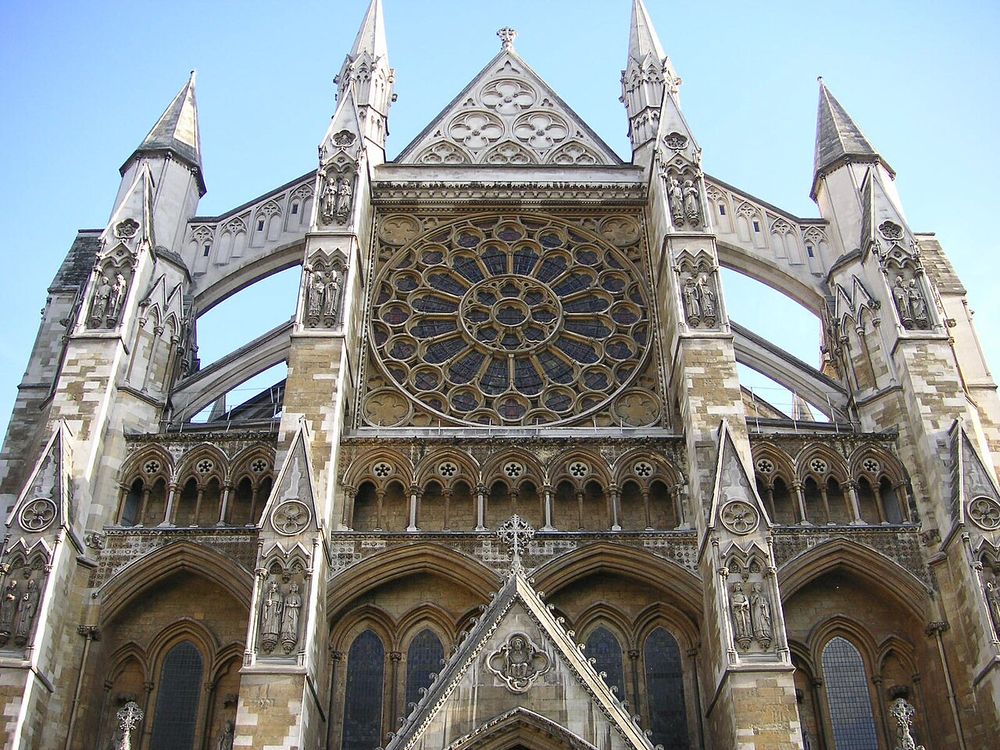
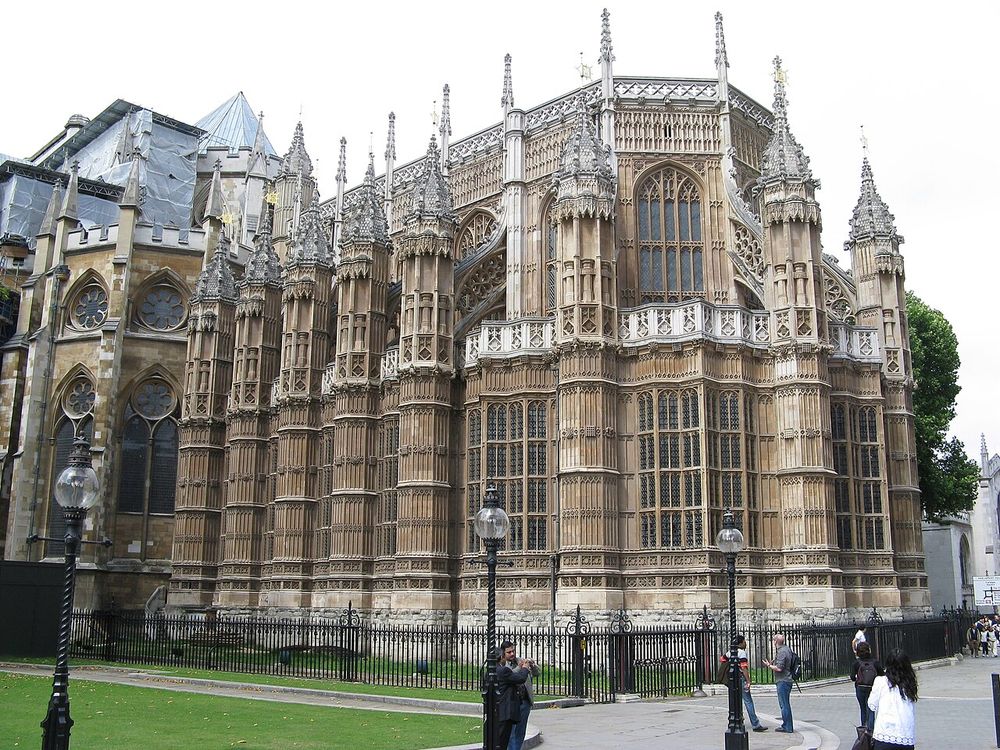
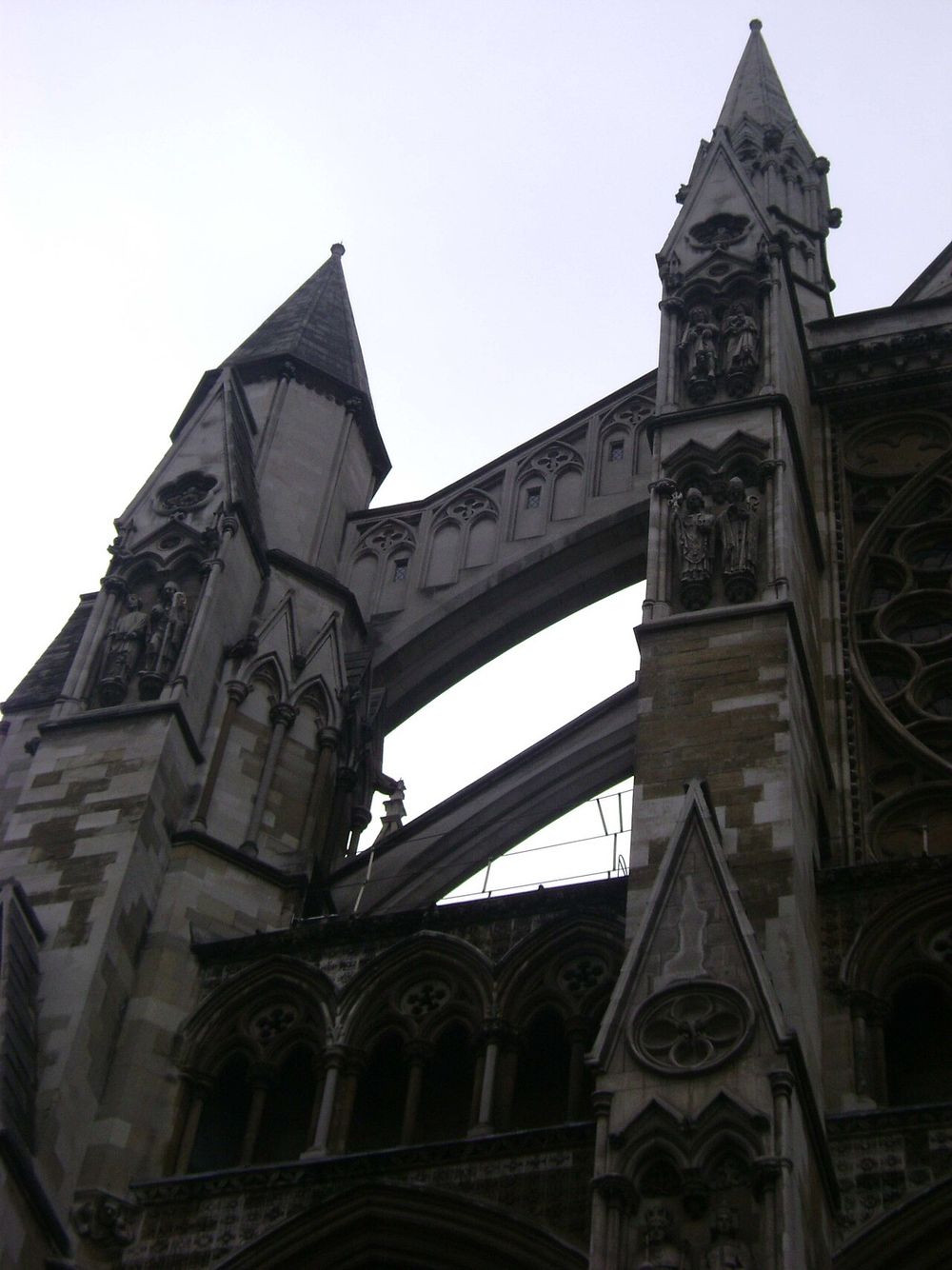
The church where every king and queen of England has been crowned since 1066, and where seventeen of them are buried, with Newton, Darwin, Dickens and three thousand others. It is crowded with the dead. It is also a parish church with a choir that sings every day.
Photo: Philip Pankhurst, CC BY-SA 2.0, Wikimedia Commons
The story
You are inside a very tall, narrow building of grey stone, lit from high windows. It should feel empty, and it does not. Every wall is covered with white marble people: admirals leaning on cannon, judges in wigs, women weeping over urns. The floor under your feet is made of names.
The first church here was finished at Christmas 1065, and a king was buried in it a week later. In China, in the Northern Song (960–1127), the scholar Sima Guang was just beginning his great history of the dynasties.
What is here
One ticket covers the church, the cloister and the Chapter House. The galleries in the roof are extra.
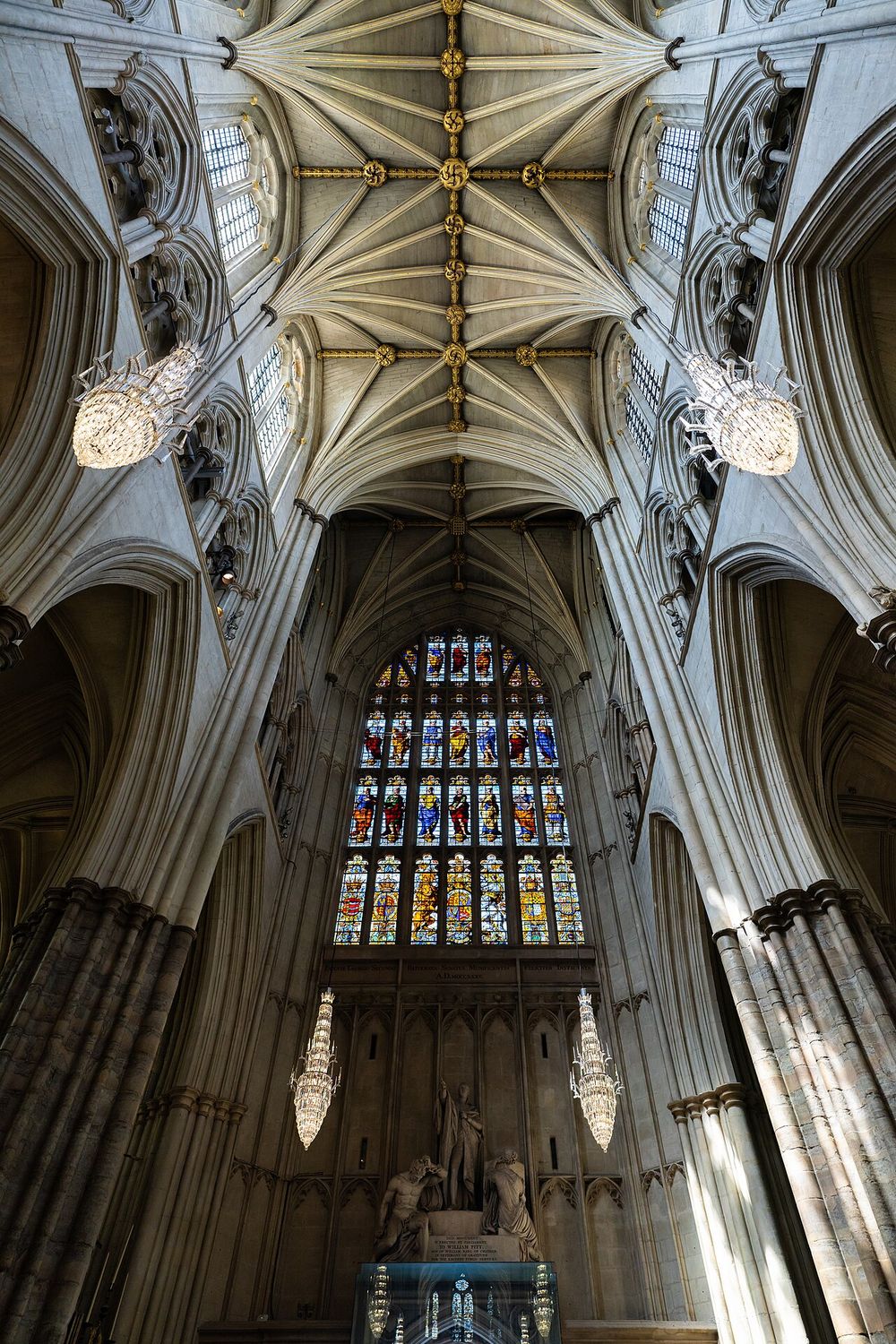
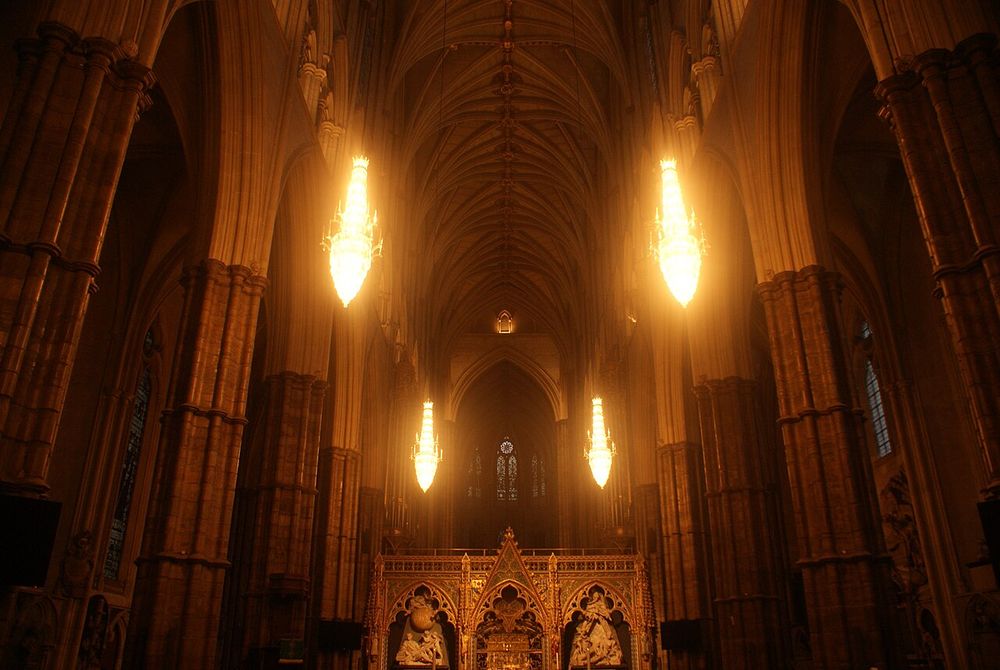
The vault of the nave, 31 metres upMaksim Sokolov (maxergon.com), CC BY-SA 4.0
The king was Edward, called the Confessor for his piety. A hundred years after his death the pope declared him a saint. In 1245 another king, Henry III, pulled down Edward's church and began this one, in the new pointed style of France, as a great stone box to hold the saint's bones.
Kings wished to lie near the saint, and nobles near the kings. After the monks were sent away in 1540 the church kept filling: with poets, generals, scientists, actors. By 1900 there was almost no floor left.
The place where the crown is put on is the square of floor between the choir and the altar. Forty kings and queens have been crowned on it.
Things people often get wrong
"It is an abbey." There have been no monks here since 1540. It is not a cathedral either, since it has no bishop. It belongs directly to the monarch.
"It is the church with the big clock tower." That is the Houses of Parliament, across the road. The church with the dome is St Paul's, three kilometres away.
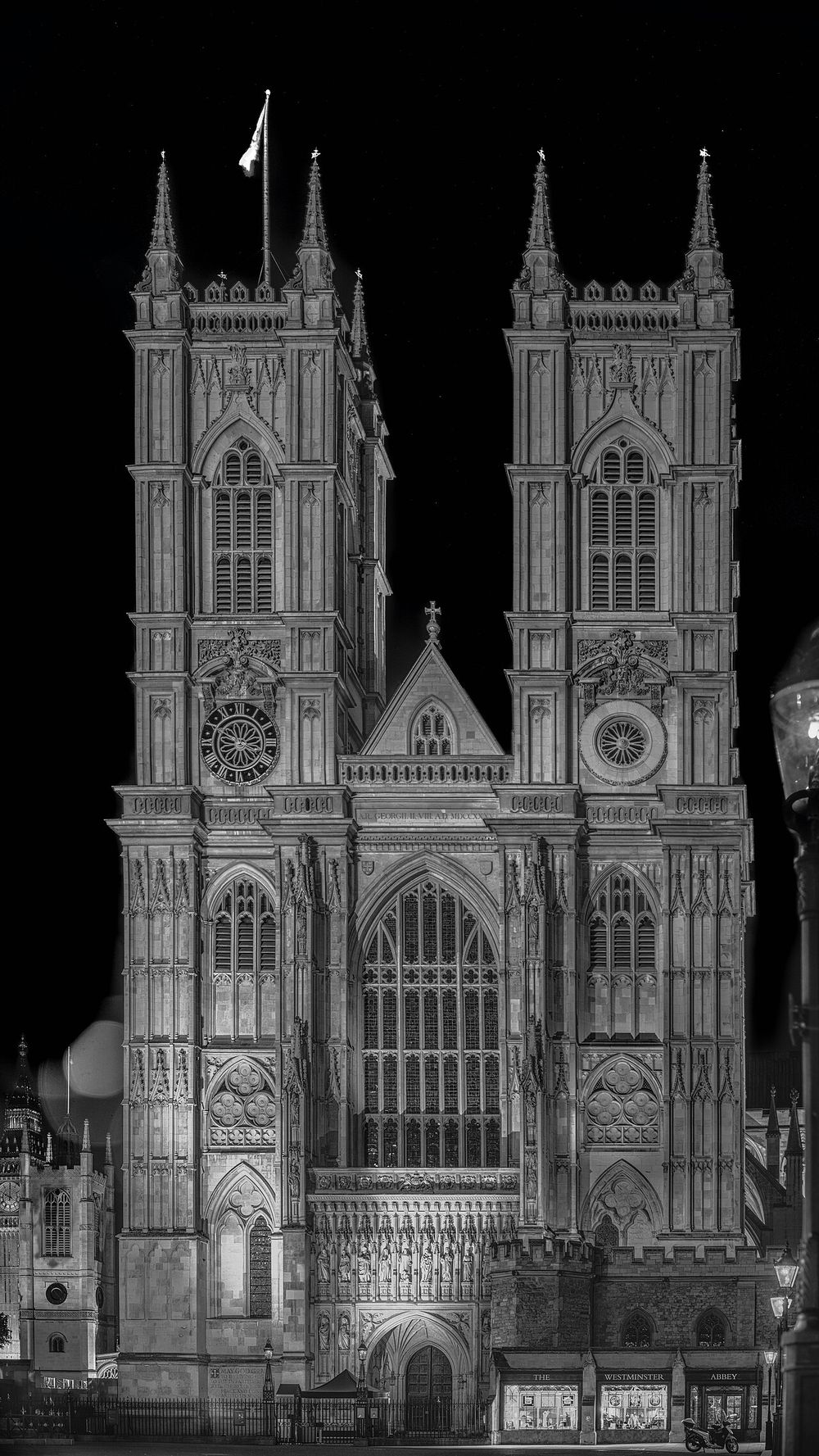
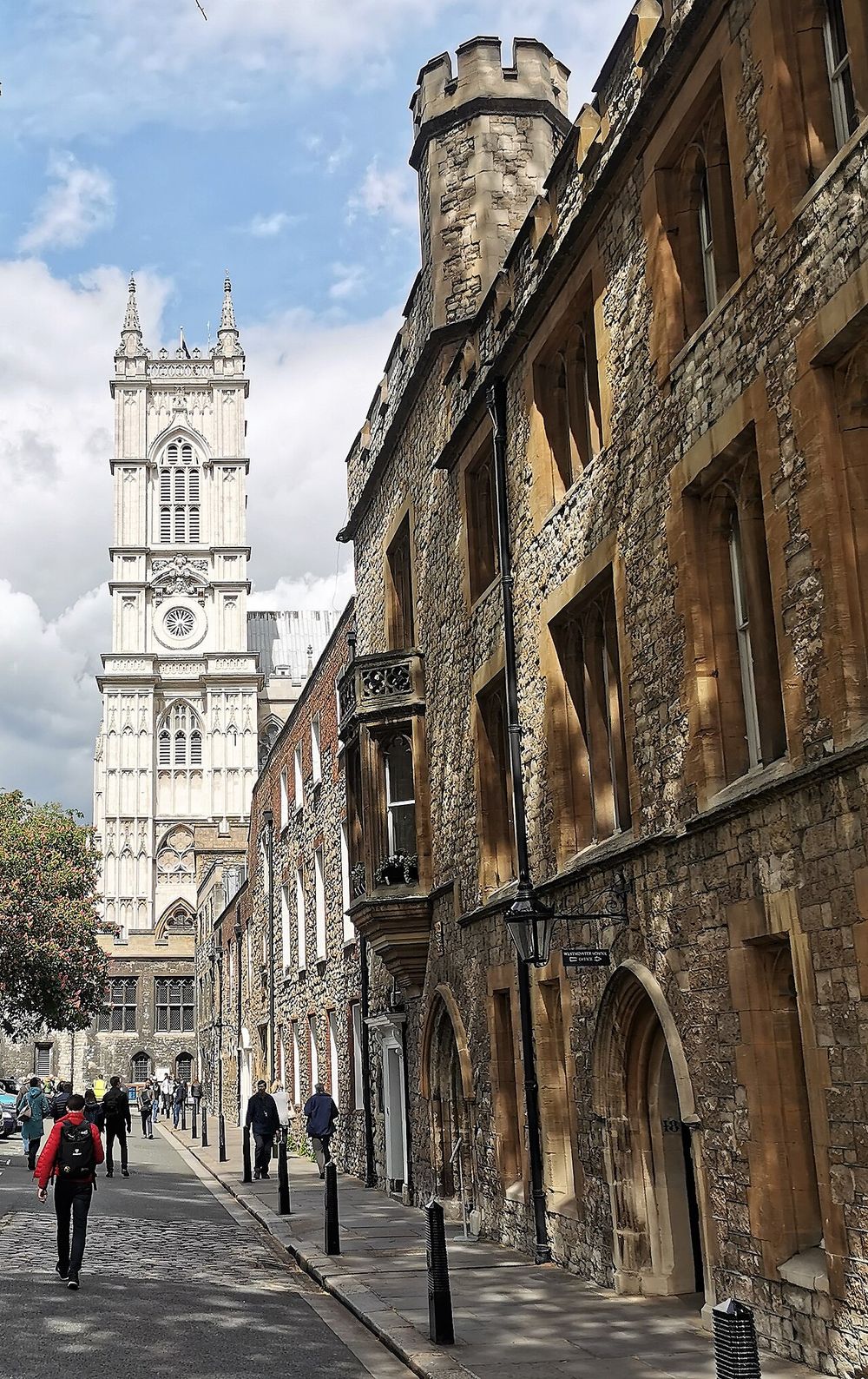
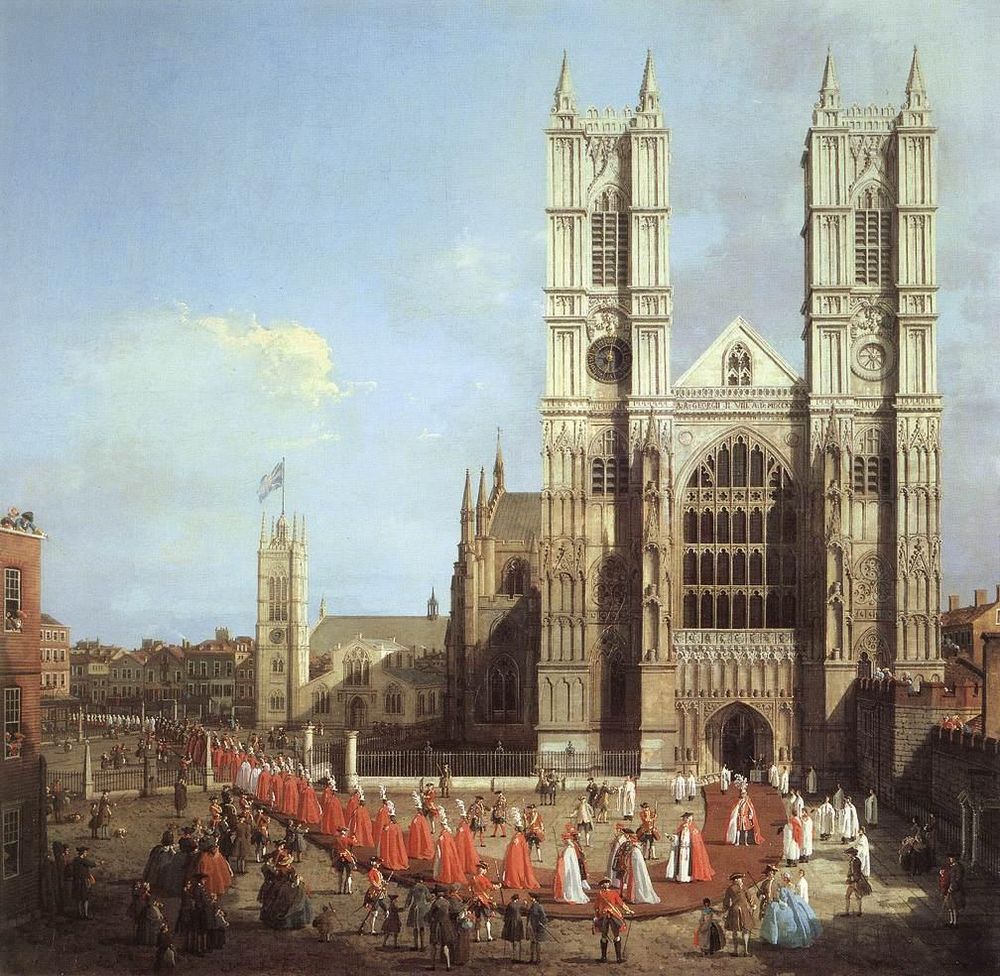
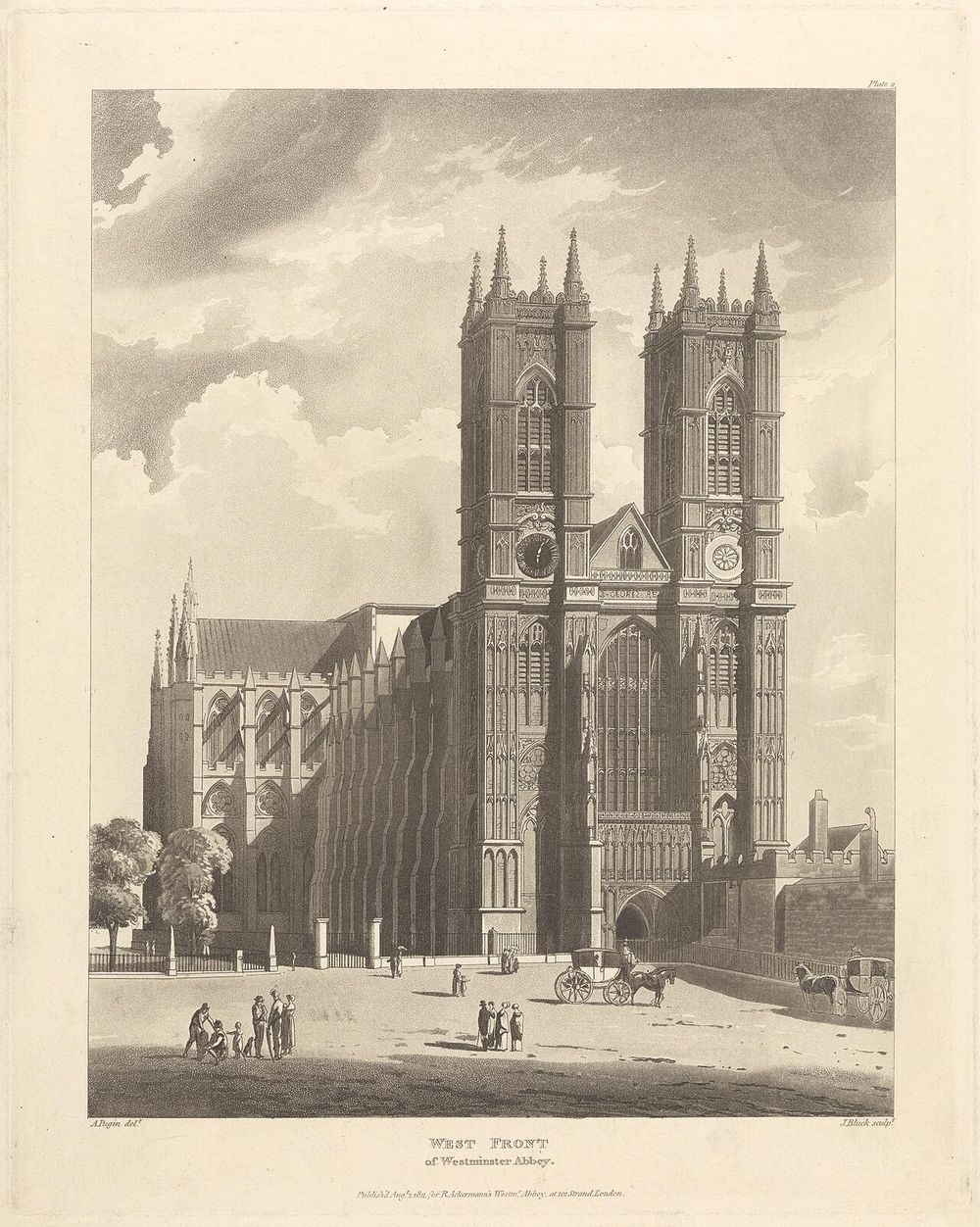
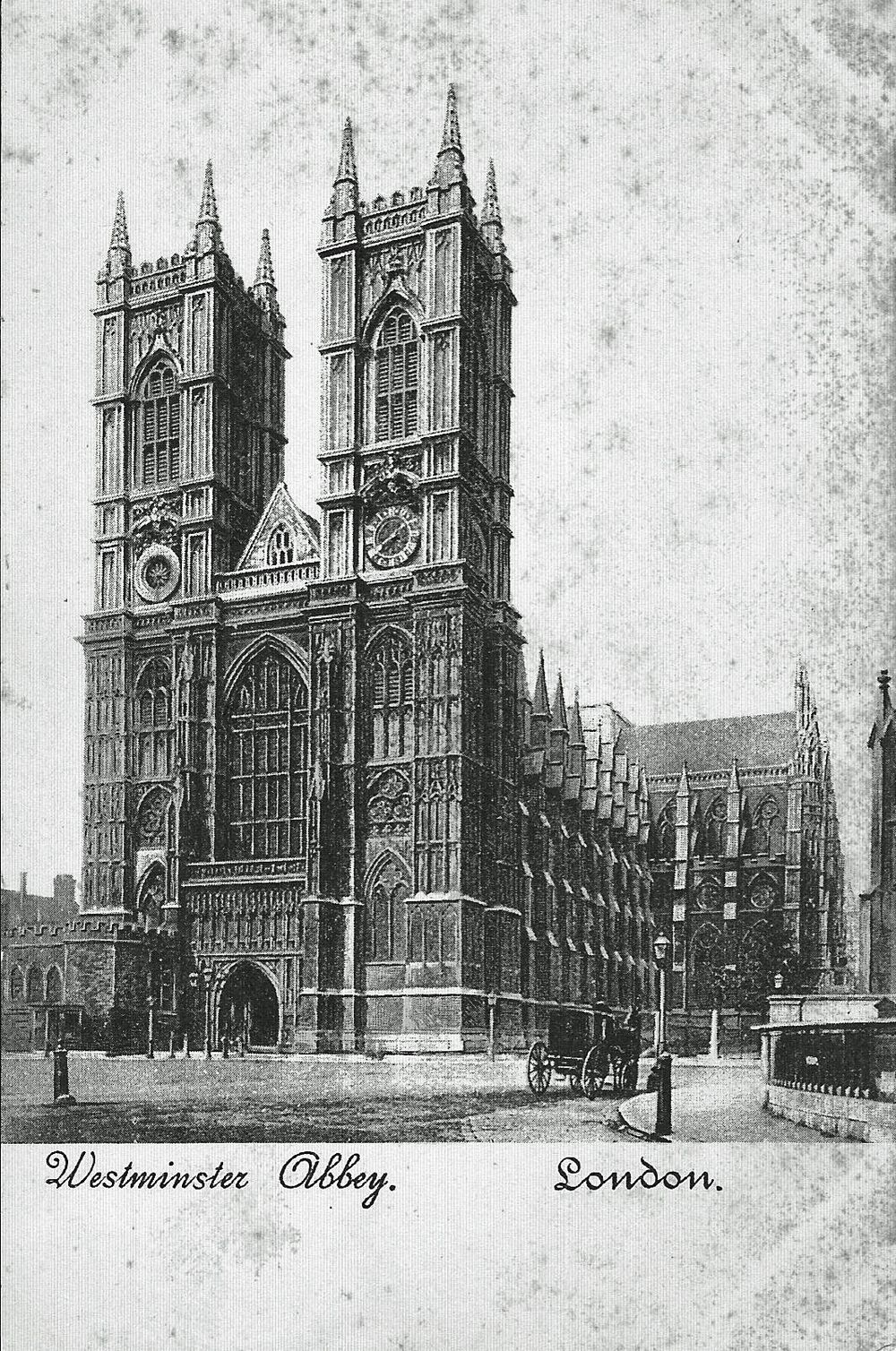
"The two towers are medieval." They were added in 1745. Everything behind them is five hundred years older.
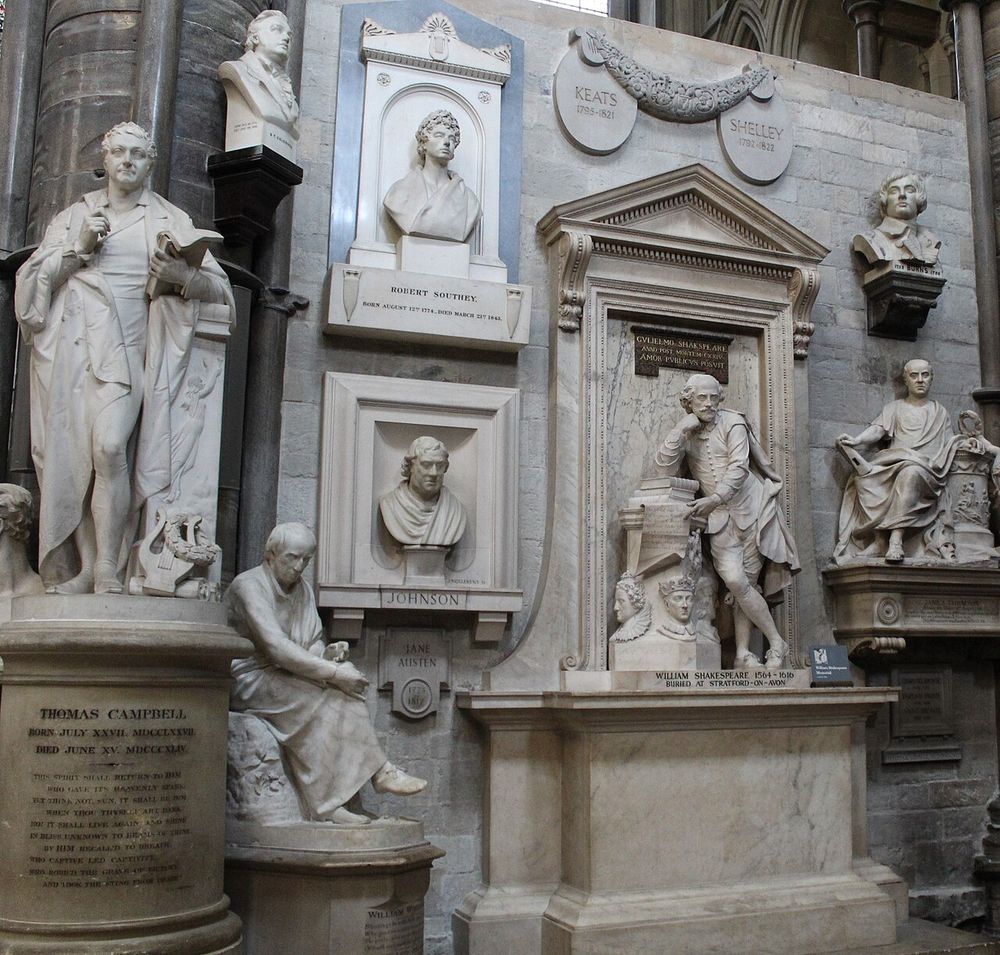
"Shakespeare is buried here." He has a statue. He is buried at Stratford, his home town. Jane Austen and the Brontë sisters also have only their names here.
"Kings are still buried here." The last was George II in 1760. Since then they have gone to Windsor.
People who stood here
William the Conqueror (Duke of Normandy, king of England from 1066)He was crowned here on Christmas Day 1066, ten weeks after killing the English king in battle. When the people inside shouted their assent, his guards outside took the noise for a riot and set fire to the houses round the church. The ceremony was finished in an almost empty building, with the new king trembling.
Geoffrey Chaucer (English poet of The Canterbury Tales)In 1399 he rented a house in the monks' garden, a few steps from the east end. He died there the next year and was buried inside the church as a tenant and a royal servant, not as a poet. A hundred and fifty years later an admirer gave him a proper tomb, and other writers asked to lie near it.
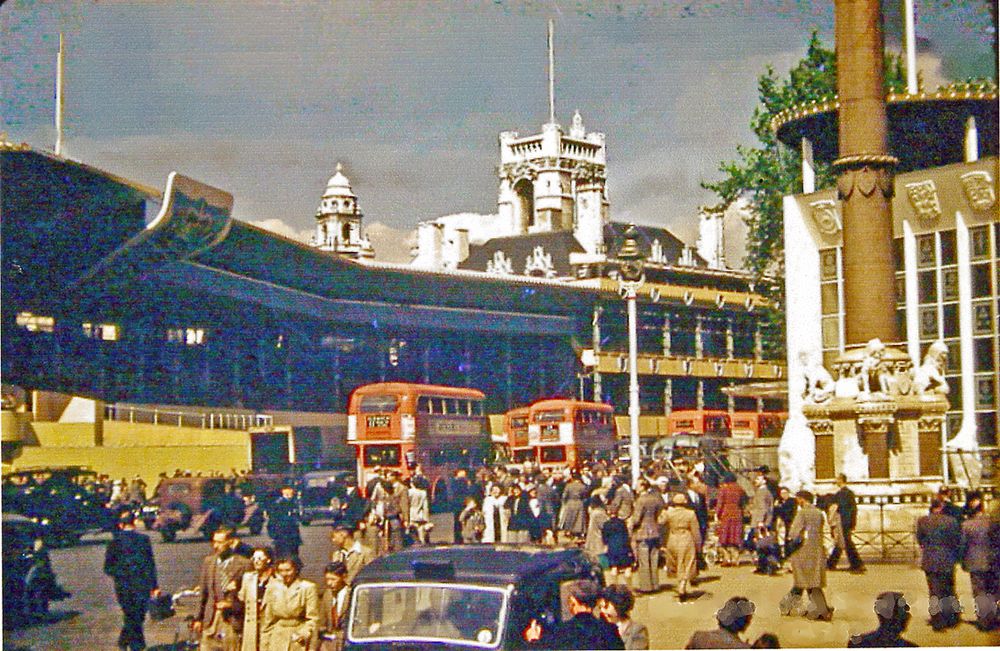
Elizabeth II (queen of the United Kingdom, 1952–2022)She was married here in 1947 and crowned here in 1953, in the first coronation shown on television. Her funeral was held here on 19 September 2022.
Go deeper: eight stops, from the west door to the chair
Visitors go in by the north door and round the church one way. The stops follow that route, after a look at the west front.
1. The west front
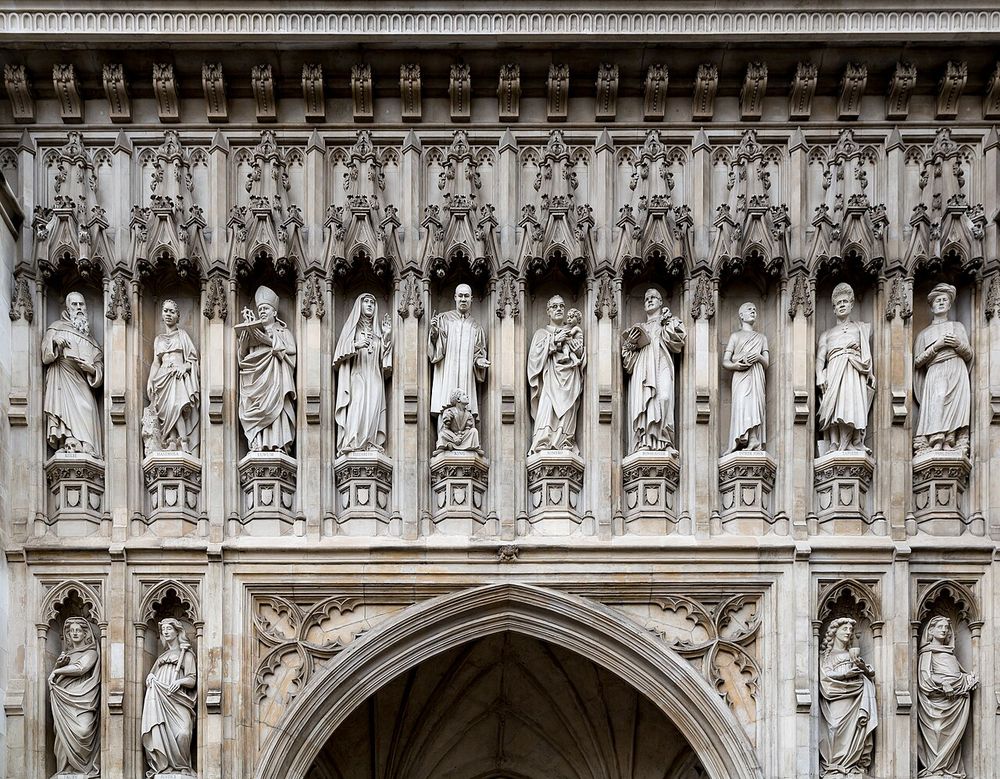
The ten statues over the west doorCEphoto, Uwe Aranas, CC BY-SA 3.0
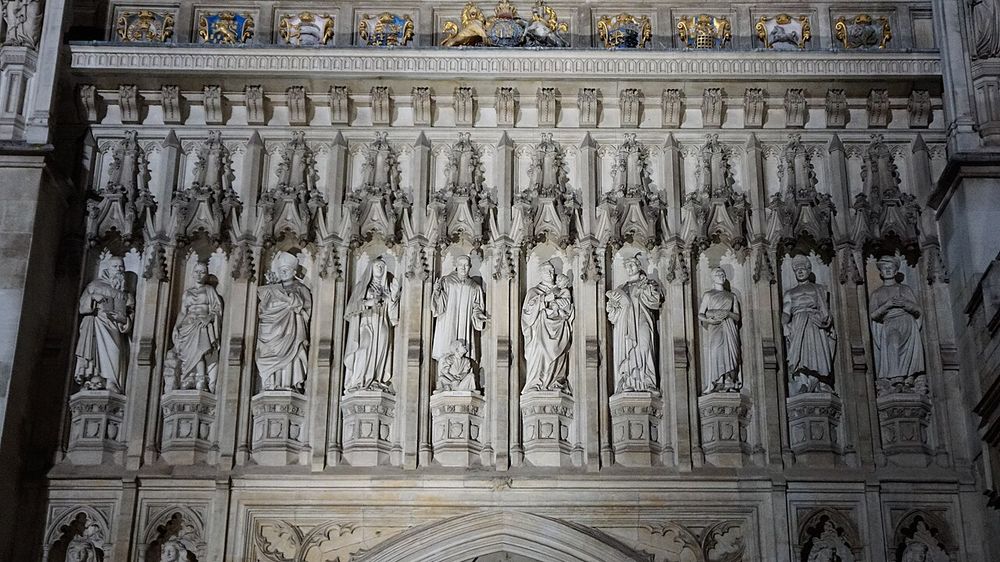
Above the great door, under the towers, ten statues stand in niches that were empty for five hundred years. They were put up in 1998 and show Christians killed for their faith in the twentieth century.
Among them are Martin Luther King, shot in America in 1968, and Wang Zhiming, a pastor of the Miao people of Yunnan in south-west China, who was put to death in 1973.
2. The nave and the warrior
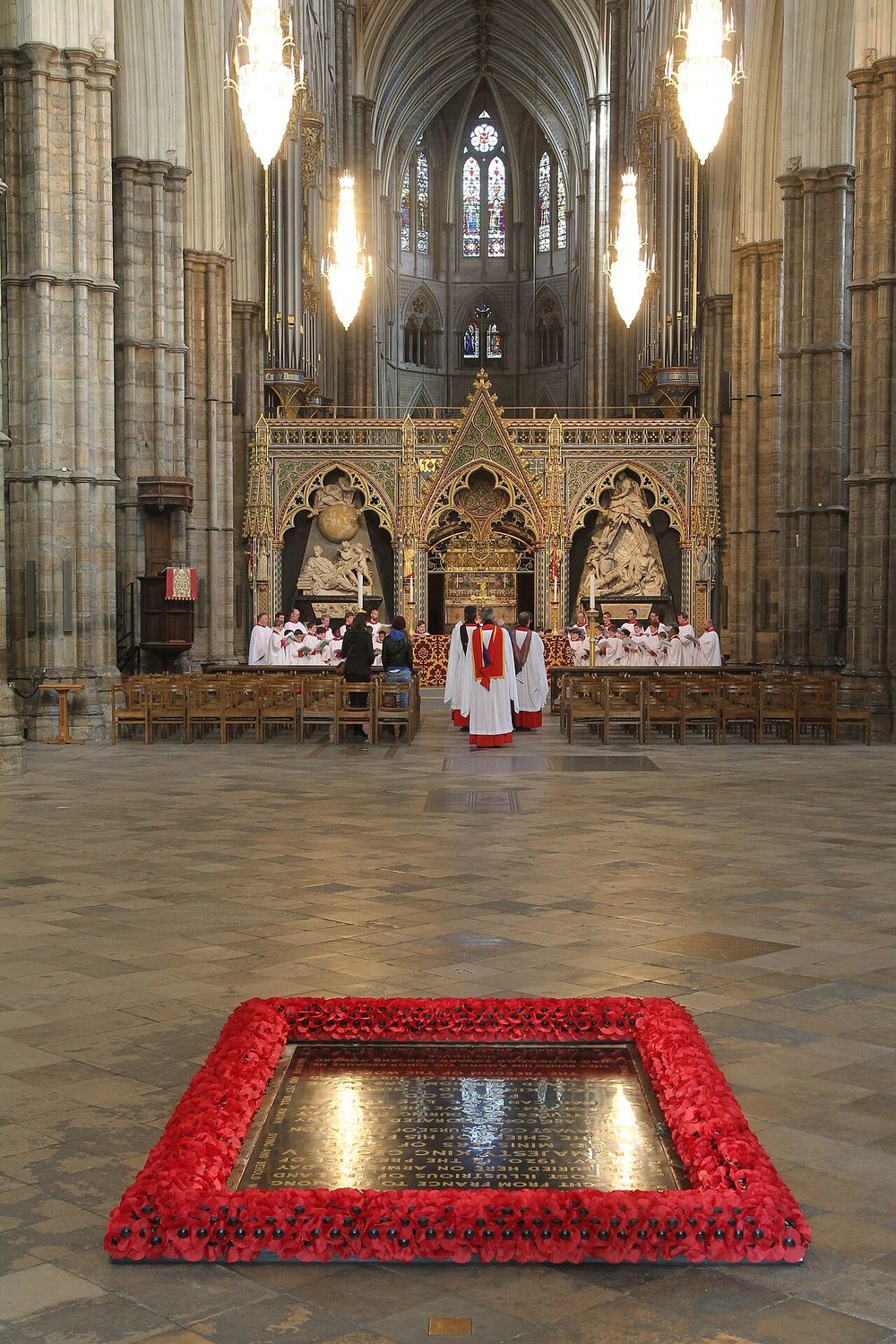
The grave and the choir screenThe National Churches Trust, CC BY 2.0
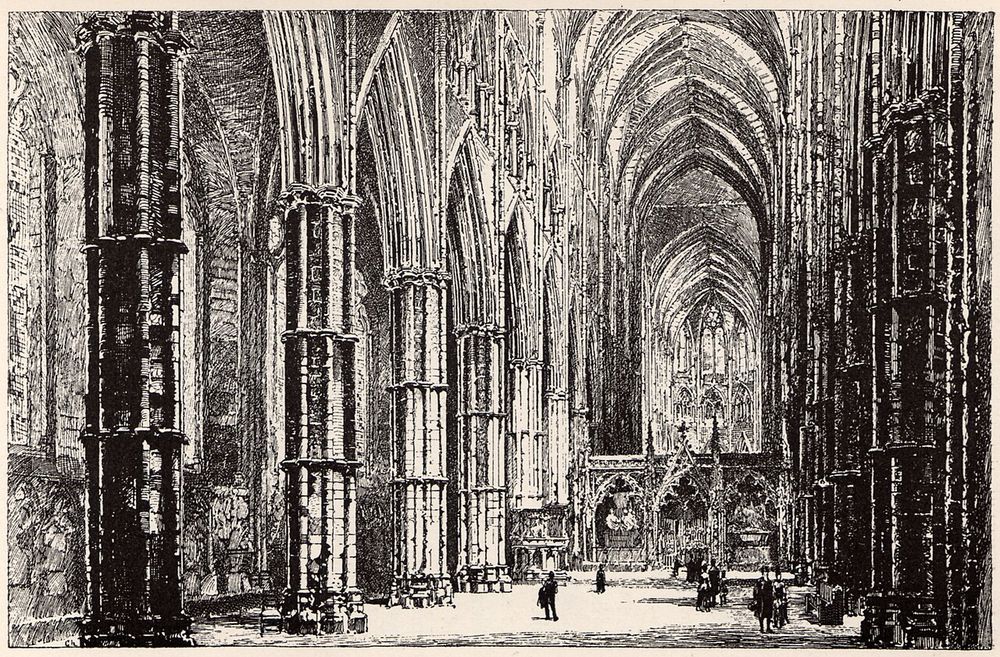
The nave is thirty-one metres high, the tallest in England, and narrow, so that it seems taller. It took a hundred and fifty years to build, and the masons of 1500 copied the style of 1260 exactly so that no one could see the join.
The grave of the Unknown WarriorRobert Lamb, CC BY-SA 2.0
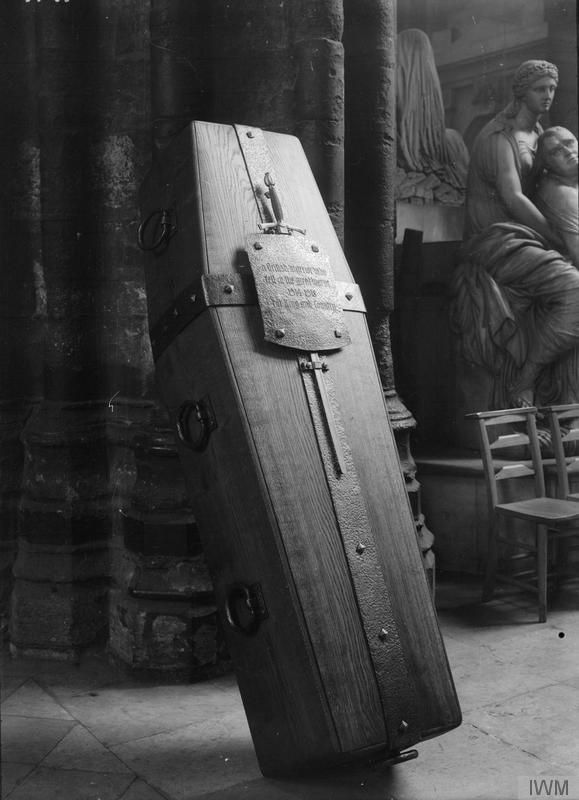
In the middle of the floor near the west door is a slab of black marble edged with red paper poppies. Under it lies a British soldier of the First World War whose name nobody knows. He was chosen from among the unidentified dead in France and buried here on 11 November 1920, in earth brought from the battlefields.
It is the only grave in the church that no one walks on. Kings and queens step round it. Royal brides send their flowers to be laid on it the day after the wedding.
3. Newton, Darwin, Hawking
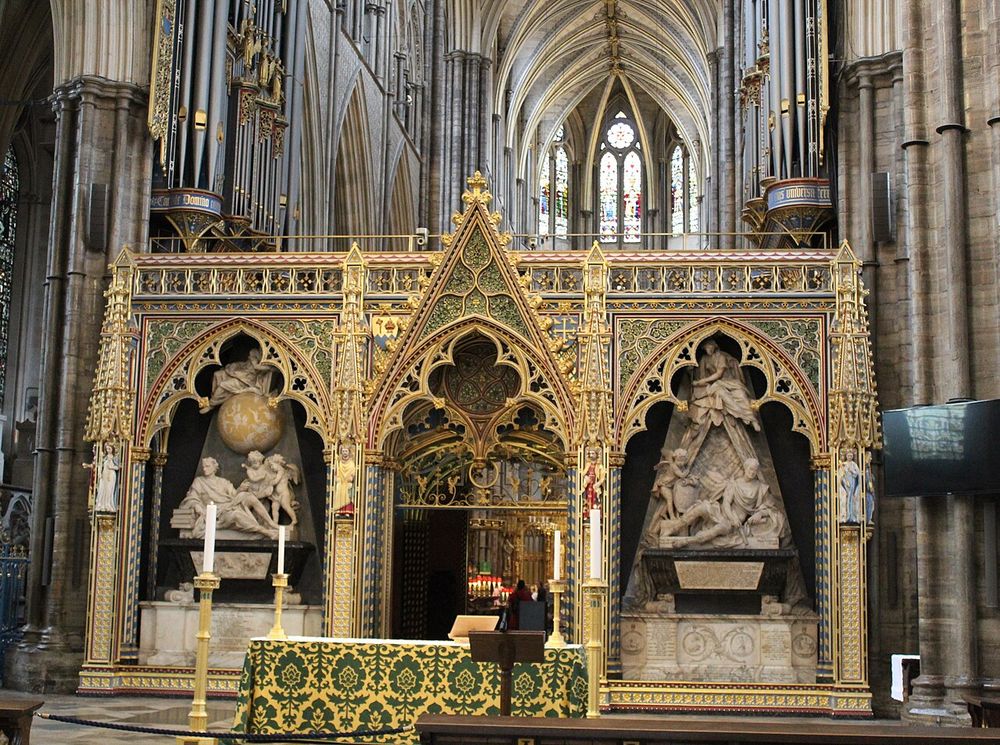
Newton's monument against the screen14GTR, CC BY-SA 4.0
Against the screen at the end of the nave, on the left, a man in a Roman robe leans on a pile of books under a globe of the heavens. This is Isaac Newton, buried here in 1727 with the honours of a duke. A French visitor wrote in astonishment that England buried a mathematician like a king.
A few steps away in the floor is a plain stone with the name Charles Darwin, 1882. The Church had fought his ideas for twenty years. When he died, it asked for his body.
Between the two, since 2018, are the ashes of Stephen Hawking. His stone shows a black hole and carries one of his equations.
4. The crossing
Circles and squares of coloured stone14GTR, CC BY-SA 4.0
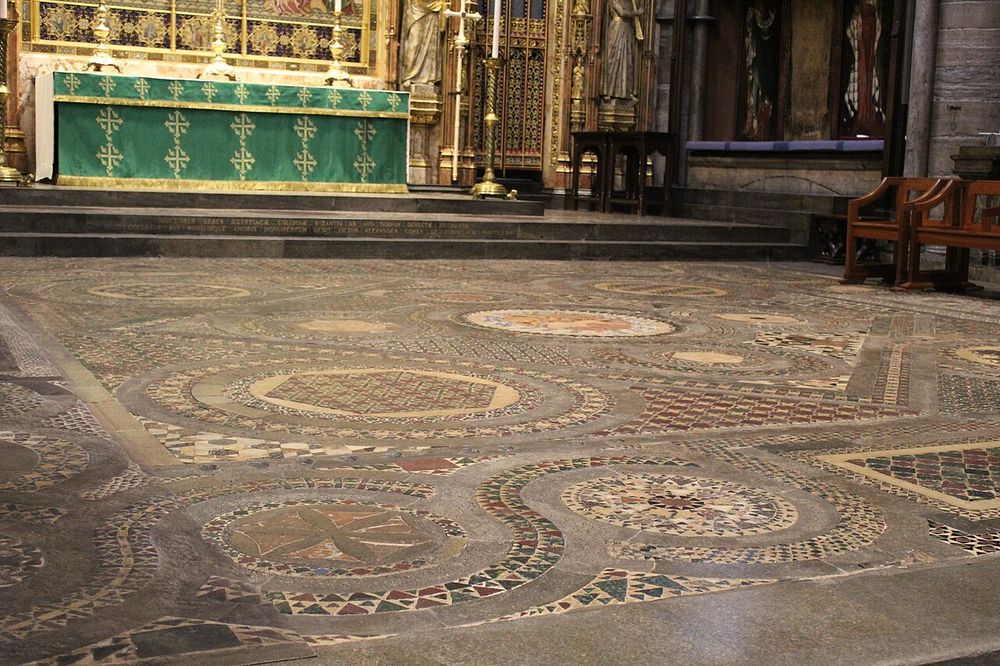
Past the choir stalls you come to the centre of the church. The floor in front of the altar is a carpet of coloured stone, laid by Italian workmen in 1268: circles inside squares inside circles, in purple, green and gold. A Latin riddle round the edge works out the age at which the world will end.
The Coronation Chair is carried here and set on this floor, facing the altar. Forty kings and queens have been crowned on this spot, the last on 6 May 2023. Royal weddings and funerals are held here too.
5. The saint and the kings
The shrine of Edward the Confessoramanderson2, CC BY 2.0
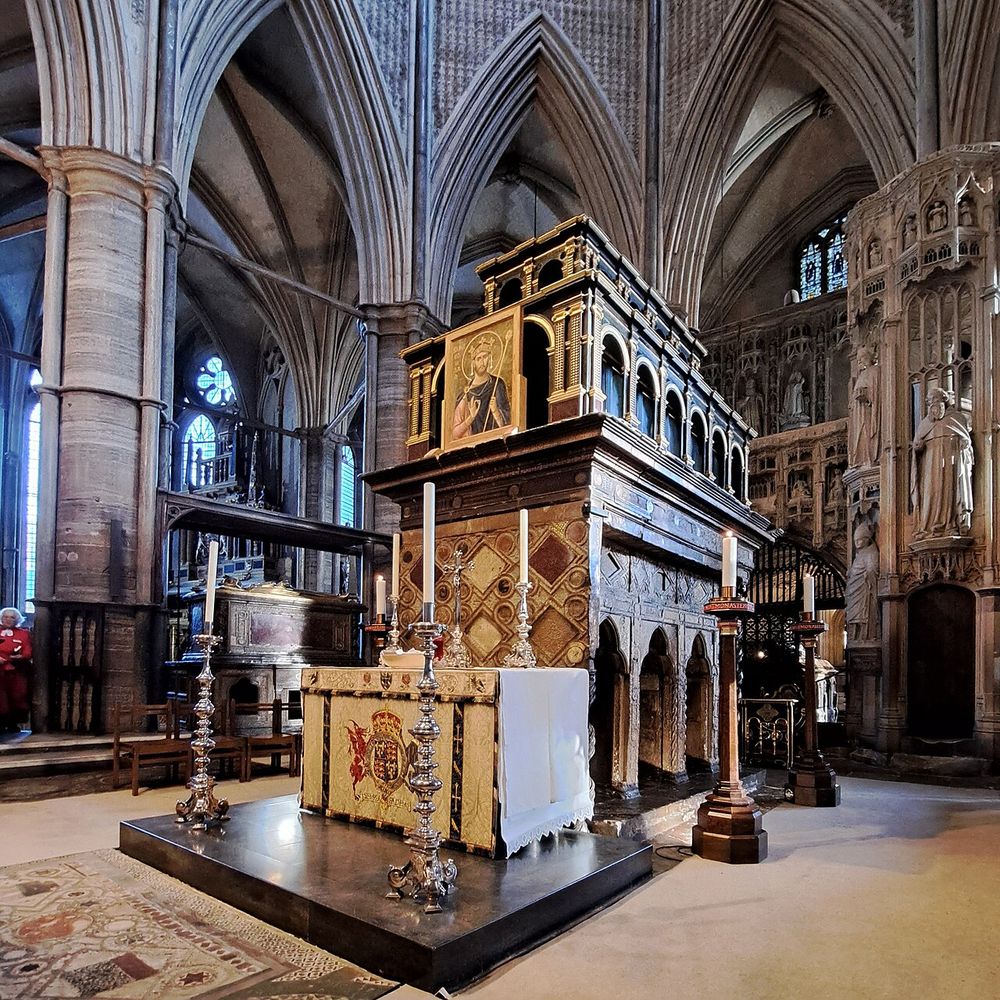
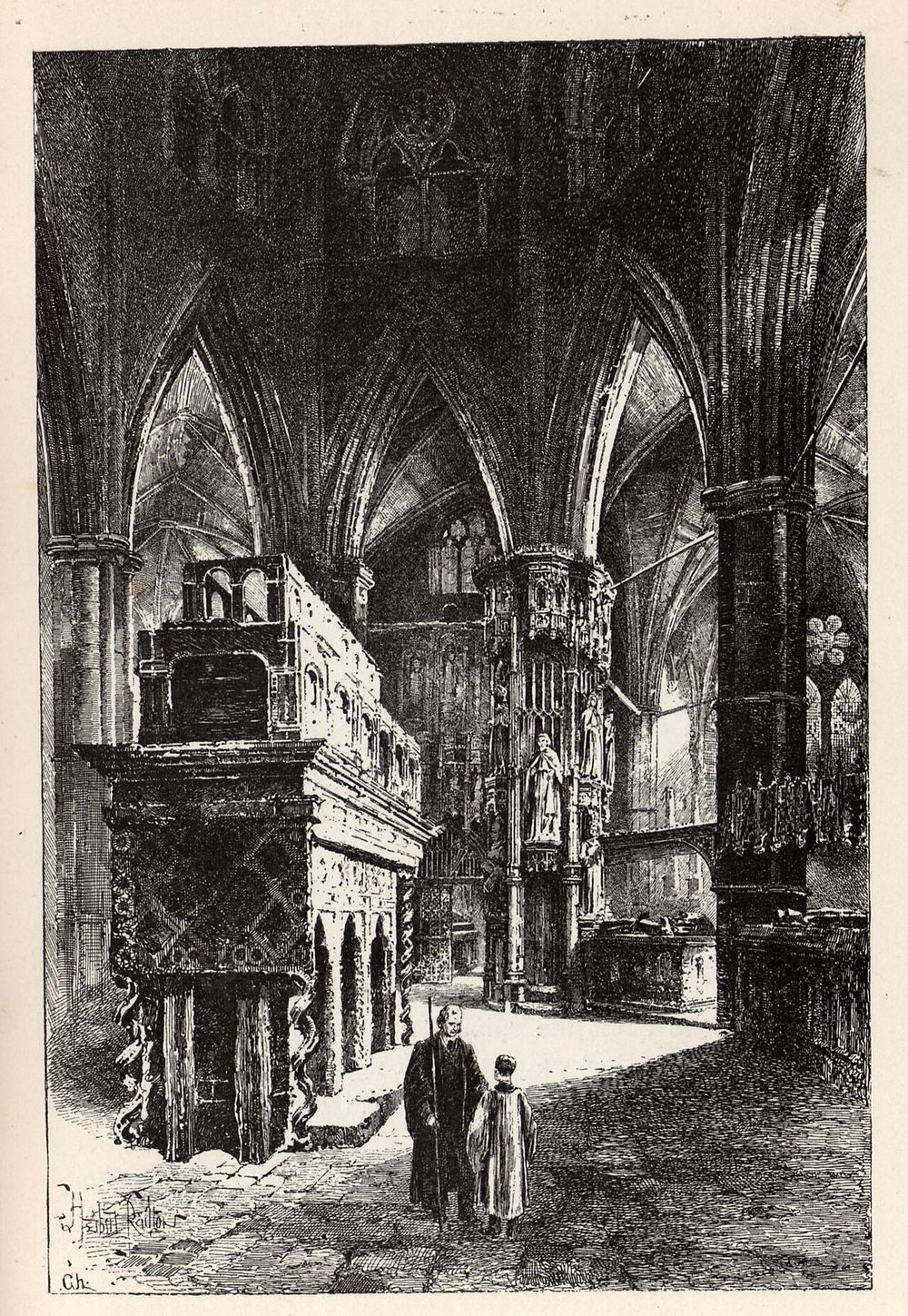
Behind the altar, raised above the level of the church, is the shrine of Edward the Confessor. You see it from the walk that runs round it. The stone base of 1269 is real. Pilgrims knelt in the niches in its sides to be near the bones.
Round the saint, in a ring, lie five kings and four queens. One tomb is a plain chest of grey marble with no figure on it. It belongs to Edward I, who died in 1307 on his way to fight the Scots, and its painted words call him their hammer.
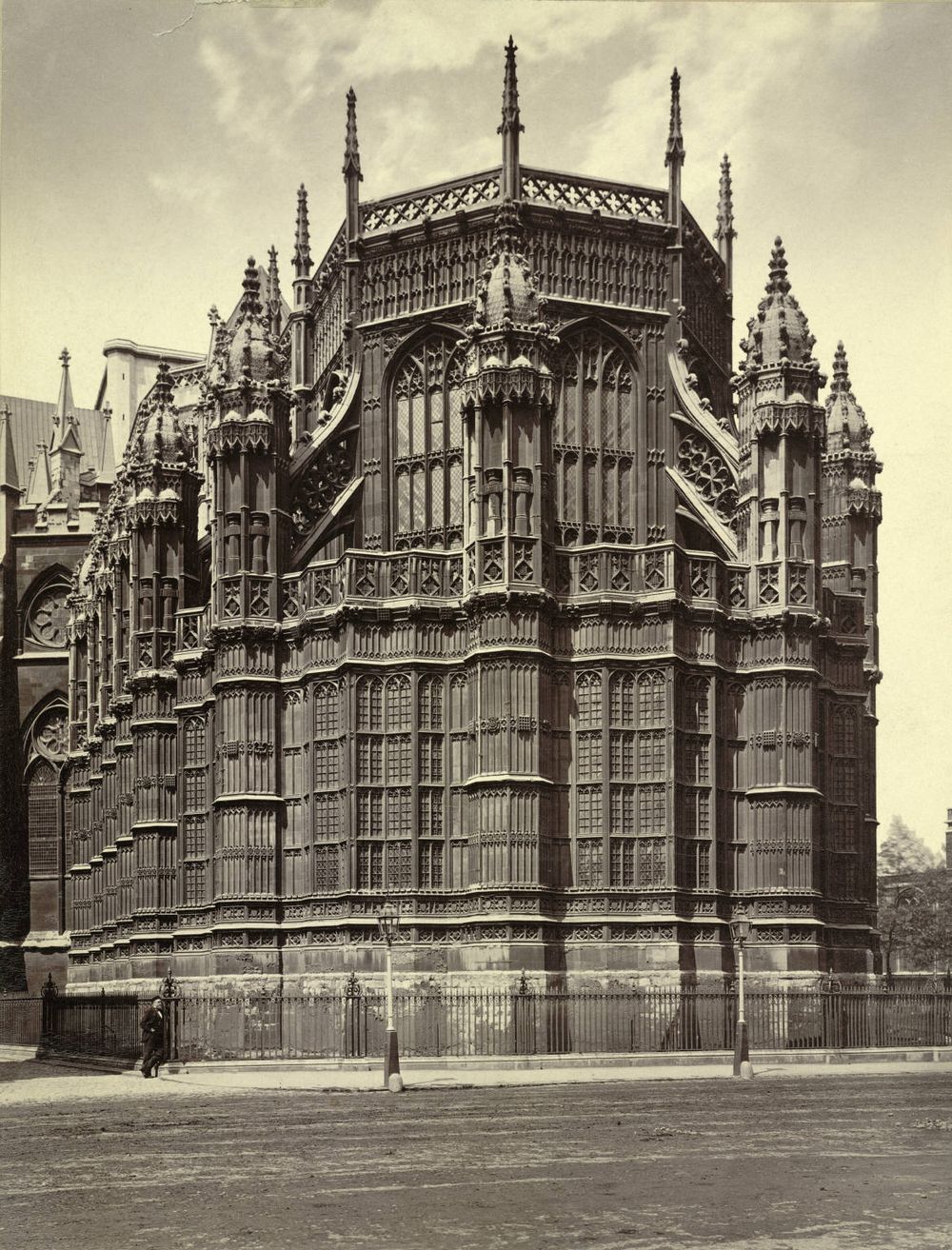
6. The chapel of Henry VII
The fan vault of Henry VII's chapelJRennocks, CC BY-SA 4.0
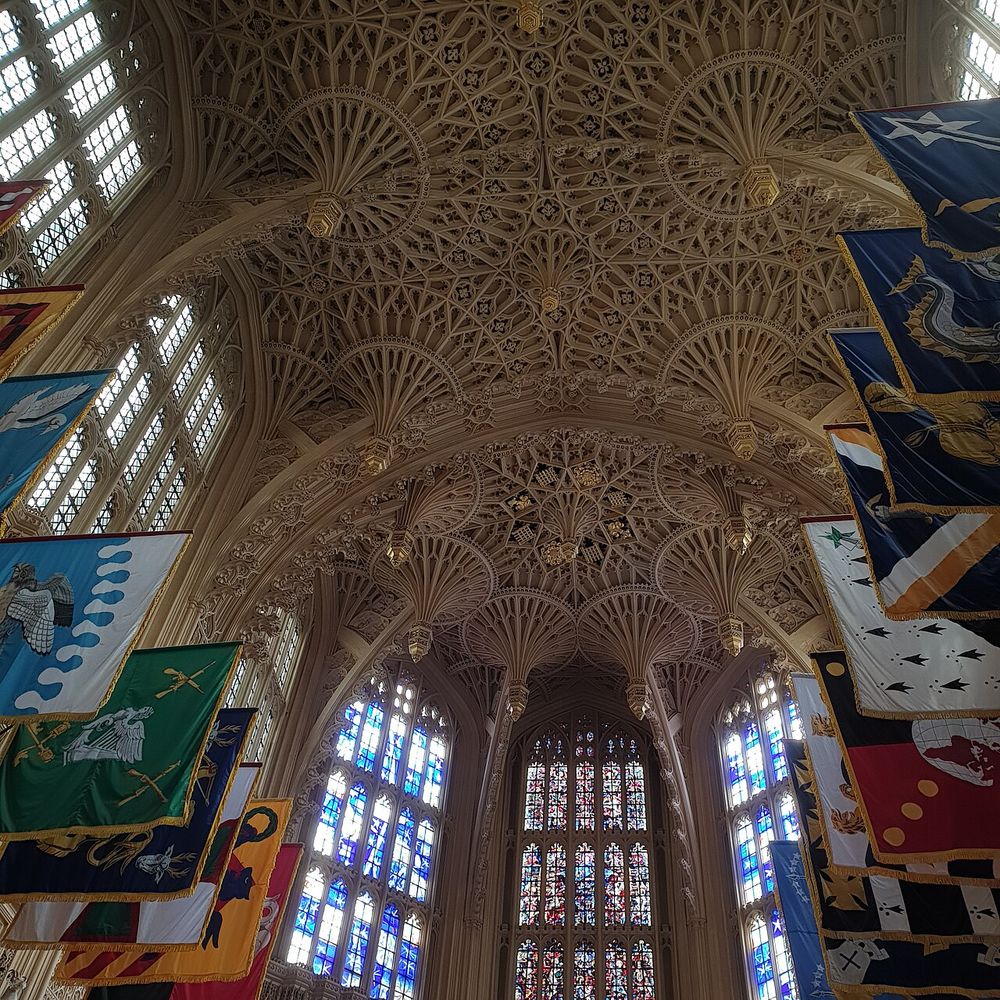
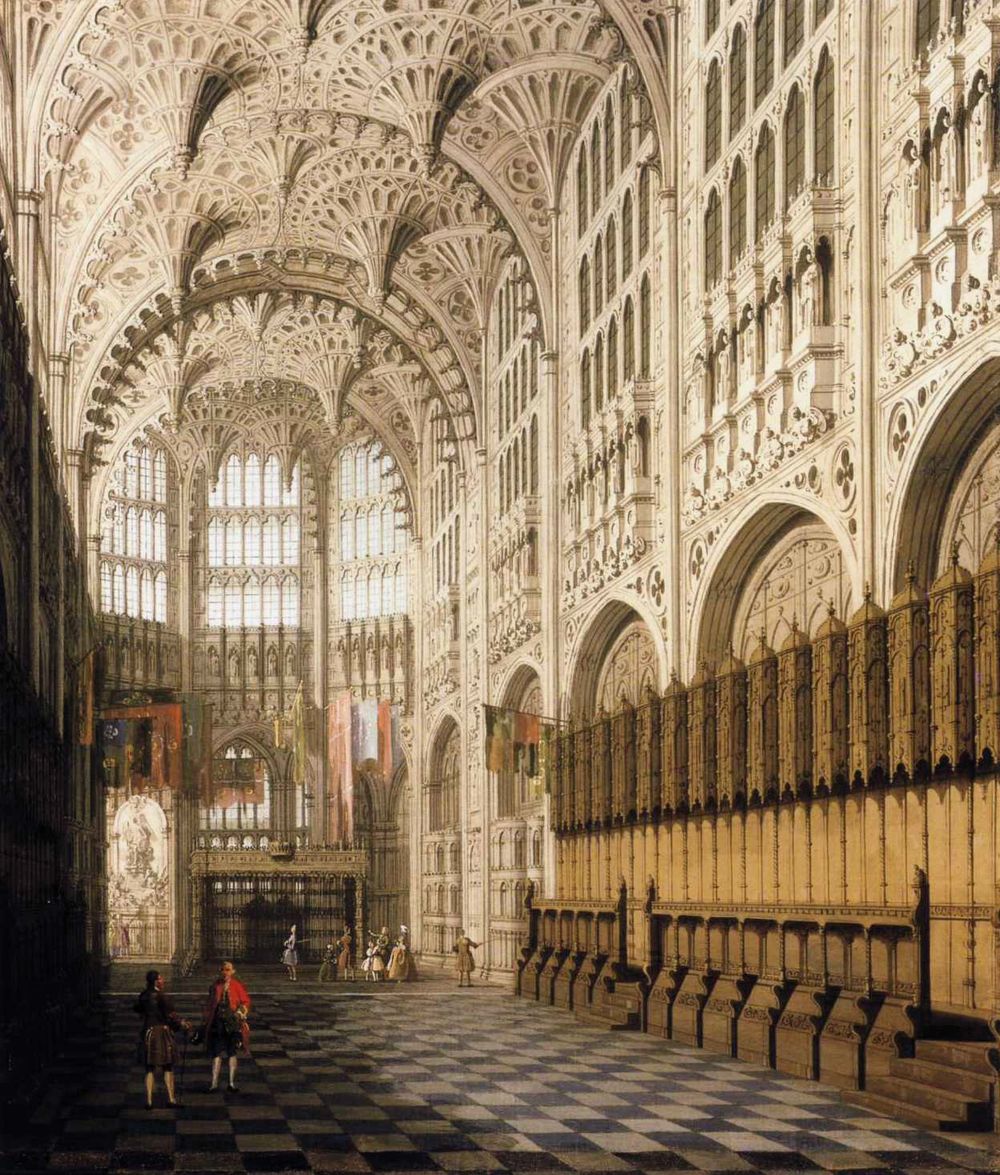
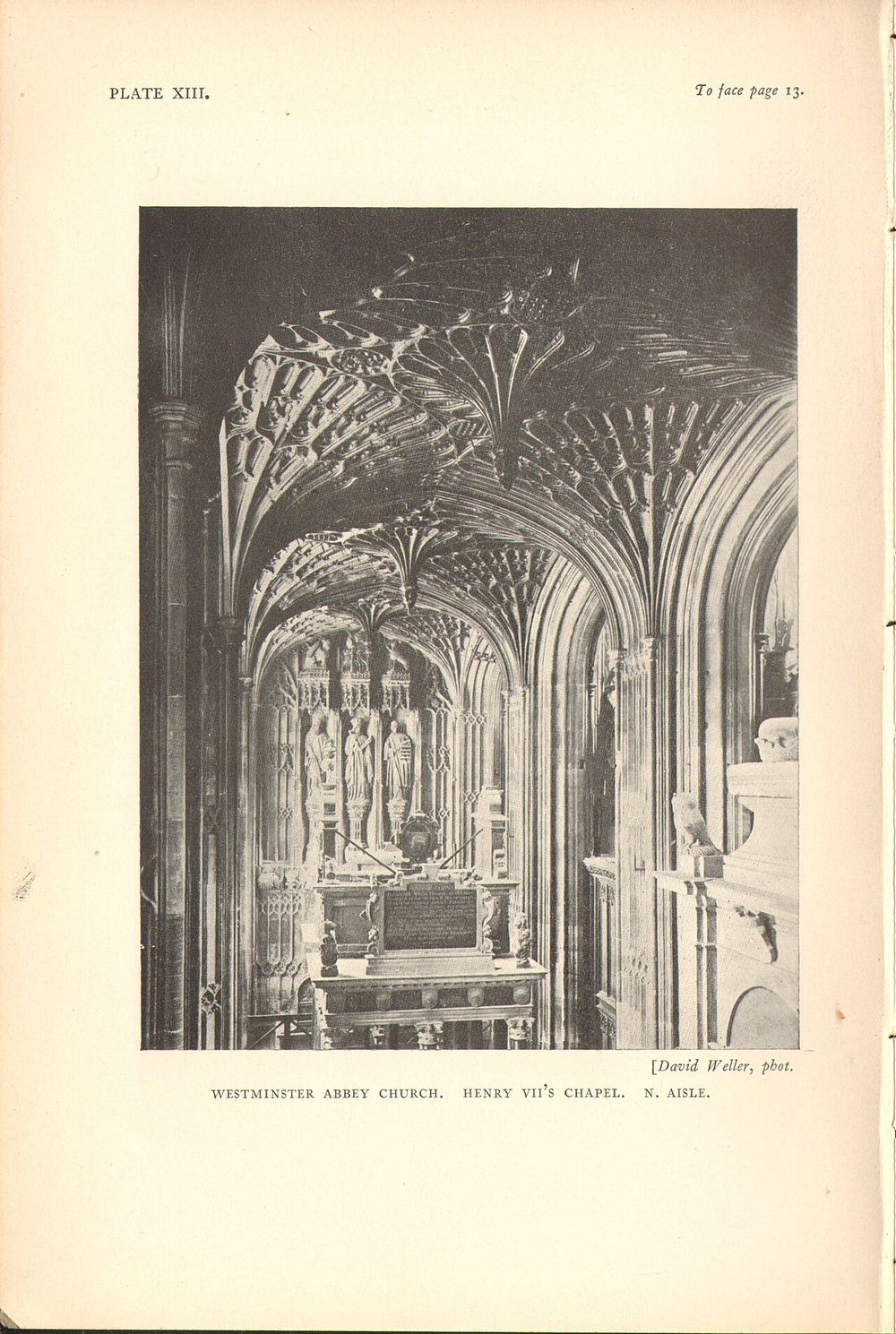
Up a flight of steps at the east end is a second church, built between 1503 and 1519. Look up. The stone roof spreads into fans, and from the fans hang carved stone lanterns that seem to have nothing holding them. It is the last and most daring thing the medieval masons of England did.
The tomb of Elizabeth IRobert Lamb, CC BY-SA 2.0
In the left aisle is the tomb of Elizabeth I, in white marble, with her face taken from a death mask. Her half-sister Mary, who had imprisoned her, lies underneath in the same grave. In the right aisle, in a taller tomb, is Mary Queen of Scots, whom Elizabeth had beheaded. Mary's son, when he became king of England, built both.
7. Poets' Corner
Poets' Corner14GTR, CC BY-SA 4.0
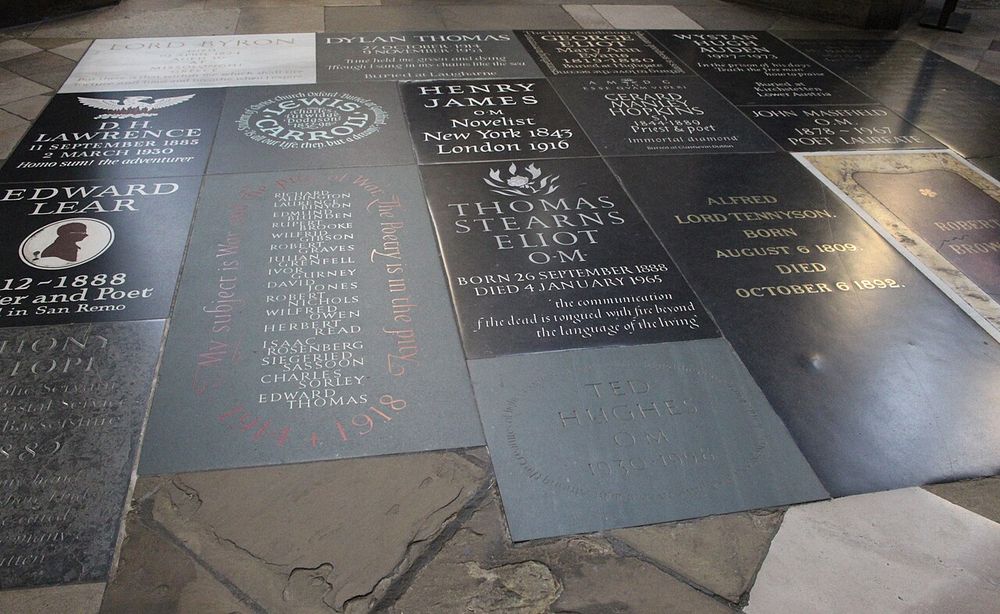
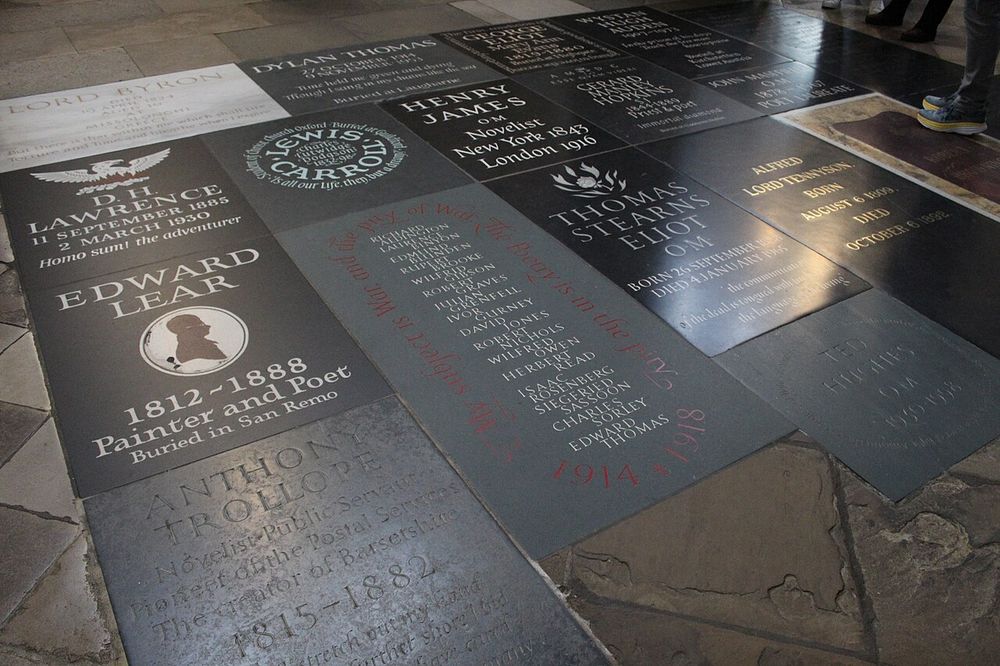
The south arm of the church is the most crowded of all. Chaucer's tomb is against the east wall, small and grey. Round it are the graves of Dickens, Tennyson, Kipling and the composer Handel, and the names of nearly everyone else who has written well in English.
Dickens asked in his will for a quiet funeral in the country. The newspapers demanded the Abbey. He was buried here early on a June morning in 1870 with twelve people present, and the grave was left open for two days so that London could walk past.
Mortality, behold and fear!
What a change of flesh is here!
Think how many royal bones
Sleep within this heap of stones
Francis Beaumont, On the Tombs in Westminster Abbey, about 1610
8. The cloister, and the chair
The vault of the Chapter HouseChrisVTG Photography, CC BY-SA 4.0
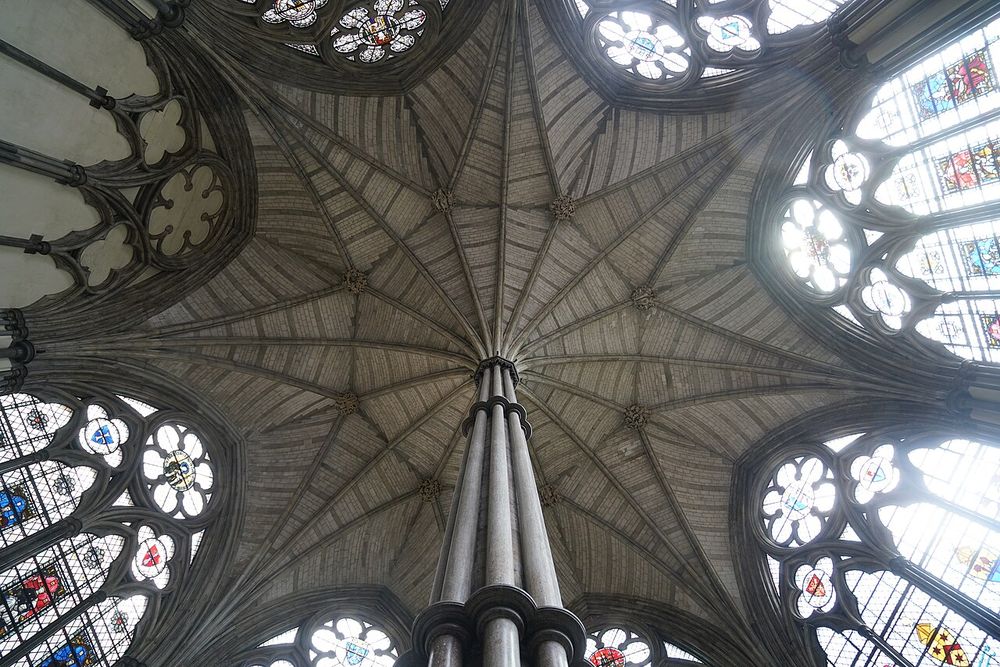
A door from the south aisle leads into the monks' cloister. Off it is an eight-sided room with a single thin pillar in the middle, built about 1250 for the monks' daily meeting. The House of Commons met here in the 1300s, before it had a home. The tiled floor is the one they stood on.
In the passage beside it is a small wooden door that has hung there since the 1050s. It is the oldest door in Britain.
The Coronation Chairamanderson2, CC BY 2.0
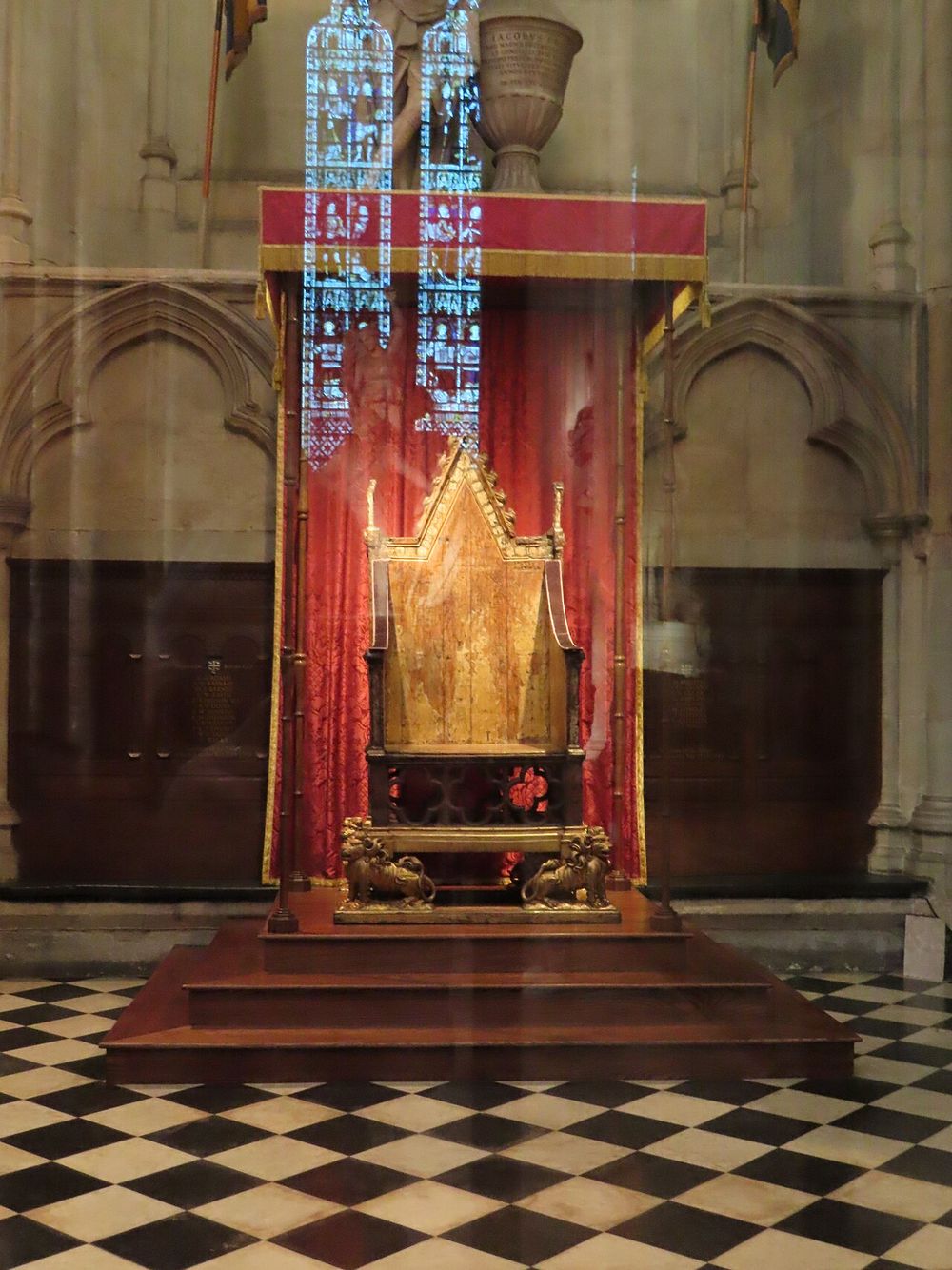
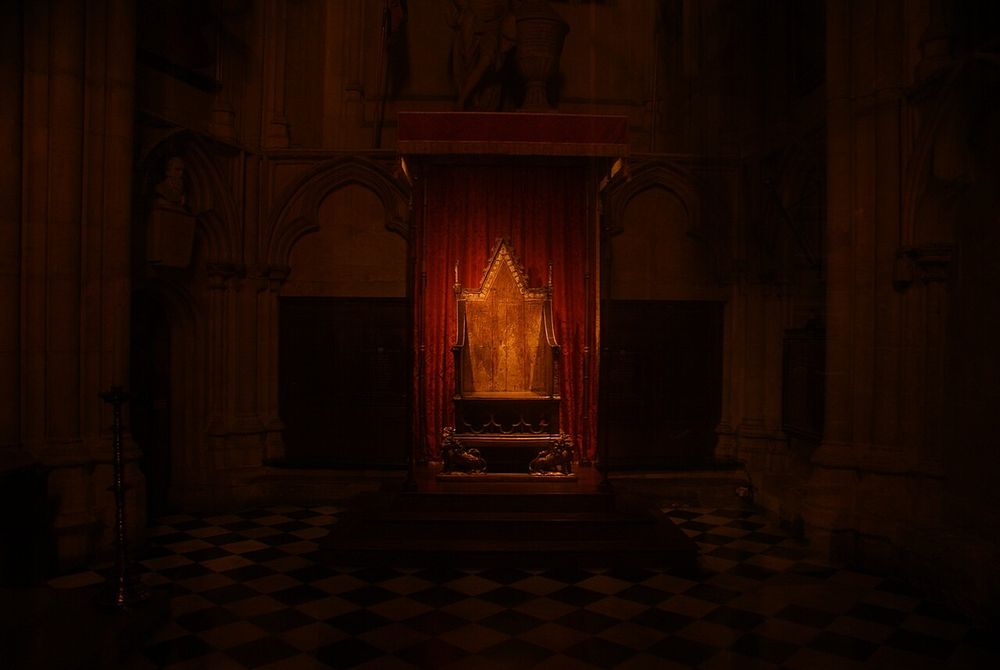
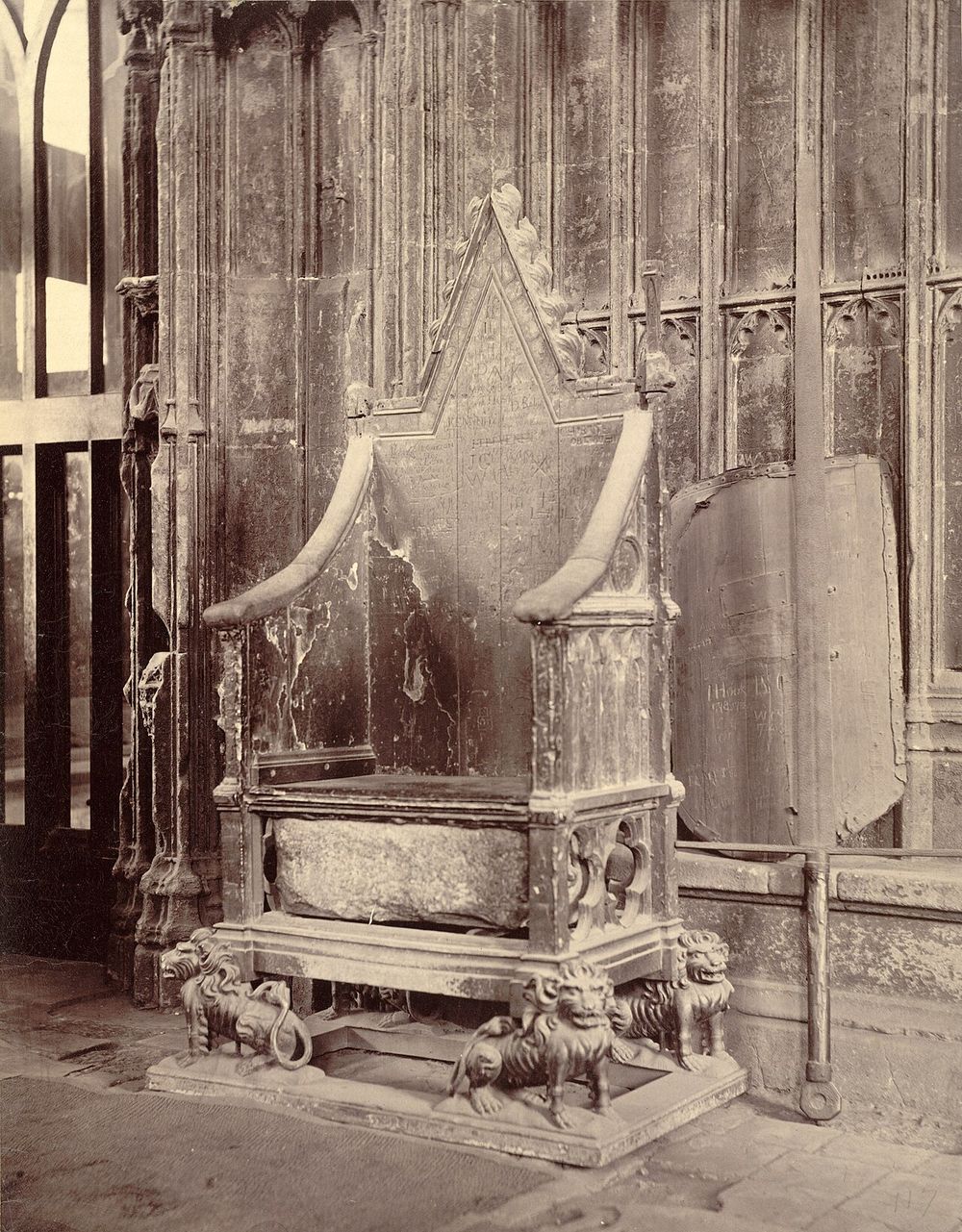
You leave past a glass case by the west door. In it is a tall oak chair with a pointed back, much scratched. Edward I had it made in 1300 to hold a block of sandstone he had carried off from Scotland, on which the Scottish kings had been crowned. Every English coronation since has used the chair.
The scratches are names. For two centuries the boys of the school next door were let in to carve them. One reads: "P. Abbott slept in this chair 5–6 July 1800." The stone went home to Scotland in 1996.
Meanwhile in the world
Year
Here
Elsewhere
1065
The first great church is finished
Northern Song China: Sima Guang begins his history; four years later Wang Anshi starts his reforms
1066
William the Conqueror is crowned
The same year; the comet later named after Halley is seen in both countries
1245
Henry III begins the present church
Southern Song (1127–1279) China (1127–1279); the Mongols have reached the edge of Europe
1400
Chaucer is buried
Ming China (1368–1644); five years before Zheng He's first voyage
1503
Henry VII's chapel is begun
Ming China, the Hongzhi reign; Leonardo starts the Mona Lisa
1727
Newton is buried
Qing China, the fifth year of the Yongzheng reign
1745
The west towers are finished
The Qianlong reign in China; Bach is at work on his last great pieces
1920
The Unknown Warrior is buried
Two years after the First World War; a year before the Communist Party of China is founded
1953
Elizabeth II is crowned, on television
The same week Everest is climbed; China begins its first five-year plan
Then and now
The Abbey and Parliament from the airAlan Hughes, CC BY-SA 2.0, Wikimedia CommonsWestminster and the ThamesMike McBey, CC BY 2.0, Wikimedia CommonsThe west front at nightThe New Athens, CC BY-SA 2.0, Wikimedia CommonsThe north door, where visitors go inAmandajm, CC BY-SA 3.0, Wikimedia CommonsHenry VII's chapel from outsideYair Haklai, CC BY-SA 4.0, Wikimedia CommonsA flying buttressZzztriple2000, Public domain, Wikimedia CommonsThe towers from the yard behindPAUL FARMER, CC BY-SA 2.0, Wikimedia CommonsThe ten statues over the west doorCEphoto, Uwe Aranas, CC BY-SA 3.0, Wikimedia CommonsThe ten, lit at nightJFVoll, CC BY-SA 4.0, Wikimedia CommonsThe vault of the nave, 31 metres upMaksim Sokolov (maxergon.com), CC BY-SA 4.0, Wikimedia CommonsThe nave by lamplightRobert Lamb, CC BY-SA 2.0, Wikimedia CommonsThe grave of the Unknown WarriorRobert Lamb, CC BY-SA 2.0, Wikimedia CommonsThe grave and the choir screenThe National Churches Trust, CC BY 2.0, Wikimedia CommonsNewton's monument against the screen14GTR, CC BY-SA 4.0, Wikimedia CommonsNewton, his books and the globe14GTR, CC BY-SA 4.0, Wikimedia CommonsThe choir stallsHayden Soloviev, CC BY 4.0, Wikimedia CommonsThe choir, looking eastHayden Soloviev, CC BY 4.0, Wikimedia CommonsThe crossing, with the pavement of 126814GTR, CC BY-SA 4.0, Wikimedia CommonsCircles and squares of coloured stone14GTR, CC BY-SA 4.0, Wikimedia CommonsThe shrine of Edward the Confessoramanderson2, CC BY 2.0, Wikimedia CommonsThe fan vault of Henry VII's chapelJRennocks, CC BY-SA 4.0, Wikimedia CommonsThe tomb of Elizabeth IRobert Lamb, CC BY-SA 2.0, Wikimedia CommonsPoets' Corner14GTR, CC BY-SA 4.0, Wikimedia CommonsNames in the floor of Poets' Corner14GTR, CC BY-SA 4.0, Wikimedia CommonsThe stone of the nonsense poet Edward Lear, among others14GTR, CC BY-SA 4.0, Wikimedia CommonsThe cloisterXaviguillen, CC BY-SA 3.0, Wikimedia CommonsMemorials on the cloister wall14GTR, CC BY-SA 4.0, Wikimedia CommonsThe vault of the Chapter HouseChrisVTG Photography, CC BY-SA 4.0, Wikimedia CommonsPaintings of about 1400 on the Chapter House wallKlaus D. Peter, Wiehl, Germany, CC BY 3.0 de, Wikimedia CommonsThe Chapter House from the gardenTilman2007, CC BY-SA 4.0, Wikimedia CommonsThe Coronation Chairamanderson2, CC BY 2.0, Wikimedia CommonsThe chair in its caseRobert Lamb, CC BY-SA 2.0, Wikimedia CommonsA procession of knights leaving the Abbey, painted by Canaletto in 1749Giovanni Antonio Canal, Public domain, Wikimedia CommonsHenry VII's chapel, painted by CanalettoGiovanni Antonio Canal, Public domain, Wikimedia CommonsThe west front in a print of about 1810John Bluck, CC0, Wikimedia CommonsThe nave, drawn by Herbert Railton, 1894Man vyi, Public domain, Wikimedia CommonsThe Confessor's chapel, drawn by Railton, 1894Man vyi, Public domain, Wikimedia CommonsHenry VII's chapel in a photograph of the nineteenth centuryCornell University Library, No restrictions, Wikimedia CommonsThe fan vault in a book of 1911Howard, F.E. (Frank Ernest) 1888-1934, Public domain, Wikimedia CommonsThe Coronation Chair with the Scottish stone under its seat, before 1950Cornell University Library, No restrictions, Wikimedia CommonsThe west front in 1898UnknownUnknown Scanned by Leonard Bentley from Iden, East Sussex, UK, Public domain, Wikimedia CommonsThe coffin of the Unknown Warrior, November 1920Horace Nicholls, Public domain, Wikimedia CommonsThe Confessor's shrine under sandbags in the First World WarHenry Rushbury, Public domain, Wikimedia CommonsThe street outside, days before the coronation of 1953Ben Brooksbank, CC BY-SA 2.0, Wikimedia Commons
Video
Films from official channels, played from YouTube. Nothing is loaded until you press play.
Westminster Palace and Westminster AbbeyUNESCO · made with NHK; 3 min · checked 2026-11-12
Local legends
These are stories people tell about this place. They are legends, not history, and each one says where it comes from.
LegendThe fisherman and St Peter
On the night before the first church was to be blessed, a stranger asked a Thames fisherman to row him across. The fisherman saw the church fill with light and heard singing. The stranger came back, said he was St Peter and had blessed the church himself, and told the man to cast his net. It came up full of salmon.
Source: Sulcard, monk of Westminster, about 1080
LegendThe stone that came from Egypt
The stone under the chair was the pillow on which Jacob slept in the Bible and dreamed of a ladder to heaven. It was carried to Egypt, to Spain, to Ireland and at last to Scotland, and it groans aloud when a true king sits on it.
Source: Scottish chronicles from the fourteenth century
LegendThe wrong stone
When the English came for the stone in 1296, the monks of Scone hid the real one and gave them a lump cut from the nearest quarry. The true stone has never been found.
Source: Scottish tradition; geologists confirm only that the stone is local sandstone from near Scone
LegendThe monk in the cloister
A monk in a brown habit walks in the cloister at dusk, a little above the level of the present floor, and speaks politely to visitors before passing through the wall.
Source: Stories told by Abbey staff since the 1900s
Later, people who live here will be able to add the stories they grew up with, and say which of these they have heard.
Not certain, and where accounts conflict
How many are buried here?
The Abbey says more than 3,300. No complete register was kept before 1607, and the floor has been dug over many times.
Is the Confessor still in his shrine?
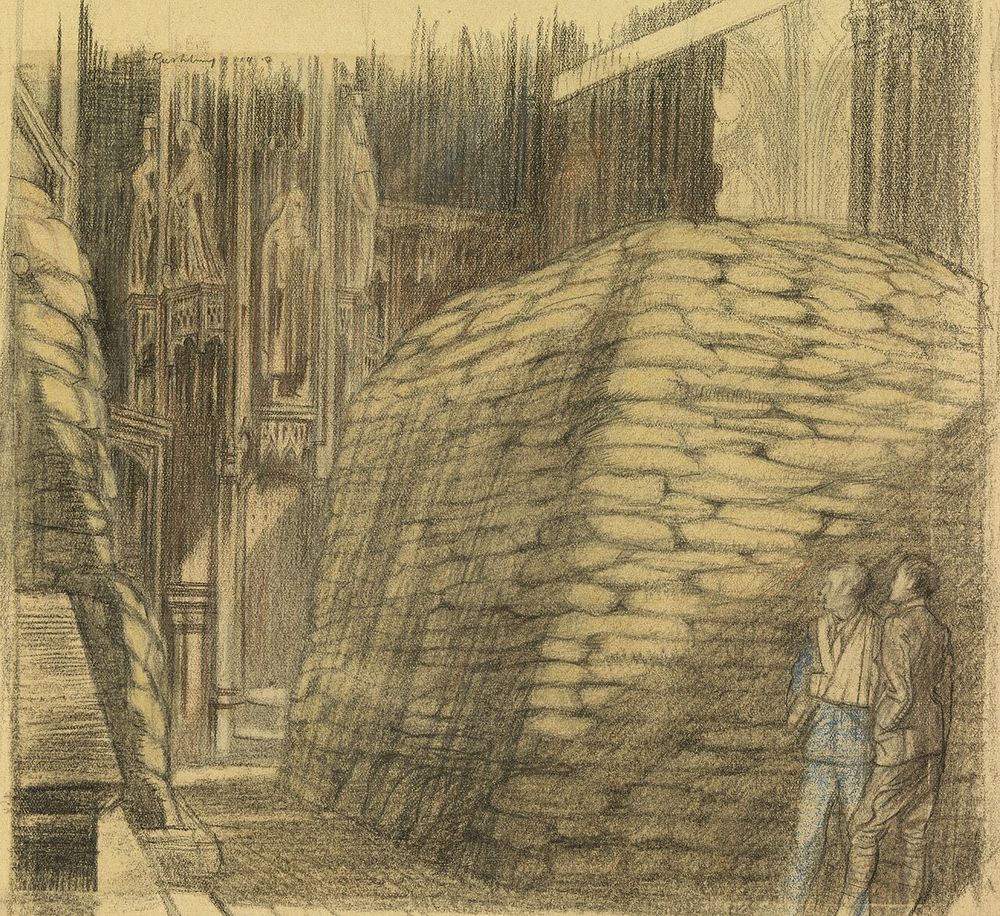
The shrine was broken up in 1540 and rebuilt in 1557. The coffin was last opened by accident in 1685, when a workman put his hand through the lid and drew out a gold cross.
Why are two queens in one grave?
James I paid for a grand tomb for Elizabeth, whose throne he had inherited, and none for Mary, a Catholic. The Latin on it calls them partners in throne and grave, sleeping in hope of one resurrection.
What does the riddle in the floor say?
It multiplies the lives of a hedge, a dog, a horse, a man and so on by three each time, up to the life of the world, which comes to 19,683 years.
Visiting
Tickets and hours
Adults pay 32 pounds; visitors over 65 and students 29 pounds; children of 6 to 17 pay 14 pounds. Under 6 is free. One adult with one child pays 32 pounds for both.
The price includes a handset guide in fourteen languages, Chinese among them.
Open to visitors Monday to Saturday. The times change from day to day; on a Wednesday in November 2026 entry was from 9:30 to 15:30.
On Sundays the Abbey is open for services only.
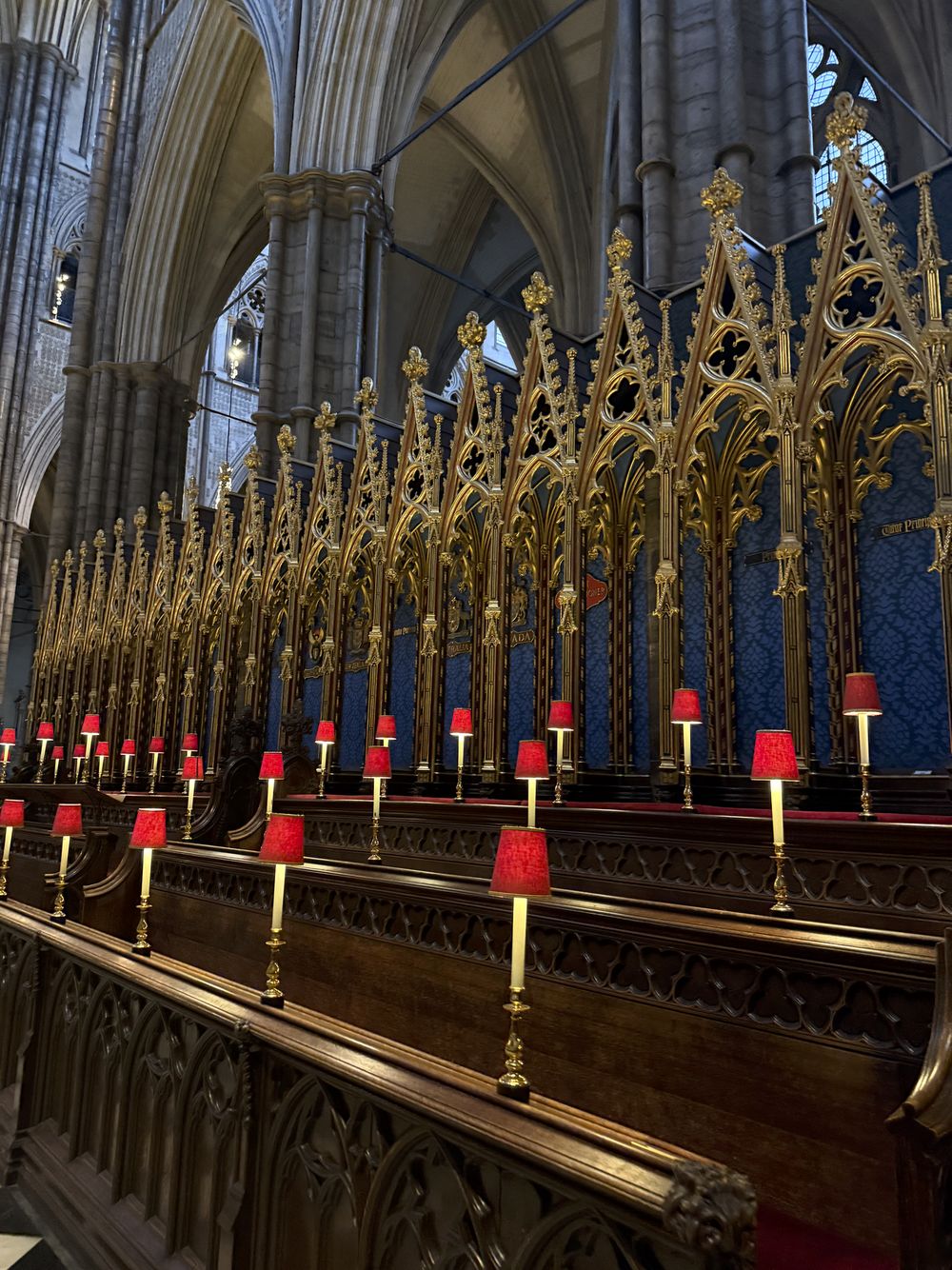
Anyone may attend a service free of charge. Evensong is sung by the choir on most afternoons; you sit in the choir stalls and may not walk about.
Last checked 2026-11-12. The Abbey's own site (westminster-abbey.org), prices and entry times as shown in November 2026.
Booking from abroad
Official page in English The Abbey sells tickets for a set time on its own site, in English, and takes foreign cards: westminster-abbey.org. The same page shows the opening times for each day, which change.
Ticket window on site Tickets are sold at the north door on the day if there is room. In summer the line can be more than an hour.
Note The Abbey is a working church and can close at short notice for a service or a state occasion. Look at the site on the morning you go.
Checked 2026-11-12
Where to start
The nearest Underground station is Westminster, five minutes on foot. The visitors' entrance is the north door, on the side facing Parliament Square.
Book the first time of the day. By eleven the royal chapels are a slow queue.
Allow two hours. If you have less, see the Unknown Warrior, Newton, the crossing, Henry VII's chapel and Poets' Corner, in that order.
For the church without the crowd, and with music, come back for Evensong.
Before you go
Bags larger than a small rucksack are not let in, and there is nowhere to leave them.
There are steps up to the royal chapels. A route without steps covers most of the church; ask at the door.
Read the notice about photographs at the entrance; the rule has changed more than once.
Customs and manners
Do not step on the grave of the Unknown Warrior.
Once an hour a priest asks for a minute of silence for prayer. Stand still where you are.
Men take off their hats.
Opening hours are given in the local time of the place. Prices are in the local currency. The figure after ≈ is approximate, at exchange rates checked on 9 November 2026, in .
Look for these
Over the west door, find the statue of a man from China.
Find the one grave with flowers round it. Why does nobody walk on it?
On Newton's monument, what are the small boys doing?
Find Darwin's stone. Is it large or small?
In the pavement before the altar, find a circle inside a square inside a circle.
In Henry VII's chapel, look up. How are the stone lanterns held?
In Poets' Corner, find a writer whose book you have read.
On the Coronation Chair, find a name scratched in the wood.
I am here
Stand at the site, sign in, press the button, and collect its stamp. Your browser will ask to use your location. It is sent to us once to confirm that you are at the site; we keep how far you were from it, not the spot where you stood.
Your stamps are saved to your account, so they follow you to any device. Checking from a browser cannot rule out every false location; stricter checks arrive with the app.
Messages
Share your photos
Photos here show the place, not people. Each one is credited to the visitor who took it and appears after our team has looked at it. A photo with you in it belongs under “I am here”.