A hunting lodge in a marsh that one king turned into the seat of government of the most powerful country in Europe. For a hundred years France was ruled from these rooms, in public, by the clock. Then one October morning a crowd came for the king, and the court never returned.
Photo: ToucanWings, CC BY-SA 3.0, Wikimedia Commons
The story
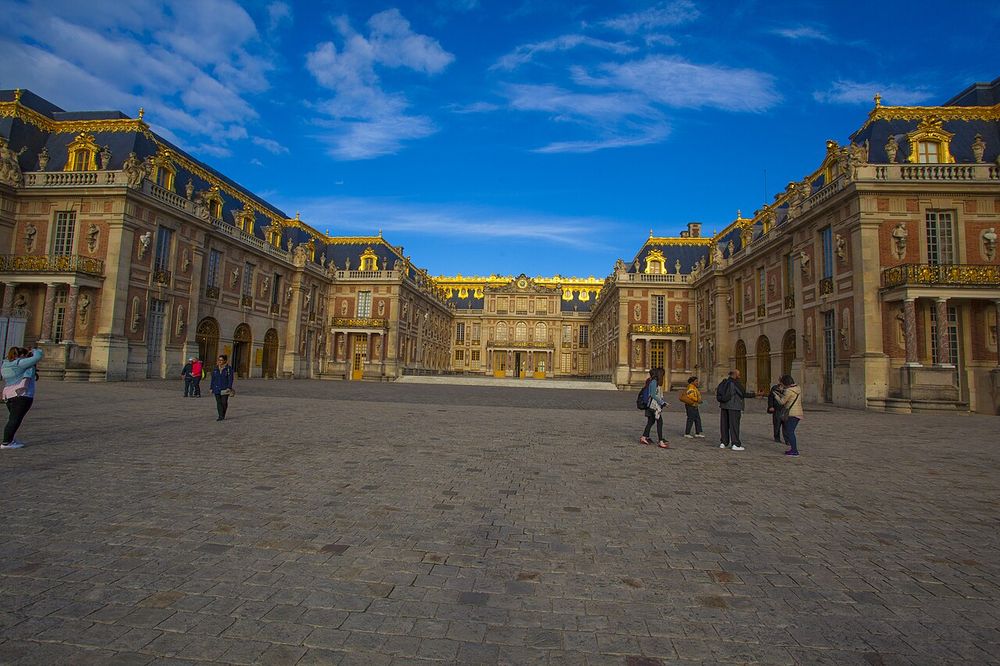
You are in a cobbled courtyard that narrows as you walk in, like a funnel. Gilded railings are behind you. Ahead, at the far end, is a small court paved in black and white marble, with walls of red brick. That brick house is where it began.
Louis XIV moved the court here for good in 1682. In Beijing the Kangxi emperor was twenty-eight and had been on the throne for twenty-one years. The two never met, but they exchanged gifts and scholars across the world.
What is here
One ticket, the Passport, covers the palace, the Trianon palaces and the gardens on any day. The park is free. The gardens are free too, except on days when the fountains play or music is on. The palace and Trianon are closed on Mondays.
The Marble Court, the core of Louis XIII's houseScareCriterion12, CC BY-SA 4.0
In 1623 Louis XIII built a hunting lodge here, on poor marshy land that nobody else wanted. His son, Louis XIV, was four when he became king and lived through a civil war in which nobles drove him out of Paris. He never trusted Paris or the nobles again.
So he kept his father's little house and wrapped a palace round it, big enough to hold the whole nobility of France. A duke who lived here, waiting to hand the king his shirt, could not be at home raising an army.
Everything pointed at him. The palace faces the rising sun, and his bedroom is at its exact centre. His getting up and his going to bed were ceremonies with a hundred people watching.
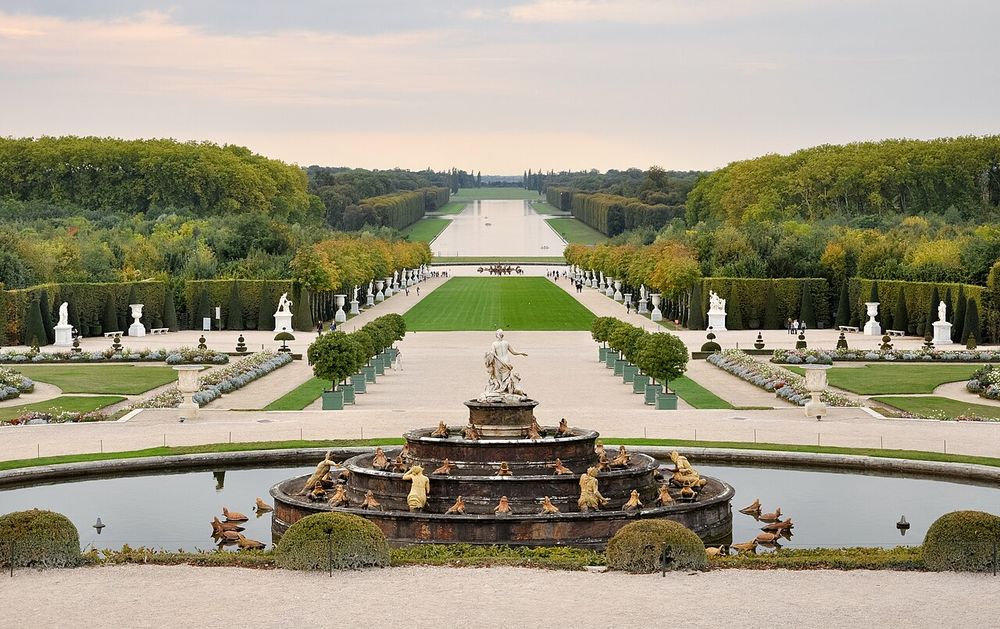
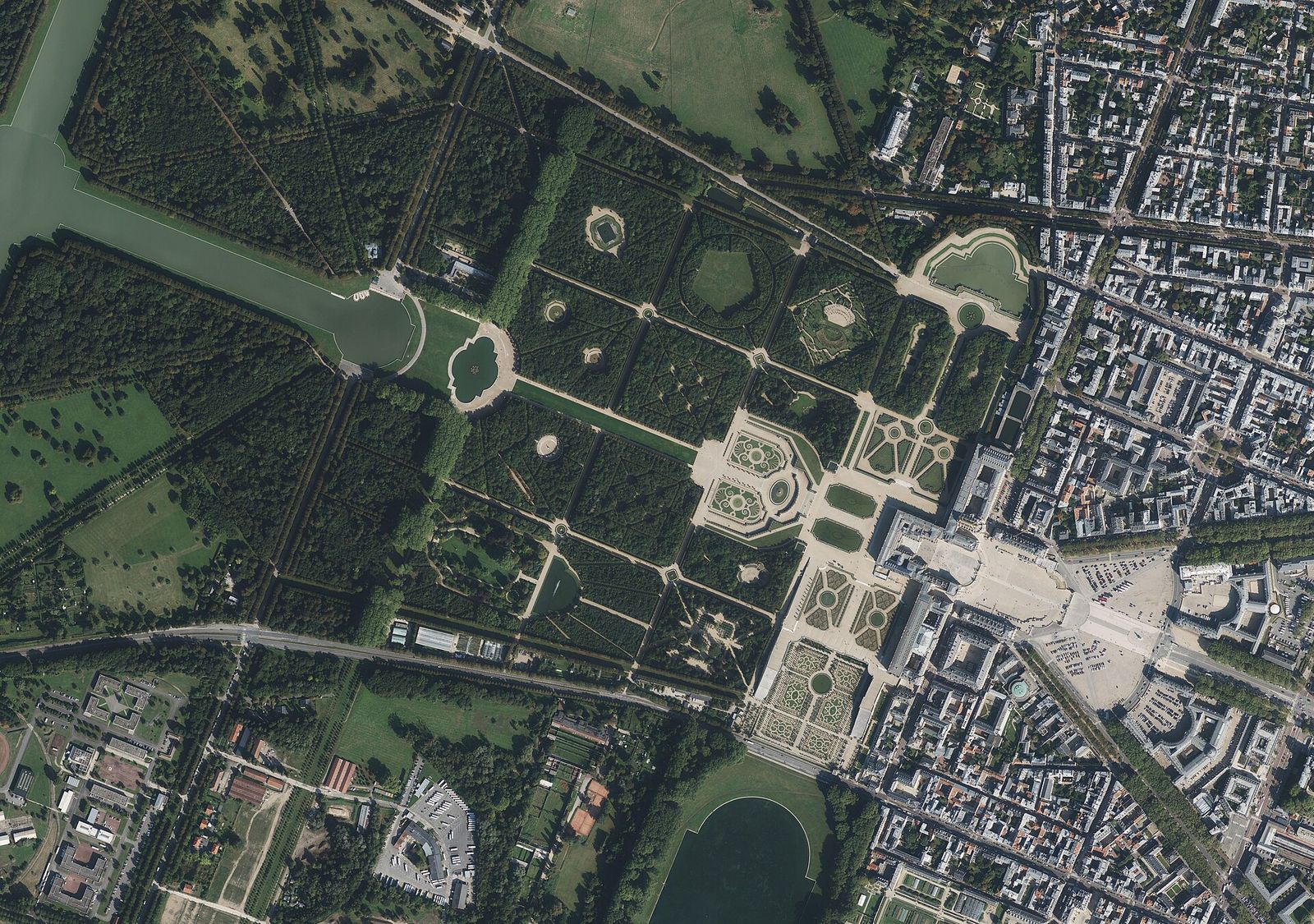
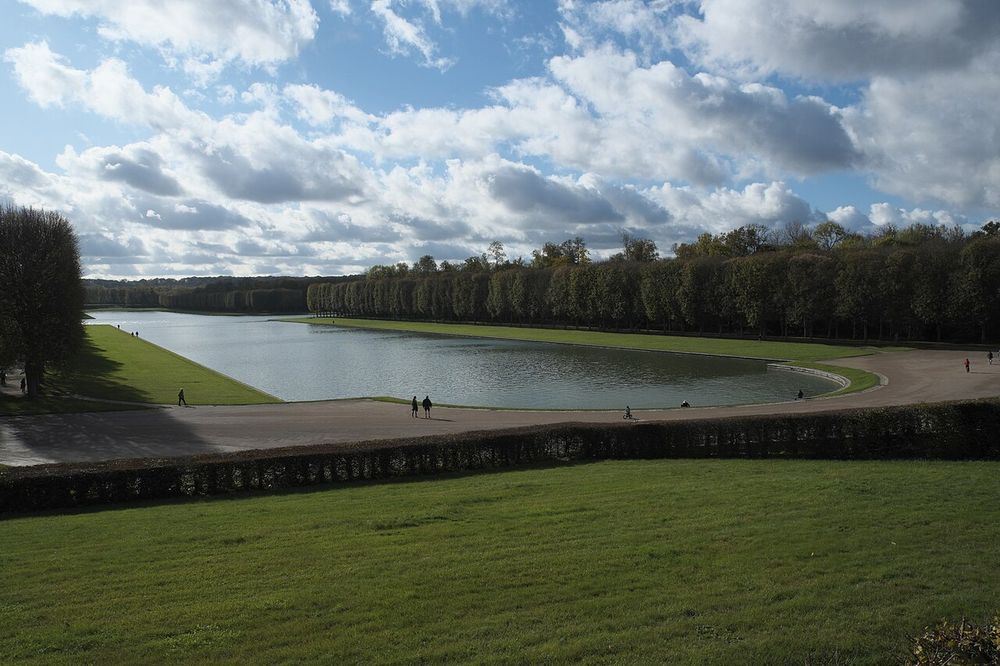
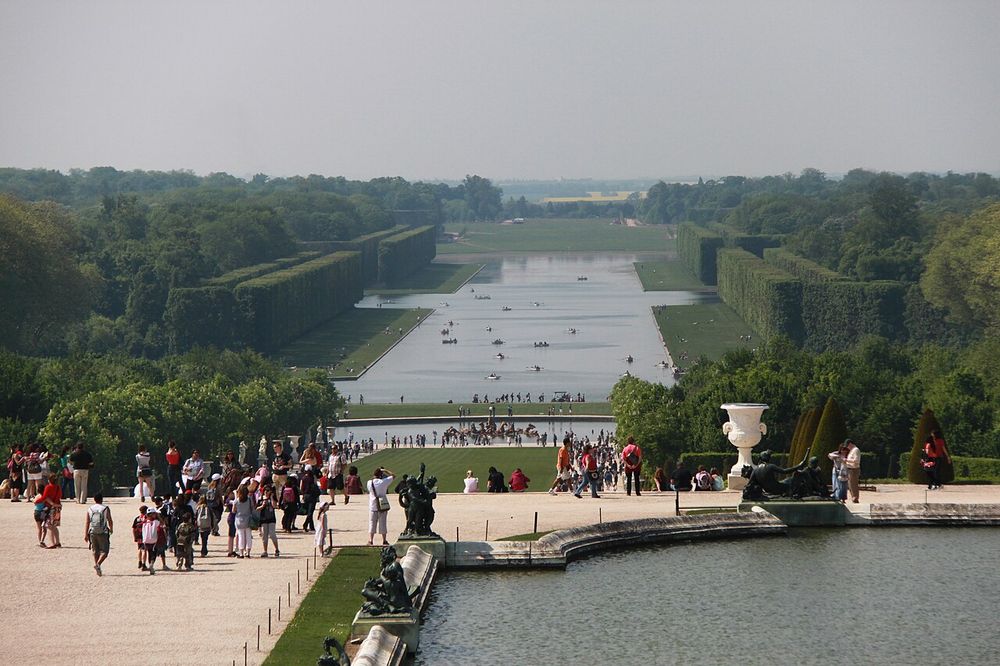
Before you leave, walk to the back and look down the garden. The view runs straight for three kilometres and was laid out before most of the palace was built.
Things people often get wrong
"Marie-Antoinette said: let them eat cake." The line was in print, put in the mouth of an unnamed princess, when she was a child in Vienna. Nobody who knew her recorded her saying it.
"Louis XIV said: I am the state." No witness reports it. On his deathbed he is recorded as saying something close to the opposite: "I am going, but the state will always remain."
"The palace had no lavatories." It had hundreds of close-stools and some fixed privies, and servants to empty them. With several thousand people living under one roof it still smelled, and visitors said so.
"The furniture is original." Nearly everything was auctioned off in 1793 and 1794. The palace has spent a century buying pieces back, one at a time, and much of what you see is a careful replacement.
"You can see Versailles in a morning." The estate covers eight square kilometres. The palace alone takes two hours; the Trianon palaces are a twenty-five-minute walk beyond the garden.
People who stood here
Wolfgang Amadeus Mozart (the Austrian composer)He was seven. His father brought him and his sister to Versailles for two weeks over Christmas 1763, and on New Year's Day 1764 the family stood behind the royal table at the public dinner. The queen, who spoke German, fed the boy titbits and translated his chatter for Louis XV.
Benjamin Franklin (American statesman, printer and scientist; one of the founders of the United States)On 20 March 1778 he was received here by Louis XVI as the envoy of a country six weeks into its alliance with France. He came without a wig or a sword, in a plain brown coat, and the court took it for republican virtue. Five years later the treaties by which Britain made peace with France and Spain, ending that war, were signed in this town.
Go deeper: eight stops, from the golden gate to the queen's village
The stops follow the route every visitor is sent on: through the courts, up to the chapel and the state rooms, out into the garden, and on to Trianon.
1. The golden gate and the three courts
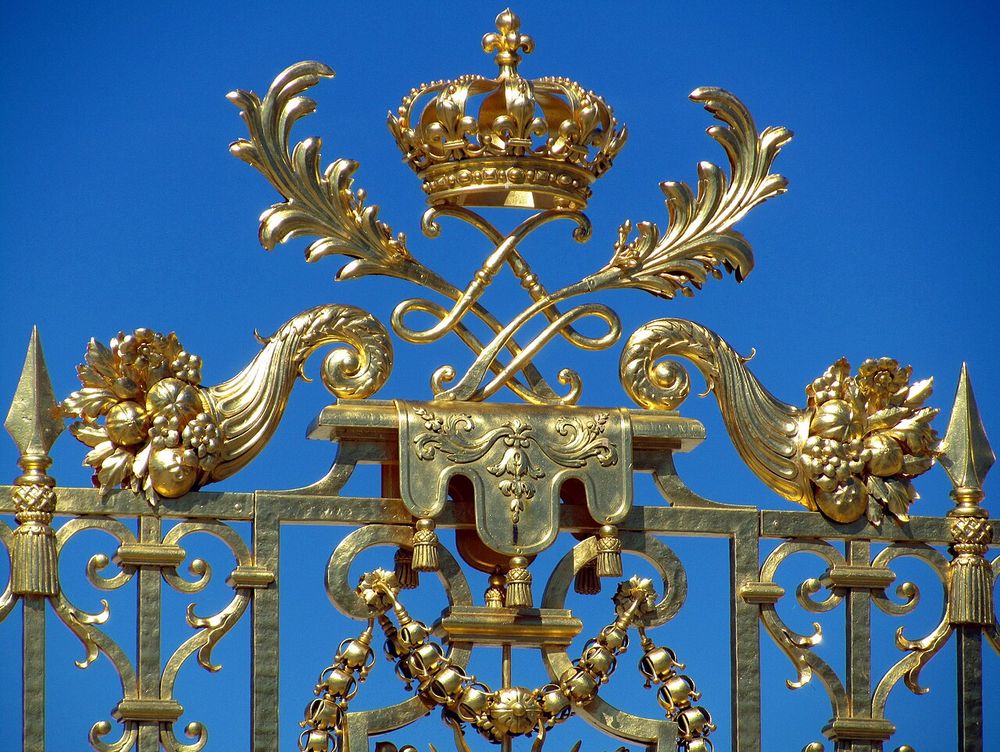
The gilded gate, remade in 2008Sunil.phys, CC BY-SA 3.0
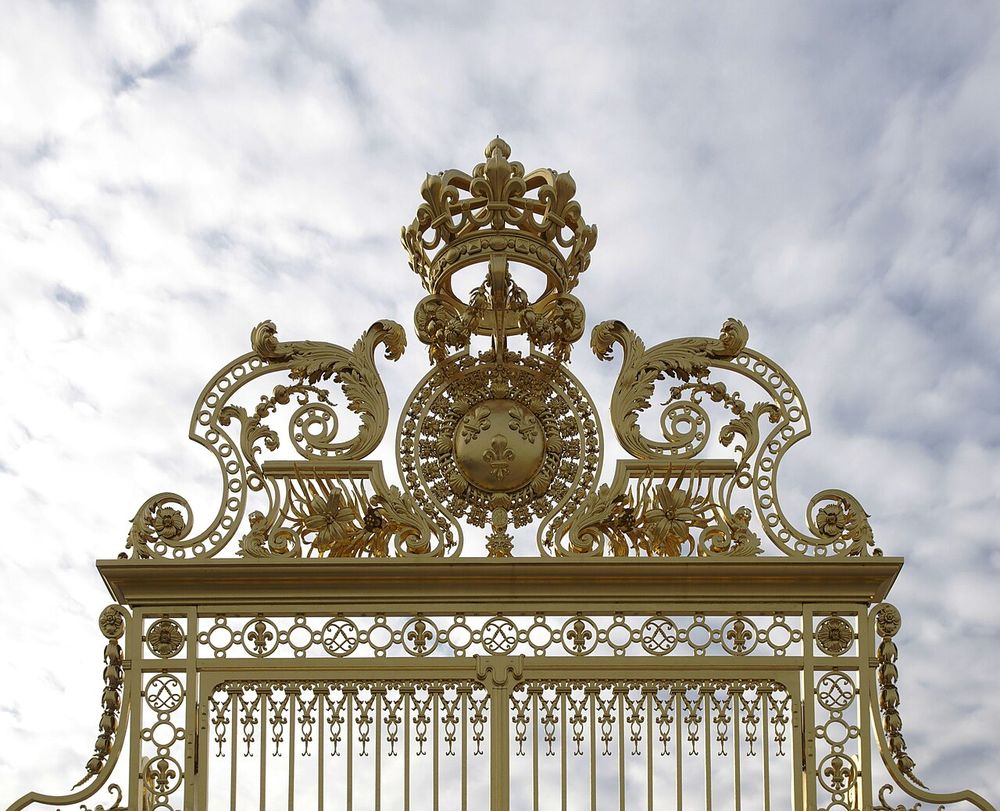
The gilded gate is new. The original was torn down in the Revolution, and this copy, eighty metres long and covered in a hundred thousand leaves of gold, was put up in 2008. On top are the king's crown and his emblem, the sun.
Beyond it the courts step up and close in: the wide Court of Honour, the Royal Court, then the small Marble Court. The further in you were allowed, the higher your rank. Only a few people could drive a carriage past the second gate.
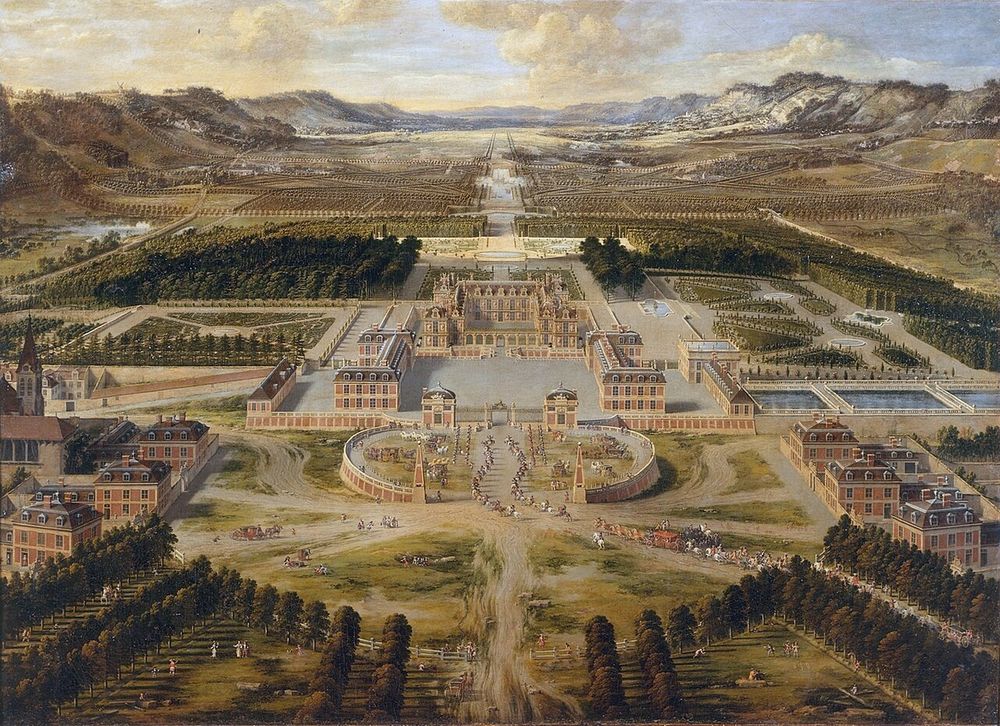
The palace in 1668, painted by Pierre PatelPierre Patel, Public domain
The brick and stone walls round the Marble Court are Louis XIII's house of the 1630s. The painting shows it in 1668 with the first gardens. Everything else you can see was added round it over the next forty years.
2. The chapel
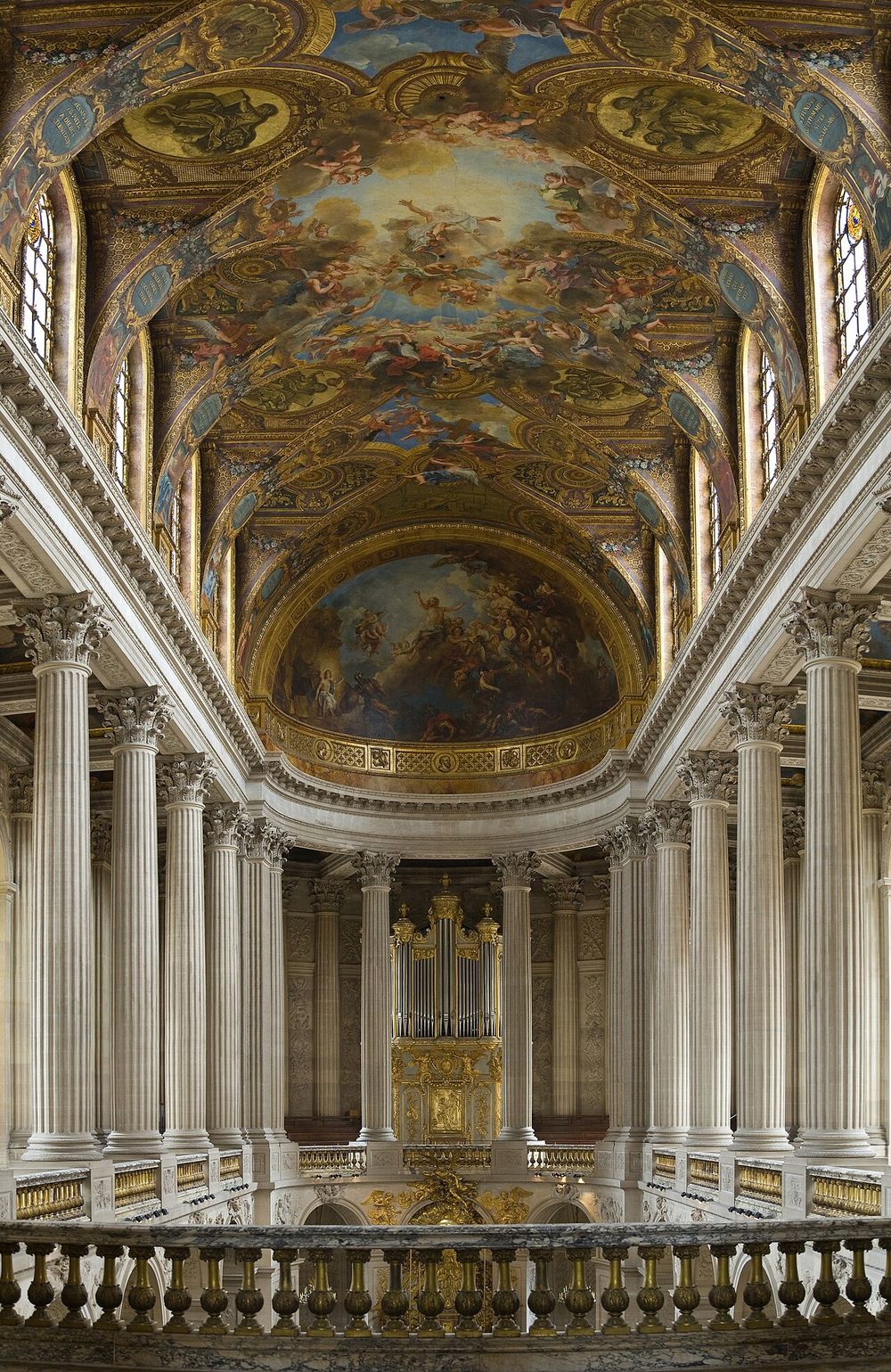
The Royal Chapel, finished in 1710Diliff, CC BY 2.5
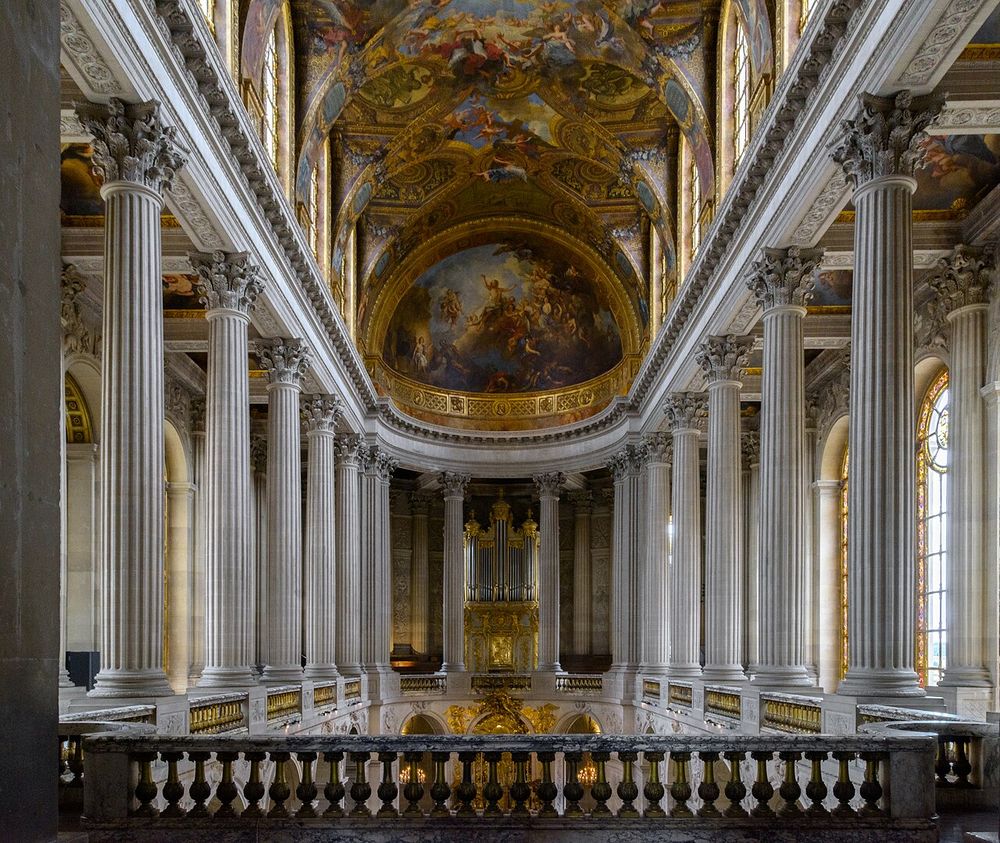
You look in from the door. The chapel was the last thing Louis XIV built, finished in 1710, five years before he died. It is white stone below and gold and paint above.
The king heard mass every morning from the upper gallery, level with his apartment. The courtiers stood below with their backs to the altar, facing him. A visitor wrote that they seemed to worship the king while the king worshipped God.
In 1770 a fourteen-year-old Austrian archduchess was married here to the heir to the throne. She was Marie-Antoinette.
3. The state rooms
Seven rooms lead one into the next along the north side, each named after a planet and its Roman god: Venus, Diana, Mars, Mercury, Apollo. The sun stands at the centre of the planets, and the Apollo room was the throne room.
Three evenings a week these rooms were opened to the whole court for cards, billiards, music and food. The king walked among his nobles and nobody had to stand on ceremony. It was politics: people who are busy gambling are not conspiring.
The silver throne, the silver tables and the silver orange-tree tubs that once stood here were melted down in 1689 to pay for a war.
4. The Hall of Mirrors
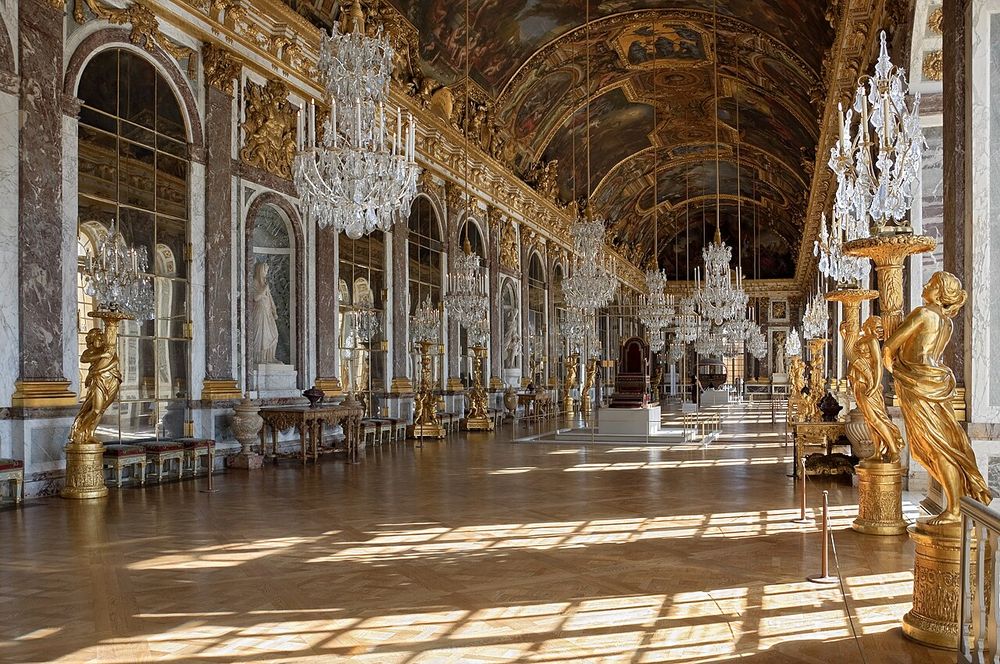
The Hall of MirrorsMyrabella, CC BY-SA 3.0
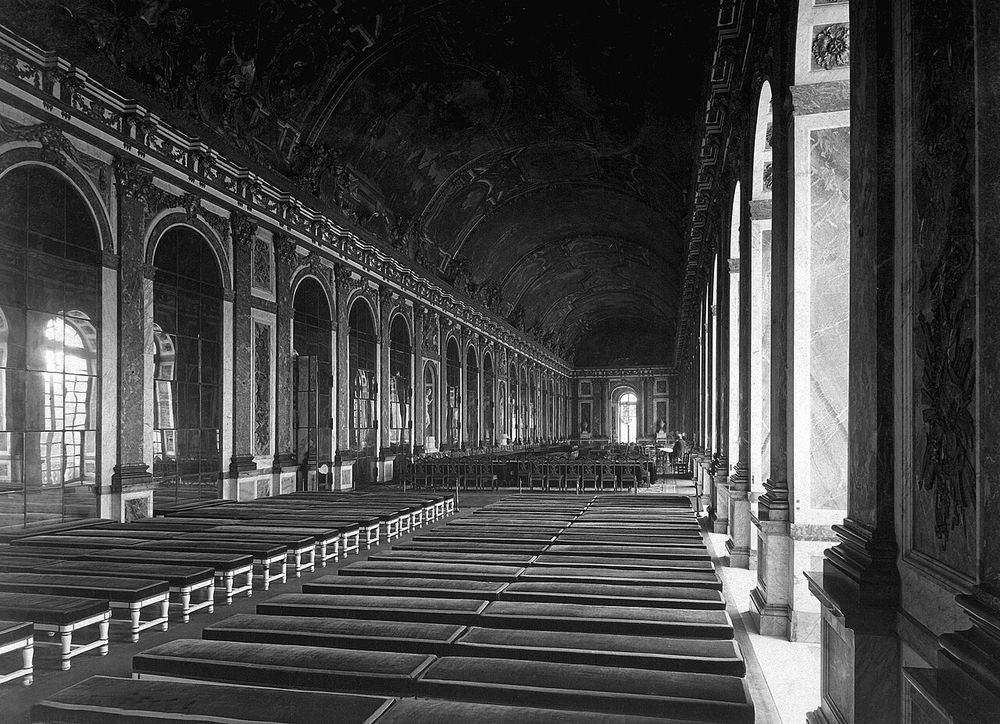
The hall is 73 metres long. Seventeen windows on the garden side face seventeen arches filled with 357 mirrors. When it opened in 1684, a mirror the size of a hand was a luxury, and Venice kept the secret of making them. Louis's minister lured Venetian glassmakers to France and had every mirror here made at home.
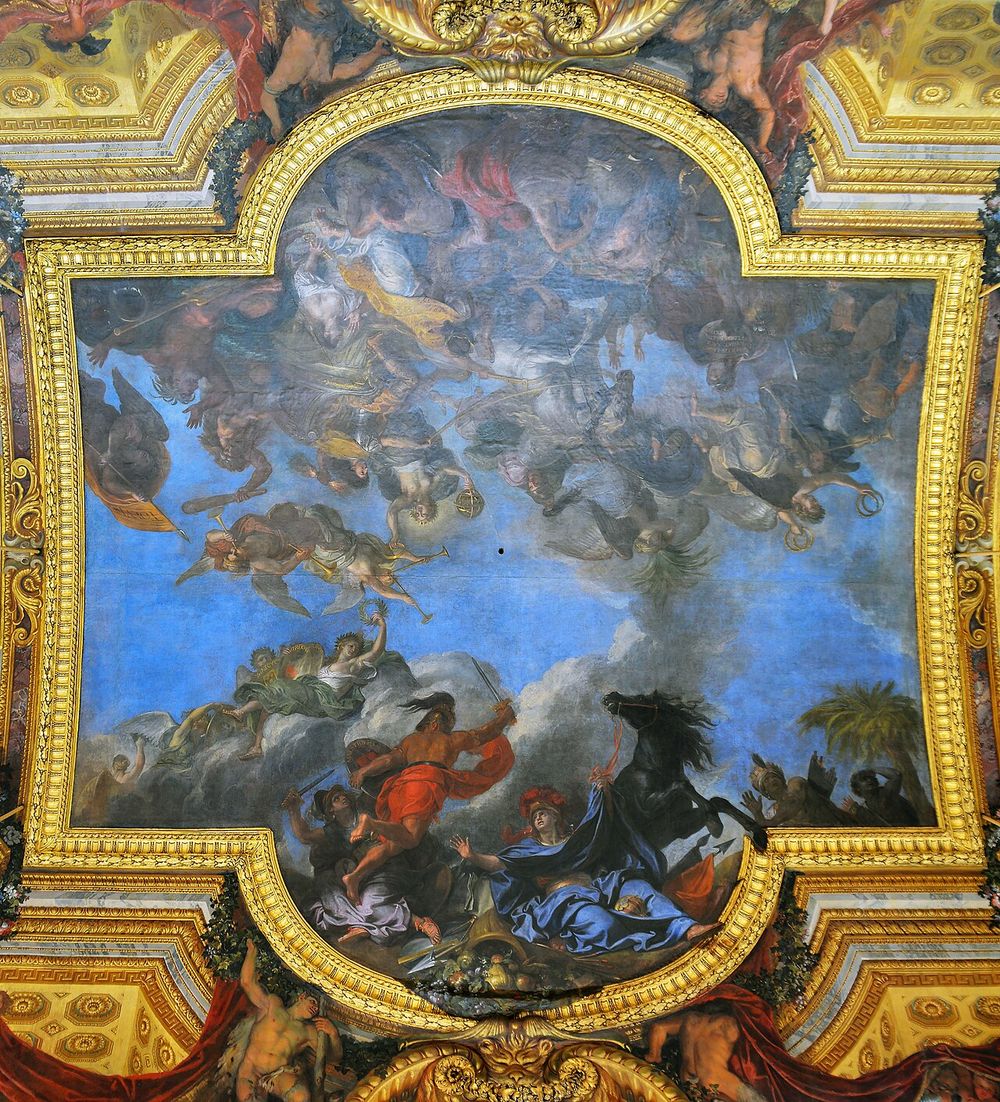
One of the ceiling paintings in the Hall of MirrorsLivioandronico2013, CC BY-SA 4.0
Look up. The ceiling shows the first eighteen years of the king's reign in thirty scenes. Earlier kings had themselves painted as Hercules or Apollo. Louis is shown as himself, in a wig, among the gods.
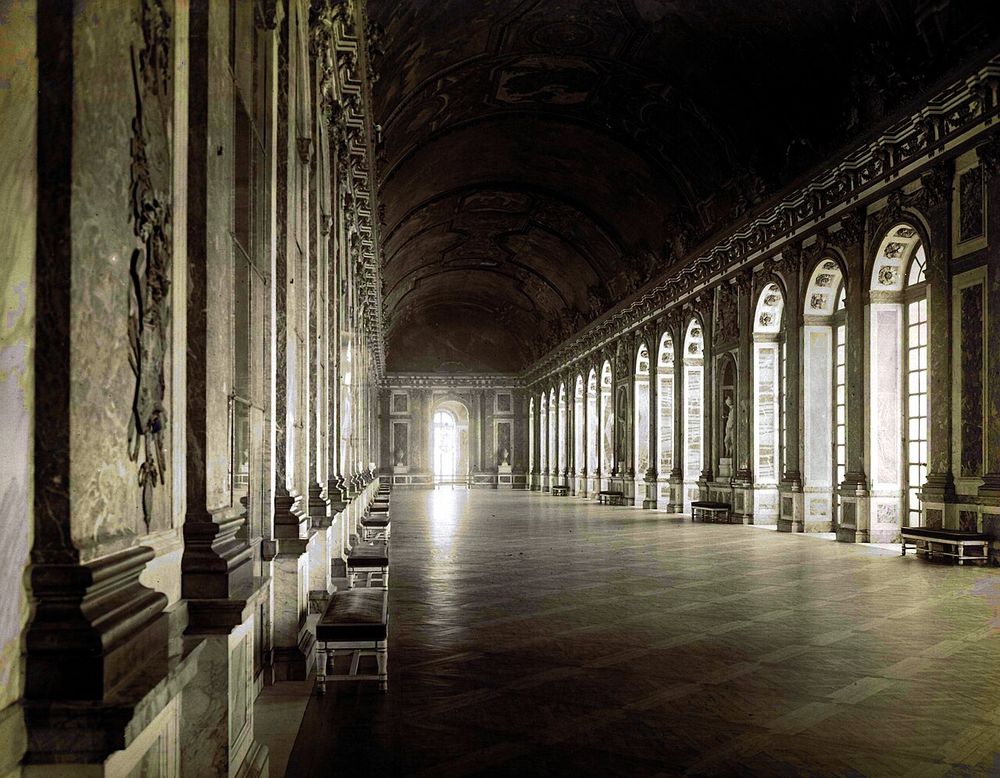
The Hall of Mirrors in 1919Woodrow Wilson Presidential Library Archives from Staunton, VA, No restrictions
On 18 January 1871, with Paris under siege, the German princes proclaimed their emperor in this room, to humiliate France. On 28 June 1919 the French chose the same room for Germany to sign the treaty that ended the First World War.
One delegation stayed away that day. The treaty gave Germany's holdings in Shandong to Japan and not back to China. Students in Beijing had been in the streets since 4 May, and the Chinese envoys refused to sign.
5. The king's bedroom
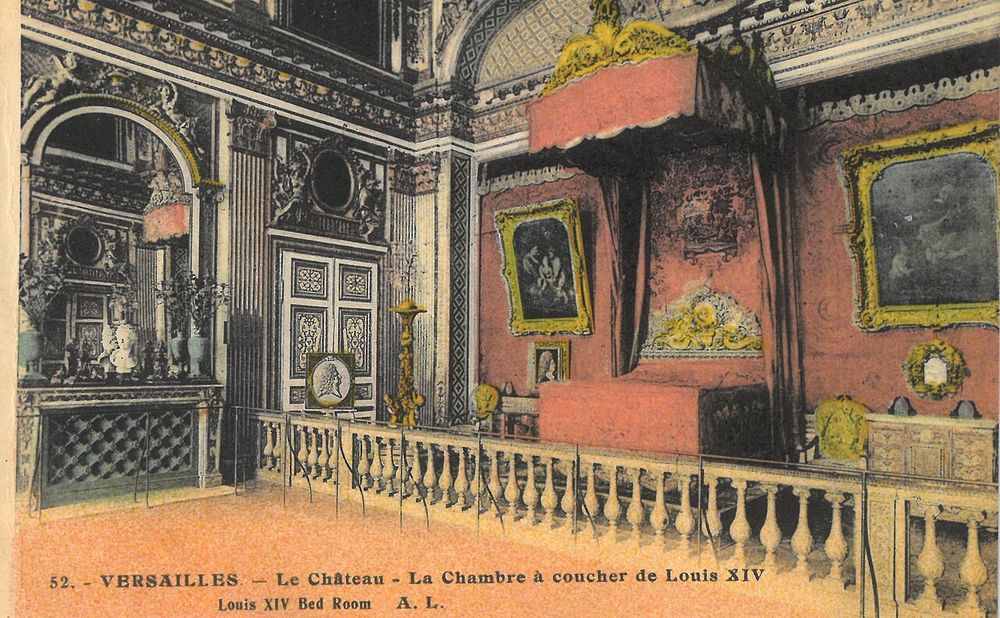
The king's bedroom on an early postcardUnknown artistUnknown artist (Scan : Tylwyth Eldar), Public domain
The room looks east over the Marble Court, on the axis of the whole palace. The bed stands behind a gilded rail that only a few could pass.
At 8:30 the first valet said: "Sire, it is time." Doctors, family and favoured nobles came in by turns, in six ranked groups, while the king was washed, shaved and dressed. To hold the candle or pass the right sleeve of the shirt was an honour that families fought over for years.
Louis XIV died in this room on 1 September 1715, of gangrene, after reigning for seventy-two years. No European monarch has reigned longer.
6. The queen's rooms and the sixth of October
The queen's bedroom is the room where nineteen royal children were born, in public, as the rule required, so that nobody could doubt the heir. When Marie-Antoinette gave birth in 1778, the crowd was so thick that she fainted for lack of air.
On 5 October 1789 several thousand women marched from Paris in the rain to demand bread. At dawn on the 6th part of the crowd broke in and killed two guards at the queen's door. She escaped through the small door to the left of the bed, which you can still see, and ran to the king's rooms.
That afternoon the royal family was taken to Paris in a carriage, surrounded by the crowd. The shutters were closed behind them. No king lived here again.
7. The gardens
The garden axis from the terrace: the Latona fountain, the lawn, the canalPaolo Costa Baldi, CC BY-SA 3.0
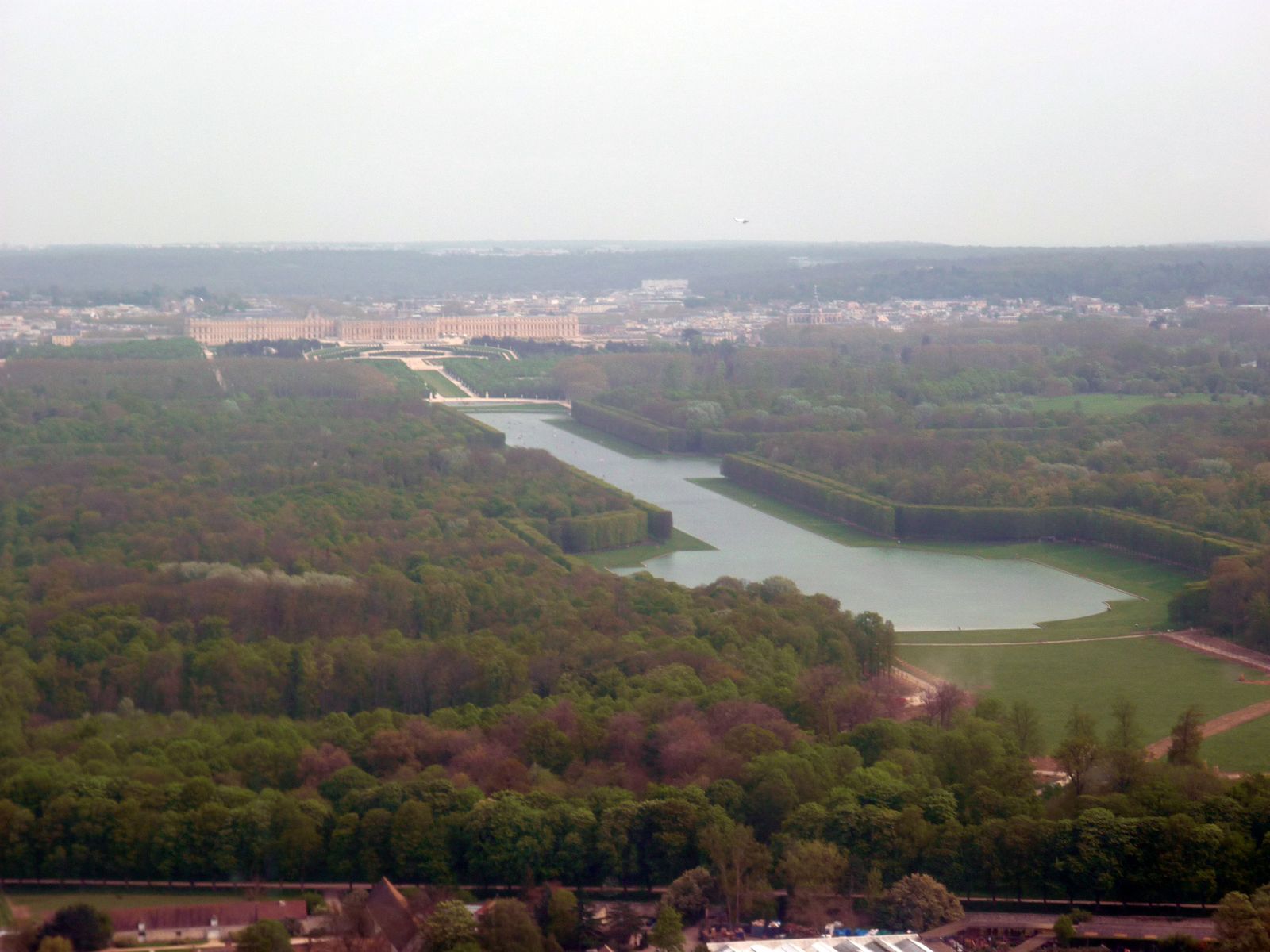
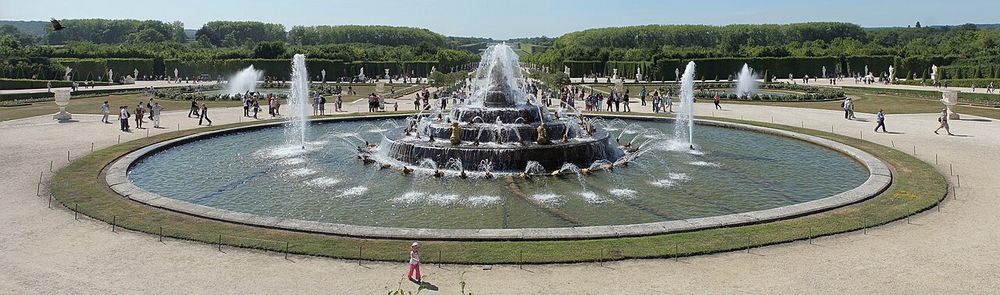
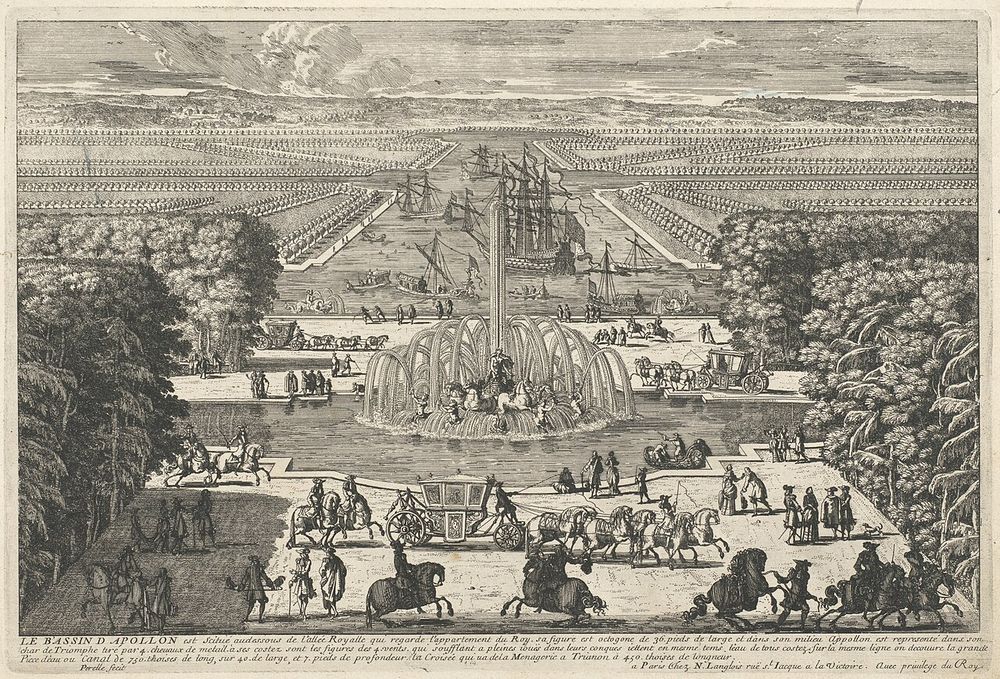
Stand at the top of the steps behind the palace. Below you is a fountain of a goddess and her children, surrounded by frogs; then a strip of lawn; then a second fountain; then a canal that runs to the horizon. André Le Nôtre drew this line in the 1660s and thousands of soldiers dug it.
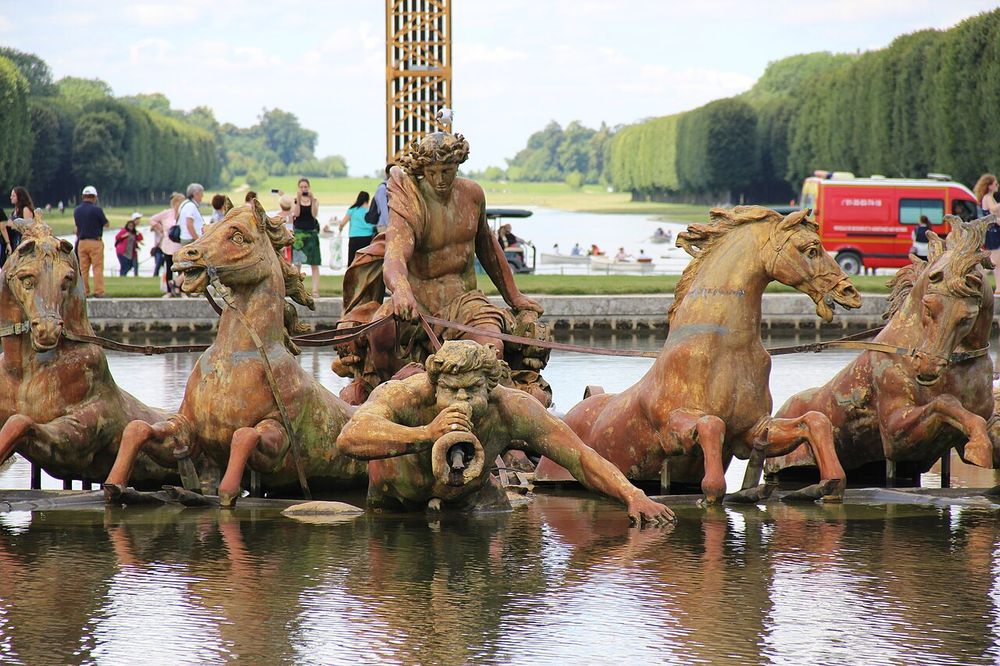
Apollo's chariot rising from the waterGary Todd from Xinzheng, China, CC0
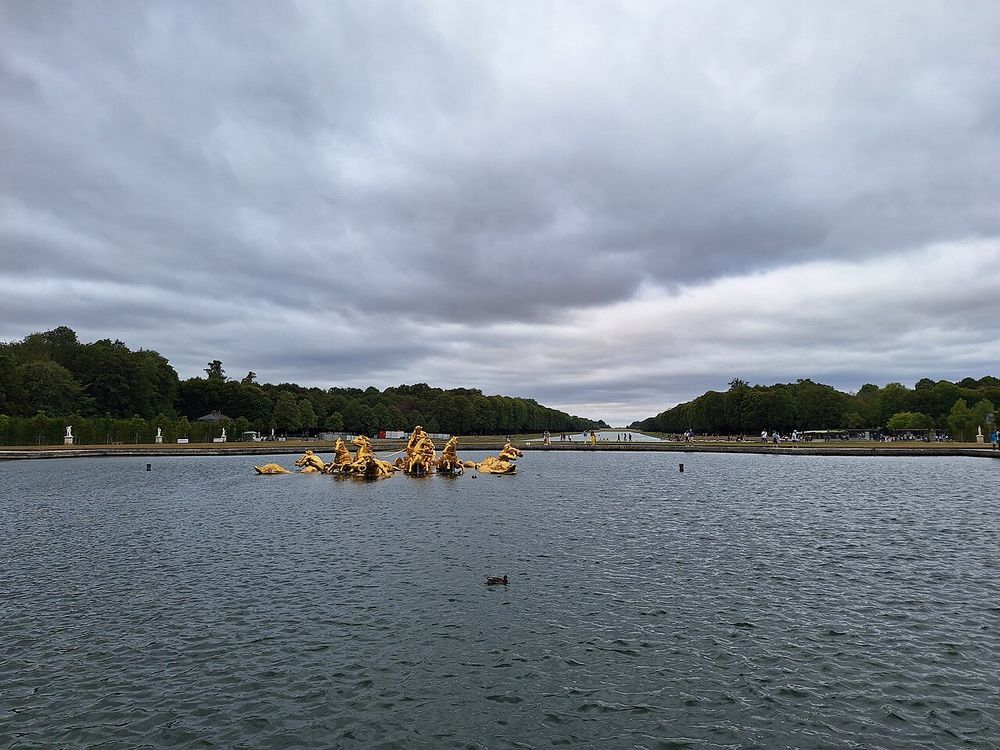
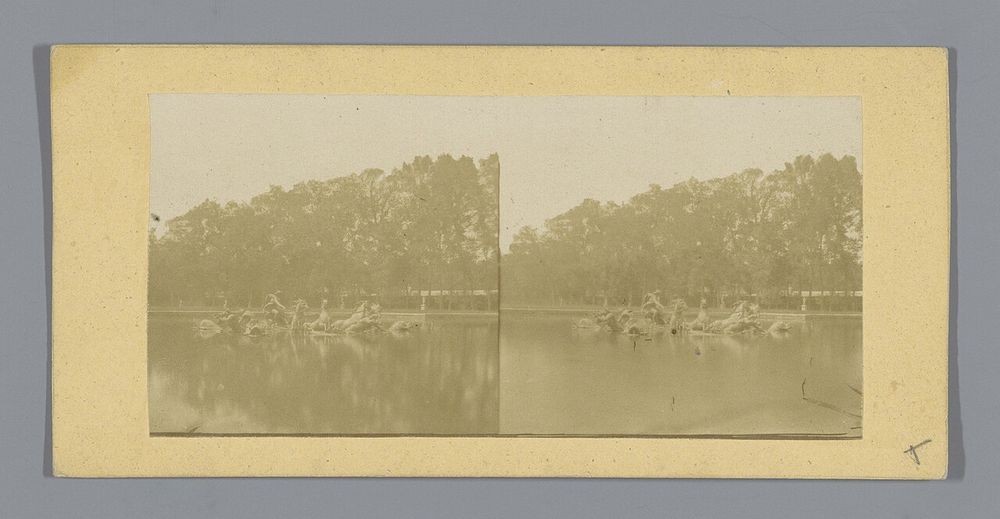
In the second fountain the sun god drives his horses up out of the water, facing the palace. At evening the real sun sets behind him, at the end of the canal.
The one thing Louis could not command was water. The site is high and dry. A machine of fourteen giant wheels on the Seine pumped water up a hill, and it was never enough for all the fountains at once. When the king walked in the garden, boys ran ahead and whistled, so that each fountain was turned on as he came and off when he had passed.
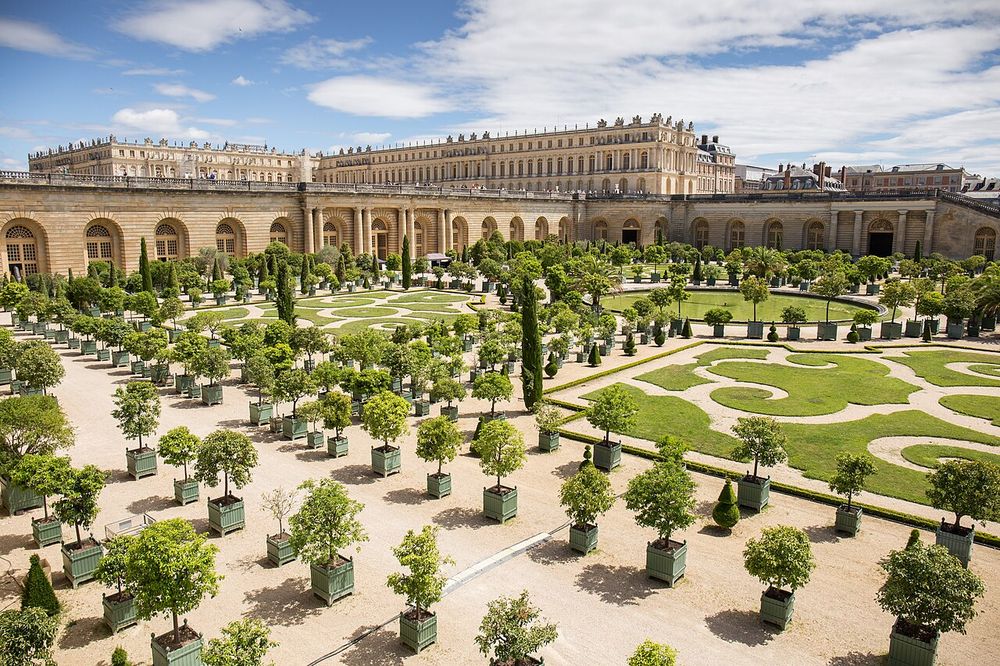
The Orangery and its trees in boxesNono vlf, CC BY-SA 4.0
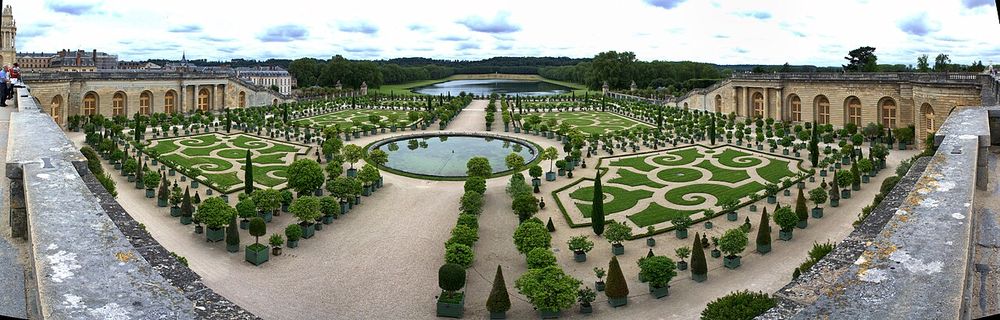
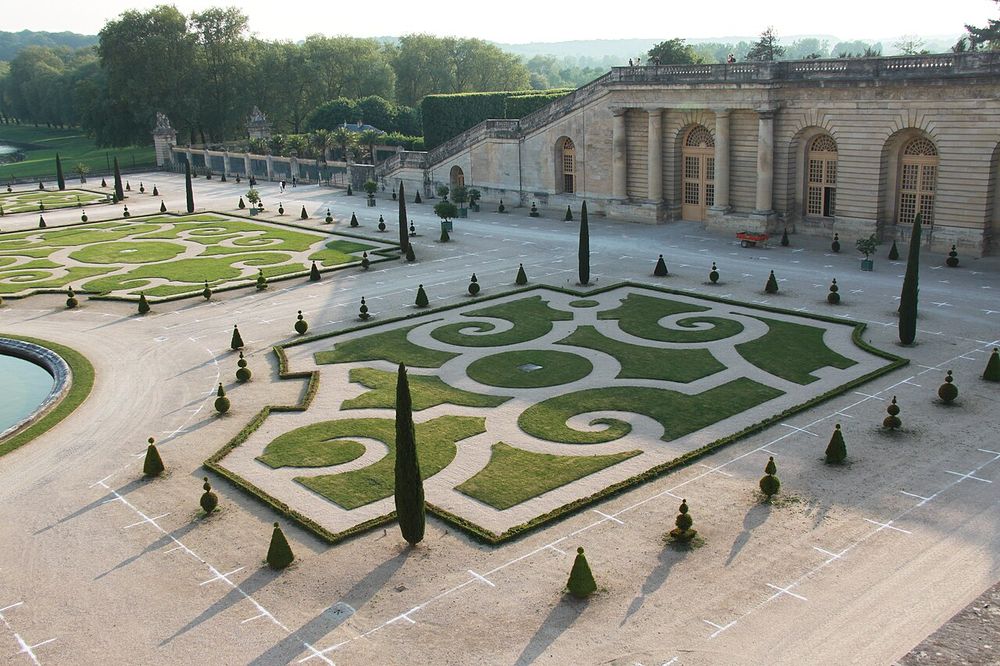
To the left, down two great staircases, is the Orangery. More than a thousand orange, lemon and palm trees in wooden boxes spend the winter in its vaulted gallery and are wheeled out in May.
8. Trianon and the queen's village
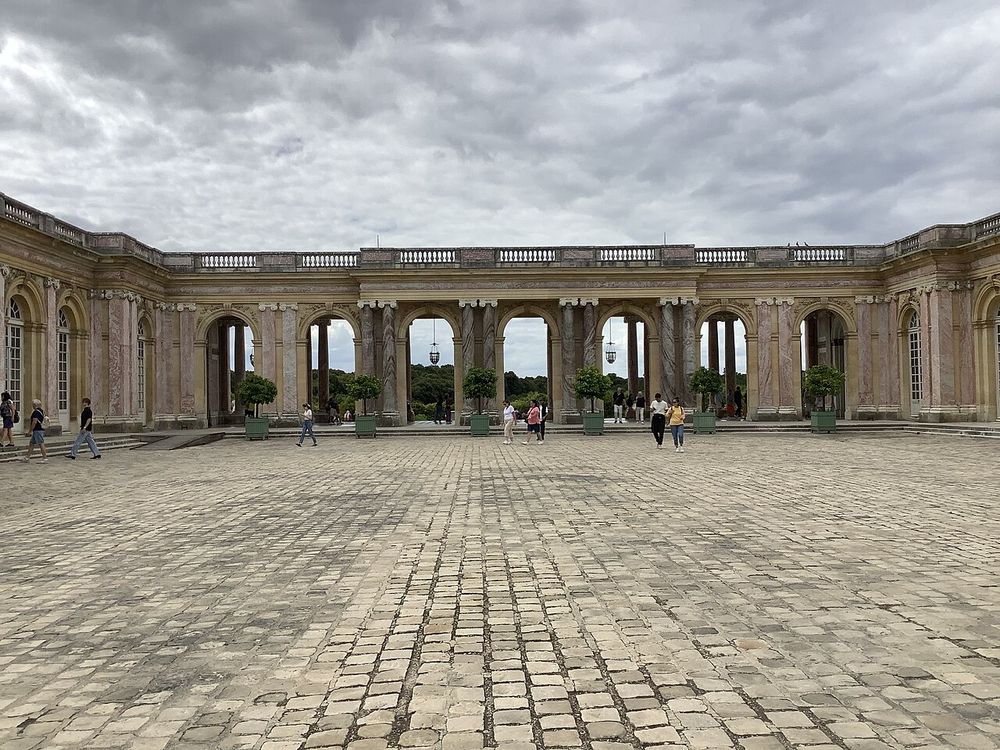
The Grand Trianon and its open colonnadeDiscoA340, CC BY-SA 4.0
Even the king needed to get away from Versailles. In 1670 he built a pavilion at the far side of the park, faced with blue and white tiles in imitation of Chinese porcelain. The tiles cracked in the frost. In 1687 he replaced it with the Grand Trianon, a low palace of pink marble, where he dined with people he chose.
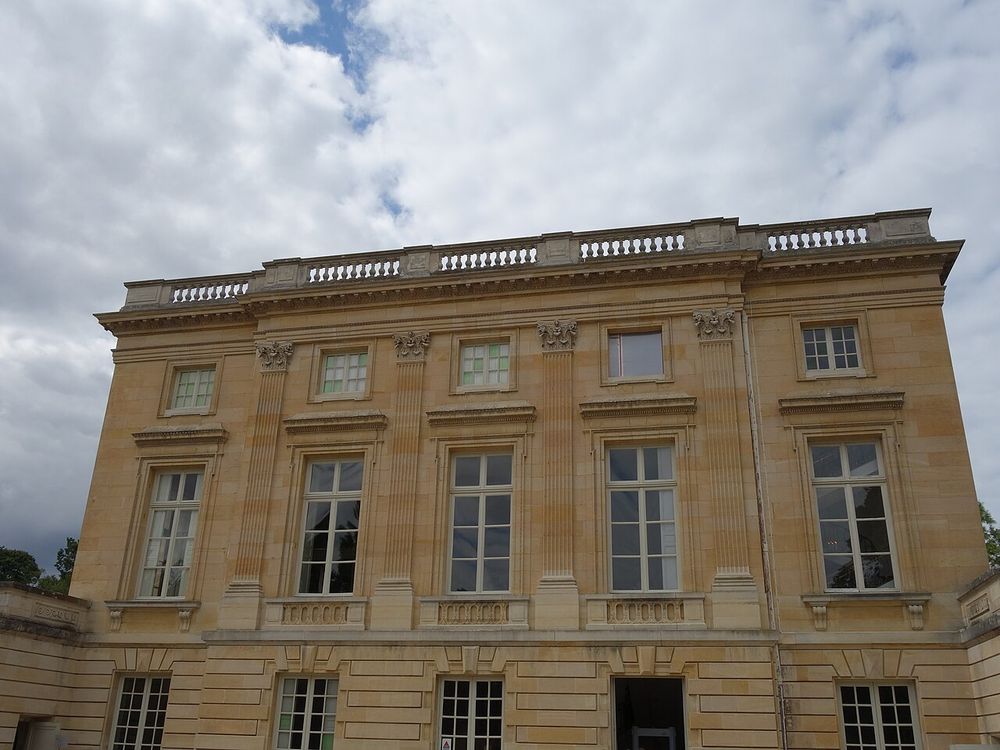
The garden front of the Petit TrianonMoonik, CC BY-SA 3.0
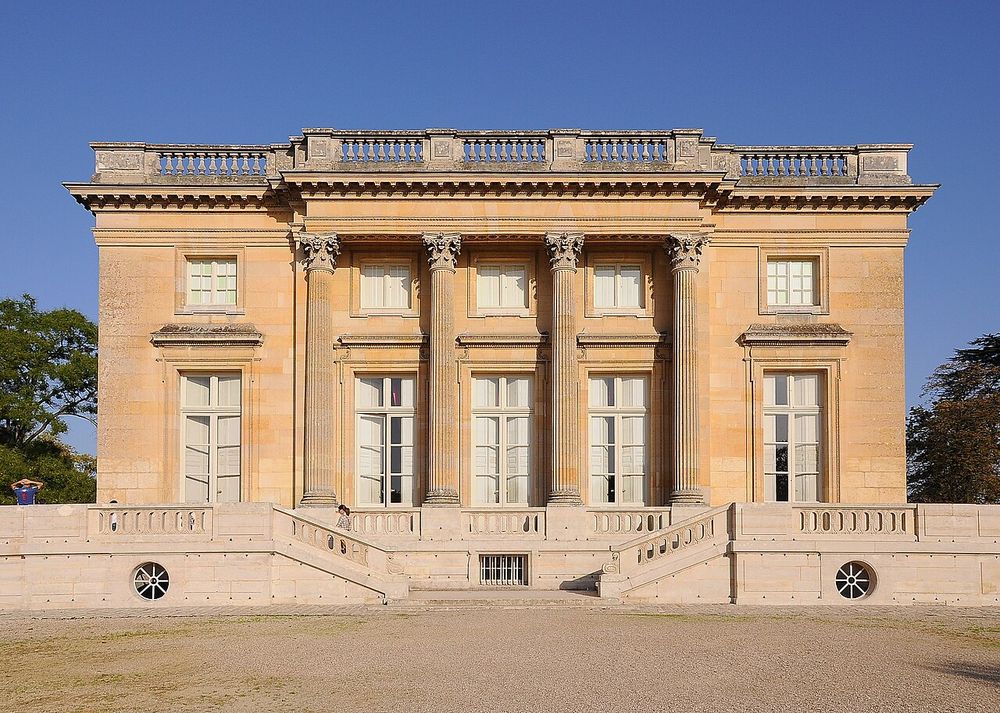
The Petit Trianon, a perfect cube of pale stone, was built in the 1760s. Louis XVI gave it to Marie-Antoinette, and it became the one place where she gave the orders. Nobody came without her invitation, not even the king.
A cottage of the Queen's HamletMoonik, CC BY-SA 3.0
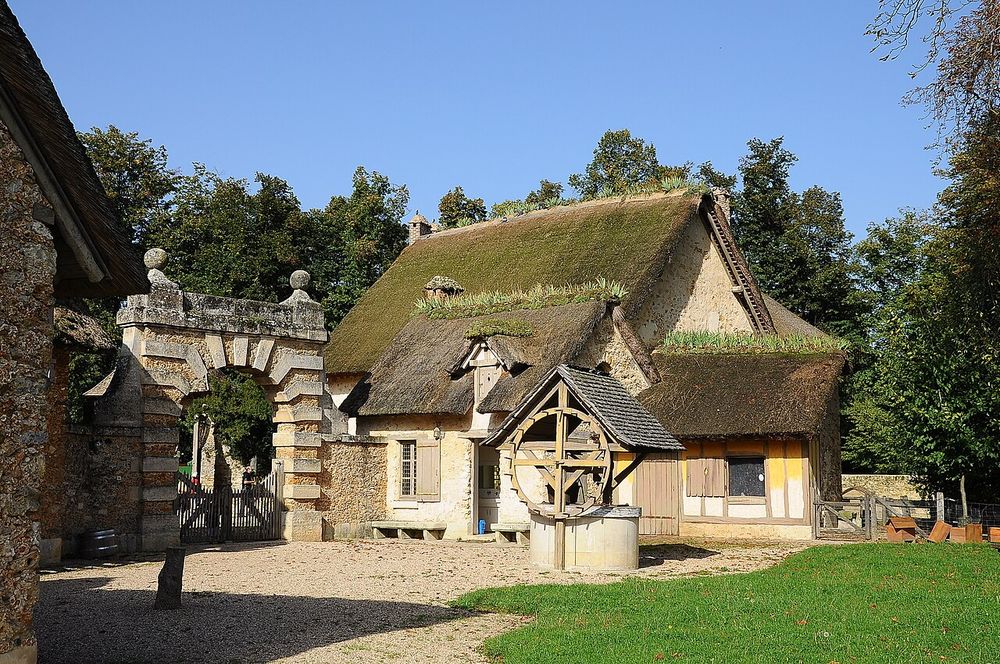
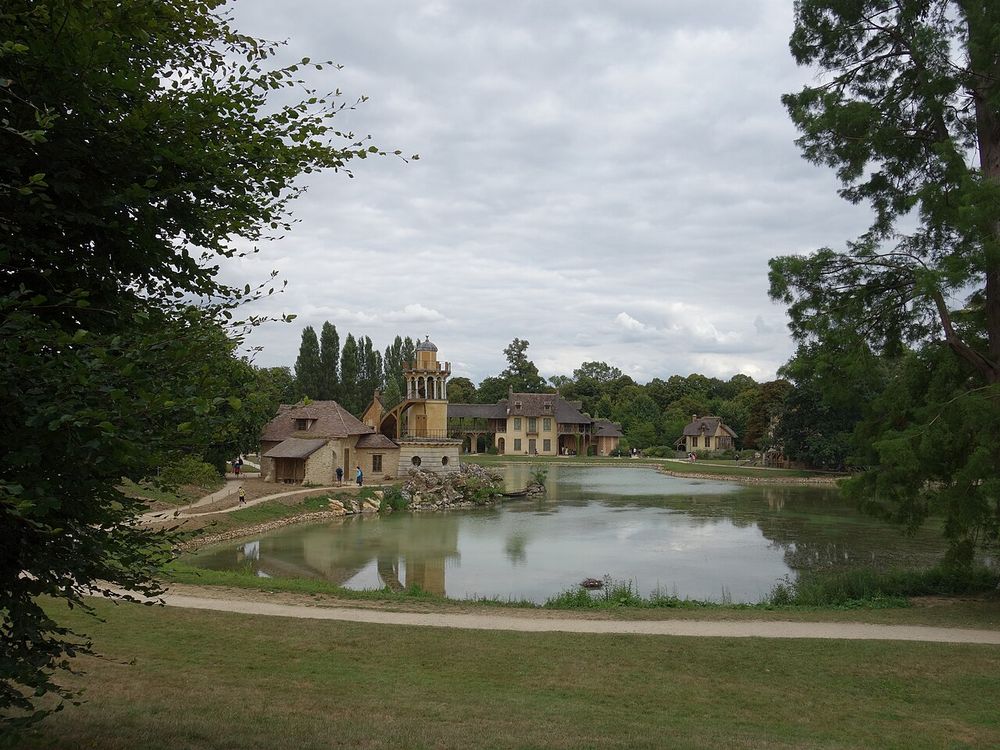
Beyond it, round a pond, she had a village built in 1783: a mill, a dairy, a dovecote, a farm with real cows. The cottages were painted with cracks to look old. Pamphlets in Paris made it a symbol of a queen playing shepherdess while people went hungry.
Meanwhile in the world
Year
Here
Elsewhere
1623
Louis XIII builds a hunting lodge
The last decades of the Ming dynasty (1368–1644); the Mayflower landed three years ago
1661
Louis XIV, aged 22, begins to rule in person and starts the gardens
The Kangxi emperor comes to the throne in Beijing, aged six
1682
The court and government move in
Peter the Great becomes tsar; Newton is at work on gravity
1685
Louis sends six Jesuit mathematicians to the court of Kangxi
They reach Beijing in 1688 and teach the emperor geometry
1715
Louis XIV dies after 72 years on the throne
Kangxi has seven years to live; he will have reigned 61
1789
The crowd takes the king to Paris
The Qianlong emperor is in his 54th year; Washington becomes president
1837
King Louis-Philippe reopens the palace as a museum of French history
Victoria becomes queen; two years before the Opium War
1919
The treaty ending the First World War is signed in the Hall of Mirrors
The May Fourth Movement in China; the Chinese envoys refuse to sign
Then and now
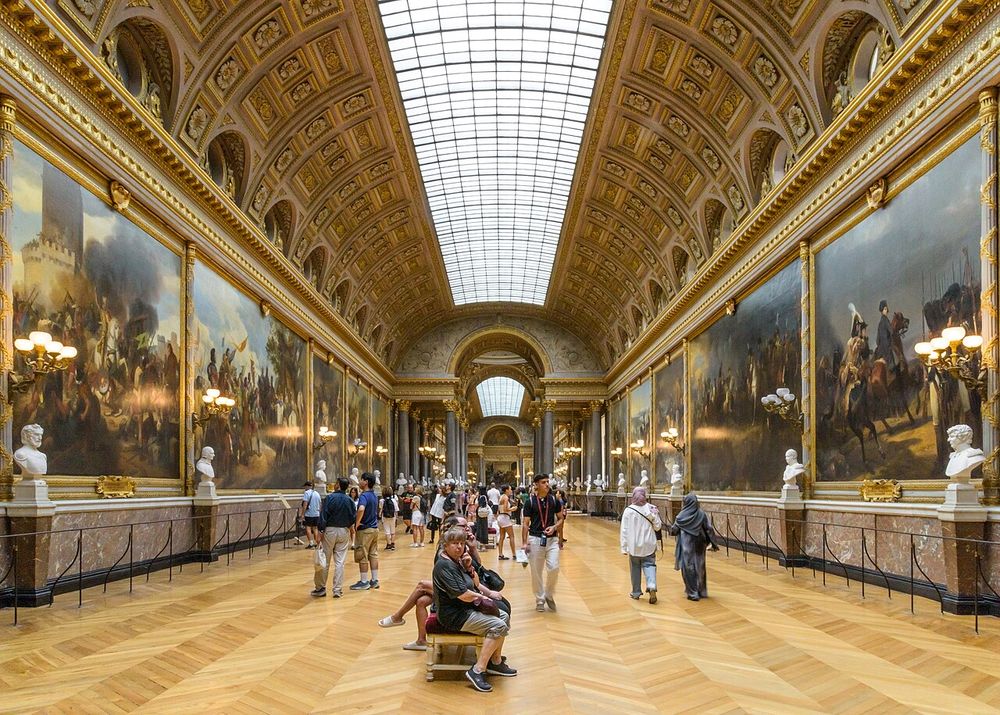
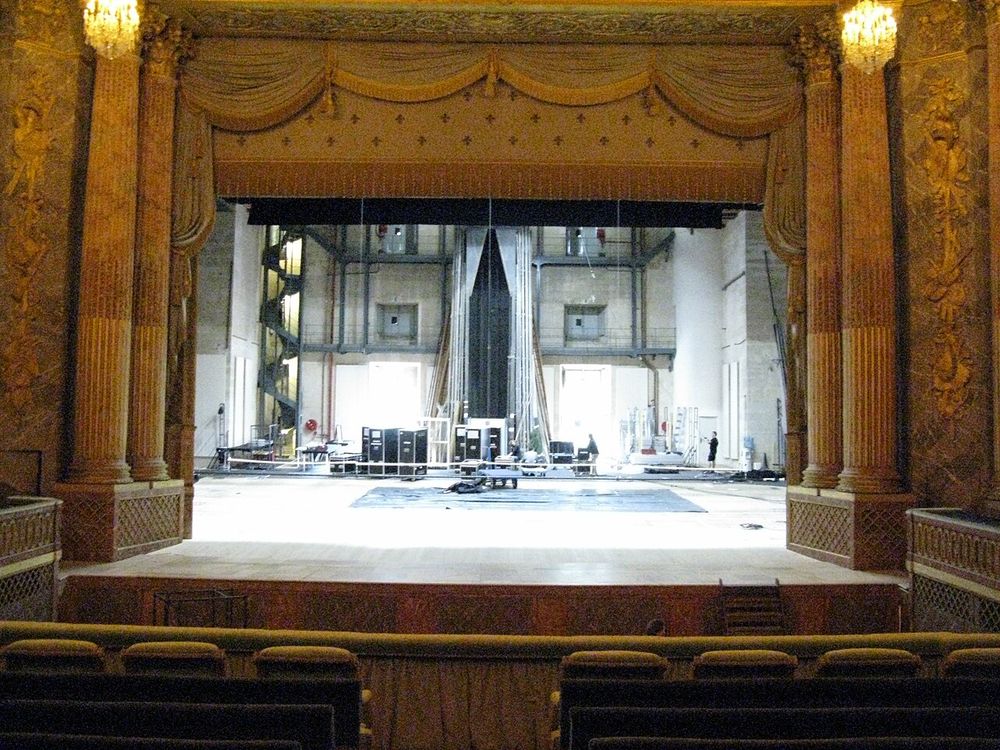
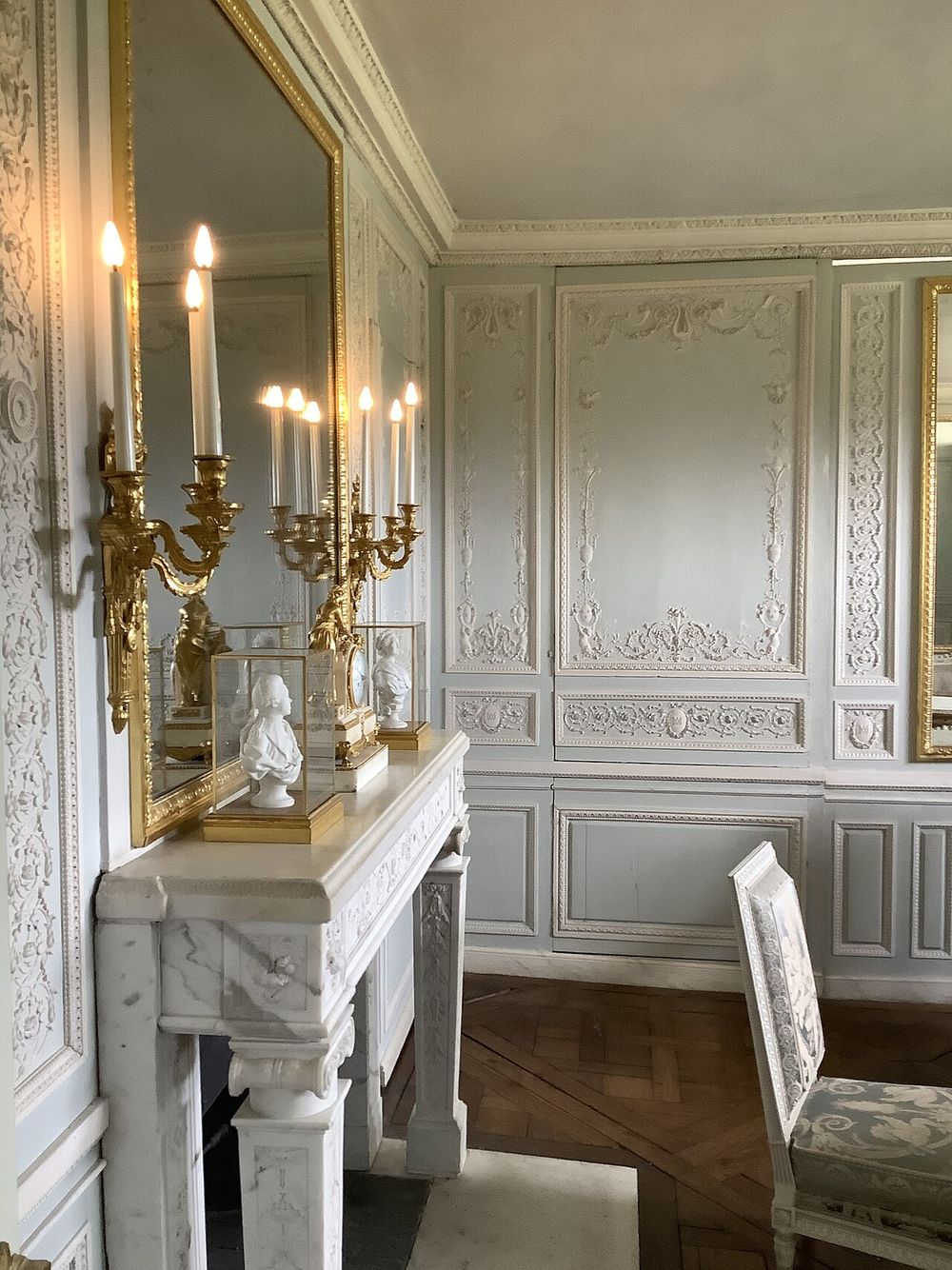
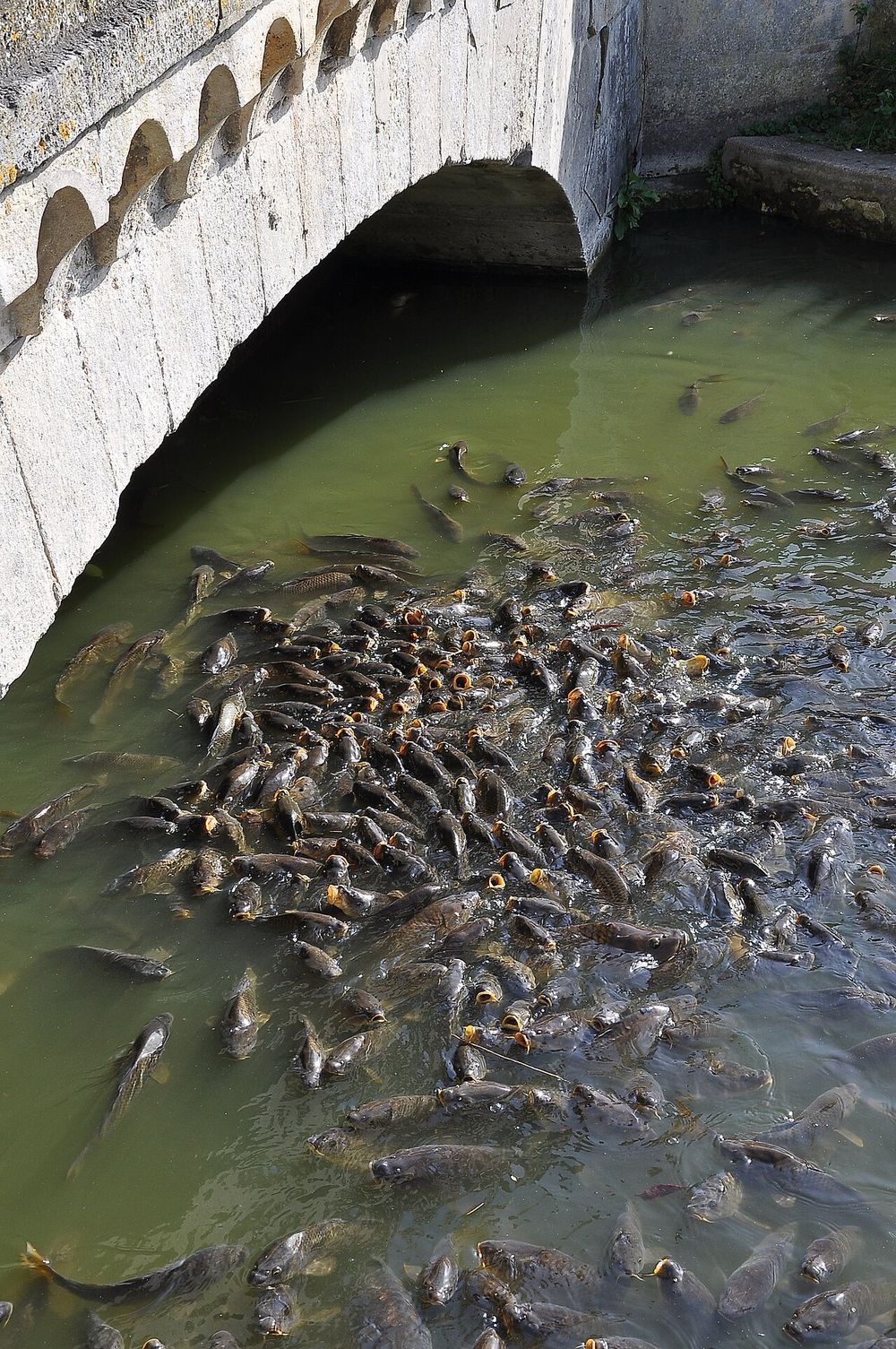
The palace, the town and the start of the garden axis from the air, 2024HerRobin, CC0, Wikimedia CommonsThe Grand Canal and the park from the airLike tears in rain, CC BY-SA 3.0, Wikimedia CommonsThe Marble Court, the core of Louis XIII's houseScareCriterion12, CC BY-SA 4.0, Wikimedia CommonsThe gilded gate, remade in 2008Sunil.phys, CC BY-SA 3.0, Wikimedia CommonsThe crown and the arms of the king on top of the gateJebulon, CC0, Wikimedia CommonsThe Royal Chapel, finished in 1710Diliff, CC BY 2.5, Wikimedia CommonsThe chapel from the upper gallery, where the king satJulian Lupyan, Public domain, Wikimedia CommonsThe chapel organJebulon, CC0, Wikimedia CommonsThe Hall of MirrorsMyrabella, CC BY-SA 3.0, Wikimedia CommonsOne of the ceiling paintings in the Hall of MirrorsLivioandronico2013, CC BY-SA 4.0, Wikimedia CommonsGilded trophies above the cornice of the Hall of MirrorsJebulon, CC0, Wikimedia CommonsThe Gallery of Battles, added in 1837Julian Lupyan, Public domain, Wikimedia CommonsThe stage of the Royal OperaGNUtoo, CC BY-SA 3.0, Wikimedia CommonsThe Latona fountainCoyau, CC BY-SA 3.0, Wikimedia CommonsThe garden axis from the terrace: the Latona fountain, the lawn, the canalPaolo Costa Baldi, CC BY-SA 3.0, Wikimedia CommonsThe basin of Apollo, with the canal beyondHeidi Meudt, CC BY 4.0, Wikimedia CommonsApollo's chariot rising from the waterGary Todd from Xinzheng, China, CC0, Wikimedia CommonsThe Grand CanalGFreihalter, CC BY-SA 3.0, Wikimedia CommonsThe canal seen from the garden, with visitors on the bankCristian Bortes from Cluj-Napoca, Romania, CC BY 2.0, Wikimedia CommonsThe Orangery and its trees in boxesNono vlf, CC BY-SA 4.0, Wikimedia CommonsThe Orangery parterre from aboveSamRushing, CC BY-SA 4.0, Wikimedia CommonsThe clipped patterns of the Orangery parterreCristian Bortes from Cluj-Napoca, Romania, CC BY 2.0, Wikimedia CommonsThe Grand Trianon and its open colonnadeDiscoA340, CC BY-SA 4.0, Wikimedia CommonsA room in the Grand TrianonDiscoA340, CC BY-SA 4.0, Wikimedia CommonsThe Petit TrianonDiscoA340, CC BY-SA 4.0, Wikimedia CommonsThe garden front of the Petit TrianonMoonik, CC BY-SA 3.0, Wikimedia CommonsThe Queen's Hamlet across its pondDiscoA340, CC BY-SA 4.0, Wikimedia CommonsA cottage of the Queen's HamletMoonik, CC BY-SA 3.0, Wikimedia CommonsCarp under a bridge at the HamletMoonik, CC BY-SA 3.0, Wikimedia CommonsThe palace in 1668, painted by Pierre PatelPierre Patel, Public domain, Wikimedia CommonsThe basin of Apollo in an engraving of the 1680sAdam Perelle, Public domain, Wikimedia CommonsThe Royal Opera on its opening night in 1770Jean-Michel Moreau, Public domain, Wikimedia CommonsThe basin of Apollo in a stereo photograph of the mid nineteenth centuryRijksmuseum, CC0, Wikimedia CommonsThe Gallery of Battles about 1895Photochrom Print Collection, Public domain, Wikimedia CommonsThe king's bedroom on an early postcardUnknown artistUnknown artist (Scan : Tylwyth Eldar), Public domain, Wikimedia CommonsThe Hall of Mirrors set out for the signing, 27 June 1919Lt. M.S. Lentz, Public domain, Wikimedia CommonsThe Hall of Mirrors in 1919Woodrow Wilson Presidential Library Archives from Staunton, VA, No restrictions, Wikimedia CommonsThe signing of the peace, 28 June 1919, painted by William Orpen (detail)William Orpen, Public domain, Wikimedia Commons
Video
Films from official channels, played from YouTube. Nothing is loaded until you press play.
The palace and park of VersaillesUNESCO · made with NHK; 2 min · checked 2026-11-12
Local legends
These are stories people tell about this place. They are legends, not history, and each one says where it comes from.
LegendThe poisoned glassmakers
Venice sent agents after the glassmakers who had gone over to France. Two of the best died suddenly within weeks of each other, poisoned, and the rest took fright and went home.
Source: Told in histories of the French mirror works since the eighteenth century; the deaths are recorded, the poison is not proved
LegendThe ladies who saw the queen
On 10 August 1901 two English schoolteachers walking near the Petit Trianon met people in old-fashioned dress and passed a fair-haired lady sketching on the grass. They decided afterwards that they had walked into the year 1789 and seen Marie-Antoinette.
Source: Charlotte Moberly and Eleanor Jourdain, An Adventure (1911)
LegendThe king who was never cold
Louis XIV ordered the windows of his rooms thrown open in every weather and never noticed the cold, while his family shivered in furs and the wine froze in the glasses at table.
Source: The letters of his sister-in-law, the Princess Palatine, who records the frozen wine in the winter of 1695
Later, people who live here will be able to add the stories they grew up with, and say which of these they have heard.
Not certain, and where accounts conflict
What did it cost?
The accounts survive and add up to about 100 million livres over fifty years. That was a few per cent of what the crown spent in those years, far less than its wars. The old claim that Versailles ruined France is not supported by the figures.
How many people lived here?
Estimates run from 3,000 to 10,000, depending on whether servants, soldiers and the town lodgings are counted. The palace itself had more than 200 apartments, and people fought for the worst of them.
Did workers die building it?
Yes. A hospital was set up for the works, and a court lady wrote in 1678 of carts carrying away the dead each night. The numbers are not known. Marsh fever among the soldiers digging the waterworks killed many more than accidents did.
Was the porcelain pavilion really Chinese?
Only in idea. Its builders had read of the porcelain tower of Nanjing and covered a French pavilion in Dutch and French tiles. No drawing of it by anyone who had seen China exists.
Visiting
Tickets and hours
The Passport costs 35 euros from April to October and 25 euros from November to March for visitors from outside the European Economic Area; residents of the Area pay 32 and 22 euros.
A Passport for entry late in the day is 28 euros in the high season and 18 in the low. The Trianon ticket alone is 15 euros.
Under 18s are free, and so are residents of the European Union under 26.
The palace is open from 9:00 to 18:30 from April to October and to 17:30 in winter. Trianon opens at 12:00. Both are closed on Mondays and on 1 January, 1 May and 25 December.
The gardens open every day at 8:00 and the park at 7:00. From 1 April to 1 November 2026 the gardens charge on days when the fountains play or music is on.
Last checked 2026-11-12. The palace's own English site (en.chateauversailles.fr), ticket pages opened in November 2026.
Booking from abroad
Official page in English The palace sells tickets on its own site, in English, for a set entry time, and takes foreign bank cards: ticket.chateauversailles.fr.
Ticket window on site Tickets are also sold at the palace on the day, but the queue to buy and then the queue to enter can take two or three hours in summer. The estate advises booking a time.
Note Entry to the palace is at the time on your ticket, within half an hour, at entrance A. Visitors who enter free (under 18; under 26 if resident in the European Union) still need to book a time.
Checked 2026-11-12
Where to start
From Paris, take the RER C train to Versailles Château Rive Gauche, about forty minutes, then walk ten minutes.
Book the 9:00 entry and go straight to the Hall of Mirrors. See the palace in the morning, the gardens at midday, and Trianon after it opens at 12:00.
Trianon is 1.5 kilometres from the palace: twenty-five minutes on foot, or a small train, a hired bicycle or an electric cart, all paid for separately.
Avoid Tuesdays, when many Paris museums are closed and everyone comes here, and weekends in summer.
Before you go
Allow a whole day and wear walking shoes. You will cover eight to ten kilometres.
Large bags and suitcases are not let in. There is a free cloakroom for small bags and pushchairs.
There is little shade in the gardens and few places to buy water once you leave the palace. Carry a bottle.
Pickpockets work the queues and the Hall of Mirrors. Keep your phone in front of you.
Customs and manners
In France, say "Bonjour" to the guard or the ticket seller before you ask anything.
Photographs are allowed without flash. Selfie sticks and tripods are not.
Do not sit on the furniture, lean on the mirrors or step over the ropes.
In the gardens, keep off the clipped lawns and do not picnic. Picnics are allowed in the park, by the canal.
Opening hours are given in the local time of the place. Prices are in the local currency. The figure after ≈ is approximate, at exchange rates checked on 9 November 2026, in .
Look for these
On the golden gate, find the sun with a face.
In the Marble Court, find the clock above the king's balcony. Who is holding it up?
In the Hall of Mirrors, count the windows on one side and the arches on the other.
On the ceiling of the Hall of Mirrors, find the king. What is he wearing on his head?
In the queen's bedroom, find the small door hidden in the wall by the bed.
At the Latona fountain, find a person who is half frog.
At the Apollo fountain, count the horses. Which way are they going?
At the Queen's Hamlet, find a wall with cracks that were painted on.
I am here
Stand at the site, sign in, press the button, and collect its stamp. Your browser will ask to use your location. It is sent to us once to confirm that you are at the site; we keep how far you were from it, not the spot where you stood.
Your stamps are saved to your account, so they follow you to any device. Checking from a browser cannot rule out every false location; stricter checks arrive with the app.
Messages
Share your photos
Photos here show the place, not people. Each one is credited to the visitor who took it and appears after our team has looked at it. A photo with you in it belongs under “I am here”.