An office block built in 1560 for the clerks of a duke, with his family's pictures hung on the top floor. The family died out in 1737. Its last member left everything to the city on one condition: that nothing should ever leave Florence.
Photo: Verum3414, CC BY 4.0, Wikimedia Commons
The story
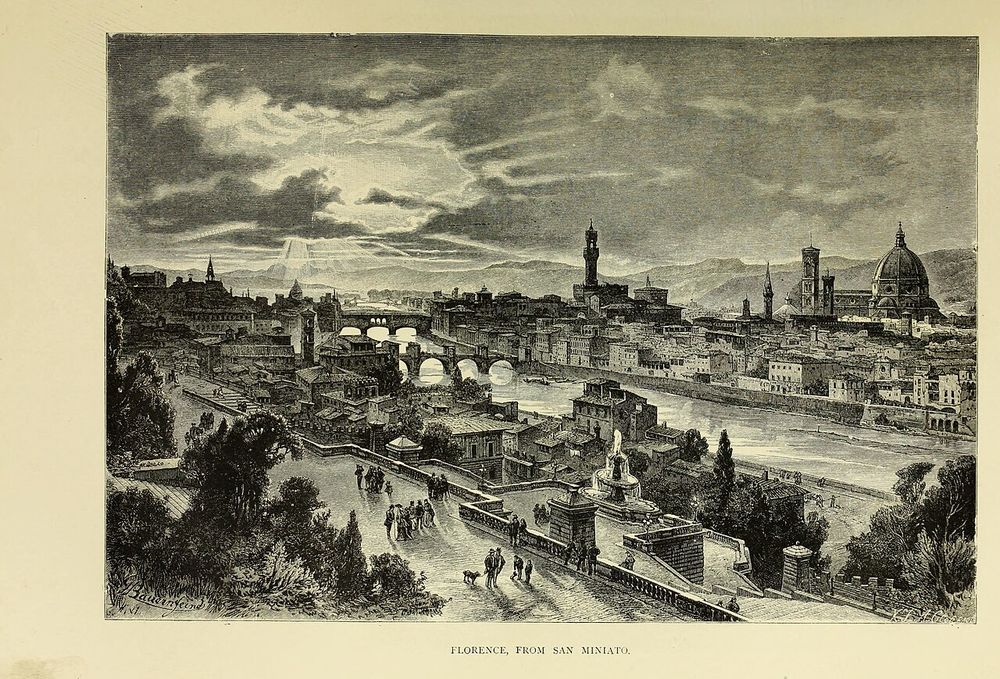
You are in a long narrow courtyard, more a street than a square, with the same grey columns and the same three floors of windows running down both sides. At one end is a tower with a clock. At the other, through an arch, is a river. Above you, behind the top row of windows, are fifty rooms of paintings.
The building was begun in 1560. In China it was the reign of the Jiajing emperor of the Ming (1368–1644); in England Elizabeth I had been queen for two years.
What is here
One ticket covers both floors of the gallery. The passage over the bridge is extra, and so are the palace and gardens across the river.
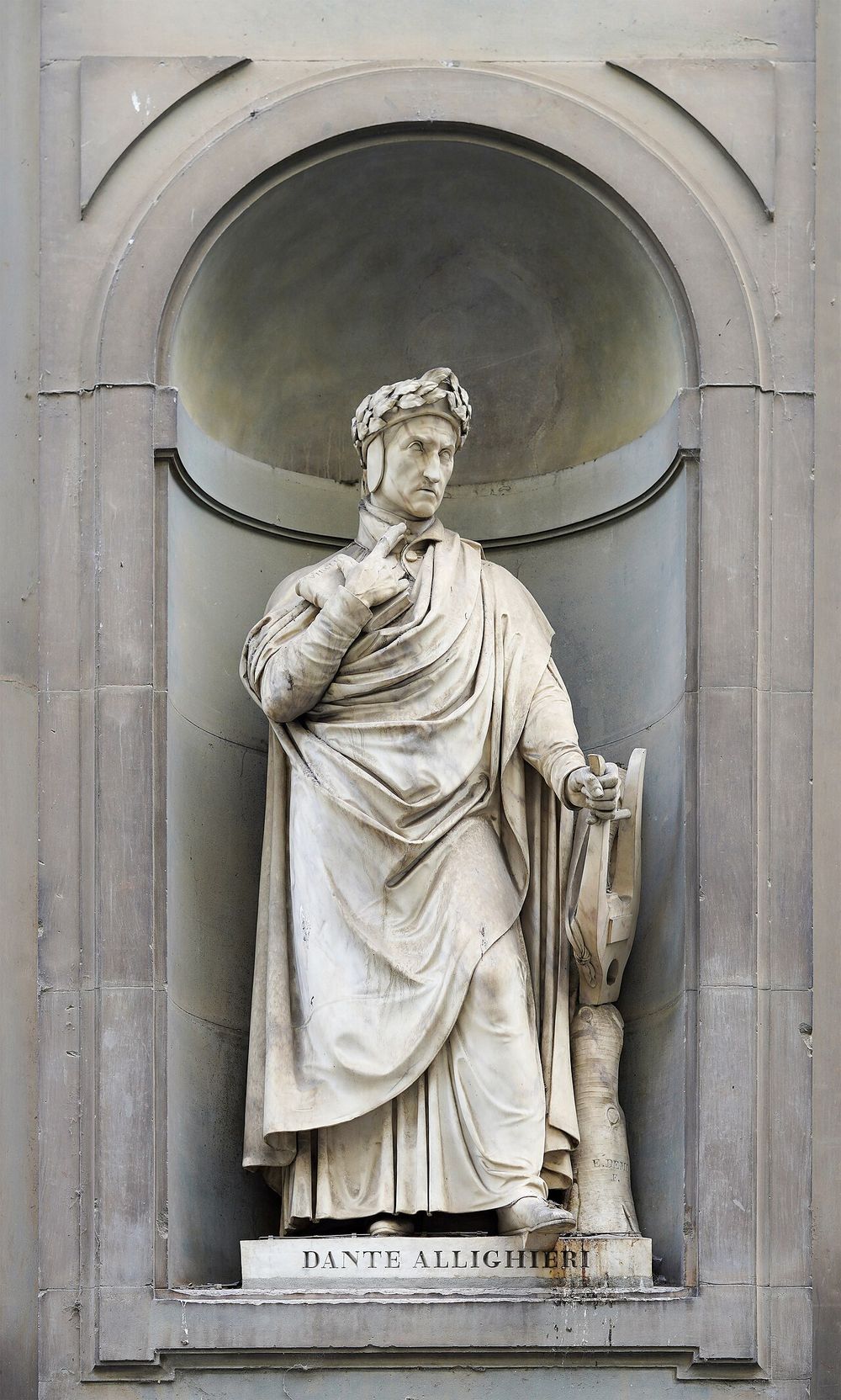
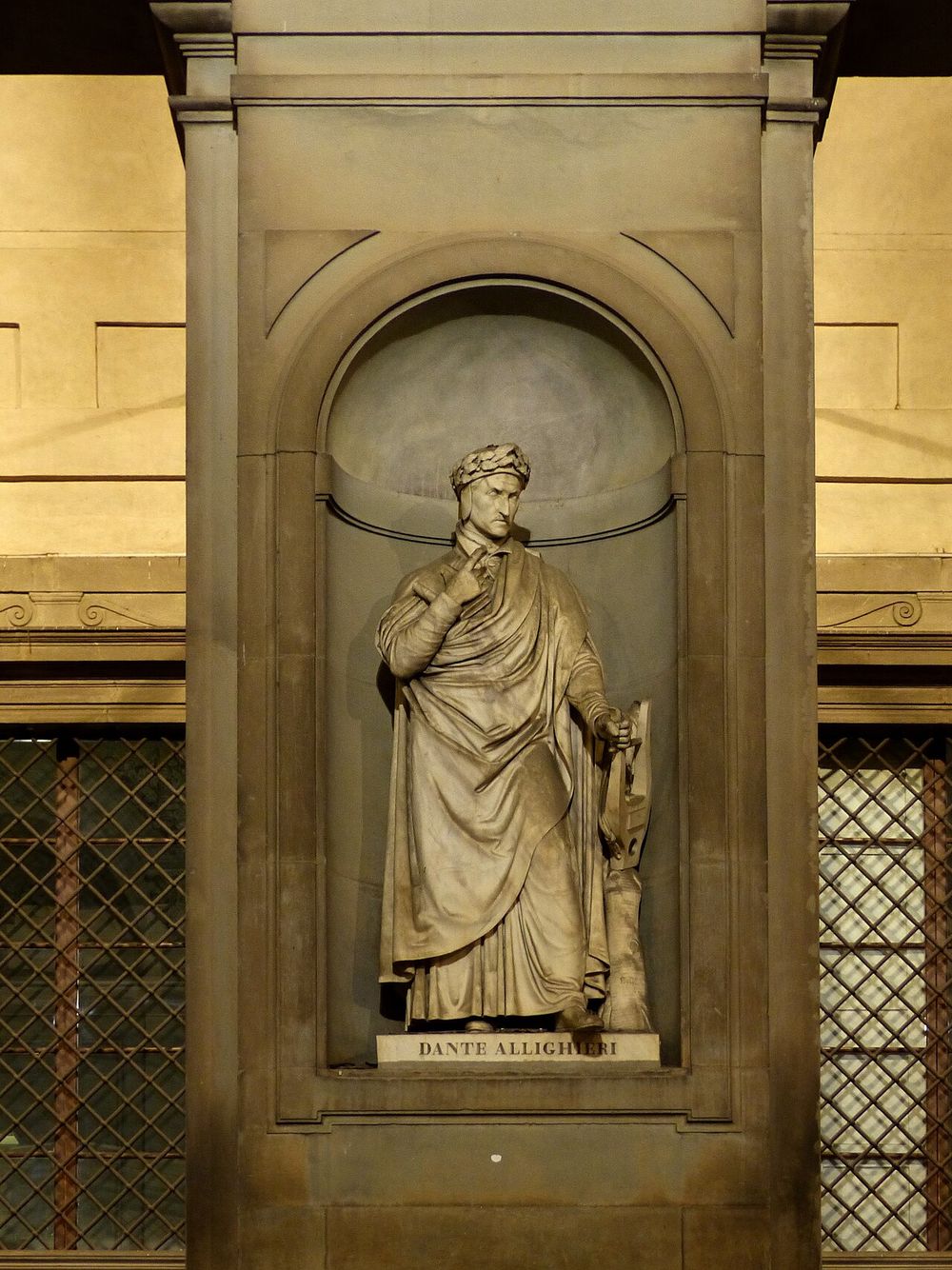
Dante, in a niche of the courtyardWikibusters, CC BY-SA 4.0
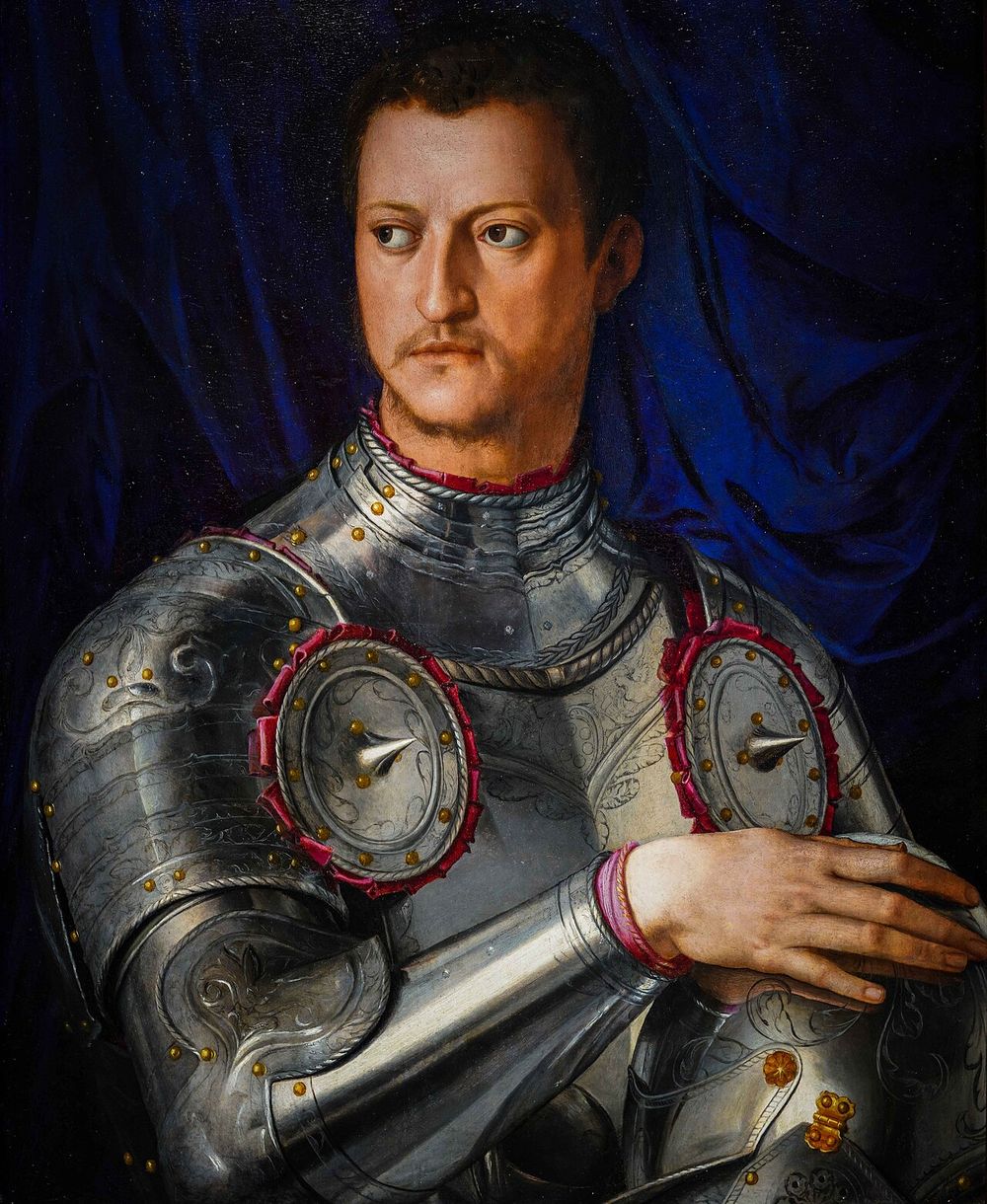
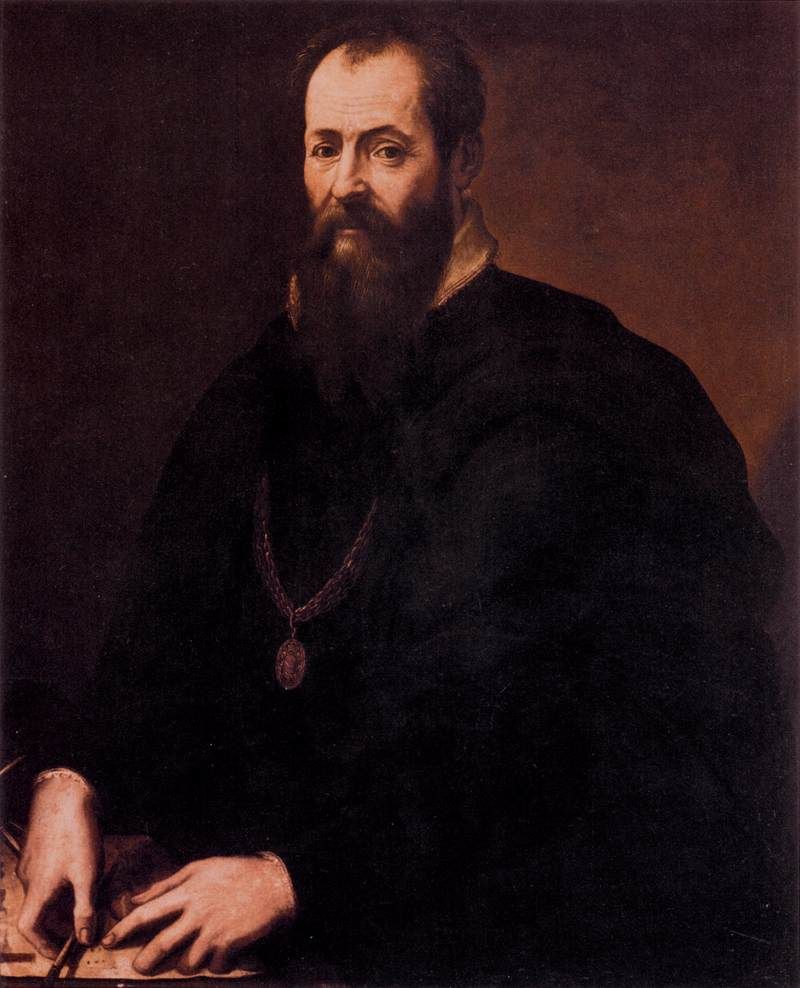
Uffizi means offices. Cosimo de' Medici, the first Grand Duke of Tuscany, wanted the thirteen departments that ran Florence under one roof, next door to his palace, where he could watch them. His architect was the painter Giorgio Vasari.
The Medici were bankers who had become princes. For three hundred years they had bought, ordered and been given the best paintings and statues in Italy. Cosimo's son moved the finest of them to the top floor of the offices in 1581, and let visitors in on request.
The last of the family, Anna Maria Luisa, had no children. In 1737 she signed a paper giving the whole collection to the state of Tuscany, "for the ornament of the state, the benefit of the people and to draw the curiosity of foreigners". None of it was to be moved from Florence. That is why it is still together.
Things people often get wrong
"It was built as a museum." It was built as offices. The state archive of Tuscany stayed in part of it until 1988.
"Michelangelo's David is here." David is in another museum, the Accademia, fifteen minutes' walk away. The Uffizi has the only finished painting on panel that Michelangelo ever made.
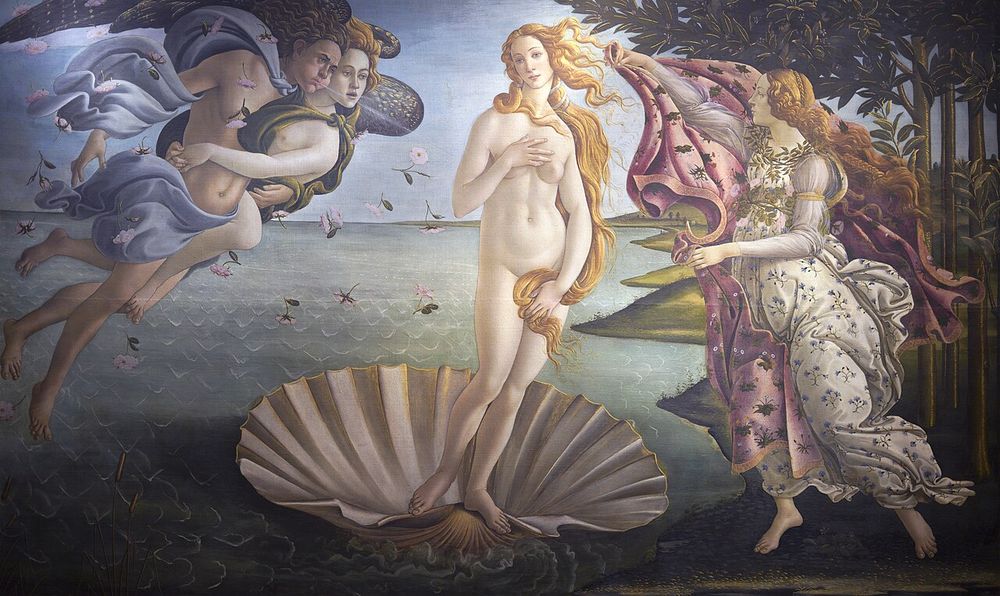
"Venus is being born." In the painting she has already been born, from the foam of the sea, and is being blown ashore.
"You can see it in an hour." There are more than a hundred rooms. Choose ten pictures and look at them properly.
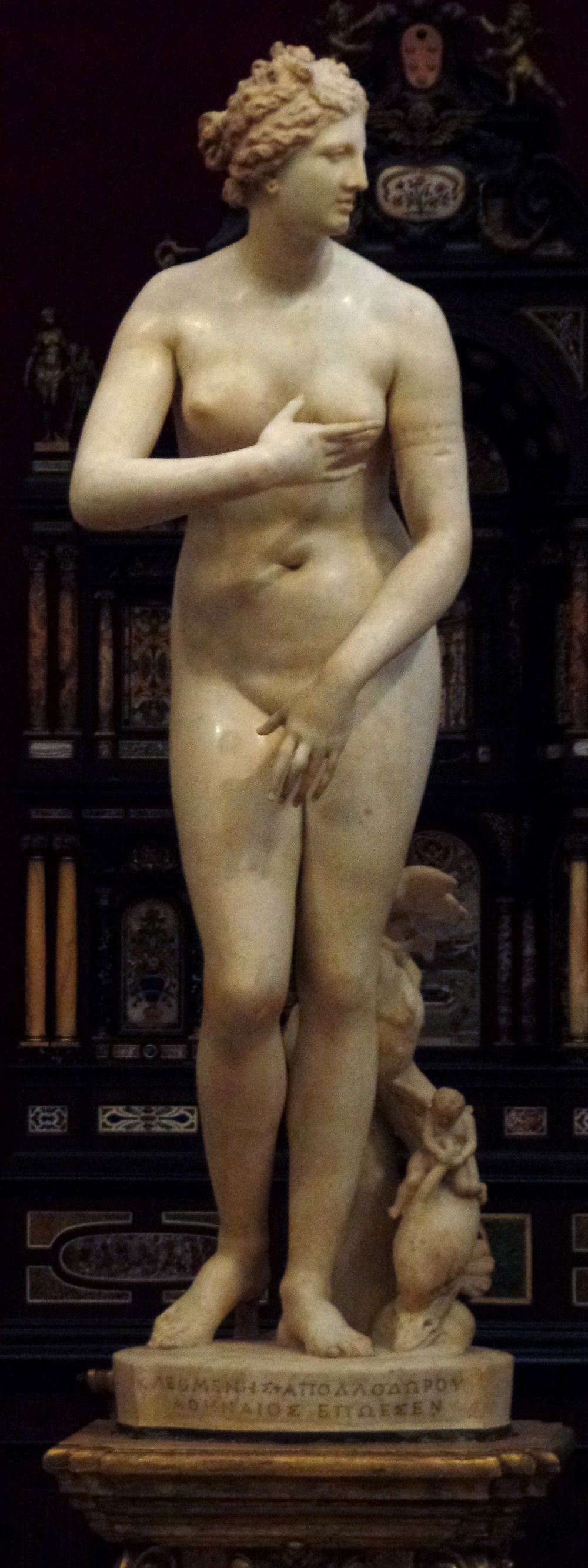
"Napoleon stole the collection." He took one statue, the Medici Venus, in 1803. It came back in 1815.
People who stood here
Napoleon (French general in 1796, later emperor)He came through Florence in the summer of 1796, aged twenty-six, at the head of the army that was stripping Italy of its art. He walked through the gallery with its director and stopped in front of the marble Venus. Tuscany was neutral, and for the moment he left her where she was.
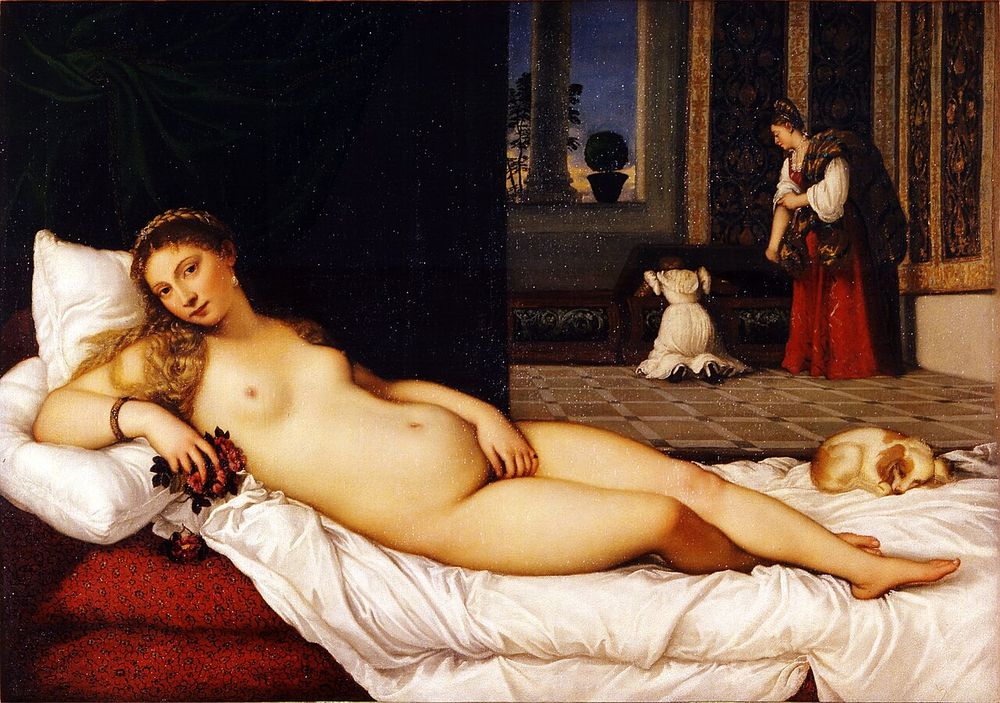
Mark Twain (American author of Tom Sawyer)He came in 1867 and again in 1878, and wrote that Titian's Venus was the vilest picture in the world, hung where any child could look at it, while he would be arrested for describing it in print. He was joking, and he was also right about the difference.
Go deeper: eight stops, from the courtyard to the window over the river
The route starts on the top floor and comes down. The stops follow it.
1. The courtyard
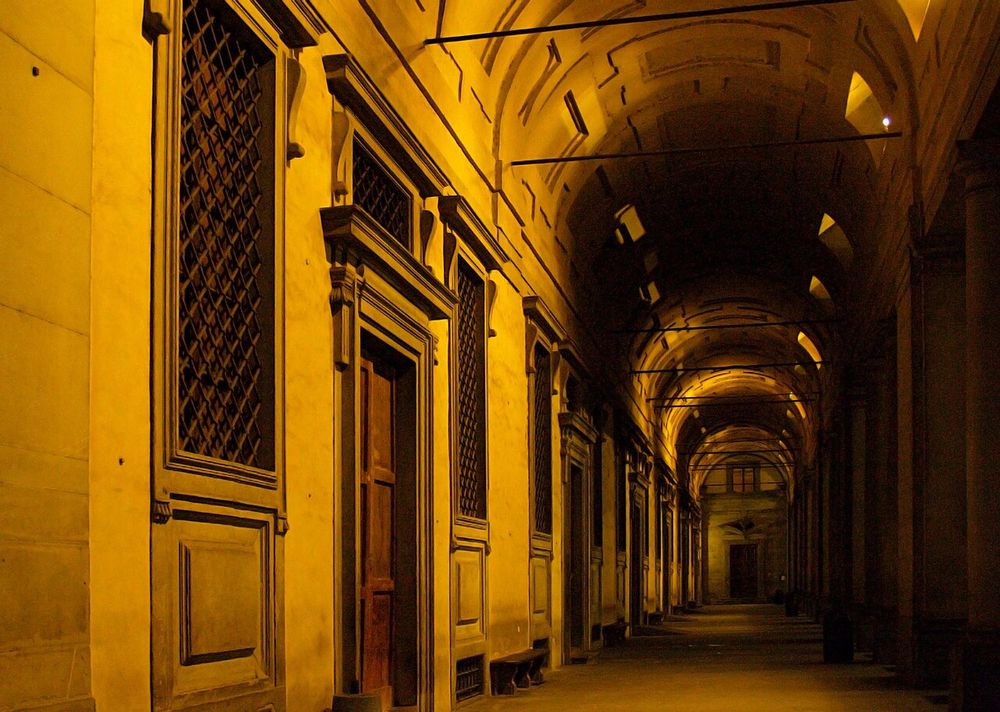
The colonnade of the courtyard at nightChi King, CC BY 2.0
Vasari had to pull down a whole quarter of old houses and most of a church to make room. The ground was river sand, so he set the building on a raft of masonry, and he used iron inside the stone to tie the long galleries together: one of the first times it was done.
The statues in the niches were added in the 1840s. They are the great men of Tuscany: Dante, Leonardo, Michelangelo, Galileo, Machiavelli, and Amerigo Vespucci, who gave his name to America.
2. The corridors
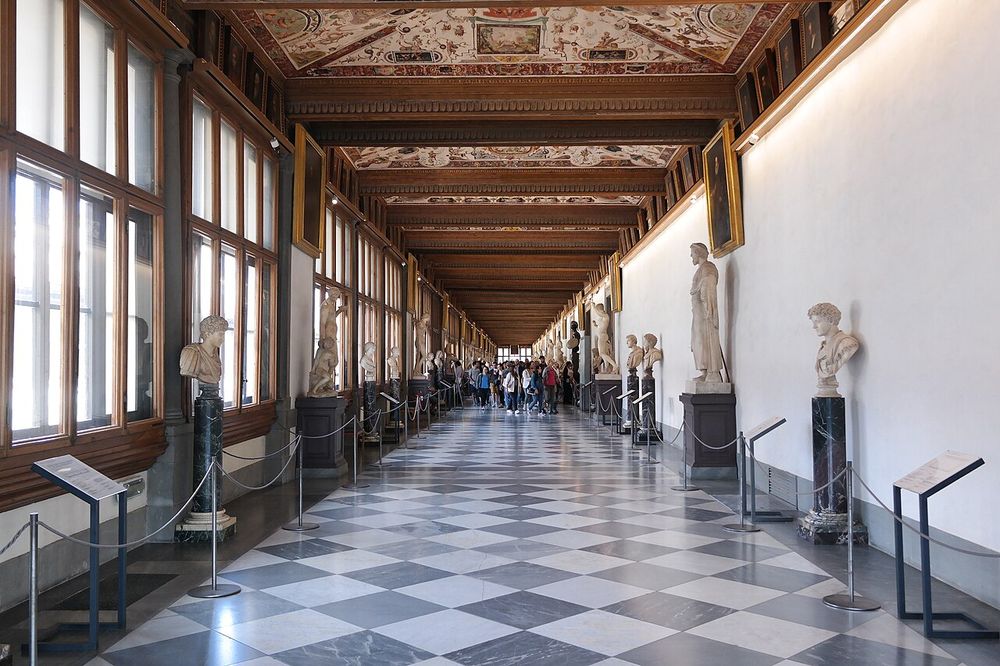
The first corridor, with its painted ceilingLuca Aless, CC BY-SA 4.0
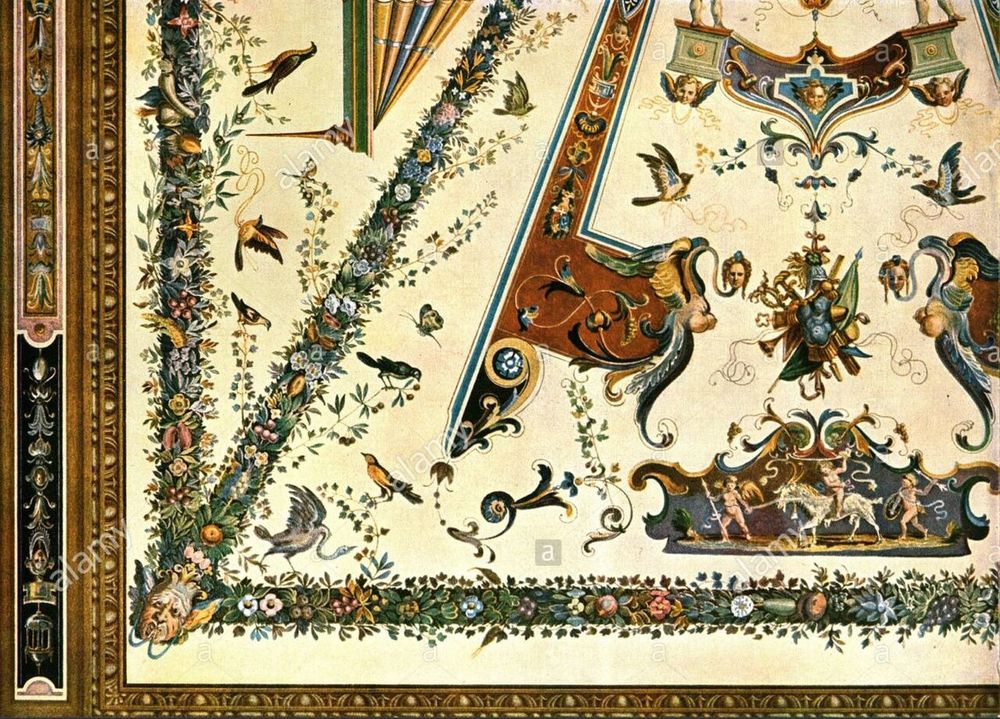
The top floor is three corridors in the shape of a U, with the rooms opening off them. The corridors were the first gallery. Look up: the ceilings were painted in the 1580s with small monsters, birds and garlands, copied from the buried rooms of a Roman emperor's palace.
The Roman statues along the walls were what visitors of the 1700s came to see. The paintings, to them, were second.
3. Three Madonnas
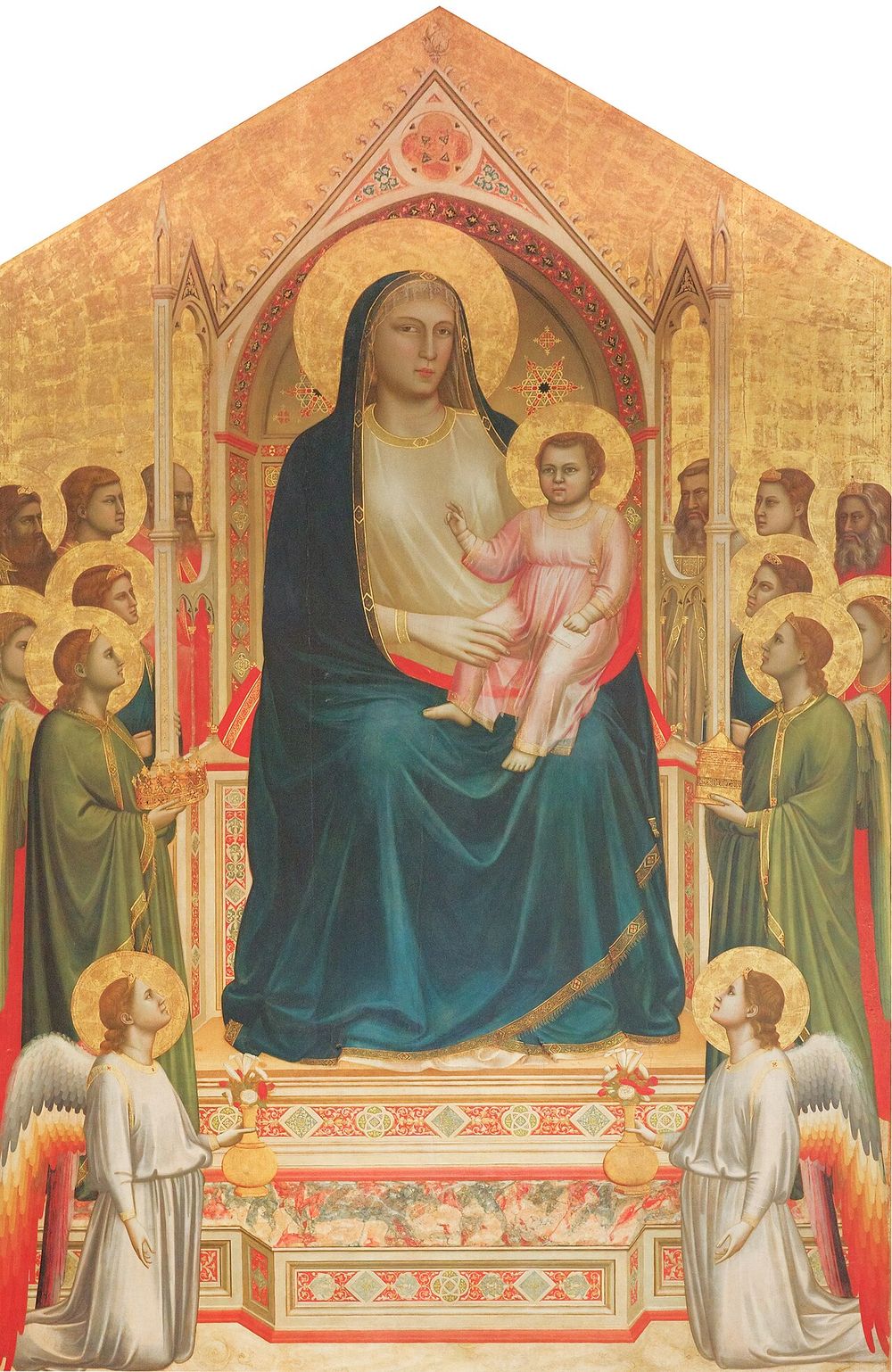
Giotto's Madonna, about 1310Giotto, Public domain
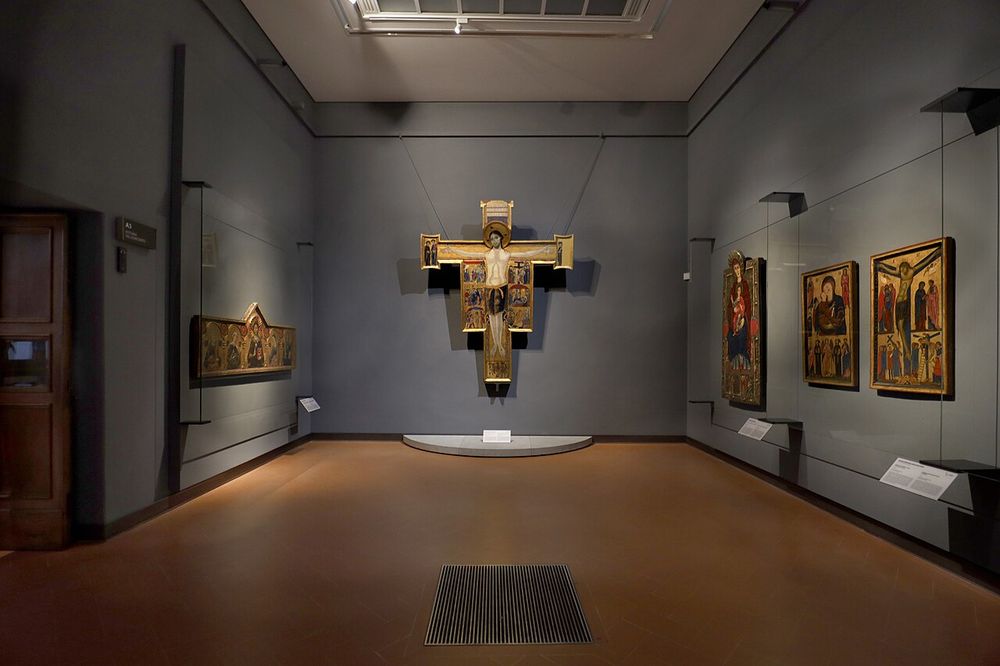
The second room holds three very large pictures of the same subject, the Virgin on a throne with her child, painted within thirty years of each other for three churches. The two older ones are flat patterns of gold.
In the third, by Giotto, about 1310, the throne has depth. You can see into it. The Virgin has weight, and knees under her dress. European painting turns a corner in this room.
4. The duke with half a nose
The Duke and Duchess of Urbino, by Piero della FrancescaPiero della Francesca, CC BY-SA 4.0
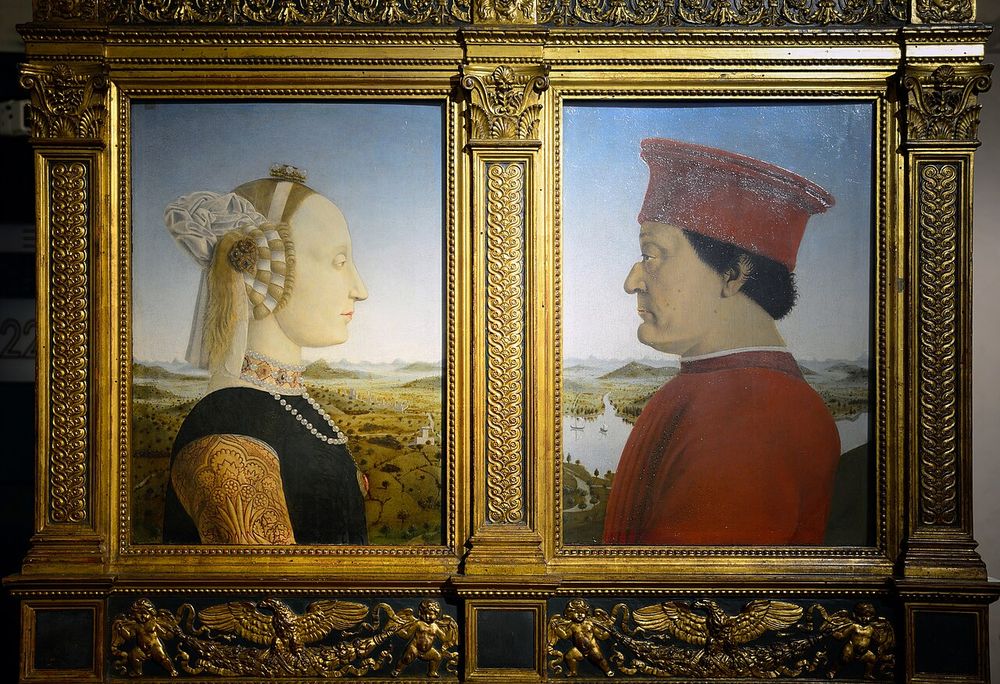
Two small panels face each other like the pages of a book: a man in red and a woman in pearls, both exactly in profile, with a wide country behind them. He is Federico, Duke of Urbino, a soldier who hired himself and his army to whoever paid.
He is always painted from the left. He lost his right eye in a tournament, and had the bridge of his nose cut away so that his good eye could see across it. The duchess is pale because she was dead when the picture was made.
5. Botticelli
Botticelli's Spring, about 1480Sandro Botticelli, Public domain
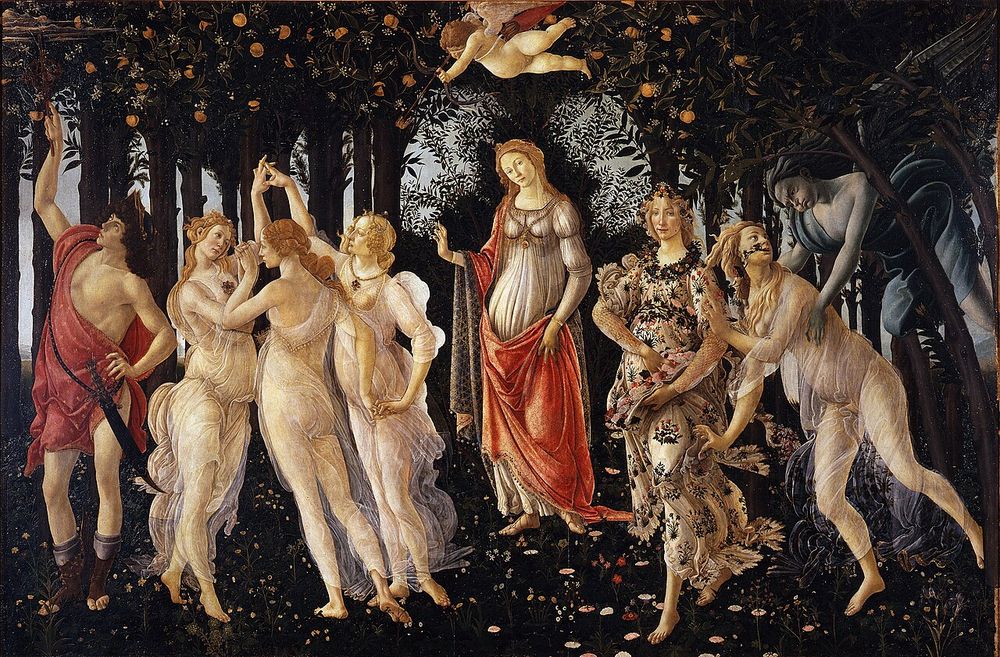
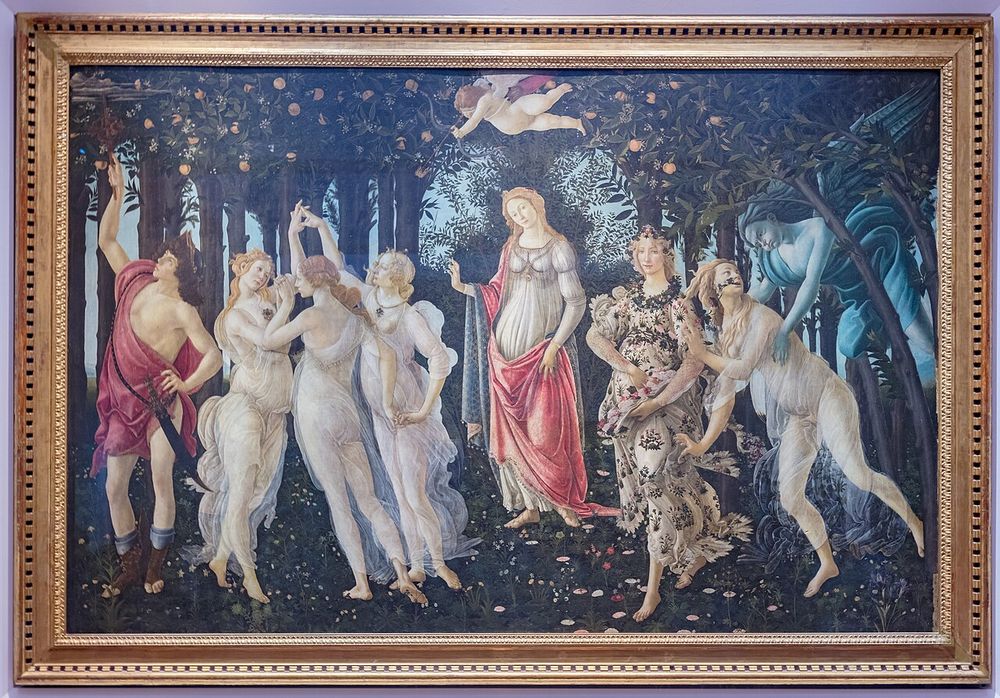
Spring, painted about 1480, was made for a Medici bedroom. Nine figures stand in an orange grove with a carpet of flowers at their feet. Botanists have named about a hundred and ninety kinds of flower in it, most of which bloom near Florence in March.
Botticelli's Birth of Venus, about 1485Sandro Botticelli, Public domain
The Birth of Venus came a few years later. It is on canvas, which was then used for flags and stage sets, not for serious pictures. The goddess is the first large naked woman painted in Europe since the fall of Rome. Her neck is too long and her shoulder is impossible. Nobody has ever minded.
Botticelli was forgotten for three hundred years after his death. These two pictures hung in a country house until 1815.
6. The room of the shells
The TribunaArmin Kleiner, CC BY-SA 4.0
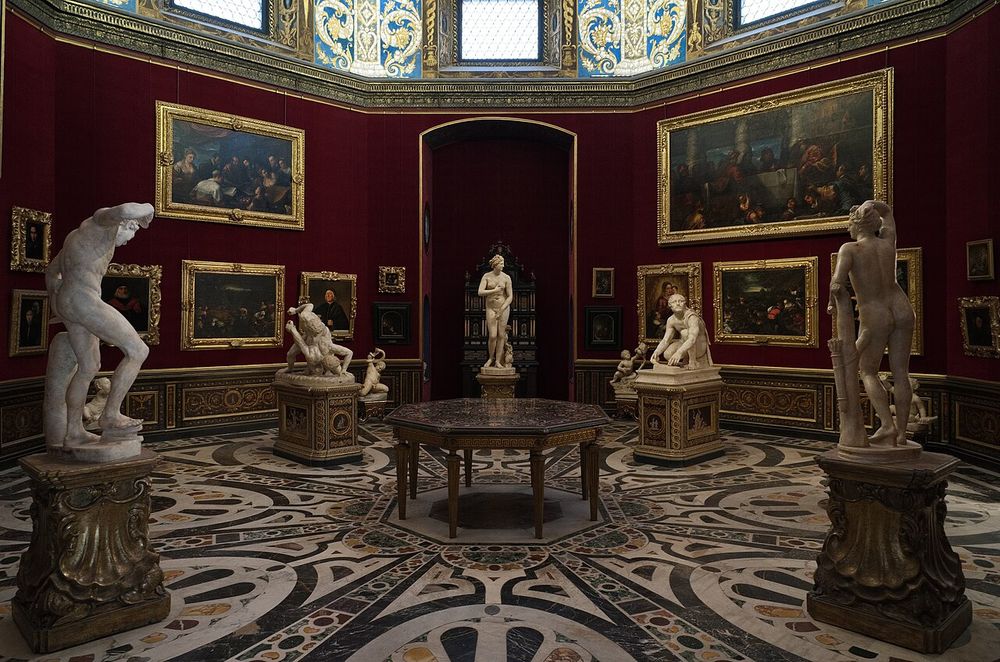
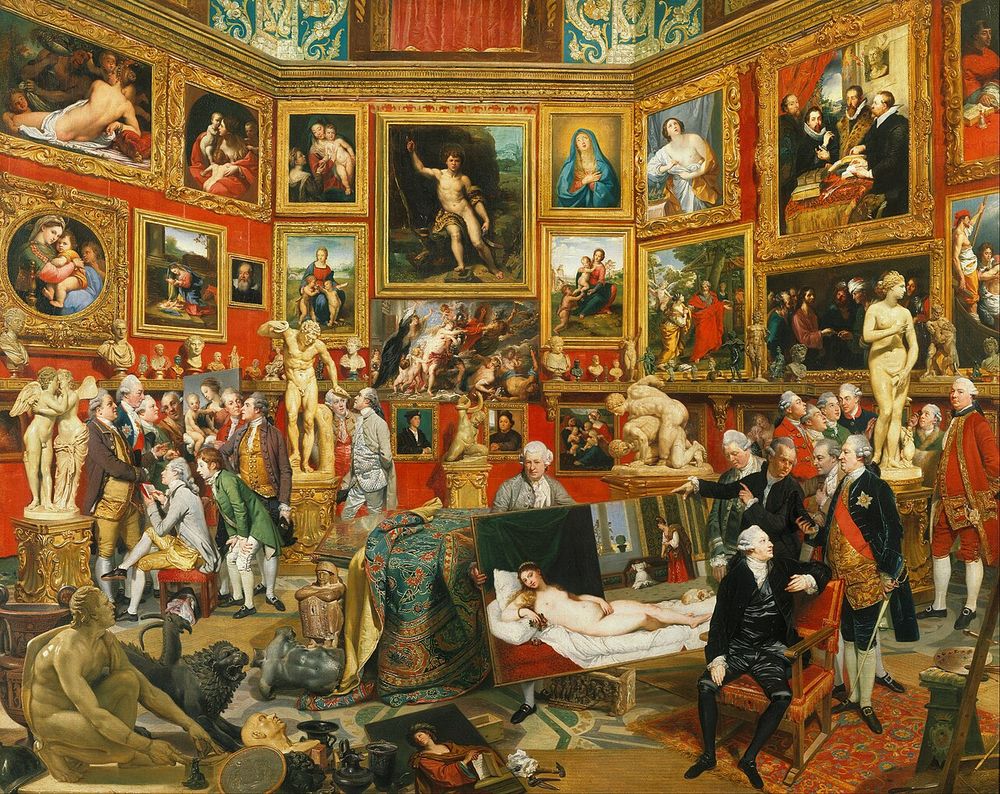
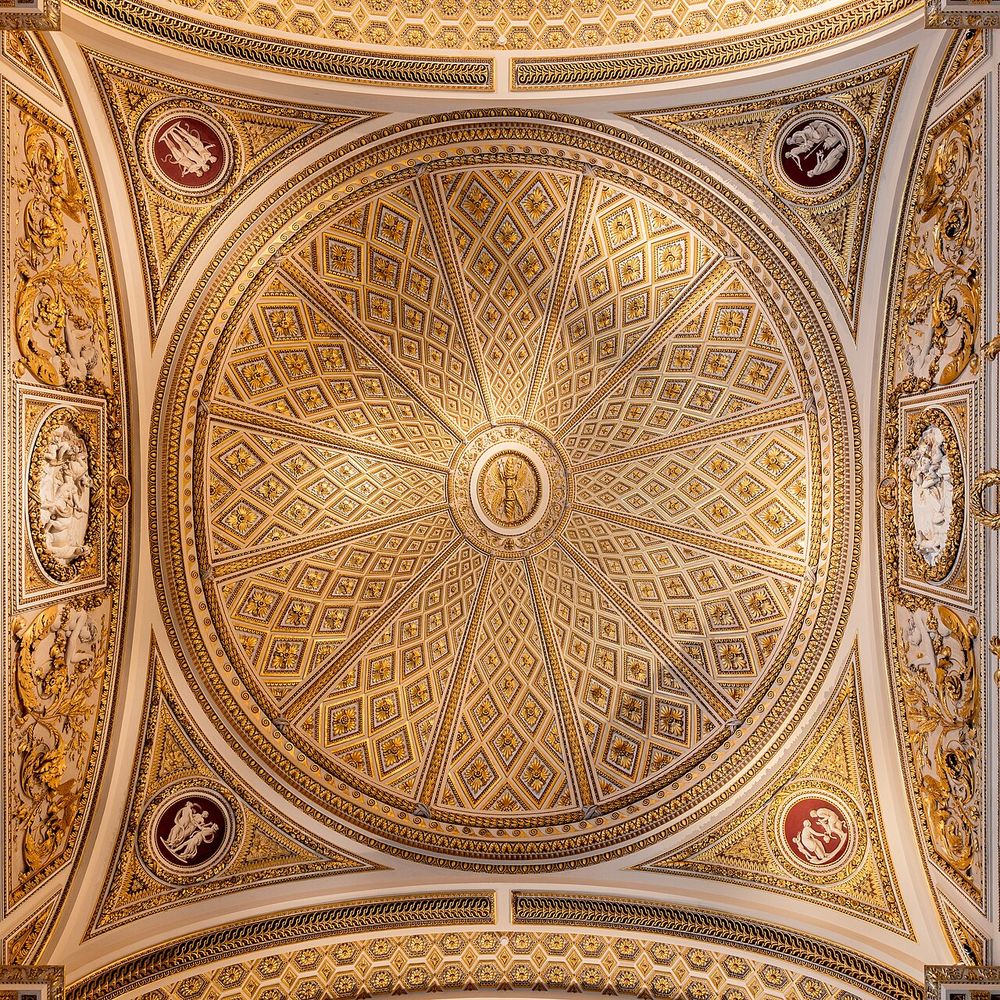
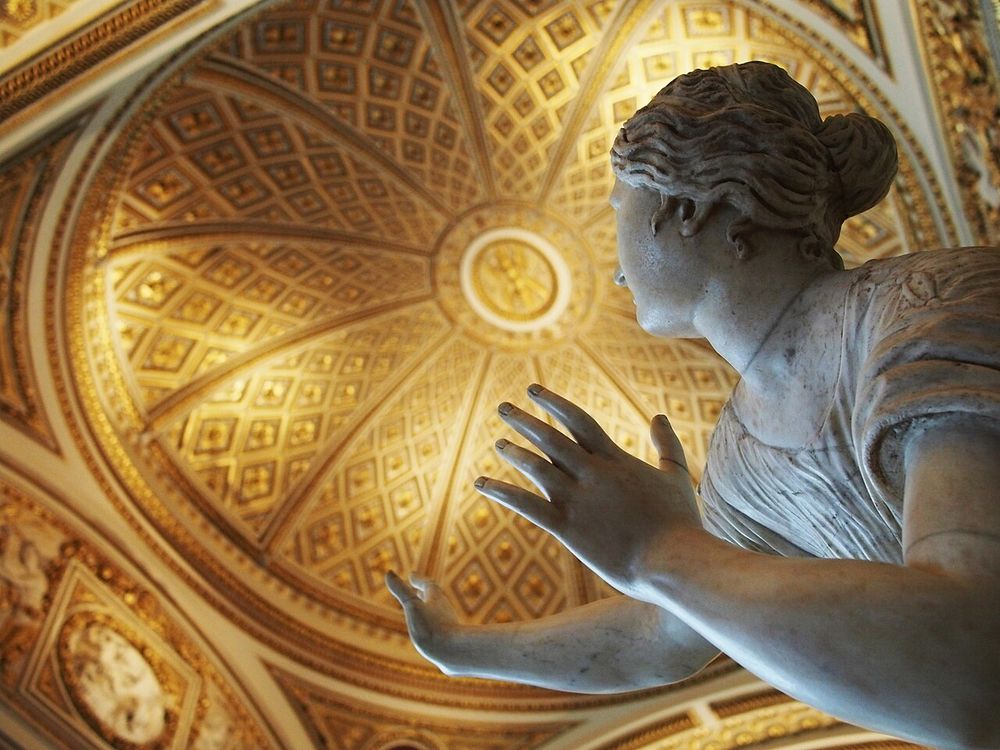
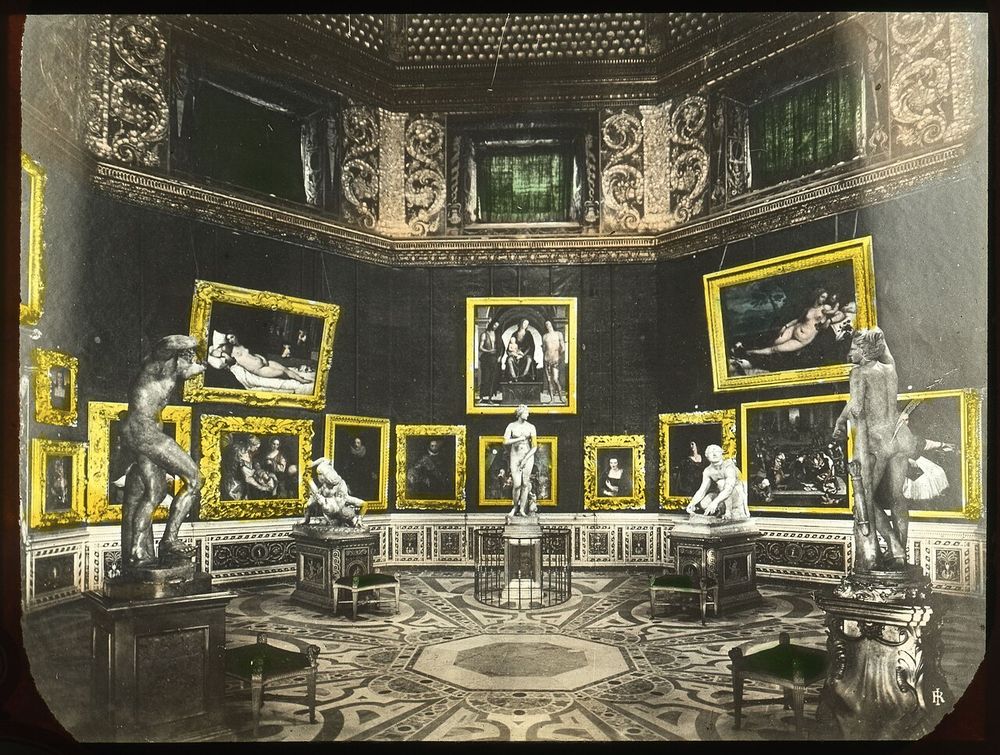
Halfway along the first corridor is an eight-sided room you may only look into. It was built in 1584 to hold the family's most precious things. The walls are red velvet. The dome is set with six thousand shells of mother-of-pearl.
The Tribuna crowded with English visitors, painted by Johan Zoffany in the 1770sJohann Zoffany, Public domain
For two centuries this was the most famous room in Europe. A painting of the 1770s shows it crowded with English gentlemen on their tour of Italy, peering at Venus through eyeglasses.
7. Leonardo, Michelangelo, Raphael
Leonardo's Annunciation, about 1472Leonardo da Vinci, Public domain
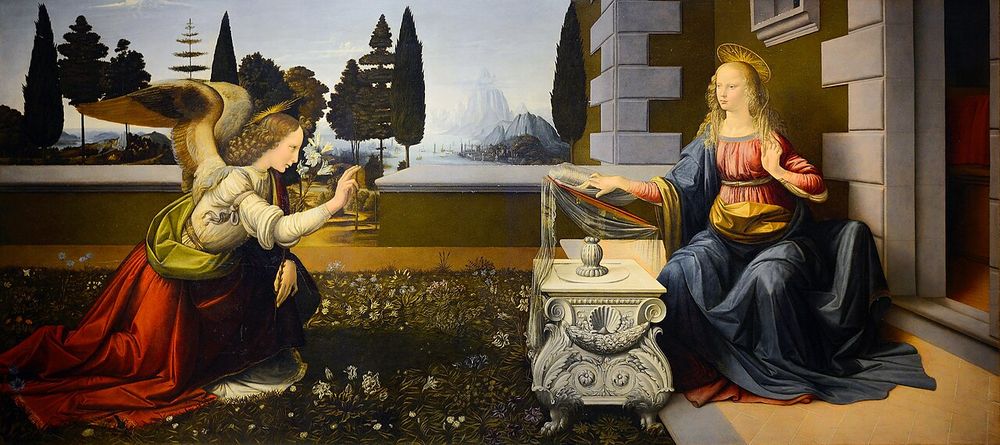
Leonardo painted the Annunciation at about twenty, still in his master's workshop. The angel's wings are a real bird's wings. The Virgin's right arm is too long: seen from the right and below, where the picture first hung, it comes right.
Michelangelo's Holy Family, in its first frameMichelangelo, Public domain
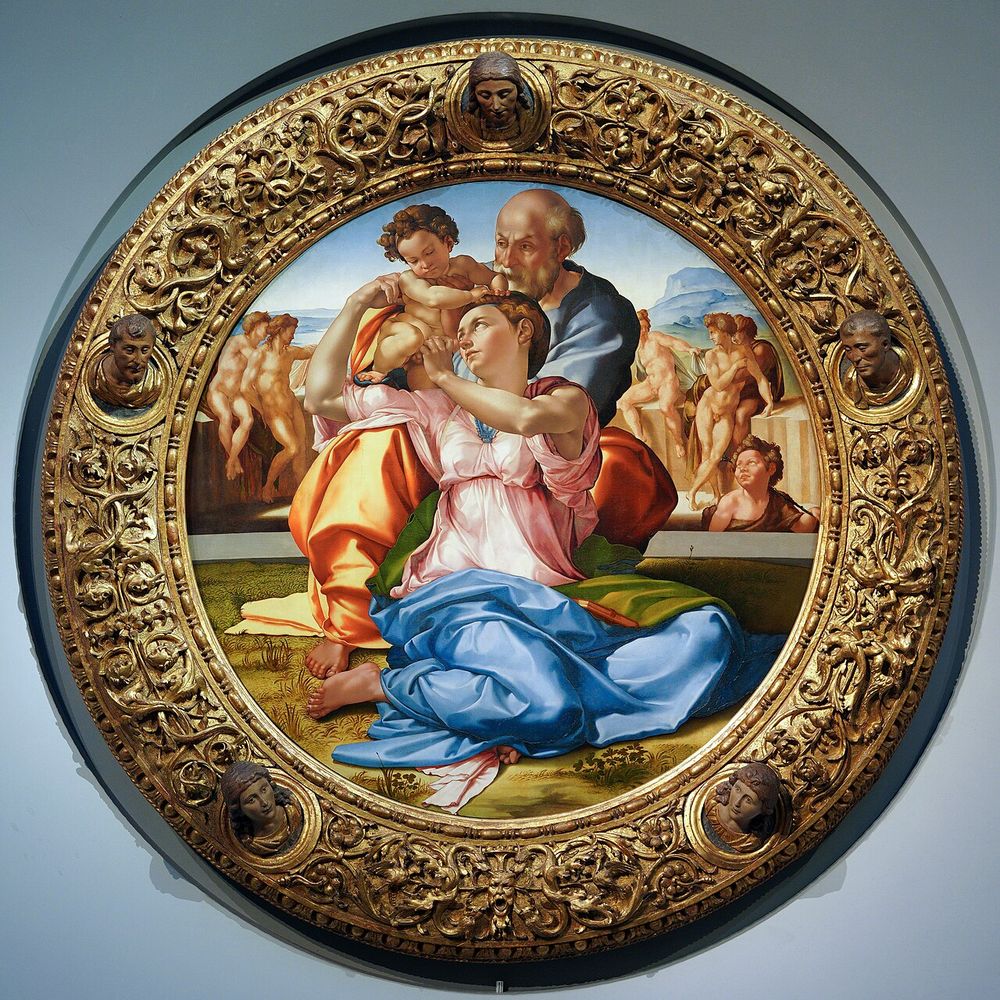
Michelangelo's round picture of the Holy Family was painted about 1506 for a rich weaver named Doni. The figures twist like sculpture and the colours are as sharp as sweets. Doni tried to pay less than the price agreed. Michelangelo doubled it.
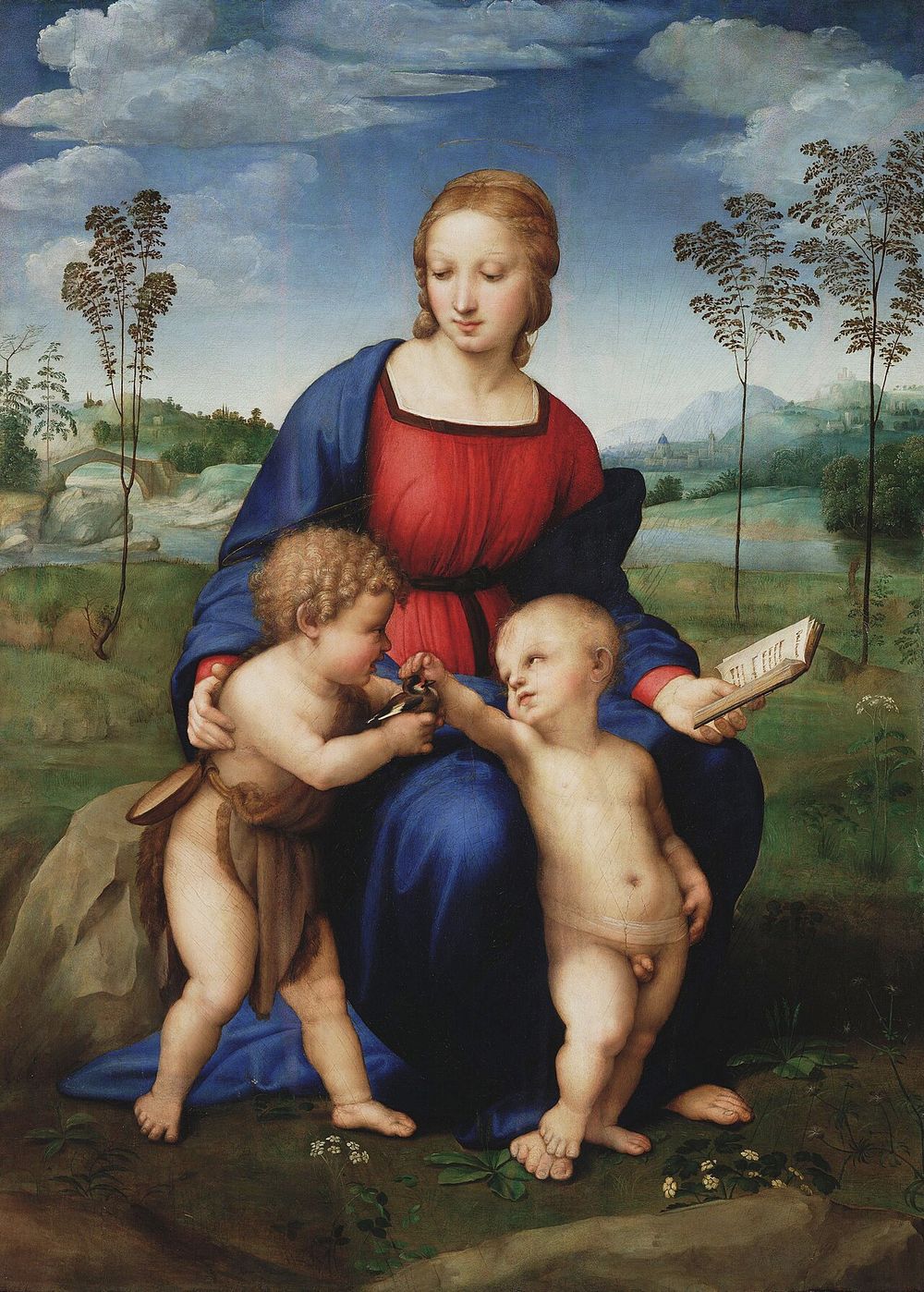
Raphael's Madonna of the Goldfinch, of the same year, was broken into seventeen pieces when the house it hung in fell down in 1547. It was nailed together and painted over. The joins were only cleaned and mended properly in 2008.
8. Downstairs, and the window
Caravaggio's Medusa, on a shieldCaravaggio, CC0
On the floor below, in rooms with dark red walls, is a head with snakes for hair, mouth open, painted on a round shield of poplar wood. Caravaggio made it about 1597 and used his own face. The shield is curved outward; he has painted it so that it seems to curve in.
It lieth, gazing on the midnight sky,
Upon the cloudy mountain-peak supine;
Below, far lands are seen tremblingly;
Its horror and its beauty are divine.
Percy Bysshe Shelley, On the Medusa of Leonardo da Vinci in the Florentine Gallery, 1819; written of another Medusa in the same collection
The river, the bridge and the end of the galleryArmin Kleiner, CC BY-SA 4.0
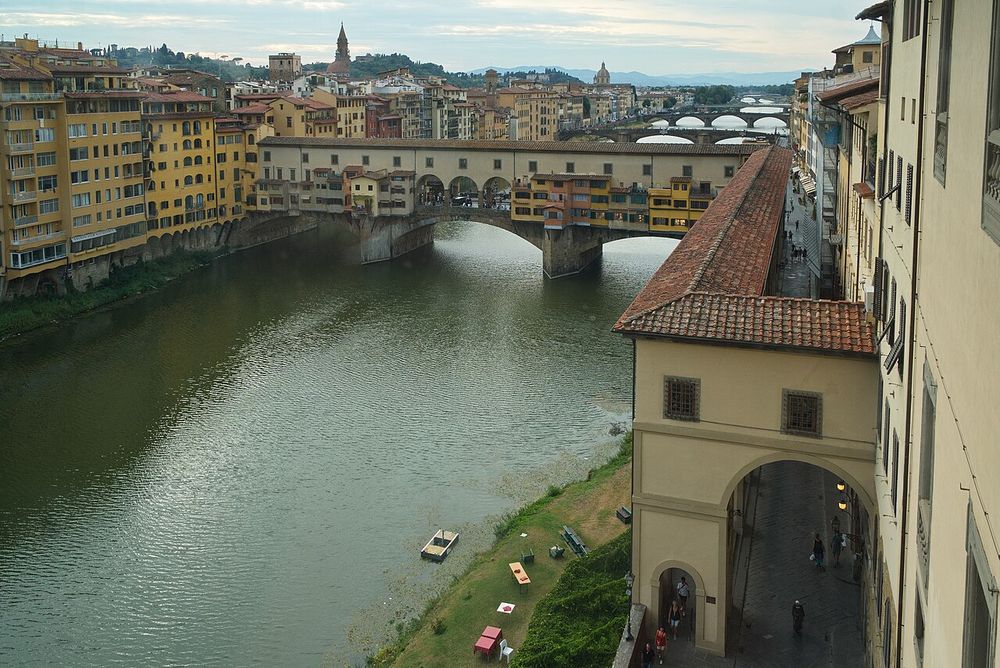
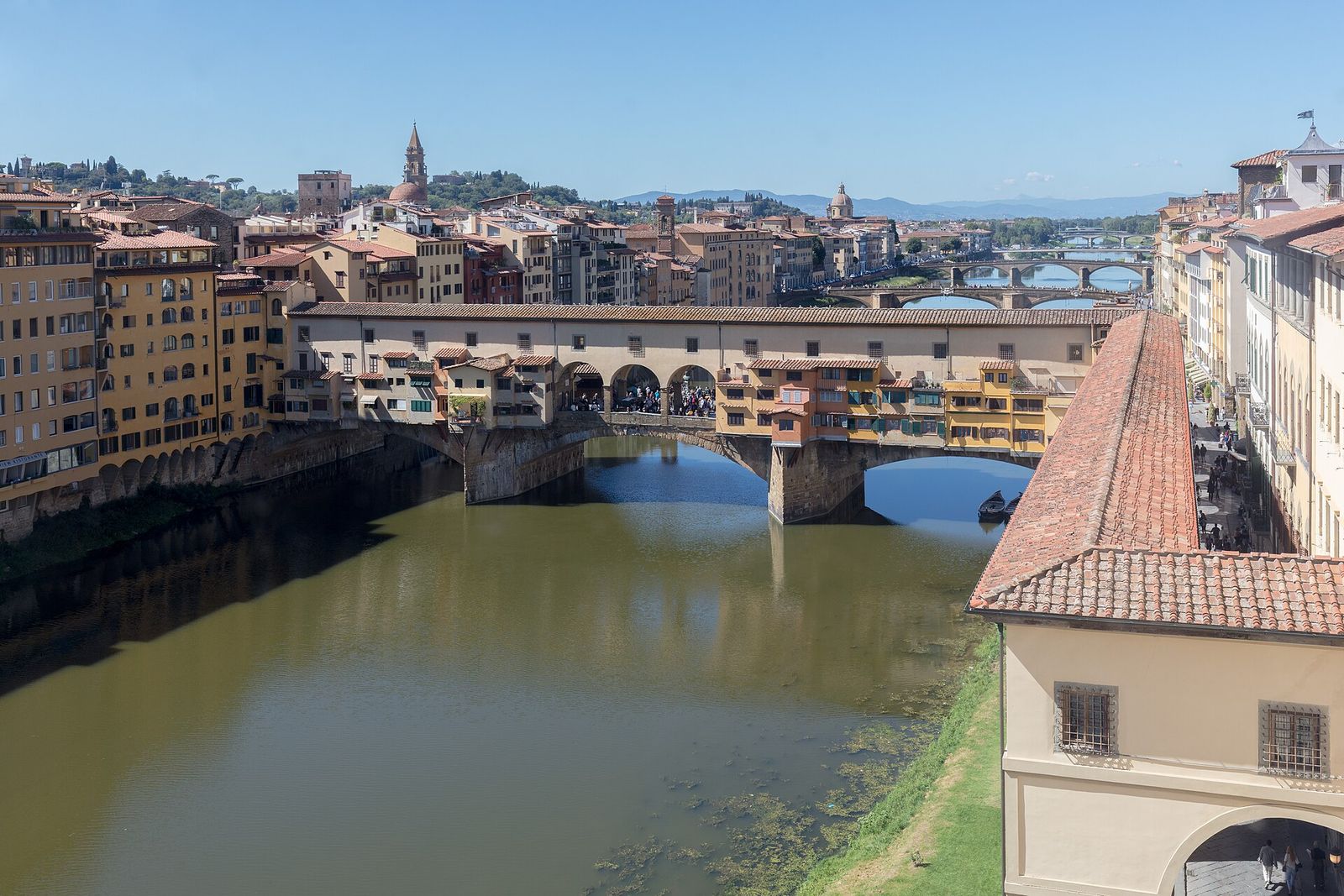
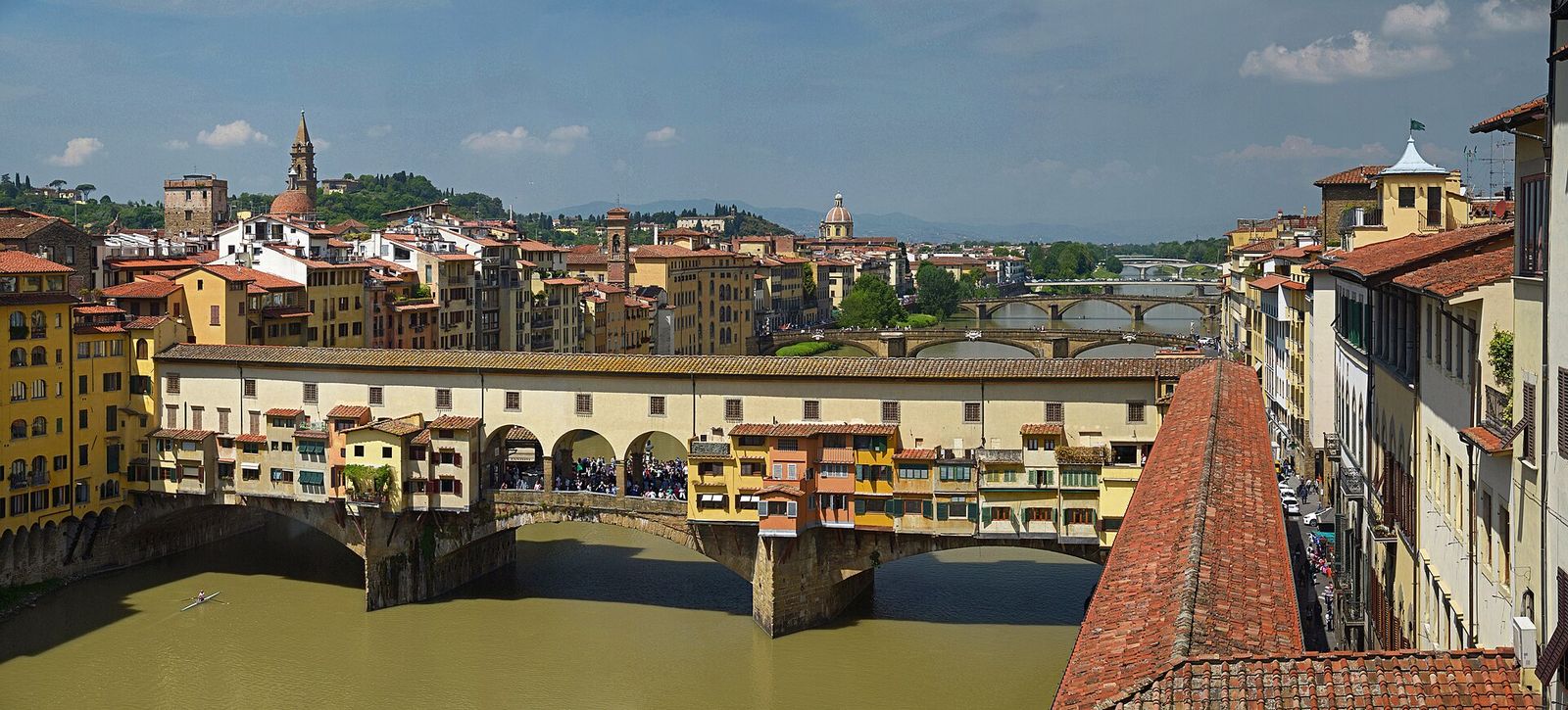
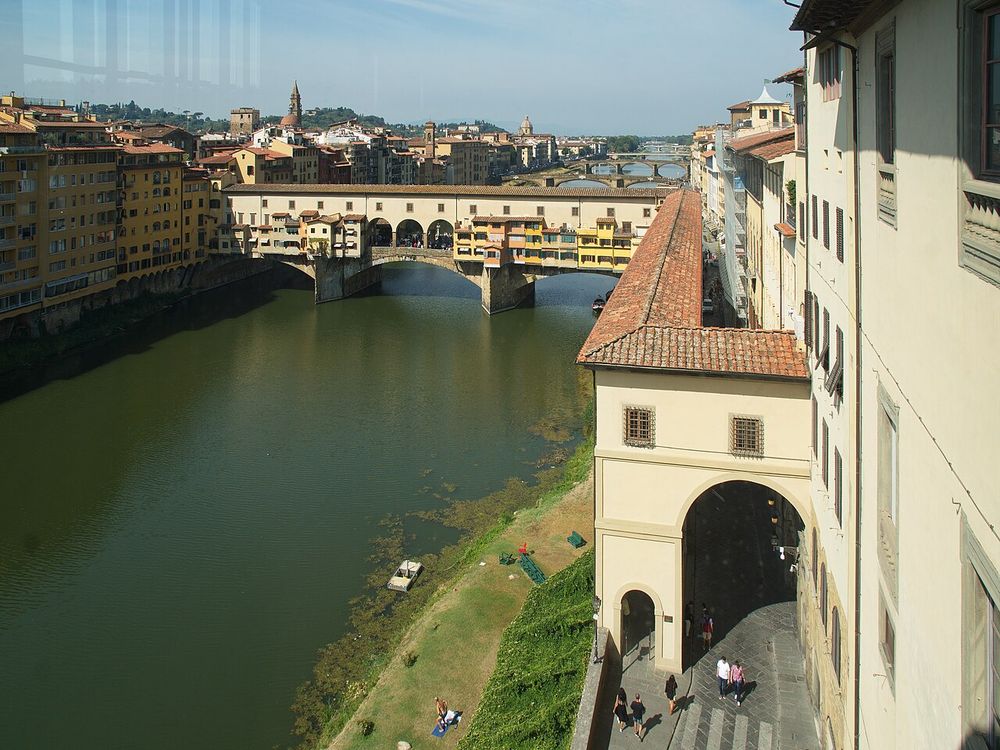
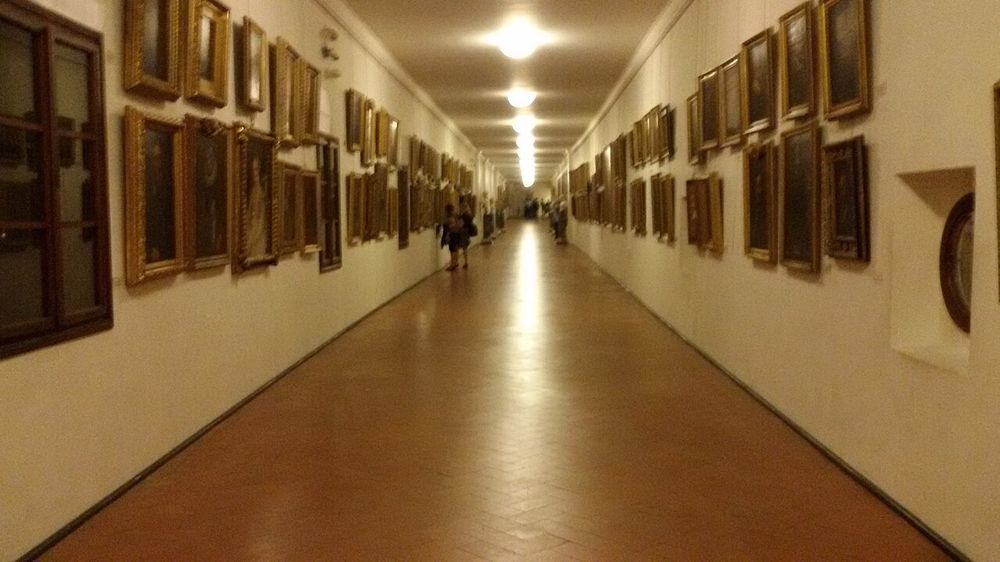
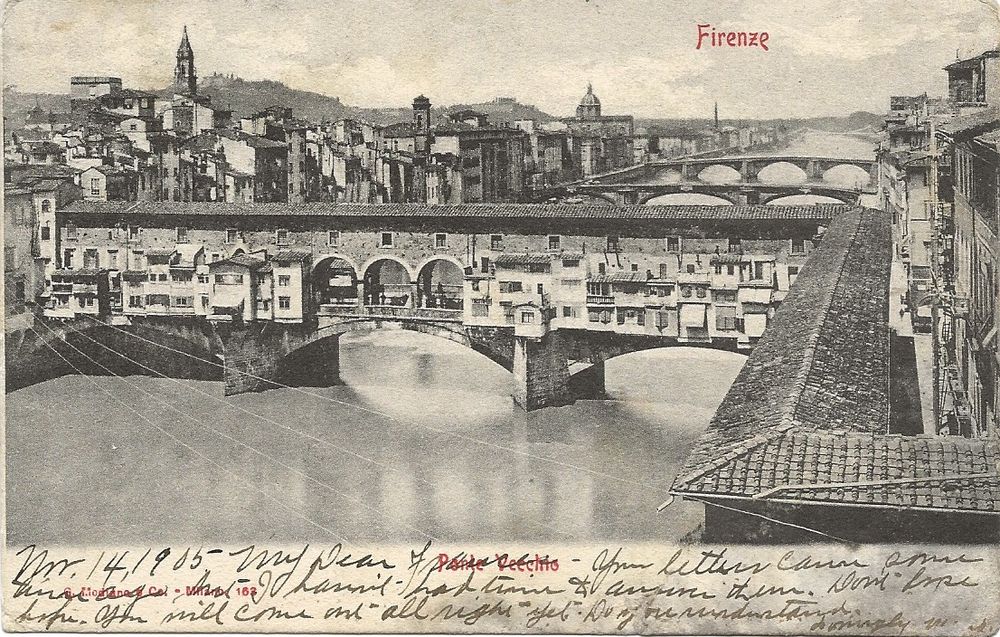
Before you go down, stop at the windows where the two long corridors join. Below is the Arno and the Ponte Vecchio, the bridge with shops on it. Along the tops of the shops runs a row of small square windows. That is a private passage almost a kilometre long, built in five months in 1565 so that the duke could walk from his office to his house without meeting his subjects.
The scar of the bomb of 1993Rhododendrites, CC BY-SA 4.0
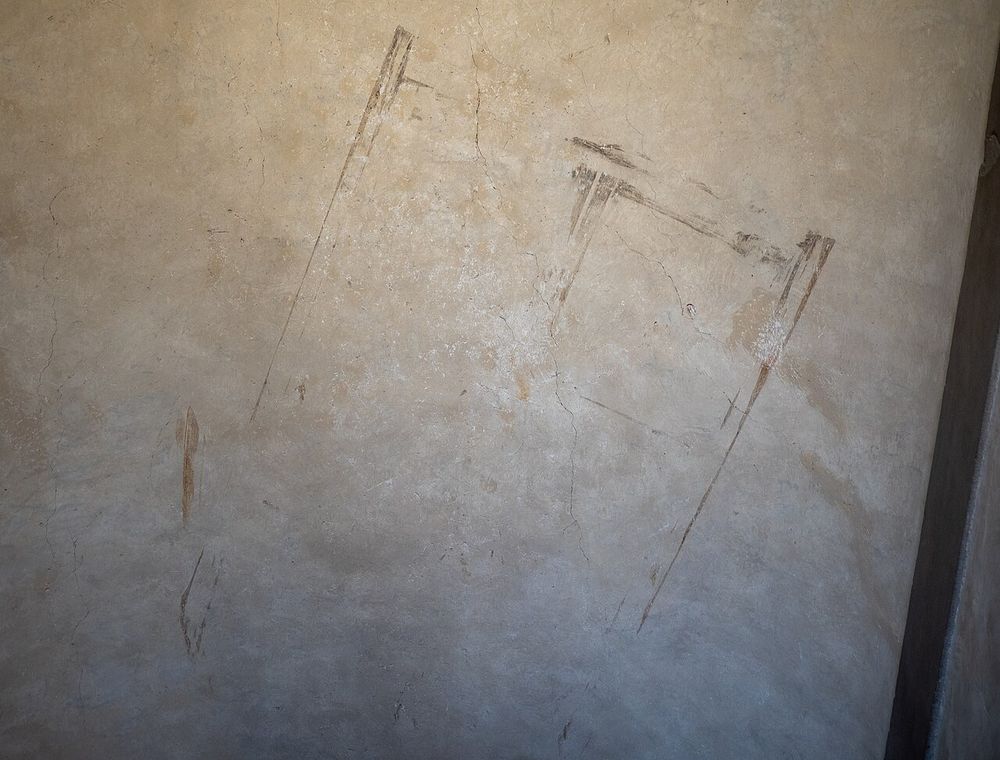
On the night of 27 May 1993 a car bomb planted by the Sicilian Mafia went off in the street behind the west wing. It killed five people, two of them children, and destroyed three paintings. A scar left on one wall has been kept.
Meanwhile in the world
Year
Here
Elsewhere
1560
Vasari begins the offices
Ming China (1368–1644), the Jiajing reign; Elizabeth I has been queen of England for two years
1565
The passage over the bridge is built in five months
The Spanish reach the Philippines, and silver from America will soon flow to China
1581
The top floor becomes a gallery
Ming China: the minister Zhang Juzheng orders all taxes paid in silver
1737
The last Medici leaves the collection to Florence
Qing China, the second year of the Qianlong reign
1769
The gallery is opened to the public
The Qianlong emperor orders his great library compiled within four years; James Watt patents his steam engine
1803
The Medici Venus is taken to Paris
The year the United States buys Louisiana from France
1966
The Arno floods the basement and the restoration rooms
The Cultural Revolution begins in China
1993
The bomb
The year the European Union comes into being
Then and now
The Ponte Vecchio and the passage above its shopsDiego Delso, CC BY-SA 4.0, Wikimedia CommonsThe Arno from the gallery windowsВвласенко, CC BY-SA 3.0, Wikimedia CommonsThe river, the bridge and the end of the galleryArmin Kleiner, CC BY-SA 4.0, Wikimedia CommonsWhere the passage leaves the galleryArmin Kleiner, CC BY-SA 4.0, Wikimedia CommonsInside the Vasari CorridorDiomidis Spinellis, CC BY-SA 4.0, Wikimedia CommonsThe colonnade of the courtyard at nightChi King, CC BY 2.0, Wikimedia CommonsDante, in a niche of the courtyardWikibusters, CC BY-SA 4.0, Wikimedia CommonsA statue in its niche after darkEddieJav, CC0, Wikimedia CommonsThe first corridor, with its painted ceilingLuca Aless, CC BY-SA 4.0, Wikimedia CommonsRooms of the lower floorFabrizio Garrisi, CC0, Wikimedia CommonsA side galleryFabrizio Garrisi, CC0, Wikimedia CommonsThe room of the thirteenth-century paintersFabrizio Garrisi, CC0, Wikimedia CommonsSpring in its frameDiego Delso, CC BY-SA 4.0, Wikimedia CommonsThe room where the Medusa hangsFabrizio Garrisi, CC0, Wikimedia CommonsThe TribunaArmin Kleiner, CC BY-SA 4.0, Wikimedia CommonsThe Medici Venus, a Greek marble of the first century BCWai Laam Lo, CC BY-SA 3.0, Wikimedia CommonsThe room of Niobe and her childrenTxllxt TxllxT, CC BY-SA 4.0, Wikimedia CommonsThe gilded ceiling of the Niobe roomDiego Delso, CC BY-SA 4.0, Wikimedia CommonsA daughter of NiobePetar Milošević, CC BY-SA 4.0, Wikimedia CommonsA copy of the Laocoön, carved in the 1520sYair Haklai, CC BY-SA 4.0, Wikimedia CommonsThe scar of the bomb of 1993Rhododendrites, CC BY-SA 4.0, Wikimedia CommonsA ceiling of the 1580s, with monsters and garlandsBernardino Poccetti, Public domain, Wikimedia CommonsGiotto's Madonna, about 1310Giotto, Public domain, Wikimedia CommonsThe Duke and Duchess of Urbino, by Piero della FrancescaPiero della Francesca, CC BY-SA 4.0, Wikimedia CommonsBotticelli's Spring, about 1480Sandro Botticelli, Public domain, Wikimedia CommonsBotticelli's Birth of Venus, about 1485Sandro Botticelli, Public domain, Wikimedia CommonsLeonardo's Annunciation, about 1472Leonardo da Vinci, Public domain, Wikimedia CommonsMichelangelo's Holy Family, in its first frameMichelangelo, Public domain, Wikimedia CommonsRaphael's Madonna of the Goldfinch, 1506{{creator:Raffaello Sanzio]}}, Public domain, Wikimedia CommonsTitian's Venus of Urbino, 1538Titian, Public domain, Wikimedia CommonsCaravaggio's Medusa, on a shieldCaravaggio, CC0, Wikimedia CommonsJudith and Holofernes, by Artemisia Gentileschi, about 1620Artemisia Gentileschi, Public domain, Wikimedia CommonsThe Tribuna crowded with English visitors, painted by Johan Zoffany in the 1770sJohann Zoffany, Public domain, Wikimedia CommonsThe Tribuna in a lantern slide of about 1913Edmund F. Arras, Public domain, Wikimedia CommonsCosimo I, who ordered the building, painted by BronzinoBronzino, Public domain, Wikimedia CommonsGiorgio Vasari, the architectAttributed to Jacopo Zucchi, Public domain, Wikimedia CommonsAnna Maria Luisa de' Medici, who gave the collection to FlorenceAntonio Franchi, Public domain, Wikimedia CommonsFlorence in a book of 1877Stieler, Karl, 1842-1885; Cavagna Sangiuliani di Gualdana, Antonio, conte, 1843-, No restrictions, Wikimedia CommonsThe Ponte Vecchio on a postcard of about 1905G. Modina, Public domain, Wikimedia Commons
Video
Films from official channels, played from YouTube. Nothing is loaded until you press play.
The historic centre of FlorenceUNESCO · made with NHK; 3 min · checked 2026-11-12
Local legends
These are stories people tell about this place. They are legends, not history, and each one says where it comes from.
LegendThe butchers of the bridge
When the duke first walked through his new passage over the bridge, the smell of the butchers' stalls below came up through the windows. He ordered the butchers off the bridge and gave their shops to goldsmiths, who have been there ever since.
Source: Florentine tradition; the decree removing the butchers is dated 1593
LegendThe tower that would not move
At the far end of the bridge the passage had to pass through an old family tower. The family refused to let the duke cut a door in it. He was so amused by their nerve that he had the passage built round the outside of the tower on brackets, where it still makes a bend.
Source: Florentine tradition about the Mannelli tower
Later, people who live here will be able to add the stories they grew up with, and say which of these they have heard.
Not certain, and where accounts conflict
What does Spring mean?
The figures can be named: Venus, the three Graces, Mercury, the west wind and the nymph he turns into Flora. Why they are together, and for whose wedding the picture was painted, has filled a library, and there is no agreed answer.
Did Leonardo paint all of the Annunciation?
It came to the gallery in 1867 from a monastery, with no name attached. Most scholars now give it to the young Leonardo, with parts by others in the workshop. The marble table is copied from a tomb his master had just made.
Is that Caravaggio's face?
It is the usual view, because the features match his other self-portraits and he could not have paid a model to scream into a mirror. There is no document.
Which model was Venus?
Tradition says Simonetta Vespucci, the beauty of Florence, who died at twenty-two. She had been dead for nine years when the picture was painted.
Visiting
Tickets and hours
A ticket bought on the day is 25 euros. Bought ahead, for a set time, it is 29 euros.
Citizens of the European Union aged 18 to 25 pay 2 euros. Visitors under 18, of any country, enter free.
The five-day pass for the Uffizi, the Pitti Palace and the Boboli Gardens is 40 euros, or 58 euros with the Vasari Corridor.
Open Tuesday to Sunday from 8:15 to 18:30. Closed on Mondays, 1 January and 25 December.
On the first Sunday of each month the state museums of Italy are free, and nothing can be booked. Expect the longest queue of the month.
Last checked 2026-11-12. The gallery's own site (uffizi.it/en), ticket prices and opening hours as shown in November 2026.
Booking from abroad
Official page in English The gallery's own site gives prices and hours in English and links to its ticket office: uffizi.it/en. A ticket bought before the day of the visit costs 4 euros more and gives you an entry time.
Ticket window on site Tickets for the same day are sold at the ticket office under the colonnade until 17:30. From April to October the line without a booking is often two hours.
Note The gallery warns that other sites with similar names resell its tickets at higher prices.
Checked 2026-11-12
Where to start
The gallery is beside the Palazzo Vecchio, five minutes on foot from the cathedral.
Book the first entry of the day, 8:15, or one after 16:00. Go straight up to the top floor and to Botticelli before the tour groups reach him.
Then go back to the beginning and walk the rooms in order. Allow three hours, with a rest at the café on the roof terrace, which looks across at the tower of the Palazzo Vecchio.
If you have only one hour: Giotto, the two profiles from Urbino, Botticelli, Leonardo, Michelangelo's round picture, and the window over the river.
Before you go
Large bags, umbrellas and bottles of water go into the free cloakroom.
Photographs are allowed without flash.
Staff meetings and strikes sometimes shorten the hours with a few days' notice. Look at the notices on the official site the day before.
Customs and manners
Stand back from the pictures. Alarms sound if you lean in.
In front of the Botticellis, look, take your photograph and give up your place.
Do not sit on the bases of the statues in the corridors.
Opening hours are given in the local time of the place. Prices are in the local currency. The figure after ≈ is approximate, at exchange rates checked on 9 November 2026, in .
Look for these
In the courtyard, find Galileo. What is he holding?
On a corridor ceiling, find a creature that is half one thing and half another.
Compare the three thrones in the room of the Madonnas. Which one could you sit on?
Look at the duke's nose.
In Spring, count the people. Then find the one whose feet are not on the ground.
In the Birth of Venus, what is she standing on?
In Leonardo's picture, look at the Virgin's right arm from the right-hand side.
From the window, find the row of small square windows above the bridge.
I am here
Stand at the site, sign in, press the button, and collect its stamp. Your browser will ask to use your location. It is sent to us once to confirm that you are at the site; we keep how far you were from it, not the spot where you stood.
Your stamps are saved to your account, so they follow you to any device. Checking from a browser cannot rule out every false location; stricter checks arrive with the app.
Messages
Share your photos
Photos here show the place, not people. Each one is credited to the visitor who took it and appears after our team has looked at it. A photo with you in it belongs under “I am here”.