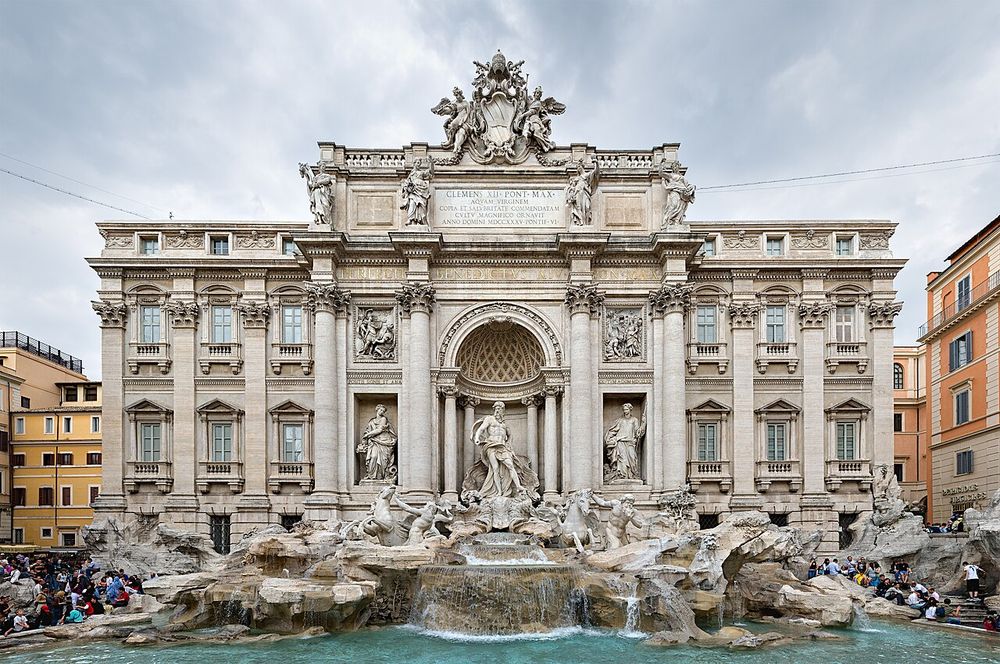
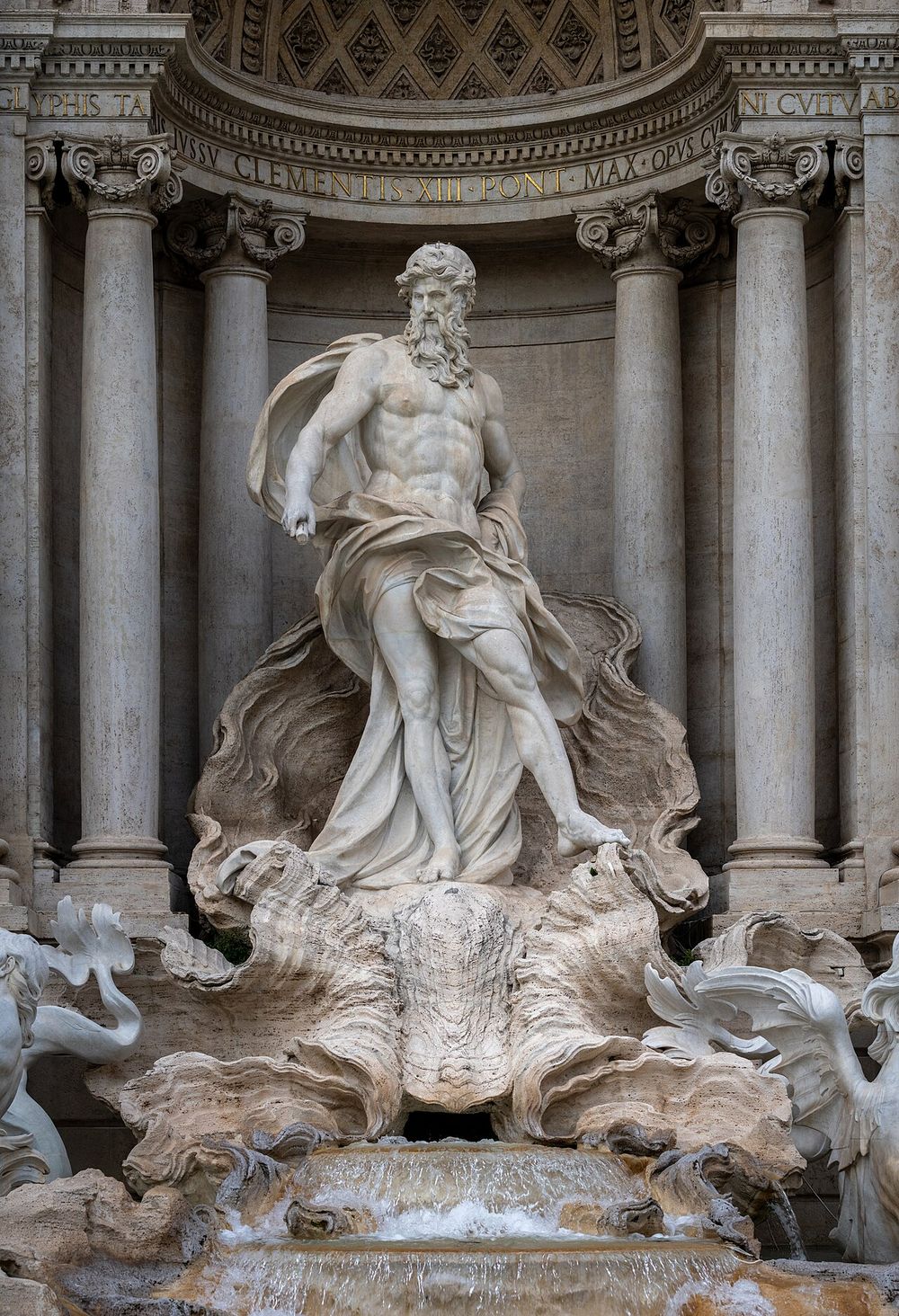
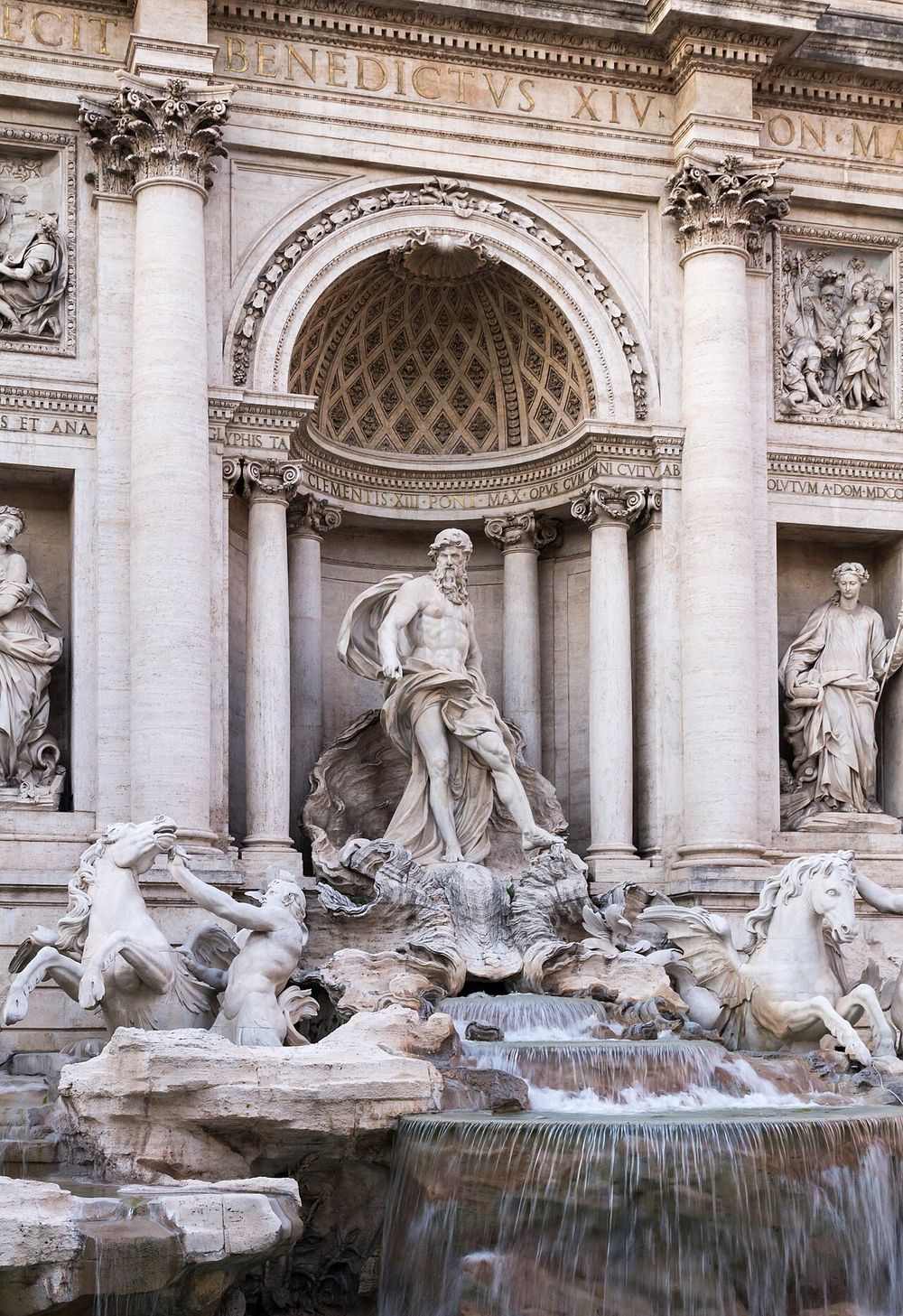
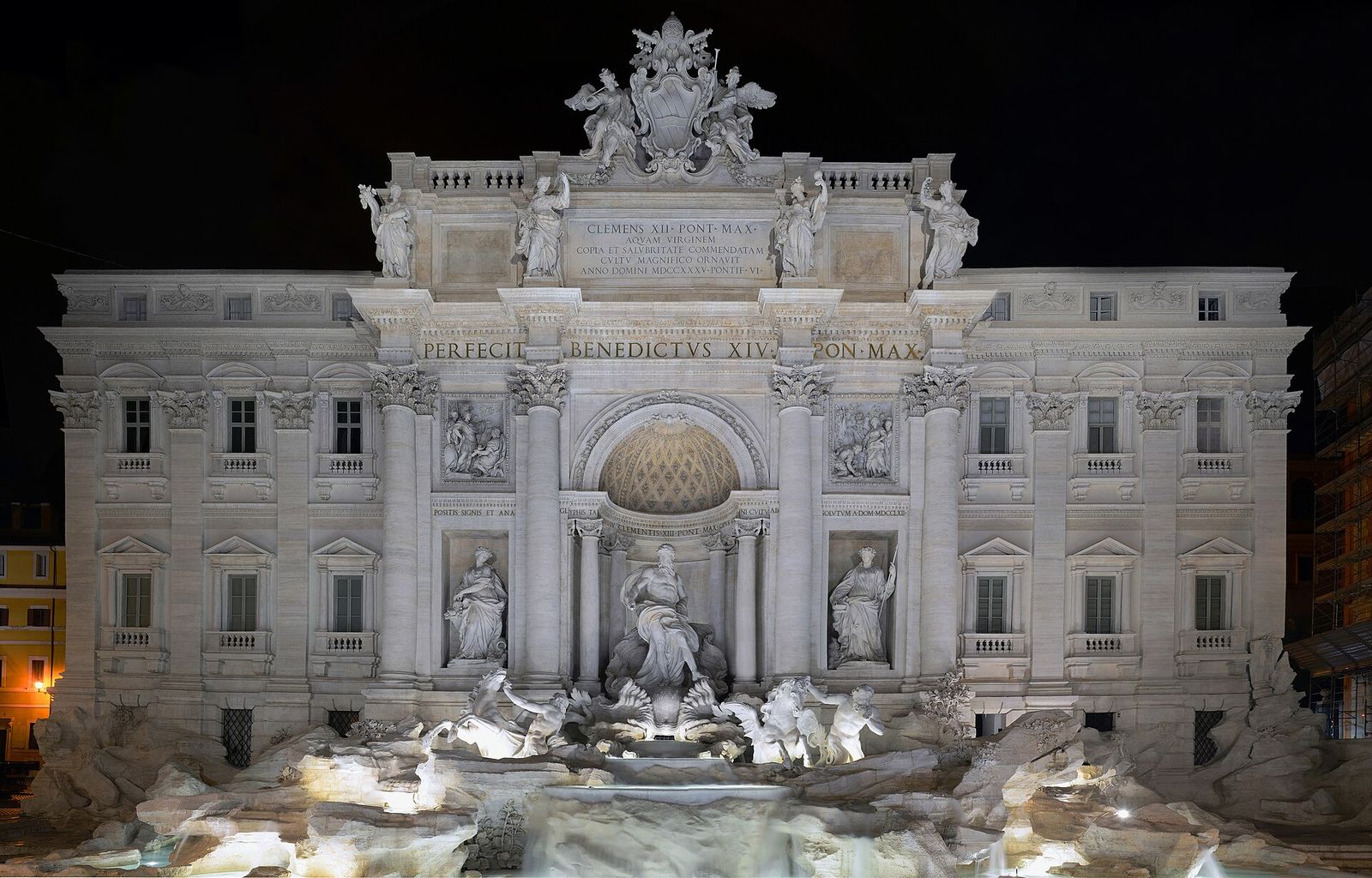
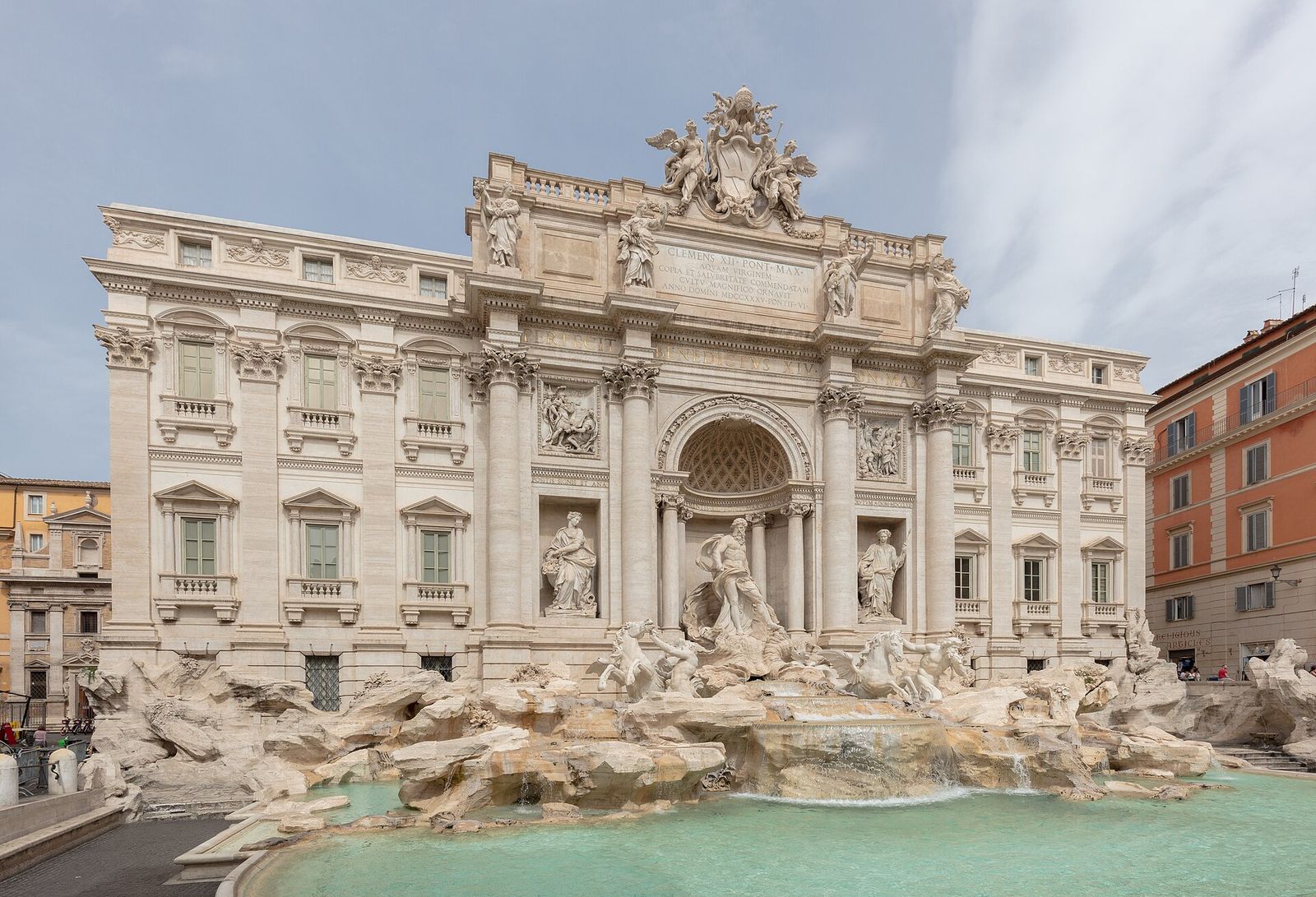
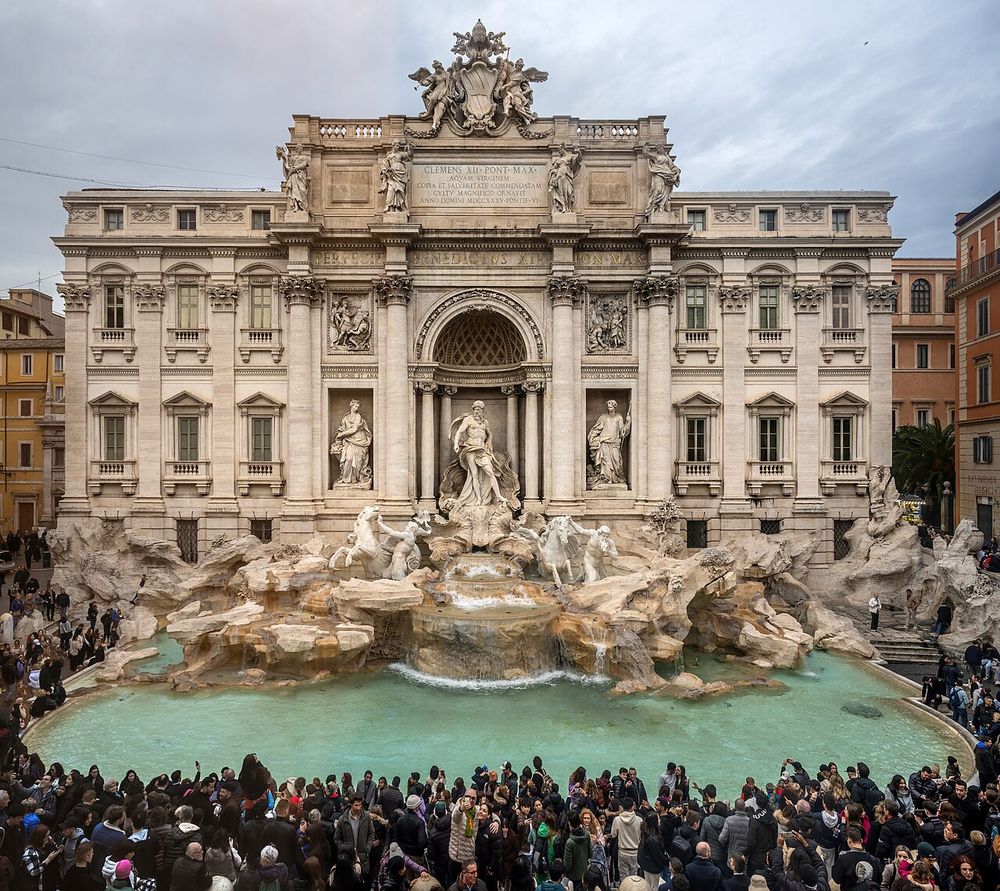
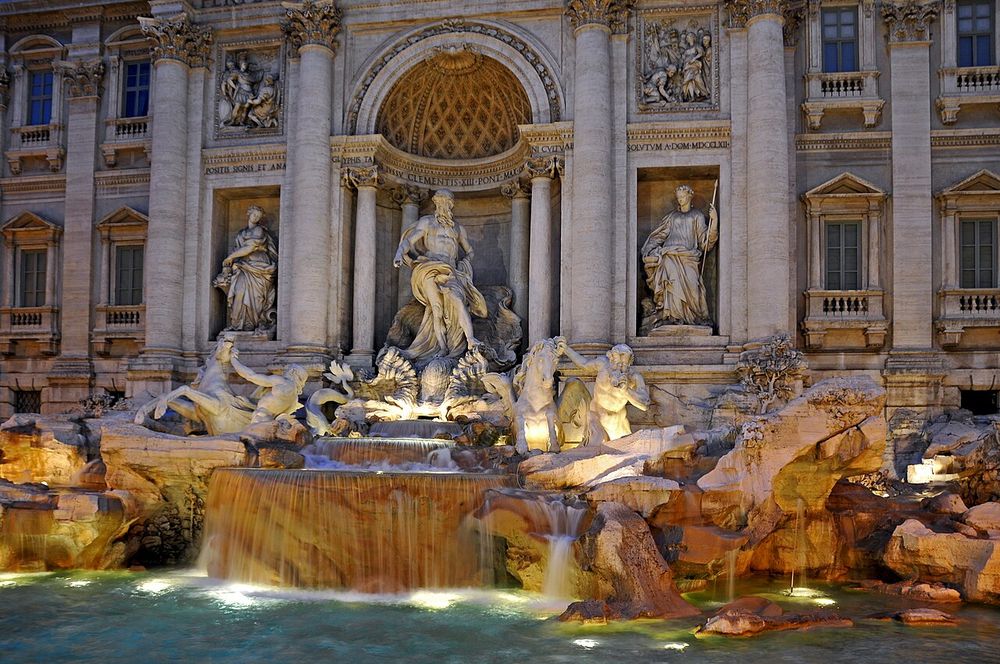
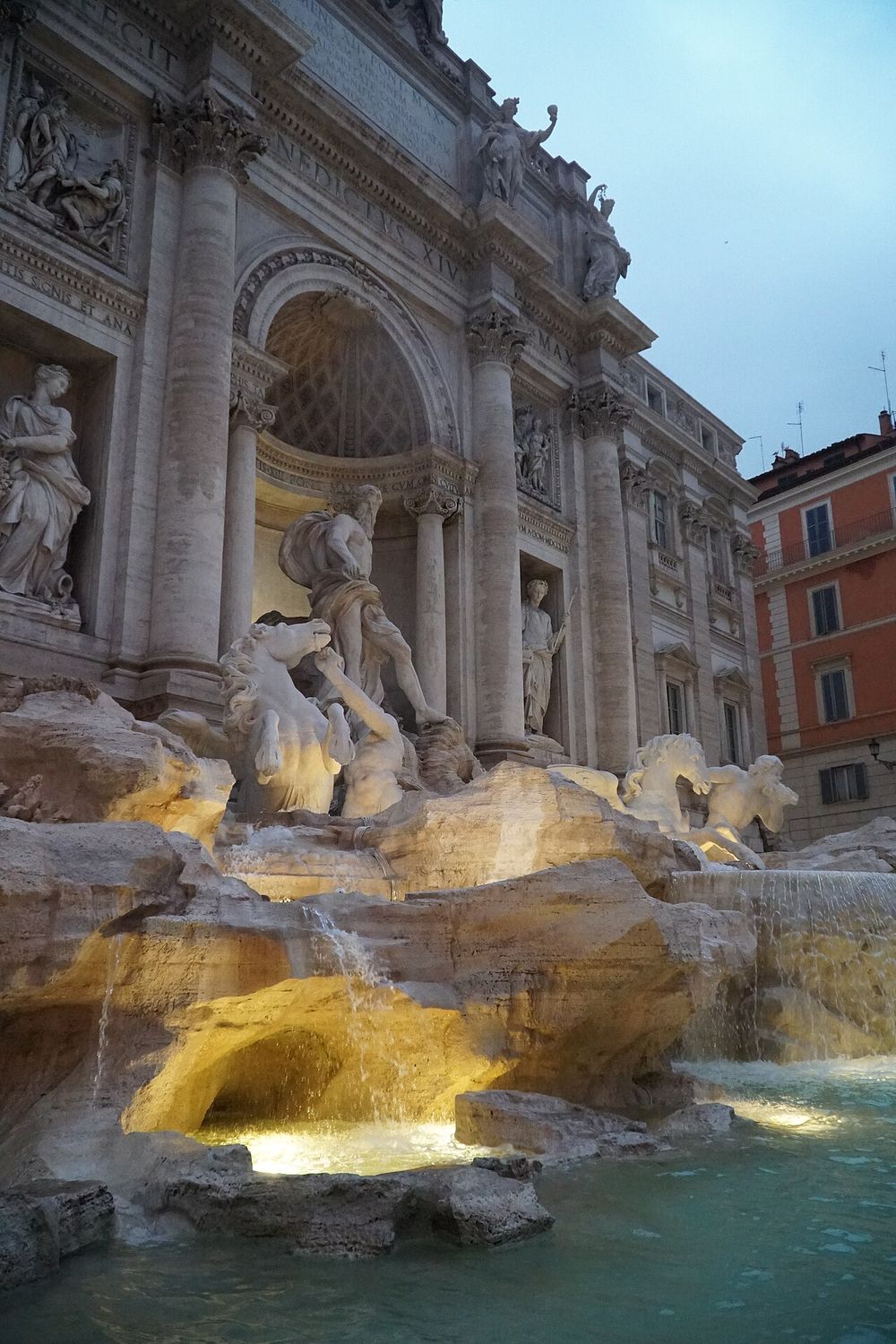
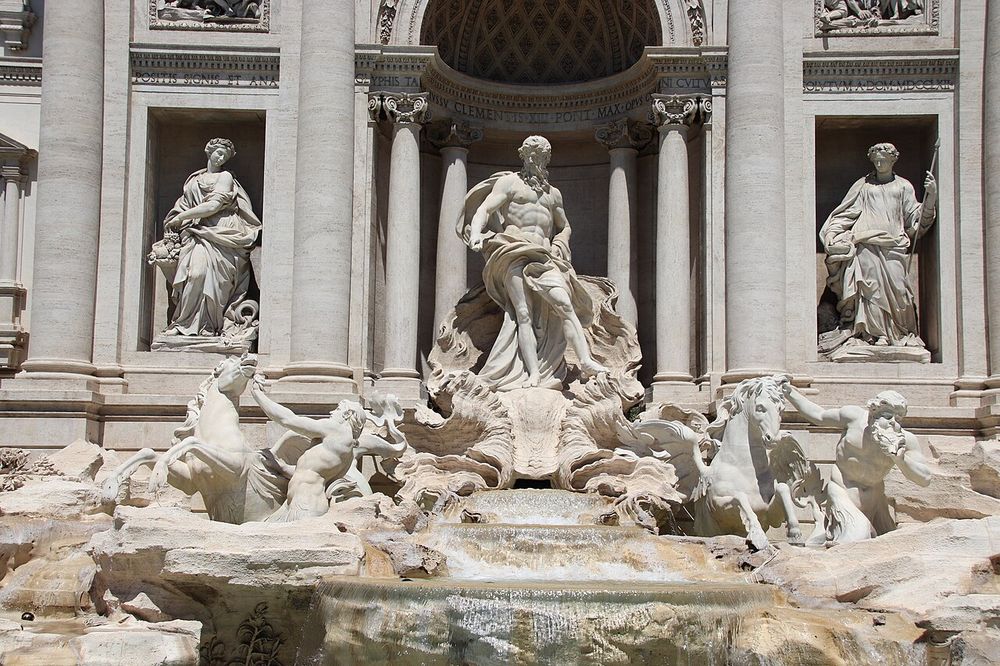
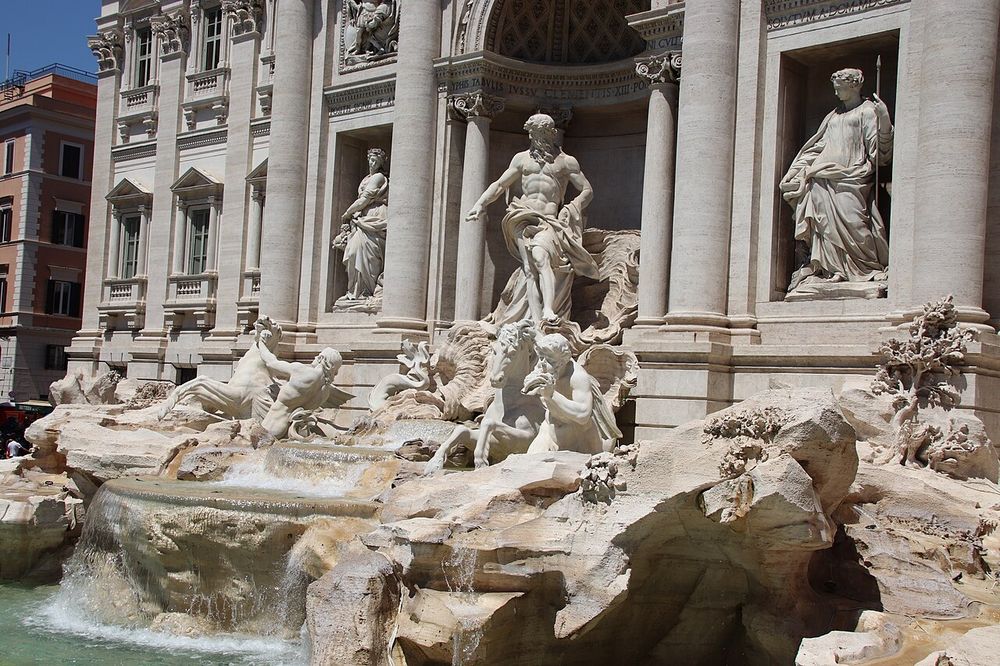
The end of a Roman water channel twenty-one kilometres long and two thousand years old, dressed up in 1762 as a cliff of white stone with a sea god riding out of it. About three thousand euros in coins go into the water every day.
Photo: Wilfredor, CC0, Wikimedia Commons
The story
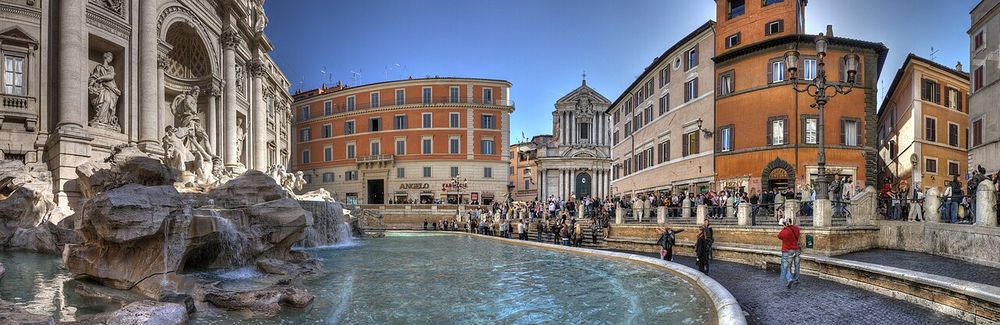
You hear it before you see it. The streets are narrow and the houses tall, and from somewhere ahead comes a steady roar, like heavy rain. Then the street opens and there is no room to stand back: one whole side of a small square is a wall of white stone with water pouring out of it.
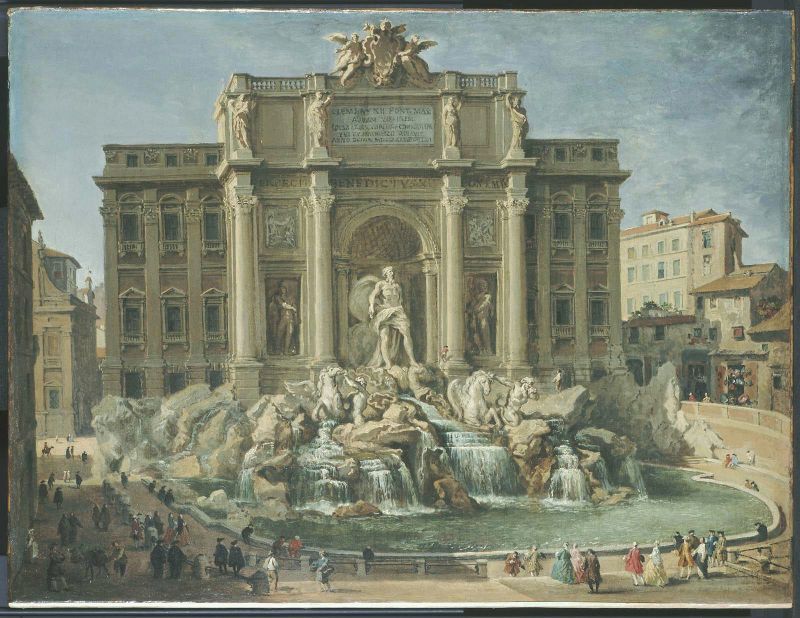
The fountain was finished in 1762. In China the Qianlong emperor was in the twenty-seventh year of his reign; in Europe Mozart was six and already on tour.
What is here
Looking is free at every hour. Since February 2026 you pay to go down to the water's edge in the daytime.
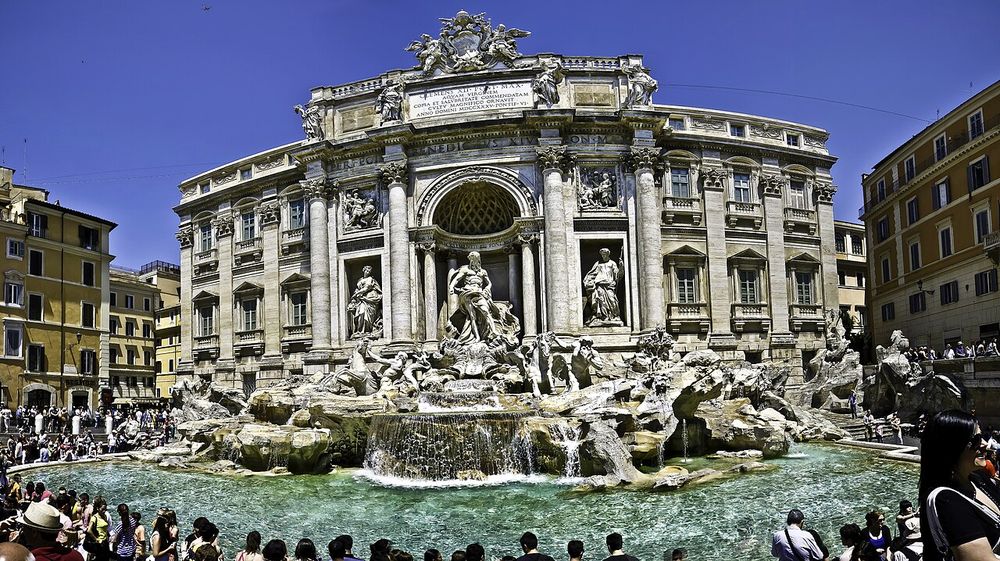
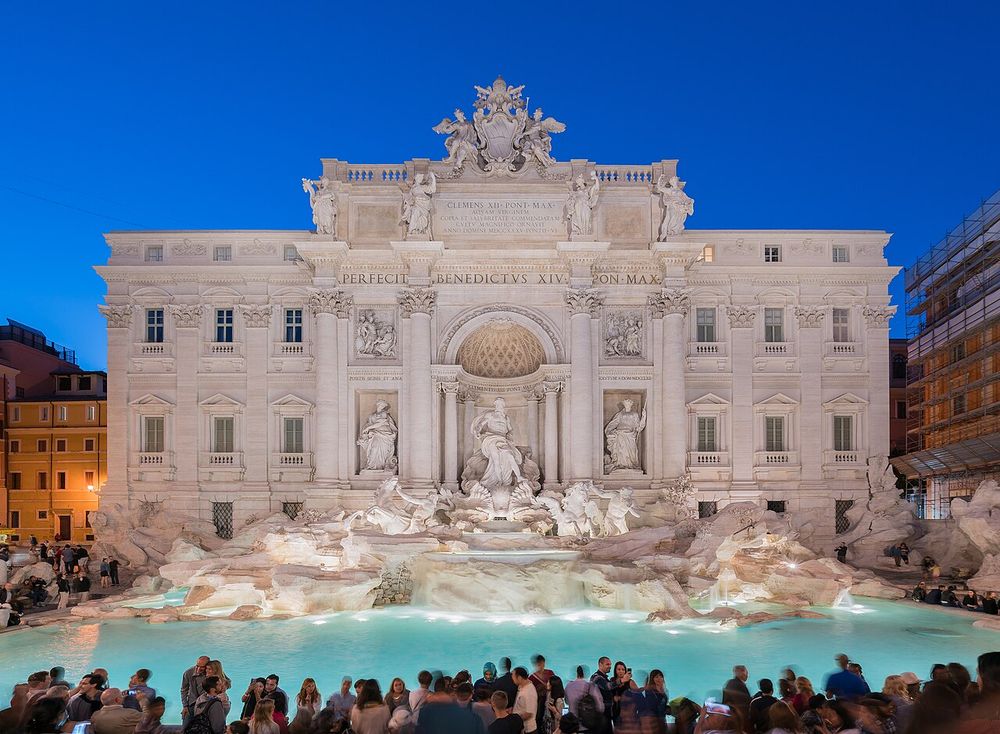
The fountain and the palace behind itDiliff, CC BY 3.0
The water is older than the fountain by eighteen centuries. In 19 BC Agrippa, the general who built the first Pantheon, brought it to Rome in a channel from springs east of the city. The channel runs almost all the way underground, which is why it was never cut when Rome was besieged. It has flowed, with repairs, ever since.
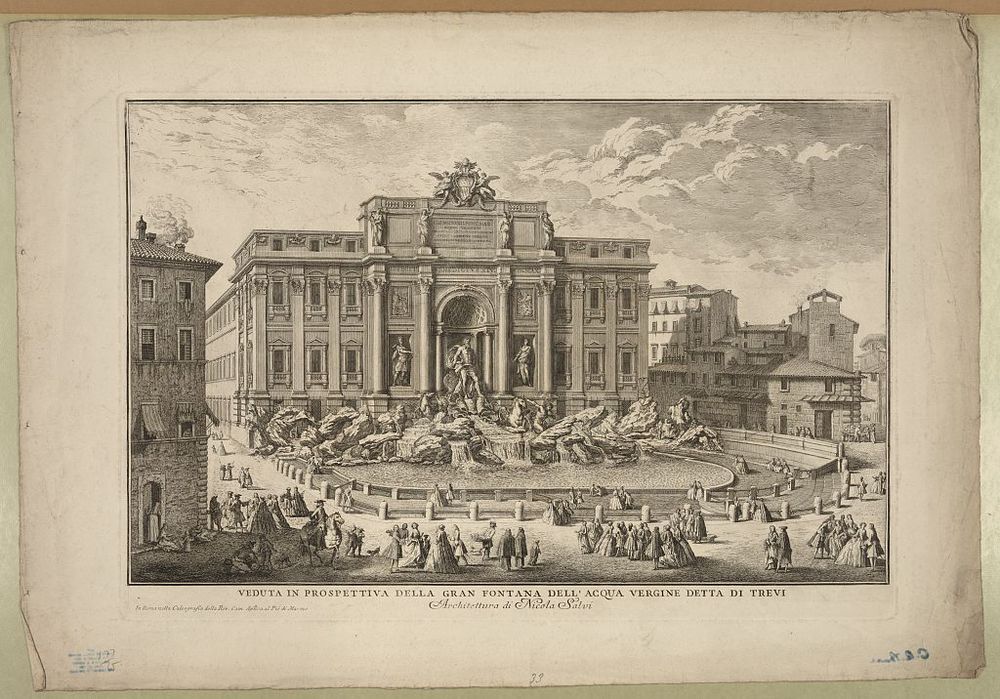
Where an aqueduct ended, the Romans built a show fountain. For centuries this one was a plain basin. In 1730 a pope held a competition for something grander, and a little-known Roman architect, Nicola Salvi, won. He worked on it for nineteen years and died with the sculpture unfinished.
The fountain has no back. It is the front of a palace, turned into a stage.
Things people often get wrong
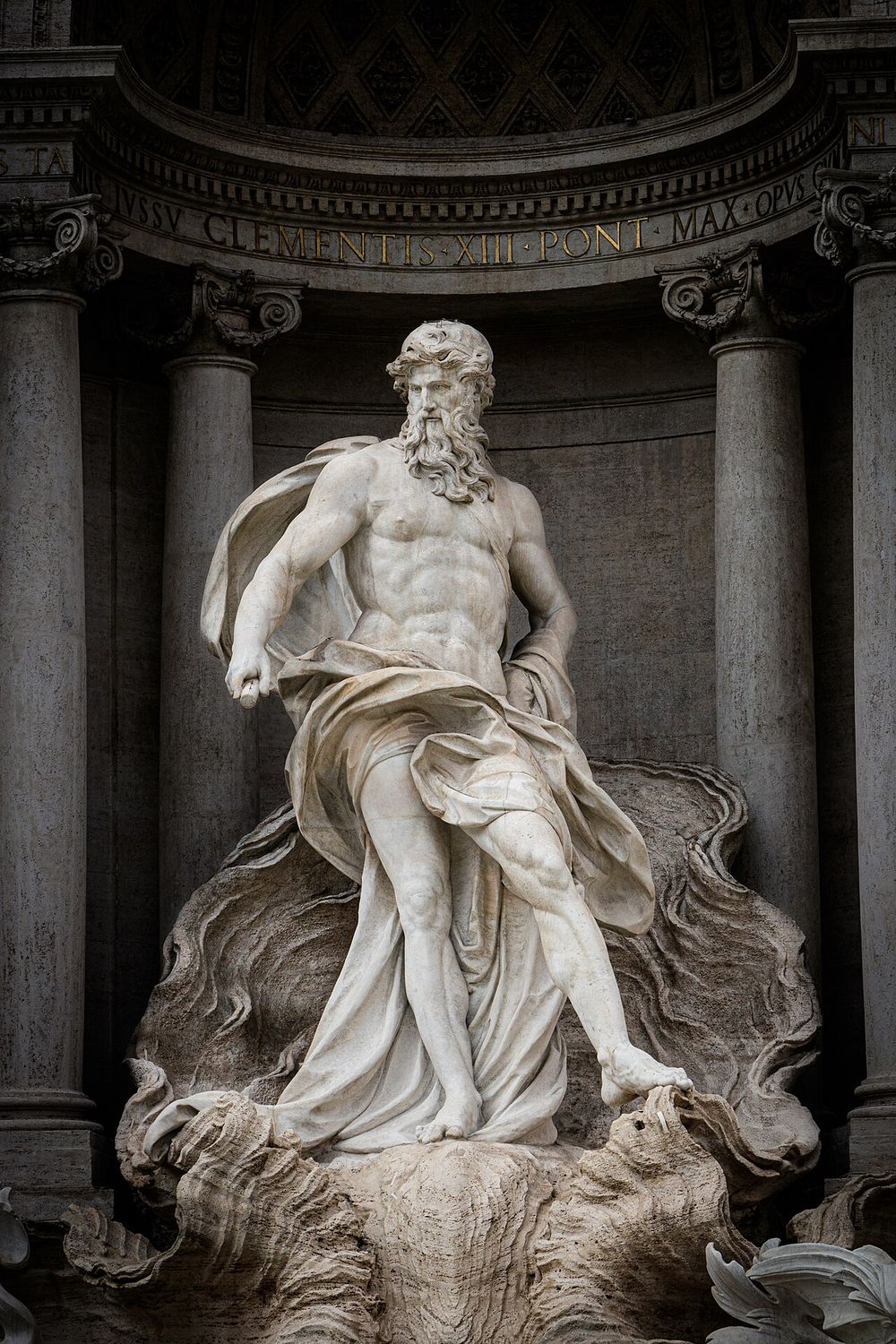
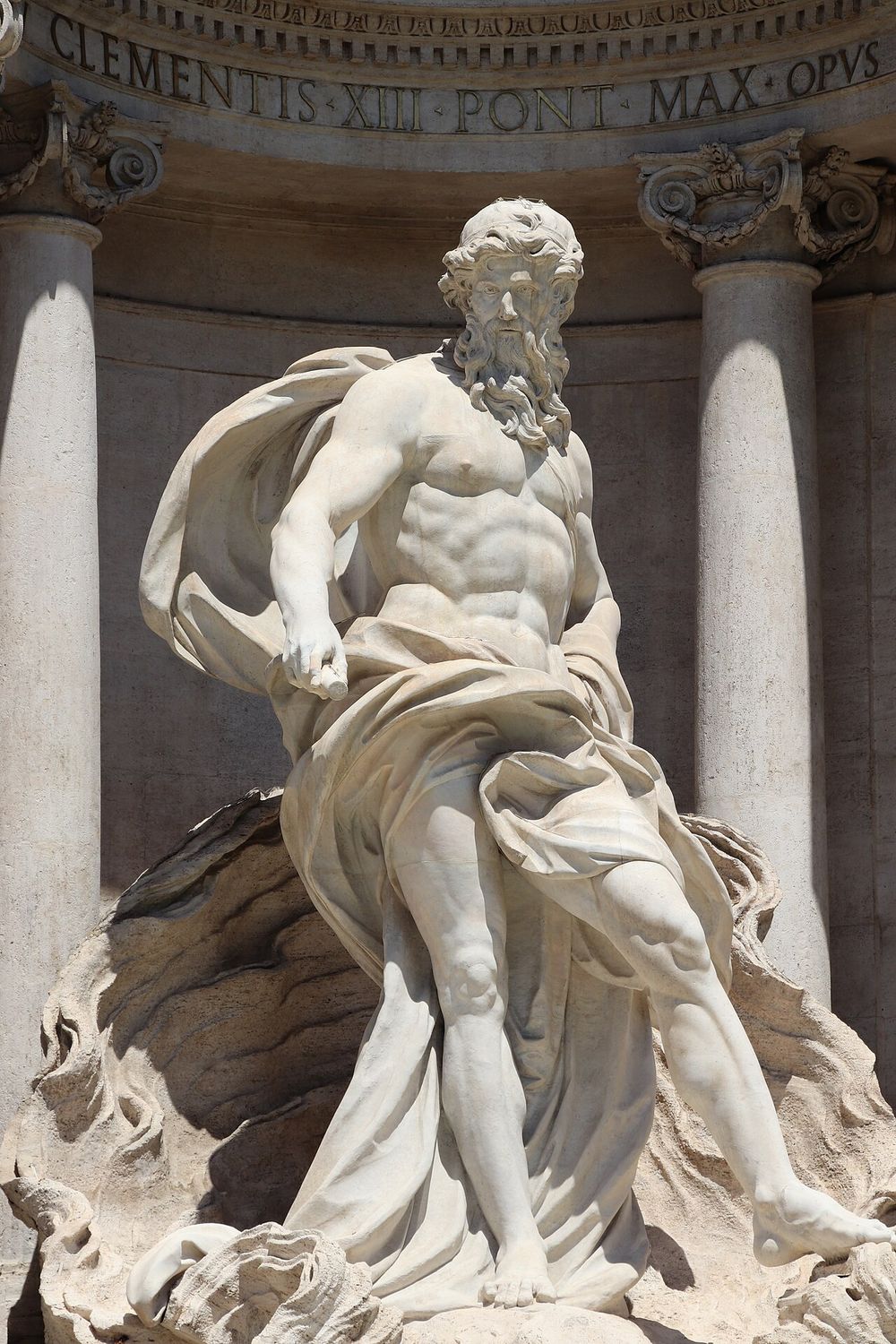
"The god in the middle is Neptune." He is Oceanus, the river that the Greeks believed ran round the whole earth. He holds no trident.
"Bernini made it." Bernini drew a plan in 1629 and turned the old basin to face this way. He had been dead for fifty years when the building began.
"The custom of the coin is ancient." It is first described by German visitors in the nineteenth century, and the three coins come from an American film of 1954.
"You may drink the water." The fountain now recycles its water. For a drink, use the small spout with two jets at the right-hand end.
"You can step in, as in the film." Wading is forbidden and the fine is several hundred euros. Since February 2026 even the paved area by the water needs a ticket in the daytime.
People who stood here
Audrey Hepburn (star of the film Roman Holiday)In the summer of 1952 she was filmed here as a princess who has run away for a day. She has her hair cut short in a barber's shop facing the fountain, while a reporter outside tries to borrow a camera from a schoolgirl. The film made her famous and sent a generation of visitors to Rome.
Federico Fellini (Italian film director)In the winter of 1959 he closed the square for several nights to film a woman in a black evening dress wading into the fountain and calling to a man to follow. The actress stood in the cold water for hours. The actor wore fisherman's boots under his trousers. The film, La Dolce Vita, came out the next year.
Go deeper: six stops, from the sound to the cellar
The stops start in the street behind you and end under the ground.
1. Three roads
The basin and the square from the left endGiorgio Galeotti from Reggio Emilia, Italia, CC BY-SA 2.0
The name is usually explained as tre vie, three roads, which met at this spot. The square is small on purpose. The architect wanted the fountain to fill your eyes with no warning.
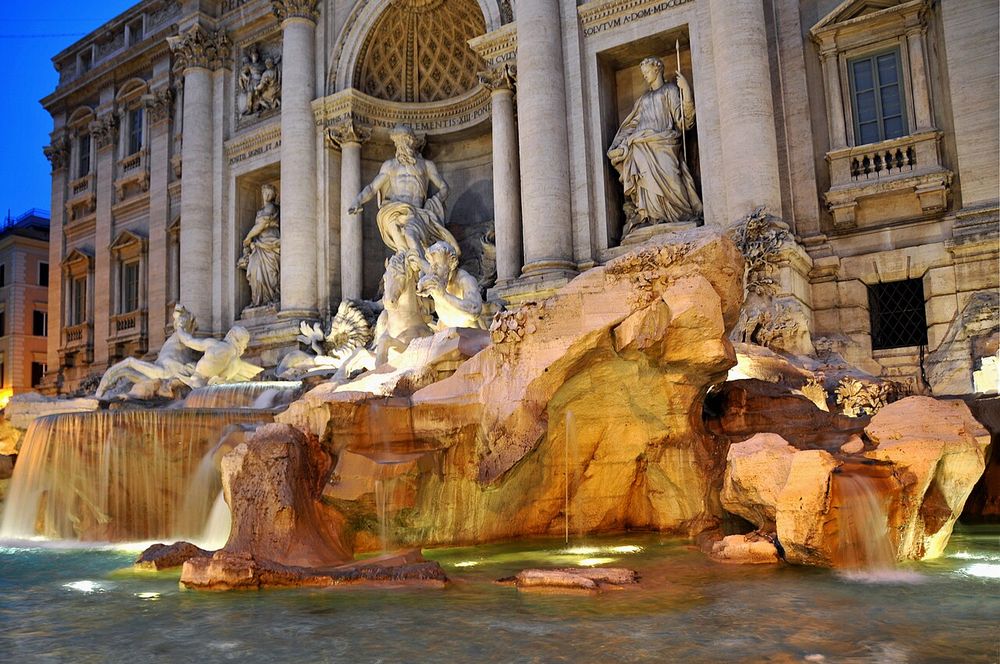
Walk to the left end and look along the front. The stone is travertine, the same pale limestone as the Colosseum, quarried at Tivoli. Where it meets the water it is carved as raw rock, with plants growing on it: a fig, a wild vine, an artichoke. More than thirty kinds have been counted.
2. The stage
The triumphal arch and the palace windowsLivioandronico2013, CC BY-SA 4.0
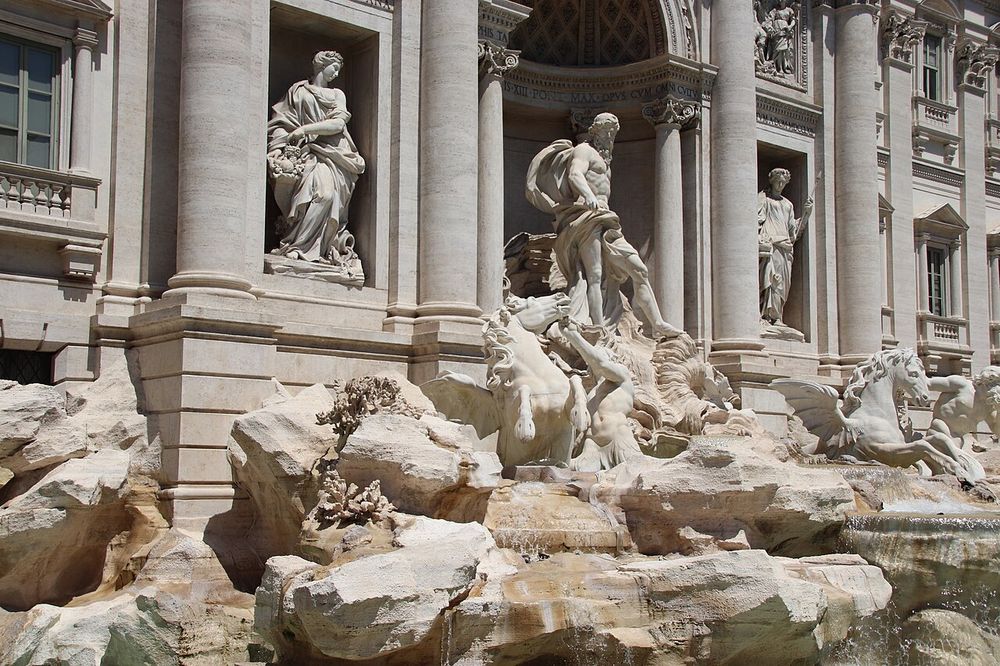
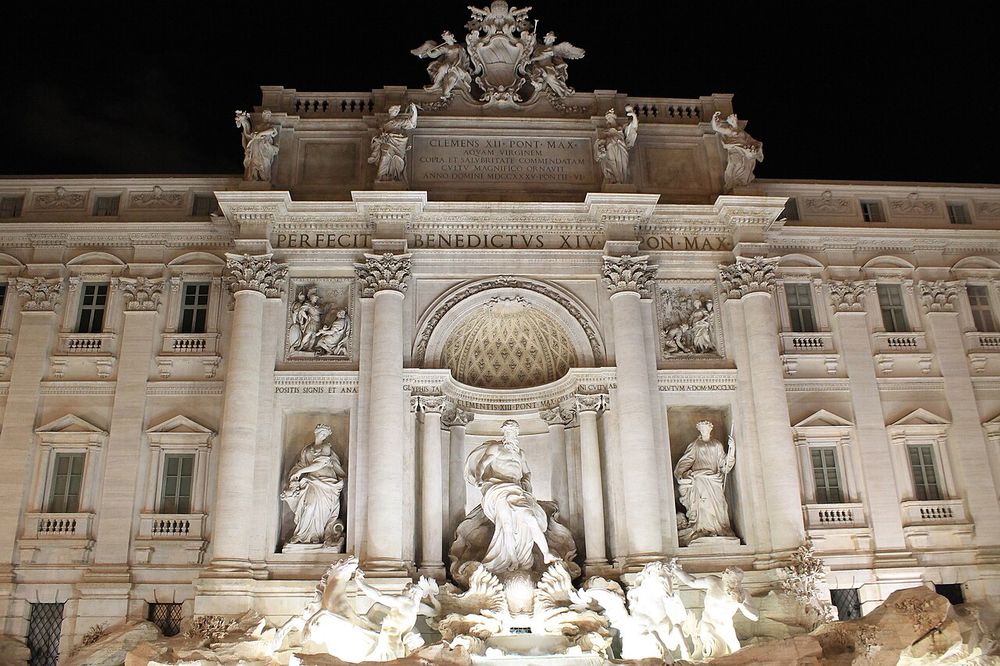
The upper part is a triumphal arch, like those the emperors built, set against the wall of a palace. The palace windows look out between the columns.
The pope's arms and the inscriptionJean-Pol GRANDMONT, CC BY 4.0
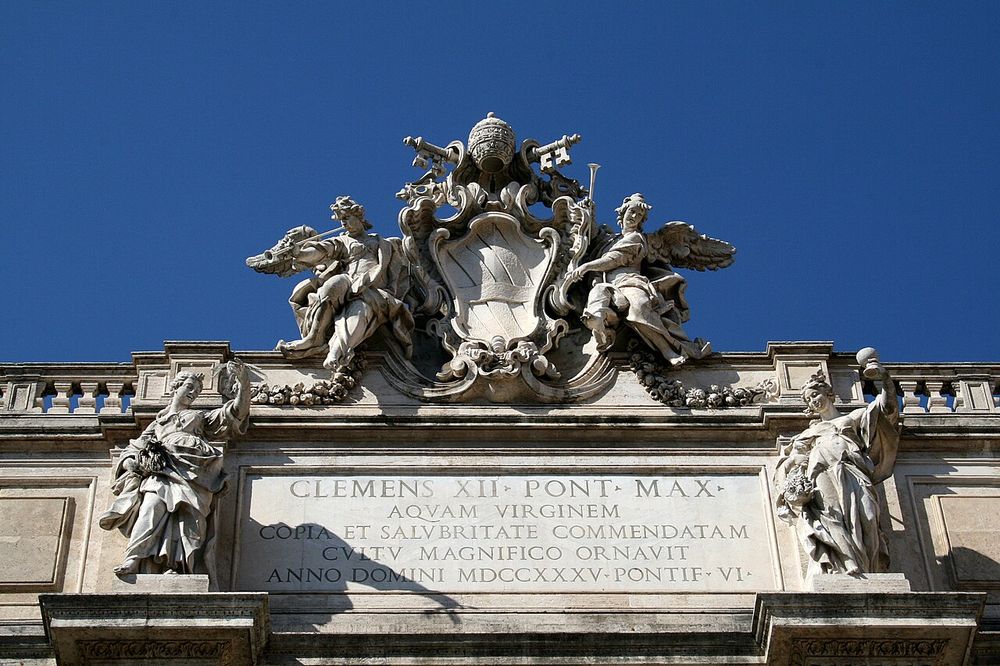
At the top two winged figures hold the arms of the pope who paid for it. He raised the money by bringing back the public lottery, which earlier popes had banned as a sin.
3. Oceanus and the horses
Oceanus in his shellWilfredor, CC0
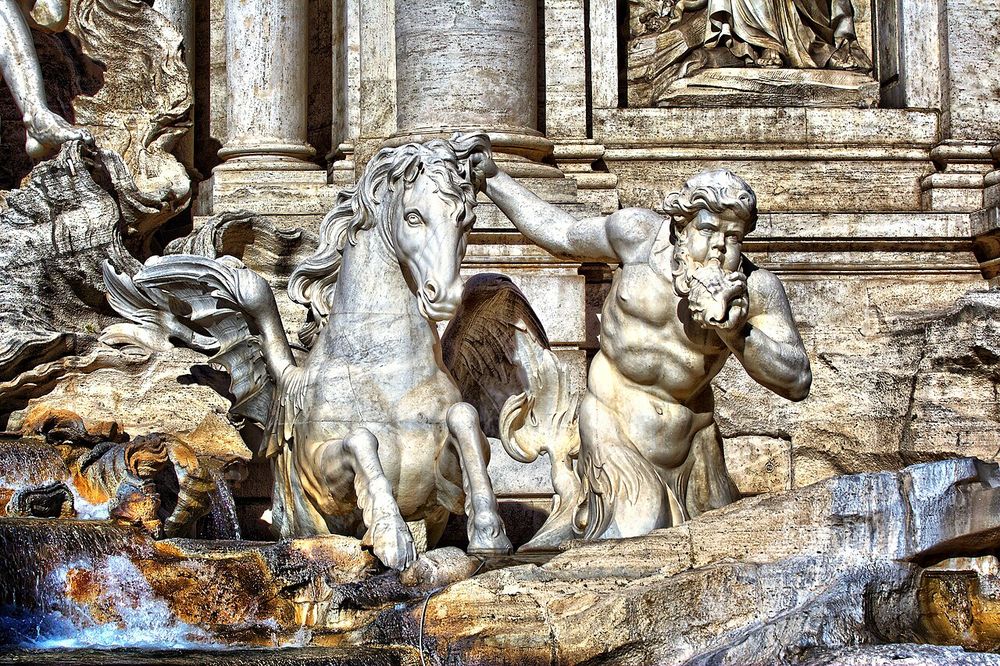
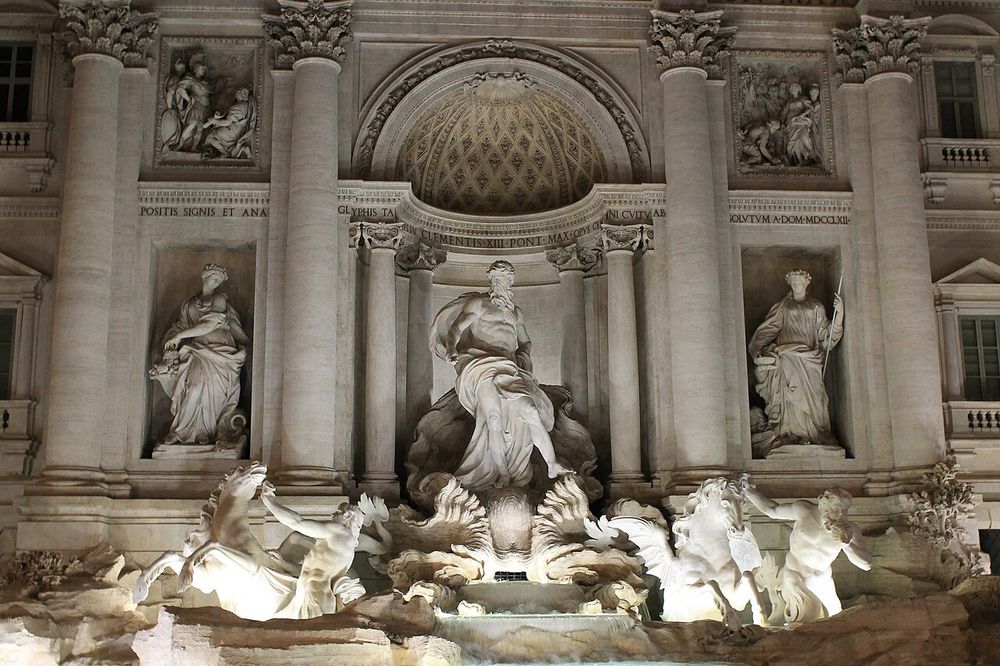
The god stands in a chariot made of a shell. Two horses with wings and fishes' tails pull it, each led by a young sea-spirit. The horse on the left rears and fights. The one on the right walks quietly. They are the two moods of the sea.
The quiet horse and its leaderLuigi Mancini, CC BY-SA 3.0
In the niches to either side stand two women. The one on the left holds a horn spilling fruit: Abundance. The one on the right holds a cup from which a snake drinks: Health. Good water brings both.
4. The girl and the general
The statues and the carved scenes above themGary Todd from Xinzheng, China, Public domain
Above the two women are two carved scenes. On the right a girl points to the ground while soldiers look on. On the left a man in armour studies a plan. He is Agrippa, ordering the channel to be built. The water was called the Virgin's water from the first.
Arches of the ancient channel in Via del NazarenoLalupa, CC BY-SA 3.0
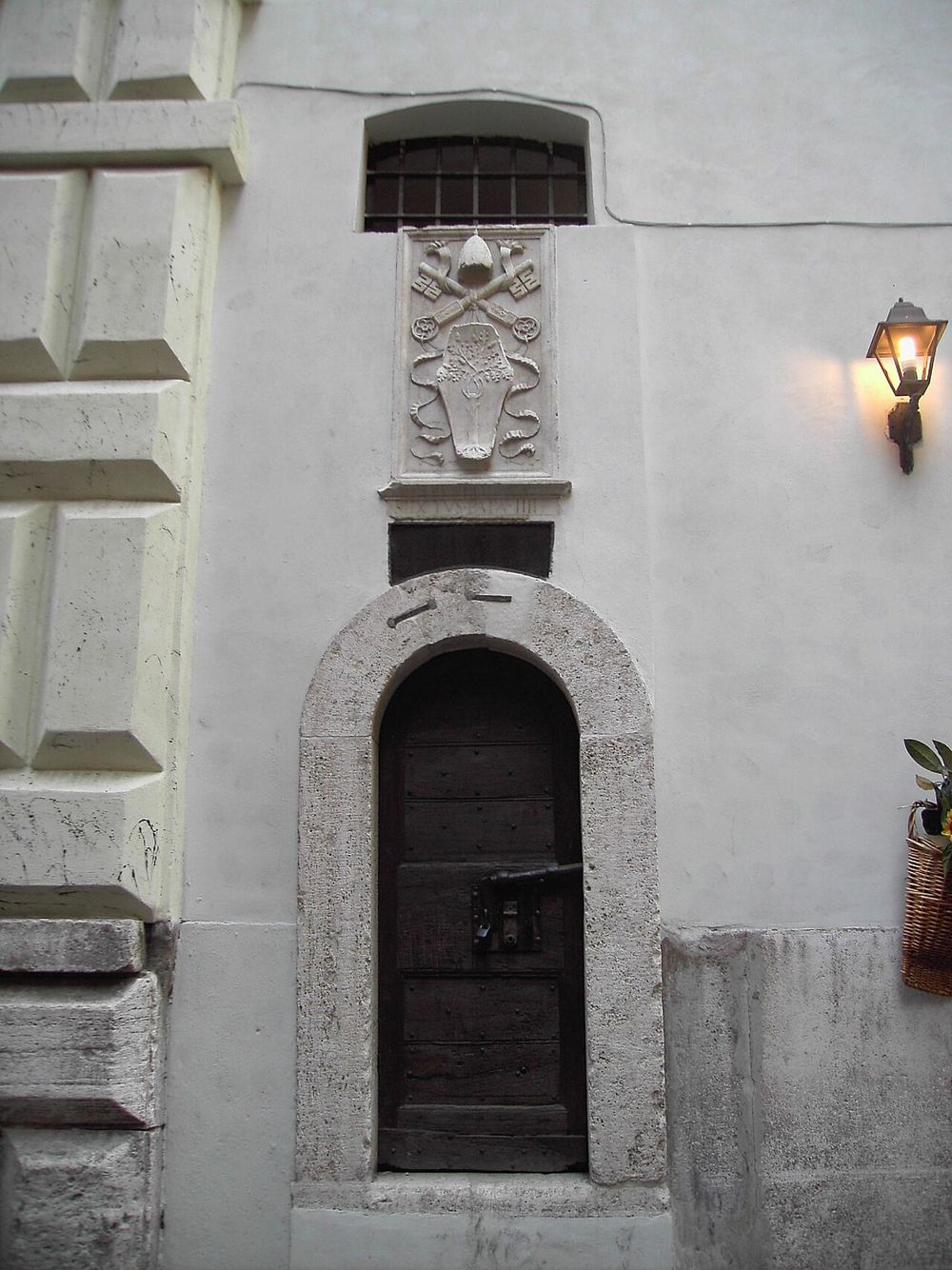
A few streets north, in Via del Nazareno, a stretch of the ancient channel can be seen behind a railing, half buried by the rise of the city.
5. The coin
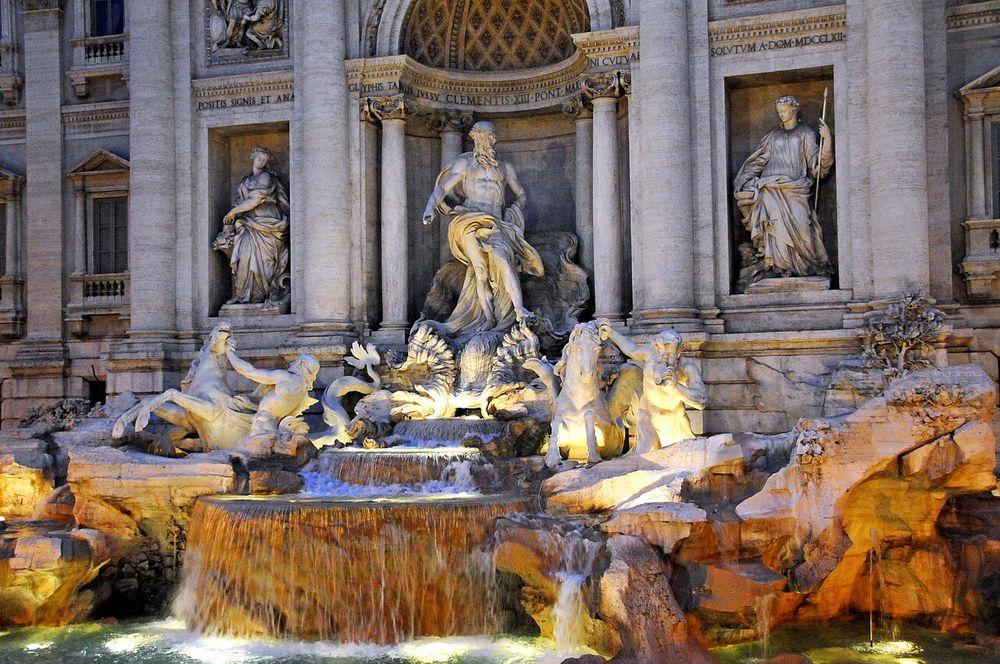
Rocks and falling water at nightDennis G. Jarvis, CC BY-SA 2.0
Stand with your back to the fountain and throw a coin with your right hand over your left shoulder. One coin means you will come back to Rome.
The basin is emptied of coins several times a week, early in the morning, with long brooms and a suction pump. The takings are about a million and a half euros a year. Since 2001 the city has given the money to a Catholic charity that runs kitchens and shelters for the poor of Rome.
Taking coins out is theft. For thirty-four years one man waded in before dawn with a magnet on a stick. He was stopped for good in 2002.
6. Round the corner, and underneath
The right-hand endDietmar Rabich, CC BY-SA 4.0
At the right-hand end, find a small basin with two thin jets that cross. It is called the lovers' fountain. A couple who drink from it together are said to stay faithful. This water is good to drink.
A Roman apartment block, nine metres downAnthony Majanlahti, CC BY 2.0
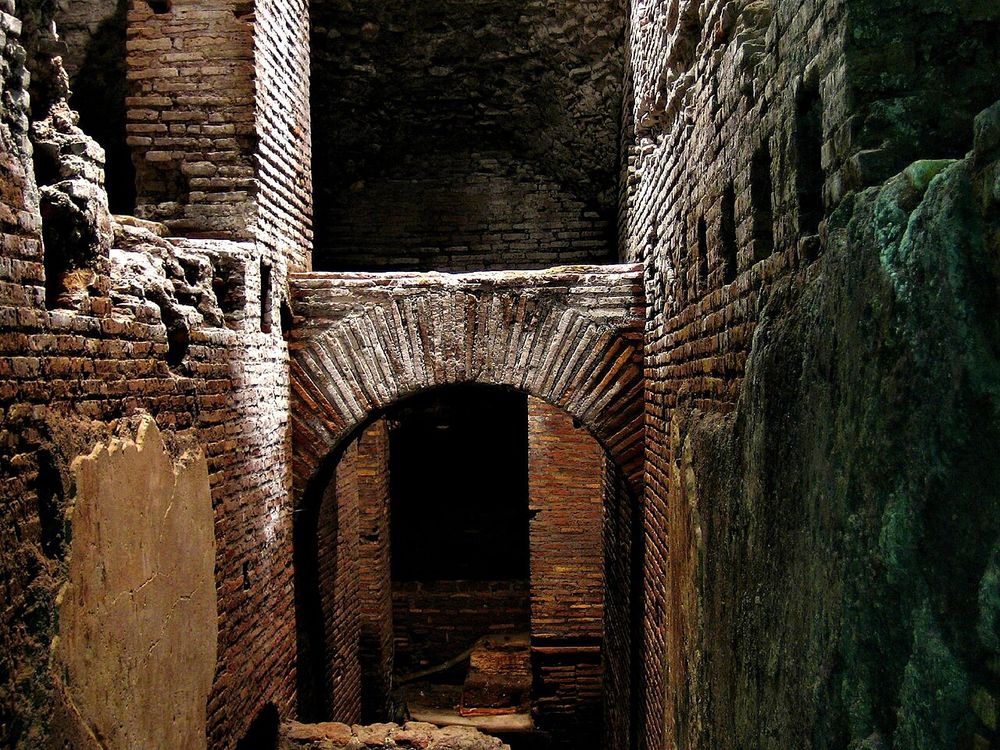
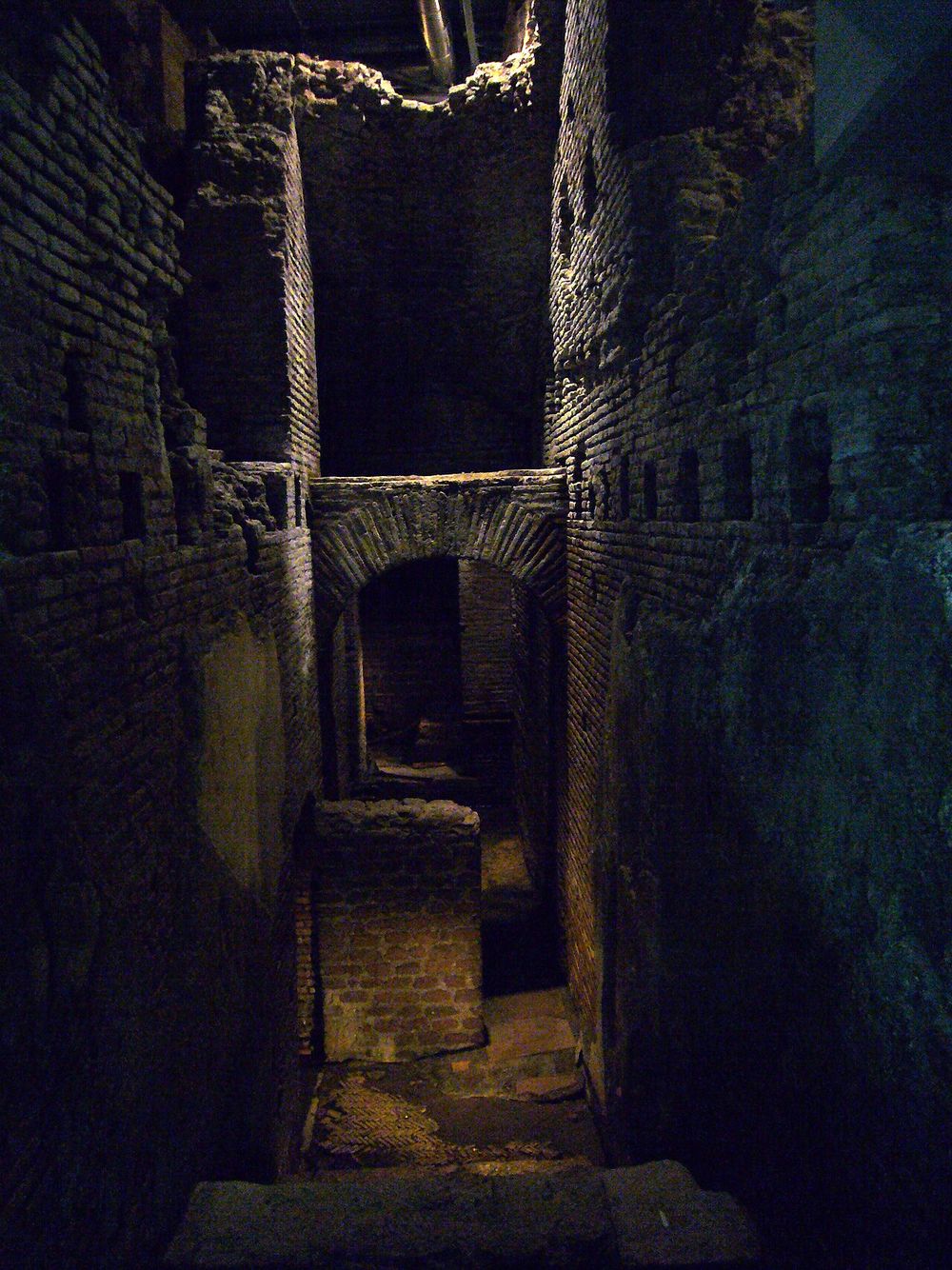
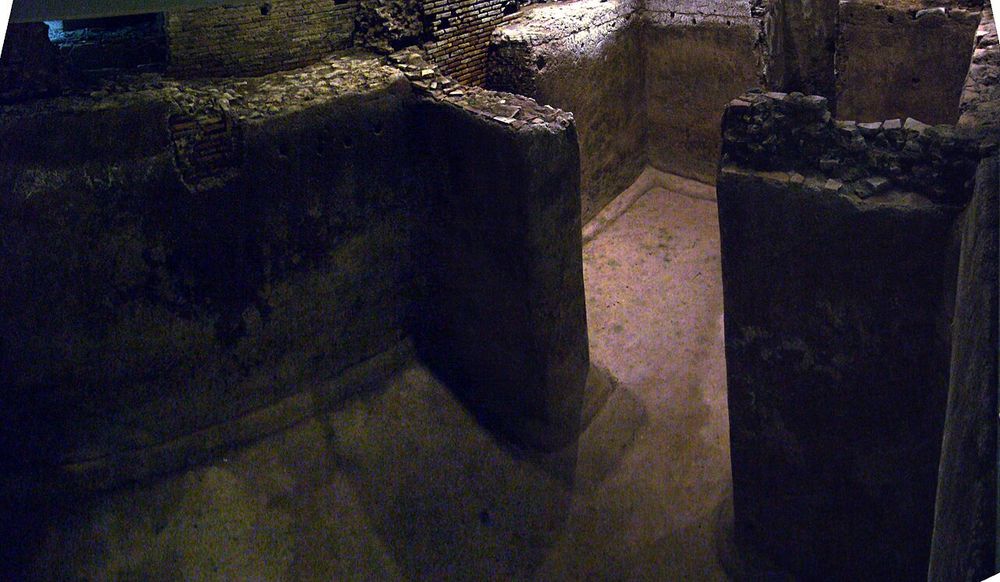
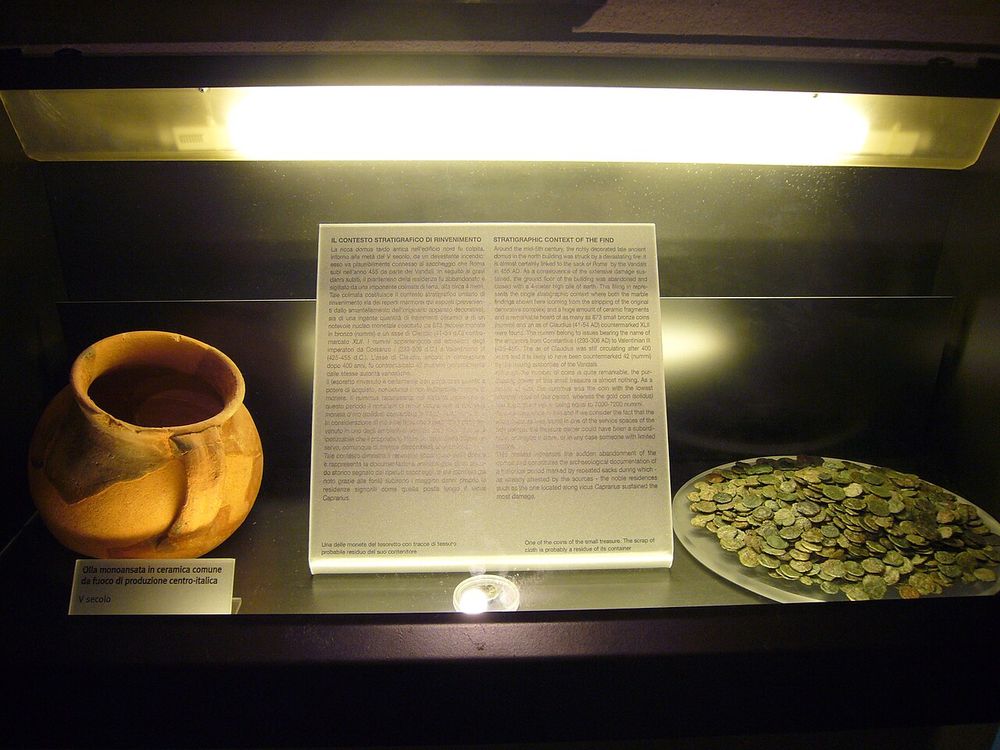
A hundred metres away, down a side street, a doorway leads to a cellar nine metres below the pavement. There are the brick walls of a Roman apartment block, a tank that held the Virgin's water, and a heap of eight hundred coins lost or hidden in the fifth century, when the city was being sacked.
Meanwhile in the world
Year
Here
Elsewhere
19 BC
Agrippa brings the water to Rome
Western Han (206 BC–AD 9) China (202 BC–AD 8); the poet Virgil dies in the same year
1453
A pope repairs the channel and builds a plain basin here
Ming China (1368–1644); Constantinople falls to the Ottomans
1629
Bernini is asked for a design
The last Ming emperor has just come to the throne; the Taj Mahal is begun three years later
1732
Work begins on Salvi's fountain
Qing China, the Yongzheng reign; George Washington is born
1762
The fountain is finished
The Qianlong reign; Rousseau publishes The Social Contract
1960
La Dolce Vita reaches the cinemas
Rome holds the Olympic Games in the same year
2015
Cleaned and relit after seventeen months of work
The year of the Paris climate agreement
2026
A ticket is charged at the water's edge
Three years after the Pantheon began to charge
Then and now
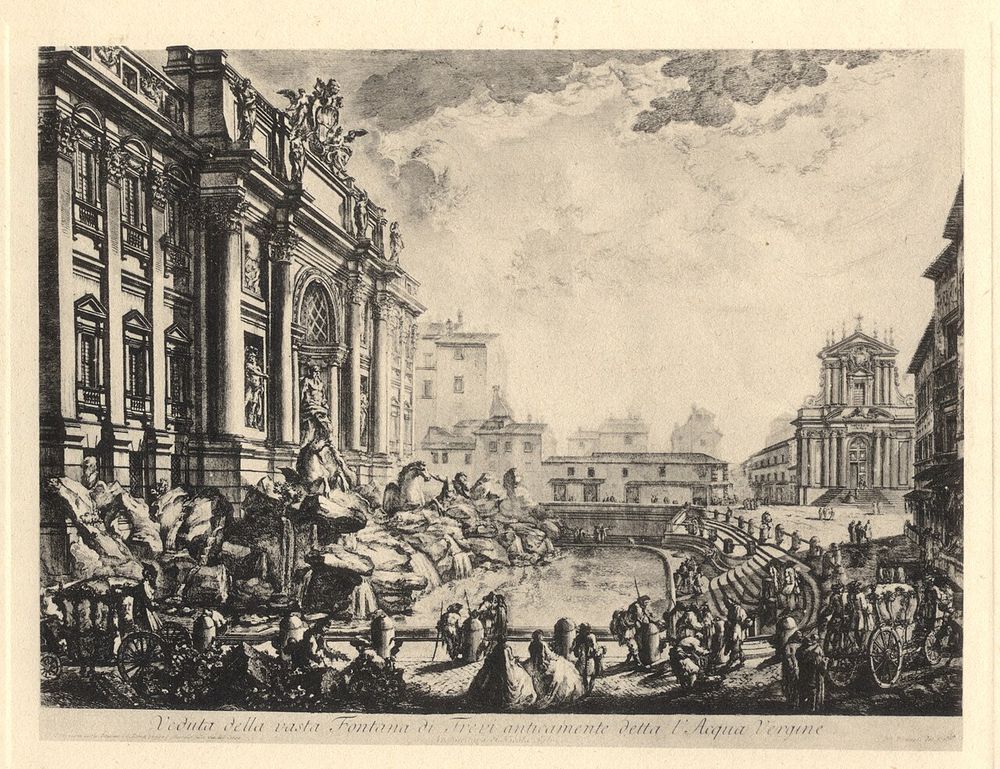
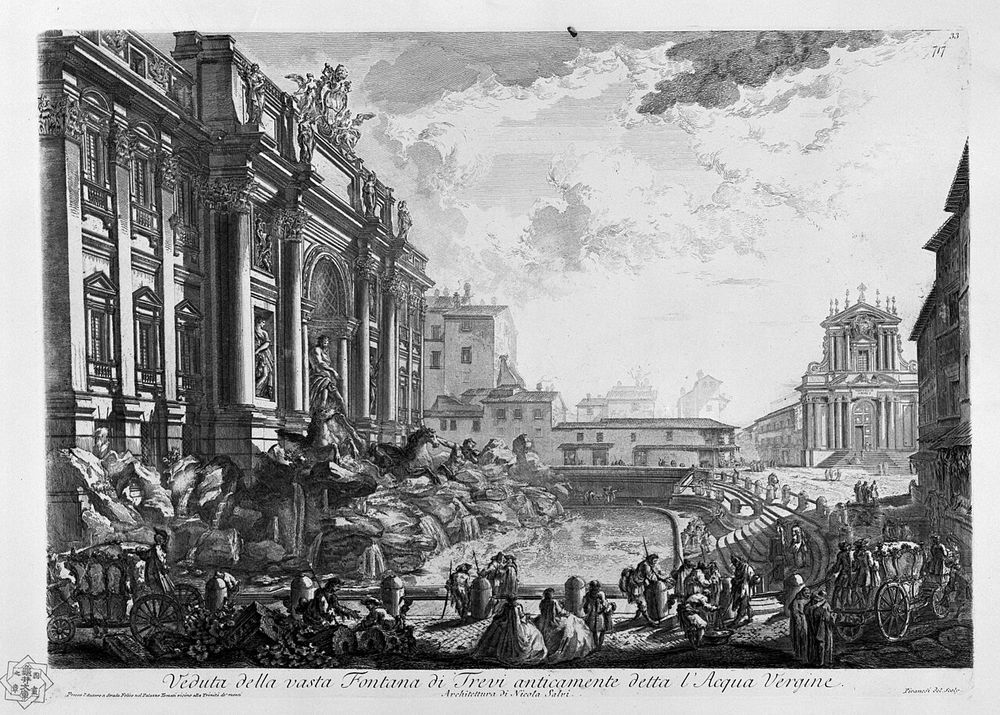
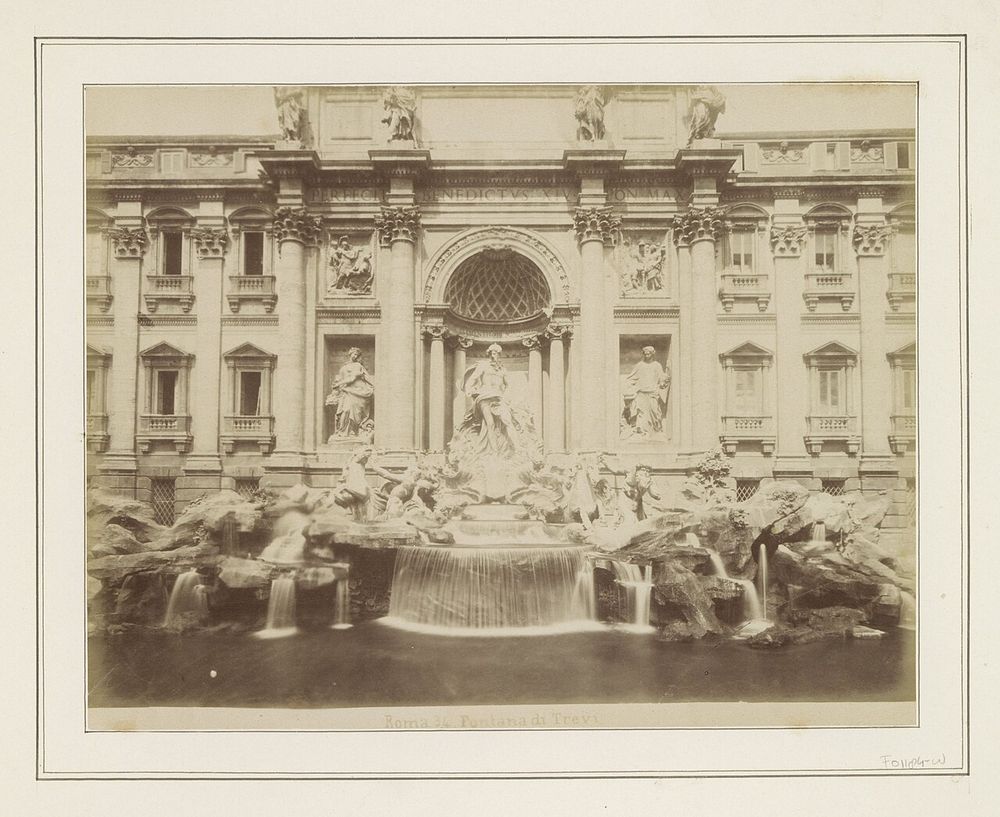
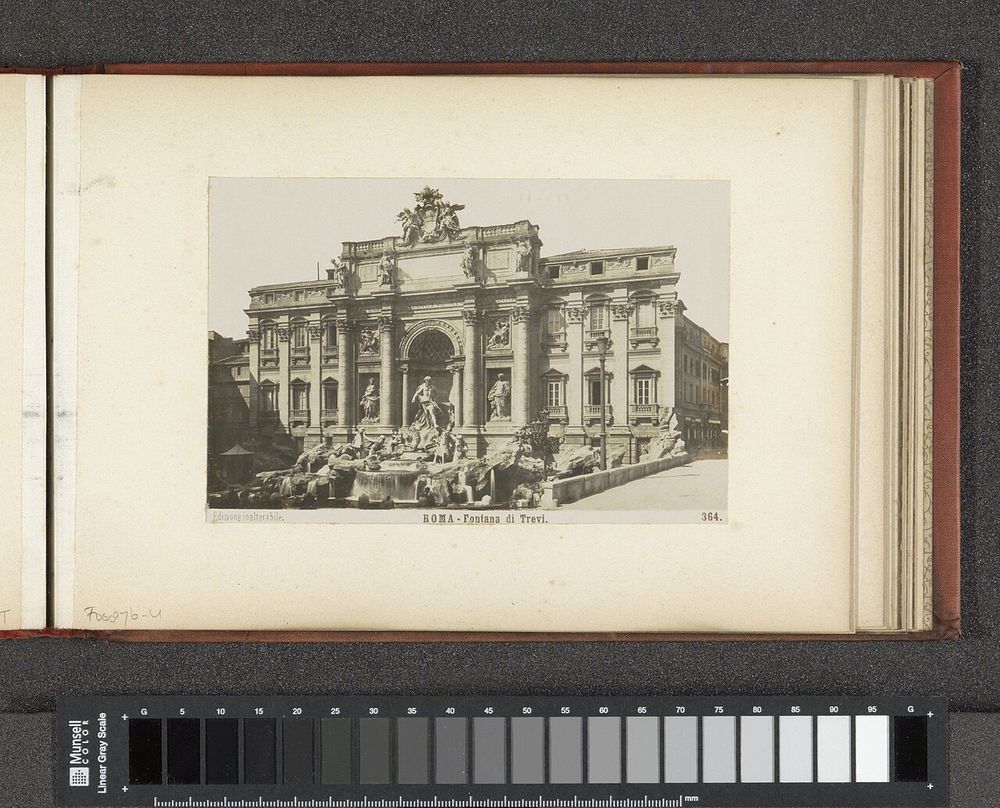
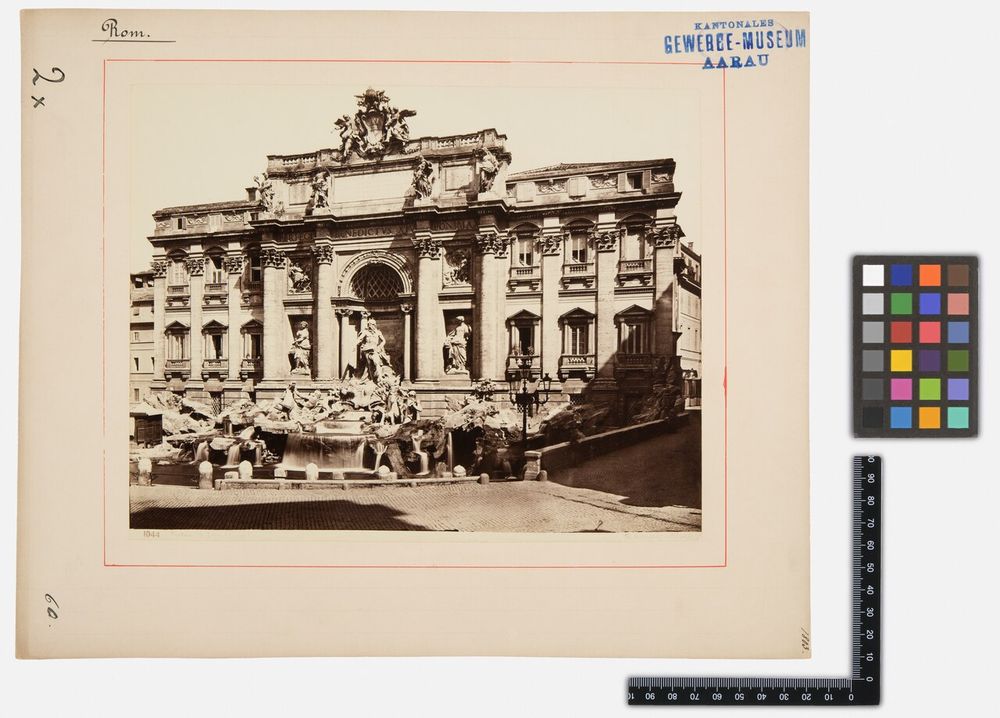
The fountain lit at nightLivioandronico2013, CC BY-SA 4.0, Wikimedia CommonsThe whole front on a clear morningDiego Delso, CC BY-SA 4.0, Wikimedia CommonsThe fountain and the palace behind itDiliff, CC BY 3.0, Wikimedia CommonsThe fountain above the crowdWilfredor, CC0, Wikimedia CommonsThe basin and the square from the left endGiorgio Galeotti from Reggio Emilia, Italia, CC BY-SA 2.0, Wikimedia CommonsA wide view from the stepsJosep Enric, CC BY-SA 2.0, Wikimedia CommonsThe front at night, in winterLivioandronico2013, CC BY-SA 4.0, Wikimedia CommonsThe triumphal arch and the palace windowsLivioandronico2013, CC BY-SA 4.0, Wikimedia CommonsA street lamp and the fountainJohn Samuel, CC BY-SA 4.0, Wikimedia CommonsOceanus between Abundance and HealthJohn Samuel, CC BY-SA 4.0, Wikimedia CommonsThe upper storeys litJohn Samuel, CC BY-SA 4.0, Wikimedia CommonsBlue hourThomas Wolf, www.foto-tw.de, CC BY-SA 3.0 de, Wikimedia CommonsRocks and falling water at nightDennis G. Jarvis, CC BY-SA 2.0, Wikimedia CommonsThe centre at nightDennis G. Jarvis, CC BY-SA 2.0, Wikimedia CommonsThe horses and the rocks, lit from belowDennis G. Jarvis, CC BY-SA 2.0, Wikimedia CommonsThe side of the fountain at duskDeb Nystrom from Ann Arbor, Michigan, USA, CC BY 2.0, Wikimedia CommonsOceanus in his shellWilfredor, CC0, Wikimedia CommonsOceanus in his nicheTomascastelazo, CC BY-SA 4.0, Wikimedia CommonsThe god from belowGary Todd from Xinzheng, China, Public domain, Wikimedia CommonsThe statues and the carved scenes above themGary Todd from Xinzheng, China, Public domain, Wikimedia CommonsHealth, with her cup and snakeGary Todd from Xinzheng, China, Public domain, Wikimedia CommonsAbundance, with her horn of fruitGary Todd from Xinzheng, China, Public domain, Wikimedia CommonsThe quiet horse and its leaderLuigi Mancini, CC BY-SA 3.0, Wikimedia CommonsThe right-hand endDietmar Rabich, CC BY-SA 4.0, Wikimedia CommonsThe pope's arms and the inscriptionJean-Pol GRANDMONT, CC BY 4.0, Wikimedia CommonsArches of the ancient channel in Via del NazarenoLalupa, CC BY-SA 3.0, Wikimedia CommonsA door into the channeluser:Lalupa, Public domain, Wikimedia CommonsRoman walls under the streets near the fountainLalupa, CC BY-SA 3.0, Wikimedia CommonsThe tank that held the Virgin's waterLalupa, CC BY-SA 3.0, Wikimedia CommonsCoins of the fifth century found undergroundLalupa, CC BY-SA 3.0, Wikimedia CommonsA Roman apartment block, nine metres downAnthony Majanlahti, CC BY 2.0, Wikimedia CommonsThe fountain painted by Giovanni Paolo Panini while it was newGiovanni Paolo Panini, Public domain, Wikimedia CommonsA print of the design, eighteenth centuryPopular Graphic Arts, Public domain, Wikimedia CommonsEtching by Piranesi, before 1778Giovanni Battista Piranesi, Public domain, Wikimedia CommonsPiranesi's view from the side, with carriages in the squareGiovanni Battista Piranesi, Public domain, Wikimedia CommonsA photograph of the later nineteenth centuryRijksmuseum, CC0, Wikimedia CommonsA page from a traveller's album, about 1880Rijksmuseum, CC0, Wikimedia CommonsThe fountain in 1890Unknown authorUnknown author, Public domain, Wikimedia Commons
Video
Films from official channels, played from YouTube. Nothing is loaded until you press play.
The historic centre of RomeUNESCO · made with NHK; 3 min · checked 2026-11-12
Local legends
These are stories people tell about this place. They are legends, not history, and each one says where it comes from.
LegendThe girl who knew the spring
Agrippa's soldiers, hot and thirsty on the road, asked a young girl for water. She led them to a spring so clear and plentiful that the general had it measured on the spot. The water was named the Virgin's after her.
Source: Frontinus, On the Aqueducts of Rome (about AD 97), who gives it as the usual explanation
LegendThe coin over the shoulder
Throw one coin and you will return to Rome. Throw two and you will fall in love with an Italian. Throw three and you will marry.
Source: The first is recorded from the 1800s; the second and third from the film Three Coins in the Fountain, 1954
LegendThe ace of cups
A barber whose shop faced the works mocked the fountain every day as it was built. One night the architect had a great stone vase set on the rail in front of his door, to shut out his view for ever. Romans call it the ace of cups, after the playing card.
Source: Roman popular tradition
LegendThe lovers' fountain
When a young man of Rome went away to be a soldier, his girl brought him here on the last evening. They drank from a new cup, and she broke it, so that no one else could drink from it and he would not forget.
Source: Roman custom, recorded in the nineteenth century
Later, people who live here will be able to add the stories they grew up with, and say which of these they have heard.
Not certain, and where accounts conflict
Why "Trevi"?
Three roads is the usual answer. Others derive it from Trebium, the place near the springs, or from the three mouths of the earlier basin. No document settles it.
How much did Bernini leave?
His drawings are lost. He moved the basin to this side of the square and may have built its first curved base. How far Salvi used his ideas has been argued for two hundred years.
Is it Oceanus or Neptune?
Salvi's own written programme names Oceanus. Guidebooks have said Neptune since the day it opened.
When exactly does the ticket apply?
The city's notice says every day from 9:00 to 22:00. Visitors report that on Mondays and Fridays, when the basin is cleaned, it opens later in the morning. The hours have changed once already; read the sign at the entrance.
Visiting
Tickets and hours
The square is open at all hours and is free.
To go down to the edge of the water between 9:00 and 22:00 costs 2 euros.
On Mondays and Fridays the basin is reported to open at 11:30, after cleaning.
The fountain is sometimes drained for a day for maintenance. The city announces it only shortly before.
Last checked 2026-11-12. The city of Rome's tourism site (turismoroma.it), notice on the entry fee as shown in November 2026.
Booking from abroad
Official page in English The city's tourism site explains the fee in English: turismoroma.it. It names fontanaditrevi.roma.it as the site for buying the ticket online.
Ticket window on site Tickets are also sold at the entrance to the basin, by card only, and at the city's tourist information points and museums.
Note No ticket is needed to see the fountain from the square, or to go down to the water between 22:00 and 9:00. Residents of Rome, children under five, and disabled visitors with a companion do not pay.
Checked 2026-11-12
Where to start
The nearest metro station is Barberini on line A, eight minutes' walk. The Pantheon is ten minutes to the west and the Spanish Steps ten minutes to the north.
Come before 8:00 or after 23:00. At those hours you may stand at the water for nothing, and at seven in the morning you may be nearly alone.
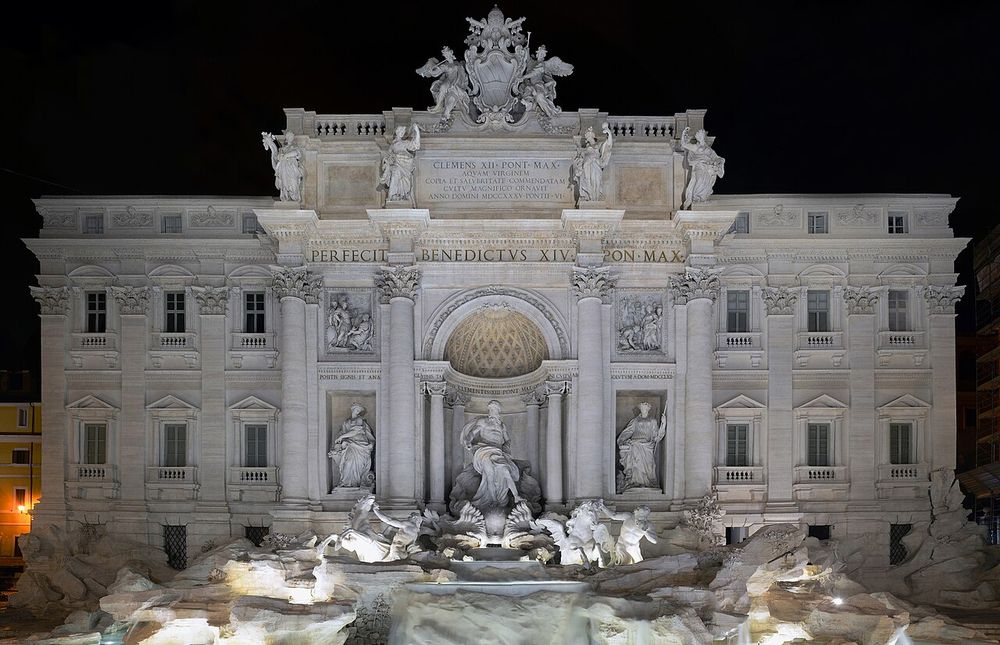
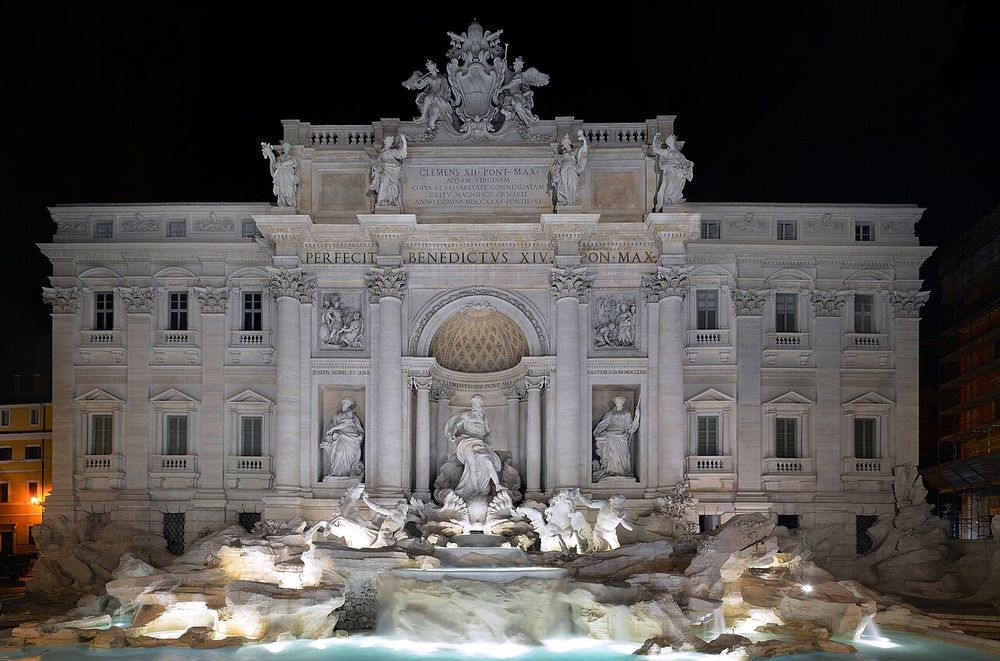
Come twice if you can: once by day for the carving, once at night for the light.
The best place for a photograph of the whole front is the top of the steps on the right-hand side.
Before you go
The square is the worst place in Rome for pickpockets. Carry your bag in front of you.
There is nowhere to sit. Sitting on the rim, eating on the steps and putting a hand or foot in the water are all fined.
Use small coins. The water does not care what they are worth, and the charity changes them all.
Customs and manners
Take your turn at the rail, throw, and step back. Someone is waiting behind you.
Do not throw anything but coins.
The attendants with whistles are there to protect the stone. When one blows at you, move.
Opening hours are given in the local time of the place. Prices are in the local currency. The figure after ≈ is approximate, at exchange rates checked on 9 November 2026, in .
Look for these
Listen first. From how far away can you hear the water?
Which of the two horses is the wild one?
What is the woman on the right holding, and what is drinking from it?
Find the girl pointing to the spring.
Find a plant carved in the rock. Can you find a second kind?
Find the windows of the palace. Is anyone looking out?
At the right end, find the big stone vase.
Find the small spout with two crossing jets.
I am here
Stand at the site, sign in, press the button, and collect its stamp. Your browser will ask to use your location. It is sent to us once to confirm that you are at the site; we keep how far you were from it, not the spot where you stood.
Your stamps are saved to your account, so they follow you to any device. Checking from a browser cannot rule out every false location; stricter checks arrive with the app.
Messages
Share your photos
Photos here show the place, not people. Each one is credited to the visitor who took it and appears after our team has looked at it. A photo with you in it belongs under “I am here”.