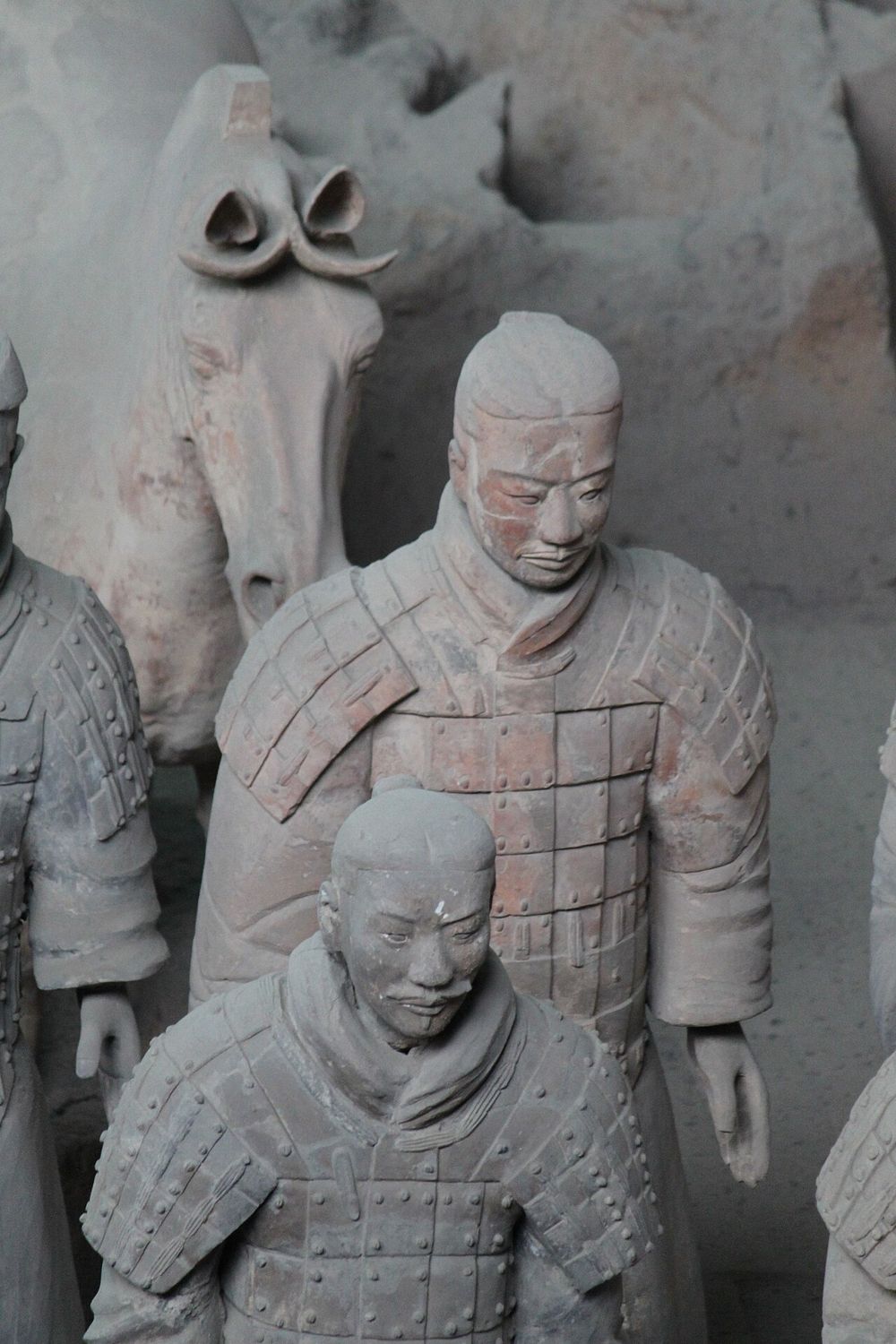
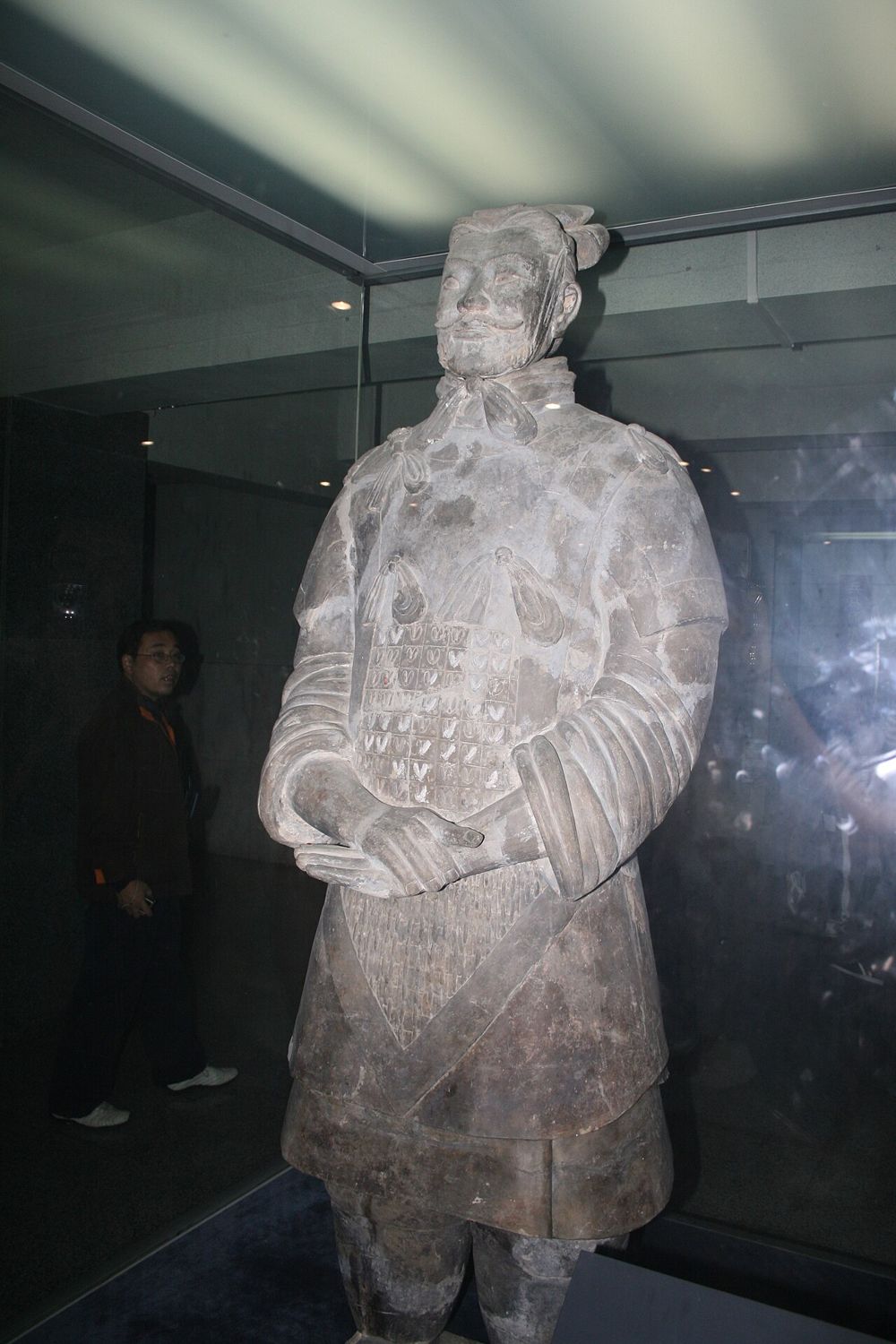
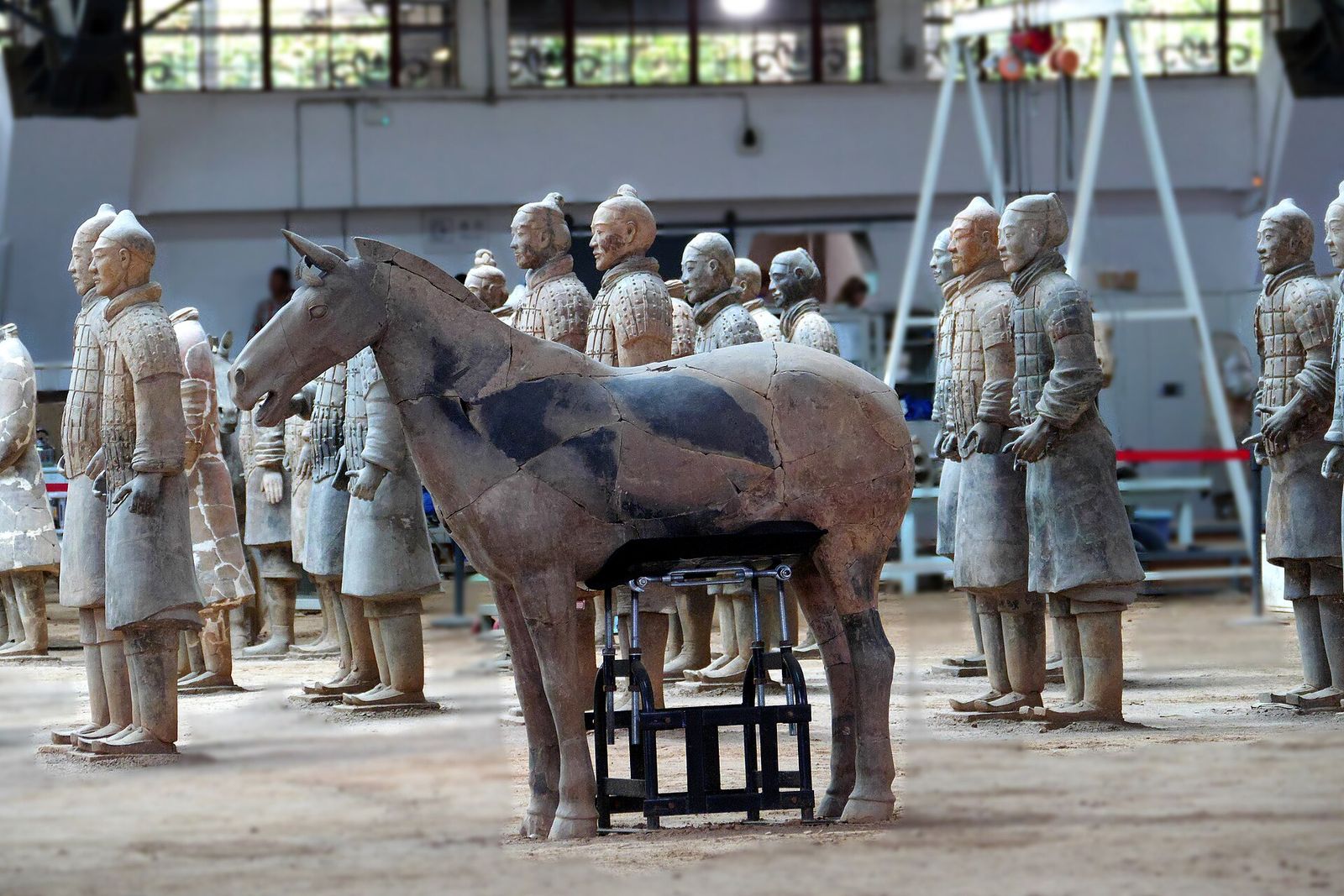
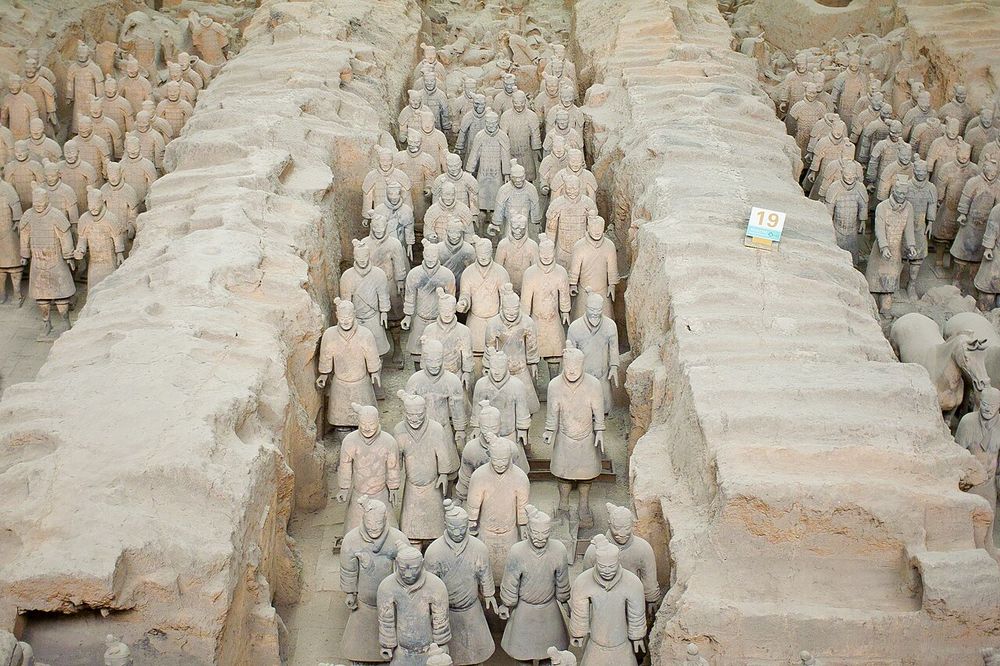
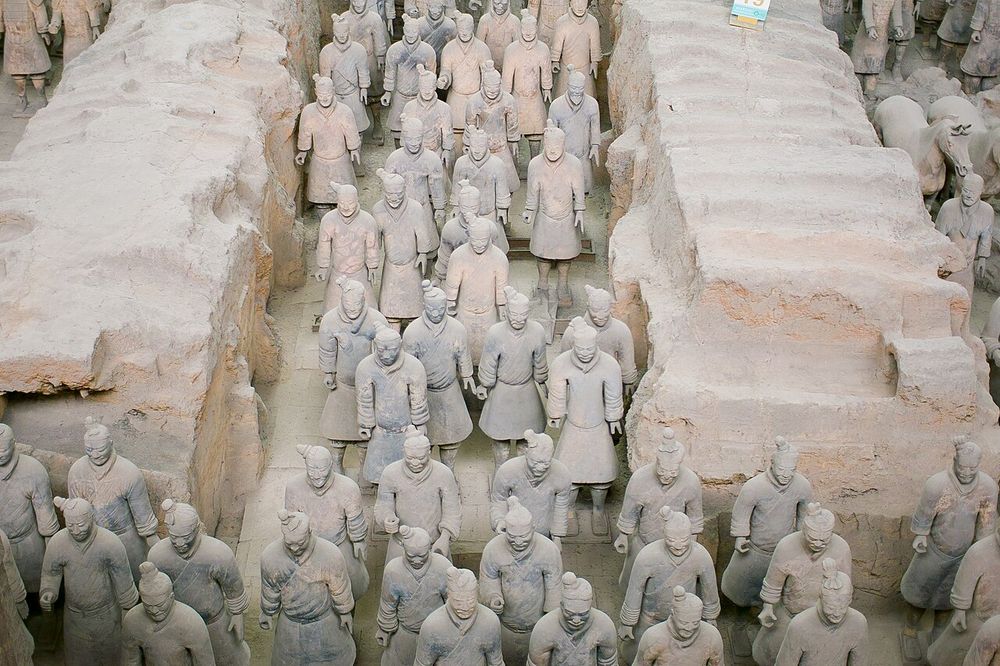
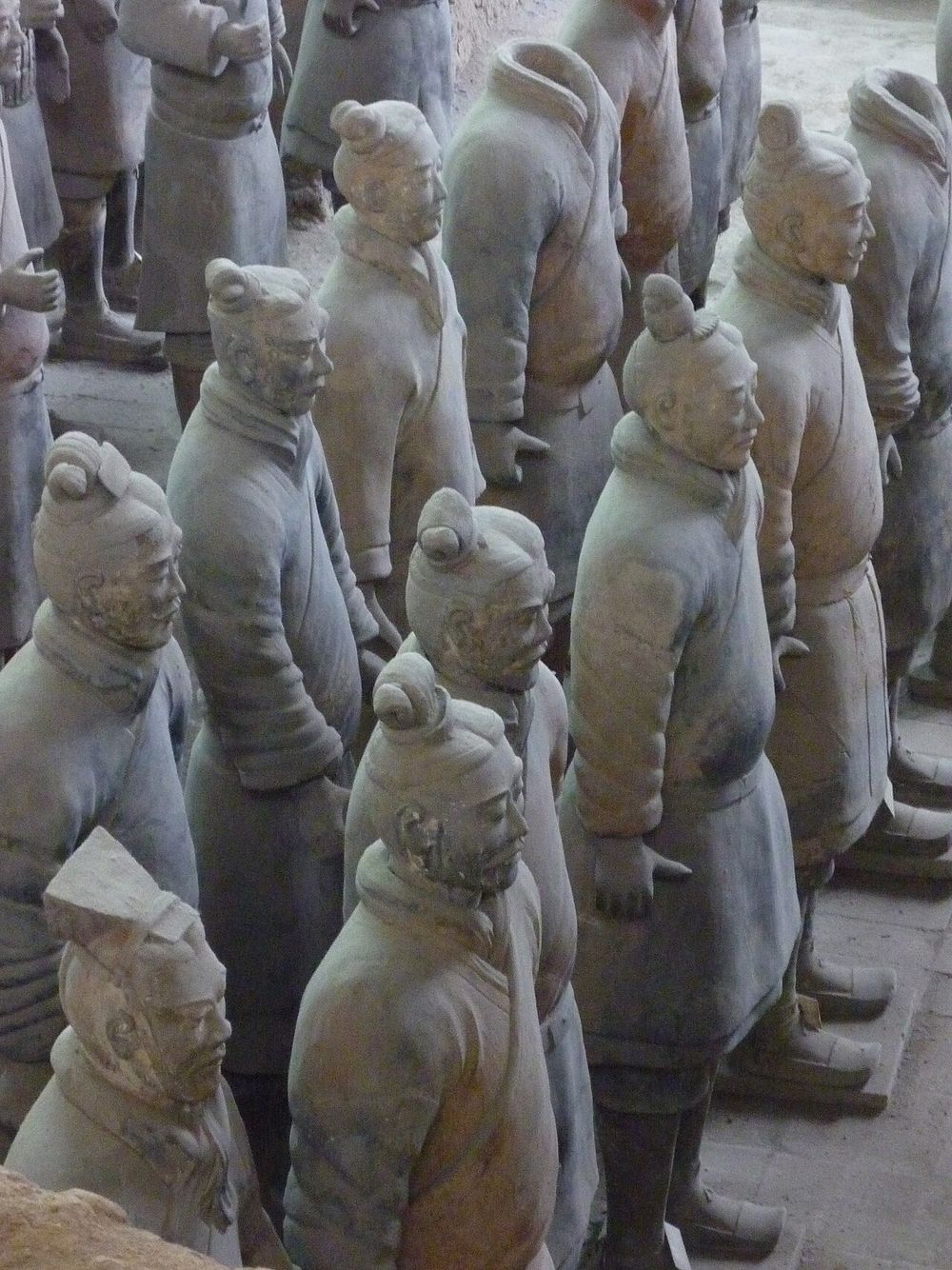
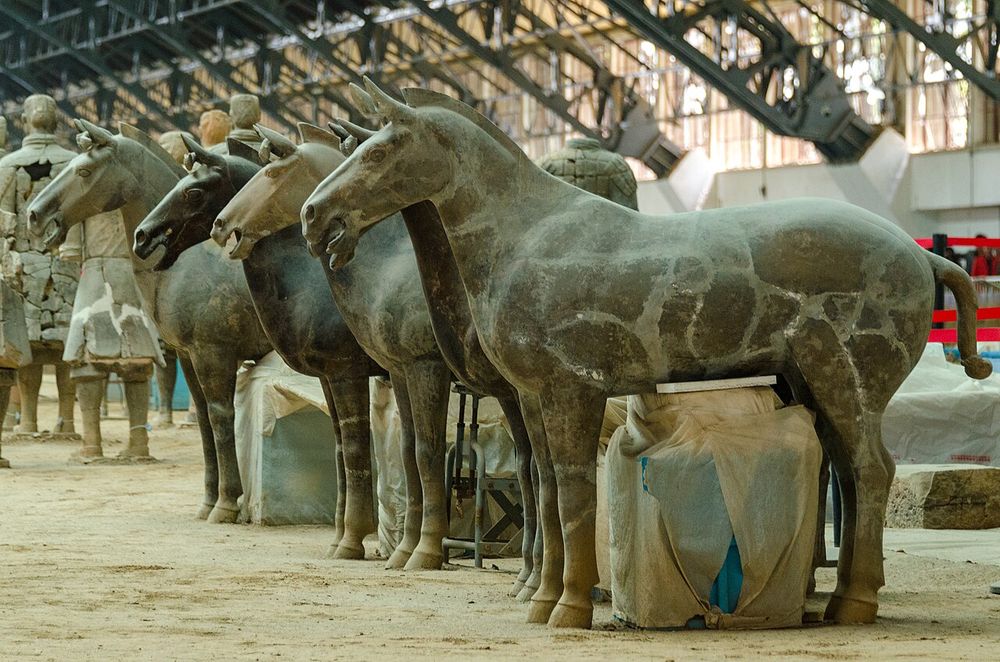
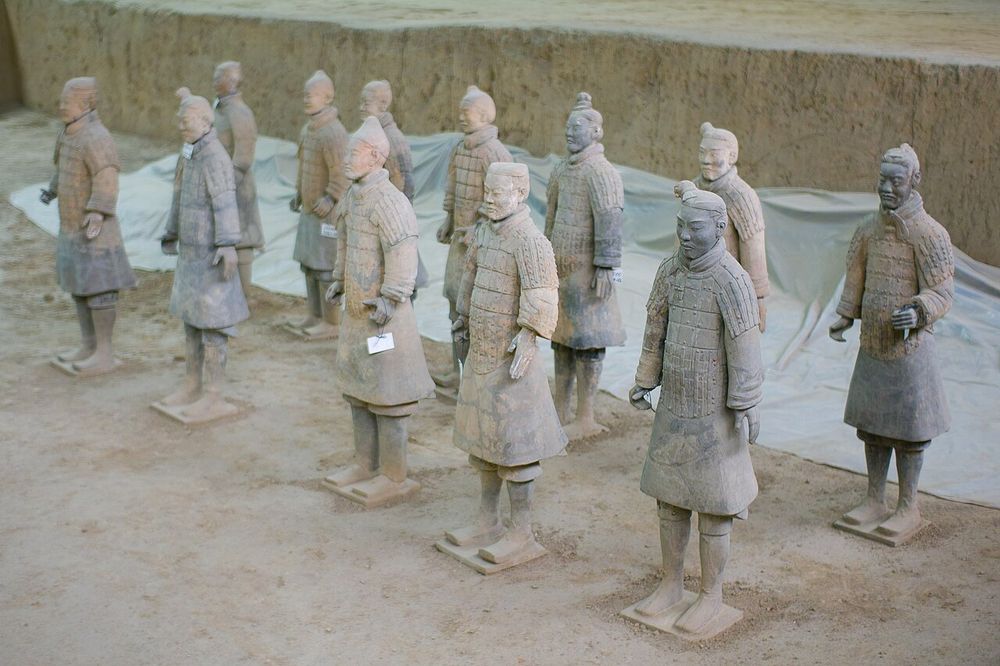
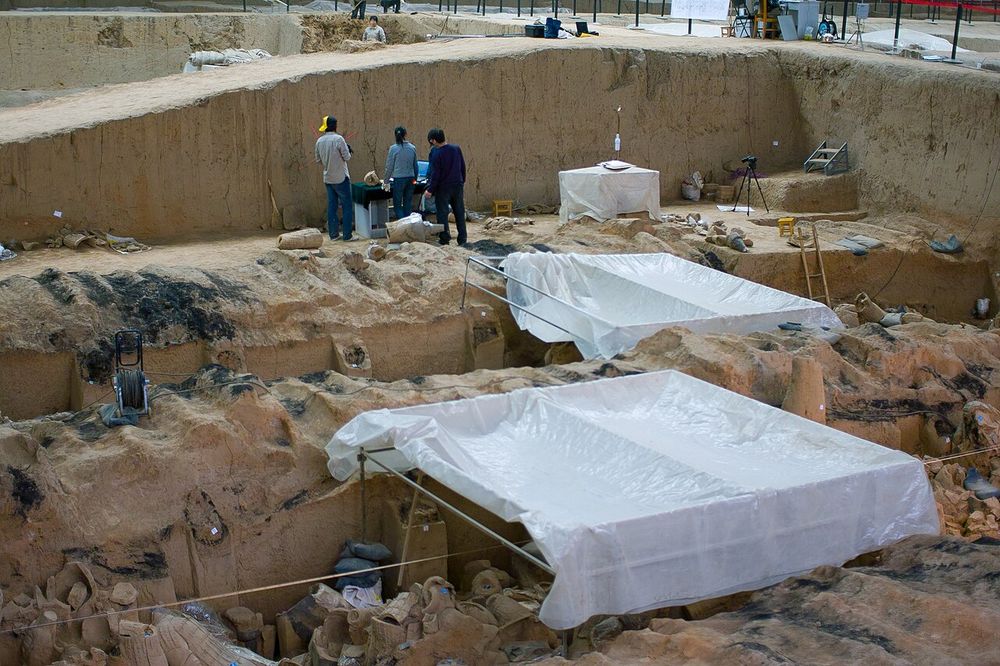
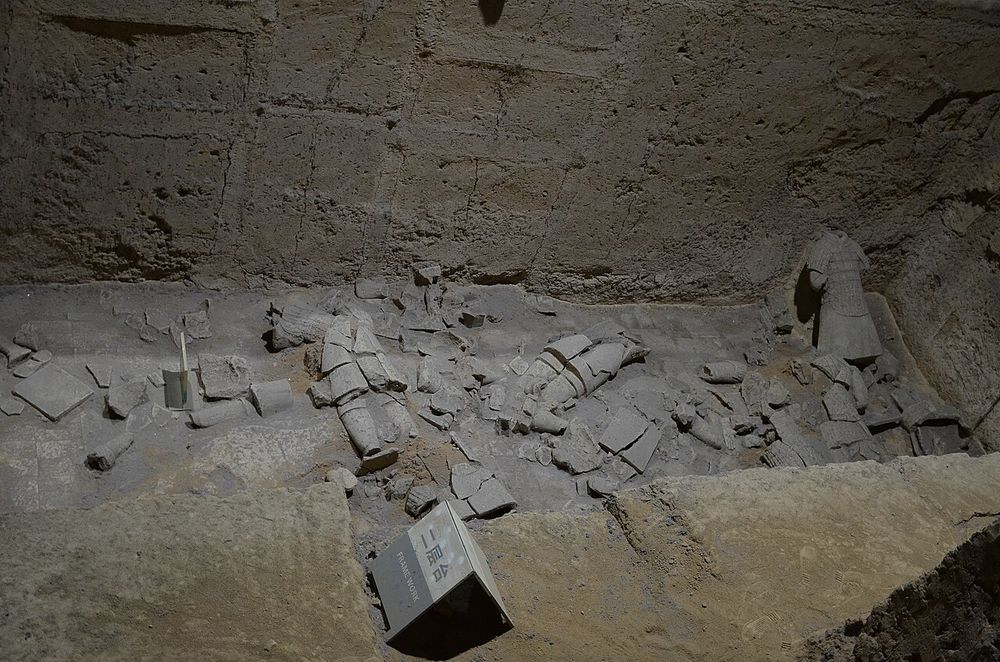
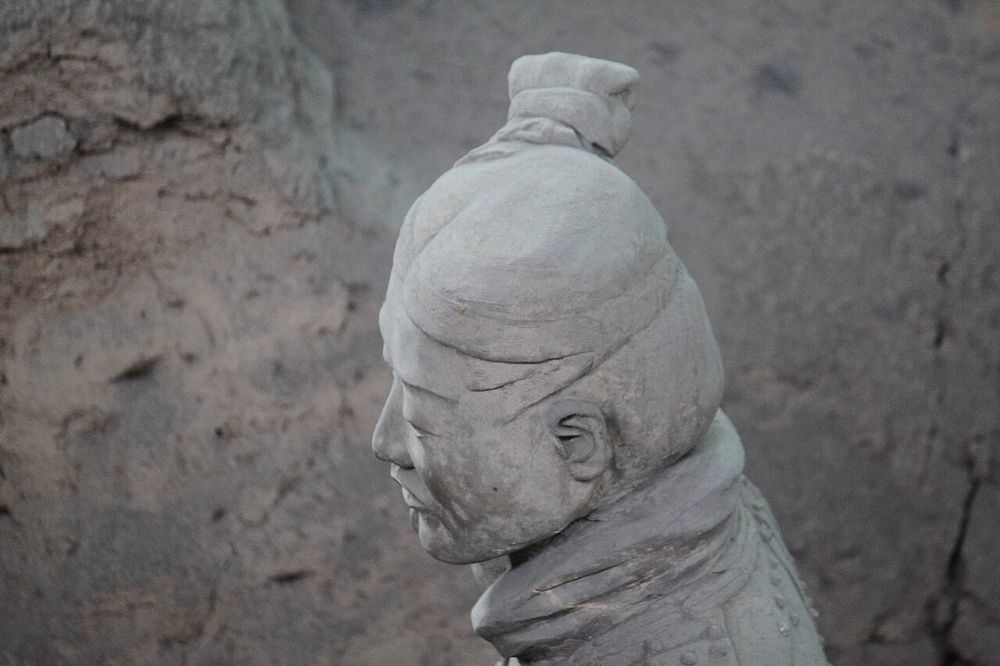
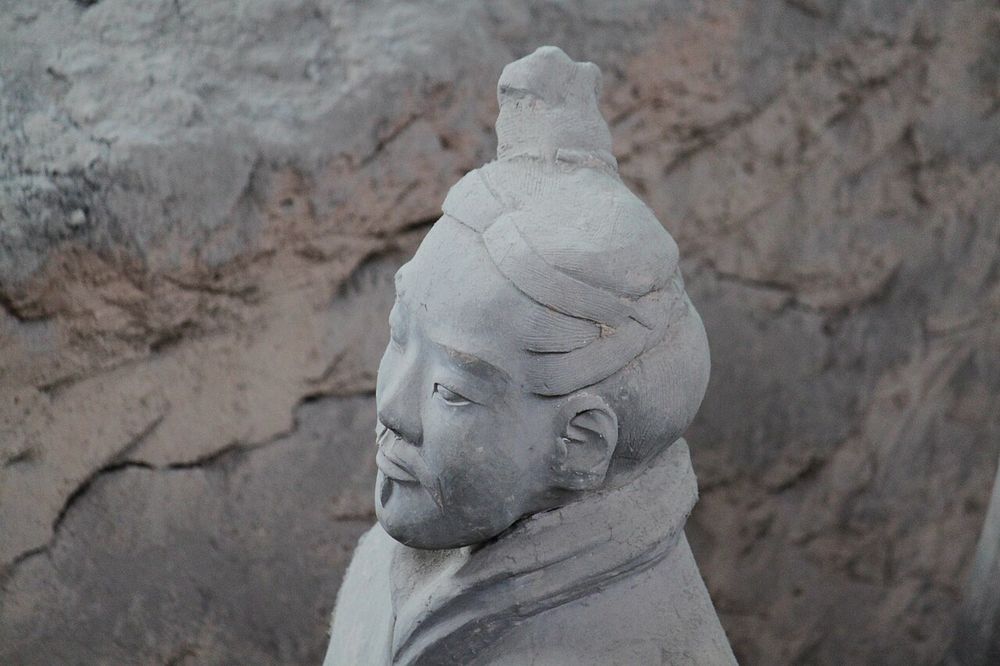
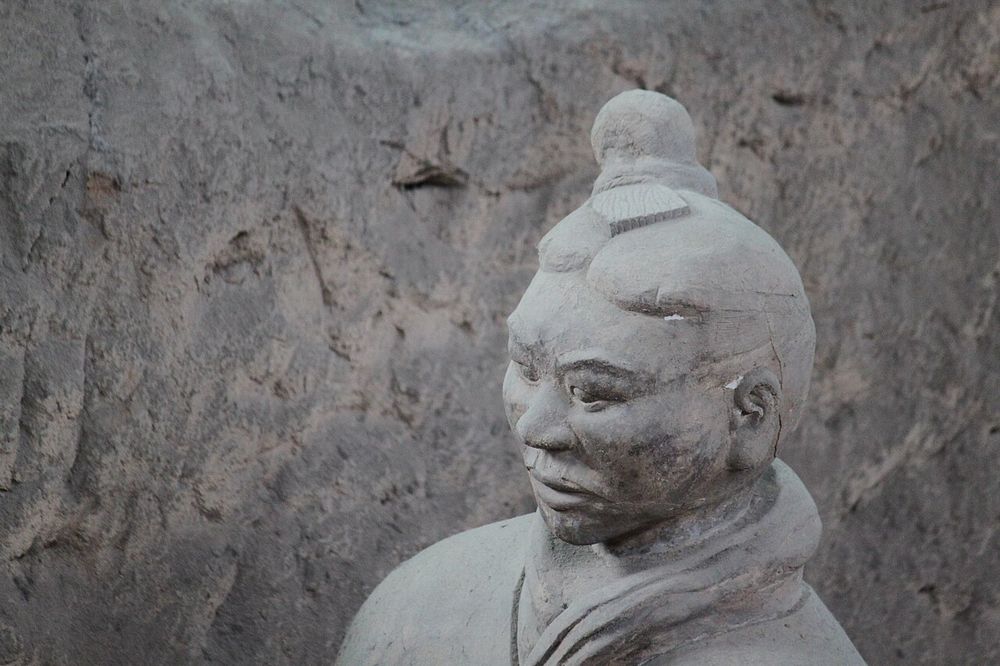
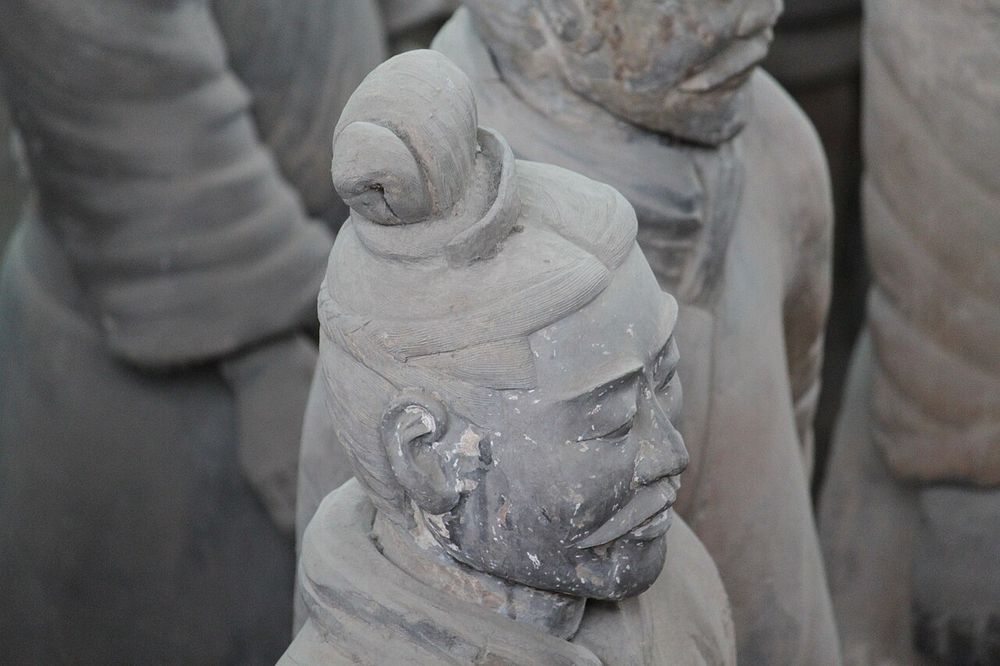
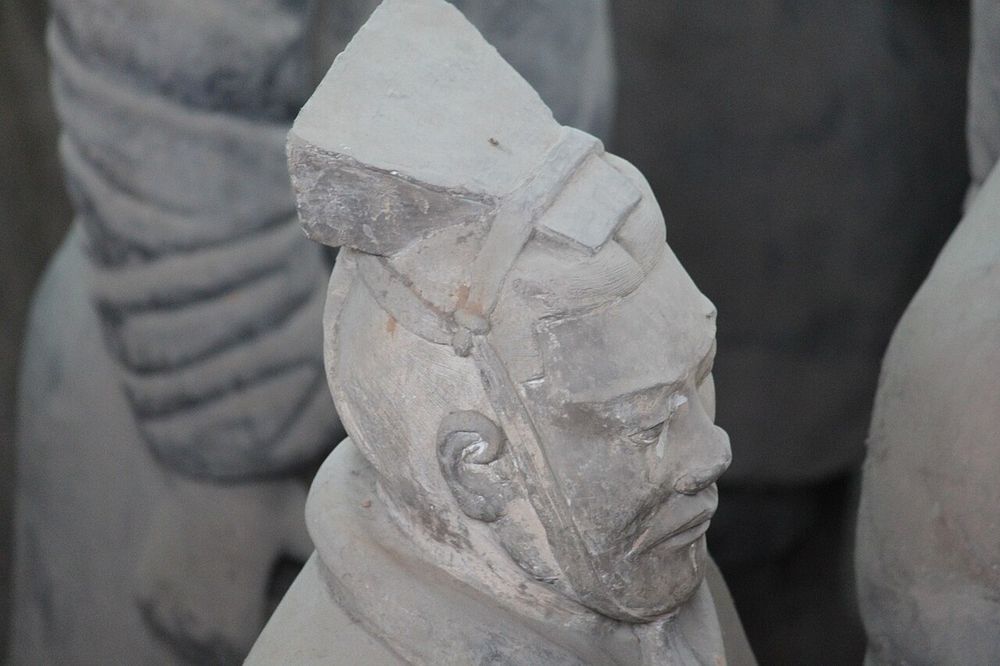
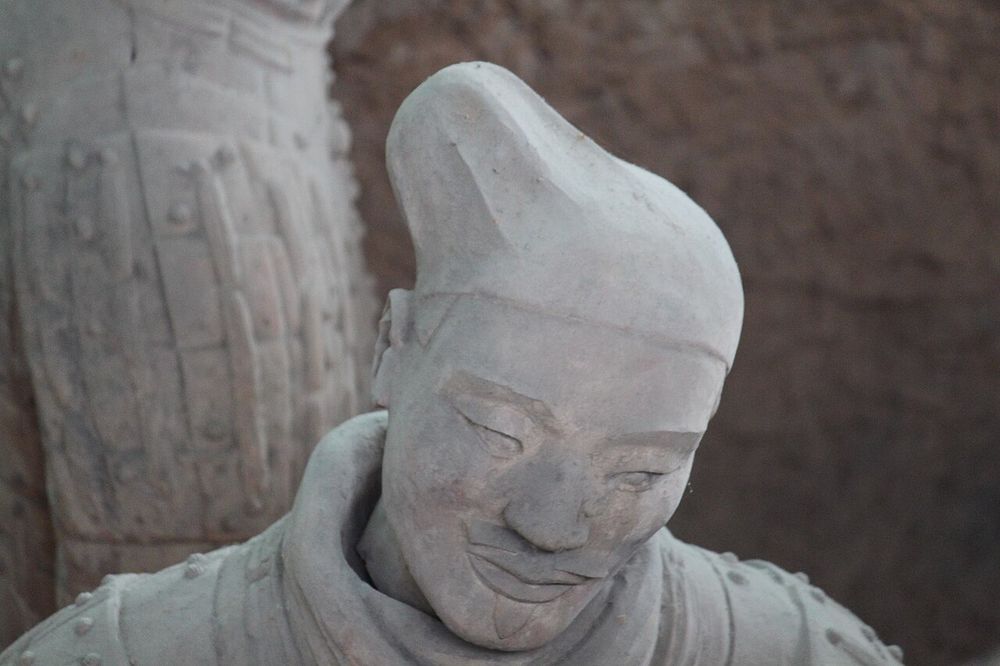
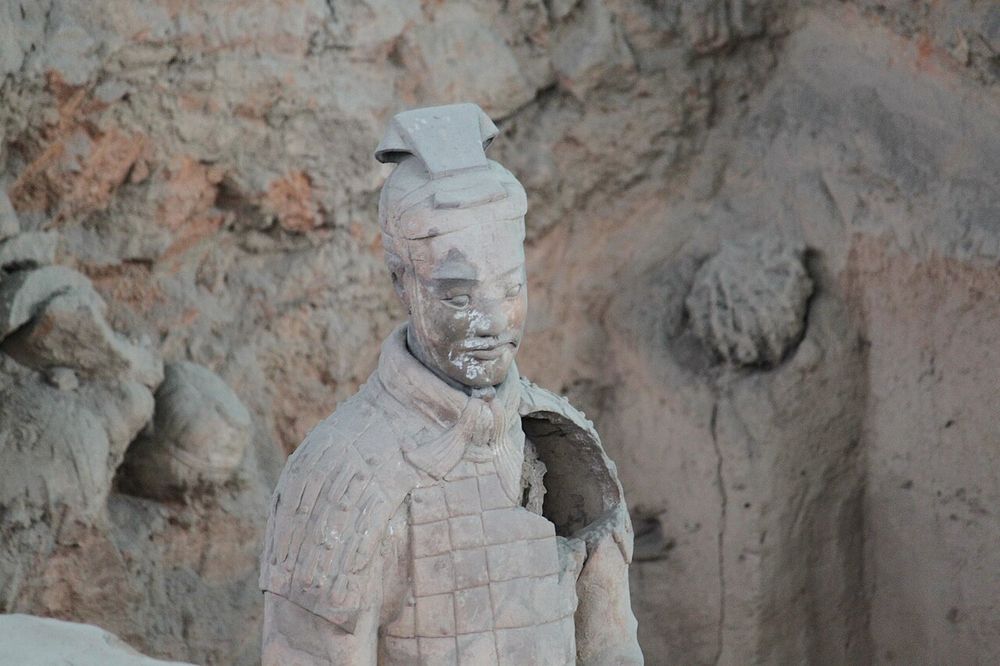
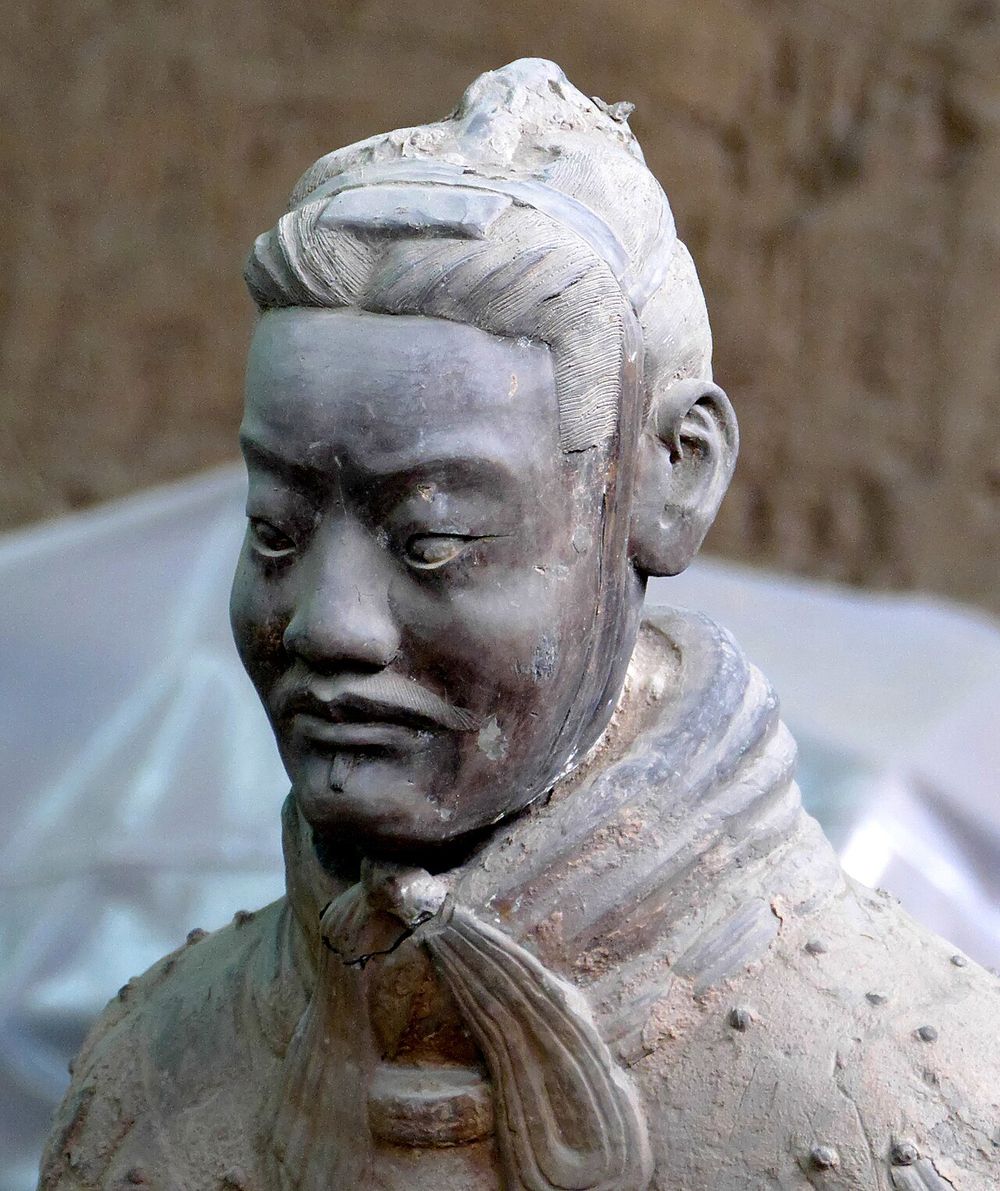
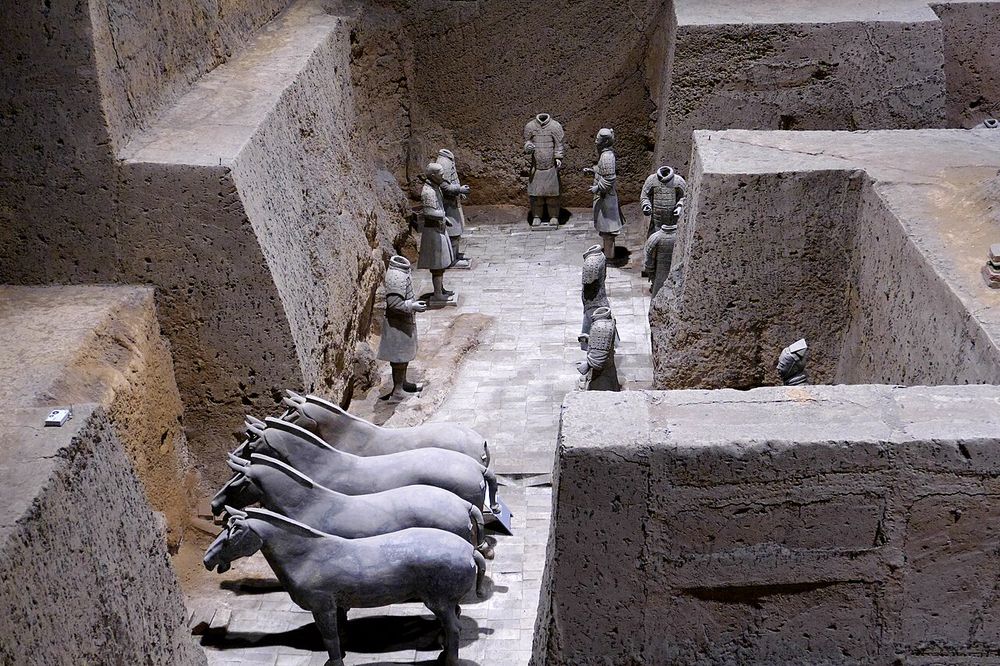
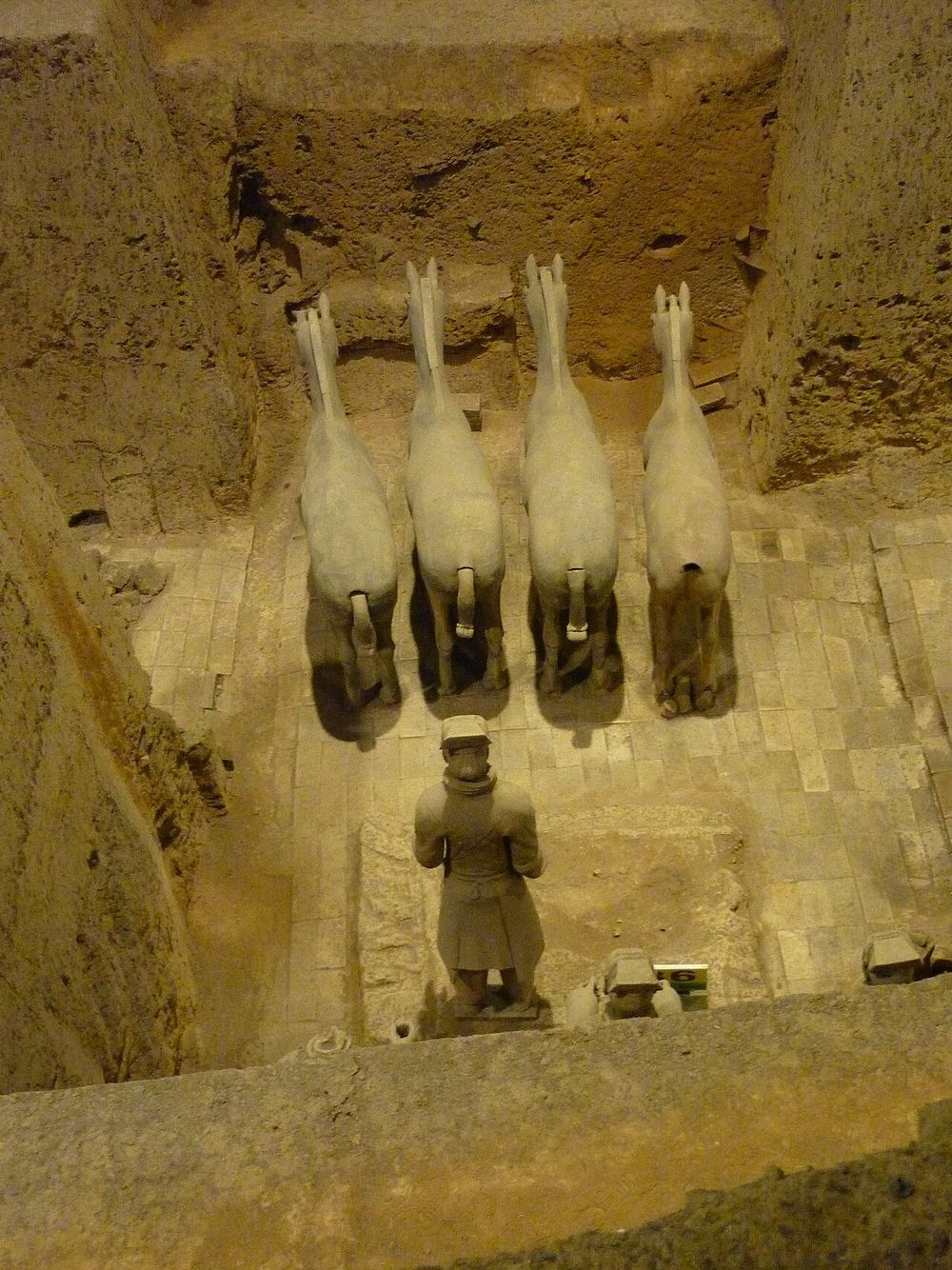
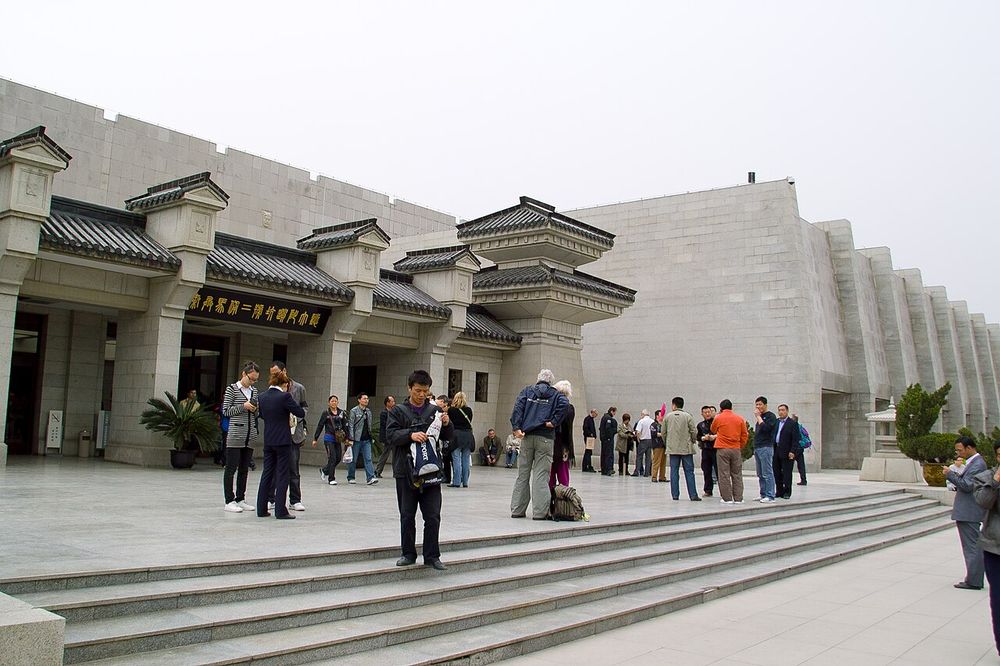
Three pits of life-size clay soldiers, buried east of the First Emperor's tomb to guard it. Farmers digging a well found them in 1974.
Photo: Zossolino, CC BY-SA 4.0, Wikimedia Commons
The story
In the dry spring of 1974, farmers from Xiyang village were digging a well south of their village when they brought up pieces of pottery and bronze arrowheads. The well had struck the south-east corner of a huge underground army.
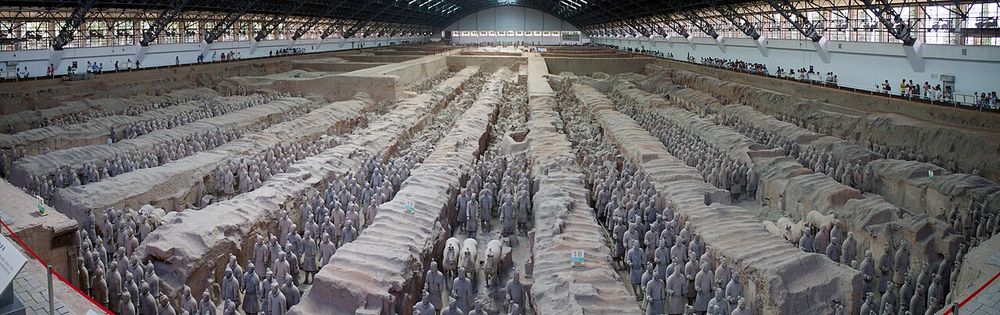
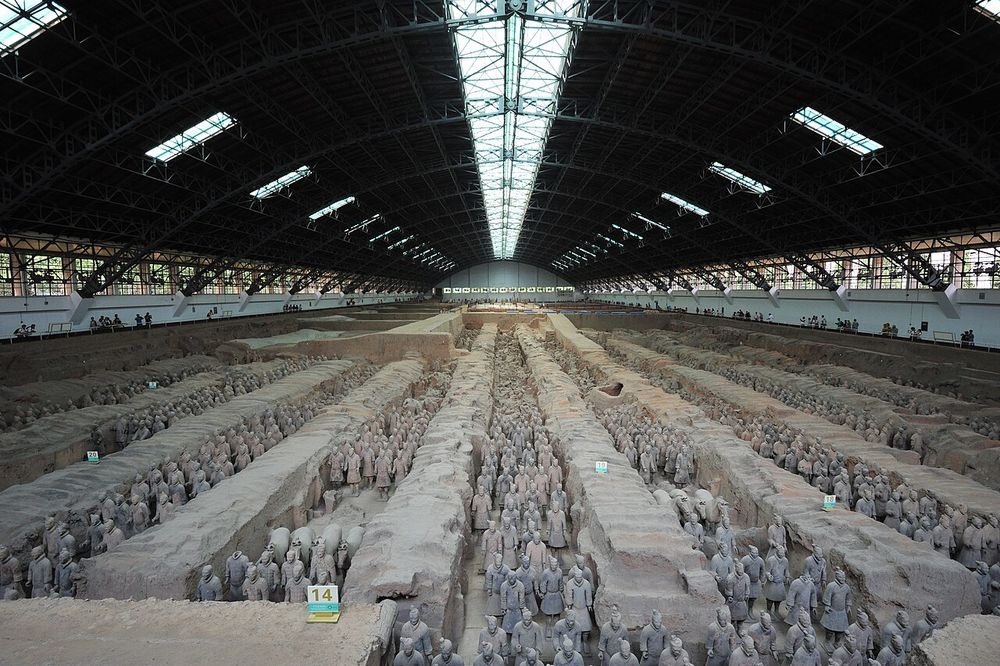
This clay army has guarded the tomb of the First Emperor for more than 2,200 years. Pit 1 in front of you is thought to hold over six thousand figures. About a fifth of it has been excavated.
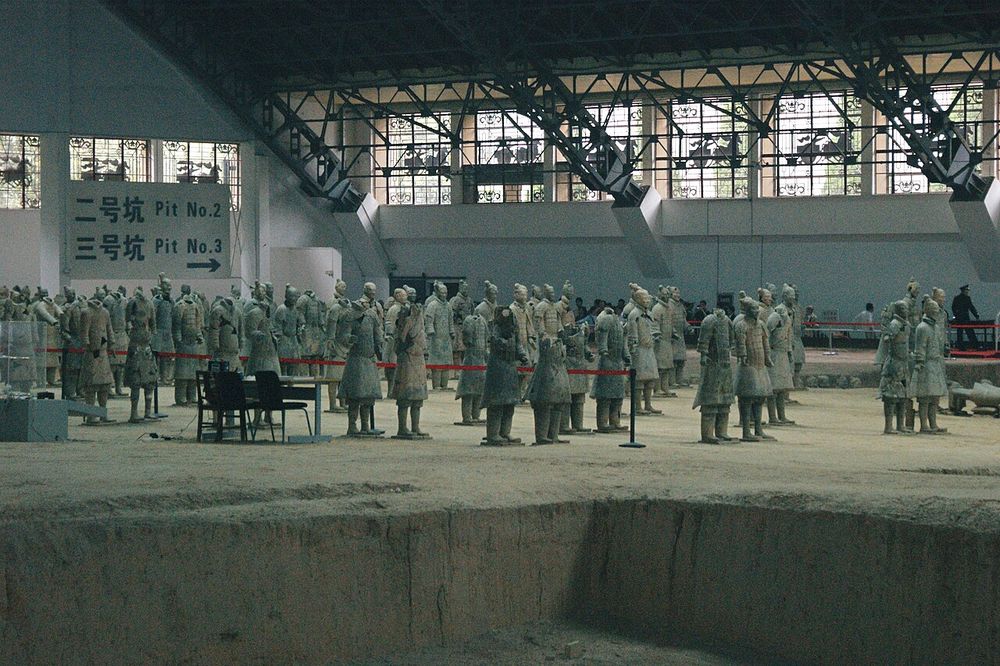
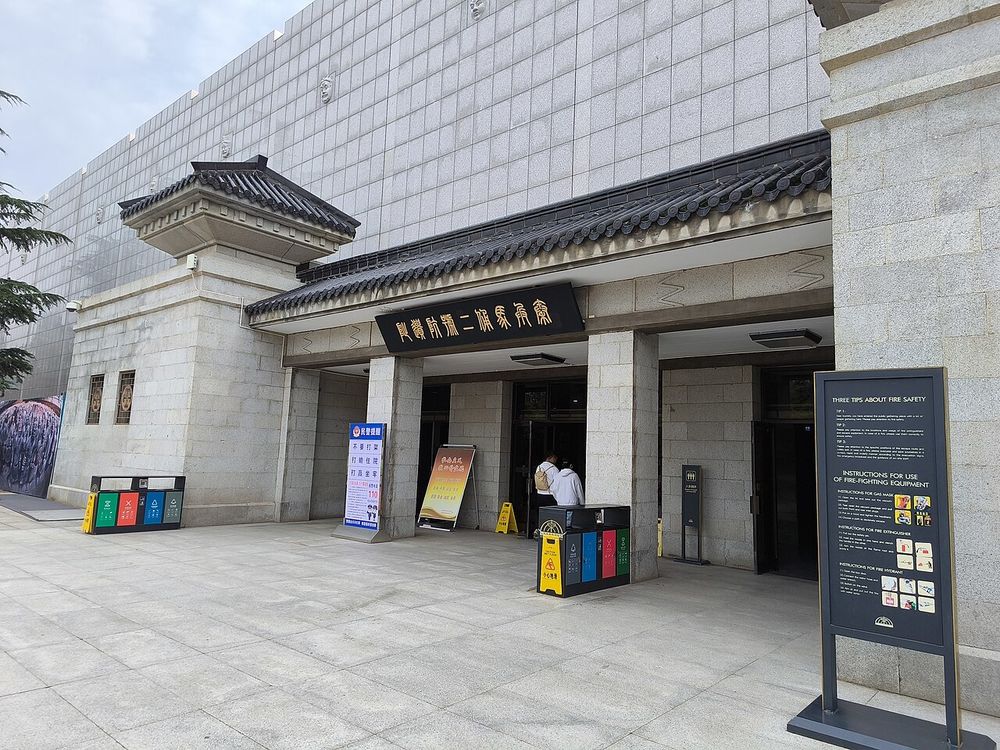
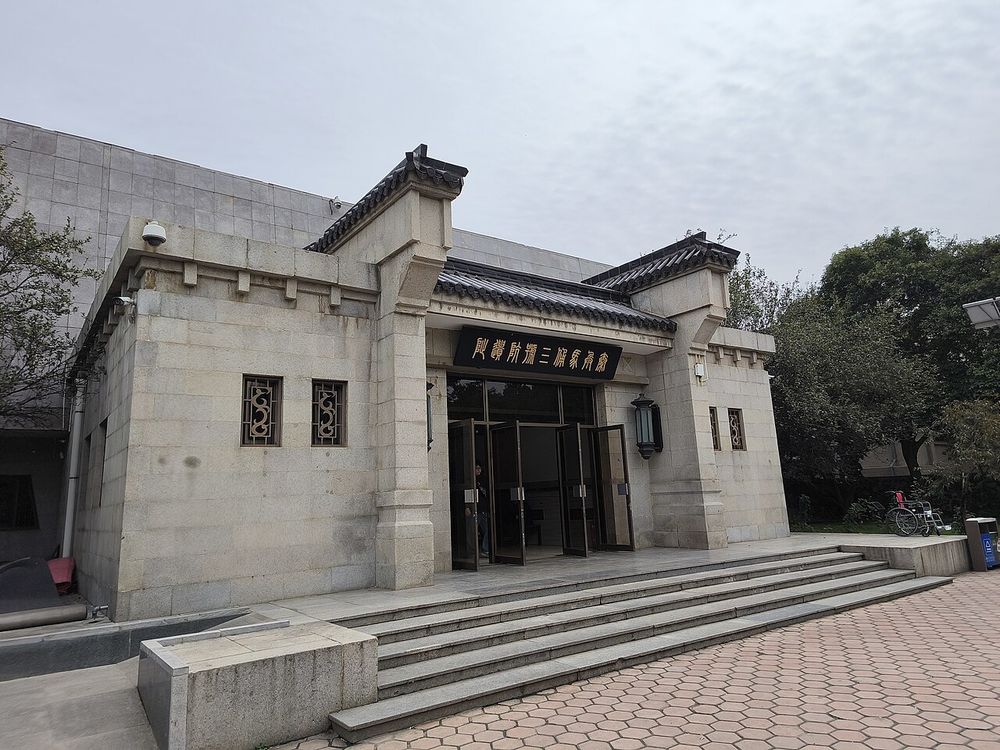
The pit museum has three pits under three roofs and one exhibition hall. All are on the same through ticket, which also covers the park round the emperor's tomb, 1.5 km to the west.
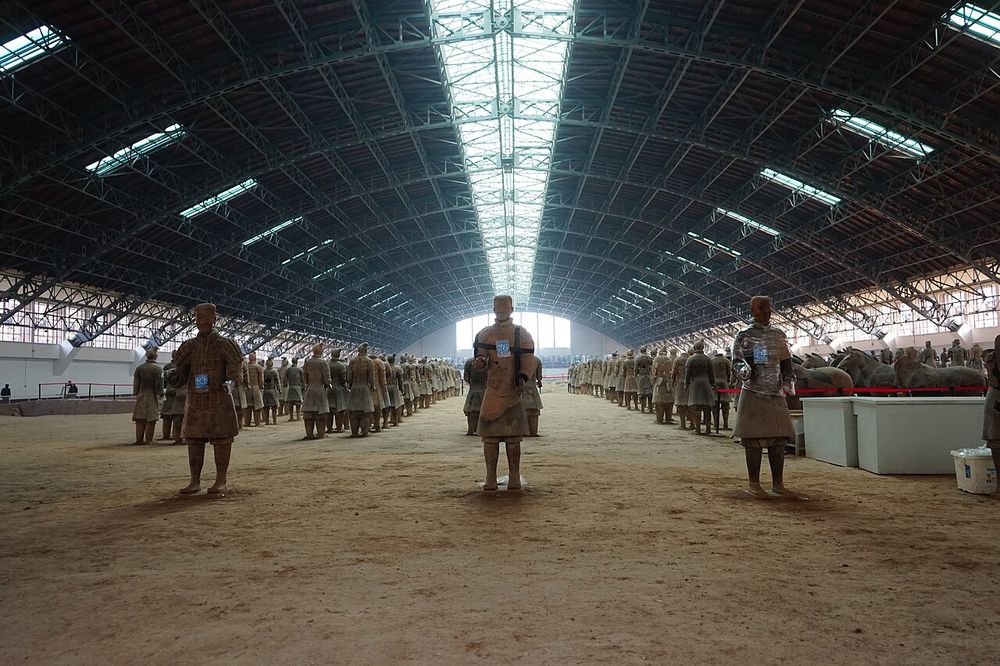
Pit 1 covers about 14,000 square metres, more than two football pitches. At the front stand three ranks of 68 men each: the vanguard. Most wear robes and no armour, dressed to charge fast.
Behind them, earth walls divide the pit into corridors holding 38 columns of chariots and infantry together: the main force. On the flanks and at the rear, soldiers face outward and backward to guard the sides.
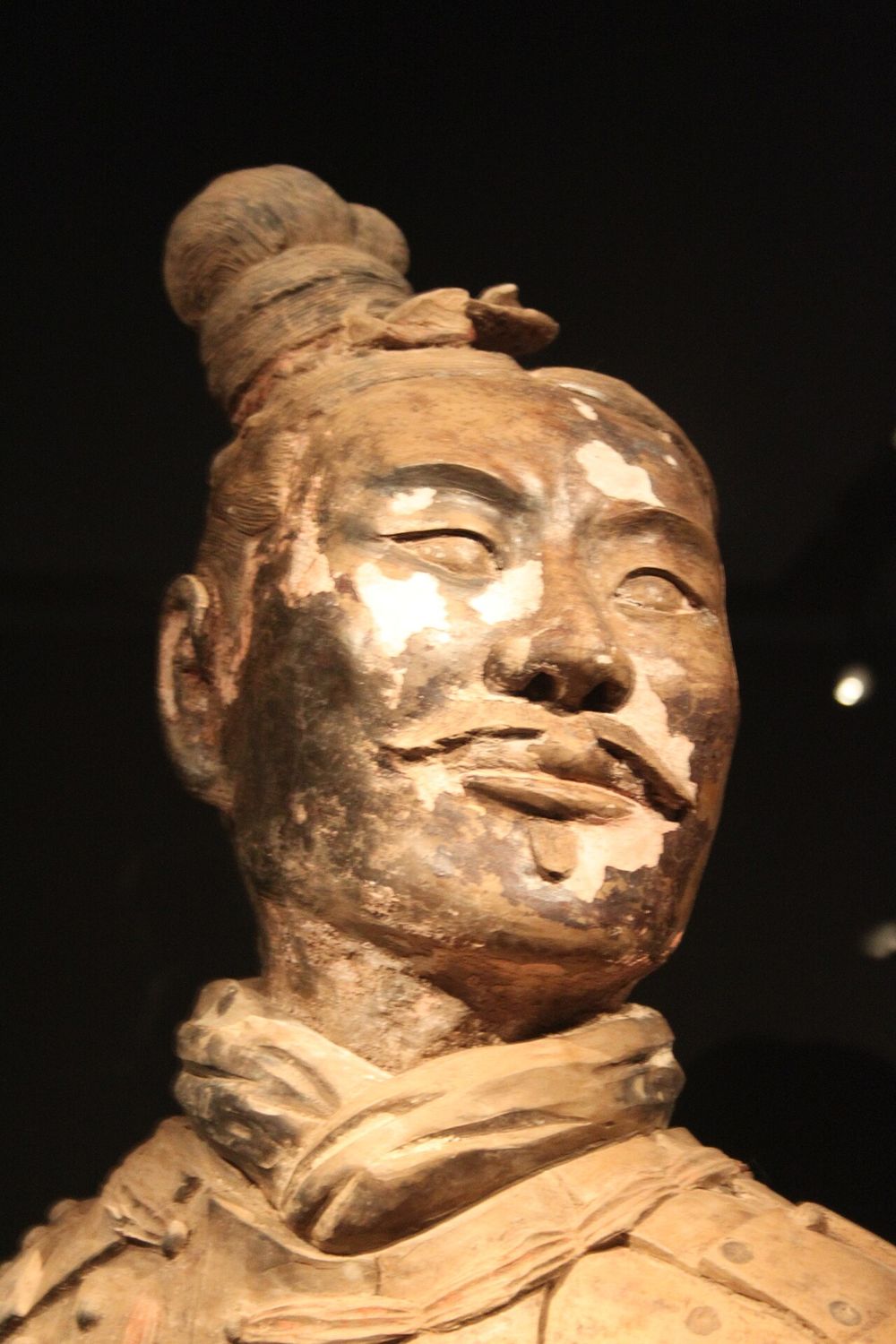
The figures were once painted all over: pink faces, robes in red, green, purple and blue. Once dug out, the paint begins to change within 15 seconds of meeting the air and has mostly curled and fallen within four minutes. That is why you see bare clay.
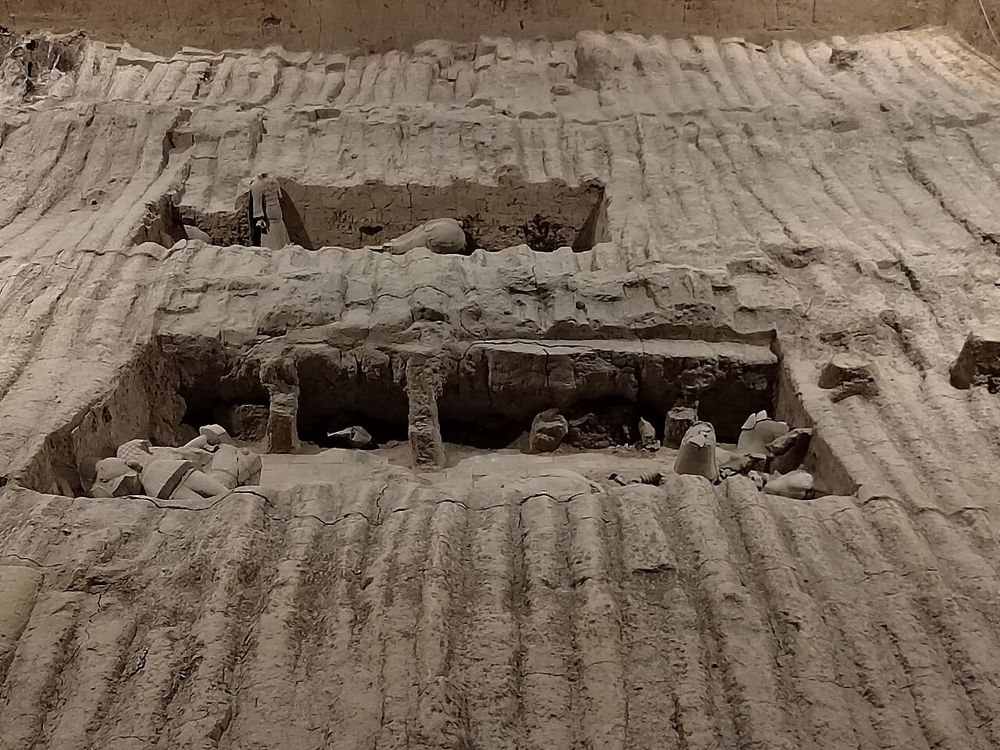
The pit was roofed with timber and matting under a layer of earth. At the fall of the Qin (221–206 BC) it was set on fire, the roof came down and the figures were smashed. Most of those standing today were pieced together by archaeologists, shard by shard.
People who stood here
Ronald Reagan, US president, April 1984He and Nancy Reagan were taken down into Pit 1 to stand among the figures. He asked if he might touch a horse, and joked that he knew it could not kick him.
Bill Clinton, US president, 1998He began his state visit to China in Xi'an and came here with his family.
Narendra Modi, prime minister of India, 14 May 2015He started his first visit to China as prime minister at Pits 1 and 3 and the bronze chariots.
Go deeper: five stops in the pit museum
1. Pit 1: a well and a battle line
The find came at the end of March 1974. Zhao Kangmin of the Lintong county cultural centre was the first to recognise the fragments as Qin and began restoring them. In July the archaeologist Yuan Zhongyi arrived to lead the dig. The trial trench grew to 336 square metres and still had not reached the pit's edge.
The pit runs east to west and every man and horse faces east. Qin conquered the other six states by marching east out of its heartland, and the facing is usually read as the direction of those states.
Look at the earth walls for the marks left by roof timbers. The builders dug the pit, paved it with brick, raised the walls, laid beams and mats and covered it with soil. They built a barracks underground.
2. Pit 2: the hardest puzzle
Pit 2沈澄心, CC0
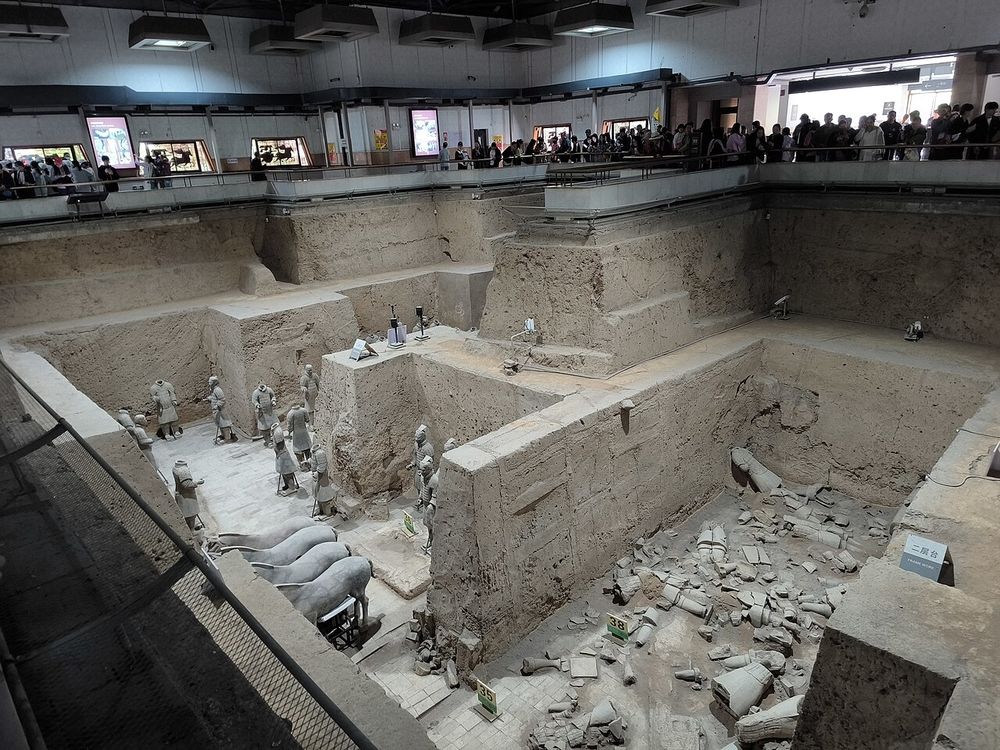
Pit 1 was stumbled on by farmers. Pit 2 was found on purpose: on 23 April 1976 the team located it by probing north of the east end of Pit 1. It is L-shaped, about 6,000 square metres, with some 1,400 figures and horses.
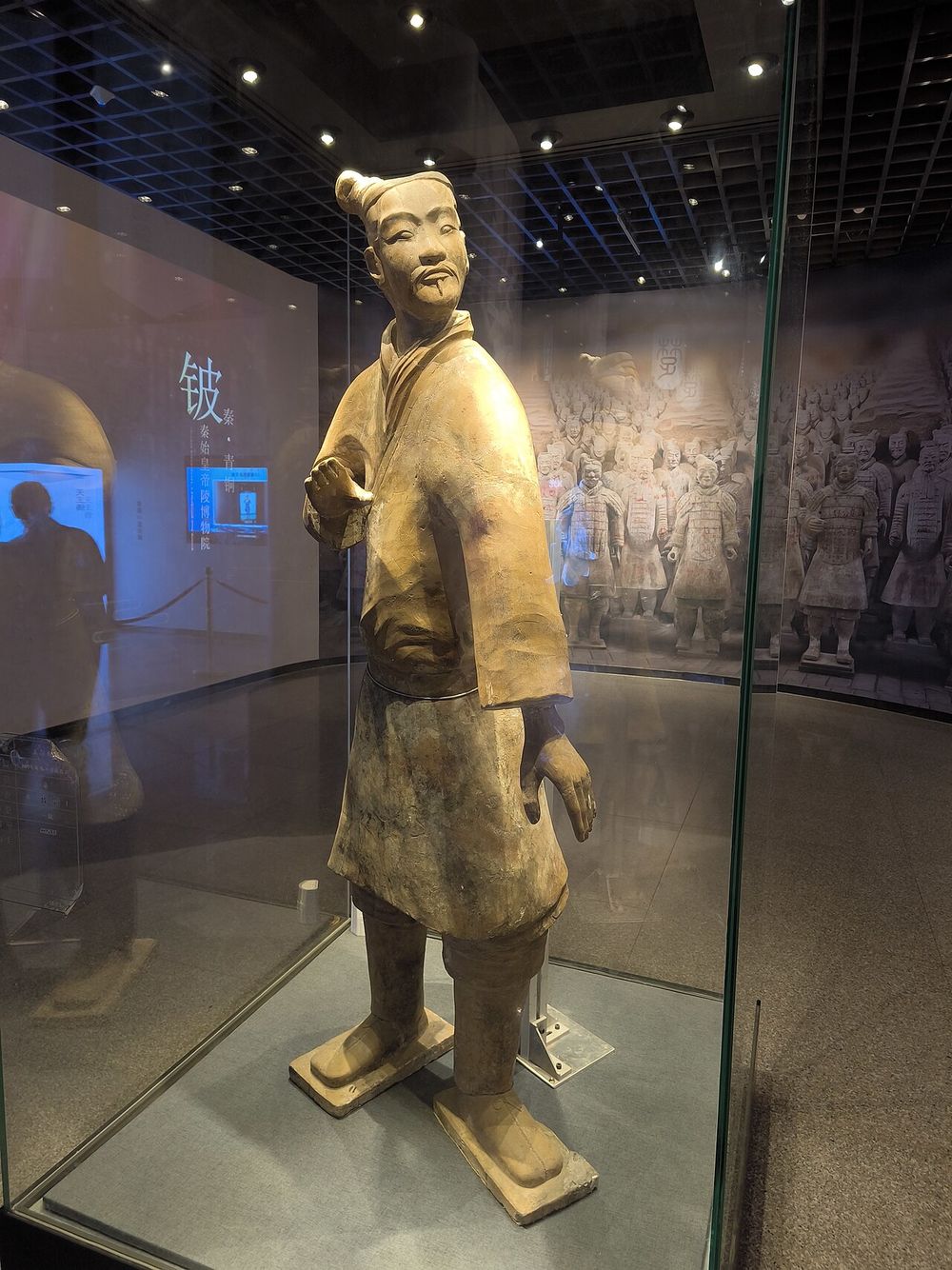
It holds four kinds of unit: crossbowmen standing and kneeling, chariots, a mixed force, and cavalry. About 108 riders each stand beside a saddled horse, the first Qin cavalry formation ever found.
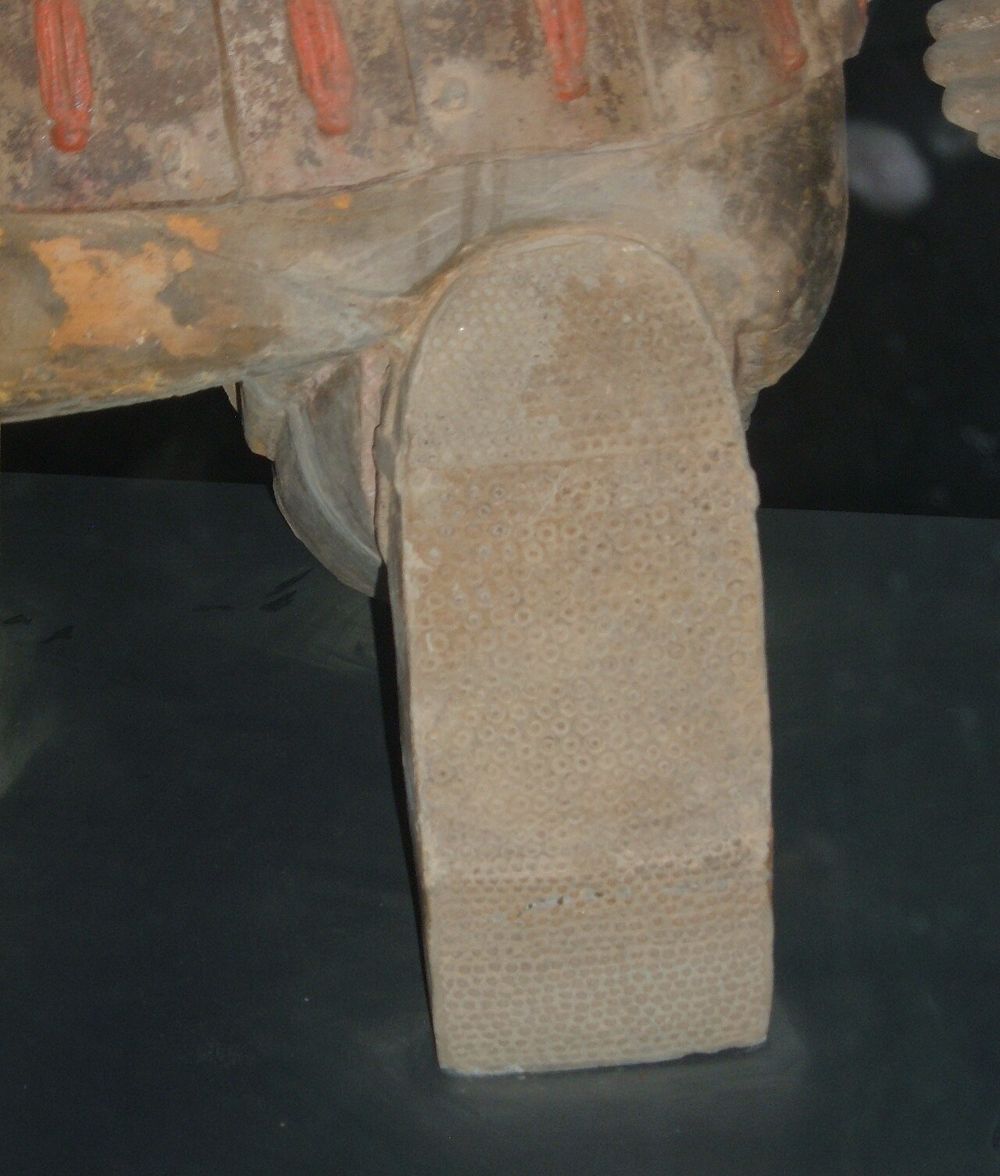
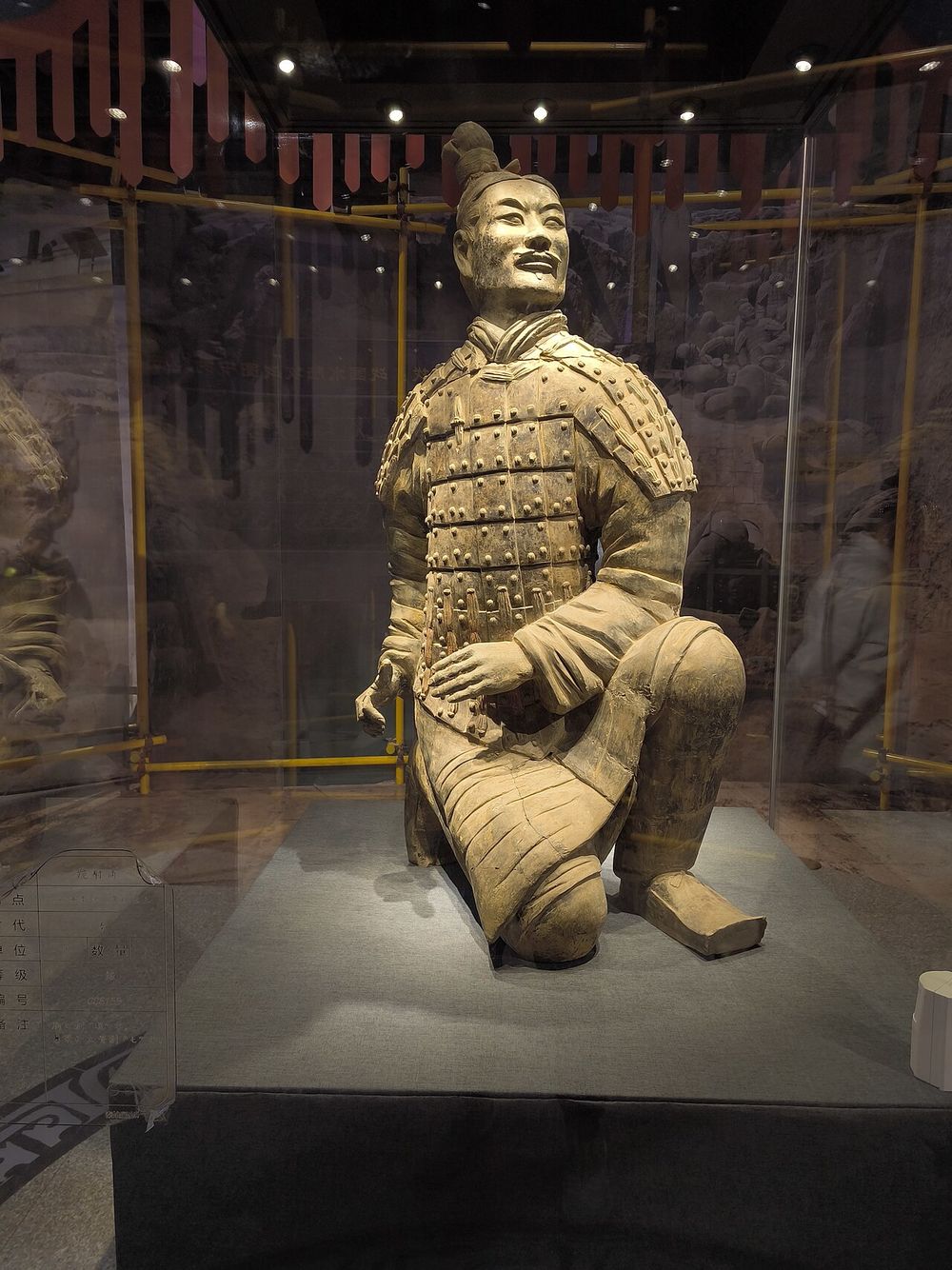
The kneeling archer rests on his right knee with both hands at his right side, holding a crossbow that was made of wood and has rotted away. Being short and low, he survived best, sometimes with paint. Look at the sole of his shoe: the maker modelled the stitching, close in some places and wide in others.
In 1999 a kneeling archer with a green-painted face was found here. It is the only one known, and nobody has settled why.
3. Pit 3: the command post
Horses and guards in Pit 3, the command postGary Todd, CC0
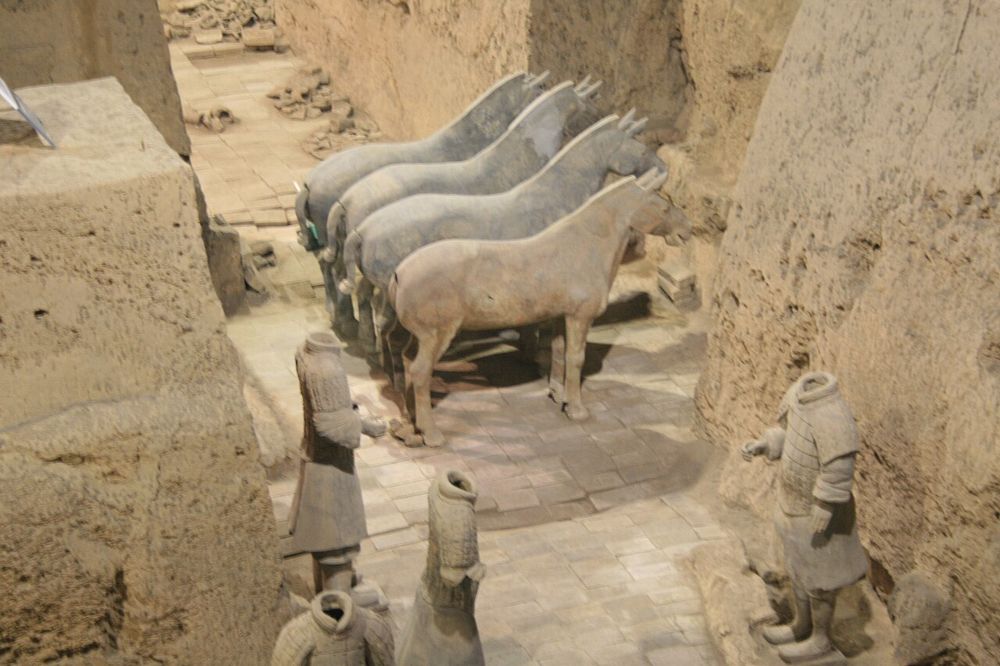
Pit 3 is small, about 520 square metres, with 68 figures, four horses and one chariot. The soldiers are not in battle order. They stand facing each other along the passages like guards. Deer antlers and animal bones were found too, which scholars link to divination and sacrifice before a campaign.
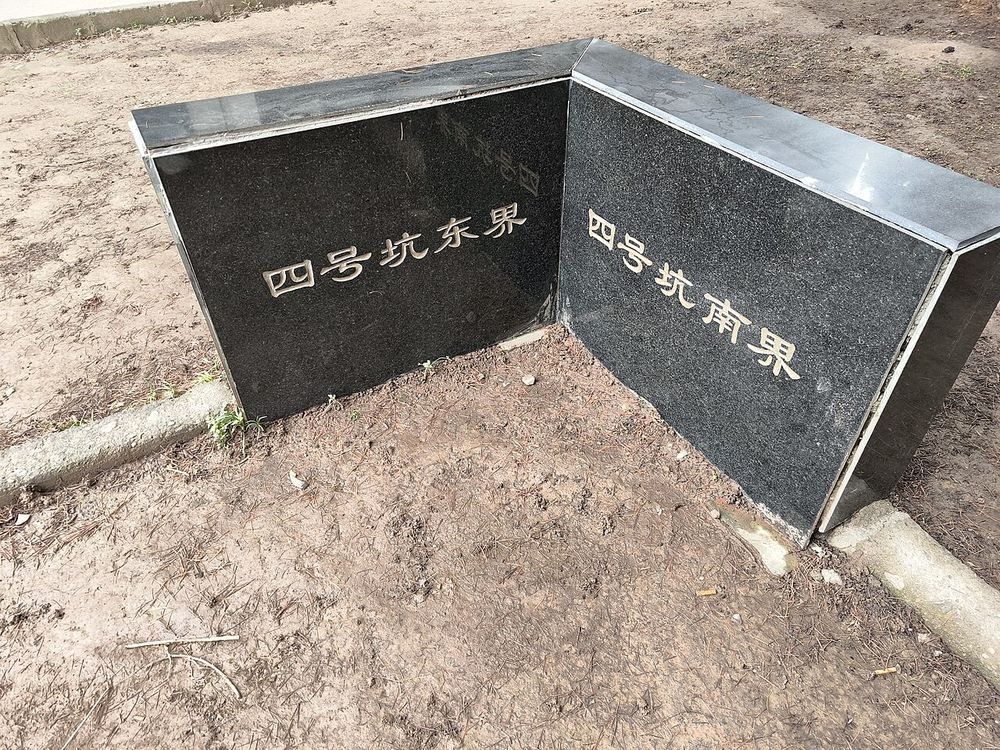
Between Pits 1 and 3 lies a fourth pit, empty. One explanation is that when rebellion broke out in 209 BC the tomb's workforce was armed and sent to fight, and the work stopped. That is a conjecture, with no text to prove it.
4. One figure up close: face, colour, fingerprint
A kneeling archer with paint survivingGary Lee Todd, CC0
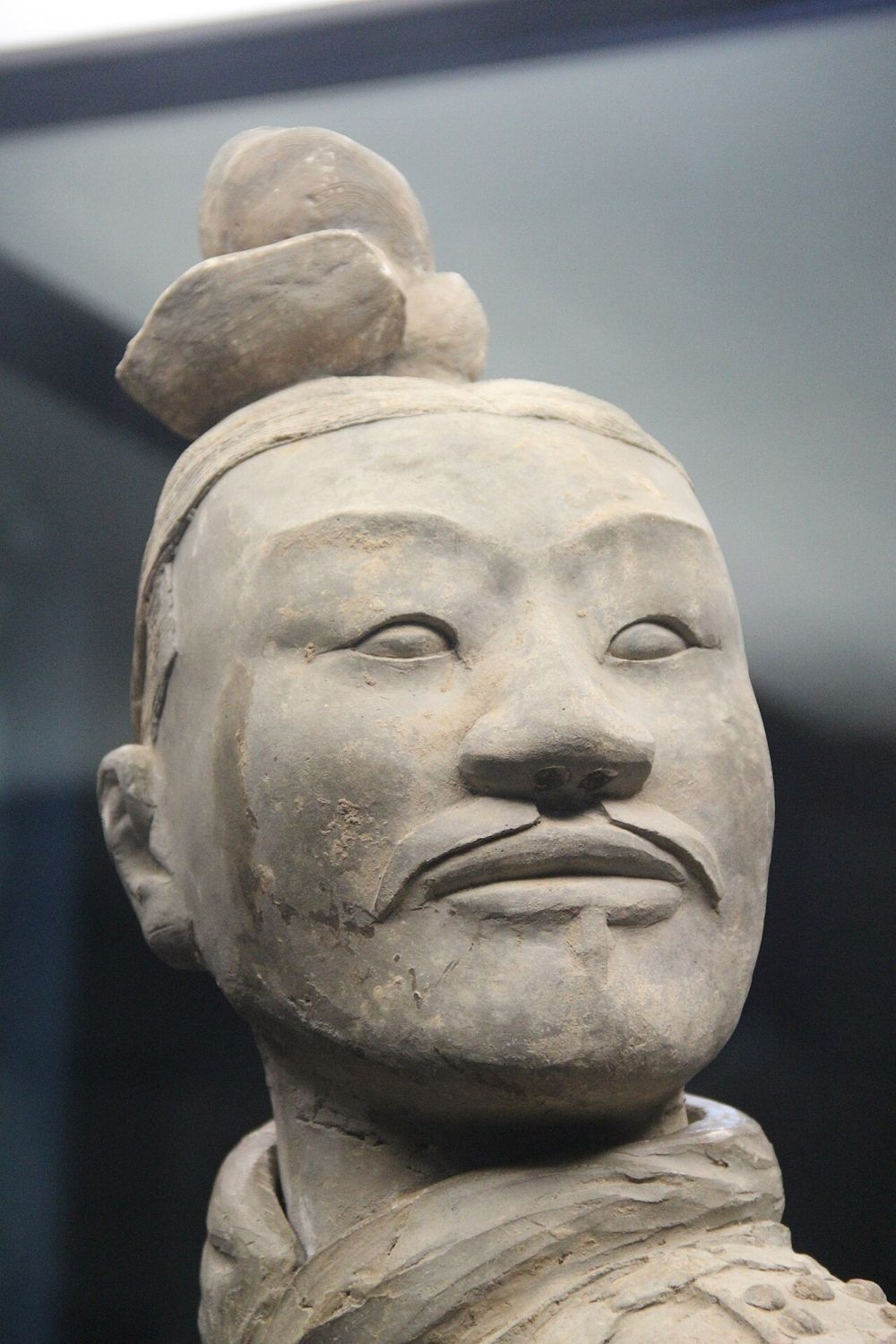
A thousand men, a thousand faces? In 2014 University College London and the museum compared 3D models of 30 ears and found no two alike. The researchers themselves warn that 30 ears do not prove each figure is a portrait. Moulded parts finished by hand is the likelier answer.
The pigments include cinnabar, azurite and malachite, and a man-made purple, barium copper silicate. It does not occur in nature. Qin and Han (206 BC–AD 220) craftsmen fired it themselves.
For years it was said the Qin plated their weapons with chromium against rust. A 2019 study in Scientific Reports overturned that: the chromium comes from lacquer on the wooden shafts. The bronze kept well because the soil is slightly alkaline and fine-grained, and the metal is rich in tin.
In 2024 a fingerprint was found on a fragment from Pit 1. The museum and Shandong University concluded it was left by a young craftsman.
5. The exhibition hall: armour made of stone
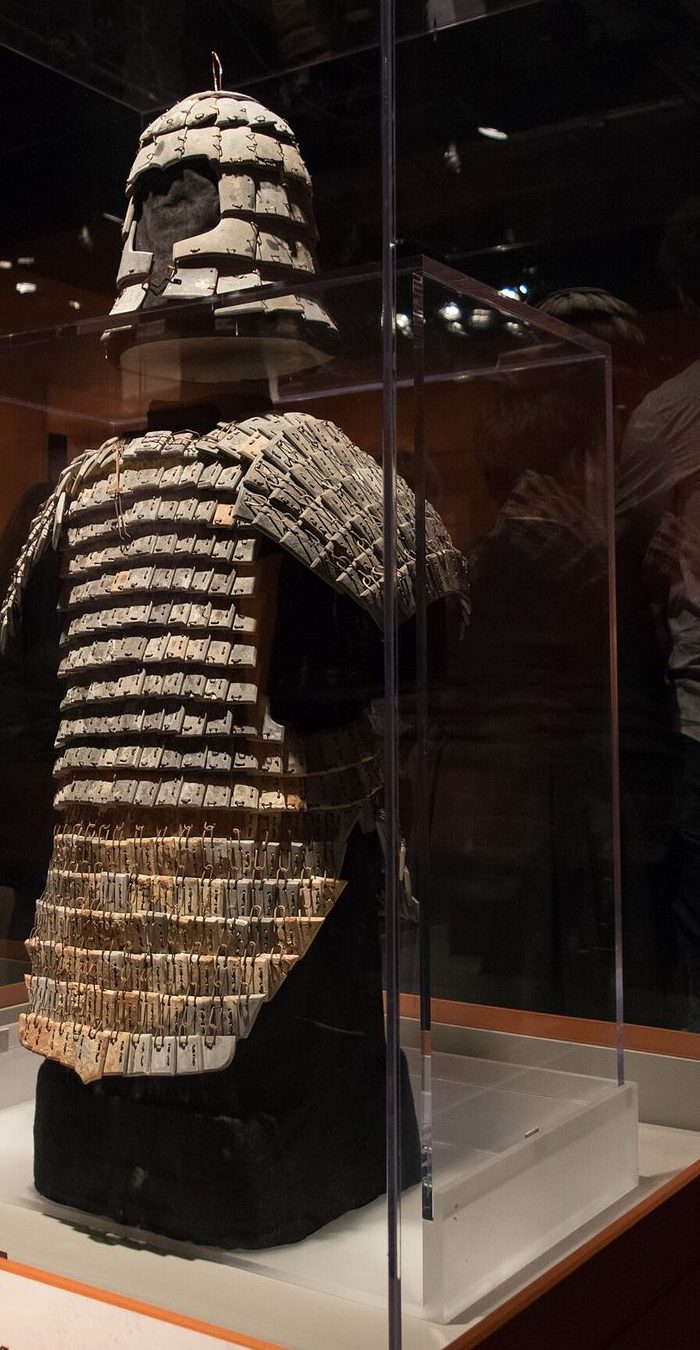
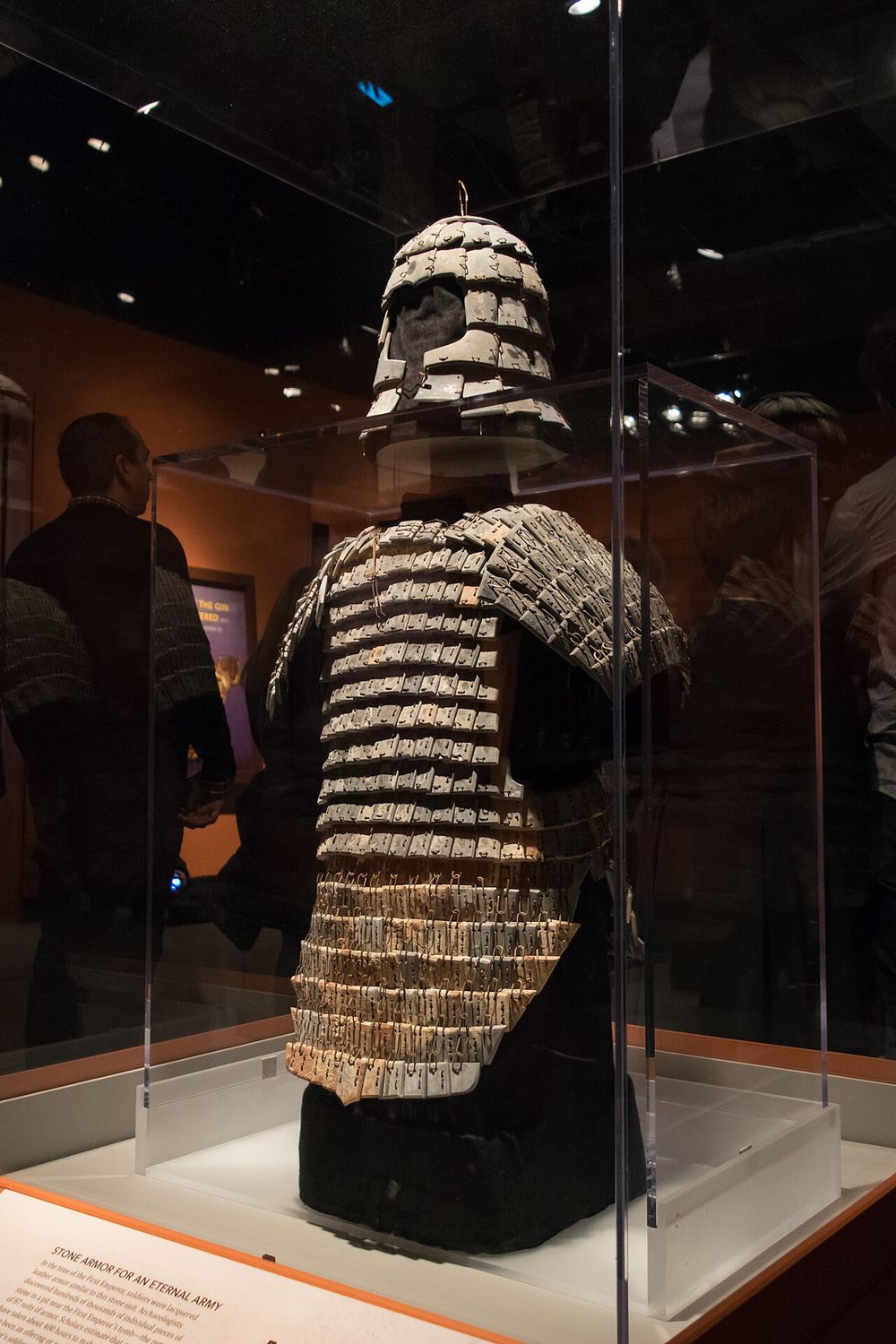
A stone helmet and suit of armour from pit K9801Difference engine, CC BY-SA 4.0
The hall stands in the pit museum area, on the same ticket as the three pits. It shows finds from all over the tomb park. The pit they are best known for, K9801, lies about 200 metres south-east of the tomb mound. A villager found it in 1996. At about 130 by 100 metres it is the largest pit yet found inside the park, and it is not open, so this hall is where you see what came out of it.
Only about 153 square metres have been dug, yet they gave up 87 suits of armour and 43 helmets, every plate cut from stone. A suit with its helmet weighs about 25 kg, far too heavy to fight in, and too slow to make in numbers. Scholars take them for burial goods, not equipment.
Look at the helmet. None of the soldiers in the pits wears one, and people used to say the Qin army fought bare-headed. These stone helmets show that the Qin did have them.
Meanwhile in the world
Year
Here
Elsewhere
246 BC
Ying Zheng becomes king of Qin at 13; work on his tomb begins
In India, Ashoka is setting up pillars carved with his edicts
221 BC
Qin conquers the six states and unifies script, weights and measures
Rome and Carthage are between their first two wars
218 BC
Tomb-building and imperial tours go on together
Hannibal takes his army and elephants across the Alps
212 BC
Work starts on the Epang Palace
Archimedes is killed by a Roman soldier at Syracuse
210 BC
The First Emperor dies on tour and is buried at Mount Li
Rome is fighting Carthage in Spain
One line to remember: the year Hannibal crossed the Alps, this clay army was being fired at the foot of Mount Li.
Then and now
Pit 1 in one sweepWalter-Wilhelm, CC BY 2.0, Wikimedia CommonsInside the hall over Pit 1Hugh Llewelyn, CC BY-SA 2.0, Wikimedia CommonsThe battle line in Pit 1Gary Lee Todd, CC0, Wikimedia CommonsPit 2沈澄心, CC0, Wikimedia CommonsHorses and guards in Pit 3, the command postGary Todd, CC0, Wikimedia CommonsThe kneeling archerGary Lee Todd, CC0, Wikimedia CommonsA kneeling archer with paint survivingGary Lee Todd, CC0, Wikimedia CommonsThe sole of the kneeling archer's shoeBrokenSphere, CC BY-SA 3.0, Wikimedia CommonsA generalGary Lee Todd, CC0, Wikimedia CommonsPit 1 from the front rail, 2011chensiyuan, CC BY-SA 4.0, Wikimedia CommonsThe front of Pit 1Jan Bockaert, CC BY-SA 2.0, Wikimedia CommonsSoldiers and a chariot horseZossolino, CC BY-SA 4.0, Wikimedia CommonsRanks in their corridors, seen from abovethierrytutin, CC BY 2.0, Wikimedia CommonsInfantry between the earth wallsthierrytutin, CC BY 2.0, Wikimedia CommonsThe ranks from behindImmanuel Giel, CC BY-SA 3.0, Wikimedia CommonsChariot horses in Pit 1xiquinhosilva, CC BY 2.0, Wikimedia CommonsRestored figures at the back of Pit 1thierrytutin, CC BY 2.0, Wikimedia CommonsThe working area at the back of Pit 1thierrytutin, CC BY 2.0, Wikimedia CommonsFigures as they are found: fallen and brokenshankar s. from Dubai, united arab emirates, CC BY 2.0, Wikimedia CommonsA soldier's head: topknot tied to the rightGary Todd, CC0, Wikimedia CommonsA face in Pit 1Gary Todd, CC0, Wikimedia CommonsA young soldierGary Todd, CC0, Wikimedia CommonsA soldier with a moustacheGary Todd, CC0, Wikimedia CommonsAn officer's capGary Todd, CC0, Wikimedia CommonsA soldier in a soft capGary Todd, CC0, Wikimedia CommonsA soldier among the earth wallsGary Todd, CC0, Wikimedia CommonsA face up closeZossolino, CC BY-SA 4.0, Wikimedia CommonsThe hall over Pit 2源義信, CC BY-SA 4.0, Wikimedia CommonsThe kneeling archer in its case源義信, CC BY-SA 4.0, Wikimedia CommonsThe standing archer源義信, CC BY-SA 4.0, Wikimedia CommonsPit 3 from the walkway源義信, CC BY-SA 4.0, Wikimedia CommonsThe chariot horses of Pit 3Zossolino, CC BY-SA 4.0, Wikimedia CommonsPit 3 from aboveImmanuel Giel, CC BY-SA 3.0, Wikimedia CommonsThe hall over Pit 3源義信, CC BY-SA 4.0, Wikimedia CommonsThe boundary stone of Pit 4, which was never filled源義信, CC BY-SA 4.0, Wikimedia CommonsThe exhibition hallthierrytutin, CC BY 2.0, Wikimedia CommonsStone armour and helmet in the exhibition hallDifference engine, CC BY-SA 4.0, Wikimedia Commons
Local legends
These are stories people tell about this place. They are legends, not history, and each one says where it comes from.
LegendThe well
When the farmers digging the well in 1974 brought up the first clay head, they took it for an earth god and feared they had disturbed him. Old people in the village hung up red cloth and burned incense.
Source: Accounts given by the villagers to Chinese reporters in later years
LegendThe burnt roof of Pit 1
The soldiers of the rebel Xiang Yu broke into the pits in 206 BC, took the bronze weapons from the hands of the clay men, and set the roof on fire.
Source: A common explanation. The histories say only that Xiang Yu burned the Qin palaces and dug into the tomb; they never mention the pits
Later, people who live here will be able to add the stories they grew up with, and say which of these they have heard.
Not certain, and where accounts conflict
How many figures are there?
About 8,000 in some accounts and about 7,000 in others. Both are estimates from the layout, since most of the pits are unexcavated. We give only the figure for Pit 1.
Is every face a portrait?
It is a favourite claim. The one study so far found 30 ears all different, and its authors say that is too few to call the figures portraits.
Why is one archer's face green?
Suggestions include a soldier from another people, war paint, or ritual meaning. Yuan Zhongyi thought the colour may mean nothing special. It is unsolved.
Visiting
Tickets and hours
The museum is in Lintong district, about an hour from central Xi'an. From 16 March to 15 November it opens 8:30–18:30, last entry 17:00. From 16 November to 15 March it opens 8:30–18:00, last entry 16:30.
One through ticket, 120 yuan all year, covers the pit museum (Pits 1 to 3 and the exhibition hall), Lishan Garden (the bronze chariots museum, the acrobats' pit, the civil officials' pit and the tomb mound) and the shuttle between the two areas.
Not included: the optional sightseeing carts inside each area, 5 yuan on the pit side and 15 yuan in Lishan Garden.
Book by real name up to 7 days ahead and choose Passport as the ID type. Booking online needs a Chinese mobile number and payment by WeChat Pay or Alipay. Machines at the Tourist Service Center sell tickets against a passport and accept Visa, but few are left on the day. Bring the passport you booked with.
The shuttle to Lishan Garden runs 8:30–17:00 and the last one back leaves at 19:00. The museum's own site is bmy.com.cn. Prices and rules change, so check before you go.
Last checked 2026-11-11. Travel and news reports, not the site's own notices.
Where to start
Go to Pit 1 first and stand at the front for the full view. Then Pit 3, the smallest, and Pit 2, where the kneeling archer and other figures are shown in cases at eye level.
When you have seen the pits, show your ticket and take the free shuttle to the park round the emperor's tomb. It has a page of its own.
Before you go
Pit 1 is crowded at the front rail. Walk the sides of the hall for a closer look at the ranks.
People outside the gate offer guiding and transport. Use the museum's own guides or audio guide.
Avoid Chinese public holidays, above all the first week of October.
Customs and manners
This is part of a tomb. Keep your voice down at the rail, do not use flash, and never drop or throw anything into the pits.
Crowds are dense and people stand closer than you may be used to. Being jostled in a queue is not meant as rudeness.
People may ask to take a photo with you, most often visitors from outside the big cities. It is friendly curiosity. Agree with a smile or decline with a wave; either is fine.
Tipping is not expected in China, at sites or in restaurants.
Look for these
How many men stand in the front rank of Pit 1? (68, in three ranks.)
How is the vanguard dressed differently from the main force behind? (Mostly robes, no armour.)
Find the kneeling archer and look at the sole of his shoe. Why would a craftsman finish a part nobody was meant to see?
Find colour. On the kneeling archer or the figures in the cases, look for traces of red, green or purple.
Some figures carry the name of a craftsman or workshop, cut or stamped. It was how the Qin held makers to account.
I am here
Stand at the site, sign in, press the button, and collect its stamp. Your browser will ask to use your location. It is sent to us once to confirm that you are at the site; we keep how far you were from it, not the spot where you stood.
Your stamps are saved to your account, so they follow you to any device. Checking from a browser cannot rule out every false location; stricter checks arrive with the app.
Messages
Share your photos
Photos here show the place, not people. Each one is credited to the visitor who took it and appears after our team has looked at it. A photo with you in it belongs under “I am here”.