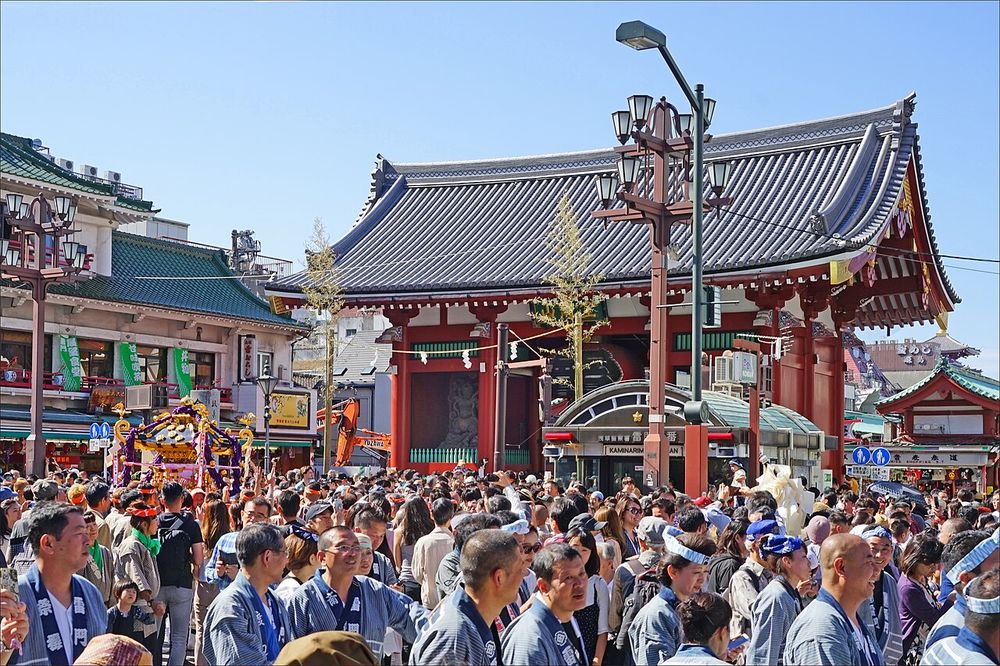
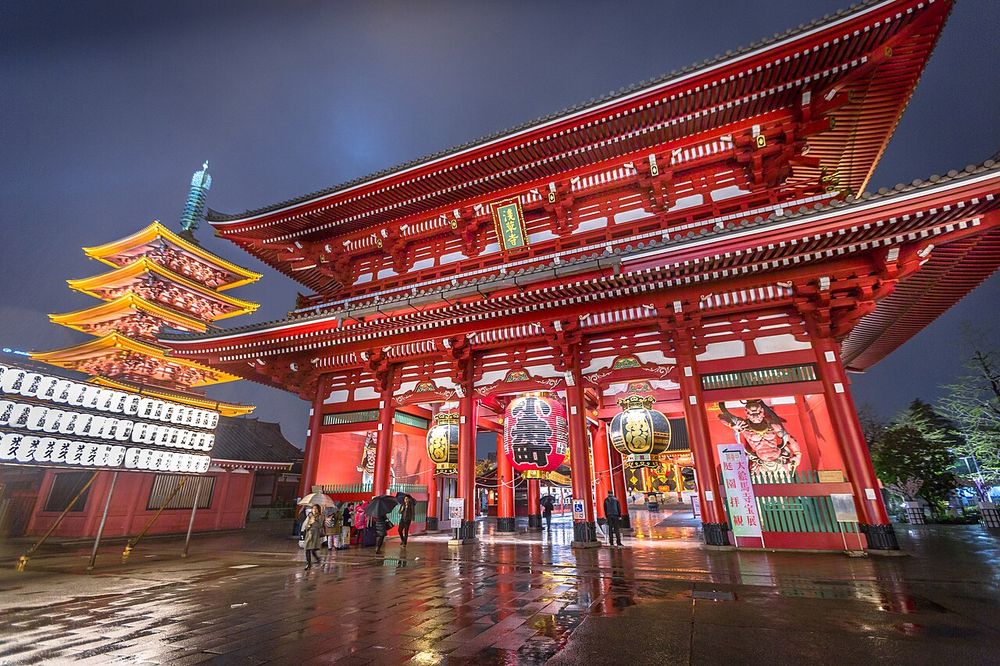
Tokyo's oldest temple, and its busiest. A great red lantern hangs at the gate, a street of stalls leads in, and at the far end is a hall built for a statue that nobody has seen in fourteen hundred years.
Photo: Christophe95, CC BY-SA 4.0, Wikimedia Commons
The story
You are at the gate of the oldest temple in Tokyo. Its story begins in 628, when Tokyo was a fishing village on a marsh. Some thirty million people come here every year, more than to any other religious site in Japan.
Almost every building you see was rebuilt in concrete after the fire-bombing of March 1945. The temple has burned and come back many times. People have never stopped coming.
What is here
Nothing here needs a ticket. The grounds never close. The main hall keeps daytime hours.
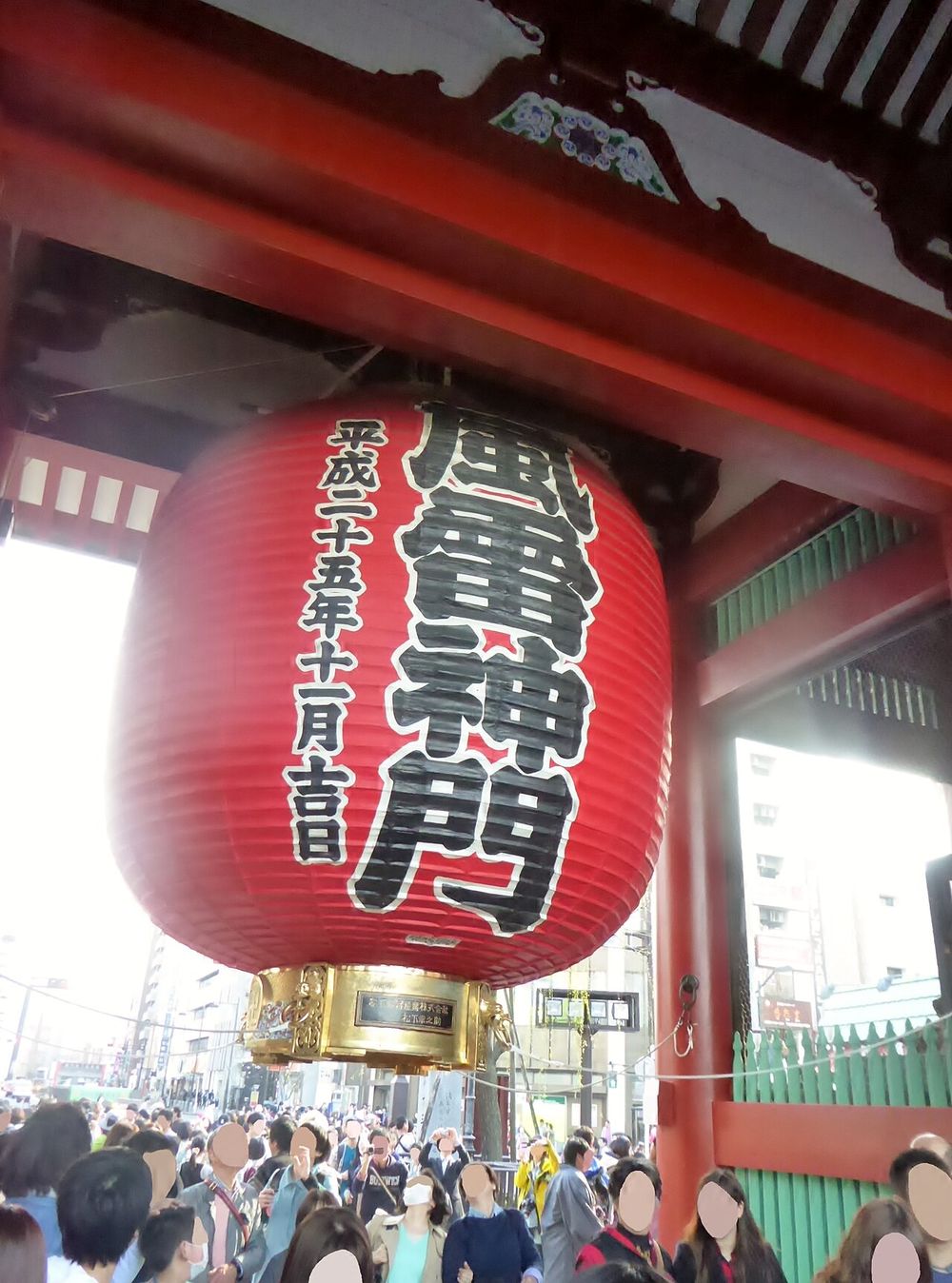
The lantern of the Thunder GateMaarten Heerlien from Voorschoten, The Netherlands, CC BY 2.0
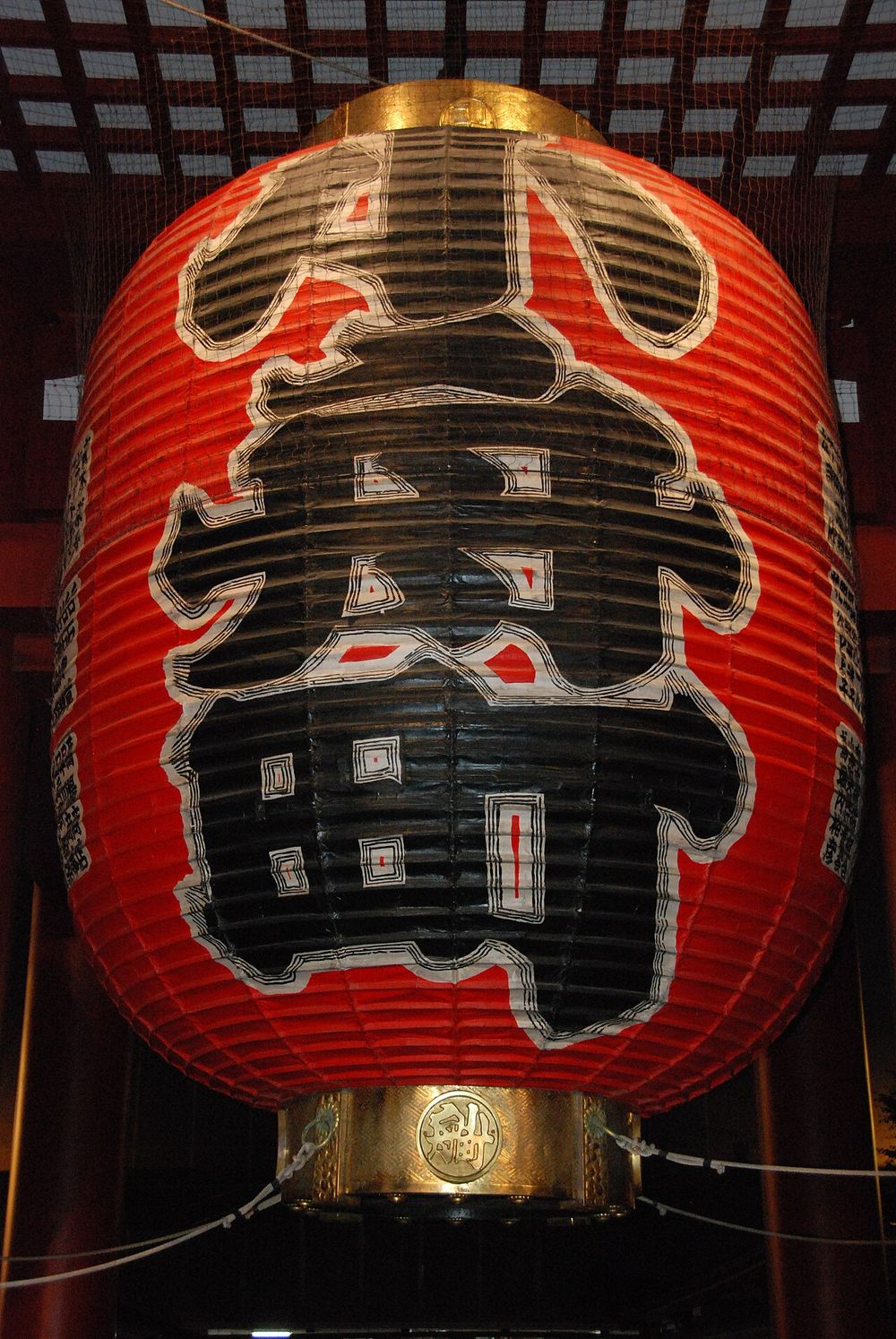
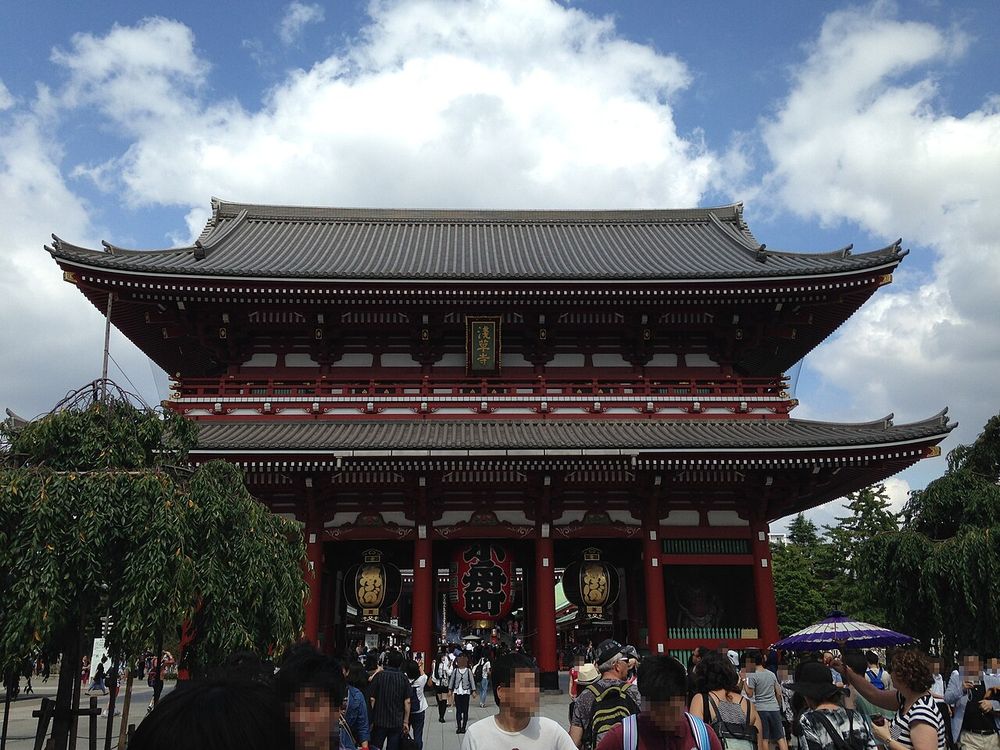
The gate is called Kaminarimon, the Thunder Gate. The god of wind stands on the right and the god of thunder on the left. The lantern between them is nearly four metres tall and weighs about 700 kilograms.
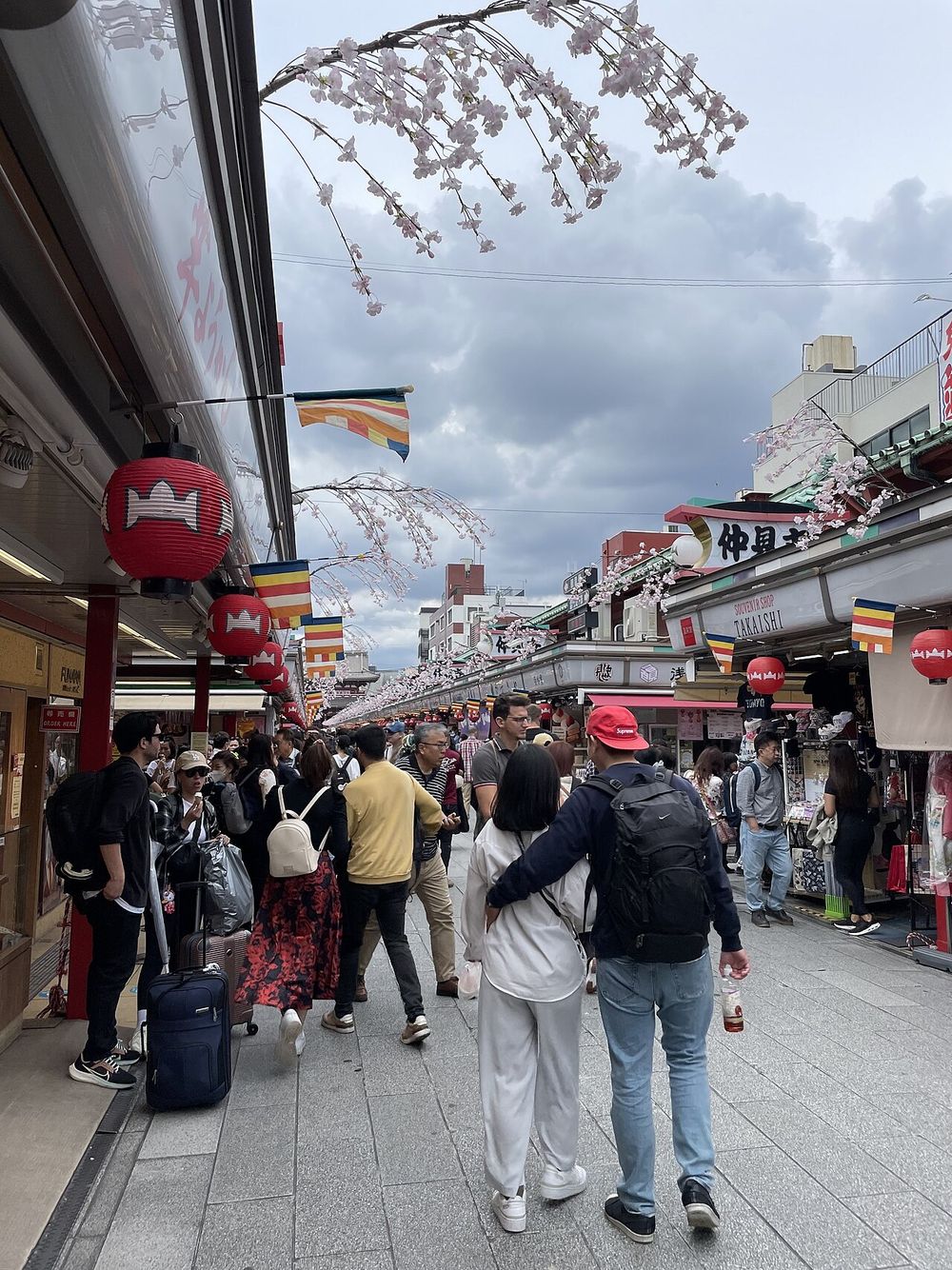
Beyond it, a straight street of small shops runs 250 metres to a second, bigger gate. There have been stalls here for three hundred years.
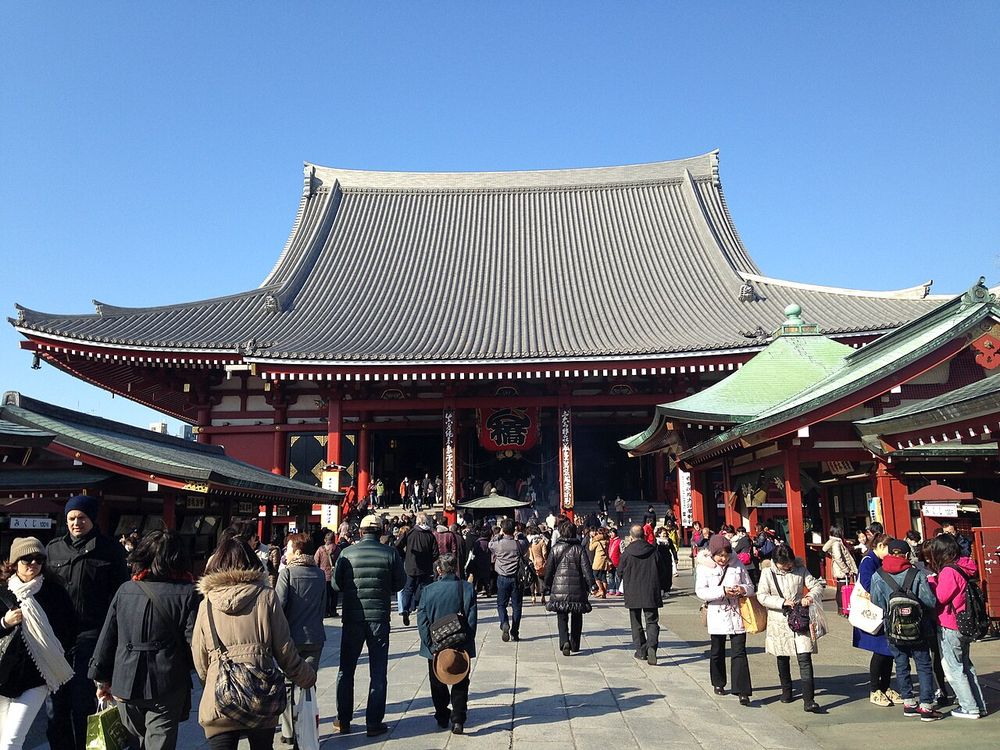
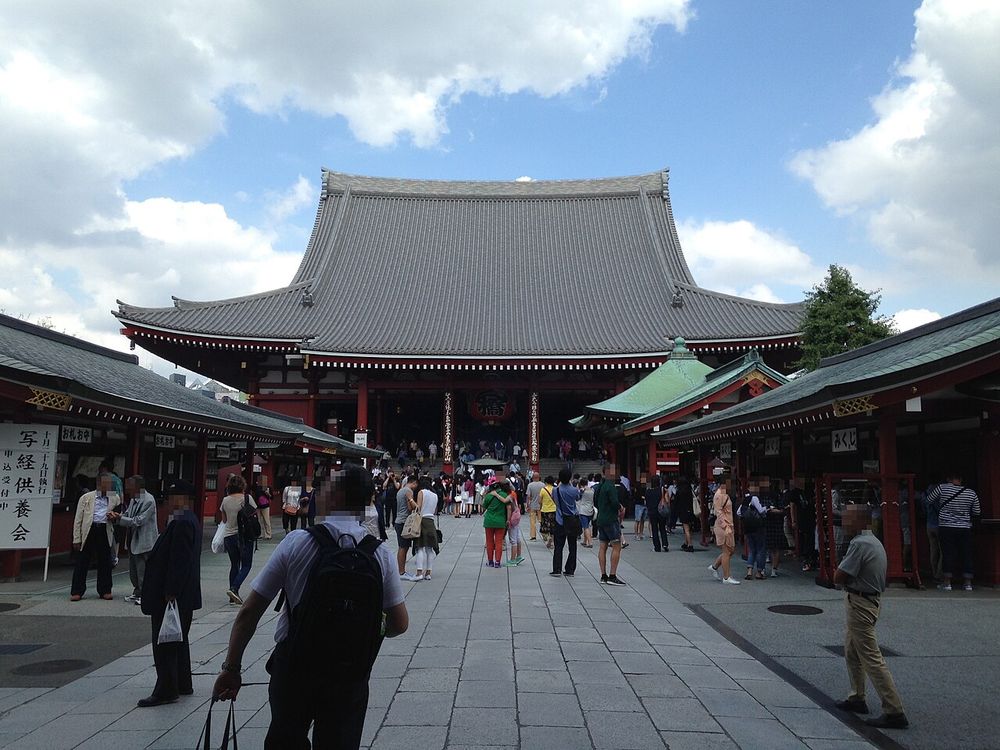
Behind the second gate is the main hall. It houses a small gold statue of Kannon, the Buddhist figure of mercy whom Chinese call Guanyin. The statue was sealed away in 645 and has not been looked at since, even by the priests.
Wave the incense smoke over yourself, throw a coin, and put your hands together. Then try your luck with a paper fortune for a hundred yen.
Things people often get wrong
"Asakusa" and "Sensō" look like two names. They are two ways of reading the same two characters. The district uses the Japanese reading. The temple uses the reading that came from China.
"It is a shrine." It is a Buddhist temple. The small building to the right of the main hall is a shrine, to the three men who founded the temple. At the temple you do not clap. At the shrine you do.
"The buildings are ancient." The main hall dates from 1958, the Thunder Gate from 1960 and the pagoda from 1973. Two things did survive the bombing: the shrine of 1649 and the east gate of 1618.
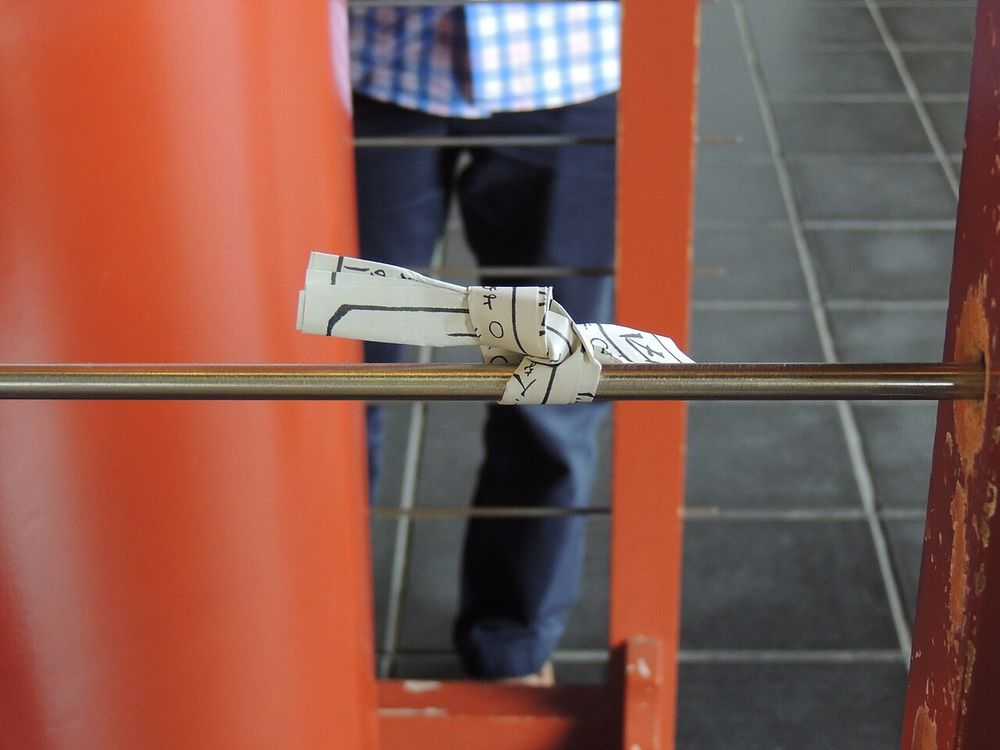
"A bad fortune means bad luck." This temple is known for giving out many bad ones, about three in ten. You tie a bad fortune to the rack and leave it behind.
People who stood here
Tokugawa Ieyasu (the warlord who founded the last line of shoguns)In 1590 he made the village of Edo his base, and chose this temple, already old, as the place where prayers would be said for his house. When he won all Japan ten years later, Edo became the seat of government and the temple grew rich. He may have stood before the old hall here, a newcomer asking the local god for favour.
Matsuo Bashō (the most famous of Japan's haiku poets)In the 1680s he lived in a hut across the river and could hear the temple's bell from his door. One spring, with the cherry trees in flower on both banks, he made a poem of not knowing which bell he had heard. He crossed the river to this temple many times.
Go deeper: eight stops, from the lantern to the shrine
The stops follow the way everyone walks: gate, street, gate, hall, and then the quieter corners.
1. Kaminarimon: the Thunder Gate
The brass plate under the lantern, with the giver's company nameTokumeigakarinoaoshima, CC0
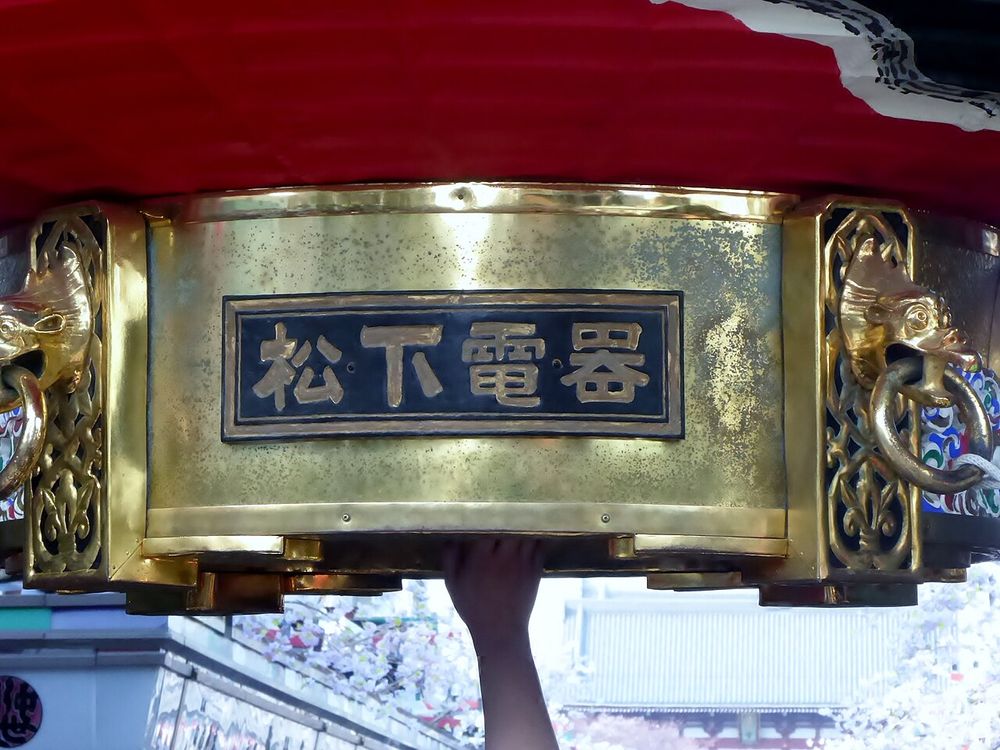
The gate burned down in 1865 and for ninety-five years there was none. The one you see was paid for in 1960 by Matsushita Kōnosuke, the founder of the company now called Panasonic. He had prayed here when he was ill, and he recovered. Look at the brass plate under the lantern. It carries his company's name.
Now look up into the bottom of the lantern. A dragon is carved there. Dragons bring rain, and a wooden city feared fire above everything.
The lantern is made new about every ten years in Kyoto. When a typhoon is coming, or when festival floats must pass, it is folded up flat.
2. Nakamise: the street of stalls
Nakamise, 2024Alexeyevitch, CC BY-SA 4.0
In the late 1600s the temple let the people who swept its grounds set up stalls along the approach. That is the beginning of this street, one of the oldest shopping streets in Japan. There are about ninety shops.
Try the small cakes shaped like pagodas and lanterns, filled with sweet bean paste, and the rice crackers grilled while you wait. Eat them at the shop. Signs ask you not to walk and eat.
Asakusa about 1890, from a traveller's albumRijksmuseum, CC0
The shops' shutters are painted with scenes of old Asakusa. You can only see them early in the morning or at night, when the shops are shut.
3. Hōzōmon: the Treasure Gate and the giant sandals
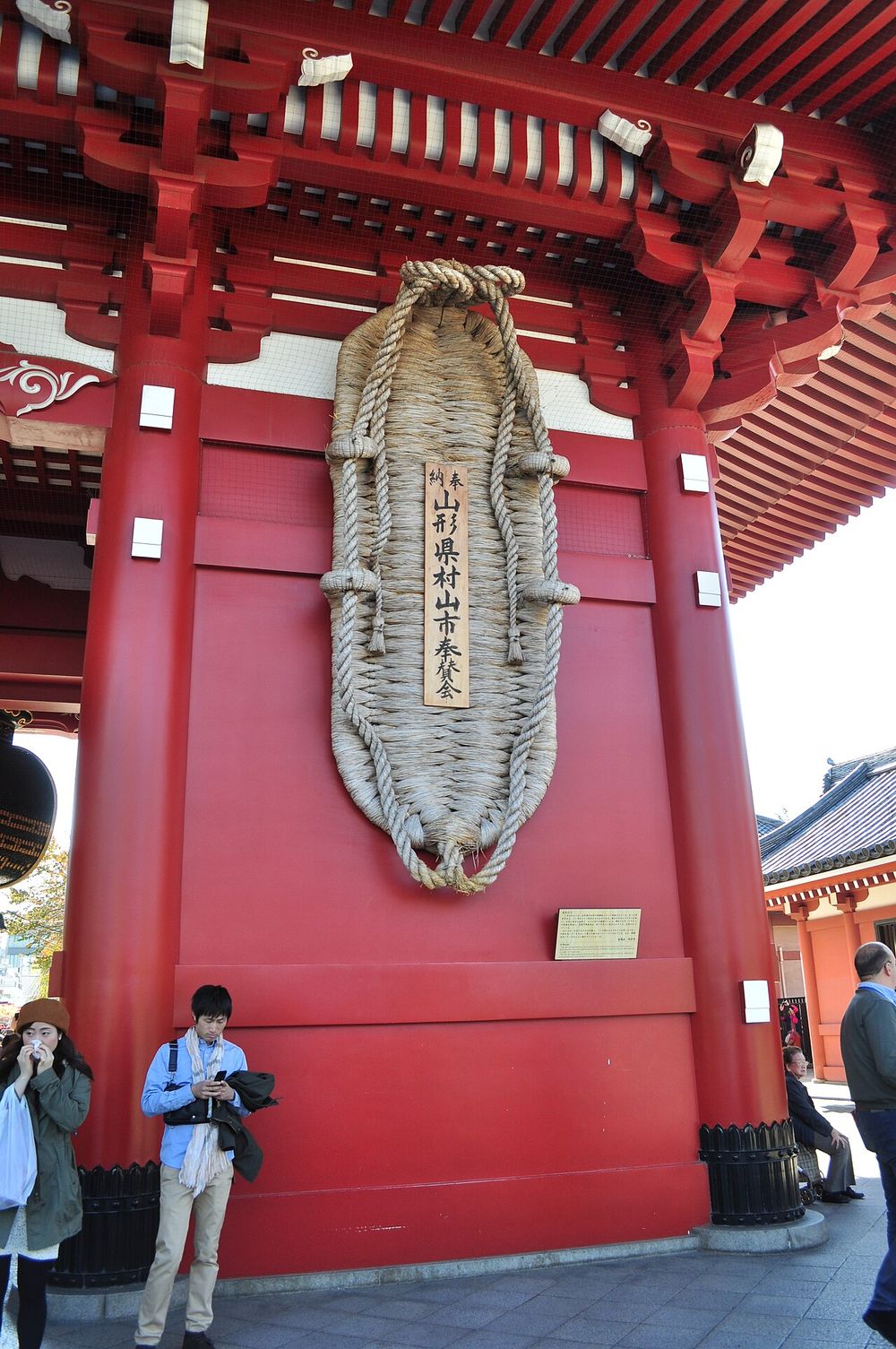
A straw sandal four and a half metres longLuistxo, CC BY-SA 4.0
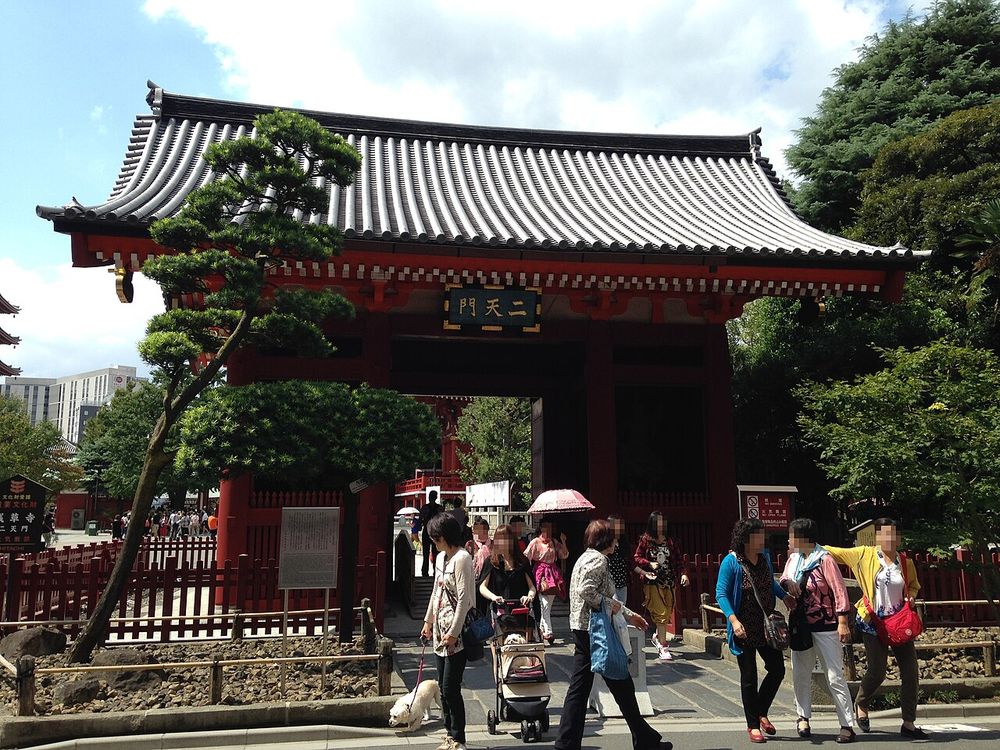
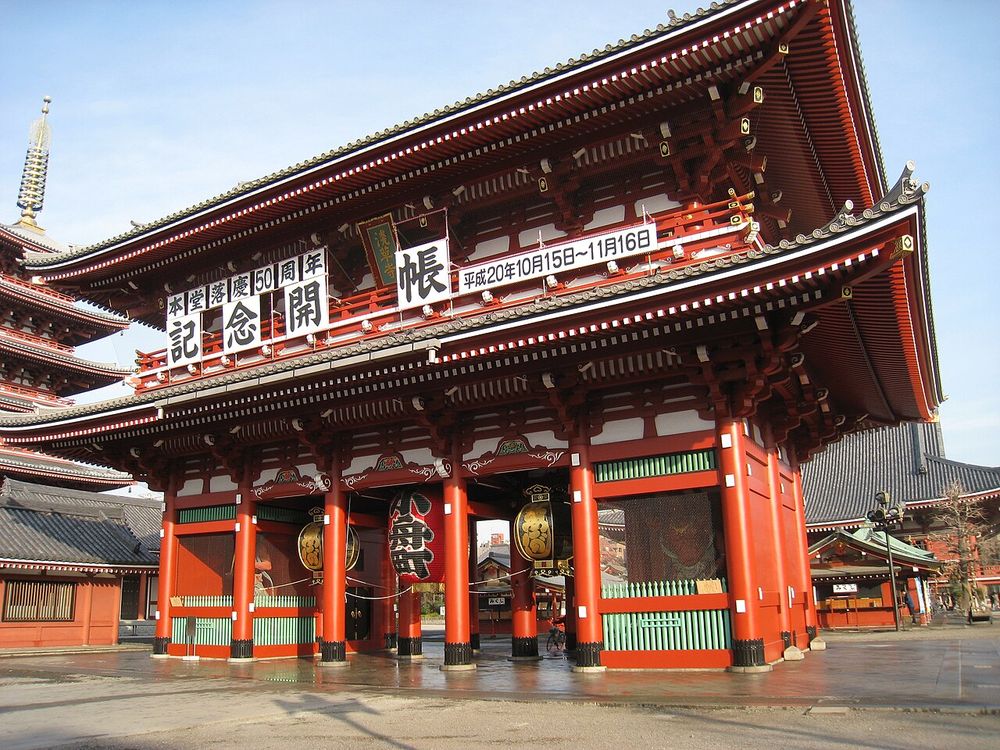
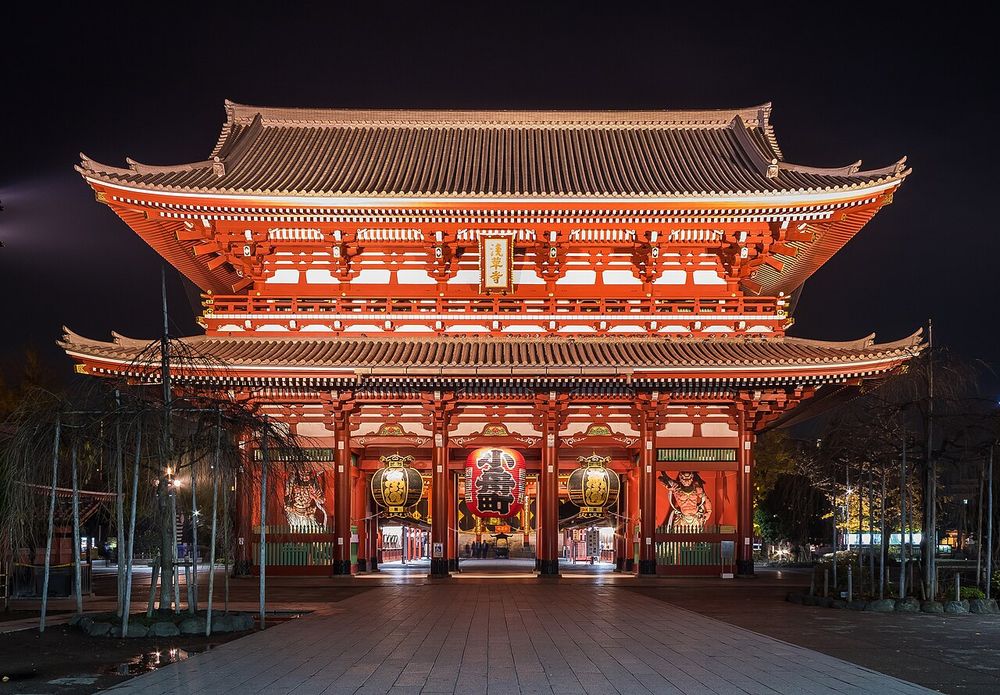
The second gate has two fierce guardian kings in front. Its upper floor is a strongroom for the temple's scriptures, which is how it gets its name.
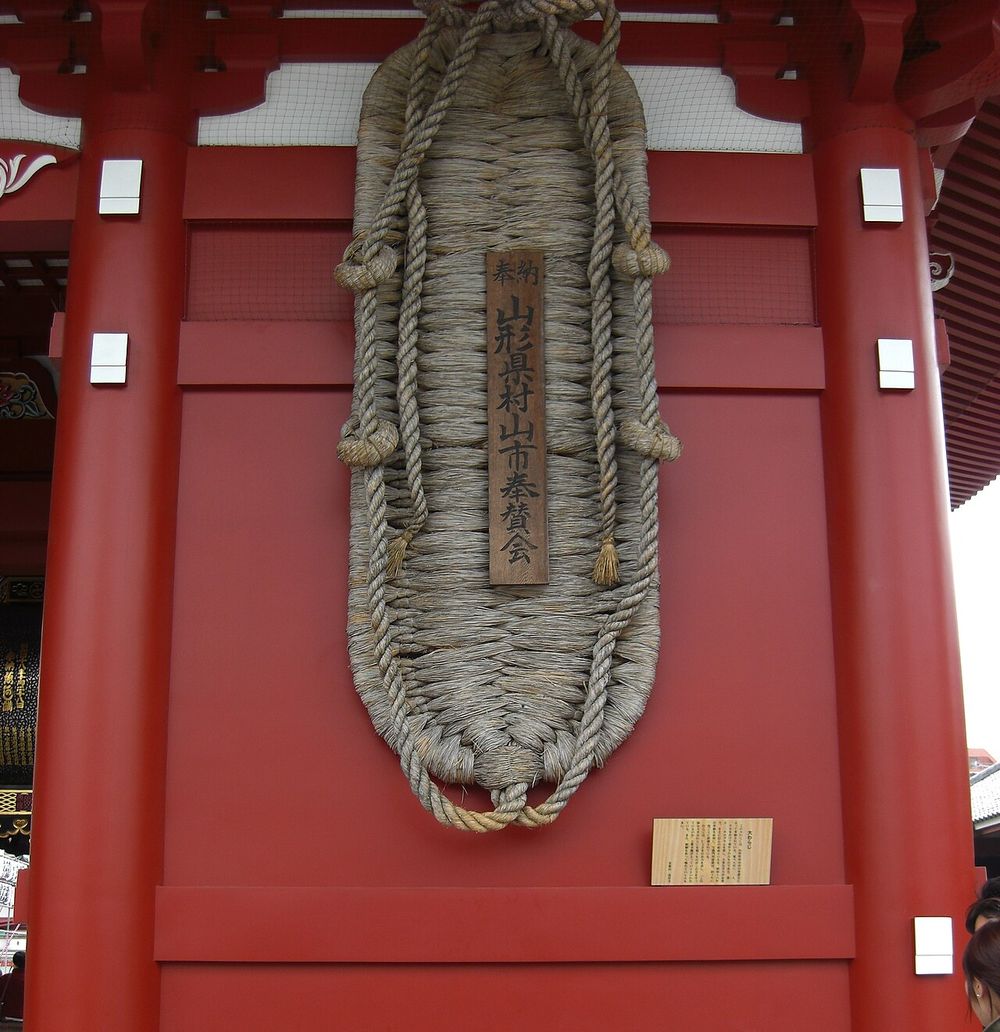
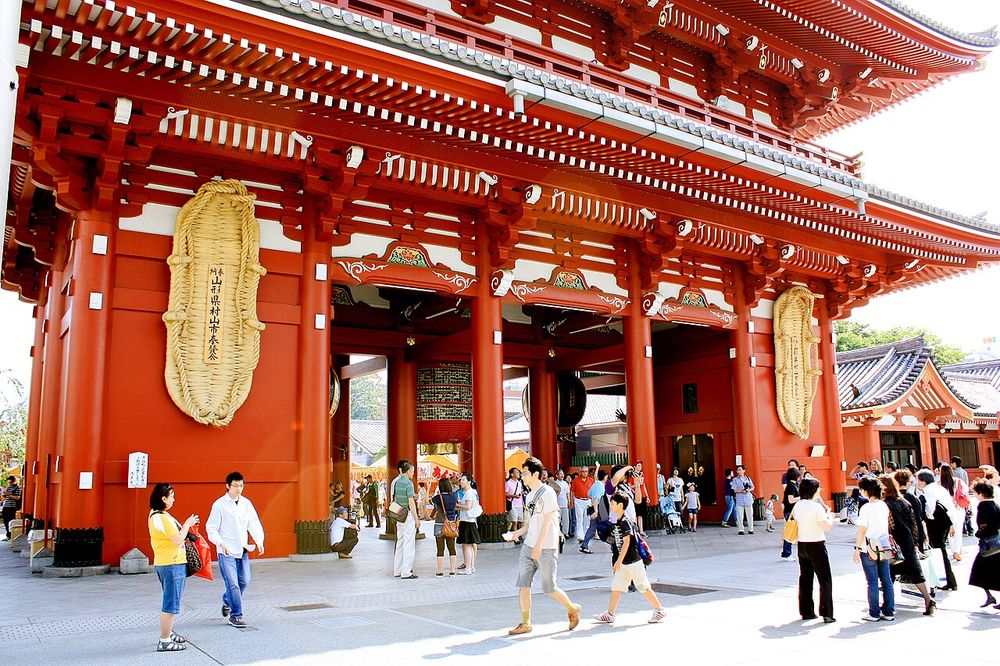
Walk through and look back. On the inner side hang two straw sandals four and a half metres long. Villagers in the north of Japan weave a new pair about every ten years. A demon who sees them is supposed to think a giant lives here and go away.
4. The incense burner and the paper fortunes
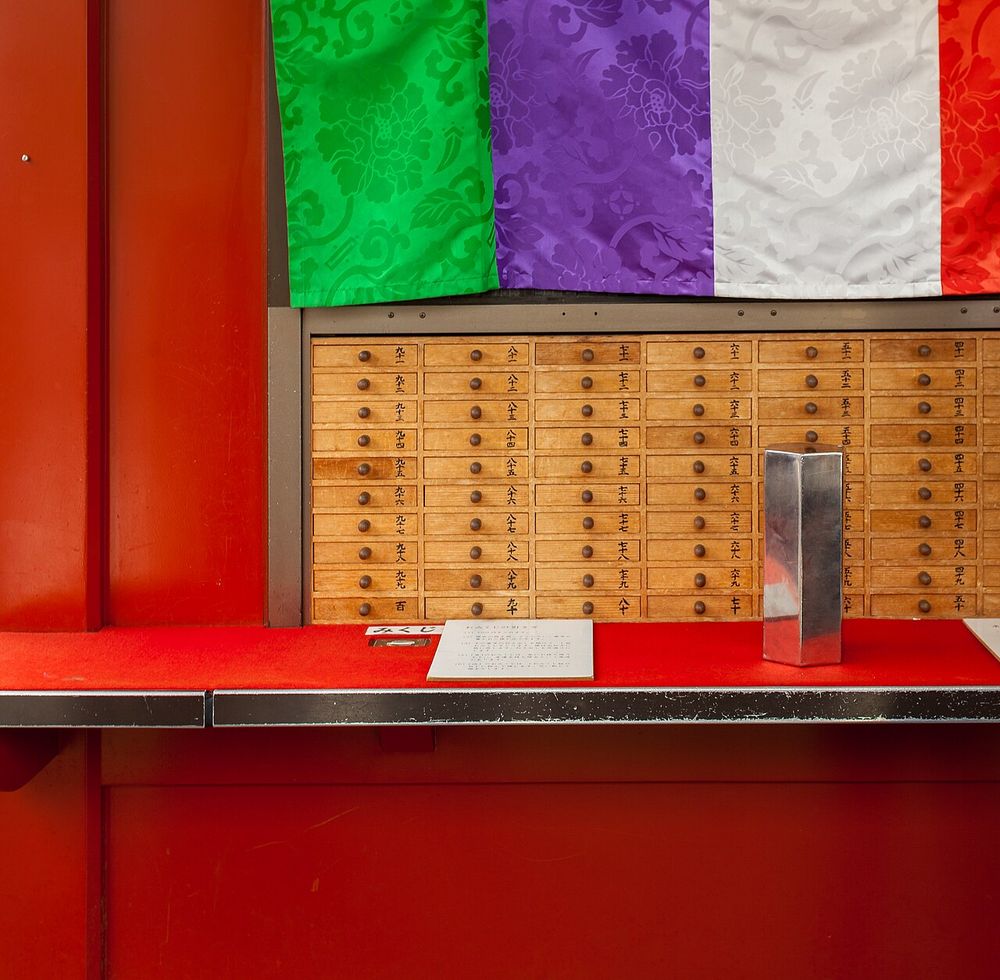
The drawers of paper fortunesPh0kin, CC BY-SA 4.0
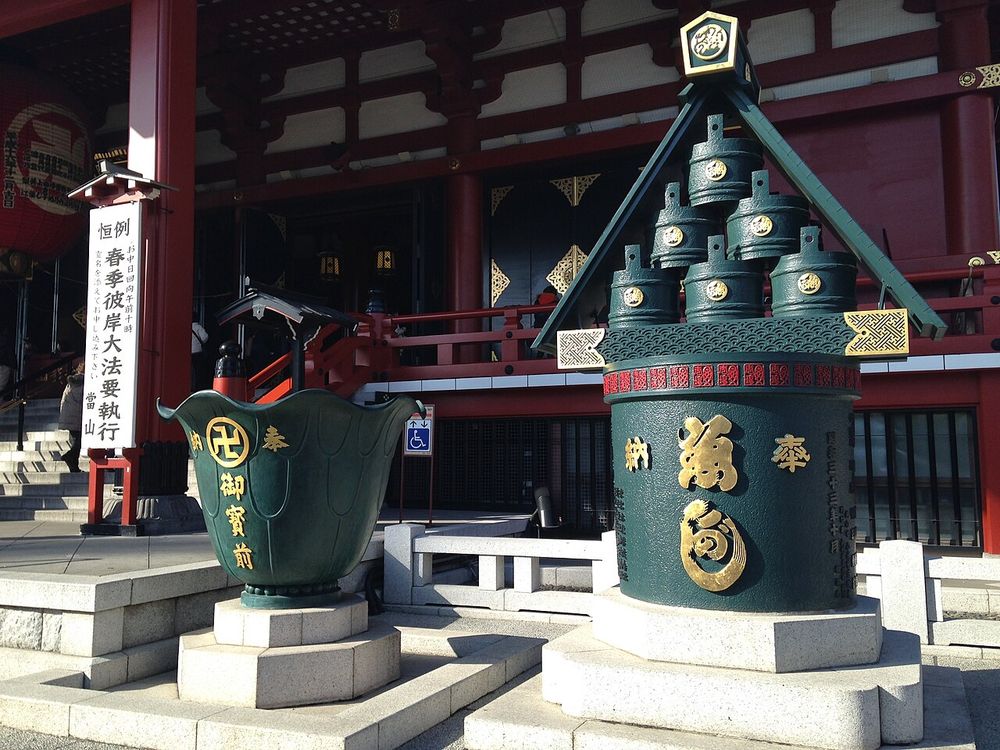
In front of the hall is a big bronze burner. People fan the smoke towards whichever part of the body they want made well, or towards their heads to be made clever.
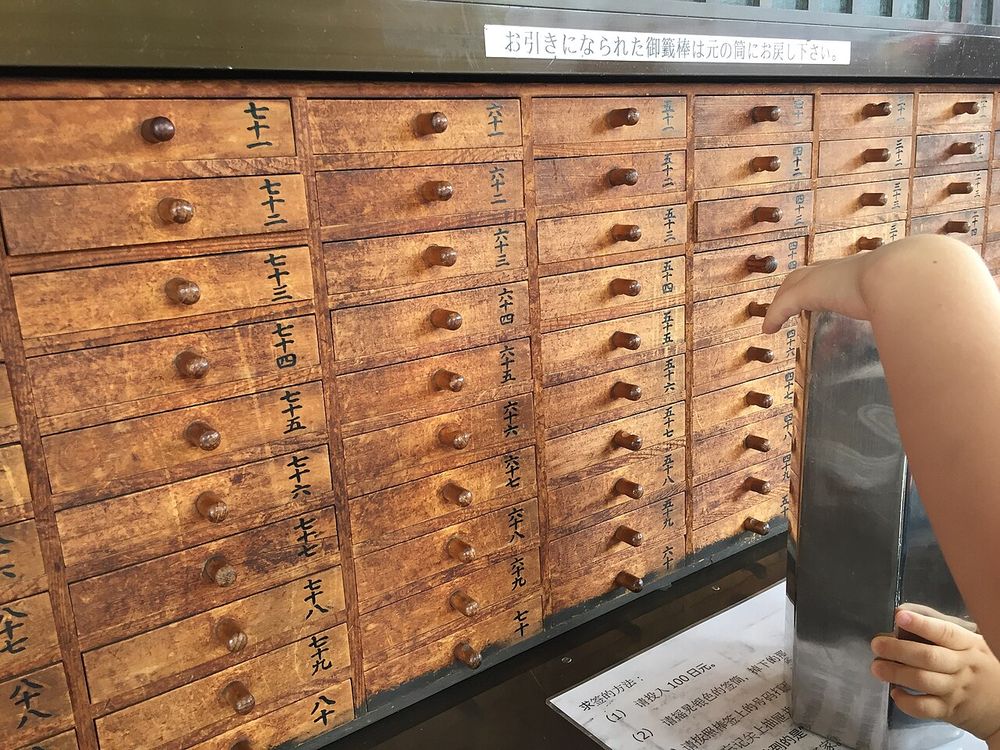
At the fortune stands, put a hundred yen in the slot, shake the metal box until a stick drops out, and read the number on it. Open the drawer with that number and take a sheet. The sheets have English on the back.
A fortune tied to the rack and left behindMadame Tatillonne, CC BY-SA 4.0
The hundred fortunes used here came from China. They go back to a set of temple lots used in Song-dynasty Hangzhou, which Japanese monks adopted and spread.
5. The main hall and the statue nobody sees
The gold doors of the inner roomZairon, CC BY-SA 4.0
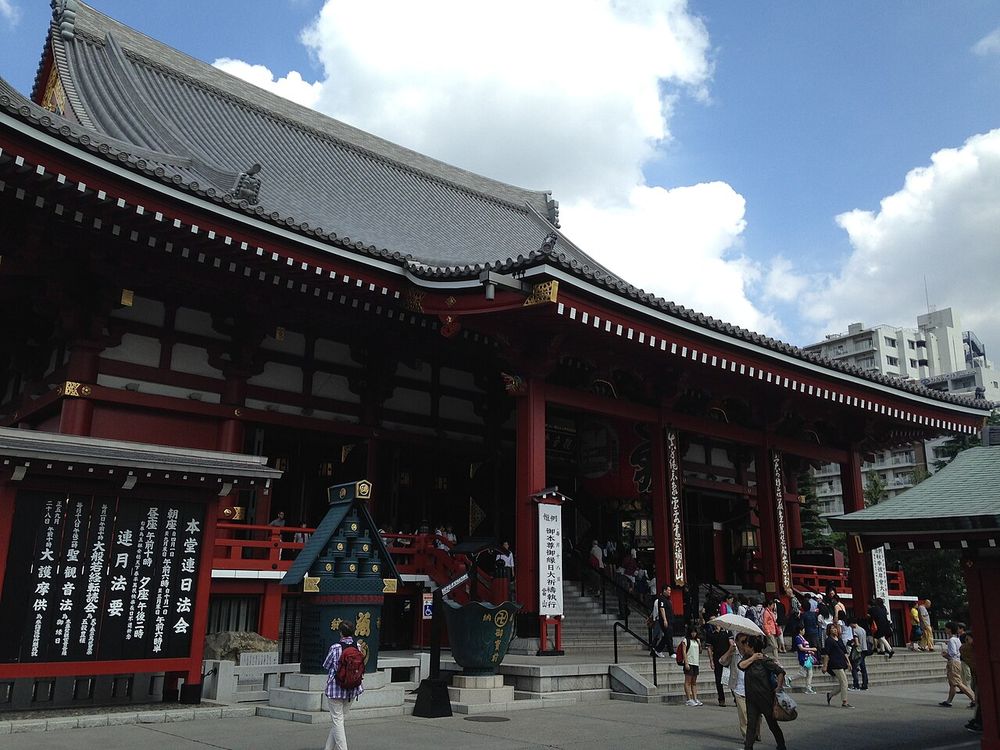
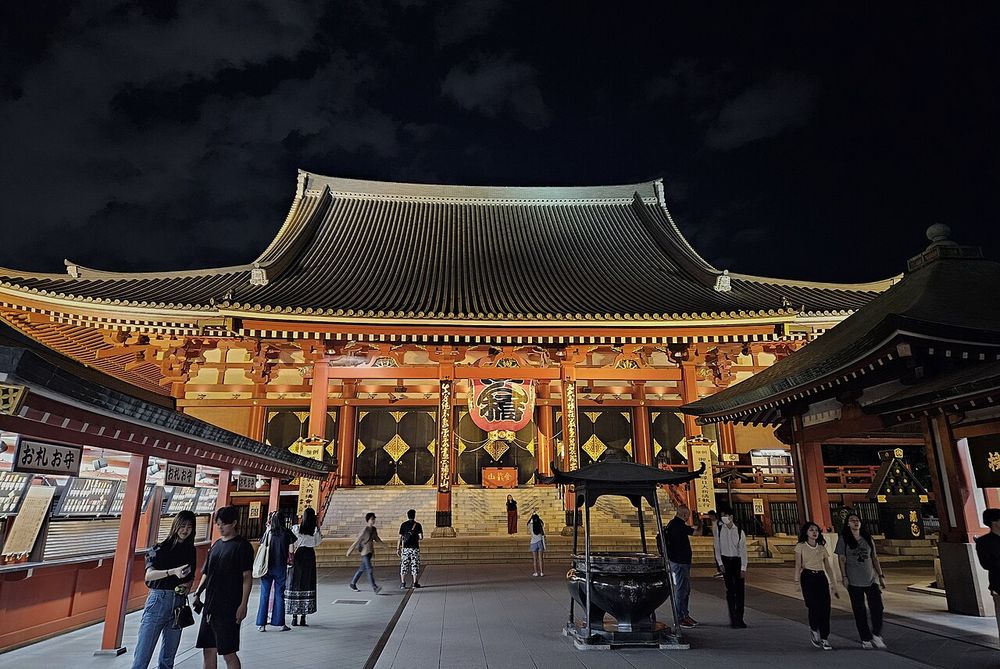
The hall of 1649 was a national treasure. It burned on the night of 10 March 1945, when American bombers set fire to this whole side of Tokyo and about a hundred thousand people died. The present hall, of 1958, copies its shape in concrete. Since 2010 its roof tiles have been titanium, which is light and does not fall in an earthquake.
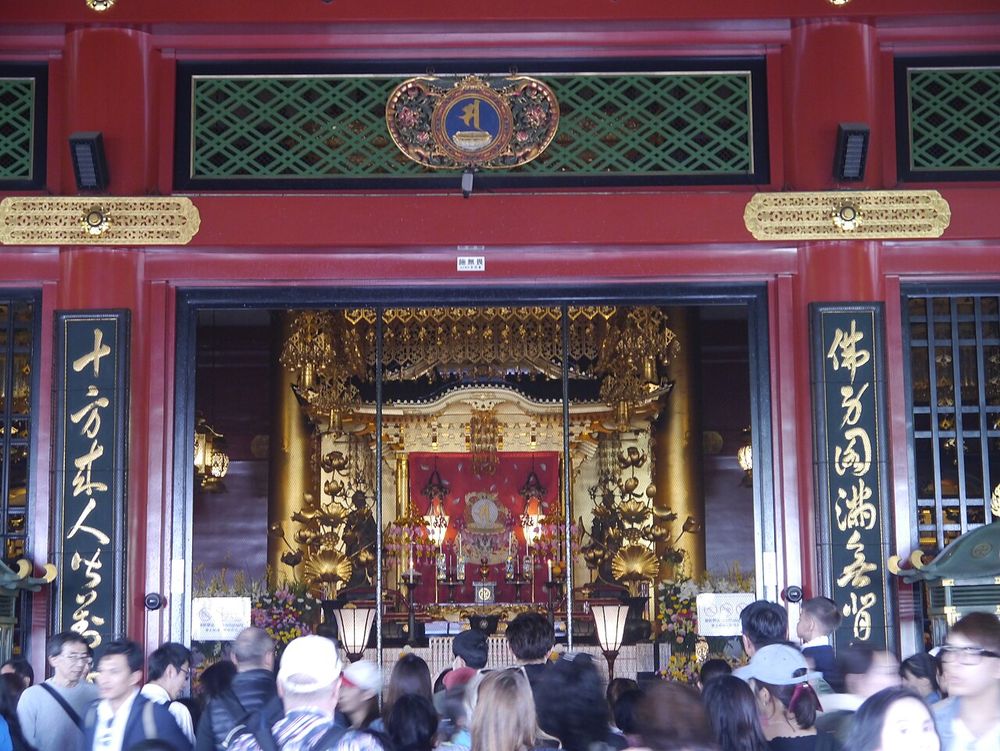
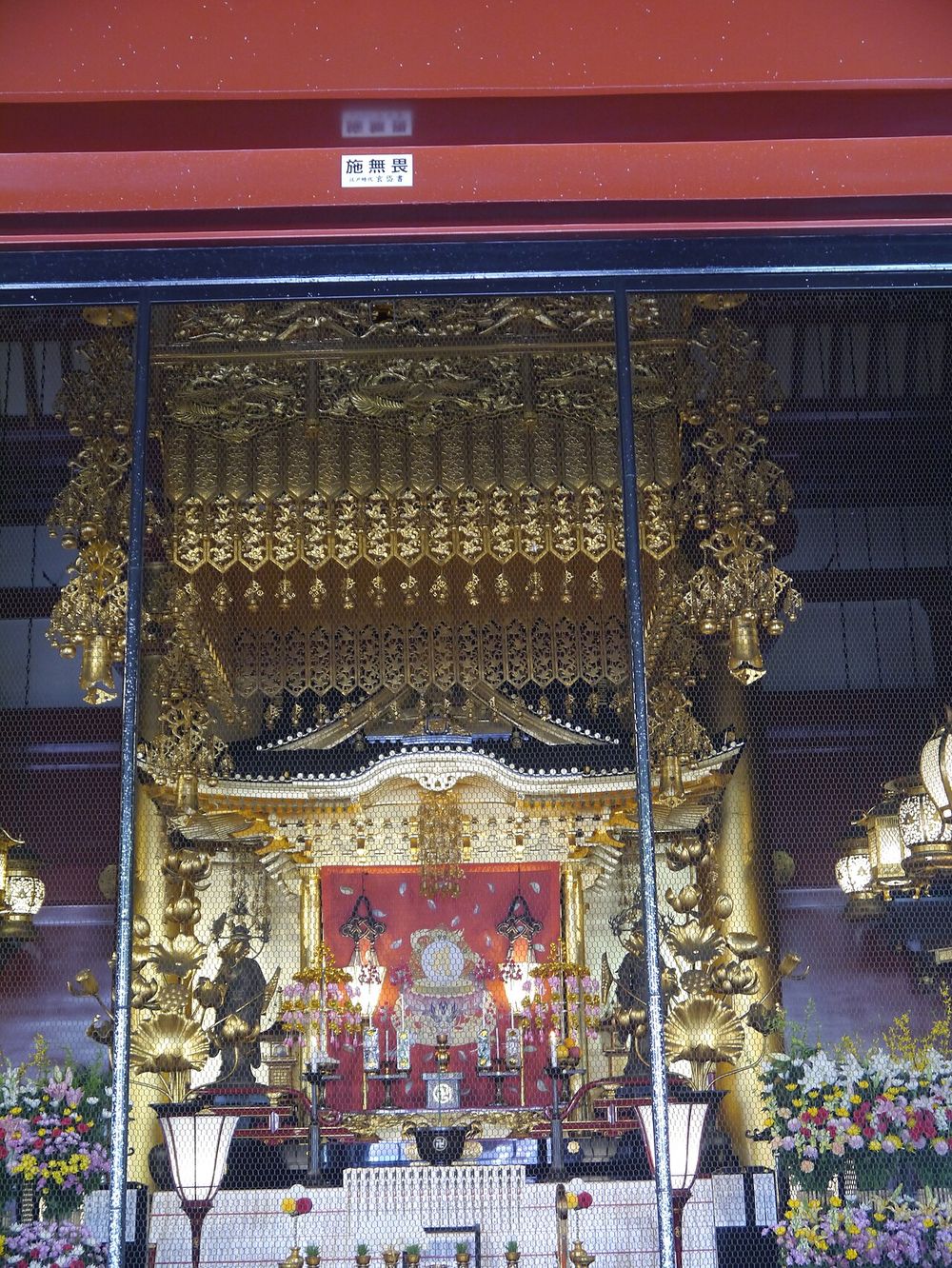
The inner room, behind the gold doors, holds the statue. A priest named Shōkai sealed it in 645 after a dream told him no one must look at it. A copy made in the ninth century stands in front, and even that is shown only once a year, on 13 December.
Under the roof of the main hallZairon, CC BY-SA 4.0
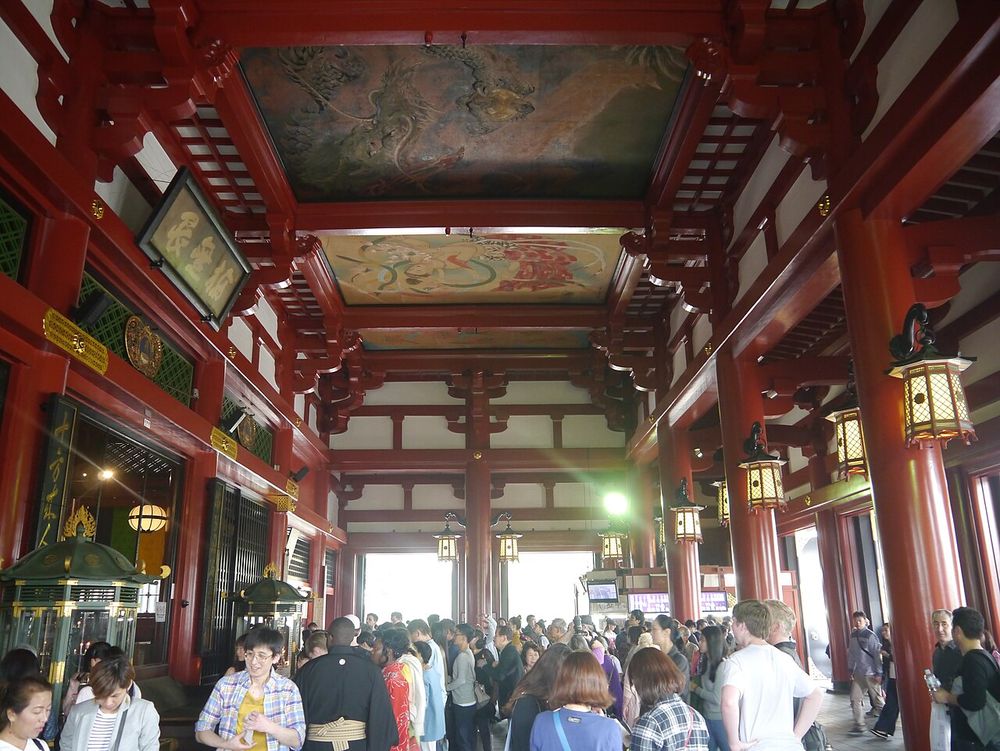
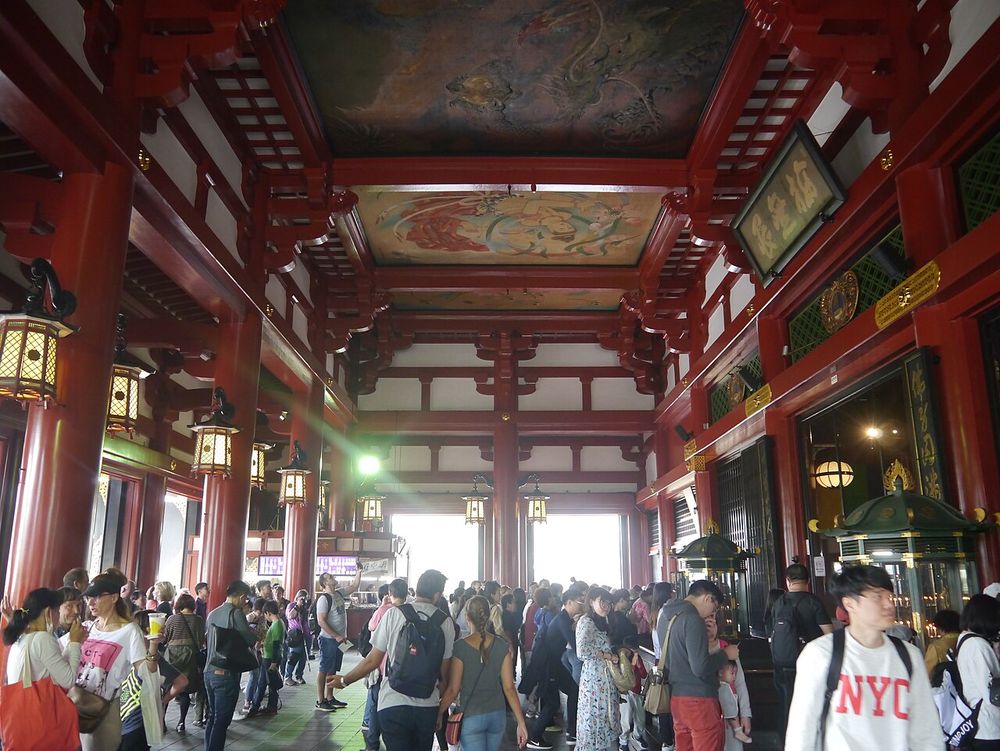
Look up. The dragon on the ceiling and the heavenly maidens beside it were painted in the 1950s by two of the best-known Japanese painters of the time.
6. The five-storey pagoda
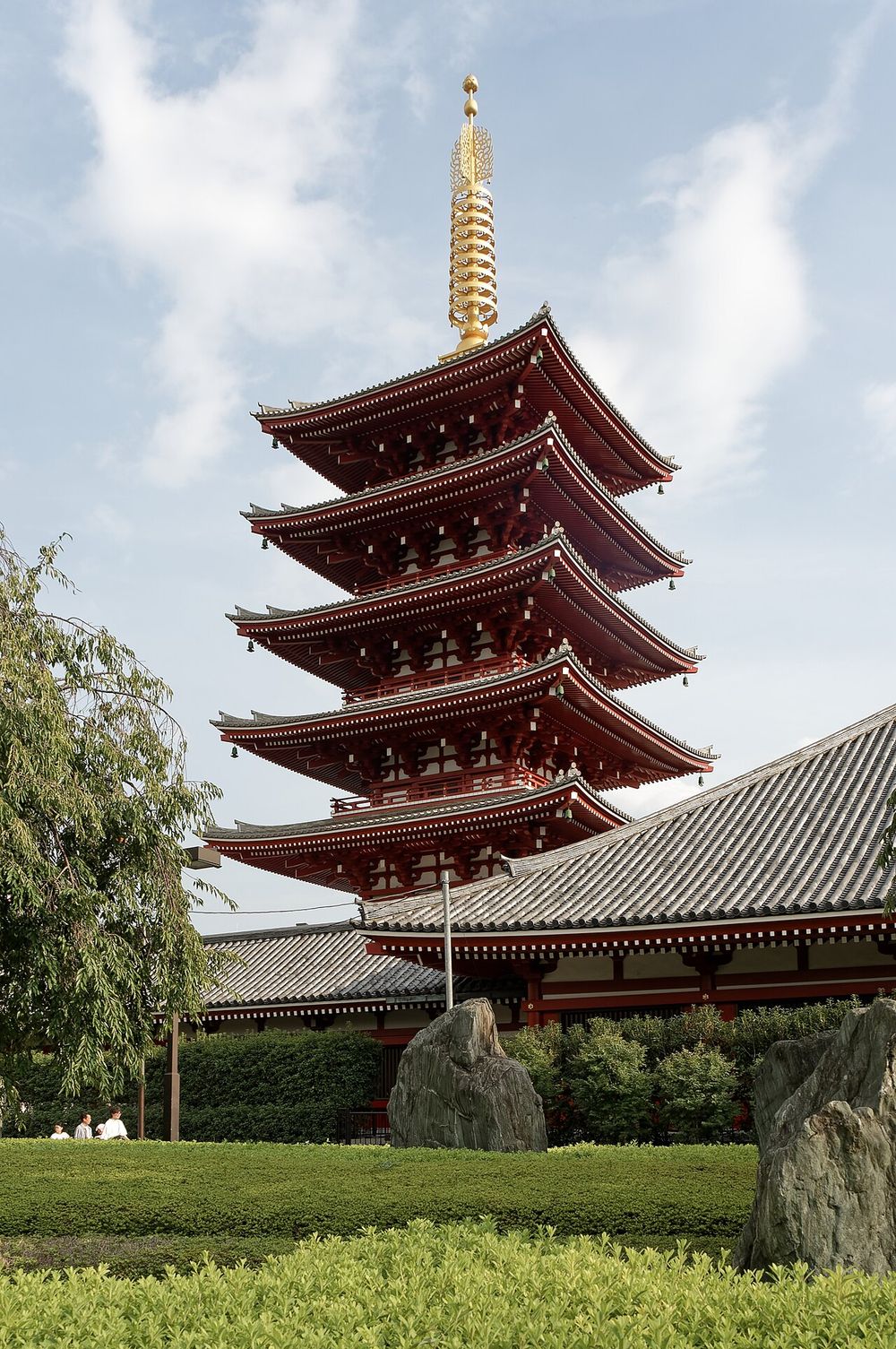
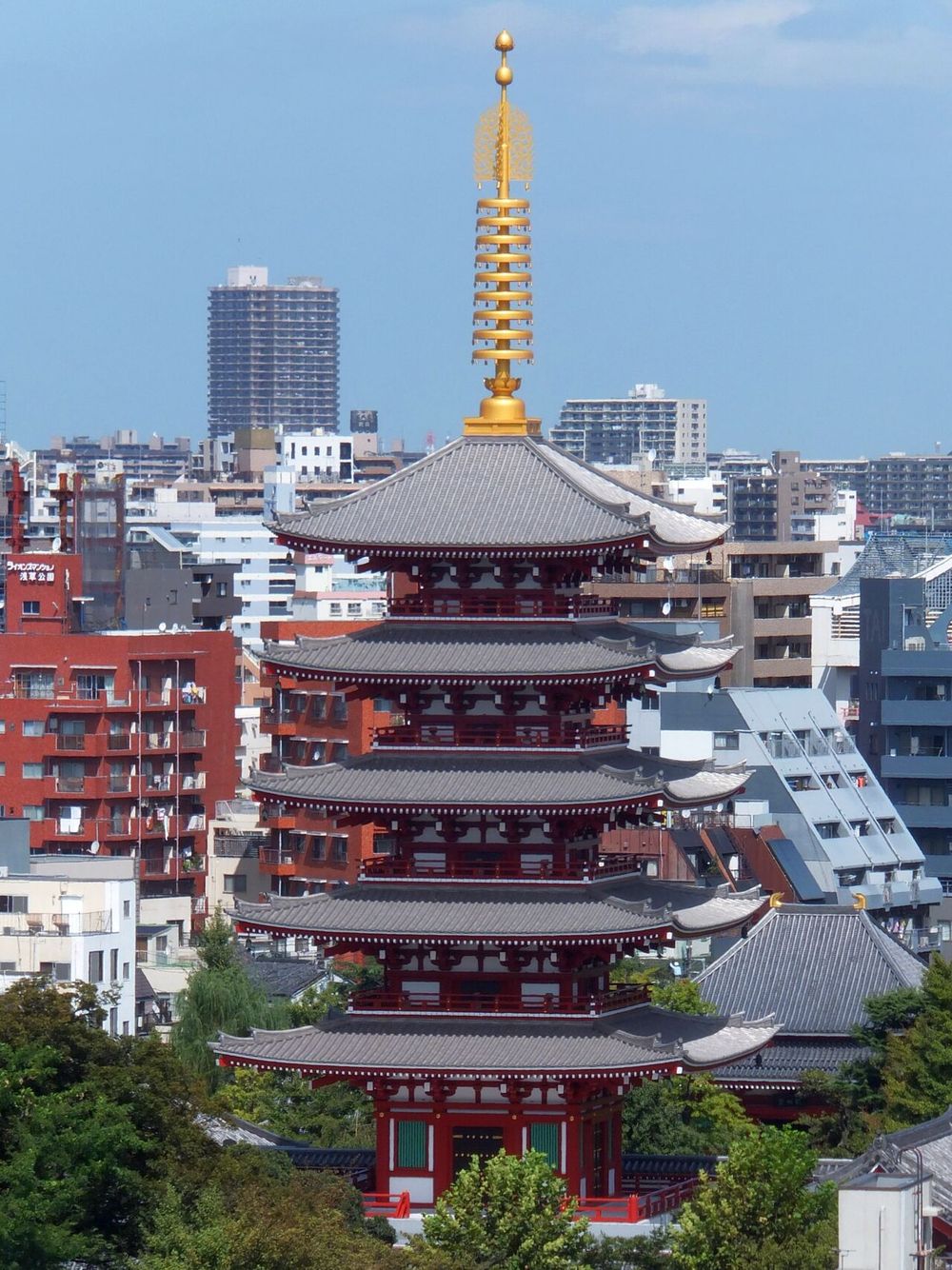
The five-storey pagoda, 2024Jakub Hałun, CC BY 4.0
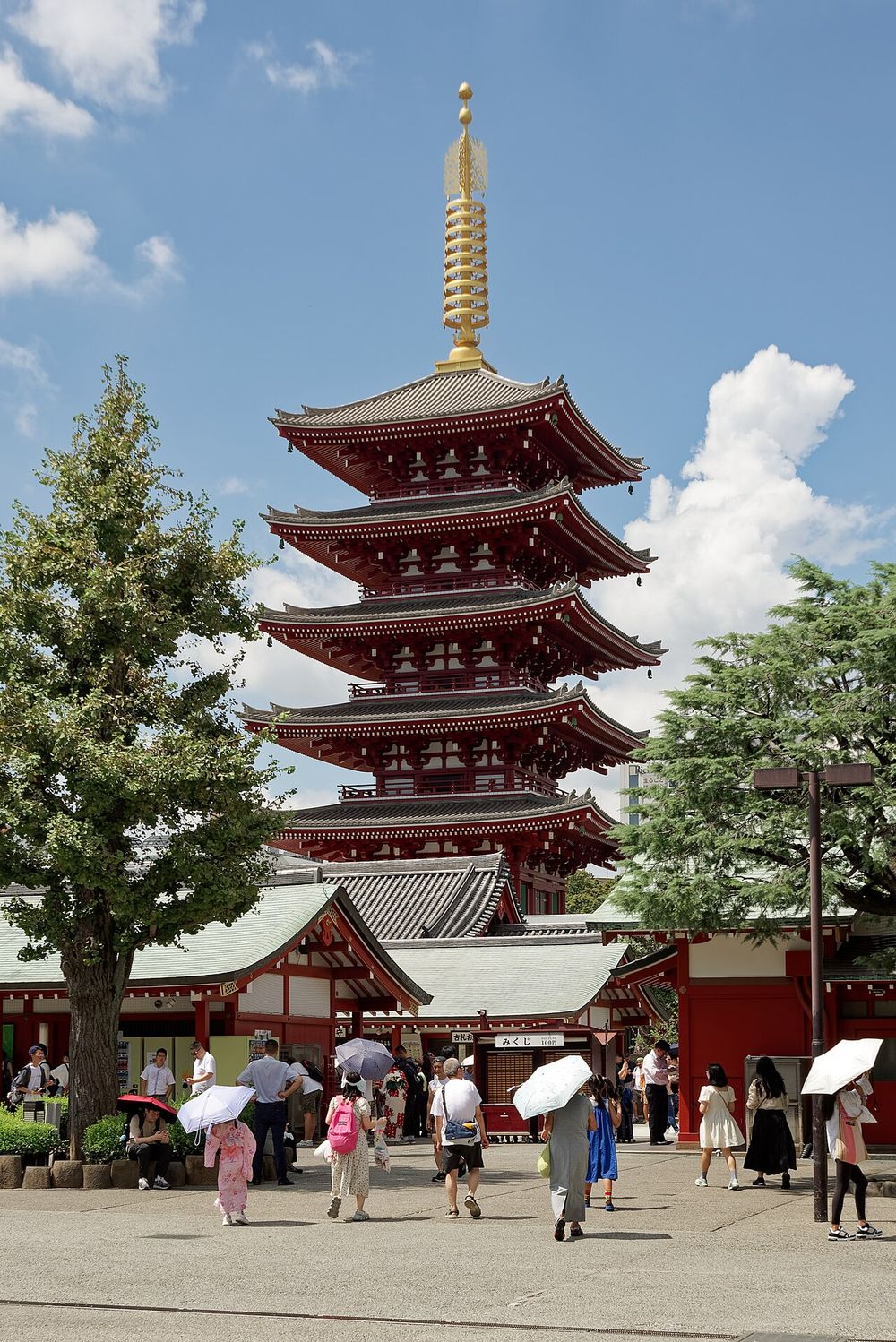
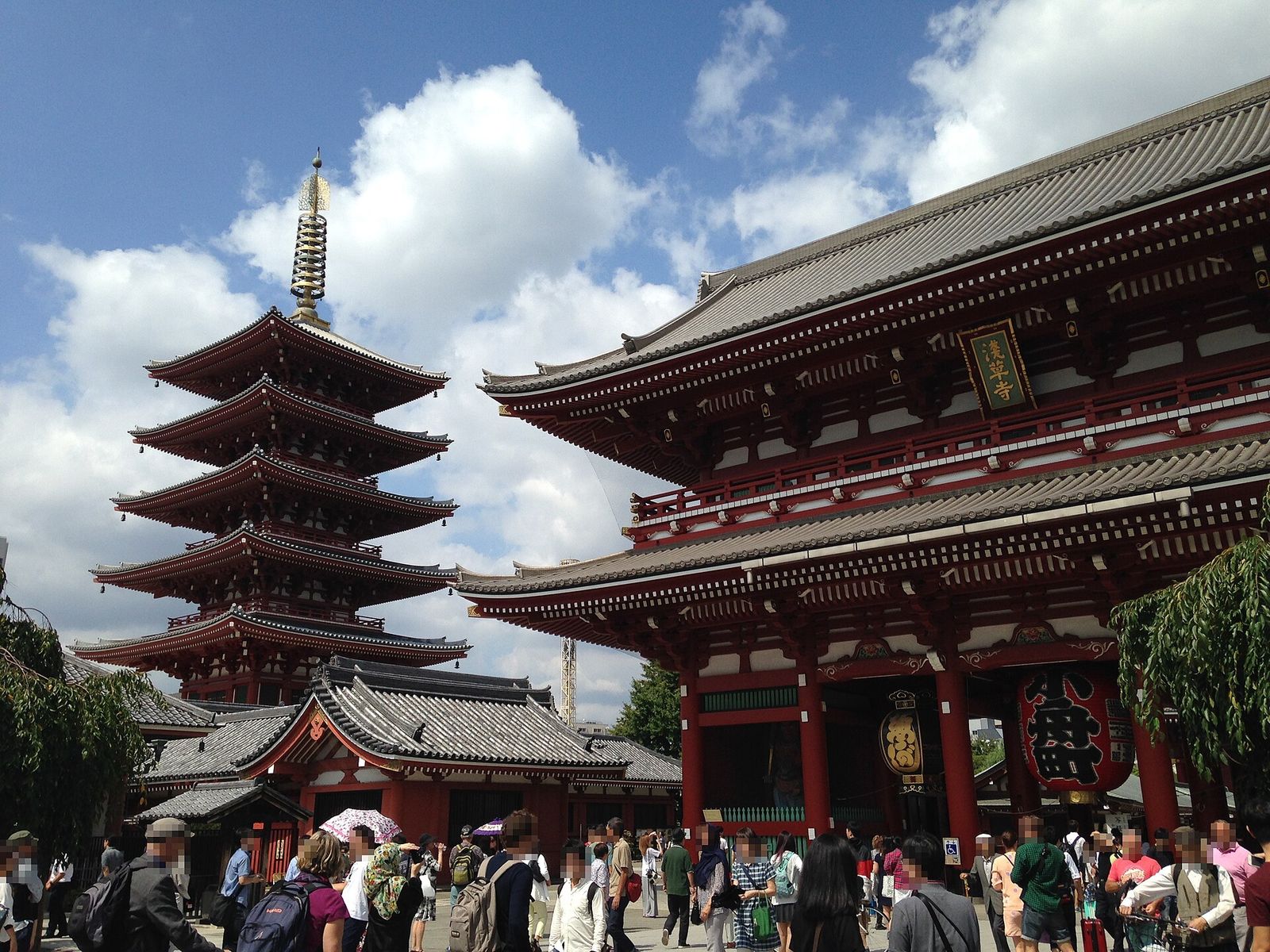
The pagoda is 53 metres high. The old one stood on the other side of the yard and burned in 1945. This one was finished in 1973. At the top it keeps a relic of the Buddha given by a temple in Sri Lanka.
Come back after dark. The halls and the pagoda are lit until about eleven, the shops are shut, and the crowd is gone.
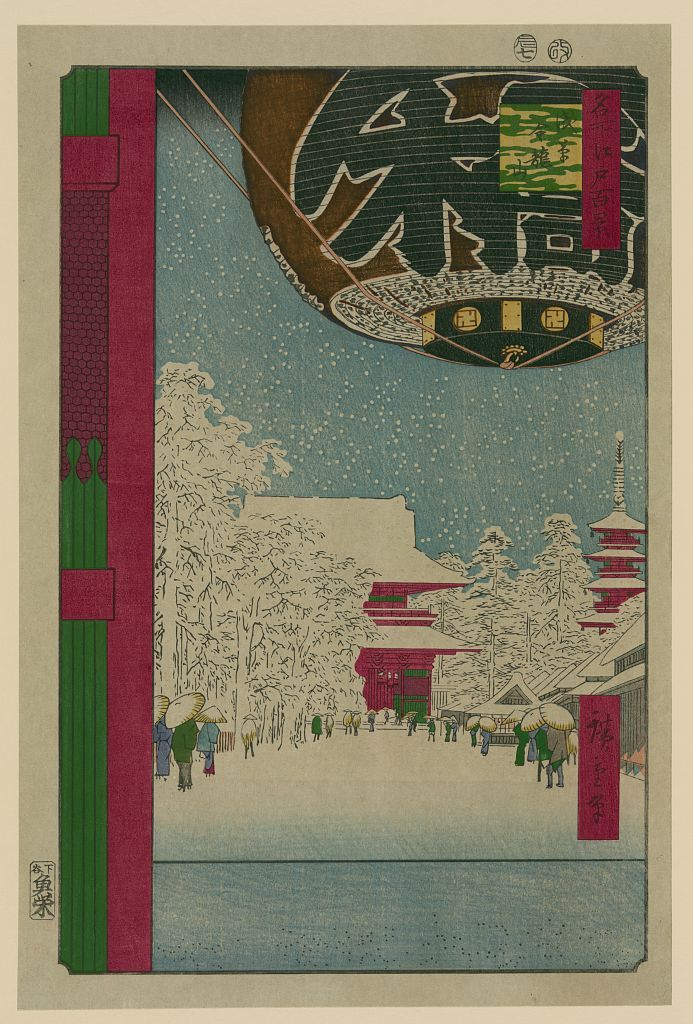
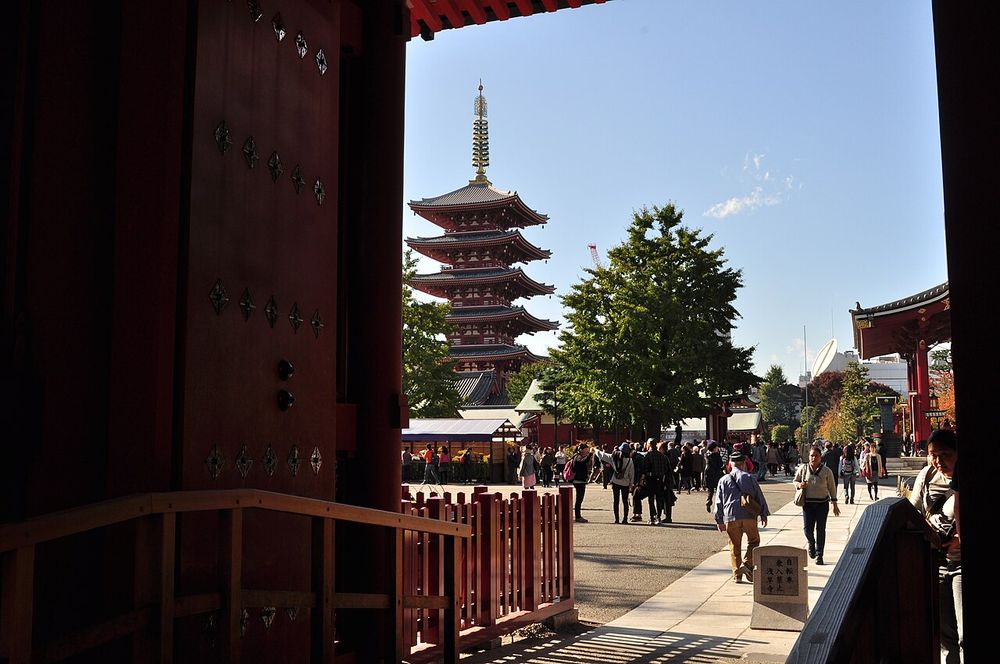
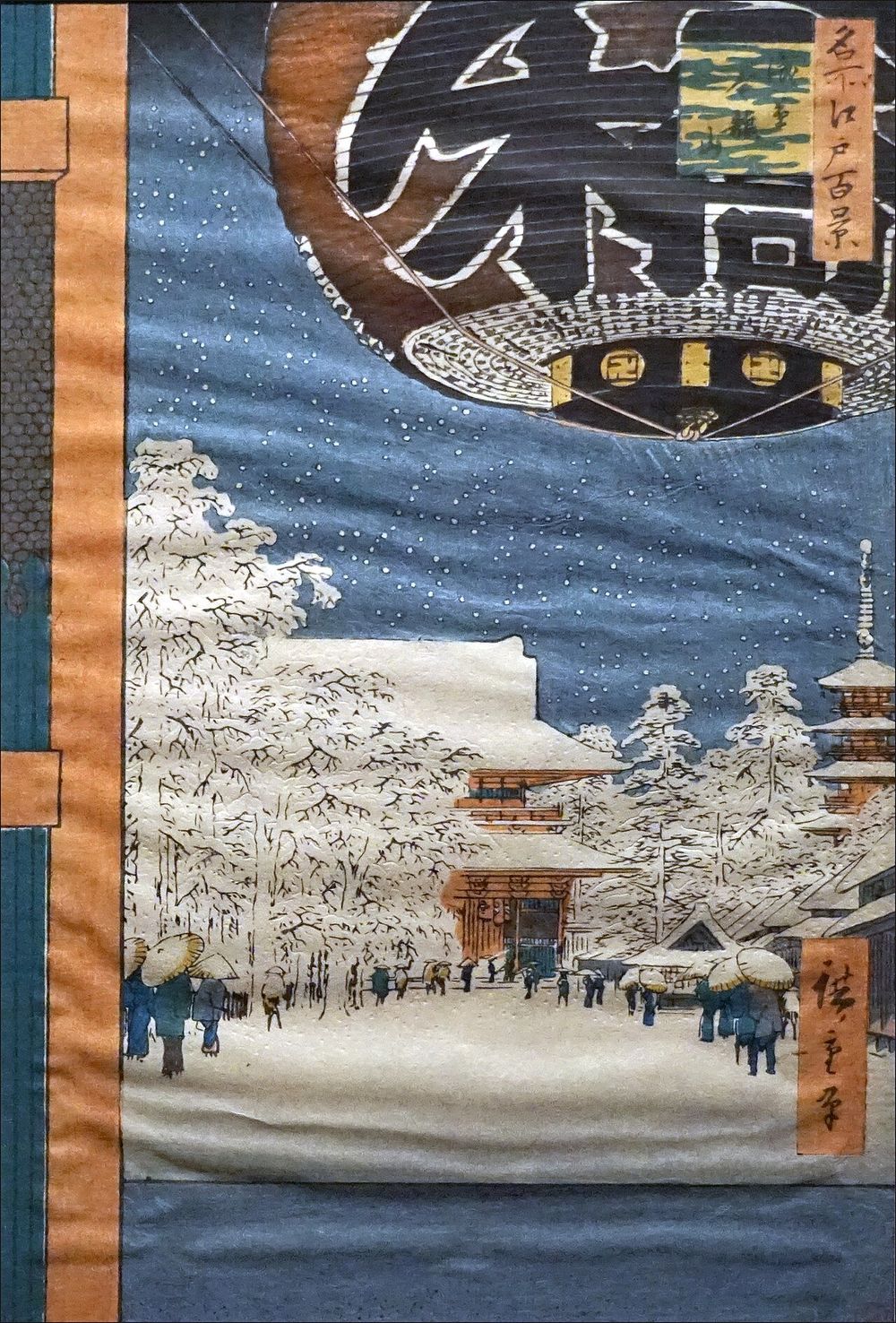
Hiroshige, the temple in snow seen through the Thunder Gate, 1856Andō, Hiroshige, 1797-1858, artist, Public domain
The artist Hiroshige drew this view in snow in 1856, looking in through the Thunder Gate past the lantern to the pagoda. It is one of the best-known Japanese prints.
7. Asakusa Shrine and the wildest festival in Tokyo
The east gate of 1618, which survived the warそらみみ (Soramimi), CC BY-SA 4.0
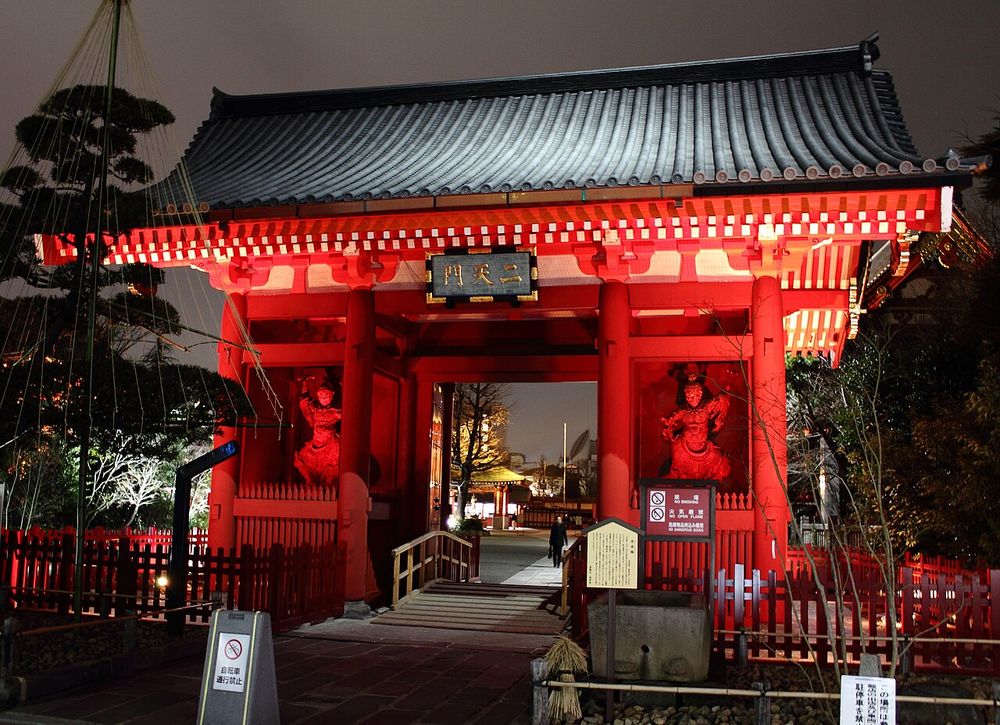
To the right of the main hall, through a stone gate, is a shrine built in 1649. It honours the two fishermen who found the statue and the village head who took it in. It escaped the fires of 1945, and so did the red gate beside it, which dates from 1618.
The Sanja festival, May 2018Jean-Pierre Dalbéra from Paris, France, CC BY 2.0
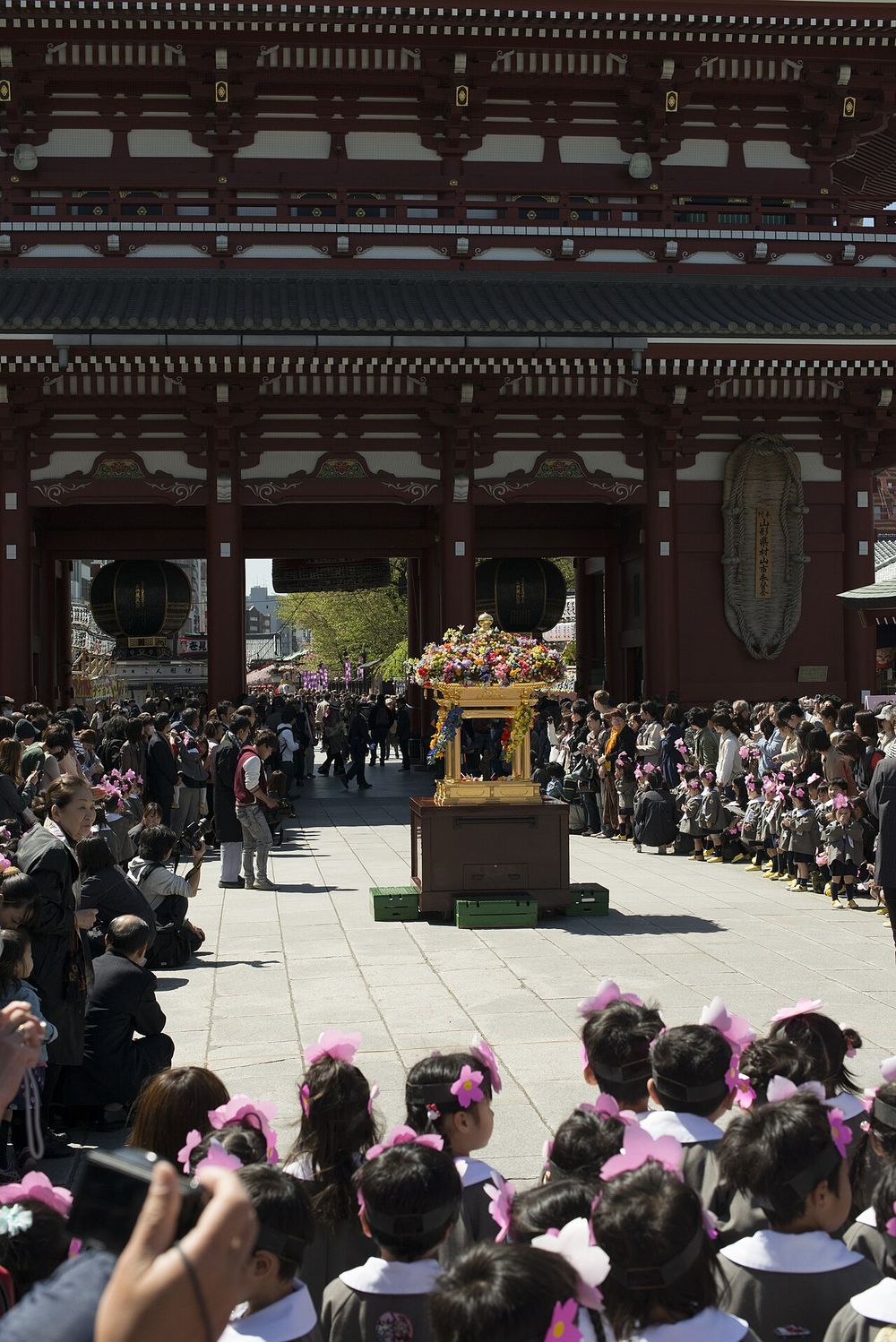
On the third weekend of May the shrine holds the Sanja festival. About a hundred portable shrines are carried through the streets on men's and women's shoulders and shaken as hard as possible, because shaking is thought to wake the power of the god. Nearly two million people come over the three days. In 2026 it was held from 15 to 17 May.
8. The same years in China
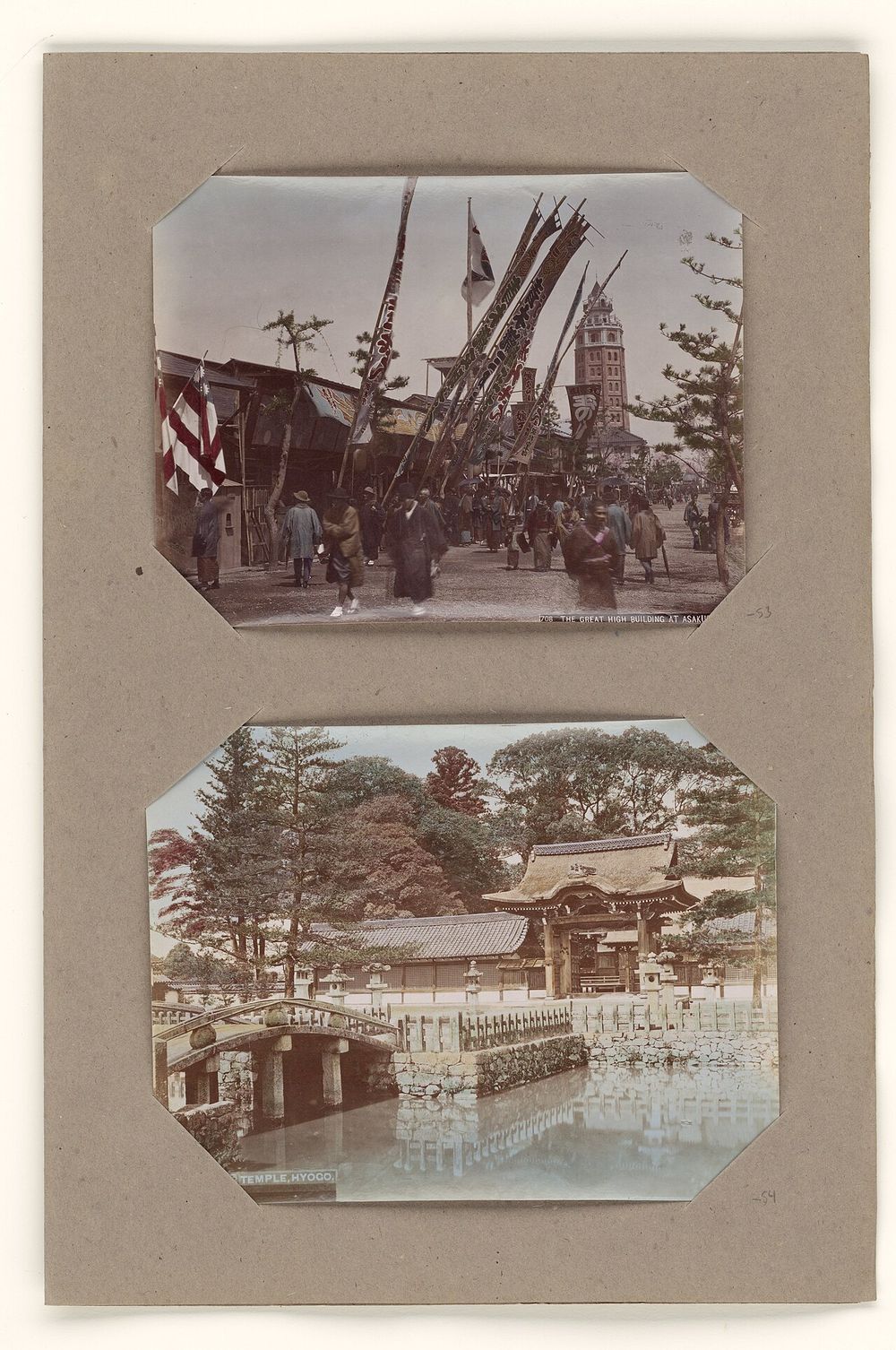
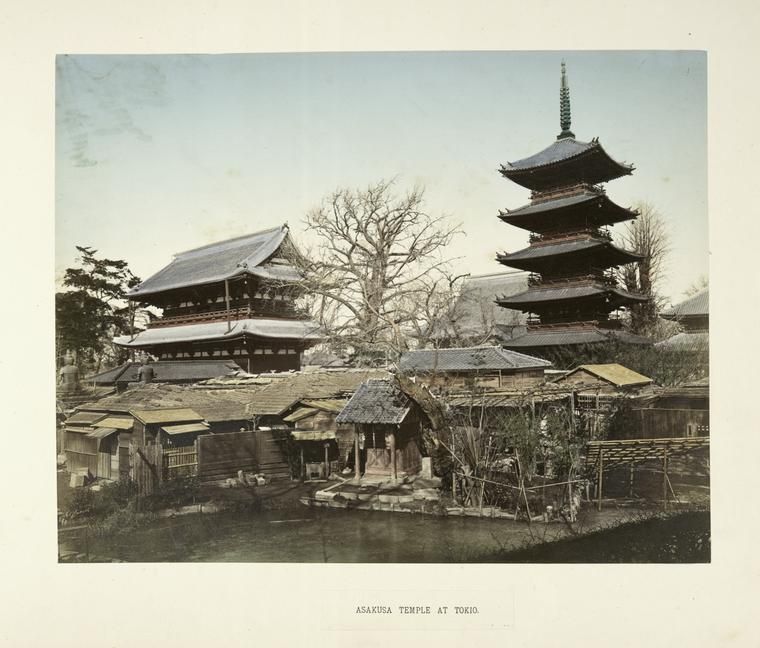
The old main hall and pagoda in a hand-coloured photograph of the late 1800sNew York Public Library, No restrictions
The temple's two founding dates are 628, when the statue was found, and 645, when the first hall was built. In China these are the early years of the Tang (618–907). In 629 the monk Xuanzang left the capital, Chang'an, for India, in search of Buddhist scriptures. In 645 he came home with them.
Buddhism had reached Japan less than a century earlier, from China by way of Korea. The Kannon worshipped here is the same figure as Guanyin, and many Chinese visitors bow to her as they would at home.
Bashō's poem about the bell is seventeen syllables long.
花の雲
鐘は上野か
浅草か
A cloud of blossom:
is that bell from Ueno,
or from Asakusa?
Matsuo Bashō, 1687
Meanwhile in the world
Year
Here
Elsewhere
628
Two fishermen net the statue
Second year of Emperor Taizong of the Tang; Xuanzang leaves for India the next year
645
The first hall is built and the statue is sealed
Xuanzang returns to Chang'an with the scriptures
1590
Tokugawa Ieyasu makes it his family's prayer temple
The Wanli reign of the Ming
1649
The main hall and the shrine are rebuilt
Sixth year of the Shunzhi Emperor of the Qing
1865
The Thunder Gate burns
The Tongzhi reign; the Taiping war has just ended
1923
The temple survives the great earthquake and its fires
The year before the Whampoa Military Academy is founded
1945
The hall, the gates and the pagoda burn in the air raid
The war ends in August
1958–1973
Hall, gates and pagoda are rebuilt
China and Japan open diplomatic relations in 1972
One line to remember: a statue found in 628, hidden since 645, and a temple that has been rebuilt every time it burned.
Then and now
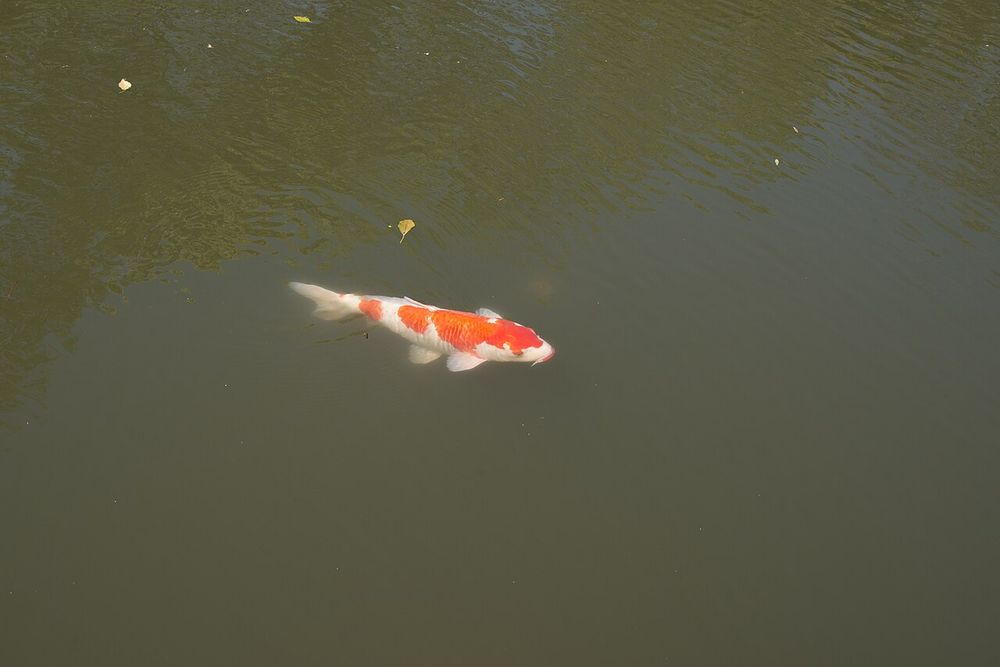
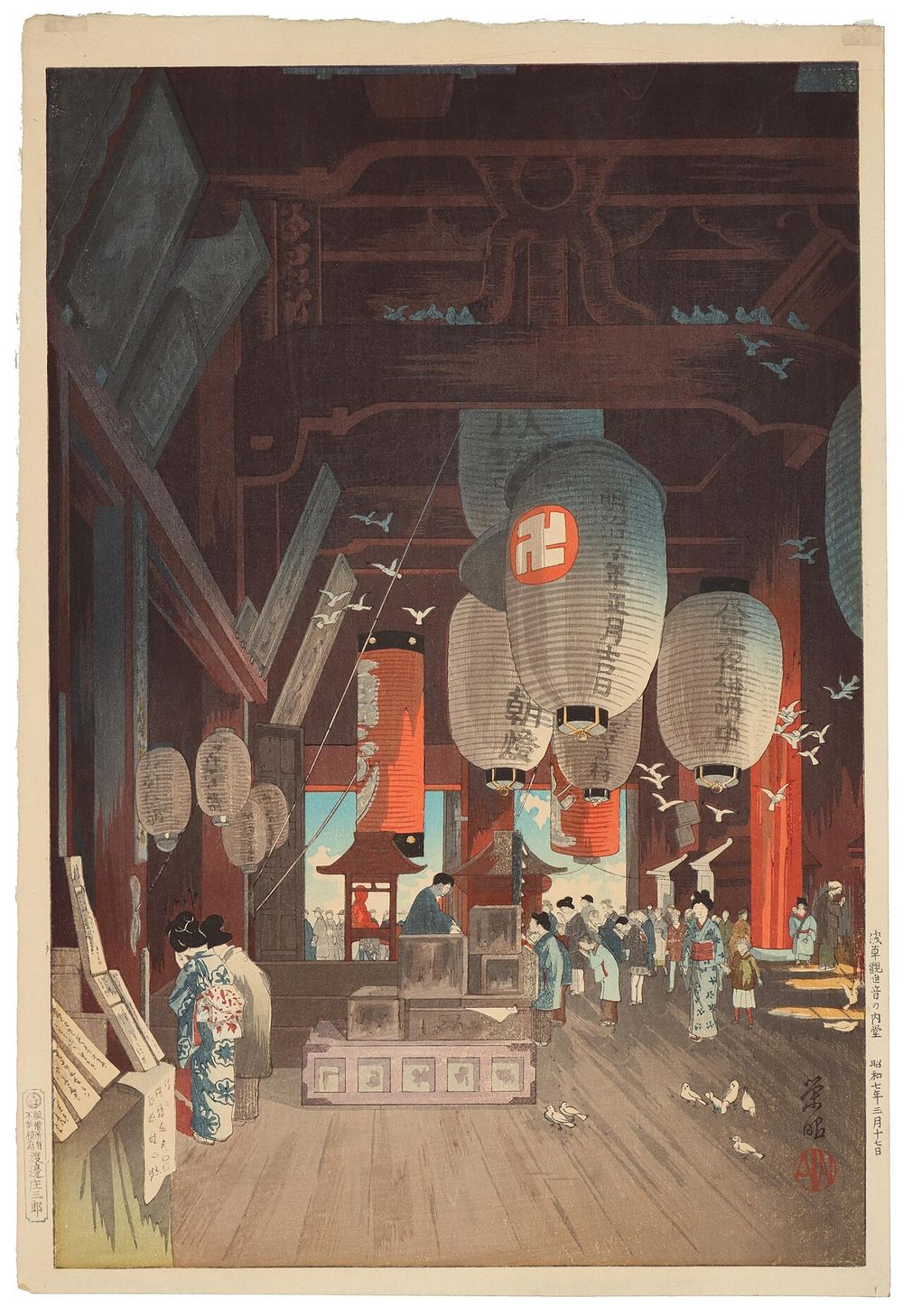
The pagoda and the Treasure Gateそらみみ (Soramimi), CC BY-SA 4.0, Wikimedia CommonsThe lantern of the Thunder GateMaarten Heerlien from Voorschoten, The Netherlands, CC BY 2.0, Wikimedia CommonsThe back of the lanternTokumeigakarinoaoshima, CC0, Wikimedia CommonsThe brass plate under the lantern, with the giver's company nameTokumeigakarinoaoshima, CC0, Wikimedia CommonsNakamise, 2024Alexeyevitch, CC BY-SA 4.0, Wikimedia CommonsNew Year's Day 2020: the crowd on the approach, from aboveDick Thomas Johnson from Tokyo, Japan, CC BY 2.0, Wikimedia CommonsThe Treasure Gateそらみみ (Soramimi), CC BY-SA 4.0, Wikimedia CommonsThe Treasure Gate from the sideDaderot, Public domain, Wikimedia CommonsThe inner side of the gate, with the giant sandalsAndrea Schaffer from Sydney, Australia, CC BY 2.0, Wikimedia CommonsA straw sandal four and a half metres longLuistxo, CC BY-SA 4.0, Wikimedia CommonsThe sandal on the gateJoe Mabel on Flickr as Joe Mabel from Seattle, US, CC BY-SA 3.0, Wikimedia CommonsThe main hallそらみみ, CC BY-SA 3.0, Wikimedia CommonsThe approach to the main hallそらみみ (Soramimi), CC BY-SA 4.0, Wikimedia CommonsThe main hall from the sideそらみみ (Soramimi), CC BY-SA 4.0, Wikimedia CommonsA bronze rainwater tub in front of the hallそらみみ, CC BY-SA 3.0, Wikimedia CommonsThe incense burner, seen from the hallMaarten Heerlien from Voorschoten, The Netherlands, CC BY 2.0, Wikimedia CommonsUnder the roof of the main hallZairon, CC BY-SA 4.0, Wikimedia CommonsWorshippers in the outer hallZairon, CC BY-SA 4.0, Wikimedia CommonsThe gold doors of the inner roomZairon, CC BY-SA 4.0, Wikimedia CommonsThe altarZairon, CC BY-SA 4.0, Wikimedia CommonsThe drawers of paper fortunesPh0kin, CC BY-SA 4.0, Wikimedia CommonsA fortune standMarco Almbauer, CC BY-SA 4.0, Wikimedia CommonsA fortune tied to the rack and left behindMadame Tatillonne, CC BY-SA 4.0, Wikimedia CommonsThe five-storey pagoda, 2024Jakub Hałun, CC BY 4.0, Wikimedia CommonsThe pagoda from the garden sideJakub Hałun, CC BY 4.0, Wikimedia CommonsThe pagoda among the roofs of AsakusaTak1701d, CC BY-SA 3.0, Wikimedia CommonsThe east gate of 1618, which survived the warそらみみ (Soramimi), CC BY-SA 4.0, Wikimedia CommonsThe pagoda seen through the east gateJoe Mabel on Flickr as Joe Mabel from Seattle, US, CC BY-SA 3.0, Wikimedia CommonsThe Sanja festival, May 2018Jean-Pierre Dalbéra from Paris, France, CC BY 2.0, Wikimedia CommonsA carp in the pond of the Denbōin gardenMaarten Heerlien from Voorschoten, The Netherlands, CC BY 2.0, Wikimedia CommonsThe main hall lit at nightlumoplank, CC0, Wikimedia CommonsThe east gate at nightKakidai, CC BY-SA 3.0, Wikimedia CommonsThe Treasure Gate at nightKakidai, CC BY-SA 4.0, Wikimedia CommonsThe gate and the pagoda on a wet evening, 2015IQRemix from Canada, CC BY-SA 2.0, Wikimedia CommonsHiroshige, the temple in snow seen through the Thunder Gate, 1856Andō, Hiroshige, 1797-1858, artist, Public domain, Wikimedia CommonsAn impression of the same print in a Paris museumJean-Pierre Dalbéra from Paris, France, CC BY 2.0, Wikimedia CommonsKobayashi Kiyochika, the year-end market at the temple, 1881Kobayashi Kiyochika, Public domain, Wikimedia CommonsAsakusa about 1890, from a traveller's albumRijksmuseum, CC0, Wikimedia CommonsThe old main hall and pagoda in a hand-coloured photograph of the late 1800sNew York Public Library, No restrictions, Wikimedia CommonsThe lantern and the crowd in a print of 1899Utagawa Yoshimune II, Public domain, Wikimedia CommonsInside the old main hall, a print by Narazaki EishōNarazaki Eishō, Public domain, Wikimedia Commons
Local legends
These are stories people tell about this place. They are legends, not history, and each one says where it comes from.
LegendThe river
Before dawn on 18 March 628, two brothers were fishing in the river. Again and again their net brought up no fish, only a small gold statue. They threw it back each time and it came up again. They took it to the head of their village, who knew it for a figure of Kannon, and he made his own house into a temple for it.
Source: The temple's own founding story
LegendThe gold dragon
On the day the statue was enshrined, a dragon with golden scales came down from the sky to the temple. This is why the temple is called Golden Dragon Mountain, and why a dragon dance is held here each March.
Source: Temple tradition
LegendThe sealed statue
In the 1860s, officials of the new government ordered the box opened, to prove that there was something in it. Those who looked are said to have gone blind, or died soon afterwards.
Source: A story told in Asakusa; the temple says only that an inspection took place
LegendThe incense smoke
Smoke fanned on to a sore place will heal it, and smoke fanned on to the head will make a child do well at school.
Source: Popular belief
Later, people who live here will be able to add the stories they grew up with, and say which of these they have heard.
Not certain, and where accounts conflict
Is there a statue in the box?
The temple says yes, and that it was seen during an official inspection in the 1860s. It is said to be about five and a half centimetres high. No photograph or drawing exists.
Was the temple really founded in 628?
The date comes from the temple's own chronicle, written centuries later. Roof tiles of the 600s and 700s found in the grounds show that a temple did stand here very early.
How many bad fortunes?
The temple says it keeps the old proportions: thirty bad in every hundred. Many other temples have quietly reduced theirs.
Should it have been rebuilt in concrete?
After 1945 the priests chose concrete so that the hall would never burn again. Some people regret the loss of timber. Others answer that the faithful come for the Kannon and not for the carpentry.
Visiting
Tickets and hours
Free. The grounds are open day and night.
The main hall is open from 6:00 to 17:00, and from 6:30 between October and March.
The buildings are lit from sunset until about 23:00.
The shops of Nakamise open at about 10:00 and shut at about 17:00.
Last checked 2026-11-12. Tokyo guides of 2026, which agree with one another; the temple's own site was not opened.
Booking from abroad
Note No ticket and no booking are needed. The temple's own site is senso-ji.jp, with pages in English and Chinese. We did not open it for this check, so we give no link.
Checked 2026-11-12
Where to start
Take the Ginza line of the metro to Asakusa and leave by exit 1. The Thunder Gate is two minutes away.
Walk the straight line: lantern, shops, second gate, incense, main hall. Then turn right for the shrine and the old east gate.
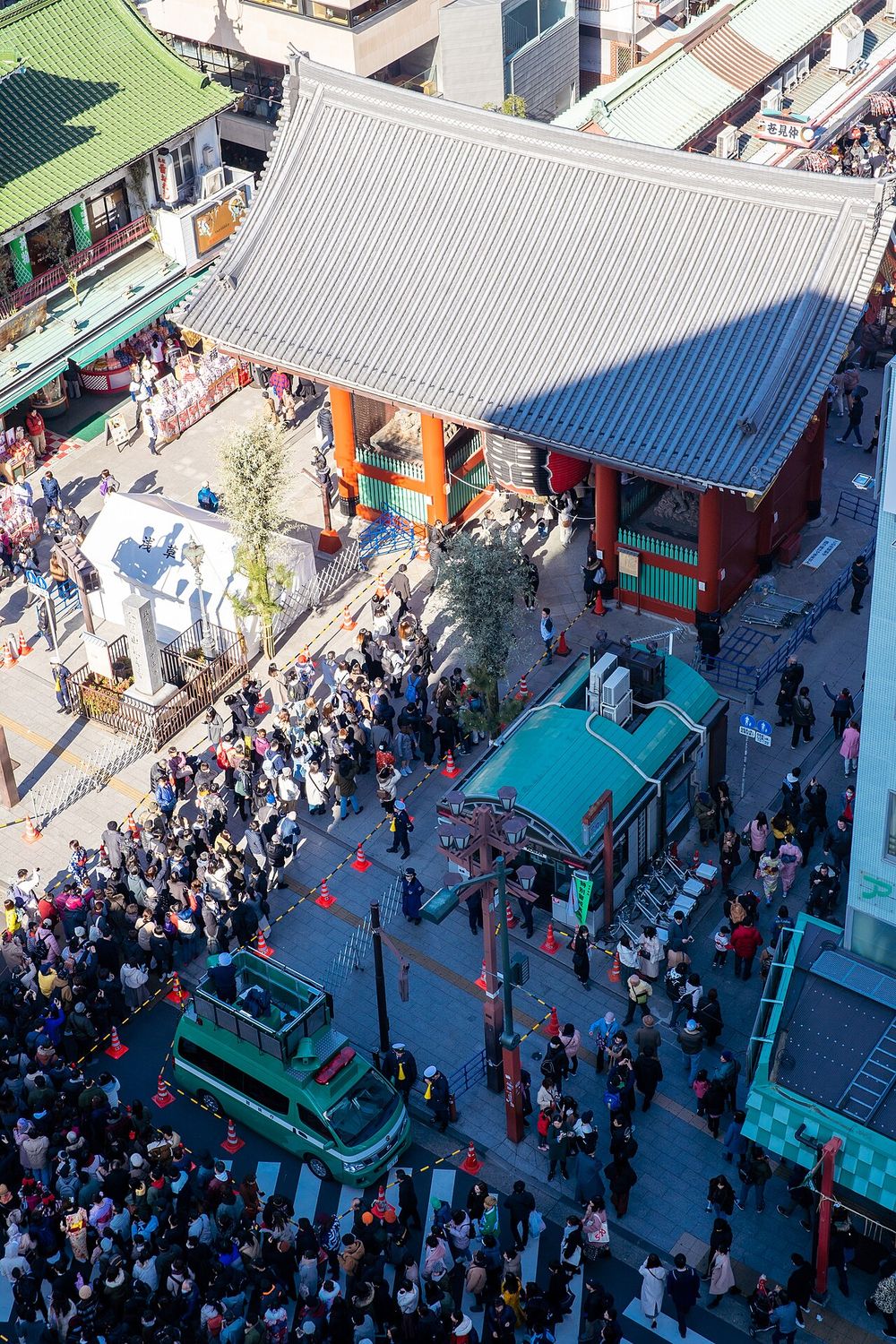
For a view of the whole temple from above, go up to the free terrace on the eighth floor of the tourist information centre, across the road from the Thunder Gate.
Come before 8:00 or after 19:00 for quiet. Come at midday for the full noise of it.
Before you go
An hour is enough for the temple. Allow another hour for the back streets, which are older in feel than the main approach.
New Year, the Sanja festival in May and the summer fireworks on the river bring crowds of hundreds of thousands.
Shops near the gate rent kimono by the day.
Rickshaw pullers by the gate offer rides. Agree the price and the route before you get in.
Customs and manners
At the water basin, rinse your left hand, then your right, then your mouth from your cupped left hand. Do not put the ladle to your lips.
At the hall, throw a coin into the box, put your hands together and bow. Do not clap. Clapping is for shrines.
Photographs are fine outside. Do not photograph the inner room or people at prayer.
On Nakamise, eat what you buy at the shop, and take your rubbish with you.
If you draw a bad fortune, tie it to the rack. If you draw a good one, keep it.
Look for these
Look up into the bottom of the big lantern. What animal is carved there?
Under the lantern, find the brass plate. Whose company gave it?
Which god is on the right of the Thunder Gate, wind or thunder? How can you tell?
On the second gate, find the giant sandals. How many men would it take to lift one?
At the incense burner, watch where people fan the smoke.
In the main hall, look at the ceiling. What is painted in the middle?
Find a building that is older than the main hall.
Count the roofs of the pagoda.
I am here
Stand at the site, sign in, press the button, and collect its stamp. Your browser will ask to use your location. It is sent to us once to confirm that you are at the site; we keep how far you were from it, not the spot where you stood.
Your stamps are saved to your account, so they follow you to any device. Checking from a browser cannot rule out every false location; stricter checks arrive with the app.
Messages
Share your photos
Photos here show the place, not people. Each one is credited to the visitor who took it and appears after our team has looked at it. A photo with you in it belongs under “I am here”.