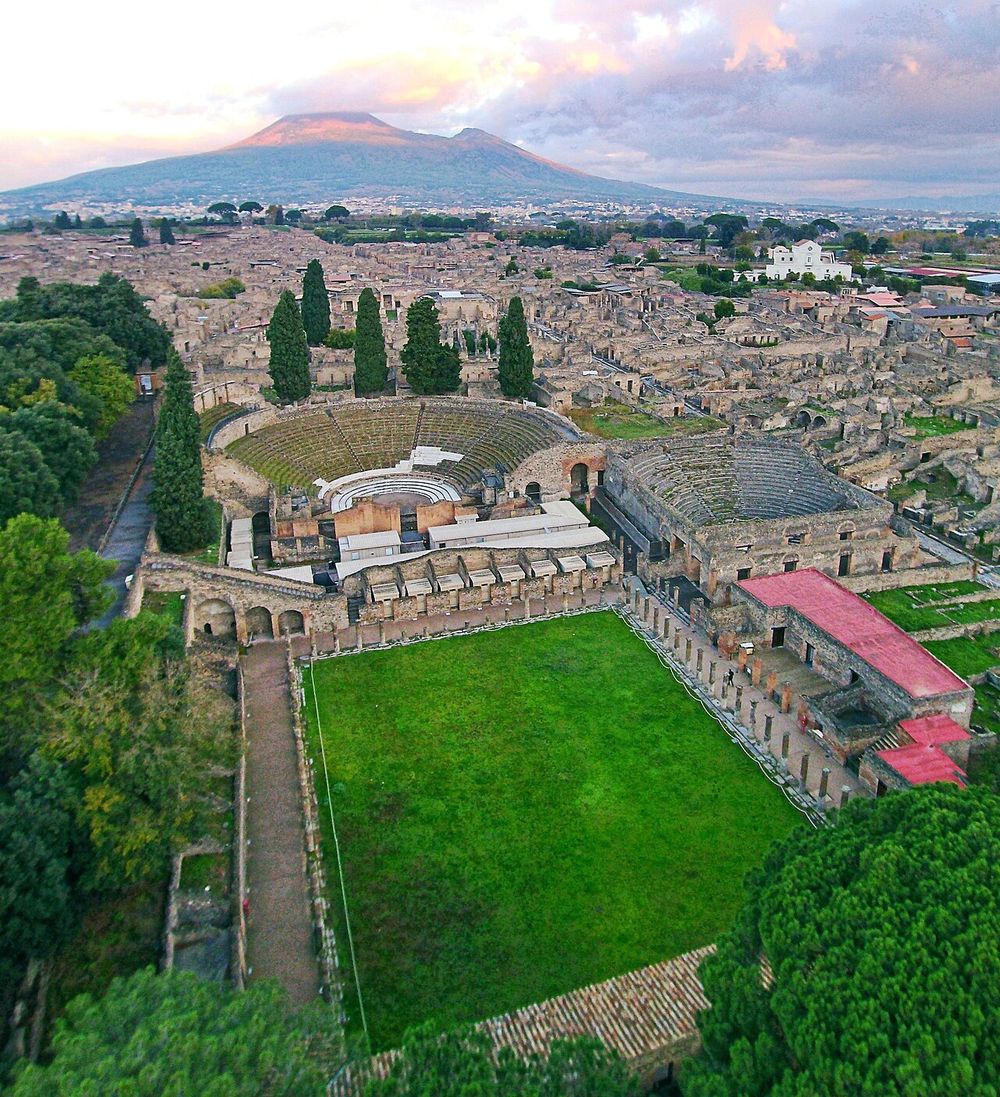
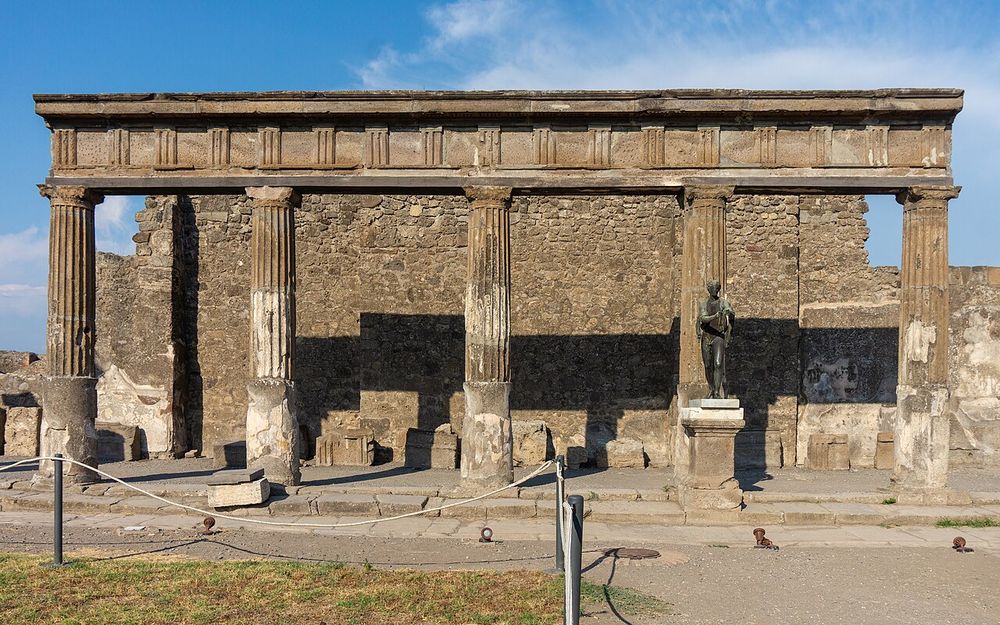
A Roman town of eleven thousand people, buried in a day and a night in the year 79 under five metres of ash. The streets, the shops, the paint on the walls and the bread in the ovens were still there when the diggers reached them seventeen hundred years later.
Photo: Carsten Steger, CC BY-SA 4.0, Wikimedia Commons
The story
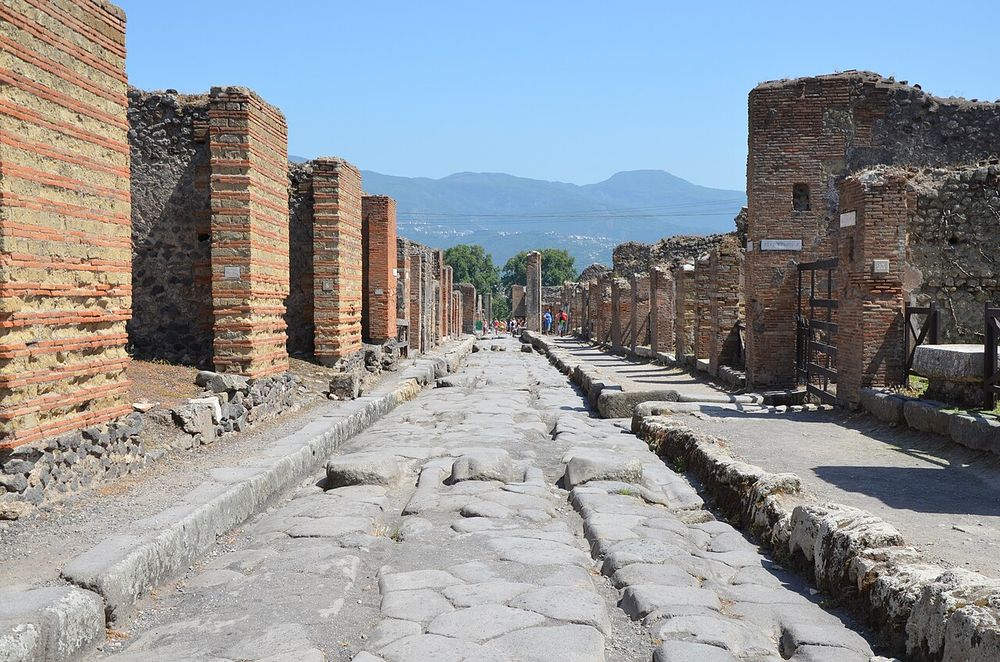
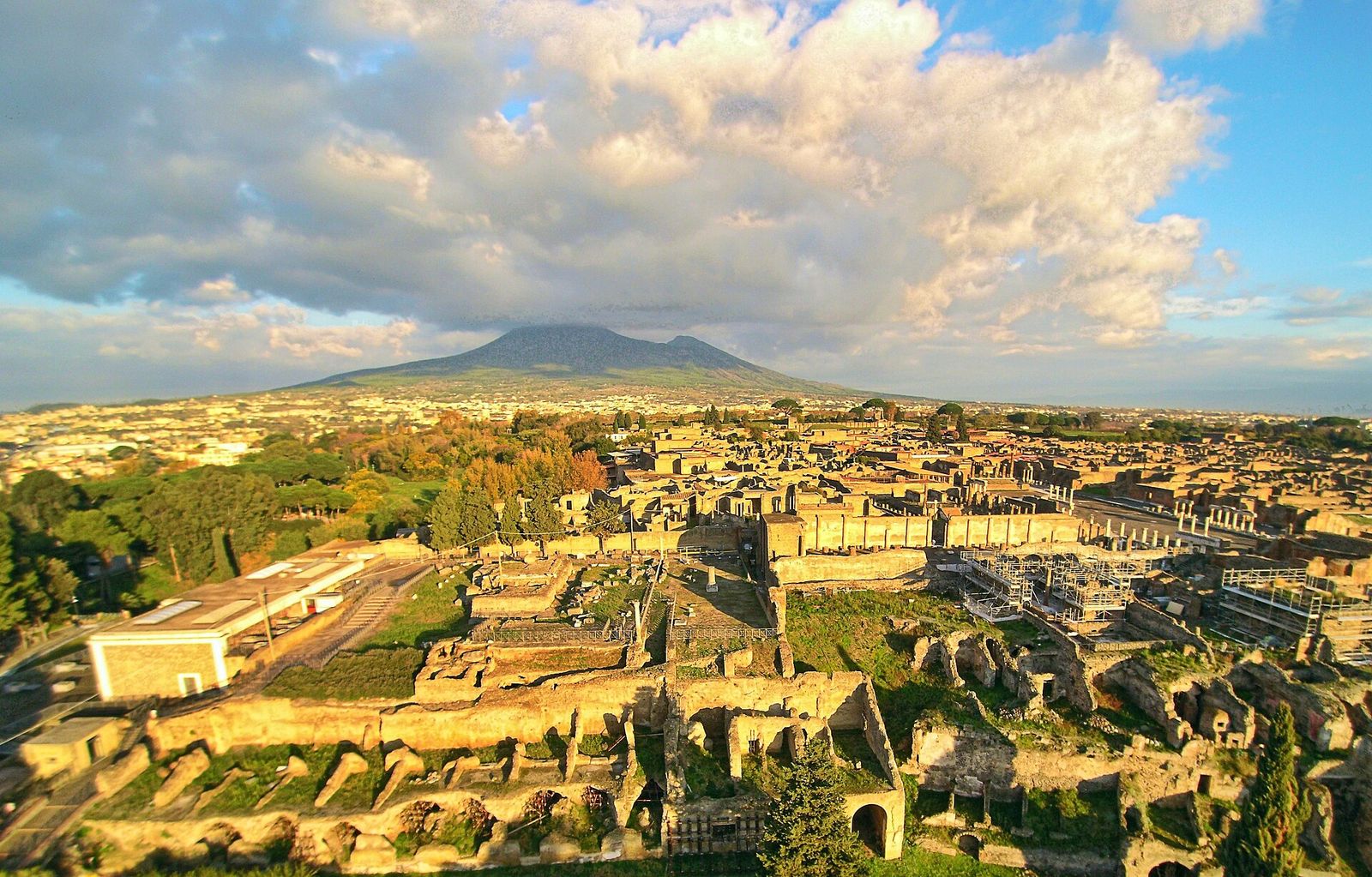
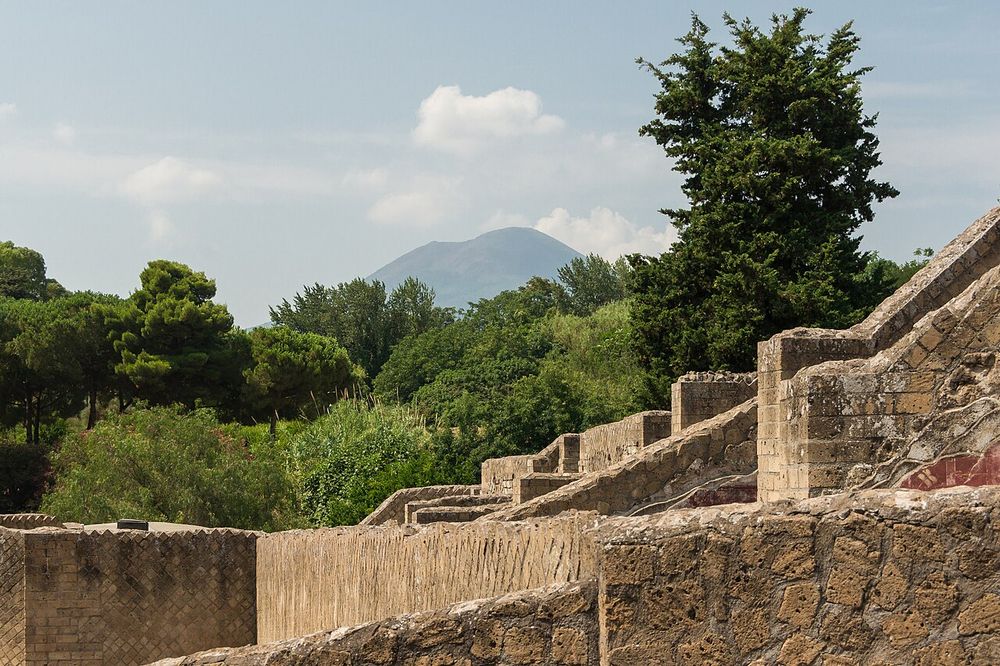
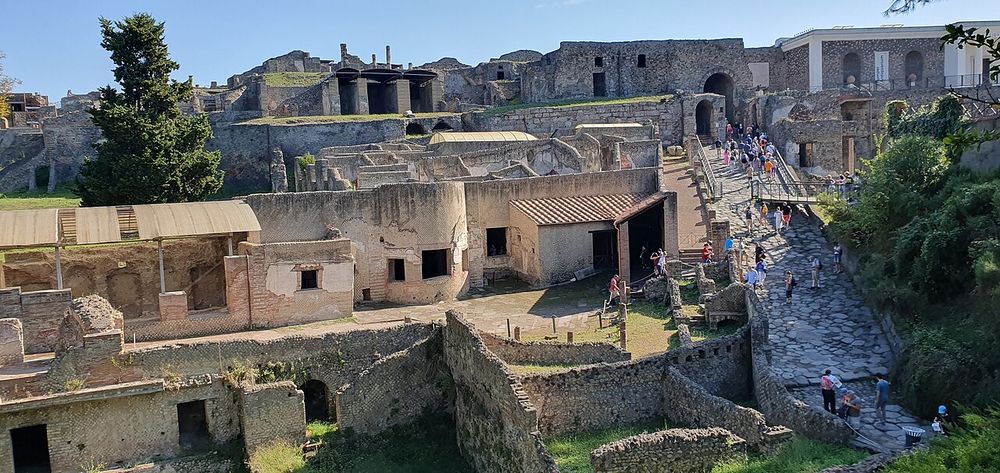
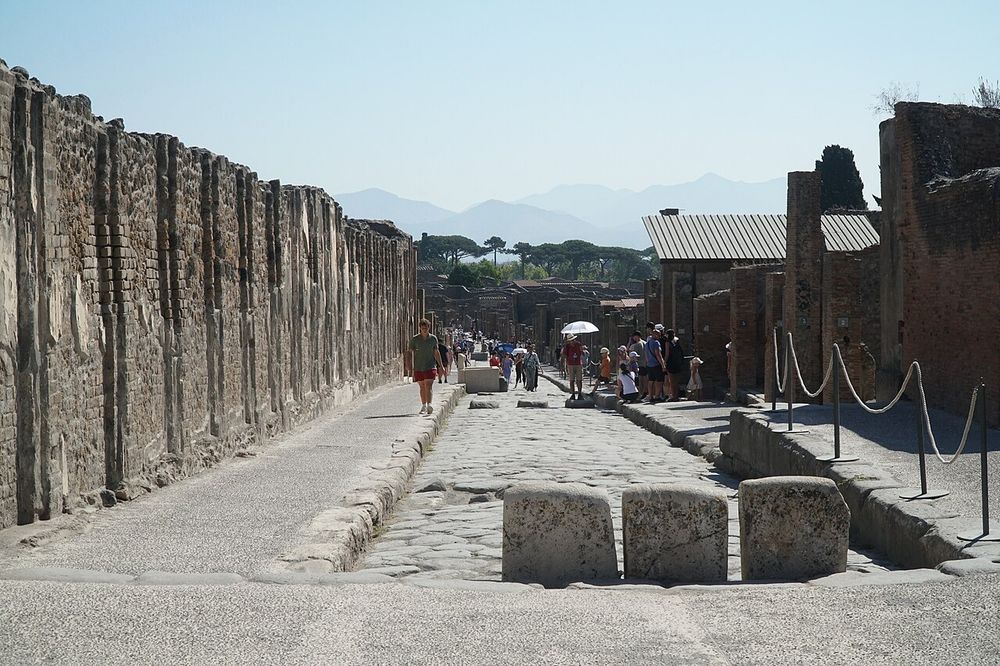
You are walking uphill on a road of black stone blocks, worn into two grooves by wheels. The pavement on either side is as high as your knee. Ahead, the road passes through a gate and becomes a street, with doorways, shop counters and a fountain at the corner. There are no roofs. At the end of the street, filling the sky, is a mountain with a broken top.
The mountain is Vesuvius. It destroyed the town in the autumn of AD 79. In that same year, in the Eastern Han (AD 25–220) capital Luoyang, the emperor called his scholars to the White Tiger Hall to settle the meaning of the classics, and the general Ban Chao was holding the Silk Road oases for China.
What is here
One ticket covers the town inside the walls. The villas outside the north-west gate need the larger ticket.
A street running towards the mountainCarole Raddato from FRANKFURT, Germany, CC BY-SA 2.0
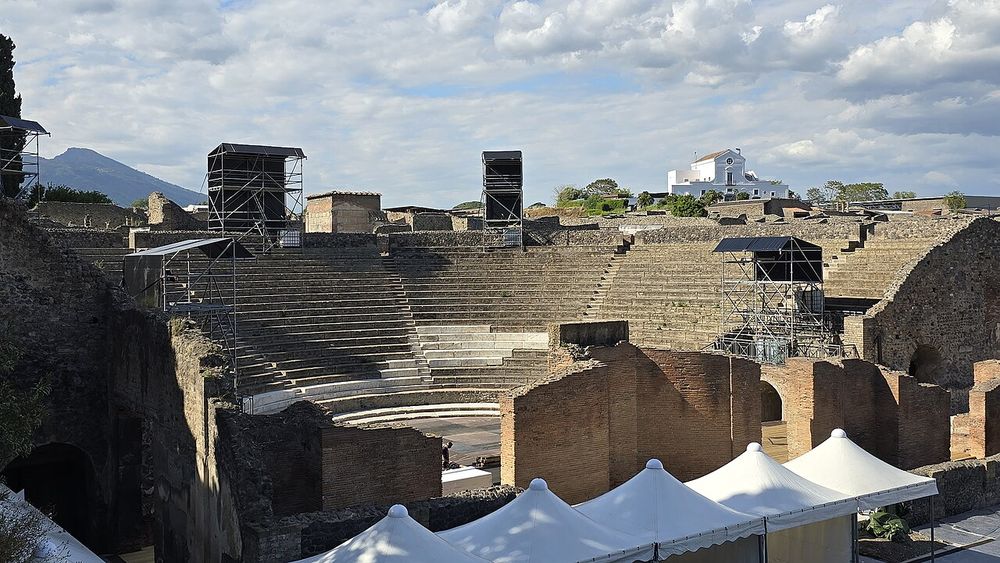
Pompeii was an ordinary place. It was a market town and river port on the Bay of Naples, living on wine, olive oil and fish sauce. It had a main square, two theatres, an arena, public baths, about thirty-five bakeries and a hundred and fifty bars.
Nobody knew the mountain was a volcano. It had been quiet for longer than anyone could remember, and vines grew to the top.
When it burst, most people ran, and most of those who ran early lived. About two thousand stayed, or went back, or could not leave. The ash that killed them also kept the town exactly as it was. Nothing else like it has come down from the ancient world.
Things people often get wrong
"It was buried by lava." No lava reached the town. First small stones of pumice fell for eighteen hours and broke the roofs. Then waves of hot gas and ash came down the mountain faster than a horse can run.
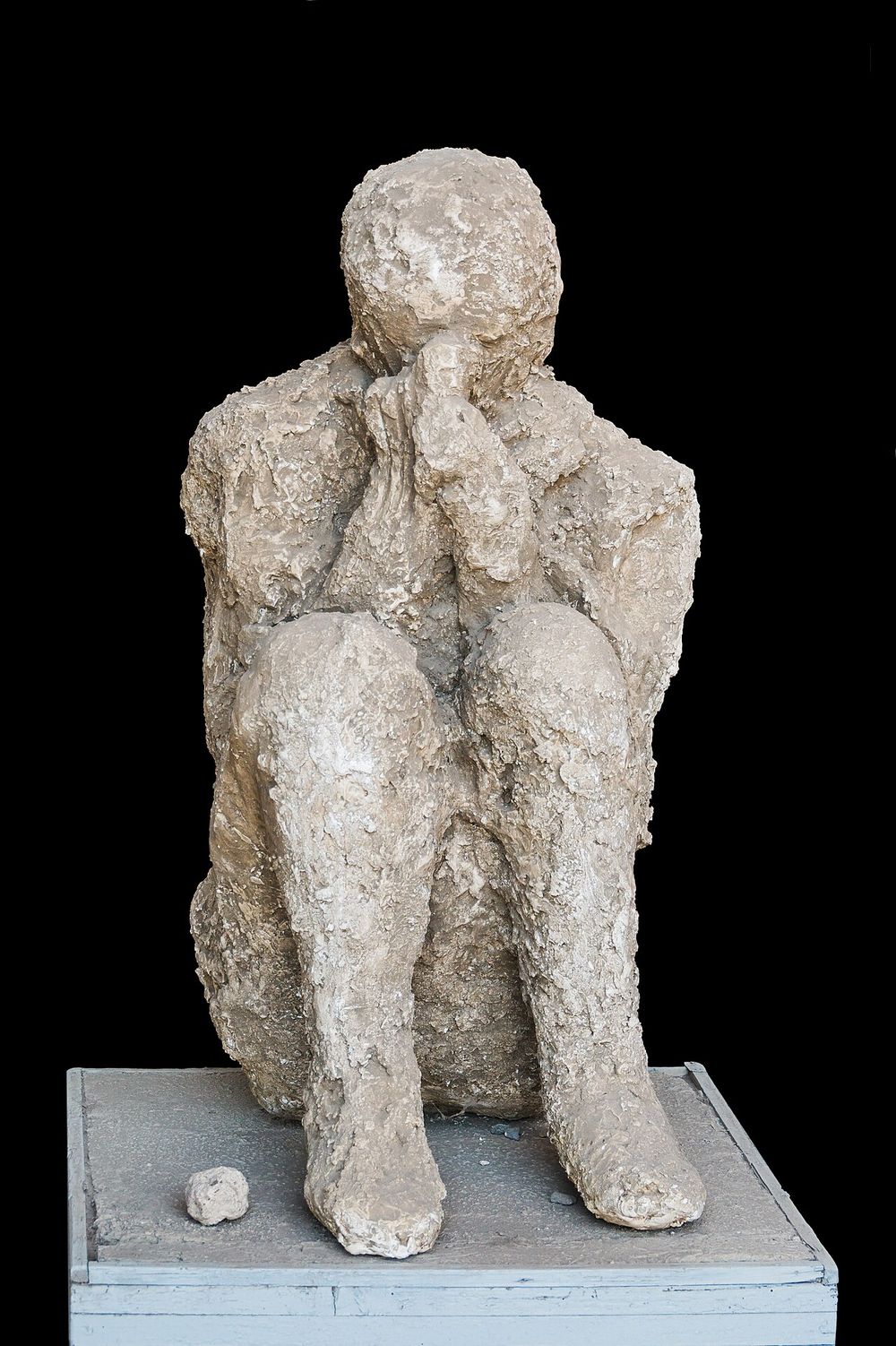
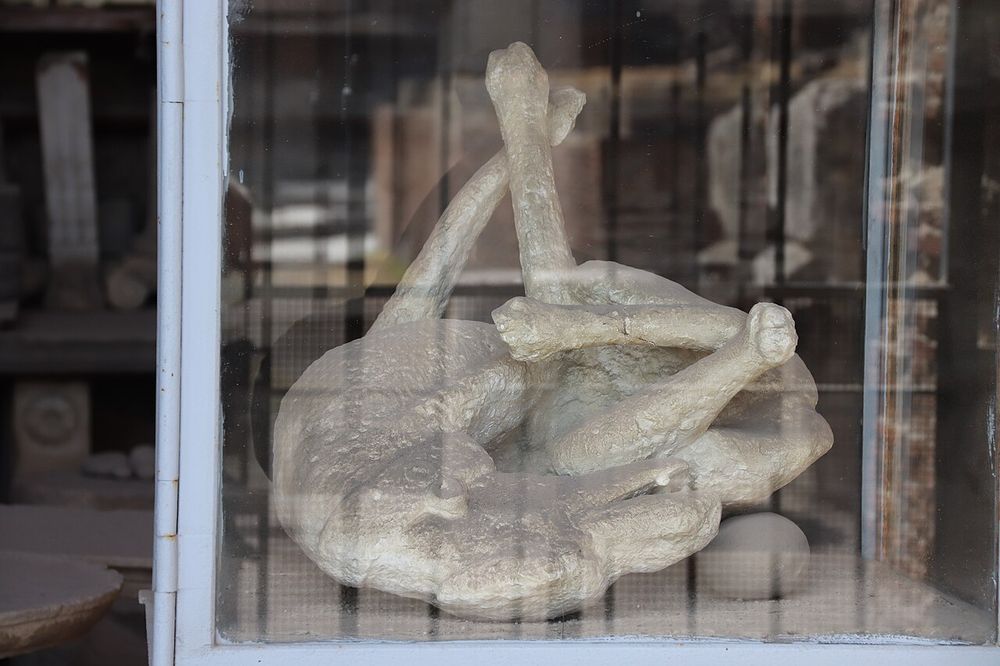
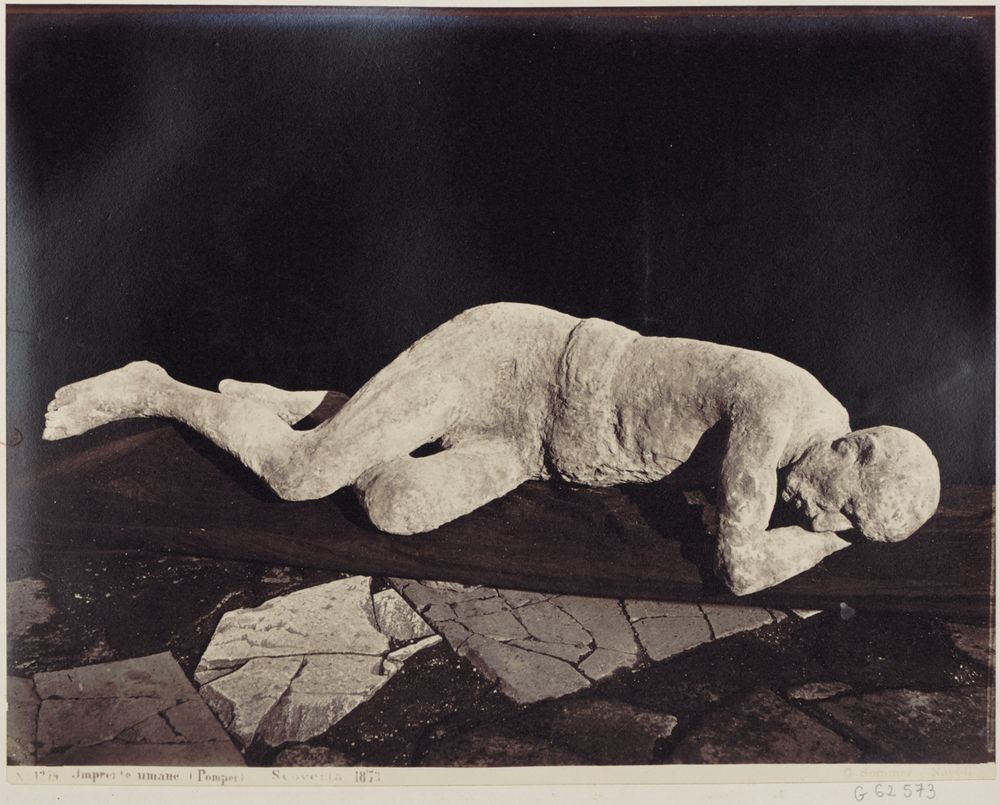
"The bodies are turned to stone." The bodies decayed and left hollows in the hardened ash. Since 1863 the diggers have filled the hollows with plaster. What you see are casts, with the bones inside.
"It happened on 24 August." That date comes from copies of a letter. In 2018 a note in charcoal was found on a wall, dated in the middle of October. The fruit and the warm clothes found in the ash also point to autumn.
"Everything has been dug up." A third of the town is still under the fields, kept for later generations. New rooms are opened every year.
"The best things are here." The finest paintings, mosaics and silver were taken to the museum in Naples. What stands in the houses is often a copy.
People who stood here
Mozart (Austrian composer)He came in June 1770, aged fourteen, with his father, on a tour of Italy. They were shown the small temple of the Egyptian goddess Isis, dug out a few years earlier with its paintings fresh. Twenty-one years later he set his last opera, The Magic Flute, among the priests of Isis.
Goethe (German poet, author of Faust)He walked through in March 1787 and was surprised by how small the houses were: "more like models and dolls' houses than real buildings". He wrote that of all the disasters in the world, few had given later ages so much pleasure.
Go deeper: eight stops, from the sea gate to the villa outside the walls
The stops cross the town from west to east and then go out by the north-west gate.
1. The sea gate
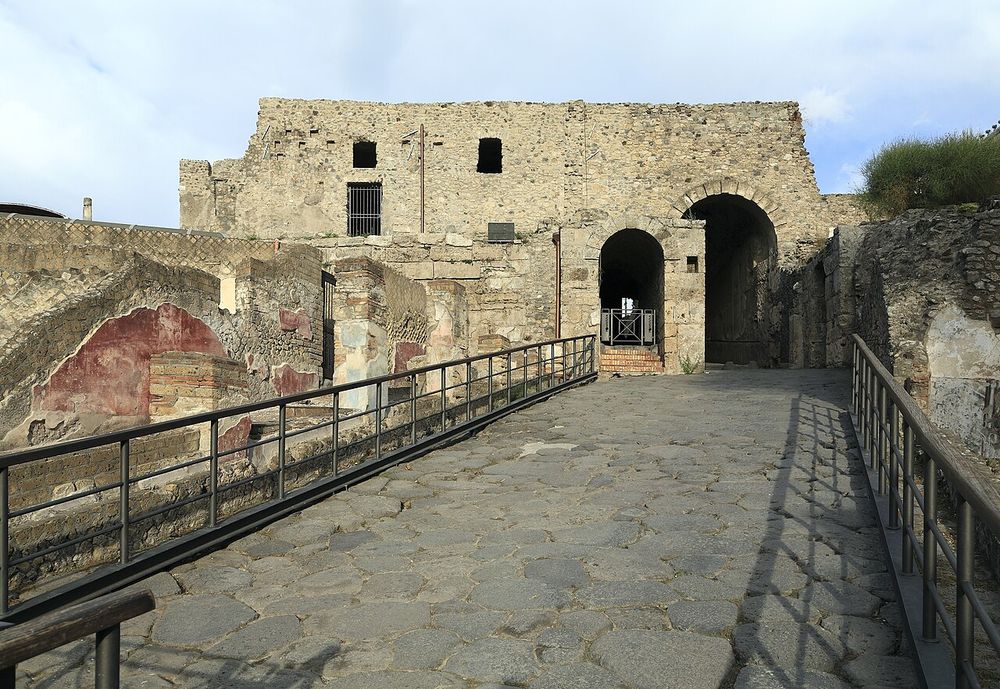
The sea gateFalk2, CC BY-SA 4.0
The gate has two arches: a narrow one for people and a wide one for animals and carts. The slope is steep because the town stands on the end of an old lava flow, forty metres above the plain.
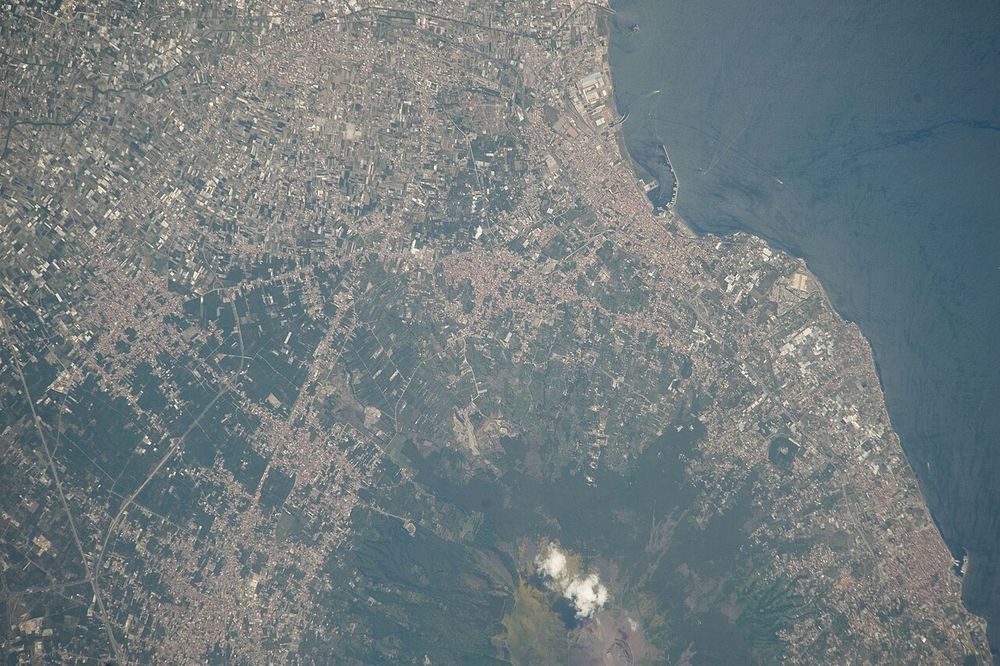
In AD 79 the sea came almost to the foot of this hill. The eruption pushed the coast two kilometres away.
2. The forum
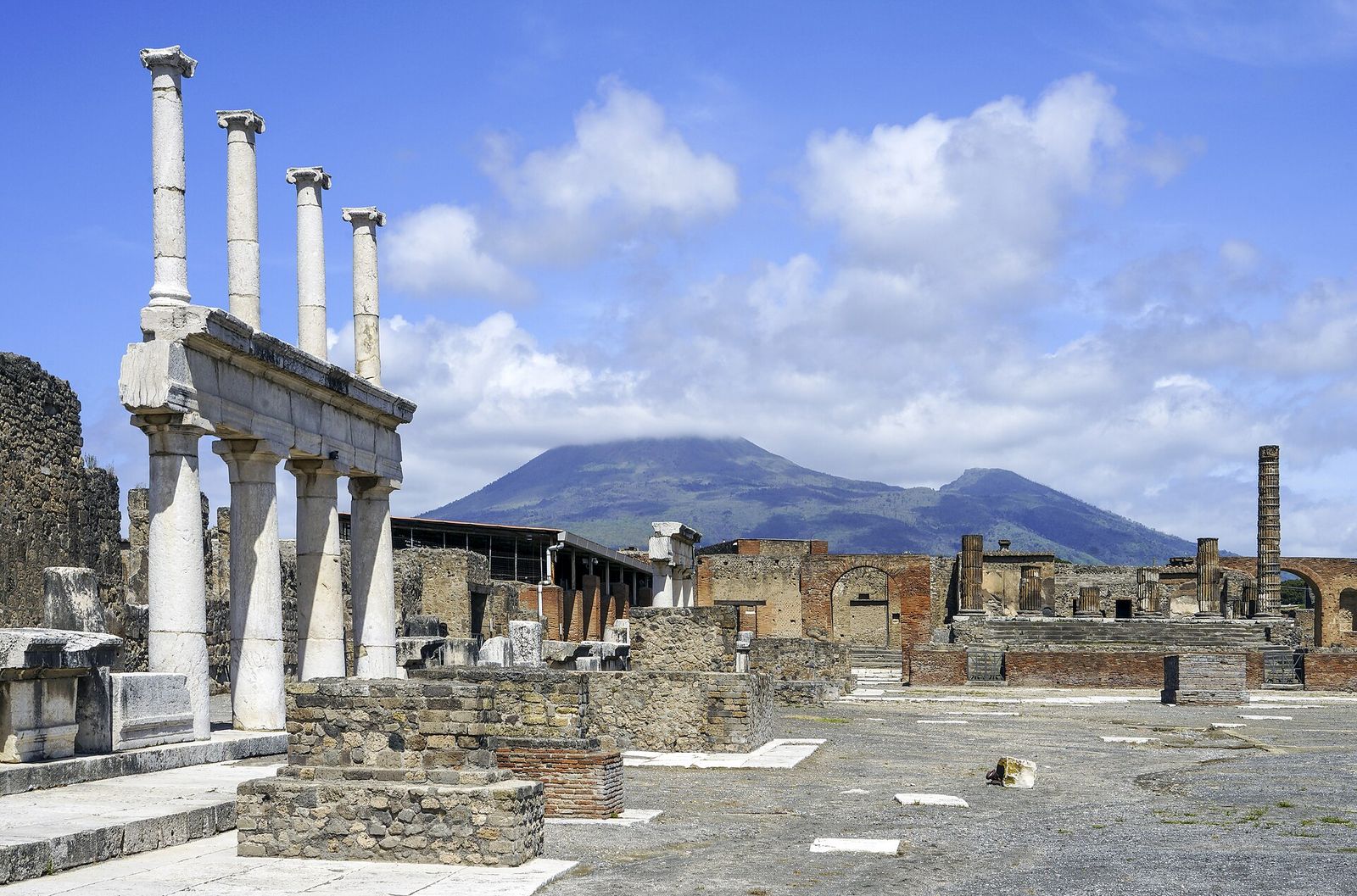
The forum, with the mountain behindCommonists, CC BY-SA 4.0
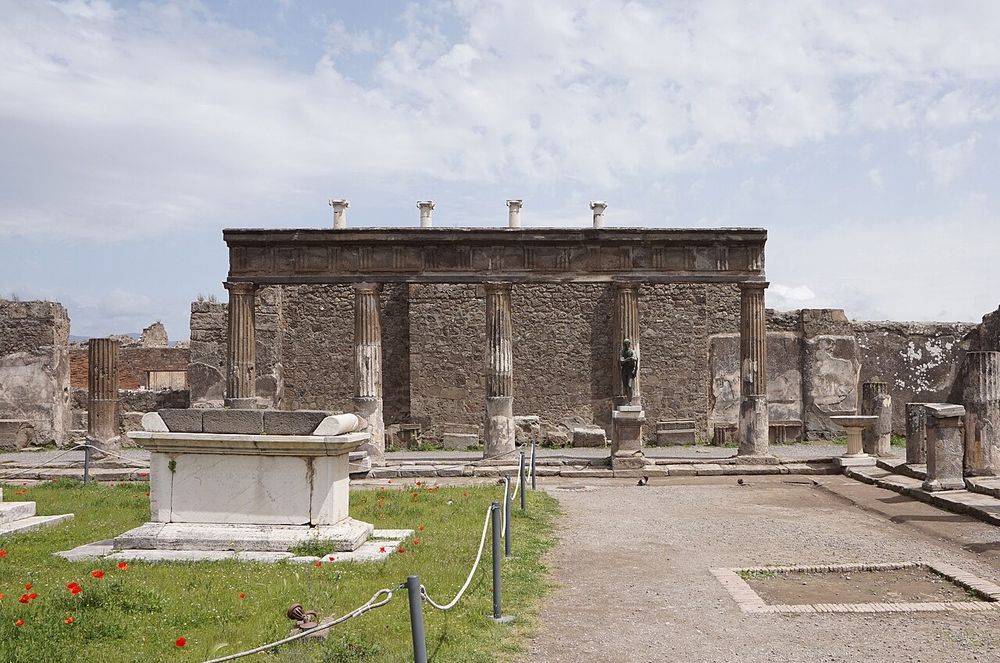
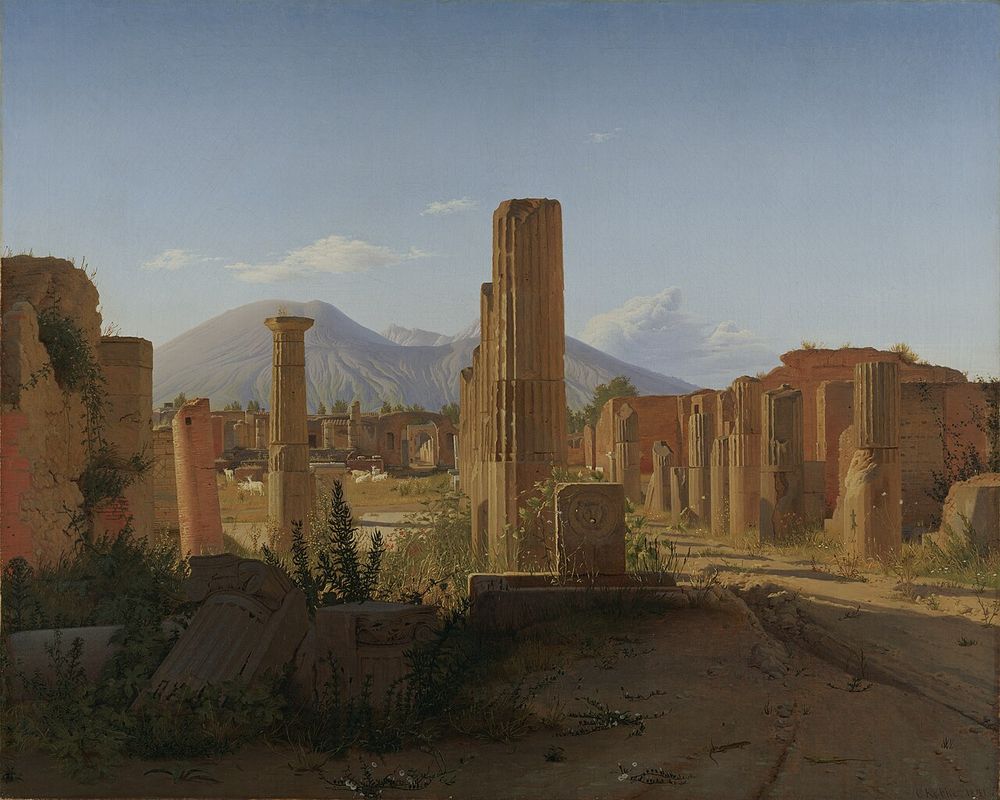
The long open square was the centre of the town. No carts were allowed in: look for the upright stones that blocked the entrances. Round it stood the town hall, the law court, the cloth market, the food market, and at the north end the temple of Jupiter, with the mountain exactly behind it.
Much of it was a building site in AD 79. An earthquake had wrecked the town seventeen years before, and the builders had not finished.
The cast of a man who died sittingJebulon, CC0
The sheds along the west side were the grain market. They now hold shelves of wine jars, and some of the casts.
3. The street
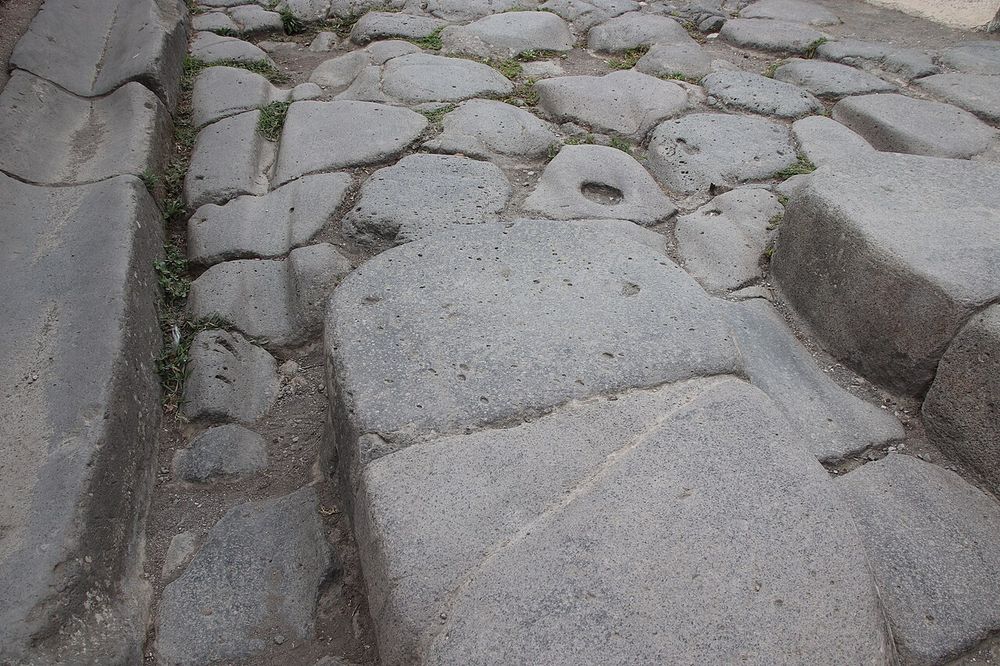
The gaps between the stones fit a cart's wheelsGary Todd from Xinzheng, China, Public domain
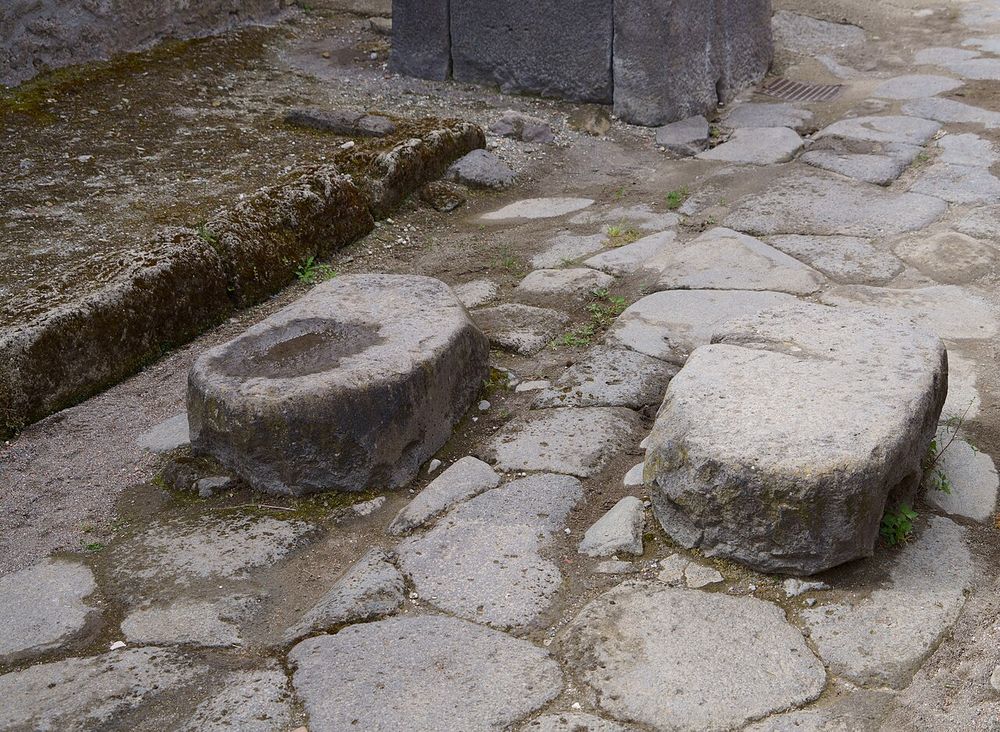
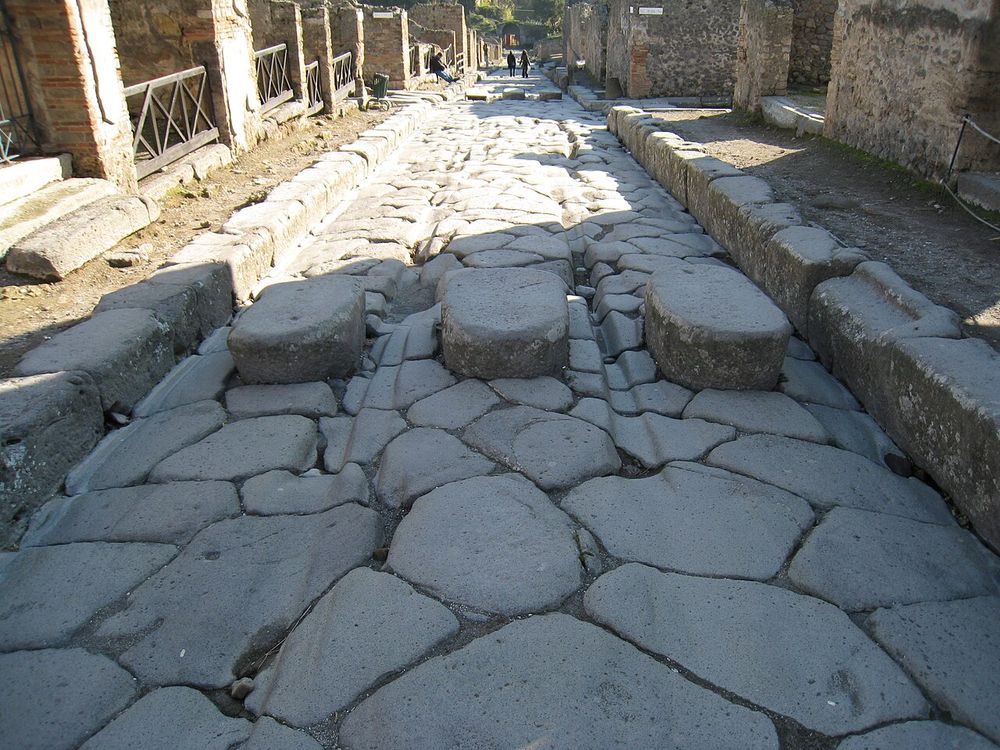
Leave the forum by the long straight street to the east. The big blocks standing in the roadway are stepping stones. The streets were also the drains, and ran with rain and dirty water; the stones let people cross with dry feet. They are set so that a cart's wheels pass between them.
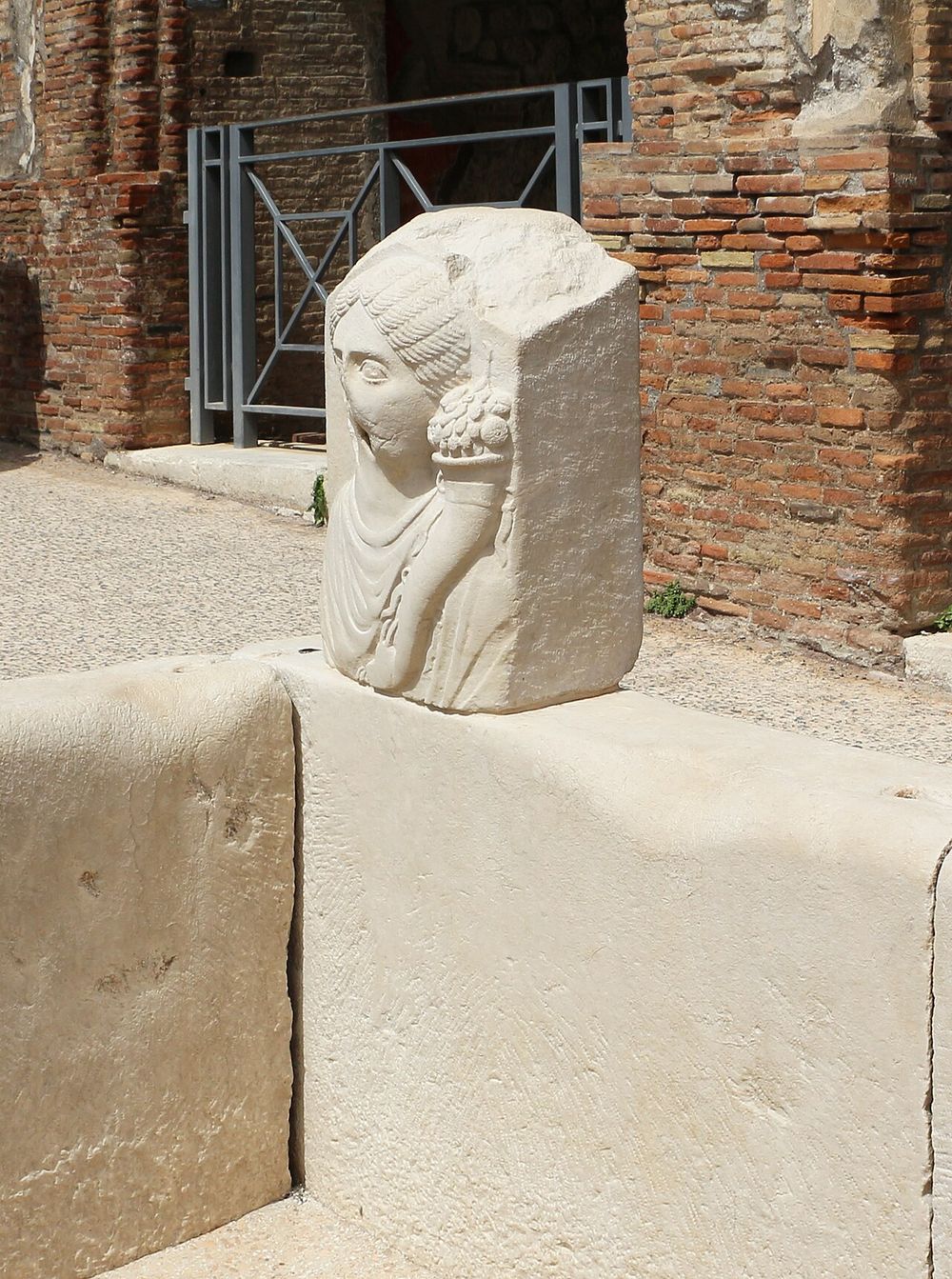
A street fountainBernard Gagnon, CC BY 4.0
At the crossings are stone troughs, each with a carved face that the water came out of. Most houses had no water of their own. Look at the rim of the trough beside the spout: it is worn into a dip by hands leaning there, one after another, for a hundred years.
The walls on this street are covered with red painted letters. They are election notices: "The fruit sellers ask you to vote for Holconius Priscus."
4. The lunch counter and the bakery
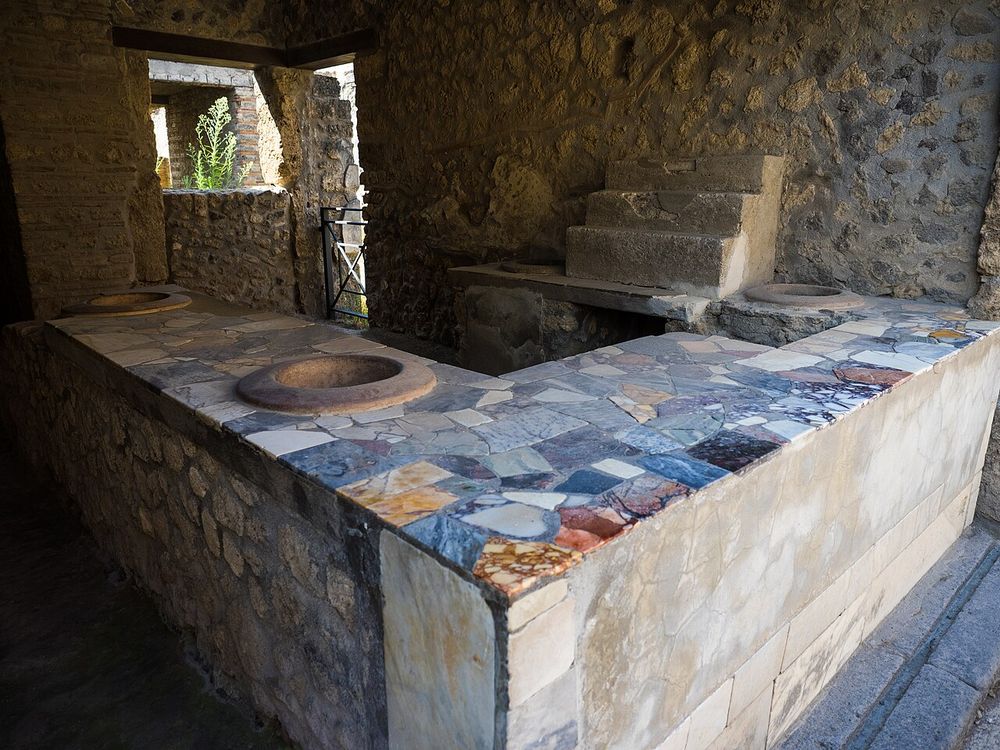
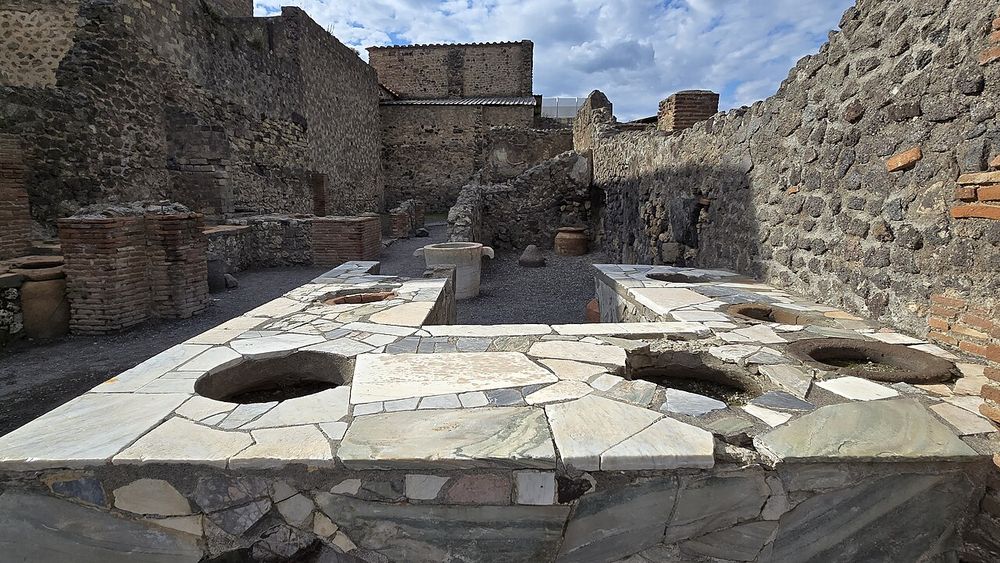
A counter faced with coloured marbleSarahhoa, CC BY-SA 2.0
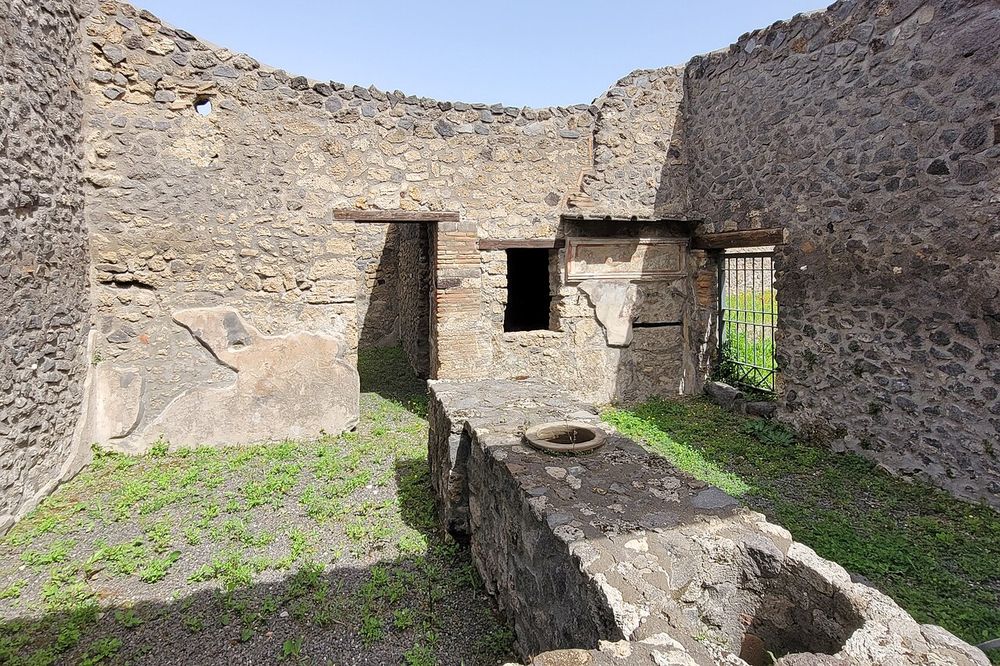
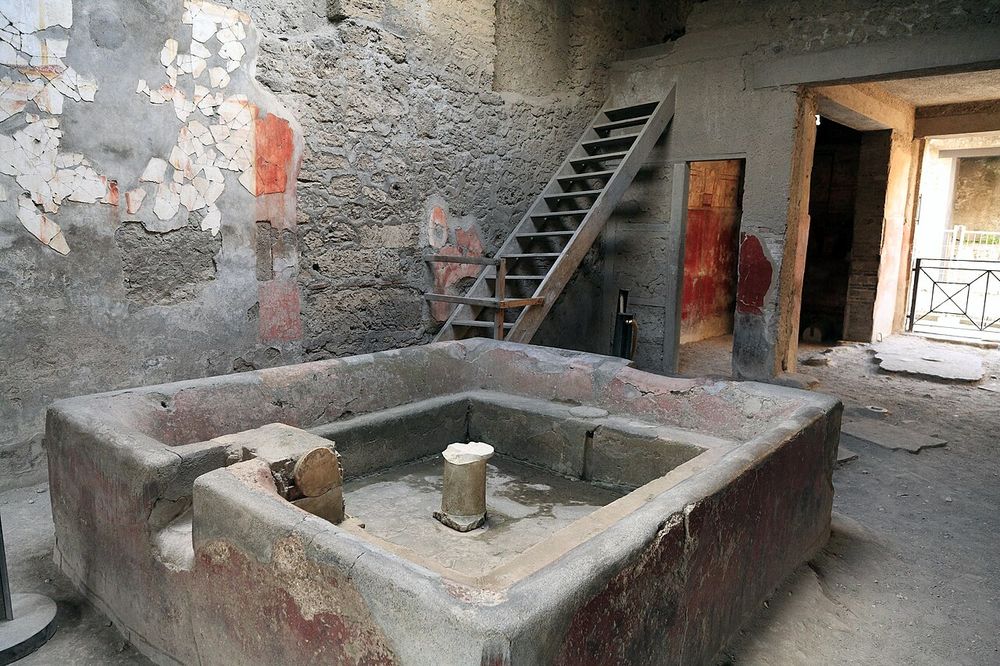
The L-shaped counters with round holes in the top are bars. Each hole is the mouth of a big clay jar set into the counter, which held dry food: beans, nuts, grain. Hot food and wine were served over the top. Most people in Pompeii had no kitchen and ate here.
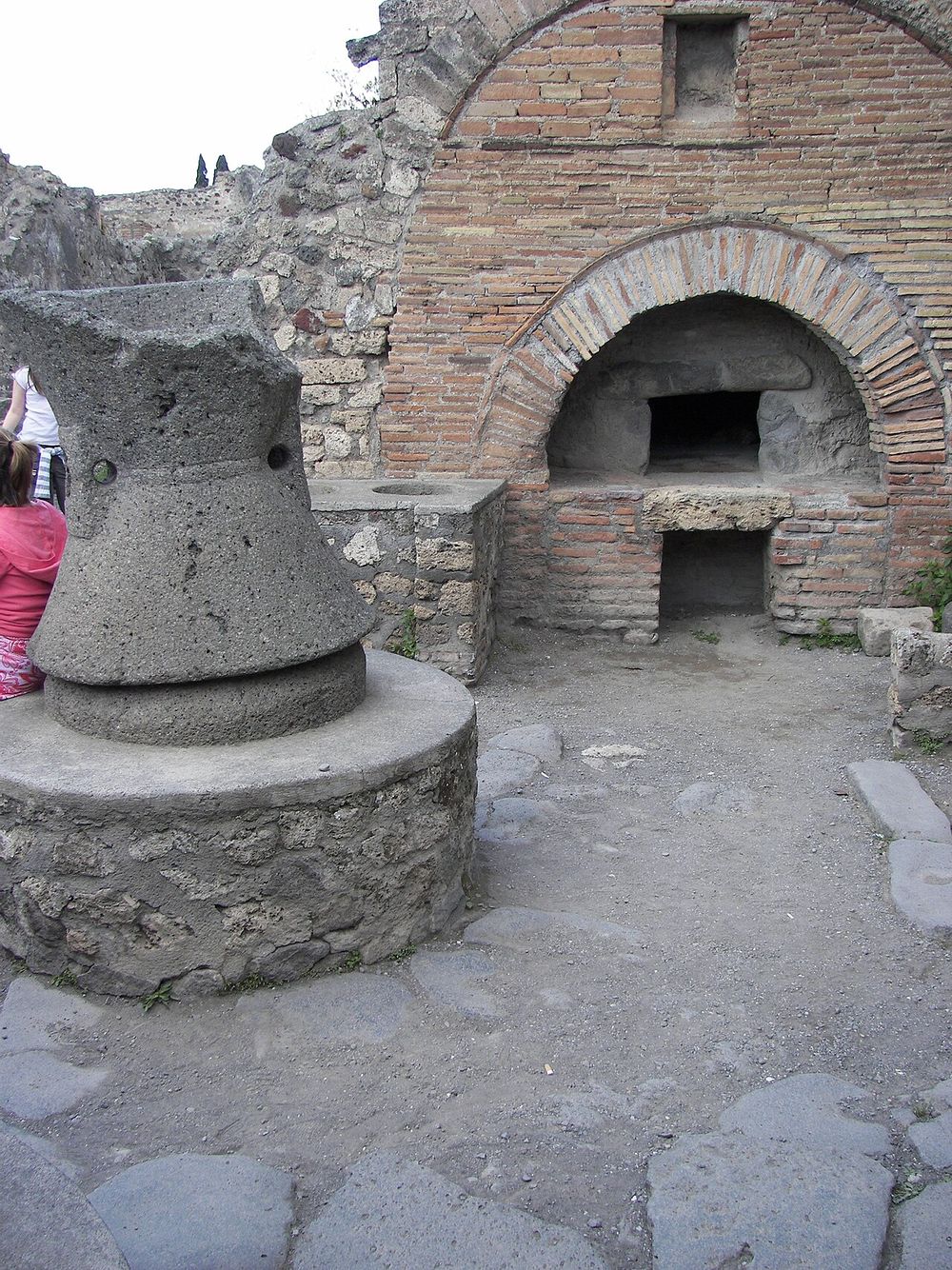
Mills and an ovenWknight94, CC BY-SA 3.0
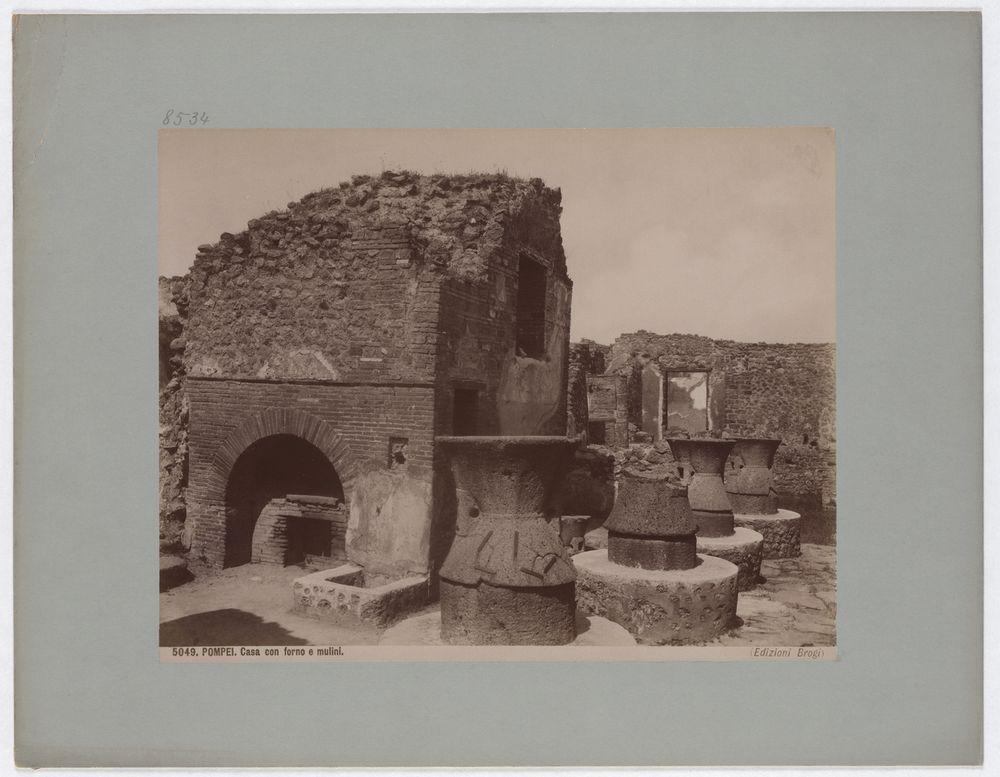
A bakery is easy to find: look for mills of black lava shaped like hourglasses, as tall as a man, and a brick oven like a pizza oven behind them. Slaves or donkeys walked round the mills. In one oven the diggers found eighty-one loaves, round and scored into eight wedges, put in to bake on the last morning.
5. The House of the Faun
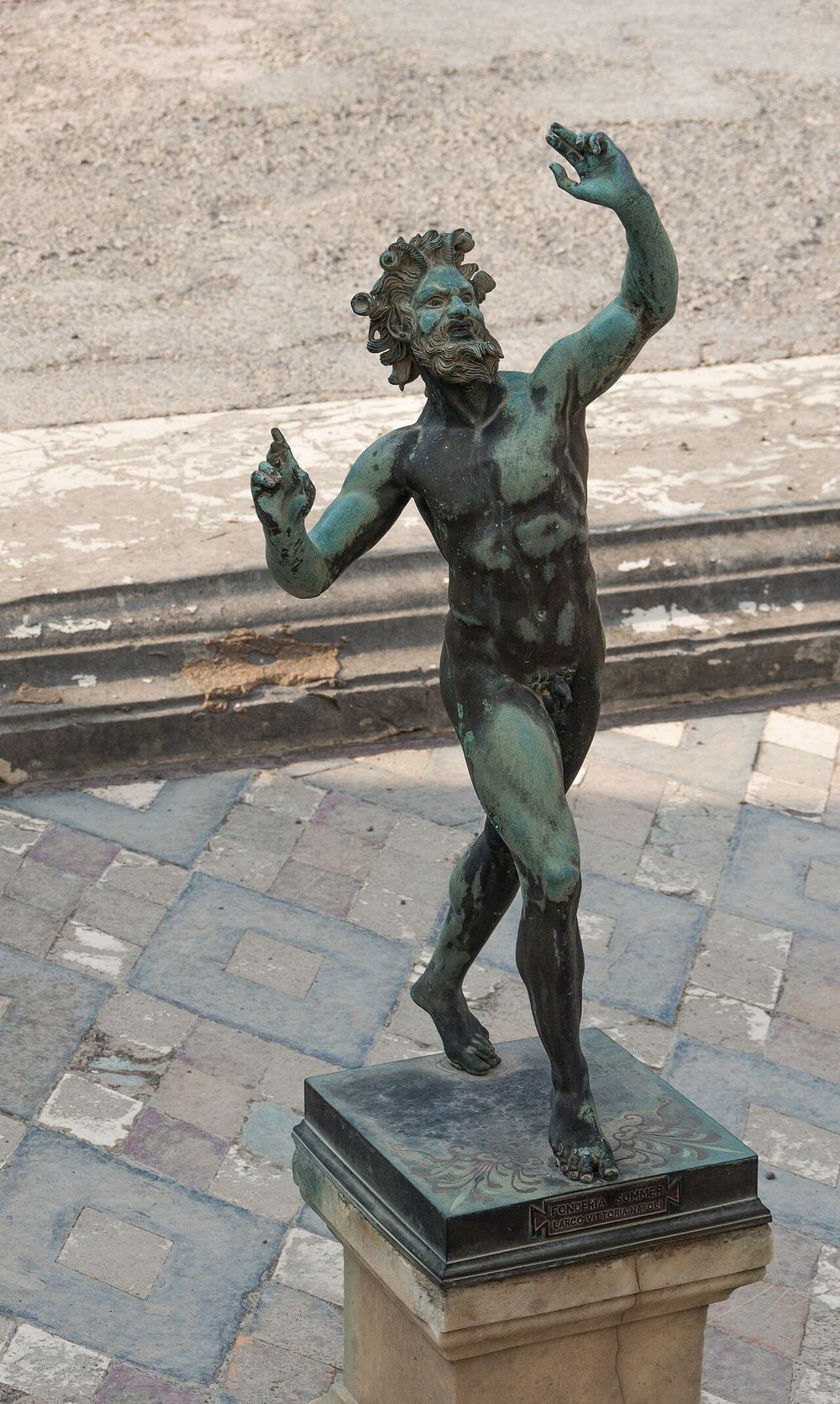
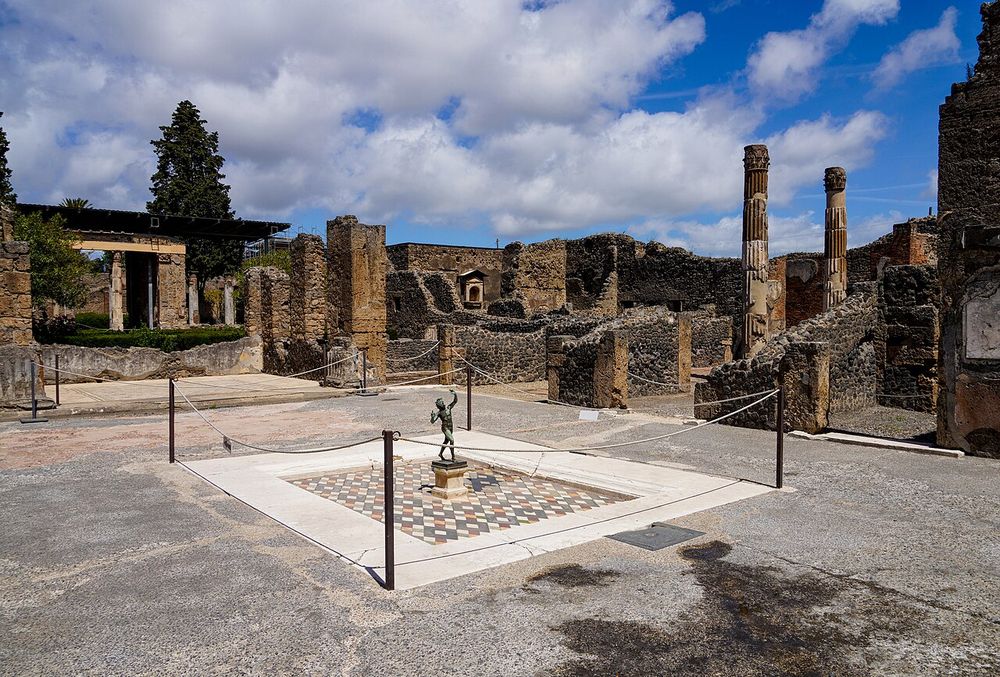
The dancing figure that gave the House of the Faun its nameJebulon, CC0
This is the largest house in the town, filling a whole block: 3,000 square metres, two halls, two gardens. It was two hundred years old when the town died. In the rain-water pool of the first hall a small bronze figure dances with his head thrown back.
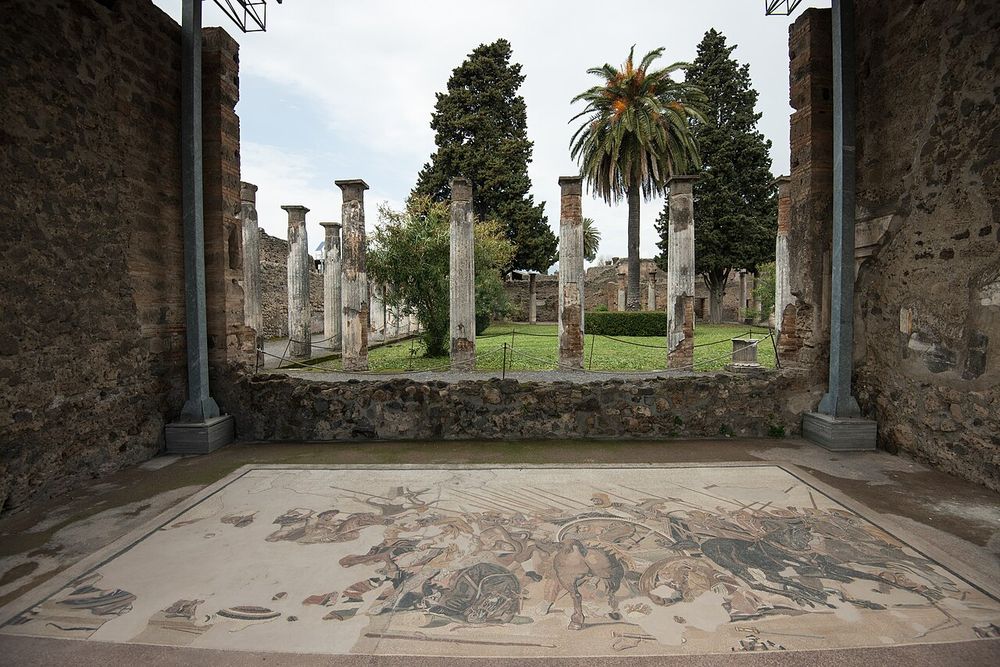
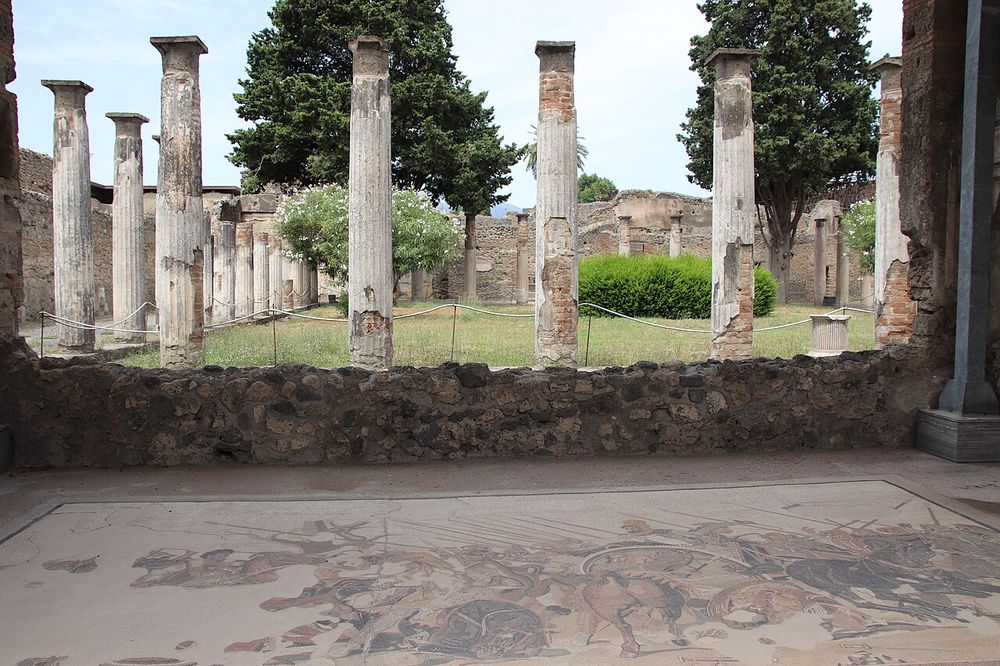
The floor of Alexander's battle, a copy in its placeMaarten Heerlien from Voorschoten, The Netherlands, CC BY 2.0
On the floor between the two gardens is a picture made of a million and a half tiny stones. Alexander the Great, bareheaded, charges from the left. The king of Persia, in his chariot, turns to flee. It copies a Greek painting made soon after the battle, which is lost. The floor you see is a copy; the real one hangs on a wall in Naples.
6. The arena
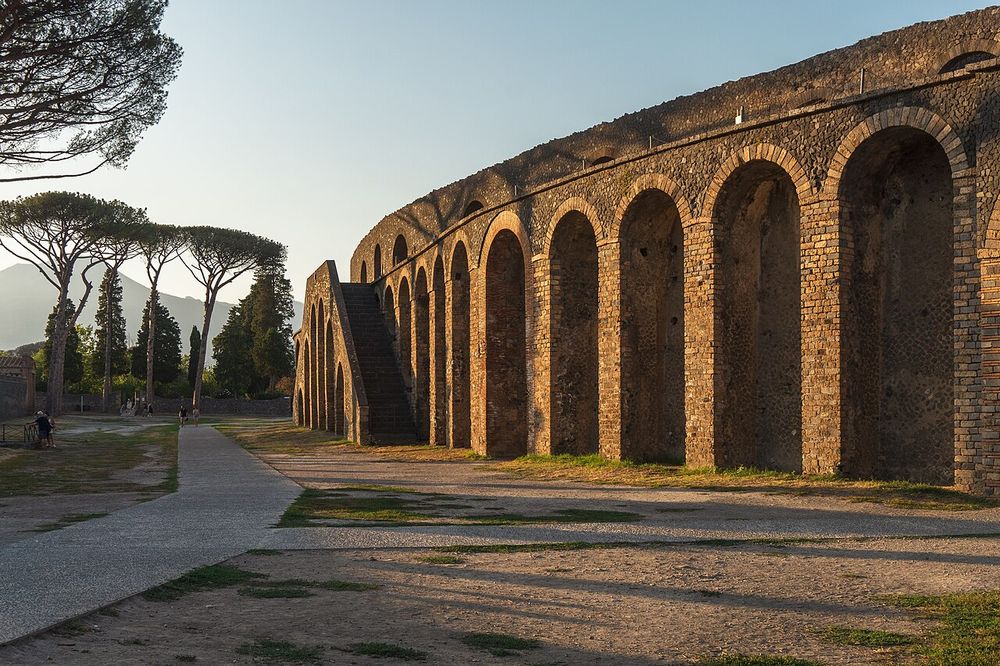
The arena from outsideMarco Ober, CC BY-SA 4.0
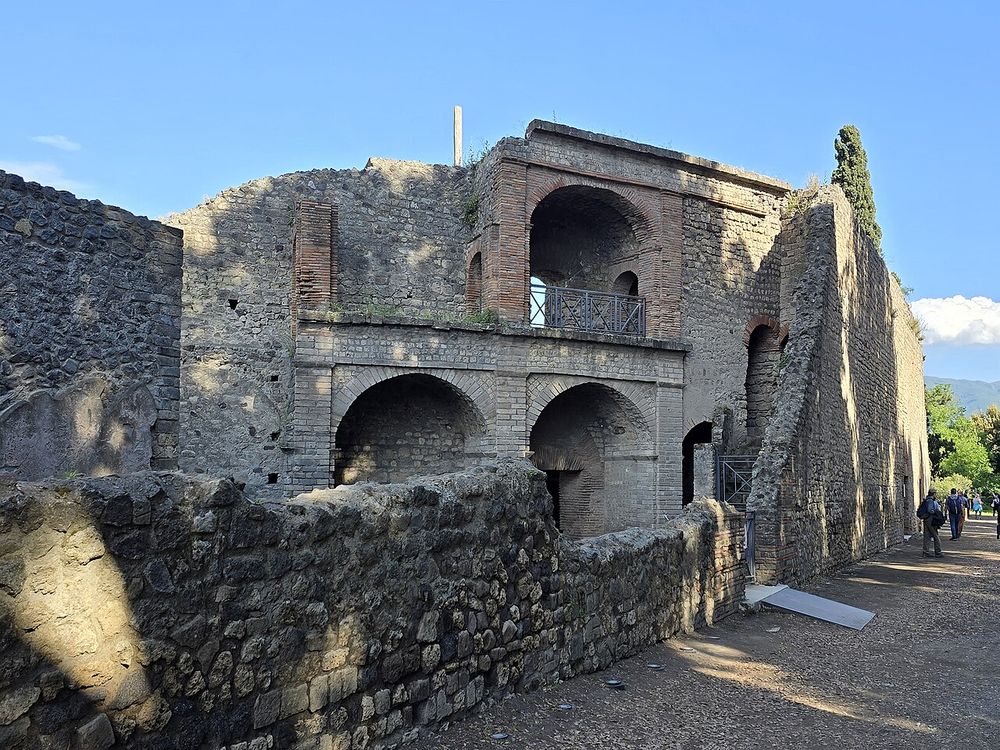
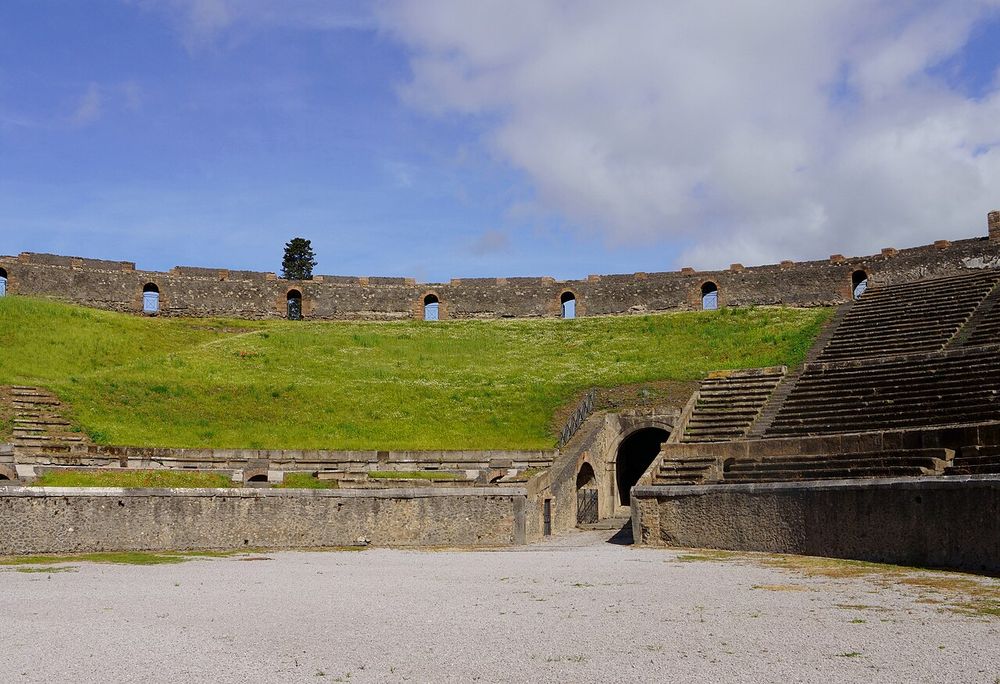
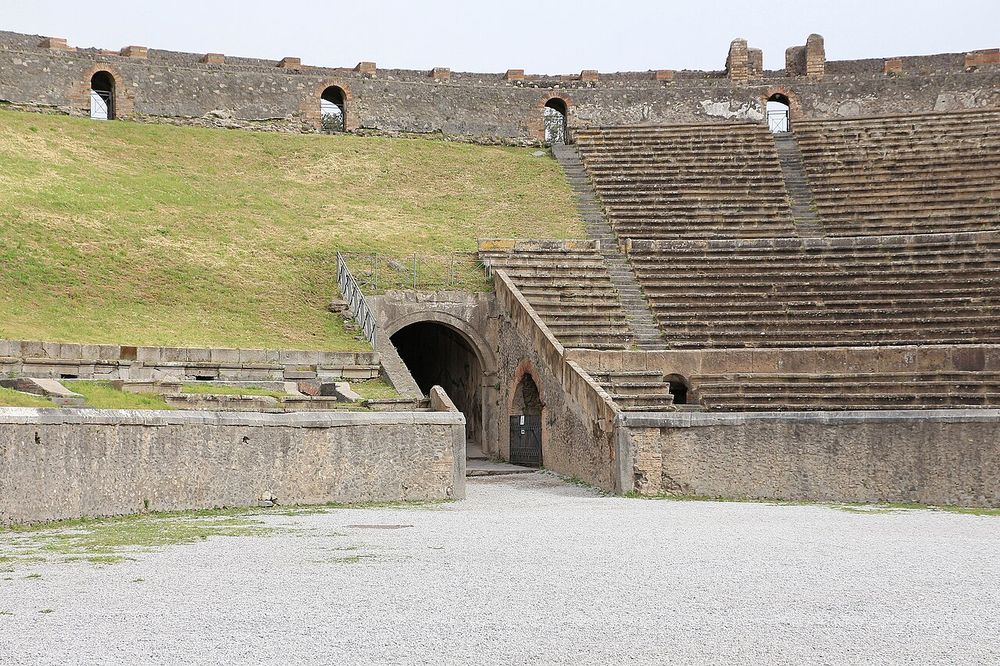
At the far east end of the town is the oldest stone arena that survives anywhere, built about 70 BC, a century and a half before the Colosseum. It held twenty thousand, nearly twice the population. People came from the whole countryside.
In AD 59 a fight broke out in the stands between the locals and visitors from the next town. Many were killed. The Senate in Rome closed the arena for ten years. A painting of the riot was found on a house wall.
In October 1971 the English band Pink Floyd played here for four days to empty seats, for a film.
7. The last day
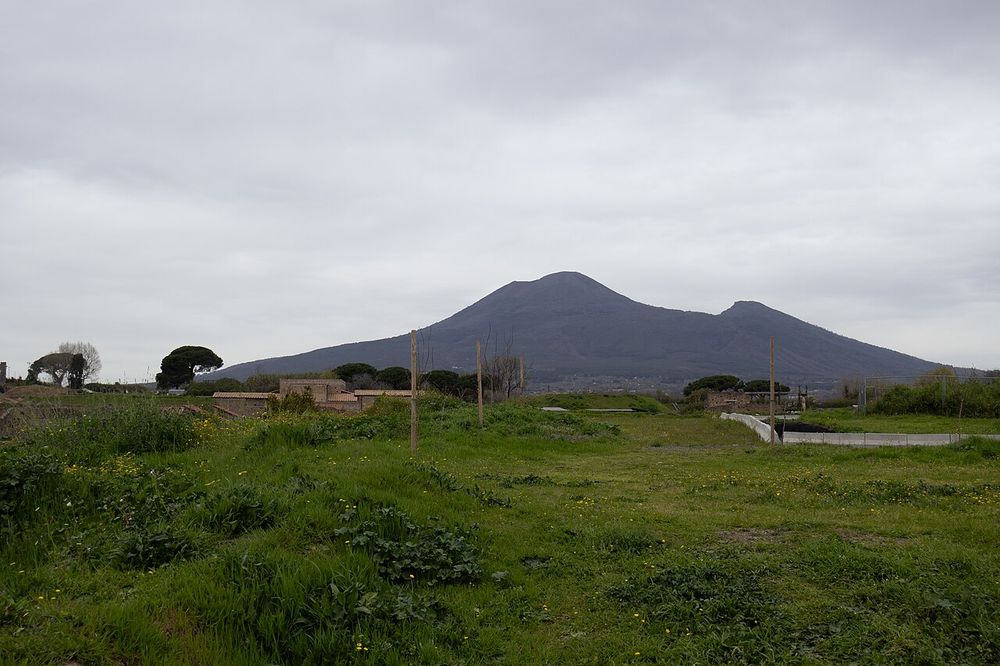
Vesuvius from the townLeftSocks, CC BY-SA 4.0
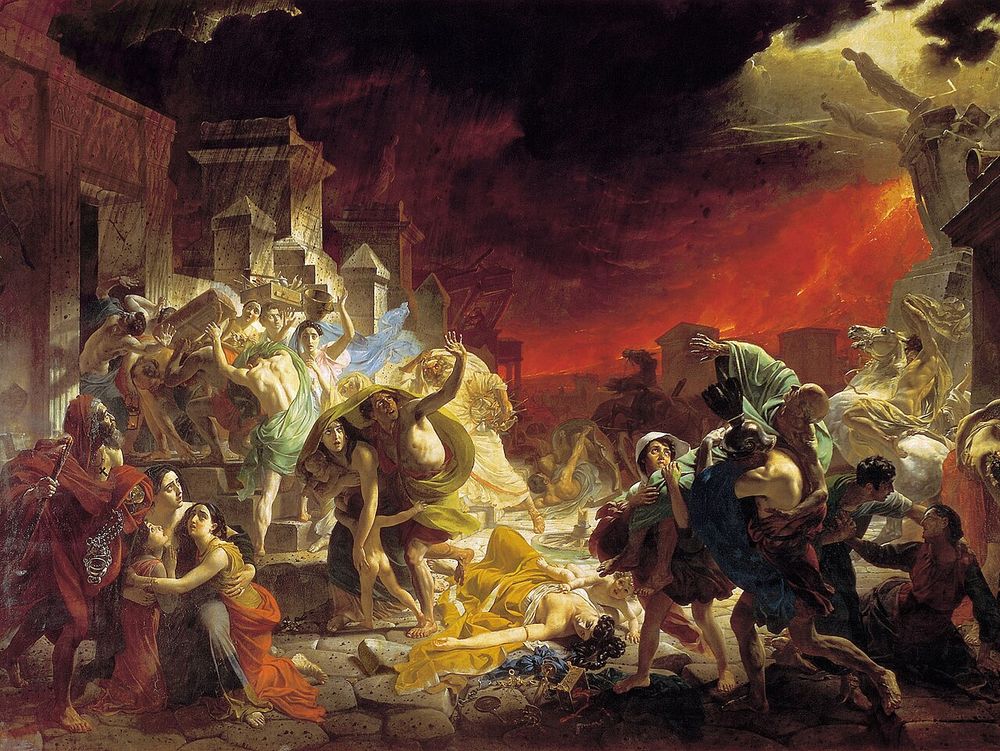
About one in the afternoon the top of the mountain blew off. A column of ash and stone rose thirty kilometres and spread out, a watcher across the bay wrote, like an umbrella pine. The sky went black. Pumice fell on the town at fifteen centimetres an hour.
Those who left in those hours, wading through it with pillows tied on their heads, mostly lived. By the next morning the column had collapsed. A wave of gas and ash, hotter than an oven, crossed the town in a few minutes and killed everyone still in it.
The vineyard where thirteen people fellMentnafunangann, CC BY-SA 3.0
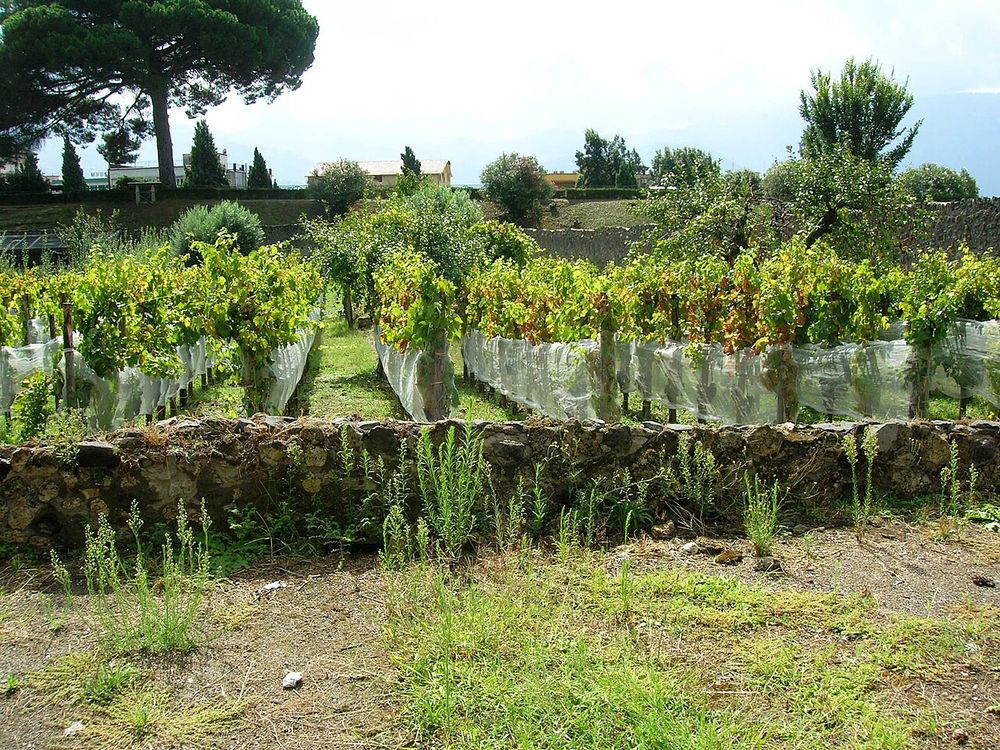
In a vineyard near the south wall thirteen people were found together: men, women and children, lying where they fell as they ran for the gate. Their casts are kept there, under glass.
8. The villa outside the walls
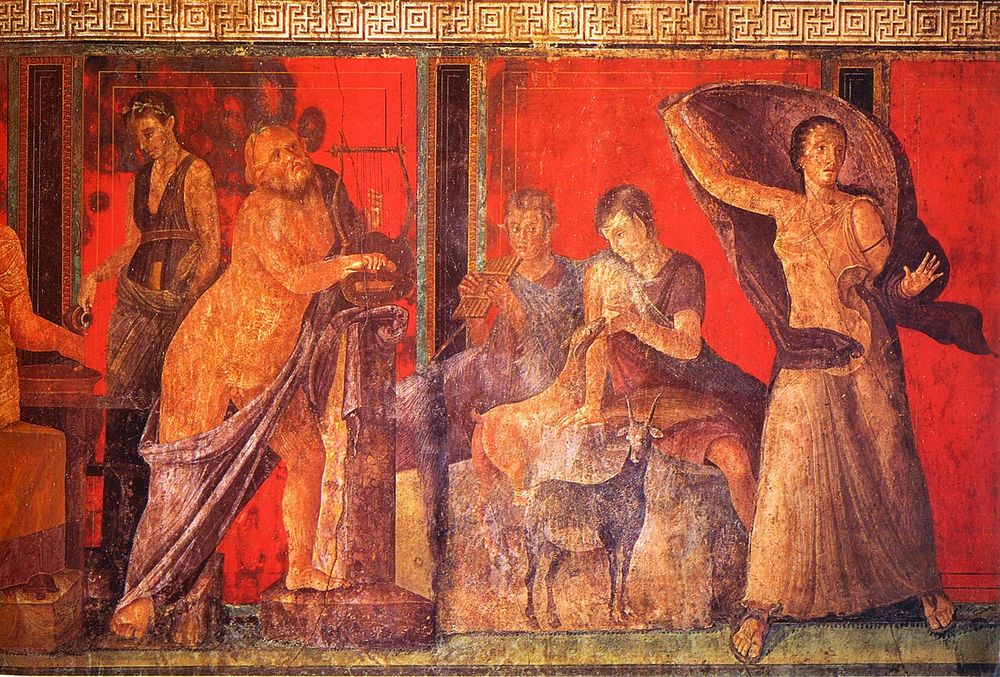
The girl with her head in another's lap, and the dancerWolfgangRieger, Public domain
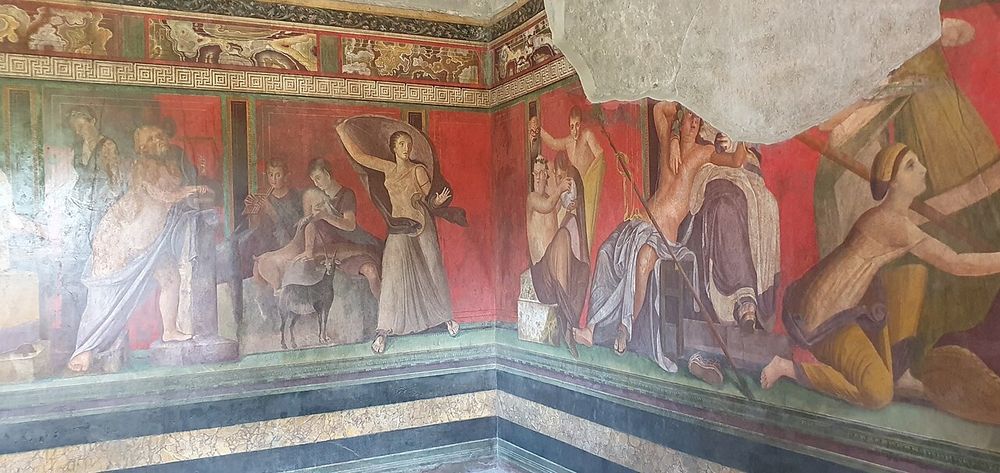
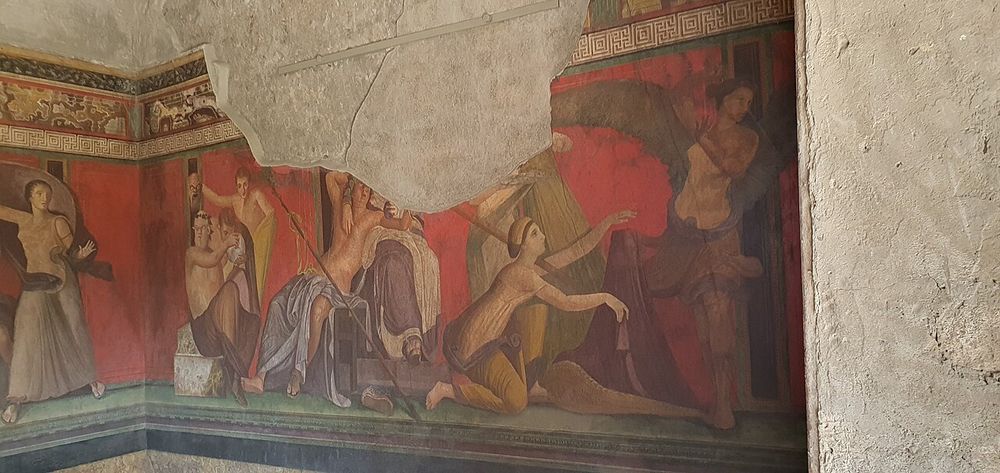
Go out by the north-west gate and down the road of tombs. Ten minutes on is a large farmhouse with a wine press. In one room, life-size figures stand against a red wall on all four sides: a woman reading, a boy, a winged figure with a whip, a girl kneeling with her head in another's lap, a woman dancing naked with cymbals.
It was painted about 60 BC. It seems to show a young woman being received into the secret worship of the wine god. Since the worship was secret, nobody wrote down what it meant.
Meanwhile in the world
Year
Here
Elsewhere
about 600 BC
A town grows up on the lava spur
China's Spring and Autumn period; Confucius is born fifty years later
80 BC
Rome plants a colony of old soldiers here
Western Han (206 BC–AD 9) China (202 BC–AD 8); the historian Sima Qian died a few years earlier
AD 62
An earthquake wrecks the town
Eastern Han China (25–220); Nero rules in Rome
AD 79
Vesuvius buries the town
The White Tiger Hall conference in Luoyang; the Colosseum opens in Rome the next year
1748
Digging begins
Qing China, the Qianlong reign; Montesquieu publishes The Spirit of the Laws
1863
The first plaster casts are made
The Tongzhi reign in China; the battle of Gettysburg in America
1944
Vesuvius erupts for the last time so far
The Second World War; Allied bombs had fallen on the ruins the year before
2018
A charcoal note moves the date to October
New digging begins in a part of the town untouched for a century
Then and now
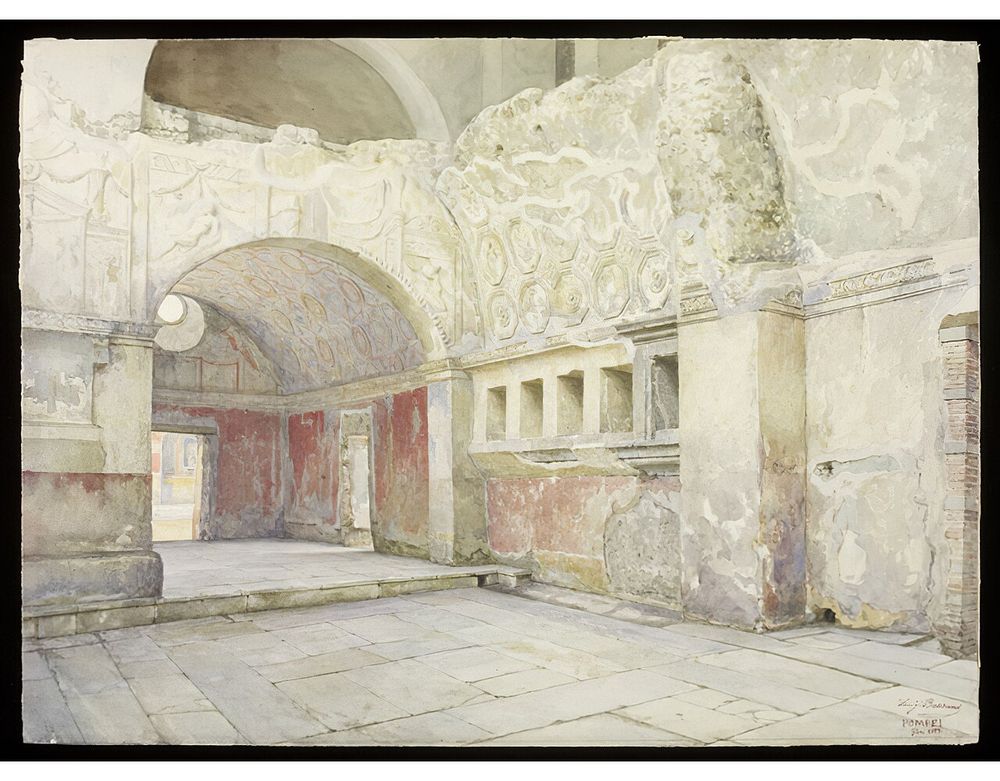
The ruins and Vesuvius in evening lightElfQrin, CC BY-SA 4.0, Wikimedia CommonsThe forum, with the mountain behindCommonists, CC BY-SA 4.0, Wikimedia CommonsPompeii and the bay from the International Space StationEarth Science and Remote Sensing Unit, Lyndon B. Johnson Space Center, Public domain, Wikimedia CommonsThe two theatres from the airElfQrin, CC BY-SA 4.0, Wikimedia CommonsVesuvius from the townLeftSocks, CC BY-SA 4.0, Wikimedia CommonsThe mountain over the wallsJebulon, CC0, Wikimedia CommonsThe sea gateFalk2, CC BY-SA 4.0, Wikimedia CommonsHouses on the slope below the gateYair Haklai, CC BY-SA 4.0, Wikimedia CommonsThe temple of ApolloMarco Ober, CC BY-SA 4.0, Wikimedia CommonsThe altar of the temple of ApolloBernard Gagnon, CC BY 4.0, Wikimedia CommonsThe main streetAdam Harangozó, CC BY-SA 4.0, Wikimedia CommonsA street running towards the mountainCarole Raddato from FRANKFURT, Germany, CC BY-SA 2.0, Wikimedia CommonsStepping stonesCommonists, CC BY-SA 4.0, Wikimedia CommonsThe gaps between the stones fit a cart's wheelsGary Todd from Xinzheng, China, Public domain, Wikimedia CommonsRuts worn by wheelsDvortygirl, CC BY-SA 4.0, Wikimedia CommonsA street fountainBernard Gagnon, CC BY 4.0, Wikimedia CommonsA lunch counterBernard Gagnon, CC BY 4.0, Wikimedia CommonsA counter faced with coloured marbleSarahhoa, CC BY-SA 2.0, Wikimedia CommonsThe jars set into a counterRigorius, CC BY-SA 4.0, Wikimedia CommonsA painted snake, guardian of a household shrineBernard Gagnon, CC BY 4.0, Wikimedia CommonsMills and an ovenWknight94, CC BY-SA 3.0, Wikimedia CommonsVats of a laundryYair Haklai, CC BY-SA 4.0, Wikimedia CommonsThe washing tank in the hall of a laundryFalk2, CC BY-SA 4.0, Wikimedia CommonsWriting scratched on a wallWknight94, CC BY-SA 3.0, Wikimedia Commons"Beware of the dog", in the doorway of a houseArgo Navis, CC BY-SA 4.0, Wikimedia CommonsThe hall of a small house, with its rain-water poolGary Todd from Xinzheng, China, Public domain, Wikimedia CommonsThe dancing figure that gave the House of the Faun its nameJebulon, CC0, Wikimedia CommonsThe first hall of the House of the FaunNikonZ7II, CC BY-SA 4.0, Wikimedia CommonsThe floor of Alexander's battle, a copy in its placeMaarten Heerlien from Voorschoten, The Netherlands, CC BY 2.0, Wikimedia CommonsThe second garden of the House of the FaunGary Todd from Xinzheng, China, Public domain, Wikimedia CommonsThe large theatreRigorius, CC BY-SA 4.0, Wikimedia CommonsThe back of the stageRigorius, CC BY-SA 4.0, Wikimedia CommonsThe arena from outsideMarco Ober, CC BY-SA 4.0, Wikimedia CommonsInside the arenaCommonists, CC BY-SA 4.0, Wikimedia CommonsThe seats and the gate for the fightersBernard Gagnon, CC BY 4.0, Wikimedia CommonsThe cast of a man who died sittingJebulon, CC0, Wikimedia CommonsThe vineyard where thirteen people fellMentnafunangann, CC BY-SA 3.0, Wikimedia CommonsThe cast of a dog left on its chainGary Todd from Xinzheng, China, Public domain, Wikimedia CommonsThe painted room of the Villa of the MysteriesYair Haklai, CC BY-SA 4.0, Wikimedia CommonsThe end wallYair Haklai, CC BY-SA 4.0, Wikimedia CommonsThe girl with her head in another's lap, and the dancerWolfgangRieger, Public domain, Wikimedia CommonsA love poem scratched on a wall, copied in 1909Mau and Zangemeister, Public domain, Wikimedia CommonsThe forum painted by Christen Købke in 1841Christen Schjellerup Købke, Public domain, Wikimedia CommonsThe Last Day of Pompeii, painted by Karl Bryullov in 1833Karl Bryullov, Public domain, Wikimedia CommonsA room of the baths, watercolour by Luigi Bazzani, about 1900Luigi Bazzani, Public domain, Wikimedia CommonsA bakery photographed by Giacomo Brogi, before 1881Giacomo Brogi, PDM-owner, Wikimedia CommonsOne of the first casts, photographed by Giorgio Sommer about 1875Giorgio Sommer, Public domain, Wikimedia Commons
Video
Films from official channels, played from YouTube. Nothing is loaded until you press play.
Pompeii, Herculaneum and Torre AnnunziataUNESCO · made with NHK; 3 min · checked 2026-11-12
Local legends
These are stories people tell about this place. They are legends, not history, and each one says where it comes from.
LegendThe soldier at the gate
A Roman sentry was found standing at his post by one of the gates, spear in hand. He had not been relieved, and he had not run.
Source: A tale of nineteenth-century guides, painted by Edward Poynter in 1865; the niche was a tomb and no soldier was found in it
LegendThe city of sin
Pompeii was destroyed for its wickedness, like the cities in the Bible. Someone who lived through the first hours scratched "Sodom and Gomorrah" on a wall.
Source: The words were found on a house wall in 1862; who wrote them, and when, is unknown
LegendThe priest and his gold
The priests of Isis were at dinner when the sky went dark. One stayed to save the temple treasure, and was found in the street with a sack of coins and the holy vessels beside him.
Source: Told from the finds of 1765–1766; the novel The Last Days of Pompeii (1834) made it famous
Later, people who live here will be able to add the stories they grew up with, and say which of these they have heard.
Not certain, and where accounts conflict
August or October?
The letter that gives 24 August survives only in copies made a thousand years later, and the copies disagree. The charcoal note, the autumn fruit, the braziers in the rooms and a coin all favour 24 October. The park now gives the autumn date.
How many died?
The remains of about 1,150 people have been found in the two-thirds of the town that has been dug. The total is put at two thousand, out of eleven thousand. Many more must have died on the roads.
Who are the people in the casts?
For a century guides told stories: a mother and child, two sisters, a beggar. In 2024 tests of the bones inside showed that several of these stories were wrong. The "mother" was a man, and not related to the child.
What is happening in the red room?
An initiation, a wedding, a play: each has been argued. The scene of the whipping may not be a whipping. The room may simply have been a dining room with fashionable pictures.
Visiting
Tickets and hours
Pompeii Express, the town only, is 20 euros. Pompeii Plus, with the Villa of the Mysteries, is 25 euros. A three-day ticket for all the park's sites is 30 euros.
Citizens of the European Union aged 18 to 24 pay 2 euros. Visitors under 18 enter free, as at all Italian state sites.
From 16 March to 14 October the site is open from 9:00 to 19:00, with last entry at 17:30. From 15 October to 15 March it closes at 17:00, with last entry at 15:30.
Closed on 25 December and 1 January. Free on the first Sunday of the month.
Last checked 2026-11-12. The archaeological park's own site (pompeiisites.org), tickets and timetables as shown in November 2026.
Booking from abroad
Official page in English The park's own site gives prices and hours in English: pompeiisites.org. It names the Vivaticket site (pompeii.vivaticket.it) as the place to buy online. Tickets carry your name, and no more than 20,000 are sold for any day.
Ticket window on site The official ticket offices are at the three entrances: Porta Marina, Piazza Esedra and Piazza Anfiteatro. Men who stop you outside the station to sell "skip the line" tickets are not from the park.
Note From 16 March to 14 October tickets are sold for the morning (entry from 9:00 to 13:00) or the afternoon (13:00 to 17:30). Bring the passport or card that matches the name on the ticket.
Checked 2026-11-12
Where to start
From Naples take the Circumvesuviana train towards Sorrento and get off at Pompei Scavi – Villa dei Misteri, about forty minutes. The Porta Marina entrance is across the road.
Be at the gate at 9:00. Walk the stops on this page from west to east and then double back to the north-west gate for the villa. That is about five kilometres, and four hours.
With two hours only: the forum, the street to the east, one lunch counter, the House of the Faun, and the casts in the forum sheds.
Ask at the gate which houses are open that day. They take turns.
Before you go
There is almost no shade. In summer bring a hat and a bottle; the street fountains with modern taps give drinking water.
The streets are rough stone with high kerbs. Wear proper shoes. A level route for wheelchairs starts at the Piazza Anfiteatro entrance.
Bags larger than a small rucksack must be left at the entrance.
The casts are the remains of people. Children may find them upsetting; say beforehand what they are.
Customs and manners
Do not sit or climb on the walls, or lean on the painted plaster.
Do not pick up stones or pieces of pottery. People who took them home have been posting them back for years, with letters of apology.
At the casts, keep your voice down and do not pose beside them.
Opening hours are given in the local time of the place. Prices are in the local currency. The figure after ≈ is approximate, at exchange rates checked on 9 November 2026, in .
Look for these
Find a pair of ruts in the road. How far apart are they?
At a fountain, find the dip worn by hands.
Find a counter with holes in it. How many jars did it have?
Find a mill. Where did the grain go in, and where did the flour come out?
Find red letters painted on a wall. Can you make out a name?
In the forum, stand so that the temple and the mountain line up.
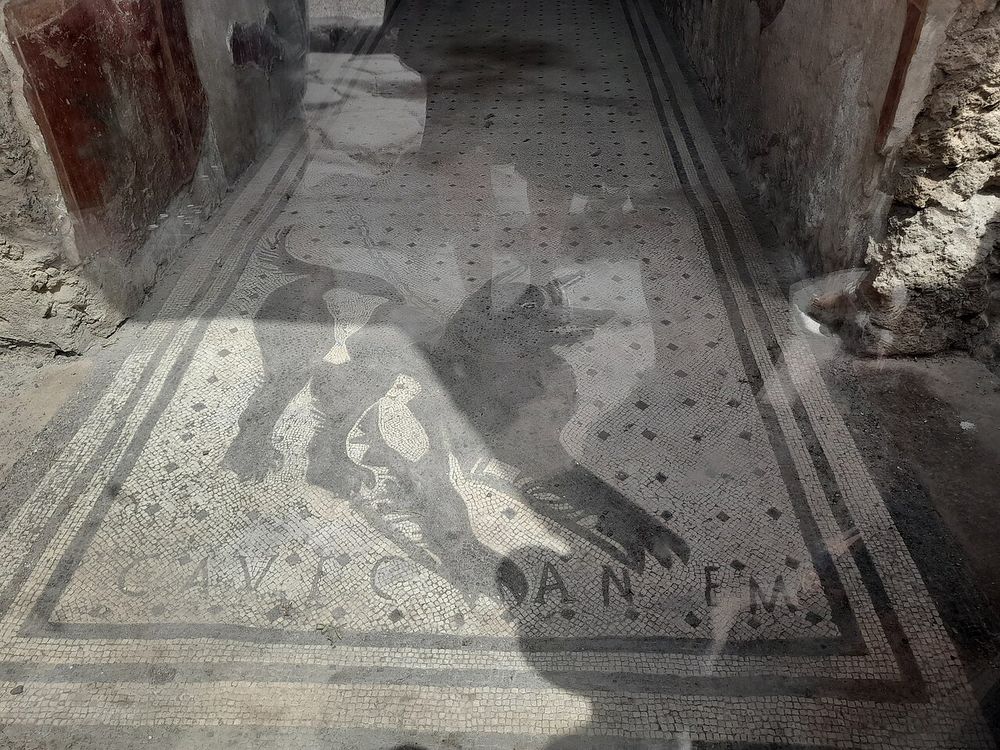
At a doorway, find the dog.
In the red room, count the figures. Which one is looking at you?
I am here
Stand at the site, sign in, press the button, and collect its stamp. Your browser will ask to use your location. It is sent to us once to confirm that you are at the site; we keep how far you were from it, not the spot where you stood.
Your stamps are saved to your account, so they follow you to any device. Checking from a browser cannot rule out every false location; stricter checks arrive with the app.
Messages
Share your photos
Photos here show the place, not people. Each one is credited to the visitor who took it and appears after our team has looked at it. A photo with you in it belongs under “I am here”.