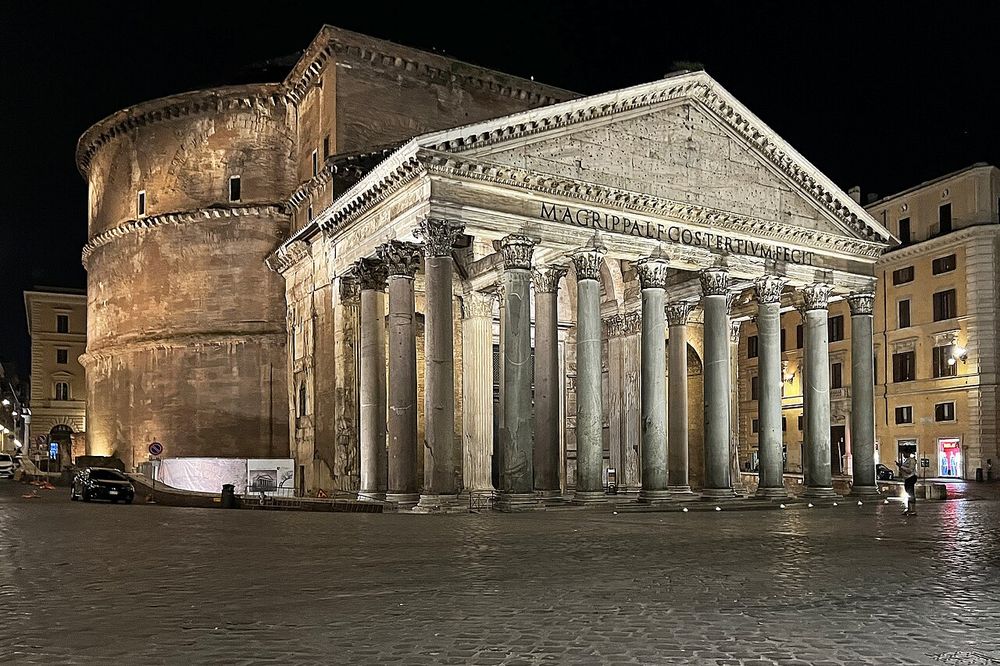
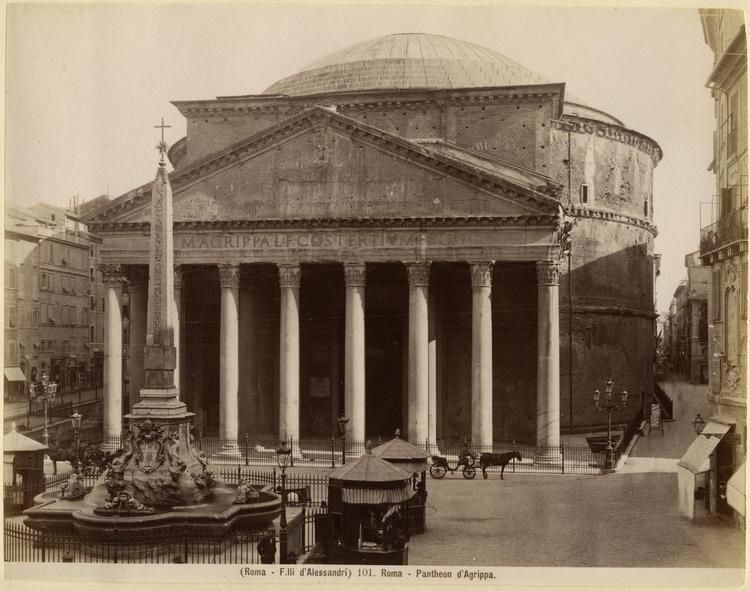
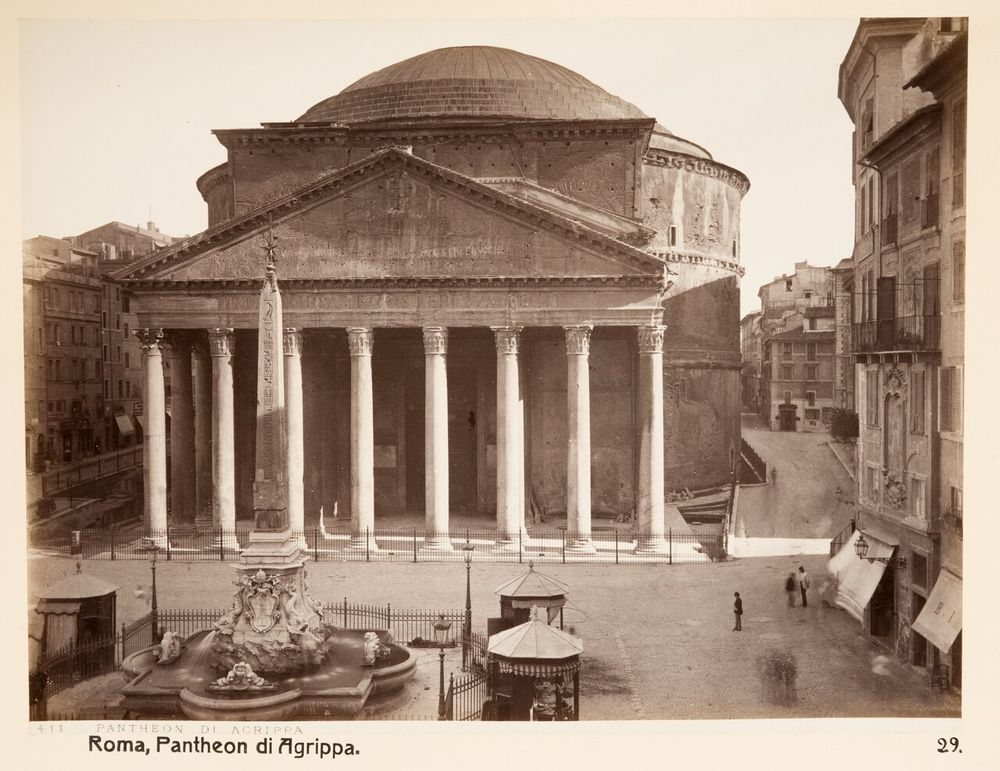
A single round room under a dome of concrete, with a hole nine metres wide open to the sky. It is nineteen hundred years old and it has never fallen down. No one has built a larger dome of plain concrete since.
Photo: Nicholas Hartmann, CC BY-SA 4.0, Wikimedia Commons
The story
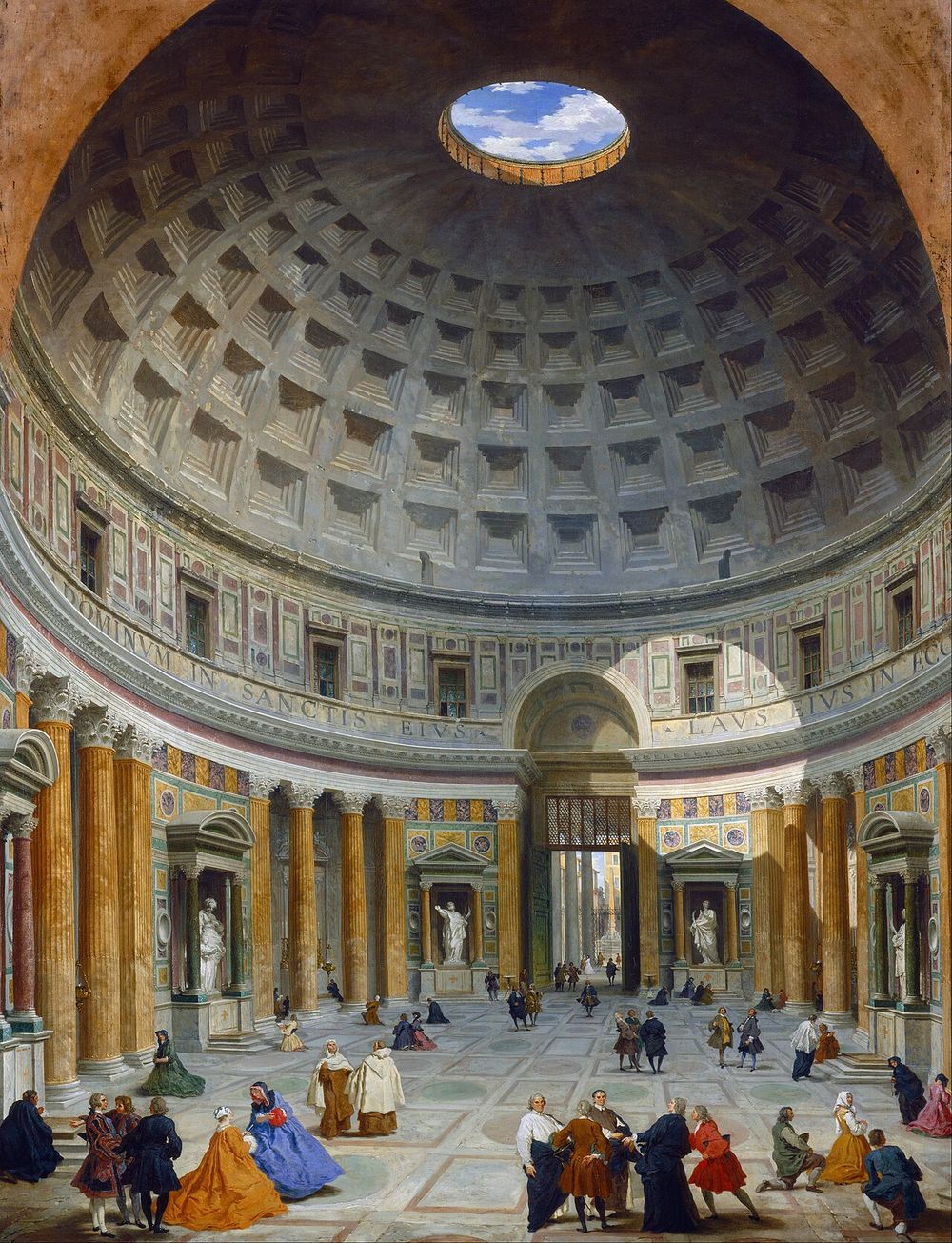
You are in a round room as wide as it is high. There are no windows. Light comes from one place only: a circle of open sky straight above you, and under it a bright disc that moves slowly across the wall.
The room was finished about the year 125, under the emperor Hadrian. In China it was the Eastern Han (25–220): at the court in Luoyang the astronomer Zhang Heng was building a bronze sphere of the heavens, turned by water.
What is here
The square and the outside are free at all hours. One ticket covers the inside.
Pantheon means "all the gods". It was a temple, and nobody now knows exactly how it was used. Its builders made one great room to stand for the sky, and left the top open.
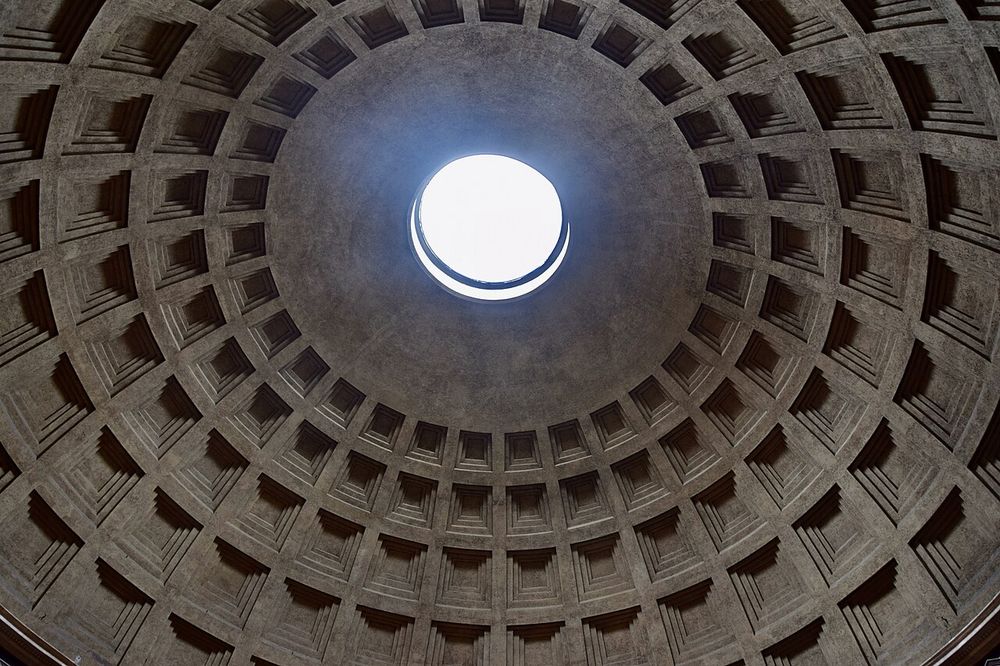
The dome is concrete, poured over a wooden frame in rings. Nothing is hidden inside it: no iron, no steel. It is 43.3 metres across. That was the widest roof in the world for thirteen hundred years.
In 609 the emperor gave the building to the pope, who made it a church. That is why it was never quarried for stone like the temples around it, and why Mass is still said here.
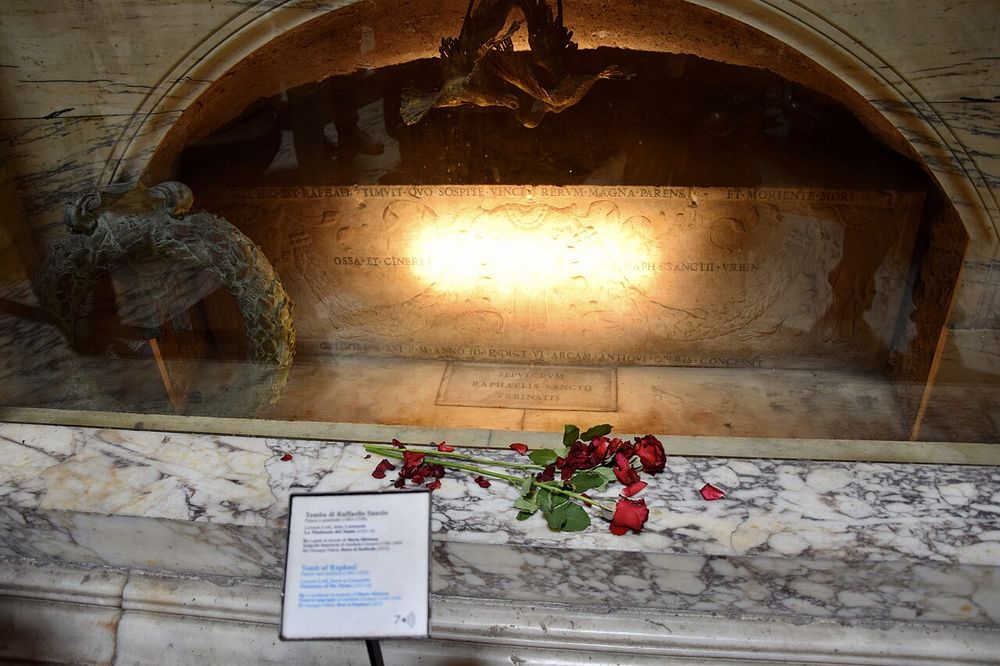
Before you leave, find the tomb of the painter Raphael, on the left. He asked to lie here.
Things people often get wrong
"It is the Parthenon." The Parthenon is in Athens, is Greek, and is a ruin. This is Roman, about 560 years younger, and whole.
"Agrippa built it, as it says on the front." Agrippa built the first temple here, which burned. Hadrian built this one and put the old founder's name back on it.
"There is glass over the hole." There is nothing. When it rains, it rains inside.
"The rain does not come in, because warm air pushes it out." It comes in. The floor is made for it: look for the small holes.
"It is a museum." It is a Catholic church, Saint Mary and the Martyrs. On Sunday morning visitors wait outside until Mass is over.
People who stood here
Hadrian (Roman emperor from 117 to 138, who built the wall across the north of England)This is his building, though he did not put his name on it. An ancient historian says he sat here in public to hear cases, with the chief men of Rome around him.
Raphael (Italian painter of the School of Athens in the Vatican)As a young man he stood inside and drew the interior; the sheet is in Florence. He died in Rome on 6 April 1520, aged thirty-seven, and was carried here the next day.
Michelangelo (Italian sculptor and painter of the Sistine Chapel ceiling)He studied the building closely. When he came to design the dome of St Peter's he made it a little narrower than this one. He is reported to have said that the Pantheon was the design of angels, not of men.
Go deeper: eight stops, from the fountain to the back wall
The stops begin in the square, go in through the porch and end at the back wall, outside.
1. The square
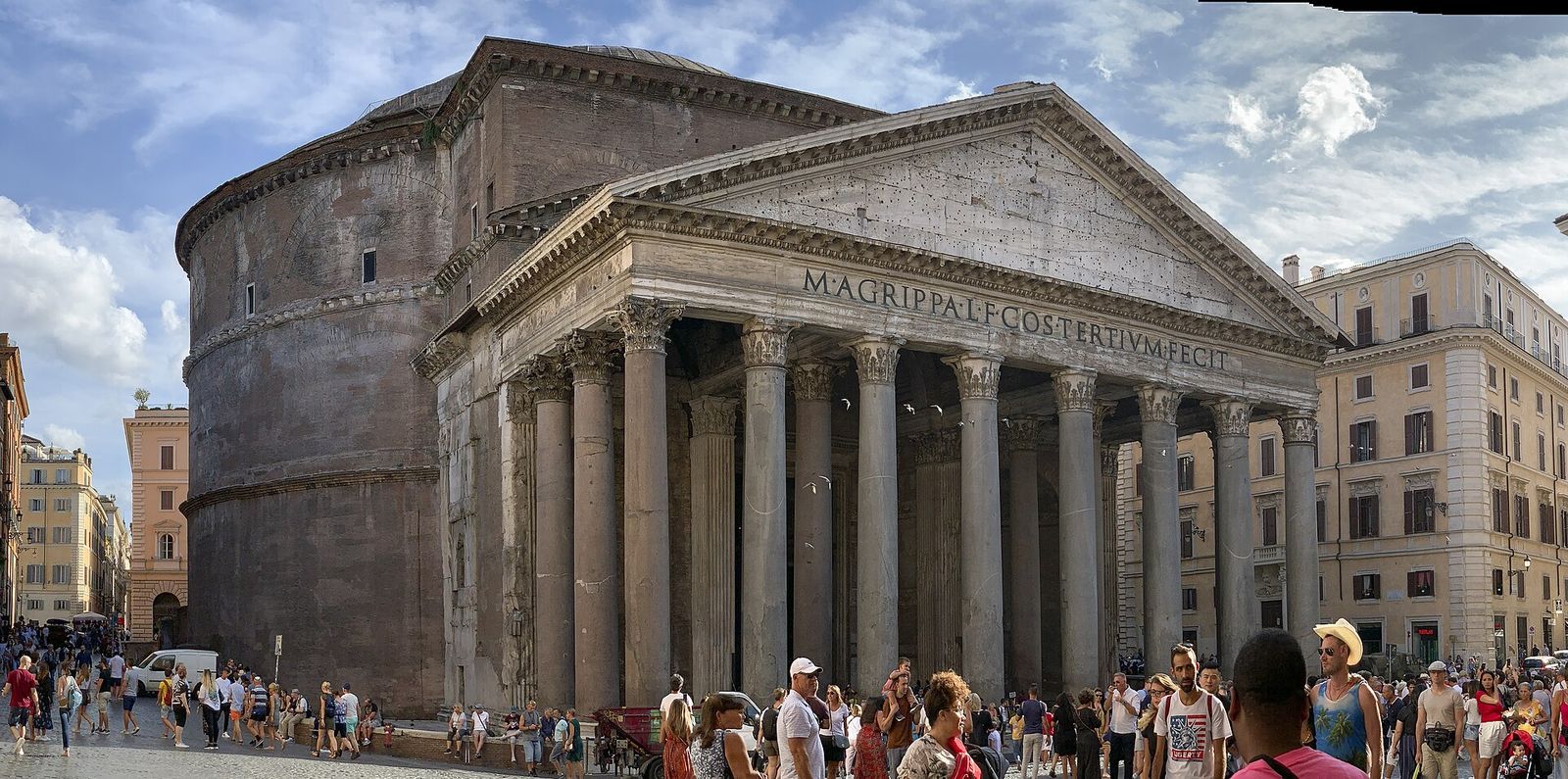
The front from across the squareRabax63, CC BY-SA 4.0
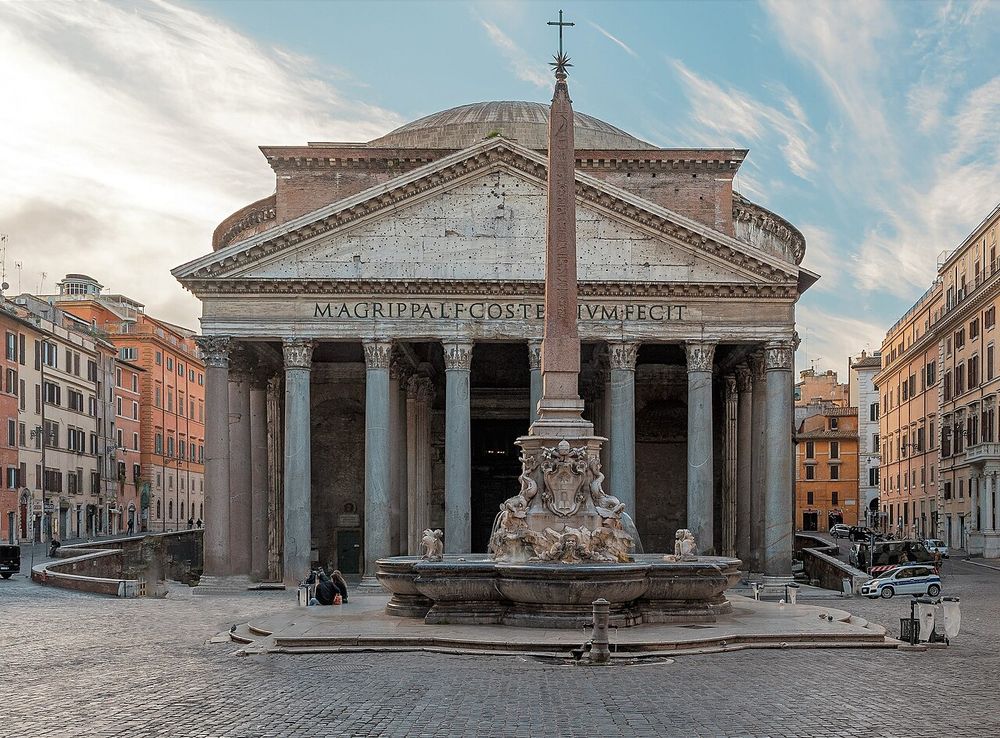
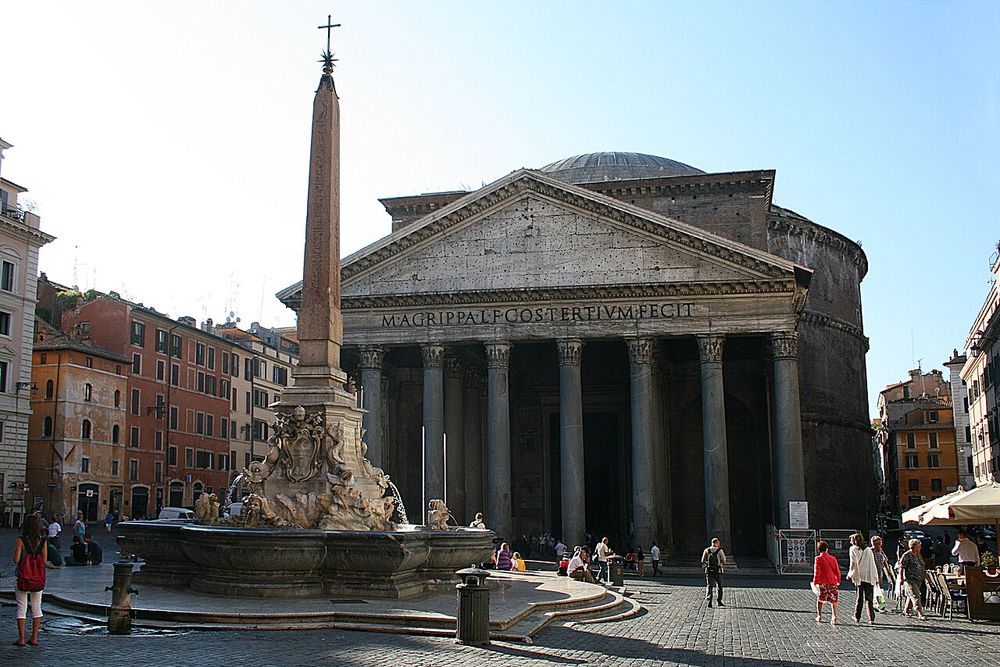
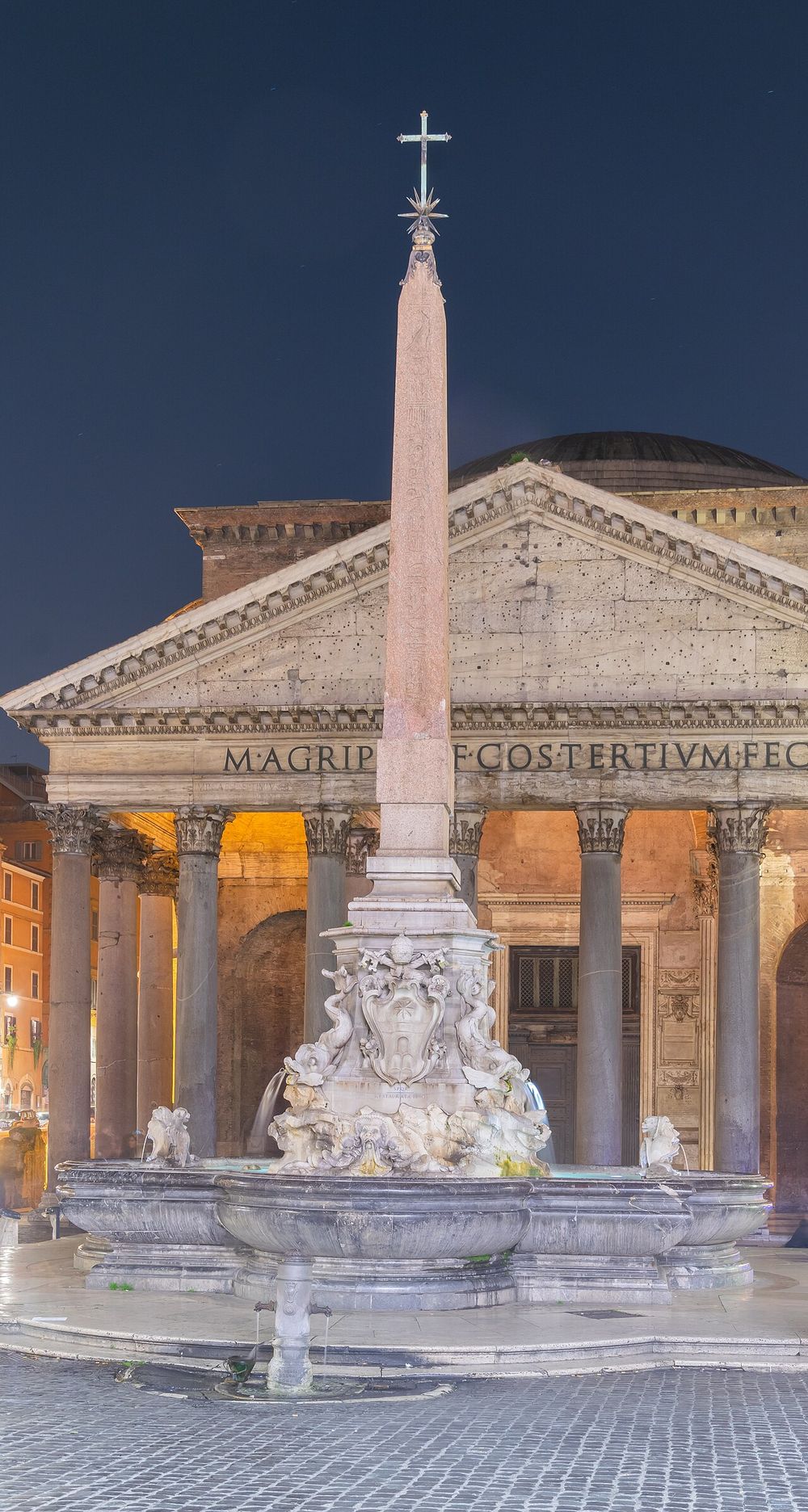
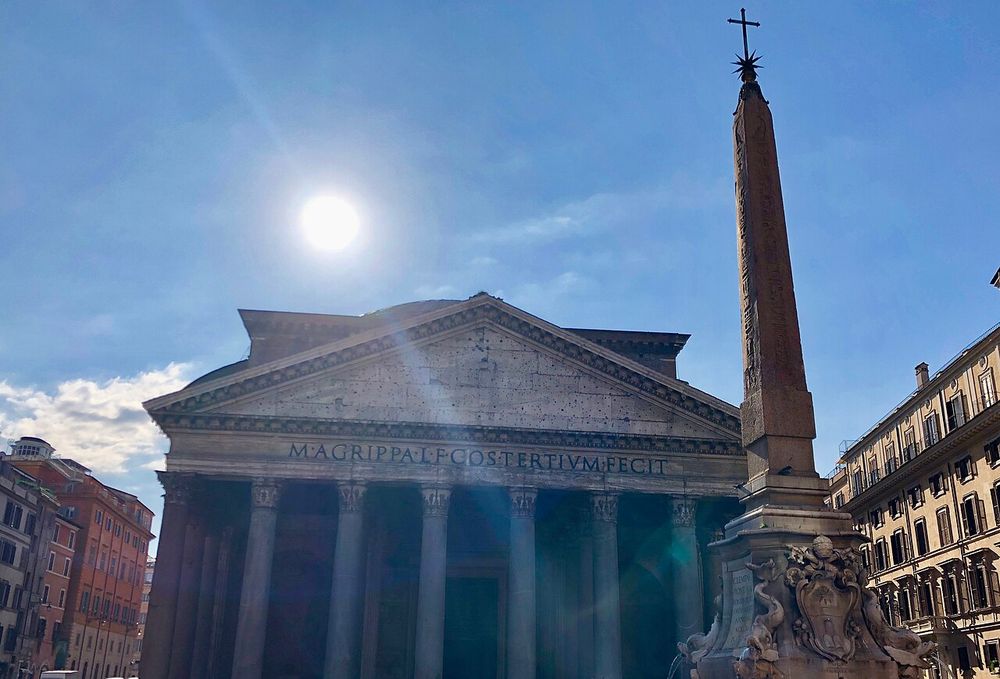
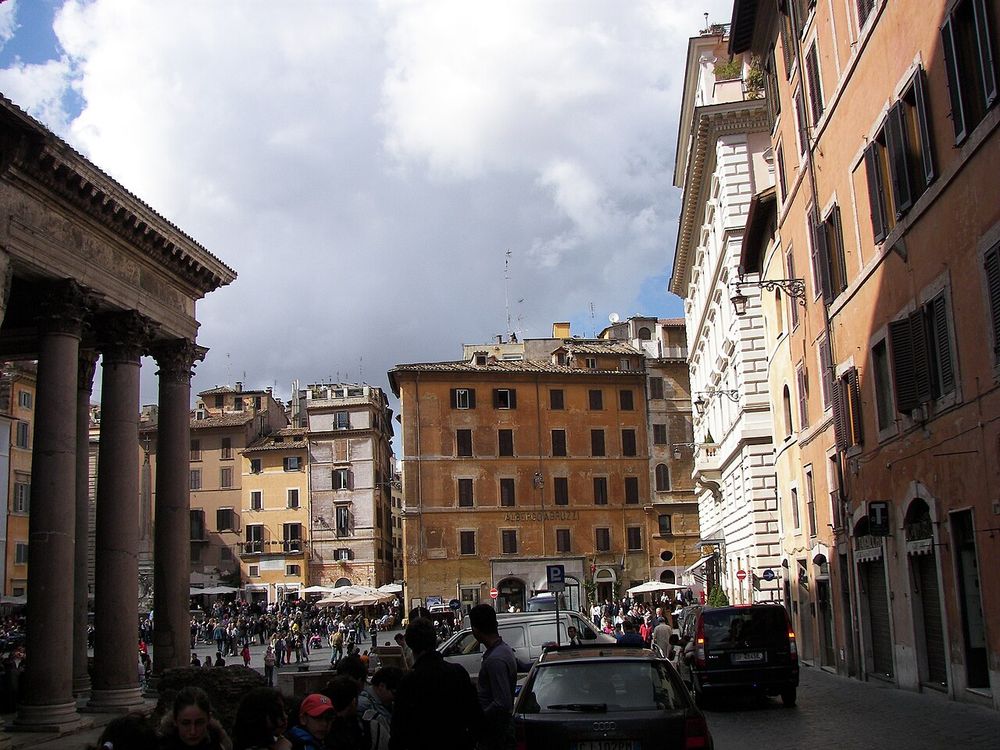
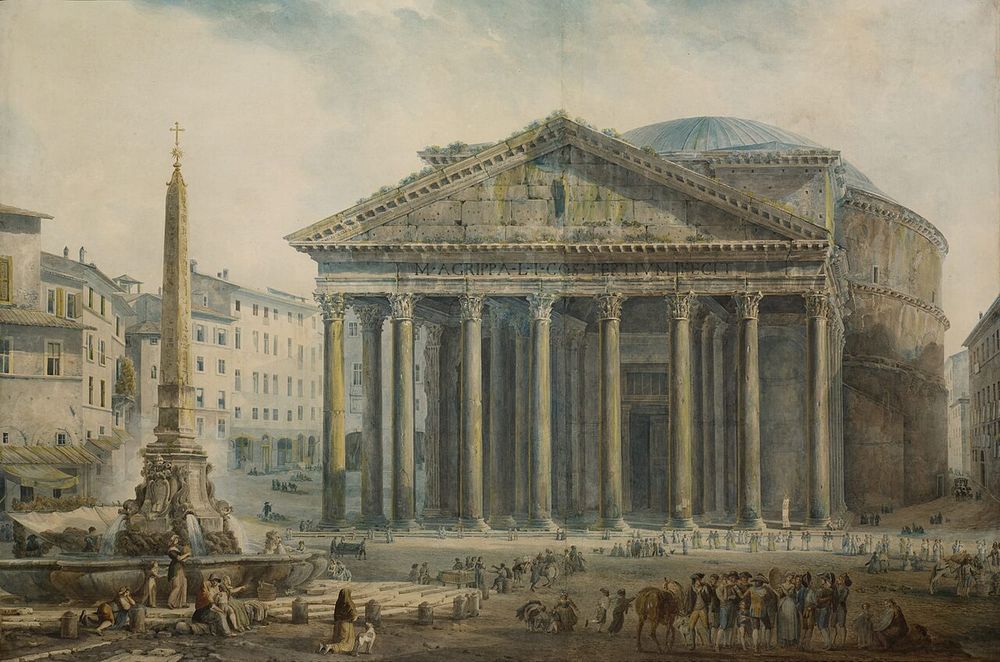
Stand by the fountain and look at the ground. The square slopes down towards the building. In Hadrian's time the street was several metres lower, and you climbed a flight of steps to the porch. Rome has risen round the Pantheon.
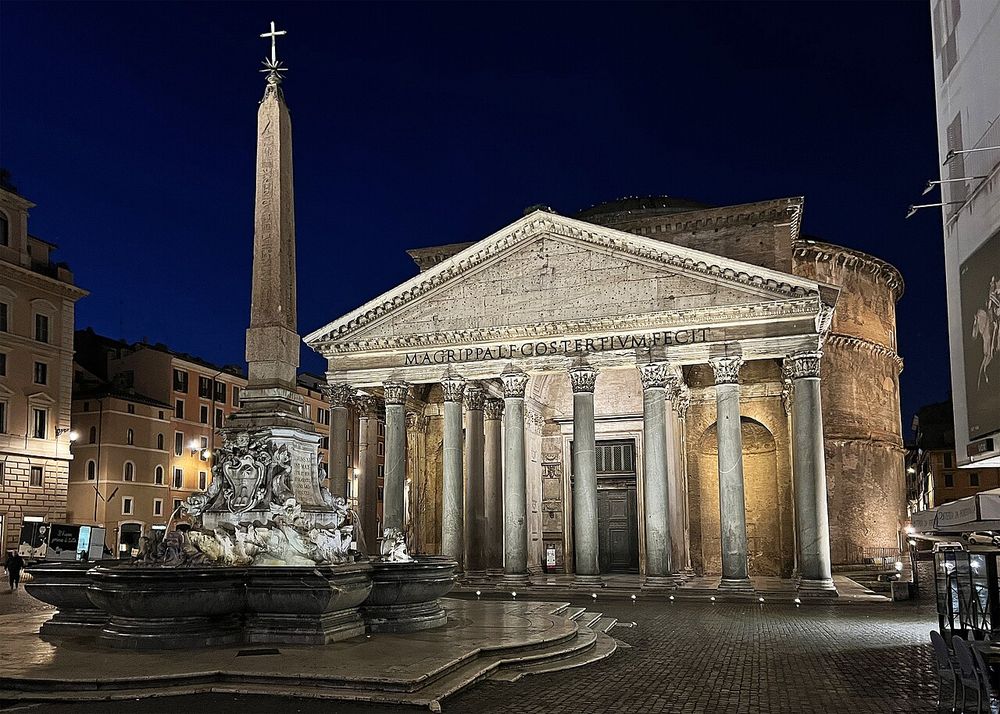
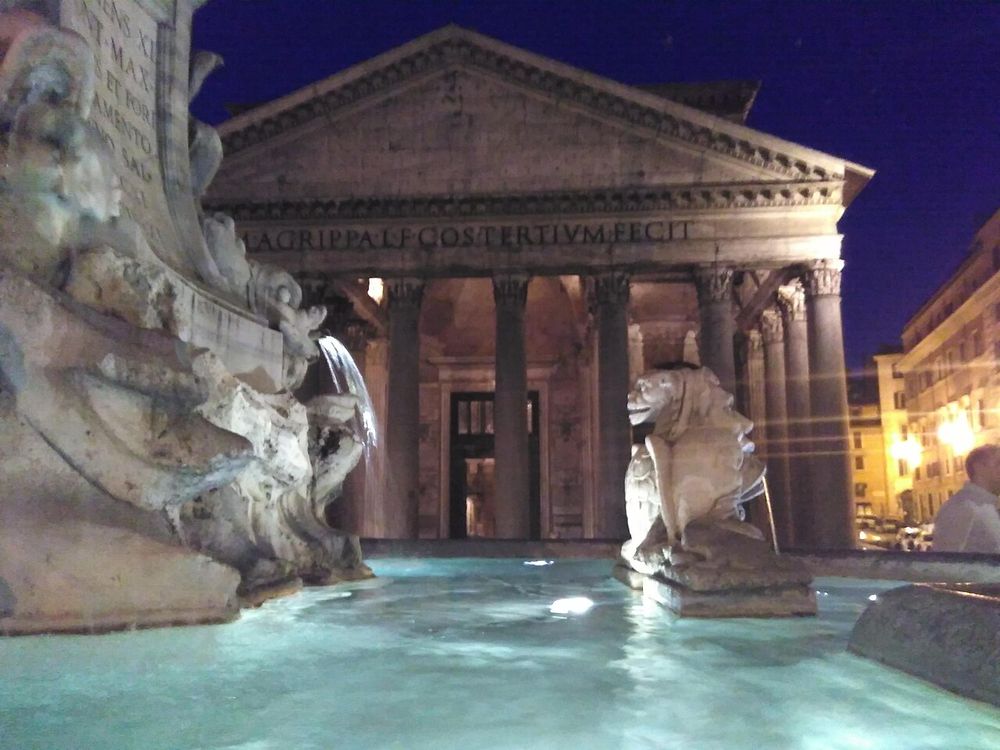
The fountain was made in 1575. The small obelisk on top is Egyptian, cut for the pharaoh Ramesses II about 1250 BC, brought to Rome for a temple of Isis, and set here in 1711.
2. The porch
Capitals of the porch columnsNicholas Hartmann, CC BY-SA 4.0
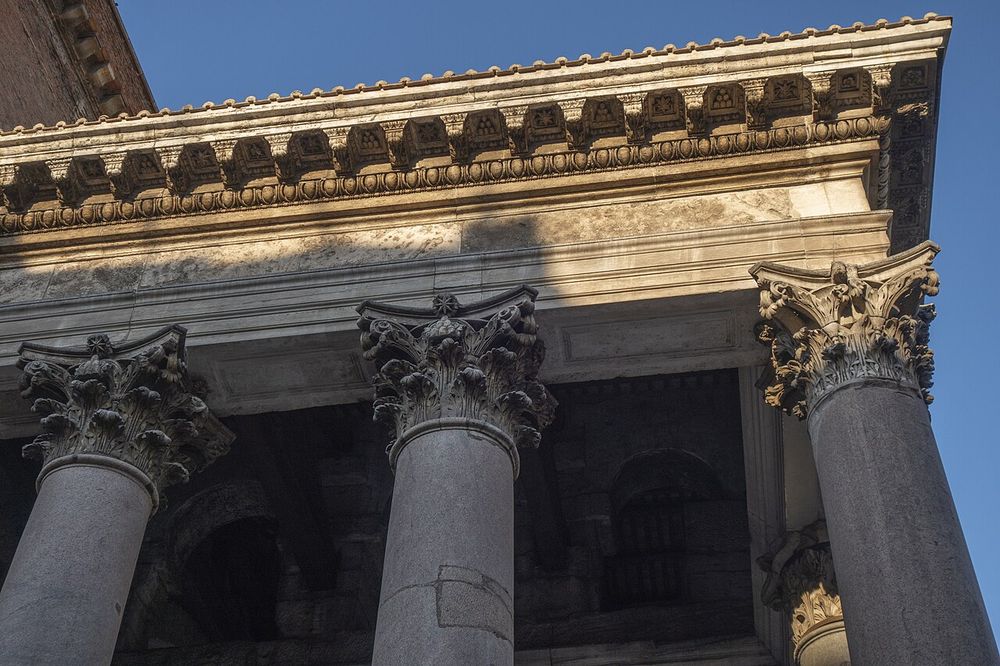
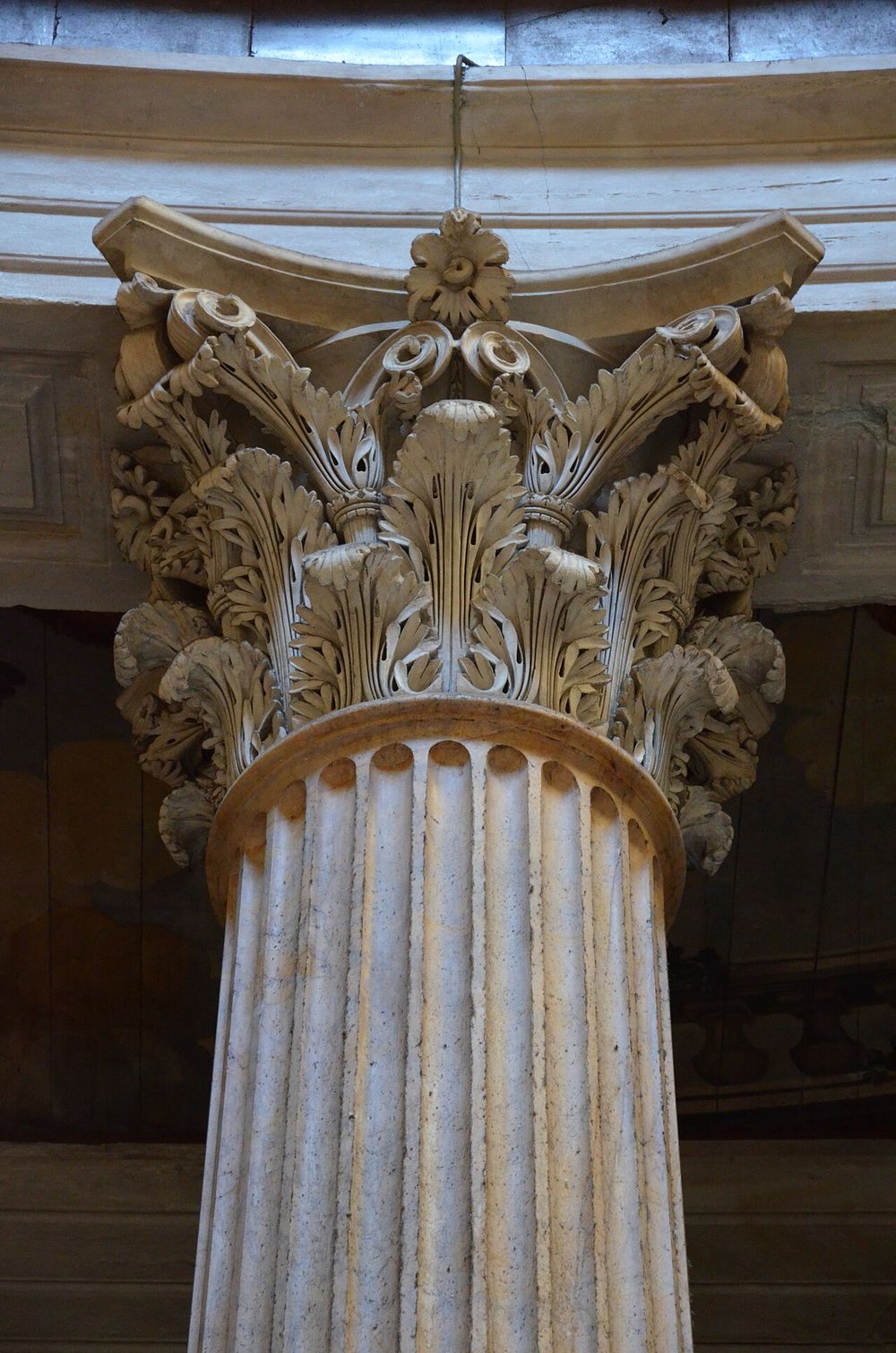
Sixteen columns hold up the porch. Each is a single piece of granite, almost twelve metres tall and about sixty tonnes in weight. They were quarried in the eastern desert of Egypt, dragged a hundred kilometres to the Nile, floated to the sea, shipped to Italy and hauled up the Tiber.
Agrippa's name on the frontWknight94, CC BY-SA 3.0
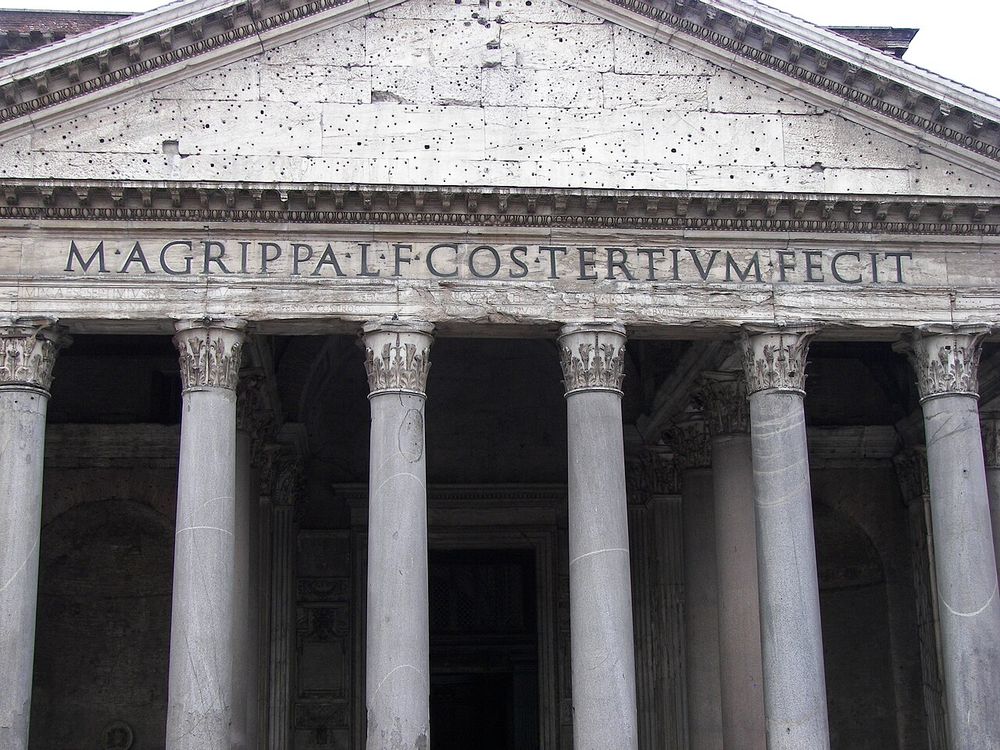
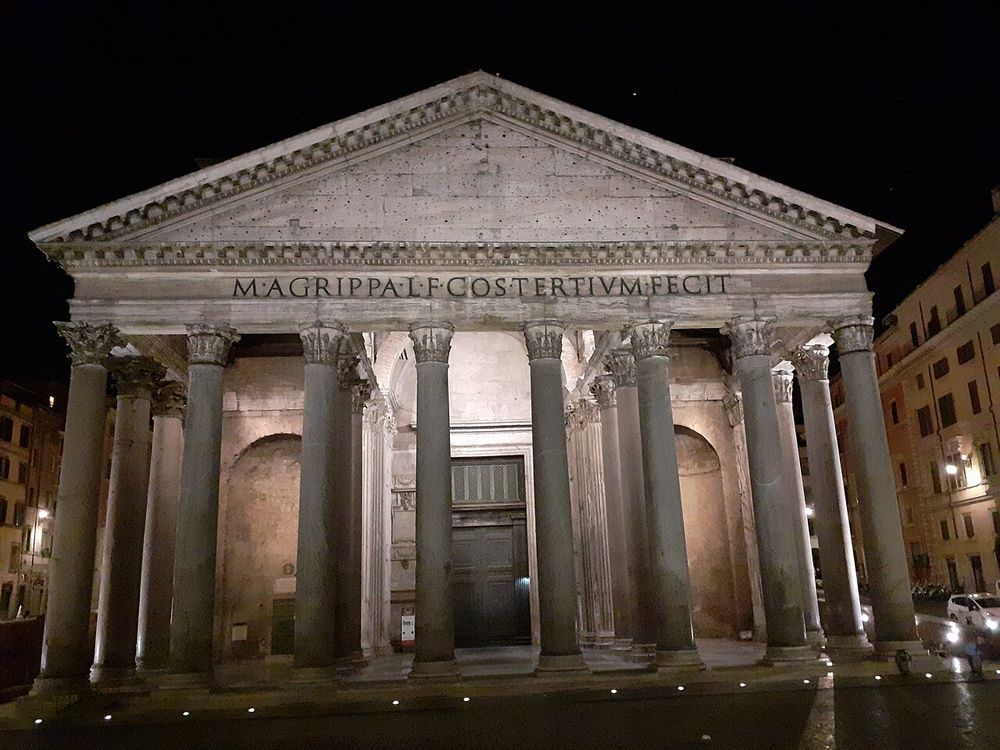
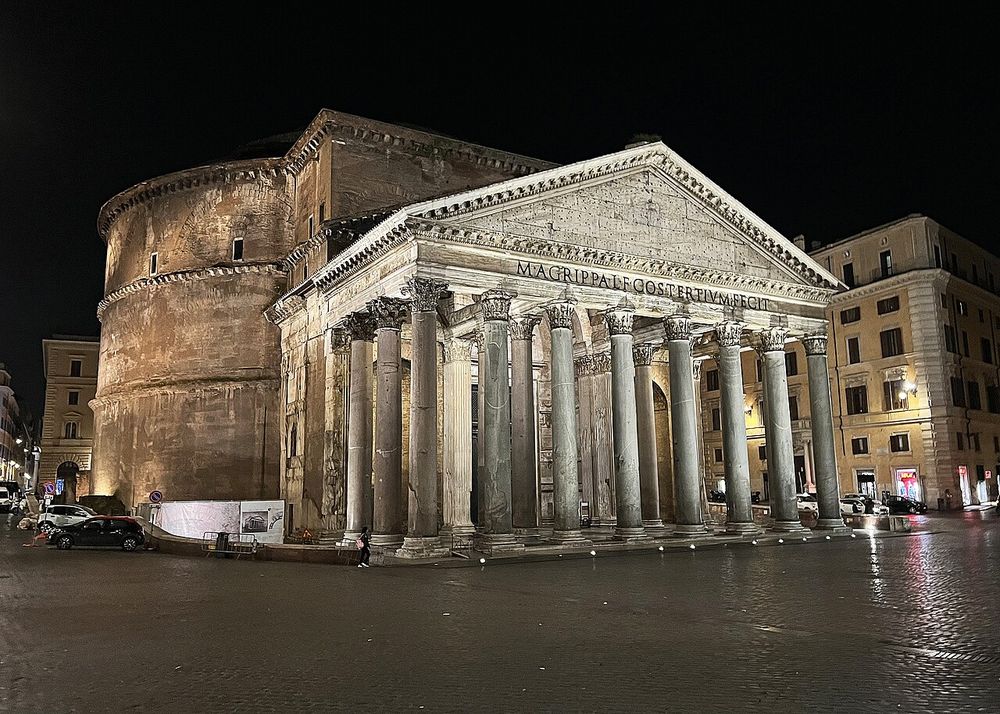
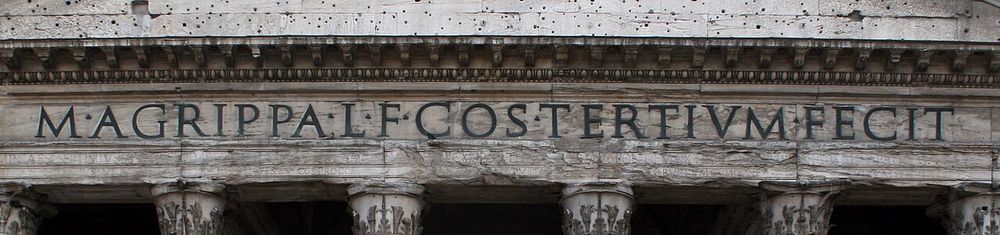
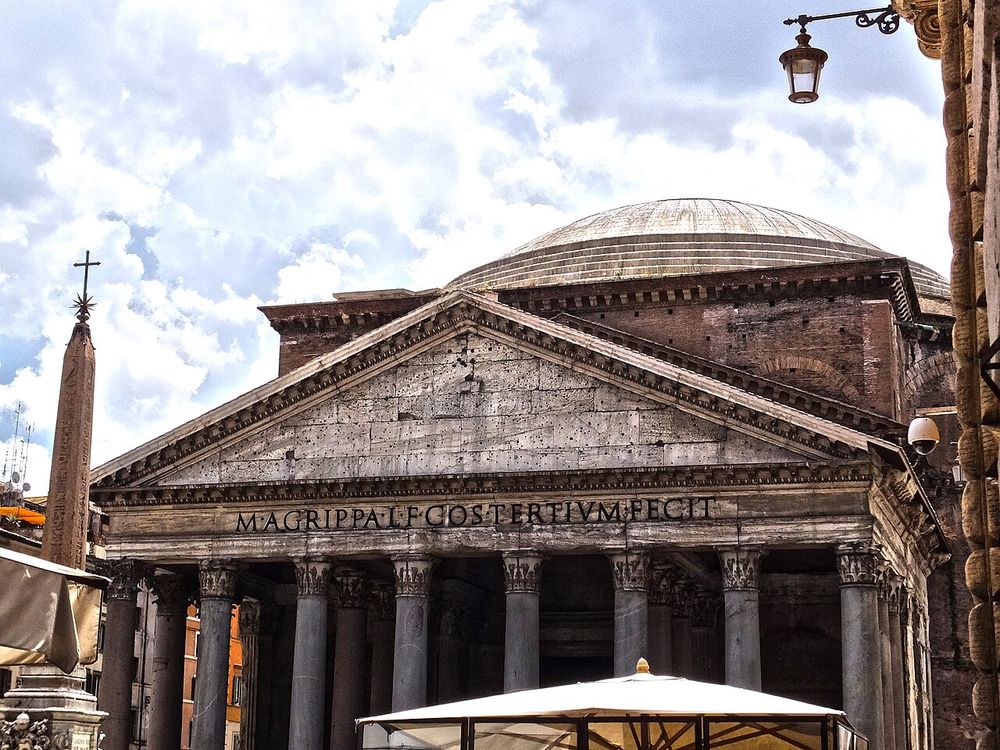
Read the big letters: M·AGRIPPA·L·F·COS·TERTIVM·FECIT. "Marcus Agrippa, son of Lucius, consul for the third time, made this." Agrippa was the friend and general of the first emperor, Augustus. His temple of about 25 BC burned in the year 80, and the one built in its place burned in 110.
Look up inside the porch. The roof beams are bare wood. They were once cased in bronze. In 1625 Pope Urban VIII, of the Barberini family, took the bronze to cast cannon. Romans said: "What the barbarians did not do, the Barberini did."
3. The doors
The porch and doors at nightThink321, CC0
The two bronze doors are about seven metres high. They are ancient, and may be the ones hung in Hadrian's day. Each leaf weighs several tonnes and still turns on its pivots.
Walking through, you pass from a square porch into a round room. The two parts do not quite fit. Look back at the wall above the porch roof and you can see the outline of a second, higher gable. The porch may have been planned for taller columns that never arrived.
4. The dome
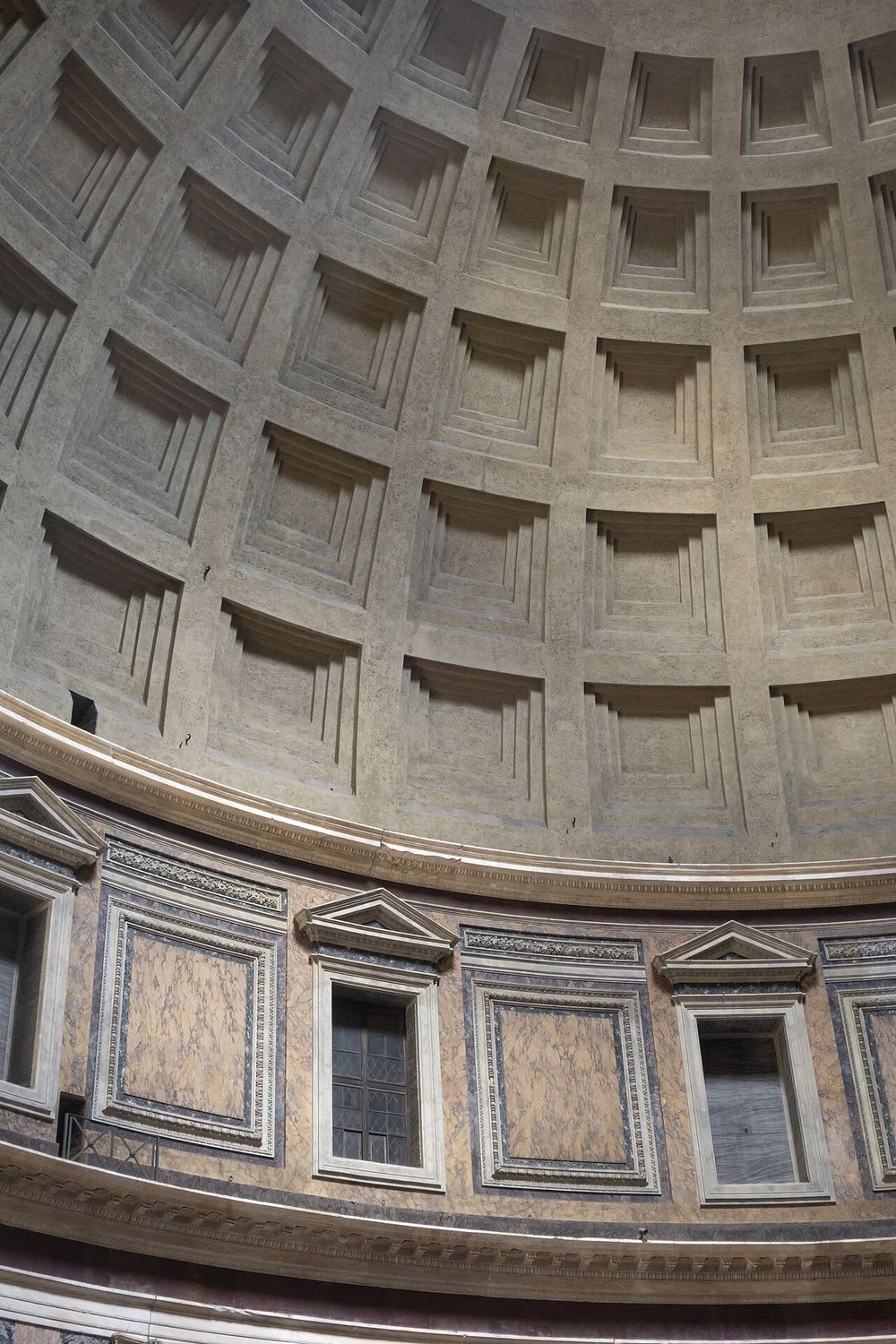
Coffers and the upper wallNicholas Hartmann, CC BY-SA 4.0
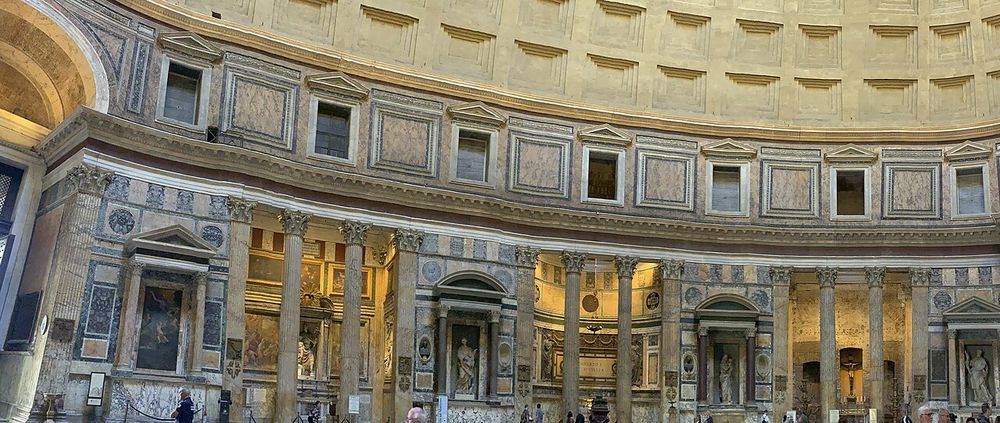
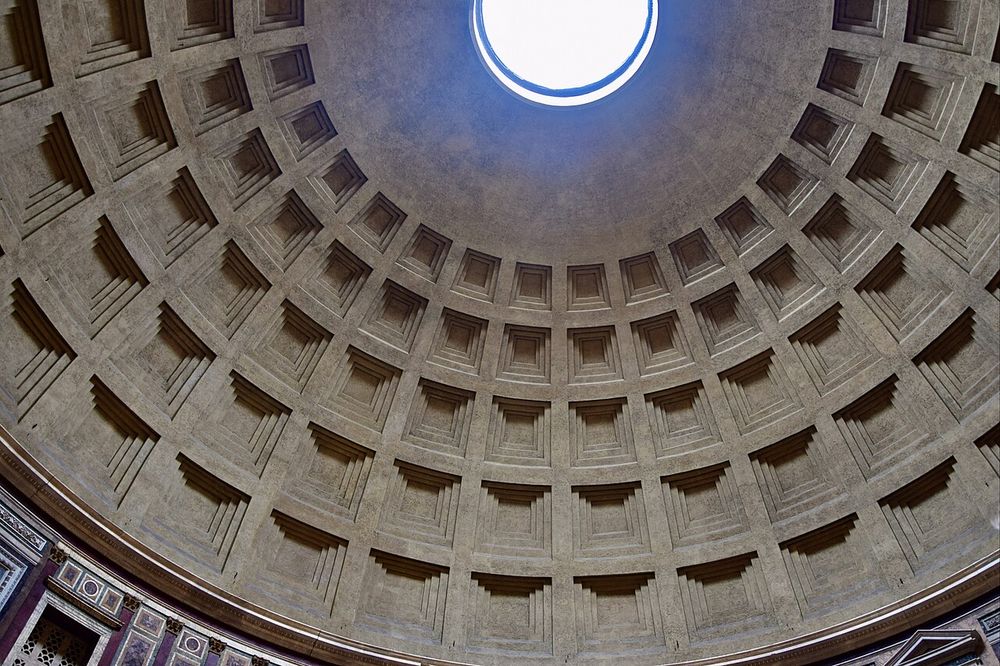
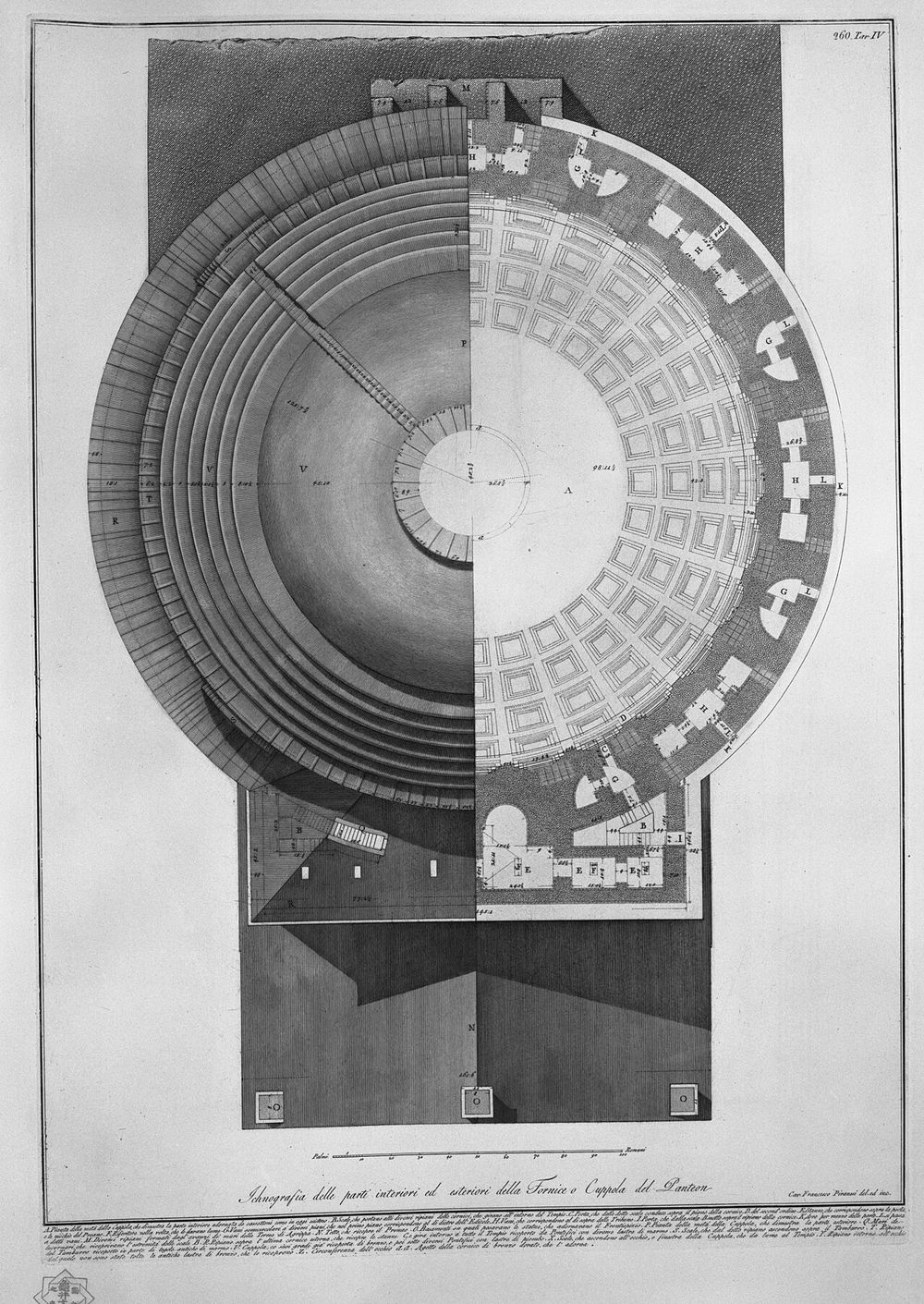
The room is 43.3 metres wide and 43.3 metres high. A ball of that size would sit exactly inside it, touching the floor.
The wall that carries the dome is six metres thick. The dome itself is about six metres thick where it starts and little more than one metre at the top. The builders changed the recipe as they went up: heavy stone in the concrete at the bottom, then brick, then light volcanic stone full of bubbles near the eye.
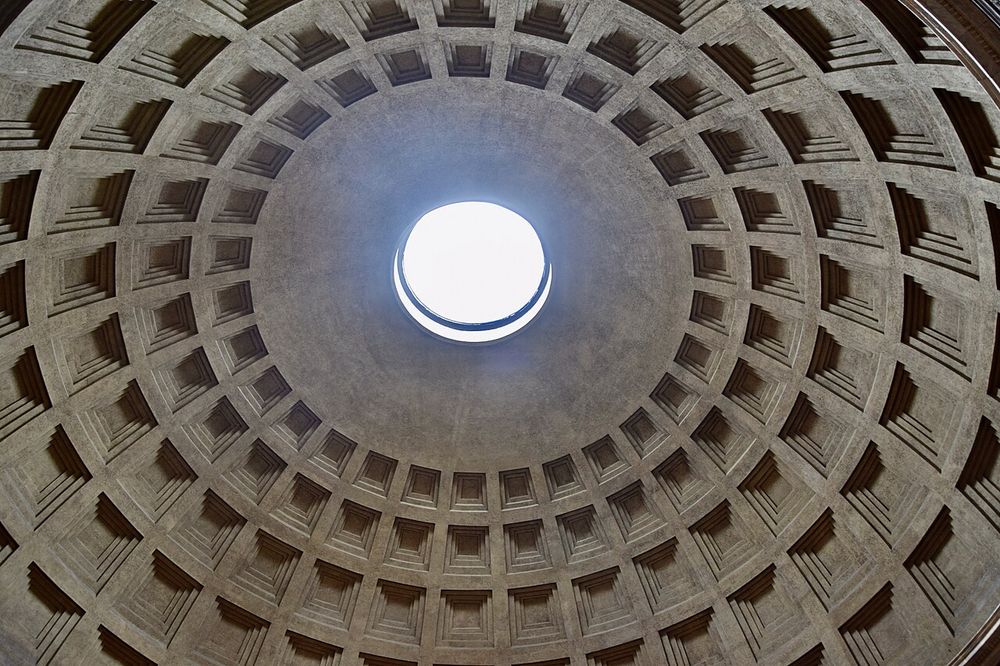
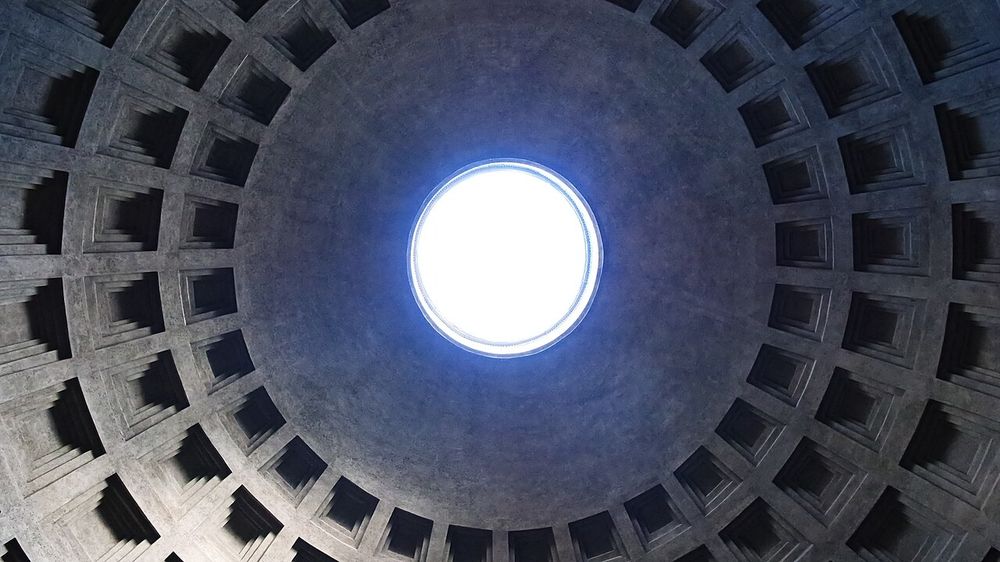
The sunken squares are called coffers. There are 140 of them, in five rings of twenty-eight. They make the dome lighter, and they make it look deeper than it is.
5. The eye
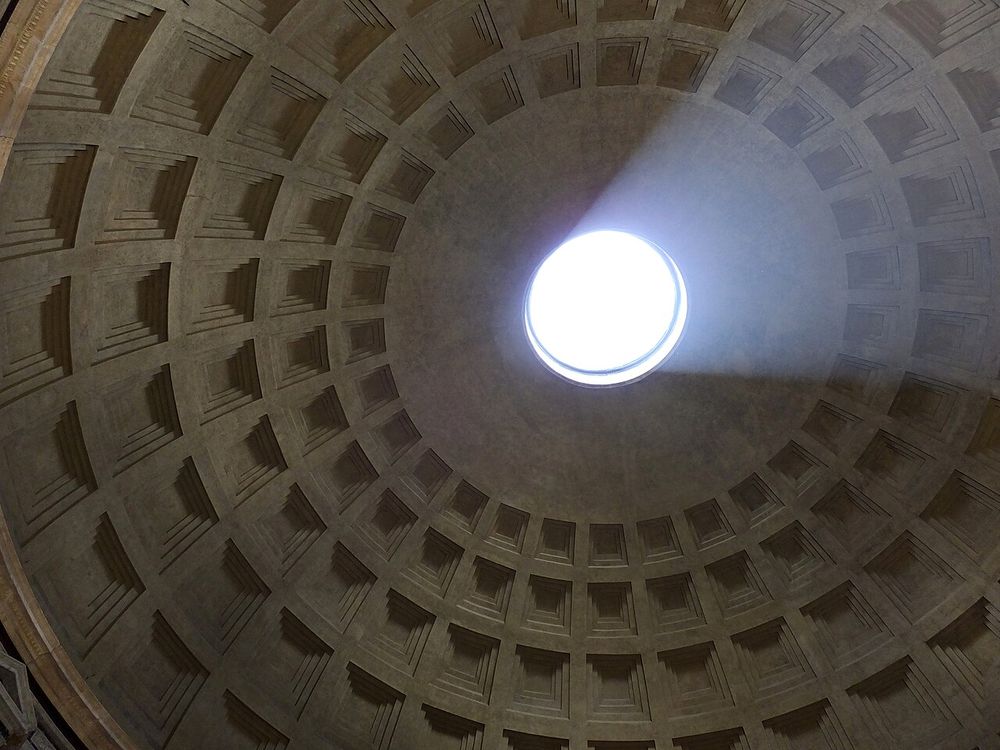
The disc of sunlight high on the domeMaarten Heerlien from Voorschoten, The Netherlands, CC BY 2.0
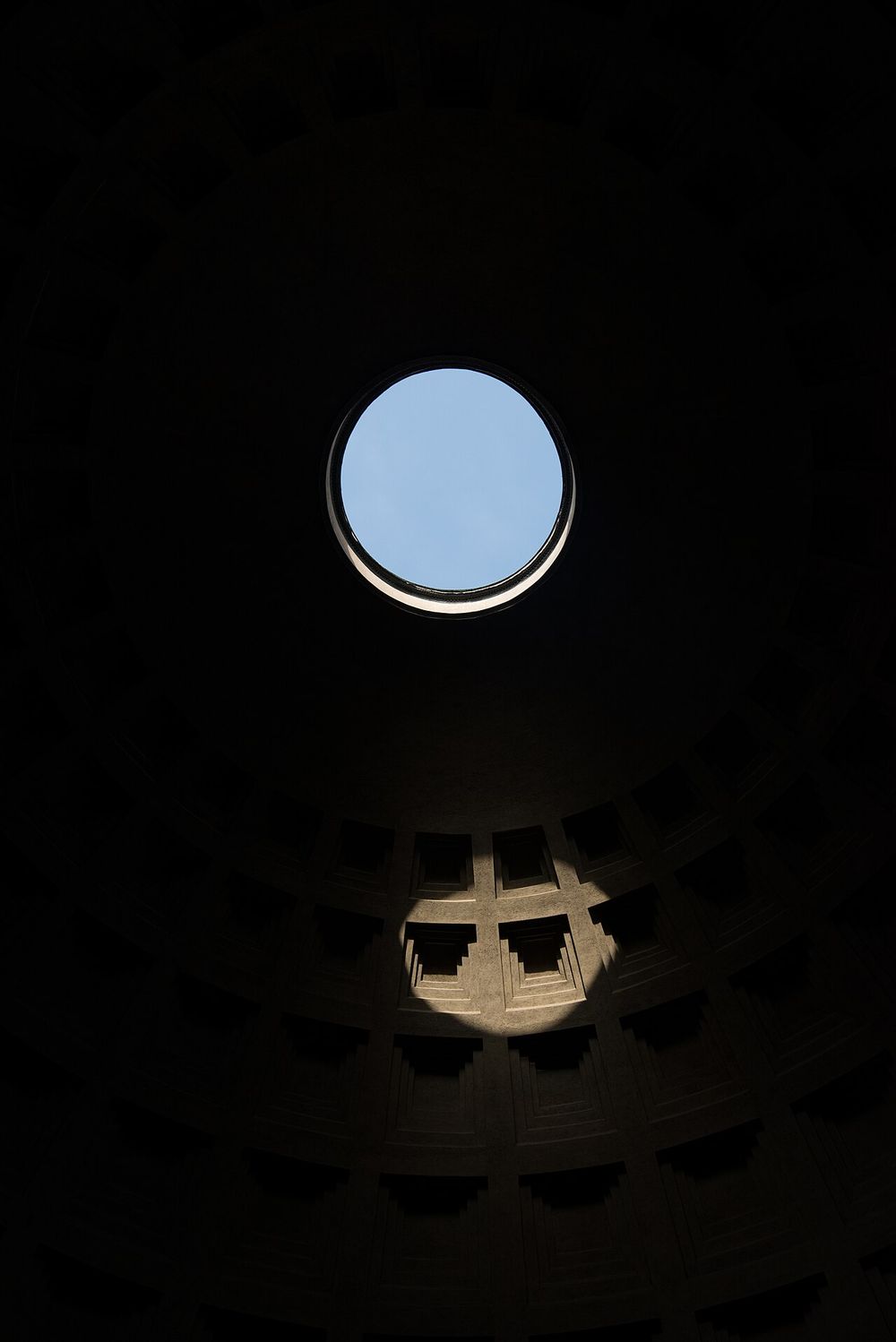
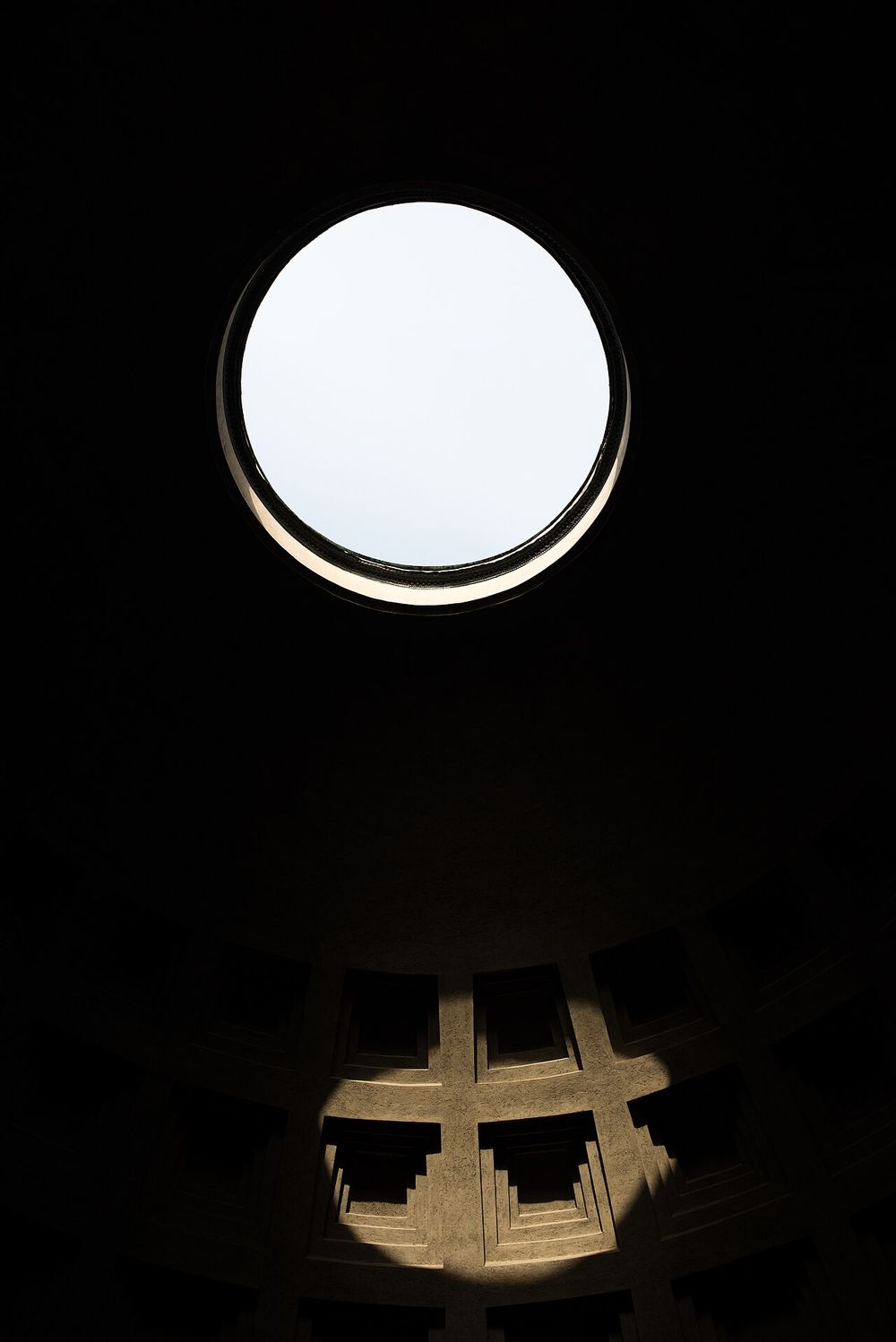
The opening is called the oculus, the eye. It is about nine metres across. It is the only source of light, and it is also what holds the dome together: its ring of brick takes the push of the concrete from all sides, like the keystone of an arch.
The beam of light in the dustAmphipolis, CC BY-SA 2.0
Watch the disc of sunlight. It works as a clock and a calendar. In winter it stays high on the dome. In summer it reaches the floor. At noon on 21 April, the day Romans kept as the birthday of their city, it falls on the doorway.
At Pentecost, fifty days after Easter, firemen climb onto the roof after Mass and pour thousands of red rose petals through the eye.
6. The floor
The rotunda and its recessesNicholas Hartmann, CC BY-SA 4.0
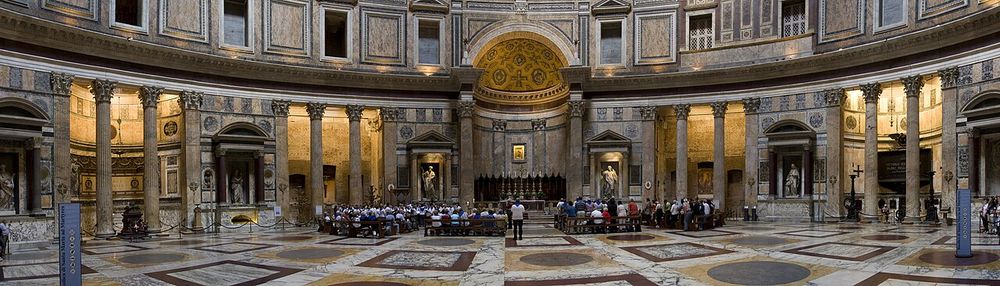
The floor is laid in circles and squares of coloured stone brought from every corner of the empire: purple from Egypt, yellow from Tunisia, white and violet from Turkey. The pattern is Hadrian's, relaid in 1873.
It is not flat. It rises a little in the middle so that rainwater runs outward. Near the centre are twenty-two small holes that take the water down to a Roman drain, which still works.
7. Raphael
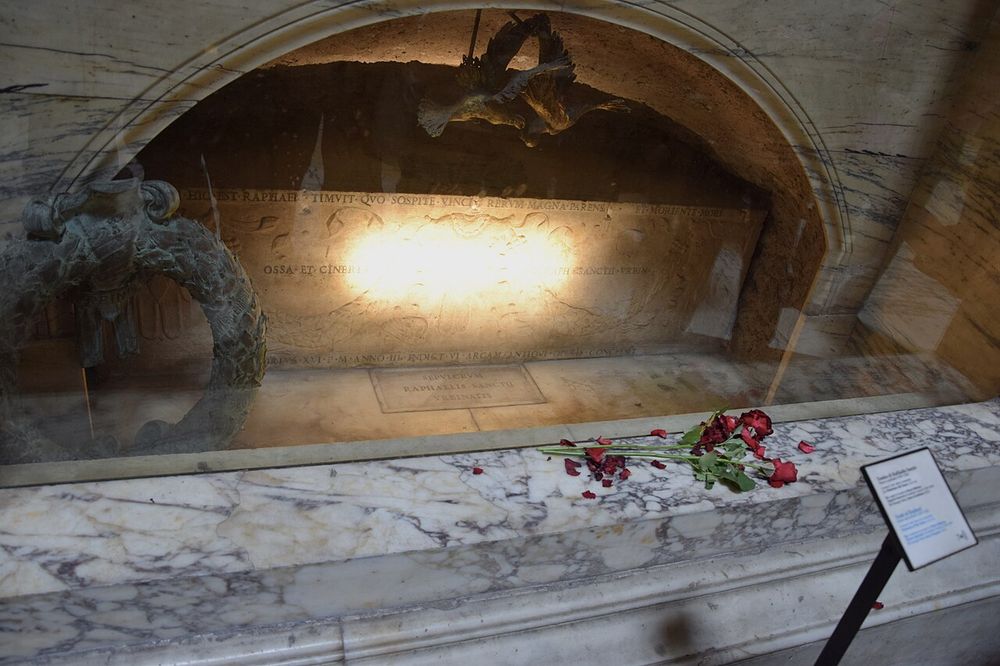
The tomb of RaphaelAnk Kumar, CC BY-SA 4.0
On the left side, between two chapels, a shrine holds a statue of the Virgin and Child. Raphael paid for it in his will. Under it, behind glass, is a Roman stone coffin with his bones.
The Latin lines on the coffin were written by his friend, the poet Pietro Bembo. They say: here lies Raphael; while he lived, Nature feared he would outdo her, and when he died, she feared she would die too.
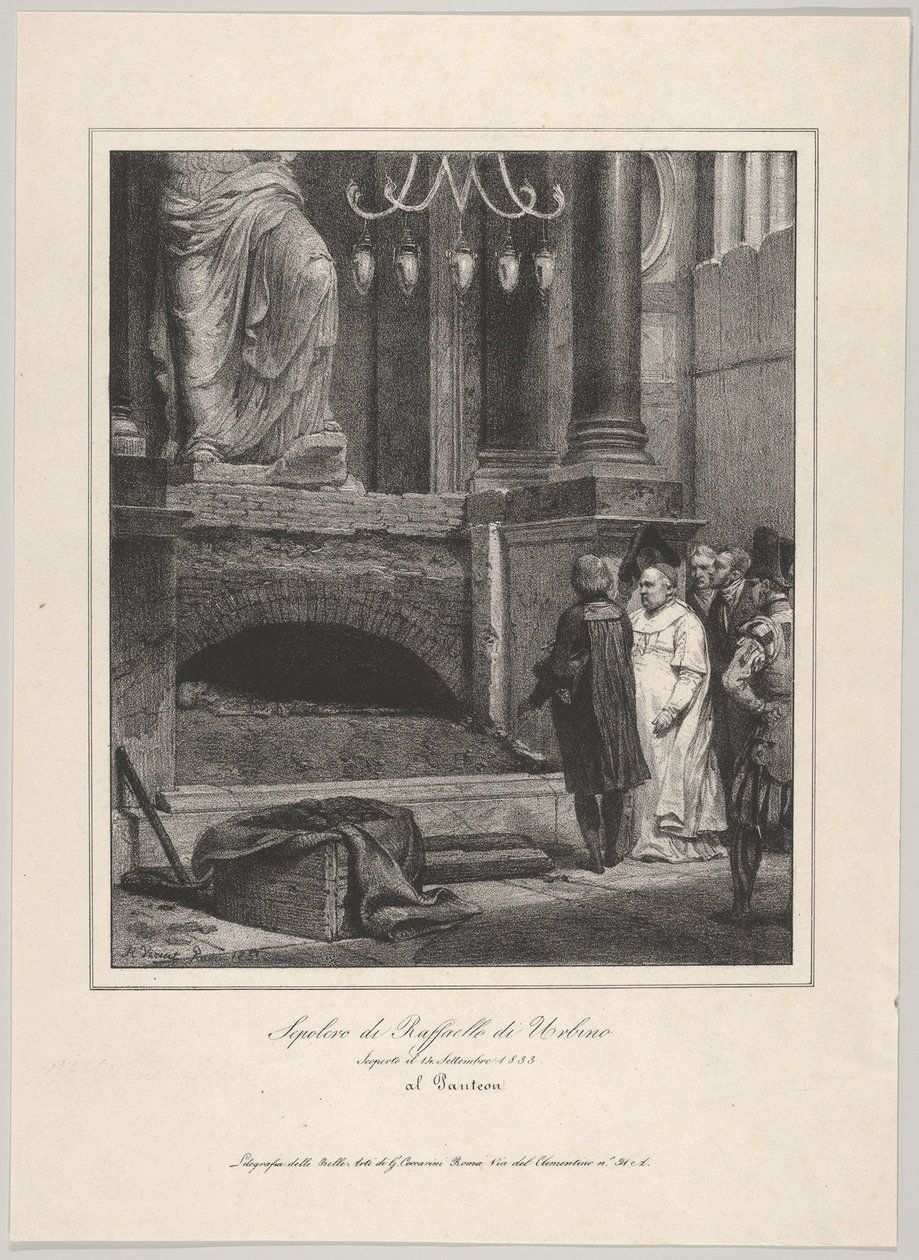
The opening of Raphael's tomb, 14 September 1833Horace Vernet, Public domain
In 1833 people began to doubt that he was really here. The floor was opened in front of a crowd of artists. A skeleton was found, measured, drawn, and put back.
Simple, erect, severe, austere, sublime—
Shrine of all saints and temple of all gods,
From Jove to Jesus—spared and blest by time
Lord Byron, Childe Harold's Pilgrimage, canto IV, 1818
8. Two kings, and the back wall
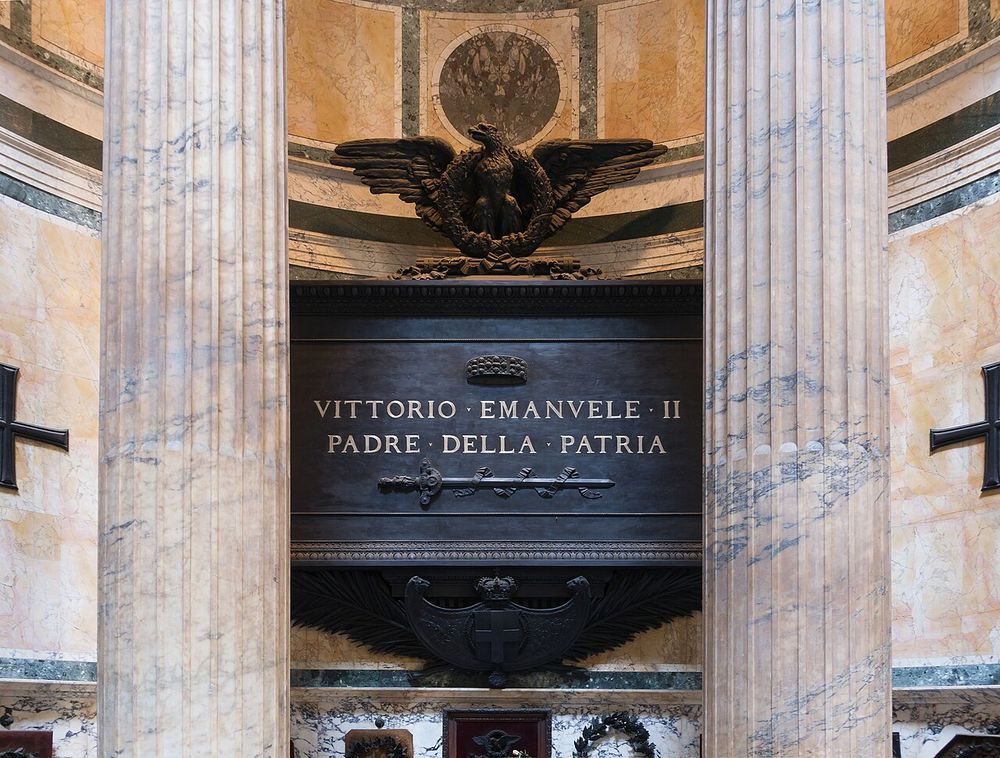
The tomb of Victor Emmanuel II, "father of the fatherland"Jebulon, CC0
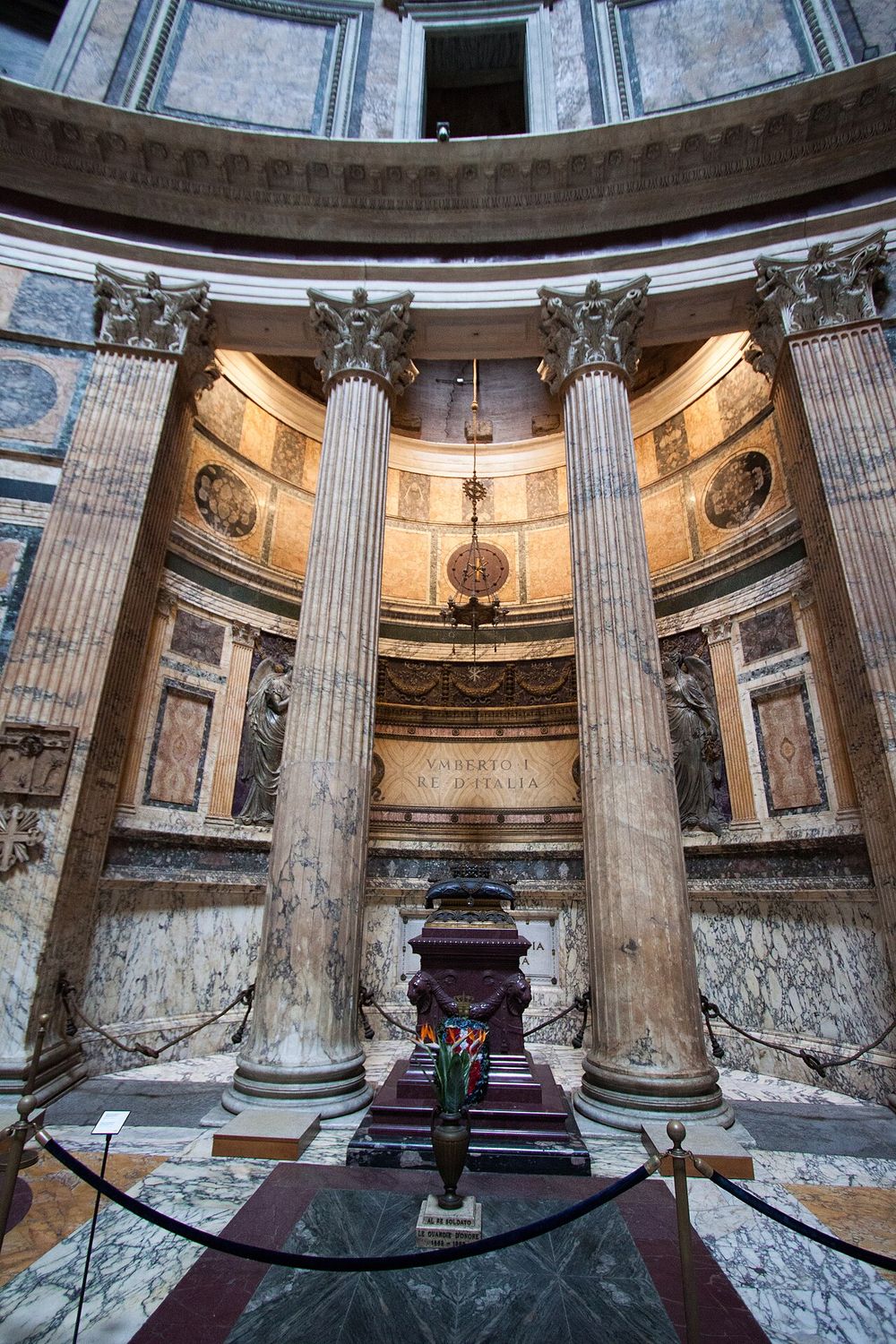
Opposite each other across the room are the tombs of the first two kings of united Italy. Victor Emmanuel II died in 1878. His son Umberto I was shot by an anarchist in 1900 and lies with his queen, Margherita, for whom the pizza is named. Volunteers still stand guard beside them.
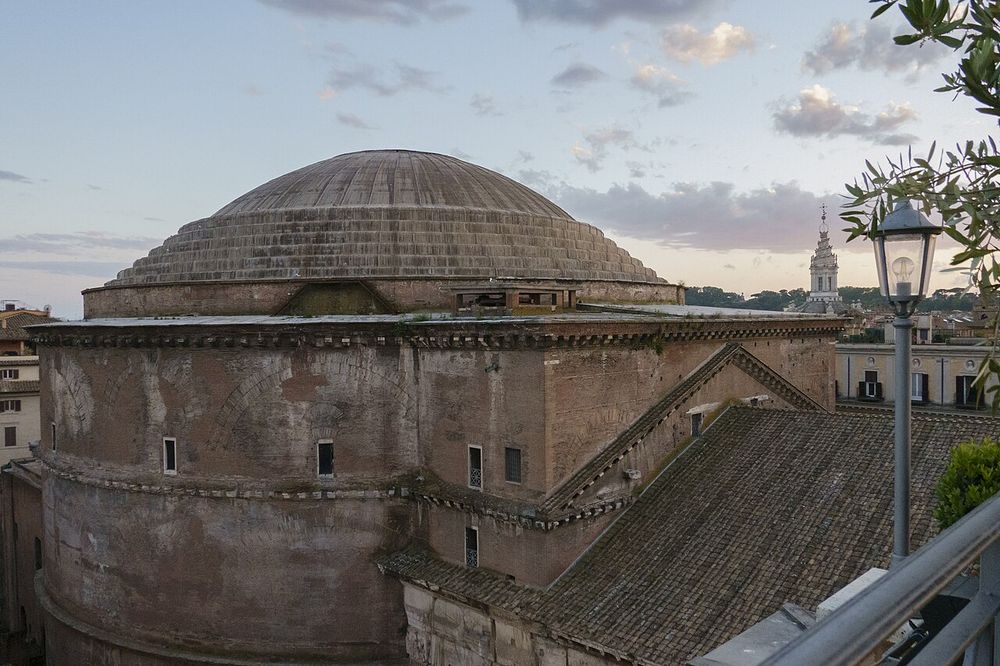
The dome and the round wall from a nearby roofNhartmannphotos, CC BY-SA 4.0
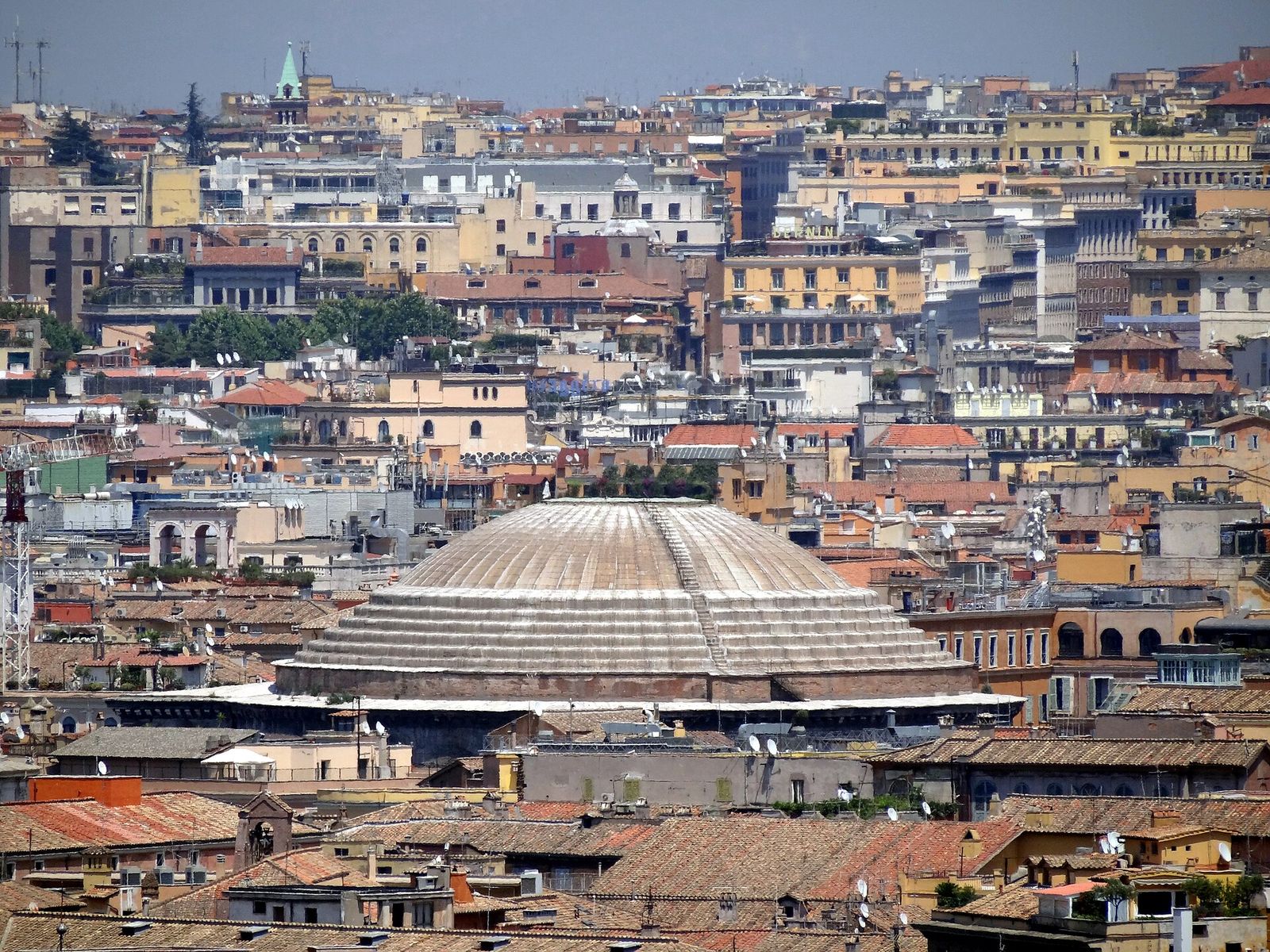
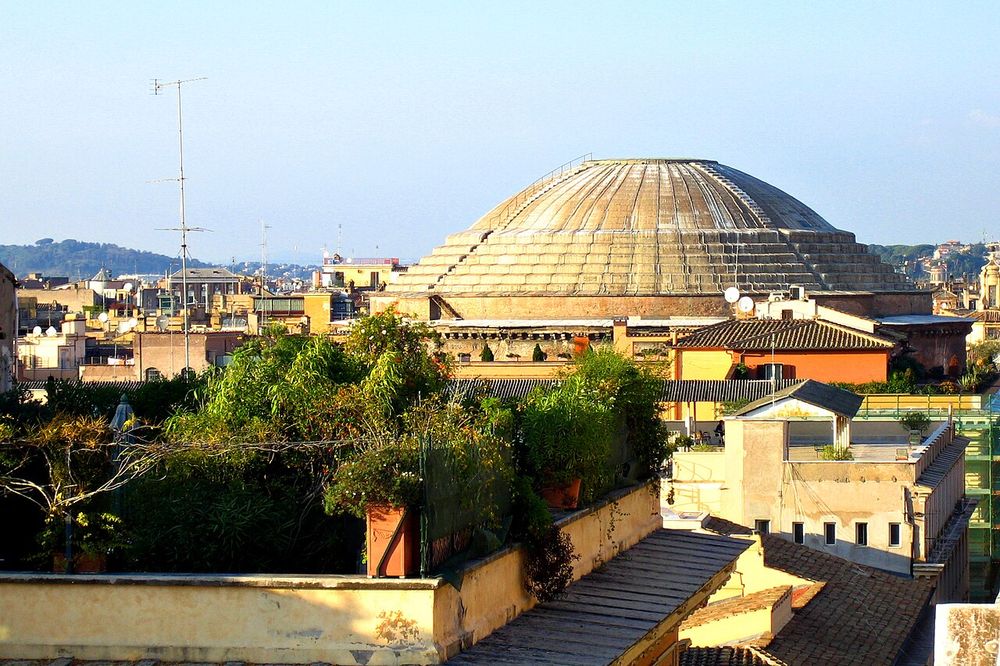
When you come out, turn left and walk round the building. The round wall is plain brick, with great arches built into it to carry the weight down to eight piers. From the street behind you can see how low and wide the dome really is.
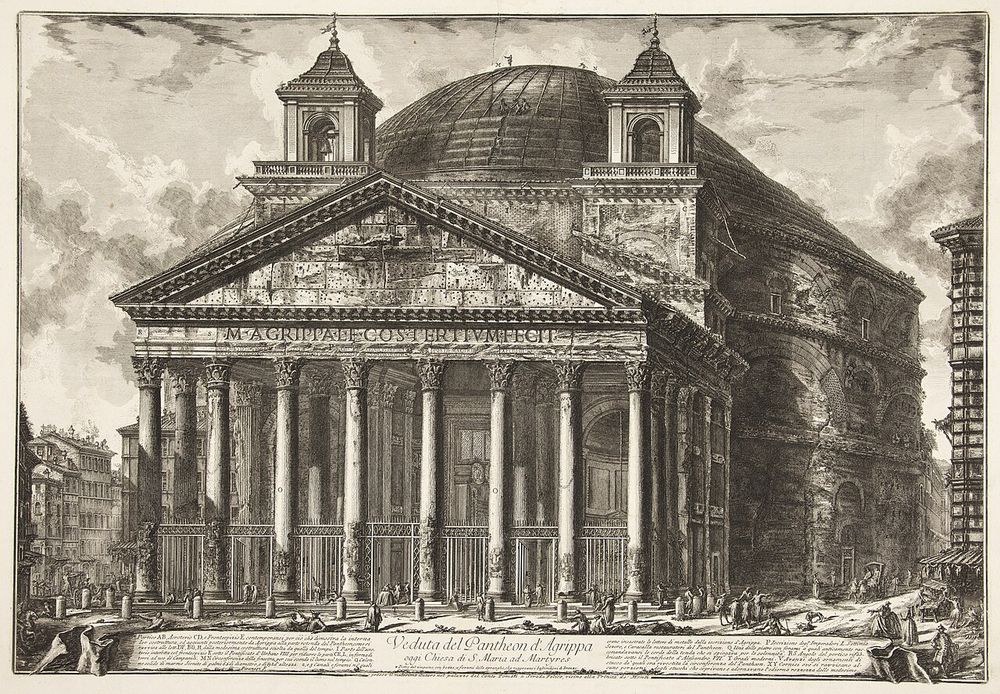
The Pantheon with its two bell towers, etching by Piranesi, 1761Giovanni Battista Piranesi, Public domain
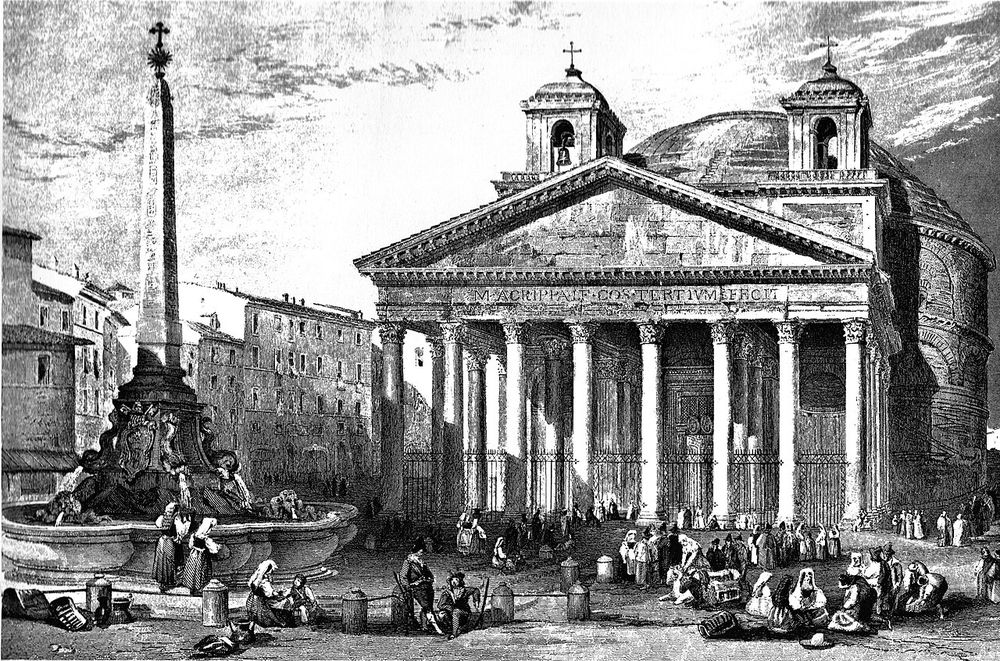
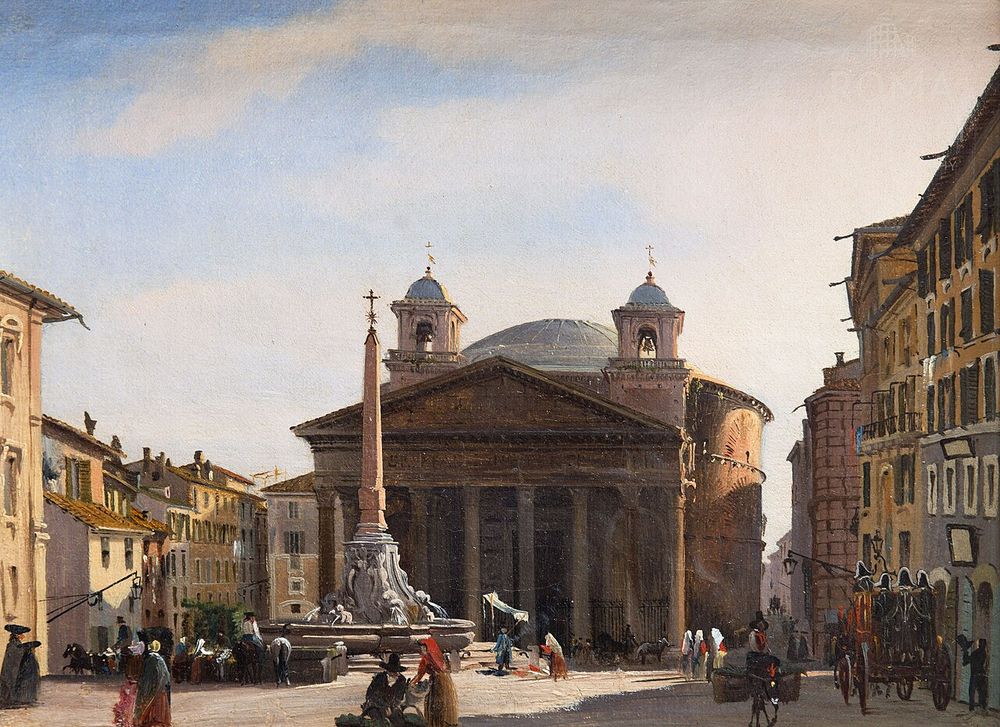
Old prints show two small bell towers on the front. They were added in the 1620s and Romans called them "the ass's ears". They were taken down in 1883.
Meanwhile in the world
Year
Here
Elsewhere
about 25 BC
Agrippa builds the first temple here
Western Han (206 BC–AD 9) China (202 BC–AD 8): the historian Sima Qian has been dead about sixty years
about 125
Hadrian's building is finished
Eastern Han China: Zhang Heng builds his water-driven sphere; twenty years earlier Cai Lun presented paper to the court
609
The temple becomes a church
Sui China (581–618): the Grand Canal is being dug, and the Zhaozhou Bridge, a stone arch that still stands, is new
663
A Byzantine emperor strips the gilded bronze tiles from the roof
Tang China (618–907); Tang and Silla defeat a Japanese fleet off Korea in the same year
1520
Raphael is buried here
Ming China (1368–1644), the Zhengde reign; Magellan's ships find the strait at the foot of South America
1625
The pope takes the bronze from the porch for cannon
The last decades of the Ming (1368–1644); in England Charles I comes to the throne
1878
The first king of Italy is buried here
Qing China, the Guangxu reign; Edison is at work on the electric lamp
2023
A ticket is charged for the first time
China's first large airliner, the C919, carries its first paying passengers
Then and now
The front and the round wall from the squareNicholas Hartmann, CC BY-SA 4.0, Wikimedia CommonsThe dome among the roofs of Rome, from the Janiculum hillBjørn Christian Tørrissen, CC BY-SA 3.0, Wikimedia CommonsThe square on an autumn dayJean-Pol GRANDMONT, CC BY 4.0, Wikimedia CommonsThe front from across the squareRabax63, CC BY-SA 4.0, Wikimedia CommonsThe porch and doors at nightThink321, CC0, Wikimedia CommonsThe Pantheon and its obelisk at duskMariordo, CC BY-SA 4.0, Wikimedia CommonsThe round wall and the porch, litMariordo, CC BY-SA 4.0, Wikimedia CommonsNight, from the fountainDeveshT, CC0, Wikimedia CommonsThe side of the porch at nightMariordo, CC BY-SA 4.0, Wikimedia CommonsThe fountain of 1575 and the Egyptian obeliskKrzysztof Golik, CC BY-SA 4.0, Wikimedia CommonsThe gable against the sunSonse, CC BY 2.0, Wikimedia CommonsAgrippa's name on the frontWknight94, CC BY-SA 3.0, Wikimedia CommonsThe inscriptionRemi Jouan, CC BY-SA 3.0, Wikimedia CommonsThe gable, and above it the outline of a second oneAmphipolis, CC BY-SA 2.0, Wikimedia CommonsCapitals of the porch columnsNicholas Hartmann, CC BY-SA 4.0, Wikimedia CommonsOne of the granite columnsCarole Raddato from FRANKFURT, Germany, CC BY-SA 2.0, Wikimedia CommonsLooking out from the porchWknight94, CC BY-SA 3.0, Wikimedia CommonsThe dome from the floorAnk Kumar, CC BY-SA 4.0, Wikimedia CommonsThe five rings of coffersAnk Kumar, CC BY-SA 4.0, Wikimedia CommonsLight on the coffersAnk Kumar, CC BY-SA 4.0, Wikimedia CommonsCoffers and the upper wallNicholas Hartmann, CC BY-SA 4.0, Wikimedia CommonsThe eyeT. Le Berre, CC BY-SA 4.0, Wikimedia CommonsThe beam of light in the dustAmphipolis, CC BY-SA 2.0, Wikimedia CommonsThe disc of sunlight high on the domeMaarten Heerlien from Voorschoten, The Netherlands, CC BY 2.0, Wikimedia CommonsThe eye and its reflectionMaarten Heerlien from Voorschoten, The Netherlands, CC BY 2.0, Wikimedia CommonsThe rotunda and its recessesNicholas Hartmann, CC BY-SA 4.0, Wikimedia CommonsThe whole room in one viewMaros M r a z (Maros), CC BY 2.5, Wikimedia CommonsThe tomb of RaphaelAnk Kumar, CC BY-SA 4.0, Wikimedia CommonsRoses on Raphael's coffinAnk Kumar, CC BY-SA 4.0, Wikimedia CommonsThe tomb of Umberto I and Queen MargheritaSzilas, CC0, Wikimedia CommonsThe tomb of Victor Emmanuel II, "father of the fatherland"Jebulon, CC0, Wikimedia CommonsThe dome and the round wall from a nearby roofNhartmannphotos, CC BY-SA 4.0, Wikimedia CommonsThe dome from aboveUnknown, CC BY 2.0, Wikimedia CommonsThe interior painted by Giovanni Paolo Panini, about 1734Giovanni Paolo Panini, Public domain, Wikimedia CommonsThe Pantheon with its two bell towers, etching by Piranesi, 1761Giovanni Battista Piranesi, Public domain, Wikimedia CommonsPlan of the dome and floor, from Piranesi's workshop, 1790Francesco Piranesi, Public domain, Wikimedia CommonsThe square in the 1780s, watercolour by Louis DucrosAbraham-Louis-Rodolphe Ducros (Moudon, 1748 - Lausanne, 1810), Swiss engraver an, Public domain, Wikimedia CommonsThe square as a market, engraving of about 1835William Bernard Cooke / After William Leighton Leitch, Public domain, Wikimedia CommonsThe Pantheon painted by Ippolito Caffi in the mid nineteenth centuryIppolito Caffi, Public domain, Wikimedia CommonsThe opening of Raphael's tomb, 14 September 1833Horace Vernet, Public domain, Wikimedia CommonsAn early photograph, with the bell towers still in placeUnknown, Public domain, Wikimedia CommonsThe front in a photograph of the later nineteenth centuryUnknown authorUnknown author, Public domain, Wikimedia Commons
Video
Films from official channels, played from YouTube. Nothing is loaded until you press play.
The historic centre of RomeUNESCO · made with NHK; 3 min · checked 2026-11-12
Local legends
These are stories people tell about this place. They are legends, not history, and each one says where it comes from.
LegendThe devil's ditch
A wizard made a bargain with the devil and then cheated him of his soul by taking refuge in the church. The devil, in his rage, ran round and round the building, and his feet wore the ditch that lies about its walls.
Source: Medieval Roman tale, told in the Mirabilia tradition
LegendThe demons through the roof
When the pope blessed the temple as a church in 609, the demons who had lived in it as gods fled upward in a rush and burst through the top of the dome. The hole they made is the eye.
Source: Medieval Roman legend
LegendThe mound of earth
To build the dome, the emperor had the room filled to the top with earth, mixed with gold coins, and the concrete was laid over it. When it was dry he told the people they could keep whatever they dug out, and the room was empty in a day.
Source: Roman popular tradition, recorded by travellers from the sixteenth century
LegendTwenty-eight carts of bones
When the temple became a church, the pope had the bones of martyrs brought from the burial tunnels outside the city, twenty-eight cartloads of them, and laid under the altar.
Source: Church tradition, first written down centuries after 609
Later, people who live here will be able to add the stories they grew up with, and say which of these they have heard.
Not certain, and where accounts conflict
What was it for?
No Roman account of the ceremonies held here survives. A historian writing a century later was already guessing: perhaps it was named for the statues of many gods, he says, or perhaps because the dome is like the heavens.
Who designed it?
Nobody knows. Stamps on the bricks show that building began about 114, under the emperor before Hadrian. The names of the architect and the engineers were not recorded.
Did the bronze go into Bernini's canopy?
Guides say the bronze from the porch was used for the great canopy over the altar of St Peter's. The accounts of the time show that almost all of it went to make cannon for the pope's castle.
Was the porch a mistake?
The higher gable traced on the wall suggests a porch planned for columns fifteen metres tall. One explanation is that the larger columns were lost at sea or could not be quarried in time. It is a good theory and it cannot be proved.
Five euros or seven?
In November 2026 the official page still gave the full price as 5 euros. Several travel sites reported that it rose to 7 euros on 1 July 2026. Take the price shown when you book as the true one.
Visiting
Tickets and hours
The official page gives the full ticket as 5 euros and 2 euros for citizens of the European Union aged 18 to 25. Travel sites report 7 euros for the full ticket since July 2026.
Under 18 is free. So is everyone on the first Sunday of the month, when there is no booking and the queue is long.
Open every day from 9:00 to 19:00. Last entry is at 18:30. Closed on 1 January and 25 December.
Mass is at 17:00 on Saturdays and 10:30 on Sundays and holy days. Only worshippers go in during Mass, and ticket sales stop an hour before.
Last checked 2026-11-12. The page of the state museums of Rome (direzionemuseiroma.cultura.gov.it), hours, prices and rules as shown in November 2026.
Booking from abroad
Official page in English The state museums of Rome give the hours, prices and rules in English: direzionemuseiroma.cultura.gov.it. That page says tickets are sold online only on the Musei Italiani portal and app, where you can register with an email address. Tickets for each month are released in the middle of the month before.
Ticket window on site Tickets are also sold on the day at the ticket office and the machines on site, in cash or by card. The office closes at 18:00.
Note The ticket carries your name. Bring the passport or identity card that matches it, or a copy; without it you may be refused entry and the ticket is not refunded. There is no fast lane.
Checked 2026-11-12
Where to start
No metro station is close. Walk from Piazza Navona, five minutes, or from the Trevi Fountain, ten. Buses stop at Largo di Torre Argentina, five minutes to the south.
Go at 9:00 or after 17:00 for a quieter room. Go between 11:00 and 13:00 on a sunny day for the beam of light.
Half an hour inside is enough for most people. Give ten minutes more to the walk round the outside.
If it rains, go. It is the one day you can watch rain fall through the roof of a church.
Before you go
Shoulders must be covered, and very short shorts or skirts are not allowed.
No food or drink inside, and no pets. There is no cloakroom, so do not bring large bags.
The Roma Pass does not cover the Pantheon.
The floor is uneven and can be slippery when wet. The entrance is level with the square.
Customs and manners
This is a church. Take off your hat and keep your voice down; attendants call for silence when the room grows loud.
Do not sit on the floor, the steps of the altars or the bases of the columns.
You may take photographs, without flash near the altars.
At the royal tombs, the guards will ask you to sign a book only if you wish to. You may simply walk past.
Opening hours are given in the local time of the place. Prices are in the local currency. The figure after ≈ is approximate, at exchange rates checked on 9 November 2026, in .
Look for these
Count the columns across the front of the porch. Then count the rows behind them.
Some of the columns are grey and some are pink. Which are in front?
Find the letters COS on the front. What office do they stand for?
Inside, find the disc of sunlight. Is it on the dome, the wall or the floor?
Count the coffers in one ring.
Find the small holes in the floor near the middle. What are they for?
At Raphael's tomb, find his name in the Latin on the coffin.
Outside, find the outline of a second gable above the porch roof.
I am here
Stand at the site, sign in, press the button, and collect its stamp. Your browser will ask to use your location. It is sent to us once to confirm that you are at the site; we keep how far you were from it, not the spot where you stood.
Your stamps are saved to your account, so they follow you to any device. Checking from a browser cannot rule out every false location; stricter checks arrive with the app.
Messages
Share your photos
Photos here show the place, not people. Each one is credited to the visitor who took it and appears after our team has looked at it. A photo with you in it belongs under “I am here”.