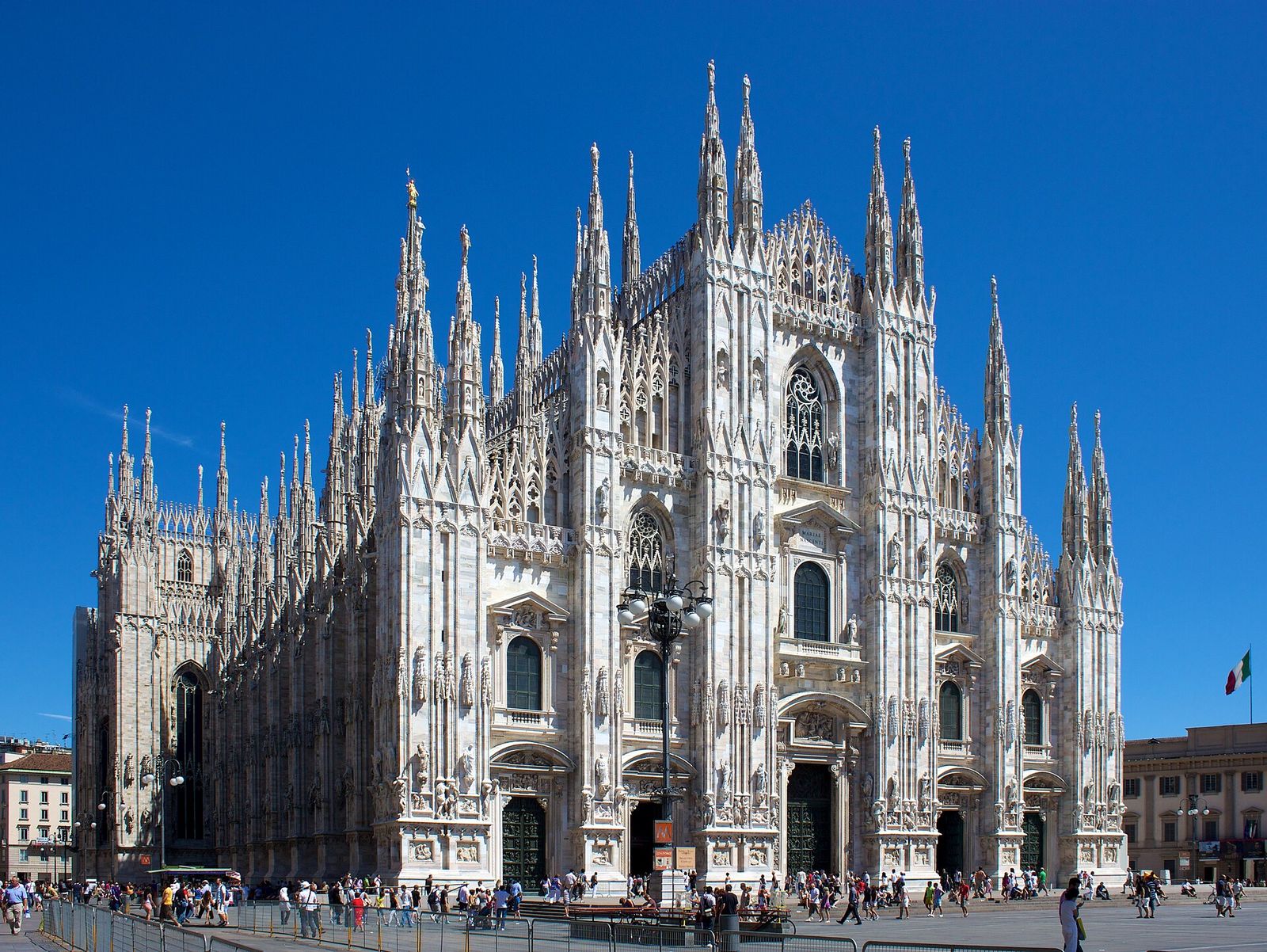
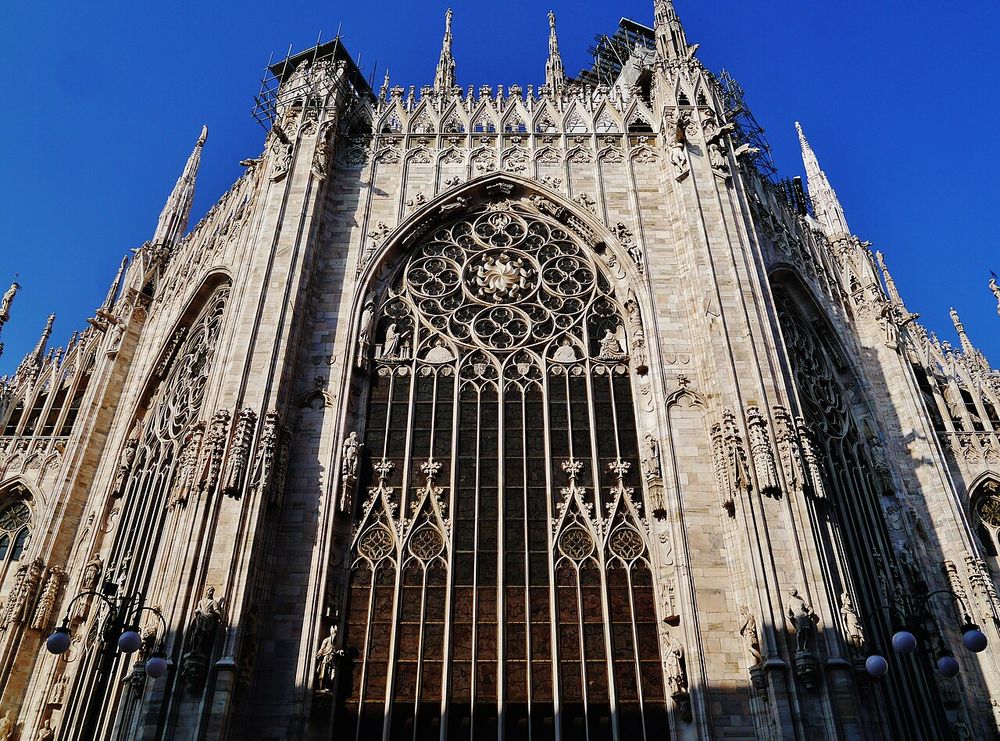
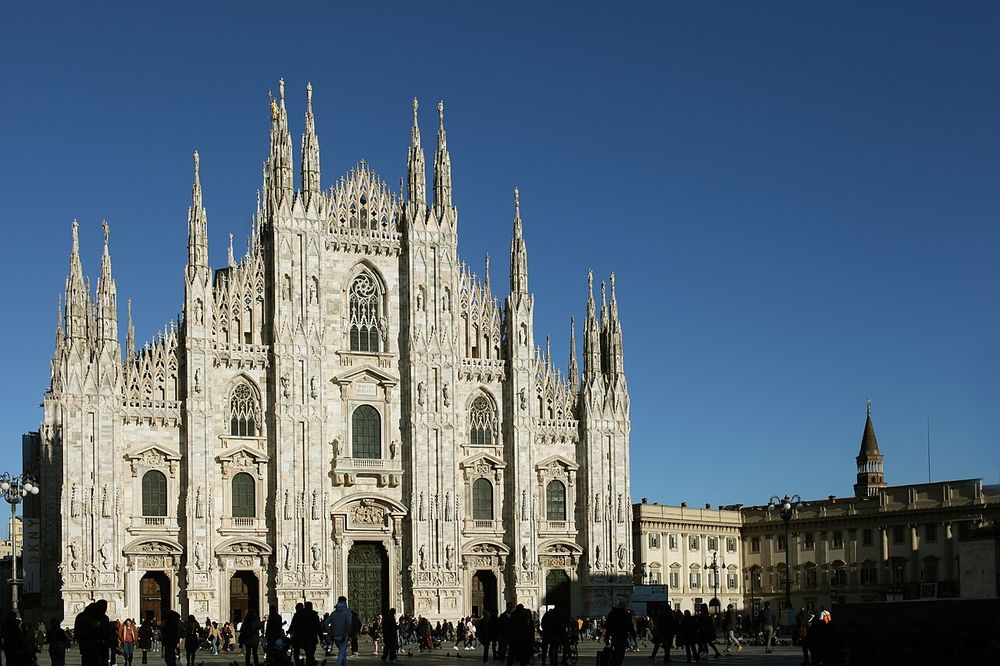
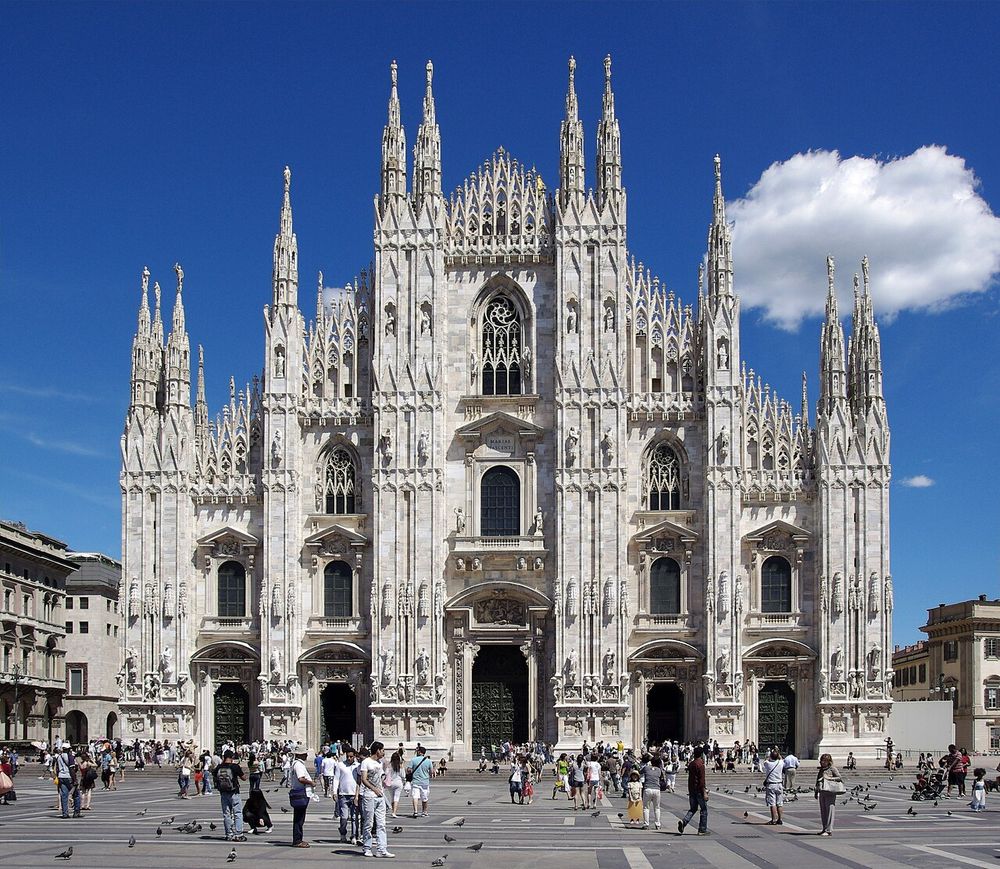
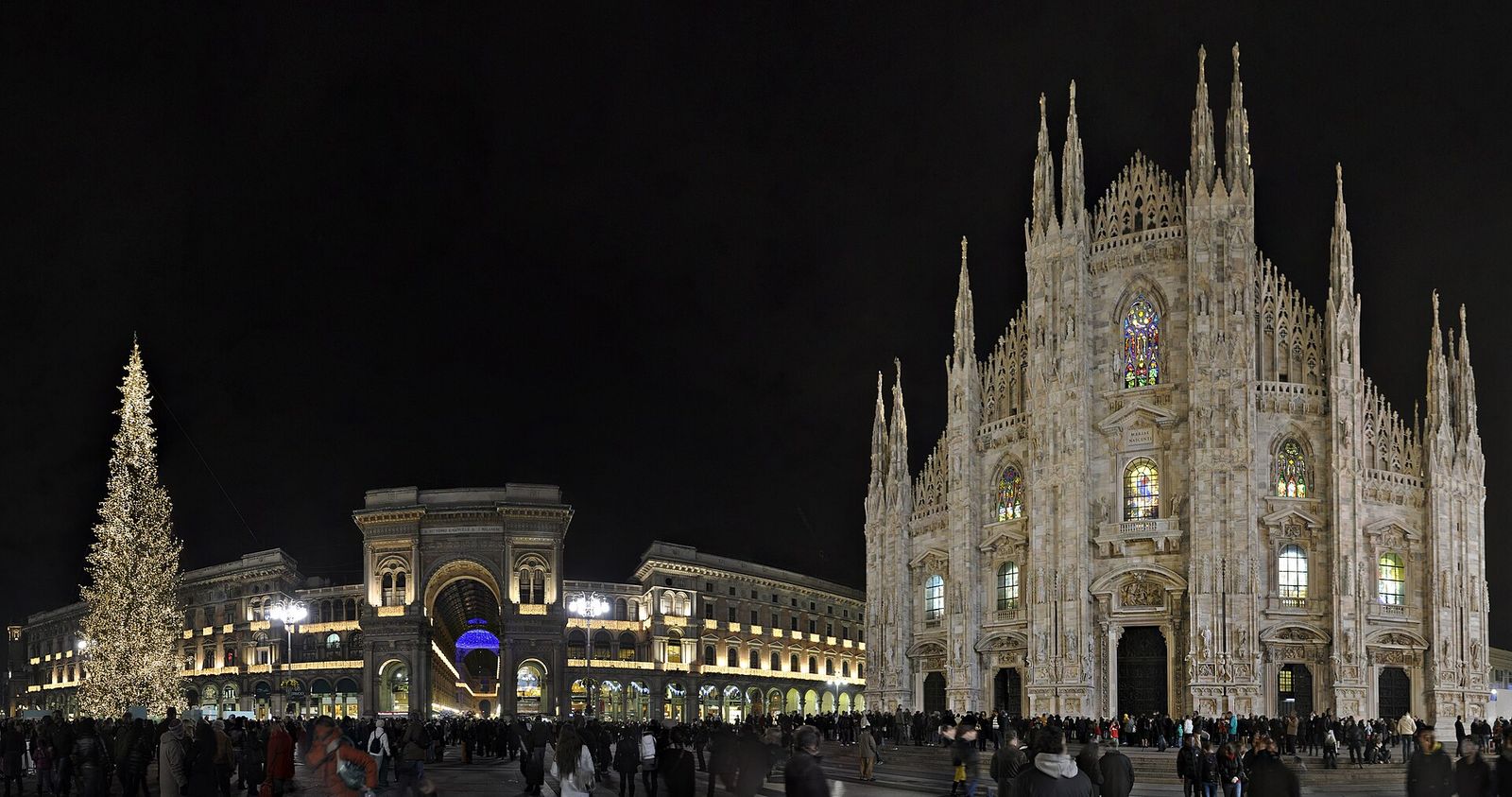
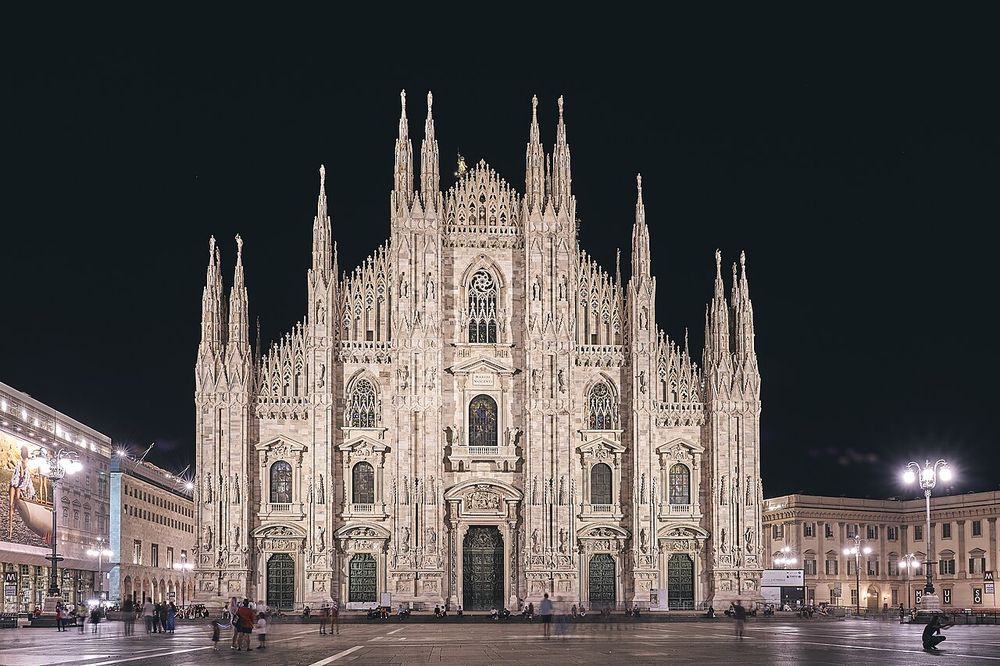
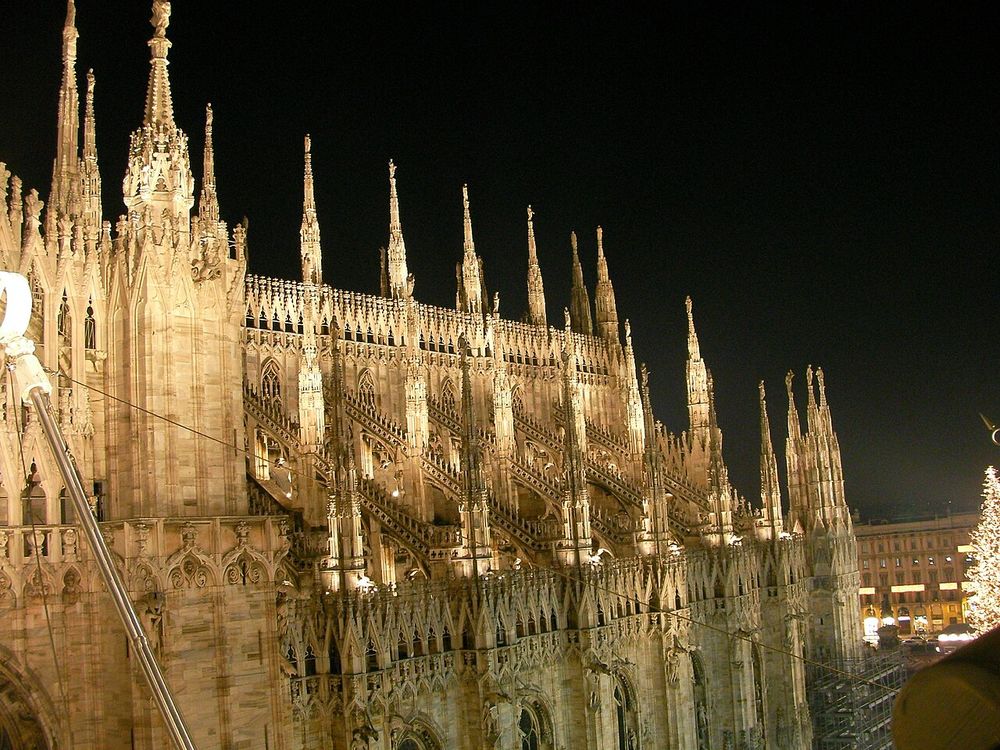
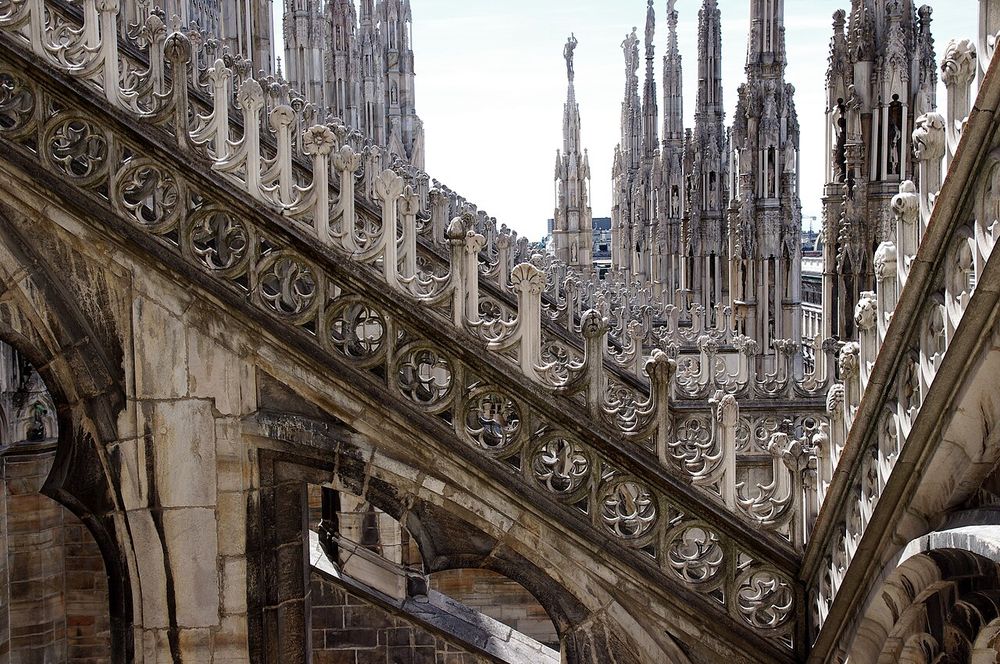
A mountain of pinkish-white marble with 135 spires and 3,400 statues, begun in 1386 and declared finished in 1965. The workshop that built it has never closed. You may walk on the roof.
Photo: kuhnmi, CC BY 2.0, Wikimedia Commons
The story
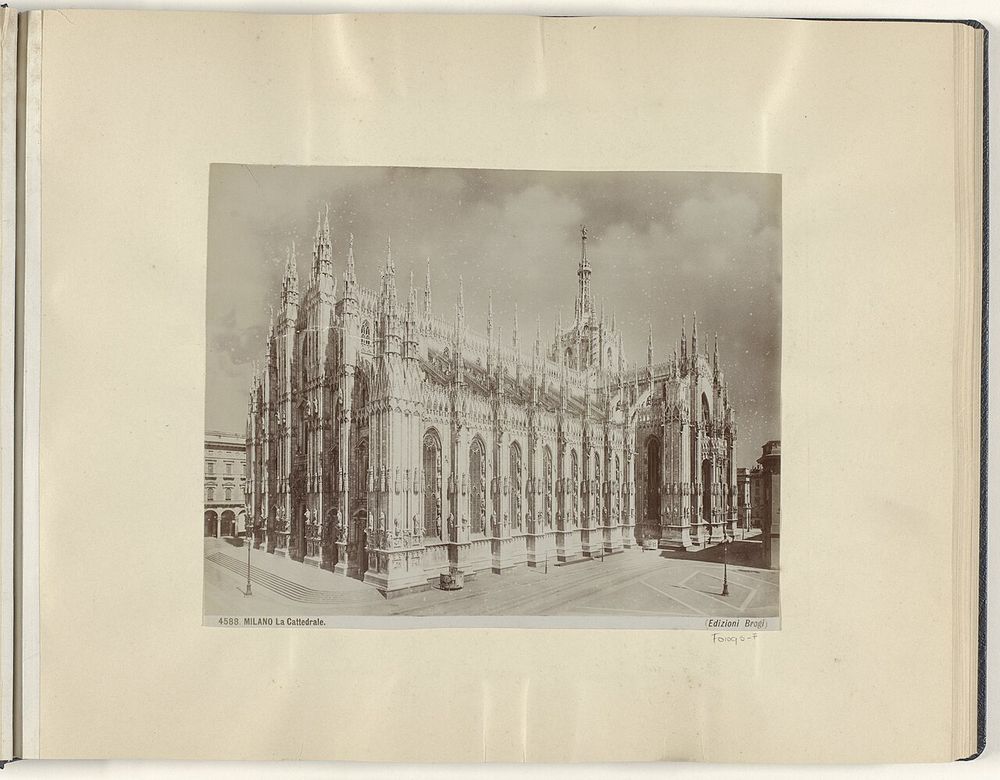
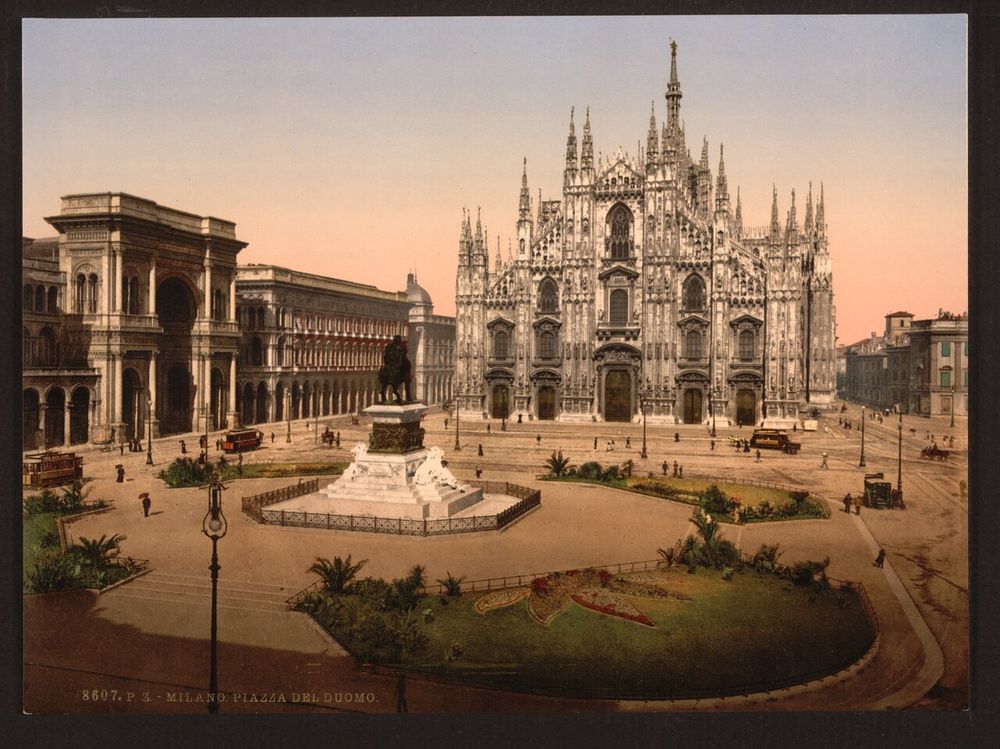
You come up out of the underground into a wide open square, and one side of it is a cliff of pale stone cut into points. There are spires on the gables, spires on the buttresses, spires on the spires, each with a small figure standing on top. In the morning the stone is grey-white. Towards evening it turns the colour of the inside of a shell.
The first stone was laid in 1386. In China it was the nineteenth year of the first Ming emperor; in England Chaucer was about to begin The Canterbury Tales.
What is here
The church, the roof and the museum are sold together or apart. The cheapest way to see the roof is to climb.
Milan in 1386 belonged to the Visconti family, who wanted a church to match the great cathedrals of France and Germany. Italy built in brick. The duke gave the builders a whole mountain of marble near Lake Maggiore, a hundred kilometres away, and the blocks were floated by lake, river and canal into the middle of the city.
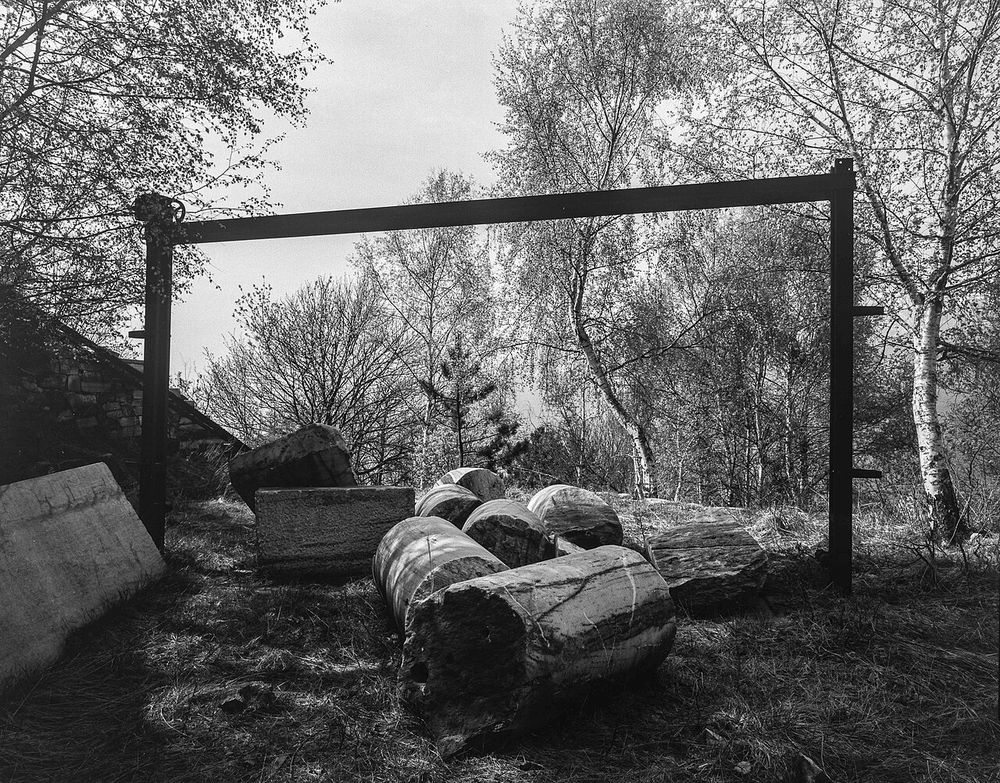
A body called the Fabbrica, the Works, was set up the next year to manage the money and the masons. It is still there, in the building behind the cathedral, and still owns the quarry. Every stone that wears out is replaced with a new one from the same mountain.
The church was in use within thirty years. The dome took a century, the great spire four centuries, the front more than four, and the last bronze door was hung in 1965. In Milan anything that never ends is said to be "as long as the building of the Duomo".
Things people often get wrong
"It is the largest church in Italy after St Peter's." St Peter's is in the Vatican, which is another country. This is the largest church in Italy.
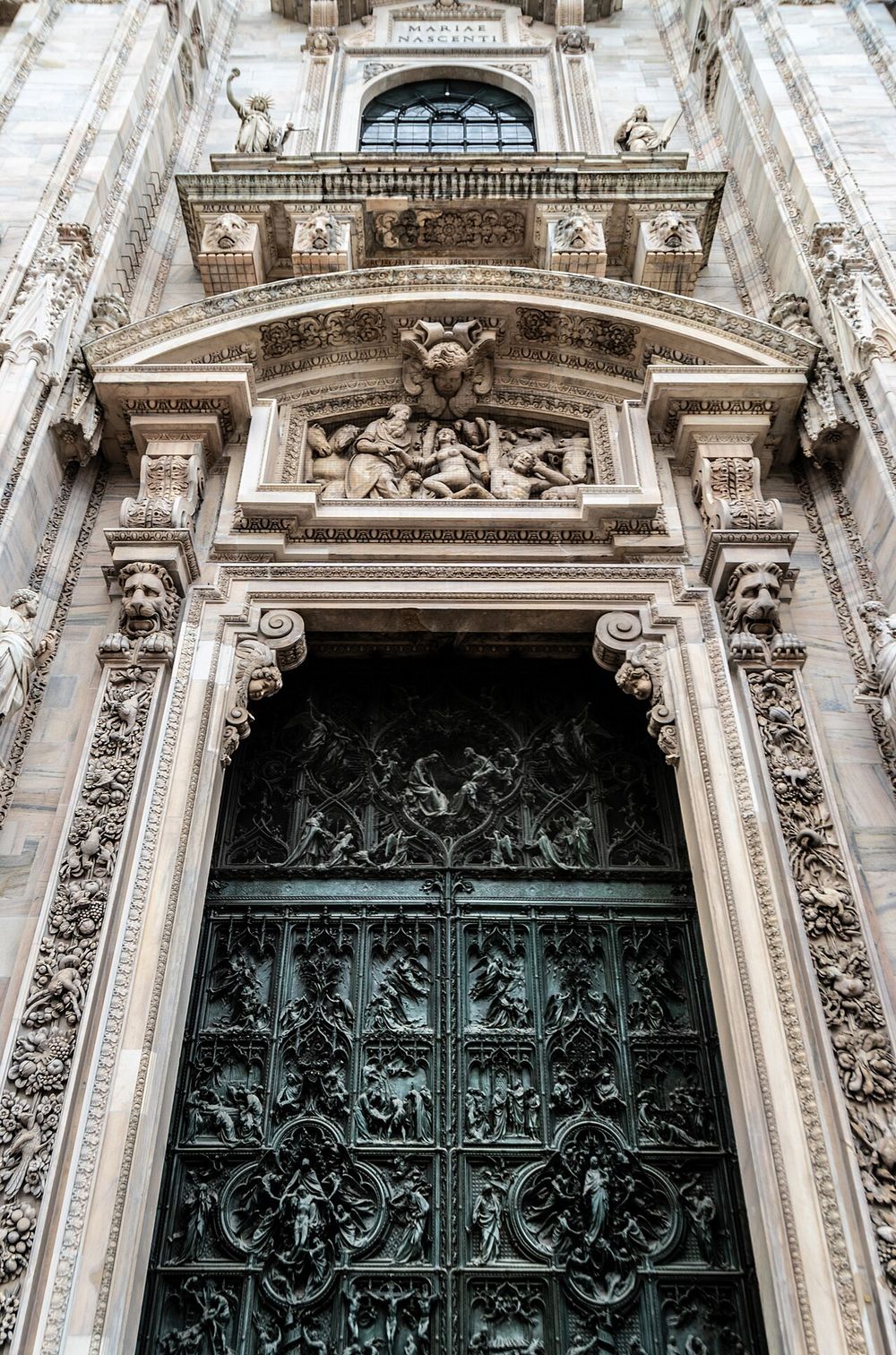
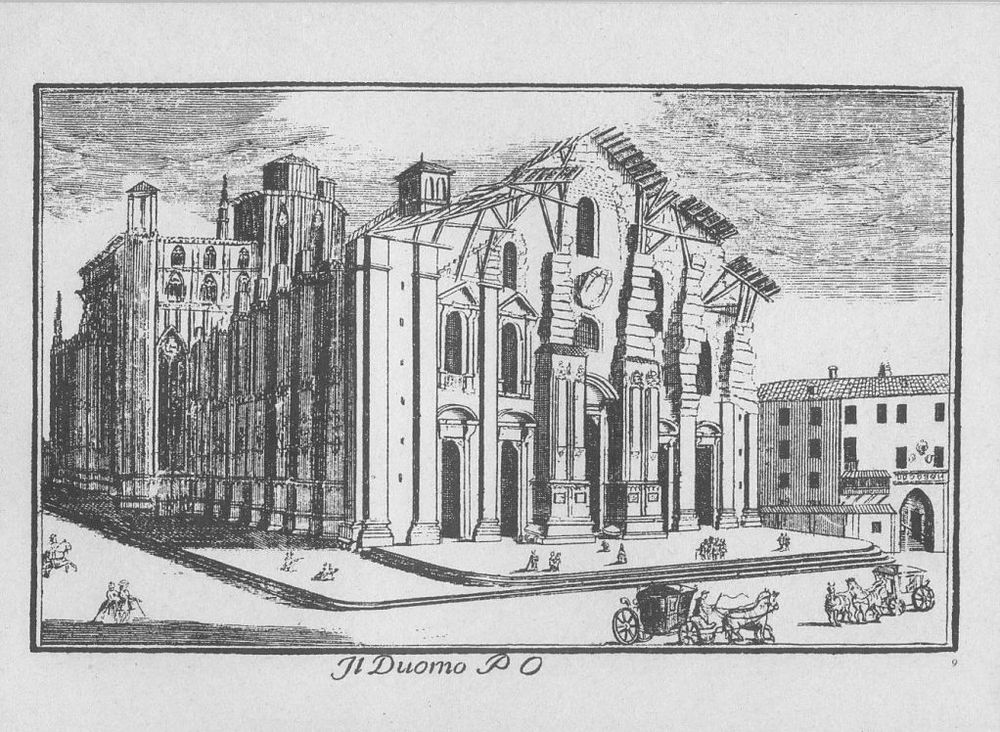
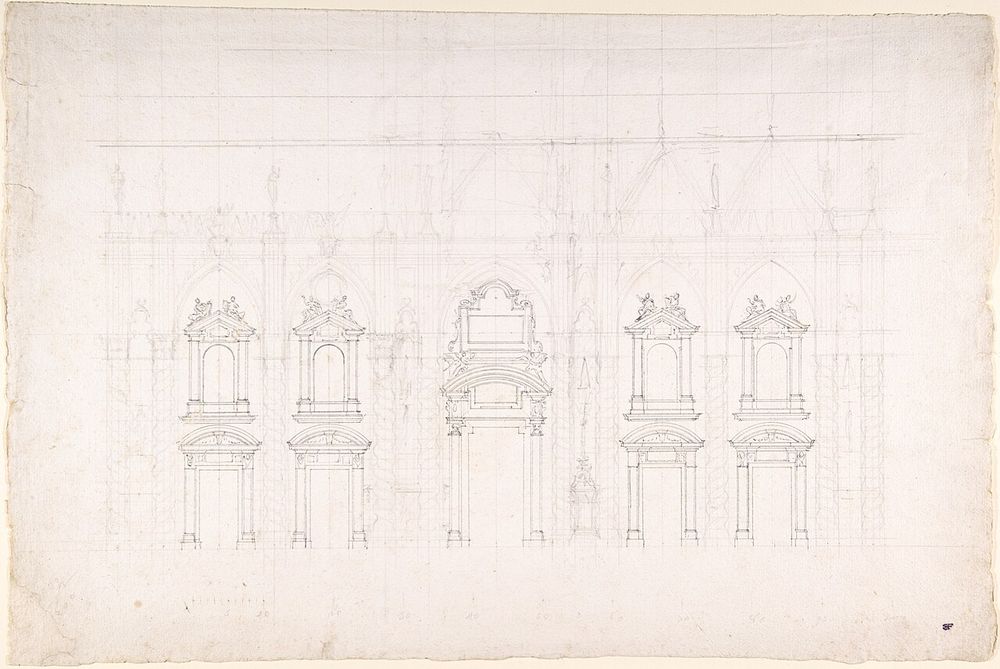
"The front is medieval." The lower windows and doors are of the 1600s, in a different style. The rest of the front was finished in a hurry between 1805 and 1813, because Napoleon was coming to be crowned.
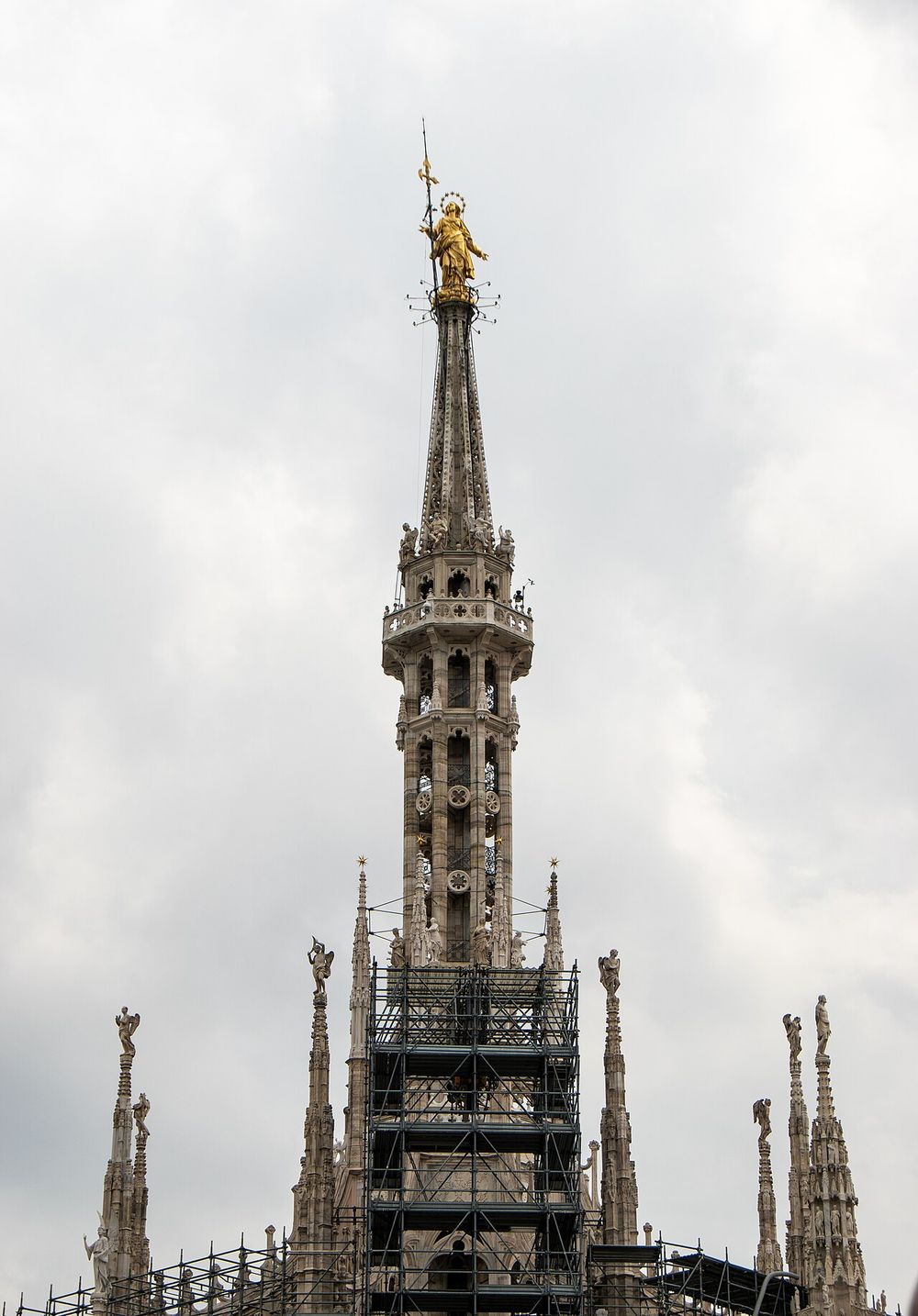
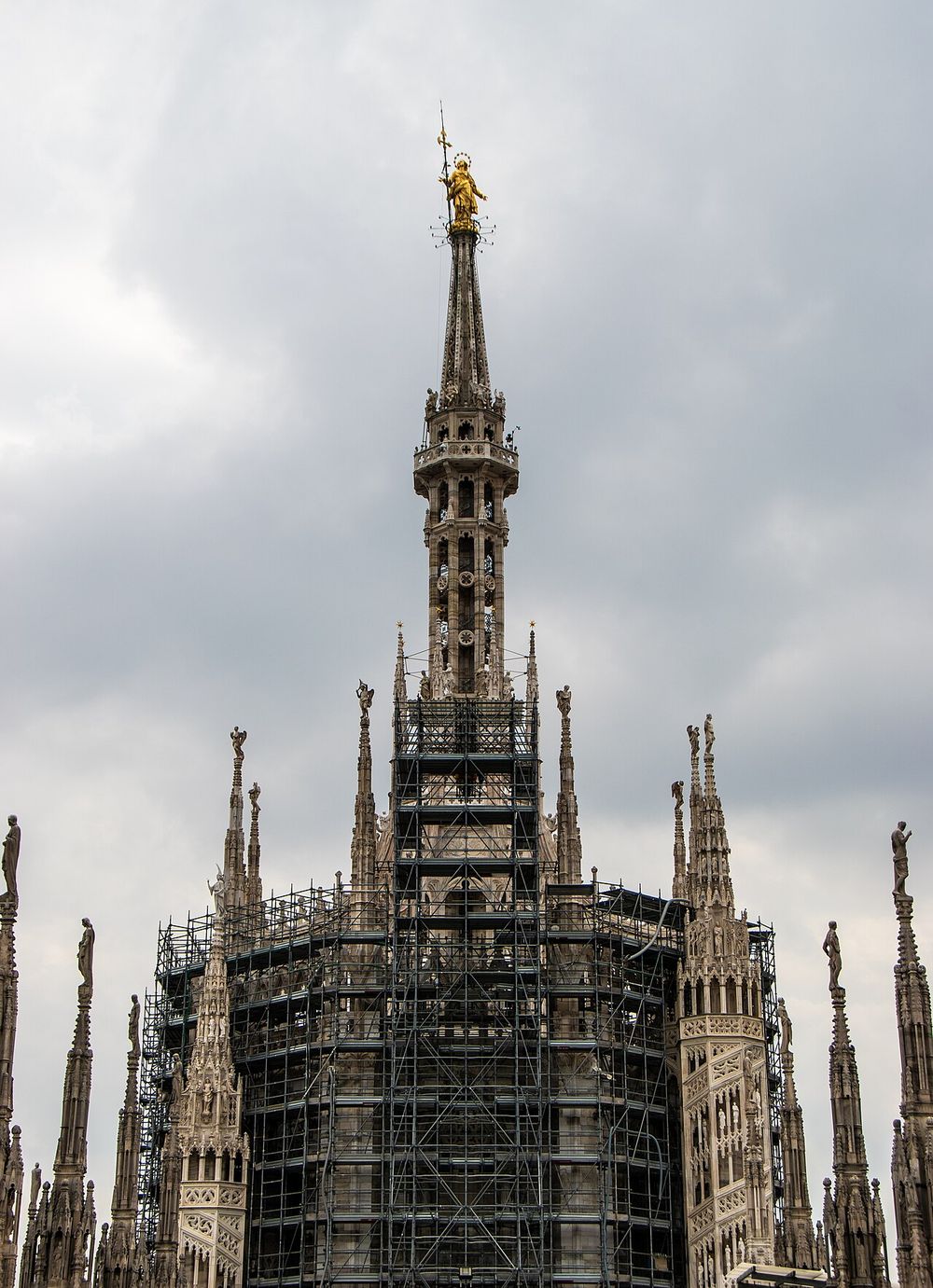
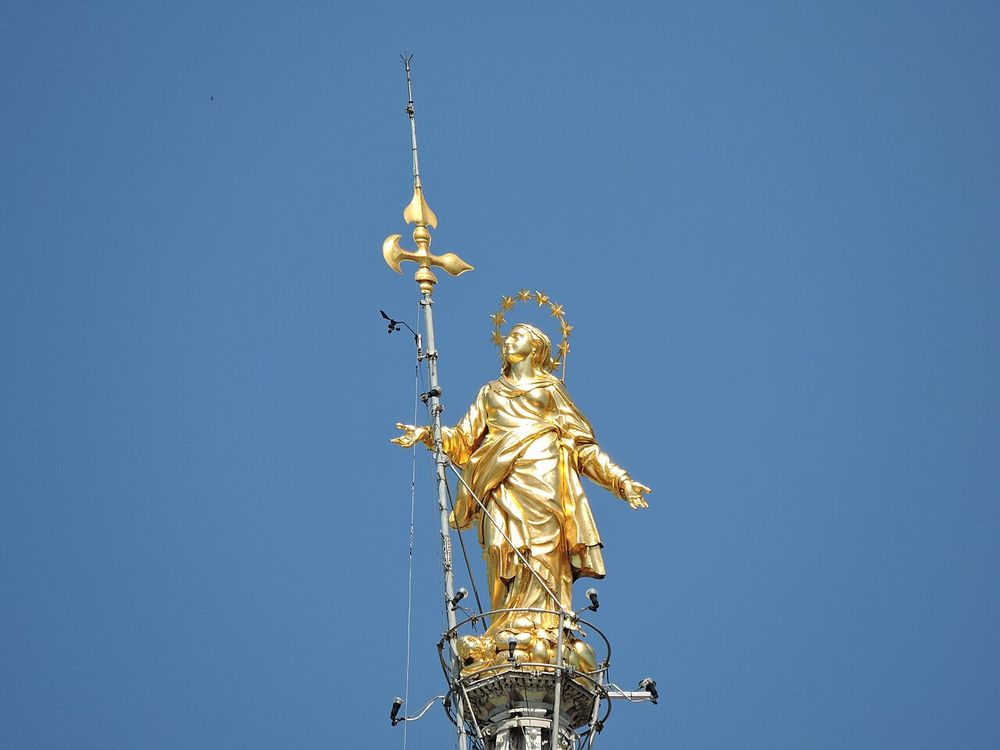
"The gold figure at the top is an angel." She is the Virgin Mary, four metres tall. Milanese call her the Madonnina, the little Madonna.
"The marble is white." It is veined with pink and grey, and it weathers badly. Some part of the building is always under scaffolding, and always will be.
"It is free, like most churches in Italy." Visitors pay. People who come to pray enter free by a separate door.
People who stood here
Leonardo da Vinci (Italian painter of the Mona Lisa and The Last Supper)He lived in Milan for seventeen years. In 1487 the Works paid him for a wooden model of the dome over the crossing, which no one yet knew how to build. He compared the cathedral to a sick body in need of a doctor-architect. His design was not used.
Napoleon (emperor of the French, 1804–1815)On 26 May 1805 he was crowned King of Italy under the dome. He set the old iron crown of the Lombard kings on his own head and said: "God gives it to me. Woe to him who touches it." He had ordered the front finished at his expense. The bill was never paid.
Mark Twain (American author of Tom Sawyer)He came in 1867, climbed to the roof, and wrote the phrase that every guide has used since: "a poem wrought in marble".
Go deeper: eight stops, from the square to the roof
The stops begin in front, go once round the outside, then in, down, and up.
1. The square
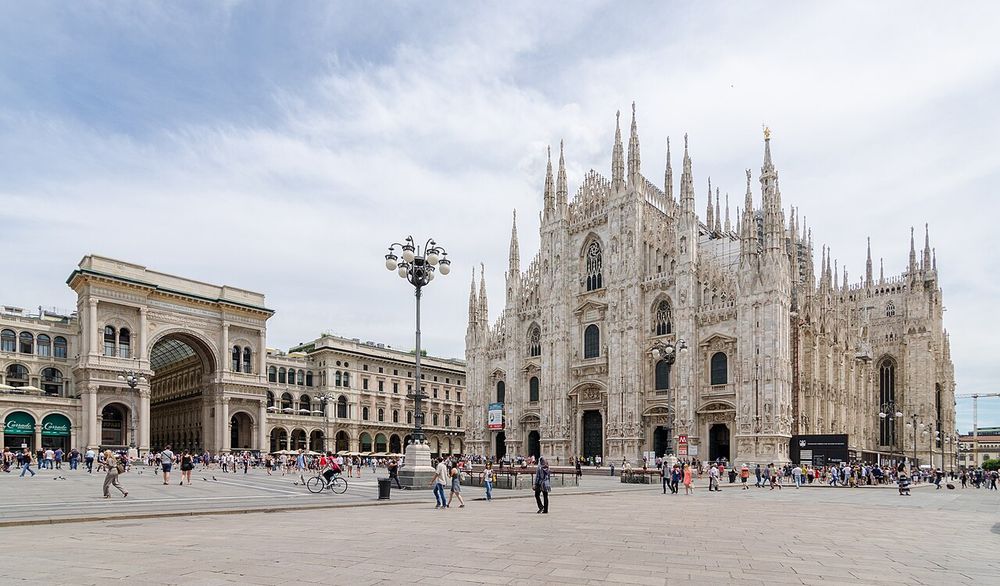
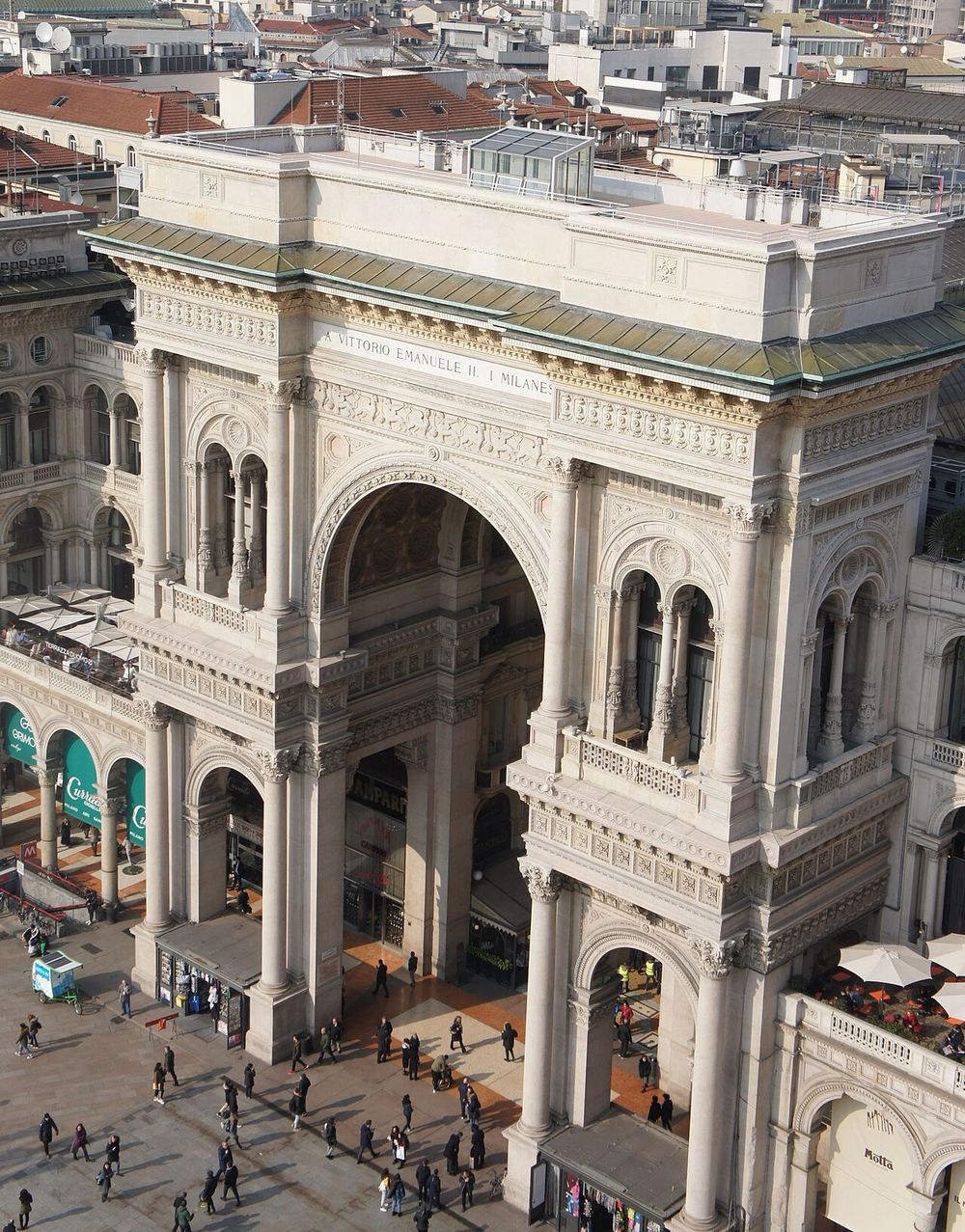
The cathedral and the entrance to the arcadeSteffen Schmitz, CC BY-SA 4.0
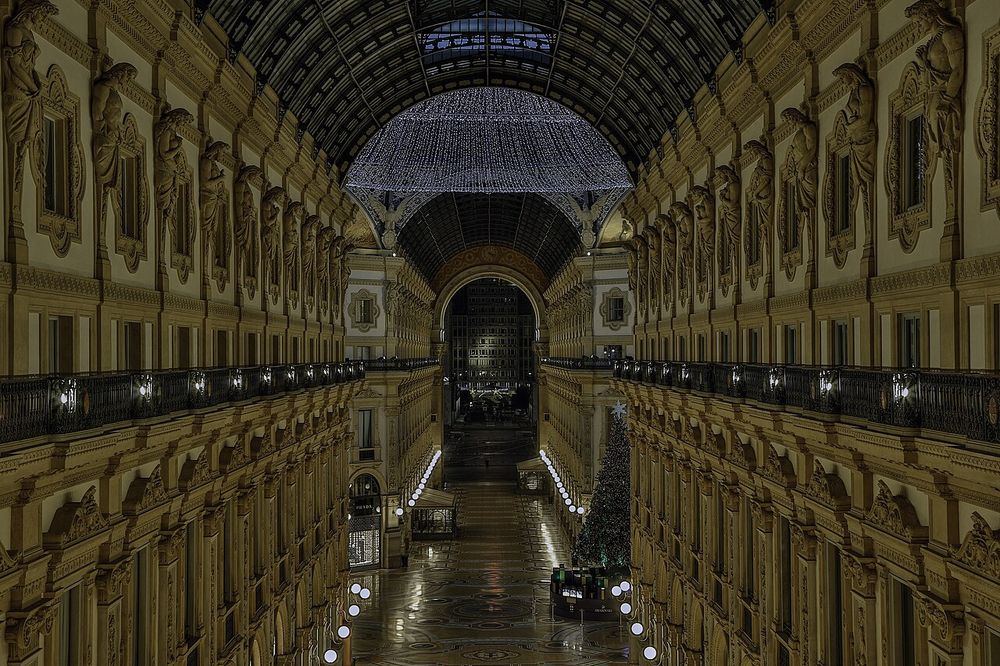
Until the 1860s the cathedral stood among crowded houses and could not be seen whole. The square was cleared when Italy became one country, and the glass-roofed arcade on the left was built to join it to the opera house.
Stand back and count the storeys of windows in the front. The cathedral is 108 metres high to the top of the gold figure, and for centuries it was the custom that nothing in Milan might stand higher. When the first tall office tower went up in the 1950s, a small copy of the Madonna was put on its roof, and each taller tower since has taken the copy over.
2. The doors
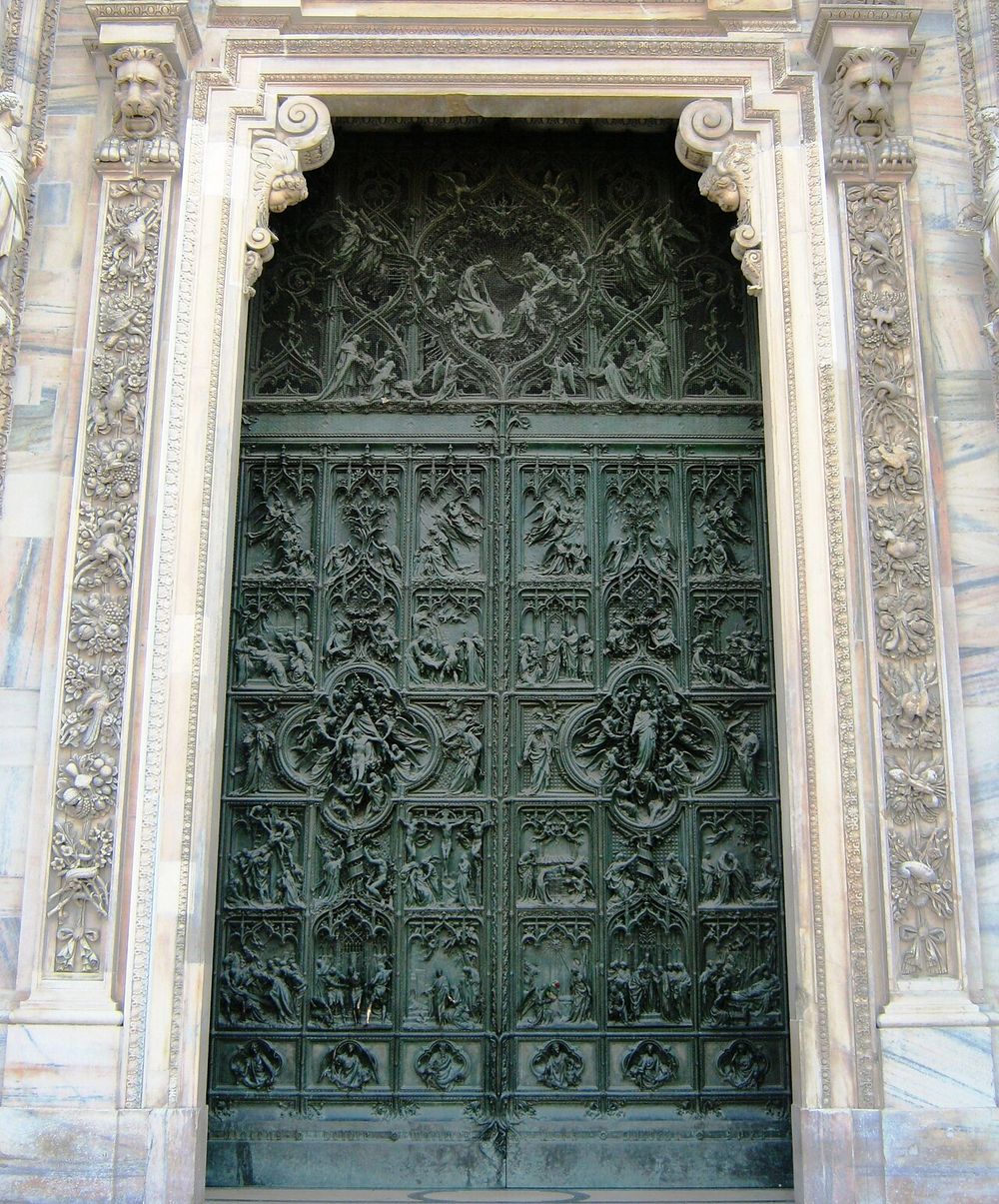
The centre doorKiril Simeonovski, CC BY-SA 3.0
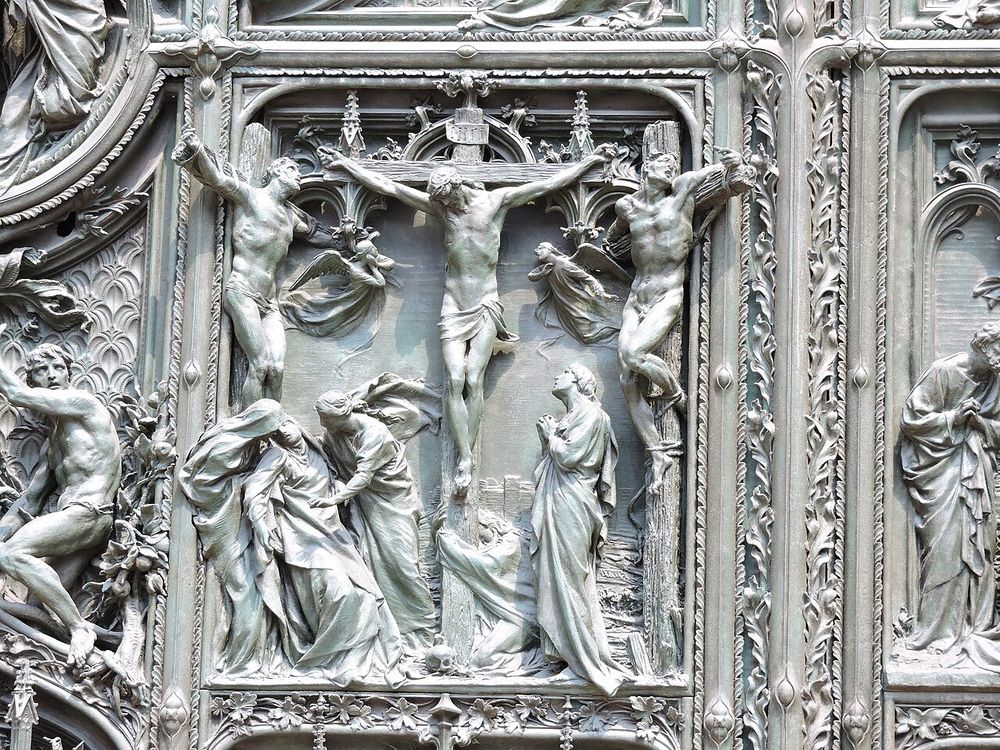
The five bronze doors were made between 1906 and 1965. The centre one tells the life of the Virgin. Low down on it, at the height of a hand, one panel shines like gold: it shows the whipping of Christ, and a leg of one of the men has been rubbed bright by visitors for luck.
A panel rubbed bright by handsHarvinder Chandigarh, CC BY-SA 4.0
Look also for the dents and tears in the bronze. They are from the bombs of August 1943, which burned much of the city centre. The cathedral was hit but did not catch fire.
3. The side, and the marble
The apse, the oldest partZairon, CC BY-SA 4.0
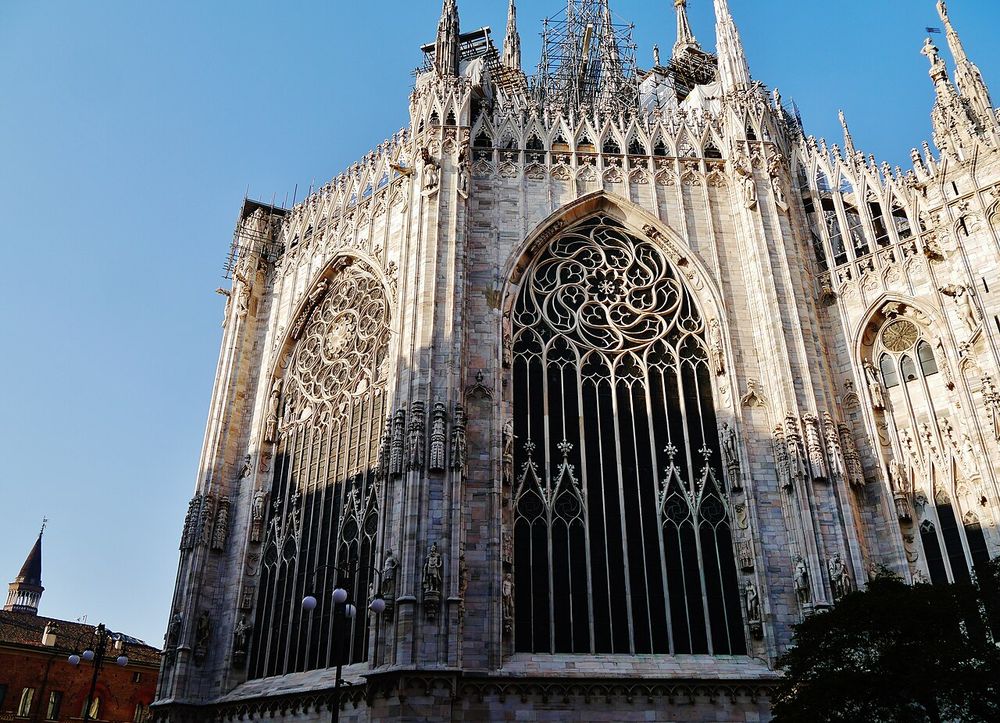
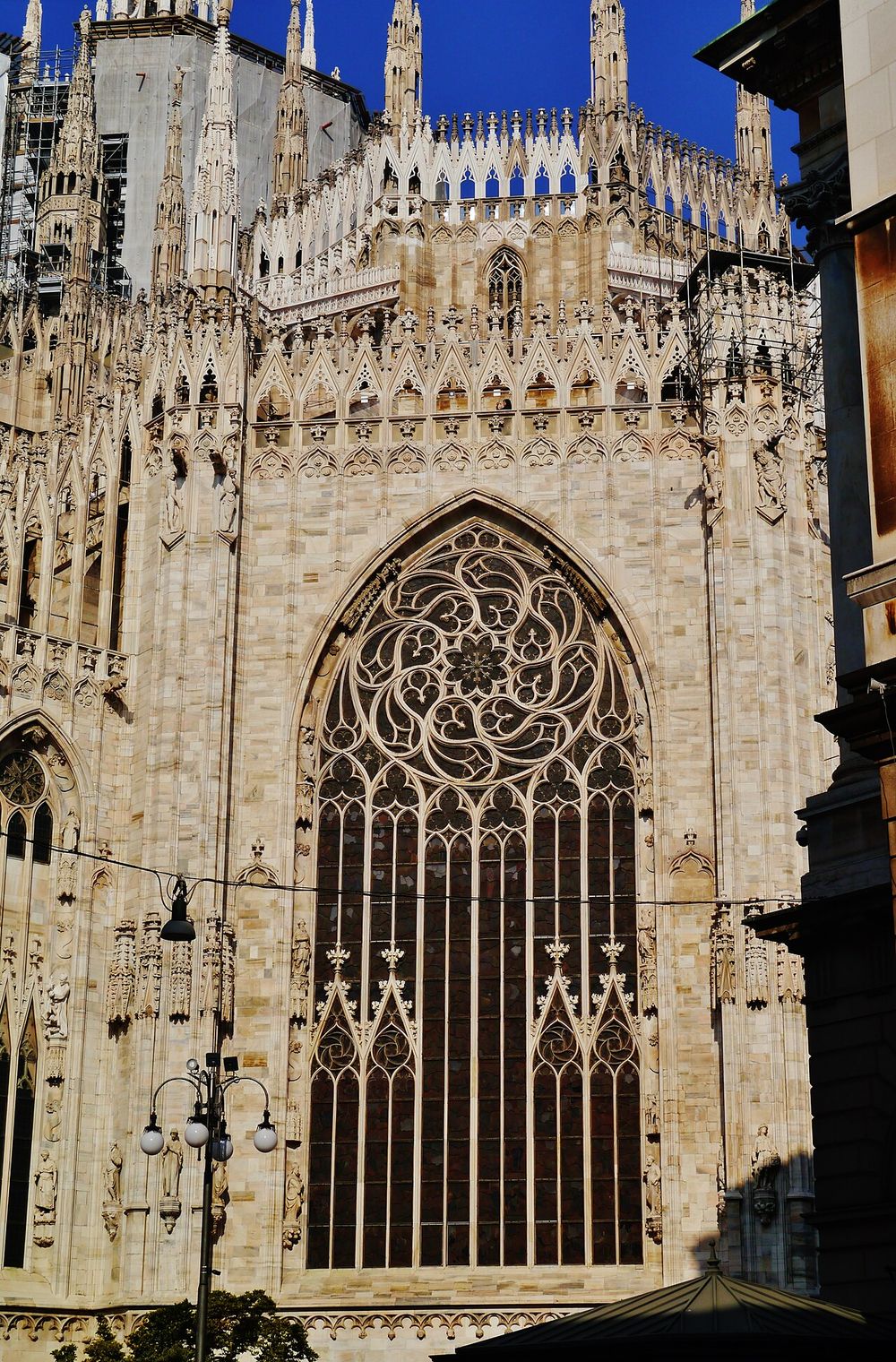
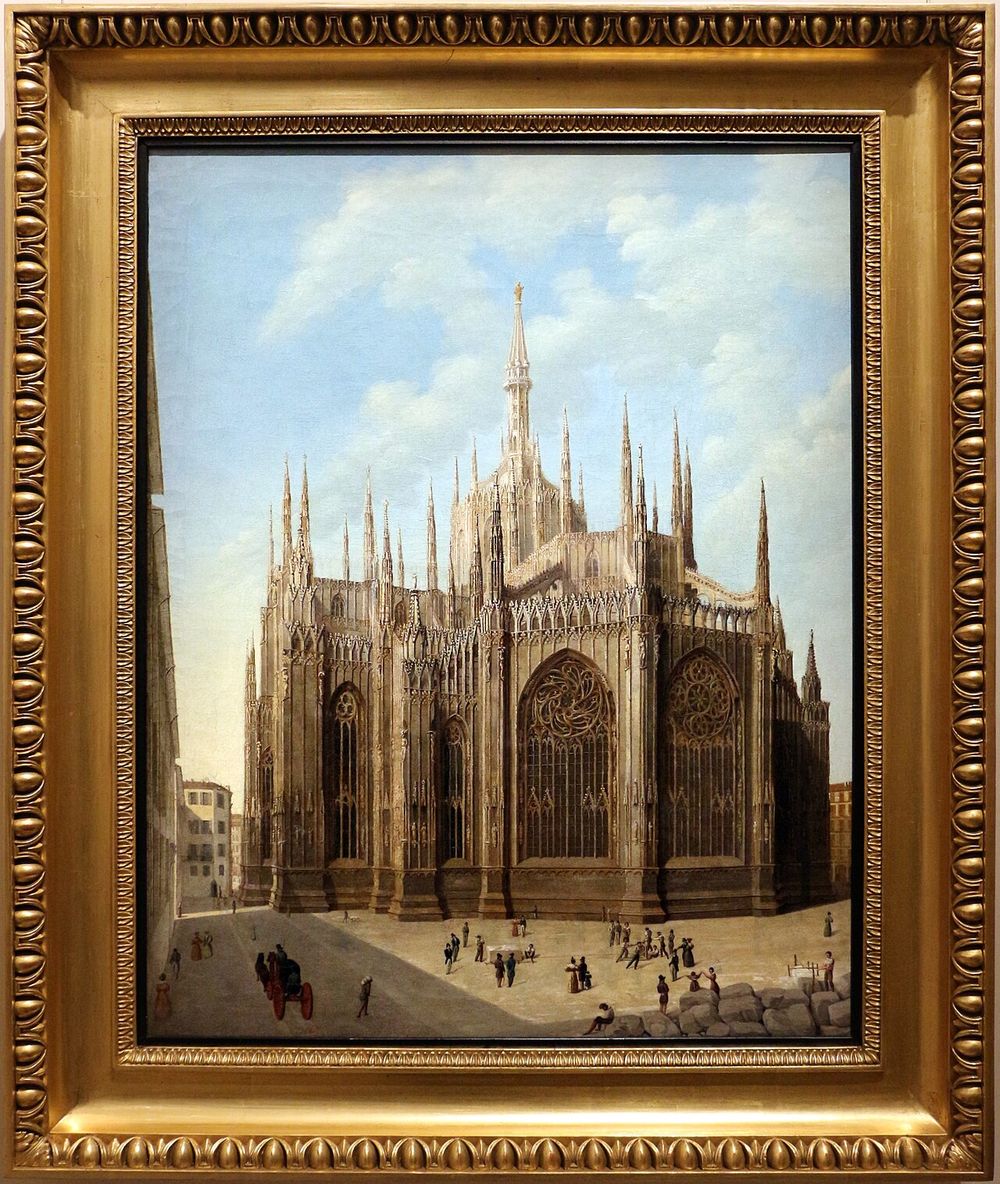
Walk down the left side to the back. This end is the oldest. The three windows of the apse are each as tall as a seven-storey house.
The quarry at CandogliaMario Finotti, CC BY 4.0
Every block came by water. It was loaded on a barge at the quarry, floated down the lake and the river, and brought by canal to a basin a few hundred metres from here. Each was marked A.U.F., "for the use of the Works", and passed every toll gate without paying. Milanese still say "a ufo" for anything got free.
4. The nave
The naveJulian Lupyan, CC0
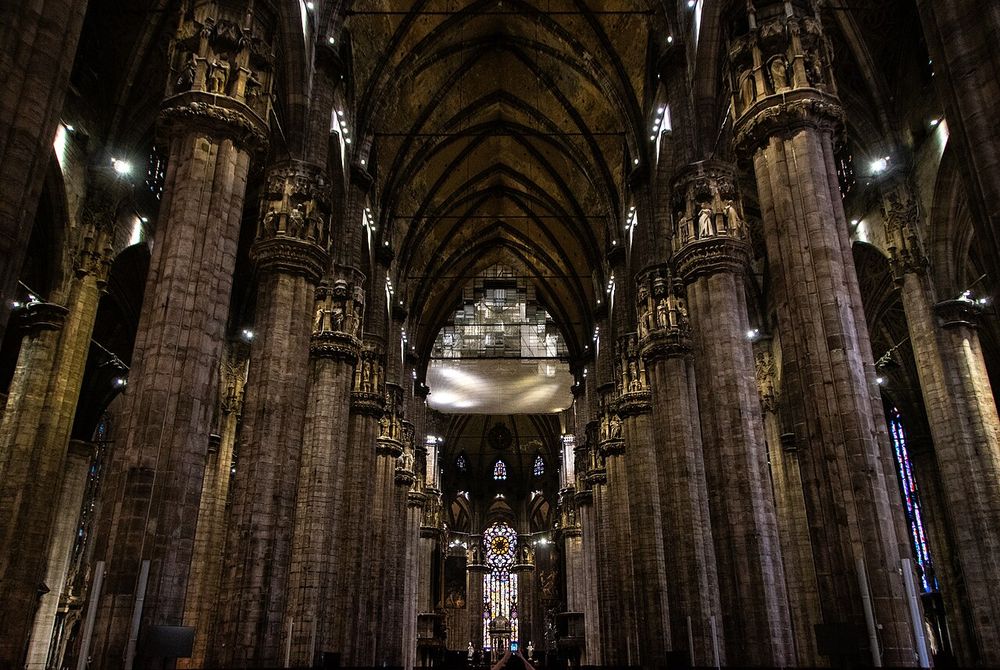
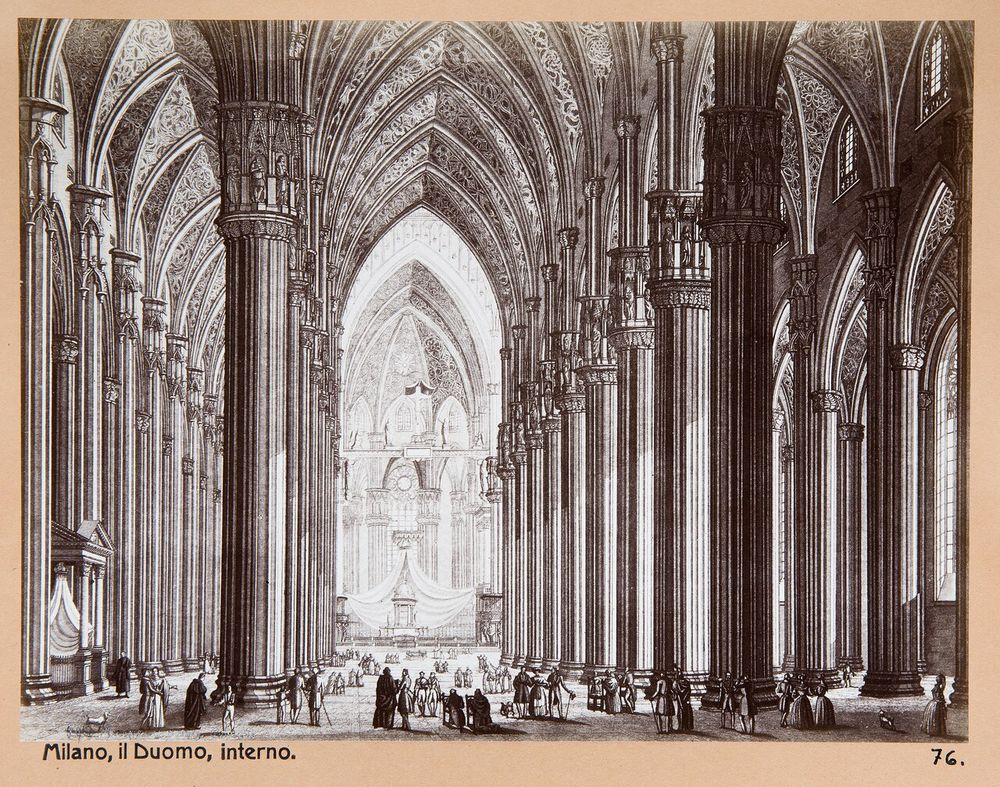
Inside it is dark and very large. Fifty-two pillars, one for each week of the year, rise twenty-four metres. At the top of each, where other churches have a simple capital, is a ring of niches with a statue in every niche.
The spot of sunlight nearing the brass lineAlaexis, CC BY-SA 4.0
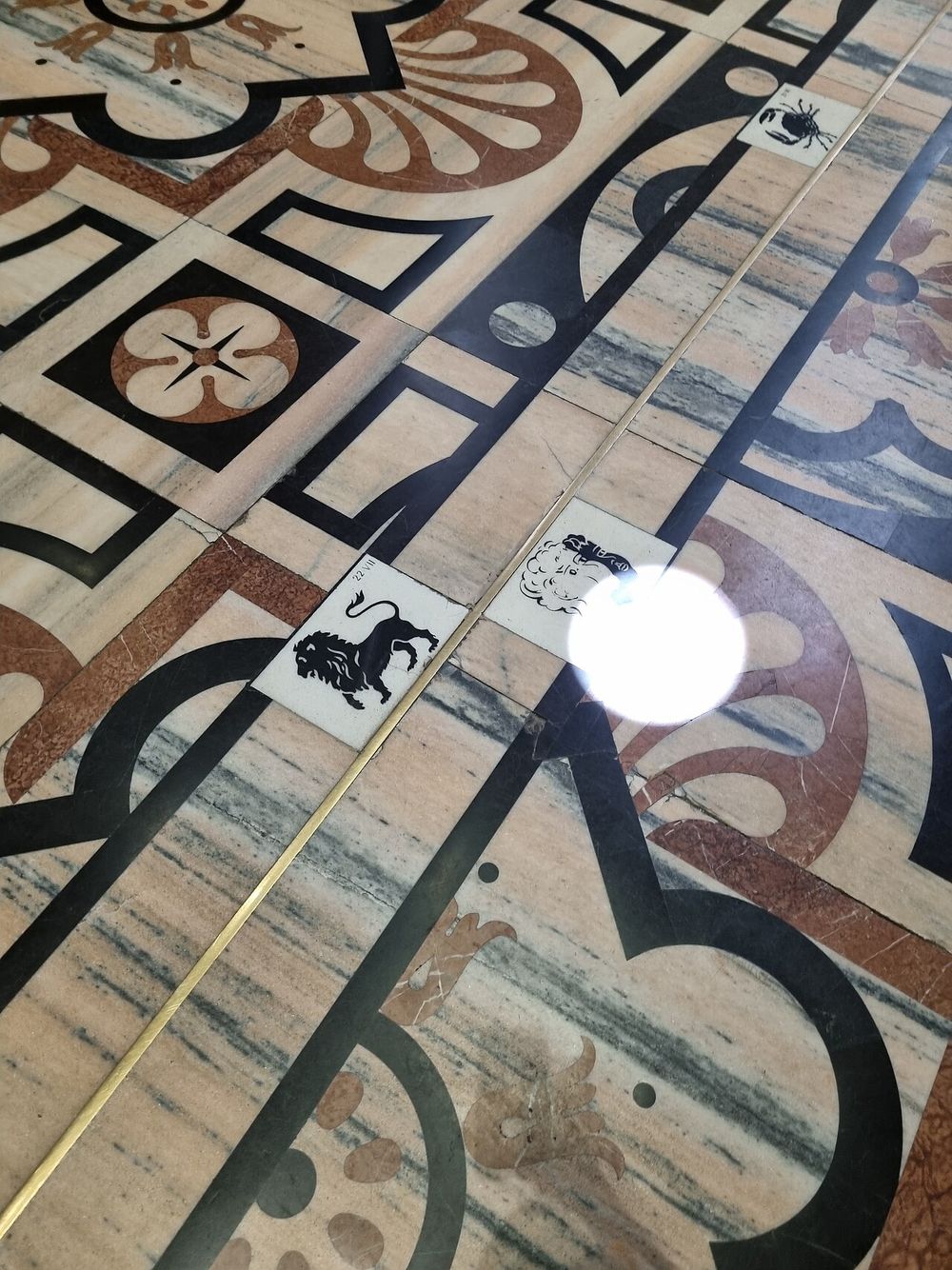
Just inside the main door a strip of brass runs across the floor and three metres up the left wall. It was laid by astronomers in 1786. At noon a spot of sunlight from a hole in the roof crosses it, at a point that tells the day of the year. The city set its clocks by it.
5. The flayed saint
St Bartholomew, carved in 1562sailko, CC BY-SA 3.0
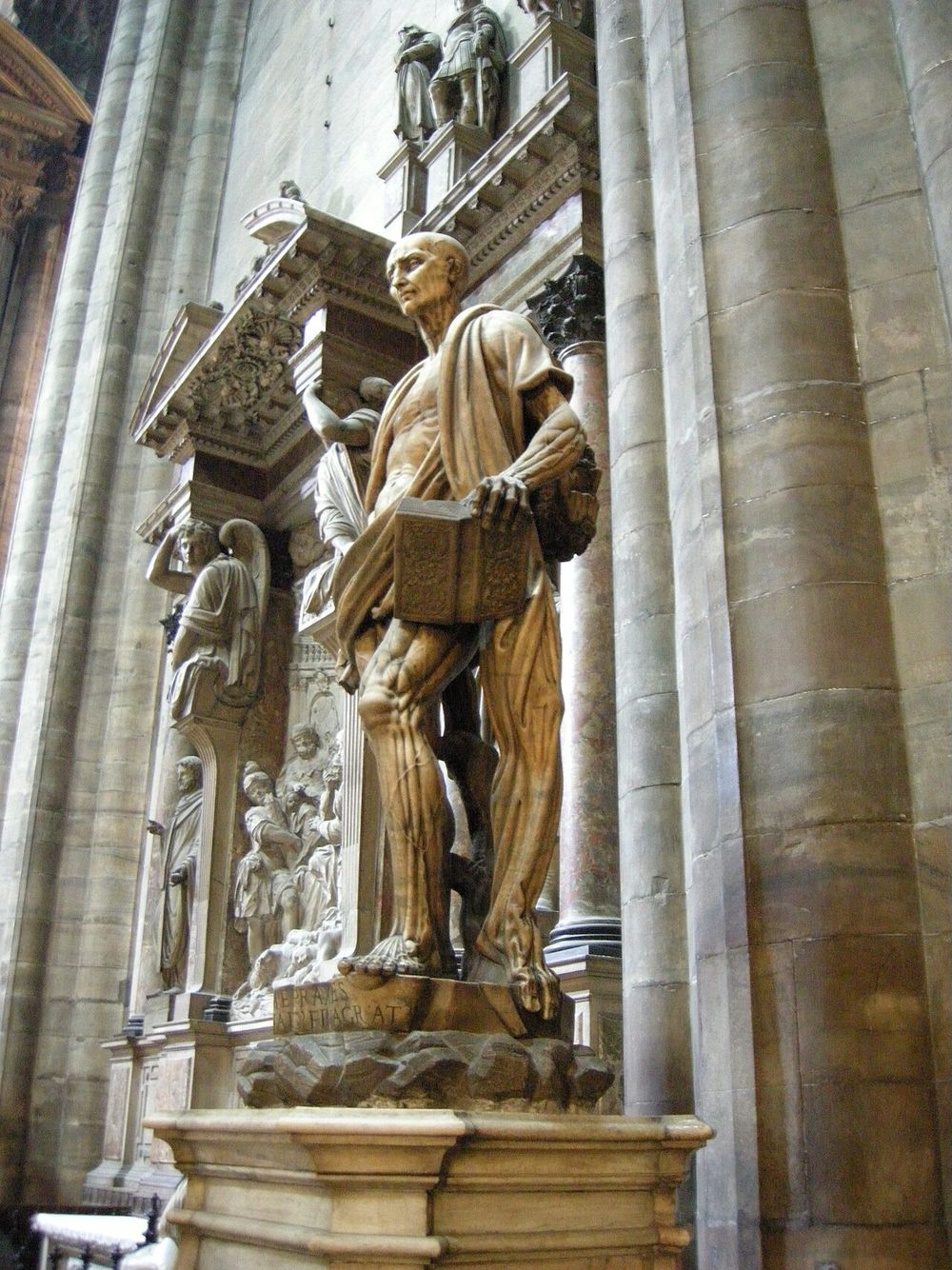
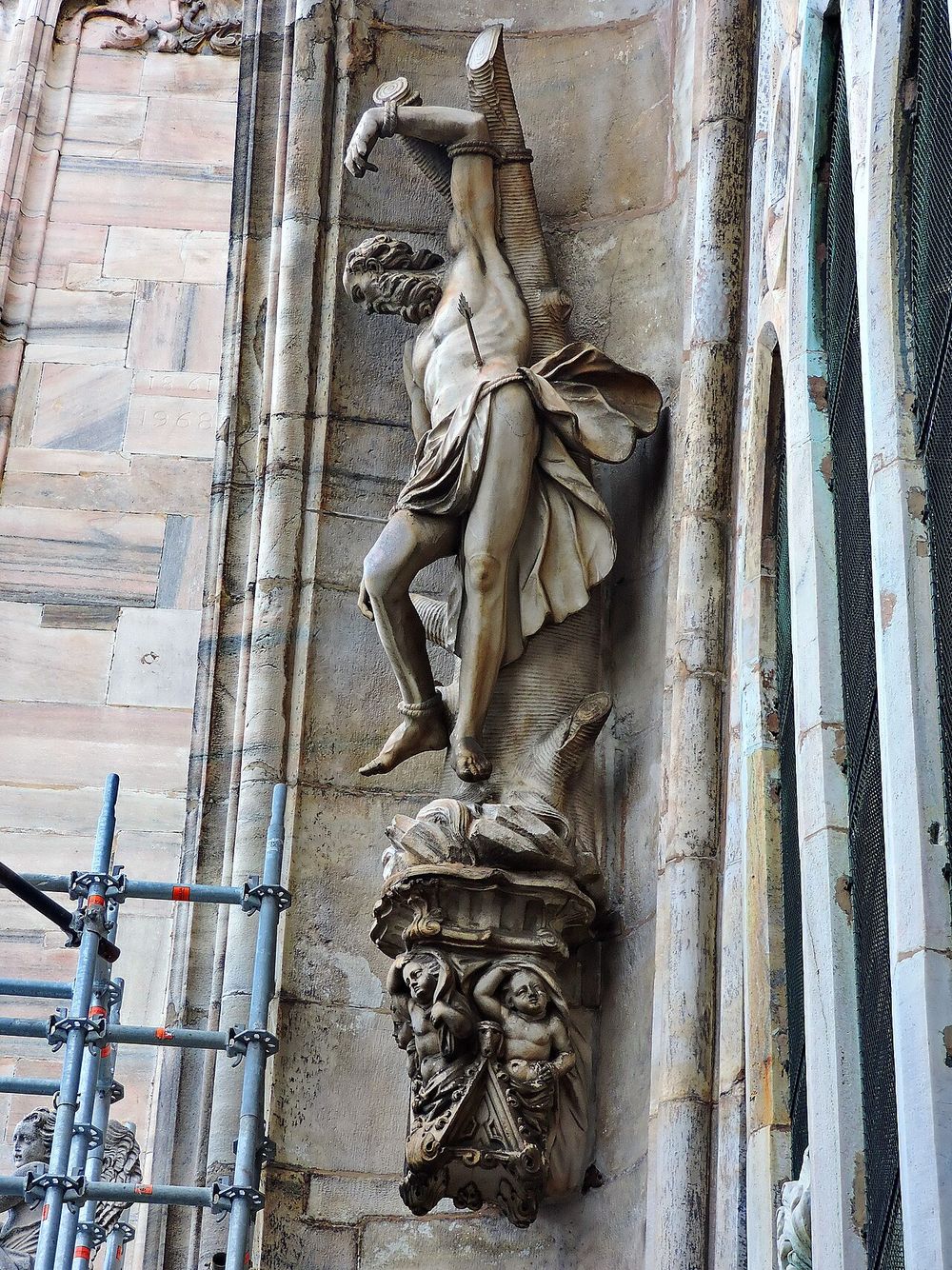
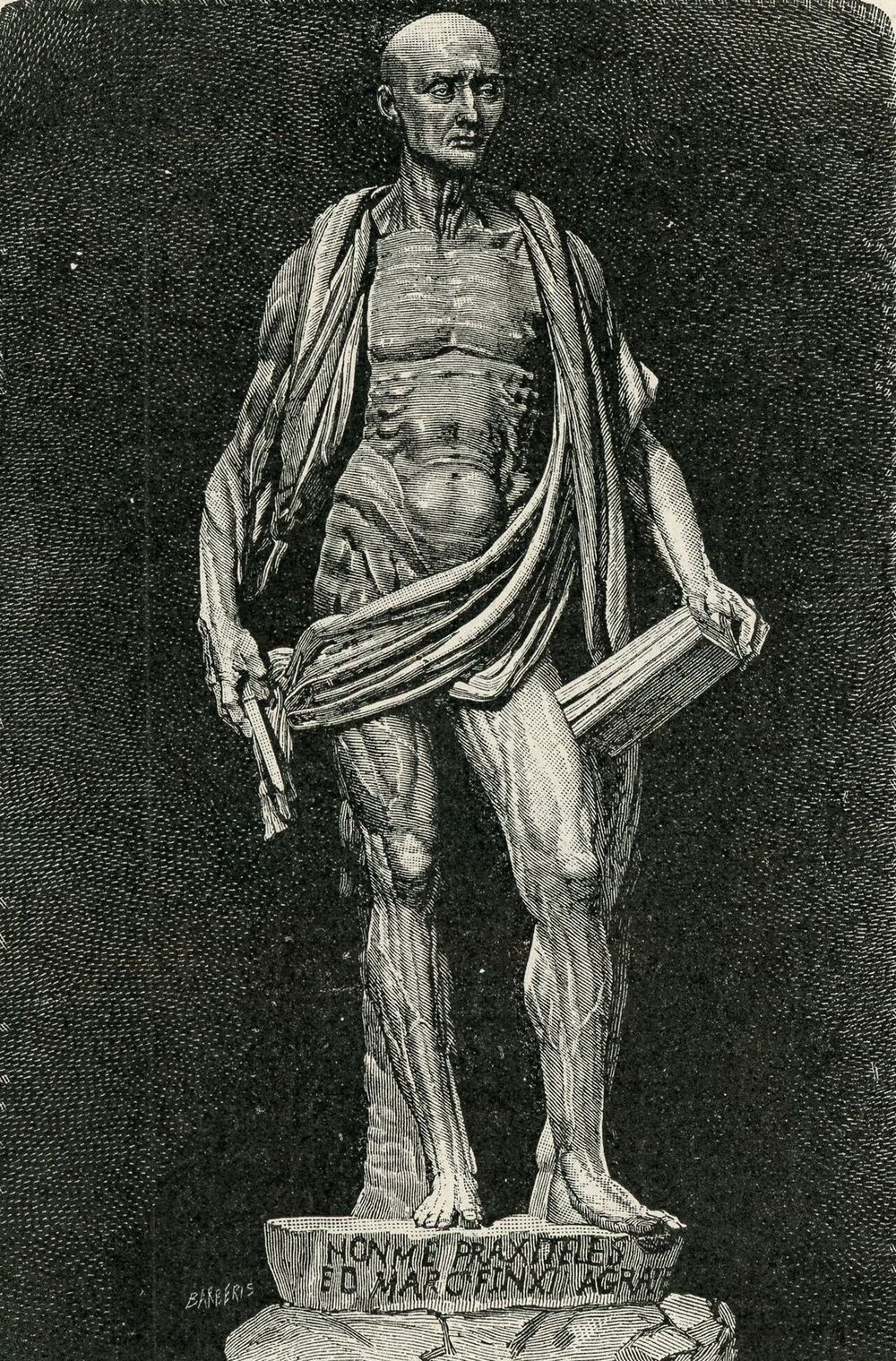
In the right arm of the church stands a marble man with no skin. Every muscle and vein is shown. What looks like a cloak over his shoulder is his own skin, with the face hanging at his back. He is St Bartholomew, who was skinned alive.
It was carved in 1562, when artists were first cutting up bodies to learn how they worked. The sculptor signed it on the base: "Not Praxiteles but Marco d'Agrate made me." Praxiteles was the most famous sculptor of ancient Greece.
6. The red light
The high altar and the choirZairon, CC BY-SA 4.0
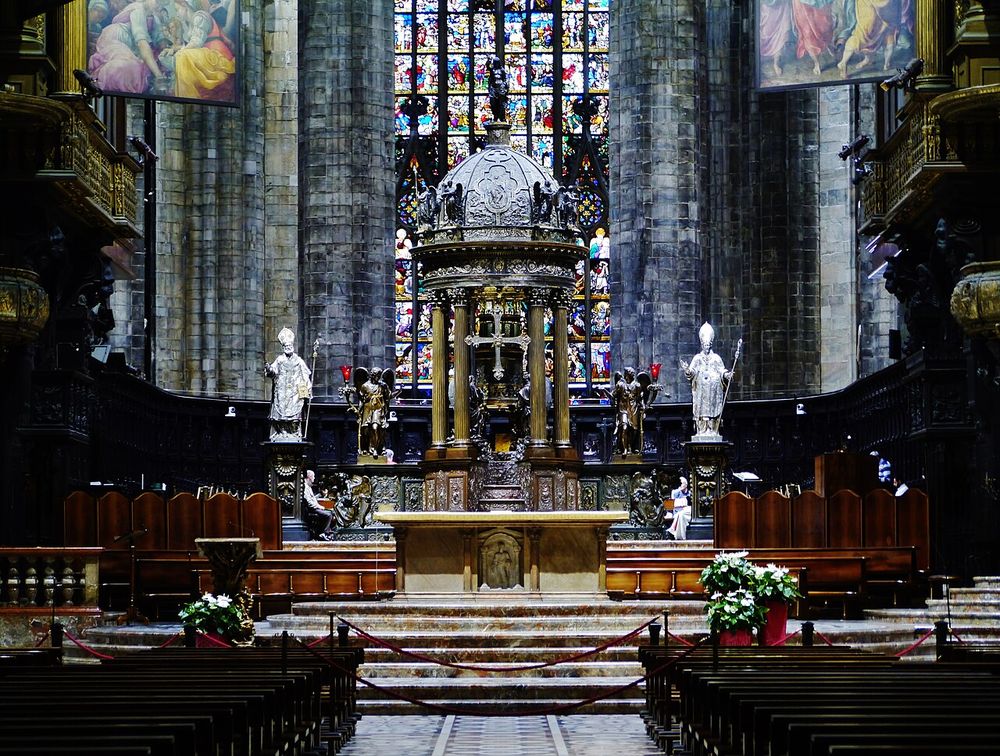
Stand in front of the high altar and look up into the vault above it. There is a small red light, forty metres up. It marks a nail said to be from the cross of Christ.
Once a year, on the Saturday nearest 14 September, the archbishop is hoisted up to it in a basket shaped like a cloud, painted with angels, and brings the nail down for three days. The lift is worked by hidden ropes. Tradition gives the design to Leonardo.
Stained glass of the apseMax_Ryazanov, CC BY-SA 3.0
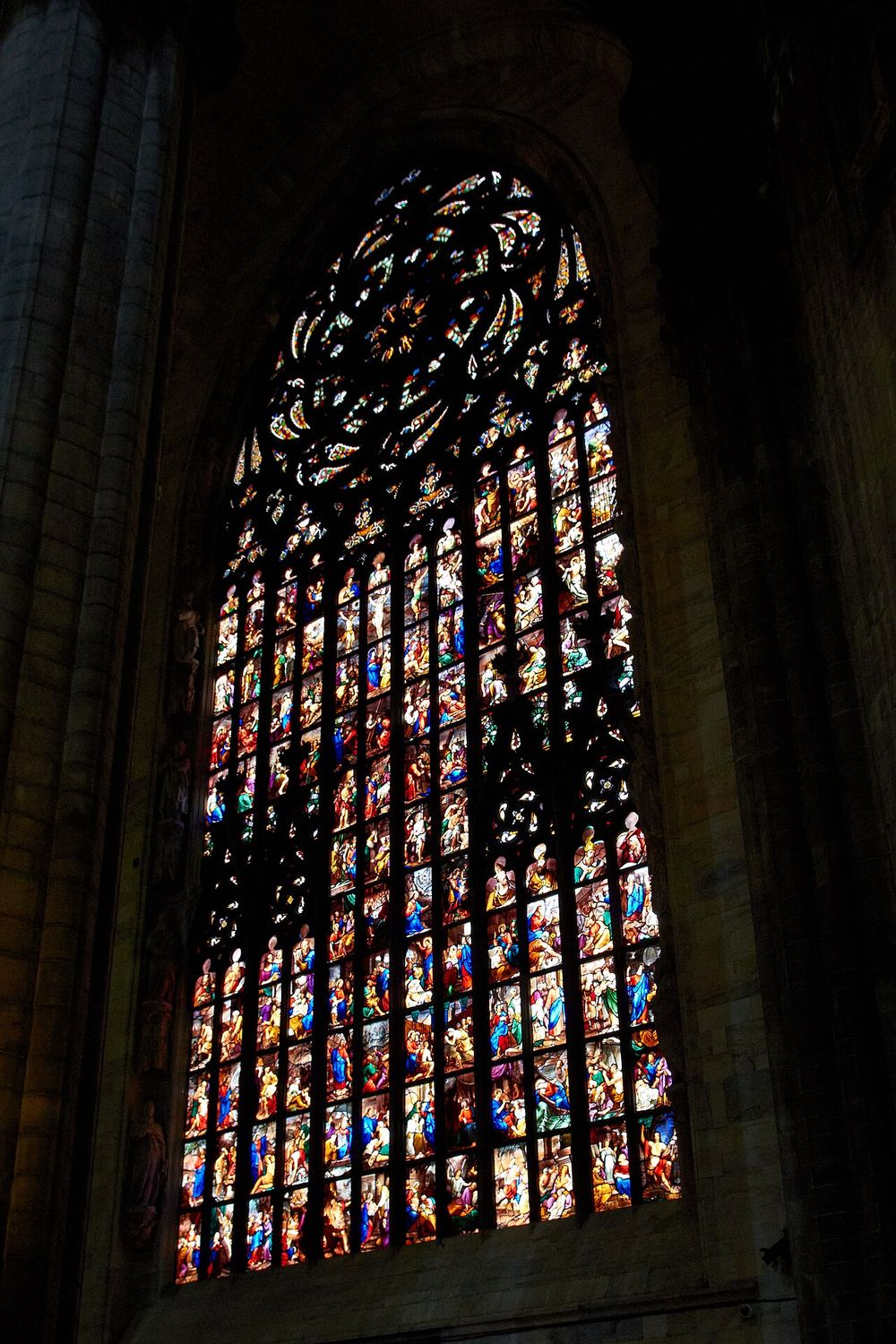
The windows behind the altar are among the largest of stained glass anywhere. The oldest panels are of the 1400s.
7. Under the square
The crypt of St CharlesSkarkkai, CC0
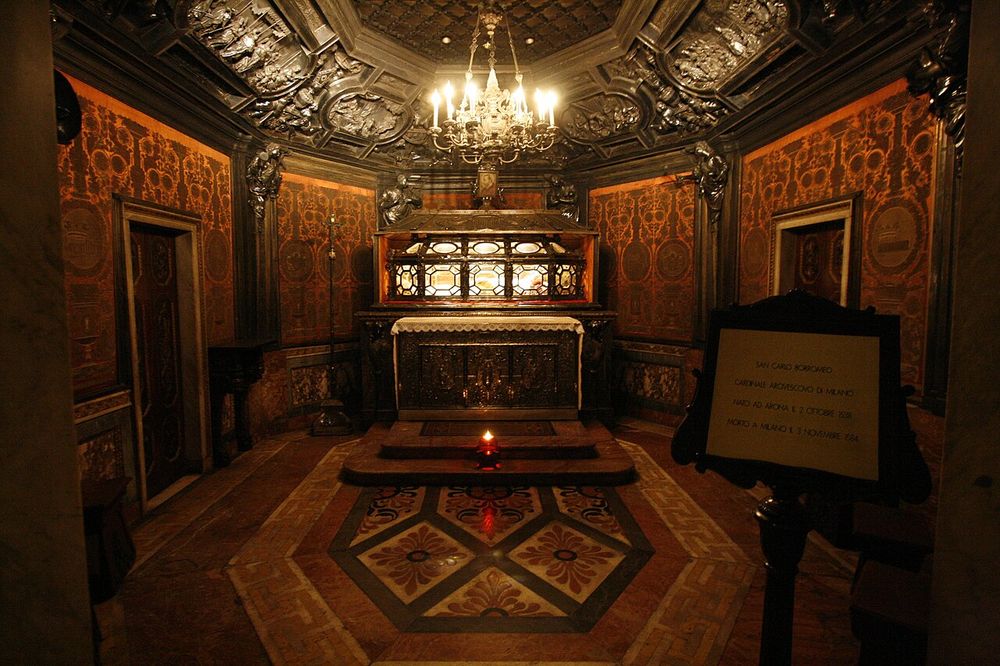
A stair near the main door leads down under the front steps, to the foundations of the churches that stood here before. Among them is an eight-sided pool of the fourth century, where the people of Roman Milan were baptised.
On the night before Easter in 387 the bishop, Ambrose, baptised in it a teacher of rhetoric from North Africa, thirty-two years old. He was Augustine, whose Confessions are still read.
8. The roof
The roof, looking westDaniel Case, CC BY-SA 3.0
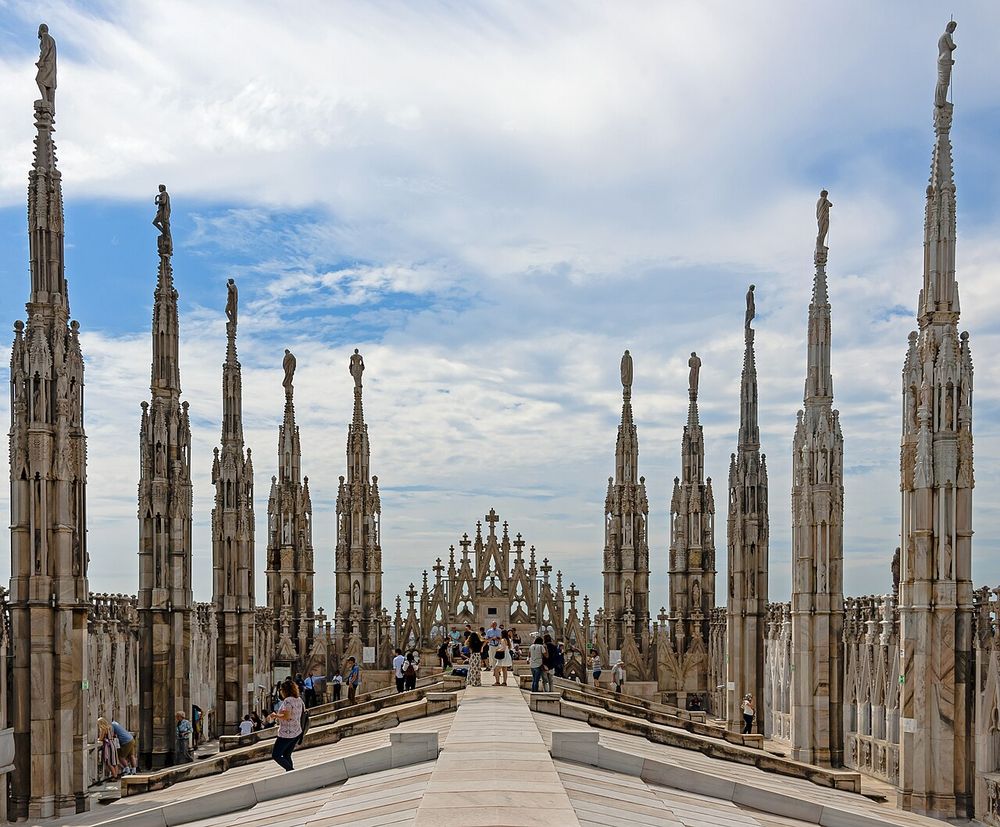
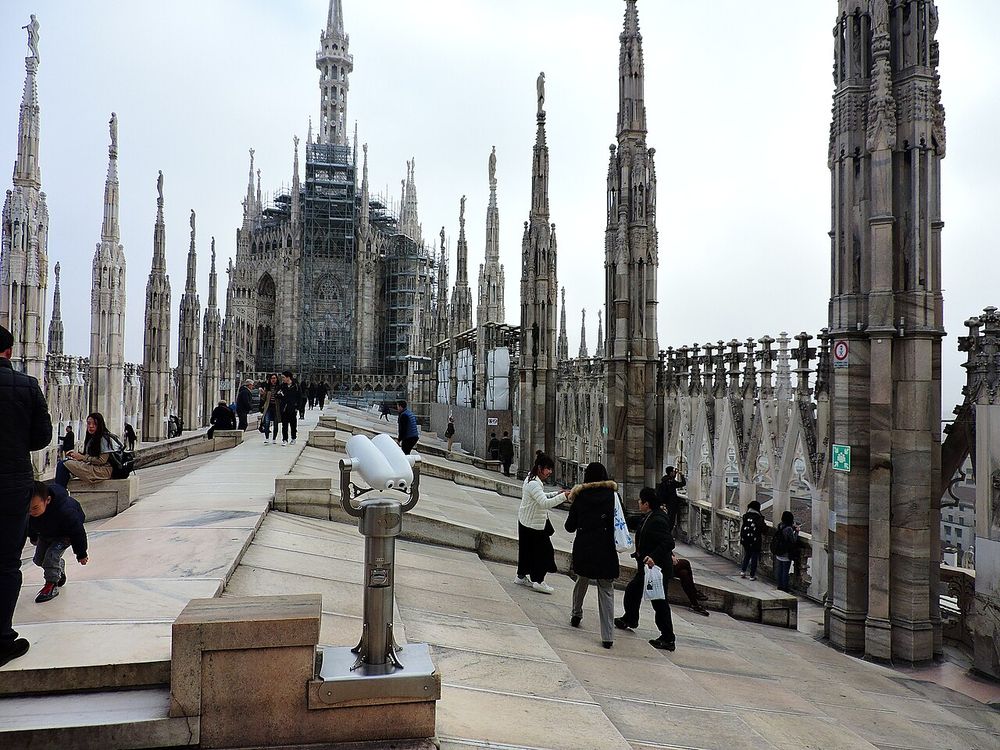
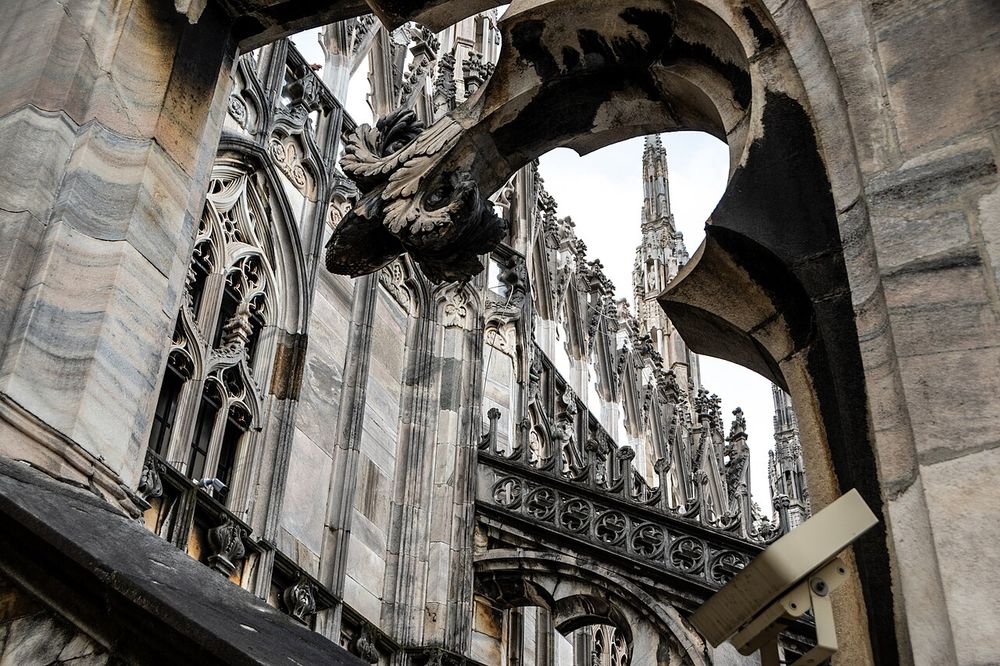
The lift or 250 steps bring you out on the lower roof, in a lane between the buttresses. The roof is paved with slabs of the same marble as the walls, and slopes gently, so that you walk up the middle of the church as up a hill.
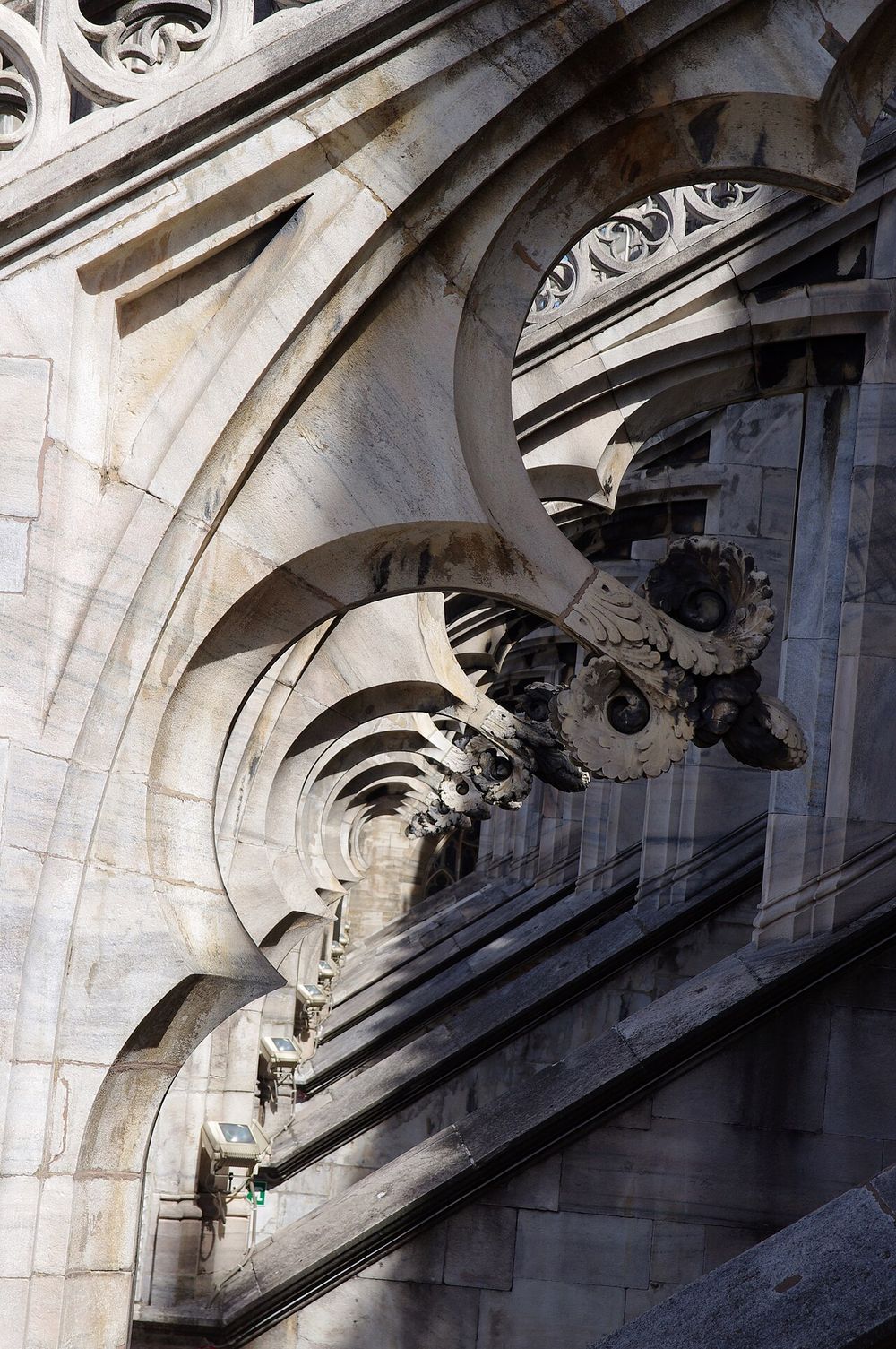
Under a flying buttressDimitris Kamaras from Athens, Greece, CC BY 2.0
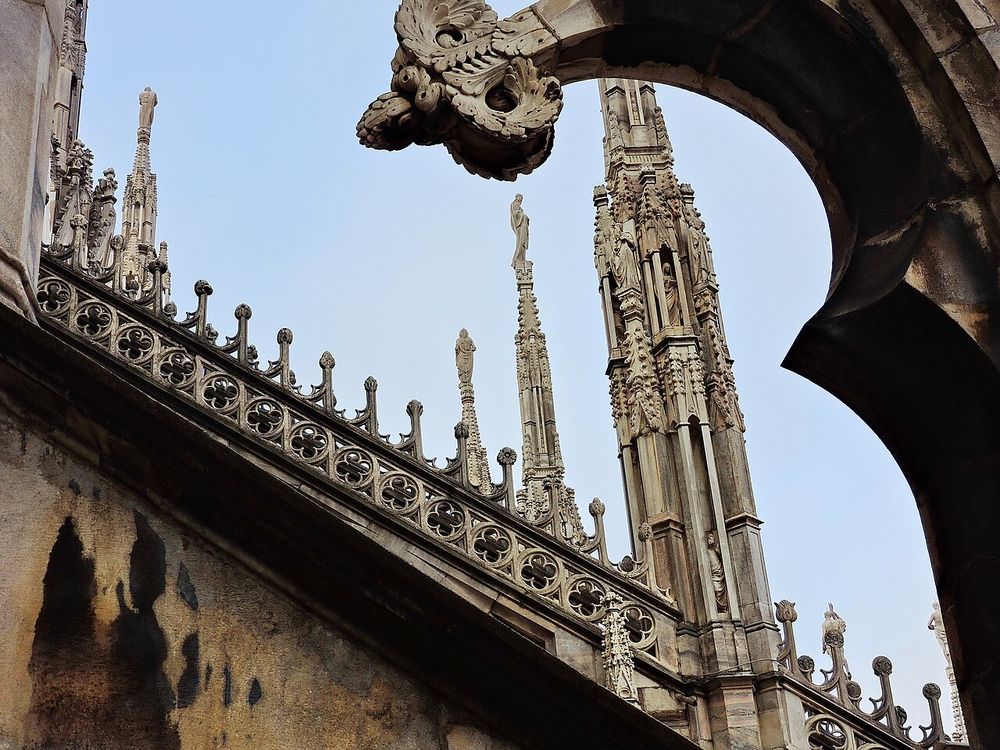
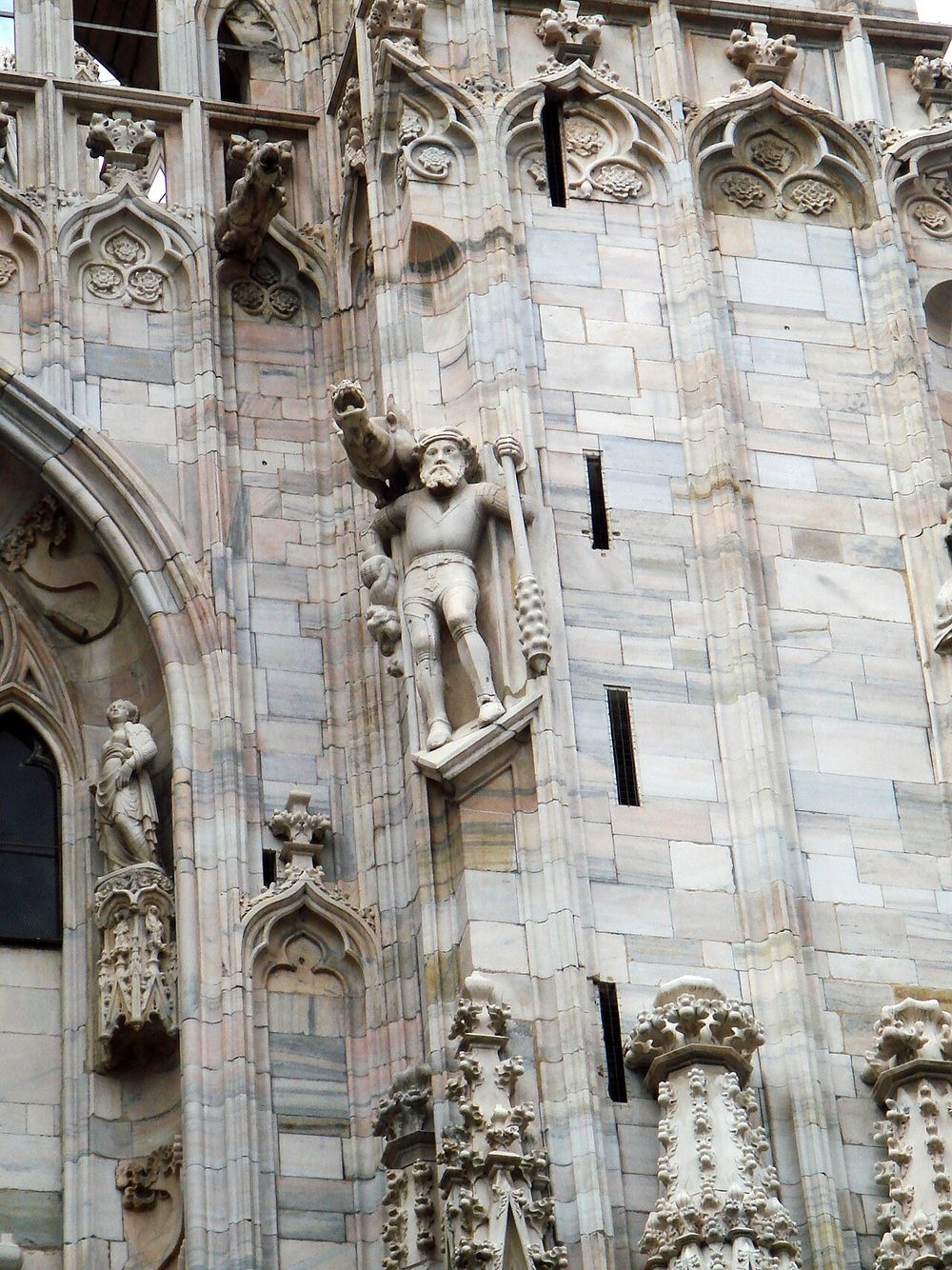
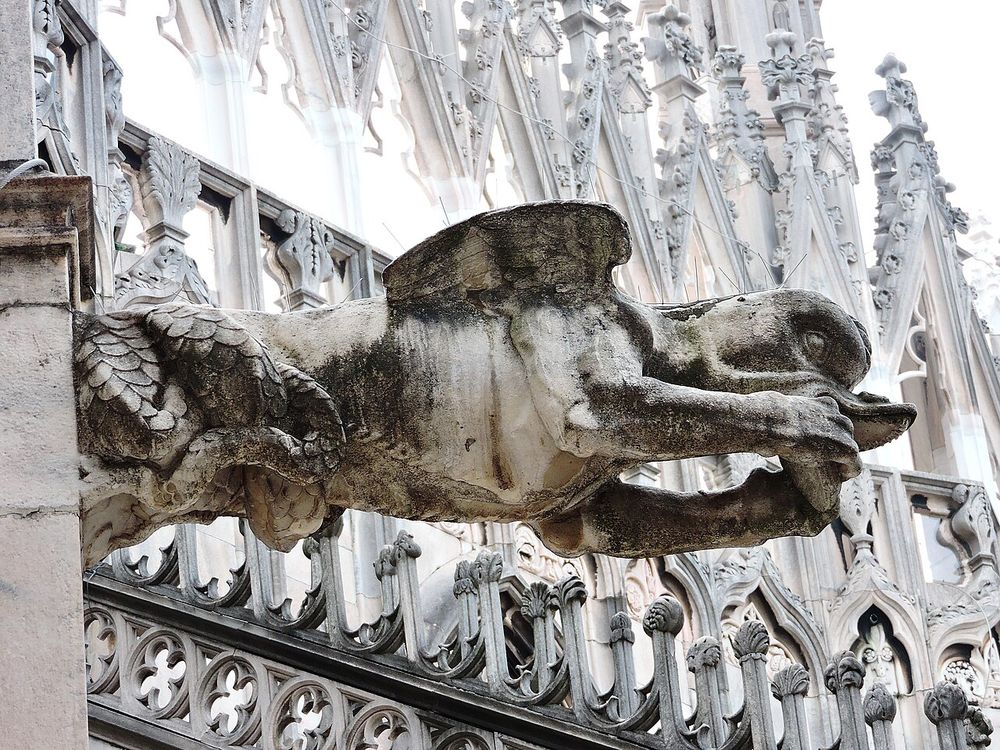
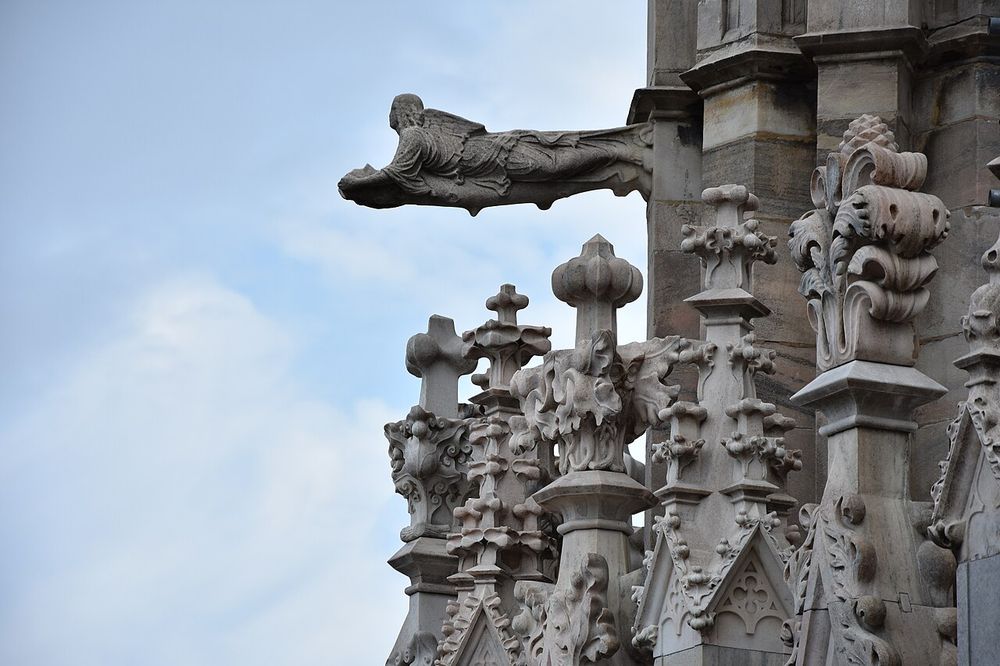
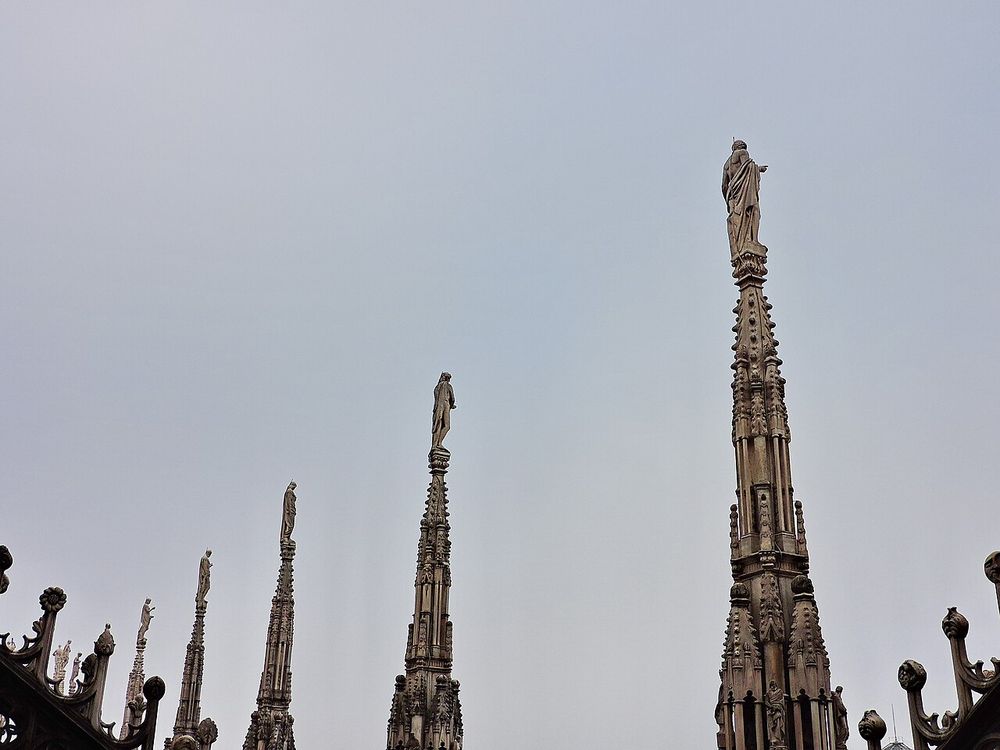
Here the statues are at arm's length. There are saints, bishops and prophets, and among them carvings added by masons of the last hundred years: boxers, a tennis racket, the faces of people they knew. The long stone monsters leaning out are rain spouts.
The spire and the MadonnaJulian Lupyan, CC0
The great spire went up in 1769 and the Madonna in 1774. She is made of copper plates over a frame, covered with gold leaf. On a clear day, with your back to her, you can see the Alps.
Meanwhile in the world
Year
Here
Elsewhere
387
Augustine is baptised on this spot
Eastern Jin (317–420) China (317–420); the monk Faxian will set out for India twelve years later
1386
The cathedral is begun
Ming China (1368–1644), the Hongwu reign; Chaucer begins The Canterbury Tales
1418
The high altar is consecrated
The Yongle reign: Zheng He is on his fifth voyage; Brunelleschi wins the contest for the dome of Florence
1487
Leonardo makes a model for the dome
Ming China, the last year of the Chenghua reign; five years before Columbus sails
1774
The Madonna is set on the spire
Qing China, the Qianlong reign; two years before the American Declaration of Independence
1805
Napoleon is crowned King of Italy here
The Jiaqing reign in China; the battle of Trafalgar is fought the same year
1943
Bombs fall on the square
The Second World War
1965
The last bronze door is hung
Chinese scientists make insulin in the laboratory for the first time
Then and now
The frontJiuguang Wang, CC BY-SA 3.0, Wikimedia CommonsThe front and the north sidePaolobon140, CC BY-SA 4.0, Wikimedia CommonsThe front on a clear dayJakub Hałun, CC BY-SA 4.0, Wikimedia CommonsThe cathedral and the entrance to the arcadeSteffen Schmitz, CC BY-SA 4.0, Wikimedia CommonsThe square at ChristmasGiorgio Galeotti, CC BY 4.0, Wikimedia CommonsThe front at nightØyvind Holmstad, CC BY-SA 4.0, Wikimedia CommonsThe spires litLarios, Public domain, Wikimedia CommonsA door and its frame of the 1600sJulian Lupyan, CC0, Wikimedia CommonsThe centre doorKiril Simeonovski, CC BY-SA 3.0, Wikimedia CommonsA panel rubbed bright by handsHarvinder Chandigarh, CC BY-SA 4.0, Wikimedia CommonsApostles carved on the frontMiguel Hermoso Cuesta, CC BY-SA 4.0, Wikimedia CommonsThe apse, the oldest partZairon, CC BY-SA 4.0, Wikimedia CommonsThe three great windows from outsideZairon, CC BY-SA 4.0, Wikimedia CommonsAn apse window between its buttressesZairon, CC BY-SA 4.0, Wikimedia CommonsA giant of 1404 holding up a rain spoutPicture by Giovanni Dall'Orto,, Attribution, Wikimedia CommonsThe naveJulian Lupyan, CC0, Wikimedia CommonsThe high altar and the choirZairon, CC BY-SA 4.0, Wikimedia CommonsStained glass of the apseMax_Ryazanov, CC BY-SA 3.0, Wikimedia CommonsSt Bartholomew, carved in 1562sailko, CC BY-SA 3.0, Wikimedia CommonsA bronze candlestick five metres tall, about 1200G.dallorto, CC BY-SA 2.5 it, Wikimedia CommonsThe spot of sunlight nearing the brass lineAlaexis, CC BY-SA 4.0, Wikimedia CommonsThe hole in the vault that lets the sun inAlaexis, CC BY-SA 4.0, Wikimedia CommonsThe crypt of St CharlesSkarkkai, CC0, Wikimedia CommonsThe roof, looking westDaniel Case, CC BY-SA 3.0, Wikimedia CommonsThe upper terraceDimitris Kamaras from Athens, Greece, CC BY 2.0, Wikimedia CommonsButtresses and spiresJakub Hałun, CC BY-SA 4.0, Wikimedia CommonsA rain spout among the buttressesJulian Lupyan, CC0, Wikimedia CommonsCarved stone at arm's lengthJakub Hałun, CC BY-SA 4.0, Wikimedia CommonsUnder a flying buttressDimitris Kamaras from Athens, Greece, CC BY 2.0, Wikimedia CommonsA stone monster leaning outDimitris Kamaras from Athens, Greece, CC BY 2.0, Wikimedia CommonsA rain spout against the skyPhyrexian, CC BY-SA 4.0, Wikimedia CommonsA saint on the roofDimitris Kamaras from Athens, Greece, CC BY 2.0, Wikimedia CommonsTops of the spiresDimitris Kamaras from Athens, Greece, CC BY 2.0, Wikimedia CommonsThe great spireJulian Lupyan, CC0, Wikimedia CommonsThe spire and the MadonnaJulian Lupyan, CC0, Wikimedia CommonsThe MadonninaHarvinder Chandigarh, CC BY-SA 4.0, Wikimedia CommonsInside the arcadeMaurizio Moro5153, CC BY-SA 4.0, Wikimedia CommonsThe arch of the arcade from the cathedral roofTadeusz Rudzki, CC BY-SA 4.0, Wikimedia CommonsThe quarry at CandogliaMario Finotti, CC BY 4.0, Wikimedia CommonsThe cathedral with its front unfinished, about 1745Marcantonio Dal Re, Public domain, Wikimedia CommonsA design for the front, drawn in the 1740s and never builtLuigi Vanvitelli, CC0, Wikimedia CommonsThe apse painted by Luigi Bisi, about 1830Sailko, CC BY 3.0, Wikimedia CommonsThe cathedral in a photograph of the later nineteenth centuryRijksmuseum, CC0, Wikimedia CommonsThe nave in a nineteenth-century photographUnknown authorUnknown author, Public domain, Wikimedia CommonsThe square in a colour print of about 1895Unknown authorUnknown author, Public domain, Wikimedia CommonsSt Bartholomew in an engraving of 1894Giuseppe Barberis, Public domain, Wikimedia Commons
Video
Films from official channels, played from YouTube. Nothing is loaded until you press play.
The cathedral works of MilanDuomo Milano TV · the cathedral's own channel; 2 min, in Italian · checked 2026-11-12
Local legends
These are stories people tell about this place. They are legends, not history, and each one says where it comes from.
LegendThe devil and the duke
The devil came to the Duke of Milan in a dream and offered to spare his soul if he would build a church covered with images of Satan. That is why the cathedral has ninety-six monsters leaning from its walls.
Source: Milanese popular tradition
LegendThe nail and the bridle
The mother of the emperor Constantine found the cross of Christ and its nails. She had one nail beaten into a bit for her son's horse, to keep him safe in battle. That bit is the relic in the vault.
Source: St Ambrose, funeral sermon for the emperor Theodosius (395)
LegendThe dragon of the lake
A dragon called Tarantasio lived in a lake south of Milan and ate children. The first Visconti killed it, and put a snake swallowing a child on his shield. You will find that snake carved on the cathedral, and on the badge of a Milanese motor car.
Source: Lombard legend, recorded from the fourteenth century
Later, people who live here will be able to add the stories they grew up with, and say which of these they have heard.
Not certain, and where accounts conflict
Who designed it?
No single architect. The records of the Works show Italian, French and German masters hired, quarrelling and dismissed in turn from 1387. One of the French, told that his geometry was not needed, replied that skill without science is nothing.
Did Leonardo design the cloud lift?
The ceremony is recorded from the 1500s and the present basket dates from the 1600s. Nothing in Leonardo's papers mentions it.
Is it finished?
The Works say no. More than a hundred people are employed on it all year, cutting and fitting new stone.
How many statues?
The usual figure is 3,400. Nobody has published a complete list, and new ones are still being added.
Visiting
Tickets and hours
The cathedral with the museum is 8 euros. The cathedral with the roof is 22 euros by the stairs and 26 euros by the lift. The roof alone is 16 euros by the stairs.
The fast-track pass, 32 euros, adds the lift without the queue, the remains under the square and the crypt.
Reduced tickets are half price.
The cathedral and roof are usually open from 9:00 to 19:00 every day, with last entry about an hour before. The museum is usually closed on Wednesdays. We could not read the hours on the official site in November 2026; check the day's notices there.
Last checked 2026-11-12. The cathedral works' own ticket site (ticket.duomomilano.it), ticket types and prices as shown in November 2026.
Booking from abroad
Official page in English The cathedral works sell tickets for a set date and time on their own site, in English, and take foreign cards: ticket.duomomilano.it. They warn that other sites sell tickets without their authority.
Ticket window on site The ticket office is beside the cathedral on the right, as you face the front. On weekends from April to October the line can be an hour, and then there is the line for security.
Note The lift goes only to the lower roof. To reach the upper terrace, and to come down, everyone uses the stairs.
Checked 2026-11-12
Where to start
Take metro line 1 or 3 to Duomo. The exit brings you up into the square.
Go up to the roof first, at opening time, while the marble is cool and the air is clear. Then come down into the church.
Or go up an hour before sunset, when the stone turns pink.
Allow two hours for the roof and the church, three with the museum.
Before you go
Shoulders and knees must be covered, on the roof as well as in the church. Guards turn people away.
Large bags are not allowed and there is no cloakroom. Glass bottles are taken at the security check.
The roof is closed in ice, snow and high wind.
The square is busy with men who put grain in your hand for the pigeons or tie a thread round your wrist, and then ask for money. Keep your hands in your pockets and walk on.
Customs and manners
Part of the nave is kept for prayer. Do not walk through it or photograph the people in it.
Do not climb on the marble or sit on the parapets of the roof.
If you rub the bright panel on the door, do it gently.
Opening hours are given in the local time of the place. Prices are in the local currency. The figure after ≈ is approximate, at exchange rates checked on 9 November 2026, in .
Look for these
From the square, find the gold figure. What is she holding?
On the centre door, find the panel that shines.
On the outside, find a snake with a child in its mouth.
Inside, look at the top of a pillar. How many statues stand round it?
Find the brass line on the floor. Is the sun on it?
Stand behind St Bartholomew. What is hanging down his back?
Find the red light in the vault.
On the roof, find a carving that is not a saint.
I am here
Stand at the site, sign in, press the button, and collect its stamp. Your browser will ask to use your location. It is sent to us once to confirm that you are at the site; we keep how far you were from it, not the spot where you stood.
Your stamps are saved to your account, so they follow you to any device. Checking from a browser cannot rule out every false location; stricter checks arrive with the app.
Messages
Share your photos
Photos here show the place, not people. Each one is credited to the visitor who took it and appears after our team has looked at it. A photo with you in it belongs under “I am here”.