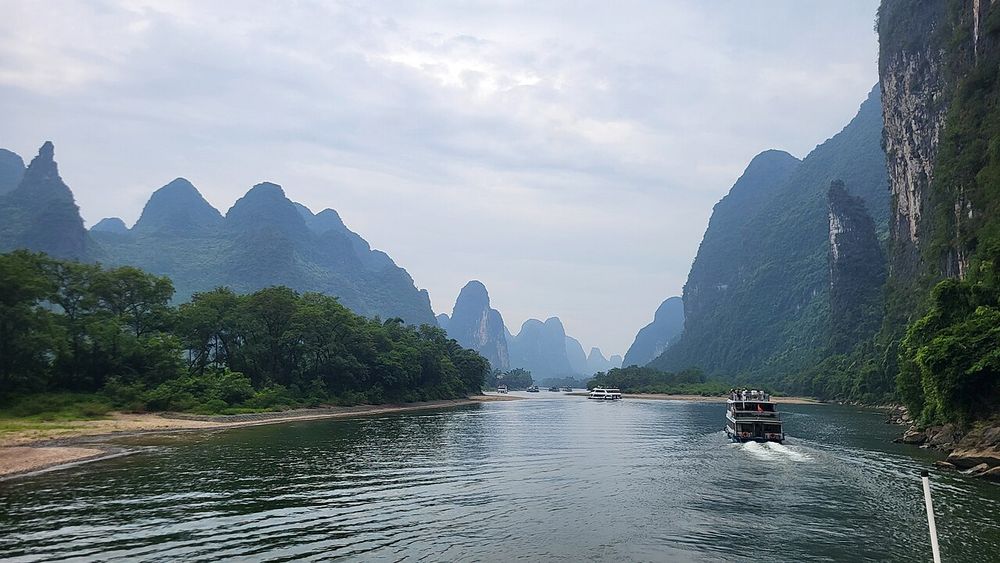
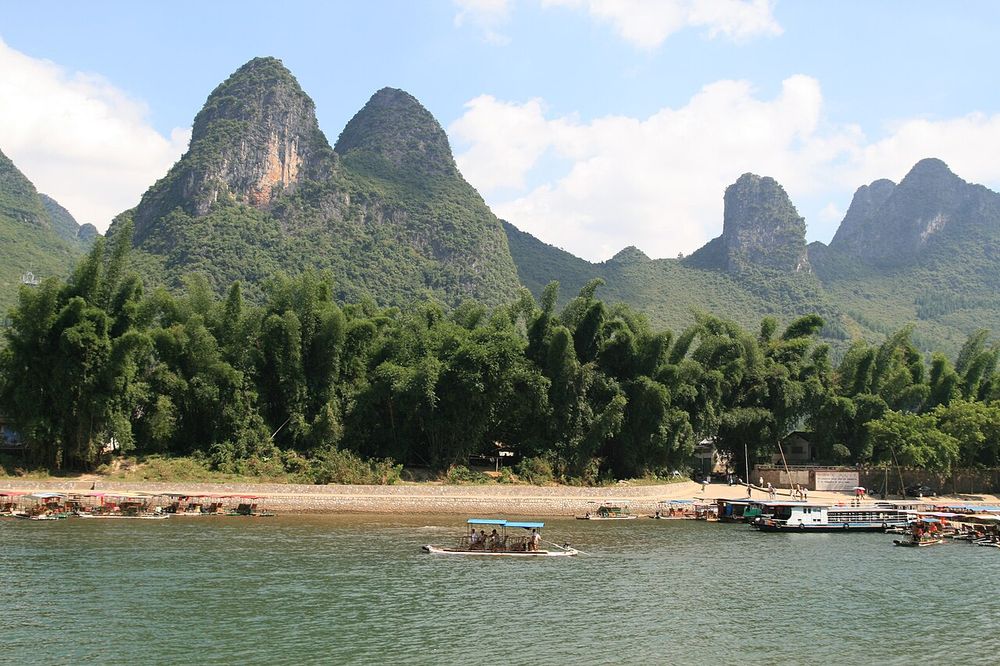
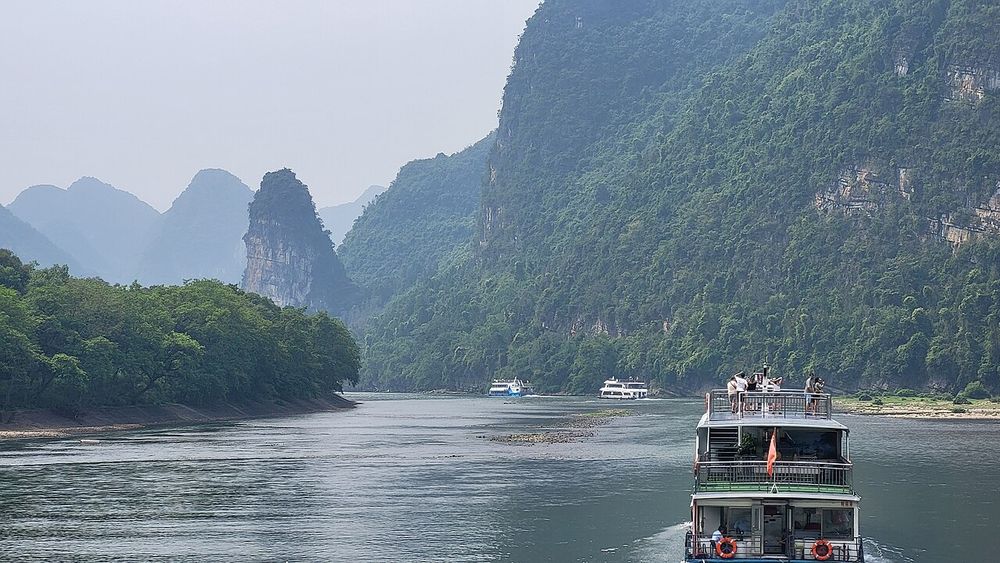
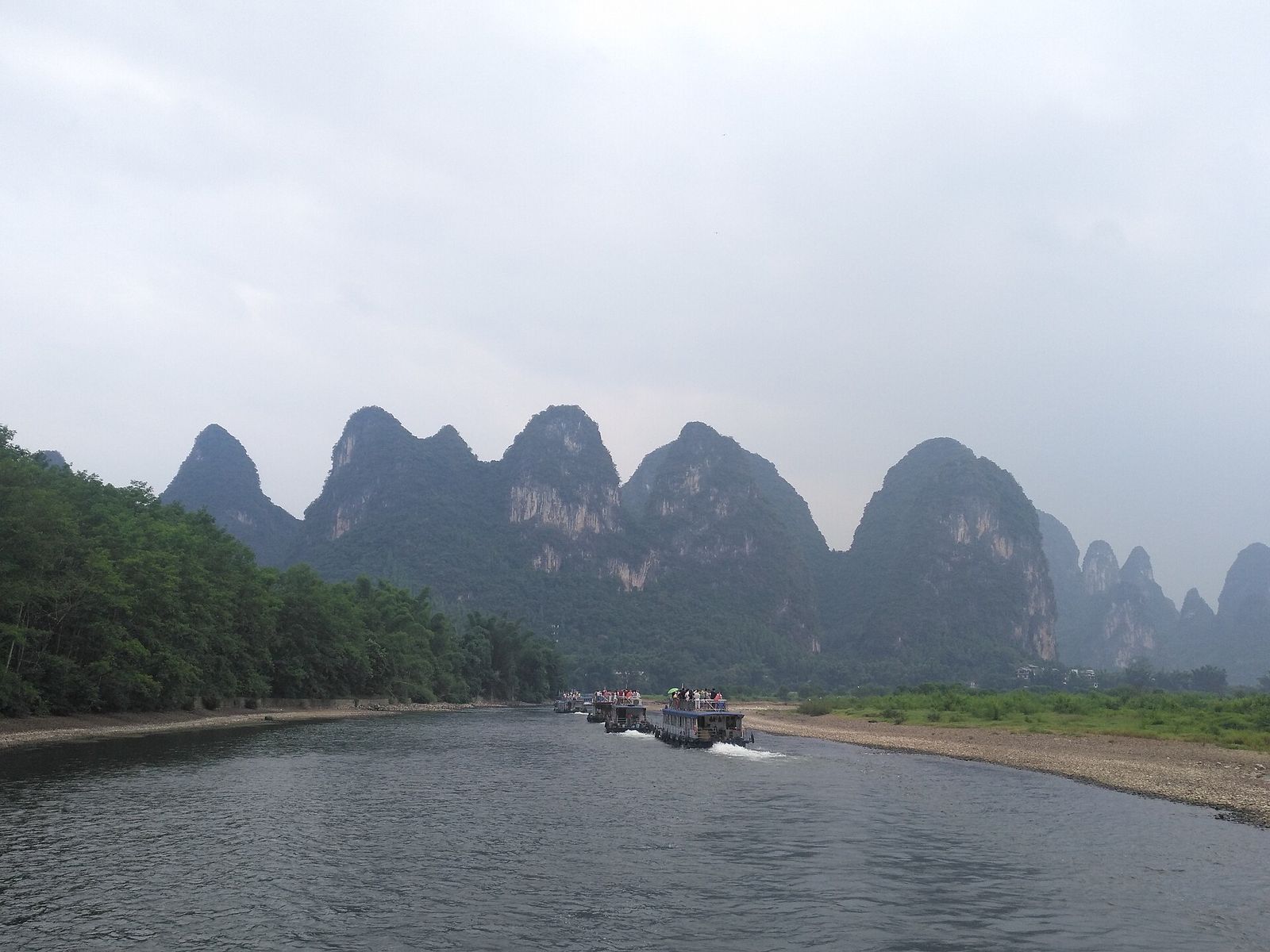
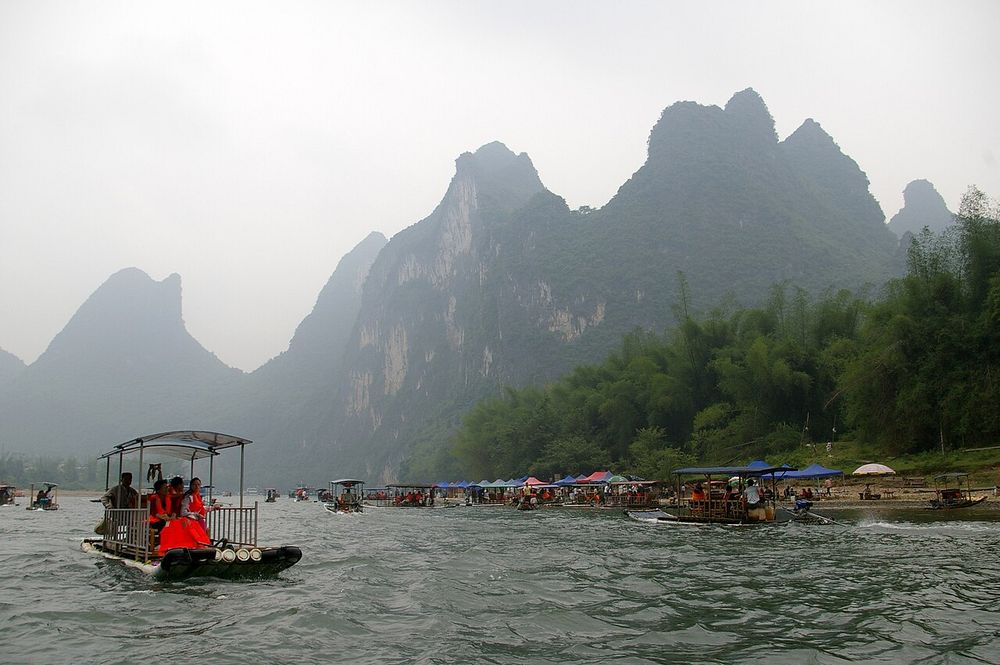
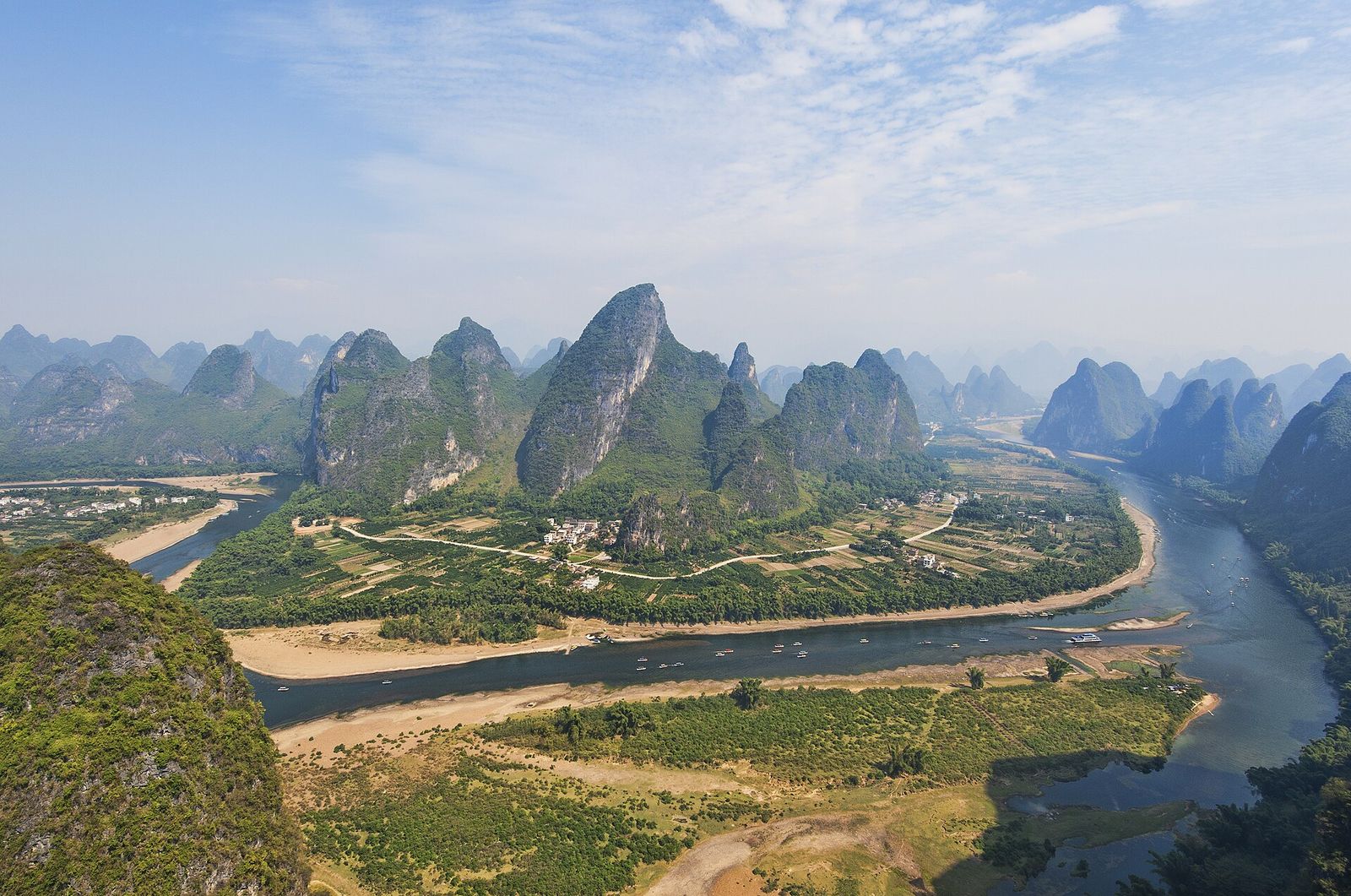
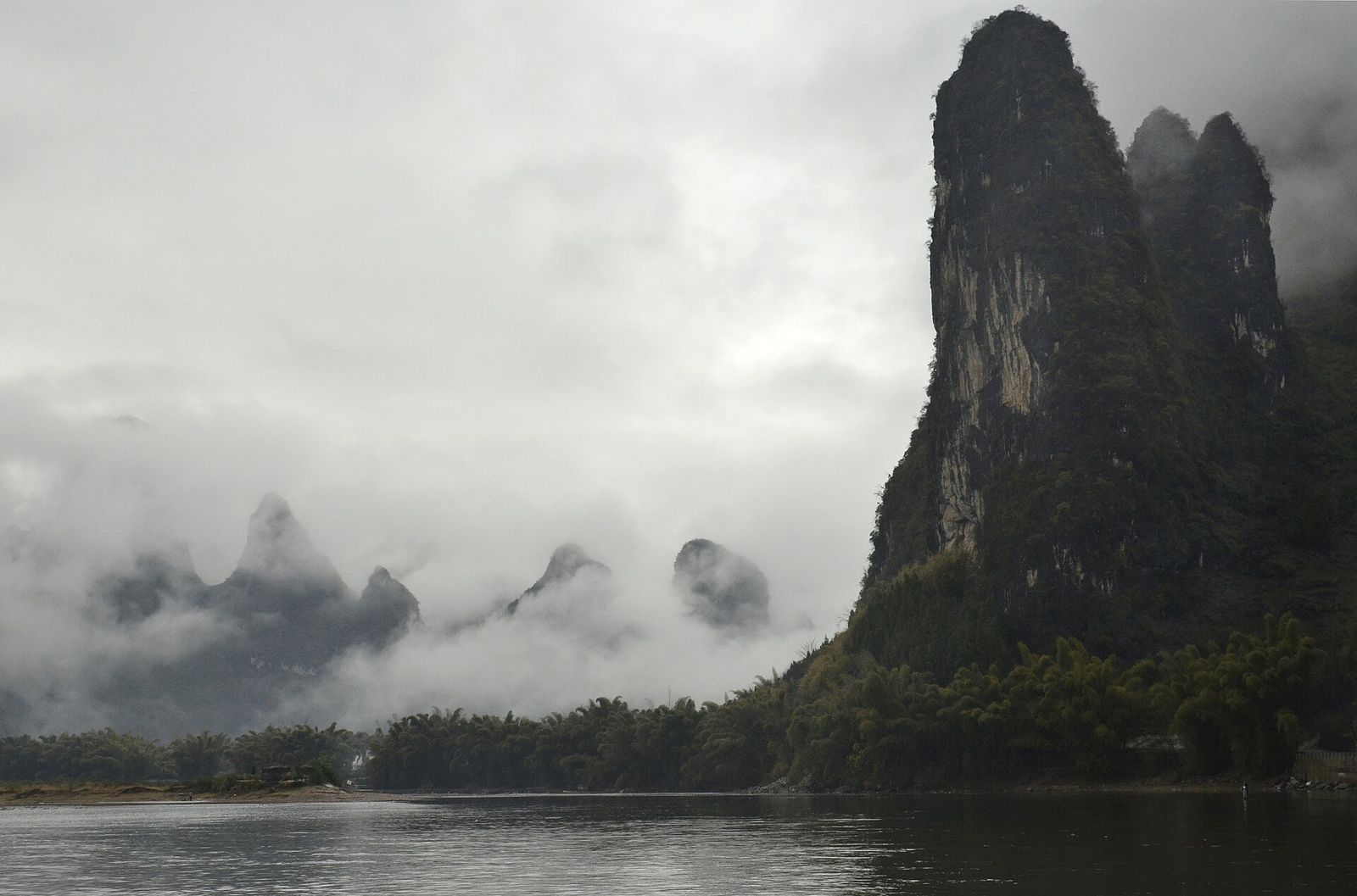
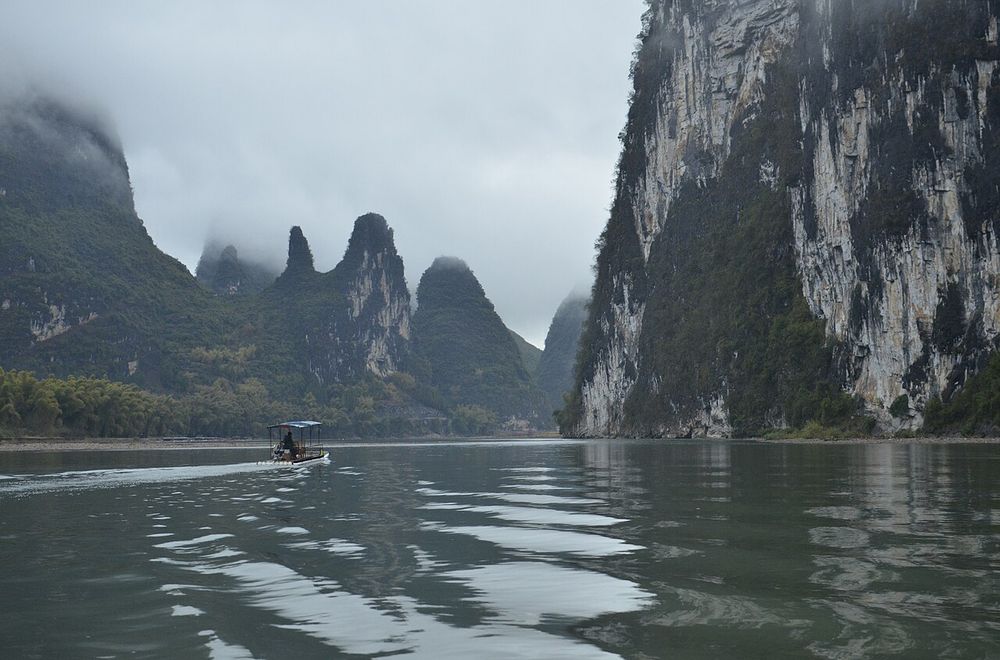
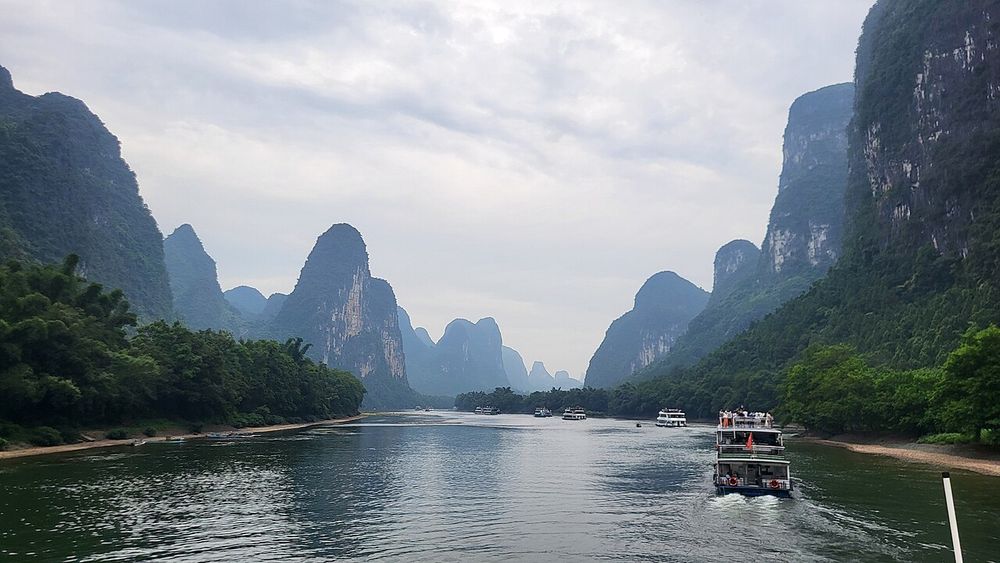
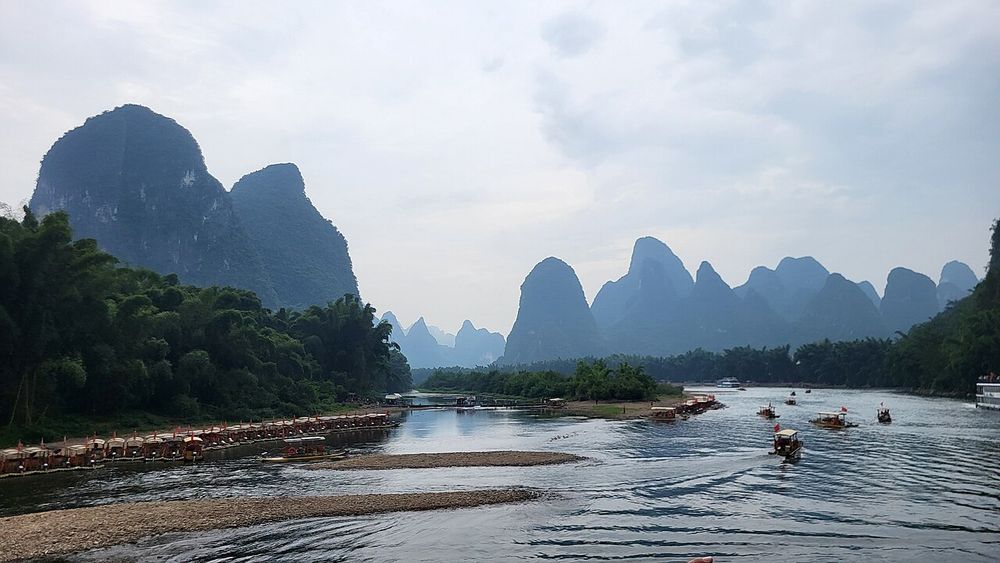
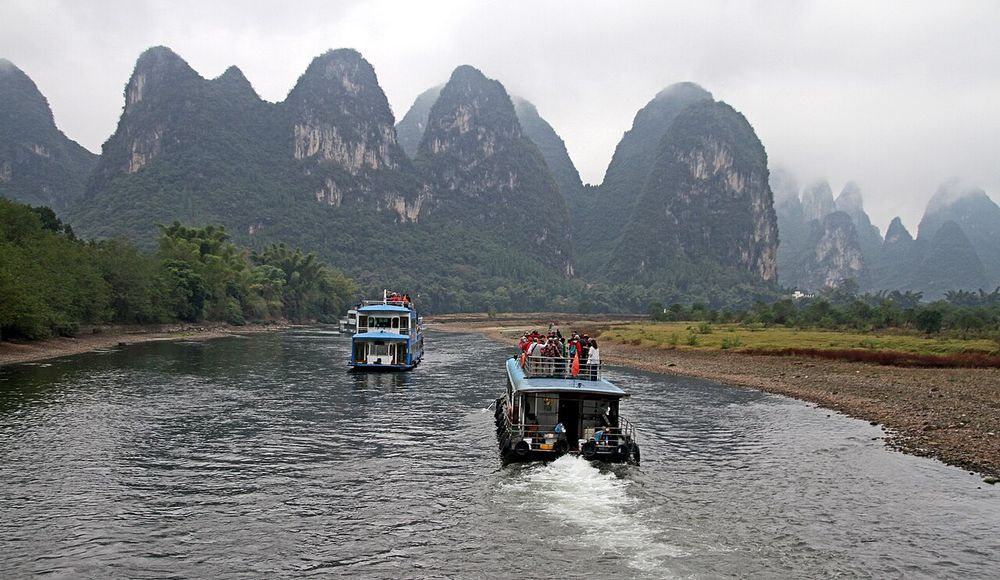
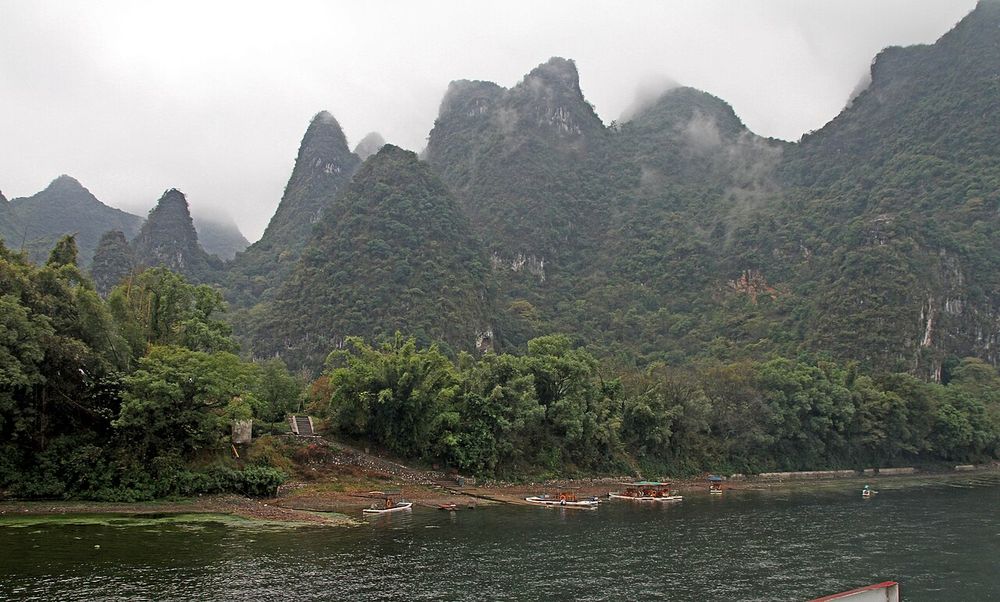
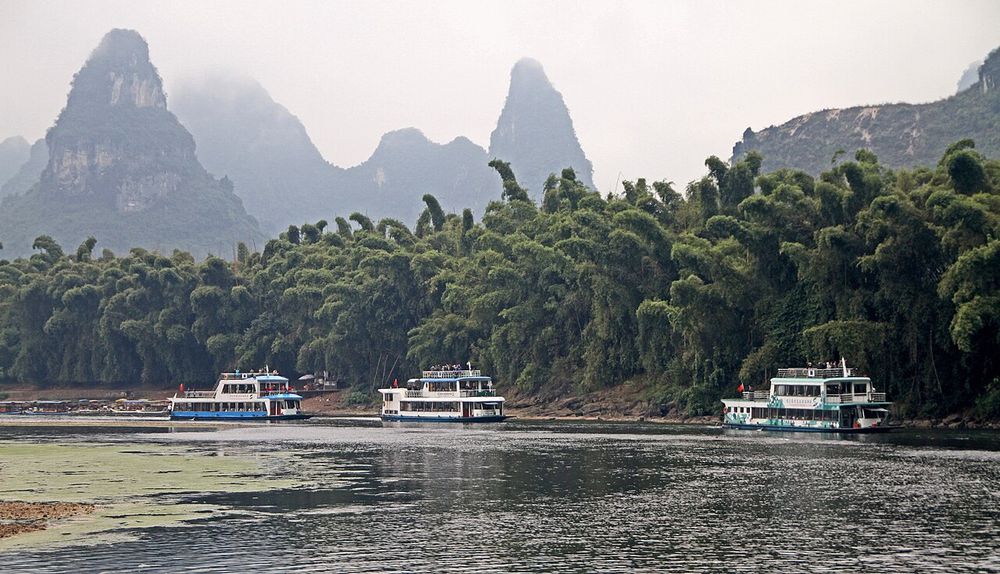
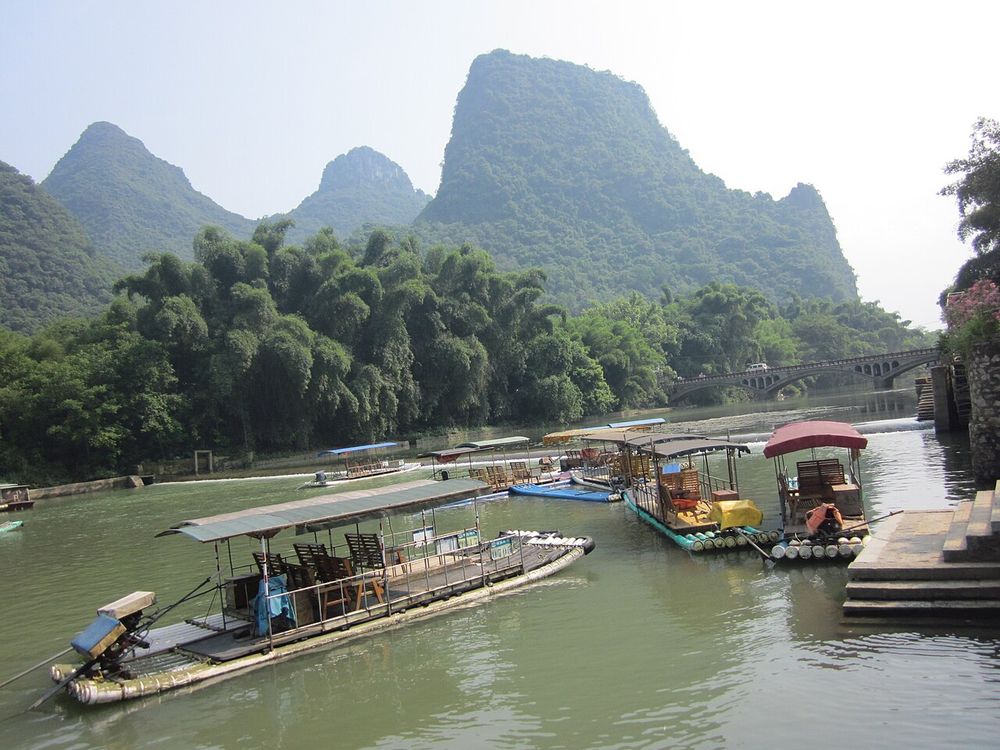
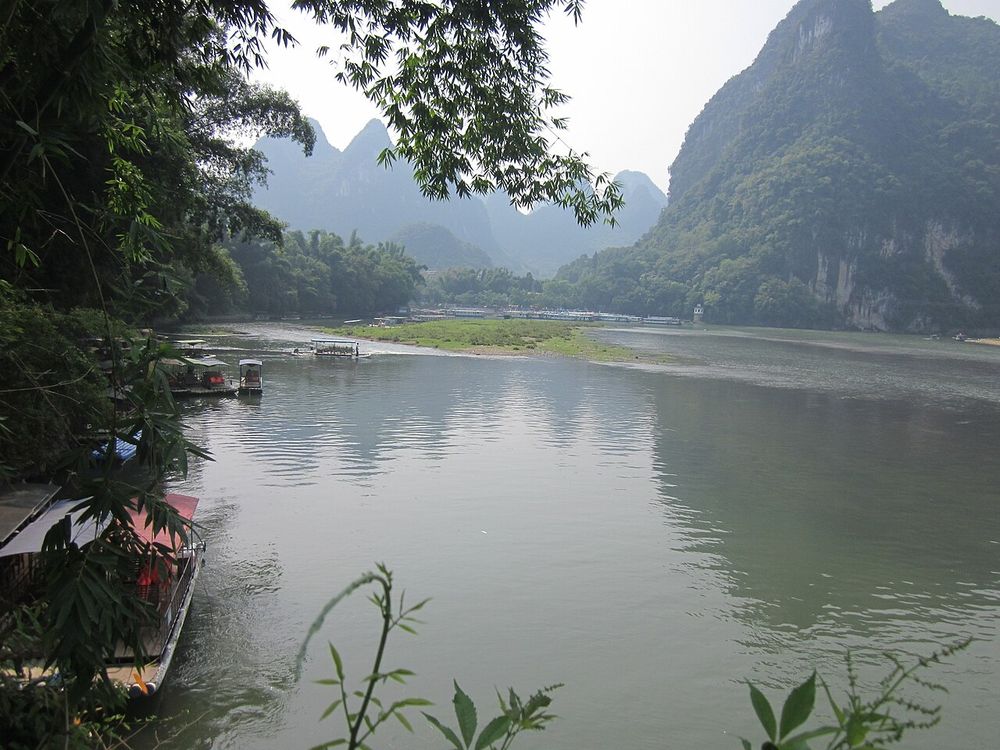
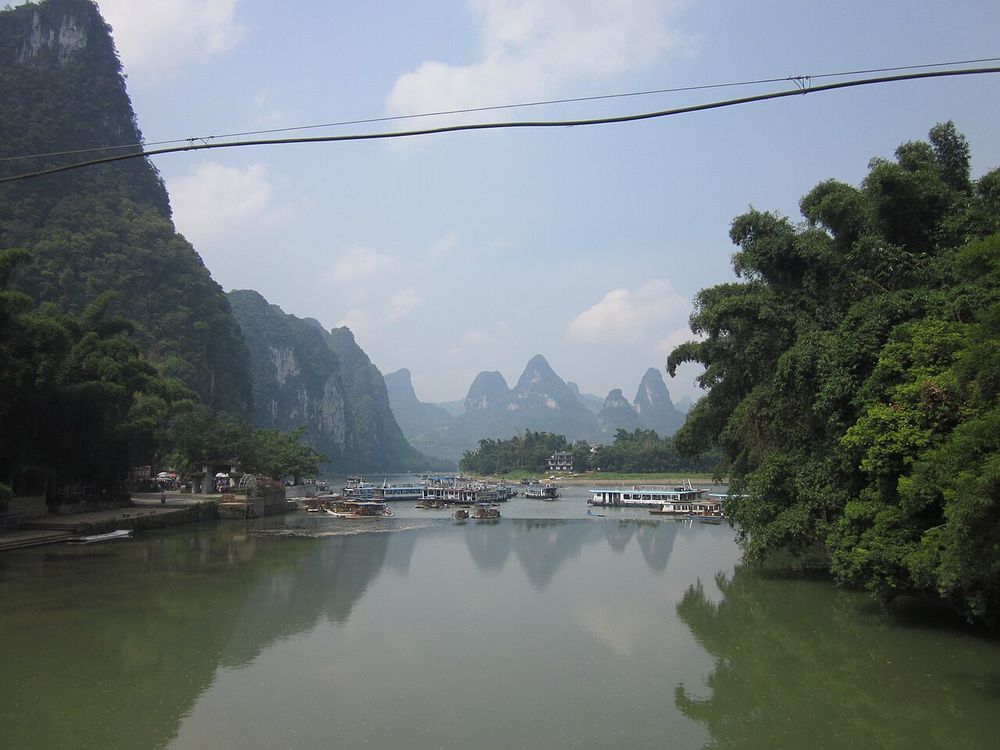
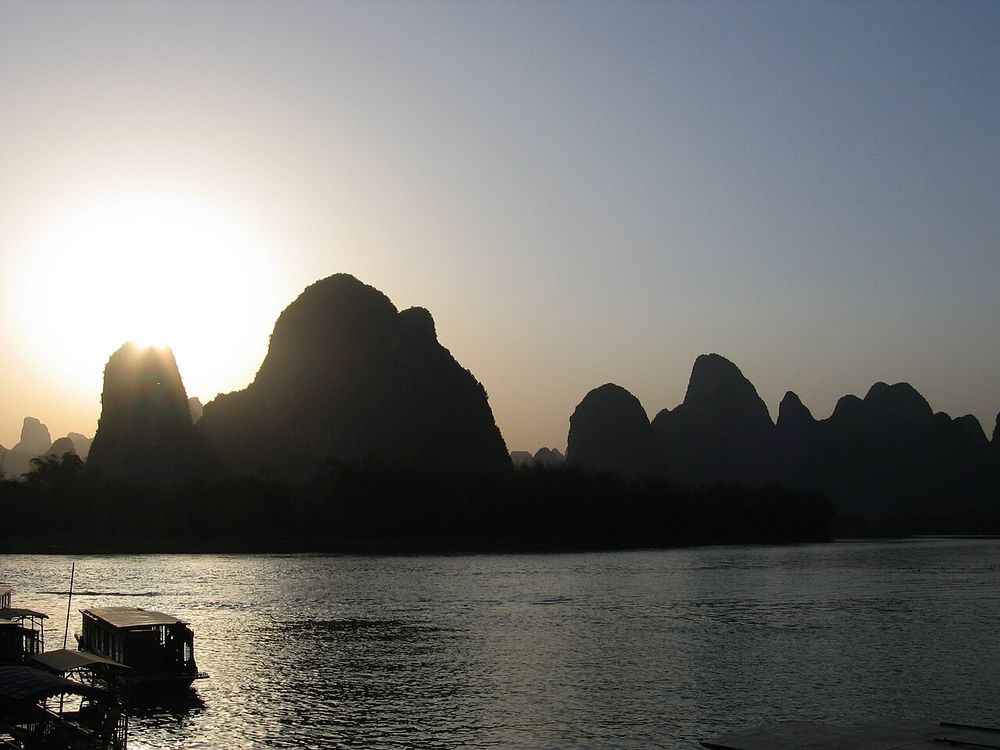
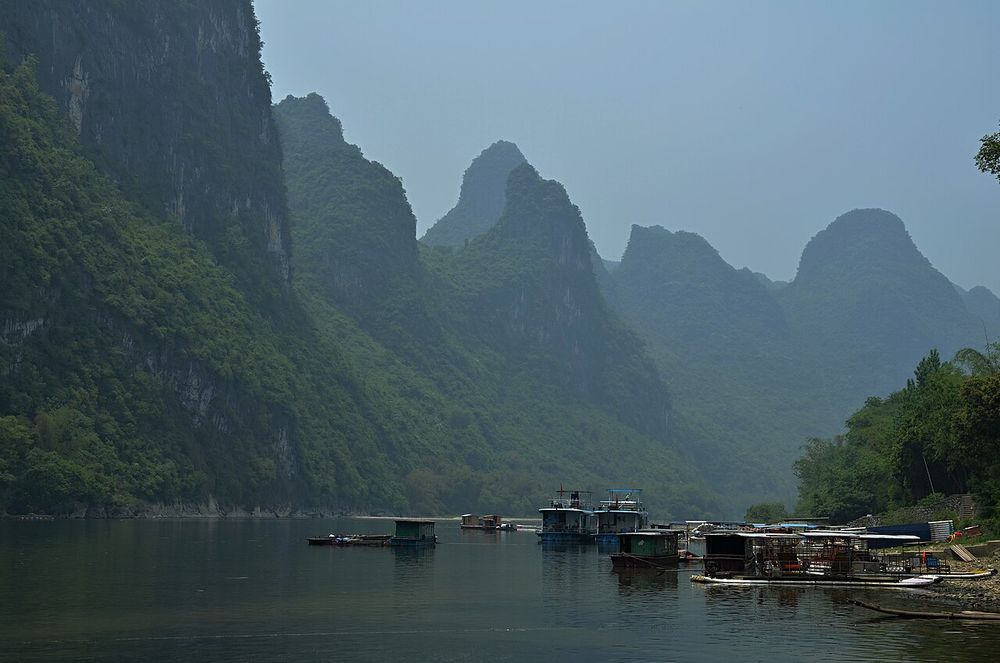
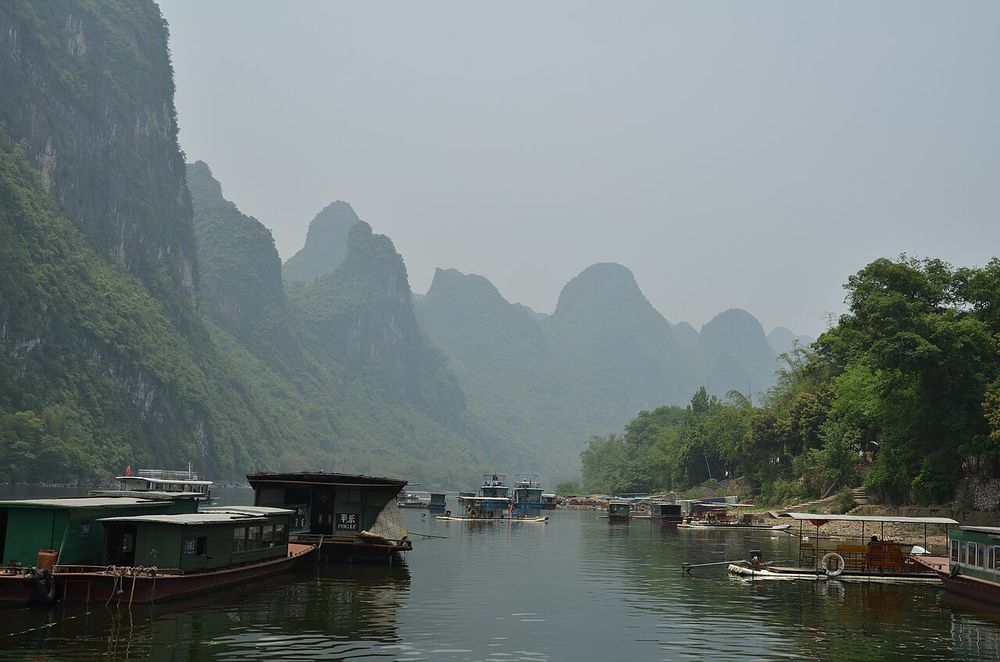
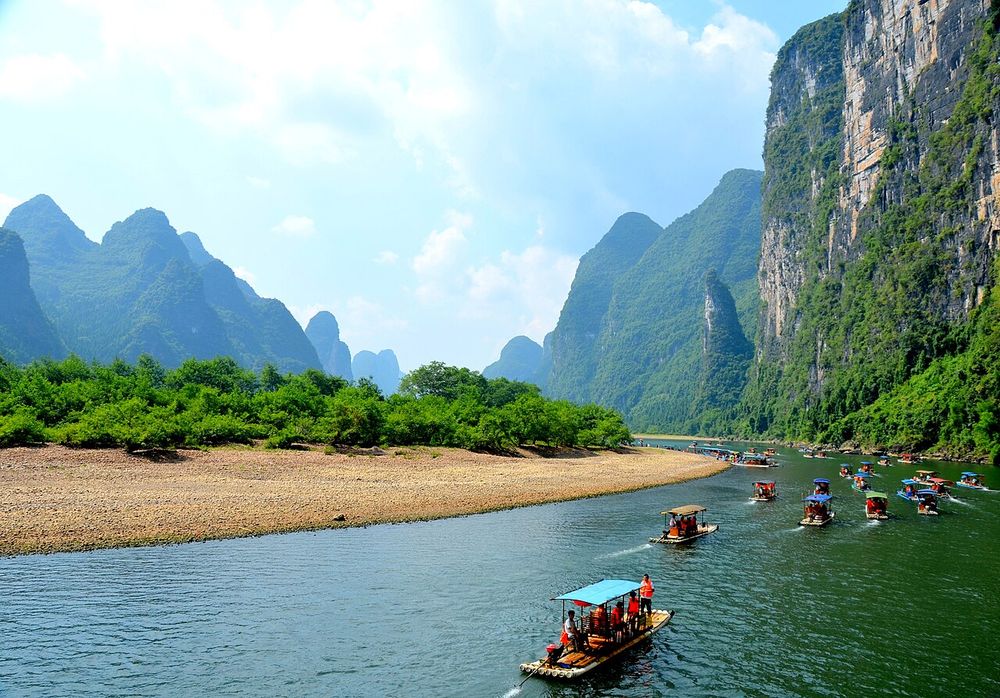
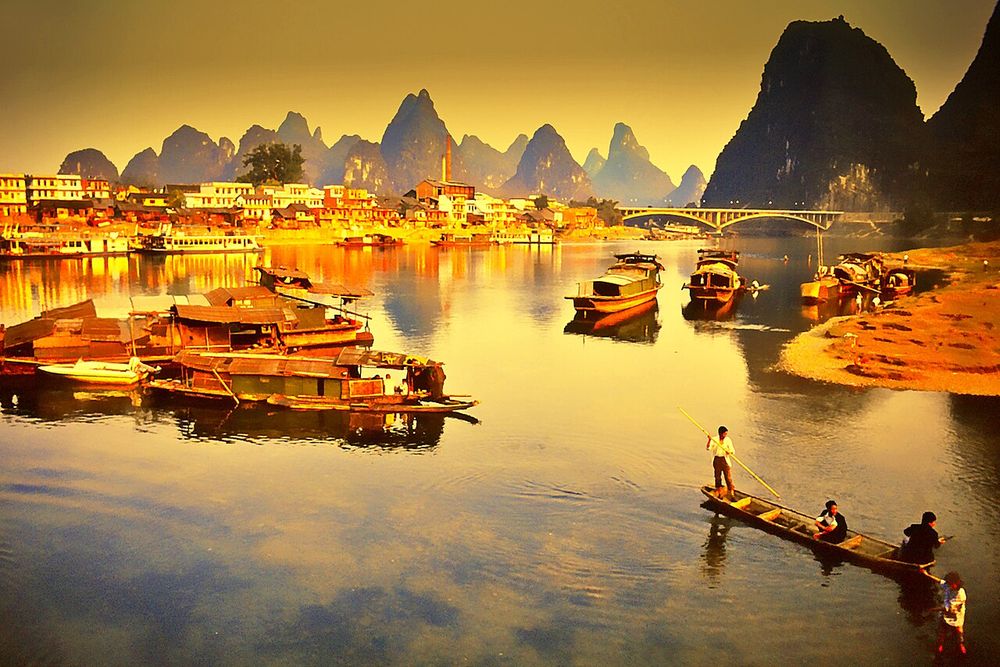
Sixty kilometres of clear green river between thousands of limestone towers. Chinese painters drew these hills for a thousand years, and visitors from abroad often assume the paintings were invented. They were not. One bend of this river is printed on the 20 yuan note.
Photo: chensiyuan, CC BY-SA 4.0, Wikimedia Commons
The story
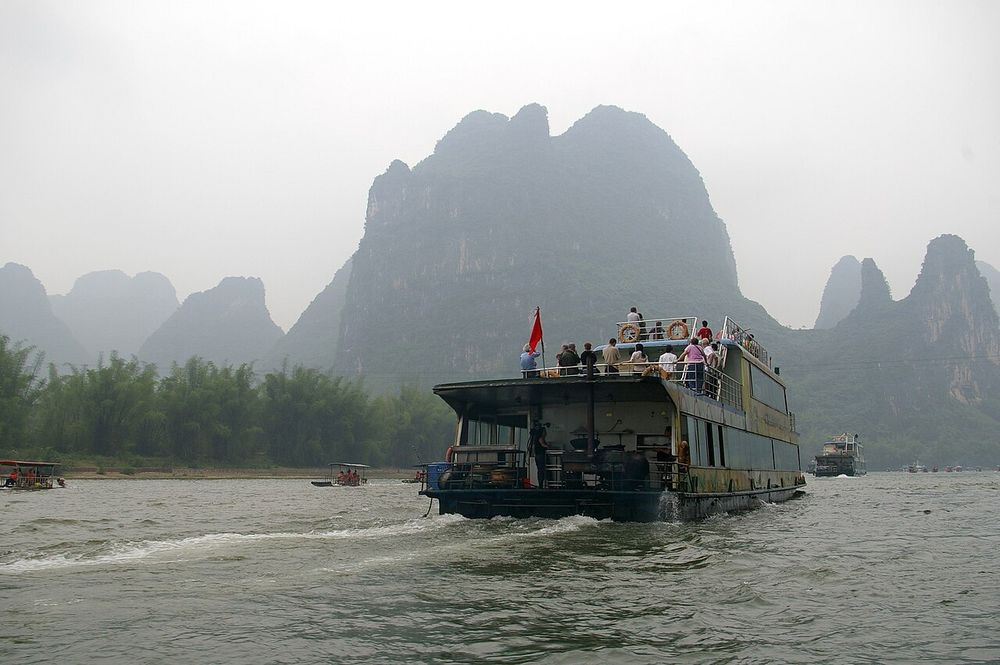
The Li River runs south from Guilin to the small town of Yangshuo. The boat takes about four hours. For most of that time you are moving between towers of grey limestone, each one separate, steep and covered in green, standing straight out of flat fields.
The Tang (618–907) poet Han Yu described it in ten characters in 822: the river is a green silk belt, the hills are jade hairpins. He never came here. People who had come told him.
What is here
The cruise ticket covers the boat from a pier near Guilin to Yangshuo, and nothing on land. The best scenery is the middle stretch, between Yangdi and Xingping, which can also be done by small raft on a separate ticket. Xingping and Yangshuo are open towns.
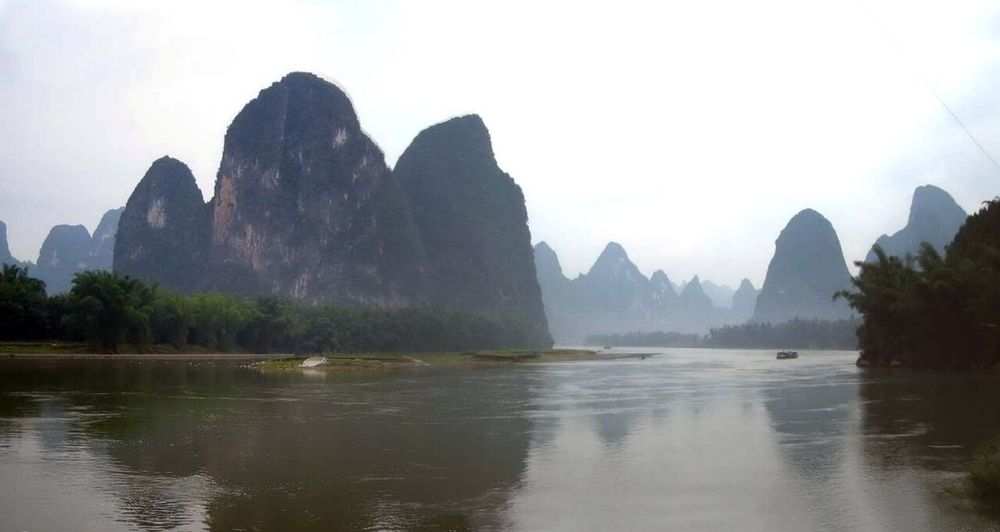
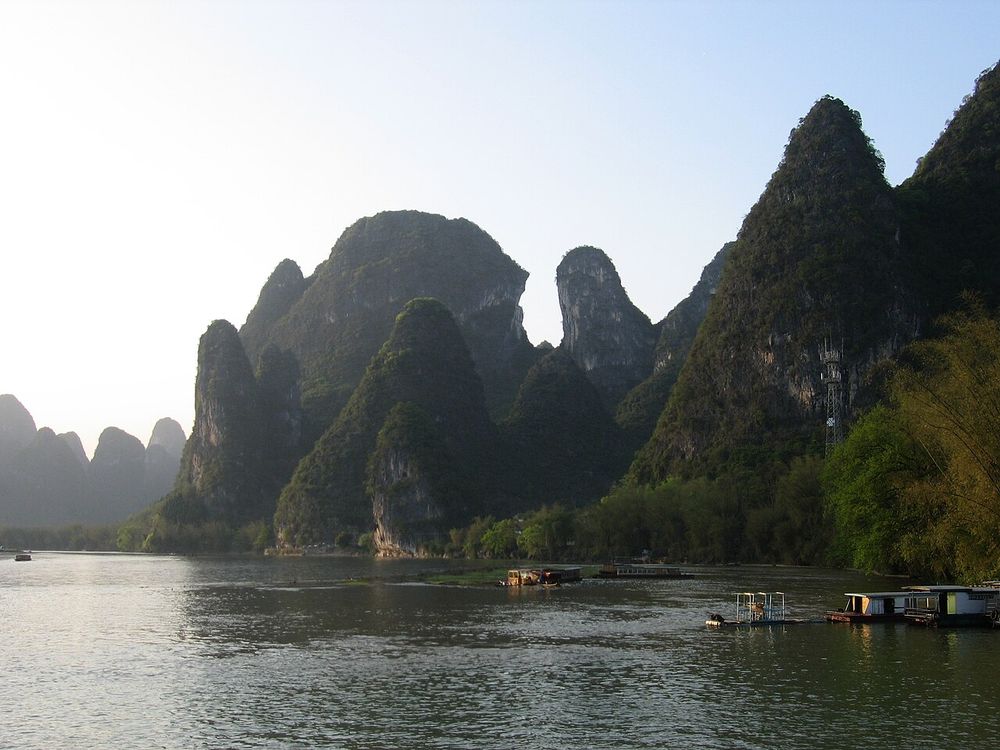
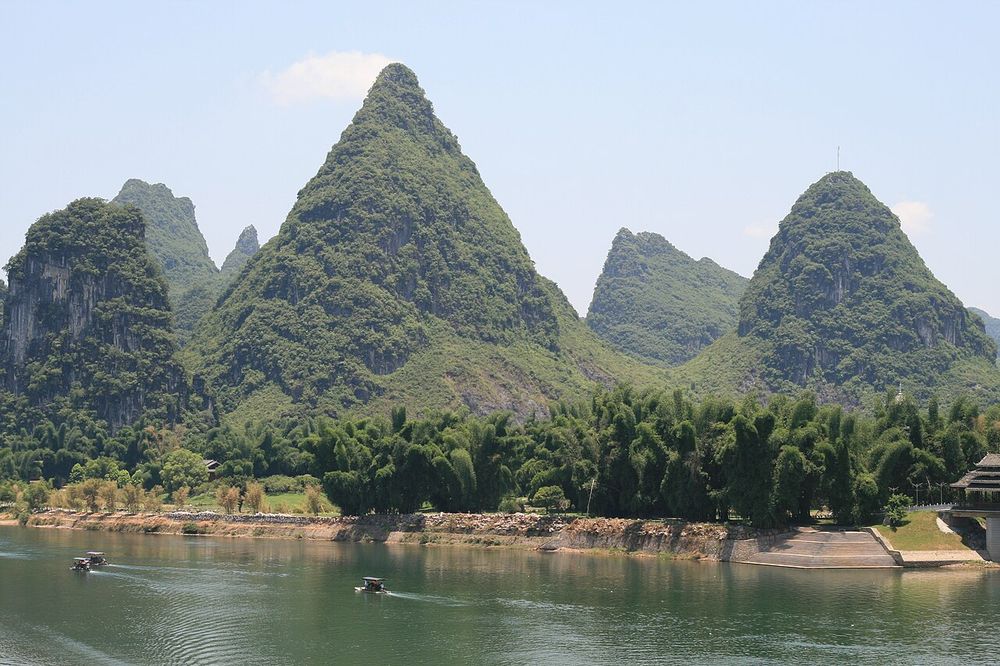
Look at the shape of the hills. Each is a tower with nearly upright sides and a rounded top. Geologists call this tower karst, and the Li River is the place the textbooks use to show it.
The rock is limestone, laid down as mud on the floor of a warm sea more than 300 million years ago. Rain is very slightly acid. Over millions of years it has eaten the limestone away along its cracks and left these towers standing.
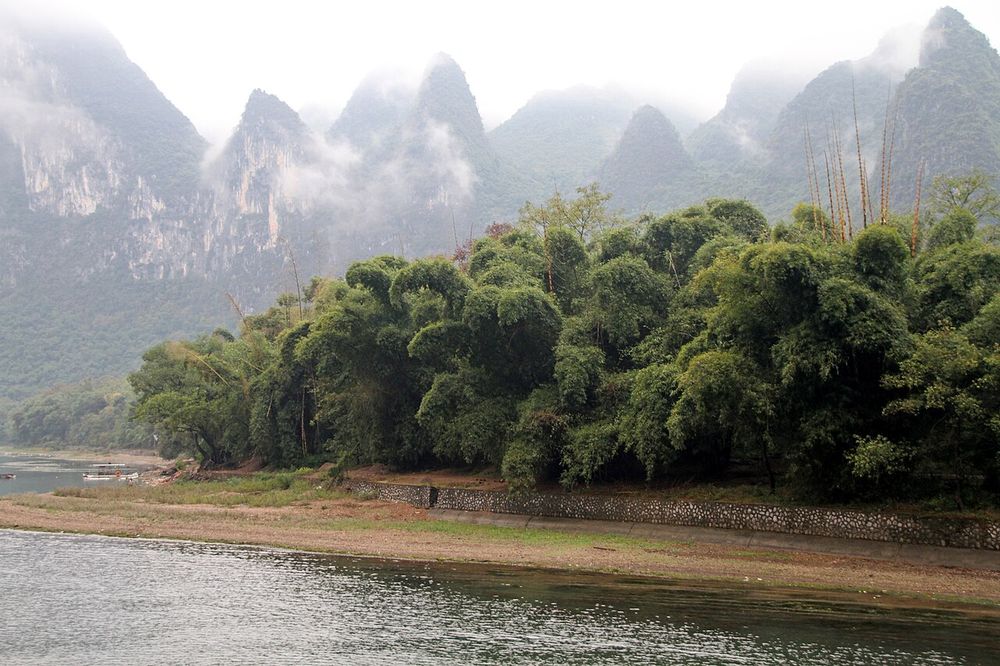
Bamboo leaning over the waterBernt Rostad, CC BY 2.0
Along the banks grow clumps of very tall bamboo that bend over the water. People here call it phoenix-tail bamboo.
The water is green, not brown. The river runs over pebbles and carries little mud, so in calm weather the hills stand upside down in it.
Things people often get wrong
"Chinese painters made these mountains up." Visitors from Europe and America often think the thin, steep peaks of Chinese ink painting are a style. Here they are simply what the land looks like.
"The boat leaves from Guilin." The piers are in the countryside, thirty to forty minutes by car south-east of the city.
"It is a round trip." It is one way, downstream. You come back from Yangshuo by road, in about an hour and a half.
"The view on the 20 yuan note is at Yangshuo." It is at Xingping, an hour upstream of Yangshuo by boat.
"'Guilin's scenery is the best under heaven' is just a saying." It is a line from a poem written in 1201 by an official named Wang Zhenggong. The poem was carved on a cliff in Guilin and found again in 1983.
The people of this place
Guangxi is the home of the Zhuang, the largest of China's minority peoples, about nineteen million. Their language is related to Thai. Along the river the villages are a mix of Han (206 BC–AD 220), Zhuang and Yao.
The Zhuang are known for singing. In the old way, young people met at song fairs and courted by trading verses, each answering the other on the spot. The third day of the third lunar month is the great song festival, and a public holiday in Guangxi.
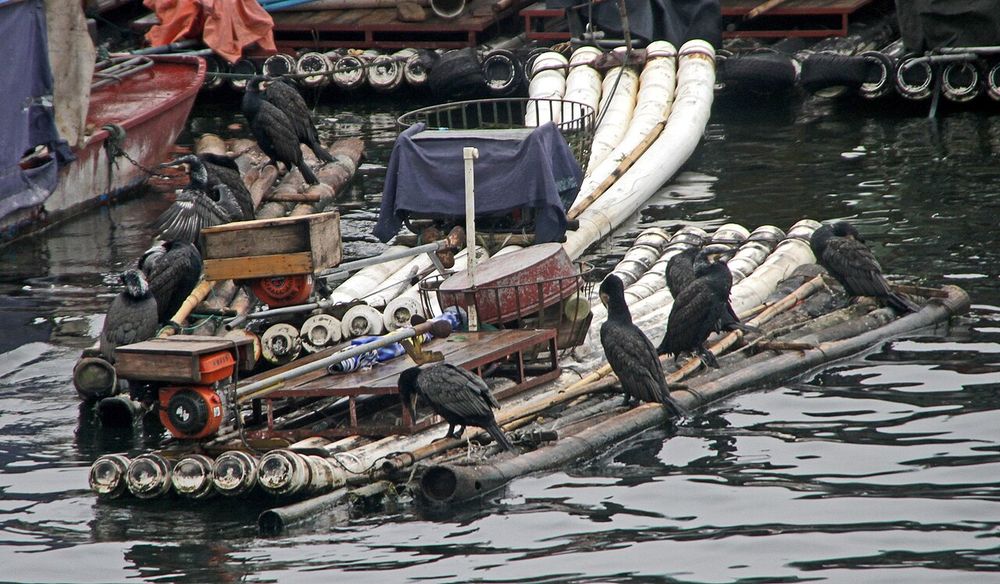
The fishermen with large black birds on their rafts are showing an old trade. The birds are cormorants. A cord round the neck stops the bird swallowing a big fish, and the fisherman takes it from its throat. Few people live by it now. Those you see at Xingping mostly pose for photographs and expect to be paid.
The local breakfast is a bowl of rice noodles with pickled beans, peanuts and a spoon of dark stewed sauce. Mix it dry first, eat most of it, then add broth.
People who stood here
Jianzhen (Chinese monk who took Buddhist teaching to Japan; called Ganjin there)After his fifth attempt to reach Japan was wrecked in a storm, he came up this river about 750 and stayed in Guilin for a year. He was already going blind. He reached Japan on the sixth attempt.
Xu Xiake (China's great travel writer, 1587–1641)He spent the early summer of 1637 here, went down the river to Yangshuo, and crawled into dozens of caves with a torch. His diary is the first careful description of this kind of landscape anywhere in the world.
Sun Yat-sen (founder of the Chinese Republic)In December 1921 he came up the river by boat with his army, stopped to speak to the people of Yangshuo, and made Guilin his headquarters for four months.
Qi Baishi (Chinese painter, 1864–1957)He came in 1905, a carpenter turned painter of forty-one. He said afterwards that these hills taught him to stop copying old masters and paint mountains his own way.
Xu Beihong (Chinese painter, famous for his horses)He lived in Yangshuo in the 1930s and painted Spring Rain on the Li River there in 1937, in wet ink with no outlines. His house in Yangshuo is kept as a museum.
Ho Chi Minh (leader of Vietnam's independence)He lived in Guilin from 1938 to 1940, working quietly in an office of the Chinese Communist army. He came back as president in 1961, took the boat down the river, and wrote a short poem in Chinese in its praise.
Deng Xiaoping (Chinese leader) and Pierre Trudeau (prime minister of Canada)In October 1973 Deng brought Trudeau down the river. Factories were then pouring waste into it. Deng told the local officials that if they ruined the Li River, nothing else they did would make up for it. Dozens of factories were closed.
Richard Nixon (American president who opened relations with China)He came in February 1976, after leaving office, and took the boat.
Bill Clinton (American president)On 2 July 1998 he gave a speech in Guilin on protecting the environment, then went down the river and walked through a fishing village near Xingping.
Go deeper: eight stops down the river, in the order the boat passes them
The stops follow the river downstream, from Guilin to Yangshuo.
1. Where the river comes from: a canal 2,200 years old
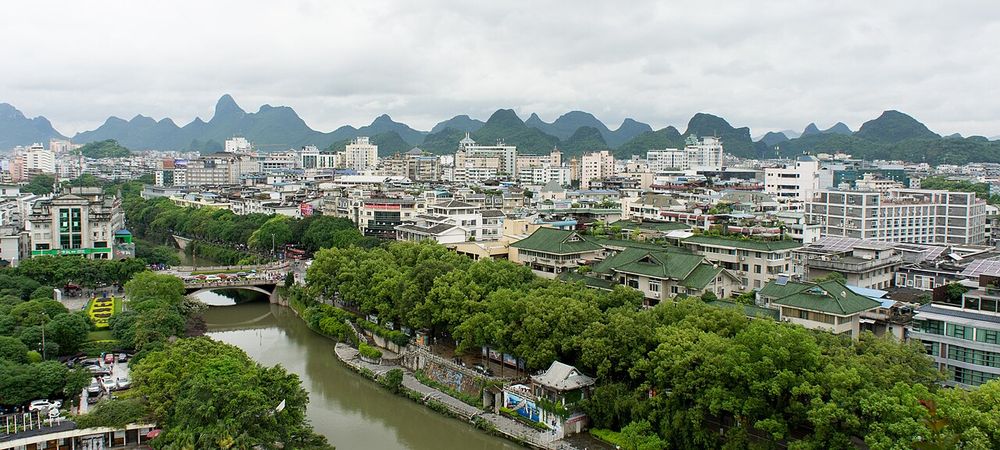
Guilin and the river from Elephant Trunk HillShujianyang, CC0
The Li rises on Mao'er Mountain, the highest in south China, north of Guilin. Near its source it comes within a few kilometres of another river, the Xiang, which flows the other way, north to the Yangtze.
In 214 BC the First Emperor of Qin (221–206 BC) had a canal cut between the two. It is called the Lingqu. It let his supply boats pass from the Yangtze to the Pearl River system and so conquer the far south. It still carries water. It is one of the oldest canals in the world that follows the contour of the land.
So the river you are on was, for two thousand years, part of the main road from central China to Guangzhou and the sea. Officials sent to the south, exiles, monks and merchants all came down it. That is why so many poems were written about it.
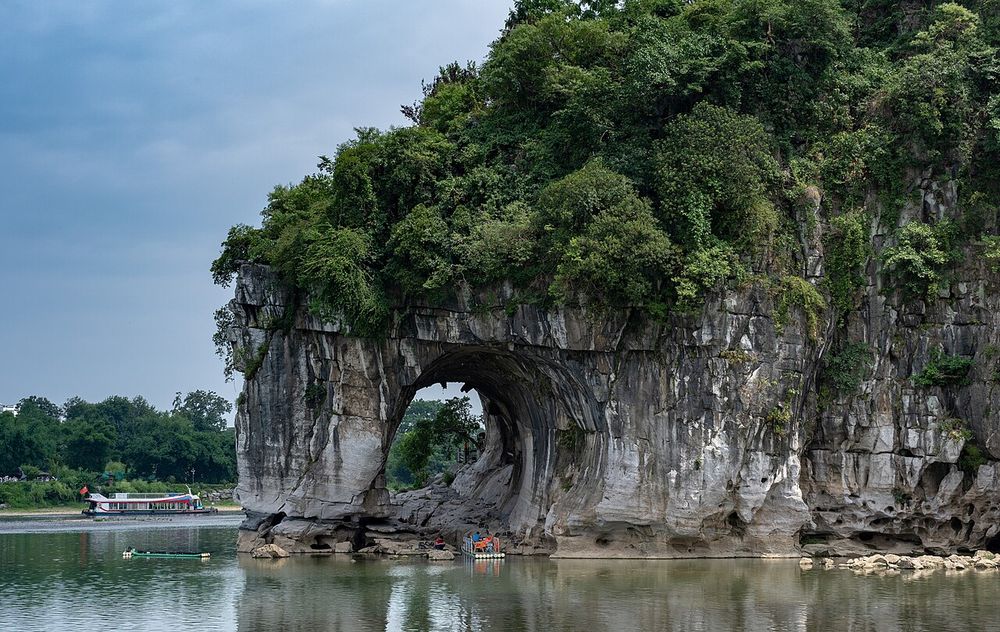
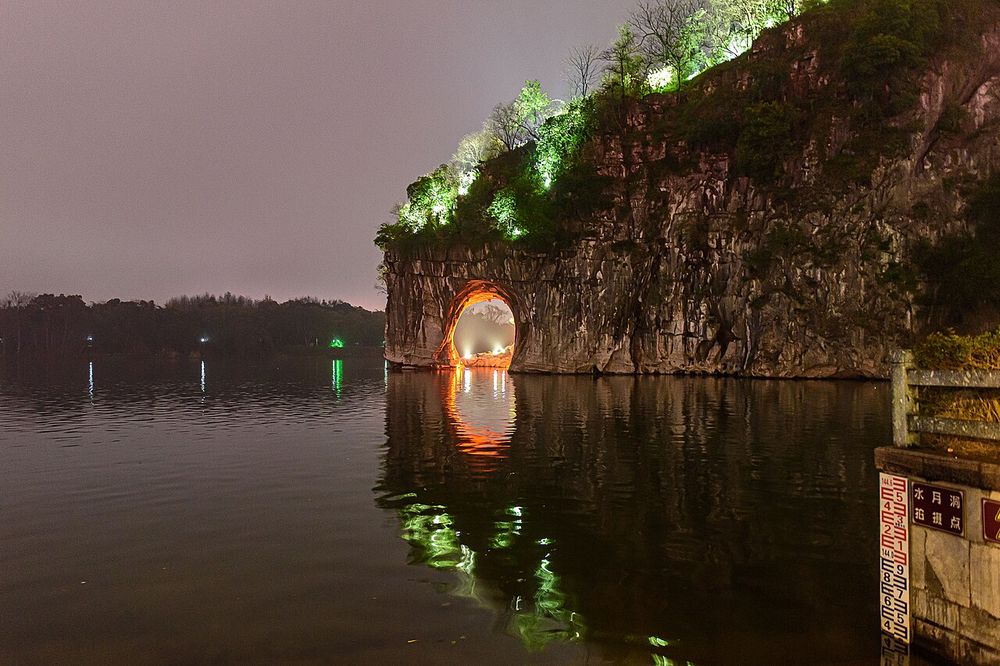
Elephant Trunk Hill in Guilin, where a smaller river joins the Lixiquinhosilva, CC BY 2.0
In the city itself the river passes Elephant Trunk Hill, a rock with a natural arch that looks like an elephant drinking. The cruise does not go past it. It has its own entrance in town.
2. The piers and the first hour
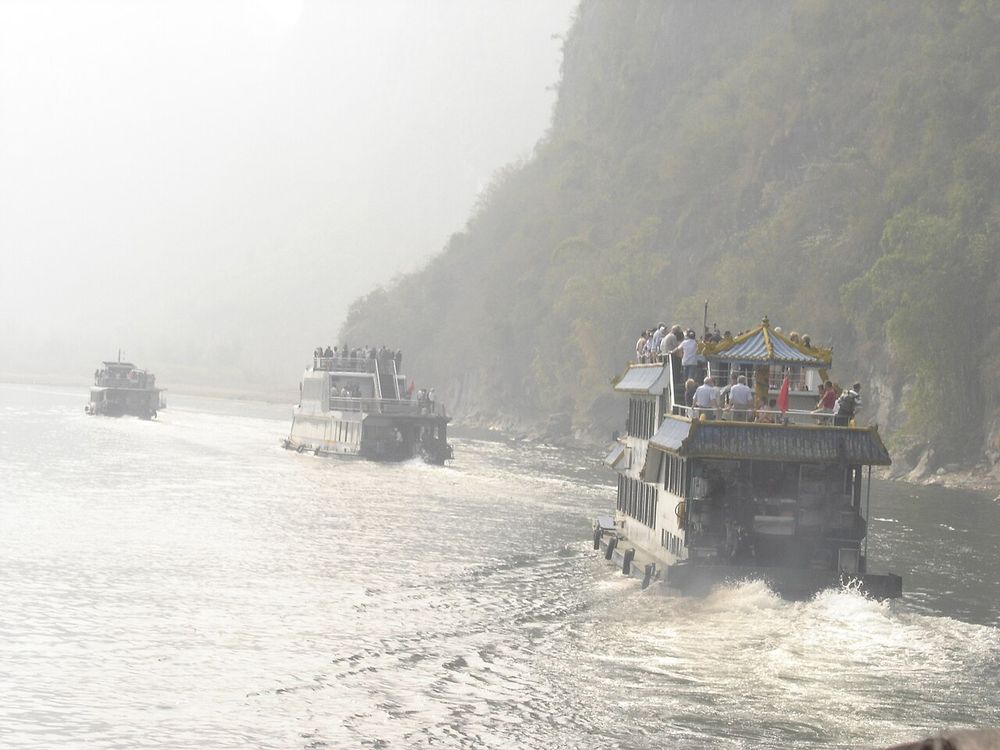
A cruise boat on the river, September 2025Renek78, CC0
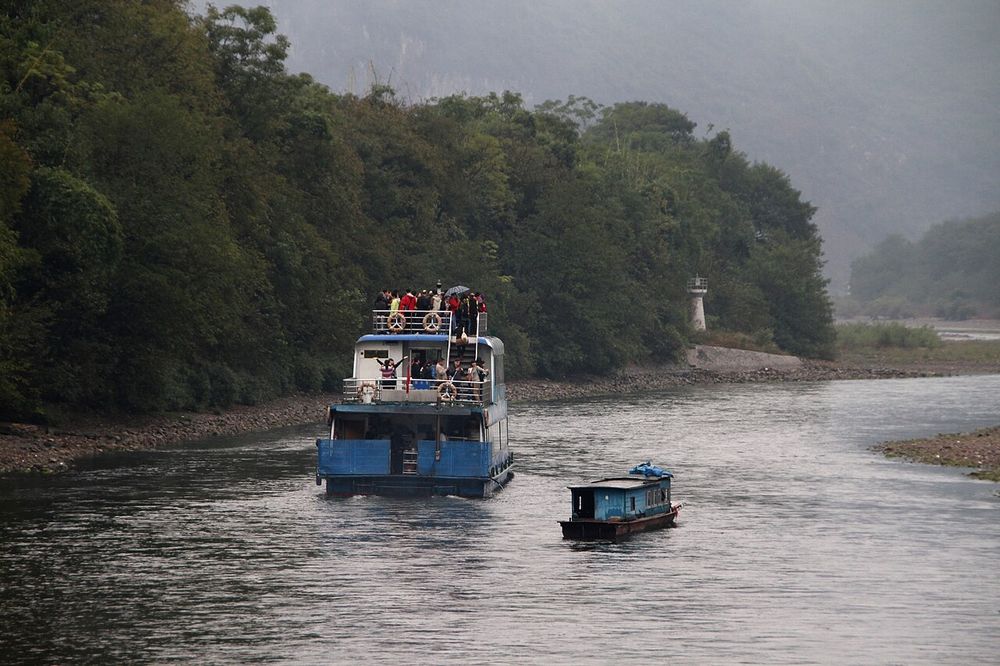
Boats leave in the morning in a long line, one after another. The first hour is gentle: low hills, water buffalo, villages, bamboo.
The hill above Crown CaveDennis G. Jarvis, CC BY-SA 2.0
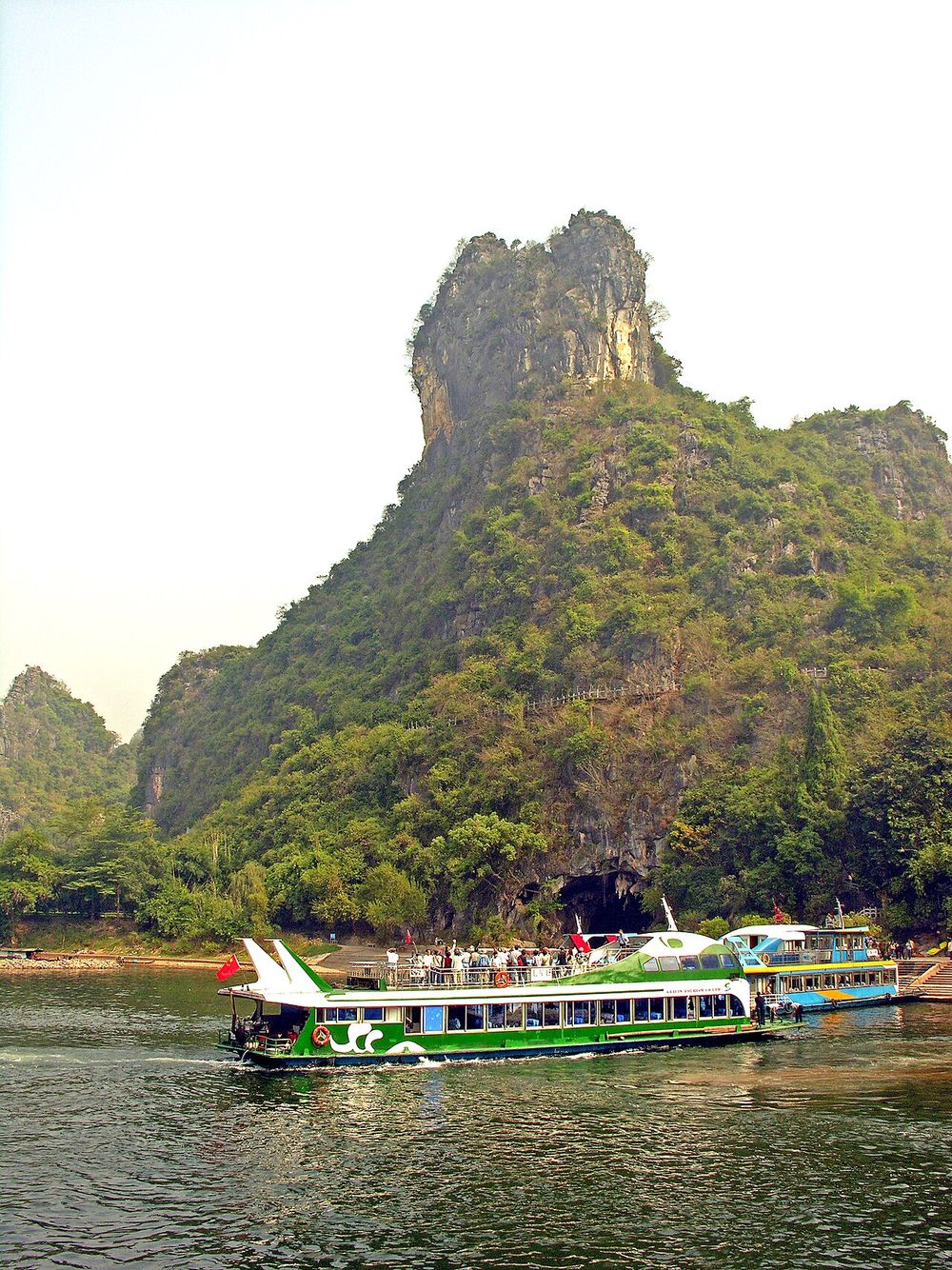
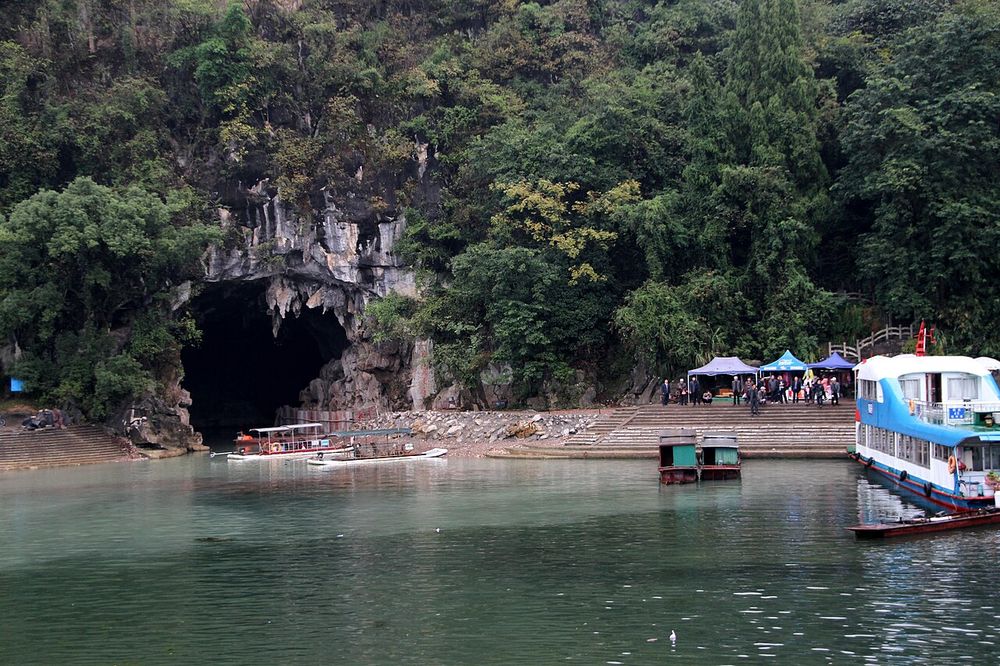
On the left bank you pass the mouth of Crown Cave. An underground river comes out of the hill here. The limestone is hollow: under these towers run many kilometres of caves.
3. Yangdi: the towers close in
The valley narrowsRenek78, CC0
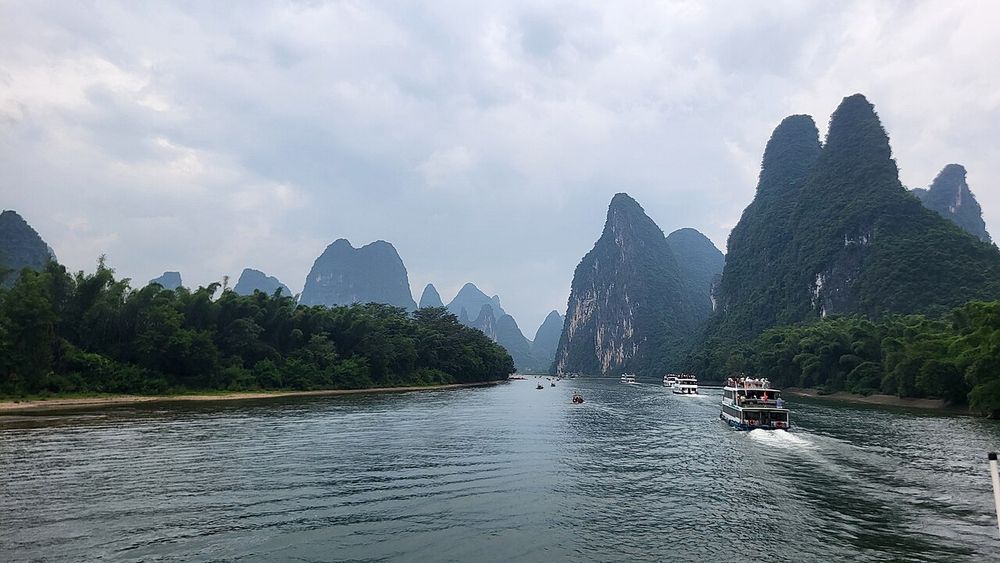
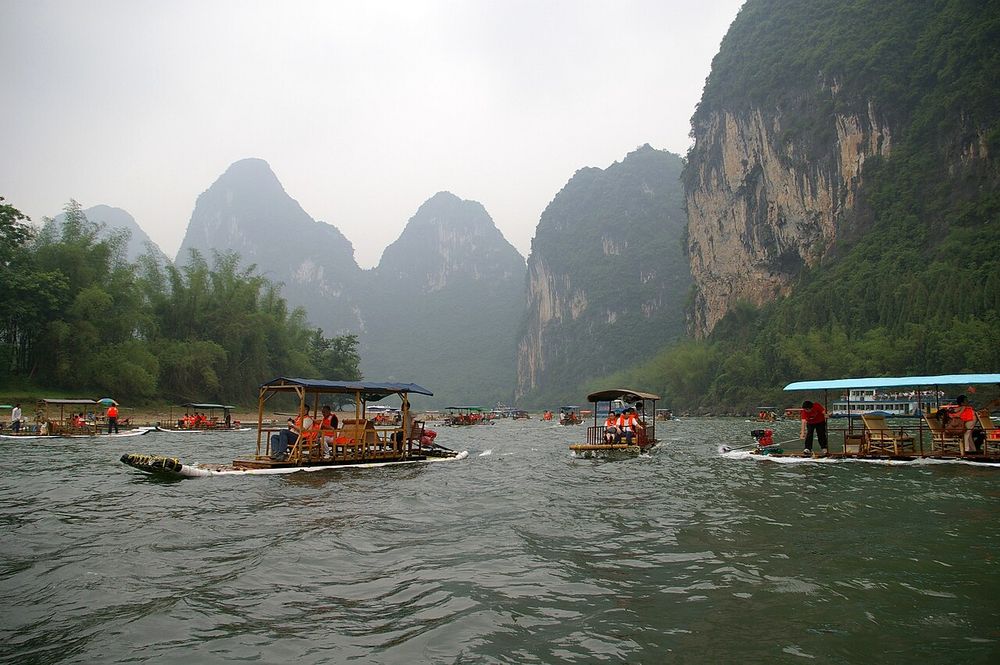
At the village of Yangdi the valley narrows and the towers stand in ranks on both sides. From here to Xingping is the stretch everyone comes for, about twenty kilometres. Go up on deck and stay there.
Geologists name two kinds of hill here. Where the towers stand apart on a flat plain, as around Yangshuo, it is "peak forest". Where they are joined at the base into one mass with many tops, as here, it is "peak cluster". Both words are translations from Chinese. The study of this landscape began in China.
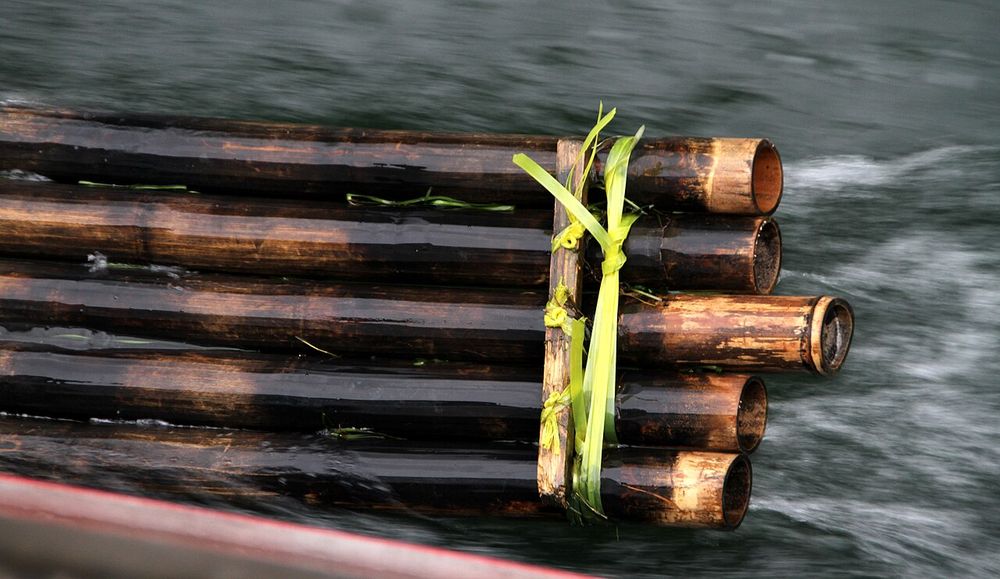
The end of a raft: plastic pipe now, bamboo onceGerd Eichmann, CC BY-SA 4.0
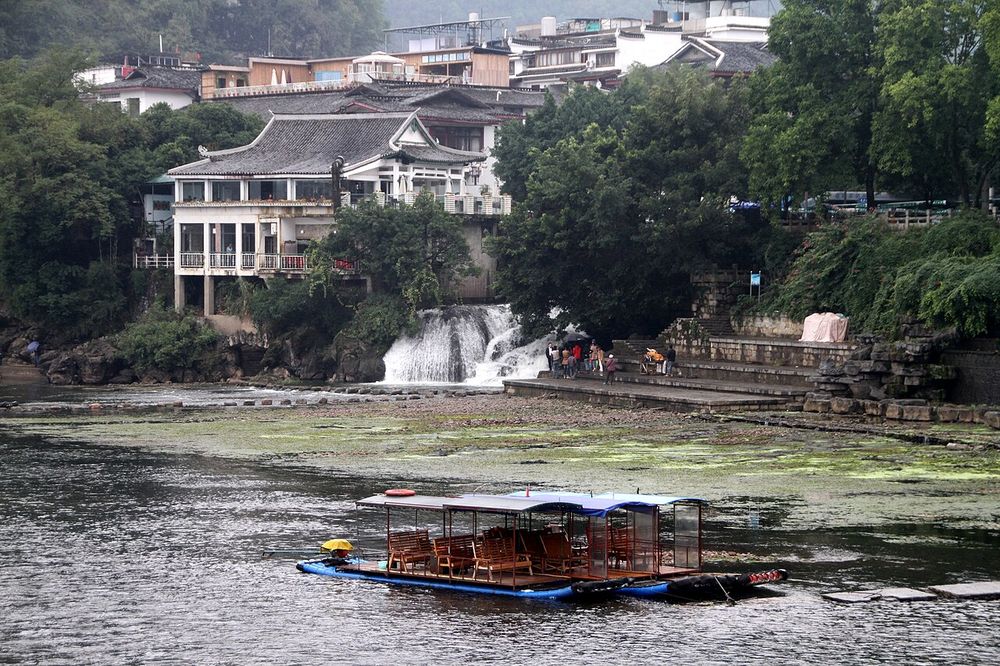
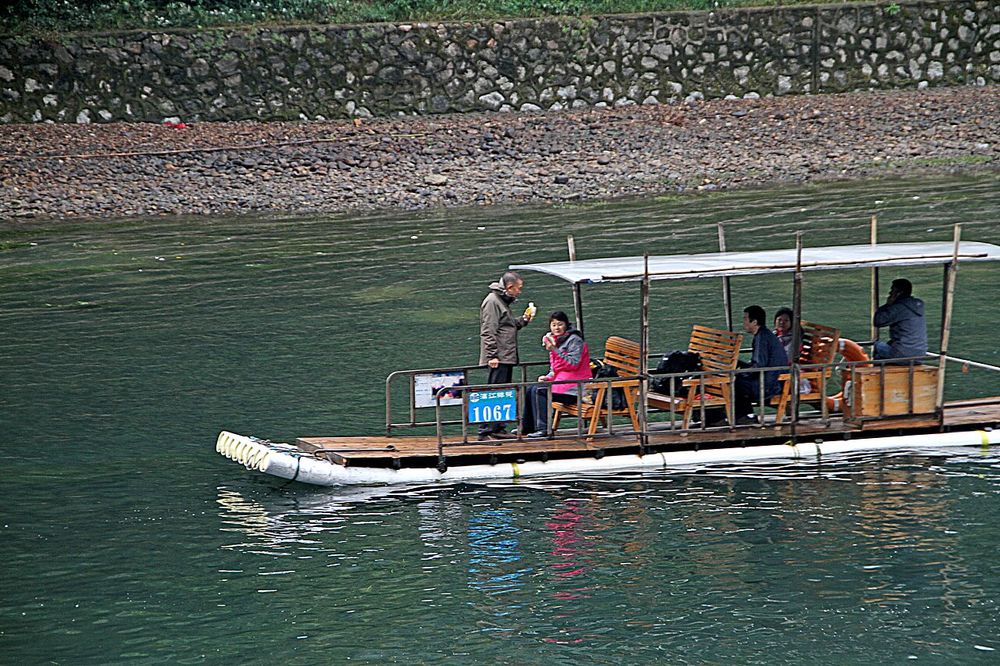
The small rafts with a roof and a motor are the cheaper way to see this stretch. They were once bamboo. Now they are plastic pipe made to look like it.
4. Nine Horses Hill
On the left a cliff a hundred metres high faces the river like a wall. Water has stained it in patches of yellow, white, grey and black. People have long seen horses in the patches: one drinking, one rearing, one lying down.
The boat's loudspeaker will ask how many you can find. Most people find three or four.
5. The yellow cloth and the 20 yuan note
The view on the back of the 20 yuan note, near Xingping, August 2018Aokisang, CC BY-SA 4.0
Just above Xingping the river widens and slows over a flat yellow rock on the bottom, which looks like a length of cloth under the water. Seven peaks stand behind it. On a still day they are doubled in the river.
The same hills doubled in still waterEmitchan, CC BY-SA 3.0
Take out a 20 yuan note and turn it over. The picture on the back was drawn from this bend, looking downstream, with a fisherman on a raft in front. The note has been in use since 2000.
To take the same picture from land, get off at Xingping and walk upstream along the bank for about fifteen minutes to the marked viewing place. Hold the note up beside the hills.
6. Xingping
The peaks at XingpingChinatravelsavvy, CC BY-SA 3.0
Xingping was the county town until about 590, when Yangshuo took its place. It has one old street of brick shop-houses and a stage for opera built in the Qing (1644–1912).
A path behind the town climbs a hill called Laozhai in about half an hour, by steep steps and a ladder. From the top you look down on a full bend of the river.
The Qing poet Yuan Mei came up the river by boat in the 1780s and wrote the best four lines on what the water does to the hills.
江到兴安水最清,
青山簇簇水中生。
分明看见青山顶,
船在青山顶上行。
Where the river nears Xing'an the water is clearest;
green hills grow in clusters out of the stream.
I can plainly see the tops of the green hills,
and the boat is sailing over the tops of the hills.
Yuan Mei (1716–1798), "From Guilin up the Li River to Xing'an"; our translation
7. Yangshuo
Arriving at YangshuoGerd Eichmann, CC BY-SA 4.0
The boat ties up at Yangshuo under a hill called Green Lotus Peak. The town sits among the towers as if in a basket.
From the 1980s foreign backpackers began to stay here, and the main street, West Street, filled with cafes with English menus. It is now the busiest tourist street in Guangxi. The country around it, along a smaller river called the Yulong, is quieter and is best seen by bicycle.
The poem that began it all was written to a friend leaving for a post in Guilin.
江作青罗带,
山如碧玉簪。
The river is a belt of green gauze;
the hills are hairpins of blue jade.
Han Yu (768–824), "Seeing off Minister Yan to Guizhou", 822; our translation
8. On the screen, on the stage and in the schoolbook
A raft below the peaks near Yangshuo, May 2009Jakub Hałun, CC BY-SA 4.0
Chinese readers met this river at school. "The Landscape of Guilin", a short essay by Chen Miao, has been in the primary school reader for decades. It praises the water as still, clear and green, and the hills as strange, graceful and steep. Most adults can still recite its opening.
The film Liu Sanjie (1960) made the river known across China and South-East Asia. Liu Sanjie, "Third Sister Liu", is the song goddess of the Zhuang. In the film she defeats a landlord and his hired scholars in a singing contest held on boats on the river. It was filmed here and at a great banyan tree outside Yangshuo, where she throws an embroidered ball to the man she loves.
Since 2004 the film director Zhang Yimou's show Impression Liu Sanjie has played at night on the river itself at Yangshuo. The stage is two kilometres of water. Twelve real hills are lit as the backdrop. Most of the six hundred performers are farmers and fishermen from the villages on the bank.
The planet of the Wookiees in Star Wars: Revenge of the Sith (2005) is this landscape. A film crew shot the hills here, and the pictures were worked into the battle scenes by computer.
The pop song "I Want to Go to Guilin" (1995) is known to almost everyone in China over thirty. Its joke is that when you have the time you have no money, and when you have the money you have no time.
If you want the frame from the film Liu Sanjie, stand at the bow of a raft at Xingping in the early morning, with the towers behind and one fishing raft on the water.
Meanwhile in the world
Year
Here
Elsewhere
214 BC
The Lingqu canal joins the Li to the Yangtze system
Hannibal has just crossed the Alps and is fighting Rome in Italy
about 750
The monk Jianzhen spends a year in Guilin
Arab and Chinese armies meet at the Talas River in Central Asia in 751
822
Han Yu writes "the hills are hairpins of jade"
Vikings are raiding the coasts of Europe
1201
"Guilin's scenery is the best under heaven"
Genghis Khan is uniting the Mongol tribes
1637
Xu Xiake explores the river and its caves
The market in tulip bulbs collapses in Holland
1944
Guilin, crowded with writers and refugees, falls to the Japanese army
The Allies land in Normandy
1960
The film Liu Sanjie is shot on the river
The Beatles form in Liverpool
1973
Deng Xiaoping orders the river cleaned up
The oil crisis begins
2000
The river appears on the 20 yuan note
The euro is one year old and has no notes yet
2014
The Guilin karst joins the World Heritage list
The Grand Canal and the Silk Roads are listed the same year
One line to remember: the paintings are not exaggerating.
In pictures
The river winding between the towers, seen from a hilltop, October 2011chensiyuan, CC BY-SA 4.0, Wikimedia CommonsThe view on the back of the 20 yuan note, near Xingping, August 2018Aokisang, CC BY-SA 4.0, Wikimedia CommonsThe same hills doubled in still waterEmitchan, CC BY-SA 3.0, Wikimedia CommonsA tower in cloud near Xingping, March 2012ReeveJ, CC BY-SA 3.0, Wikimedia CommonsPeaks and river near XingpingReeveJ, CC BY-SA 3.0, Wikimedia CommonsA cruise boat on the river, September 2025Renek78, CC0, Wikimedia CommonsTowers on both banks, September 2025Renek78, CC0, Wikimedia CommonsThe river below the cliffsRenek78, CC0, Wikimedia CommonsThe valley narrowsRenek78, CC0, Wikimedia CommonsBoats in line on the riverRenek78, CC0, Wikimedia CommonsCruise boats among the peaks, November 2012Gerd Eichmann, CC BY-SA 4.0, Wikimedia CommonsA cruise boat setting outGerd Eichmann, CC BY-SA 4.0, Wikimedia CommonsLow hills in the first hourGerd Eichmann, CC BY-SA 4.0, Wikimedia CommonsA cave mouth at the water's edgeGerd Eichmann, CC BY-SA 4.0, Wikimedia CommonsThe hill above Crown CaveDennis G. Jarvis, CC BY-SA 2.0, Wikimedia CommonsPhoenix-tail bamboo on the bankGerd Eichmann, CC BY-SA 4.0, Wikimedia CommonsBamboo and peaksBernt Rostad, CC BY 2.0, Wikimedia CommonsBamboo leaning over the waterBernt Rostad, CC BY 2.0, Wikimedia CommonsThe end of a raft: plastic pipe now, bamboo onceGerd Eichmann, CC BY-SA 4.0, Wikimedia CommonsA roofed raftGerd Eichmann, CC BY-SA 4.0, Wikimedia CommonsA raft below the peaks near Yangshuo, May 2009Jakub Hałun, CC BY-SA 4.0, Wikimedia CommonsRafts near YangshuoJakub Hałun, CC BY-SA 4.0, Wikimedia CommonsA river boat near YangshuoJakub Hałun, CC BY-SA 4.0, Wikimedia CommonsCormorants waiting on a raftGerd Eichmann, CC BY-SA 4.0, Wikimedia CommonsBoats tied up at a villageGerd Eichmann, CC BY-SA 4.0, Wikimedia CommonsBoats drawn up on a beach, August 2014Huangdan2060, CC0, Wikimedia CommonsThe river through the treesHuangdan2060, CC0, Wikimedia CommonsA quiet reach in Yangshuo countyHuangdan2060, CC0, Wikimedia CommonsThe peaks at XingpingChinatravelsavvy, CC BY-SA 3.0, Wikimedia CommonsEvening at XingpingChinatravelsavvy, CC BY-SA 3.0, Wikimedia CommonsHills in haze, April 2011Pavel Špindler, CC BY 3.0, Wikimedia CommonsBoats moored on the riverPavel Špindler, CC BY 3.0, Wikimedia CommonsA clear day on the riverDariusz Jemielniak (Pundit), CC BY-SA 3.0, Wikimedia CommonsArriving at YangshuoGerd Eichmann, CC BY-SA 4.0, Wikimedia CommonsElephant Trunk Hill in Guilin, where a smaller river joins the Lixiquinhosilva, CC BY 2.0, Wikimedia CommonsElephant Trunk Hill at night, February 2024N509FZ, CC BY-SA 4.0, Wikimedia CommonsGuilin and the river from Elephant Trunk HillShujianyang, CC0, Wikimedia CommonsThe river at sunset in 1988Nicholas Kenrick, CC BY 2.0, Wikimedia CommonsTour boats in mist, 2004Rogerwilley, CC0, Wikimedia Commons
Local legends
These are stories people tell about this place. They are legends, not history, and each one says where it comes from.
LegendNine Horses Hill
A herd of heavenly horses came down to drink. A painter saw them and began to draw. The horses were startled, ran into the cliff and could not get out. A local rhyme says that whoever can pick out seven will come second in the imperial examinations, and whoever finds all nine will come first.
Source: Local tradition and boatmen's rhyme
LegendNine Horses Hill
Premier Zhou Enlai, passing by boat in 1960, was asked how many horses he could see, and found nine.
Source: A story told by guides; we found no written record from the time
LegendYearning-for-Husband Rock
A boatman's family ran out of rice on the river. The husband climbed the hill to look for help and turned to stone. His wife, with a child on her back, climbed after him and turned to stone below him.
Source: Local tradition
LegendElephant Trunk Hill
The elephant belonged to the Emperor of Heaven. It fell ill here, was nursed by farmers, and refused to go back. The emperor ran it through with a sword. The pagoda on its back is the hilt.
Source: Local tradition
LegendLiu Sanjie
Third Sister Liu sang so well that no man could out-sing her. Her brother, afraid of the trouble she caused, cut the vine she was hanging from as she gathered firewood, and she fell into the river and floated away singing. Many places in Guangxi claim to be where she rose to heaven.
Source: Zhuang folk tradition, recorded from the Song dynasty on
Later, people who live here will be able to add the stories they grew up with, and say which of these they have heard.
Not certain, and where accounts conflict
How long is the river?
Figures of 164 and 214 kilometres are both printed, depending on where the upper river is counted from. The stretch of the cruise, from the piers to Yangshuo, is about 60 kilometres.
How old are the towers?
The limestone is more than 300 million years old. The towers were shaped much later, and studies differ on when: figures run from a few million years to tens of millions.
Did Nixon say Guilin was the most beautiful of all cities?
Chinese guidebooks quote him as saying that of more than a hundred cities he had seen, none surpassed Guilin. We found the words only in Chinese, with no record in English of where or when he said them.
Visiting
Tickets and hours
Official prices in 2026, as reported by booking guides: 215 yuan on a three-star boat, 360 yuan on a four-star boat. Agencies add a fee, and more if they collect you from your hotel.
Four-star boats usually include a buffet lunch. On three-star boats lunch is extra or not served. Check when you book.
Boats leave in the morning, roughly between 9:00 and noon. The journey is about four hours.
Three-star boats use Mopanshan pier and four-star boats use Zhujiang pier. Both are 30 to 40 minutes from the city by taxi. No ordinary city bus goes there in time for the boats.
Small motor rafts run on the Yangdi to Xingping stretch. They are sold at the piers there and through the same official account.
Last checked 2026-11-12. Booking guides of 2026 that give the official ticket prices; the river's own ticket office works through a Chinese WeChat account.
Booking without WeChat
International booking platform Trip.com and Klook both sell the cruise in English and take foreign cards. You enter your passport number when you book. This is the route most guides for foreign visitors recommend.
WeChat or Alipay The official ticket office sells through the WeChat service account 漓江售票处, in Chinese. Guides say a passport number can be typed in by hand.
Ticket window on site There are ticket offices in Guilin where staff will register a passport for you. Use them if your dates are open. In holiday weeks boats sell out days ahead.
Note Tickets are by real name. At the pier you must show the same passport you booked with. A photograph of it is not accepted.
Checked 2026-11-12
Where to start
Sit where you like for the first hour. From Yangdi on, be on the top deck.
The 20 yuan view comes about three hours in, just before Xingping. Have a note ready.
If you have two days, stay a night in Xingping or Yangshuo and take a raft in the early morning, before the big boats arrive.
Buses from Yangshuo back to Guilin leave often and take about an hour and a half.
Before you go
The best water is from April to October. In winter the river can be too low and boats run only the lower part. After heavy rain in May and June sailings can be stopped for a day or two.
Mist is common and is not bad luck. It is what the painters painted.
The deck has no shade. Bring a hat in summer and a jacket in winter.
Do not book a train or flight out of Yangshuo or Guilin for the same afternoon. Boats can run an hour late when the water is low.
Customs and manners
The fishermen with cormorants at Xingping and Yangshuo expect a few yuan if you photograph them. Agree the price first.
On West Street prices for visitors start high. Bargain politely, or walk on.
On deck people take turns at the rail for the famous views. Take your picture and give up the place.
If you are offered oil tea in a Yao village, it is bitter and salty, with puffed rice in it. Guests are expected to drink at least three bowls.
Look for these
Find a hill with nearly upright sides and a round top. Now find ten more.
Look for a cave mouth at the water's edge.
At Nine Horses Hill, how many horses can you find?
Hold up a 20 yuan note. Which peak on the note is which peak in front of you?
Find a raft. Is it bamboo or plastic?
Find the black birds on the rafts. What is round their necks?
Find a hill reflected upside down in the water.
I am here
Stand at the site, sign in, press the button, and collect its stamp. Your browser will ask to use your location. It is sent to us once to confirm that you are at the site; we keep how far you were from it, not the spot where you stood.
Your stamps are saved to your account, so they follow you to any device. Checking from a browser cannot rule out every false location; stricter checks arrive with the app.
Messages
Share your photos
Photos here show the place, not people. Each one is credited to the visitor who took it and appears after our team has looked at it. A photo with you in it belongs under “I am here”.