The Leaning Tower of Pisa and the Field of Miracles
Torre di Pisa · TOR-reh dee PEE-za
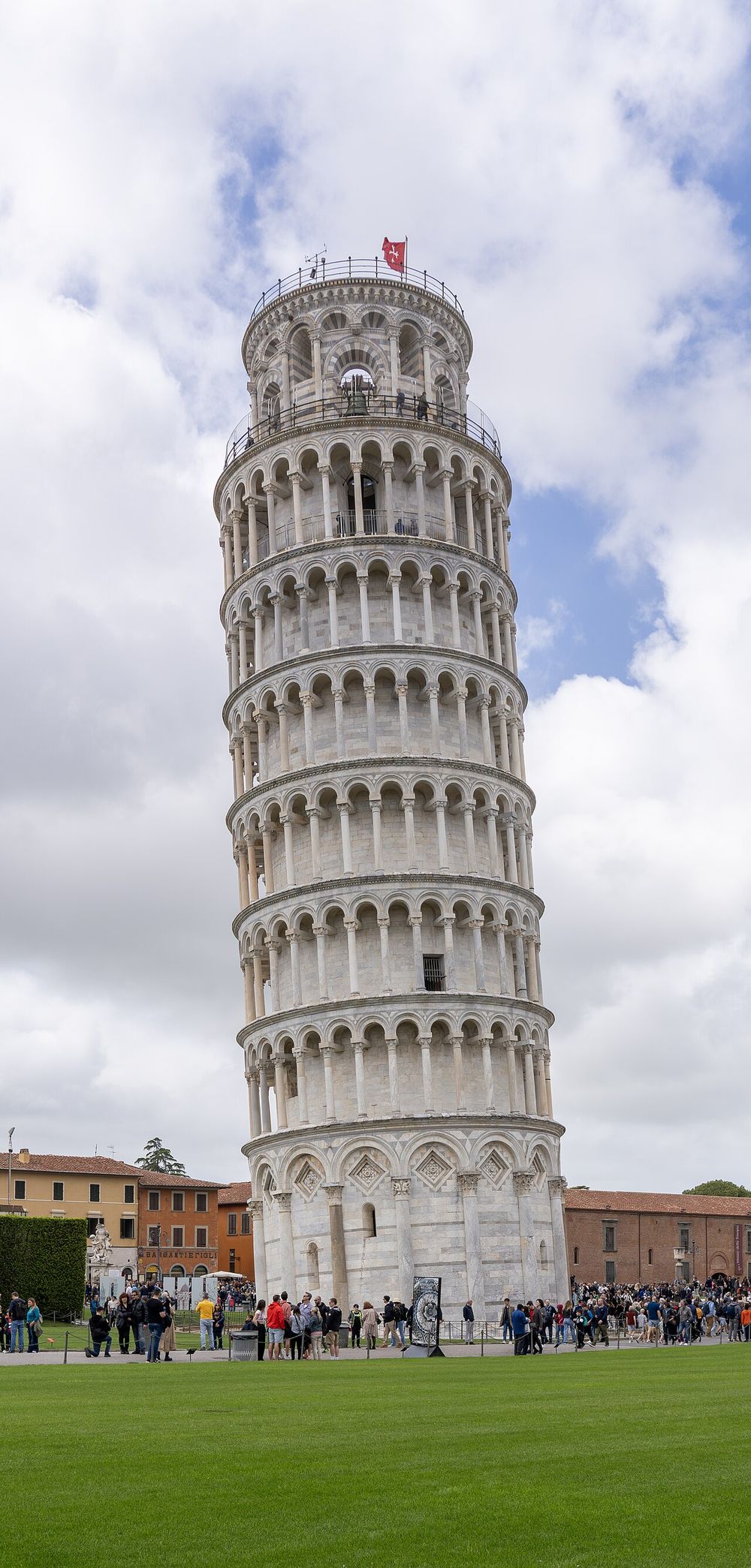
A bell tower that began to sink when it was three storeys high, was left alone for a century, and was then finished at a slant. It leaned a little more every year for eight hundred years. In 2001 engineers pulled it back by forty-five centimetres, and stopped.
Photo: Guglielmo Giambartolomei, CC BY-SA 4.0, Wikimedia Commons
The story
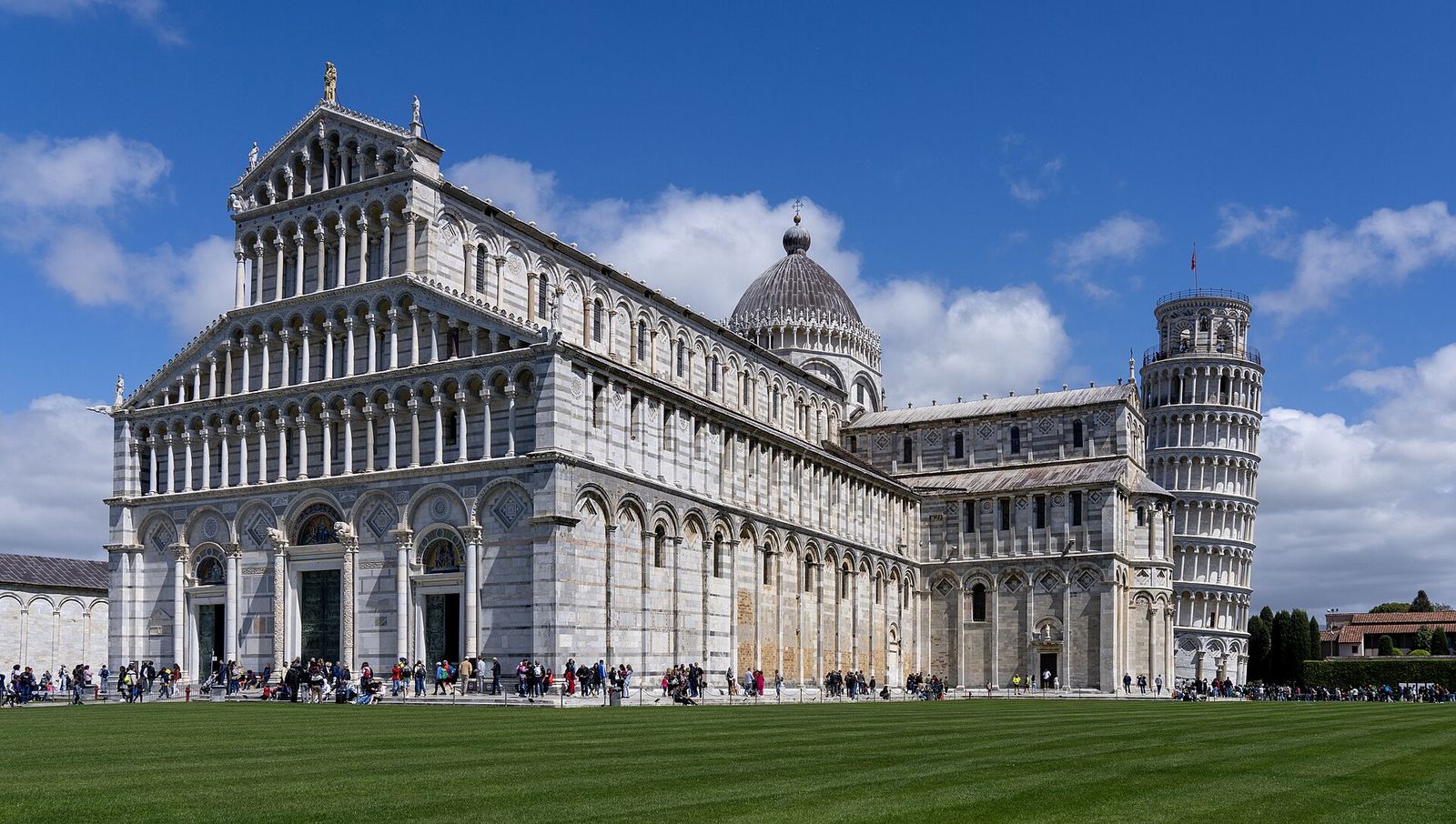
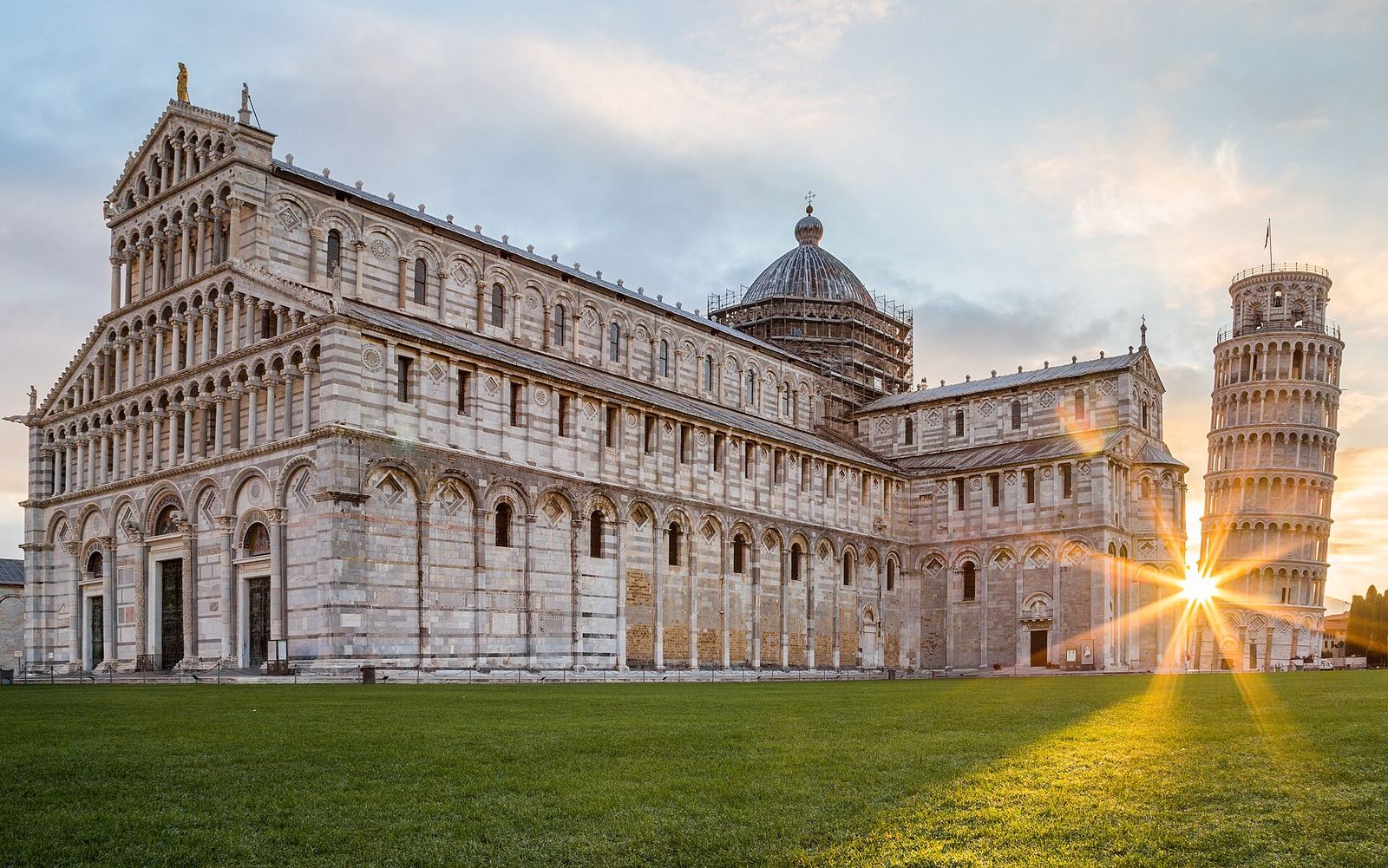
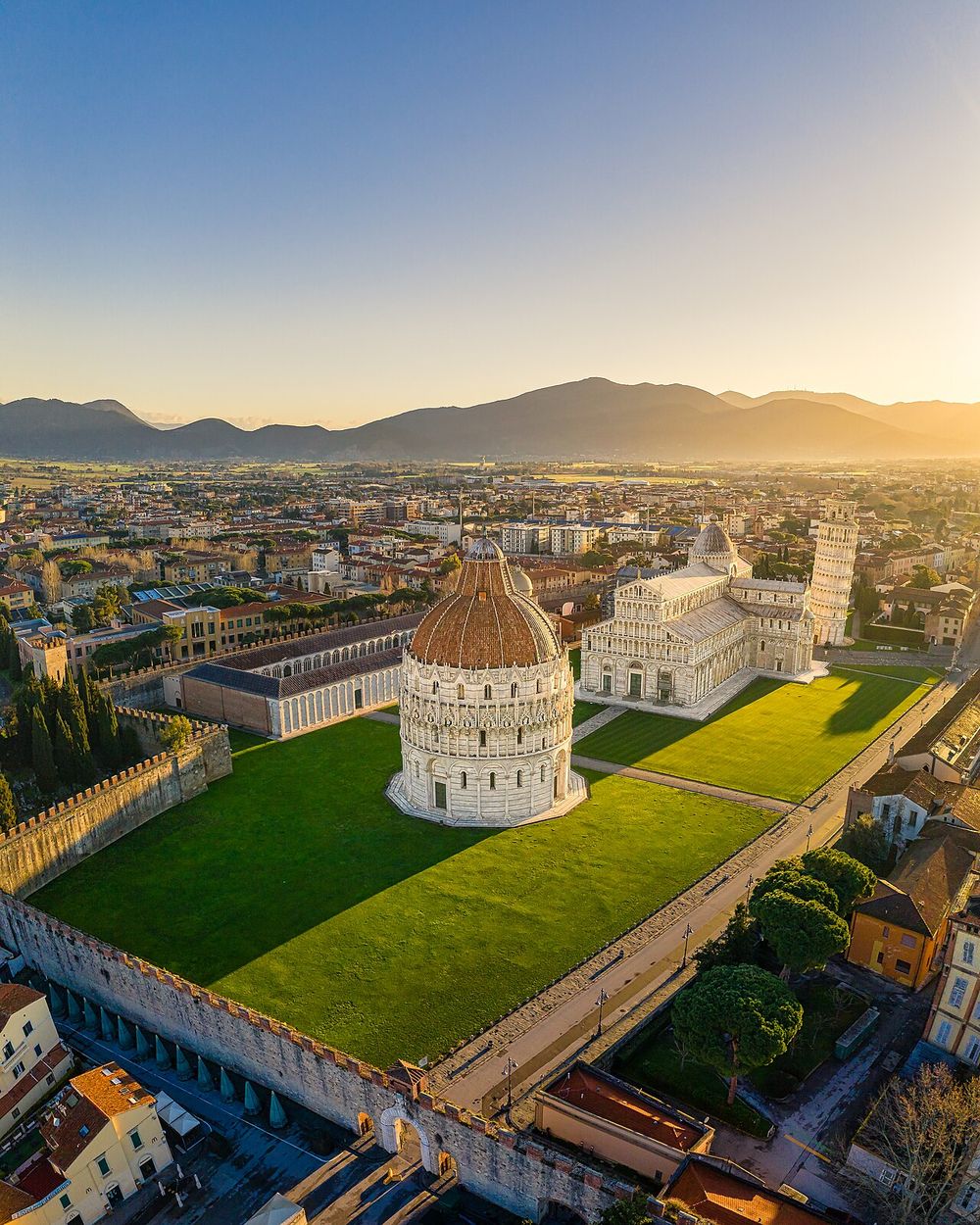
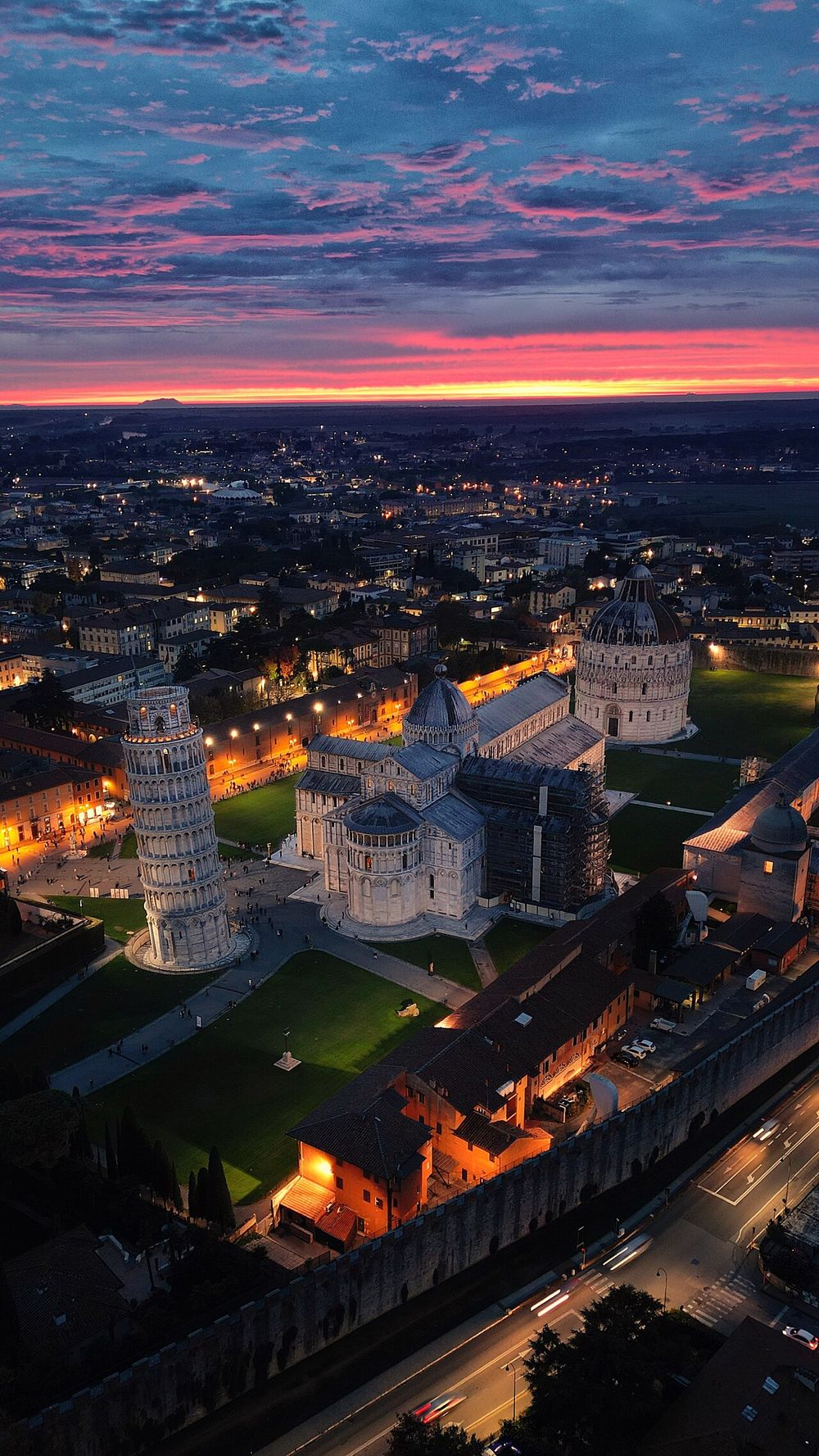
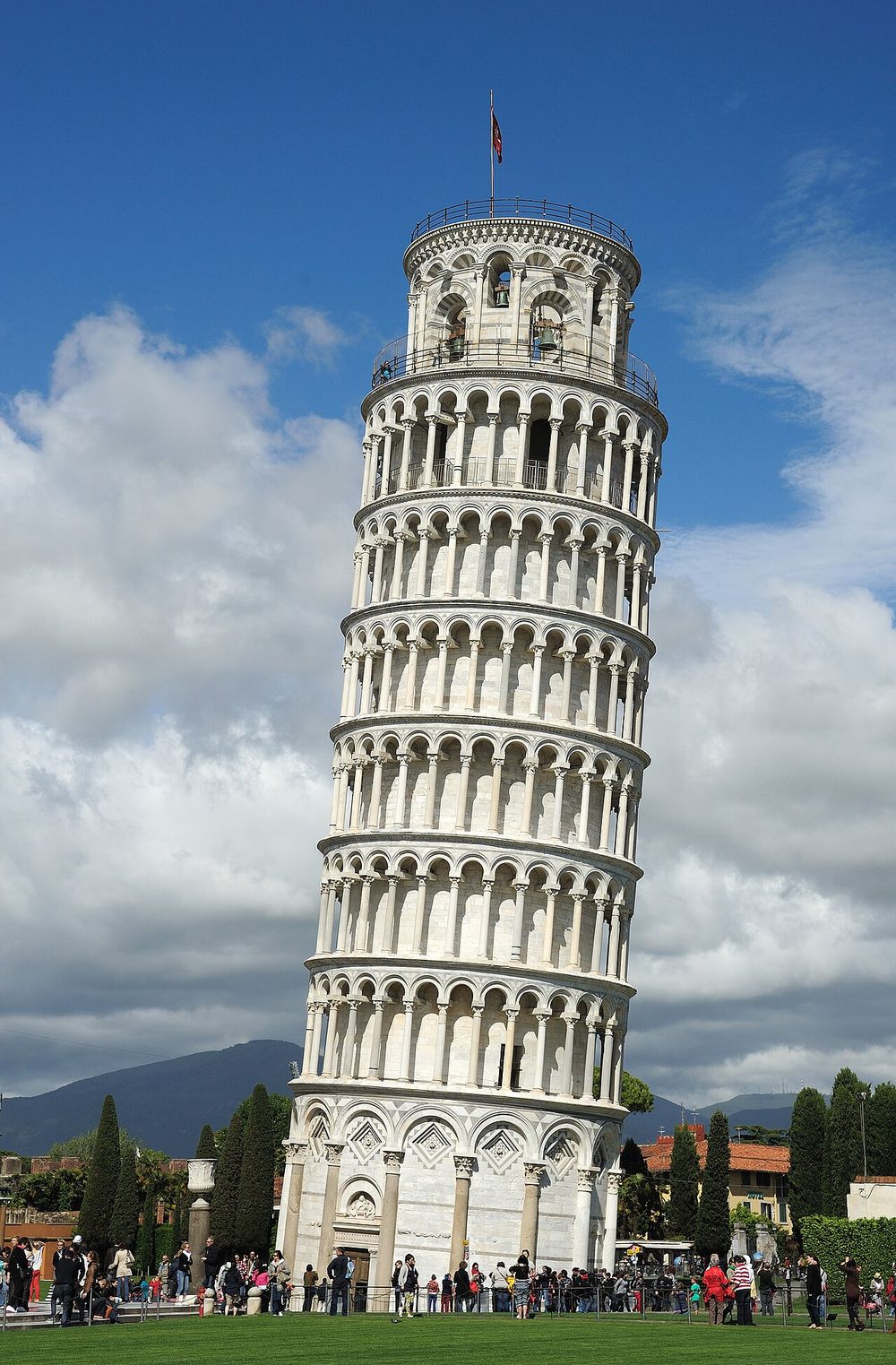
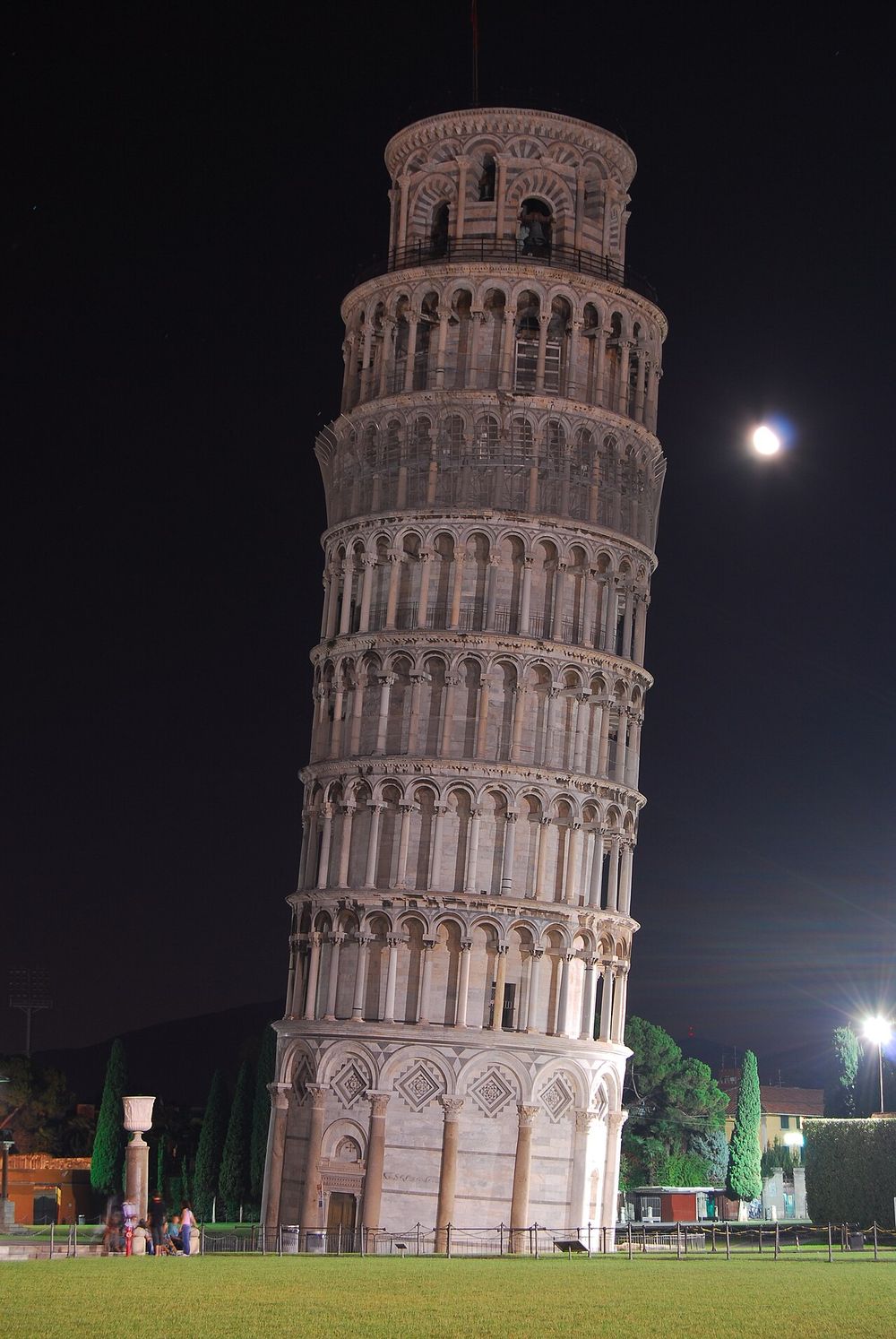
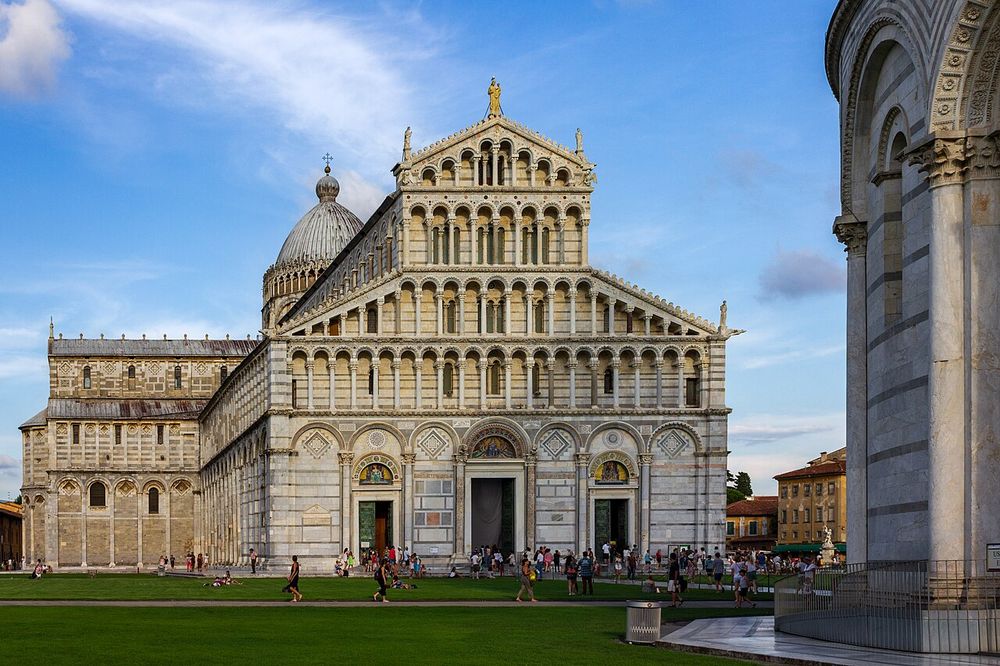
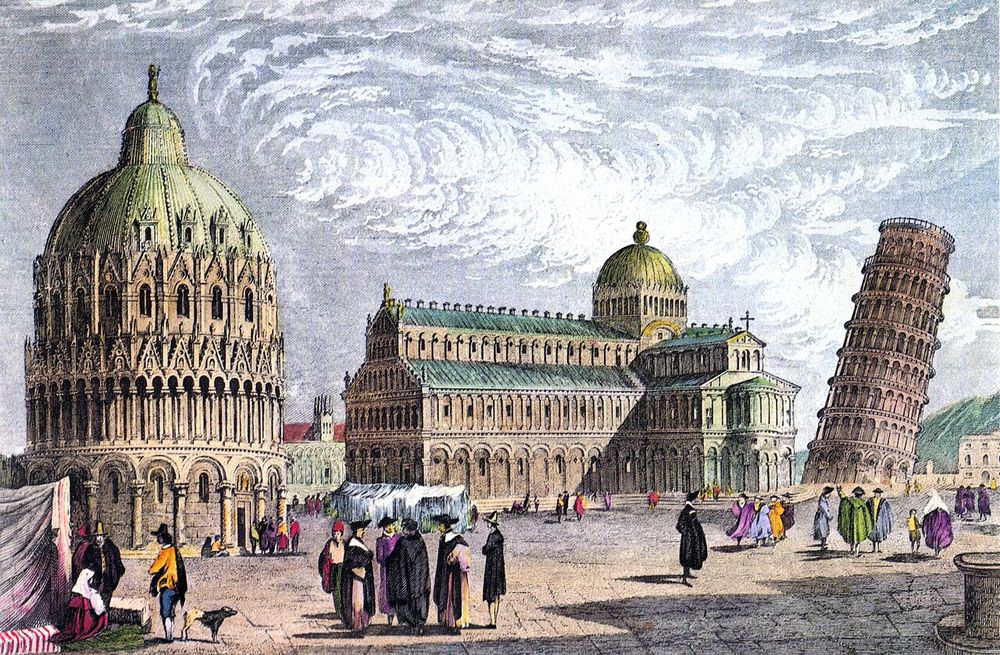
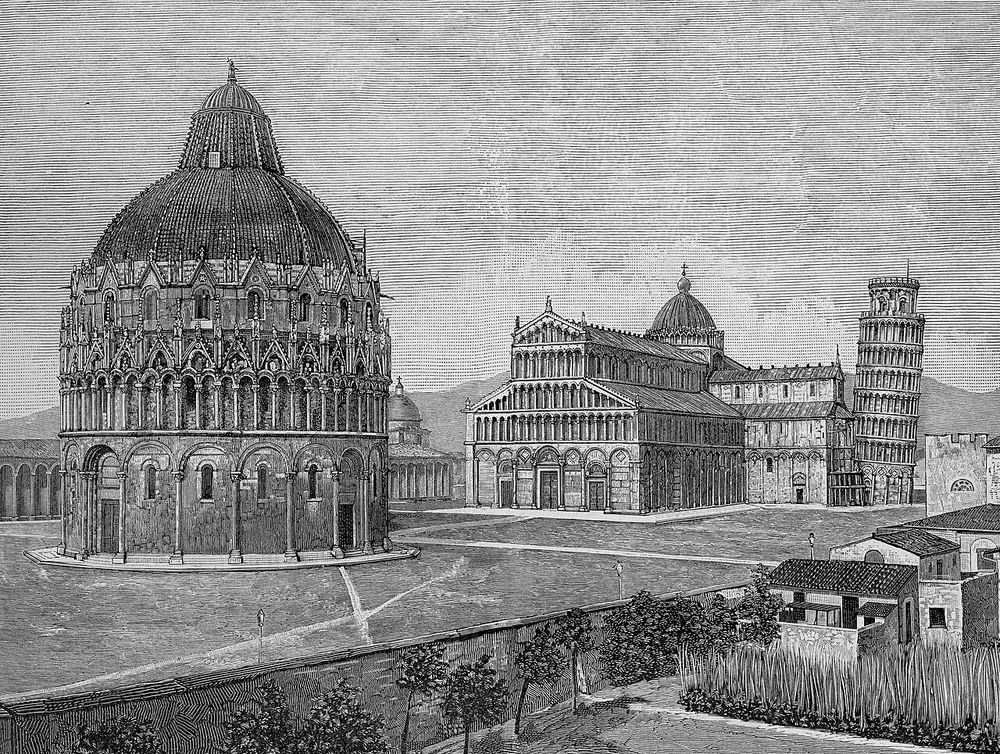
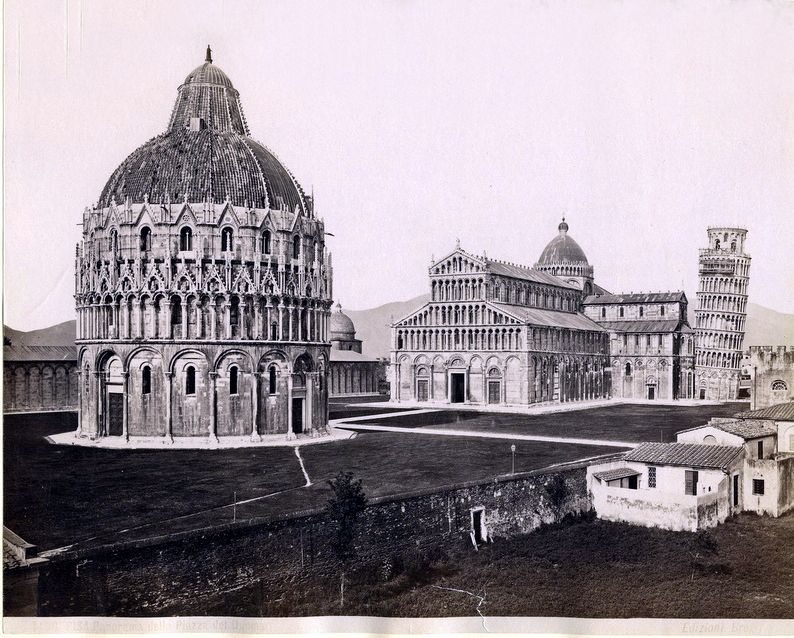
You are on short green grass, with a wall of old brick behind you. In front are three buildings of white marble: a round one with a dome, a long church with rows of small arches on its front, and behind the church a round tower of eight storeys, also arched all the way up. The tower is not upright. Your eye keeps trying to correct it and cannot.
The tower was begun in August 1173. In China it was the Southern Song (1127–1279), and the philosopher Zhu Xi was forty-three. In Paris the walls of Notre-Dame were ten years old.
What is here
The lawn is free. The cathedral is free with a pass. Every other building needs a ticket, and the tower needs a ticket for a set time.
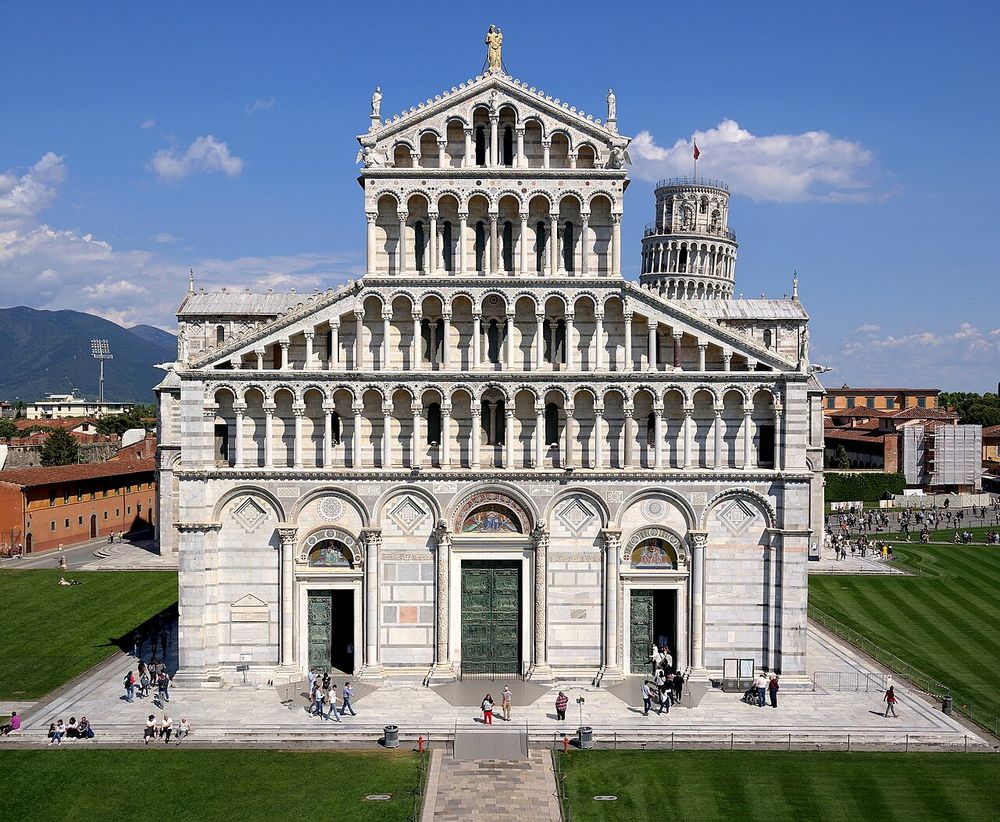
The cathedral, with the tower behind itPaestumPaestum, CC BY 4.0
Pisa in the eleventh century was a sea power, with a fleet that fought from Spain to Syria. In 1063 it raided the harbour of Palermo and came home with six shiploads of treasure. The cathedral was begun the next year with the money.
Over two hundred years the city added a place to be baptised, a bell tower, and a walled cemetery: the whole of a Christian life, from first to last, on one lawn.
The ground here is river mud. The cathedral and the Baptistery lean too, though less. The tower is narrow and heavy, and it went over.
Things people often get wrong
"It was built to lean." It was meant to stand straight. The builders spent two centuries trying to hide the mistake.
"It is still falling." It has not moved since 2008, and is expected to stand for at least two hundred years more.
"Galileo dropped two cannon balls from the top." The story was first told by his secretary, sixty years later. Galileo himself never mentions it.
"The square is called the Field of Miracles." Its name is Piazza del Duomo, Cathedral Square. A poet called it a field of miracles in a novel in 1910, and the tourist trade took it up.
"The tower is the thing to see." It is the bell tower of the church beside it. The church and the Baptistery are the greater buildings, and there is no queue for them.
People who stood here
Galileo (Italian scientist, born in Pisa in 1564)He was baptised in the Baptistery, studied medicine at the university here and came back at twenty-five to teach mathematics. It was in Pisa that he began to time falling and swinging things. He left in 1592, having quarrelled with most of his colleagues.
Fibonacci (Leonardo of Pisa, who brought the numerals 0 to 9 into use in Europe)He was born here about 1170 and was a small boy when the tower was begun. His book of 1202 taught merchants to reckon with the Indian numerals he had learned in North Africa. He lived in Pisa in the years when the tower stood unfinished at three storeys, and may have crossed this grass many times.
Go deeper: eight stops, from the lawn to the top of the tower
The stops begin at the gate in the city wall and end on top of the tower.
1. The lawn
Baptistery, cathedral, tower and cemetery in one viewGuglielmo Giambartolomei, CC BY-SA 4.0
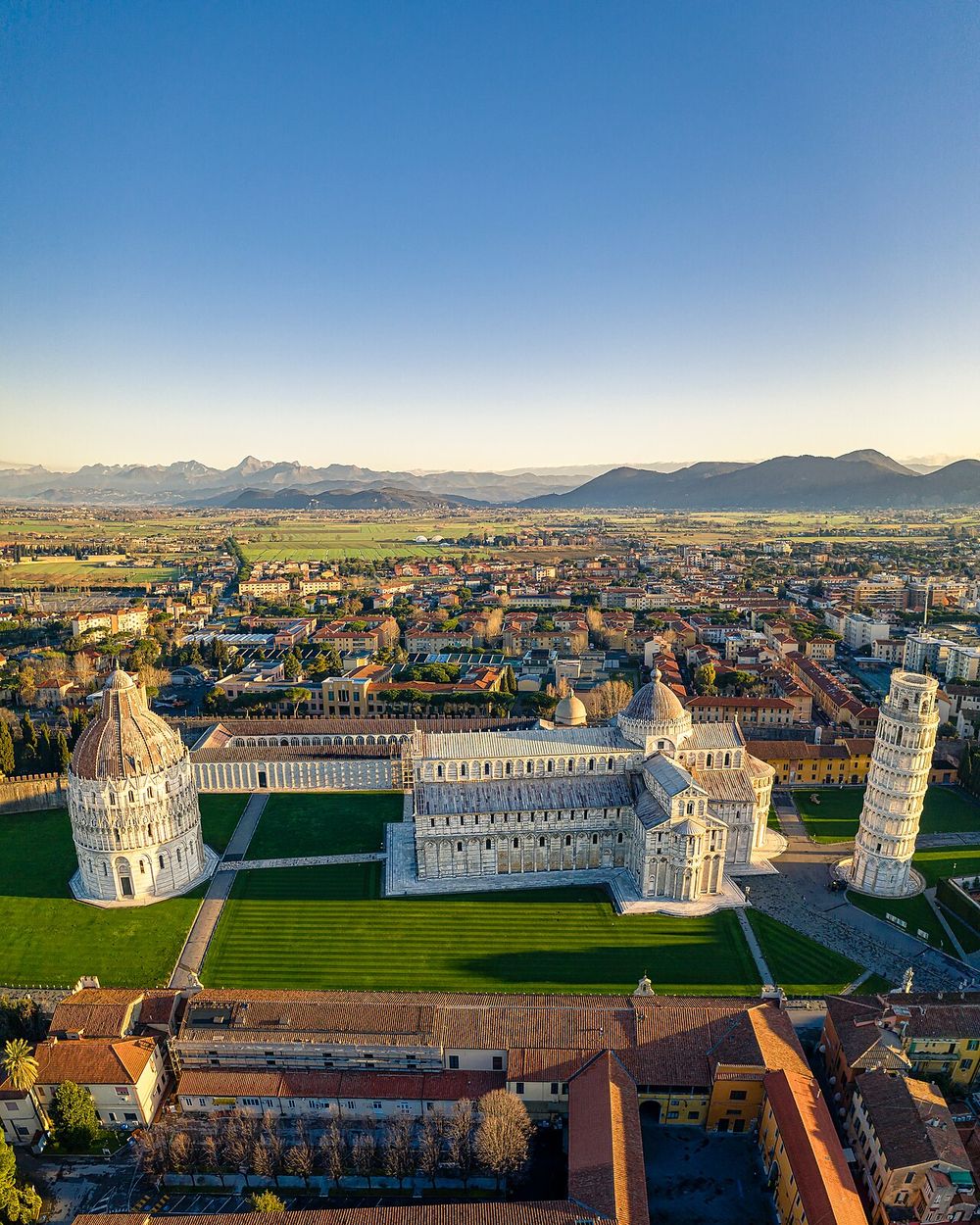
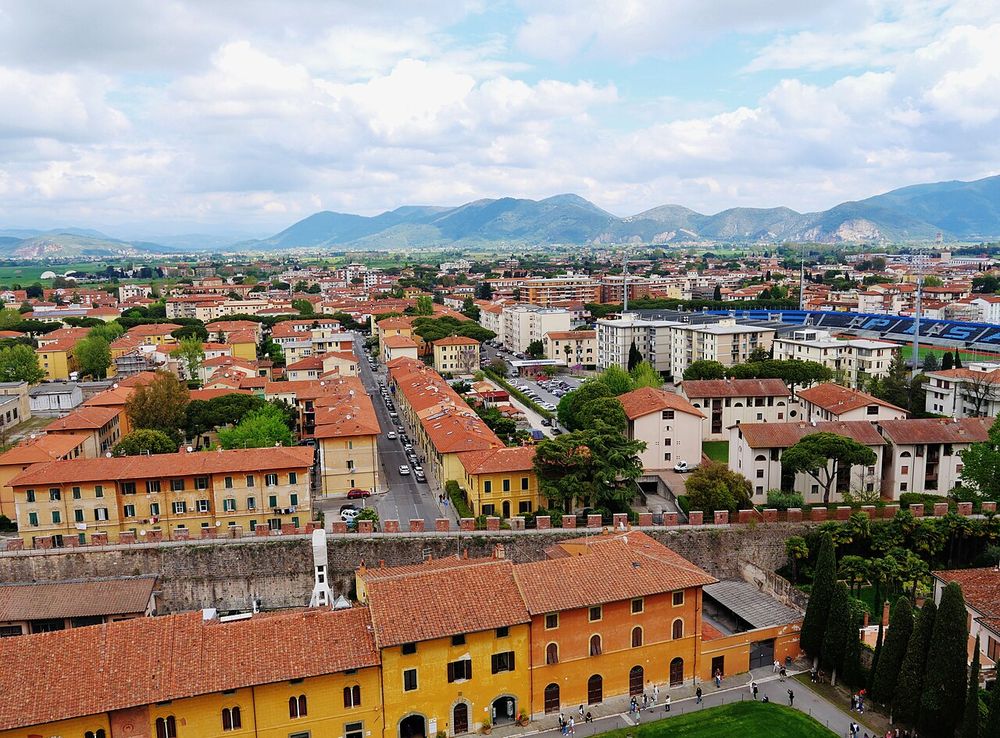
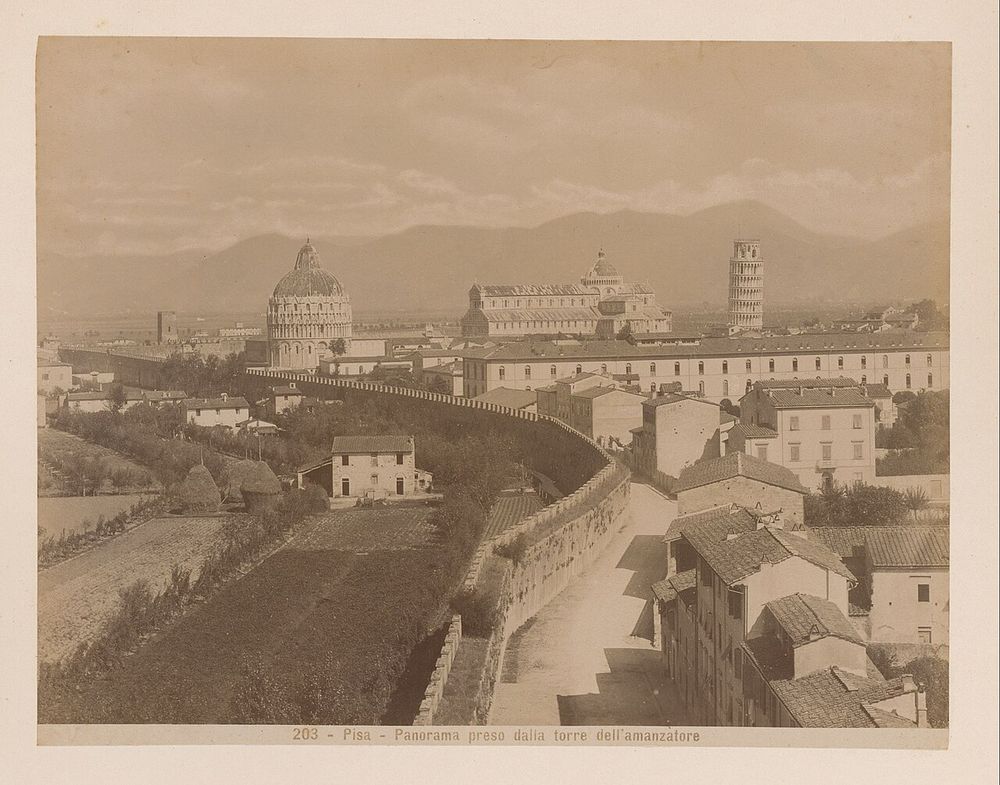
Most cathedrals stand in the crowded middle of their towns. Pisa put this one at the edge, against the city wall, where there was room. The grass is a nineteenth-century idea; before that the ground was bare earth, with houses and a hospital among the monuments.
All four buildings use the same white and grey marble and the same rows of small arches on thin columns. The style is Pisa's own. The idea of the arches came with the fleet, from the churches and mosques of the eastern Mediterranean.
2. The cathedral
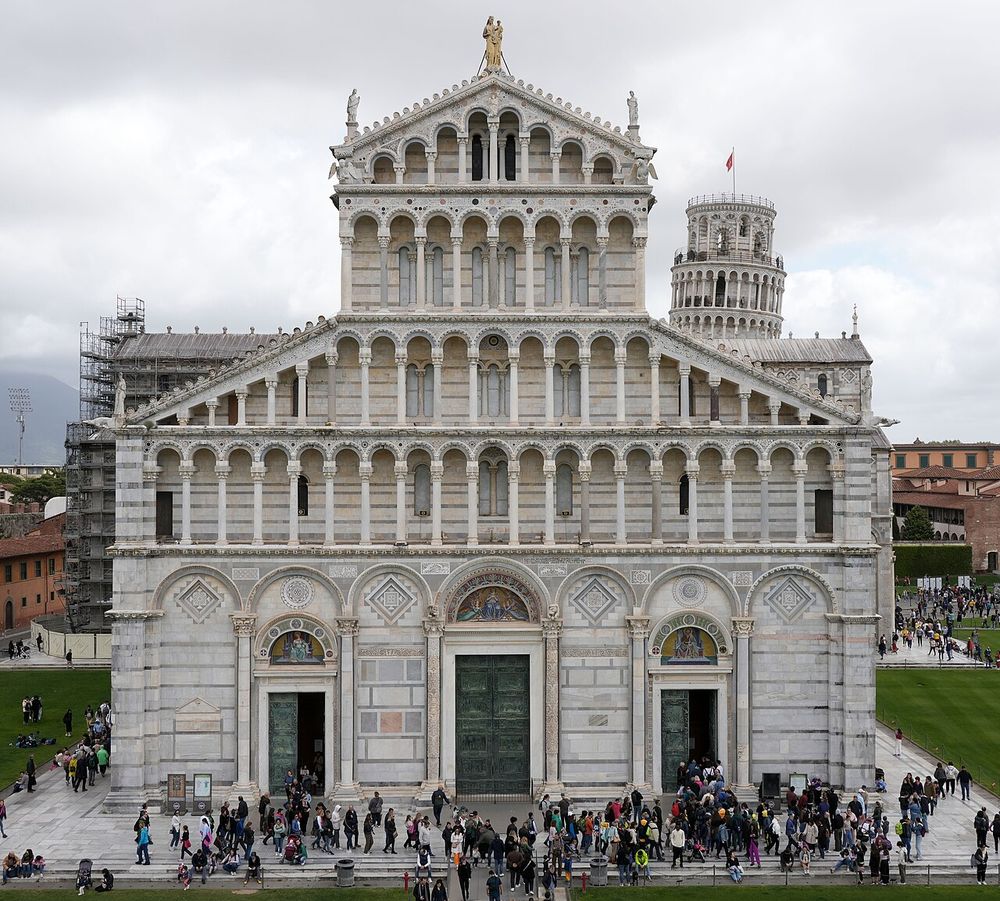
The cathedral front from the BaptisteryPaestumPaestum, CC BY 4.0
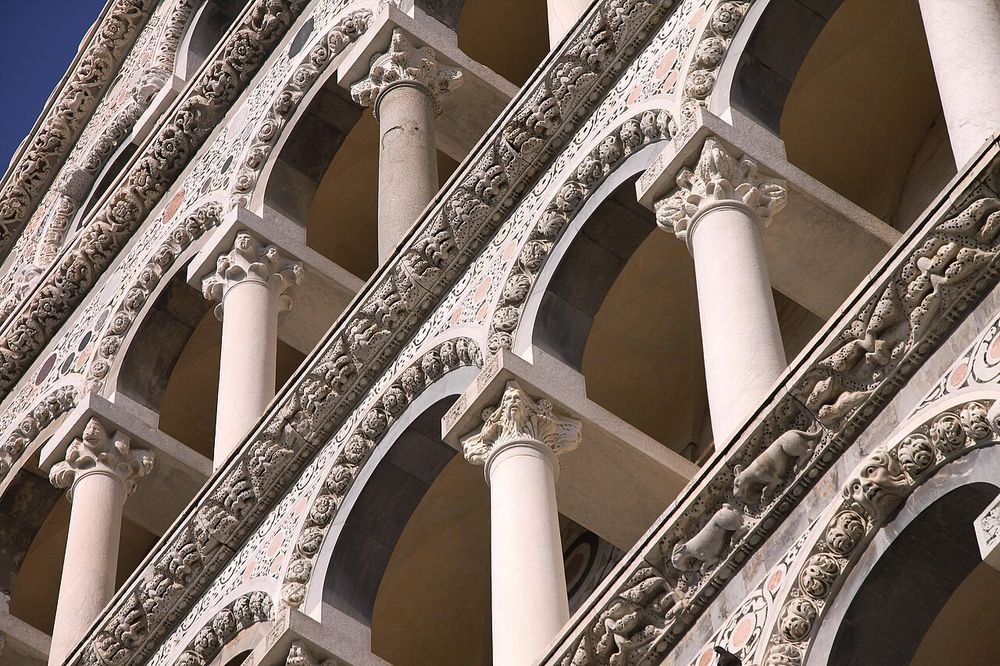
The front has four galleries of arches, one above another, each column different from the next. Look at the wall beside the left-hand door: the tomb of the architect is built into it. His name was Buscheto, and the Latin says he was cleverer than Ulysses.
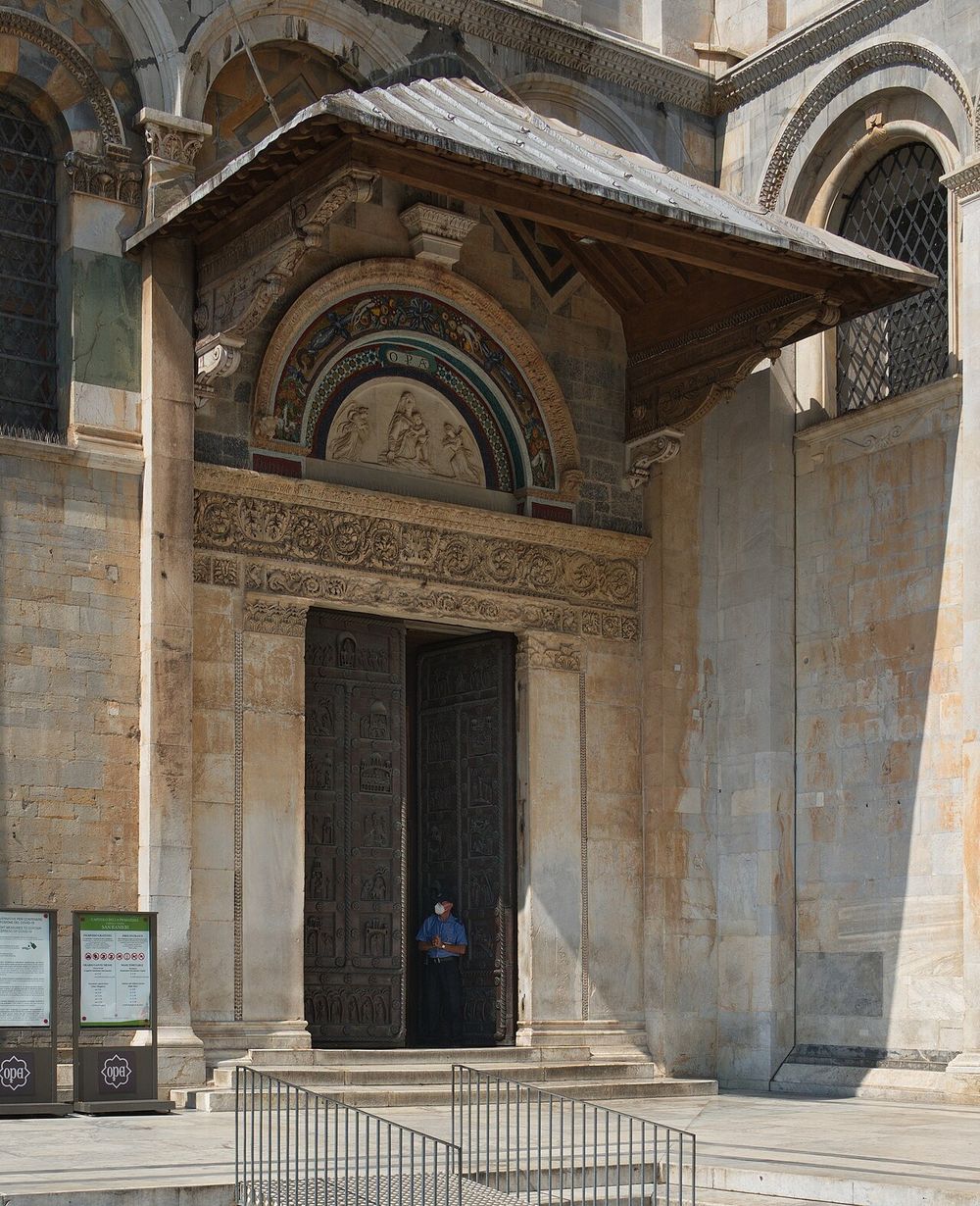
The door facing the towerMenkinAlRire, CC BY-SA 4.0
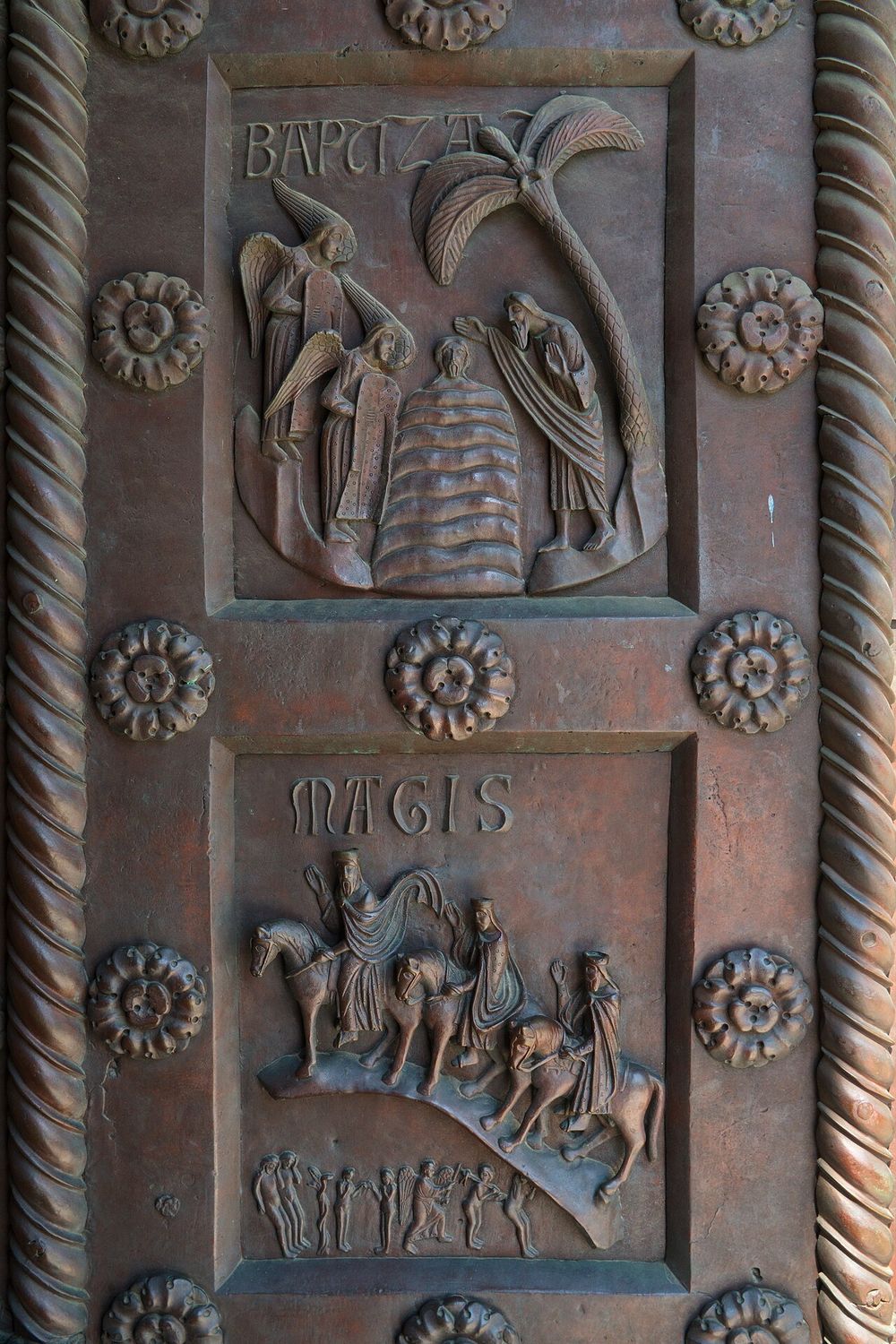
Walk round to the door facing the tower. Its bronze leaves were cast about 1180 and survived the fire that destroyed the others. They tell the life of Christ in twenty small scenes, with palm trees and very few figures, like pictures drawn by a child who has seen everything.
3. The lamp and the pulpit
The naveEric Kilby, CC BY-SA 2.0
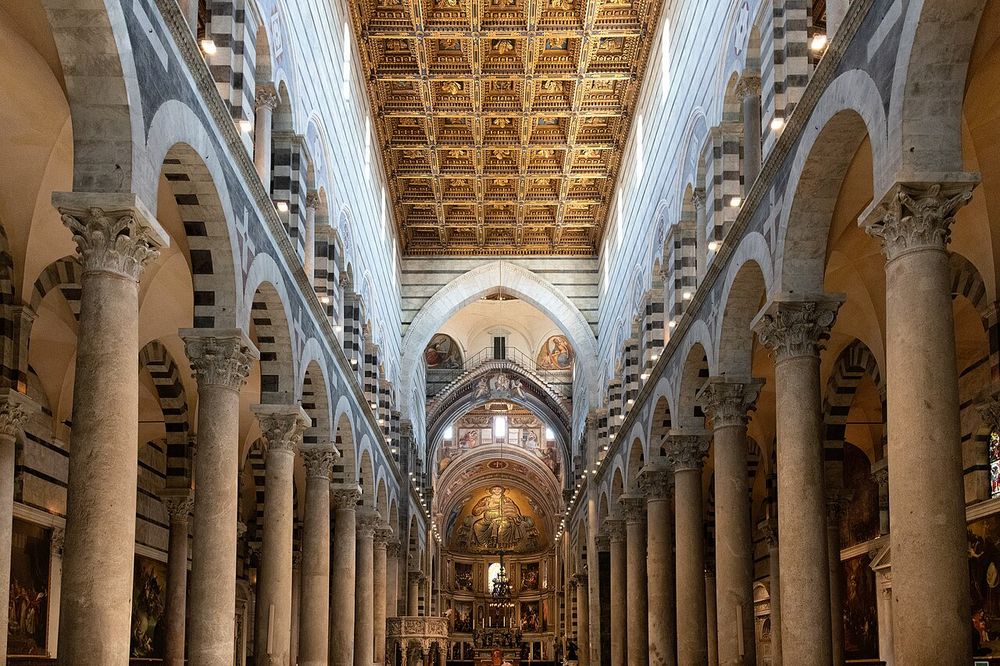
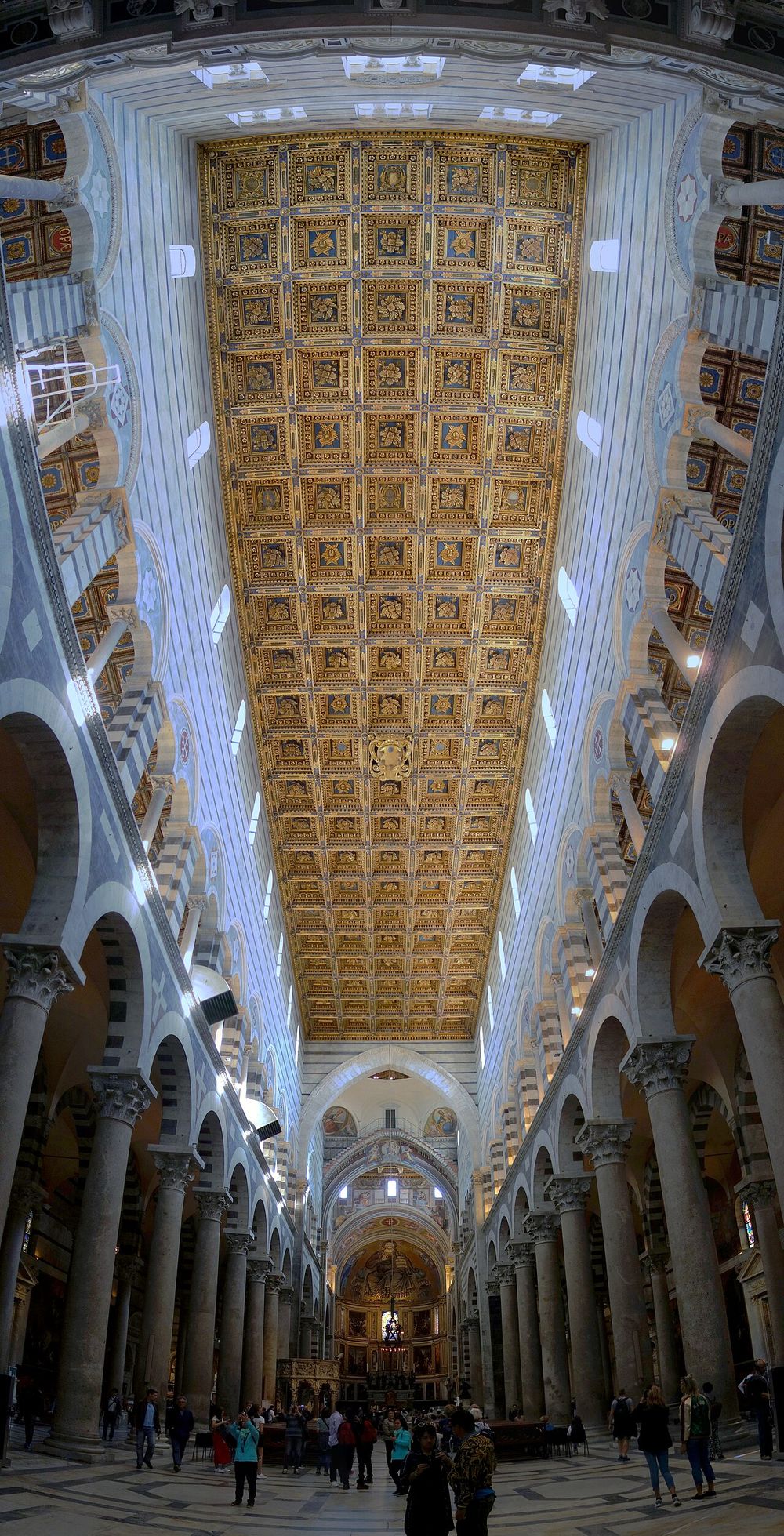
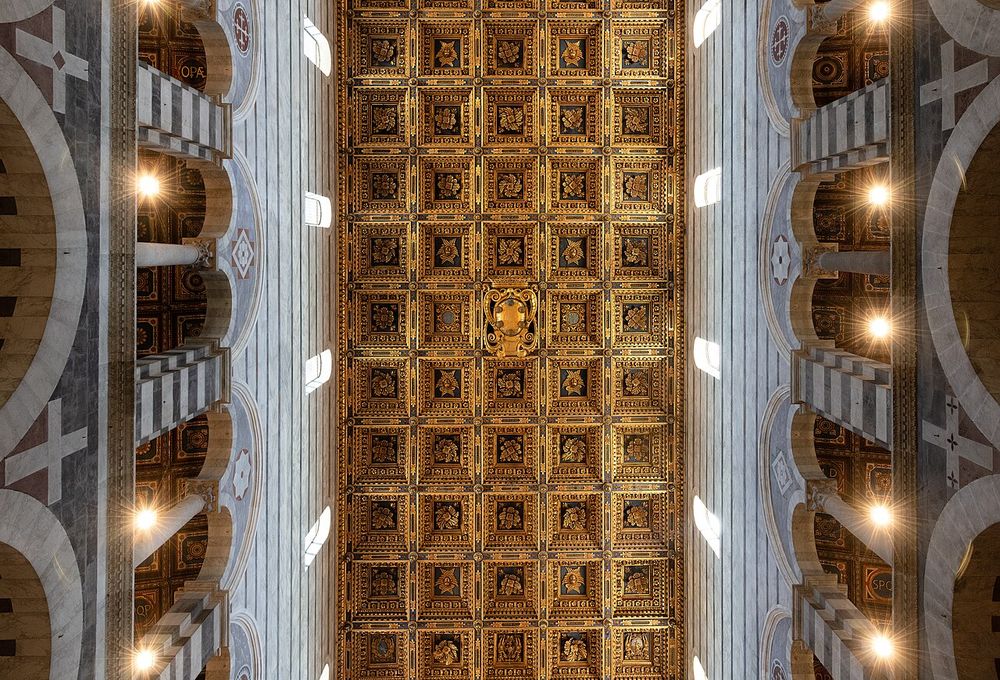
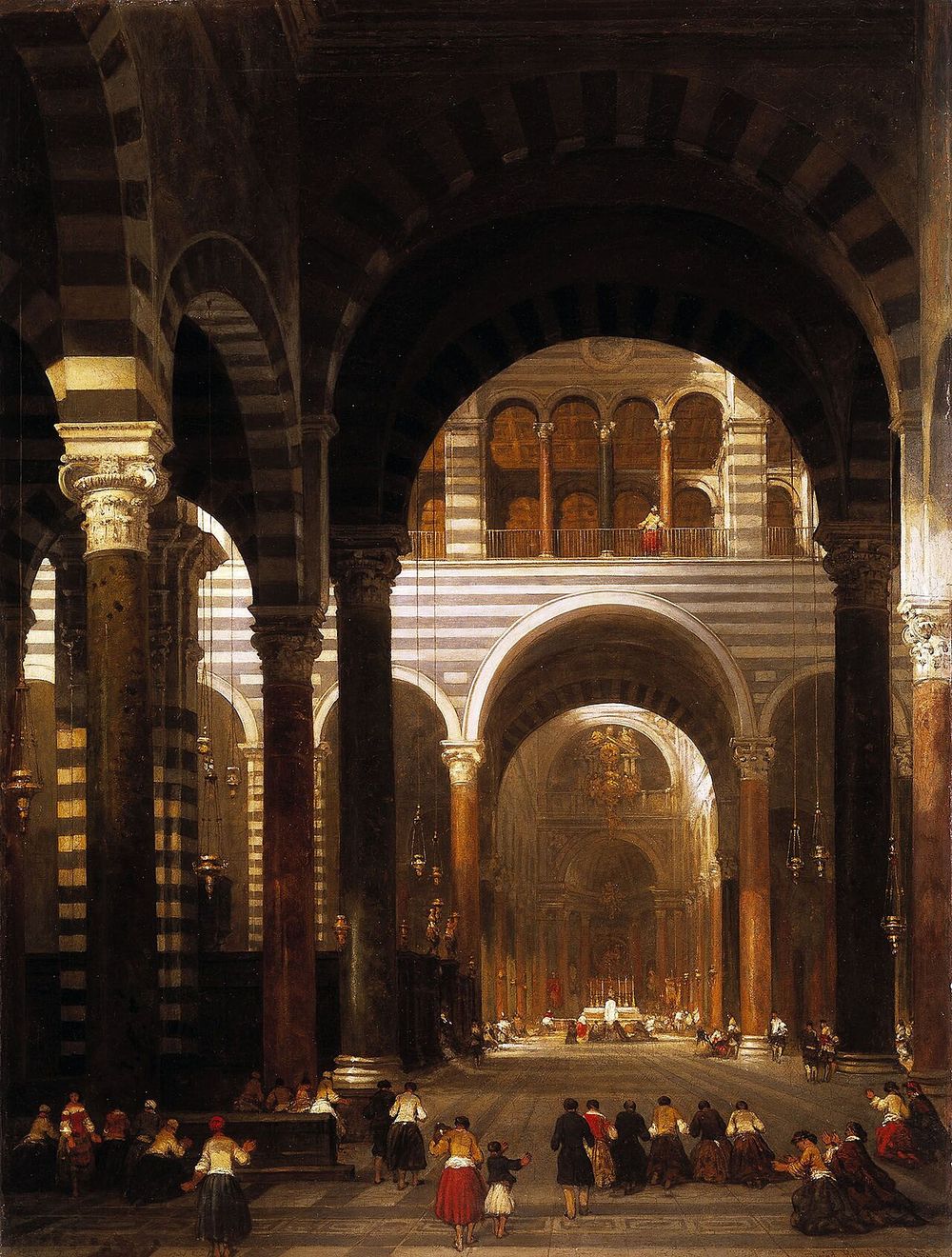
Inside, sixty-eight columns of granite march down the nave. Many were taken from Roman buildings and, it is said, from the mosque at Palermo. The gilded ceiling replaced the one burned in 1595, and carries the arms of the Medici of Florence, who by then owned Pisa.
The bronze lampTangopaso, Public domain
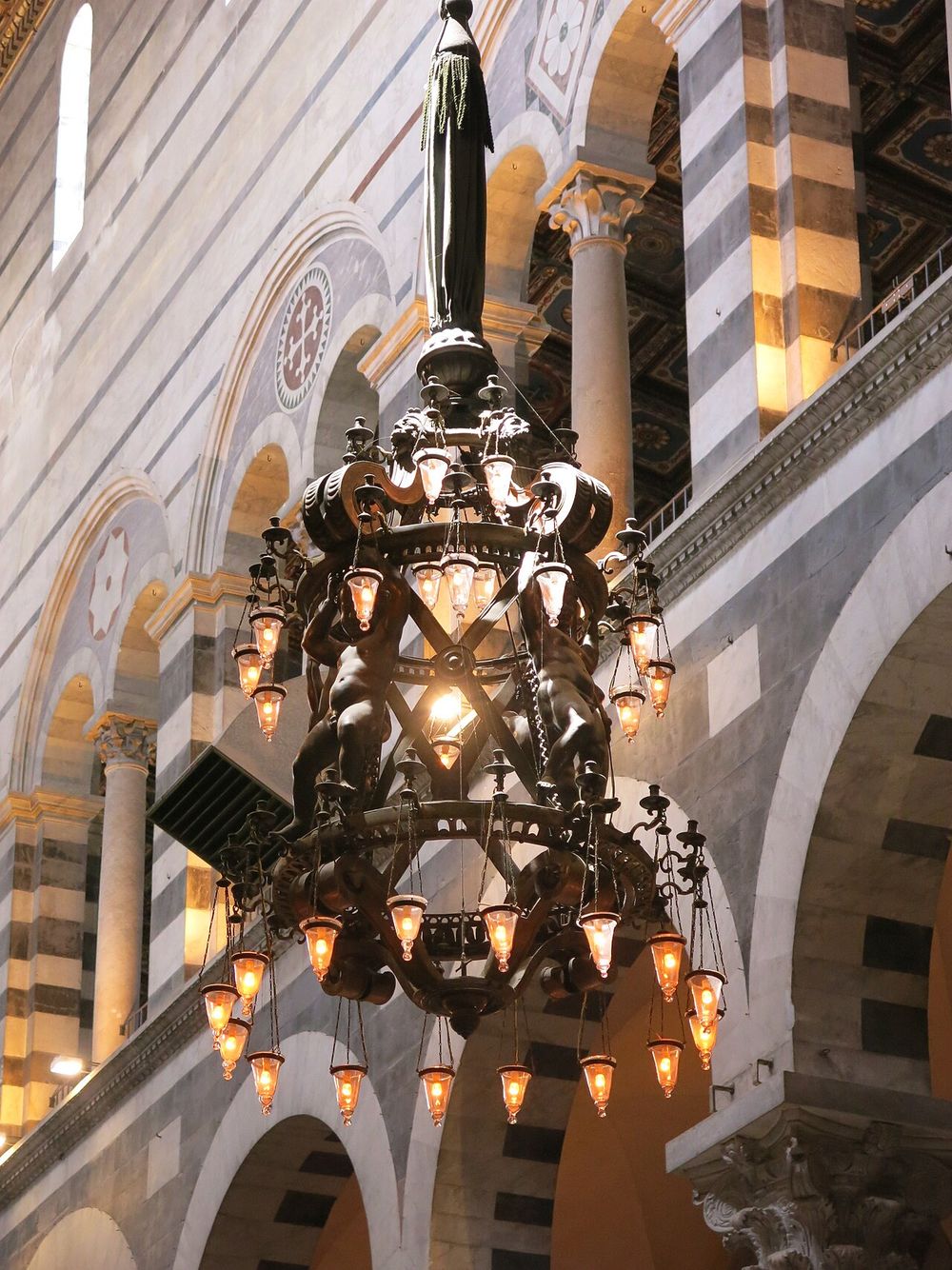
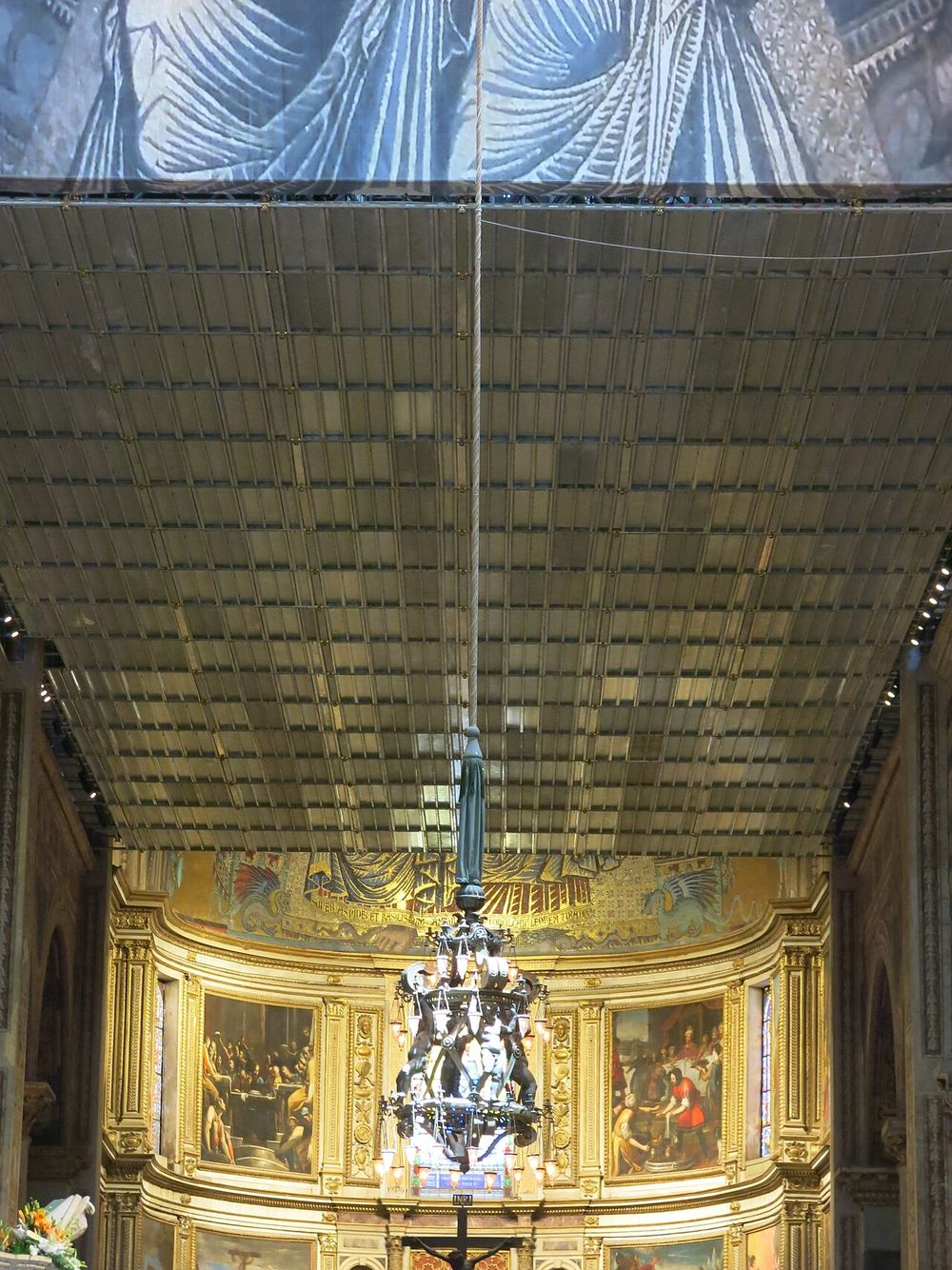
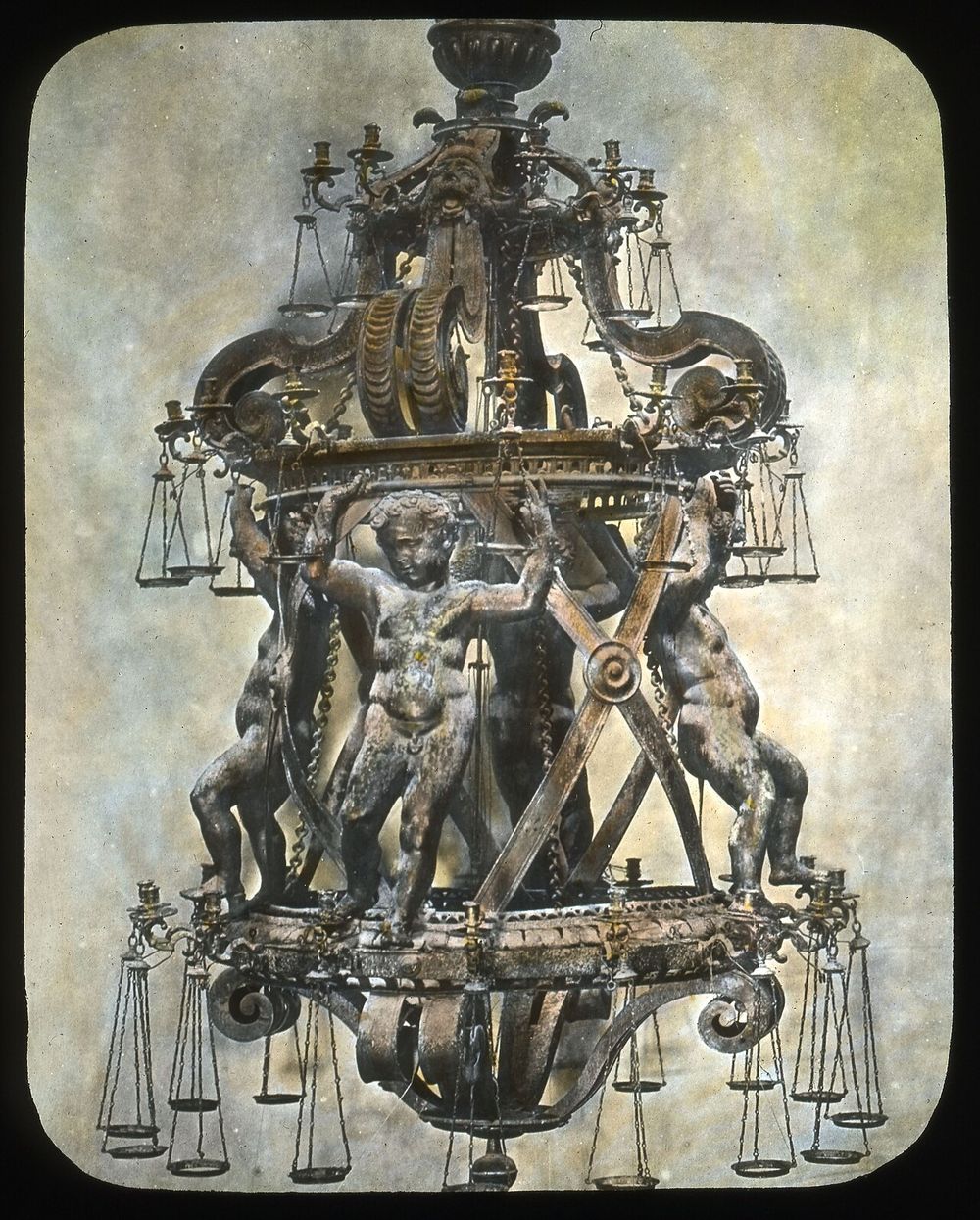
A bronze lamp hangs on a long chain in the middle of the nave. It is known as Galileo's lamp.
The pulpit near it was carved between 1302 and 1310 by Giovanni Pisano. Nine panels show the story of Christ with crowds of small figures twisting in every direction. It was taken to pieces after the fire and put together again in 1926; not everyone agrees that the pieces are in the right order.
4. The Baptistery
The BaptisteryPaestumPaestum, CC BY 4.0
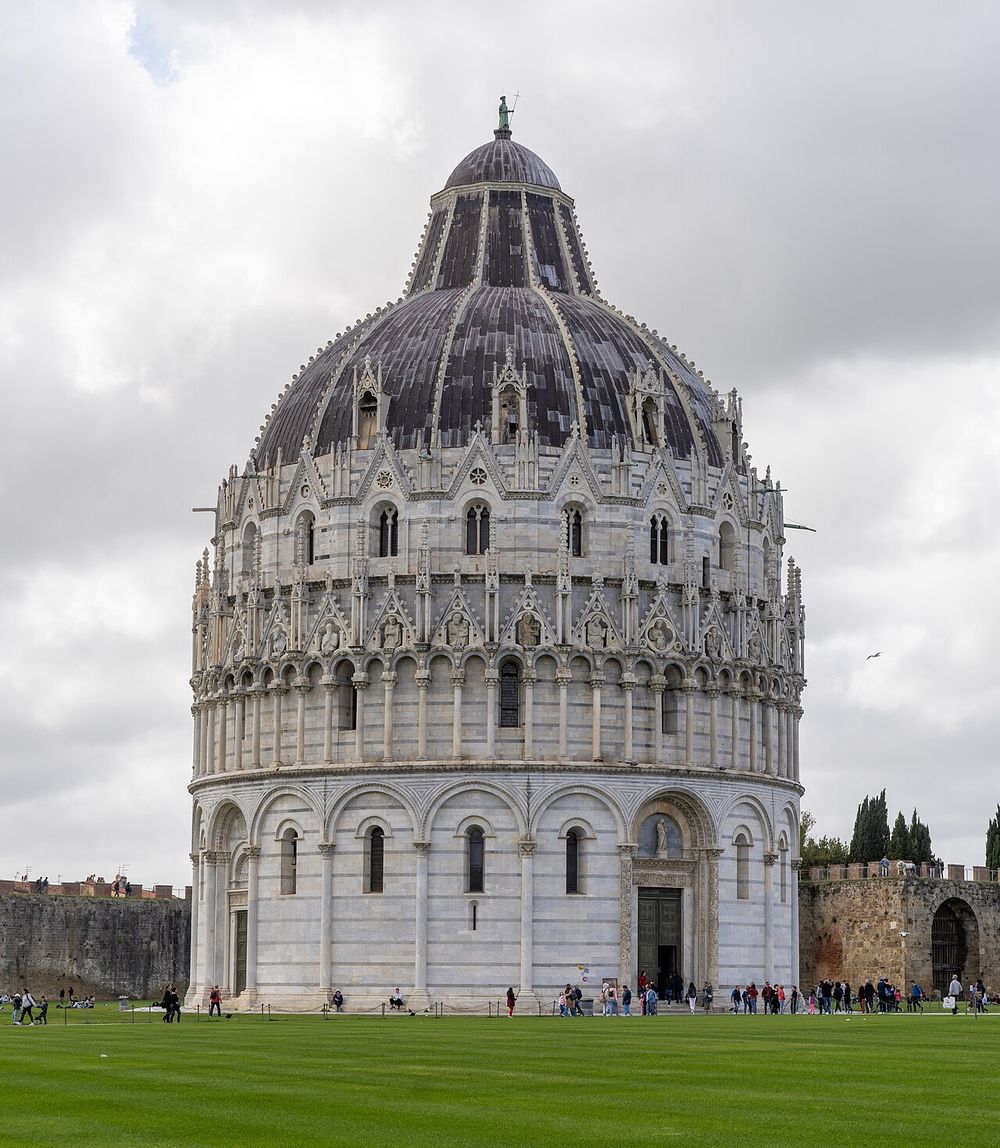
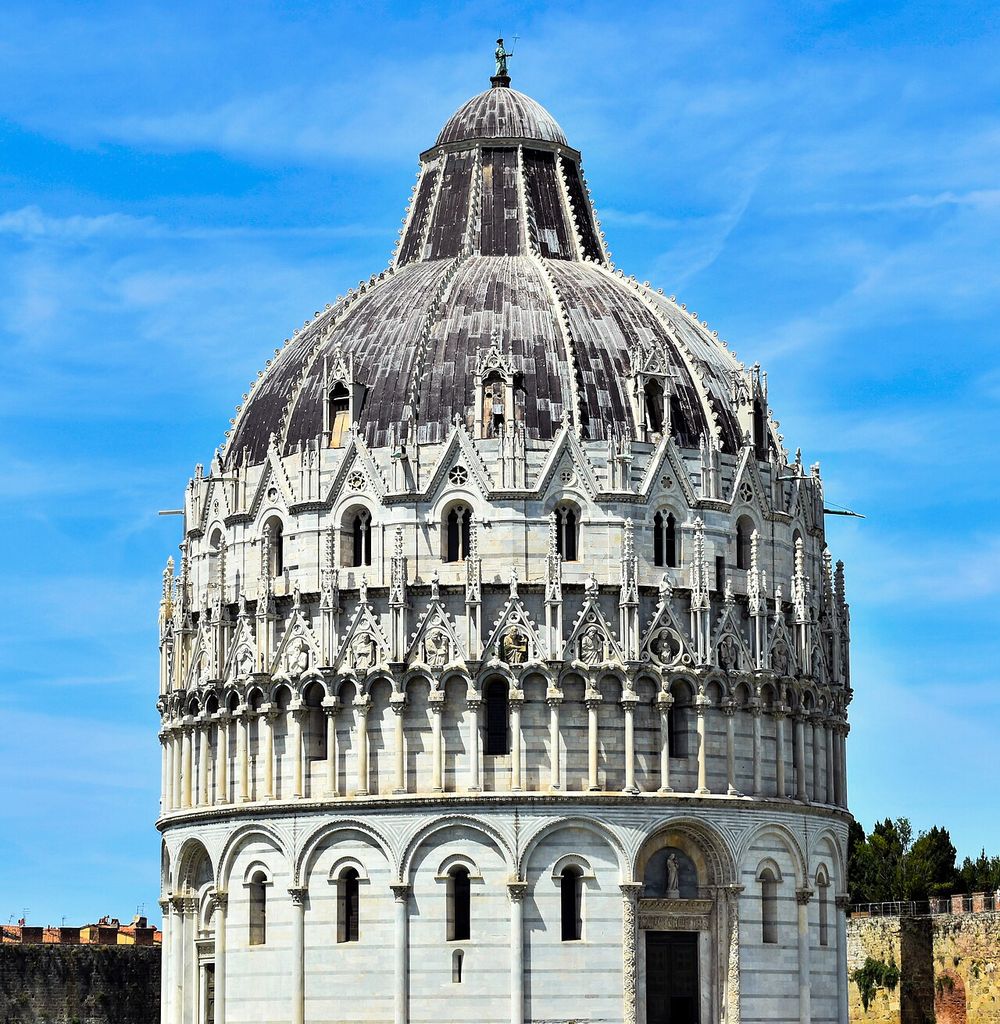
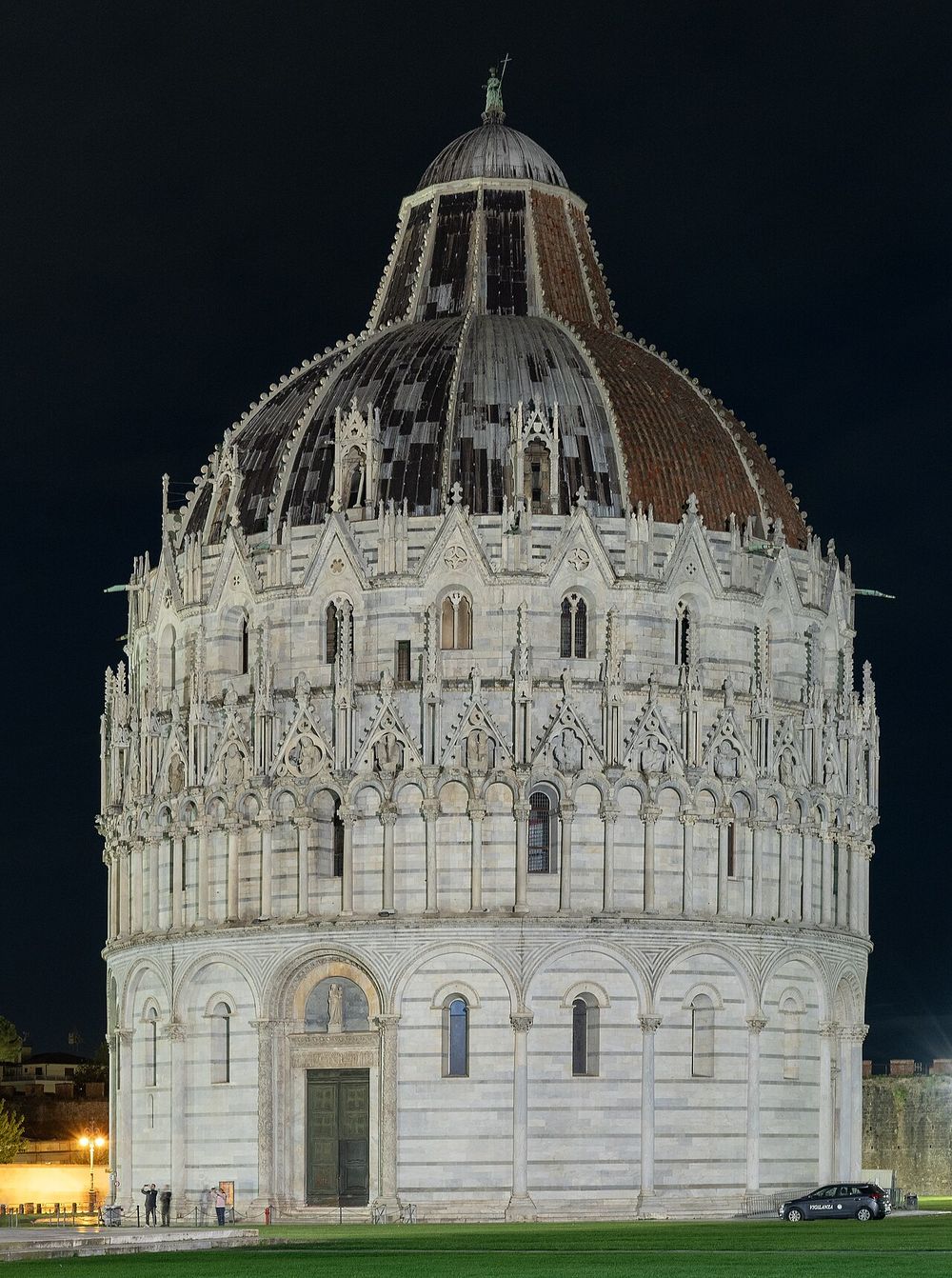
The round building is the largest baptistery in Italy, 55 metres high. It took two centuries to build, and the taste changed halfway: round arches below, pointed gables above.
Nicola Pisano's pulpit of 1260Xosema, CC BY-SA 4.0
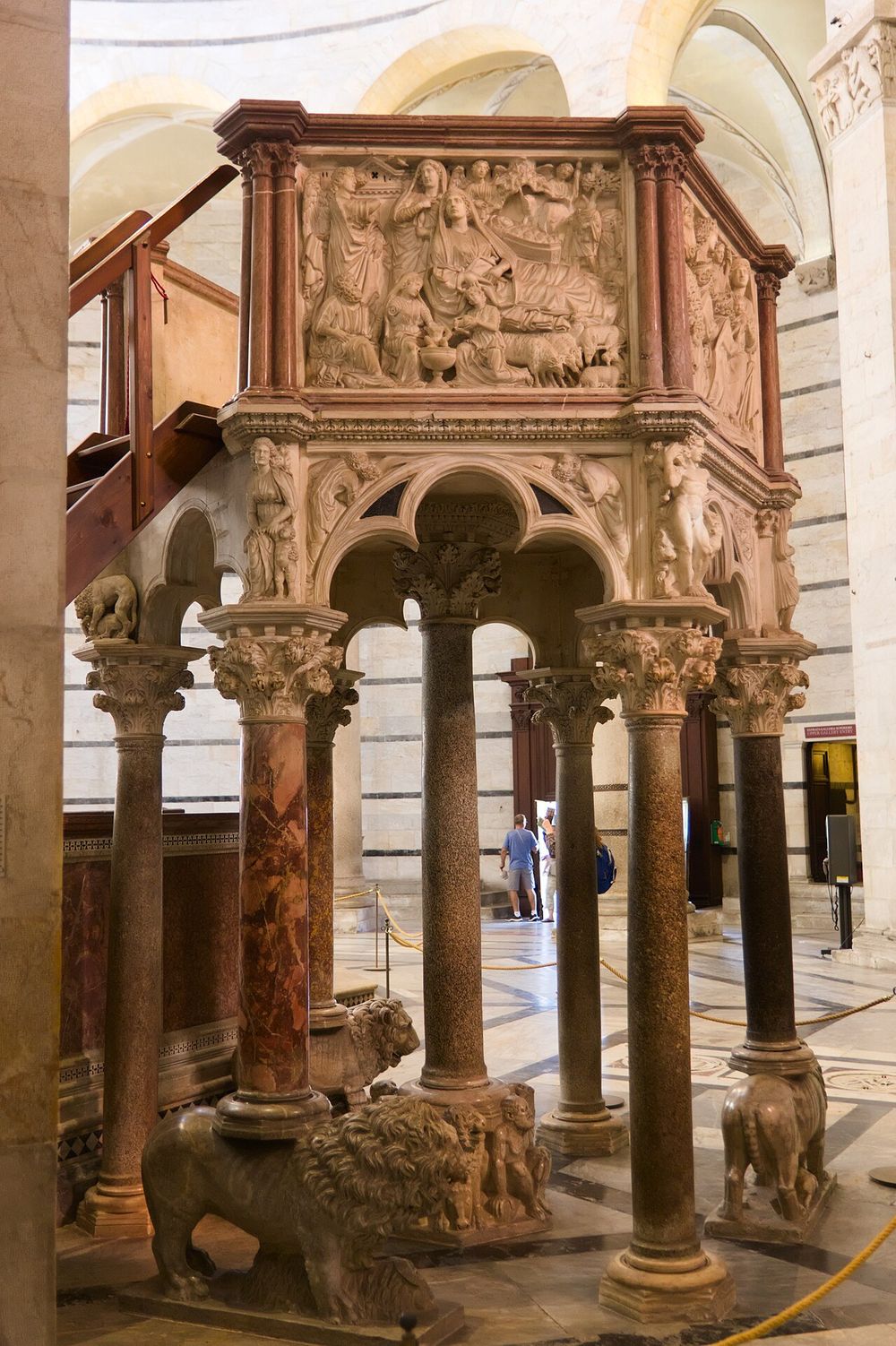
The pulpit inside was finished in 1260 by Nicola Pisano, father of Giovanni. At one corner stands a small naked man with a lion cub on his shoulder. He is the virtue of Strength, and he is copied from a Roman Hercules. He is the first nude in the classical manner carved in Italy for seven hundred years.
Every half hour an attendant shuts the doors and sings a few notes. The dome holds each note so long that he sings a chord with himself.
5. Why it leans
Eight storeys, and a curvePaestumPaestum, CC BY 4.0
The tower weighs about 14,500 tonnes and stands on a foundation only three metres deep, in soft clay. By 1178, with three storeys built, the south side had begun to sink. Then Pisa went to war, and the work stopped for ninety-four years.
The pause saved it. The clay had time to settle and harden under the weight. Had the masons gone straight on, it would have fallen.
The bell chamber, tilted back the other wayBloodyowl, Public domain
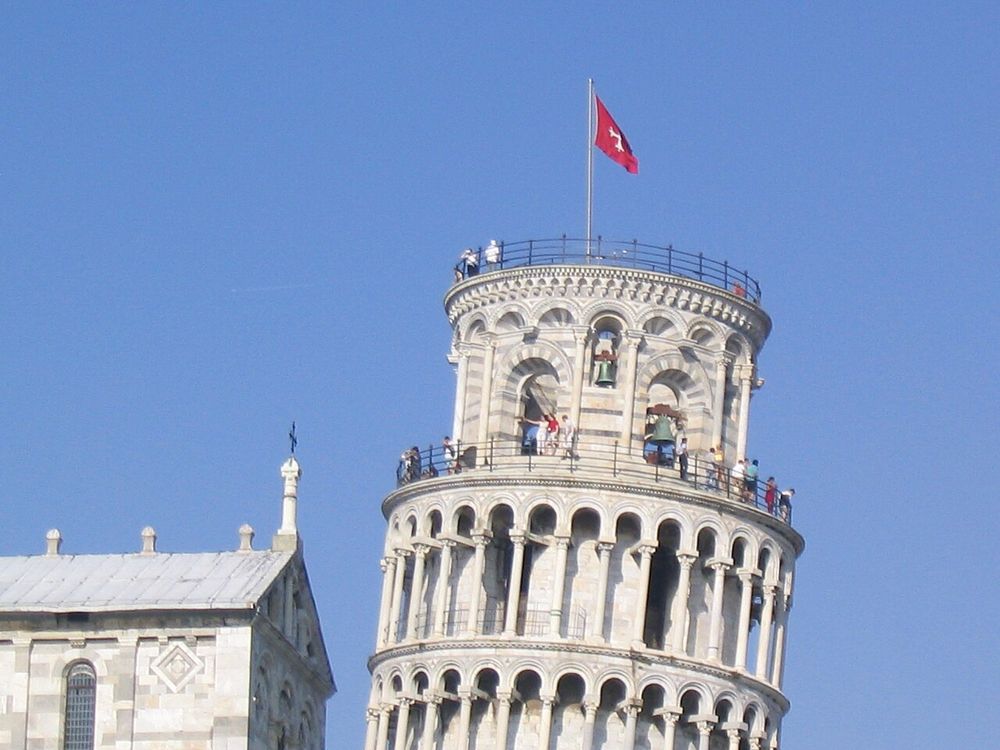
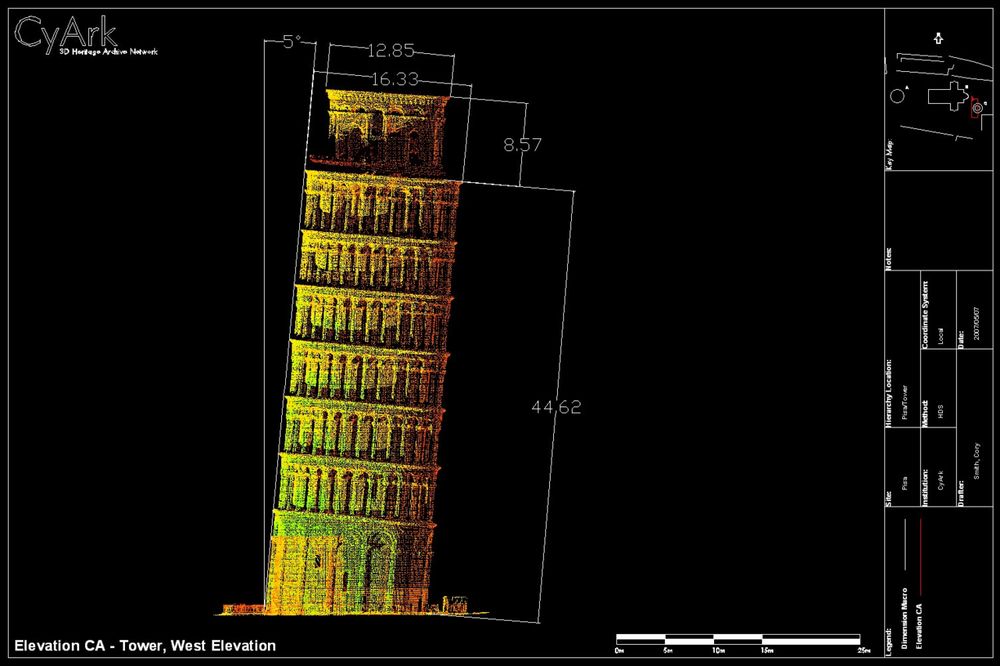
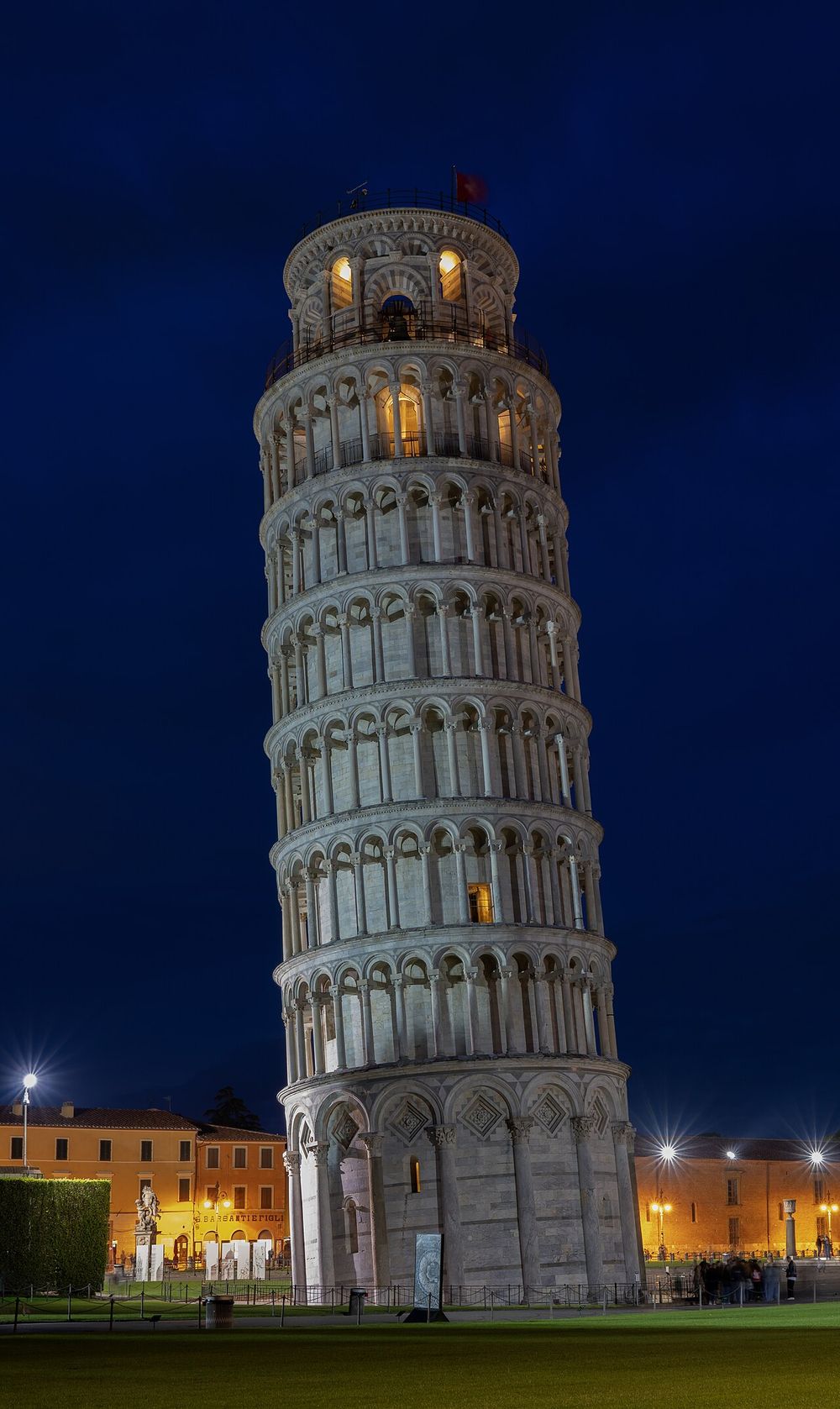
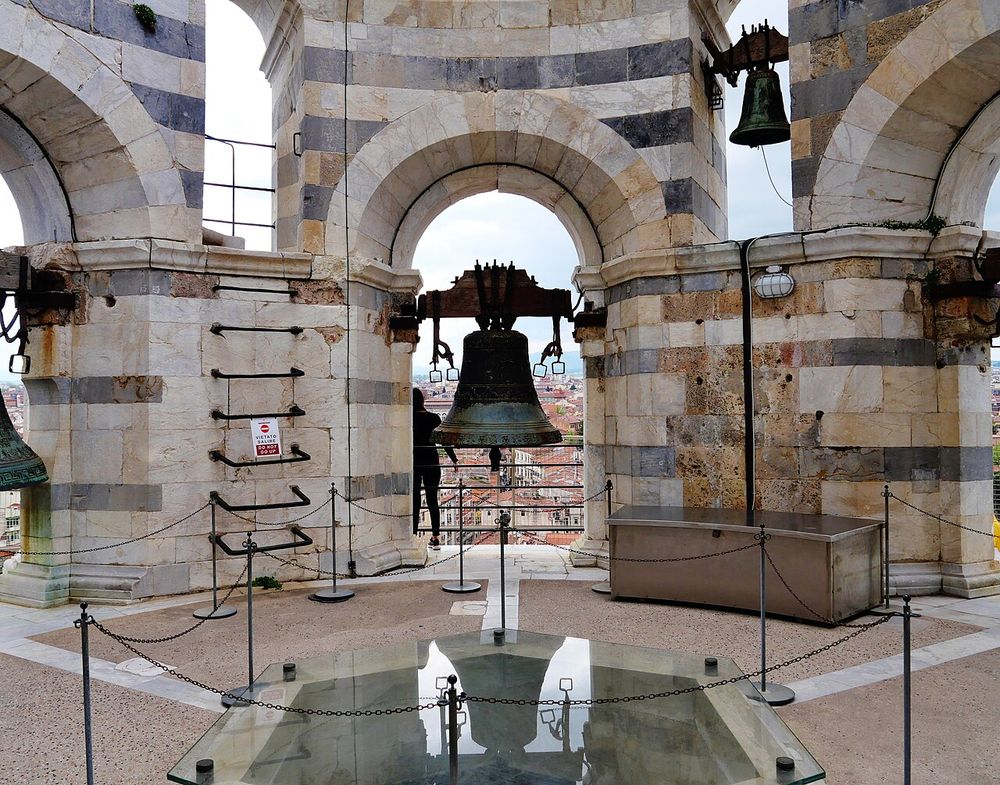
When building began again in 1272 the masons made the new storeys taller on the low side, to bring the top back towards the centre. So the tower is not straight even in its lean: it is curved, like a banana. The bell chamber, added a century later, is tilted the other way again.
6. How it was saved
A laser survey of the tower, 2007CyArk, https://www.cyark.org/data-use-policy, CC BY-SA 4.0
By 1990 the top was four and a half metres out of line and moving more than a millimetre a year. A medieval tower in another Italian city had just fallen without warning and killed four people. The tower of Pisa was shut.
The first attempt, freezing the ground, nearly brought it down in one night in September 1995. The answer that worked was the simplest. Long drills were slid in at an angle under the high side, and soil was taken out a few buckets at a time. The tower sank gently on that side and swung back.
Seventy tonnes of earth were removed in two years. The top moved back forty-five centimetres, to where it had been in 1838. The engineers could have gone further. The city asked them not to.
7. The climb
Steps worn hollowSailko, CC BY 3.0
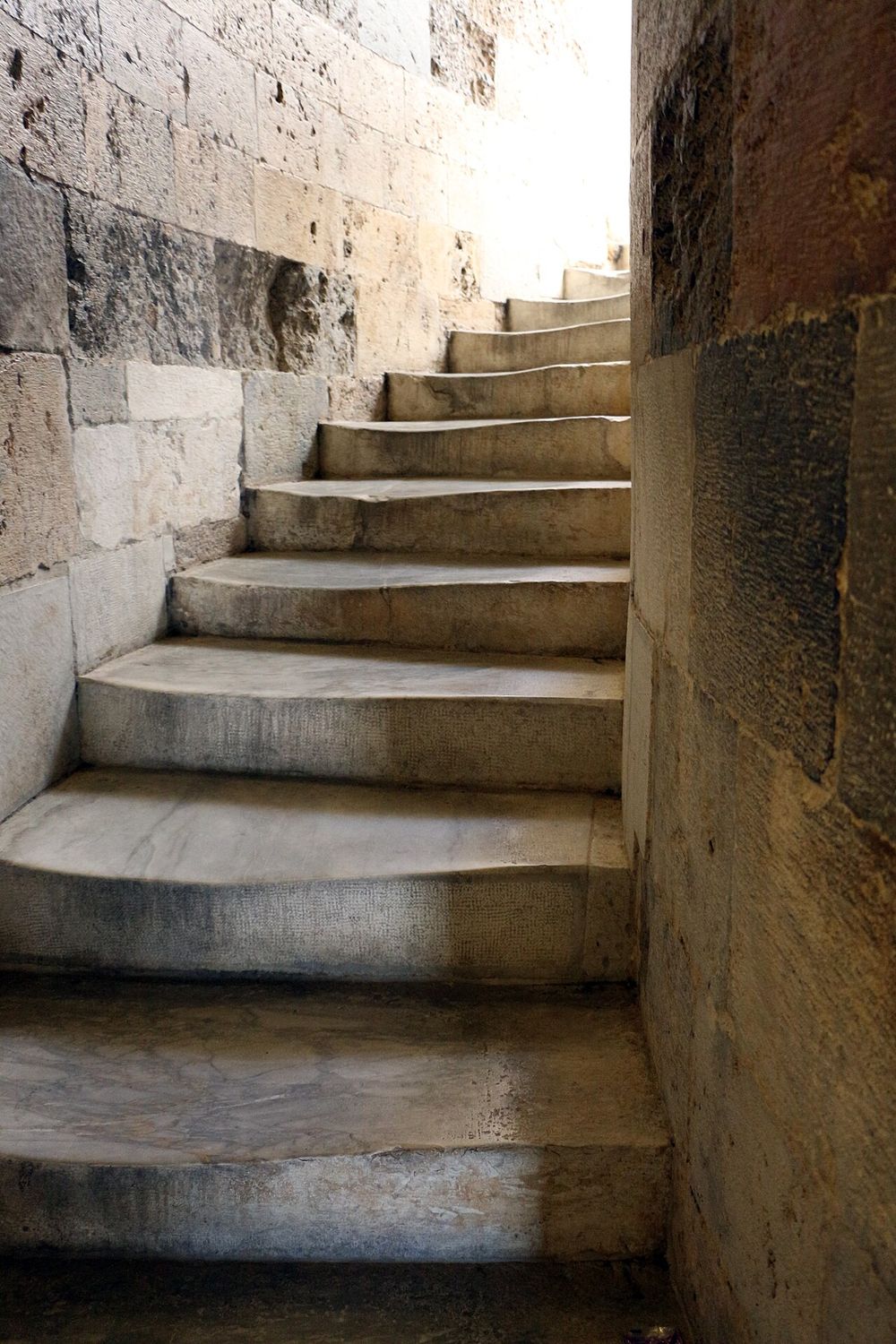
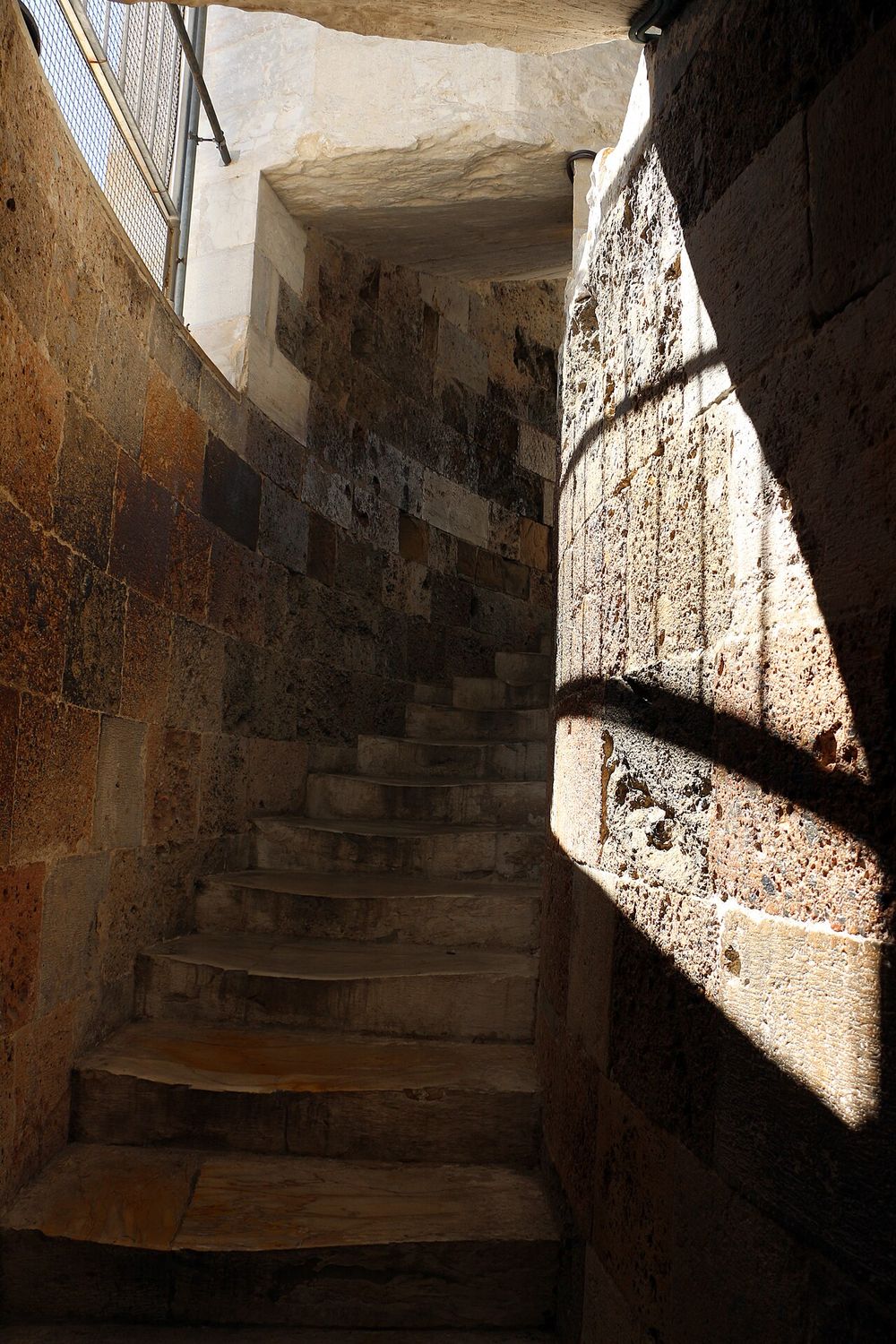
The stair winds up inside the wall, 251 steps to the top gallery and more to the bells. The marble treads are worn into hollows, and the hollows move: on one side of the tower they are against the outer wall, on the other against the inner, because every climber for eight centuries has been thrown the same way by the slope.
One of the seven bellsZairon, CC BY 4.0
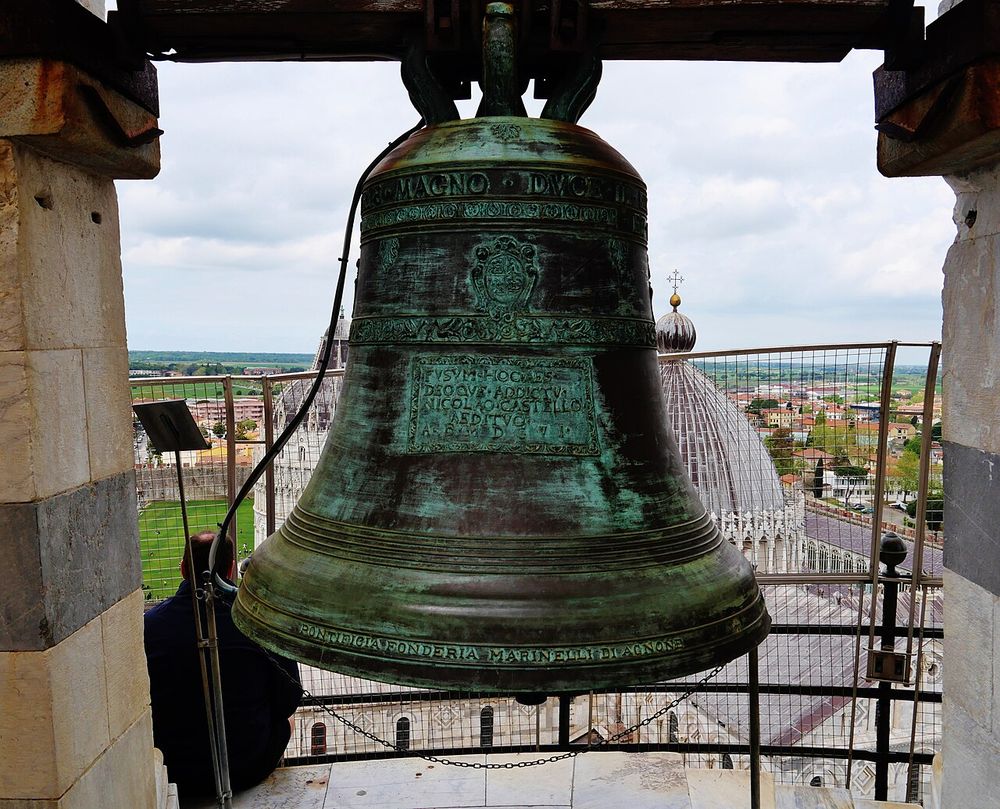
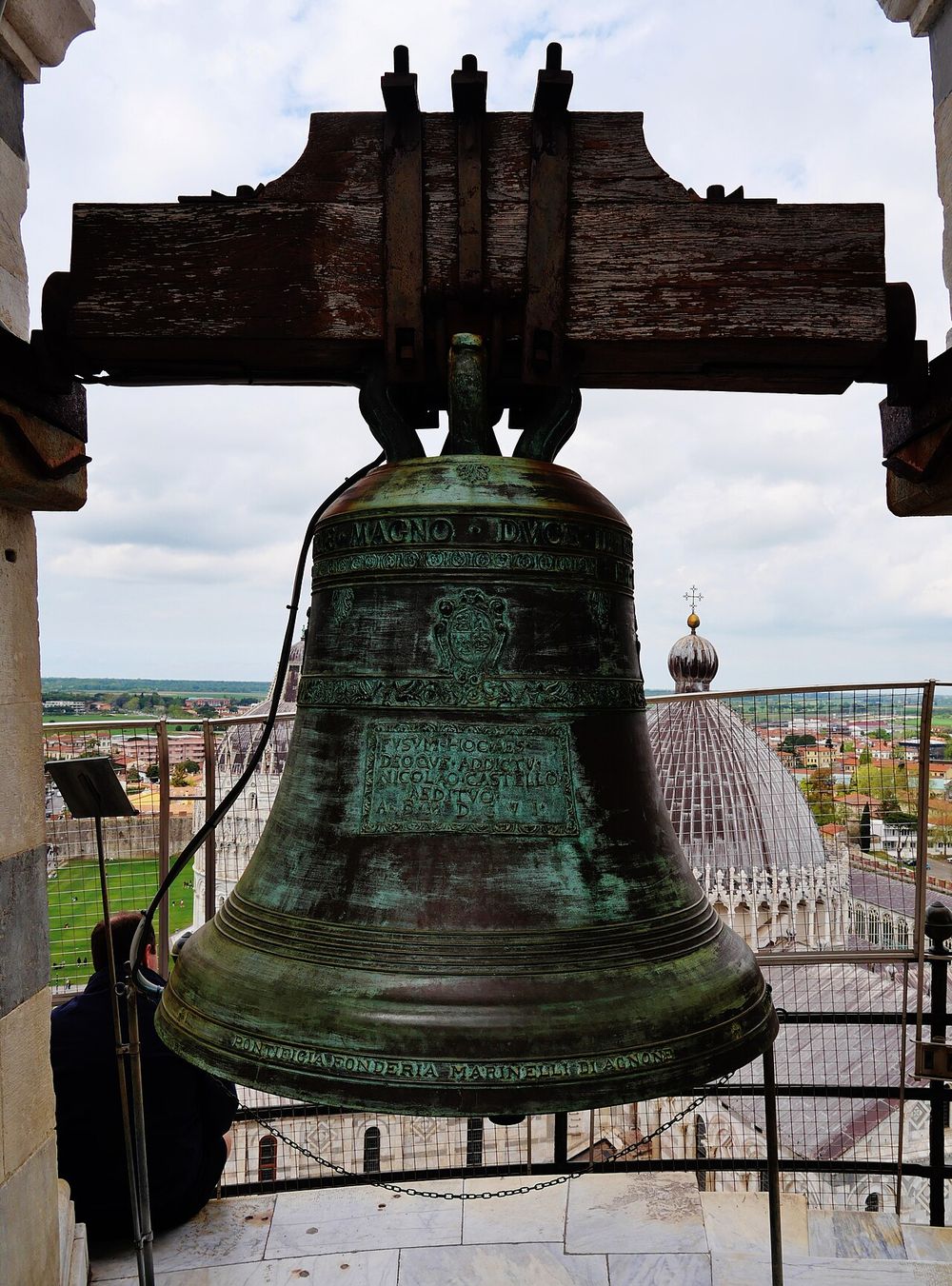
There are seven bells, one for each note of the scale. The largest weighs three and a half tonnes. They are no longer swung, for fear of shaking the tower; they are struck by hammers.
In July 1944 an American sergeant was sent forward to find out whether German observers were using the tower, and to call down the guns if they were. He looked at it through his glasses for a long time and did not give the order.
8. The cemetery
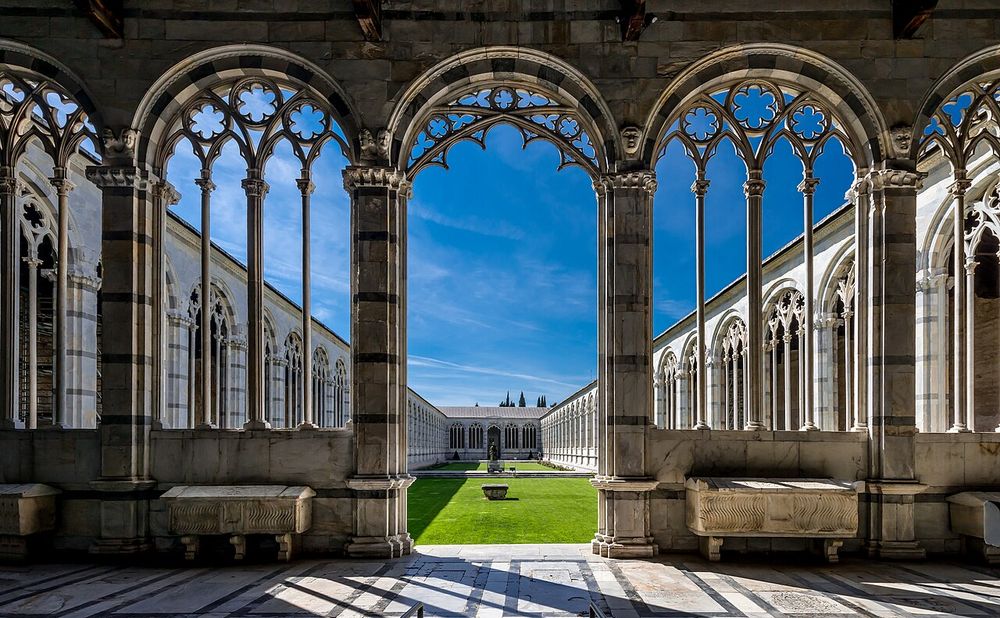
The cloister through its archesBernd Thaller from Graz, Austria, CC BY 2.0
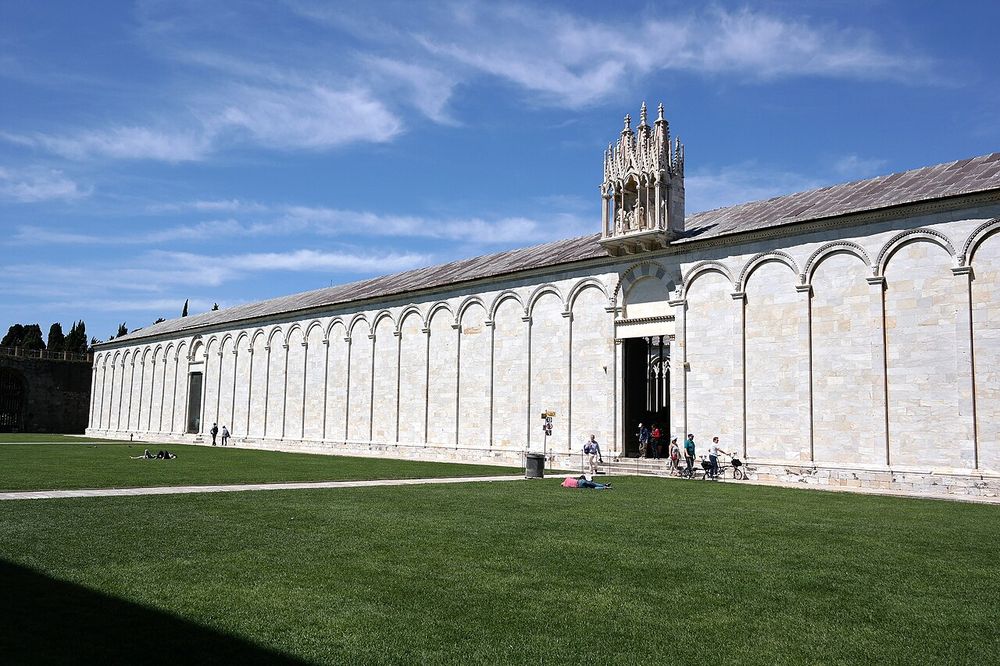
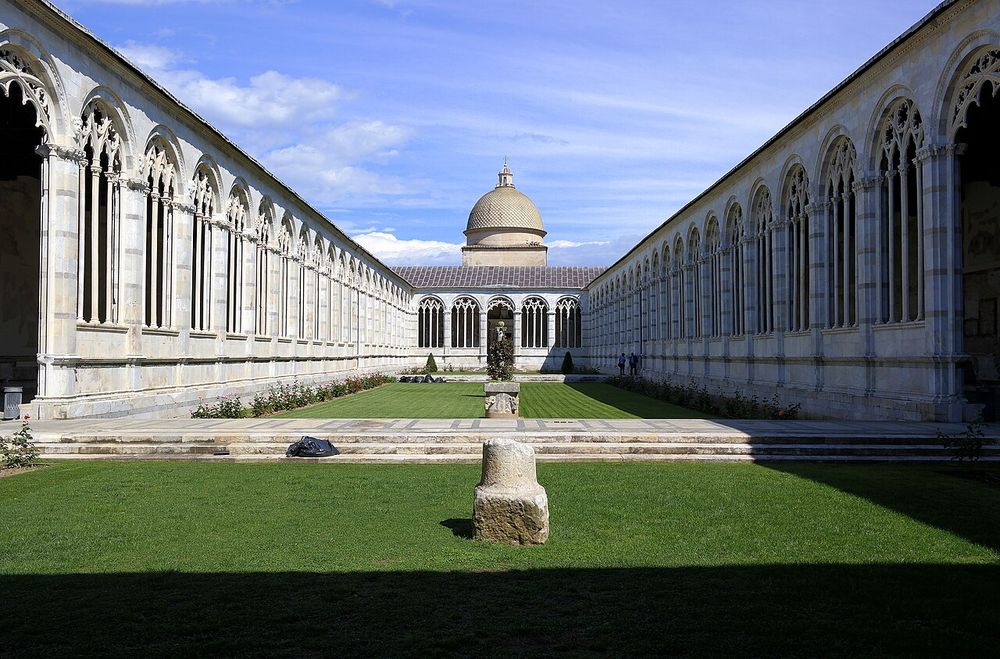
The long blank wall on the north side of the lawn hides a cloister begun in 1278. Its middle is a rectangle of grass, and under the grass is earth said to have been brought from Jerusalem.
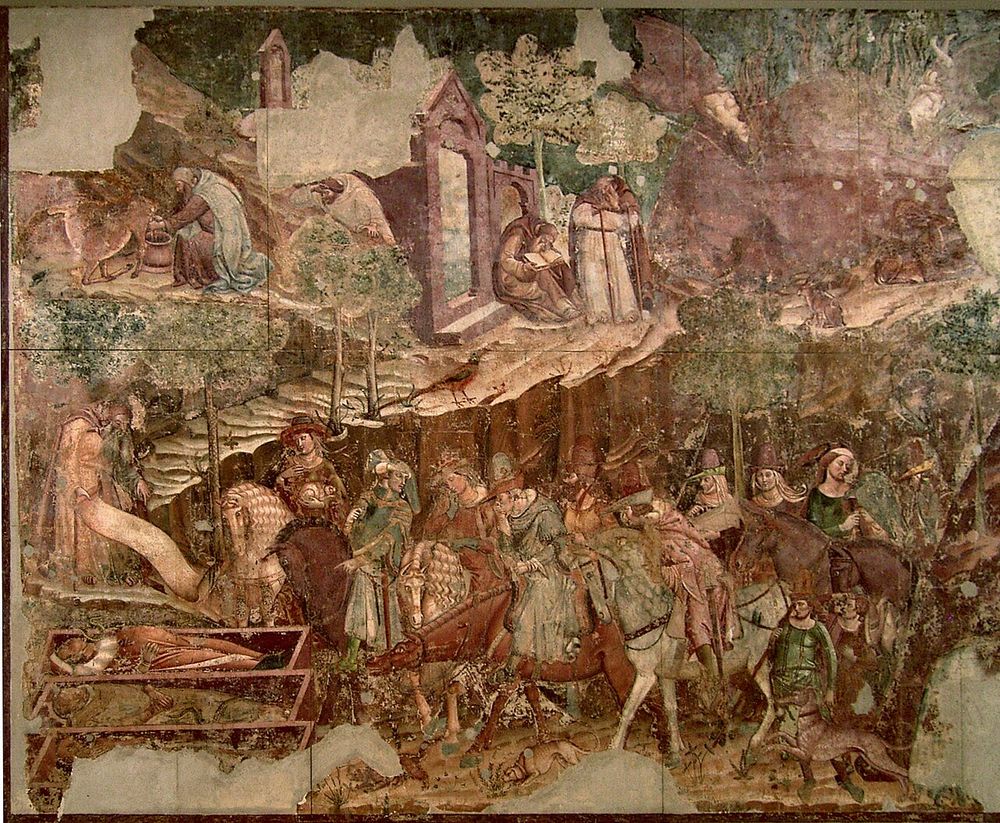
The hunters and the three coffinsUnknown, Public domain
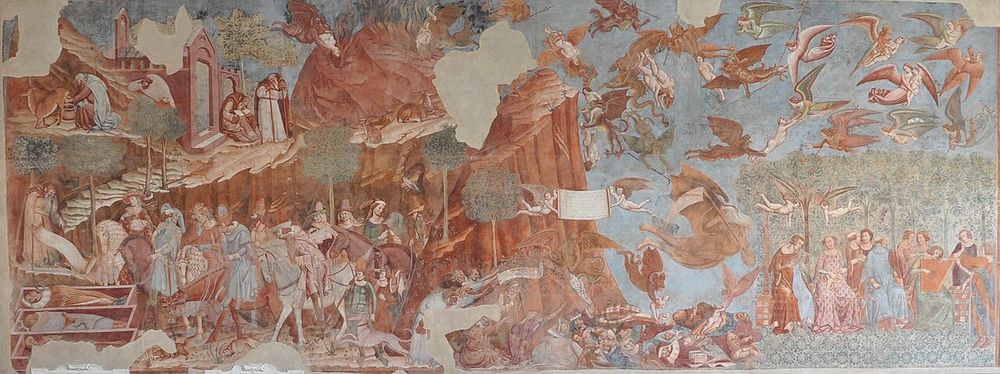
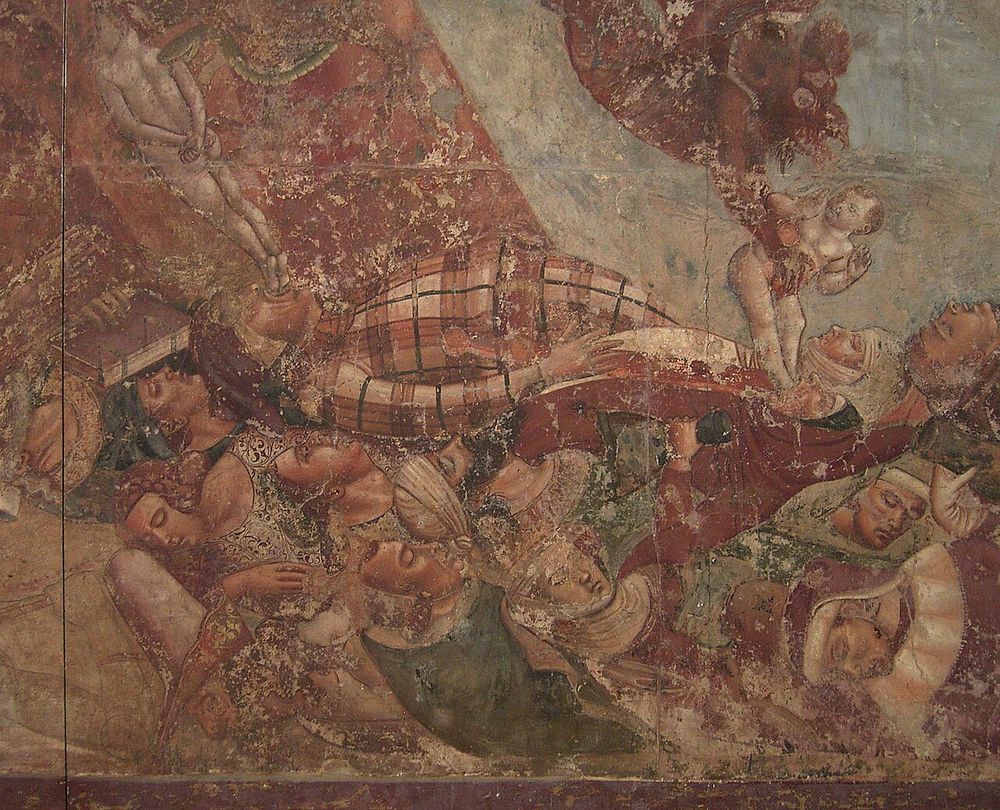
The walls were once painted from end to end. On 27 July 1944 a shell set the roof on fire, and the melted lead ran down over the paintings. What could be saved was peeled off the walls, and under it the restorers found the artists' first drawings in red earth. They are in the museum across the lawn.
The greatest of the paintings is back in its place: the Triumph of Death, of about 1340. Three young lords out hunting come upon three open coffins. Their horses smell it first.
Meanwhile in the world
Year
Here
Elsewhere
1064
The cathedral is begun
Northern Song (960–1127) China (960–1127): Su Shi is twenty-seven; two years before the Normans conquer England
1173
The tower is begun
Southern Song China (1127–1279); Saladin is uniting Egypt and Syria
1178
The tower starts to sink and work stops
Zhu Xi is teaching at the White Deer Grotto academy within two years
1272
Work begins again
The Yuan (1271–1368) dynasty has just been proclaimed in China, and Marco Polo is on his way there
1284
Pisa loses its fleet to Genoa and never recovers
One of the Pisans taken prisoner will, years later, write down Marco Polo's story in a Genoese gaol
1372
The bell chamber finishes the tower
Ming China (1368–1644), the fifth year of the first emperor
1590
Galileo teaches at Pisa
Ming China, the Wanli reign; Shakespeare is writing his first plays
1944
The cemetery burns; the tower is spared
The last full year of the Second World War
2001
The tower reopens, forty-five centimetres straighter
China joins the World Trade Organization
Then and now
The cathedral and the tower at sunriseMHoser, CC BY-SA 4.0, Wikimedia CommonsThe cathedral, with the tower behind itPaestumPaestum, CC BY 4.0, Wikimedia CommonsThe lawn and the city wall from the airGuglielmo Giambartolomei, CC BY-SA 4.0, Wikimedia CommonsBaptistery, cathedral, tower and cemetery in one viewGuglielmo Giambartolomei, CC BY-SA 4.0, Wikimedia CommonsThe Baptistery from aboveGuglielmo Giambartolomei, CC BY-SA 4.0, Wikimedia CommonsThe square at duskKoukoo 1991, CC BY-SA 4.0, Wikimedia CommonsThe towerSaffron Blaze, CC BY-SA 3.0, Wikimedia CommonsEight storeys, and a curvePaestumPaestum, CC BY 4.0, Wikimedia CommonsThe tower at nightPaestumPaestum, CC BY 4.0, Wikimedia CommonsThe tower and the moonJan Drewes (www.jandrewes.de), CC BY-SA 3.0, Wikimedia CommonsThe bell chamber, tilted back the other wayBloodyowl, Public domain, Wikimedia CommonsInside the bell chamberZairon, CC BY 4.0, Wikimedia CommonsOne of the seven bellsZairon, CC BY 4.0, Wikimedia CommonsA bell and its frameZairon, CC BY 4.0, Wikimedia CommonsPisa from the top of the towerZairon, CC BY 4.0, Wikimedia CommonsThe stair inside the wallSailko, CC BY 3.0, Wikimedia CommonsSteps worn hollowSailko, CC BY 3.0, Wikimedia CommonsA laser survey of the tower, 2007CyArk, https://www.cyark.org/data-use-policy, CC BY-SA 4.0, Wikimedia CommonsThe cathedral front from the BaptisteryPaestumPaestum, CC BY 4.0, Wikimedia CommonsFour galleries of archesLuca Aless, CC BY-SA 4.0, Wikimedia CommonsColumns of the front, each one differentNormanB, CC BY-SA 3.0, Wikimedia CommonsThe cathedral from the south-westPerituss, CC0, Wikimedia CommonsThe door facing the towerMenkinAlRire, CC BY-SA 4.0, Wikimedia CommonsPalm trees on the bronze door of about 1180MenkinAlRire, CC BY-SA 4.0, Wikimedia CommonsThe naveEric Kilby, CC BY-SA 2.0, Wikimedia CommonsThe nave and its gilded ceilingSpike, CC BY-SA 4.0, Wikimedia CommonsThe ceiling, looking straight upEric Kilby, CC BY-SA 2.0, Wikimedia CommonsThe bronze lampTangopaso, Public domain, Wikimedia CommonsThe lamp and the mosaic of the apseTangopaso, Public domain, Wikimedia CommonsThe BaptisteryPaestumPaestum, CC BY 4.0, Wikimedia CommonsRound arches below, pointed gables aboveJulian Lupyan, CC0, Wikimedia CommonsThe Baptistery at nightPaestumPaestum, CC BY 4.0, Wikimedia CommonsNicola Pisano's pulpit of 1260Xosema, CC BY-SA 4.0, Wikimedia CommonsThe outer wall of the cemeteryLuca Aless, CC BY-SA 4.0, Wikimedia CommonsThe cloister through its archesBernd Thaller from Graz, Austria, CC BY 2.0, Wikimedia CommonsThe grass in the middle of the cloisterLuca Aless, CC BY-SA 4.0, Wikimedia CommonsThe Triumph of Death, painted about 1340Buonamico Buffalmacco, Public domain, Wikimedia CommonsThe hunters and the three coffinsUnknown, Public domain, Wikimedia CommonsA devil carries off a soulUnknown, Public domain, Wikimedia CommonsThe square in a coloured print of about 1830Jakob Rauschenfels von Steinberg, Public domain, Wikimedia CommonsBaptistery, cathedral and tower in a wood engraving of the nineteenth centuryUnknown authorUnknown author, Public domain, Wikimedia CommonsThe square photographed by Giacomo Brogi, before 1881Giacomo Brogi, Public domain, Wikimedia CommonsThe square from the city wall, in a nineteenth-century photographRijksmuseum, CC0, Wikimedia CommonsThe inside of the cathedral, painted by David Roberts in 1859David Roberts, Public domain, Wikimedia CommonsGalileo's lamp in a lantern slide of about 1913Edmund F. Arras, Public domain, Wikimedia Commons
Video
Films from official channels, played from YouTube. Nothing is loaded until you press play.
The Piazza del Duomo, PisaUNESCO · made with NHK; 3 min · checked 2026-11-12
Local legends
These are stories people tell about this place. They are legends, not history, and each one says where it comes from.
LegendThe swinging lamp
Galileo, a student of nineteen, sat bored at Mass and watched the lamp swing after the sacristan had lit it. He timed it with his pulse and found that the wide swings took no longer than the narrow ones. From that came the pendulum clock.
Source: Vincenzo Viviani, Life of Galileo (1654); the lamp now hanging was put up in 1587, after the date given
LegendThe two cannon balls
Galileo climbed the tower before the whole university and let fall two balls of different weights. They struck the ground together, and the professors who had taught for two thousand years that the heavier falls faster went home in silence.
Source: Viviani, Life of Galileo (1654)
LegendThe holy earth
An archbishop of Pisa came home from the Crusades with fifty-three shiploads of earth from the hill where Christ was crucified, and spread it in the cemetery. A body laid in it is said to turn to bones in a single day.
Source: Pisan chronicles from the fourteenth century
LegendThe devil's claws
The devil, furious at the beauty of the cathedral, climbed its north wall to pull it down. An angel drove him off. A block of marble on that side is covered in small holes where his claws dug in, and no one who counts them gets the same number twice.
Source: Pisan popular tradition
Later, people who live here will be able to add the stories they grew up with, and say which of these they have heard.
Not certain, and where accounts conflict
Who designed the tower?
For centuries the credit went to Bonanno Pisano, who cast the bronze door. Documents found in the last hundred years point as strongly to Diotisalvi, who was building the Baptistery at the time. Neither signed it.
Did Galileo drop anything?
He argued in writing that bodies of different weight fall together, and he described trials "from a high tower" in general terms. Most historians think the public show on this tower is his secretary's embroidery.
How many steps?
Figures of 251, 273, 294 and 296 are all in print. It depends on where you stop and which side you count, because the two sides of a leaning stair are not the same length.
Will it lean again?
The engineers who steadied it expect it to begin moving again, very slowly, in two or three centuries, and say the same cure can then be repeated.
Visiting
Tickets and hours
The tower is 20 euros, with no reductions. Children under 8 may not go up, and those under 18 must be with an adult.
A ticket for every monument including the tower was reported at 27 euros in 2026, and one for everything but the tower at 11 euros. The official site shows its price list only as a picture, which we could not read; check there.
The cathedral is free. Any ticket comes with a pass for it, and it opens to visitors at 10:00.
In November 2026 the monuments were open from 9:00 to 18:00, with last entry half an hour before. In summer they open earlier and close later, and from 17 June to 31 August the tower and the cemetery stay open until 22:00.
A ticket for the other monuments is good for a year from the date you choose.
Last checked 2026-11-12. The site of the cathedral works of Pisa (opapisa.it), opening times and ticket rules as shown in November 2026.
Booking from abroad
Official page in English The cathedral works sell every ticket on their own site, in English, and take foreign cards: opapisa.it. The tower is sold for a set time and in limited numbers.
Ticket window on site There are ticket offices on the square, behind the tower and in the Sinopie Museum. In summer the tower times for the day are often gone by mid-morning.
Note Sites with similar names sell the same tower ticket for much more. The official price is 20 euros with no booking fee.
Checked 2026-11-12
Where to start
Pisa is an hour from Florence by train. From Pisa Centrale station the square is twenty-five minutes on foot through the old town, or ten by bus. Pisa San Rossore, a smaller station on some lines, is five minutes' walk away.
Book the tower for early morning or the last hour. Be at the left-luggage office beside the tower fifteen minutes before your time: no bags of any kind go up.
Then see the Baptistery, the cathedral after 10:00, and the cemetery last, when the afternoon sun comes through its arches.
Allow three hours for everything. The tower visit itself lasts half an hour.
Before you go
The stair is narrow and slippery, and the slope pushes you against the wall. Wear shoes with a grip. It is not a climb for anyone with a weak heart or poor balance.
In the cathedral and the Baptistery, cover your shoulders and knees.
The stalls along the wall sell the same things at the same prices. The men selling watches and bags from blankets are not licensed, and buyers can be fined too.
Customs and manners
Everyone takes the photograph that seems to hold the tower up. Take yours, and then move off the path.
Keep off the grass where it is roped.
In the Baptistery, be silent when the attendant sings.
Opening hours are given in the local time of the place. Prices are in the local currency. The figure after ≈ is approximate, at exchange rates checked on 9 November 2026, in .
Look for these
Stand at the Baptistery door and look at the cathedral. Is it upright?
On the tower, compare the columns on the low side with those on the high side. Which are longer?
Is the bell chamber leaning the same way as the rest?
On the bronze door, find the three kings on horseback.
In the cathedral, find the lamp. Is it swinging?
On the Baptistery pulpit, find the small naked man. What is on his shoulder?
On the tower stair, look at the hollows in the steps. Which side are they on?
In the cemetery, find the three coffins.
I am here
Stand at the site, sign in, press the button, and collect its stamp. Your browser will ask to use your location. It is sent to us once to confirm that you are at the site; we keep how far you were from it, not the spot where you stood.
Your stamps are saved to your account, so they follow you to any device. Checking from a browser cannot rule out every false location; stricter checks arrive with the app.
Messages
Share your photos
Photos here show the place, not people. Each one is credited to the visitor who took it and appears after our team has looked at it. A photo with you in it belongs under “I am here”.