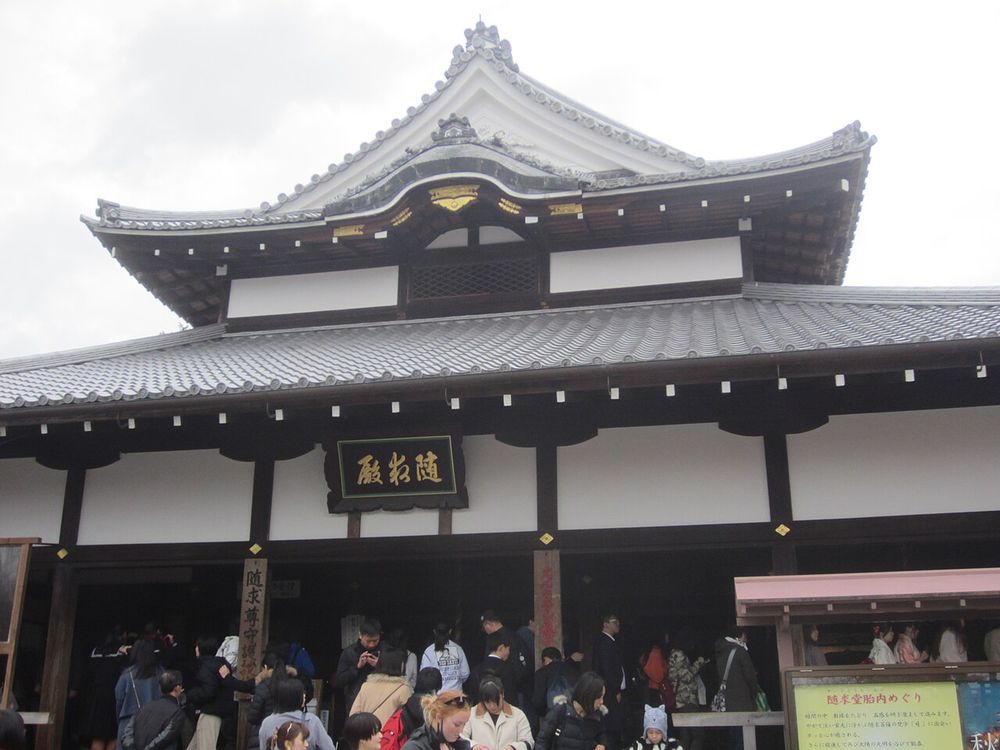
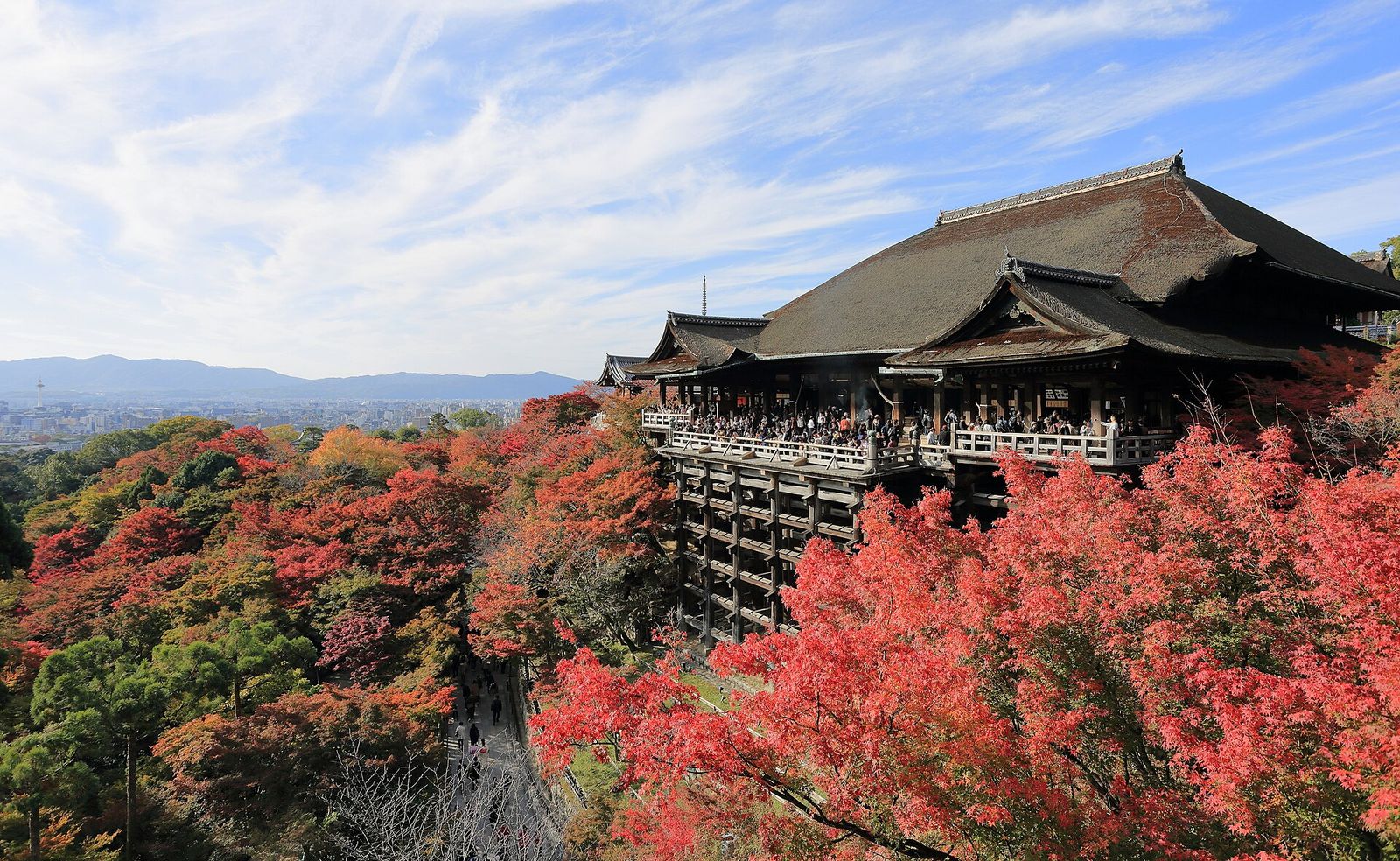
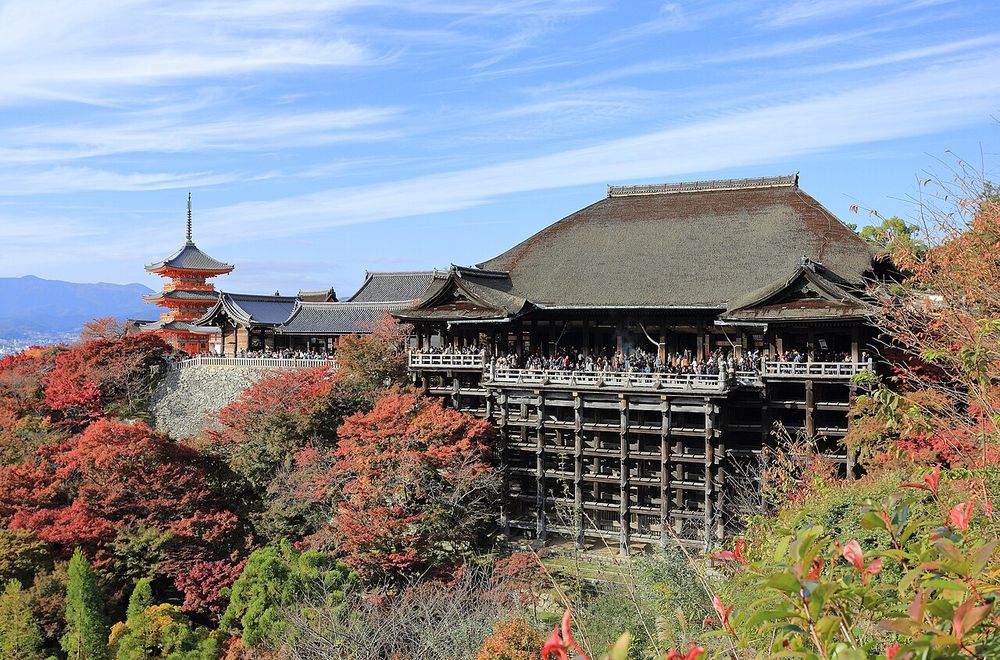
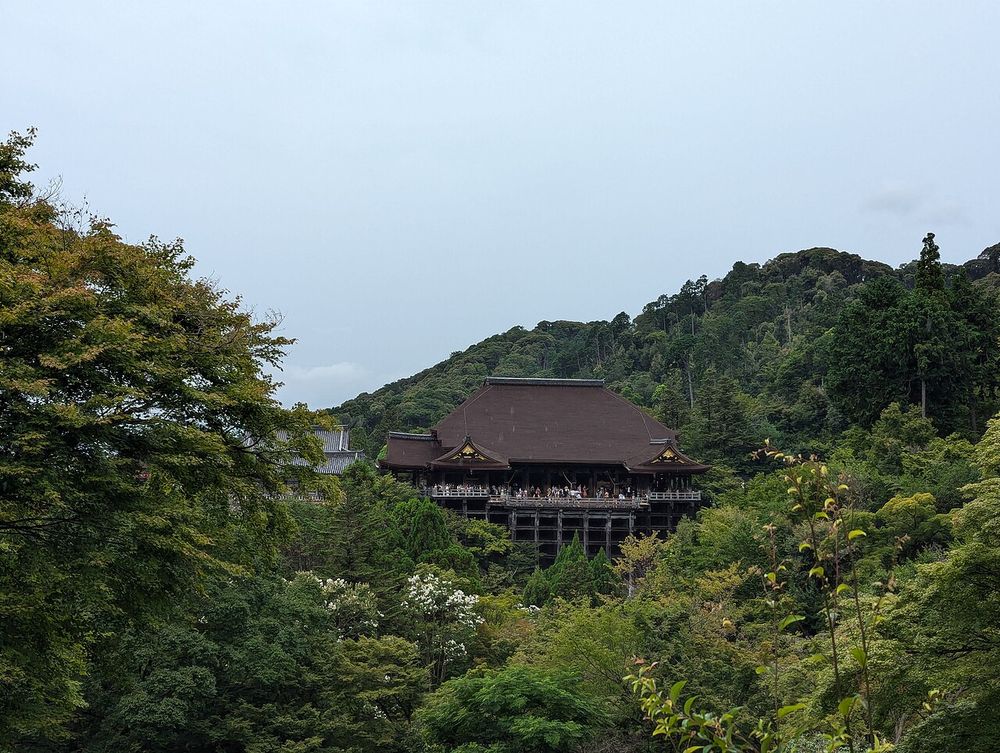
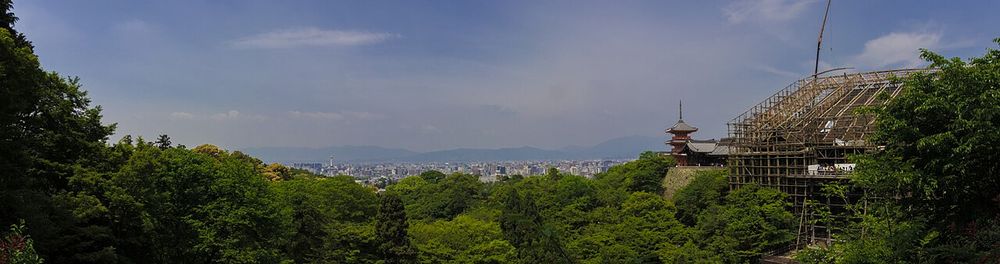
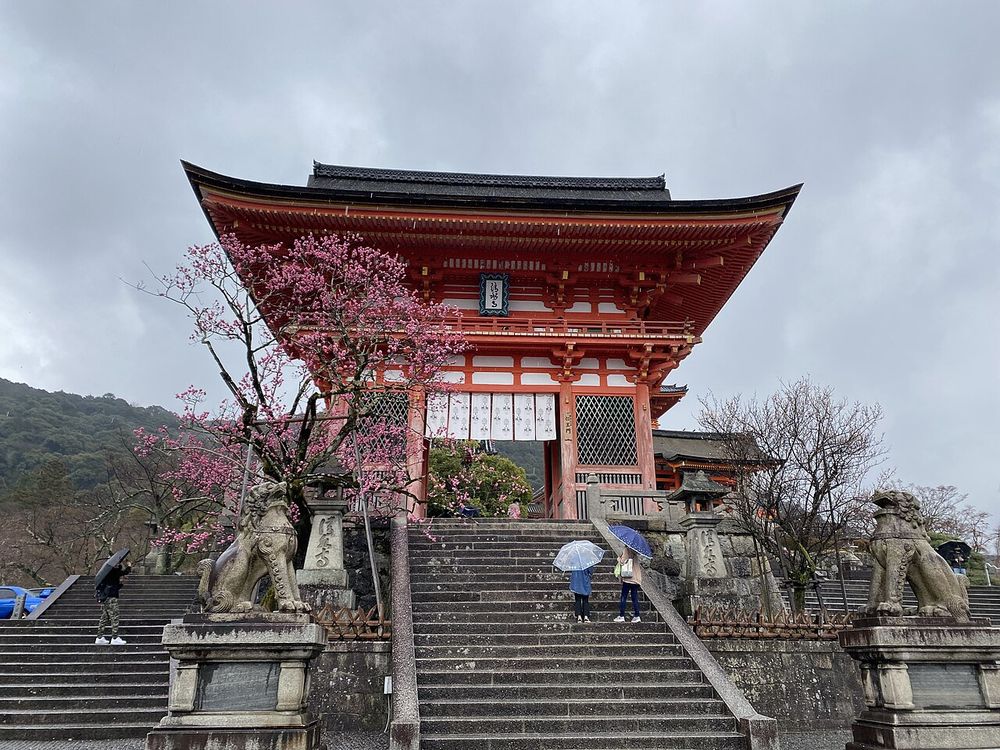
A wooden hall on a hillside, with a stage thirteen metres above the slope and a spring at its foot. The temple is older than Kyoto itself. For centuries people jumped from the stage to have a wish granted, and most of them lived.
Photo: lumoplank, CC0, Wikimedia Commons
The story
You are on a wooden floor with no wall in front of you, only a low rail. Below the rail the hillside falls away into treetops. To your right, far off, are the roofs of a city. Under your feet the boards are worn smooth, and under the boards are pillars as tall as a four-storey house.
The temple dates itself to 778, sixteen years before Kyoto became the capital. In China it was the Tang (618–907): the great rebellion of An Lushan had ended fifteen years before, and the poet Du Fu had been dead for eight.
What is here
One ticket covers the main hall, the stage, the Okuno-in and the spring. The gates, the pagoda and the lanes below are free.
Kiyomizu means "pure water". The water is a spring that comes out of the hill below you, and the temple grew up around it. The hall behind you belongs to Kannon, the figure of mercy in Buddhism, who is said to hear anyone who calls.
The stage was built for her. Music and dance were performed on it as offerings, facing the hall and not the view. It also held the crowds, because this has been one of the most visited temples in Japan for a thousand years.
The buildings burned again and again. What you stand on was put up in 1633 by order of the shogun, the military ruler of Japan.
Japanese has a saying for a bold decision: "to jump off the stage of Kiyomizu". It is not a figure of speech. Go to the rail and look down.
Things people often get wrong
"The stage looks out over Kyoto." It faces south, across a valley to a small red pagoda. The city is off to the right. The stage was aimed at the hall, not at the scenery.
"It was built in 778." The temple was founded then. The hall and stage date from 1633, after the last great fire.
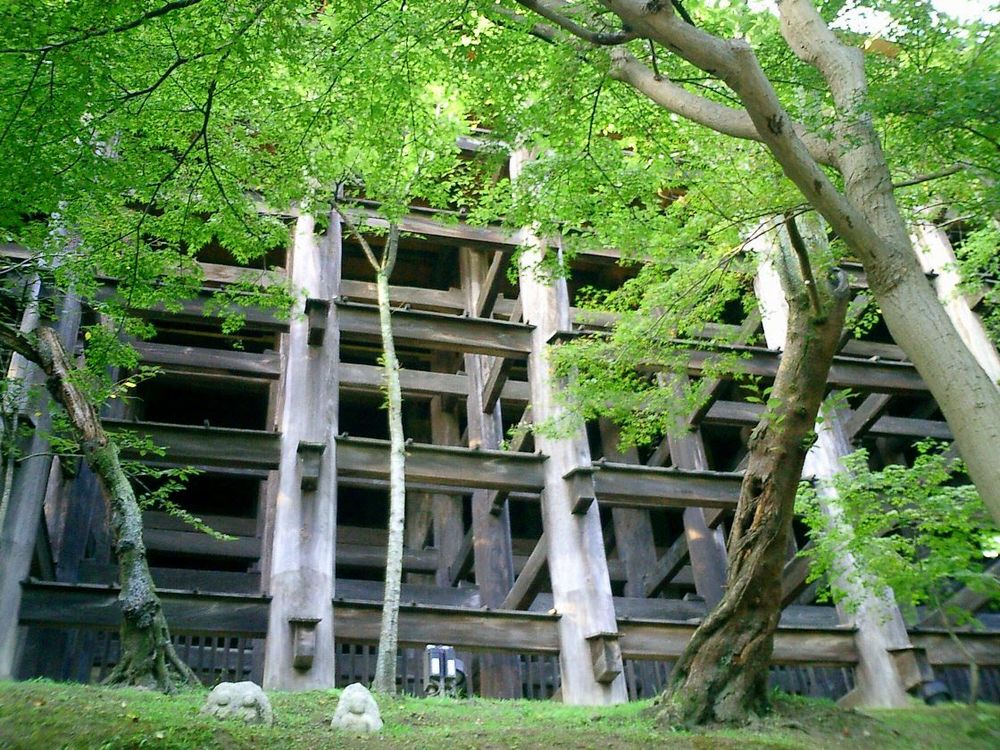
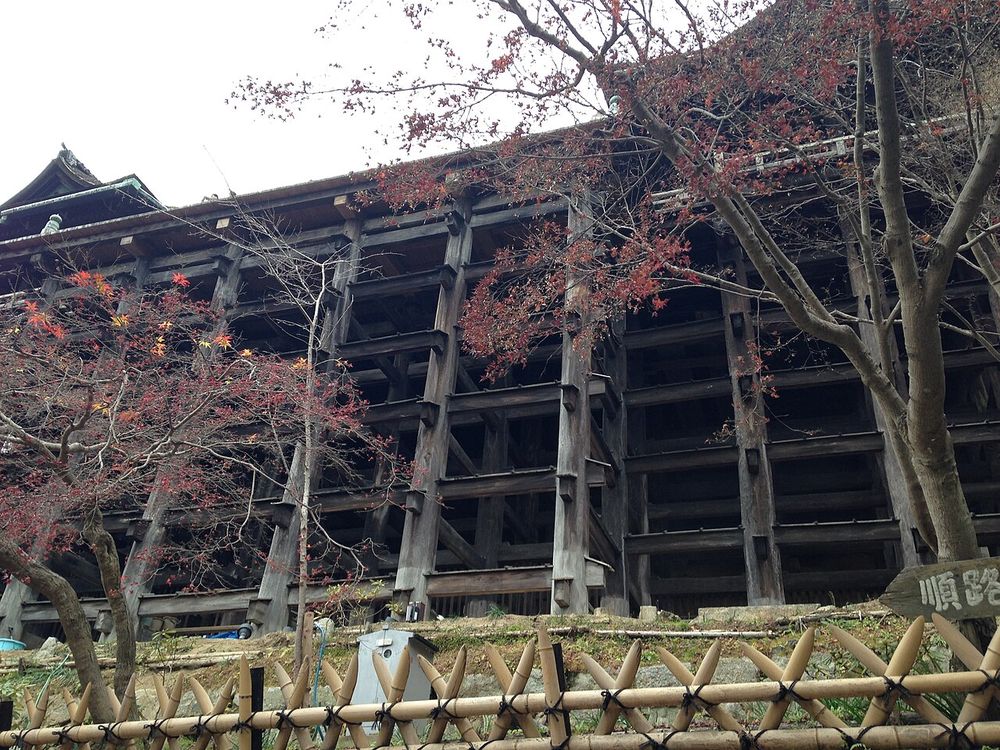
"There is not one nail in the temple." This is said of the frame under the stage, where the pillars and cross-beams are slotted together and wedged. It is not claimed for the whole temple.
"Each of the three streams gives a different blessing." Guidebooks say long life, success at school and luck in love. The water is the same spring divided in three, and the temple speaks only of one pure water.
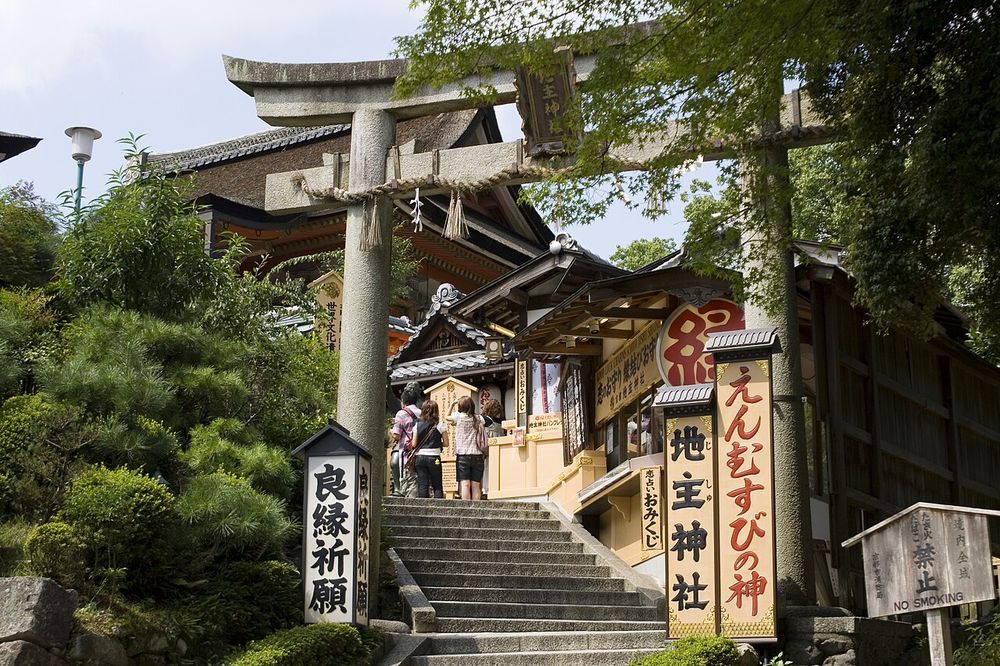
"The shrine of love is part of the temple." Jishu Shrine stands behind the hall but belongs to Shinto, the native religion of Japan. The government separated shrines from temples in 1868.
"You can come in the evening." The gate shuts at about six. It stays open after dark on only three short periods a year.
People who stood here
Sei Shōnagon (lady of the Japanese court about the year 1000, who wrote The Pillow Book)She wrote of going into retreat at Kiyomizu, and listed the temple on the eighteenth of the month, Kannon's day, among "noisy things". The hall she knew burned long ago, but it stood on this spot, and she may have leaned on a rail where you lean now.
Go deeper: eight stops, from the red gate to the spring
The stops follow the one-way route: up through the gates, across the stage, round the valley and down to the spring.
1. The Niō Gate
The Niō GateDXR, CC BY-SA 4.0
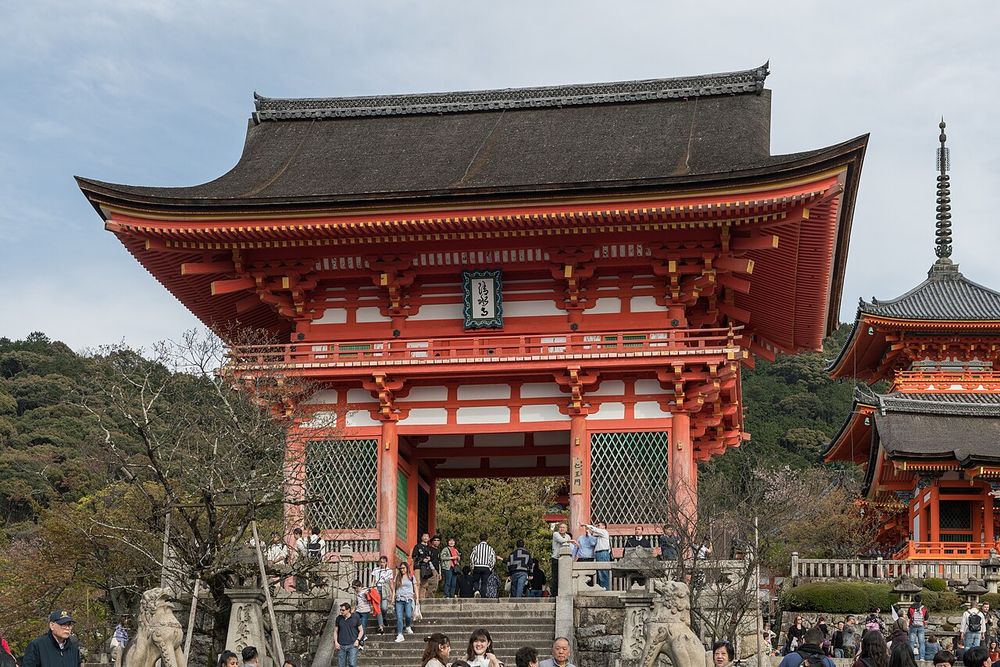
The lane ends at a flight of stone steps and a gate painted orange-red, fourteen metres high. In the bays on each side stands a guardian with bared teeth. One has his mouth open and one has it shut: the first and last sounds of the Sanskrit alphabet, the beginning and the end of all things.
This gate is older than the hall. It was rebuilt about 1500, after the civil war that burned most of Kyoto, and the fire of 1629 did not reach it.
On the left before the steps is a long low shed. It is a stable. Pilgrims of rank left their horses here and went up on foot.
2. The West Gate and the pagoda
The West Gate with the pagoda behindDon Ramey Logan, CC BY-SA 4.0
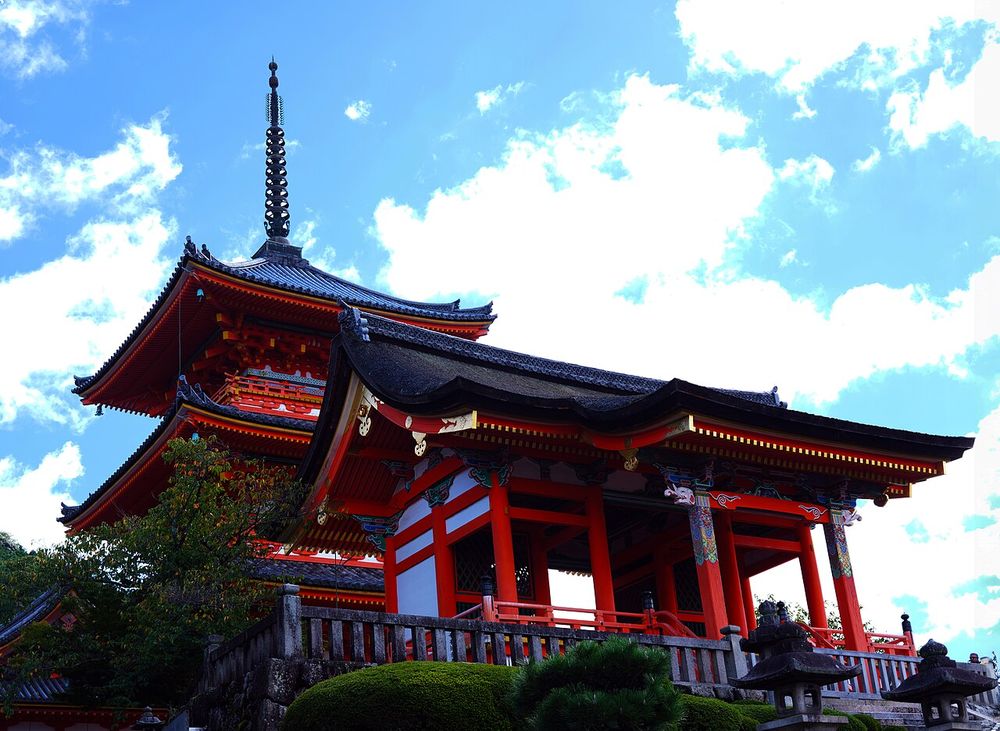
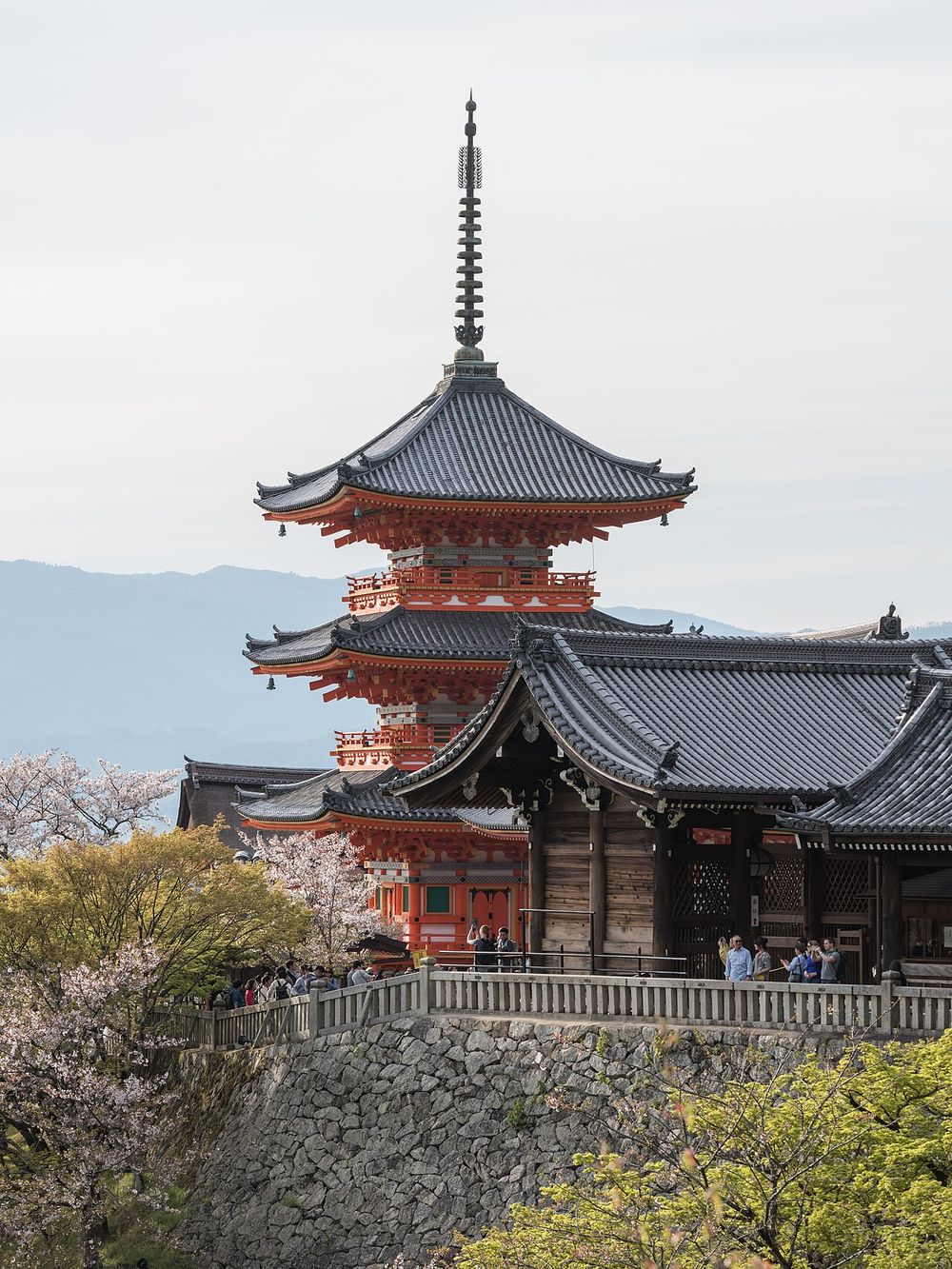
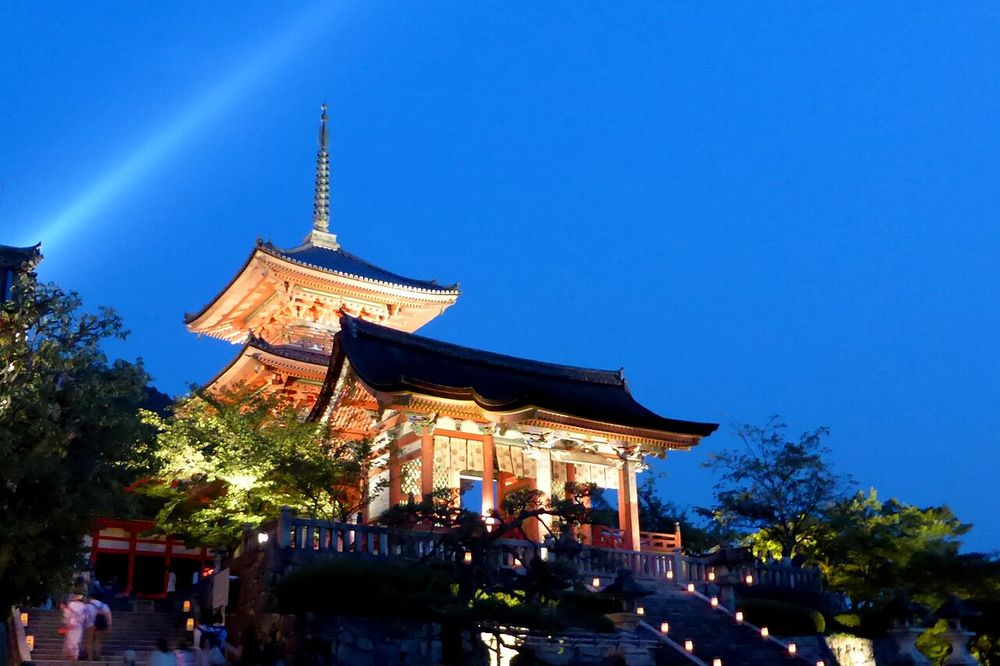
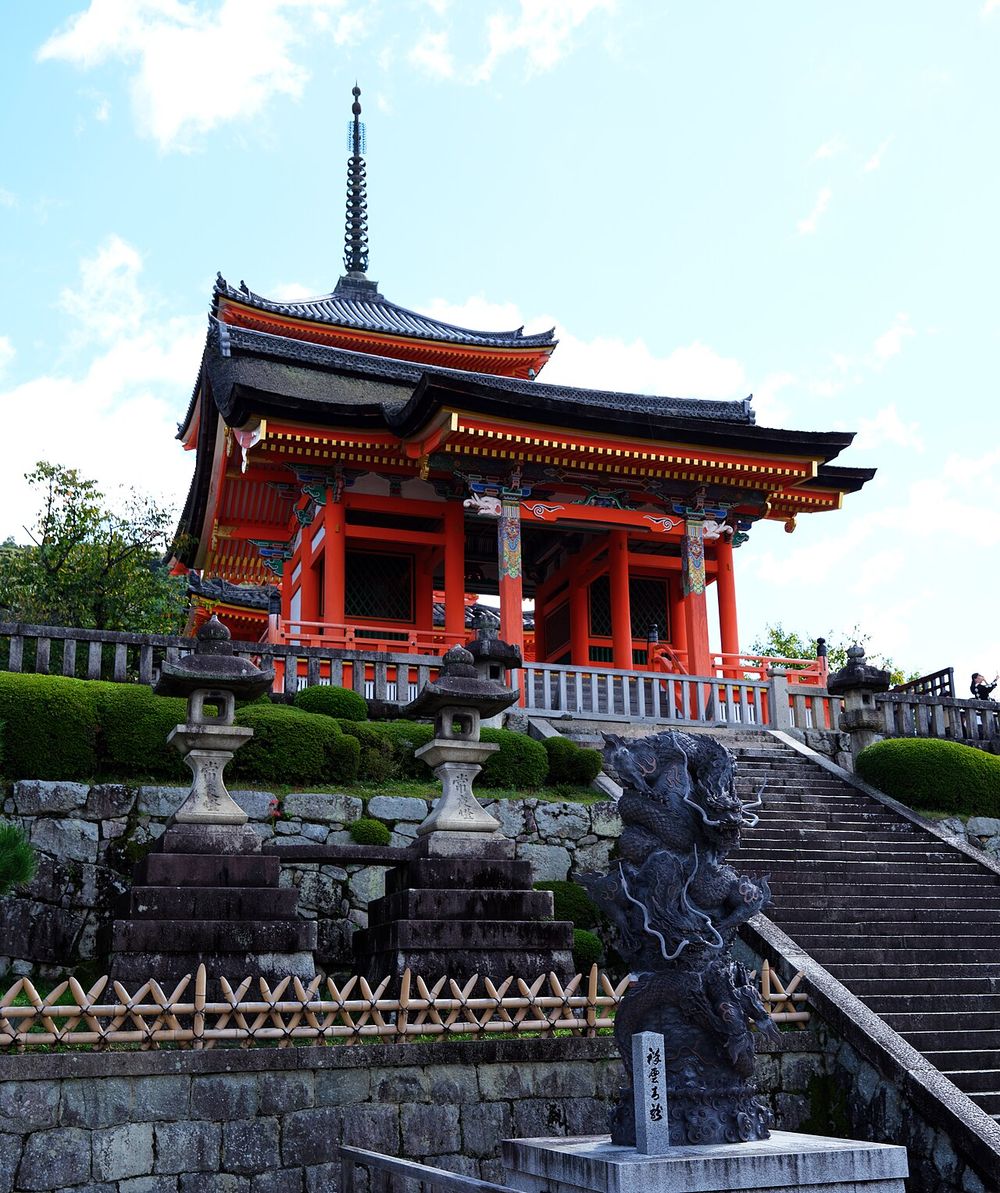
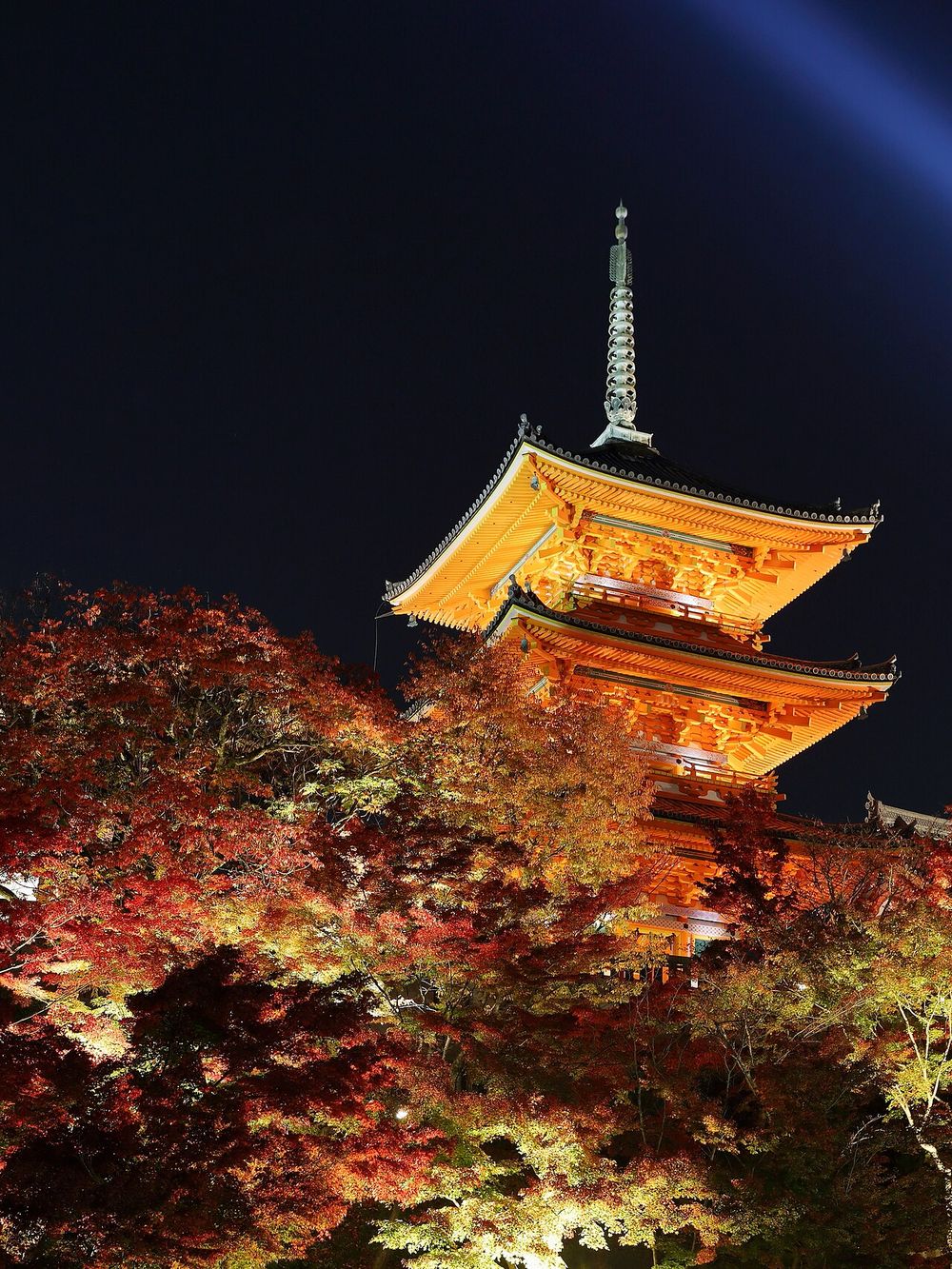
Above the Niō Gate is a second gate, with a pagoda of three storeys behind it. Both were rebuilt in 1631 and 1632. The pagoda is about 31 metres high, among the tallest of its kind in Japan.
The three-storey pagodaDXR, CC BY-SA 4.0
Nobody walks through the West Gate. It was built for looking out of. From here the sun sets over the western hills, and in Buddhism the paradise of the Buddha Amida lies in the west. Worshippers sat here at sunset and pictured it.
3. The dark walk
The Zuigu-dō, where the dark walk beginsAnother Believer, CC BY-SA 4.0
The hall on the left with a curved gable is the Zuigu-dō, built in 1718. For 100 yen you take off your shoes and go down a stair into complete darkness.
You hold a rope of wooden beads as big as oranges and follow it round. The dark is meant to be the womb of a Buddhist mother figure. At the far point a single stone is lit from above. You turn it, make one wish, and climb back into daylight as if newly born.
4. The main hall
Inside the outer hallHyppolyte de Saint-Rambert, CC BY-SA 4.0
You pay at the next gate and enter the main hall along its side. At the door stand an iron staff taller than a man and a pair of iron clogs. Visitors try to lift them. Few manage the staff.
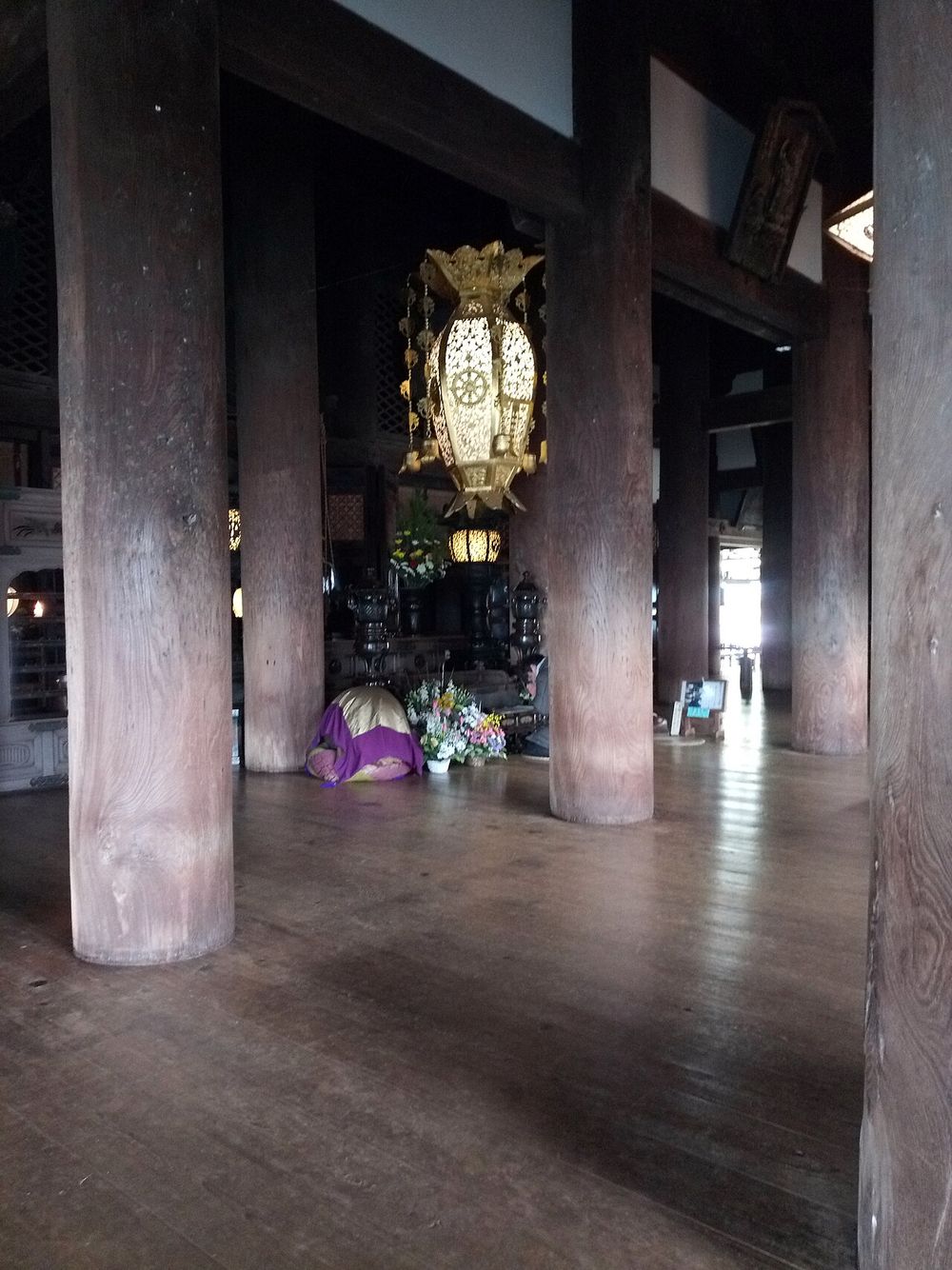
The hall is dim, with a floor of dark boards and pillars thicker than you can circle with your arms. The image of Kannon is at the back, and you cannot see it. It is kept in a closed cabinet and shown once every thirty-three years, because Kannon is said to take thirty-three forms. It was last shown in 2000.
An altar inside the templeZairon, CC BY-SA 4.0
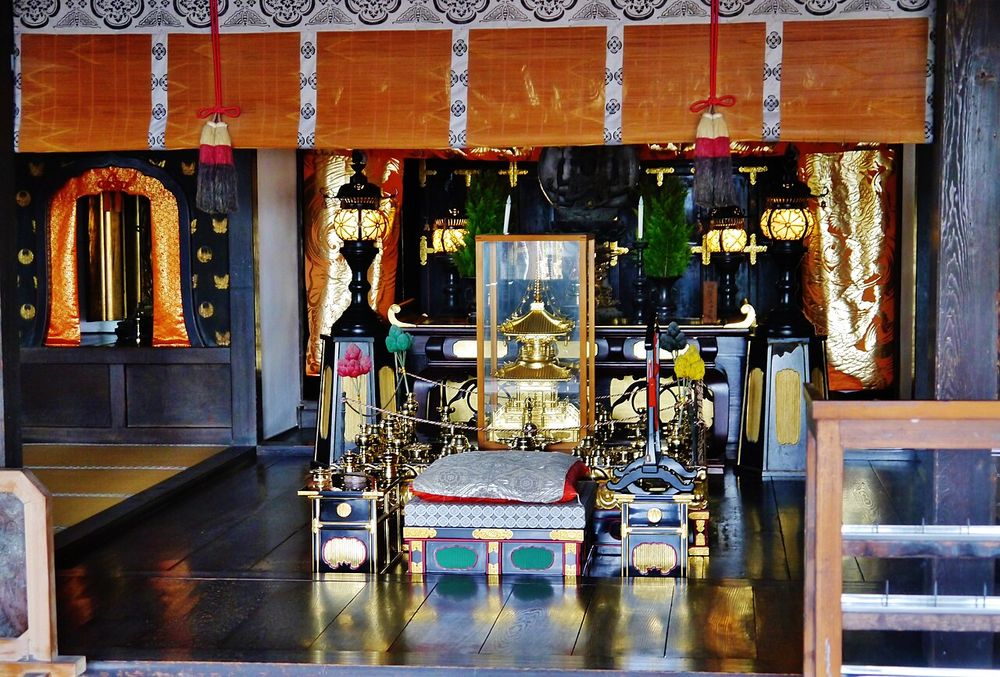
What you see in front is a copy made to stand in for it. It has eleven heads and many arms, and two of the arms are raised above its head to hold up a tiny Buddha. That pose is found here and is called the Kiyomizu type.
5. The stage
The frame of pillars and cross-beams, held without nailsTomomarusan, CC BY 2.5
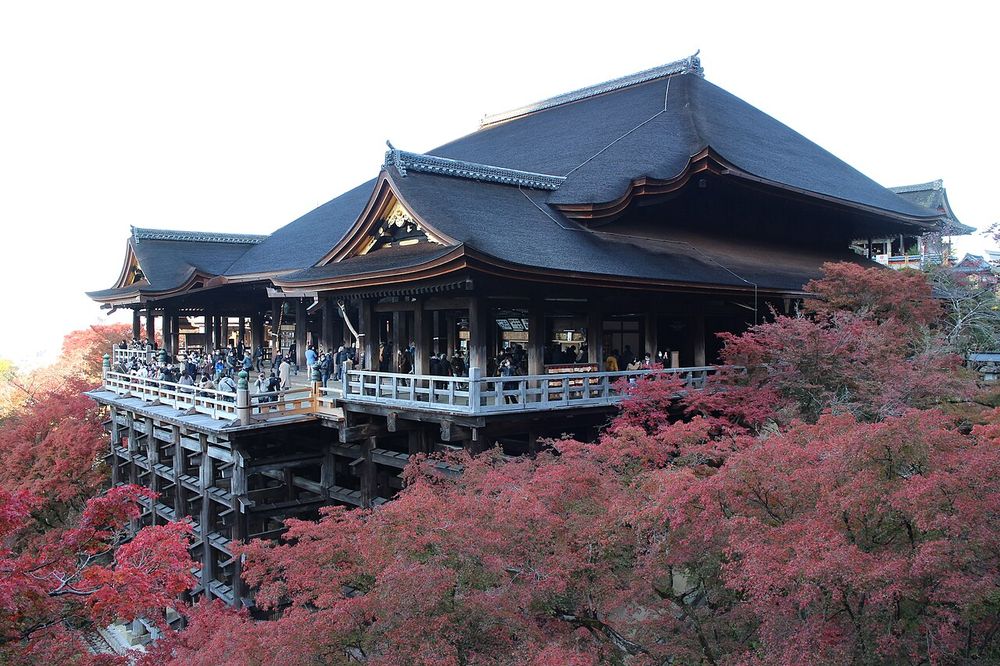
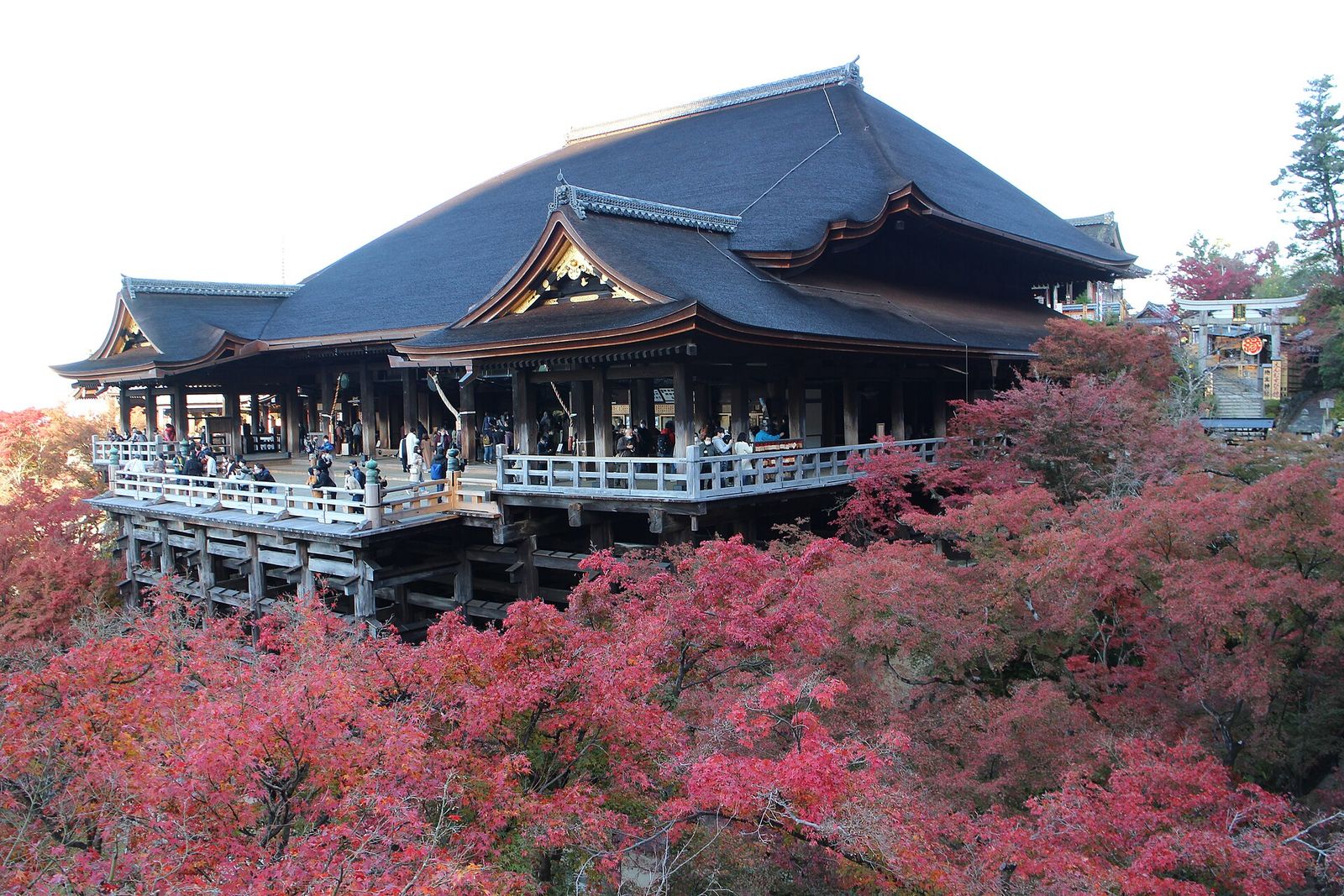
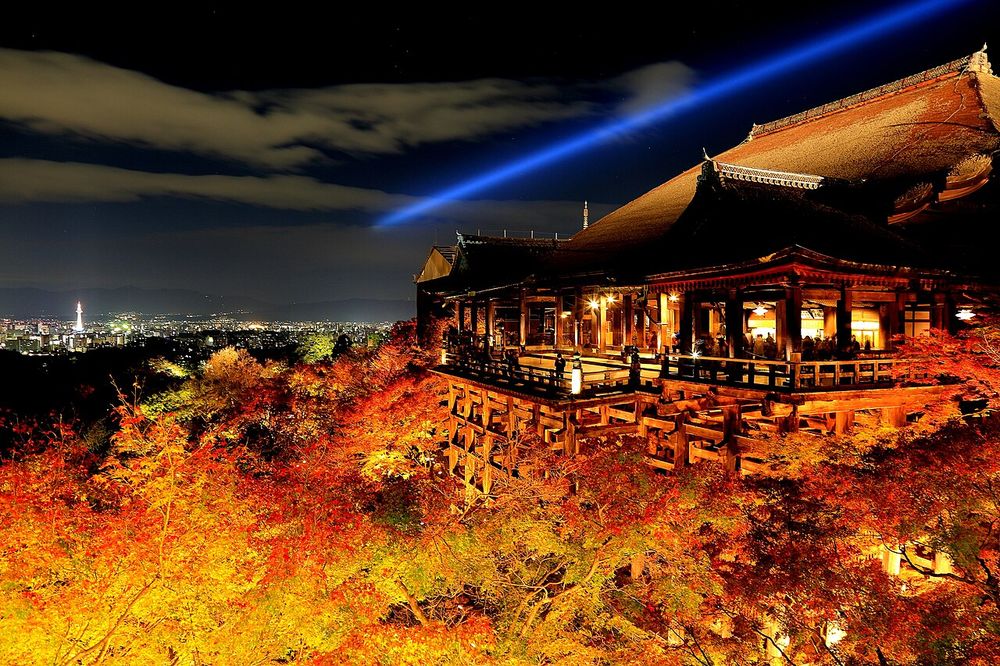
The stage is about 190 square metres, floored with more than four hundred boards of cypress. It stands thirteen metres above the slope on eighteen pillars of zelkova, a hardwood. Each pillar was cut from a tree some four hundred years old. Beams pass through slots in the pillars and are held by wedges.
Look at the floor. It slopes slightly towards the rail so that rain runs off. Look at the roof behind you: it is not tile but layers of cypress bark, as thick as a mattress. It was laid new between 2017 and 2020.
The main hall and stage above the maples, NovemberMartin Falbisoner, CC BY-SA 4.0
In the Edo period (1603–1868) people believed that if you jumped from here with your whole trust in Kannon, you would land unhurt and your wish would be granted. The temple's own diaries record 234 jumps between 1694 and 1864. The trees were thick below, and about 85 in 100 survived. Most jumpers were in their teens and twenties.
The prefecture of Kyoto forbade it in 1872 and put up a fence. The saying stayed in the language.
Every year on 12 December the head priest stands on this stage with a brush as long as his arm and writes a single character on a sheet of paper taller than he is. It is the "character of the year", chosen by public vote, and the whole country watches.
6. The shrine of love
The steps and torii of Jishu ShrineRomanKetchup, CC BY 2.0
Behind the hall, steps climb under a stone torii to Jishu Shrine, the shrine of the god who owned this ground before the temple came. He is Ōkuninushi, who arranges marriages.
In front of the shrine two stones are set in the paving, well apart. Walk from one to the other with your eyes shut and you will find love. If a friend guides you by voice, you will need a go-between.
The shrine closed for repairs in August 2022. Ask at the ticket gate whether it has reopened.
7. The view back
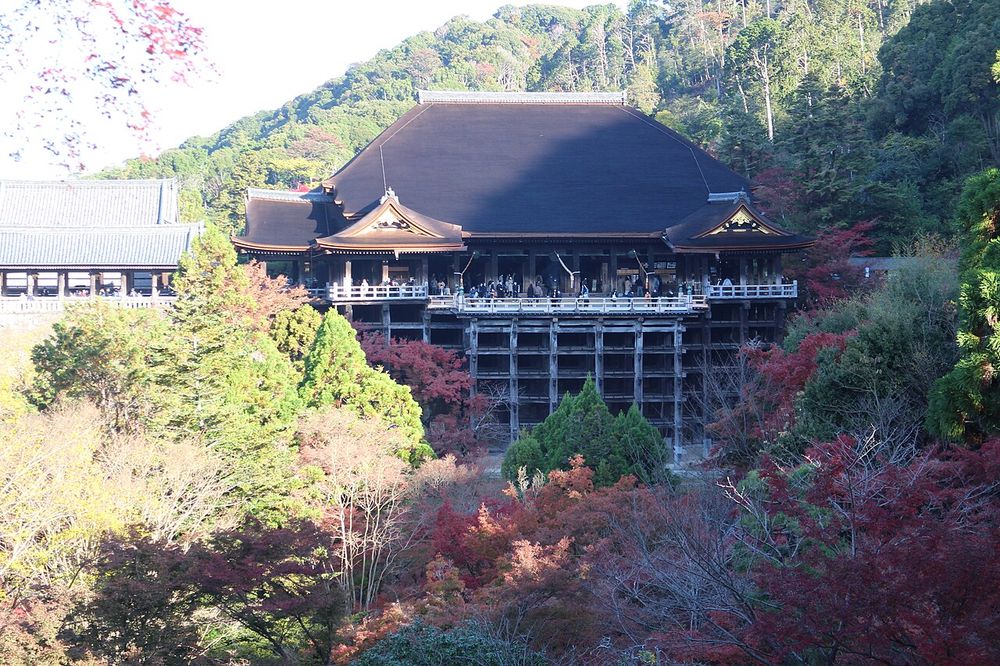
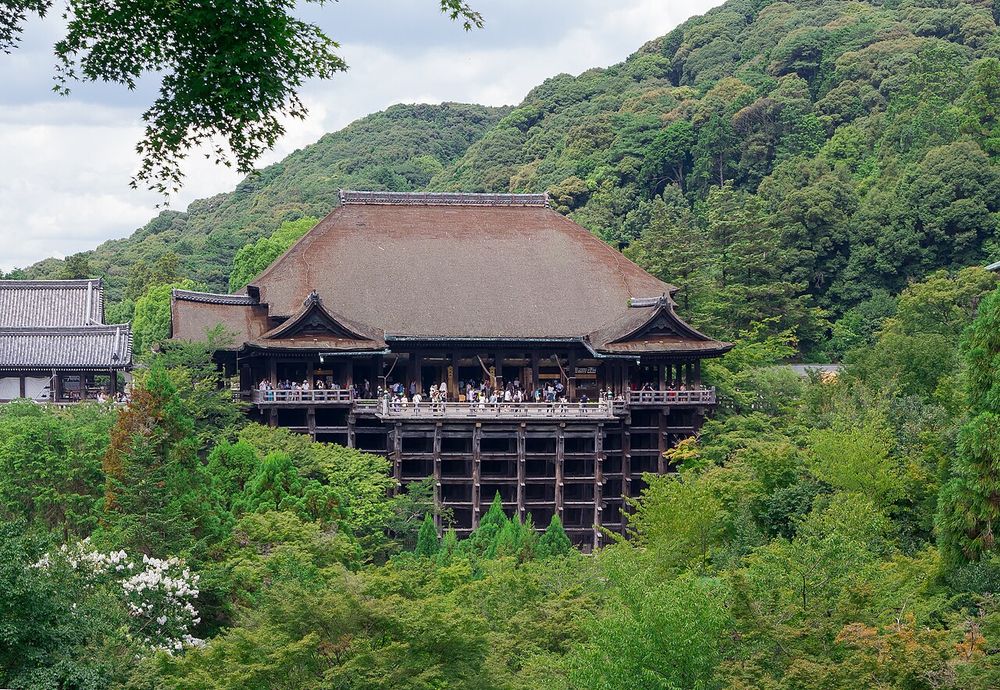
The hall, the stage and the hill behindSuicasmo, CC BY-SA 4.0
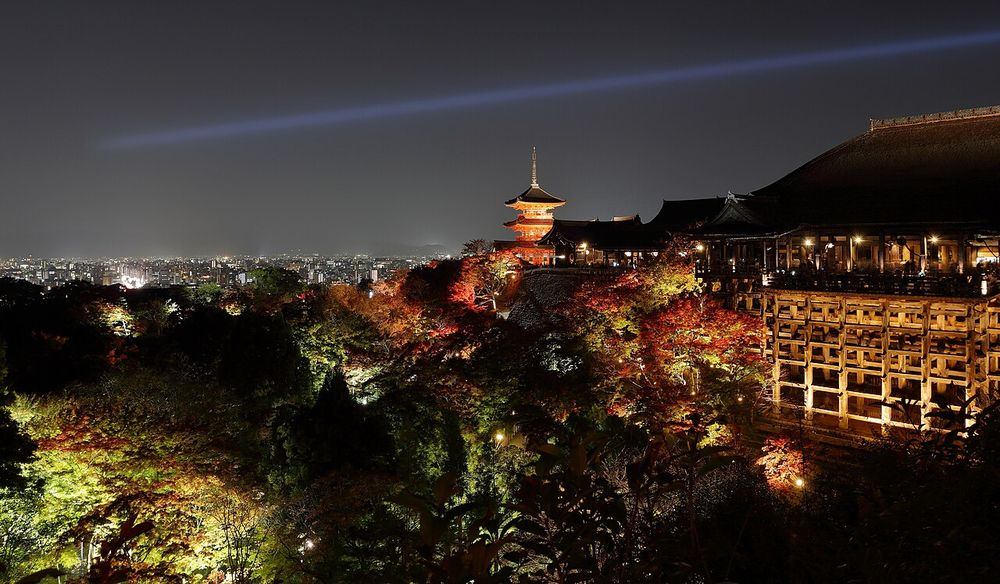
The path now bends round the head of the valley to a smaller hall with a smaller stage, the Okuno-in. Turn round. This is where every photograph of Kiyomizu is taken: the great roof, the stage, the forest of pillars, and the city beyond.
The Okuno-in stands directly over the spring, on the spot where the first hut is said to have been.
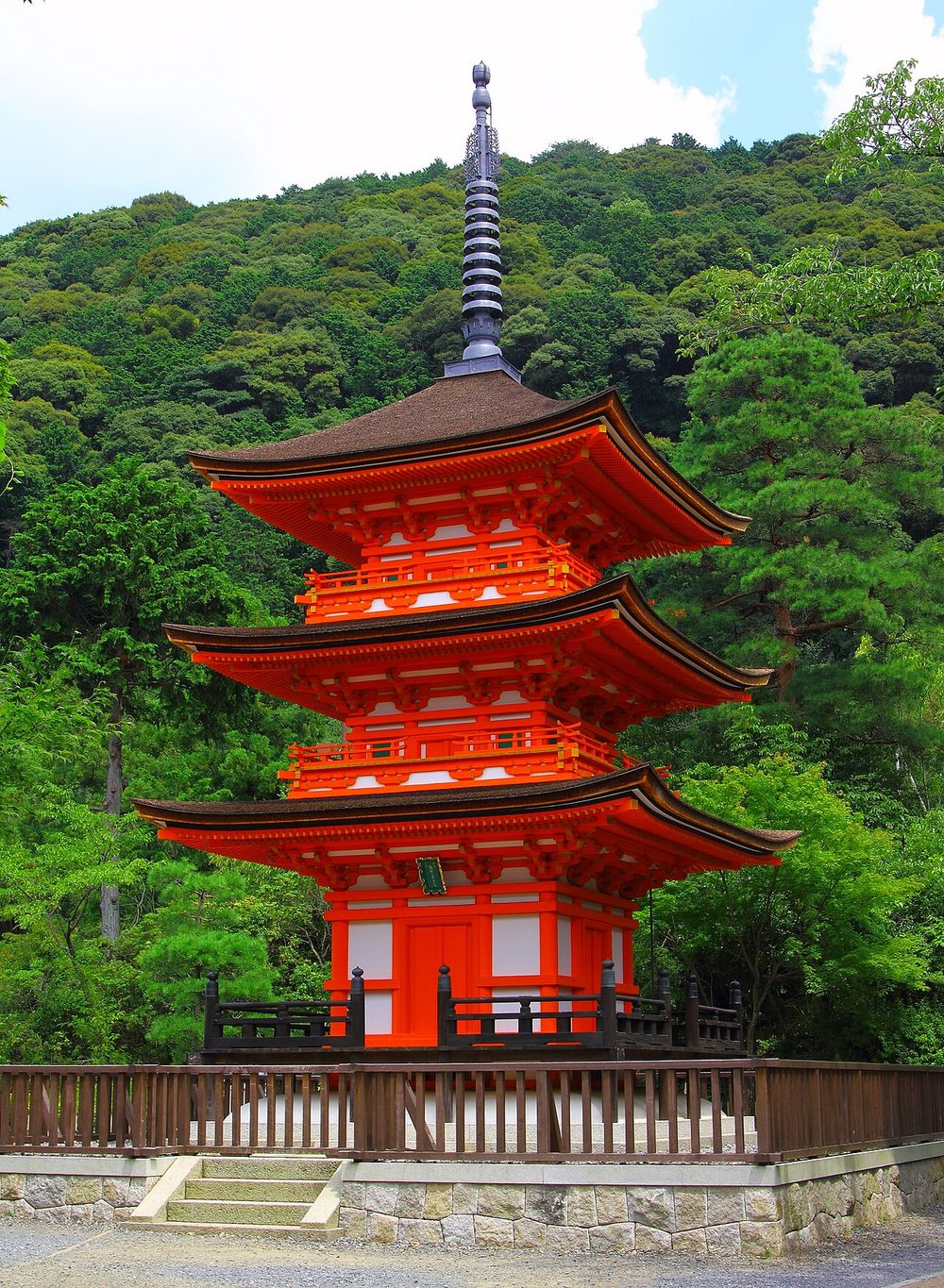
The Koyasu PagodaKakidai, CC BY-SA 4.0
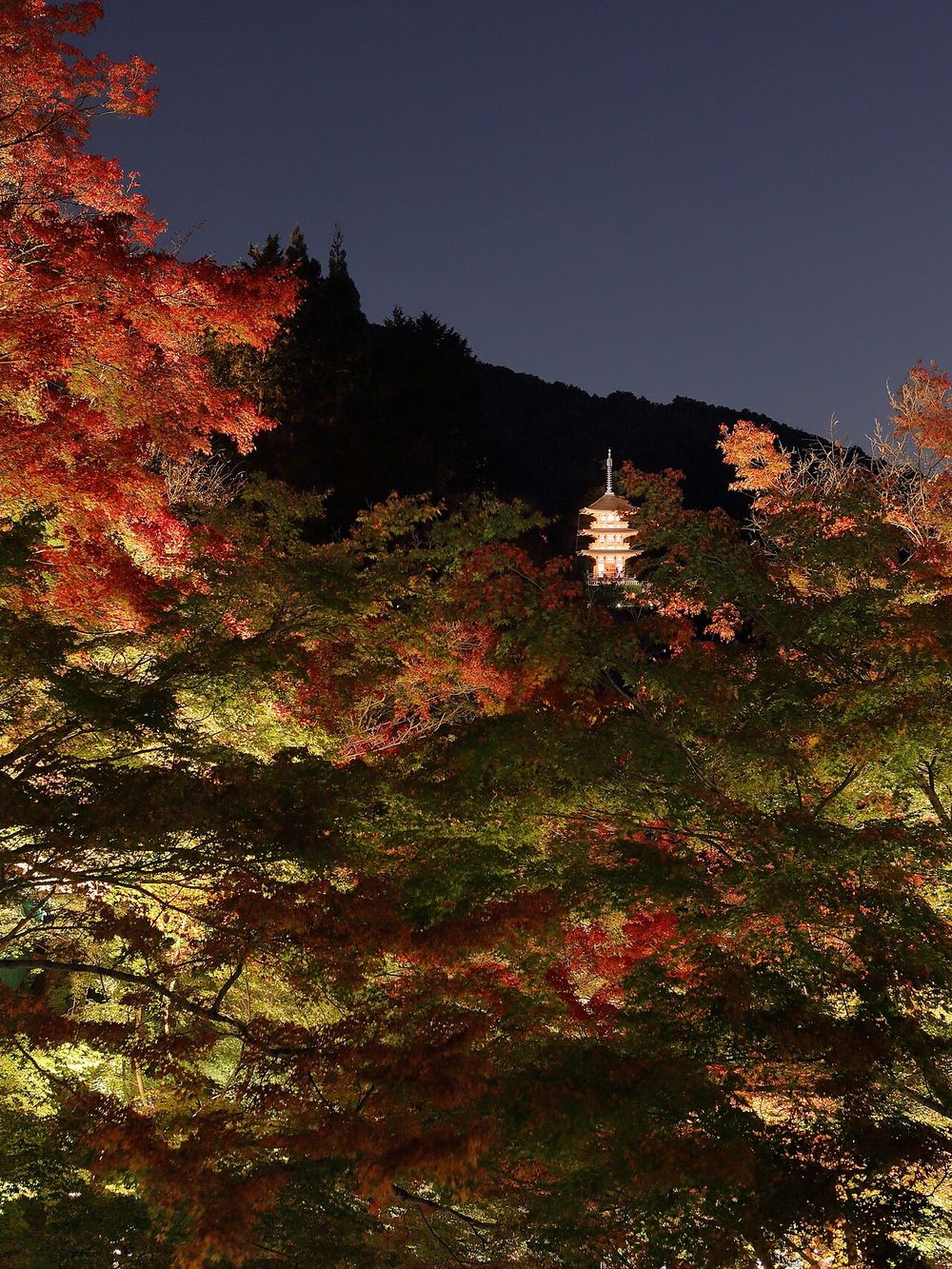
The path goes on to the small red pagoda you saw from the stage. Women came to it to pray for an easy birth. From its foot you see the whole temple at once.
清水へ祇園をよぎる桜月夜
こよひ逢ふ人みなうつくしき
To Kiyomizu, cutting through Gion,
a night of cherry blossom under the moon:
everyone I meet this evening
is beautiful.
Yosano Akiko, from Tangled Hair, 1901
8. The spring
The Otowa spring from aboveChristophe95, CC BY-SA 4.0
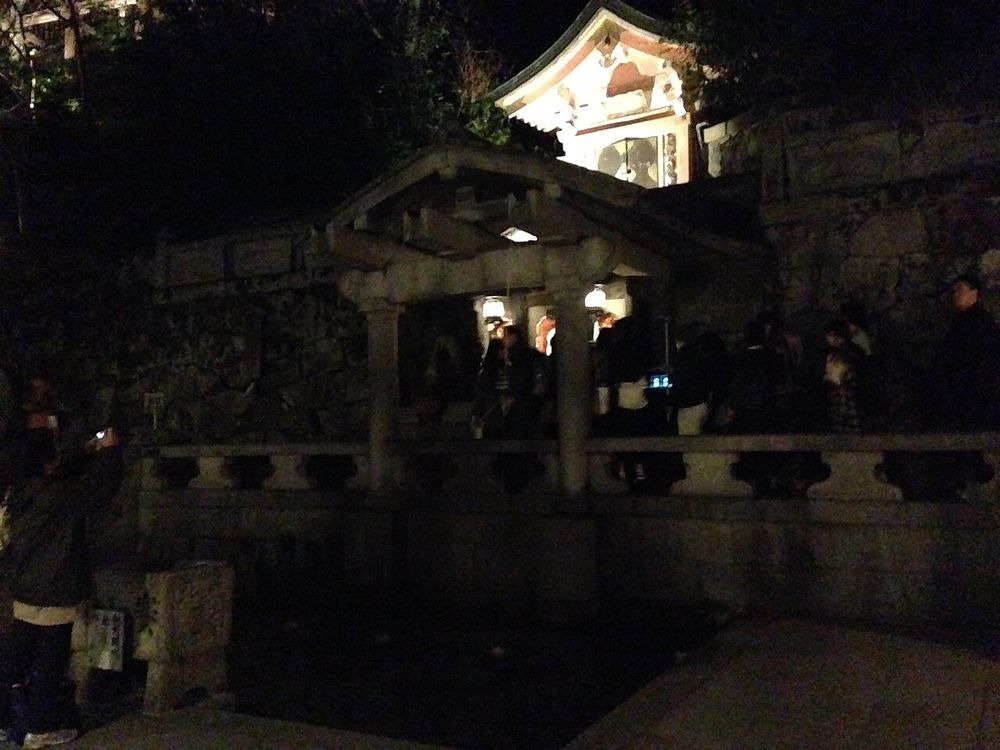
Steps lead down to the foot of the hill. Three thin streams fall from a stone channel into a basin. This is the Otowa spring, the pure water of the temple's name. It has not run dry in the temple's history.
You take a ladle on a long handle from a rack lit with ultraviolet light, reach out and catch one stream. Pour the water into your palm and drink from your hand. One stream, one sip: to drink from all three is thought greedy.
The pillars under the stageそらみみ, CC BY-SA 3.0
The way out passes under the stage. Stop and look up at the pillars. Near the path is a stone put up in 1994 to two chiefs of the Emishi, the people of the north. They surrendered in 802 to the general who had built this temple's first hall. He asked the court to spare them. The court cut off their heads.
Meanwhile in the world
Year
Here
Elsewhere
778
The temple dates its founding to this year
Tang China, fifteen years after the An Lushan rebellion; in the Pyrenees, Charlemagne's rearguard is destroyed at Roncevaux
794
The capital moves to the plain below the temple
In Tang China the poet Bai Juyi is twenty-two; Charlemagne settles his court at Aachen
798
A general builds the first large hall
Two years before Charlemagne is crowned emperor in Rome; in Chang'an, Han Yu is thirty
1469
Burned in the civil war that ruins Kyoto
Ming China (1368–1644), the Chenghua reign; in Florence, Lorenzo de' Medici takes power
1633
The present hall and stage are finished
The last years of the Ming (1368–1644); in Rome Galileo is tried; in Agra the Taj Mahal is one year into building
1872
Jumping from the stage is forbidden
The Tongzhi reign in China; Japan's first railway opens; Jules Verne is publishing Around the World in Eighty Days
1994
Listed as World Heritage with sixteen other sites of old Kyoto
The Channel Tunnel opens; Nelson Mandela becomes president of South Africa
2020
The new roof of cypress bark is uncovered
The year of the pandemic, when the stage stood almost empty
Then and now
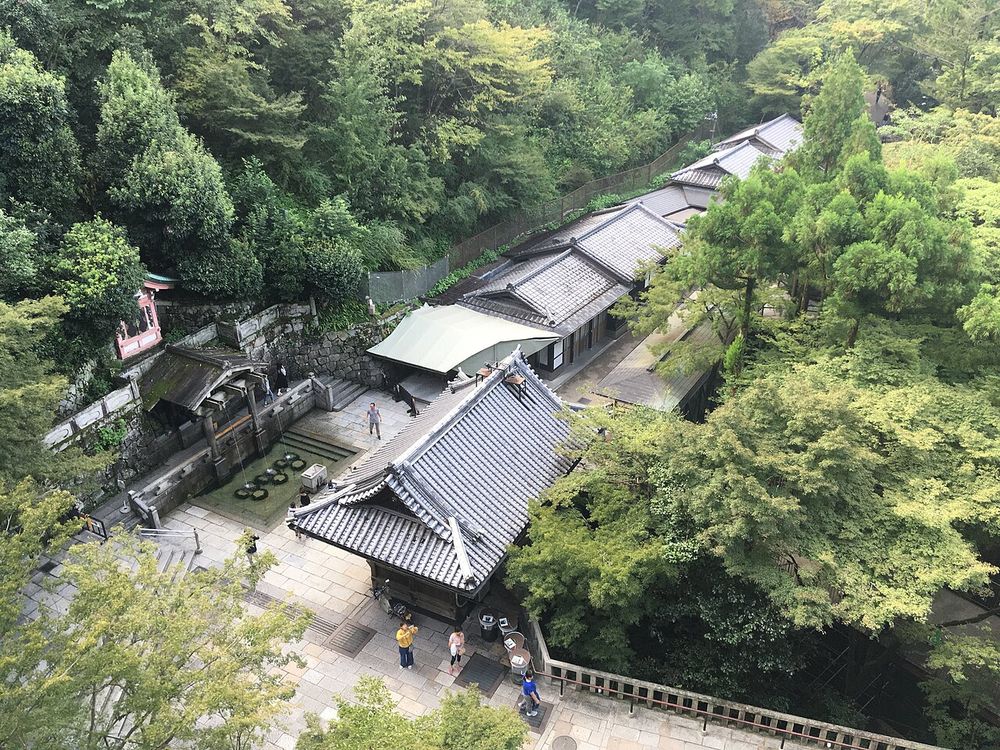
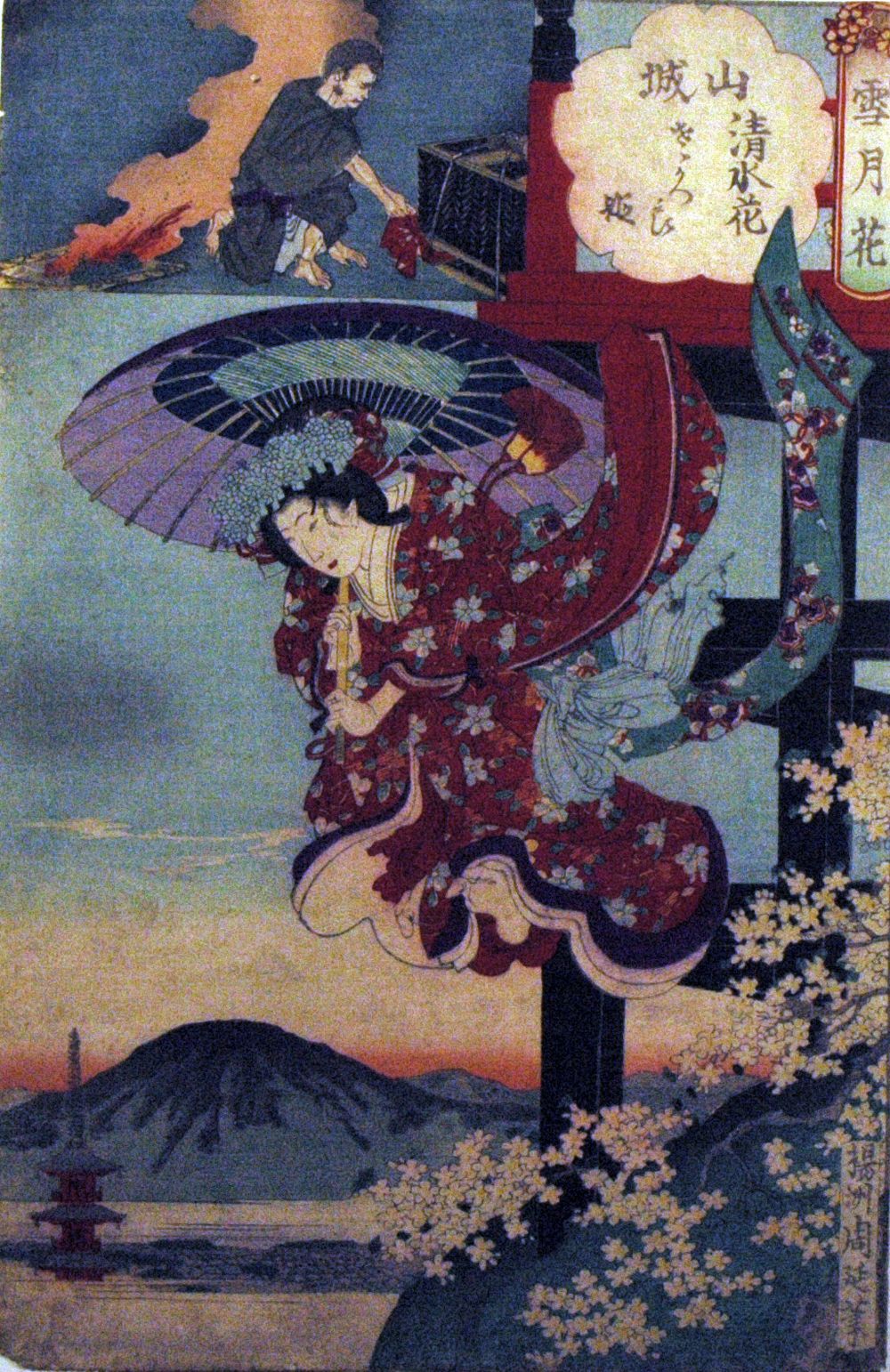
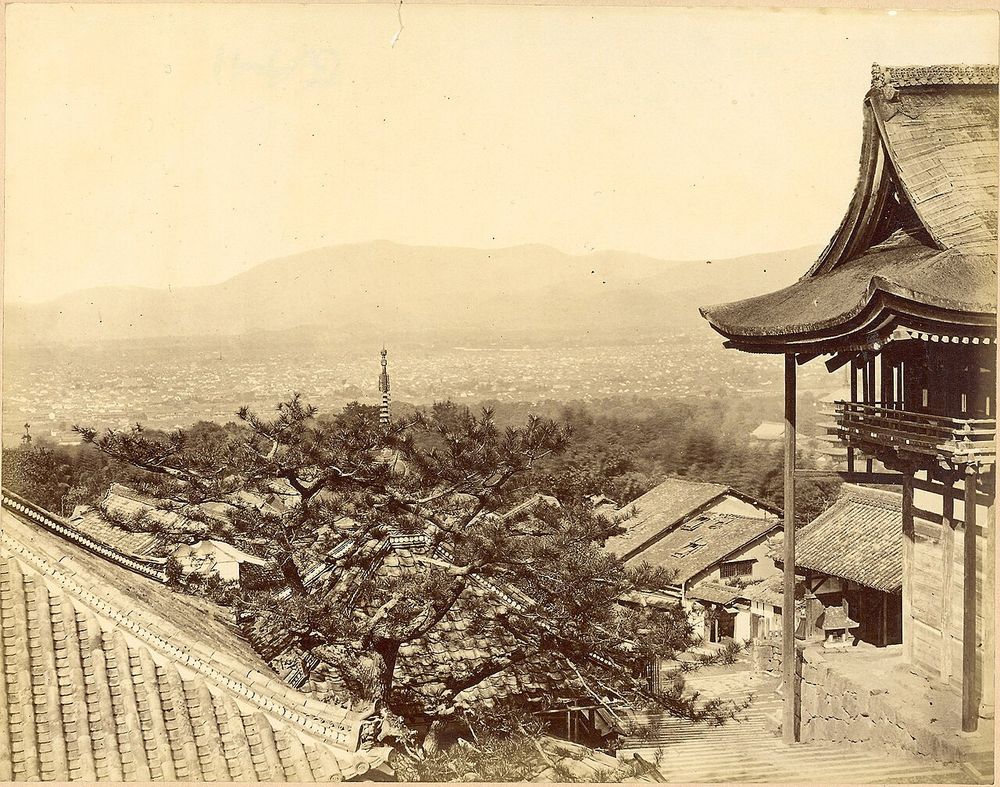
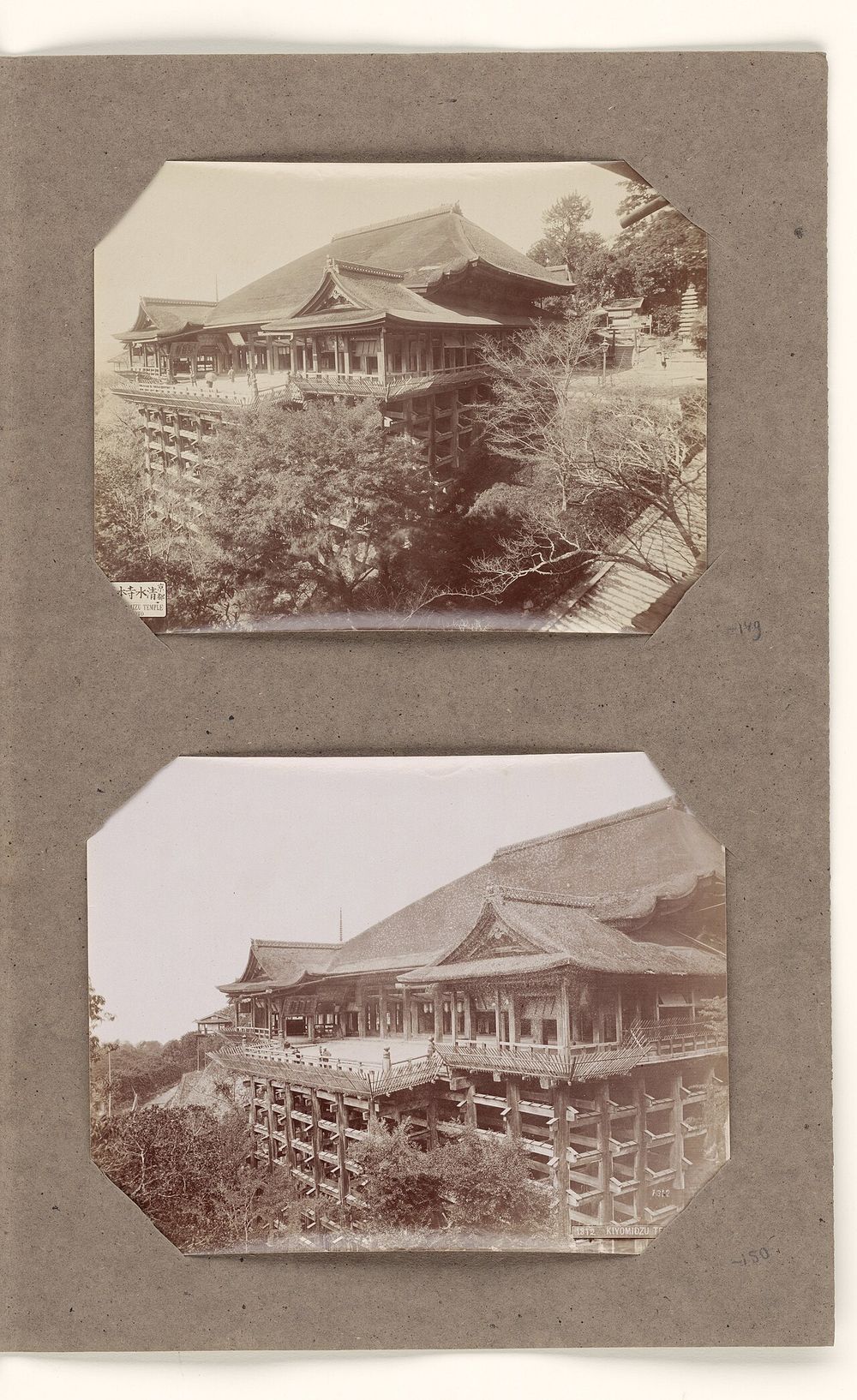
The main hall and stage above the maples, NovemberMartin Falbisoner, CC BY-SA 4.0, Wikimedia CommonsThe hall under its new roof, 2021Suicasmo, CC BY-SA 4.0, Wikimedia CommonsThe stage from the Okuno-inSuicasmo, CC BY-SA 4.0, Wikimedia CommonsThe hall, the stage and the hill behindSuicasmo, CC BY-SA 4.0, Wikimedia CommonsThe hall in summer greenKakidai, CC BY-SA 4.0, Wikimedia CommonsThe pagoda and the hall across the valleyMartin Falbisoner, CC BY-SA 4.0, Wikimedia CommonsThe temple from the Koyasu PagodaTakipoint123, CC BY-SA 4.0, Wikimedia CommonsThe hall and the city from the far side of the valleyLars1512, CC0, Wikimedia CommonsThe pillars under the stageそらみみ, CC BY-SA 3.0, Wikimedia CommonsThe frame of pillars and cross-beams, held without nailsTomomarusan, CC BY 2.5, Wikimedia CommonsInside the outer hallHyppolyte de Saint-Rambert, CC BY-SA 4.0, Wikimedia CommonsAn altar inside the templeZairon, CC BY-SA 4.0, Wikimedia CommonsThe Niō GateDXR, CC BY-SA 4.0, Wikimedia CommonsThe Niō Gate in cherry seasonAkonnchiroll, CC BY-SA 4.0, Wikimedia CommonsThe Niō Gate and the pagoda at duskTetsuhiro Terada from Japan, CC BY 2.0, Wikimedia CommonsThe West Gate from belowDon Ramey Logan, CC BY 4.0, Wikimedia CommonsThe West Gate with the pagoda behindDon Ramey Logan, CC BY-SA 4.0, Wikimedia CommonsThe three-storey pagodaDXR, CC BY-SA 4.0, Wikimedia CommonsThe Zuigu-dō, where the dark walk beginsAnother Believer, CC BY-SA 4.0, Wikimedia CommonsThe steps and torii of Jishu ShrineRomanKetchup, CC BY 2.0, Wikimedia CommonsThe Koyasu PagodaKakidai, CC BY-SA 4.0, Wikimedia CommonsThe Otowa spring from aboveChristophe95, CC BY-SA 4.0, Wikimedia CommonsThe spring at nightそらみみ, CC BY-SA 3.0, Wikimedia CommonsThe temple lit for the autumn night openingMartin Falbisoner, CC BY-SA 4.0, Wikimedia CommonsMaples under the lightsMartin Falbisoner, CC BY-SA 4.0, Wikimedia CommonsThe pagoda at night, with the beam of light that stands for Kannon's mercyMartin Falbisoner, CC BY-SA 4.0, Wikimedia CommonsThe stage on an autumn nightHaibo Lu, CC BY-SA 4.0, Wikimedia CommonsThe hall in snow애콜라이트, CC BY-SA 3.0, Wikimedia CommonsCherry petals on the pondKimonBerlin, CC BY-SA 2.0, Wikimedia CommonsThe steps of SannenzakaAporon999, CC BY-SA 3.0, Wikimedia CommonsKiyomizu in cherry season, woodblock print by Utagawa Hiroshige, about 1834Utagawa Hiroshige, CC0, Wikimedia CommonsThe temple in a print by Hiroshige II, 1863Utagawa Hiroshige II, Public domain, Wikimedia CommonsPrincess Sakura at Kiyomizu, a character of the kabuki stage, in a nineteenth-century printThe San Diego Museum of Art Collection, Public domain, Wikimedia CommonsKyoto seen from the temple in the 1870sLyman, Benjamin Smith, 1835-1920, Photographer. Rosin, Henry D., Dr., Collector., Public domain, Wikimedia CommonsTwo photographs of the hall, about 1890Rijksmuseum, CC0, Wikimedia Commons
Video
Films from official channels, played from YouTube. Nothing is loaded until you press play.
The historic monuments of ancient KyotoUNESCO · made with NHK; 3 min · checked 2026-11-12
Local legends
These are stories people tell about this place. They are legends, not history, and each one says where it comes from.
LegendThe golden stream
A monk of Nara named Enchin dreamed that he should go north and look for a clear spring. He followed a stream that shone like gold into these hills and found an old hermit beside a waterfall. "I have been waiting two hundred years for you," the hermit said, gave him a log of sacred wood, and was gone. Enchin carved the log into a figure of Kannon and stayed.
Source: Kiyomizu-dera Engi (the temple's founding chronicle)
LegendThe general and the deer
Two years later a warrior, Sakanoue no Tamuramaro, came into the hills to hunt a deer, whose blood was thought good for his wife in childbirth. He met Enchin at the spring. The monk told him it was wrong to kill in a holy place. The warrior went home ashamed, told his wife, and the two of them gave their own house to be the temple's hall.
The iron staff and clogs at the door of the hall are said to have belonged to Benkei, the giant warrior monk who fought the young hero Yoshitsune and became his follower. In one telling their duel took place on this very stage.
Anyone who trips and falls on the stone steps of Sannenzaka will die within three years. The shops on the slope sell small gourds, which catch the soul if you fall and keep it safe.
Source: Kyoto townspeople's saying, recorded since the Edo period
LegendThe blue dragon
A blue dragon, a form taken by Kannon, flies to the Otowa spring every night to drink.
Source: Temple tradition; a dragon procession has been held since 2000
Later, people who live here will be able to add the stories they grew up with, and say which of these they have heard.
Not certain, and where accounts conflict
Eighteen pillars or 139?
Guidebooks often say the stage stands on 139 pillars. The temple speaks of eighteen great pillars of zelkova under the stage. The larger figure seems to count every post beneath the hall and its wings. We give the temple's number.
Who founded it, and when?
The story of the monk and the general comes from the temple's own chronicle, written down centuries later. What documents of the time show is that the court recognised the temple in 805 and 810, and that the general was real: he led the armies of the north.
How many really jumped?
The figure of 234 comes from diaries kept at the temple from 1694 to 1864, and some years are missing. The true number is higher. Nothing is recorded for the centuries before.
Is Jishu Shrine open again?
It closed in August 2022 for repairs announced as lasting about three years. In November 2026 we could not confirm from the shrine itself that it had reopened.
Visiting
Tickets and hours
The ticket is 500 yen for adults and 200 yen for children of school age up to fifteen.
The temple opens at 6:00 every day of the year. It closes at about 18:00, and at 18:30 in July and August. The closing time shifts with the season, so check the temple's site.
It stays open until 21:30, with last entry at 21:00, on three periods a year. In 2026 these were 27 March to 5 April, 14 to 16 August, and 21 to 30 November.
The dark walk under the Zuigu-dō costs 100 yen.
Last checked 2026-11-12. The temple's own site (kiyomizudera.or.jp/en), access and events pages as shown in November 2026; fee as printed on the temple's notices.
Booking from abroad
Official page in English No booking is needed and none is offered. The temple's English pages give the way there and the dates of the night openings: kiyomizudera.or.jp/en.
Ticket window on site Buy the ticket at the booth in front of the main hall on the day. Bring yen in cash.
Note The temple warns that some map apps show paths that do not reach it. There are two ways in: up Kiyomizu-zaka to the Niō Gate, or up Chawan-zaka.
Checked 2026-11-12
Where to start
From Kyoto Station take city bus 206 or 100 to Gojō-zaka, then walk ten minutes uphill. From Kiyomizu-Gojō station on the Keihan line it is twenty-five minutes on foot.
Come at 6:00 if you can. For the first hour the stage is nearly empty and the shops on the lanes are shut. By ten the lanes are full.
The route is one way: gates, main hall, stage, Okuno-in, pagoda, spring, out under the stage. Allow an hour and a half.
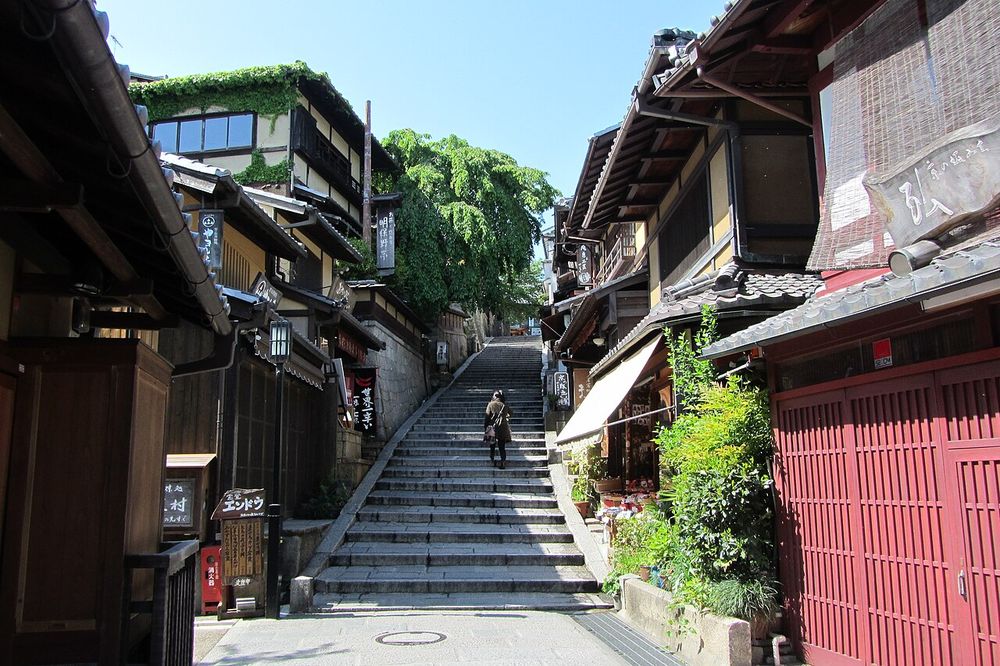
Go down by Sannenzaka and Ninenzaka, the stepped lanes of old wooden houses, towards Gion.
Before you go
The temple has no car park, and the lanes are closed to cars for much of the day.
There are many steps. The temple publishes a map of a step-free route for wheelchairs.
Cherry blossom is at its best around the start of April and the maples in the second half of November. Those are also the most crowded weeks of the year.
The hidden Kannon is next due to be shown in 2033.
Customs and manners
At the main hall, put a coin in the box, put your hands together and bow. Do not clap: this is a temple.
At the spring, do not put the ladle to your lips. Pour the water into your hand. Put the ladle back in the rack.
Take off your hat in the hall, and do not photograph the altar.
On the lanes, do not stop people in kimono to photograph them without asking. Most are visitors like you.
Opening hours are given in the local time of the place. Prices are in the local currency. The figure after ≈ is approximate, at exchange rates checked on 9 November 2026, in .
Look for these
At the Niō Gate, which guardian has his mouth open?
At the stable below the gate, find the iron rings for tying horses. Do they all hang the same way?
Try to lift the iron staff at the door of the hall. Then try the clogs.
On the stage, put a coin on the floor. Which way does it want to roll?
From the Okuno-in, count the pillars you can see under the stage.
Find the small red pagoda across the valley from the stage. Then find the stage from the pagoda.
At the spring, how many streams are there? Is one of them faster?
Look at the edge of the roof. What is it made of?
I am here
Stand at the site, sign in, press the button, and collect its stamp. Your browser will ask to use your location. It is sent to us once to confirm that you are at the site; we keep how far you were from it, not the spot where you stood.
Your stamps are saved to your account, so they follow you to any device. Checking from a browser cannot rule out every false location; stricter checks arrive with the app.
Messages
Share your photos
Photos here show the place, not people. Each one is credited to the visitor who took it and appears after our team has looked at it. A photo with you in it belongs under “I am here”.