LegendHow the lakes were made
A mountain god polished a mirror out of wind and cloud for a goddess. She dropped it, and it broke into 108 pieces, which became the lakes of the valley.
Source: Told by guides; we found no written source
Aba, Sichuan, China
九寨沟 · Jiǔzhàigōu
More than a hundred lakes step down a mountain valley like stairs, joined by waterfalls, in water so clear you can see the trees lying on the bottom. World Heritage since 1992.
Photo: Chensiyuan, CC BY-SA 4.0, Wikimedia Commons
The name means "valley of nine villages", after nine Tibetan villages inside it. The lakes here are called haizi, "sons of the sea". More than a hundred of them step down the valley like a staircase, joined by waterfalls and streams.
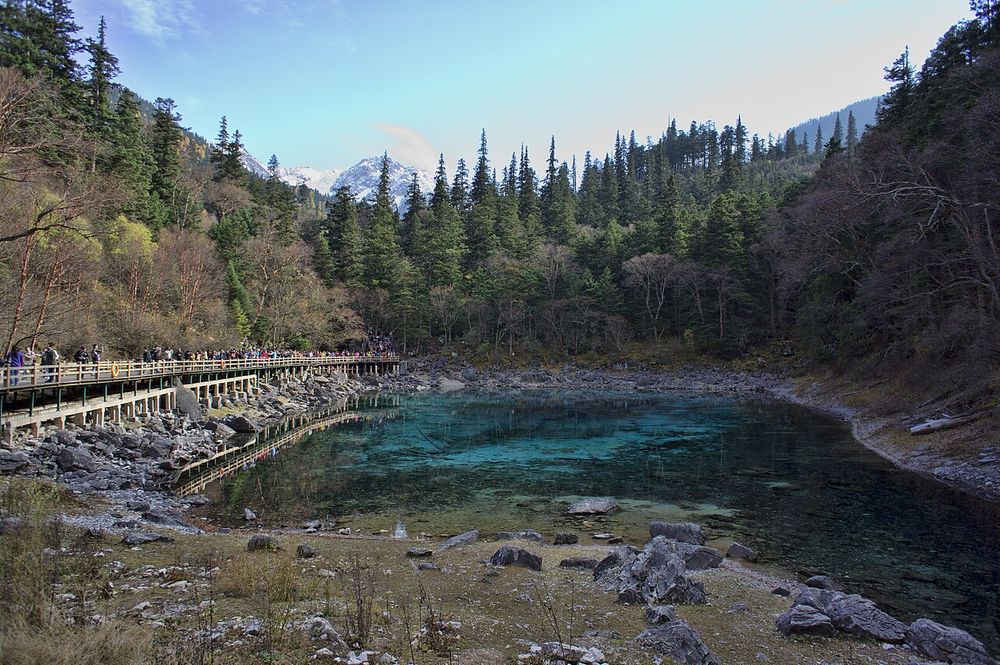
In Five Flower Lake in front of you, one sheet of water shows blue, green and yellow at once, and the fallen trunks on the bottom are perfectly clear. A Chinese saying goes: after Huangshan you need see no other mountain, after Jiuzhaigou no other water.
The park is one valley shaped like a Y, about 30 kilometres from the gate to the far ends, and one ticket covers all of it. What matters is knowing that there are three branches, each with its own lakes, and that you need the park bus to reach them. The bus is a separate ticket, in practice bought together with the entry ticket.
| Part | Ticket |
|---|---|
| Zechawa branch: Long Lake and the Five-Colour Pond | Included |
| Rize branch: Five Flower Lake, Pearl Shoal and its waterfall, Mirror Lake | Included |
| Nuorilang Falls, where the branches meet | Included |
| Shuzheng branch: the Shuzheng Lakes, Sparkling Lake, Shuzheng village | Included |
| The park buses between the stops | Separate bus ticket, 90 yuan in the high season |
| Huanglong, the lime pools to the south | A different park with its own ticket and booking |
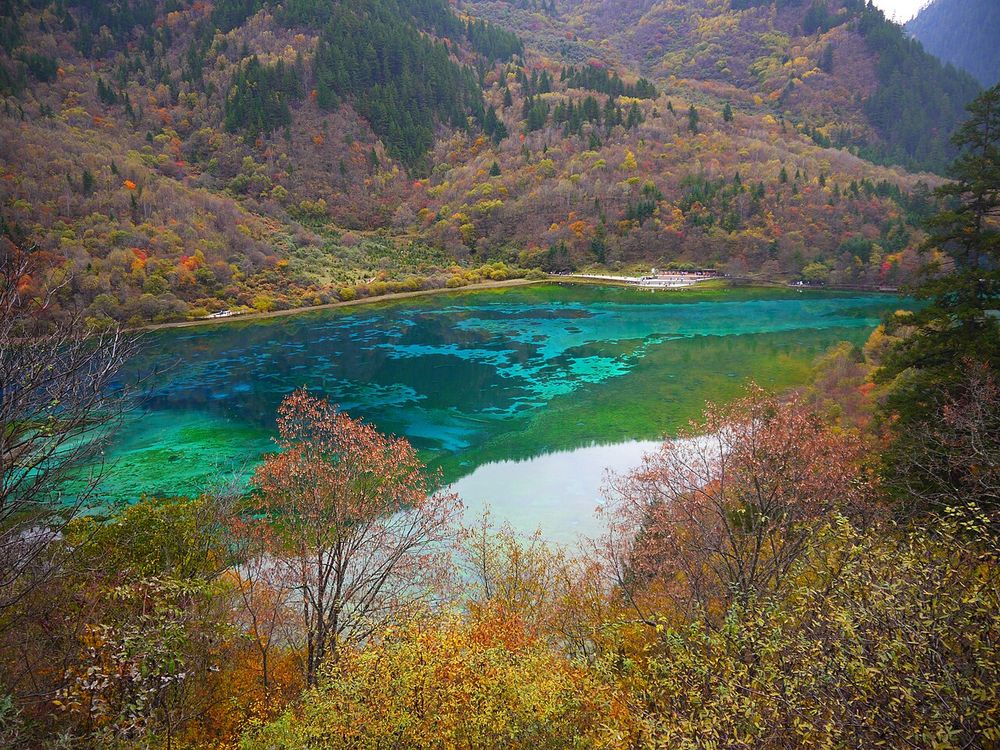
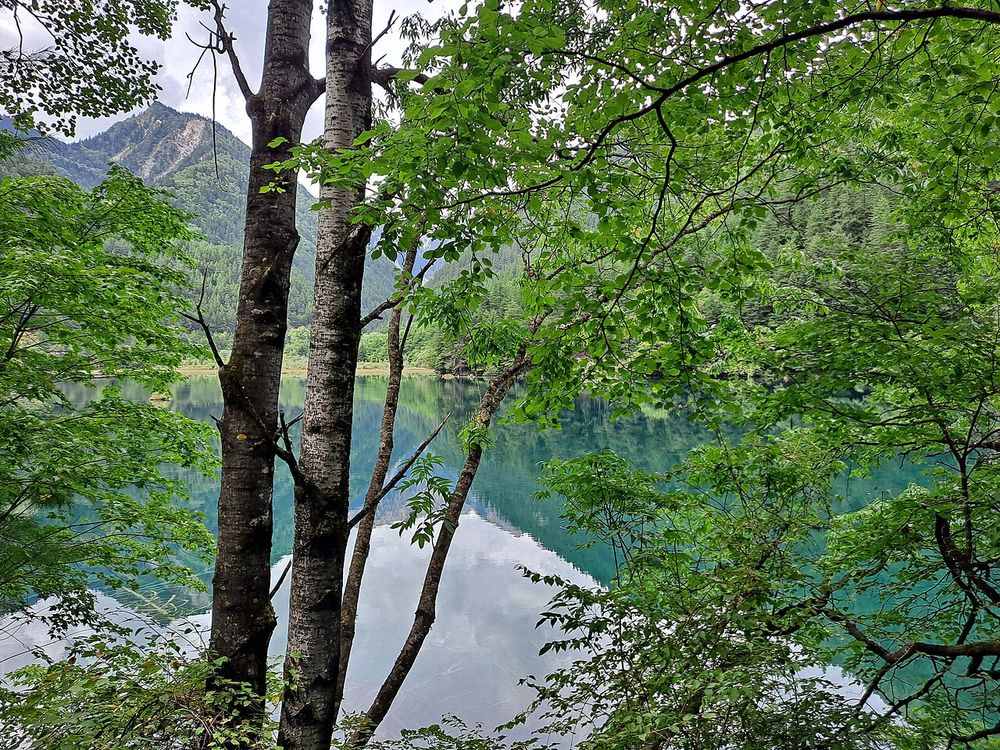
Why is the water so clear? It comes from snowfields and from underground, and runs through limestone. Almost nothing floats in it, so light reaches a long way down.
Why several colours? Where the lake is shallow you are seeing the pale yellow lime crust and the water plants on the bottom. Where it is deep you see blue. The trees and hills on the shore are reflected in as well. One lake becomes a palette.
Why do the logs on the bottom not rot? A tree that falls in is slowly coated with a crust of lime from the water. Many of the trunks you can see are white on the surface.
Autumn is the best season. The coloured forest on the slopes is reflected in the water and the lake has more colours than at any other time.
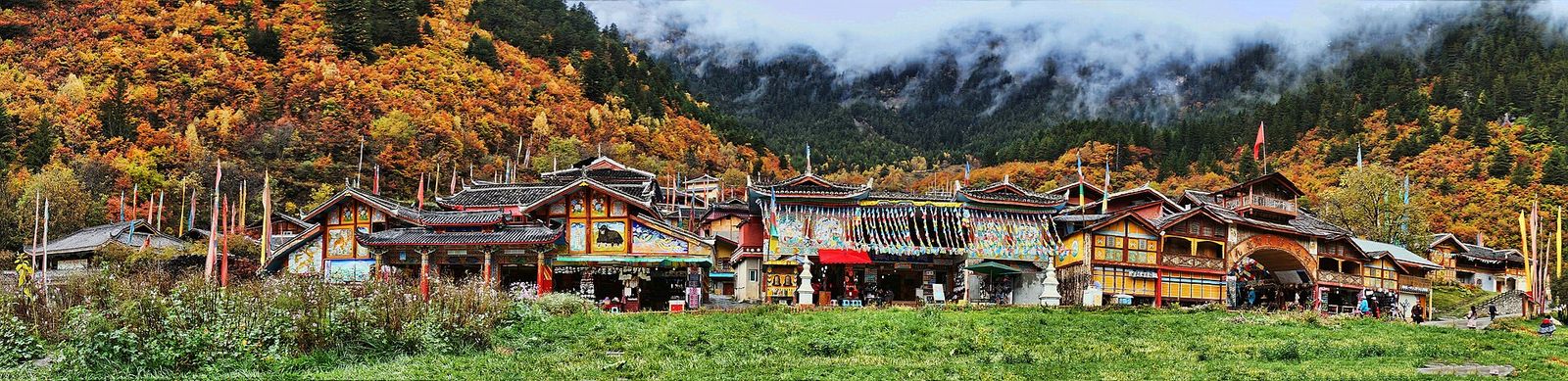
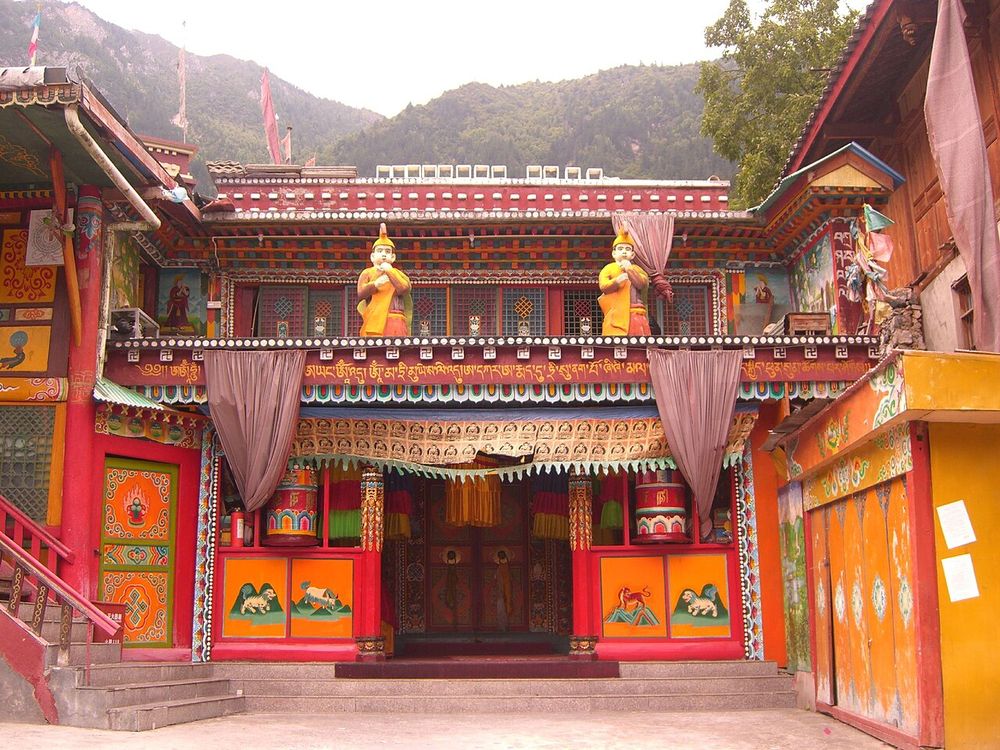
The nine villages are Tibetan, and people have farmed and herded here for centuries. You will see prayer flags on poles and strung across streams, white stupas, and small mills where the water turns a prayer wheel all day. They are acts of devotion, not decoration.
Many families in this region follow Bön, Tibet's older religion, alongside Buddhism. Bön pilgrims walk round holy places anticlockwise, the opposite of Buddhists. If you are not sure which way to go round a stupa or a temple, follow the people in front of you.
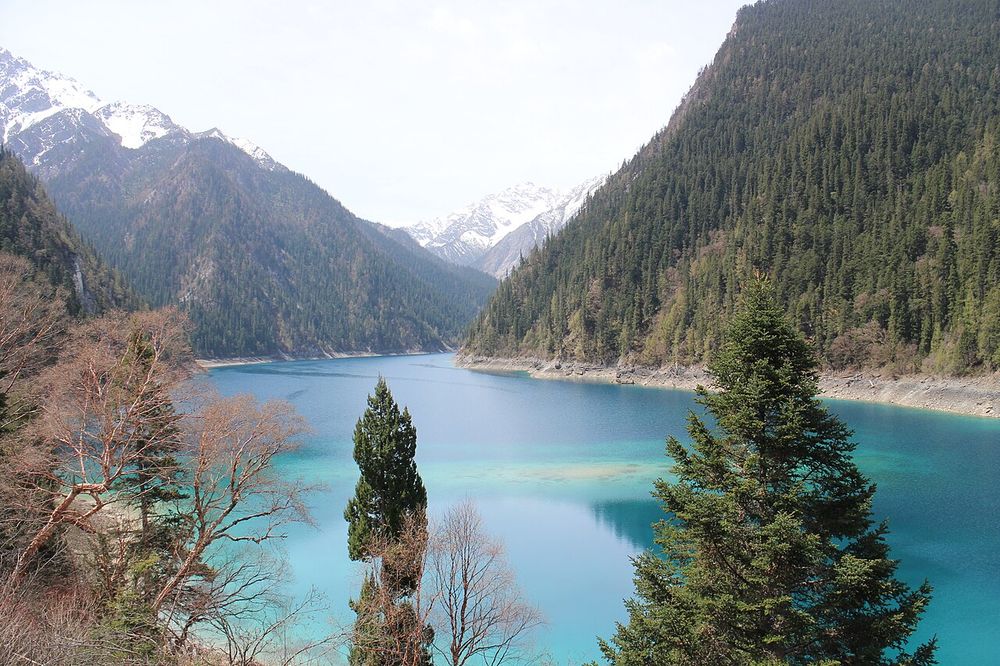
Long Lake lies at the end of the Zechawa branch at about 3,060 metres. At about 1.5 square kilometres it is the largest and highest lake in the park, with snow peaks and forest all round. It often freezes in winter.
Just below it the Five-Colour Pond is tiny and a startling blue-green. This is the highest point of the visit, so walk slowly.
Sun Geng, a researcher at the Chengdu Institute of Biology of the Chinese Academy of Sciences, gives three causes. Physics: there is so little floating in the water that red, orange and yellow light is absorbed and the short blue wavelengths are scattered back.
Chemistry: calcium, magnesium and bicarbonate in the water form particles of lime between 0.1 and 0.45 thousandths of a millimetre across, which are very good at scattering blue and green light. Biology: algae and water plants reflect the light once more and add layers of colour. Depth, season, weather and where you stand do the rest.
It is not dyed. In July 2026 a video claiming the lakes were coloured with dye went round online. The park administration answered that it had not been filmed in Jiuzhaigou.
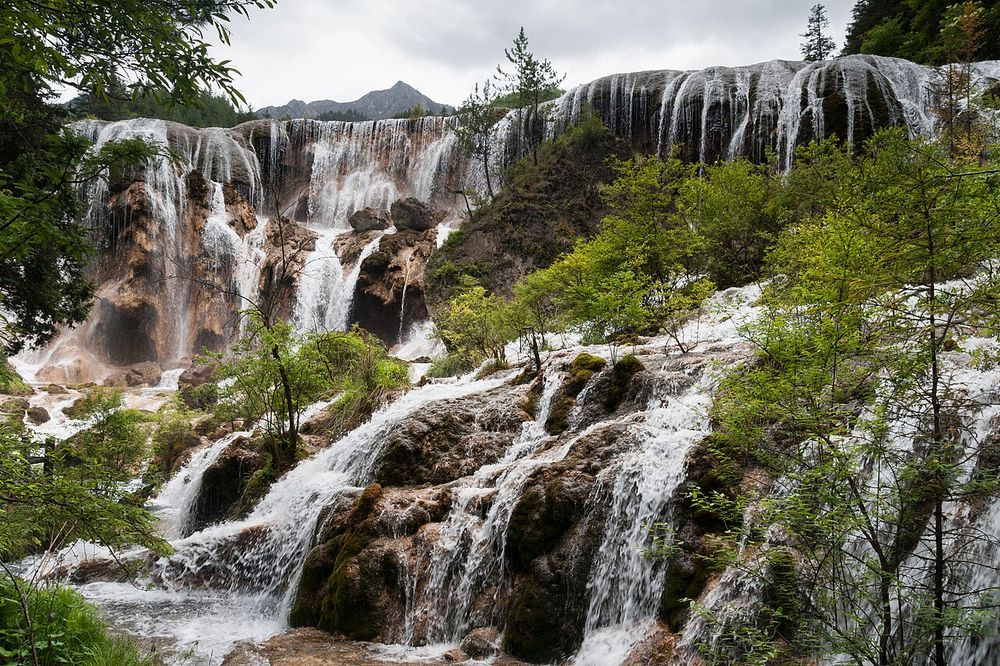
At Pearl Shoal the water runs across a wide sloping bank of lime and breaks into drops like pearls, then falls over the edge as a waterfall. The boardwalk is wet. Hold on to small children.
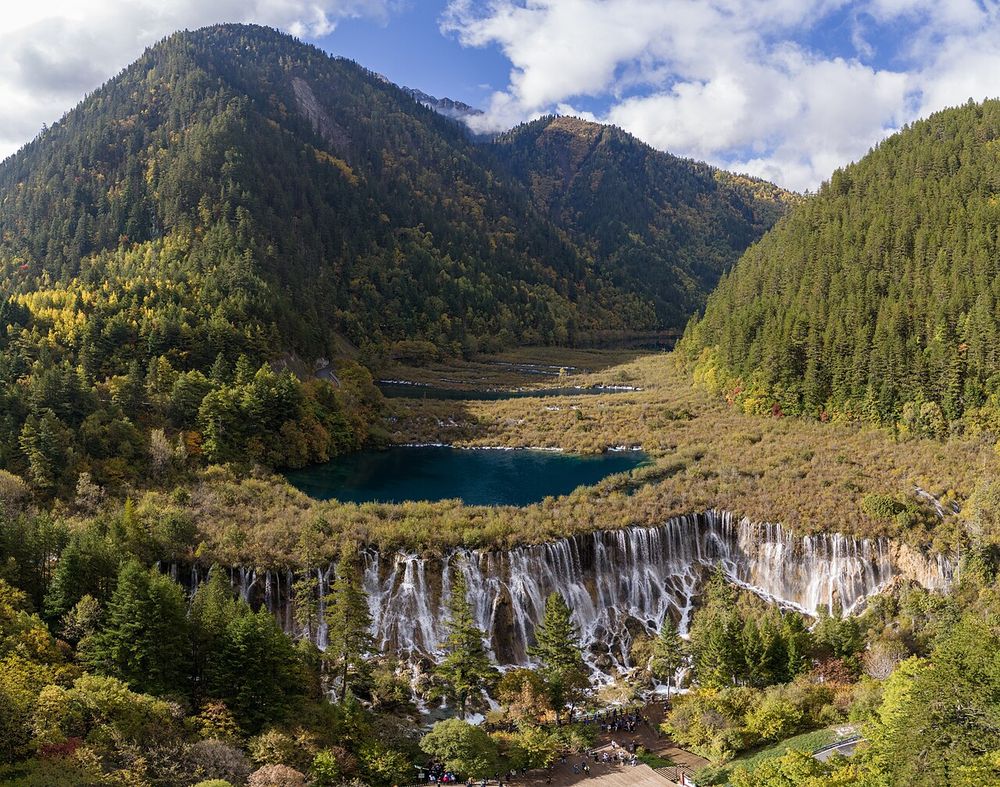
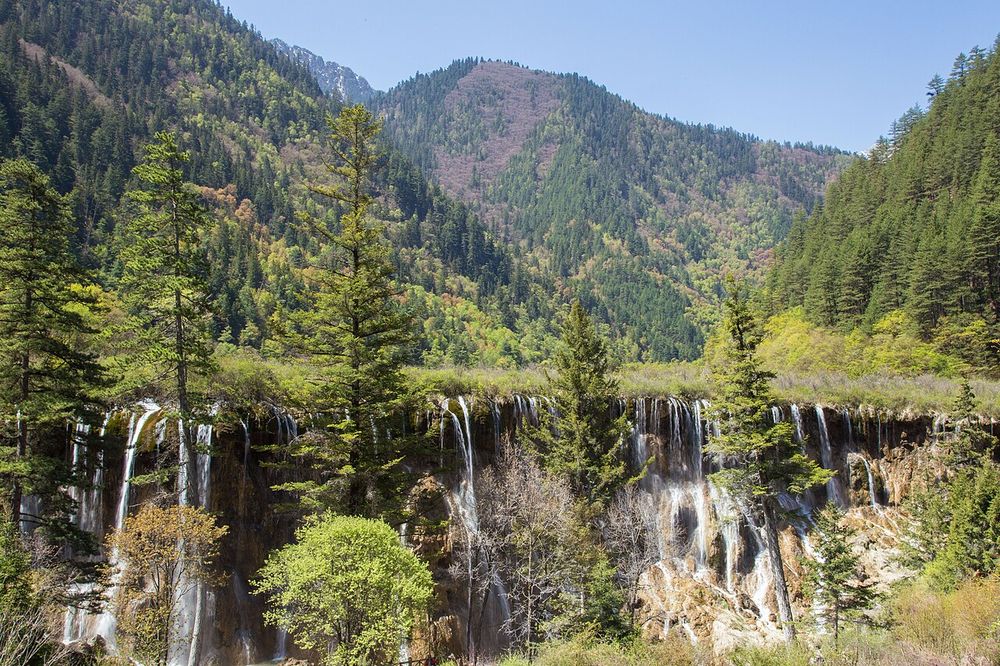
Nuorilang stands where the valley forks, and is one of the widest waterfalls in the park. The name means "grand" in Tibetan. Its lip is not ordinary rock. It is lime laid down by the water, layer on layer, over more than ten thousand years.
In the earthquake of 8 August 2017 about 20 metres of the lip collapsed, and the great curtain of water shrank to a trickle. A team from Southwest University of Science and Technology repaired it with the same lime and the same microbes, so that the fall could grow its own crust back. By June 2018 it looked as it had before.
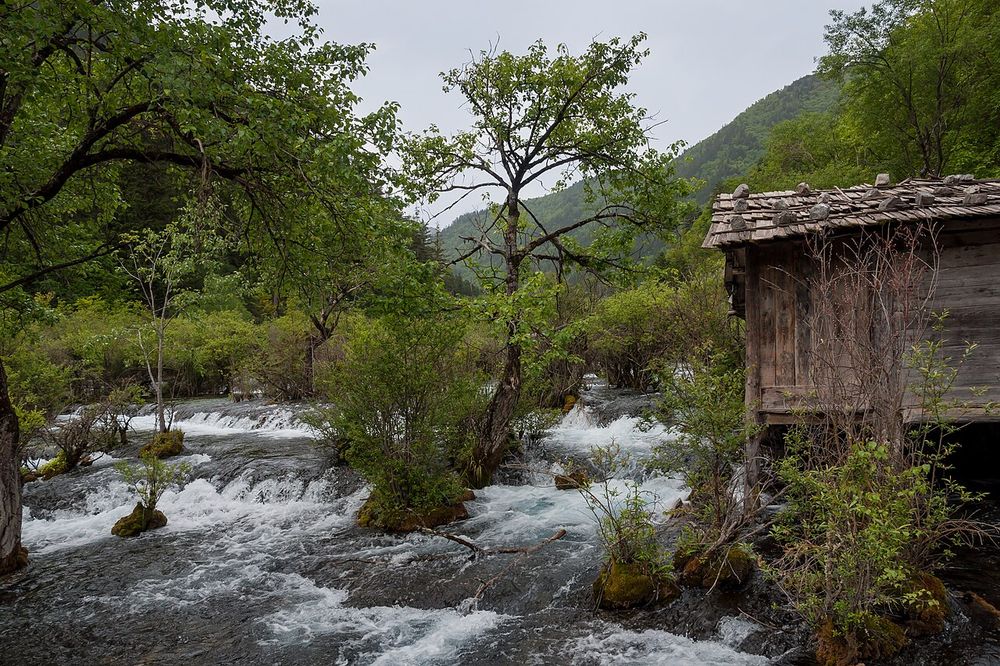
Lakes large and small step down the valley here. Between each level is a dam built of lime, and the water spills over the top as a low waterfall.
For children: picture a row of water jars set on steps. The more water flows, the higher the rims grow, because the lime in the water settles on them little by little.
Shuzheng village is beside the lakes, with Tibetan houses, prayer flags and a water mill.
Sparkling Lake lies in the Shuzheng valley between Double Dragon Lake and Sleeping Dragon Lake. When the sun is low the surface flashes like sparks.
In 2017 its dam burst, leaving a gap 40 metres long, 12 wide and 15 deep, and the lake almost emptied. Chengdu University of Technology led the repair and it reopened before October 2020. Below the mended dam there is now a waterfall that was not there before.
A question to talk over: when nature damages a natural heritage site, should people mend it or leave it alone? The answer here was to let nature do most of the work and to help only where needed.
The valley was heavily logged until about 1979. In 1978 the State Council approved a nature reserve here, and in 1984 it opened to visitors. About 5,000 people came that year.
Today no one may stay overnight inside the valley. You move by park bus and on foot along the boardwalks.
Huanglong, also in northern Sichuan, has coloured pools built of the same lime and is often visited on the same trip. It is a different park with its own ticket.
Pamukkale in Turkey and the Plitvice Lakes in Croatia are the best-known lime terraces and stepped lakes outside China. Compare how each staircase of water was made.
For many Chinese the first idea of this place came from a song, Magical Jiuzhai, made famous by the Tibetan singer Rongzhong Erjia.
| Year | Here | Elsewhere |
|---|---|---|
| Over 10,000 years | Lime settles layer by layer and builds the dams and falls | People turn from hunting and gathering to farming |
| 1978 | A nature reserve is approved | China's reform and opening begins |
| 1984 | Opens to visitors; about 5,000 come that year | China returns to the Summer Olympics, at Los Angeles |
| 1992 | Listed as World Heritage | Huanglong and Wulingyuan are listed the same year, China's first purely natural sites |
| 8 August 2017 | A magnitude 7.0 earthquake damages Nuorilang, Sparkling Lake and more | – |
| 28 September 2021 | The whole park reopens | – |
One line to remember: every dam and waterfall here was built by the water, and after the earthquake the water was helped to build them again.

These are stories people tell about this place. They are legends, not history, and each one says where it comes from.
A mountain god polished a mirror out of wind and cloud for a goddess. She dropped it, and it broke into 108 pieces, which became the lakes of the valley.
Source: Told by guides; we found no written source
Later, people who live here will be able to add the stories they grew up with, and say which of these they have heard.
Last checked 2026-11-11. Travel and news reports, not the site's own notices.
Stand at the site, sign in, press the button, and collect its stamp. Your browser will ask to use your location. It is sent to us once to confirm that you are at the site; we keep how far you were from it, not the spot where you stood.
Your stamps are saved to your account, so they follow you to any device. Checking from a browser cannot rule out every false location; stricter checks arrive with the app.
Photos here show the place, not people. Each one is credited to the visitor who took it and appears after our team has looked at it. A photo with you in it belongs under “I am here”.