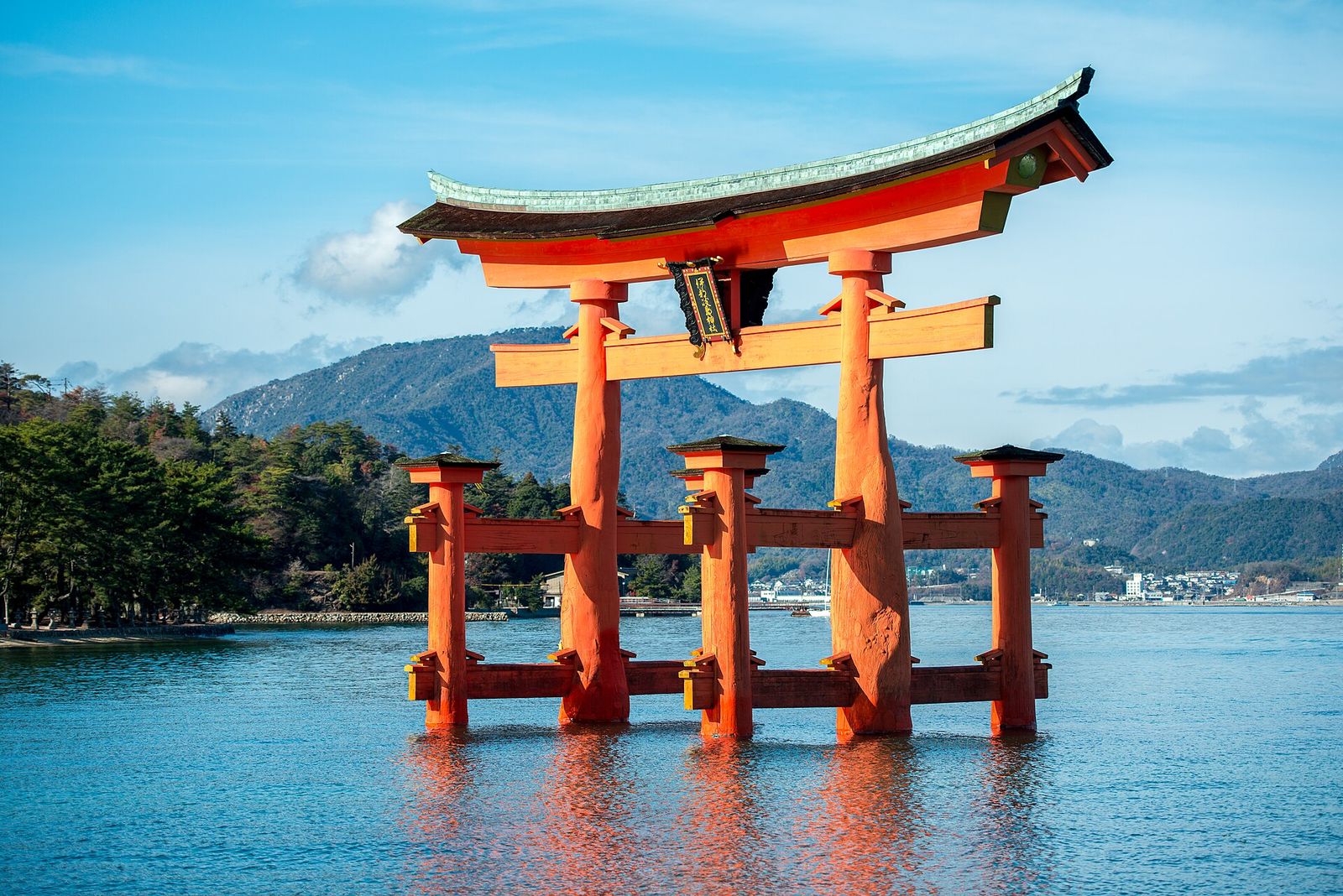
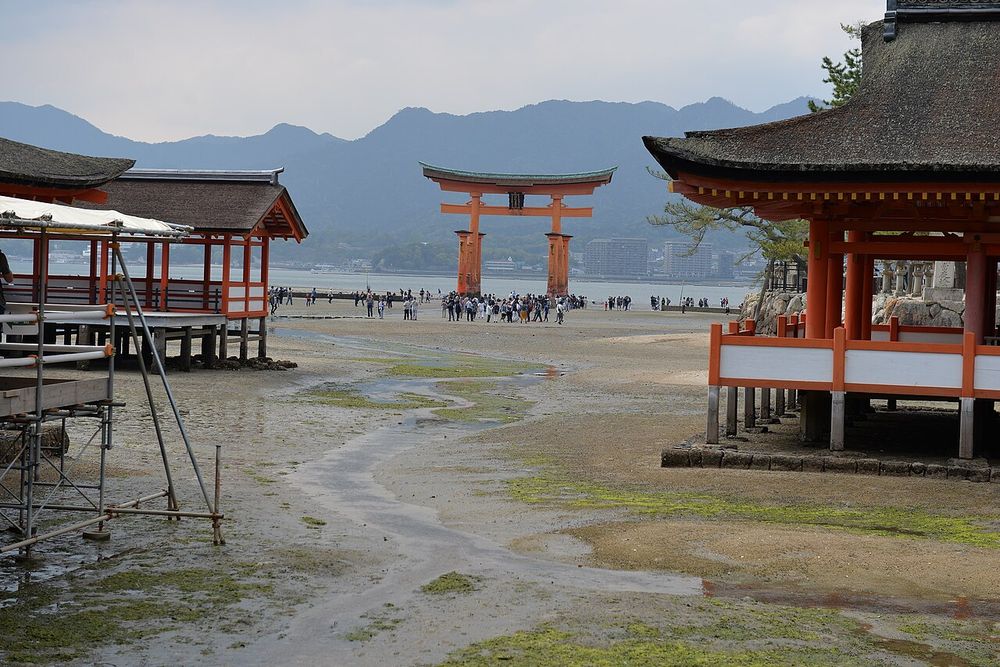
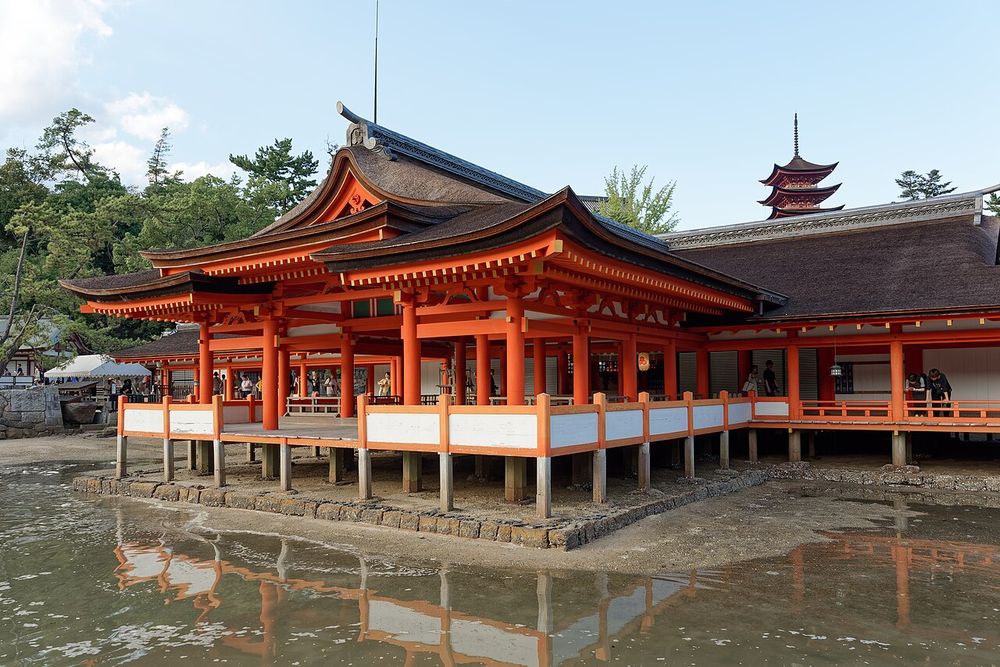
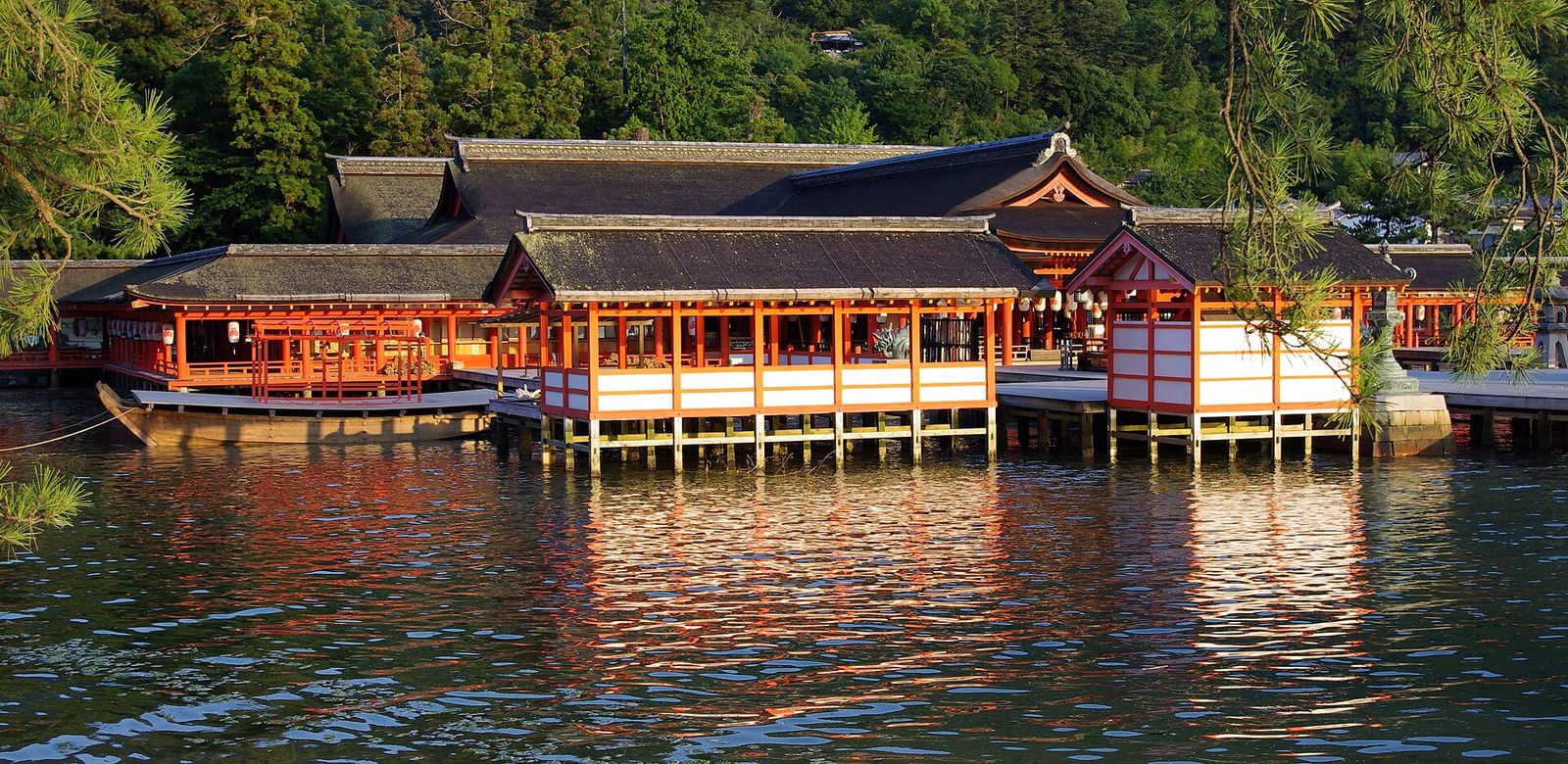
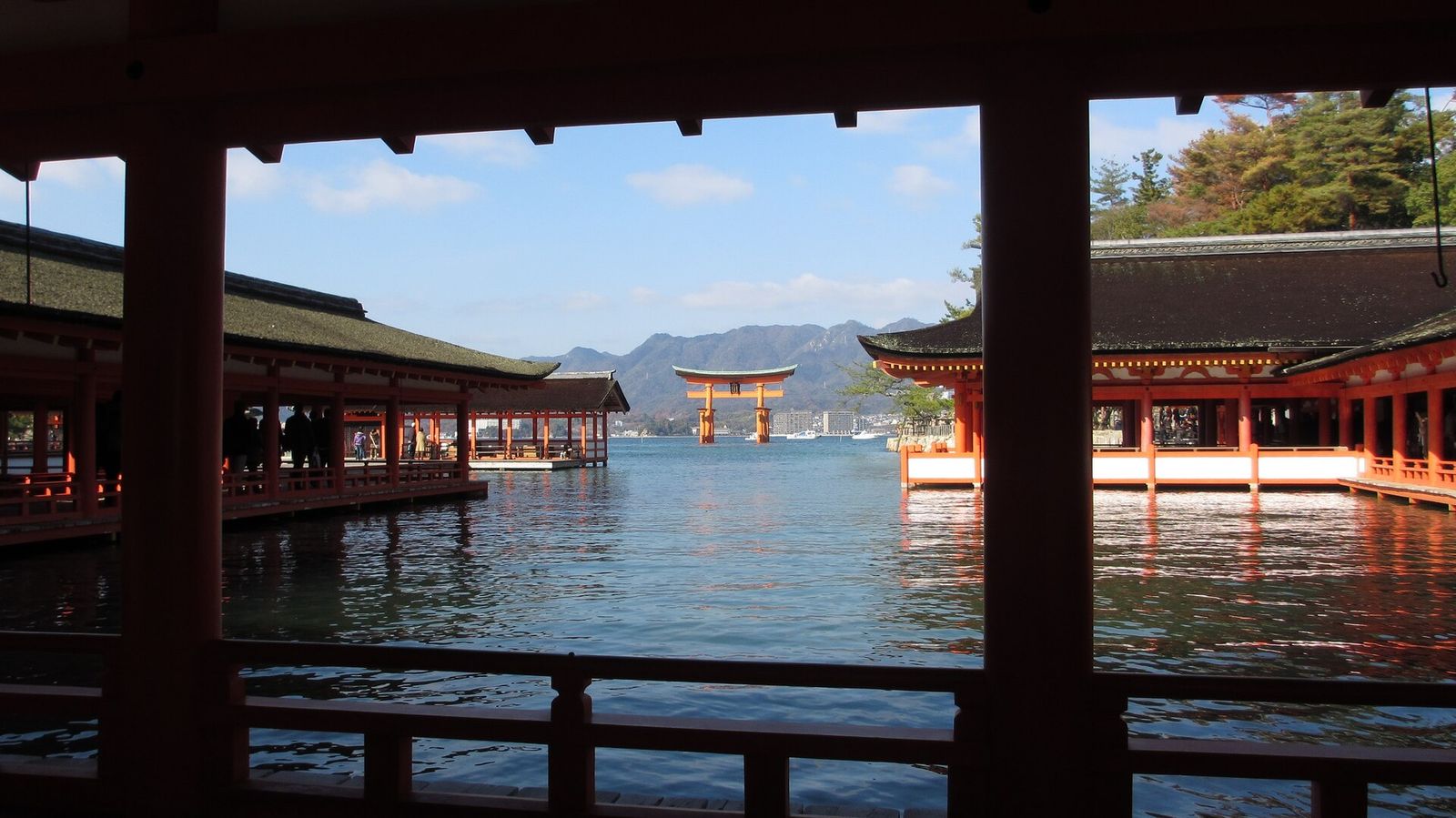
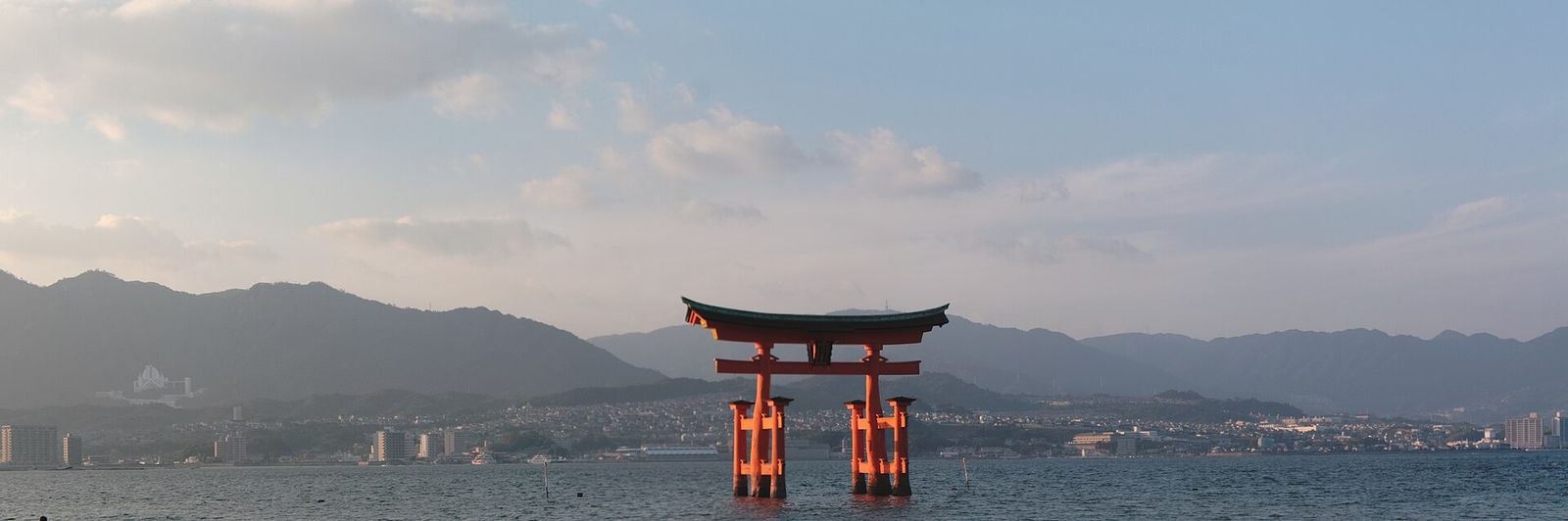
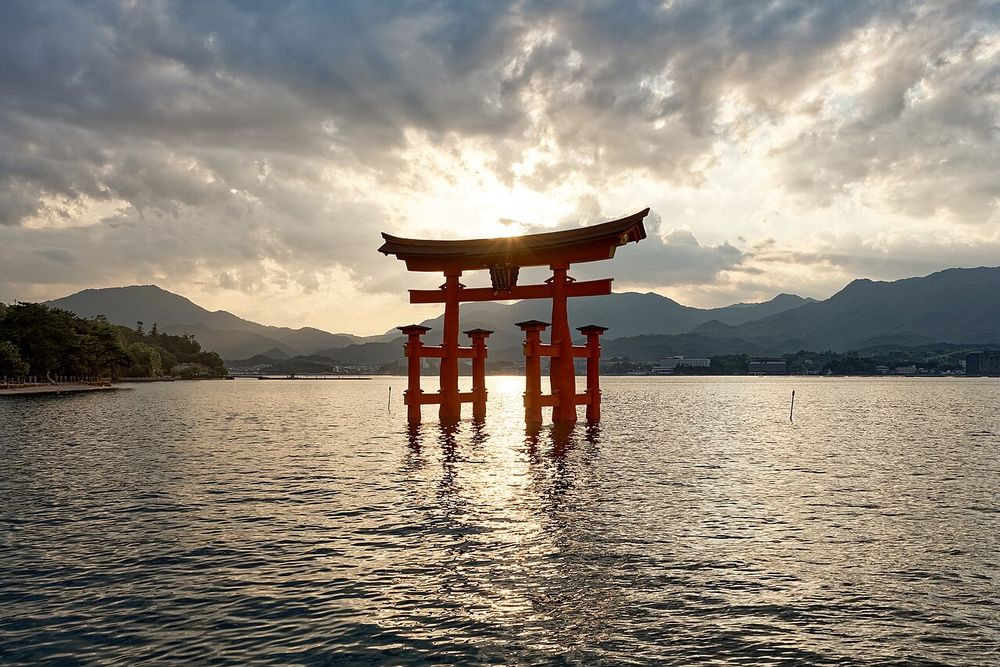
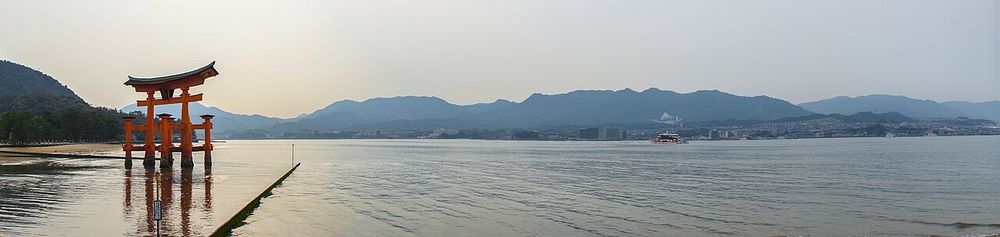
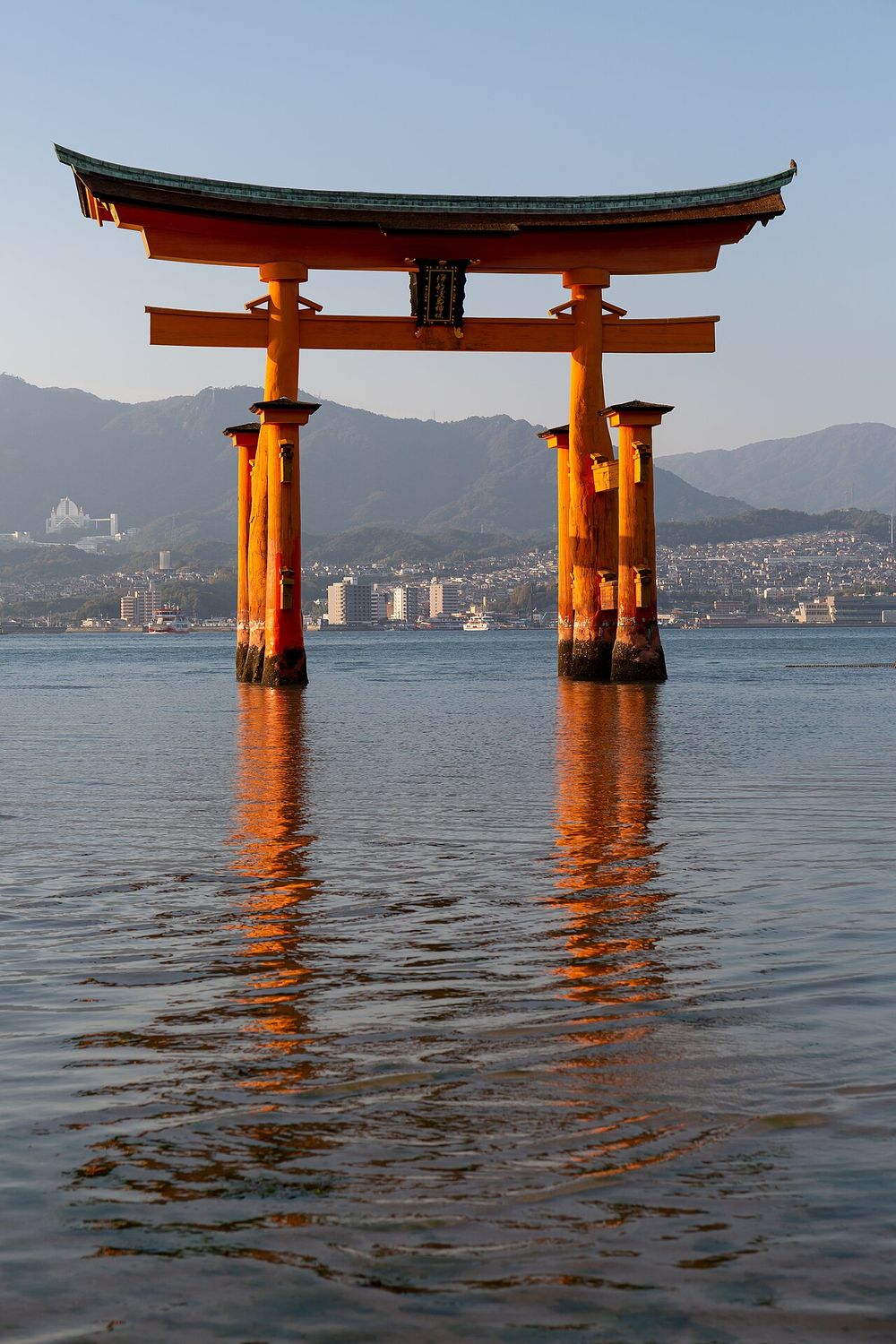
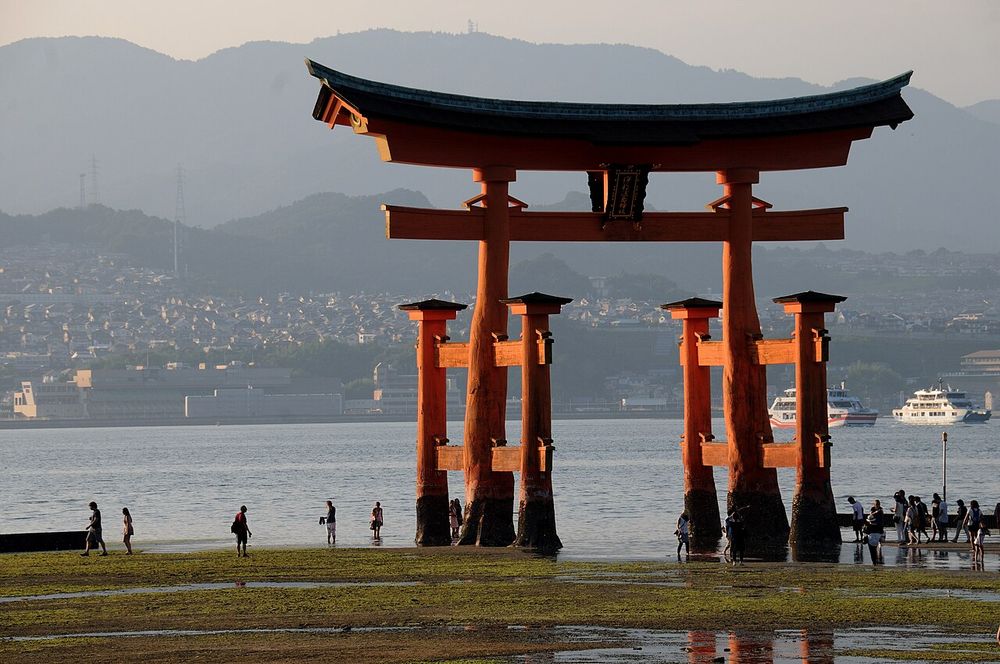
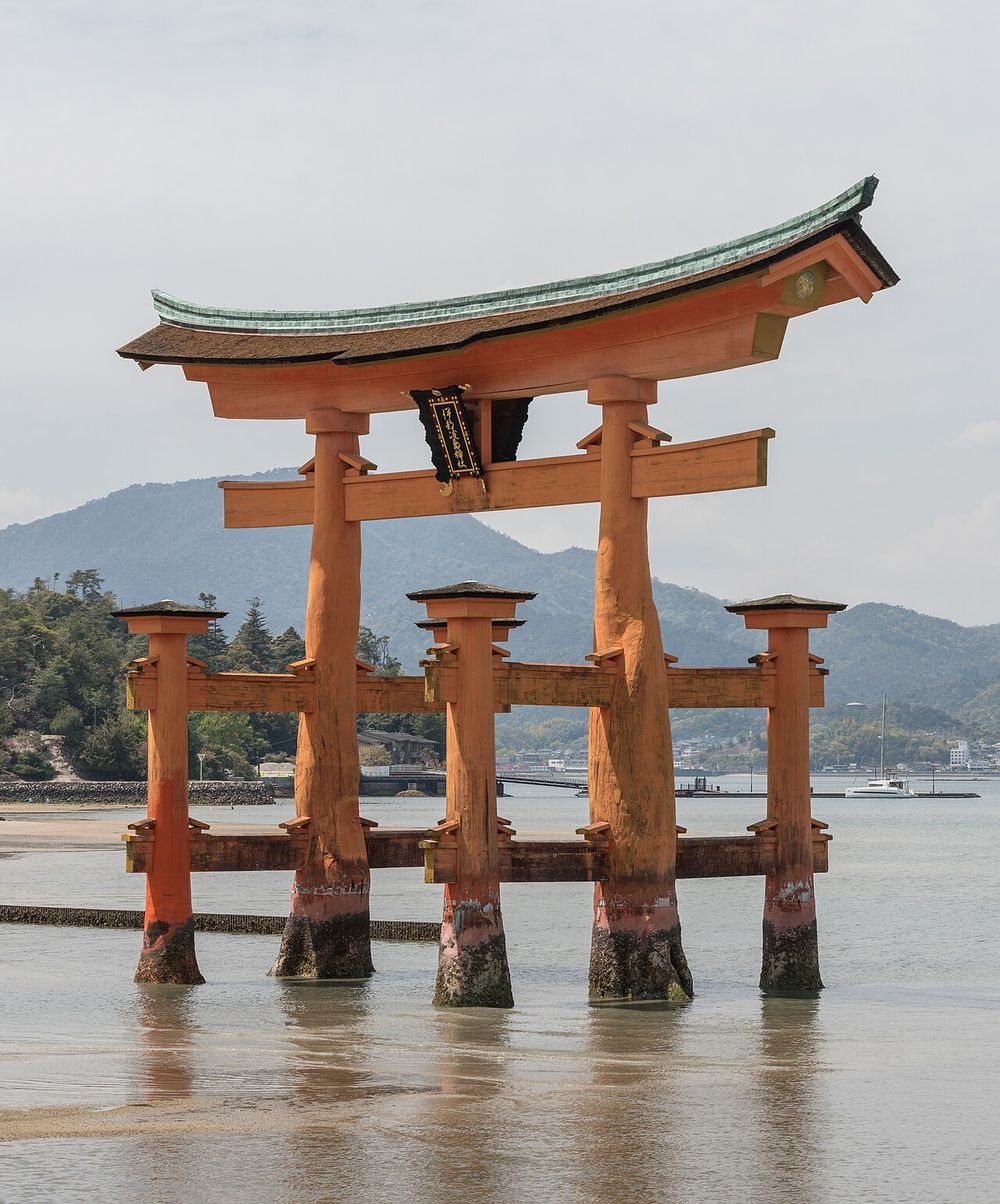
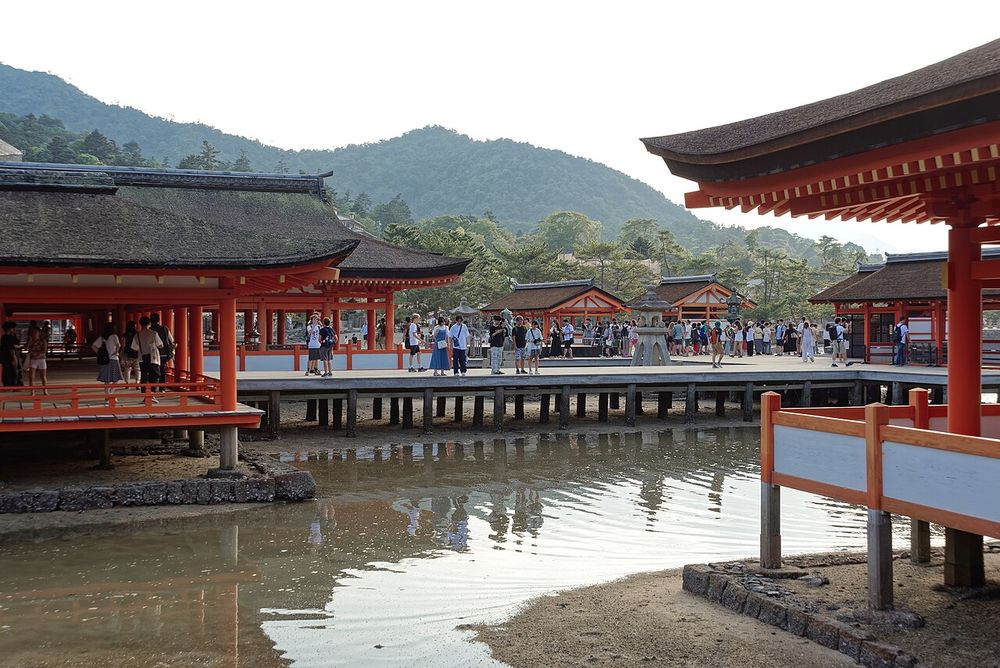
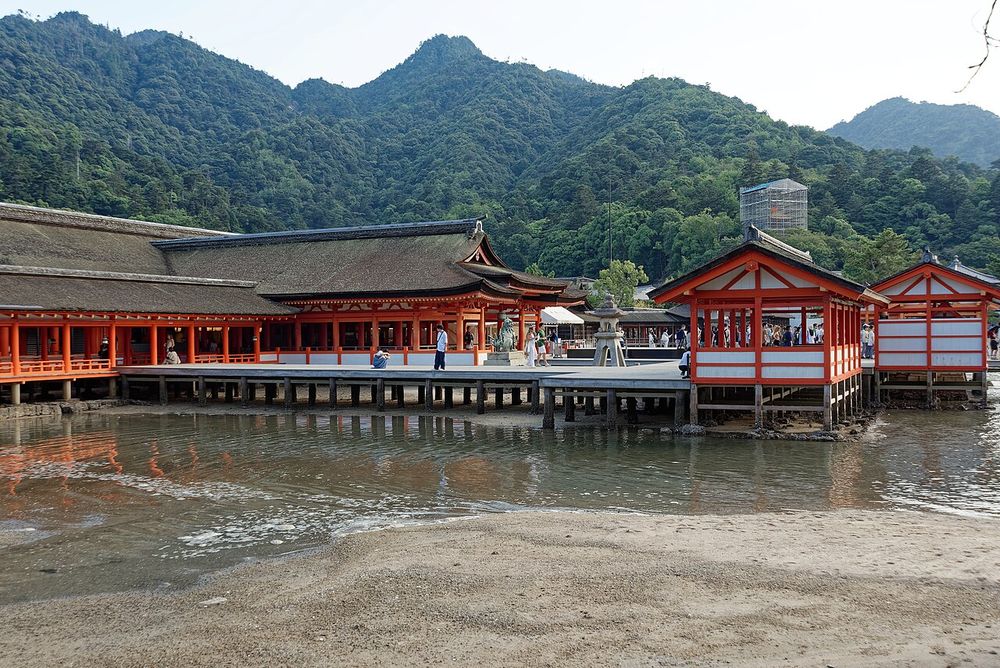
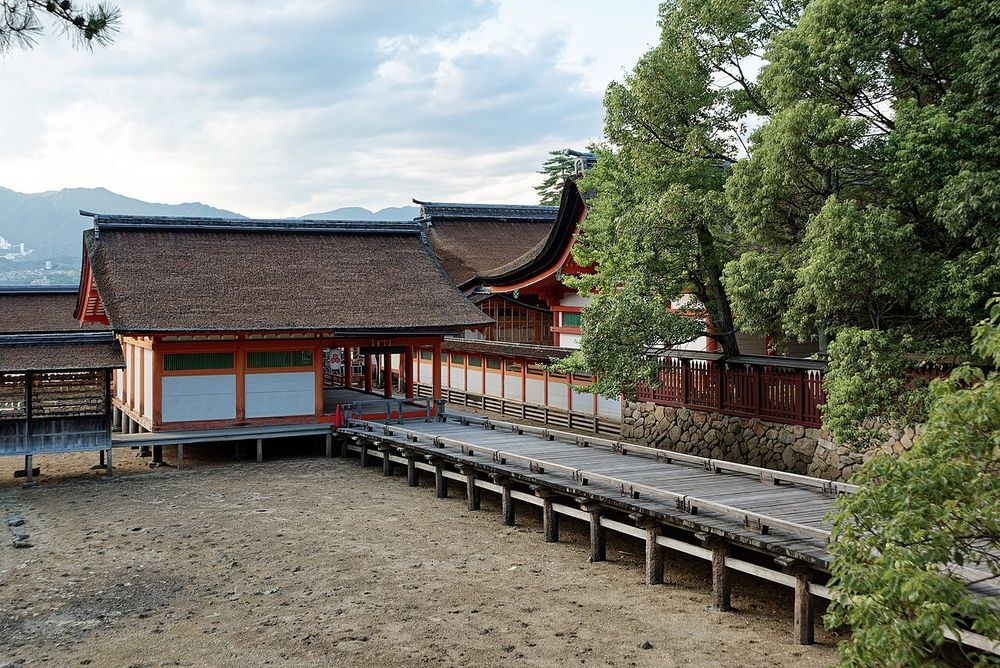
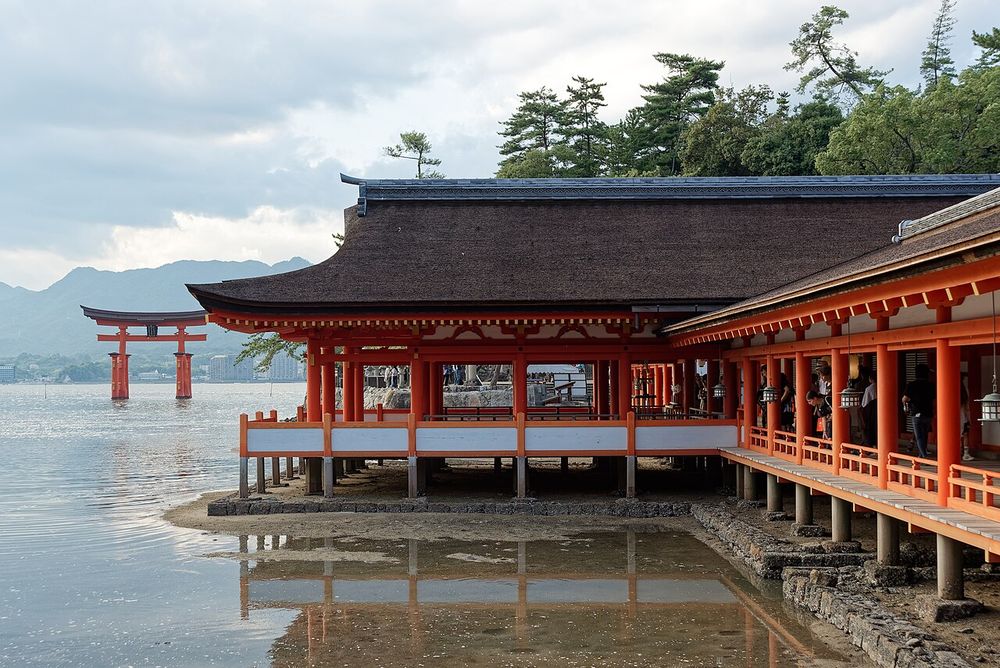
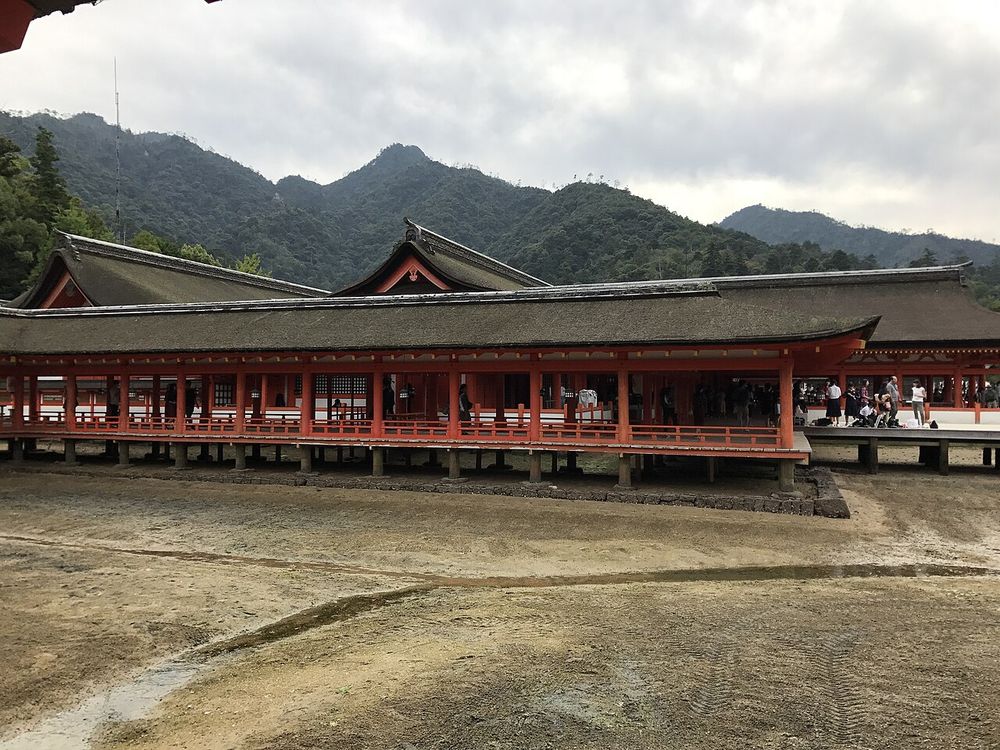
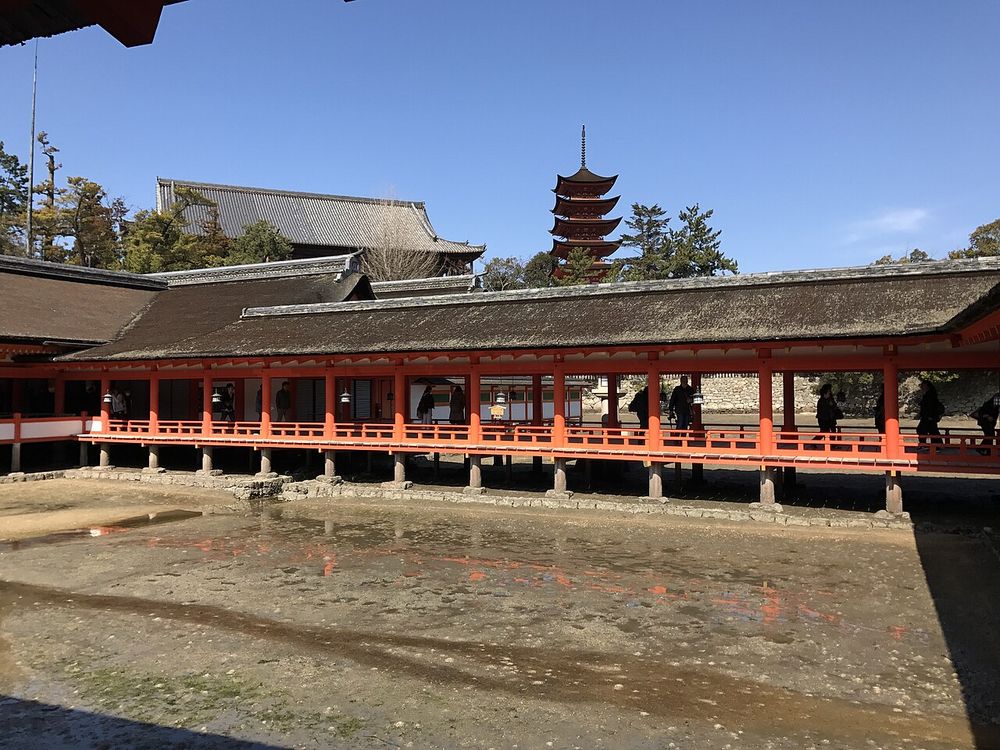
A shrine built on stilts over the sea, with its gate standing in the water 200 metres out. Twice a day the tide comes in under the floors and the whole shrine seems to float. Twice a day it goes out, and you can walk to the gate.
Photo: Jakub Hałun, CC BY-SA 4.0, Wikimedia Commons
The story
The island was holy before the shrine was. People believed the whole island was the body of a god, so no one could live on it, cut its trees or be buried in it. To worship, they came by boat. The shrine was therefore built at the island's edge, on the beach between high and low water, where it touches the island as lightly as possible.
What you see was laid out about 1168 by Taira no Kiyomori, then the most powerful man in Japan. He built it like a nobleman's mansion of his day, with halls joined by covered walks round a garden. Here the garden is the sea. That was in the time of the Southern Song (1127–1279) in China.
The gate and the shore are free. One ticket lets you walk the corridors of the shrine from east to west, past all its halls and stages. The treasure hall, the hall on the hill and the cable car up the mountain are paid for separately.
The pagoda is seen from outside, free; the hall has a small fee
If you have one minute
On the shore, facing the gate
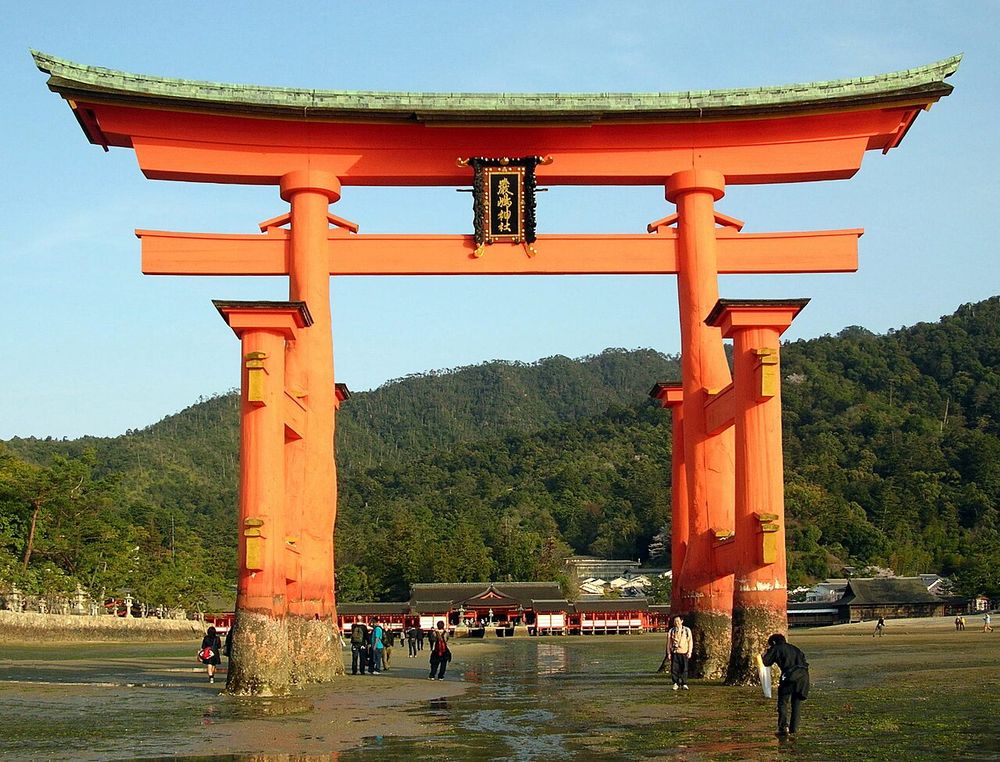
The great gate in the seaJordyMeow, CC BY-SA 3.0
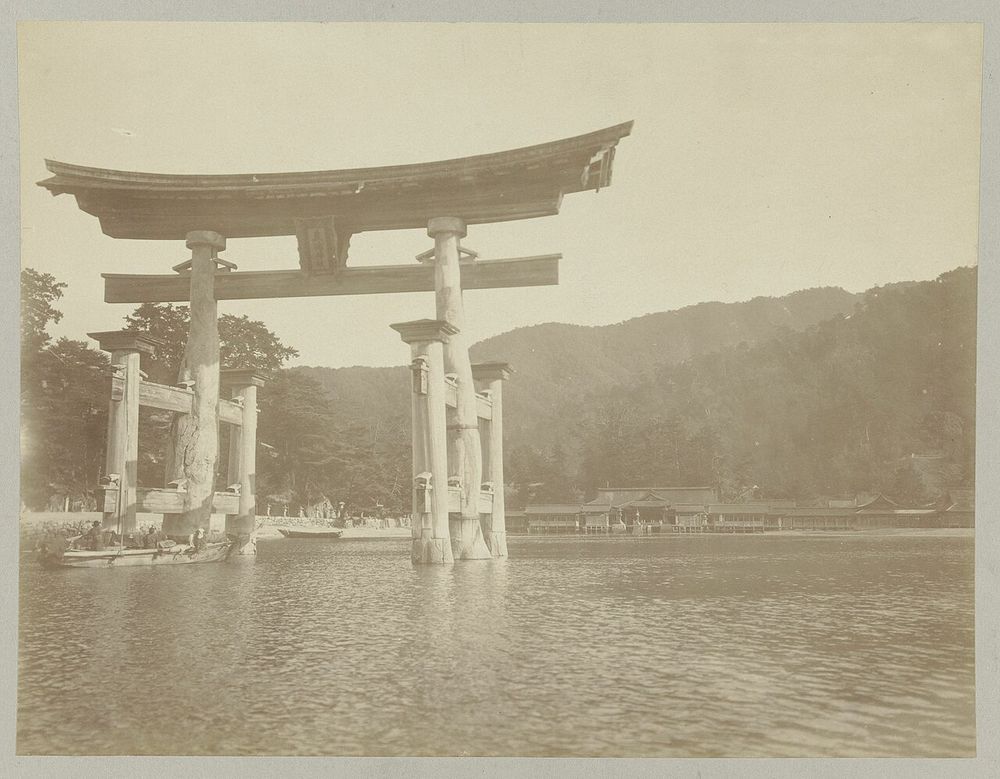
The red gate is 16.6 metres high and weighs about 60 tonnes. Nothing holds it down. Its posts are not sunk in the sea bed. They stand on it. The gate stays up by its own weight, and the box under its roof is filled with several tonnes of stones to make it heavier.
The two main posts are whole trunks of camphor trees, about five hundred years old when they were cut. This gate was put up in 1875. There have been gates on this spot for at least eight hundred years.
The gate from the east corridor at low tide, spring 2019shankar s., CC BY 2.0
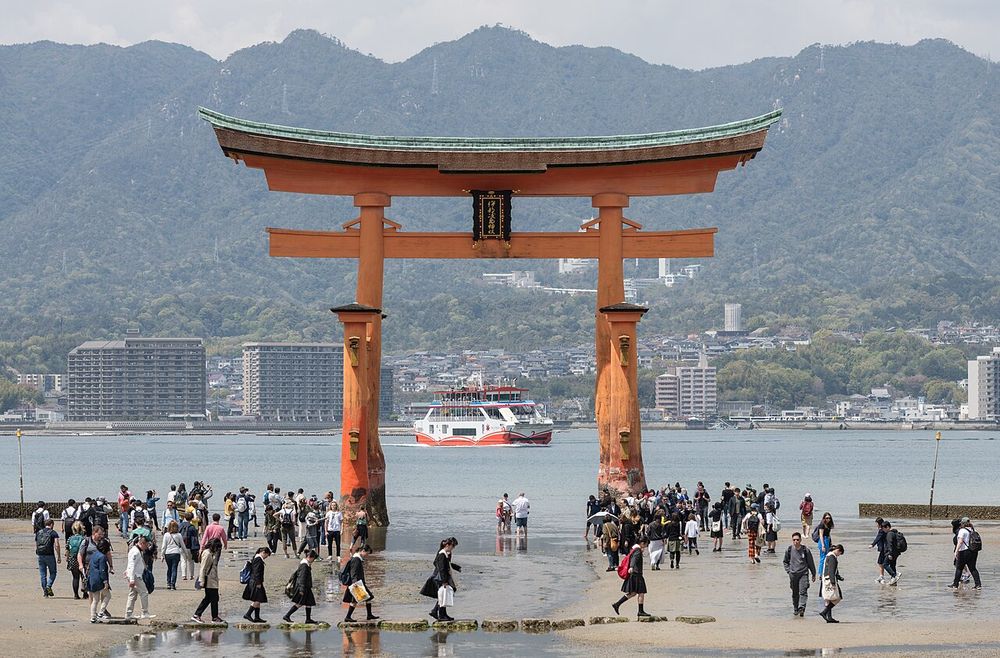
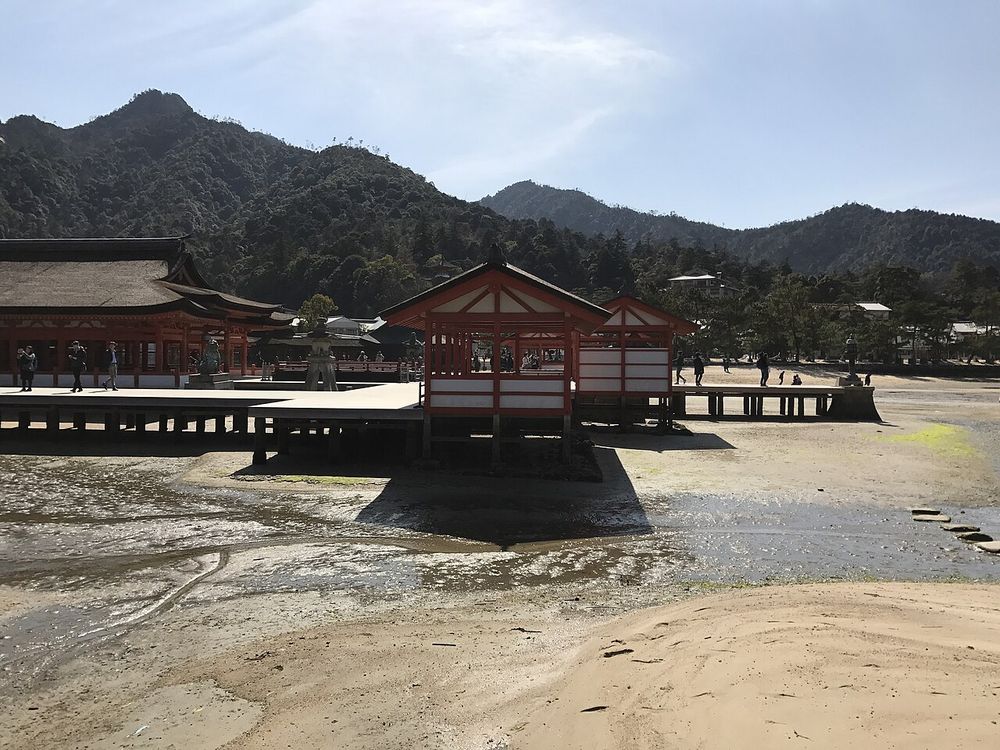
Now look at the water. If it is high, the shrine and the gate stand in the sea. If it is low, there is wet sand, and people are walking out to touch the posts. Both are the real thing. The builders meant you to see both.
The paint is vermilion. It was made from mercury and keeps insects and rot out of the wood. The colour was also believed to keep evil away.
Things people often get wrong
"The gate floats", or "the gate is set in concrete". Neither. It stands on the sea bed by its weight alone.
"Miyajima is the name of the shrine." Miyajima means "shrine island" and is the everyday name of the island. Its proper name, and the shrine's, is Itsukushima.
"The gate is always in the water." For some hours each day it stands on sand. Check the tide table before you choose your boat.
"These are the buildings Kiyomori built." His shrine burned twice. Most of what stands dates from a rebuilding of 1241, on his plan. The innermost hall is from 1571.
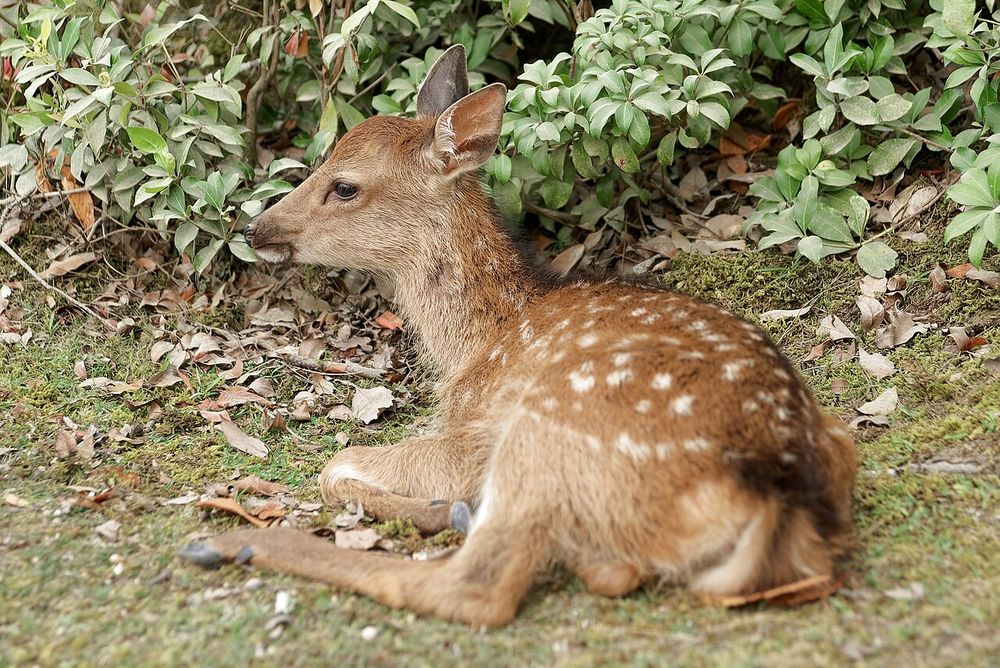
"The deer are tame." They are wild. They will eat your map, your ticket and your ferry pass. Feeding them is forbidden.
People who stood here
Taira no Kiyomori (warrior who ruled Japan from behind the throne, 1118–1181; the villain of The Tale of the Heike)He was governor of this province as a young man and believed the goddesses of the island had made his fortune. He rebuilt their shrine on a scale no one had seen, came here on pilgrimage ten times, and brought emperors with him. Four years after his death his whole clan was destroyed at sea, 150 kilometres to the west.
Emperor Go-Shirakawa (retired emperor and the great schemer of his age)In 1174 he made the long sea journey from Kyoto with Kiyomori to worship here. No emperor had ever travelled so far for a shrine in the provinces.
Mori Motonari (warlord of western Japan, 1497–1571)In 1555 he trapped and destroyed a much larger army on this island in a single night attack. Because blood had been spilt on holy ground, he had the stained earth dug up and carried away, and the shrine washed. He rebuilt the innermost hall that stands today.
Toyotomi Hideyoshi (the peasant's son who united Japan, 1537–1598)He stopped here in 1587 on his way to conquer Kyushu, and ordered the great hall on the hill above the shrine. It was never finished.
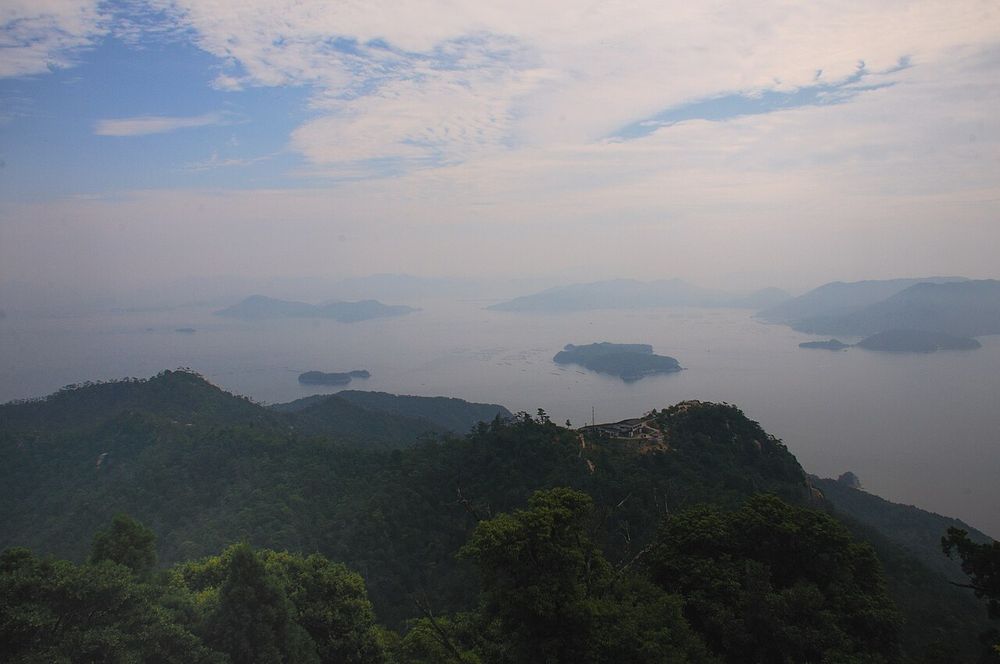
Ito Hirobumi (Japan's first prime minister)He loved the mountain behind the shrine, paid for the path to its top, and said the real worth of this famous view was the view from the summit.
Albert Einstein (physicist)He came in December 1922, near the end of six weeks of lectures in Japan, walked along the shore to the shrine and climbed the mountain.
The leaders of the G7On 19 May 2023 Joe Biden, Emmanuel Macron, Olaf Scholz, Rishi Sunak, Giorgia Meloni, Justin Trudeau and Japan's Kishida Fumio walked the corridors together and were photographed with the gate behind them.
Go deeper: eight stops, from the gate in the sea to the hall on the hill
The first stop is outside and free. Stops 2 to 6 follow the one-way route through the shrine. The last two are on the hill behind.
1. The great gate
Visitors walk out at low tide, April 2019DXR, CC BY-SA 4.0
At low tide, walk out to it. Up close you see that it has six legs, not two. Each main post has two smaller posts beside it, joined by tie beams. This is what keeps it upright in a typhoon.
The posts are rough because they are natural trunks, not shaped timber. Look for coins pushed into the cracks by visitors. Please do not add one. The metal harms the wood.
On the roof, at the east end, is a gold sun, and at the west end a moon. The board on the seaward side reads "Itsukushima Shrine". The board facing the shrine gives the name in an older spelling.
The gate was wrapped in scaffolding for repair from 2019 to the end of 2022. Workers found the insides of the posts eaten hollow, and filled and bound them.
2. The corridor: a floor with gaps
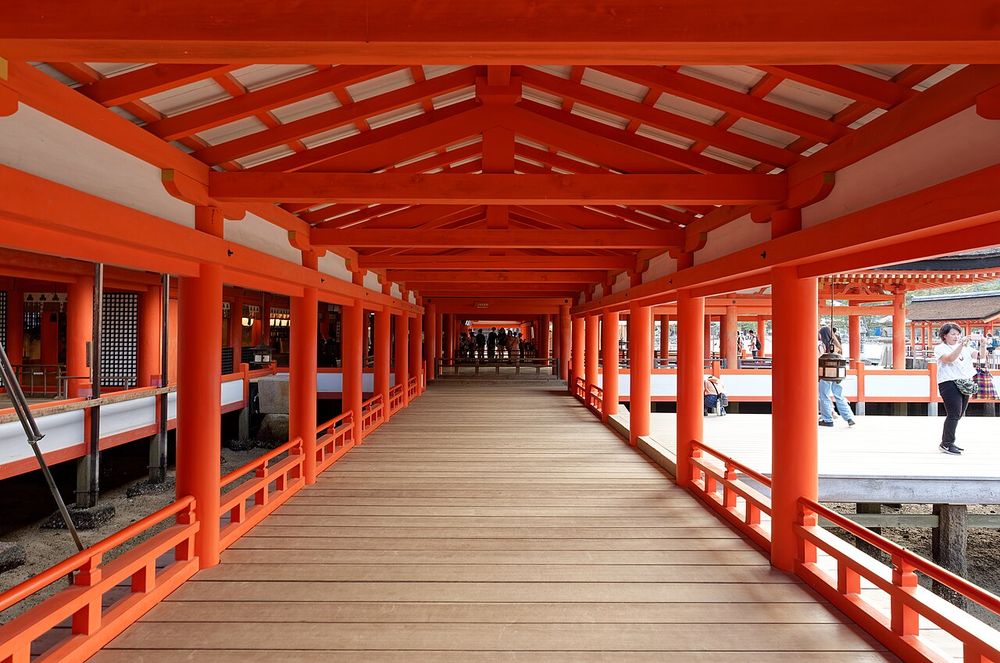
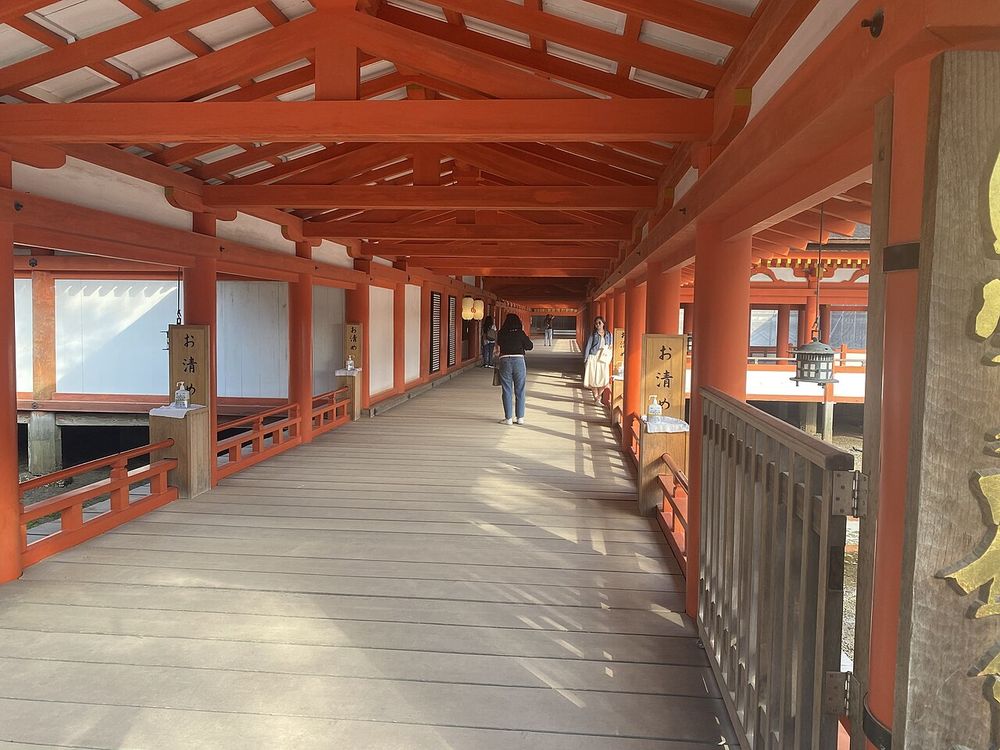
The east corridorJakub Hałun, CC BY 4.0
Pay at the east entrance and you are on the corridor. It runs for about 275 metres, in two wings, with a red post every 2.4 metres.
Look down. The floorboards are laid with a small gap between them. In a storm tide the sea rises through the gaps and runs off again. A tight floor would be lifted by the water like the lid of a box.
The boards you are walking on are a second layer, laid to protect the old floor beneath. Until the last century visitors took off their shoes.
The shrine is built to lose its edges. In the great typhoons of 1991 and 2004 the outer platforms and stages were torn away, as they are meant to be, and the main halls stood.
3. The shrine of the guest gods
The shrine of the guest gods under its bark roofJakub Hałun, CC BY 4.0
The first group of halls belongs to five gods who are guests of the island. Every ceremony of the shrine begins here, before going on to the main hall.
Look at the roofs. They are not tile. They are thin strips of cypress bark, laid in dozens of layers and fixed with bamboo nails. A roof lasts about thirty years.
4. The main shrine and the stage in the sea
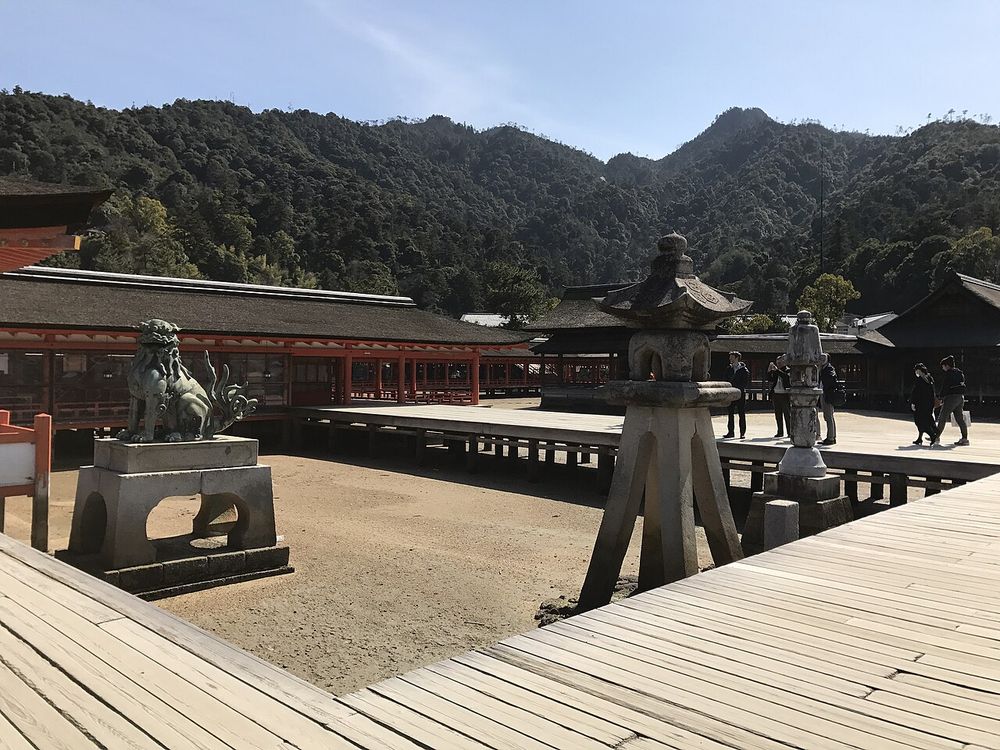
The deck in front of the main shrineそらみみ, CC BY-SA 4.0
The main halls face the gate across the water. Three goddesses are worshipped here, daughters of the storm god. They protect ships, and by extension all journeys and all good fortune.
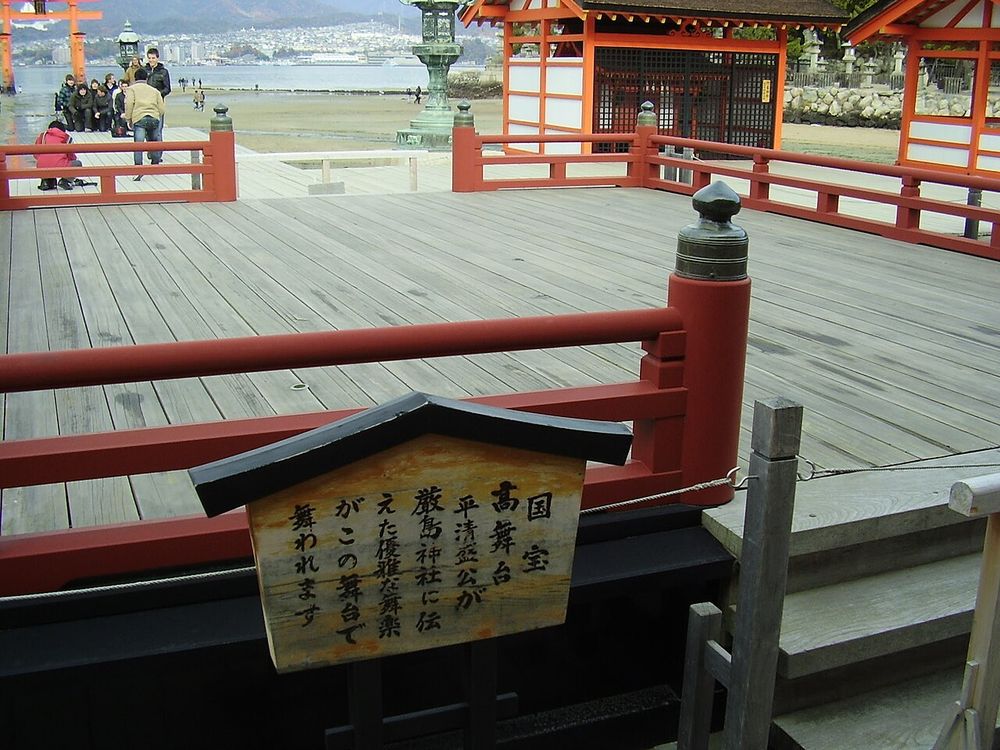
The raised dance stage and its noticeRuinDig/Yuki Uchida, CC BY 4.0
In front is a wide wooden deck. In its middle stands a small raised stage with a red rail. Court dances called bugaku are performed on it, in masks and heavy silk, to flutes and drums. Kiyomori brought the dancers from Osaka in the 1100s. The same dances are still done here about ten times a year.
The deck rests on stone posts given by Mori Motonari. From it a narrow pier runs straight out towards the gate. Stand at its end. The gate, the pier and the innermost hall are on one line.
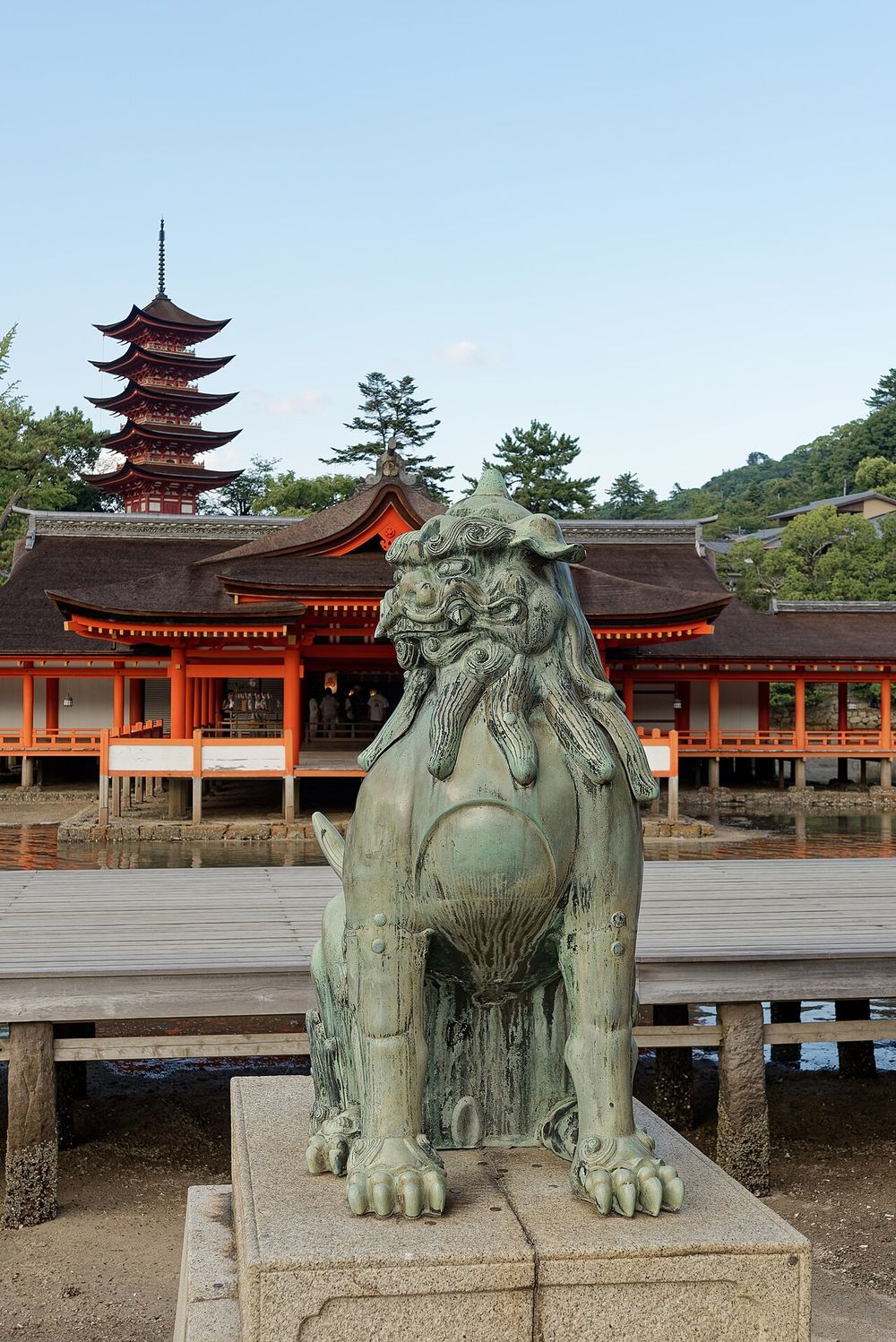
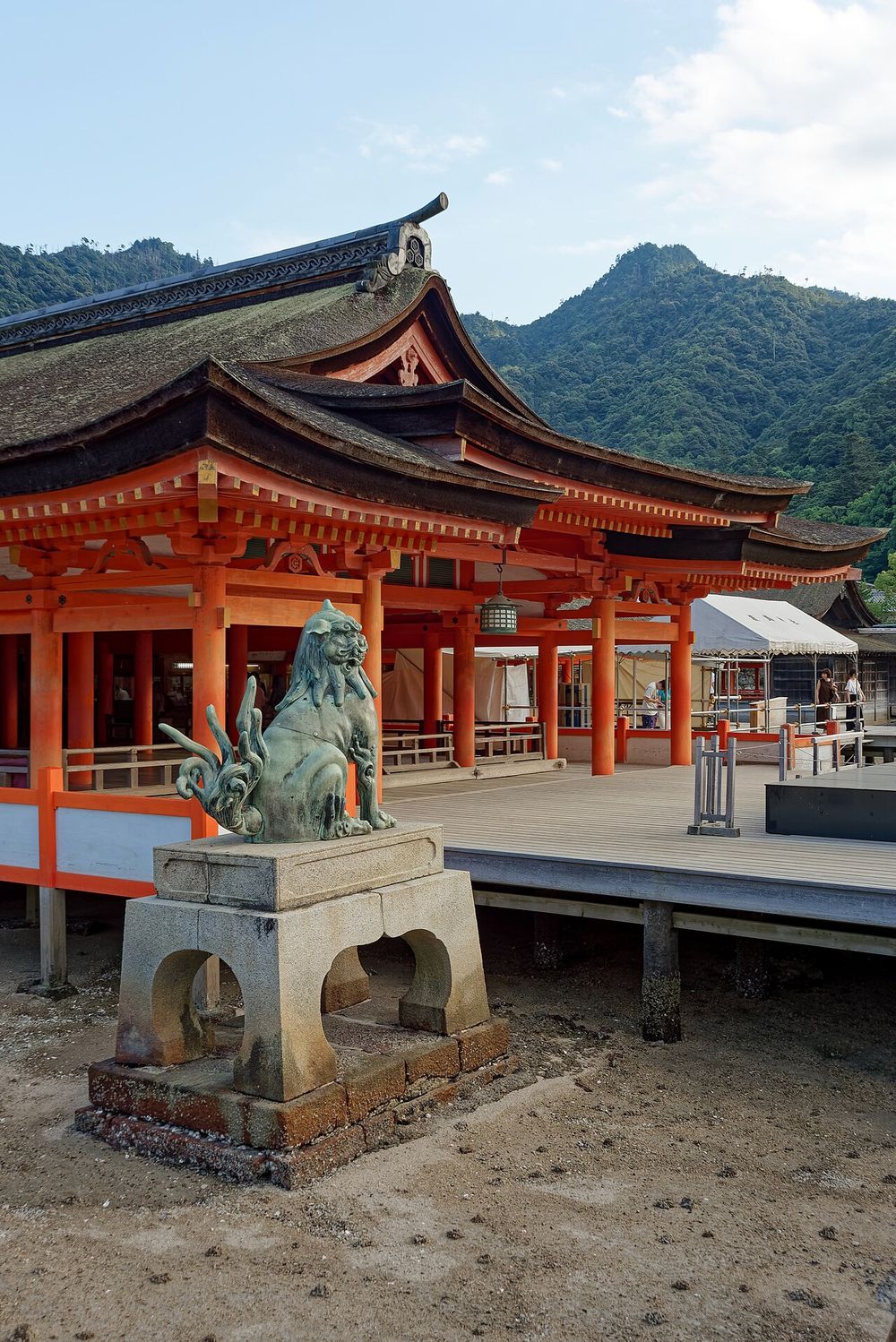
A guardian lion-dog on the deckJakub Hałun, CC BY 4.0
This is the frame most people take home. The leaders of the G7 were photographed on this spot in 2023. Stand at the landward end of the pier, with the bronze lantern to one side and the gate in the middle.
5. A theatre that stands in the sea
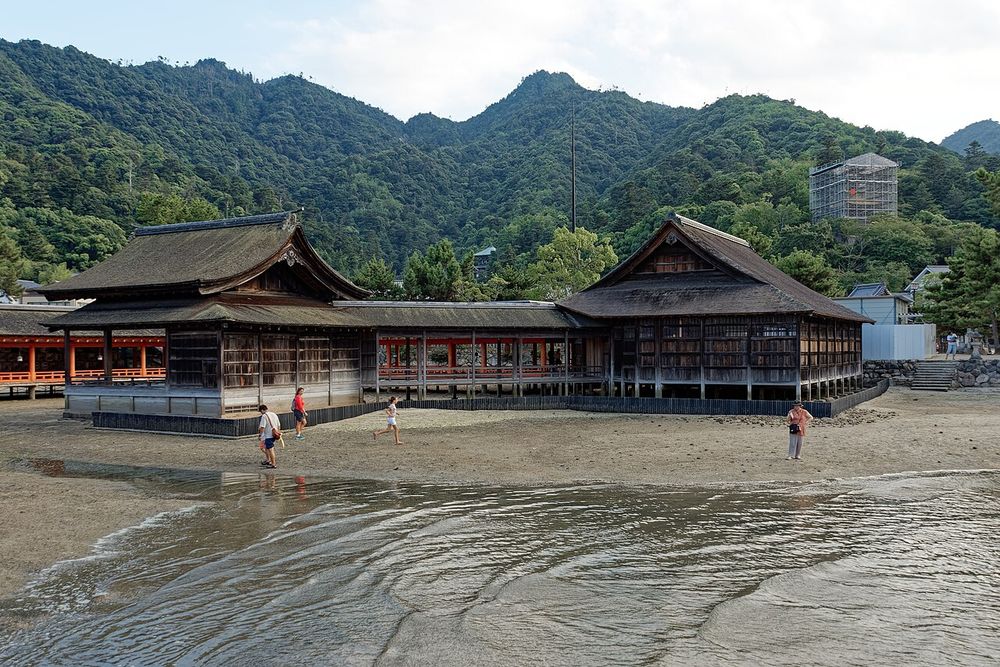
The Noh stage at low tideJakub Hałun, CC BY 4.0
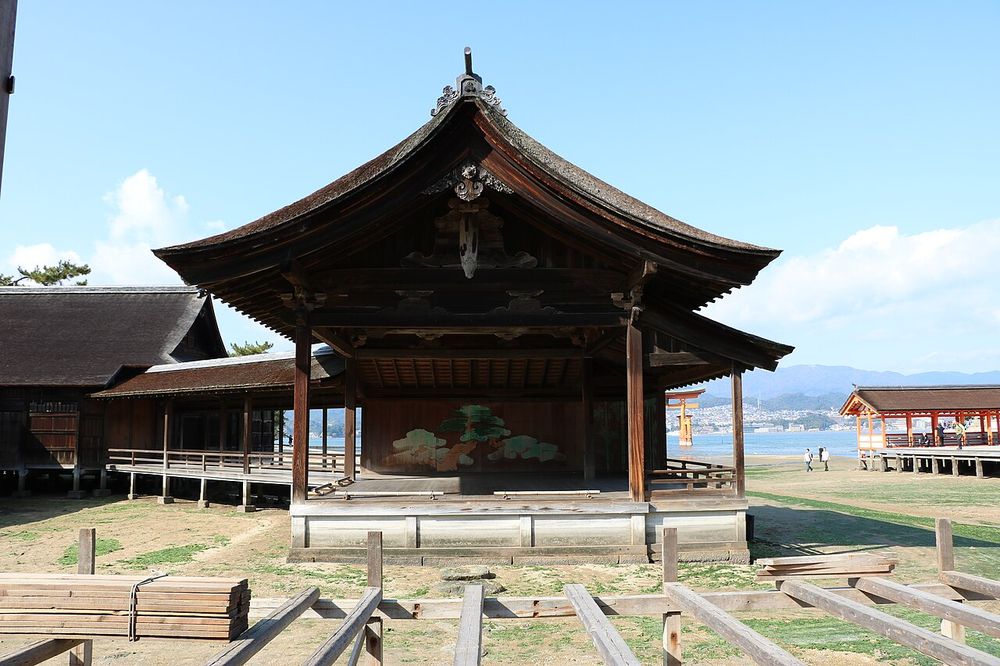
On the west side, apart from the corridor, is a roofed stage with a painted pine tree on its back wall. It is for Noh, the masked drama of the samurai, and was built in 1680. It is the only Noh stage in Japan that stands in the sea.
Noh actors stamp, and the sound matters. On land, large jars are set under the floor to make it ring. Here the floor is one sprung piece, and the water beneath changes the sound with the tide.
6. The arched bridge and the ponds
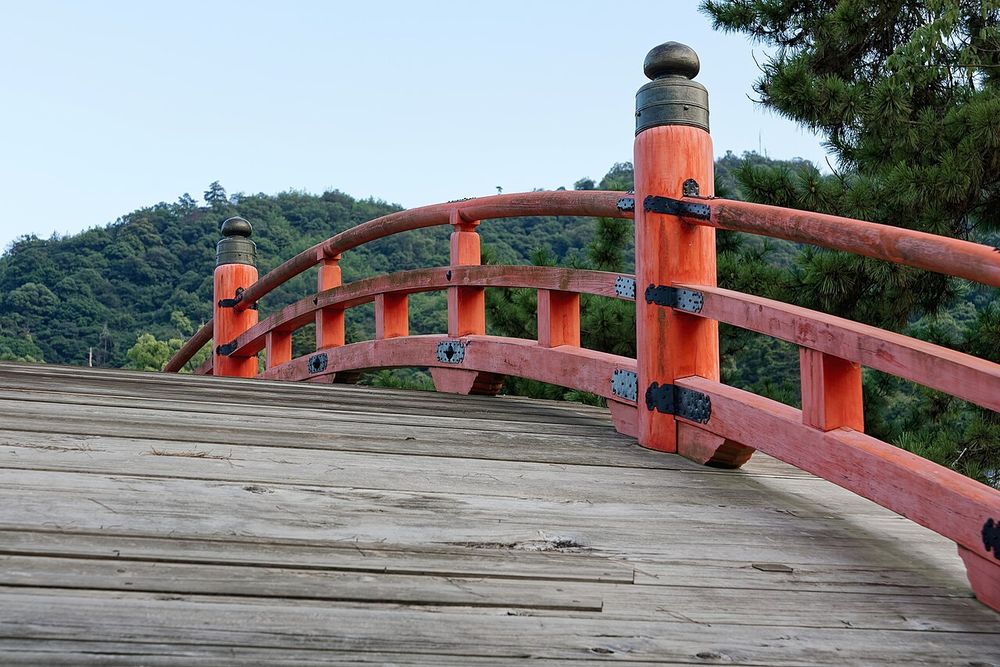
The arched bridge of 1557Jakub Hałun, CC BY 4.0
Near the exit is a steep red bridge with no steps. It was built in 1557 for the emperor's messenger alone. On the days he came, temporary steps were set on it.
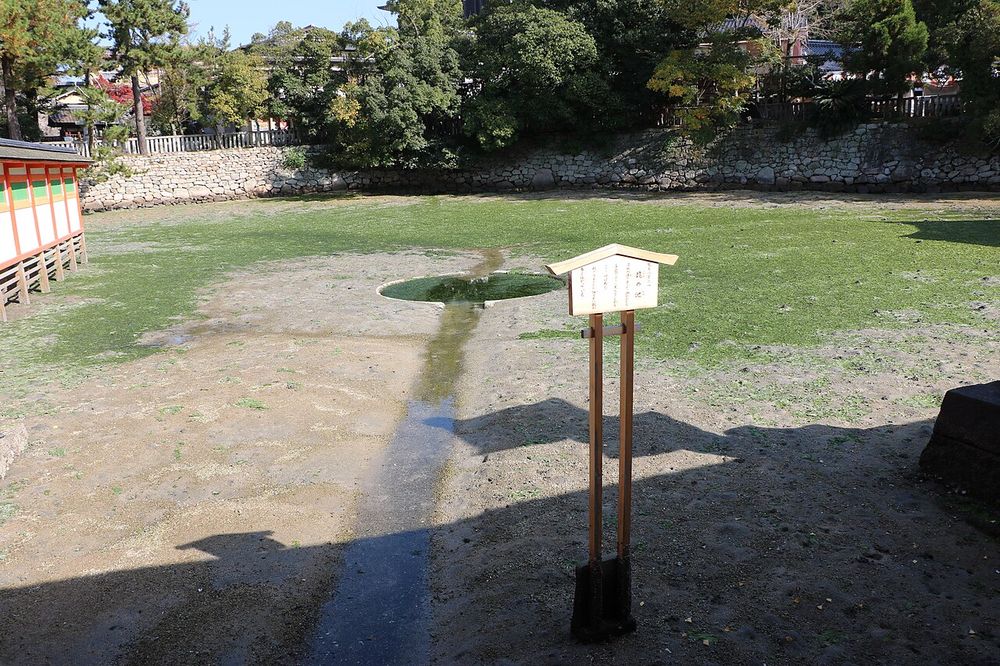
A mirror pond on the sandさかおり, CC BY-SA 4.0
At low tide, look on the sand beside the corridors for three round pools that do not drain. Fresh water rises in them from under the beach. They are called the mirror ponds.
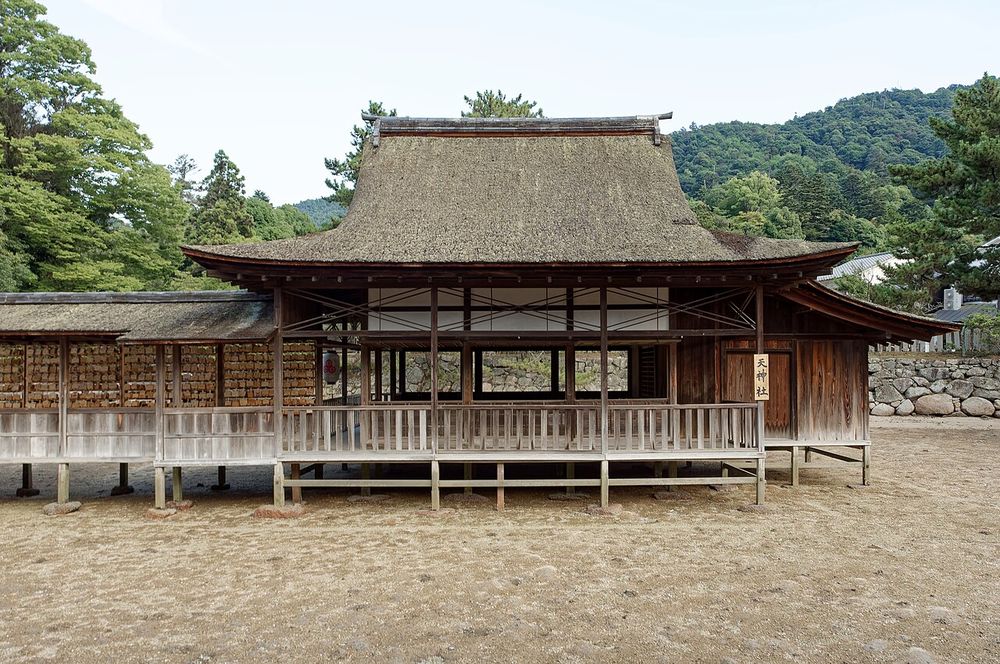
The unpainted Tenjin shrine of 1556Jakub Hałun, CC BY 4.0
The small unpainted hall nearby, of bare grey wood, was added in 1556. It shows what the red halls would look like without their paint.
7. The pagoda and the hall of a thousand mats
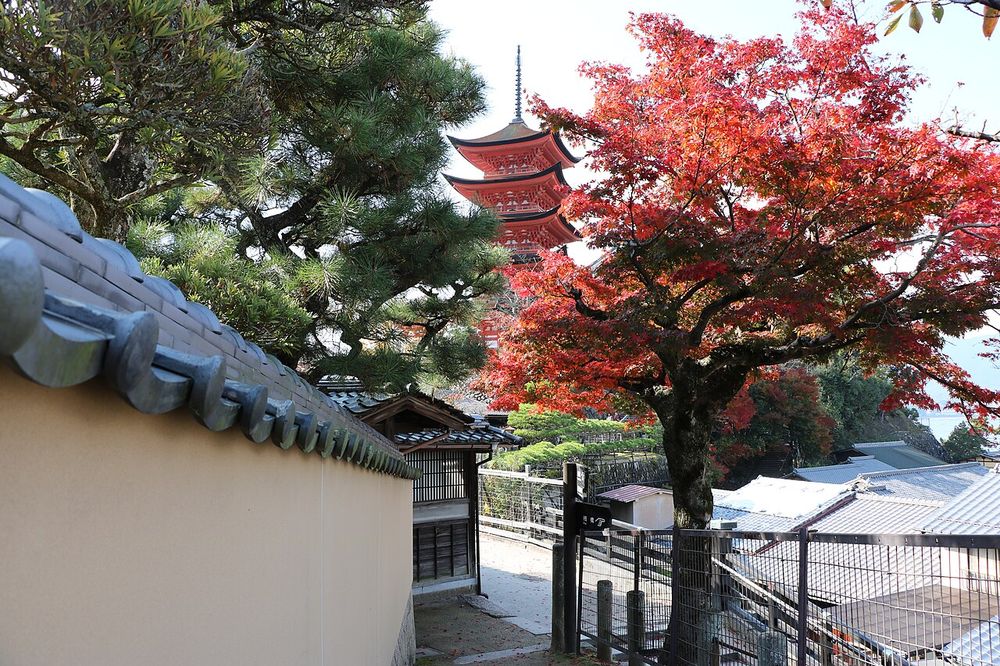
The five-storey pagoda in Novemberさかおり, CC BY-SA 4.0
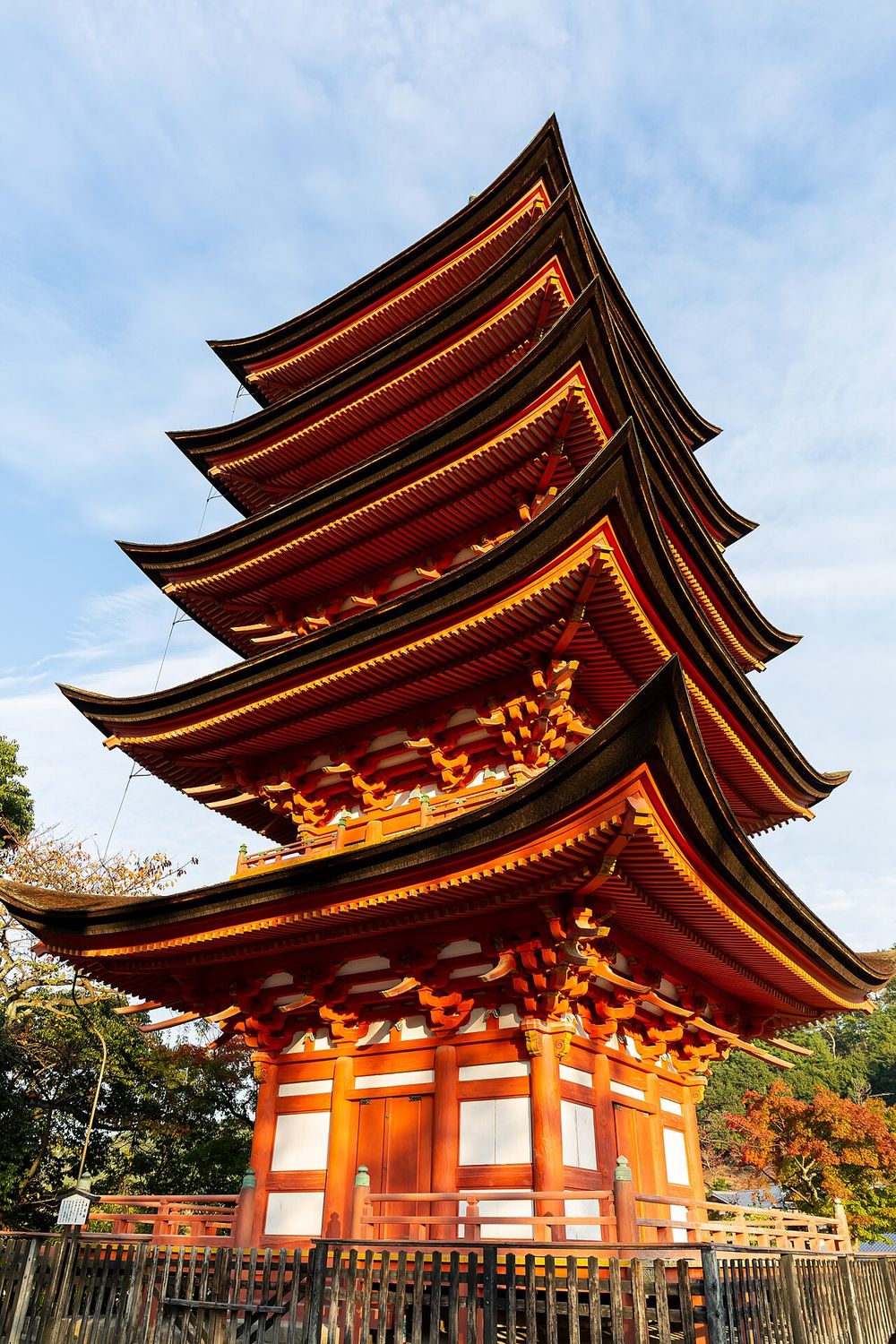
On the hill just above the shrine stands a five-storey pagoda of 1407, and beside it a huge dark hall.
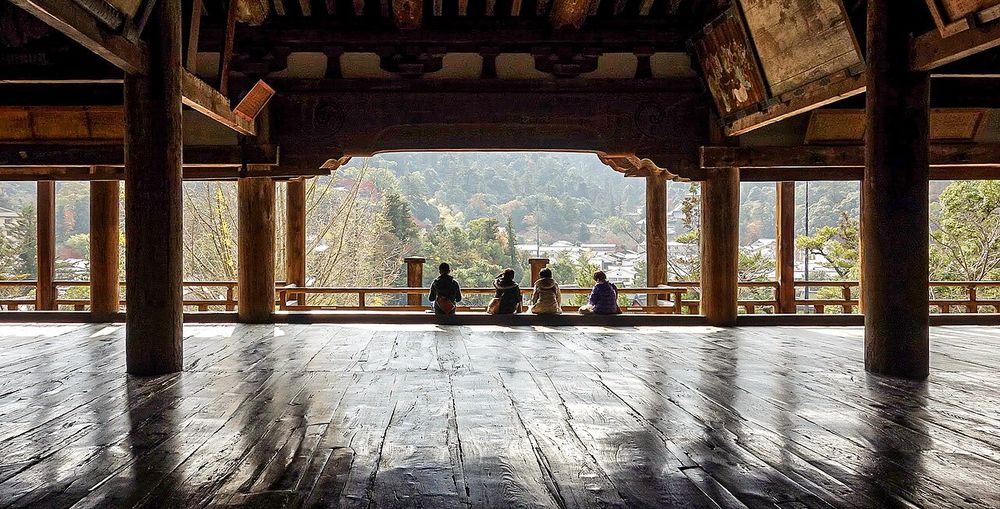
Inside Senjokaku: looking out between the pillarsKQuhen, CC BY-SA 4.0
Hideyoshi ordered the hall in 1587 for the reading of Buddhist scriptures for the war dead. He died in 1598 with the roof on and nothing else done. It has no ceiling, no walls and no paint. It is called Senjokaku, "the hall of a thousand mats", for its size. You can walk in and see how a great timber building is put together.
In 2026 the pagoda is wrapped for repair until late December.
8. Scrolls, a television epic and a rice scoop
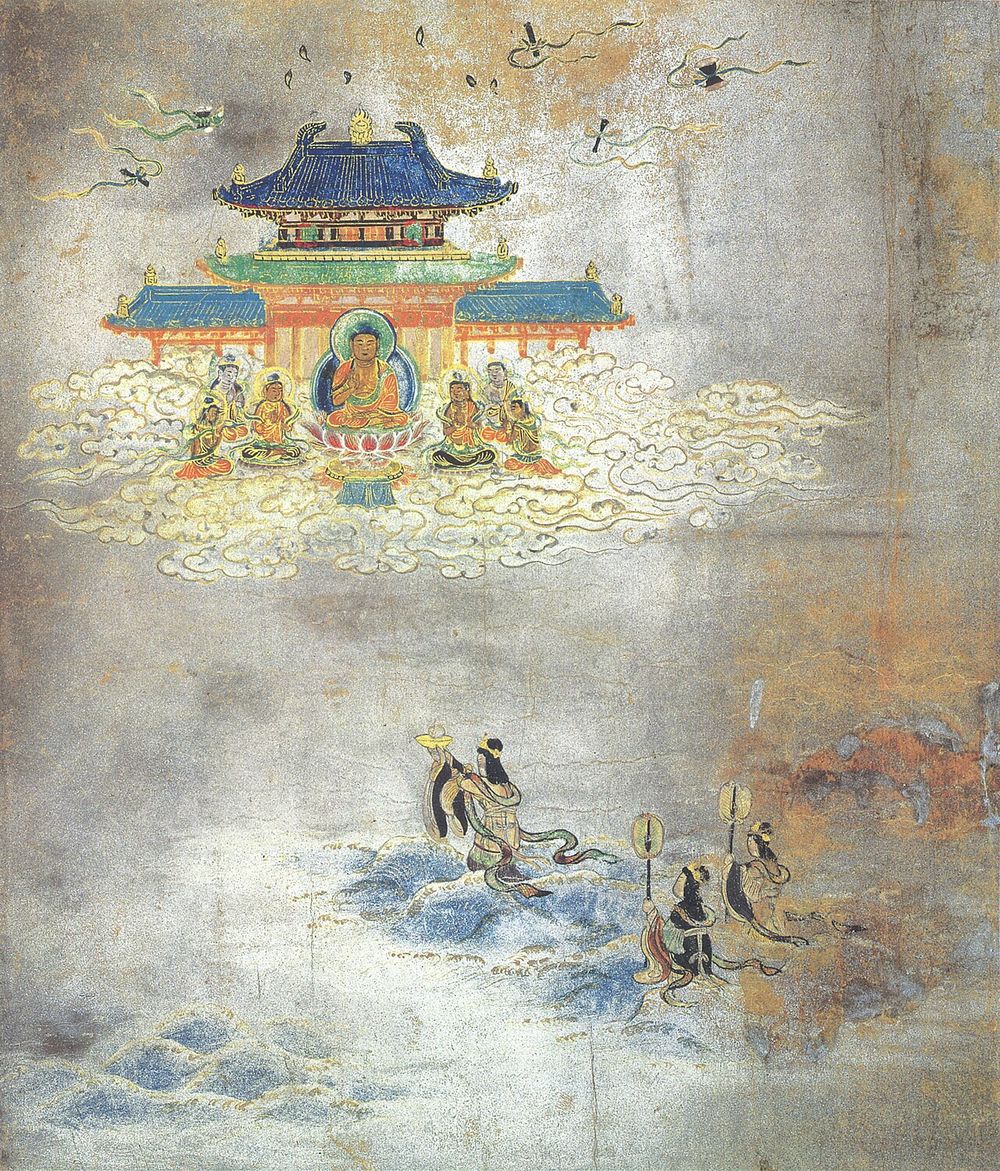
A scroll of the scriptures given by Kiyomori's family in 1164Unknown, Public domain
In 1164 Kiyomori and thirty-one members of his family each copied a chapter of Buddhist scripture and gave the set to the shrine. The scrolls are written on paper scattered with gold and silver, with crystal rollers, and are among the most beautiful books ever made in Japan. Copies are shown in the treasure hall near the exit.
The Tale of the Heike, the great war story of medieval Japan, tells how Kiyomori's clan rose and fell. Japanese schoolchildren learn its opening by heart. It says that the proud do not last, and are like a dream on a spring night.
The national television drama of 2012, Taira no Kiyomori, with Matsuyama Kenichi in the title part, filmed its pilgrimage scenes at the shrine.
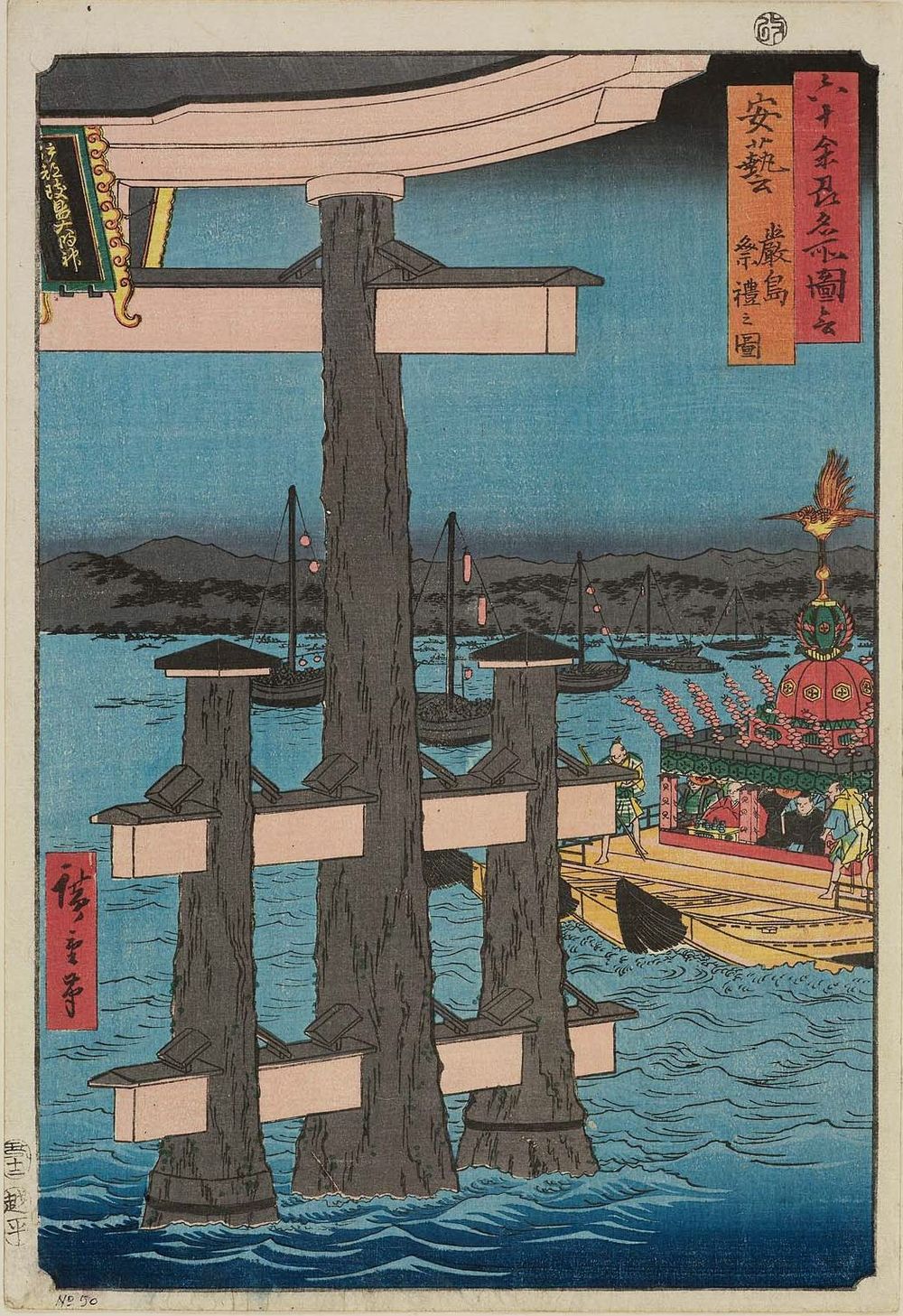
Hiroshige, the festival at Itsukushima, 1853Utagawa Hiroshige, Public domain
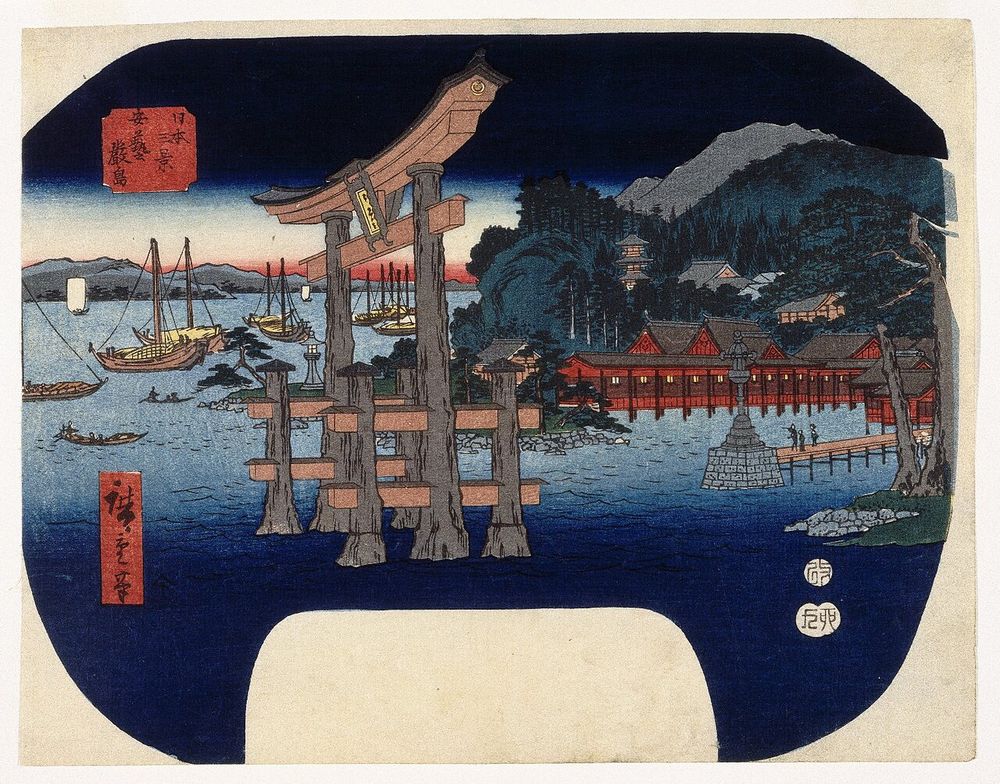
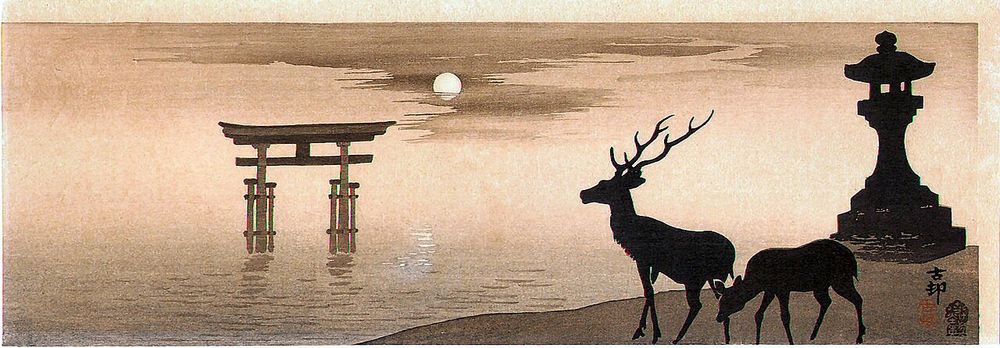
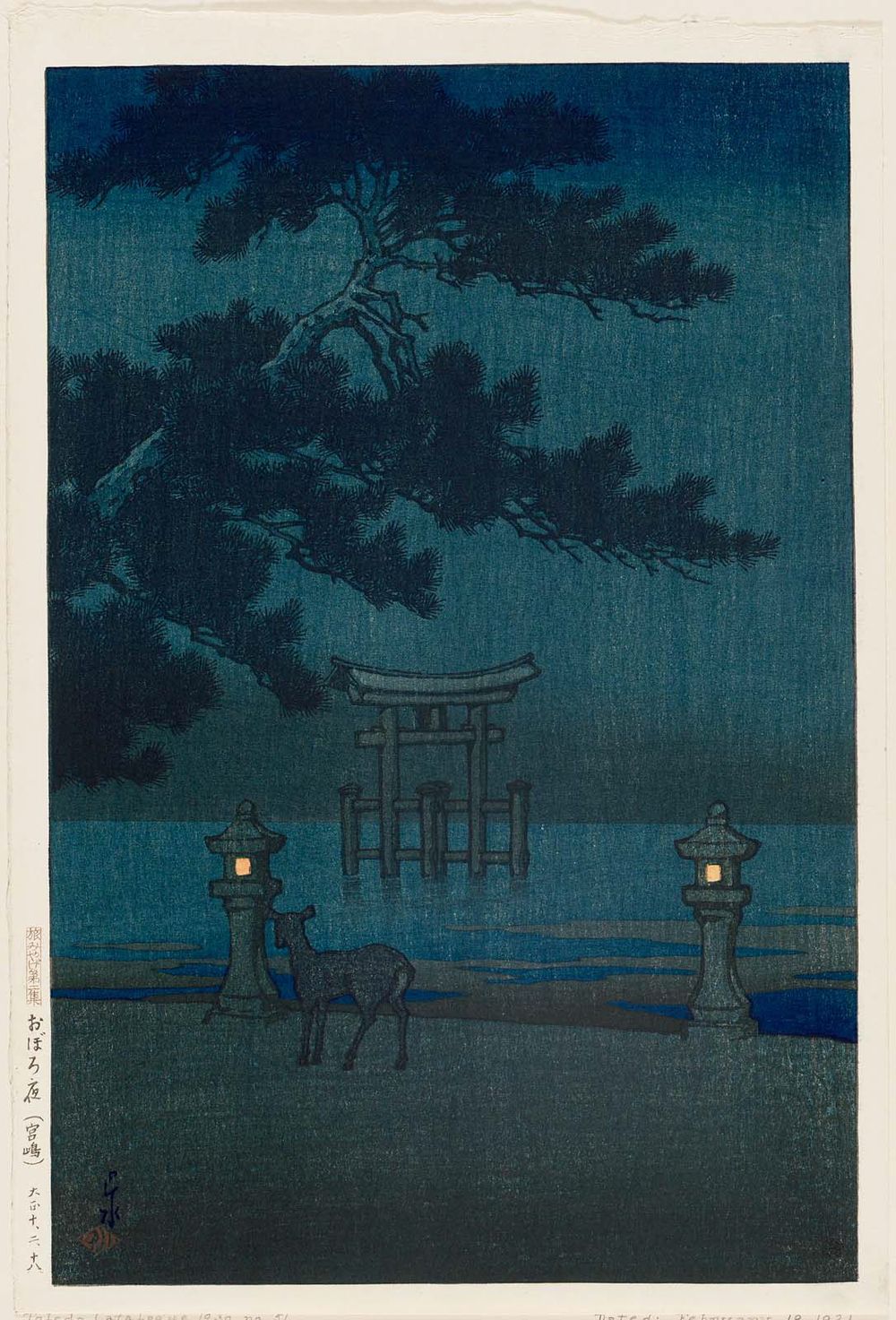
Hiroshige and other print artists of the 1800s drew the gate again and again. Their pictures, sold cheaply all over Japan, are why every Japanese knew this view before the railway came.
The wooden rice scoops sold in every shop are the island's own invention. A monk here designed the shape about 1800, as something the islanders could make and sell to pilgrims.
Meanwhile in the world
Year
Here
Elsewhere
593
The year tradition gives for the first shrine
Muhammad is a young merchant in Mecca
1168
Kiyomori builds the shrine over the sea
Notre-Dame in Paris has been building for five years
1185
Kiyomori's clan is destroyed at the sea battle of Dan-no-ura
Saladin takes Jerusalem two years later
1241
The halls are rebuilt after two fires
Mongol armies ride into Poland and Hungary
1555
The battle of Itsukushima
Catholic and Protestant princes of Germany make peace at Augsburg
1587
Hideyoshi orders the hall on the hill
Mary, Queen of Scots, is beheaded
1875
The present gate is raised
Bizet's opera Carmen is first performed
1945
The atomic bomb falls on Hiroshima, 20 kilometres away; the shrine is not harmed
The Second World War ends
1996
The shrine and Hiroshima's bombed dome join the World Heritage list together
The first cloned sheep, Dolly, is born
One line to remember: come twice, once with the sea in and once with the sea out.
Then and now
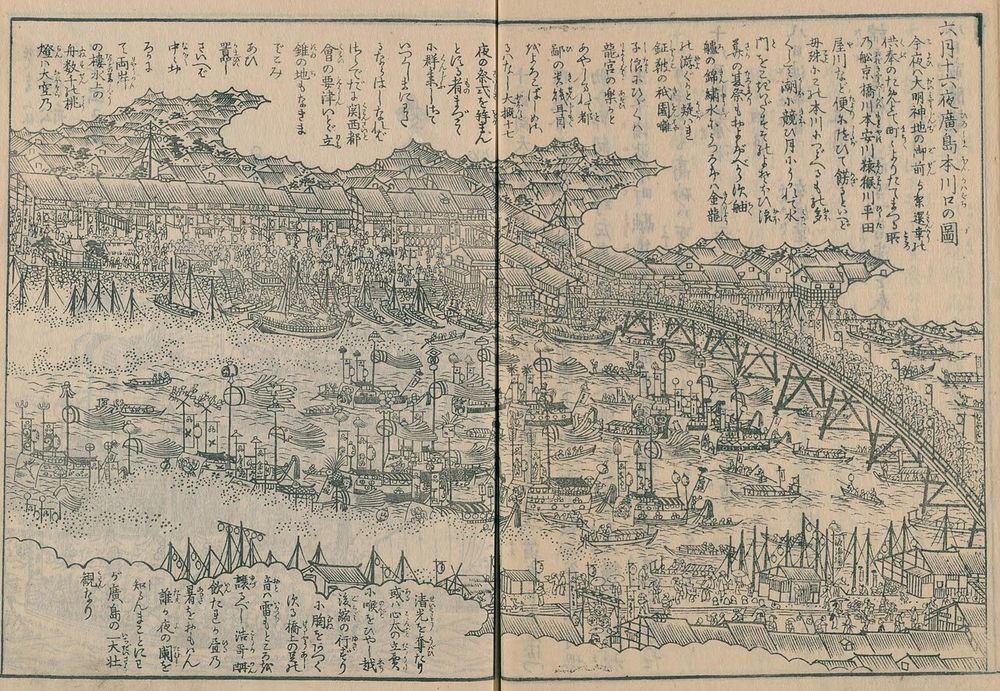
The shrine at high tide, July 2010Jakub Hałun, CC BY-SA 4.0, Wikimedia CommonsThe gate seen from inside the shrine at high tideJohnnyOneSpeed, CC BY-SA 3.0, Wikimedia CommonsThe great gate in the seaJordyMeow, CC BY-SA 3.0, Wikimedia CommonsThe gate and the mainland, December 2008Gilad Rom, CC BY 2.0, Wikimedia CommonsThe gate at sunset, August 2024Jakub Hałun, CC BY 4.0, Wikimedia CommonsThe gate from the shoreFattony12000, CC BY-SA 4.0, Wikimedia CommonsHigh water, November 2018Balon Greyjoy, CC0, Wikimedia CommonsLow tide: the six legs of the gateJosep M. Gracia, CC BY-SA 4.0, Wikimedia CommonsVisitors walk out at low tide, April 2019DXR, CC BY-SA 4.0, Wikimedia CommonsThe gate from the east at low tideDXR, CC BY-SA 4.0, Wikimedia CommonsThe roof, the sun mark and the posts of natural camphorBernard Gagnon, CC BY-SA 3.0, Wikimedia CommonsThe gate from the east corridor at low tide, spring 2019shankar s., CC BY 2.0, Wikimedia CommonsThe gate lit at nightJosep M. Gracia, CC BY-SA 4.0, Wikimedia CommonsThe island, the mountain and the ferriesNaokijp, CC BY-SA 4.0, Wikimedia CommonsThe island from the ferryそらみみ, CC BY-SA 4.0, Wikimedia CommonsThe corridors at low tide, August 2024Jakub Hałun, CC BY 4.0, Wikimedia CommonsThe shrine on its postsJakub Hałun, CC BY 4.0, Wikimedia CommonsThe west corridor from the shoreJakub Hałun, CC BY 4.0, Wikimedia CommonsThe shrine of the guest gods, with the gate beyondJakub Hałun, CC BY 4.0, Wikimedia CommonsThe shrine of the guest gods under its bark roofJakub Hałun, CC BY 4.0, Wikimedia CommonsThe east corridorJakub Hałun, CC BY 4.0, Wikimedia CommonsThe corridor and the mountain behindそらみみ, CC BY-SA 4.0, Wikimedia CommonsThe east corridor and the pagodaそらみみ, CC BY-SA 4.0, Wikimedia CommonsInside the corridor: gaps between the floorboardsImmanuelle, CC BY 4.0, Wikimedia CommonsThe main shrineJakub Hałun, CC BY 4.0, Wikimedia CommonsThe deck in front of the main shrineそらみみ, CC BY-SA 4.0, Wikimedia CommonsThe deck at low tideそらみみ, CC BY-SA 4.0, Wikimedia CommonsThe raised dance stage and its noticeRuinDig/Yuki Uchida, CC BY 4.0, Wikimedia CommonsA guardian lion-dog on the deckJakub Hałun, CC BY 4.0, Wikimedia CommonsThe Noh stage at low tideJakub Hałun, CC BY 4.0, Wikimedia CommonsThe Noh stage, built in 1680さかおり, CC BY-SA 4.0, Wikimedia CommonsThe arched bridge of 1557Jakub Hałun, CC BY 4.0, Wikimedia CommonsThe unpainted Tenjin shrine of 1556Jakub Hałun, CC BY 4.0, Wikimedia CommonsA mirror pond on the sandさかおり, CC BY-SA 4.0, Wikimedia CommonsThe five-storey pagoda in Novemberさかおり, CC BY-SA 4.0, Wikimedia CommonsThe pagoda of 1407Balon Greyjoy, CC0, Wikimedia CommonsInside Senjokaku: looking out between the pillarsKQuhen, CC BY-SA 4.0, Wikimedia CommonsA wild sika deer on the islandJakub Hałun, CC BY 4.0, Wikimedia CommonsThe Inland Sea from the top of Mount MisenJosep M. Gracia, CC BY-SA 4.0, Wikimedia CommonsA scroll of the scriptures given by Kiyomori's family in 1164Unknown, Public domain, Wikimedia CommonsBoats of the summer festival, from a guidebook of 1842岡田清編 , 山野峻峯斎画, Public domain, Wikimedia CommonsHiroshige, the festival at Itsukushima, 1853Utagawa Hiroshige, Public domain, Wikimedia CommonsHiroshige, Itsukushima on a fan printUtagawa Hiroshige, Public domain, Wikimedia CommonsThe gate about 1895Rijksmuseum, CC0, Wikimedia CommonsOhara Koson, moon and deer at Miyajima, about 1910Ohara Koson, Public domain, Wikimedia CommonsKawase Hasui, a hazy night at Miyajima, 1921Hasui Kawase, Public domain, Wikimedia Commons
Local legends
These are stories people tell about this place. They are legends, not history, and each one says where it comes from.
LegendThe founding
The three goddesses came by sea looking for a home. A man of the island named Saeki no Kuramoto guided them round the shore in his boat until they chose this bay, in the year 593. A crow flew ahead to show the way.
Source: The shrine's own account, in records of the 1100s and later
LegendKiyomori's dream
While Kiyomori was repairing a temple on Mount Koya, an old monk appeared and told him that if he rebuilt the shrine of Itsukushima he would rise to the highest rank. The monk then vanished. He was the saint Kukai.
Source: The Tale of the Heike
LegendThe setting sun
Kiyomori wanted a channel cut finished before nightfall. He stood on the shore, raised his fan and called the sinking sun back up the sky. It rose, and the work was done.
Source: Local tradition of the Inland Sea, attached to the Ondo strait near Kure
LegendThe fire on the mountain
The saint Kukai lit a fire on Mount Misen in 806 and it has burned ever since. Water boiled over it cures all illness. The flame in the Peace Park in Hiroshima was lit from it.
Source: Tradition of Daisho-in temple; the lighting of the Peace Flame from it in 1964 is a fact
Later, people who live here will be able to add the stories they grew up with, and say which of these they have heard.
Not certain, and where accounts conflict
Was the shrine founded in 593?
The date comes from the shrine's tradition. The first mention in a dated document is from 811. Nothing is known of what stood here before Kiyomori.
Why is it built over the sea?
The usual answer is respect for the holy island. Some historians add that Kiyomori's wealth came from sea trade with Song China, and that a shrine in the water was a statement about where his power lay. Both may be true.
How many gates have there been?
The shrine counts the present gate as the eighth or ninth since Kiyomori's time. The records of the earlier ones are not complete.
How many tonnes of stones are in the gate?
Figures from four to seven tonnes are printed. We give "several".
Visiting
Tickets and hours
The shrine is 300 yen for adults. A joint ticket with the treasure hall is 500 yen.
It opens at 6:30. It closes at 18:00 from March to mid-October, at 17:30 from mid-October to the end of November and in January and February, and at 17:00 in December.
Senjokaku asks 100 yen. The cable car up Mount Misen is 2,000 yen return, and the last car down leaves well before the shrine closes.
Works in 2026: the pagoda is under repair until 20 December and part of the east corridor is being strengthened until December. The gate is clear.
Last checked 2026-11-12. The shrine's published fees and hours and the Miyajima tourist association, as reported by guides checked in 2026.
Booking from abroad
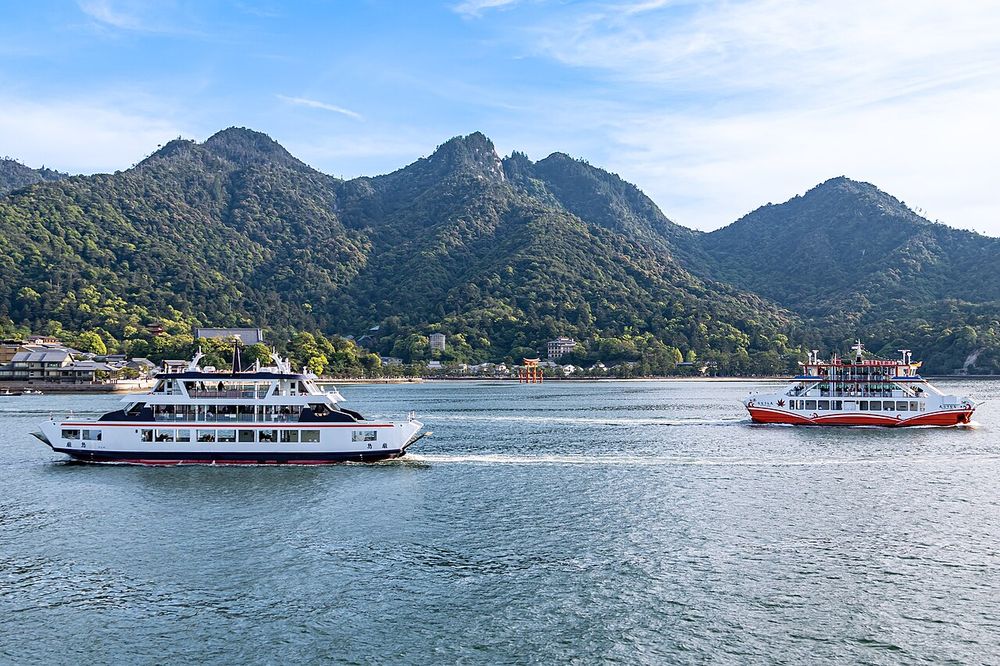
International booking platform The ferry from Miyajimaguchi takes ten minutes and runs every fifteen minutes or so through the day. Tickets come from machines at the pier. Of the two companies, the JR ferry accepts the Japan Rail Pass. Since October 2023 a visitor tax of 100 yen is added to each crossing to the island.
Note Nothing needs booking. You pay at the shrine entrance on the day and no document is asked for. Bring cash.
Checked 2026-11-12
Where to start
Look up the tide for Hiroshima port for your day. Above 250 centimetres the shrine and gate look afloat. Below 100 centimetres you can walk to the gate.
From Hiroshima station, the JR train to Miyajimaguchi takes 25 minutes. The tram takes an hour and costs less. The ferry pier is across the road.
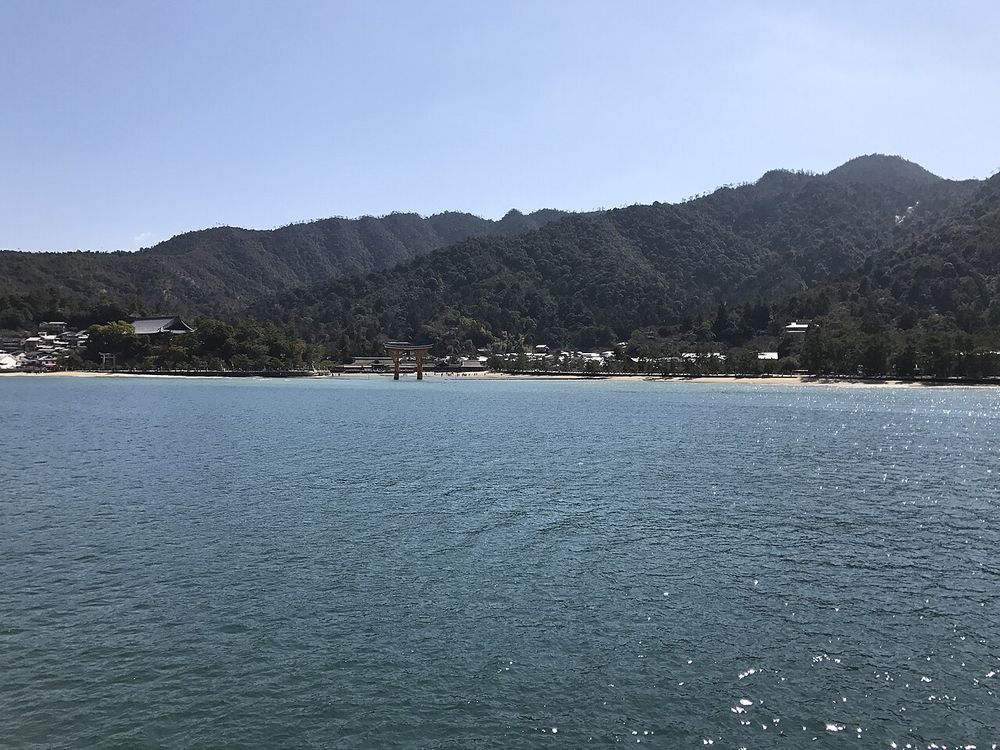
On the ferry, stand on the right-hand side going over. The boat passes in front of the gate.
From the island pier, walk ten minutes along the shore to the shrine. Go through the shrine, then up to the pagoda, then back along the shopping street.
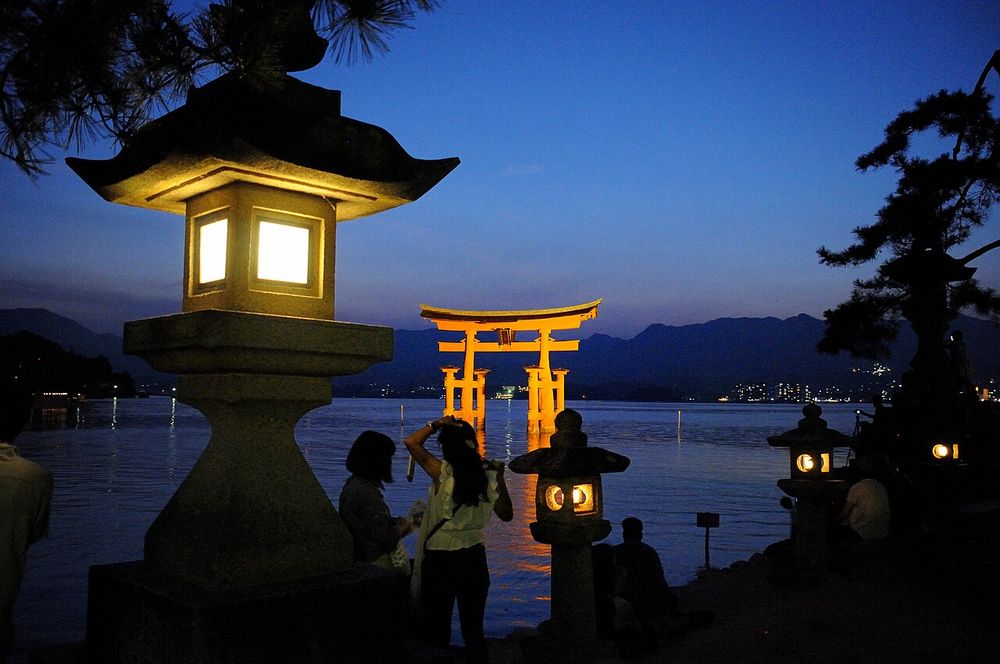
If you can, stay to see both tides, or stay the night. After the last day-trippers leave, the gate is lit until eleven.
Before you go
The deer take paper and food from hands and bags. Keep tickets and maps in a closed pocket.
The sand near the gate is wet and has sharp oyster shells. Wear shoes you do not mind getting dirty.
The corridors have low steps but no stairs. A wheelchair can go round with help.
Customs and manners
This is a working shrine. If a ceremony or a wedding is under way, wait at the side and do not walk between the priests and the hall.
At the main hall: a coin, two bows, two claps, one bow.
Do not climb on the stages or sit on the corridor rails.
Do not push coins into the gate, and do not take stones or shells from under it.
Do not feed the deer.
Islanders still follow an old rule: there is no graveyard on the island. The dead are taken across to the mainland.
Look for these
How many legs does the gate have?
Find the sun on the roof of the gate. Where is the moon?
Look at the floor of the corridor. Can you see the sea through it?
Stand at the end of the pier. What three things are in one line?
Find the stage with a pine tree painted on its wall.
Find a bridge with no steps. Who was it for?
Find a hall with no red paint.
At low tide, find a pool on the sand that has not drained.
I am here
Stand at the site, sign in, press the button, and collect its stamp. Your browser will ask to use your location. It is sent to us once to confirm that you are at the site; we keep how far you were from it, not the spot where you stood.
Your stamps are saved to your account, so they follow you to any device. Checking from a browser cannot rule out every false location; stricter checks arrive with the app.
Messages
Share your photos
Photos here show the place, not people. Each one is credited to the visitor who took it and appears after our team has looked at it. A photo with you in it belongs under “I am here”.