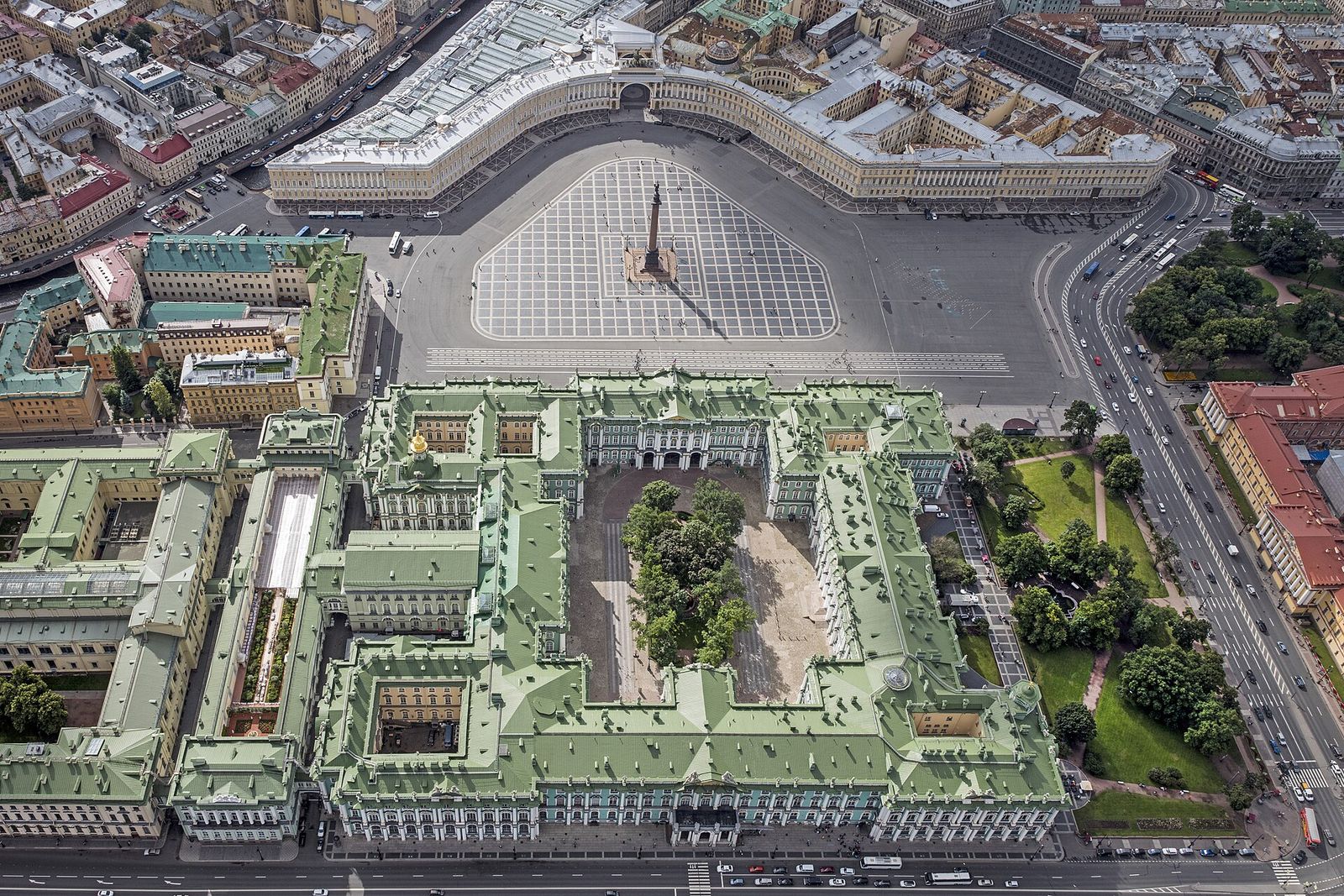
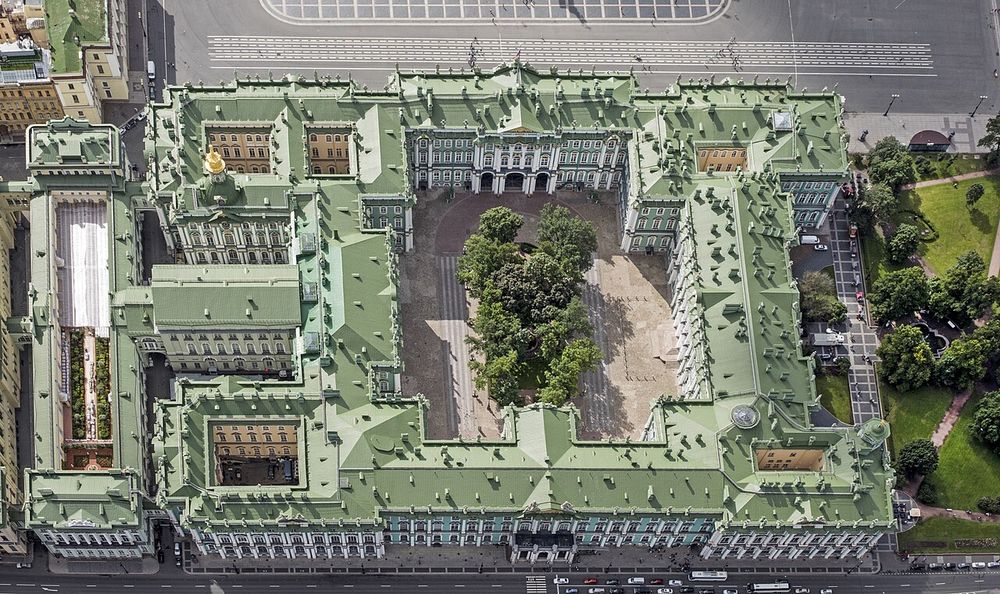
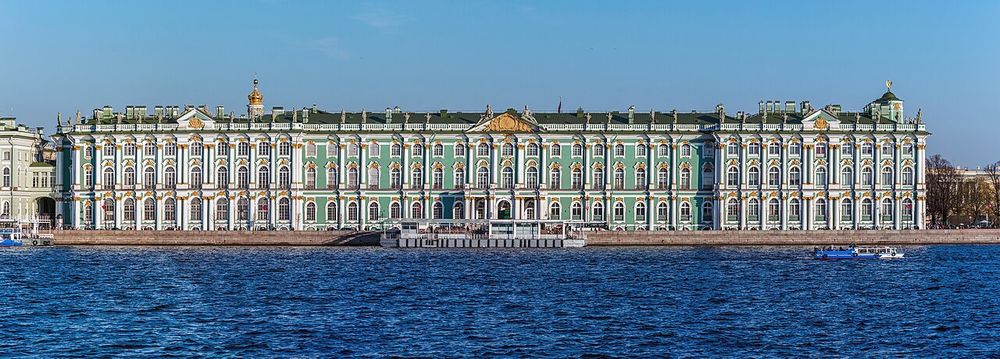
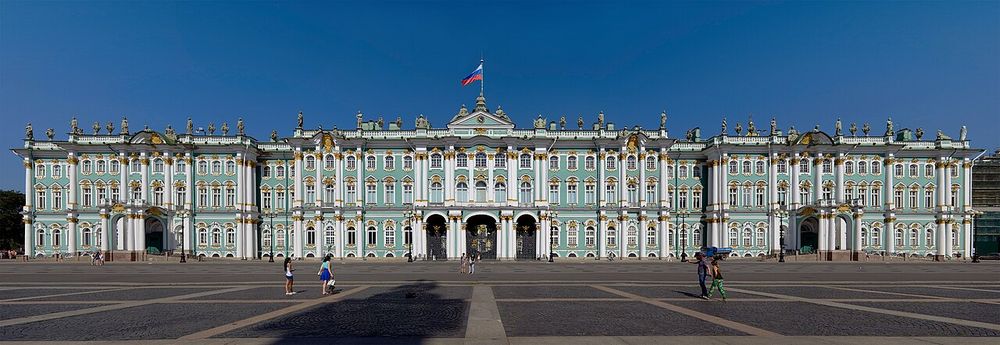
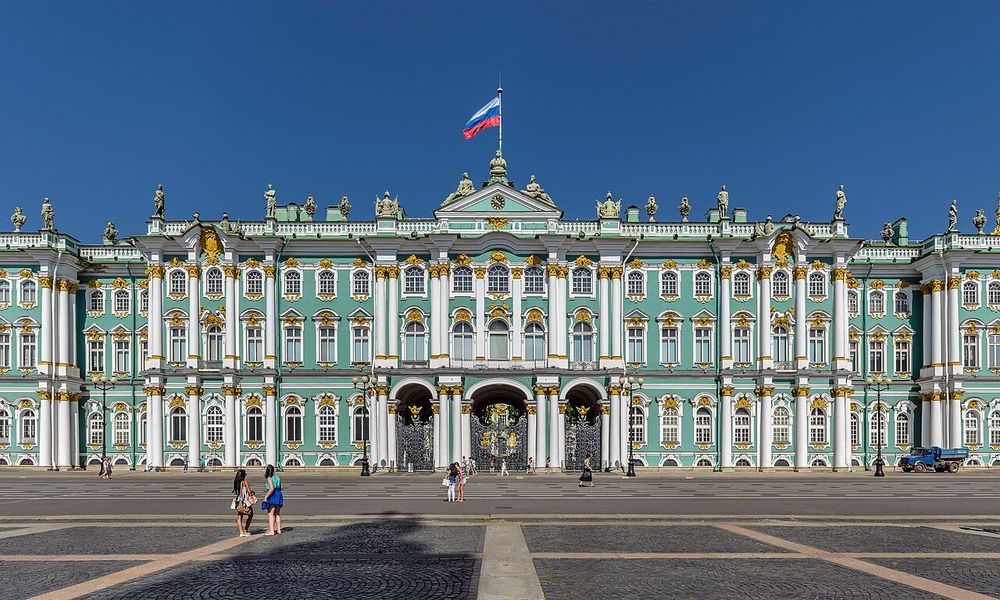
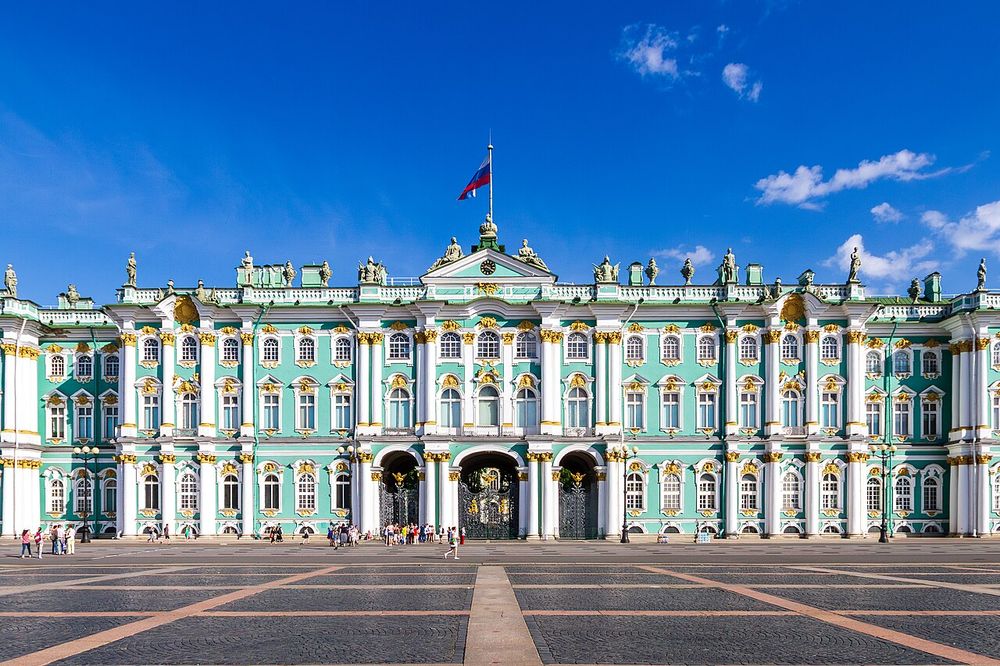
The green and white Winter Palace of the tsars on the Neva, with four more buildings behind it, holding some three million objects. Catherine the Great began the collection in 1764 as her private retreat, her "hermitage". In 1917 the revolution came through its doors, and in the siege of 1941–44 its keepers lived in its cellars and guarded empty frames.
Photo: Godot13, CC BY-SA 4.0, Wikimedia Commons
The story
The Winter Palace was built in 1754–1762 for Empress Elizabeth by the Italian architect Bartolomeo Rastrelli: some fifteen hundred rooms behind a front two hundred metres long on the river. Her successor Catherine II bought 225 paintings from a Berlin merchant in 1764, and kept buying. She built a smaller palace next door to hold them, and called it her hermitage.
Only "mice and I admire all this," she wrote. In 1852 Nicholas I opened a new building to the public. In 1917 the palace became a museum, and today the State Hermitage spreads over the Winter Palace, three Hermitage buildings, a theatre, and the General Staff Building across the square.
What is here
One ticket for the Main Museum Complex covers the Winter Palace and the Small, Old and New Hermitage, with all temporary exhibitions. The General Staff Building (Impressionists and modern art) has its own ticket. The museum also runs other sites in the city.
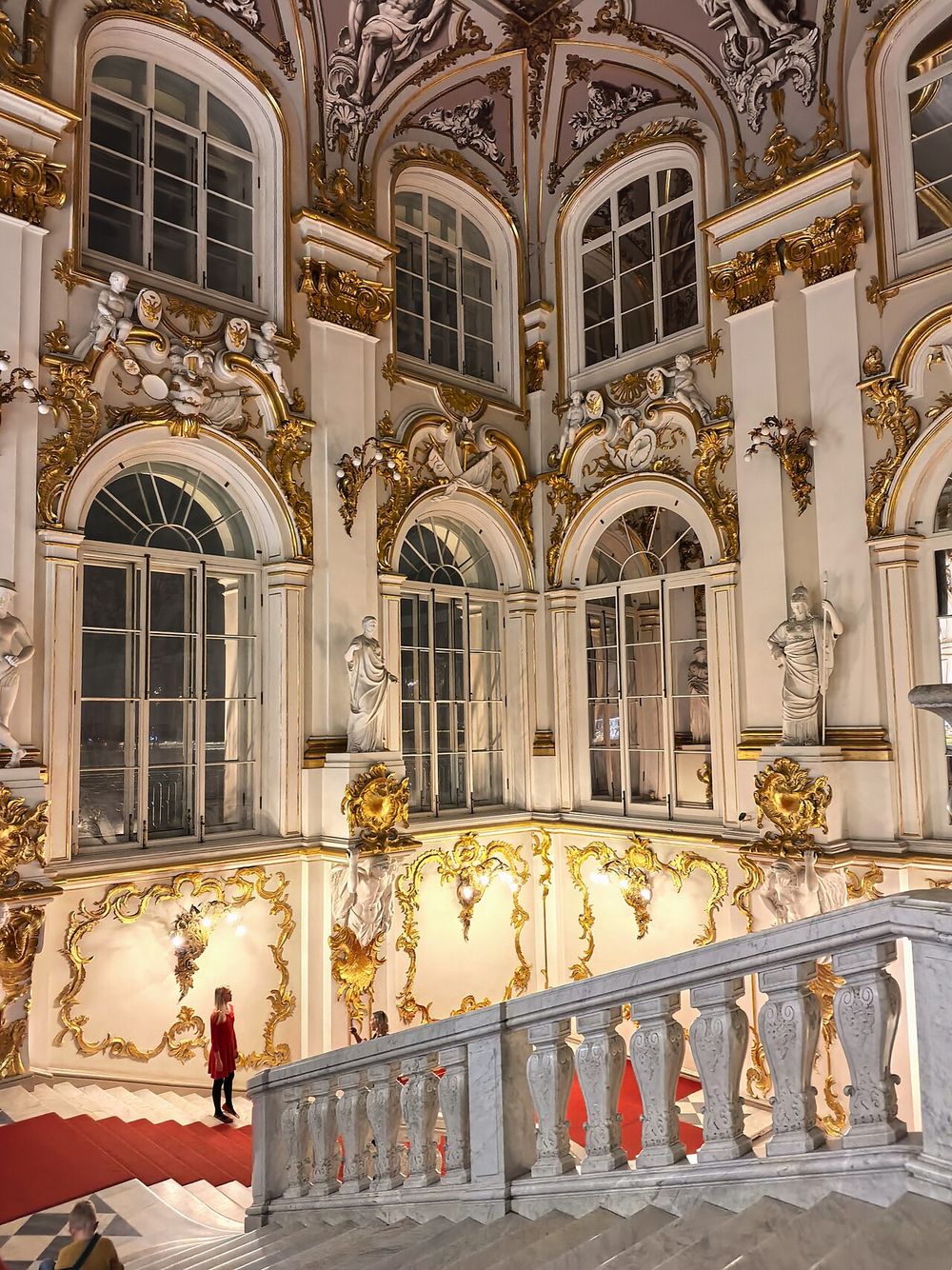
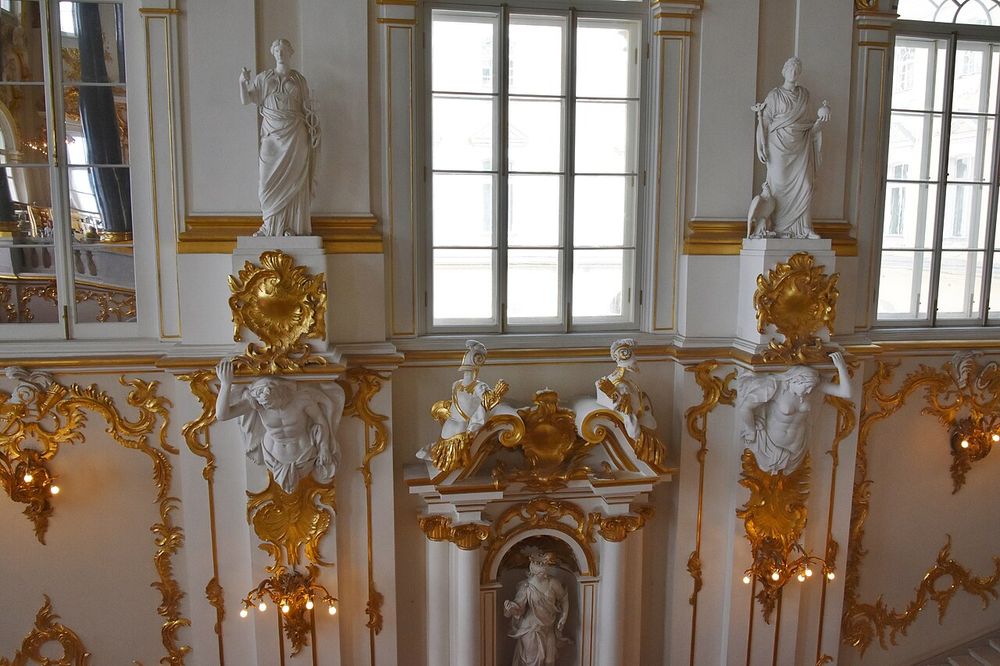
The Jordan Staircase, 2026Александровы АГ, CC BY-SA 4.0
You came up the white and gold state staircase. It is named for the Epiphany procession that went down it each January to bless the waters of the Neva through a hole in the ice.
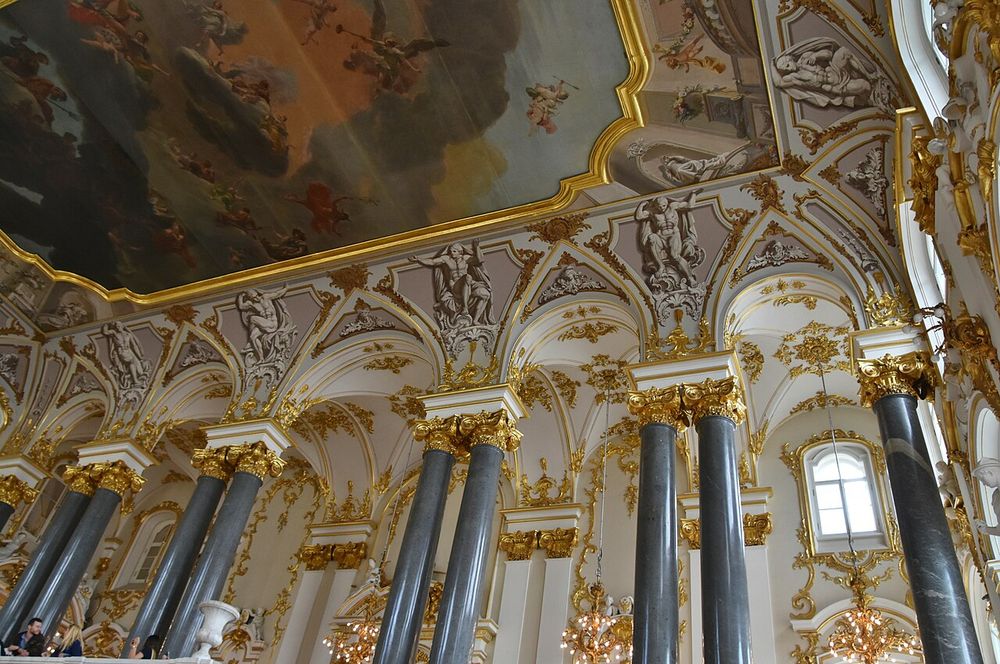
Burned in the fire of 1837, it was rebuilt in two years exactly as before. The ceiling shows the gods of Olympus.
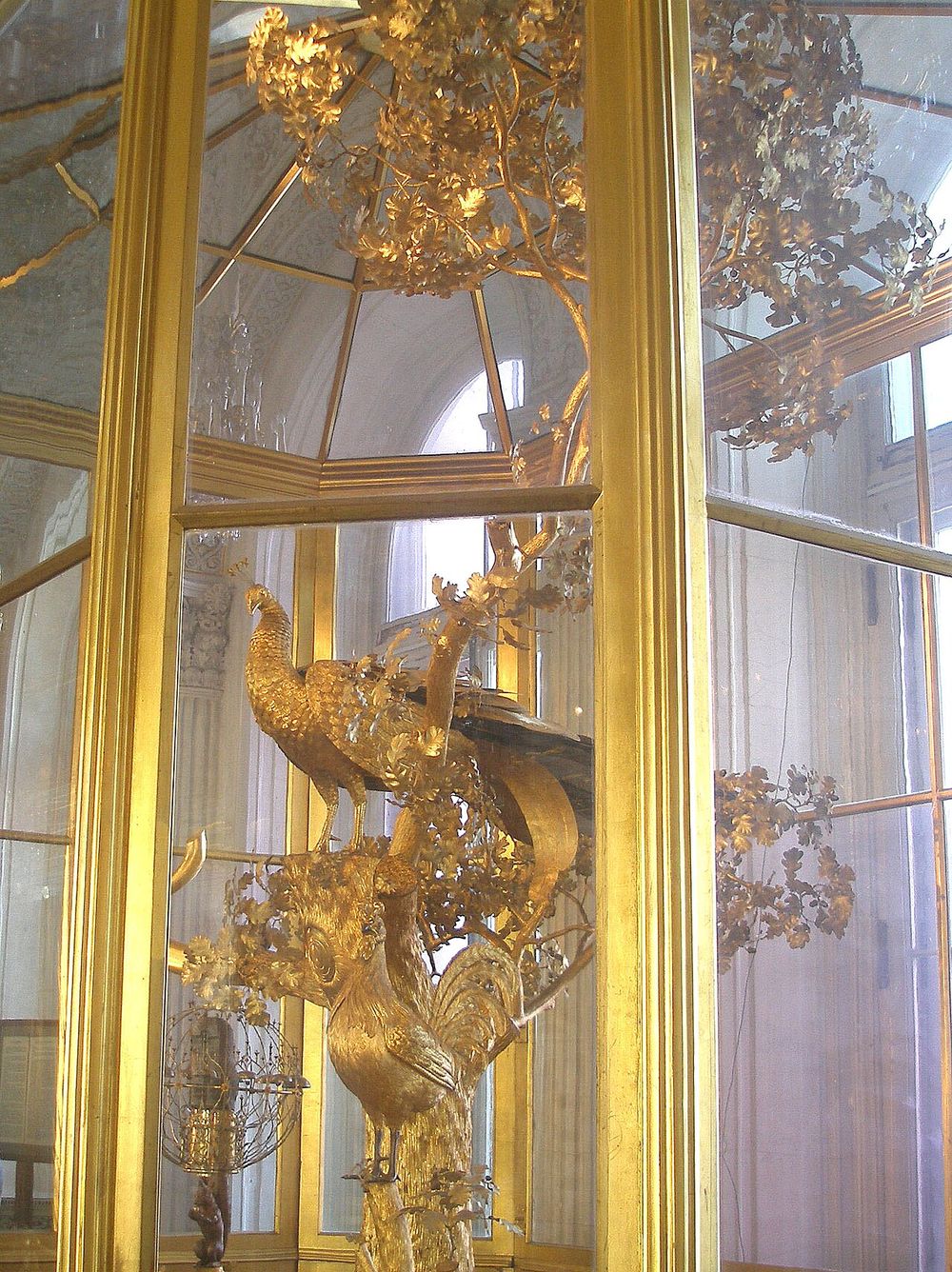
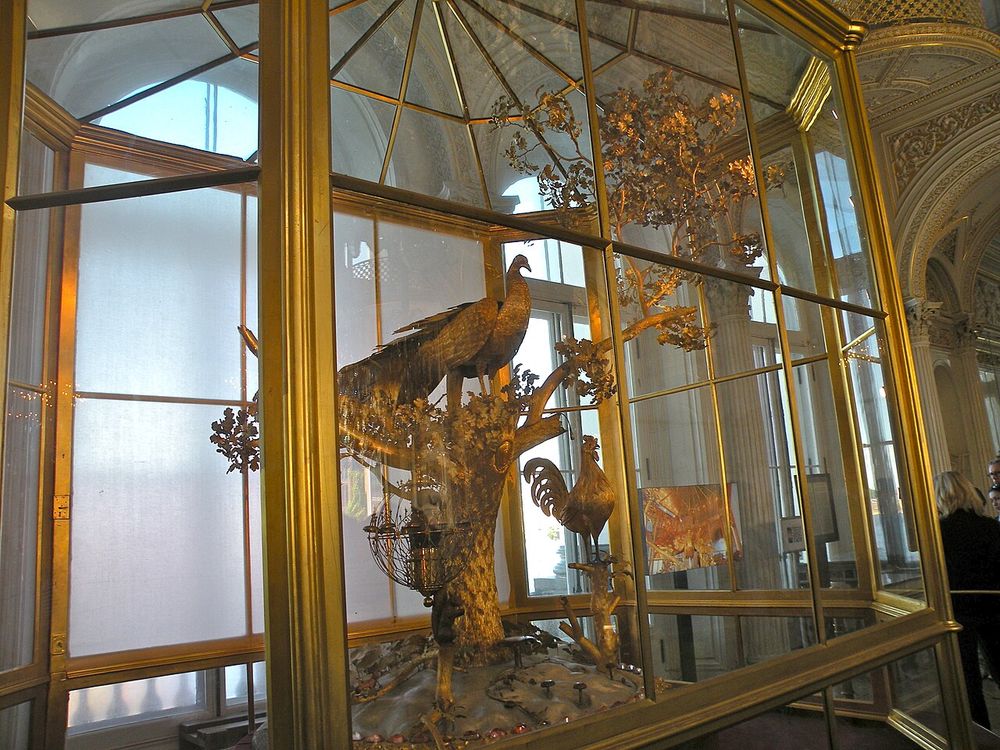
The Peacock ClockVolkov, Public domain
Ask for the Pavilion Hall, in the Small Hermitage. A golden peacock, an owl and a cockerel sit in a cage of gilded branches. The clock was made in London by James Cox and bought by Prince Potemkin for Catherine in 1781. It still works.
Things people often get wrong
"The Hermitage is a single palace." It is six main buildings linked together, and the visitor sees only part of them.
"You can see it in a day." Walking every room would take days. Choose: the state rooms, the Italian and Dutch painting, and one other collection.
"The storming of the Winter Palace was a great battle." Most of the famous images are from Eisenstein's film October of 1928 and a mass re-enactment of 1920. On the night of 25–26 October 1917 the palace was taken with few deaths.
"The Impressionists are in the palace." Matisse, Picasso and the Impressionists are in the General Staff Building across Palace Square, entered by the same ticket.
People who stood here
We searched Russian, Chinese and English sources for this list.
Catherine II, the Great (empress of Russia 1762–1796)A German princess who took the throne from her husband, she bought whole collections across Europe and corresponded with Voltaire. The museum counts its birthday from her first purchase.
Bartolomeo Rastrelli (Italian architect)He gave St Petersburg its baroque: the Winter Palace, the Smolny Convent, the Catherine Palace at Tsarskoye Selo.
Denis Diderot (French philosopher)Catherine bought his library to give him money, and paid him to keep it. In 1773–74 he spent five months in St Petersburg talking with her almost every afternoon.
Alexander Pushkin (Russia's national poet)As a junior courtier from 1834 he had to attend balls in the Winter Palace with his wife, Natalia, which he hated. His duel was fought three years later.
Alexander Kerensky (head of the Provisional Government)The Provisional Government met in the Winter Palace in 1917. Kerensky left before the night of 25 October; his ministers were arrested in the small dining room after two in the morning.
Iosif Orbeli (director during the siege)In 1941 he sent over a million objects east by train and stayed with his staff through the siege, in the cellars. In 1946 he gave evidence at Nuremberg about the shelling of the museum.
Alexander Sokurov (Russian film director)His film Russian Ark (2002) is one unbroken shot of about ninety minutes through thirty-three rooms of the Winter Palace and three centuries of Russian history.
Go deeper: eight stops, from the Jordan Staircase to the Tangut treasures
Enter from Palace Square through the courtyard. Pick up a map. These eight stops take about three hours.
1. Palace Square
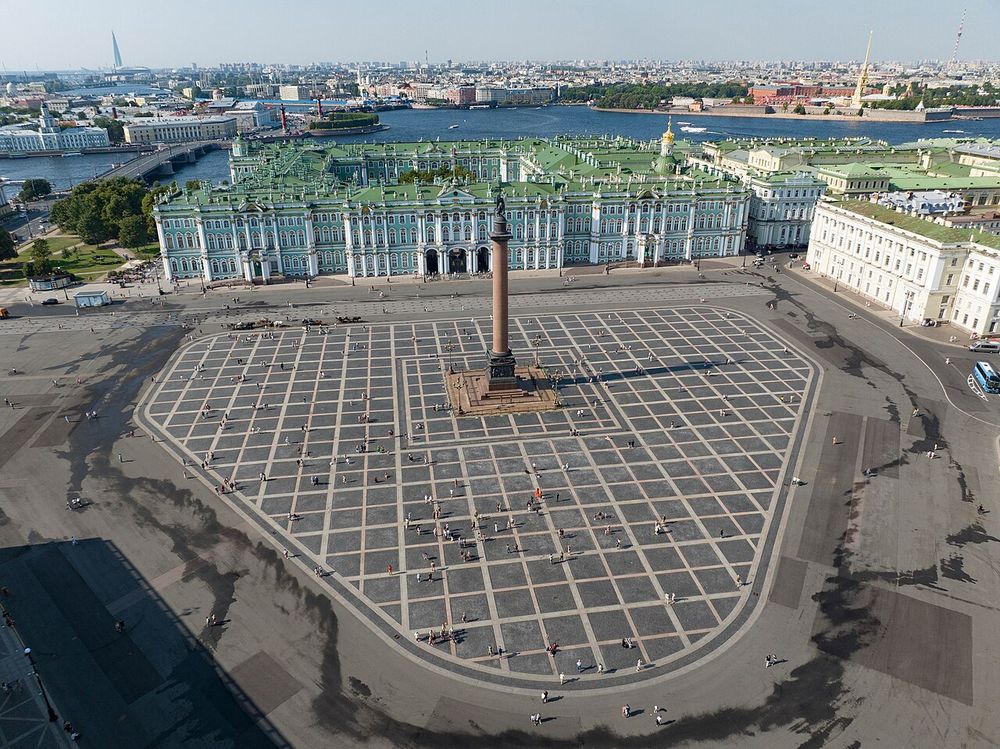
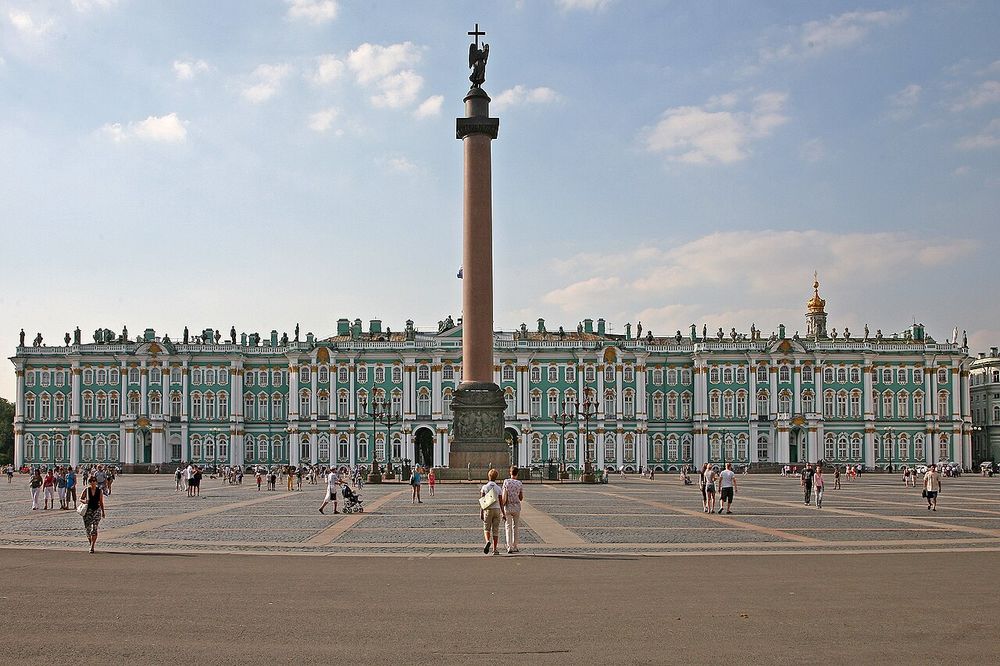
Palace Square from aboveNikolai Bulykin, CC BY-SA 4.0
The square is closed by the curved yellow General Staff Building with its triumphal arch. In the middle stands the Alexander Column, 47 metres high. Its red granite shaft is a single stone, held in place only by its own weight. It celebrates the victory over Napoleon.
2. The Jordan Staircase and the state rooms
The staircase ceilingRichard Mortel from Riyadh, Saudi Arabia, CC BY 2.0
Beyond the staircase is a chain of great halls on the Neva side: the Field Marshals' Hall, the Armorial Hall, the Great Throne Room of St George. They were built for receptions of two or three thousand guests.
Gold and white on the staircaseRichard Mortel from Riyadh, Saudi Arabia, CC BY 2.0
Here, at the end of Russian Ark, a ball ends and the guests stream down the Jordan Staircase. Photography without flash is allowed: stand at the top of the stair, looking down the flight, and take the same picture.
3. The Military Gallery of 1812
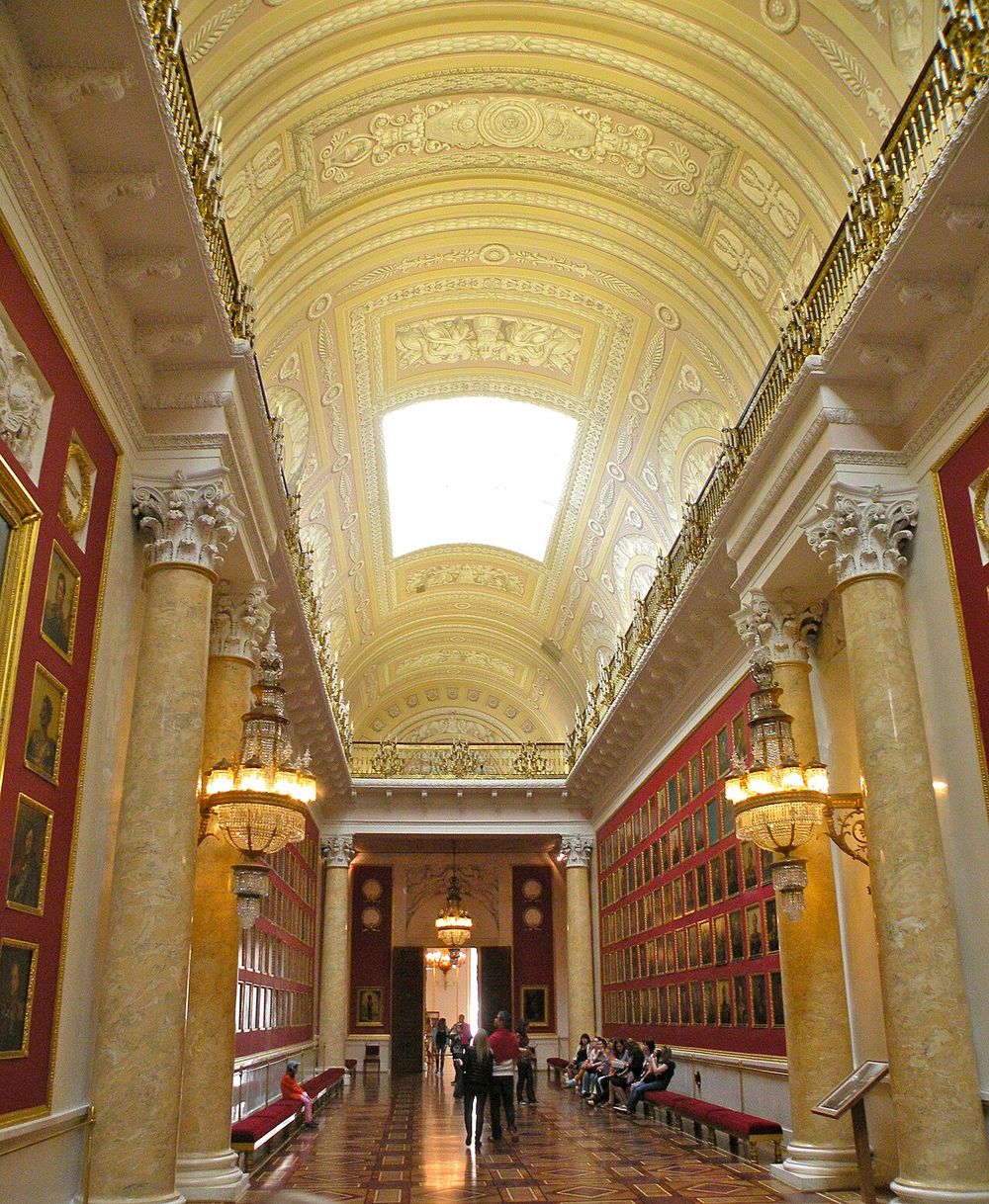
The Military Gallery of 1812Chatsam, CC BY-SA 3.0
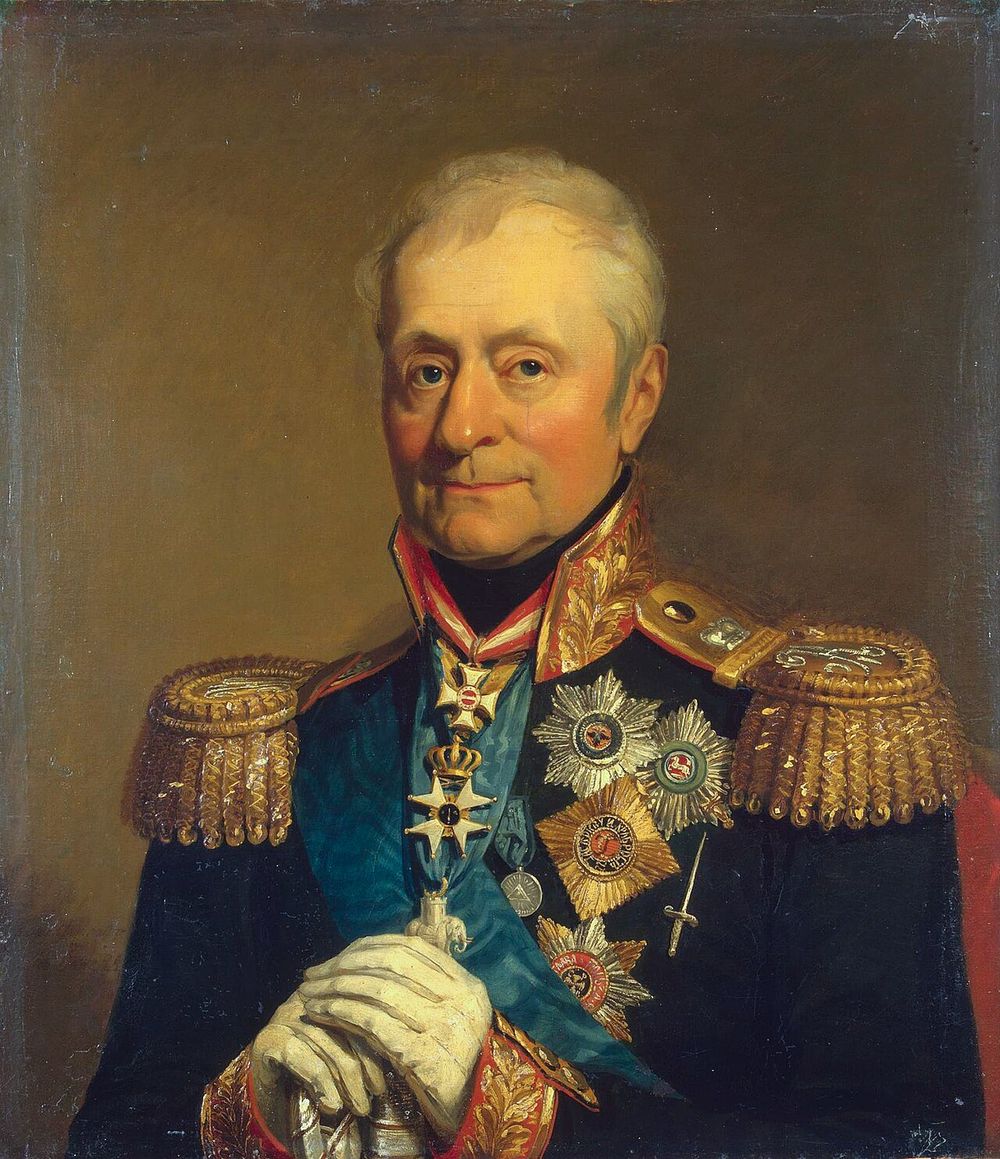
A long gallery hung with 332 portraits of the generals who fought Napoleon, most painted by the Englishman George Dawe and his assistants. Some frames are empty, with only a name: the generals had died and no portrait of them could be found.
A general's portrait of the kind in the Military Galleryxiquinhosilva, CC BY 2.0
4. The Malachite Room and the small dining room
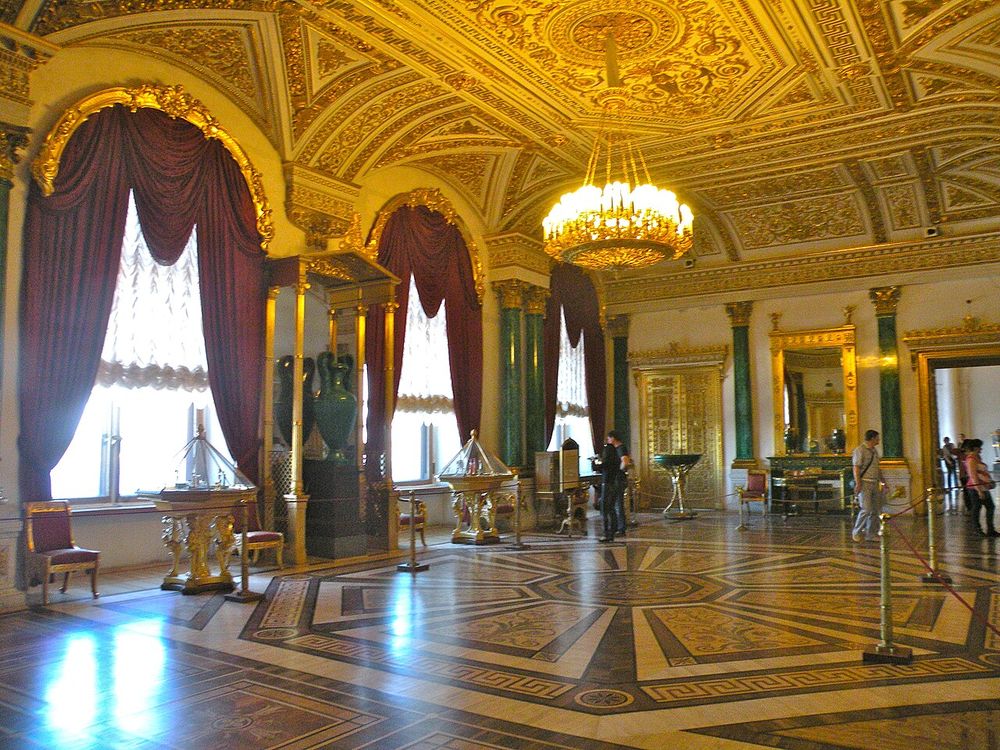
The Malachite RoomChatsam, CC BY-SA 3.0
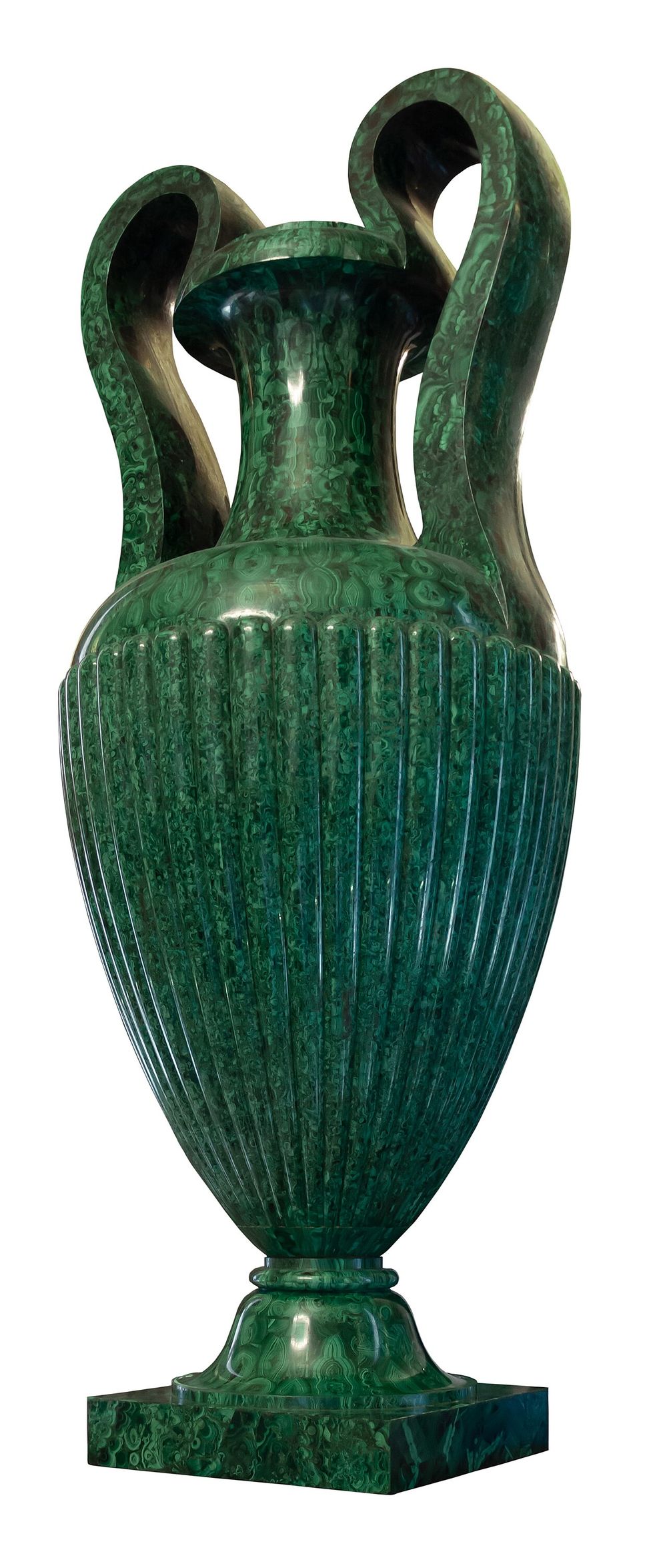
Columns, pilasters and vases faced with green malachite from the Urals, two tonnes of it. Here the Provisional Government held its last meetings in October 1917. Next door, in the small dining room, its ministers were arrested; the clock on the mantel was stopped at 2:10.
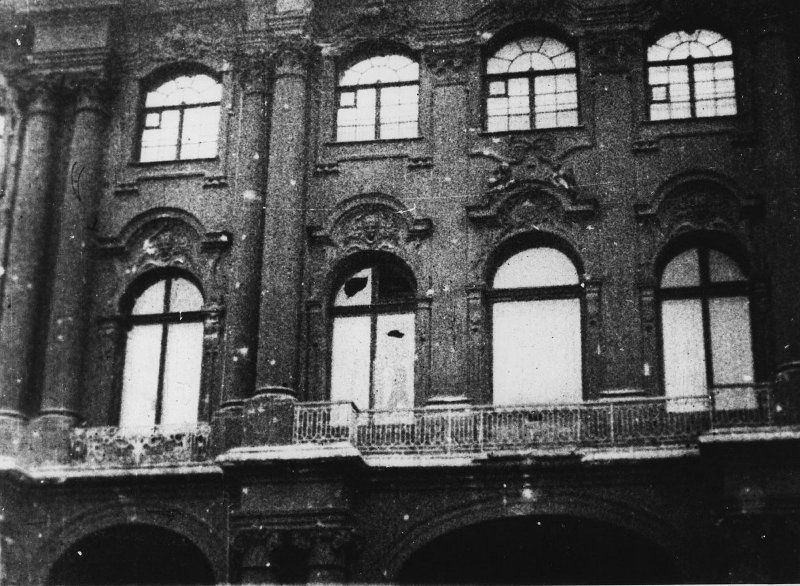
The palace front on the morning of 26 October 1917Pyotr Novitsky, Public domain
5. The Pavilion Hall and the Peacock Clock
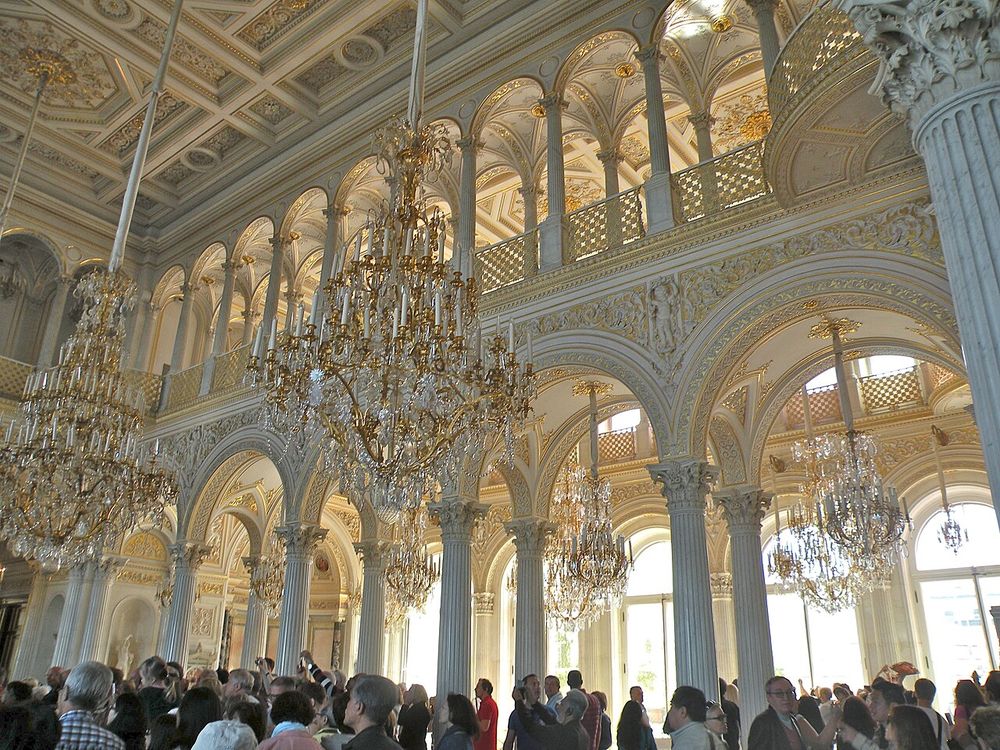
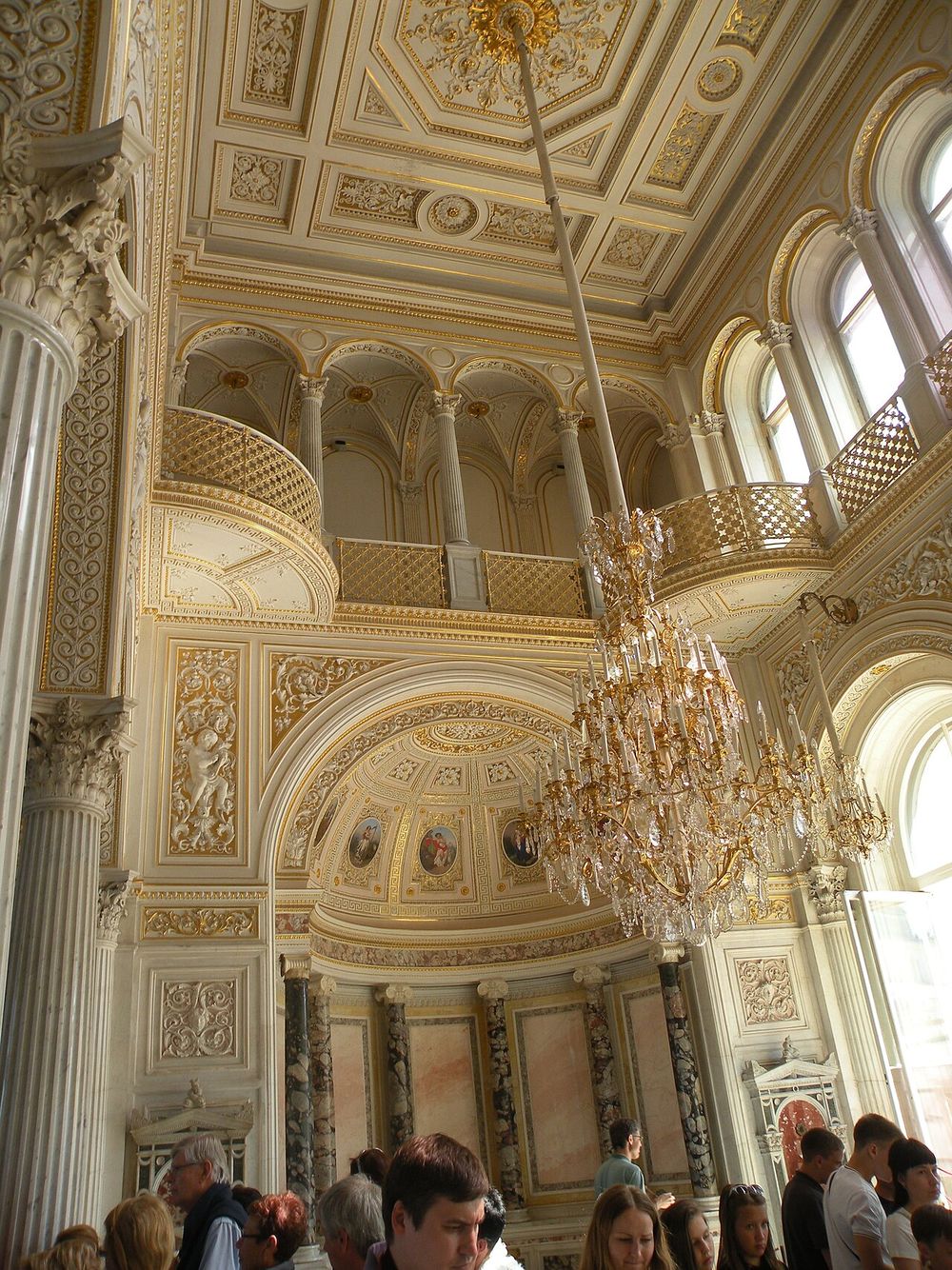
The Pavilion HallChatsam, CC BY-SA 3.0
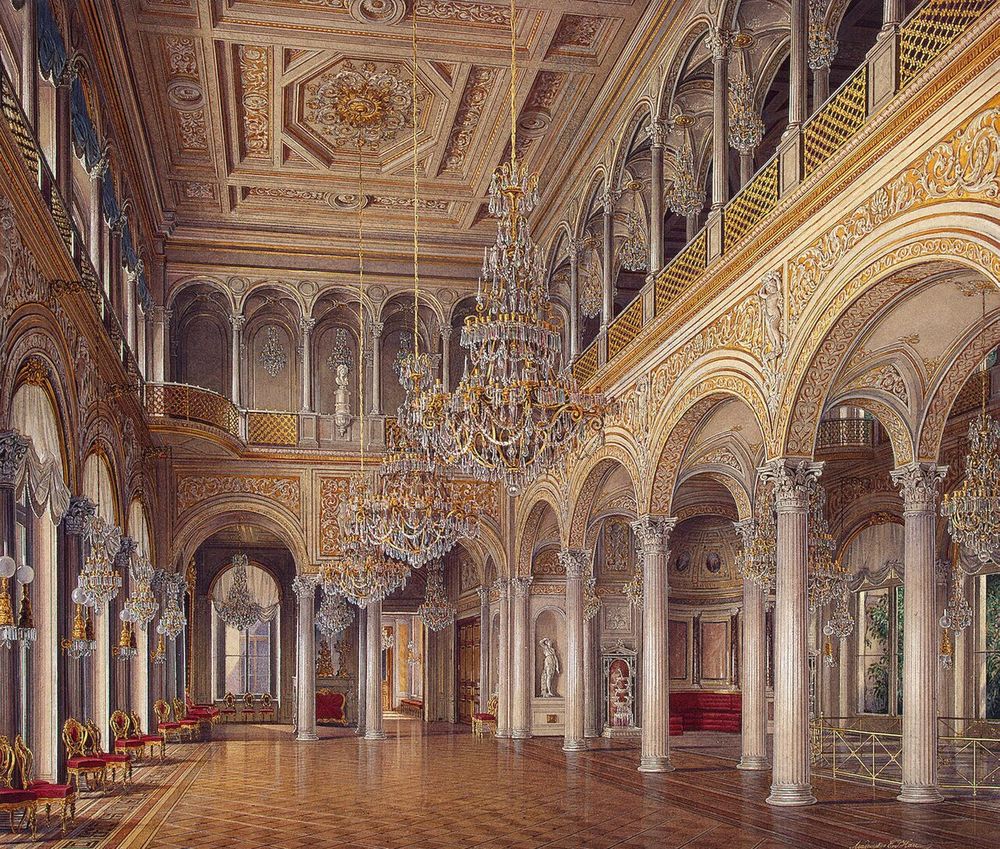
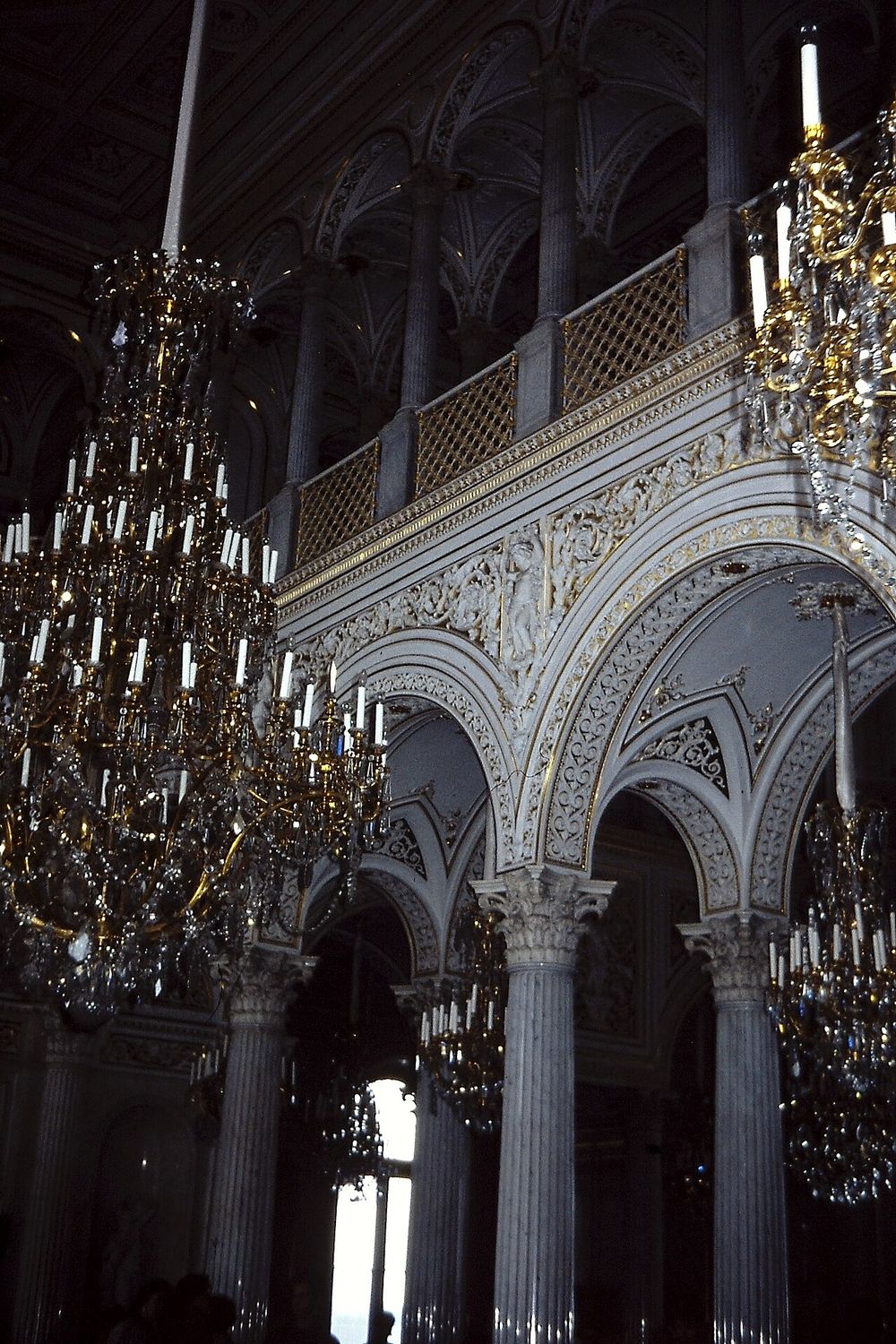
White marble, gold and crystal chandeliers in a Moorish and Renaissance mix of the 1850s. Mosaic in the floor copies one found in a Roman bath. Look out of the windows: the hanging garden is on the first floor.
The peacock, the owl and the cockerelChatsam, CC BY-SA 3.0
The Peacock Clock is wound and set going once a week; the museum announces when. The peacock spreads its tail, the owl turns its head and the cock crows. The dial is in a mushroom at the bottom.
6. Leonardo and Rembrandt
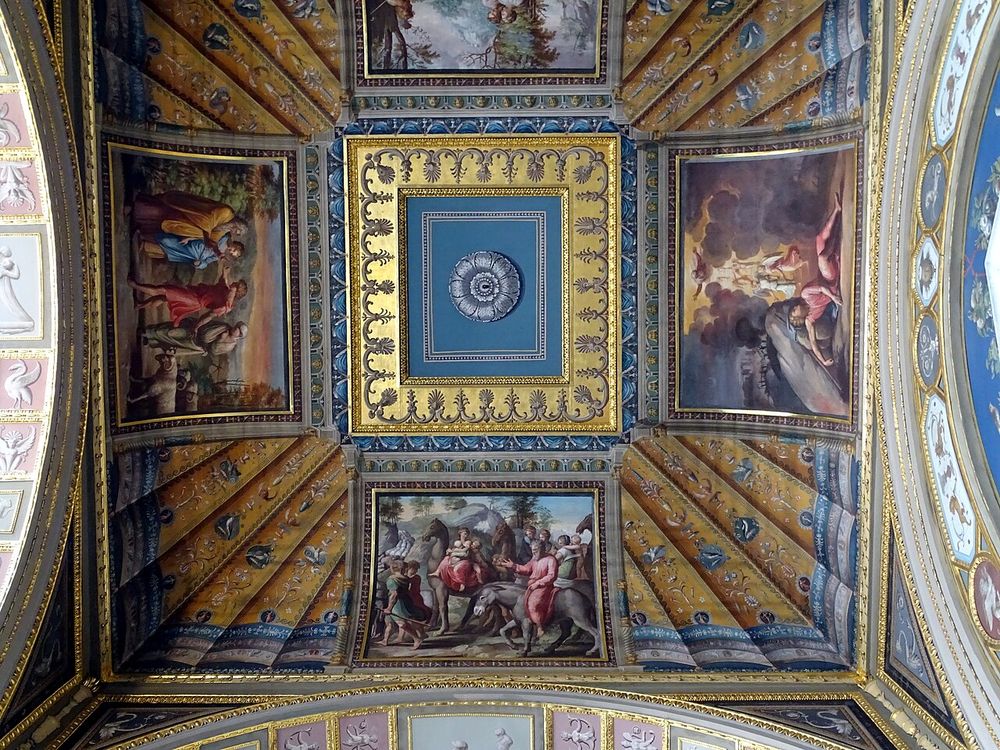
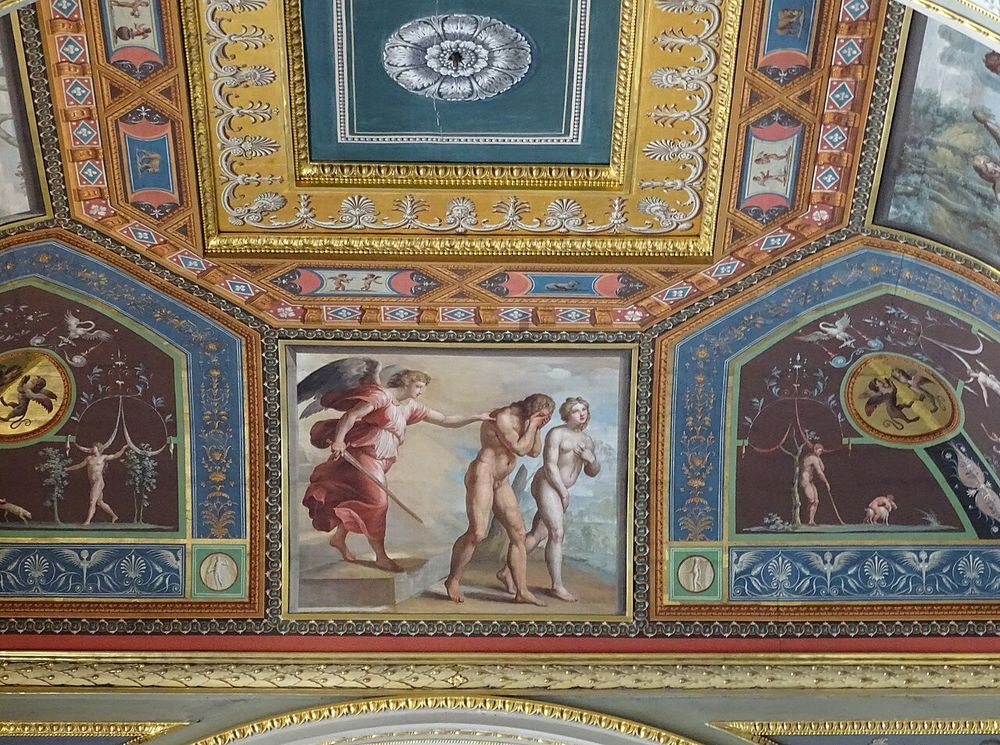
The ceiling of the Raphael LoggiasAd Meskens, CC BY-SA 4.0
The Raphael Loggias are a copy, made for Catherine, of the painted corridor in the Vatican. Nearby are two small paintings by Leonardo da Vinci, the Benois Madonna and the Madonna Litta. Fewer than twenty paintings by him survive in the world.
The Rembrandt room holds The Return of the Prodigal Son, painted near the end of his life. The father's two hands on the kneeling son are different: one broad, one fine. His Danaë, nearby, was attacked with acid and a knife in 1985 and took twelve years to restore.
7. The Tangut treasures and Chinese art
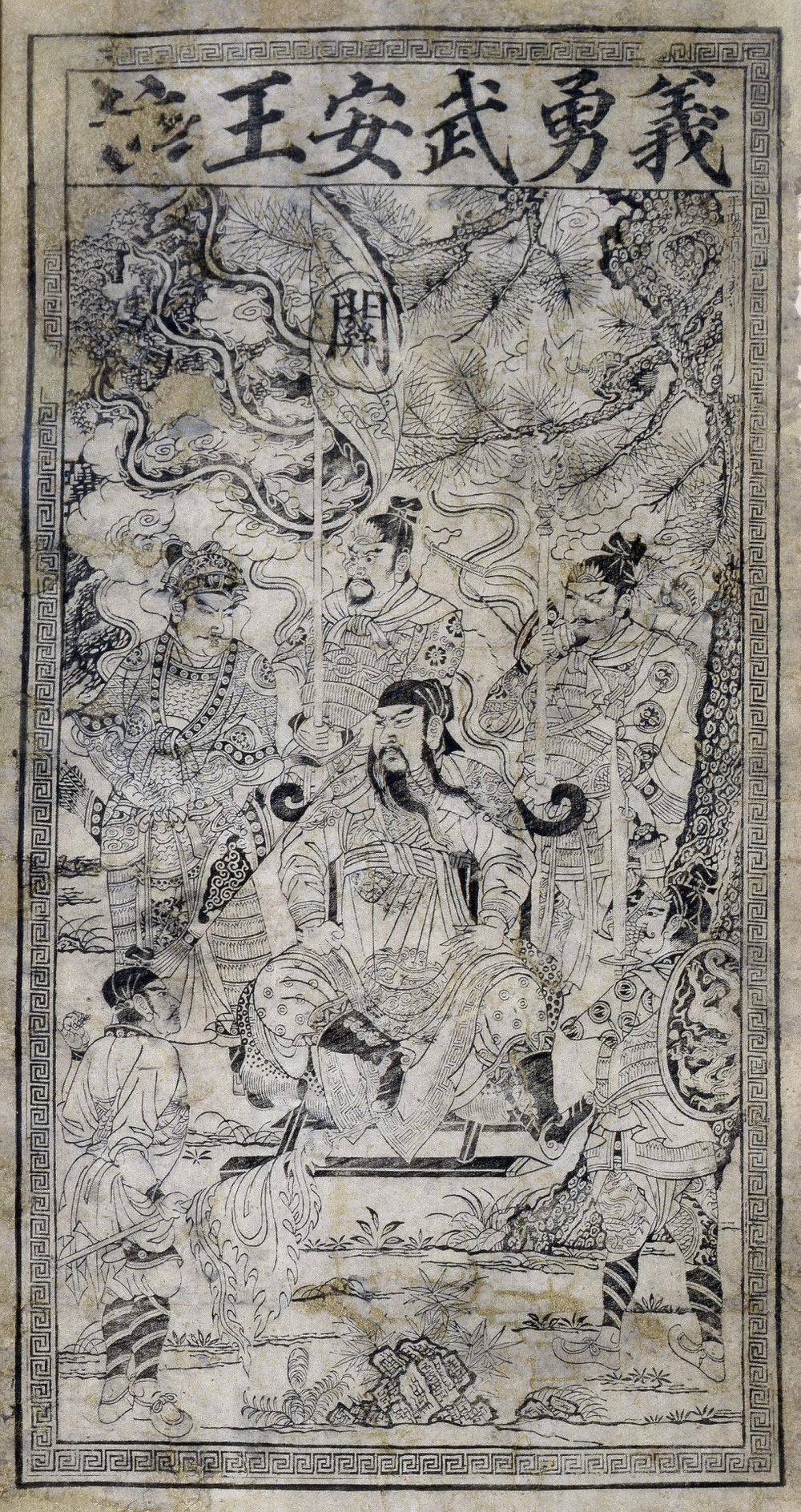
Guan Yu, a woodblock print of the Jin dynasty from Khara-KhotoUnknown authorUnknown author, Public domain
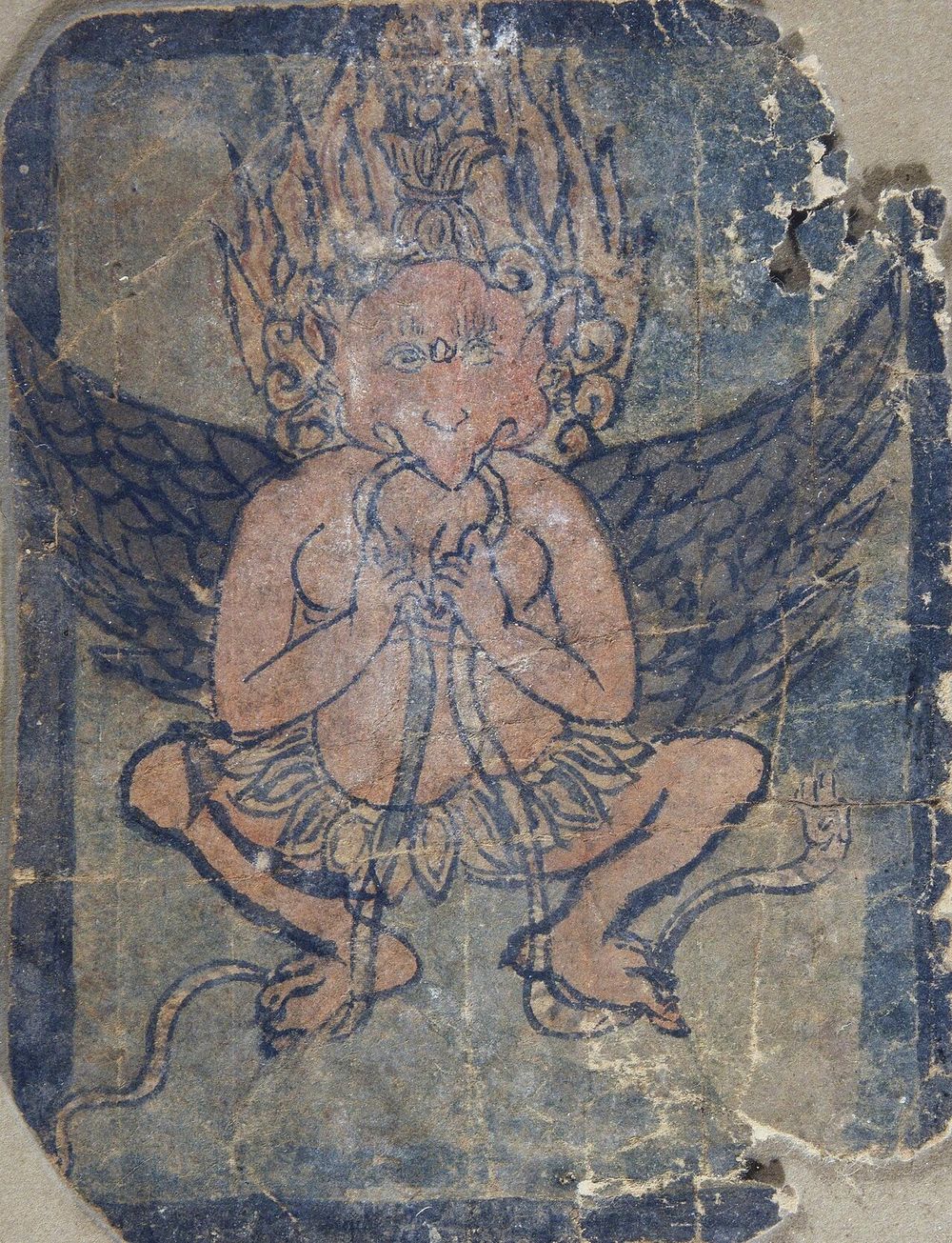
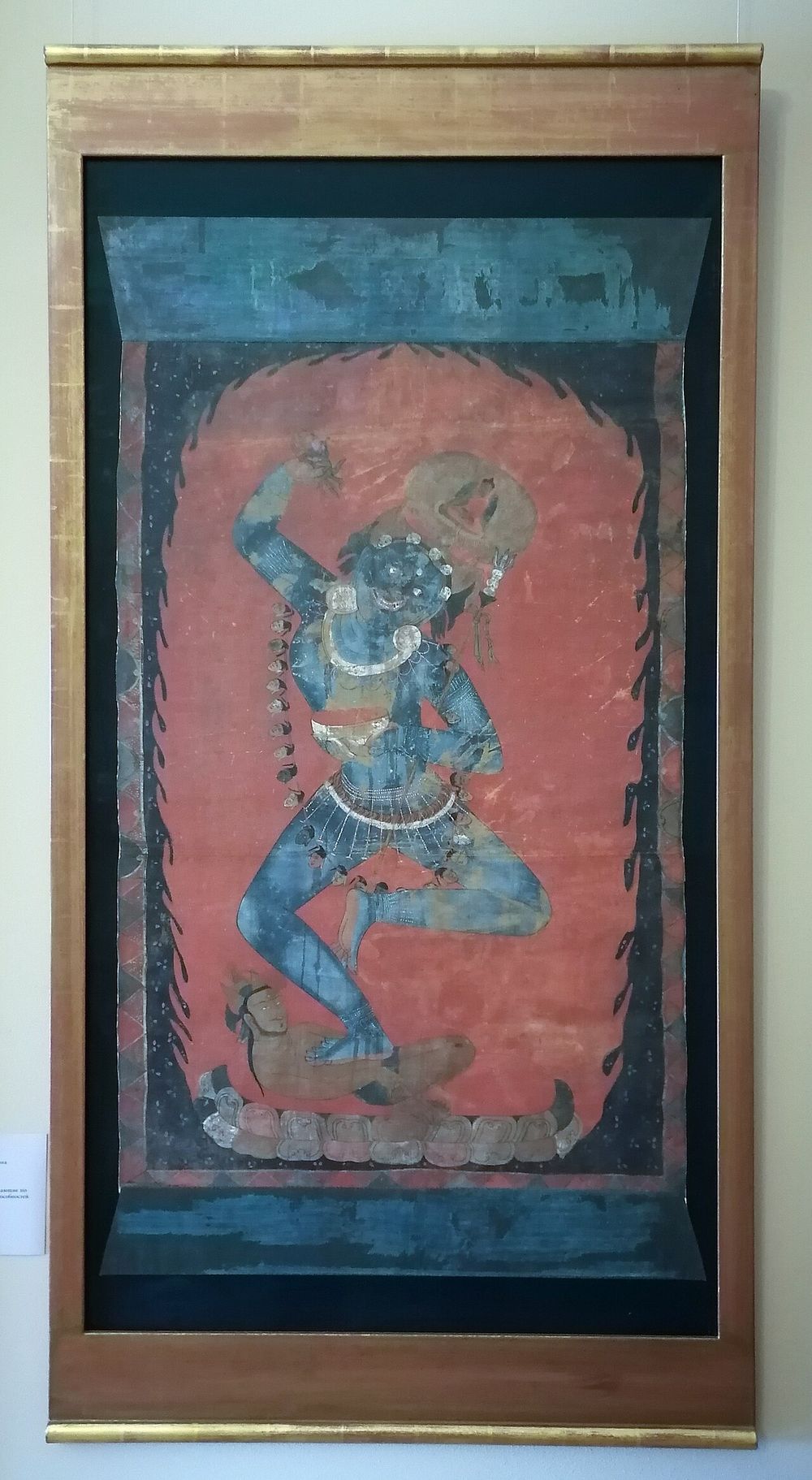
On the top floor are the museum's collections from the East. In 1908–09 the Russian explorer Pyotr Kozlov dug in the dead city of Khara-Khoto, in what is now Inner Mongolia, a city of the Tangut state of Western Xia (1038–1227). He brought back paintings, sculptures and thousands of books.
Among them is a woodblock print of Guan Yu, the general of the Three Kingdoms (220–280), printed in Pingyang in the Jin dynasty (1115–1234). It is one of the oldest printed pictures of him. The Hermitage also keeps wall paintings and statues from Dunhuang, brought by Sergei Oldenburg's expedition of 1914–15.
A Garuda from Khara-Khoto, thirteenth centuryUnknown authorUnknown author, Public domain
How these things came here, and whether some should go home, is a question China and other countries have raised about many museums. For now, this is the place to see Western Xia painting.
8. The siege, the cats, and the same years in China
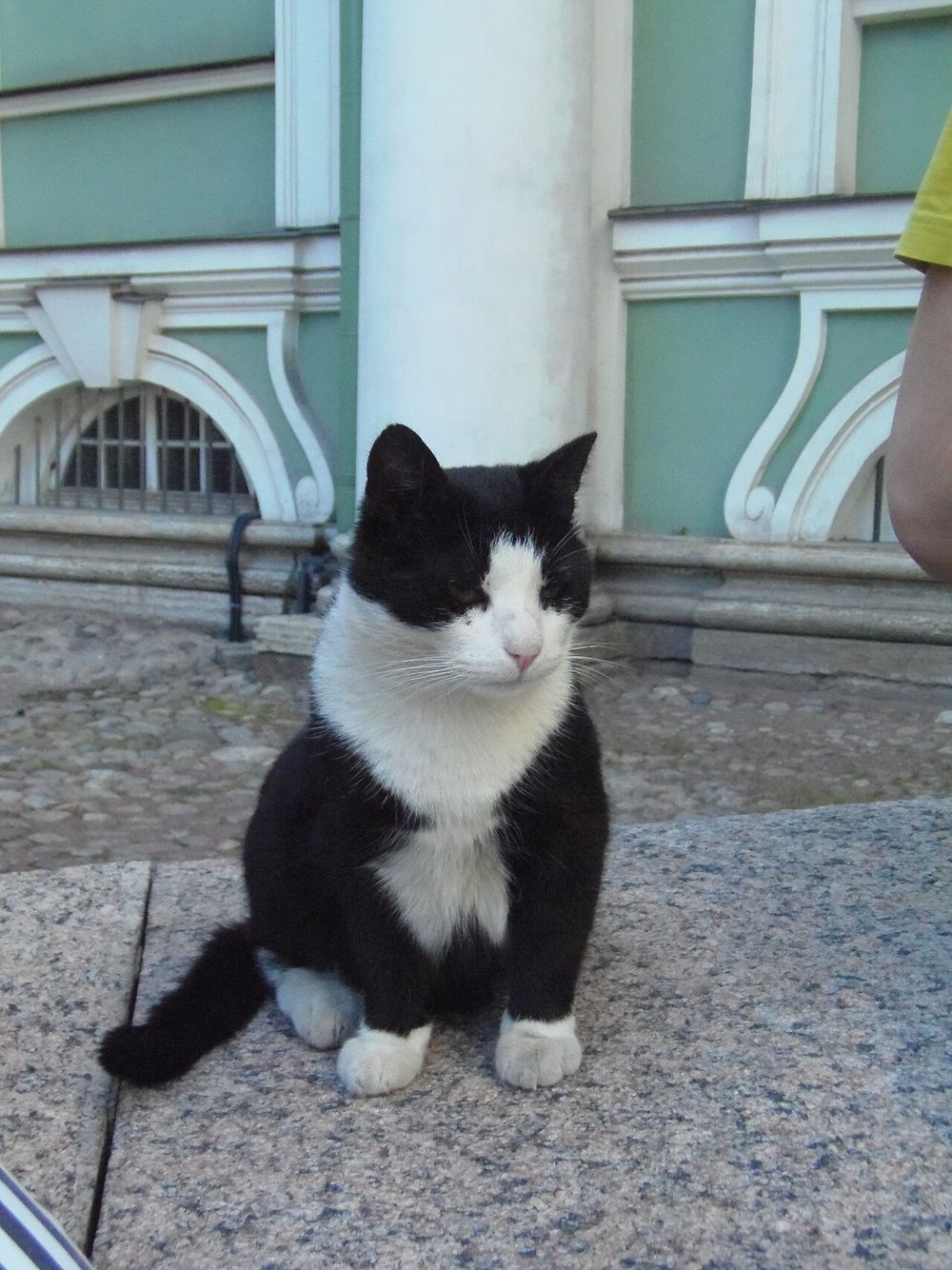
One of the Hermitage cats, 2014Petrov Victor, CC BY-SA 3.0
During the 872 days of the siege of Leningrad, from 1941 to 1944, the empty frames stayed on the walls so that the paintings could be rehung at once. About two thousand people lived in the cellars. Guides led tours of the empty rooms, describing the paintings from memory.
The museum keeps about fifty cats in its cellars to hunt mice, a custom that goes back to the empress Elizabeth. They have their own day each spring.
Catherine founded the collection in 1764, the twenty-ninth year of the Qianlong emperor (1736–1795). She and Qianlong were the two great collectors of their age, and never met. The Winter Palace was stormed in 1917, the sixth year of the Chinese Republic.
Meanwhile in the world
Year
Here
Elsewhere
1762
The Winter Palace is finished
The Seven Years' War
1764
Catherine buys her first 225 paintings
Mozart, aged eight, plays in London
1837
The great fire
Victoria becomes queen
1852
The New Hermitage opens to the public
Uncle Tom's Cabin is published
1908–09
Kozlov digs at Khara-Khoto
Ford's Model T
1917
The Winter Palace is taken
The United States enters the First World War
1941–1944
The siege of Leningrad
The war in the Pacific
One line to remember: Catherine's hermitage became everybody's museum.
Then and now
The Winter Palace and Palace Square from the air, 2016Godot13, CC BY-SA 4.0, Wikimedia CommonsThe palace and its courtyards from the airGodot13, CC BY-SA 4.0, Wikimedia CommonsThe river front across the NevaFlorstein (Telegram:WikiPhoto.Space), CC BY-SA 4.0, Wikimedia CommonsThe square frontFlorstein (Telegram:WikiPhoto.Space), CC BY-SA 4.0, Wikimedia CommonsThe Winter Palace from Palace SquareFlorstein (Telegram:WikiPhoto.Space), CC BY-SA 4.0, Wikimedia CommonsThe square front in summerMatthias Süßen, CC BY-SA 4.0, Wikimedia CommonsThe palace and the Alexander Column, 2010W. Bulach, CC BY-SA 4.0, Wikimedia CommonsPalace Square from aboveNikolai Bulykin, CC BY-SA 4.0, Wikimedia CommonsThe Winter Canal between the palace and the theatreАлександр Байдуков, CC BY-SA 4.0, Wikimedia CommonsThe Neva and the Spit of Vasilievsky IslandA.Savin, FAL, Wikimedia CommonsThe Jordan Staircase, 2026Александровы АГ, CC BY-SA 4.0, Wikimedia CommonsThe staircase ceilingRichard Mortel from Riyadh, Saudi Arabia, CC BY 2.0, Wikimedia CommonsGold and white on the staircaseRichard Mortel from Riyadh, Saudi Arabia, CC BY 2.0, Wikimedia CommonsThe Military Gallery of 1812Chatsam, CC BY-SA 3.0, Wikimedia CommonsA general's portrait of the kind in the Military Galleryxiquinhosilva, CC BY 2.0, Wikimedia CommonsThe Malachite RoomChatsam, CC BY-SA 3.0, Wikimedia CommonsA malachite vaseAndrey Korzun, CC BY-SA 4.0, Wikimedia CommonsThe Pavilion HallChatsam, CC BY-SA 3.0, Wikimedia CommonsThe Pavilion Hall from the galleryChatsam, CC BY-SA 3.0, Wikimedia CommonsThe Peacock ClockVolkov, Public domain, Wikimedia CommonsThe peacock, the owl and the cockerelChatsam, CC BY-SA 3.0, Wikimedia CommonsThe ceiling of the Raphael LoggiasAd Meskens, CC BY-SA 4.0, Wikimedia CommonsPainted vaults of the LoggiasAd Meskens, CC BY-SA 4.0, Wikimedia CommonsGuan Yu, a woodblock print of the Jin dynasty from Khara-KhotoUnknown authorUnknown author, Public domain, Wikimedia CommonsA Garuda from Khara-Khoto, thirteenth centuryUnknown authorUnknown author, Public domain, Wikimedia CommonsA Buddhist painting in the rooms of Eastern art (hall 363), 2020Netelo, CC BY-SA 4.0, Wikimedia CommonsOne of the Hermitage cats, 2014Petrov Victor, CC BY-SA 3.0, Wikimedia CommonsThe Pavilion Hall, watercolour by Eduard Hau, 1864Eduard Hau, Public domain, Wikimedia CommonsThe palace front on the morning of 26 October 1917Pyotr Novitsky, Public domain, Wikimedia CommonsThe Pavilion Hall in 1993lelebella, CC BY 2.0, Wikimedia Commons
Local legends
These are stories people tell about this place. They are legends, not history, and each one says where it comes from.
LegendMice and cats
Empress Elizabeth is said to have ordered the best mouse-catching cats of Kazan sent to the Winter Palace in 1745. Their descendants, people say, still guard the cellars.
Source: A decree of 1745 asking for Kazan cats is often cited; the line of descent is legend
LegendThe ghost of the Winter Palace
Guards on night duty tell of a lady in a white dress who walks the empty halls, some say Empress Elizabeth, some say Catherine.
Source: A story told to visitors; we found no reliable early account
Later, people who live here will be able to add the stories they grew up with, and say which of these they have heard.
Not certain, and where accounts conflict
How many rooms?
The Winter Palace alone is usually said to have about 1,500 rooms, the whole museum over 1,000 open to visitors. Counts differ by what is counted as a room.
What happened on the night of 25 October 1917?
Soviet accounts told of a heroic storming; the guards inside were mostly cadets and a women's battalion, and resistance was slight. The shot from the cruiser Aurora was a blank. Numbers of dead given by historians range from a few to a few dozen.
Since 14 July 2026 the price depends on the time of entry: 1,200 roubles from 11:00, 700 roubles from 16:00, and 500 roubles from 18:00 on Tuesday, Friday and Saturday, when the museum stays open until 20:00.
Closed on Mondays. Open until 18:00 on Wednesday, Thursday and Sunday, and until 20:00 on Tuesday, Friday and Saturday.
The museum also has free days on some holidays, such as 7 December, St Catherine's day.
Last checked 2026-11-12. Russian press on the Hermitage's new ticket prices, July 2026, and the museum's own announcements.
Booking from abroad
Official page in English Tickets are sold on the museum's own site in Russian and English for a date and time. Payment there needs a card issued in Russia or a Russian payment system; cards issued abroad generally do not work.
Ticket window on site Ticket machines and desks in the main courtyard sell tickets on the day, in roubles. Queues can be long in summer.
Note Children under 14 enter free, and many other visitors get free or reduced entry; check the museum's site.
Checked 2026-11-12
Where to start
Metro to Admiralteyskaya, then a five-minute walk. Enter from Palace Square through the main courtyard.
Come in the evening for the cheaper ticket and fewer people.
Go up the Jordan Staircase first, then follow the river side.
Before you go
Visas: most foreigners need a Russian visa; many can apply online. Chinese citizens with ordinary passports may visit visa-free for up to 30 days until 31 December 2027.
Money: cards issued abroad generally do not work in Russia. Bring cash.
Coats and large bags must go in the cloakroom. Wear comfortable shoes: the route is many kilometres.
Many governments advise against travel to Russia. Read your own government's advice.
Customs and manners
Photography is allowed without flash or tripod in most rooms.
The room attendants, often older women, are strict and proud of their halls. Follow what they say.
Leningraders who lived through the siege, and their families, remember it deeply. Speak of it with respect.
Opening hours are given in the local time of the place.
Look for these
On the Jordan Staircase, look up and find Mount Olympus.
In the Military Gallery, find an empty frame with only a name.
In the small dining room, find the clock stopped at 2:10.
On the Peacock Clock, find the dial.
In the Rembrandt room, compare the father's two hands.
Outside, look for a cat.
I am here
Stand at the site, sign in, press the button, and collect its stamp. Your browser will ask to use your location. It is sent to us once to confirm that you are at the site; we keep how far you were from it, not the spot where you stood.
Your stamps are saved to your account, so they follow you to any device. Checking from a browser cannot rule out every false location; stricter checks arrive with the app.
Messages
Share your photos
Photos here show the place, not people. Each one is credited to the visitor who took it and appears after our team has looked at it. A photo with you in it belongs under “I am here”.