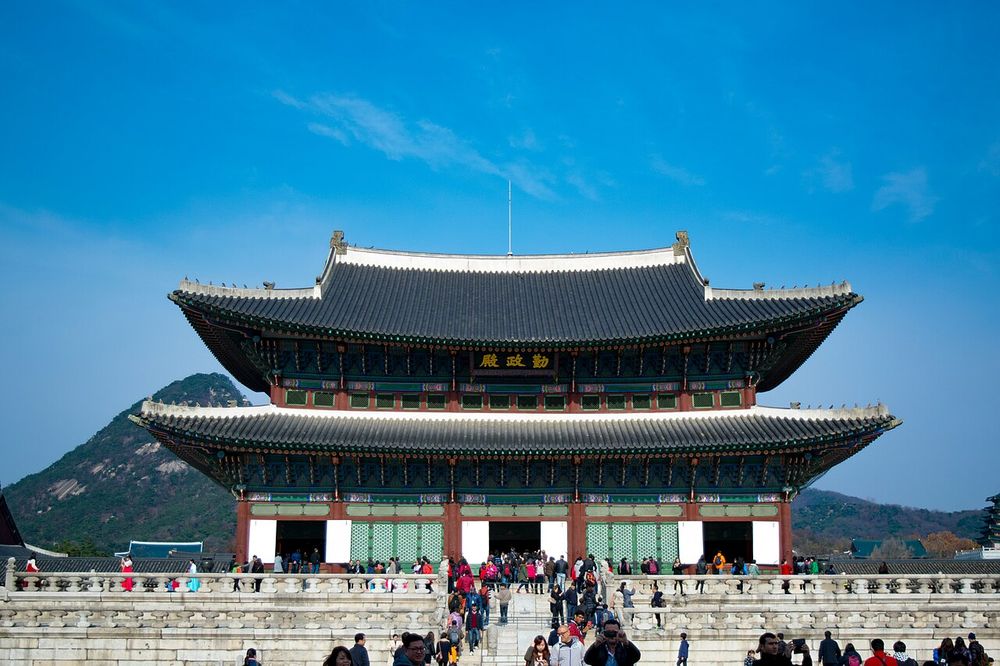
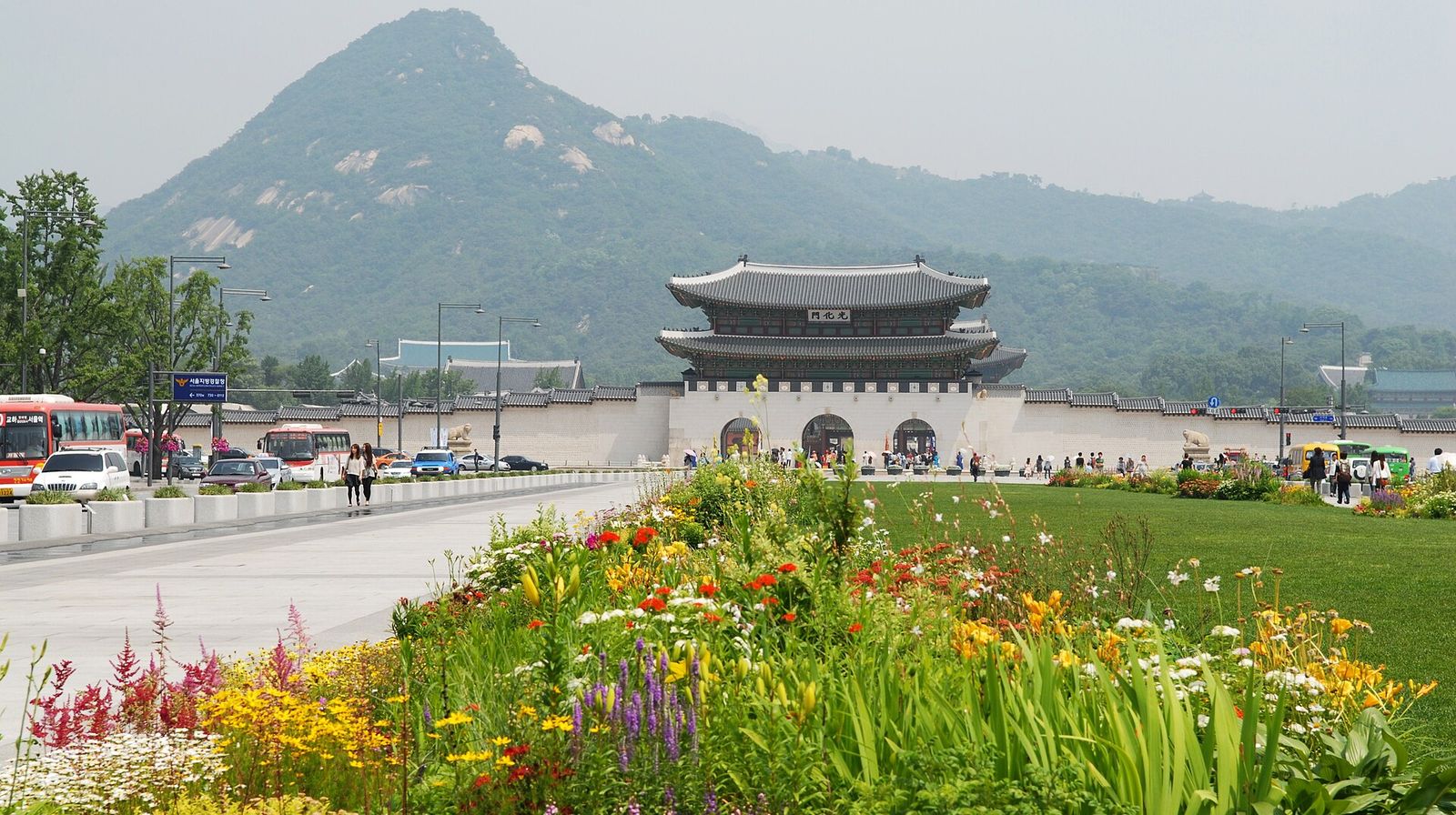
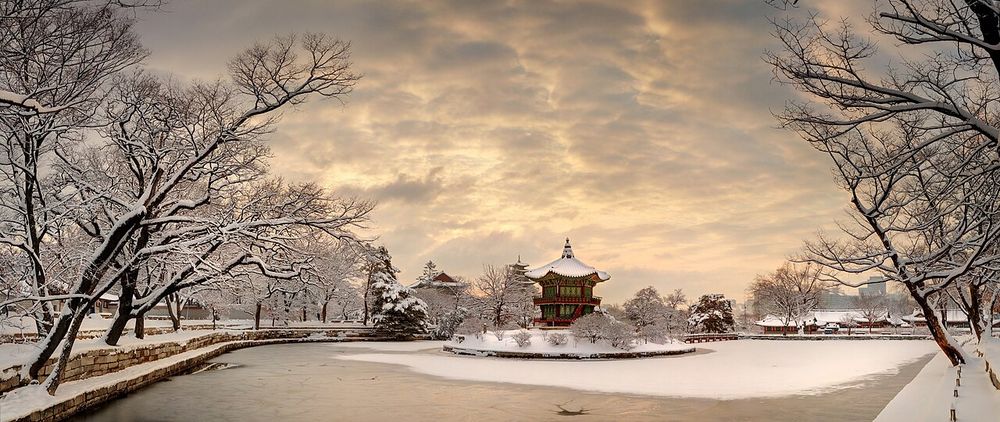
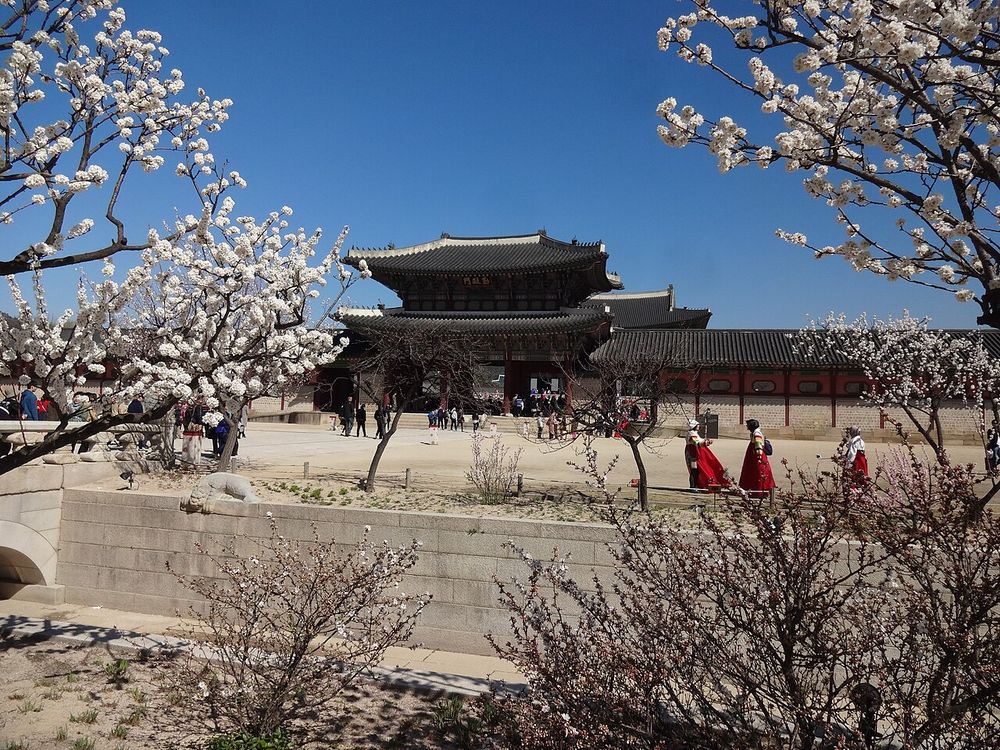
The first palace of Korea's last dynasty, built in 1395 under a mountain at the north end of Seoul. It has been burned, left in ruins for 270 years, rebuilt, and nine-tenths torn down. Most of what you see has been put back since 1990.
Photo: Basile Morin, CC BY-SA 4.0, Wikimedia Commons
The story
You are standing in the main palace of the Joseon dynasty, which ruled Korea for 518 years. Its founder built it in 1395, three years after he took the throne. That was twenty-five years before the Forbidden City in Beijing was finished.
The name means "great blessings". It comes from a line in the Chinese Book of Songs, chosen by the minister who planned the new capital.
What is here
One ticket covers the whole palace. The two museums inside the walls are free and have their own doors.
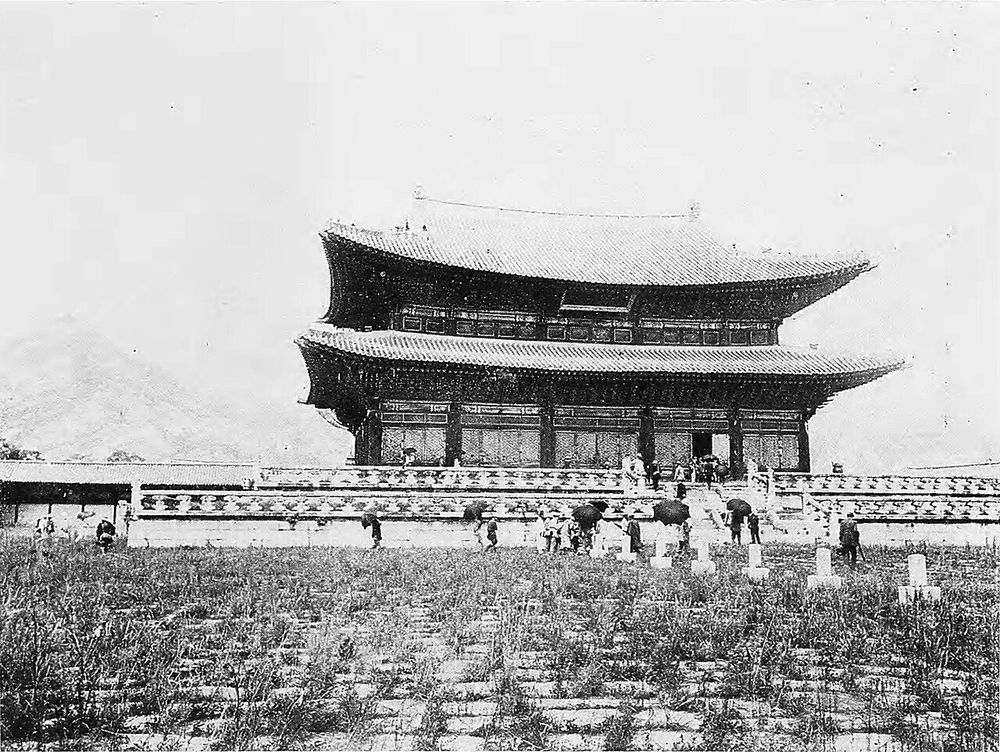
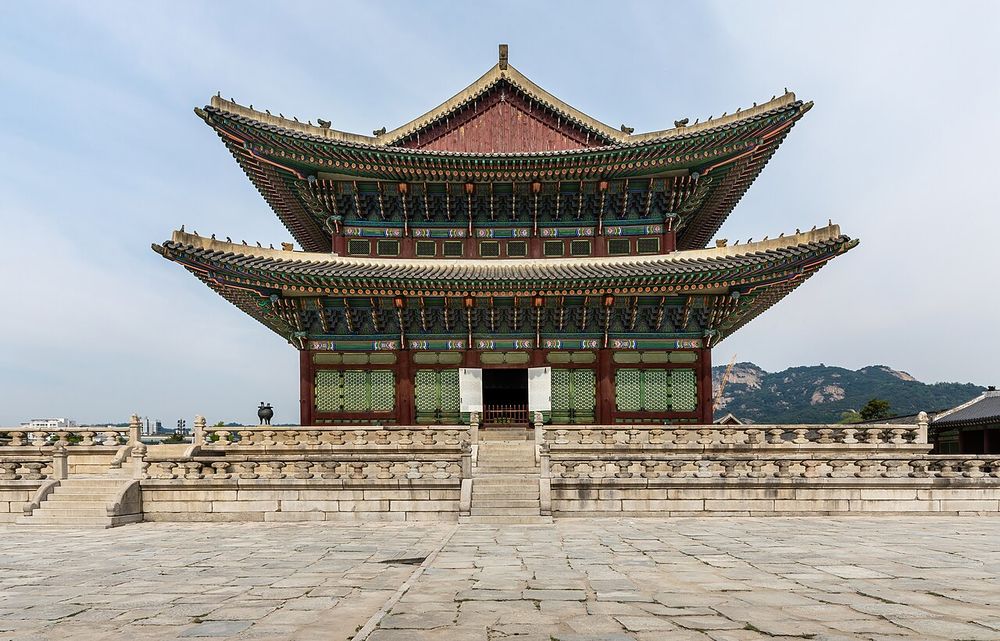
The big hall on its two-tier stone platform is where the king was crowned, received his officials and met foreign envoys. The two rows of small stone posts in the yard told each official where to stand, by rank.
Look past the roof. The mountain behind is Bugak, and the whole palace is lined up on it.
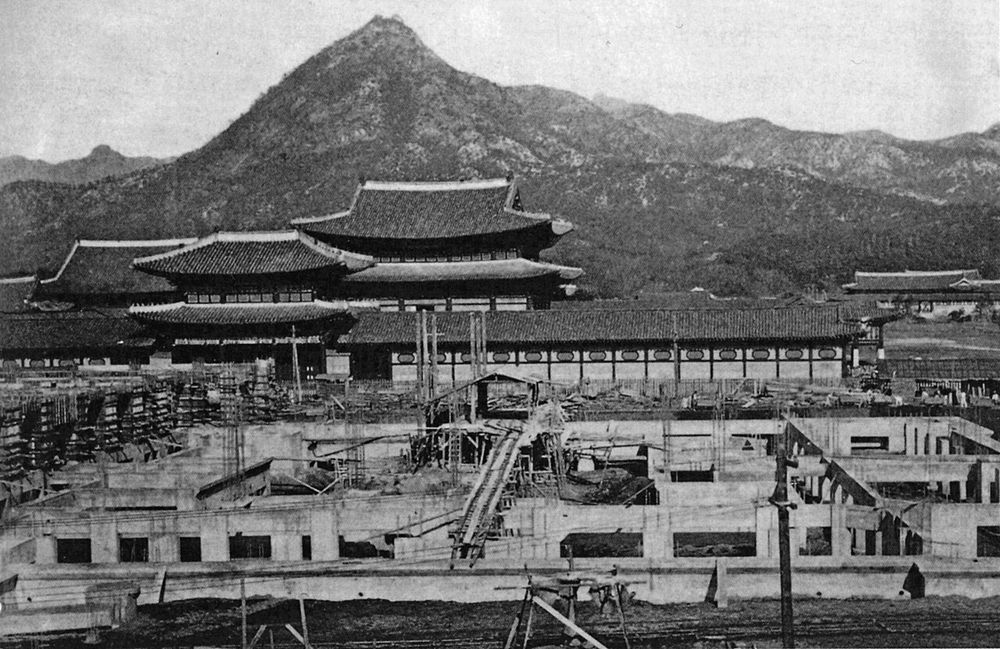
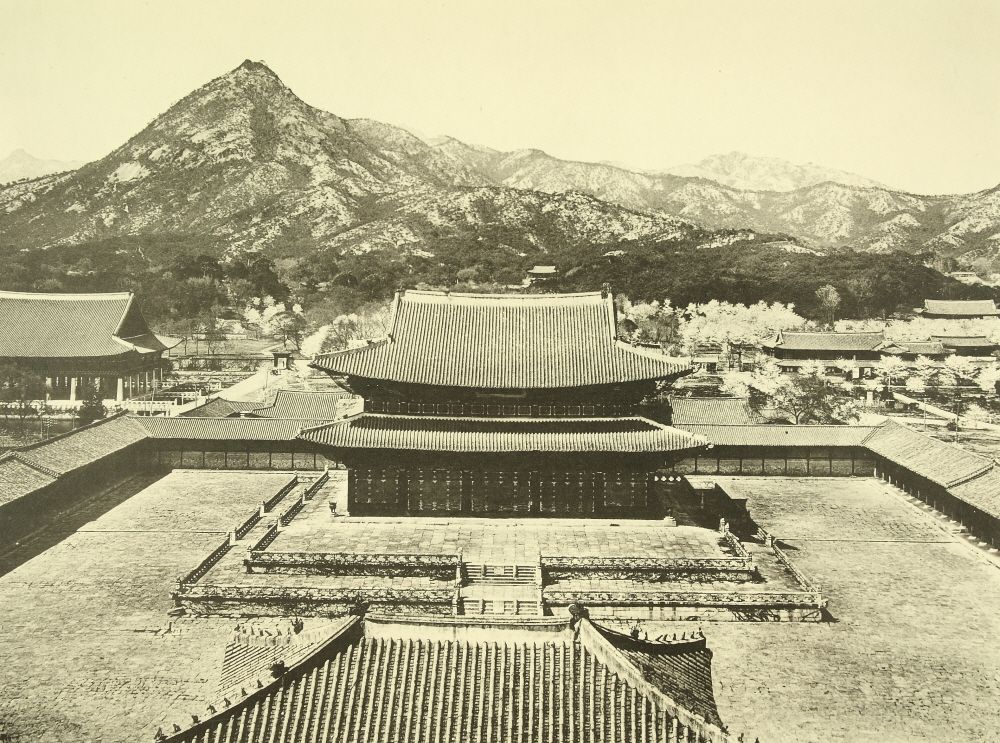
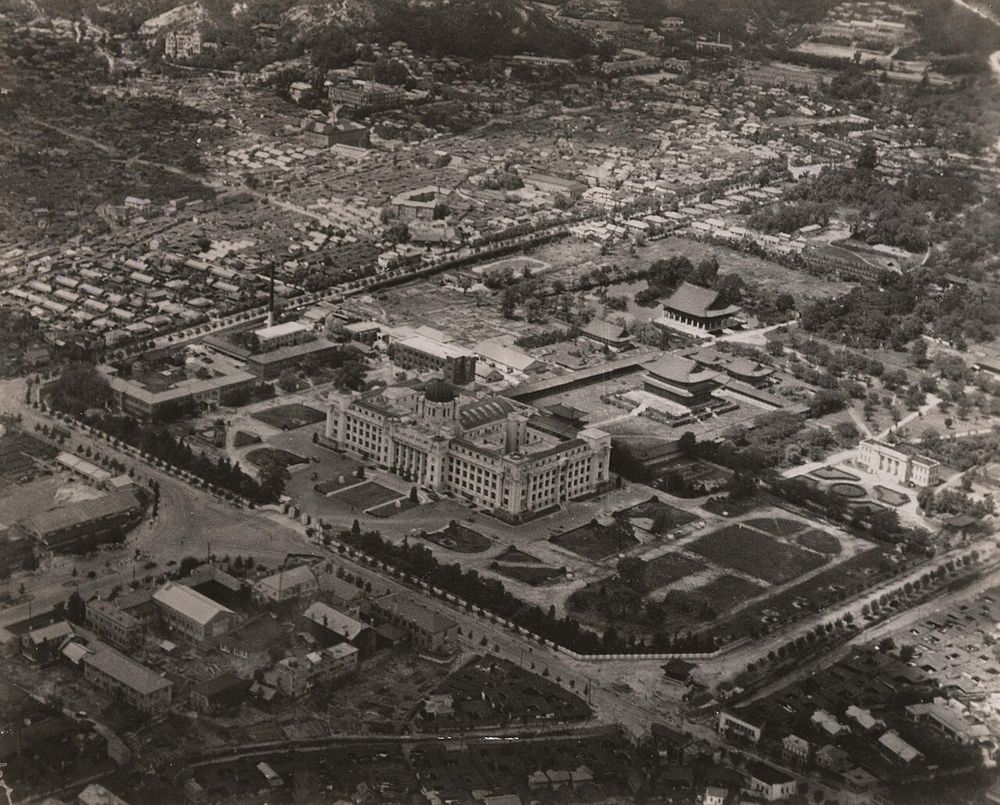
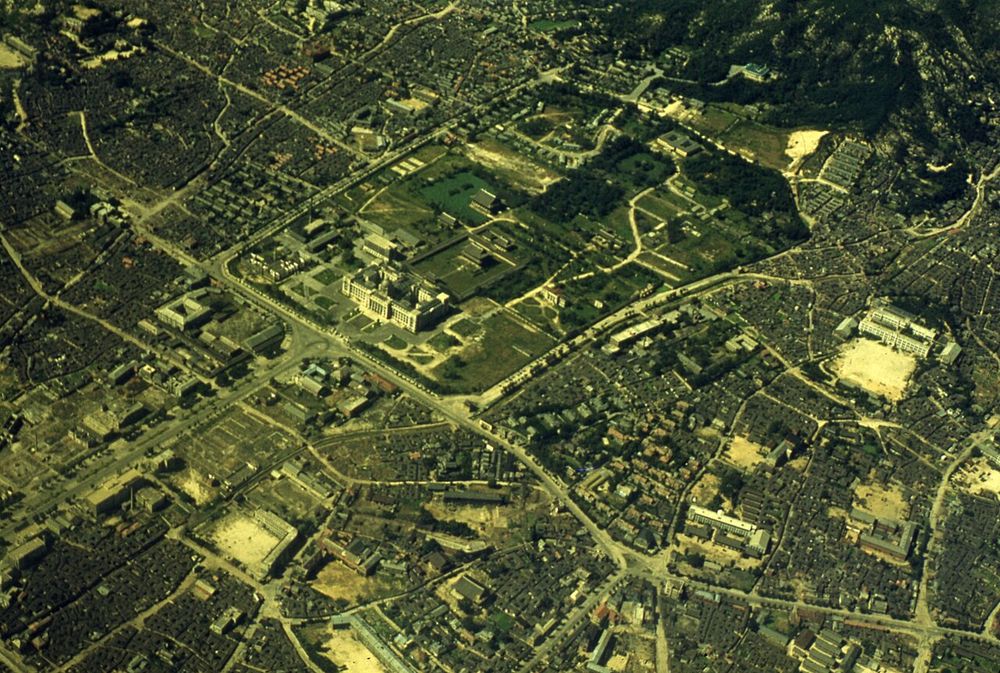
In 1592 the palace burned during a Japanese invasion and was left as it lay. It was rebuilt in the 1860s. After Japan took Korea in 1910, most of the buildings were sold off or pulled down, and a huge government office was put up right in front of this hall. That office was demolished in 1995.
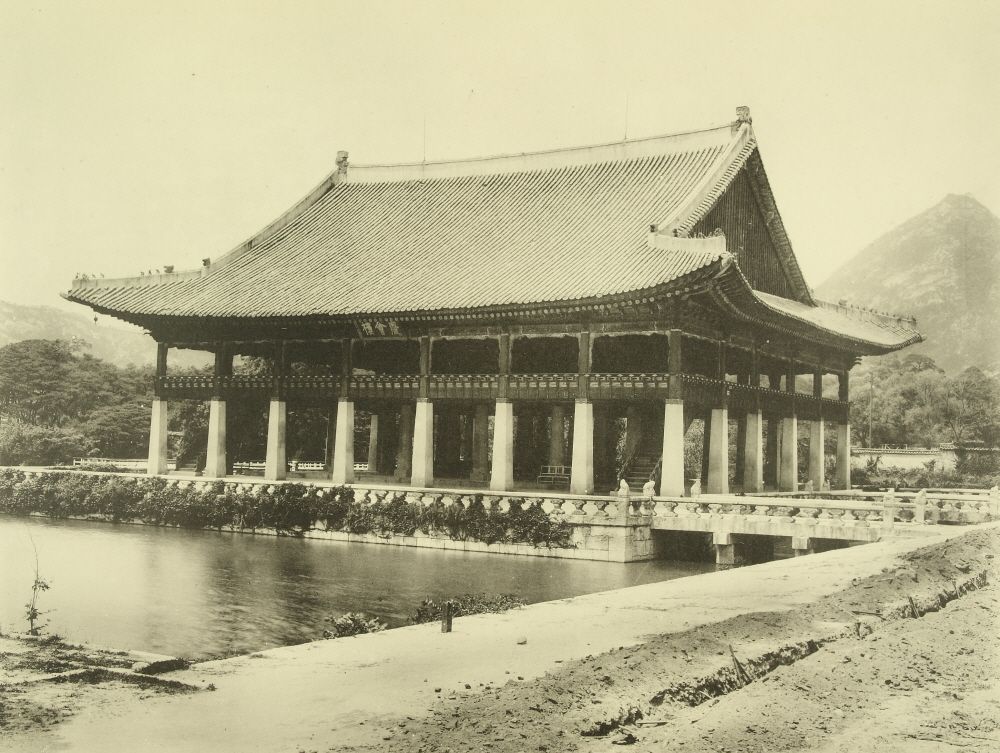
So the throne hall and the pavilion on the pond are from the 1860s, and much else is newer than it looks.
Things people often get wrong
"It is a copy of the Forbidden City." It is older. Both follow the same ancient Chinese rules for a palace: halls of state in front, living quarters behind, everything on one north–south line. This one is smaller and sits in a landscape of hills.
"These buildings are six hundred years old." None is. The oldest date from the rebuilding of 1867.
"The Japanese burned it in 1592." Korean records of the time say it was set on fire by people of the city after the king fled. Historians still argue.
"Anything called hanbok gets you in free." The top and the bottom must both be worn properly. Staff at the gate decide.
People who stood here
King Sejong (the Korean king who gave his people an alphabet)He was crowned in this palace in 1418 and ruled from it for thirty-two years. Korean was then written with Chinese characters, which few could learn. In 1443 he and his scholars devised twenty-eight letters that a clever man could learn in a morning. The scholars worked in a hall west of where you stand. He may have crossed this courtyard on his way to see them.
Empress Myeongseong (Queen Min, wife of King Gojong)She was the strongest political mind at the court in the 1880s and looked to Russia for help against Japan. Before dawn on 8 October 1895, Japanese agents broke into her quarters at the north end of this palace and killed her. She walked these paths for twenty years.
Go deeper: ten stops, south gate to north garden
The palace runs from south to north: gates, the halls of state, the king's and queen's quarters, then the gardens. These stops follow that line.
1. Gwanghwamun: the gate that has moved four times
Gwanghwamun, the main gateTrainholic, CC BY-SA 3.0
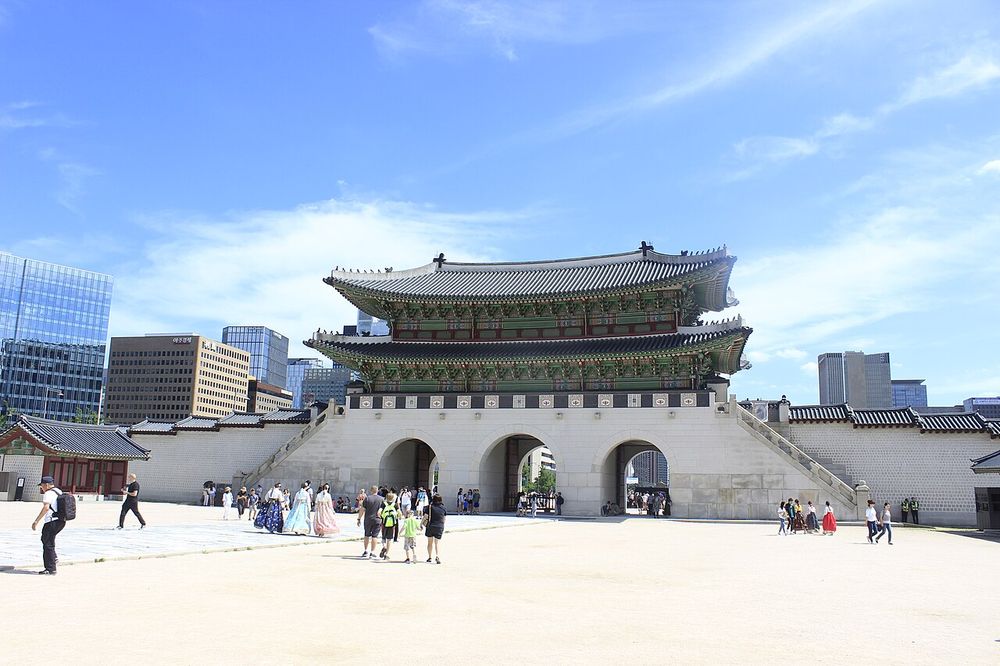
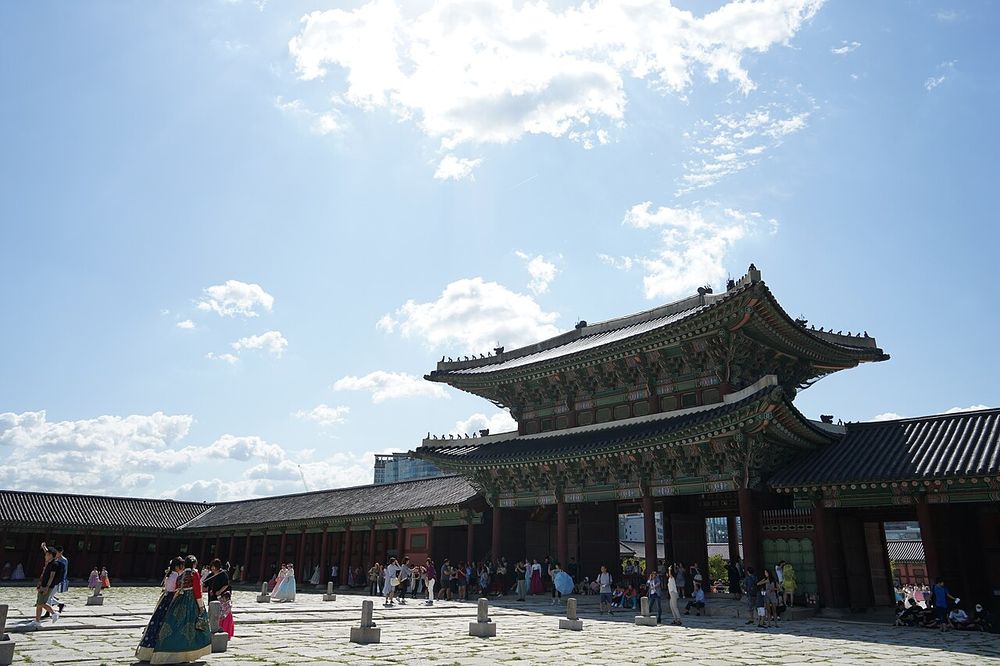
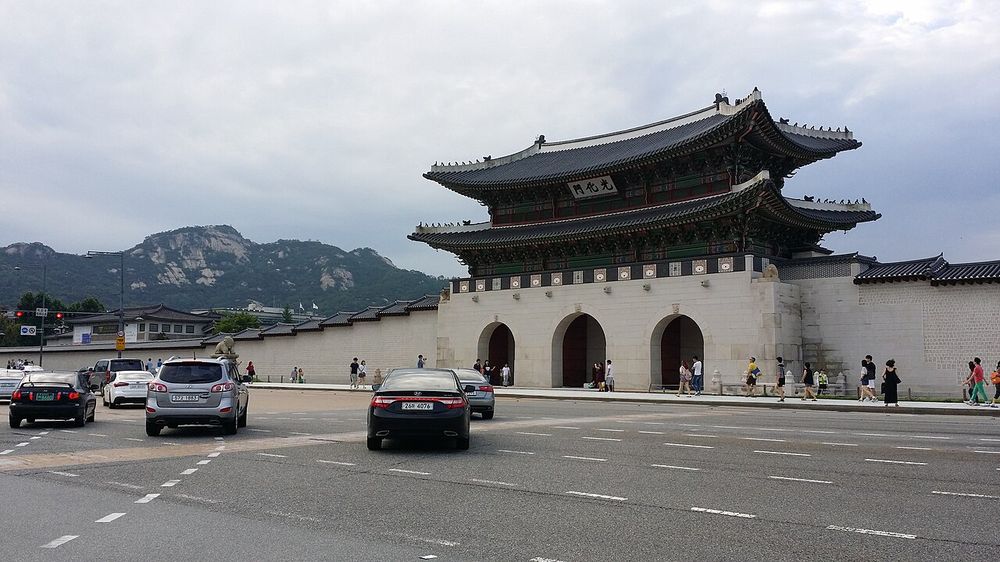
The main gate has three arches. The middle one was for the king. In 1927 the Japanese moved the whole gate round to the east side to clear the view of their new building. It was burned in the Korean War in 1950, rebuilt in concrete in 1968 a few metres off line, and rebuilt again in wood on the true line in 2010.
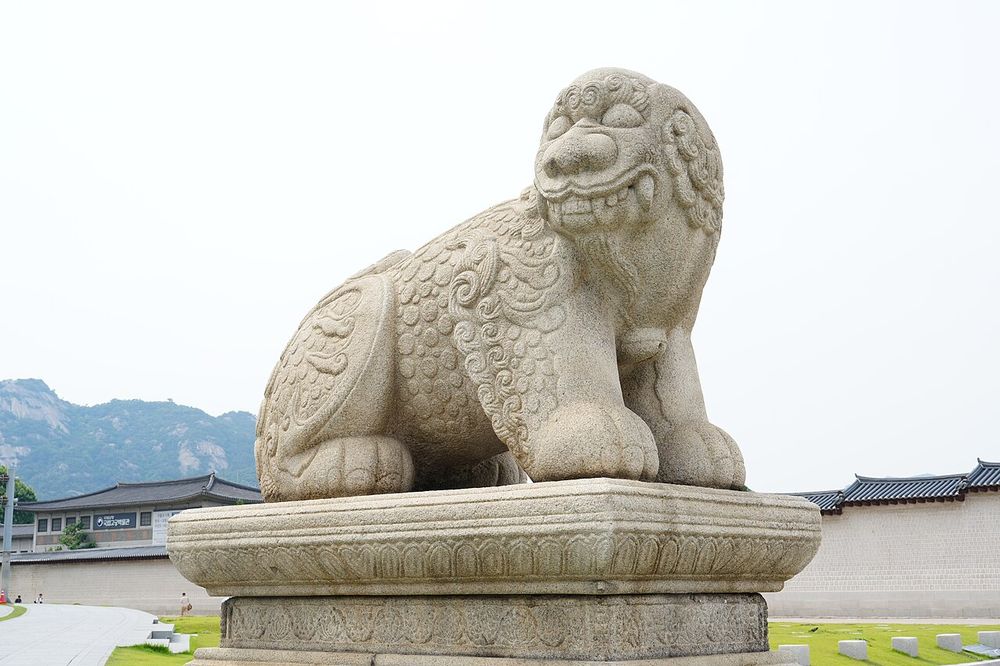
A stone haetae in front of the gate, 2026Sadopaul, CC BY-SA 4.0
The two stone beasts in front are haetae. They can tell right from wrong and they eat fire.
The stone platform in front of the gate, where the king met his people, was dug out from under the road and restored in 2023. The name board was changed in the same year to black with gold letters, after old photographs showed that was how it had been.
The changing of the guard is acted out here at 10:00 and 14:00, except on Tuesdays.
2. The second and third gates, and a stream to cross
Heungnyemun, the second gateBasile Morin, CC BY-SA 4.0
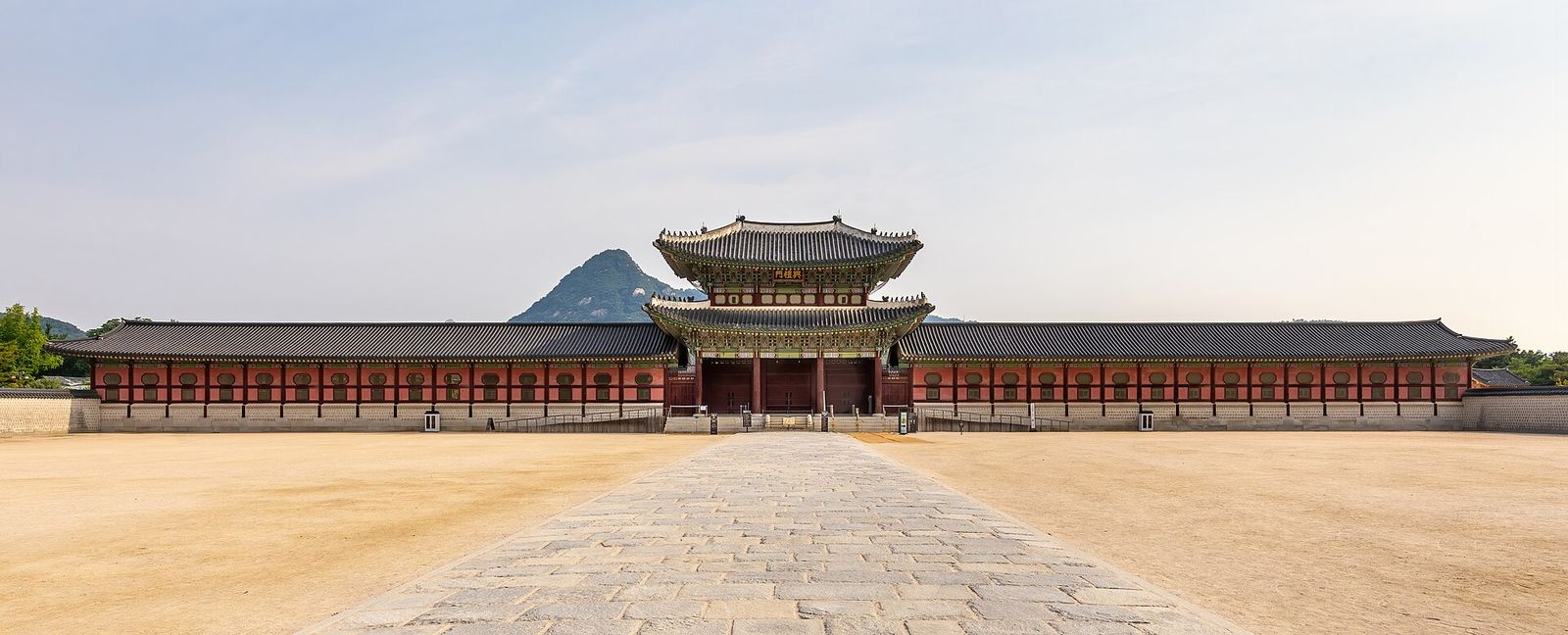
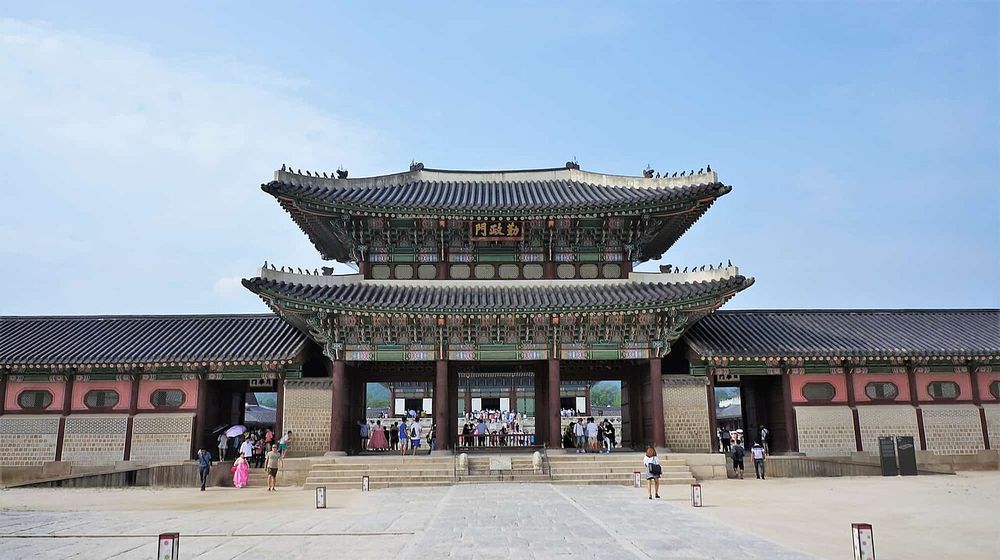
Between the second gate and the third you cross a small stone bridge over a channel of water. A palace had to have water in front and a mountain behind. Crossing it was also meant to clean the mind of anyone coming before the king.
Look over the sides of the bridge. Four stone animals crouch on the banks and stare into the water, to stop evil coming up the stream.
This yard was empty from 1926 to 1996. The Japanese Government-General Building stood exactly here.
3. Geunjeongjeon: the throne hall
The throne and the screen of sun, moon and five peaksTristan Surtel, CC BY-SA 4.0
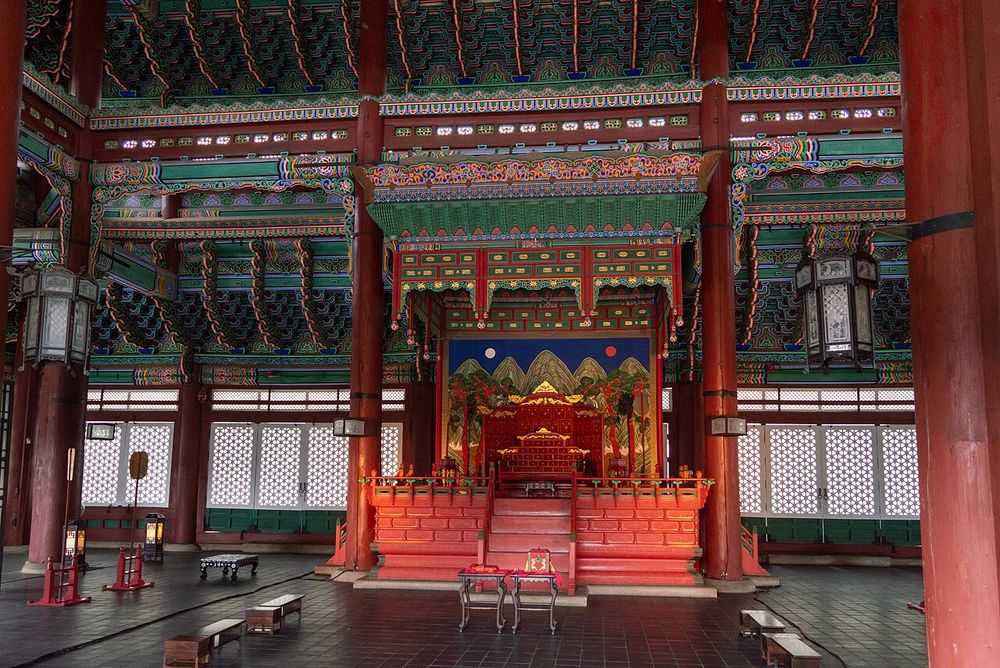
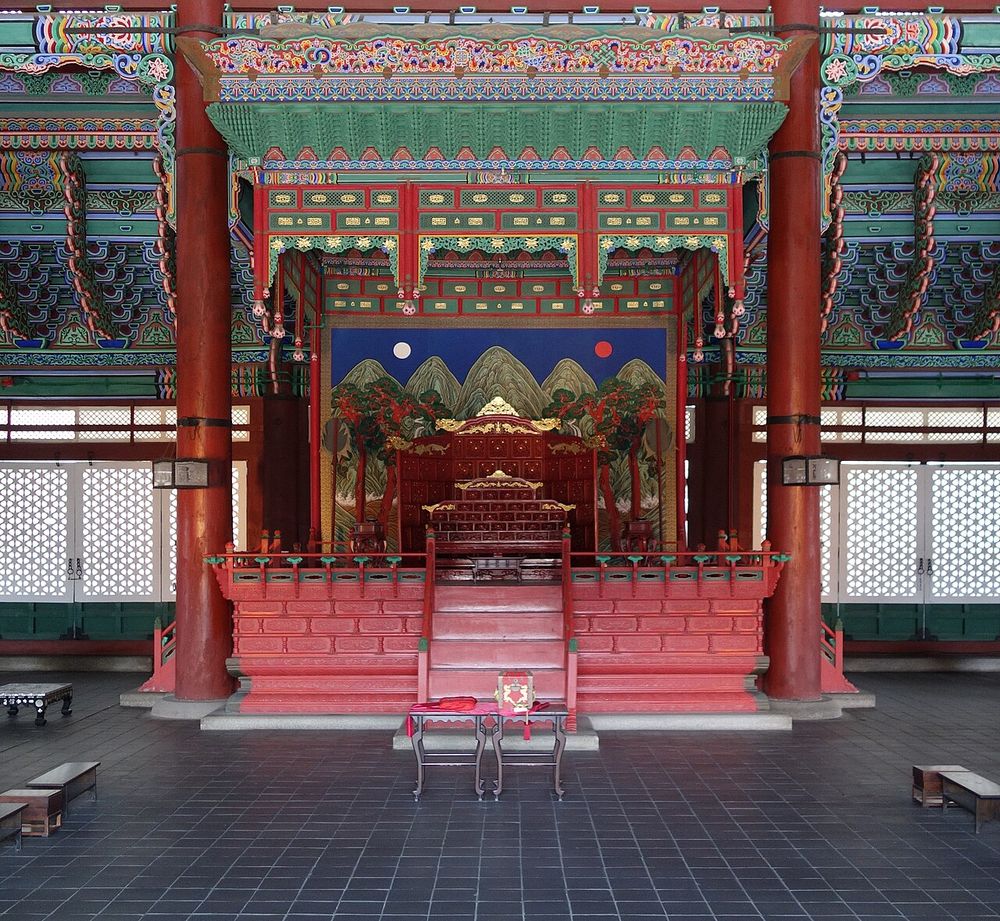
The name means "hall of diligent government". Look in through the open doors. Behind the throne is a screen painted with a sun, a moon and five peaks. The king sat between sun and moon, and the scene stood for the whole world in his care. The same picture is on the 10,000-won banknote.
Look up inside at the ceiling. Two golden dragons have seven claws each. A Chinese emperor's dragon had five. The hall was rebuilt in 1867, when the court wished to look very grand.
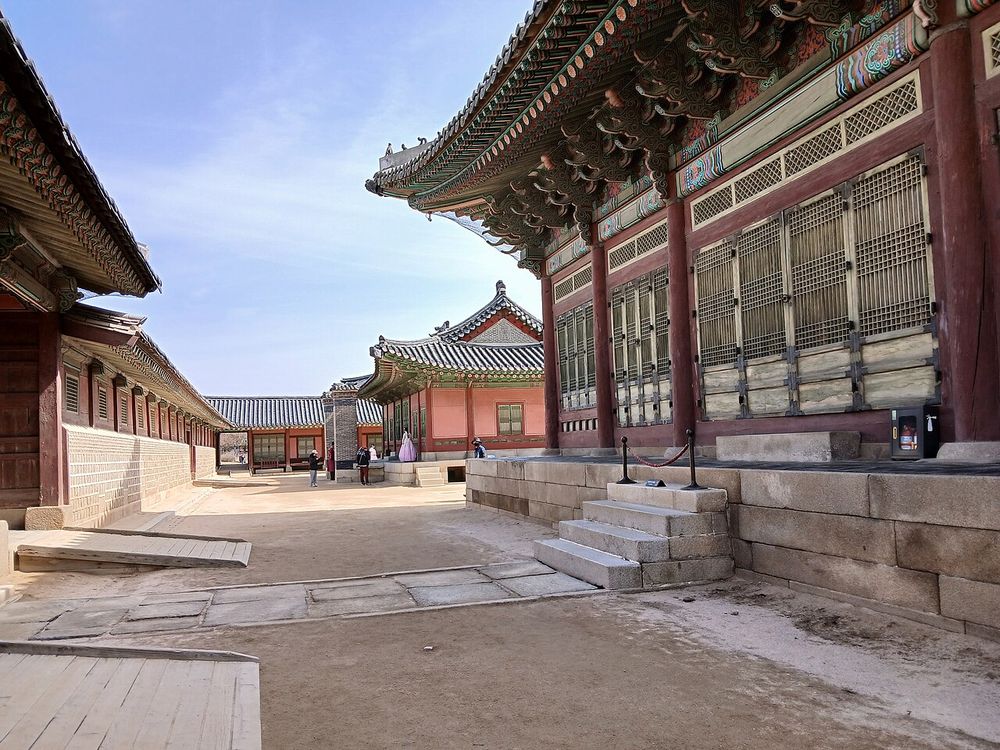
The courtyard and its corridorDe-Shao Liu (Terry850324), CC BY-SA 4.0
The paving of the yard is rough on purpose. Smooth stone would glare in the sun, and rough stone makes people in leather shoes walk slowly and carefully.
In September 2020 the band BTS performed in front of this hall for an American television show, and the film was seen round the world.
4. Sajeongjeon: where the work was done
Sajeongjeon and its side hallTristan Surtel, CC BY-SA 4.0
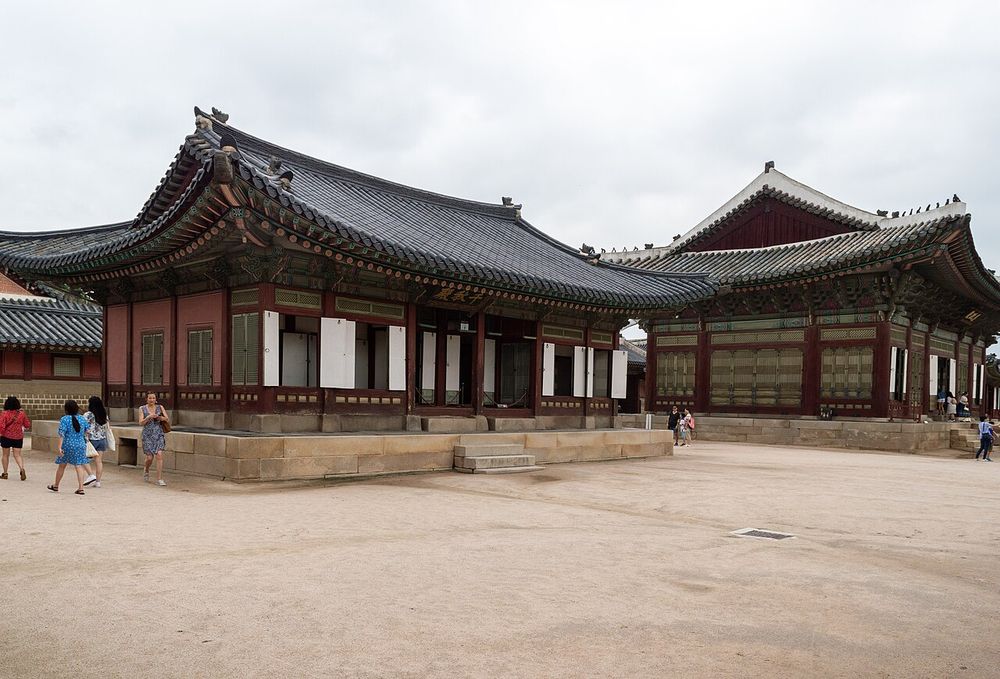
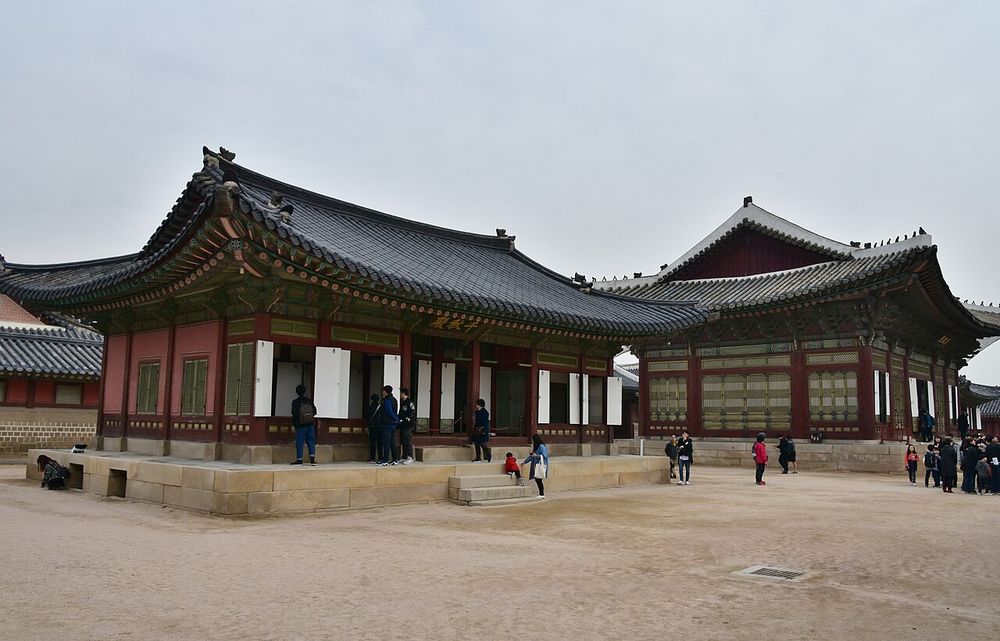
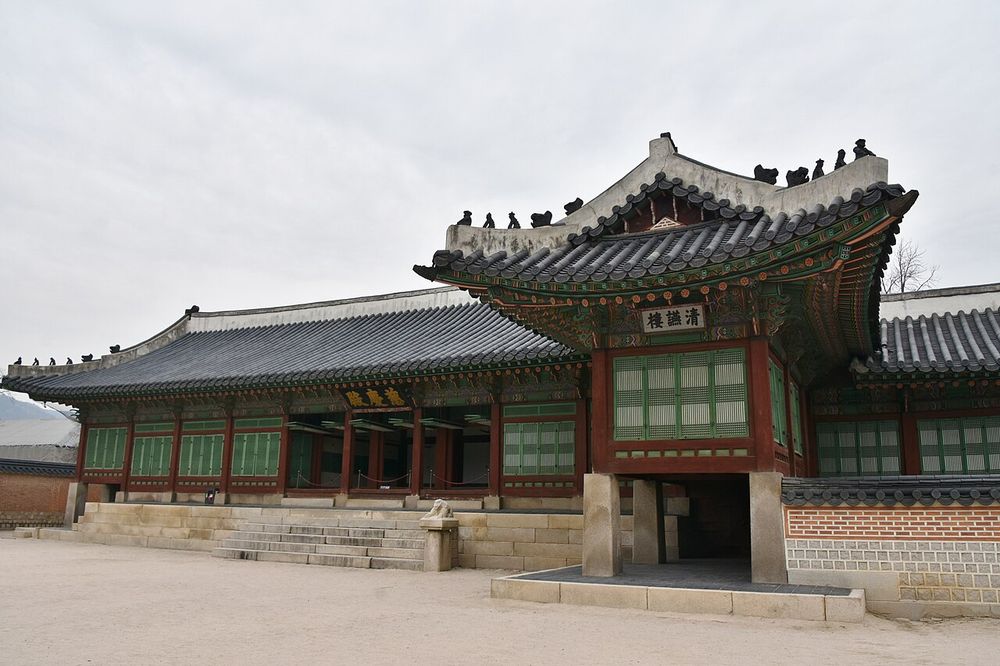
Behind the throne hall is a smaller hall where the king met his ministers every morning, read reports and heard lectures on the Confucian classics. The name means "hall of thoughtful government".
The low halls on each side have heated floors. The king used them in winter. The main hall has none.
5. Gyeonghoeru: a banquet hall on the water
Gyeonghoeru at nightRhie Cudanin, CC BY 3.0
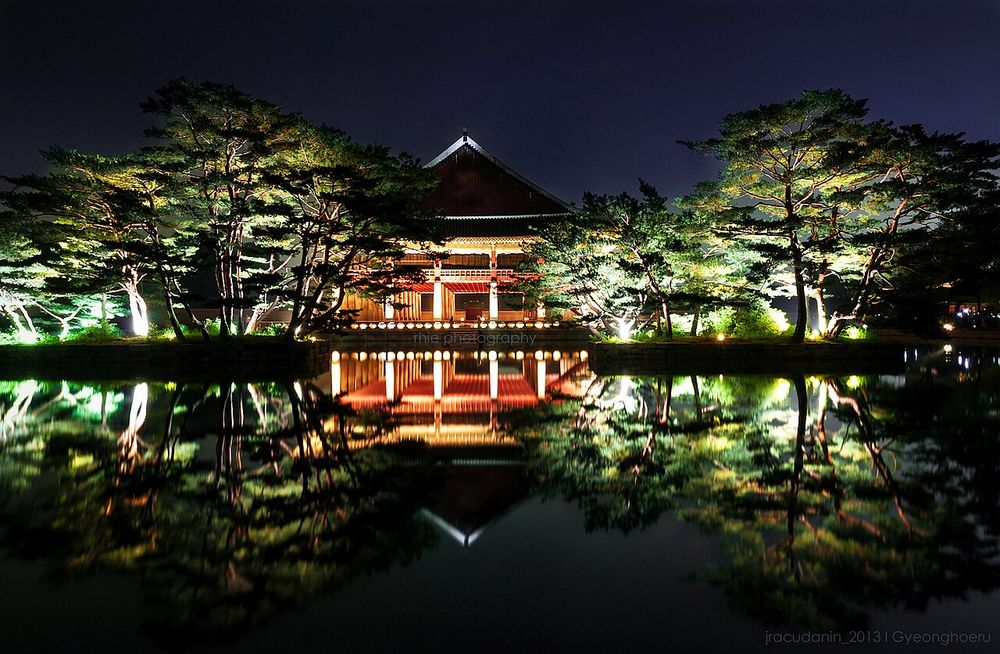
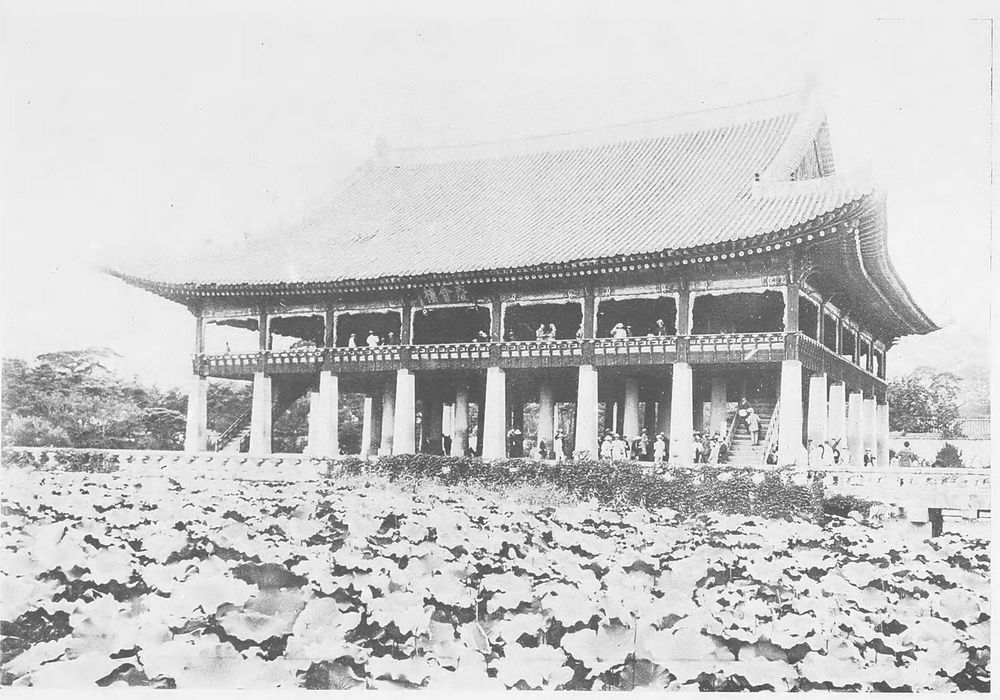
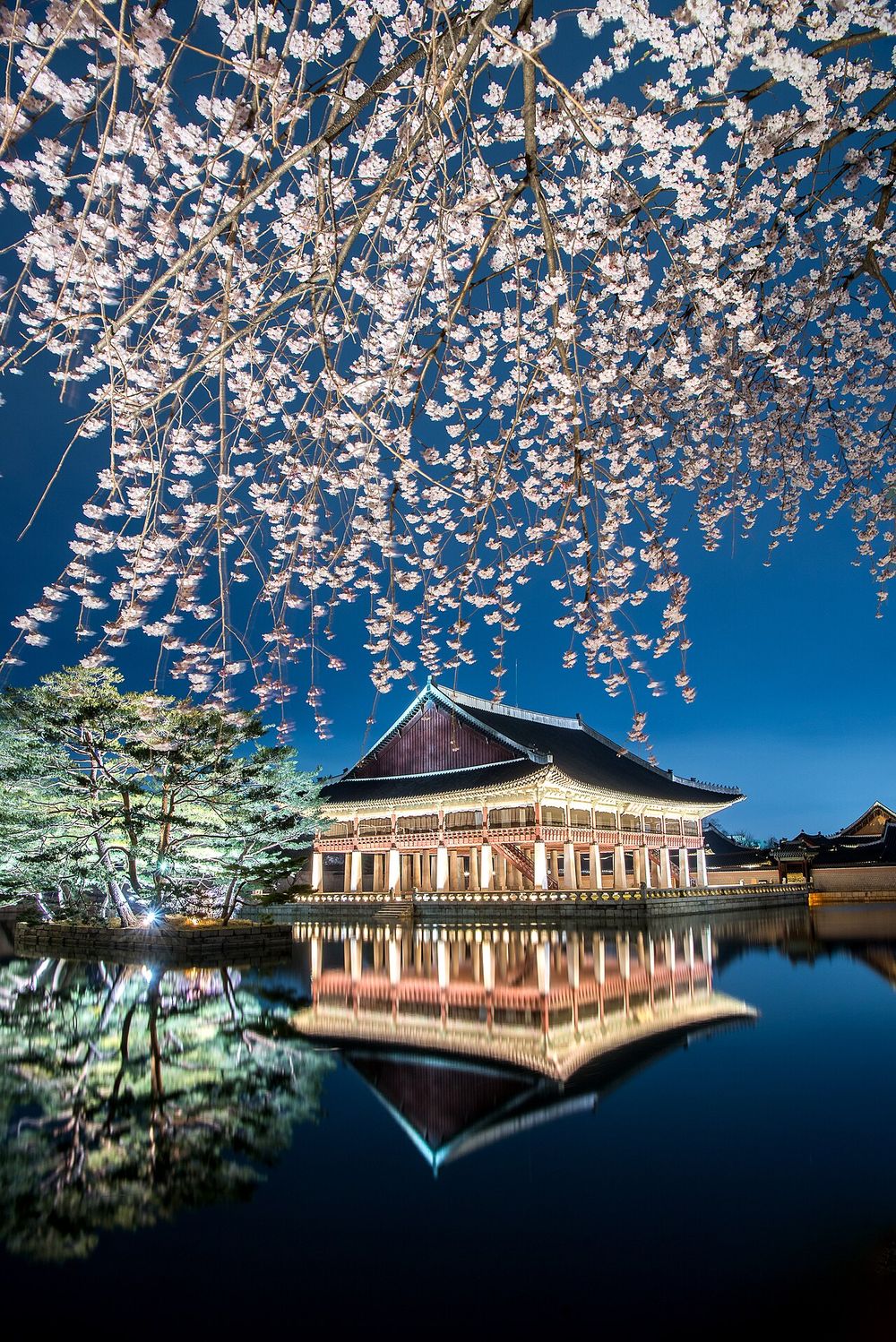
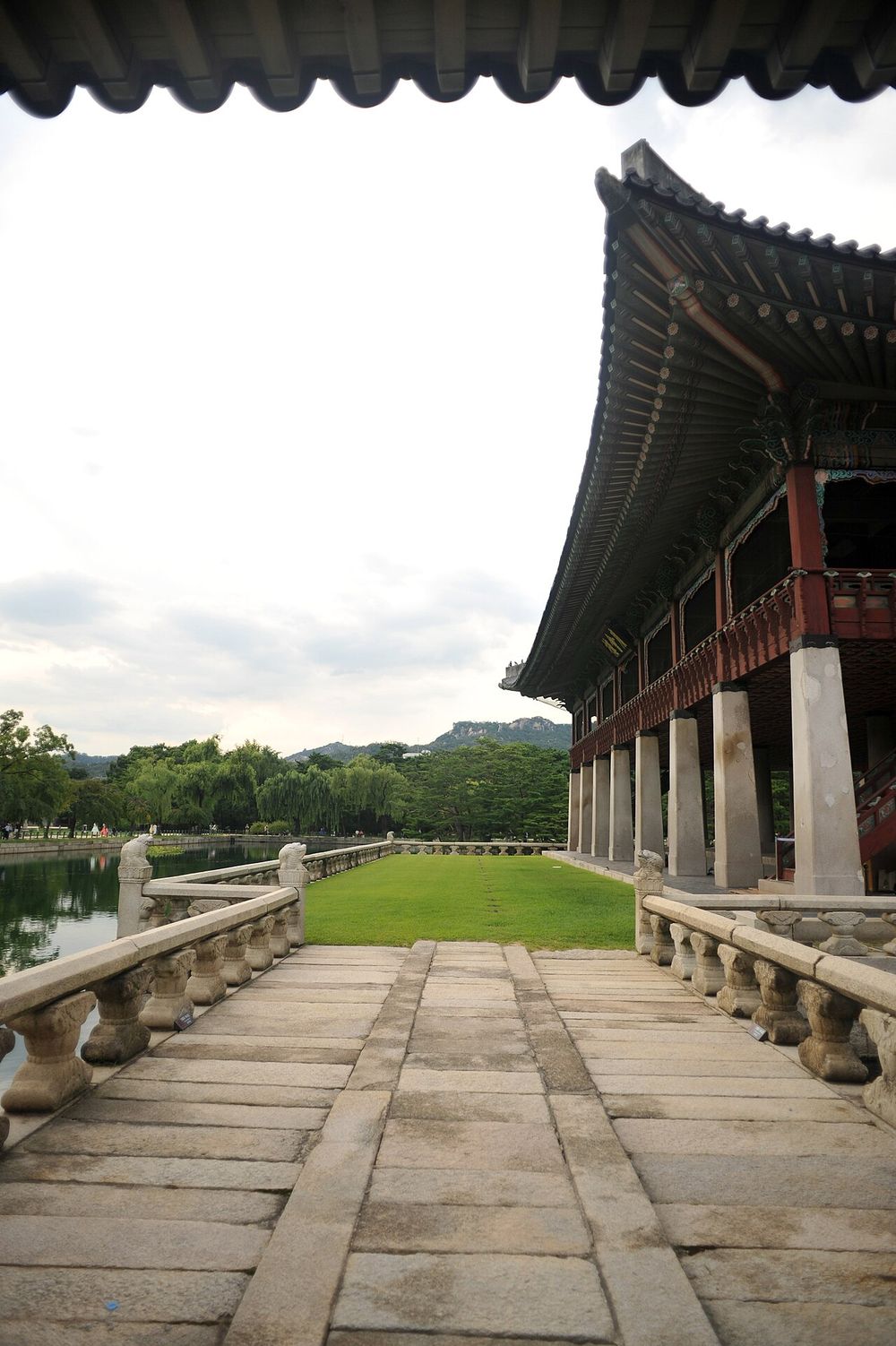
This open hall stands on forty-eight stone pillars in a square pond. The outer pillars are square and the inner ones round, for the old Chinese idea that the earth is square and the sky round.
Kings gave banquets here, above all for the envoys who came from the Ming (1368–1644) court in China. The first pavilion was built in 1412. This one dates from 1867 and is the largest of its kind in Korea.
Gyeonghoeru in 1906, the pond full of lotusja:朝日新聞社, Public domain
When the pond was drained and cleaned in 1997, workers found a bronze dragon in the mud. It had been put there in the 1860s to guard the building against fire.
6. The king's and queen's quarters, and the chimneys
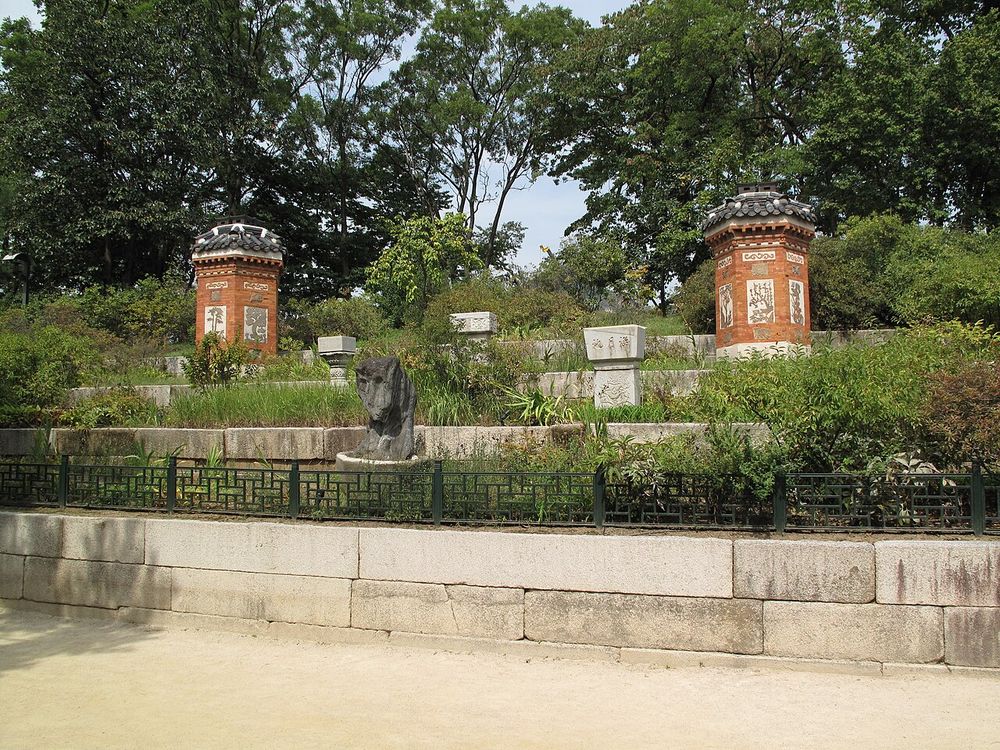
The chimneys in the terraced gardenG41rn8, CC BY-SA 4.0
The king's bedchamber and the queen's, behind it, have no ridge along the top of the roof. The usual explanation is that the king is himself a dragon, and no other dragon, as a roof ridge was called, should lie on top of him.
Both halls were taken down in 1917 and their timber was used to repair another palace after a fire. What stands here was rebuilt in 1995.
Behind the queen's hall is a small terraced garden. The four six-sided brick towers are chimneys. Smoke from the floor heating ran underground and came out here, far from the rooms. They are decorated with cranes, bats, plum and bamboo.
7. Hyangwonjeong: the pavilion on the island
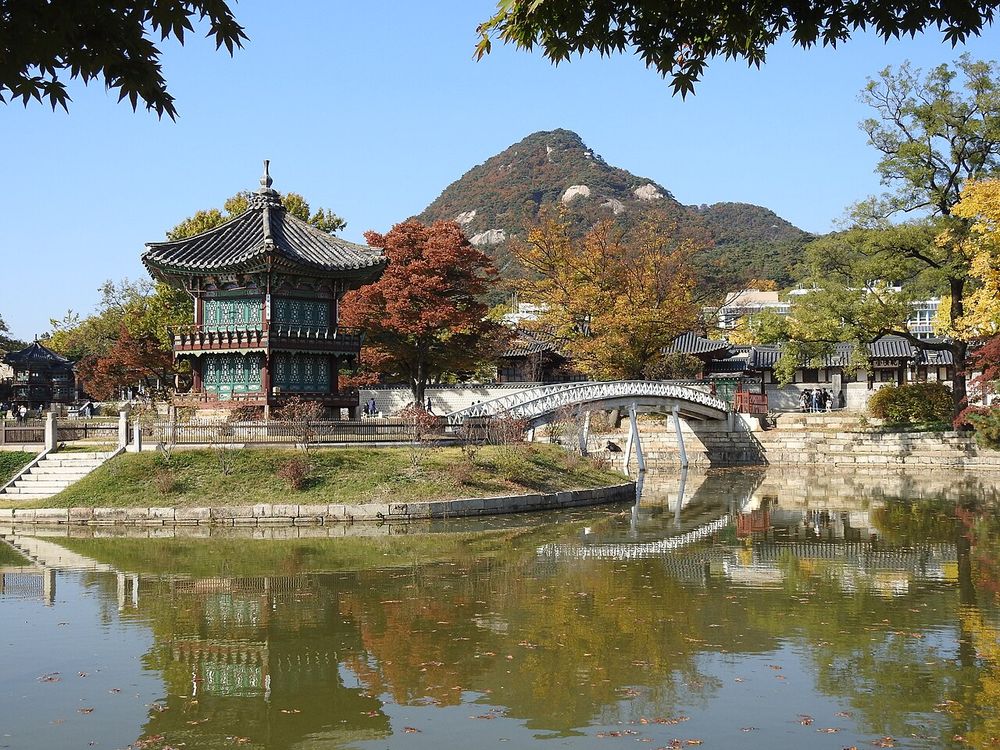
Hyangwonjeong and Mount BugakHuntsmanleader, CC0
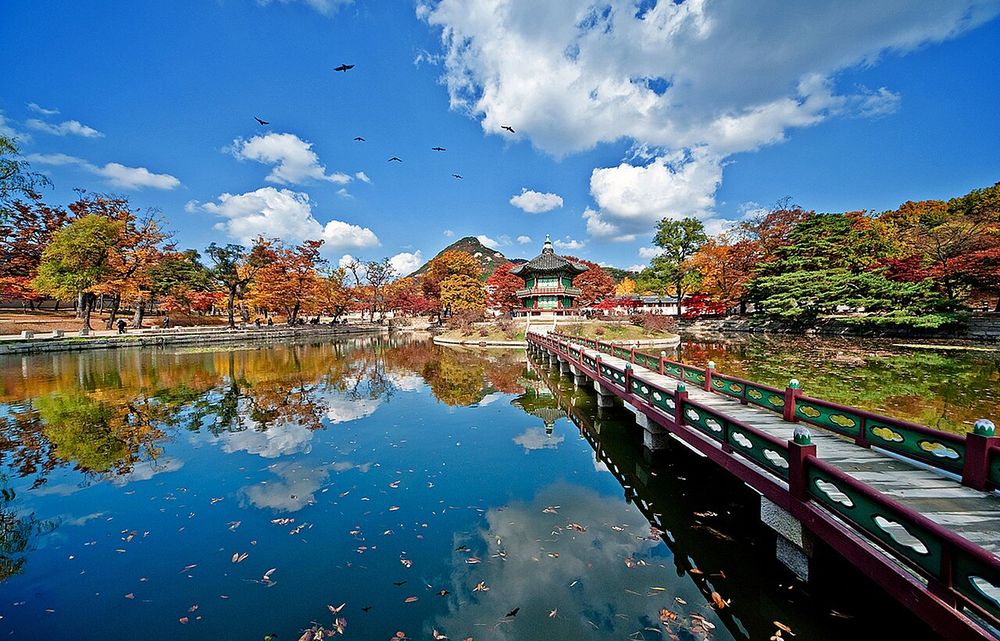
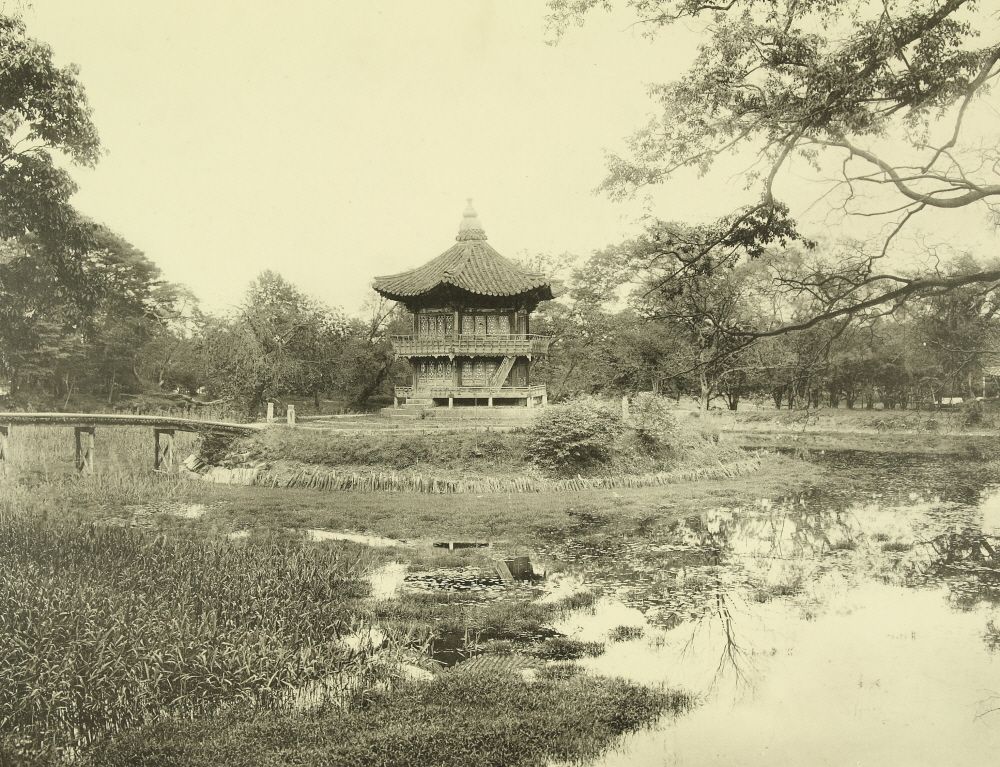
In 1873 King Gojong had a second pond dug at the north end and a six-sided pavilion built on its island. The name means "fragrance that carries far", from a Chinese essay in praise of the lotus.
The bridge was rebuilt on the wrong side after the Korean War. In 2021 it was moved back to the north, where the king used to cross from his own house.
Come in late October, when the trees round the water turn.
8. Geoncheonggung: electric light, and a murder
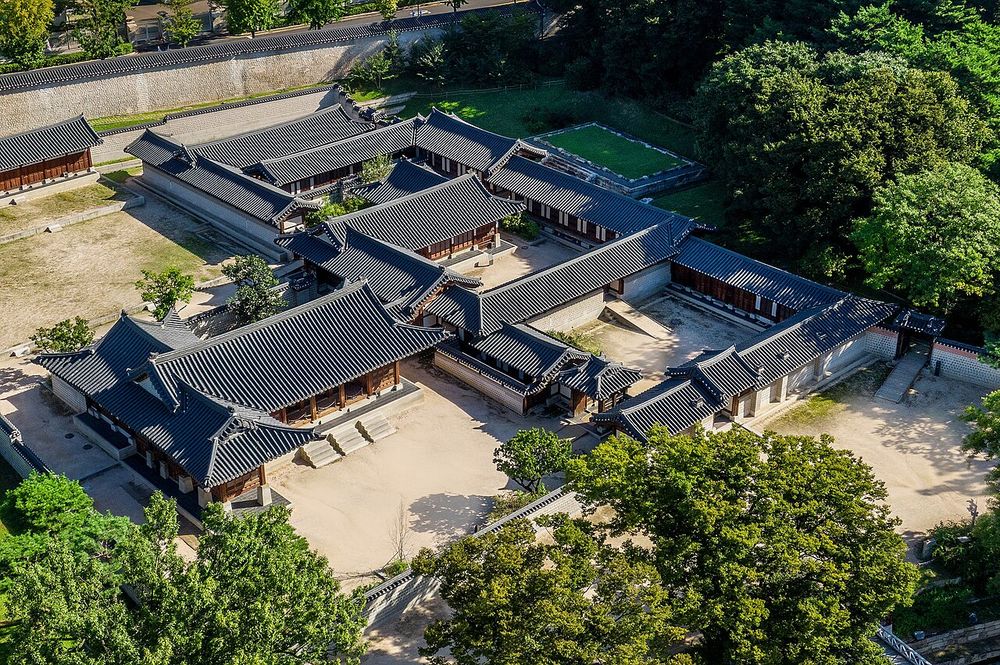
Geoncheonggung from the airRoyal Palaces and Tombs Center, KOGL Type 1
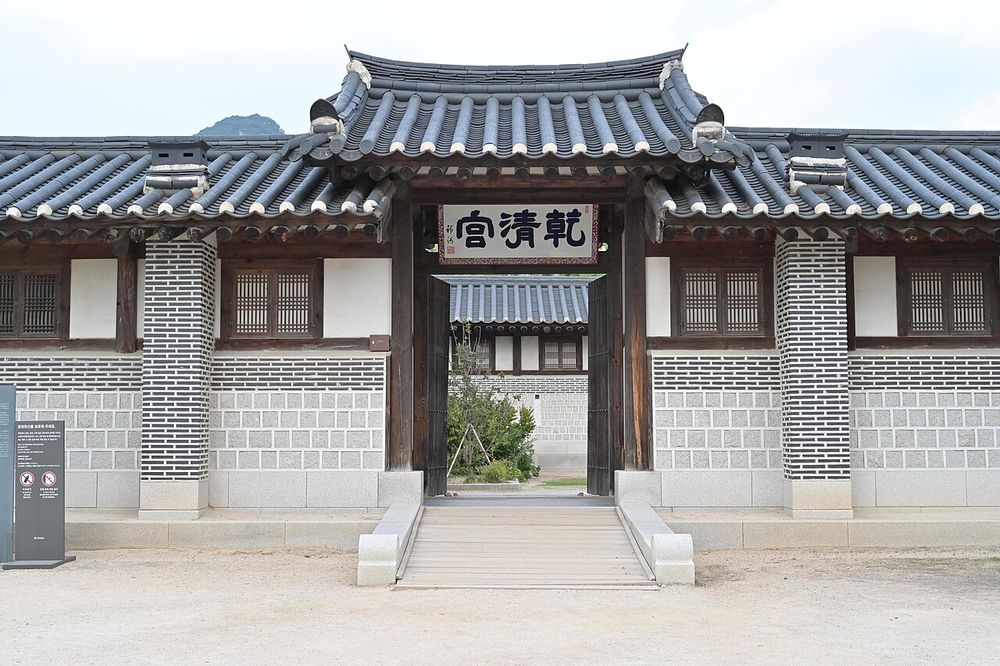
North of the pond is a group of plain buildings that look like a nobleman's house. The king and queen lived here from 1884. In 1887 the first electric lamps in Korea were lit here, with a generator bought from Edison's company and water from the pond.
Before dawn on 8 October 1895, a band of Japanese swordsmen and soldiers, organised by the Japanese minister in Seoul, forced their way in. They killed the queen in her rooms and burned her body in the grove behind.
Four months later the king fled to the Russian legation, hidden in a court lady's sedan chair. He never lived in this palace again.
9. Taken apart, and put back
1920: the Government-General Building going up in front of the palaceUnknown authorUnknown author, Public domain
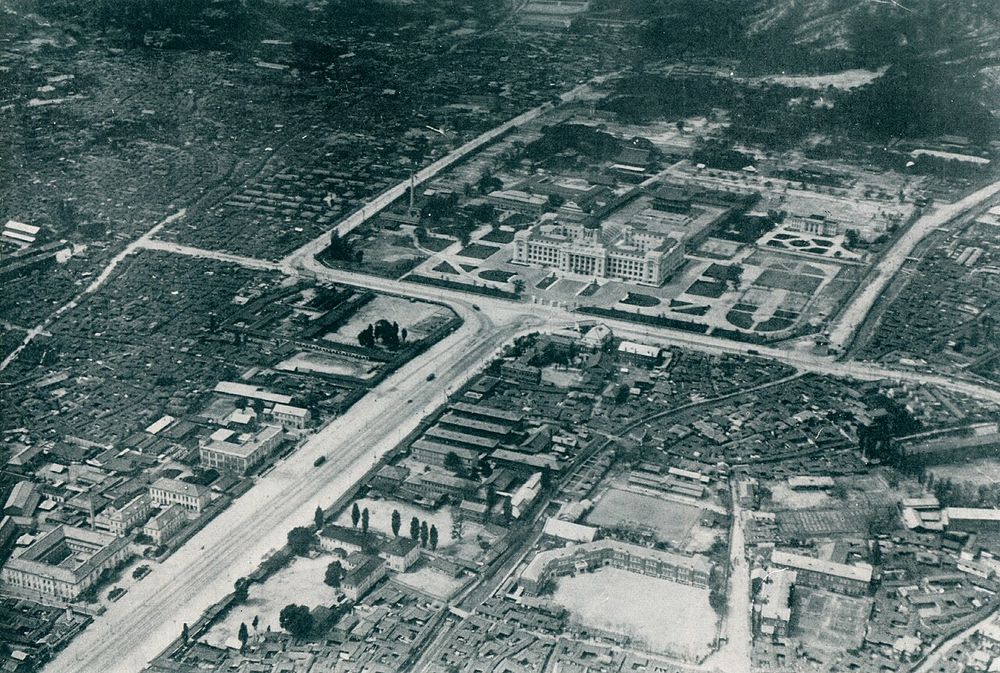
After 1910 the colonial government held trade fairs in the grounds and sold the buildings for their timber. Of some five hundred, about forty were left. From 1916 to 1926 it built its headquarters of granite, with a dome, between the main gate and the throne hall. From the street, the palace could no longer be seen.
About 1930: the finished building hides the palace日本地理風俗大系, Public domain
After 1945 the building housed the Korean parliament and then the national museum. Many people wanted to keep it as evidence. On 15 August 1995, fifty years to the day after liberation, the tip of the dome was cut off before a crowd. The rest was gone by the end of 1996.
Rebuilding began in 1990 and is planned to run to 2045. Even then, well under half of the old palace will be back.
10. The same years in China
The throne hall in 1906, with weeds in the yardja:朝日新聞社, Public domain
Joseon and Ming were founded within a generation of each other, in 1392 and 1368. The Joseon kings took their calendar and their titles from the Ming emperor and sent envoys to Beijing several times a year.
When Japan invaded in 1592 and this palace burned, the Wanli Emperor sent armies to help. The war lasted seven years and drained the Ming treasury.
In 1895, the year the queen was killed, the Qing lost its war with Japan and gave up its old claim to stand over Korea. Fifteen years later Korea was a Japanese colony.
Meanwhile in the world
Year
Here
Elsewhere
1395
The palace is built
The Hongwu reign of the Ming; the Forbidden City is finished in 1420
1443
King Sejong's alphabet
The Zhengtong reign of the Ming
1592
The palace burns in the Japanese invasion
The Wanli Emperor sends an army to Korea
1867
Rebuilt after 270 years
The Tongzhi reign; the Qing (1644–1912) is trying to modernise
1887
Electric light at Geoncheonggung
The Guangxu reign; Shanghai has had electric street lamps since 1882
1895
The queen is murdered
The Qing loses the war with Japan and signs the Treaty of Shimonoseki
1926
The Government-General Building is finished
The Northern Expedition begins in China
1995
The demolition of that building begins
China and South Korea opened diplomatic relations three years earlier
2010
Gwanghwamun is rebuilt in wood on its old line
The Shanghai World Expo
One line to remember: built in 1395, burned in 1592, rebuilt in 1867, pulled down after 1910, and coming back since 1990.
Then and now
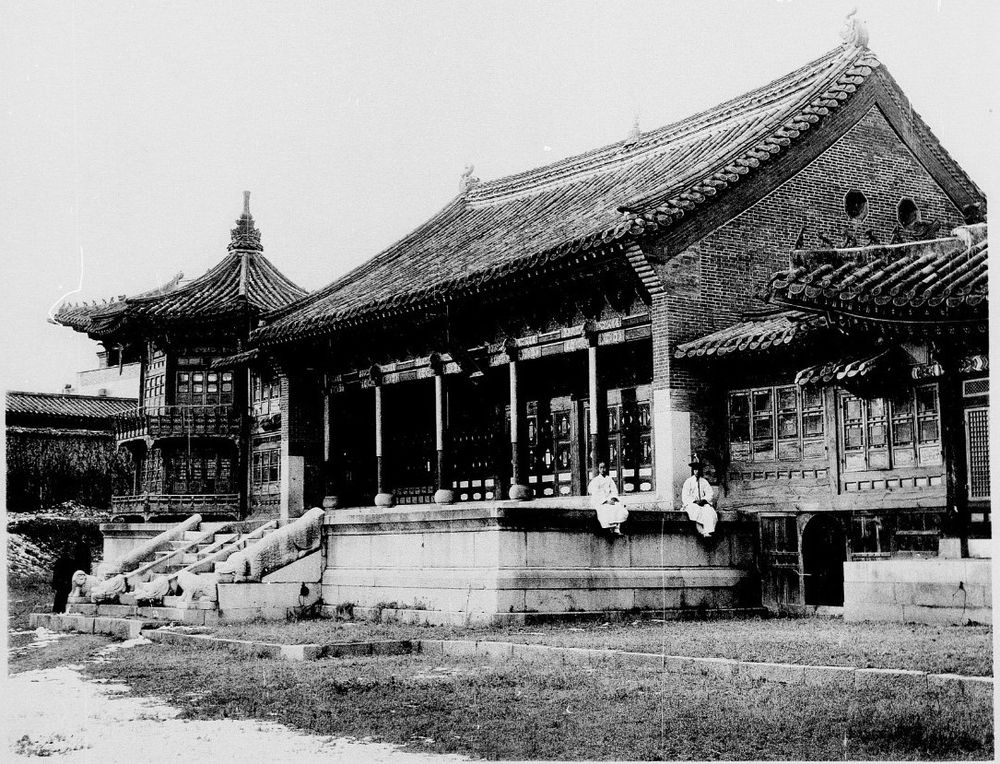
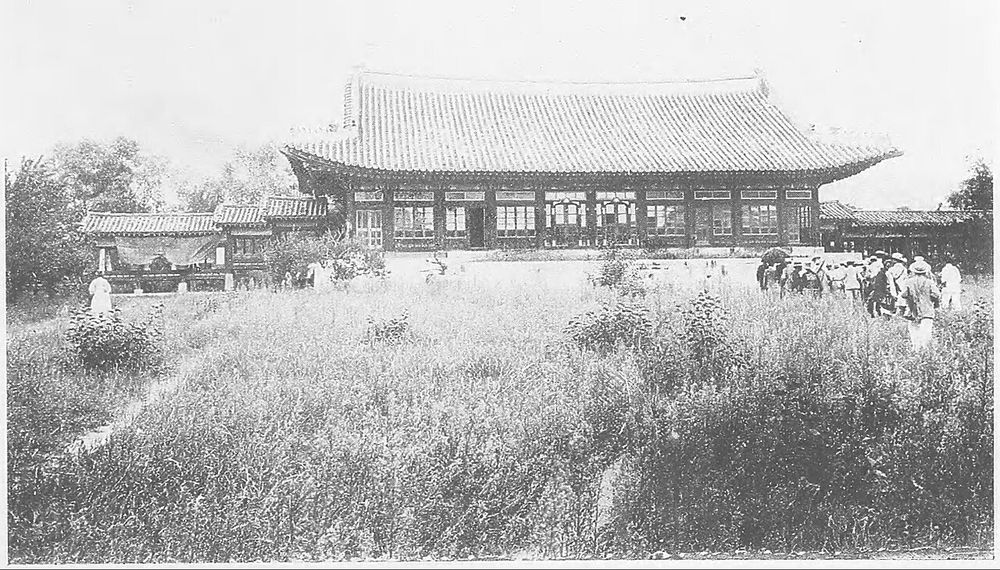
Gwanghwamun with Mount Bugak behind서울특별시 소방재난본부(Seoul Metropolitan Fire & Disaster Headquarters), CC BY-SA 4.0, Wikimedia CommonsGwanghwamun, the main gateTrainholic, CC BY-SA 3.0, Wikimedia CommonsThe gate from the avenue민건오, CC BY-SA 3.0, Wikimedia CommonsA stone haetae in front of the gate, 2026Sadopaul, CC BY-SA 4.0, Wikimedia CommonsHeungnyemun, the second gateBasile Morin, CC BY-SA 4.0, Wikimedia CommonsPainted eaves of the second gateEthan Doyle White, CC BY-SA 4.0, Wikimedia CommonsGeunjeongmun, the third gate, and its corridorPinterpandai, CC BY-SA 4.0, Wikimedia CommonsGeunjeongjeon, the throne hallBrady Bellini, CC0, Wikimedia CommonsThe throne hall on its stone platformBasile Morin, CC BY-SA 4.0, Wikimedia CommonsThe courtyard and its corridorDe-Shao Liu (Terry850324), CC BY-SA 4.0, Wikimedia CommonsThe throne and the screen of sun, moon and five peaksTristan Surtel, CC BY-SA 4.0, Wikimedia CommonsThe throne from the side doorSpike, CC BY-SA 4.0, Wikimedia CommonsSajeongjeon and its side hallTristan Surtel, CC BY-SA 4.0, Wikimedia CommonsA side yard behind the throne hall, March 2025Epicgenius, CC BY-SA 4.0, Wikimedia CommonsHalls of the working quarterRichard Mortel from Riyadh, Saudi Arabia, CC BY 2.0, Wikimedia CommonsGyeonghoeru at nightRhie Cudanin, CC BY 3.0, Wikimedia CommonsGyeonghoeru in springFallfield2, CC BY-SA 4.0, Wikimedia CommonsThe stone causeway to the pavilionSungslim, CC BY-SA 4.0, Wikimedia CommonsBlossom by the pondWorldContributor, CC BY-SA 4.0, Wikimedia CommonsA hall of the queen dowager's quarterRichard Mortel from Riyadh, Saudi Arabia, CC BY 2.0, Wikimedia CommonsThe chimneys in the terraced gardenG41rn8, CC BY-SA 4.0, Wikimedia CommonsHyangwonjeong in autumn서울특별시 소방재난본부(Seoul Metropolitan Fire & Disaster Headquarters), CC BY-SA 4.0, Wikimedia CommonsHyangwonjeong and Mount BugakHuntsmanleader, CC0, Wikimedia CommonsHyangwonjeong in snow, 2013Cultural Heritage Administration, KOGL Type 1, Wikimedia CommonsGeoncheonggung from the airRoyal Palaces and Tombs Center, KOGL Type 1, Wikimedia CommonsThe gate of Geoncheonggung주식회사 아이티앤, CC BY 4.0, Wikimedia CommonsPainted brackets under a roofThe original uploader was Appleby at English Wikipedia., CC BY-SA 2.0, Wikimedia CommonsRoofs in winterKorea.net / Korean Culture and Information Service (Jeon Han), CC BY-SA 2.0, Wikimedia CommonsSpring blossom in the groundsWorldContributor, CC BY-SA 4.0, Wikimedia CommonsA palace building about 1900, photographed by Maurice CourantMaurice Courant, Public domain, Wikimedia CommonsThe throne hall in 1906, with weeds in the yardja:朝日新聞社, Public domain, Wikimedia CommonsAn overgrown hall in 1906ja:朝日新聞社, Public domain, Wikimedia CommonsGyeonghoeru in 1906, the pond full of lotusja:朝日新聞社, Public domain, Wikimedia Commons1920: the Government-General Building going up in front of the palaceUnknown authorUnknown author, Public domain, Wikimedia CommonsAbout 1930: the finished building hides the palace日本地理風俗大系, Public domain, Wikimedia CommonsThe throne hall about 1930Government-General of Chōsen, Public domain, Wikimedia CommonsGyeonghoeru about 1930Government-General of Chōsen, Public domain, Wikimedia CommonsHyangwonjeong about 1930Government-General of Chōsen, Public domain, Wikimedia CommonsSeoul from a US Navy aircraft, September 1945Naval Photographic Center, Public domain, Wikimedia CommonsThe palace area from the air in 1951, during the war한국저작권위원회, CC BY 4.0, Wikimedia Commons
Local legends
These are stories people tell about this place. They are legends, not history, and each one says where it comes from.
LegendThe haetae at the gate
The mountain south of Seoul is shaped like a flame, and its fire kept reaching the palace. The stone haetae were set at the gate because the haetae eats fire.
Source: Seoul tradition, told since the rebuilding of the 1860s
LegendThe Government-General Building
The Japanese gave their building the shape of the character for "sun", the first character of "Japan", and placed it to cut the line of good fortune that runs from the mountain to the palace.
Source: Widely believed in Korea; the plan does resemble the character, but no Japanese document states such a purpose
LegendThe king's roof
The king's bedchamber has no ridge because the king is a dragon, and a second dragon must not lie over him.
Source: The usual explanation given by palace guides; no building record states it
LegendThe pond
Two bronze dragons were sunk in the pond of Gyeonghoeru to keep fire away. One was found in 1997. The other has never been seen.
Source: A record of the 1860s rebuilding; the find of 1997
Later, people who live here will be able to add the stories they grew up with, and say which of these they have heard.
Not certain, and where accounts conflict
Who burned the palace in 1592?
The court's own annals blame townspeople and slaves, who are said to have burned the offices that held the slave registers. Some Japanese accounts describe the palace standing when their army arrived. Scholars are divided.
Should the Government-General Building have been kept?
In the 1990s historians and architects argued for moving it or leaving it as a reminder. The government chose to demolish it. Its spire is displayed at the Independence Hall of Korea.
How much of the palace is original?
The throne hall, Gyeonghoeru and a handful of others are from the 1860s. Most of the rest was rebuilt after 1990, on old foundations and from old drawings and photographs.
Hangul or Chinese on the gate?
From 1968 to 2010 the name board was in the Korean alphabet, written by President Park Chung-hee. The board of 2010 and that of 2023 use the Chinese characters of the 1860s. People who want Korean letters back still campaign.
Visiting
Tickets and hours
3,000 won for an adult. Children and people of 65 and over enter free. Guides differ on the exact ages for foreign visitors, so ask at the gate.
Anyone wearing hanbok, Korean traditional dress, enters free. Shops outside the gate rent it by the hour.
Open 9:00 to 17:00 from November to February, to 18:00 in spring and autumn, and to 18:30 from June to August. Last entry is one hour before closing.
Closed on Tuesdays. When Tuesday is a public holiday, it closes the next working day instead.
In 2026 the autumn night opening ran from 2 September to 2 October, 19:00 to 21:30.
Last checked 2026-11-12. Seoul guides of 2026 and Korea's official tourism listing; the palace's own site refuses automated visits, so we could not open it.
Booking from abroad
Ticket window on site Night openings in spring and autumn are sold online ahead, on a Korean ticket site. Guides say a limited number of tickets are kept for foreign visitors at the gate on the night, on showing a passport. We could not confirm this.
Note No booking is needed in the daytime. Tickets are sold at the gate. The palace's site is on royal.khs.go.kr, which has an English version. It refuses automated visits, so we could not open it and give no link.
Checked 2026-11-12
Where to start
Metro line 3 to Gyeongbokgung station, exit 5, comes up inside the walls. Line 5 to Gwanghwamun station, exit 2, brings you up the avenue to the gate, which is the better first view.
Be at the gate for the guard ceremony at 10:00, then go in.
Walk the straight line north to the throne hall, turn left to the pavilion on the pond, then go on north to the island pavilion and the queen's last house. Allow two hours.
Free guided walks in English, Chinese and Japanese start near the ticket gate. The times are posted there.
Before you go
There is little shade and the yards are wide. Bring a hat in summer and gloves in winter.
The two museums inside the walls are free and are a good place to rest.
Seoul's other four palaces are within a short ride. Changdeokgung, with its garden, is the one to see next.
Customs and manners
If you rent hanbok, wear it as it is meant to be worn. It is Korea's formal dress, and older Koreans notice.
Do not step into the halls or sit on the raised wooden floors. Where a building is open, shoes come off at the step.
The site of the queen's death is a place of mourning for Koreans. Keep your voice down there.
Koreans greet with a small bow. Hand over money and tickets with two hands, or with the right hand while the left touches your right forearm.
The years of Japanese rule are a living subject. Listen, and do not make light of it.
Look for these
At the main gate, which of the three arches is the tallest, and who used it?
On the stone bridge, find the four animals watching the water. One of them is sticking out its tongue.
In the big yard, find the stone posts. What is written on them?
Round the throne hall's platform, find the twelve animals of the zodiac. Which two are missing?
Look in at the throne. What three things are painted on the screen behind it?
At the pavilion on the pond, are the outer pillars round or square?
Find a roof with no ridge on top. Whose house was it?
In the terraced garden, find the chimneys. How many sides does each have?
I am here
Stand at the site, sign in, press the button, and collect its stamp. Your browser will ask to use your location. It is sent to us once to confirm that you are at the site; we keep how far you were from it, not the spot where you stood.
Your stamps are saved to your account, so they follow you to any device. Checking from a browser cannot rule out every false location; stricter checks arrive with the app.
Messages
Share your photos
Photos here show the place, not people. Each one is credited to the visitor who took it and appears after our team has looked at it. A photo with you in it belongs under “I am here”.