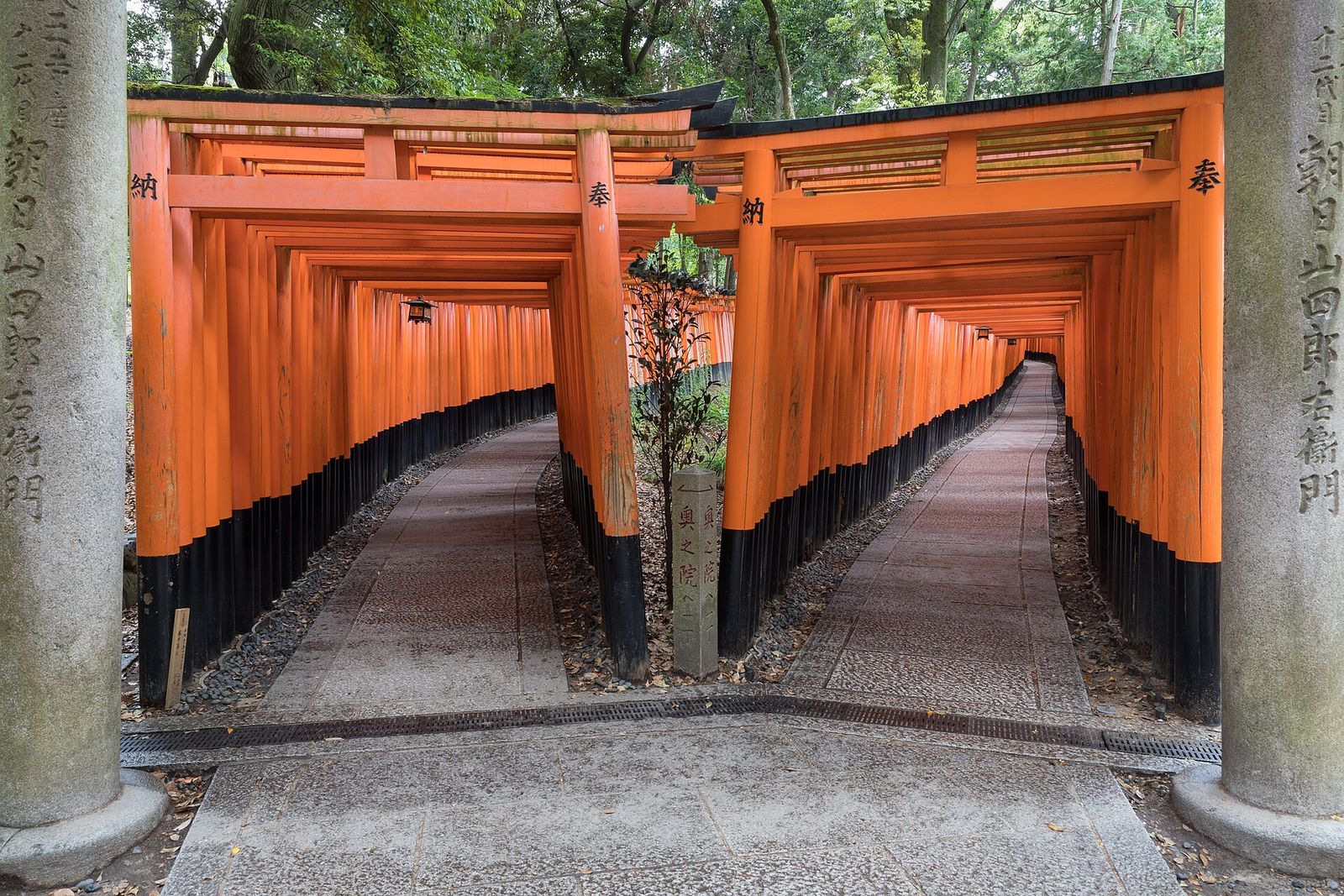
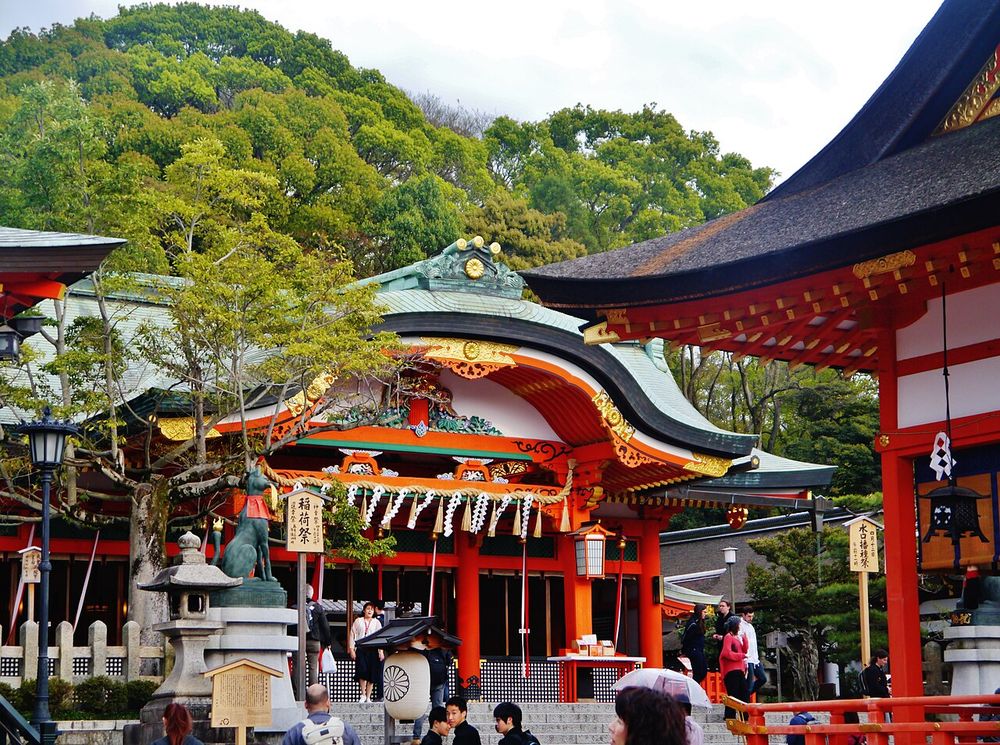
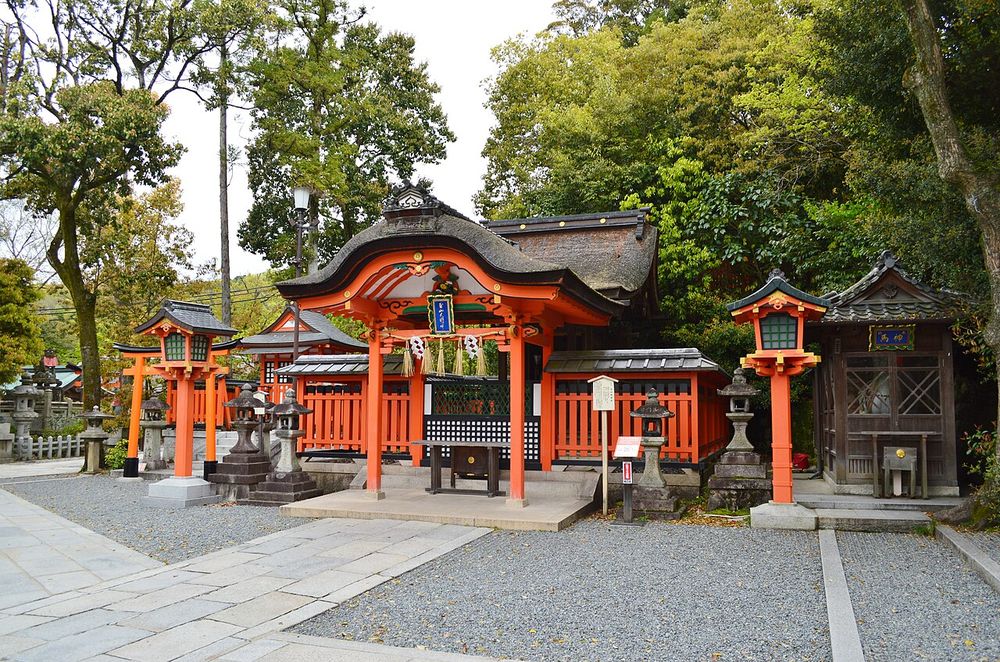
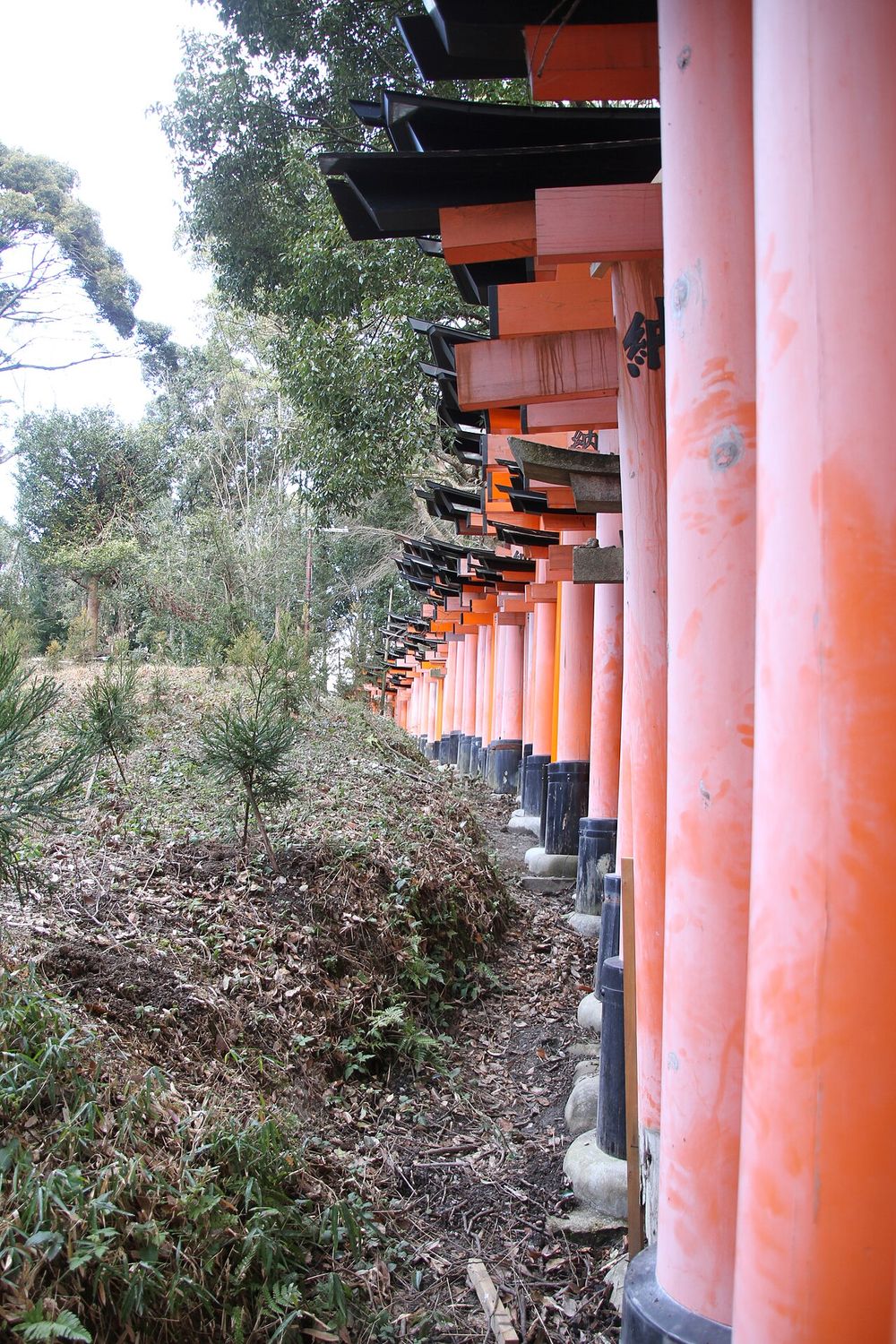
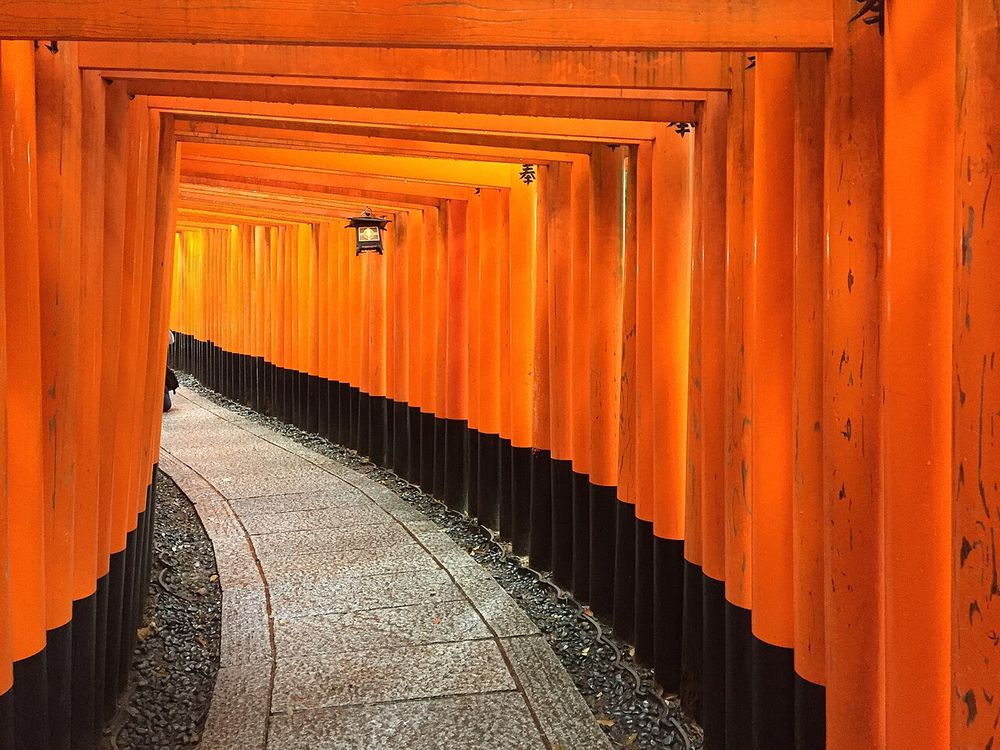
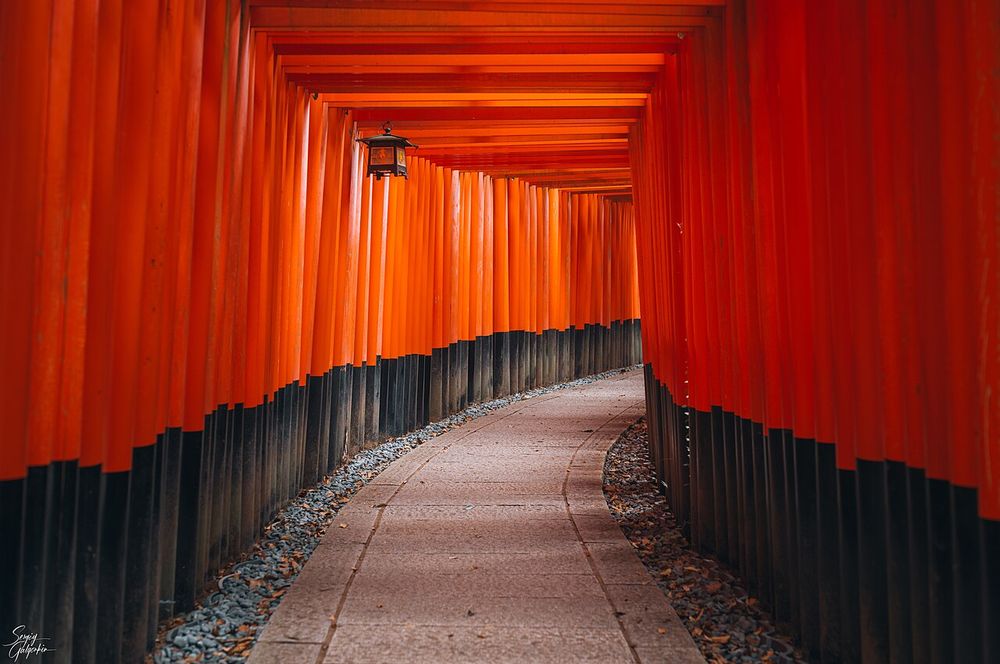
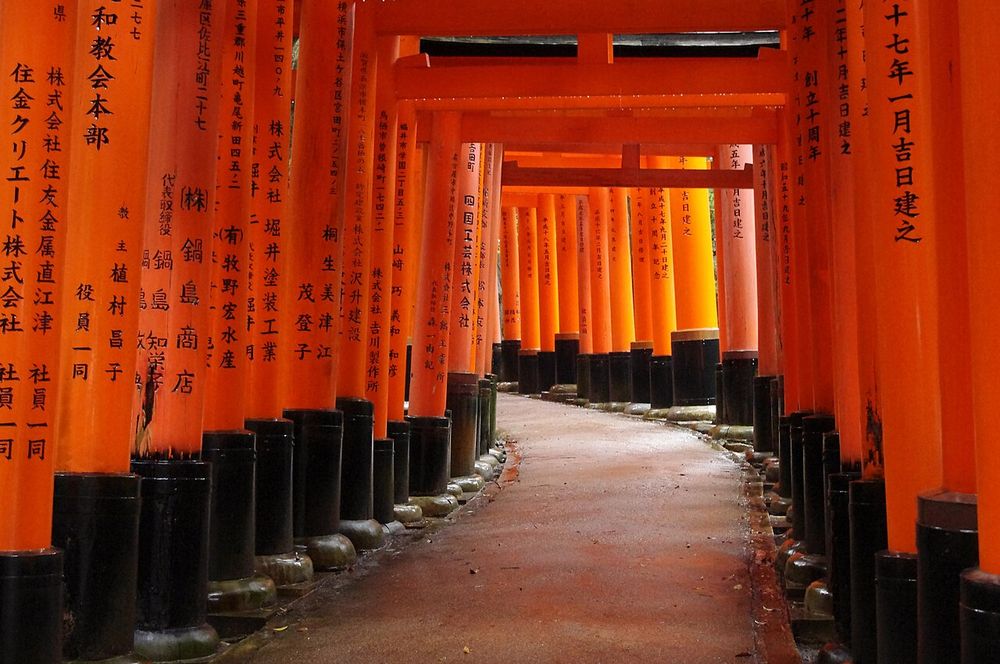
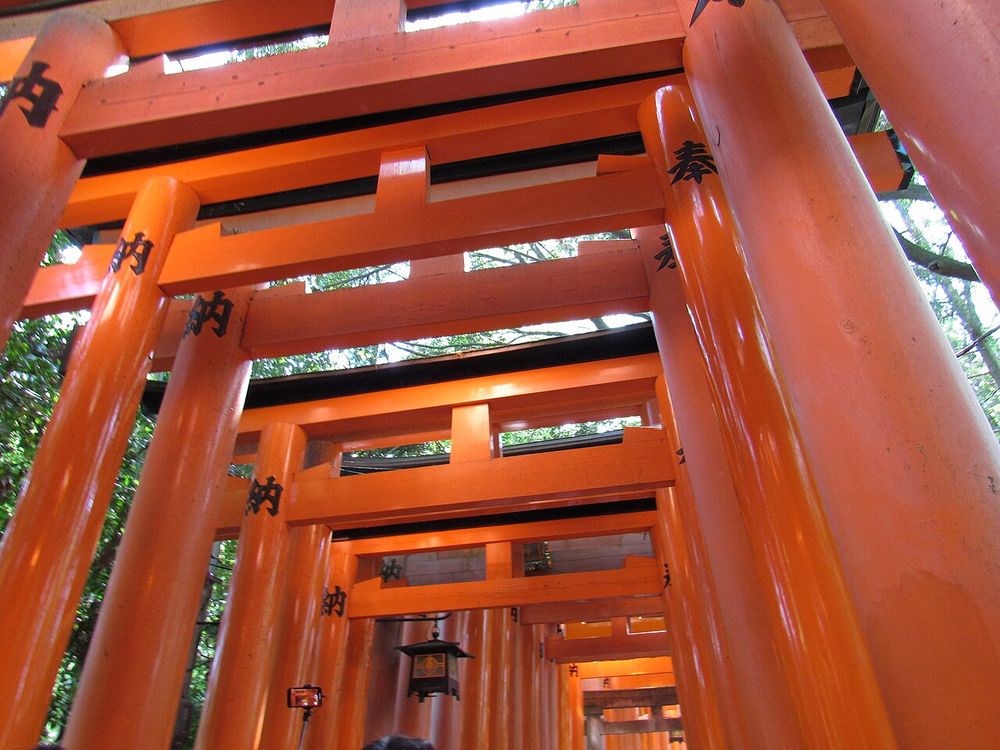
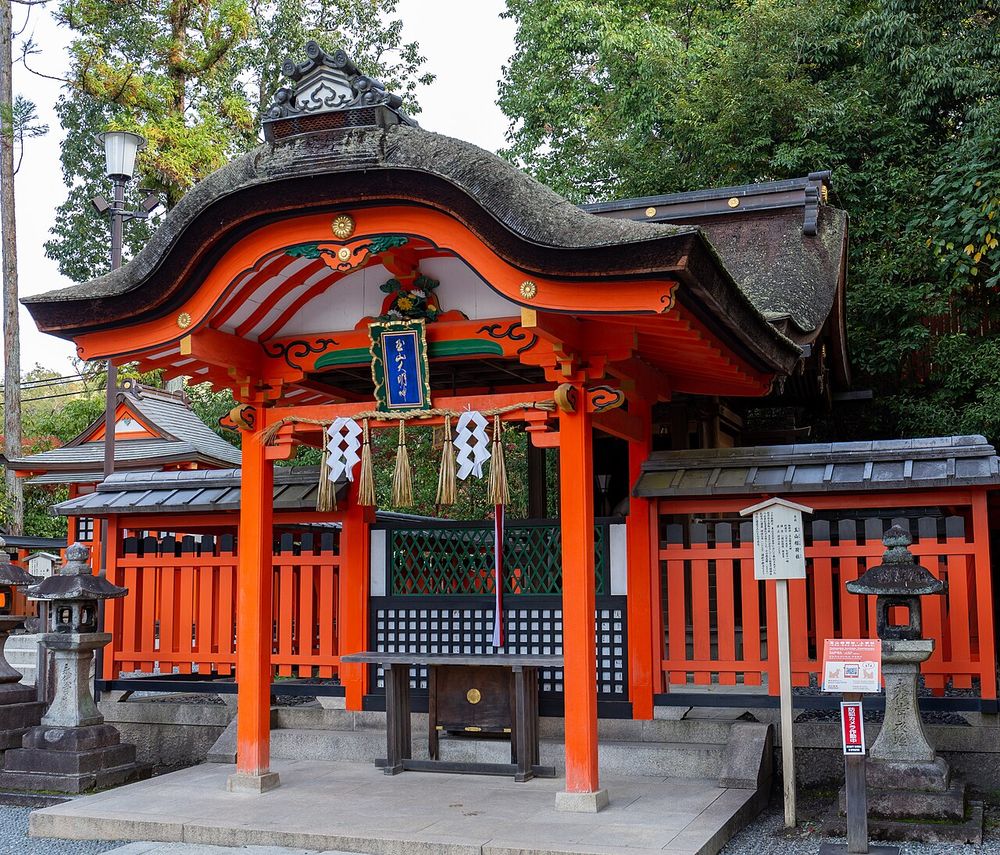
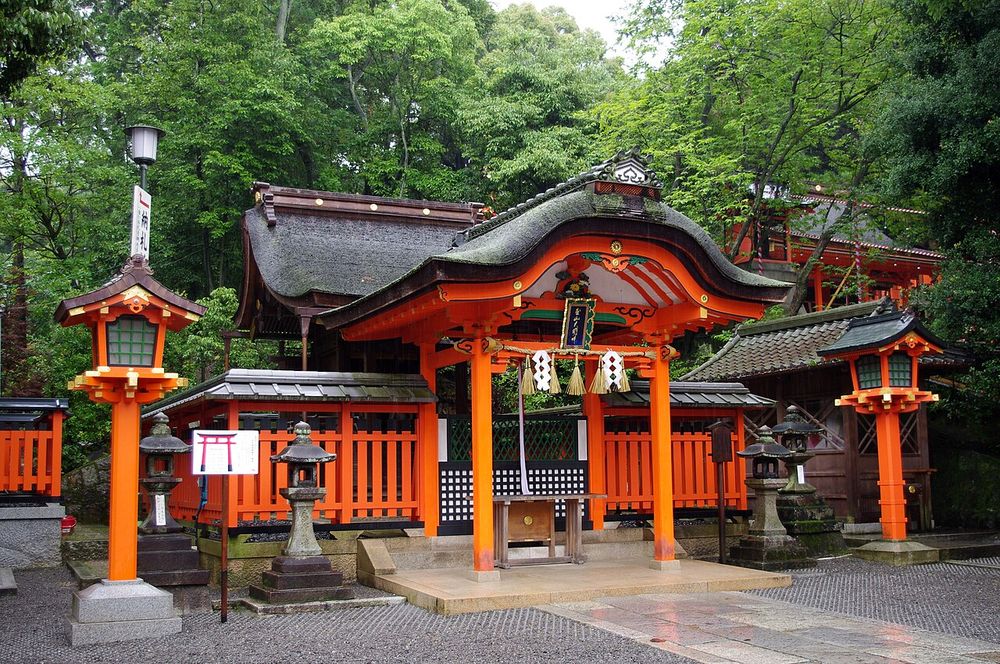
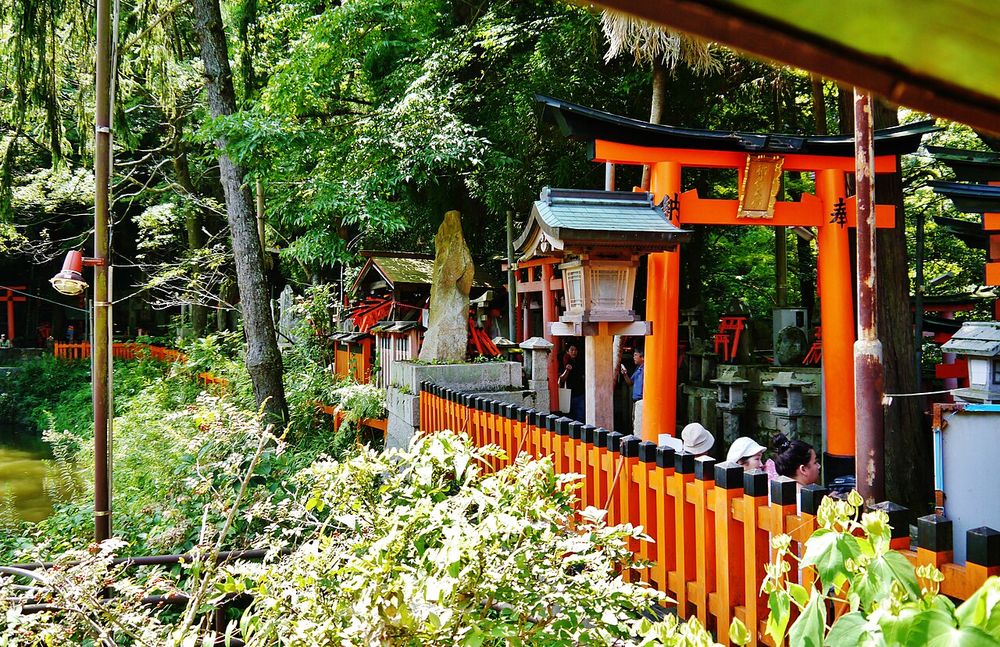
A shrine to the god of rice and of business, at the foot of a wooded hill. The paths up the hill run through thousands of red gates. Every one was paid for by somebody giving thanks or asking for luck.
Photo: Zairon, CC BY-SA 4.0, Wikimedia Commons
The story
You are standing at the head shrine of Inari, the god Japanese farmers asked for rice and Japanese shopkeepers now ask for good business. There are some thirty thousand Inari shrines in Japan. This is the first of them, founded in 711.
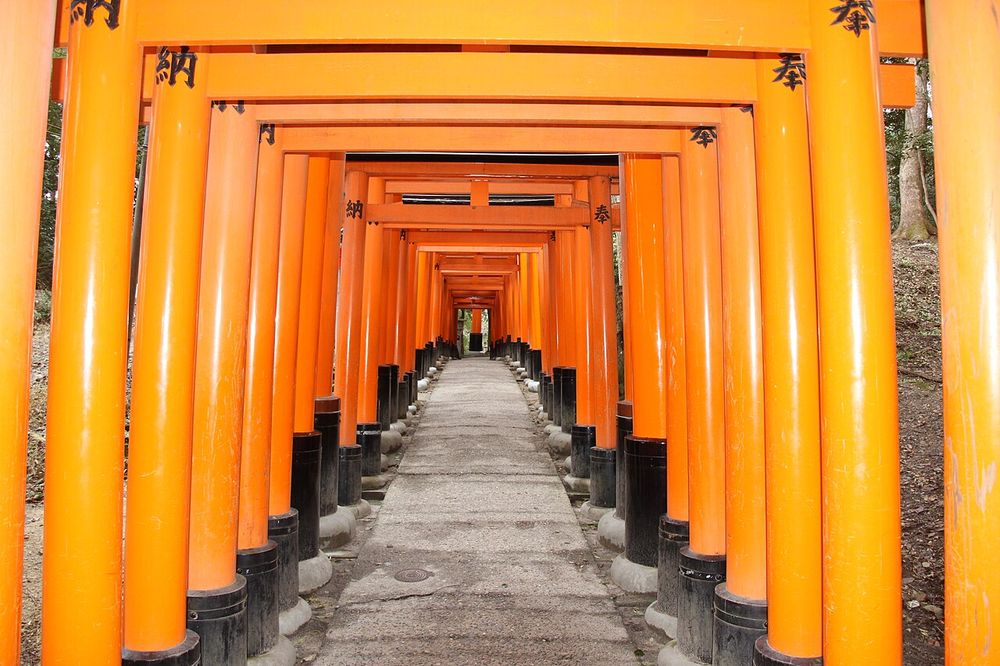
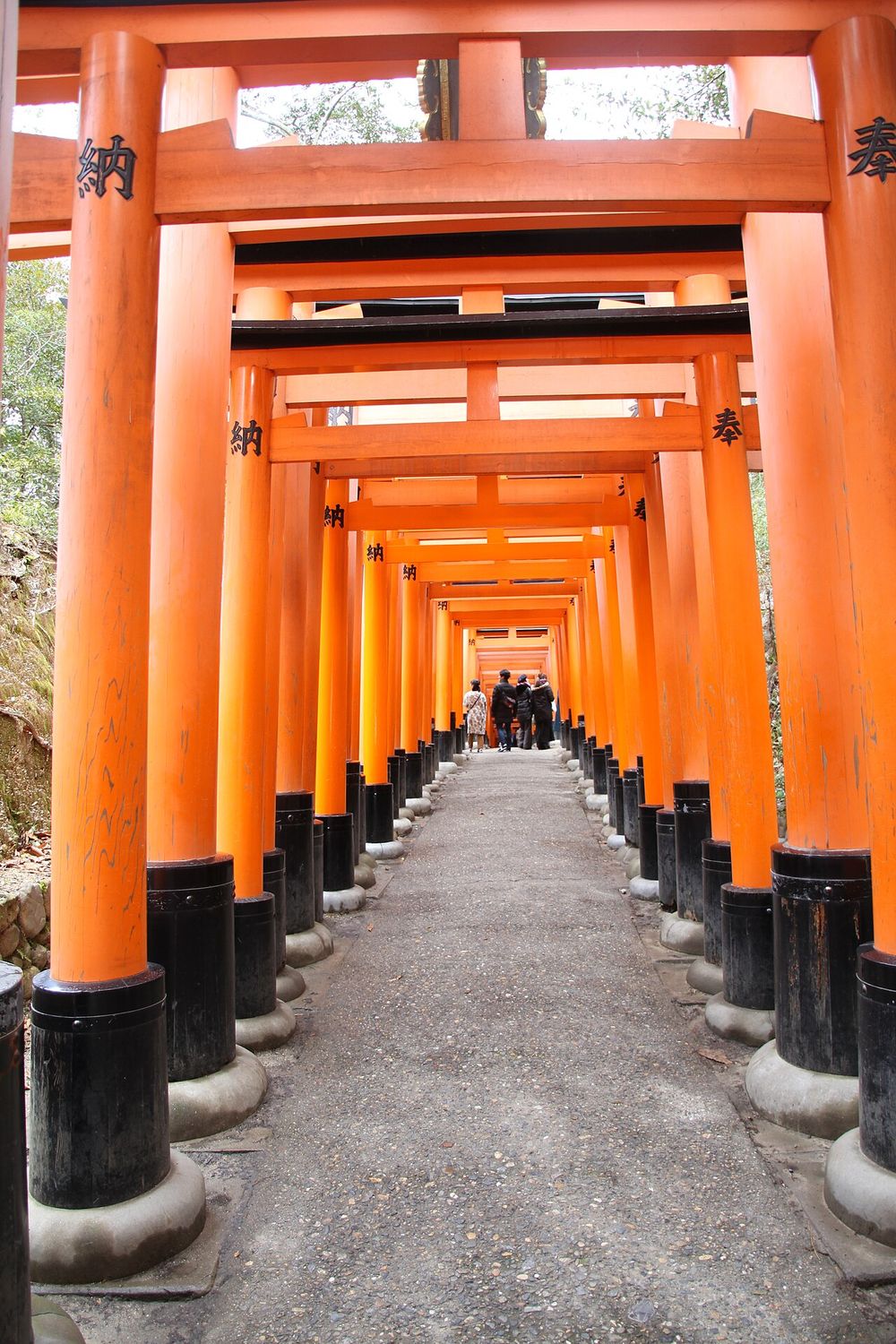
Behind the buildings a hill rises 233 metres. The paths that climb it pass under about ten thousand red gates, set so close together that they make tunnels.
What is here
Nothing here needs a ticket, and nothing closes. The counters for charms and prayers keep daytime hours.
Where the two tunnels of Senbon torii beginBasile Morin, CC BY-SA 4.0
A gate like this is called a torii. It marks the line between the everyday world and a place where a god lives. Most shrines have one or two. This one has thousands, because of a custom that took hold here about three hundred years ago: when a wish was granted, you gave the god a gate.
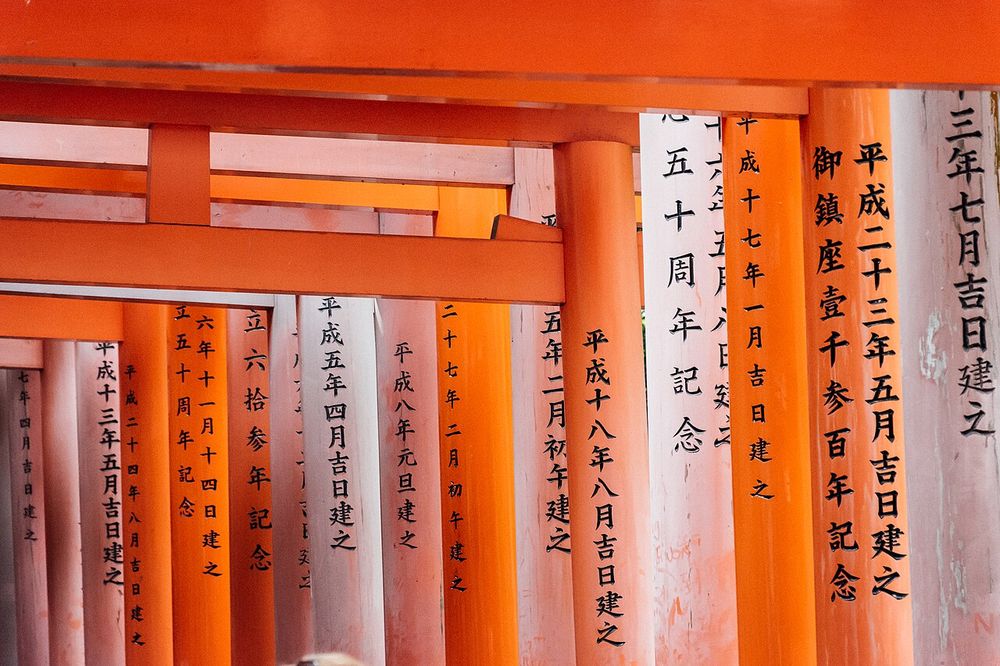
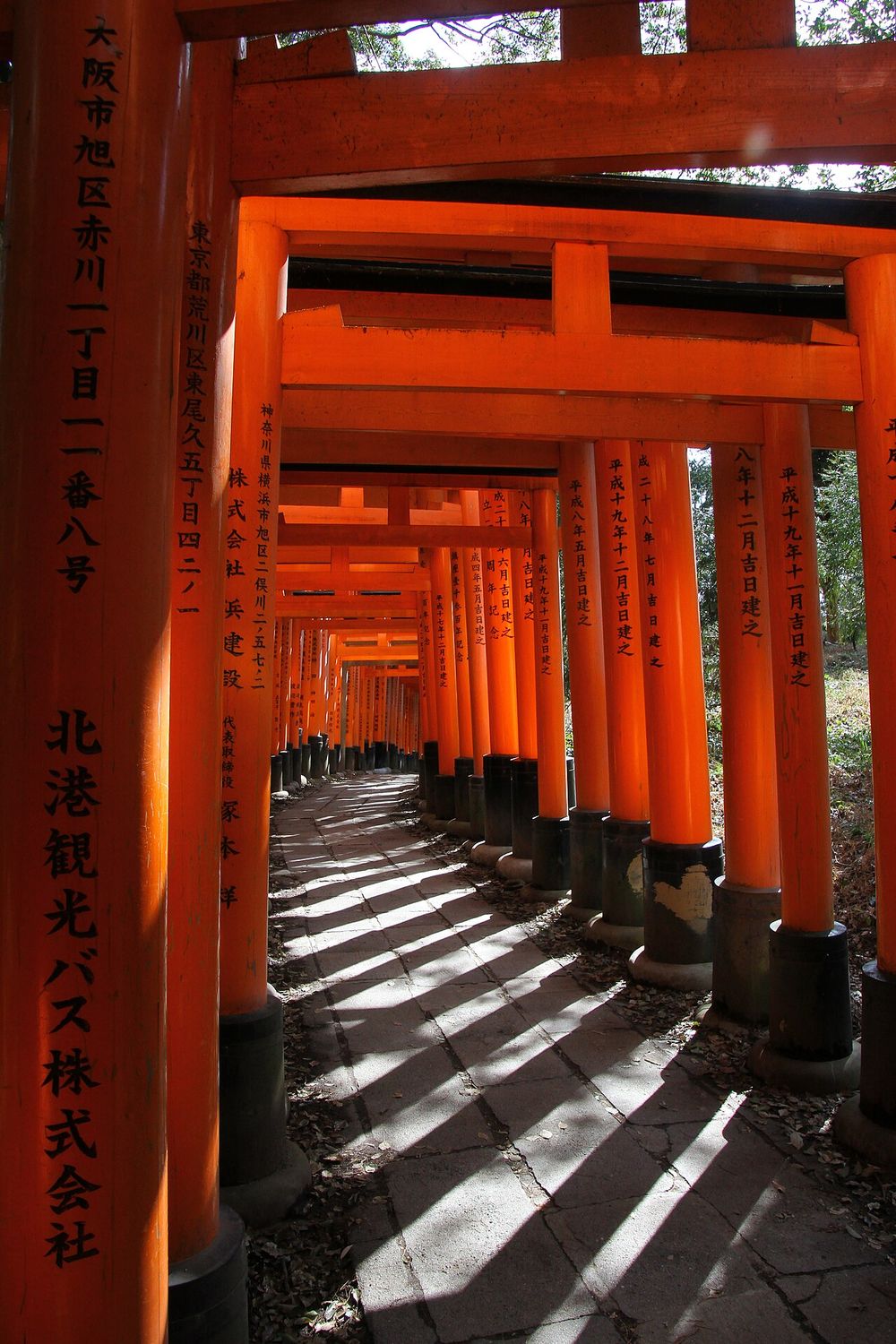
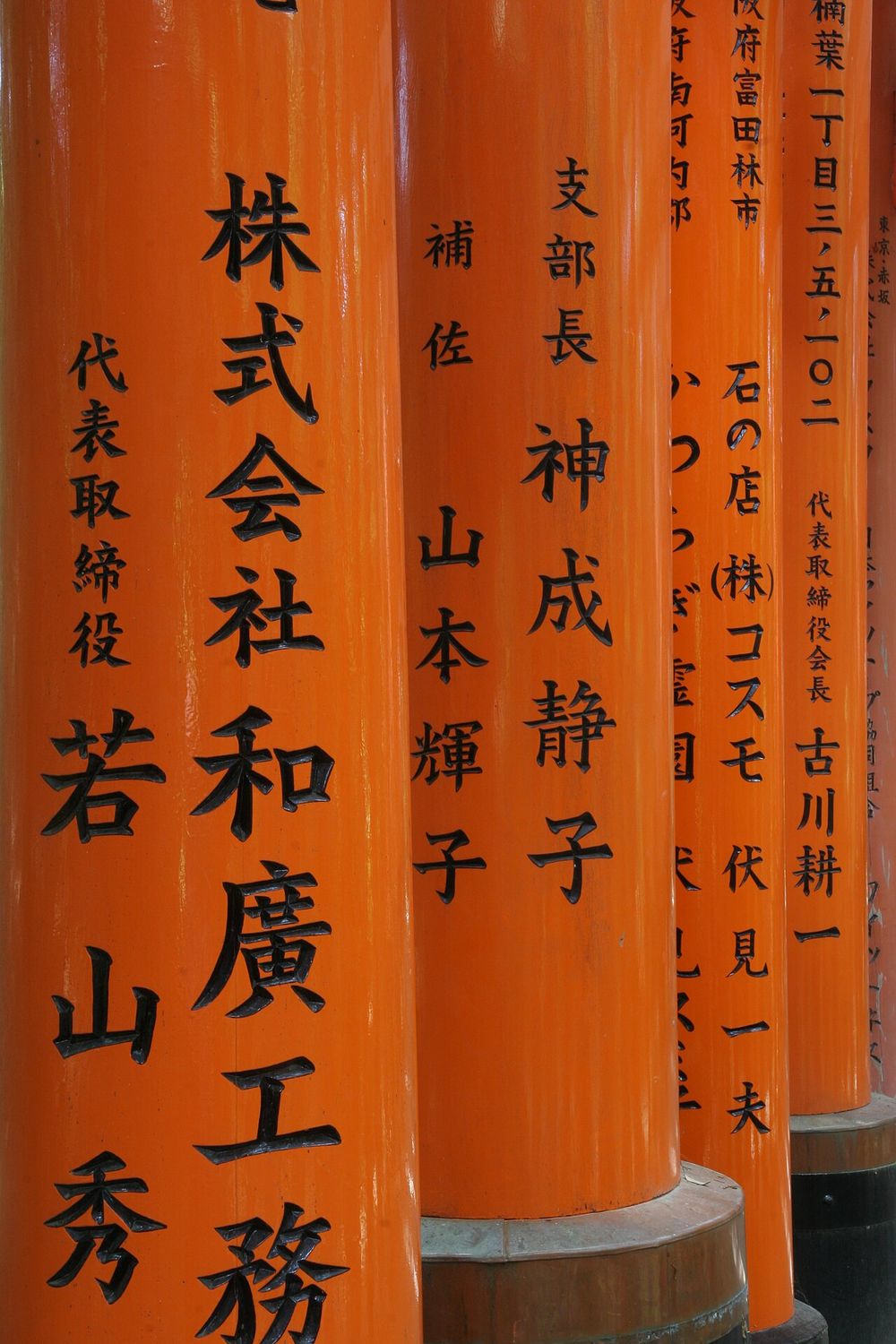
Walk up, then turn round. On the back of every gate, in black, are the name of the giver and the date. Most are companies.
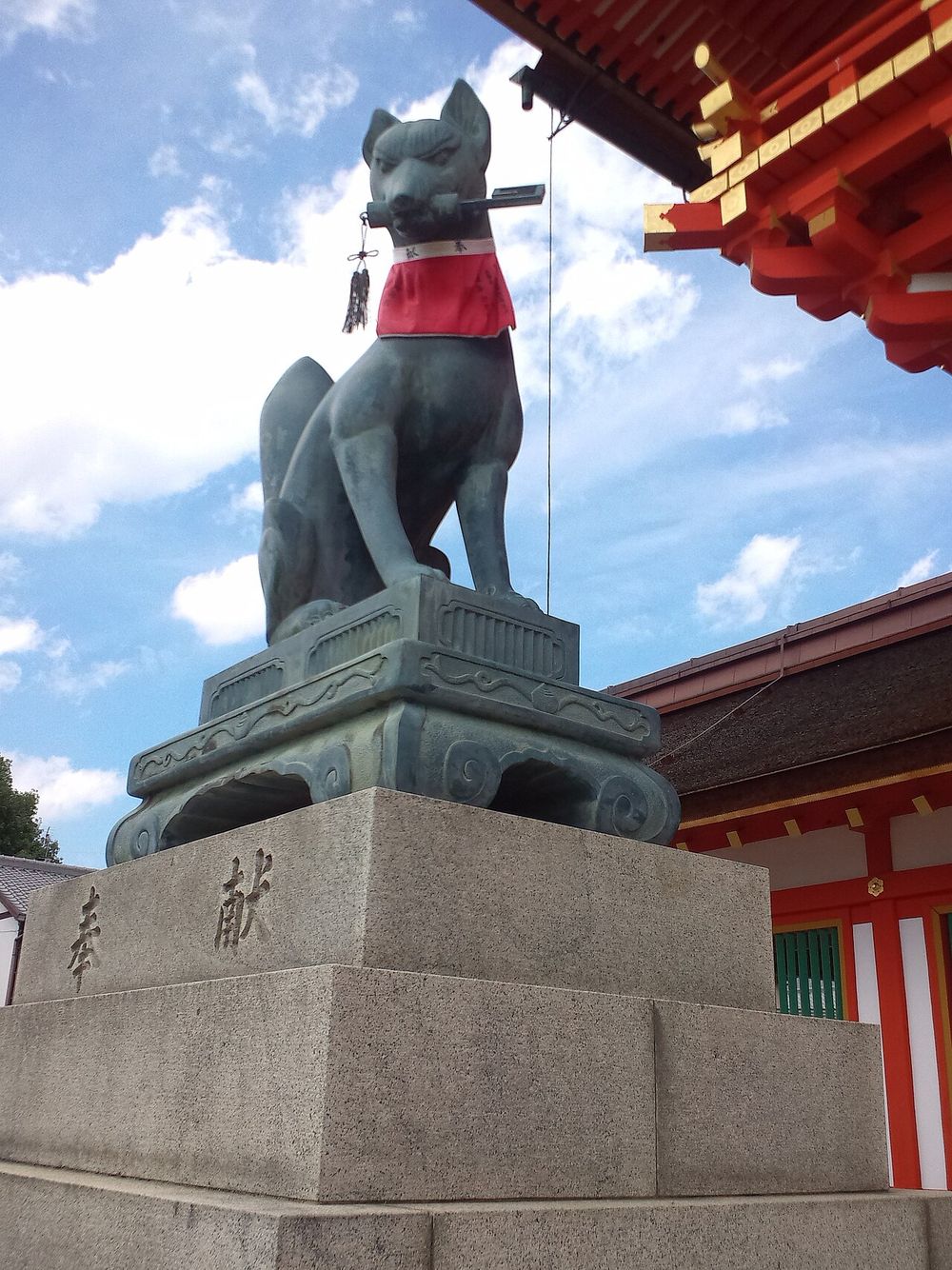
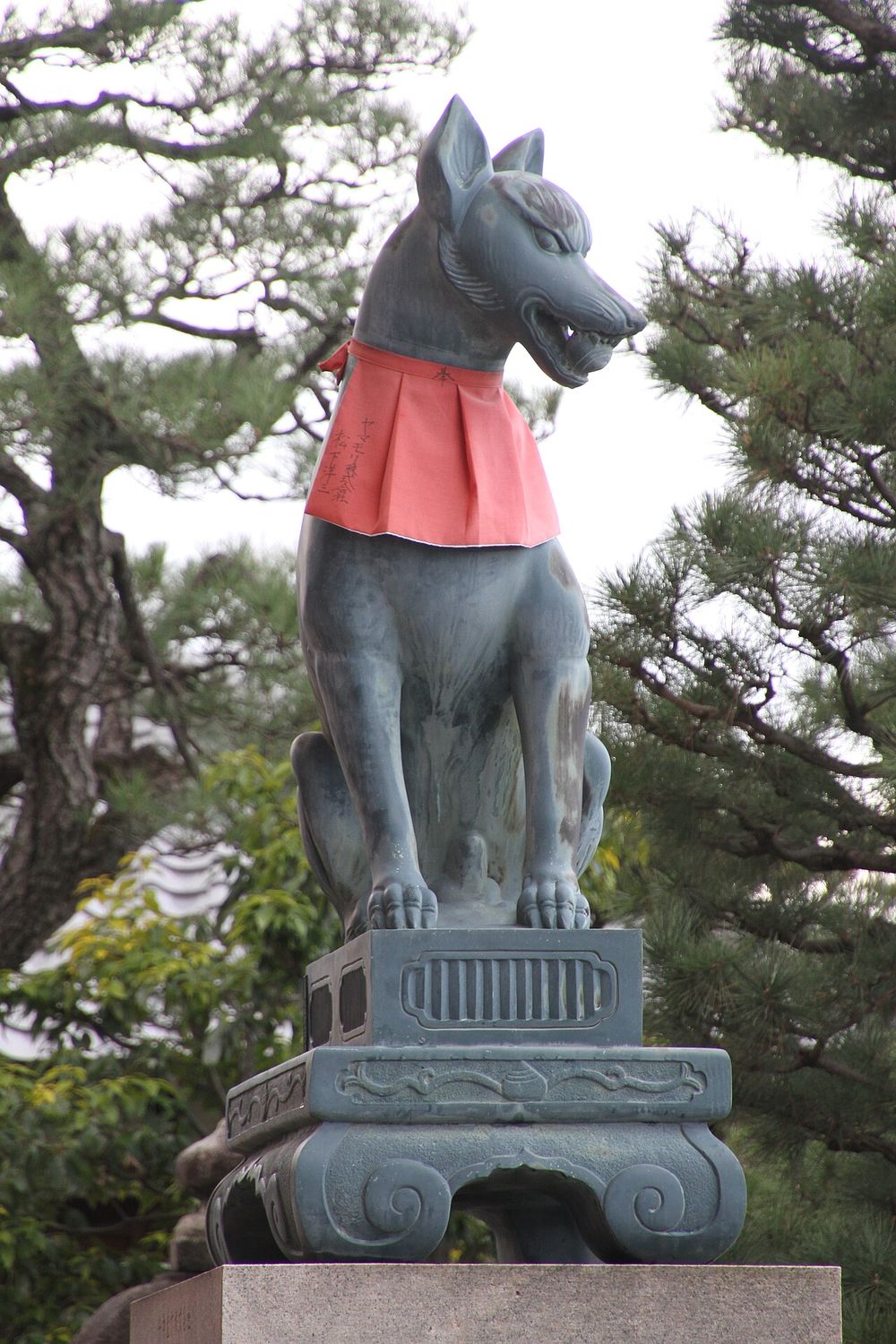
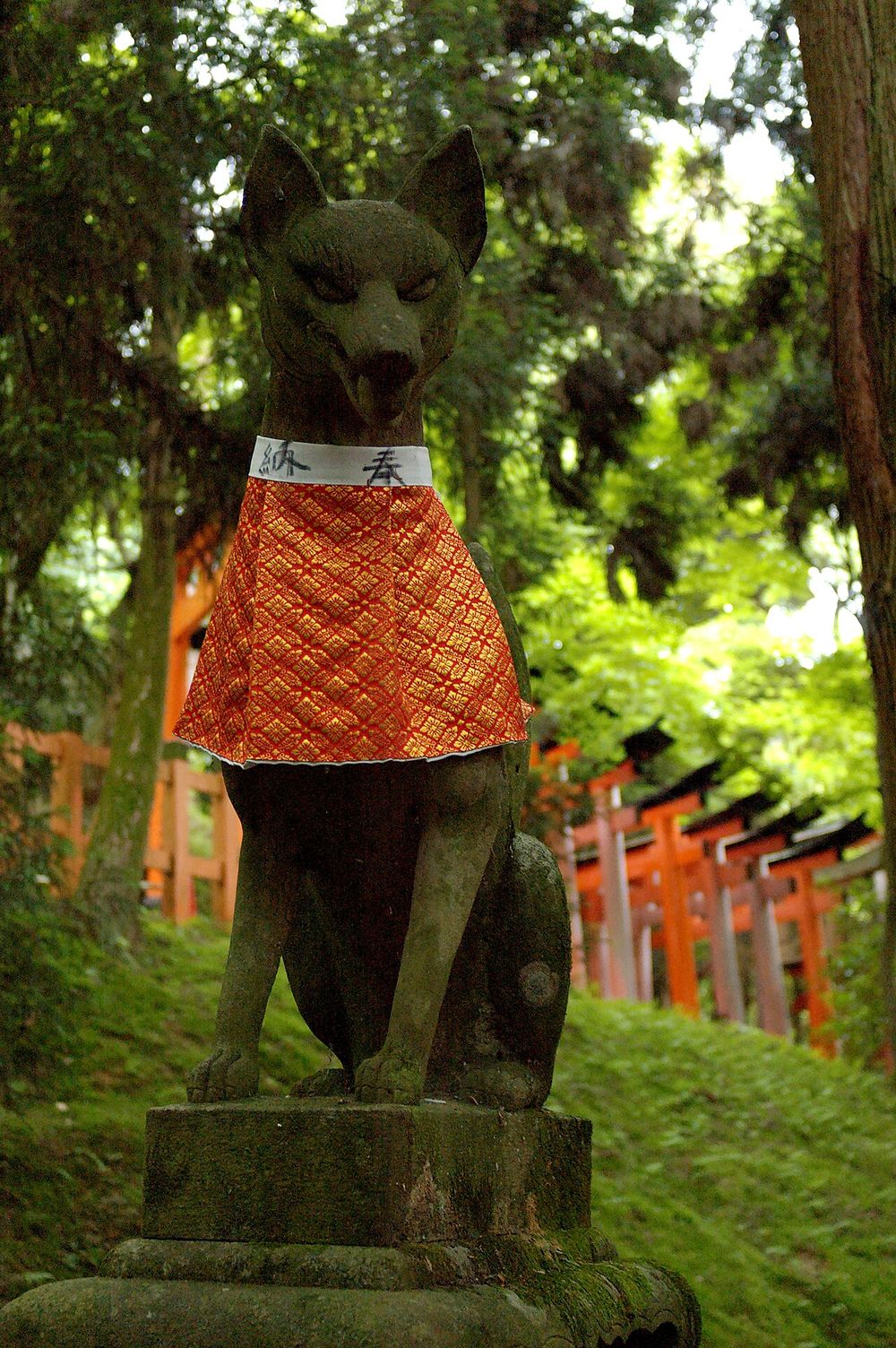
The stone foxes you see everywhere are the god's messengers. They are not the god. Look at what each one holds in its mouth.
The shrine never closes and costs nothing. The whole loop over the hill takes two to three hours.
Things people often get wrong
"It is a temple." It is a shrine. Temples in Japan are Buddhist. Shrines belong to Shinto, the older worship of the gods of places and of nature. There is no statue of the god to see.
"People here worship foxes." The foxes serve Inari. Japanese people do leave them fried tofu, which foxes are said to love.
"There are exactly a thousand gates." "Senbon torii", thousand gates, is the name of the two tightest tunnels near the bottom, which have roughly eight hundred. On the whole hill there are about ten thousand.
"The gates are ancient." The custom is some three centuries old, and the wood rots. A gate lasts ten or twenty years and is then replaced. Most of what you walk under is younger than you are.
People who stood here
Sei Shōnagon (Japanese court lady, author of The Pillow Book)About the year 1000 she climbed this hill on the god's festival day in early spring. By the middle shrine she was out of breath and close to tears. A woman of forty passed her, saying she meant to go up seven times that day and had already done three. Sei Shōnagon wrote that she envied her. She may have rested where you are resting.
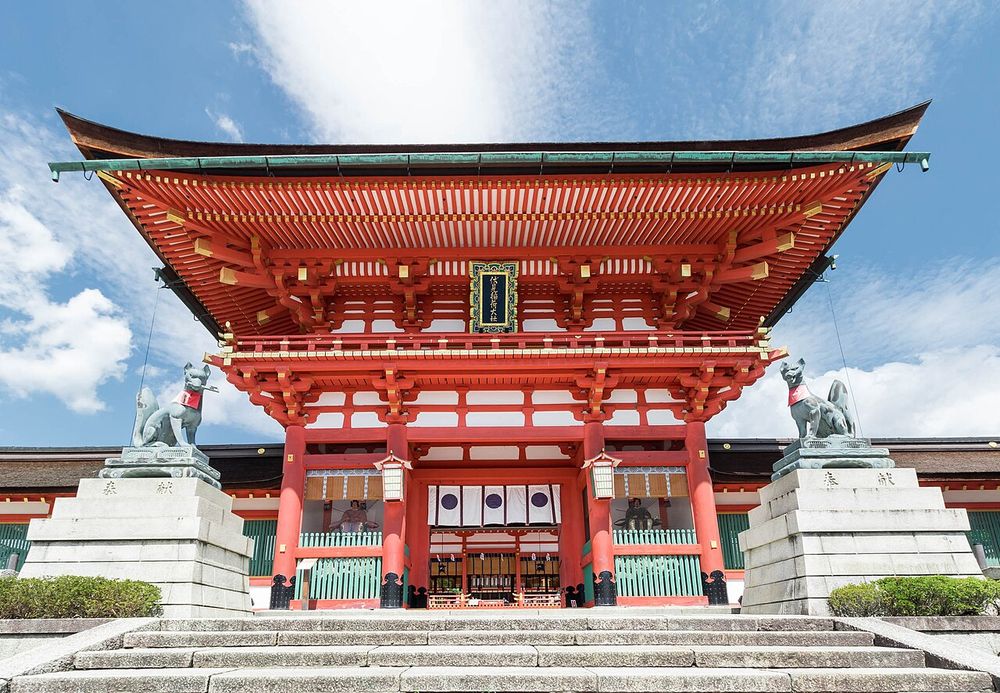
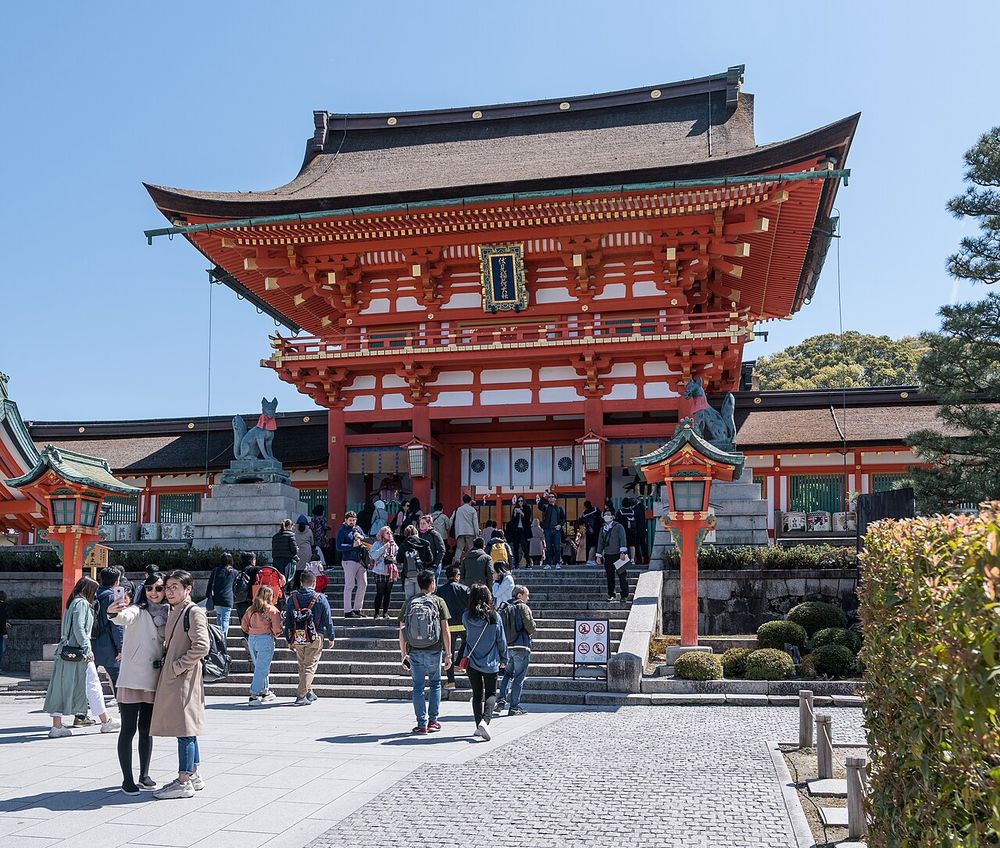
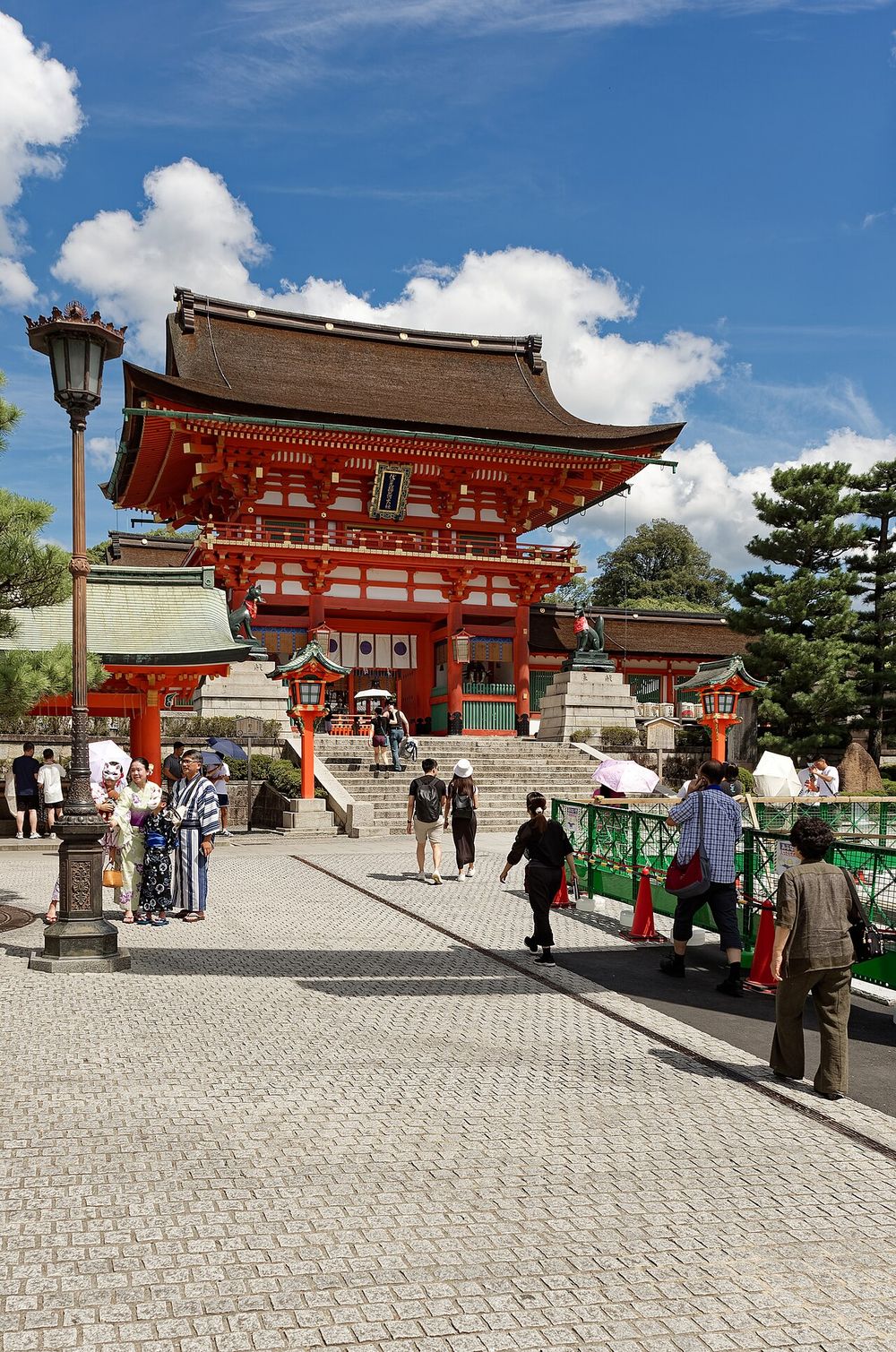
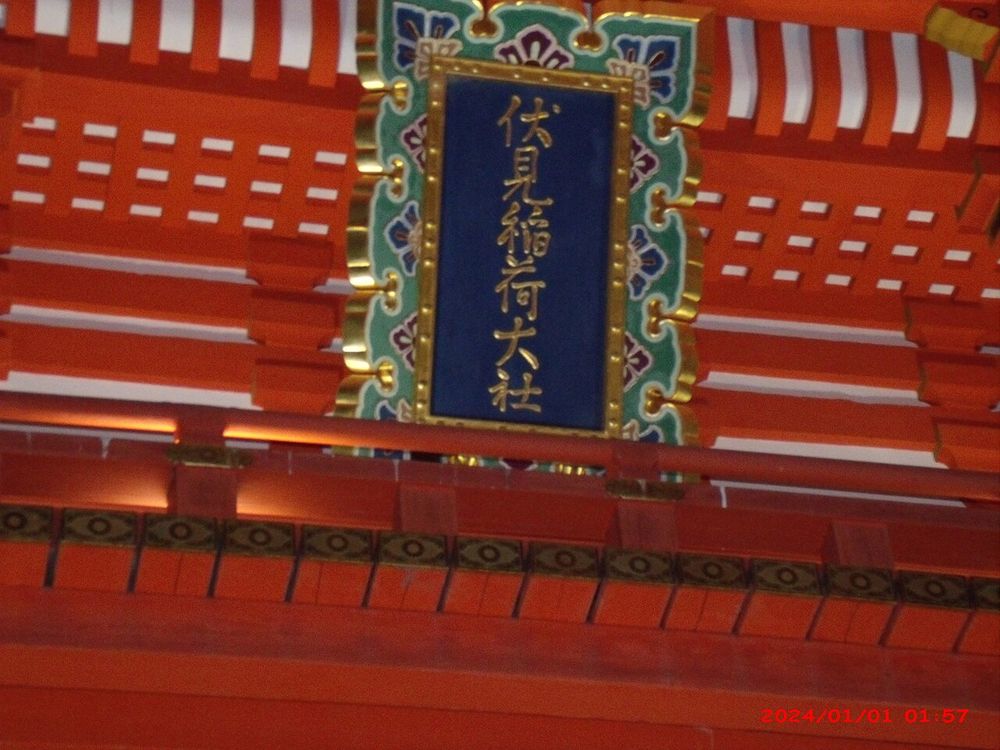
Toyotomi Hideyoshi (the warlord who united Japan in the 1580s)In 1588 his mother fell ill, and he promised the god a great gift if she lived. She recovered. The two-storey gate in front of you, built in 1589, is the gift. He may have stood here to see what his promise had bought. Three years later he sent his armies into Korea, where they fought the troops of Ming China.
Go deeper: ten stops, from the station to the hilltop
The stops run uphill, from the station to the top. You can turn back at any of them.
1. The first gate, and a fox with a key
A bronze fox with a key in its mouthYanajin33, CC BY-SA 3.0
From the station you walk straight under a tall red gate. Bow your head slightly as you pass. Japanese visitors keep to the side, since the middle of the path is the god's.
A bronze fox sits on each side of the way. One holds a key in its mouth. It is the key to the storehouse where the rice is kept. Others hold a round jewel, a sheaf of rice, or a scroll.
The colour of the gates is vermilion. It was made from mercury and lead ores, which keep wood from rotting, and the colour is thought to drive off evil.
2. The tower gate: a warlord pays his debt
The tower gate, given by Hideyoshi in 1589Kakidai, CC BY-SA 4.0
The two-storey gate was given by Toyotomi Hideyoshi in 1589. His letter of 1588 to the shrine still exists. In it he promises ten thousand measures of rice if his mother is cured.
When the gate was taken apart for repair in 1973, the date 1589 was found written on a timber inside. The story had been doubted until then.
3. The main hall, and how to pray
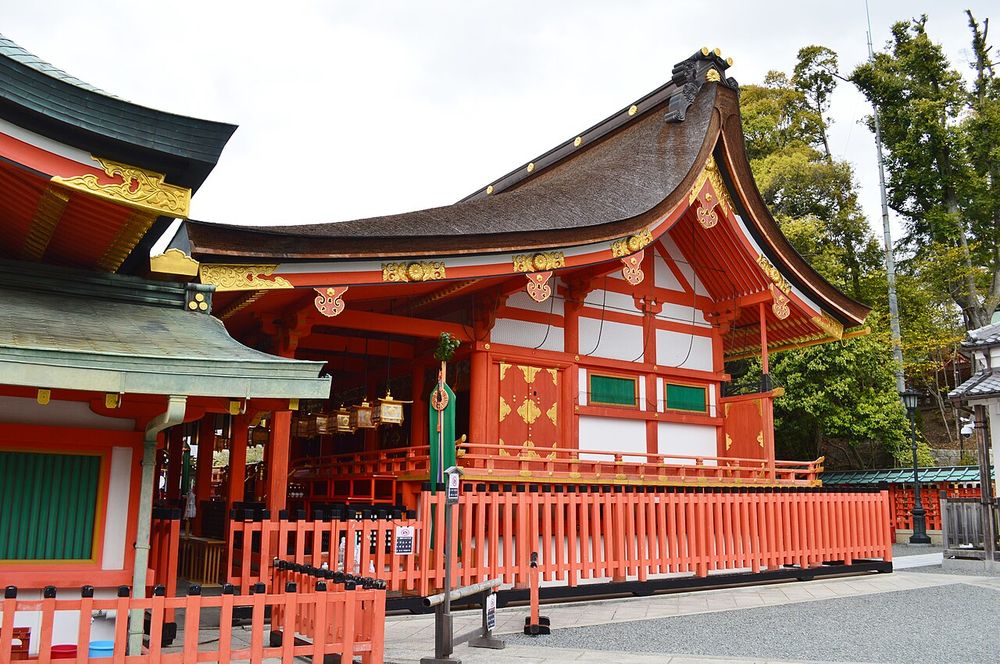
The main hall, rebuilt in 1499Saigen Jiro, CC0
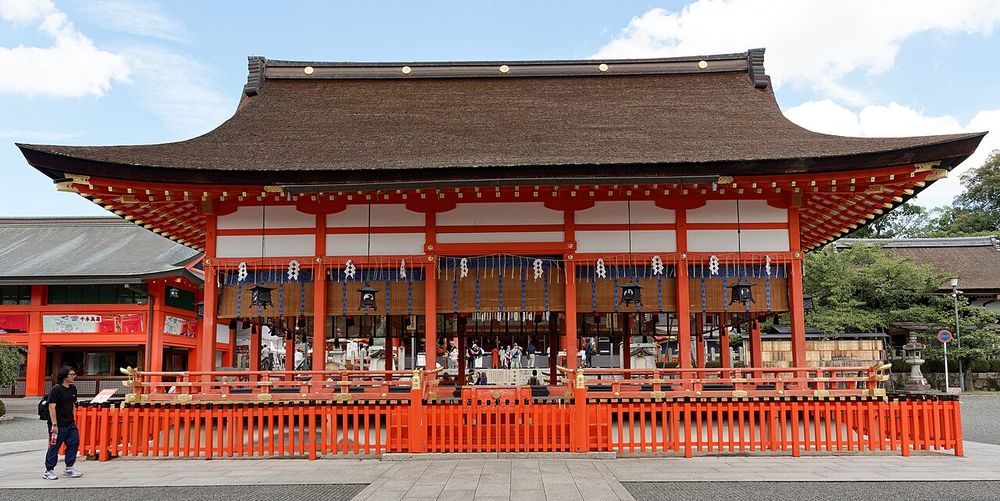
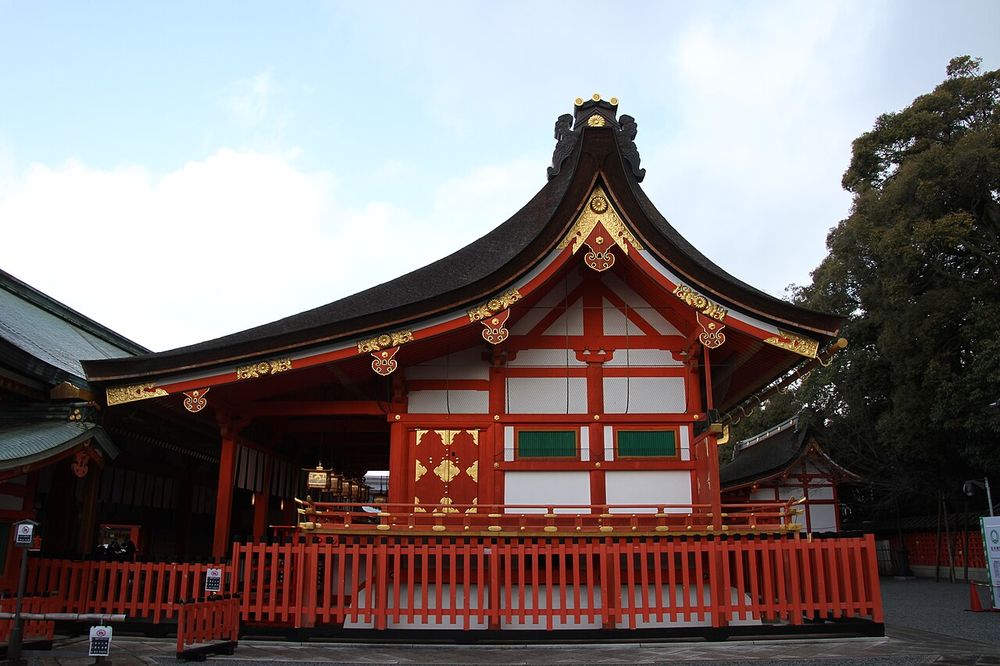
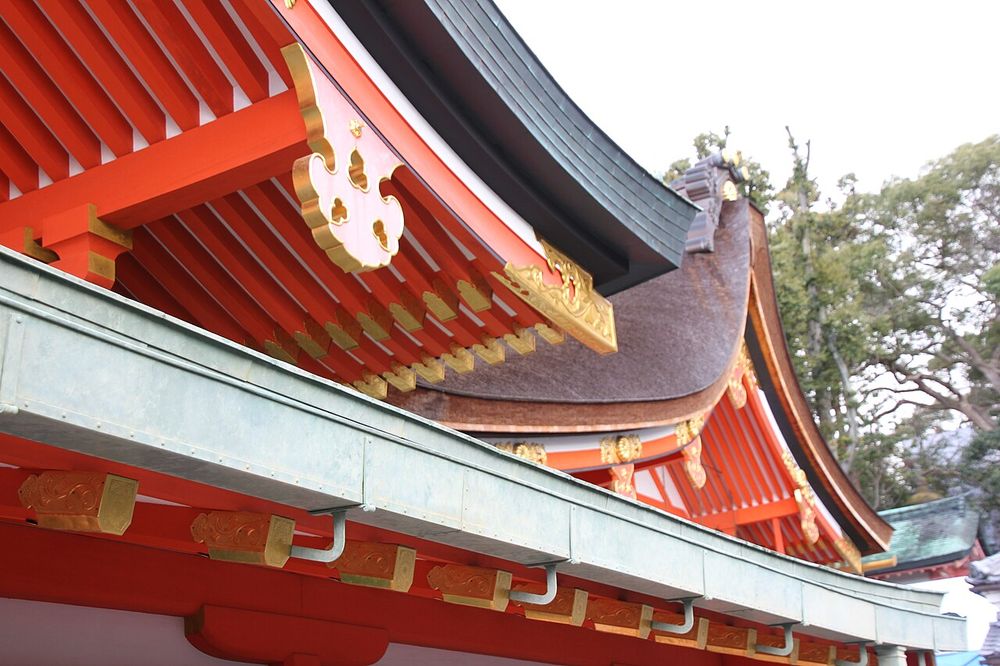
In 1468 the whole shrine burned in a civil war that wrecked Kyoto. The main hall was rebuilt in 1499 and is the oldest building here. Its roof sweeps forward in one long curve to shelter the people praying.
Five gods are worshipped inside, together called Inari. Nobody sees them. The doors stay shut.
To pray as people do here: drop a coin in the box, ring the bell, bow twice, clap your hands twice, make your wish in silence, and bow once more.
4. Foxes
A stone fox in a red bibHyppolyte de Saint-Rambert, CC BY-SA 4.0
Foxes came down to the rice fields in spring and went back to the hills in autumn, as the rice god was thought to do. They also ate the mice that ate the rice. So the fox became the god's servant.
The red bibs are tied on by worshippers, as people in Japan do for statues they wish to thank.
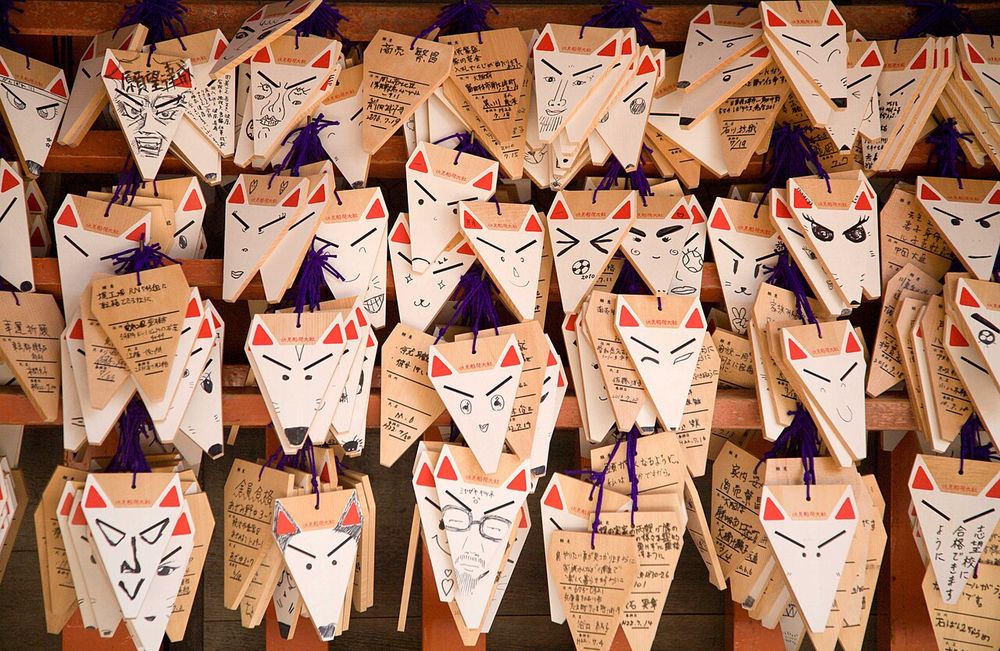
Wish tablets shaped like fox facesChi King, CC BY 2.0
Wishes are written on wooden tablets and hung up. Here the tablets are shaped like a fox's face, and people draw the face themselves.
Chinese readers will know the fox spirit from old stories, in which it can be a helper or a seducer. In Japan too the fox can bewitch, but Inari's white foxes are on your side.
5. Senbon torii: the two tunnels
Inside Senbon toriiHyppolyte de Saint-Rambert, CC BY-SA 4.0
Behind the main hall the path splits into two tunnels side by side. Take the right one going up. The gates stand so close that the light comes through in orange stripes.
In the film Memoirs of a Geisha (2005) the girl Chiyo runs through this tunnel after a stranger gives her a coin, on her way to pray that she may become a geisha.
To have it almost to yourself, come before seven in the morning or after dark.
6. The backs of the gates: who pays
Givers' names and dates on the postsBeni Arnold, CC BY 2.0
Going up you see plain red. Coming down you see writing. The left post gives the date and the right post the giver. You will read the names of banks, building firms, restaurants and families from all over Japan.
A small gate costs a few hundred thousand yen and the largest well over a million. There is a waiting list for places.
A gate being replacedmyself, CC BY-SA 3.0
Watch for a gap, a new post still pale, or a base wrapped in tape. Somewhere on the hill a gate is always being taken out and another put in.
7. The inner shrine and the heavy-light stones
Sunlight through the postsHyppolyte de Saint-Rambert, CC BY-SA 4.0
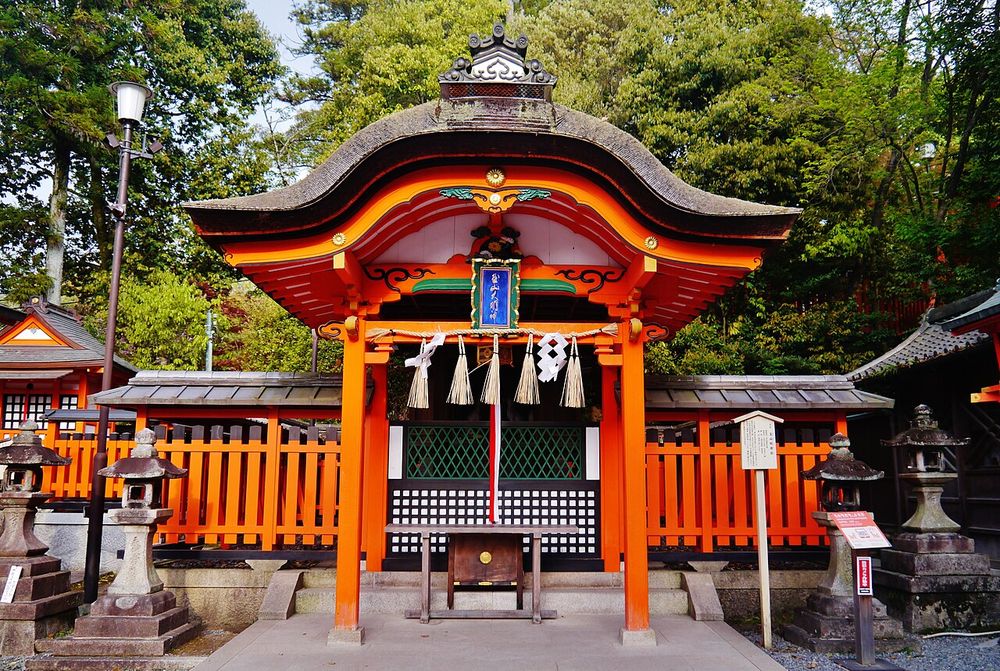
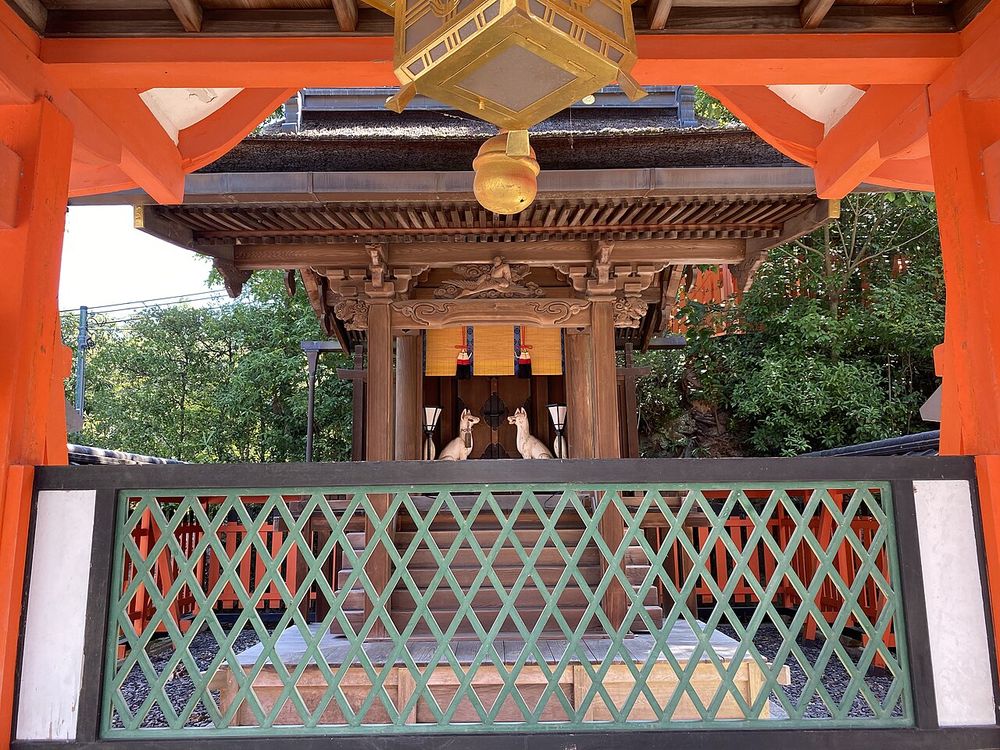
The two tunnels end at a small shrine from which people pray towards the hilltop. To its right stand two stone lanterns, each with a loose round stone on top.
Make a wish, guess how heavy the stone is, then lift it. If it is lighter than you thought, the wish will come true. If it is heavier, you will have to work for it.
Most visitors turn back here. The hill starts here.
8. The hill: ponds, stone altars, and the view
A sub-shrine with stone lanternsZairon, CC BY-SA 4.0
Higher up the gates thin out and the forest closes in. Beside the path are thousands of stone altars crowded with small gates and foxes. Each belongs to a family or a group that worships Inari under a name of its own.
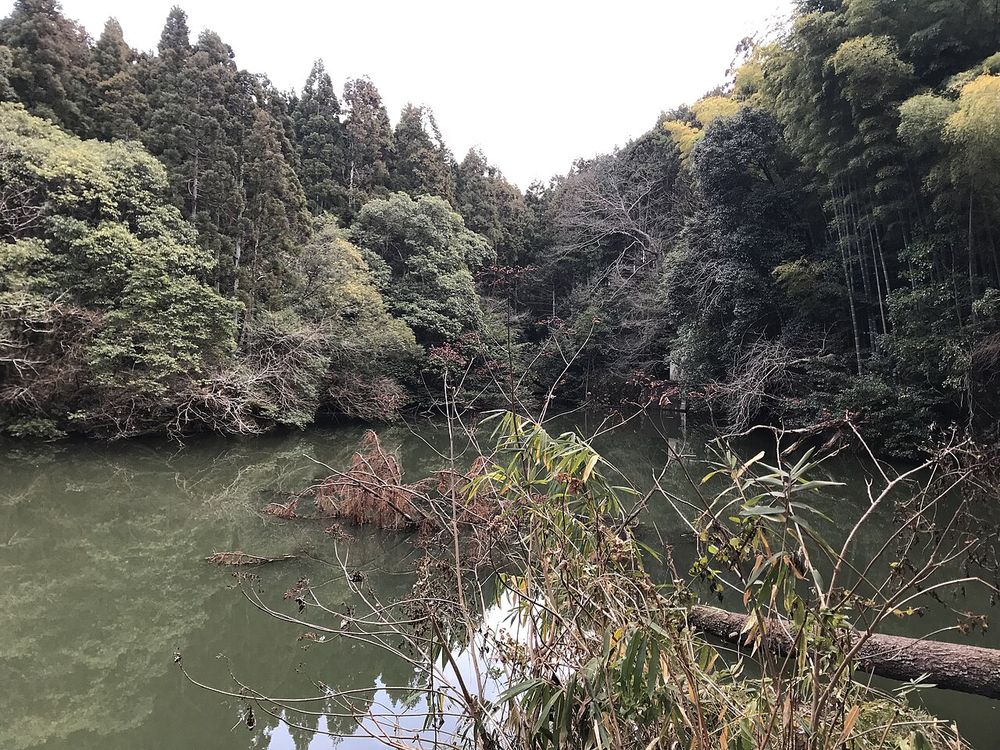
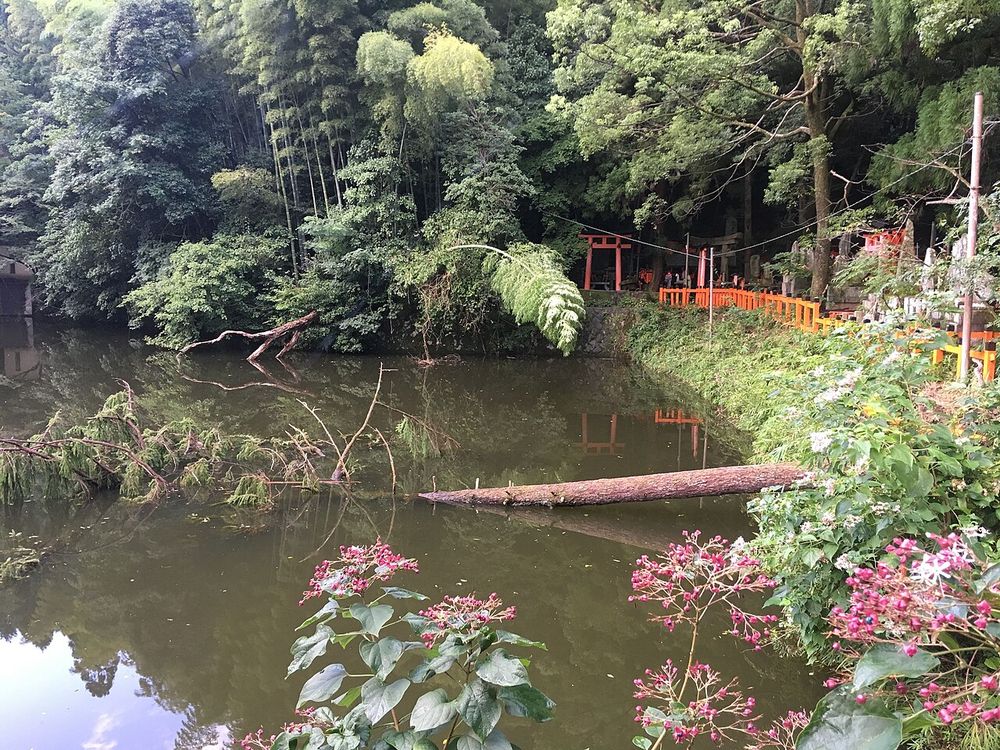
The pond on the hillそらみみ, CC BY-SA 4.0
At the pond, people who have lost someone clap their hands and listen. The echo is said to come back from the direction where the missing person will be found.
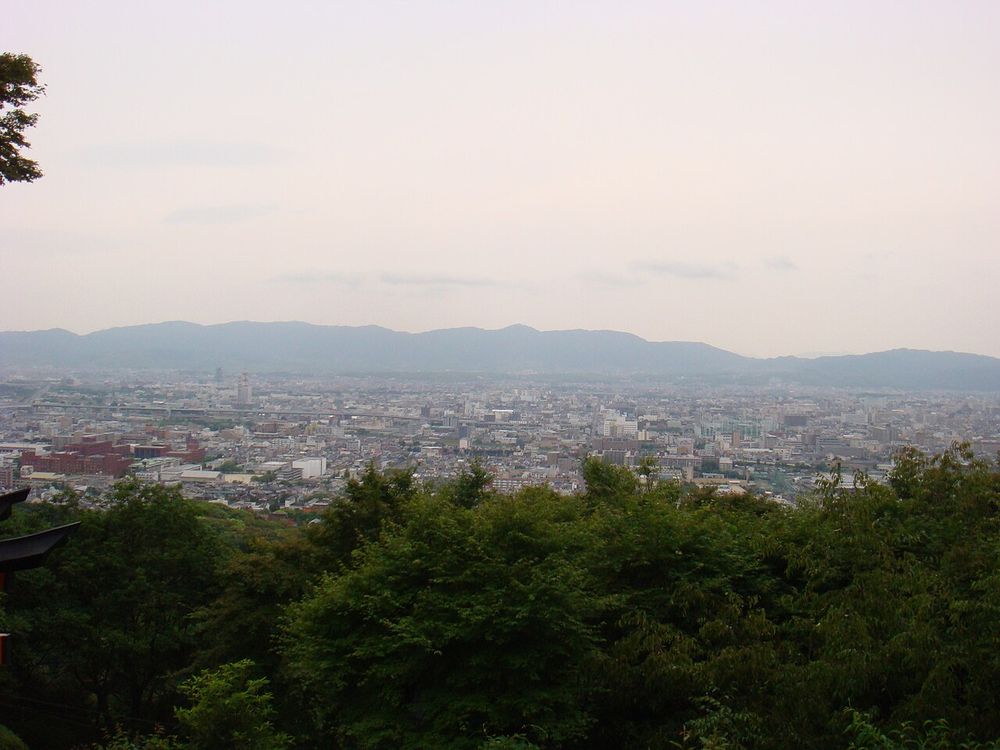
Kyoto from the hill at duskmyself, CC BY-SA 3.0
Halfway up, at the crossing called Yotsutsuji, the trees open and you see Kyoto spread out below. There are tea houses here that have been run by the same families for generations.
From the crossing a loop of about forty minutes goes round the three peaks. The top, at 233 metres, has no view at all, only an altar among the trees.
9. The shrine's year
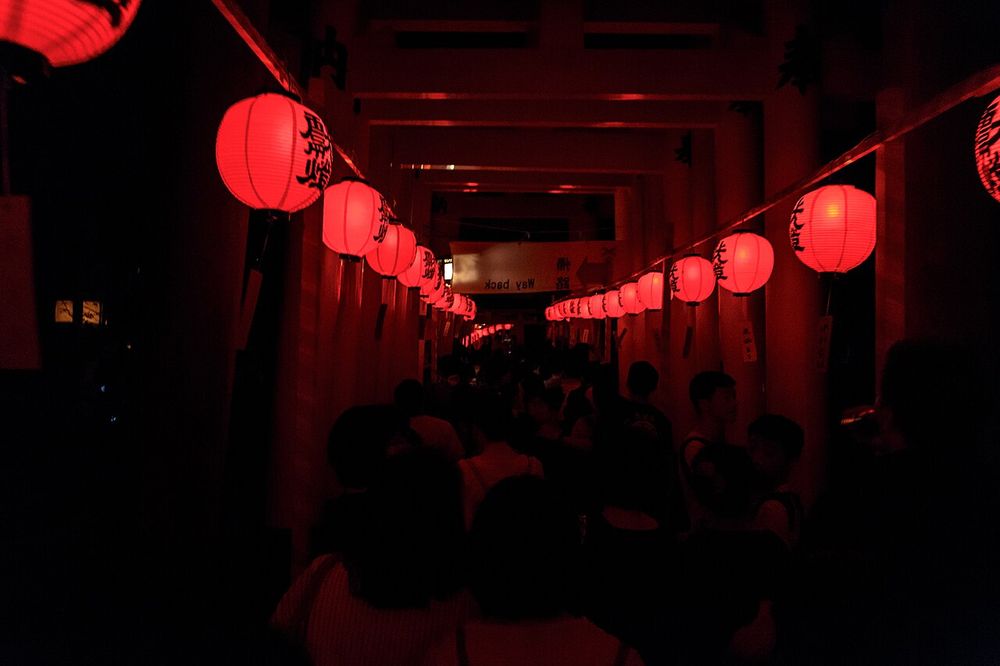
Red lanterns in the tunnel at nightnobu3withfoxy from Iga,Mie, Japan, CC BY 2.0
At New Year more than two million people come here in three days, to make the first prayer of the year. In February comes the festival of the day the god is said to have first come down on the hill. In July the grounds are hung with thousands of red lanterns. On 8 November bonfires are lit to send the god back to the hill after the harvest.
The street leading to the shrine sells two things you will not find at most shrines. One is rice packed in a pouch of sweet fried tofu, called inari-zushi after the god. The other is whole grilled sparrow, eaten because sparrows steal rice.
10. The founders, and the same years in China
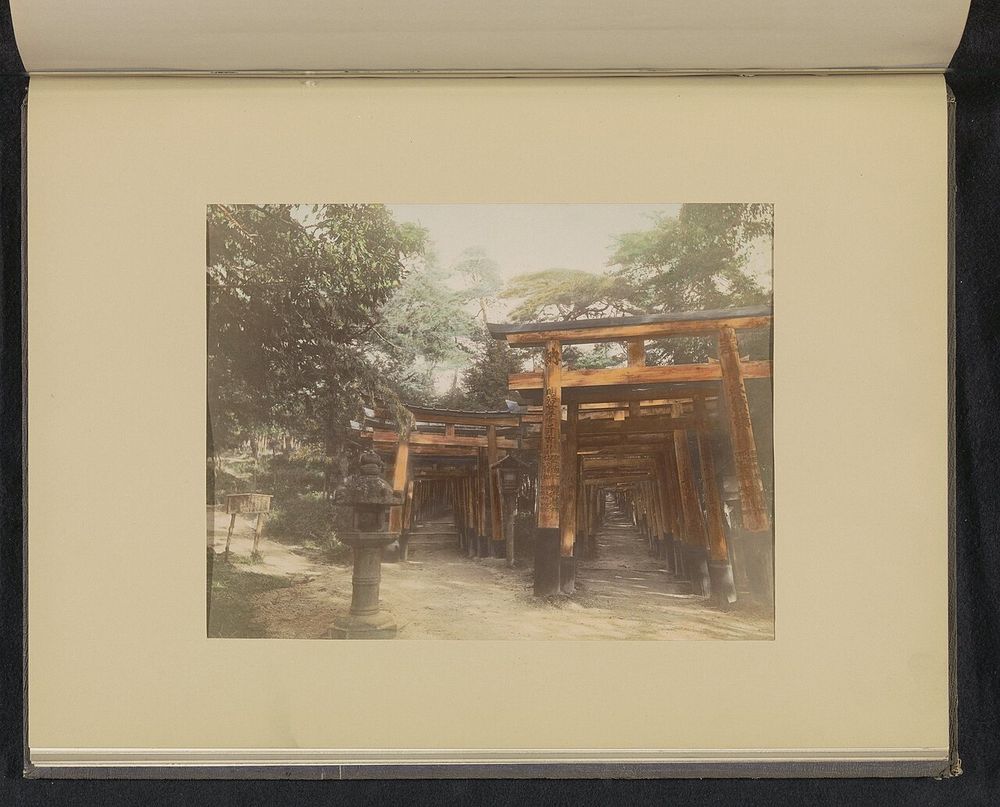
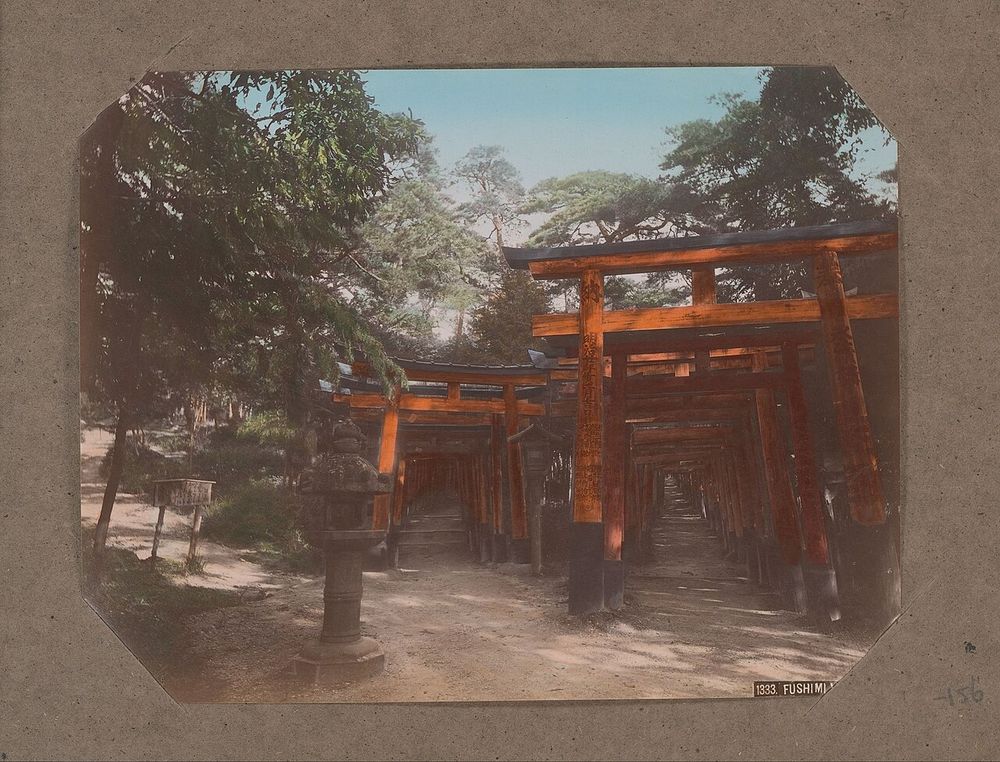
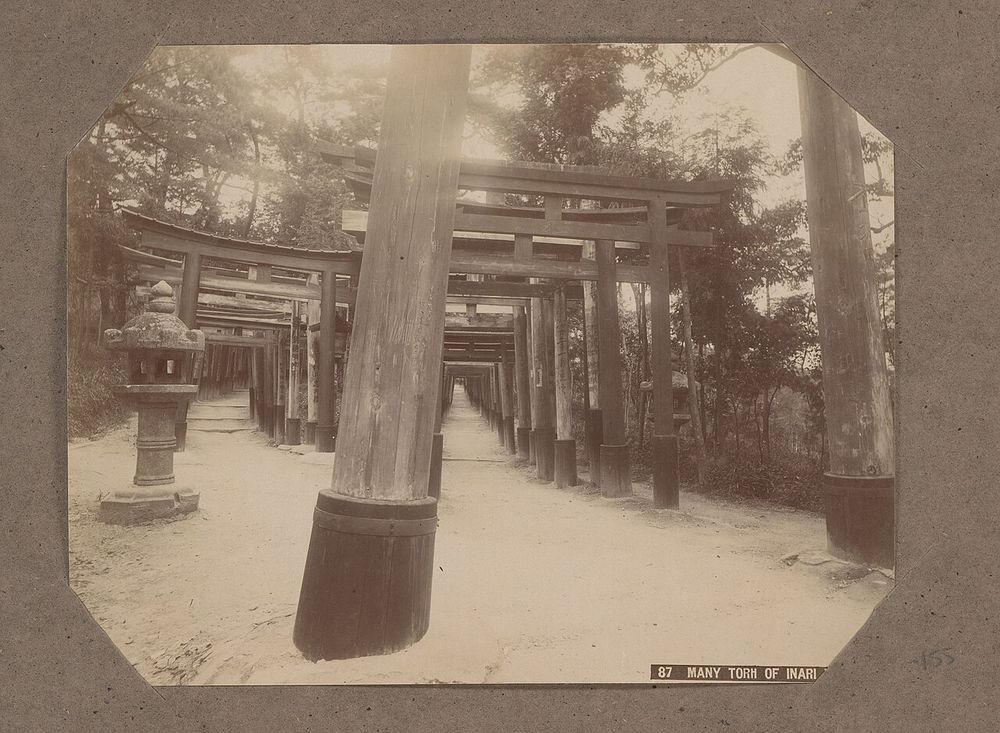
The gate tunnel about 1890, in a hand-coloured photographRijksmuseum, CC0
The shrine was founded by the Hata, a rich clan that had come to Japan from the mainland by way of Korea some centuries before. They brought silk weaving and skill in irrigation. They wrote their name with the character for Qin, and claimed to descend from the First Emperor of Qin (221–206 BC). Historians think this was a boast.
In 711, the year of the founding, the Tang empire was at its height and Japan was copying it eagerly. The year before, Japan had moved to a new capital at Nara, laid out on the plan of the Tang (618–907) capital Chang'an.
The gate itself has cousins on the mainland, in the memorial archways of China and the red-arrow gates of Korea. Nobody has shown which came from which.
Meanwhile in the world
Year
Here
Elsewhere
711
The Hata clan founds the shrine on the hill
The Tang at its height; Emperor Xuanzong takes the throne the next year
794
Kyoto becomes the capital of Japan
The Tang, forty years after the An Lushan rebellion
942
The court gives the god its highest rank
The Five Dynasties (907–960), between Tang and Song
1468
The shrine burns in the Ōnin War
The Chenghua reign of the Ming
1499
The main hall is rebuilt
The Hongzhi reign of the Ming
1589
Hideyoshi gives the tower gate
The Wanli reign; three years later Ming troops fight Hideyoshi's army in Korea
about 1700
Giving gates becomes the custom
The Kangxi reign of the Qing
2011
The shrine marks 1,300 years
The year of the great earthquake in eastern Japan
One line to remember: founded in 711 for rice, kept alive by business, and every gate is somebody's thank-you.
Then and now
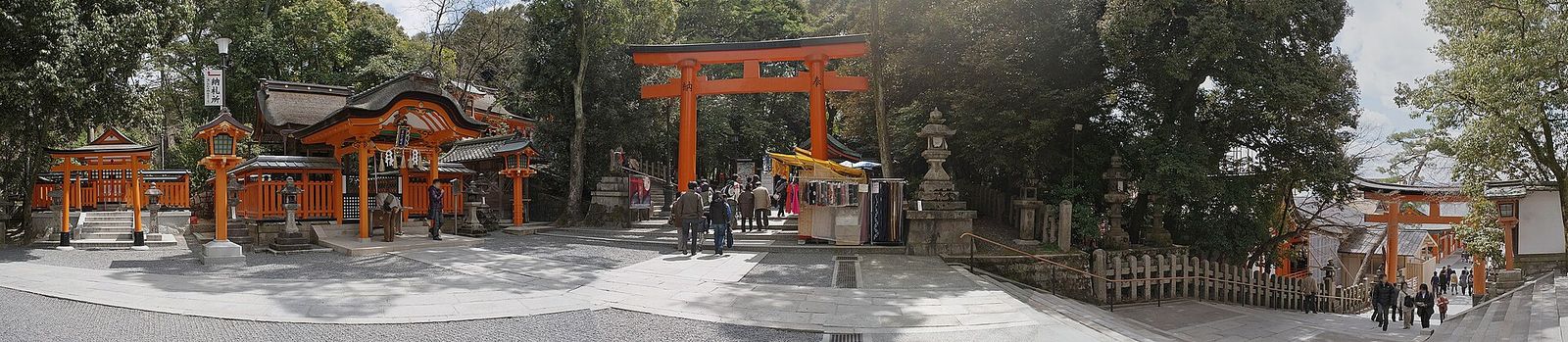
Where the two tunnels of Senbon torii beginBasile Morin, CC BY-SA 4.0, Wikimedia CommonsThe front of the shrine in a wide viewz tanuki, CC BY 3.0, Wikimedia CommonsThe tower gate, given by Hideyoshi in 1589Kakidai, CC BY-SA 4.0, Wikimedia CommonsThe tower gate from the stepsDXR, CC BY-SA 4.0, Wikimedia CommonsThe approach to the tower gateJakub Hałun, CC BY 4.0, Wikimedia CommonsThe name board of the gate, lit for New Year 2024Mr.ちゅらさん, CC0, Wikimedia CommonsThe outer hall of worshipJakub Hałun, CC BY 4.0, Wikimedia CommonsThe inner hall of worship, in front of the main hallZairon, CC BY-SA 4.0, Wikimedia CommonsThe main hall, rebuilt in 1499Saigen Jiro, CC0, Wikimedia CommonsThe main hall from the sideHyppolyte de Saint-Rambert, CC BY-SA 4.0, Wikimedia CommonsRoof and eaves of the main hallHyppolyte de Saint-Rambert, CC BY-SA 4.0, Wikimedia CommonsThe temporary hall, used when the main hall is repairedSaigen Jiro, CC0, Wikimedia CommonsThe Tamayama Inari sub-shrineSaigen Jiro, CC0, Wikimedia CommonsA bronze fox with a key in its mouthYanajin33, CC BY-SA 3.0, Wikimedia CommonsA stone fox in a red bibHyppolyte de Saint-Rambert, CC BY-SA 4.0, Wikimedia CommonsA mossy fox beside the pathsyvwlch, CC BY 2.0, Wikimedia CommonsFoxes at an altar behind a fenceImmanuelle, CC BY-SA 4.0, Wikimedia CommonsWish tablets shaped like fox facesChi King, CC BY 2.0, Wikimedia CommonsInside Senbon toriiHyppolyte de Saint-Rambert, CC BY-SA 4.0, Wikimedia CommonsThe tunnel going uphillHyppolyte de Saint-Rambert, CC BY-SA 4.0, Wikimedia CommonsSunlight through the postsHyppolyte de Saint-Rambert, CC BY-SA 4.0, Wikimedia CommonsThe tunnel seen from outsideHyppolyte de Saint-Rambert, CC BY-SA 4.0, Wikimedia CommonsA bend in the pathPLBechly, CC BY-SA 4.0, Wikimedia CommonsGates in the eveningSergiy Galyonkin from Raleigh, USA, CC BY-SA 2.0, Wikimedia CommonsThe backs of the gates, with their inscriptionsJakub Hałun, CC BY-SA 4.0, Wikimedia CommonsLooking up through the crossbeamsYamaguchi 1951, CC BY-SA 4.0, Wikimedia CommonsGivers' names and dates on the postsBeni Arnold, CC BY 2.0, Wikimedia CommonsA company's name on a gateMichaelMaggs, CC BY-SA 2.5, Wikimedia CommonsA gate being replacedmyself, CC BY-SA 3.0, Wikimedia CommonsA small shrine on the hillBalon Greyjoy, CC0, Wikimedia CommonsA sub-shrine with stone lanternsZairon, CC BY-SA 4.0, Wikimedia CommonsGates and lanterns at a sub-shrineJakub Hałun, CC BY-SA 4.0, Wikimedia CommonsThe pond on the hillそらみみ, CC BY-SA 4.0, Wikimedia CommonsAltars beside the pondZairon, CC BY-SA 4.0, Wikimedia CommonsFallen trees at the pond after the typhoon of September 2018Christophe95, CC BY-SA 4.0, Wikimedia CommonsKyoto from the hill at duskmyself, CC BY-SA 3.0, Wikimedia CommonsRed lanterns in the tunnel at nightnobu3withfoxy from Iga,Mie, Japan, CC BY 2.0, Wikimedia CommonsThe gate tunnel about 1890, in a hand-coloured photographRijksmuseum, CC0, Wikimedia CommonsTwo rows of gates, about 1890Rijksmuseum, CC0, Wikimedia CommonsThe gates and a stone lantern, about 1890Rijksmuseum, CC0, Wikimedia Commons
Local legends
These are stories people tell about this place. They are legends, not history, and each one says where it comes from.
LegendThe hilltop
A rich man of the Hata clan, Irogu, used a rice cake as a target for his arrows. The cake turned into a white bird and flew to the top of this hill, and where it landed rice grew. He built a shrine there and called it "rice growing", ine-nari, which became Inari.
Source: A record of Yamashiro province from the eighth century, known from later quotations
LegendThe foxes
An old fox couple living north of Kyoto wished to serve the god and came to this hill with their five cubs. The god took them in, and since then foxes have carried Inari's messages.
Source: A medieval shrine tale
LegendThe heavy-light stones
If the stone feels lighter than you guessed, your wish will be granted.
Source: Shrine custom
LegendThe pond
Clap your hands at the edge of the pond. The echo comes back from the direction in which the person you are looking for will be found.
Source: Local belief; the pond is called the Echo Pond
Later, people who live here will be able to add the stories they grew up with, and say which of these they have heard.
Not certain, and where accounts conflict
How many gates are there?
The shrine speaks of about ten thousand on the hill. Nobody has a fixed number, since gates are added and removed all the time. Counts made by volunteers give some thousands large enough to walk through.
Was the first shrine really built in 711?
The date comes from the shrine's own tradition and an old provincial record. Worship of the hill is probably older than any building.
Did the Hata come from China?
Japanese chronicles say they arrived from the Korean kingdom of Baekje and descended from the Qin emperors. Most historians place their home in Korea and treat the Qin ancestry as a later claim.
Where does the torii come from?
Explanations point to India, China, Korea or Japan itself. None is proved.
Visiting
Tickets and hours
Free. Open 24 hours, every day of the year.
The counters for charms, wish tablets and prayers are open in the daytime, from about 8:30 until late afternoon.
The tea houses on the hill keep daytime hours and some close on weekdays.
Last checked 2026-11-12. The shrine's own site, opened in November 2026, and Kyoto guides of 2026.
Booking from abroad
Official page in English No ticket and no booking are needed. The shrine's own site has an English version with its festivals and notices: inari.jp.
Note The grounds and the hill are open day and night, all year.
Checked 2026-11-12
Where to start
Take the JR Nara Line from Kyoto Station to Inari, two stops and five minutes. Only local trains stop there. The shrine gate is across the road from the station.
Walk through the tower gate to the main hall, then behind it to the tunnels.
If you have one hour, go as far as the inner shrine and the heavy-light stones. With two hours, go on to the Yotsutsuji crossing for the view. With three, do the loop of the peaks.
Come before 7:00 or after 18:00. Between 9:00 and 16:00 the lower tunnels are a slow queue.
Before you go
The climb is about 12,000 steps there and back, mostly stone stairs. Wear proper shoes.
There are drink machines on the hill, at prices that rise with the height. Carry water in summer.
Above the crossing the path is unlit at night. Bring a light, and do not go alone. Wild boar and monkeys live on the hill.
The Keihan line also stops nearby, at Fushimi-Inari station, five minutes on foot.
Customs and manners
This is a place of worship, and in September 2026 the shrine posted a request about visitors' manners. Keep to one side in the tunnels and do not block them for photographs. Tripods and drones are not wanted.
Before praying, rinse your hands at the water basin: left hand, then right, then pour a little into your left palm to rinse your mouth. Do not drink from the ladle.
Do not touch the foxes or their bibs, and do not move the small gates and offerings on the stone altars. They belong to the families who put them there.
Eating while walking is frowned on in Japan. Eat at the stall where you bought the food.
Take your rubbish away with you. There are almost no bins.
Look for these
Find a fox with a key and a fox with a ball. What else can a fox hold?
On the tower gate, find the two seated guards with bows. Are they gods or soldiers?
In the tunnel, turn round and find the newest date you can read.
Find a gate given by a company. Can you guess what it sells?
Find a gate that has just been put in. How can you tell?
At the inner shrine, lift the stone. Was it heavier or lighter than you guessed?
On the hill, find the smallest gate you can. Is it bigger than your hand?
At the crossing, find the tallest building in Kyoto.
I am here
Stand at the site, sign in, press the button, and collect its stamp. Your browser will ask to use your location. It is sent to us once to confirm that you are at the site; we keep how far you were from it, not the spot where you stood.
Your stamps are saved to your account, so they follow you to any device. Checking from a browser cannot rule out every false location; stricter checks arrive with the app.
Messages
Share your photos
Photos here show the place, not people. Each one is credited to the visitor who took it and appears after our team has looked at it. A photo with you in it belongs under “I am here”.