Cattedrale di Santa Maria del Fiore · DWOH-moh; SAN-ta ma-REE-a del FYOH-reh
A cathedral planned with a dome 45 metres wide at a time when no one alive knew how to build one. For years the walls stood open to the sky. A goldsmith closed them, in sixteen years, without scaffolding from the ground. No larger dome of brick has been built since.
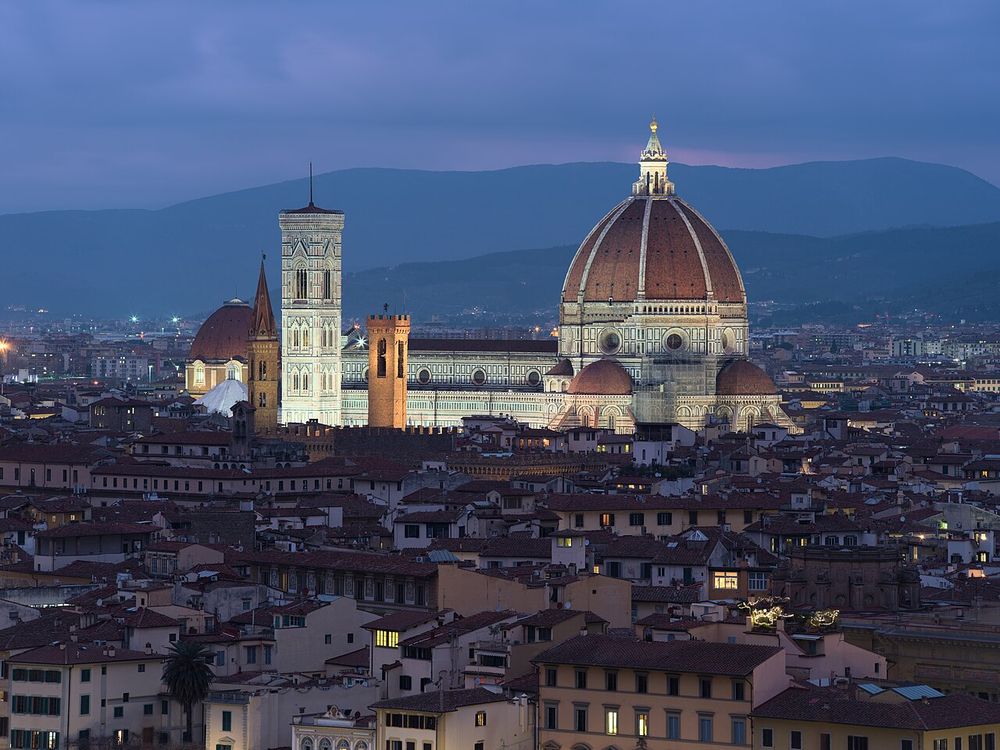
Photo: Dllu, CC BY-SA 4.0, Wikimedia Commons
The story
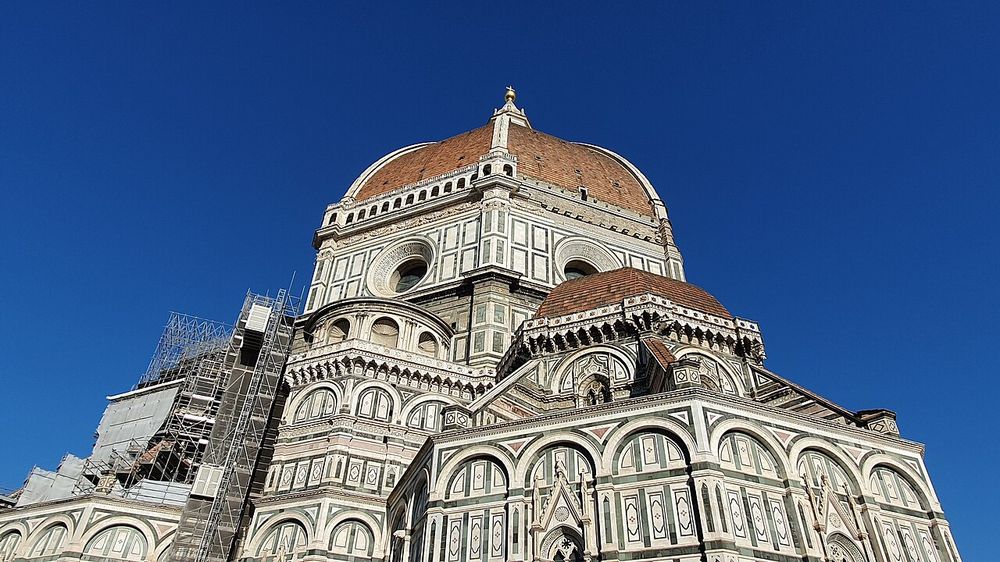
You are in a square too small for what stands in it. A wall of white, green and pink marble rises in front of you like a cliff. To see the top you have to tip your head back, and then you see only the edge of something red and very large, curving away.
The dome was begun in 1420. In the same year, in Beijing, the Forbidden City was finished, and the fleets of Zheng He were sailing the Indian Ocean for the Ming (1368–1644) emperor.
What is here
The cathedral is free. Everything else is sold in three passes, each valid for three days, and each covering the ones below it.
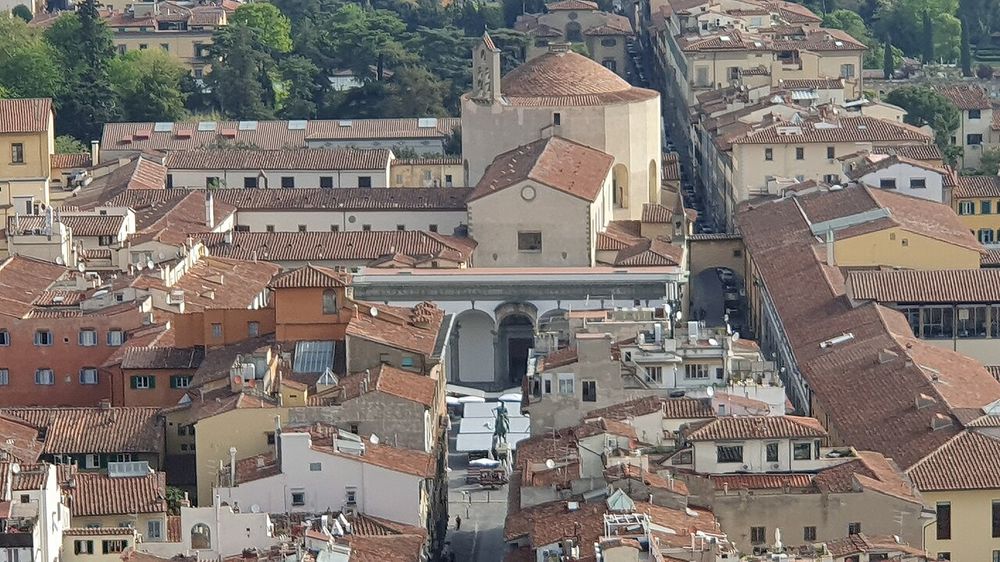
The dome from the street belowYair Haklai, CC BY-SA 4.0
Florence in 1296 was rich from wool and banking, and wanted the largest church in the world. The plan called for a dome wider than any built since ancient Rome. The city began anyway, and trusted that someone would work out the roof later.
By 1418 the walls were up and the hole was open to the rain. The usual way to build an arch was over a wooden frame. There was not enough timber in Tuscany for a frame that size.
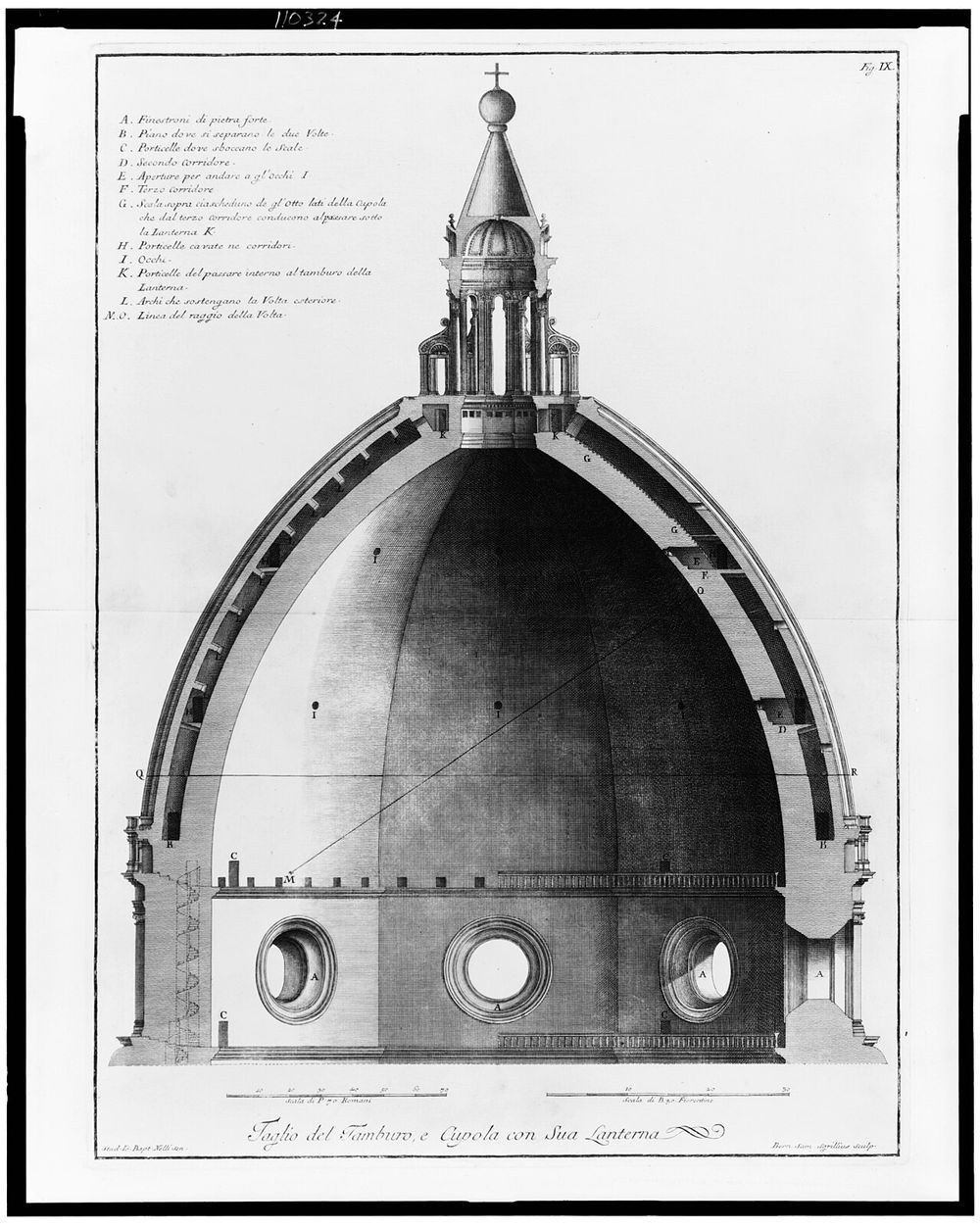
Filippo Brunelleschi, a goldsmith and clockmaker, said he could do it with no frame at all. He built two domes, one inside the other, laid the bricks in a zigzag so that each ring held itself up, and invented the cranes to lift them. It took sixteen years.
You can climb between his two domes to the top.
Things people often get wrong
"Duomo means dome." It is the Italian word for a cathedral, from the Latin for house: the house of God.
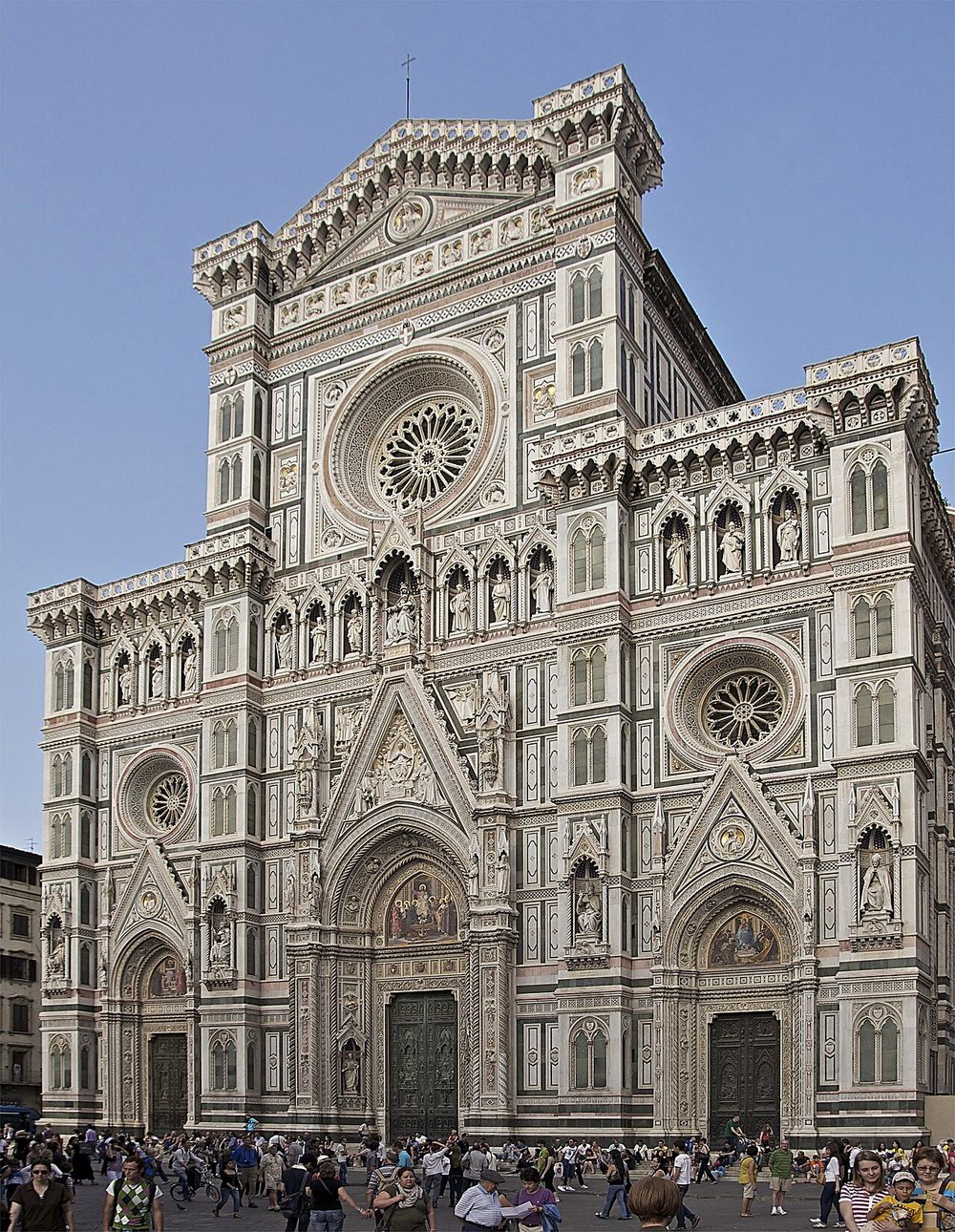
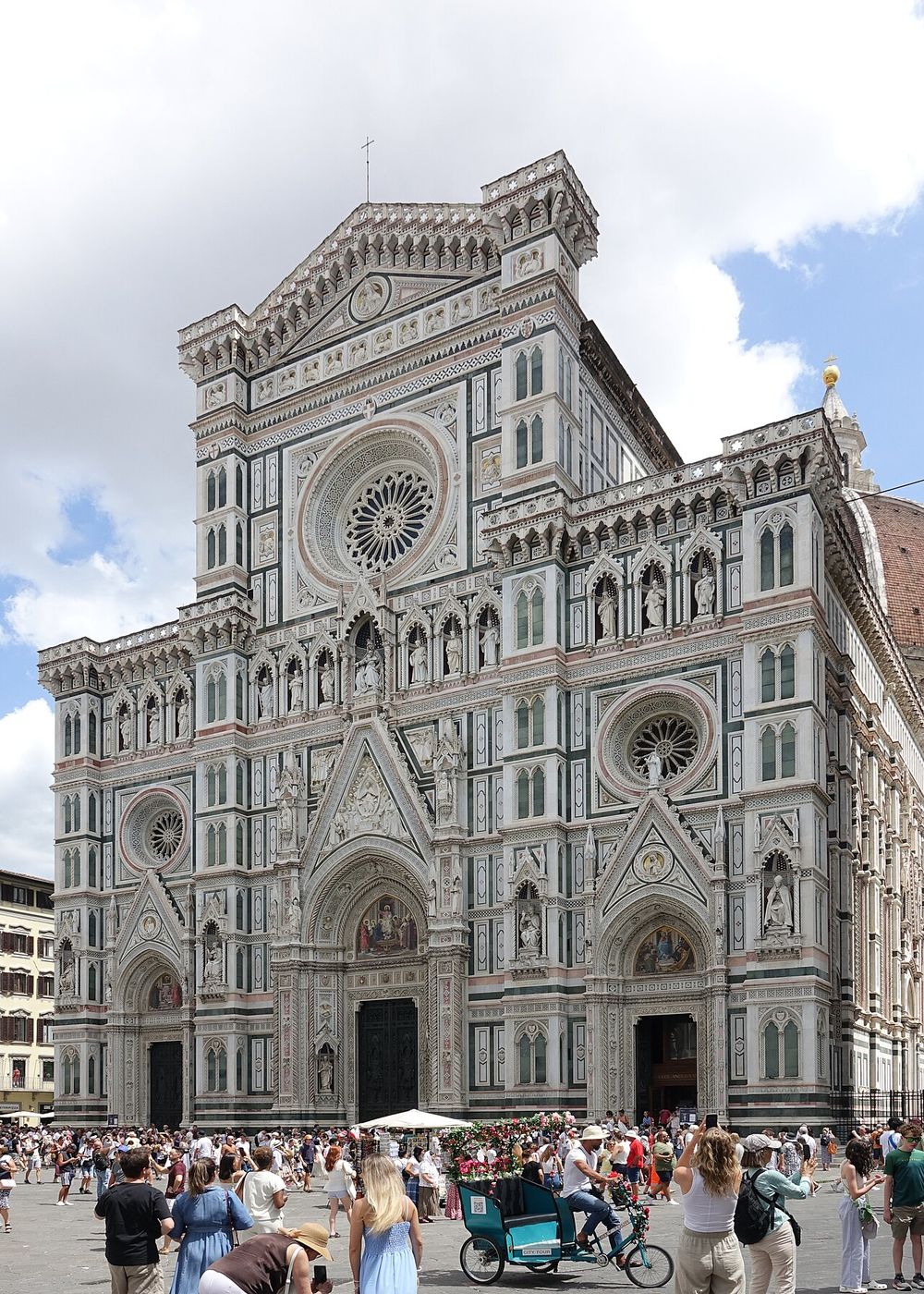
"The marble front is medieval." The front was bare brick until 1887. What you see was built in the reign of Queen Victoria.
"You need a ticket for the cathedral." The church itself is free. The tickets are for the dome, the tower, the Baptistery and the museum.
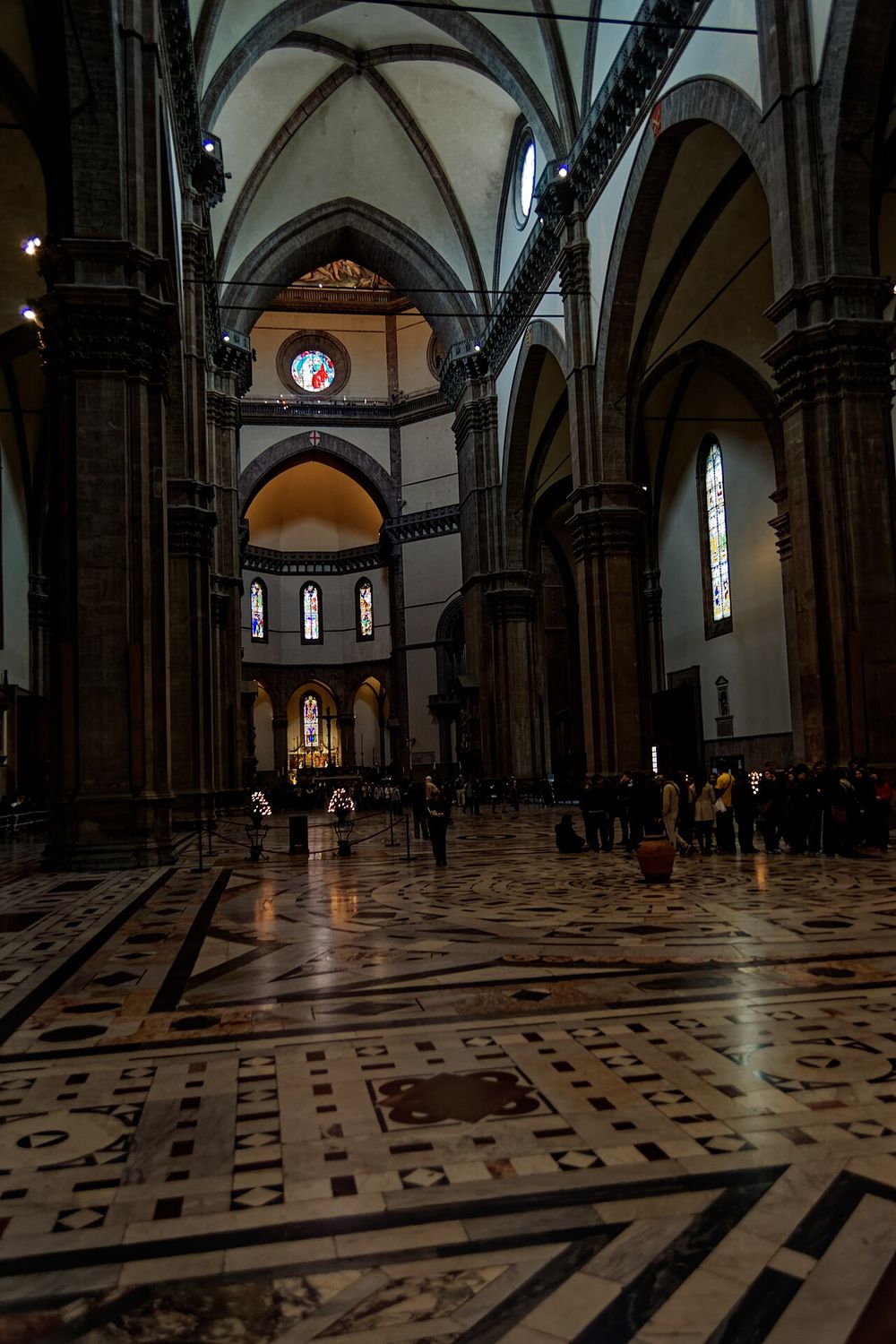
"The inside must be as rich as the outside." It is nearly bare. Florence spent its money on the shell, and most of the art once inside is now in the museum behind.
"Giotto built the bell tower." He designed it at sixty-seven and lived to see only the first storey.
People who stood here
Dante (Italian poet of the Divine Comedy)He was baptised in the Baptistery in 1266 and called it "my beautiful San Giovanni". He was thirty-one when the cathedral was begun and was driven out of Florence six years later, for good. A stone on the south side of the square is shown as the place where he sat to watch the builders.
Leonardo da Vinci (Italian painter of the Mona Lisa)In 1471 he was a nineteen-year-old apprentice in the workshop that made the gilded copper ball for the top of the dome, and he watched it hoisted with Brunelleschi's machines. Years later he drew those machines in his notebooks.
Michelangelo (Italian sculptor of David)His David was ordered in 1501 by the cathedral works, to stand high on a buttress of this church. It turned out too good to put so far from the eye. When he left to build the dome of St Peter's in Rome, he is reported to have said he would make its sister: bigger, but not more beautiful.
Go deeper: eight stops, from the golden doors to the top of the dome
The stops begin at the oldest building in the square and end on top of the newest part of the cathedral.
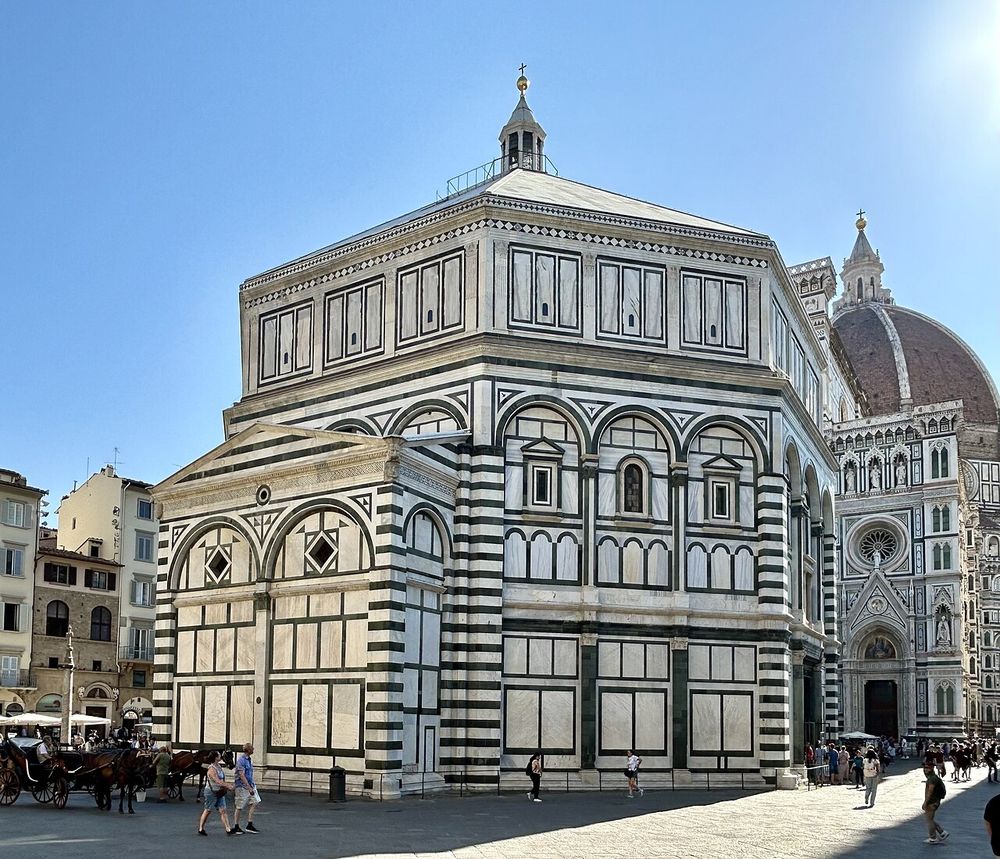
1. The Baptistery
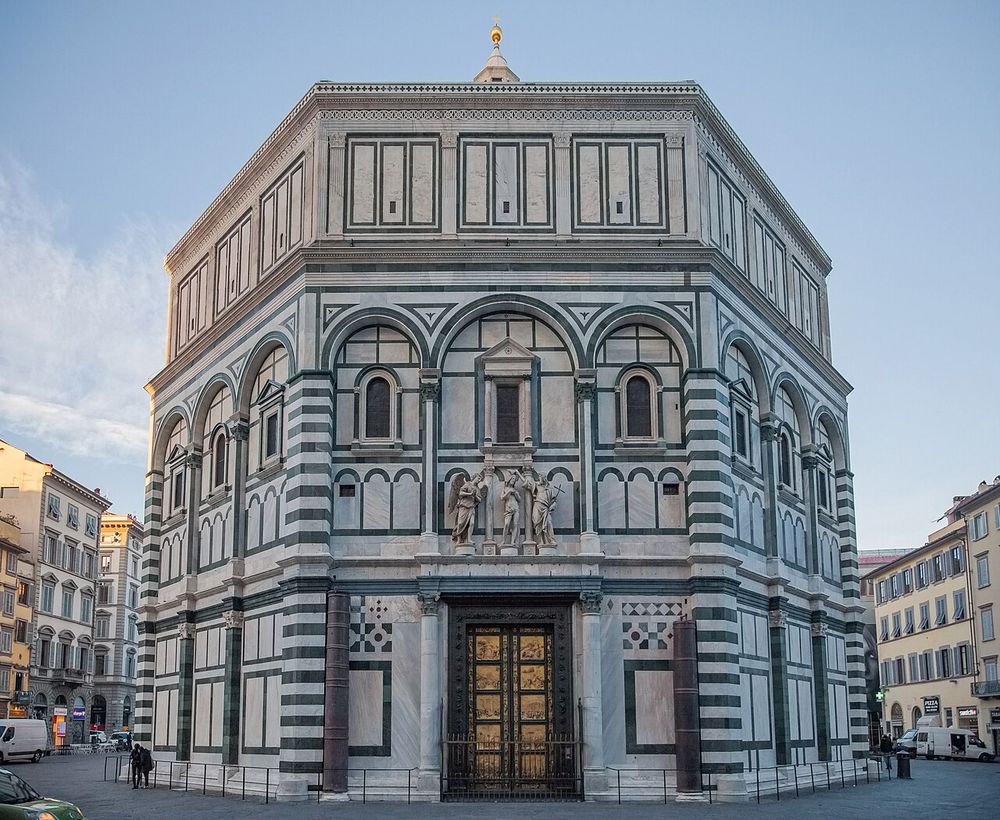
The Baptistery from the cathedral stepsBradley Weber, CC BY 2.0
The eight-sided building in front of the cathedral is two hundred years older than it. For centuries every child born in Florence was baptised here.
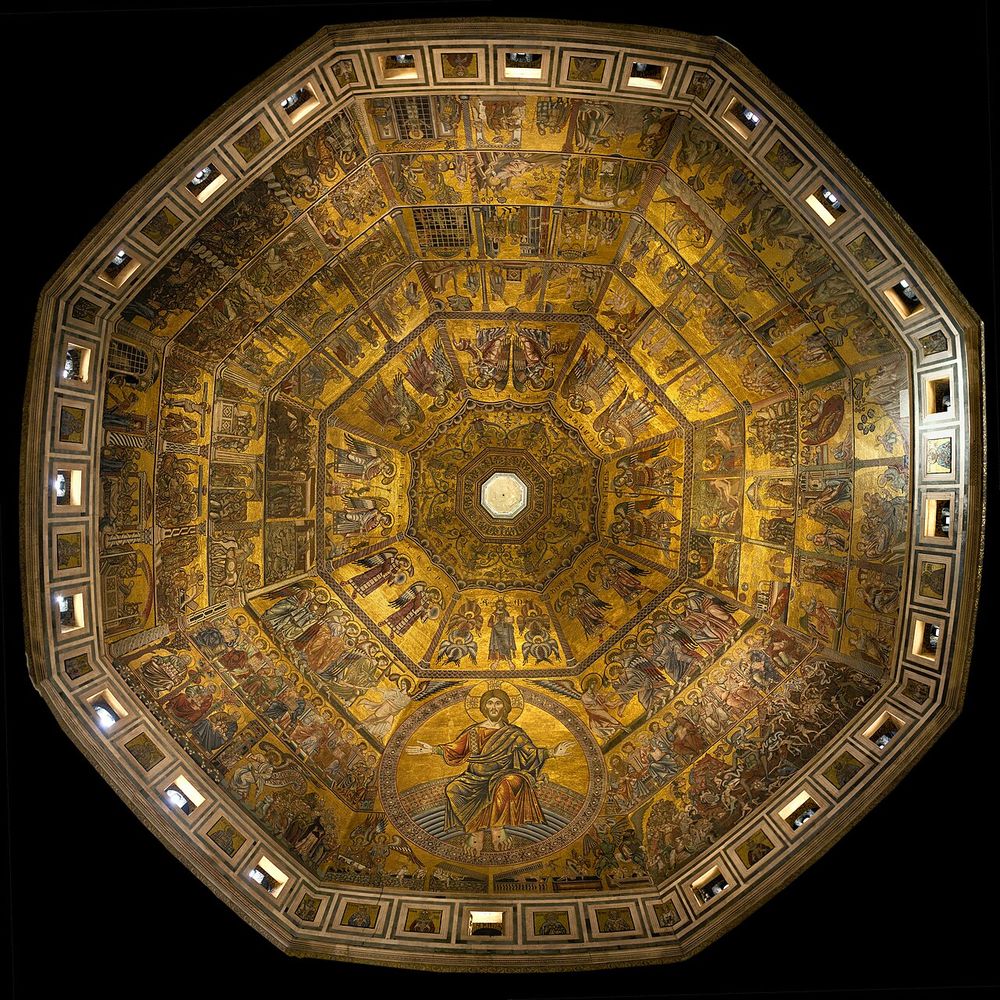
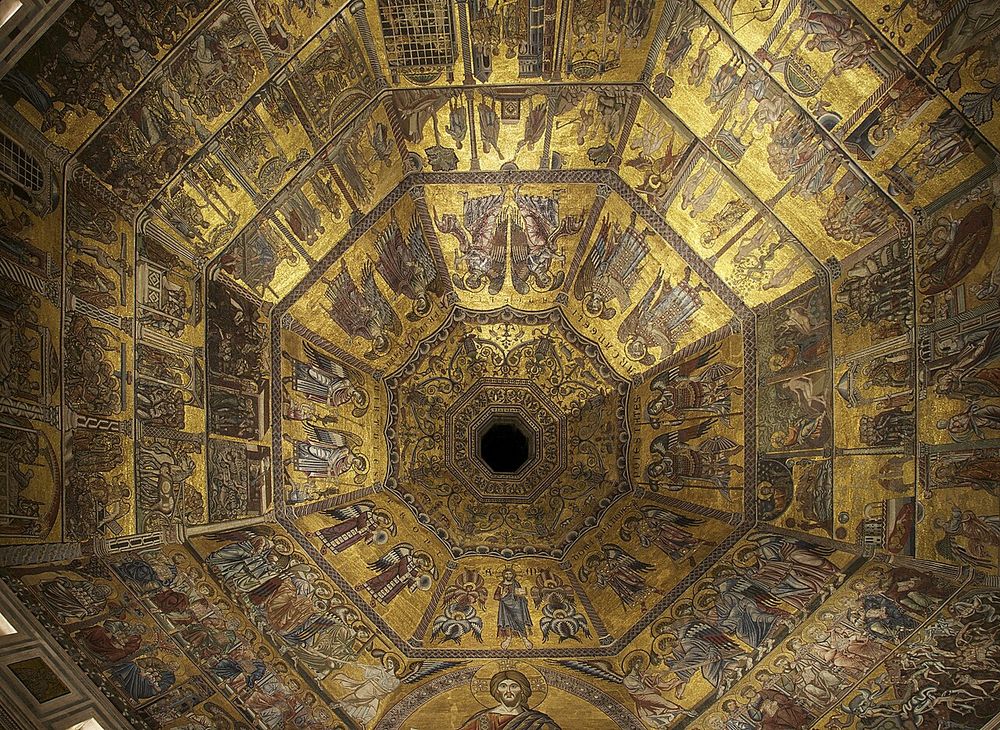
Its ceiling is covered with gold mosaic of the 1200s. In 2026 the ceiling is being restored and is hidden by a platform; the cathedral works say so on their ticket site.
2. The golden doors
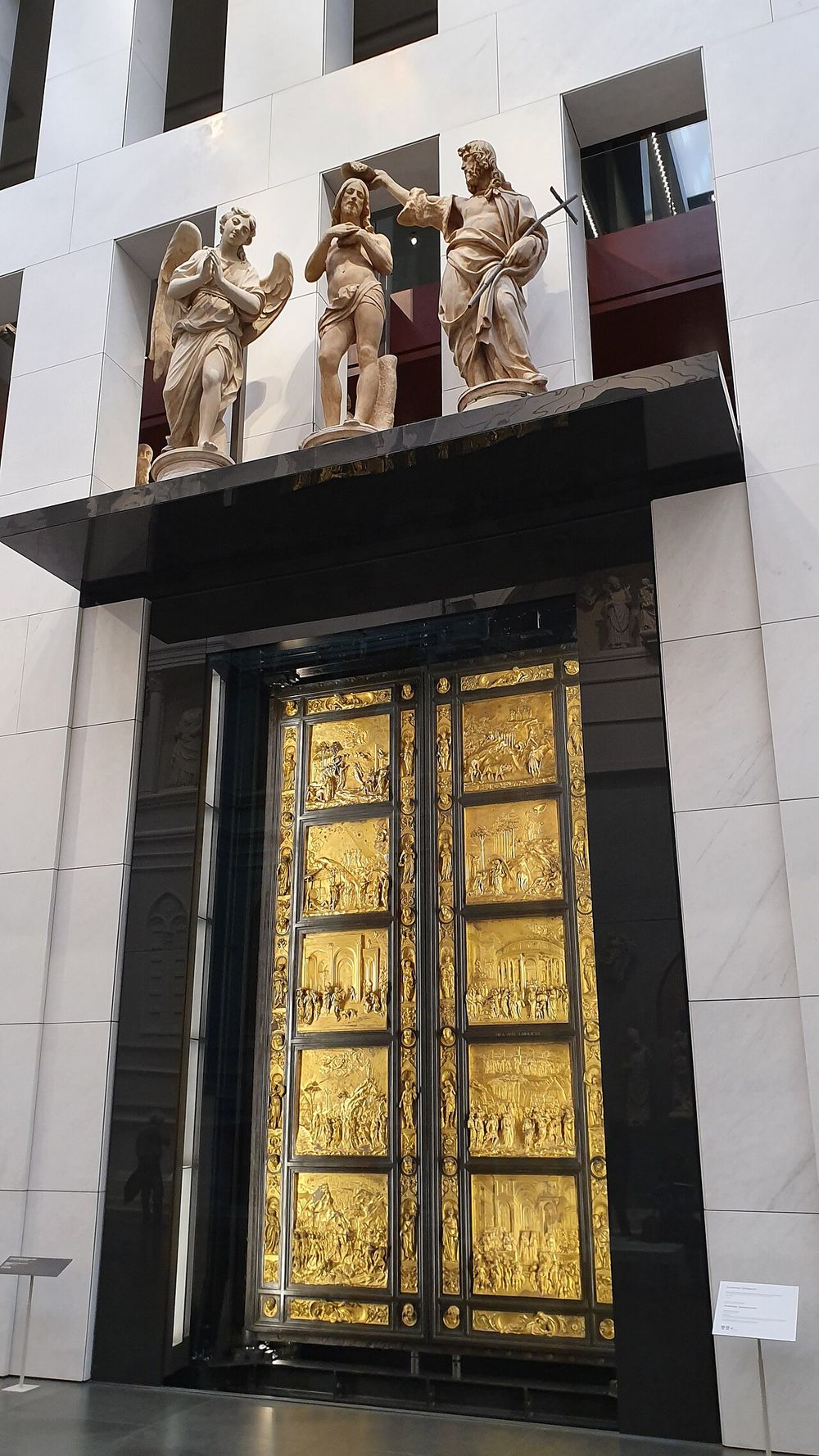
The real golden doors, in the museumYair Haklai, CC BY-SA 4.0
In 1401 the cloth merchants of Florence held a contest for a pair of bronze doors. Seven artists entered. The winner was Lorenzo Ghiberti, aged twenty-three. The loser who took it hardest was Brunelleschi, who gave up sculpture and went to Rome to measure ruins.
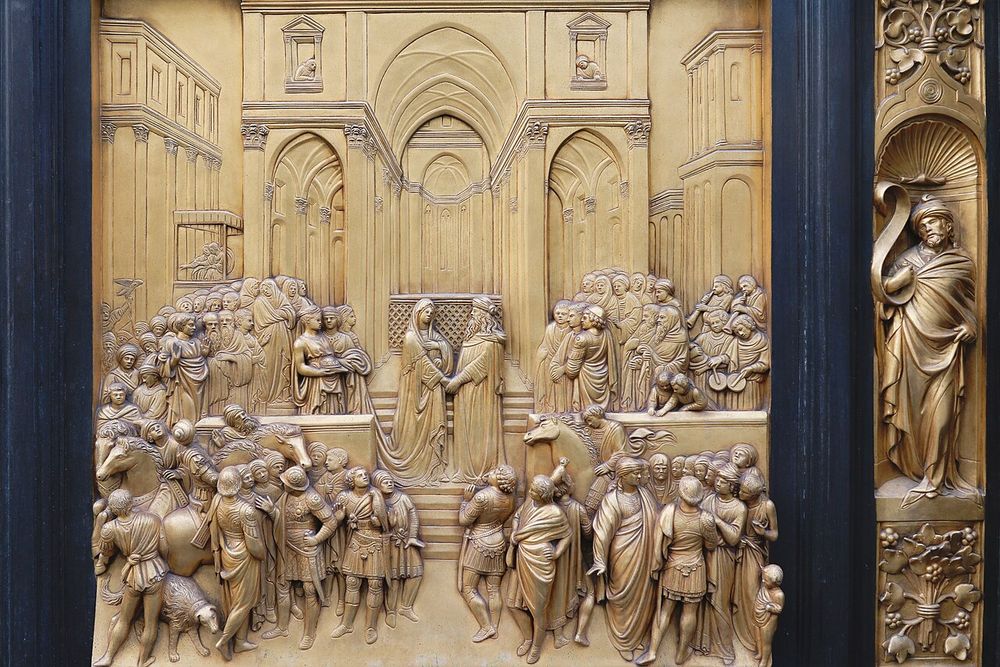
Solomon and the Queen of Sheba, the last panelIngo Mehling, CC BY-SA 4.0
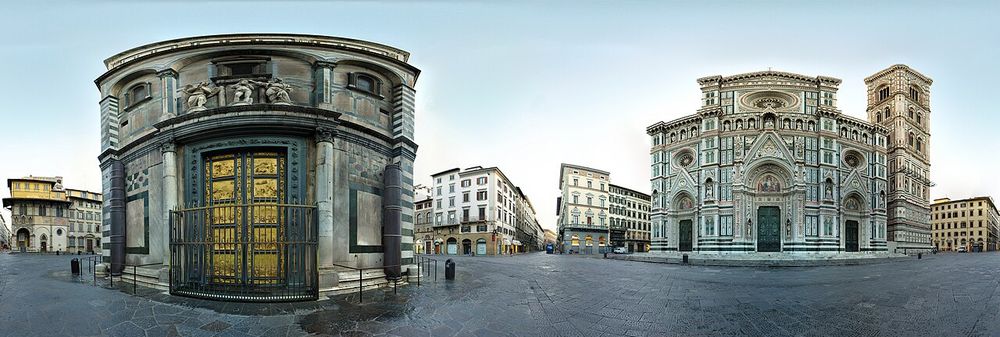
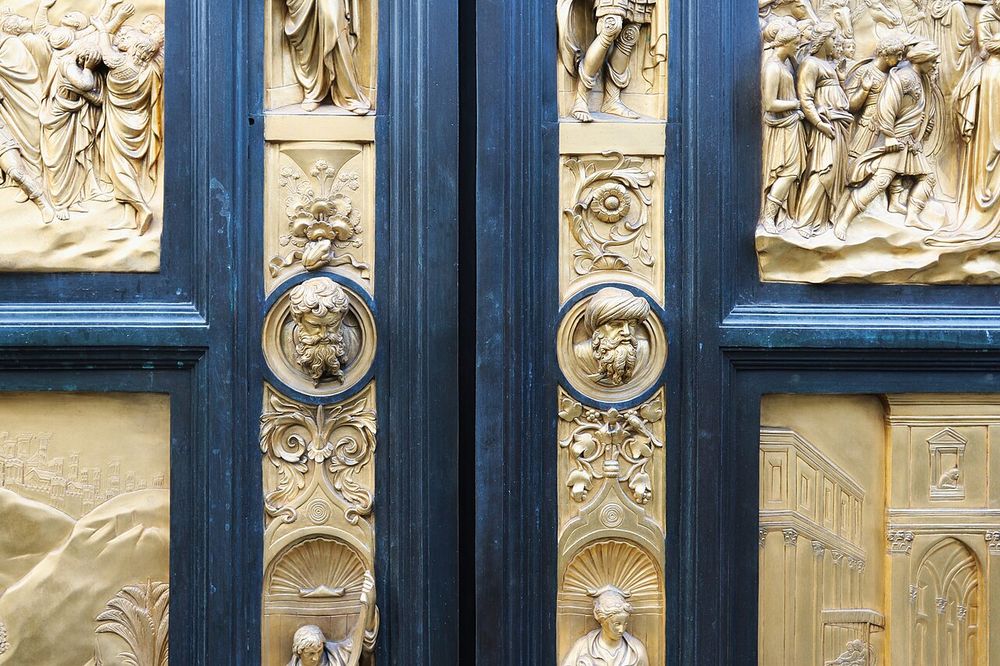
Ghiberti spent twenty-one years on those doors and then twenty-seven on a second pair, the ones facing the cathedral. They have ten square panels of scenes from the Old Testament, in gilded bronze, with buildings that seem to go back into real space.
Michelangelo said they were fit to be the gates of Paradise, and the name stayed. The doors in front of you are copies. The real ones are in the museum, in a case filled with nitrogen.
3. The front
The front of 1887Jebulon, CC0
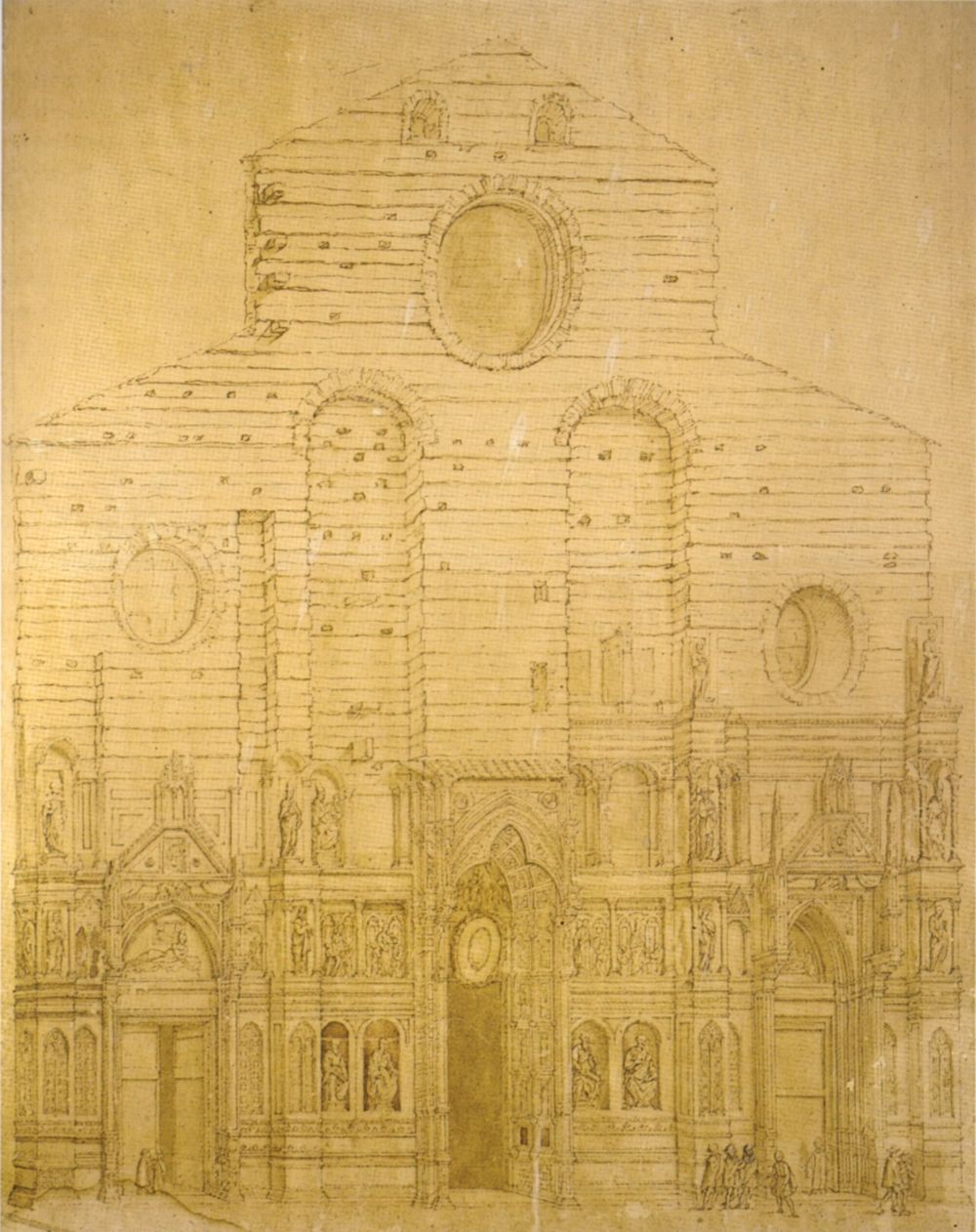
The first front was started in 1296 and got a third of the way up. In 1587 the Medici duke had it pulled off, meaning to build something modern. Nothing was agreed for three hundred years.
The first front, drawn before it was pulled down in 1587After Bernardino Poccetti, Public domain
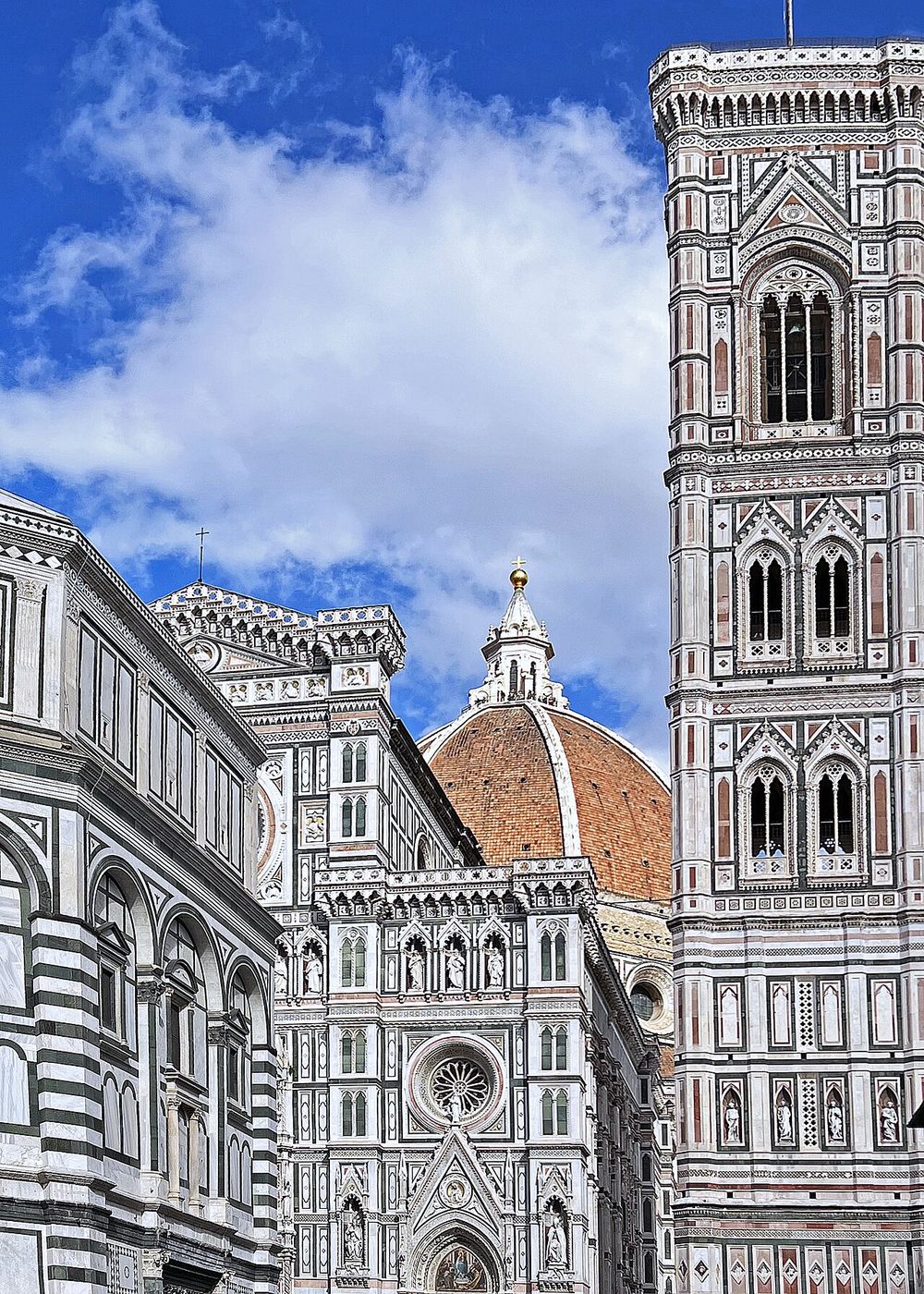
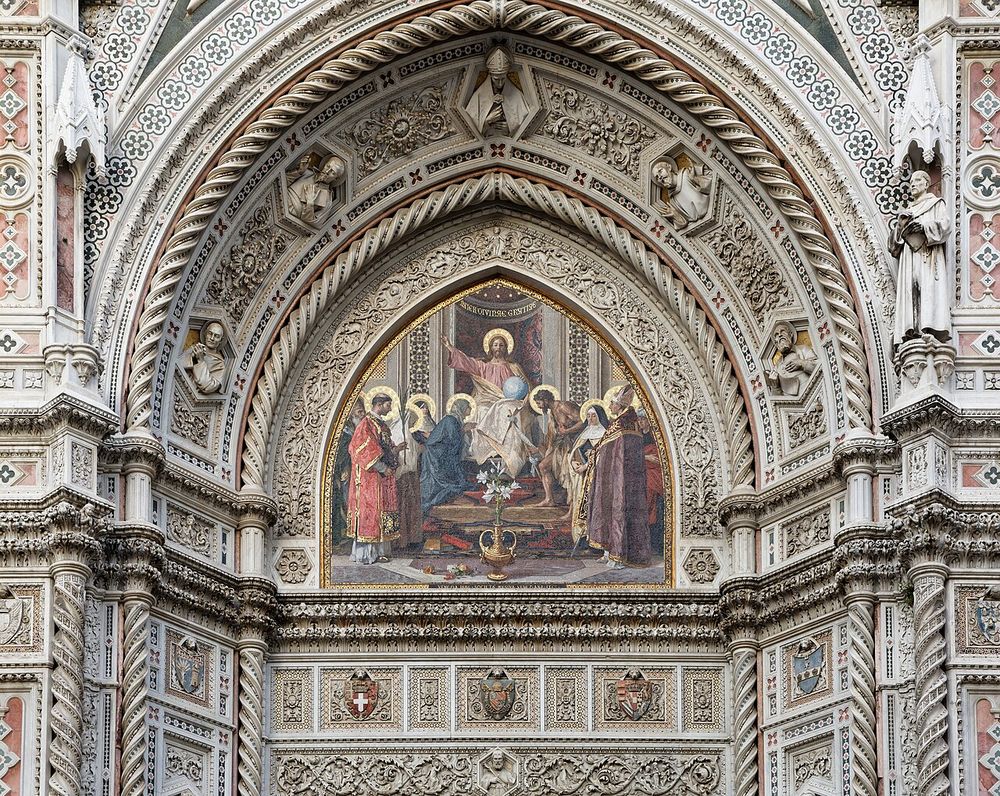
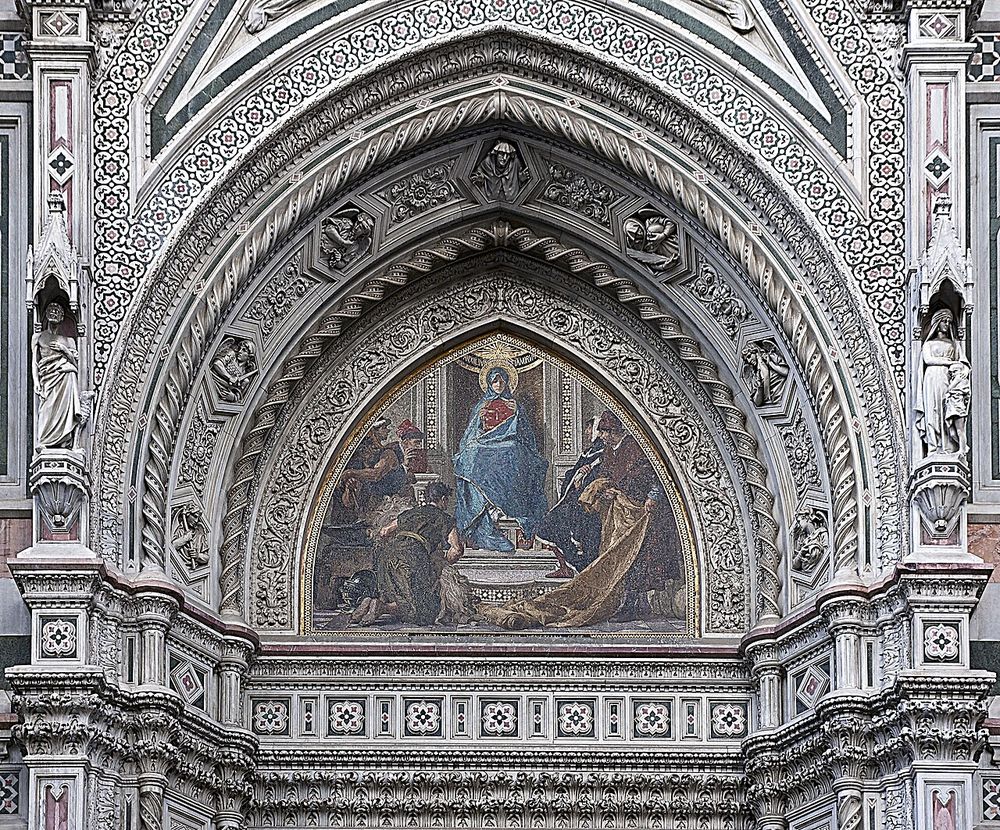
The present front was finished in 1887. The white marble is from Carrara, the green from Prato and the pink from the Maremma: the colours of the Italian flag, which was then twenty-six years old.
4. The bell tower
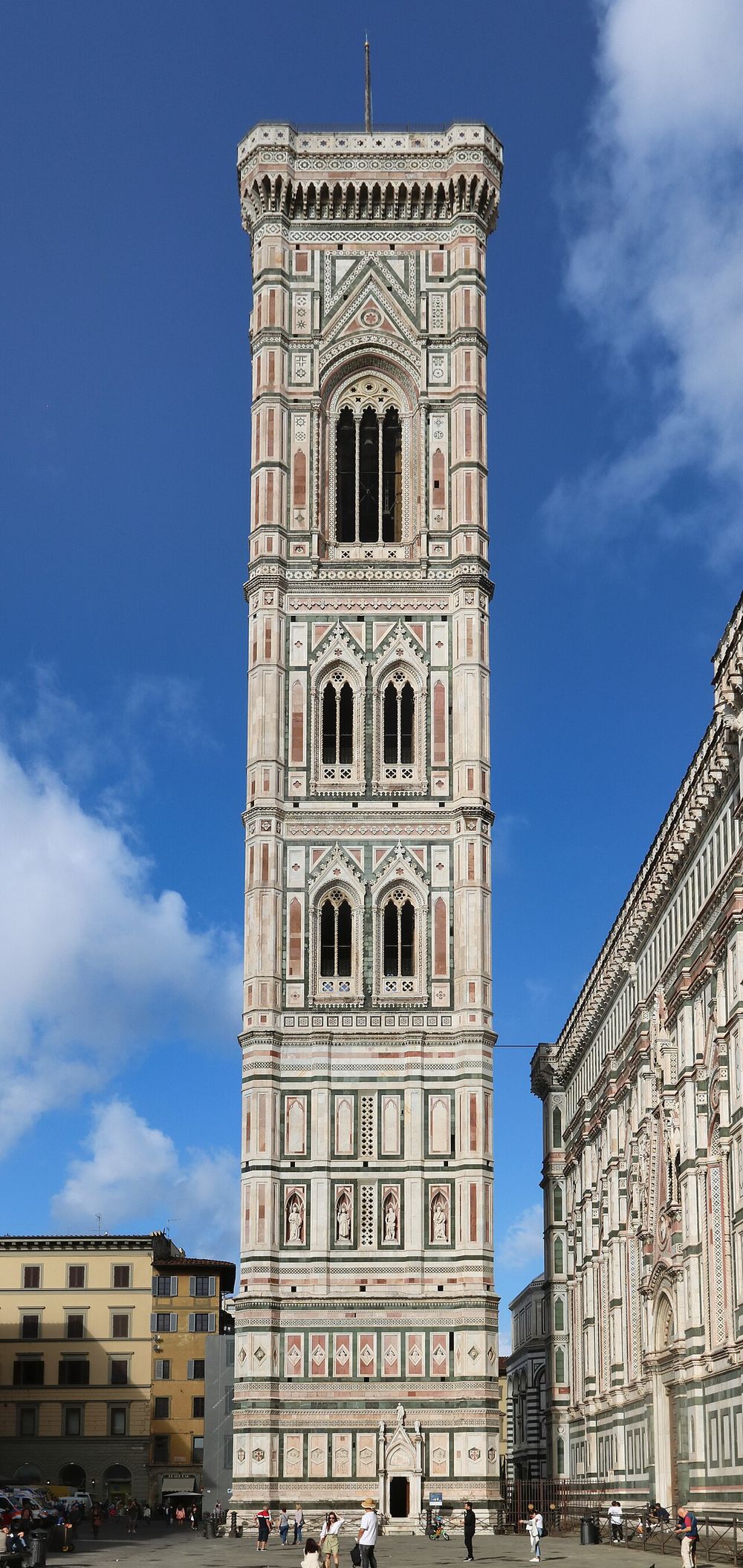
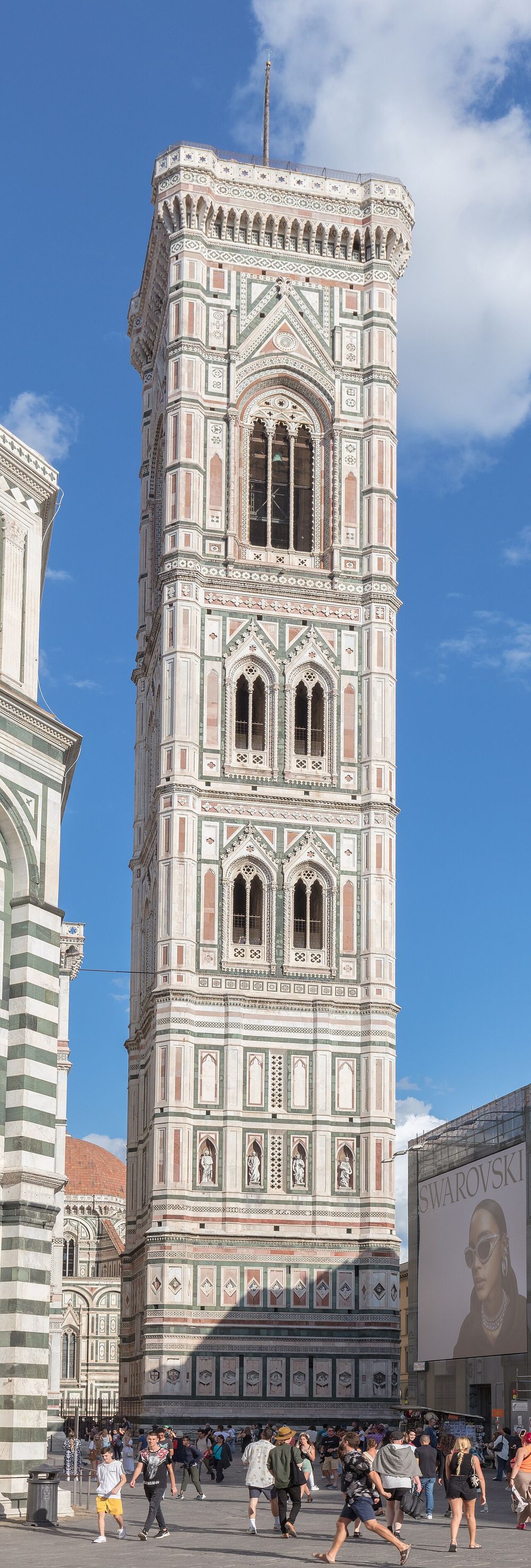
The bell tower, 84.7 metresIngo Mehling, CC BY-SA 4.0
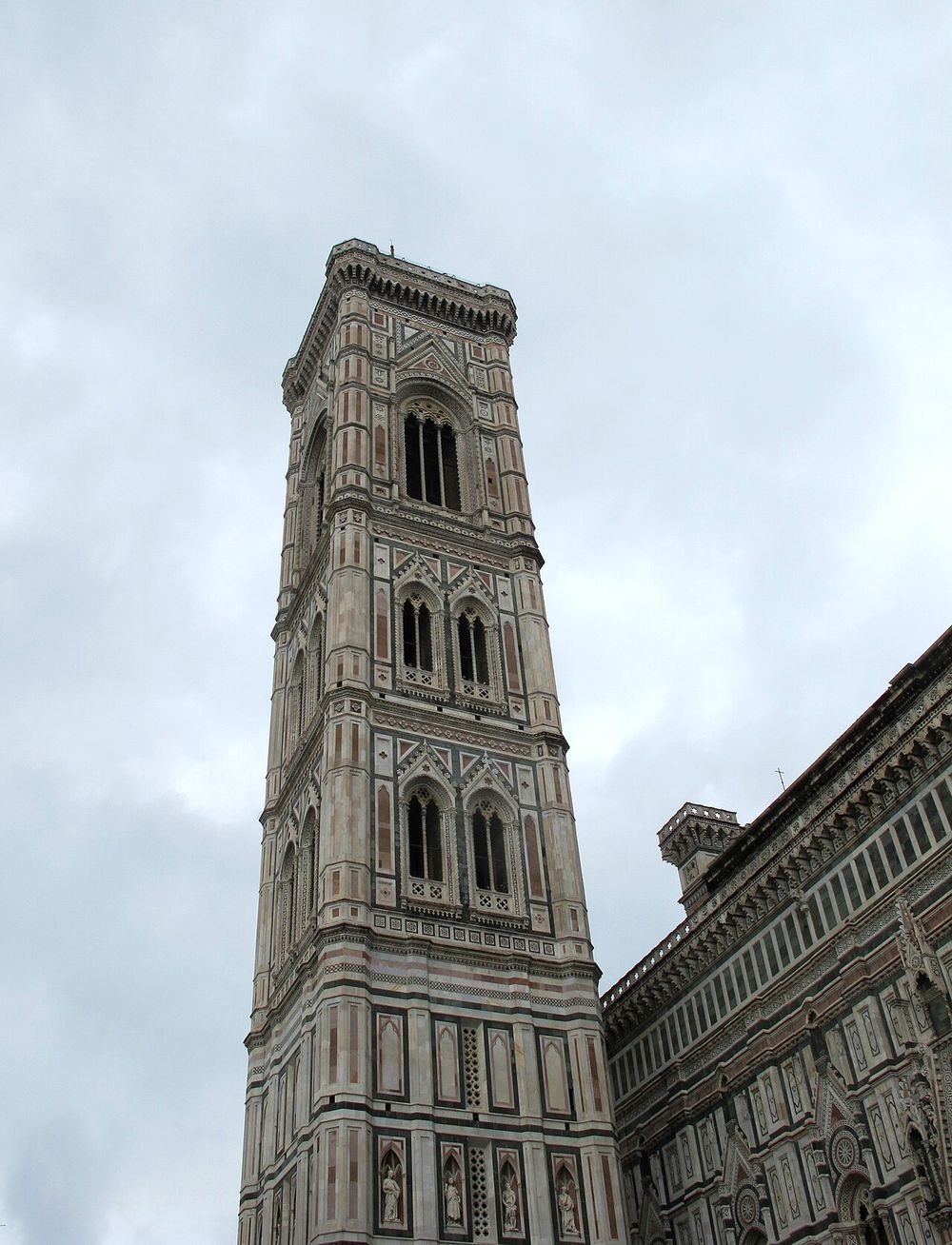
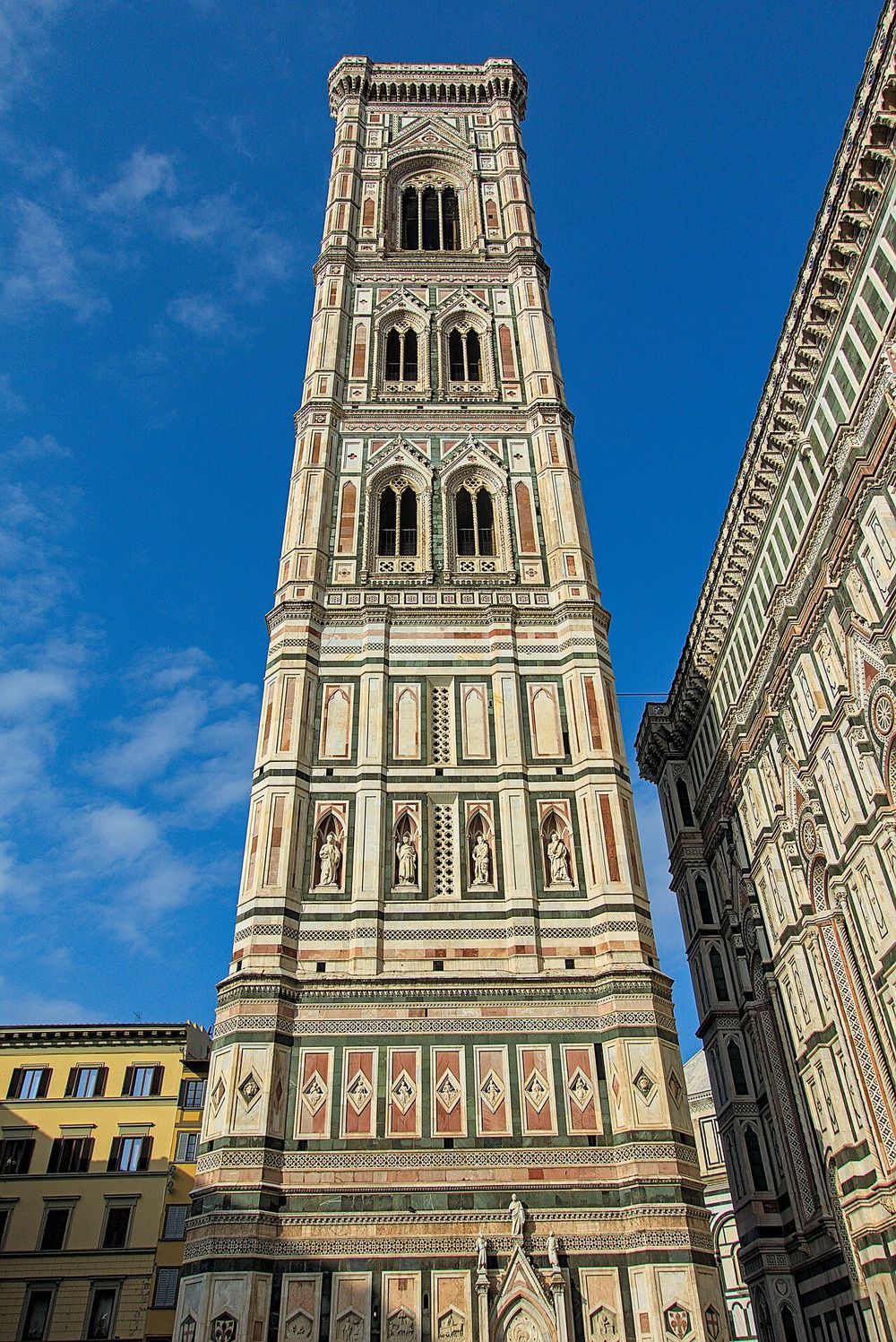
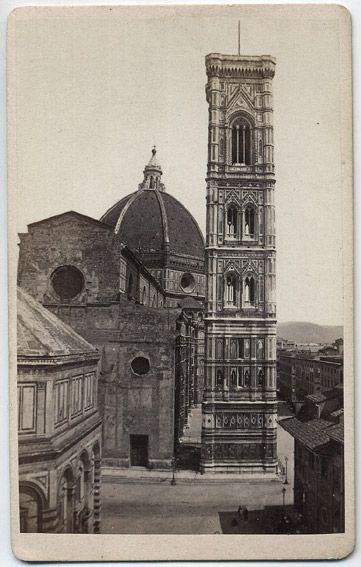
The tower is 84.7 metres high and stands apart from the church, as bell towers do in Italy. Giotto, the painter, was made city architect in 1334 and drew it. He died three years later with one storey built.
Look at the lowest row of small carved panels. They show the trades that made Florence: weaving, building, medicine, navigation, law. One shows a man falling off a ladder into flight. He is Daedalus, the first inventor.
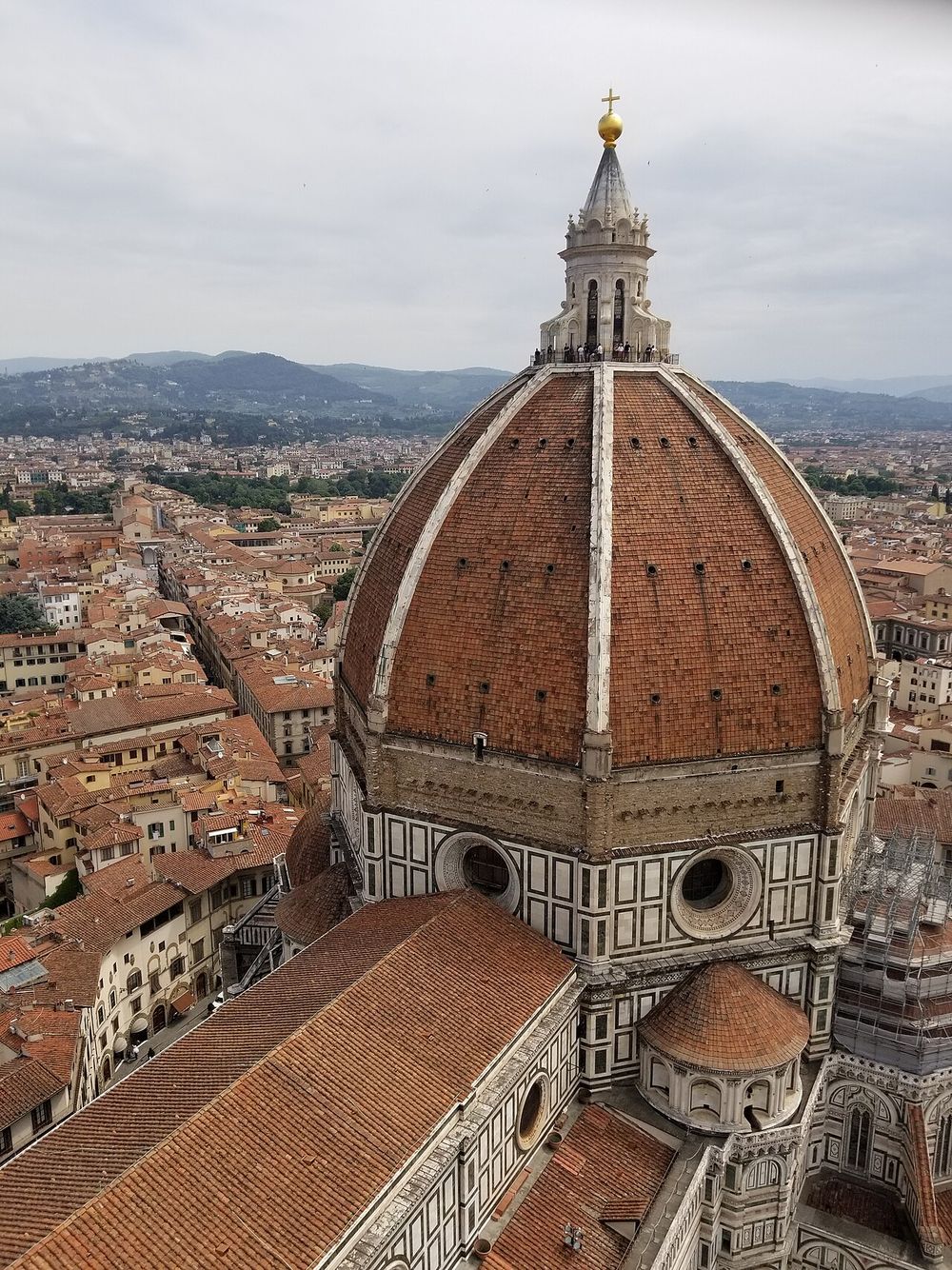
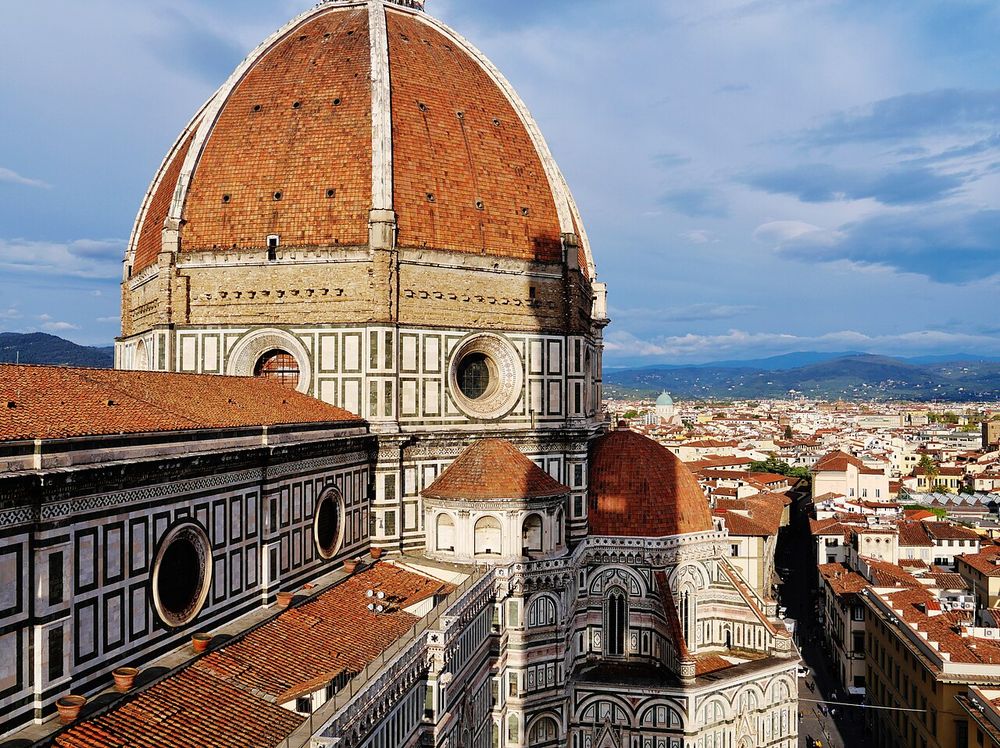
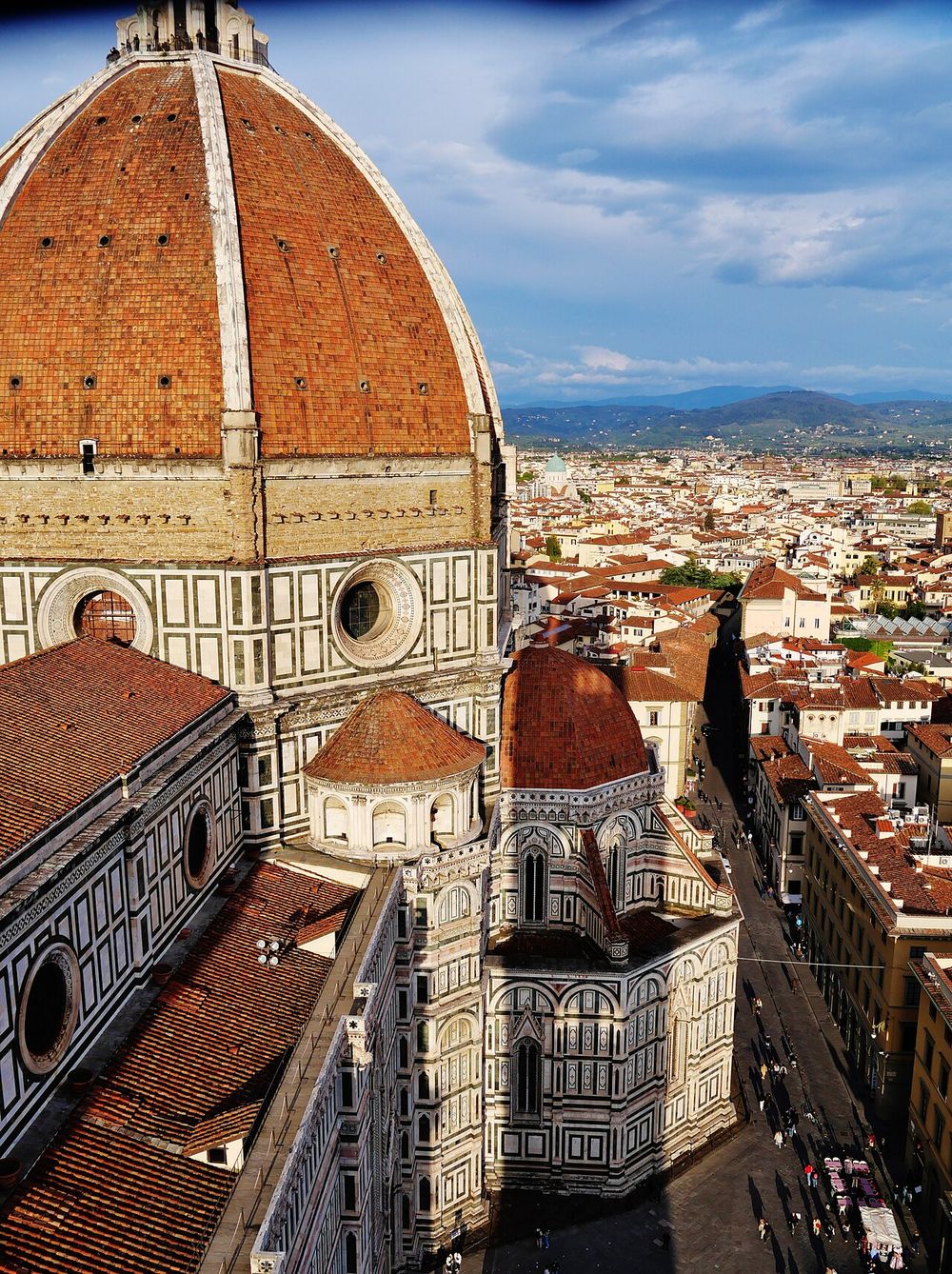
There are 414 steps and no lift. The reward is the only close view of the dome from outside.
5. The nave
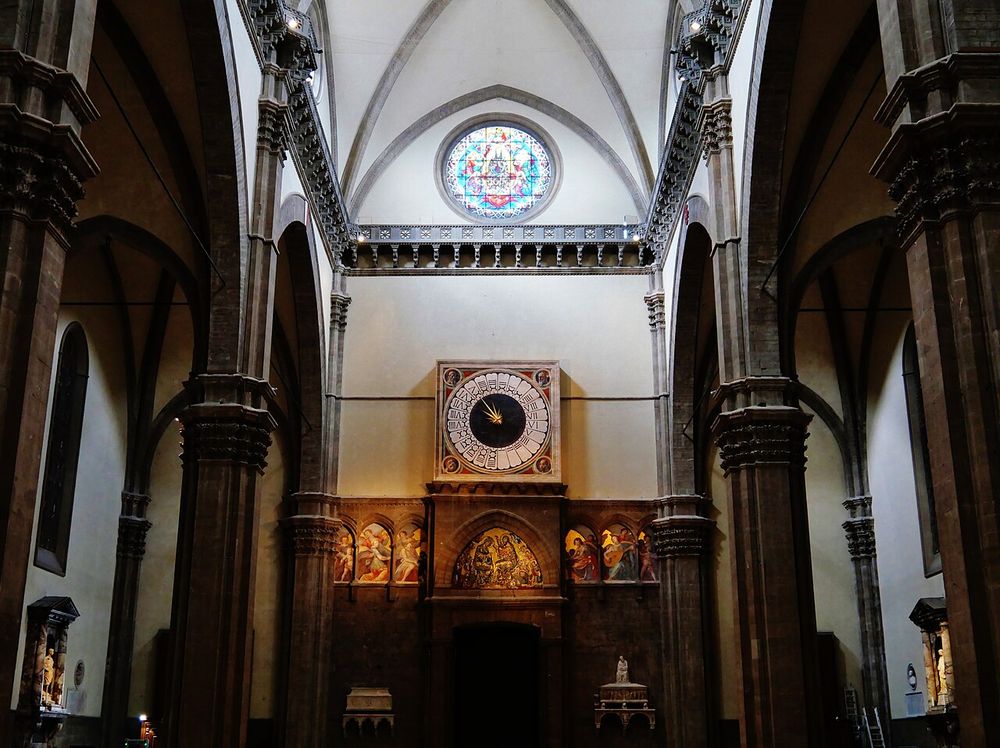
The inside of the front wall, with the clockZairon, CC BY 4.0
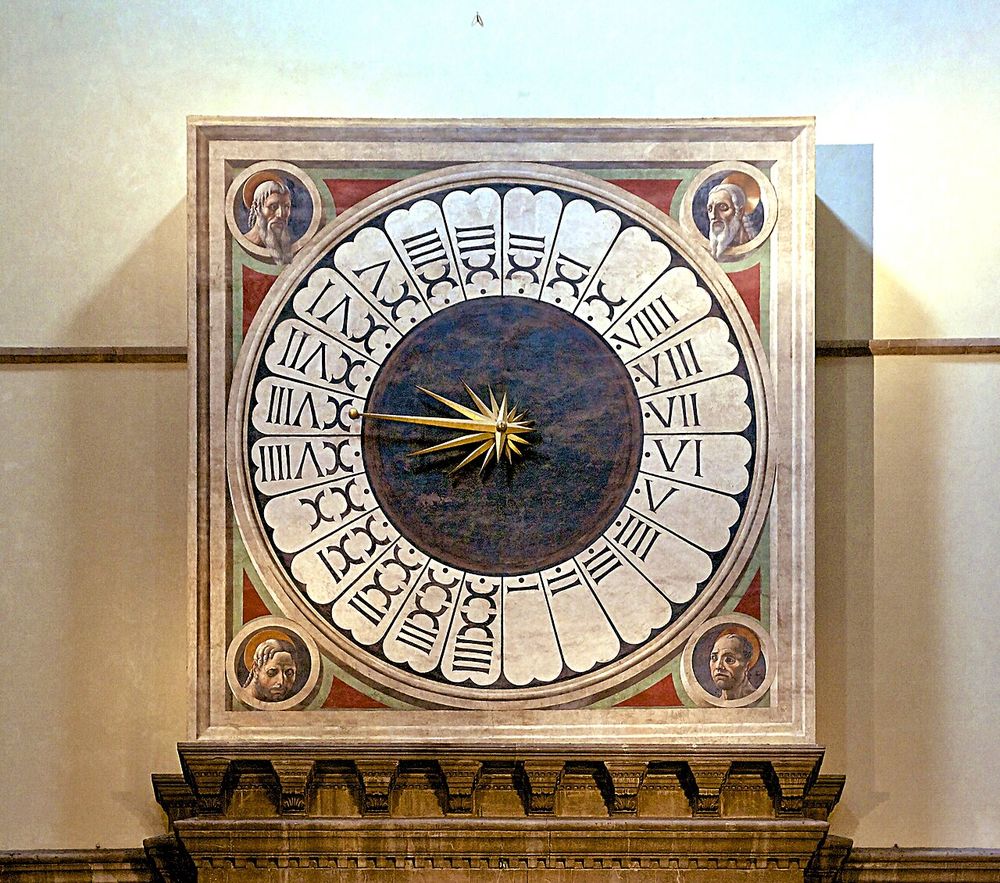
Inside, turn round and look above the door. The clock was painted in 1443. It has one hand and twenty-four hours, and it runs backwards, as a shadow moves on a sundial. The day ends at XXIV, which is sunset.
Dante and his poem, painted in the cathedral in 1465Domenico di Michelino / After Alesso Baldovinetti, Public domain
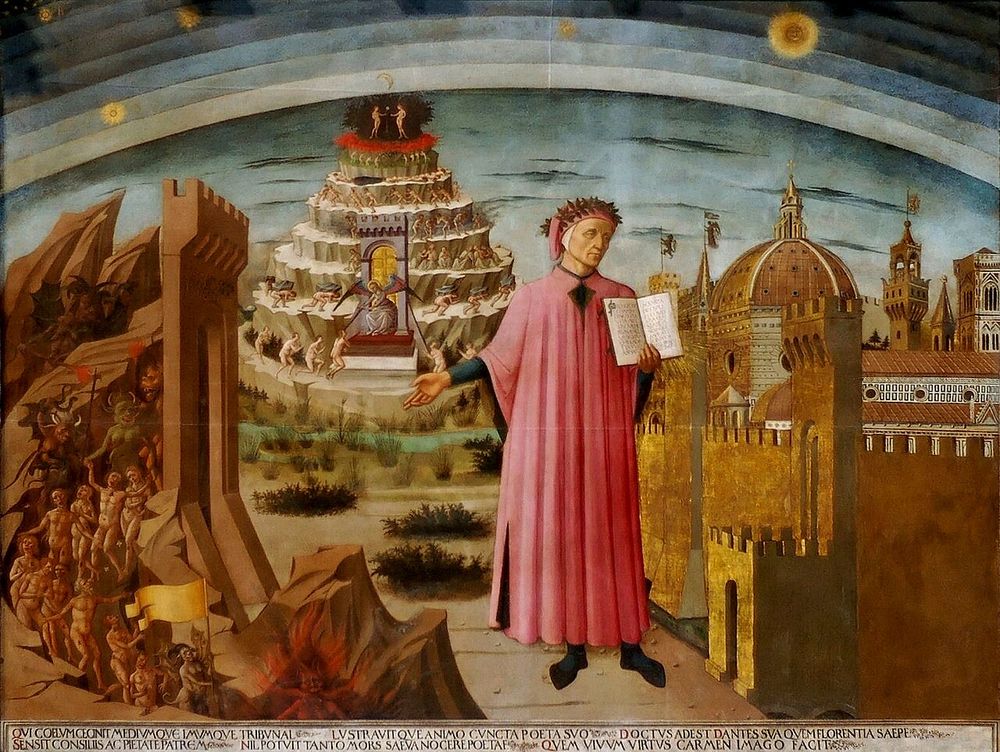
On the left wall is a painting of 1465. Dante stands outside the walls of Florence holding his poem, with hell on one side, the mountain of purgatory behind, and the dome, then twenty-nine years old, on the other.
On Sunday 26 April 1478, during Mass, men of the Pazzi family attacked the two Medici brothers near the altar. Giuliano was stabbed nineteen times and died on the floor. Lorenzo, cut in the neck, got into the sacristy and bolted its bronze door. By evening the plotters were hanging from the windows of the town hall.
6. Under the dome
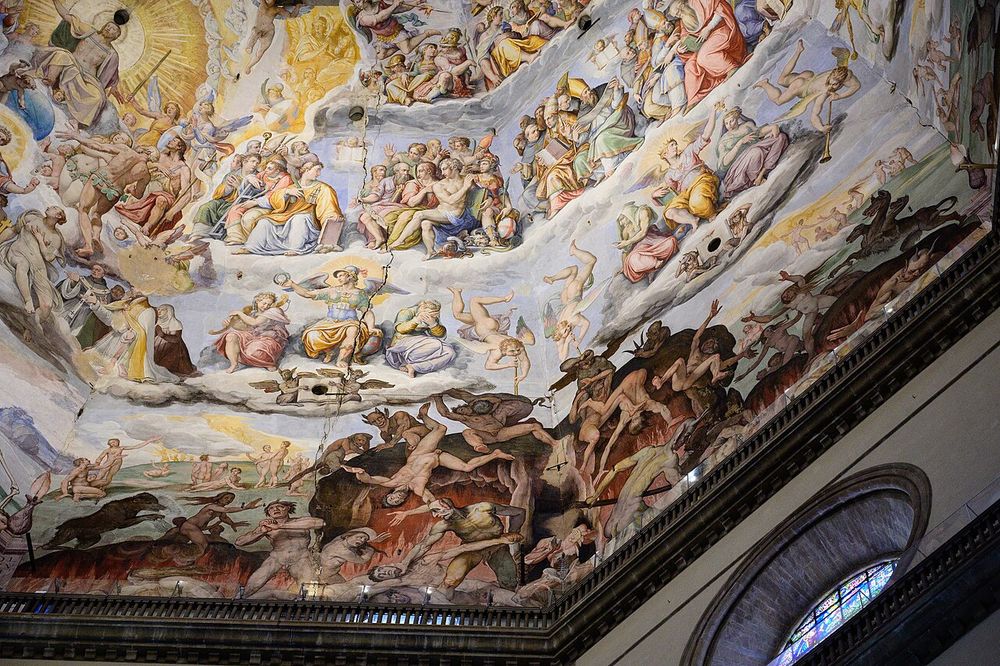
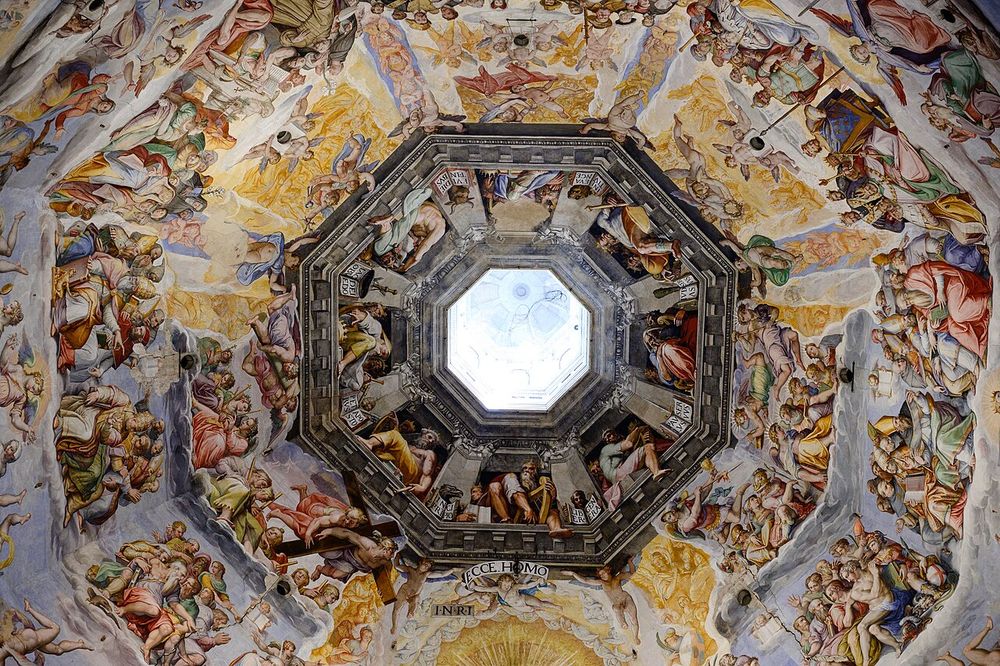
The Last Judgment inside the domeLivioandronico2013, CC BY-SA 4.0
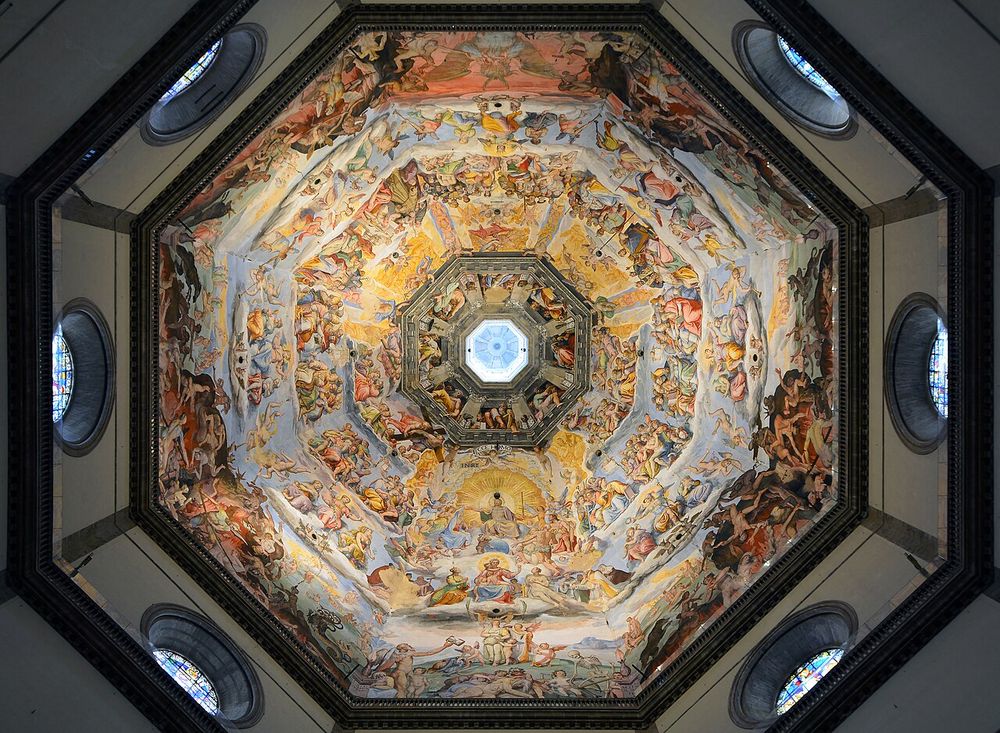
Stand under the centre and look up. The painting covers 3,600 square metres and shows the Last Judgment in rings: heaven at the top, hell at the bottom. It was done between 1572 and 1579.
Brunelleschi wanted the inside left plain, or covered in gold mosaic like the Baptistery. Many Florentines have thought since that he was right.
The dome has eight sides and not a round base, which made it harder: a round dome holds itself together as it rises, and an eight-sided one tries to fall inward at the flat parts.
7. Between the shells
Bricks laid in herringboneArmin Kleiner, CC BY-SA 4.0
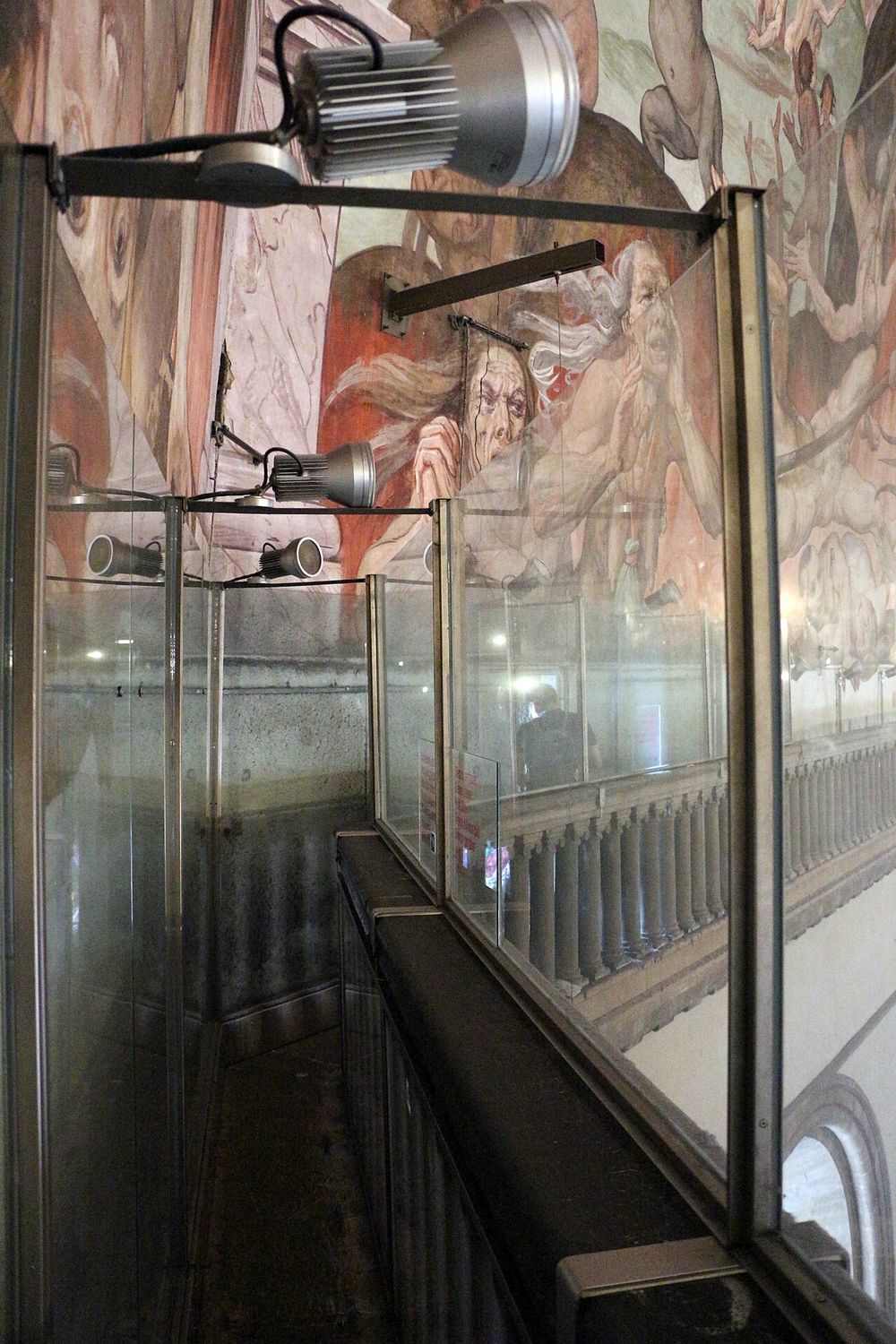
The climb is 463 steps. After the first stair you come out on a narrow gallery inside the dome, close under the painted devils. Then you enter the space between the two shells. The inner one is two metres thick and carries the weight. The outer one keeps the rain off and makes the dome look taller.
The gallery inside the dome, on the way upSailko, CC BY 3.0
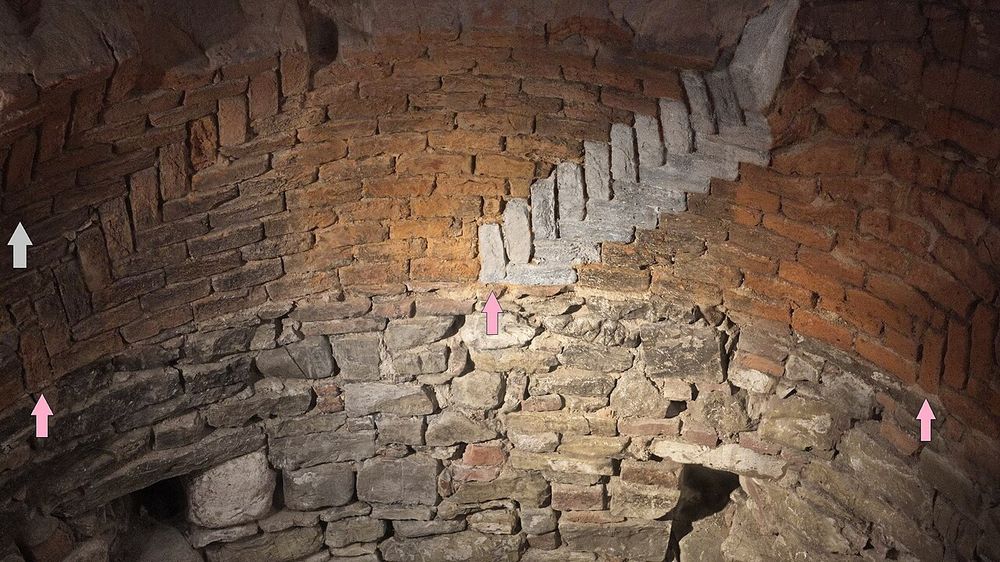
Look at the bricks beside you. In every course some are set upright, and the upright ones climb in a spiral, like the pattern of a herringbone cloth. They lock each new ring to the one below before the mortar is dry. That is how the masons could work with nothing under them.
More than four million bricks went into it. Brunelleschi had a canteen set up on the scaffolding so that the men did not lose time climbing down for lunch, and had their wine watered.
8. The top, and the museum
The lantern and the gilded ballSailko, CC BY 3.0
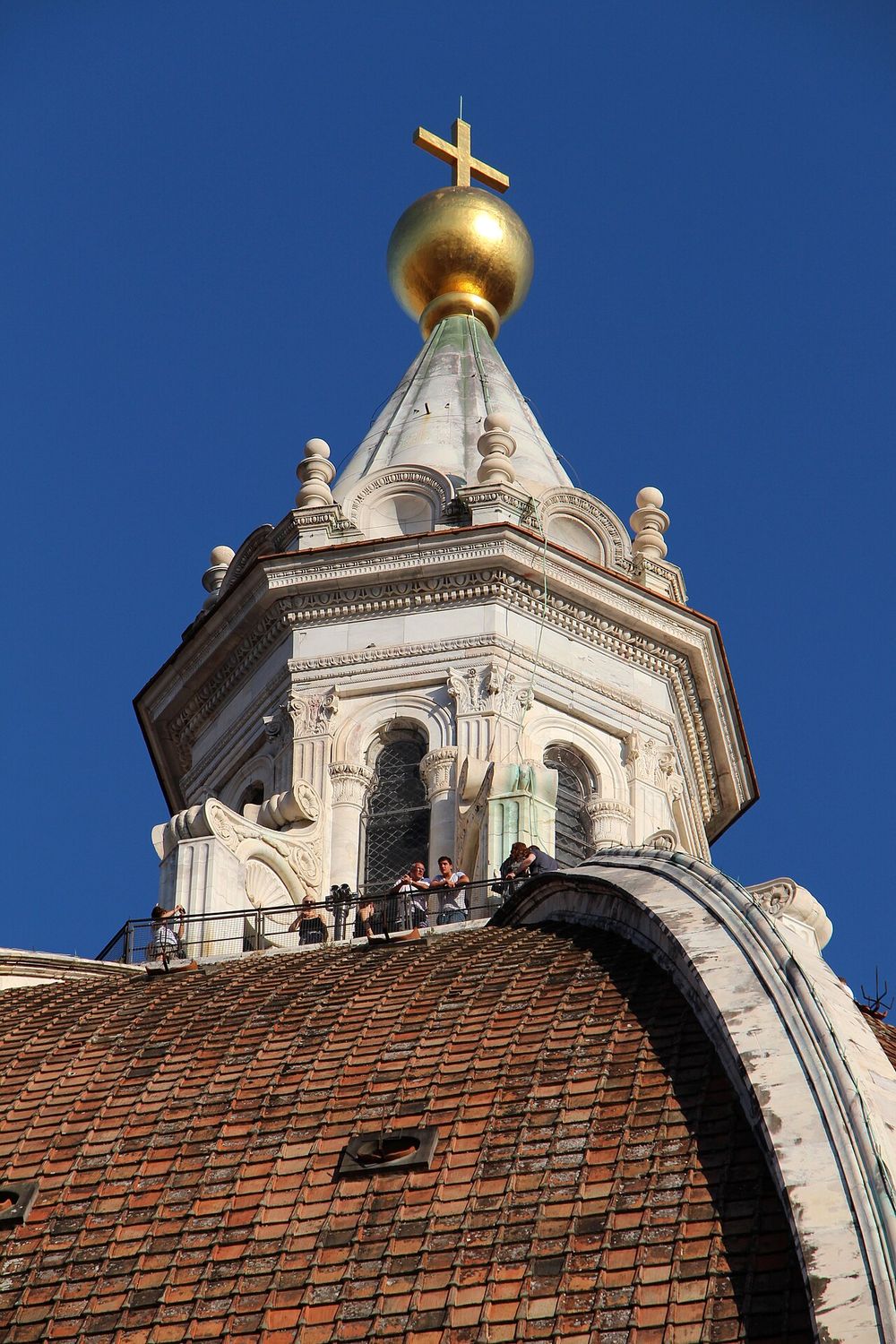
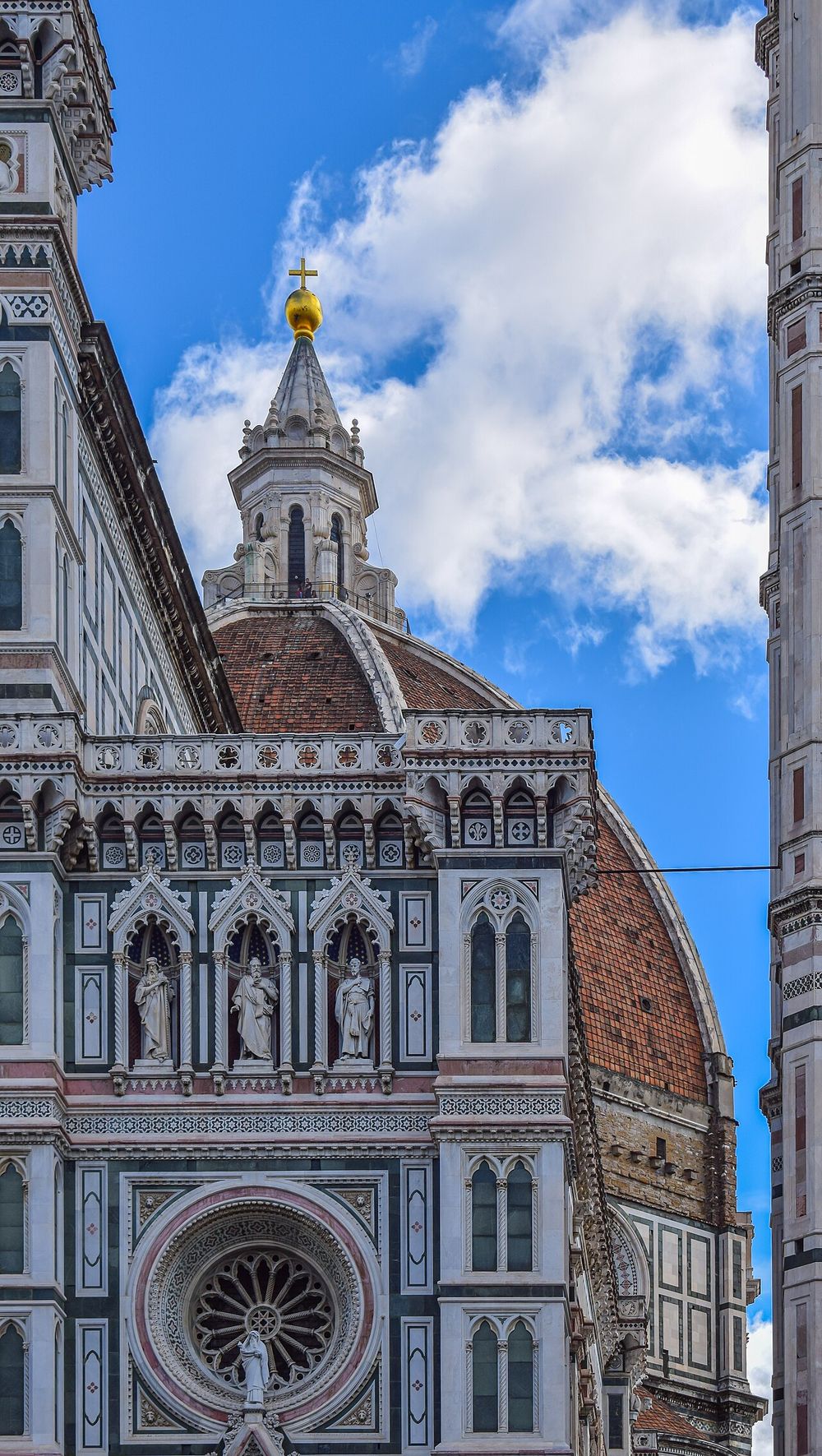
You come out at the foot of the marble lantern, 90 metres up. Brunelleschi designed it but died in 1446, when work on it had only just begun. The gilded ball above went up in 1471. Lightning knocked it off in 1601; a white disc in the paving behind the cathedral marks where it landed.
Michelangelo's last Pietà but one, in the museumMarie-Lan Nguyen, CC BY 2.5
The museum is behind the cathedral, on the spot where Michelangelo carved David. It has the real golden doors, a wall rebuilt to show the lost first front with its statues, and Brunelleschi's wooden models.
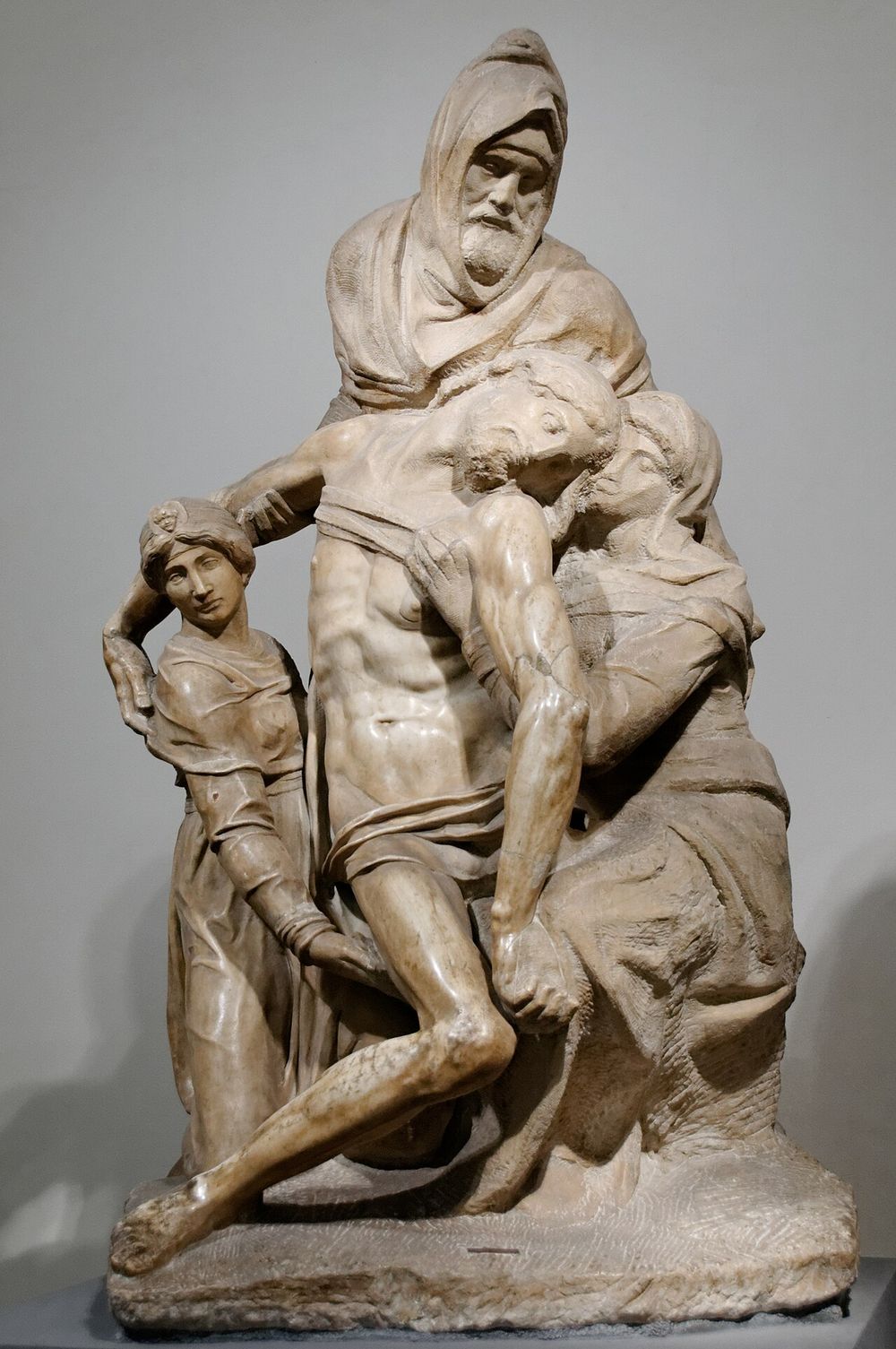
It also has a group of four figures that Michelangelo carved in his seventies for his own tomb. The old man at the top, holding up the dead Christ, has the sculptor's face. He broke the group with a hammer and gave it away.
Meanwhile in the world
Year
Here
Elsewhere
1296
The cathedral is begun
Yuan China (1271–1368); Marco Polo has been home in Venice for a year
1334
Giotto designs the bell tower
Yuan China; fourteen years before the Black Death kills half of Florence
1420
Brunelleschi starts the dome
Ming China (1368–1644): the Forbidden City and the Temple of Heaven are finished
1436
The dome is closed and the church consecrated
Ming China; in Germany Gutenberg is at work on printing with movable type
1452
The golden doors are hung
Leonardo da Vinci is born; a year before Constantinople falls to the Ottomans
1478
Murder at Mass
Ming China, the Chenghua reign; Botticelli is painting Spring in the same city
1579
The painting inside the dome is finished
Ming China: Li Shizhen has just completed his great book of medicines; Drake is sailing round the world
1887
The marble front is finished
Qing China, the Guangxu reign; in Paris work begins on the Eiffel Tower
Then and now
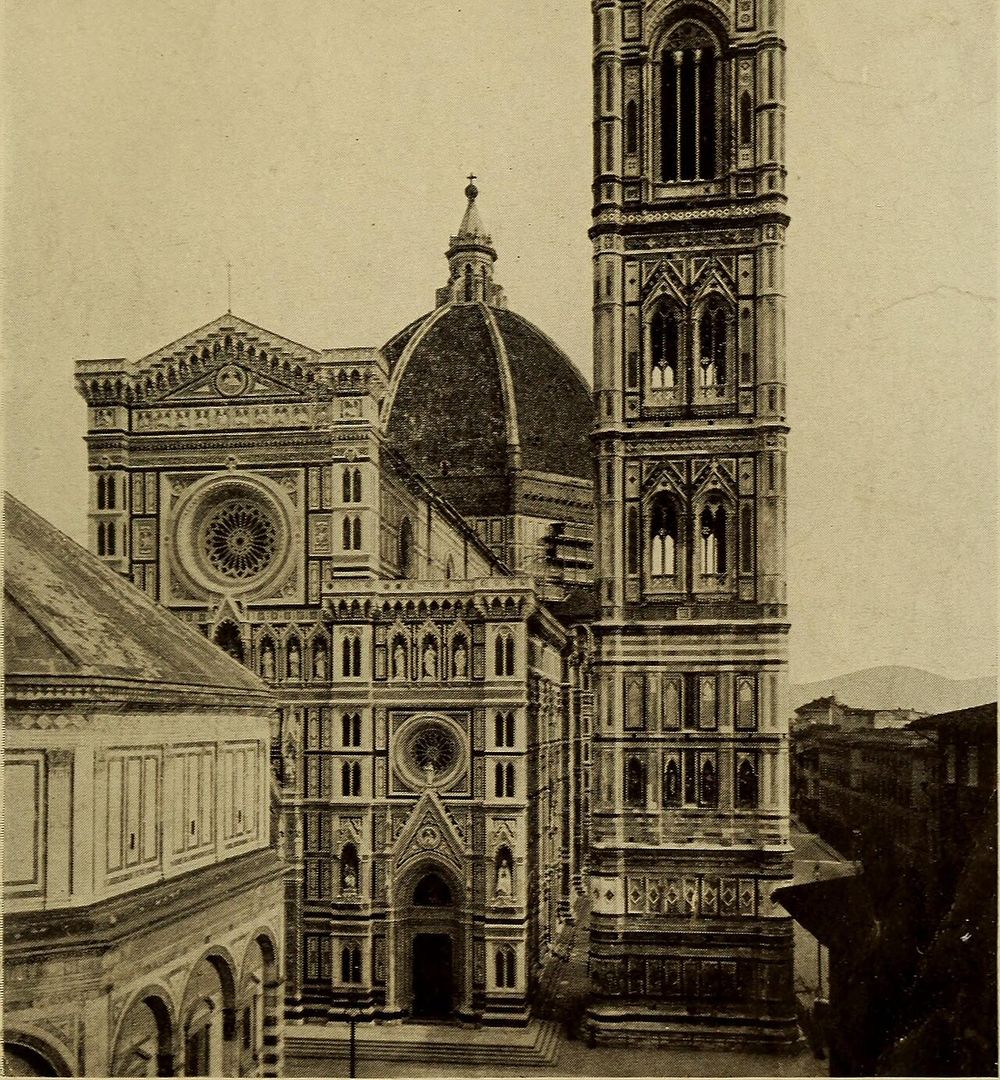
The cathedral above the roofs, from the hill to the southMariordo, CC BY-SA 4.0, Wikimedia CommonsFlorence from Piazzale MichelangeloRay in Manila, CC BY 2.0, Wikimedia CommonsThe dome and tower at nightDllu, CC BY-SA 4.0, Wikimedia CommonsThe dome from the street belowYair Haklai, CC BY-SA 4.0, Wikimedia CommonsThe side of the cathedral and the bell towerMariordo, CC BY-SA 4.0, Wikimedia CommonsThe front of 1887Jebulon, CC0, Wikimedia CommonsThe front and the bell towerGzen92, CC BY-SA 4.0, Wikimedia CommonsMarble in three coloursLiridon, CC BY-SA 4.0, Wikimedia CommonsThe mosaic over the centre doorOakenchips, CC BY-SA 4.0, Wikimedia CommonsThe mosaic over the right doorJebulon, CC0, Wikimedia CommonsGiotto's bell tower from belowAcediscovery, CC BY 4.0, Wikimedia CommonsThe bell tower, 84.7 metresIngo Mehling, CC BY-SA 4.0, Wikimedia CommonsThe bell tower from its footFabio Pani, CC BY-SA 4.0, Wikimedia CommonsThe whole height of the towerDiego Delso, CC BY-SA 4.0, Wikimedia CommonsThe dome from the top of the bell towerPaultheidiot, CC BY-SA 4.0, Wikimedia CommonsThe dome and the hills beyondZairon, CC BY 4.0, Wikimedia CommonsThe dome over the cityZairon, CC BY 4.0, Wikimedia CommonsThe lantern and the gilded ballSailko, CC BY 3.0, Wikimedia CommonsLooking north from the top of the domeYair Haklai, CC BY-SA 4.0, Wikimedia CommonsThe Last Judgment inside the domeLivioandronico2013, CC BY-SA 4.0, Wikimedia CommonsDetail of the paintingZde, CC BY-SA 4.0, Wikimedia CommonsThe painting round the opening of the lanternZde, CC BY-SA 4.0, Wikimedia CommonsThe gallery inside the dome, on the way upSailko, CC BY 3.0, Wikimedia CommonsThe nave looking eastTxllxt TxllxT, CC BY-SA 4.0, Wikimedia CommonsThe inside of the front wall, with the clockZairon, CC BY 4.0, Wikimedia CommonsThe clock of 1443, which runs backwardsPaolo Uccello, CC0, Wikimedia CommonsThe BaptisteryEdanziger, CC BY 4.0, Wikimedia CommonsThe Baptistery from the cathedral stepsBradley Weber, CC BY 2.0, Wikimedia CommonsThe Baptistery and the cathedral face to faceUser:MatthiasKabel, CC BY-SA 3.0, Wikimedia CommonsThe real golden doors, in the museumYair Haklai, CC BY-SA 4.0, Wikimedia CommonsThe frame of the golden doorsIngo Mehling, CC BY-SA 4.0, Wikimedia CommonsSolomon and the Queen of Sheba, the last panelIngo Mehling, CC BY-SA 4.0, Wikimedia CommonsThe mosaic ceiling of the Baptistery, photographed before the repairUser:MatthiasKabel, CC BY-SA 3.0, Wikimedia CommonsChrist in judgment, at the centre of the ceilingJebulon, CC0, Wikimedia CommonsA small dome built to test the herringbone methodYair Haklai, CC BY-SA 4.0, Wikimedia CommonsBricks laid in herringboneArmin Kleiner, CC BY-SA 4.0, Wikimedia CommonsMichelangelo's last Pietà but one, in the museumMarie-Lan Nguyen, CC BY 2.5, Wikimedia CommonsStones of the older church under the floorFilius humanitas, CC BY-SA 3.0, Wikimedia CommonsThe remains of Santa ReparataFilius humanitas, CC BY-SA 3.0, Wikimedia CommonsDante and his poem, painted in the cathedral in 1465Domenico di Michelino / After Alesso Baldovinetti, Public domain, Wikimedia CommonsThe first front, drawn before it was pulled down in 1587After Bernardino Poccetti, Public domain, Wikimedia CommonsSection through the dome and lantern, engraved in 1733Sgrilli, Bernardo Sansone, active 1733-1755.; Brunelleschi, Filippo, 1377-1446., Public domain, Wikimedia CommonsThe bell tower in a photograph by Giacomo Brogi, before 1881Giacomo Brogi, Public domain, Wikimedia CommonsThe cathedral from the town hall tower, about 1897…trialsanderrors, CC BY 2.0, Wikimedia CommonsThe cathedral in a book of 1911Internet Archive Book Images, No restrictions, Wikimedia Commons
Video
Films from official channels, played from YouTube. Nothing is loaded until you press play.
The historic centre of FlorenceUNESCO · made with NHK; 3 min · checked 2026-11-12
Local legends
These are stories people tell about this place. They are legends, not history, and each one says where it comes from.
LegendThe egg
The judges asked Brunelleschi to show his plan. He refused, in case it was stolen, and asked instead that whoever could make an egg stand on end on a slab of marble should build the dome. The others tried and failed. He tapped the egg on the marble, flattening its end, and it stood. They said they could have done that. "So you could have built the dome," he said, "if you had seen my plan."
Source: Giorgio Vasari, Lives of the Artists (1550)
LegendThe mound of coins
One of the rival builders proposed to fill the church with earth to hold the dome up while it was built, and to mix small coins into the earth, so that the people of Florence would carry it all away afterwards for nothing.
Source: Vasari, Lives of the Artists; the same tale is told of the Pantheon
LegendThe bull's head
High on the north side of the cathedral a stone bull's head looks down at a house across the street. A master mason was the lover of a baker's wife who lived there. When her husband had them taken to court, the mason set the horned head where the husband would see it every morning.
Source: Florentine popular tradition
LegendThe dove and the cart
On Easter morning a cart loaded with fireworks is drawn to the cathedral door by white oxen. A rocket shaped like a dove runs down a wire from the altar and sets it alight. If the dove flies back to the altar without stopping, the harvest will be good.
Source: Florentine custom, kept since at least the fifteenth century
Later, people who live here will be able to add the stories they grew up with, and say which of these they have heard.
Not certain, and where accounts conflict
How did he do it?
Brunelleschi left no drawings and told his workmen only what each needed to know. The herringbone bricks and the chains of stone and wood can be seen. How he kept eight curved walls rising towards a single point, with no frame to measure from, is still argued over.
Is it cracking?
Yes, and it has been since at least 1639. The cracks are measured by instruments all the time. They open and close with the seasons and grow by a few millimetres a century.
Did Dante really sit on that stone?
The stone has been pointed out since the 1500s. There is no record from his own time.
Did Michelangelo name the doors?
Vasari says so, a century after the doors were hung. It may also be that the space between a cathedral and its baptistery was simply called the "paradise" in Italian.
Visiting
Tickets and hours
The cathedral is free, Monday to Saturday from 10:15 to 15:45. It is closed to visitors on Sundays and feast days.
The Brunelleschi Pass, 30 euros, covers the dome, the bell tower, the Baptistery, the museum and Santa Reparata. The Giotto Pass, 20 euros, is the same without the dome. The Ghiberti Pass, 15 euros, is the Baptistery, the museum and Santa Reparata.
Children of 7 to 14 pay 12 euros, 7 euros and 5 euros for the three passes. Under 7 is free.
The dome is climbed at the time on your pass: Monday to Friday 8:15 to 18:45, Saturday to 16:30, Sunday 12:45 to 16:30. It is closed for maintenance from 16 to 20 November 2026.
The bell tower is open every day from 8:15 to 18:45. It is under repair in 2026; the top stays open, with part of the view covered.
The Baptistery is open from 8:30 to 19:30, and the museum from 8:30 to 19:00, closed on the first Tuesday of the month. Everything is closed on 1 January, Easter Sunday and 25 December.
Last checked 2026-11-12. The cathedral works' own ticket site (tickets.duomo.firenze.it), prices and opening hours as shown in November 2026.
Booking from abroad
Official page in English The cathedral works sell their own tickets in English and take foreign cards: tickets.duomo.firenze.it. They state that no other seller of "skip the line" entry is authorised.
Ticket window on site The official ticket office is at Piazza San Giovanni 7, opposite the north door of the Baptistery, open Monday to Saturday 8:00 to 19:15 and Sunday 10:15 to 17:45. Times for the dome are usually sold out days ahead.
Note With any pass you must leave bags at the free luggage store at Piazza Duomo 38/R before going into any of the monuments.
Checked 2026-11-12
Where to start
The cathedral is ten minutes on foot from the main railway station, Santa Maria Novella. The centre is closed to cars.
Book the dome for the first time of the day. Then do the museum, which explains everything you have just climbed through, and the bell tower late in the afternoon for the light on the dome.
The line for the free cathedral is longest at 10:15. Come after 14:00.
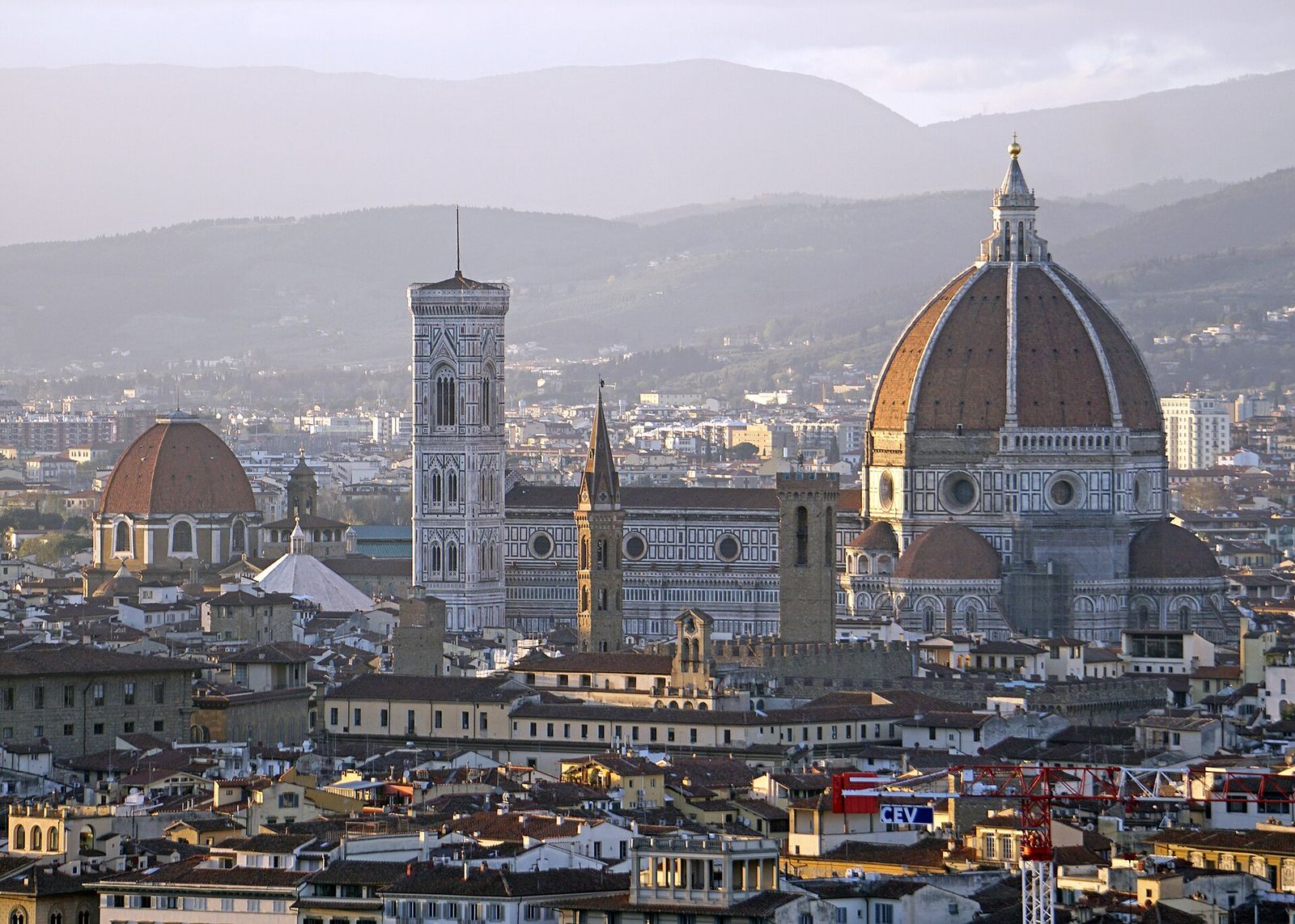
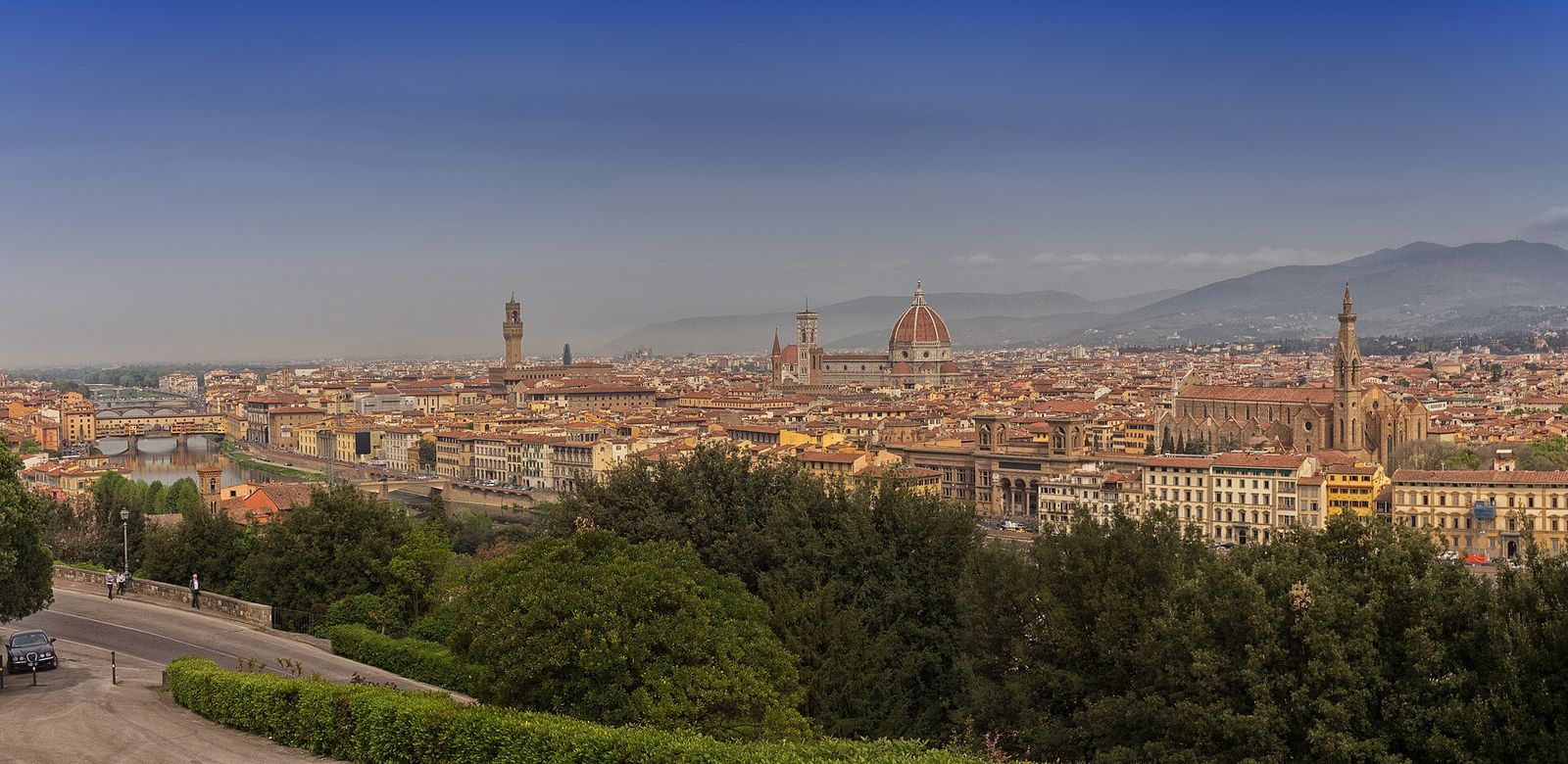
For the picture of the whole dome over the city, go up to Piazzale Michelangelo across the river at sunset.
Before you go
The dome is 463 steps and the tower 414, with no lift in either. The passages are narrow and steep, with people coming down the same way. They are not for anyone with a weak heart or a fear of closed spaces.
In the cathedral and the Baptistery, shoulders must be covered and legs covered to the knee. Flip-flops are not allowed.
A pass lets you into each place once, within three days of the date you chose. The dome time cannot be changed.
Customs and manners
The cathedral is in use. Keep your voice down and stay out of the roped areas, where people pray.
Do not write on the walls of the dome stair. The works have put up tablet screens for visitors to leave a message instead.
On the stairs, let those coming down pass at the landings.
Opening hours are given in the local time of the place. Prices are in the local currency. The figure after ≈ is approximate, at exchange rates checked on 9 November 2026, in .
Look for these
Count the sides of the Baptistery, then the sides of the dome.
On the golden doors, find a small bald head sticking out of a ring. It is the artist.
On the bell tower, find the man with wings.
Inside, what time is it by the clock over the door?
In the painting of Dante, find the dome.
In the dome painting, find the devils. Are they at the top or the bottom?
On the climb, find bricks standing on end.
Behind the cathedral, find the white disc in the paving where the ball fell.
I am here
Stand at the site, sign in, press the button, and collect its stamp. Your browser will ask to use your location. It is sent to us once to confirm that you are at the site; we keep how far you were from it, not the spot where you stood.
Your stamps are saved to your account, so they follow you to any device. Checking from a browser cannot rule out every false location; stricter checks arrive with the app.
Messages
Share your photos
Photos here show the place, not people. Each one is credited to the visitor who took it and appears after our team has looked at it. A photo with you in it belongs under “I am here”.