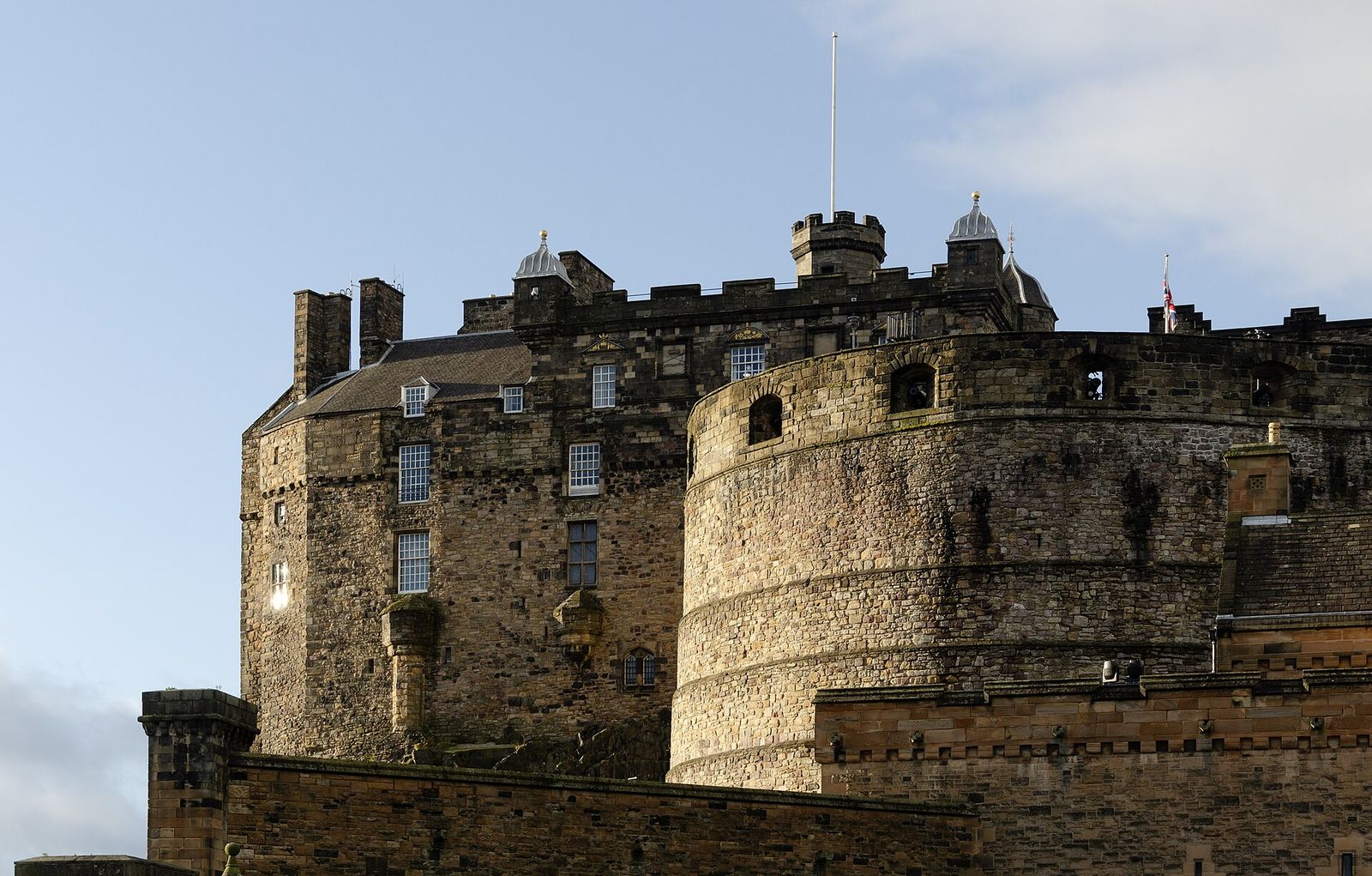
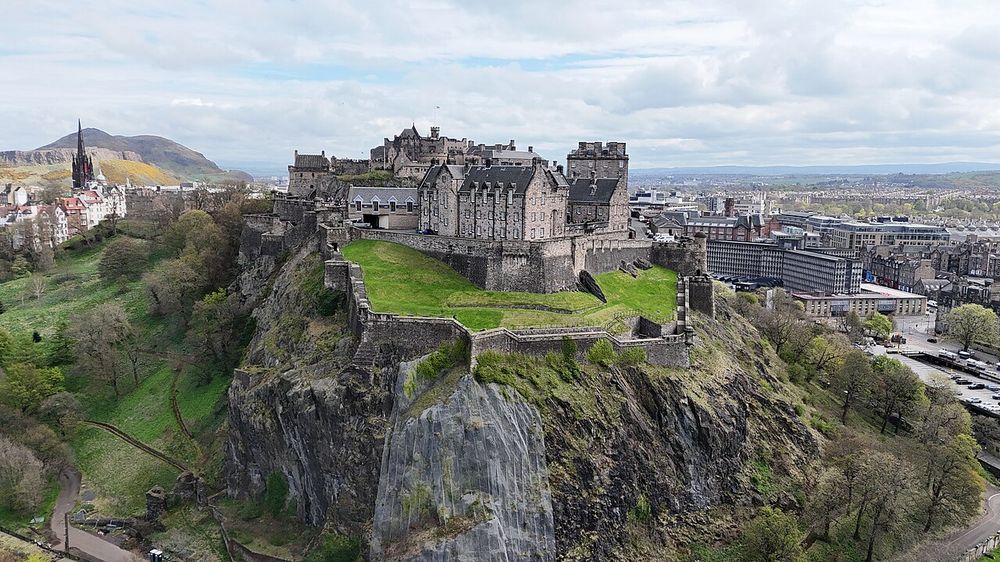
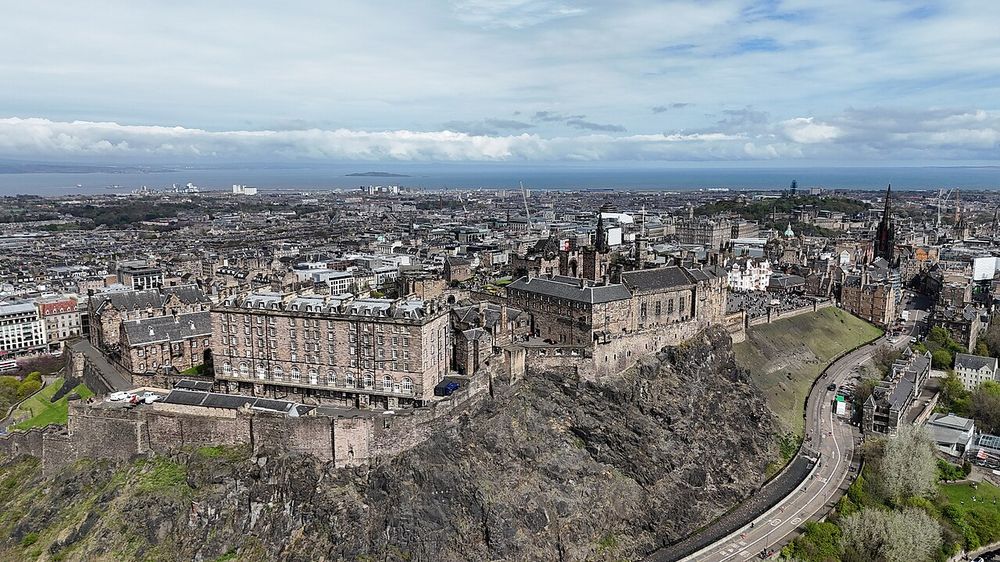
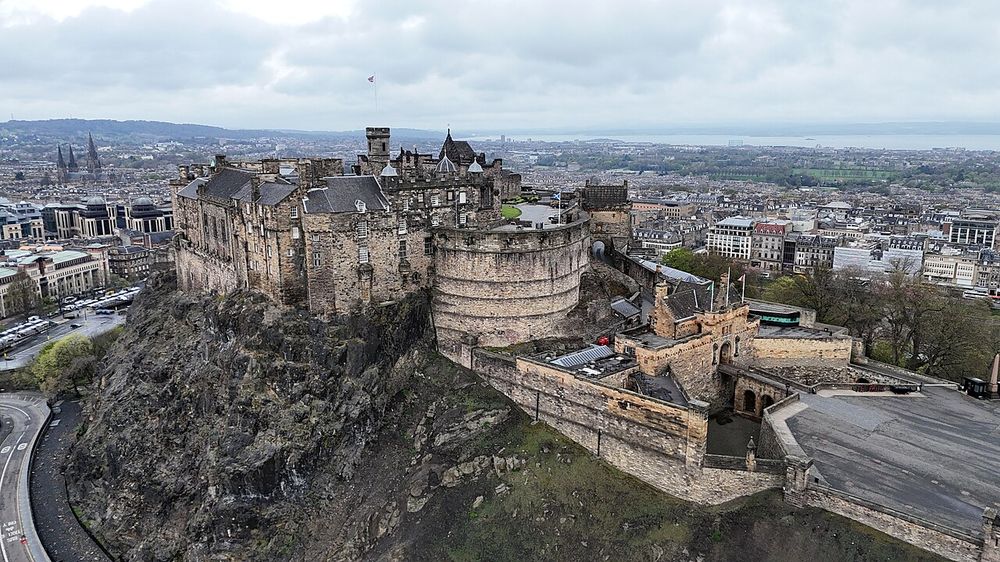
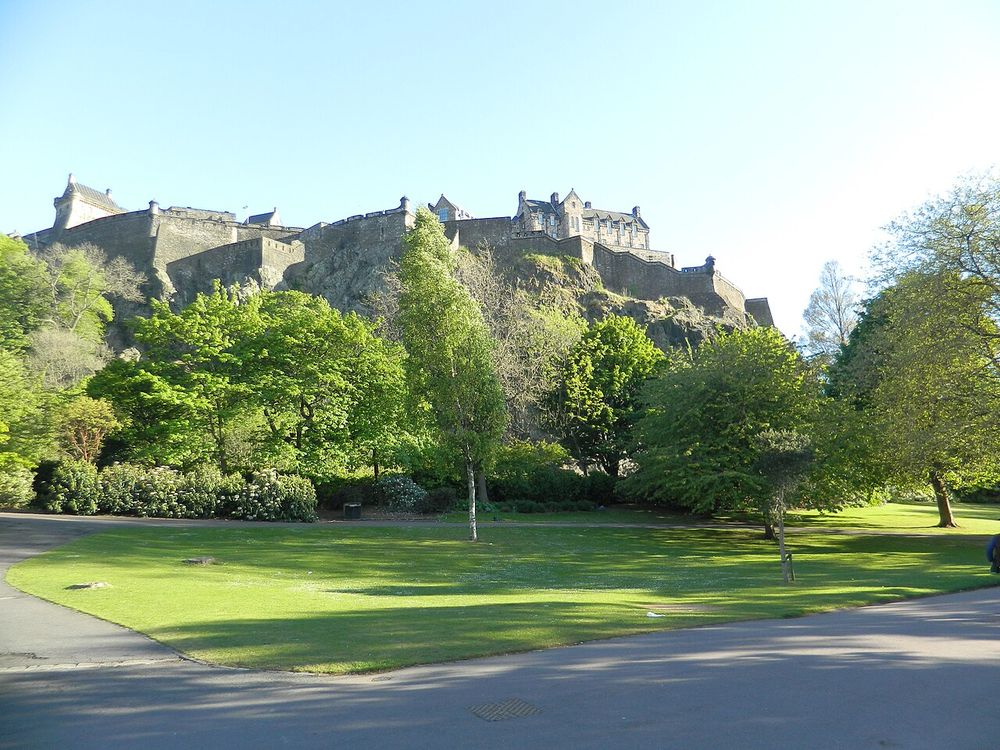
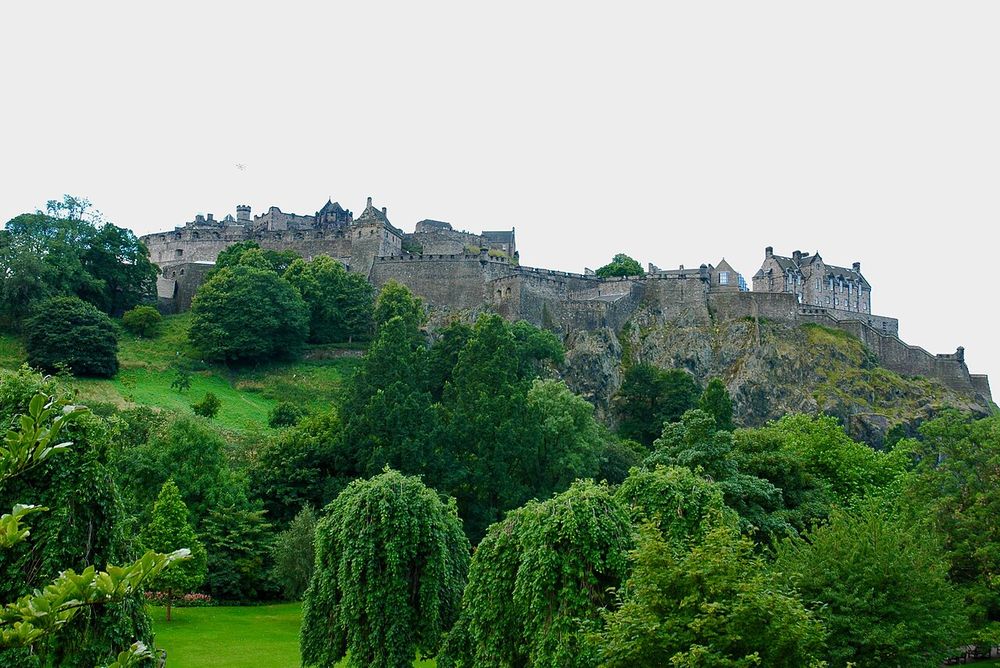
A fortress on the stump of a dead volcano, with cliffs on three sides and a city at its feet. For nine hundred years whoever held this rock held Scotland, and so it was attacked more often than any other place in Britain. Inside the walls are a chapel of the 1100s, the crown of the Scottish kings, and a gun that is still fired at one o'clock on six days of the week.
Photo: 瑞丽江的河水, CC BY-SA 4.0, Wikimedia Commons
The story
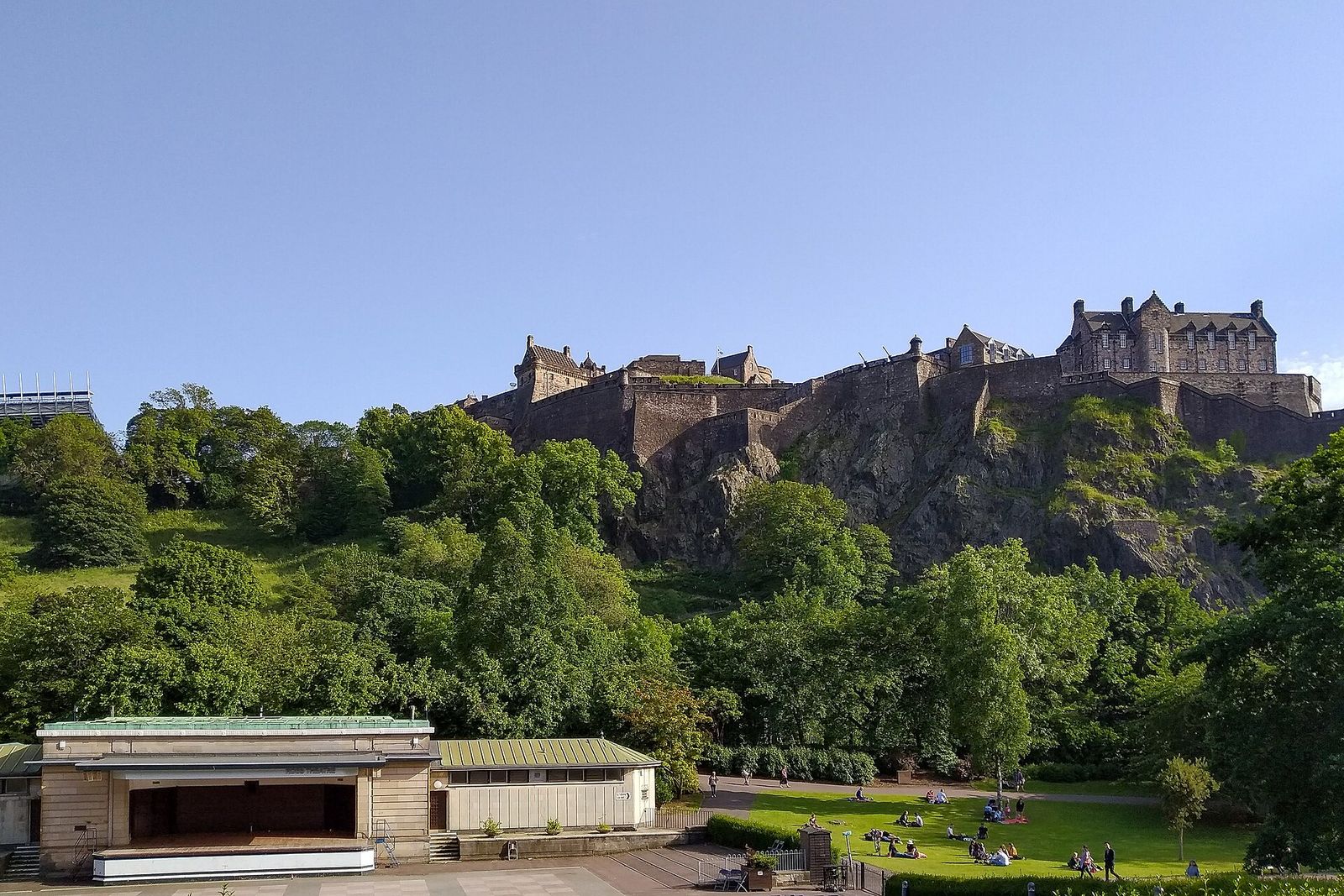
You are in a long green garden in the bottom of a valley, with a railway running through it. Above you on one side is a cliff of black rock, eighty metres high, with trees clinging to its foot. Along the top of the cliff runs a line of grey walls, and behind the walls are roofs, a tower and a flag.
The oldest building up there is a chapel no bigger than a living room. It was built about 1130 by a king in memory of his mother. In China the Southern Song (1127–1279) had just begun, and the general Yue Fei was fighting the invaders from the north.
What is here
One ticket covers everything inside the walls, including the museums. The parade ground in front of the gate is free.
The castle on its rock, from the gardensMatti Blume, CC BY-SA 4.0
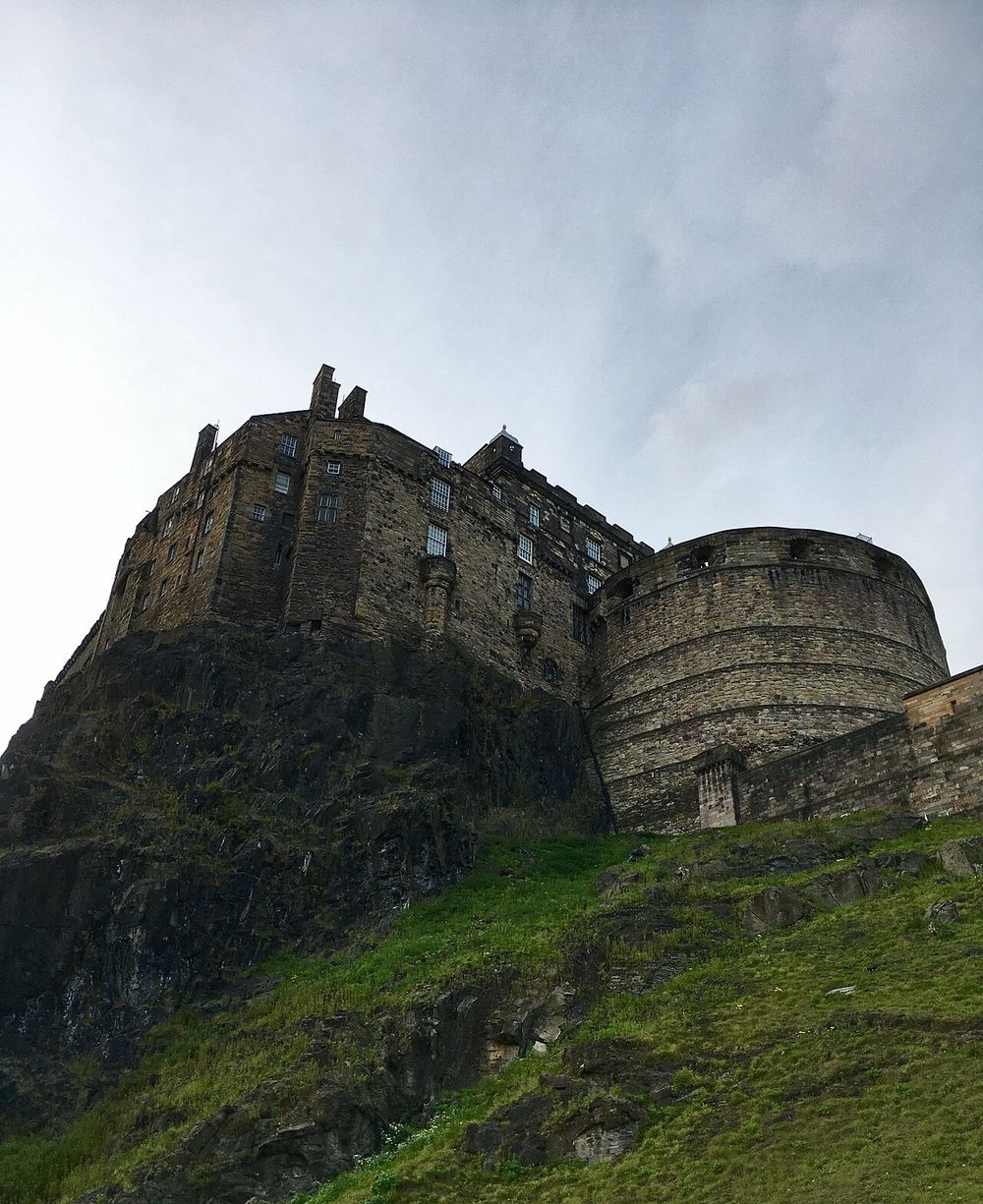
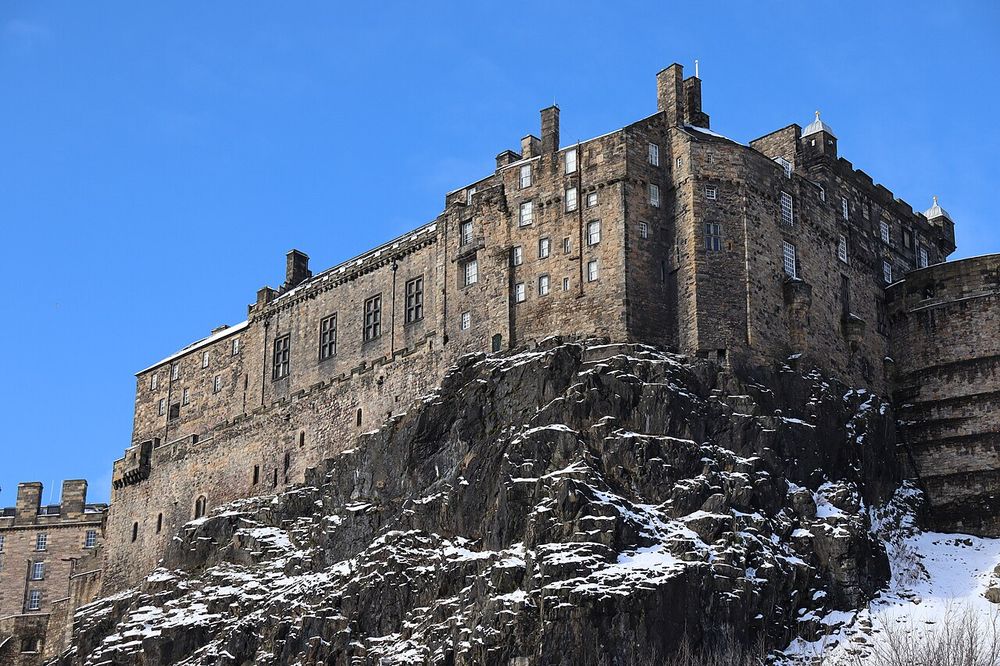
The rock is the hard core of a volcano that died about 350 million years ago. Ice later ground away the soft ground round it and left a ramp of rubble on the east side only. The main street of old Edinburgh runs down that ramp. Every attacker had to come up it.
Scottish kings lived on the summit from the eleventh century. England took the castle and lost it again more than once. Scots besieged other Scots in it. The last attempt was in 1745. By its keepers' count it has been under siege more often than anywhere else in Britain.
It is still an army post. Soldiers guard the gate, and a gun is fired from the wall each day.
Things people often get wrong
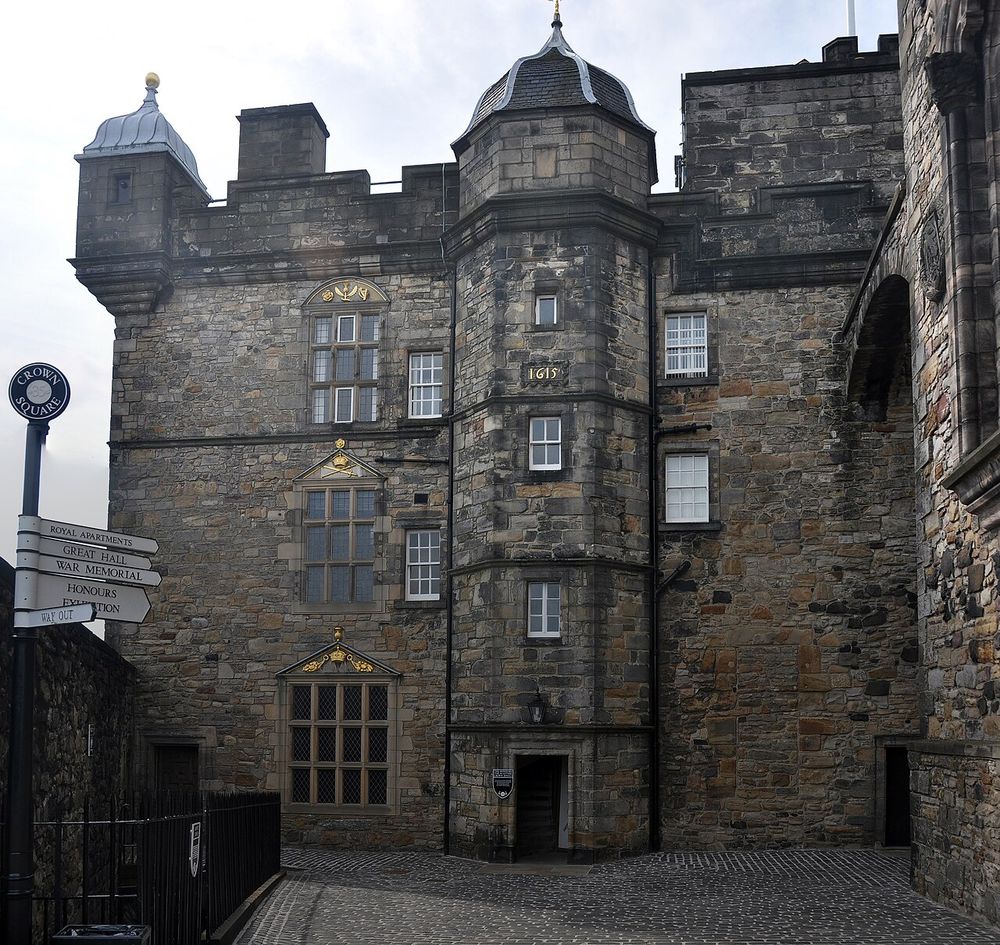
"It is one castle." It is a small town of buildings from eight centuries: a chapel, a palace, a hall, barracks, a hospital, prisons, and museums. Very little of what you see from below is older than 1570.
"The Stone of Destiny is here." The stone on which Scottish kings were crowned was kept here from 1996 to 2024. It is now in a museum in Perth.
"The gun is fired at noon." It is fired at one o'clock, on every day but Sundays, Good Friday and Christmas Day, and has been since 1861.
"You can buy a ticket at the gate." On busy days you cannot. When the day's tickets are sold out on the website, none are sold at the castle.
People who stood here
Mary, Queen of Scots (queen of Scotland, 1542–1567)In June 1566 she came up to the castle for safety and gave birth to a son in a room the size of a cupboard. He became king of Scotland at thirteen months, and king of England as well at thirty-six. Her initials and the year are over the palace door.
Oliver Cromwell (ruler of England, 1653–1658)In 1650 he beat the Scottish army on the coast and then sat down in front of this castle for three months, digging mines under the rock, until the governor gave it up. His soldiers turned the palace and the hall into barracks.
Walter Scott (Scottish novelist, author of Ivanhoe)On 4 February 1818 he stood in a locked room of the palace while workmen broke open an oak chest that had been sealed for a hundred and eleven years. Inside, wrapped in linen, were the crown, the sceptre and the sword of Scotland, which many people believed had been taken to London and melted.
Go deeper: eight stops, from the parade ground to the prisons
The route climbs in a spiral from the gate to the summit. Allow at least two hours, which is what the castle itself advises.
1. The parade ground
The parade ground and the gatehouseVoello, CC0
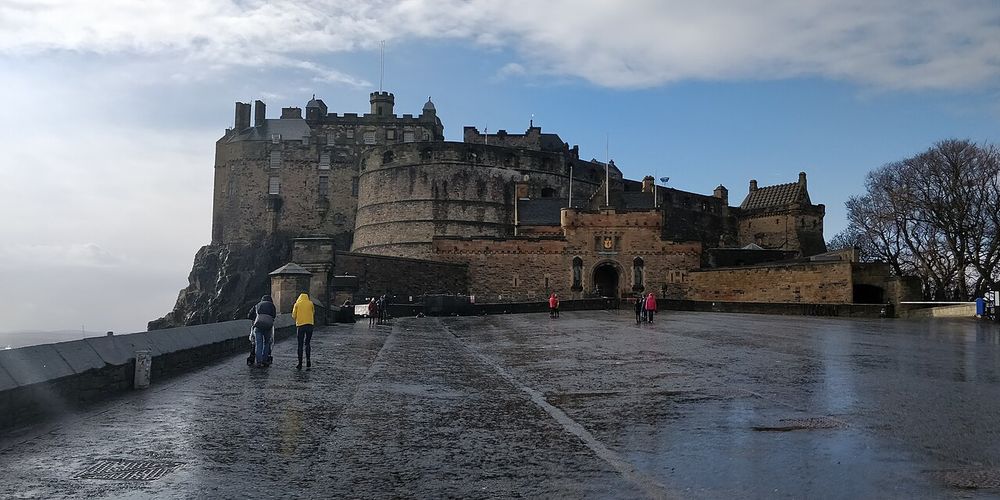
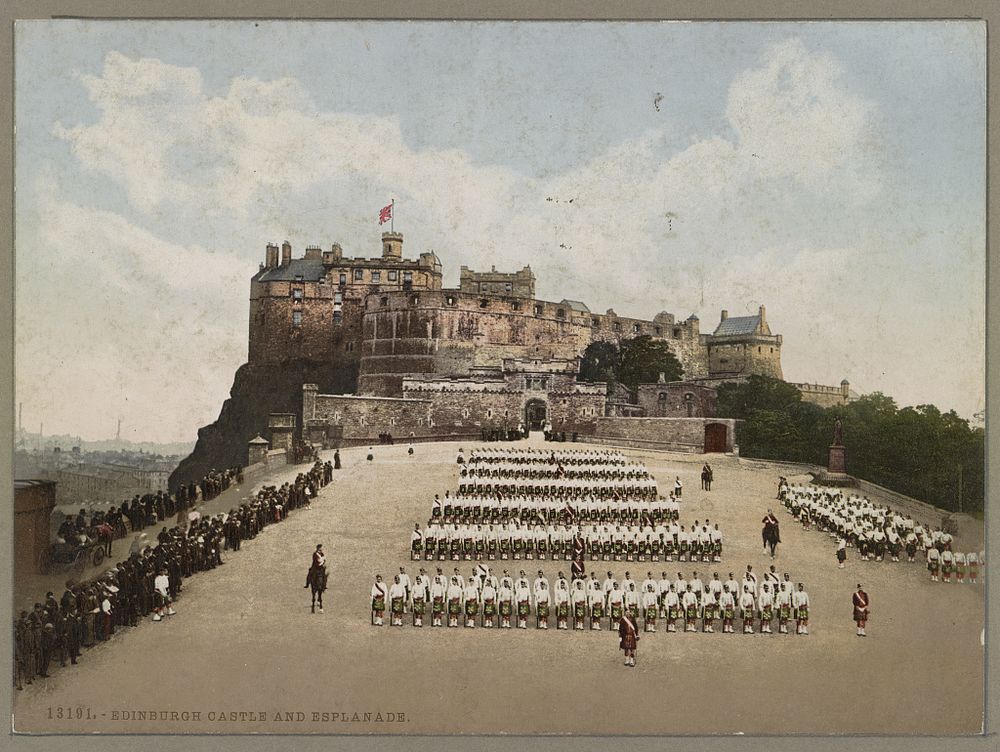
The flat open space in front of the gate was made in 1753 as a drill ground. Each August stands for nearly nine thousand people are built on it, and military bands from many countries march here by night.
Look over the wall on your right. That drop is why the castle is here.
2. The gates
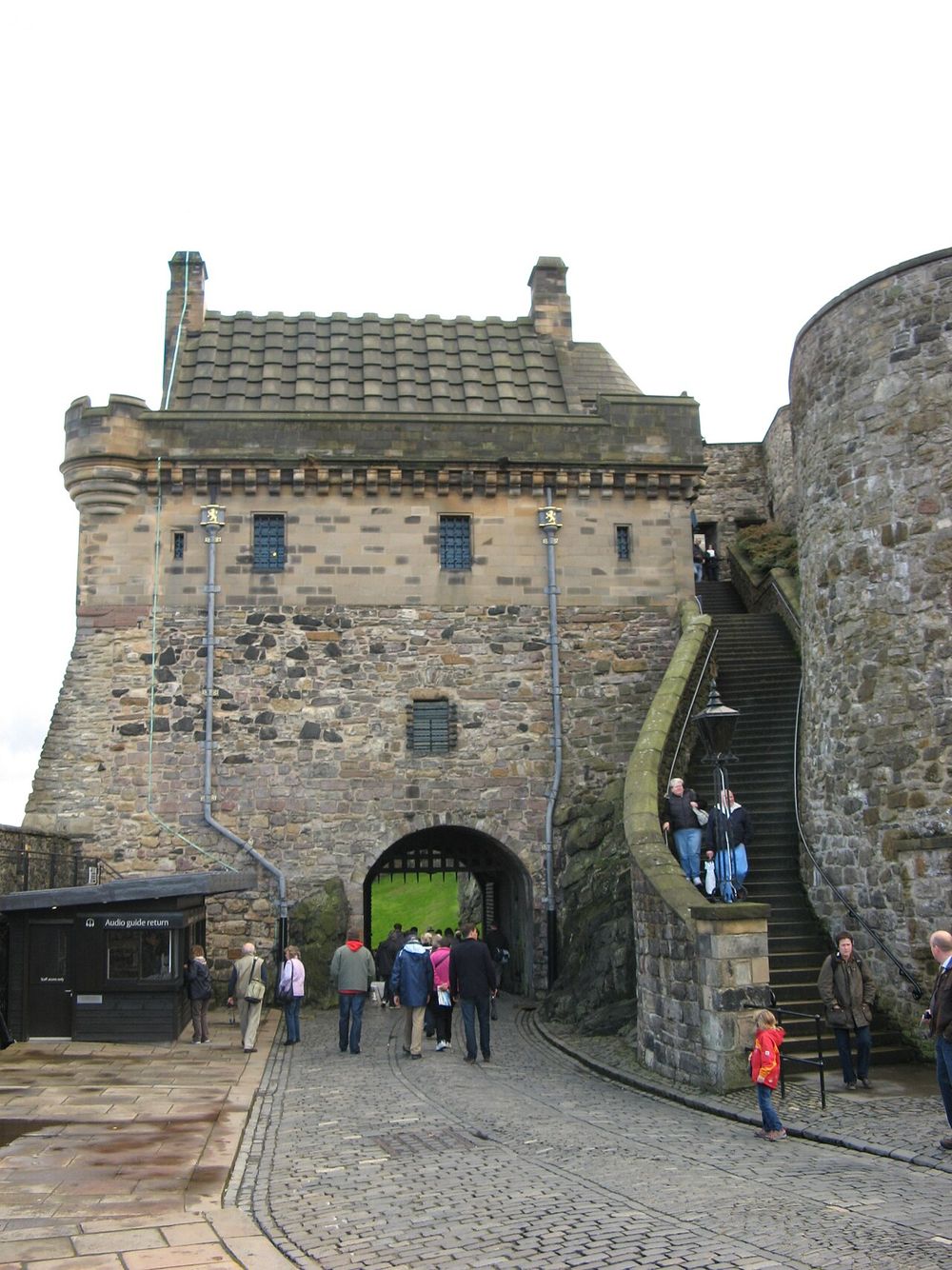
The gate tower of the 1570sJonathan Oldenbuck, CC BY-SA 3.0
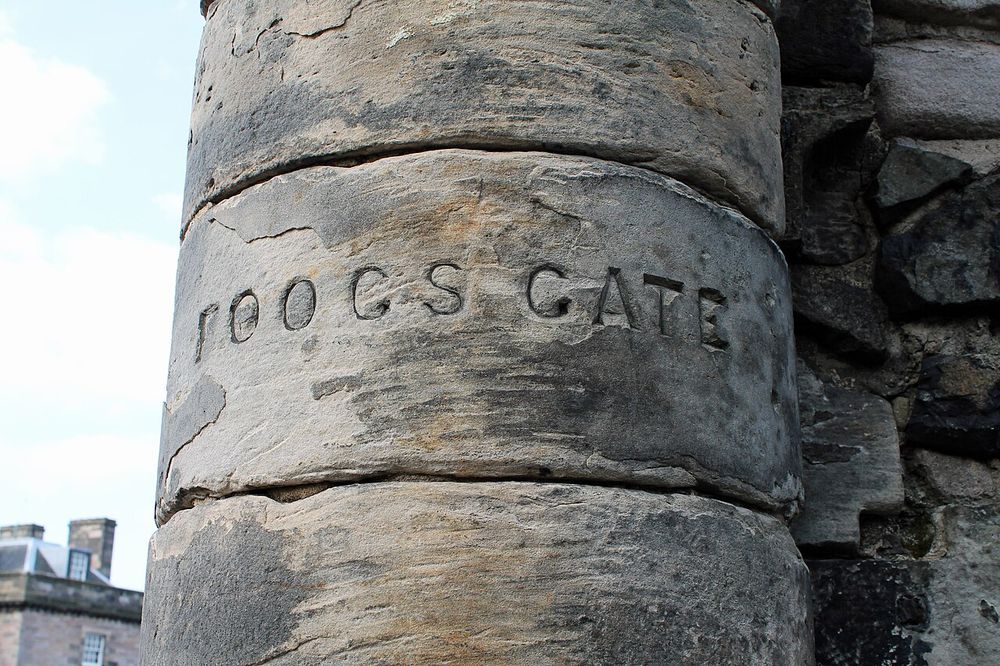
The first gate, with its ditch and bridge, looks the oldest and is the newest. It was built in 1888 to make the castle look more like a castle. The two bronze men beside it are Robert the Bruce and William Wallace, who led the Scots against England about 1300.
The real gate is the tall tower a little further up, built in the 1570s after a siege had knocked down everything in front of it. It once had heavy doors and an iron grating that dropped from above.
The seventy stepsPeulle, CC BY 4.0
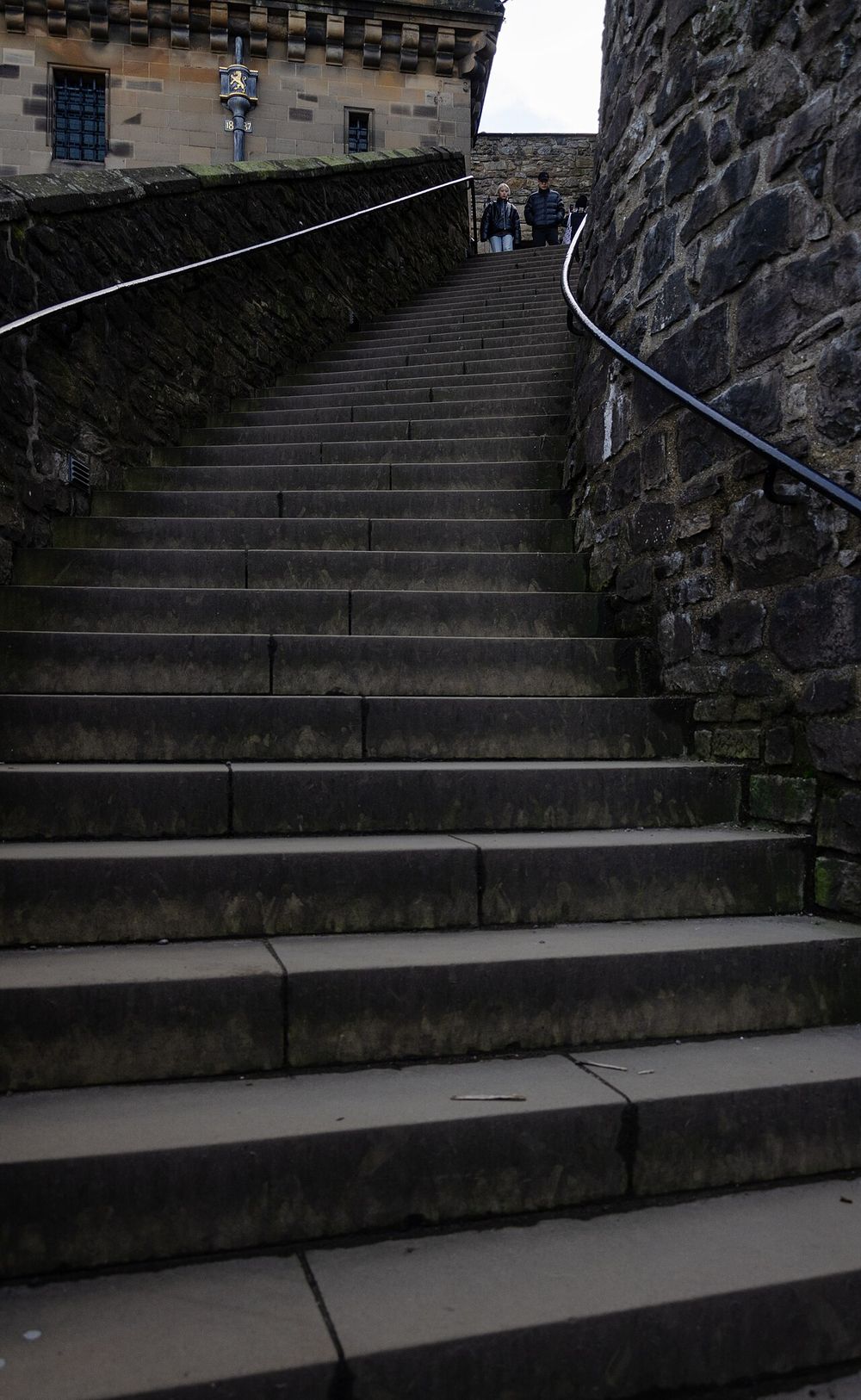
Just inside, on the left, seventy steep steps go straight up to the summit. This was the only way up in the Middle Ages. The road that curves round to the right was cut later, to bring up heavy guns.
3. The guns on the north wall
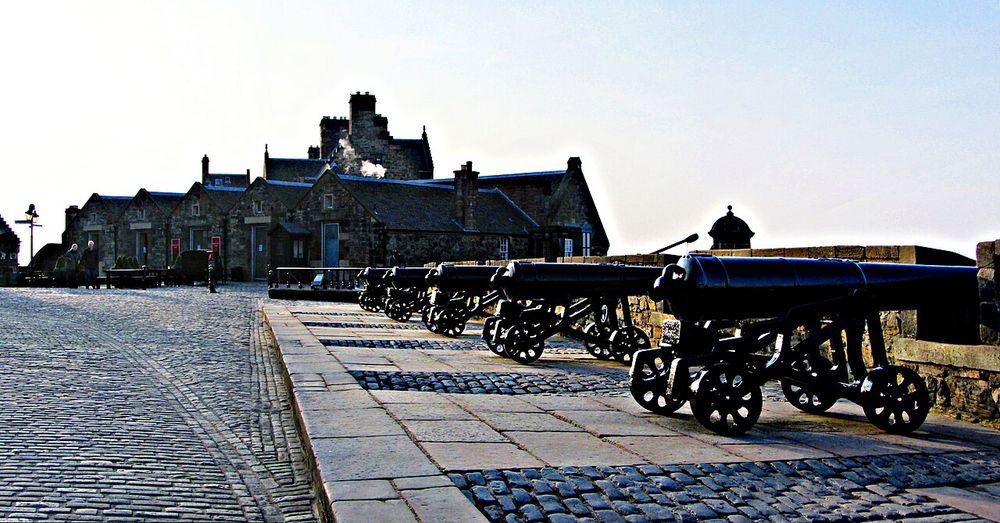
Cannon on the north wallscott marsland, CC BY 3.0
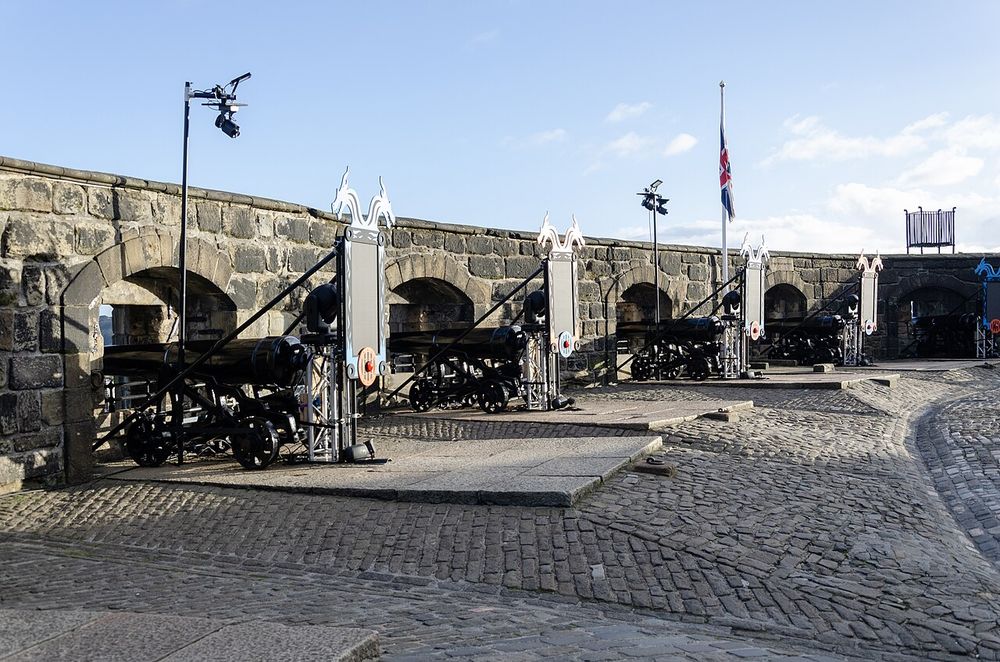
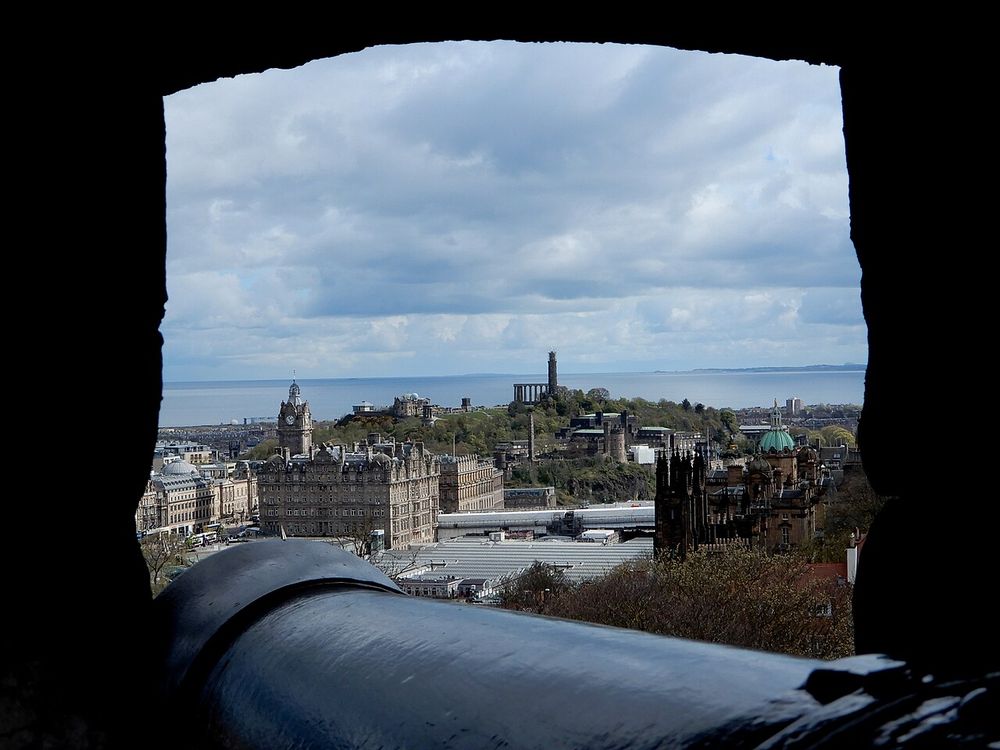
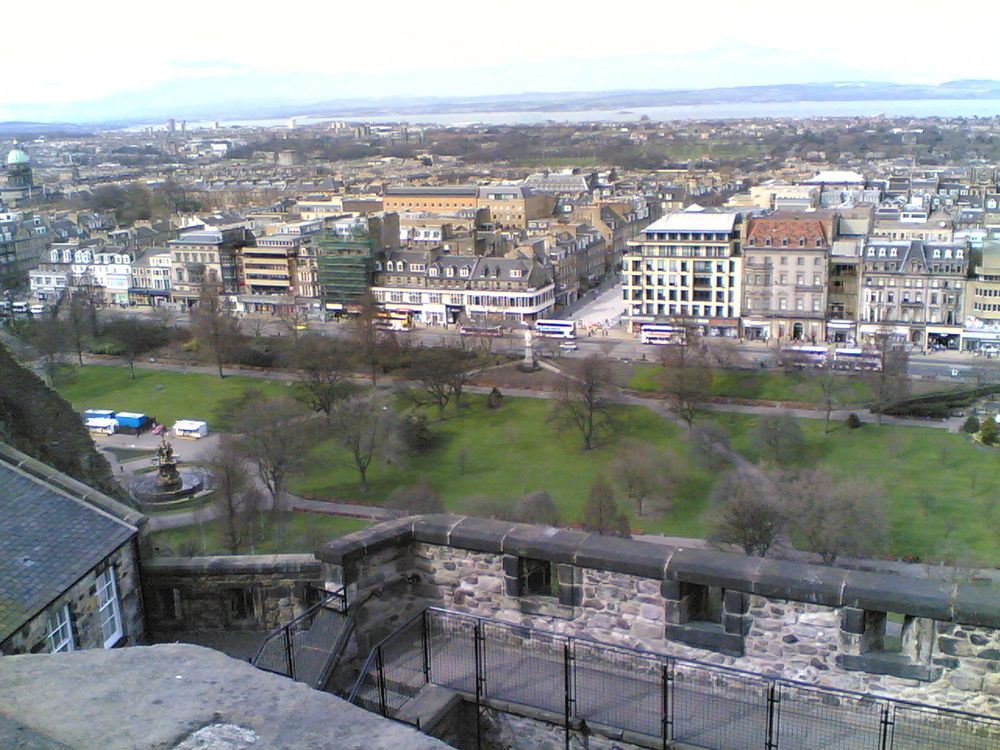
The row of black cannon points over the gardens at the new part of the city. In 1745 the castle's guns fired into the old town, which the army of the prince called Bonnie Prince Charlie had occupied. He held the town for six weeks and never took the castle.
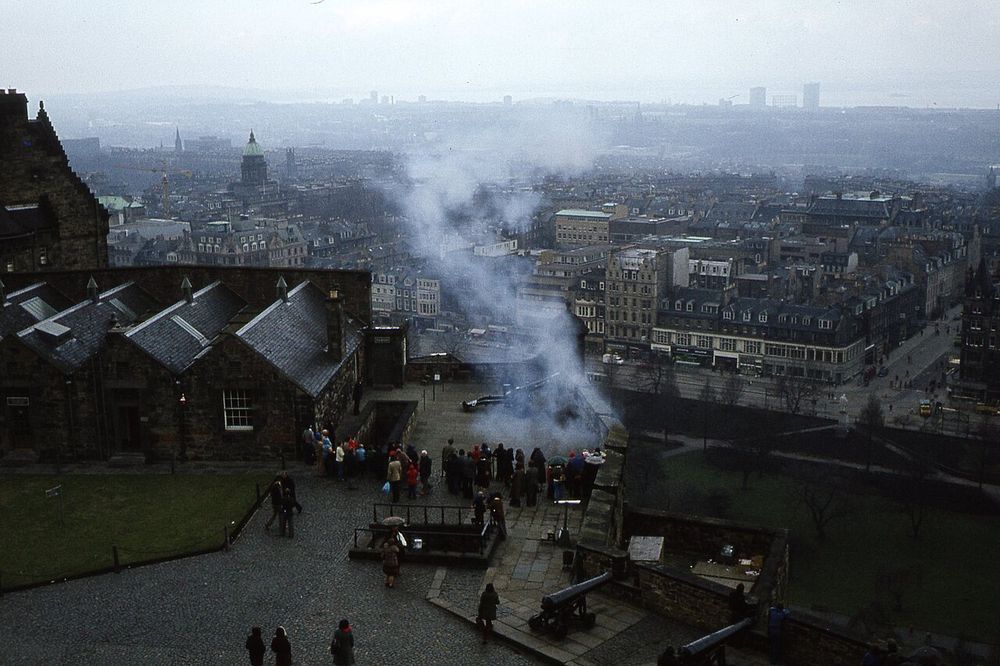
Smoke from the one o'clock gunColin Park, CC BY-SA 2.0
A little further along is a modern field gun. At one o'clock a gunner fires a single blank shot. The custom began in 1861 so that ships in the sea-inlet to the north could set their clocks, on days when fog hid the signal on the hill across the town.
4. The chapel and the great gun
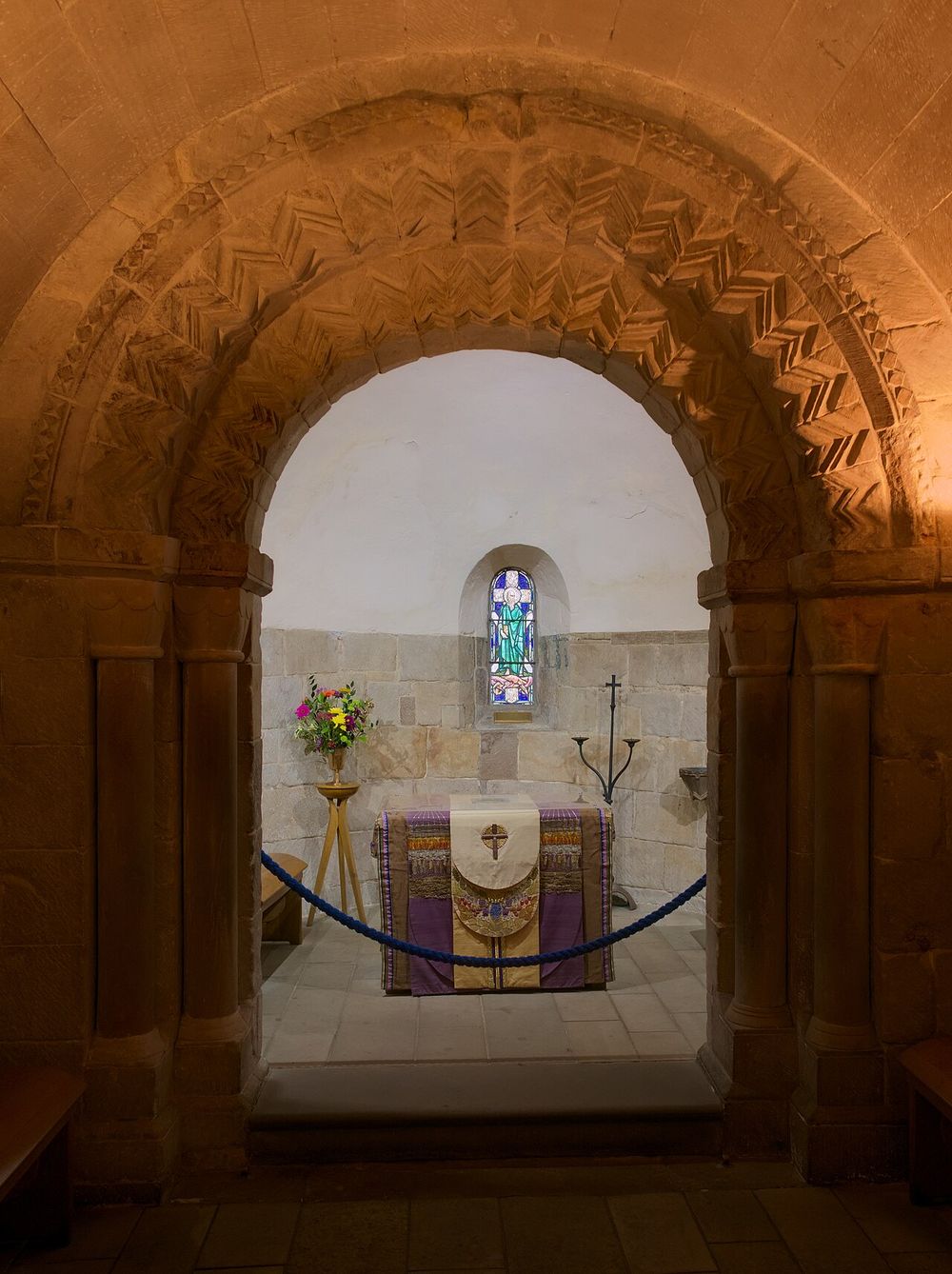
Inside the chapel of about 1130Daniel Kraft, CC BY-SA 3.0
On the highest point of the rock is a plain stone box with a round arch inside, carved in zigzags. King David I built it about 1130 for his mother Margaret, an English princess who had died in the castle in 1093. It is the oldest building in Edinburgh.
In 1314 the Scots took the castle back by climbing the north cliff at night, and their king ordered every building pulled down so that the English could never use it again. Only this chapel was spared. Later it was a gunpowder store, and nobody remembered what it was until 1845.
The great gun of 1449Kim Traynor, CC BY-SA 3.0
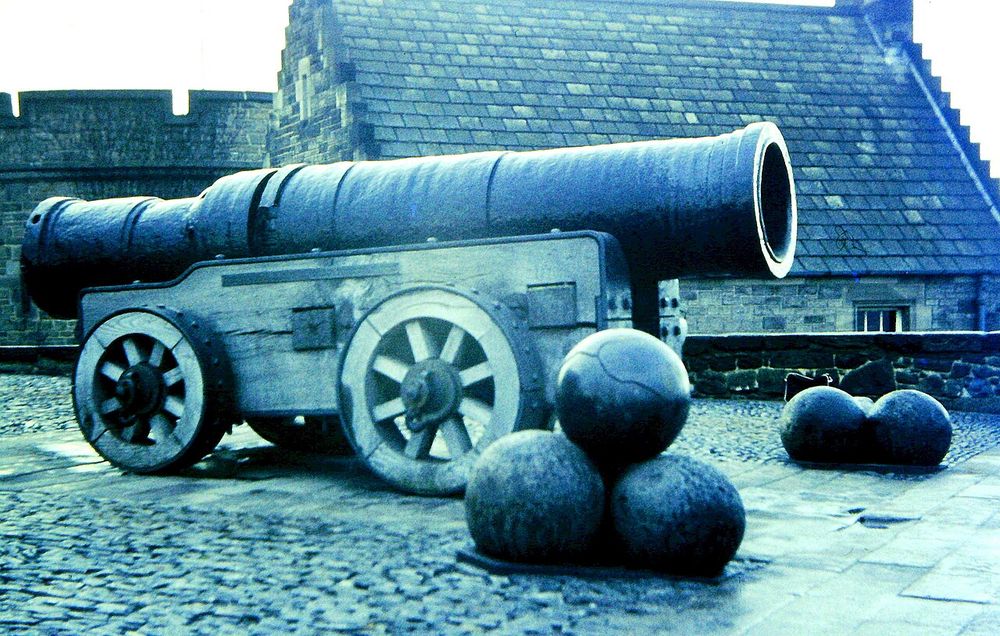
Outside the chapel door is a gun that weighs six tonnes. It was made in 1449 in the town of Mons, in what is now Belgium, and given to the king of Scotland in 1457, the year a deposed Ming emperor took back his throne in Beijing. It threw a stone ball of 150 kilograms about three kilometres. It was so heavy that on the road it covered only five kilometres a day.
In 1681 it was fired for a prince's birthday and the barrel burst. You can see the split iron hoops near the back.
5. The round battery
Guns on the round batteryPeulle, CC BY 4.0
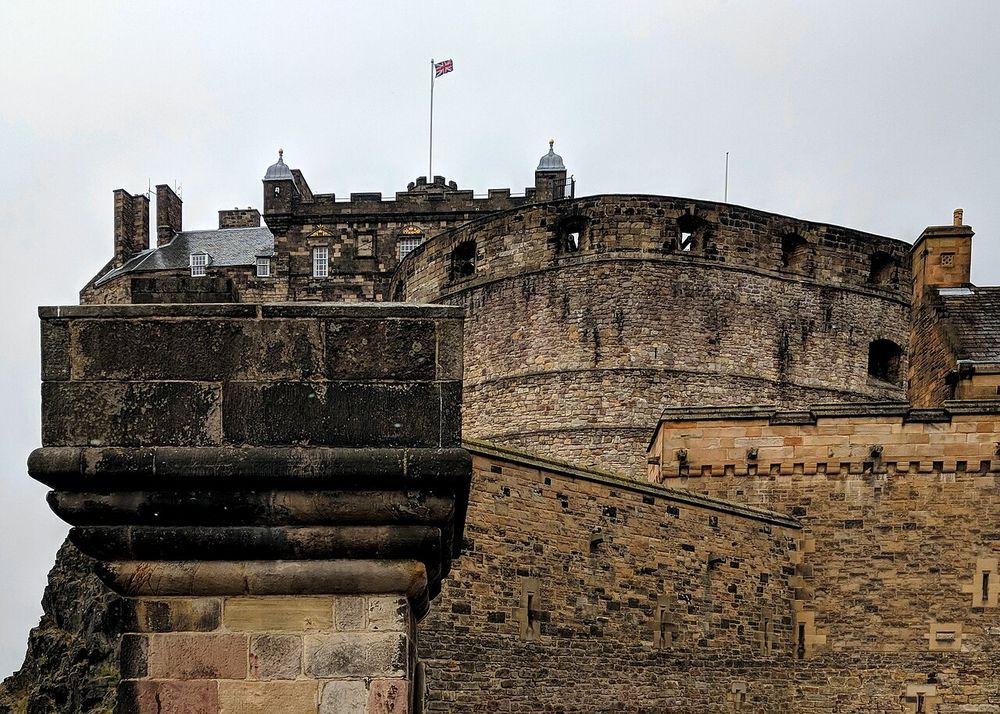
The great curved wall that you saw from the street is a gun platform, built in the 1570s. It is wrapped round the ruin of a tower thirty metres high that stood here for two hundred years and was shot to pieces in a siege in 1573. The lower rooms of the old tower were found again inside the wall in 1912.
6. The palace and the crown
The royal palaceNilfanion, CC BY-SA 3.0
The square at the top was the heart of the royal castle. On its east side is the palace. Over the door are the gilded letters M and H, for Mary and her husband Henry, and the date 1566.
The room where her son was born is on the ground floor. It is barely big enough for a bed, with a painted wooden ceiling. In China it was the last year of the Jiajing emperor, the year the official Hai Rui sent him a famous letter of blame.
Upstairs are the crown, the sceptre and the sword. The crown was remade in 1540 with gold dug in Scotland. They are the oldest royal regalia in Britain, because the English ones were melted down in 1649. These were smuggled out of a castle under siege and buried under the floor of a village church.
7. The hall
The hall of 1511Osama Shukir Muhammed Amin FRCP(Glasg), CC BY-SA 4.0
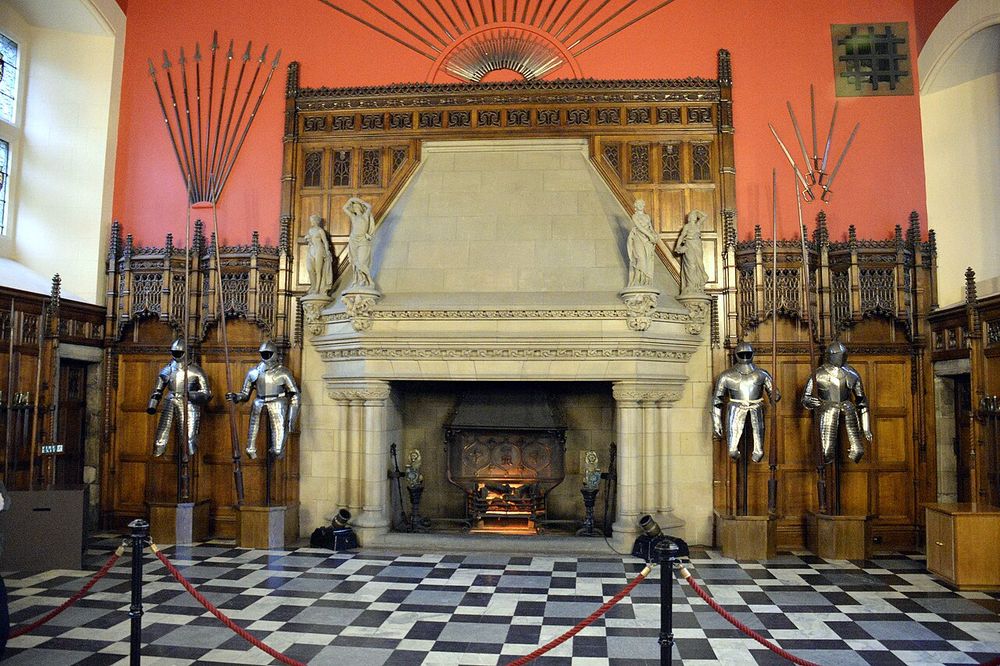
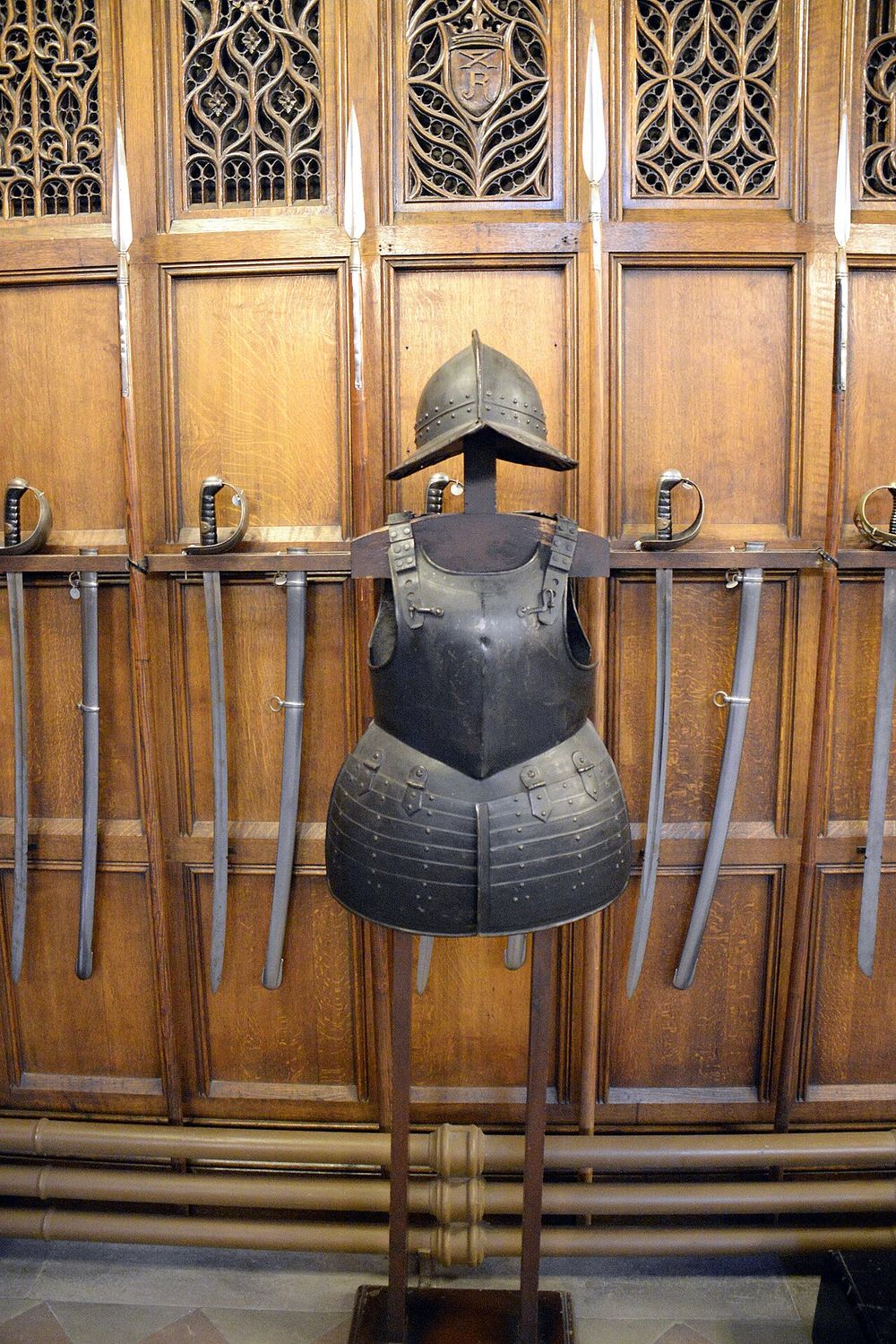
On the south side of the square is the hall King James IV finished in 1511 for feasts and for receiving ambassadors. The walls are hung with swords, pikes and armour arranged in patterns, as army storekeepers of the 1800s liked to do.
Look up. The timber roof is the one the king's carpenters made. It was hidden for two centuries above the floors of a barracks, which is why it was not burned or replaced.
To the right of the fireplace, high up, is a small barred opening. From behind it the king could listen to what was said in his hall.
8. The memorial and the prisons
The front of the war memorialAlan Findlay, CC BY-SA 2.0
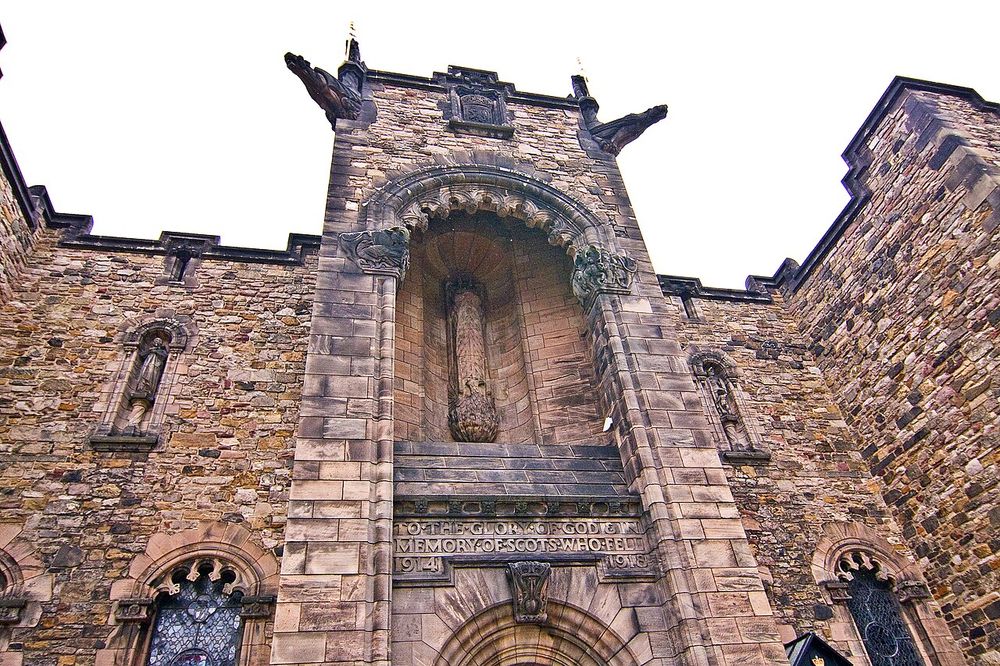
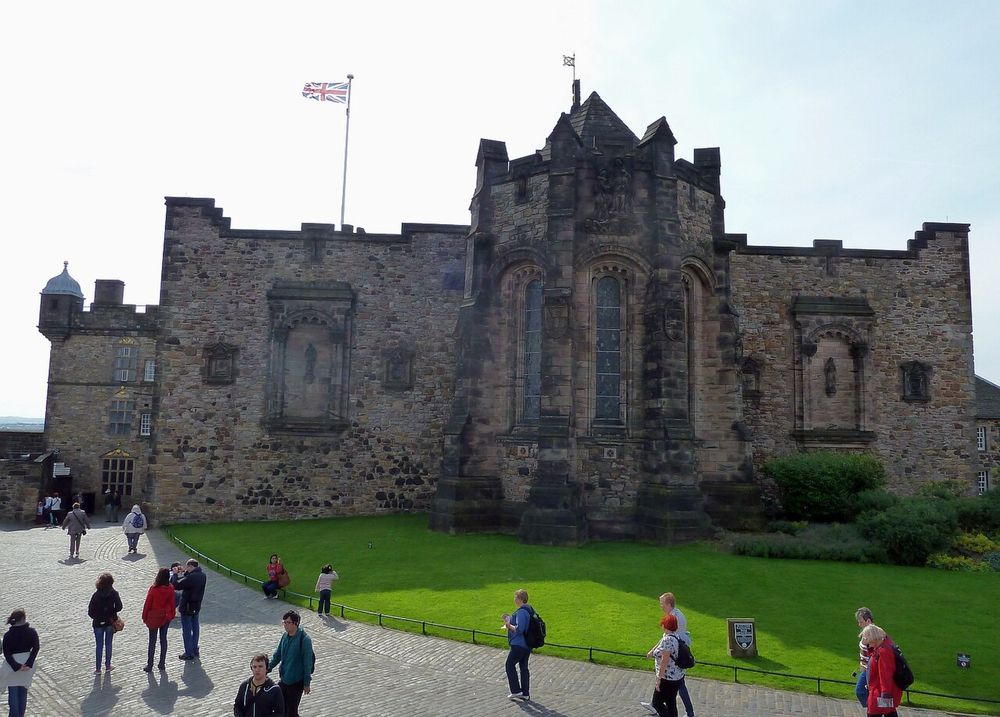
The north side of the square is a memorial opened in 1927 to the Scots who died in the First World War; the dead of later wars have been added. Their names are written in books that anyone may open. At the far end a steel box holding a full list of the names stands on a piece of the bare rock, which comes up through the floor.
Hammocks in the prisons of warOsama Shukir Muhammed Amin FRCP(Glasg), CC BY-SA 4.0
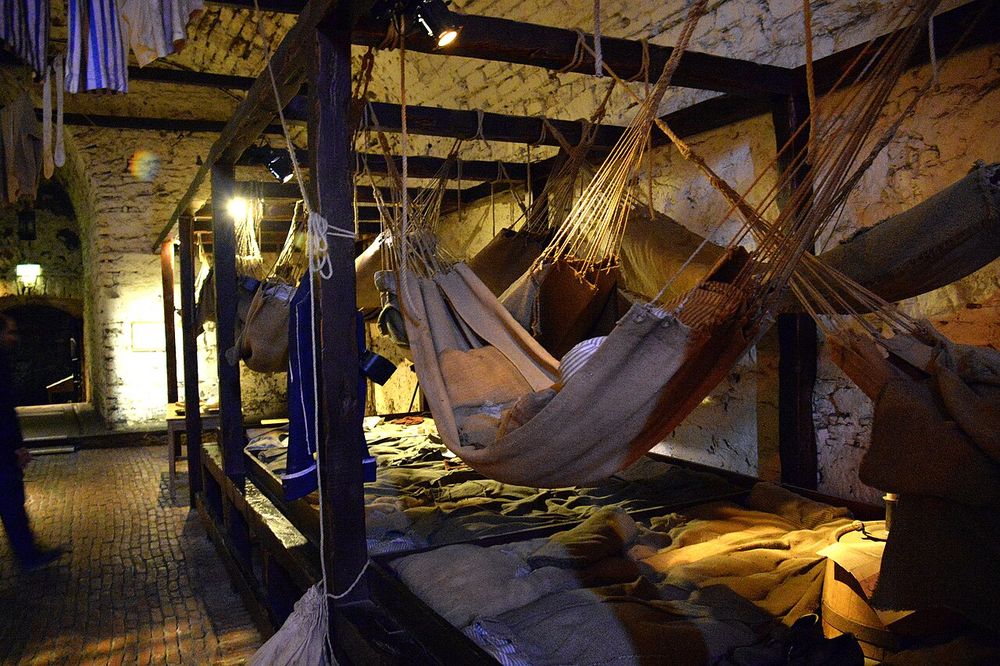
Under the hall are stone vaults where prisoners of war were kept from 1757 to 1815: French, Spanish, Dutch, Americans. They slept in hammocks, carved ships from the bones in their soup, and cut their names in the doors. In 1811 forty-nine of them got out through a hole in the wall and down the rock.
Meanwhile in the world
Year
Here
Elsewhere
about 1130
The chapel is built
The first years of the Southern Song in China
1314
The Scots climb the cliff and retake the castle
The Yuan dynasty (1271–1368) in China brings back the civil service examinations
1457
The great gun arrives from Burgundy
A deposed Ming emperor retakes his throne in Beijing; four years after the fall of Constantinople
1566
A future king of Scotland and England is born in the palace
The last year of the Jiajing emperor of the Ming
1573
The longest siege ends; the tower is destroyed
The first year of the Wanli emperor
1707
Scotland and England are joined; the crown is locked in a chest
The Kangxi reign of the Qing
1818
Walter Scott finds the crown
The Jiaqing reign of the Qing (1644–1912); three years after Waterloo
1861
The one o'clock gun is first fired
The Xianfeng emperor dies; the American Civil War begins
1927
The war memorial opens
The sixteenth year of the Republic of China
Then and now
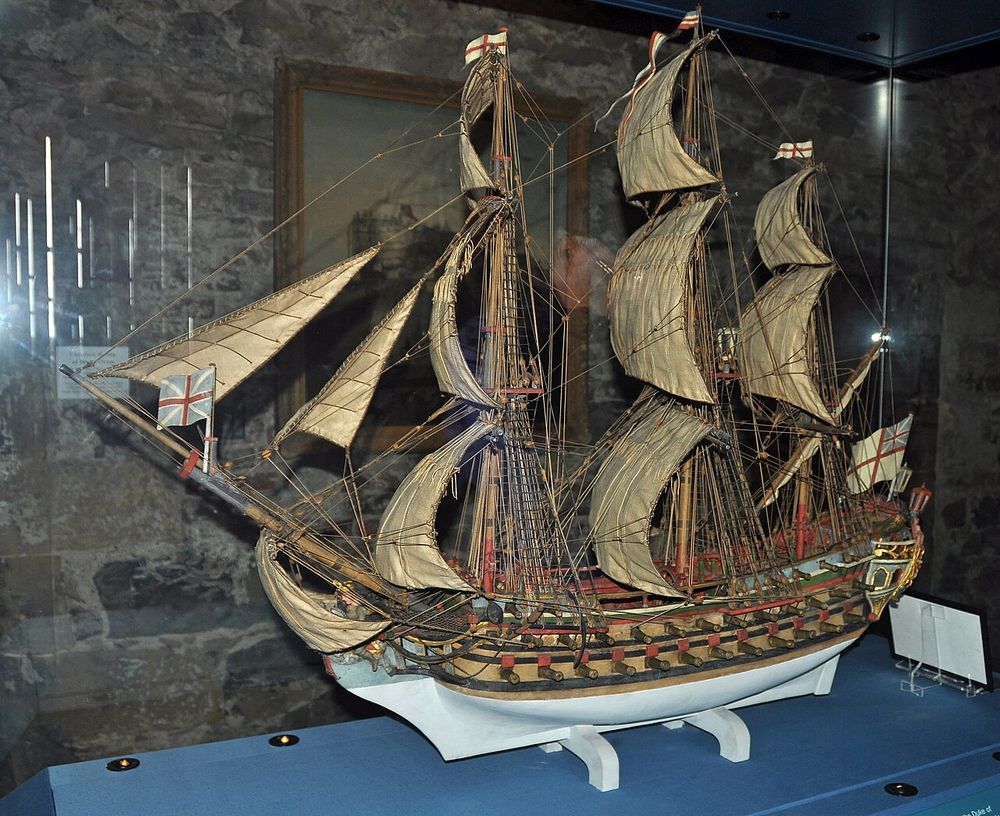
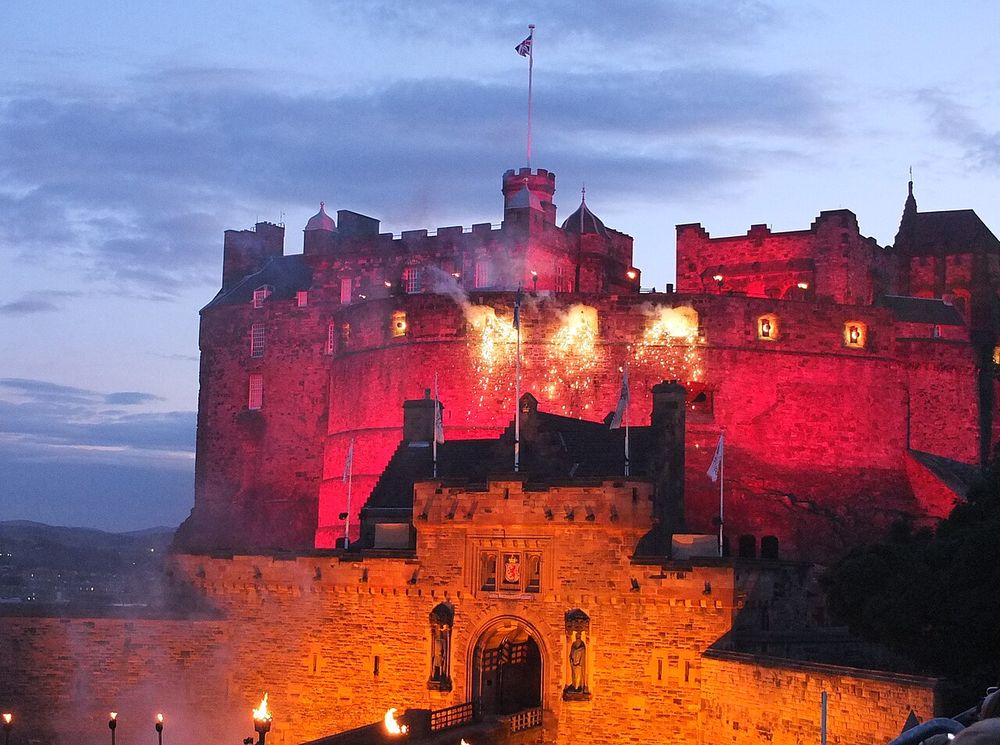
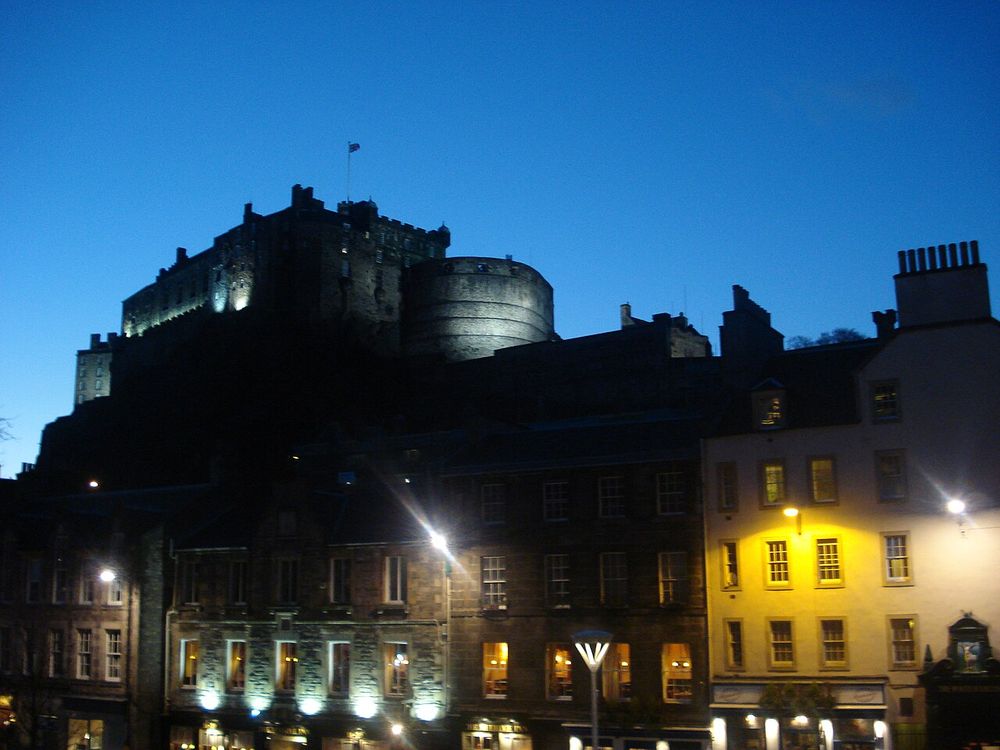
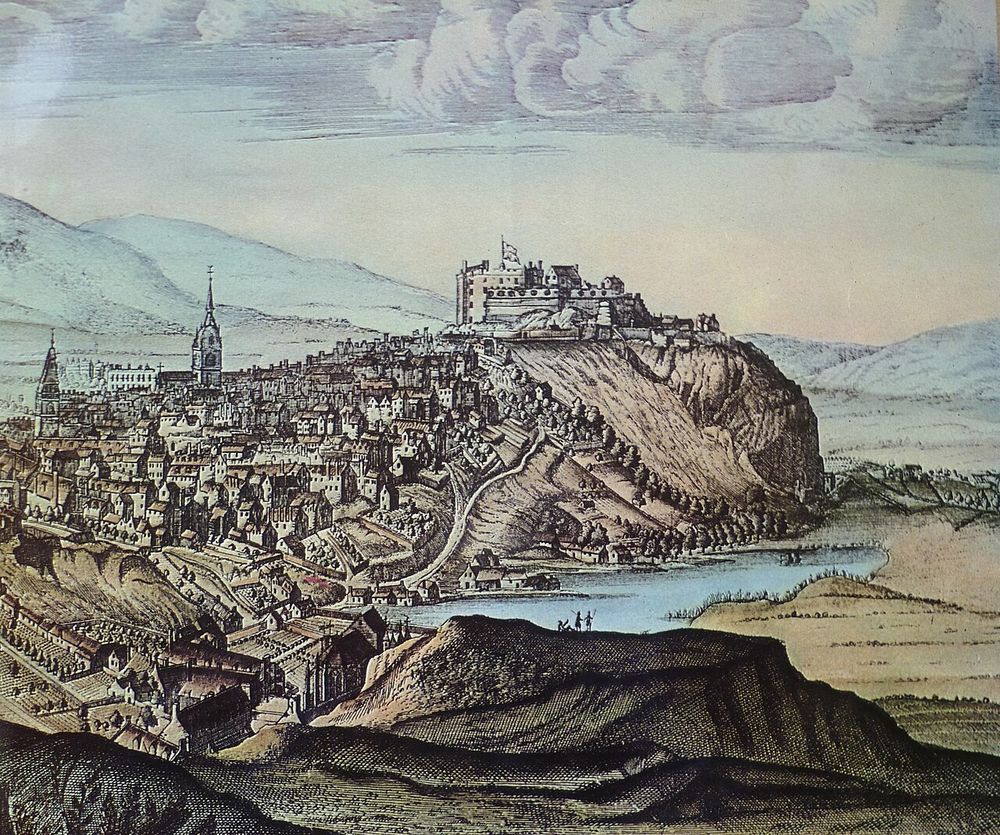
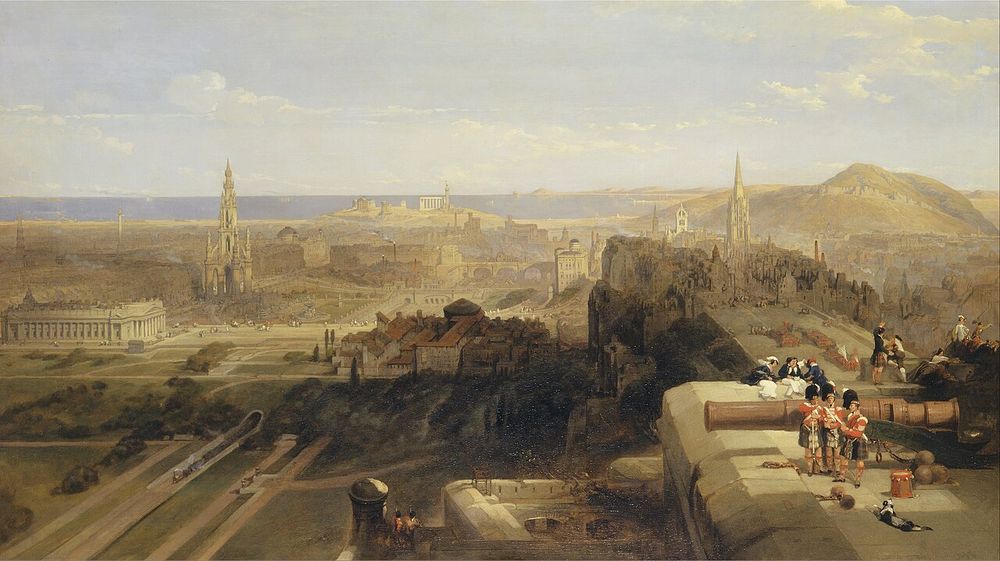
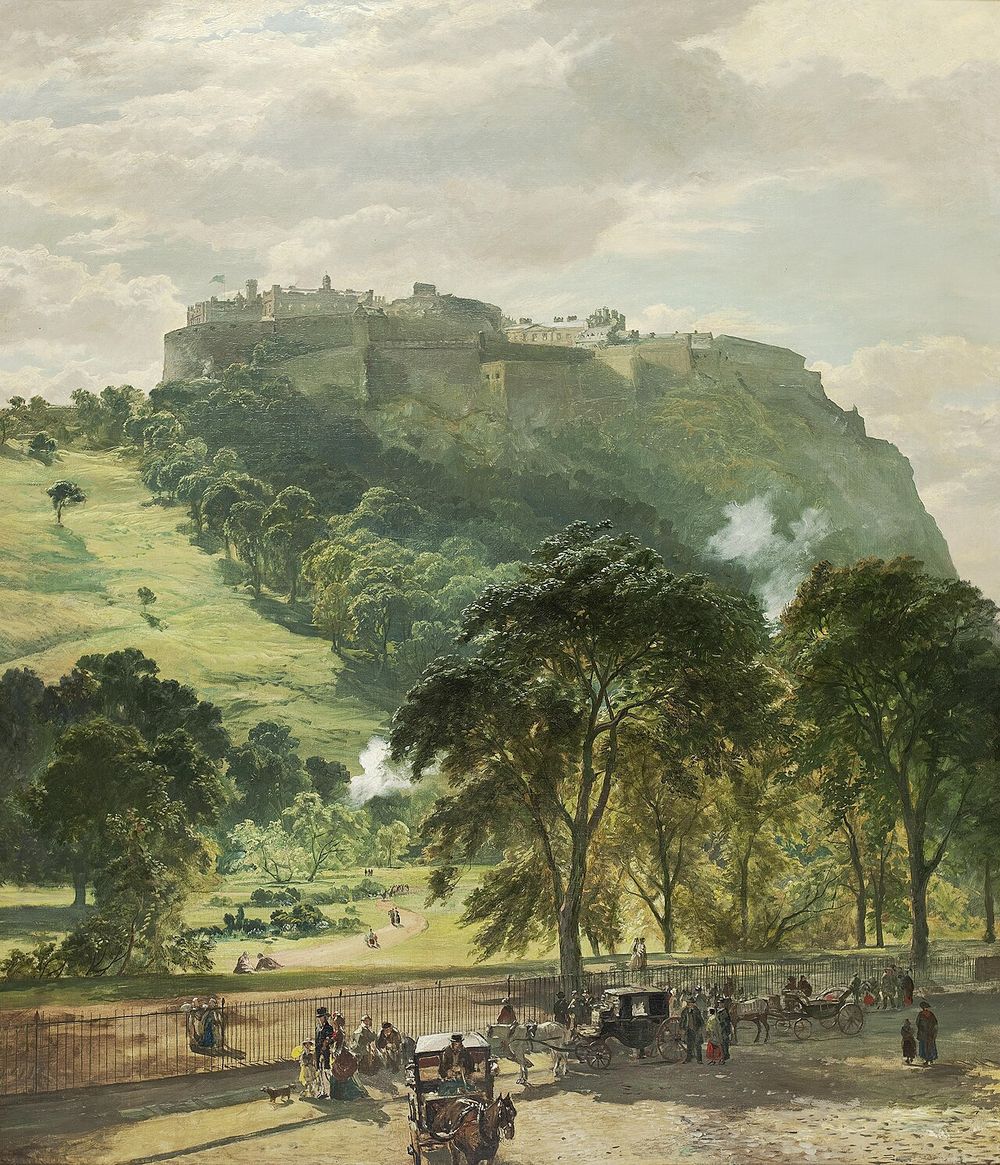
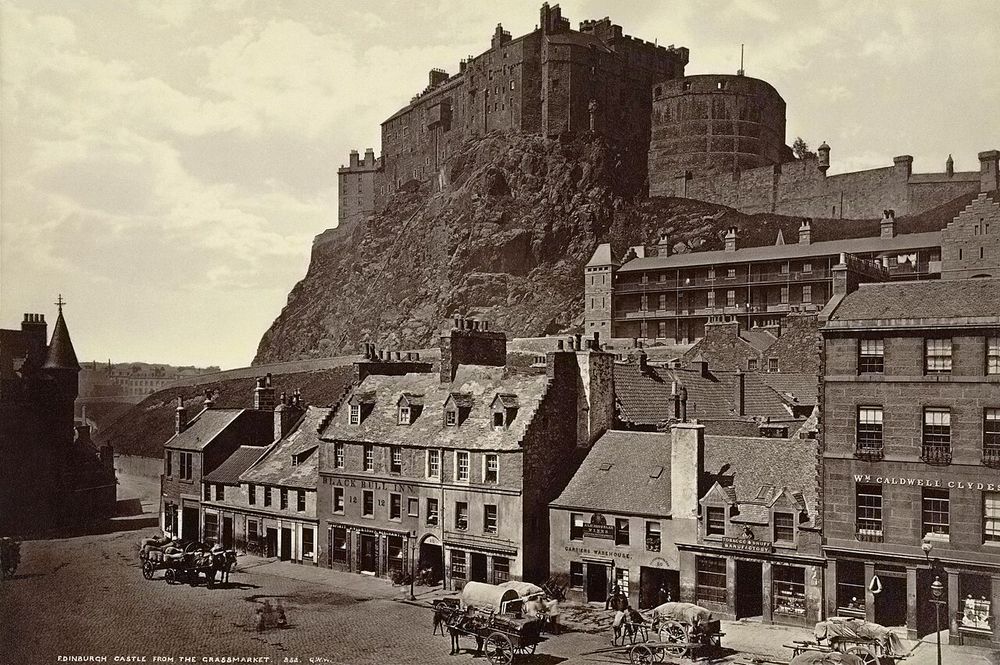
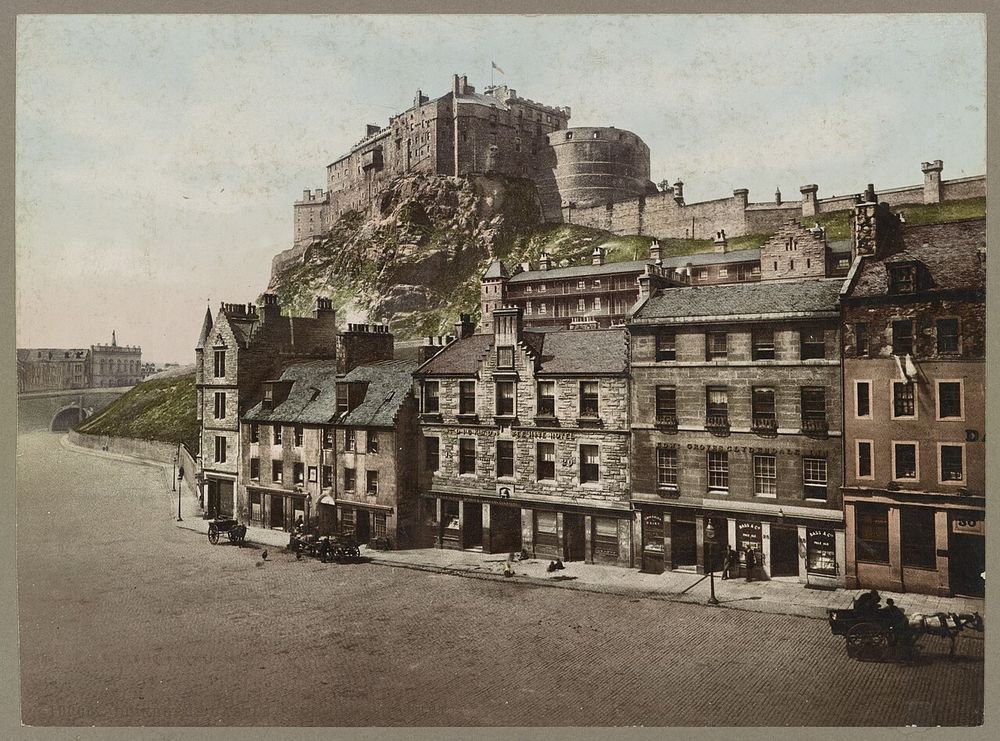
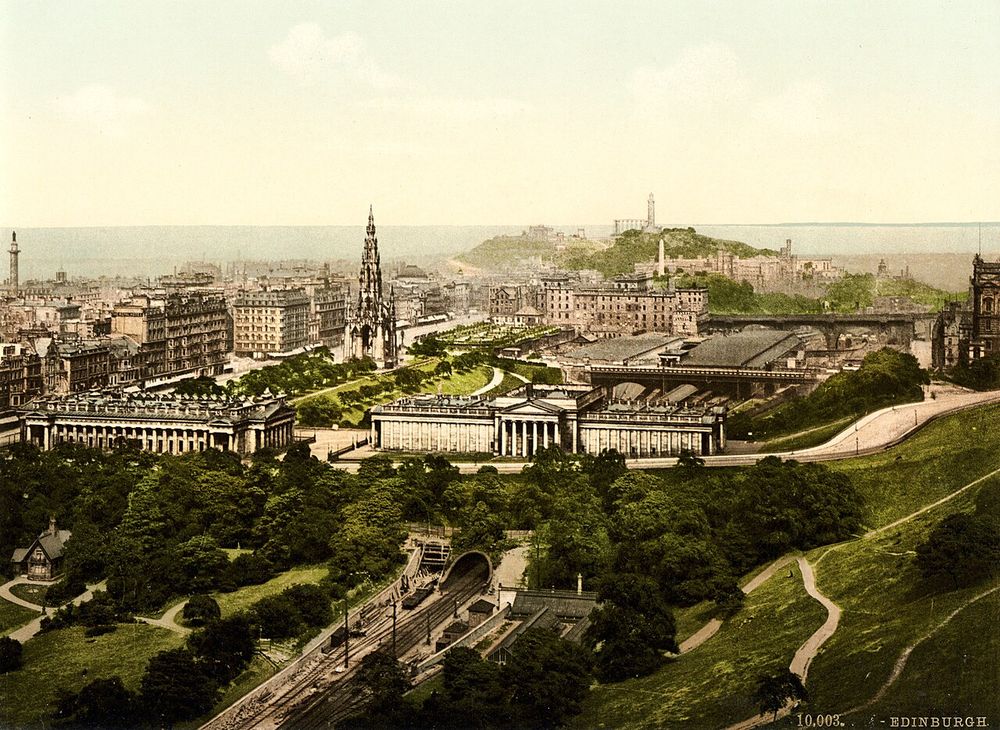
The castle on its rock, from the gardensMatti Blume, CC BY-SA 4.0, Wikimedia CommonsThe round battery and the palacePeulle, CC BY 4.0, Wikimedia CommonsThe castle on its rock from the air瑞丽江的河水, CC BY-SA 4.0, Wikimedia CommonsThe castle and the old town running down the ridge瑞丽江的河水, CC BY-SA 4.0, Wikimedia CommonsThe castle and the city from the air瑞丽江的河水, CC BY-SA 4.0, Wikimedia CommonsThe north cliff from the gardensJohn Lord, CC BY-SA 2.0, Wikimedia CommonsThe castle above the treesLauren, CC BY-SA 2.0, Wikimedia CommonsThe rock from belowLornaMCampbell, CC BY-SA 4.0, Wikimedia CommonsThe south side in snowMike Shaw, CC BY-SA 4.0, Wikimedia CommonsThe old town and the castle from the hill to the eastDaniel Kraft, CC BY-SA 3.0, Wikimedia CommonsThe parade ground and the gatehouseVoello, CC0, Wikimedia CommonsThe gate tower of the 1570sJonathan Oldenbuck, CC BY-SA 3.0, Wikimedia CommonsThe seventy stepsPeulle, CC BY 4.0, Wikimedia CommonsThe name of the upper gate, cut in stoneSarah Stierch, CC BY 2.0, Wikimedia CommonsCannon on the north wallscott marsland, CC BY 3.0, Wikimedia CommonsSmoke from the one o'clock gunColin Park, CC BY-SA 2.0, Wikimedia CommonsThe city through a gun portCeri Thomas, CC BY-SA 2.0, Wikimedia CommonsThe new town from the wallsErath at English Wikipedia, Public domain, Wikimedia CommonsInside the chapel of about 1130Daniel Kraft, CC BY-SA 3.0, Wikimedia CommonsThe great gun of 1449Kim Traynor, CC BY-SA 3.0, Wikimedia CommonsThe graveyard for soldiers' dogsNaddoddr, CC0, Wikimedia CommonsGuns on the round batteryPeulle, CC BY 4.0, Wikimedia CommonsThe round battery from the wallsEnchufla Con Clave, CC BY-SA 4.0, Wikimedia CommonsThe royal palaceNilfanion, CC BY-SA 3.0, Wikimedia CommonsThe palace wall in the squareNeil Owen, CC BY-SA 2.0, Wikimedia CommonsThe hall of 1511Osama Shukir Muhammed Amin FRCP(Glasg), CC BY-SA 4.0, Wikimedia CommonsArmour in the hallOsama Shukir Muhammed Amin FRCP(Glasg), CC BY-SA 4.0, Wikimedia CommonsThe front of the war memorialAlan Findlay, CC BY-SA 2.0, Wikimedia CommonsThe war memorial across the squareRob Farrow, CC BY-SA 2.0, Wikimedia CommonsHammocks in the prisons of warOsama Shukir Muhammed Amin FRCP(Glasg), CC BY-SA 4.0, Wikimedia CommonsA ship model in the prisonsNilfanion, CC BY-SA 3.0, Wikimedia CommonsThe castle lit red at nightAd Meskens, CC BY-SA 3.0, Wikimedia CommonsThe castle at night from the market belowKevin Gibbons from Oxford, UK, CC BY 2.0, Wikimedia CommonsThe castle and the lake that lay below it, about 1690John Slezer, Public domain, Wikimedia CommonsEdinburgh from the castle, painted in 1847David Roberts, Public domain, Wikimedia CommonsThe castle from the gardens, painted in the 1860sSamuel Bough, Public domain, Wikimedia CommonsThe castle from the market, an early photographGeorge Washington Wilson / Adam Cuerden, Public domain, Wikimedia CommonsThe same view in colour, 1890sMiscellaneous Items in High Demand, PPOC, Library of Congress, Public domain, Wikimedia CommonsSoldiers on parade in front of the gate, 1890sMiscellaneous Items in High Demand, PPOC, Library of Congress, Public domain, Wikimedia CommonsThe city from the walls, 1890sDetroit Publishing Co., under license from Photoglob Zürich, Public domain, Wikimedia CommonsThe great gun in 1969Ray Bird, CC BY-SA 2.0, Wikimedia Commons
Video
Films from official channels, played from YouTube. Nothing is loaded until you press play.
The Old and New Towns of EdinburghUNESCO · made with NHK; 3 min · checked 2026-11-12
Local legends
These are stories people tell about this place. They are legends, not history, and each one says where it comes from.
LegendThe piper in the tunnel
Long ago a tunnel was found under the castle, running down towards the palace at the other end of the town. A boy was sent in with his pipes, to play as he walked so that men above could follow the sound. Half-way down the hill the music stopped. He was never found, and on quiet nights his pipes are heard under the street.
Source: Edinburgh street lore, in print since the nineteenth century
LegendThe headless drummer
In 1650 a sentry saw a drummer without a head beating his drum along the wall. Soon afterwards Cromwell's army came. The drum is said to be heard whenever the castle is about to be attacked.
Source: Scottish ghost lore
LegendThe castle of the maidens
In the days of the ancient kings, their daughters were kept on this rock, out of danger, until they were married. Old charters do call the place the Castle of the Maidens.
Source: The name Castrum Puellarum is in documents of the twelfth century; the story was told to explain it
LegendThe blacksmith's gun
The great gun was forged by a village blacksmith and his seven sons for the king's siege of a rebel castle, and named Meg after the smith's loud-voiced wife.
Source: A tale of south-west Scotland made popular by Walter Scott; the accounts of the Duke of Burgundy show it was made at Mons
Later, people who live here will be able to add the stories they grew up with, and say which of these they have heard.
Not certain, and where accounts conflict
How many sieges?
The castle's own site calls it the most besieged place in Britain. A count published in 2014 found twenty-six sieges. The number depends on what you call a siege.
Did Queen Margaret pray in the chapel?
For a long time it was said so. The carving is of a style used a generation after her death, and historians now give the building to her son.
Why one o'clock and not noon?
The usual answer in Edinburgh is a joke about thrift: one shot costs less than twelve. The real reason is that the signal on the hill, which the gun copies, was already set for one o'clock.
Visiting
Tickets and hours
An adult (16 to 64) pays 23.50 pounds online or 26 pounds at the gate; 65 and over 19 pounds or 21 pounds; a child of 7 to 15 pays 11.50 pounds or 13 pounds.
A thirty-minute tour with a castle guide costs 6.50 pounds more and must be booked ahead.
From 1 April to 30 September: 9:30 to 18:00, last entry 17:00. From 1 October to 31 March: 9:30 to 17:00, last entry 16:00.
Closed on 25 and 26 December. On 1 January it opens at 11:00.
Last checked 2026-11-12. The castle's own site (edinburghcastle.scot), read in November 2026 for prices, hours and tours.
Booking from abroad
Official page in English The castle sells timed tickets on its own site, in English, and takes foreign cards. Start from the official ticket page: edinburghcastle.scot, tickets. The online price is lower than the price at the gate.
Ticket window on site There is a ticket box on the parade ground, at the higher "walk-up" price. The official site warns that once the day is sold out online, no tickets are sold at the castle.
Note Opening times are on the official page. The site also warns of lookalike websites selling fake tickets.
Checked 2026-11-12
Where to start
From Waverley, the main railway station, it is a short walk, uphill all the way.
From the airport, the tram takes about thirty minutes to Princes Street, below the rock.
Go first to the summit by the seventy steps, then work down. Be at the gun five minutes before one.
For the view of the castle itself, go down afterwards into the gardens on the north side.
Before you go
The ground is steep, cobbled and slippery in rain. The summit is windy and cold even in summer.
There is no public parking at the castle.
From May to October the parade ground is partly filled with the stands for the August show.
Customs and manners
In the war memorial, be quiet and take no photographs.
The crown may not be photographed.
The soldiers at the gate are on duty. Do not touch them or block their path.
Opening hours are given in the local time of the place. Prices are in the local currency. The figure after ≈ is approximate, at exchange rates checked on 9 November 2026, in .
Look for these
From below, count the sides of the rock that are cliff.
At the first gate, find two bronze men. What is each one holding?
Count the steps of the steep stair.
At the chapel, look at the arch. What pattern is carved on it?
On the great gun, find where the iron split.
Over the palace door, find the letters and the date.
In the hall, find the small barred window by the fireplace.
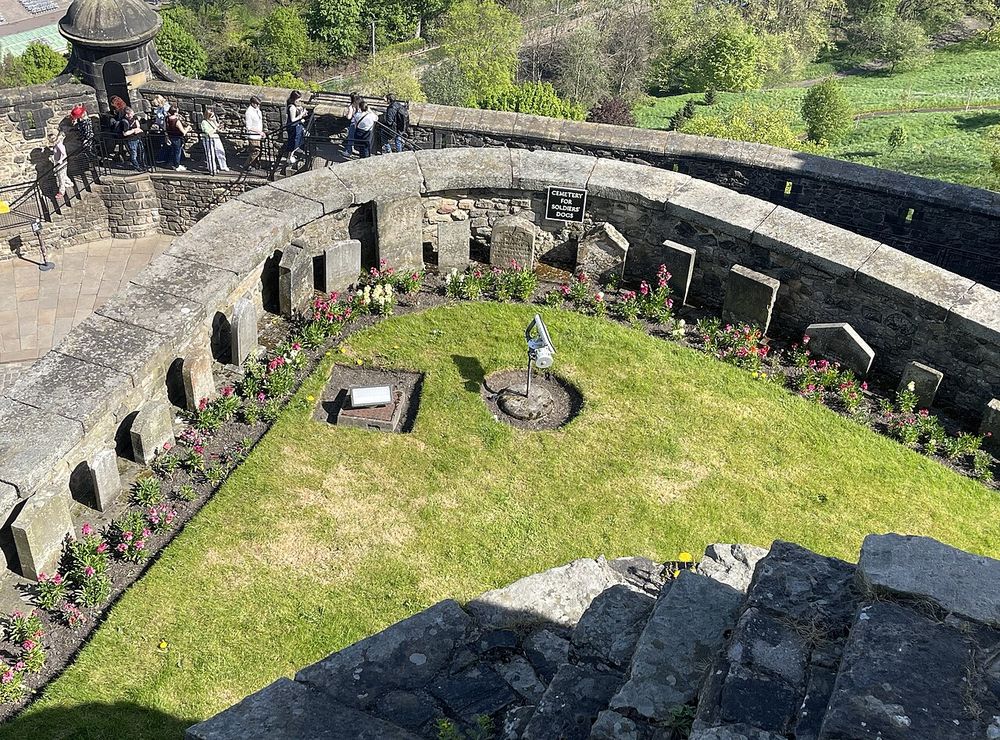
Near the summit, look over the wall for a small garden with headstones. Who is buried there?
I am here
Stand at the site, sign in, press the button, and collect its stamp. Your browser will ask to use your location. It is sent to us once to confirm that you are at the site; we keep how far you were from it, not the spot where you stood.
Your stamps are saved to your account, so they follow you to any device. Checking from a browser cannot rule out every false location; stricter checks arrive with the app.
Messages
Share your photos
Photos here show the place, not people. Each one is credited to the visitor who took it and appears after our team has looked at it. A photo with you in it belongs under “I am here”.