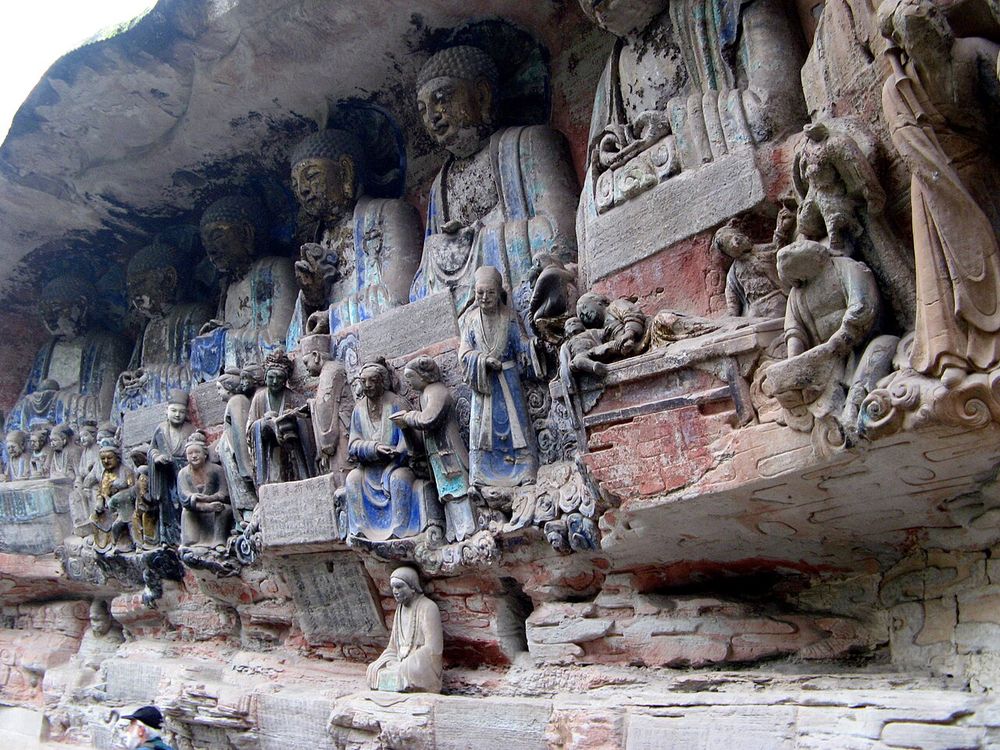
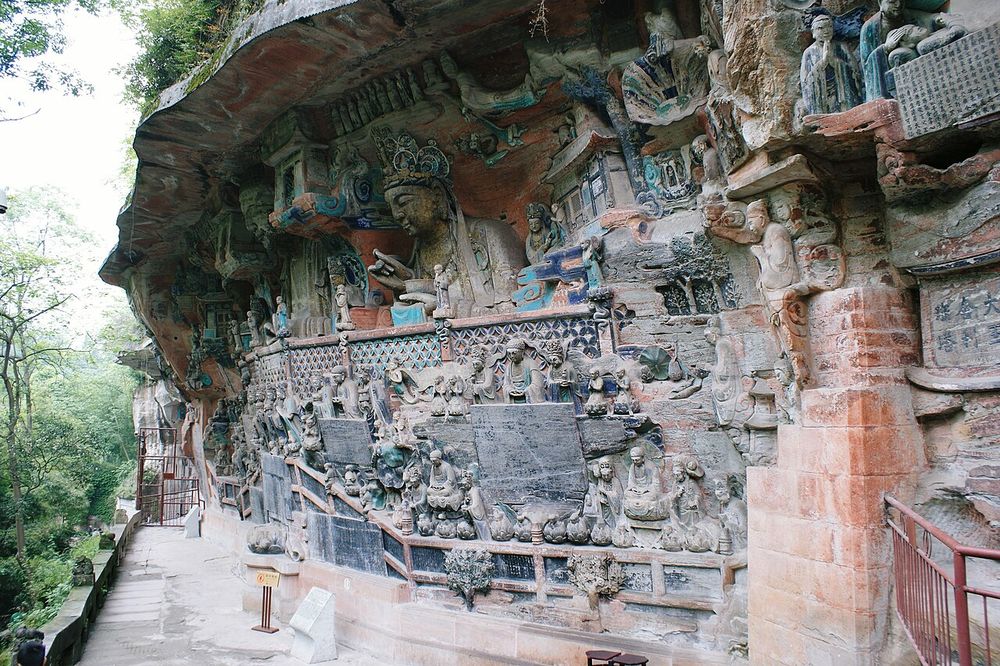
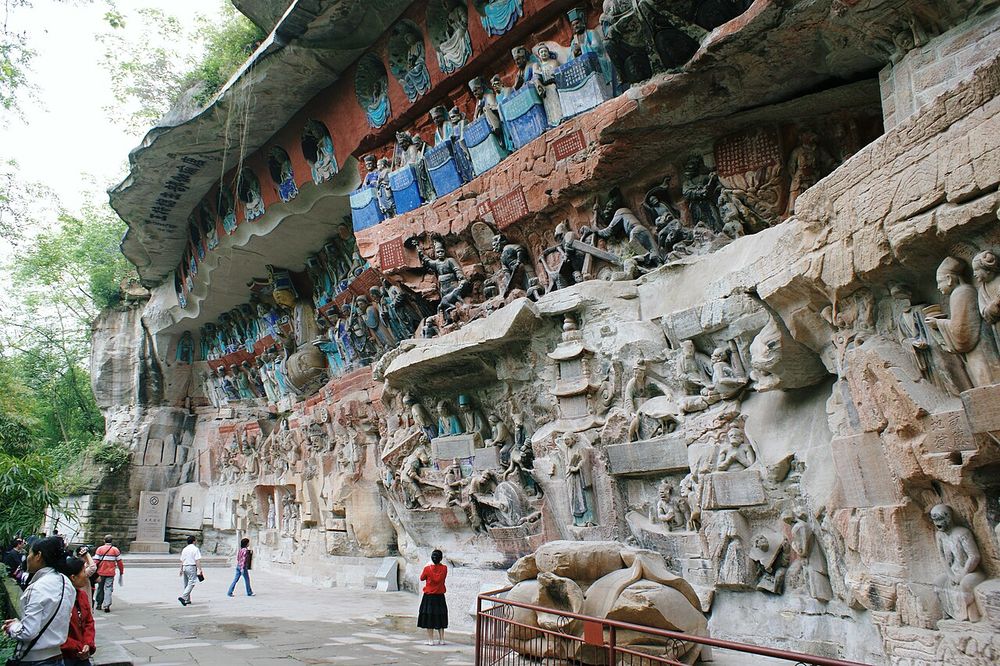
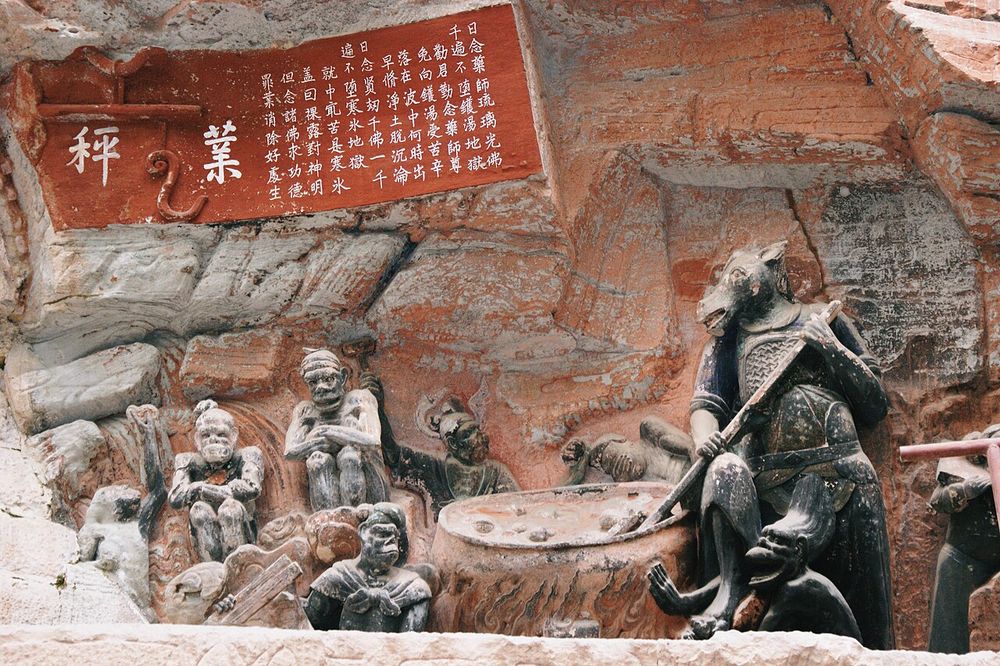
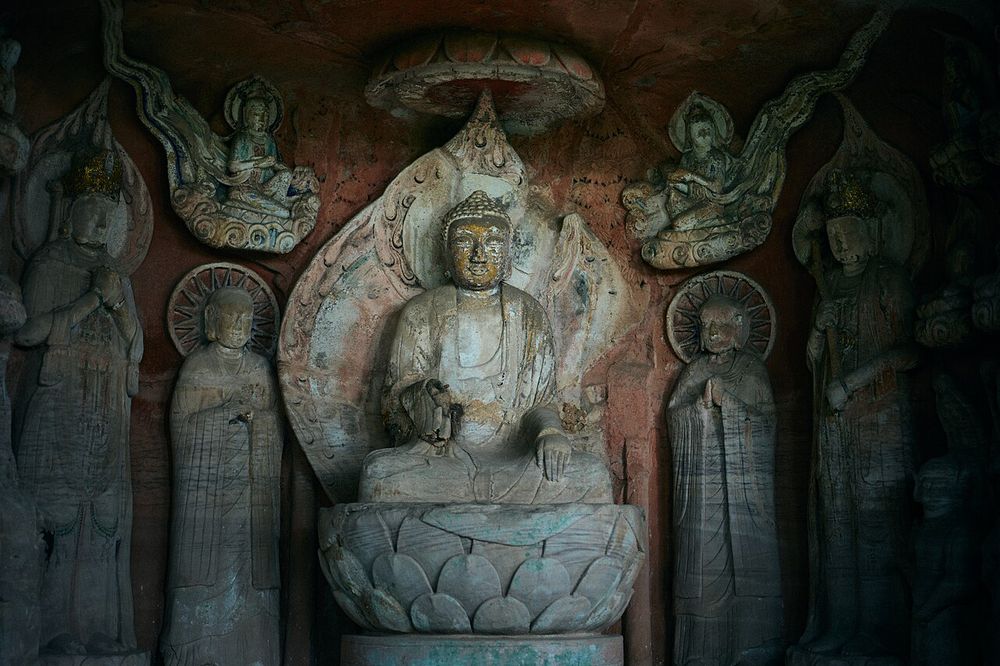
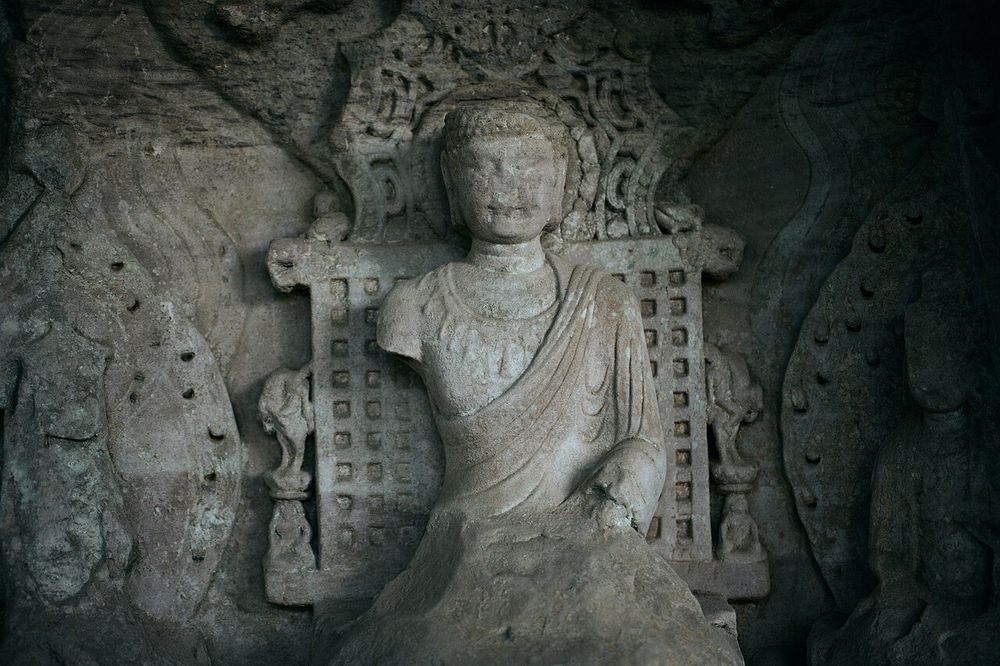
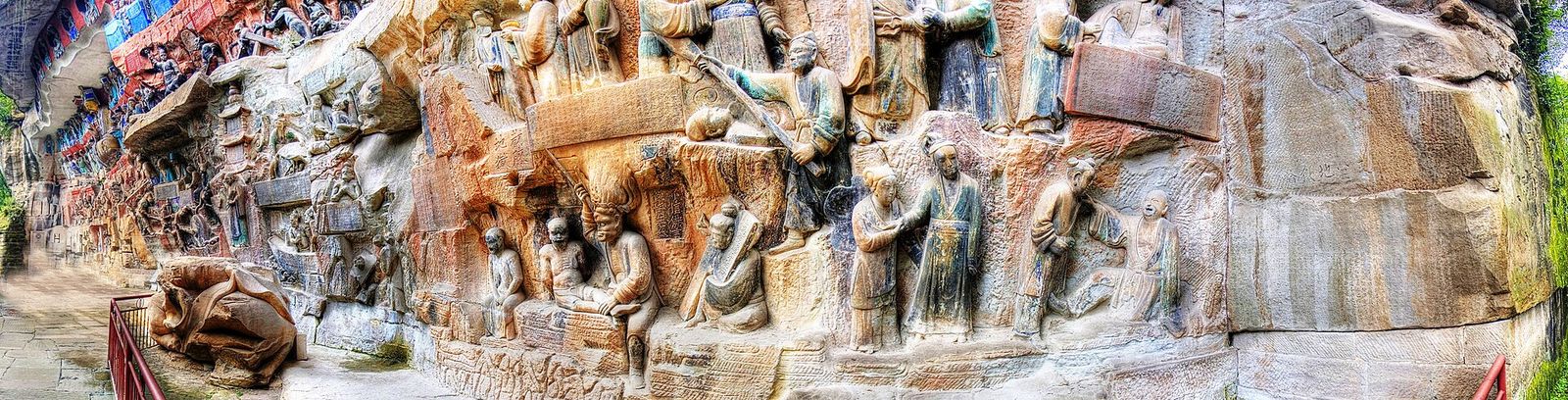
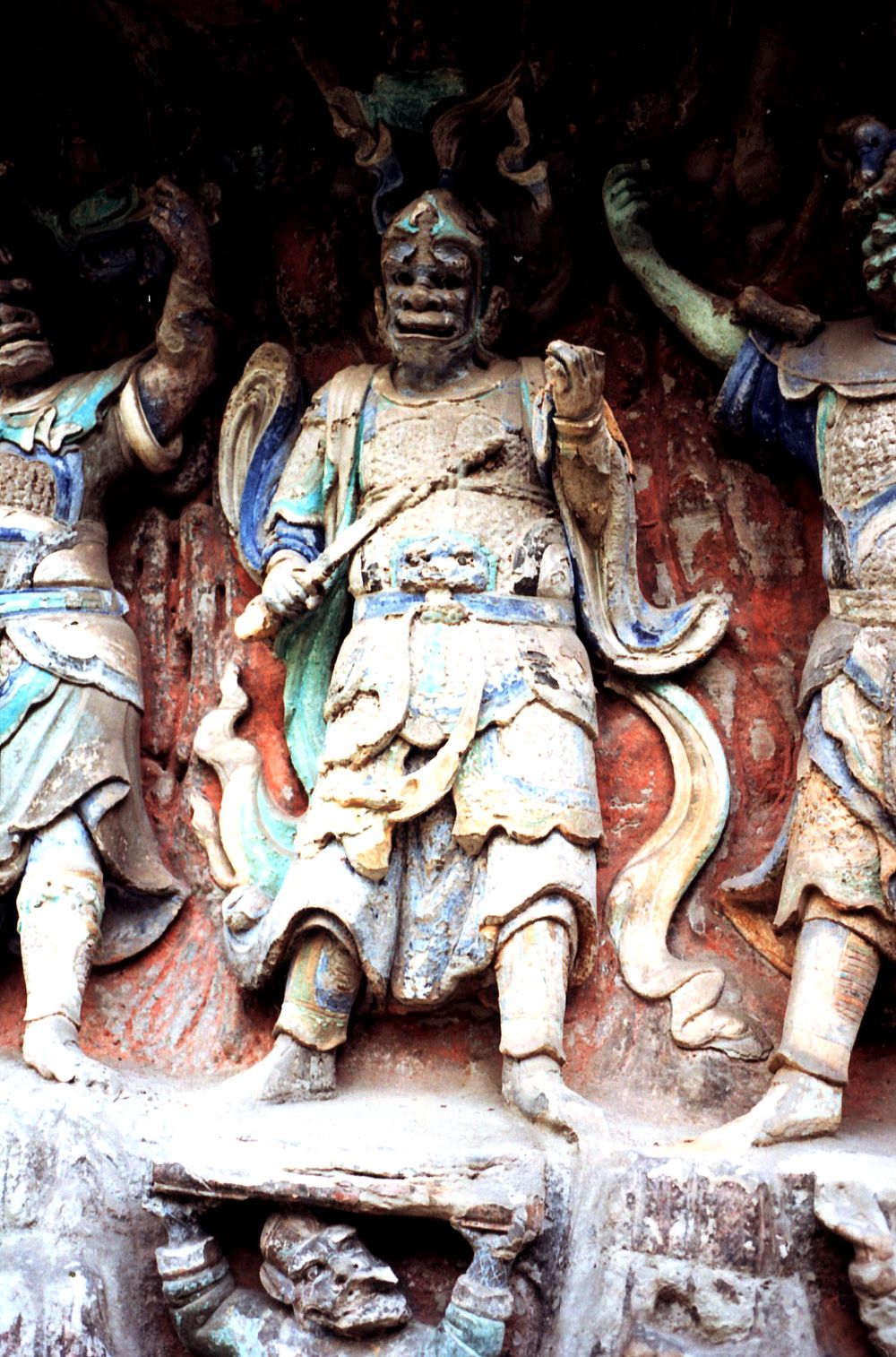
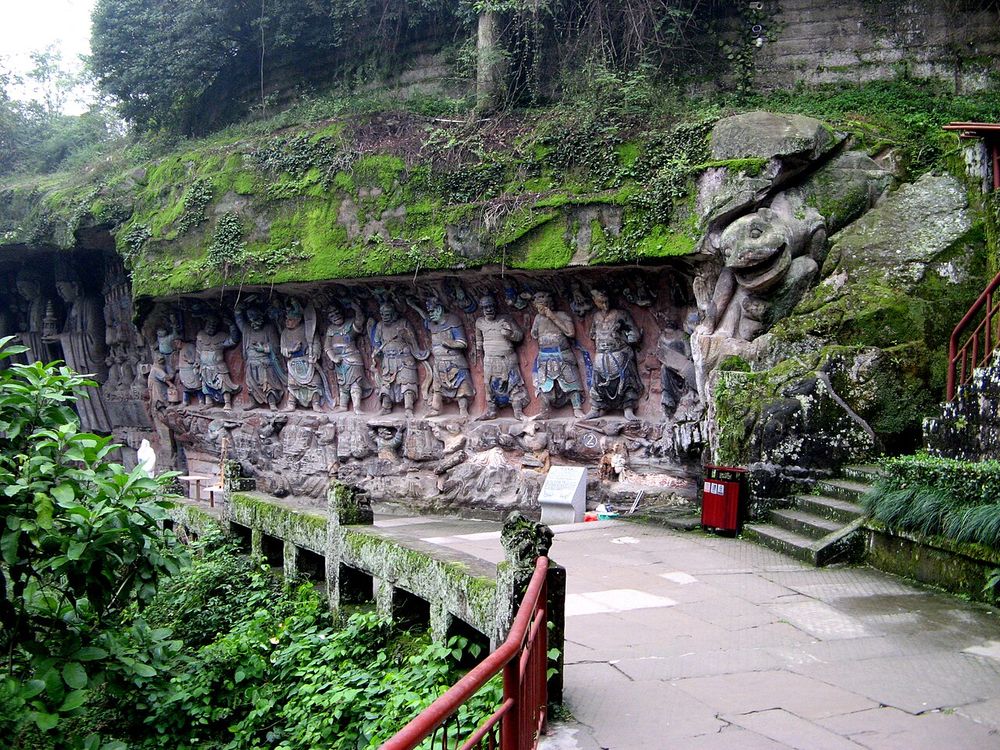
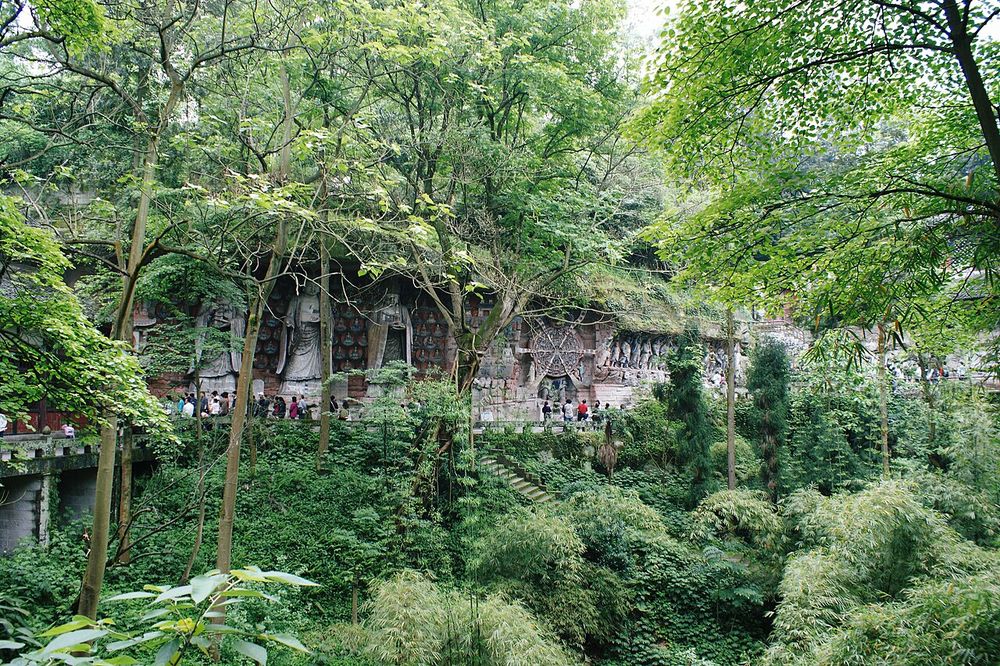
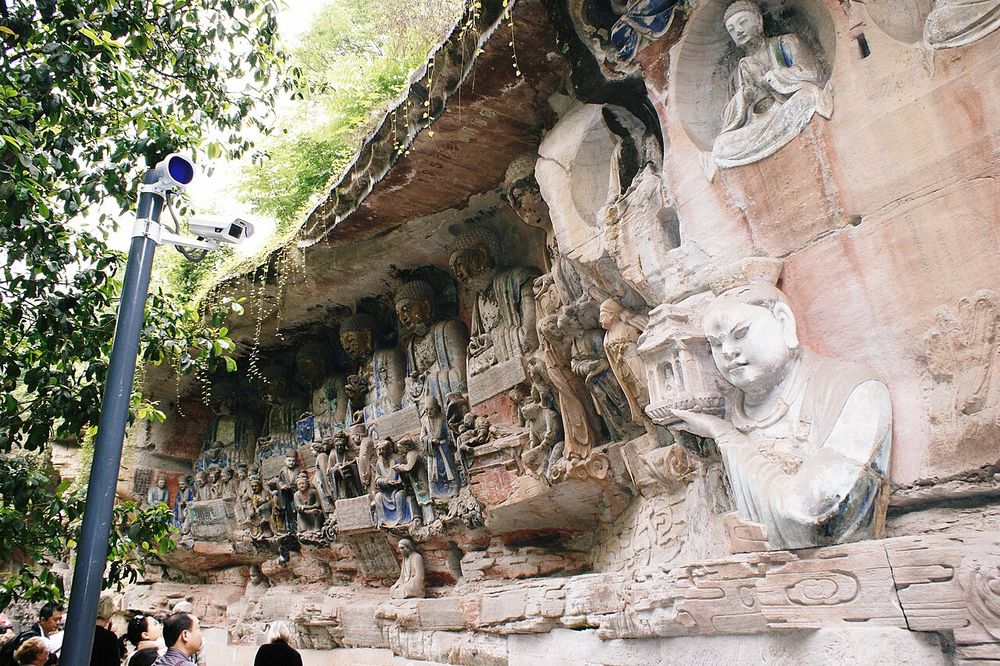
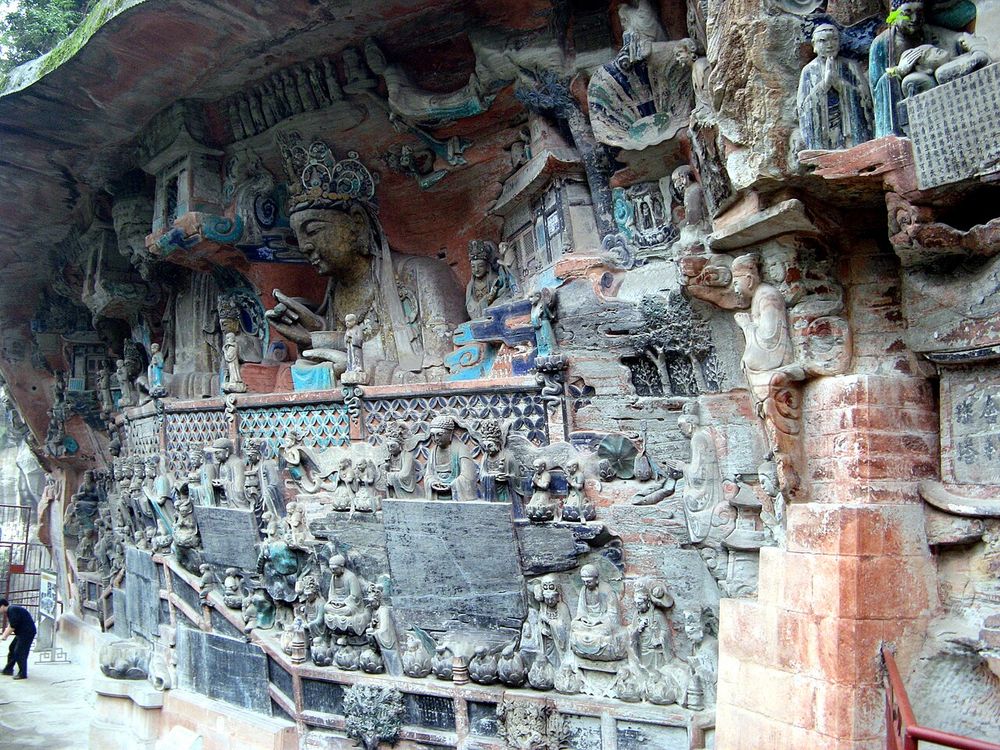
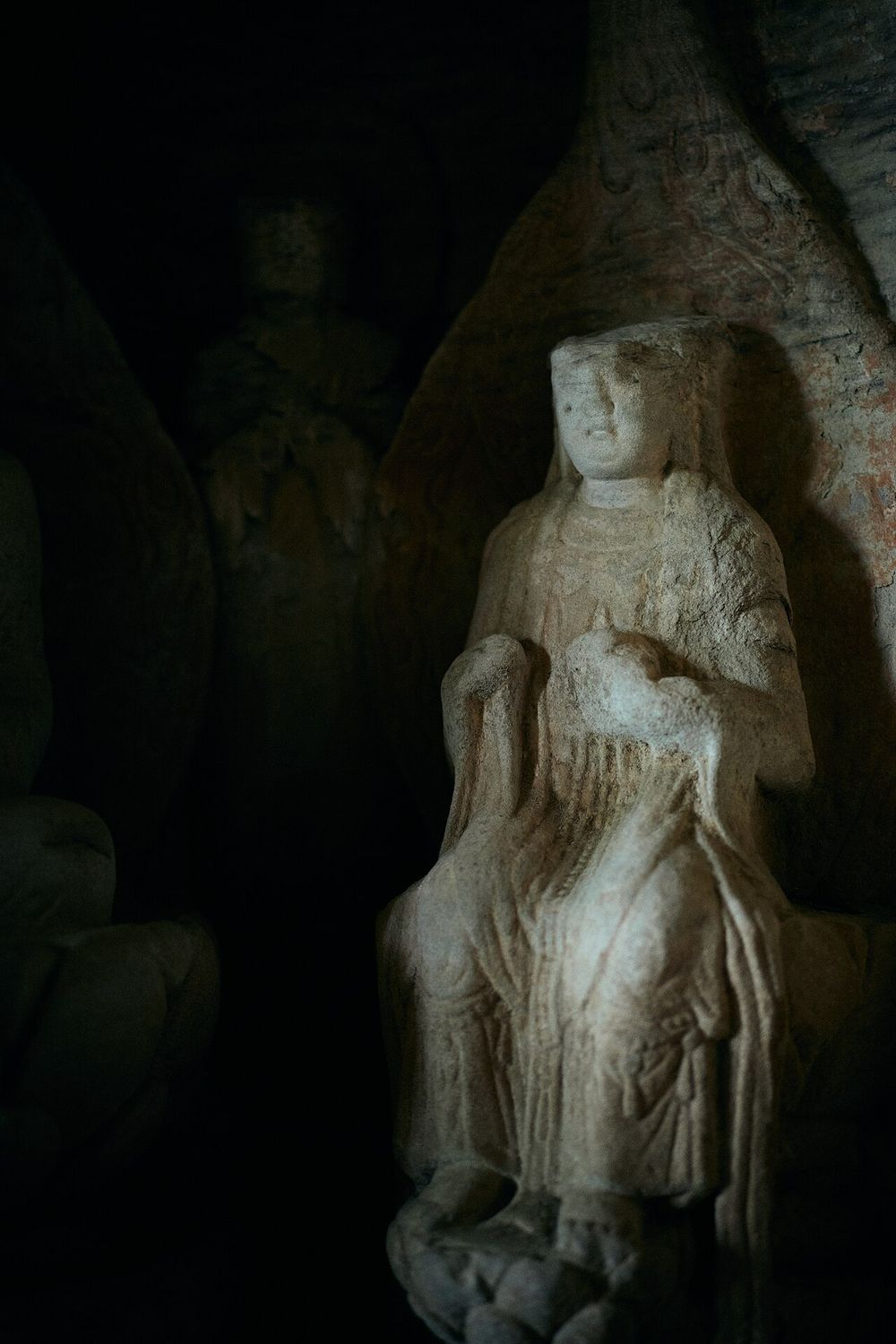
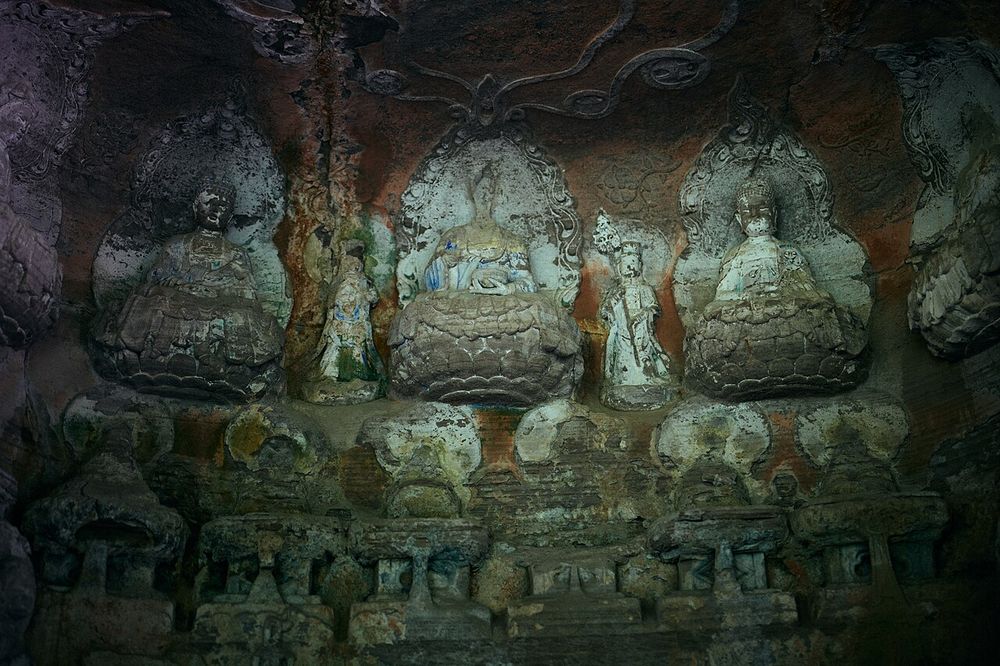
In the hills west of Chongqing, from the 9th century to the 13th, monks and donors had whole cliffs carved and painted with Buddhist scenes, but also with farmers, mothers, drunkards and herdsmen. The greatest group, at Baodingshan, is a horseshoe-shaped gorge lined with sculpture for half a kilometre, made to a single plan over seventy years.
Photo: Davidmcbride, CC BY-SA 4.0, Wikimedia Commons
The story
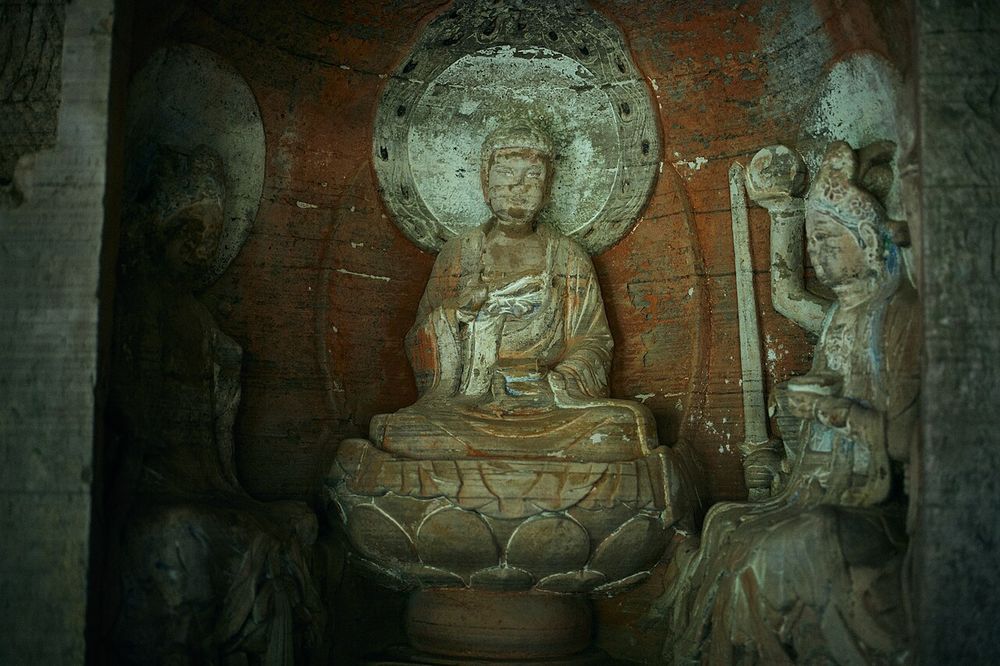
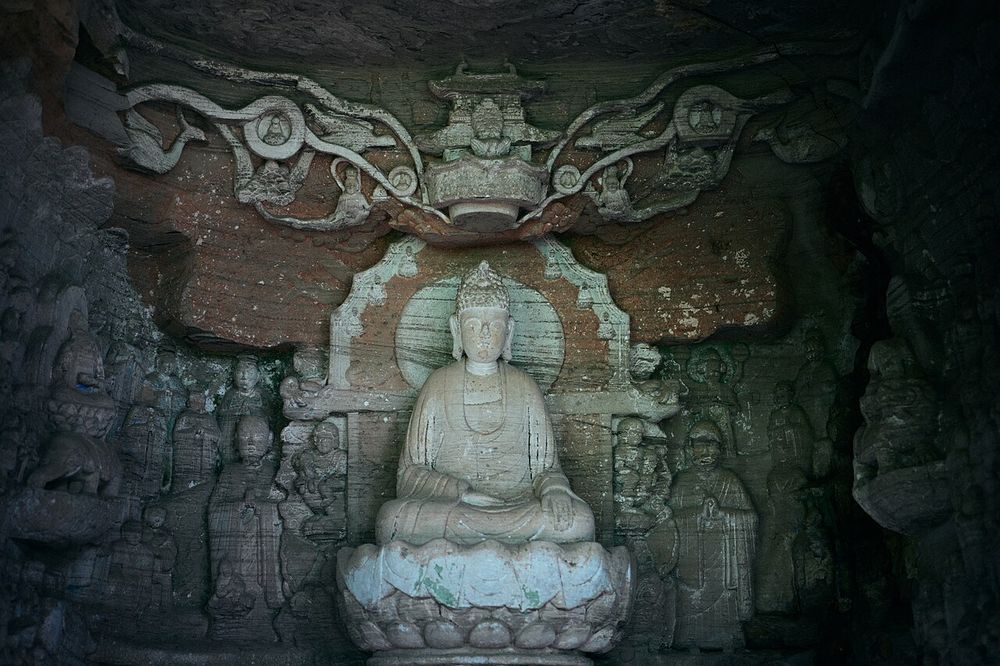
Dazu means "great sufficiency", and in the late Tang (618–907) and the Song this was a prosperous corner of Sichuan. In 892 a local general, Wei Junjing, began carving Buddhist niches on Beishan, the North Hill outside his fortified town, and for two and a half centuries families paid for more. At Beishan the sculpture is delicate and courtly: slender bodhisattvas in deep niches, carved by named masters.
In 1174 a monk named Zhao Zhifeng began something larger at Baodingshan, fifteen kilometres away: a complete teaching carved round a gorge, from the wheel of rebirth to the hells, the Pure Land and the Buddha's death, with captions for those who could read and vivid scenes for those who could not. More than 50,000 figures survive across the area, and five of the sites were listed together as a World Heritage Site in 1999.
What is here
Baodingshan and Beishan are sold separately or on a combined ticket; three smaller sites each cost about 30 yuan. Shuttle carts and the dome cinema are extra.
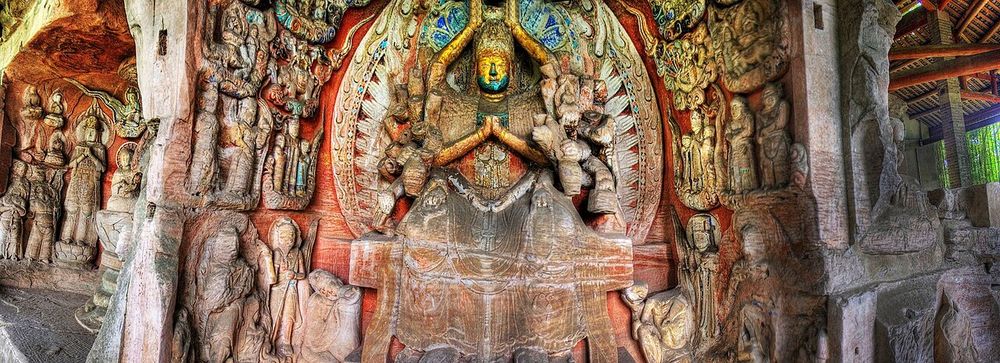
The Thousand-armed Guanyin, 2025Yumeto, CC BY-SA 4.0
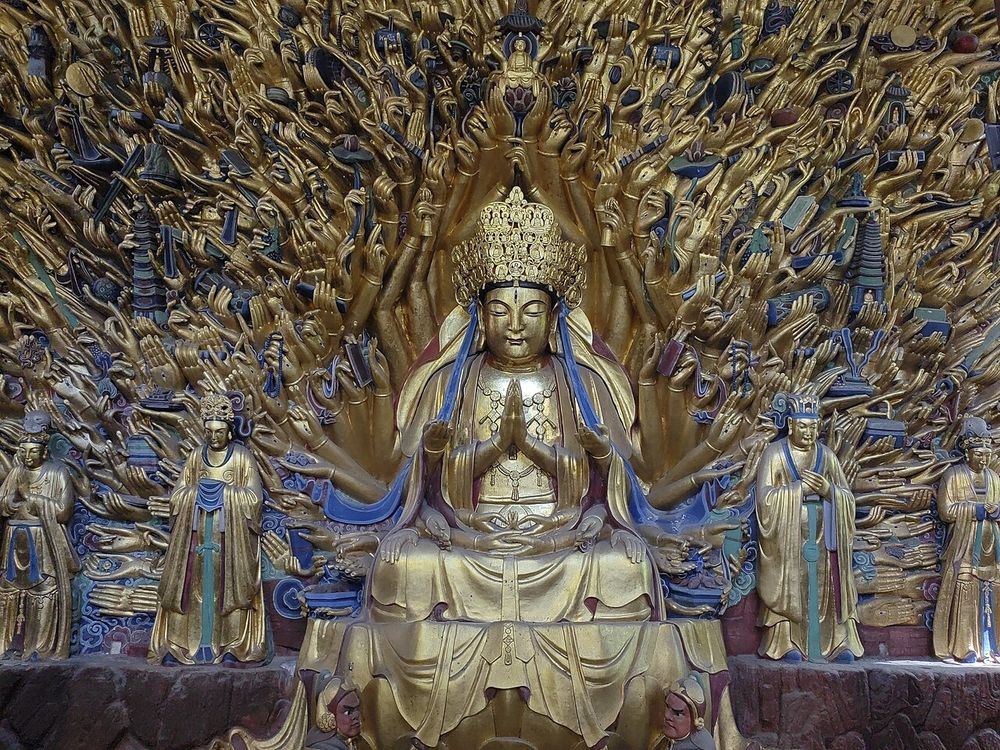
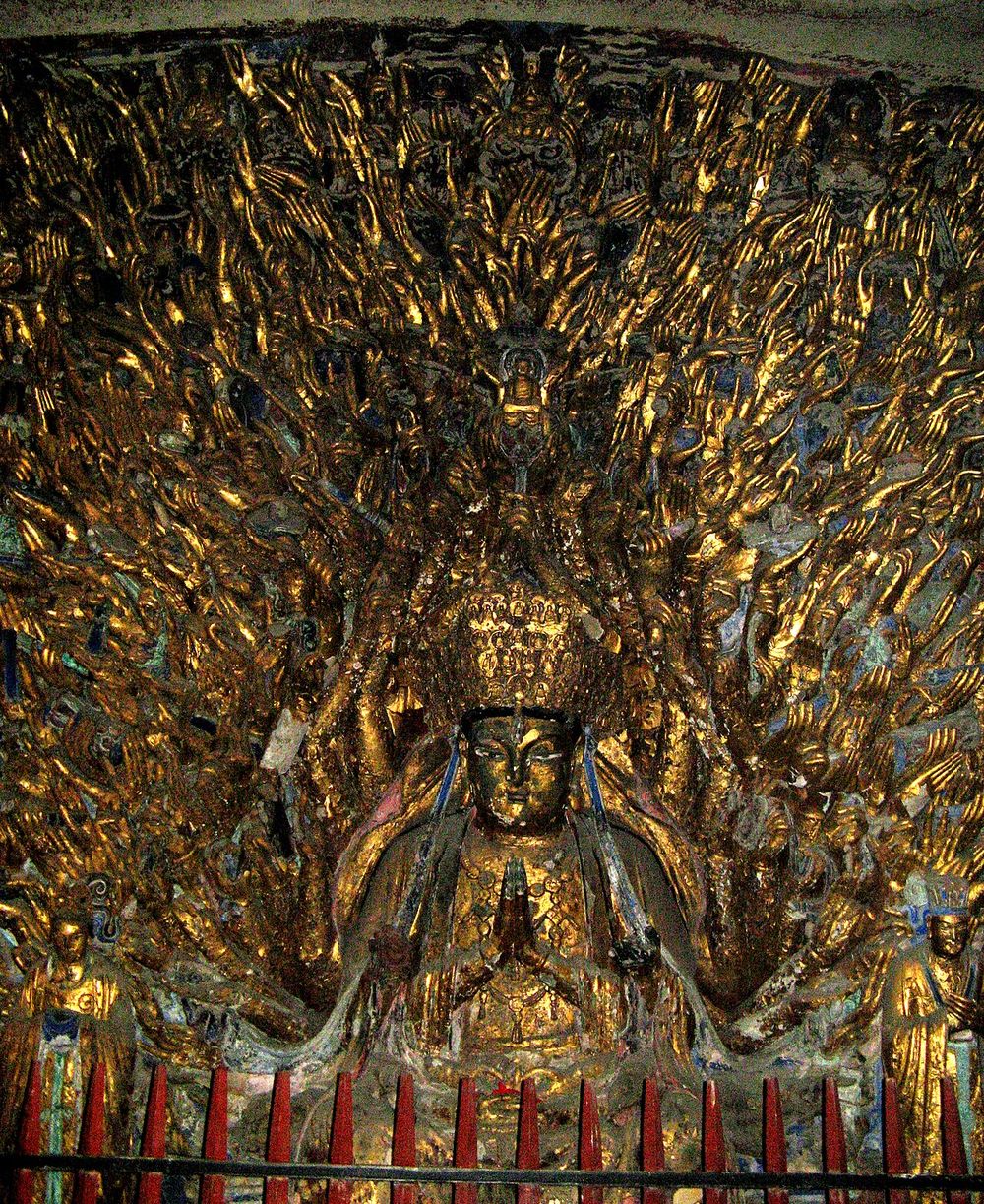
In a hall on the south side of the gorge, a golden Guanyin sits in front of a fan of hands that covers 88 square metres of rock, each hand with an eye in its palm and something in its grasp. Restorers working from 2008 to 2015 counted 830 hands and regilded them with gold leaf.
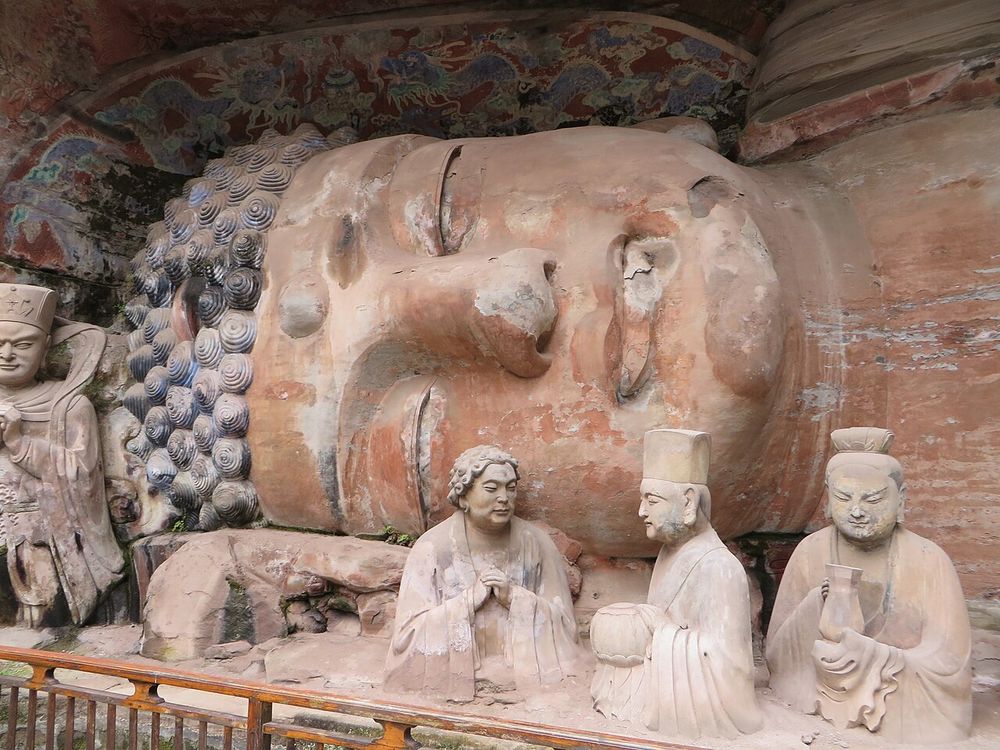
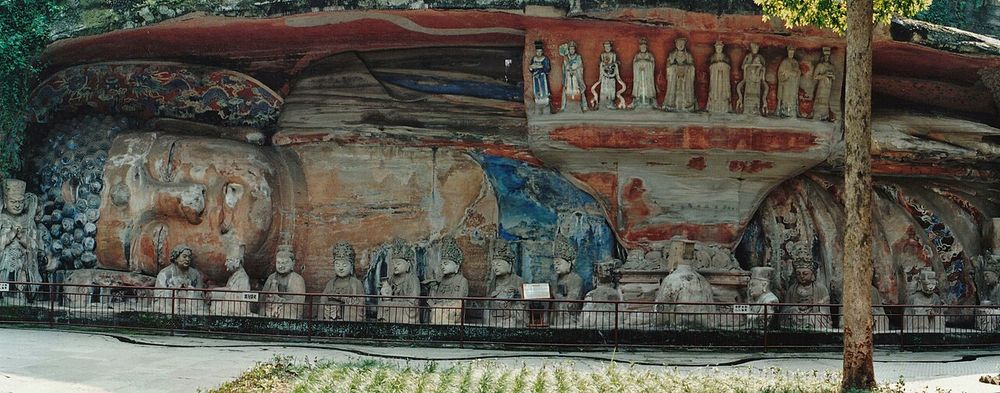
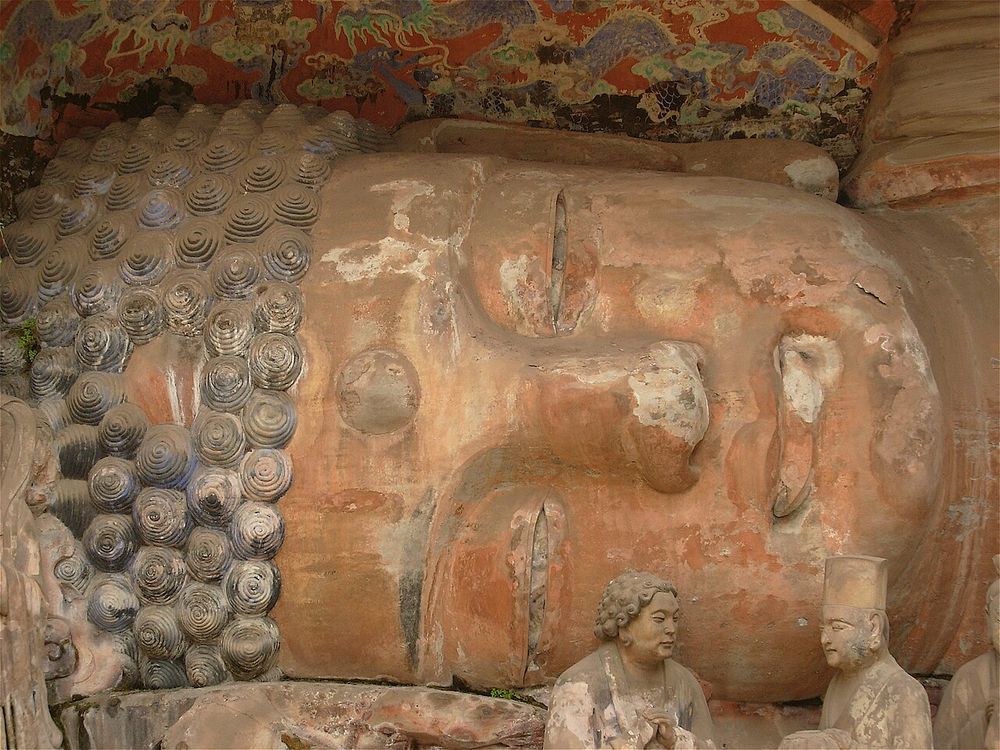
Then walk on to the Reclining Buddha, 31 metres long, shown only from the waist up, as if the rest of his body runs on into the mountain; and to the Parents' Kindness, ten scenes of a mother's life from pregnancy to old age, among the most human carvings in China.
The head of the Reclining Buddha with disciples, 2014Jpbowen, CC BY-SA 4.0
Things people often get wrong
"These are caves." Most of Dazu is carved on open cliffs and under overhangs, not in caves; the paint survives because the rock shelters it.
"It is all Buddhist." Some sites mix Buddhism with Taoism and Confucianism; at Shizhuanshan the founders of all three sit side by side.
People who stood here
We searched Chinese sources first for this list, then English ones.
Wei Junjing (general, late 9th century)The Tang general who held Dazu began the carvings on Beishan in 892; his stele of 895 is among the oldest records of the site.
Liu Benzun (lay Buddhist, 844–907)A Tang ascetic of Sichuan whose deeds of self-sacrifice are carved at Baodingshan; Zhao Zhifeng took him as the founder of his teaching.
Fu Yuanjun (carver, 12th century)One of a family of master carvers whose names are cut into the niches of Beishan.
Zhao Zhifeng (monk, born 1159)He planned Baodingshan and spent some seventy years having it carved, from 1174 to about 1252.
Yang Jialuo (historian, 1912–1991)In 1945 he led the first scholarly survey of the carvings, which made Dazu known to the wider world.
Go deeper: round the gorge of Baodingshan, then Beishan, seven stops8 stops · about 1 min to read
Baodingshan is a one-way loop round the gorge of Dafowan, about 1.5 km; allow two hours. Beishan is in Dazu town, half an hour away.
1. The Wheel of Rebirth
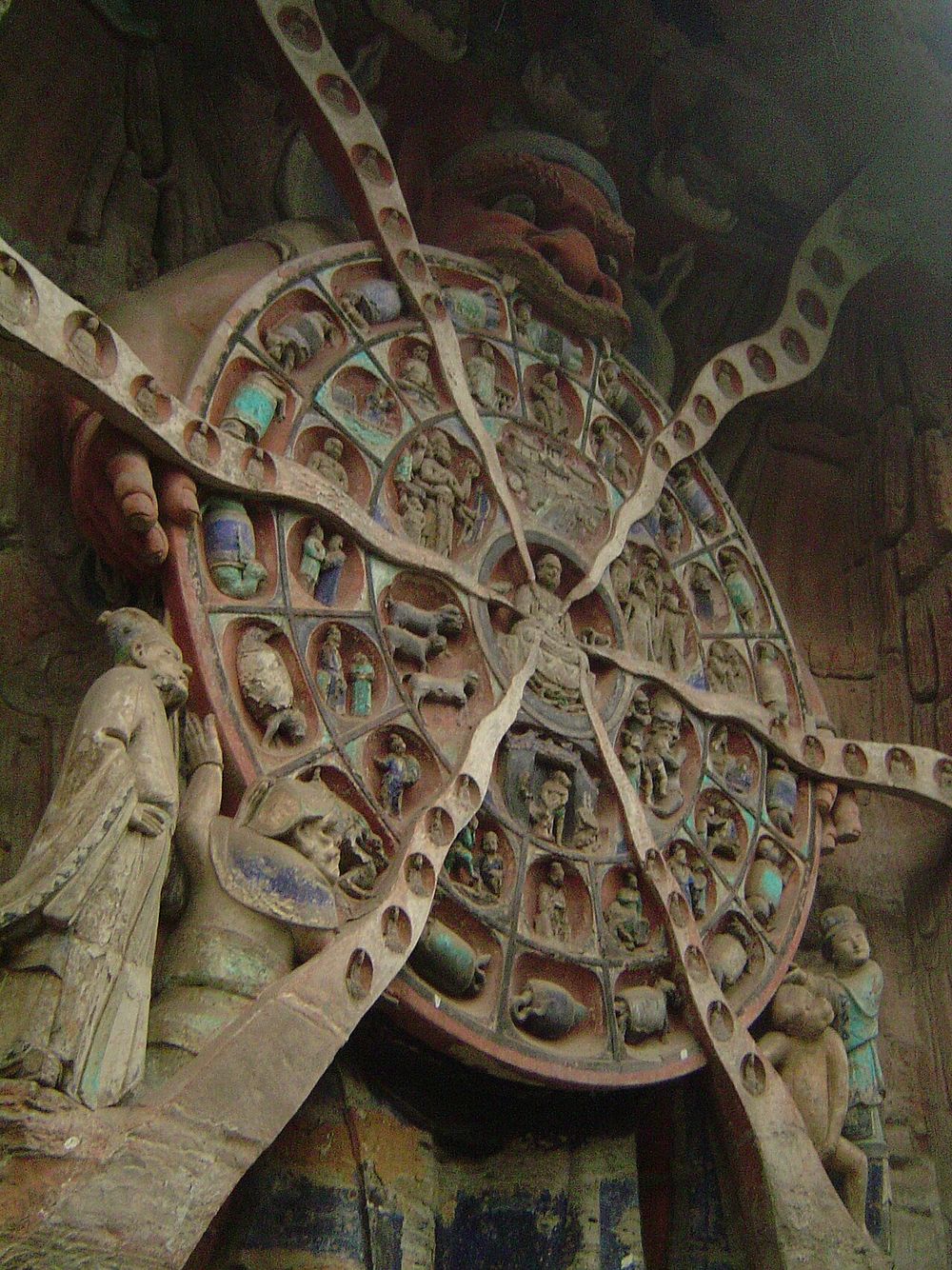
Detail of the Wheel of Rebirth, 2010Laurent Bélanger, CC BY-SA 4.0
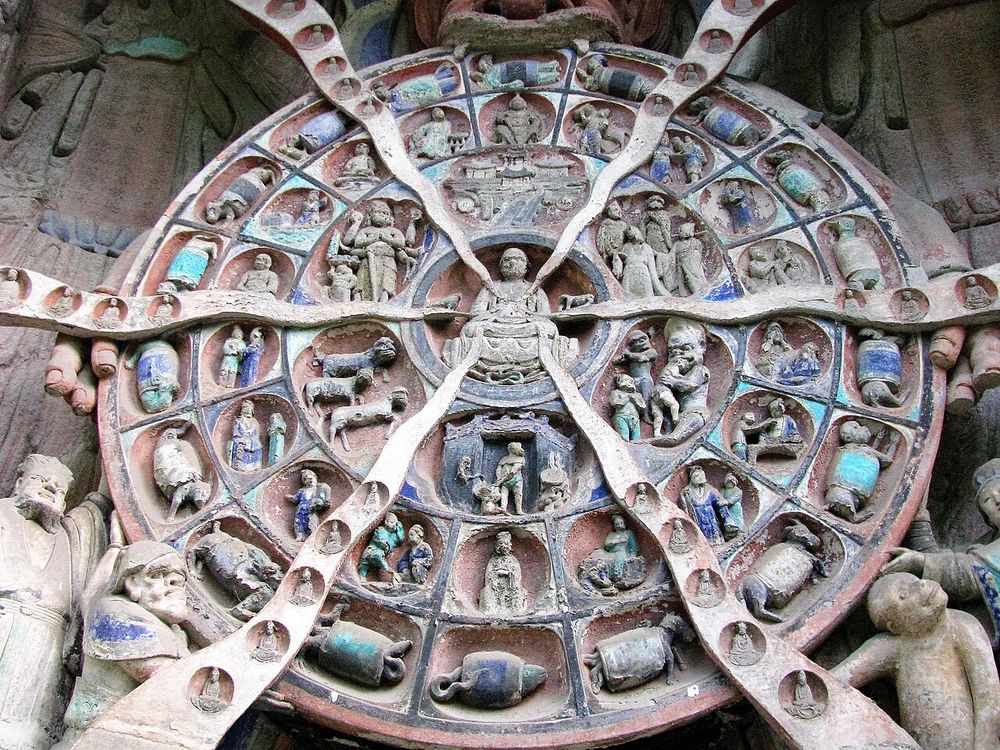
A great wheel held in the jaws of a demon of impermanence, showing the six paths of rebirth; round its rim, small scenes show the causes of each fate.
2. The Three Sages of Huayan
The Three Sages of Huayan, 2025Yumeto, CC BY-SA 4.0
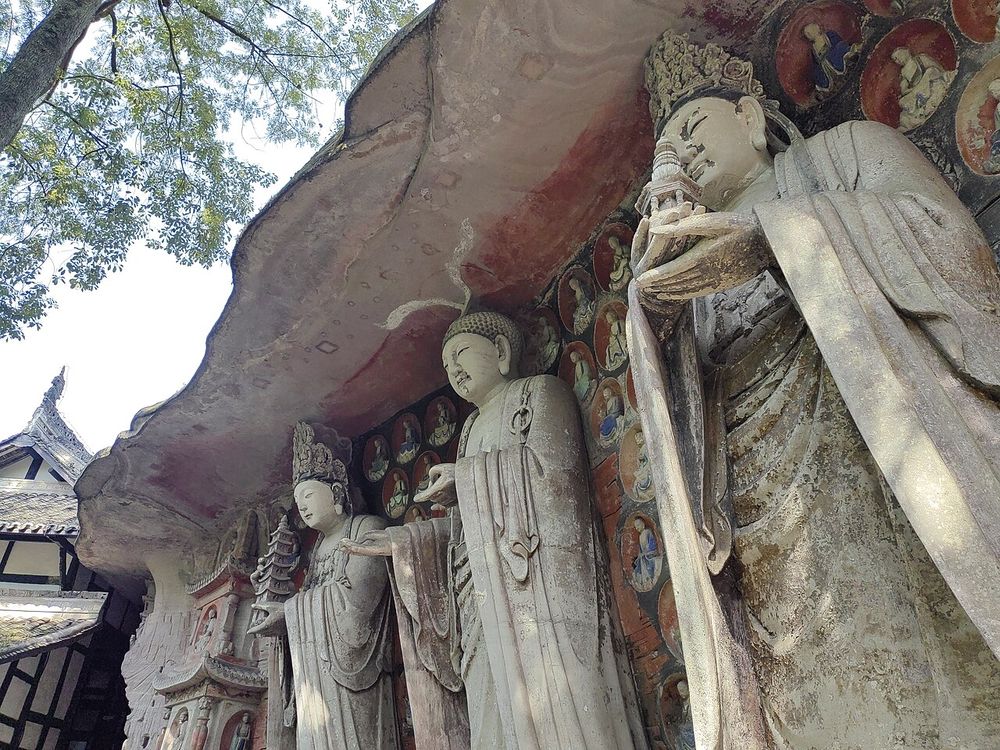
Three figures seven metres high lean forward from the cliff; one holds a stone pagoda on his arm, carved so that the weight runs through his robe into the rock.
3. The Thousand-armed Guanyin
The Guanyin before restoration, 2007G41rn8, CC BY-SA 4.0
The golden fan of 830 hands, under its own roof.
4. The Reclining Buddha
The Reclining Buddha, 31 metres longBgabel, CC BY-SA 3.0
The Buddha at the moment of his death, with disciples rising from the ground before him.
5. Parents' Kindness and the Pure Land
The Parents' Kindness, 2007G41rn8, CC BY-SA 4.0
Ten scenes of parents' love, then the Western Paradise of Amitabha, with souls reborn in lotus buds.
The Western Pure Land, 2009Hugh Llewelyn from Keynsham, UK, CC BY-SA 2.0
6. The hells and the herdsmen
Scenes of the hells, 2009Hugh Llewelyn from Keynsham, UK, CC BY-SA 2.0
Grim scenes of punishment, among them a drunkard who fails to know his own father; further on, herdsmen and their oxen stand for the steps of taming the mind.
A painted scene with an inscription, 2009Hugh Llewelyn from Keynsham, UK, CC BY-SA 2.0
7. Beishan
A Buddha in a niche at Beishan, 2023JL Cogburn, CC BY-SA 2.0
On the hill above Dazu town, a long row of Tang and Song niches. Look for the Cave of the Revolving Sutra Repository, carved in 1142–1146, and for the graceful bodhisattva holding prayer beads.
A carved figure at Beishan, 2023JL Cogburn, CC BY-SA 2.0
The carvings and the same years elsewhere
In 1174, when Zhao Zhifeng began Baodingshan, Saladin took Damascus; the Leaning Tower of Pisa had been begun the year before.
Meanwhile in the world
Year
Here
Elsewhere
892
Wei Junjing begins the carvings on Beishan
A great Viking army lands in Kent and fights Alfred the Great
1174
Zhao Zhifeng begins Baodingshan
Saladin takes Damascus
1945
Yang Jialuo's team makes the first scholarly survey
The Second World War ends
1999
Five sites are listed as a World Heritage Site
The euro is introduced
2015
Restoration of the Thousand-armed Guanyin is finished
The Paris climate agreement is signed
One line to remember: a mountain gorge carved like a picture book of Buddhist teaching, with ordinary people on every page.
Baodingshan and Beishan
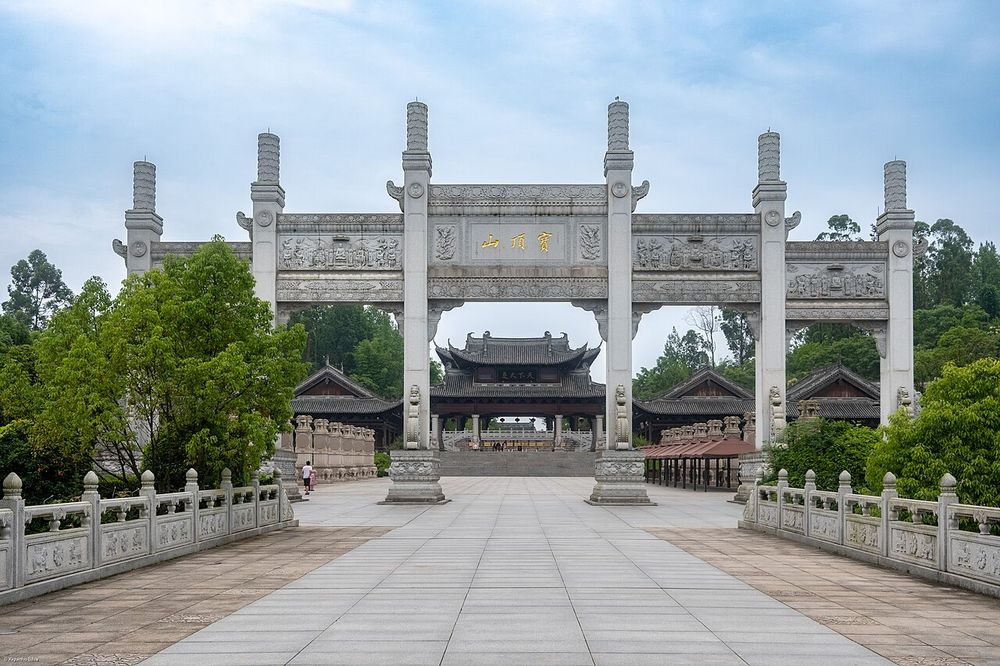
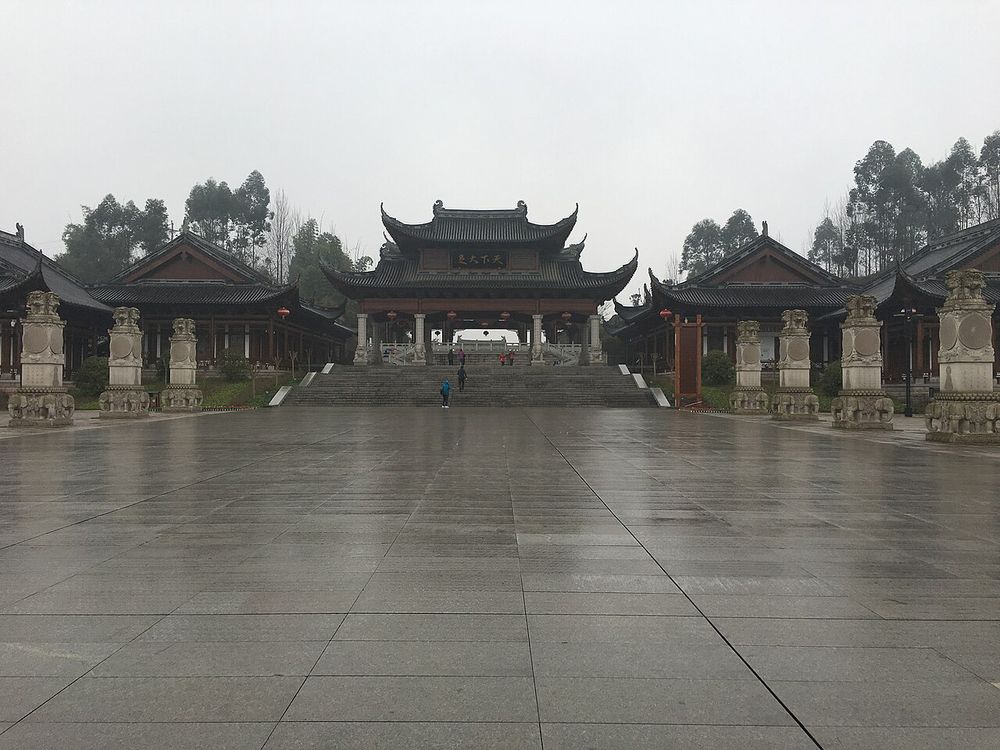
Panorama of a carved cliff at Baodingshan, 2011Davidmcbride, CC BY-SA 4.0, Wikimedia CommonsThe Thousand-armed Guanyin, panorama, 2011Davidmcbride, CC BY-SA 4.0, Wikimedia CommonsThe Thousand-armed Guanyin, 2025Yumeto, CC BY-SA 4.0, Wikimedia CommonsThe Guanyin before restoration, 2007G41rn8, CC BY-SA 4.0, Wikimedia CommonsThe head of the Reclining Buddha with disciples, 2014Jpbowen, CC BY-SA 4.0, Wikimedia CommonsThe Reclining Buddha, 31 metres longBgabel, CC BY-SA 3.0, Wikimedia CommonsThe Buddha entering nirvana, 2007David Barrie from England, CC BY 2.0, Wikimedia CommonsThe Wheel of Rebirth, 2004Calton, CC BY-SA 3.0, Wikimedia CommonsDetail of the Wheel of Rebirth, 2010Laurent Bélanger, CC BY-SA 4.0, Wikimedia CommonsThe Three Sages of Huayan, 2025Yumeto, CC BY-SA 4.0, Wikimedia CommonsA guardian of the Dharma, 2006Gisling, CC BY-SA 3.0, Wikimedia CommonsThe path along the carved cliffs, 2007G41rn8, CC BY-SA 4.0, Wikimedia CommonsThe gorge in green, 2009Hugh Llewelyn from Keynsham, UK, CC BY-SA 2.0, Wikimedia CommonsCarved scenes under an overhang, 2009Hugh Llewelyn from Keynsham, UK, CC BY-SA 2.0, Wikimedia CommonsThe Parents' Kindness, 2007G41rn8, CC BY-SA 4.0, Wikimedia CommonsThe Western Pure Land, 2009Hugh Llewelyn from Keynsham, UK, CC BY-SA 2.0, Wikimedia CommonsFigures of the Pure Land, 2007G41rn8, CC BY-SA 4.0, Wikimedia CommonsScenes of the hells, 2009Hugh Llewelyn from Keynsham, UK, CC BY-SA 2.0, Wikimedia CommonsA painted scene with an inscription, 2009Hugh Llewelyn from Keynsham, UK, CC BY-SA 2.0, Wikimedia CommonsThe characters "Baoding" carved in the rock, 2025Yumeto, CC BY-SA 4.0, Wikimedia CommonsAn inscribed stele, 2025Yumeto, CC BY-SA 4.0, Wikimedia CommonsThe Shengshou Temple above the gorge, 2012Gerd Eichmann, CC BY-SA 4.0, Wikimedia CommonsA temple hall, 2009Hugh Llewelyn from Keynsham, UK, CC BY-SA 2.0, Wikimedia CommonsStone pillars in a courtyard, 2024xiquinhosilva, CC BY 2.0, Wikimedia CommonsThe museum building, 2024xiquinhosilva, CC BY 2.0, Wikimedia CommonsThe entrance plaza, 2024xiquinhosilva, CC BY 2.0, Wikimedia CommonsA stone gateway, 2024xiquinhosilva, CC BY 2.0, Wikimedia CommonsThe plaza in the rainjt Guan, CC BY 3.0, Wikimedia CommonsA Buddha in a niche at Beishan, 2023JL Cogburn, CC BY-SA 2.0, Wikimedia CommonsA seated bodhisattva at Beishan, 2023JL Cogburn, CC BY-SA 2.0, Wikimedia CommonsA carved figure at Beishan, 2023JL Cogburn, CC BY-SA 2.0, Wikimedia CommonsA niche with a seated Buddha, 2023JL Cogburn, CC BY-SA 2.0, Wikimedia CommonsA standing figure in the dark, 2023JL Cogburn, CC BY-SA 2.0, Wikimedia CommonsThree Buddhas in a niche, 2023JL Cogburn, CC BY-SA 2.0, Wikimedia Commons
Local legends
These are stories people tell about this place. They are legends, not history, and each one says where it comes from.
LegendThe hands no one could count
It used to be said that the Thousand-armed Guanyin's hands could never be counted: each counter lost track and got a different number. A monk is said to have done it at last by laying a sheet of gold leaf on each hand.
Source: Told by guides at Baodingshan
Later, people who live here will be able to add the stories they grew up with, and say which of these they have heard.
Not certain, and where accounts conflict
When did Zhao Zhifeng finish?
Inscriptions give the start in the Chunxi years (1174–1189); the end date of about 1252 is an estimate, and some scenes may have been left unfinished when the Mongol invasion reached Sichuan.
Visiting
Tickets and hours
Baodingshan 110–115 yuan, Beishan 58–70 yuan, combined 140 in the main season; last entry about 16:30.
Over-65s enter free; a few free days a year are announced by the scenic area.
Last checked 2026-11-12. Prices and booking from 2026 Sina guides citing the scenic area; guides differ by season (Baodingshan 110–115 yuan, Beishan 58–70 yuan).
Booking without WeChat
Official page in English Book with your real name on the "大足石刻" official WeChat account or its authorised platform "土行孙旅游"; the official stores on Meituan and Douyin lead to the same system.
Note Foreign visitors book with a passport number. Baodingshan fills up on summer weekends and holidays; book three days ahead.
Checked 2026-11-12
Where to start
Go to Baodingshan in the morning before the groups, then Beishan in the afternoon.
The museum and the dome cinema at Baodingshan help explain the scenes.
Before you go
Dazu is about 1.5 hours from Chongqing by car or bus; high-speed trains stop at Dazu South.
The paths are shaded but damp; wear shoes that grip.
Customs and manners
Do not touch the carvings or the gold leaf; no flash in the Guanyin hall.
Some niches are still places of worship; be quiet near them.
Opening hours are given in the local time of the place. Prices are in the local currency. The figure after ≈ is approximate, at exchange rates checked on 9 November 2026, in .
Look for these
In the Thousand-armed Guanyin, find an eye in the palm of a hand.
In the hells, find the drunkard who does not know his father.
At the Reclining Buddha, see where his body disappears into the rock.
I am here
Stand at the site, sign in, press the button, and collect its stamp. Your browser will ask to use your location. It is sent to us once to confirm that you are at the site; we keep how far you were from it, not the spot where you stood.
Your stamps are saved to your account, so they follow you to any device. Checking from a browser cannot rule out every false location; stricter checks arrive with the app.
Messages
Share your photos
Photos here show the place, not people. Each one is credited to the visitor who took it and appears after our team has looked at it. A photo with you in it belongs under “I am here”.