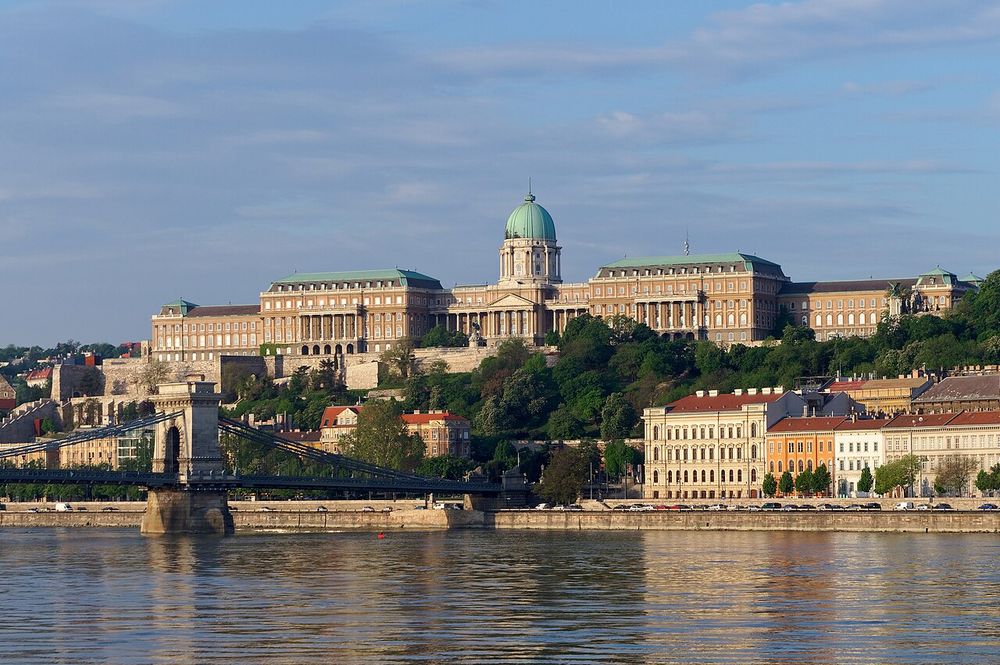
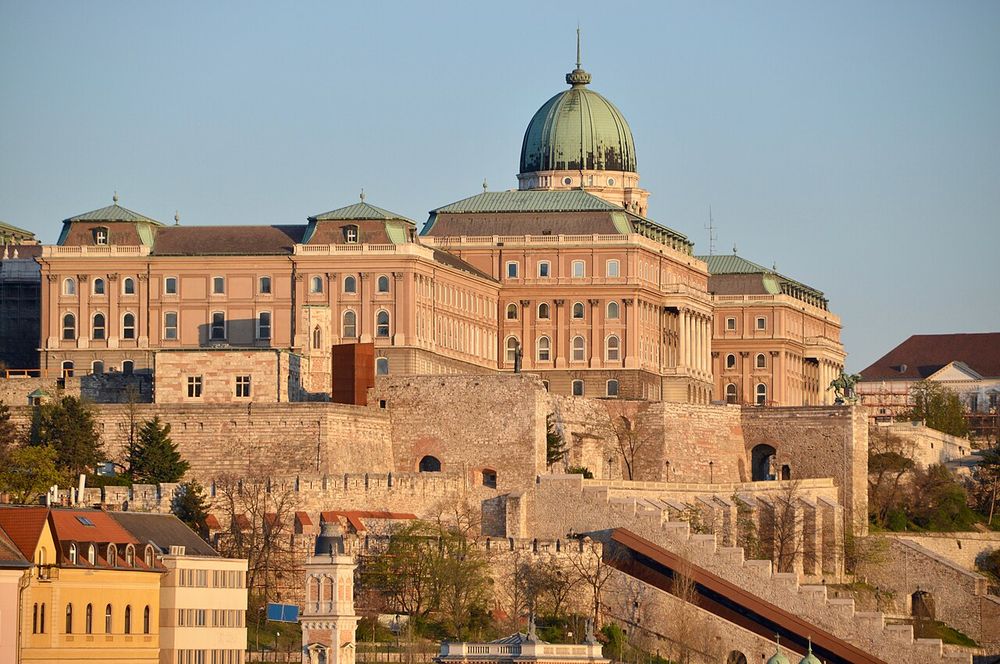
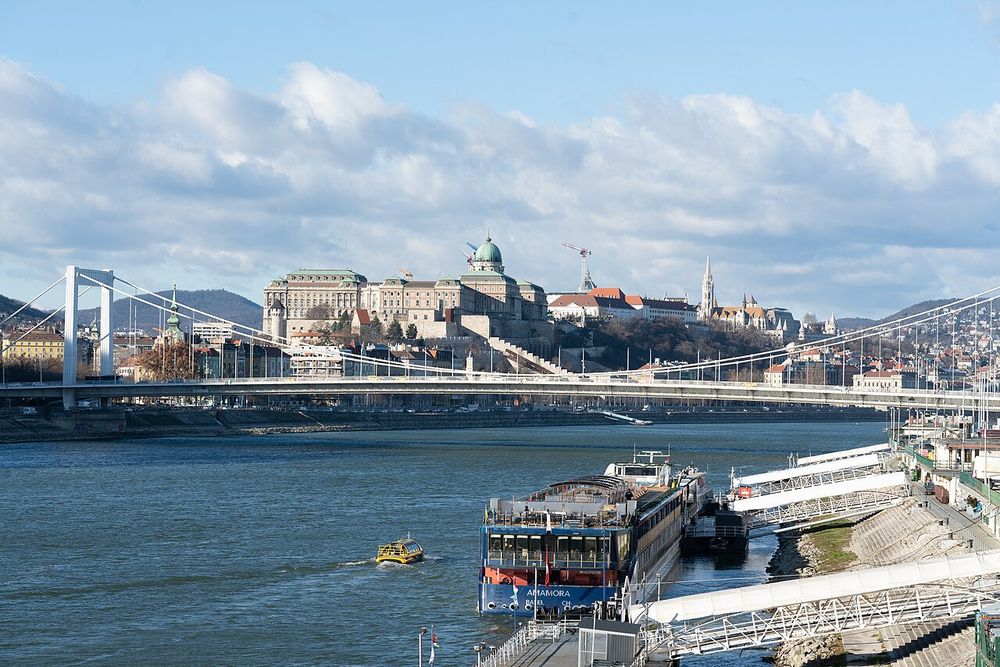
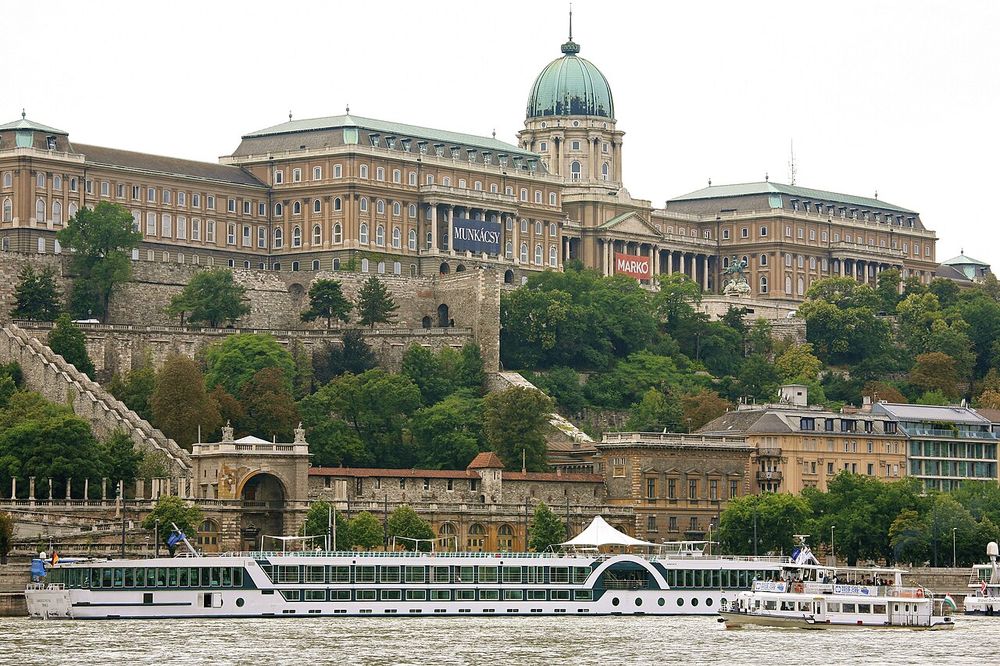
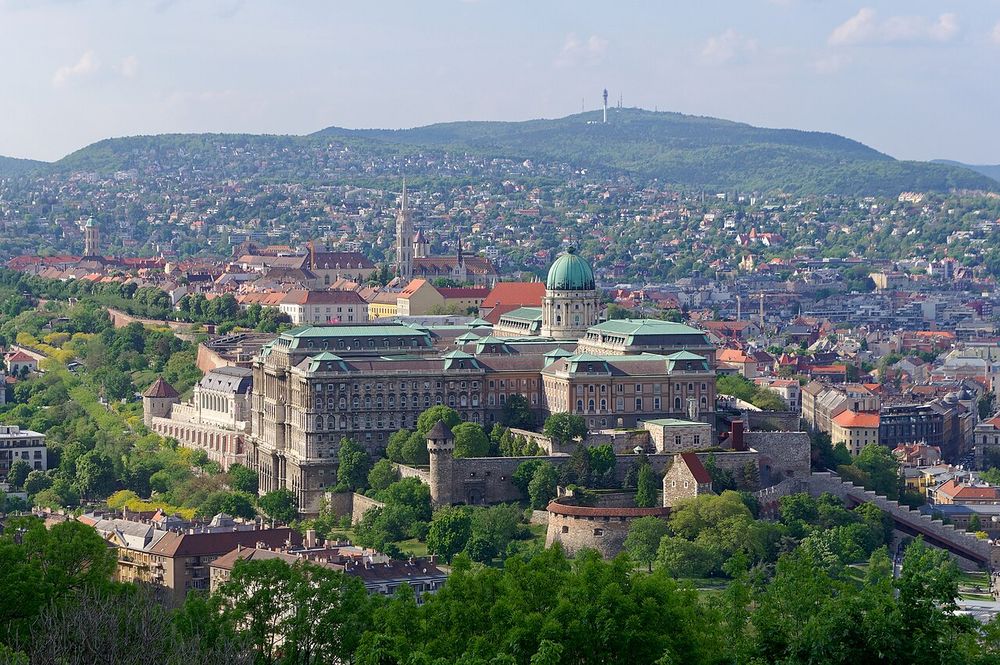
The palace of the kings of Hungary on the hill above the Danube, destroyed and rebuilt so many times that almost nothing you see is older than 1950. Under it lies the court of King Matthias, where Renaissance Italy first came north of the Alps.
Photo: Paul Colin Hennig firstdorsal.eu, CC BY-SA 4.0, Wikimedia Commons
The story
Budapest was three towns until 1873: Buda and Óbuda on the hilly west bank, Pest on the flat east bank. The kings lived up here, on a limestone ridge a kilometre and a half long. After the Mongols burned the country in 1241–42, King Béla IV walled the hill, and a palace grew at its southern tip.
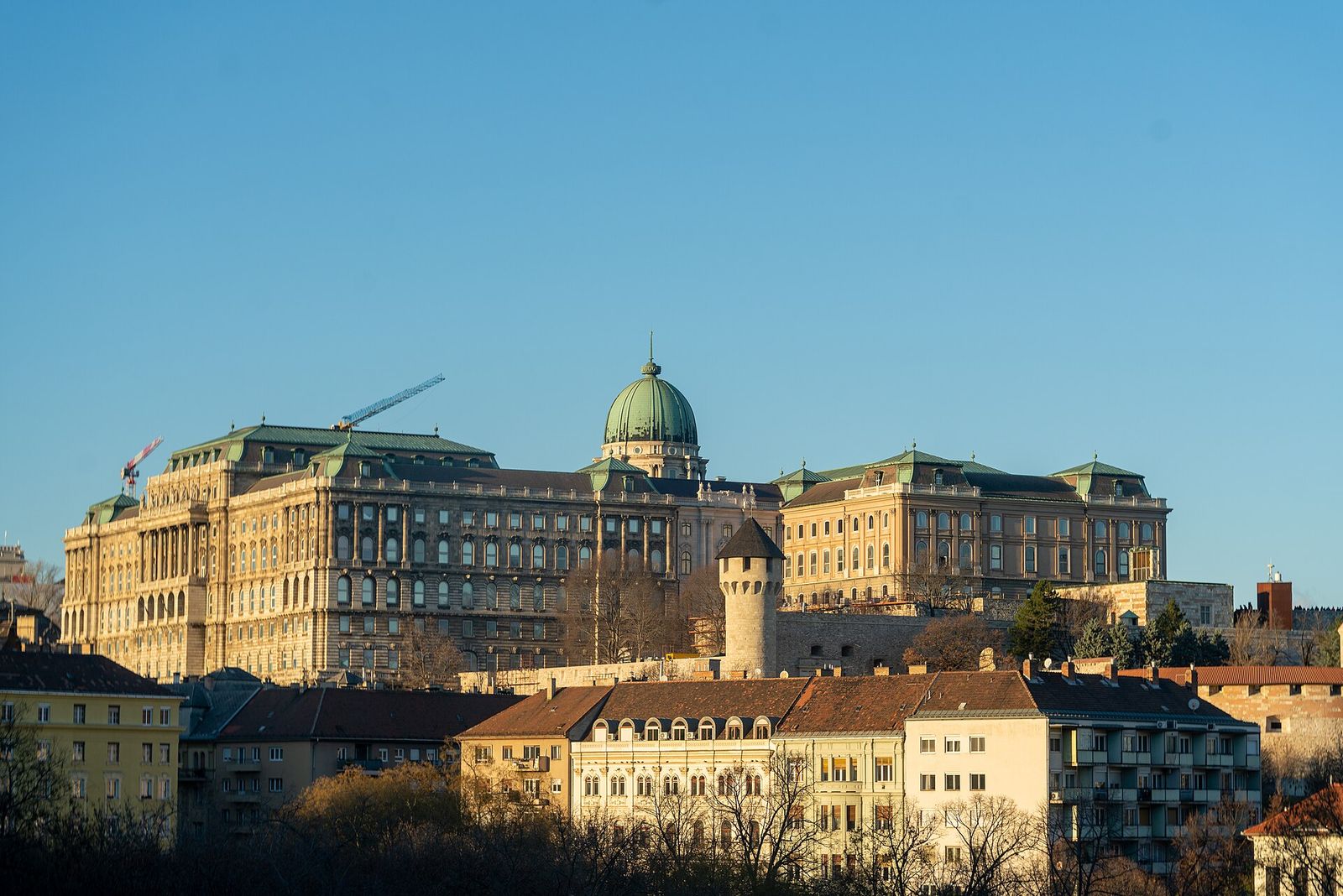
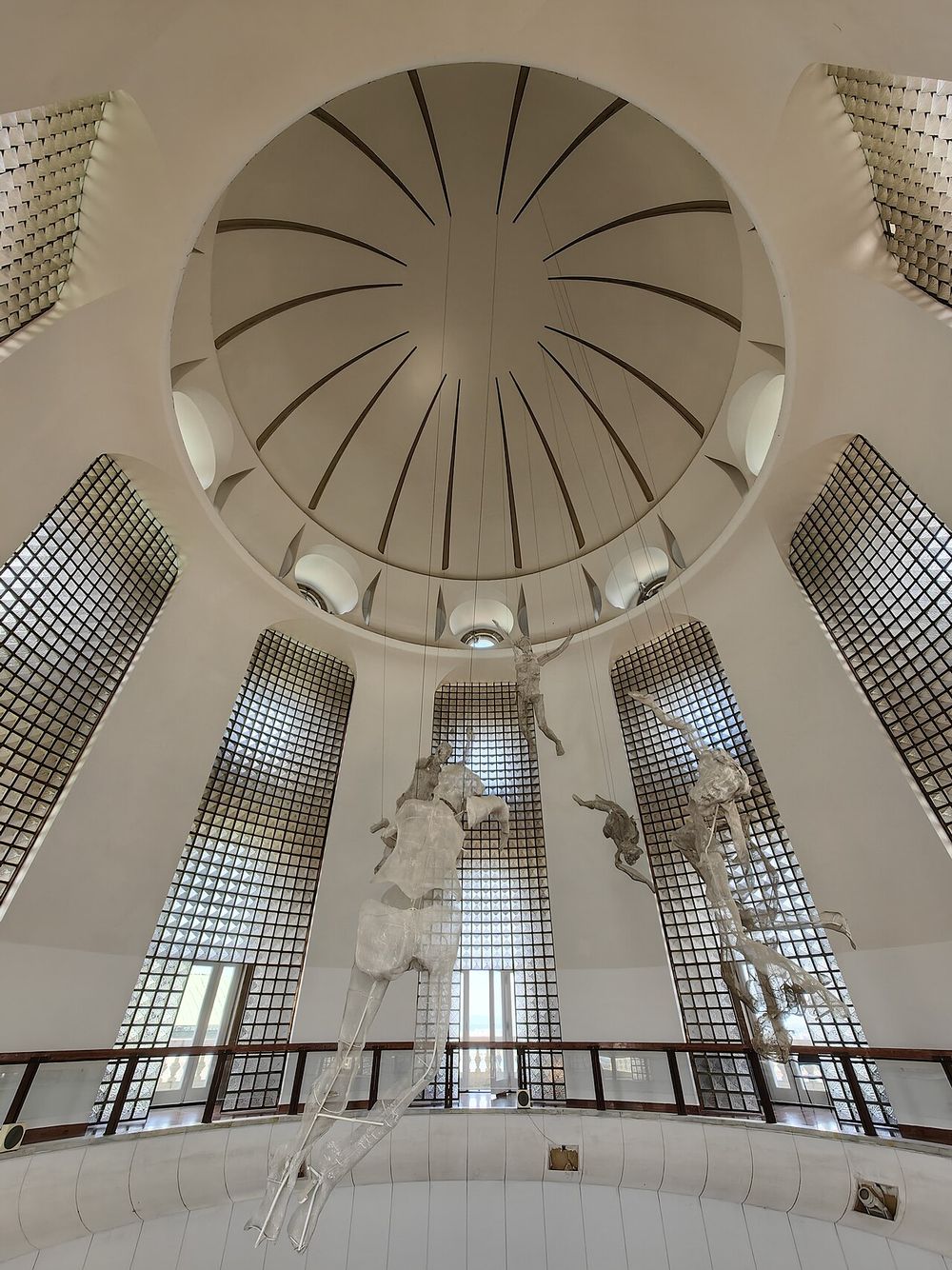
Since then the hill has been besieged more than thirty times. Turks held it for 145 years. The palace burned in 1686, 1849 and 1945. The long domed building you see was finished in 1912, burned out in the last siege of the Second World War, and rebuilt in a plainer form in the 1950s to 1980s.
What is here
The hill, the terraces and the courtyards are free. Each museum in the palace has its own ticket: the Hungarian National Gallery, the Budapest History Museum (Castle Museum) and the National Széchényi Library. St Stephen's Hall and other restored rooms are seen with their own tickets. The funicular is paid; the Fisherman's Bastion and Matthias Church have their own pages.
On the terrace below the dome, looking across the river
The palace from the Pest bank, 2019Jakub Hałun, CC BY-SA 4.0
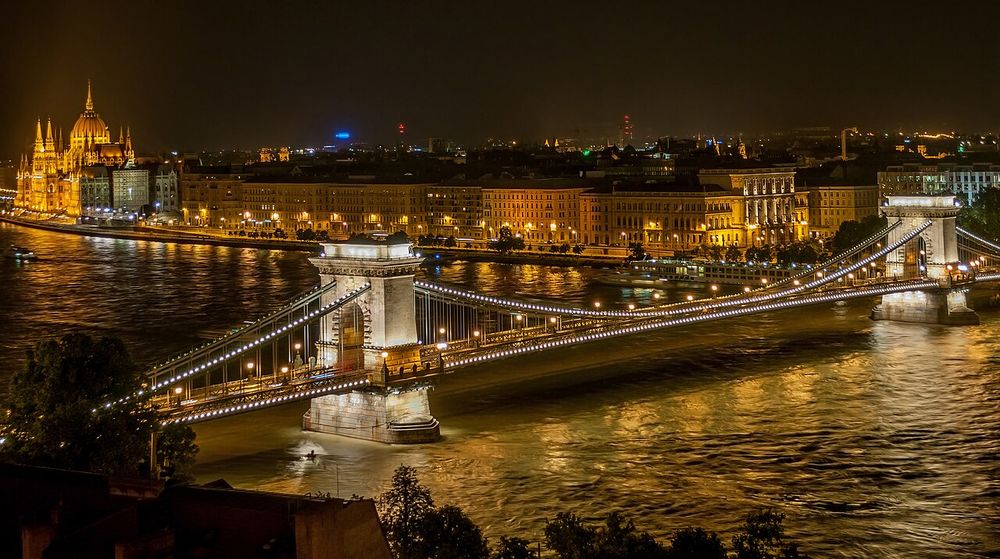
In front of you the Danube turns south. Across it is Pest. To the left the Chain Bridge, the first permanent bridge between the two towns, opened in 1849. Further left, on the far bank, the Parliament.
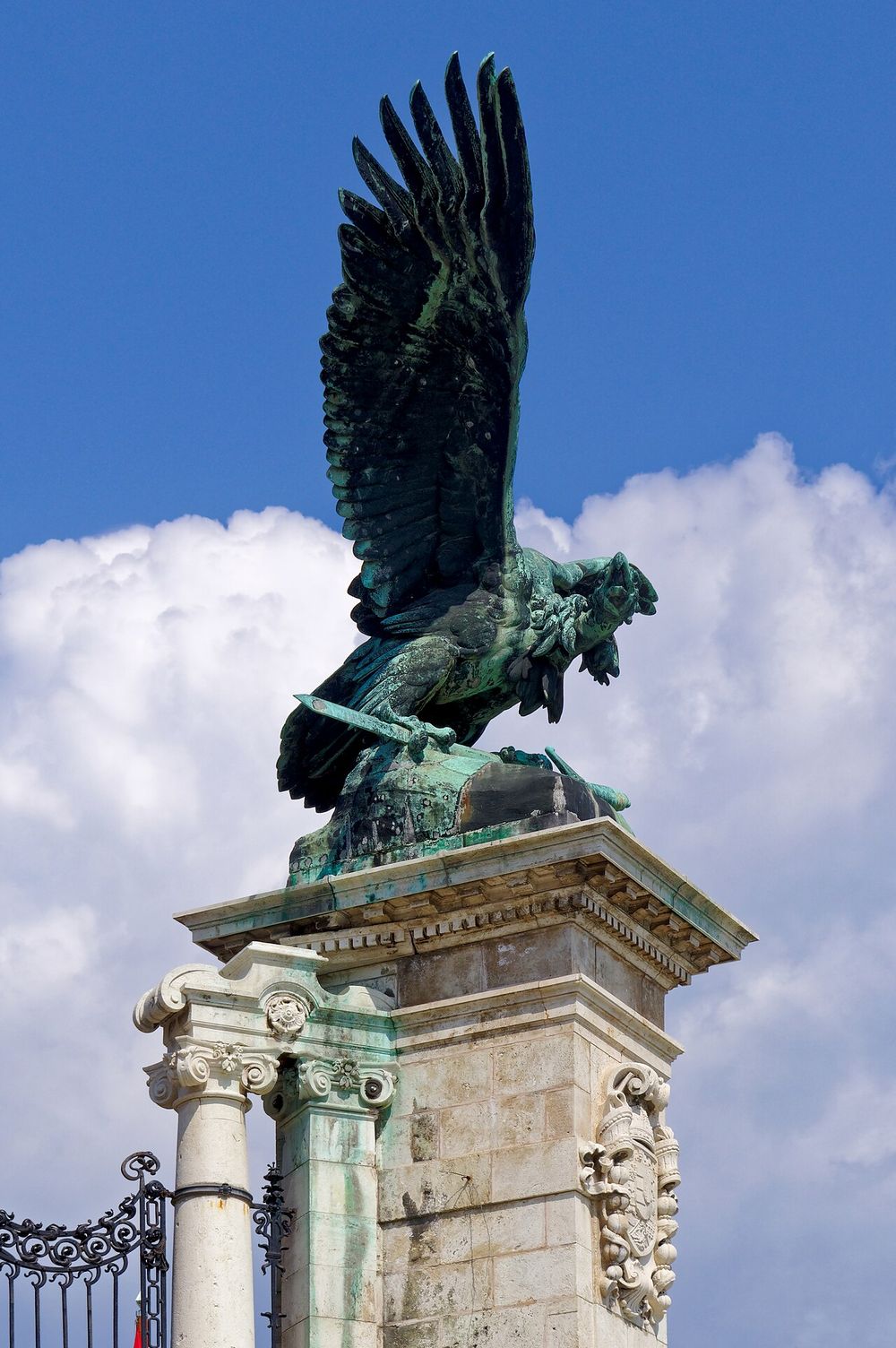
The turul over the gateJakub Hałun, CC BY-SA 4.0
Behind you a great bronze bird spreads its wings over the gate. It is the turul, the falcon of Hungarian legend that led the Magyars to their new home. It was set up in 1905.
The building behind it is not the palace of the kings. It is a museum building in a palace's clothes. Inside are the Hungarian National Gallery, the Budapest History Museum and the national library.
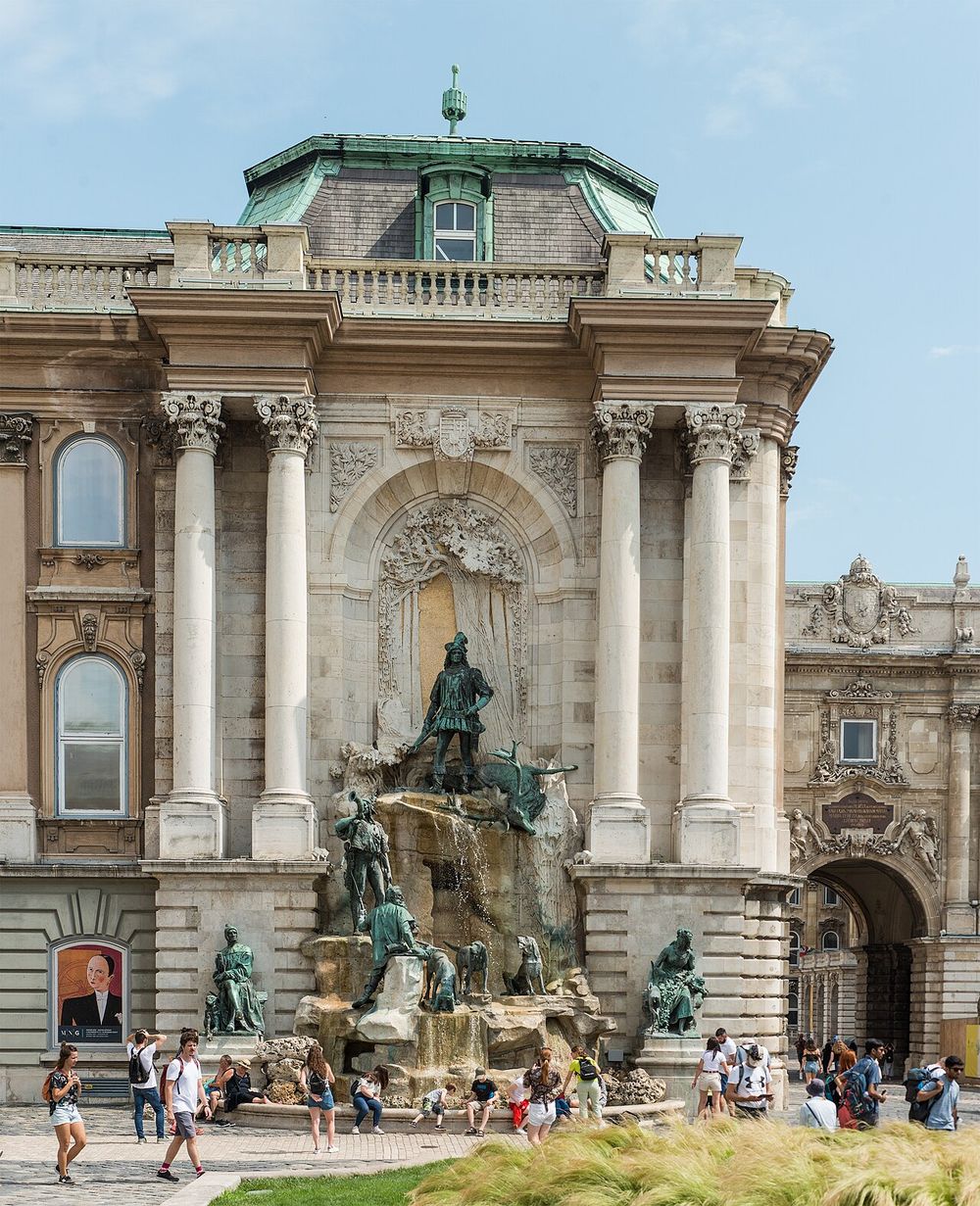
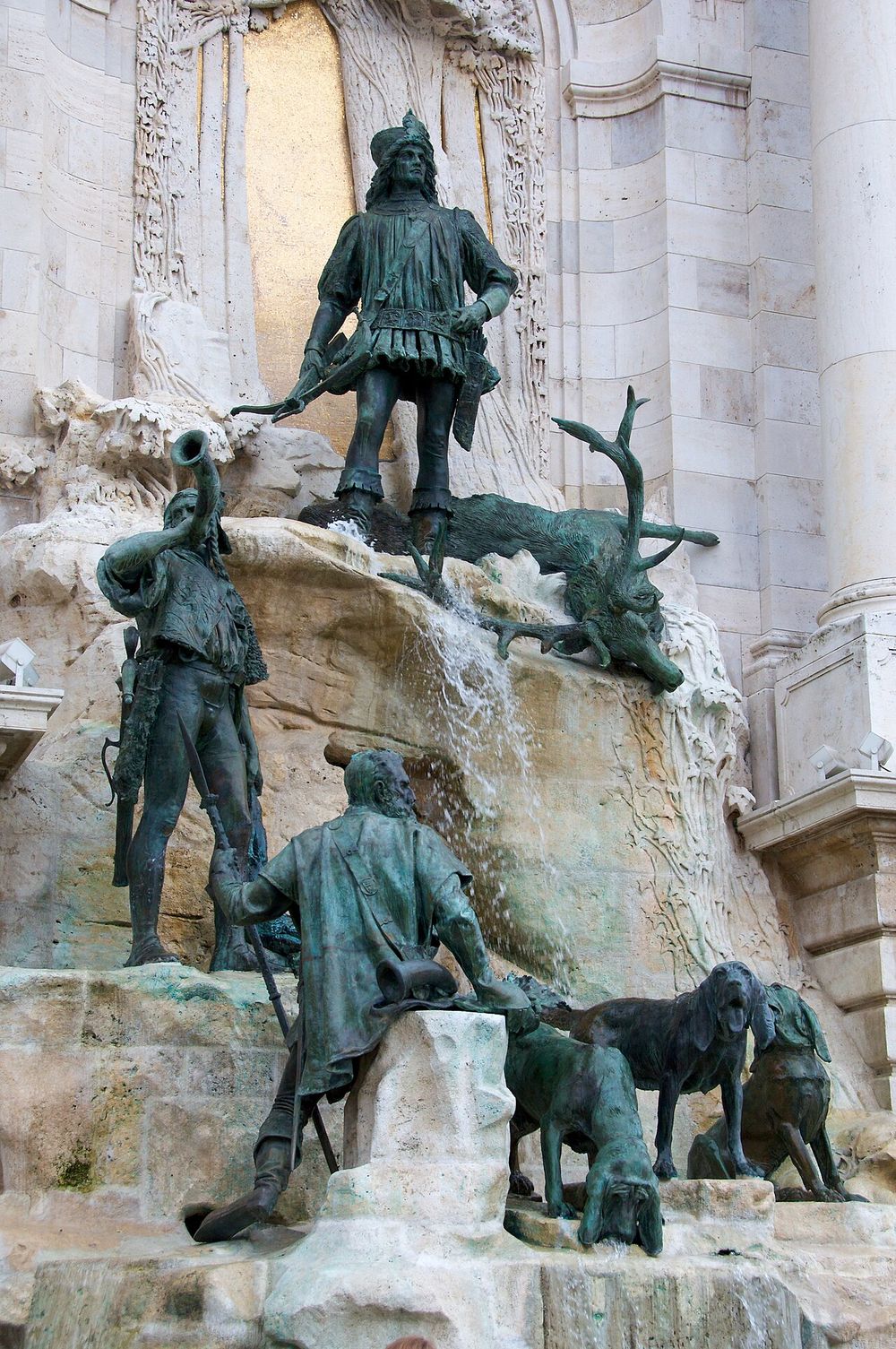
The Matthias Fountain, 1904Carl von Einem (Einemnet), CC BY-SA 4.0
Walk round to the courtyard on the west side for the Matthias Fountain: the king in hunting dress over a stag he has killed, and a girl watching him. Her story is in the legends.
Things people often get wrong
"The castle is a single building." Buda Castle means the whole hill: the palace, the old town of streets and churches to its north, the Fisherman's Bastion and Matthias Church. They have separate pages here.
"You need a ticket for the castle." The hill, the terraces and the courtyards are free, day and night. Only the museums inside charge.
"It is a medieval castle." The walls you see are mostly of the nineteenth and twentieth centuries. The medieval palace lies underneath, and parts of it can be seen in the History Museum.
"The funicular is the only way up." It is the easiest and the dearest. You can walk up from the river by the free stairs and lifts of the Várkert Bazár, or take bus 16.
People who stood here
We searched Hungarian and English sources for this list.
King Matthias Corvinus (king of Hungary 1458–1490)The most loved king in Hungarian memory. He filled the palace with Italian artists and scholars and built one of the great libraries of Europe, the Corvina. After his death it was scattered. About two hundred of its books survive in libraries around the world.
Suleiman the Magnificent (Ottoman sultan)On 29 August 1541 his army took Buda without a fight. The palace became the seat of an Ottoman pasha for 145 years.
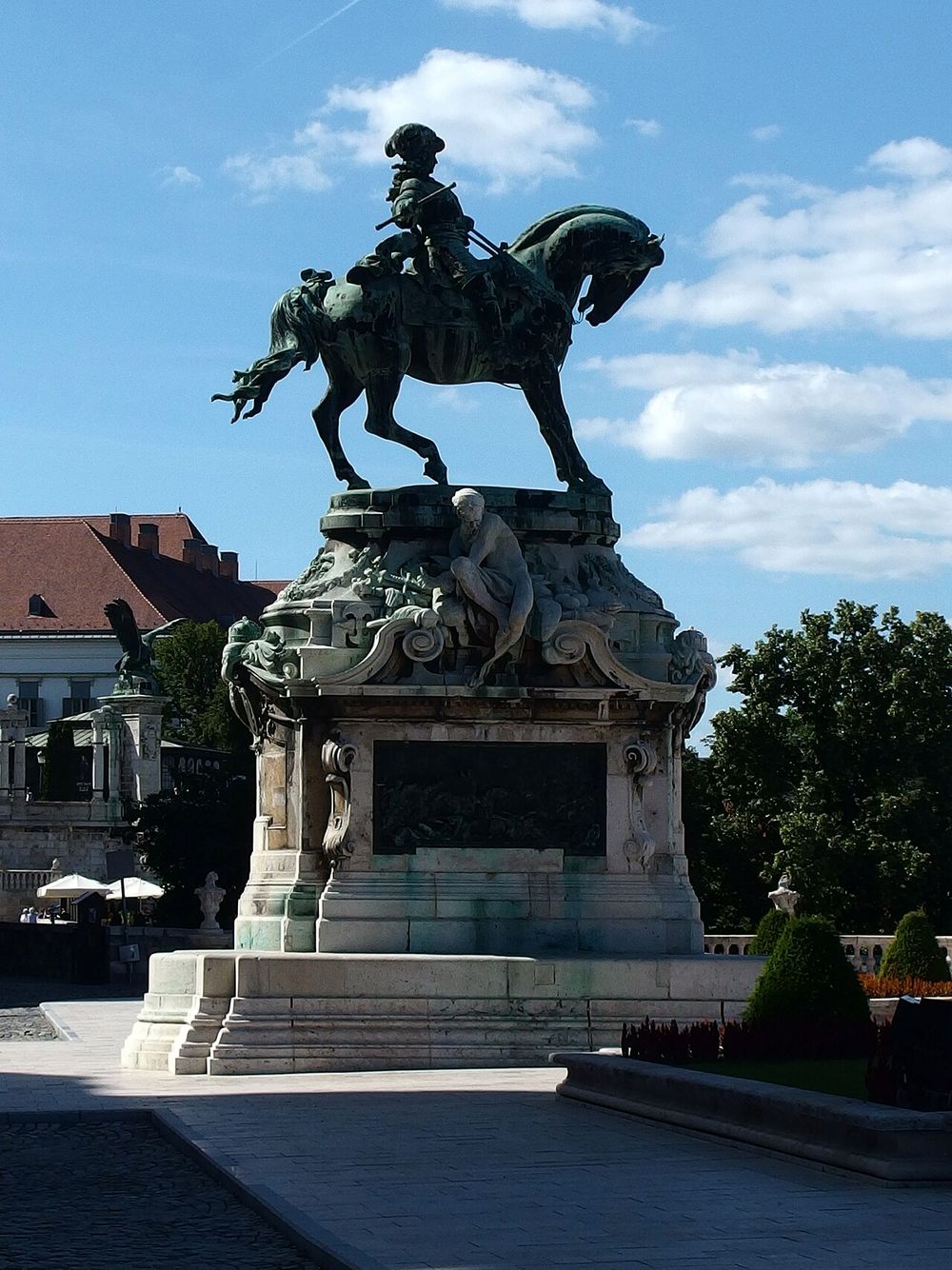
Prince Eugene of Savoy (general)As a young officer he fought in the siege of 1686 that took Buda back from the Ottomans. His statue on horseback stands on the terrace.
Empress Elisabeth ("Sisi") and Emperor Franz JosephThey were crowned king and queen of Hungary in the church on the hill in 1867, and stayed in the palace on their visits. Sisi loved Hungary, and many Hungarians loved her back.
Sándor Petőfi (Hungarian poet, 1823–1849)On 15 March 1848, the first day of the revolution, he and the crowd crossed the river to the governor's council in the castle district and won the release of the imprisoned writer Mihály Táncsics. Chinese readers know him from the lines "生命诚可贵,爱情价更高" and from Lu Xun, who translated him.
Miklós Horthy (regent of Hungary 1920–1944)He ruled Hungary from this palace for twenty-four years. In October 1944 German commandos seized the hill and forced him out.
Go deeper: seven stops, from the Chain Bridge to the ruins under the palace
Walk the hill from south to north. The museums need half a day each; the outside needs two hours.
1. The Chain Bridge and the funicular
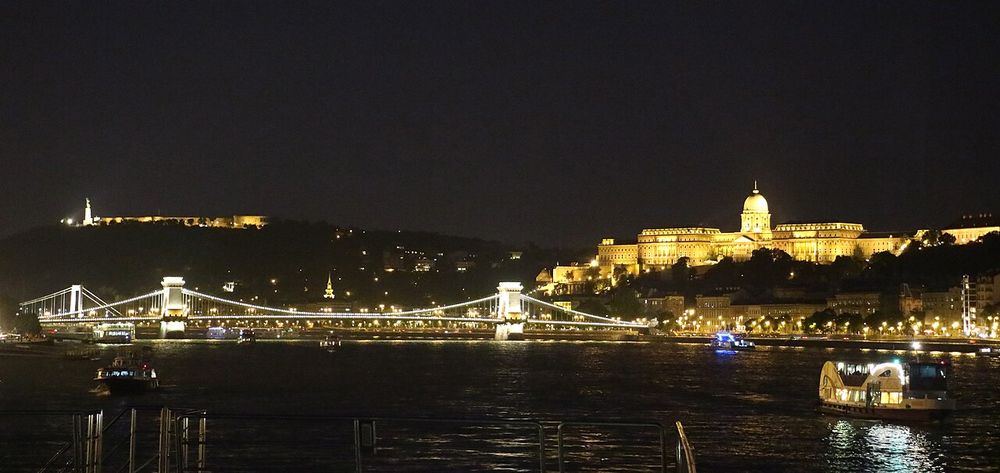
The palace lit goldAritra Kar, CC BY-SA 3.0
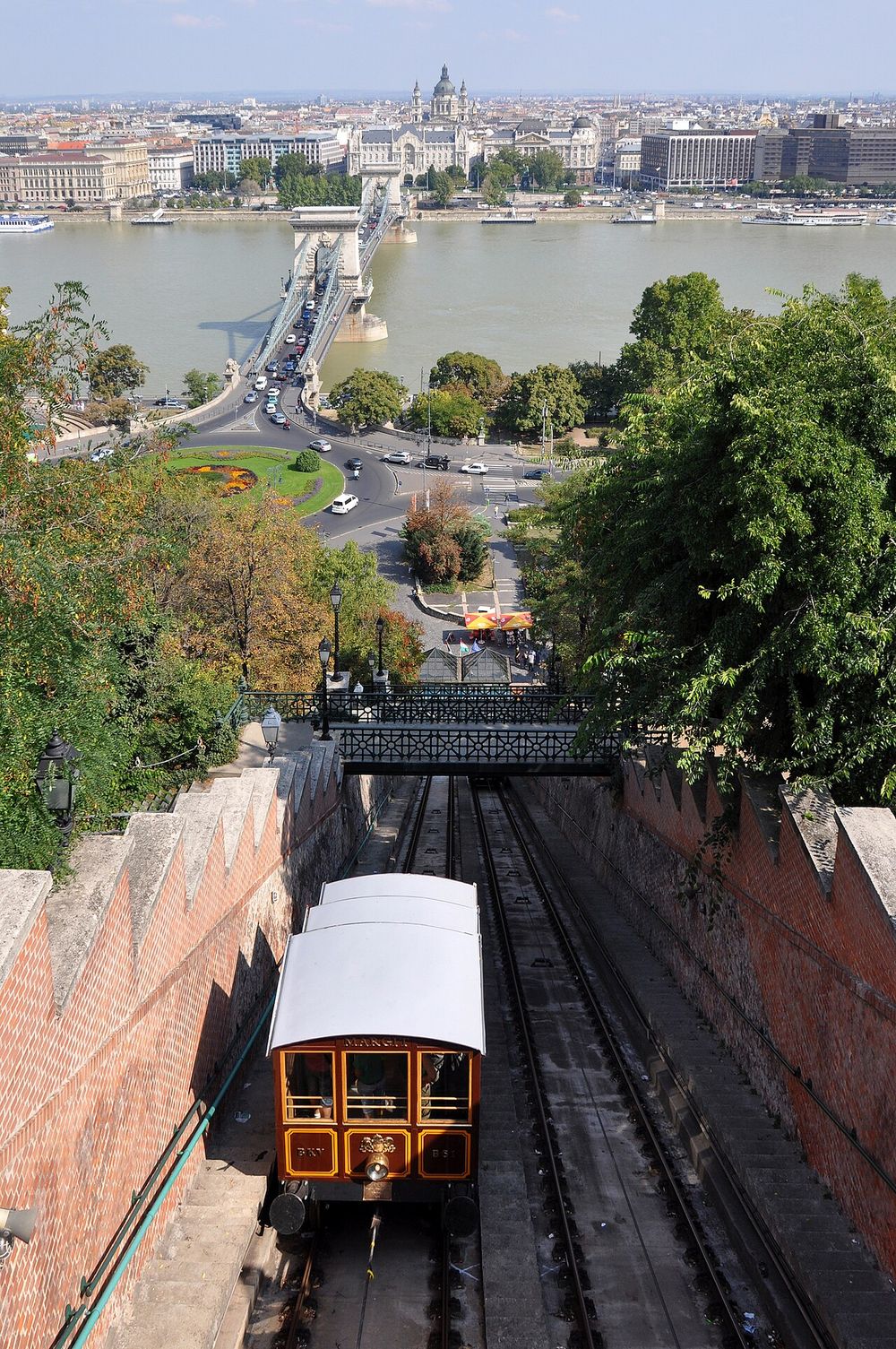
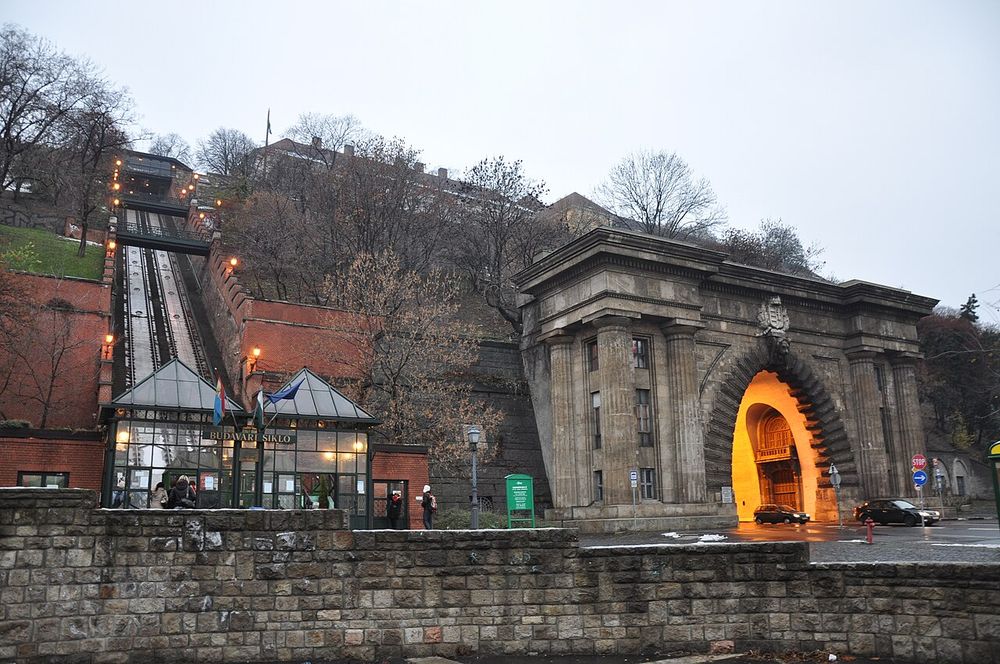
Count István Széchenyi paid for the Chain Bridge and brought a Scottish engineer, Adam Clark, to build it. Clark stayed, married in Budapest, and also dug the tunnel under the hill. The square at the bridge end is named after him.
A funicular car, 2024Random photos 1989, CC0
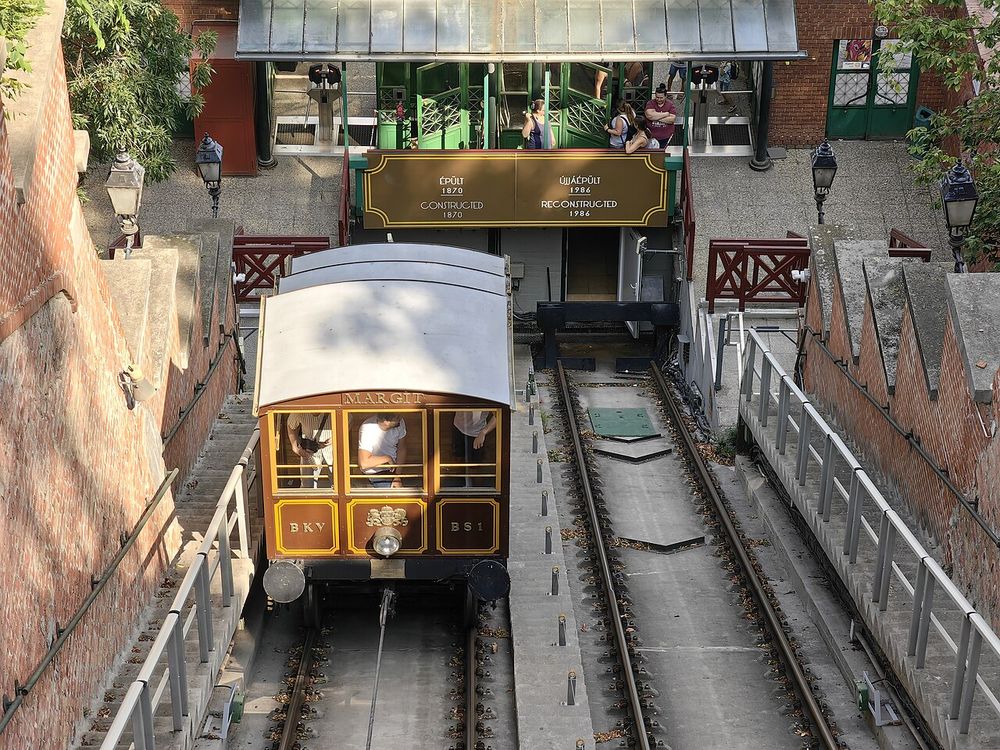
The funicular opened in 1870, one of the first in Europe. It was wrecked in 1944 and reopened only in 1986. Its two cars pass each other halfway.
2. The terrace and the turul
The turul with its swordSteve Collis from Melbourne, Australia, CC BY 2.0
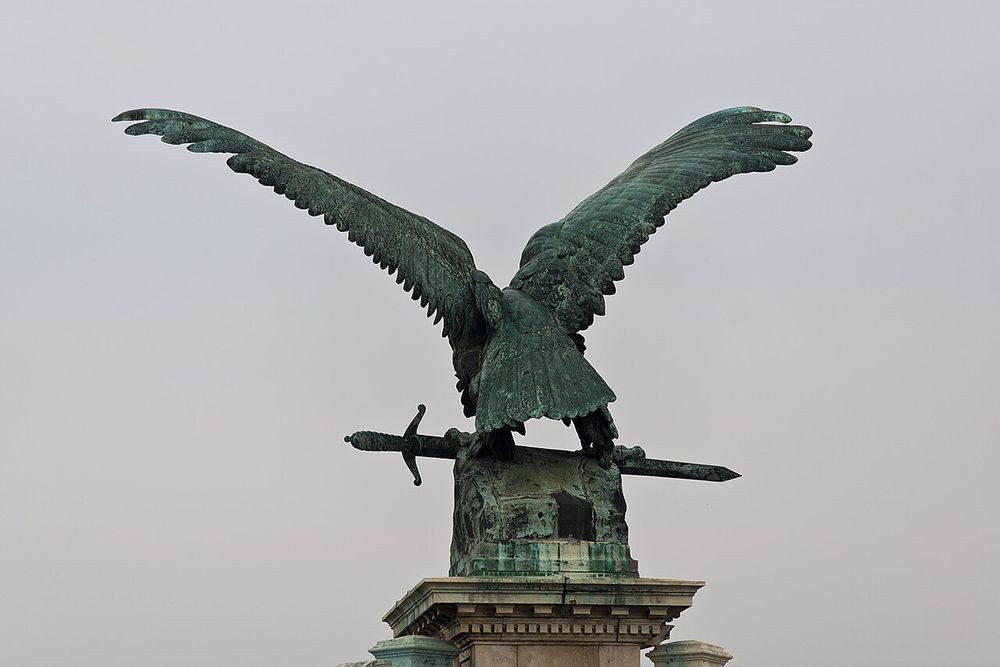
The bird holds a sword in its claws. In legend a turul came in a dream to Emese, mother of Álmos, foretelling that her son would found a line of kings. The kings who lived here counted themselves his descendants.
Prince Eugene on the terraceMark Ahsmann, CC BY-SA 3.0
On the terrace in front of the dome stands Prince Eugene, facing the river. From here the view of Pest is the best in the city at dusk, when the Parliament lights up.
3. The palace that is a copy
The palace at sunrise, 2021VargaA, CC BY-SA 4.0
Maria Theresa built a baroque palace here in the 1750s and 60s. Between 1875 and 1912 the architects Miklós Ybl and Alajos Hauszmann doubled it to over three hundred metres and gave it a dome. Franz Joseph hardly used it.
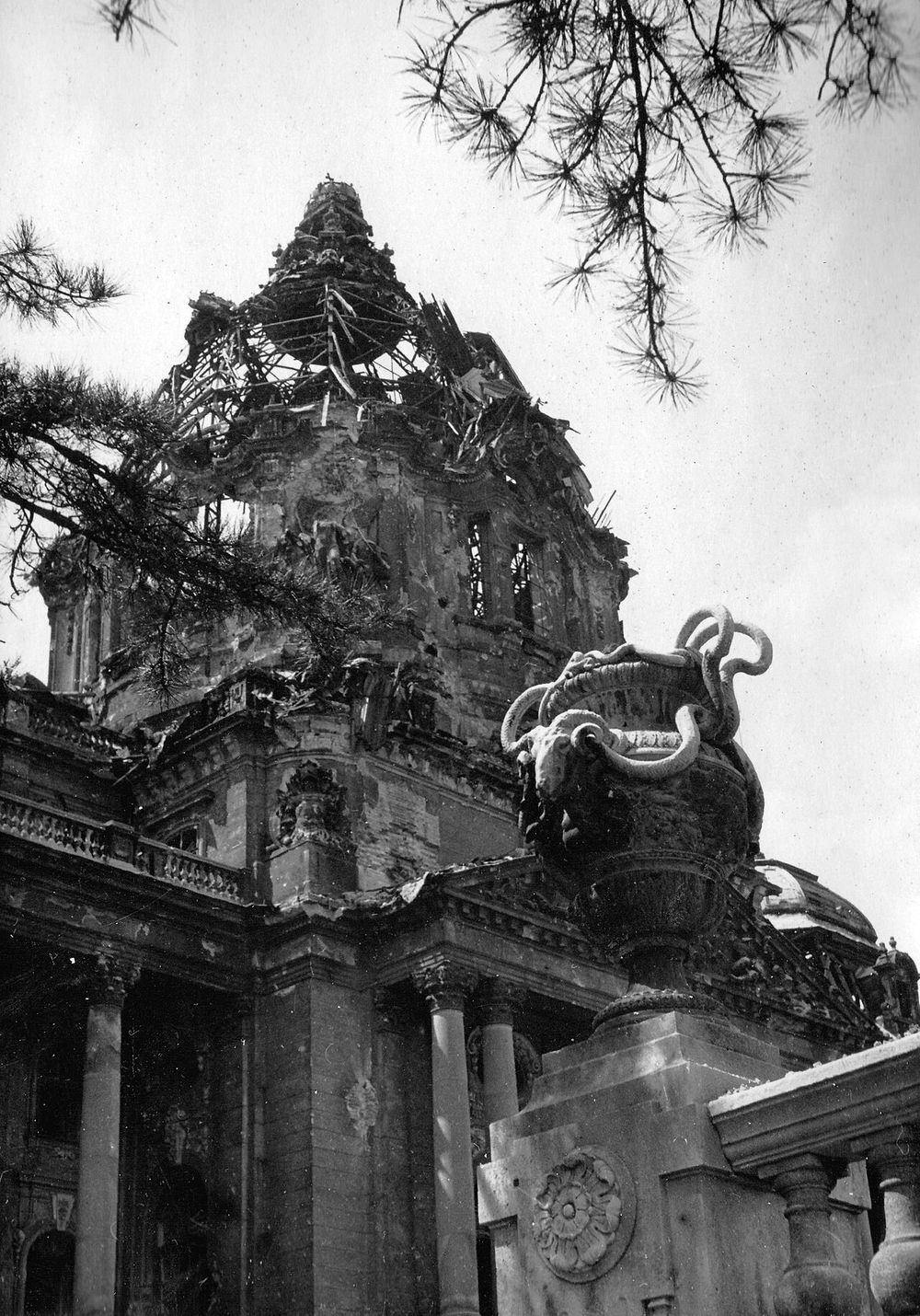
The river front with the ruined dome, 1945FOTO:Fortepan — ID 30891: Adományozó/Donor: Military Museum of Southern New Engl, CC BY-SA 3.0
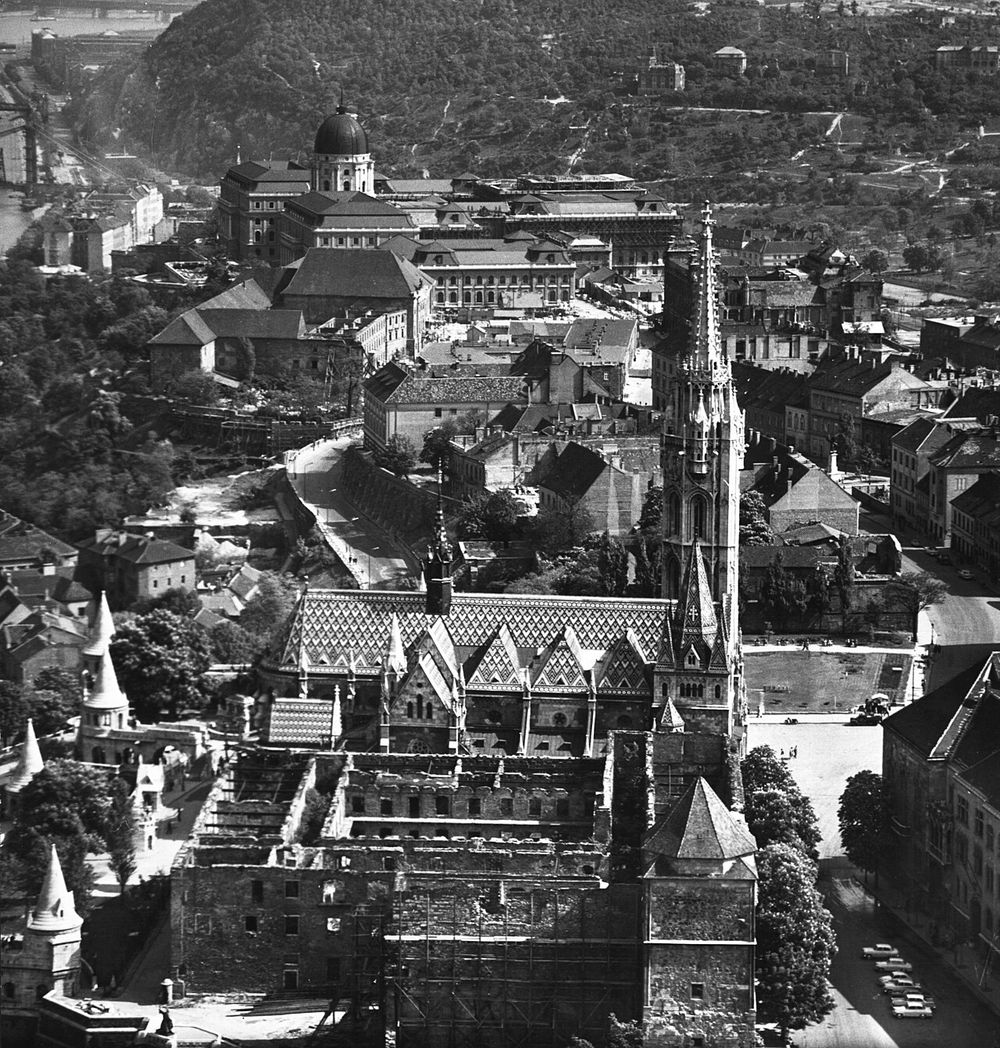
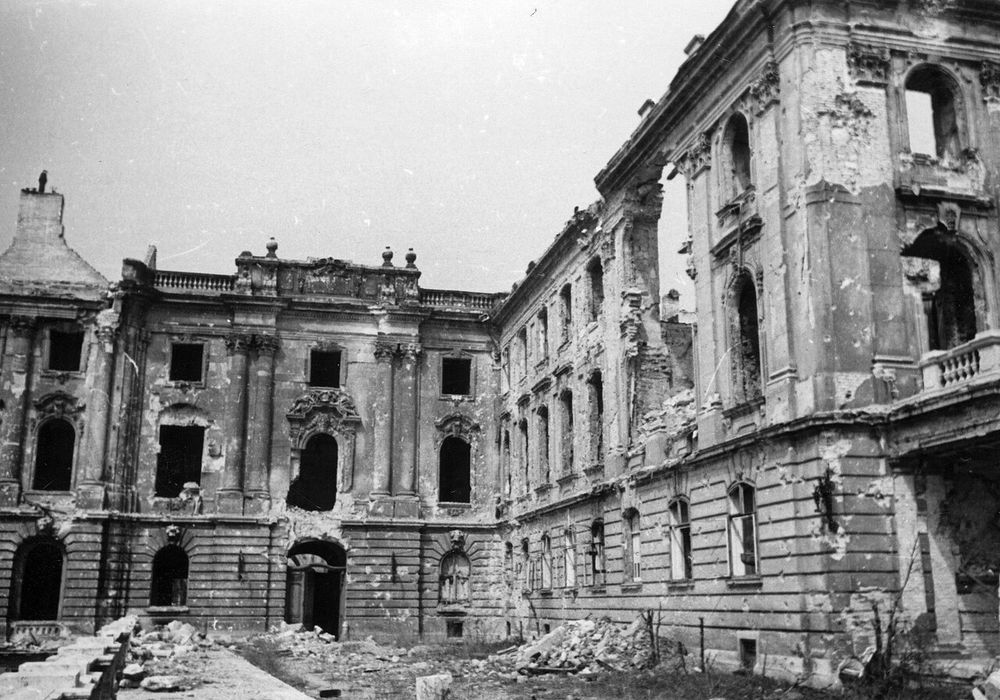
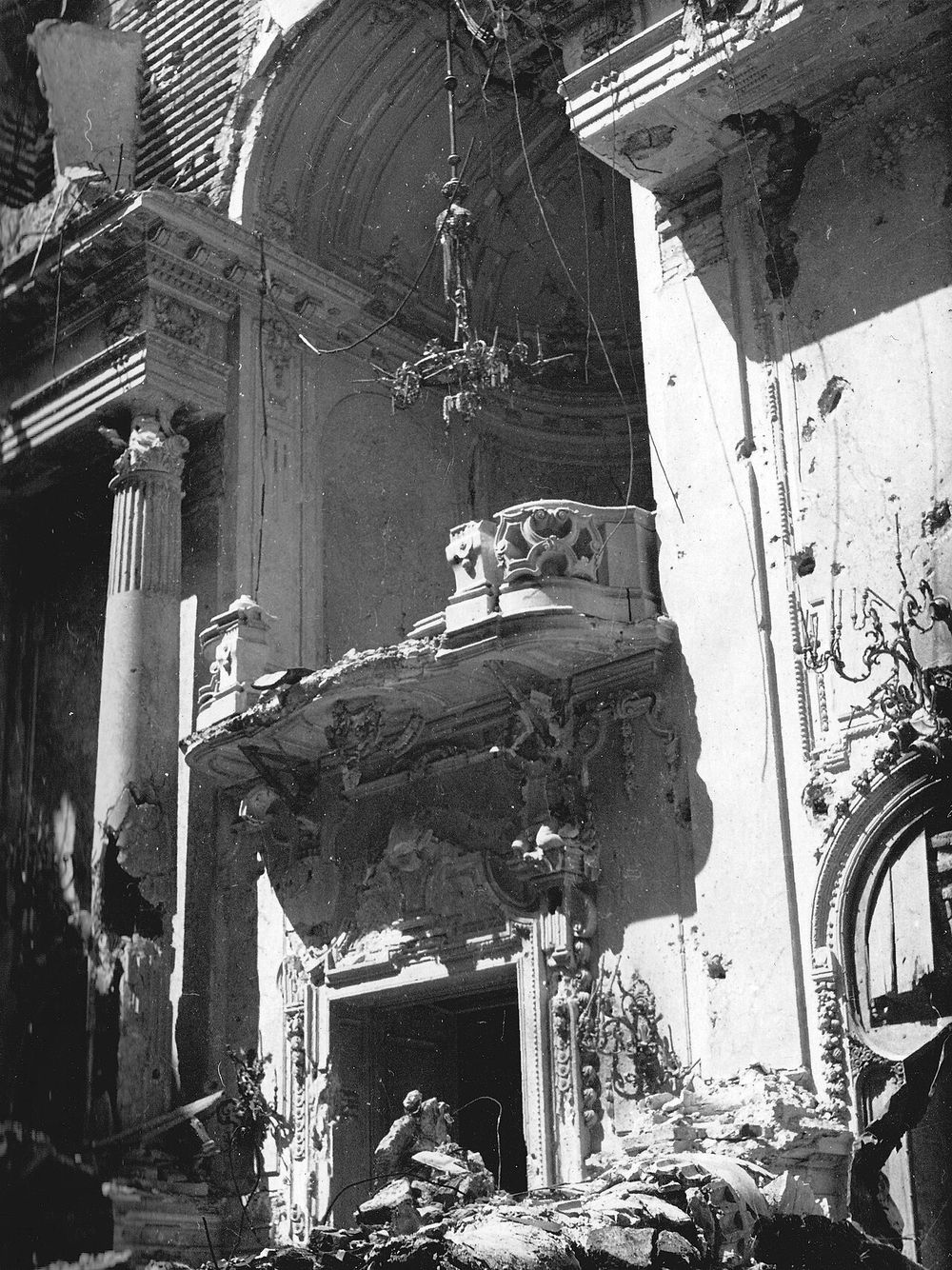
In the winter of 1944–45 German and Hungarian troops made their last stand on the hill for fifty days. When it ended, the dome was a skeleton and the halls were open to the sky.
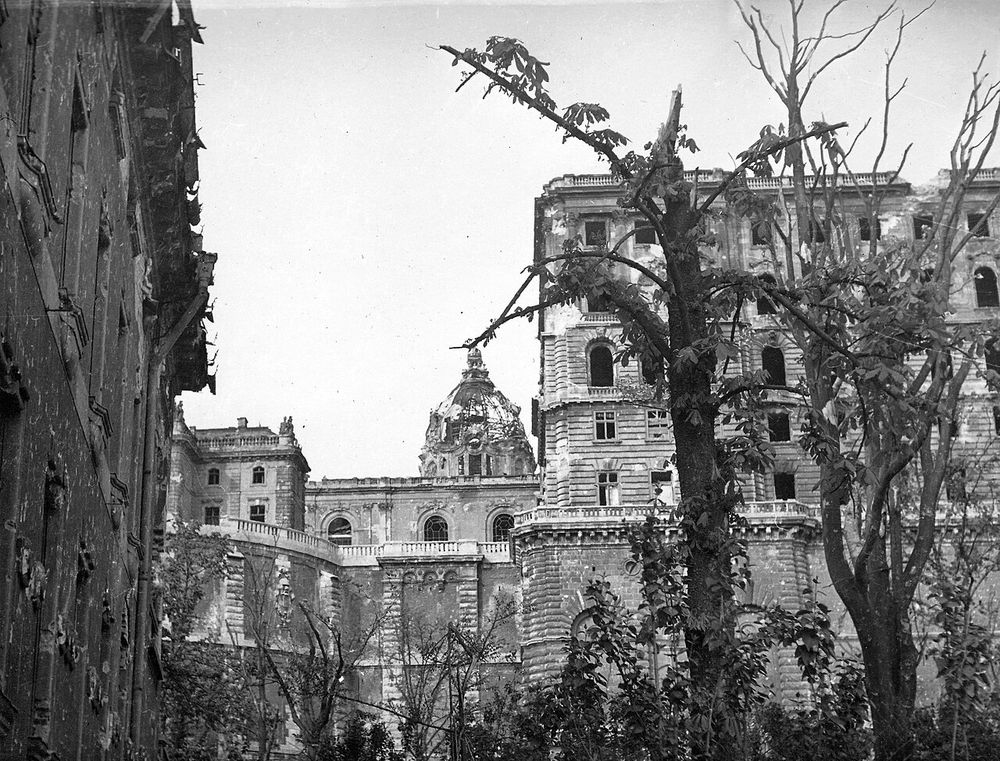
The palace from Palota tér, 1945FOTO:Fortepan — ID 30902: Adományozó/Donor: Military Museum of Southern New Engl, CC BY-SA 3.0
The communist government rebuilt the shell and stripped the inside. The dome was given a new shape. The rich rooms of 1912 were gone.
4. St Stephen's Hall: a room come back
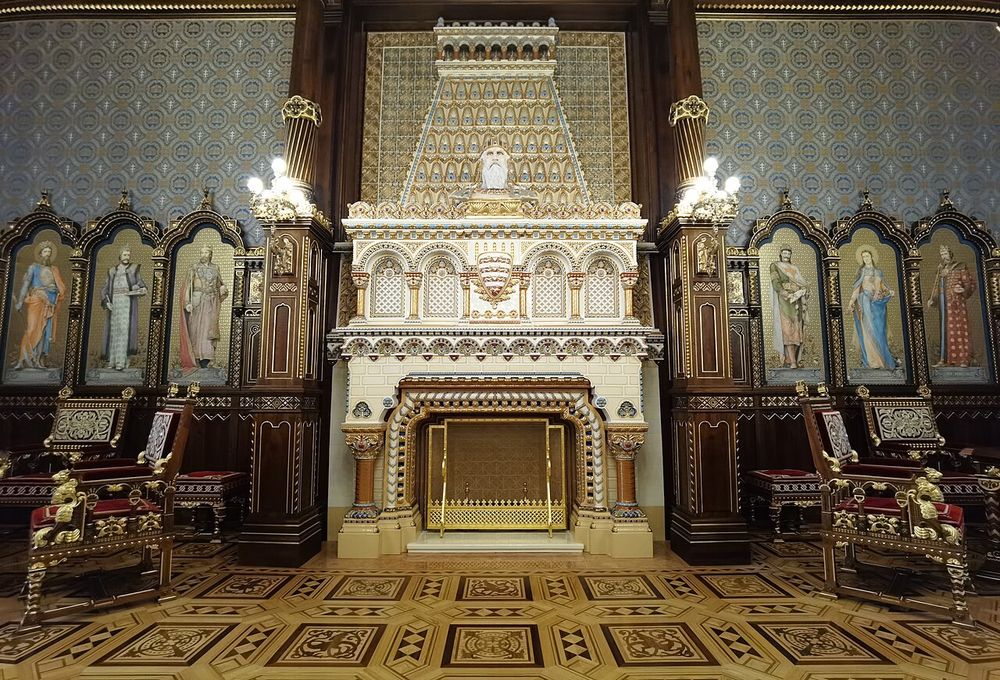
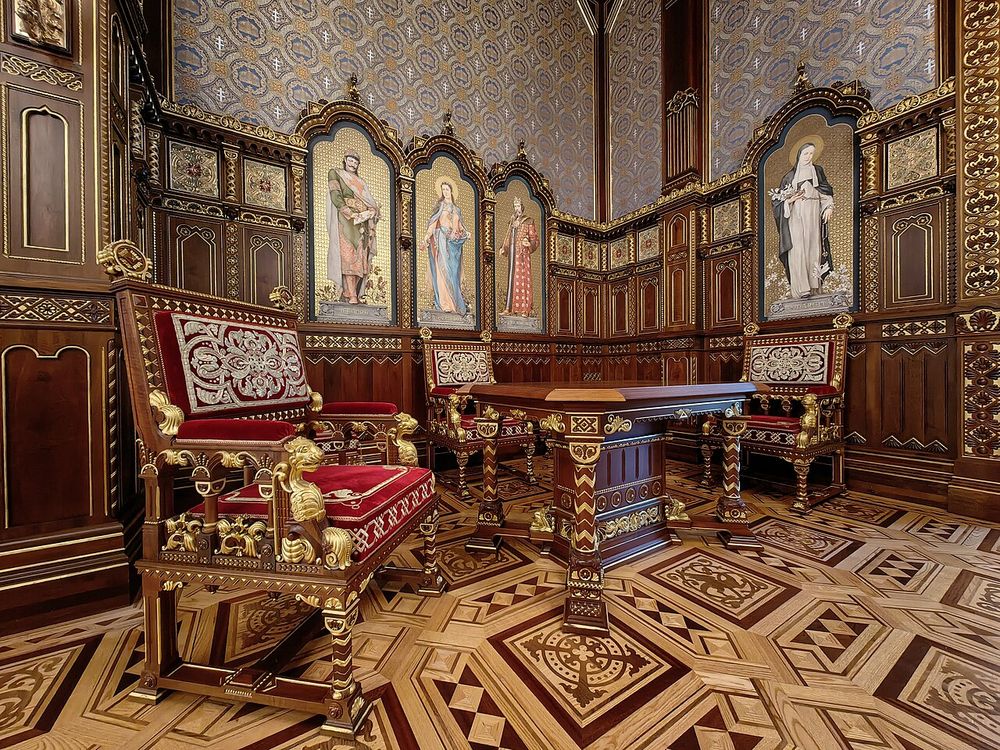
St Stephen's Hall, rebuilt 2021Random photos 1989, CC BY-SA 4.0
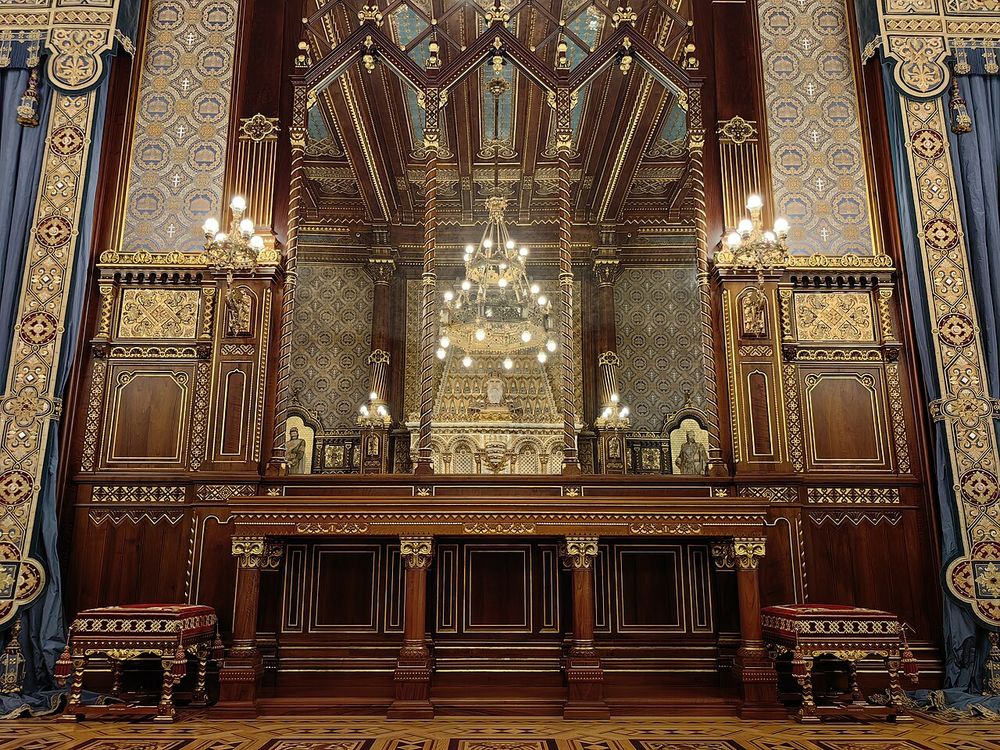
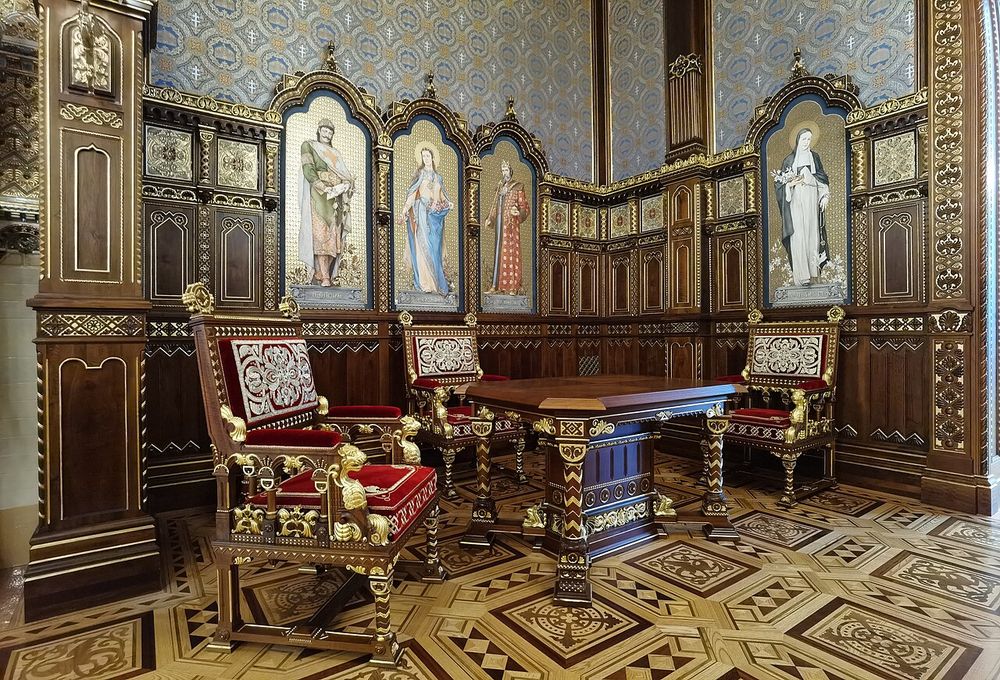
Since 2021 one of those rooms is back. St Stephen's Hall was rebuilt from old photographs and surviving pieces, with carved wood, Zsolnay ceramic stove and painted saints. It is part of a government programme to restore the palace of 1912.
The great ceramic stoveRandom photos 1989, CC BY-SA 4.0
Many Hungarians are glad to see it. Others think rebuilding vanished rooms is costly make-believe. Either way, it is the closest you can come to the palace the last kings knew.
5. The Matthias Fountain and the Lion Court
The king's hunters and dogsBriYYZ from Toronto, Canada, CC BY-SA 2.0
Alajos Stróbl made the fountain in 1904. The king stands at the top in hunting clothes, with his hunters and dogs below. The girl on the right is Ilonka, from a ballad by Mihály Vörösmarty.
Through the gate guarded by lions is the inner courtyard and the entrance to the History Museum.
6. Under the palace: the king's Gothic rooms
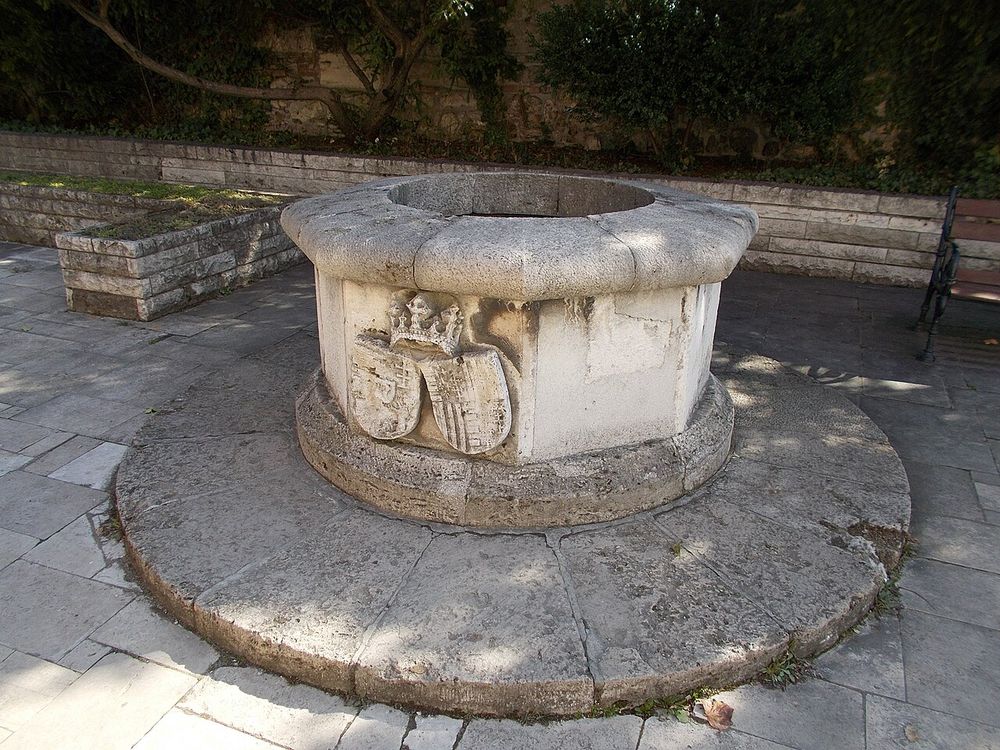
The arms of Matthias and Beatrice on a fountain basinGlobetrotter19, CC BY-SA 4.0
After the war, archaeologists digging in the rubble found the medieval palace under the baroque one: vaulted halls, a chapel, carvings from Matthias' Renaissance court. The History Museum shows them in its lower floors. The coat of arms of Matthias and his queen, Beatrice of Naples, is carved on a fountain basin from his court.
Matthias married Beatrice in 1476, and through her Italian craftsmen, books and ideas came to Buda. For a few years before his death in 1490 this was one of the most brilliant courts in Europe.
7. Night, and the same years in China
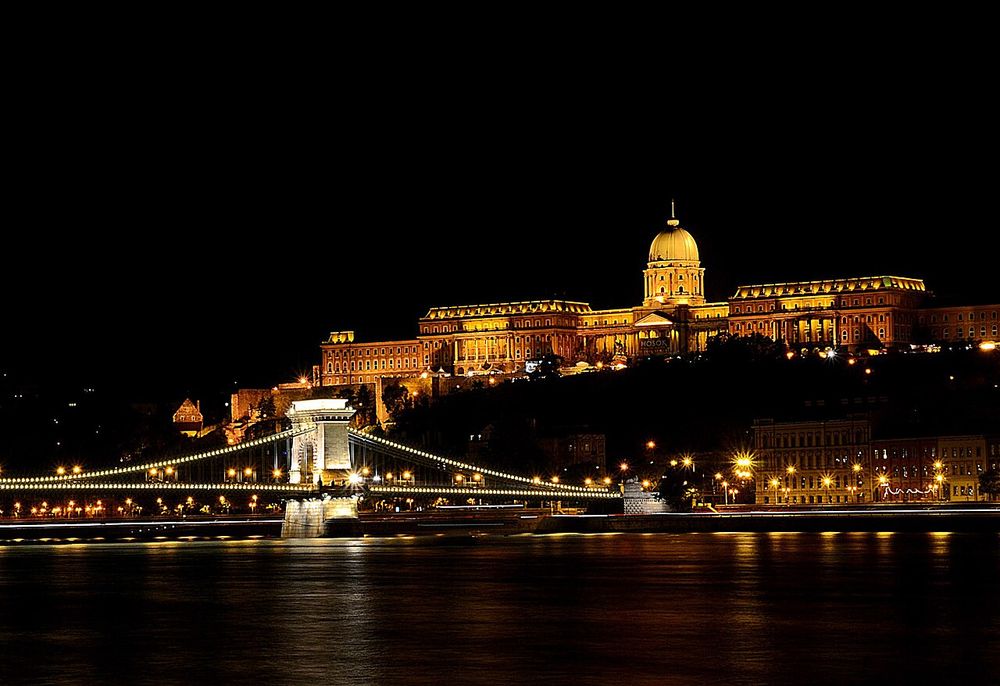
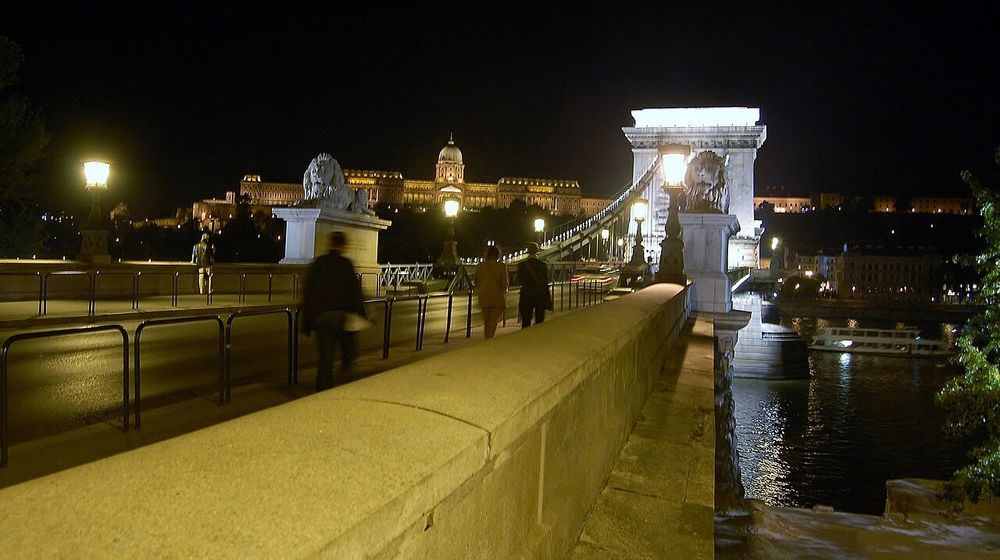
The palace and the Chain Bridge at night, 2006Bahnfrend, CC BY-SA 4.0
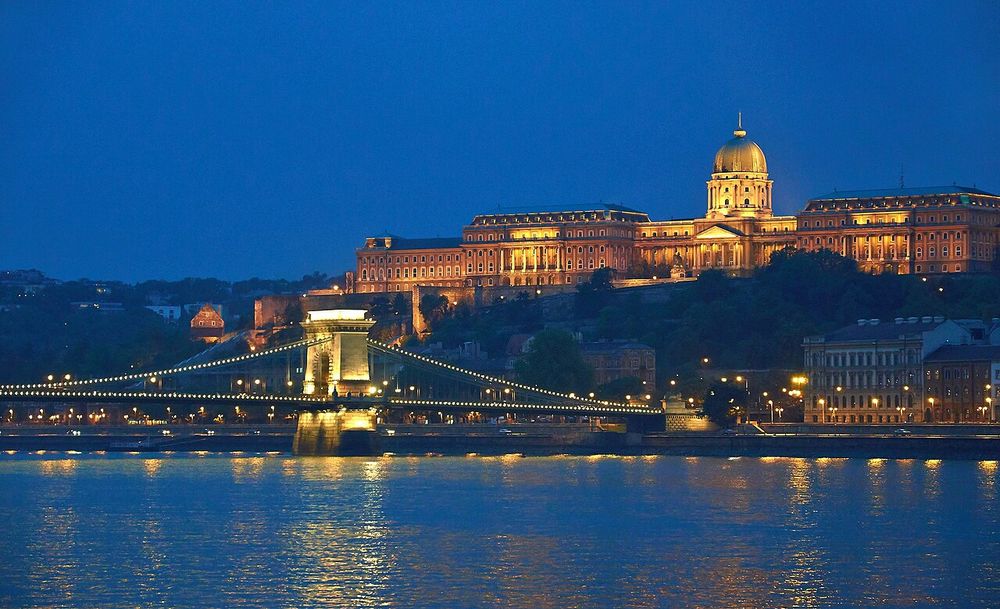
Cross back over the Chain Bridge after dark and turn round. The palace is lit gold above the river. It looks older and grander from below than it is up close, which is what its builders meant.
Béla IV walled this hill after the Mongol invasion of 1241, the same Mongols who were then conquering northern China. Matthias ruled in the years of the Ming (1368–1644) emperor Chenghua (1464–1487). When Suleiman took Buda in 1541, the Jiajing emperor (1521–1567) was on the Ming throne.
Meanwhile in the world
Year
Here
Elsewhere
1247
Béla IV walls the hill after the Mongol invasion
Louis IX prepares his crusade
1476
Matthias marries Beatrice of Naples
Caxton prints the first book in England
1541
The Ottomans take Buda
Calvin settles in Geneva
1686
The siege that retakes Buda; the palace burns
Newton finishes his Principia
1849
Hungarian rebels storm the hill; the Chain Bridge opens
The California gold rush
1912
The palace is finished
The Titanic sinks
1945
The siege ends; the palace is a ruin
The Second World War ends
2021
St Stephen's Hall reopens
The world reopens after the pandemic
One line to remember: besieged thirty times, burned three times, and still the crown of the city's skyline.
Then and now
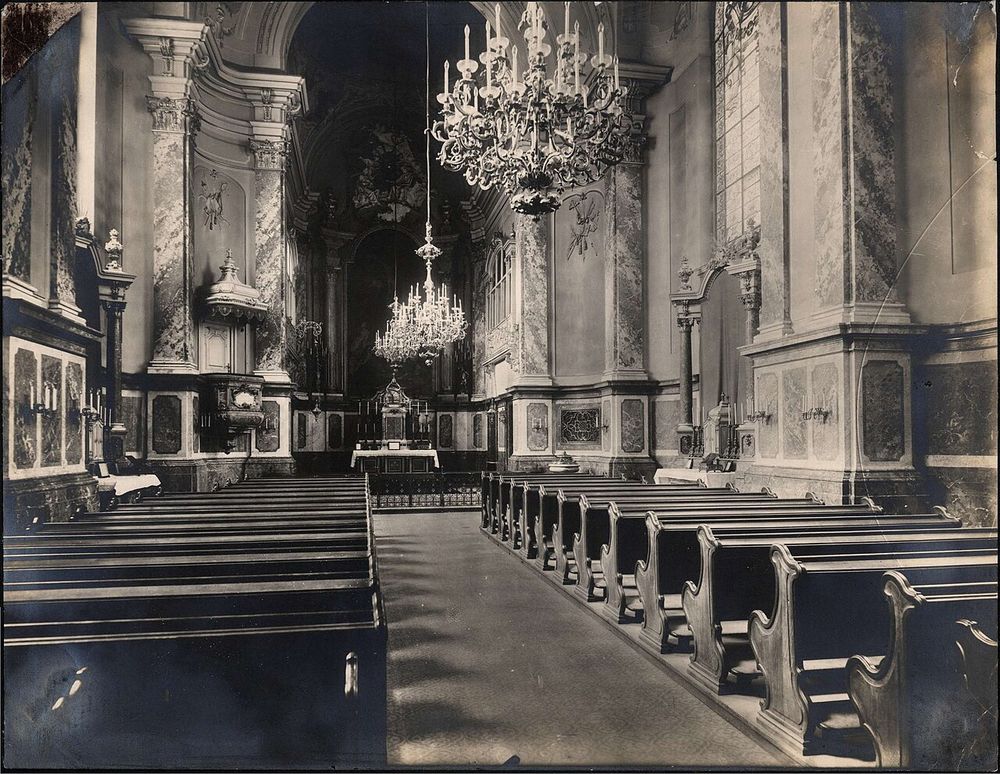
The palace from across the Danube, 2025Paul Colin Hennig firstdorsal.eu, CC BY-SA 4.0, Wikimedia CommonsThe palace behind the Elisabeth Bridge, 2025Paul Colin Hennig firstdorsal.eu, CC BY-SA 4.0, Wikimedia CommonsThe palace and the river boatsAlex Proimos from Sydney, Australia, CC BY 2.0, Wikimedia CommonsThe palace and the Chain Bridge at dusk, 2012Moyan Brenn from Italy, CC BY 2.0, Wikimedia CommonsThe palace from the Pest bank, 2019Jakub Hałun, CC BY-SA 4.0, Wikimedia CommonsThe palace and Castle Hill from Gellért Hill, 2019Jakub Hałun, CC BY-SA 4.0, Wikimedia CommonsThe palace at sunrise, 2021VargaA, CC BY-SA 4.0, Wikimedia CommonsInside the rebuilt domeRandom photos 1989, CC BY-SA 4.0, Wikimedia CommonsThe Matthias Fountain, 1904Carl von Einem (Einemnet), CC BY-SA 4.0, Wikimedia CommonsThe king's hunters and dogsBriYYZ from Toronto, Canada, CC BY-SA 2.0, Wikimedia CommonsThe arms of Matthias and Beatrice on a fountain basinGlobetrotter19, CC BY-SA 4.0, Wikimedia CommonsThe turul over the gateJakub Hałun, CC BY-SA 4.0, Wikimedia CommonsThe turul with its swordSteve Collis from Melbourne, Australia, CC BY 2.0, Wikimedia CommonsPrince Eugene on the terraceMark Ahsmann, CC BY-SA 3.0, Wikimedia CommonsThe funicular above the Chain BridgeMarc Ryckaert (MJJR), CC BY 3.0, Wikimedia CommonsThe funicular and the tunnel at nightJorge Láscar from Australia, CC BY 2.0, Wikimedia CommonsA funicular car, 2024Random photos 1989, CC0, Wikimedia CommonsSt Stephen's Hall, rebuilt 2021Random photos 1989, CC BY-SA 4.0, Wikimedia CommonsSt Stephen's Hall, the throne sideRandom photos 1989, CC BY-SA 4.0, Wikimedia CommonsCarved wood and painted saintsRandom photos 1989, CC BY-SA 4.0, Wikimedia CommonsThe great ceramic stoveRandom photos 1989, CC BY-SA 4.0, Wikimedia CommonsThe palace and the Chain Bridge at night, 2006Bahnfrend, CC BY-SA 4.0, Wikimedia CommonsThe bridge, Gellért Hill and the palace by nightErik Cleves Kristensen, CC BY 2.0, Wikimedia CommonsThe palace lit goldAritra Kar, CC BY-SA 3.0, Wikimedia CommonsThe Chain Bridge at nightWilfredor, CC0, Wikimedia CommonsCastle Hill from the air, Matthias Church in front and the palace behindFOTO:Fortepan — ID 77665: Adományozó/Donor: Simon Gyula. archive copy at the Way, CC BY-SA 3.0, Wikimedia CommonsThe palace chapel before the warUnknown authorUnknown author, Public domain, Wikimedia CommonsThe western courtyard, after 1945FOTO:Fortepan — ID 52038: Adományozó/Donor: Kramer István dr., CC BY-SA 3.0, Wikimedia CommonsThe palace from Palota tér, 1945FOTO:Fortepan — ID 30902: Adományozó/Donor: Military Museum of Southern New Engl, CC BY-SA 3.0, Wikimedia CommonsThe river front with the ruined dome, 1945FOTO:Fortepan — ID 30891: Adományozó/Donor: Military Museum of Southern New Engl, CC BY-SA 3.0, Wikimedia CommonsThe ruins of the ballroomFOTO:Fortepan — ID 22263: Adományozó/Donor: Military Museum of Southern New Engl, CC BY-SA 3.0, Wikimedia Commons
Local legends
These are stories people tell about this place. They are legends, not history, and each one says where it comes from.
LegendIlonka at the fountain
A girl named Ilonka met a handsome hunter in the forest and fell in love. When she came to Buda to find him, she saw him ride in at the head of the court: he was King Matthias. Knowing she could never have him, she died of grief.
Source: Mihály Vörösmarty's ballad Szép Ilonka (1833), from older folk tales
LegendMatthias the Just
Hungarians tell hundreds of stories of King Matthias walking among his people in disguise, testing his officials and punishing the greedy. "Matthias is dead, justice is gone," the saying goes.
Source: Hungarian folk tales and proverb
LegendNo clinking of beer
Hungarians do not clink beer glasses. The story is that Austrian officers clinked beer to celebrate when thirteen Hungarian generals were executed at Arad in 1849, and Hungary swore not to do it for 150 years. Many still do not.
Source: Widely told in Hungary; historians have found no record of the toast
Later, people who live here will be able to add the stories they grew up with, and say which of these they have heard.
Not certain, and where accounts conflict
How many sieges?
Hungarian guides say Buda was besieged thirty-one times. Counts differ by what is called a siege.
Should the old rooms be rebuilt?
The government's programme is rebuilding parts of the 1912 palace and moving the National Gallery out. Some architects and historians support it; others say the money should protect what survives, and that the post-war building is itself history.
Checked 2026-11-12 The palace has no single ticket office. The first button is the Budapest History Museum (Castle Museum), the second the Hungarian National Gallery; each sells its own tickets.
Tickets and hours
The hill is open at all hours and free.
The museums are usually closed on Mondays. The History Museum closes earlier in winter. Check each one before you go.
The funicular runs from early morning to late evening and costs several thousand forints.
Last checked 2026-11-12. Budapest guides of 2026 and the sites of the museums in the palace.
Booking from abroad
Official page in English Each museum sells its own tickets on its own site in Hungarian and English, paid by card. The terraces and courtyards need no ticket.
Ticket window on site Ticket desks at each museum entrance sell tickets on the day.
Note The Budapest Card gives free or reduced entry to several of the museums and free public transport.
Checked 2026-11-12
Where to start
From the Pest side, cross the Chain Bridge on foot and take the funicular, or walk up through the Várkert Bazár on the river side, which has free lifts. Bus 16 runs from Deák tér to the top.
Start at the palace terrace, then walk north through the old streets to the Fisherman's Bastion.
Come back at night to see it lit, from the Pest embankment or tram 2.
Before you go
Hungary uses the forint, not the euro. Cards are accepted almost everywhere.
The hill is steep and the paving uneven. Wear flat shoes.
Restaurants on the hill charge far more than those below.
Customs and manners
Hungarians put the family name first: Petőfi Sándor, not Sándor Petőfi.
Do not clink beer glasses with Hungarians. Wine and pálinka are fine.
The guards at the President's palace on the hill change on the hour. Watch, but do not touch them or step into their path.
The siege of 1944–45 is still remembered in many families. Speak of it with care.
Opening hours are given in the local time of the place.
Look for these
Find the sword in the turul's claws.
On the Matthias Fountain, find Ilonka. Which way is she looking?
Find bullet marks from 1945 on the walls of the old town.
From the terrace, find the Parliament across the river.
At the funicular, watch the two cars meet halfway.
I am here
Stand at the site, sign in, press the button, and collect its stamp. Your browser will ask to use your location. It is sent to us once to confirm that you are at the site; we keep how far you were from it, not the spot where you stood.
Your stamps are saved to your account, so they follow you to any device. Checking from a browser cannot rule out every false location; stricter checks arrive with the app.
Messages
Share your photos
Photos here show the place, not people. Each one is credited to the visitor who took it and appears after our team has looked at it. A photo with you in it belongs under “I am here”.