The office and London house of the British monarch: 775 rooms behind a pale stone front put up in thirteen weeks in 1913. Most people see only the railings, the guards in red and a balcony. For ten weeks each summer the doors open and you may walk through the rooms where the state receives its guests.
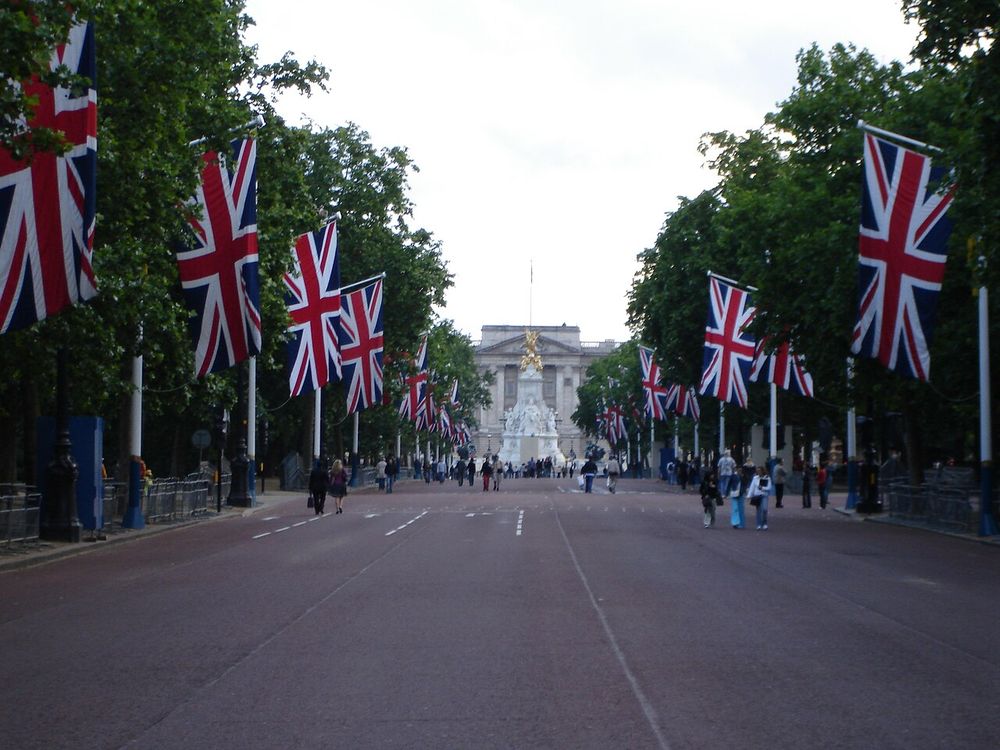
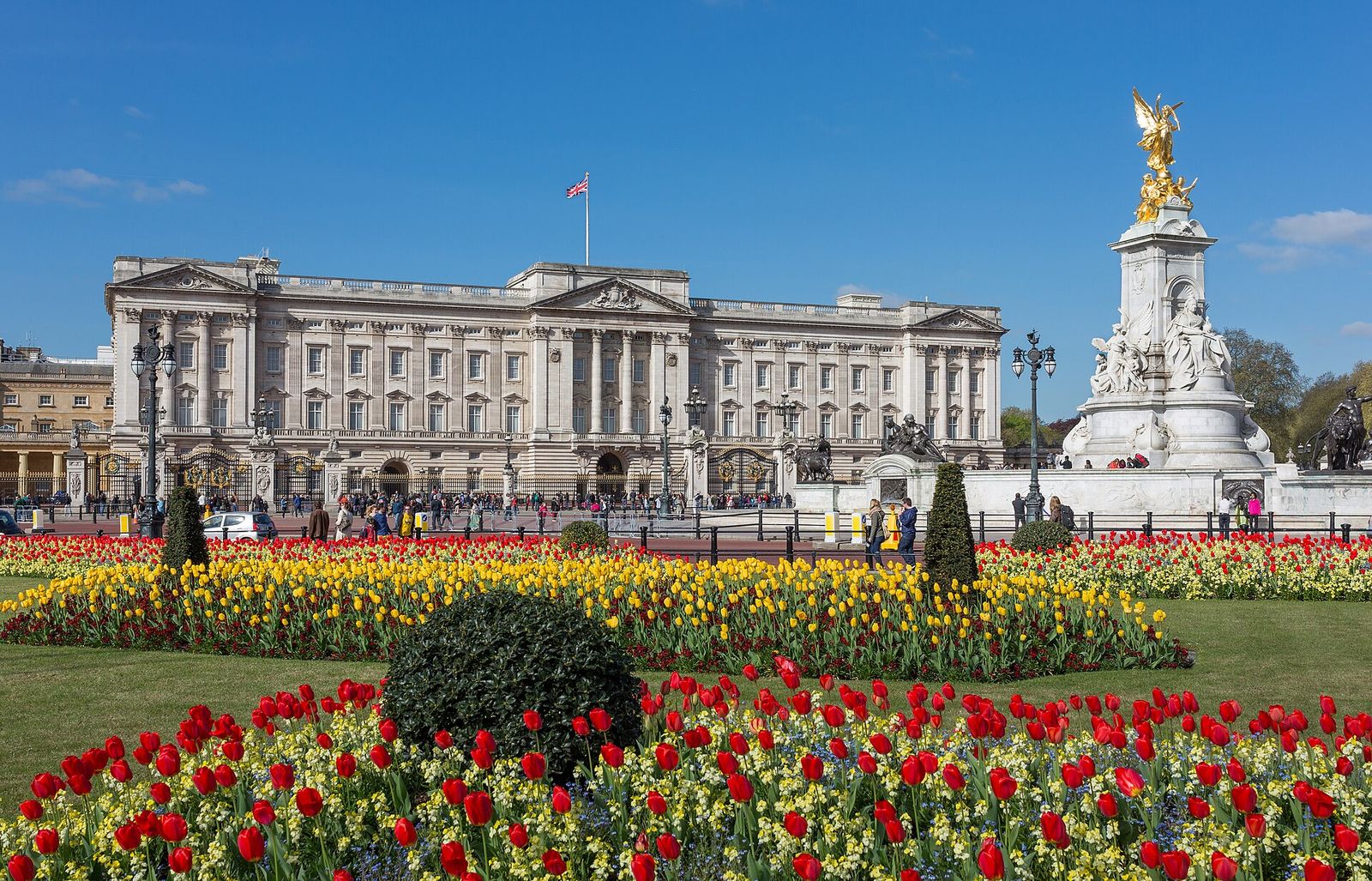
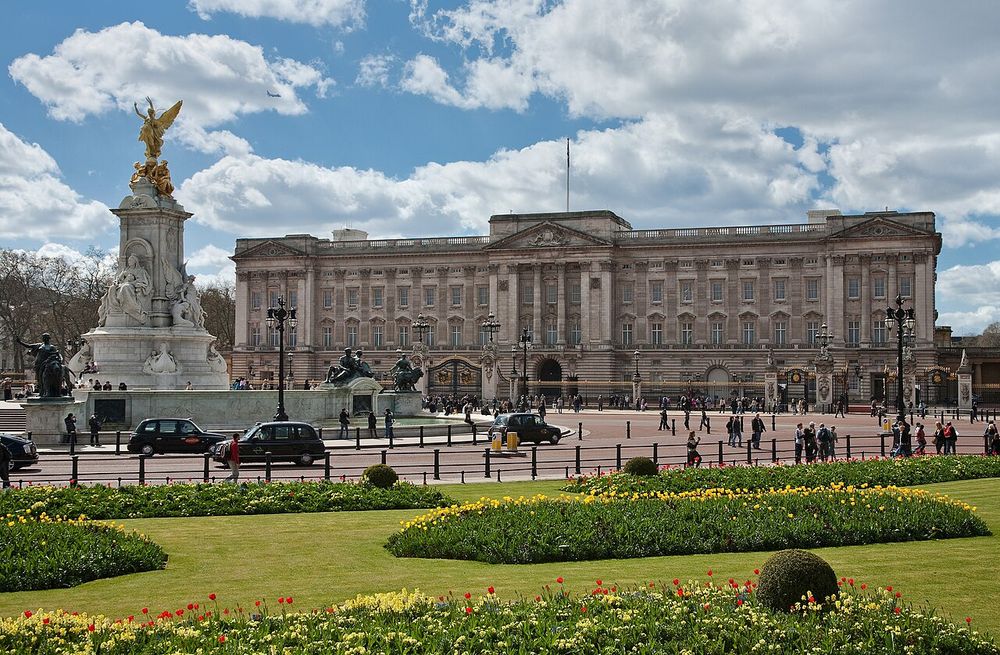
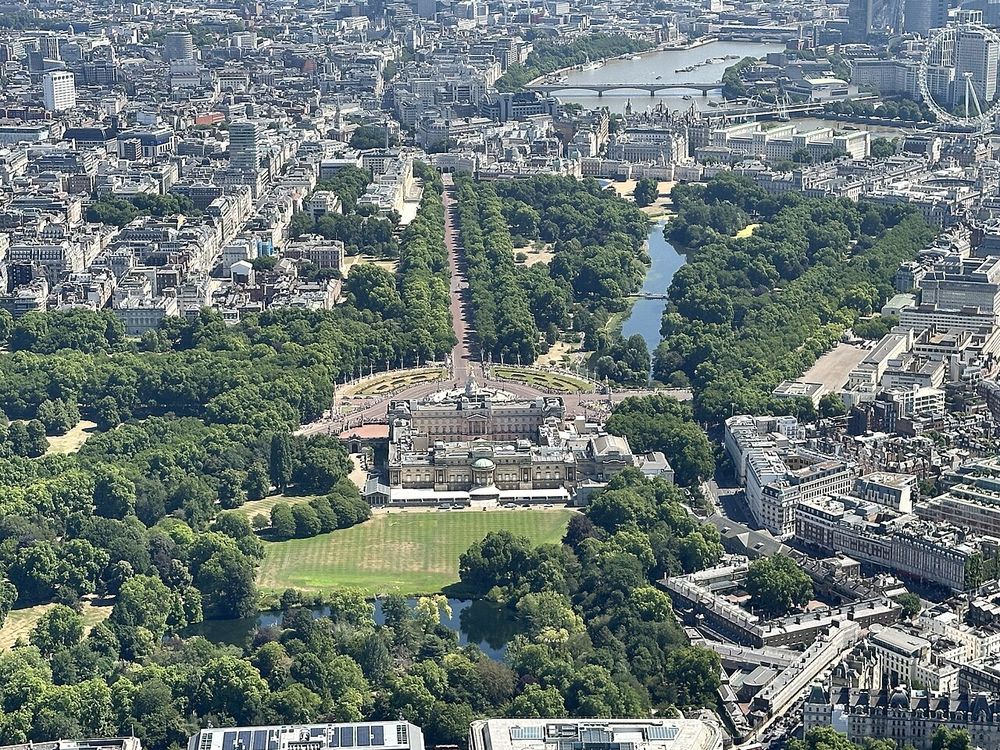
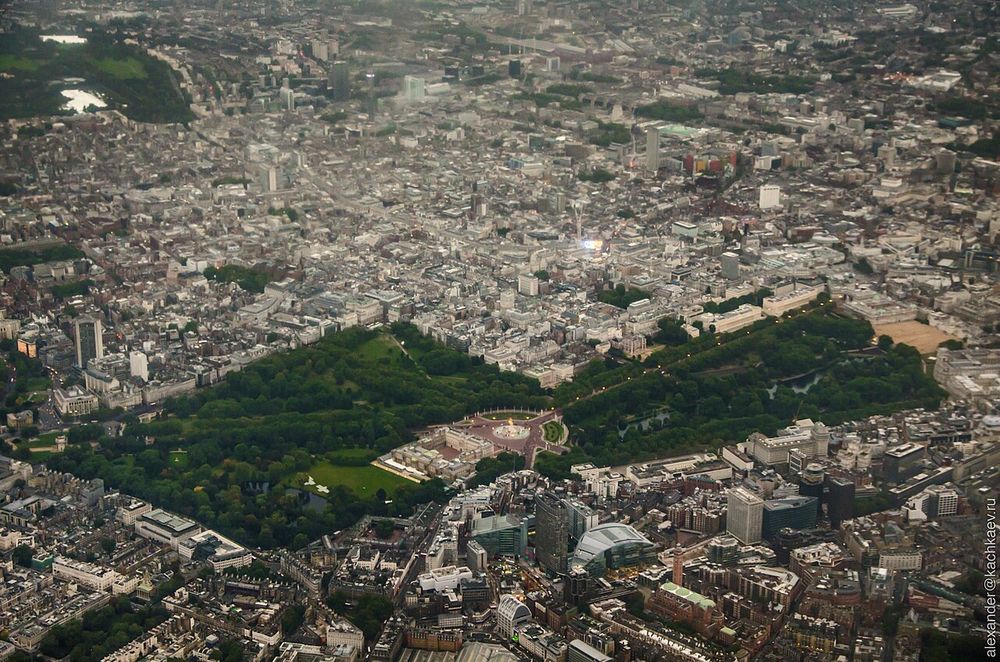
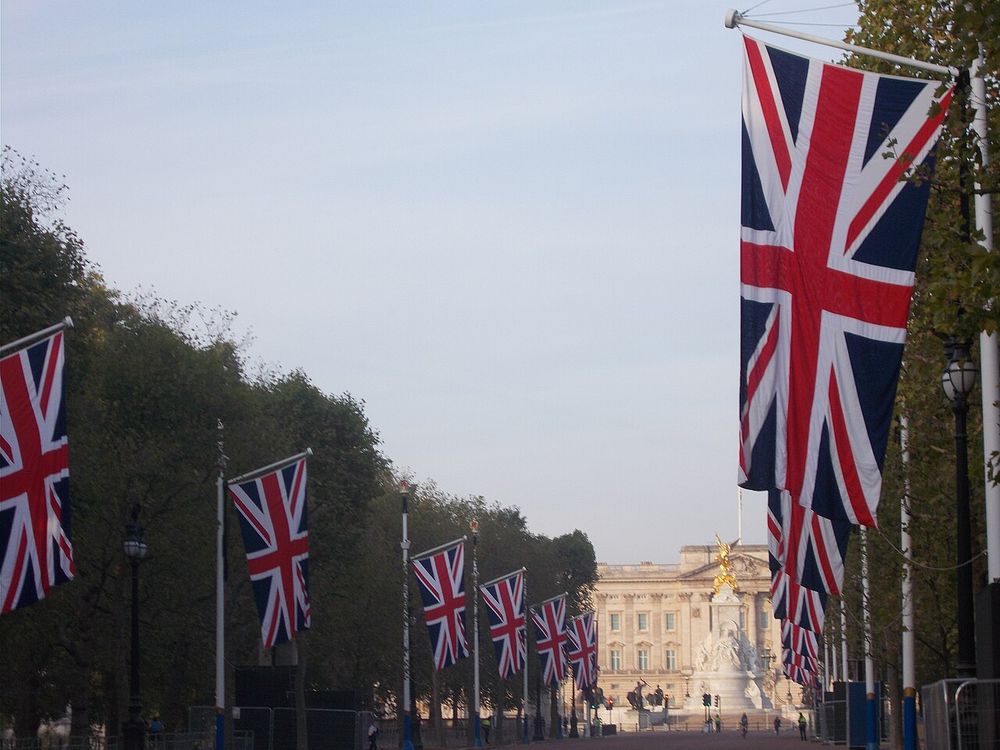
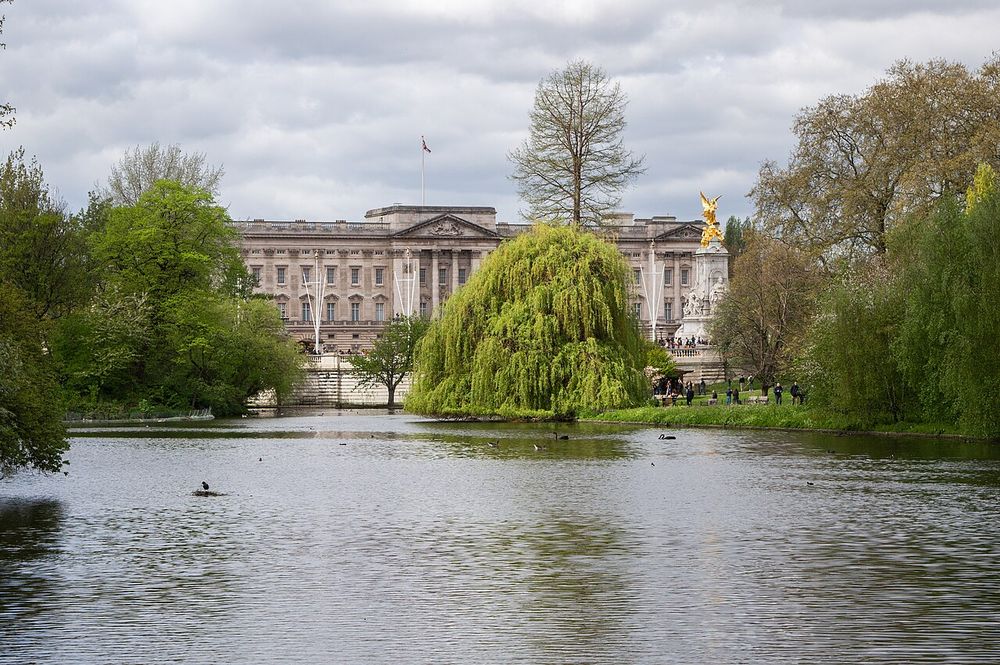
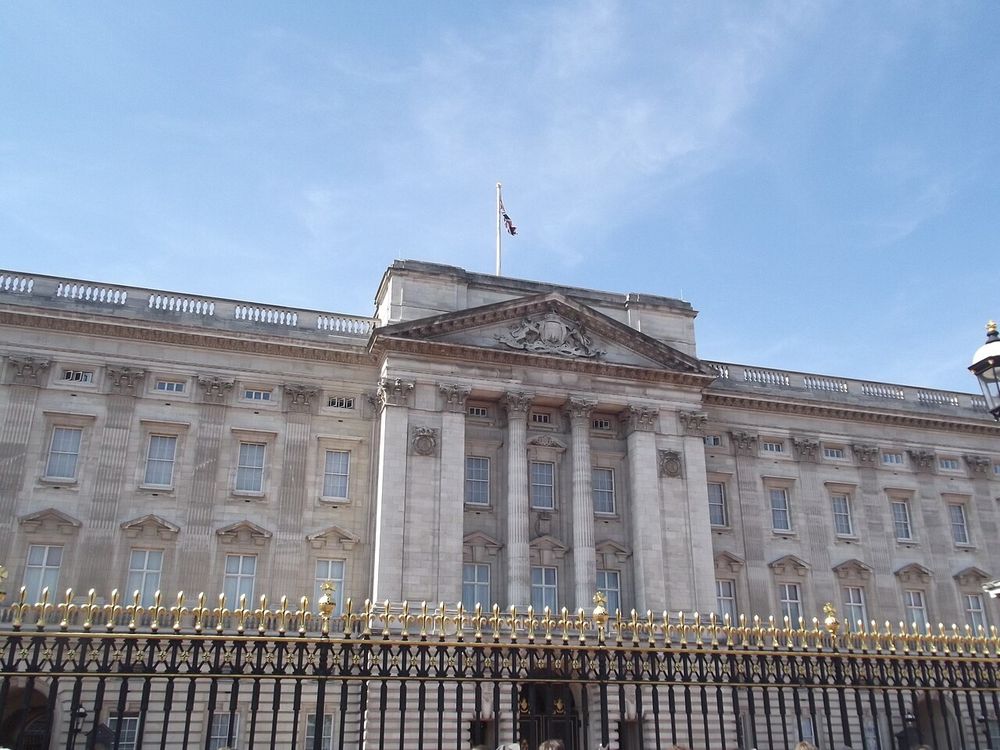
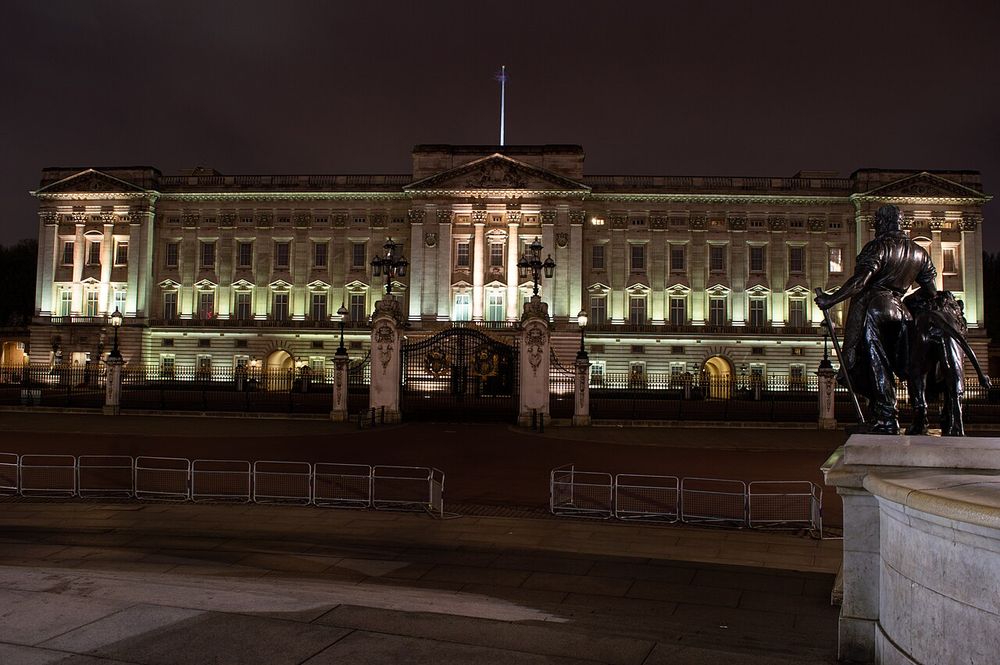
You are walking down a wide straight road surfaced in dull red, with plane trees and flagpoles on both sides. At the end is a white marble monument with a gold figure on top, and behind it a long flat building of pale grey stone, three storeys high, with black and gold railings in front. A flag is flying from the roof.
A queen first came to live here in 1837. She was Victoria, and she was eighteen. In China it was the seventeenth year of the Daoguang emperor, shortly before the first Opium War.
What is here
The outside, the memorial and the guard are free on any day. The rooms need a ticket and are open only at certain times of year.
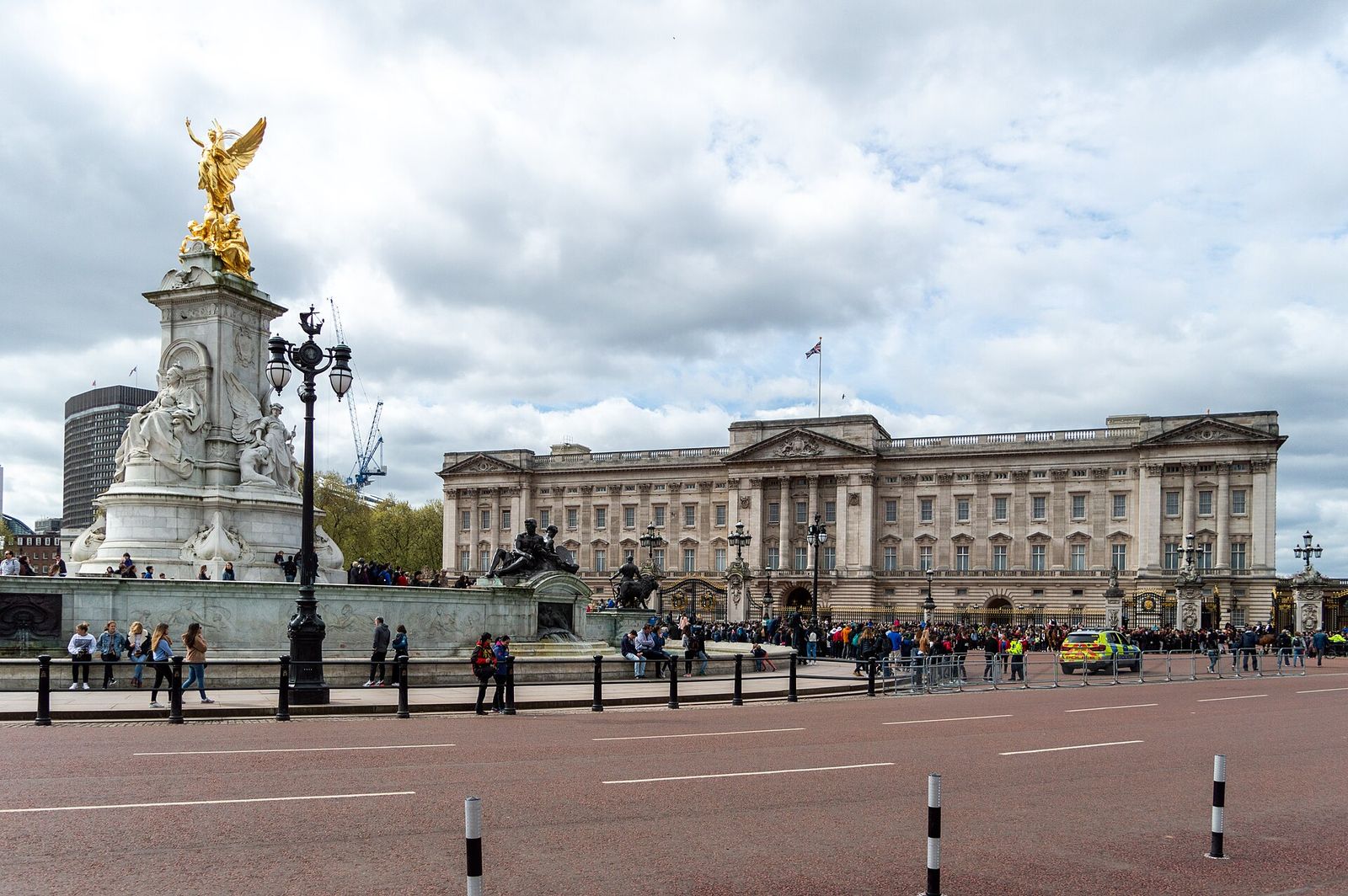
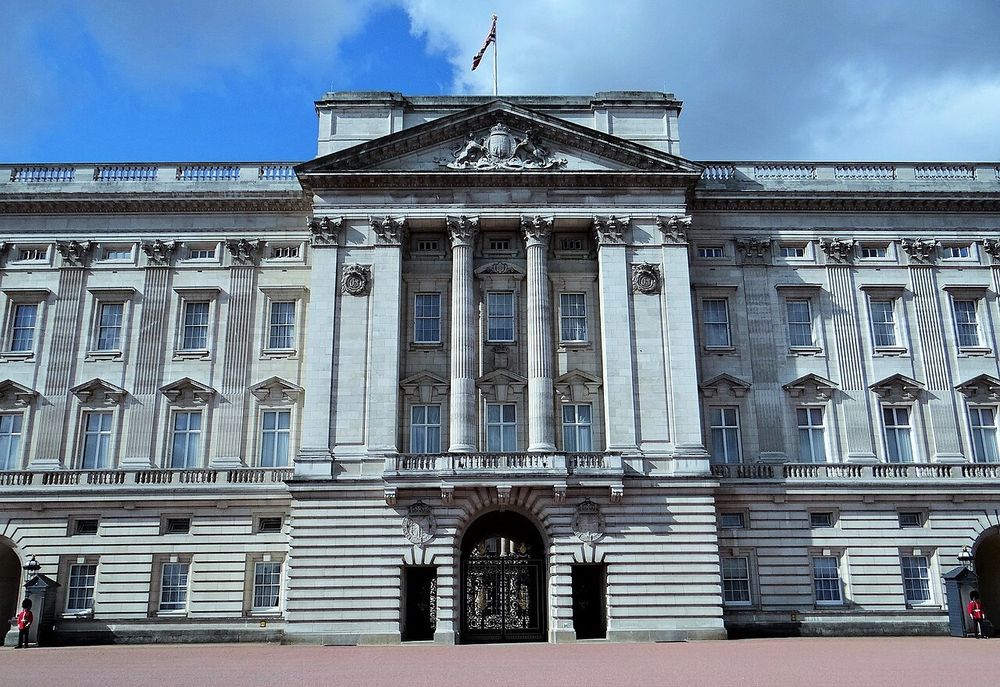
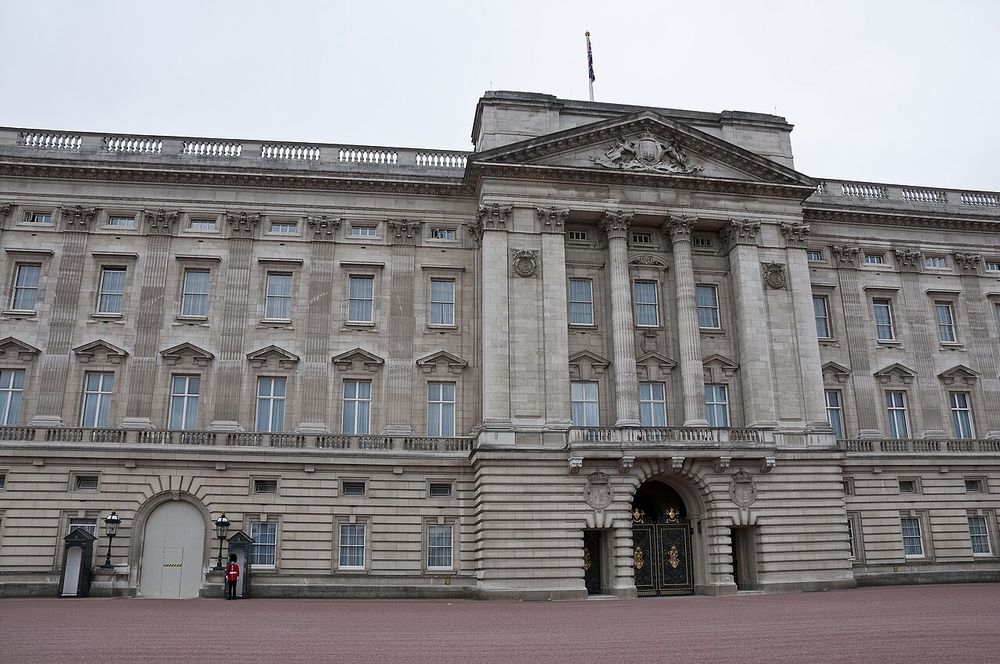
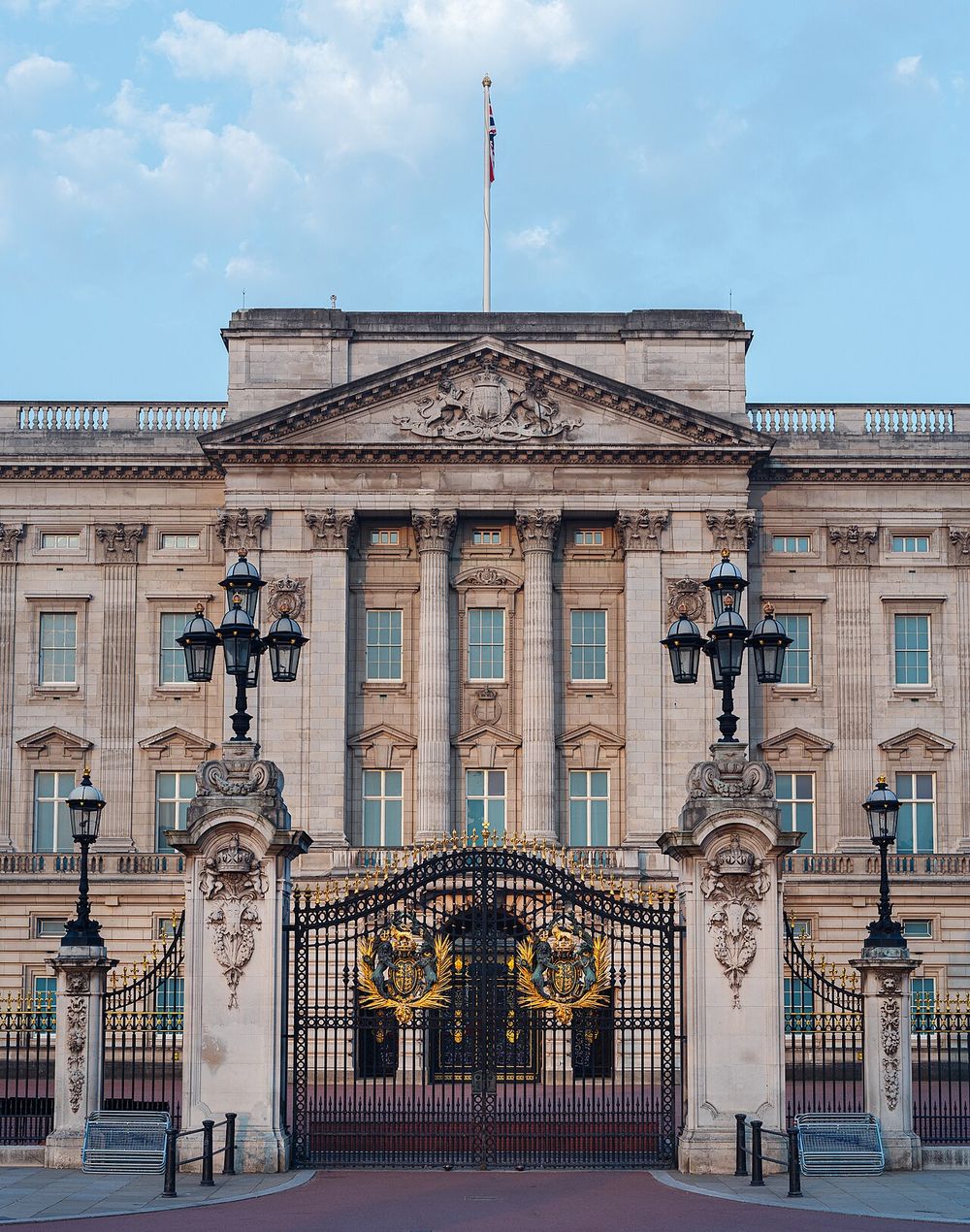
The front and the memorialTristan Surtel, CC BY-SA 4.0
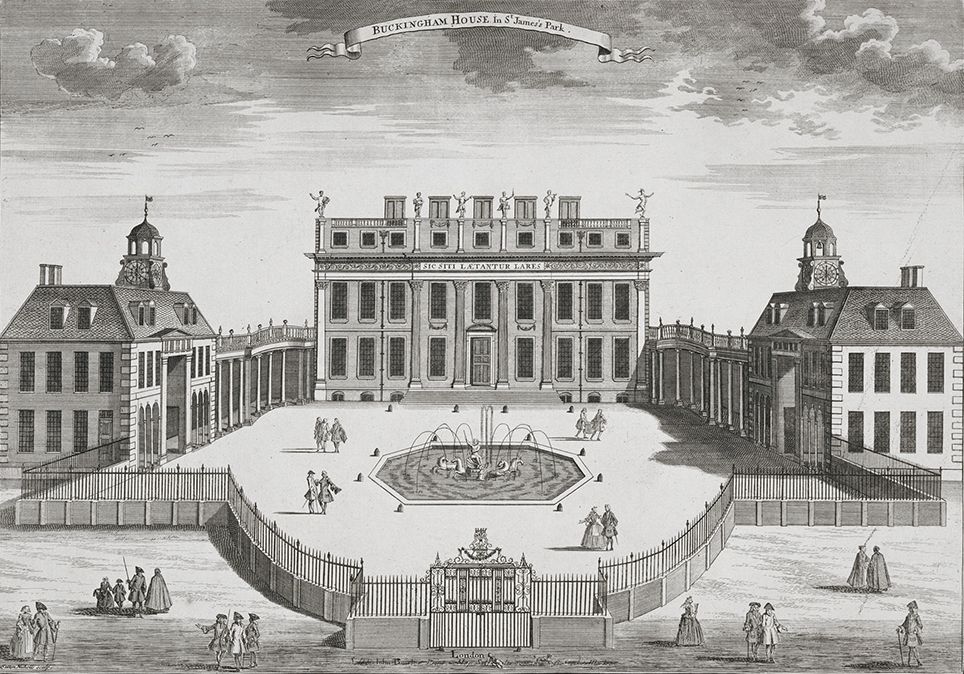
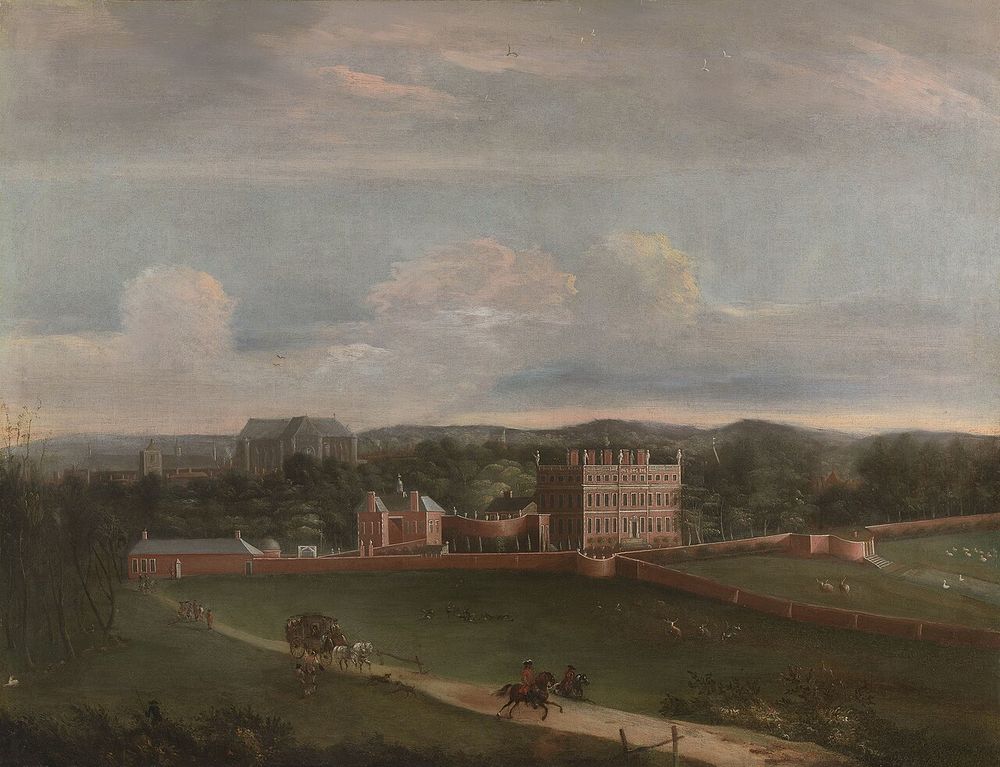
The palace began as a nobleman's house in the country outside London, built in 1703 for the Duke of Buckingham. King George III bought it in 1761 as a quiet home for his wife. His son George IV, who loved building, set out to turn it into a palace and spent far more than Parliament had allowed. He died before it was ready.
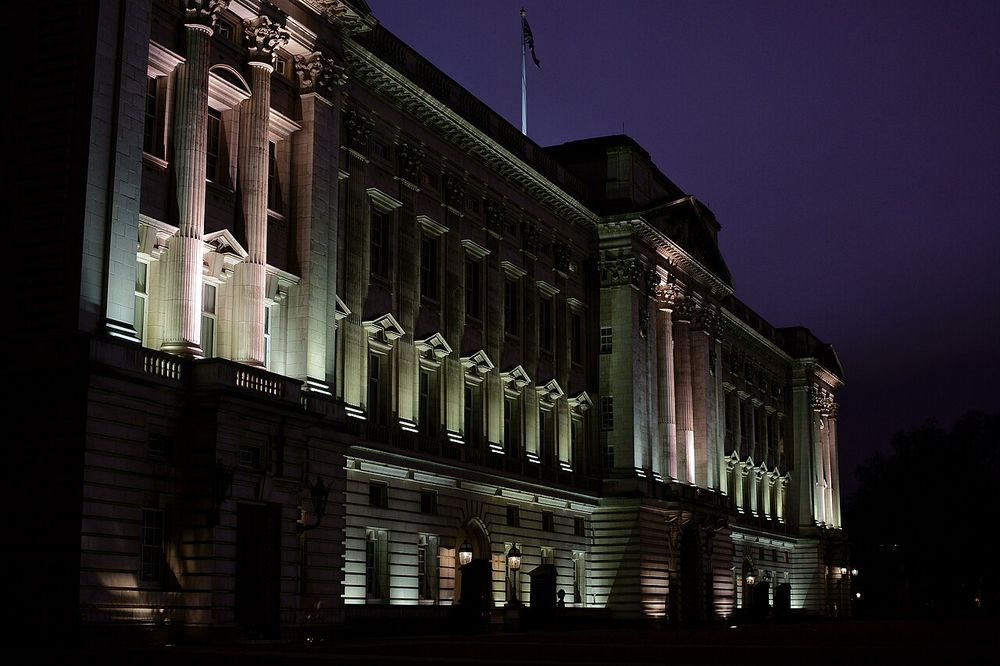
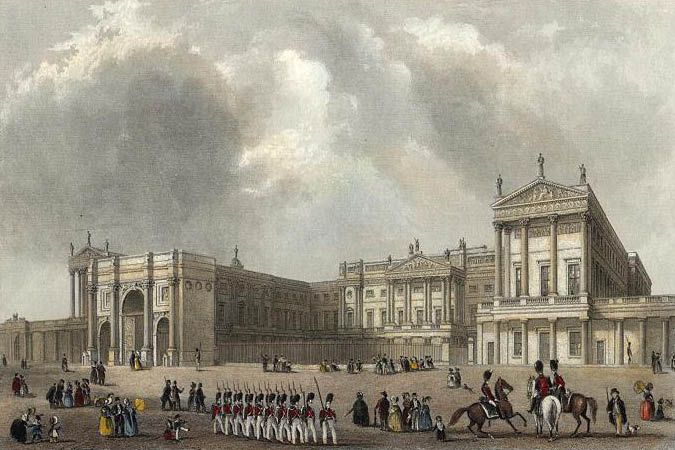
What you see from the road is not his palace. It is a wing added in 1847 across the open side of his courtyard, to give Queen Victoria more bedrooms for her growing family, and given a new face of pale stone in 1913. The old palace, in yellow stone, is behind it, looking over the garden.
The King works here and receives presidents and prime ministers here. He does not sleep here. Since 2017 the wiring and pipes of the whole building have been under replacement, room by room.
Things people often get wrong
"The flag shows that the King is in." Only one flag does. The royal standard, in red, gold and blue quarters, flies when he is here. When he is away, the palace flies the ordinary Union flag.
"You can go in at any time." The State Rooms open to visitors for about ten weeks from July to September, and on a few days in winter by guided tour.
"The guard changes every day." It changes on set mornings, not all, and is cancelled in heavy rain.
"The guards are for show." They are serving infantry soldiers of the regular army, who are also sent on operations abroad.
"It has always been the royal palace." It has been the monarch's London home for less than two hundred years. The court is still officially at St James's Palace, a brick palace a few minutes' walk away.
People who stood here
Mozart (Austrian composer)In 1764, aged eight, he played three times for King George III and Queen Charlotte in the house that stood here. The King put pieces by Bach and Handel in front of him to read at sight. He was paid twenty-four guineas each time, and dedicated six sonatas to the Queen.
Queen Victoria (queen of the United Kingdom, 1837–1901)She moved in three weeks after coming to the throne. The chimneys smoked, the bells did not ring, and there was no room large enough for a ball. She had the ballroom built, and in 1851 she was the first to step out on the balcony to be seen.
Winston Churchill (British prime minister in the Second World War)Through the war he came every Tuesday to lunch alone with the King, the two of them serving themselves from a side table so that no servant should hear. On 8 May 1945, the day the war in Europe ended, he stood on the balcony between the King and Queen in front of a crowd that filled the road to the far end.
Go deeper: seven stops, from the Mall to the garden
The first four stops are outside and free. The last three follow the summer route through the rooms.
1. The Mall
The Mall hung with flagsSean, CC BY-SA 2.0
The road is nearly a kilometre long and was laid out in its present form in 1911 as a stage for processions. Its red surface is meant to look like a carpet. On Sundays it is closed to cars.
2. The gates and the guard
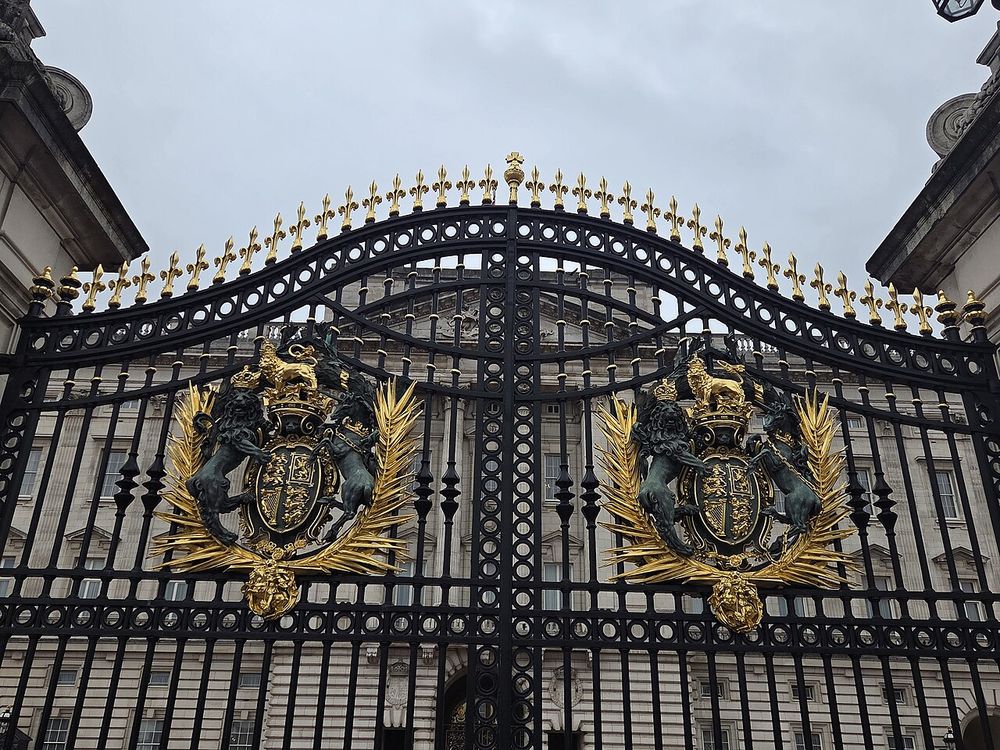
The royal arms on the gatesAndrew Bone, CC BY 4.0
The gates carry the royal arms in gilded iron: a lion on the left, a unicorn on the right. The lion stands for England and the unicorn for Scotland.
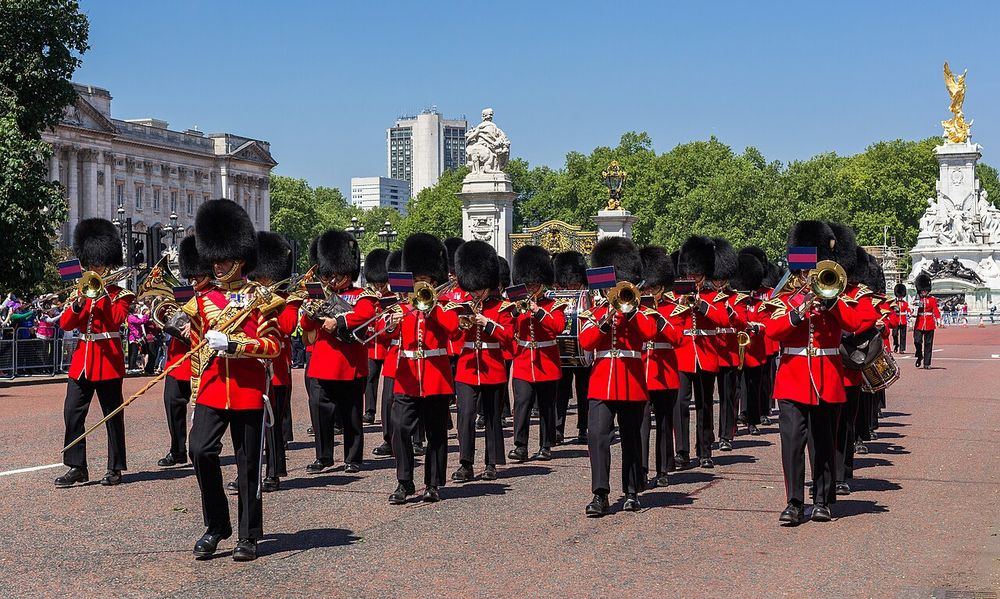
A guards' band marching to the palaceDiliff, CC BY-SA 3.0
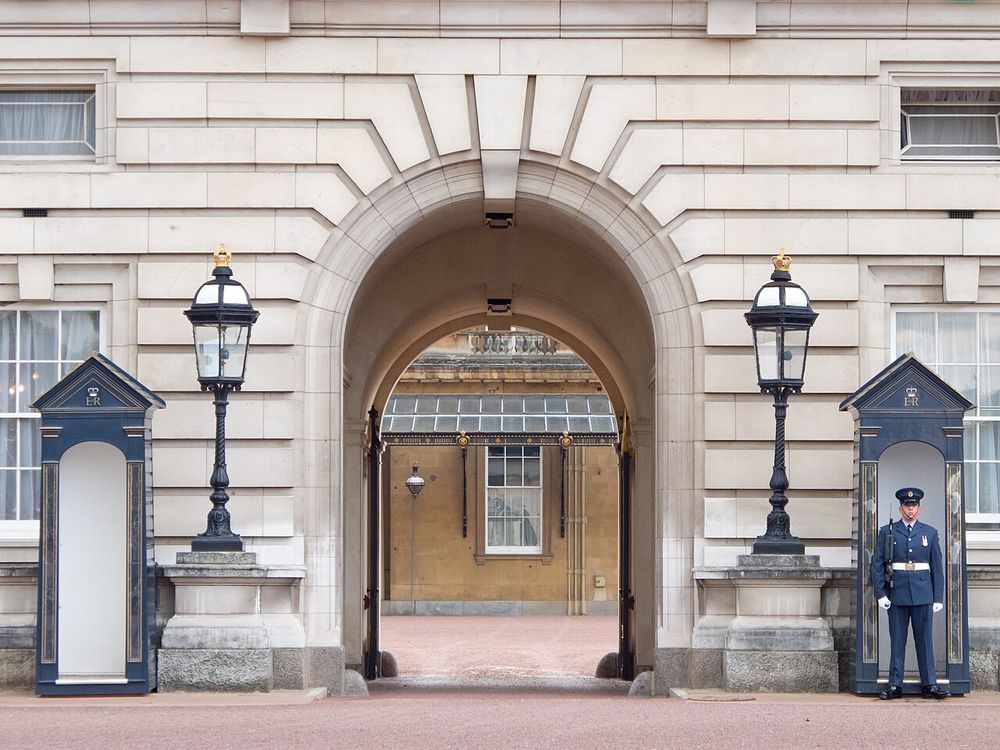
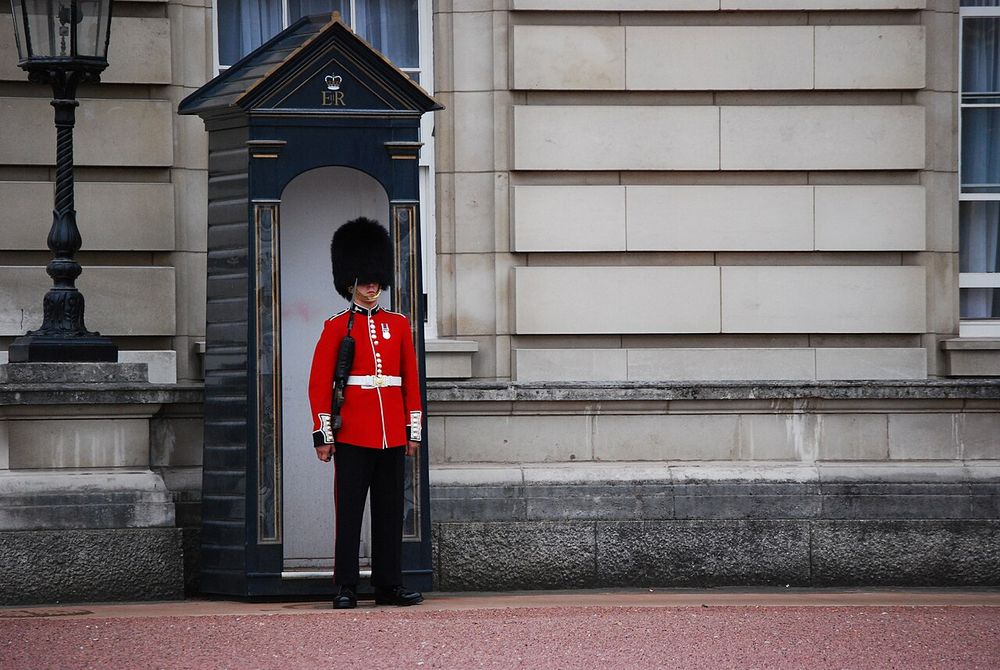
The soldiers usually come from five regiments of foot guards. All wear red coats and tall black caps of bearskin, and you tell them apart by the buttons: singly for the first regiment, in pairs for the second, in threes, fours and fives for the others.
At the change, the old guard forms up in the forecourt. The new guard marches in with a band from its barracks close by. The officers touch hands to pass over the keys, and the sentries are replaced one by one. It takes about forty-five minutes, and the band plays whatever it likes: marches, film music, songs from the charts.
3. The balcony
The balconyIbex73, CC BY-SA 4.0
Find the middle window on the first floor, under the triangle of the roof, with a stone balcony draped in red on great days. The family comes out here after a coronation, a wedding or the King's official birthday in June, when the air force flies over the roof.
In September 1940 a German pilot flew straight up the Mall and dropped a string of bombs on the palace while the King and Queen were inside. The chapel was destroyed. The Queen said she was glad: now she could look the bombed poor of east London in the face.
4. The memorial
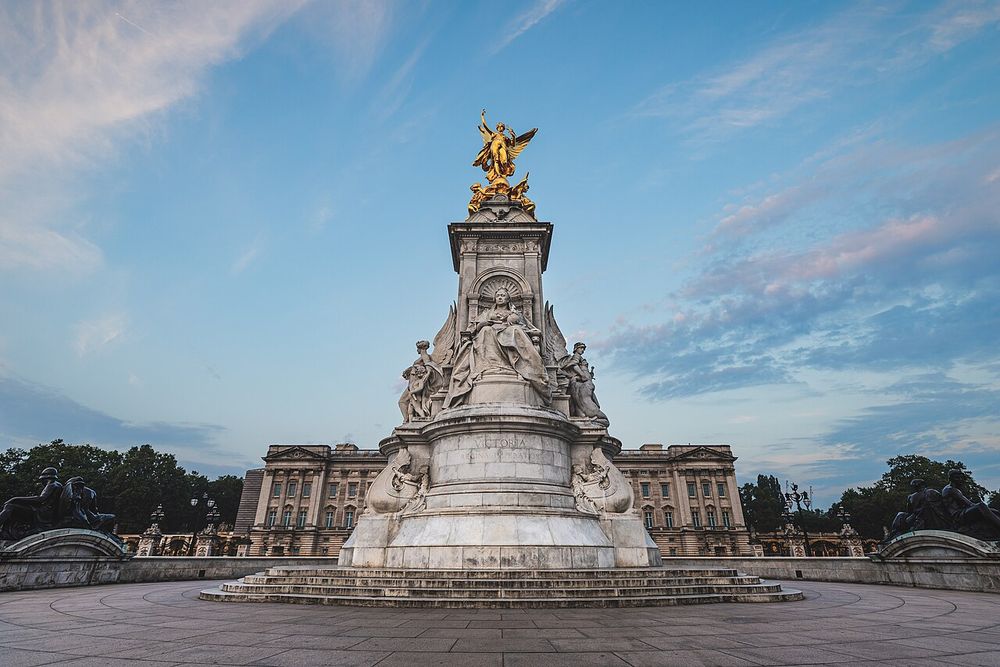
The Victoria Memorial in early morningJulian Herzog (Website), CC BY 4.0
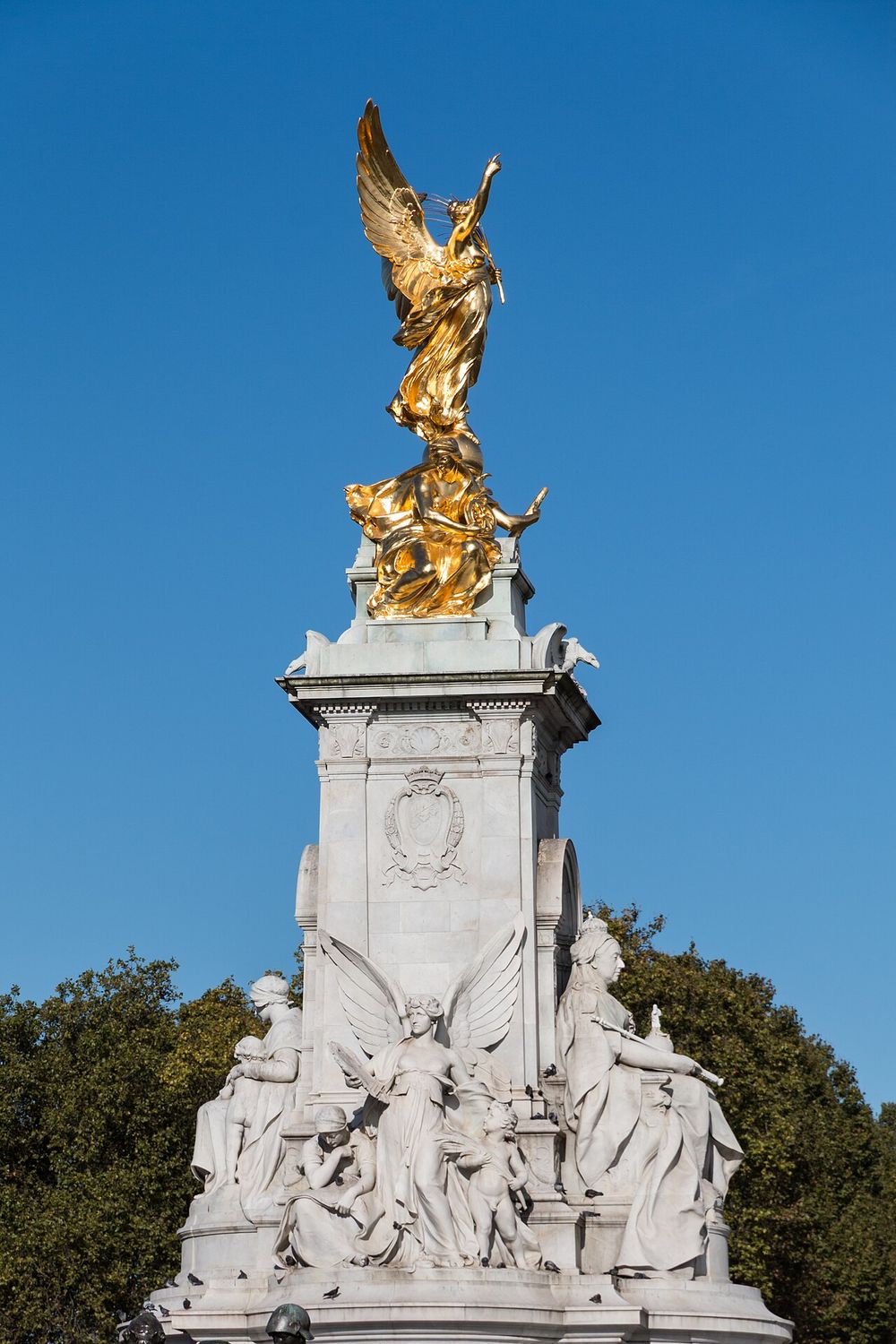
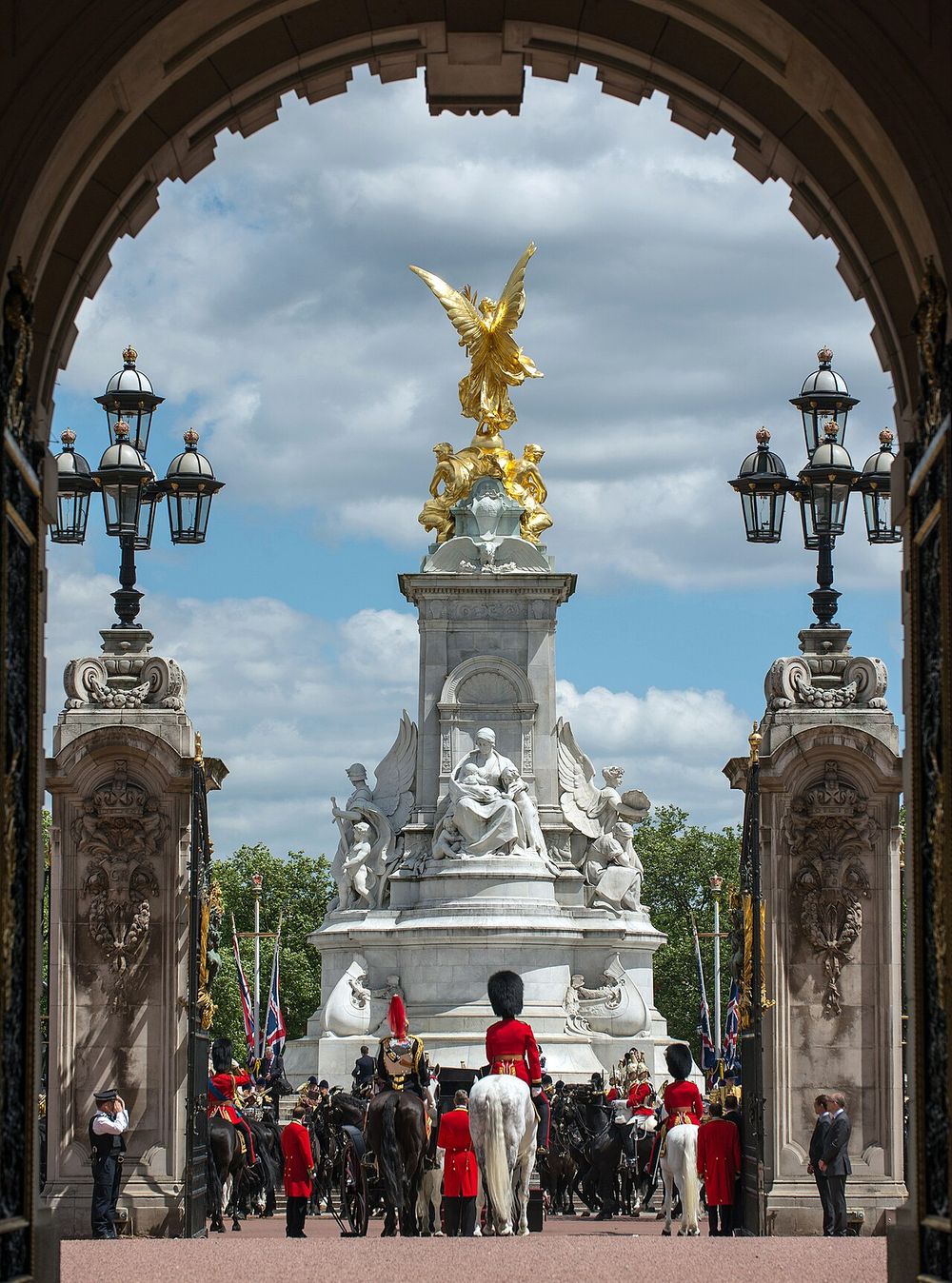
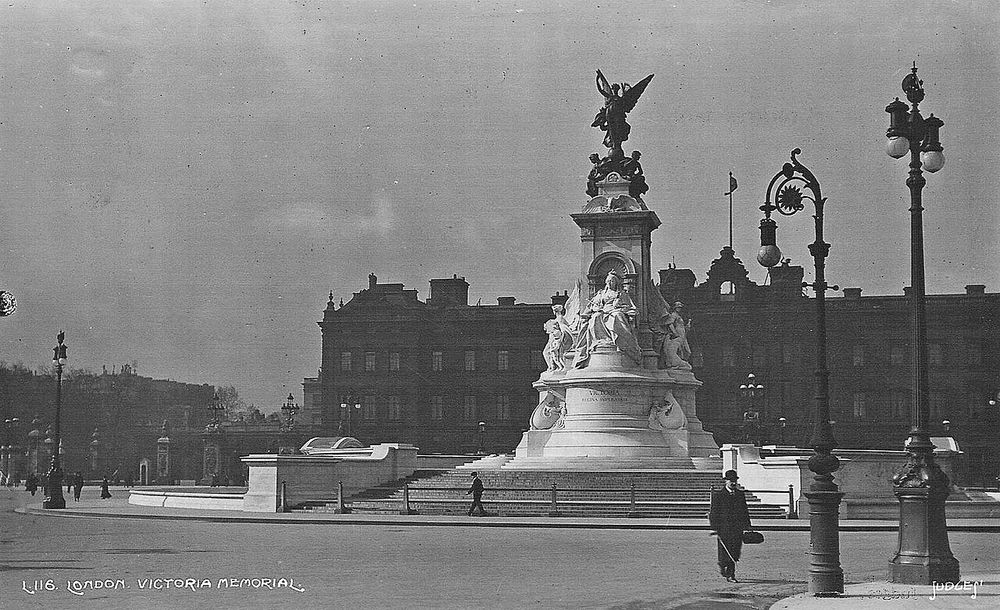
The white marble pile in front of the gates was unveiled in 1911. Queen Victoria sits facing down the Mall, away from the palace. Above her is a winged figure of Victory in gilded bronze. Round the base are a mother and children, an angel of justice and an angel of truth.
Its steps are the best free place to watch the guard change. Be there forty minutes early.
5. The staircase and the throne
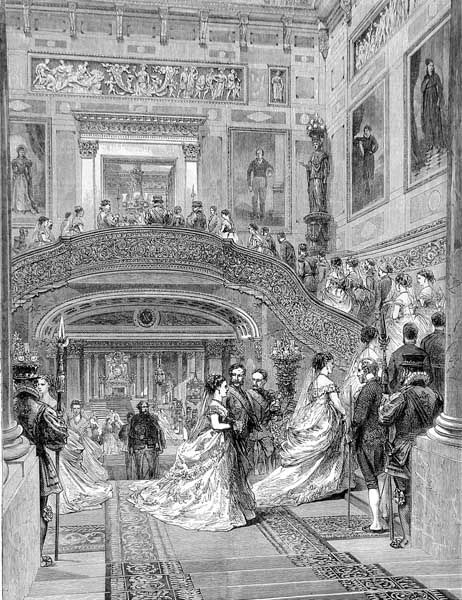
The grand staircase in 1870Unknown, Public domain
Summer visitors enter at the side and come first to a staircase that divides and curves up under a glass dome, with a gilded bronze rail of leaves.
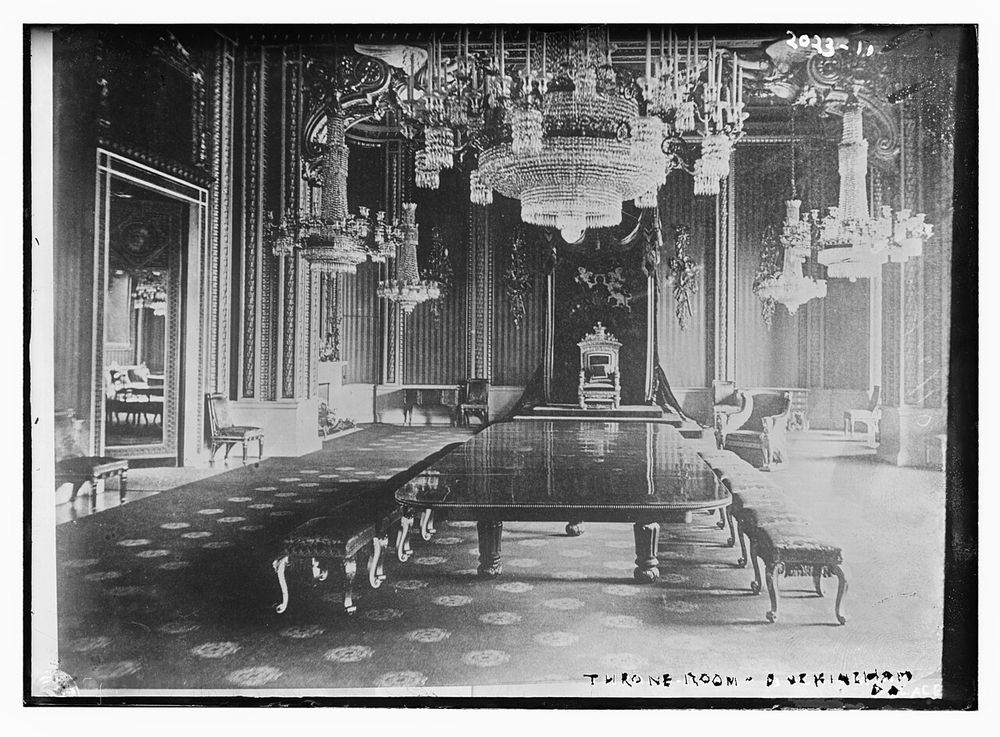
The Throne Room about 1900Bain News Service, publisher, Public domain
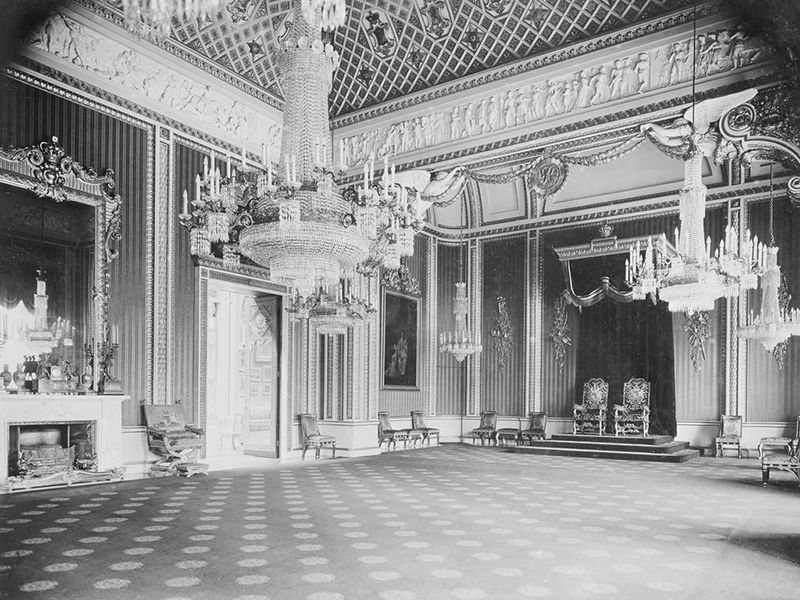
The Throne Room is red and gold, with two chairs under a canopy at the far end. The room is used for group photographs after royal weddings. The chairs were made for coronations in the abbey and brought here afterwards. No king has been crowned in this room.
6. The pictures and the ballroom
A gallery forty-seven metres long, lit from the roof, runs down the middle of the palace. On its walls hang paintings bought by kings over four centuries: Rembrandt, Rubens, Vermeer, Canaletto. They are changed from year to year.
The new ballroom in 1856Unknown, Public domain
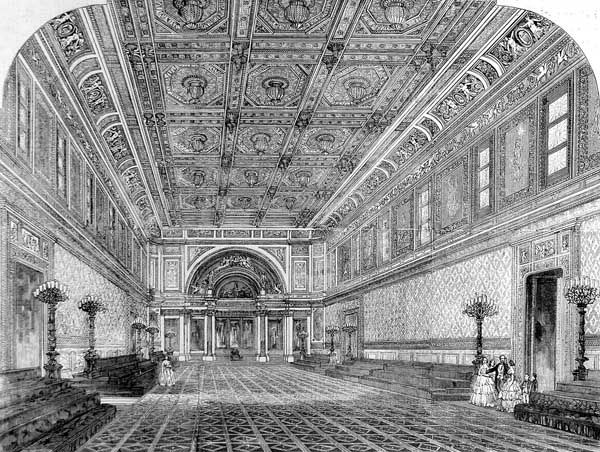
The Ballroom, added for Queen Victoria in 1855, is the largest room. State banquets are held here at a table in the shape of a horseshoe for about a hundred and seventy guests. Laying it takes about three days, and by custom the monarch looks it over before dinner.
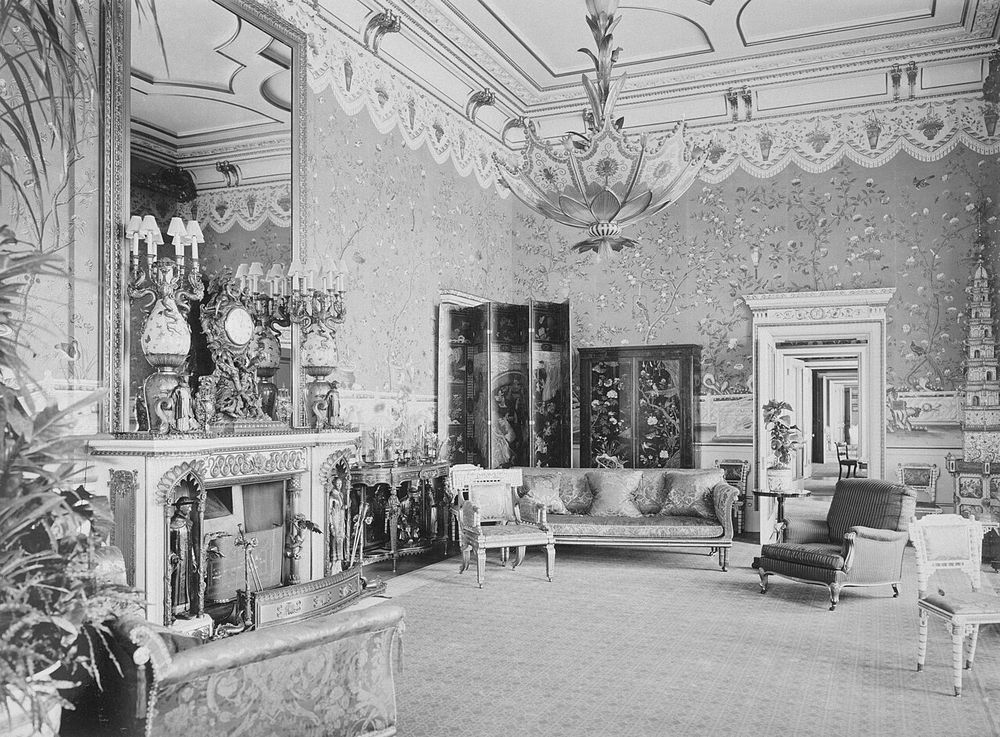
The White Drawing Room about 1901Coulter, John, ed; Victoria, Queen of Great Britain, 1819-1901; Cooper, John A. , No restrictions
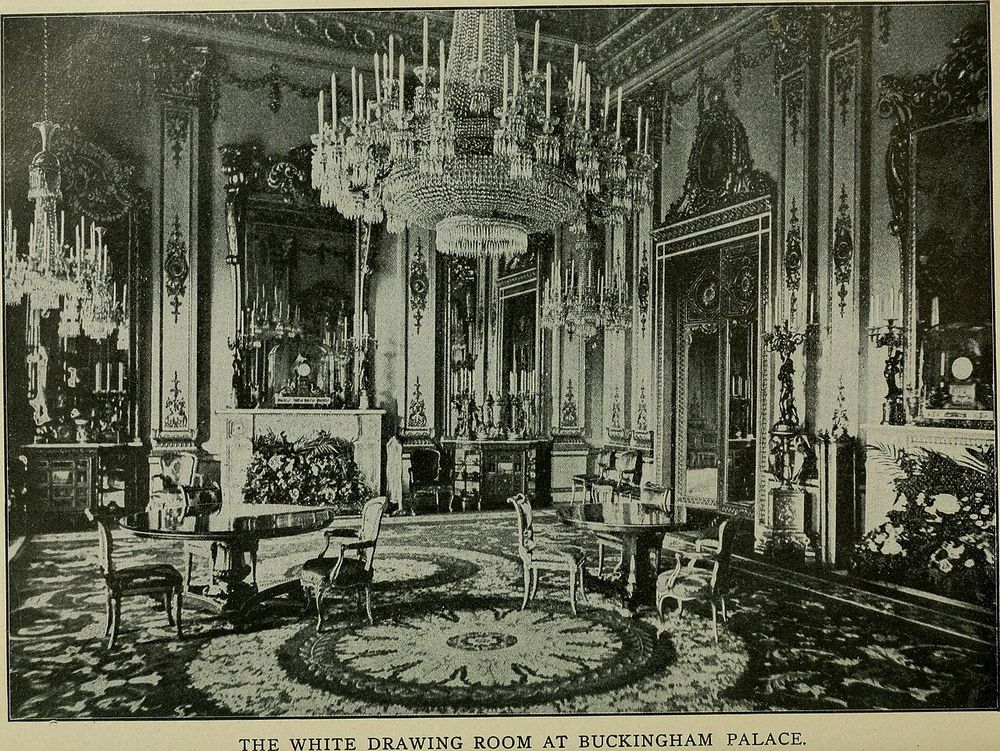
In the White Drawing Room, look at the tall mirror and cabinet in the corner. The whole piece swings open. It is a door, and the family comes through it from their private rooms to meet their guests.
7. The garden
The garden front, the palace George IV builtGryffindor, CC BY-SA 3.0
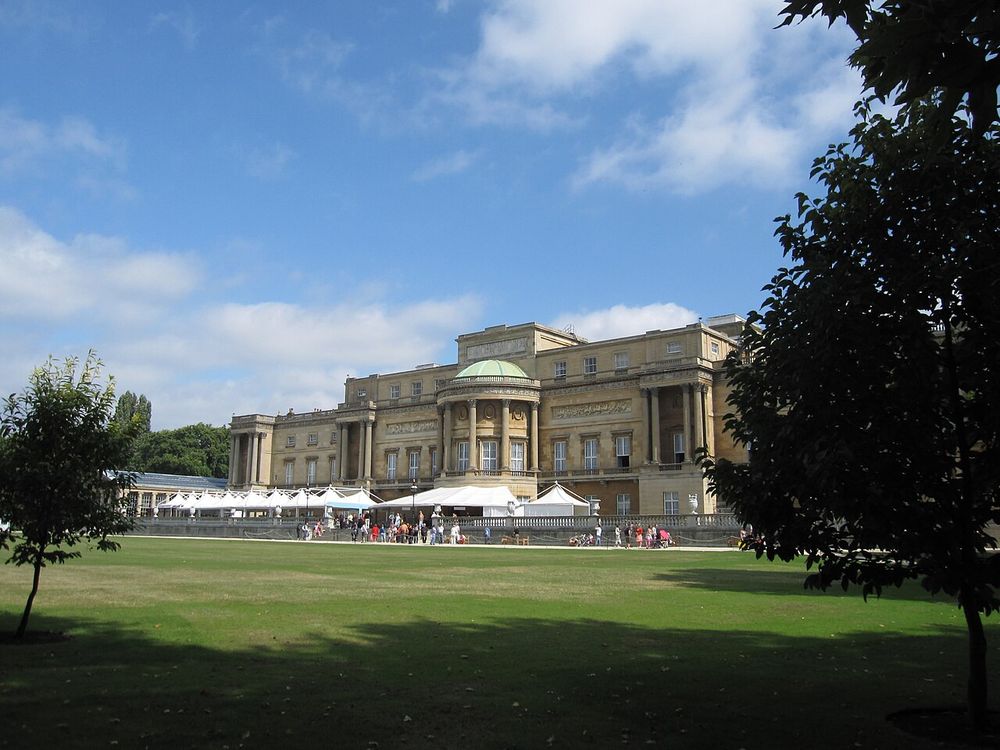
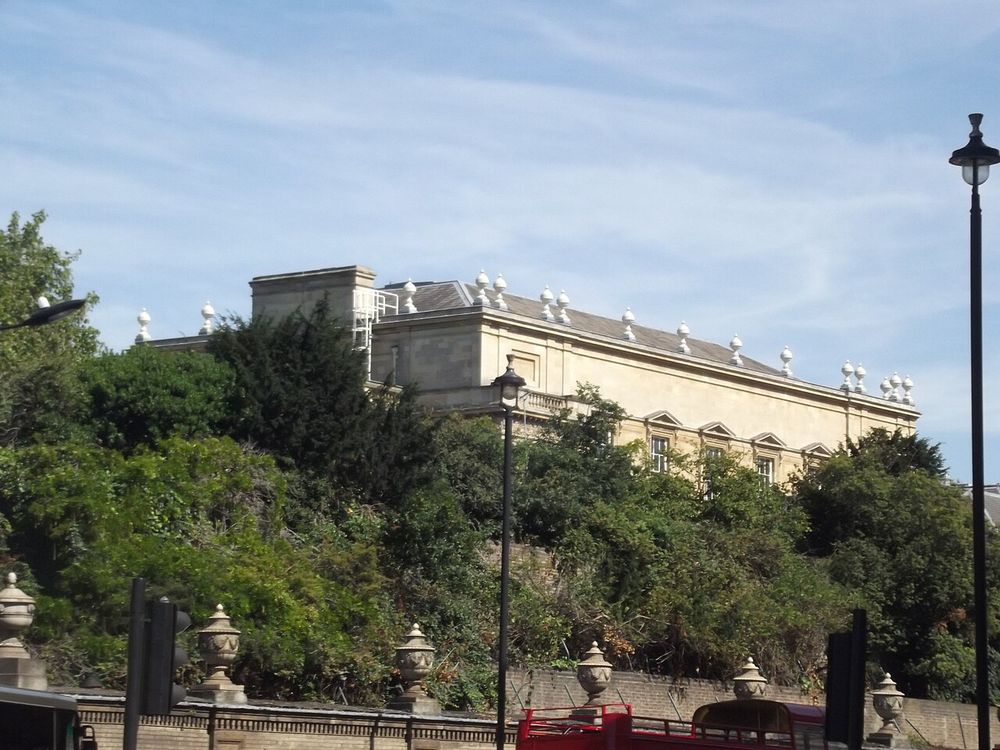
You leave by the back, and for the first time see the palace George IV built: a long front of honey-coloured stone with a curved bay in the middle.
The palace across its lakeRobert Lamb, CC BY-SA 2.0
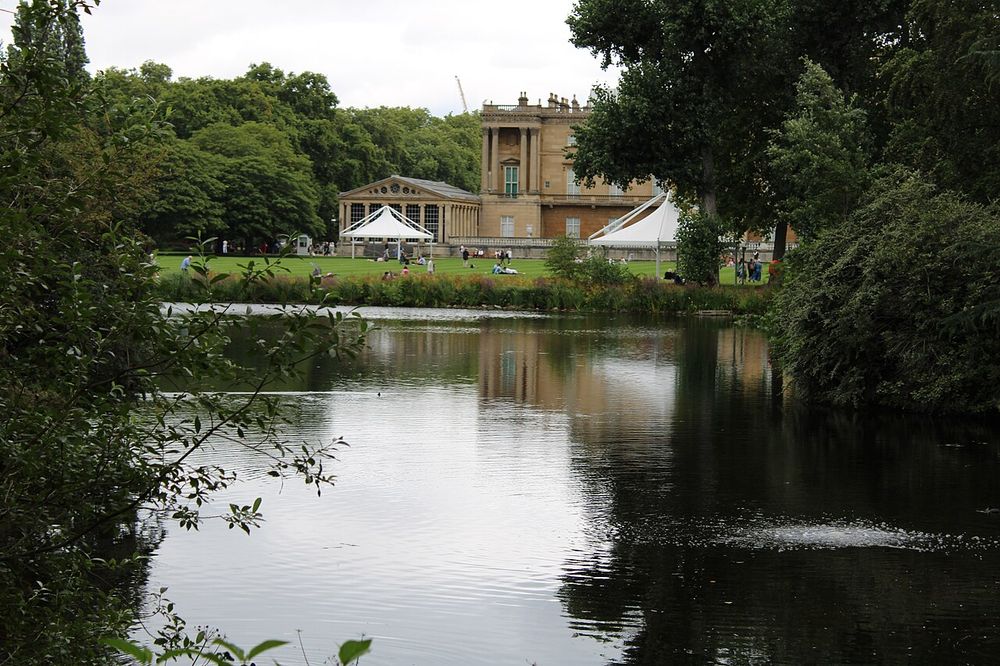
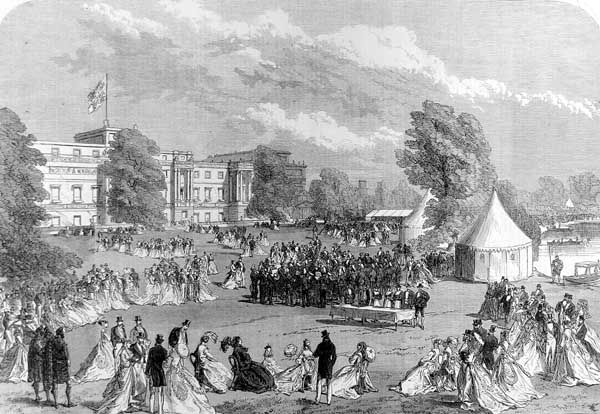
The garden covers sixteen hectares, with a lake, a tennis court and more than three hundred kinds of wild flower. About three times each summer the King gives a party on the lawn for eight thousand people at a time, chosen for the work they have done. They drink about twenty-seven thousand cups of tea.
Meanwhile in the world
Year
Here
Elsewhere
1703
A duke builds a country house here
Qing China, the Kangxi reign; Peter the Great founds St Petersburg
1761
George III buys it for the Queen
The Qianlong reign in China; three years before Mozart plays here
1837
Victoria moves in
The Daoguang reign in China; the telegraph is patented in the same year
1851
The first appearance on the balcony
The Taiping rebellion begins in China; the Great Exhibition is held in London
1913
The front is refaced in thirteen weeks
The second year of the Republic of China; a year before the First World War
1940
Bombed with the King and Queen inside
The Second World War; the Battle of Britain is at its height
1993
The State Rooms are opened to paying visitors
The money goes to repair Windsor Castle after its fire
2015
The president of China stays here on a state visit
The year Elizabeth II becomes the longest-reigning British monarch
Then and now
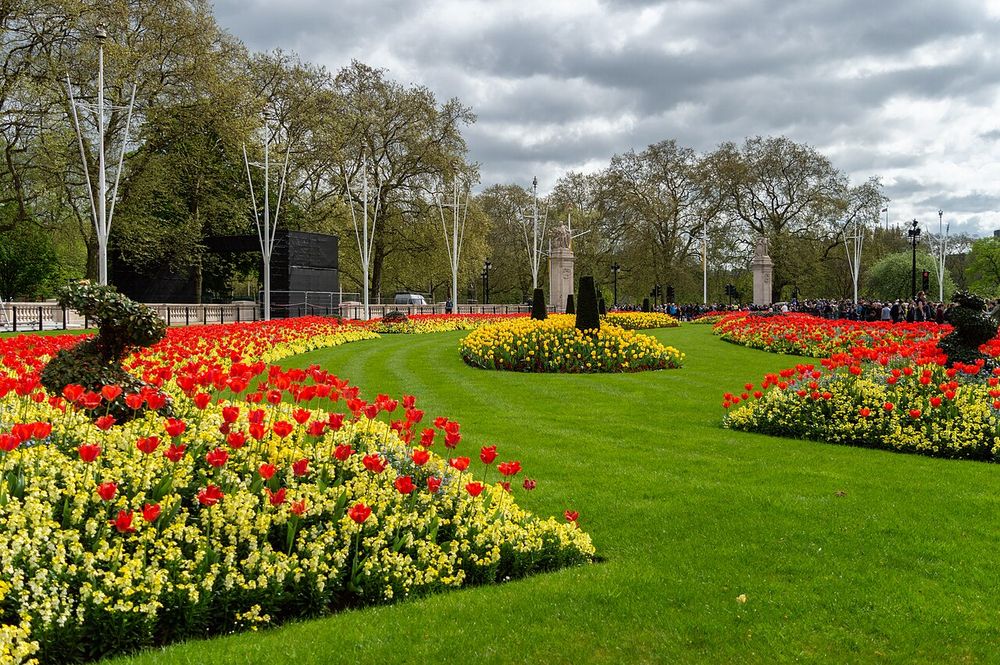
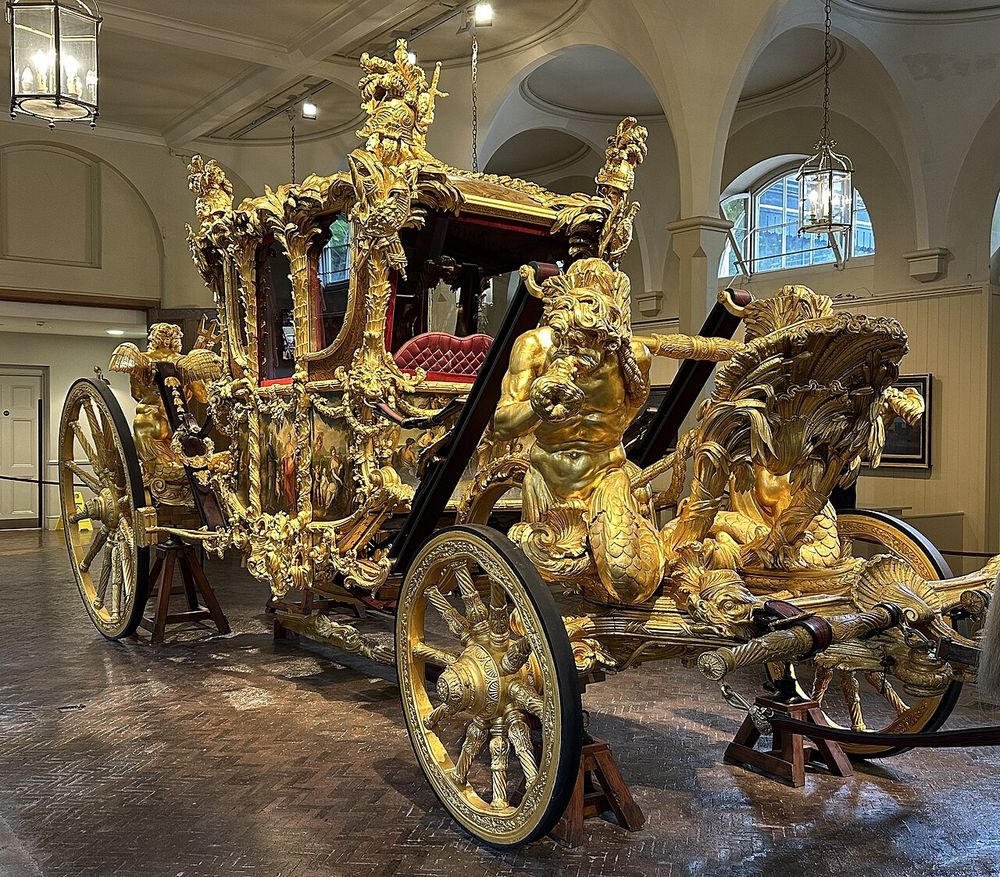
The front and the memorialTristan Surtel, CC BY-SA 4.0, Wikimedia CommonsTulips in front of the palace in springDiliff, CC BY-SA 3.0, Wikimedia CommonsThe palace across the flower bedsDiliff, CC BY-SA 3.0, Wikimedia CommonsThe palace, its garden and the Mall from the airMatt Brown, CC BY 4.0, Wikimedia CommonsThe palace between two royal parksAlexander Kachkaev, CC BY 3.0, Wikimedia CommonsThe Mall hung with flagsSean, CC BY-SA 2.0, Wikimedia CommonsFlags along the MallPeter S, CC BY-SA 2.0, Wikimedia CommonsThe palace from the lake in St James's ParkTristan Surtel, CC BY-SA 4.0, Wikimedia CommonsThe centre of the front, with the balconyChris Gorringe, CC BY-SA 2.0, Wikimedia CommonsThe balconyIbex73, CC BY-SA 4.0, Wikimedia CommonsThe front through the railingsElliott Brown from Birmingham, United Kingdom, CC BY-SA 2.0, Wikimedia CommonsThe central gatesJulian Herzog (Website), CC BY 4.0, Wikimedia CommonsThe royal arms on the gatesAndrew Bone, CC BY 4.0, Wikimedia CommonsThe arch into the courtyard, with sentry boxesCarlos Delgado, CC BY-SA 3.0, Wikimedia CommonsA sentry at his boxMaryG90, CC BY-SA 3.0, Wikimedia CommonsA guards' band marching to the palaceDiliff, CC BY-SA 3.0, Wikimedia CommonsThe side of the palace from the roadElliott Brown from Birmingham, United Kingdom, CC BY-SA 2.0, Wikimedia CommonsThe Victoria Memorial in early morningJulian Herzog (Website), CC BY 4.0, Wikimedia CommonsVictory on top of the memorialDietmar Rabich, CC BY-SA 4.0, Wikimedia CommonsThe memorial seen from inside the palace archSergeant Rupert Frere (Royal Logistic Corps), OGL v1.0, Wikimedia CommonsThe front at nightTristan Surtel, CC BY-SA 4.0, Wikimedia CommonsThe palace lit on a winter eveningPeter Trimming, CC BY-SA 2.0, Wikimedia CommonsThe garden front, the palace George IV builtGryffindor, CC BY-SA 3.0, Wikimedia CommonsFlower beds by the memorialTristan Surtel, CC BY-SA 4.0, Wikimedia CommonsThe lake in the gardenKJP1, CC BY-SA 4.0, Wikimedia CommonsThe palace across its lakeRobert Lamb, CC BY-SA 2.0, Wikimedia CommonsThe Gold State Coach of 1762, in the Royal MewsAPK, CC BY 4.0, Wikimedia CommonsBuckingham House in 1710Unknown, Public domain, Wikimedia CommonsThe house in the fields, painted about 1700anonymous, Public domain, Wikimedia CommonsThe palace in 1837, with the marble arch that was later movedUnknown, Public domain, Wikimedia CommonsThe new ballroom in 1856Unknown, Public domain, Wikimedia CommonsA garden party in 1868The original uploader was Honbicot at English Wikipedia., Public domain, Wikimedia CommonsThe grand staircase in 1870Unknown, Public domain, Wikimedia CommonsThe Throne Room about 1900Bain News Service, publisher, Public domain, Wikimedia CommonsThe White Drawing Room about 1901Coulter, John, ed; Victoria, Queen of Great Britain, 1819-1901; Cooper, John A. , No restrictions, Wikimedia CommonsThe old front and the new memorial, 1912Judges Ltd., Public domain, Wikimedia CommonsThe Yellow Drawing Room about 1914Sir Alexander Nelson Hood (1854-1937), Public domain, Wikimedia CommonsThe Throne Room in 1914Alexander Hood, 5th Duke of Bronté, Public domain, Wikimedia Commons
Video
Films from official channels, played from YouTube. Nothing is loaded until you press play.
Buckingham Palace: art, history and royal ceremoniesRoyal Collection Trust · the palace's own film; 5 min · checked 2026-11-12
Local legends
These are stories people tell about this place. They are legends, not history, and each one says where it comes from.
LegendThe boy in the chimney
In the first years of Queen Victoria a boy of fourteen got into the palace three times. He slept under a sofa, sat on the throne, stole the Queen's underclothes and listened to her talking to her husband. He was caught each time, and at last was sent to sea.
Source: The case of Edward Jones, reported in the London newspapers, 1838–1841; the details grew in the telling
LegendThe monk of the terrace
On Christmas Day a monk in chains walks the back terrace. He died in a punishment cell of the priory that stood on this ground before the house.
Source: London ghost lore, in print since the nineteenth century
LegendThe mulberry garden
King James I planted four acres of mulberry trees on this spot to start an English silk industry. He planted the wrong kind, which silkworms will not eat, and the garden became a place for drinking. One of his trees is said to be alive in the palace garden still.
Source: The planting of 1609 is recorded; the surviving tree is palace tradition
Later, people who live here will be able to add the stories they grew up with, and say which of these they have heard.
Not certain, and where accounts conflict
Is the Mall really a runway?
It is often said, and the removable lamp posts are real. No government has confirmed the plan, and pilots point out that the trees are very close.
How many rooms?
The palace gives 775, of which 19 are State Rooms, 52 are bedrooms for the family and guests, 188 are bedrooms for staff, 92 are offices and 78 are bathrooms. The count dates from before the present rebuilding.
Will the King move in?
Newspapers expect it when the work on the building ends. The palace has not announced it.
When does the guard change?
Usually at 11:00 on several days a week, more often in summer. The army publishes the dates a month ahead and alters them for state events and weather. We did not verify the dates for any month.
Visiting
Tickets and hours
In summer 2026 the State Rooms cost 33 pounds for an adult booked ahead and 37 pounds on the day; 21.50 pounds or 24.50 pounds for ages 18 to 24; 16.50 pounds or 18.50 pounds for ages 5 to 17. Under 5 was free.
The price includes a multimedia guide in nine languages.
In July and August 2026 the rooms were open every day from 9:30 to 19:30; in September, Thursday to Monday, until 18:30.
The outside can be seen at any hour of any day.
Last checked 2026-11-12. The Royal Collection Trust's own site (rct.uk), dates and prices of the summer opening of 2026 as shown there.
Booking from abroad
Official page in English The Royal Collection Trust sells timed tickets on its own site, in English, and takes foreign cards: rct.uk. Tickets bought ahead are cheaper than on the day.
Ticket window on site The official site lists a higher price "on the day", so during the summer opening tickets are also sold at the palace when any are left. We did not check the ticket office ourselves.
Note The summer opening of 2026 ran from 9 July to 27 September. Dates for 2027 had not been published when we looked in November 2026. In winter the rooms can be seen only on guided tours on a few dates, at a much higher price.
Checked 2026-11-12
Where to start
The nearest Underground stations are Green Park, St James's Park and Victoria, each about ten minutes on foot.
The best approach is on foot down the Mall from Trafalgar Square, twenty minutes, with the palace growing in front of you.
For the guard, stand on the steps of the memorial or at the railings to the left of the centre gates.
Allow two and a half hours for the State Rooms and the walk out through the garden.
Before you go
There is an airport-style security check. Large bags and pushchairs are taken in at the entrance and returned at the exit, which is at the far side of the garden.
Photographs are not allowed inside the State Rooms. They are allowed in the garden.
In a hot summer the rooms are warm, and there are few places to sit before the garden.
Customs and manners
Do not touch a sentry or stand in his path. He will march through you, and he is allowed to shout.
Do not climb the memorial or the railings for a better view.
The crowd at the guard change is where London's pickpockets work. Keep your bag closed and in front of you.
Opening hours are given in the local time of the place. Prices are in the local currency. The figure after ≈ is approximate, at exchange rates checked on 9 November 2026, in .
Look for these
Which flag is flying on the roof?
On the gates, find the lion and the unicorn. Which is on which side?
Look at a guardsman's buttons. How are they grouped?
Find the balcony. How many windows open onto it?
On the memorial, which way is Queen Victoria facing?
On the Mall, look down. What colour is the road, and why?
Count the windows along the top floor of the front.
In the garden, turn round. What colour is the back of the palace?
I am here
Stand at the site, sign in, press the button, and collect its stamp. Your browser will ask to use your location. It is sent to us once to confirm that you are at the site; we keep how far you were from it, not the spot where you stood.
Your stamps are saved to your account, so they follow you to any device. Checking from a browser cannot rule out every false location; stricter checks arrive with the app.
Messages
Share your photos
Photos here show the place, not people. Each one is credited to the visitor who took it and appears after our team has looked at it. A photo with you in it belongs under “I am here”.