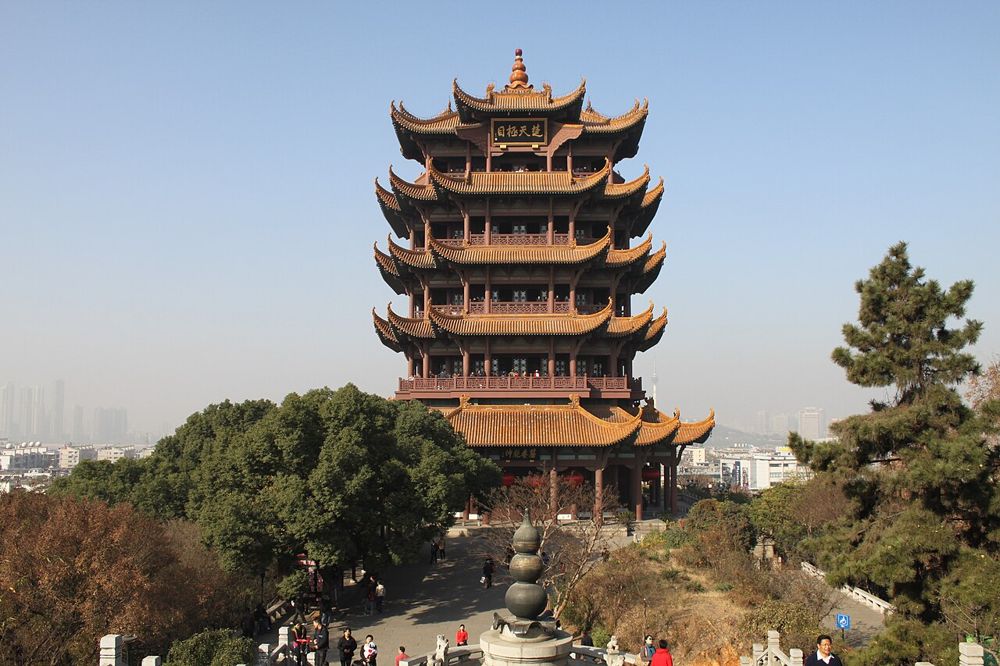
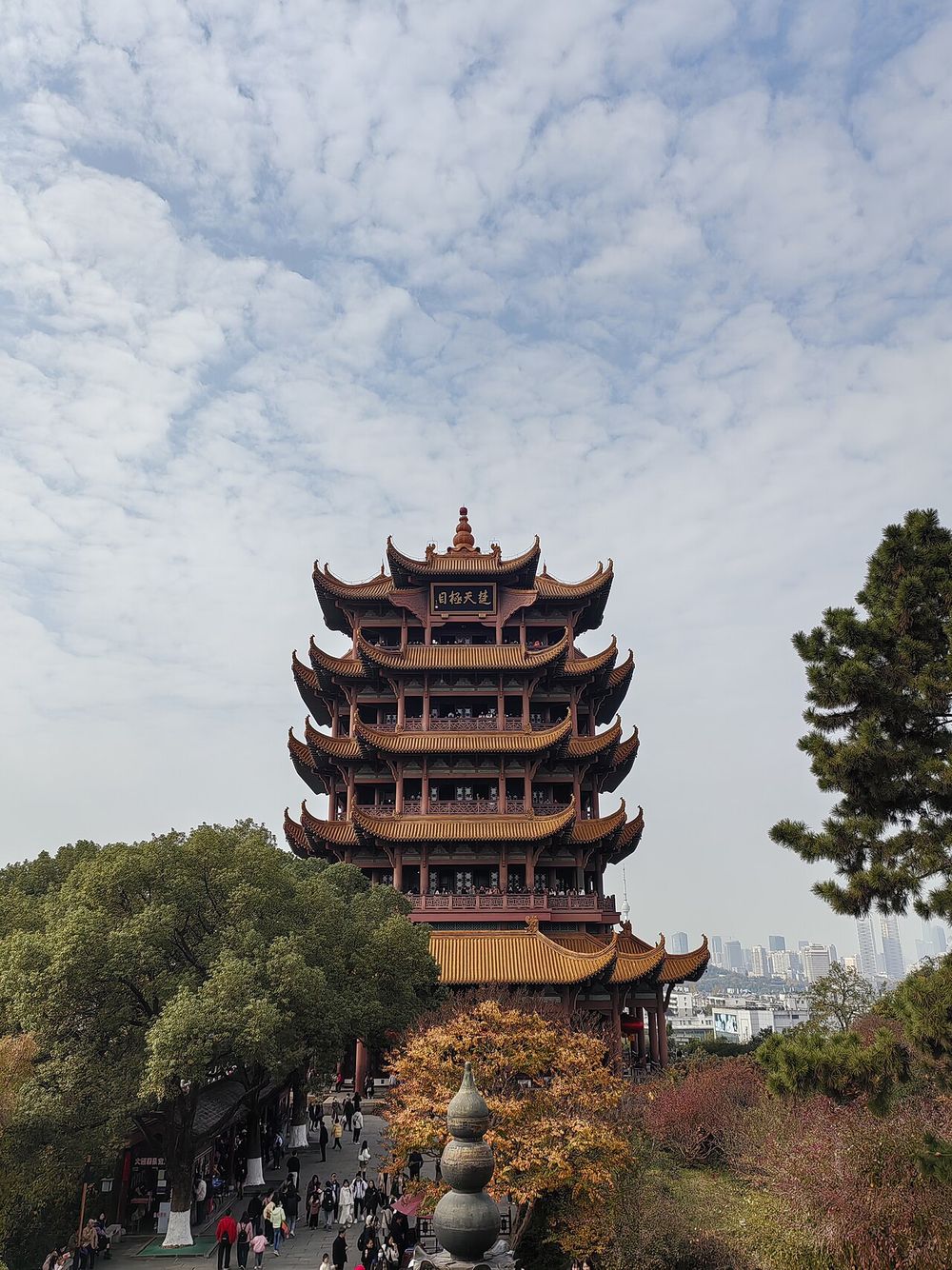
A tower of poems, burned and rebuilt for 1,800 years. The present one dates from 1985.
Photo: xiquinhosilva, CC BY 2.0, Wikimedia Commons
The story
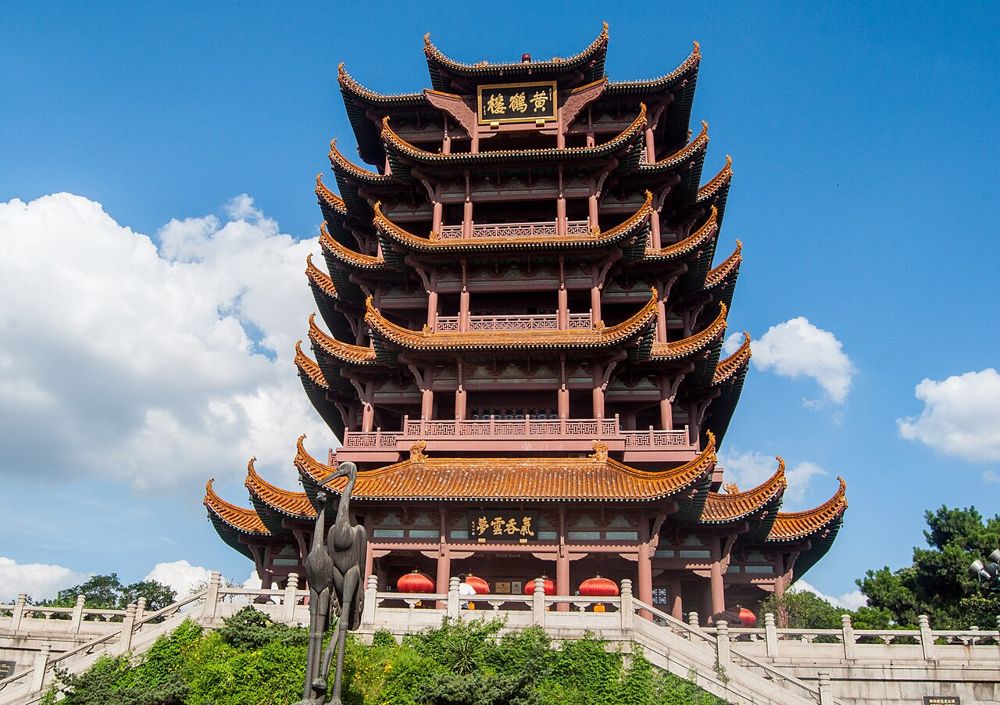
The Yellow Crane Tower in front of you was finished in 1985.
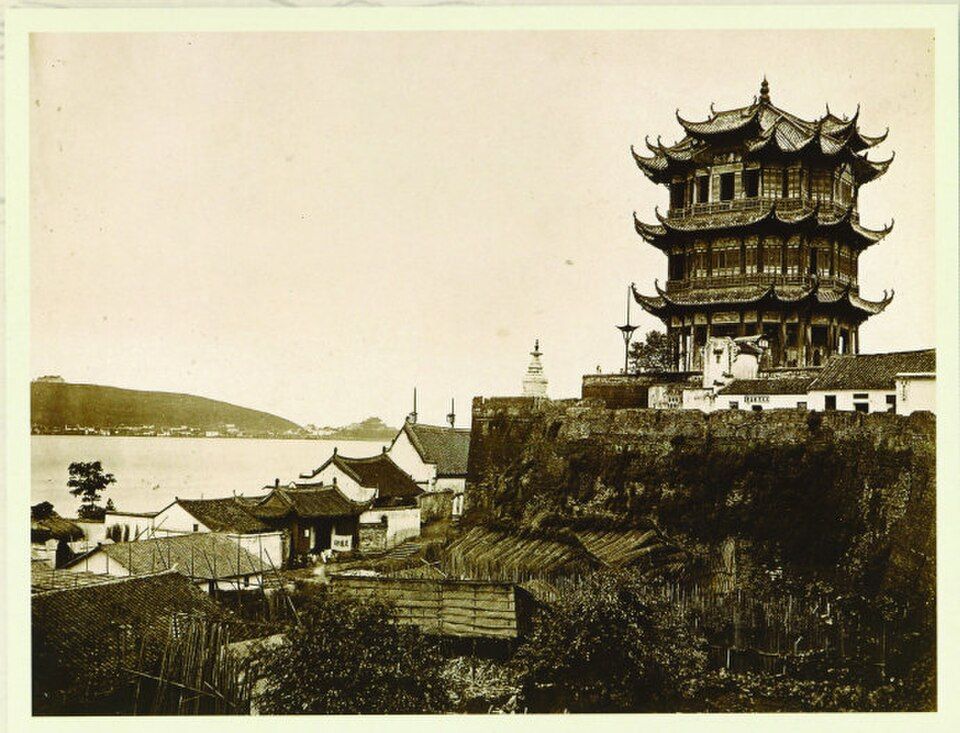
According to a Tang (618–907) dynasty geography, Sun Quan built a walled town here in the Three Kingdoms period (220–280) and put a tower on its corner by the river. For more than a thousand years it was destroyed and rebuilt, rebuilt and destroyed. The last of the old towers burned in 1884. In 1957 the approach to the Yangtze River Bridge was laid across the site.
So today's tower stands about a kilometre back from where it began. The one Cui Hao and Li Bai climbed was down by the water.
What is here
The tower stands inside a ticketed park on Snake Hill. The day ticket covers the park and the climb to the top of the tower. The evening light show is sold separately, and a day ticket does not admit you to it.
Part
Ticket
The tower, climbed to the top floor
Day ticket
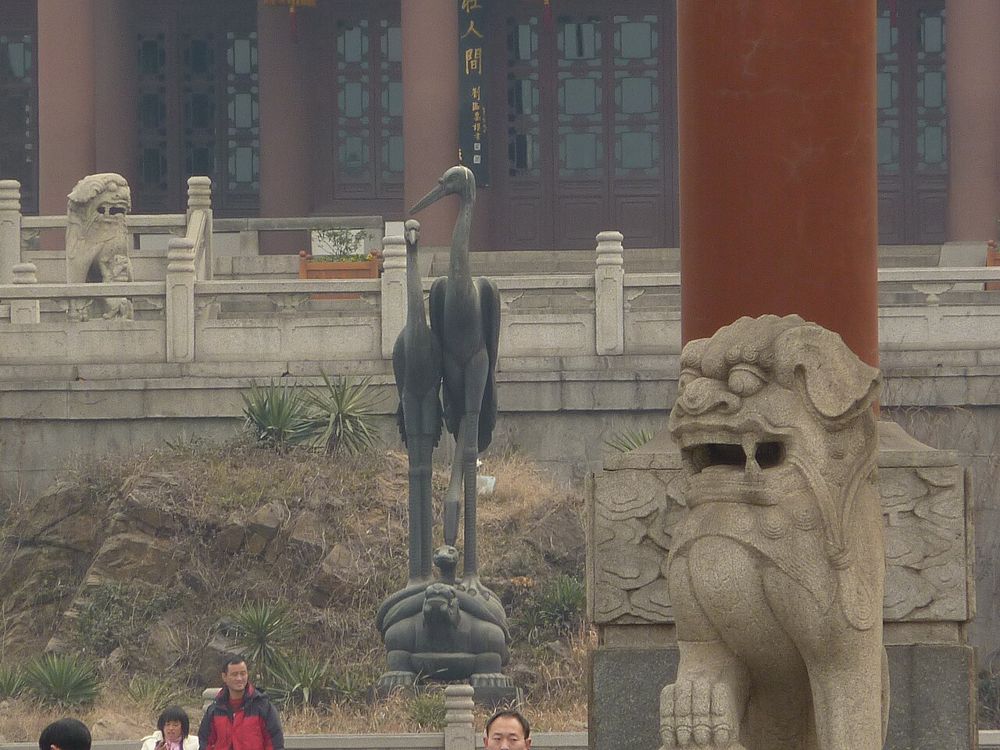
“Return of the Yellow Cranes”, the bronze in front of the tower
Day ticket
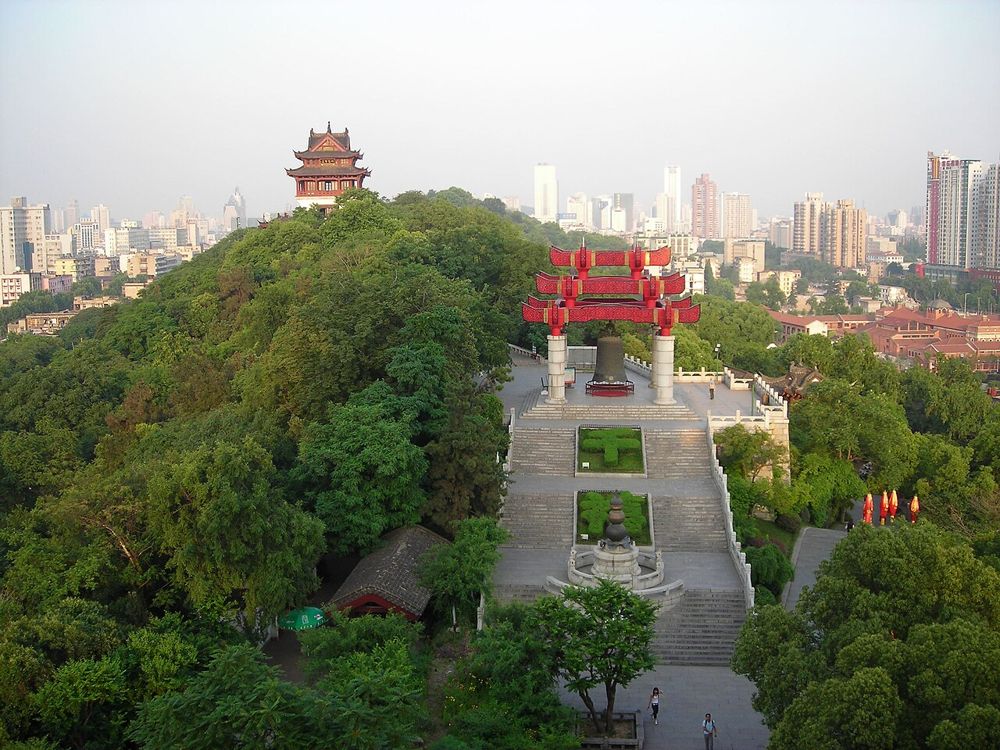
The white pagoda on Snake Hill (Shengxiang Pagoda)
Day ticket
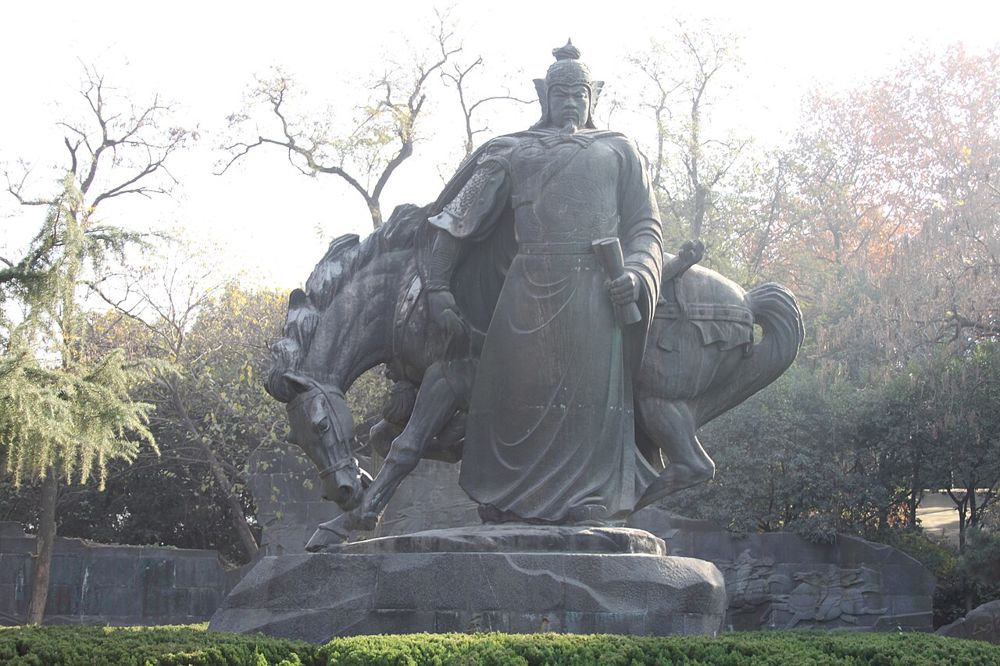
The statue of Yue Fei
Day ticket
The evening light show, 19:30–22:00
Separate ticket
If you have one minute
From a watchtower to a place for poems
The present towerGary Lee Todd, CC0
The earliest record says that in AD 223 Sun Quan walled the town of Xiakou and raised a tower on the rock at its riverside corner. It began as a lookout.
By the Tang it had become the place where writers feasted and saw friends off. Cui Hao wrote “Yellow Crane Tower” here, which the Song critic Yan Yu ranked first among all Tang seven-character regulated poems.
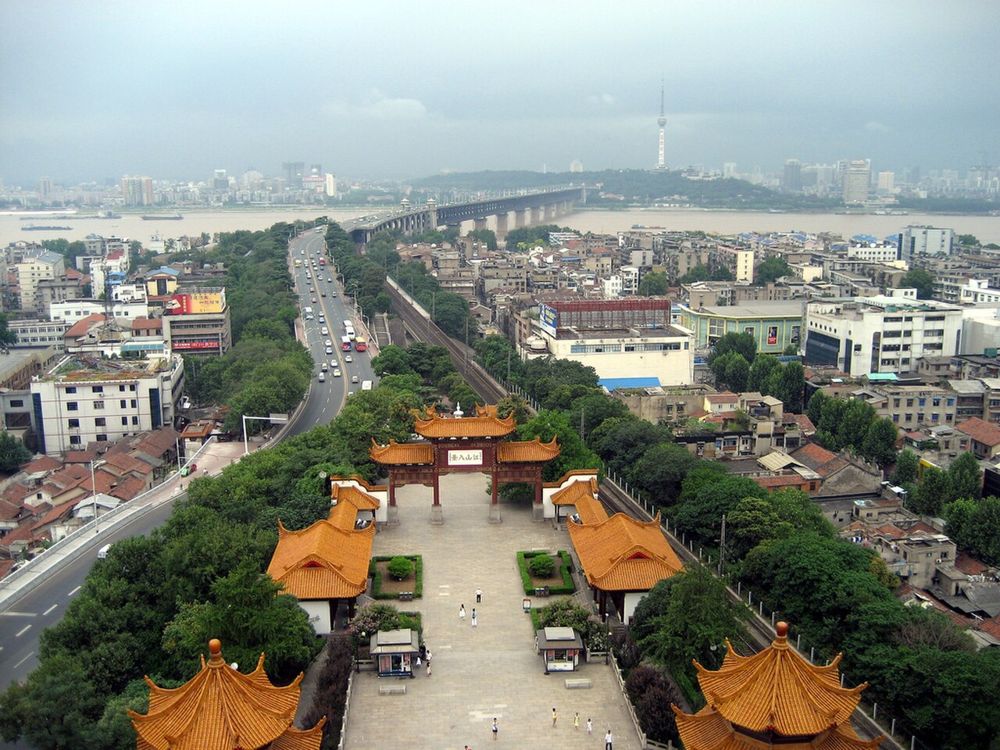
When you reach the top, look toward the Yangtze River Bridge. The Wuchang end of it is where the old tower stood.
People who stood there
A caution first. The poets did not stand where you are. The old tower stood on the riverbank, at today's bridgehead about a kilometre away. Climb to the top, find the Yangtze River Bridge, and look at its near end: that is where they stood.
Cui Hao, Tang poet, 8th centuryHe wrote the poem that later critics ranked first among all Tang regulated verse.
Li Bai, China's best-loved poet, 8th centuryHe saw his friend Meng Haoran off from here to Yangzhou and wrote of the tower in eleven poems, more than anyone.
Yue Fei, Song general and byword for loyalty, 12th centuryThe Song (960–1279) general climbed the tower while it still stood whole.
Lu You, Song poet, 1170Passing on his way up the river, he recorded that the tower was gone and even its site lost.
Mao Zedong, 1927He came in the spring of 1927, when no tower stood on the hill, looked out over the river and wrote a poem that takes the tower's name as its title.
Go deeper: six stops
1. What year was it really built?
Fact: the Tang geography Yuanhe junxian tuzhi records that in the second year of Huangwu (223) Sun Quan built the walls of Xiakou, and that a tower called Yellow Crane stood on the rock at the corner. It was a military lookout, not a place to admire the view.
Note what the book dates: the building of the town. The tower's year is inferred from it. That is why official descriptions say it is “traditionally” dated to 223. The caution is right.
Accounts differ on the name. One view: Snake Hill was once called Yellow Swan Hill, and “swan” and “crane” were interchangeable in old usage. The other: it was named for an immortal who rode a crane, which is the next stop.
2. The immortal on the crane changed four times
The bronze “Return of the Yellow Cranes” in front of the towerVmenkov, CC BY-SA 2.0
Who rode the crane? The story has been told for well over a thousand years, and in the books the rider changes four times.
3. Cui Hao's first line: yellow crane, or white cloud?
Fact: Yan Yu wrote in the Southern Song (1127–1279) that among Tang seven-character regulated poems, Cui Hao's “Yellow Crane Tower” should stand first.
Accounts differ. The first line every Chinese schoolchild learns has the man of old riding away on a yellow crane. But two anthologies compiled in the Tang itself, in 744 and 753, and a Dunhuang manuscript, all have him riding away on a white cloud.
The crane version took over in the Ming (1368–1644) and Qing (1644–1912), and the Three Hundred Tang Poems chose it. Most scholars now think the original was “white cloud”; some still argue for the crane. One line of verse, argued over for three hundred years.
4. Did Li Bai really put down his brush?
Accounts differ: there is a fiercer line too, about smashing the tower with one fist and kicking over Parrot Island. The Ming scholar Yang Shen held that a Chan monk composed it as a verse on the brush story, and that it is not Li Bai's.
Fact: brush or no brush, scholars count 11 poems by Li Bai that mention the tower, more than anyone else. The best known sees Meng Haoran off to Yangzhou. Another has a jade flute played in the tower and plum blossom falling over the “river city” in the fifth month, which scholars connect with Wuhan's nickname, River City.
5. Connections across time and place
Two famous towers rebuilt a year apart: Yueyang Tower in 1867, Yellow Crane Tower in 1868. With the Pavilion of Prince Teng they are the three great towers south of the Yangtze, and all three were destroyed and rebuilt many times. The Pavilion of Prince Teng was last destroyed in 1926.
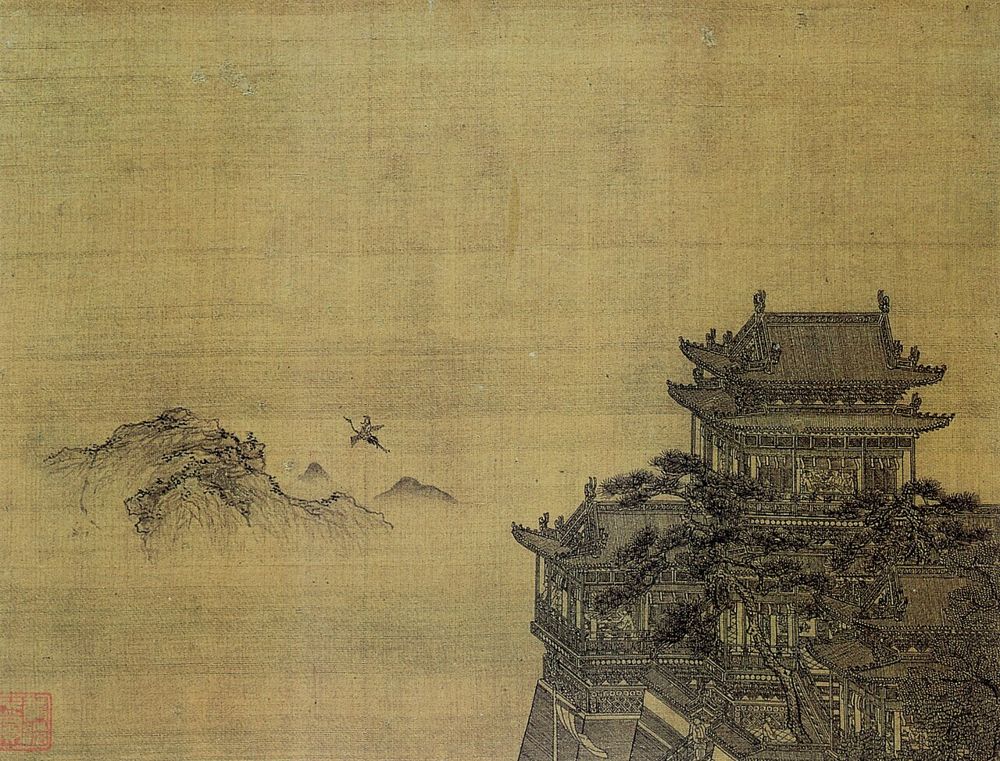
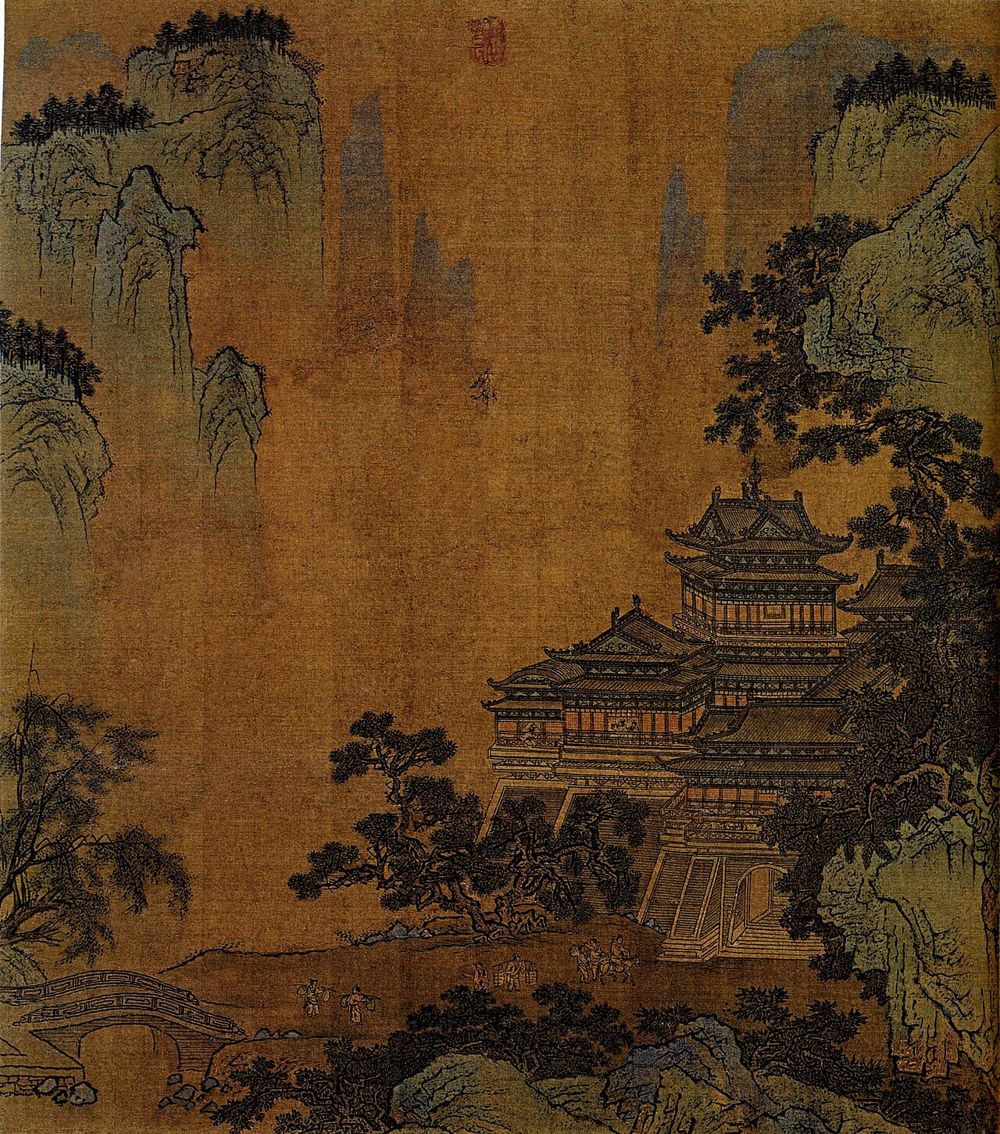
One painter for all three: the Yuan artist Xia Yong painted each of them in ruled-line style. Two of those leaves are in the Freer Gallery in Washington.
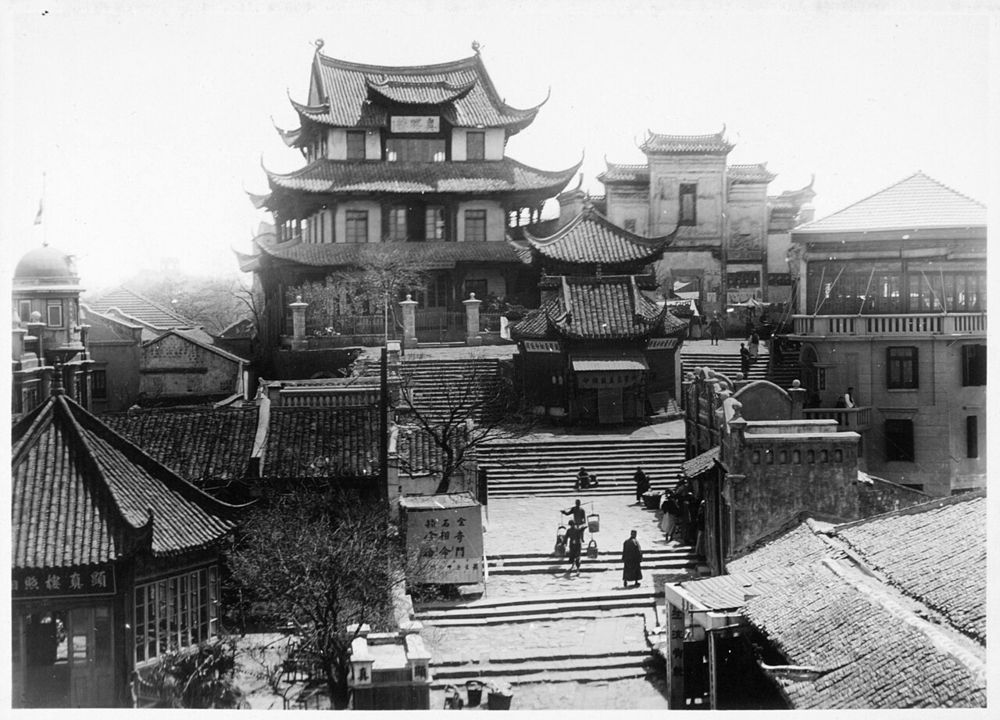
An old photograph became a new building: John Thomson photographed the last timber tower in 1871, and the 1985 tower was modelled on that one.
The tower made way for a bridge. Generation after generation of towers stood on the same rock for over a thousand years. In 1957 the rock went to the Yangtze River Bridge, and the tower moved up Snake Hill.
The same bird in two civilisations. In China the crane carries immortals. In Greece, in the story of the cranes of Ibycus, it bears witness. Schiller made that story a ballad in 1797.
6. From the riverbank to the hilltop
The last timber tower in the 1870s, photographer unknownUnknown photographer, Public domain
The old tower was not always there. The table below lists only the dates that have been checked.
223
Sun Quan walls Xiakou; a tower stands on the corner
6th c.
Zhang Zhengjian's poem, thought to be the first about the tower
514
The tower is still standing
Tang
A place for feasts and farewells
to early S. Song
Intact; Li Gang and Yue Fei both climb it
1170
Lu You passes Wuchang and notes the tower is gone and even its site lost
1868
The last timber tower is completed
1871
John Thomson photographs it
1884
It burns down
1899
Huang Zunxian laments in a poem that the tower is “smashed again” and there is no wall left to write on
after 1907
A new building near the old site, later renamed Aolüe Tower
1957
The Yangtze River Bridge approach takes over the site
1985
The present tower opens on Snake Hill, about 1 km away, modelled on the 1868 tower, in reinforced concrete
Then and now
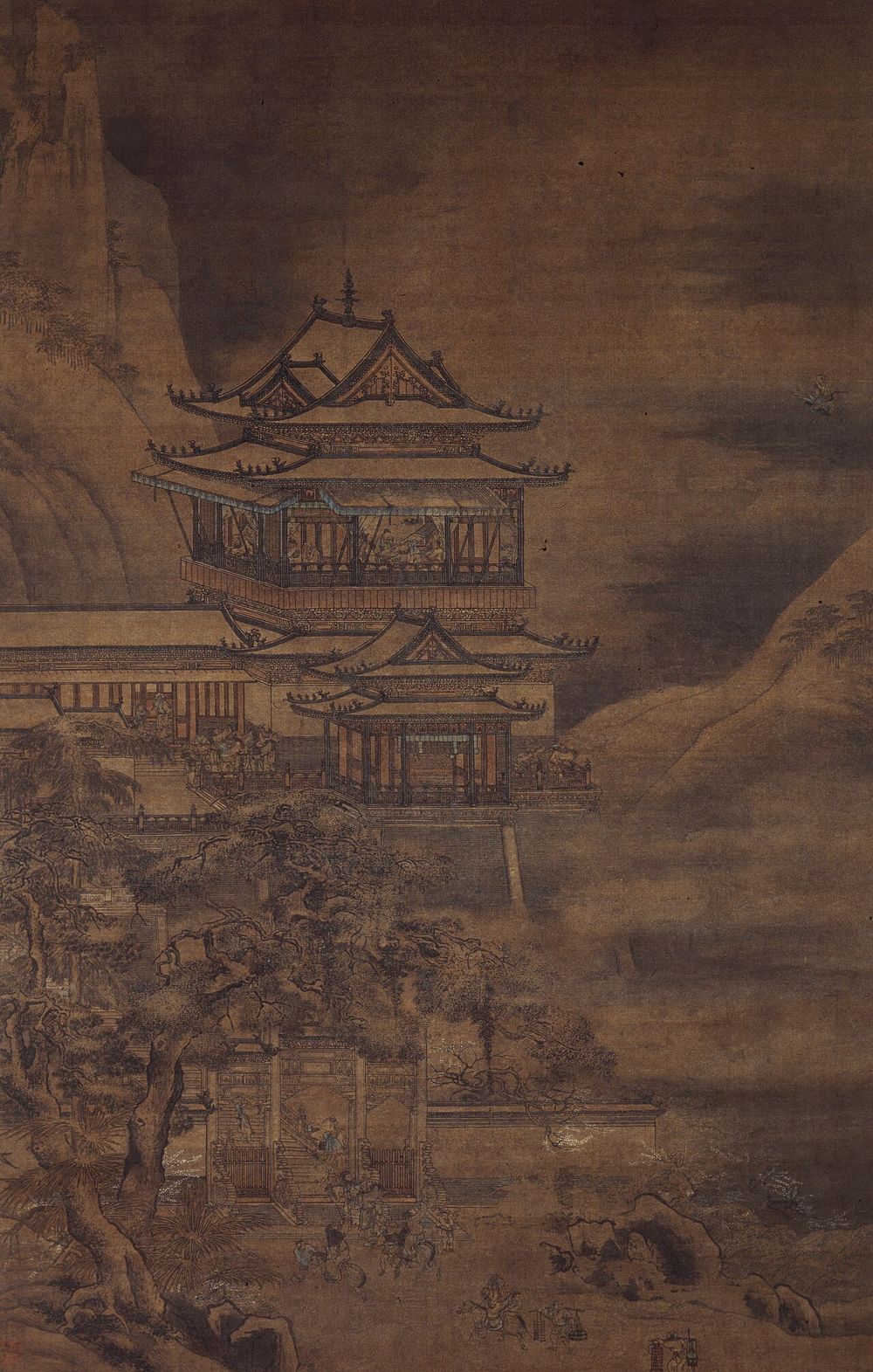
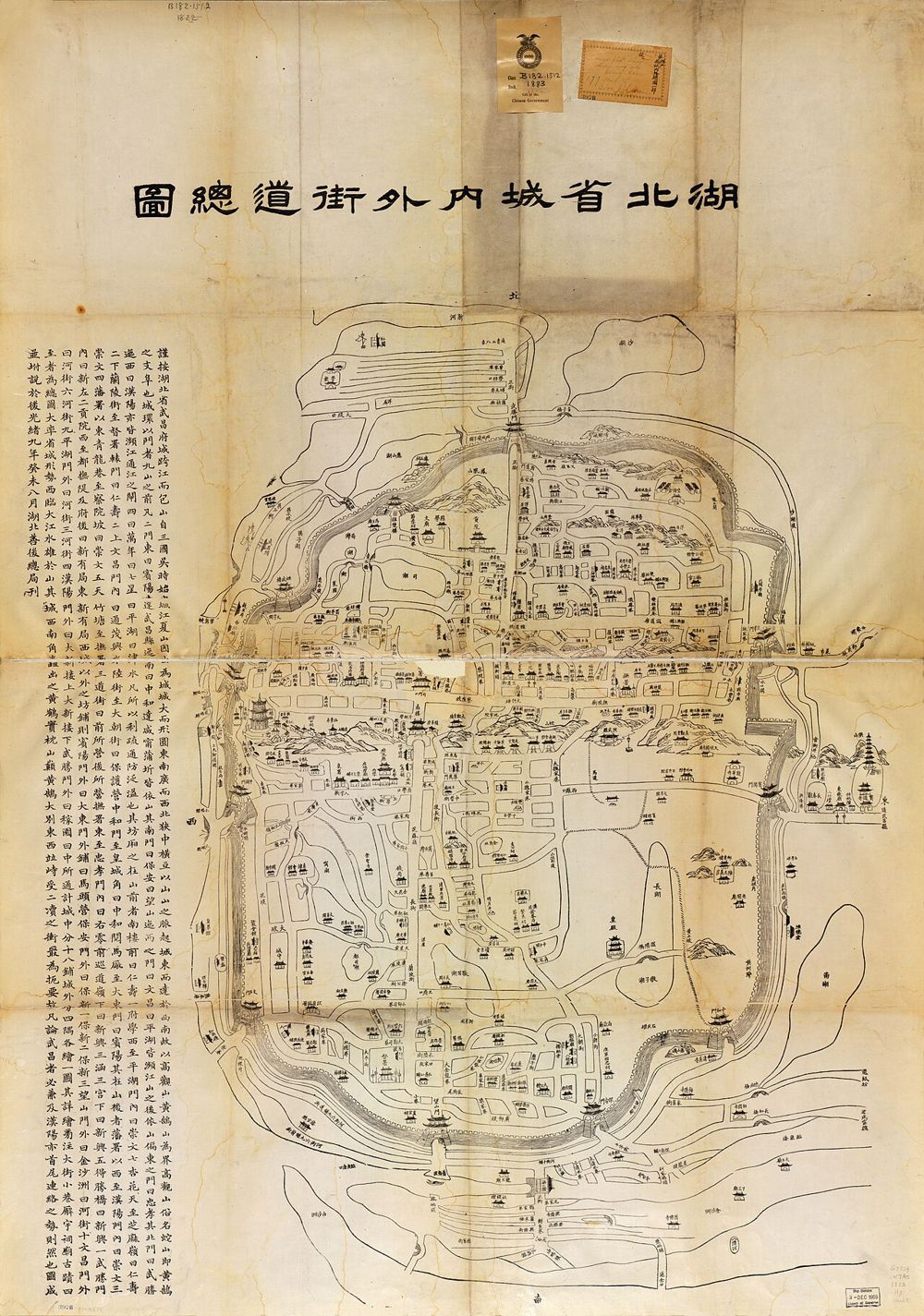
The tower in 2023Yumeto, CC BY-SA 4.0, Wikimedia CommonsThe present towerGary Lee Todd, CC0, Wikimedia CommonsThe present tower, 2013Meraj Chhaya, CC BY 2.0, Wikimedia CommonsThe bronze “Return of the Yellow Cranes” in front of the towerVmenkov, CC BY-SA 2.0, Wikimedia CommonsStatue of Yue Fei in the parkGary Lee Todd, CC0, Wikimedia CommonsWuhan from the tower于回 (risemeagain), CC BY-SA 2.0, Wikimedia CommonsSnake Hill from the towerChubbyWimbus, CC BY-SA 3.0, Wikimedia CommonsAn Zhengwen, “Yellow Crane Tower”, Ming dynasty hanging scroll. Shanghai MuseumAn Zhengwen (Ming dynasty), Public domain, Wikimedia CommonsXia Yong, “Yellow Crane Tower”, Yuan dynasty, ruled-line paintingXia Yong (Yuan dynasty), Public domain, Wikimedia CommonsAnonymous, “Yellow Crane Tower”, Ming album leaf. Shanghai MuseumAnonymous (Ming dynasty), Public domain, Wikimedia CommonsThe last timber tower in the 1870s, photographer unknownUnknown photographer, Public domain, Wikimedia CommonsStreet map of Wuchang, 1883, the year before the fire. Library of CongressUnknown; Library of Congress, Public domain, Wikimedia CommonsThe old site in 1926, from the Japanese photo series Ajia Taikan. Its caption says the tower no longer stood; the building in view is a later one, not yet identified for certainAjia Taikan photo series, Public domain, Wikimedia Commons
Local legends
These are stories people tell about this place. They are legends, not history, and each one says where it comes from.
LegendLi Bai puts down his brush
Li Bai is said to have climbed the tower meaning to write a poem, seen Cui Hao's on the wall, said “there is a view before my eyes I cannot put into words, for Cui Hao's poem is written overhead”, and put down his brush.
The remark first appears in a Northern Song (960–1127) work by Li Tian, more than two hundred years after Li Bai. It cannot be shown to be his.
Source: Li Tian, Gaiwen lu, Northern Song
LegendThe immortal on the crane
An immortal rides off from the tower on a yellow crane. The story has been told for well over a thousand years, but the rider keeps changing. In order of first appearance:
The History of the Southern Qi (6th century): “it is said that the immortal Zi'an passed here riding a yellow swan.” A swan, not yet a crane.
Ren Fang's Shuyi ji (6th century): the scholar Xun Gui meets an immortal who arrives on a crane, drinks with him, and flies away. This is the earliest complete story.
Tang and Song records: Fei Yi, a minister of Shu Han, became an immortal and often rested here on his yellow crane. Fei Yi was a real man. His ascension is legend.
Popular tales from the Yuan (1271–1368) and Ming (1368–1644): Lü Dongbin paints a crane on the wall of the Xin family's tavern.
The version visitors know best today, Lü Dongbin's, is the latest of all, more than a thousand years younger than the first.
Source: History of the Southern Qi; Ren Fang, Shuyi ji; Tang and Song records
LegendElsewhere: the cranes of Ibycus
A Greek legend. The poet Ibycus, murdered on the road, saw cranes pass overhead as he died. Later the flock appeared above a theatre, and the killers gave themselves away.
Source: Ancient Greek tradition
Later, people who live here will be able to add the stories they grew up with, and say which of these they have heard.
Not certain, and where accounts conflict
How tall is the present tower?
Figures of 49, 50.4, 51.4 and 52 m all circulate. We give none until the park confirms one.
Does the bronze finial of the 1868 tower survive?
The park displays an “old bronze top”. Whether it is the original is not yet confirmed. If it is, it is the only piece of the last timber tower left.
When was the white pagoda on Snake Hill built?
It is a nationally protected monument. The date often given, 1343, still lacks a scholarly source.
Visiting
Tickets and hours
The tower is in a ticketed park on Snake Hill in Wuchang district, Wuhan.
Daytime opening is 08:30 to 18:00, with last entry at 17:20. The day ticket was reported at 70 yuan in mid-2026.
There is a separate evening session with a light show, 19:30 to 22:00. It needs its own ticket; a day ticket does not admit you.
Last checked 2026-11-11. Travel and news reports, not the site's own notices.
Where to start
Climb to the top floor first and find the Yangtze River Bridge. Everything in the story starts from that view: the old site is at the near end of the bridge.
Then come down through the park. The bronze cranes stand in front of the tower, and the statue of Yue Fei is in the grounds.
Before you go
The tower has many stairs. Allow for that with small children and older visitors.
Carry your passport. Ticketed sites in China generally check identity documents.
Prices and hours change. Check the park's official channel before you travel.
Customs and manners
The poems on the walls and steles are part of the place. Do not write or scratch anything beside them.
Crowds are dense and people stand closer than you may be used to. Being jostled in a queue is not meant as rudeness.
People may ask to take a photo with you, most often visitors from outside the big cities. It is friendly curiosity. Agree with a smile or decline with a wave; either is fine.
Tipping is not expected in China, at sites or in restaurants.
Look for these
From the top, find the Yangtze River Bridge. Where did the old tower stand? (At the Wuchang bridgehead.)
In the earliest story, what bird did the immortal ride? (A yellow swan.)
In the Tang anthologies, on what did the man of old ride away in Cui Hao's first line? (A white cloud.)
The tower in front of you copies the tower of which reign? (Tongzhi, Qing dynasty.)
I am here
Stand at the site, sign in, press the button, and collect its stamp. Your browser will ask to use your location. It is sent to us once to confirm that you are at the site; we keep how far you were from it, not the spot where you stood.
Your stamps are saved to your account, so they follow you to any device. Checking from a browser cannot rule out every false location; stricter checks arrive with the app.
Messages
Share your photos
Photos here show the place, not people. Each one is credited to the visitor who took it and appears after our team has looked at it. A photo with you in it belongs under “I am here”.