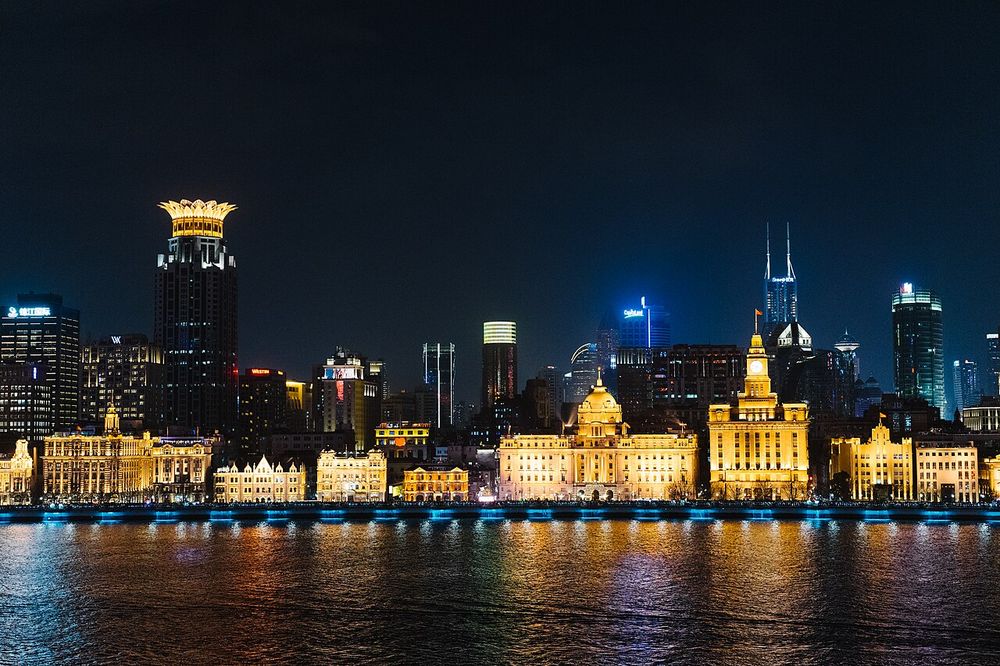
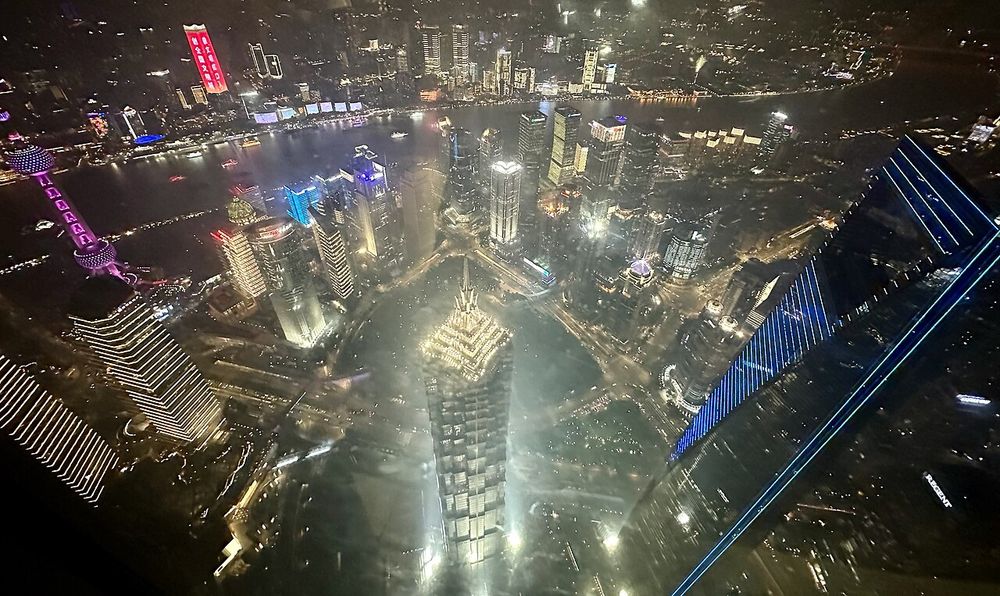
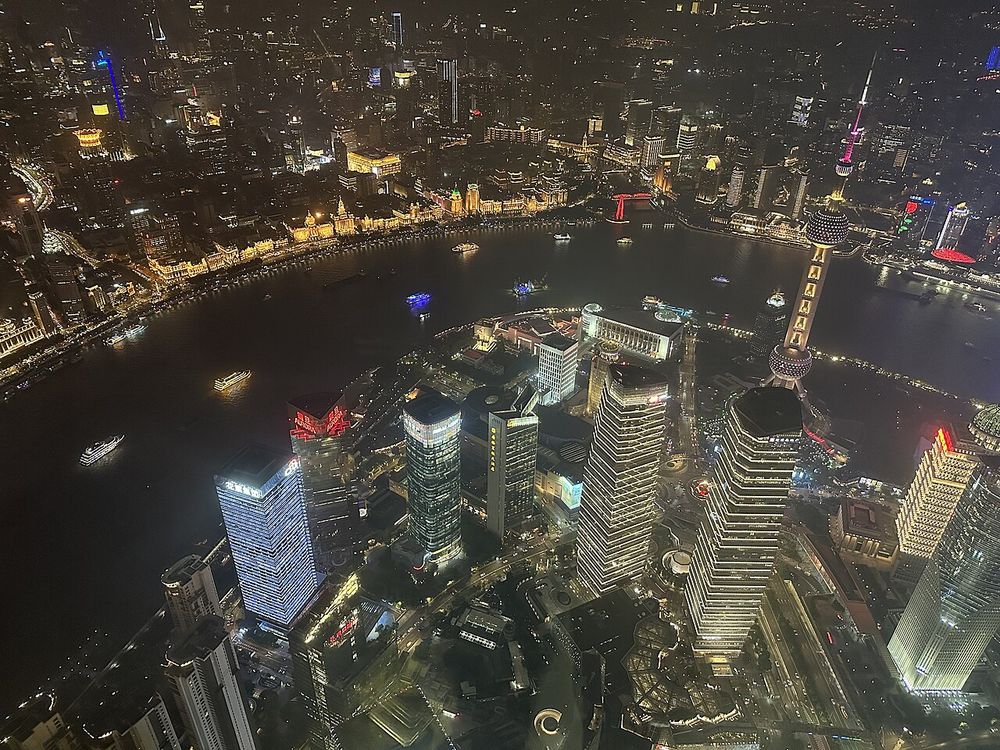
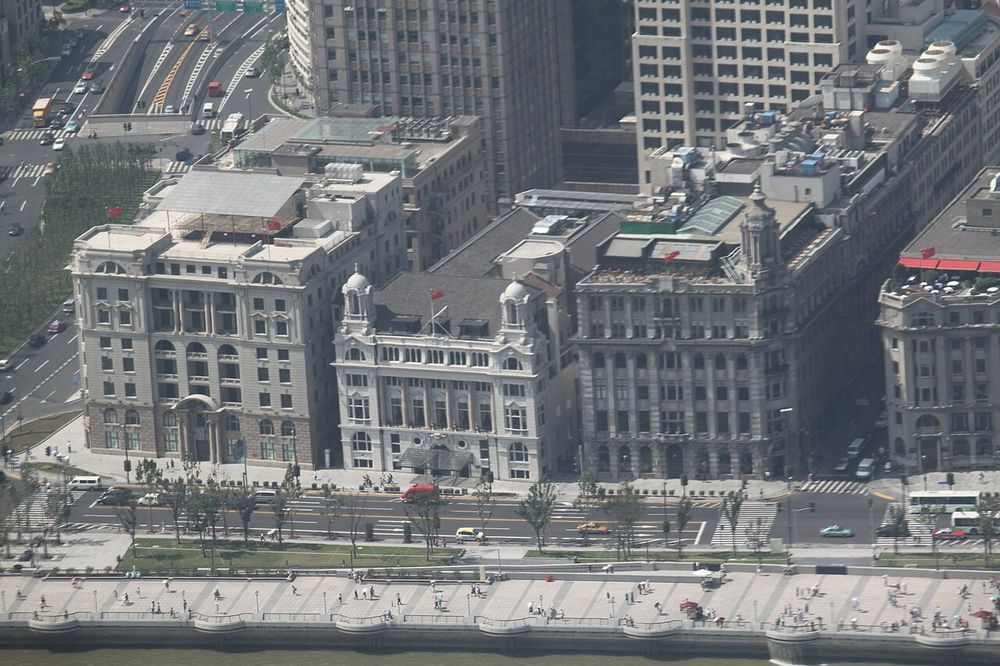
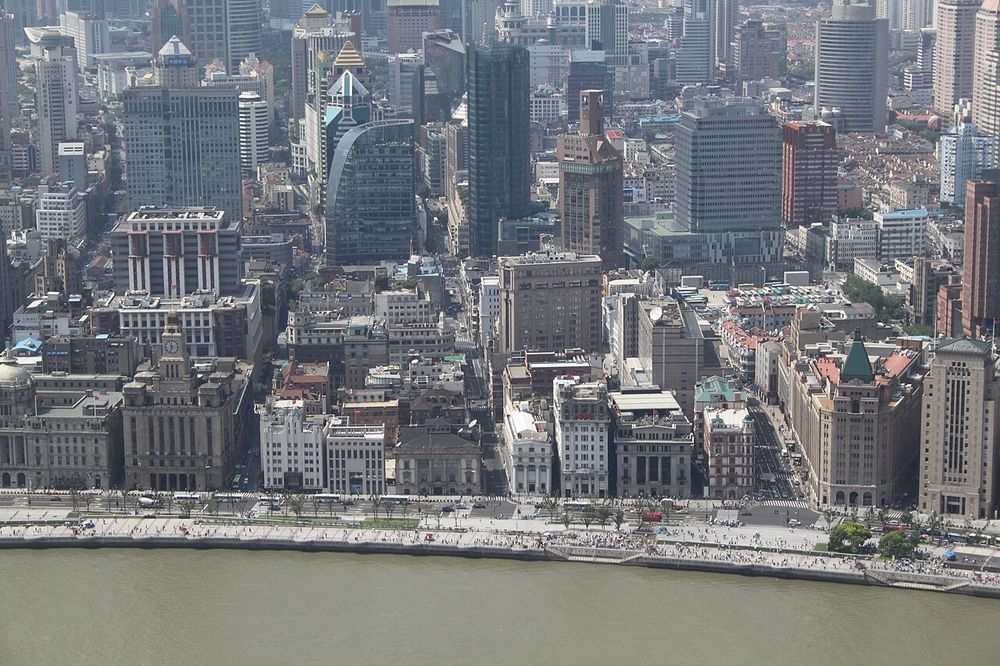
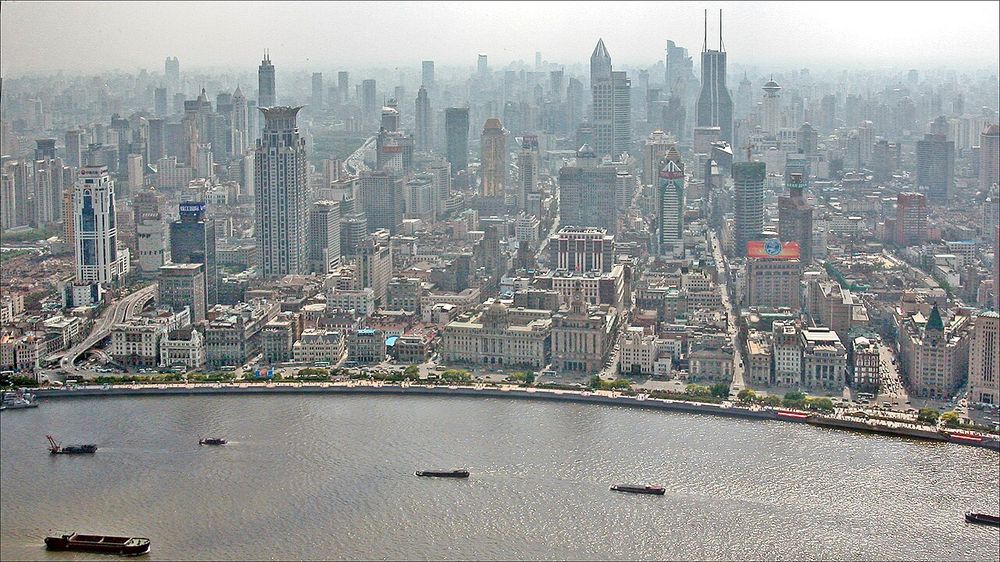
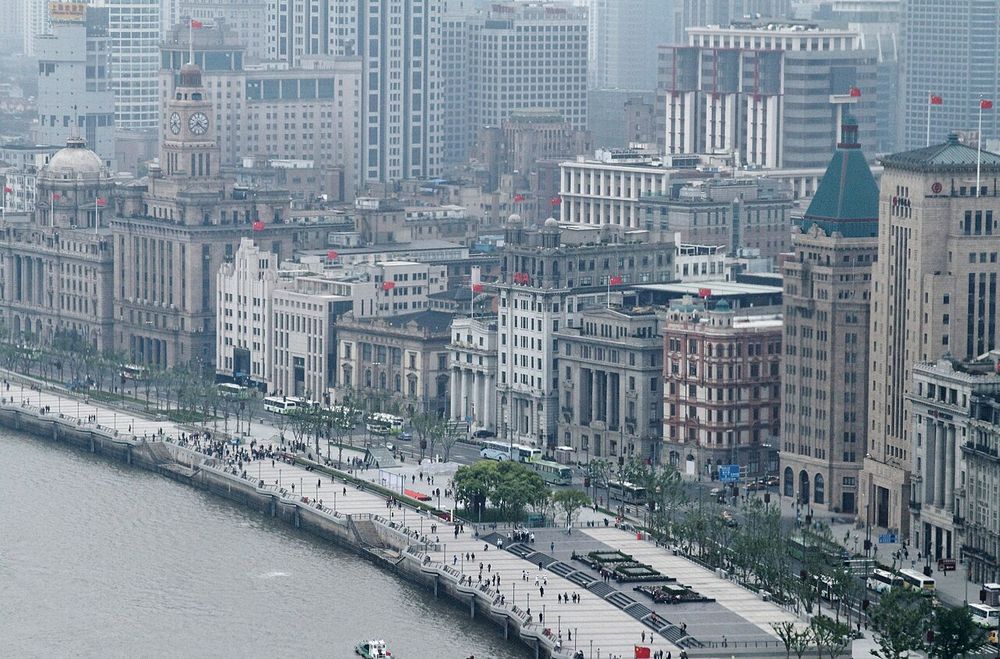
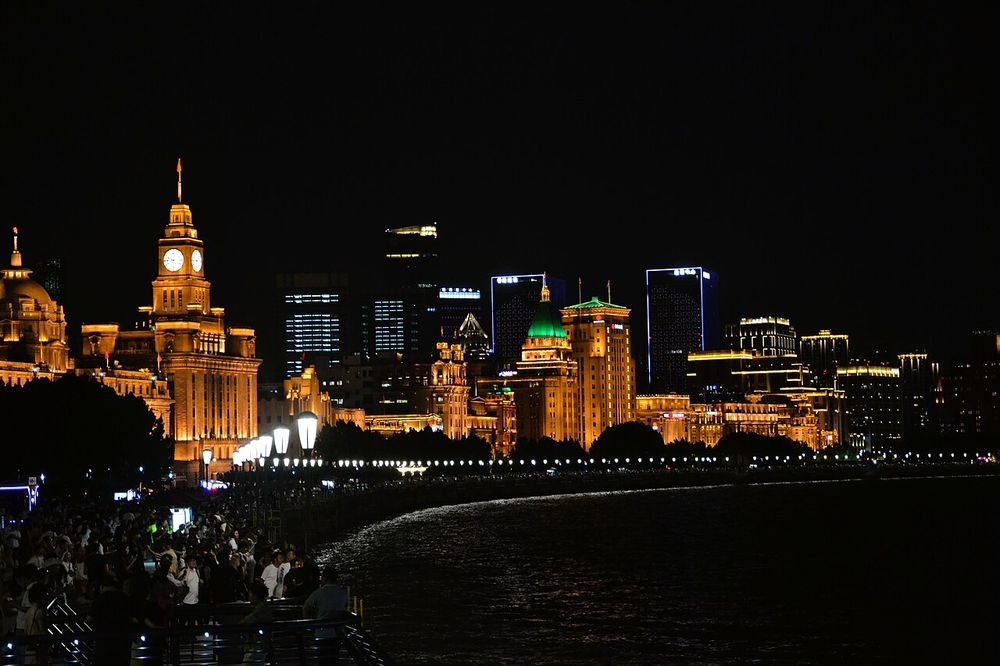
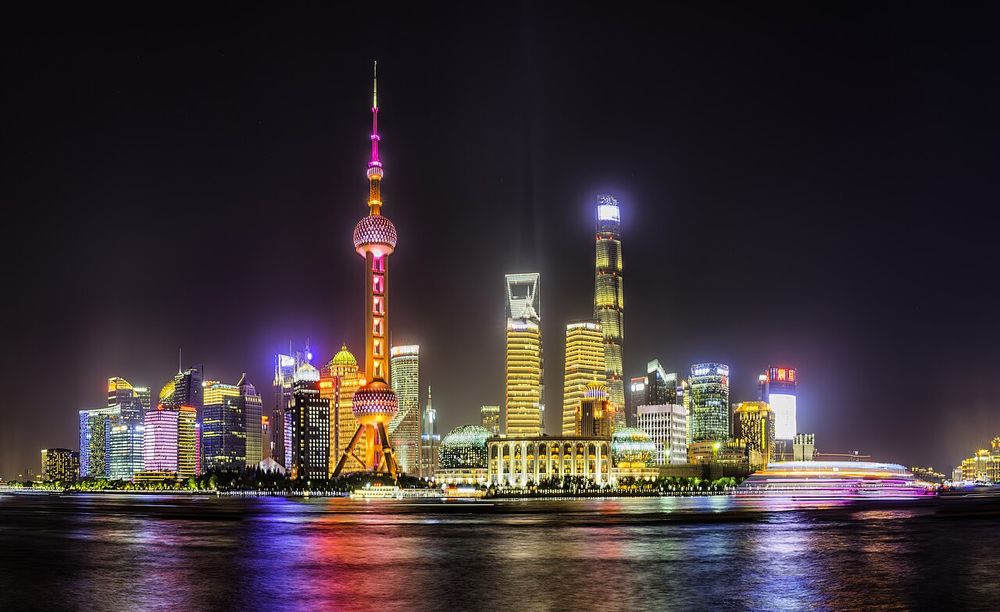
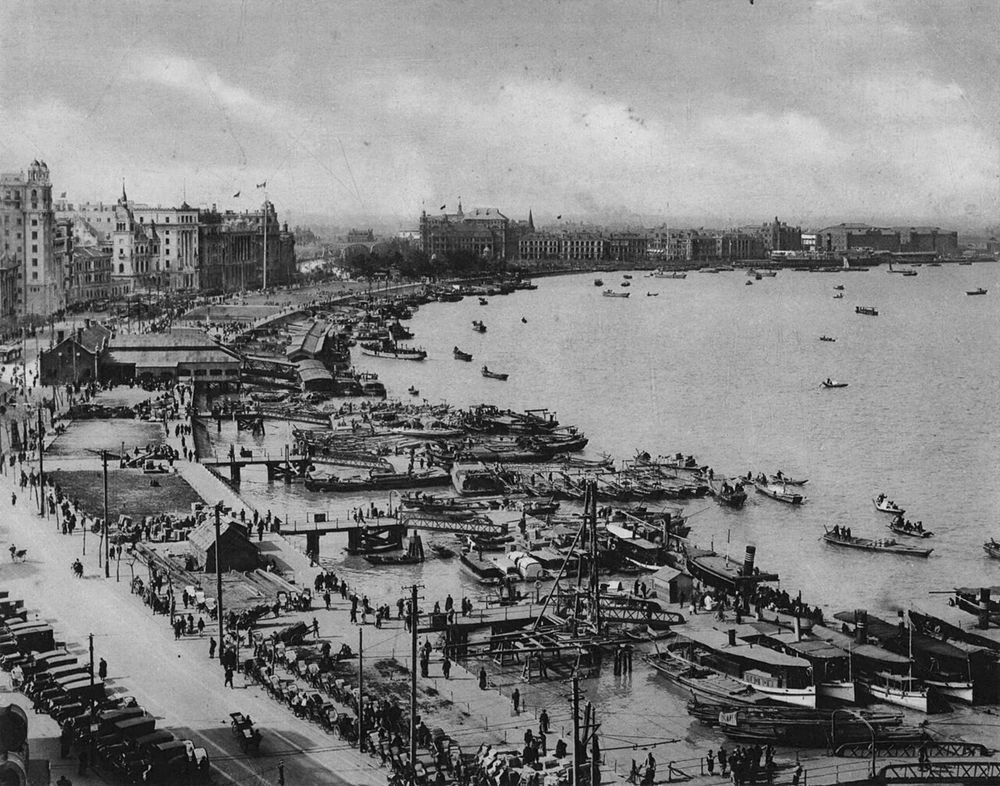
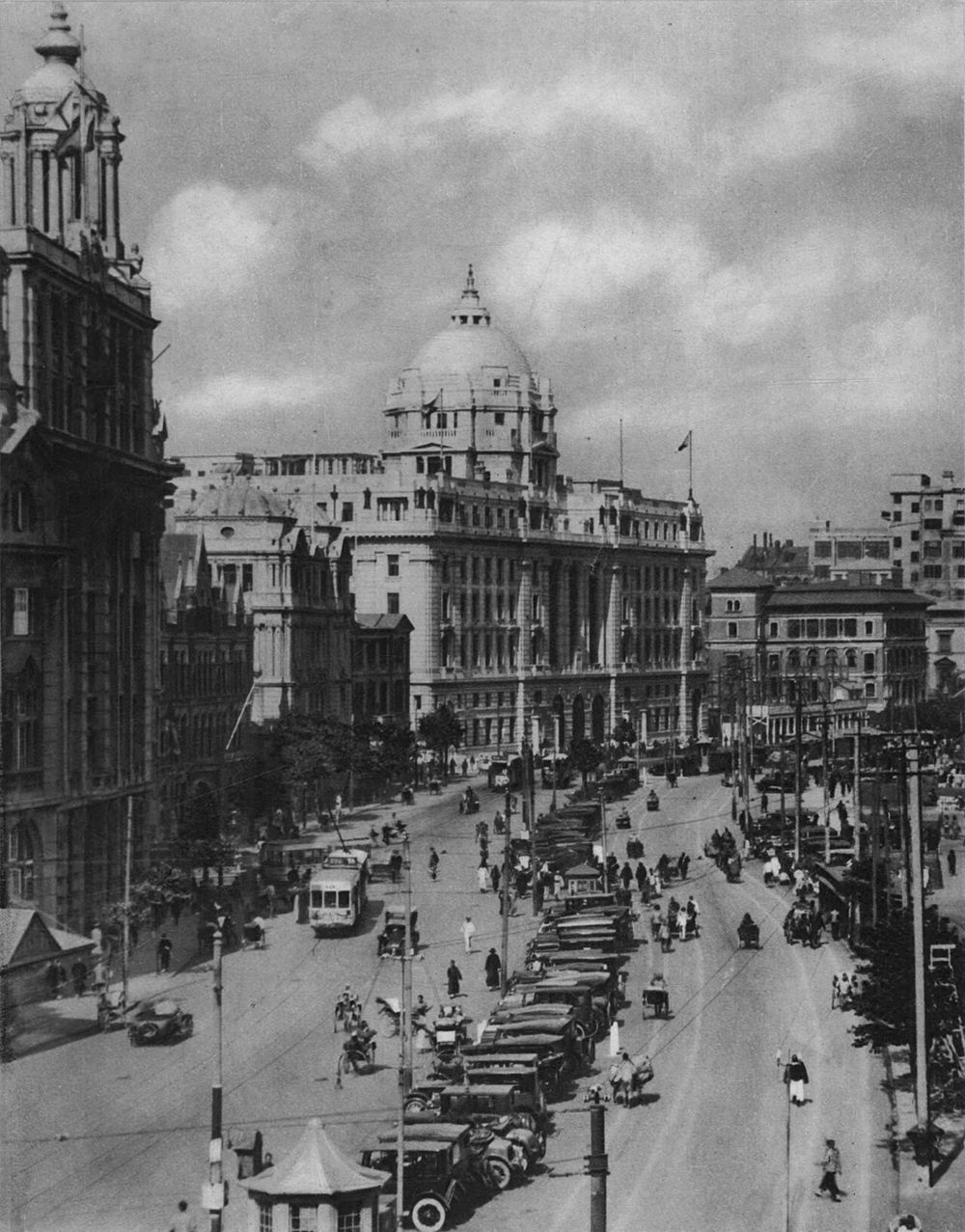
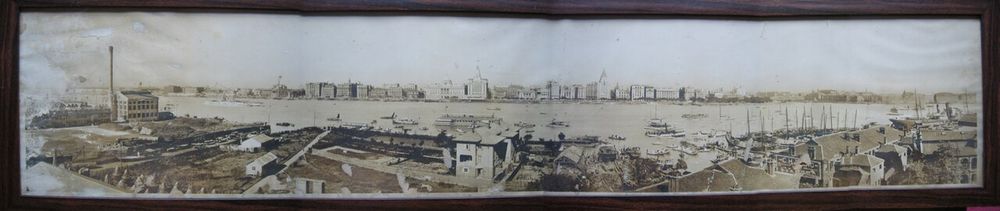
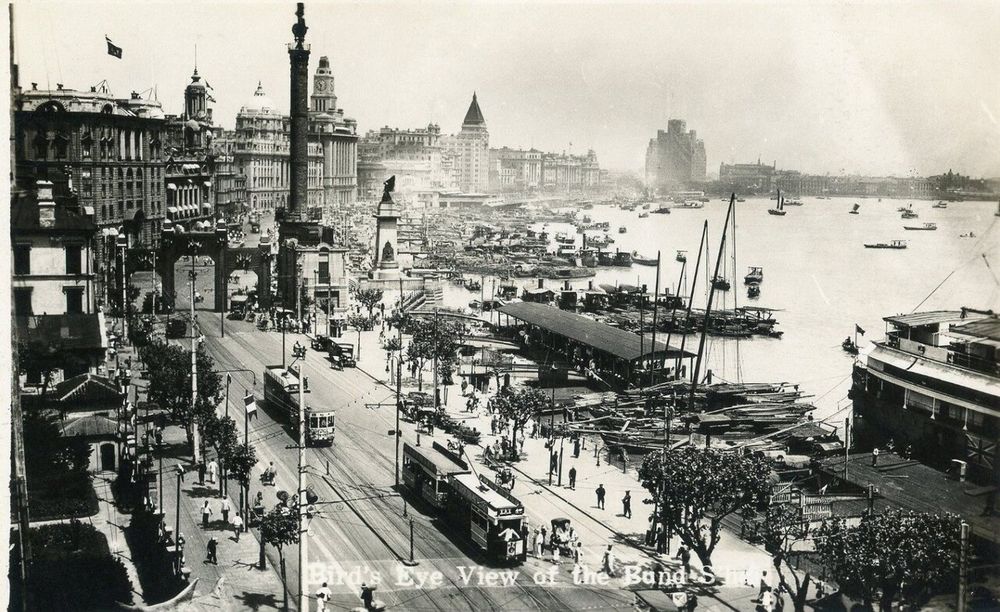
A mile of stone banks, hotels and offices along the Huangpu River, built between the 1900s and the 1930s when Shanghai was a treaty port run largely by foreigners. Across the water stands the skyline of the 1990s and after. Between the two, on the riverside walk, you see a hundred years of the city at once.
Photo: Dllu, CC BY-SA 4.0, Wikimedia Commons
The story
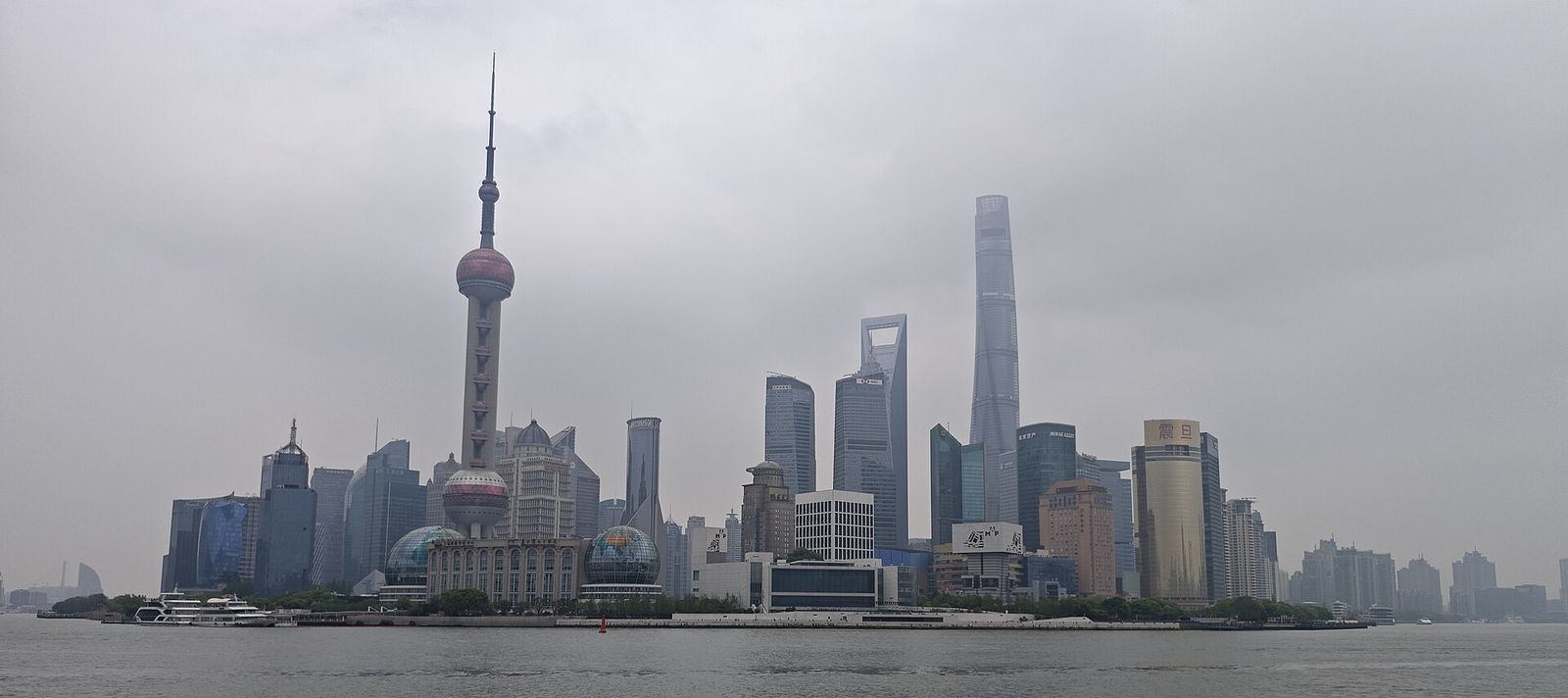
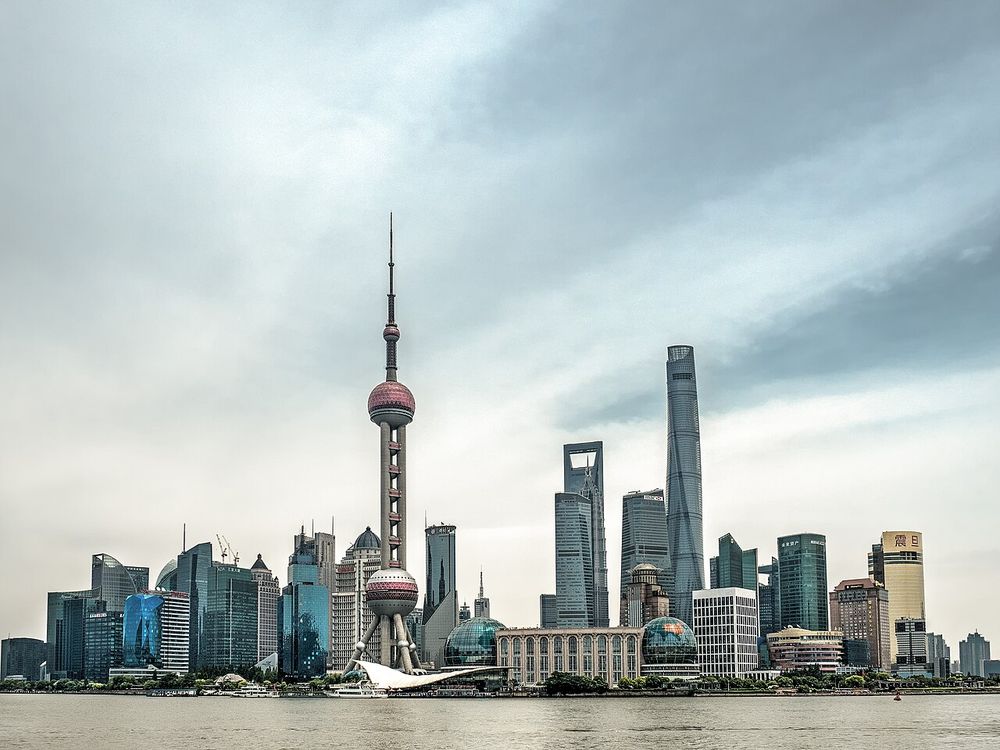
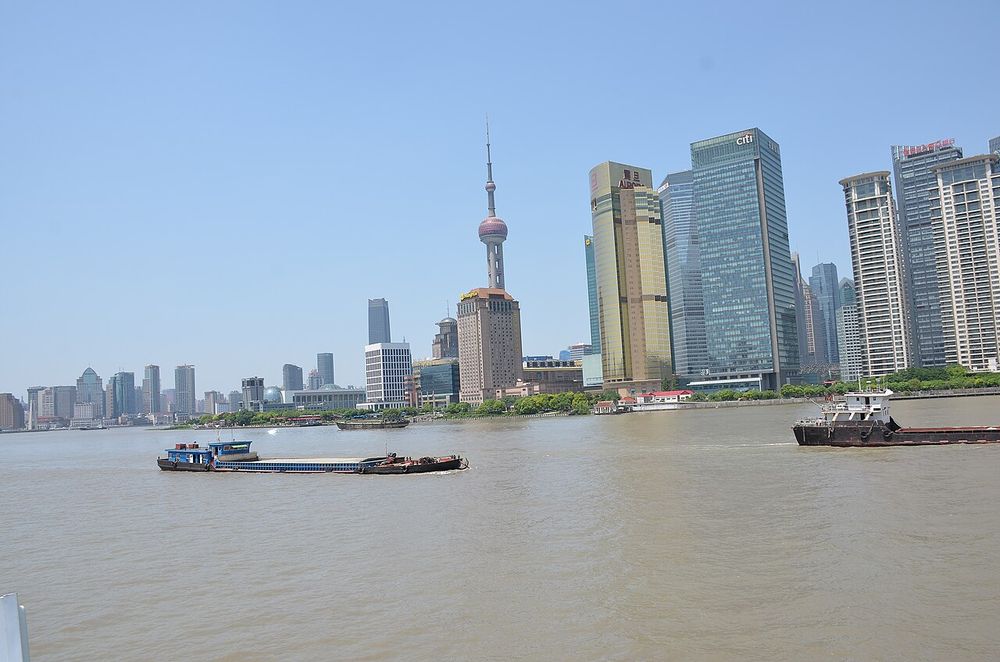
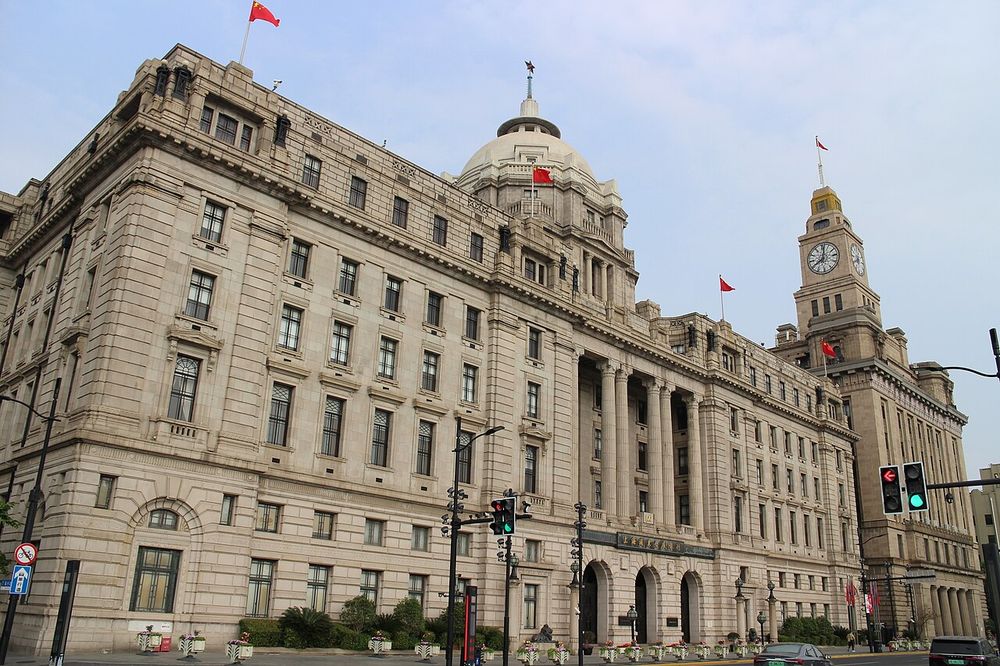
You are on a broad raised walkway along a wide brown river busy with barges. Behind you, across a road of traffic, stands a wall of heavy stone buildings: domes, columns, a clock tower, a green pyramid roof. In front of you, across the water, a forest of glass towers rises, among them a tower with pink balls on it and the tallest building in China, twisting as it climbs.
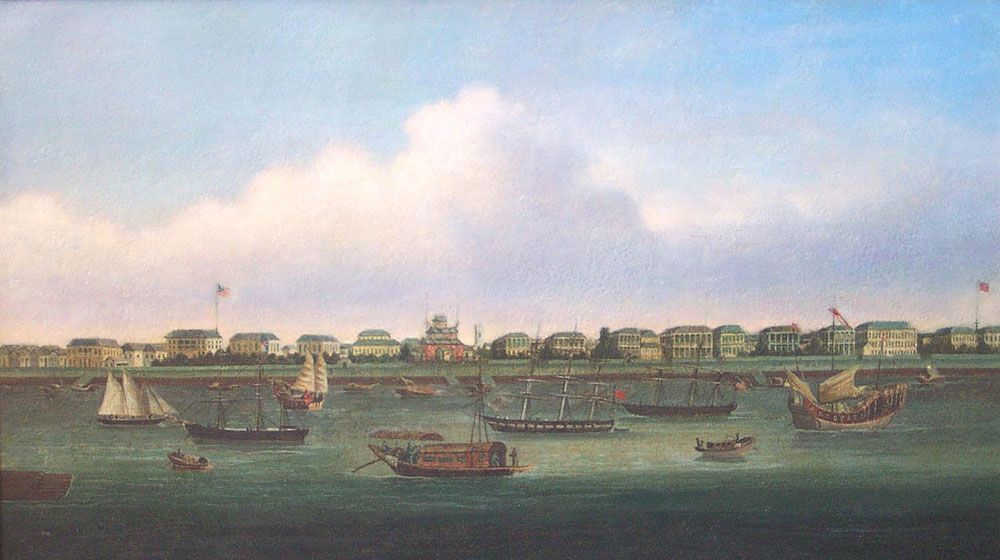
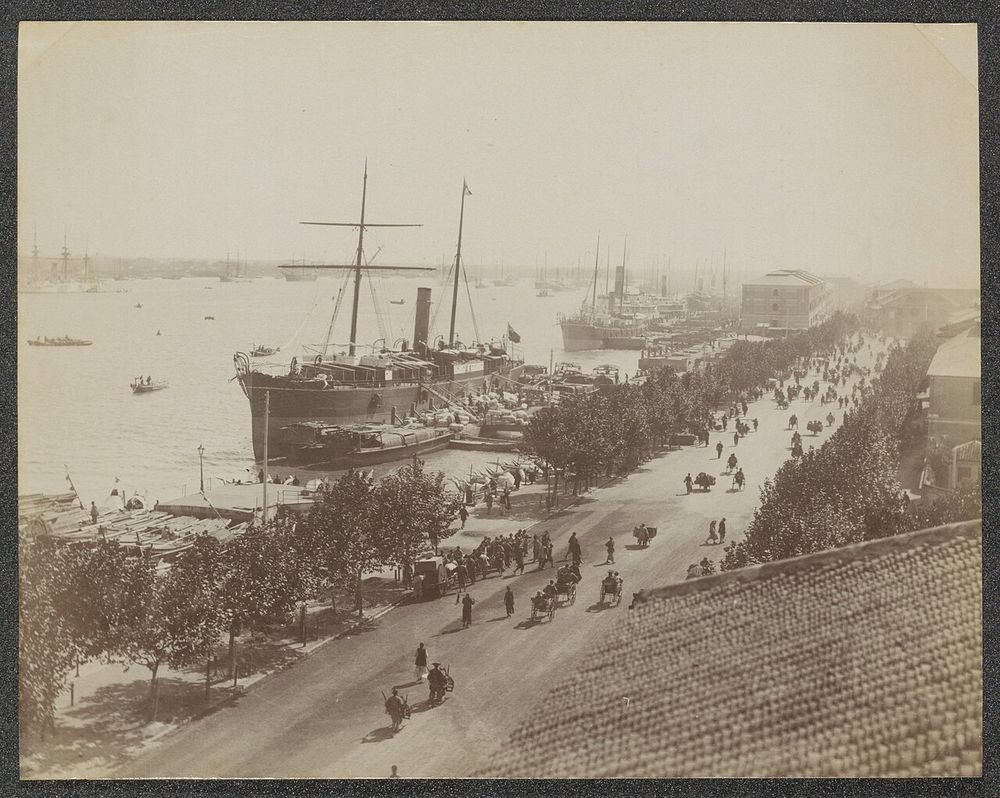
In 1842, after the first Opium War, the Treaty of Nanking opened Shanghai to British trade. A towpath along the river became the waterfront of the British settlement. Anglo-Indian traders called such a path a "bund", from a Hindi word for embankment. A few years later, in 1848, Marx and Engels published The Communist Manifesto.
What is here
The Bund is a public street and riverside walk. The buildings are visited one by one; some lobbies are open to the public.
The Bund from Pudong at nightLloyd Tudor, CC BY-SA 4.0
The buildings behind you went up mostly between 1900 and 1937, banks, trading houses, clubs and hotels competing to look the grandest. They were designed by foreign architects, many from one Shanghai firm, Palmer and Turner, and built by Chinese contractors and workmen.
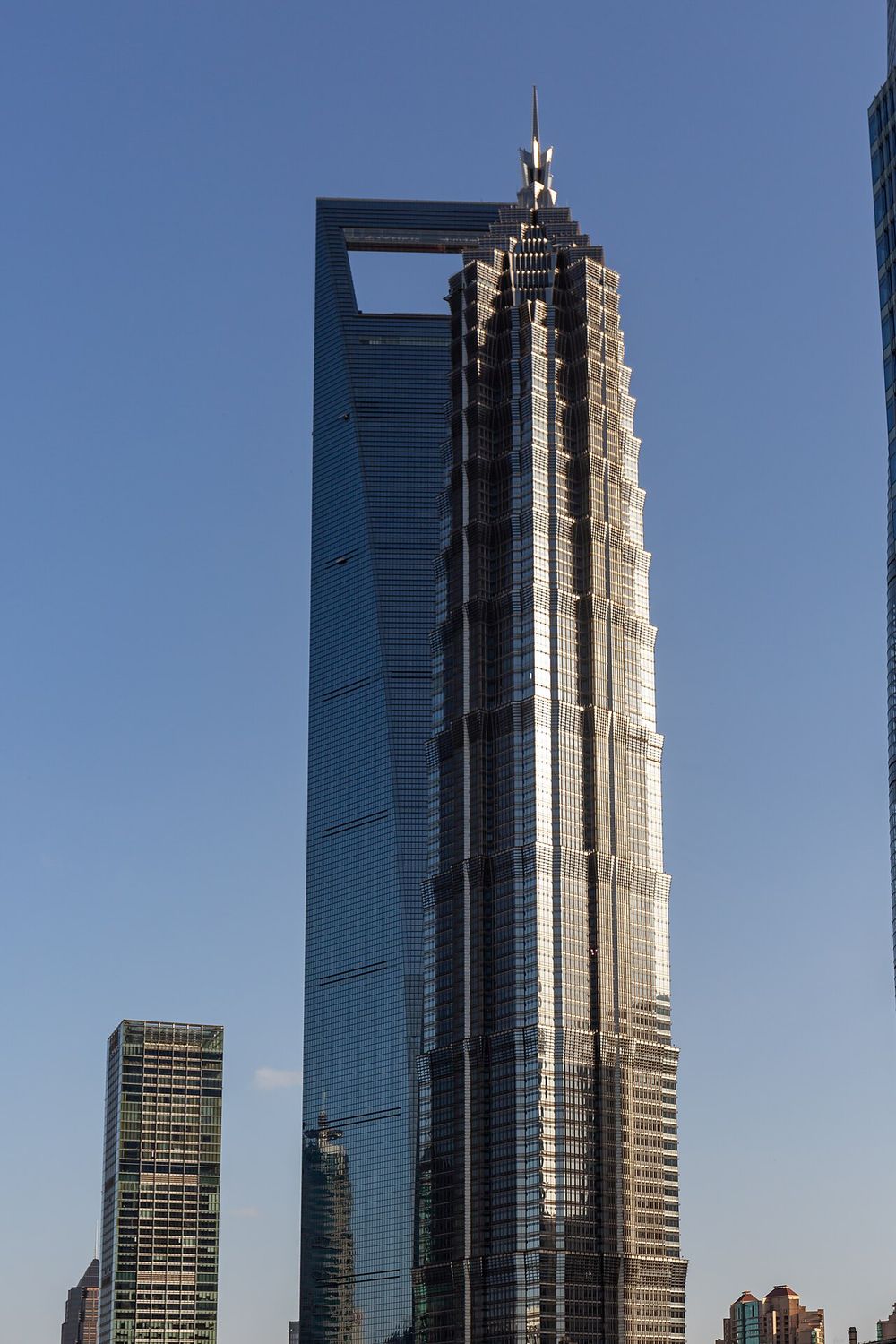
Across the river, Pudong was farmland and warehouses until the 1990s. The tower with the pink balls, the Oriental Pearl, opened in 1994. The tallest, the Shanghai Tower, 632 metres, was finished in 2015.
The Bund is a public street. There is nothing to pay and nothing to book.
Things people often get wrong
"These are colonial government buildings." Almost all were built as private offices of banks and companies. The settlements were run by councils of foreign ratepayers, not by a colonial government.
"Everything here is old." The riverside walk and its flood wall were rebuilt in the 1990s, and the road in front in the 2000s.
"The buildings are museums." Most are banks, hotels and restaurants again. You may walk into the lobbies of some; others are offices.
People who stood here
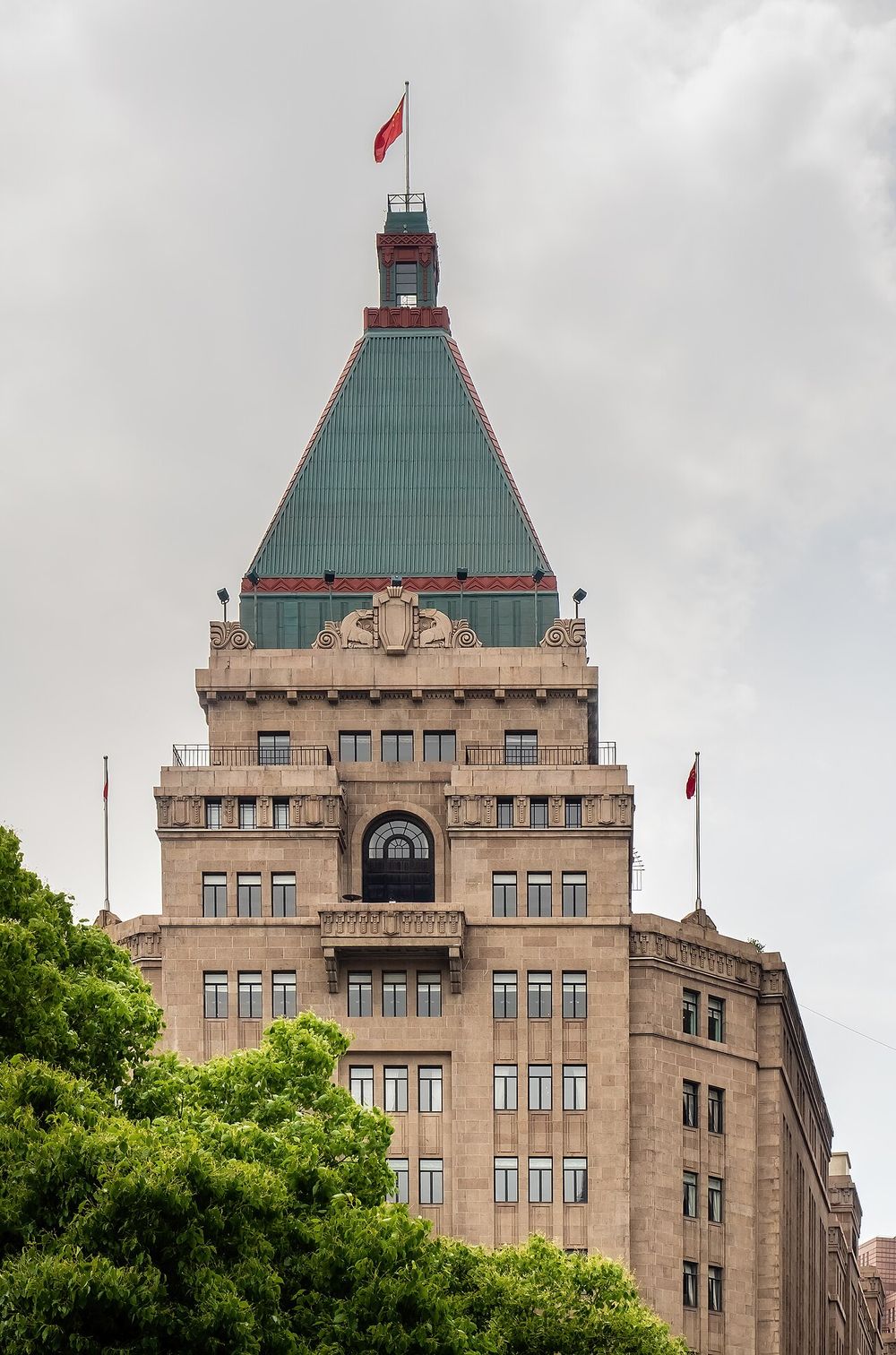
Victor Sassoon (businessman, 1881–1961)He built the hotel with the green pyramid roof in 1929 and lived in a penthouse under it. From his windows he could see the whole Bund.
Noël Coward (English playwright)Laid up with flu in the same hotel in 1929, he wrote a comedy, Private Lives, in a few days. He may have looked out from his window at the river you see.
Go deeper: six stops from south to north
Walk the riverside promenade from south to north, crossing to the buildings where you want to look closely. It is about 1.5 kilometres.
1. The clubs
The old Shanghai Club, No. 2Can Pac Swire from Toronto, Canada, CC BY-SA 2.0
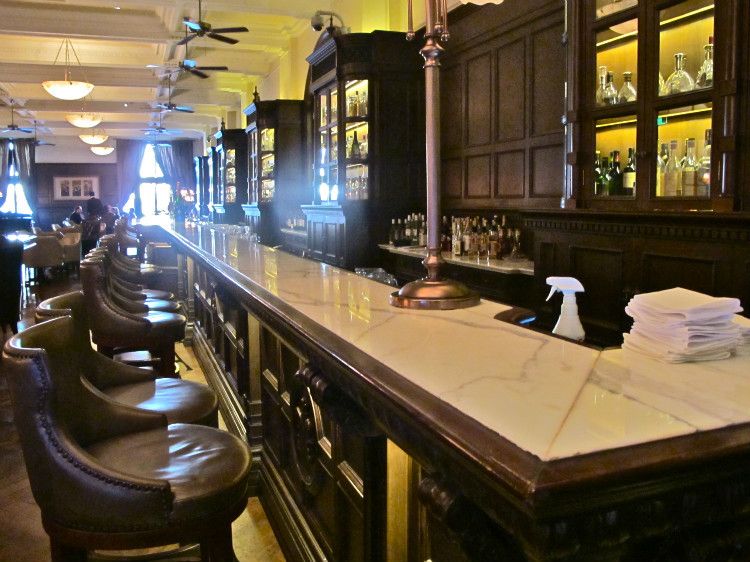
At number 2, near the south end, is the old Shanghai Club of 1910, where British merchants drank at what was said to be the longest bar in the world. It is a hotel again, and the bar has been rebuilt.
2. The bank with the dome
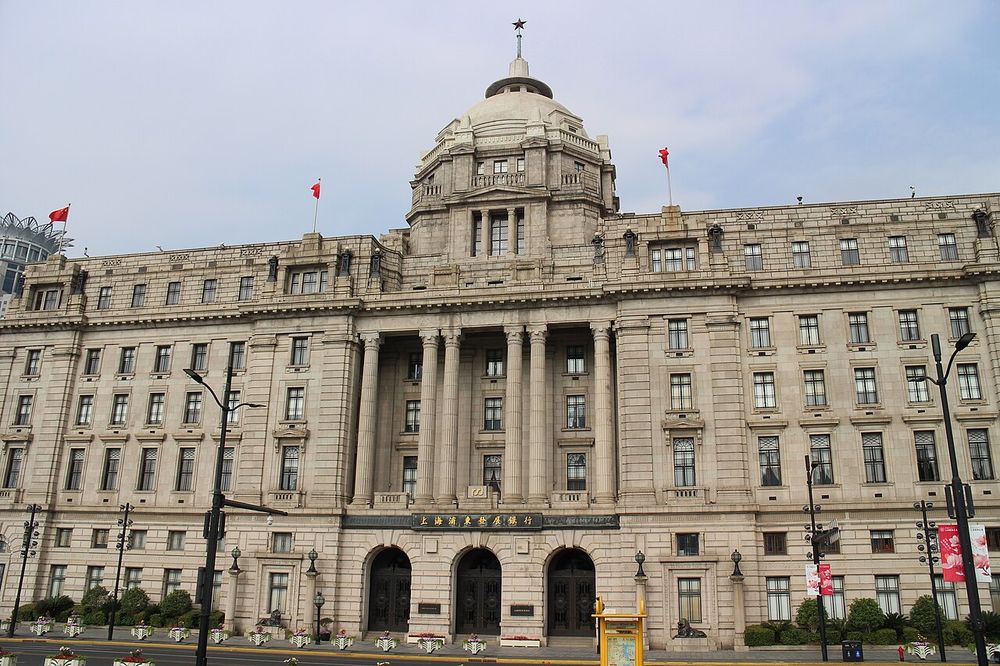
The HSBC Building, No. 12Suicasmo, CC0
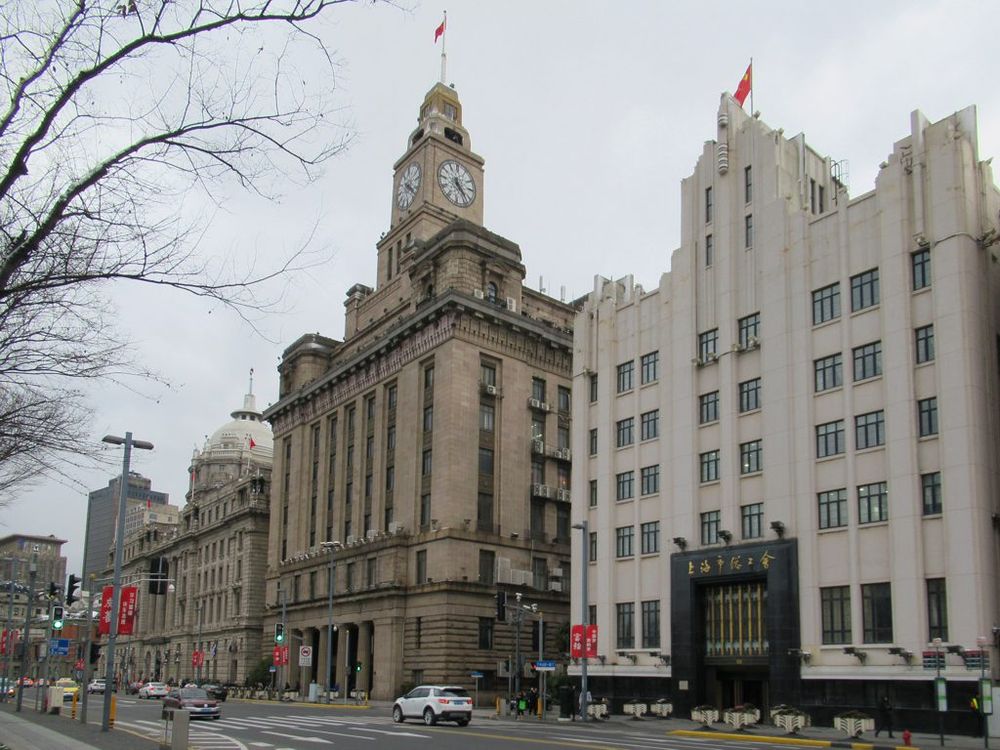
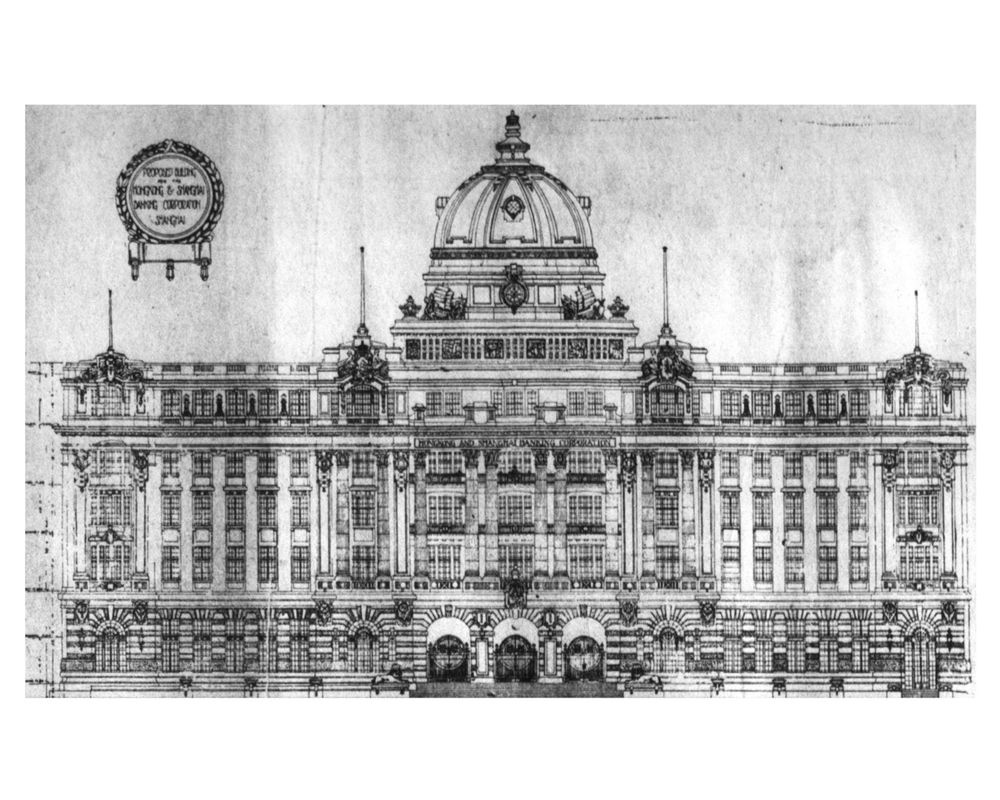
The great domed building at number 12 was finished in 1923 for the Hongkong and Shanghai Bank. Its builders called it the finest building between the Suez Canal and the Bering Strait. It is now the Shanghai Pudong Development Bank. You may step into the entrance hall to see the mosaics in the dome, covered with plaster in the 1950s and found again in 1997.
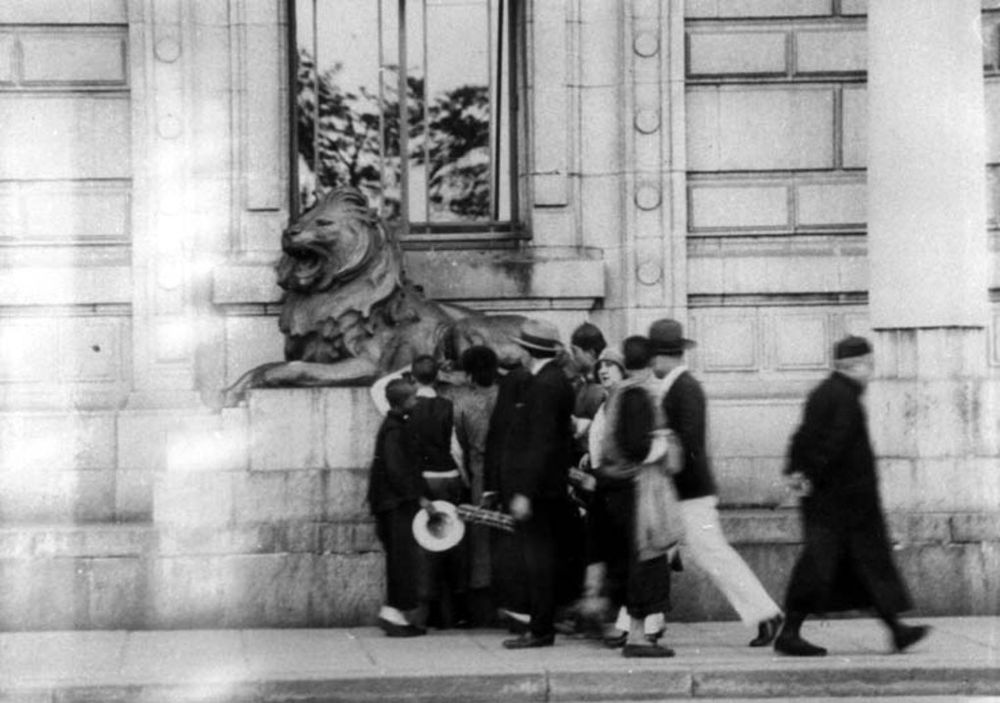
Two bronze lions guarded the door. The originals are now in the Shanghai History Museum; the ones outside are copies.
3. The clock tower
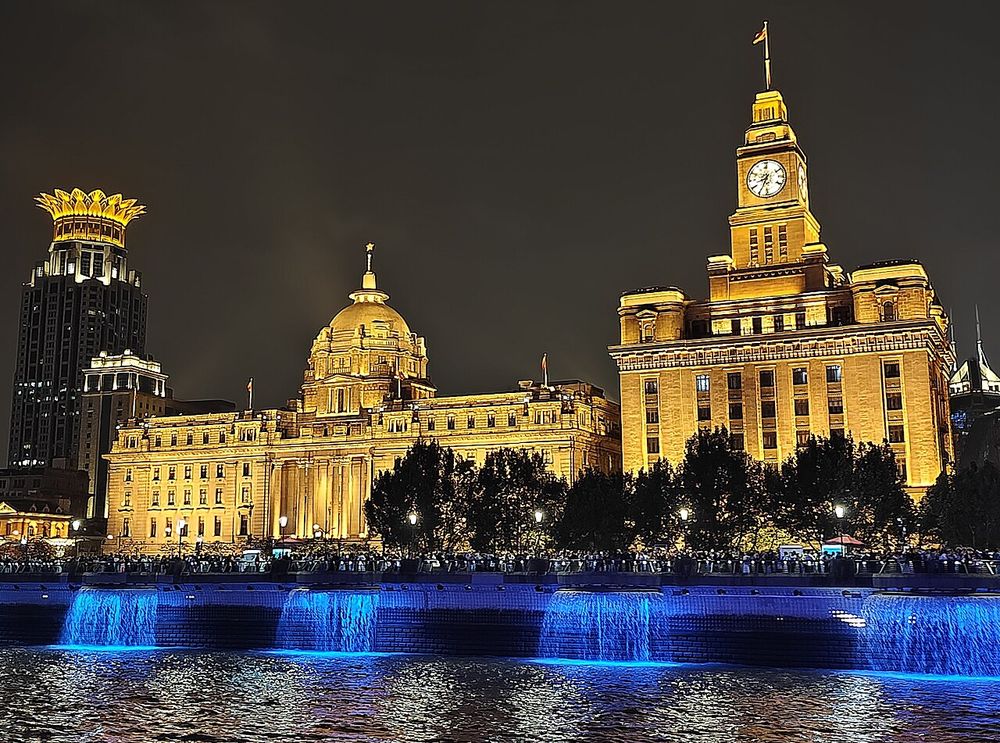
The bank and the Custom House at nightDvTor8303, CC0
Next door, at number 13, is the Custom House of 1927 with its clock tower. The clock and bells were made in England. On the hour it chimes over the river.
4. The green roof
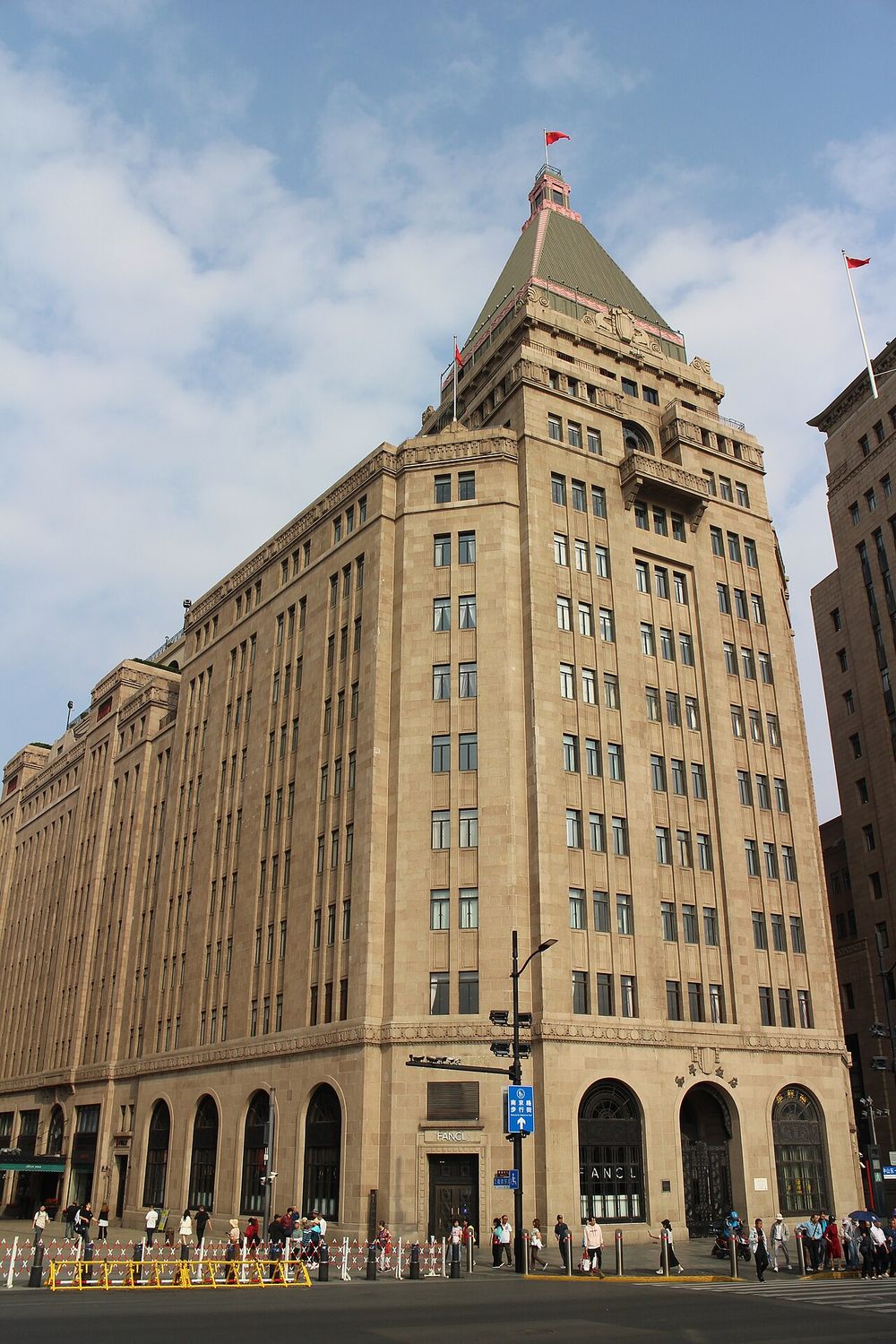
Sassoon House and its green roofSuicasmo, CC0
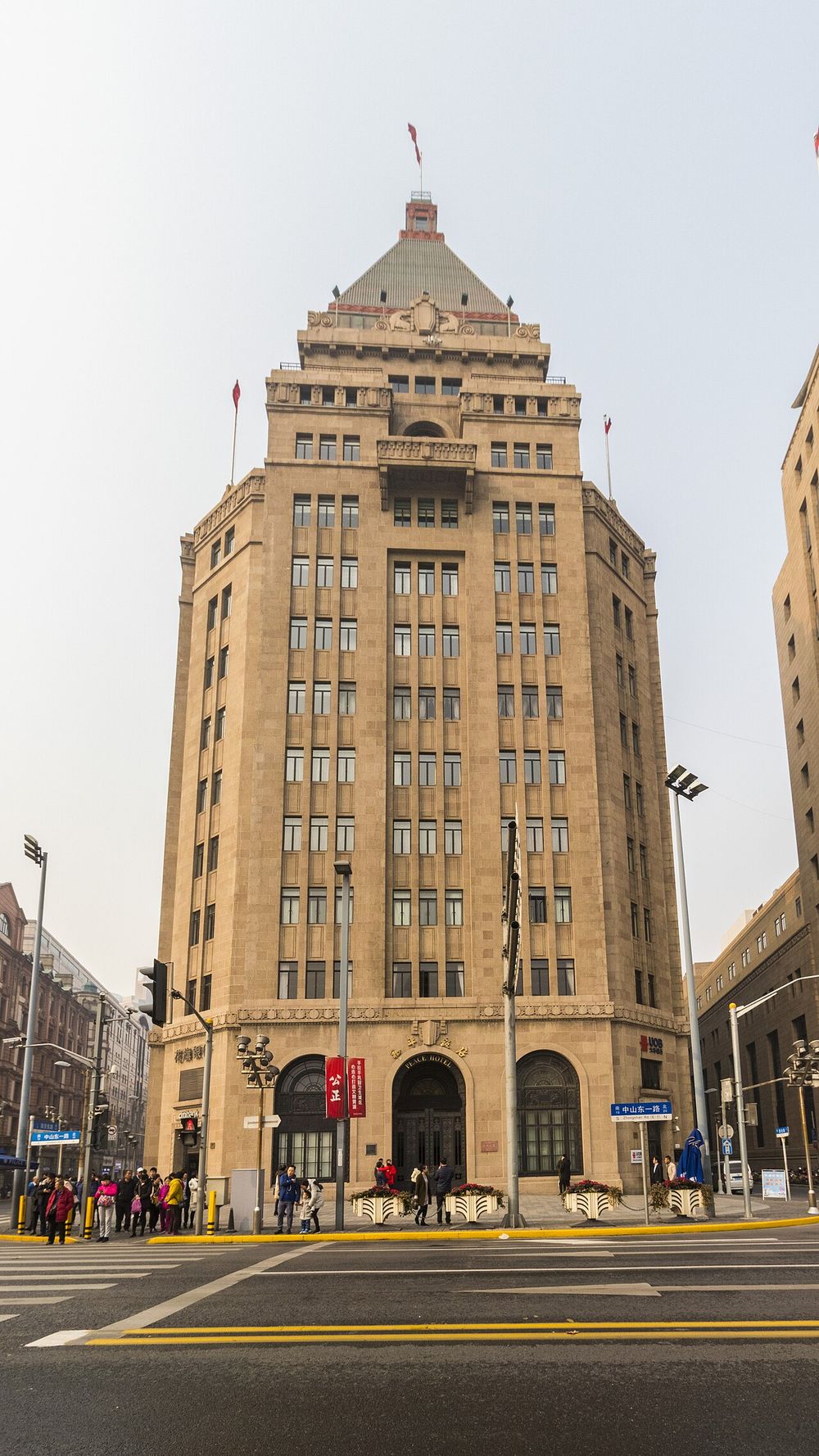
At the corner of Nanjing Road stands Sassoon House, 1929, with its green copper pyramid. It opened as the Cathay Hotel and is now the Fairmont Peace Hotel. The jazz band in its bar has played old Shanghai songs since the 1980s.
Nanjing Road, the city's great shopping street, starts here and runs west.
5. The Chinese bank
The Bank of China building, No. 23ScareCriterion12, CC BY-SA 4.0
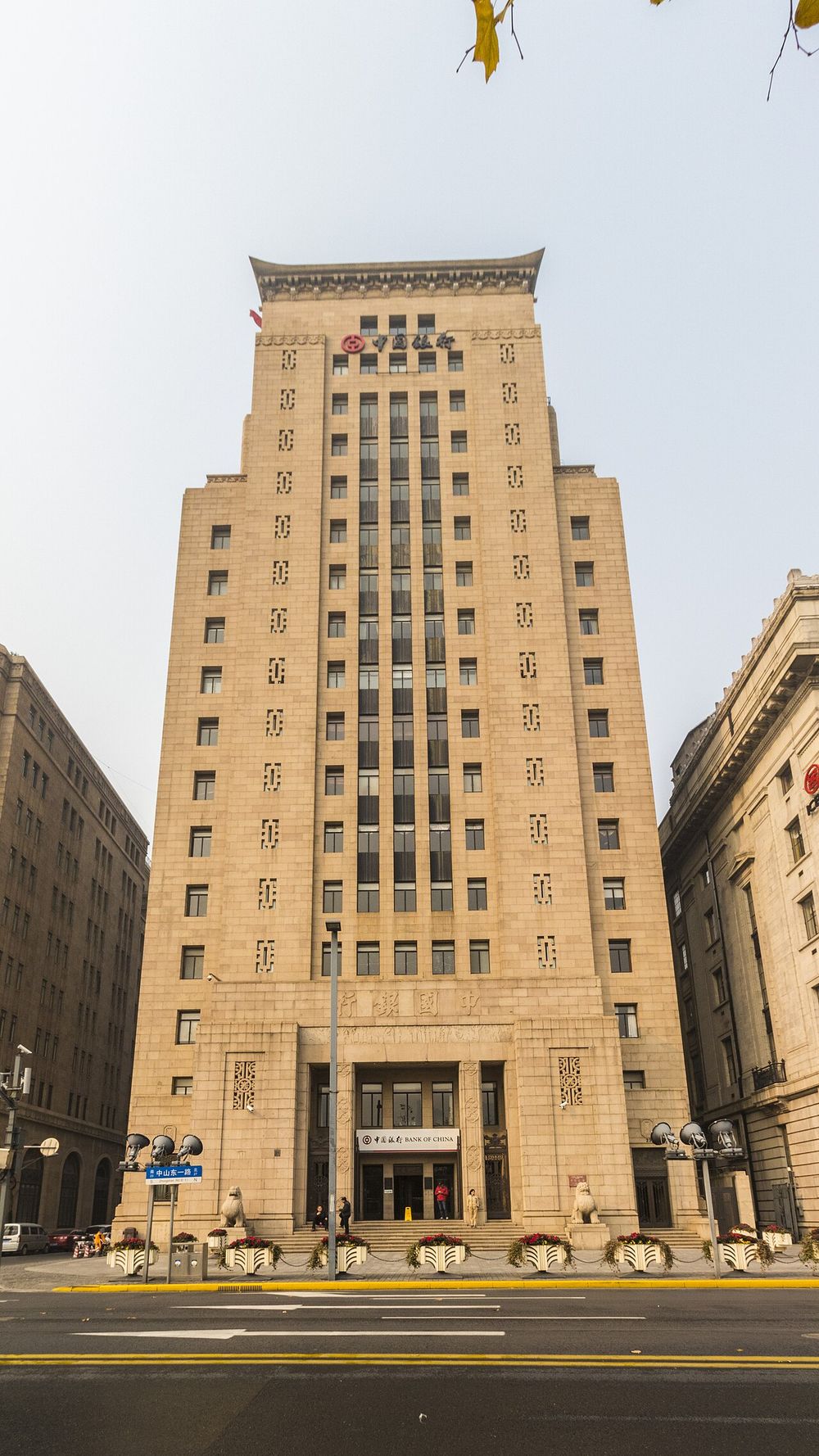
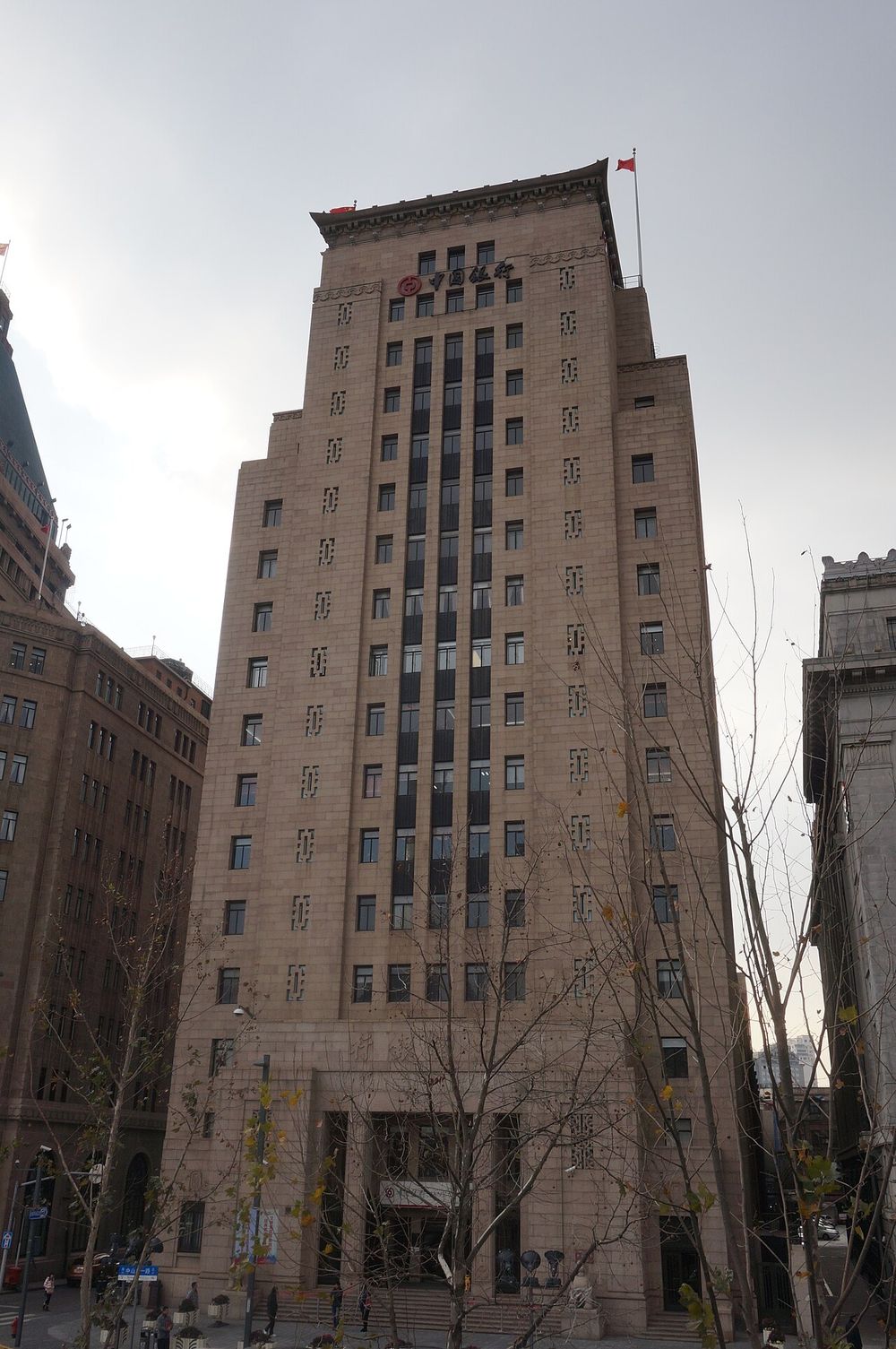
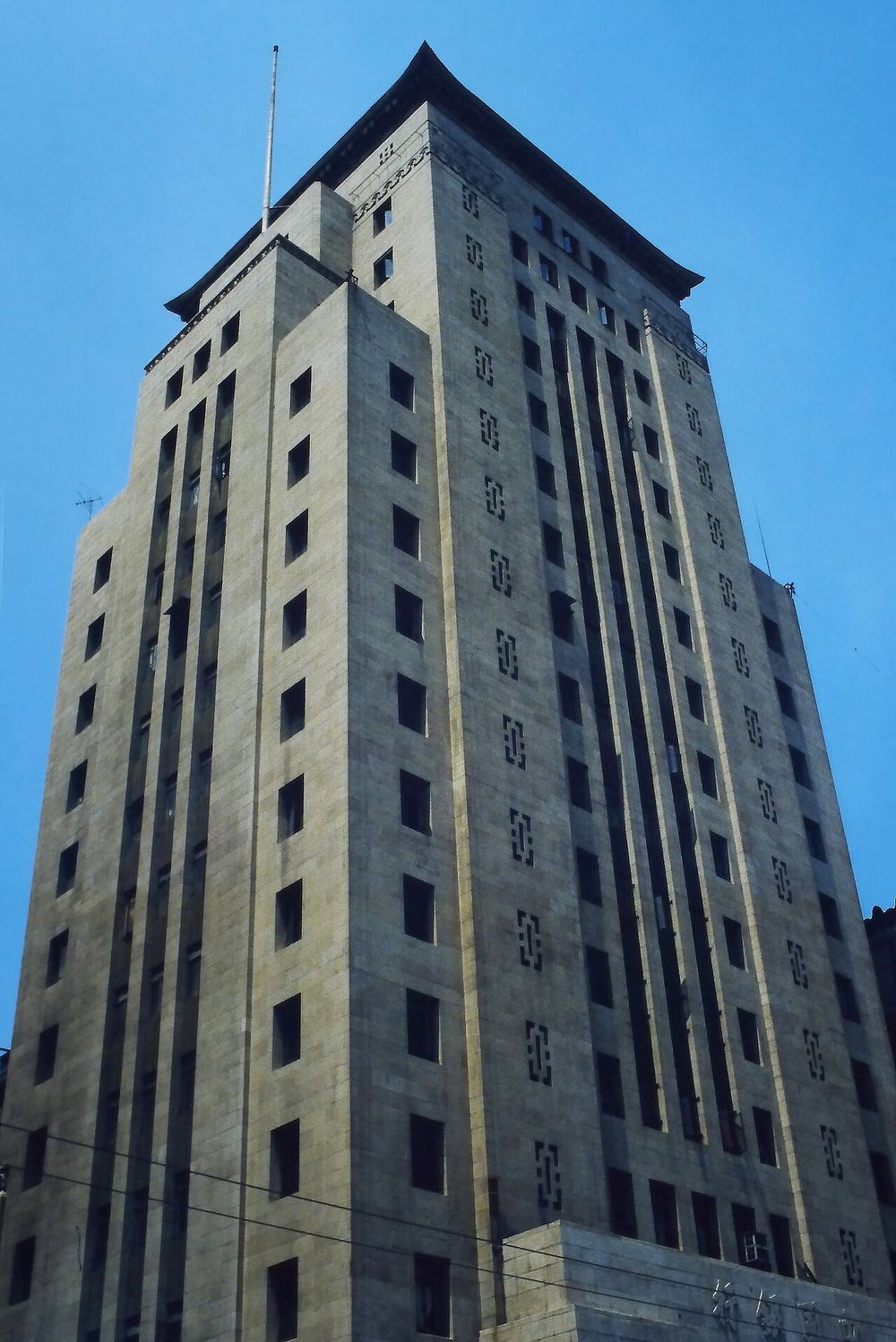
Beside it, at number 23, is the Bank of China of 1937, the only big building on the Bund designed partly by a Chinese architect, Lu Qianshou. Its roof is Chinese in shape, and its walls are carved with Chinese patterns. It was meant to be the tallest on the Bund; it ended a little lower than its neighbour, Sassoon House.
6. The bridge and the park
Waibaidu Bridge and the towers of PudongSuicasmo, CC0
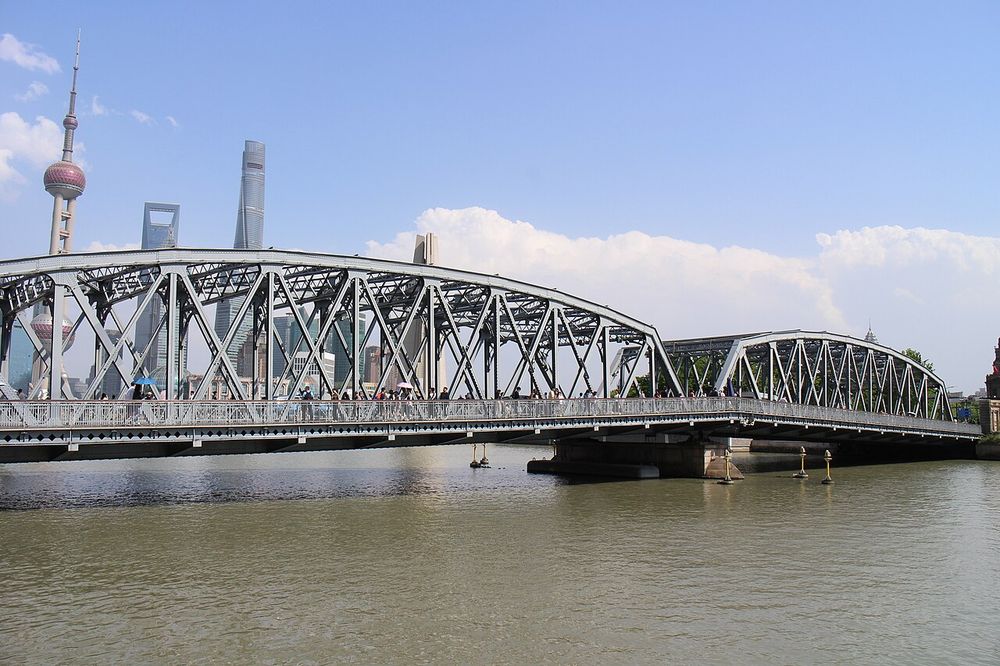
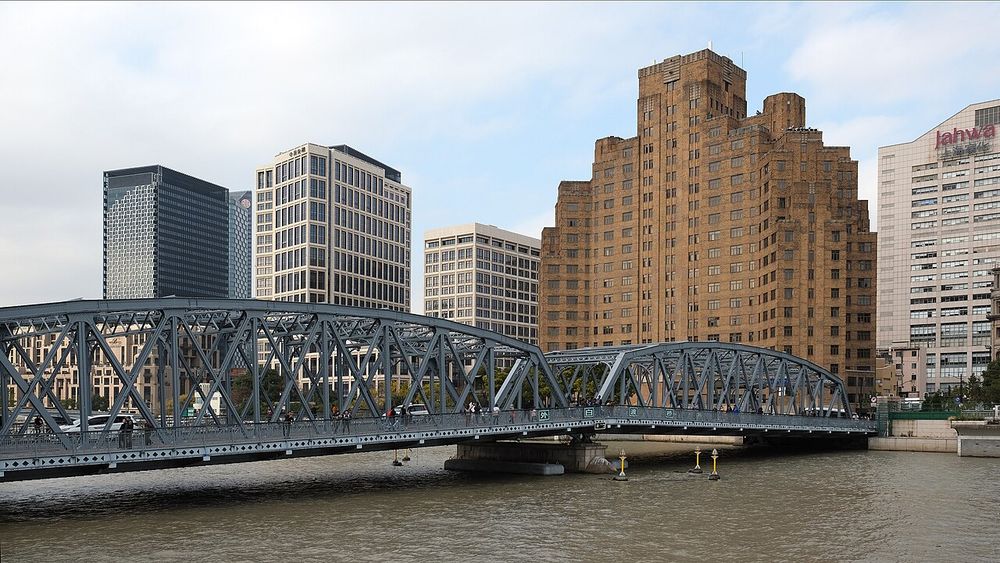
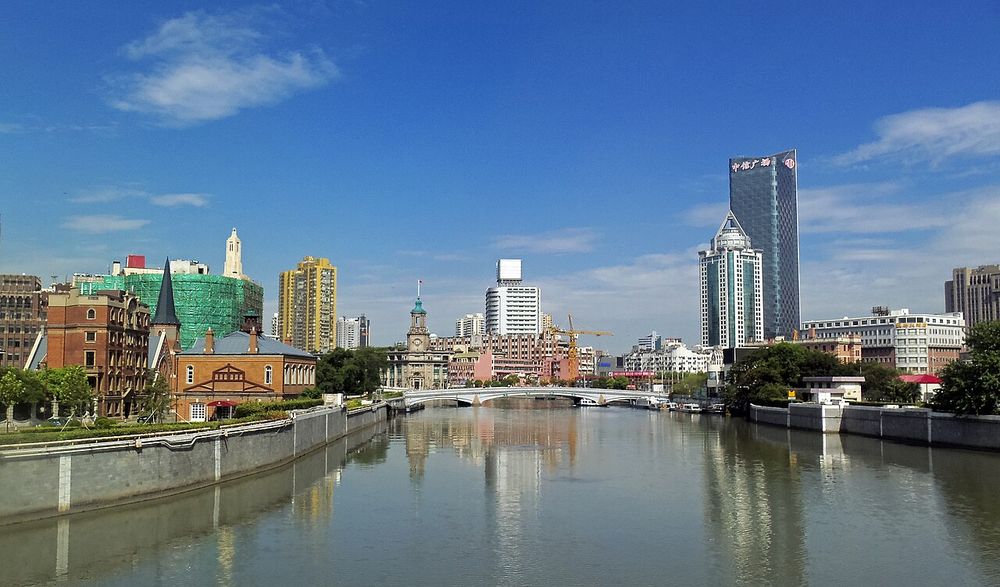
At the north end a steel bridge of 1907 crosses Suzhou Creek where it flows into the Huangpu. In 2008 it was floated away for repair and brought back the next year.
The Monument to the People's Heroes钉钉, CC BY-SA 4.0
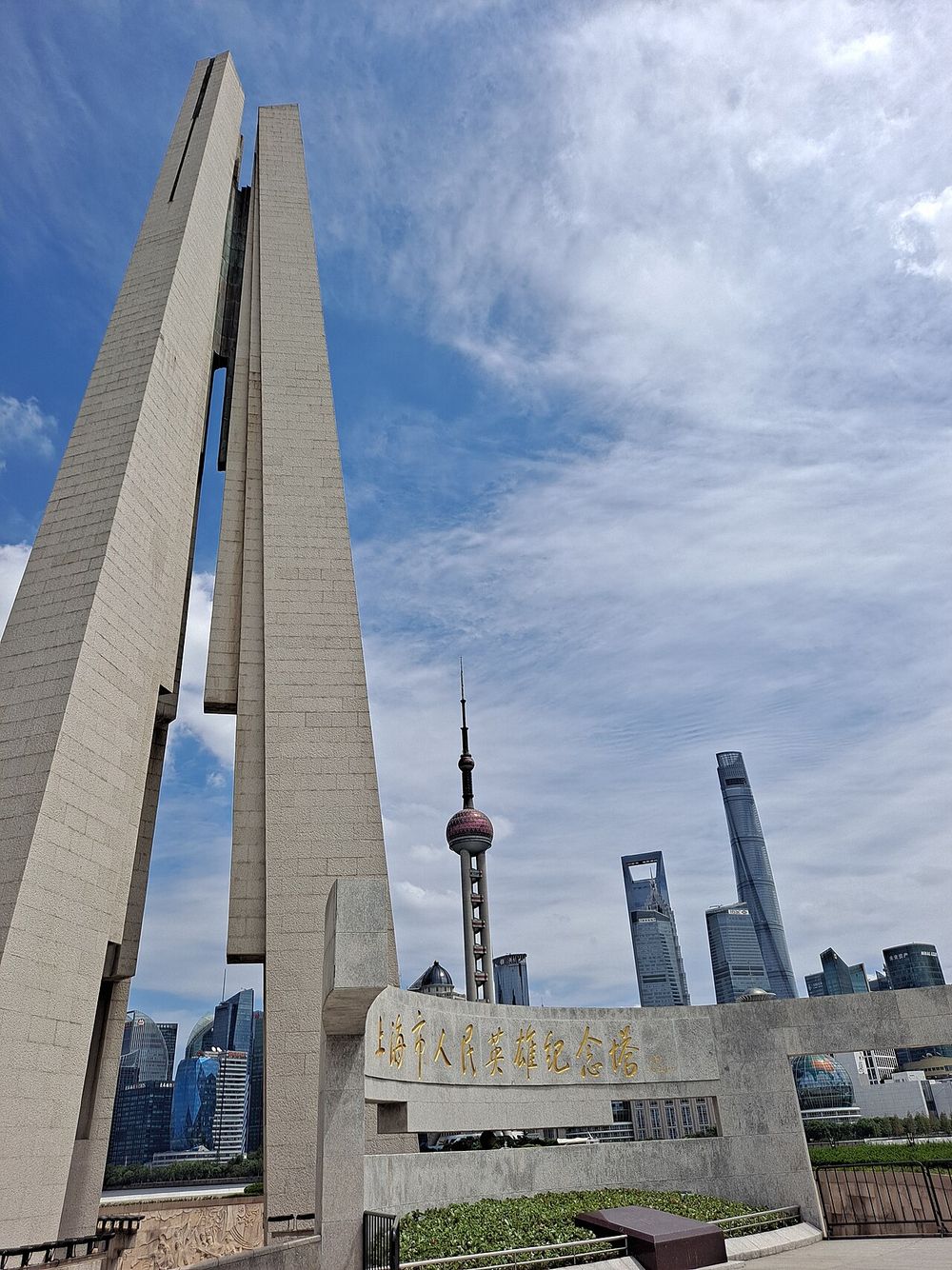
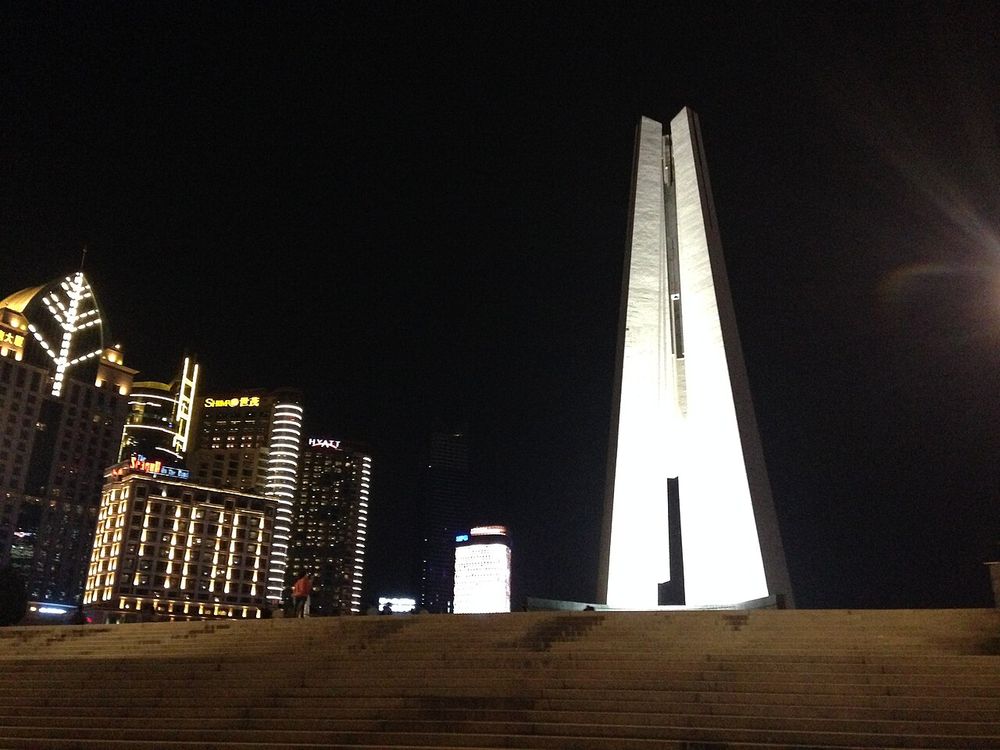
Beside it is Huangpu Park, the first public garden of the settlement, opened in 1868. For decades its rules kept out Chinese who were not servants of foreigners. In it now stands the Monument to the People's Heroes, three tall stone fins put up in 1993.
Meanwhile in the world
Year
Here
Elsewhere
1842
The Treaty of Nanking opens Shanghai to foreign trade
Britain's Mines Act bans women and children from working underground
1868
The settlement's public garden opens
The Meiji Restoration begins in Japan
1907
Waibaidu Bridge is built
Qiu Jin is executed in Shaoxing
1923
The domed bank is finished
The great Kanto earthquake destroys Tokyo
1929
Sassoon House opens as the Cathay Hotel
The Wall Street Crash
1937
The Bank of China building is finished; war reaches Shanghai
The Golden Gate Bridge opens
1994
The Oriental Pearl Tower opens across the river
The Channel Tunnel opens
2015
The Shanghai Tower is finished
The Paris climate agreement
Then and now
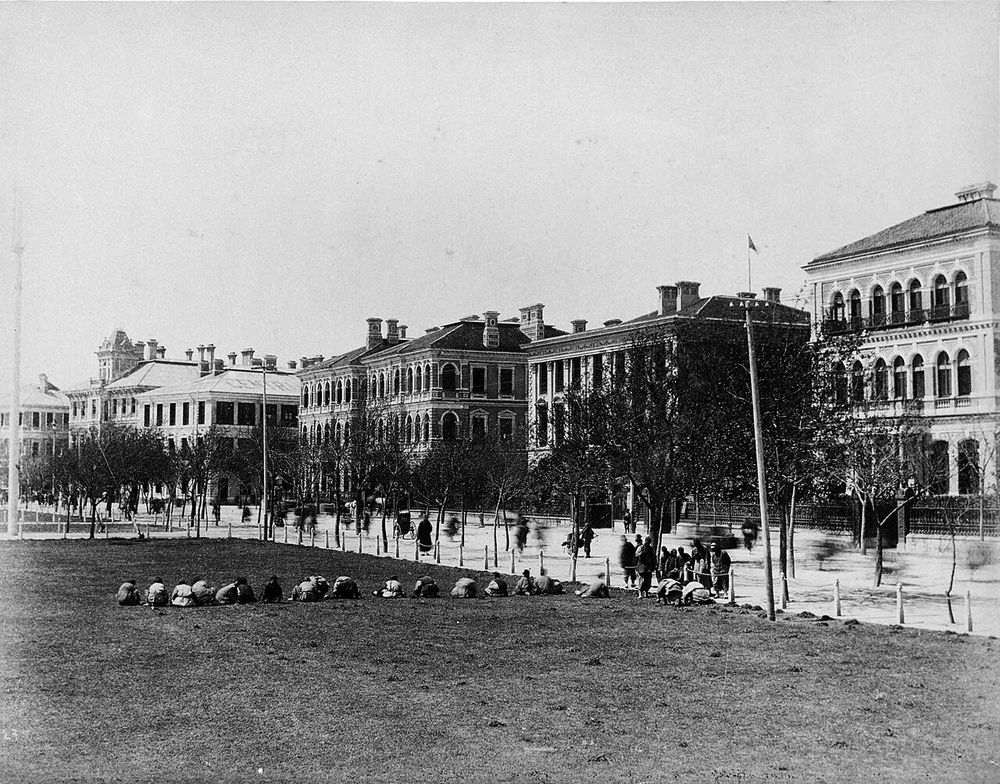
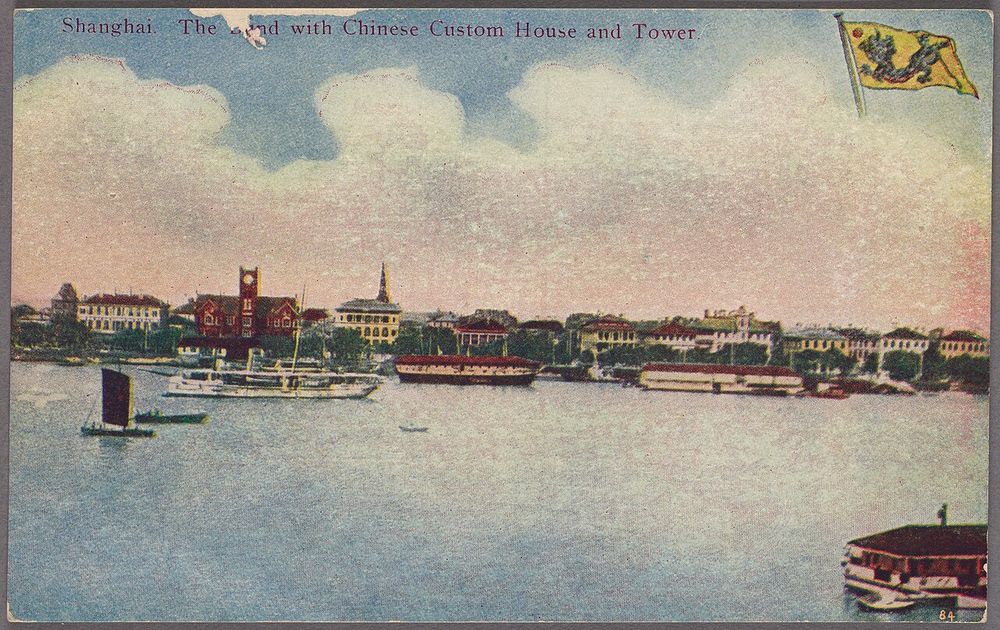
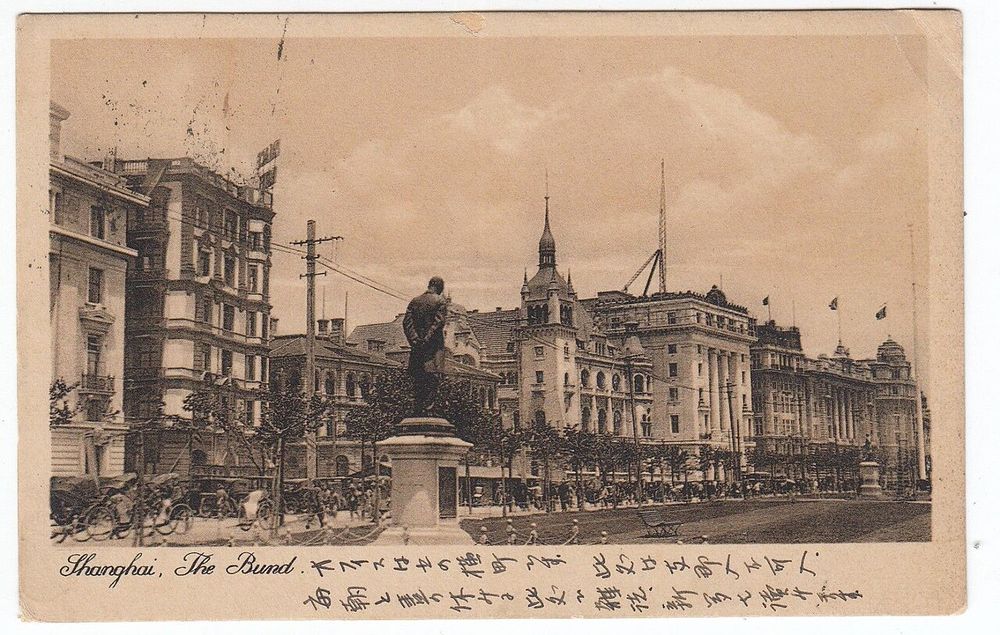
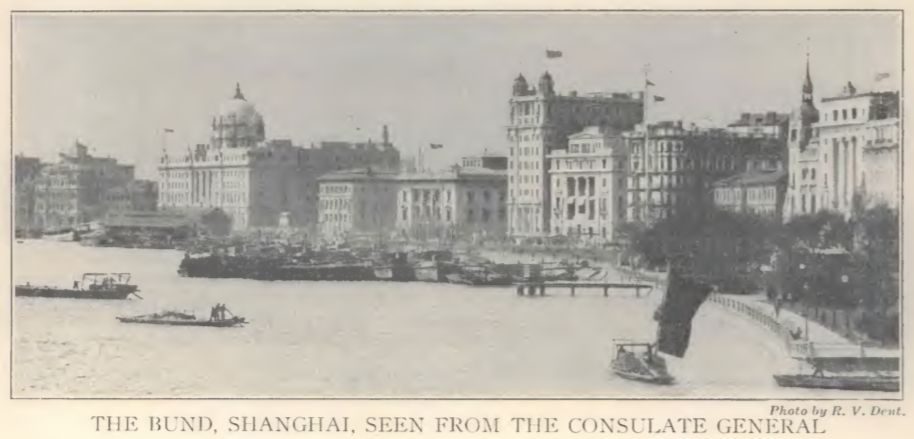
The Bund lit up at nightCnchina, CC BY 3.0, Wikimedia CommonsPudong across the river from the BundDvTor8303, CC0, Wikimedia CommonsLujiazui at night from aboveA Chinese ID, CC BY-SA 4.0, Wikimedia CommonsThe river bend at night from aboveA Chinese ID, CC BY-SA 4.0, Wikimedia CommonsThe domed bank and its neighbours from the Oriental Pearl TowerGary Lee Todd, Ph.D., CC0, Wikimedia CommonsThe old waterfront and the city behind itGary Lee Todd, Ph.D., CC0, Wikimedia CommonsThe Bund and the river from across the waterJean-Pierre Dalbéra from Paris, France, CC BY 2.0, Wikimedia CommonsThe Bund in fog from aboveKimonBerlin, CC BY-SA 2.0, Wikimedia CommonsThe clock tower at nightErnest Jourdier, CC BY 4.0, Wikimedia CommonsThe Bund from Pudong at nightLloyd Tudor, CC BY-SA 4.0, Wikimedia CommonsPudong lit at nightDavid Zhang from Canada, CC BY-SA 2.0, Wikimedia CommonsThe Oriental Pearl and the towers of LujiazuiErmell, CC0, Wikimedia CommonsBarges and the Pudong skylineshankar s. from Dubai, united arab emirates, CC BY 2.0, Wikimedia CommonsJin Mao TowerBalon Greyjoy, CC0, Wikimedia CommonsThe old Shanghai Club, No. 2Can Pac Swire from Toronto, Canada, CC BY-SA 2.0, Wikimedia CommonsThe rebuilt long barHsen-SH, CC BY-SA 4.0, Wikimedia CommonsThe HSBC Building, No. 12Suicasmo, CC0, Wikimedia CommonsThe bank and the clock tower side by sideSuicasmo, CC0, Wikimedia CommonsThe Custom House, No. 13David Stanley from Nanaimo, Canada, CC BY 2.0, Wikimedia CommonsThe bank and the Custom House at nightDvTor8303, CC0, Wikimedia CommonsSassoon House and its green roofSuicasmo, CC0, Wikimedia CommonsSassoon House from the streetScareCriterion12, CC BY-SA 4.0, Wikimedia CommonsThe green copper pyramidErmell, CC BY-SA 4.0, Wikimedia CommonsThe Bank of China building, No. 23ScareCriterion12, CC BY-SA 4.0, Wikimedia CommonsThe Bank of China from belowLivelikerw, CC BY-SA 3.0, Wikimedia CommonsWaibaidu Bridge and Shanghai Mansionskallerna, CC BY-SA 4.0, Wikimedia CommonsWaibaidu Bridge and the towers of PudongSuicasmo, CC0, Wikimedia CommonsSuzhou Creek from the bridgeDaniel Case, CC BY-SA 3.0, Wikimedia CommonsHuangpu Parkxiquinhosilva, CC BY 2.0, Wikimedia CommonsThe Monument to the People's Heroes钉钉, CC BY-SA 4.0, Wikimedia CommonsThe monument at nightそらみみ (Soramimi), CC BY-SA 4.0, Wikimedia CommonsThe architects' drawing of the bank's frontPalmer & Turner, Public domain, Wikimedia CommonsThe first warehouses on the Bund, painted about 1850AnonymousUnknown author, Public domain, Wikimedia CommonsThe waterfront in an early photographRijksmuseum, CC0, Wikimedia CommonsWorkers cutting the grass on the Bund, nineteenth centuryLai Afong, Public domain, Wikimedia CommonsThe old Custom House on a postcardScan by NYPL, Public domain, Wikimedia CommonsThe Bund on a postcard of 1925Unknown authorUnknown author, Public domain, Wikimedia CommonsThe Bund in 1926R.V Dent, Public domain, Wikimedia CommonsThe Bund and its wharves in 1927Unknown authorUnknown author, Public domain, Wikimedia CommonsLooking north along the Bund, 1920sUnknown authorUnknown author, Public domain, Wikimedia CommonsPanorama of the Bund, about 1930上海王开照相馆, Public domain, Wikimedia CommonsThe Bund about 1934Unknown, c. 1934, Public domain, Wikimedia CommonsPassers-by and a bronze lion at the bank, 1920sUnknown authorUnknown author, Public domain, Wikimedia CommonsSassoon House at the victory parade, 10 October 1945Ministry of Propaganda, Republic of China, 1945, Public domain, Wikimedia CommonsThe Bank of China building in 1988Jan Kranendonk (https://www.jankranendonk.nl), CC BY-SA 4.0, Wikimedia Commons
Video
Films from official channels, played from YouTube. Nothing is loaded until you press play.
Shanghai's Bund, a witness to historyCGTN · 2 min · checked 2026-11-12
Local legends
These are stories people tell about this place. They are legends, not history, and each one says where it comes from.
LegendRub the lion's paw
Touch the paws of the bronze lions at the bank's door and money will come to you. Shanghai people say the lion with its mouth open roars in wealth and the one with its mouth shut keeps it in.
Source: Shanghai custom; the habit is also told of the lions at the bank's Hong Kong office
LegendThe bell of the Custom House
The bells in the clock tower, made in England, were said to be tuned to Big Ben in London, so that the Bund would sound like Westminster.
Source: Shanghai lore; the clock first played the Westminster chimes
Later, people who live here will be able to add the stories they grew up with, and say which of these they have heard.
Not certain, and where accounts conflict
Was there a sign saying "No dogs or Chinese"?
The park's regulations, in force until 1928, banned dogs in one clause and Chinese other than servants in another. Whether a single board ever used those exact words is argued over by historians. The exclusion itself is not in doubt.
How many buildings?
Usually given as fifty-two along the Bund, called a museum of world architecture. The count depends on where the Bund is said to end.
When are the lights on?
The buildings and the Pudong towers are lit every evening, with longer hours at weekends and holidays. We did not check the current timetable.
Visiting
Tickets and hours
Free, at all hours.
The bank halls are open in banking hours; the hotel lobbies are open to visitors at most times.
Last checked 2026-11-12. Reference works on the buildings and the history of the settlements; the Bund is a public street and has no ticket office or site of its own.
Booking without WeChat
Official page in English The Bund is a public street: no ticket, no booking, no official site of its own.
Ticket window on site None needed.
Note On public holidays the police may close the riverside walk to new arrivals when it is full, and the nearest metro exits may be shut.
Checked 2026-11-12
Where to start
Take metro line 2 or 10 to East Nanjing Road and walk ten minutes east to the river.
Come once by day to see the buildings, and once after dark for the lights.
For the view back at the Bund, cross the river to Lujiazui by metro or by the public ferry.
Before you go
There are security checks at the stairs up to the riverside walk on busy evenings.
The walk is exposed to wind and sun, with little shade.
Customs and manners
Beware of friendly strangers who invite you to a tea ceremony or a bar; it is a known scam.
Do not climb the flood wall for a photograph.
Opening hours are given in the local time of the place.
Look for these
Find the building with the green pyramid roof.
Is the clock tower or the green roof taller?
Find a Chinese-style roof among the Western buildings.
Count the pink balls on the Oriental Pearl Tower.
Look at the bronze lions at No. 12. Which one has its mouth open?
From the north end, find where Suzhou Creek meets the river.
I am here
Stand at the site, sign in, press the button, and collect its stamp. Your browser will ask to use your location. It is sent to us once to confirm that you are at the site; we keep how far you were from it, not the spot where you stood.
Your stamps are saved to your account, so they follow you to any device. Checking from a browser cannot rule out every false location; stricter checks arrive with the app.
Messages
Share your photos
Photos here show the place, not people. Each one is credited to the visitor who took it and appears after our team has looked at it. A photo with you in it belongs under “I am here”.