LegendThe Seven-Star Stones
The stones east of the Hall of Prayer for Good Harvests are said to stand for the seven stars of the Big Dipper.
Source: Local folk tale
Beijing, China
天坛 · Tiāntán
Not a temple with monks, but the place where the emperor spoke to Heaven. Finished in 1420, the same year as the Forbidden City. World Heritage since 1998.
Photo: Balon Greyjoy, CC0, Wikimedia Commons
This is not a temple in the usual sense. No monks lived here and no one came to worship. It is an altar: the place where the emperor, and only the emperor, came to speak to Heaven.
It was finished in 1420, the same year as the Forbidden City, and it covers 273 hectares, about four times the palace's area. Over the Ming (1368–1644) and Qing (1644–1912) dynasties, 22 emperors performed more than 600 ceremonies here. The round hall with three blue roofs in front of you is where they prayed each spring for a good harvest. The roofs are blue because the sky is.
The Temple of Heaven is a park of 273 hectares with the altars standing inside it. The gate ticket lets you into the park only. The three buildings most people come for need the combined ticket, so buy that one. Other parts are scattered through the park and are easy to miss.
| Part | Ticket |
|---|---|
| The Hall of Prayer for Good Harvests | Combined ticket |
| The Imperial Vault of Heaven and the Echo Wall | Combined ticket |
| The Circular Mound | Combined ticket |
| The Danbi Bridge, the raised road between the altars | Gate ticket |
| The Seven Star Stones and the old cypress groves | Gate ticket |
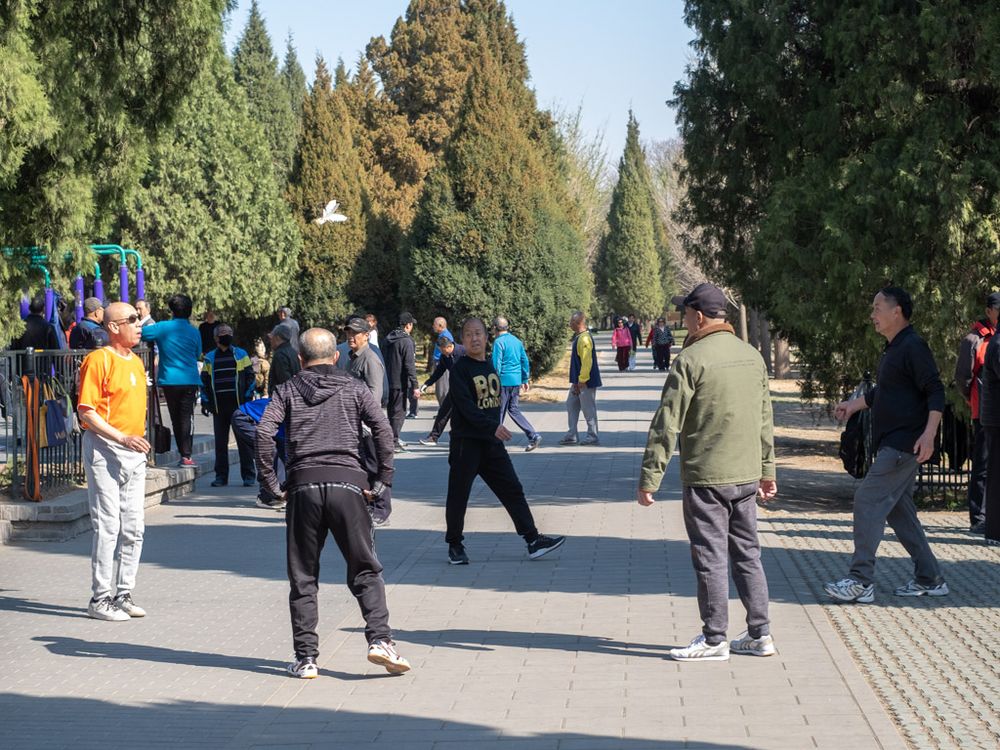
| The Long Corridor by the east gate, where Beijingers gather | Gate ticket |
| The Fasting Palace | In the park. Not one of the three combined-ticket buildings |
| The Divine Music Administration | Its own ticket, reported as 10 yuan in 2026 |
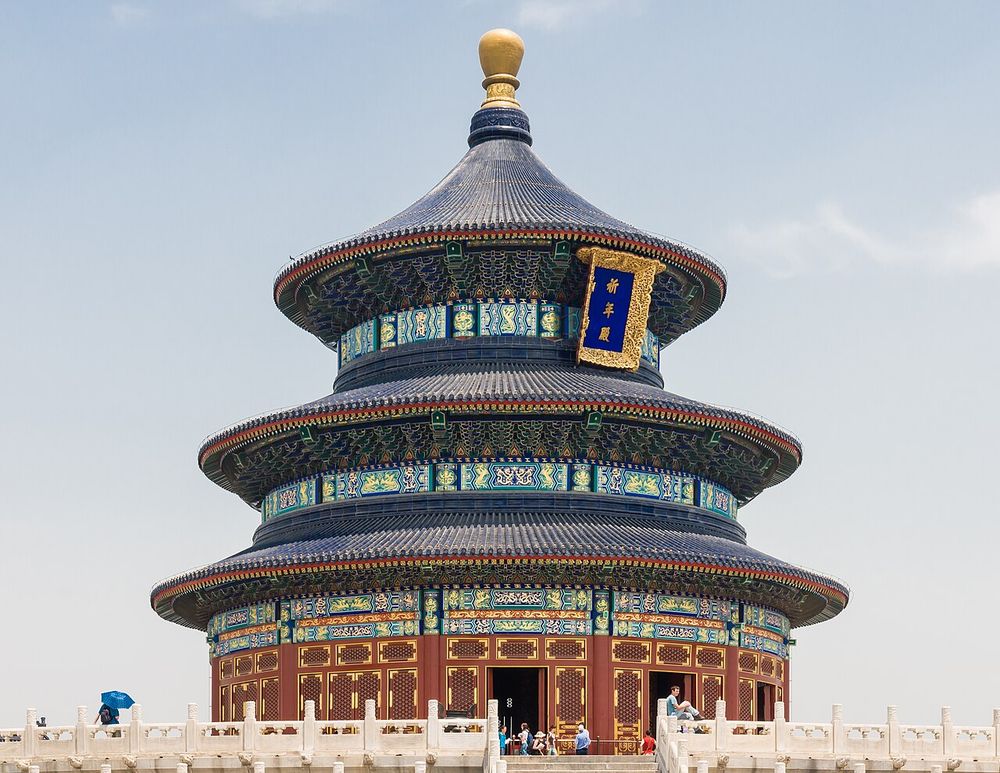
The hall is round, 38 metres high, and stands on three tiers of white marble. Round is the shape of Heaven. The wall around the whole park is curved on the north side and square on the south, because in the old Chinese picture of the world Heaven was round and the Earth was square.
Go inside and count the columns. There are 28. The four in the middle stand for the four seasons. The ring of twelve around them stands for the twelve months, and the outer twelve for the twelve two-hour periods of the old Chinese day. Add the two rings and you have 24, the solar terms that farmers used to time their work. The building is a calendar you can walk into.
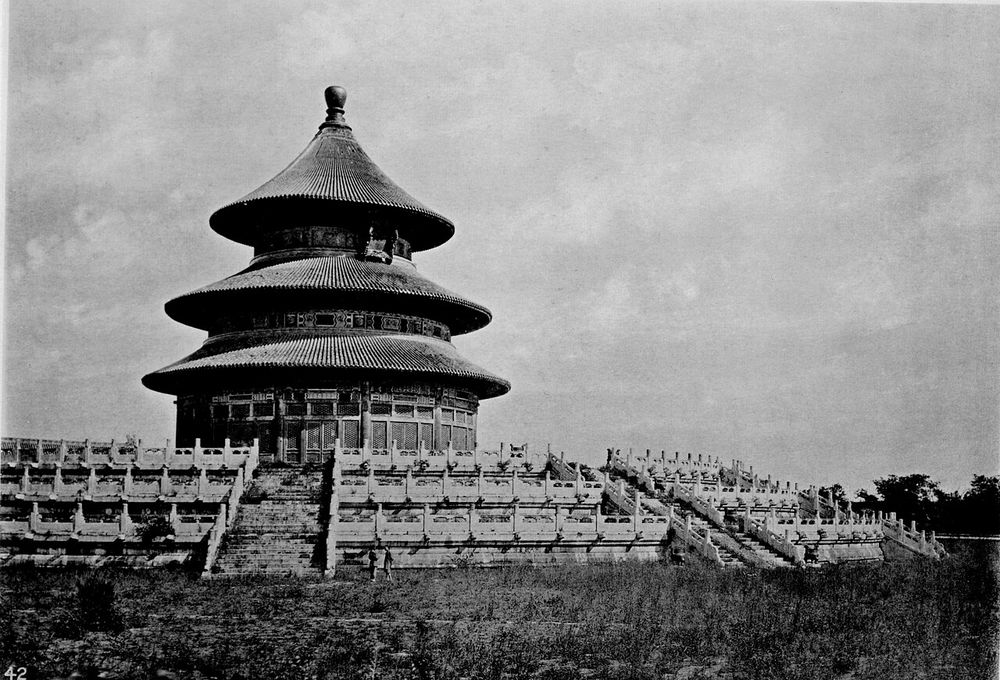
What you see is not the hall of 1420. It was struck by lightning in 1889 and burned to the ground, and this one was rebuilt on the old plan within a few years. Further down this page there is a photograph taken before the fire.
For five hundred years ordinary people were not allowed inside these walls, or even to watch the emperor's procession pass. Since 1918 it has been a public park, and some of the people who have stood on this terrace you will know.
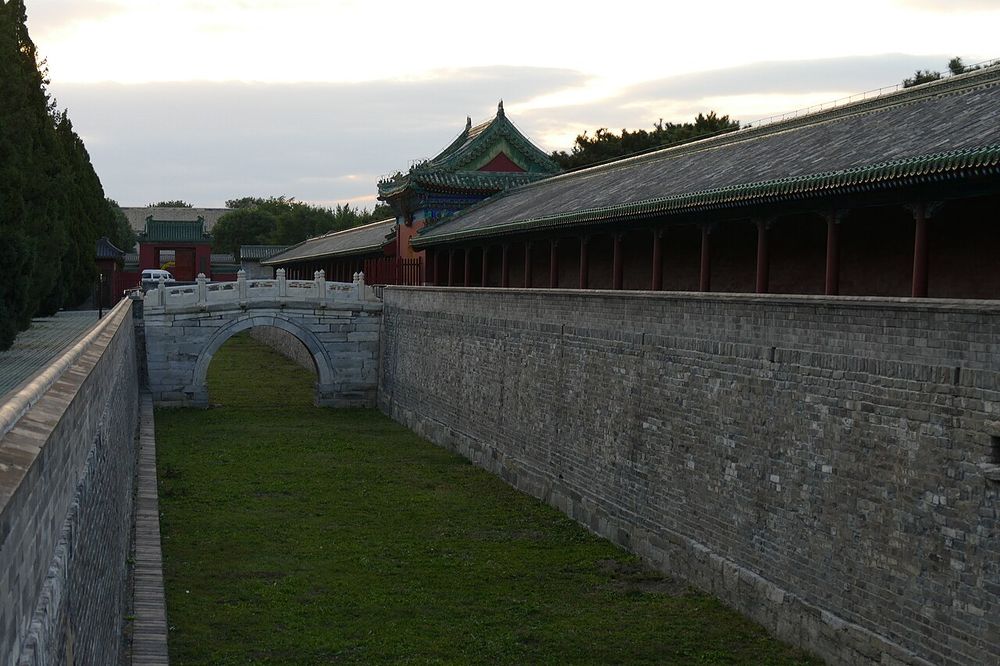
Enter by the West Gate and this is the first compound you reach. It has two moats and its own walls, which is why people call it the little Forbidden City. Before each ceremony the emperor moved in here to fast: no meat, no wine, no music, no state business.
The main hall is built entirely of brick vaulting, without a single wooden beam. Look up at the ceiling when you go in.
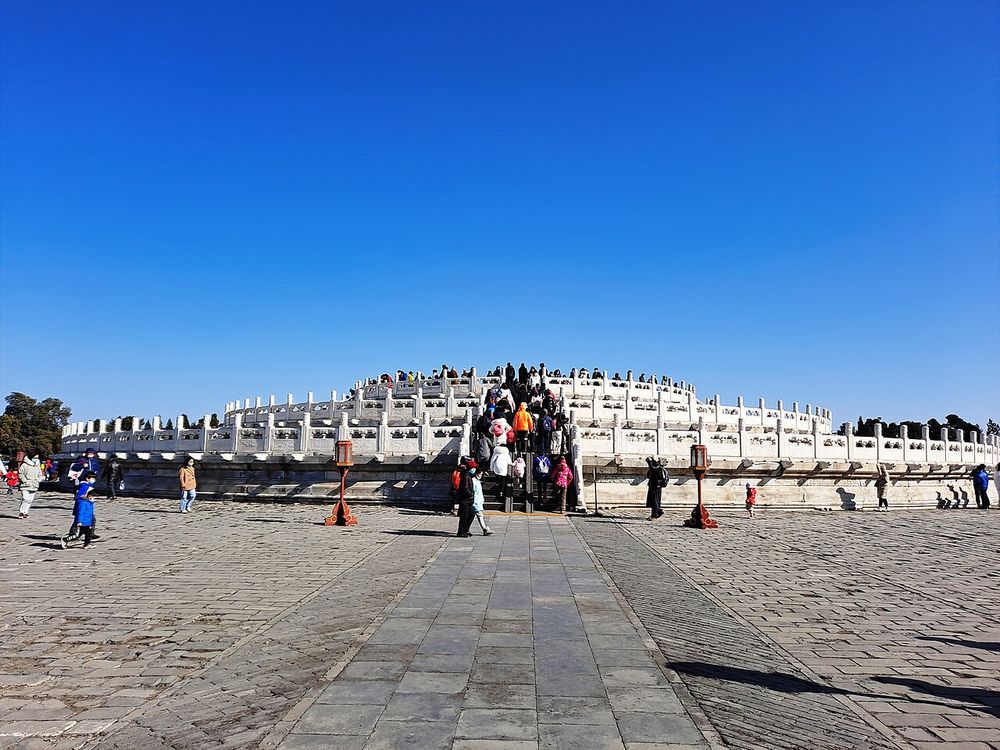
This open platform of three marble rings was built in 1530 for the ceremony at the winter solstice, the most important of the year. In the Ming it was faced with blue glazed tile. Qianlong enlarged it and gave it the white marble railings and grey-green stone you see now.
Climb to the top and look at the paving. The round stone in the centre is the Heart of Heaven. Around it is a ring of nine slabs, then a ring of 18, then 27, each ring nine more than the last, out to 81 in the ninth ring. The steps and railings are counted in nines too. Nine is the largest single odd number, and odd numbers belonged to Heaven.
Stand on the centre stone and say something. Your voice bounces off the railings around you and comes back at once, so it sounds fuller than usual. The people who built the altar took this as Heaven answering.
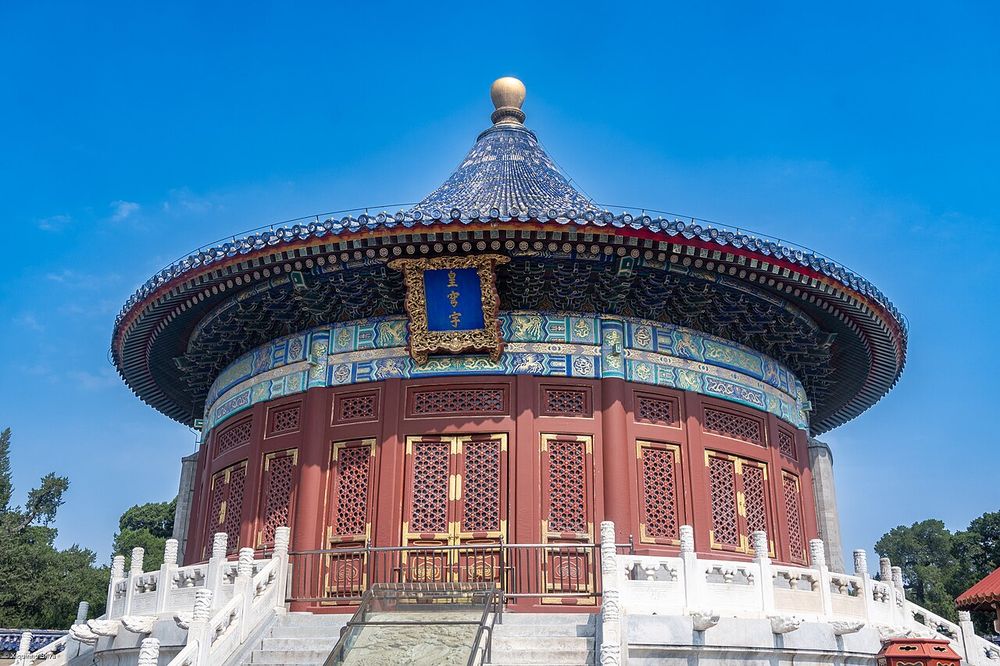
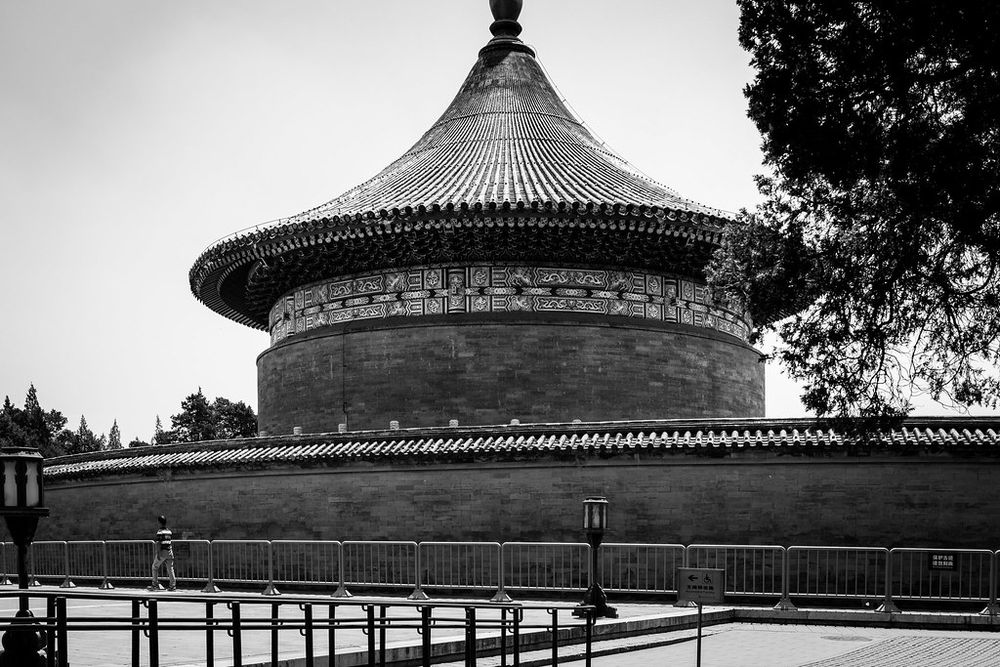
This smaller round building, north of the altar, is where the tablets used in the solstice ceremony were kept. It was built in 1530 and rebuilt under Qianlong.
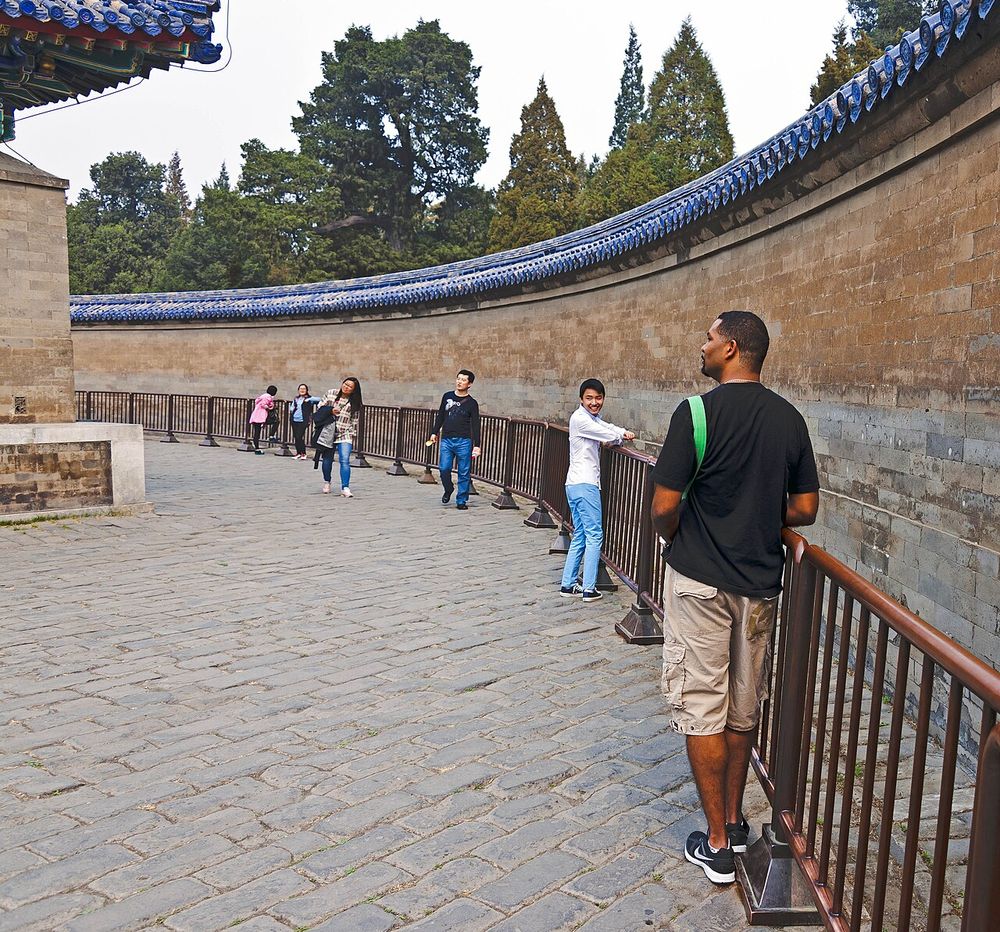
The round wall of its courtyard is the Echo Wall. It is about three metres high, with an inside radius of about 32.5 metres, built of a hard, fine brick from Linqing in Shandong, ground smooth and fitted without visible joints. A whisper spoken along the wall at one side can be heard at the other. A railing now keeps visitors a step away from the brick, so the effect is harder to get than it once was; try at opening time, before the courtyard fills.
In front of the hall are the Three Echo Stones. Clap on the third slab and the sound returns more than once. In the 1950s the physicist Tang Dingyuan worked out why: the sound travels to the round wall, comes back, and goes out and back again. How many echoes you hear depends on how loud the clap is and how quiet the courtyard.
The courtyard was still giving up secrets six hundred years on. On 26 March 1994 researchers from Heilongjiang University, measuring the acoustics here, found by accident a pair of spots where two people far apart can talk in ordinary voices. They named it the Dialogue Stone.
It is called a bridge, but it is a raised brick causeway about 360 metres long, joining the altar in the south to the Hall of Prayer in the north. It is the spine of the whole site.
Walk it from south to north and notice your feet: the ground rises slowly all the way. The emperor was meant to feel that he was walking up to Heaven.
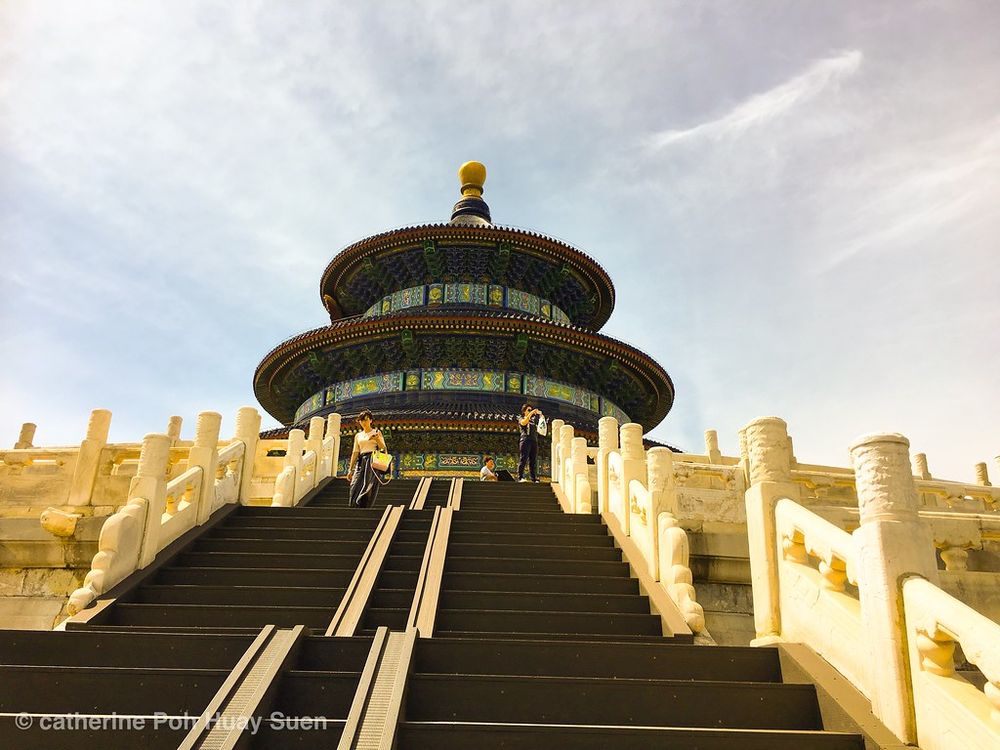
In 1420 a rectangular hall stood here, and Heaven and Earth were worshipped in it together. In 1530 the Jiajing emperor separated the two rites and built an altar to Earth in the north of the city. The hall was replaced in 1545 by a round one with three roofs in three colours: blue at the top, yellow in the middle and green at the bottom. Qianlong renamed it and made all three blue.
The four central columns are 19.2 metres high and 1.2 metres across. Stand at the door and look straight up into the dome.
East of the hall lie a group of large carved stones called the Seven-Star Stones. Count them.
The park has more than 3,500 old cypresses, pagoda trees and pines, and many are several hundred years old. The grove west of the Danbi Bridge is the quietest place in the park, and the one Kissinger said could not be copied.
In the western outer grounds stands the office where musicians and dancers trained for the rites. The music is called Zhonghe Shaoyue, played on sets of bronze bells and stone chimes. The compound reopened to visitors in February 2026 and holds performances.
After 1530 Beijing had four altars at the four sides of the city: Heaven in the south, Earth in the north, the Sun in the east and the Moon in the west. All four are parks today.
Archaeologists in Xi'an have uncovered the round altar of the Tang (618–907) capital, a four-tiered platform of rammed earth. It is reported to match the top tier of this altar in diameter, which would mean the measurement was handed down for a thousand years.
The whispering gallery under the dome of St Paul's Cathedral in London works the same way as the Echo Wall: sound spoken close to a smooth curved wall clings to it and travels round.
An ancient Chinese chronicle, the Zuo zhuan, says that the great affairs of a state are sacrifice and war. For most of Chinese history, standing here at the solstice was as much a part of ruling as commanding an army.
| Year | Here | Elsewhere |
|---|---|---|
| 1420 | The altar is finished, in the same year as the Forbidden City | In Florence work starts on the dome of the cathedral |
| 1530 | Heaven and Earth get separate altars; the Circular Mound is built | The Augsburg Confession sets out the Protestant faith |
| 1751 | About now Qianlong is rebuilding the altar and the Imperial Vault | The first volume of the French Encyclopédie is published |
| 1889 | Lightning burns down the Hall of Prayer | The Eiffel Tower is completed in Paris |
| 1896 | About now the rebuilt hall is finished | The first modern Olympic Games are held in Athens |
| 1918 | The altar opens as a public park | The First World War ends |
One line to remember: the year lightning destroyed the Hall of Prayer, Paris finished an iron tower.
These are stories people tell about this place. They are legends, not history, and each one says where it comes from.
The stones east of the Hall of Prayer for Good Harvests are said to stand for the seven stars of the Big Dipper.
Source: Local folk tale
Later, people who live here will be able to add the stories they grew up with, and say which of these they have heard.
Last checked 2026-11-11. Travel and news reports, not the site's own notices.
Stand at the site, sign in, press the button, and collect its stamp. Your browser will ask to use your location. It is sent to us once to confirm that you are at the site; we keep how far you were from it, not the spot where you stood.
Your stamps are saved to your account, so they follow you to any device. Checking from a browser cannot rule out every false location; stricter checks arrive with the app.
Photos here show the place, not people. Each one is credited to the visitor who took it and appears after our team has looked at it. A photo with you in it belongs under “I am here”.