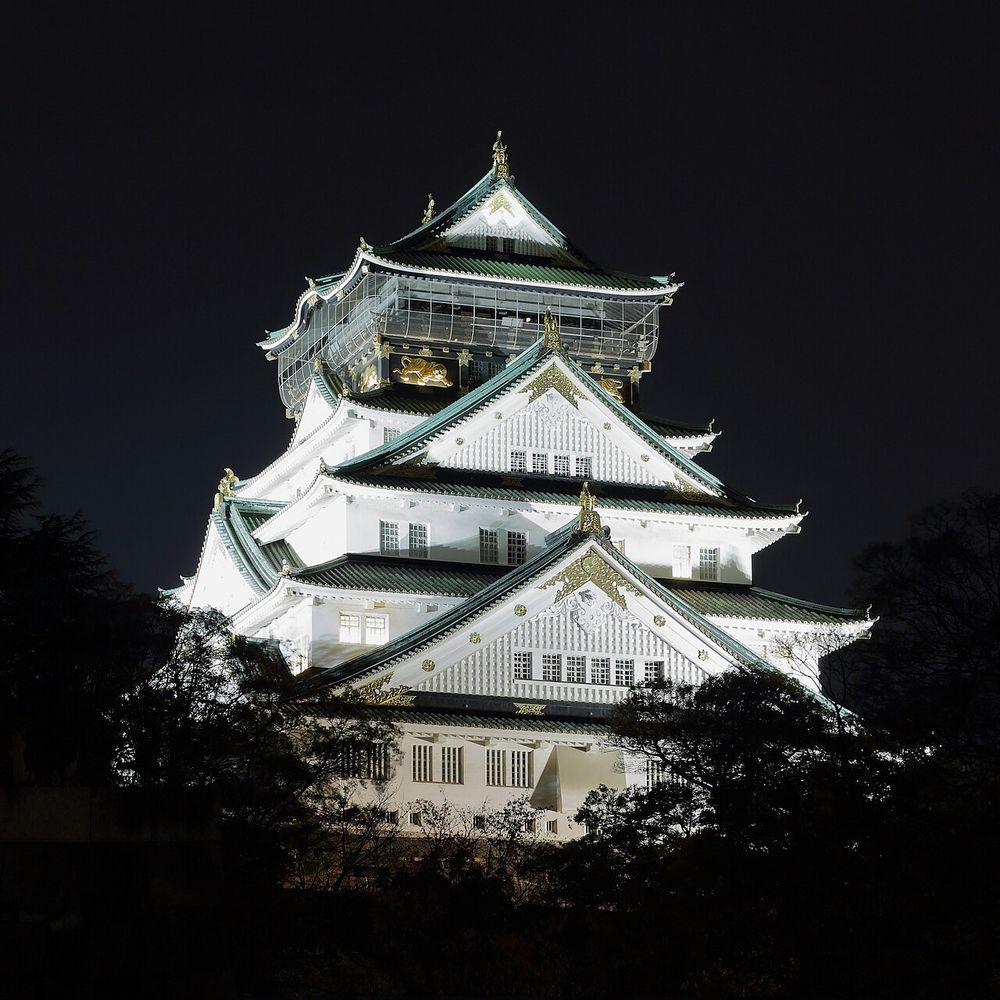
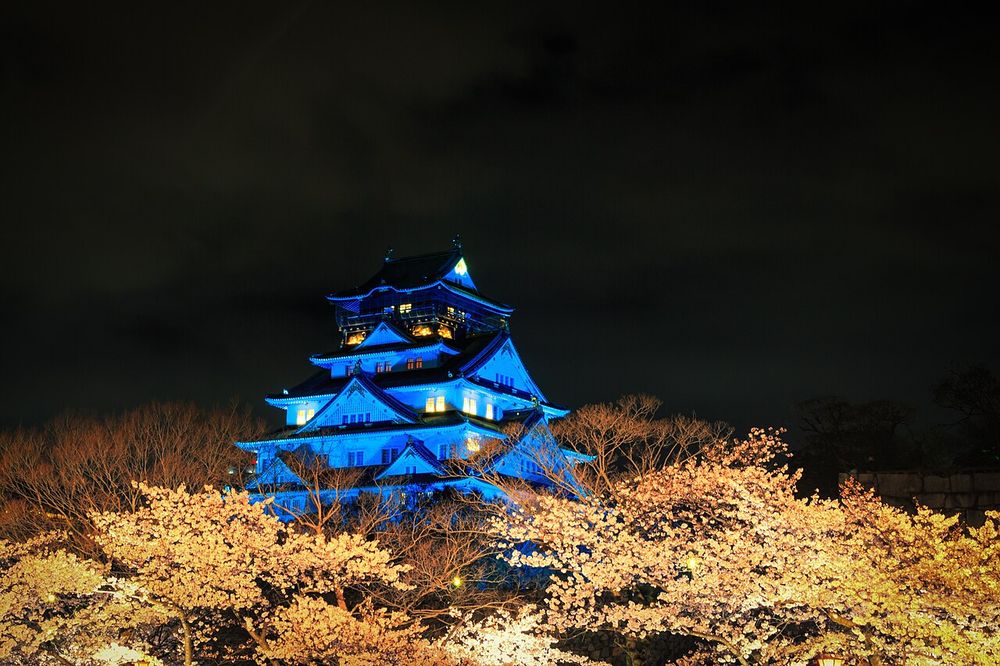
A peasant's son who made himself master of Japan built his castle here in 1583. His enemies burned it, buried it and built a bigger one on top. The white tower you see is the third, made of concrete in 1931 and paid for by the people of Osaka. The walls and moats are the real thing.
Photo: 663highland, CC BY 2.5, Wikimedia Commons
The story
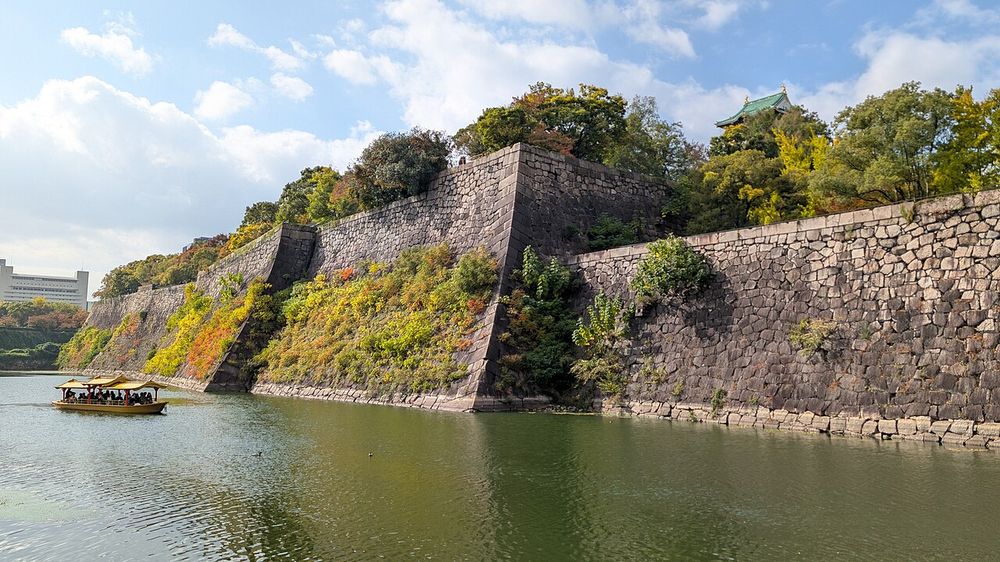
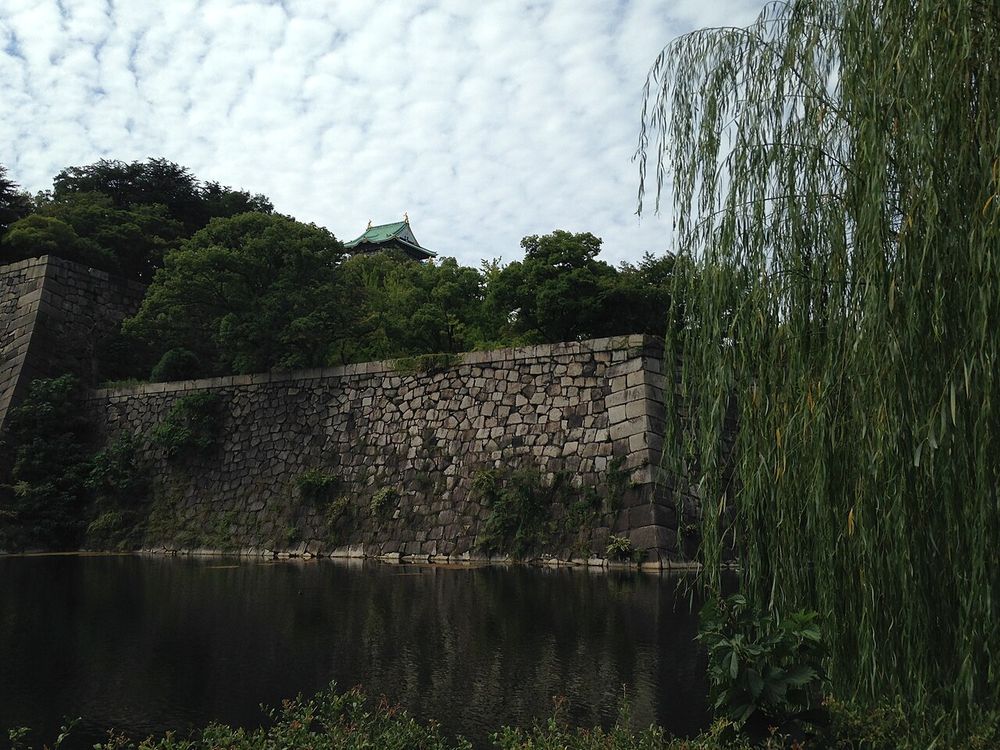
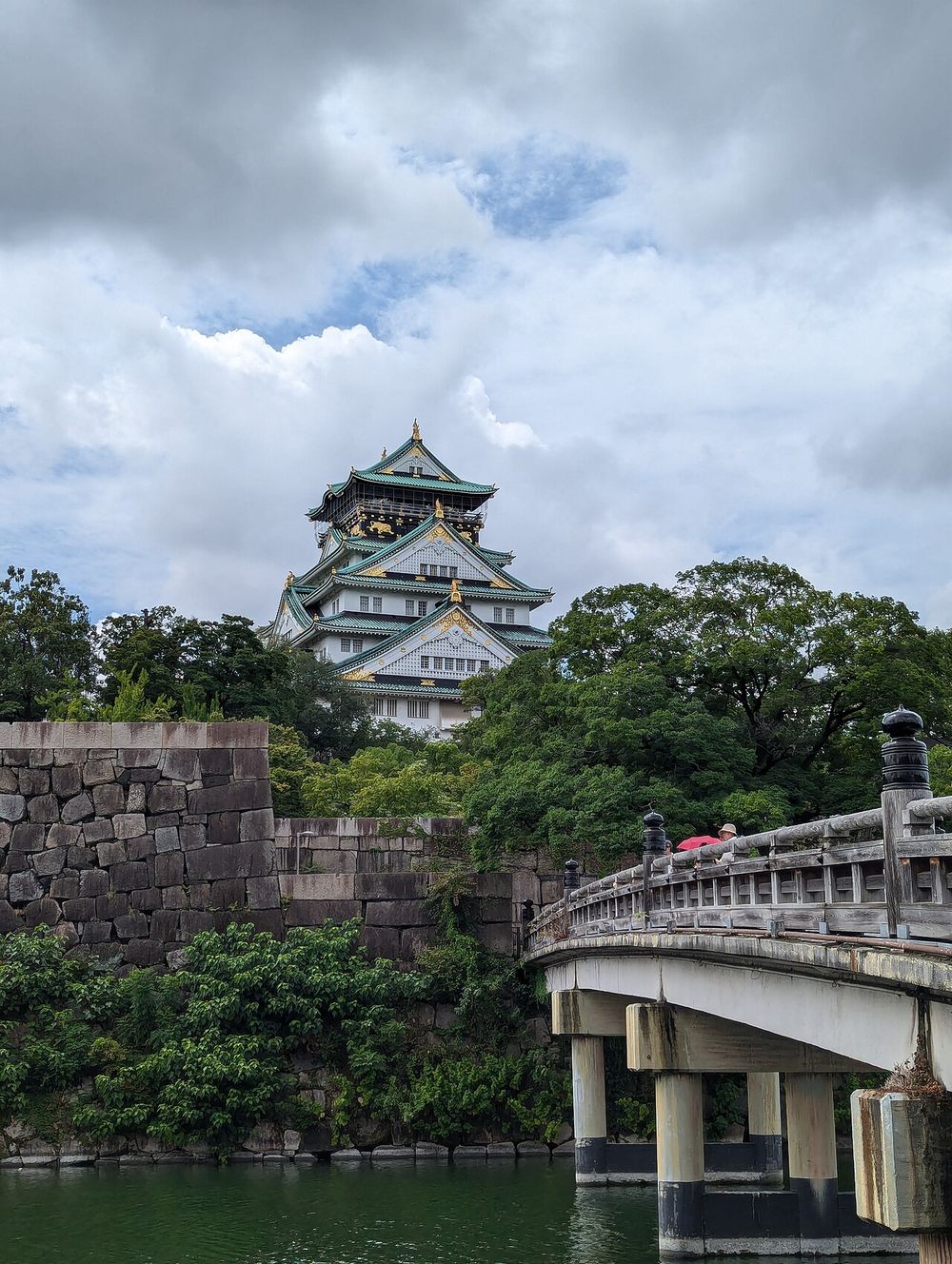
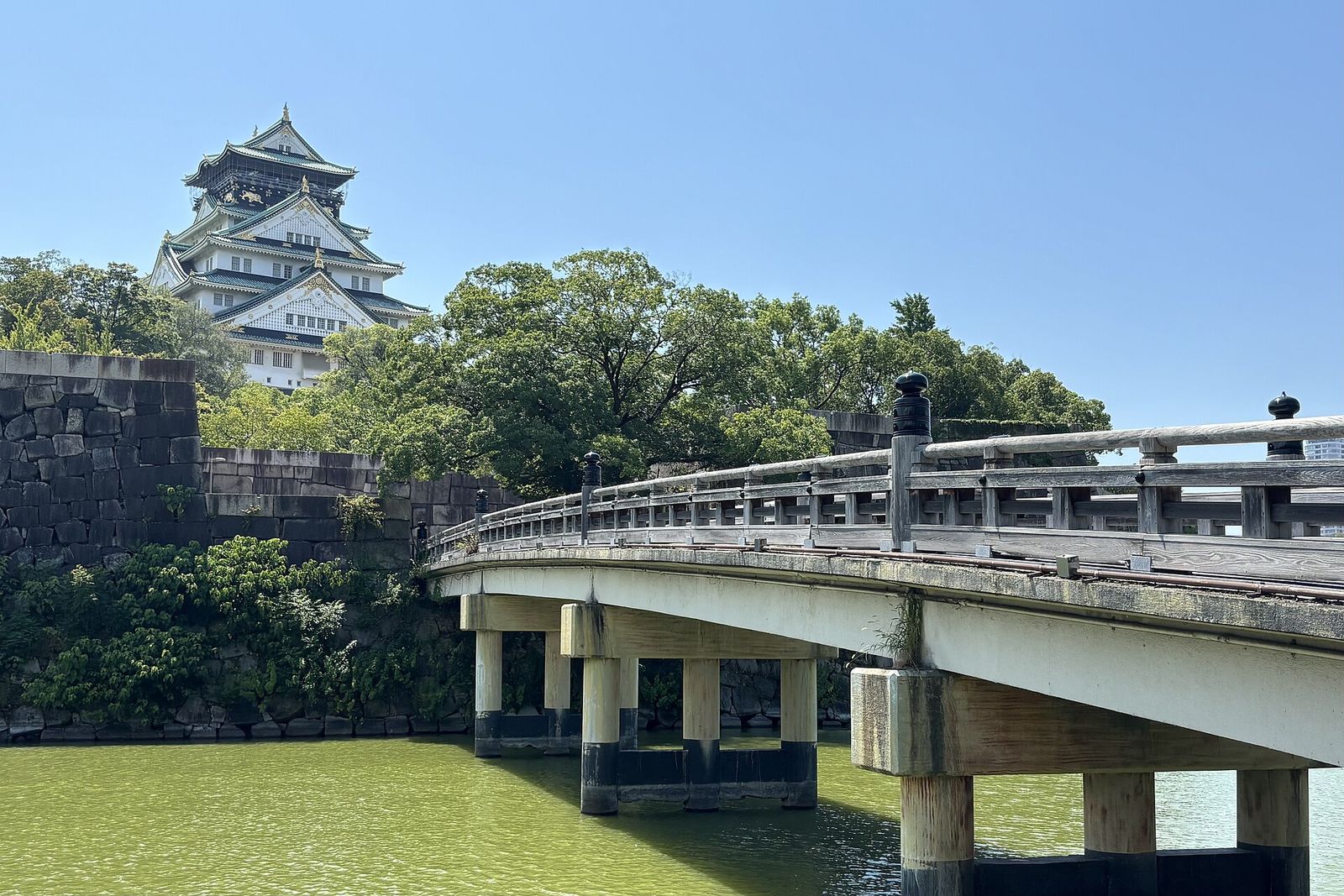
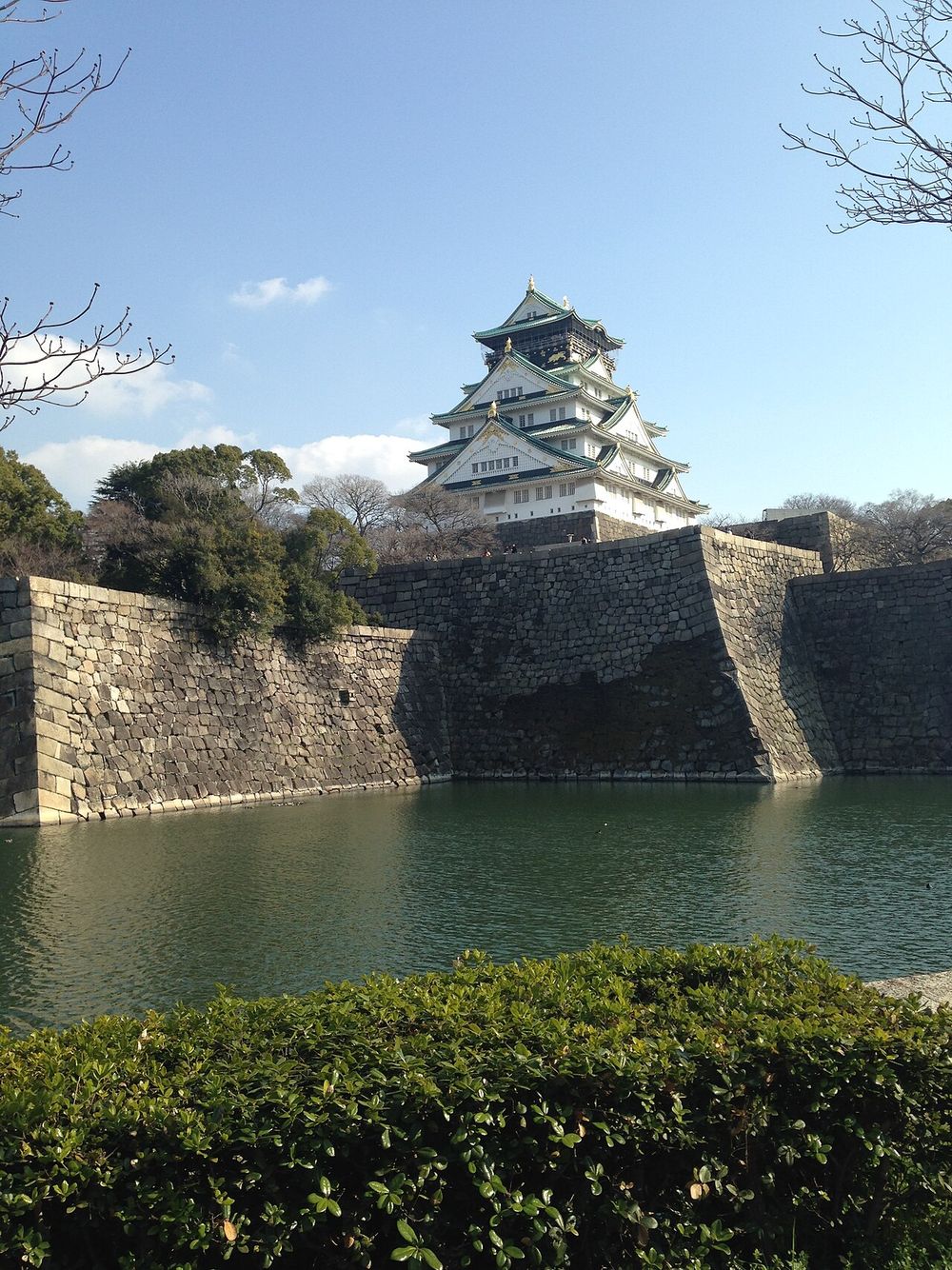
You are on a bridge over a moat as wide as a river. In front of you a wall of grey stone rises straight out of the water, higher than a ten-storey building and perfectly smooth, curving outward at the foot like the side of a ship. Far above it, small and white among the trees, is a tower with a green roof and gold at the corners.
The first castle was begun in 1583. In that year, in Ming China, the Italian priest Matteo Ricci was allowed to settle in Guangdong, and in the north-east a young chief named Nurhaci began the wars that would make his grandson emperor in Beijing.
What is here
The park, the gates, the walls and the moats are free at all hours. You pay for the tower, and separately for the western garden.
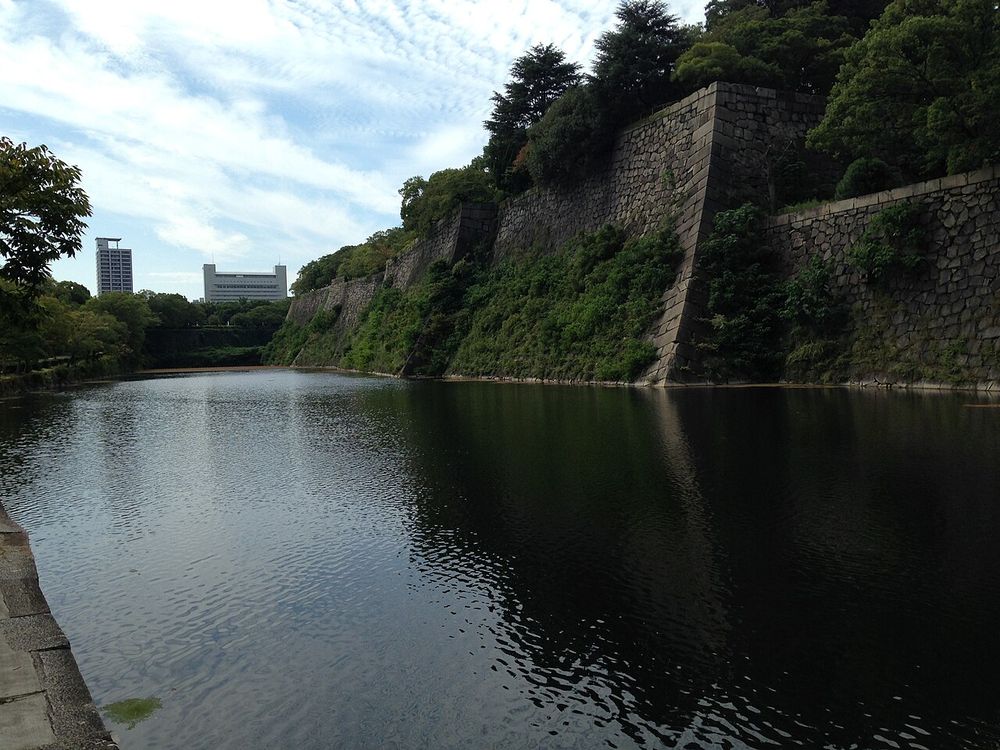
The inner moat and its wallsJoli Rumi, CC BY-SA 4.0
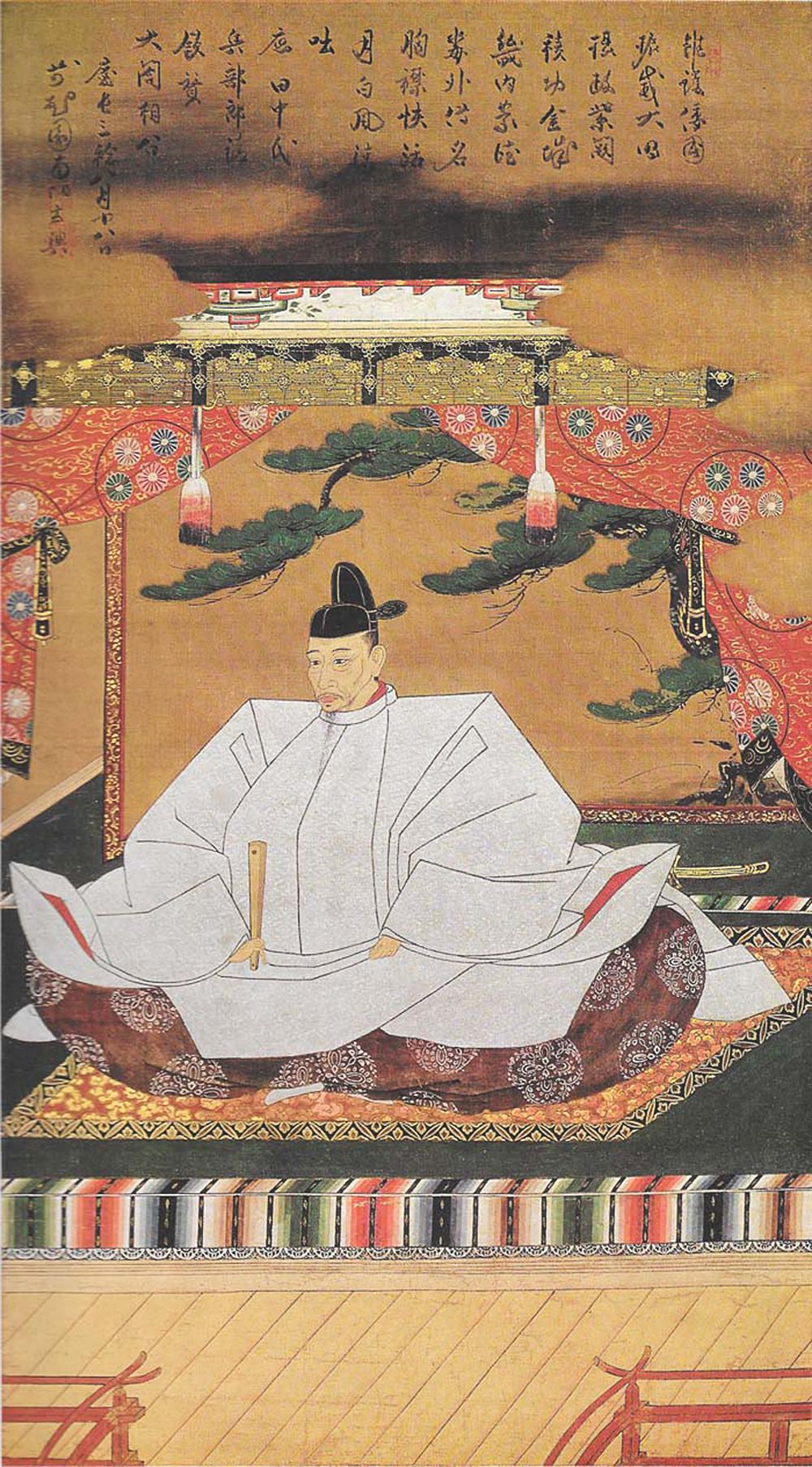
Toyotomi Hideyoshi began life as a farmer's son and a servant who carried his lord's sandals. By 1590 he ruled all Japan. He built this castle to be larger than any other, with a tower of five roofs covered in gold leaf and black lacquer.
He died in 1598 and left a son of five. In 1615 the boy, now twenty-one, was besieged here by Tokugawa Ieyasu, the lord who had sworn to protect him. The castle burned. The son and his mother died in the ruins.
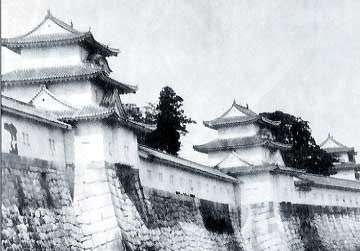
The Tokugawa then buried what was left under as much as ten metres of earth and built a new castle on top, with higher walls and a white tower. Lightning burned that tower in 1665. For the next 266 years the castle had none.
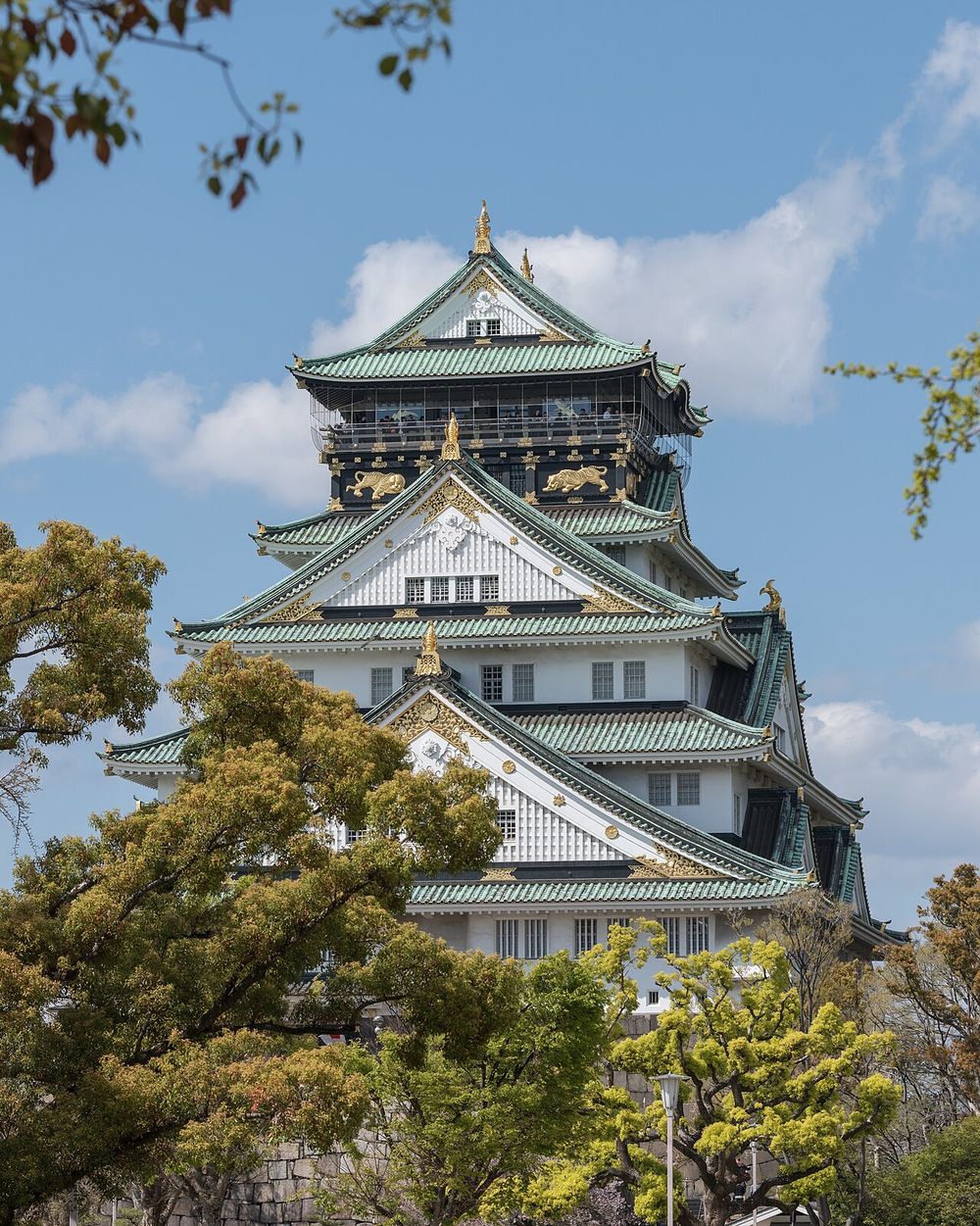
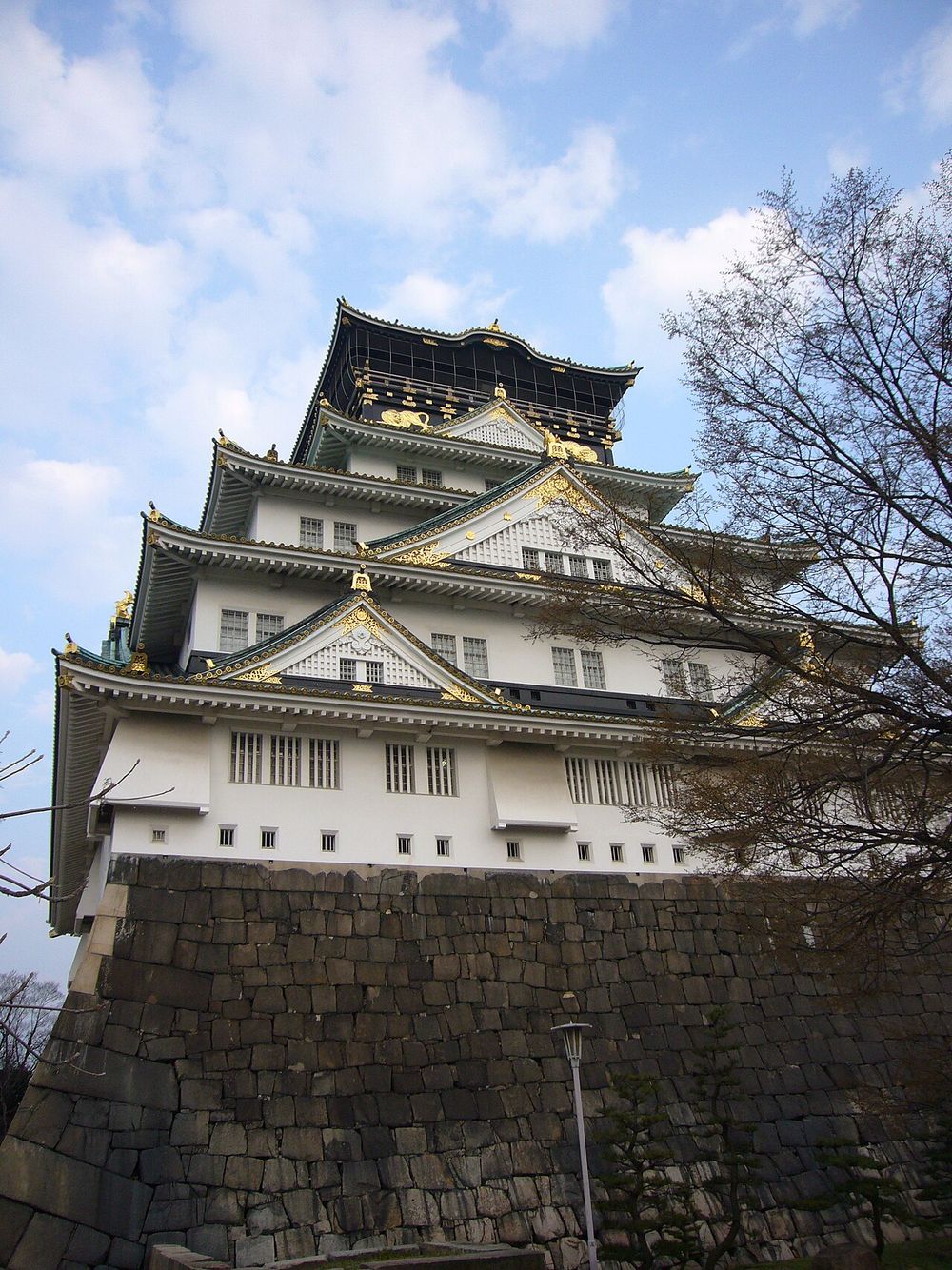
The tower in front of you was built in 1931, in concrete, with lifts. It is a museum. Go up it for the view, and walk round it for the walls.
Things people often get wrong
"This is Hideyoshi's castle." Nothing of his can be seen above ground. Every wall and moat you walk past was built by the family that destroyed his.
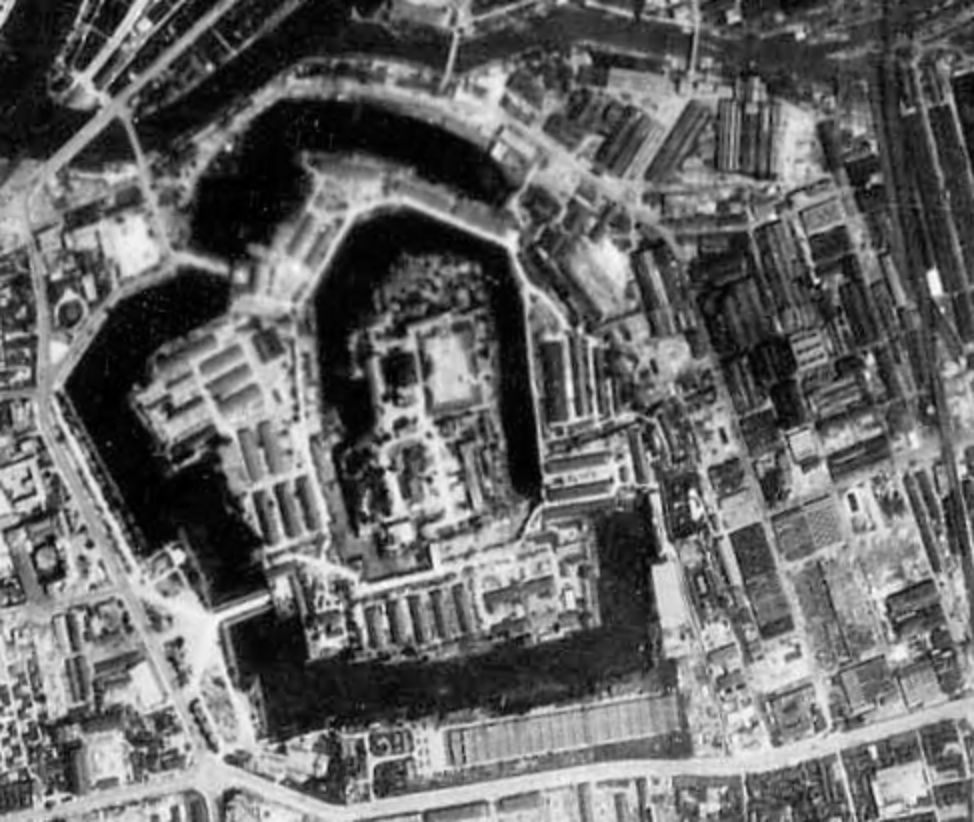
"The tower is a fake." It is a building of 1931 and is now protected as one. It is older than most things in Osaka, and it came through the bombing of 1945 when the arsenal round it was flattened.
"It looks as it did in the old days." The white walls copy the Tokugawa tower and the top storey, black with gold tigers, copies Hideyoshi's. No such mixture ever stood here before.
"The great stones were lifted by some lost art." They were dragged on sledges over seaweed and logs by thousands of men, and the lords who sent them carved their marks on the stones to prove it.
People who stood here
Toyotomi Hideyoshi (ruler of Japan, 1585–1598, who twice invaded Korea)He showed visitors round himself, opening storerooms of gold and silk. He had a tea room made entirely of gold that could be taken apart and carried. From here in 1592 he sent an army to Korea, meaning to conquer Ming China. The Ming sent troops, and the war ended only with his death.
Tokugawa Ieyasu (founder of the shogunate that ruled Japan from 1603 to 1868)He came here in 1586 to kneel to Hideyoshi. He came back in 1614 with an army. When he could not take the castle he made a truce, filled in its moats under cover of the peace, and attacked again the next summer.
Go deeper: eight stops, from the great gate to the buried wall
The stops go in by the main gate on the west, up to the tower and out to the north.
1. The great gate
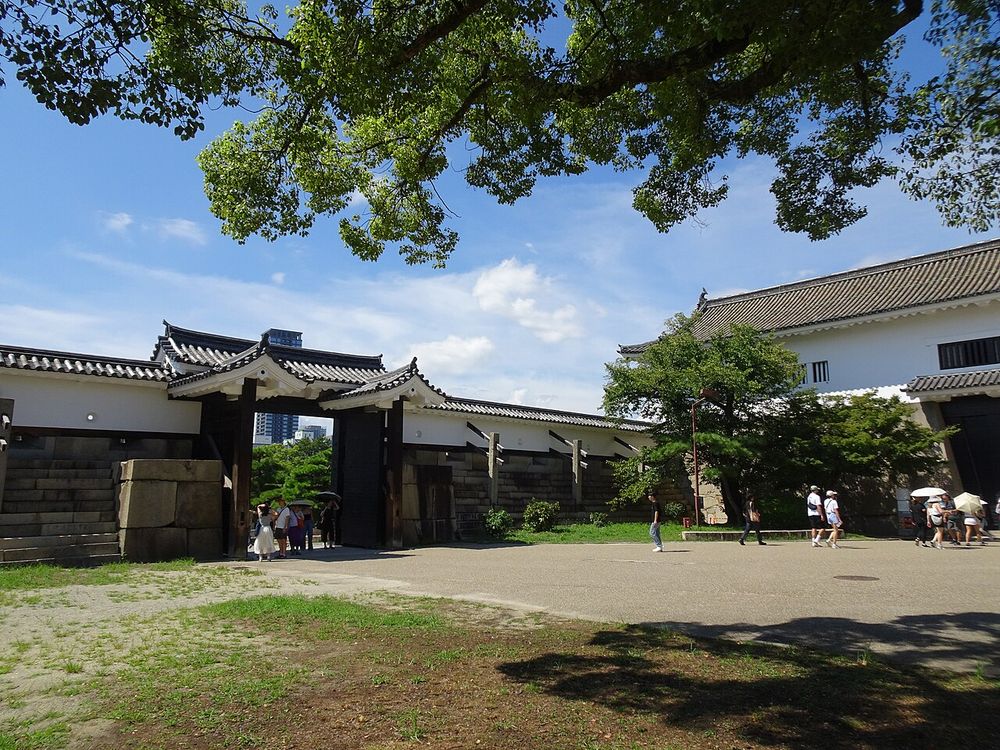
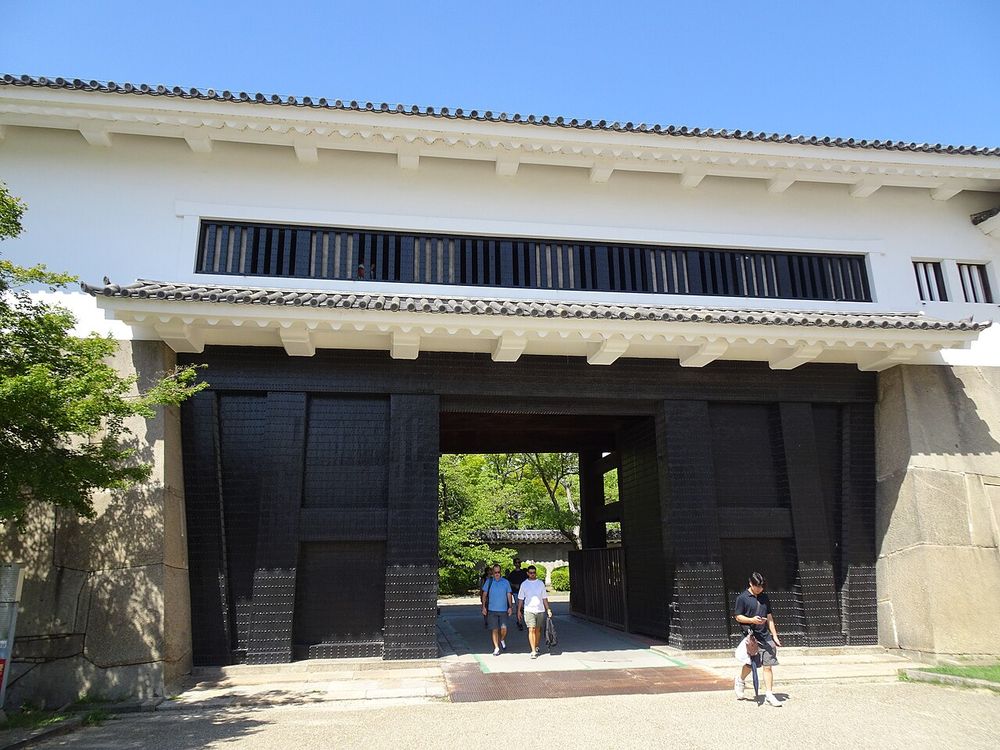
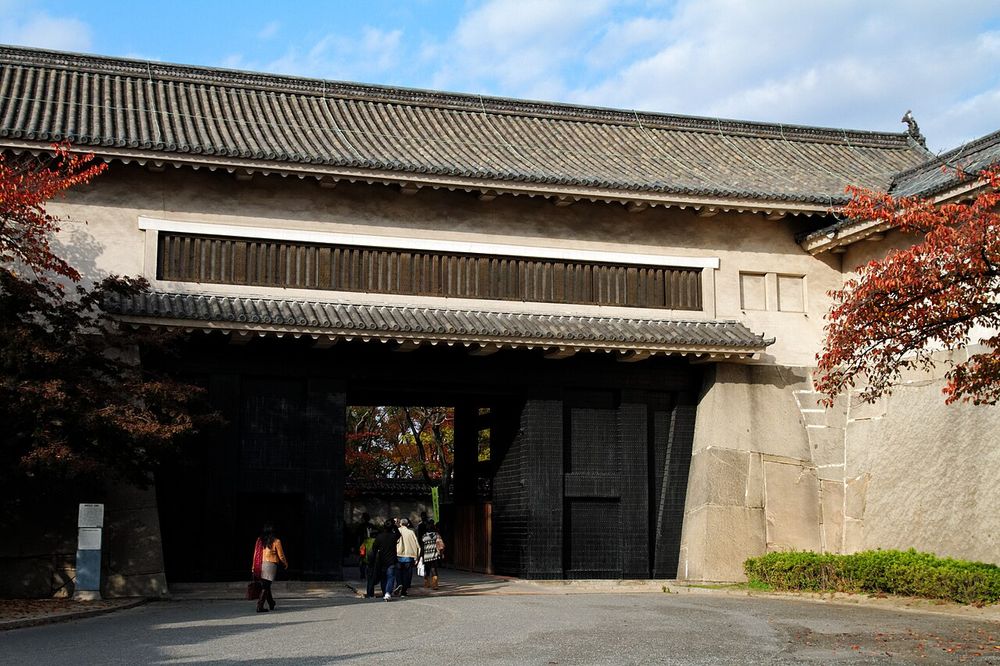
The yard inside the Ōte-monSpudgun67, CC0
The Ōte-mon is the front door. You cross the outer moat on a causeway, pass through a gate, and find yourself in a square yard with a second, heavier gate at right angles. An attacker who broke the first door would be shot from three sides while trying to turn.
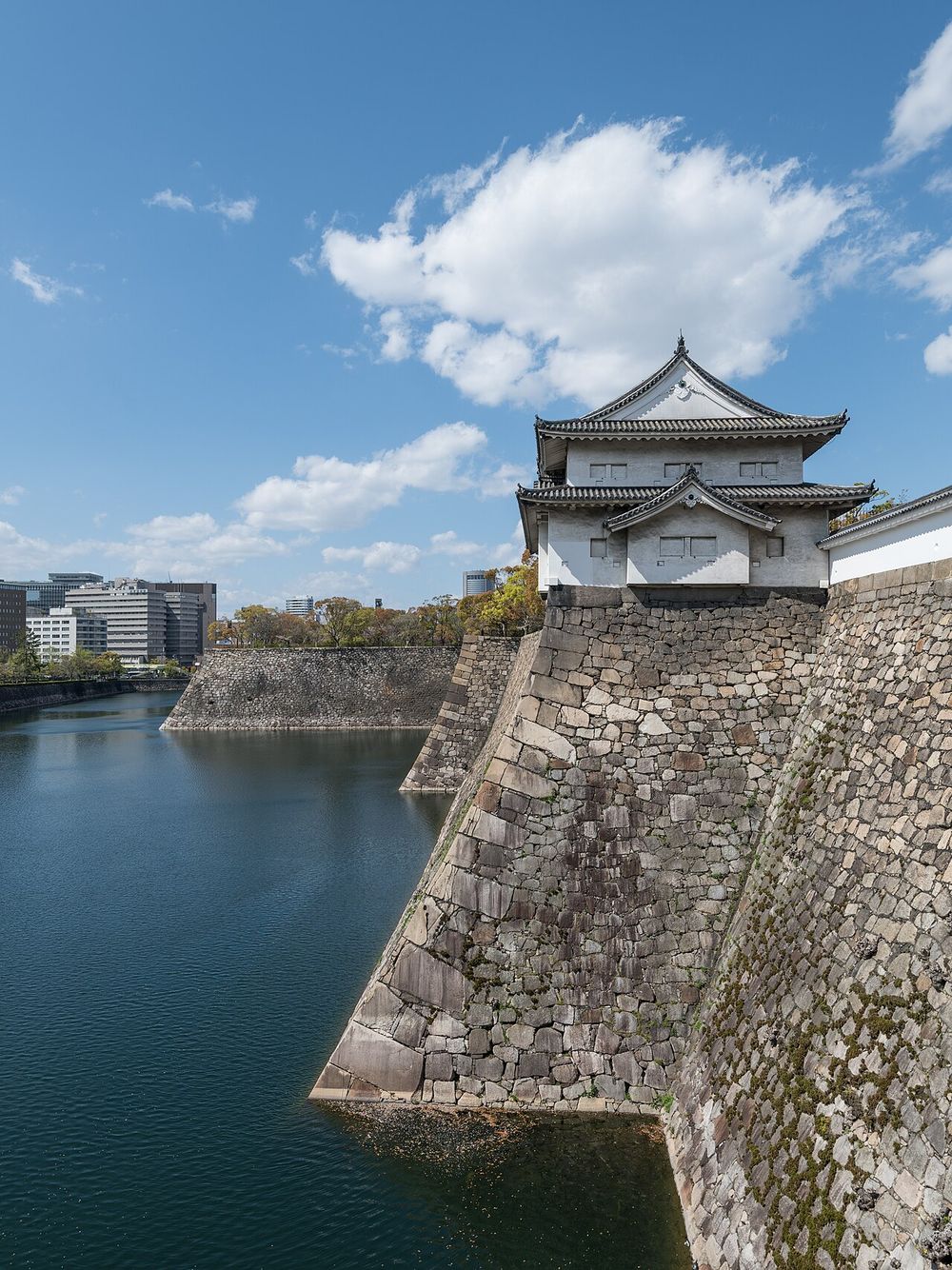
The Thousand-Coin Turret, 1620DXR, CC BY-SA 4.0
The white turret on the corner to your left dates from 1620 and is the oldest building in the castle. Its name, the Thousand-Coin Turret, is older still: it comes from the temple-fortress that stood here before the castle and was besieged for ten years in the 1570s.
2. The walls
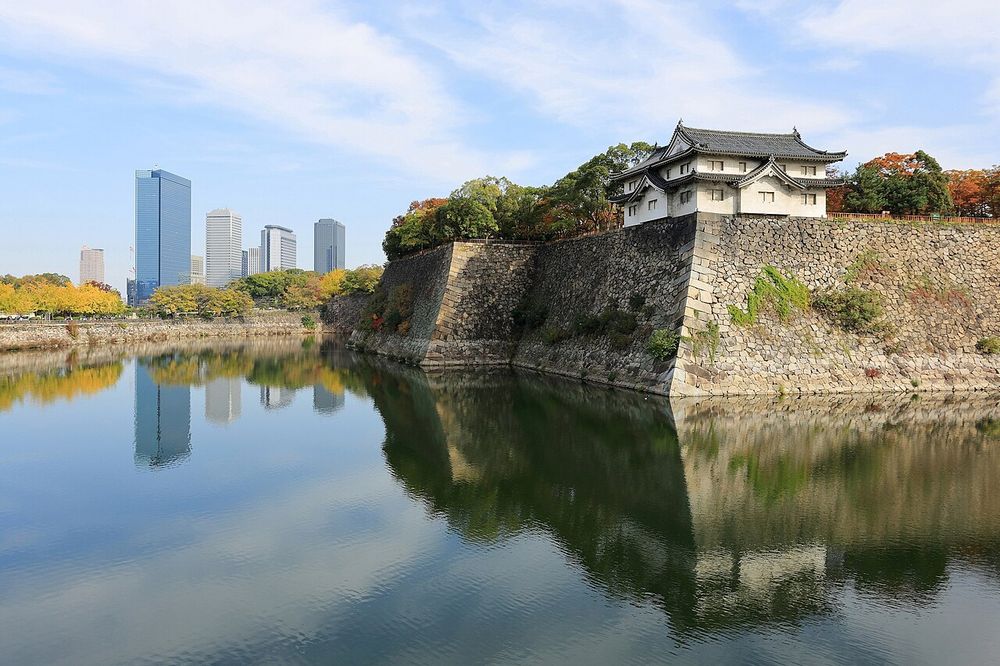
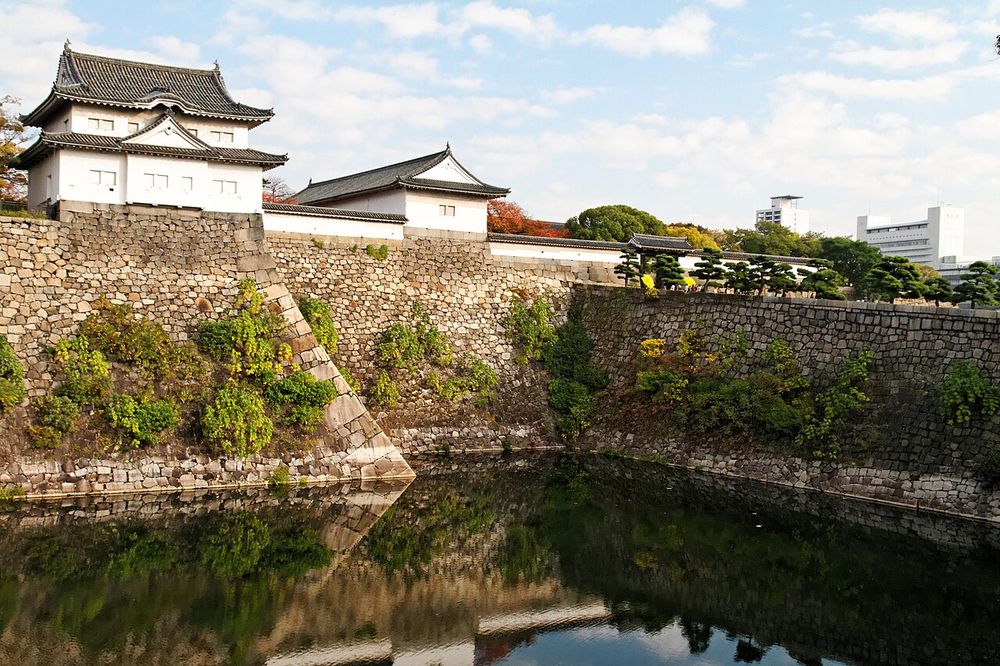
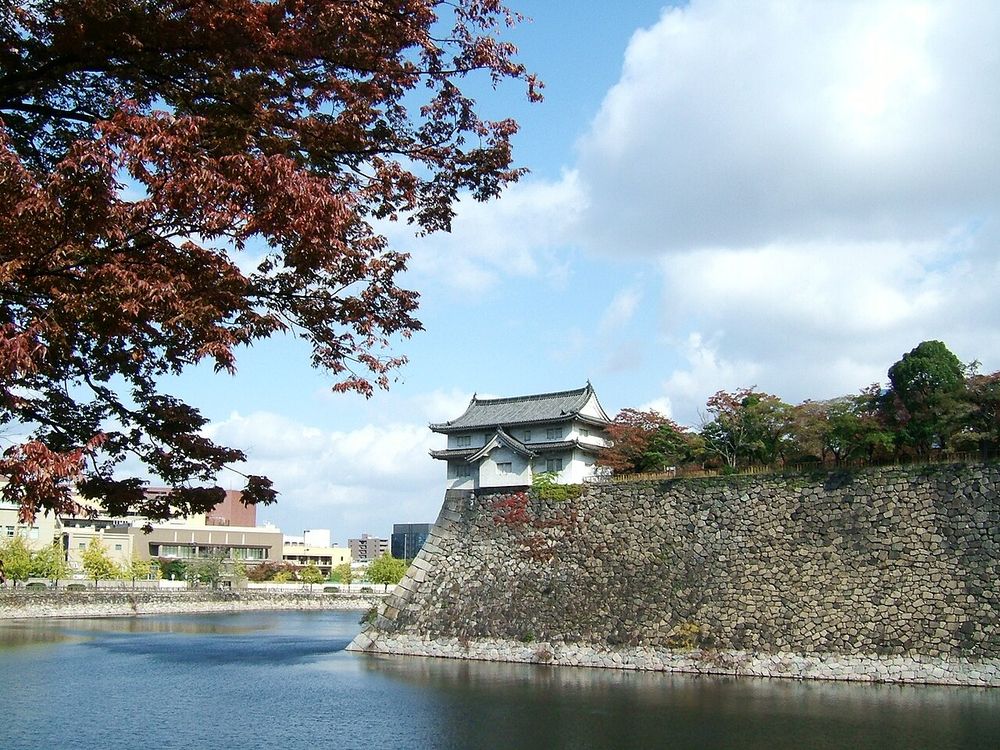
The outer moat, a corner turret and the office towersMartin Falbisoner, CC BY-SA 4.0
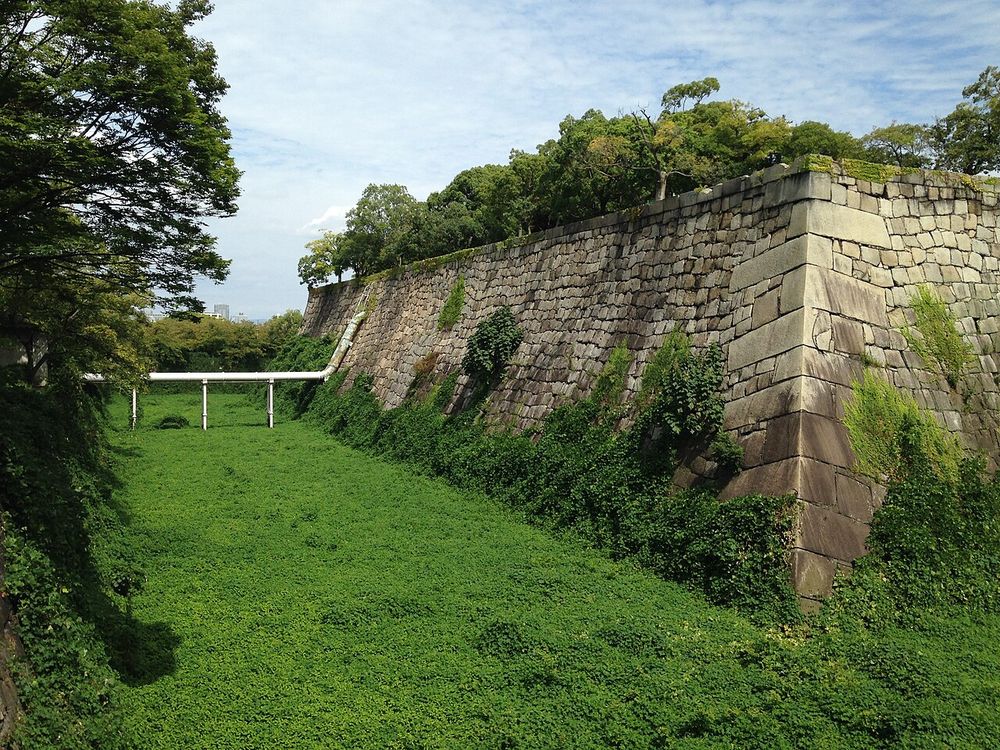
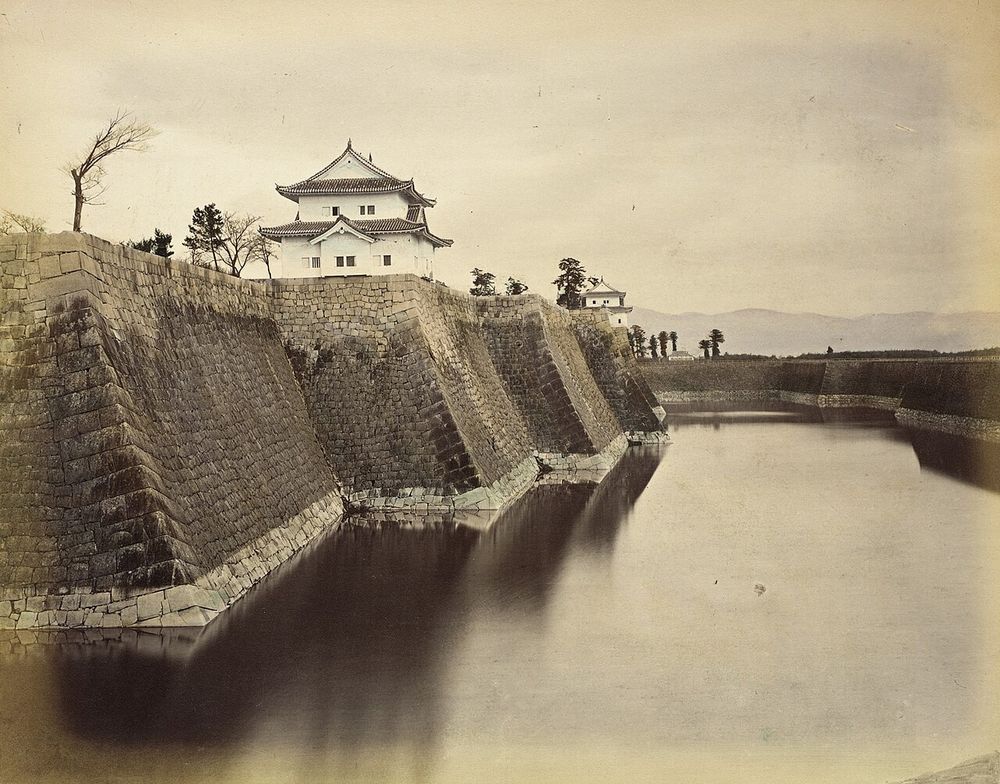
In 1620 the Tokugawa ordered sixty-four lords of western Japan to rebuild the castle at their own cost. It kept them poor and busy. The walls run for twelve kilometres and stand up to thirty-two metres above the moat, the highest in Japan.
There is no mortar. Each block is cut to fit its neighbours and leans a little inward. The curve at the foot spreads the weight and lets the wall ride an earthquake.
Look closely at the faces of the stones. Many carry a small carved sign: a circle, a cross, a fan. They are the marks of the lords and their work gangs.
3. The Octopus Stone
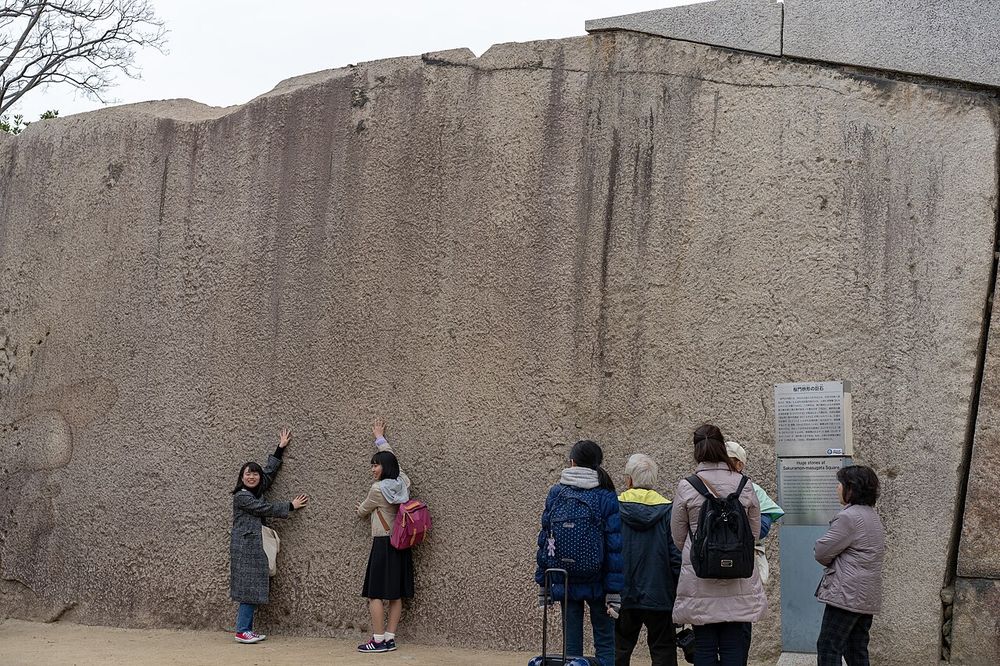
The Octopus Stone, with people for scalelasta29, CC BY 2.0
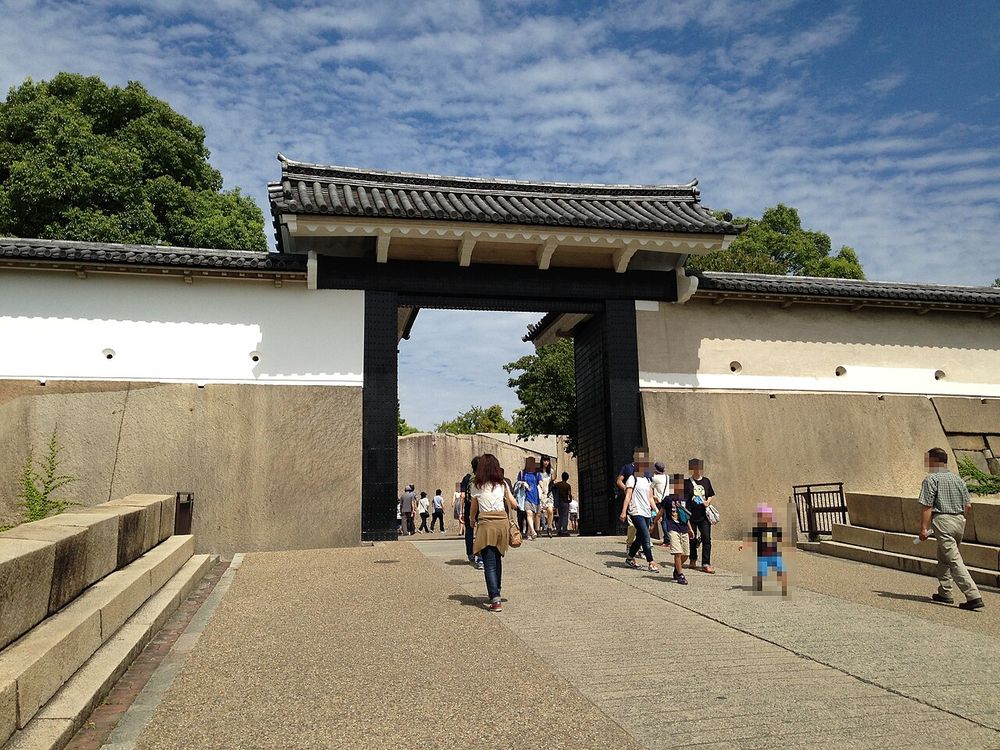
Inside the Sakura Gate, the wall facing you contains a single slab eleven metres long and more than five high, about the area of thirty-six sleeping mats. It is the largest stone in any Japanese castle. It weighs something over a hundred tonnes and came by sea from an island 150 kilometres away.
It is thin, less than a metre thick: a facing, set up like a screen to astonish people coming in. The stain on its left side is shaped like an octopus, which gave it its name.
4. The tower from outside
The tower from the southDXR, CC BY-SA 4.0
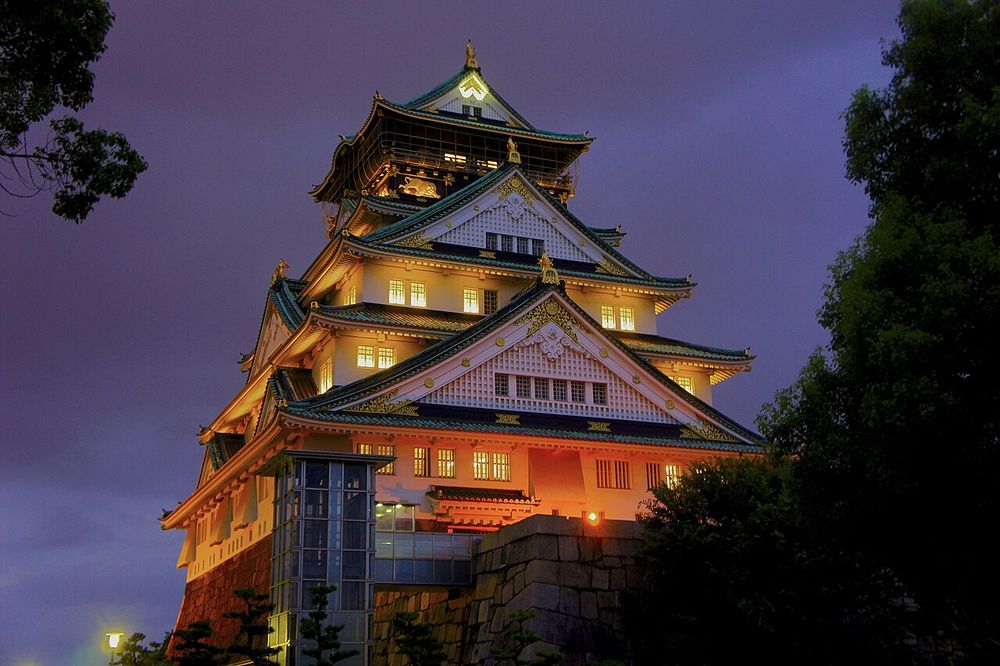
The tower is 55 metres high from the ground. It has five roofs and eight floors. In 1928 the mayor asked the citizens for money to rebuild it, and the whole sum came in within six months, much of it in small coins.
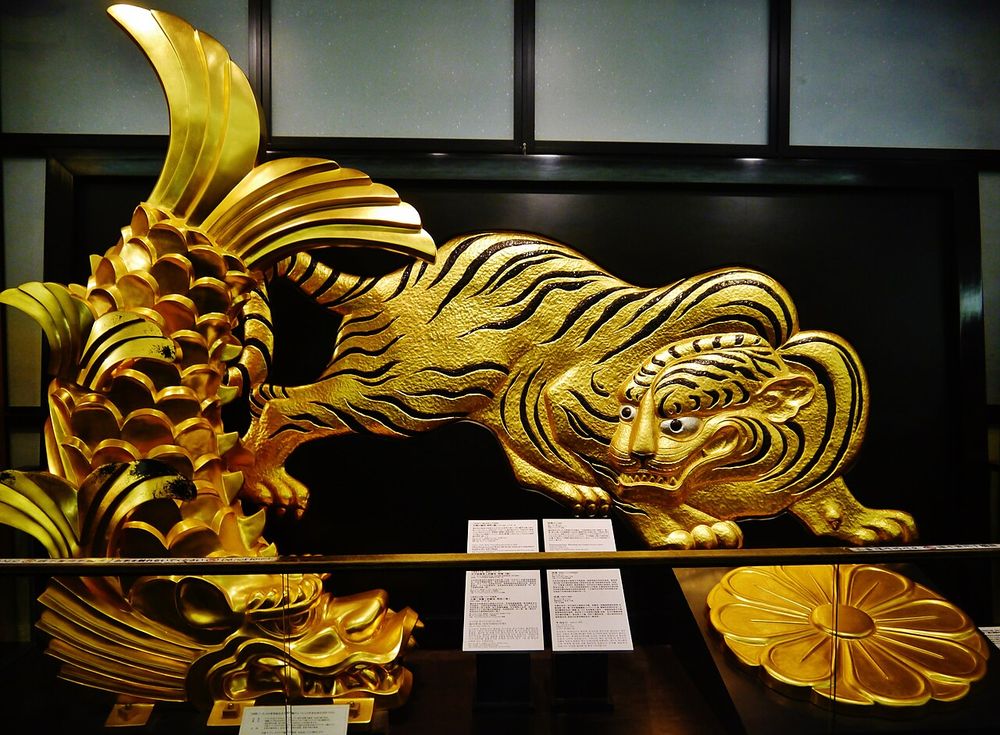
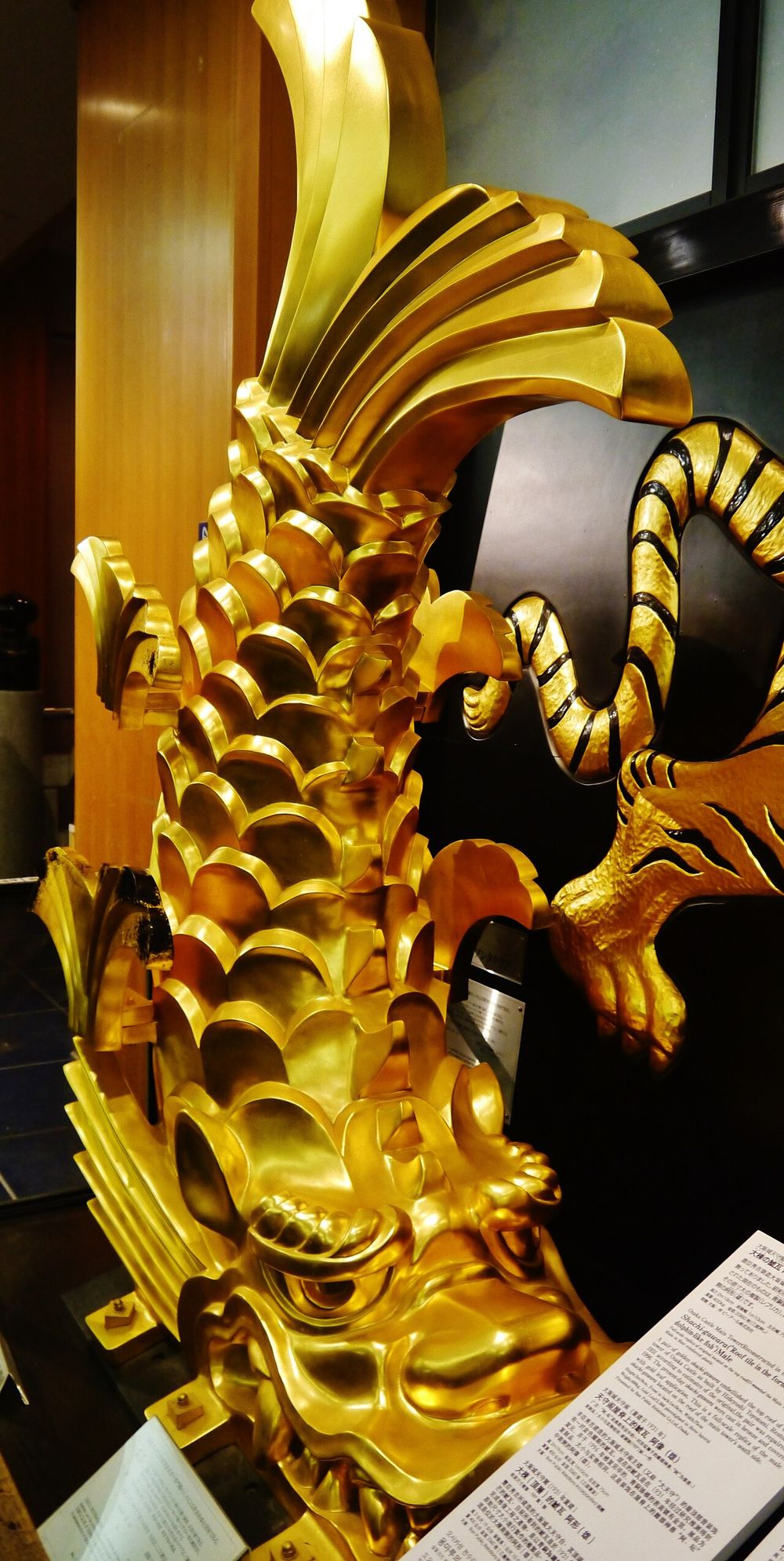
A golden tiger-fish from the roof, shown insideZairon, CC BY-SA 4.0
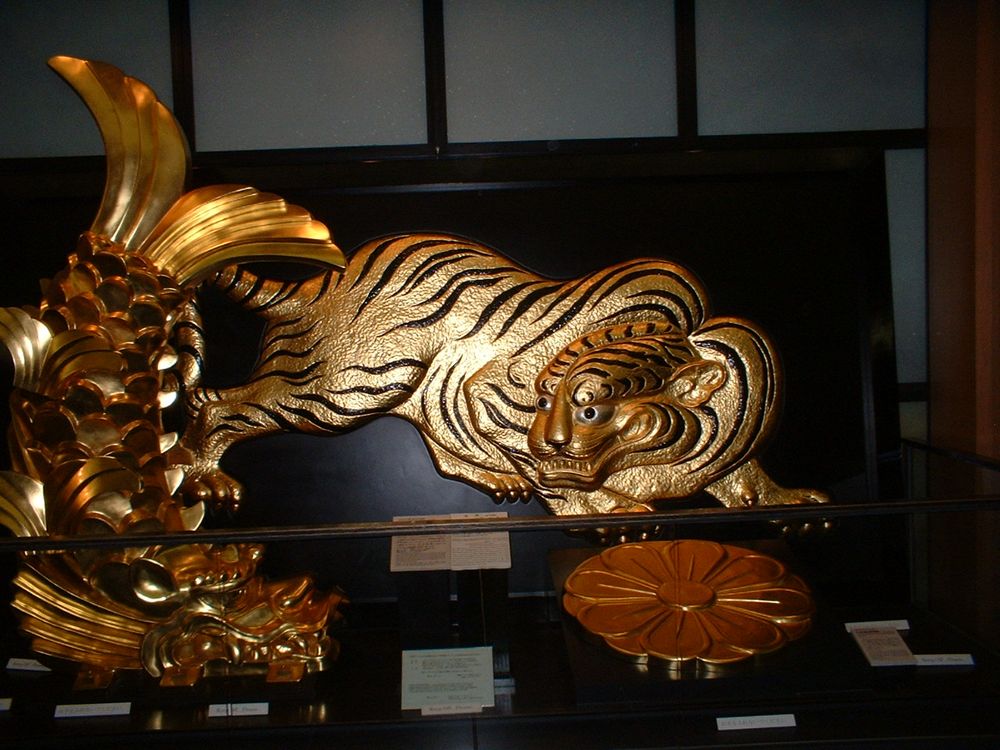
At the ends of the top ridge are two golden fish with the heads of tigers, tails in the air. They are charms against fire: the creature is said to spout water. Under the eaves of the top storey are crouching tigers in gold.
Look for the scarred patches on the stone base. They are from the air raids of 1945.
5. Inside the tower
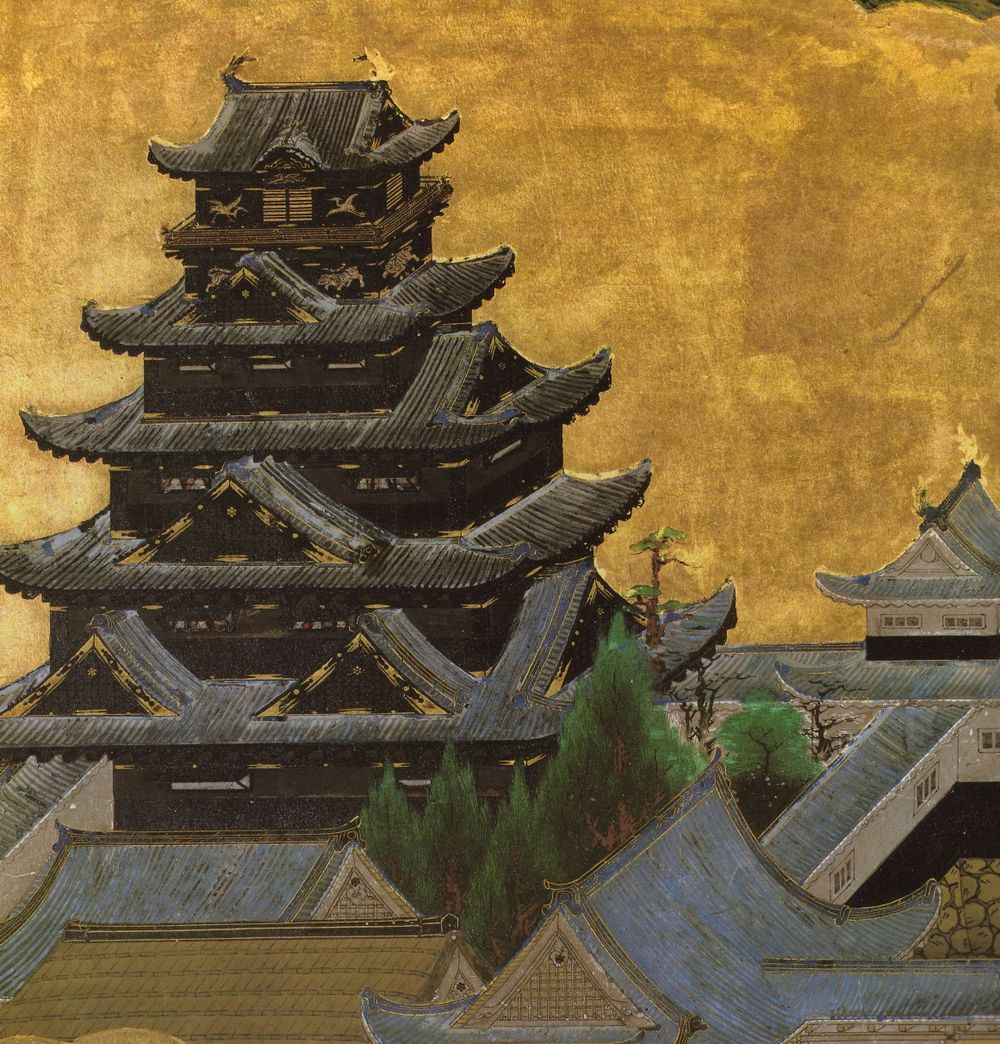
Hideyoshi's black tower, a detail of the screenOsaka Castle Museum, Public domain
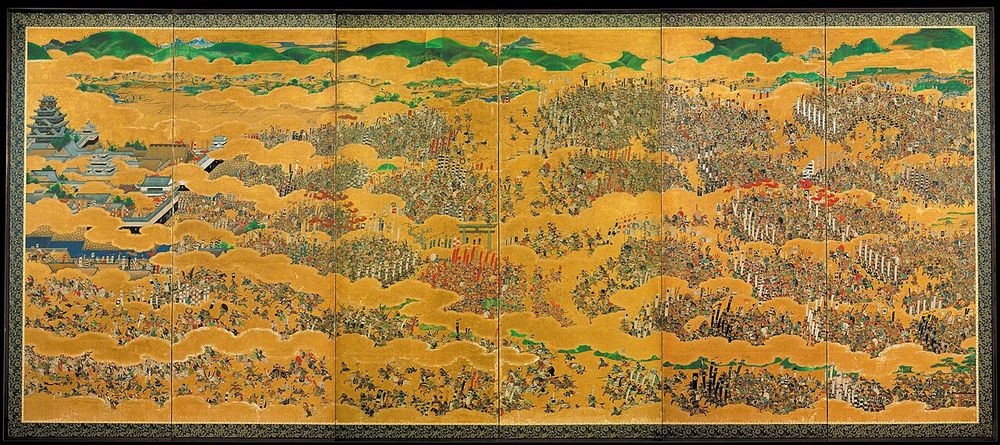
Take the lift to the fifth floor and climb the last three by the stairs, or walk up through the museum. The best thing in it is a painted screen of the battle of 1615, made for one of the generals who fought in it. It shows five thousand tiny figures: soldiers, horses, and townspeople running for the river with their children.
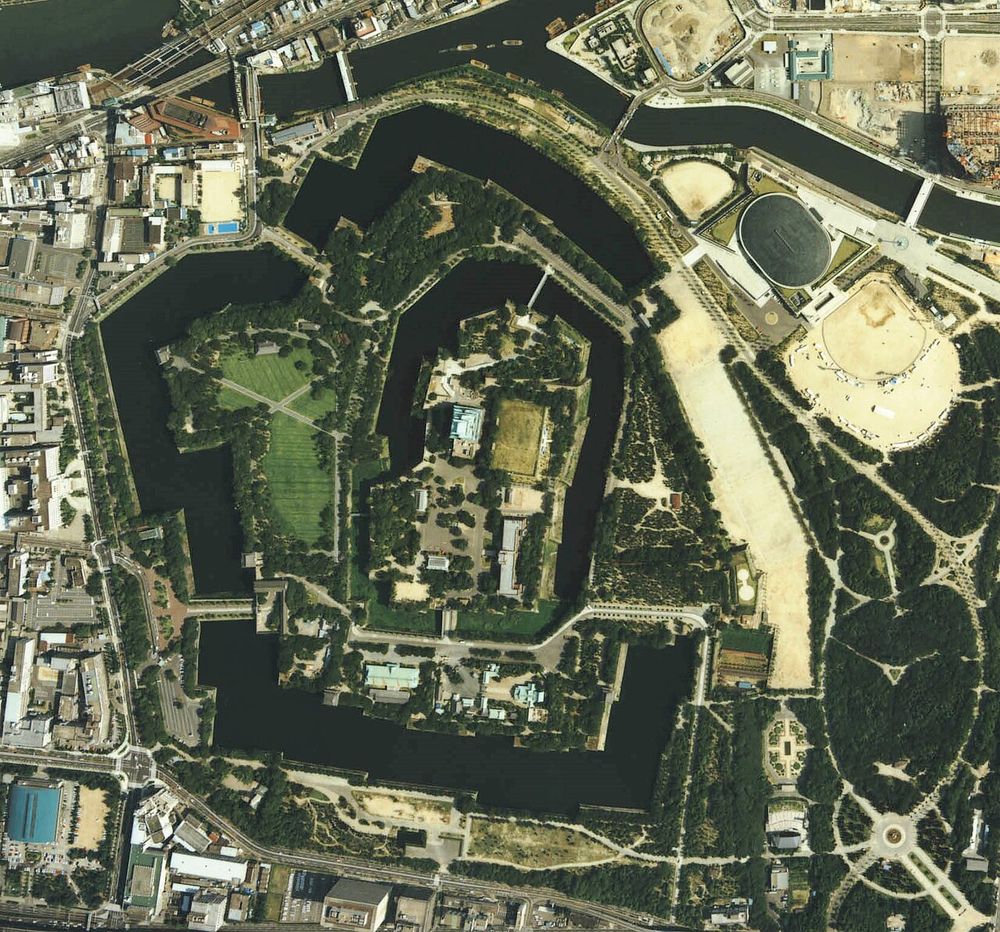
The two rings of moat, photographed from above in 2017国土地理院 (Institute of Land and Geography), Attribution
The top floor is an open gallery fifty metres up. Find the two rings of moat below you, and the office towers beyond them. Hideyoshi's castle covered four times the area you can see.
6. The buried wall
Stone wall and willowそらみみ (Soramimi), CC BY-SA 4.0
In 1959 engineers drilling near the tower struck a stone wall seven metres down. It was Hideyoshi's, built of rough natural boulders, quite unlike the cut blocks above. A drawing of his castle found the next year showed where the rest must lie.
Since April 2025 a small museum beside the tower has let you walk down and stand in front of a stretch of it, blackened by the fire of 1615. It is included in the tower ticket.
7. Where the Toyotomi ended
The battle of 1615 on a folding screen of the seventeenth centuryanonymous, Public domain
Go down the slope north of the tower. On 4 June 1615, with the castle on fire, Hideyoshi's son Hideyori, his mother and about thirty attendants took refuge in a storehouse somewhere on this terrace. A messenger was sent to ask for their lives. The answer was gunfire. They killed themselves.
The tower above the bridgeTakipoint123, CC BY-SA 4.0
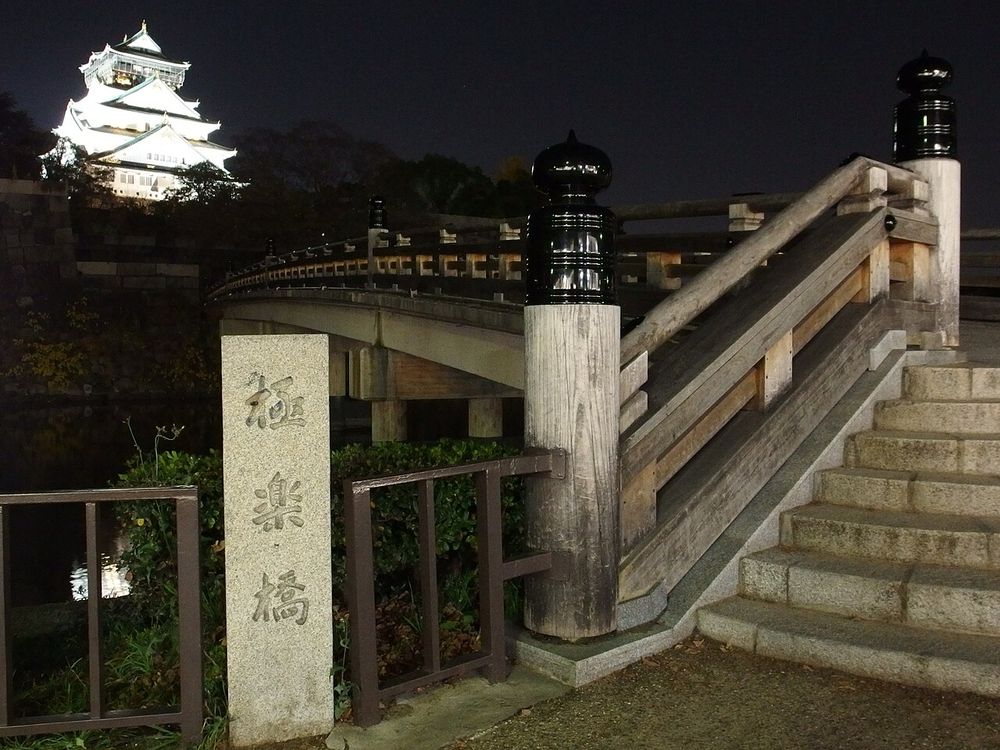
A stone marks the place. The bridge beyond it is called Gokuraku-bashi, the Bridge to Paradise.
8. The western garden
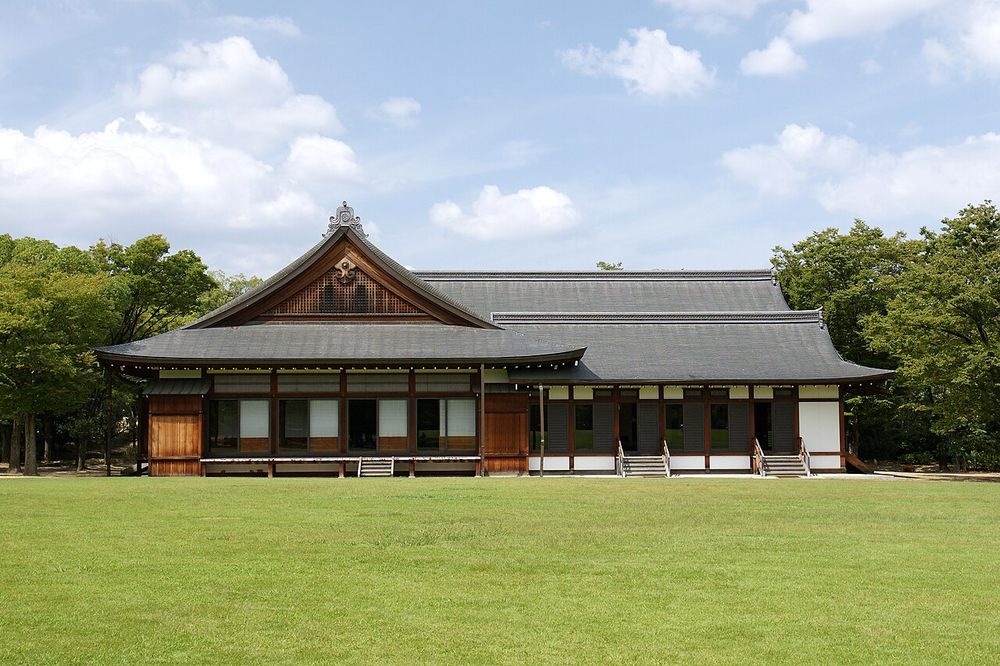
The guest house in the western garden663highland, CC BY 2.5
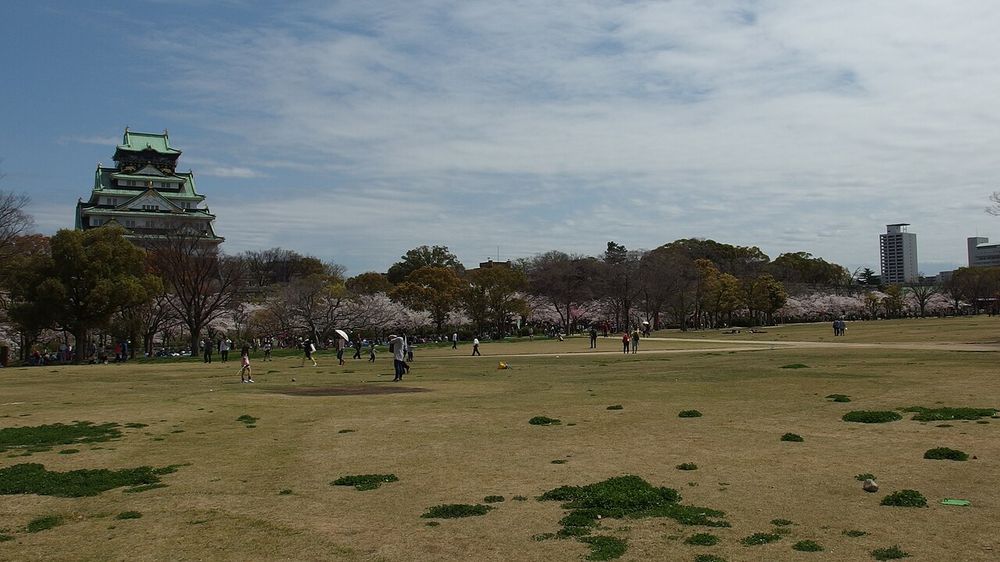
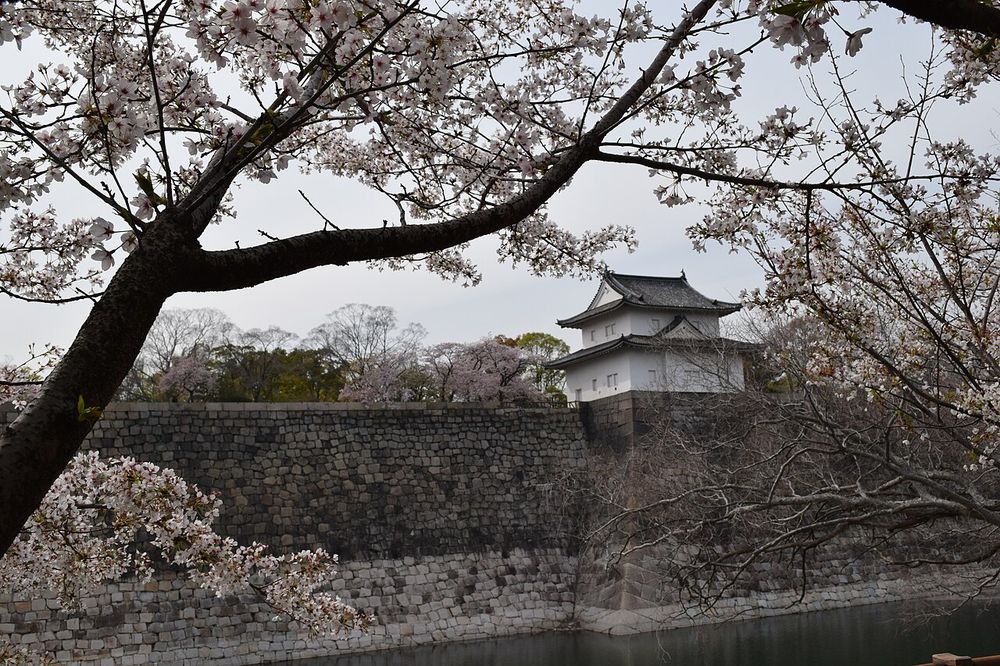
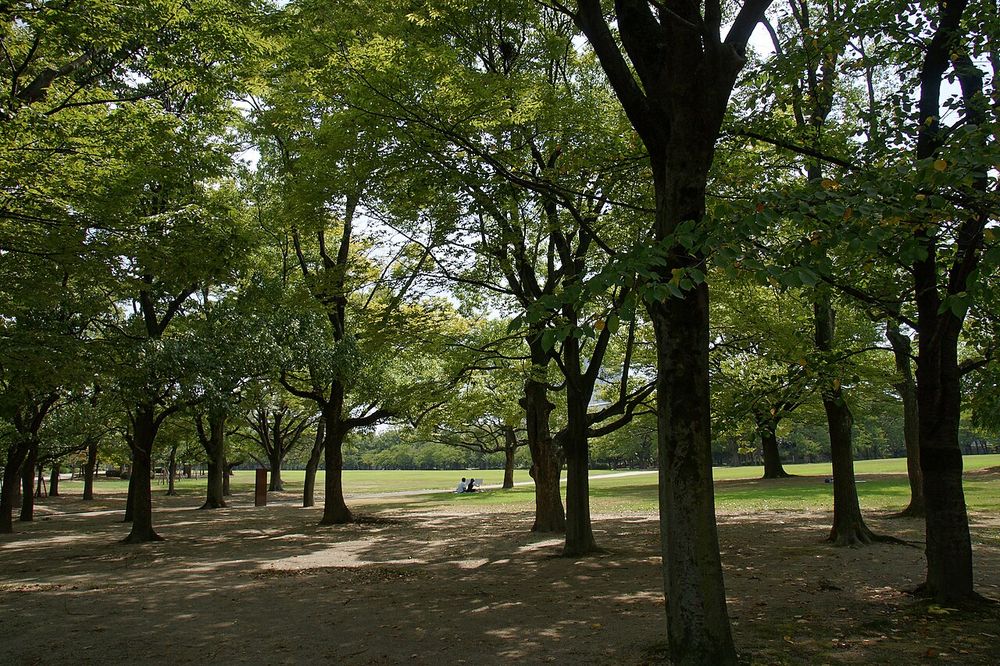
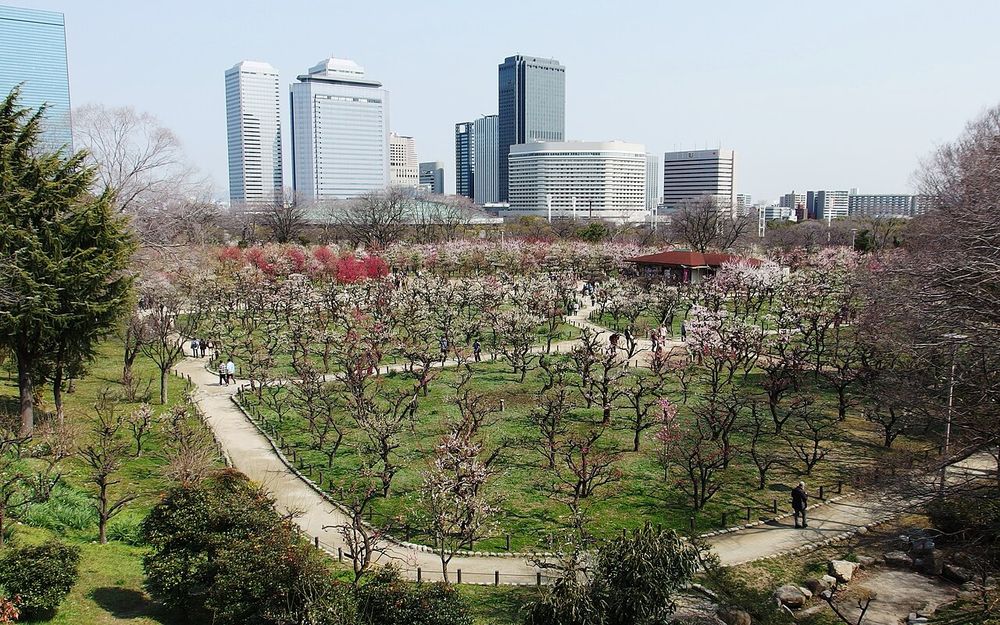
The lawn west of the inner moat was where Hideyoshi's wife lived after his death, and later the Tokugawa governor. It has three hundred cherry trees and the clearest view of the tower across the water.
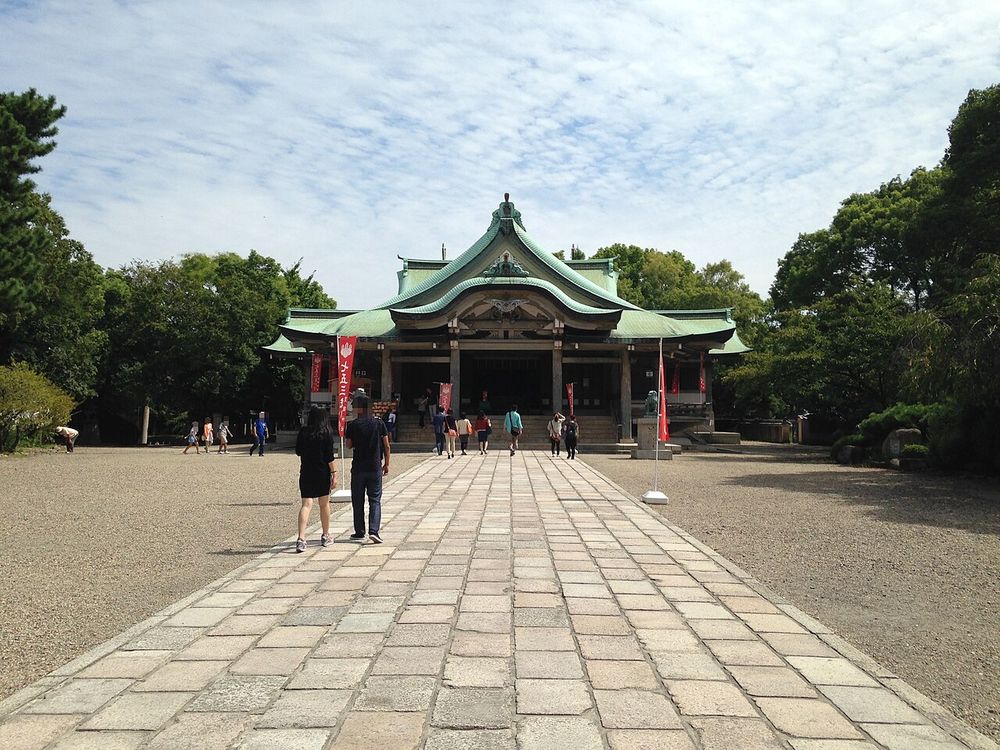
On the way out to the south is a shrine to Hideyoshi. It was founded in 1879 by a new government that had its own reasons to honour the man the Tokugawa had erased, and was moved into the castle in 1961.
Meanwhile in the world
Year
Here
Elsewhere
1583
Hideyoshi begins the castle
Ming China (1368–1644), the Wanli reign: Matteo Ricci settles in Guangdong; Nurhaci takes up arms
1592
From here Hideyoshi sends his army to Korea
Ming China sends troops to Korea's aid; in London Shakespeare's first plays are on the stage
1615
The castle falls to the Tokugawa
The year before Nurhaci proclaims his own dynasty; the second part of Don Quixote is published
1629
The Tokugawa castle is finished
The last Ming emperor has reigned for two years; the Taj Mahal is begun three years later
1665
Lightning destroys the tower
Qing China, the Kangxi reign; the Great Plague is in London
1868
The last shogun flees the castle by night, and it burns
The Meiji Restoration; in China, the Tongzhi reign
1931
The concrete tower opens
Two months after the Japanese army seized Manchuria; the Empire State Building opens in New York
1945
The arsenal round the castle is bombed flat; the tower stands
The end of the Second World War
2025
Hideyoshi's buried wall is opened to visitors
Osaka holds a world's fair for the second time
Then and now
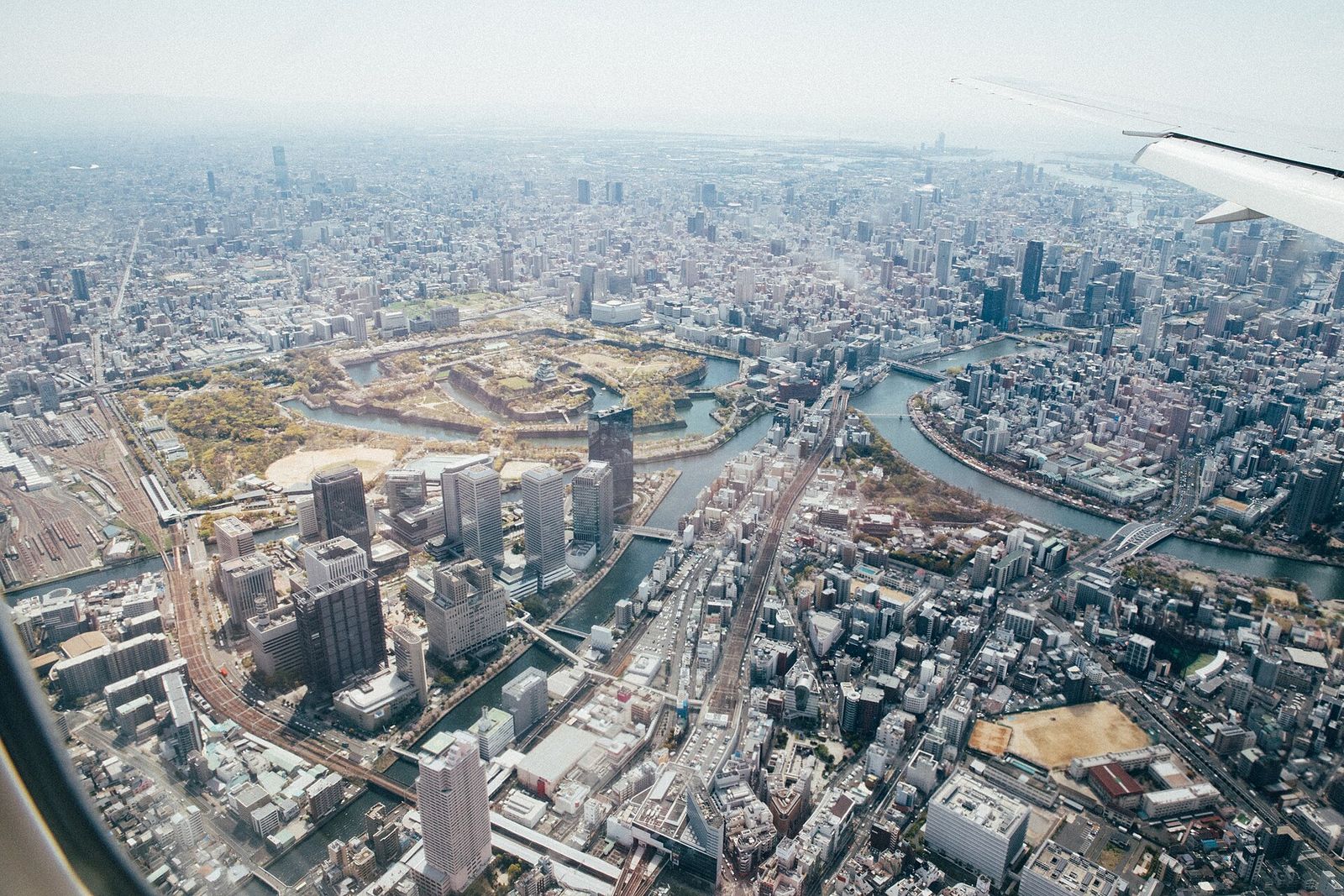
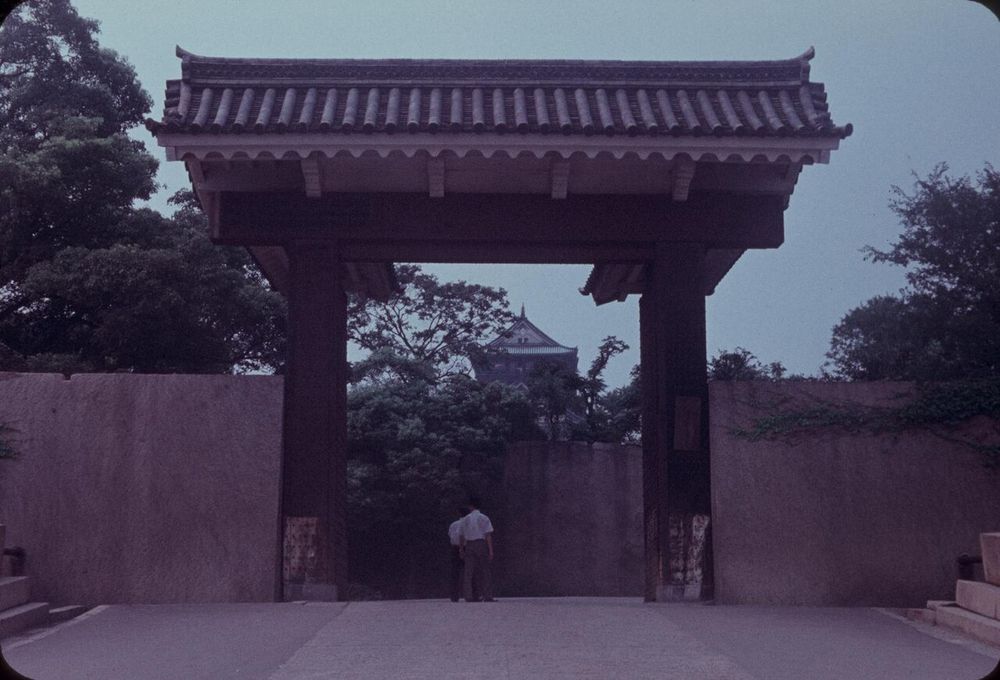
The castle park in the middle of Osaka, from the airDick Thomas Johnson from Tokyo, Japan, CC BY 2.0, Wikimedia CommonsThe two rings of moat, photographed from above in 2017国土地理院 (Institute of Land and Geography), Attribution, Wikimedia CommonsThe castle from above in 1985国土交通省, Attribution, Wikimedia CommonsThe tower and the Bridge to ParadiseSakai Yayoi, CC0, Wikimedia CommonsThe tower above the bridgeTakipoint123, CC BY-SA 4.0, Wikimedia CommonsThe bridge at nightMc681, CC BY-SA 4.0, Wikimedia CommonsThe tower from the southDXR, CC BY-SA 4.0, Wikimedia CommonsThe tower on its stone baselienyuan lee, CC BY 3.0, Wikimedia CommonsThe tower above the inner moatそらみみ, CC BY-SA 3.0, Wikimedia CommonsThe tower across the lawn of the western gardenMc681, CC BY-SA 4.0, Wikimedia CommonsThe tower lit at duskManish Prabhune, CC BY-SA 4.0, Wikimedia CommonsThe tower at nightMartin Falbisoner, CC BY-SA 4.0, Wikimedia CommonsThe tower lit in blue above autumn leavesReginald Pentinio, CC BY 2.0, Wikimedia CommonsA golden tiger-fish from the roof, shown insideZairon, CC BY-SA 4.0, Wikimedia CommonsThe tiger-fish, tail upZairon, CC BY-SA 4.0, Wikimedia CommonsA crouching tiger in goldMarcel Montes, CC BY 2.5, Wikimedia CommonsThe inner moat and its wallsJoli Rumi, CC BY-SA 4.0, Wikimedia CommonsA wall rising from the waterそらみみ (Soramimi), CC BY-SA 4.0, Wikimedia CommonsThe outer moat, a corner turret and the office towersMartin Falbisoner, CC BY-SA 4.0, Wikimedia CommonsThe dry moat near the Sakura Gateそらみみ (Soramimi), CC BY-SA 4.0, Wikimedia CommonsStone wall and willowそらみみ (Soramimi), CC BY-SA 4.0, Wikimedia CommonsThe yard inside the Ōte-monSpudgun67, CC0, Wikimedia CommonsThe Thousand-Coin Turret, 1620DXR, CC BY-SA 4.0, Wikimedia CommonsThe turret and the gate across the moatKimonBerlin, CC BY-SA 2.0, Wikimedia CommonsThe long turret over the inner gateSpudgun67, CC0, Wikimedia CommonsThe inner gate from the yardKimonBerlin, CC BY-SA 2.0, Wikimedia CommonsThe north-west turretUser:Midori, Public domain, Wikimedia CommonsA turret on the south wall in cherry season::::=UT=::::, CC BY-SA 3.0, Wikimedia CommonsThe Sakura Gateそらみみ (Soramimi), CC BY-SA 4.0, Wikimedia CommonsThe Octopus Stone, with people for scalelasta29, CC BY 2.0, Wikimedia CommonsThe time capsule of 1970, to be opened in the year 6970Guilhem Vellut, CC BY 2.0, Wikimedia CommonsThe army headquarters of 1931, now shopsMc681, CC BY-SA 4.0, Wikimedia CommonsThe guest house in the western garden663highland, CC BY 2.5, Wikimedia CommonsTrees in the western garden663highland, CC BY 2.5, Wikimedia CommonsThe plum grove in JanuaryKousuke Sekidou, CC BY-SA 4.0, Wikimedia CommonsPlum blossom and the towers of the business parkMc681, CC BY-SA 4.0, Wikimedia CommonsThe shrine to Hideyoshiそらみみ (Soramimi), CC BY-SA 4.0, Wikimedia CommonsToyotomi Hideyoshi, painted about 1601Kanō Mitsunobu, Public domain, Wikimedia CommonsThe battle of 1615 on a folding screen of the seventeenth centuryanonymous, Public domain, Wikimedia CommonsHideyoshi's black tower, a detail of the screenOsaka Castle Museum, Public domain, Wikimedia CommonsWalls and a turret in a photograph of about 1865Unknown, Public domain, Wikimedia CommonsThe ramparts before the fire of 1868Unknown authorUnknown author, Public domain, Wikimedia CommonsThe castle grounds from an American aircraft, 1 June 1945United States Army Air Force, Public domain, Wikimedia CommonsThe Sakura Gate in a slide of the mid twentieth centuryCarlquist, Sherwin John, 1930-2021, CC BY 4.0, Wikimedia Commons
Local legends
These are stories people tell about this place. They are legends, not history, and each one says where it comes from.
LegendThe thousand strings of coins
When the warlord Oda Nobunaga besieged the temple that stood here, one turret beat off every attack. "I would pay a thousand strings of coins for that turret," his soldiers said.
Source: Osaka tradition, recorded in the Edo period
LegendThe golden well
Hideyoshi had bars of gold sunk in the well beside the tower to keep its water sweet.
Source: Osaka tradition; when the well was examined in 1959 no gold was found, and it proved to have been dug by the Tokugawa
LegendThe escape to the south
Hideyori did not die in the storehouse. The general Sanada carried him out through a tunnel and took him by ship to Kagoshima, at the far end of Japan, where he lived quietly for many years.
Source: A children's rhyme sung in Kyoto after 1615; graves shown in Kagoshima
Later, people who live here will be able to add the stories they grew up with, and say which of these they have heard.
Not certain, and where accounts conflict
How much does the Octopus Stone weigh?
It has never been taken out and weighed. From its area and an estimated thickness, figures from 108 to 130 tonnes are given.
What did Hideyoshi's tower look like?
It stood for thirty years and no plan survives. The screen of the battle and one other painting show a dark building with gold ornaments, and they do not agree on the details.
Who gave the order to fire on the storehouse?
Hideyori's wife was Ieyasu's own granddaughter, and she had been sent out to plead for him. The sources disagree on whether Ieyasu or his son refused her.
Should the tower be rebuilt in wood?
Other Japanese cities have debated replacing their concrete towers with wooden ones. Osaka has chosen to keep its tower as a monument of 1931.
Visiting
Tickets and hours
The tower is 1,200 yen for adults and 600 yen for students at high school and university. Children up to fifteen are free. The ticket includes the Toyotomi Stone Wall Museum.
Open from 9:00 to 18:00, with last entry at 17:30. Closed from 28 December to 1 January.
The Nishinomaru Garden is 200 yen and is closed on Mondays.
The park never closes and costs nothing.
Last checked 2026-11-12. Osaka's official tourism site (osaka-info.jp) and the castle's own site (osakacastle.net), fees and hours as shown in November 2026.
Booking from abroad
Official page in English The castle's own site has a link to buy an electronic ticket in advance: osakacastle.net/english. The fee and hours are also given in English by the city's tourism office: osaka-info.jp.
Ticket window on site Tickets are sold at the booth at the foot of the tower. In cherry season and on holidays the line can be an hour; an advance ticket goes straight to the door.
Note The Osaka Amazing Pass, a city pass for visitors, includes the tower.
Checked 2026-11-12
Where to start
For the route on this page, take the subway to Tanimachi 4-chome and walk five minutes to the Ōte-mon. From Osakajō-kōen station on the JR loop line you arrive at the back, by the Bridge to Paradise, after a walk of fifteen minutes.
Be at the tower at 9:00, or after 16:00. In the middle of the day the lift queue alone can be half an hour; the stairs are faster.
Allow two and a half hours: one for the walls and gates, one for the tower, half for the garden.
For a photograph of the tower over water, stand on the lawn of the Nishinomaru Garden or at the north-east corner of the inner moat.
Before you go
The lift goes to the fifth floor. A second lift for wheelchair users goes to the top.
The park is large and has little shade on the bridges and gravel. Carry water in summer.
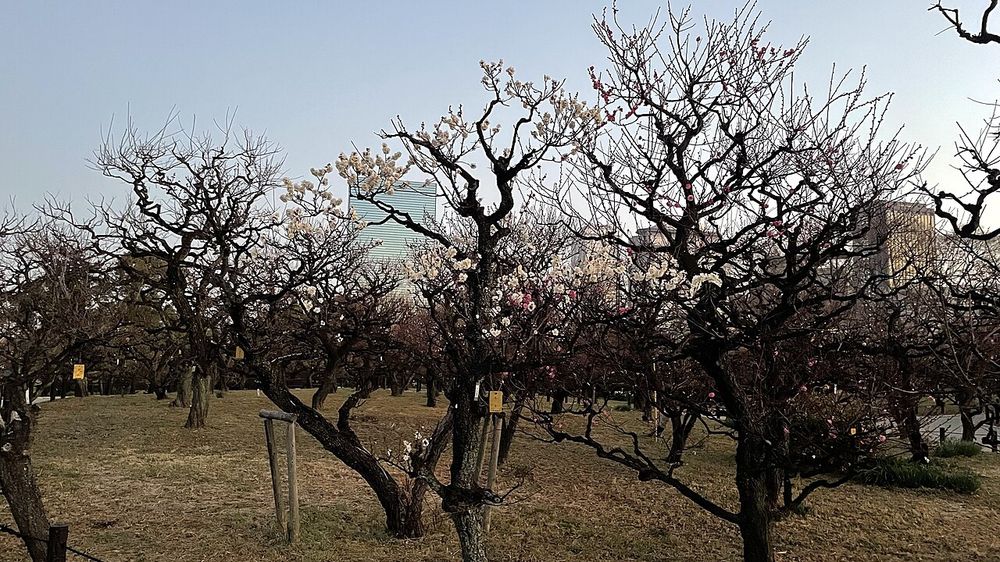
Plum blossom is at its best in mid February, cherry in the first week of April.
Customs and manners
Photographs are not allowed on the third and fourth floors of the museum, where the originals are shown.
At the shrine, bow twice, clap twice, bow once.
Do not climb on the walls or throw stones into the moats.
Opening hours are given in the local time of the place. Prices are in the local currency. The figure after ≈ is approximate, at exchange rates checked on 9 November 2026, in .
Look for these
Before you go in, count the roofs of the tower. Inside, count the floors.
Find a mark carved on a stone in the wall. What shape is it?
At the Octopus Stone, find the octopus.
On the tower, find the tigers. How many can you see from one side?
On the screen in the museum, find someone who is not a soldier.
From the top, find both rings of moat.
Find the scars of 1945 on the stone base.
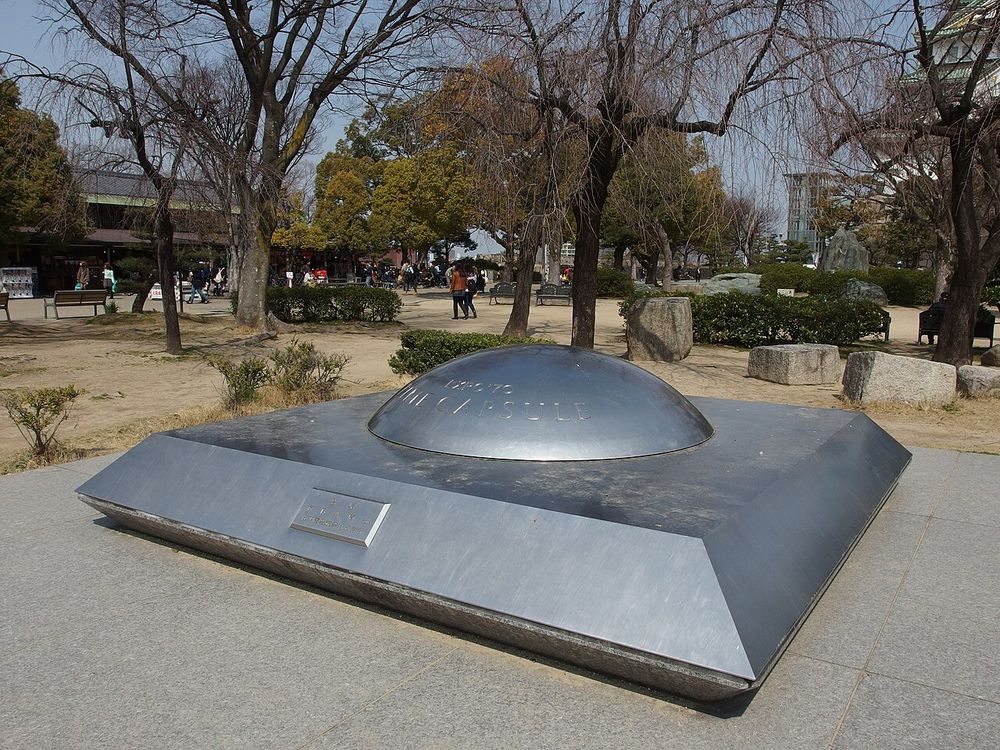
Near the tower, find the lid of the time capsule. In what year will it be opened?
I am here
Stand at the site, sign in, press the button, and collect its stamp. Your browser will ask to use your location. It is sent to us once to confirm that you are at the site; we keep how far you were from it, not the spot where you stood.
Your stamps are saved to your account, so they follow you to any device. Checking from a browser cannot rule out every false location; stricter checks arrive with the app.
Messages
Share your photos
Photos here show the place, not people. Each one is credited to the visitor who took it and appears after our team has looked at it. A photo with you in it belongs under “I am here”.