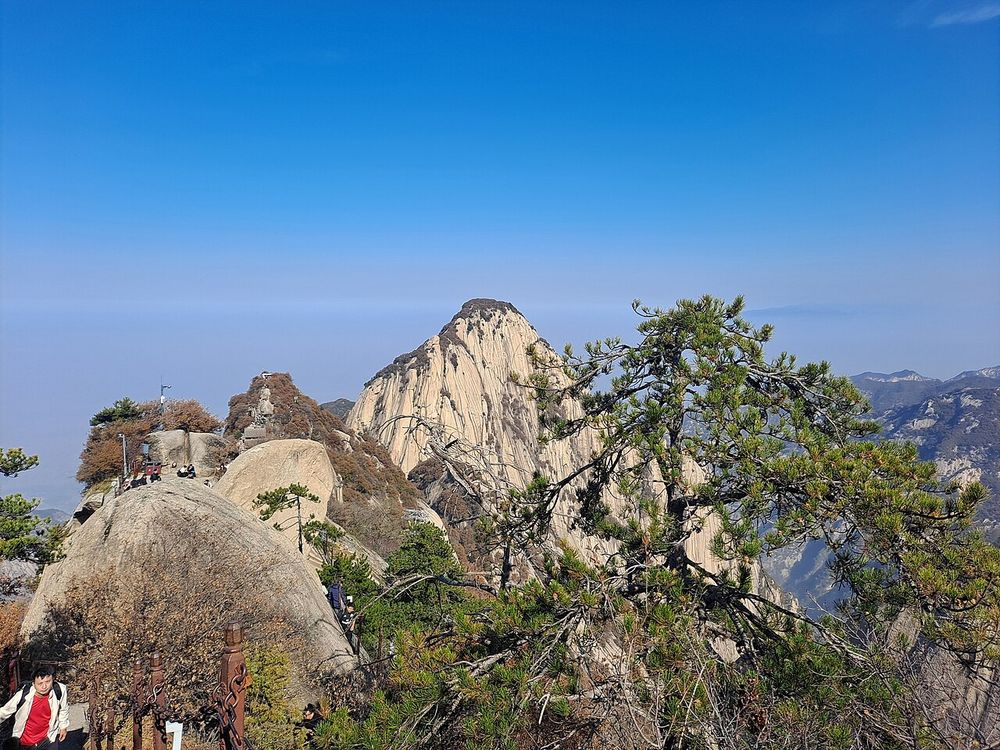
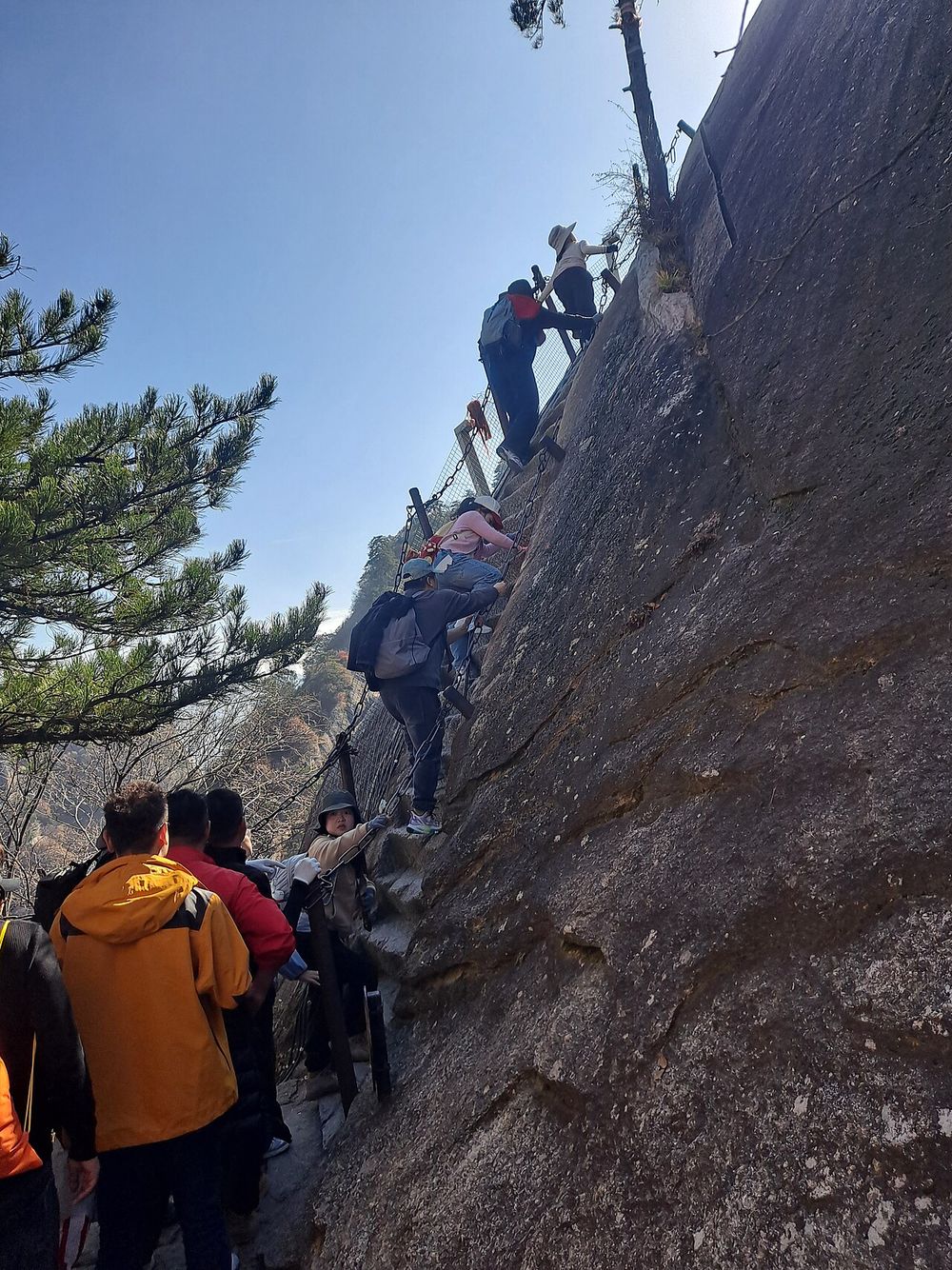
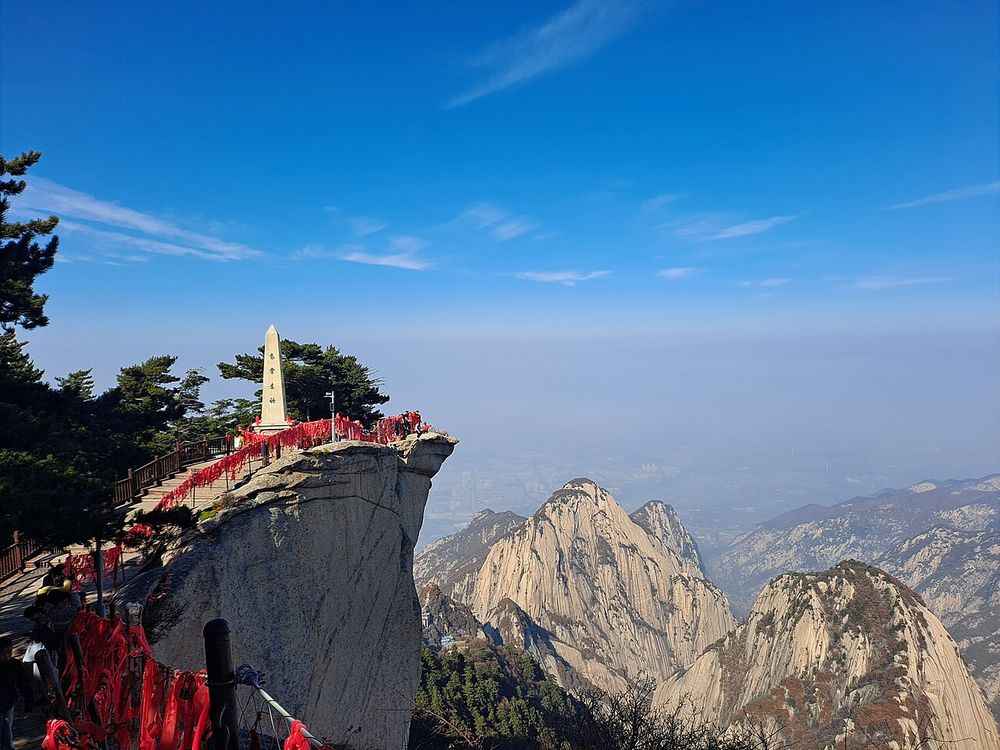
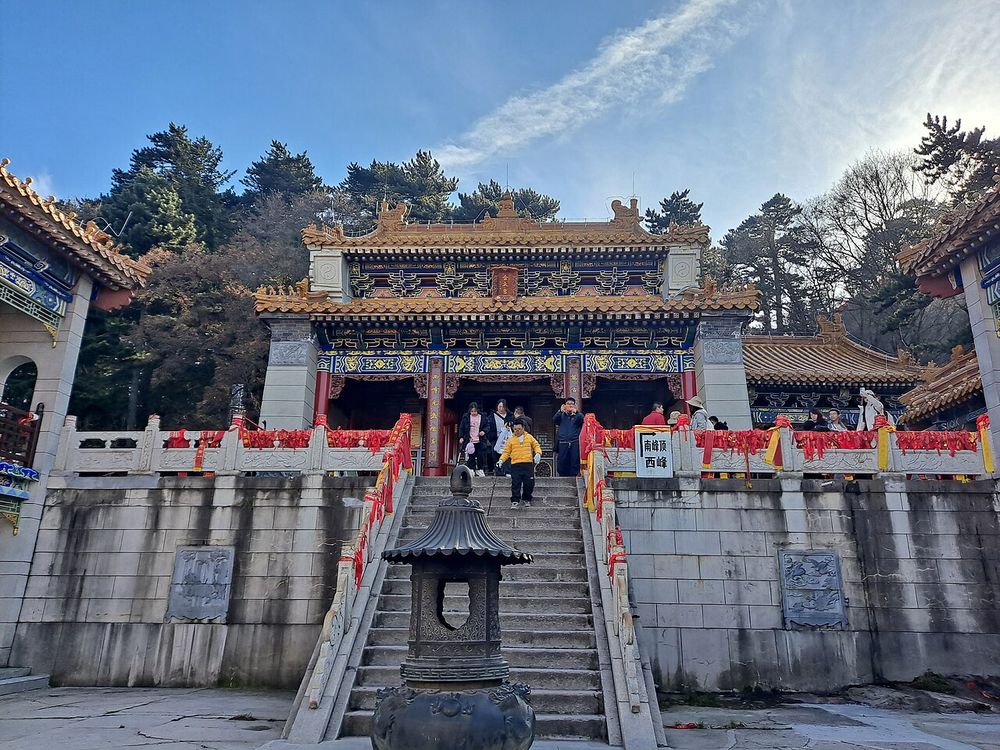
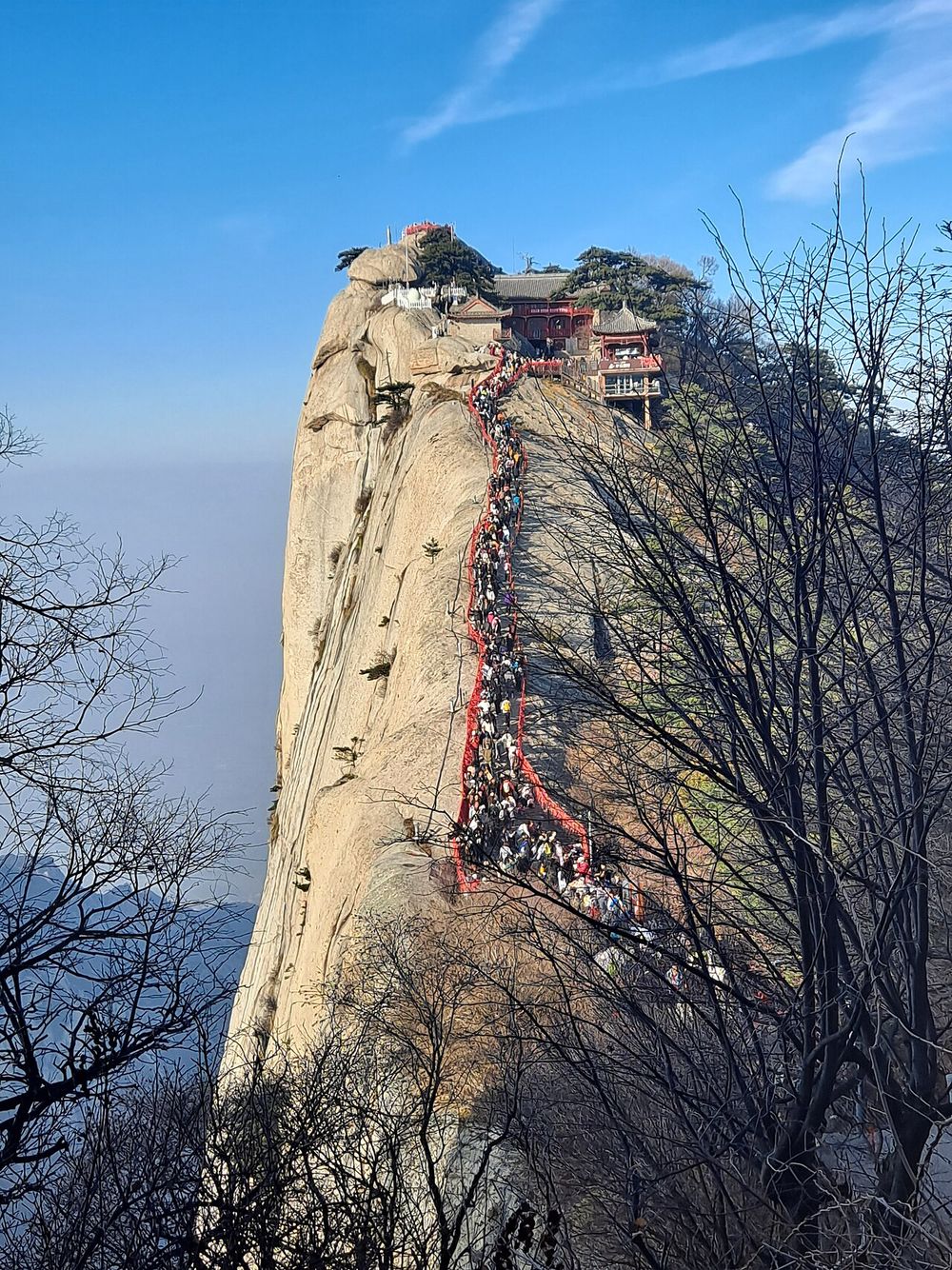
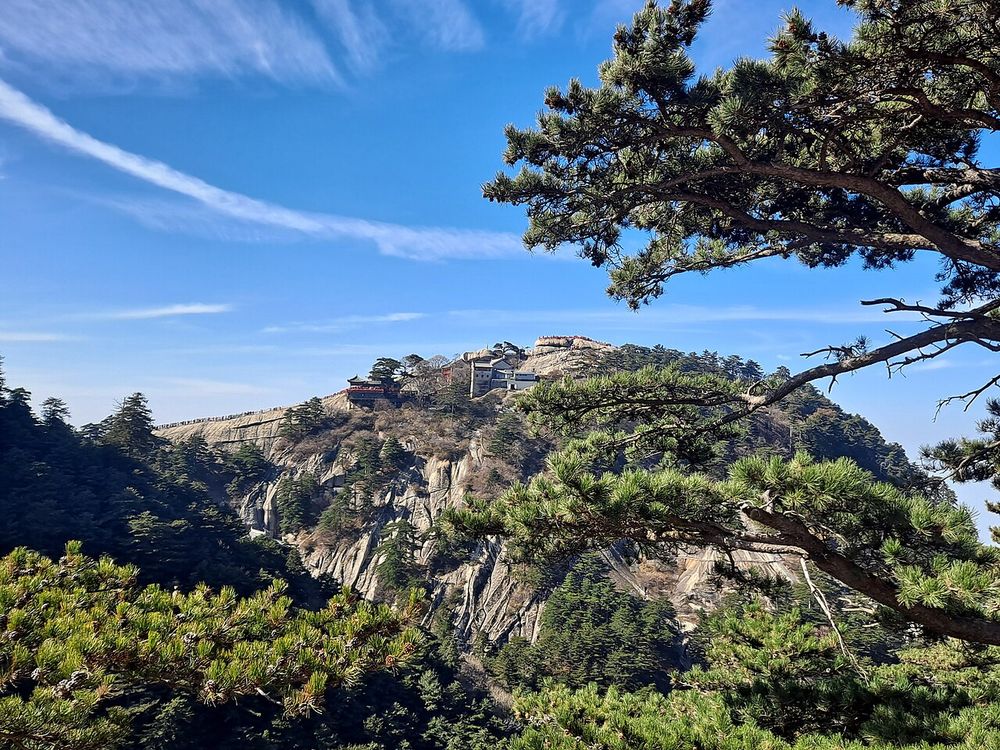
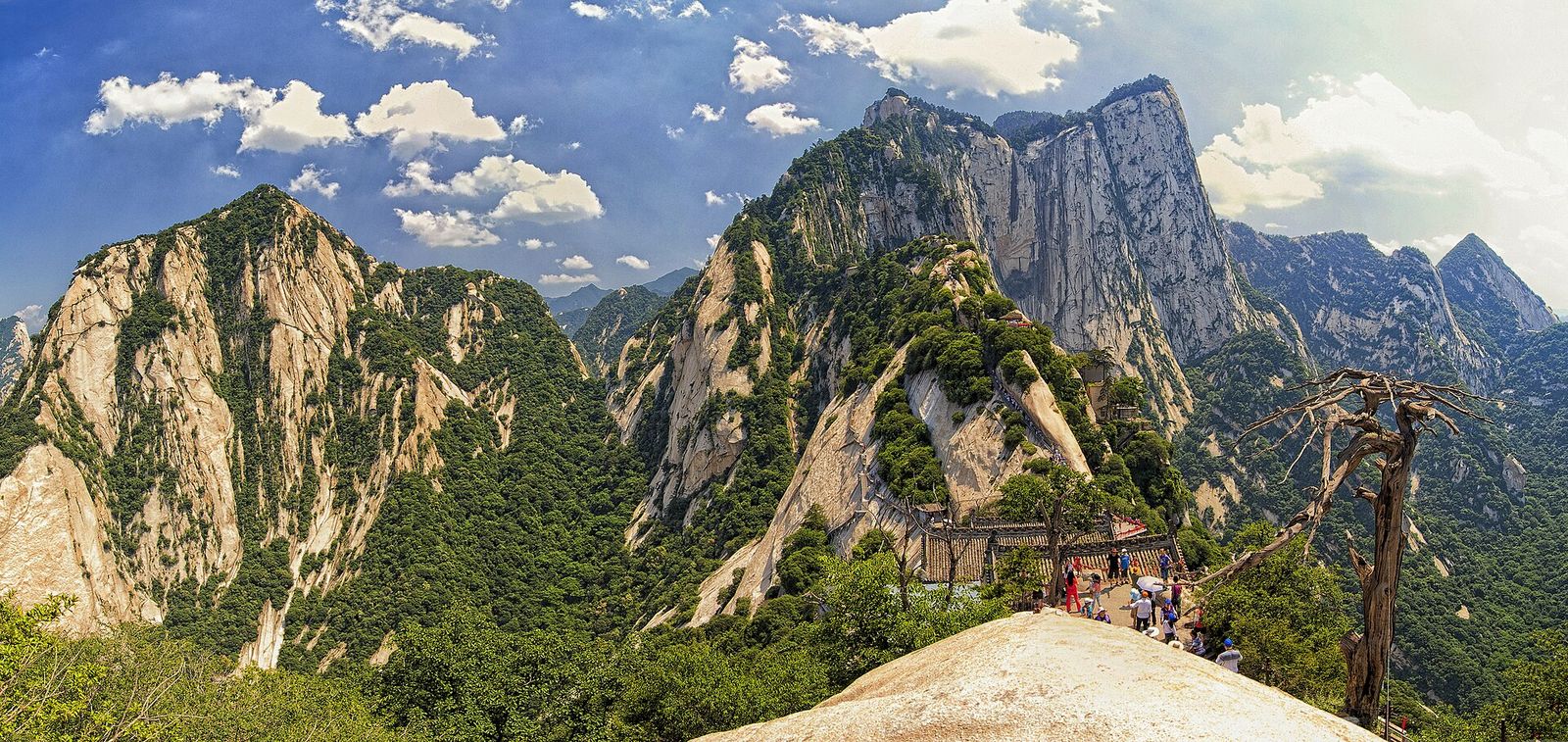
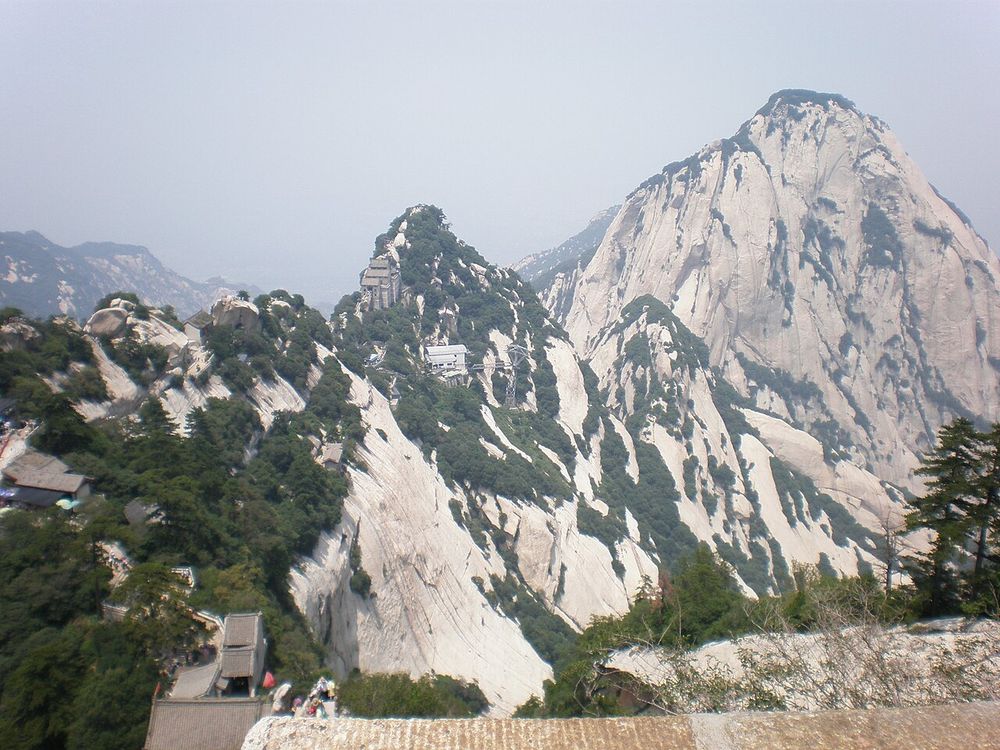
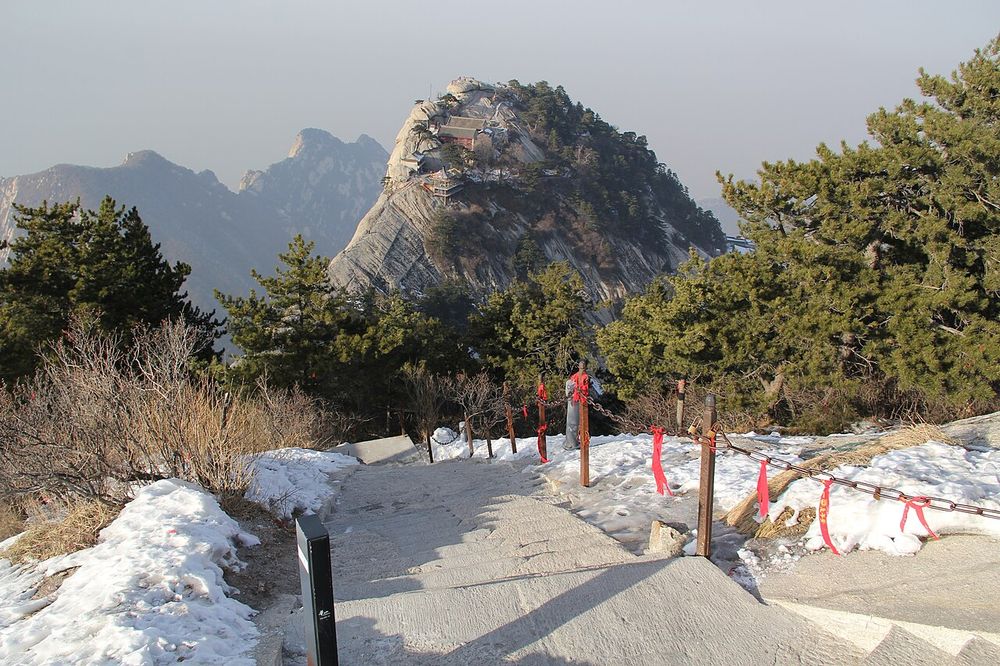
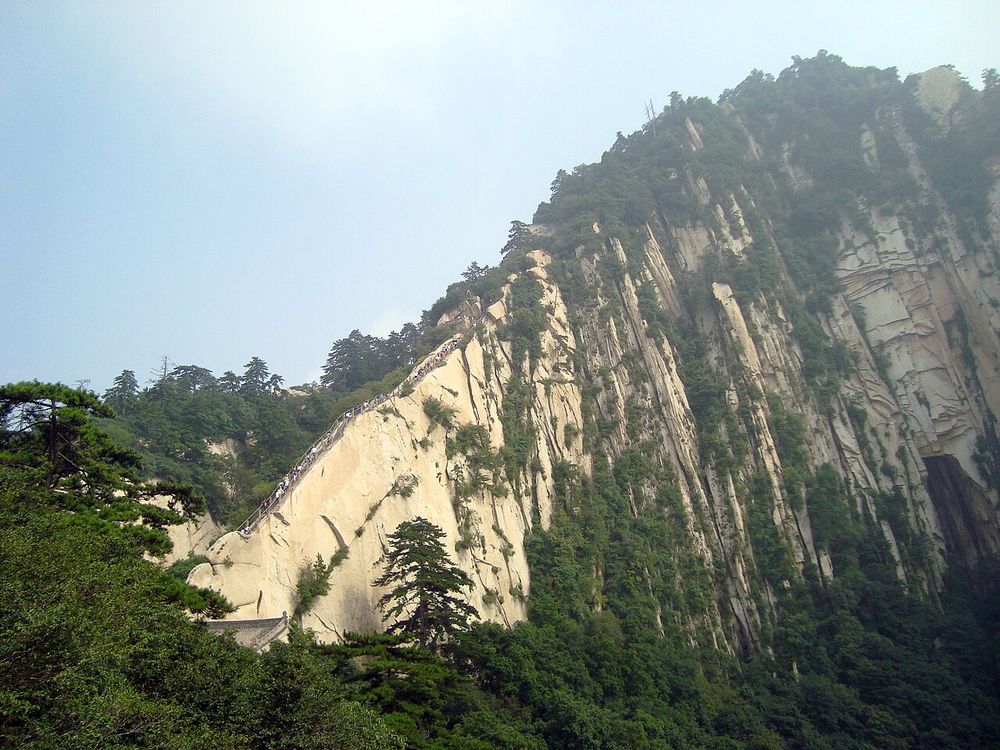
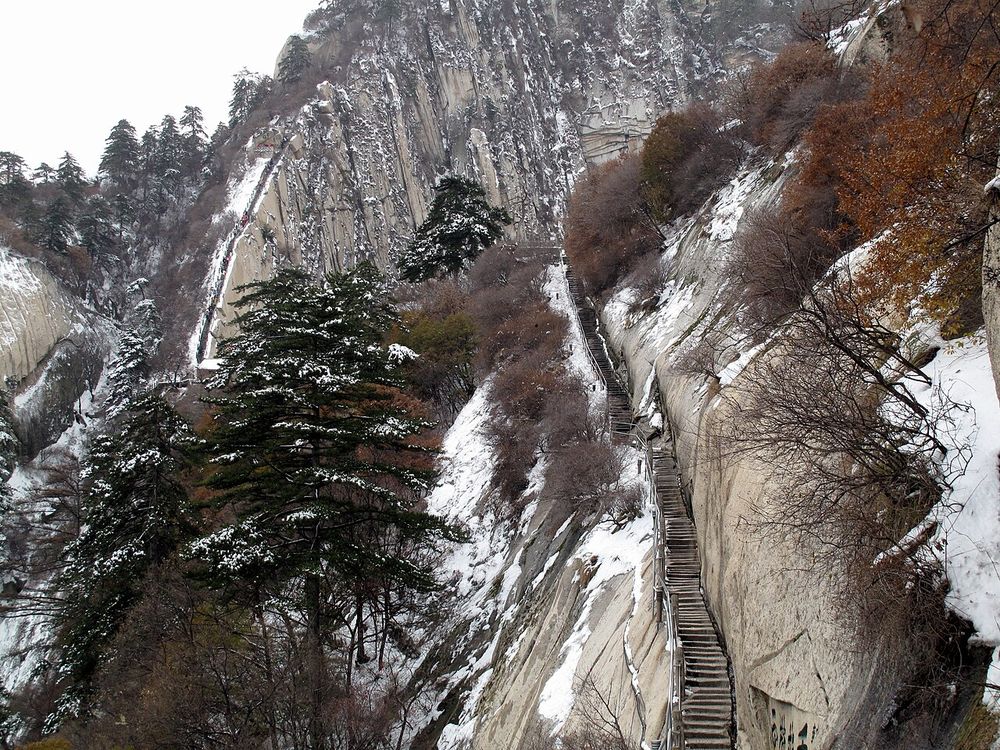
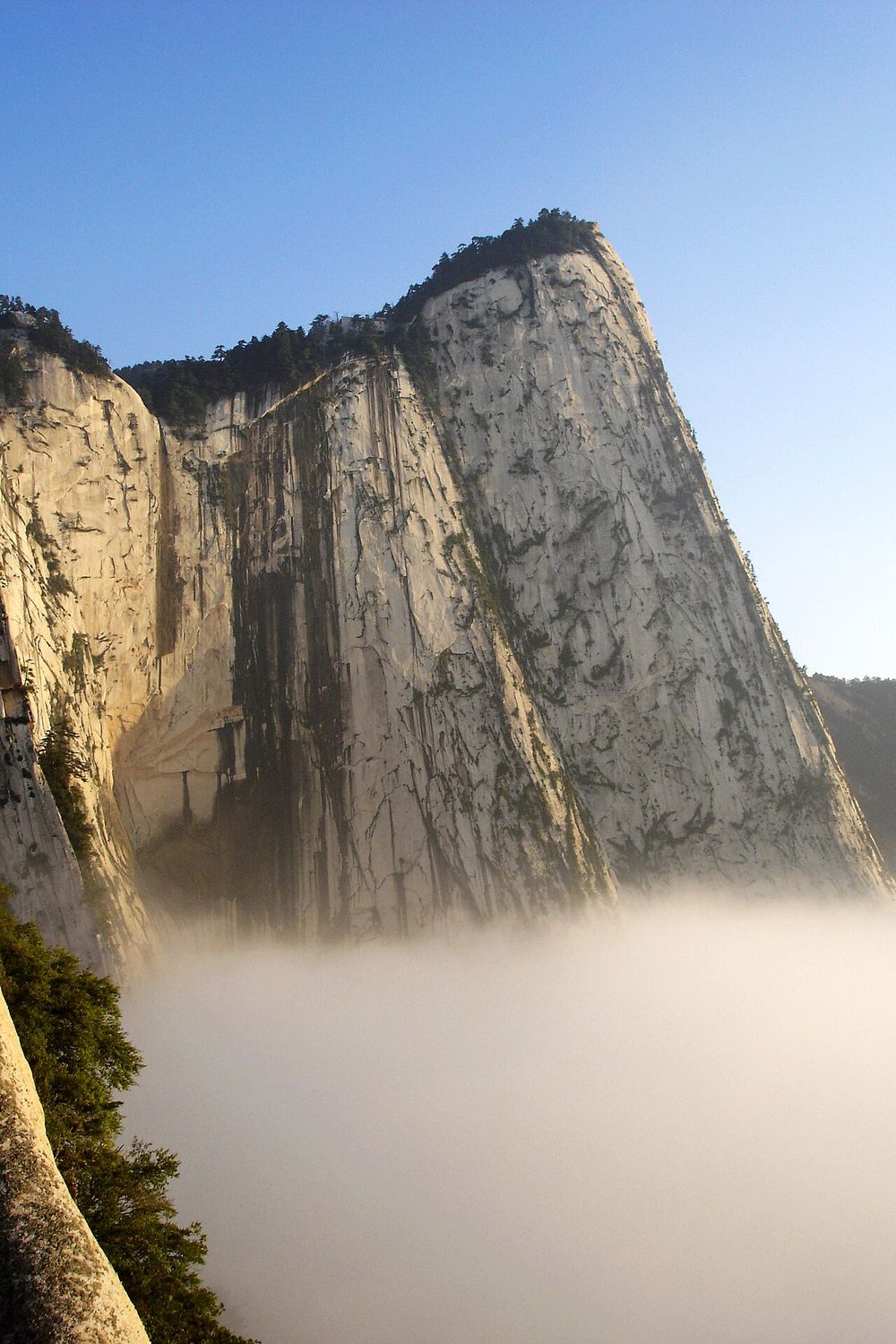
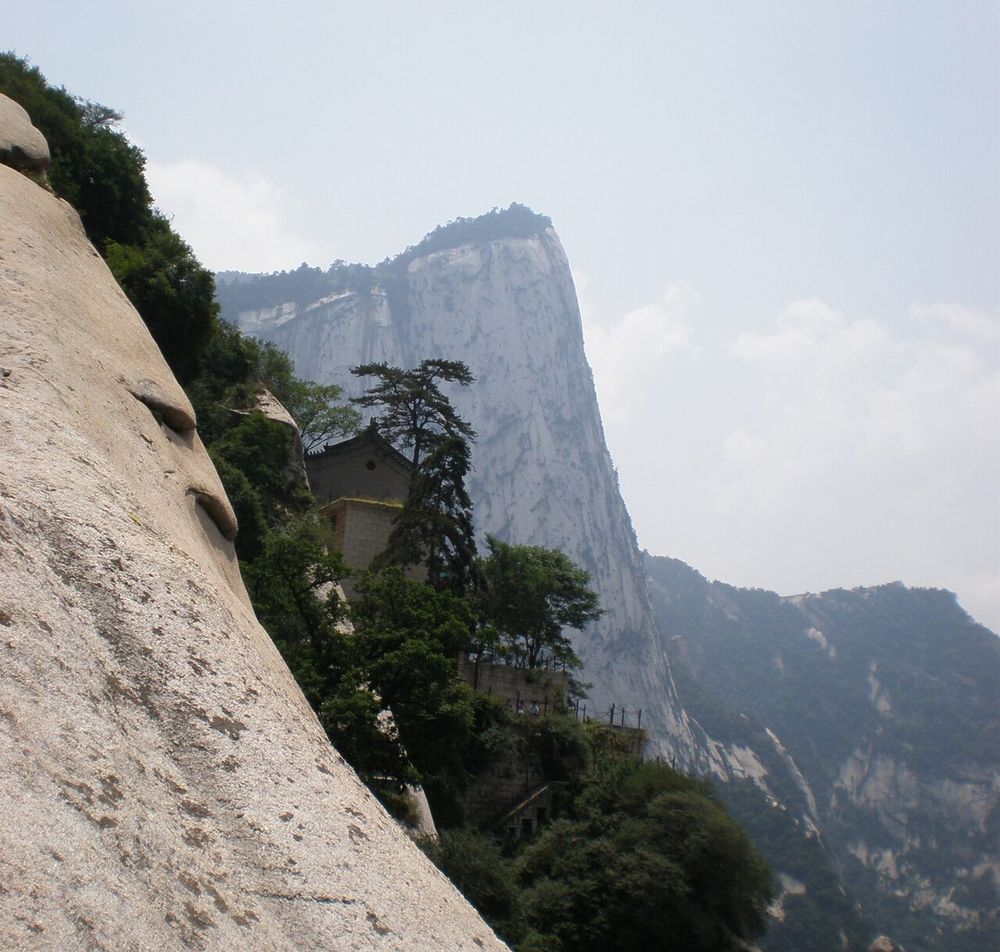
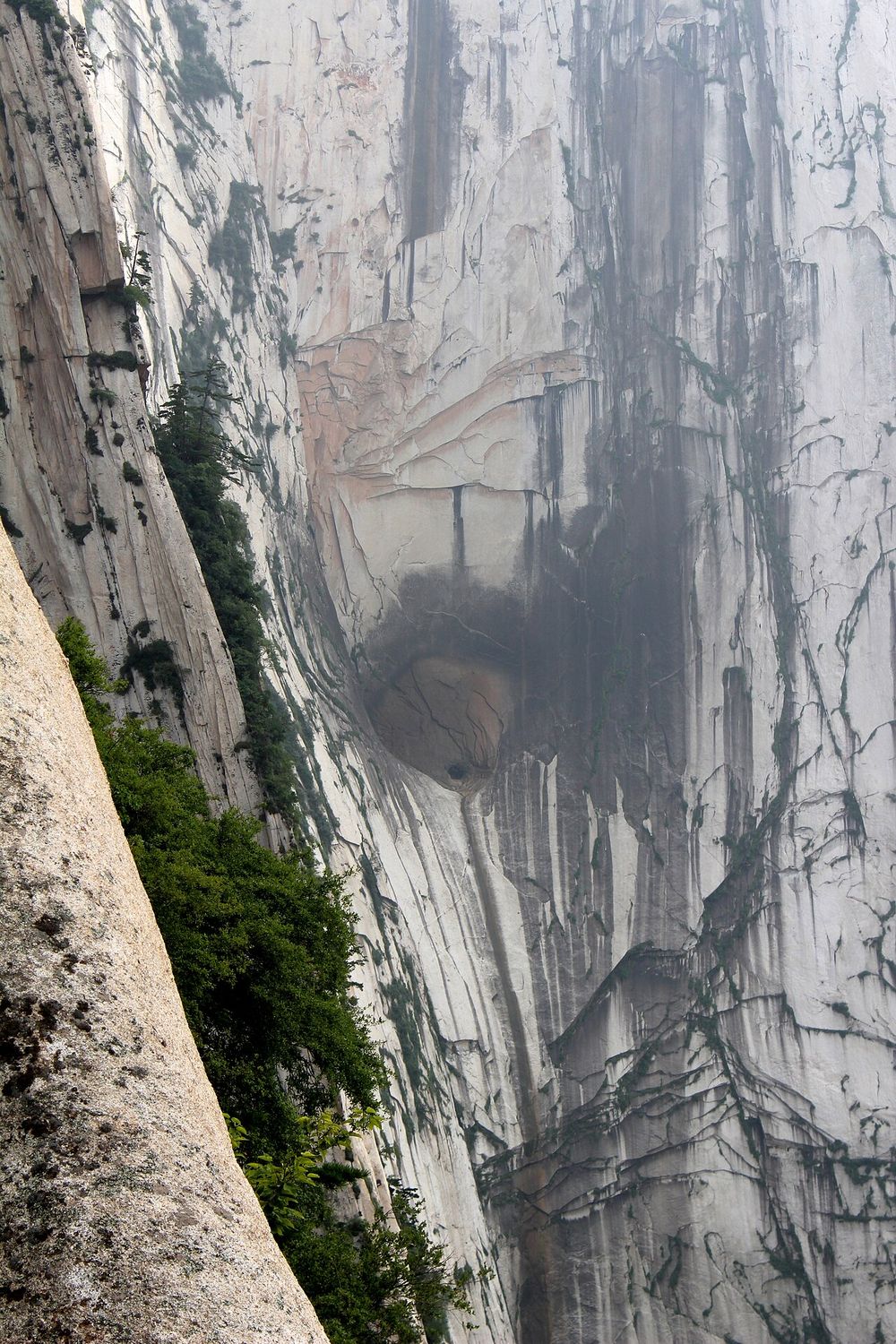
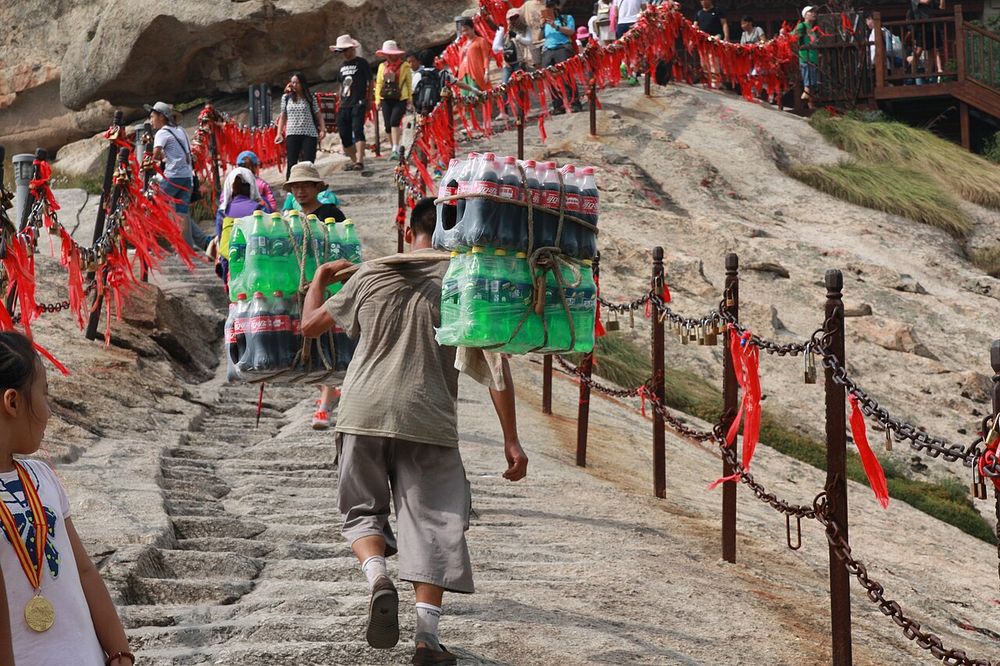
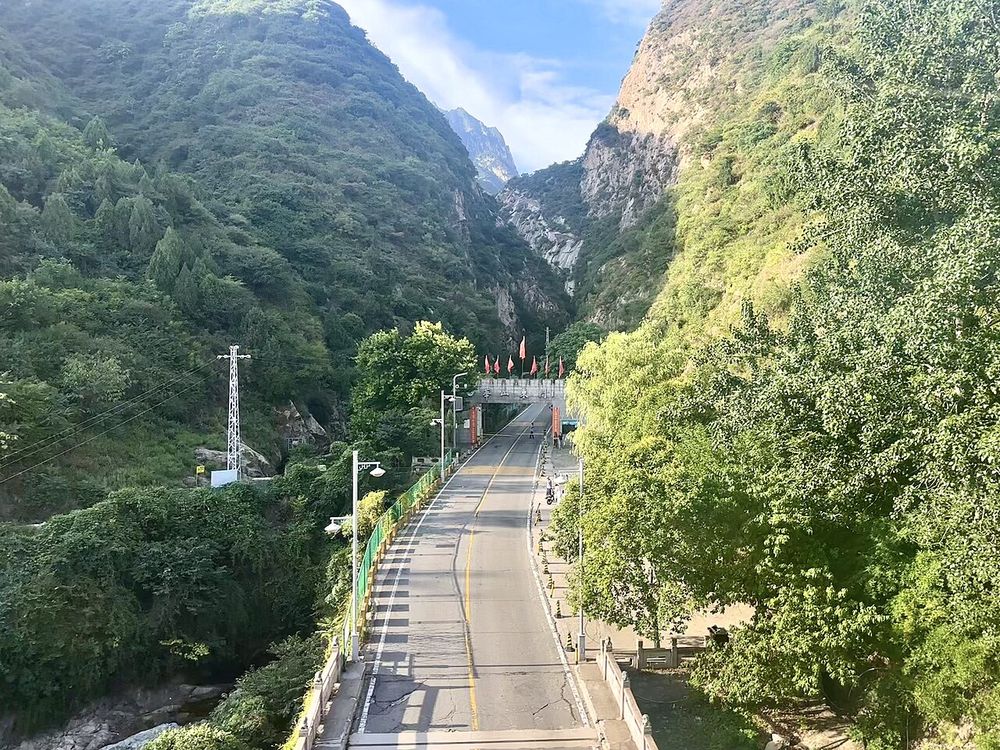
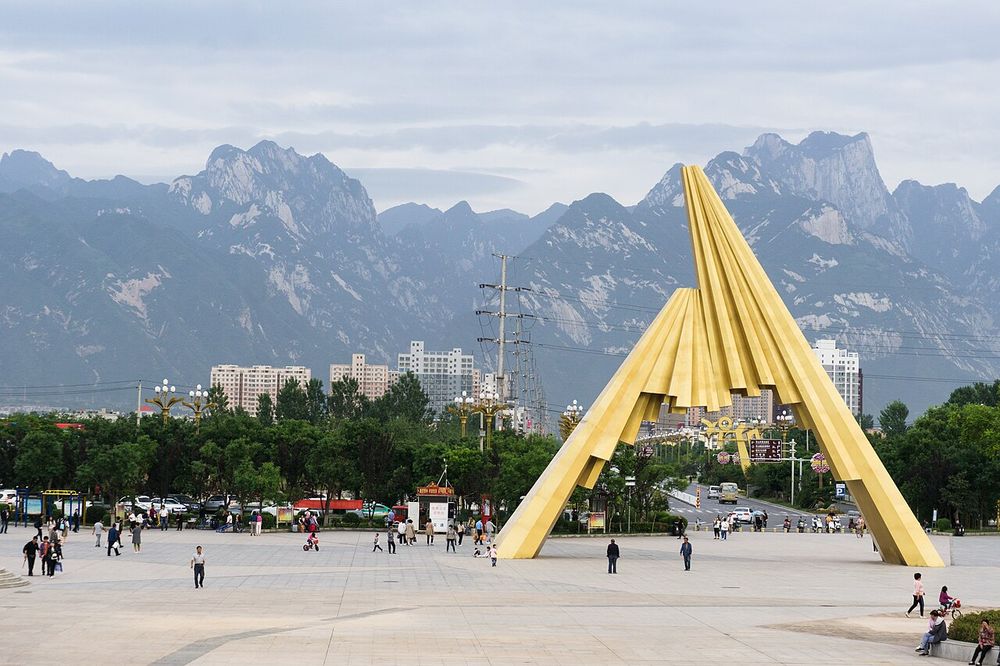
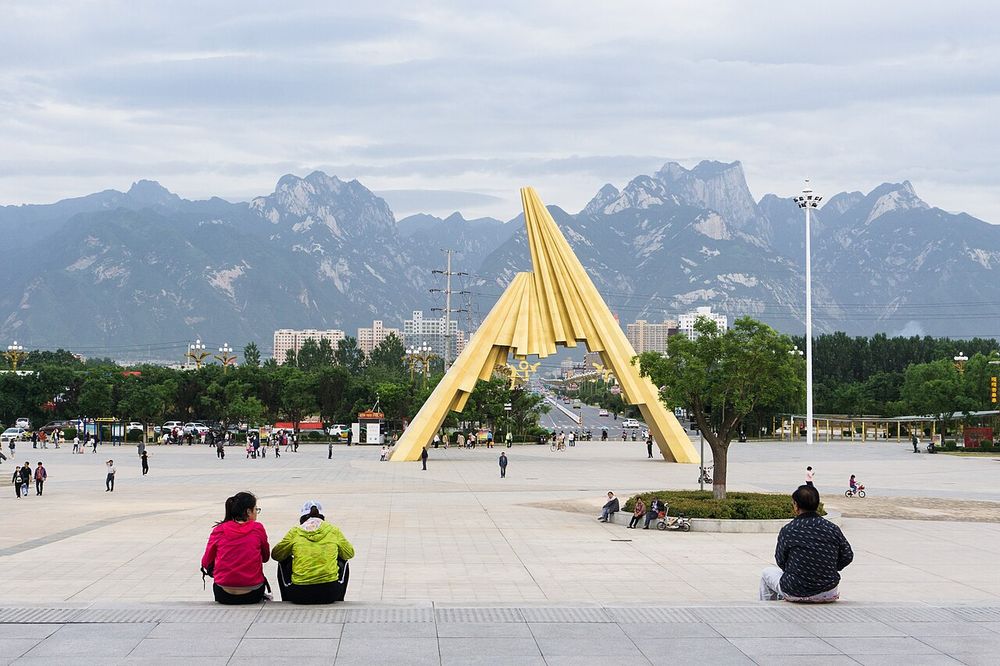
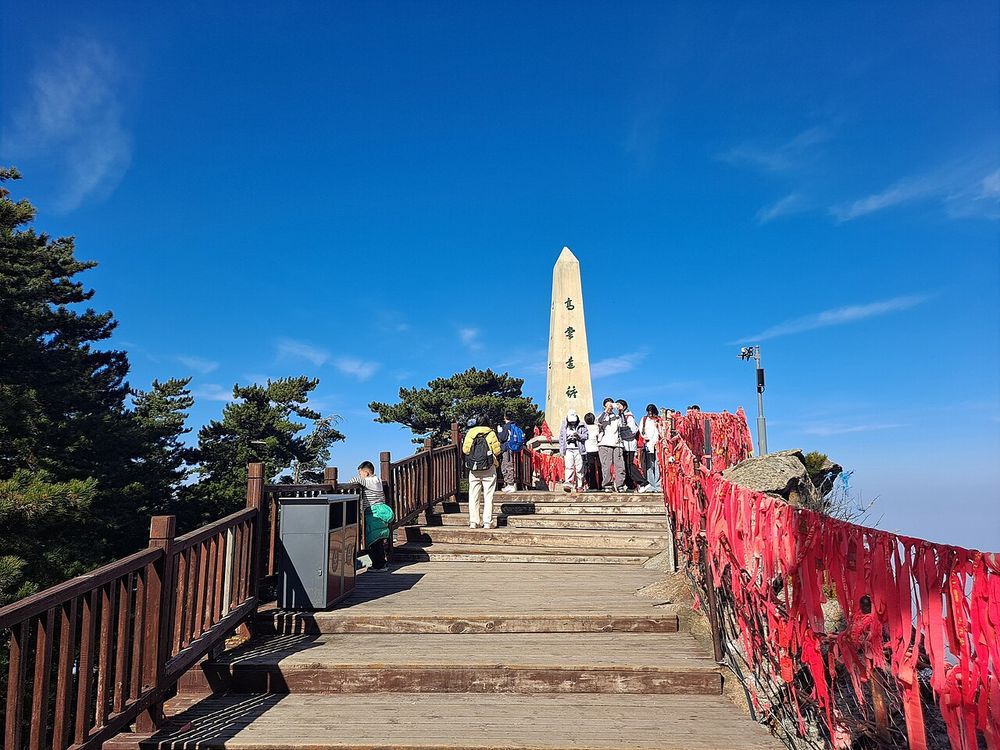
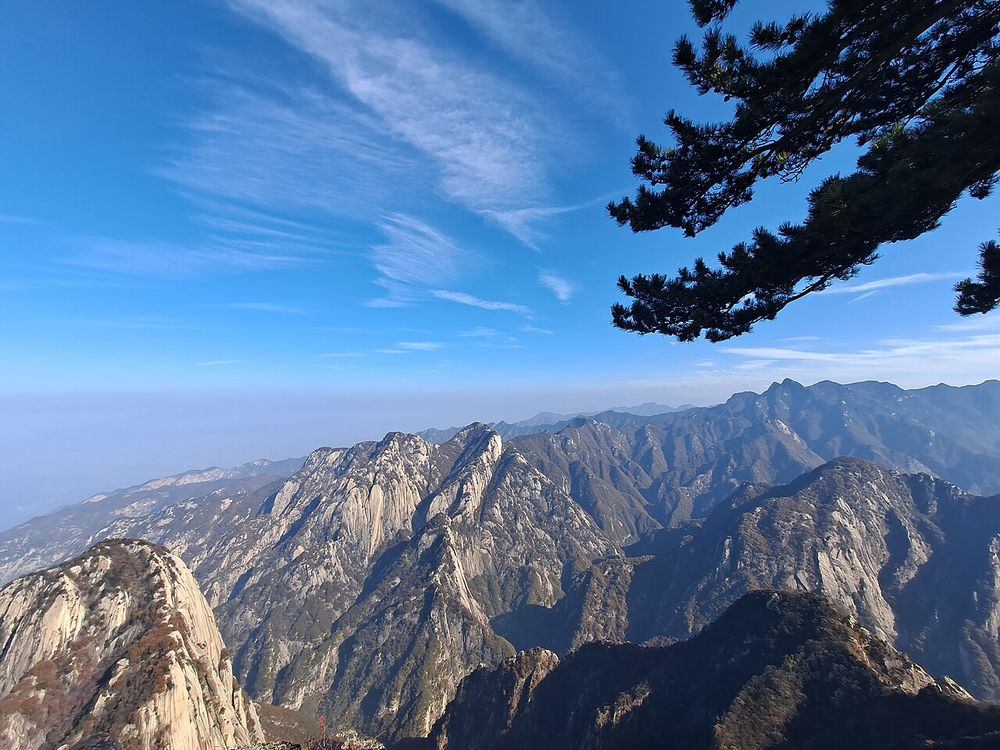
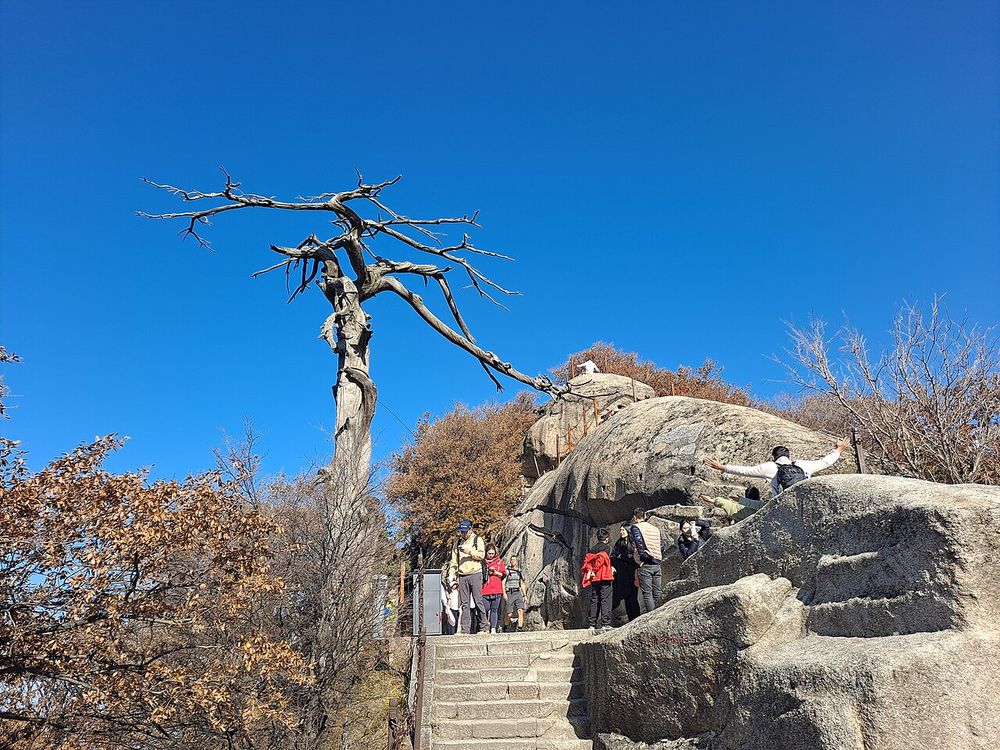
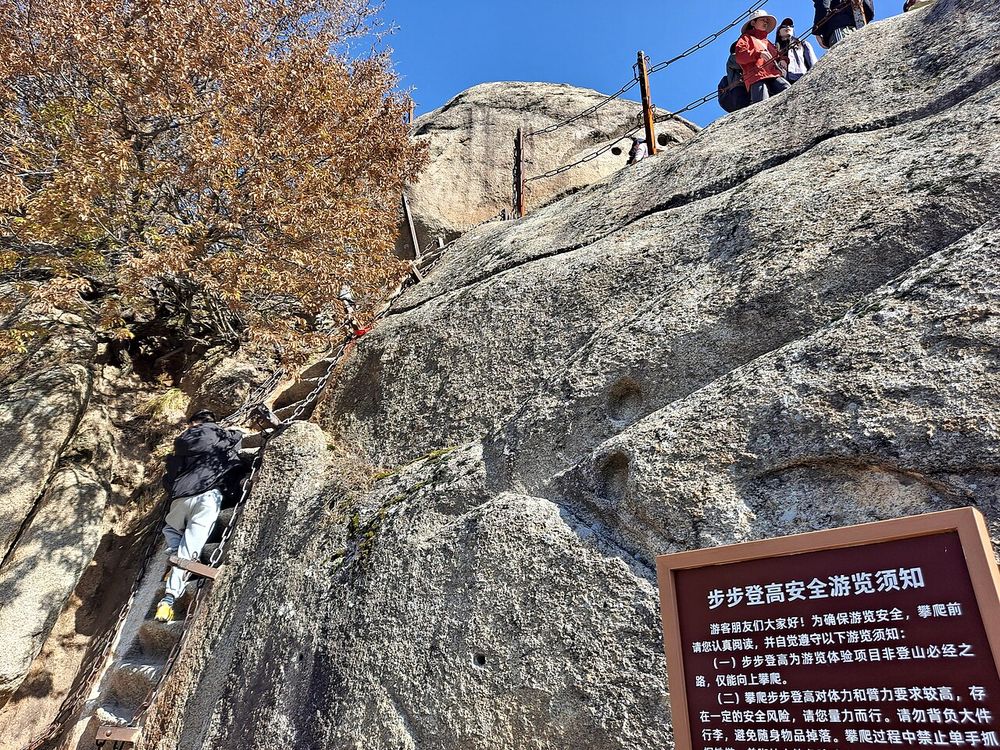
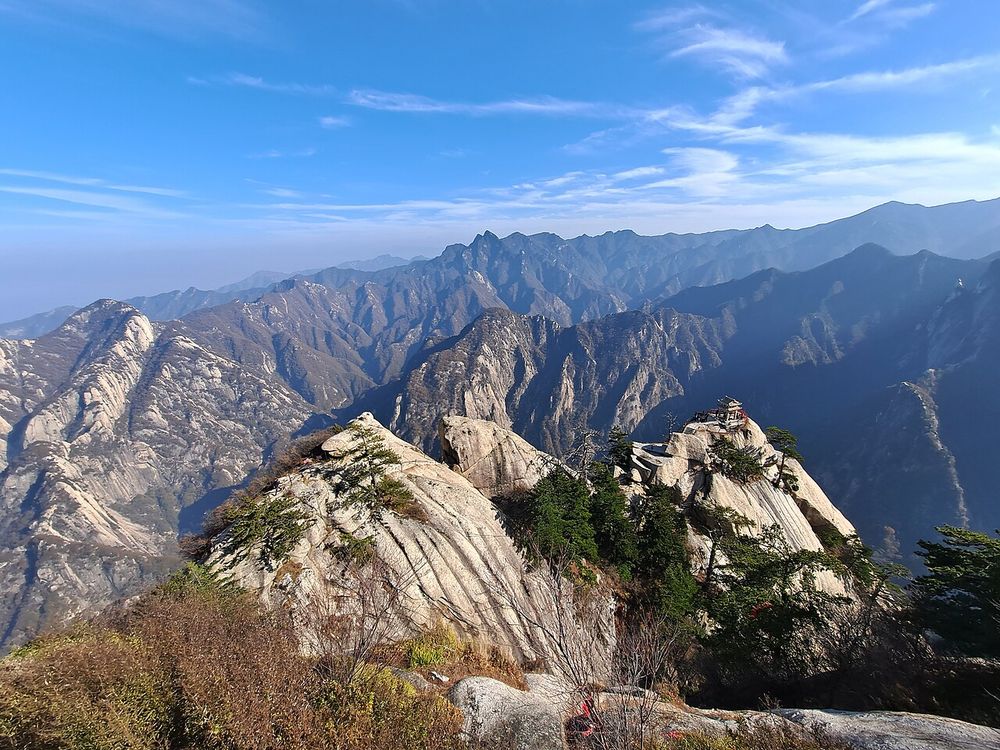
The Western of China's Five Great Mountains is a single block of granite rising almost two kilometres above the Wei River plain, cut by sheer cliffs into five peaks. For centuries Taoist hermits lived in caves on its faces, and pilgrims climbed by steps cut into the rock, holding chains. "Since ancient times there has been only one road up Mount Hua", the saying goes.
Photo: chensiyuan, CC BY-SA 4.0, Wikimedia Commons
The story
Mount Hua is the Western Mountain of the five sacred peaks where emperors made sacrifices to heaven and earth; the temple at its foot, the Xiyue Temple, received offerings for over two thousand years. Taoists saw the mountain as a place where immortals lived, and built temples and hermitages on its peaks, some reachable only by chains.
The mountain has five peaks: East, for the sunrise; South, the highest at 2,155 metres; West, shaped like a lotus; North, the lowest; and Middle, between them. Until the 20th century the only way up was the narrow path from the north, past cliffs called "a thousand feet" and "a hundred feet". Today two cable cars reach the North and West peaks.
What is here
The mountain ticket covers the peaks; cable cars, shuttle buses and the two cliff experiences are paid separately.
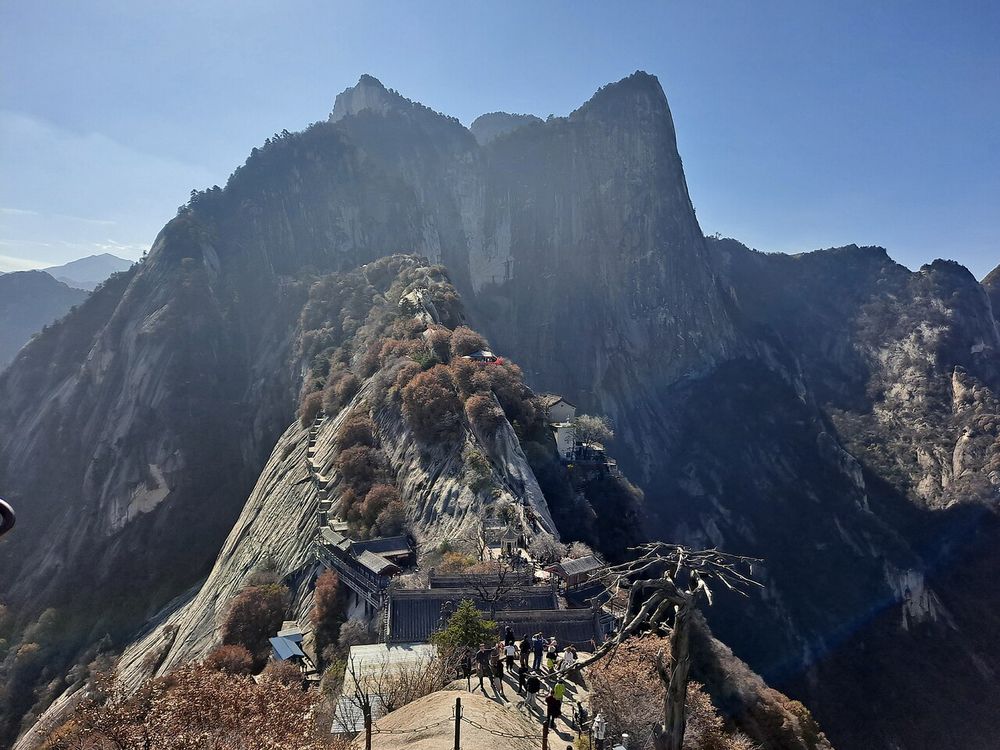
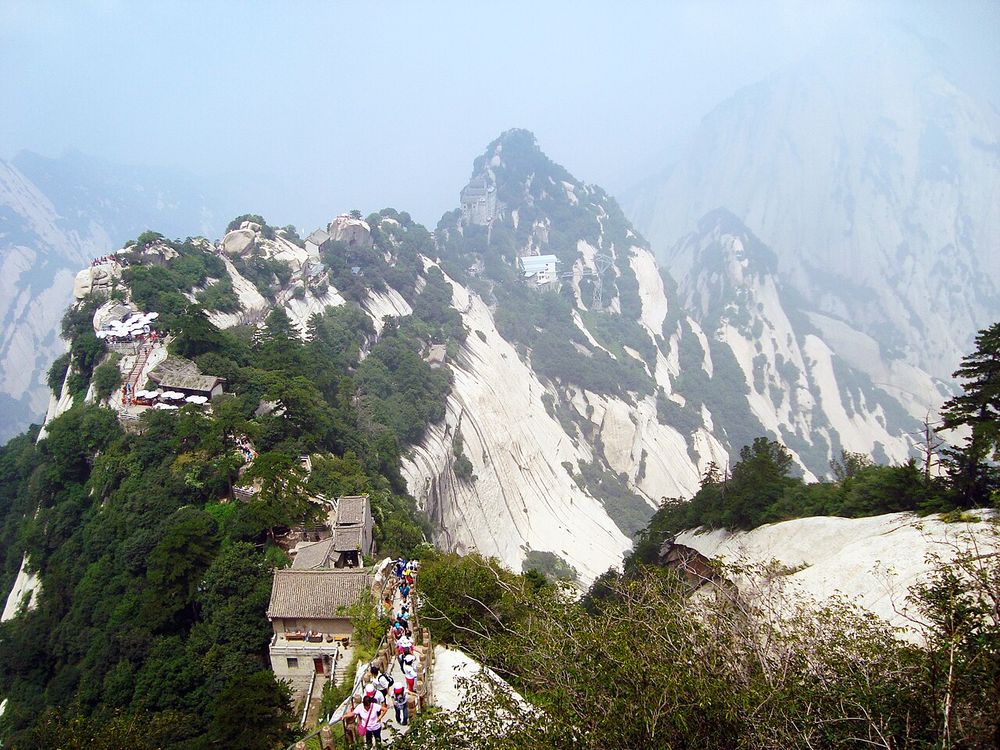
The ridge joining the North Peak to the high peaks is a blade of granite with steps cut along its spine and a drop on both sides. The poet Han Yu, the story goes, was so frightened here that he sat down, wept and threw a farewell letter over the edge. Today it has railings and chains, and thousands climb it each day.
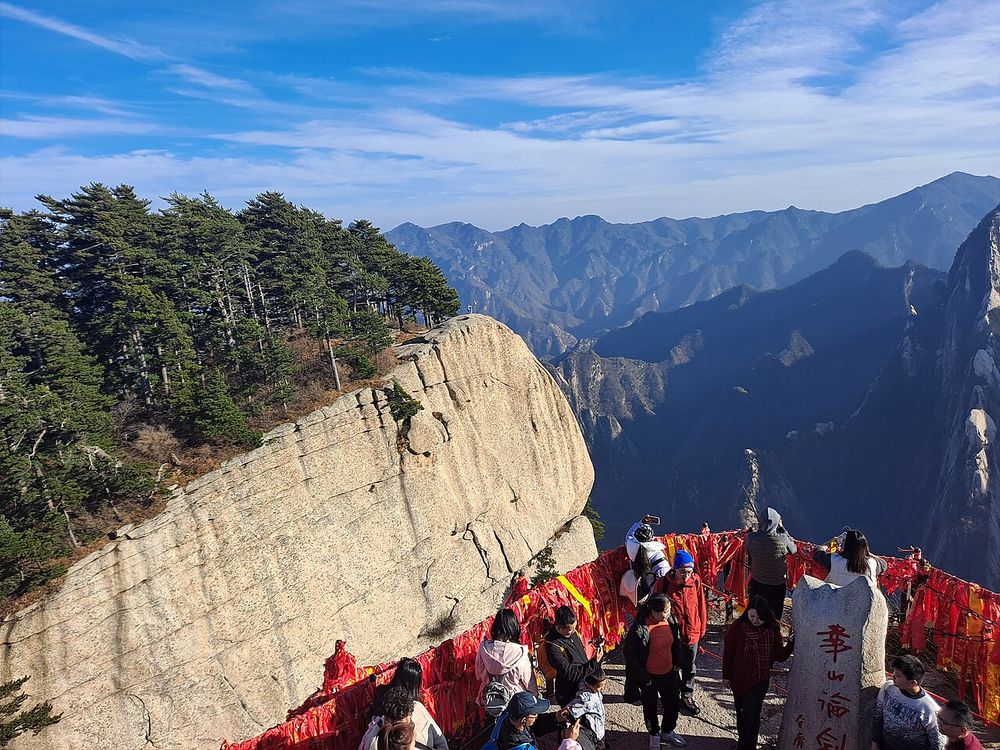
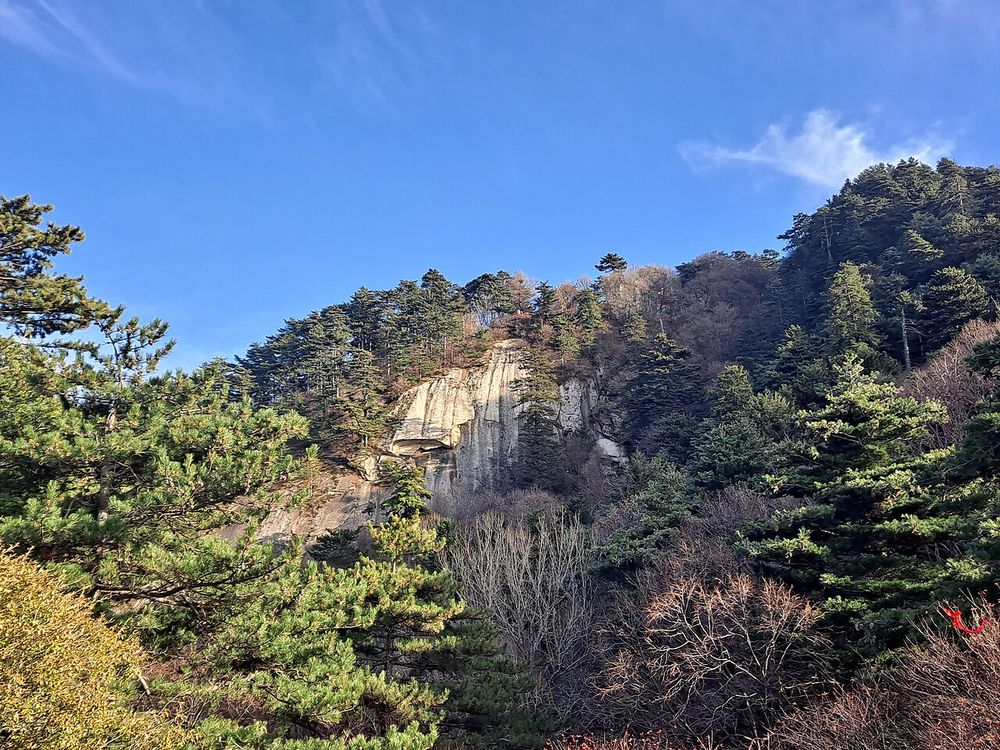
Above it, on the South Peak, the Plank Road in the Sky runs along a cliff face on boards fixed to iron pins, with a harness clipped to a cable. It is optional, and not for anyone afraid of heights.
A cliff on the South Peak, 2025H2v5o68z, CC0
Things people often get wrong
"It is the most dangerous hike in the world." The main paths have steps, railings and chains, and are climbed by huge crowds; the frightening parts are optional extras. Ice, crowds and night climbs are the real risks.
"There is one road up." There are now two main walking routes and two cable cars.
People who stood here
We searched Chinese sources first for this list, then English ones.
Li Bai (poet, 701–762)He wrote of the Western Mountain rising out of the Yellow River like a lotus flower, in "Song of the Cloud Terrace of the Western Mountain".
Han Yu (writer, 768–824)The great prose writer of the Tang climbed the mountain; a rock on Canglong Ridge is still called the place where he threw his letter.
Chen Tuan (Taoist, 871–989)The Taoist sage lived as a hermit on the mountain for decades and is said to have slept for months at a time.
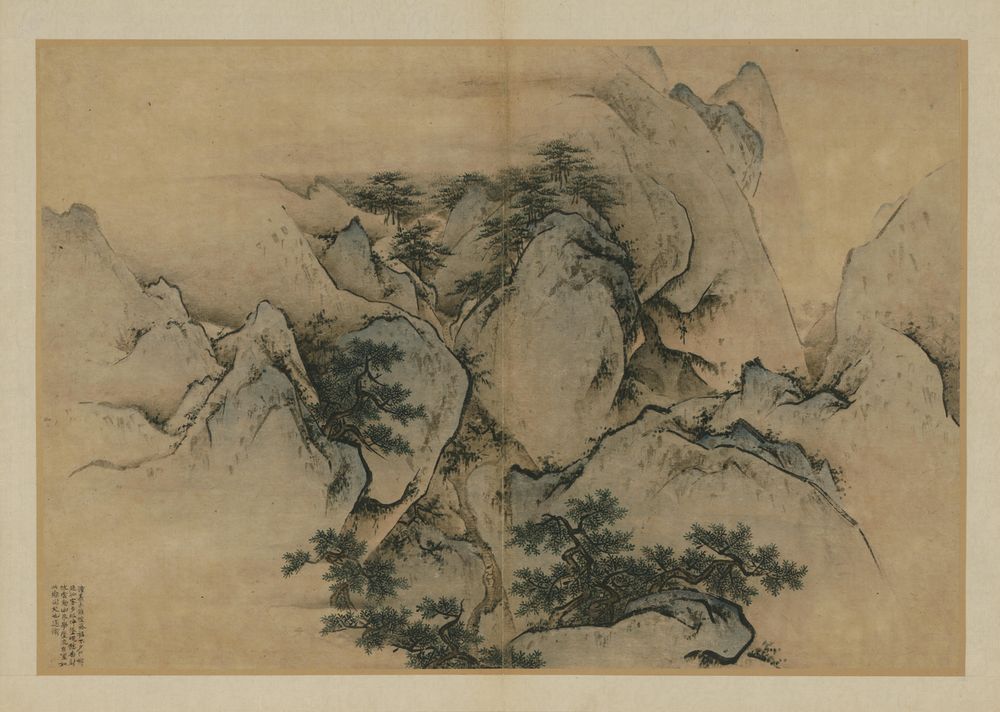
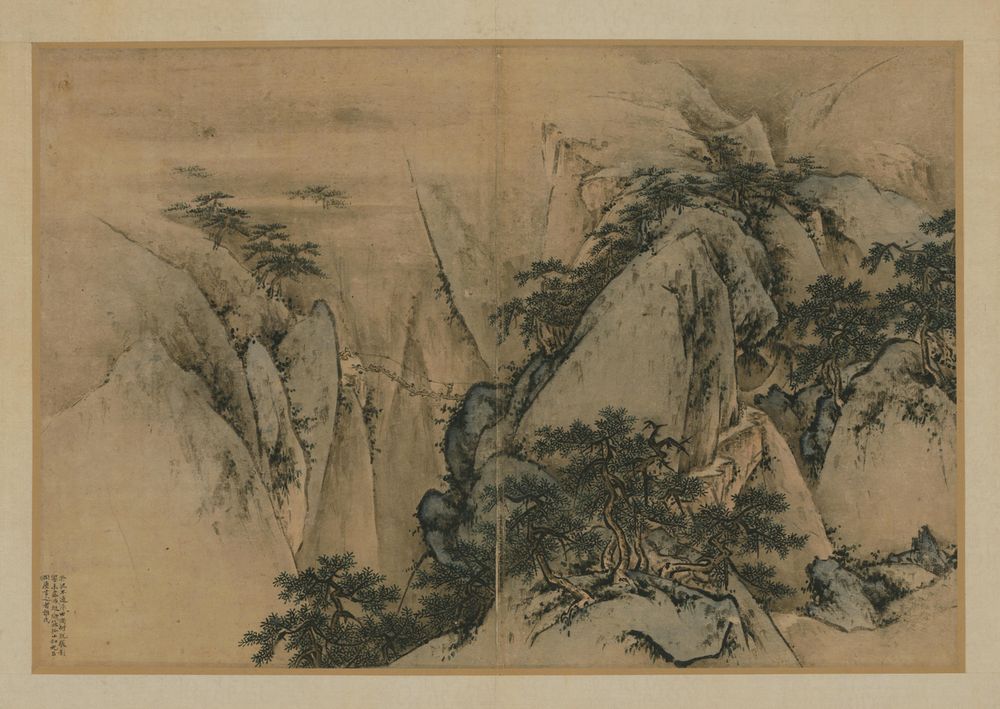
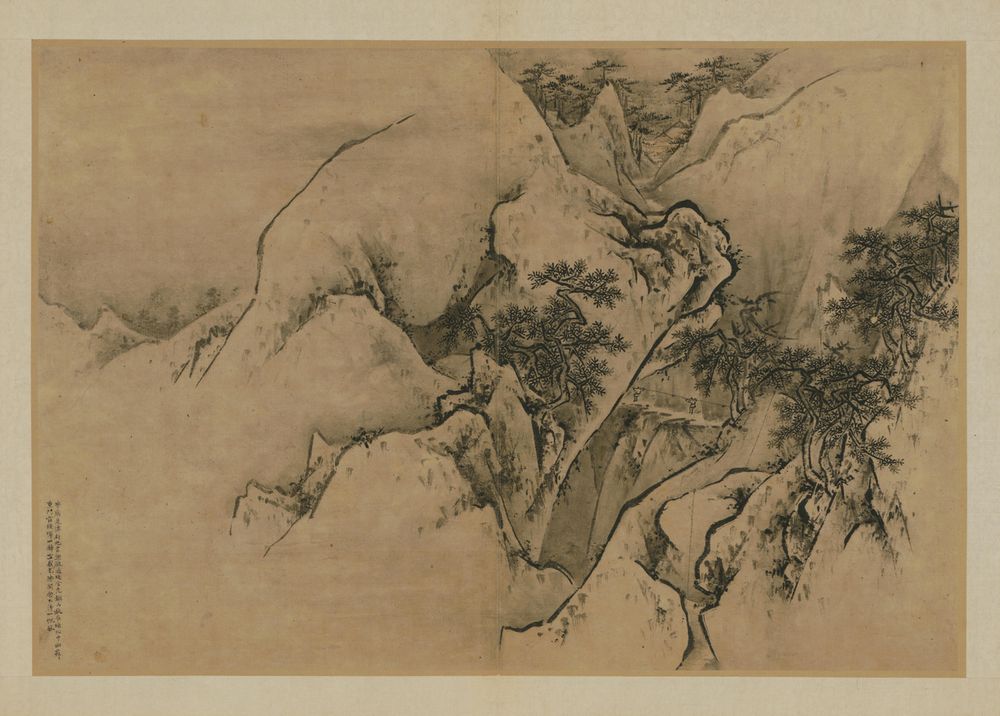
Wang Lü (doctor and painter, born 1332)In 1383 he climbed the mountain at fifty and painted an album of forty leaves from what he had seen, a rare early landscape painted from life.
Jin Yong (novelist, 1924–2018)His novels set the great sword contest of the martial world on the summit of Mount Hua; he climbed it himself in 2003.
Go deeper: from the foot to the five peaks, six stops7 stops · about 1 min to read
The classic way is "up by the West, down by the North": cable car to the West Peak, walk round the high peaks, then down Canglong Ridge to the North Peak and its cable car. Walkers can climb all night from the Huashan Gate to see the sunrise.
1. The Huashan Gate and the old path
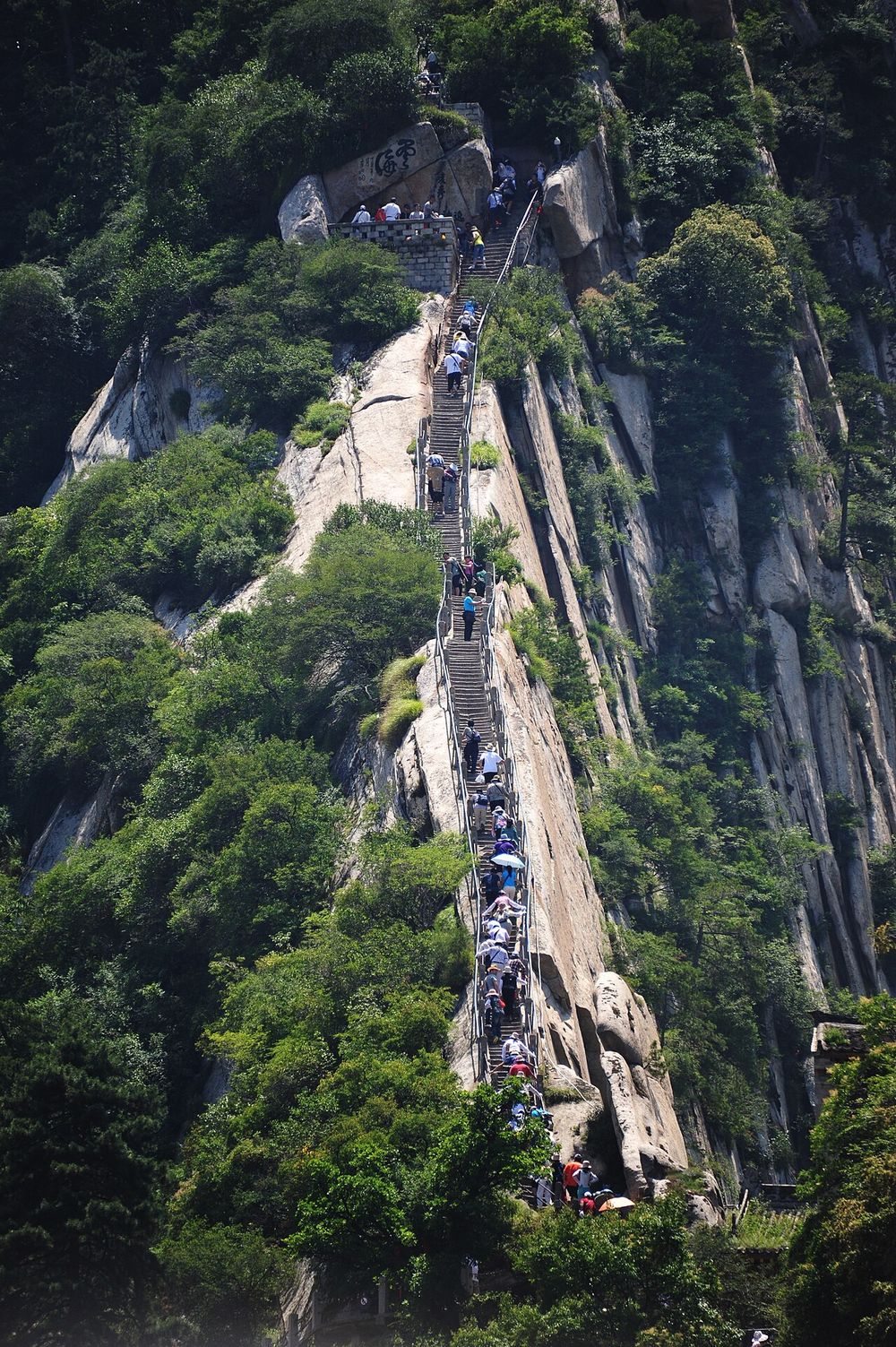
Steps cut up a cliff, 2011chensiyuan, CC BY-SA 4.0
The old route up the north valley, through the stairs of Qianchi Zhuang, so steep the steps are cut into a cleft in the rock.
2. The North Peak
The ridge from the North Peak, 2025H2v5o68z, CC0
The lowest peak, where the north cable car arrives; in 1949 a small team of soldiers climbed a cliff behind it to take the mountain.
3. Canglong Ridge and the Golden Lock Pass
Climbers on Canglong Ridge, 2025H2v5o68z, CC0
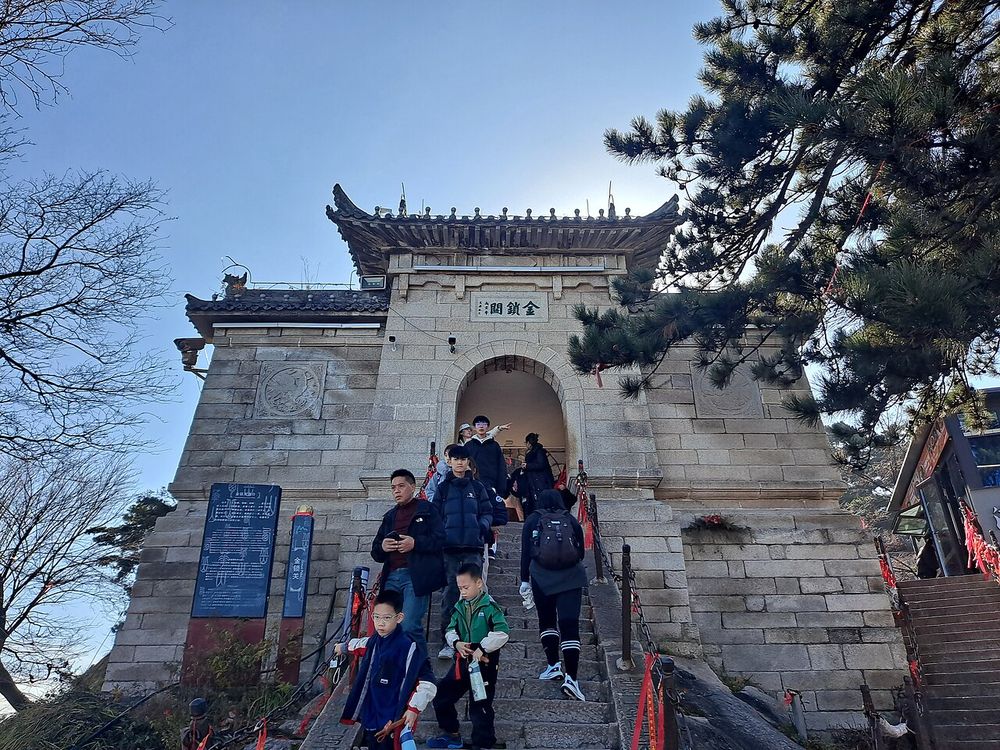
The blade of the ridge, then the gate where visitors hang padlocks on the chains for luck and love.
The Golden Lock Pass, 2025H2v5o68z, CC0
4. The East Peak
The summit of the East Peak, 2025H2v5o68z, CC0
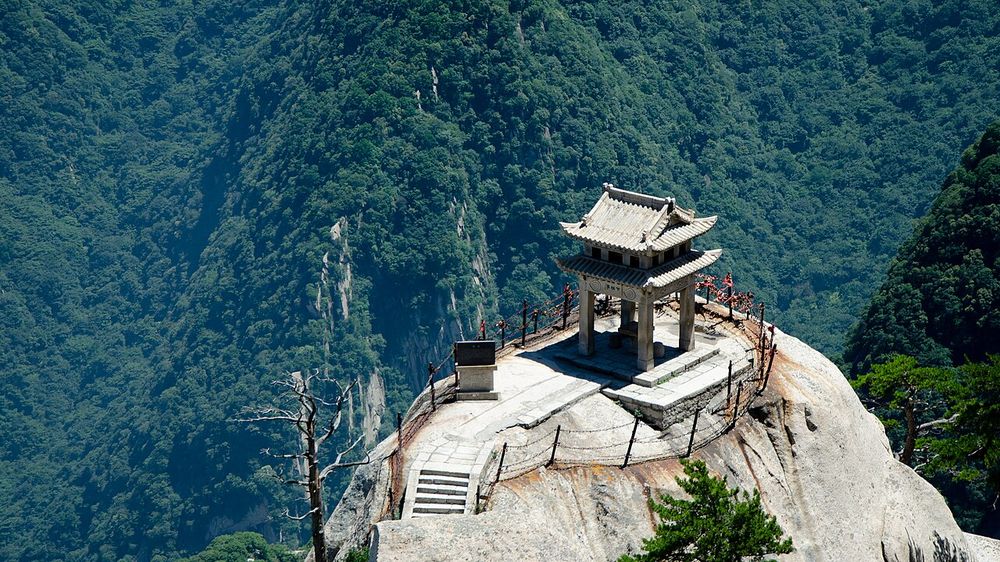
The peak for the sunrise. Below it is the Chess Pavilion and the Yaozi Fanshen, a climb down a cliff on footholds.
The Chess Pavilion below the East Peak, 2022Liuboyoupeter, CC BY-SA 4.0
5. The South Peak
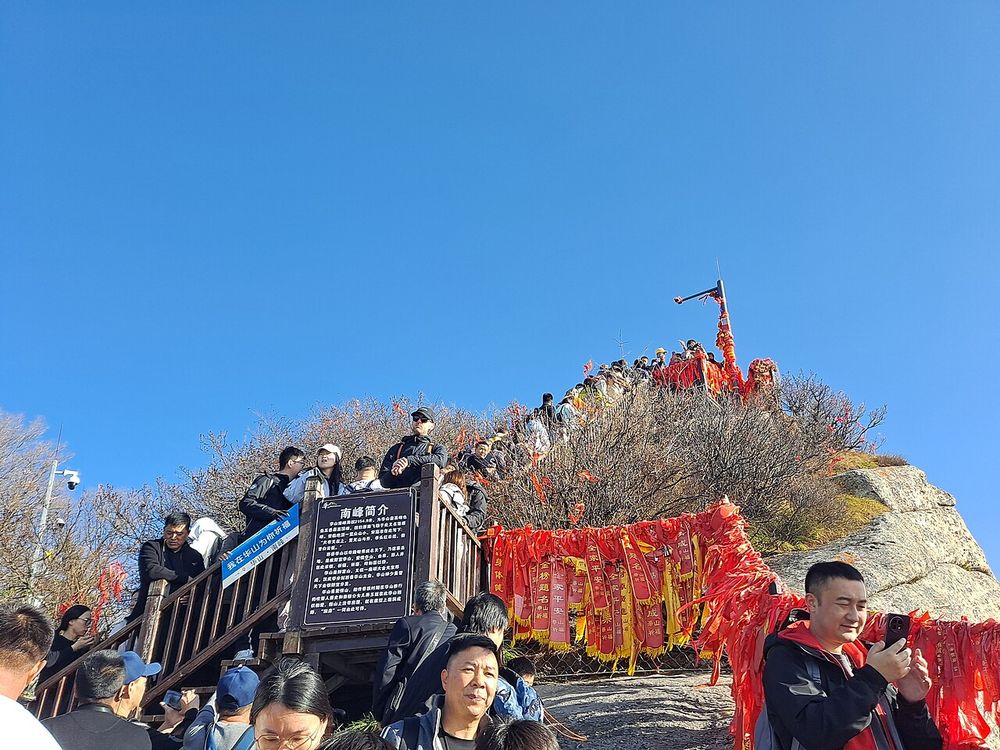
The temple on the South Peak, 2025H2v5o68z, CC0
The highest point, with a Taoist temple and the start of the Plank Road in the Sky.
6. The West Peak
The West Peak, 2025H2v5o68z, CC0
The lotus peak, with sheer cliffs on its north face and the rock said to have been split by the hero Chenxiang to save his mother.
The West Peak seen from the Middle Peak, 2025H2v5o68z, CC0
The mountain and the same years elsewhere
In 1383, when Wang Lü climbed and painted the mountain, the crisis began in Portugal that would bring the house of Aviz to the throne.
Meanwhile in the world
Year
Here
Elsewhere
1383
Wang Lü climbs and paints the mountain
The crisis of 1383–85 begins in Portugal
1949
Soldiers climb a cliff to take the mountain
NATO is founded
2013
The West Peak cable car opens
Pope Francis is elected
One line to remember: a granite mountain of five peaks, climbed on stairs cut into its cliffs.
Peaks, ridges and old paintings
The peaks of Mount Hua, 2011chensiyuan, CC BY-SA 4.0, Wikimedia CommonsSteps cut up a cliff, 2011chensiyuan, CC BY-SA 4.0, Wikimedia CommonsThe granite peaks, 2008Peretz Partensky from San Francisco, USA, CC BY-SA 2.0, Wikimedia CommonsA path in the snow, 2013Xingxing cai, CC BY-SA 4.0, Wikimedia CommonsCliffs and a templeA J Butler, CC BY 3.0, Wikimedia CommonsA sheer granite faceA J Butler, CC BY 3.0, Wikimedia CommonsSnow on the cliffs, 2009颐园新居, CC BY-SA 3.0, Wikimedia CommonsA peak above the clouds, 2004Ondřej Žváček, CC BY 2.5, Wikimedia CommonsA temple on a cliff edge, 2008Peretz Partensky from San Francisco, USA, CC BY-SA 2.0, Wikimedia CommonsA cave on the north face of the West PeakConstellationevolution, CC BY-SA 3.0, Wikimedia CommonsThe Chess Pavilion below the East Peak, 2022Liuboyoupeter, CC BY-SA 4.0, Wikimedia CommonsA porter carrying supplies up, 2015Fernando, CC BY-SA 2.0, Wikimedia CommonsThe road into the scenic area, 2024A Chinese ID, CC BY-SA 4.0, Wikimedia CommonsThe visitor centre square and the mountain, 2018Alexey Komarov, CC BY-SA 4.0, Wikimedia CommonsThe mountain from Huayin, 2018Alexey Komarov, CC BY-SA 4.0, Wikimedia CommonsThe summit of the East Peak, 2025H2v5o68z, CC0, Wikimedia CommonsA stone tablet on the East Peak, 2025H2v5o68z, CC0, Wikimedia CommonsThe view from the East Peak, 2025H2v5o68z, CC0, Wikimedia CommonsThe West Peak, 2025H2v5o68z, CC0, Wikimedia CommonsThe view from the West Peak, 2025H2v5o68z, CC0, Wikimedia CommonsThe West Peak seen from the Middle Peak, 2025H2v5o68z, CC0, Wikimedia CommonsThe temple on the South Peak, 2025H2v5o68z, CC0, Wikimedia CommonsA cliff on the South Peak, 2025H2v5o68z, CC0, Wikimedia CommonsCrowds at the top of the South Peak, 2025H2v5o68z, CC0, Wikimedia CommonsThe ridge from the North Peak, 2025H2v5o68z, CC0, Wikimedia CommonsAn old pine on the North Peak, 2025H2v5o68z, CC0, Wikimedia CommonsClimbing a steep slab, 2025H2v5o68z, CC0, Wikimedia CommonsClimbers on Canglong Ridge, 2025H2v5o68z, CC0, Wikimedia CommonsCanglong Ridge from above, 2025H2v5o68z, CC0, Wikimedia CommonsThe Golden Lock Pass, 2025H2v5o68z, CC0, Wikimedia CommonsPeaks and ridges, 2025H2v5o68z, CC0, Wikimedia CommonsA leaf from Wang Lü's Mount Hua album, 1383Wang Lü, Public domain, Wikimedia CommonsAnother leaf from Wang Lü's albumWang Lü, Public domain, Wikimedia CommonsPines and cliffs, from Wang Lü's albumWang Lü, Public domain, Wikimedia Commons
Local legends
These are stories people tell about this place. They are legends, not history, and each one says where it comes from.
LegendChenxiang splits the mountain
The goddess of Mount Hua married a mortal and was imprisoned under the West Peak by her brother; her son Chenxiang grew up, split the mountain with an axe and set her free. A split rock on the peak is shown as the place.
Source: A folk tale told in plays and in "The Magic Lotus Lantern"
LegendThe mountain lost at chess
Before he became the first Song emperor, Zhao Kuangyin played chess with the Taoist Chen Tuan, staked the mountain and lost; so, the story goes, Mount Hua has paid no tax ever since.
Source: A story told at the Chess Pavilion
Later, people who live here will be able to add the stories they grew up with, and say which of these they have heard.
Not certain, and where accounts conflict
Did Han Yu really weep on the ridge?
The story appears in a Tang anecdote collection written soon after his time, but it may have been told to mock him; the "letter-throwing place" was named much later.
Visiting
Tickets and hours
160 yuan from March to November, 100 yuan in winter; cable cars 140 (West) and 80 (North) one way; shuttle buses to the cable cars extra.
The walking gate is open 24 hours; cable cars run about 7:00 to 16:00 up and to 19:00 down in summer.
Last checked 2026-11-12. Ticket prices from the Huayin city government notice of March 2026 as reported, and 2026 Sina guides; cable car prices from the same guides.
Booking without WeChat
Official page in English Tickets must be booked in advance with your real name, by time slot, on the "华山旅游服务平台" official WeChat account or mini-program; there are no tickets at the gate. Partner sales are on Ctrip, Douyin and Tongcheng.
Note Foreign visitors book with a passport number and enter with the passport.
Checked 2026-11-12
Where to start
For most visitors: West Peak cable car up, walk the peaks, Canglong Ridge down to the North Peak cable car.
To see the sunrise on the East Peak, climb overnight or sleep in a hostel on the mountain.
Before you go
High-speed trains reach Huashan North station from Xi'an in about half an hour.
Wear shoes with grip and gloves for the chains; it is cold on top even in summer.
Customs and manners
On narrow stairs, keep right and let people coming down pass.
The Taoist temples on the peaks are working temples: be quiet inside.
Opening hours are given in the local time of the place. Prices are in the local currency. The figure after ≈ is approximate, at exchange rates checked on 9 November 2026, in .
Look for these
On Canglong Ridge, find the rock where Han Yu threw his letter.
On the West Peak, find the split rock of Chenxiang.
Compare Wang Lü's paintings with the cliffs you climbed.
I am here
Stand at the site, sign in, press the button, and collect its stamp. Your browser will ask to use your location. It is sent to us once to confirm that you are at the site; we keep how far you were from it, not the spot where you stood.
Your stamps are saved to your account, so they follow you to any device. Checking from a browser cannot rule out every false location; stricter checks arrive with the app.
Messages
Share your photos
Photos here show the place, not people. Each one is credited to the visitor who took it and appears after our team has looked at it. A photo with you in it belongs under “I am here”.